
Article

TGR-T: Truncated-Gaussian-Weighted Reliability for Adaptive Dynamic Thresholding in Weakly Supervised Indoor 3D Point Cloud Segmentation

by
Ziwei Luo
1,2,
Xinyue Liu
1,3,
Jun Jiang
1,4,
Hanyu Qi
1,
Chen Wang
1,
Zhong Xie
2 and
Tao Zeng
5,6,*
1
School of Computer Science and Artificial Intelligence, Wuhan Textile University, Wuhan 430200, China
2
School of Computer Science, China University of Geosciences, Wuhan 430074, China
3
Engineering Research Center of Natural Resource Information Management and Digital Twin Engineering Software, Ministry of Education, Wuhan 430074, China
4
Hubei Key Laboratory of Intelligent Geo-Information Processing, China University of Geosciences, Wuhan 430074, China
5
School of Electronic Information Engineering, Sichuan University, Chengdu 610065, China
6
Chengdu Qianjia Technology Co., Ltd., Chengdu 610207, China
*
Author to whom correspondence should be addressed.
ISPRS Int. J. Geo-Inf. 2026, 15(3), 108; https://doi.org/10.3390/ijgi15030108
Submission received: 14 January 2026 / Revised: 23 February 2026 / Accepted: 2 March 2026 / Published: 4 March 2026
(This article belongs to the Special Issue Indoor Mobile Mapping and Location-Based Knowledge Services)

Abstract

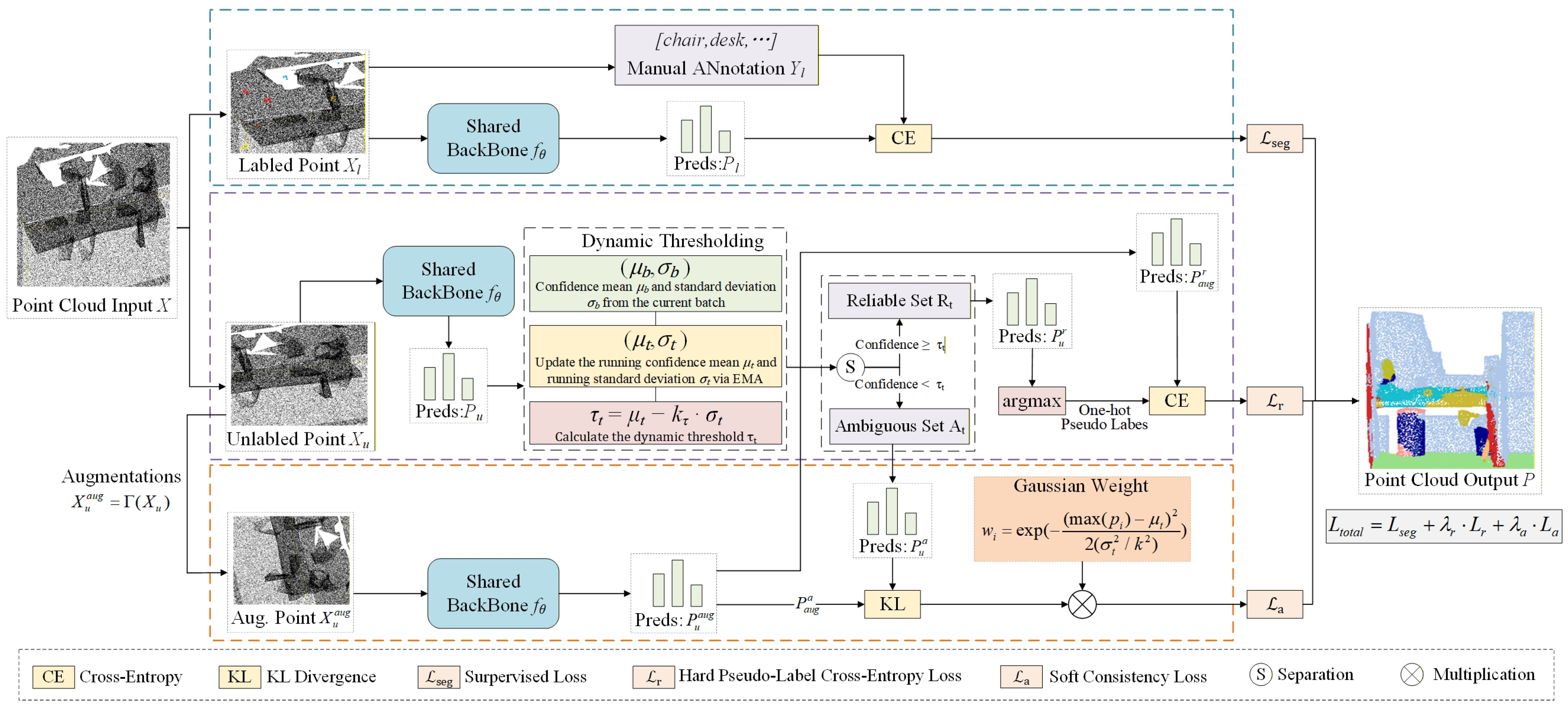
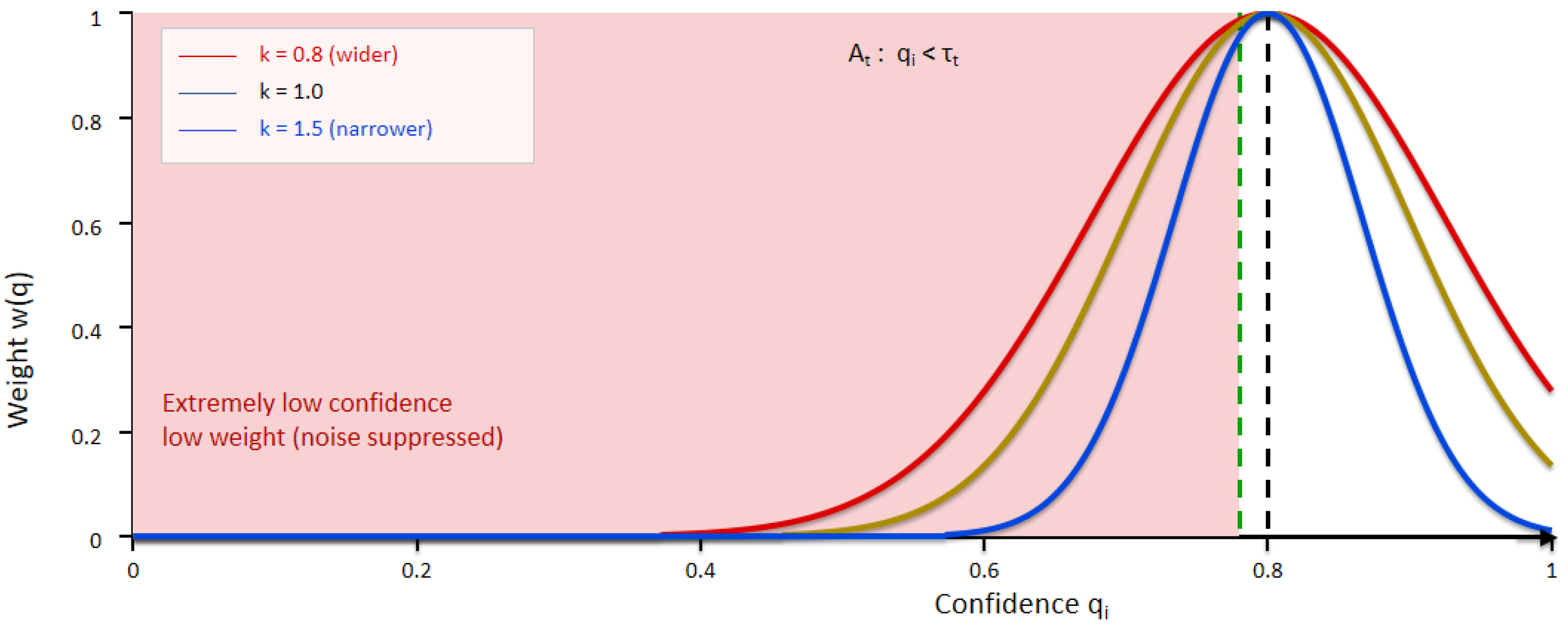
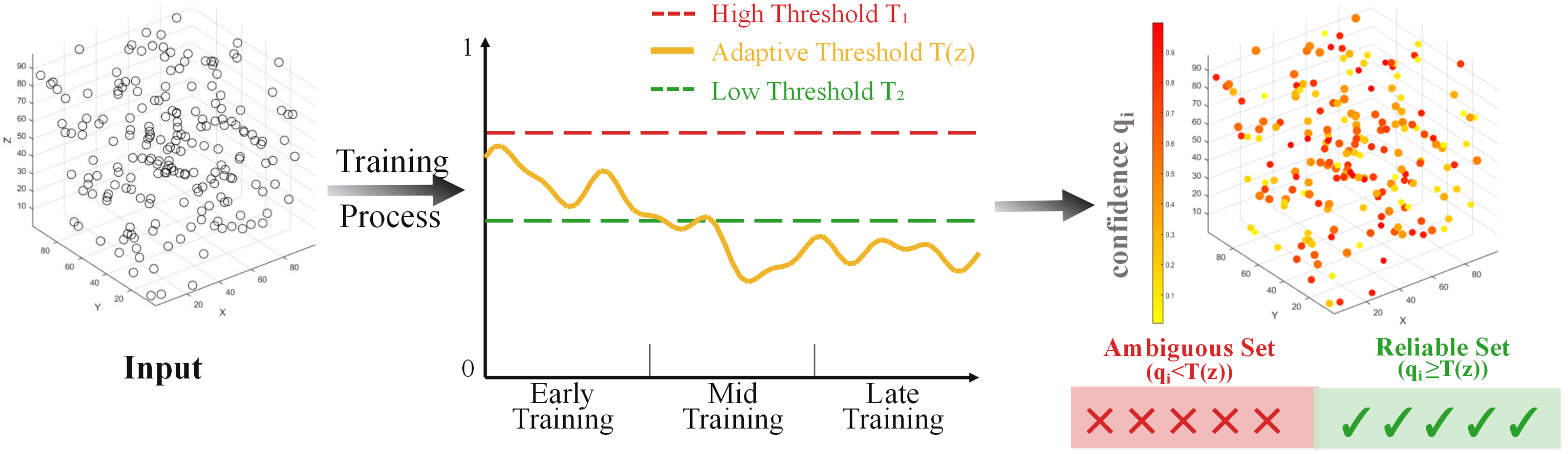
Indoor 3D point cloud semantic segmentation is a fundamental task for fine-grained scene understanding and intelligent perception. Due to the prohibitive cost of dense point-wise annotations, weakly supervised learning has emerged as a promising alternative for indoor point cloud segmentation. However, existing weakly supervised methods commonly rely on fixed confidence thresholds for pseudo-label selection, which exhibit limited generalization caused by threshold sensitivity, underutilization of informative low-confidence regions, and progressive noise accumulation during self-training. To address these issues, we propose TGR-T, a weakly supervised framework for indoor 3D point cloud semantic segmentation that incorporates truncated-Gaussian-weighted reliability with adaptive dynamic thresholding. Specifically, a reliability-adaptive dynamic thresholding strategy is introduced to guide pseudo-label selection based on the evolving confidence statistics of unlabeled mini-batches, with exponential moving average smoothing employed to produce stable global estimates and robust separation of reliable and ambiguous regions. To further exploit uncertain regions, a learnable truncated Gaussian weighting function is designed to explicitly model prediction uncertainty within the ambiguous set, providing soft supervision by assigning adaptive weights to low-confidence predictions during optimization. Extensive experimental results demonstrate that the proposed framework significantly enhances the exploitation of unlabeled data under extremely limited supervision: extensive experiments conducted on standard indoor 3D scene benchmarks demonstrate that TGR-T achieves competitive or superior segmentation performance under extremely sparse supervision and can even outperform several fully supervised baselines trained with dense annotations while using only 1% labeled points, thereby substantially narrowing the performance gap between weakly supervised and fully supervised 3D semantic segmentation methods.
Keywords: 3D point cloud semantic segmentation; indoor scene; weakly supervised learning; dynamic thresholding; truncated-Gaussian weighting; pseudo-label refinement 3D point cloud semantic segmentation; indoor scene; weakly supervised learning; dynamic thresholding; truncated-Gaussian weighting; pseudo-label refinement