
Abstract
This study touches upon the issue of searching for tourist information in the context of preferred forms of cartographic presentation in different geographic scales. The main objective of our research was to examine the link between the type of tourist information that is searched for and the graphical level of abstraction, as well as geographic scale. We used the method of the online survey on twelve maps to study users’ preferences in two respondent groups: geographers and sociologists. Based on the map rankings obtained, we have drawn conclusions on the informative value of realistic and conventional sources of tourist information. The study has demonstrated the globalization of social behavior that significantly favors global web map services over other online sources. The most important factor in choosing a map is whether it contains the information the user is currently seeking. It is impossible to clearly indicate a preferred level of abstraction for presenting tourist information at every geographical scale. However, consistently high rankings were observed for maps using pictorial and symbolic signs. The map type preferences of geographers and sociologists were very similar, although geographers showed a slightly stronger preference for maps with conventional symbols. All respondents rated traditional hypsometric maps highly.
1. Introduction
Travel, as frequent in today’s tourism-dominated mobile world as it is now, is often related to seeking information about one’s selected destination, e.g., in guidebooks, maps, apps, one’s friends’ opinions, etc. [1]. Studies confirm, however, that the internet has been a fundamental source of information for years, although the way it is used has been changing, along with the ways of popularizing its use for promotional purposes by the tourism industry [2,3].
Maps and other cartographic visualizations closely connected with the geographic scale are actually among the most user-friendly forms of spatial representation [4,5]. In this research, geographical scale is synonymous with cartographic scale, i.e., map scale. In definitions of a tourist map, emphasis is placed on the represented area, the map scale, and its intended use. A tourist map should include topographic features as well as information on tourist attractions and infrastructure, presented using conventional symbols appropriate to the map scale and its intended purpose [6]. Tourist maps and other representations play an important role in the creation of tourist spaces [7]. Tourist maps convey spatial information by means of graphic symbols, allowing tourists to localize objects at different scales with an appropriate level of detail, depending on the extent of tourist exploration [8]. Maps constitute a specific type of visual representation of reality [9,10], i.e., they show some particular features of what is present at the moment, in this case, of the place that a traveling person is going to. The research on the influence of interactive thematic maps on tourist perceptions is interesting, in which the form of graphic design plays a less important role [11].
Representations, including maps, differ in terms of the level of conventionality, i.e., the way of presenting significant features of space [12] and from simple to complex maps [13]. Even considering the fact that all maps are conventional in nature, if the categories derived from classical semiotics and semiology are applied, it becomes apparent that some maps are index maps, and some of them are icon or symbolic maps [14,15]. Index maps are, for instance, ortophotomaps, as well as satellite and aerial images, with markings or names of specific places plotted onto them.
Icon maps are those on which we can recognize visual resemblance between the real-life image and what is presented on the map since the map uses pictures or realistic graphics of the structures and objects that exist in real life [16]. Symbolic or conventional maps are maps that are based on the rules of cartographic semiotics, i.e., using traditional, conventional symbols on the map [17].
The usefulness of a given map may be correlated not only with its level of detail, geographic scale, and the extent to which it includes useful information that a person is searching for, but also with the extent to what extent the person can read the relevant information, and the extent to which the person knows the conventions of map reading [18]. Such skills and acquired predispositions, either learned at school or at university, or acquired via web services by map users, may be defined as cartographic competence or cartographic skills [19]. Competence may be combined with the knowledge of conventions that rule the map creation process and with map-reading skills, whereas habits may result from the long-term usage of the most popular global web map services [20]. In contemporary tourism, such competence comes hand-in-hand with the popularization of map design on global services [21].
At present, most global web map services offer a choice between a conventional map and an orthophotomap, commonly referred to as a satellite, which is satellite imagery with geographical coordinates [22]. Orthophotomaps, also called image maps (orthoimage maps), have become very popular and are also preferred by users [23].
At the same time, maps with pictorial graphics that can be easily associated with real-life objects, as well as pseudo-3D graphics that directly imitate specific tourist attractions, are considered visually attractive [24]. Typical cartographic icons and symbols are at the higher level of graphical abstraction [25].
What seems interesting is the fact that recipients prefer specific map types for tourist information for a given geographic scale, considering them more informative. Hence, in this study, the number of times a given cartographic representation was selected by a person searching for information over other representation types is the indicator of the informative value of this cartographic representation, and users’ preferences can be organized into a pattern that puts maps in order from the most to the least frequently selected ones. Additionally, what we are going to examine is whether or not the preference for a particular map type and selecting them in the specific order depends on two variable groups: the type of information searched for and the cartographic competence and habits [26].
In the case of research on the effectiveness of several point-of-interest (POI) pictograms on tourist maps, online questionnaires are used, where users provide an assessment of the correct interpretations of the pictograms [27]. In such cases, statistical tests work well—they show simple and statistically significant correlations between individual interpreted signs. However, for more complex rankings for multiple variants, appropriate visualization of the obtained data can be used, which will be the basis for both analysis and synthesis of the obtained information [28]. In turn, to perform a certain synthetic evaluation of several features and several methods, the total factor is practical, e.g., the total informative value [29].
When studying geographic phenomena that are commonly comprehensible to society, it is worthwhile to obtain the opinions of respondent groups that differ in terms of the education profile. In this study, we demonstrated an approach to evaluating sources of tourist information about an unknown country, city, and city square, based on the opinions of geographers and users with different educational profiles.
The main objective of the research was to examine the relationship between the type of tourist information sought and the graphical level of abstraction of maps across geographic scales: country, city, and city square. In addition, the following specific research questions were addressed:
- —
- What are the current preferred sources of tourist information, and do these preferences depend on the educational profile of users?
- —
- Is there a single preferred graphical form of a tourist map for searching for information about an unknown area?
- —
- Is the content of tourist information related to the choice of a cartographic presentation with a specific level of abstraction?
- —
- What similarities and differences exist between geographers and sociologists in their preferred types of tourist maps?
2. Materials and Methods
To meet the objective and answer the questions raised, the research was divided into the following stages:
- —
- Creating a set of cartographic visualizations according to three geographical scales (country–city–square) and four graphical levels of visualization abstraction (Section 2.1);
- —
- Preparation and conduct of an online survey among students of Geography (Geoinformation) and non-Geography (Sociology) and from one university, who have never been to the mapped country (Section 2.2);
- —
- Statement of general preferences related to sources of tourist information (Section 3.1);
- —
- Analytical ranking of information about the country, about the city, about the square according to three geographical scales—visual presentation of the complex ranking results in the form of a structured table with color-coded equivalents (Section 3.2, Section 3.3 and Section 3.4)
- —
- Preparation of synthetic tourist informative value of cartographic presentations—a total numeric determination of the informative value for each cartographic presentation (Section 3.5).
2.1. Cartographic Materials
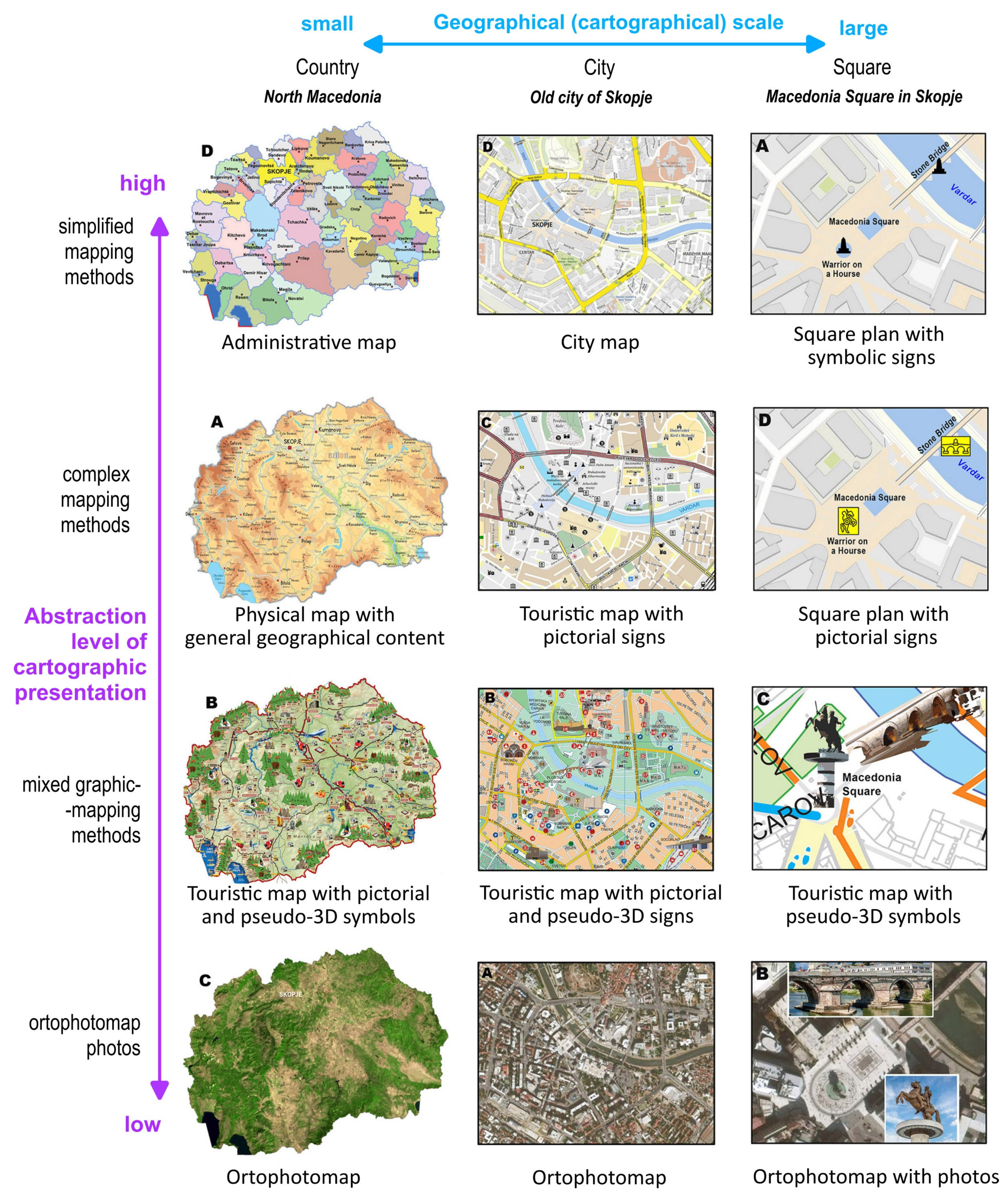
North Macedonia, the Old City of Skopje, and Macedonia Square in Skopje have been selected as geographical units for the preparation of cartographic material. The choice of North Macedonia was dictated by the fact that it is hardly visited by potential tourists, which was supposed to be the precondition, so that the respondent had to search for information about the country, having never previously visited it. The choice was also determined by the relatively regular and condensed shape of the area of Macedonia, which allowed users to focus on the visualization’s content and level of abstraction instead of the shape of the geographical unit [30].
Figure 1 shows patterns with the order of twelve cartographic visualizations in two criteria: geographic scale and level of abstraction. A small scale was used for the representation of the country, and the average scale was used for the city and the city square. Maps were downloaded from the internet; only icons and symbols were designed for the square map. Four selected levels of abstraction of cartographic representations are linked with different levels of mapping’s conventionality, starting with the most indexical mapping, photographic in nature, and ending with the entirely conventional, symbolic mapping [31].
Figure 1.
Research material order of twelve cartographic representations according to geographic scale and level of abstraction (source available from: (A) https://macedonia-timeless.com/pol (accessed on 19 February 2024); (B) https://www.freeworldmaps.net/europe/macedonia/map.html (accessed on 19 February 2024); (C) vidiani.com/large-detailed-tourist-map-of-skopje-city/ (accessed on 19 February 2024); (D) https://centercrcd.org/2015/12/04/free-map-of-skopje-for-young-people/ (accessed on 19 February 2024).
As far as the online survey was concerned, three sets of visualizations, each one with four maps, were prepared. Following the rule of the geographic description and cartographic representation (moving from the general to details), firstly, respondents could see the task with the ranking of four maps of the country in the form of an island-shaped map on the monitor, then, four versions for the framed city area, and, finally, the city square (Figure 1). Each map was marked with letters A, B, C, and D, respectively. To avoid the effect of “learning” in the process of completing consecutive tasks, the order of map types was changed [29].
2.2. Procedure and Participants
The online survey was activated in the Limsurvey app for students of Geography (Geosciences) and Sociology from one university. The survey was closed after 50 questionnaires were filled in correctly in each group. The survey opened with three questions:
Do you often travel for tourist purposes?
Do you often search for information before traveling?
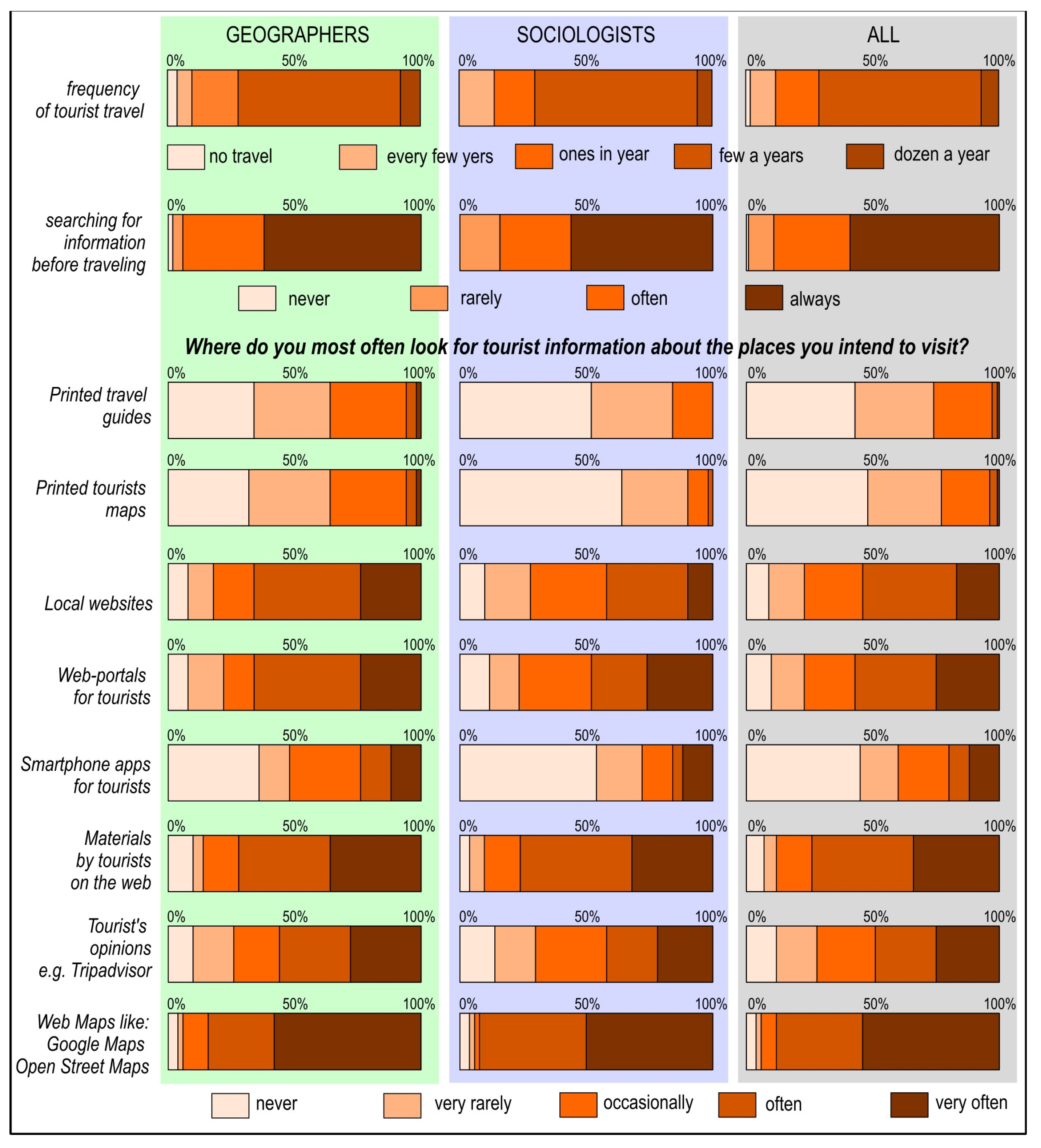
Where do you usually search for tourist information? (Figure 2):
Figure 2.
Preferred sources of tourist information on the internet according to respondents’ answers.
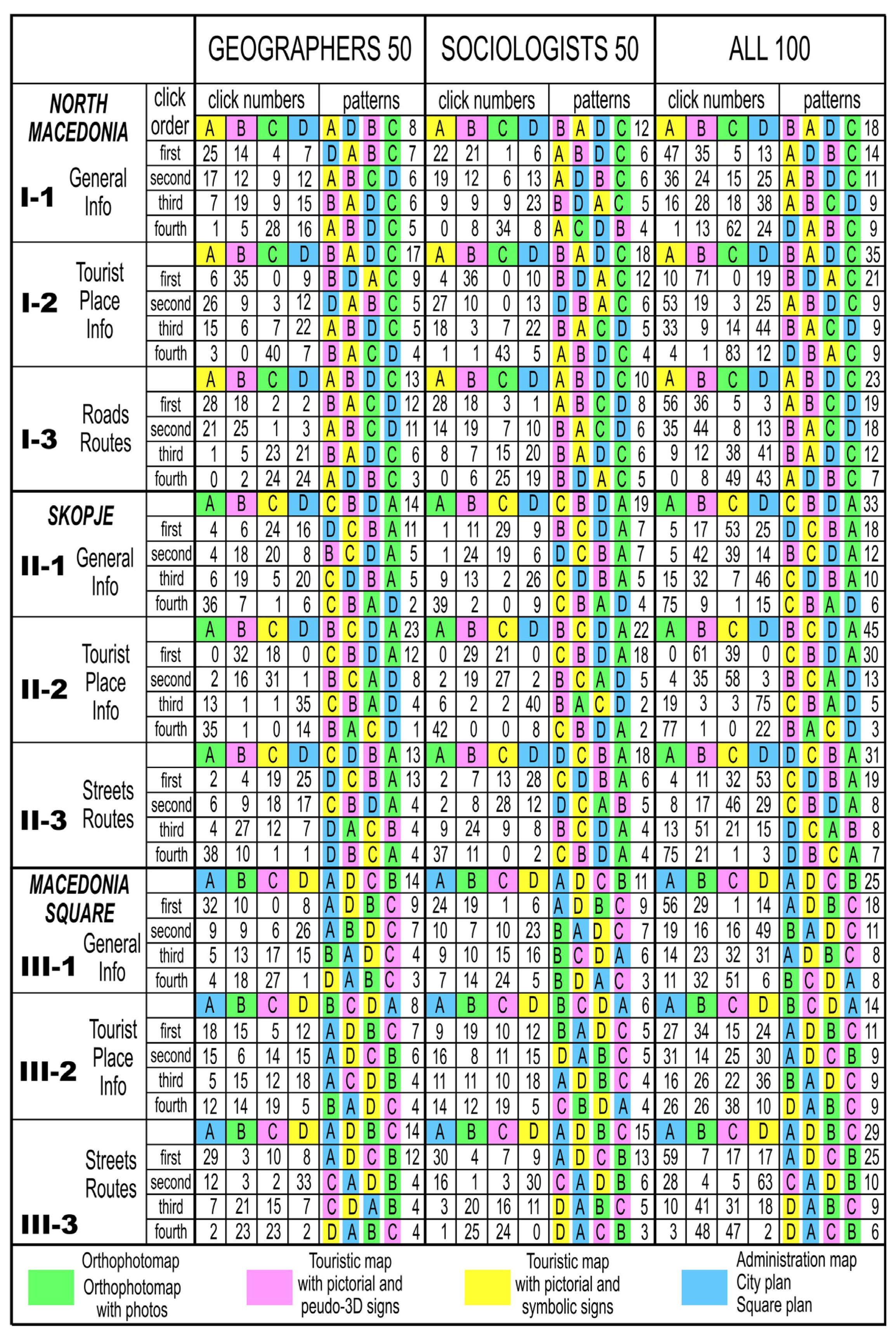
Then, respondents received three consecutive tasks on three consecutive templates (views) for North Macedonia in full view on the monitor (Figure 3):
Figure 3.
Frequency (click order from first to fourth click) and patterns (the five most common patterns) of choices by respondents.
- –
- I-1: Imagine that you are going to visit North Macedonia and you are searching for general information. On the internet, you find four maps that give you access to the information you need. Decide which one out of those four maps (A-B-C-D) you click on first, second, third, and fourth.
- –
- I-2: Imagine that you are going to visit North Macedonia and you are searching for tourist information about places/objects. On the internet, you find four maps that give you access to the information you need. Decide which one out of those four maps (A-B-C-D) you click on first, second, third, and fourth.
- –
- I-3: Imagine that you are going to visit North Macedonia and you are searching for tourist information about routes/roads. On the internet, you find four maps that give you access to the information you need. Decide which one out of those four maps (A-B-C-D) you click on first, second, third, and fourth.
With the above instruction, the respondent could see all four maps of Macedonia on the monitor in the A-B-C-D order (Figure 1). After that task was completed, the respondent saw a view of the analogical tasks for the Old City in Skopje and, finally, the same task for Macedonia Square in Skopje. Three tasks with three subtasks were marked in Figure 3.
At the end of the survey, respondents filled in the personal data form concerning their major and sex. One hundred respondents aged 19–26 answered the sex question as follows: Female (54), Male (39), Other (5), Prefer not to answer (2). Geography students and students majoring in similar subjects answered as follows: Female (19), Male (29), Other (1), Prefer not to answer (1); Social Studies students: Female (35), Male (10), Other (4), Prefer not to answer (1).
The respondents took part in the anonymous online survey voluntarily and without any financial gratification. Each respondent was informed of the scientific nature of the study during the first view of the survey, as well as of the opportunity to discontinue taking part in the survey at any moment, and of full anonymity. The respondent could move on to the next question after the previous question had been answered, without the opportunity to go back to the previous question.
3. Results
3.1. General Preferences Related to Sources of Tourist Information
Based on the answers included in Figure 2, we could notice that 64% of students from both groups traveled for tourist purposes with the same frequency, i.e., a few times a year. Both groups declared that they definitely search for information before traveling, with geographers doing it more often than sociologists. Considering all respondents, both in total and as two separate groups, it can be observed that web map services are visibly the most important sources of tourist information. Online resources and recommendations created by other tourists and published on the internet, as well as websites collecting tourist reviews, are highly popular too. Although local websites that contain a lot of information for potential tourists and web portals for tourists are widely popular among geographers, they are less popular with sociologists. The smartphone app for potential tourists is significantly less popular. Printed guidebooks are not used frequently, and printed tourist maps ranked the lowest.
3.2. Information About the Country (Figure 1 and Figure 3)
3.2.1. General Information
The results for sociologists were the same as for geographers regarding maps, the most and least frequently selected as the first choice. It is noteworthy that sociologists would choose map B almost as frequently as map A. The results can be interpreted as follows: physical maps with hypsometric tints A, which students are taught to interpret at school, combine the value of realistic representation that is entirely conventional with purely conventional elements, which leaves the impression of the abundance of information that the map offers. ADBC seems to be the pattern chosen most frequently by geographers for general information about the country; however, it is noteworthy that slightly fewer people made a choice following the DABC order.
3.2.2. Tourist Place Information
Tourist map B was most frequently selected as the first choice by both geographers and sociologists. The pseudo-3D symbols were highly suggestive and easily recognizable. Although these symbols are large and occupy substantial map space, respondents appreciated the immediate visual information about tourist sites in North Macedonia. The second most frequently selected map was physical map A, characterized by pleasant hypsometric colors and clearly legible city and regional names. The orthophotomap C, chosen the least often, was considered useless in terms of finding information about sights worth seeing in North Macedonia. The most frequently chosen pattern of maps among geographers, BADC, definitely leaves the second most popular one, BDAC, far behind. The situation looks exactly the same for sociologists.
3.2.3. Tourist Route Information
In both groups, the results were identical, with physical map A most frequently selected as the first choice and tourist map B as the second. In this case, the tourist map with large symbols placed along roads was less preferred than the physical map that displayed roads clearly but did not include tourist objects.
Orthophotomap C and administrative map D were selected significantly less frequently. This indicates that the degree of cartographic conventionality was not a decisive factor. More important was whether the map contained essential information, particularly the main tourist routes for traveling around North Macedonia.
In this task, the preferred pattern was again ABDC, although this preference was more pronounced among geographers than sociologists. The second most common sequence among geographers was BACD, while among sociologists it was ABCD, though the differences were minimal.
3.3. Information About the City (Figure 1 and Figure 3)
3.3.1. General Information
We did not specify the exact type of information needed, leaving it entirely up to the person who was filling in the survey. Both groups, geographers and sociologists, selected the map of the city with symbolic and pictorial signs C as the first choice. On that map, signs in black were visible due to the contrast with the rest of the map content. The map included a lot of information; however, it could still be easily read because of its coherent graphic style that referred to conventional cartographic symbols. Interestingly, that map was selected more often as the first choice than tourist map B, which might have been considered visually chaotic due to its incoherent sign and icon system. Orthophotomap A was selected the least often in both groups. It was the closest to the real-life image in the sense that it was a satellite image of Skopje, but it lacked the information needed by tourists.
CBDA, which favored maps with intuitively understood information about what may be interesting for tourists to see in their visited town or city, was the most frequent pattern in both groups. What is noteworthy, symbols that were iconic in nature played a significant part in such preferences, as their presence made map D rank third.
3.3.2. Tourist Place Information
Both groups, sociologists and geographers, selected the tourist map with pictorial and pseudo-3D signs B as the first one and the map with pictorial signs C as the second one. These two maps included a wealth of information about tourist attractions in Skopje, but map B was less abstract. The most interesting attractions were represented by pseudo-3D signs resembling the real-life tourist sights. Again, ortophotomap was chosen the least often. It was the most faithful photographic representation of the city’s topography, but it did not show what was worth seeing. Apparently, respondents preferred maps that included the information they needed but also maps that used icons rather than symbols to convey information.
The most frequent pattern of map choice, BCDA, was similar for both groups, which means a preference for tourist maps with cartographic signs for searching touristic objects in the city. All students rated the easy-to-read city map without tourist symbols lower, and the orthophotomap the lowest.
3.3.3. Tourist Route Information
In this case, both groups preferred map D as their first choice and map C as their second choice. A preference for maps with streets particularly displayed with names can definitely be observed here; however, the fewer other symbols the map has, the better. The process of map selection may thus be pictured as a situation in which respondents select maps that contain the information needed by them but reject those that have too many signs and symbols. Therefore, it was no coincidence that for that task we selected the most abstract map that significantly highlighted the information searched for.
Geographers selected the order CDBA, and sociologists selected the order DCBA. That means that even though both groups rejected the orthophotomap as not very useful and the tourist map, geographers chose the more complex city plan C, and sociologists preferred its simplified version D. This fact portrays a visible difference in the map reading skills between the two groups since sociologists are not as good at reading some signs and symbols as geographers, who understand them well.
3.4. Information About the Square (Figure 1 and Figure 3)
3.4.1. General Information
In this case, both geographers and sociologists selected the square plan with simplified black symbols and descriptions (Square Plan A). This most abstract and conventional cartographic form allowed users to identify locations and key attractions without providing excessive additional information. Interestingly, map B was chosen as the second most popular one, which was actually the orthophotomap with pictures of tourist attractions, the most realistic representation of the place that we asked about. It is possible that respondents could find information about the specificity of Macedonia Square in a fast and easy way. What is even more interesting, tourist map C was most often chosen last, probably because its pseudo-3D symbols were difficult to interpret and were so large that they covered the cartographic content.
The most frequent pattern, ADCB, was identical in both groups of respondents, i.e., consistently from cartographic form with the highest level of abstraction to the lowest level. In this task about general information, students preferred the more conventional maps, and the least conventional maps ranked last.
3.4.2. Tourist Place Information
In this task, the opinions of geographers and sociologists differed. Geographers preferred the most conventional map A as their first choice, sociologists chose the most realistic ortophomap B. At the same time, it is noteworthy that for geographers, the differences in the number of respondents preferring those two map types were slight. The choice of the orthophotomap by sociologists seems interesting. It probably resulted from the fact that the orthophotomap included photos of the most relevant sights on the square. Thus, information was provided in a way that required neither cartographic competence nor any special effort in symbol recognition.
For this instruction, the dominating pattern of choices was the same for both groups: BCDA. It means that the least conventional maps were preferred the most, and the most abstract maps were preferred the least. It is worth mentioning, though, that after the preferred choices by both groups were added, the orthophotomap with the pictures (map B) turned out to be the only fixed element of the pattern, with the order of the other maps being quite labile.
3.4.3. Tourist Route Information
The last task was related to the choice of the map that was the most useful in terms of finding the best route to Macedonia Square. In both cases, a simple city plan with symbols won. The orthophotomap was selected the least as the first choice and the most often as the last choice, being useless in terms of finding the way to the square, as it was filled with photos of tourist attractions. In this case, just like in similar cases, the most conventional maps, as well as the simplest to read ones, are the most preferred because they are the most useful for finding the best route. The preferred pattern of map choice for this task was the same for both groups: ADBC, the most abstract presentation chosen as the first option.
3.5. Total Tourist Informative Value of Cartographic Representation (Figure 4)
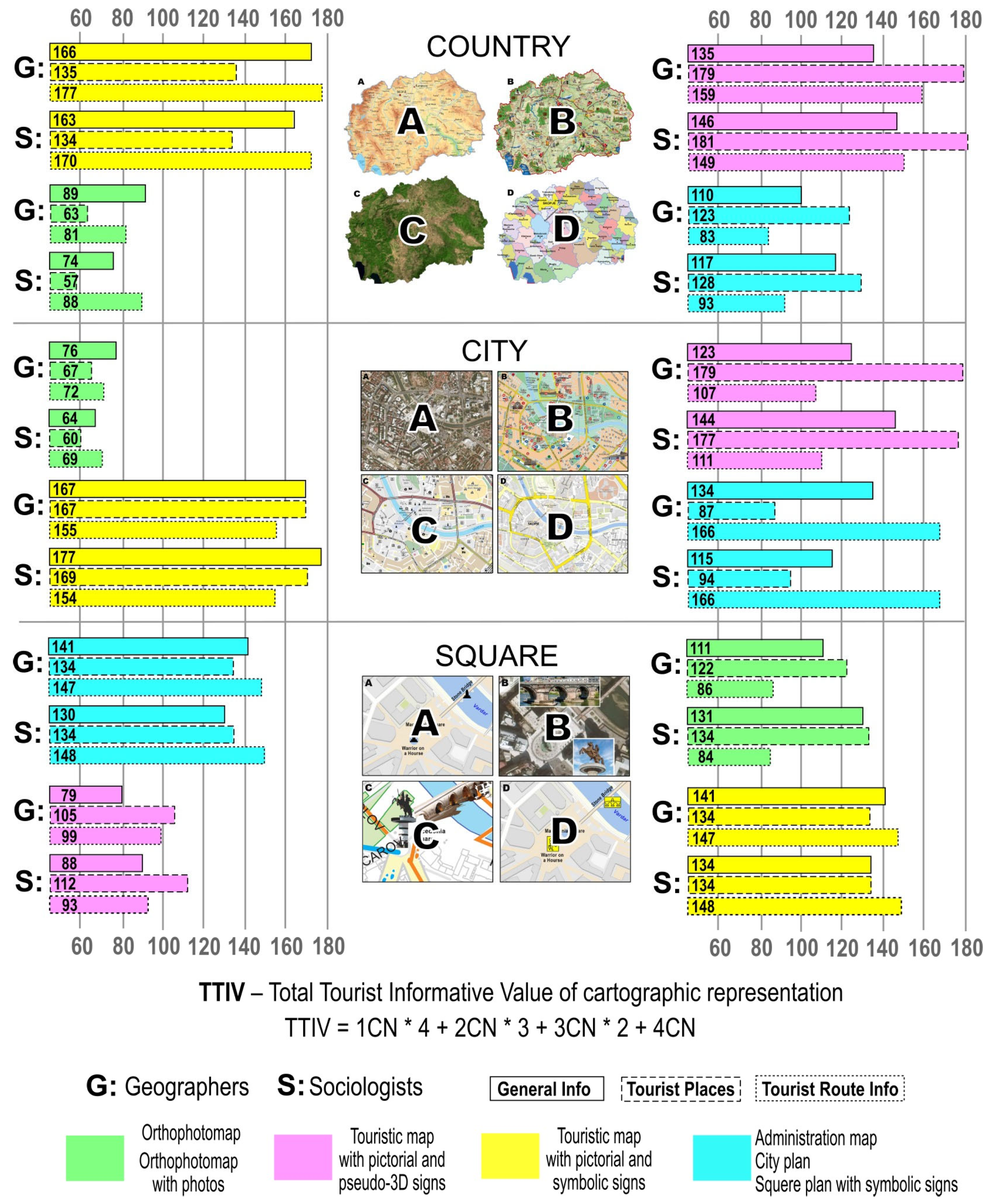
To achieve more synthesizing results, we suggested the total numeric determination of the informative value for each cartographic representation. The total tourist informative value [TTIV] of each visualization was calculated as the sum of the following components from Figure 3: first click number [1CN] * × 4 + second click number [2CN] × 3 + third click number [3CN] × 2 + fourth click number [4CN]. Figure 4 shows the collection of the total values as they were clicked on by geographers (G) and sociologists (S) per twelve cartographic representations following the above questions.
Considering all three types of information and three geographic scales, it may be concluded that the tourist city map with pictorial and symbolic typical cartographic signs has scored the highest among geographers and sociologists. The orthophotomaps of the country and the city, on the other hand, have definitely scored the lowest in total. The orthophotomap of the square with photos has scored higher from this type of most realistic presentation, even higher among sociologists than geographers. Similar numeric values of tourist informativeness can be observed for the presentation of the country for both groups of students. Whereas certain differences occur in the representation of the city and the city square. We observe that the total information value allows for small differences in the assessments by geographers and sociologists. The high value for information about tourist attractions, thanks to the tourist map with pictorial and pseudo-3D signs for the country and city, compared to the low value for the square, is noteworthy.
Figure 4.
Total tourist informative value of cartographic representations by geographers and sociologists according to three consecutive map views for tasks in the online survey.
Figure 4.
Total tourist informative value of cartographic representations by geographers and sociologists according to three consecutive map views for tasks in the online survey.

4. Discussion
A visible preference for the most popular web map services, such as Google Maps and Open Street Map, which are favored over any other sources of information, is definitely noteworthy. The main global web mapping platforms are favored by travelers more than web portals for tourists, opinions by tourists on the internet, and resources created by tourists. This phenomenon may indicate that preferences are globalizing due to tourists using the same sources of information in social media that nowadays have become the most frequently visited spaces on the internet. The reason that the students prefer the commercial web services is probably that they are convenient and that they are used to using them. Unfortunately, we are inclined to believe that the main reason for such preferences among students is not cartographic quality.
Future research could determine the extent to which such preferences are common among people from older generations and other social and professional groups. The wide range of objectives and tasks associated with tourist mapping suggests that the value of specific cartographic presentations may vary considerably depending on user needs [32].
Due to the increasing digitalization of different areas of social life, it could have been expected that printed guidebooks and paper tourist maps would not be a particularly preferred source of information when planning a trip to a new country. At the same time, the difference in the role of printed maps for both groups of respondents can be observed because 64% of non-geographers (sociologists) never use printed maps, with 32% of geographers never using them. It should not come as a surprise as the representations of that kind are quite common in the process of studying, it also possible that geographers simply appreciate the fact that analog maps are more convenient due to their size, stability, ease with which one can command a view of the entire flat surface, and lack of light reflections that make using display screens so difficult.
Cartographic competence is visible in geographers, who definitely appreciated the physical map with hypsometric coloring, as many as 25 people, it was a first click. The map was selected as the second choice by significantly fewer respondents (14). At the same time, 22 sociologists clicked first on the physical map, and 21 sociologists clicked second on the tourist map with pictorial and pseudo-3D symbols. Judging by the standards of correct map design, this physical map of North Macedonia (A in the first task) is the most aesthetic and correctly designed cartographic image out of all twelve maps. High rating of tourist maps with red and other visually enhanced symbols should not surprise because the right color selection for symbols may evoke the interest of potential tourists in graphic elements.
We have shown that the usage of symbols with visual enhancement can not only have a significant impact on the tourists’ choices but even change their tourist preferences [33]. On the other hand, seemingly attractive pseudo-3D symbols do not work on map users if they cannot be easily interpreted because a good map should be easy to read [34]. Quite surprisingly, city plan D with pictorial symbols, designed according to the rules of map design, was not particularly appreciated, especially not by sociologists. Those symbols drawn with the black line on the yellow background on the plan of the square, with a black frame, are noticed and interpreted best [35]. The fact that both groups of students favored city map D, which had a cartographic design similar to that of global map services, such as Google Maps, may be evidence of global standardization of the dominant graphic style of maps [36].
In this study, we focused on four cartographic forms of information presentation for potential tourists, but we are aware that other forms are also gaining popularity online. One example is tourist maps with illustrative elements designed to be more accessible to tourists from diverse cultural backgrounds. However, many such maps prioritize visual aesthetics rather than cartographic accuracy [37]. Multimedia representations also play a significant role in tourist cartographic communication [38]. Access to new mapping tools has enabled the development of novel visualization forms with varying levels of abstraction, including satellite imagery and standard cartographic symbols [39]. There are also examples of thematic mapping approaches that visualize tourist gastronomic satisfaction using data derived from social media [40]. However, adding further cartographic forms to the four considered here would definitely require more complicated tasks for online survey respondents.
Comparing maps A and D of Macedonia Square, it can be that the higher informative value, assigned by geographers to maps with typical cartographic symbols, proves their competence achieved during studies and their greater experience with maps. At the same time, the high preference by sociologists of photographs on the orthophotomap may result from the common usage of photographs taken by smartphones for communication on social media. Currently, this issue is related to the evolution of the ways in which spatial objects are represented on different levels of abstraction in virtual and augmented reality (e.g., the index level, photographic level, level of simple geometric symbols of high conventionality).
In this study, the focus was on the qualitative description of the responses and the presentation of the most common patterns of choices. Due to the exploratory nature of the study, formal statistical tests were not included. Statistical tests in studies with users of cartographic representations are used especially in the case of simple instructions for respondents [37,41,42]. Therefore, we decided to present the rather complex data from this survey in a more visual way in Figure 3 with color-coded equivalents. The diagrams in Figure 4 also have the same color-code and a graphically enriched line pattern for horizontal diagrams. All combinations are visible, allowing for the possibility of capturing detailed combinations of the distribution of the click order of respondents. In turn, the distribution of the click orders of respondents (Figure 3) allowed for the calculation of the total tourist informative value (Figure 4).
The visual presentation of the obtained information in this study is related to the cartographic visualization of multi-factor information in the geographical space [43]. The use of parallel bar charts for two respondent groups can be considered as a beneficial visualization to reveal the relationship between user preferences for the graphical abstraction level of cartographic representation in tourist information search across geographic scales [44].
5. Conclusions
The authors aimed to examine the relationship between the type of tourist information sought and the level of graphical abstraction of maps across geographic scales. Although the research did not allow for the formulation of a single, clear relationship, several conclusions can be drawn based on the research questions posed in the introduction. The main conclusions are as follows:
- —
- The most preferred current sources of tourist information are global map services (e.g., Google Maps, OpenStreetMap) and online resources created by tourists.
- —
- Printed maps are used as a secondary source of information by geographers and are not used by non-geographers.
- —
- The most important factor in map selection is whether the map contains the information the user is seeking.
- —
- Although the preferred map type depends on the type of information sought, more general information is associated with a greater preference for more abstract maps.
- —
- The level of cartographic conventionality (graphical abstraction) does not play a major role when maps contain the necessary information.
- —
- Traditional tourist maps with pictorial and symbolic signs received consistently high ratings across all three geographic scales and information types.
- —
- The map type preferences of geographers and sociologists were very similar, although geographers showed a slightly stronger preference for conventional symbols.
- —
- Significant differences between geographers and sociologists appear only when searching for country-scale information; at the city and city-square scales, both groups appear to rely on similar skills.
- —
- Both geographers and non-geographers highly value traditional hypsometric maps with strong aesthetic qualities.
- —
- Popular web-based tourist maps featuring visually attractive pseudo-3D symbols are not universally effective sources of tourist information.
- —
- When users search for very specific information about places worth visiting or tourist attractions, conventional maps with pictorial icons rather than abstract symbols are preferred.
- —
- Orthophotomaps received low ratings at the country and city scales, while orthophotomaps with photographs were rated more favorably at larger scales, such as city squares.
Taking all the above aspects into consideration, it may be concluded that a single universal type of maps that could be useful for tourists does not exist since a lot depends on the area that the searched for information is about, as well as on the nature of the information sought after, and map design in the context of the representation’s abstractness. For this reason, using online maps with the option to change their type, depending on the type of information searched for, as well as to add new map layers or subtract them when necessary, seems to be the most pragmatic solution.
Author Contributions
Conceptualization, Beata Medyńska-Gulij and Marek Krajewski; methodology, Beata Medyńska-Gulij and Marek Krajewski; software, Beata Medyńska-Gulij; validation, Beata Medyńska-Gulij and Marek Krajewski; formal analysis, Beata Medyńska-Gulij and Marek Krajewski; investigation, Beata Medyńska-Gulij and Marek Krajewski; resources, Beata Medyńska-Gulij; data curation, Beata Medyńska-Gulij; writing—original draft preparation, Beata Medyńska-Gulij and Marek Krajewski; visualization, Beata Medyńska-Gulij; supervision, Marek Krajewski. All authors have read and agreed to the published version of the manuscript.
Funding
This research received no external funding.
Data Availability Statement
Dataset available on request from the authors.
Conflicts of Interest
The authors declare no conflicts of interest.
References
- Hyde, K.F. Tourist information search. In Handbook of Tourist Behavior; Routledge: New York, NY, USA, 2009; pp. 50–67. [Google Scholar]
- Zajadacz, A. Sources of tourist information used by Deaf people. Case study: The Polish Deaf community. Curr. Issues Tour. 2012, 17, 434–454. [Google Scholar] [CrossRef]
- Cai, W.; McKenna, B. Power and Resistance: Digital-Free Tourism in a Connected World. J. Travel Res. 2023, 62, 290–304. [Google Scholar] [CrossRef]
- Slocum, T.A.; McMaster, R.B.; Kessler, F.C.; Howard, H.H. Thematic Cartography and Geovisualization; CRC Press: Boca Raton, FL, USA, 2023; pp. 238–267. [Google Scholar]
- Konstantinou, E.N.; Skopeliti, A.; Nakos, B. POI Symbol Design in Web Cartography—A Comparative Study. ISPRS Int. J. Geo-Inf. 2023, 12, 254. [Google Scholar] [CrossRef]
- Jancewicz, K.; Borowicz, D. Tourist maps—Definition, types and contents. Pol. Cartogr. Rev. 2017, 49, 27–41. [Google Scholar] [CrossRef]
- Del Casino, V.J.; Hanna, S.P. Representations and identities in tourism map spaces. Prog. Hum. Geogr. 2000, 24, 23–46. [Google Scholar] [CrossRef]
- Medyńska-Gulij, B. ‘Map, Tourism’, Encyclopedia of Tourism, 2nd ed.; Jafari, J., Xiao, H., Eds.; Springer International: Berlin/Heidelberg, Germany, 2023. [Google Scholar]
- Fiske, J. Introduction to Communication Studies; Routledge: London, UK, 2011; p. 248. [Google Scholar]
- Jenkins, H.; Shresthova, S.; Gamber-Thompson, L.; Kligler-Vilenchik, N.; Zimmerman, A. By Any Media Necessary: The New Youth Activism; New York University Press: New York, NY, USA, 2016; pp. 28–68. [Google Scholar]
- Young Chung, J.; Anuar, F.I.; Go, H.; Gretzel, U. Influence of interactive thematic maps on tourist perceptions: A network analysis. J. Hosp. Tour. Technol. 2011, 2, 216–234. [Google Scholar] [CrossRef]
- Forrest, D. Thematic Maps in Geography. Int. Encycl. Soc. Behav. Sci. 2015, 24, 260–267. [Google Scholar]
- Korycka-Skorupa, J.; Nowacki, T. Cartographic presentation–from simple to complex map. Misc. Geogr. 2019, 23, 16–22. [Google Scholar] [CrossRef]
- Barthes, R. Writing Degree Zero & Elements of Semiology; Vintage Classic: London, UK, 2010; pp. 12–32. [Google Scholar]
- Peirce, C.S.; Bellucci, F. Charles S. Peirce: Selected Writings on Semiotics 1894–1912; De Gruyter Mouton: Boston, MA, USA, 2020. [Google Scholar]
- Clarke, L.M. An experimental investigation of the communicative efficiency of point symbols on tourist maps. Cartogr. J. 1989, 26, 105–110. [Google Scholar] [CrossRef]
- Morrison, C.; Forrest, D. A study of point symbol design for computer based large scale tourist mapping. Cartogr. J. 1995, 32, 126–136. [Google Scholar] [CrossRef]
- Kimerling, A.J.; Muehrcke, P.C.; Muehrcke, J.O.; Muehrcke, P.M. Map Use: Reading, Analysis, Interpretation; ESRI Press Academic: Redlands, CA, USA, 2016; pp. 59–74. [Google Scholar]
- Gerber, R.V. Competence and Performance in Cartographic Language. Cartogr. J. 1981, 18, 104–111. [Google Scholar] [CrossRef]
- Kałamucki, K.; Czerny, A. Role of cartographic products in the promotion of tourism based on the example of Roztocze. Reg. Barom. Anal. Progn. 2015, 13, 145–151. [Google Scholar] [CrossRef]
- Kalvet, T.; Olesk, M.; Tiits, M.; Raun, J. Innovative Tools for Tourism and Cultural Tourism Impact Assessment. Sustainability 2020, 12, 7470. [Google Scholar] [CrossRef]
- Pan, B.; Crotts, J.C.; Muller, B. Developing web-based tourist information tools using google map. In Information and Communication Technologies in Tourism; Springer: Vienna, Austria, 2007; pp. 503–512. [Google Scholar]
- Vondráková, A.; Voženílek, V. User preferences in image map using. Int. Arch. Photogramm. Remote Sens. Spat. Inf. Sci. 2016, 41, 599–603. [Google Scholar] [CrossRef]
- Brown, A.; Emmer, N.; van den Worm, J. Cartographic design and production in the internet era: The example of tourist web maps. Cartogr. J. 2001, 38, 61–72. [Google Scholar] [CrossRef]
- MacEachren, A.M. How Maps Work: Representation, Visualization and Design; Guildford Press: New York, NY, USA, 2004. [Google Scholar]
- Halik, Ł.; Wielebski, Ł. Usefulness of Plane-Based Augmented Geovisualization—Case of “The Crown of Polish Mountains 3D”. ISPRS Int. J. Geo-Inf. 2023, 12, 38. [Google Scholar] [CrossRef]
- Kovačević, D.; Brozović, M.; Možina, K. Comprehension of City Map Pictograms Designed for Specific Tourists’ Needs. ISPRS Int. J. Geo-Inf. 2024, 13, 137. [Google Scholar] [CrossRef]
- Medyńska-Gulij, B.; Zagata, K. Experts and Gamers on Immersion into Reconstructed Strongholds. ISPRS Int. J. Geo-Inf. 2020, 9, 655. [Google Scholar] [CrossRef]
- Wielebski, Ł.; Medyńska-Gulij, B. Graphically supported evaluation of mapping techniques used in presenting spatial accessibility. Cartogr. Geogr. Inf. Sci. 2019, 46, 311–333. [Google Scholar] [CrossRef]
- Dent, B.D. Cartography: Thematic Map Design; McGraw-Hill: Boston, CA, USA, 1999. [Google Scholar]
- Kraak, M.J.; Ormeling, F.J. Cartography: Visualization of Geospatial Data, 4th ed.; CRC Press: Abingdon, UK, 2020. [Google Scholar]
- McCleary, G.F., Jr. Confronting the tourist map: Divergent purposes and disparate users. In Proceedings of the 24th International Cartographic Conference, Santiago de Chile, Chile, 15–21 November 2009; pp. 15–21. [Google Scholar]
- Medynska-Gulij, B. The Effect of Cartographic Content on Tourist Map Users. Cartography 2003, 32, 49–54. [Google Scholar] [CrossRef]
- Robinson, A.H.; Sale, R.D.; Morrison, J.L. Elements of Cartography, 4th ed.; John Wiley & Sons, Inc.: New York, NY, USA, 1978. [Google Scholar]
- Medynska-Gulij, B. Point Symbols: Investigating Principles and Originality in Cartographic Design. Cartogr. J. 2008, 45, 62–67. [Google Scholar] [CrossRef]
- Egger, I.; Lei, S.I.; Wassler, P. Digital free tourism—An exploratory study of tourist motivations. Tour. Manag. 2020, 79, 104098. [Google Scholar] [CrossRef]
- Airikka, M.; Masoodian, M. A survey of the visual design of cartographic and other elements of illustrated tourist maps. In Proceedings of the 2019 23rd International Conference in Information Visualization—Part II, Adelaide, SA, Australia, 16–19 July 2019. [Google Scholar]
- Edler, D.; Keil, J.; Weißmann, M.; Dickmann, F. Funktionen kartographischer Medien in touristischen Anwendungsszenarien. In Landschaft und Tourismus; RaumFragen: Stadt–Region–Landschaft; Springer: Wiesbaden, Germany, 2023. [Google Scholar]
- Caiza-Morales, L.; Gómez, C.; Torres, R.; Nicolau, A.P.; Olano, J.M. MANGLEE: A Tool for Mapping and Monitoring MANgrove Ecosystem on Google Earth Engine—A Case Study in Ecuador. J. Geovis. Spat. Anal. 2024, 8, 17. [Google Scholar] [CrossRef]
- Zou, H.; Zheng, Y.; Zhang, Y.; Liu, Y. A Geospatial Perspective on the Factors Influencing Tourist Dining Satisfaction. J. Geovis. Spat. Anal. 2024, 8, 25. [Google Scholar] [CrossRef]
- Cybulski, P.; Krassanakis, V. The effect of map label language on the visual search of cartographic point symbols. Cartogr. Geogr. Inf. Sci. 2022, 49, 189–204. [Google Scholar] [CrossRef]
- Lioli, D.; Komninos, A. Icon Design for Landmark Importance in Mobile maps. In Proceedings of the 20th Pan-Hellenic Conference on Informatics, Patras, Greece, 10–12 November 2016; pp. 1–6. [Google Scholar]
- Medyńska-Gulij, B.; Cybulski, P. Spatio-temporal dependencies between hospital beds, physicians and health expenditure using visual variables and data classification in statistical table. Geod. Cartogr. 2016, 65, 67–80. [Google Scholar] [CrossRef]
- Żyszkowska, W. Levels and properties of map perception. Pol. Cartogr. Rev. 2017, 49, 17–26. [Google Scholar][Green Version]
Disclaimer/Publisher’s Note: The statements, opinions and data contained in all publications are solely those of the individual author(s) and contributor(s) and not of MDPI and/or the editor(s). MDPI and/or the editor(s) disclaim responsibility for any injury to people or property resulting from any ideas, methods, instructions or products referred to in the content. |
© 2026 by the authors. Published by MDPI on behalf of the International Society for Photogrammetry and Remote Sensing. Licensee MDPI, Basel, Switzerland. This article is an open access article distributed under the terms and conditions of the Creative Commons Attribution (CC BY) license.