


Abstract
Searches for new particles beyond the Standard Model (SM) are an important task for the Large Hadron Collider (LHC). In this paper, we investigate the properties of the heavy non-SM Higgs bosons in the -term extended Next-to-Minimal Supersymmetric Standard Model (NMSSM). We scan the parameter space of the NMSSM considering the basic constraints from Higgs data, dark matter (DM) relic density, and LHC searches for sparticles. And we also consider the constraints from the LZ2022 experiment and the muon anomaly constraint at the 2 level. We find that the LZ2022 experiment has a strict constraint on the parameter space of the NMSSM, and the limits from the DM-nucleon spin-independent (SI) and spin-dependent (SD) cross-sections are complementary. Then, we discuss the exotic decay modes of heavy Higgs bosons decaying into SM-like Higgs bosons. We find that for doublet-dominated Higgs and , the main exotic decay channels are , , , and , and the branching ratio can reach to about 23%, 10%, 35%, and 10% respectively.
1. Introduction
In July 2012, both the ATLAS and CMS collaborations at the Large Hadron Collider (LHC) announced a scalar with mass near 125 GeV [1,2,3], and recently, the combined measurement of the muon anomalous magnetic moment by the Fermi National Accelerator Laboratory (FNAL) [4] and the Brookhaven National Laboratory (BNL) [5] showed a 4.2 discrepancy from the prediction in the Standard Model (SM). The continuously updated experimental results provide rich information about supersymmetry (SUSY). As an economic realization of SUSY, the Next-to-Minimal Supersymmetric Standard Model (NMSSM) [6,7,8,9,10] has attracted more attention. However, considering the recent experimental constraints, the parameter space of the NMSSM with a discrete -symmetry (-NMSSM) has been strictly constrained [11,12,13,14]. In order to obtain a broad parameter space that agrees with the recent experimental results, we extend the -NMSSM by adding an explicit -term, which is called the -term extended NMSSM (NMSSM) [14,15]. Compared with -NMSSM, the NMSSM can easily explain the discrepancy of the muon anomalous magnetic moment in a broad parameter space while also coinciding with the experimental results in Dark Matter (DM) and Higgs physics, as well as the LHC searches for sparticles [12,16]. In addition, the NMSSM is free from the tadpole problem and domain-wall problem in the -NMSSM. An extension of the MSSM called the SSM [17] is a model similar to the -NMSSM except that the singlet whose vacuum expectation value (VEV) gives rise to the term also serves the role of a right-handed neutrino, thereby violating R-parity. Therefore, compared to the SSM, the NMSSM can give a stable Lightest Supersymmetric Particle (LSP).
Since the discovery of a 125 GeV Standard Model (SM)-like Higgs boson at the LHC, the search for non-SM Higgs bosons has become even more pressing. In the NMSSM, the lightest or next-to-lightest CP-even Higgs boson can be regarded as the SM-like Higgs boson. In addition to the SM-like Higgs boson ( or ), the NMSSM predicts another two CP-even neutral Higgs bosons (/ and ), two CP-odd neutral Higgs bosons ( and ), and a pair of charged Higgs bosons (). In this paper, we explore the discovery potential for the non-SM heavier Higgs bosons and in the NMSSM at the LHC.
At present, besides the conventional search channels for heavy Higgs focusing on the decay modes into pairs of SM particles, the heavy Higgs exotic decay modes in the NMSSM are kinematically open. The heavy neutral Higgs bosons can have a sizable branching ratio into two lighter neutral Higgs bosons, or into a lighter neutral Higgs boson and one Z boson. The relevant searches have been carried out at the LHC [18,19,20,21,22,23,24,25]. Ref. [26] has presented benchmark planes with cross-sections via gluon fusion for the exotic decay channels of heavy Higgs bosons in the NMSSM. And some discussions about the heavy Higgs exotic decays have also been conducted in the Two-Higgs-Doublet Model (2HDM) [27,28]. However, there have been no relevant discussions regarding the properties of the heavy Higgs boson in the NMSSM. Therefore, our study aims to investigate the properties of the heavier CP-even Higgs boson and CP-odd Higgs boson in the NMSSM. We focus on the searches for heavy Higgs bosons in final states with two lighter scalars, or one light scalar and a Z boson.
The outline of this paper is as follows: in Section 2, we briefly describe the relevant theoretical preliminaries of NMSSM including the Higgs sector, the neutralino sector, and the DM-nucleon scattering cross-section. In Section 3, we give the numerical results considering the constraints of DM from the LZ experiment and investigate the properties of heavy Higgs bosons. In Section 4, we list the summary of this paper.
2. Theoretical Preliminaries
2.1. The Basics of the NMSSM
To solve the problem in the Minimal Supersymmetric Standard Model (MSSM), such as the problem, the NMSSM is introduced. The NMSSM consisits of two Higgs doublet superfields, and , and one singlet chiral superfield, . After the electroweak symmetry breaking, the Higgs fields acquire the vacuum expected values (vevs); i.e., , , , and , . The Higgs fields in the NMSSM can be written as follows [10]:
where , , and denote the neutral CP-even Higgs fields; , , and denote the neutral CP-odd Higgs fields; and and denote the charged Higgs fields.
The general form of the superpotential in the NMSSM can be given by [10,29,30]
where the term is the same as that of the MSSM; and are bilinear mass coefficients; and are dimensionless coupling coefficients; is the supersymmetric tadpole term of mass square dimension; and the parameters , , and can be used to solve the tadpole problem and domain-wall problem in the -symmetry NMSSM [31,32,33,34,35].
In this work, we consider a specific scenario in which the parameters and in Equation (2) are equal to 0. This special scenario can be called the -term extended NMSSM (NMSSM), which is more economical than GNMSSM in explaining the SM-like Higgs mass and the properties of DM. The superpotential and the corresponding soft breaking Lagrangian can be written as follows [33,34]:
where , , and S are the scalar parts of the superfields , , and , respectively. By solving the minimization equation of the scalar potential, the soft breaking mass parameters , , and can be expressed in terms of the vacuum expected values of the scalar field. To simplify the calculation, we set to be 0. Therefore, the Higgs sector is partially determined by the following parameters:
For convenience, we define , , and , where is the SM Higgs field and its vev is , is the other CP-even doublet Higgs field and its vev is zero, and corresponds to the CP-odd Higgs boson in the MSSM [36,37]. In the basis , the elements of the CP-even Higgs mass symmetric matrix can be written as
And the elements of the CP-odd Higgs mass symmetric matrix under the basis is given by
By diagonalizing and using the unitary matrix V and U, we can obtain the CP-even Higgs mass eigenstate with , and CP-odd Higgs mass eigenstate with , respectively [34,38,39].
Each of the three CP-even Higgs bosons can be either SM-like (h), or dominant (H), or singlet dominant (). Likewise, each of the two CP-odd Higgs bosons can be either singlet dominant (), or dominant ().
The mass eigenstate of charged Higgs bosons is , and their masses can be written as
For neutralino sector, the neutralino mass eigenstate in the basis of is
where , and and are Bino and Wino soft breaking masses, respectively. After diagonalizing the mass matrix by rotation matrix N, we can obtain the neutralino mass eigenstate (i = 1, 2, 3, 4, 5) labeled in mass-ascending order, which can be expressed as
Assuming the lightest neutralino is the LSP, which can be considered as an ideal candidate for DM. Evidently, , , and denote the Bino, Wino, Higgsino, and Singlino fractions in , respectively. Different from the case in the -NMSSM, 2|| may be much larger than in obtaining Singlino-dominated DM.
2.2. The Heavy Higgs Bosons
In this work we require the lightest CP-even Higgs boson is SM-like, and investigate the properties of the heavy Higgs bosons and . At the LHC, the heavy Higgs boson H ( or ) is mainly produced through gluon-gluon fusion (ggF), and the production cross-section can be obtained by
where denotes the SM-like Higgs boson, and is the reduced coupling coefficient relative to the prediction in the SM. In the NMSSM, the exotic decay modes of heavy Higgs bosons are open and heavy Higgs bosons and can have sizable branching ratio into two lighter Higgs bosons, e.g., , , which can be called Higgs-to-Higgs decays. In addition, heavy Higgs bosons and may decay into one light Higgs boson and a Z boson, e.g., , . The branching ratio of the Higgs-to-Higgs decays depends on trilinear Higgs couplings. For the typical case with , , the relevant trilinear Higgs couplings relative to Higgs-to-Higgs decays can be expressed by (neglecting contributions of ) [10,26] the following:
For the decays and , the relevant couplings are
where is the component of the physical state ; and is the component of the physical state .
2.3. The Anomalous Magnetic Moment of the Muon in the NMSSM
The recent measurement of the muon anomalous magnetic moment by the FNAL has been updated, and its value is [4]
The result is in full agreement with the BNL E821 result [5]:
And the combined experimental average is [40,41,42,43,44,45,46,47,48,49,50,51,52,53,54,55,56,57]
The latest lattice calculations have led to a prediction that differs from the experimental result of by only [58]. While the current value for the anomaly, combining the latest Standard Model prediction [40] and the improved experimental result [59], is . In our analysis, we use the same value for the discrepancy between theory and experiment as used in ref. [60], namely, [4], in order to make the comparison systematic.
In SUSY, the contributions to mainly originate from the loops mediated by a smuon and a neutralino or a chargino and a muon-type sneutrino [61,62,63,64,65,66,67,68,69,70,71]. In the NMSSM, the one-loop contributions to can be written as [72]
where , , represent the neutralino, chargino, and smuon index, respectively. And
where X denotes the smuon mass rotation matrices; and and denote the chargino mass rotation matrix. and are loop functions of the kinematic variables and , and their expressions are written as [73,74] follows:
For the scenario with mass-degenerate sparticles, the relationship holds.
2.4. DM-Nucleon Scattering Cross-Section
In the NMSSM, the lightest neutralino as the LSP can be considered as a DM candidate [75,76]. The Higgsino fraction of plays an important role in elastic scattering between and nucleon. In the scenario with massive squarks, the Spin-Dependent (SD) scattering of with nucleons is mediated by exchanging a Z boson, and the scattering cross-section is approximated given by [77,78]
where , denoting protons (neutrons), pb, pb, and
The spin-independent (SI) scattering of with nucleons is mainly produced by exchanging CP-even Higgs bosons through the t-channel, and the cross-section is as follows [15,79,80]:
where , denoting the reduced mass of the DM-nucleon system. The expressions of the effective couplings are
with being the coupling coefficient between the CP-even Higgs bosons and nucleon,
where and . The form factors () denote the normalized light quarks contribution to the nucleon mass, and represents other heavy quarks mass fraction in the nucleon.
3. Numerical Results
The parameter space of the NMSSM has been scanned by EasyScan_HEP [81] with the Metropolis–Hastings algorithm:
For other supersymmetric parameters, we fix them at 2 TeV. We use the package SARAH-4.14.3 [82,83,84,85] to generate the model files in the NMSSM, use the program SPheno-4.0.4 [86,87] to obtain the particle spectrum, and use the package MicrOMEGAs-5.2.13 [88,89,90,91,92,93,94,95,96,97] to calculate the DM observables.
To be specific, we require the samples to satisfy the following basic constraints:
1. The lightest CP-even Higgs boson should be SM-like, and its mass should be between 121 GeV and 129 GeV. We utilize the code HiggsSignals-2.2.3 [98] to fit the properties of the SM-like Higgs boson to LHC Higgs data and utilize the code HiggsBounds-5.3.2 [99] to implement the constraints from the direct search for extra Higgs bosons at the LEP and Tevatron.
2. We assume the lightest neutralino is one of the DM candidates, so when comparing the dark matter scattering cross-section below with the experimental limit, we need the DM relic density [100]. The SI and SD DM cross-sections should be scaled by a factor .
3. We consider the constraints from the direct detection experiments for sparticles at the LHC, and use SModelS-2.3.2 [101,102,103,104] to decompose the spectrum including these processes:
The Next-to-Leading Order (NLO) cross-sections of these processes at = 13 TeV are calculated by Prospino2.1 [105]. In the following discussions, all the surviving samples satisfy these basic constraints.
3.1. Properties of Dark Matter
We project all the surviving samples from the scan onto a two-dimensional diagram, as shown below. The surviving samples are divided into three categories by three different colors: the purple samples satisfy the basic constraints mentioned above; the yellow samples satisfy not only the basic constraints but also the muon anomaly constraint within the 2 level; and the red samples satisfy the basic constraints, the muon anomaly constraint within the 2 level, and also the LZ experiment constraint in the year 2022 (LZ2022) [106].
Figure 1 shows the surviving samples on the plane and . The green line on the left (right) plot is the upper limit of SI (SD) nucleon-DM cross-sections, which comes from the results of the recent LZ2022 experiment. The samples above the green line are excluded by the LZ2022 experiment. From this figure, we conclude that the results of recent nucleon-DM experiments impose strong constraints on the parameter space in the NMSSM, and the SD limit is complementary to the SI limit in limiting the parameter space in the NMSSM. The figure also reveals 100 GeV 400 GeV considering the constraints from the recent LZ2022 experiment.
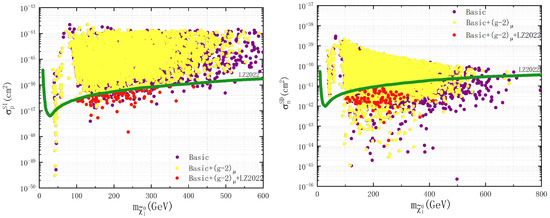
Figure 1.
SI (left plot) and SD (right plot) nucleon-DM cross-section versus the mass of DM. The green lines stand for limits from LZ2022. Purple samples satisfy the basic constraints; yellow samples satisfy the anomaly of within the 2 level further, and red samples satisfy the basic constraints, muon anomaly constraint within the 2 level, and also the LZ2022 experiment constraint.
We display the characteristics of DM components in Figure 2. The upper left plot exhibits the Bino-component , the upper right plot exhibits the Wino-component , the lower left plot shows the Higgsino-component , and the lower right plot shows the Singlino-component . Considering the constraints from the anomaly of and the recent LZ2022 experiment, the dark matter are mainly Wino-dominated or Higgsino-dominated. A few samples are Bino-dominated, but no samples are Singlino-dominated. The mass of Wino-dominated DM is less than 300 GeV, the mass of Higgsino-dominated DM is less than 350 GeV, and the mass of Bino-dominated DM is less than 400 GeV.
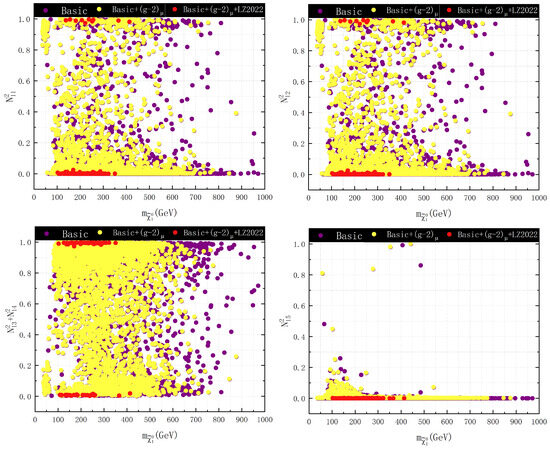
Figure 2.
Similar with Figure 1, but shows the DM components versus the the mass of DM.
To investigate the properties of the surviving parameter space, we pick out the red samples in Figure 1 and Figure 2 and project them onto , , planes in Figure 3. For the Higgsino-dominated DM, 2 is much larger than as can be seen from the left plot, which is significantly different from the scenario in the -NMSSM. In the -NMSSM, Higgsino-dominated DM only requires 2 are larger than 1. The middle plot shows that is greater than 20 for the Wino-dominated or Higgsino-dominated DM. From the right plot, we can see that the survival samples mainly tend to be 850 GeV 1500 GeV and 100 GeV 300 GeV for Higgsino-dominated DM, and 100 GeV 300 GeV and 800 GeV 1000 GeV for the Wino-dominated DM.
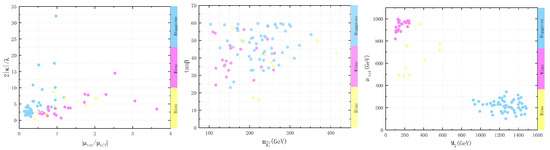
Figure 3.
Survived samples projected onto , and planes. The yellow points denote the Bino-dominated DM, light purple points denote the Wino-dominated DM, and blue points denote the Higgsino-dominated DM.
3.2. Properties of Heavy Higgs Bosons
We pick out the survival samples satisfying the basic constraints mentioned above, and also the constraints from the anomaly of and the limit of SI (SD) nucleon-DM cross-sections to investigate the properties of heavy Higgs bosons and . In Figure 4, we show the singlet component of the non-SM CP-even and CP-odd Higgs bosons. From the upper plots, we can see that for most of the survival samples, the next-to-lightest CP-even Higgs boson can be mostly singlet-dominated or doublet-dominated. Correspondingly, the heaviest CP-even Higgs boson can be mostly doublet-dominated or singlet-dominated. But for a portion of the samples, singlet-doublet mixing can be large. The lower plots show that for most of the surviving samples, the lightest CP-odd Higgs boson is mostly singlet-dominated and the heaviest CP-odd Higgs boson is mostly doublet-dominated. However, for a part of the samples, singlet-doublet mixing can be large. And for a small fraction of the samples, can be mostly singlet-dominated.
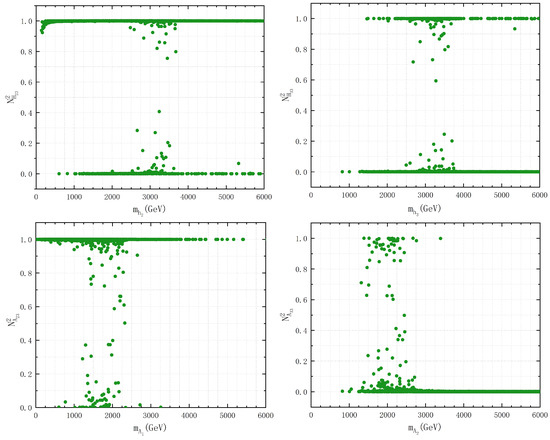
Figure 4.
The singlet component of the non-SM CP-even and CP-odd Higgs bosons versus their masses.
As discussed above, the exotic decay channels of heavy Higgs bosons and are open. In Figure 5 and Figure 6 we show the exotic decay channels of and , and we only consider the decay channels of heavy Higgs boson decaying into lighter Higgs boson. The left (right) plot of Figure 5 shows that is doublet-dominated (singlet-dominated), and the left (right) plot of Figure 6 shows is doublet-dominated (singlet-dominated). For the doublet-dominated Higgs boson , the main decay channels are and , and the branching ratio can reach about 23% and 10%, respectively. The decay is proportional to the component of the physical state . The large branching ratio of just corresponds to the scenario that the doublet component of is relatively large. The decay is proportional to the Higgs trilinear coupling shown in the first equation of Equation (13), which is usually relatively large when the mixing between doublet and singlet scalar fields is large. The singlet-dominated Higgs boson mainly decays into , and the branching ratio of can reach to about 1.
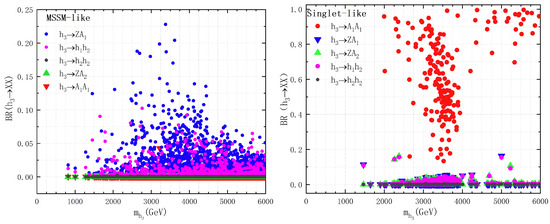
Figure 5.
The exotic decay channels of the heavy CP-even Higgs boson . The (left plot) denotes being doublet-dominated (MSSM-like), and the (right plot) denotes being singlet-dominated (singlet-like).
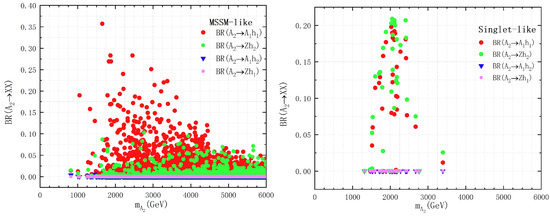
Figure 6.
The exotic decay channels of heavy CP-odd Higgs boson . The (left plot) denotes being doublet-dominated (MSSM-like), and the (right plot) denotes being singlet-dominated (singlet-like).
Figure 6 shows that for the doublet-dominated Higgs boson , the main decay channels of the Higgs boson are and , and the branching ratio can reach to about 35% and 10%, respectively. The decay is proportional to the Higgs trilinear coupling shown in the second equation of Equation (13), which is usually relatively large when the mixing between doublet and singlet pseudoscalar fields is large, as the off-diagonal element shown. The decay is proportional to the component of the physical state . The large branching ratio of just corresponds to the scenario that the doublet component of is relatively large. The branching ratio of the decay approaches 0 because the component of the SM-like is much lower. The main decay channels of the singlet-dominated Higgs boson are and .
Since the production cross-section of singlet-dominated Higgs bosons at the LHC is very small, we only consider the production of doublet-dominated Higgs bosons and . In Figure 7 and Figure 8, we show the production cross-section of the Higgs bosons and with and decaying into the SM-like Higgs at TeV LHC. We find that the cross-sections and can reach to about pb and pb, respectively.
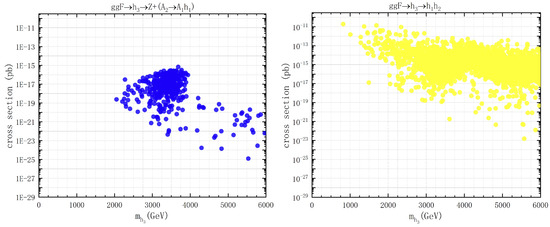
Figure 7.
The cross-section of the heavy CP-even Higgs boson decaying into the SM-like Higgs boson at 13TeV LHC.
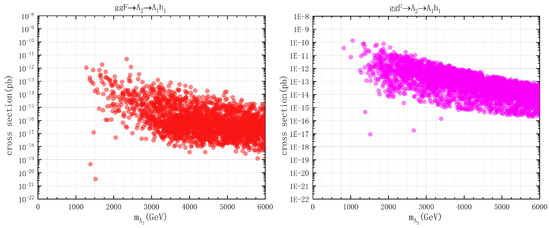
Figure 8.
The cross-section of the heavy CP-odd Higgs boson decaying into the SM-like Higgs boson at 13 TeV LHC.
4. Summary
In this paper, we have performed phenomenological studies on the properties of dark matter and heavy Higgs bosons and in the NMSSM. Considering the basic constraints from Higgs data, DM relic density, and LHC searches for sparticles, we have scanned the parameter space of the NMSSM. We find that the LZ2022 experiment has a strict constraint on the parameter space of the NMSSM, and the limits from the DM-nucleon SI and SD cross-sections are complementary. Samples surviving the LZ2022 experiment and the muon anomaly constraint at the 2 level are mainly featured by , 850 GeV 1500 GeV, and 100 GeV 300 GeV for Higgsino-dominated DM, or 100 GeV 300 GeV, and 800 GeV 1000 GeV for Wino-dominated DM.
The detections of heavy Higgs bosons through exotic decay modes into SM-like Higgs bosons are important for analyzing the Higgs signals. We find that for doublet-dominated Higgs , and , the main exotic decay channels are , , and , and the branching ratio can reach about 23%, 10%, 35%, and 10%, respectively. At the 13 TeV LHC, the production cross-section of processes and can reach to about pb and pb, respectively. This spectrum is hardly tested, but it is free from current constraints from the LHC on exotic Higgs. It is unfortunate that these heavy Higgs still cannot be tested at the High-Luminosity LHC (HL-LHC) [107]; one has to wait for the next-generation hadron colliders (such as the SPPC [108] and FCC-hh [109]) in order to investigate this parameter space.
Author Contributions
Conceptualization, Z.H. and L.S.; writing, Z.H. and X.L.; calculating, L.S. and X.L. All authors have read and agreed to the published version of the manuscript.
Funding
This work is supported by the China Scholarship Council under Grant No. 202208410277, and also by the High Performance Computing Center of Henan Normal University.
Data Availability Statement
Data is available upon a reasonable request to the authors.
Conflicts of Interest
The authors declare no conflicts of interest.
References
- Aad, G. et al. [Atlas Collaboration] Combined search for the Standard Model Higgs boson using up to 4.9 fb−1 of pp collision data at TeV with the ATLAS detector at the LHC. Phys. Lett. B 2012, 710, 49–66. [Google Scholar] [CrossRef]
- Chatrchyan, S. et al. [CMS Collaboration] Observation of a New Boson at a Mass of 125 GeV with the CMS Experiment at the LHC. Phys. Lett. B 2012, 716, 30–61. [Google Scholar] [CrossRef]
- Chatrchyan, S. et al. [CMS Collaboration] Combined Results of Searches for the Standard Model Higgs Boson in pp Collisions at TeV. Phys. Lett. B 2012, 710, 26–48. [Google Scholar] [CrossRef]
- Abi, B. et al. [(Muon g − 2 Collaboration)] Measurement of the Positive Muon Anomalous Magnetic Moment to 0.46 ppm. Phys. Rev. Lett. 2021, 126, 141801. [Google Scholar] [CrossRef] [PubMed]
- Bennett, G.W. et al. [(Muon g − 2 Collaboration)] Final Report of the Muon E821 Anomalous Magnetic Moment Measurement at BNL. Phys. Rev. D 2006, 73, 072003. [Google Scholar] [CrossRef]
- Franke, F.; Fraas, H. Mass bounds for the neutral Higgs bosons in the next-to-minimal supersymmetric standard model. Phys. Lett. B 1995, 353, 234–242. [Google Scholar] [CrossRef]
- Szleper, M. Search for the NMSSM Higgs bosons at the photon collider. Int. J. Mod. Phys. A 2005, 20, 7404–7411. [Google Scholar] [CrossRef]
- Ellwanger, U. Phenomenological Aspects of the Next-to-Minimal Supersymmetric Standard Model. Nucl. Phys. B Proc. Suppl. 2010, 200–202, 113–119. [Google Scholar] [CrossRef]
- Franke, F.; Fraas, H. Neutralinos and Higgs bosons in the next-to-minimal supersymmetric standard model. Int. J. Mod. Phys. A 1997, 12, 479–534. [Google Scholar] [CrossRef]
- Ellwanger, U.; Hugonie, C.; Teixeira, A.M. The Next-to-Minimal Supersymmetric Standard Model. Phys. Rept. 2010, 496, 1–77. [Google Scholar] [CrossRef]
- Cao, J.; Li, F.; Lian, J.; Pan, Y.; Zhang, D. Impact of LHC probes of SUSY and recent measurement of (g − 2)μ on ℤ3-NMSSM. Sci. China Phys. Mech. Astron. 2022, 65, 291012. [Google Scholar] [CrossRef]
- Cao, J.; Lian, J.; Pan, Y.; Zhang, D.; Zhu, P. Improved (g − 2)μ measurement and singlino dark matter in μ-term extended ℤ3-NMSSM. J. High Energy Phys. 2021, 9, 175. [Google Scholar] [CrossRef]
- Zhou, H.; Cao, J.; Lian, J.; Zhang, D. Singlino-dominated dark matter in Z3-symmetric NMSSM. Phys. Rev. D 2021, 104, 015017. [Google Scholar] [CrossRef]
- Cao, J.; Lian, J.; Pan, Y.; Yue, Y.; Zhang, D. Impact of recent (g − 2)μ measurement on the light CP-even Higgs scenario in general Next-to-Minimal Supersymmetric Standard Model. J. High Energy Phys. 2022, 3, 203. [Google Scholar] [CrossRef]
- Cao, J.; Li, D.; Lian, J.; Yue, Y.; Zhou, H. Singlino-dominated dark matter in general NMSSM. J. High Energy Phys. 2021, 6, 176. [Google Scholar] [CrossRef]
- Cao, J.; Jia, X.; Meng, L.; Yue, Y.; Zhang, D. Status of the singlino-dominated dark matter in general Next-to-Minimal Supersymmetric Standard Model. J. High Energy Phys. 2023, 3, 198. [Google Scholar] [CrossRef]
- Lopez-Fogliani, D.E.; Munoz, C. Proposal for a Supersymmetric Standard Model. Phys. Rev. Lett. 2006, 97, 041801. [Google Scholar] [CrossRef]
- Sirunyan, A.M. et al. [CMS Collaboration] Search for a heavy pseudoscalar boson decaying to a Z and a Higgs boson at TeV. Eur. Phys. J. C 2019, 79, 564. [Google Scholar] [CrossRef]
- Aaboud, M. et al. [The ATLAS Collaboration] Search for heavy resonances decaying into a W or Z boson and a Higgs boson in final states with leptons and b-jets in 36 fb−1 of TeV pp collisions with the ATLAS detector. J. High Energy Phys. 2018, 3, 174, Erratum in J. High Energy Phys. 2018, 11, 51. [Google Scholar] [CrossRef]
- Aad, G. et al. [The ATLAS Collaboration] Search for heavy resonances decaying into a Z or W boson and a Higgs boson in final states with leptons and b-jets in 139 fb−1 of pp collisions at TeV with the ATLAS detector. J. High Energy Phys. 2023, 6, 16. [Google Scholar] [CrossRef]
- Khachatryan, V. et al. [CMS Collaboration] Search for a pseudoscalar boson decaying into a Z boson and the 125 GeV Higgs boson in final states. Phys. Lett. B 2015, 748, 221–243. [Google Scholar] [CrossRef]
- Sirunyan, A.M. et al. [The CMS Collaboration] Search for a heavy pseudoscalar Higgs boson decaying into a 125 GeV Higgs boson and a Z boson in final states with two tau and two light leptons at TeV. J. High Energy Phys. 2020, 3, 65. [Google Scholar] [CrossRef]
- Sirunyan, A.M. et al. [The CMS Collaboration] Search for new neutral Higgs bosons through the H→ ZA process in pp collisions at TeV. J. High Energy Phys. 2020, 3, 55. [Google Scholar] [CrossRef]
- Aad, G. et al. [ATLAS Collaboration] Search for a heavy Higgs boson decaying into a Z boson and another heavy Higgs boson in the and final states in pp collisions at TeV with the ATLAS detector. Eur. Phys. J. C 2021, 81, 396. [Google Scholar] [CrossRef]
- Tumasyan, A. et al. [The CMS Collaboration] Search for a heavy Higgs boson decaying into two lighter Higgs bosons in the bb final state at 13 TeV. J. High Energy Phys. 2021, 11, 57. [Google Scholar] [CrossRef]
- Ellwanger, U.; Hugonie, C. Benchmark planes for Higgs-to-Higgs decays in the NMSSM. Eur. Phys. J. C 2022, 82, 406. [Google Scholar] [CrossRef]
- Kling, F.; Li, H.; Pyarelal, A.; Song, H.; Su, S. Exotic Higgs Decays in Type-II 2HDMs at the LHC and Future 100 TeV Hadron Colliders. J. High Energy Phys. 2019, 6, 31. [Google Scholar] [CrossRef]
- Kling, F.; Li, H.; Li, S.; Pyarelal, A.; Song, H.; Su, S.; Su, W. Exotic Higgs Decays in the Type-II 2HDMs at Current and Future pp Colliders. arXiv 2022, arXiv:2205.12198. [Google Scholar]
- Abel, S.A. Destabilizing divergences in the NMSSM. Nucl. Phys. B 1996, 480, 55–72. [Google Scholar] [CrossRef]
- Maniatis, M. The Next-to-Minimal Supersymmetric extension of the Standard Model reviewed. Int. J. Mod. Phys. A 2010, 25, 3505–3602. [Google Scholar] [CrossRef]
- Panagiotakopoulos, C.; Tamvakis, K. Stabilized NMSSM without domain walls. Phys. Lett. B 1999, 446, 224–227. [Google Scholar] [CrossRef]
- Ferrara, S.; Kallosh, R.; Linde, A.; Marrani, A.; Van Proeyen, A. Superconformal Symmetry, NMSSM, and Inflation. Phys. Rev. D 2011, 83, 025008. [Google Scholar] [CrossRef]
- Hollik, W.G.; Liebler, S.; Moortgat-Pick, G.; Paßehr, S.; Weiglein, G. Phenomenology of the inflation-inspired NMSSM at the electroweak scale. Eur. Phys. J. C 2019, 79, 75. [Google Scholar] [CrossRef]
- Hollik, W.G.; Li, C.; Moortgat-Pick, G.; Paasch, S. Phenomenology of a Supersymmetric Model Inspired by Inflation. Eur. Phys. J. C 2021, 81, 141. [Google Scholar] [CrossRef]
- Kolda, C.F.; Pokorski, S.; Polonsky, N. Stabilized singlets in supergravity as a source of the mu-parameter. Phys. Rev. Lett. 1998, 80, 5263–5266. [Google Scholar] [CrossRef]
- Miller, D.J.; Nevzorov, R.; Zerwas, P.M. The Higgs sector of the next-to-minimal supersymmetric standard model. Nucl. Phys. B 2004, 681, 3–30. [Google Scholar] [CrossRef]
- Cao, J.J.; Heng, Z.X.; Yang, J.M.; Zhang, Y.M.; Zhu, J.Y. A SM-like Higgs near 125 GeV in low energy SUSY: A comparative study for MSSM and NMSSM. J. High Energy Phys. 2012, 3, 86. [Google Scholar] [CrossRef]
- King, S.F.; Mühlleitner, M.; Nevzorov, R.; Walz, K. Natural NMSSM Higgs Bosons. Nucl. Phys. B 2013, 870, 323–352. [Google Scholar] [CrossRef]
- Wang, F.; Wang, W.; Wu, L.; Yang, J.M.; Zhang, M. Probing degenerate heavy Higgs bosons in NMSSM with vector-like particles. Int. J. Mod. Phys. A 2017, 32, 1745005. [Google Scholar] [CrossRef]
- Aoyama, T.; Asmussen, N.; Benayoun, M.; Bijnens, J.; Blum, T.; Bruno, M.; Caprini, I.; Calame, C.C.; Cè, M.; Colangelo, G.; et al. The anomalous magnetic moment of the muon in the Standard Model. Phys. Rep. 2020, 887, 1–166. [Google Scholar] [CrossRef]
- Aoyama, T.; Hayakawa, M.; Kinoshita, T.; Nio, M. Complete Tenth-Order QED Contribution to the Muon g − 2. Phys. Rev. Lett. 2012, 109, 111808. [Google Scholar] [CrossRef] [PubMed]
- Aoyama, T.; Kinoshita, T.; Nio, M. Theory of the Anomalous Magnetic Moment of the Electron. Atoms 2019, 7, 28. [Google Scholar] [CrossRef]
- Czarnecki, A.; Marciano, W.J.; Vainshtein, A. Refinements in electroweak contributions to the muon anomalous magnetic moment. Phys. Rev. D 2003, 67, 073006, Erratum in Phys. Rev. D 2006, 73, 119901. [Google Scholar] [CrossRef]
- Gnendiger, C.; Stöckinger, D.; Stöckinger-Kim, H. The electroweak contributions to (g − 2)μ after the Higgs boson mass measurement. Phys. Rev. D 2013, 88, 053005. [Google Scholar] [CrossRef]
- Keshavarzi, A.; Nomura, D.; Teubner, T. Muon and : A new data-based analysis. Phys. Rev. D 2018, 97, 114025. [Google Scholar] [CrossRef]
- Stoffer, P.; Colangelo, G.; Hoferichter, M. Two-pion contributions to the muon g − 2. PoS 2019, CD2018, 84. [Google Scholar] [CrossRef]
- Colangelo, G.; Hoferichter, M.; Stoffer, P. Two-pion contribution to hadronic vacuum polarization. J. High Energy Phys. 2019, 2, 6. [Google Scholar] [CrossRef]
- Davier, M.; Hoecker, A.; Malaescu, B.; Zhang, Z. Reevaluation of the hadronic vacuum polarisation contributions to the Standard Model predictions of the muon and using newest hadronic cross-section data. Eur. Phys. J. C 2017, 77, 827. [Google Scholar] [CrossRef]
- Keshavarzi, A.; Nomura, D.; Teubner, T. of charged leptons, , and the hyperfine splitting of muonium. Phys. Rev. D 2020, 101, 014029. [Google Scholar] [CrossRef]
- Hoferichter, M.; Hoid, B.L.; Kubis, B. Three-pion contribution to hadronic vacuum polarization. J. High Energy Phys. 2019, 8, 137. [Google Scholar] [CrossRef]
- Kurz, A.; Liu, T.; Marquard, P.; Steinhauser, M. Hadronic contribution to the muon anomalous magnetic moment to next-to-next-to-leading order. Phys. Lett. B 2014, 734, 144–147. [Google Scholar] [CrossRef]
- Melnikov, K.; Vainshtein, A. Hadronic light-by-light scattering contribution to the muon anomalous magnetic moment revisited. Phys. Rev. D 2004, 70, 113006. [Google Scholar] [CrossRef]
- Masjuan, P.; Sanchez-Puertas, P. Pseudoscalar-pole contribution to the (gμ − 2): A rational approach. Phys. Rev. D 2017, 95, 054026. [Google Scholar] [CrossRef]
- Hoferichter, M.; Hoid, B.L.; Kubis, B.; Leupold, S.; Schneider, S.P. Dispersion relation for hadronic light-by-light scattering: Pion pole. J. High Energy Phys. 2018, 10, 141. [Google Scholar] [CrossRef]
- Gérardin, A.; Meyer, H.B.; Nyffeler, A. Lattice calculation of the pion transition form factor with Wilson quarks. Phys. Rev. D 2019, 100, 034520. [Google Scholar] [CrossRef]
- Colangelo, G.; Hagelstein, F.; Hoferichter, M.; Laub, L.; Stoffer, P. Longitudinal short-distance constraints for the hadronic light-by-light contribution to (g − 2)μ with large-Nc Regge models. J. High Energy Phys. 2020, 3, 101. [Google Scholar] [CrossRef]
- Blum, T.; Chowdhury, S.; Hayakawa, M.; Izubuchi, T. Hadronic light-by-light scattering contribution to the muon anomalous magnetic moment from lattice QCD. Phys. Rev. Lett. 2015, 114, 012001. [Google Scholar] [CrossRef]
- Boccaletti, A.; Borsanyi, S.; Davier, M.; Fodor, Z.; Frech, F.; Gerardin, A.; Giusti, D.; Kotov, A.Y.; Lellouch, L.; Lippert, T.; et al. High precision calculation of the hadronic vacuum polarisation contribution to the muon anomaly. arXiv 2024, arXiv:2407.10913. [Google Scholar]
- Aguillard, D.P. et al. [The Muon g - 2 Collaboration] Measurement of the Positive Muon Anomalous Magnetic Moment to 0.20 ppm. Phys. Rev. Lett. 2023, 131, 161802. [Google Scholar] [CrossRef]
- Hunt-Smith, N.T.; Melnitchouk, W.; Sato, N.; Thomas, A.W.; Wang, X.G.; White, M.J. Global QCD analysis and dark photons. J. High Energy Phys. 2023, 9, 96. [Google Scholar] [CrossRef]
- Li, S.; Xiao, Y.; Yang, J.M. Constraining CP-phases in SUSY: An interplay of muon/electron g − 2 and electron EDM. Nucl. Phys. B 2022, 974, 115629. [Google Scholar] [CrossRef]
- Li, Z.; Liu, G.L.; Wang, F.; Yang, J.M.; Zhang, Y. Gluino-SUGRA scenarios in light of FNAL muon g − 2 anomaly. J. High Energy Phys. 2021, 12, 219. [Google Scholar] [CrossRef]
- Du, X.; Wang, F. NMSSM from Alternative Deflection in Generalized Deflected Anomaly Mediated SUSY Breaking. Eur. Phys. J. C 2018, 78, 431. [Google Scholar] [CrossRef]
- Wang, K.; Wang, F.; Zhu, J.; Jie, Q. The semi-constrained NMSSM in light of muon g − 2, LHC, and dark matter constraints. Chin. Phys. C 2018, 42, 103109. [Google Scholar] [CrossRef]
- Cox, P.; Han, C.; Yanagida, T.T. Muon g − 2 and dark matter in the minimal supersymmetric standard model. Phys. Rev. D 2018, 98, 055015. [Google Scholar] [CrossRef]
- Yang, J.L.; Feng, T.F.; Yan, Y.L.; Li, W.; Zhao, S.M.; Zhang, H.B. Lepton-flavor violation and two loop electroweak corrections to (g − 2)μ in the B-L symmetric SSM. Phys. Rev. D 2019, 99, 015002. [Google Scholar] [CrossRef]
- Li, S.; Xiao, Y.; Yang, J.M. Can electron and muon g − 2 anomalies be jointly explained in SUSY? Eur. Phys. J. C 2022, 82, 276. [Google Scholar] [CrossRef]
- Wang, F.; Wu, L.; Xiao, Y.; Yang, J.M.; Zhang, Y. GUT-scale constrained SUSY in light of new muon g − 2 measurement. Nucl. Phys. B 2021, 970, 115486. [Google Scholar] [CrossRef]
- Aboubrahim, A.; Klasen, M.; Nath, P.; Syed, R.M. Tests of gluino-driven radiative breaking of the electroweak symmetry at the LHC. Phys. Scr. 2022, 97, 054002. [Google Scholar] [CrossRef]
- Wang, K.; Zhu, J. Smuon in the NMSSM confronted with the muon g–2 anomaly and SUSY searches. Chin. Phys. C 2023, 47, 013107. [Google Scholar] [CrossRef]
- Zheng, M.D.; Zhang, H.H. Studying the anomalies and in R-parity violating MSSM framework with the inverse seesaw mechanism. Phys. Rev. D 2021, 104, 115023. [Google Scholar] [CrossRef]
- Domingo, F.; Ellwanger, U. Constraints from the Muon g − 2 on the Parameter Space of the NMSSM. J. High Energy Phys. 2008, 7, 79. [Google Scholar] [CrossRef]
- Athron, P.; Bach, M.; Fargnoli, H.G.; Gnendiger, C.; Greifenhagen, R.; Park, J.H.; Paßehr, S.; Stöckinger, D.; Stöckinger-Kim, H.; Voigt, A. GM2Calc: Precise MSSM prediction for (g − 2) of the muon. Eur. Phys. J. C 2016, 76, 62. [Google Scholar] [CrossRef]
- Endo, M.; Hamaguchi, K.; Iwamoto, S.; Kitahara, T. Supersymmetric interpretation of the muon g − 2 anomaly. J. High Energy Phys. 2021, 7, 75. [Google Scholar] [CrossRef]
- Almarashi, M.M.; Alhazmi, F.; Abdulhafidh, R.; Basir, S.A. Dark matter in NMSSM with small and . Results Phys. 2023, 49, 106531. [Google Scholar] [CrossRef]
- Wang, L.; Yang, J.M.; Zhang, Y.; Zhu, P.; Zhu, R. A Concise Review on Some Higgs-Related New Physics Models in Light of Current Experiments. Universe 2023, 9, 178. [Google Scholar] [CrossRef]
- Badziak, M.; Olechowski, M.; Szczerbiak, P. Blind spots for neutralino dark matter in the NMSSM. J. High Energy Phys. 2016, 3, 179. [Google Scholar] [CrossRef]
- Badziak, M.; Olechowski, M.; Szczerbiak, P. Spin-dependent constraints on blind spots for thermal singlino-higgsino dark matter with(out) light singlets. J. High Energy Phys. 2017, 7, 50. [Google Scholar] [CrossRef]
- Badziak, M.; Olechowski, M.; Szczerbiak, P. Blind spots for neutralinos in NMSSM with light singlet scalar. PoS 2015, PLANCK2015, 130. [Google Scholar]
- Pierce, A.; Shah, N.R.; Freese, K. Neutralino Dark Matter with Light Staus. arXiv 2013, arXiv:1309.7351. [Google Scholar]
- Shang, L.; Zhang, Y. EasyScan_HEP: A tool for connecting programs to scan the parameter space of physics models. arXiv 2023, arXiv:2304.03636. [Google Scholar]
- Staub, F. SARAH. arXiv 2008, arXiv:0806.0538. [Google Scholar]
- Staub, F. SARAH 3.2: Dirac Gauginos, UFO output, and more. Comput. Phys. Commun. 2013, 184, 1792–1809. [Google Scholar] [CrossRef]
- Staub, F. SARAH 4: A tool for (not only SUSY) model builders. Comput. Phys. Commun. 2014, 185, 1773–1790. [Google Scholar] [CrossRef]
- Staub, F. Exploring new models in all detail with SARAH. Adv. High Energy Phys. 2015, 2015, 840780. [Google Scholar] [CrossRef]
- Porod, W. SPheno, a program for calculating supersymmetric spectra, SUSY particle decays and SUSY particle production at e+ e- colliders. Comput. Phys. Commun. 2003, 153, 275–315. [Google Scholar] [CrossRef]
- Porod, W.; Staub, F. SPheno 3.1: Extensions including flavour, CP-phases and models beyond the MSSM. Comput. Phys. Commun. 2012, 183, 2458–2469. [Google Scholar] [CrossRef]
- Bélanger, G.; Boudjema, F.; Pukhov, A.; Semenov, A. micrOMEGAs4.1: Two dark matter candidates. Comput. Phys. Commun. 2015, 192, 322–329. [Google Scholar] [CrossRef]
- Belanger, G.; Boudjema, F.; Pukhov, A.; Semenov, A. MicrOMEGAs: A Program for calculating the relic density in the MSSM. Comput. Phys. Commun. 2002, 149, 103–120. [Google Scholar] [CrossRef]
- Belanger, G.; Boudjema, F.; Pukhov, A.; Semenov, A. micrOMEGAs_3: A program for calculating dark matter observables. Comput. Phys. Commun. 2014, 185, 960–985. [Google Scholar] [CrossRef]
- Belanger, G.; Boudjema, F.; Pukhov, A.; Semenov, A. micrOMEGAs: A Tool for dark matter studies. Nuovo Cim. C 2010, 033N2, 111–116. [Google Scholar] [CrossRef]
- Belanger, G.; Boudjema, F.; Brun, P.; Pukhov, A.; Rosier-Lees, S.; Salati, P.; Semenov, A. Indirect search for dark matter with micrOMEGAs2.4. Comput. Phys. Commun. 2011, 182, 842–856. [Google Scholar] [CrossRef]
- Belanger, G.; Boudjema, F.; Pukhov, A.; Semenov, A. Dark matter direct detection rate in a generic model with micrOMEGAs 2.2. Comput. Phys. Commun. 2009, 180, 747–767. [Google Scholar] [CrossRef]
- Belanger, G.; Boudjema, F.; Pukhov, A.; Semenov, A. micrOMEGAs 2.0.7: A program to calculate the relic density of dark matter in a generic model. Comput. Phys. Commun. 2007, 177, 894–895. [Google Scholar] [CrossRef][Green Version]
- Belanger, G.; Boudjema, F.; Pukhov, A.; Semenov, A. MicrOMEGAs 2.0: A Program to calculate the relic density of dark matter in a generic model. Comput. Phys. Commun. 2007, 176, 367–382. [Google Scholar] [CrossRef]
- Belanger, G.; Boudjema, F.; Pukhov, A.; Semenov, A. micrOMEGAs: Version 1.3. Comput. Phys. Commun. 2006, 174, 577–604. [Google Scholar] [CrossRef]
- Belanger, G.; Boudjema, F.; Pukhov, A.; Semenov, A. micrOMEGAs: Recent developments. In Proceedings of the 4th International Workshop on the Identification of Dark Matter, York, UK, 2–6 September 2002; pp. 262–267. [Google Scholar] [CrossRef]
- Bechtle, P.; Heinemeyer, S.; Stål, O.; Stefaniak, T.; Weiglein, G. Probing the Standard Model with Higgs signal rates from the Tevatron, the LHC and a future ILC. J. High Energy Phys. 2014, 11, 39. [Google Scholar] [CrossRef]
- Bechtle, P.; Heinemeyer, S.; Stal, O.; Stefaniak, T.; Weiglein, G. Applying Exclusion Likelihoods from LHC Searches to Extended Higgs Sectors. Eur. Phys. J. C 2015, 75, 421. [Google Scholar] [CrossRef]
- Bagnaschi, E.; Sakurai, K.; Borsato, M.; Buchmueller, O.; Citron, M.; Costa, J.C.; De Roeck, A.; Dolan, M.J.; Ellis, J.R.; Flächer, H.; et al. Likelihood Analysis of the pMSSM11 in Light of LHC 13-TeV Data. Eur. Phys. J. C 2018, 78, 256. [Google Scholar] [CrossRef]
- Khosa, C.K.; Kraml, S.; Lessa, A.; Neuhuber, P.; Waltenberger, W. SModelS Database Update v1.2.3. J. High Energy Phys. 2020, 2020, 158. [Google Scholar] [CrossRef]
- Mahdi Altakach, M.; Kraml, S.; Lessa, A.; Narasimha, S.; Pascal, T.; Waltenberger, W. SModelS v2.3: Enabling global likelihood analyses. arXiv 2023, arXiv:2306.17676. [Google Scholar]
- Dutta, J.; Kraml, S.; Lessa, A.; Waltenberger, W. SModelS extension with the CMS supersymmetry search results from Run 2. J. High Energy Phys. 2018, 1, 5–12. [Google Scholar] [CrossRef]
- Ambrogi, F.; Dutta, J.; Heisig, J.; Kraml, S.; Kulkarni, S.; Laa, U.; Lessa, A.; Neuhuber, P.; Reyes-González, H.; Waltenberger, W.; et al. SModelS v1.2: Long-lived particles, combination of signal regions, and other novelties. Comput. Phys. Commun. 2020, 251, 106848. [Google Scholar] [CrossRef]
- Beenakker, W.; Hopker, R.; Spira, M. PROSPINO: A Program for the production of supersymmetric particles in next-to-leading order QCD. arXiv, 1996; arXiv:hep-ph/9611232. [Google Scholar]
- Aalbers, J. et al. [LUX-ZEPLIN Collaboration] First Dark Matter Search Results from the LUX-ZEPLIN (LZ) Experiment. Phys. Rev. Lett. 2023, 131, 041002. [Google Scholar] [CrossRef] [PubMed]
- Aberle, O.; Adorisio, C.; Adraktas, A.; Ady, M.; Albertone, J.; Alberty, L.; Alcaide Leon, M.; Alekou, A.; Alesini, D.; Almeida Ferreira, B.; et al. High-Luminosity Large Hadron Collider (HL-LHC): Technical Design Report; CERN: Geneva, Switzerland, 2020; Volume 10. [Google Scholar] [CrossRef]
- CEPC Study Group. CEPC Conceptual Design Report: Volume 1—Accelerator. arXiv 2018, arXiv:1809.00285. [Google Scholar]
- Abada, A. et al. [The FCC Collaboration] FCC-hh: The Hadron Collider: Future Circular Collider Conceptual Design Report Volume 3. Eur. Phys. J. Spec. Top. 2019, 228, 755–1107. [Google Scholar] [CrossRef]
Disclaimer/Publisher’s Note: The statements, opinions and data contained in all publications are solely those of the individual author(s) and contributor(s) and not of MDPI and/or the editor(s). MDPI and/or the editor(s) disclaim responsibility for any injury to people or property resulting from any ideas, methods, instructions or products referred to in the content. |
© 2025 by the authors. Licensee MDPI, Basel, Switzerland. This article is an open access article distributed under the terms and conditions of the Creative Commons Attribution (CC BY) license (https://creativecommons.org/licenses/by/4.0/).