


Abstract
The shoe industry has been continuously growing in recent years. The goal of this study was to identify factors affecting perceived shoe quality among shoe manufacturing workers. A sample of 350 shoe manufacturing workers participated in answering a survey that was distributed using a purposive sampling approach. Structural Equation Modeling (SEM) indicated that quality training was the most significant factor on perceived shoe quality, indicating that quality training should be prioritized and included in company programs to sustain quality products. Interestingly, perceived tooling/machinery conditions, teamwork and cooperation, the operator’s technical skills, and the operator’s quality mindset, also had significant effects on perceived shoe quality. This study is one of the first studies to explore perceived shoe quality among shoe manufacturing workers. The results may convey information for future research on perceived product quality, particularly for the shoe industry. Finally, our framework can be utilized for the enhancement of perceived product quality in shoe manufacturing industries worldwide.
1. Introduction
The shoe industry has been continuously growing over in recent years. It is expected to grow at a rate of 5.5% from 2020 to 2027, with a reach of up to USD 530.3 billion [1]. By 2027, the global shoe industry is predicted to be valued at USD 365.5 billion [1]. This significant growth can be associated with the high demand for footwear in various sectors. To enhance the global competitiveness of the shoe industry, it is important to maximize product quality.
Product quality can be simply defined as the ability of a product to meet or surpass a certain level of specification, and as fulfilling requirements that are necessary and expected by the customer [2]. It is a crucial part of product development and design [3]. Li et al. [4] mentioned that product quality directly affected customer satisfaction. If the perception of the producer about the product quality can be managed well, it can lead to superior product quality and customer loyalty to the brand [5,6,7]; thus, product quality is an important part of shoe manufacturing, particularly for influencing the purchasing decisions of the customers [8,9,10,11].
There are several previous studies related to the shoe industry. For instance, they examine shoe fitting designs and experiments [12], health and safety risks to operators in the industry [13,14], external results and the impact of the shoe industry on the environment [15,16], and technological advances in the shoe manufacturing process [17]. However, despite the availability of previous studies related to shoe quality/shoe industry, currently, there is limited research that focuses on the factors affecting perceived shoe quality in the manufacturing stage. Lombard [18] only identified soft and hard factors that affect product quality, and he concluded that “soft factors” have more impact on product quality. In addition, Jha and Iyer’s [19] paper only utilized a comprehensive literature review about quality, but it mainly focuses on construction material quality. Furthermore, Kamarulzaman’s [20] paper tackled perceived quality using their conceptual framework, and they focused on the attribute “Technical Perceived Quality” for product design, but not in the development and manufacturing stage. Thus, it is important to determine factors affecting the perceived quality of the shoe quality, which can be explored by utilizing a more advanced method such as Structural Equation Modeling.
Structural Equation Modeling (SEM) is a quantitative research technique that can incorporate qualitative methods and utilize models to show the inter-relationship between given factors [21,22]. This method has been used in several areas such as the social sciences, behavioral science, economics, marketing, health science, manufacturing, and engineering. Since SEM is mainly focused on the inter-relationship between given factors, this technique can simultaneously be utilized to explore several factors affecting the shoe quality.
The goal of this study was to identify factors affecting the perceived quality, among shoe manufacturing workers, of the shoe quality. Several factors such as Operator’s Quality Mindset, Leader’s Quality Mindset, Operators, Operator’s Technical Skills and Operator’s Technical Knowledge, Workplace Environment, Company’s Quality Culture, Quality Reward/ Incentives, Teamwork and Cooperation, Perceived Tooling/Machinery Condition, Perceived Material Quality, Quality Training, and Perceived Product Quality, were analyzed simultaneously using Structural Equation Modeling. This research will provide new insight and perspectives concerning factors that affect perceived shoe quality. This research can help identify the critical factors that should be considered when implementing quality improvement projects. Using the results of this study, manufacturing companies can further improve the workers’ perception of superior product quality, which can lead to superior product quality. Moreover, the analysis that is presented in this study will convey important information for future research that will explore perceived product quality.
2. Conceptual Framework
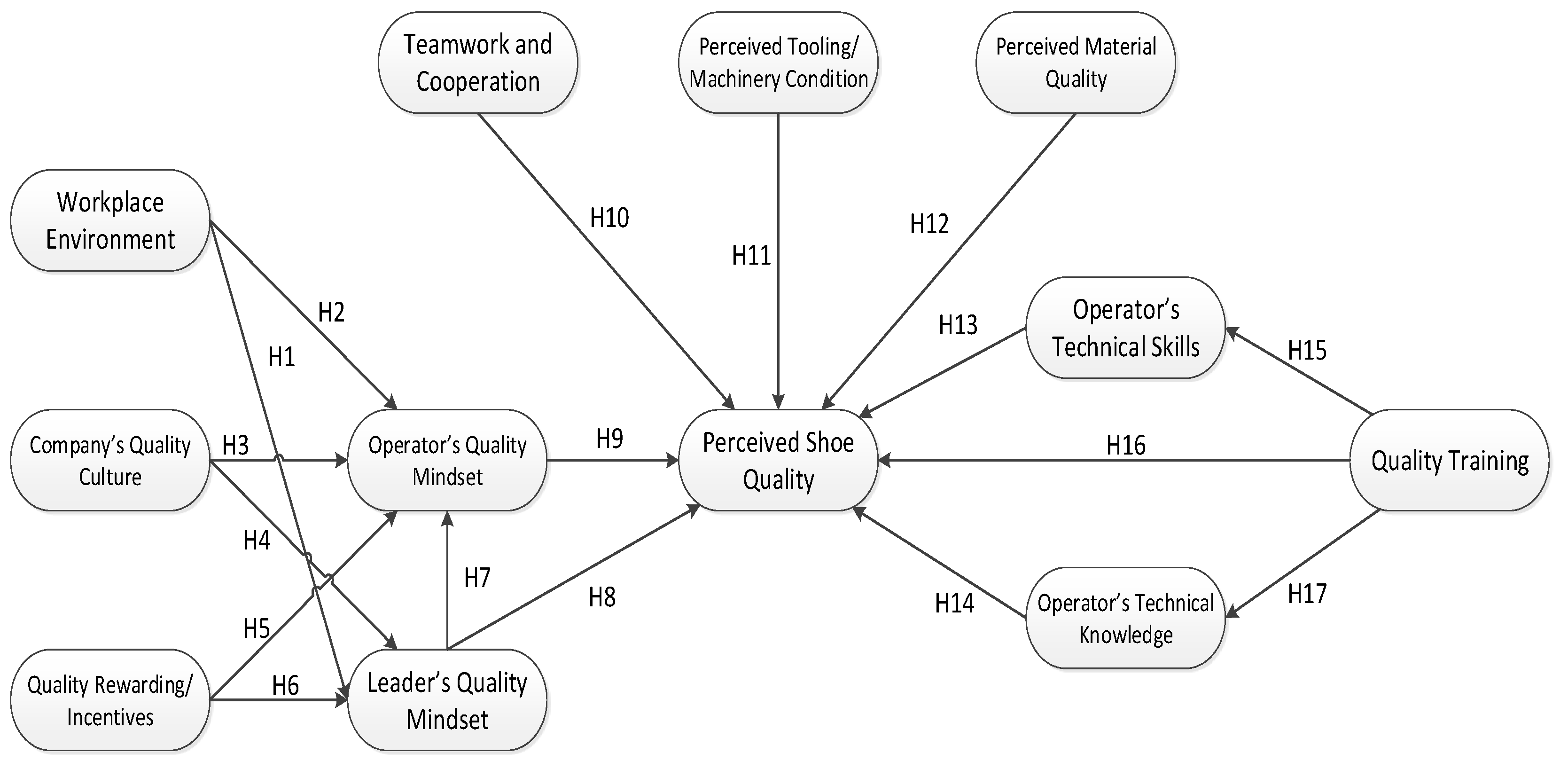
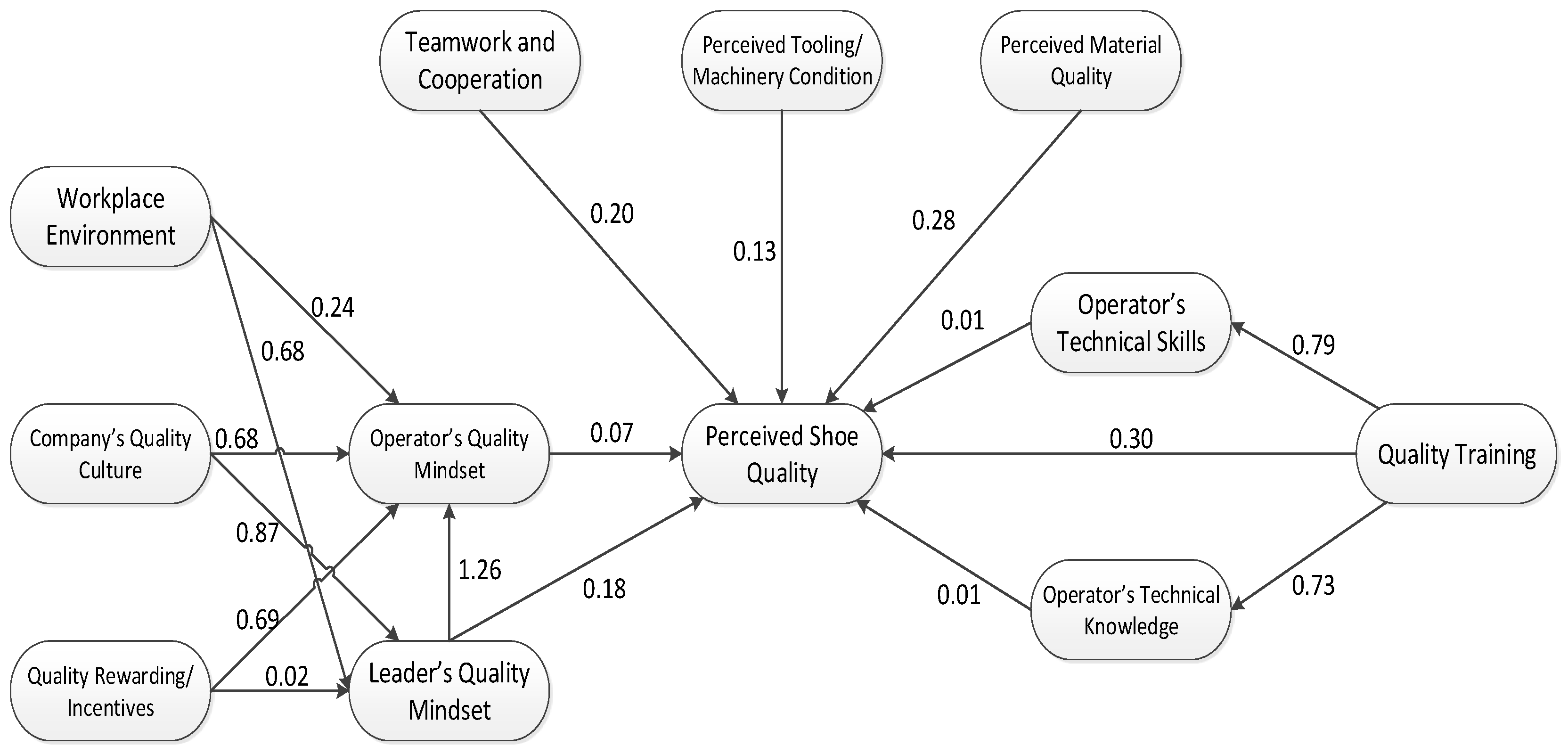
Figure 1 represents the conceptual framework of this study. A total of 17 hypotheses were constructed and were based on several literatures [10,18,23,24,25] (Table 1). Based on this figure, there were seven exogenous variables (Workplace Environment, Company’s Quality Culture, Quality Reward/Incentives, Teamwork and Cooperation, Perceived Tooling/Machinery Condition, Perceived Material Quality, and Quality Training) and four endogenous variables (Operator’s Quality Mindset, Leader’s Quality Mindset, Operator’s, Operator’s Technical Skills, and Operator’s Technical Knowledge).
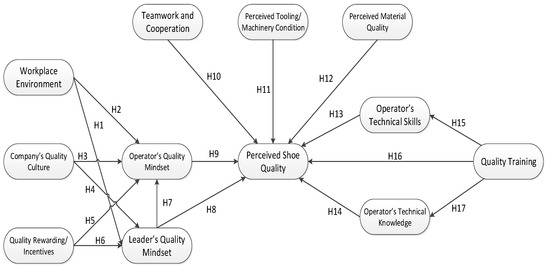
Figure 1.
Conceptual framework of the factors affecting perceived product quality.

Table 1.
The hypotheses construct.
The main process plays a big role in shoe quality. This construction process includes cutting materials, assembly (also referred to as stitching), stock fitting (Outsole/insole/midsole preparations), and lasting (attaching the stitched parts or upper to the outsole, midsole, and insole) [26].
The perceived shoe quality can be characterized depending on the construction, design, and how the shoes fit the customer [23,27]. These three factors are dependent on the internal effort of the manufacturer. Aside from internal efforts, Lombard [18] argued that soft factors (Culture, Commitment, Teamwork, Training, Leadership, Employee Involvement, and Rewards) and hard factors (Process Management, Conformance to Quality, Product complexity, and Machine maintenance) affects product quality. In addition, Teh et al. [24] found that an improvement in workplace environment when it comes to health and safety has a direct impact on product quality and reliability.
There is evidence to support a relationship between workplace environment and one’s mentality [20]. A positive and encouraging workplace has many positive effects on the employee. According to Horrevorts [28], there is a high correlation between a good and positive workplace to an employee’s mindset and productivity. In addition, they stated that a good workplace environment has a significant correlation with employees’ satisfaction with their work as a whole which can lead to a more positive outlook towards work. Thus, we hypothesized as follows:
Hypothesis 1 (H1).
The workplace environment had a significant direct effect on the Leader’s quality mindset.
Hypothesis 2 (H2).
The workplace environment had a significant direct effect on the Operator’s quality mindset.
Culture plays a big role in one’s behavior and mindset. Each individual is exposed to their own culture and is continuously affected by it when it comes to decision-making. According to Boubakri [29], culture molds and shapes one’s attitude and beliefs. One’s company culture must be defined and promoted because this significantly affects the behavior of all employees. There is evidence that supports the relationship between a culture and the mentality of a person [30]. Culture plays an important part in one’s behavior, personality, and decision-making. Their study strongly suggests that there is a strong connection between cultural background and productivity. Thus, we hypothesized as follows:
Hypothesis 3 (H3).
The company’s Quality Culture had a significant direct effect on the Operator’s quality mindset.
Hypothesis 4 (H4).
The company’s Quality Culture had a significant direct effect on the Leader’s quality mindset.
Rewards are not limited to a monetary incentive; there are other forms of incentives such as vacation time, recognition, material things, and many more. It can be tangible and intangible, but it serves one main purpose, which is to achieve a certain goal (such as higher productivity and better quality). There is evidence proving that rewards have a direct impact on one’s mindset [31]. Their study concluded that extrinsic rewards have a positive relationship with the intrinsic motivation of people. In addition, they stated that rewards have an indirect effect on one’s creative performance. Thus, we hypothesized as follows:
Hypothesis 5 (H5).
Quality rewarding/incentives had a significant direct effect on the Operator’s quality mindset.
Hypothesis 6 (H6).
Quality rewards/incentives had a significant direct effect on the Leader’s quality mindset.
An employee’s mindset is a big factor when it comes to perceived product quality. The company can help mold and shape each employee’s mindset towards the organization’s goals by:
- social modeling;
- social norms;
- signal credibility;
- respect autonomy;
- avoiding blame and focusing on growth (Paunesku, 2019).
There is evidence supporting the idea that one’s mentality has a direct effect on perceived product quality [32]. One’s mindset manifests in one’s charisma, and that charisma is channeled through the communication of one’s values and vision. Thus, we hypothesized as follows:
Hypothesis 7 (H7).
A leader’s quality mindset had a significant direct effect on Operator’s quality mindset.
Hypothesis 8 (H8).
A leader’s quality mindset had a significant direct effect on perceived shoe quality.
Hypothesis 9 (H9).
The operator’s quality mindset had a significant direct effect on perceived shoe quality.
Most employees are working positively when they are grouped into teams; however, when working in teams, there is a need to balance out each member for them to work towards a common goal. Shoe quality does not depend on one process, in fact, the outcome of multiple processes dictates quality. By having a common goal regarding quality, all involved personnel must coordinate and communicate to address quality issues immediately in order to maintain the desired level of quality in the products. There is evidence supporting the idea that teamwork has a direct impact on the perception of quality [33]. Thus, we hypothesized as follows:
Hypothesis 10 (H10).
Teamwork and cooperation had a significant direct effect on perceived shoe quality.
Machines and tooling are used to make the process of shoemaking more efficient with consistent quality. Their condition contributes significantly to the outcome of every pair produced. There is evidence supporting the idea that machine/tool condition has a direct effect on the perceived quality of the product [34]. Machine and tooling effectiveness can be measured, and it should be one of the things that are considered when producing a high-quality product. Thus, we hypothesized as follows:
Hypothesis 11 (H11).
Perceived tooling/machinery conditions had a significant direct effect on perceived shoe quality.
In manufacturing shoes, raw materials are transformed little by little until they achieve the desired construction, shape, and style. Different materials are combined to construct the shoes needed by the customer. Before the processing begins, materials are checked one by one or by batch, depending on the type of material and on where the material will be processed. Each employee involved in processing should have the ability to distinguish materials based on an accepted level of quality. The perceived material quality, noted by the employee, is essential to avoid unnecessary defects during the manufacturing stage. Thus, we hypothesized as follows:
Hypothesis 12 (H12).
Perceived material quality had a significant direct effect on perceived shoe quality.
There is evidence supporting the idea that technical skills have a direct effect on perceived product quality. Special training programs can lead to improved technical skills. A certain degree of mastery of a special process leads to process efficiency and it is directly related to how one perceives product quality [35]. Thus, we hypothesized as follows:
Hypothesis 13 (H13).
The operator’s technical skills had a significant direct effect on perceived shoe quality.
When it comes to shoemaking, technical knowledge is crucial to the whole process of producing the product. Technical knowledge is key to productivity because knowing the purpose of every procedure in shoemaking will help the employee to eliminate the non-value-adding task. There is evidence supporting the idea that technical knowledge has a direct effect on perceived product quality. It has been found that knowledge of a specific item influences efficiency [36]. Thus, we hypothesized as follows:
Hypothesis 14 (H14).
The operator’s technical knowledge had a significant direct effect on perceived shoe quality.
Technical skills in shoemaking are learned techniques/ abilities or methods required to perform a task. A task can be completed successfully if it has passed the acceptable level of quality that is defined by one’s technical knowledge. Technical knowledge can be learned and understood by using a different approach. In shoemaking, it is the metrics used to define the shoe’s standard; it involves color, length, width, and other descriptive items. The purpose of providing training is to improve the degree of expertise and knowledge on a specific topic or task. Many production problems can be solved by providing adequate training to all levels of the organization. There is evidence showing that providing training has a direct impact on one’s skills and knowledge [37,38,39,40,41]. Research has found that there is a relationship between training and motivation practices, and task efficiency. Thus, we hypothesized as follows:
Hypothesis 15 (H15).
Quality training had a significant direct effect on the Operator’s technical skills.
Hypothesis 16 (H16).
Quality training had a significant direct effect on the Perceived shoe quality.
Hypothesis 17 (H17).
Quality training had a significant direct effect on the Operator’s technical knowledge.
3. Methodology
3.1. Participants
The study was conducted for 3 months between February 2021 to April 2021 in two shoe manufacturing factories located in Clark, Pampanga, Philippines. A sample of 350 shoe manufacturing workers from various departments participated in answering a survey (Table 2). The samples will be grouped per department (Cutting department, Upper department, Stock fitting department, Lasting department, Support Department & Management). No incentive or reward was given to those who participated since all respondents voluntarily answered the questionnaire.
Table 2.
Descriptive statistics of participants.
3.2. Questionnaire
The questionnaire was distributed to the participants using an online survey and paper surveys (Appendix A). All questions were in English and were translated to the local language (Tagalog) to increase the participants’ understanding of the items. The questionnaire consisted of different factors (leader’s quality mindset, operator’s quality mindset, perceived tooling/machinery condition, operator’s technical skills, company’s quality culture, and quality training) affecting the perceived superior shoe quality. It was scaled using a Likert scale of 1 (strongly disagree) to 5 (strongly agree). This questionnaire was conducted in order to assess and validate the effectiveness of current programs that are being implemented in the factory.
3.3. Structural Equation Modeling
SEM is a widely used analytical tool in the social sciences, wherein a theoretical model is tested using data collected through surveys and questionnaires [22,42]. The maximum likelihood estimation approach was utilized using AMOS22 to obtain the Structural Equation Model [43]. A full model test and goodness of fit test were used to evaluate the difference between the hypothesized model and the observed data [22,44]. For the full model test, the chi-squared test was used, whereas for the goodness of fit test, the following model fit criteria was used: GFI, AGFQ, RMR, SRMR, RMSEA, TLI, NFI, PNFI, and AIC. To ensure internal consistency within the data, Cronbach’s alpha was also used to evaluate and assess the hypothesized model and observed data. Performing this test helped validate the data’s accuracy [45].
4. Results
Table 3 shows the descriptive statistics of the initial and final models as well as the mean, standard deviation, and variance of each item. Malkanthie [46] stated that it is hard to get the model to have a good fit in the initial run, and that is why indices can be modified to have a better fit by reducing the overall chi-square by adding covariance on indicators.
Table 3.
Descriptive statistic of SEM.
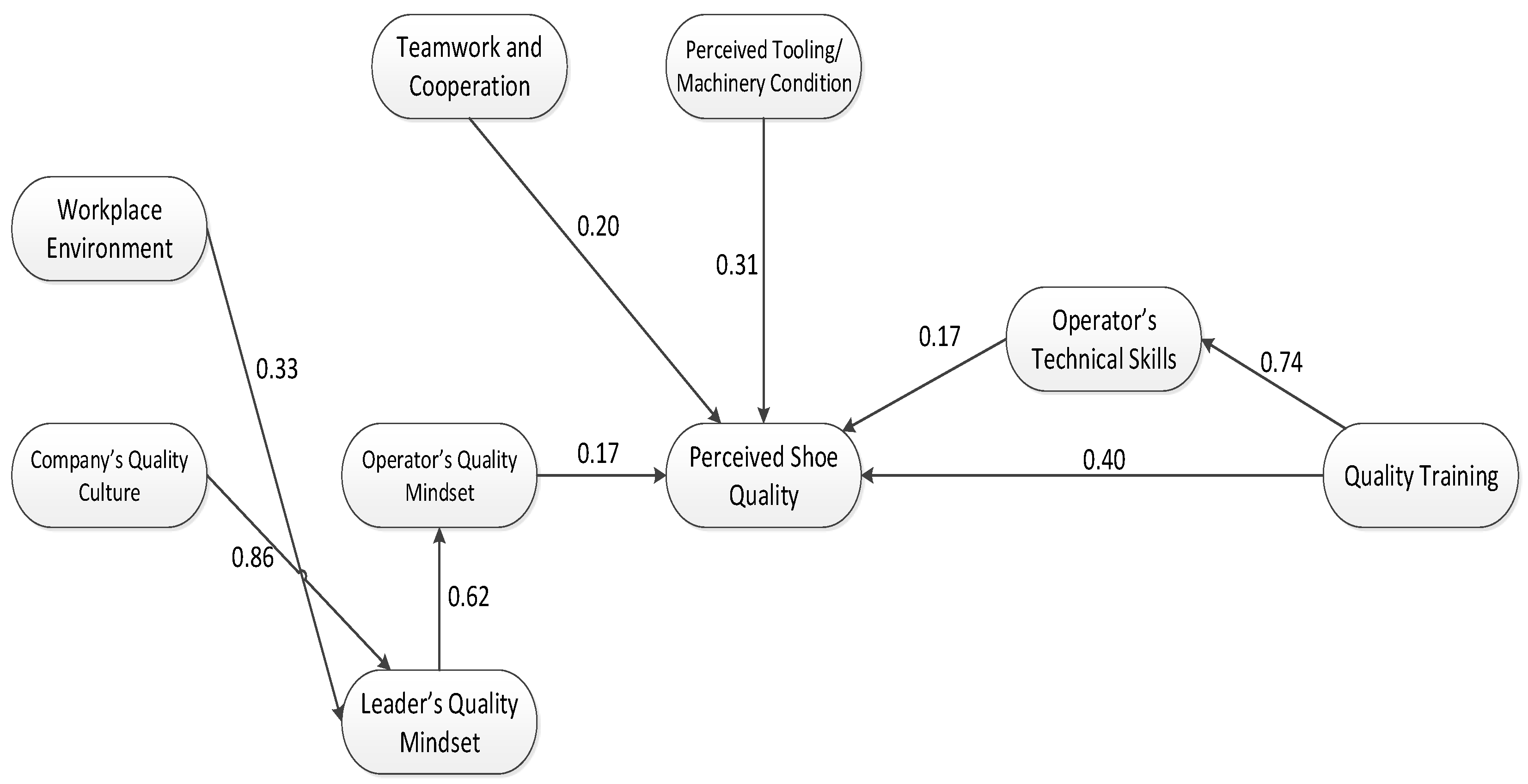
Figure 2 and Figure 3 show the initial and final SEM for evaluating factors affecting perceived superior shoe quality in the shoe manufacturing industry. Based on the initial evaluation, several hypotheses were not significant, such as H2, H3, H5, H6, H7, H8, H12, H14, and H17; therefore, several lines were removed in the final SEM. After performing indices modification, and adding covariance on indicators, the finalized chi-square was a reduced model with a better fit. The summary of the standardized direct effect, standardized indirect effect, and the standardized total effect are shown in Table 4.
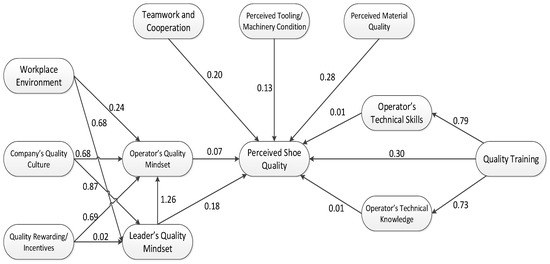
Figure 2.
The initial SEM for evaluating factors affecting perceived superior shoe quality in the shoe manufacturing industry.
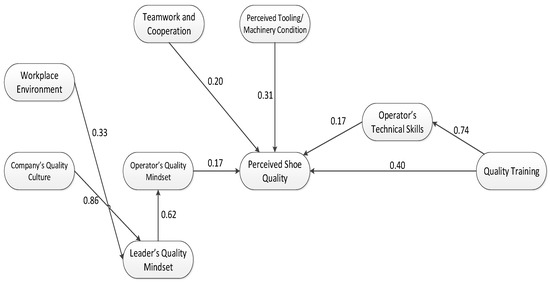
Figure 3.
The final SEM for evaluating factors affecting the perceived product quality in the shoe manufacturing industry.
Table 4.
Direct effect, indirect effect, and total effect.
Table 5 demonstrated the IFI, TLI, CFI, GFI, AGFI, and RMSEA of the final model. The table shows that GFI, AGFI, and RMSEA have met the minimum cut-off value, although, IFI, TLI, and CFI are nearly approaching the minimum cut-off value, which means it can still be considered valid.
Table 5.
The goodness of fit measures.
Table 6 shows the reliability and validity of the constructs such as Cronbach’s α, Factor Loadings, Average Variance Extracted (AVE), and Composite Reliability (CR). Factor Loadings were utilized to evaluate the validity of each construct. If the AVE is higher than 0.5 it is acceptable, but we can accept 0.4 according to Fornell and Larcker [49]. If the AVE is less than 0.5, but composite reliability is higher than 0.6, the convergent validity of the construct is still adequate. Cronbach’s α and Composite Reliability (CR) both measure the internal consistency between each set of items in a construct. Cronbach’s α and a CR that achieved 0.70 or above means that the scale has good reliability.
Table 6.
Final SEM reliability and validity of the constructs.
In general, composite reliability that is greater than 0.6, and an AVE that is greater than 0.5, can indicate that the reliability of the model is good. Cronbach’s α and CR values above 0.90 are not desirable because they indicate that all indicator variables are measuring the same phenomenon, and are therefore unlikely to be a valid measure of the construct [50]. CQC, OQM, LQM, PTMC, OTS, QT and PSSQ had a Cronbach’s α and CR greater than 0.7, and an AVE greater than 0.5, indicating that these variables were significant and were internally consistent. Even WE could not reach the AVE minimum cutoff value, but this can still be considered valid because its CR was higher than 0.6 [49].
5. Discussion
The shoe industry is expected to grow at a rate of 5.5% from 2020 to 2027, potentially reaching up to USD 530.3 billion [1]. The goal of this study was to identify factors affecting perceived shoe quality among shoe manufacturing workers. Several factors such as Operator’s Quality Mindset, Leader’s Quality Mindset, Operators, Operator’s Technical Skills and Operator’s Technical Knowledge, Workplace Environment, Company’s Quality Culture, Quality Reward/ Incentives, Teamwork and Cooperation, Perceived Tooling/Machinery Condition, Perceived Material Quality, Quality Training, and Perceived Product Quality were analyzed simultaneously using Structural Equation Modeling.
5.1. Factors Affecting the Perceived Shoe Quality among Manufacturing Workers
The SEM indicated that the quality training provided by the company had a significant effect on perceived superior shoe quality (PSSQ). Among all factors that had direct effects on the PSSQ, quality training had the highest direct effect. In addition, quality training had also shown a direct effect on the operator’s technical skills (OTS), wherein the OTS has an impact on the PSSQ. Training given to employees helps them to be more interested in learning more about their job and may help them eventually land a promotion. Bhat [51] concluded that conducting more training significantly determines organizational performance. The shoe industry is fast-paced and changes from time to time; therefore, having quality training will help the employee to catch up with these changes.
Surprisingly, the results showed that the operator’s technical skills were more important for the perceived shoe quality than the operator’s technical knowledge. The operator’s technical skills had a significant direct (0.17), indirect (0.13), and total effect (0.17) on the perceived superior shoe quality. This shows that workmanship should be the focus of the training provided. Actual exercises and other related activities to improve technical skills would be much more rewarding and beneficial than conducting classroom training. Shoemaking requires a high degree of customization and shoes ar mostly built by hand. Each operator is required to be very precise when completing manual processes. According to Reznick [52], teaching technical skills is a very crucial task. There is no easy way to achieve it, other than through mastering the basics manually and continuously. Another item that should be prioritized is the operator’s quality mindset, because it is more significant for perceived superior shoe quality than that of the leader’s quality mindset. The workplace environment, the company’s quality culture, and the leader’s quality mindset indirectly affect perceived product quality through the operator’s quality mindset.
The operator’s quality mindset had a significant direct effect (0.17) and total effect (0.17) on perceived superior shoe quality. Aside from the operator’s skills and knowledge of the process, their quality mindset should be developed as well. The results suggest that their quality mindset can affect perceived superior shoe quality. Having programs to promote a quality mindset will increase quality awareness and improve product quality.
It is evident that the leader’s quality mindset directly affected the operator’s quality mindset (0.62), which subsequently led to the perceived shoe quality. It is important to note that the leader’s role is to teach, guide, and nurture the employees under his/her commands at work. Having the leader push his/her people towards adopting a quality mindset will lead to a higher perceived shoe quality. The workplace environment and the company’s quality culture directly affect the leader’s quality mindset and indirectly affect the operator’s quality mindset.
Finally, based on the results, it is visible that teamwork and cooperation had a significant direct effect (0.31) and total effect (0.31) on the perceived shoe quality. It is not surprising for teamwork and cooperation between employees to have an impact on perceived quality because shoe manufacturing is a combination of numerous processes, wherein the shoes pass from one operator to another, who then perform different tasks. To reach the desired shoe quality, communication and feedback between employees is necessary. This level of communication and feedback, regarding quality, can only be achieved if teamwork and cooperation is present between every member of the organization.
5.2. Perceived Shoe Quality and Open Innovation
Open innovation has become an important issue [53,54,55,56,57,58,59,60,61,62,63,64,65,66,67,68,69,70,71,72], including for shoe quality. Currently, the perception of shoe quality by shoe manufacturing workers depends on what they currently know from previous experiences in shoemaking. Workers also rely on their current experiences, which they encounter as they repeat their assigned process. Goals and quality standard-setting are important; once this is properly established in the mind of the worker, it can promote user innovation. The shoe-making process consists of multiple manual steps wherein construction occurs part by part. The process standards that have been set out can be subject to adjustment, especially if a more efficient way is thought of. A worker that is directly exposed or is closer to the process can easily identify alternatives on how to perform the process, but it should be verified and validated before making adjustments. Perception of the quality of workers significantly contributes to user innovation because it forms the basis of what they can and cannot do.
Most of the time, employees at different levels have different perceptions of shoe quality. These gaps can be a big factor in the quality of the end product. Perception of quality varies for different levels of employees; thus, this can contribute to an inconsistency in quality perception. Usually, mid-level to high-level management have already established a good understanding of quality, which has been gained through experience. That is why they could take a different view on the process of shoemaking, compared with the perspective of a basic level employee. Low-level employees lack experience, which can be improved by using the quality perception model. Open innovation is a good thing and is highly recommended to help improve quality perception. Viewing the process through the eyes of a highly experienced shoemaker will promote innovation and improvement.
6. Conclusions
6.1. Theoretical Implications
With the continuous growth of the shoe manufacturing industry, it is important to focus on the quality of the product. The goal of this study is to identify factors affecting the perceived quality of shoes among shoe manufacturing workers. Structural Equation Modeling (SEM) indicated that quality training was the most significant factor on perceived shoe quality, indicating that quality training should be prioritized and included in company programs to sustain quality products. Interestingly, perceived tooling/machinery conditions, teamwork and cooperation, the operator’s technical skills, and the operator’s quality mindset also had significant effects on perceived shoe quality. Having to understand the factors that influence perceived superior shoe quality will help management focus on the factors that have significant effects on product quality.
This study is one of the first studies that explore shoe manufacturing workers’ perceptions of shoe quality. The results may convey information for future research on perceived product quality, particularly for shoe industry. Finally, our framework can be utilized to enhance perceived product quality in shoe manufacturing industries worldwide.
6.2. Practical Implications
The perceived quality can be improved using numerous approaches, but the model specifies the items that should be focused on when it comes to perceived quality improvement in a manufacturing setup. Based on our study, training is very important, and is a practice that is continuously implemented in even world-class factories. It is considered a very effective technique when it comes to moving personnel towards a certain goal. Although other factors affect perceived quality, including perceived tooling/machinery conditions, teamwork, and cooperation, the operator’s quality mindset and the operator’s technical skills should also be considered when improving quality in a manufacturing setup. This model implies that those factors also contribute to the perceived shoe quality.
Similarly to some industries [73,74], the shoe manufacturing industry is very complex, and having a lead that helps improve quality will be a great asset. Producing the correct quality is a must in shoemaking, because shoe repair can multiply the cost of manufacturing by four to five times. If training is not effective when it comes to improving quality, other factors can be further investigated and considered.
6.3. Limitations and Future Research Direction
Despite the significant contributions of the current study, there are several limitations that the authors would like to acknowledge. First, this study only measured the perceived quality rather than the quality itself. Future research that combines subjective and objective measures would be promising. Second, the effect of several additional factors was still underexplored. Future research can accommodate several additional factors such as quality programs, job design, employee satisfaction, and process difficulty [75,76,77,78]. Lastly, machine learning algorithms such as random forest classifier and artificial neural network could be utilized to determine an accurate predictive model.
Author Contributions
Conceptualization, T.C., R.B.T. and Y.T.P.; methodology, T.C., R.B.T. and Y.T.P.; software, T.C., R.B.T. and Y.T.P.; validation, Y.T.P., R.N. and S.F.P.; formal analysis, T.C., R.B.T. and Y.T.P.; investigation, T.C., R.B.T. and Y.T.P.; resources, R.B.T.; writing—original draft preparation, T.C., R.B.T. and Y.T.P.; writing—review and editing, Y.T.P.; supervision, Y.T.P., R.N. and S.F.P.; funding acquisition, Y.T.P. All authors have read and agreed to the published version of the manuscript.
Funding
This research was funded by Mapúa University Directed Research for Innovation and Value Enhancement (DRIVE).
Institutional Review Board Statement
This study was approved by School of Industrial Engineering and Engineering Management Mapua University Research Ethics Committees (FM-RC-21-43).
Informed Consent Statement
Informed consent was obtained from all subjects involved in the study.
Data Availability Statement
The data presented in this study are available on request from the corresponding author.
Acknowledgments
The researchers would like to extend their deepest gratitude to the respondents of this study despite the current COVID-19 inflation rate.
Conflicts of Interest
The authors declare no conflict of interest.
Appendix A
Table A1.
The constructs and measurement items.
Table A1.
The constructs and measurement items.
| Construct | Factors Code | Measure | Supporting Studies |
|---|---|---|---|
| Operator’s Quality Mindset | OQM1 | I know the importance of the quality of our product. | Lombard [18], Meslec et al. [32] |
| OQM2 | I perform the operation while thinking about the quality. | ||
| OQM3 | I am committed to maintaining quality in producing shoes. | ||
| OQM4 | I know basic quality issues in my department. | ||
| OQM5 | I involve myself in making quality improvements. | ||
| Operator’s Technical Knowledge | OTK1 | I know the specification to follow in my designated process. | Lombard [18], Wu et al. [36] |
| OTK2 | I am aware of the quality key point/s in my designated process. | ||
| OTK3 | I receive training about quality from time to time. | ||
| OTK4 | I can identify products that do not meet the standards. | ||
| Operator’s Technical Skills | OTS1 | I know how to technically perform my task. | Lombard [18], Pinto et al. [35] |
| OTS2 | I have the ability/skill to produce quality products. | ||
| OTS3 | I am doing the proper procedure based on the Process SOP. | ||
| OTS4 | I have been provided with technical training to perform efficiently. | ||
| OTS5 | I complete the process by following standard procedures consistently. | ||
| OTS6 | I am technically capable of producing quality shoes. | ||
| Leader’s Quality Mindset | LQM1 | Quality is the priority of my leader. | Meslec, N., et al. [32] |
| LQM2 | Leaders know the correct standards in our product. | ||
| LQM3 | Leaders promote quality awareness from time to time. | ||
| LQM4 | Leaders motivate the employees to maintain good quality. | ||
| LQM5 | Leaders can identify if I am not maintaining quality. | ||
| LQM6 | Leaders are committed to maintaining good quality. | ||
| Company’s Quality Culture | CQC1 | The company promotes the importance of quality. | Bakas, D., et al. [30], Ebadollah, A., [38] |
| CQC2 | The quality program is supported by the management. | ||
| CQC3 | The company prioritizes making quality products. | ||
| CQC4 | We solve the root causes of a quality problem. | ||
| CQC5 | Everyone follows one quality standard. | ||
| Workplace Environment | WE1 | I work in a good environment that promotes quality. | Bakas, D., et al. [30], Kamarulzaman, et al. [20] |
| WE2 | There are visuals posted to remind me about quality. | ||
| WE3 | Quality is important to the management. | ||
| WE4 | Everyone strives to make quality products. | ||
| Material Quality | MQ1 | The quality of the material is important. | Lombard [18] |
| MQ2 | I check the material quality before processing. | ||
| MQ3 | Someone in charge maintains the material’s quality. | ||
| MQ4 | I am knowledgeable in checking the material quality. | ||
| Tooling/ Machinery Condition | TMC1 | Tooling/machine conditions are important to the quality. | Lombard [18], Suryaprakash et al. [34] |
| TMC2 | I know when the tool/machine is not in good condition. | ||
| TMC3 | I have the proper tool/machine to produce quality shoes. | ||
| TMC4 | I only operate when my tool/machine will produce quality shoes. | ||
| Teamwork and Cooperation | TC1 | We need a team effort to maintain quality. | Tohidi, H., [39], Axon et al. [33] |
| TC2 | My team does not cooperate in maintaining quality. | ||
| TC3 | Another department helps to improve quality problems. | ||
| TC4 | We maintain good quality by having good communication. | ||
| Quality Training | QT1 | I have received a quality training. | Marta, R, et al. [40], Tabassi et al. [37] |
| QT2 | Some trainers are in charge of providing training regularly. | ||
| QT3 | Quality training has been effective. | ||
| QT4 | I learned the important key points during training. | ||
| QT5 | Training is provided when making new styles. | ||
| QT6 | I have received enough training to ensure the quality of products. | ||
| Quality Reward/ Incentive | QRI1 | I will be motivated if we have incentives for maintaining quality. | Klor, E. F., et al. [41], Shaheen et al. [31] |
| QRI2 | It is hard to maintain quality when there is no reward. | ||
| QRI3 | I deserve a reward for maintaining quality. | ||
| Perceived shoe Quality | PSQ1 | I only pass good quality shoes to the next process. | |
| PSQ2 | I do not accept shoes with defects. | ||
| PSQ3 | I know what a quality product looks like. | ||
| PSQ4 | I always aim to make superior quality shoes. | ||
| PSQ5 | I know what a quality product looks like. | ||
| PSQ6 | I always aim to make superior quality shoes. |
References
- Chouhan, N.; Vig, H.; Desmukh, R. Footwear Market Size, Share & Growth: Research Report 2027. Available online: https://www.alliedmarketresearch.com/footwear-market (accessed on 29 July 2021).
- Waters, D.; Waters, C.D.J. Quantitative Methods for Business; Pearson Education: London, UK, 2008. [Google Scholar]
- Stylidis, K.; Wickman, C.; Söderberg, R. Perceived quality of products: A framework and attributes ranking method. J. Eng. Des. 2020, 31, 37–67. [Google Scholar] [CrossRef]
- Li, Q.; Su, G.; Li, C.; Wang, M.; Tan, L.; Gao, L.; Mingge, W.; Wang, Q. Emission profiles, ozone formation potential and health-risk assessment of volatile organic compounds in rubber footwear industries in China. J. Hazard. Mater. 2019, 375, 52–60. [Google Scholar] [CrossRef]
- Botta, F.; Lupiáñez, J.; Chica, A.B. When endogenous spatial attention improves conscious perception: Effects of alerting and bottom-up activation. Conscious. Cogn. 2014, 23, 63–73. [Google Scholar] [CrossRef]
- Cherry, K.; Gans, S. Introduction to Psychology. Available online: https://courses.lumenlearning.com/msstate-waymaker-psychology/chapter/reading-what-is-perception/ (accessed on 18 February 2022).
- Juran, J.M.; Godfrey, A.B. Juran’s quality handbook, p. cm. In Juran’s Quality Control Handbook. Include Index; McGraw-Hill: New York, NY, USA, 1998; ISBN 0-07-034003-X. [Google Scholar]
- Barouch, G.; Bey, C. Cost of quality and process model: Improving accounting tools for attaining higher environmental efficiency. J. Clean. Prod. 2018, 181, 192–200. [Google Scholar] [CrossRef]
- Feigenbaum, A.V. Total Quality Control, 3rd ed.; McGraw-Hill: New York, NY, USA, 1992. [Google Scholar]
- Jiao, L. Factors Affecting Customer Satisfaction and Customer Loyalty towards Belle Footwear Company in Lanzhou City, Gansu Province of the People’s Republic of China. J. Bus. Manag. 2013, 14, 41–48. [Google Scholar]
- Hoe, L.C.; Mansori, S. The effects of product quality on customer satisfaction and loyalty: Evidence from Malaysian engineering industry. Int. J. Ind. Mark. 2018, 3, 20. [Google Scholar] [CrossRef]
- Janson, D.; Newman, S.; Dhokia, V. Safety footwear: A survey of end-users. Appl. Ergon. 2021, 92, 103333. [Google Scholar] [CrossRef]
- Bispo, L.G.M.; da Silva, J.M.N.; Bolis, I.; dos Santos Leite, W.K.; de Araujo Vieira, E.M.; Colaço, G.A.; de Souza, E.L.; Gontijo, L.A.; da Silva, L.B. Effects of a worksite physical activities program among men and women: An interventional study in a footwear industry. Appl. Ergon. 2020, 84, 103005. [Google Scholar] [CrossRef]
- Vieira, E.R.; Serra, M.V.G.B.; de Almeida, L.B.; Villela, W.V.; Scalon, J.D.; Quemelo, P.R.V. Symptoms and risks for musculoskeletal disorders among male and female footwear industry workers. Int. J. Ind. Ergon. 2015, 48, 110–116. [Google Scholar] [CrossRef]
- Carvalho Filho, J.; Nunhes, T.V.; Oliveira, O.J. Guidelines for cleaner production implementation and management in the plastic footwear industry. J. Clean. Prod. 2019, 232, 822–838. [Google Scholar] [CrossRef]
- Moktadir, A.; Rahman, T.; Jabbour, C.J.C.; Ali, S.M.; Kabir, G. Prioritization of drivers of corporate social responsibility in the footwear industry in an emerging economy: A fuzzy AHP approach. J. Clean. Prod. 2018, 201, 369–381. [Google Scholar] [CrossRef]
- Pagano, S.; Russo, R.; Savino, S. A vision guided robotic system for flexible gluing process in the footwear industry. Robot. Comput.-Integr. Manuf. 2020, 65, 101965. [Google Scholar] [CrossRef]
- Lombard, R.; van Waveren, C.C.; Chan, K.-Y. Factors affecting quality in a manufacturing environment for a non-repairable product. In Proceedings of the 2014 IEEE International Conference on Industrial Engineering and Engineering Management, Selangor, Malaysia, 9–12 December 2014; pp. 137–142. [Google Scholar]
- Jha, K.; Iyer, K. Critical factors affecting quality performance in construction projects. Total Qual. Manag. Bus. Excell. 2006, 17, 1155–1170. [Google Scholar] [CrossRef]
- Kamarulzaman, N.; Saleh, A.; Hashim, S.; Hashim, H.; Abdul-Ghani, A. An overview of the influence of physical office environments towards employee. Procedia Eng. 2011, 20, 262–268. [Google Scholar] [CrossRef]
- Kiraz, A.; Canpolat, O.; Özkurt, C.; Taşkın, H. Analysis of the factors affecting the Industry 4.0 tendency with the structural equation model and an application. Comput. Ind. Eng. 2020, 150, 106911. [Google Scholar] [CrossRef]
- Lomax, R.; Schumacker, R. A Beginner’s Guide to Structural Equation Modeling; Routledge Academic: New York, NY, USA, 2012. [Google Scholar]
- Witana, C.P.; Feng, J.; Goonetilleke, R.S. Dimensional differences for evaluating the quality of footwear fit. Ergonomics 2004, 47, 1301–1317. [Google Scholar] [CrossRef]
- Teh, P.-L.; Adebanjo, D.; Ahmed, P.K. Factors affecting product quality and reliability: A comparison of developed and developing countries. In Proceedings of the 2014 IEEE International Conference on Industrial Engineering and Engineering Management, Selangor, Malaysia, 9–12 December 2014; pp. 1481–1485. [Google Scholar]
- Kau, L.; Nel, H. Cost of Quality: A Review and Future Research Directions. Int. J. Soc. Ecol. Sustain. Dev. (IJSESD) 2019, 10, 28–52. [Google Scholar] [CrossRef]
- Hatfield, C.B. Designing, Cutting and Grading Boot and Shoe Patterns, and Complete Manual for the Stitching Room, by an Expert of Thirty Years; Nabu Press: New York, NY, USA, 2010. [Google Scholar]
- Goonetilleke, R.S.; Luximon, A.; Tsui, K.L. The Quality of Footwear Fit: What we know, don’t know and should know. In Proceedings of the Human Factors and Ergonomics Society Annual Meeting, San Diego, CA, USA, 30 July–4 August 2000; pp. 2-515–2-518. [Google Scholar]
- Horrevorts, M.; Van Ophem, J.; Terpstra, P. Impact of cleanliness on the productivity of employees. Facilities 2018, 36, 442–459. [Google Scholar] [CrossRef]
- Boubakri, N.; Chkir, I.; Saadi, S.; Zhu, H. Does national culture affect corporate innovation? International evidence. J. Corp. Financ. 2021, 66, 101847. [Google Scholar] [CrossRef]
- Bakas, D.; Kostis, P.; Petrakis, P. Culture and labour productivity: An empirical investigation. Econ. Model. 2020, 85, 233–243. [Google Scholar] [CrossRef]
- Shaheen, K.; Waheed, A.; Hashmi, W.H. Extrinsic rewards and creative performance syndrome: The mediating mechanism and interacting effects. Think. Ski. Creat. 2020, 38, 100713. [Google Scholar] [CrossRef]
- Meslec, N.; Curseu, P.L.; Fodor, O.C.; Kenda, R. Effects of charismatic leadership and rewards on individual performance. Leadersh. Q. 2020, 31, 101423. [Google Scholar] [CrossRef]
- Axon, D.R.; Campbell, P.; Warholak, T. Student pharmacists’ experiences of teamwork in a quality improvement course. Curr. Pharm. Teach. Learn. 2019, 11, 139–144. [Google Scholar] [CrossRef]
- Suryaprakash, M.; Prabha, M.G.; Yuvaraja, M.; Revanth, R.R. Improvement of overall equipment effectiveness of machining centre using tpm. Mater. Today Proc. 2021, 46, 9348–9353. [Google Scholar] [CrossRef]
- Pinto, L.; Nunes, E.; Sousa, S. A framework to improve training and development of workers’ technical skills: Effects on operational performance during company relocation. Procedia Manuf. 2020, 51, 1806–1813. [Google Scholar] [CrossRef]
- Wu, Z.B.; Yeung, G.; Mok, V.; Han, Z. Firm-specific knowledge and technical efficiency of watch and clock manufacturing firms in China. Int. J. Prod. Econ. 2007, 107, 317–332. [Google Scholar] [CrossRef]
- Tabassi, A.A.; Ramli, M.; Bakar, A.H.A. Effects of training and motivation practices on teamwork improvement and task efficiency: The case of construction firms. Int. J. Proj. Manag. 2012, 30, 213–224. [Google Scholar] [CrossRef]
- Ebadollah, A. Organizational culture and productivity. Procedia-Soc. Behav. Sci. 2011, 15, 772–776. [Google Scholar] [CrossRef][Green Version]
- Tohidi, H. Teamwork productivity & effectiveness in an organization base on rewards, leadership, training, goals, wage, size, motivation, measurement and information technology. Procedia Comput. Sci. 2011, 3, 1137–1146. [Google Scholar]
- Raurell-Torredà, M.; Rascón-Hernán, C.; Malagón-Aguilera, C.; Bonmatí-Tomás, A.; Bosch-Farré, C.; Gelabert-Vilella, S.; Romero-Collado, A. Effectiveness of a training intervention to improve communication between/awareness of team roles: A randomized clinical trial. J. Prof. Nurs. 2021, 37, 479–487. [Google Scholar] [CrossRef]
- Klor, E.F.; Kube, S.; Winter, E. Can higher rewards lead to less effort? Incentive reversal in teams. J. Econ. Behav. Organ. 2014, 97, 72–83. [Google Scholar] [CrossRef]
- Davvetas, V.; Diamantopoulos, A.; Zaefarian, G.; Sichtmann, C. Ten basic questions about structural equations modeling you should know the answers to–But perhaps you don’t. Ind. Mark. Manag. 2020, 90, 252–263. [Google Scholar] [CrossRef]
- Maydeu-Olivares, A. Maximum likelihood estimation of structural equation models for continuous data: Standard errors and goodness of fit. Struct. Equ. Model. A Multidiscip. J. 2017, 24, 383–394. [Google Scholar] [CrossRef]
- Prasetyo, Y.T. Factors Affecting Gross Manual Dexterity: A Structural Equation Modeling Approach. In Proceedings of the 2020 IEEE 7th International Conference on Industrial Engineering and Applications (ICIEA), Bangkok, Thailand, 16–21 April 2020; pp. 425–429. [Google Scholar]
- Tavakol, M.; Dennick, R. Making sense of Cronbach’s alpha. Int. J. Med. Educ. 2011, 2, 53. [Google Scholar] [CrossRef]
- Malkanthie, A.M. Structural Equation Modeling with Amos; Lap Lambert Academic Publishing Inc.: Chisinau, Moldova, 2018. [Google Scholar]
- Gefen, D.; Straub, D.; Boudreau, M.-C. Structural equation modeling and regression: Guidelines for research practice. Commun. Assoc. Inf. Syst. 2000, 4, 7. [Google Scholar] [CrossRef]
- Hair, J.F.; Gabriel, M.; Patel, V. AMOS covariance-based structural equation modeling (CB-SEM): Guidelines on its application as a marketing research tool. Braz. J. Mark. 2014, 13, 44–55. [Google Scholar]
- Fornell, C.; Larcker, D.F. Evaluating structural equation models with unobservable variables and measurement error. J. Mark. Res. 1981, 18, 39–50. [Google Scholar] [CrossRef]
- Hair, J.F.; Anderson, R.E.; Babin, B.J.; Black, W.C. Multivariate Data Analysis: A Global Perspective; Pearson Education: London, UK, 2010; Volume 7. [Google Scholar]
- Bhat, Z.H. Impact of training on employee performance: A study of retail banking sector in India. Indian J. Appl. Res. 2013, 3, 292–293. [Google Scholar] [CrossRef]
- Reznick, R.K. Teaching and testing technical skills. Am. J. Surg. 1993, 165, 358–361. [Google Scholar] [CrossRef]
- Lu, Q.; Chesbrough, H. Measuring open innovation practices through topic modelling: Revisiting their impact on firm Financial Performance. Technovation, 2021; 102434, in press. [Google Scholar] [CrossRef]
- Belitski, M.; Rejeb, N. Does open customer innovation model hold for family firms? J. Bus. Res. 2022, 145, 334–346. [Google Scholar] [CrossRef]
- Chaudhary, S.; Kaur, P.; Talwar, S.; Islam, N.; Dhir, A. Way off the mark? open innovation failures: Decoding what really matters to chart the future course of action. J. Bus. Res. 2022, 142, 1010–1025. [Google Scholar] [CrossRef]
- Naqshbandi, M.M.; Jasimuddin, S.M. The linkage between open innovation, absorptive capacity and managerial ties: A cross-country perspective. J. Innov. Knowl. 2022, 7, 100167. [Google Scholar] [CrossRef]
- Tomita, K. Open innovation and drug discovery startups in Japan: The importance of communication in licensing. Asia Pac. Manag. Rev. 2022; in press. [Google Scholar] [CrossRef]
- Xiaoguang, Z. Incorporation of Sticky Information and product diversification into static game of Open Innovation. Int. J. Innov. Stud. 2022, 6, 11–25. [Google Scholar] [CrossRef]
- Seo, R.; Park, J.-H. When is interorganizational learning beneficial for inbound open innovation of Ventures? A contingent role of Entrepreneurial Orientation. Technovation 2022, 116, 102514. [Google Scholar] [CrossRef]
- Kimpimäki, J.-P.; Malacina, I.; Lähdeaho, O. Open and sustainable: An emerging frontier in innovation management? Technol. Forecast. Soc. Chang. 2022, 174, 121229. [Google Scholar] [CrossRef]
- Bašić, M. Organisational learning antecedents and Open innovation: Differences in internationalisation level. Int. J. Innov. Stud. 2021, 5, 161–174. [Google Scholar] [CrossRef]
- Saura, J.R.; Palacios-Marqués, D.; Ribeiro-Soriano, D. Exploring the boundaries of open innovation: Evidence from Social Media Mining. Technovation, 2022; 102447, in press. [Google Scholar] [CrossRef]
- Mastrocinque, E.; Lamberti, E.; Ramirez, F.J.; Petrovic, D. Measuring open innovation under uncertainty: A fuzzy logic approach. J. Eng. Technol. Manag. 2022, 63, 101673. [Google Scholar] [CrossRef]
- Sanni, M.; Verdolini, E. Eco-innovation and openness: Mapping the growth trajectories and the knowledge structure of open eco-innovation. Sustain. Futures 2022, 4, 100067. [Google Scholar] [CrossRef]
- Shin, H.; Perdue, R.R. Developing creative service ideas through hotel customer engagement for open innovation: Focused on empowerment and motivation processes. Int. J. Hosp. Manag. 2022, 100, 103077. [Google Scholar] [CrossRef]
- Audretsch, B.D.; Belitski, M. The limits to open innovation and its impact on Innovation Performance. Technovation, 2022; 102519, in press. [Google Scholar] [CrossRef]
- Shaikh, I.; Randhawa, K. Managing the risks and motivations of technology managers in open innovation: Bringing stakeholder-centric corporate governance into focus. Technovation 2022, 114, 102437. [Google Scholar] [CrossRef]
- Cavallo, A.; Burgers, H.; Ghezzi, A.; van de Vrande, V. The evolving nature of Open innovation governance: A study of a digital platform development in collaboration with a Big Science Centre. Technovation, 2021; 102370, in press. [Google Scholar] [CrossRef]
- Scaliza, J.A.; Jugend, D.; Chiappetta Jabbour, C.J.; Latan, H.; Armellini, F.; Twigg, D.; Andrade, D.F. Relationships among organizational culture, open innovation, innovative ecosystems, and performance of firms: Evidence from an emerging economy context. J. Bus. Res. 2022, 140, 264–279. [Google Scholar] [CrossRef]
- Ahlfänger, M.; Gemünden, H.G.; Leker, J. Balancing knowledge sharing with protecting: The efficacy of formal control in open innovation projects. Int. J. Proj. Manag. 2022, 40, 105–119. [Google Scholar] [CrossRef]
- Wu, H.; Han, Z.; Zhou, Y. Optimal degree of openness in open innovation: A Perspective from Knowledge Acquisition & knowledge leakage. Technol. Soc. 2021, 67, 101756. [Google Scholar]
- Dall-Orsoletta, A.; Romero, F.; Ferreira, P. Open and collaborative innovation for the Energy Transition: An Exploratory study. Technol. Soc. 2022, 69, 101955. [Google Scholar] [CrossRef]
- Sellitto, M.A.; Hermann, F.F. Influence of green practices on organizational competitiveness: A study of the electrical and electronics industry. Eng. Manag. J. 2019, 31, 98–112. [Google Scholar] [CrossRef]
- Baierle, I.C.; Benitez, G.B.; Nara, E.O.B.; Schaefer, J.L.; Sellitto, M.A. Influence of Open Innovation Variables on the Competitive Edge of Small and Medium Enterprises. J. Open Innov. Technol. Mark. Complex. 2020, 6, 179. [Google Scholar] [CrossRef]
- Balinado, J.R.; Prasetyo, Y.T.; Young, M.N.; Persada, S.F.; Miraja, B.A.; Perwira Redi, A.A. The effect of service quality on customer satisfaction in an automotive after-sales service. J. Open Innov. Technol. Mark. Complex. 2021, 7, 116. [Google Scholar] [CrossRef]
- German, J.D.; Redi, A.A.; Prasetyo, Y.T.; Persada, S.F.; Ong, A.K.; Young, M.N.; Nadlifatin, R. Choosing a package carrier during COVID-19 pandemic: An integration of pro-environmental planned behavior (PEPB) theory and Service Quality (SERVQUAL). J. Clean. Prod. 2022, 346, 131123. [Google Scholar] [CrossRef] [PubMed]
- Prasetyo, Y.T.; Castillo, A.M.; Salonga, L.J.; Sia, J.A.; Chuenyindee, T.; Young, M.N.; Persada, S.F.; Miraja, B.A.; Redi, A.A. Factors influencing repurchase intention in drive-through Fast Food: A structural equation modeling approach. Foods 2021, 10, 1205. [Google Scholar] [CrossRef]
- Ong, A.K.; Cleofas, M.A.; Prasetyo, Y.T.; Chuenyindee, T.; Young, M.N.; Diaz, J.F.; Nadlifatin, R.; Redi, A.A. Consumer behavior in clothing industry and its relationship with open innovation dynamics during the COVID-19 pandemic. J. Open Innov. Technol. Mark. Complex. 2021, 7, 211. [Google Scholar] [CrossRef]
Publisher’s Note: MDPI stays neutral with regard to jurisdictional claims in published maps and institutional affiliations. |
© 2022 by the authors. Licensee MDPI, Basel, Switzerland. This article is an open access article distributed under the terms and conditions of the Creative Commons Attribution (CC BY) license (https://creativecommons.org/licenses/by/4.0/).