Article

Evaluation Method of Heavy-Ion-Induced Single-Event Upset in 3D-Stacked SRAMs


1
Institute of Modern Physics, Chinese Academy of Sciences, Lanzhou 730000, China
2
School of Nuclear Science and Technology, University of Chinese Academy of Science, Beijing 100049, China
*
Author to whom correspondence should be addressed.
Electronics 2020, 9(8), 1230; https://doi.org/10.3390/electronics9081230

Submission received: 8 June 2020 / Revised: 23 July 2020 / Accepted: 28 July 2020 / Published: 30 July 2020
(This article belongs to the Special Issue Extreme-Environment Electronics: Challenges and Solutions)

Abstract

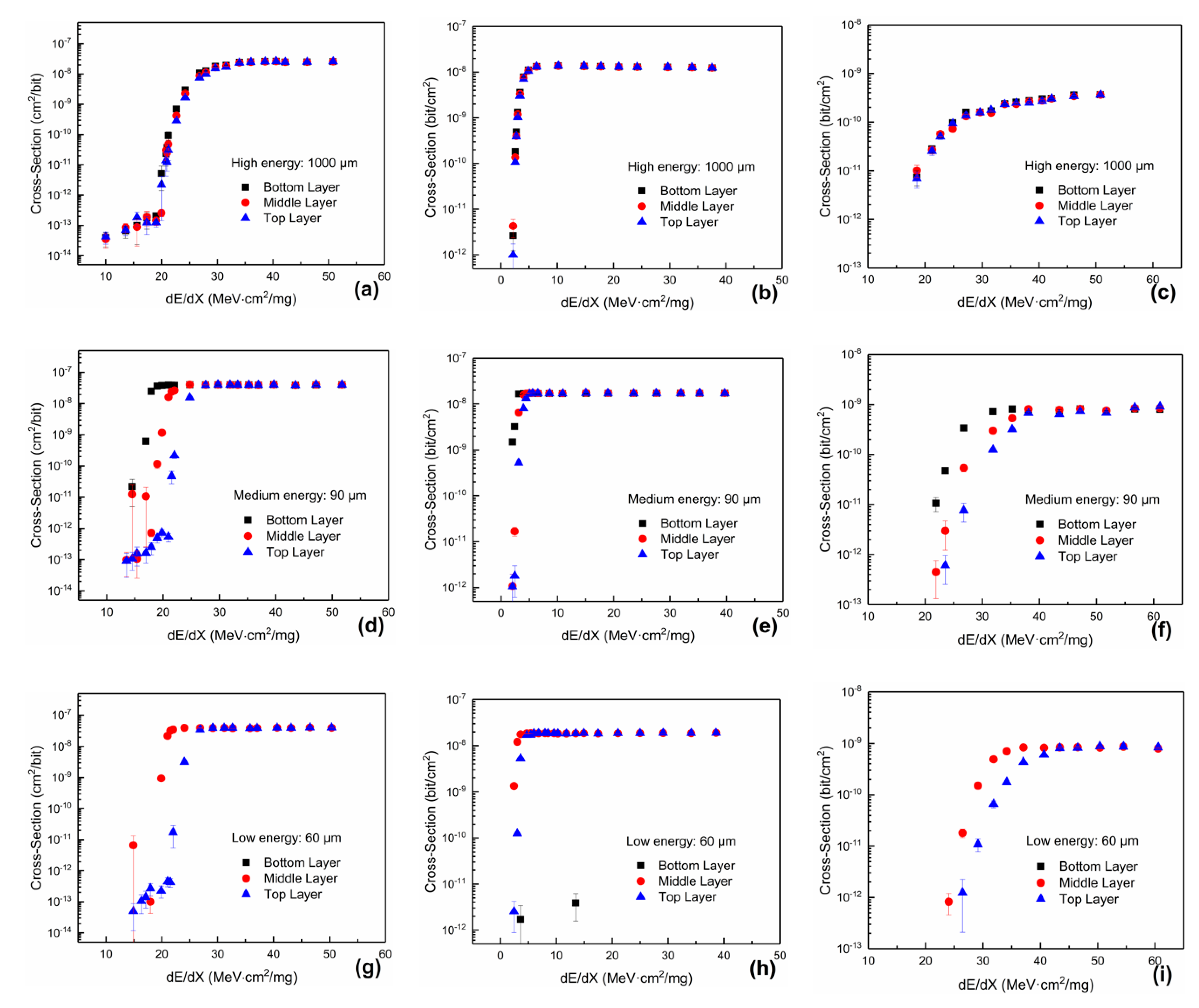
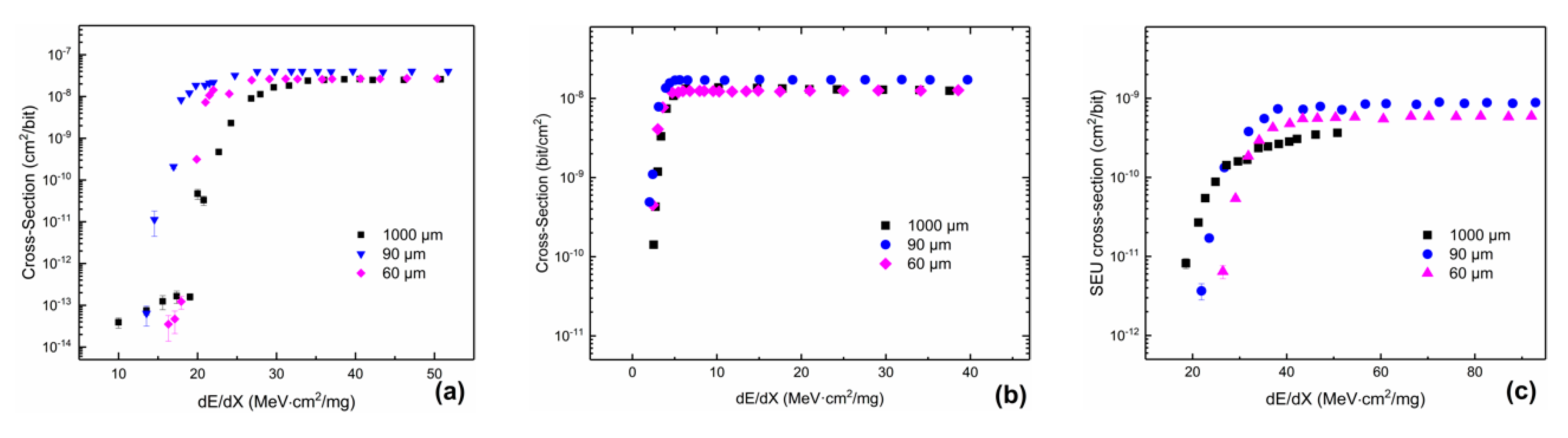
The interaction of radiation with three-dimensional (3D) electronic devices can be determined through the detection of single-event effects (SEU). In this study, we propose a method for the evaluation of SEUs in 3D static random-access memories (SRAMs) induced by heavy-ion irradiation. The cross-sections (CSs) of different tiers, as a function of the linear energy transfer (LET) under high, medium, and low energy heavy-ion irradiation, were obtained through Monte Carlo simulations. The simulation results revealed that the maximum value of the CS was obtained under the medium-energy heavy-ion penetration, and the effect of penetration range of heavy ions was observed in different tiers of 3D-stacked devices. The underlying physical mechanisms of charge collection under different heavy-ion energies were discussed. Thereafter, we proposed an equation of the critical heavy-ion range that can be used to obtain the worst CS curve was proposed. Considering both the LET spectra and flux of galactic cosmic ray (GCR) and the variation in the heavy-ion Bragg peak values with the atomic number, we proposed a heavy-ion irradiation test guidance for 3D-stacked devices. In addition, the effectiveness of this method was verified through simulations of the three-tier vertically stacked SRAM and the ultrahigh-energy heavy-ion irradiation experiment of the two-tier vertically stacked SRAM. this study provides a theoretical framework for the detection of SEUs induced by heavy-ion irradiation in 3D-integrated devices.
Keywords: Monte-Carlo simulation; single-event upset; test standard; three-dimensional integrated circuits; ultrahigh-energy heavy ion Monte-Carlo simulation; single-event upset; test standard; three-dimensional integrated circuits; ultrahigh-energy heavy ion