Article

Resolving Knowledge Gaps in Liquid Crystal Delay Line Phase Shifters for 5G/6G mmW Front-Ends

by
Jinfeng Li
1,2,3,* and
Haorong Li
1
1
Beijing Key Laboratory of Millimeter Wave and Terahertz Technology, School of Integrated Circuits and Electronics, Beijing Institute of Technology, Beijing 100081, China
2
School of Interdisciplinary Science, Beijing Institute of Technology, Beijing 100081, China
3
Department of Electrical and Electronic Engineering, Imperial College London, London SW7 2AZ, UK
*
Author to whom correspondence should be addressed.
Electronics 2026, 15(2), 485; https://doi.org/10.3390/electronics15020485
Submission received: 26 December 2025 / Revised: 20 January 2026 / Accepted: 22 January 2026 / Published: 22 January 2026

Abstract

In the context of fifth-generation (5G) communications and the dawn of sixth-generation (6G) networks, a surged societal demand on bandwidth and data rate and more stringent commercial requirements on transmission efficiency, cost, and reliability are increasingly evident and, hence, driving the maturity of reconfigurable millimeter-wave (mmW) and terahertz (THz) devices and systems, in particular, liquid crystal (LC)-based tunable solutions for delay line phase shifters (DLPSs). However, the field of LC-combined electronics has witnessed only incremental developments in the past decade. First, the tuning principle has largely been unchanged (leveraging the shape anisotropy of LC molecules in microscale and continuum mechanics in macroscale for variable polarizability). Second, LC-enabled devices’ performance has yet to be standardized (suboptimal case by case at different frequency domains). In this context, this work points out three underestimated knowledge gaps as drawn from our theoretical designs, computational simulations, and experimental prototypes, respectively. The first gap reports previously overlooked physical constraints from the analytical model of an LC-embedded coaxial DLPS. A new geometry-dielectric bound is identified. The second gap deals with the lack of consideration in the suboptimal dispersion behavior in differential delay time (DDT) and differential delay length (DDL) for LC phase-shifting devices. A new figure of merit (FoM) is proposed and defined at the V-band (60 GHz) to comprehensively evaluate the ratios of the DDT and DDL over their standard deviations across the 54 to 66 GHz spectrum. The third identified gap deals with the in-depth explanation of our recent experimental results and outlook for partial leakage attack analysis of LC phase shifters in modern eavesdropping.

1. Introduction

The millimeter-wave (mmW) [1,2,3,4,5] and terahertz (THz) [6,7] spectra offer a promising frontier for beyond-fifth-generation (B5G) [8,9,10] and sixth-generation (6G) [11,12] communications and sensing [13,14,15,16,17], primarily due to their vast available bandwidth, which enables a significant increase in data rates compared to the congested sub-6 GHz microwave bands [18]. However, a primary challenge at these higher frequencies, such as the V-band, is the severe free-space path loss and atmospheric absorption. To overcome these limitations, directional beam steering has become indispensable. This is predominantly achieved through phased arrays [19] and, more recently, their two-dimensional counterpart, metasurfaces [20]. The commercialization of these technologies further demands cost-effective and streamlined fabrication, making the performance of individual components critical to the overall system’s viability.
Among these components, the phase shifter [21,22,23] is a key determinant of a phased array’s performance and cost. Phase shifters are passive devices that control the phase of an electromagnetic wave. A specific and critical subclass is the delay line [24,25], which provides a constant time delay (Δt), resulting in a differential phase shift (Δϕ) that increases linearly with frequency. This frequency-linear relationship is the defining characteristic of true time delay (TTD), which is essential for wideband and ultra-wideband systems. TTD prevents beam squinting in phased arrays, mitigates signal distortion, and is vital for applications ranging from wideband beamforming to digital signal processing.
Since their inception in the early 1990s, liquid crystal (LC)-based delay line phase shifters (DLPSs) [26,27,28] have emerged as a promising technology for passive analog beam steering. They offer a compelling alternative to power-intensive digital beamforming and possess an inherent potential for TTD operation, positioning them to address critical challenges in 5G/6G systems [27,28]. Figure 1 depicts the combination of LC with coaxial or other enclosed transmission line structures for realizing DLPS, wherein the electric field-driven reorientation of the LC director (nanoscopically) results in the stepless tuning of electric permittivity (macroscopically) as per the controlled variation in the dipole moment [25].
Due to the variation in the permittivity (implemented by varying the bias voltage applied to the LC), the resultant wave speed perturbation of the mmW transmitted signal produces Δϕ in the angular domain or Δt in the time domain. By grouping the LC-embedded DLPS devices in an array (subsystem) for feeding a phased array antenna, continuous beam steering can be envisaged, featuring a far higher spatial resolution (beam-pointing accuracy) than those achieved by conventional P-I-N diode-based switches [29,30] or micro-electromechanical systems (MEMSs) [31,32,33] that are binary switching in nature (i.e., resulting in beam-pointing errors inherently). Other advantages exhibited by the ever-evolving LC DLPS-enabled technology (e.g., low insertion loss, low power consumption, and insertion loss self-balancing for reduced complexity in circuitry) are evidenced and discussed in a host of our past developments [25,28,34], as well as other state of the art [35,36,37] technologies across the globe.
However, the performance evaluation of these smart devices requires careful consideration, particularly in the ongoing beyond-5G/6G standardization roadmap. While general phase shifters are often assessed by their phase-shifting range and insertion loss [25,27,36], the performance of a delay line is critically judged by the flatness—or minimal dispersion—of its differential delay time (DDT) or differential delay length (DDL) across the operational band. This distinction in metrics reveals different trade-offs and optimization frontiers, which are often overlooked.
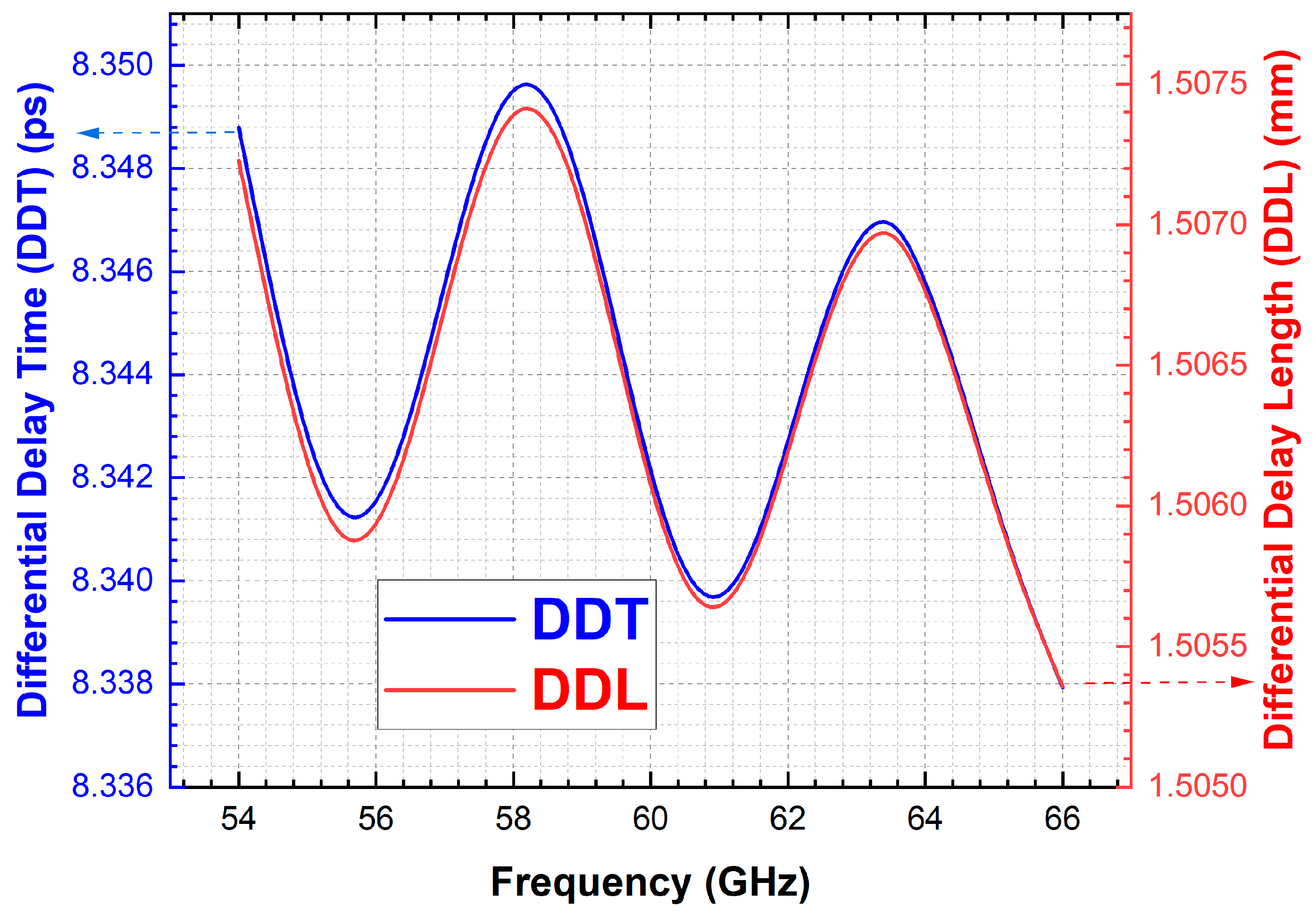
To be more specific, the conventional comparison metric based on figure of merit (FoM) in labelling the performance of phase-shifting devices (e.g., LC-based phase shifters versus other phase-shifting technologies) utilizes the format of degree per dB at a specific frequency (per GHz). While this FoM (°/dB) is a one-size-fits-all paradigm valid for single-frequency assessment, it fails to convey the dispersion behavior in broadband TTD characterization, for which quantifying the frequency dependency (ripples) in the delay time or delay length of the LC DLPS is necessary. However, there is limited exposure of such a wideband metric in current documentation. Furthermore, besides the analytical and computational investigation of knowledge gaps in LC-based DLPS for 5G/6G and THz communications, experimental inspirations drawn from the lens of information security (cryptanalysis) and reliability in the physical layer are missing in the existing literature.
To this end, this paper presents a comprehensive investigation that bridges critical, yet underappreciated, knowledge gaps in LC-based DLPS. Through an integrated approach combining analytical modeling, electromagnetic simulation, and experimental insights, this work raises and tackles three specific unknowns and challenges, as summarized in Figure 2, Figure 3 and Figure 4.
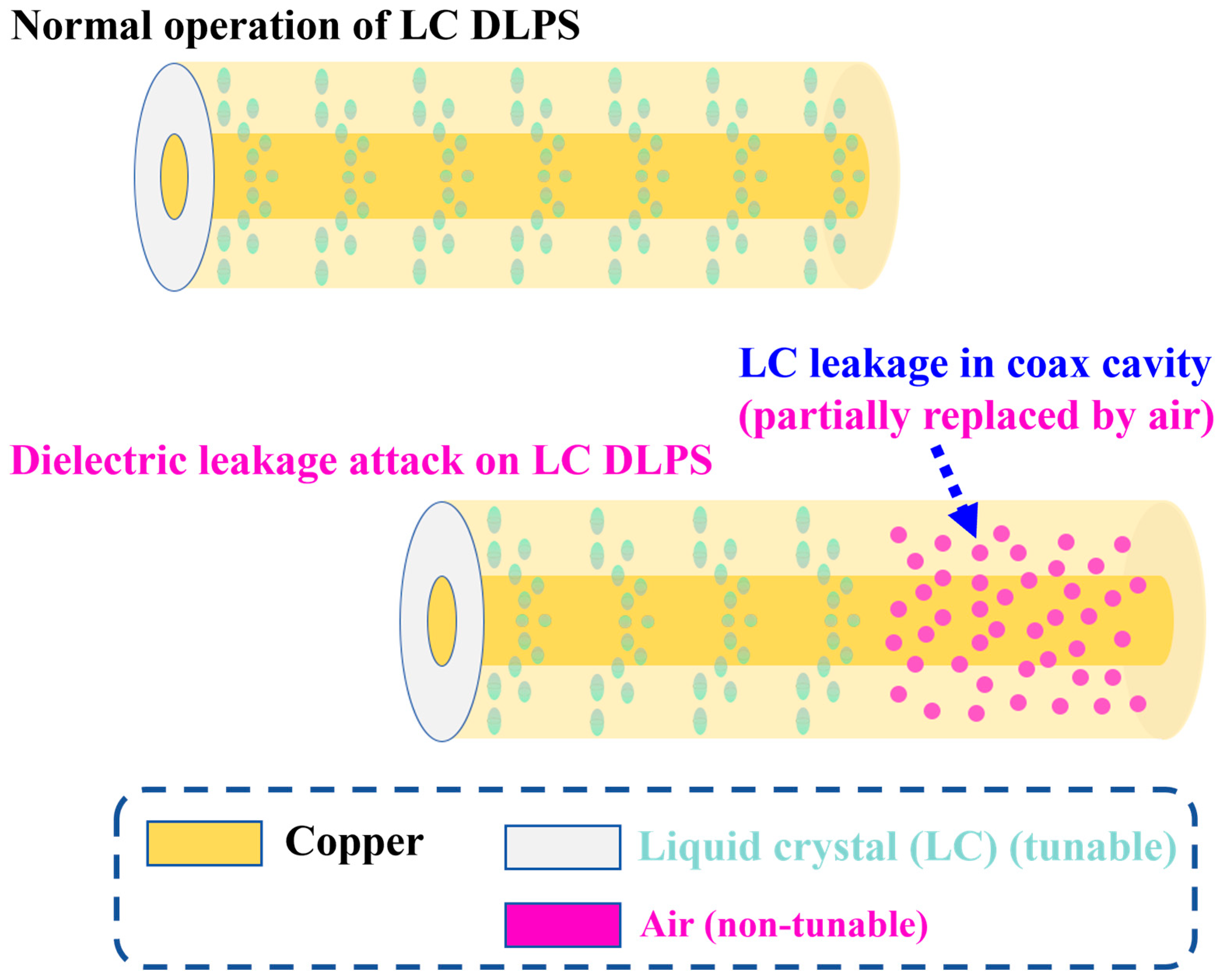
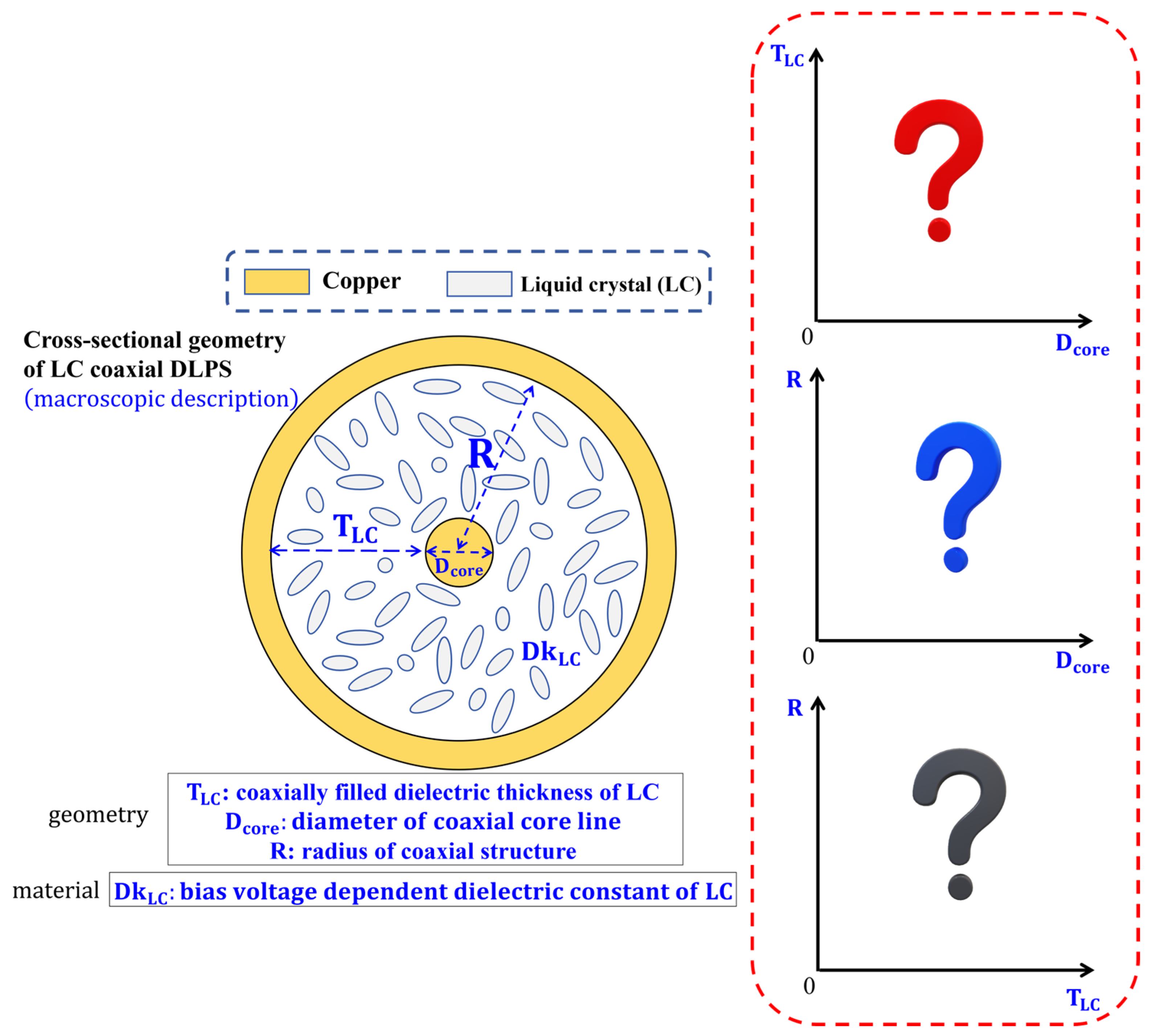
Figure 2 asks questions about the physical limits of the geometry coaxially filled with LC for DLPSs operating in a single mode, i.e., free of a higher-order mode (HoM) condition. Figure 3 argues that the LC DLPS design with the conventionally optimal figure of merit (FoM, defined as the ratio of the maximally achievable differential phase shift to the maximal insertion loss) in the angular domain does not imply the optimal DDT or DDL behavior when looking into the wideband dispersions. Figure 4 highlights a critical security vulnerability associated with LC DLPS within phased array subsystems. The observed partial dielectric leakage of the LC from its coaxial cavity introduces a dual challenge. First, it complicates the prediction of DLPS performance degradation due to the transient dynamics of the resulting LC–air mixture—effectively a two-phase flow problem within the dielectric cavity. Second, this physical vulnerability necessitates a reassessment of security implications in the 5G/6G ecosystem, as it presents a potential vector for malicious attack.
Accordingly, the following sections are structured to detail these new investigations: Section 2 covers the analytical foundation concerning the derivation of previously unconsidered physical constraints in the analytical model of an LC-embedded coaxial DLPS, Section 3 presents the suboptimal dispersion behavior results (frequency ripples) observed in LC-DLPS performance by mathematical modeling and simulation using electronic design automation (EDA) tools, and Section 4 contributes experiment-inspired insights and analysis of partial dielectric leakage attacks for an LC DLPS in the security landscape of a beam-steering subsystem targeting B5G/6G applications.

2. Materials and Methods

The dielectric specifications of the LC utilized in this work (for analytical, numerical, and experimental analysis in Section 2, Section 3, and Section 4, respectively) are provided in Section 2.1. A physics-inspired geometry–material intertwined correlation of a coaxially-filled LC-DLPS is mathematically derived in Section 2.2, based on the new bound of which a numerical testbed is established and simulated in Section 3 as a case study into the dispersion behavior of the DDT and DDL.

2.1. LC Material Specifications and LC DLPS Structures

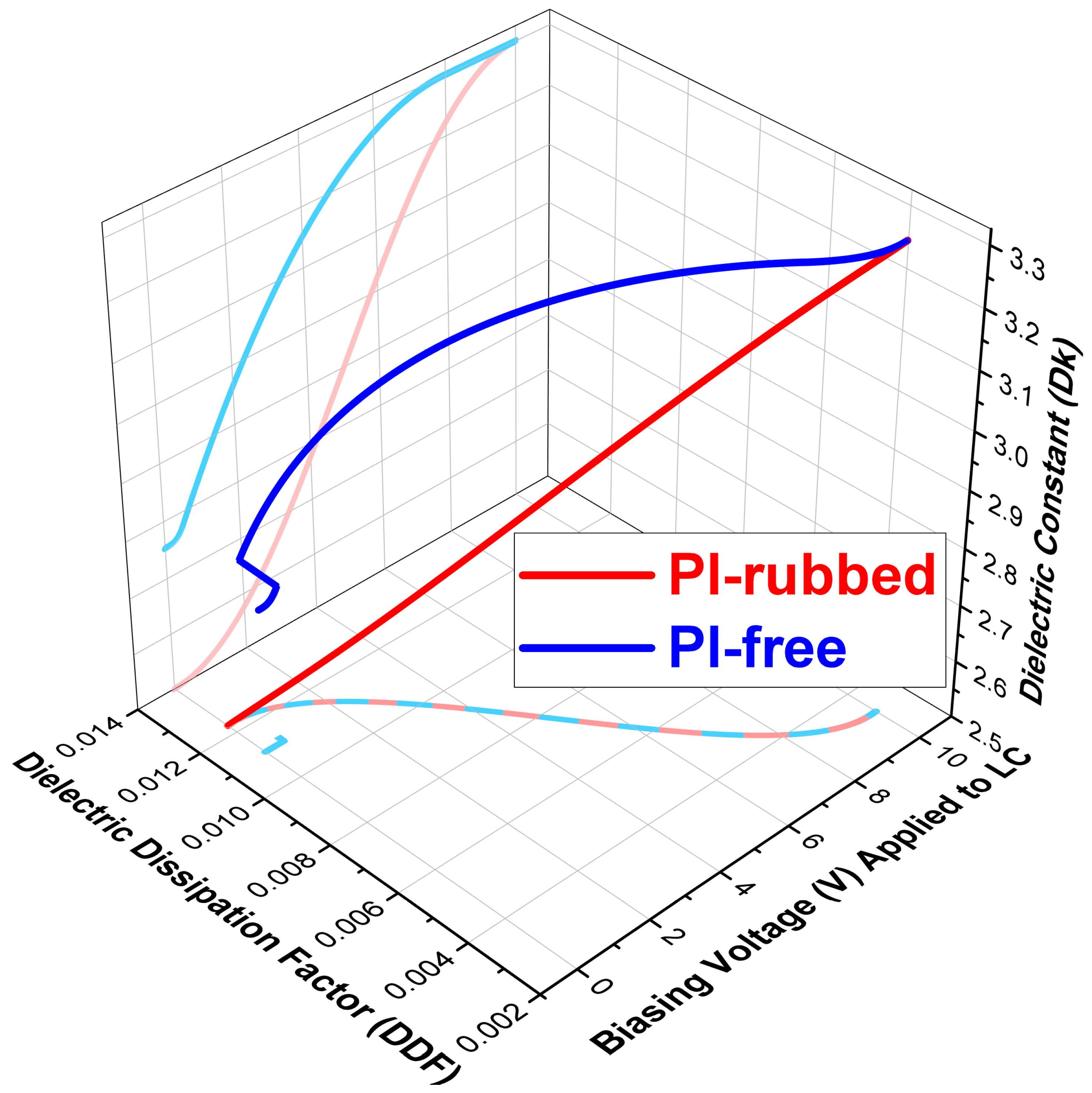
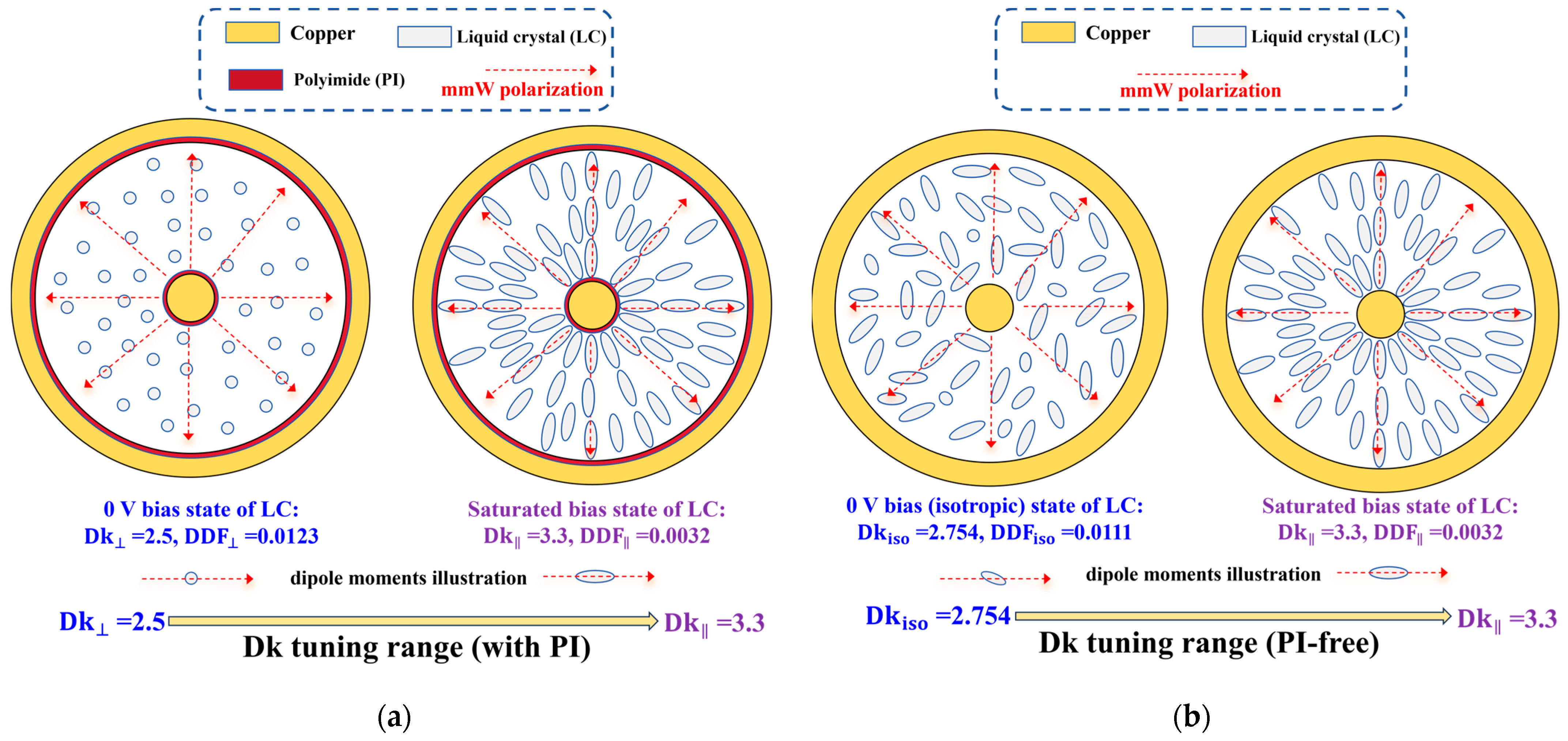
Microwave-engineered nematic LC in the grade of GT3-24002 is employed in this work. The coaxially characterized bias-voltage-dependent dielectric behavior of the LC is depicted in Figure 5, encompassing the dielectric constant (Dk) and dielectric dissipation factor (DDF) under two fabrication (alignment) paradigms, i.e., polyimide (PI) rubbed for mechanically anchoring pre-alignment of LC and PI-free actioned on a coaxially accommodated device structure for LC DLPS, as shown in Figure 6a and Figure 6b, respectively. The technical details and implications of the two setups are discussed explicitly in our prior works in [34,38].
Note that the characterized non-linear relationship between the applied bias voltage and the LC’s Dk, as shown in Figure 5, has a direct implication for realizing precise TTD states. Since the introduced DDT is proportional to the variation in D k L C between biasing voltages, the non-linear Dk-versus-voltage curve translates into a corresponding non-linear tuning characteristic for the DDT. Specifically, the steep slope of the Dk curve at low bias voltages (the threshold region) means that small voltage changes produce large changes in DDT, offering high sensitivity but potentially challenging control resolution. Conversely, in the saturated region at higher voltages, where Dk plateaus, the DDT becomes relatively voltage-insensitive, providing stable operation but requiring larger voltage swings to achieve the final increments of delay. This inherent non-linearity must be accounted for in the control circuitry of a practical system. Conventionally, a calibrated digital-to-analog converter or a pre-distortion lookup table is typically required to linearize the control voltage-to-delay transfer function, ensuring accurate and repeatable setting of desired TTD states across the device’s operational range.

2.2. Unobserved Physical Constraints Implied on Geometry Design Ranges of Single-Mode LC-coax-DLPS

While the mathematical foundations of coaxial transmission lines are thoroughly established in canonical textbooks and academic lectures and well documented in recent advances [39], their integration with LC reconfigurable technology remains largely unexplored in the public domain. In particular, critical aspects, such as the physical constraints and design challenges associated with this combination, have yet to be systematically analyzed and disclosed. This knowledge gap motivates the necessity for recreating and refining physical models to accurately capture the underlying interactions and enable the semi-automatic development of optimized LC-based reconfigurable coaxial systems.
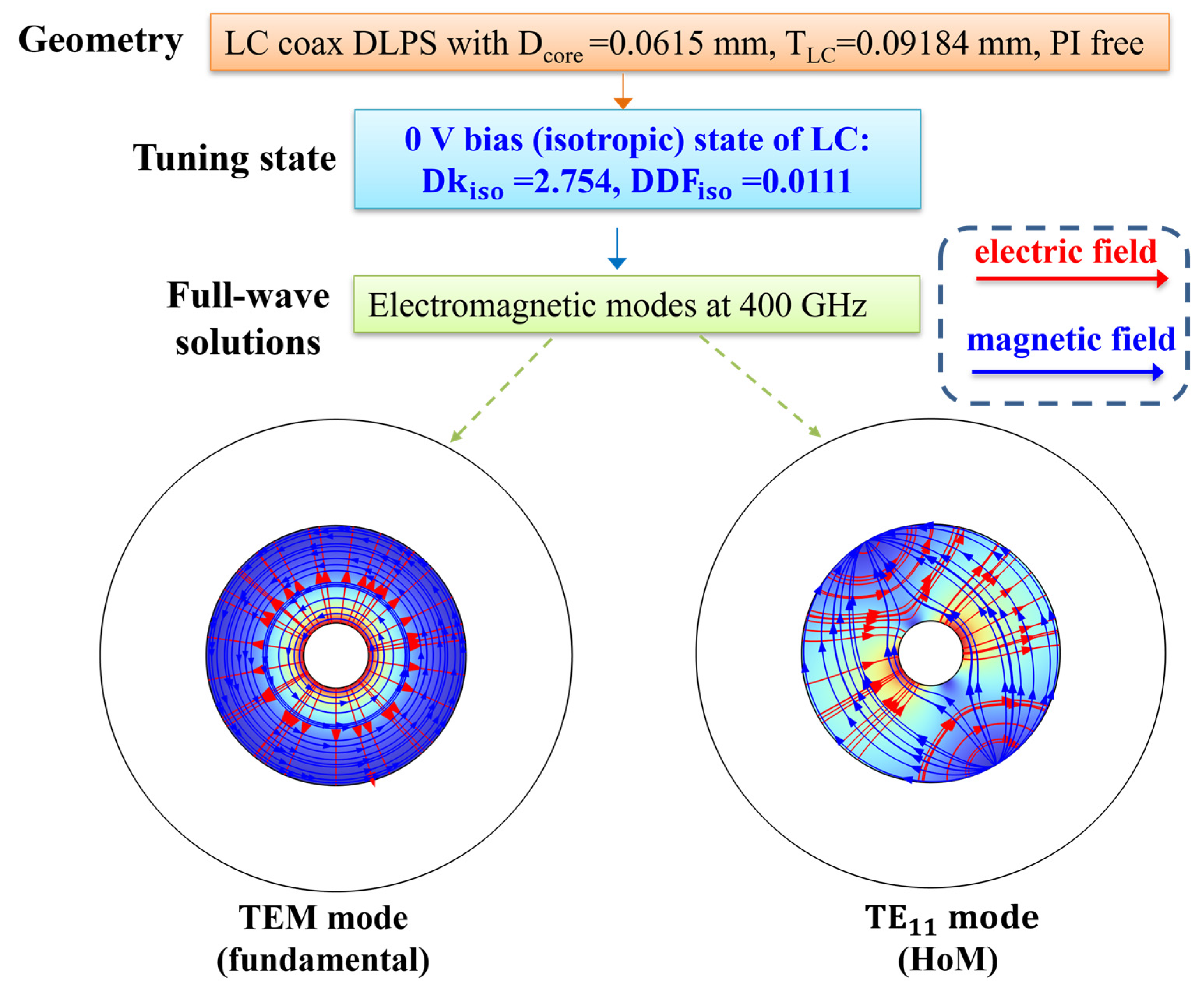
In our past initiatives [34,38], we investigated this problem from the lens of higher-order modes (HoMs) and their mitigations, more specifically, taking a conservative approach and assumptions as highlighted in [38]. A full-wave simulated illustration of the HoM (TE11 mode) is shown in Figure 7 using COMSOL Multiphysics (version 6.1.0.252) for an LC-filled coaxial DLPS with the cross-sectional geometry of Dcore = 0.0615 mm and TLC = 0.09184 mm, using the coordinate in Figure 2.
However, a few naturally embedded physical constraints and their interplay for implying the LC applications were overlooked. By looking into the assumptions and mathematical equations we assembled in [34,38], a few new observations (unaddressed questions as raised in Figure 2) are reported in this work for alerting LC-coax-DLPS designers and engineers.
According to the HoM cutoff-governing equation we derived in (1) [38], given the cutoff frequency ( f c ); the speed of light (c); the dielectric material’s tuning state, i.e., Dk of LC ( D k L C ); and one of the dimensions of T L C (or D c o r e ), then the other geometry parameter, i.e., D c o r e (or T L C ), can be reformulated as per (2) and (3). This indicates that the sum of the core line diameter and NLC thickness remains constant for a fixed cutoff frequency and material (at a specific dielectric tuning state), as per (4). Note that the analytical cutoff condition for the dominant TE11 mode in a coaxial line, from which (1) originates, is derived under the assumption of a homogeneous, isotropic dielectric filling. The cutoff wavelength for this mode is fundamentally governed by the average circumferential path π ( D c o r e + T L C ) that the wave must traverse. Using a single, effective permittivity value that represents the average dielectric response of the LC over this critical path is therefore a valid first-order approximation for calculating the cutoff frequency.
f c = c π ( D c o r e + T L C ) D k L C ,
D c o r e = c f c π D k L C T L C ,
T L C = c f c π D k L C D c o r e ,
D c o r e + T L C = c f c π D k L C .
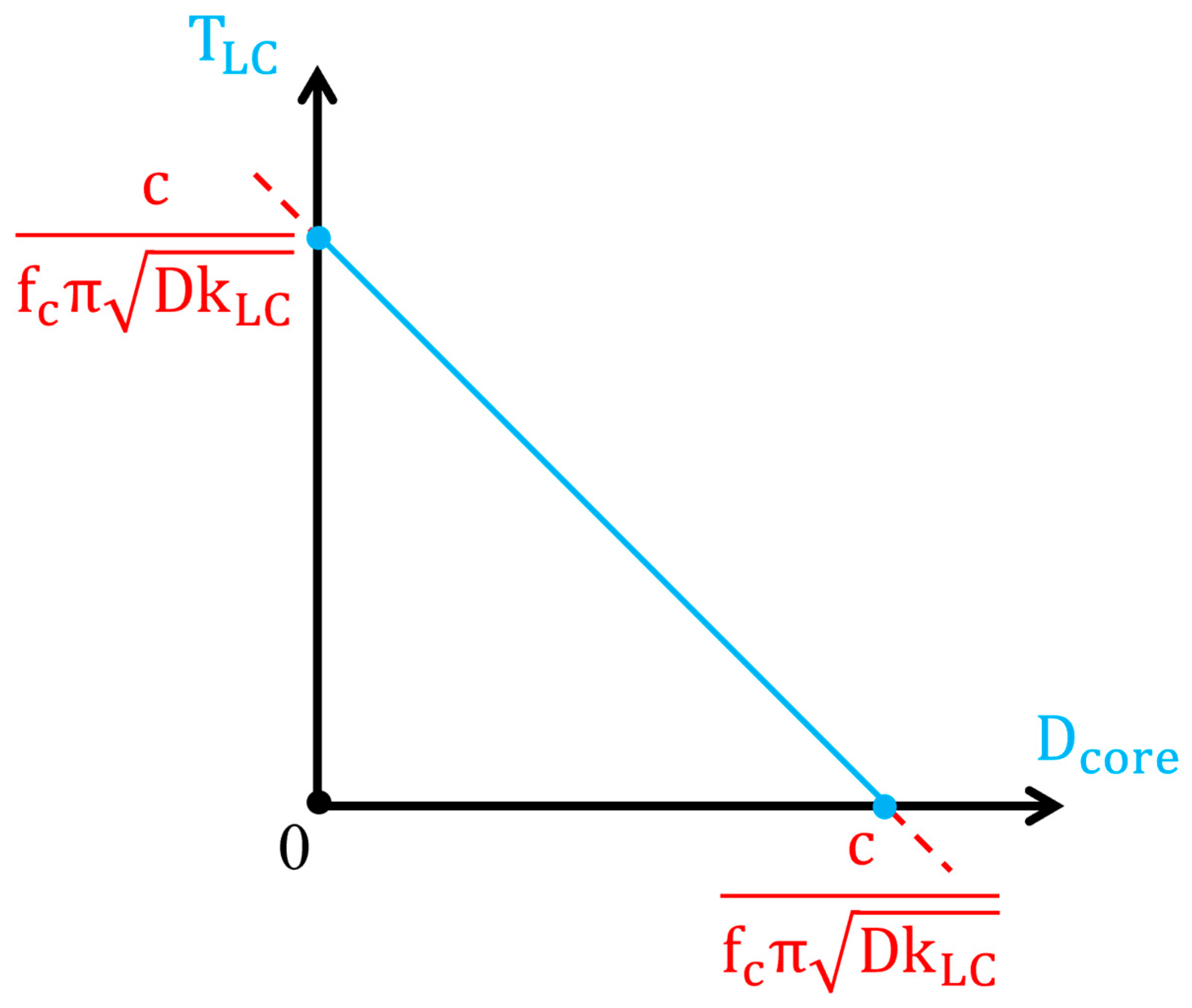
Note that for (2), when T L C     c f c π D k L C , D c o r e becomes negative (non-physical). Similarly, for (3), when D c o r e     c f c π D k L C , T L C lacks physical meaning (negative). Thus, both of these two dimensions must satisfy the following inequalities: T L C < c f c π D k L C and D c o r e < c f c π D k L C at the same time, as depicted in blue in Figure 8.
As per the coordinate system in Figure 2, the coaxial radius (R) is schematically described as (5). If combined with (2) and (3), we can derive the physical constraints related to D c o r e and T L C by rewriting the equations at (6) and (7), respectively.
R = D c o r e 2 + T L C ,
R = c f c π D k L C D c o r e 2 ,
R = c 2 f c π D k L C + T L C 2 .
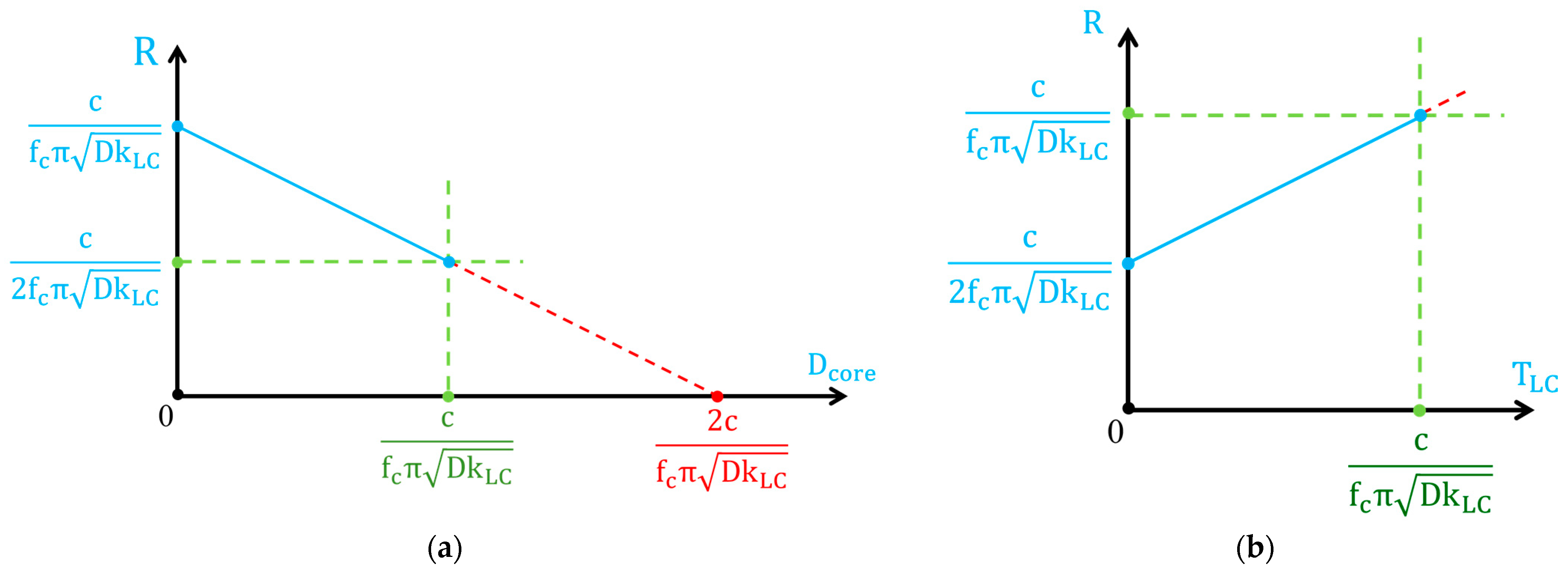
From (6) and (7), graphical representations of R vs. D c o r e and R vs. T L C are provided in Figure 9a and Figure 9b, respectively, highlighting the HoM-free regions of physical validity. Only the sections marked in blue (i.e., c 2 f c π D k L C < R < c f c π D k L C ) represent feasible dimensions for the LC coaxial DLPS. The implementation of these constraints is essential for maintaining operational security, as they directly suppress HoM-induced instabilities.
Interestingly, two limiting cases emerge from the analysis. Two notable zeros and the corresponding implications on the waveguide or transmission line are observed at the following extremes:
  • For R = c f c π D k L C , D c o r e = 0, resulting in a circular waveguide filled entirely with the LC dielectric.
  • For R = c 2 f c π D k L C , T L C = 0, causing the coaxial line to degenerate into a solid wire.
In summary, for practical applications of LC coaxial DLPS, where permittivity is tunable by the bias voltage applied on the LC dielectrics, the designed coaxial radius should operate within the interval of c 2 f c π D k L C < R < c f c π D k L C , hence ensuring practical applicability whilst avoiding degeneration into non-functional structures. More specifically, the operational D c o r e and T D k is governed by a constant sum of c f c π D k L C . By leveraging the D k L C tunability of LC, these ranges (and sum) can be adjusted continuously for diverse application scenarios, offering reasonable flexibility in design and operation.
Note that a radially inhomogeneous tensor permittivity model of D k L C could more accurately describe the LC’s anisotropic properties, especially under intermediate bias states where the director field orientation may vary radially. While such a tensor model is crucial for precise simulations of phase shift and loss dynamics, it is overly complex and unnecessary for deriving the generalized geometric constraints presented here. The radial variation in permittivity, if considered, would result in an effective permittivity for the TE11 cutoff that lies between the extreme perpendicular and parallel values. Our use of the scalar D k L C —specifically its maximum achievable value—captures the limiting case that defines the strictest geometric bound. This simplified approach yields clear, algebraic design Equations (2)–(7) that are far more useful to a designer than constraints derived from a numerical tensor model.
In summary, the uniform scalar D k L C model provides a necessary and sufficient simplification to derive the fundamental, conservative geometric constraints for HoM suppression. It transforms a complex electromagnetic boundary-value problem into an accessible design tool without compromising the validity of the resulting safety bounds for practical LC-coax-DLPS design.
It is also important to note that the derived cutoff condition (1) and the consequent geometric bounds (2)–(7) represent the theoretical limit for the onset of the TE11 mode. The analysis as presented does not incorporate an additional safety margin or guard band. In practice, manufacturing tolerances, dielectric inhomogeneities, and connector transitions may cause HoM excitation to be slightly below this theoretical frequency. Therefore, for critical applications requiring robust single-mode operation, designers should consider applying a prudent safety factor (e.g., designing for a cutoff frequency 10–20% above the maximum operational frequency) or validating the final design with full-wave simulations across all LC tuning states.

2.3. Computational Testbed of LC Coaxial DLPS (PI-Free)

With the physical constraint uncovered above (Section 2.2), a dry run of the LC phase-shifting subsystem utilizing a fully enclosed coaxial testbed (free of PI) is performed. The testbed in LC-coaxially accommodated format is due to two reasons. First, the single-dielectric configuration is ensured, hence removing the additional interface or competition problems with two or multiple dielectrics, i.e., ruling out the corresponding instabilities, inaccuracies, and uncertainties. Second, the noise-free advantage of the coaxial topology rules out the computational and experimental uncertainties due to the various complex electromagnetic environments involved for a transmission line-typed DLPS. Jointly, these twofold advantageous features, albeit not fundamentally new, are reasonably novel to justify an enhanced testbed with improved stability and controllability compared to planar topology, e.g., microstrip lines (MSL) [40], inverted microstrip lines (IMSLs) [41], enclosed coplanar waveguides (ECPWs) [25], etc.
With the electromagnetic stability in mind, the optimization of the coaxially accommodating structure focuses specifically on the dielectric thickness of LC (and hence the spacing between inner and outer conductors) because it is a critical design parameter that creates a direct trade-off among key performance indicators of insertion loss (particularly, metal loss and dielectric loss), phase-shifting tunability, device response time, and the dispersion as currently discussed in this paper.
The computational simulations are performed with a finite element method (FEM) solver, i.e., Ansys high-frequency structure simulator (HFSS) in the version of 2022 R1. Rather than performing an exhaustive parameter sweep, a number of informative cases (12 designs) were chosen to be investigated, as shown in Table 1, based on diverse tuning states of LC as the 50 Ω impedance-matching baseline. All the designs here assume a fixed core line diameter ( D c o r e ) of 0.23 mm and an LC-filled line length ( L L C ) of 15.92 mm. The impedance characterization takes the power-current ( Z P I ) methodology by default in HFSS to unify (renormalize) the post-processed computational results for all the 12 designs.
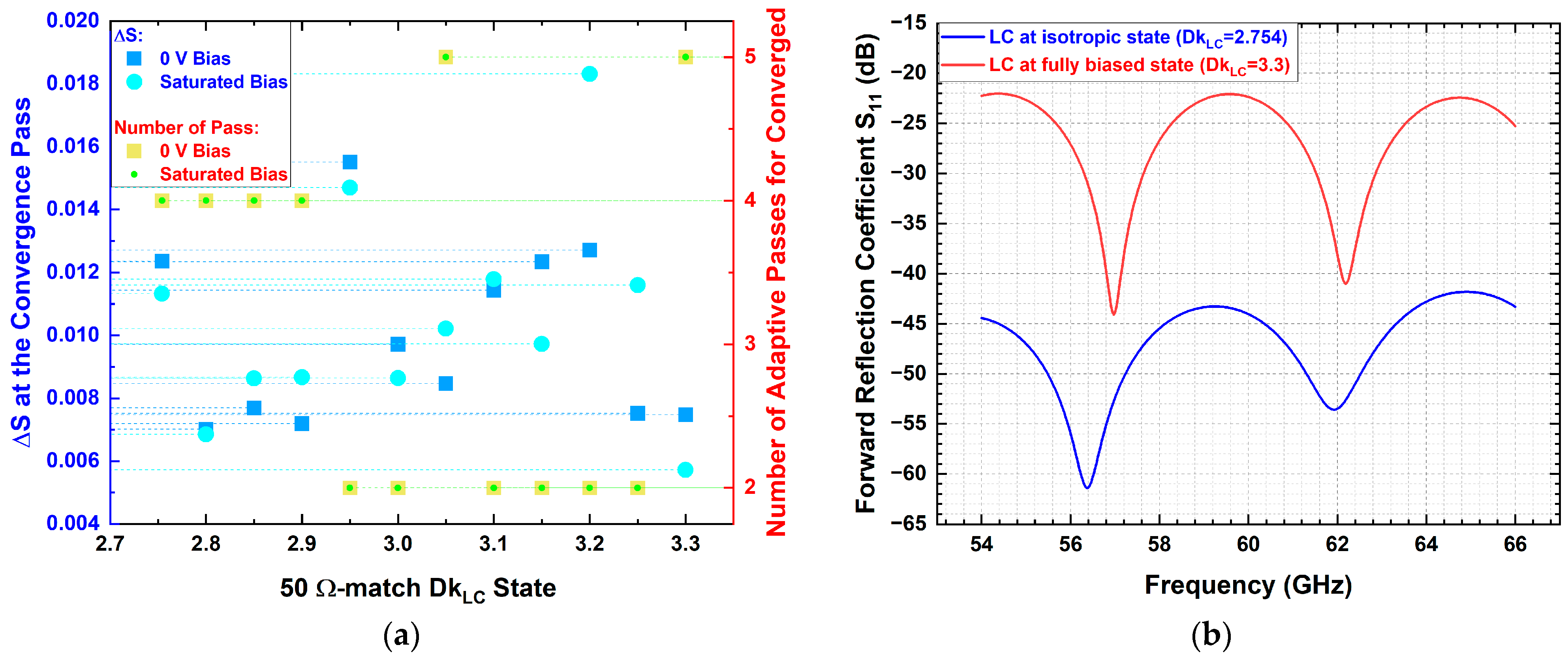
For the full-wave simulation of the above 12 designs, Figure 10a reports the computational convergence statistics upon adaptive meshing (tetrahedral grids) and the number of iterative passes required for reaching the convergence threshold (∆S < 0.02 in magnitude between consecutive passes). By way of illustration, the forward reflection coefficient ( S 11 ) for one of the designs (i.e., selecting D k L C = 2.80 as the 50 Ω matching baseline) is presented in Figure 10b, encompassing the return loss characterization results at the two extreme biasing states of LC, i.e., 0 V bias (LC at the isotropic state with D k L C = 2.754) and saturated bias (LC at the fully aligned state with D k L C = 3.3). The return loss results reported here are post-processed by renormalizing the wave port impedance to 50 Ω. This dedicated step simulates the practical effect of connecting the LC coaxial DLPS device to a standard 50 Ω measurement system.
With the confidence established based on the computational convergence, the post-processed differential phase shift ( Φ s i m u l a t e d ) in the angular domain is subsequently utilized to compute the TTD properties of DDT and DDL as per (8) and (9), respectively.
D D T ( s ) = Φ s i m u l a t e d ( ° ) 360 ° 1 f H z ,
D D L ( m ) = c ( m / s ) D k L C D D T ( s ) .

3. Results of Dispersion and New FoMs on Delay Times and Lengths

The dispersion analysis of all 12 LC coaxial DLPS designs (detailed geometrically in Table 1) was conducted via full-wave computational methods. The evaluated spectrum covers the V-band WiGig range from 54 GHz to 66 GHz, corresponding to the 60 GHz carrier with a ±10% perturbation.

3.1. Results of DDL and DDT Across 54 GHz to 66 GHz

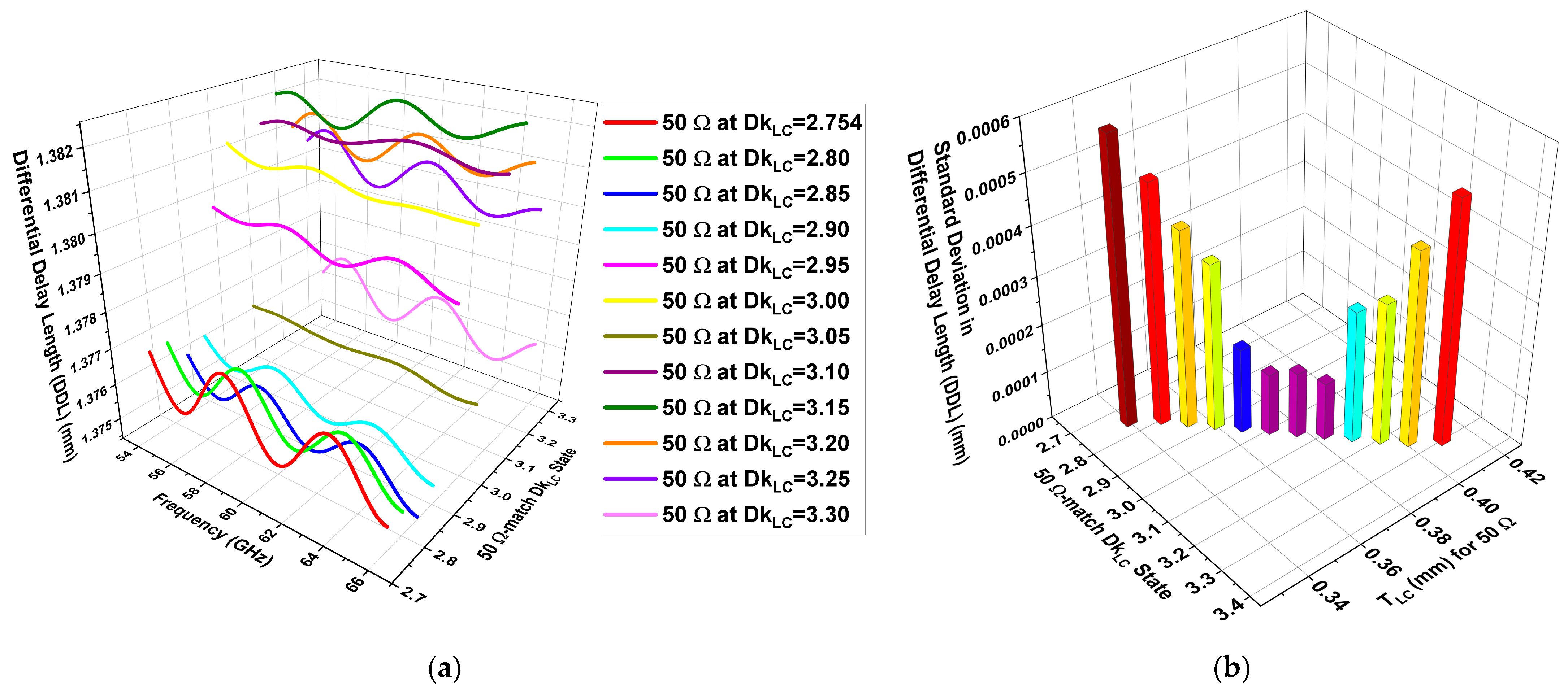
As observed from the DDL results in Figure 11, the LC coaxial DLPS design with 50 Ω matched at the tuning state of D k L C = 3.1 achieves the second maximum DDL (as evidenced in Figure 11a). Meanwhile, the design exhibits the minimum dispersion across 54 GHz to 66 GHz, as evidenced from the standard deviation presented in Figure 11b, derived across the spectrum from 54 GHz to 66 GHz. Note that the design exhibiting the maximal DDL (see Figure 11a for the design with 50 Ω matched at the tuning state of D k L C = 3.15), however, presents noticeable ripples (dispersion) as quantified in Figure 11b.
We attribute these frequency-domain ripples primarily to resonant standing waves formed by partial reflections at the interfaces between the LC-filled section and the input/output ports. Even with careful 50 Ω matching at a specific LC state ( D k L C = 3.15), the impedance of the LC section changes with frequency due to material dispersion and geometric effects, creating a small, frequency-dependent impedance step. This mismatch sets up a weak Fabry–Pérot-type cavity along the length of the LC section ( L L C ). The periodicity of the observed ripples in DDL is consistent with the round-trip phase condition of this cavity. While the coaxial topology and our 50 Ω renormalization minimize this effect, it is more pronounced in the designs with the larger (or smaller) dielectric thickness ( T L C ), as these configurations have the higher sensitivity to impedance variations and sustain the stronger standing-wave pattern.
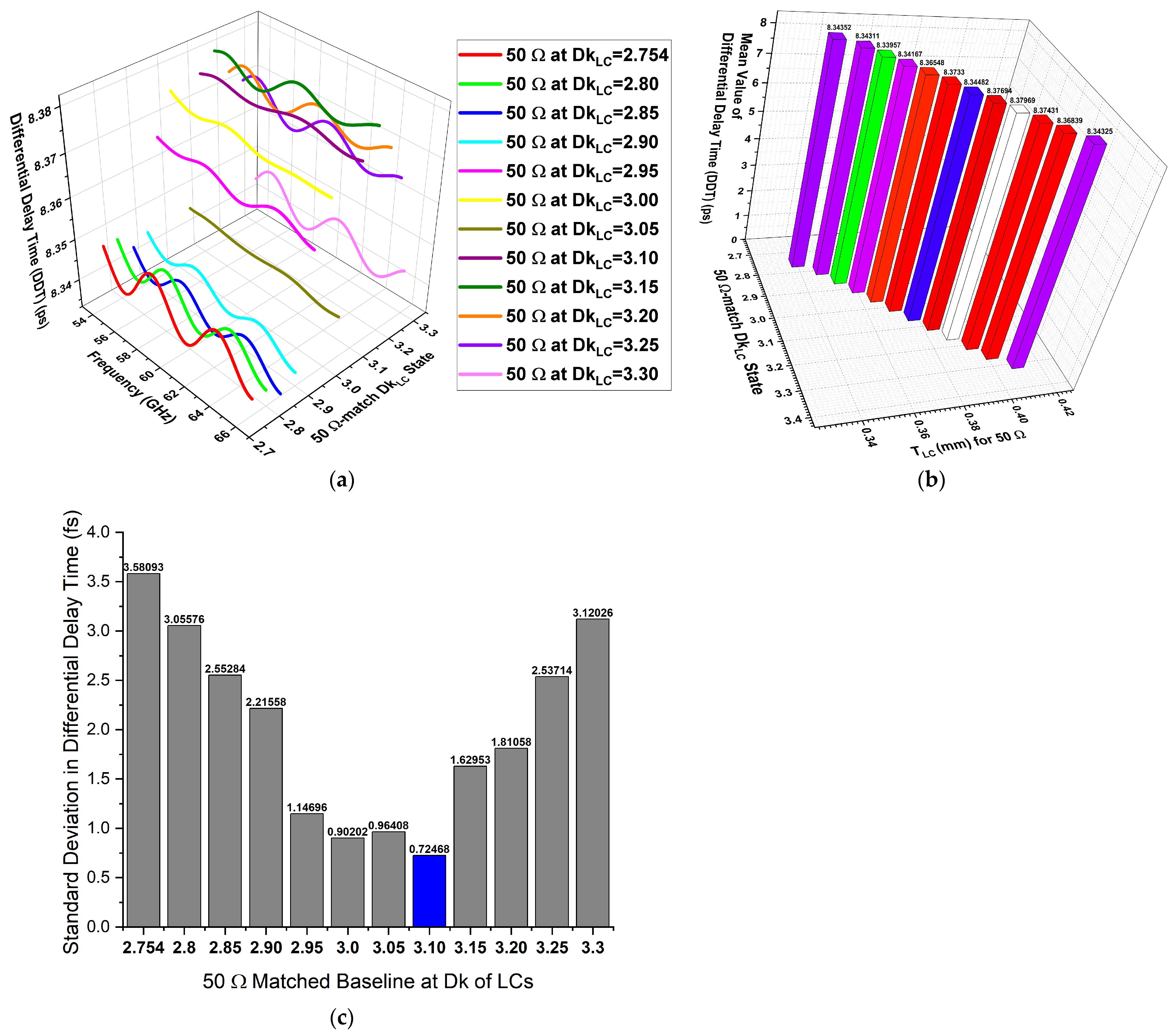
The results of DDT for the 12 designs across 54 GHz to 66 GHz, the mean value, and the standard deviation are presented in Figure 12a, Figure 12b, and Figure 12c, respectively.
From the results of DDL (Figure 11) and DDT (Figure 12) above, new insight is obtained that the design which optimally functions in the dispersion-mitigated true time delay (time domain), i.e., with the geometry 50 Ω-matched at D k L C = 3.1, can differ significantly from that which optimally functions in the phase-shift-to-insertion-loss paradigm (angular domain), i.e., with the geometry 50 Ω-matched at D k L C = 2.8 as previously derived in [34]. The observed optimized frequency-stable DDT performance (Figure 12) confirms the TTD nature of the proposed LC-DLPS. This property is directly applicable to wideband phased arrays, as it inherently prevents beam squinting—a common issue in arrays using dispersive phase shifters. The ability to provide a constant time delay ensures that the beam direction remains fixed over a wide frequency range, a critical requirement for modern wideband communication and sensing systems.

3.2. Proposal of New FoMs and Results Comparison

To unify the performance evaluation of devices operating in different frequencies in a fair manner, a figure-of-merit (FoM)-centric approach catering to delay times and lengths (i.e., DDT and DDL) can be strategically defined to label and compare the LC DLPS devices with reasonable comprehensiveness.
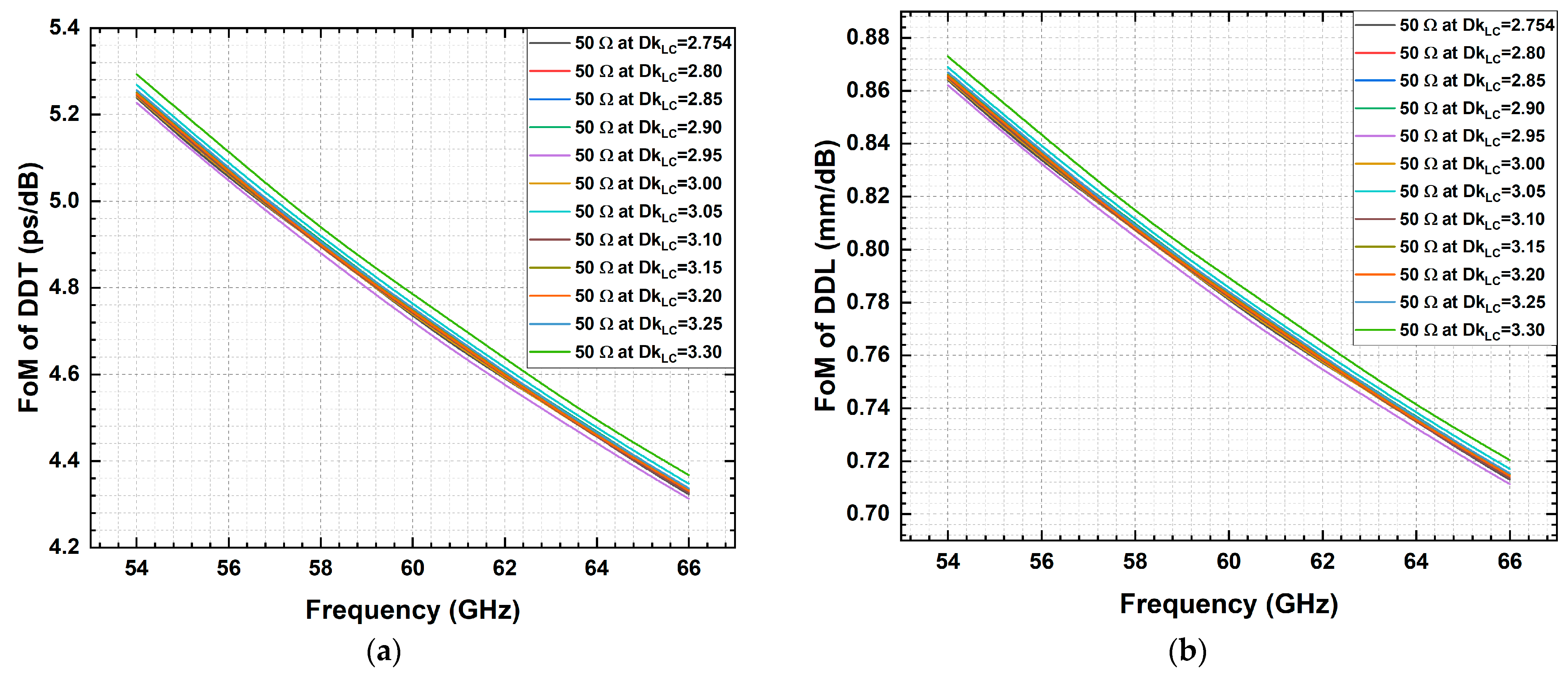
First, to incorporate the insertion loss (IL) behavior in the FoM (DDT) and FoM (DDL) assessments, the ratios of DDT/IL and DDL/IL are defined and quantified in Figure 13a and Figure 13b, respectively. As per the mainstream metric of FoM, the IL here takes into account the maximally dissipated state of the LC coaxial DLPS (among all the tuning states), i.e., wherein the LC layer is 0 V biased at the isotropic state ( D k L C = 2.754), with the maximal DDF of 0.0111 presented as mentioned in Section 2.1. Meanwhile, the 50 Ω renormalization treatment is employed for post-processing results, hence factoring the return loss (due to impedance mismatch) into the IL consideration and, hence, the overall FoM evaluation.
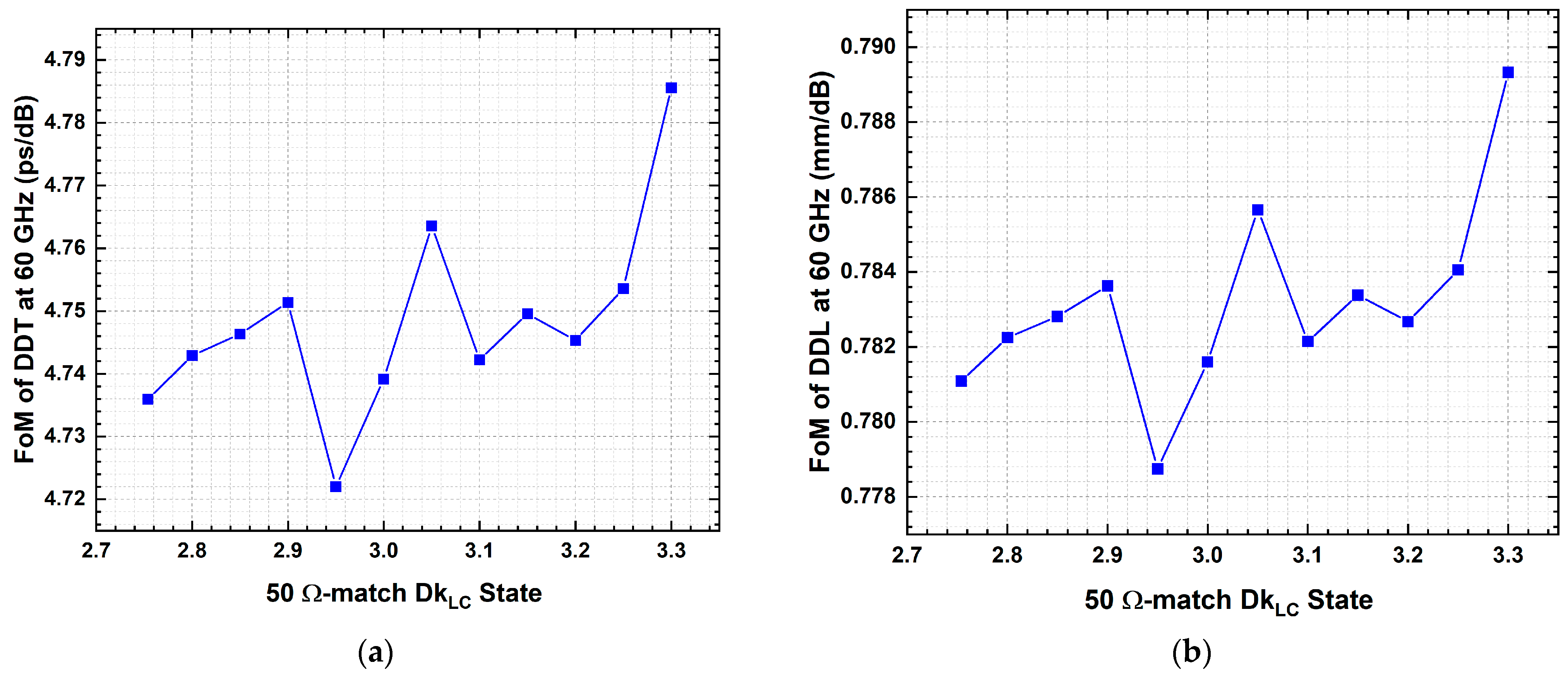
Looking into 60 GHz specifically by plotting the results of Figure 13 (picking 60 GHz only) against the matching baselines ( D k L C ), the maximal FoMs (DDT and DDL) occur at the design with 50 Ω matched at the saturated bias state of LC, i.e., at the LC tuning state of D k L C = 3.3, whereas the minimal FoM (DDT and DDL) occurs at the design with 50 Ω matched at the LC tuning state of D k L C = 2.95, as observed in Figure 14.
Factoring the dispersion behavior into the comprehensive FoM assessment, we propose the ultimate true-time-delay-related figure of merit (TTD- F o M ) as per (10) and (11) for DDT and DDL, respectively. The standard deviation of DDT (or DDL) across the operational band is chosen as the dispersion penalty in (10) and (11) for its direct physical relevance. In a TTD beamformer, a frequency-dependent delay (i.e., a non-zero standard deviation) directly translates to beam squinting. This metric therefore quantifies the frequency stability of the delay, which is the core requirement for wideband operation. It provides a more stringent and system-aware measure than a simple ratio of mean delay to bandwidth, as it specifically penalizes the undesirable ripple and non-flatness observed in the DDT or DDL responses (e.g., Figure 12), which degrade TTD performance even if the mean delay is high.
TTD - F o M o f   D D T   ( d B 1 ) = F o M   o f   D D T   o v e r   I L   ( p s / d B ) S t a n d a r d   D e v i a t i o n   i n   D D T   ( p s ) ,
TTD - F o M o f   D D L ( d B 1 ) = F o M   o f   D D L   o v e r   I L   ( m m / d B ) S t a n d a r d   D e v i a t i o n   i n   D D L   ( m m ) .
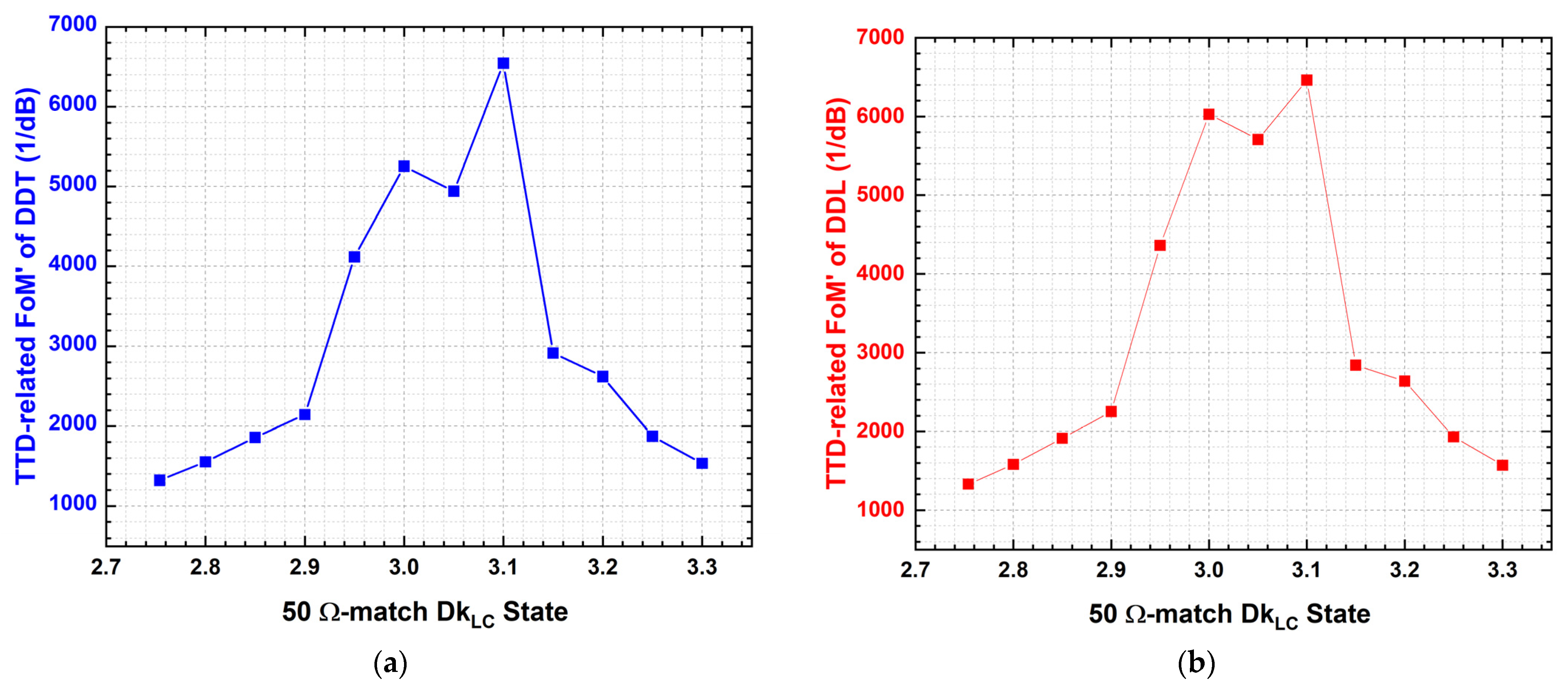
The TTD- F o M results as per (10) and (11) for the 12 designs are presented in Figure 15a and Figure 15b, respectively.
As observed in the TTD- F o M o f   D D T behavior in Figure 15a and the TTD- F o M o f   D D L behavior in Figure 15b, both the polylines show an initial upward trend followed by a subsequent decline. Among these, the LC coaxial DLPS design with D k L C of 3.1 for achieving a port impedance of 50 Ω demonstrates the optimal TTD performance. It is interesting to note that the TTD- F o M of DDL and TTD- F o M of DDT exhibit not only a similar trend of variation versus the 50 Ω-match D k L C baseline, but their values fall within the same order of magnitude (i.e., between 1000 and 7000, in the unit of 1/dB).

4. Discussions on Unnoticed Complexities of Partial Dielectric Leakage Attacks (PDLAs) Experimentation

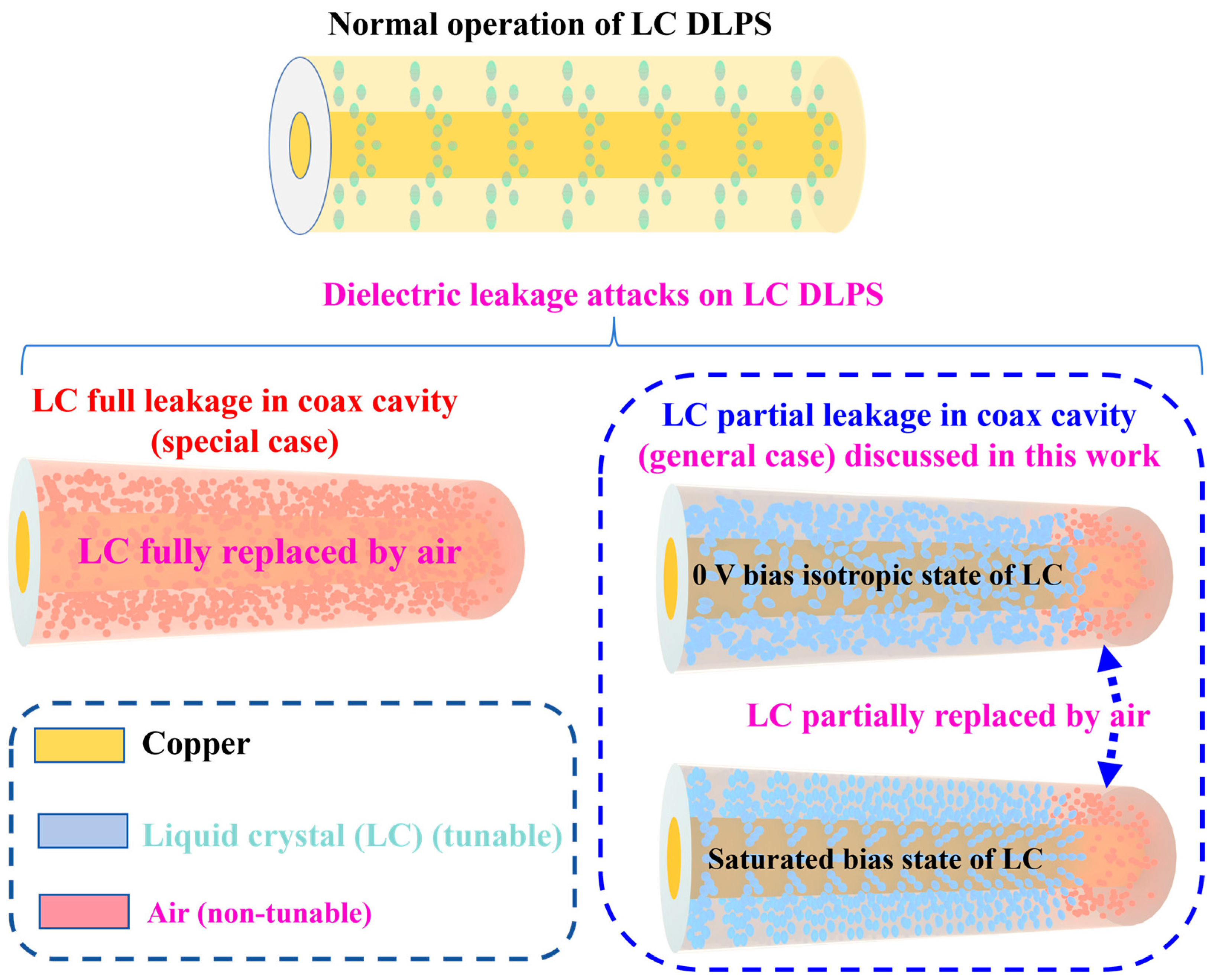
In the internet-of-everything ecosystem nowadays, users (customers) are ever more dependent on digitalized connectivity, due to which the reliability and resilience of telecommunication networks can tip the balance. To be more specific, for 5G and 6G wireless communication networks [42], the technologies of intelligent beamforming, beam steering, and beam tracking [43] are attracting a great deal of research attention in mmWave communications, as well as THz sensing [44] and imaging [45]. In addition to the quest for high-resolution functionality (both temporal and spatial), the mandatory reliability and resilience speak volumes for the indispensable but less-researched modalities. Interpretation of our measured results on entire dielectric leakage attack (DLA) of an LC strip-line DLPS at 60 GHz was reported in our recent experimentation [46]. However, the more general cases of various partial dielectric leakage attacks (PDLAs), as illustrated in Figure 16, have yet to be discussed, for which a couple of limitations and challenges are newly identified in this work in the following subsections.

4.1. Rethinking PDLA Impacts on Phase Shift and Insertion Loss

First, the phase-shifting drift due to DLA has yet to be analyzed, as the DLA arguably increases the maximally achievable tuning range of the dielectric space, in particular, when the LC is completely substituted by air (Dk = 1.0006), as the referenced bias state can only offer the minimum Dk of 2.5. However, the leakage of dielectric (more specifically, the tunable LC) means that the tunable media loses the function of continuously acting as an analogue phase shifter, i.e., the air-filled (or partially filled) one becomes a digital phase shifter.
The drift of insertion loss due to DLA is presented experimentally in the measured forward transmission coefficient S21 in amplitude, but not mentioned in the analysis or performance summary, because the drift has a two-fold effect here. First, the DLA-induced impedance mismatching degrades the forward transmission, i.e., increases the insertion loss. However, the DLA-induced replacement of the lossy LC (DDF ranging from 0.0032 to 0.0123 in that work) with air (nearly no loss dielectric) leads to a slump in the dielectric volume loss, which significantly reduces the insertion loss. These two impacts jointly lead to the variation (drift) in the insertion loss, which may increase or decrease, depending on the line length of the device. As evidenced in our previous analytics [47], line length is arguably an important integrant for the dielectric volumetric loss and also can perturb the return loss and hence the insertion loss at an unneglectable level.

4.2. Possible Transients of Liquid–Gas Two-Phase Flow

To explain this in more detail, for the intermediate leakage states with air-filled ratio (AFR) < 100% (i.e., partial leakage of LC, and partial air-filled cavity) that are not reported in the paper [46], the problem is arguably a complex transient concerning liquid–gas two-phase flow in the subject domain of fluid dynamics. Two complexities come into play and make partial dielectric leakage analysis technically infeasible to conduct.
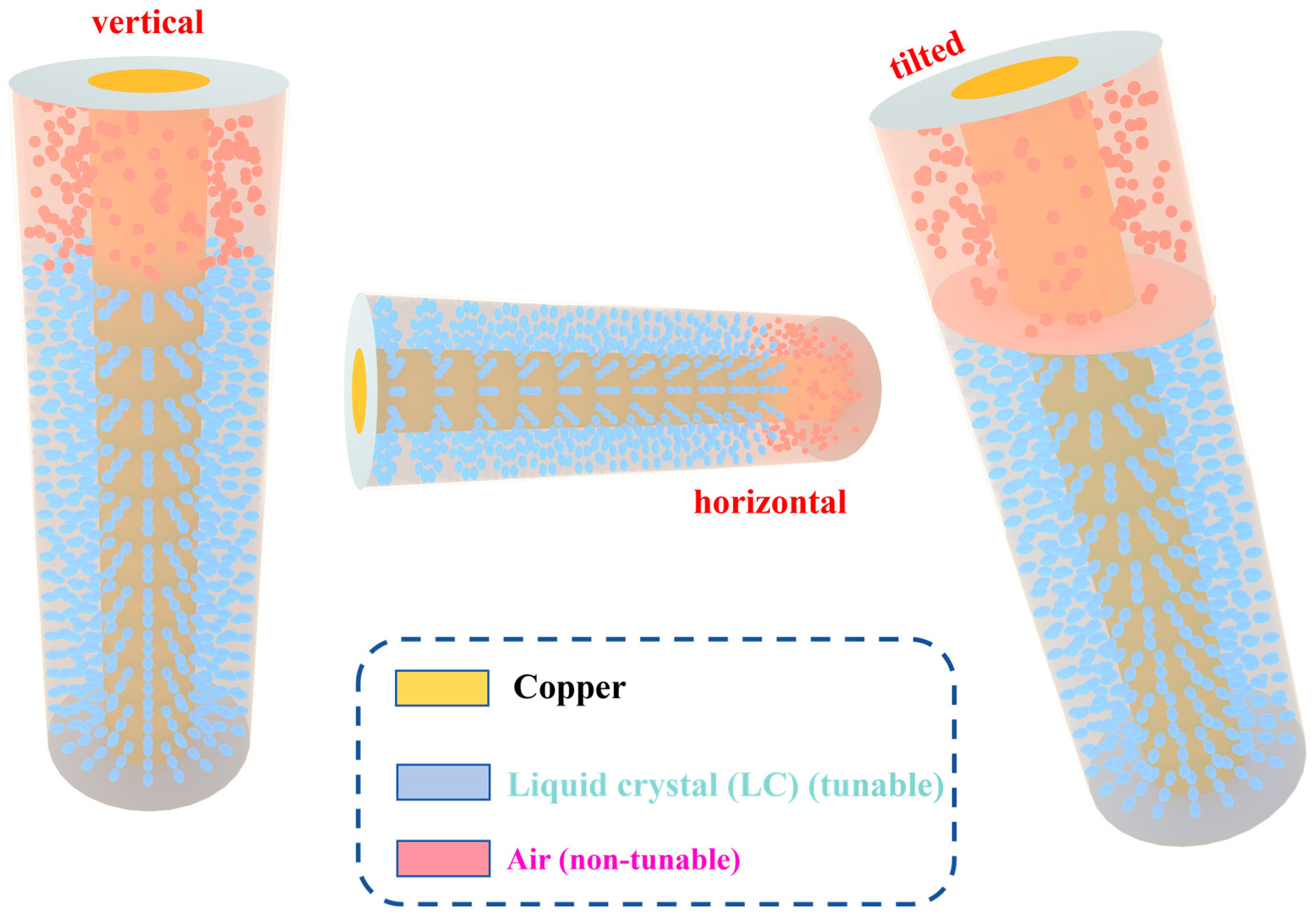
First, LC deployed in the device exhibits fluidity (flowing as the name of the material suggests), for which the partial leakage results in the unpredictable spatial distribution of the materials (liquid and gas mixture) if the device is physically moved in position or tilted at an angle in specific applications, as illustrated in Figure 17. Second, a fixed AFR can infer infinite possibilities of the effective Dk (constantly changing as per the two-phase flow in the transmission line with the dielectrics mix (inhomogeneous in space and time).
For these two reasons explained above, it is not possible to comprehensively characterize the real-time transients’ effects as parameterized with a single AFR indicator in the partial leakage case. A more spatial-dependent and time-dependent metric may be introduced, for which many assumptions must be made to describe the localized flow patterns in mesoscale, and that constitutes a very specific case study and lacks generalizability for general readers and engineers who care more about the maximum drifts of the performance due to the dielectric leakage of LC; we characterized these in the device’s equilibrium state with the AFR of 0% (no leakage) and 100% (full leakage) [46], i.e., an analogy to the binary representations of ones and zeros exhibited by conventional computers.
Nevertheless, the paper [46] marks the first vulnerability study on the dielectric leakage attacks (DLAs) on LC DLPS in 60 GHz WiGig systems. Due to the complexity of the inhomogeneous mixed two-phase liquid–gas media for the partial leakage transient cases, we limit the current study presentation to the full leakage case at equilibrium, which represents the maximum performance drifts in the transmission and reflection behavior of the tunable transmission line, which suffices to provide the engineering guidance and implications from the performance drift’s perspective at equilibrium. However, the missing knowledge of the intermediate states during partial DLA compromises the fidelity advantage of LC-based analogue devices, potentially degrading performance in cryptography and cryptanalysis applications, e.g., the number of operations before a residual error comes into play and tips the balance.
For the partial leakage case (PDLA with AFR < 100%), due to the flow nature of LC (fluidity of the material as the name suggests), the inclined angle of the phase shifter device (as defined by diverse applications) can result in diverse spatial distribution of the tunable dielectrics (LCs) and non-tunable dielectric (i.e., air), which can result in a constantly varying effective dielectric constant (a transient problem) that perturbs the wave speed (and phase shift) of the tunable transmission line (i.e., the phase shifter device in this work). Characterizing such transients requires a dedicated real-time monitoring of the liquid–air two-phase flow, which is a thermodynamics problem (out of the scope of the journal, albeit an interesting topic, and the author has worked on two-phase flow characterization before). A digital twin (virtual prototype) can also be developed in the future research landscape.
In summary, delving into this partial leakage state (with the air-filled ratio AFR between 0 and 100%) as a transient study is highly valuable (but challenging), wherein a CFD study on the leakage monitoring mechanism and sensing equipment can be developed. The future work shall also incorporate suitable error correction algorithms to address the partial leakage cases.

4.3. Other Attacking Vulnerabilities on LC DLPS

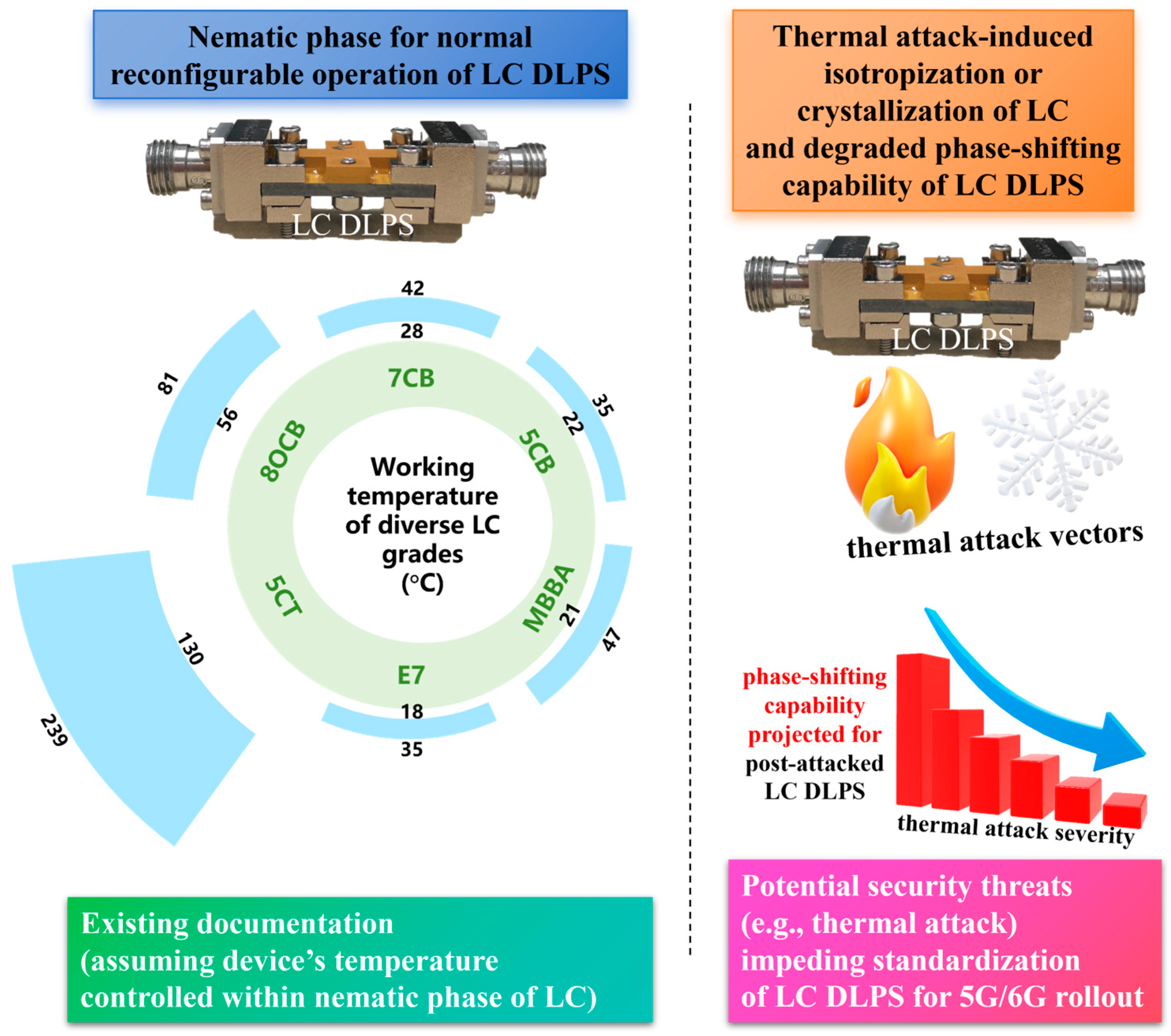
Beyond vulnerabilities related to LC leakage, this section postulates and discusses additional attack vectors, including temperature, biasing, and surface roughness attacks. Coupled with the inherent slow response time of LC materials [25], these security concerns significantly impede the standardization of LC-enabled systems such as reconfigurable intelligent surfaces (RISs) [48,49,50]. As depicted in Figure 18, a temperature-based attack, for instance, forces the LC outside its stable nematic range (characterized on the left of the figure for a number of commercially available LC grades of public knowledge). This induces isotropization (through heating) or crystallization (through cooling), creating eavesdropping risks, degrading phase-shift and transmission amplitude control, causing device malfunction, and ultimately compromising the entire phased array subsystem.
While a PDLA-induced impedance mismatch can certainly misalign or disrupt a beam (a denial-of-service attack), a more subtle eavesdropping mechanism is theoretically possible. If an attacker can induce and precisely control a time-varying, partial leakage (e.g., via a microfluidic injection/withdrawal system or a localized thermal gradient), the resulting dynamic perturbation of the effective dielectric constant would impose a time-varying phase modulation on the transmitted signal. This modulation is not random noise; it is a deterministic, attacker-controlled signal. Crucially, if the attacker’s control signal (the leakage pattern) is synchronized with the baseband information, the phase modulation could be engineered to create a low-power, parasitic side-channel emission. This side-channel could be radiated directly from the compromised DLPS structure, if the perturbation creates an asymmetric, dipole-like discontinuity, or coupled backwards into the feed network, where it might be intercepted at an upstream monitoring point controlled by the attacker. In this scenario, the attacker is not merely jamming the link but is using the LC’s dielectric state as a non-linear mixer to exfiltrate a modulated replica of the signal. While implementing such a precise, real-time attack is highly complex, the fundamental vulnerability exists: the analog, voltage-controlled dielectric property of the LC, which is the core of its functionality, also provides a physical parameter that can be maliciously modulated to encode information for interception.

5. Conclusions

The advent of beyond-5G (B5G) and 6G wireless networks necessitates communication systems with unprecedented heterogeneity in spatial and temporal domains. Beam forming, enabled by phase shifters and delay lines, is a cornerstone of this technological evolution, driving demand for high-performance reconfigurable devices at millimeter-wave (mmW) and terahertz (THz) frequencies. While liquid crystal (LC)-based delay line phase shifters (DLPSs) offer significant promise due to their tunability, their development has plateaued, hindered by stagnant tuning principles and a lack of standardized performance metrics.
This work bridges critical knowledge gaps in LC coaxial DLPS technology through an integrated analytical, computational, and experimental approach. Our contributions are threefold.
First, our analytical model uncovered previously overlooked physical constraints inherent to the LC-coaxial geometry. We derived explicit bounds that define the permissible ranges for the core diameter and LC thickness to suppress higher-order modes. This provides a necessary design rule for ensuring stable, single-mode operation across the LC’s tuning range.
Second, we demonstrated that optimizing for phase shift or insertion loss alone is insufficient for true-time-delay (TTD) applications. Our full-wave analysis revealed that designs with minimal dispersion in differential delay time (DDT) and length (DDL) can differ from those optimized for maximum phase shift. To address this, we introduced a novel dispersion-aware figure of merit (TTD-FoM′) that explicitly weights the achieved delay against its frequency stability (standard deviation). Applying this TTD-FoM′ at the V-band quantitatively identified the design point (matched at D k L C = 3.1) that optimally balances delay magnitude with dispersion mitigation, a key requirement for squint-free wideband beamforming.
Third, we extended the security analysis of LC devices beyond complete failure. By examining partial dielectric leakage attacks (PDLAs), we elucidated the complex, transient nature of liquid–gas two-phase flow within the cavity and its impact on system performance. Furthermore, we delineated the specific physical mechanism—a maliciously controlled, time-varying leakage acting as a parasitic phase modulator—by which such a vulnerability could be exploited for information interception rather than mere beam disruption.
Collectively, these contributions provide a foundational framework—encompassing rigorous design bounds, a dispersion-aware performance metric, and a clarified threat model—that directly addresses the field’s stagnation. This work equips designers with the tools to develop more robust, predictable, and secure LC-DLPS components, thereby facilitating their reliable integration into next-generation 5G/6G communication and sensing systems.

Author Contributions

Conceptualization, J.L.; methodology, J.L.; software, J.L. and H.L.; validation, J.L. and H.L.; formal analysis, J.L. and H.L.; investigation, J.L.; resources, J.L.; data curation, J.L. and H.L.; writing—original draft preparation, J.L. and H.L.; writing—review and editing, J.L.; visualization, J.L. and H.L.; supervision, J.L.; project administration, J.L.; funding acquisition, J.L. All authors have read and agreed to the published version of the manuscript.

Funding

This research was funded by National Natural Science Foundation of China, grant number 62301043, as well as the Fundamental Research Funds for the Central Universities (Beijing Institute of Technology Research Fund Program for Young Scholars), grant number 1750012222543.

Data Availability Statement

Dataset available on request from the authors.

Conflicts of Interest

The authors declare no conflicts of interest. The funders had no role in the design of the study; in the collection, analyses, or interpretation of data; in the writing of the manuscript; or in the decision to publish the results.

Abbreviations

The following abbreviations are used in this manuscript:
AFRAir-filled ratio
B5GBeyond-fifth-generation communication
CFDsComputational fluid dynamics
DcoreCore line diameter
DACDigital-to-analog converter
DDFDielectric dissipation factor
DDFisoDielectric dissipation factor at isotropic LC state
DkDielectric constant
DkisoDielectric constant at isotropic LC state
DkLCDielectric constant of LC
DDLDifferential delay length
DDTDifferential delay time
DLADielectric leakage attack
DLPSDelay line phase shifter
ECPWEnclosed coplanar waveguide
EDAElectronic design automation
fcCutoff frequency
FEMFinite element method
5GFifth-generation communication
FoMFigure of merit
F o M Figure of merit (newly proposed in this work)
HFSSHigh-frequency structure simulator
HoMHigher-order mode
ILInsertion loss
IMSLInverted microstrip line
LCLiquid crystal
MEMSMicro-electromechanical system
MSLMicrostrip line
mmWMillimeter wave
mWMicrowave
PDLAPartial dielectric leakage attack
PIPolyimide
RISReconfigurable intelligence surface
6GSixth-generation communication
S11Forward reflection coefficient
S21Forward transmission coefficient
THzTerahertz
TLCThickness of LC
TTDTrue time delay

References

  1. Hemadeh, I.A.; Satyanarayana, K.; El-Hajjar, M.; Hanzo, L. Millimeter-Wave Communications: Physical Channel Models, Design Considerations, Antenna Constructions, and Link-Budget. IEEE Commun. Surv. Tutor. 2018, 20, 870–913. [Google Scholar] [CrossRef]
  2. Busari, S.; Huq, K.; Mumtaz, S.; Dai, S.; Rodriguez, J. Millimeter-Wave Massive MIMO Communication for Future Wireless Systems: A Survey. IEEE Commun. Surv. Tutor. 2018, 20, 836–869. [Google Scholar] [CrossRef]
  3. Roh, W.; Seol, J.; Park, J.; Lee, B.; Lee, J.; Kim, Y. Millimeter-wave beamforming as an enabling technology for 5G cellular communications: Theoretical feasibility and prototype results. IEEE Commun. Mag. 2014, 52, 106–113. [Google Scholar] [CrossRef]
  4. Srivastava, G.; Kumar, A.; Mohan, A.; Kumar, S.; Ali, T. A self-octaplexing millimeter-wave antenna array for 5g fr2 spectrum. Sci. Rep. 2025, 15, 10386. [Google Scholar] [CrossRef] [PubMed]
  5. Elkashlan, M.; Duong, T.Q.; Chen, H.H. Millimeter-wave communications for 5G: Fundamentals: Part I [guest editorial]. IEEE Commun. Mag. 2014, 52, 52–54. [Google Scholar] [CrossRef]
  6. Sanjari, P.; Aflatouni, F. An integrated photonic-assisted phased array transmitter for direct fiber to mm-wave links. Nat. Commun. 2023, 14, 1414. [Google Scholar] [CrossRef] [PubMed]
  7. O’Hara, J.F.; Ekin, S.; Choi, W.; Song, I. A Perspective on Terahertz Next-Generation Wireless Communications. Technologies 2019, 7, 43. [Google Scholar] [CrossRef]
  8. da Silva, L.M.; Guerreiro, J. On the 5G and Beyond. Appl. Sci. 2020, 10, 7091. [Google Scholar] [CrossRef]
  9. Esmail, A.A.F.; Koziel, S. Design and optimization of metamaterial-based highly-isolated MIMO antenna with high gain and beam tilting ability for 5G millimeter wave applications. Sci. Rep. 2024, 14, 3203. [Google Scholar] [CrossRef]
  10. Rasheed, I.; Fei, H.; Hong, Y.; Balasubramanian, B. Intelligent vehicle network routing with adaptive 3D beam alignment for mmWave 5G-based V2X Communications. IEEE Trans. Intell. Transp. Syst. 2021, 22, 2706–2718. [Google Scholar] [CrossRef]
  11. Ortiz-Fuentes, J.A.; Silva-Montero, J.; Galvan-Tejada, G.M.; Abdalmalak, K.A.; Segovia-Vargas, D. A Novel Super Wide Band Monopole Antenna with a Curved Ground Plane for 6G and Wireless Communications. IEEE Open J. Antennas Propag. 2025, 6, 1435–1443. [Google Scholar] [CrossRef]
  12. Bryant, B.; Won, H.; Hong, Y.-K.; Lee, W.; Choi, M. Design of Triple-Band (DSRC, 5G, 6G) Antenna for Autonomous Vehicle Telematics. Electronics 2022, 11, 2523. [Google Scholar] [CrossRef]
  13. Mahmoud, R.; Castanheira, D.; Silva, A.; Gameiro, A. Sensing-Assisted Communication for mmWave Networks: A Review of Techniques, Applications, and Future Directions. Electronics 2025, 14, 3787. [Google Scholar] [CrossRef]
  14. Jiménez, F. Connected Vehicles, V2V Communications, and VANET. Electronics 2015, 4, 538–540. [Google Scholar] [CrossRef]
  15. Banerjee, S.; Dutta, P.; Basu, S.; Mishra, S.K.; Appasani, B.; Nanda, S.; Abdulkarim, Y.I.; Muhammadsharif, F.F.; Dong, J.; Jha, A.V.; et al. A New Design of a Terahertz Metamaterial Absorber for Gas Sensing Applications. Symmetry 2023, 15, 24. [Google Scholar] [CrossRef]
  16. Jiménez, F. Technologies and Applications of Communications in Road Transport. Appl. Sci. 2022, 12, 8997. [Google Scholar] [CrossRef]
  17. Abdulkarim, Y.I.; Alkurt, F.Ö.; Bakır, M.; Awl, H.N.; Muhammadsharif, F.F.; Karaaslan, M.; Appasani, B.; Badri, K.S.L.A.; Zhu, Y.Y.; Dong, J. A polarization-insensitive triple-band perfect metamaterial absorber incorporating ZnSe for terahertz sensing. J. Opt. 2022, 24, 105102. [Google Scholar] [CrossRef]
  18. Zhou, F.; Abdalmalak, K.A.; Yuste, A.P. Hybrid Dual-Band Antenna for 5G High-Speed Train Communication and Positioning Systems. Electronics 2025, 14, 847. [Google Scholar] [CrossRef]
  19. Kebe, M.; Yagoub, M.; Amaya, R. A Survey of Phase Shifters for Microwave Phased Array Systems. Int. J. Circuit Theory Appl. 2024, 53, 3719–3739. [Google Scholar] [CrossRef]
  20. Malik, B.T.; Khan, S.; Koziel, S. Design and implementation of multi-band reflectarray metasurface for 5G millimeter wave coverage enhancement. Sci. Rep. 2024, 14, 15286. [Google Scholar] [CrossRef]
  21. Ebrahimi, A.; Beziuk, G.; Ghorbani, K.; Martín, F. Tunable phase shifters using composite inductive-capacitive loaded slow-wave transmission lines. AEU—Int. J. Electron. Commun. 2022, 148, 154155. [Google Scholar] [CrossRef]
  22. Kebe, M.; Yagoub, M.; Amaya, R. A Wideband Analog Vector Modulator Phase Shifter Based on Non-Quadrature Vector Operation. Electronics 2025, 14, 997. [Google Scholar] [CrossRef]
  23. Mattsson, M.; Buisman, K.; Kuylenstierna, D. Modeling of intermodulation in a loaded-line phase shifter based on a polynomial varactor model. Int. J. Microw. Wirel. Technol. 2024, 16, 1113–1124. [Google Scholar] [CrossRef]
  24. Dussopt, L. Phase shifters and tuneable delay lines. In Advanced RF MEMS; Lucyszyn, S., Ed.; Cambridge University Press: Cambridge, UK, 2010; pp. 307–342. [Google Scholar]
  25. Li, J.; Chu, D. Liquid Crystal-Based Enclosed Coplanar Waveguide Phase Shifter for 54–66 GHz Applications. Crystals 2019, 9, 650. [Google Scholar] [CrossRef]
  26. Zografopoulos, D.C.; Ferraro, A.; Beccherelli, R. Liquid-crystal high-frequency microwave technology: Materials and Characterization. Adv. Mater. Technol. 2018, 4, 1800447. [Google Scholar] [CrossRef]
  27. Jakoby, R.; Gaebler, A.; Weickhmann, C. Microwave liquid crystal enabling technology for electronically steerable antennas in SATCOM and 5G millimeter-wave systems. Crystals 2020, 10, 514. [Google Scholar] [CrossRef]
  28. Li, J.; Li, H.; Xiao, Y. Unified Interpretation of Angular and Cumulative Angular Phase Representations with Best-Practice Guidelines for Differential Phase Shift Extraction in Nematic Liquid Crystal-Based Reconfigurable Phase Shifters. Crystals 2025, 15, 994. [Google Scholar] [CrossRef]
  29. Louati, S.; Talbi, L.; Boutayeb, H.; Hettak, K.; Ghayekhloo, A. Reconfigurable SIW Phase Shifter Based on Parallel Stubs Loaded with Surface Mount p-i-n Diodes. IEEE Trans. Compon. Packag. Manuf. Technol. 2024, 14, 176–179. [Google Scholar] [CrossRef]
  30. Di Paola, C.; Zhao, K.; Zhang, S.; Pedersen, G.F. Hybrid Switchable Phased Array with p-i-n Diodes for 5G Mobile Terminals. In Proceedings of the 2021 15th European Conference on Antennas and Propagation (EuCAP), Dusseldorf, Germany, 22–26 March 2021; pp. 1–5. [Google Scholar]
  31. Barker, S.; Rebeiz, G.M. Distributed MEMS true-time delay phase shifters and wide-band switches. IEEE Trans. Microw. Theory Tech. 1998, 46, 1881–1890. [Google Scholar] [CrossRef]
  32. Scardelletti, M.C.; Ponchak, G.E.; Varaljay, N.C. Ka-Band, MEMS Switched Line Phase Shifters Implemented in Finite Ground Coplanar Waveguide. In Proceedings of the 32nd European Microwave Conference, Milan, Italy, 23–26 September 2002; pp. 1–4. [Google Scholar]
  33. Dehnaw, A.M.; Shiu, R.K.; Chen, R.B.; Li, J.W.; Manie, Y.C.; Liang, H.C.; Peng, P.C. Self-Start Multi-Wavelength Laser Source with Tunable Delay-Line Interferometer and Optical Fiber Reflector for Wireless Communication System. Appl. Sci. 2021, 11, 9553. [Google Scholar] [CrossRef]
  34. Li, J.; Li, H. Liquid Crystal-Filled 60 GHz Coaxially Structured Phase Shifter Design and Simulation with Enhanced Figure of Merit by Novel Permittivity-Dependent Impedance Matching. Electronics 2024, 13, 626. [Google Scholar] [CrossRef]
  35. Neuder, R.; Späth, M.; Schüßler, M.; Sáez, A.J. Architecture for sub-100  ms liquid crystal reconfigurable intelligent surface based on defected delay lines. Commun. Eng. 2024, 3, 70. [Google Scholar] [CrossRef]
  36. Maune, H.; Jost, M.; Reese, R.; Polat, E.; Nickel, M.; Jakoby, R. Microwave Liquid Crystal Technology. Crystals 2018, 8, 355. [Google Scholar] [CrossRef]
  37. Roig, M.; Maasch, M.; Damm, C.; Jakoby, R. Dynamic beam steering properties of an electrically tuned liquid crystal based CRLH leaky wave antenna. In Proceedings of the 2014 8th International Congress on Advanced Electromagnetic Materials in Microwaves and Optics, Copenhagen, Denmark, 25–28 August 2014; pp. 253–255. [Google Scholar]
  38. Li, J.; Li, H. Modeling 0.3 THz Coaxial Single-Mode Phase Shifter Designs in Liquid Crystals with Constitutive Loss Quantifications. Crystals 2024, 14, 364. [Google Scholar] [CrossRef]
  39. Massoni, E.; Perregrini, L.; Bozzi, M. Substrate Integrated Waveguide Two-Mode Coaxial Launcher. IEEE Trans. Microw. Theory Tech. 2025, 73, 9187–9195. [Google Scholar] [CrossRef]
  40. Massoni, E.; Bozzi, M.; Perregrini, L.; Tamburini, U.A.; Tomassoni, C. A novel class of high dielectric resonator filters in microstrip line technology. In Proceedings of the 2017 IEEE MTT-S International Microwave Workshop Series on Advanced Materials and Processes for RF and THz Applications (IMWS-AMP), Pavia, Italy, 20–22 September 2017; pp. 1–3. [Google Scholar]
  41. Weil, C.; Luessem, G.; Jakoby, R. Tunable inverted-microstrip phase shifter device using nematic liquid crystals. In Proceedings of the 2002 IEEE MTT-S International Microwave Symposium Digest (Cat. No.02CH37278), Seattle, WA, USA, 2–7 June 2002; pp. 367–371. [Google Scholar]
  42. Bazzi, A.; Bomfin, R.; Mezzavilla, M.; Rangan, S.; Rappaport, T.; Chafii, M. Upper Mid-Band Spectrum for 6G: Vision, Opportunity and Challenges. IEEE Commun. Mag. 2026, 64, 206–212. [Google Scholar] [CrossRef]
  43. Va, V.; Vikalo, H.; Heath, R. Beam tracking for mobile millimeter wave communication systems. In Proceedings of the Global Conference on Signal and Information Processing, Washington, DC, USA, 7–9 December 2016; pp. 743–747. [Google Scholar]
  44. You, X.; Pagay, V.; Withayachumnankul, W. Non-Contact Monitoring of Plant Leaf Water Status Using Terahertz Waves. J. Infrared Millim. Terahertz Waves 2025, 46, 53. [Google Scholar] [CrossRef]
  45. Deng, M.; Kanwal, S.; Wang, Z.; Cai, C.; Cheng, Y.; Guan, J.; Hu, G.; Wang, J.; Wen, J.; Chen, L. Dielectric Metasurfaces for Broadband Phase-Contrast Relief-Like Imaging. Nano Lett. 2024, 24, 14641–14647. [Google Scholar] [CrossRef] [PubMed]
  46. Li, J.; Li, H. Dielectric Leakage Attacks on Liquid Crystal Phase Shifters in 60 GHz WiGig Systems. Electron. Lett. 2025, 61, e70317. [Google Scholar] [CrossRef]
  47. Li, J.; Li, H. Assessing Vulnerabilities in Line Length Parameterization and the Per-Unit-Length Paradigm for Phase Modulation and Figure-of-Merit Evaluation in 60 GHz Liquid Crystal Phase Shifters. Symmetry 2024, 16, 1261. [Google Scholar] [CrossRef]
  48. Qi, K.; Wu, Q.; Fan, P.; Cheng, N.; Fan, Q.; Wang, J. Reconfigurable Intelligent Surface Assisted VEC Based on Multi-Agent Reinforcement Learning. IEEE Commun. Lett. 2024, 28, 2427–2431. [Google Scholar] [CrossRef]
  49. Yadav, A.K.; Yadav, S.; Pandey, A.; Silva, A. On the secrecy performance of RIS-enabled wireless communications over Nakagami-m fading channels. ICT Express 2023, 9, 452–458. [Google Scholar] [CrossRef]
  50. Qi, K.; Wu, Q.; Fan, P.; Cheng, N.; Chen, W.; Letaief, K.B. Reconfigurable-Intelligent-Surface-Aided Vehicular Edge Computing: Joint Phase-Shift Optimization and Multiuser Power Allocation. IEEE Internet Things J. 2025, 12, 764–777. [Google Scholar] [CrossRef]
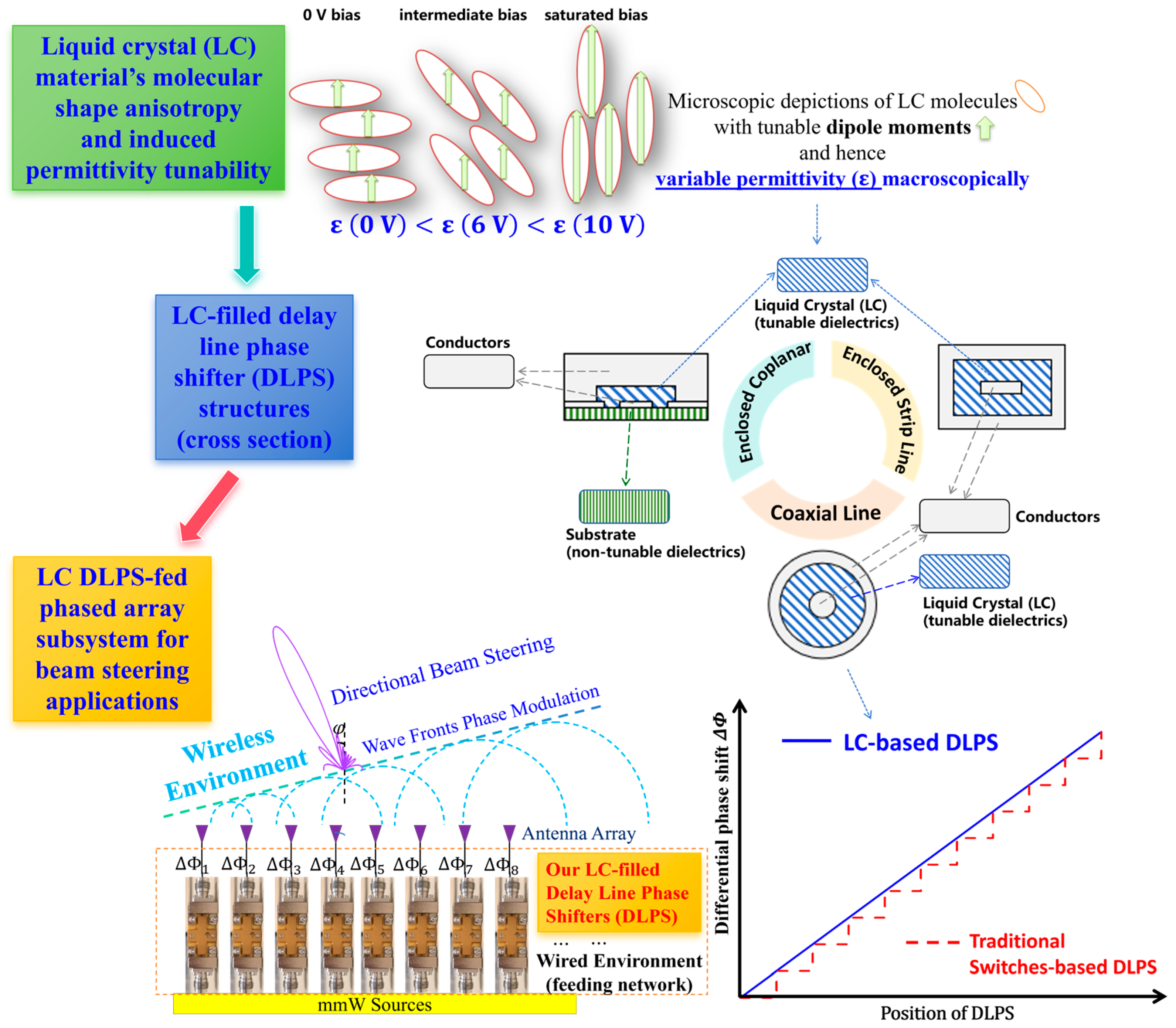
Figure 1. Delay line phase shifters (DLPSs) and the projected technological route via electric permittivity tuning of liquid crystals (LCs) for 5G/6G mmW beam-steering applications.
Electronics 15 00485 g001
Figure 2. Previously unconsidered physical constraints in the analytical model of an LC-embedded coaxial DLPS for securing single-mode (HoM-free) operation.
Electronics 15 00485 g002
Figure 3. Limited attention on suboptimal dispersion behavior (frequency ripples observed in DDT and DDL) of an FoM-optimized LC coaxial DLPS design with the 50 Ω impedance-matching baseline at the isotropic LC tuning state (i.e., DkLC = 2.754).
Electronics 15 00485 g003
Figure 4. Newly identified security vulnerabilities of partial dielectric leakage attacks (PDLAs) on LC DLPS and subsystem, potentially leading to eavesdropping concerns in beam-steering applications as per Figure 1.
Electronics 15 00485 g004
Figure 5. Characterized dielectric properties of GT3-24002 LC-embedded coaxial DLPS under PI-applied and PI-free assumptions. Note that the plot is three-dimensional (3D), with projections on the DDF vs. bias voltage plane at the bottom (dashed representation) and Dk vs. bias voltage plane for the inner wall (in a lighter color).
Electronics 15 00485 g005
Figure 6. Cross-sectional structures of LC coaxial DLPS devices manufactured with diverse assembly strategies: (a) with PI-rubbed layer for pre-alignment (mechanical anchoring of LC molecules) to unleash the full intrinsic Dk tuning range of LC (dipole moment variable from perpendicular to parallel interactions); (b) PI-free condition for ease of fabrication but a degradation of the Dk tuning range (dipole moment variable from isotropic to parallel interactions).
Electronics 15 00485 g006
Figure 7. Illustrations of fundamental TEM mode and HoM (TE11 mode) solved at 400 GHz for an LC-embedded coaxial DLPS (PI-free) design with Dcore = 0.0615 mm and TLC = 0.09184 mm at 0 V bias (i.e., LC at isotropic state with Dkiso = 2.754). The red arrow denotes the electric vector field, while the blue arrow depicts the magnetic vector field.
Electronics 15 00485 g007
Figure 8. Dielectric tuning state ( D k L C ) dependent operational range (physical design limits) identified for LC dielectric thickness ( T L C ) and core line diameter ( D c o r e ) of an LC coax DLPS free of HoM.
Electronics 15 00485 g008
Figure 9. Graphical representations of the physical constraints identified on HoM-free LC coaxial DLPS: (a) R vs. D c o r e ; (b) R vs. T L C .
Electronics 15 00485 g009
Figure 10. (a) Meshing statistics concerning the full-wave computational convergence of LC coaxial DLPS designs with diverse tuning states of LC ( D k L C ) as the 50 Ω impedance-matching baseline; (b) characterized forward reflection coefficient ( S 11 ) for the LC coaxial DLPS design with 50 Ω matched at the LC tuning state of D k L C = 2.80.
Electronics 15 00485 g010
Figure 11. (a) Derived DDL for various D k L C -based 50 Ω impedance-matching designs vs. f across 54 GHz to 66 GHz (using D k L C = 3.3 in computing DDL); (b) derived standard deviation in DDL across 54 GHz to 66 GHz for various D k L C -based 50 Ω impedance-matching designs.
Electronics 15 00485 g011
Figure 12. (a) Derived DDT for various D k L C -based 50 Ω impedance-matching designs vs. f from 54 GHz to 66 GHz; (b) derived mean value of DDT across 54 GHz to 66 GHz vs. 50 Ω matched baseline in the tuning state of LC ( D k L C ) and the corresponding dielectric thickness T L C ; (c) derived standard deviation (fs) of DDT across 54 GHz to 66 GHz vs. diverse 50 Ω matched baselines in the tuning states of LC ( D k L C ).
Electronics 15 00485 g012
Figure 13. Characterization results of the new FoMs across 54 GHz to 66 GHz for the 12 designs of LC coaxial DLPS with 50 Ω matched at diverse tuning states of LC ( D k L C ): (a) FoM (DDT); (b) FoM (DDL).
Electronics 15 00485 g013
Figure 14. Depiction of 60 GHz characterized results of the new FoMs for the 12 designs of LC coaxial DLPS with 50 Ω matched at diverse tuning states of LC ( D k L C ): (a) FoM (DDT); (b) FoM (DDL).
Electronics 15 00485 g014
Figure 15. Results of the proposed new TTD- F o M factoring dispersion into performance evaluation of the LC coaxial DLPS across 54 GHz to 66 GHz: (a) TTD- F o M of DDT; (b) TTD- F o M of DDL.
Electronics 15 00485 g015
Figure 16. Illustrations of dielectric leakage attacks on LC coaxial DLPS: (left) special case of full leakage of LC (i.e., LC is entirely replaced by air in the dielectric cavity); (right) general case of partial leakage of LC (resulting in a mix of LC and air in the dielectric cavity).
Electronics 15 00485 g016
Figure 17. Complex dynamics illustrations for liquid–gas two phase flow in an LC coaxial DLPS due to positional movements of the device: vertically positioned, horizontally positioned, and positioned at a tilted angle.
Electronics 15 00485 g017
Figure 18. Illustration of potential thermal attack vectors identified on LC DLPS devices.
Electronics 15 00485 g018
Table 1. LC coaxial DLPS designs with diverse tuning states of LC as the 50 Ω matching baseline.
Design of 50 Ω Match at D k L C = ? T L C (mm) D c o r e (mm) L L C (mm)
D k L C = 2.7540.340.2315.92
D k L C = 2.800.348760.2315.92
D k L C = 2.850.354540.2315.92
D k L C = 2.900.360350.2315.92
D k L C = 2.950.366170.2315.92
D k L C = 3.000.372020.2315.92
D k L C = 3.050.377890.2315.92
D k L C = 3.100.383780.2315.92
D k L C = 3.150.389690.2315.92
D k L C = 3.200.395630.2315.92
D k L C = 3.250.401590.2315.92
D k L C = 3.300.410.2315.92
Disclaimer/Publisher’s Note: The statements, opinions and data contained in all publications are solely those of the individual author(s) and contributor(s) and not of MDPI and/or the editor(s). MDPI and/or the editor(s) disclaim responsibility for any injury to people or property resulting from any ideas, methods, instructions or products referred to in the content.