Article

Compact S- and C-Band Single-/Dual-Band Bandpass Filters with Multiple Transmission Zeros Using Spoof Surface Plasmon Polaritons and Half-Mode Substrate Integrated Waveguide

1
School of Information and Software Engineering, East China Jiaotong University, Nanchang 330013, China
2
State Key Laboratory of Millimeter Wave, Southeast University, Nanjing 210096, China
3
School of Information and Communications Engineering, Xi’an Jiaotong University, Xi’an 710049, China
*
Authors to whom correspondence should be addressed.
Electronics 2026, 15(2), 484; https://doi.org/10.3390/electronics15020484
Submission received: 25 December 2025 / Revised: 16 January 2026 / Accepted: 21 January 2026 / Published: 22 January 2026

Abstract

In this paper, a flower-shaped spoof surface plasmon polaritons (SSPPs) unit with strong slow-wave effect is proposed to construct bandpass filters (BPFs). Benefiting from extended current path induced by addition of rotated stubs around rectangular unit, the proposed SSPPs unit exhibits reduced asymptotic frequency. Following this, a single-band filter boasting multiple transmission zeros (TZs) in its upper stopband is developed by embedding the unit into half-mode substrate integrated waveguide (HMSIW). To improve suppression of the lower stopband, a pair of open circuited stubs are loaded to produce TZs and enhance its frequency selectivity. Consequently, the single-band BPF realizes an impressive roll-off rate of 0.116 dB/MHz. Subsequently, geometric dimensions of the open-circuited stubs are modified to dispose the TZs into passband and acquire dual-band operation. In addition, defected ground structures (DGSs) are loaded to broaden the bandwidth of notch between two passbands. Finally, a dual-band filter with a wide suppression band of 0.50 GHz is developed. With roll-off rates of 0.096 and 0.119 dB/MHz, the filter demonstrates good selectivity as well.

1. Introduction

The unprecedentedly intensive exploitation of spectrum resources and an increasingly intricate electromagnetic environment have fueled demand for high-performance filters. With unique properties including slow-wave effect [1], controllable dispersion characteristics [2], low crosstalk feature [3], and field enhancement [4], SSPPs have found great potential in the design of miniaturized and advanced filters. Owing to the inherent high-frequency cutoff property of them, several lowpass filters based on SSPPs have been proposed [5,6]. As for the construction of bandpass filters, diverse dominant implementation approaches are developed, among which are adoption of coupling structures [7], combination with highpass structures [8,9,10], introduction of lower TZs generated by resonators [11], and utilization of intrinsic bandpass characteristics of emerging high-order mode of SSPPs [12,13].
In past decades, the development of filters has extensively leveraged technologies such as microstrip lines and coplanar waveguides featuring low fabrication cost and ease of integration [14,15], along with waveguides characterized by high-power handling capability and low insertion loss [16]. Merging complementary strengths of these technologies while circumventing their individual drawbacks, the advent of the substrate integrated waveguide (SIW) has inspired novel design methodologies for development of filters [17]. To shrink transversal size of SIW, substrate integrated folded waveguides (SIFWs) [18] and half-mode SIW (HMSIW) [19] are proposed.
While these configurations effectively facilitate transversal miniaturization, the longitudinal dimension of SIW still faces constraints owing to fast-wave feature of it. To eliminate the deficiency, slow-wave structures are introduced into SIWs, with SSPPs structure standing out as a prospective candidate [20,21]. Moreover, the incorporation of SSPPs overcomes bandwidth limitation of conventional SIWs, paving a new avenue for implementation of wideband filters based on SIWs [22]. Nevertheless, the direct cascading of SSPPs-based lowpass filter with a SIW leads to a relatively bulky footprint. Consequently, SIWs and SSPPs are combined as a mixed transmission line (TL) to reduce circuit size. In ref. [23], transversal blind vias are integrated into SIWs to excite SSPPs and develop a BPF. However, the cutoff frequency of blind-via-based SSPPs structure exhibits a restricted dynamic tuning range. By patterning subwavelength periodic grooves on the metal layer of the SIW, another widely investigated type of hybrid SIW-SSPPs TL is established [24,25]. In ref. [26], blind vias and subwavelength grooves are also combined to construct SSPPs units, so as to achieve a more pronounced slow-wave effect and additional degrees of freedom. Despite possessing flexible adjustability, the frequency selectivity exhibited by most of these designs is relatively modest. Therefore, DGSs are added to generate TZs with no enlargement of dimensions, accelerating stop-band attenuation of the filter [27]. In practical scenarios, certain interference signals may occasionally arise within the passband and need to be suppressed to ensure the reliable performance of communication systems. Accordingly, notched bands are introduced to reject undesired signals [28,29,30,31,32]. Nevertheless, these designs are plagued by either inadequate rejection level or narrow suppression bandwidth.
In this paper, a novel flower-shaped SSPPs unit is proposed. The unit exhibits reduced asymptotic frequency and improved miniaturization performance, which originate from the extended current path as well as the enhanced capacitive and inductive effects introduced by the rotated stubs. Additionally, the rotated stubs also introduce multiple signal propagation paths facilitating the generation of TZs. Therefore, good selectivity can be obtained when the presented unit is applied to filter design. Extra TZs with a wide dynamic range are generated to further boost attenuation in stopband or eliminate interference signals within passband via introduction of meandered stubs and DGSs. Finally, a single-band BPF operating at 3.70–4.75 GHz with excellent frequency selectivity and a dual-band BPF possessing two flat passbands covering 3.51–4.67 GHz and 5.37–6.31 GHz are constituted. Both filters exhibit favorable propagation characteristics within operating frequency and high suppression level in stopband, confirming the effectiveness of design approach.

2. Analysis of SSPPs Unit

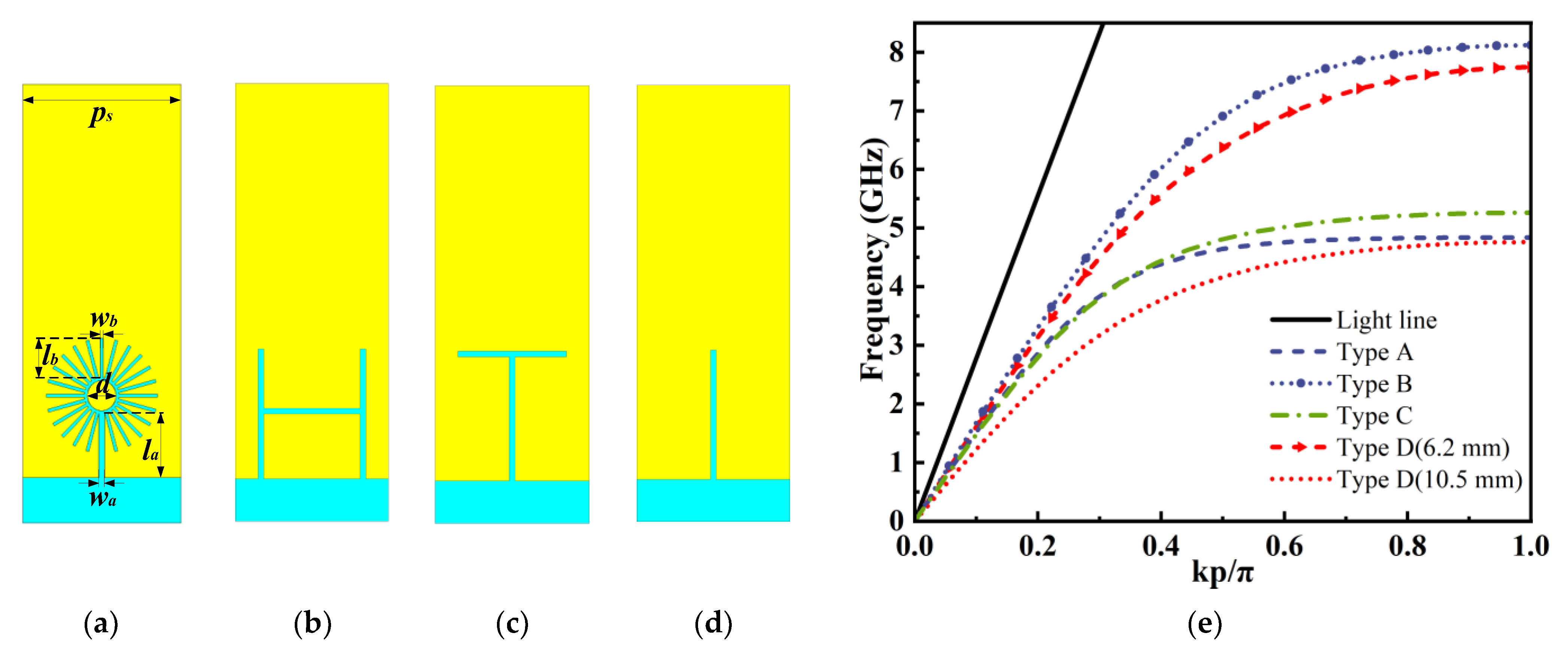
Figure 1a–d illustrate the configuration of the flower-shaped (Type A), H-shaped (Type B), T-shaped, and rectangular SSPPs units. The flower-shaped unit is constructed by adding rotated stubs to the upper side of the traditional rectangular unit. The flower-shaped groove is patterned on corrugated copper coated onto Rogers 5880 substrate with thickness of 0.508 mm and dielectric constant of 2.2. The initial geometric parameters of the unit are defined as follows: the unit period ps = 5.4 mm, the inner diameter of circular ring d = 1.2 mm, the width of rectangular slot wa = 0.2 mm, the length of slot la = 4 mm, the width of loaded stubs wb = 0.1 mm, and the length of stubs lb = 2.2 mm.
According to the numerically simulated dispersion curve of the flower-shaped unit in Figure 1e, the wavevector k in SSPPs waveguide is greater than the counterpart in free space, demonstrating the slow-wave feature of the structure. With increasing frequency, the dispersion curve displays a more pronounced deviation from the light line and a steady decline in phase velocity, ultimately converging to the asymptotic frequency of 4.75 GHz. The dispersion curves of other units with the same groove depth of 6.2 mm are also presented in Figure 1e, and these units exhibit much higher asymptotic frequencies. Moreover, for the rectangular unit, a groove depth of 10.5 mm is required to achieve the same cutoff frequency of 4.75 GHz. Therefore, the proposed unit is more conducive to miniaturization of circuit size.
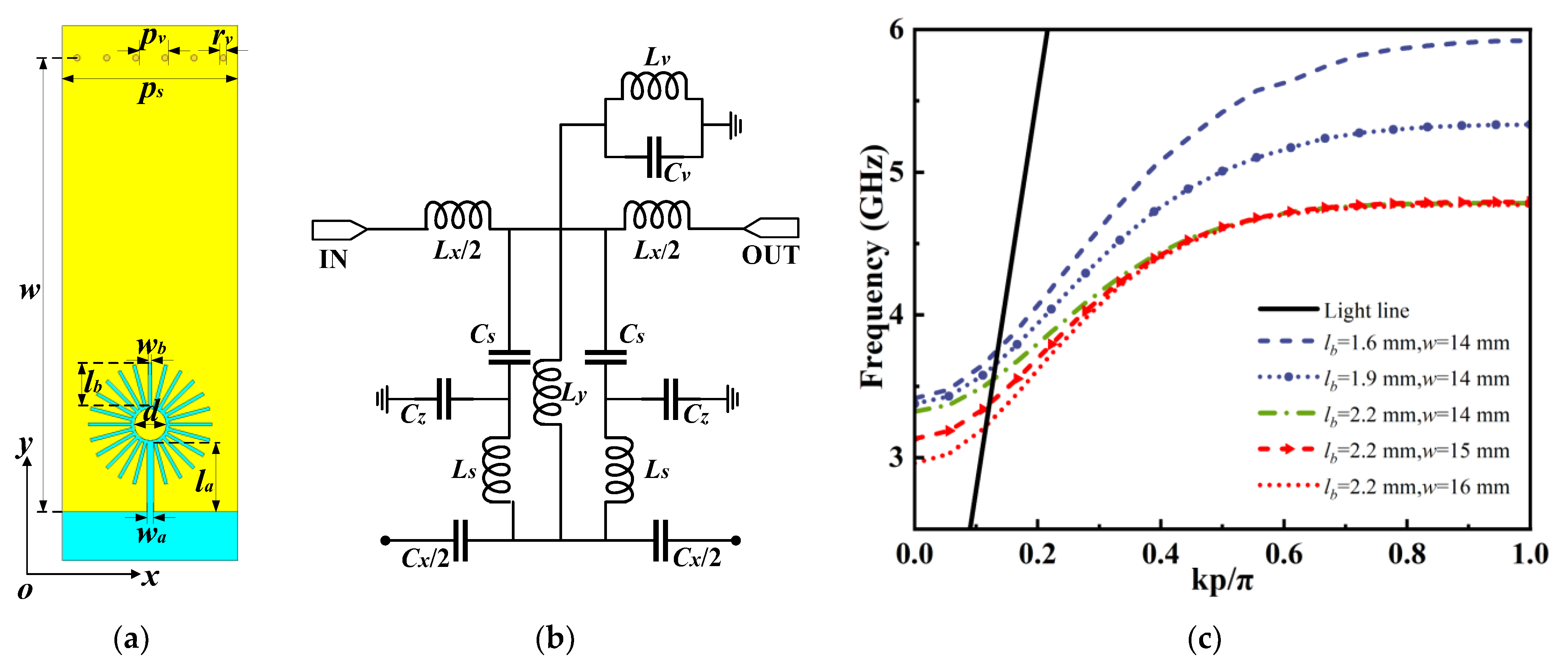
Since SSPPs inherently exhibit only high-frequency cutoff property, the SSPPs unit is integrated into the HMSIW to block signals in lower frequencies and realize bandpass filtering response. As shown in Figure 2a, the hybrid HMSIW-SSPPs unit is constructed by adding grounding vias to SSPP structures. The period and diameter of vias are 0.9 and 0.2 mm, respectively. In Figure 2b, the equivalent circuit of the SIW-SSPPs unit is presented, where Lv and Cv denote parasitic inductance and capacitance of grounding via. Lx, Ly, and Ls represent current paths on top metal layer, while Cs and Cx correspond to the capacitances introduced by the SSPPs unit. In addition, capacitance formed between the top and bottom metallic layers is denoted as Cz. And the values of these elements can be extracted using the formulas provided in [26]. When relevant physical parameters of the unit are adjusted, the values of lumped elements change accordingly, which in turn induces the shift in resonant frequency.
Dispersion curves in Figure 2c demonstrate that the unit exhibits anticipated bandpass characteristics, which arise when the cutoff frequency resulting from highpass behavior of HMSIW is lower than that from the lowpass response of SSPPs. The controllability of the dispersion characteristics of the proposed HMSIW-SSPPs unit is also investigated by plotting the evolution of dispersion curves against different values of w and lb in the figure. As indicated, the lower cutoff frequency declines from 3.32 to 2.96 GHz as w varies from 14 to 16 mm and all other parameters are maintained at their original values (lb = 2.2 mm), with no impact on the upper cutoff frequency. Conversely, the upper cutoff frequency is dictated by the value of lb. Notably, deeper groove depth yields more prominent deviation of the dispersion curves from the light line, coupled with gradual reduction in the asymptotic frequency. Simultaneously, increase in groove depth gives rise to corresponding growth in both wavevector and momentum, laying a theoretical foundation for the design of transition structure.

3. Design of BPFs

3.1. Single-Band BPF with Lower and Upper TZs

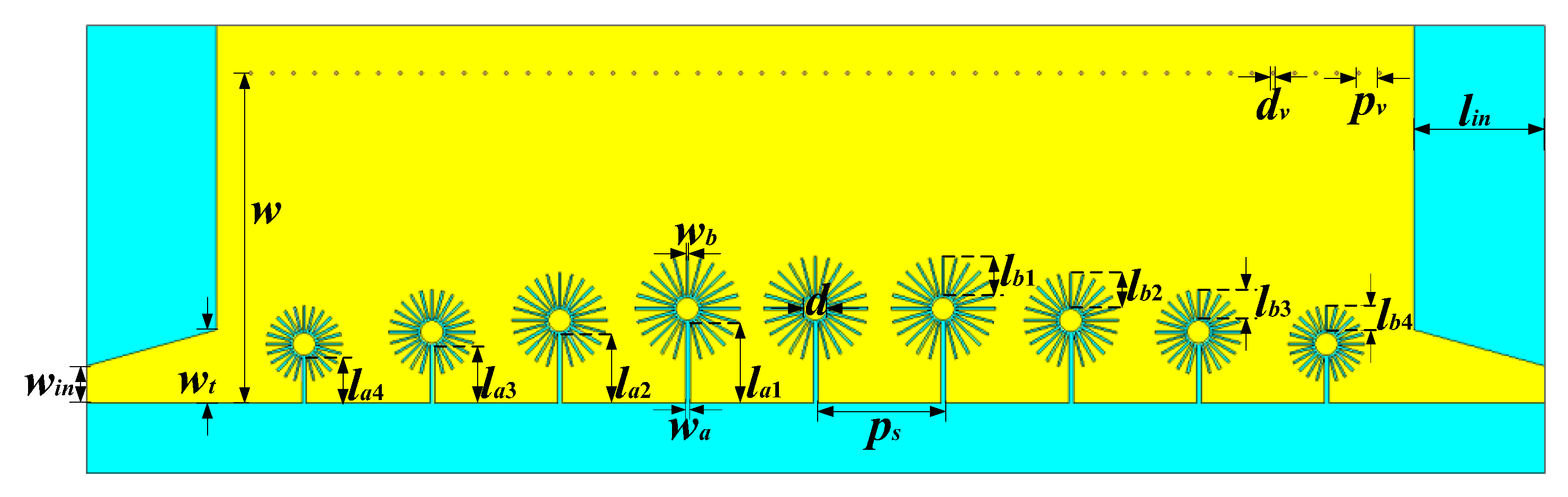
The configuration of the BPF constructed based on flower-shaped SSPPs unit and HMSIW is illustrated in Figure 3. The entire structure is made up of three sections: microstrip feeding structure, transition structure, and transmission structure. In the design of microstrip feeding structure, the initial width at the port win is set to 1.55 mm to realize characteristic impedance of 50 Ω. The design of tapered width is adopted for microstrip line to avoid reflection induced by abrupt change in impedance and prevent degradation of filtering performance such as aggravated ripple in passband. There are three units with gradient depth in transition structure. Specifically, the depth of rectangular slot la is increased linearly from la4 to la1 with a step width of lat, while the depth of loaded stubs lb is increased linearly from lb4 to lb1 with a step width of lbt. In this manner, impedance matching can be achieved. Simultaneously, momentum and wavevector matching between the TE0.5,0 mode and the SSPPs are provided to guarantee favorable transmission performance. The transmission section comprises three identical flower-shaped units, facilitating efficient propagation of SSPPs.
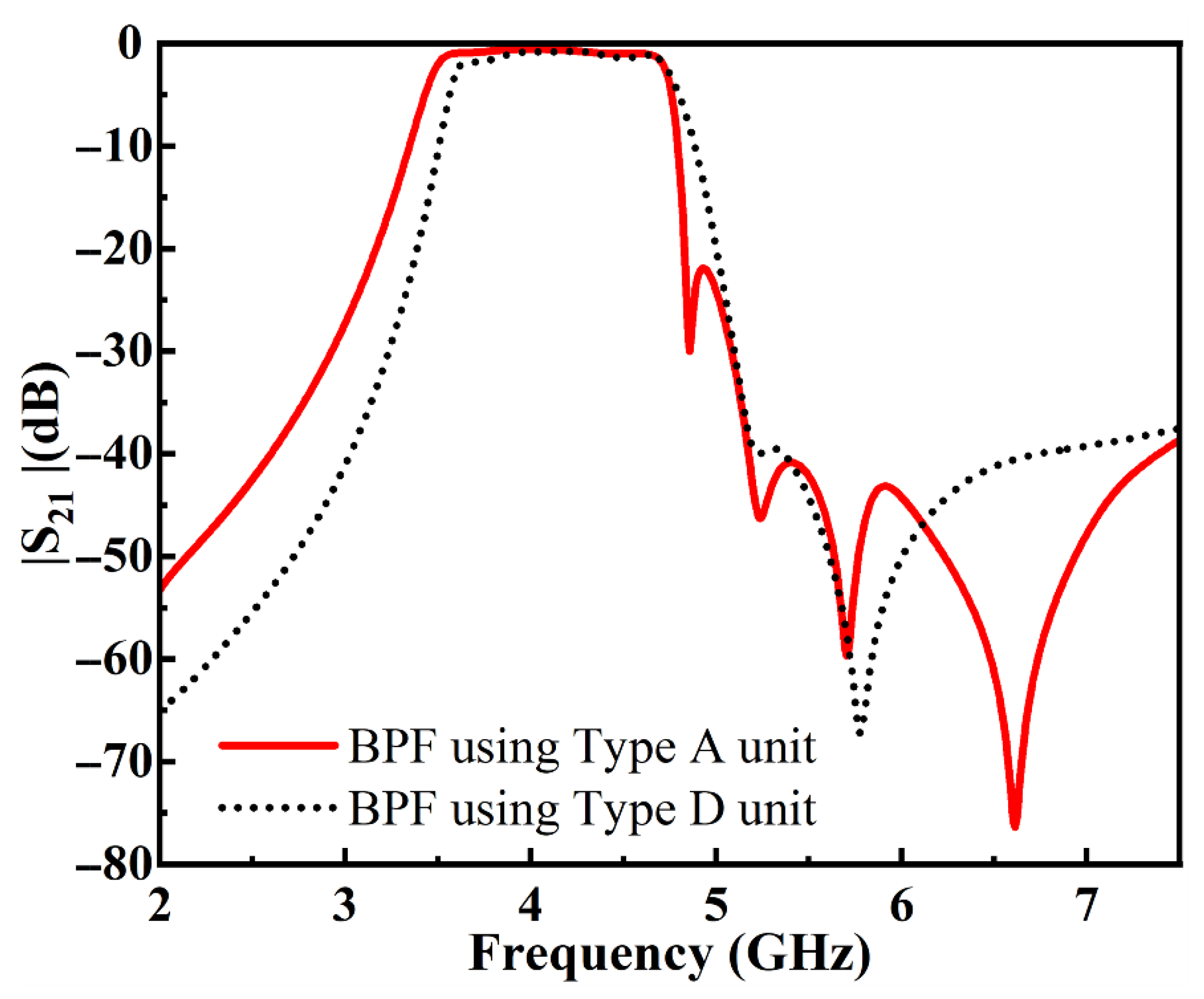
The parameters of the single-band filter are tabulated in Table 1. The corresponding S21 of proposed waveguide is presented in Figure 4, revealing bandpass frequency response with excellent flatness. To demonstrate the superiority of the proposed SSPPs unit, another comparative filter is established using rectangular unit with depth of 10.5 mm. Except for the SSPPs structures, the rest of the filter is identical to that of the single-band BPF based on flower-shaped unit. The simulated S21 of the filter is also included in Figure 4 to provide a clear comparison. While the two filters share a similar operating frequency band, the filter based on flower-shaped unit presents more TZs located in upper stopband than its counterpart based on rectangular unit. Therefore, the adoption of the proposed unit in filter design enables the realization of sharper roll-off skirts, optimized frequency selectivity, and enhanced stopband suppression level. Whereas utilization of flower-shaped unit supports excellent upper roll-off characteristics, the lower roll-off performance of the filter is fairly ordinary.
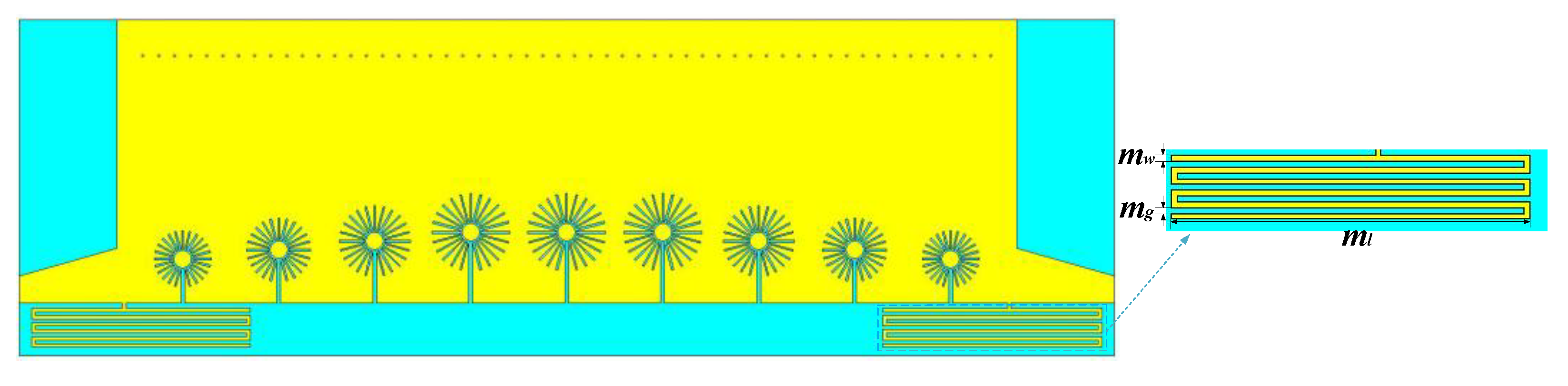
To tackle this problem, open-circuited stubs are attached to both sides of the waveguide to introduce TZs in lower stopband. For the sake of miniaturization of circuit size and enhancement of adjustability, the open-circuited stubs illustrated in Figure 5 are meandered. The introduction of an open-circuited stub into the main transmission line enables the creation of TZs at specific frequencies, which can be determined by the following expression [13]:
f T Z = ( 2 n + 1 ) v p 4 l , n = 0 , 1 , 2 ,
in which l and vp represent the physical length of open-circuited stub and the phase velocity of electromagnetic wave propagating along transmission line. This behavior arises because an open-circuited stub acts as a frequency-dependent reactive element, and its input impedance Zstub is defined as
Z s t u b = j Z s cot θ s
where Zs and θs refer to the characteristic impedance and electrical length of the stub, respectively. As can be deduced from Equation (2), the input impedance of the stub approaches zero when the electrical length satisfies
θ s = ( 2 n + 1 ) π / 2
Under this condition, the open-circuited stub effectively acts as a low-impedance shunt branch connected to the main transmission path. This abrupt reduction in shunt impedance introduces severe impedance discontinuity, which in turn induces strong signal reflection along the transmission line. From the viewpoint of power transmission, the low shunt impedance diverts most of the incident energy into the stub and prevents efficient power transfer toward output port. Consequently, the transmission coefficient is drastically suppressed at corresponding frequency, resulting in formation of TZs. Moreover, given that the electrical length of the stub θs is related to its physical length l by the phase velocity vp as
θ s = 2 π f l v p
the expression in Equation (1) can be derived by combining Equations (3) and (4).
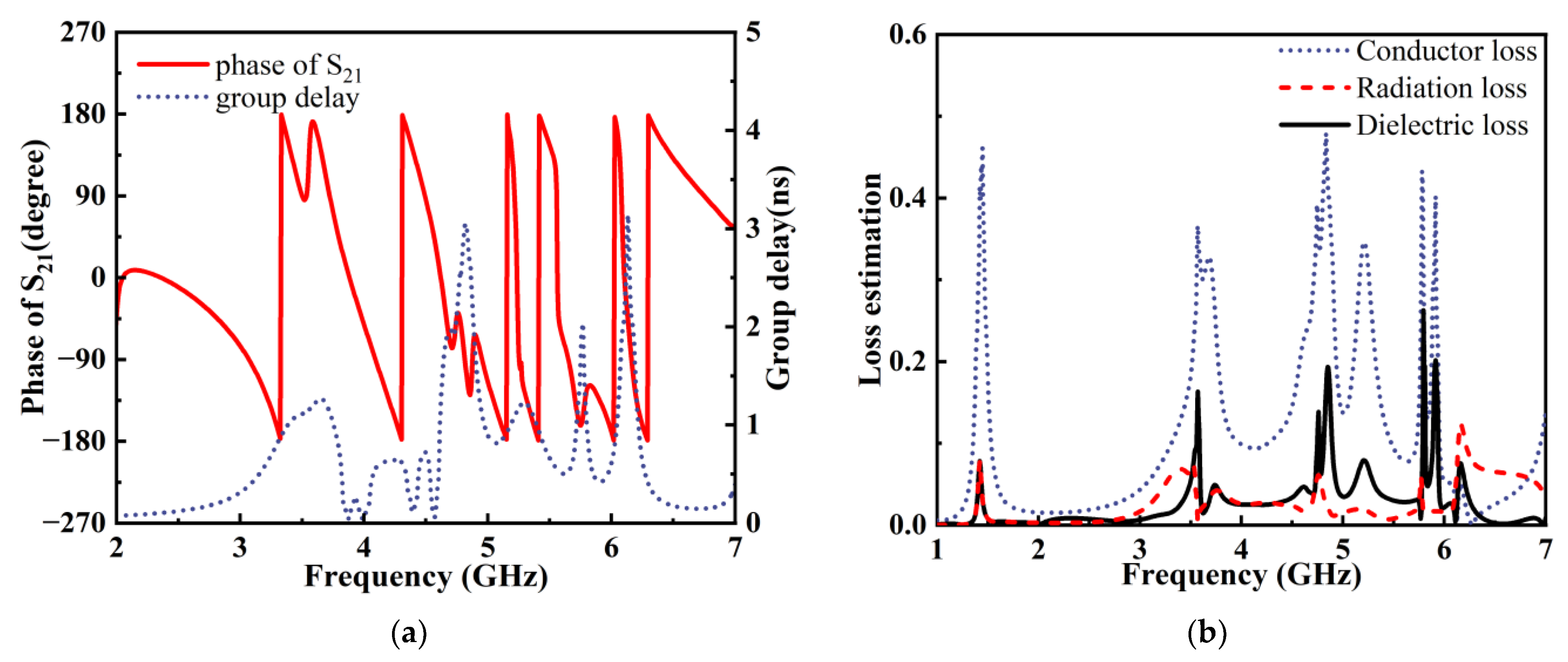
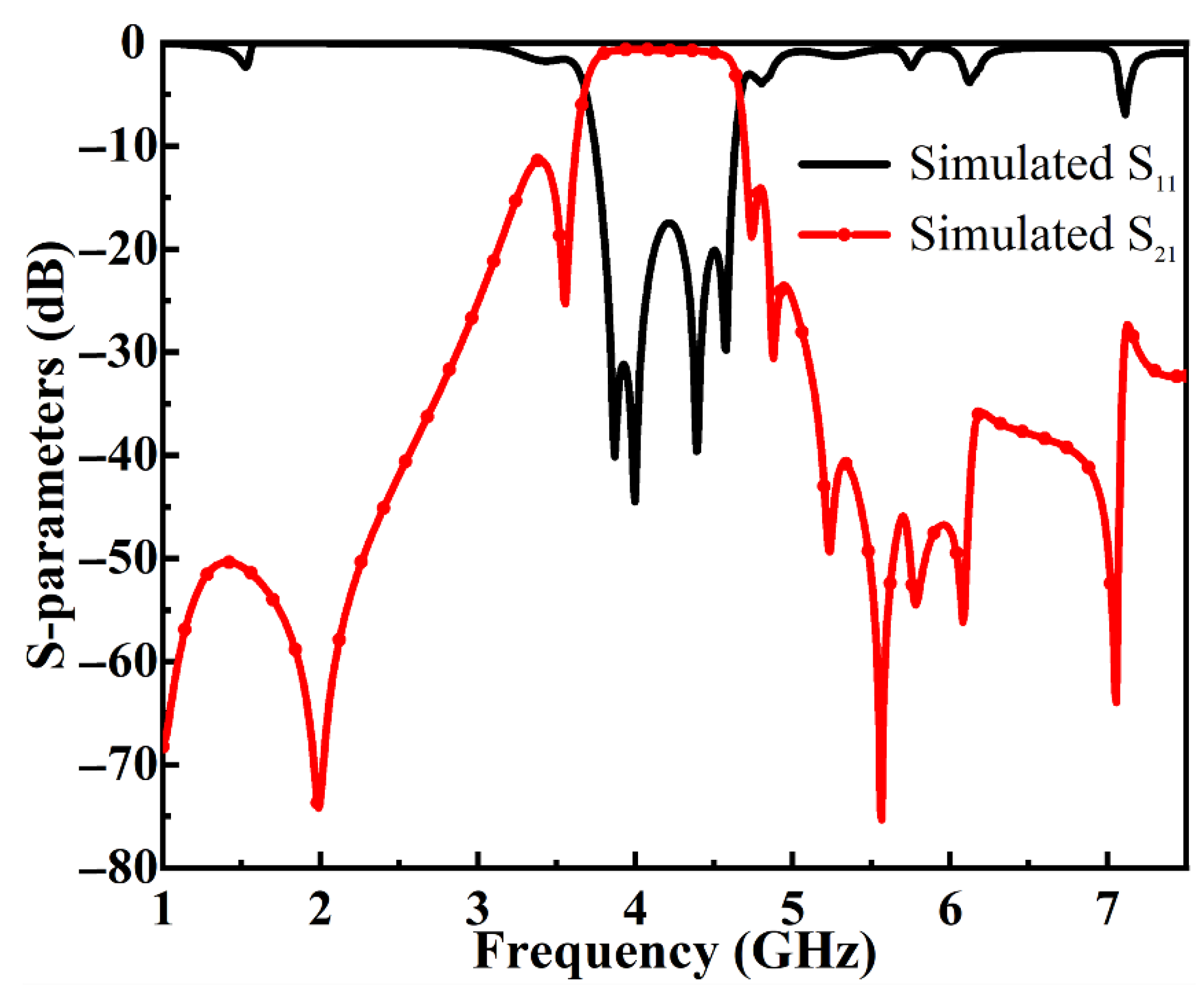
Therefore, once the target frequency of the TZ is specified, the physical parameters of the open-circuited stub can be preliminarily determined theoretically via the aforementioned formulations and further refined through electromagnetic simulation. The dimensions of open-circuited stubs are set as ml = 12.3 mm, mw = 0.2 mm, and mg = 0.2 mm. As indicated in Figure 6, two TZs located at 2.0 and 3.5 GHz are introduced in lower stopband, enabling effective suppression of low-frequency signals. Throughout passband range of 3.70–4.75 GHz, the filter exhibits return loss exceeding 17.5 dB and insertion loss below 0.63 dB. Furthermore, the roll-off rate of 0.116 dB/MHz highlights good selectivity of the filter. In Figure 7a, the phase of S21 and group delay of the filter are provided. Within the whole passband, phase of S21 shows small fluctuations. Moreover, the group delay response remains below 1.26 ns across the passband, indicating stable signal transmission. In contrast, the relatively high nonlinearity alongside large fluctuations outside the passband are observed. This behavior is caused by introduced TZs, which provide sharp stopband attenuation at the expense of abrupt phase changes. In Figure 7b, loss analysis of the filter is illustrated. As observed, the conductor loss is the dominant loss mechanism, which originates from finite conductivity and surface roughness of the metal layers. The conductor loss may be mitigated by reducing metal surface roughness through improved fabrication accuracy, together with the use of alternative metallization materials with higher conductivity. The dielectric loss contributes moderately to the total loss, and substrate with lower loss tangent can be used to alleviate such loss. In contrast, the radiation loss remains relatively small across the operating frequency range due to the strong field confinement capability of the SSPP structures. To intuitively demonstrate the performance of the proposed filter, its key performance metrics are summarized in Table 2.

3.2. Dual-Band BPF with Wide Inter-Band Suppression

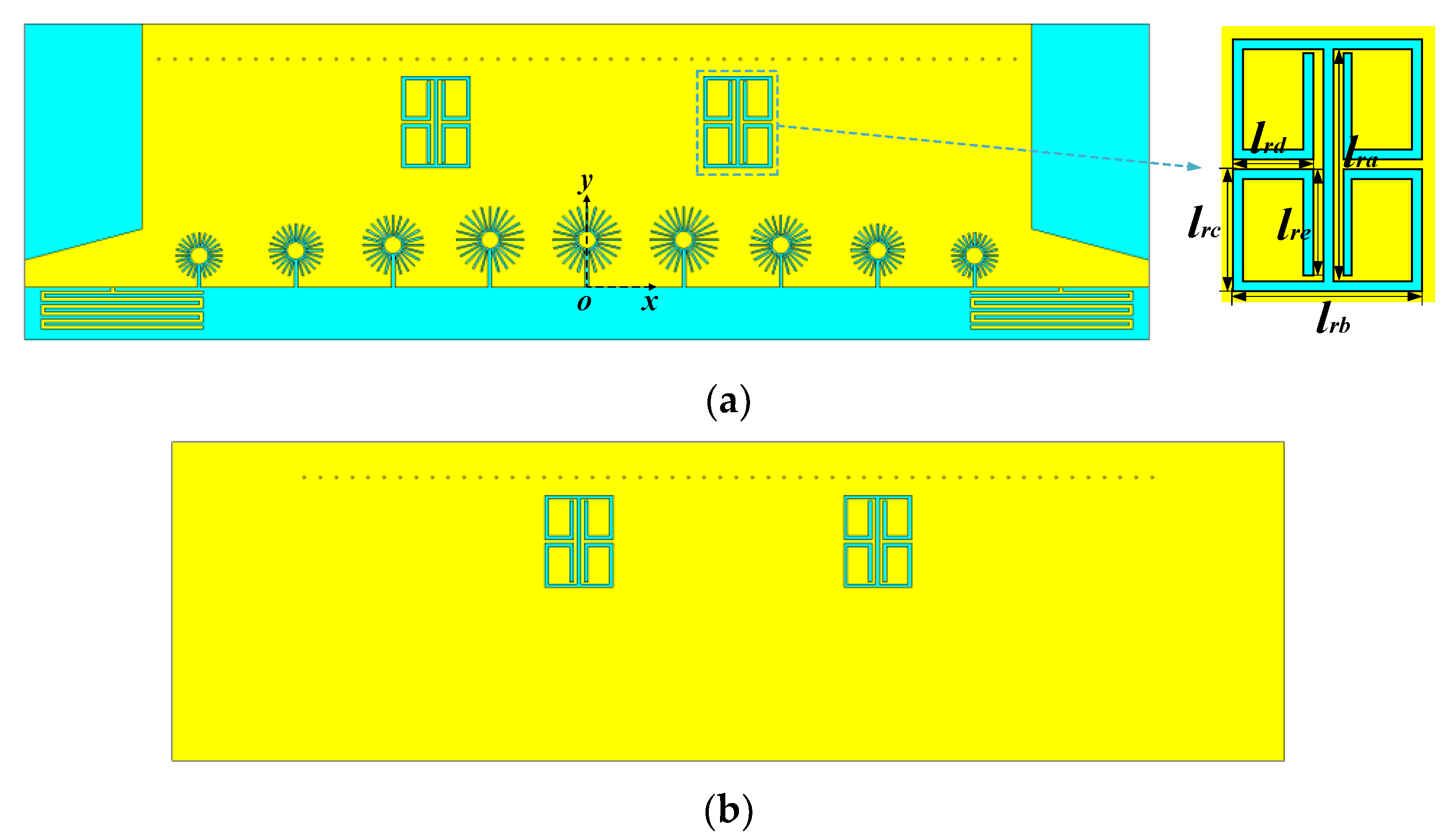
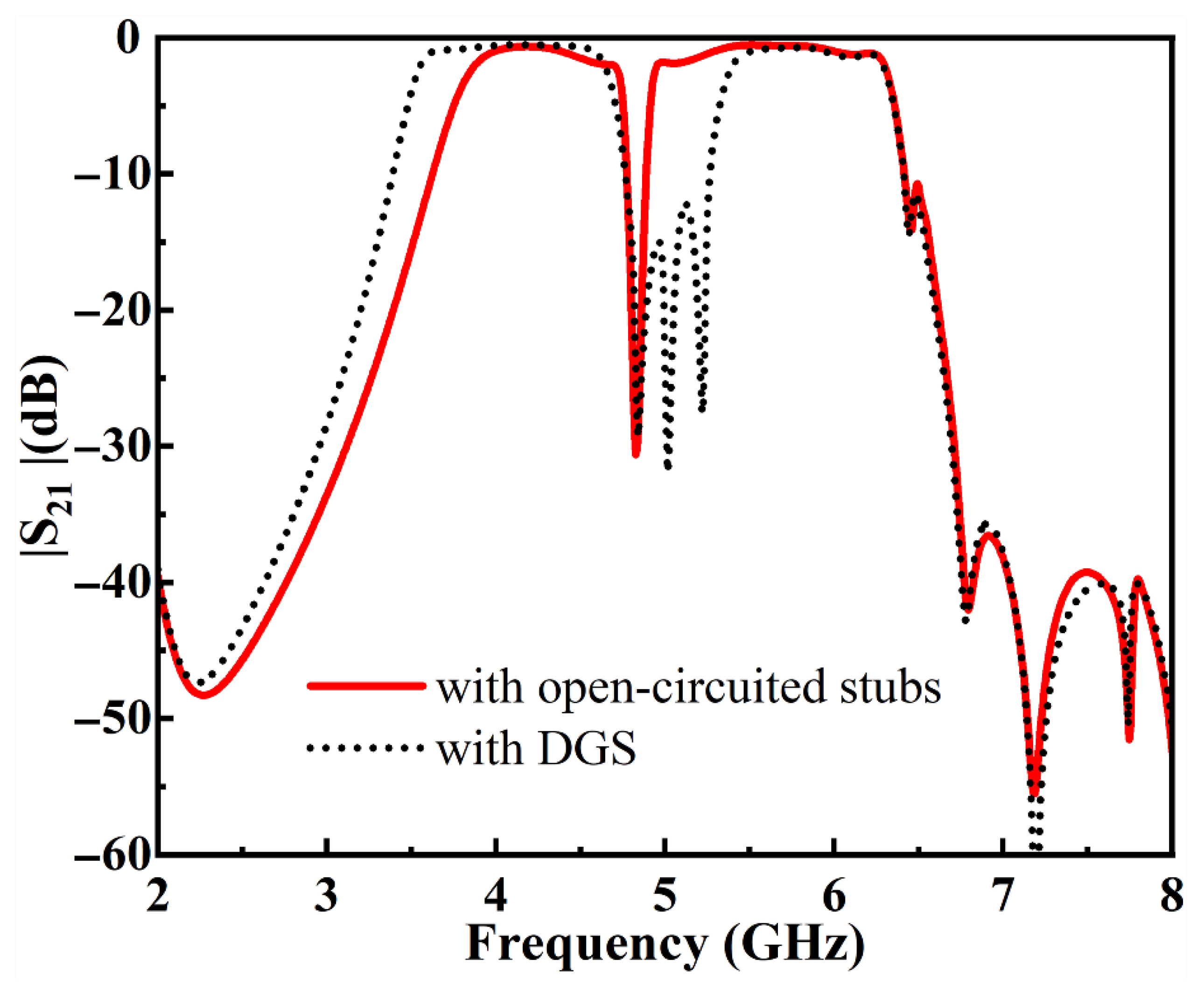
In the prior section, TZs are successfully introduced into the stopband by loading open-circuited stubs, effectively optimizing the frequency selectivity of the proposed single-band BPF. In this section, a dual-band BPF is developed by resetting TZ to the interior of passband to meet the escalating demand for multiband filtering systems with high spectral efficiency. To this end, modifications are made to the structural parameters of the aforementioned single-band filter. The parameters of the proposed dual-band BPF are given below, w = 13 mm, la1 = 2.7 mm, lat = 0.3 mm, lb1 = 1.9 mm, ml = 9 mm, mw = 0.2 mm, and mg = 0.2 mm, while the other parameters are left unchanged. In Figure 8, the simulated S21 illustrates the presence of a notch within the passbands, validating the feasibility of the design idea. However, the suppression band between passbands is too narrow to achieve sufficient isolation between the two passbands, which may undermine the signal integrity of the dual-band filtering systems in practical applications. To broaden the bandwidth of the suppression band, DGSs are loaded to introduce additional capacitance and inductance, thereby producing extra TZs. The layout of the DGS resonators is displayed in Figure 9.
The DGS would extend the path of current flow and accumulate charges at the openings of the defects, which introduce additional distributed inductance Ld and capacitor Cd. The DGS in Figure 9a can be equivalently modeled as a parallel circuit of Ld and Cd. At its resonant frequency:
f d = 1 / ( 2 π L d C d )
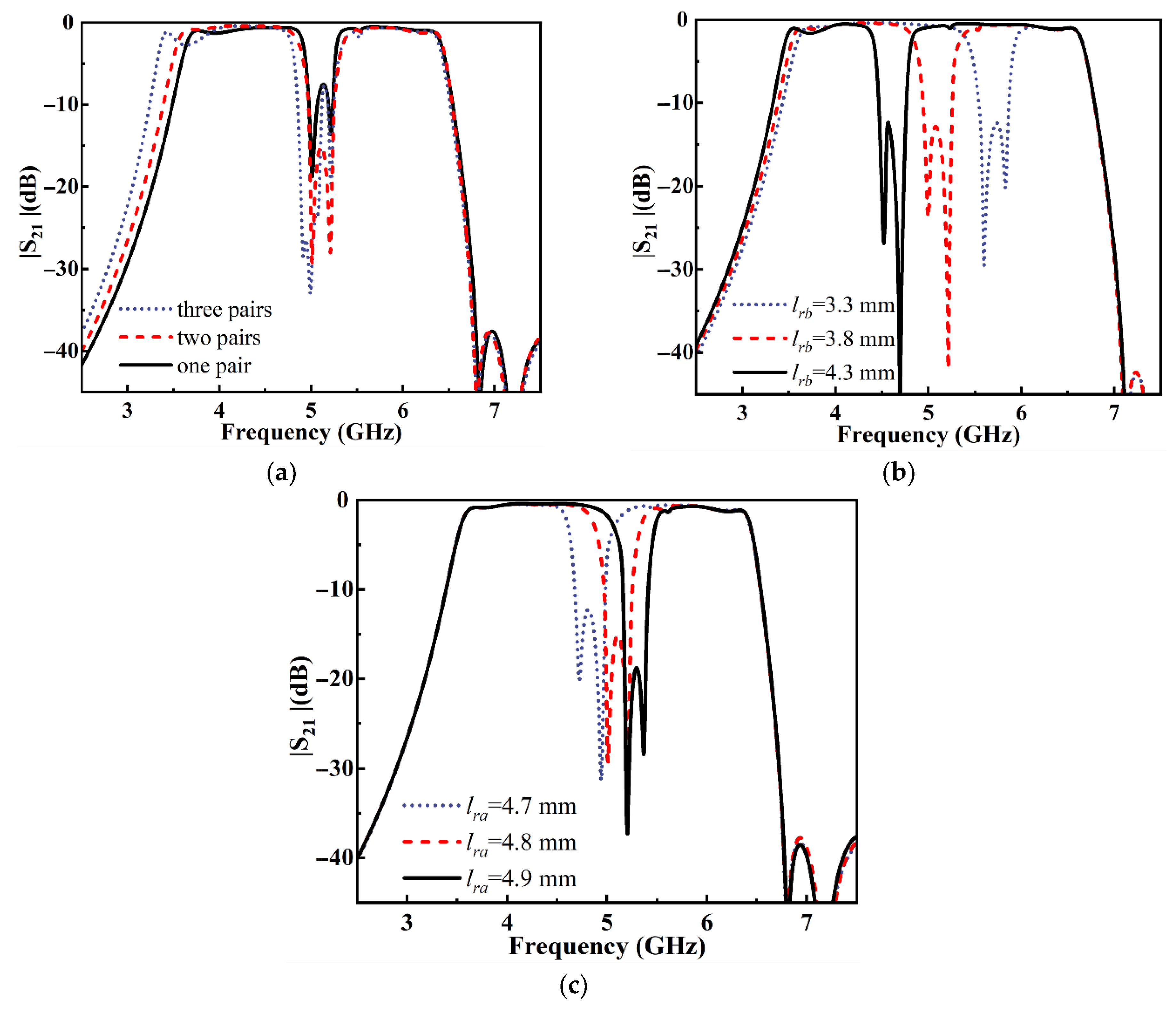
the equivalent impedance of the parallel circuit approaches infinity. This blocks the current path of the transmission line and prevents signal from propagating normally. Consequently, TZs are created. To ensure that TZs introduced by the DGS are located in appropriate frequency band, optimization and adjustment of their parameters are required. Accordingly, parametric sweepings are conducted to investigate the influence of certain parameters of the DGS on the performance of TZs generated by them. Initially, the impact of the number of loaded resonators on the frequency response characteristics is examined, and Figure 10a illustrates the comparison of the transmission coefficient of the BPF equipped with one pair, two pairs, and three pairs of DGS resonators. When equipped with just one pair of resonators, the rejection level of the notch is inferior to that obtained with two pairs. Although the widest suppression band can be acquired by utilizing three pairs of DGSs, the performance and flatness of passbands are compromised. To strike a balance between performance of suppression band and that of passbands, two pairs of DGSs are ultimately adopted in this work.
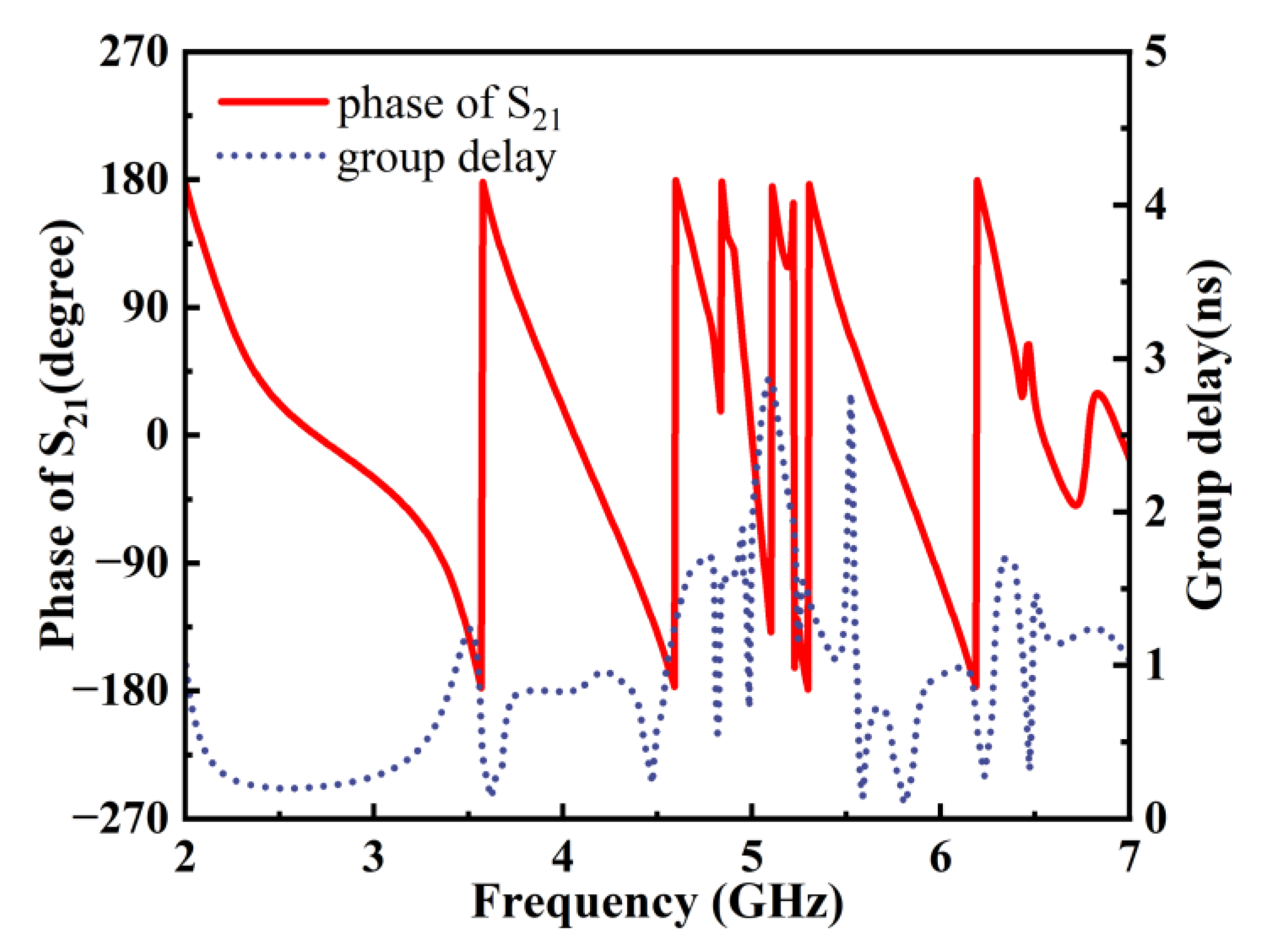
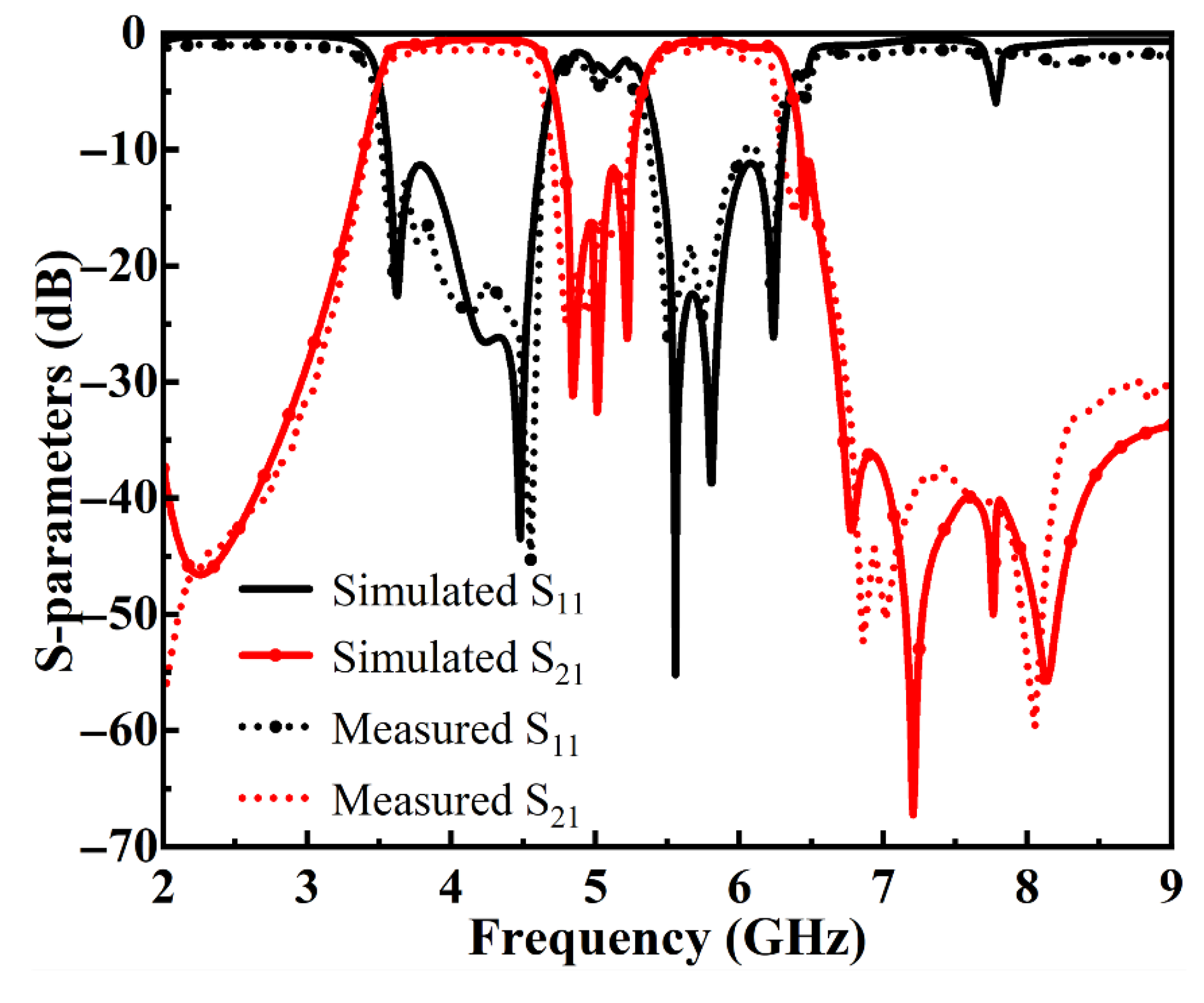
Further analysis of Figure 10 reveals that as lrb increases, the resonant frequency of the DGS reduces and TZs shift towards lower frequencies owing to increased capacitance and inductance. In contrast, the increase in lra leads to diminution of electromagnetic coupling within the resonators, which in turn induces the shift in the resonant frequency towards higher frequencies. The manipulation of positions of TZs exhibits high flexibility, providing the possibility of broadening the stopband. The structural parameters of DGSs after fine-tuning are determined as follows: wr = 0.2 mm, lra = 4.8 mm, lrb = 3.8 mm, lrc = 2.5 mm, lrd = 1.6 mm, and lre = 2.2 mm. For a clear illustration of the effect of the DGS on inter-band stopband, a simulated transmission coefficient of the waveguide loaded with open-circuited stubs and a DGS is provided in Figure 8. The existence of three TZs is observed, promoting the expansion of the bandwidth of the inter-band stopband by roughly 245.5% compared with the design that merely leverages open-circuited stubs to generate the notch. Meanwhile, the maximum suppression level between two passbands reaches up to 30 dB, which also contributes to good isolation. In Figure 11, the S-parameters of the dual-band BPF with wide inter-band suppression are presented, showing two sub-passbands centered at 4.09 and 5.84 GHz with fractional bandwidths (FBWs) of 28.4% and 16.1%. The phase of S21 and group delay of dual-band filter are illustrated in Figure 12. Except for degraded phase linearity and large group delay fluctuations in the inter-band stopband, the filter exhibits excellent phase linearity and a flat group delay response.
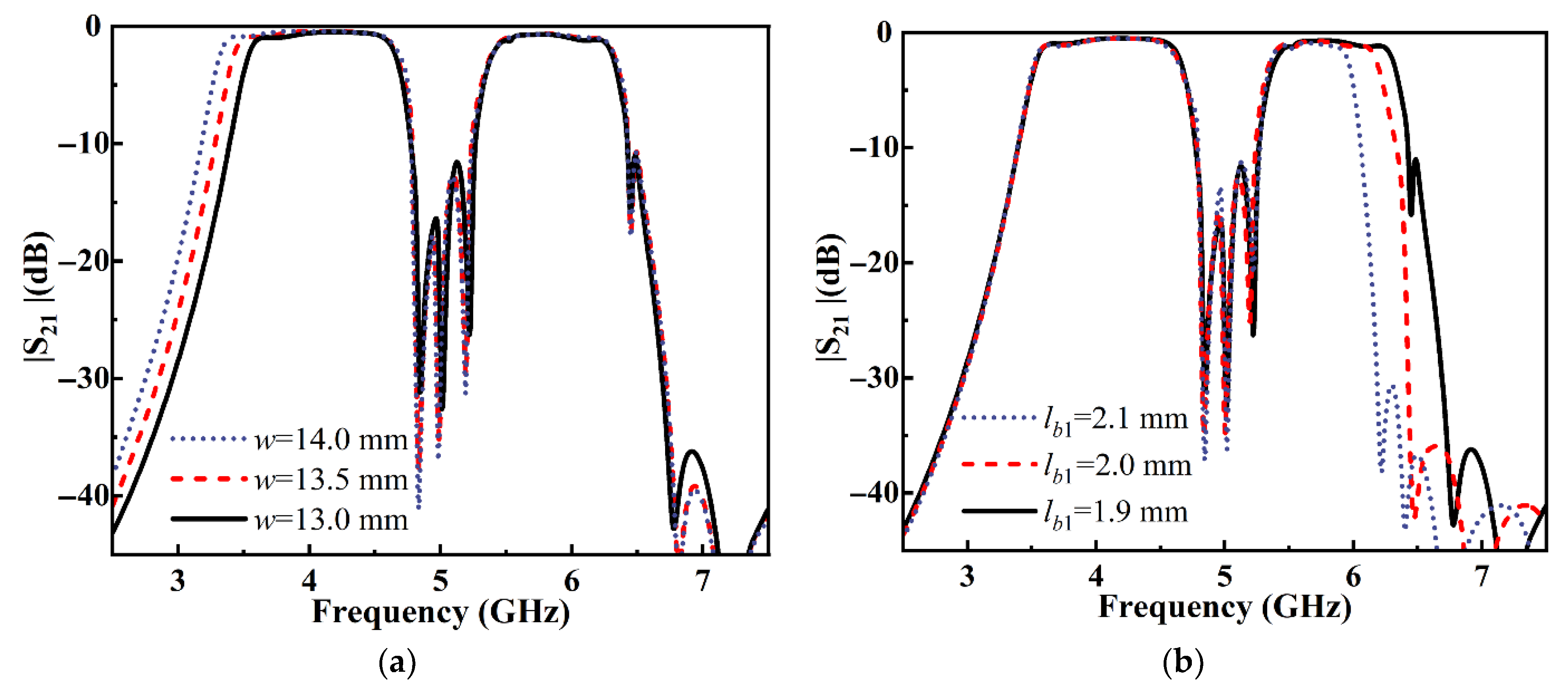
As suppression of signals in lower and higher frequencies is obtained via HMSIW and SSPPs structures, tuning the parameters of these configurations allows for the manipulation of the operating ranges of passbands. As indicated in Figure 13, the variation in the HMSIW width w from 13 to 14 mm brings about the reduction in lower cutoff frequency and center frequency of the lower passband, whereas the upper passband remains essentially unaffected. On the contrary, decreasing the depth of the loaded stubs lb1 barely causes modification to the lower passband, yet it triggers the shift in upper cutoff frequency and center frequency of the upper passband towards higher frequencies, along with broadening of its bandwidth.

4. Experimental Validation and Discussion

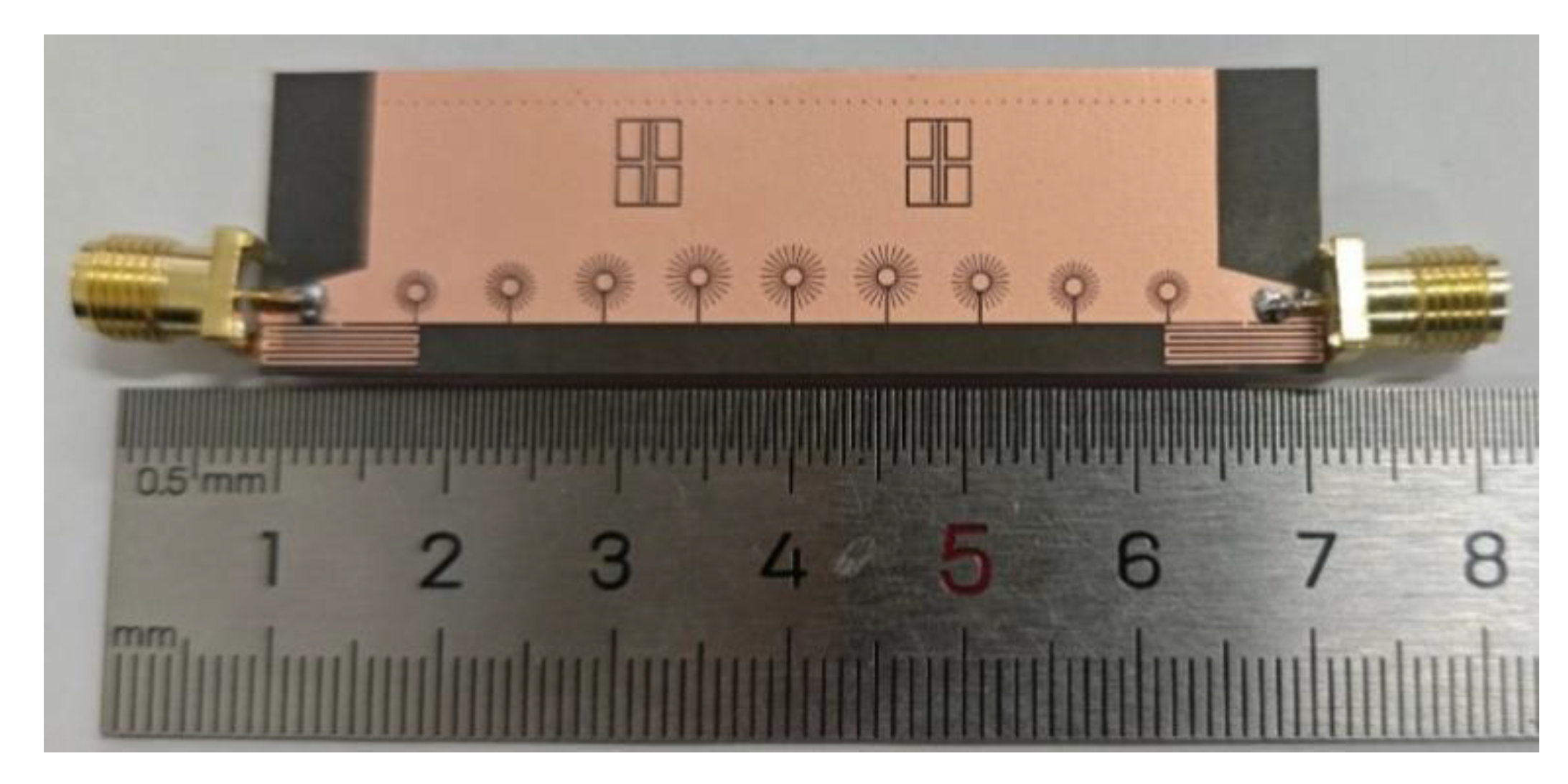
For verification, a prototype of the proposed dual-band BPF is fabricated using standard printed circuit board (PCB) technology, and a photograph of the sample is depicted in Figure 14. By using a Keysight E5071C network analyzer, the S-parameters of the filter is tested. Measured results are shown in Figure 11 to compare with simulated ones. While simulated results demonstrate two passbands spanning 3.51–4.67 GHz and 5.37–6.31 GHz, and the maximum insertion loss of 1.25 dB and minimum return loss of 11.2 dB, measured ones exhibit narrower bandwidth and inferior losses. Specifically, within the measured lower passband from 3.51 to 4.53 GHz, insertion loss stays below 1.54 dB and return loss surpasses 12.8 dB. The measured upper passband is centered at 5.81 GHz with 3 dB FBW of 15.8%, where insertion loss and return loss are measured to be better than 2.5 and 9.54 dB, respectively. Except for some frequency offsets, the tendency of the measured results generally conforms to the simulated ones. The discrepancies between them may be ascribed to fabrication tolerance and impedance mismatching induced by SMA soldering.
In Table 3, a comprehensive comparison of this work with other related works is provided. In reference [12], high-order mode of the rectangular unit is exploited to develop BPFs. Although the exclusion of redundant highpass structure and transition structure facilitates the simplicity of the configuration and low-loss transmission of signals over a broad frequency range, the excitation of high-order mode typically incurs a sacrifice of the compactness of the transversal dimension. In [21,24,25,26], BPFs with controllable bandwidth are developed using SIWs and SSPPs. However, the relatively gentle roll-off characteristics of these designs imply that they lack outstanding frequency selectivity. As reported in [28], the utilization of multiple CSRRs enables the BPF to attain a wide rejection band and good inter-band isolation, yet it also induces degradation of the performance of the passbands, including increased insertion loss and undesirable matching in transition bands. While a deep and highly controllable notched band is achieved without compromising the performance of the passbands, the rejection band is too narrow to ensure satisfactory isolation [29]. In addition, the miniaturization potential of this design is not significant enough. In [30], the sophisticated meander-strip unit is proposed to reduce transversal size of filter. Moreover, the integration of active components into the resonator enables dynamic tuning of the notch. However, the absence of lower cutoff frequency prevents the design from suppressing signals at lower frequencies, leading to a great limitation on its application. In contrast, interdigital coupling structures are adopted to block low-frequency signals and realize independent control of lower cutoff frequency [31]. Although a reflectionless notch is developed, flatness of the passbands and performance of the notched band still leave room for improvement.
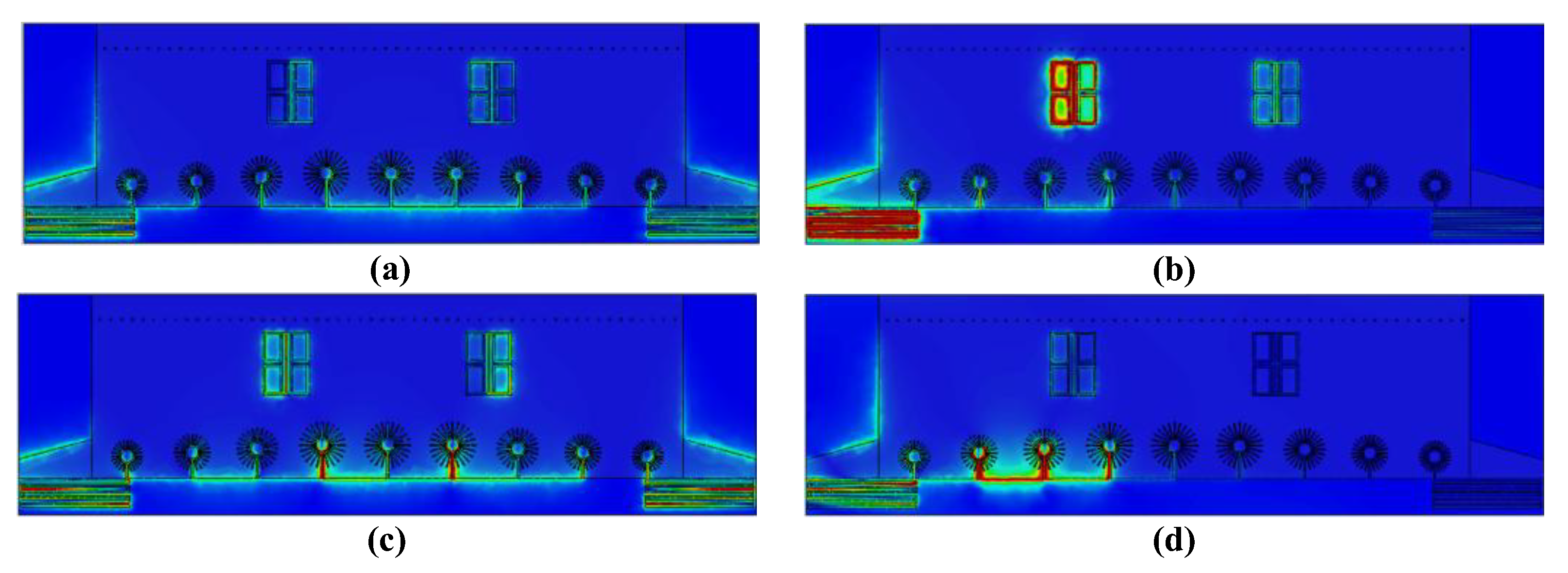
For a more thorough understanding of transmission behavior of the proposed design, the electric field distributions at 4.0, 5.0, 5,8, and 7.3 GHz are illustrated in Figure 15. While signals at 4.0 and 5.8 GHz (within passbands) propagate efficiently across the filter, the transmission of the electromagnetic wave is disrupted at the stopband frequencies of 5.0 and 7.3 GHz. A closer examination of the electric field distribution reveals the distinct forming mechanisms underlying the two stopbands. At 5.0 GHz (located at inter-band stopband), a substantial portion of electric field energy is coupled to the open-circuited stub and DGS. In contrast, the energy at 7.3 GHz experiences progressive attenuation originating from SSPPs structures.
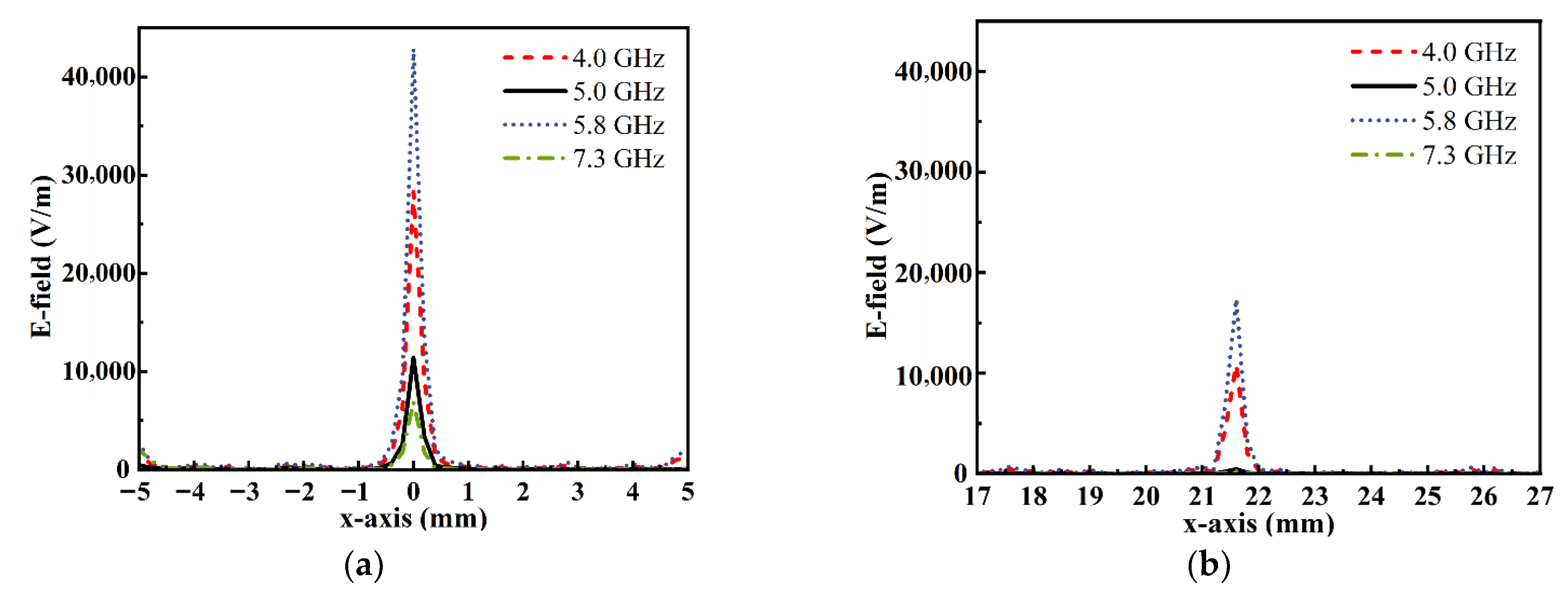
To further quantify and visualize the propagation characteristics of the electric field, the one-dimensional electric field distribution of the dual-band filter is depicted in Figure 16 using a visualization method similar to that in [33]. The reference line is oriented along the x-axis at y = 0 mm and positioned at the surface of the top metal layer. The simulated electric-field distributions reveal strong energy confinement within the subwavelength grooves (at x = 0 mm and x = 21.6 mm), highlighting the effective field confinement capability of the SSPPs structure. At 4.0 GHz and 5.8 GHz, although the electric field undergoes attenuation during propagation, a relatively strong field intensity is still observed near the output port (x = 21.6 mm), which indicates effective signal transmission through the filter. In contrast, at 5.0 GHz and 7.3 GHz, the field intensity is significantly reduced and becomes negligible at x = 21.6 mm. This verifies the suppression of signal propagation and confirms the stopband characteristic of the proposed filter.

5. Conclusions

In this paper, BPFs with compact size and good selectivity characteristics are demonstrated. Improved miniaturization capability and sharper roll-off are achieved by virtue of the implementation of the flower-shaped SSPPs unit. In addition, open-circuit stubs and DGSs are added to introduce controllable TZs, which in turn provides the possibility for further optimization of frequency selectivity or establishment of dual-band operation. Given that the cutoff frequencies of passbands and the range of the notch can be manipulated via modification of corresponding geometric parameters, the filters enjoy considerable flexibility in the regulation of operating bands. The feasibility of the design approach is validated through experimental results closely matching the simulated results. With desirable passband flatness, good inter-band suppression, and simple configuration, the design proposed in this paper holds tremendous potential for applications in scenarios such as satellite communication links, radar front-end modules, and wireless backhaul systems.

Author Contributions

Conceptualization, B.R., P.Z. and K.X.; methodology, P.Z.; formal analysis, P.Z.; writing—original draft preparation, P.Z.; writing—review and editing, B.R. and K.X.; supervision, B.R.; funding acquisition, B.R. All authors have read and agreed to the published version of the manuscript.

Funding

This research was supported in part by the National Natural Science Foundation of China under Grant 62261022, in part by the Natural Science Foundation of Jiangxi Province under Grant 20252BAC240226, and in part by the Project of State Key Laboratory of Millimeter Wave under Grant K202516.

Data Availability Statement

Data are contained within the article.

Conflicts of Interest

The authors declare no conflicts of interest.

References

  1. Garcia-Vidal, F.J.; Martin-Moreno, L.; Pendry, J.B. Surfaces with holes in them: New plasmonic metamaterials. J. Opt. 2005, 7, 97–101. [Google Scholar]
  2. Martín-Cano, D.; Nesterov, M.L.; Fernandez-Dominguez, A.I.; Garcia-Vidal, F.J.; Martin-Moreno, L.; Moreno, E. Domino plasmons for subwavelength terahertz circuitry. Opt. Express 2010, 18, 754–764. [Google Scholar] [CrossRef] [PubMed]
  3. Ji, L.; Li, X.C.; He, X.; Mao, J.F. A slow wave ridged half-mode substrate integrated waveguide with spoof surface plasmon polaritons. IEEE Trans. Plasma Sci. 2021, 49, 1818–1825. [Google Scholar] [CrossRef]
  4. Wang, M.; Sun, S.; Ma, H.F.; Cui, T.J. Supercompact and ultrawideband surface plasmonic bandpass filter. IEEE Trans. Microw. Theory Tech. 2020, 68, 732–740. [Google Scholar] [CrossRef]
  5. Pathak, B.B.; Kshetrimayum, R.S.; Hong, J.S. Flexible SSPP low-pass filter employing trapezium-mounted semicircular-shaped unit cell for B5G NR FR1 radio stripes network. IEEE Microw. Wireless Technol. Lett. 2025, 35, 1478–1481. [Google Scholar]
  6. Chen, Y.B.; Liu, Q.; Zhang, W.; Jin, C. Compact lowpass filters using GCPW-based spoof surface plasmon polaritons. Mater. Des. 2025, 253, 113863. [Google Scholar] [CrossRef]
  7. Pan, L.D.; Wu, Y.L.; Wang, W.M.; Wei, Y.W.; Yang, Y.H. A flexible high-selectivity single-layer colanar waveguide bandpass filter using interdigital spoof surface plasmon polaritons of bow-tie cells. IEEE Trans. Plasma Sci. 2020, 48, 3582–3588. [Google Scholar]
  8. Zhang, D.W.; Sun, Y.X.; Zhang, K.; Wu, Q.; Jiang, T. Short-circuited stub-loaded spoof surface plasmon polariton transmission lines with flexibly controllable lower out-of-band rejections. Opt. Lett. 2021, 46, 4354–4357. [Google Scholar]
  9. Ren, B.P.; Chen, W.J.; Zhang, X.Y.; Guan, X.H.; Xu, K.D. Compact tri-band bandpass filter with wide upper stopband based on spoof surface plasmon polaritons and open-/short-circuited stubs. Electronics 2025, 14, 285. [Google Scholar]
  10. Zhang, D.W.; Zhang, K.; Wu, Q.; Jiang, T. A compact wideband filter based on spoof surface plasmon polaritons with a wide upper rejection band. IEEE Photonics Technol. Lett. 2020, 32, 1511–1514. [Google Scholar]
  11. Mazdouri, B.; Honari, M.M.; Mirzavand, R. Miniaturized spoof SPPs filter based on multiple resonators or 5G applications. Sci. Rep. 2021, 11, 22557. [Google Scholar] [CrossRef] [PubMed]
  12. Xu, K.D.; Lu, S.; Guo, Y.J.; Chen, Q. High-order mode of spoof surface plasmon polaritons and its application in bandpass filters. IEEE Trans. Plasma Sci. 2021, 49, 269–275. [Google Scholar] [CrossRef]
  13. Yang, J.X.; Chen, Z.; Tang, R.F.; Li, W.L.; Li, W.Z.; Shi, J.F.; Li, S.Y. Tri-band bandpass filter based on spoof surface plasmon polaritons with independently designed bandwidths. IEICE Electron. Express 2025, 22, 20250443. [Google Scholar] [CrossRef]
  14. He, F.C.; Liu, S.; Ye, L.F.; Zhu, H.L.; Lei, D.; Yan, J. Multipassband and wide-stopband filters via independent tuning of high-order SSPP modes. IEEE Microw. Wirel. Technol. Lett. 2025, 35, 1288–1291. [Google Scholar] [CrossRef]
  15. Ma, H.F.; Shen, X.P.; Cheng, Q.; Jiang, W.X.; Cui, T.J. Broadband and high-efficiency conversion from guided waves to spoof surface plasmon polaritons. Laser Photonics Rev. 2014, 8, 146–151. [Google Scholar] [CrossRef]
  16. Chen, J.X.; Zhu, P.X.; Shi, X.; Qin, W. A ridge WG SSPP bandpass filter with lower transmission zero and extended upper stopband. IEEE Microw. Wirel. Technol. Lett. 2025, 35, 521–524. [Google Scholar] [CrossRef]
  17. Deslandes, D.; Wu, K. Integrated microstrip and rectangular waveguide in planar form. IEEE Microw. Wirel. Compon. Lett. 2001, 11, 68–70. [Google Scholar]
  18. Grigoropoulos, N.; Sanz-Izquierdo, B.; Young, P.R. Substrate integrated folded waveguides (SIFW) and filters. IEEE Microw. Wirel. Compon. Lett. 2005, 15, 829–831. [Google Scholar] [CrossRef]
  19. Lai, Q.H.; Fumeaux, C.; Hong, W.; Vahldieck, R. Characterization of the propagation properties of the half-mode substrate integrated waveguide. IEEE Trans. Microw. Theory Tech. 2009, 57, 1996–2004. [Google Scholar] [CrossRef]
  20. Zhu, Y.; Li, X.C.; Mao, J.F. Mode composite substrate integrated coaxial line based on substrate integrated coaxial line and periodic L-shaped SSPP structure. IEEE Trans. Compon. Packag. Manuf. Technol. 2023, 13, 528–536. [Google Scholar] [CrossRef]
  21. Tian, H.Y.; Dong, Y.D. Wideband low-loss filter with compact size and wide stopband based on folded planar waveguide. IEEE Microw. Wirel. Technol. Lett. 2023, 33, 651–654. [Google Scholar] [CrossRef]
  22. Zhang, Q.; Zhang, H.C.; Wu, H.; Cui, T.J. A hybrid circuit for spoof surface plasmons and spatial waveguide modes to reach controllable band-pass filters. Sci. Rep. 2015, 5, 16531. [Google Scholar] [CrossRef] [PubMed]
  23. Guan, D.F.; You, P.; Zhang, Q.F.; Xiao, K.; Yong, S.W. Hybrid spoof surface plasmon polariton and substrate integrated waveguide transmission line and its application in filter. IEEE Trans. Microw. Theory Tech. 2018, 65, 4925–4932. [Google Scholar] [CrossRef]
  24. Zhang, B.Q.; Li, Z.L.; Wang, M.F.; Ling, H.T.; Wang, Y.M.; Zhang, X.J.; Liu, W.H.; Qi, V.C.; Chen, K.F.; Tang, G.B. Narrowband SIW-SSPP hybrid bandpass filter with compact profile at Ka-band narrowband SIW-SSPP hybrid bandpass filter with compact profile at Ka-band. IEEE Access 2023, 11, 98305–98314. [Google Scholar] [CrossRef]
  25. Luo, Y.X.; Yu, J.W.; Cheng, Y.Z.; Chen, F.; Luo, H. A compact microwave bandpass filter based on spoof surface plasmon polariton and substrate integrated plasmonic waveguide structures. Appl. Phys. 2022, 128, 97. [Google Scholar] [CrossRef]
  26. Liu, Y.X.; Zhang, Y.M.; Liu, H.; Forsberg, E.; Zhang, Y.; He, S.L. Compact slow-wave half-mode substrate integrated waveguide with spoof surface plasmon polaritons for miniaturized microwave circuits. IEEE Access 2024, 12, 99921–99935. [Google Scholar]
  27. Wang, J.H.; Cao, L.J.; Ru, H.J.; Cai, W.B.; Yang, B.F.; Ye, L.F. Bandpass half-mode substrate integrated plasmonic filters with steep roll-offs. IEEE Photonics Technol. Lett. 2025, 37, 269–272. [Google Scholar] [CrossRef]
  28. Han, K.L.; Jiang, X.F.; Wang, Z.X.; Mao, Z.Z.; Wang, Y.; Tian, L.S.; Yu, Q. High-performance dual-band bandpass filter using SIPW and CSRRs. IEEE Trans. Plasma Sci. 2025, 53, 382–388. [Google Scholar] [CrossRef]
  29. Wen, Q.L.; Xin, Y.L.; Yang, Z.Q.; Xie, H.Y.; Qiu, Y. Wideband filter with controllable notched band based on fan-shaped SIW and spoof surface plasmon polaritons. Microw. Opt. Technol. Lett. 2025, 67, e70135. [Google Scholar] [CrossRef]
  30. Ye, L.F.; Chen, Y.; Wang, Z.Y.; Zhu, C.H.; Zhou, J.L.; Liu, Q.H. Compact spoof surface plasmon polariton waveguides and notch filters based on meander-strip units. IEEE Photonics Technol. Lett. 2021, 33, 135–138. [Google Scholar] [CrossRef]
  31. Cao, Y.; Lu, Y.M.; Yin, S.F.; Lin, B. Design of a CPW-based SSPP band-pass filter with reflectionless notch. Phys. Scr. 2024, 99, 125529. [Google Scholar] [CrossRef]
  32. Liao, Q.Q.; Tang, G.P.; Xiao, T.; Liu, C.G.; Huang, L.F.; Wang, H.G. Design of 5G-advanced and beyond millimeter-wave filters based on hybrid SIW-SSPP and metastructures. Electronics 2025, 14, 3026. [Google Scholar] [CrossRef]
  33. Xu, K.K.; Liu, S.Y.; Sun, W.F.; Ma, Z.F.; Li, Z.B.; Yu, Q.; Li, G. Design and fabrication of a monolithic optoelectronic integrated Si CMOS LED based on hot-carrier effect. IEEE J. Sel. Top. Quantum Electron. 2016, 22, 70–77. [Google Scholar] [CrossRef]
Figure 1. (a) Configurations of flower-shaped SSPPs unit (Type A), (b) H-shaped unit (Type B), (c) T-shaped unit (Type C), (d) traditional rectangular unit (Type D), and (e) their simulated dispersion curves of the units.
Electronics 15 00484 g001
Figure 2. (a) Configurations of the HMSIW-SSPPs unit, (b) equivalent circuit model of the unit, and (c) dispersion curves of the unit with varying value of parameters.
Electronics 15 00484 g002
Figure 3. Schematic diagram of the single-band BPF based on the HMSIW-SSPPs unit.
Electronics 15 00484 g003
Figure 4. The simulated |S21| of BPFs based on flower-shaped unit and rectangular unit.
Electronics 15 00484 g004
Figure 5. Layout of BPF loaded with open-circuited stubs.
Electronics 15 00484 g005
Figure 6. Simulated S-parameters of the single-band BPF with lower and upper TZs.
Electronics 15 00484 g006
Figure 7. (a) Phase of S21 and group delay of the single-band filter, and (b) its loss analysis.
Electronics 15 00484 g007
Figure 8. Comparison of |S21| of the dual-band BPF loaded with open circuited stubs and dual-band BPF loaded with both open-circuited stubs and DGSs.
Electronics 15 00484 g008
Figure 9. Layout of BPF loaded with open-circuited stubs and DGS: (a) front view, (b) back view.
Electronics 15 00484 g009
Figure 10. Performance of the notch introduced by the DGS with a varying (a) number of DGSs, (b) value of lrb, (c) value of lra.
Electronics 15 00484 g010
Figure 11. Simulated and measured S-parameters of the dual-band BPF.
Electronics 15 00484 g011
Figure 12. Phase of S21 and group delay of the dual-band filter.
Electronics 15 00484 g012
Figure 13. Simulated |S21| with different values of (a) w, and (b) lb1.
Electronics 15 00484 g013
Figure 14. Photograph of the fabricated prototype of the dual-band BPF.
Electronics 15 00484 g014
Figure 15. Electric field of dual-band BPF at (a) 4.0 GHz, (b) 5.0 GHz, (c) 5.8 GHz, and (d) 7.3 GHz.
Electronics 15 00484 g015
Figure 16. One-dimensional electric field distributions of dual-band BPF along x-axis at the region (a) from x = −5 mm to x = 5 mm, and (b) from x = 17 mm to x = 27 mm.
Electronics 15 00484 g016
Table 1. Parameters of the single-band BPF. Unit: mm.
Para.ValuesPara.ValuesPara.Values
pv0.9w14lat0.5
dv0.2d1.2wb0.1
lin5.5ps5.4lb12.2
win1.55wa0.2lbt0.2
wt3.1la14
Table 2. Summary of the performance parameters of the single-band filter.
Performance MetricUnitValue
CFGHz4.23
RLdB>17.5
ILdB<0.63
Operating frequencyGHz3.70–4.75
Roll-off ratedB/MHz0.116
Stopband attenuationdB>27.3
Group delayns<1.26
CF: Center frequency, RL: Return loss, IL: Insertion loss.
Table 3. Comparison of this work with other related works.
Ref.CF (GHz)RL (dB)IL (dB)Pass FBW (%)Stop FBW (%)Isolation Level (dB)OrderRoll-Off Rate (dB/MHz)Size (λg2)
[12]7.26, 9.9812.60.1640.1, 20.62.24050.102, 0.0941.19 × 0.58
[21]6.08120.560.56//20.0371.09 × 0.19
[24]3010.01.503.0//20.0110.70 × 0.38
[25]8.710.21.4632.0//30.0500.99 × 0.35
[26]8.1510.01.4082.2//170.0302.17 × 0.32
[28]7.55, 10.610.01.7014.6, 11.323.62830.085, 0.0472.58 × 0.35
[29]8.25, 9.7813.01.4118.4, 10.72.422.750.128, 0.1421.42 × 1.14
[30]2.612.01.0/2.818120.2430.35 × 0.13
[31]2.02, 3.7510.00.41133.7, 16.81.82560.427, 0.3430.51 × 0.15
This work4.09, 5.8411.21.2528.4, 16.19.232.430.096, 0.1190.88 × 0.23
FBW: Fractional bandwidth; λg: the guided wavelength at center frequency of the lower passband.
Disclaimer/Publisher’s Note: The statements, opinions and data contained in all publications are solely those of the individual author(s) and contributor(s) and not of MDPI and/or the editor(s). MDPI and/or the editor(s) disclaim responsibility for any injury to people or property resulting from any ideas, methods, instructions or products referred to in the content.