Article

Design and Implementation of a 28-GHz Four-Phase Beam-Steering Antenna Based on a Butler Matrix Network

Department of Electronic Engineering, National Taipei University of Technology, Taipei City 10608, Taiwan
*
Author to whom correspondence should be addressed.
Electronics 2026, 15(12), 2505; https://doi.org/10.3390/electronics15122505

Submission received: 12 April 2026 / Revised: 2 June 2026 / Accepted: 4 June 2026 / Published: 6 June 2026
(This article belongs to the Special Issue New Challenges in Beyond 5G/6G Network Wireless Technologies)

Abstract

This paper presents a four-phase beam-steering antenna for 28 GHz wireless communication, targeting the demand for high-efficiency and low-complexity beam-steering solutions in millimeter-wave systems. The proposed design employs a Butler matrix network to achieve multi-directional beam switching while reducing implementation complexity. The antenna is realized using microstrip technology on a printed circuit board (PCB), and the overall architecture consists of a 1 × 4 microstrip antenna array and a 4 × 4 Butler matrix network. Each component is carefully designed and analyzed to ensure optimized performance and proper system balance. The proposed antenna exhibits excellent performance in terms of bandwidth and compact size, while also providing advantages that include low cost, ease of fabrication, and structural simplicity. The beam-steering capability is experimentally verified through far-field measurements. The measurement results indicate that the four beam directions are −38°, −13°, +19°, and +41°, with corresponding gains of 8.79, 9.66, 10.8, and 9.21 dBi, respectively. In addition, a good agreement between the measurement and simulation results is observed, which validates the effectiveness and feasibility of the proposed design.

1. Introduction

Millimeter-wave antennas with multiple switchable beams have been widely studied for 5G communication systems. Various multibeam antenna designs and beamforming techniques have been proposed and applied [1,2]. In particular, beamforming networks (BFNs) and their integration with antenna arrays play a critical role in achieving efficient beam-steering performance. Due to the increase in the number of wireless communications and sensors in each wireless communication device, electromagnetic interference in each device and in different propagation paths must be adequately suppressed to mitigate multipath degradation and channel interference in complex environments [3,4]. Millimeter-wave multibeam antenna arrays have the advantage of high directivity radiation capability and wide coverage area. Compared to conventional phase-controlled antenna arrays, multibeam antenna arrays are gaining interest in modern wireless communication applications such as cellular phones, radar, and satellite communications. There are already multi-beam control using switching circuits [5,6,7].
With the beam switching network, the desired amplitude and phase characteristics of the antenna can be achieved. Blass matrices [8,9], Nolen matrices [10,11,12,13], Rotman lenses [14,15,16,17], and Butler matrices [18,19,20,21,22,23,24,25] are commonly mentioned in beamforming networks to enable beam switching antenna arrays to adjust various amplitudes and phases. Among these types, Butler matrix is one of the most promising techniques. The reason is its easy implementation with microstrip line technology and its advantages of simple architecture, compact size, cost-effectiveness, and wide beam coverage [26,27,28,29].
There have been many studies on beam control using Butler matrix with various techniques, such as single-layer substrate design [28,29,30,31], multi-layer substrate design [32,33,34,35], substrate integrated waveguide (SIW) [36,37,38,39,40,41,42,43,44], waveguide (WG) [45,46,47] techniques, etc. In [31], three novel designs are proposed for 27 GHz wireless communication, namely, a branch-line coupler with defective ground structure, a crossoverless crossover, and an LC phase shifter with high quality factor and quick response. The phase control of LC is faster and therefore applicable to 5G, but produces a low antenna gain. In [36], a Butler matrix multibeam antenna array with dual polarization was proposed. The two polarized radiation beams can provide a wide angular range between ±48° with a peak gain of 9.38/9.51 dBi. Although the realized gain is relatively high, the substrate synthesized waveguide structure is a complex structure, making the design difficult. In [45], the authors present an end-fire dipole antenna fed by a waveguide, where a broadband Butler matrix is implemented to provide power to a 1 × 4 antenna array. The multibeam antenna achieves wide bandwidth and high radiation efficiency; however, it remains challenging to fabricate in practical communication hardware.
Different beamforming architectures can be implemented in RF, IF, or LO paths depending on system requirements and implementation strategies. Among these approaches, RF-path beam switching based on passive Butler matrix networks provides advantages in terms of structural simplicity, low implementation complexity, and straightforward integration with antenna arrays. In addition, passive RF beamforming architectures avoid additional active control circuits while maintaining stable beam-switching characteristics through passive phase distribution. Alternative beamforming approaches, including IF-path and LO-path beam steering methods, have also been investigated in communication systems. In particular, adaptive DDS-PLL beamsteering architectures based on real-time direction-of-arrival (DoA) estimation provide another implementation strategy for adaptive beam control. However, such approaches generally involve additional active circuit complexity and control mechanisms.
Butler matrix antennas provide commendable performance; nonetheless, they frequently depend on intricate implementations, including multilayer substrates, substrate integrated waveguides (SIWs), and waveguide structures, which pose obstacles for system integration. This study offers a switchable-beam array antenna system functioning at 28 GHz, constructed with a single-layer microstrip design to implement the Butler matrix network. The employment of a low-loss, single-layer substrate facilitates diminished fabrication complexity and expense while preserving satisfactory antenna performance. The proposed antenna is evaluated using ANSYS HFSS 2022 R2 high-frequency simulation software and corroborated by construction and measurement.

2. Design Approach

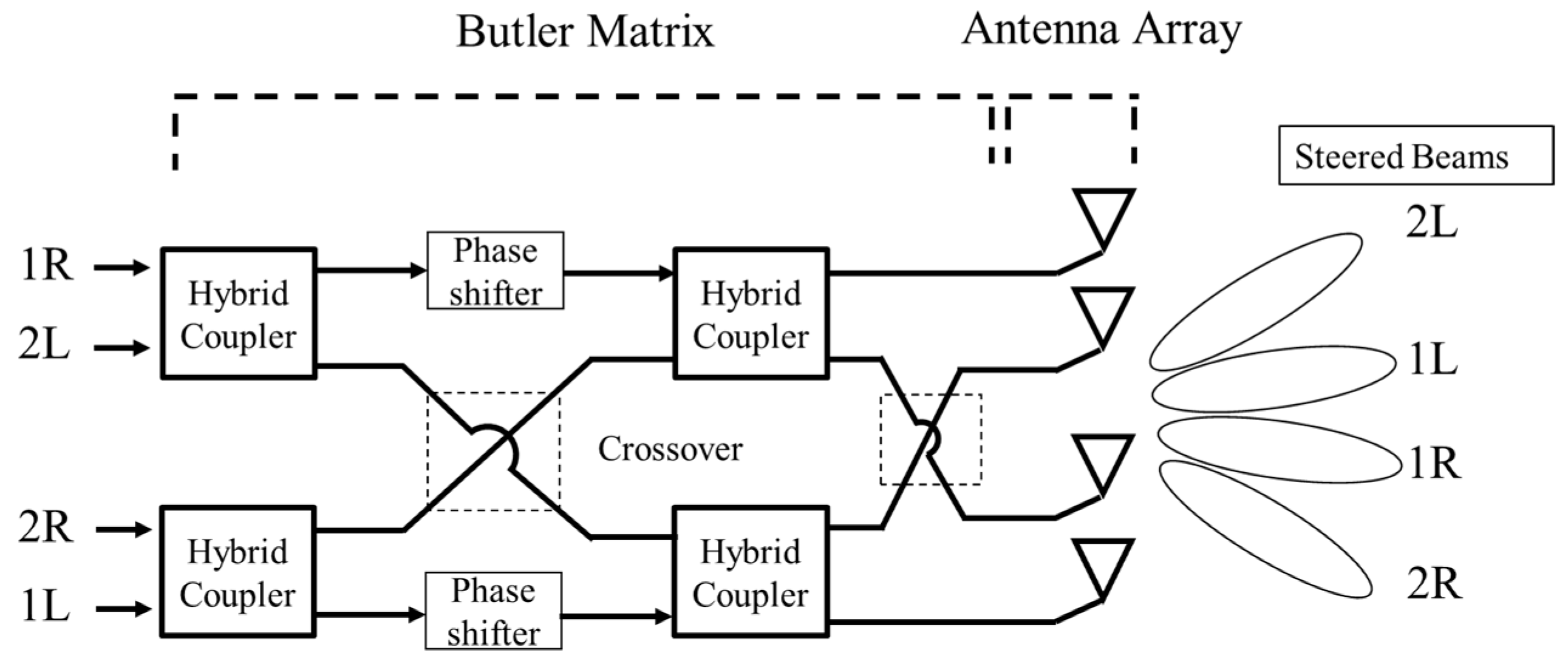
The Butler matrix is a beam-controlled feeding network that can generate different radiation directions. It can be manufactured with microstrip lines and does not require any expensive active circuit equipment. The Butler matrix architecture is shown in Figure 1. The four beam directions for input ports 1–4 are denoted 1L, 2R, 2L, and 1R, respectively. This section integrates Butler matrix antennas on the same substrate. A Rogers RT5880 substrate with a thickness of 0.254 mm and a dielectric constant ( ε r ) of 2.2 is used to implement the Butler matrix antenna.

2.1. Analysis of the 4 × 4 Butler Matrix

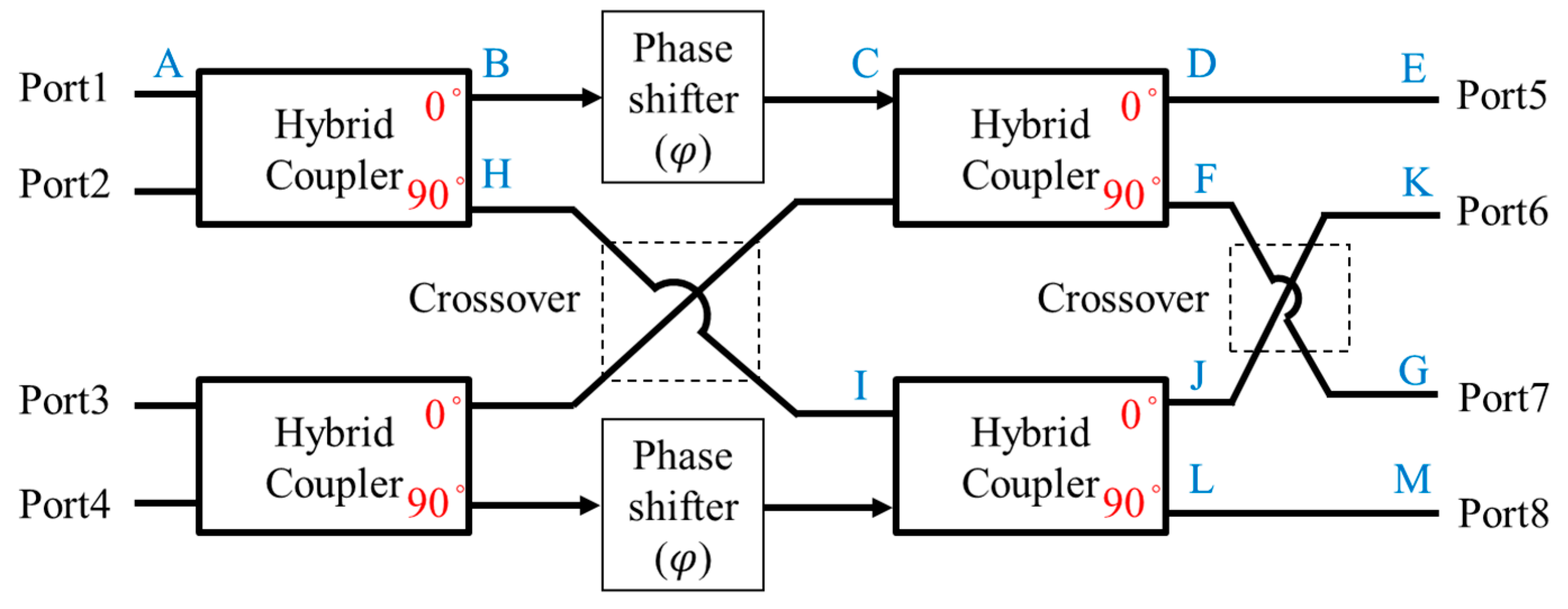
The realization of progressive phase difference (PPD) at the output ports of the Butler matrix is analyzed and derived based on Figure 2. It consists of four 90° couplers and two crossovers forming four inputs and four outputs. When the input port 1 is stimulated, the signal is transmitted to the output ports 5–8, and the important positions are marked with capital letters, and the transmission paths are: A → B → C → D → E, A → B → C → F → G, A → H → I → J → K and A → H → I → L → M.
The PPD modulation factor that changes the direction of the beam is modified by a phase shift value. When input port 1 is activated, signals of −φ, −90°, −φ−90° and −180° phases are output from ports 5 to 8. The output port must have the same phase difference to satisfy (1):
S 61 S 51 = S 71 S 61
The value derived from φ from (1) is 45°, and the PPD of the input port 1 is equal to −45°.
90 ° + φ = φ 90 ° + 90 ° φ = 45 °
Similarly, when the input ports 2 to 4 are excited, the output phase will satisfy (1) as shown in (3)–(5), respectively.
0 ° + 90 ° + φ = 90 ° φ 90 ° + 0 °
90 ° φ 90 ° + 90 ° = 0 ° + 90 ° + φ + 90 °
φ 90 ° + 90 ° + 90 ° = 90 ° + φ + 90 °
Similarly, substituting φ = 45° in (3) through (5) produces a PPD of 135° for input port 2, a PPD of −135° for port 3, and a PPD of 45° for port 4. Therefore, it can be concluded that this structure produces PPD values of ±45° and ±135°. Table 1 shows the theoretical phase values of the Butler matrix output.

2.2. Hybrid Coupler

The hybrid coupler [48] is composed of one input, two outputs and one isolation port. The function of the hybrid coupler is to equally distribute the power across the output ports, and the two outputs have a phase difference of 90°.
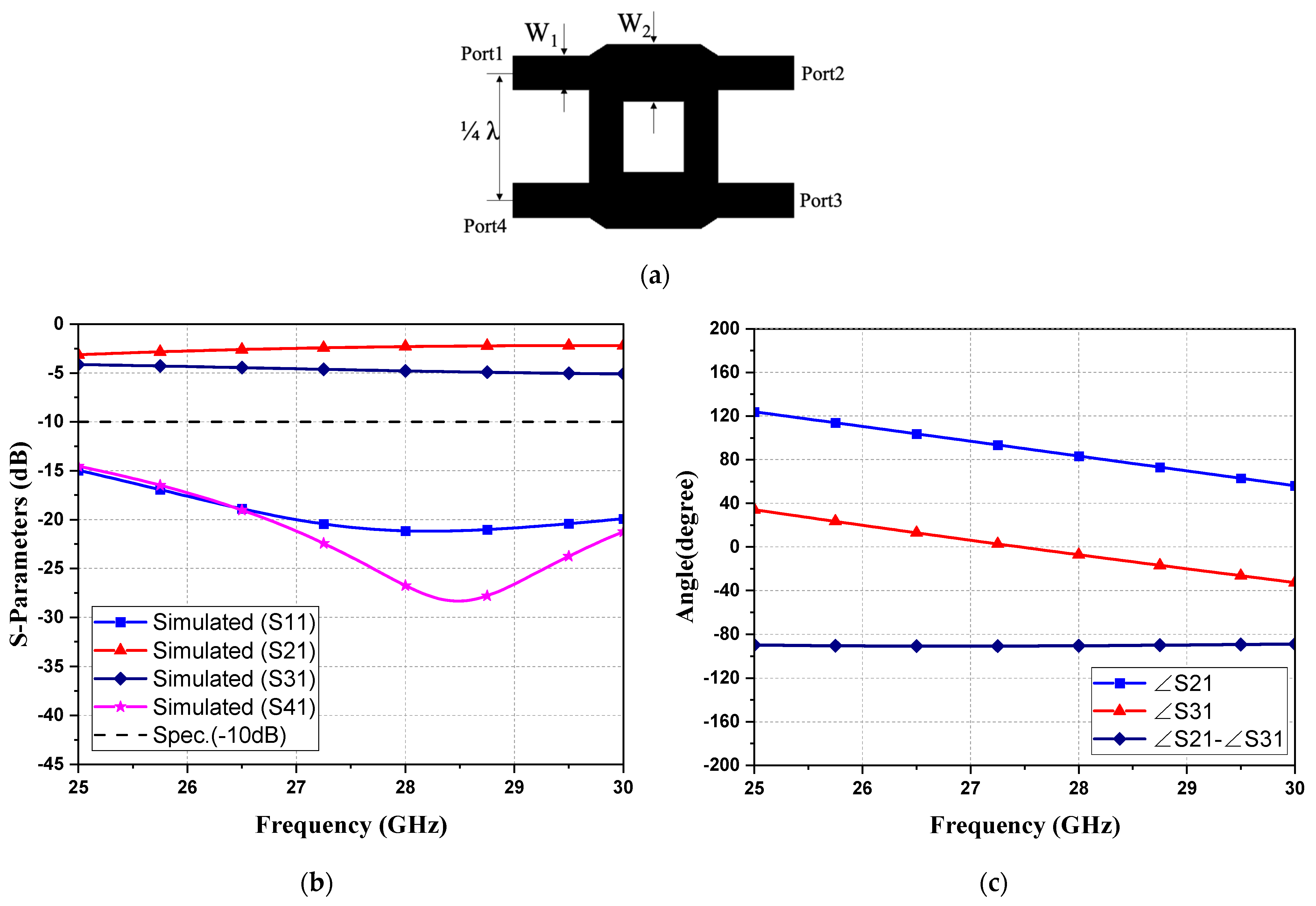
Figure 3a shows the design of the 28 GHz hybrid coupler. When the impedances are matched, port 1 power outputs to port 2 and port 3 with the same amplitude and 90° phase difference. The hybrid coupler is mainly coupled between two sets of quarter wavelength microstrip lines and the auxiliary line, one with two 50 Ω and the other with two 35 Ω transmission lines, thus forming a square with a perimeter approximately equal to one wavelength. The width of the impedance line can be calculated by bringing the result of (7) into (6).
W = 8 h e B e 2 B 2
B = Z 0 60 × ε r + 1 2 + ε r 1 ε r + 1 ( 0.23 + 0.11 ε r )
where W is the line width, the height (h) is 0.254 mm, and the dielectric constant ( ε r ) is 2.2. The matrix describing the parameters of the hybrid coupler S is shown in (8).
S H y b r i d = 1 2 0 j j 0 1 0 0 1 1 0 0 1 0 j j 0
Figure 3b is the result of the simulated hybrid coupler S parameters, and it resonates between 27.5 and 29.5 GHz. At 28 GHz, S 21 and S 31 are about −3 dB, which justifies the hybrid coupler that divides the transmitted power equally between the output ports. In Figure 3c, the phase difference between the outputs is |−90.43°|, which fits the design requirements.

2.3. Crossover

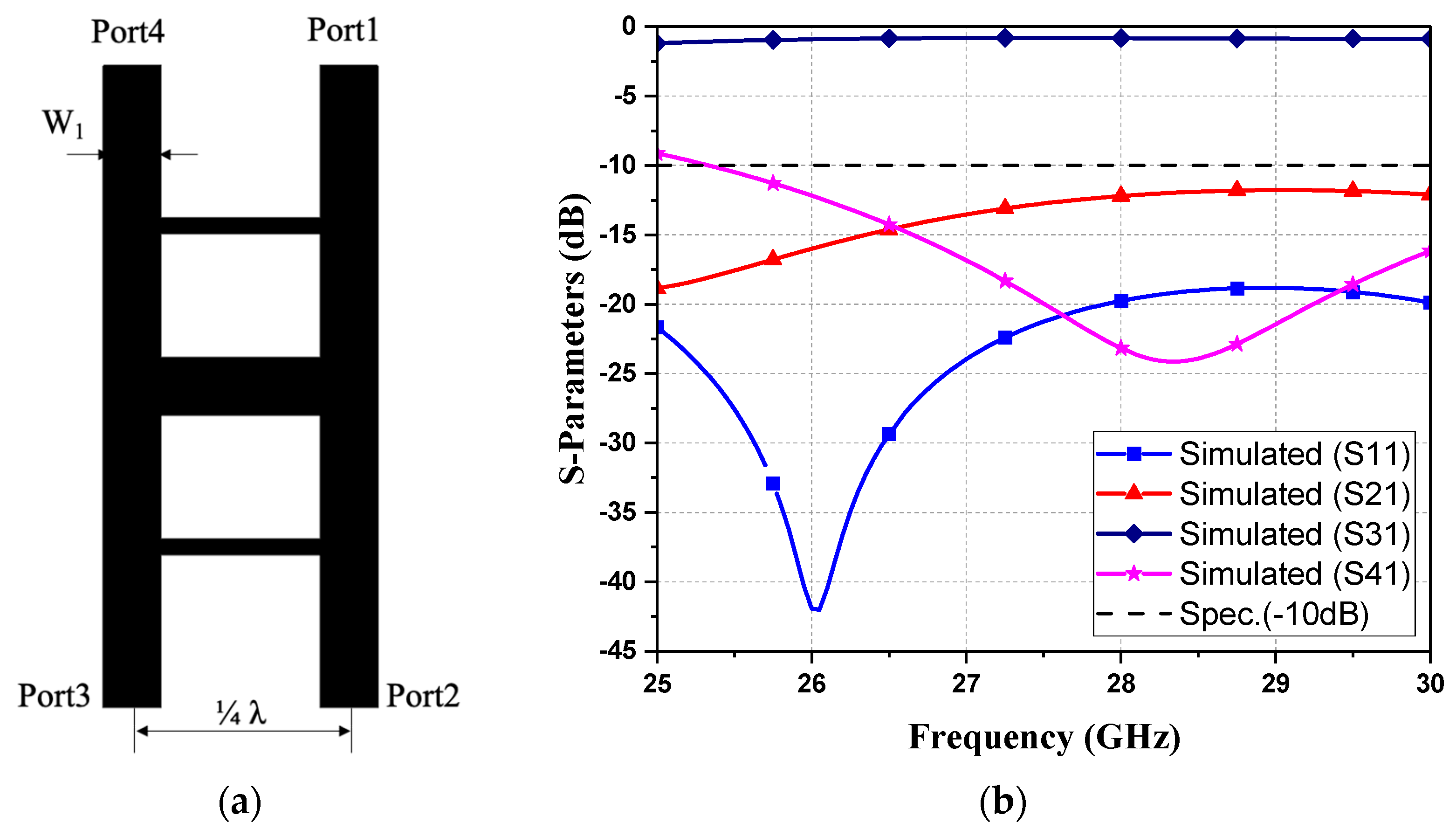
The Butler matrix has the main problem of signal overlap. Therefore, a high isolation crossover can be overcome in adjacent ports [48]. Figure 4a shows the crossover architecture with a total of four ports, including two inputs and two outputs, and each neighboring port is isolated to complete the crossover design. In addition, the crossover is designed using a 50 Ω microstrip transmission line. The S matrix of the crossover is shown in (9).
S C r o s s o v e r = 0 0 0 0 j 0 0 j j 0 0 j 0 0 0 0
Figure 4b shows the simulated S-parameters when Port 1 is excited at 25.53–31.8 GHz. S 11 , S 21 and S 41 are below −10 dB. S 31 is −0.82 dB at 28 GHz. These results satisfy reflection and isolation parameters and are suitable for use in the Butler matrix.

2.4. Phase Shifter

The purpose of using a phase shifter [48] is to change the phase direction of the wave. It is implemented in a microstrip design. Each line of the reference line ΔL introduces the phase shift angle given by (10).
λ g = λ 0 ε r e f f
where λ g is the waveguide wavelength in the substrate, λ 0   is the wavelength in free space, and ε r e f f is the effective dielectric constant of the microstrip line.
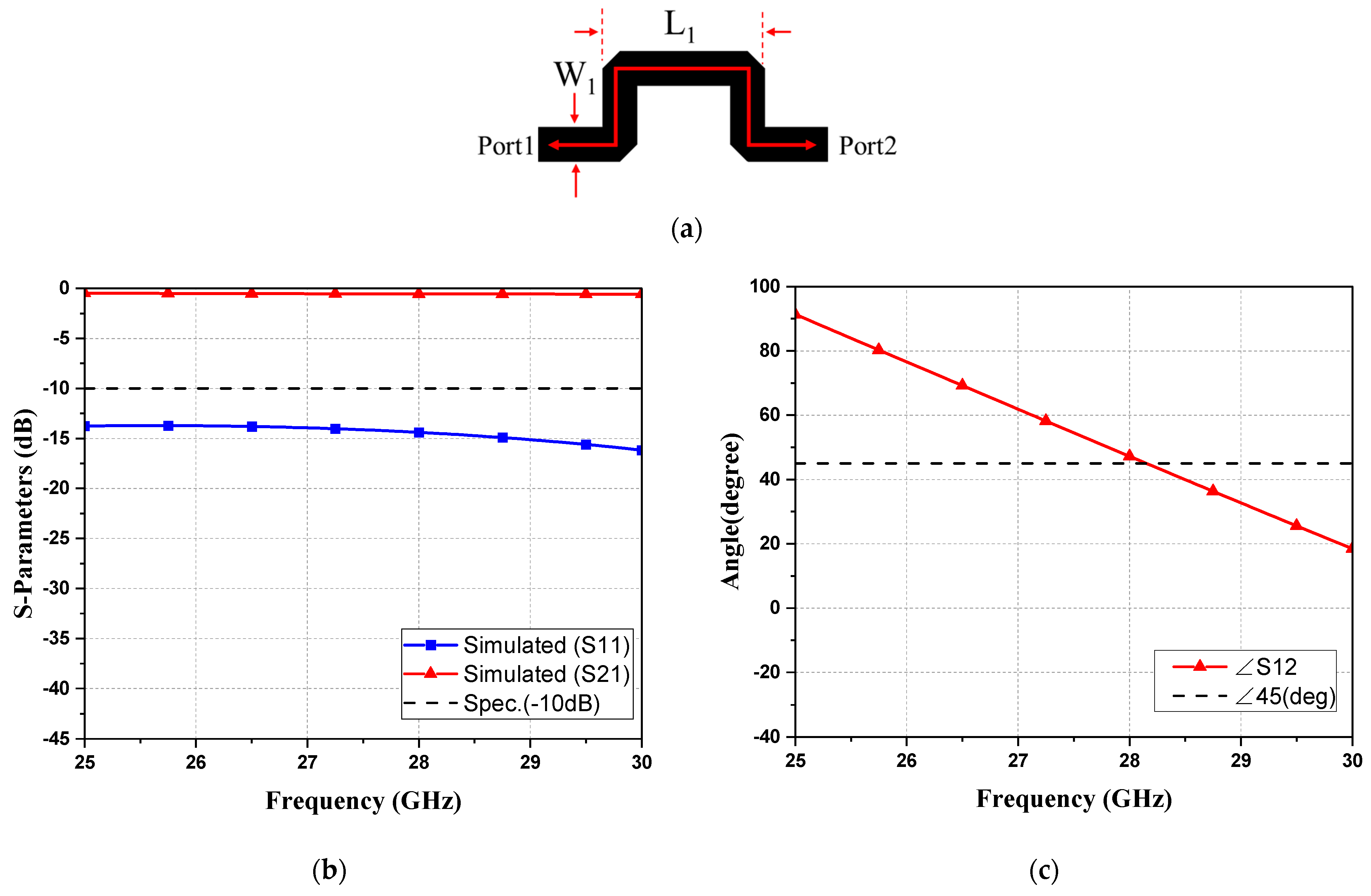
The total length of the theoretical transmission line of the 45° phase shifter is 8.547 mm at 28 GHz, calculated by (10). Figure 5a depicts the 45° phase shifter layout. S 21 is −0.5 dB and S 11 is −24 dB at 28 GHz in Figure 5b. For the phase shift, the phase of port 1 to port 2 is 45° at 28 GHz as shown in Figure 5c.

2.5. Design of Butler Matrix

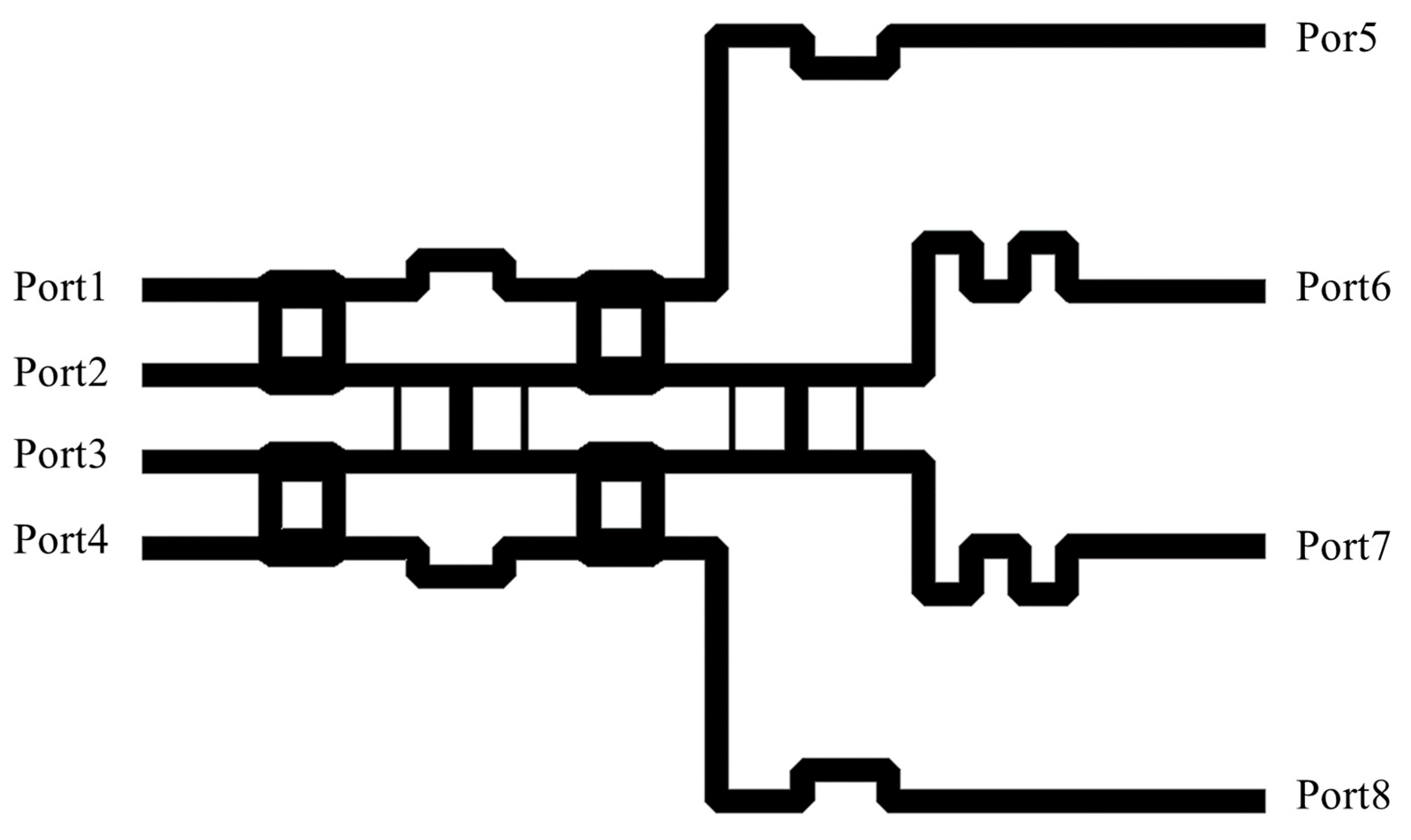
The Butler matrix layout is composed of 4 inputs and 4 outputs via a hybrid coupler, divider, and phase shifter. When a signal is input to any of the input ports, the power is divided equally among the four outputs, and these four outputs have a phase shift and equal amplitude. Figure 6 shows the Butler matrix configuration designed at 28 GHz and simulated for this design architecture.
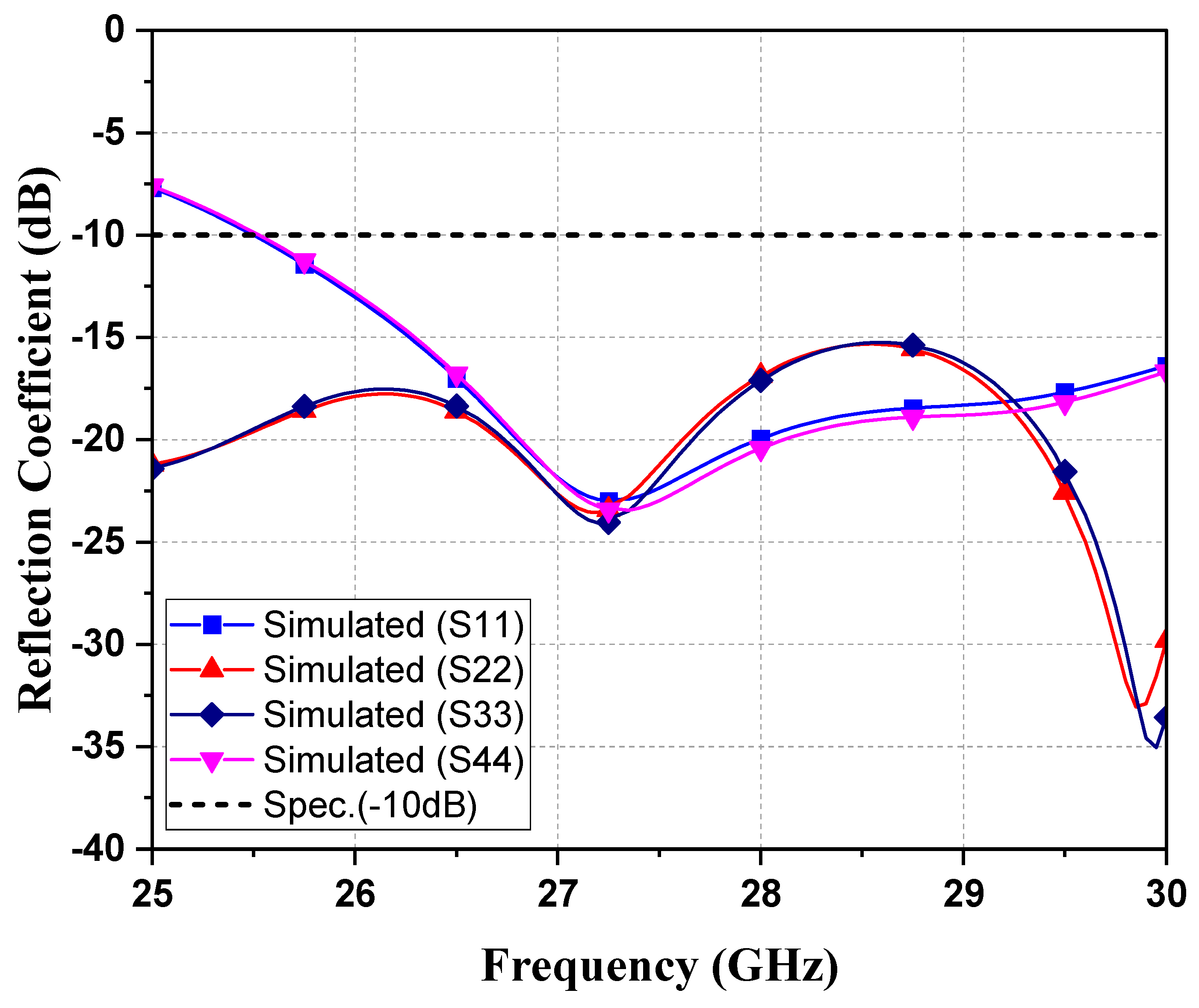
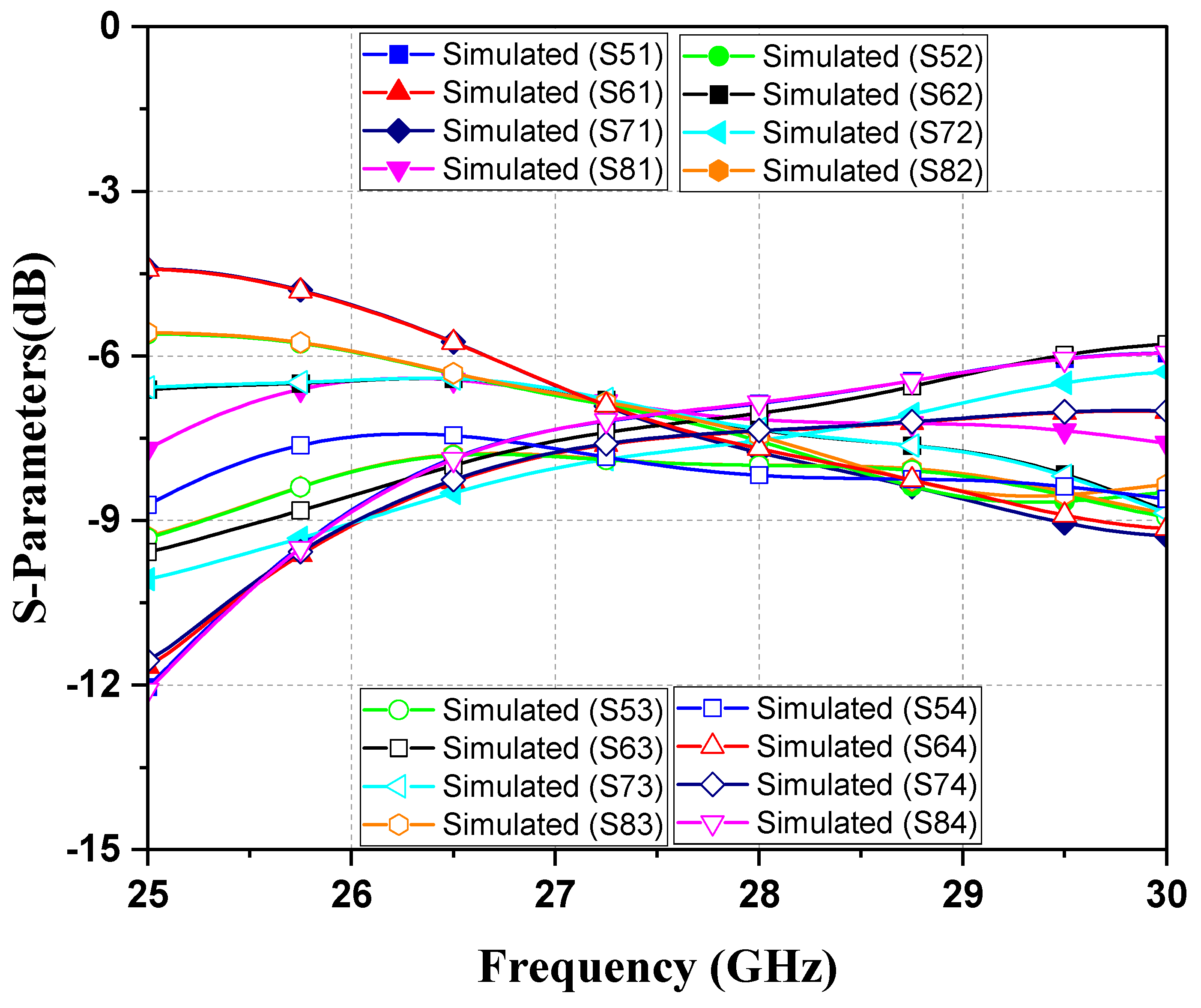
The simulation of Butler matrix S-parameters is shown in Figure 7 and Figure 8. The reflection coefficients of input ports 1 to 4 are below −15 dB at 28 GHz, presenting a good matching result and a large bandwidth between 26.5 GHz and 30 GHz. The Butler matrix in Figure 7 is a symmetric structure, so the reflection coefficient of port 1 is quite similar to Port 4, as well as for port 2 and 3. Simulation of the transmission coefficient results in the input power of each input port being equally distributed among the four output ports. When one of the inputs provides 1 W of power, each output port will receive 0.25 W of power, which can also be expressed as 10 log (0.25) = −6.02 dB. Figure 8 shows the transmission coefficients corresponding to the four input ports, the simulated S5i, S6i, S7i and S8i at 28 GHz in the range of −6.85 dB to −8.17 dB, where i = 1, 2, 3, 4.
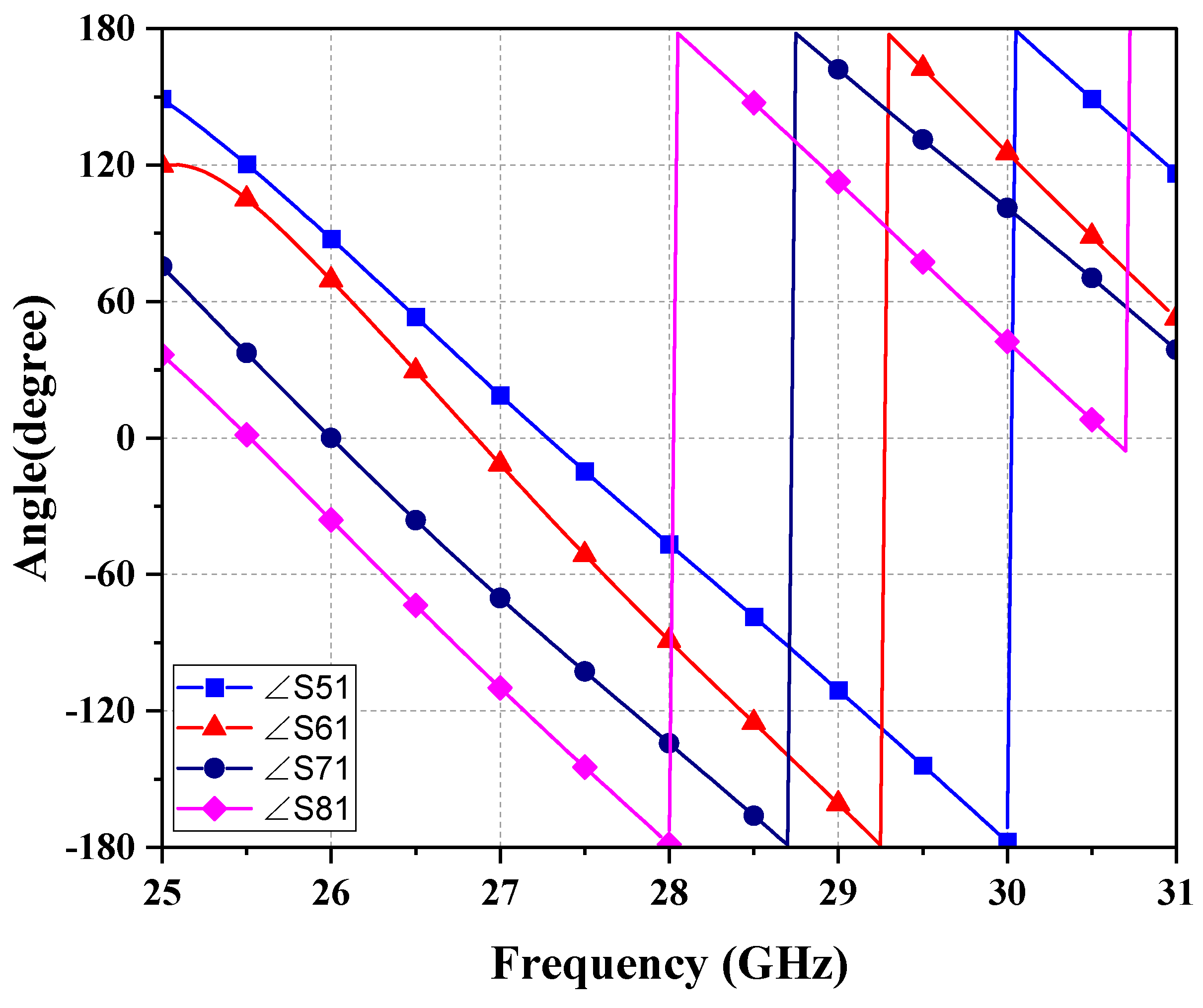
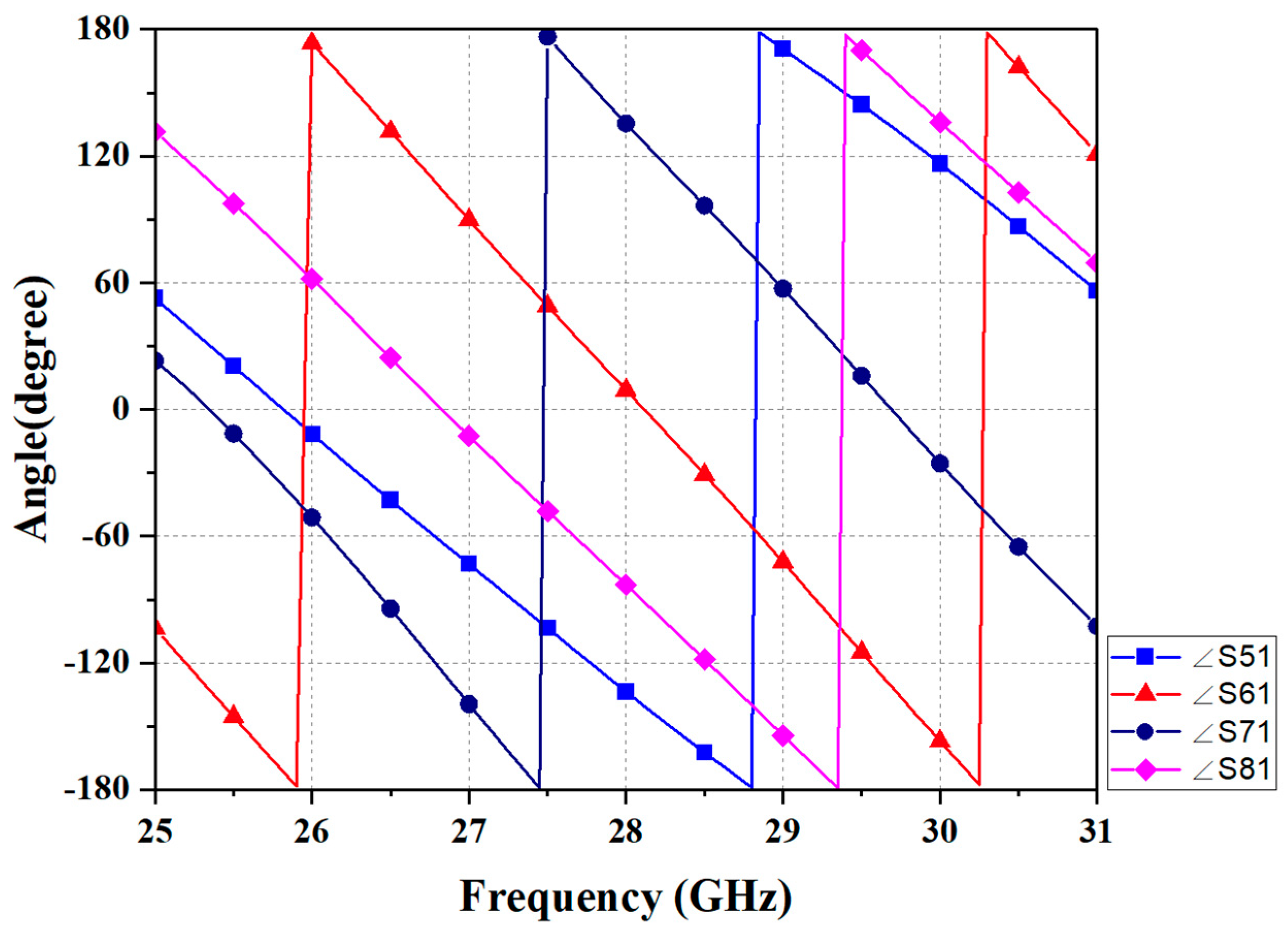
According to Figure 9, the phases of output ports 5 to 8 at 28 GHz obtained when input port 1 is activated are −46.7°, −89.1°, −134.2° and −178.6° respectively, which are close to the ideal results of −45°, −90°, −135° and −180°. The average phase difference of the adjacent output ports turned out to be −43.96°, which is a tolerable error of 1.04° from the ideal −45°. The error of 1.04° is tolerable. The simulated phases of output ports 5 to 8 obtained from input port 2 excitation at 28 GHz are −133.6°, +9.1°, +135.3°, and −83.1°, as shown in Figure 10 and the results are close to the ideal −135°, 0°, +135°, and −90°. The average phase difference between adjacent output ports was 136.83°, which is approximately 1.83° off from the ideal phase difference of 135°. There is an error of about 1.83° from the ideal phase difference of 135°. Since the designed Butler matrix is symmetrical, the phase difference for the input port 3 and port 4 excitation is close to the value of the result for port 2 and port 1, but there is a negative sign difference. The phase simulation data for input port 3 and port 4 at 28 GHz are listed in Table 2.
Ideally, the output phase difference is −45°, +135°, −135°, and +45° for exciting input ports 1 to 4, respectively. The average phase differences obtained for the four simulated input ports are −43.96°, +136.83°, −136.1°, and +42.2°, which are within the acceptable range of phase errors for the output ports. These differences are due to the phase errors generated by the couplers, which indirectly cause the directional shifts in the beam generated by the matrix.

3. Antenna Element Design

3.1. Rectangular Patch Antenna

The four outputs of the Butler matrix are integrated with four antenna elements, and these antennas radiate beams in four different directions. A rectangular patch antenna is used as the radiating element [49], and its dimensions can be determined by (11)–(14).
W = c 2 f 0 2 ε r + 1
ε e f f = ε r + 1 2 + ε r 1 2 1 + 12 h W 0.5
L h = 0.412 ε e f f + 0.3 W h + 0.264 ε e f f 0.258 W h + 0.8
L = c f 0 ε r e f f 2 L
where f 0 is the design frequency, ε r the substrate dielectric constant, ε e f f is the effective dielectric constant, W is the patch width, L is the patch length, and h is the substrate height. Since the edge effect, the patch length is extended by ΔL.
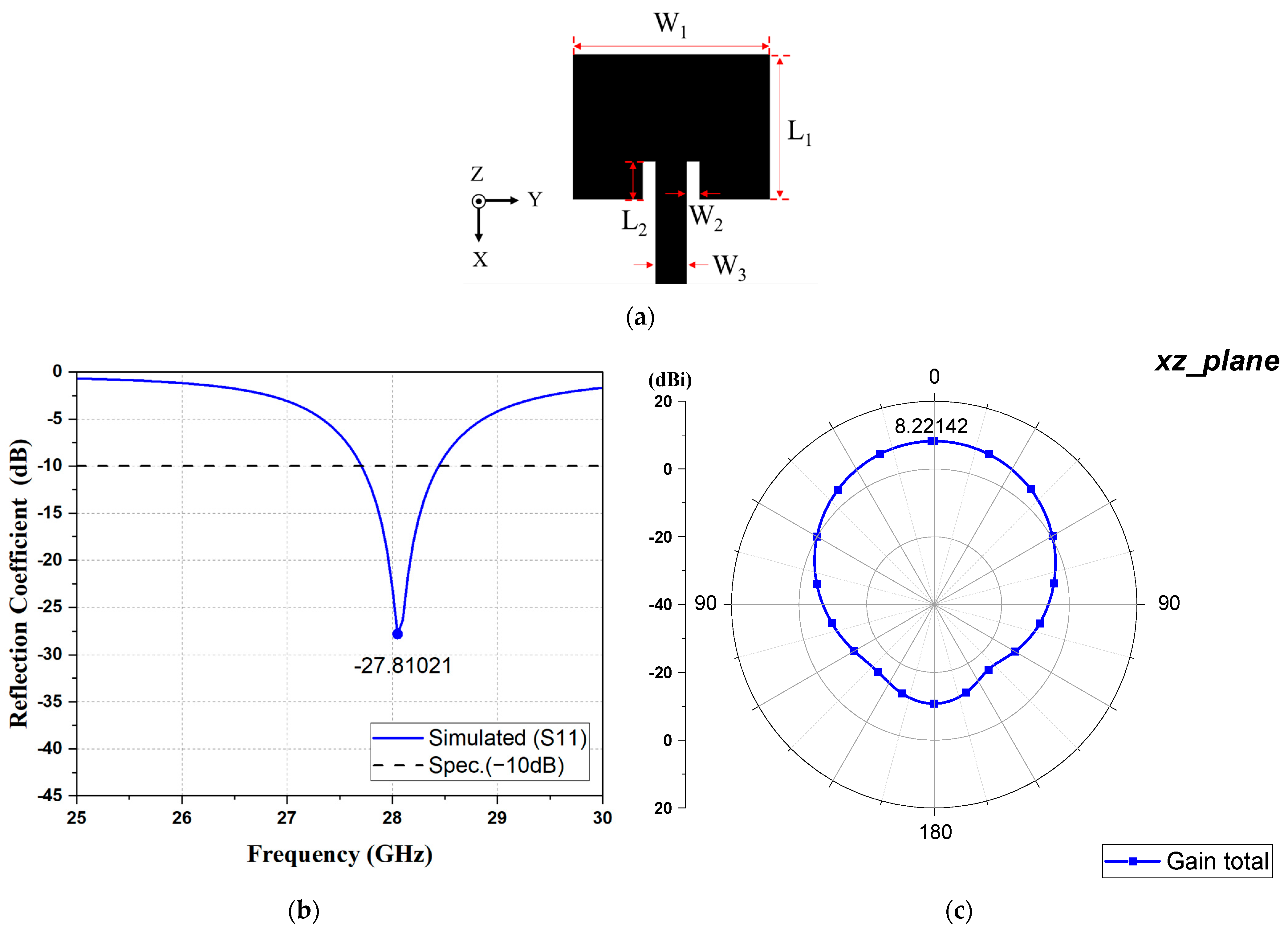
The 28 GHz rectangular patch antenna designed by electromagnetic simulation and optimization is shown in Figure 11a. The reflection coefficient and radiation direction are given in Figure 11b,c. The reflectance coefficient is below −10 dB in 27.7–28.44 GHz. The peak antenna gain at 28 GHz is 8.2 dBi and the front-to-back ratio is 18 dB.

3.2. Integration of Butler Matrix and Antenna Arrays

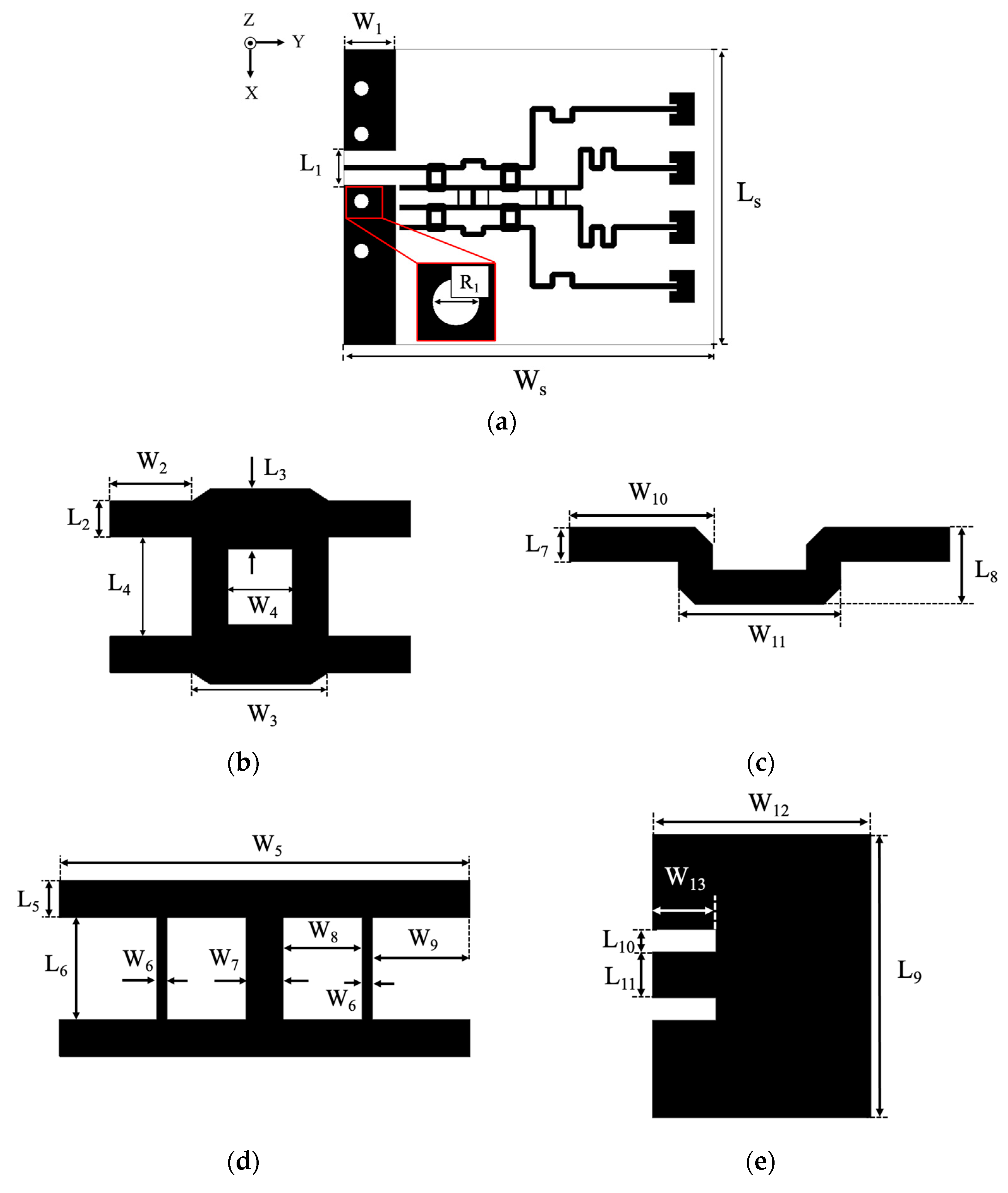
A Butler feeding network feeds the signal into a 1 × 4 antenna array operating at 28 GHz in Figure 12a. The rectangular patch antenna is connected to the output port of the Butler matrix, and the final beam formation can be guided by the Butler matrix and the selected beam direction. The dimensions of the Butler antenna are 40 × 43 × 0.254 m m 3 (3.733λ0 × 4.013λ0 × 0.0237λ0). For practical measurement considerations, the Butler matrix antenna is designed with ground and feed lines at the front of the input port for connection and measurement verification using a 1.85 mm End Launch connector. Finally, a detailed dimensional drawing of the overall Butler matrix antenna, hybrid coupler, crossover, phase shifter and antenna is shown in Figure 12. The dimensions are listed in Table 3.
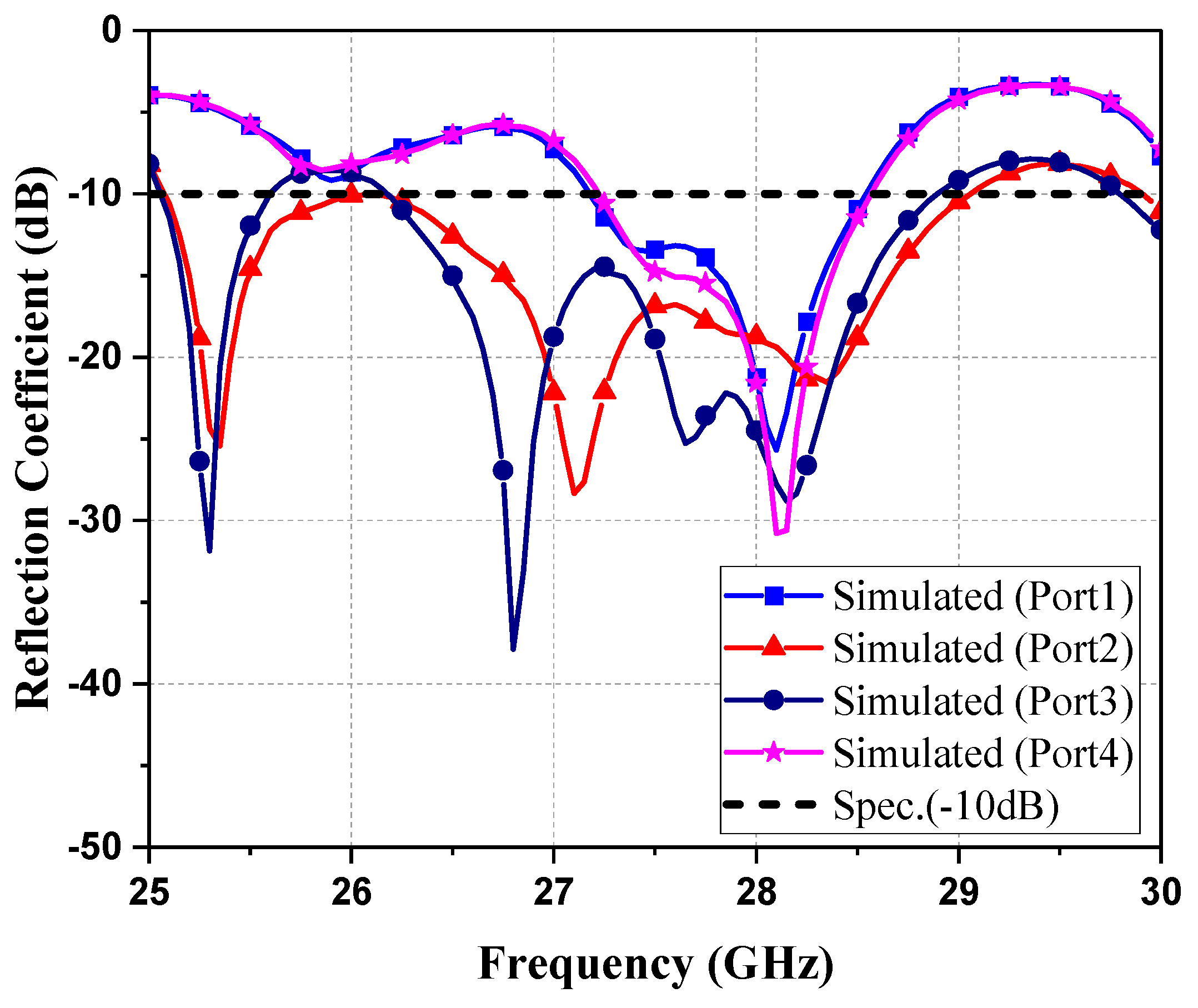
The proposed Butler matrix antenna is simulated for each input port as shown in Figure 13. The calculated impedance bandwidth is 35.7% in 27.5–28.5 GHz with −10 dB as the reference. At 28 GHz, the reflection coefficient is lower than −25 dB, so the design simulation shows good reflection coefficient and bandwidth.
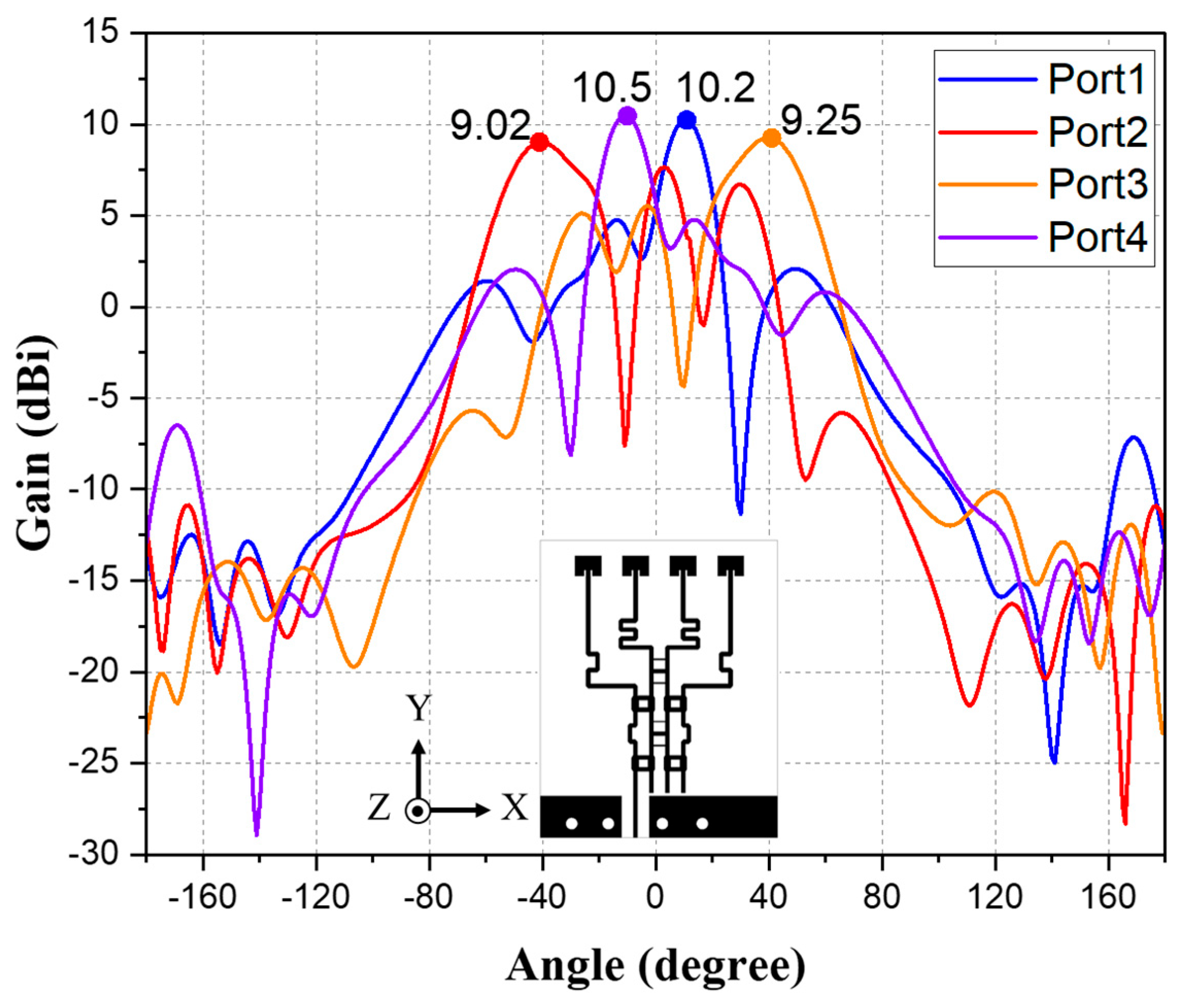
Figure 14 illustrates the xz-plane radiation patterns, where four distinct beams are generated by exciting input ports 1 to 4, respectively. Due to the symmetrical structure of the Butler matrix, the beam corresponding to port 1 is approximately symmetric to that of port 4, while the beam corresponding to port 2 is symmetric to that of port 3, with opposite beam directions.
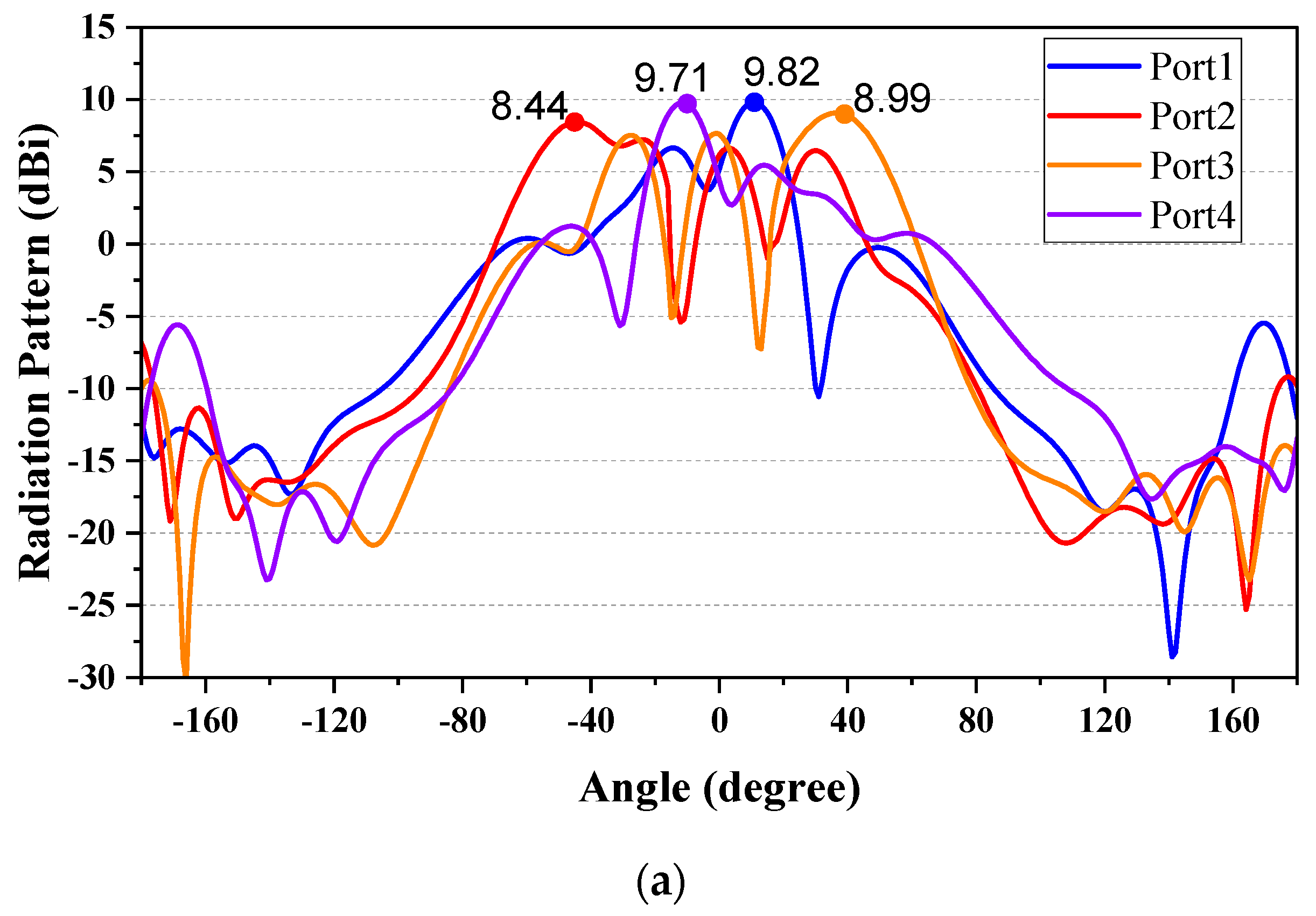
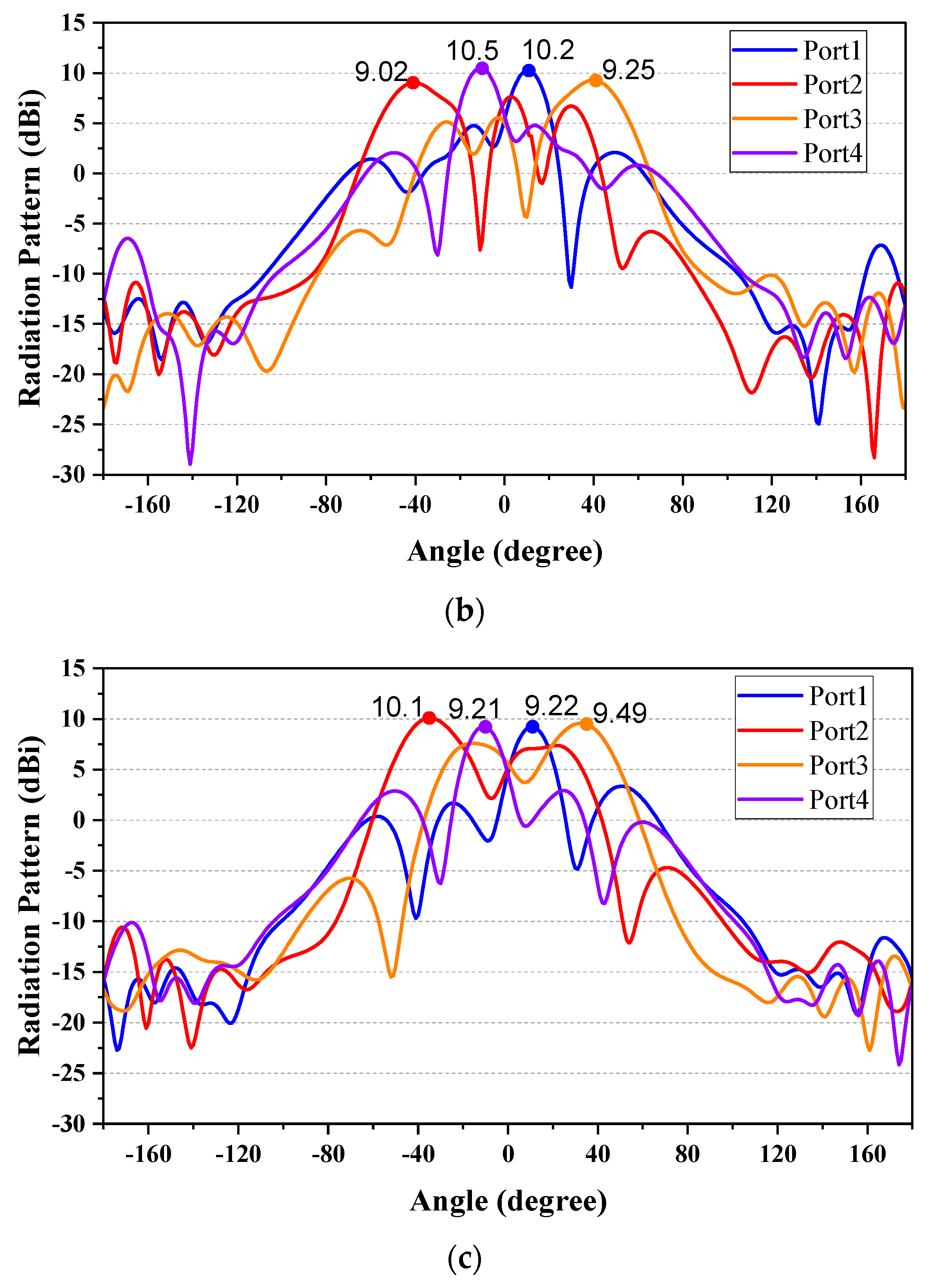
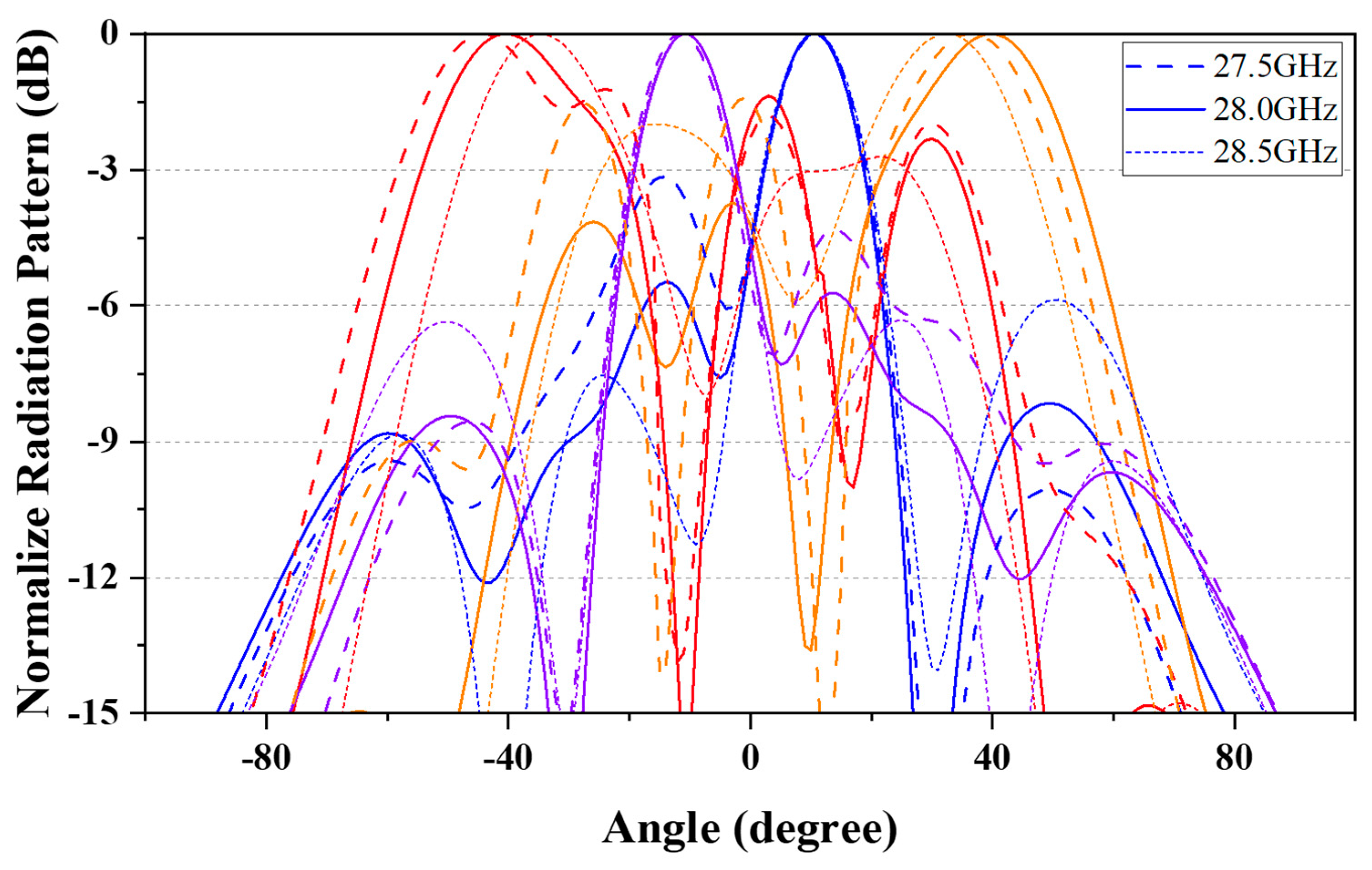
Figure 15 depicts the radiation pattern for theta from −90° to +90° at 27.5, 28 and 28.5 GHz. The simulated beam directions at 27.5 GHz are +13°, −37°, +37°, and −13° with gains between 8.44 and 9.71 dB. The beam directions at 28 GHz are +12°, −35°, +35°, and −12°, with gains between 9.02 and 10.5 dB, respectively. The beam directions at 28.5 GHz are +11°, −37°, +37° and −11° with gains between 9.21 and 10.1 dB. Figure 16 shows the normalized radiation direction at different frequencies, from which it can be observed that the side channel of port 1 and port 4 starts from −6 dB, while the side channel of port 2 and port 3 has a tendency to be larger, probably because the input ports 2 and 3 of the Butler matrix are designed to be closer to each other, causing them to influence each other, so that the side channel has a tendency to be larger.

4. Fabrication, Measurement and Discussion

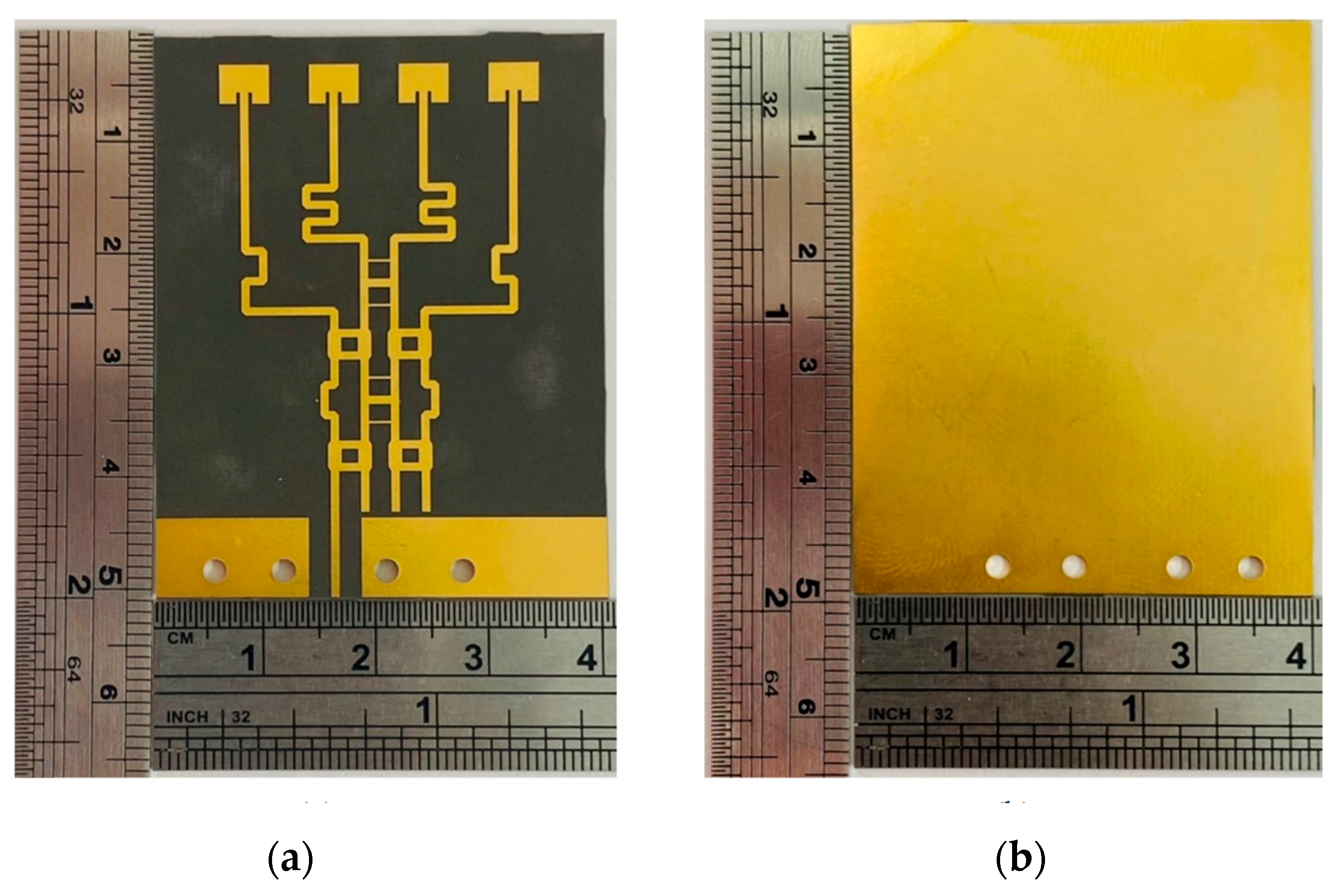
The phase-controlled millimeter wave Butler matrix antenna for the proposed beamforming system is depicted in Figure 17, consisting of a 90° hybrid coupler of a Butler matrix, a frequency divider, a 45° phase shifter, a phase-modulated microstrip line and a 28 GHz rectangular antenna. The antenna is printed on the top layer of 0.254 mm thick Rogers RT5880 substrate material, as well as reserved for 1.85 mm End Launch connector ground and feed transmission line, and finally the bottom layer is a perfect ground. The total dimensions of the manufactured antenna system including the reserved clamp space are 40 mm × 50 mm (3.733λ × 4.666λ) and 40 mm × 43 mm (3.733λ × 4.013λ) without clamps.
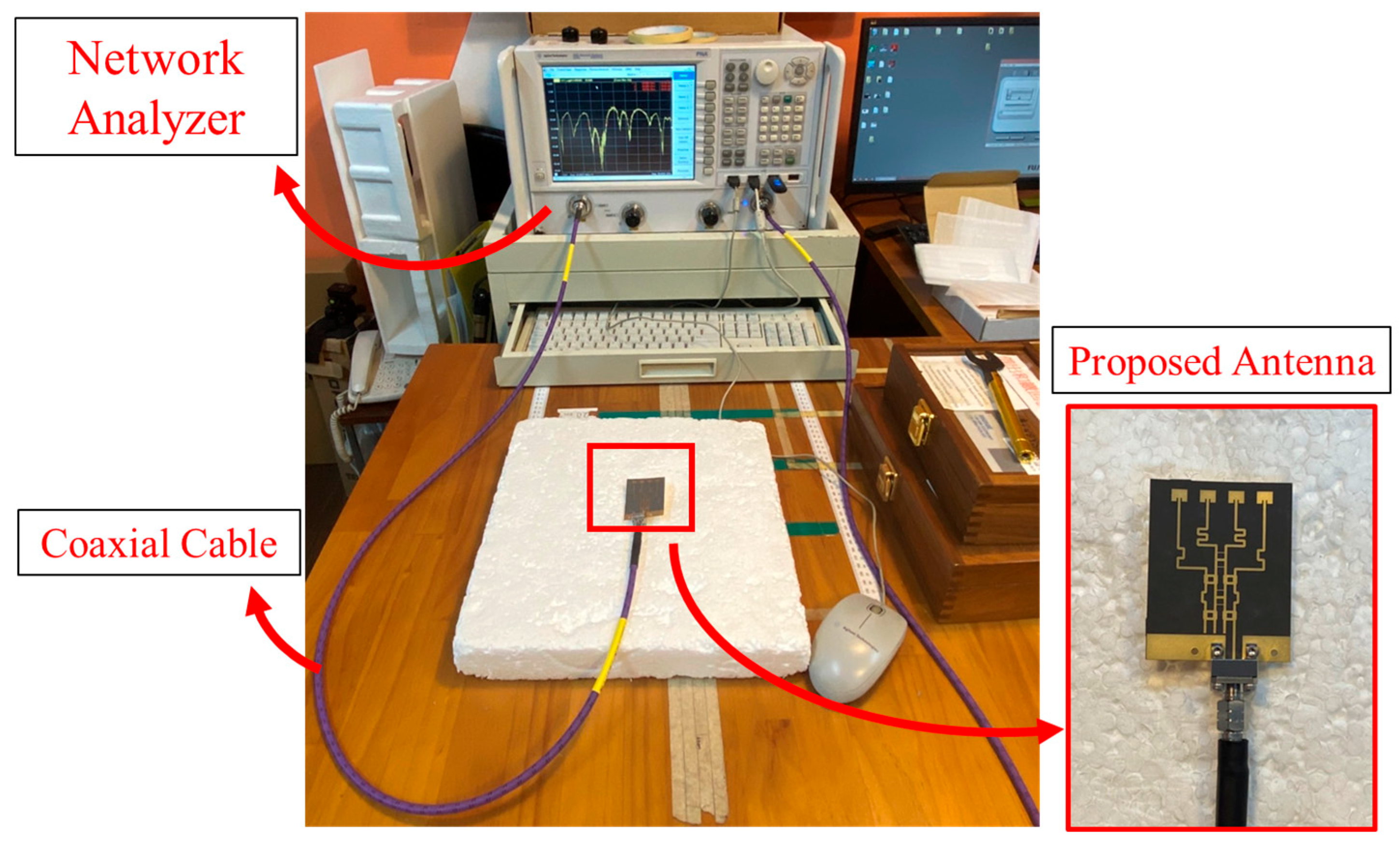
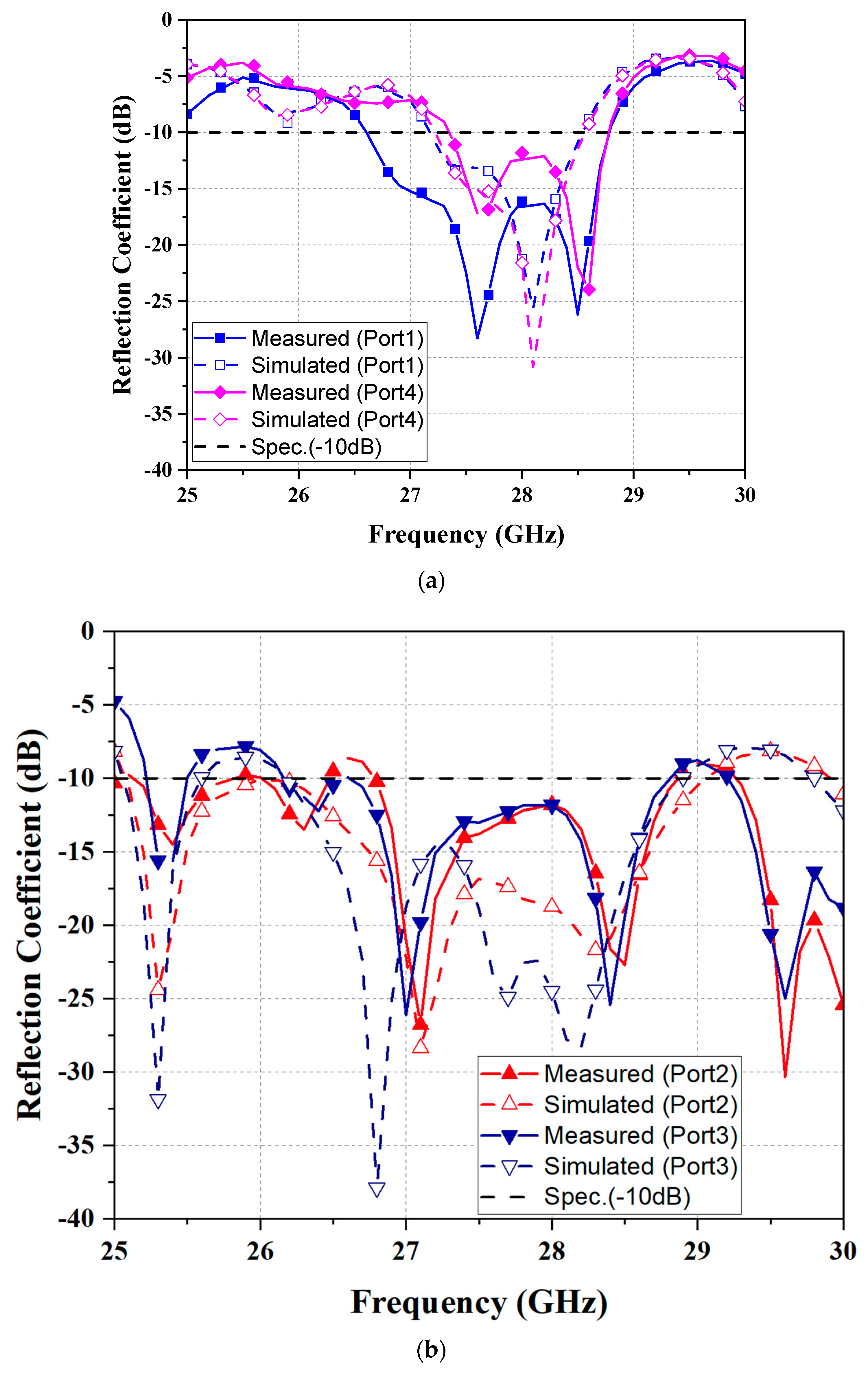
The reflectance coefficient was observed by an Agilent PNA N5227A network analyzer (Agilent Technologies, Santa Clara, CA, USA), and the instrument was calibrated using the SOL calibration method with a coaxial cable. The input signal is fed from the 1.85 mm End Launch connector to one of the input ports, while the three unused input ports are connected by 50 Ω resistors in Figure 18. The measured reflection coefficients of the four input ports are in Figure 19. Since the Butler antenna is symmetrical, the consistency of the simulation reflection coefficients for port 1 and 4 can be seen in Figure 19a, and the measurement results of port 1 and 4 both show a low point of resonance at 27.6 GHz and 28.6 GHz. However, the reason for the difference between the simulation and measurement results may be the effect of the bending of the substrate produced by the manufacturing. Then, port 2 and port 3 are in symmetric mode, and the reflection coefficients in Figure 19b show good consistency between the simulations and measurements, although there is a slight frequency bias between the two. The reflection coefficients for the four input port simulations were all below −20 dB at 28 GHz, and all measurements showed slight attenuation. However, all showed no significant effect on the antenna below −10 dB. This degradation may be caused by manufacturing, such as solder surface adhesion of resistive components with non-flat tin surface and bent substrate.
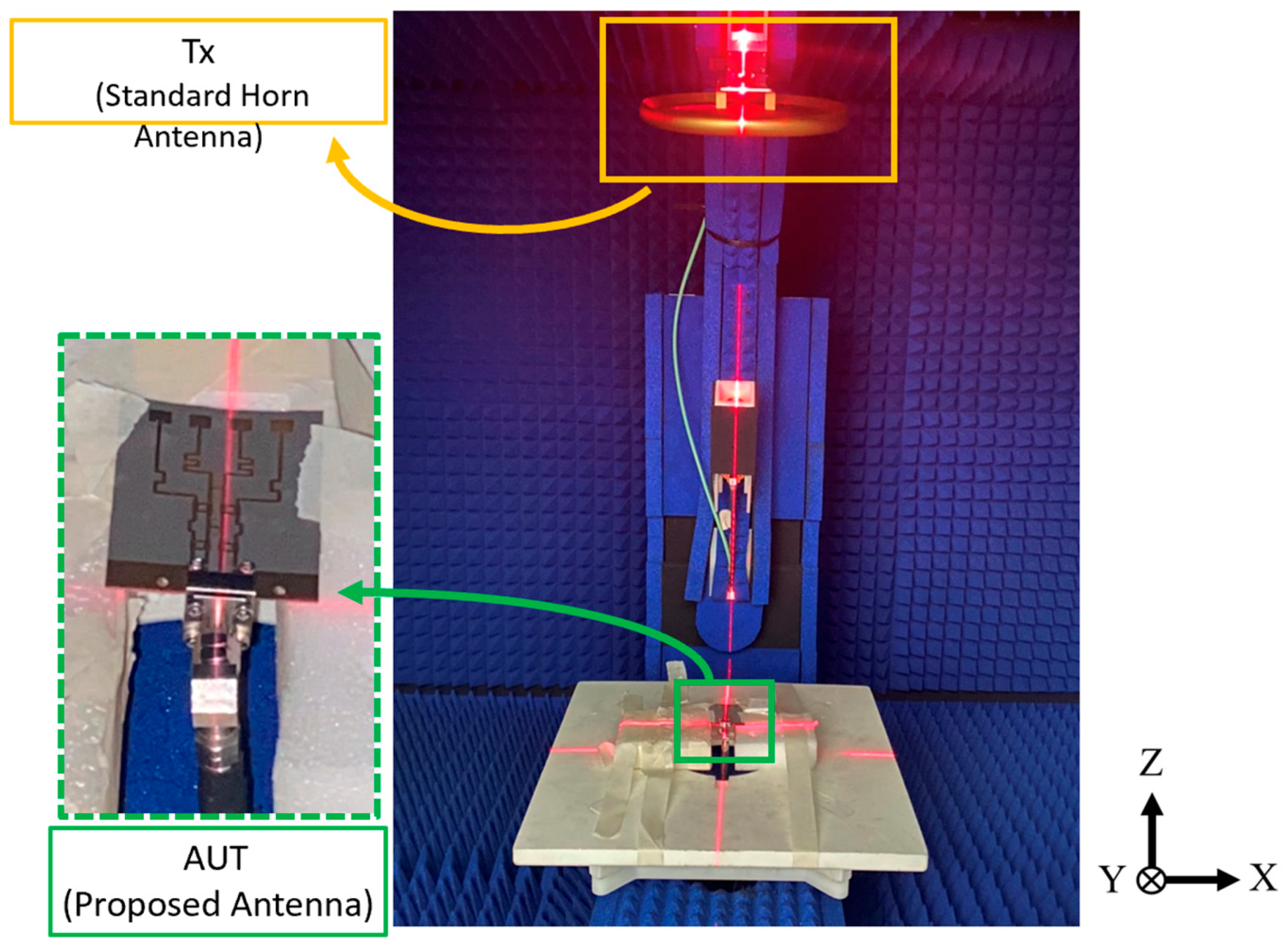
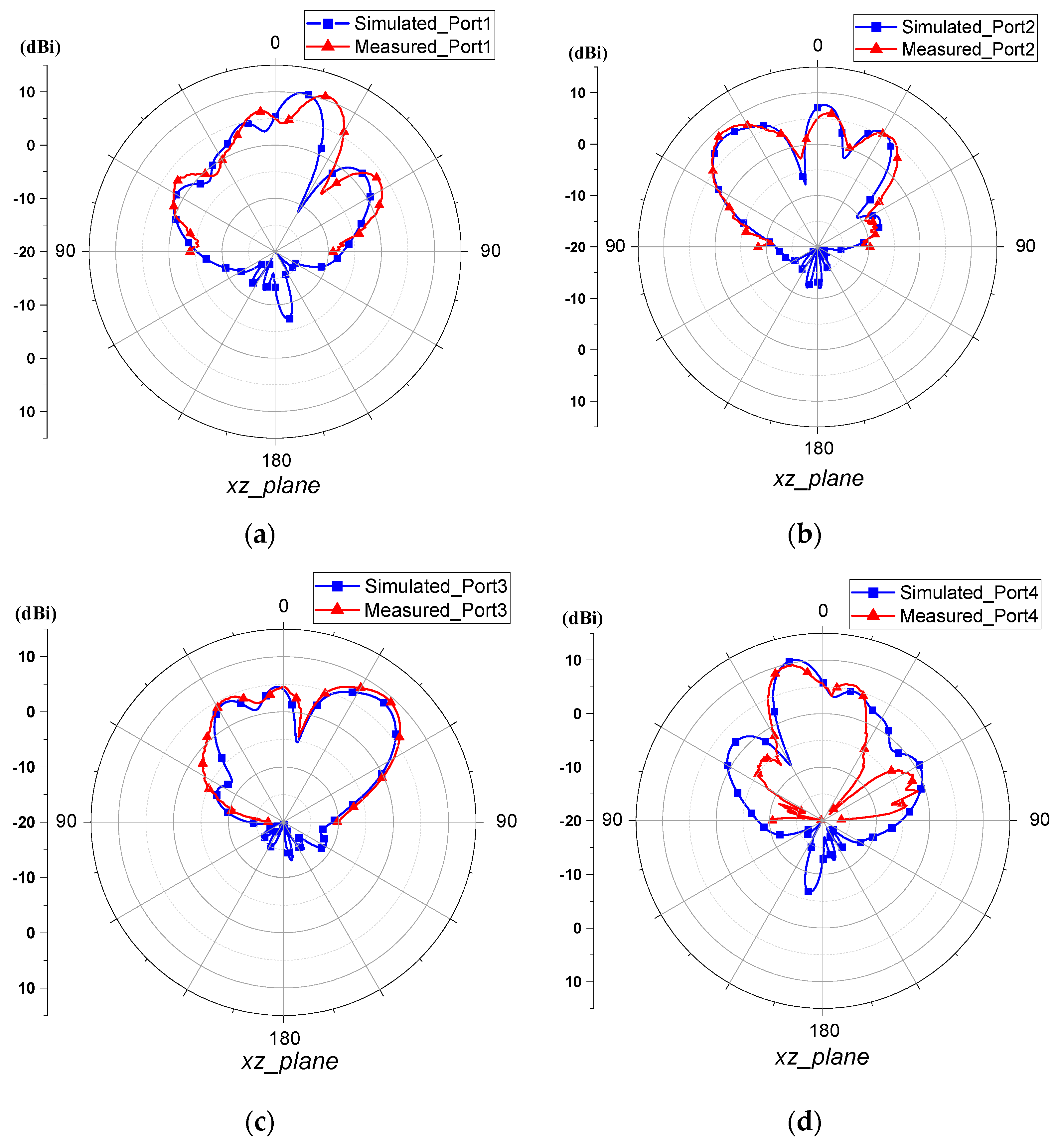
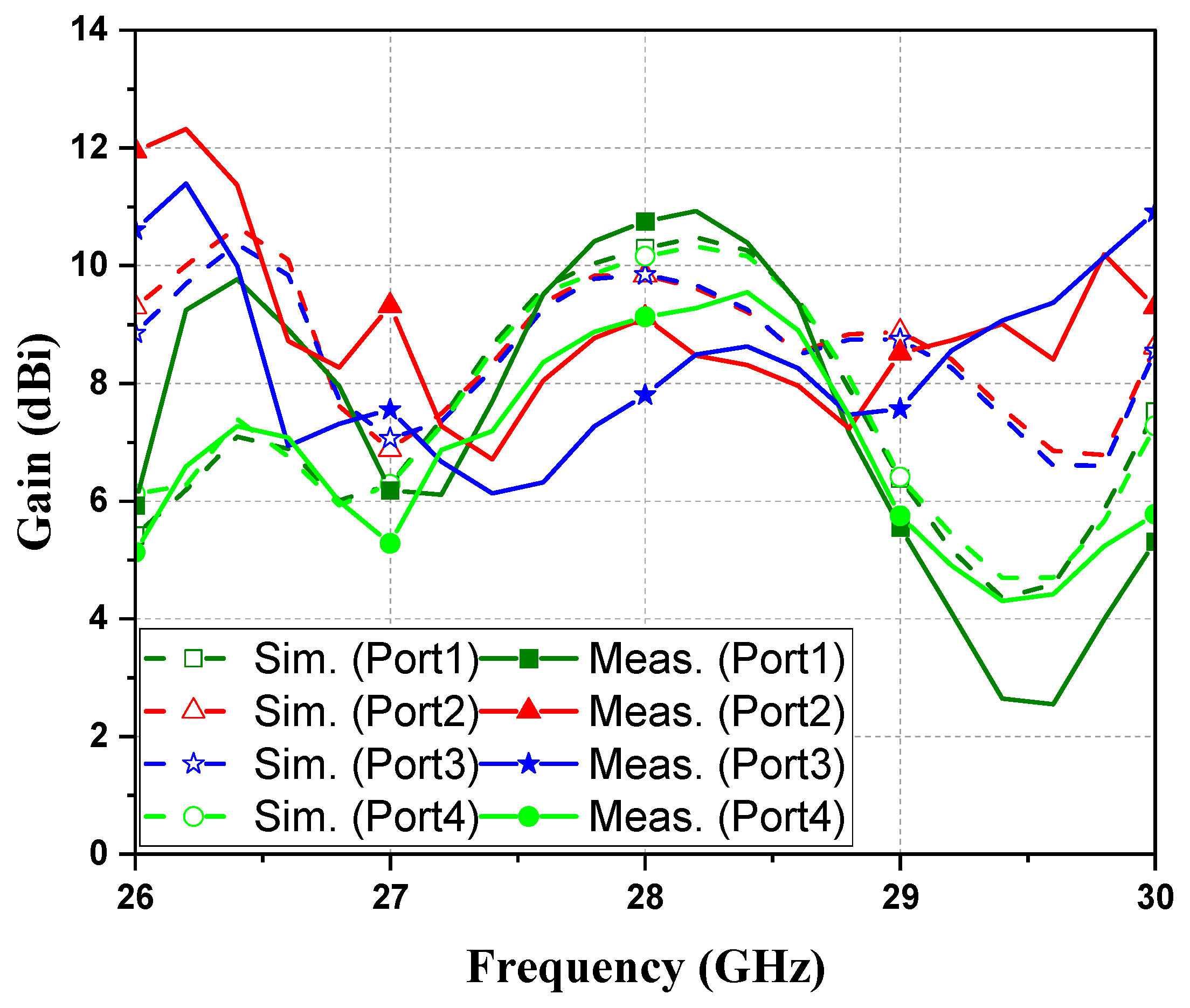
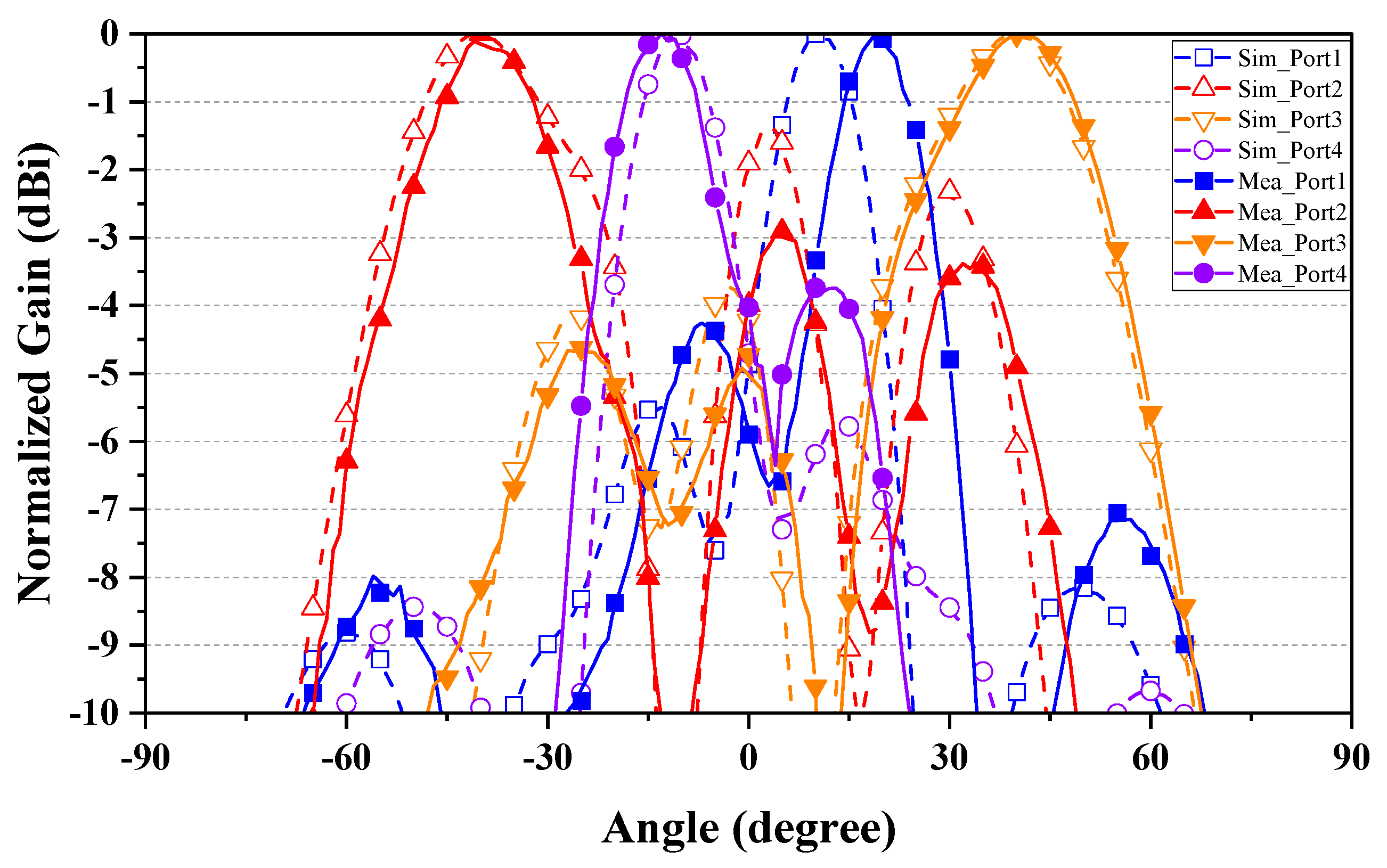
The radiation direction was measured in a reflectionless chamber using a manufactured antenna as the receiving antenna, and the measurement was carried out using the millimeter wave antenna measurement system (BWant-MW6) equipment. Theta angles of the non-reflective chamber equipment range from −90° to +90°, mainly in the northern hemisphere of the spherical coordinate system, as shown in Figure 20. Figure 21 illustrates the radiation directions corresponding to each of the four input ports by simulations and measurements at 28 GHz. The simulated peak gains for 2L, 1L, 1R and 2R directions are +9.02, +10.5, +10.2, +9.25 dBi, and the beam steering angles are −41°, −10°, +11° and +41°. The measured peak gains in the 2L, 1L, 1R and 2R directions are +8.79, +9.66, +10.8, +9.21 dBi, and the measured beam steering angles are −38°, −13°, +19° and +41°. Figure 22 illustrates the gain simulation and measurement when port 1 to port 4 are excited. The simulated gain at 27.5 to 28.5 GHz is 8.4 to 10.4 dBi, and the actual measured gain is between 6.1 and 10.9 dBi. The simulated and measured gains were in the range of 6.1 to 10.9 dBi. Except for a slight difference in gain and a significant difference in the 1L beam steering angle, the other input ports match well with the simulated results, and the errors between simulation and measurement were mainly caused by the substrate bending effect, the connector effect, and inaccuracies in the antenna set-up. The normalized beam direction at 28 GHz is shown in Figure 23. For 2L, 1L, 1R and 2R, the simulated side lobes are −1.59 dB, −5.71 dB, −5.47 dB, −3.73 dB; and the measured results are −2.9 dB, −3.74 dB, −4.25 dB, −4.74 dB. This may be due to the effect of the substrate fabrication causing bending.

5. Literature Comparison and Discussion

The performance of the proposed design is evaluated through comparison with recently reported millimeter-wave Butler matrix beam-switching antennas, as summarized in Table 4. The proposed antenna achieves competitive gain performance compared with [2,32,38]. In comparison with designs employing more complex architectures, such as those in [37,45,50,51], the proposed microstrip-based structure provides comparable beam angle coverage and radiation performance while maintaining a simpler configuration. One of the main advantages of the proposed design is its single-layer implementation, which reduces fabrication complexity and facilitates system integration. In addition, the compact structure and reduced antenna thickness make it suitable for practical 5G millimeter-wave applications. At the same time, the design reflects the typical trade-offs of planar passive beamforming networks. For instance, the microstrip implementation may introduce higher insertion loss compared with waveguide-based approaches, and the radiation characteristics can be influenced by layout and fabrication conditions. Overall, the proposed design provides a balanced trade-off between structural simplicity, compactness, and beam-steering performance.

6. Conclusions

In this paper, a 4 × 4 Butler matrix beam-switching antenna operating at 28 GHz has been designed, fabricated, and experimentally validated. The Butler matrix network and antenna array were thoroughly analyzed through full-wave simulations and measurements. The measured results demonstrate that the proposed antenna is capable of steering the radiation beam toward −38°, −13°, +19°, and +41°, with side-lobe levels ranging from −2.9 dB to −4.7 dB. The overall size of the integrated antenna system, including the Butler matrix and antenna array, is only 40 mm × 43 mm. Compared with recently reported Butler matrix beam-switching antennas, the proposed design achieves a favorable balance among antenna performance, structural simplicity, fabrication cost, and system integration. The single-layer microstrip implementation simplifies the fabrication process while maintaining stable beam-switching performance and favorable radiation characteristics. The measured results confirm the feasibility of the proposed architecture for practical 28 GHz 5G millimeter-wave communication systems. Although adaptive beamforming architectures may provide additional beam-control flexibility, they generally require more sophisticated active circuits and control mechanisms. In contrast, the proposed passive Butler matrix architecture emphasizes implementation simplicity, low-cost fabrication, compact size, and straightforward antenna integration. These features make the proposed design attractive for practical millimeter-wave beam-switching applications and provide a useful reference for future beamforming antenna developments.

Author Contributions

Conceptualization, M.-A.C., C.-W.L. and B.-R.C.; methodology, M.-A.C. and C.-W.L.; software, M.-A.C., C.-W.L. and B.-R.C.; validation, M.-A.C., C.-W.L. and B.-R.C.; formal analysis, M.-A.C., C.-W.L. and B.-R.C. investigation, C.-W.L. and B.-R.C. resources, M.-A.C., C.-W.L. and B.-R.C.; writing—original draft preparation, M.-A.C. and B.-R.C.; writing—review and editing, M.-A.C. and C.-W.L.; visualization, M.-A.C.; supervision, M.-A.C.; project administration, M.-A.C.; funding acquisition, M.-A.C. All authors have read and agreed to the published version of the manuscript.

Funding

This research received no external funding.

Institutional Review Board Statement

Not applicable.

Data Availability Statement

All data are included within manuscript.

Conflicts of Interest

The authors declare no conflicts of interest.

References

  1. Fonseca, N.J.; Gomanne, S.-A.; Castillo-Tapia, P.; Quevedo-Teruel, O.; Tomura, T.; Hirokawa, J. Connecting networks for two-dimensional Butler matrices generating a triangular lattice of beams. IEEE J. Microw. 2021, 1, 646–658. [Google Scholar] [CrossRef]
  2. Lee, S.; Lee, Y.; Shin, H. A 28-GHz switched-beam antenna with integrated Butler matrix and switch for 5G applications. Sensors 2021, 21, 5128. [Google Scholar] [CrossRef]
  3. Babale, S.A.; Rahim, S.K.A.; Barro, O.A.; Himdi, M.; Khalily, M. Single Layered 4 × 4 Butler Matrix Without Phase-Shifters and Crossovers. IEEE Access 2018, 6, 77289–77298. [Google Scholar] [CrossRef]
  4. Mohamed, I.M.; Sebak, A.-R. 60 GHz 2-D scanning multibeam cavity-backed patch array fed by compact SIW beamforming network for 5G applications. IEEE Trans. Antennas Propag. 2019, 67, 2320–2331. [Google Scholar] [CrossRef]
  5. Karimian, R.; Ardakani, M.D.; Ahmadi, S.; Zaghloul, M. High resolution beam switch antenna based on modified CRLH Butler matrix. Eng. Rep. 2021, 3, e12287. [Google Scholar] [CrossRef]
  6. Farahani, M.; Akbari, M.; Nedil, M.; Sebak, A.-R.; Denidni, T.A. Millimeter-wave dual left/right-hand circularly polarized beamforming network. IEEE Trans. Antennas Propag. 2020, 68, 6118–6127. [Google Scholar] [CrossRef]
  7. Li, X.; Wang, J.; Li, Z.; Li, Y.; Geng, Y.; Chen, M.; Zhang, Z. Leaky-wave antenna array with bilateral beamforming radiation pattern and capability of flexible beam switching. IEEE Trans. Antennas Propag. 2021, 70, 1535–1540. [Google Scholar] [CrossRef]
  8. Blass, J. Multidirectional antenna—A new approach to stacked beams. In 1958 IRE International Convention Record; IEEE: New York, NY, USA, 1966; Volume 8, pp. 48–50. [Google Scholar]
  9. Hu, B.; Chen, P.; Zhang, K.; Xu, J.; Yu, X. A low-sidelobe circularly polarized continuous beam-scanning array using double-layer rotated structure for Ku-band satellite communications. IEEE Antennas Wirel. Propag. Lett. 2021, 21, 605–609. [Google Scholar] [CrossRef]
  10. Fonseca, N.J. Printed S-Band 4 × 4 Nolen Matrix for Multiple Beam Antenna Applications. IEEE Trans. Antennas Propag. 2009, 57, 1673–1678. [Google Scholar] [CrossRef]
  11. Djerafi, T.; Fonseca, N.J.; Wu, K. Planar Ku-Band 4 × 4 Nolen Matrix in SIW Technology. IEEE Trans. Microw. Theory Tech. 2010, 58, 259–266. [Google Scholar] [CrossRef]
  12. Ren, H.; Zhang, H.; Jin, Y.; Gu, Y.; Arigong, B. A Novel 2-D 3 × 3 Nolen Matrix for 2-D Beamforming Applications. IEEE Trans. Microw. Theory Tech. 2019, 67, 4622–4631. [Google Scholar] [CrossRef]
  13. Yu, D.; Liu, H.; Zhang, Y.; Wang, Z.; Fang, S. Wideband Nolen Matrix with 360° Continuously Tuned Differential Phase and Low In-Band Phase Deviation Error. Int. J. RF Microw. Comput.-Aided Eng. 2024, 2024, 8835630. [Google Scholar] [CrossRef]
  14. Rotman, W.; Turner, R. Wide-angle microwave lens for line source applications. IEEE Trans. Antennas Propag. 1963, 11, 623–632. [Google Scholar] [CrossRef]
  15. Liu, N.-C.; Tien, C.-C.; Chang, C.-Y.; Ling, H.-W.; Chiu, C.-W.; Tarng, J.-H. Millimeter-wave 2-D beam-switchable and scalable phased antenna array. IEEE Trans. Antennas Propag. 2021, 69, 8997–9002. [Google Scholar] [CrossRef]
  16. Li, J.; He, C.; Fan, H.; Jin, R. Gain-Equalized Multibeam Antenna Fed by a Compact Dual-Layer Rotman Lens at K a-Band. IEEE Trans. Antennas Propag. 2021, 70, 2307–2311. [Google Scholar] [CrossRef]
  17. Gao, Y.; Khaliel, M.; Zheng, F.; Kaiser, T. Rotman lens based hybrid analog–digital beamforming in massive MIMO systems: Array architectures, beam selection algorithms and experiments. IEEE Trans. Veh. Technol. 2017, 66, 9134–9148. [Google Scholar] [CrossRef]
  18. Wen, J.M.; Wang, C.K.; Hong, W.; Pan, Y.M.; Zheng, S.Y. A wideband switched-beam antenna array fed by compact single-layer Butler matrix. IEEE Trans. Antennas Propag. 2021, 69, 5130–5135. [Google Scholar] [CrossRef]
  19. Nimehvari Varcheh, H.; Rezaei, P. Integration of the modified Butler matrix and decoupling network for beam-steering antenna array. Int. J. RF Microw. Comput.-Aided Eng. 2022, 32, e23015. [Google Scholar] [CrossRef]
  20. Najafabadi, A.M.A.; Ghani, F.A.; Tekin, I. Low-cost multibeam millimeter-wave array antennas for 5G mobile applications. IEEE Trans. Veh. Technol. 2022, 71, 12450–12460. [Google Scholar] [CrossRef]
  21. Vallappil, A.K.; Rahim, M.K.A.; Khawaja, B.A.; Murad, N.A.; Mustapha, M.G. Butler matrix based beamforming networks for phased array antenna systems: A comprehensive review and future directions for 5G applications. IEEE Access 2020, 9, 3970–3987. [Google Scholar] [CrossRef]
  22. Adamidis, G.A.; Vardiambasis, I.O.; Ioannidou, M.P.; Kapetanakis, T.N. Design and implementation of single-layer 4 × 4 and 8 × 8 Butler matrices for multibeam antenna arrays. Int. J. Antennas Propag. 2019, 2019, 1645281. [Google Scholar] [CrossRef]
  23. Idury, S.K.; Delmonte, N.; Silvestri, L.; Bozzi, M.; Mukherjee, S. Design and realization of a compact substrate integrated coaxial line butler matrix for beamforming applications. Int. J. Microw. Wirel. Technol. 2024, 16, 812–818. [Google Scholar] [CrossRef]
  24. Biswas, B.; Karmakar, A. Bioinspired planar switched beam network using Butler matrix on a flexible substrate targeting multifaceted millimeter-wave applications. Int. J. Microw. Wirel. Technol. 2024, 16, 625–635. [Google Scholar] [CrossRef]
  25. Benaouf, T.M.; Hamdoun, A.; Himdi, M.; Lafond, O.; Ammor, H. A 4 × 4 Butler matrix with switching/steering beams based on new tunable phase difference couplers. Int. J. Microw. Wirel. Technol. 2024, 16, 1033–1042. [Google Scholar] [CrossRef]
  26. Wang, C.; Yao, Y.; Cheng, X.; Zhu, Z.; Li, X. A W-Band High-Efficiency Multibeam Circularly Polarized Antenna Array Fed by GGW Butler Matrix. IEEE Antennas Wirel. Propag. Lett. 2021, 20, 1130–1134. [Google Scholar] [CrossRef]
  27. Park, Y.; Bang, J.; Choi, J. Dual-Circularly Polarized 60 GHz Beam-Steerable Antenna Array with 8 × 8 Butler Matrix. Appl. Sci. 2020, 10, 2413. [Google Scholar] [CrossRef]
  28. Reddy, M.H.; Siddle, D.; Sheela, D. Design and implementation of a beam-steering antenna array using butler matrix feed network for X-band applications. AEU-Int. J. Electron. Commun. 2022, 147, 154147. [Google Scholar] [CrossRef]
  29. Trinh-Van, S.; Lee, J.M.; Yang, Y.; Lee, K.-Y.; Hwang, K.C. A Sidelobe-Reduced, Four-Beam Array Antenna Fed by a Modified 4 × 4 Butler Matrix for 5G Applications. IEEE Trans. Antennas Propag. 2019, 67, 4528–4536. [Google Scholar] [CrossRef]
  30. Ishfaq, M.K.; Babale, S.A.; Chattha, H.T.; Himdi, M.; Raza, A.; Younas, M.; Rahman, T.A.; Rahim, S.K.A.; Khawaja, B.A. Compact wide-angle scanning multibeam antenna array for V2X communications. IEEE Antennas Wirel. Propag. Lett. 2021, 20, 2141–2145. [Google Scholar] [CrossRef]
  31. Wang, D.; Polat, E.; Tesmer, H.; Maune, H.; Jakoby, R. Switched and steered beam end-fire antenna array fed by wideband via-less butler matrix and tunable phase shifters based on liquid crystal technology. IEEE Trans. Antennas Propag. 2022, 70, 5383–5392. [Google Scholar] [CrossRef]
  32. Khan, T.; Rahman, M.; Akram, A.; Amin, Y.; Tenhunen, H. A low-cost CPW-fed multiband frequency reconfigurable antenna for wireless applications. Electronics 2019, 8, 900. [Google Scholar] [CrossRef]
  33. Sun, Q.; Ban, Y.-L.; Lian, J.-W.; Liu, Y.; Nie, Z. Millimeter-wave multibeam antenna based on folded C-type SIW. IEEE Trans. Antennas Propag. 2020, 68, 3465–3476. [Google Scholar] [CrossRef]
  34. Wu, Q.; Hirokawa, J.; Yin, J.; Yu, C.; Wang, H.; Hong, W. Millimeter-wave multibeam endfire dual-circularly polarized antenna array for 5G wireless applications. IEEE Trans. Antennas Propag. 2018, 66, 4930–4935. [Google Scholar] [CrossRef]
  35. Ke, Y.-H.; Yang, L.-L.; Chen, J.-X. Design of switchable dual-balun feeding structure for pattern-reconfigurable endfire antenna. IEEE Antennas Wirel. Propag. Lett. 2021, 20, 1463–1467. [Google Scholar] [CrossRef]
  36. Zhu, Y.; Deng, C. Millimeter-wave dual-polarized multibeam endfire antenna array with a small ground clearance. IEEE Trans. Antennas Propag. 2021, 70, 756–761. [Google Scholar] [CrossRef]
  37. Qin, C.; Chen, F.-C.; Xiang, K.-R. A 5 × 8 Butler matrix based on substrate integrated waveguide technology for millimeter-wave multibeam application. IEEE Antennas Wirel. Propag. Lett. 2021, 20, 1292–1296. [Google Scholar] [CrossRef]
  38. Lu, R.; Yu, C.; Zhu, Y.; Hong, W. Compact millimeter-wave endfire dual-polarized antenna array for low-cost multibeam applications. IEEE Antennas Wirel. Propag. Lett. 2020, 19, 2526–2530. [Google Scholar] [CrossRef]
  39. Wang, C.; Cao, W.; Ma, W.; Tong, Y.; Zhu, Y. A Sigle-Layer Dual-Band Shared-Aperture Antenna With High Gain and Sidelobe Suppression Based on High-Order Mode for Vehicular Communications. IEEE Trans. Veh. Technol. 2023, 73, 473–481. [Google Scholar] [CrossRef]
  40. Zhang, J.; Zhao, K.; Wang, L.; Pedersen, G.F.; Zhang, S. Wideband low-profile dual-polarized phased array with endfire radiation patterns for 5G mobile applications. IEEE Trans. Veh. Technol. 2021, 70, 8431–8440. [Google Scholar] [CrossRef]
  41. Althuwayb, A.A. MTM-and SIW-inspired bowtie antenna loaded with AMC for 5G mm-wave applications. Int. J. Antennas Propag. 2021, 2021, 6658819. [Google Scholar] [CrossRef]
  42. Murshed, A.; Hossain, M.; Kiem, N.; Hai, N.; Nishiyama, E.; Toyoda, I.; Mahbub, I. Simple Integration of Cavity-Backed Antenna with Patch Antenna for Developing Hybrid Antenna Using SIW Technology. Int. J. RF Microw. Comput.-Aided Eng. 2024, 2024, 9040638. [Google Scholar] [CrossRef]
  43. Pedram, K.; Sim, S. A Multifunctionality Reconfigurable HMSIW Filter by Using EBG Structure and Diodes for C/X-Band Application. Int. J. RF Microw. Comput.-Aided Eng. 2024, 2024, 9940203. [Google Scholar] [CrossRef]
  44. Thummaluru, S.R.; Kumar, R.; Chaudhary, R.K. Frequency-Tunable SIW Band-Reject Filter with Increased Fundamental Mode Bandwidth for Spectrum Underlay Cognitive Radio. Int. J. RF Microw. Comput.-Aided Eng. 2024, 2024, 4303470. [Google Scholar] [CrossRef]
  45. Quan, Y.; Wang, H.; Tao, S.; Yang, J. A Wideband Endfire Double Dipole Antenna Fed From Double-Ridge Gap Waveguides for Multibeam Array Application. IEEE Antennas Wirel. Propag. Lett. 2022, 21, 760–764. [Google Scholar] [CrossRef]
  46. Ma, Z.L.; Huang, X.; Chu, Q.X.; Xue, Q. An injection molded circularly polarized endfire multibeam antenna with wide axial ratio beamwidth coverage using rhombic waveguide element. Int. J. RF Microw. Comput.-Aided Eng. 2022, 32, e23084. [Google Scholar] [CrossRef]
  47. Fang, X.; Wang, W.; Zheng, Y.; Zheng, Z.; Zhang, H.; Huang, G.-L. A Compact and Simply-Constructed All-Metal Circularly Polarized Ridge-Waveguide Slotted Antenna Array for Vehicle Mounted Satcom on the Move (SOTM) Communication Application. IEEE Trans. Veh. Technol. 2022, 71, 12626–12634. [Google Scholar] [CrossRef]
  48. Pozar, D.M. Microwave Engineering; John Wiley & Sons: Hoboken, NJ, USA, 2011. [Google Scholar]
  49. Pozar, D.M. Microstrip antennas. Proc. IEEE 1992, 80, 79–91. [Google Scholar] [CrossRef] [PubMed]
  50. Tong, X.; Jiang, Z.H.; Yu, C.; Wu, F.; Xu, X.; Hong, W. Low-Profile, Broadband, Dual-Linearly Polarized, and Wide-Angle Millimeter-Wave Antenna Arrays for Ka-Band 5G Applications. IEEE Antennas Wirel. Propag. Lett. 2021, 20, 2038–2042. [Google Scholar] [CrossRef]
  51. Kim, S.; Yoon, S.; Lee, Y.; Shin, H. A miniaturized Butler matrix based switched beamforming antenna system in a two-layer hybrid stackup substrate for 5G applications. Electronics 2019, 8, 1232. [Google Scholar] [CrossRef]
Figure 1. 4 × 4 Butler matrix antenna architecture.
Electronics 15 02505 g001
Figure 2. Structure of the 4 × 4 Butler matrix. The letters A–M denote the phase observation nodes used for the phase analysis and output phase calculations.
Electronics 15 02505 g002
Figure 3. Hybrid coupler. (a) Structure. (b) Simulation of S-parameters. (c) Phase difference between port 2 and port 3. The parameters are: W1 = 0.725 mm, W2 = 1.2 mm.
Electronics 15 02505 g003
Figure 4. Crossover. (a) Structure. (b) Simulated S-parameters. The parameter: W 1 = 0.725 mm.
Electronics 15 02505 g004
Figure 5. A 45° Phase shifter. (a) Structure. (b) Simulated S-parameters. (c) Simulated phase. The parameters are: W1 = 0.725 mm and L1 = 8.547 mm.
Electronics 15 02505 g005
Figure 6. The designed Butler matrix architecture.
Electronics 15 02505 g006
Figure 7. Simulation of insertion loss between input and output.
Electronics 15 02505 g007
Figure 8. Insertion loss between the input and output ports of the simulation.
Electronics 15 02505 g008
Figure 9. Phases corresponding to each of the four output ports at excitation input port 1.
Electronics 15 02505 g009
Figure 10. Phases corresponding to each of the four output ports during excitation of input port 2.
Electronics 15 02505 g010
Figure 11. Rectangular patch antenna. (a) Geometry. (b) Simulated reflection coefficient. (c) xy-plane radiation direction diagram. The parameters are: W1 = 4.42 mm, W2 = 0.35 mm, W3 = 0.725 mm, L1 = 3.42 mm and L2 = 1.0 mm.
Electronics 15 02505 g011
Figure 12. Detailed dimensions of the Butler matrix antenna. (a) Overall architecture with feed-in design. (b) Hybrid coupler. (c) Phase shifter. (d) Frequency divider. (e) 28 GHz rectangular patch antenna.
Electronics 15 02505 g012
Figure 13. Simulated reflection coefficients for each input port.
Electronics 15 02505 g013
Figure 14. XZ-plane radiation directions of the four input ports.
Electronics 15 02505 g014
Figure 15. Simulated radiation directions in the xy plane at (a) 27.5 (b) 28 and (c) 28.5 GHz.
Electronics 15 02505 g015aElectronics 15 02505 g015b
Figure 16. Normalized radiation directions simulated in the xz-plane at frequencies of 27.5, 28, and 28.5 GHz. Blue, purple, red, and orange curves correspond to Port 1, Port 2, Port 3, and Port 4, respectively. Dashed, solid, and dotted lines represent 27.5 GHz, 28 GHz, and 28.5 GHz, respectively.
Electronics 15 02505 g016
Figure 17. Prototype fabrication of Butler matrix antenna. (a) Top view. (b) Bottom view.
Electronics 15 02505 g017
Figure 18. The fabricated antenna and reflectance coefficient measurement setup.
Electronics 15 02505 g018
Figure 19. Simulated and measured reflection coefficients. (a) Port 1 and 4. (b) Port 2 and 3.
Electronics 15 02505 g019
Figure 20. Antenna set-up in a non-reflective room.
Electronics 15 02505 g020
Figure 21. Simulation and measurement beam directions in the xz-plane for (a) port 1 (1L), (b) port 2 (2R), (c) port 3 (2L), (d) port 4 (1R).
Electronics 15 02505 g021
Figure 22. Simulated and measured gain of port 1 to port 4 excitations.
Electronics 15 02505 g022
Figure 23. Simulated and measured normalized radiation direction in the xz plane at 28 GH.
Electronics 15 02505 g023
Table 1. Output phase of Butler matrix with different input ports.
Port#P1P2P3P4
P5 φ 90 ° + φ 90 ° 180 °
P6 90 ° 0 ° 180 ° + φ φ + 90 °
P7 90 ° + φ 180 ° + φ 0 ° 90 °
P8 90 ° + 90 ° 90 ° 90 ° + φ φ
PPD−45135−13545
Table 2. Simulated phase difference.
No.Adjacent Output Port PhaseAverage Phase DifferenceTheoretical GoalsPhase Deviation
Port 5–6Port 6–7Port 7–8
Port 1−42.4−45.1−44.4−43.96−451.04
Port 2142.7126.2141.6136.831351.83
Port 3−150−116.9−141.4−136.1−1351.1
Port 445.738.142.842.2452.8
Table 3. Detailed dimensions of Butler matrix antenna (Unit: mm).
ParameterValueParameterValue
WS40L14.7
LS43L20.725
W17L31.2
W21.6375L41.975
W32.725L50.725
W41.725L61.975
W58L70.725
W60.2L81.625
W70.725L94.42
W81.5375L100.35
W91.9L110.725
W103.0125R12
W113.425h0.254
W123.42
W131.0
Table 4. Comparison of recent literature.
Ref.Proposed[2][32][37][38][45][51][50]
fc
(GHz)
2828282829302827
Dielectric Layer12252224
SubstratesRT5880RF-30PolytetrafluoroethyleneRO4003CRT5880Metal WaveguideMerck
GT7-
29001
TLY-5
RO4450B
Dielectric Constant2.232.45–3.533.552.2-2.17/6.152.2/3.5
Degree±14/
±39
−43,
+34
±60±48±135°±14/
±42°
−39
~+36
±61°/
±75°
Lobe
(dB)
−3−5.3−6−7−15−10−6-
Gain8.8–10.85.8–6.75.69.5111.6–14.310.6–13.98.5–9.96.3–8.9
Size
0 × λ0)
3.73 × 4.013.4 × 4.6-11.6 × 98.08.6 × 4.00.51 × 2.01.7 × 2.1-
Design methodMSSP4TLCSIWSIWWGMSMulti-layer
Disclaimer/Publisher’s Note: The statements, opinions and data contained in all publications are solely those of the individual author(s) and contributor(s) and not of MDPI and/or the editor(s). MDPI and/or the editor(s) disclaim responsibility for any injury to people or property resulting from any ideas, methods, instructions or products referred to in the content.