Review

Optoelectronic Terahertz Sources for Next-Generation Communication Systems: Technologies, Challenges, and Future Directions

1
Graduate School of Information Science and Electrical Engineering, Kyushu University, Fukuoka 819-0395, Japan
2
School of Engineering and Technology, Soroti University, Soroti P.O. Box 211, Uganda
*
Author to whom correspondence should be addressed.
Electronics 2026, 15(11), 2477; https://doi.org/10.3390/electronics15112477
Submission received: 1 May 2026 / Revised: 1 June 2026 / Accepted: 2 June 2026 / Published: 4 June 2026
(This article belongs to the Special Issue New Challenges in Beyond 5G/6G Network Wireless Technologies)

Abstract

The terahertz (THz) frequency band has emerged as a promising frontier for next-generation wireless communication systems targeting ultra-high data rates, ultra-low latency, and spectrum expansion beyond conventional millimeter-wave regimes. Realizing practical THz communication links, however, critically depends on stable, tunable, and integrable signal sources capable of delivering sufficient output power while maintaining spectral purity and energy efficiency. Among the various THz generation approaches, optoelectronic techniques offer unique advantages, including large bandwidth, wide frequency tunability and compatibility with fiber-optic infrastructures. This review provides a technology-focused assessment of key optoelectronic THz source technologies, namely photoconductive antennas, quantum cascade lasers, and unitraveling carrier photodiode (UTC-PD)-based photomixers, with particular emphasis on UTC-PD photomixers due to their strong suitability for continuous-wave THz generation and fiber-compatible architectures. The implications of optoelectronic THz sources for system-level architectures, including THz-over-fiber links, coherent detection schemes, and phased-array integration, are further examined. Finally, critical challenges and emerging research directions toward monolithic photonic–terahertz integration and deployable high-capacity wireless front-ends are discussed. This review aims to provide a structured perspective on the state of optoelectronic THz source technologies and their role in enabling practical next-generation communication systems.

1. Introduction

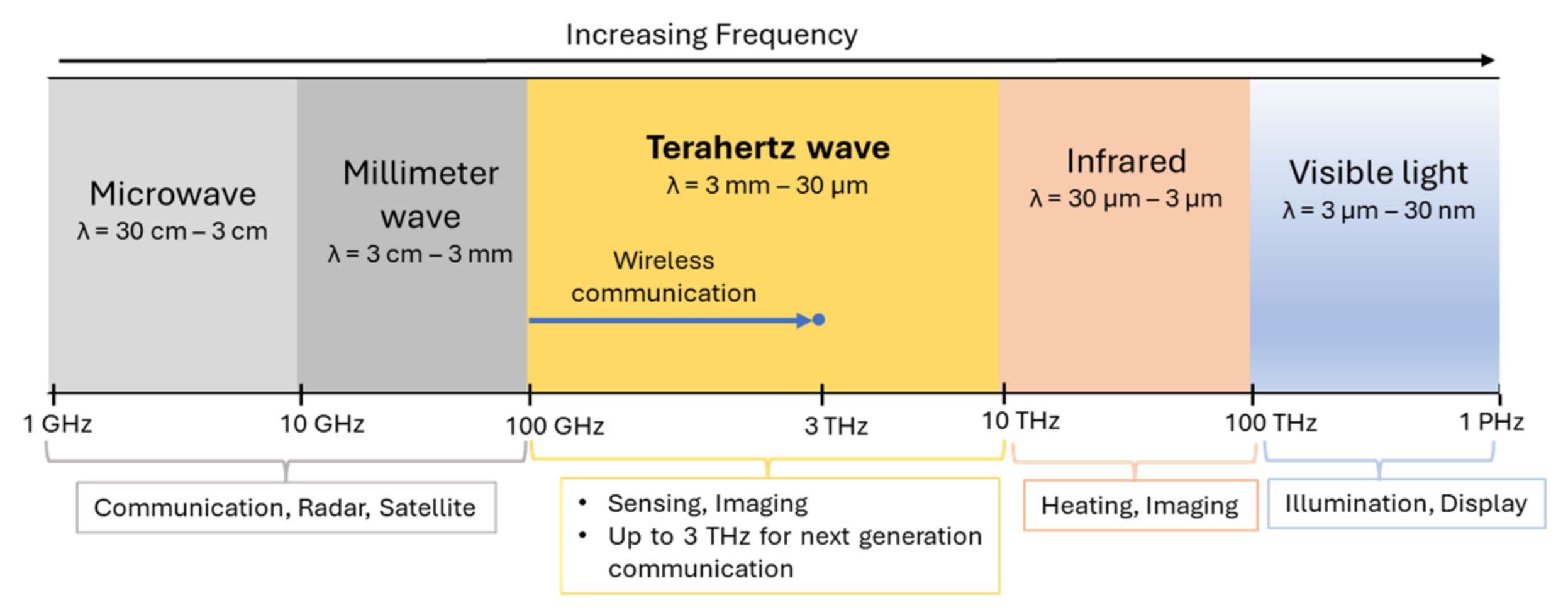
The rapid proliferation of data-intensive applications, including Internet of Things (IoT), artificial intelligence (AI), e-commerce and fintech, video content streaming and social media platforms, has placed unprecedented demand on wireless communication systems to provide ultra-high data rates. To sustain this growth, large bandwidth offered by high frequencies and advanced network architectures is required, characterized by dense deployments of small radio cells and robust backhaul systems supported by high-capacity point-to-point wireless links. While millimeter-wave (mmWave) bands have enabled multi-gigabit-per-second transmission, spectrum congestion and the limited bandwidth available below 100 GHz increasingly constrain further capacity scaling. Similarly, although free-space optical (FSO) communication systems provide access to the vast unlicensed spectrum available in the infrared (IR) and visible-light regions, several practical challenges limit the widespread deployment of optical wireless communication (OWC) technologies for mobile 6G and beyond networks. These challenges include restricted transmission power due to hardware limitations, very high atmospheric attenuation and sensitivity to transmitter–receiver misalignment, which degrade link reliability, reduce achievable data rates, and limit transmission distance. Concurrently, the global rollout of 5G systems [1] has accelerated research into Beyond 5G and 6G technologies, driving an urgent need to explore new frequency resources capable of meeting future bandwidth demands. In this context, the terahertz (THz) frequency range (0.1–10 THz), as shown in Figure 1, has emerged as a promising candidate for next-generation wireless communications.
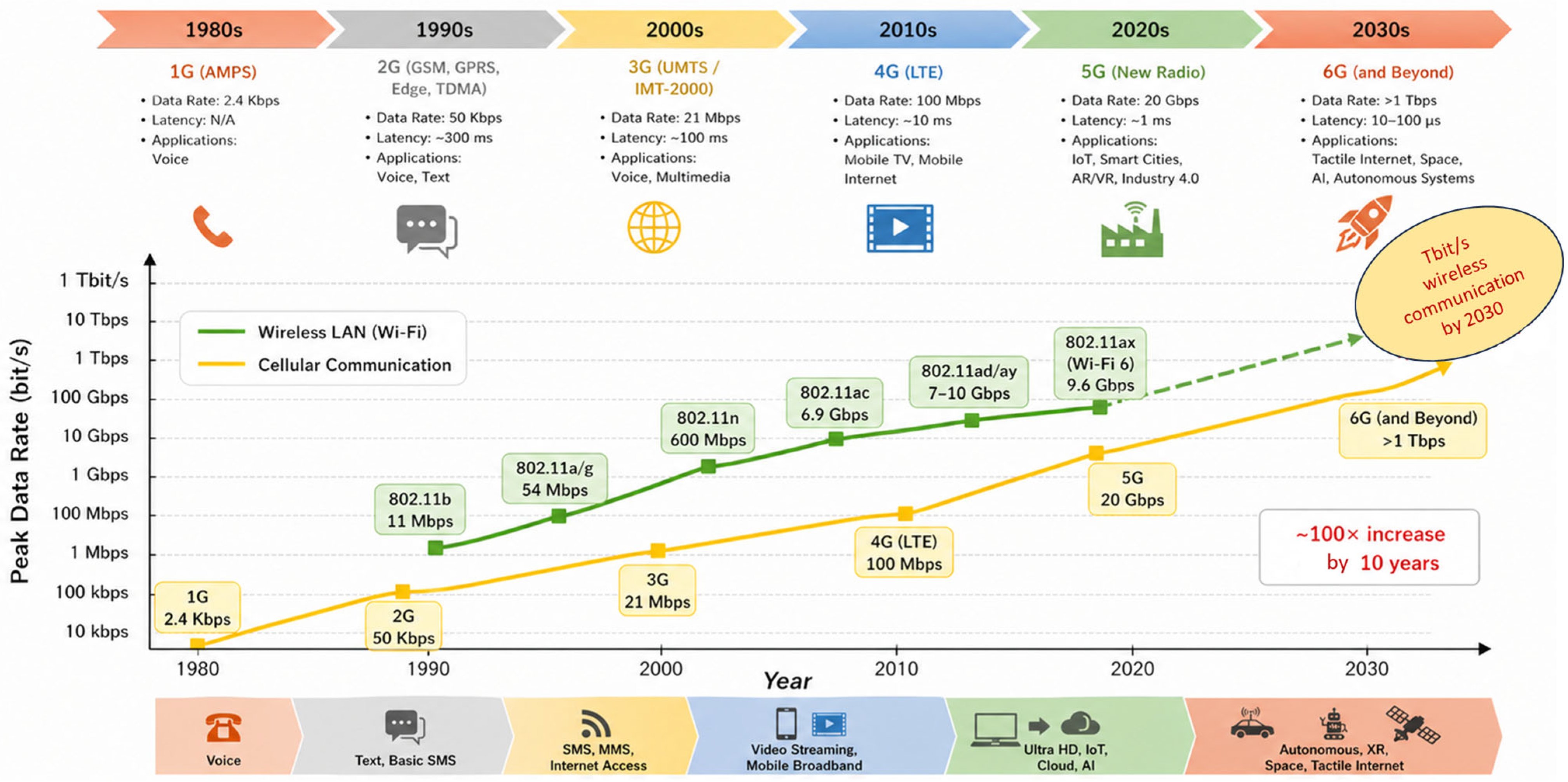
Operating in this spectrum offers access to vast contiguous bandwidths, enabling the possibility of terabit-per-second data rates that are envisioned to drive the Beyond 5G/6G era by 2030 [2,3,4], as shown in Figure 2. Moreover, the inherently short wavelengths of THz signals facilitate highly directional beamforming and the integration of compact antenna arrays, which are advantageous for spatial multiplexing and interference mitigation. However, despite these compelling benefits, the transition from proof-of-concept demonstrations to practical THz communication systems remains challenging, primarily due to significant hardware limitations, particularly in the efficient and stable generation of THz signals. Among the various components in a THz transceiver, including mixers, amplifiers, antennas, and detectors, the signal source remains one of the most critical and technically demanding elements. A viable THz source for communication systems must simultaneously satisfy several stringent requirements:
  • Sufficient output power to overcome severe free-space path loss.
  • Wide frequency tunability for flexible spectrum utilization.
  • Low phase noise for coherent modulation.
  • High modulation bandwidth.
  • Energy efficiency suitable for practical deployment.
  • Compatibility with integration platforms.
Conventional electronic THz sources such as CMOS [5,6,7], heterojunction bipolar transistors (HBTs) [8,9,10,11,12], high-electron-mobility transistors (HEMTs) [13,14,15,16], and resonant tunneling diodes (RTDs) [17,18,19] are promising in terms of compactness, system efficiency and robustness. Additionally, electronics can be easily produced by scalable and cost-effective integrated circuit technics and processes. The limitation with electronic THz generators is the speed of the active devices, which is a function of the electron transit time and the parasitic RC-time constants. This has significantly challenged the application of electronic-based devices to generate THz frequencies.
In this framework, optoelectronic methods for THz generation have emerged as a compelling solution. Optoelectronic THz sources exploit optical techniques, most commonly optical heterodyning or photomixing [20,21,22,23], to generate THz signals. This approach offers several intrinsic advantages that include wide frequency tunability, high spectral purity, seamless fiber compatibility and convergence of optical and wireless domains; optoelectronic sources naturally bridge photonic infrastructure and wireless front-ends. These characteristics make optoelectronic approaches particularly attractive for architectures such as THz-over-fiber links and distributed antenna systems envisioned for next-generation networks.
By integrating device physics, photonic integration strategies, and communication system considerations within a unified framework, this review aims to elucidate the distinctive role of optoelectronic THz sources in enabling practical next-generation wireless systems and to identify pathways toward scalable, high-capacity THz transceivers for 6G and beyond. In contrast to broader THz technology surveys, this work provides a structured and communication-oriented analysis of optoelectronic THz source technologies through: (i) a detailed examination of the physical mechanisms governing optical-to-THz conversion; (ii) an account of key compact THz wave generating technologies that include photoconductive antenna (PCA), quantum cascade laser (QCL), and uni-traveling-carrier photodiode (UTC-PD)-based approaches; (iii) an in-depth discussion of UTC-PD performance scaling, bandwidth, and efficiency limitations; (iv) a system-level perspective linking device characteristics to architectures such as THz-over-fiber networks and photonic beamforming systems; and (v) an assessment of the key technical challenges and emerging research directions shaping future deployable optoelectronics-enabled THz communication platforms.

2. Optoelectronic Terahertz Source Technologies

2.1. Quantum Cascade Lasers (QCLs)

These are a type of semiconductor lasers that are specifically engineered to emit photons with low energy in the far-infrared and THz frequency ranges [24,25]. Generally, QCLs function at frequencies between 1 and 5 THz. Although they can generate output powers of several hundred mWs when operated at extremely low temperatures, there is still a major challenge in achieving similar power levels at room temperature [26,27]. This obstacle greatly restricts the practical use of QCLs.

2.2. Photoconductive Antennas (PCAs)

Another technique to down-convert optical signals to the THz band relies on the use of photoconductive antennas [28,29]. A photoconductive antenna generally consists of a conventional THz metallic antenna printed on top of a photoconductive substrate. When illuminated by an optical signal (normally an optical pulse), photocarriers are excited at the gap of the antenna. A DC bias field is then used to accelerate the carriers along the antenna structure, resulting in the emission of THz photons. The main challenge of this technique relates to the low conversion efficiency and the resulting low emitted power (less than a milliwatt at hundreds of GHz). Table 1 below summarizes the fundamental capabilities for PCAs, QCLs and UTC-PD photomixer devices.

2.3. Photomixing

Photomixing, also referred to as optical heterodyning, is an optoelectronic technique that converts two optical waves of different frequencies into an electrical alternating current at the difference frequency using a photodiode or photoconductor, thereby enabling terahertz (THz) generation. Common photomixing devices include low-temperature-grown GaAs (LTG-GaAs) photoconductors, p–i–n photodiodes, and uni-traveling-carrier photodiodes (UTC-PDs). A photoconductor consists of a semiconductor placed between two electrodes. When illuminated with photons of energy equal to or greater than the bandgap, electron–hole pairs are generated. Under an applied electric field, these carriers produce a current proportional to the optical power. When two laser beams of similar wavelength are combined, the resulting current oscillates at their beat frequency. High-performance photoconductors require short carrier lifetimes and high carrier drift velocities. LTG-GaAs photomixers are optimized for operation near 800 nm and are therefore less suitable for optical communication systems operating at 1550 nm. Although InGaAs-based photoconductors have been investigated, their performance remains inferior to that of GaAs photoconductors, p–i–n photodiodes, and UTC-PDs [35,36]. Their design is also challenging due to competing requirements, including high resistivity, strong absorption, high mobility, short carrier lifetime, and high breakdown field [35].
Conventional p–i–n photodiodes consist of an intrinsic semiconductor layer positioned between p- and n-doped regions that absorbs incident light. Illumination generates electron–hole pairs within the depletion region, which drift under the built-in electric field. The bandwidth is determined by carrier transit time and the RC time constant. Reducing the depletion width shortens transit time but increases capacitance, thereby limiting bandwidth and responsivity. This trade-off is further constrained by the lower mobility of holes compared to electrons. In p–i–n photodiodes, responsivity is primarily limited by the transit time of holes through the intrinsic region, whereas in UTC-PDs, it is governed by electron drift velocity. This leads to higher bandwidth and improved saturation characteristics due to the absence of hole accumulation.
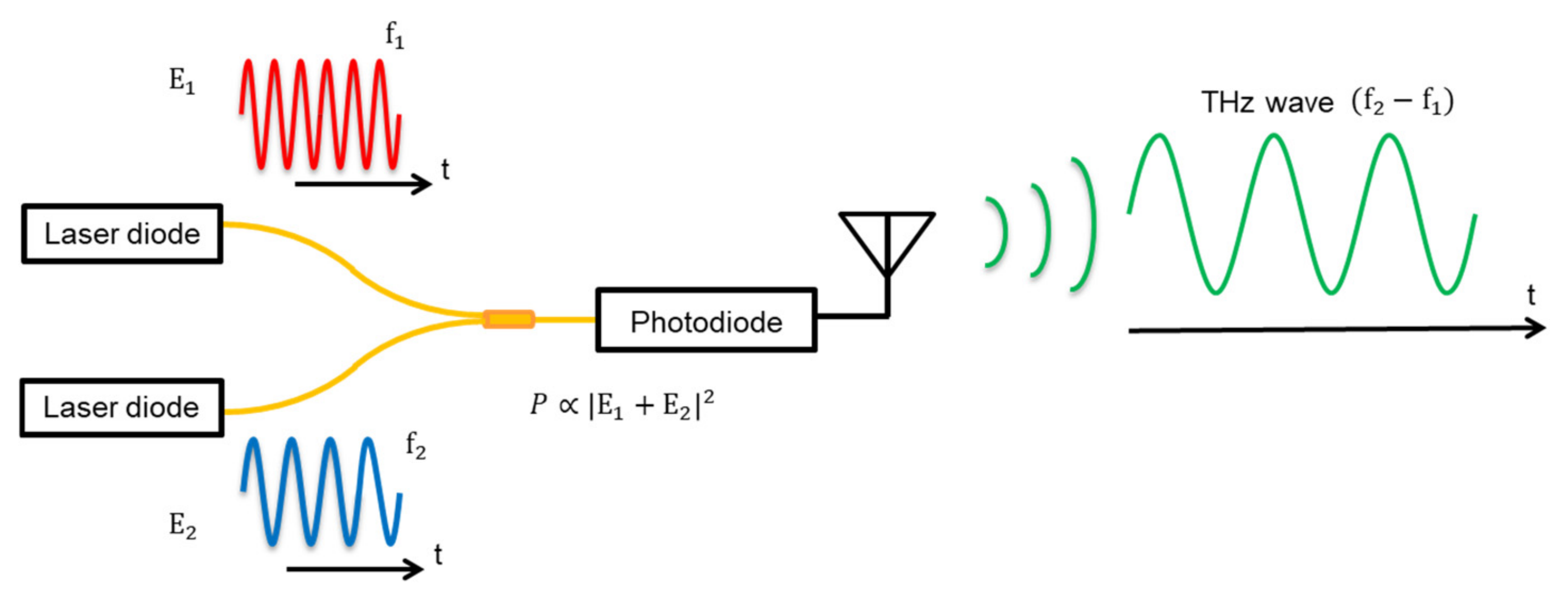
Photomixing using a photodiode is shown in Figure 3. Two optical waves with frequencies f 1 and f 2 are combined and converted into an electrical signal at the difference frequency f 2 f 1 [20,21].
The electric fields for the two lightwaves are E 1 and E 2 . The power P of the lightwaves detected by the photodiode is proportional to the square of the total electric fields of the two lightwaves and is expressed as follows:
E 1 = A 1 e x p i 2 π f 1 t + φ 1 k 1 x 1
E 2 = A 2 e x p i 2 π f 2 t + φ 2 k 2 x 2
P E 1 + E 2 2
thus:
P = A 1 2 + A 2 2 + 2 A 1 A 2 cos 2 π f 2 f 1 t + φ 2 φ 1 k 2 x 2 k 1 x 1
where A 1 and A 2 are the amplitudes, f 1 and f 2 are the frequencies, k 1 and k 2 are the wavenumbers, φ 1 and φ 2 are the phases, and x 1 and x 2 are the optical path lengths. Due to square-law detection, an alternating current at frequency f 2 f 1 is generated with a phase determined by both the phase difference and the path length difference.
The phase of the generated terahertz wave can be controlled either by adjusting the optical phase difference φ 2 φ 1 or by modifying the optical path lengths. The former allows for direct phase transfer from the optical domain to the terahertz domain. For example, a phase shift in π in the optical signal produces the same phase shift in the terahertz signal. However, this method requires fiber-based optical components, such as optical phase modulators, and phase stabilization to suppress fluctuations.
Alternatively, phase control can be achieved by varying the optical path length. When both paths are changed by Δ x , the phase shift is given by:
k 2 k 1 Δ x = 2 π 1 λ 1 1 λ 2 Δ x
where λ 1 and λ 2 are the wavelengths. In air, for two lightwaves in the 1550 nm band with a frequency difference of 300 GHz, the coefficient is approximately 1   mm 1 . Therefore, an optical delay of 1 mm results in a 2 π phase shift in the terahertz signal, corresponding to one wavelength at 300 GHz.

2.4. Fundamentals of a UTC-PD

2.4.1. Basic Device Structure

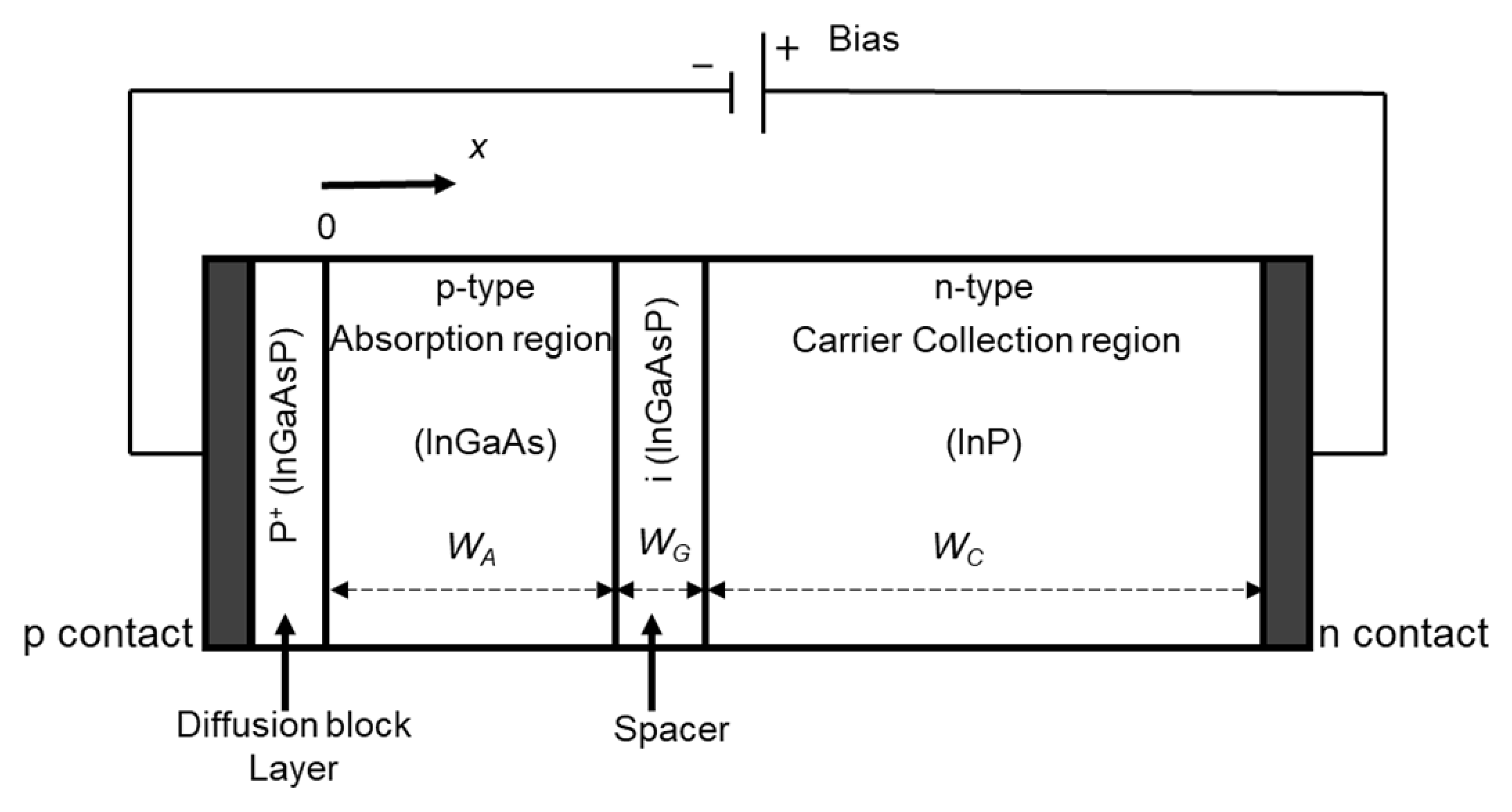
The basic structure of a UTC-PD is illustrated in Figure 4. A key distinction is the inclusion of a diffusion-blocking layer on the p-side of the absorption region, which suppresses hole transport toward the p-contact and permits only electrons to drift toward the n-contact.
The device comprises an active region consisting of a p-type absorption layer and a lightly doped n-type carrier-collection layer, with the respective thicknesses denoted as W A and W C . Although alternative structures have been proposed to reduce dark current [37] and junction capacitance [38], they are not suitable for ultrafast operation due to limited bandwidth and response speed. Typical doping concentrations are p = 1 × 10 24   m 3 in the absorption region and n = 1 × 10 22   m 3 in the collection region [39]. The absorption layer is composed of In0.53Ga0.47As, which is lattice-matched to the InP collection layer grown on an InP substrate. Owing to its relatively narrow band gap (0.75 eV), InGaAs efficiently absorbs 1550 nm optical radiation and generates electron–hole pairs, whereas the wider band gap InP layer (1.35 eV) remains transparent to the incident light. There is a thin (~10 nm) intrinsic In0.75Ga0.25As0.53P0.47 graded layer with a ~1 eV band gap. This graded layer, denoted W G , smoothens the band discontinuity and enhances carrier transport, thereby improving the photodiode’s speed.

2.4.2. UTC-PD Operating Principle

A UTC-PD is an optoelectronic device operated under reverse bias, with the positive terminal applied to the n-contact and the negative terminal to the p-contact. Under illumination at 1550 nm, optical absorption occurs exclusively in the narrow bandgap InGaAs layer, generating electron–hole pairs. The photogenerated electrons occupy conduction band states (CB), while holes remain in the valence band (VB). Owing to the intrinsic electric field at the p–n junction, carrier separation occurs even in the absence of external bias, thereby suppressing recombination.
Under reverse bias, electrons drift toward the n-contact, whereas holes move toward the p-contact. However, the highly doped (p+) diffusion-block layer adjacent to the p-contact impedes hole transport, preventing their contribution to the external photocurrent. This constitutes a key distinction between UTC-PDs and conventional p–i–n photodiodes. The confined holes undergo dielectric relaxation (τR) and accumulate within the absorption region, establishing a quasi-neutral condition and inducing a self-consistent electric field. In contrast, photogenerated electrons diffuse across the absorption layer and drift into the collection layer, where they are collected at the n-contact and contribute to the output current. The exclusive involvement of high-velocity electrons enables the UTC-PD to achieve superior speed and bandwidth.

2.4.3. Development of UTC-PD Integrated Devices

UTC-PDs have been extensively studied to improve performance, particularly in terahertz photonics. Fiber-pigtailed UTC-PD modules with rectangular waveguide such as in [40,41] and integrated planar antennas [42,43,44] have been developed. Prior to the formal introduction of the UTC-PD concept in 1997 [45], related device structures employing depleted InP had been reported, primarily aimed at reducing dark current and increasing voltage swing [37,38]. The UTC-PD design emphasized the elimination of hole transport, relying exclusively on electron transport to achieve superior speed and output performance. This advantage is contingent on quasi-ballistic electron transport or velocity overshoot. In early development stages, device sensitivity was not a primary concern. However, a design incorporating both neutral and depleted p-type absorber regions, derived from UTC principles, rapidly gained attention and it has come to be known as the modified UTC-PD (MUTC-PD). In the MUTC-PD, part of the wide-bandgap depletion region is replaced by a depleted absorber. Owing to its proximity to the p-type absorber, electron current remains dominant, preserving the essential operating characteristics of the UTC-PD [46,47,48,49,50].

2.5. Key Challenges to Optimal Device Performance

2.5.1. Frequency Scaling and Bandwidth Limitations

The high-frequency performance of UTC-PDs is primarily determined by carrier transit time and RC time constant [32,33,51,52]. The overall 3 dB bandwidth, f 3 d B , is a function of both the carrier transit-time-limited bandwidth f T and RC-limited bandwidth and can be approximated by:
f 3 d B f T 2 f R C 2 1 2
The carrier transit-time-limited bandwidth ( f T ) is predominantly governed by the electron transport velocity within the depletion layer. UTC-PDs exhibiting bandwidths exceeding 100 GHz have been reported [53,54,55,56,57]. Conversely, the RC-limited bandwidth ( f R C ) is dictated by the total device resistance and capacitance, both of which must be carefully minimized to achieve superior high-frequency performance. In particular, reducing capacitance through smaller device geometries and optimized electrode configurations is critical for sustaining a high-frequency response. However, reducing device size introduces trade-offs in optical coupling efficiency and power-handling capability. This highlights the need for simultaneous optimization of transport physics and circuit parasitics.

2.5.2. Output Power Scaling and Efficiency

The generated THz power can be expressed approximately as follows:
P T H z I p h 2 R L
where I p h is the photocurrent amplitude at the beat frequency, and R L is the load resistance. This expression provides a simplified relationship under idealized assumptions, including ideal impedance matching, negligible parasitic losses, linear photodiode operation, and constant responsivity. Since the photocurrent scales with optical input power, increasing the optical power generally increases the THz output power generated. In practical UTC-PD photomixers, however, THz power scaling is constrained by several non-ideal effects. At high optical excitation levels, space-charge effects reduce the internal electric field strength, leading to carrier transport limitations and photocurrent saturation. In addition, photodiode responsivity typically decreases at higher frequencies due to transit-time effects and parasitic capacitance. The effective radiated THz power is also strongly influenced by impedance matching between the UTC-PD and the antenna or external load, as well as by antenna radiation efficiency. Furthermore, self-heating and limited thermal dissipation capability can degrade device performance and reliability under high-bias or high-photocurrent operation. Consequently, the achievable THz output power in practical systems deviates from the ideal quadratic scaling predicted by Equation (7).
State-of-the-art integrated UTC-PDs have demonstrated milliwatt-level output power around 300 GHz [34,40,41], as summarized in Table 2. Efficiency improvement remains an active area of research, particularly through device scaling using on-chip planar combiners [20,58,59] and field-enhancement techniques.

2.5.3. Thermal Effects and Space-Charge Limitations

Thermal management is one of the primary constraints in high-power UTC-PD operation. High temperature affects performance and leads to device degradation over time. In addition, space-charge effects become significant at high photocurrent densities. Accumulated charge within the device reduces the internal electric field, thereby slowing carrier transport and limiting bandwidth and output power. To mitigate these effects, several strategies have been explored that include use of high-thermal-conductivity substrates like silicon carbide (SiC) that has a higher thermal conductivity (490 W/m/K) than InP (68 W/m/K) [60,61,62,63,64].

2.5.4. Impedance Matching

Efficient THz radiation from UTC-PDs requires careful integration with antenna structures or rectangular waveguides integrated with planar transmission line transitions. Since the photodiode behaves as a high-frequency current source with non-negligible internal impedance, impedance matching between the device and the load (antenna) is critical for maximum power transfer [65,66]. Common antenna structures include bow-tie antennas [42], log-periodic antennas [67], slot antennas [68] and patch antennas [58]. At THz frequencies, parasitic capacitance and inductance strongly influence impedance matching. As frequency increases, mismatch losses become more severe, leading to reduced radiation efficiency.
Overall, the challenges discussed above are strongly interdependent rather than independent design constraints. Reducing device dimensions to improve RC-limited bandwidth and achieve higher operating frequencies simultaneously increases current density and thermal loading, which can intensify space-charge effects and reduce power handling capability. Similarly, increasing photocurrent for higher THz output power may degrade high-frequency performance through increased junction heating. In addition, impedance matching becomes increasingly difficult at higher frequencies due to the stronger influence of parasitic capacitance and inductance, directly affecting radiation efficiency and achievable output power. Consequently, the optimization of UTC-PD performance requires a comprehensive co-design approach that simultaneously considers device geometry, thermal dissipation, and carrier transport dynamics.

3. System-Level Implications for Next-Generation Communications

The practical relevance of optoelectronic THz sources is ultimately determined by how effectively they can be incorporated into complete communication systems. Different THz communication architectures, especially those envisioned for 6G and beyond, impose distinct requirements on source generation, signal distribution, synchronization, beam steering, and energy efficiency. In this context, optoelectronic UTC-PD photomixer-based THz sources are particularly attractive for such architectures that benefit from centralized optical processing and coherent signal distribution, such as THz-over-fiber access networks, cloud–radio access networks (C-RANs), indoor ultra-dense small cells, and photonic beamforming arrays. It is worth noting that the suitability of a given THz source technology depends strongly on the target deployment scenario and system architecture. Table 3 summarizes some of the communication-relevant performance metrics for PCAs, QCLs and UTC-PDs.

3.1. THz-over-Fiber Architectures

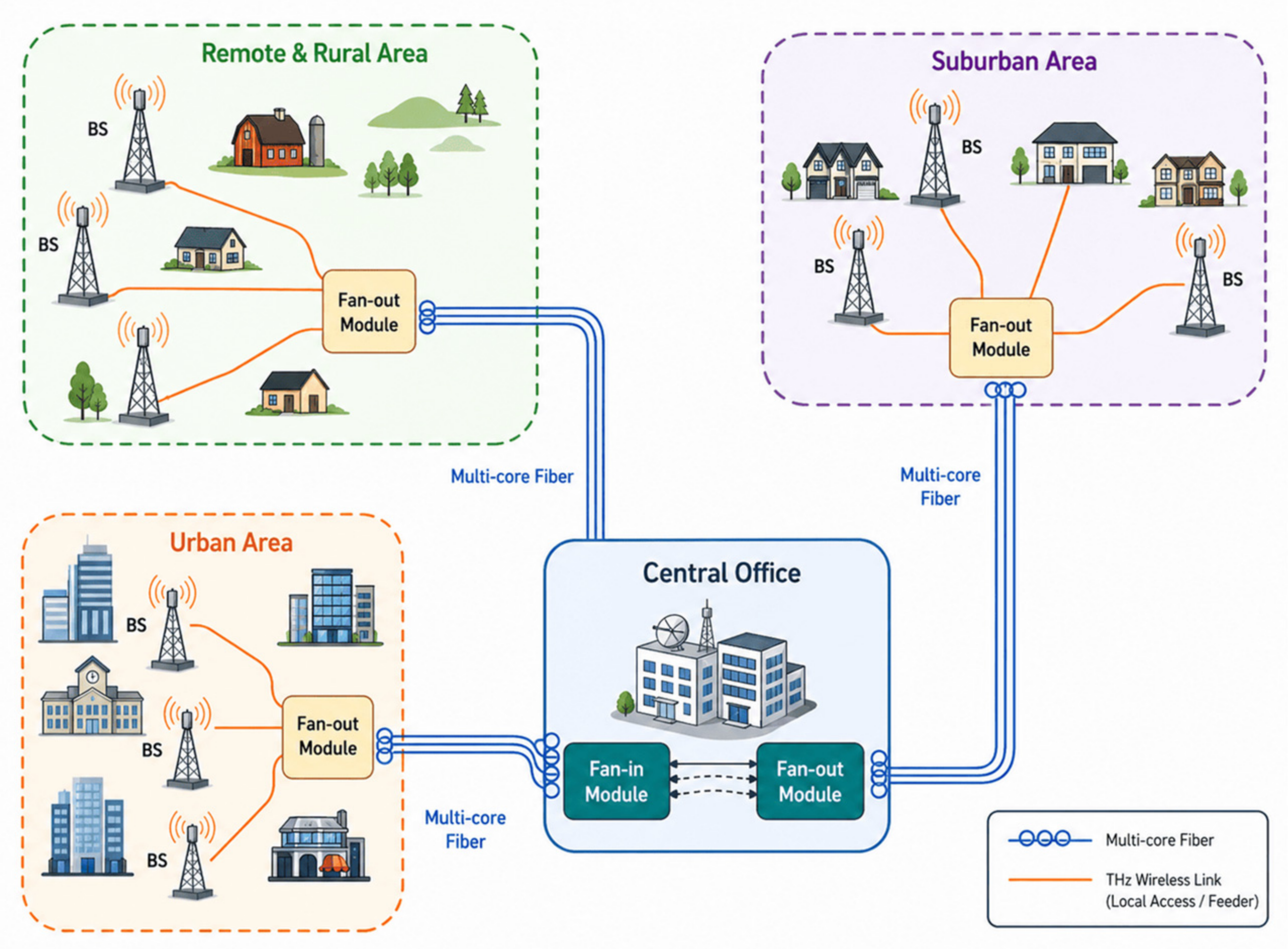
One of the most compelling system-level applications of optoelectronic THz sources is THz-over-fiber (ToF), where optical signals are transmitted over fiber and converted into THz radiation at remote antenna units. This approach leverages the low-loss and high-bandwidth capabilities of optical fiber to distribute high-frequency signals efficiently across a network. In a typical ToF architecture, as shown in Figure 5, two optical carriers carrying data are generated at a central unit and transmitted through fiber to a remote photomixer, such as a UTC-PD. At the remote node, optical heterodyning generates a THz signal that is radiated through an antenna [69].
This configuration offers several advantages that include centralized signal generation and processing, reduced complexity at remote antenna units, high frequency stability due to optical coherence, and scalability for distributed antenna systems. THz-over-fiber architectures are particularly relevant for indoor 6G access networks, distributed antenna systems, and cloud-based radio access networks. Optoelectronic sources are uniquely suited for this architecture, as the THz carrier is generated directly from optical signals. In contrast, purely electronic or QCL-based sources require additional conversion stages, reducing efficiency and increasing system complexity.

3.2. Coherent Detection and Spectral Purity

Next-generation communication systems are expected to employ advanced modulation formats, such as high-order quadrature amplitude modulation (QAM), to maximize spectral efficiency. These formats require coherent detection, which, in turn, demands highly stable carriers with low phase noise [70,71,72].
Optoelectronic THz sources, particularly those based on photomixing, inherently support coherent operation [23,73]. Since the THz signal is derived from optical carriers, its phase noise is directly linked to the optical linewidth [74]. By using narrow-linewidth lasers or phase-locked optical sources, extremely high spectral purity can be achieved. This enables high-order modulation schemes, reduced error vector magnitude (EVM), and improved link reliability. UTC-PD-based photomixers are especially advantageous in this regard, as they can preserve the coherence of optical signals while providing wide tunability. This makes them strong candidates for coherent THz transceivers. Table 4 summarizes some of the recently reported high-speed UTC-PD-enabled THz communication demonstrations.

3.3. Beamforming and Phased-Array Integration for Beam Steering

At THz frequencies, free-space path loss is significantly higher than at lower frequencies, necessitating the use of highly directional beams to achieve sufficient link budget. This is typically accomplished through beamforming and phased-array techniques that are particularly attractive for ultra-massive MIMO systems, directional backhaul links, and dynamic beam-steering applications in dense THz networks.
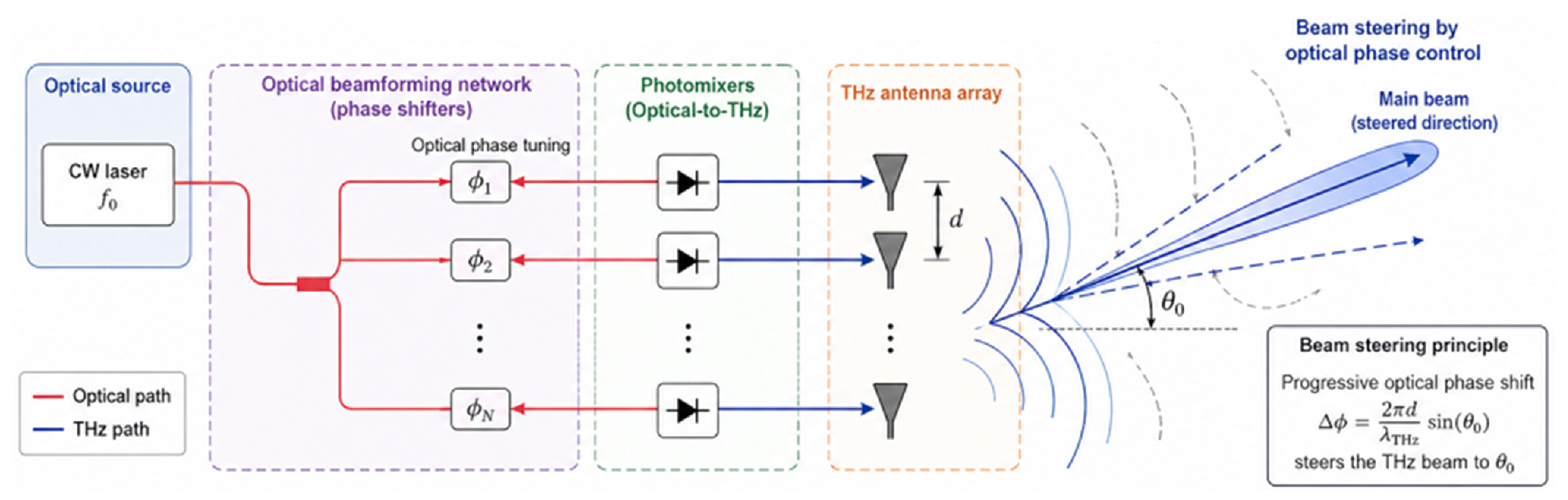
Optoelectronic THz sources provide unique opportunities for implementing beamforming architectures through optical phase control and photonic signal distribution, as shown in Figure 6. In photomixing-based systems, controlling the optical phase enables direct control of the radiated THz phase at each antenna element. By introducing controlled optical phase shifts across multiple photomixers, constructive and destructive interference can be engineered spatially, enabling electronic beam steering without requiring conventional high-frequency RF phase shifters [80,81,82].
Despite their advantages, including low-loss transmission and wider tunability, practical implementation of large-scale THz phased arrays remains highly challenging. One critical requirement is precise phase synchronization among antenna elements since even small phase deviations can significantly distort the beam pattern at THz frequencies. Because the wavelength is extremely short, phase errors corresponding to only a few micrometers of path-length variation may produce noticeable beam degradation and pointing inaccuracies. Thermal drift in optical waveguides, photonic integrated circuits, and electronic bias circuitry can further introduce phase instability over time, requiring active calibration and compensation mechanisms.
Additionally, element spacing to avoid grating lobes is also an important design constraint as small spacing can increase electromagnetic mutual coupling and complicate impedance matching and thermal management. In addition, scaling toward ultra-massive MIMO architectures significantly increases the complexity of optical routing networks, bias control circuitry, and power distribution across the array.
Therefore, while optoelectronic beamforming architectures provide important advantages in terms of coherence, tunability, and low-loss signal distribution, practical THz phased-array systems must carefully address synchronization accuracy, thermal stability, array scalability, mutual coupling, and power efficiency to enable robust high-gain wireless communication links.

3.4. Link Budget Considerations

The feasibility and performance of THz wireless communication links are fundamentally determined by the link budget, which accounts for transmitted power, antenna gains, propagation losses, and receiver sensitivity. Compared with conventional microwave and sub-6 GHz systems, THz communications experience substantially higher propagation attenuation due to the combined effects of free-space path loss, atmospheric absorption, and obstruction/blockage losses.
The free-space path loss (FSPL) of electromagnetic waves increases with both transmission distance and carrier frequency according to the Friis transmission equation [83,84]:
P r x d B m = P t x d B m + G t x d B + G r x d B 20 log 10 4 π d f c ,
where P t x and P r x denote the transmitted and received powers, G t x and G r x are the transmitter and receiver antenna gains, d is the propagation distance, f is the carrier frequency, and c is the speed of light. Since FSPL scales proportionally to f 2 , attenuation becomes significantly larger at THz frequencies than at conventional microwave bands [85,86,87,88]. However, the shorter wavelength at THz frequencies also enables highly directional high-gain antennas and compact phased arrays, partially compensating for increased spreading loss.
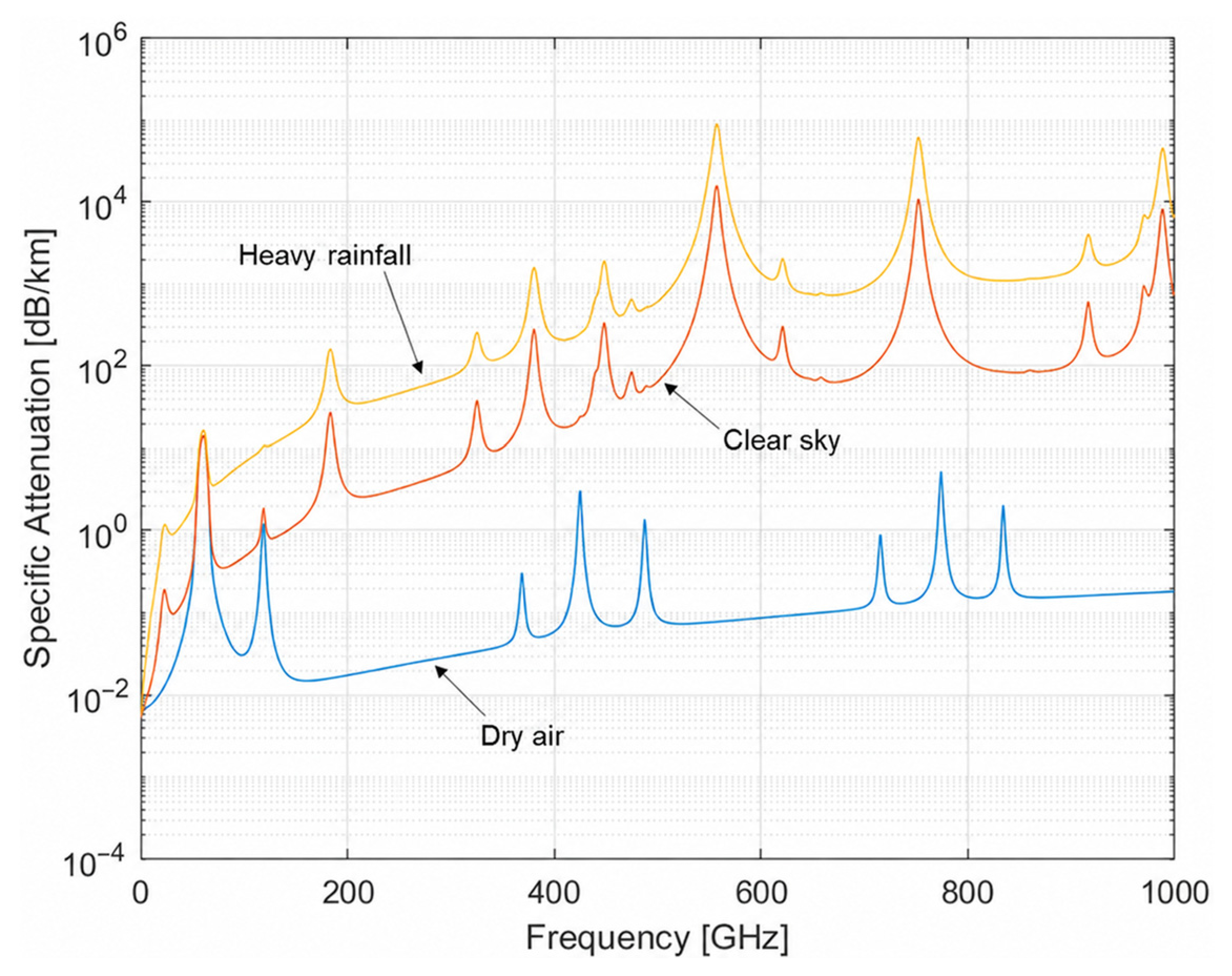
In addition to FSPL, atmospheric absorption becomes a dominant impairment in the THz regime. Unlike sub-6 GHz systems, where gaseous attenuation is typically negligible, THz waves strongly interact with atmospheric molecules, particularly oxygen and water vapor [89,90]. These molecular resonances produce frequency-selective absorption peaks at specific frequencies, creating transmission windows separated by highly attenuated spectral regions. Models such as ITU-R P.676-12 [91] are commonly used to estimate gaseous attenuation under different atmospheric conditions by accounting for oxygen and water vapor absorption lines. Atmospheric attenuation further depends on humidity, pressure, temperature, rain, and fog density, and can range from a few dB/km in favorable transmission windows to several tens or hundreds of dB/km near absorption peaks. Figure 7 illustrates signal attenuation, assuming an air pressure of 101.3 kPa, temperature of 20 °C, and water vapor densities of 0 g/m3 (dry air), 7.5 g/m3 (clear sky), and 50 g/m3 (heavy rain), based on ITU recommendations [91,92].
Considering a typical isotropic link budget, the link attenuation L can be given as follows:
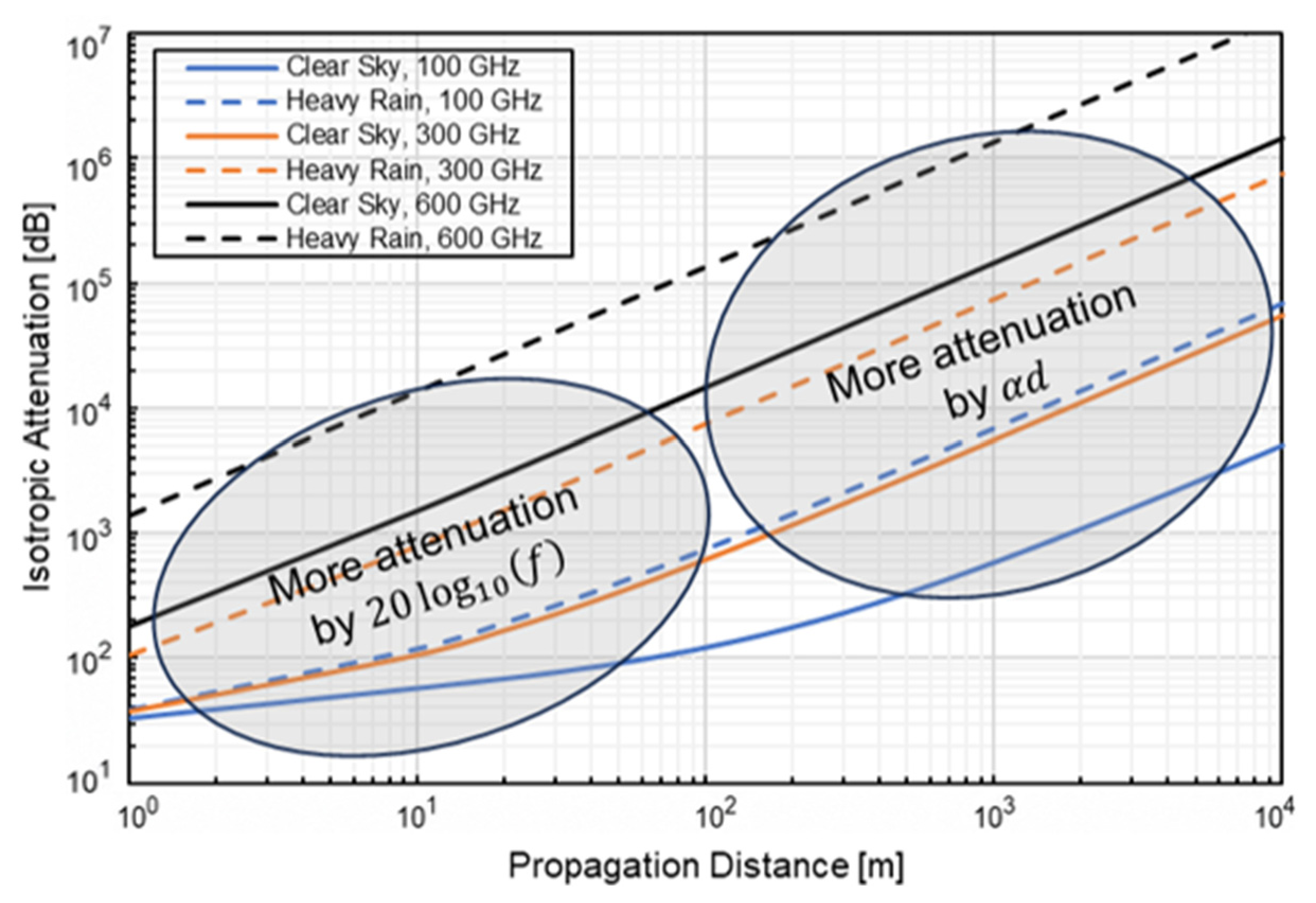
L   d B = P t x d B m P t x d B m = 92.45 G t x d B G r x d B + 20 log 10 f + 20 log 10 d + α d ,
where the frequency f is in GHz, distance d is in km, and attenuation α is in dB/km. It is illustrated in Figure 8 that with antenna gains of G t x = G r x = 50   d B , there is more free-space attenuation due to the α d factor beyond 0.1 km. Consequently, practical outdoor THz systems typically operate within relatively transparent spectral windows to limit propagation loss and dispersion effects.
Furthermore, THz propagation is also highly susceptible to blockage and scattering due to the extremely short wavelength of THz signals. Common objects such as buildings, vehicles, foliage, and human bodies become electrically large relative to the wavelength, causing severe attenuation and limiting reliable non-line-of-sight propagation [93]. Human blockage may introduce attenuation on the order of 40 dB [94], while vehicle and foliage blockage can result in losses ranging from tens of decibels to more than 50 dB depending on geometry and vegetation density [95,96]. As a result, THz systems generally rely on highly directional line-of-sight links supported by beamforming and beam-steering techniques using phased antenna arrays. The small physical dimensions of THz antennas allow a large number of antenna elements to be integrated into compact apertures, enabling substantial antenna gains to compensate for propagation losses. Nevertheless, dense array implementations introduce practical challenges such as mutual coupling and electromagnetic interactions between closely spaced elements.
Considering these propagation impairments, achieving practical THz communication distances requires a careful balance between transmitted power, antenna gain, receiver sensitivity, and atmospheric conditions. The relatively low output power of optoelectronic THz sources, especially UTC-PD photomixers, remains a major limitation for long-range links. To improve the overall link budget, several approaches have been investigated, including the use of high-gain lens-coupled antennas [97], power-combining techniques [20,58,59], hybrid optical–electronic amplification architectures [98], and adaptive algorithms for backhaul link planning [99,100]. Moreover, standardization efforts, such as IEEE 802.15.3d, aim to address these challenges [101].

3.5. Energy Efficiency and System Scalability

Energy efficiency is a critical consideration for future wireless networks, particularly in dense deployments with large numbers of transceivers. Optoelectronic THz architectures may offer advantages such as low-loss optical signal distribution over fiber, compatibility with centralized signal processing, and reduced electromagnetic interference compared with purely electronic distribution approaches. However, the relatively low optical-to-THz conversion efficiency remains a challenge. Improving efficiency at both device and system levels is essential for large-scale deployment.
Scalability is another key factor. Integrated photonic platforms enable mass production using semiconductor fabrication techniques, dense integration of multiple channels and compatibility with existing optical infrastructure. These features make optoelectronic approaches particularly attractive for future networks that require flexible, high-capacity, and scalable architectures [86].

4. Emerging Directions and Future Outlook

The continued advancement of optoelectronic terahertz sources is closely tied to progress in material science, device engineering, and system integration. While current technologies demonstrate promising capabilities, achieving the performance, efficiency, and scalability required for next-generation communication systems demands innovative approaches that go beyond incremental improvements. This section outlines key emerging directions that are expected to shape the future of optoelectronic THz sources and their role in enabling practical high-capacity wireless systems.

4.1. Plasmonic-Enhanced Photomixers

One of the most promising approaches to overcoming efficiency and bandwidth limitations in photomixing-based THz sources is the incorporation of plasmonic nanostructures. By exploiting surface plasmon resonances, these structures can confine optical fields into subwavelength regions, significantly enhancing light–matter interaction [102]. In plasmonic uni-traveling-carrier photodiodes (UTC-PDs) and photoconductive devices, this leads to increased optical absorption within ultrathin active regions, reduced carrier transit distances, enhanced responsivity and bandwidth, and improved optical-to-THz conversion efficiency [103,104]. Such designs enable the simultaneous optimization of optical absorption and high-speed carrier transport—two traditionally conflicting requirements in conventional photomixers. As fabrication techniques for nanoscale structures continue to mature, plasmonic enhancement is expected to play a central role in next-generation THz photomixers and integrated THz systems.

4.2. Optical Frequency Comb-Based THz Generation

Optical frequency combs provide a powerful platform for generating highly stable and precisely spaced optical tones, which can be used for photomixing to produce THz signals with exceptional spectral purity. Compared to dual-laser heterodyning, comb-based approaches offer intrinsic phase coherence across multiple frequency components, reduced phase noise and frequency drift, capability for multi-channel THz generation, and simplified frequency tuning through comb spacing control. These features are particularly attractive for dense wavelength-division multiplexing (WDM) and multi-carrier communication systems. Recent demonstrations using microresonator-based Kerr combs have enabled low-phase-noise THz carriers and high-data-rate wireless links beyond 300 GHz, highlighting their potential for integrated THz transmitters [105,106]. Integration of frequency comb sources with photonic circuits and high-speed photodiodes could enable compact, multi-channel THz transmitters for ultra-high-capacity links [107,108].

4.3. Monolithic Photonic–Terahertz Integration

A major trend in the field is the move toward fully integrated photonic–THz systems, where optical sources, modulators, photomixers, and antennas are co-integrated on a single platform. Such monolithic or quasi-monolithic integration offers several advantages, including reduced optical and electrical coupling losses, improved system stability and robustness, compact form factor, and potential for large-scale manufacturing [109]. Heterogeneous integration techniques, particularly combining III–V semiconductors with silicon photonics, are central to this effort. Recent advances in hybrid material platforms and phase-change materials integrated on silicon waveguides have further expanded the functionality of THz photonic integrated circuits [110]. Ultimately, fully integrated photonic–THz chips could serve as compact transceiver front-ends for future wireless networks and 6G systems.

4.4. High-Power Photomixing and Power Combining Techniques

To address the persistent challenge of limited output power, research is increasingly focused on power-scaling strategies for photomixing-based sources. Key approaches include parallel integration of multiple photomixers [20,58,59], coherent power combining using phased arrays [68], and improved thermal management for higher optical input power [60,61]. Optical beamforming techniques can be leveraged to control the phase of multiple photomixing elements, enabling constructive interference and increased radiated power, thereby enhancing multi-channel transmission capabilities in THz communication systems.

4.5. Outlook Toward 6G and Beyond

Looking ahead, optoelectronic THz sources are expected to play a key role in enabling several envisioned features of 6G and beyond:
  • Ultra-high-capacity short-range wireless links.
  • Wireless backhaul and fronthaul networks.
  • Integrated sensing and communication systems.
In these applications, the ability to seamlessly interface optical and wireless domains will be a defining advantage. Photomixing-based sources, particularly UTC-PD platforms integrated with photonic circuits, are well positioned to meet these requirements. However, realizing this vision will require continued progress in efficiency, power scaling, integration, and cost reduction. Collaborative efforts across disciplines will be essential to translate current research advances into deployable technologies.

5. Conclusions

This review has presented a comprehensive analysis of optoelectronic terahertz sources in the context of next-generation communication systems. The fundamental principles of optical-to-THz conversion, including photomixing and carrier transport dynamics, were discussed to establish the physical basis for device operation. Key technologies, namely photoconductive antennas, quantum cascade lasers, and uni-traveling carrier photodiode-based photomixers, were examined and compared in terms of output power, efficiency, bandwidth, tunability, and system compatibility. Among these technologies, UTC-PD photomixers emerge as particularly promising candidates for communication-oriented applications due to their wide frequency tunability, high modulation bandwidth, room-temperature operation, and inherent compatibility with optical fiber networks.
This review further highlights that system-level deployment of THz sources for 6G and beyond depends not only on device-level performance, but also on architectural considerations including THz-over-fiber distribution, coherent detection, beamforming, phased-array integration, and link budget constraints. Optoelectronic approaches offer important advantages in these scenarios through centralized optical processing, coherent signal generation, and seamless interfacing between optical and wireless domains.
Despite significant progress, several important challenges remain. Limited output power at high frequencies, low optical-to-THz conversion efficiency, thermal effects, space-charge limitations, impedance matching, and large-scale integration complexity continue to restrict practical deployment. These challenges are strongly interdependent and require coordinated advances in material engineering, device physics, antenna integration, thermal management, and photonic circuit design.
Emerging research directions, including plasmonic-enhanced photomixers, optical-frequency-comb-based THz generation, monolithic photonic–THz integration, and coherent power-combining techniques, offer promising pathways toward overcoming current limitations. Continued progress in these areas is expected to improve efficiency, scalability, spectral purity, and integration readiness for practical THz communication systems. Overall, optoelectronic THz sources are well positioned to play a central role in enabling ultra-high-capacity wireless links, wireless fronthaul/backhaul systems, integrated sensing and communication, and other key features envisioned for 6G and beyond networks.

Author Contributions

Conceptualization, H.S.; validation, H.S., B.L., M.C. and K.K.; formal analysis, H.S.; investigation, H.S., B.L. and M.C.; resources, H.S. and K.K.; writing—original draft preparation, H.S.; writing—review and editing, H.S., B.L., M.C. and K.K.; supervision, K.K.; project administration, K.K. All authors have read and agreed to the published version of the manuscript.

Funding

This research received no external funding.

Data Availability Statement

Data are contained within this article.

Conflicts of Interest

The authors declare no conflicts of interest.

References

  1. Dahlman, E.; Parkvall, S.; Sköld, J. 5G NR—The Next Generation Wireless Access Technology; Academic Press (Elsevier): London, UK, 2021. [Google Scholar]
  2. Nguyen, V.-L.; Lin, P.-C.; Cheng, B.-C.; Hwang, R.-H.; Lin, Y.-D. Security and privacy for 6G: A survey on prospective technologies and challenges. IEEE Commun. Surv. Tutor. 2021, 23, 2384–2428. [Google Scholar] [CrossRef]
  3. Ghafoor, S.; Boujnah, N.; Rehmani, M.H.; Davy, A. MAC protocols for terahertz communication: A comprehensive survey. IEEE Commun. Surv. Tutor. 2020, 22, 2236–2282. [Google Scholar] [CrossRef]
  4. Lee, D.; Sasaki, H.; Fukumoto, H.; Hiraga, K.; Nakagawa, T. Orbital angular momentum (OAM) multiplexing: An enabler of a new era of wireless communications. IEICE Trans. Commun. 2017, E100-B, 1044–1063. [Google Scholar] [CrossRef]
  5. Gao, L.; Chan, C.H. A 0.68–0.72-THz 2-D scalable radiator array with−3 dBm radiated power and 27.3 dBm EIRP in 65-nm CMOS. IEEE J. Solid-State Circuits 2022, 57, 3114–3124. [Google Scholar] [CrossRef]
  6. Jalili, H.; Momeni, O. A 0.46-THz 25-element scalable and wideband radiator array with optimized lens integration in 65-nm CMOS. IEEE J. Solid-State Circuits 2020, 55, 2387–2400. [Google Scholar] [CrossRef]
  7. Aghasi, H.; Cathelin, A.; Afshari, E. A 0.92-THz SiGe power radiator based on a nonlinear theory for harmonic generation. IEEE J. Solid-State Circuits 2017, 52, 406–422. [Google Scholar] [CrossRef]
  8. Arabhavi, A.M.; Ciabattini, F.; Hamzeloui, S.; Flückiger, R.; Saranovac, T.; Han, D.; Marti, D.; Bonomo, G.; Chaudhary, R.; Ostinelli, O.; et al. InP/GaAsSb double heterojunction bipolar transistor emitter-fin technology with fMAX = 1.2 THz. IEEE Trans. Electron. Devices 2022, 69, 2122–2129. [Google Scholar] [CrossRef]
  9. Wittemeier, J.; Vogelsang, F.; Starke, D.; Rücker, H.; Pohl, N. A SiGe-based 0.48 THz signal source with 45 GHz tuning range. In Proceedings of the 2021 51st European Microwave Conferenc (EuMC) IEEE, London, UK, 4–6 April 2022; pp. 869–872. [Google Scholar]
  10. Jain, R.; Hillger, P.; Ashna, E.; Grzyb, J.; Pfeiffer, U.R. A 64-pixel 0.42-THz source SoC with spatial modulation diversity for computational imaging. IEEE J. Solid-State Circuits 2020, 55, 3281–3293. [Google Scholar] [CrossRef]
  11. Heinemann, B.; Rücker, H.; Barth, R.; Barwolf, F.; Drews, J.; Fischer, G.; Fox, A.; Fursenko, O.; Grabolla, T.; Herzel, F.; et al. SiGe HBT with fT/fMAX of 505 GHz/720 GHz. In Proceedings of the 2016 IEEE International Electron Devices Meeting (IEDM), San Francisco, CA, USA, 3–7 December 2016; pp. 3.1.1–3.1.4. [Google Scholar]
  12. Urteaga, M.; Pierson, R.; Rowell, P.; Jain, V.; Lobisser, E.; Rodwell, M.J.W. 130 nm InP DHBTs with fT > 0.52 THz and fMAX > 1.1 THz. In Proceedings of the IEEE Device Research Conference (DRC), Santa Barbara, CA, USA, 20–22 June 2011; pp. 281–282. [Google Scholar]
  13. Zamora, A.; Kevin, M.K.H.L.; Gerry, M.; Mike, L.; Wayne, Y.; Khanh, T.; Ben, S.; William, R. A high-efficiency 670 GHz ×36 InP HEMT multiplier chain. In Proceedings of the 2017 IEEE MTT-S International Microwave Symposium (IMS), Honolulu, HI, USA, 4–9 June 2017; pp. 977–979. [Google Scholar]
  14. Chattopadhyay, G.; Reck, T.; Kooi, J.; Tang, A.; Deal, W.; Stachnik, R.A.; Jarnot, R.; Livesey, N. A 340 GHz cryogenic amplifier-based spectrometer for space-based atmospheric science applications. In Proceedings of the 42nd International Conference on Infrared, Millimeter, and Terahertz Waves (IRMMW-THz), Cancun, Mexico, 27 August–1 September 2017; pp. 1–2. [Google Scholar]
  15. Mei, X.; Yoshida, W.; Lange, M.; Lee, J.; Zhou, J.; Liu, P.H.; Deal, W.R. First demonstration of amplification at 1 THz using 25-nm InP high electron mobility transistor process. IEEE Electron. Device Lett. 2015, 36, 327–329. [Google Scholar] [CrossRef]
  16. Leuther, A.; Tessmann, A.; Doria, P.; Ohlrogge, M.; Seelmann-Eggebert, M.; Maßler, H.; Schlechtweg, M.; Ambacher, O. 20 nm metamorphic HEMT technology for terahertz monolithic integrated circuits. In Proceedings of the 9th European Microwave Integrated Circuit Conference, Rome, Italy, 7–8 October 2014; pp. 84–87. [Google Scholar]
  17. Koyama, Y.; Kitazawa, Y.; Yukimasa, K.; Uchida, T.; Yoshioka, T.; Fujimoto, K.; Sato, T.; Iba, J.; Sakurai, K. A high-power terahertz source over 10 mW at 0.45 THz using an active antenna array with integrated patch antennas and resonant-tunneling diodes. IEEE Trans. Terahertz Sci. Technol. 2022, 12, 510–519. [Google Scholar] [CrossRef]
  18. Arzi, K.; Suzuki, S.; Rennings, A.; Erni, D.; Weimann, N.; Asada, M.; Prost, W. Subharmonic injection locking for phase and frequency control of RTD-based THz oscillator. IEEE Trans. Terahertz Sci. Technol. 2020, 10, 221–224. [Google Scholar] [CrossRef]
  19. Maekawa, T.; Kanaya, H.; Suzuki, S.; Asada, M. Oscillation up to 1.92 THz in resonant tunneling diode by reduced conduction loss. Appl. Phys. Express 2016, 9, 024101. [Google Scholar] [CrossRef]
  20. Ssali, H.; Kamiura, Y.; Doi, R.; Agemori, H.; Che, M.; Mikami, Y.; Kato, K. THz wave power enhancement using a microstrip line-based combiner integrated with arrayed UTC-PDs. Electronics 2024, 13, 2661. [Google Scholar] [CrossRef]
  21. Kato, K. Photonics-assisted terahertz-wave beam steering and its application in secured wireless communication. Photonics 2022, 9, 9. [Google Scholar] [CrossRef]
  22. Safian, R.; Ghazi, G.; Mohammadian, N. Review of photomixing continuous-wave terahertz systems and current application trends in the terahertz domain. Opt. Eng. 2019, 58, 110901. [Google Scholar] [CrossRef]
  23. Preu, S.; Döhler, D.H.; Malzer, S.; Wang, J.L.; Gossard, A.C. Tunable, continuous-wave terahertz photomixer sources and applications. J. Appl. Phys. 2011, 109, 061301. [Google Scholar] [CrossRef]
  24. Williams, B.S. Terahertz quantum-cascade lasers. Nat. Photonics 2007, 1, 517–525. [Google Scholar] [CrossRef]
  25. Wang, X.; Shen, C.; Jiang, T.; Zhan, Z.; Deng, Q.; Li, W.; Wu, W.; Yang, N.; Chu, W.; Duan, S. High-power terahertz quantum cascade lasers with 0.23 W in continuous wave mode. AIP Adv. 2016, 6, 075210. [Google Scholar] [CrossRef]
  26. Lu, Q.; Wang, F.; Wu, D.; Slivken, S.; Razeghi, M. Room temperature terahertz semiconductor frequency comb. Nat. Commun. 2019, 10, 1–7. [Google Scholar] [CrossRef] [PubMed]
  27. Khalatpour, A.; Paulsen, A.K.; Deimert, C.; Wasilewski, Z.R.; Hu, Q. High-power portable terahertz laser systems. Nat. Photonics 2021, 15, 16–20. [Google Scholar] [CrossRef]
  28. Burford, N.M.; El-Shenawee, M.O. Review of terahertz photoconductive antenna technology. Opt. Eng. 2017, 56, 010901. [Google Scholar] [CrossRef]
  29. Yardimci, N.T.; Jarrahi, M. Nanostructure-enhanced photoconductive terahertz emission and detection. Small 2018, 14, 1802437. [Google Scholar] [CrossRef] [PubMed]
  30. Jin, Y.; Reno, J.L.; Kumar, S. Phase-locked terahertz plasmonic laser array with 2 W output power in a single spectral mode. Optica 2020, 7, 708–715. [Google Scholar] [CrossRef]
  31. Curwen, C.A.; Reno, J.L.; Williams, B.S. Terahertz quantum cascade VECSEL with watt-level output power. Appl. Phys. Lett. 2018, 113, 011104. [Google Scholar] [CrossRef]
  32. Ishibashi, T.; Ito, H. Uni-traveling carrier photodiodes: Development and prospects. IEEE J. Sel. Top. Quantum Electron. 2022, 28, 3803006. [Google Scholar] [CrossRef]
  33. Ishibashi, T.; Muramoto, Y.; Yoshimatsu, T.; Ito, H. Uni-traveling-carrier photodiodes for terahertz applications. IEEE J. Sel. Top. Quantum Electron. 2014, 20, 79–88. [Google Scholar] [CrossRef]
  34. Kamiura, Y.; Doi, R.; Soeda, K.; Naganuma, K.; Yamaguchi, Y.; Qian, C.; Che, M.; Mikami, Y.; Yumoto, J.; Nagatsuma, T.; et al. 5-mW 300-GHz-band THz-wave generator consisting of two SiC-based photomixers and power combiner. In Optical Fiber Communication Conference; Optica Publishing Group: Washington, DC, USA, 2025; Paper M2K.5. [Google Scholar]
  35. Martin, M.; Brown, E.R. Critical comparison of GaAs and InGaAs THz photoconductors. In Terahertz Technology and Applications; SPIE: Bellingham, WA, USA, 2012; Volume 8261, pp. 15–21. [Google Scholar]
  36. Nagatsuma, T. Photonic generation of millimeter waves and its applications. In Optics InfoBase Conference Paper; Optica Publishing Group: Washington, DC, USA, 2012. [Google Scholar]
  37. Pearsall, T.P.; Piskorski, M.; Brochet, A.; Chevrier, J. A Ga0.47In0.53As/InP heterophotodiode with reduced dark current. IEEE J. Quantum Electron. 1981, 17, 255–259. [Google Scholar] [CrossRef]
  38. Davis, G.A.; Weiss, R.E.; LaRue, R.A.; Williams, K.J.; Esmann, R.D. A 920–1650 nm high-current photodetector. IEEE Photonics Technol. Lett. 1996, 8, 1373–1375. [Google Scholar] [CrossRef]
  39. Ishibashi, T.; Furuta, T.; Fushimi, H.; Kodama, S.; Ito, H.; Nagatsuma, T.; Shimizu, N.; Miyamoto, Y. InP/InGaAs uni-traveling-carrier photodiodes. IEICE Trans. Electron. 2000, E83-C, 938–949. [Google Scholar]
  40. Qian, C.; Che, M.; Kamiura, Y.; Doi, R.; Ishibashi, T.; Mikami, Y.; Kato, K. 3-mW-output 300-GHz ultra-compact photonic THz-wave generator. In Proceedings of the IEEE Opto-Electronics and Communications Conference, Melbourne, Australia, 30 June–4 July 2024. [Google Scholar]
  41. Song, H.-J.; Ajito, K.; Muramoto, Y.; Wakatsuki, A.; Nagatsuma, T.; Kukutsu, N. Uni-traveling-carrier photodiode module generating 300 GHz power greater than 1 mW. IEEE Microw. Wirel. Compon. Lett. 2012, 22, 363–365. [Google Scholar] [CrossRef]
  42. Ssali, H.; Kamiura, Y.; Maeda, T.; Kato, K. Characterization of a bow-tie antenna integrated UTC-photodiode on silicon carbide for terahertz wave generation. Telecom 2026, 7, 9. [Google Scholar] [CrossRef]
  43. Ishibashi, T.; Ito, H. Uni-traveling-carrier photodiodes. J. Appl. Phys. 2020, 127, 031101. [Google Scholar] [CrossRef]
  44. Renaud, C.C.; Natrella, M.; Graham, C.; Seddon, J.; Van Dijk, F.; Seeds, A.J. Antenna integrated THz uni-traveling carrier photodiodes. IEEE J. Sel. Top. Quantum Electron. 2018, 24, 8500111. [Google Scholar] [CrossRef]
  45. Ishibashi, T.; Kodama, S.; Shimizu, N.; Furuta, T. High-speed response of uni-traveling carrier photodiodes. Jpn. J. Appl. Phys. 1997, 36, 6263–6268. [Google Scholar] [CrossRef]
  46. Dong, X.; Liu, K.; Huang, Y.; Duan, X.; Wang, Q.; Ren, X. Characterization of phase shift in modified uni-traveling-carrier photodiode. J. Light. Technol. 2025, 43, 7720–7728. [Google Scholar] [CrossRef]
  47. Wang, X.; Huang, Y.; Tan, S.; Du, J.; Yang, M.; Liu, K.; Duan, X.; Ren, X. Bandwidth optimization and fabrication of high-power MUTC-PD. IEEE J. Quantum Electron. 2024, 60, 4000206. [Google Scholar] [CrossRef]
  48. Dong, X.; Liu, K. Modified uni-traveling-carrier photodetector with its optimized cliff layer. Sensors 2024, 24, 2020. [Google Scholar] [CrossRef] [PubMed]
  49. Dong, X.; Liu, K.; Huang, Y.; Duan, X.; Wang, Q.; Ren, X. Design of high-speed UTC-PD with optimization of its electron transit performance and parasitic capacitance. IEEE Photonics J. 2023, 15, 6800309. [Google Scholar] [CrossRef]
  50. Wang, F.; Zhang, B.; Wang, L. High-performance inverted evanescently coupled waveguide integrated MUTC-PD with high response speed. Appl. Opt. 2021, 60, 10696–10703. [Google Scholar] [CrossRef] [PubMed]
  51. Zheng, Y.; Han, Q.; Ye, H.; Wang, S.; Chu, Y.; Geng, L.; An, J. High-responsivity waveguide UTC photodetector with 90 GHz bandwidth for high-speed optical communication. Photonics 2025, 12, 891. [Google Scholar] [CrossRef]
  52. Xiong, W.; Peng, Z.; Yao, R.; Guo, Q.; Chi, C.; Ji, C. Systematic analysis of a modified uni-traveling-carrier photodiode under high-power operating conditions. Photonics 2023, 10, 471. [Google Scholar] [CrossRef]
  53. Wang, Y.; Yu, J.; Liu, X. Design of broadband modified uni-traveling-carrier photodiodes with 3 dB bandwidth of 171 GHz. Phys. Status Solidi A 2025, 222, 2400858. [Google Scholar] [CrossRef]
  54. Sun, M.; Xiong, B.; Sun, C.; Hao, Z.; Wang, J.; Wang, L.; Han, Y.; Li, H.; Gan, L.; Luo, Y. Ultrafast evanescently coupled waveguide MUTC-PDs with high responsivity. Opt. Express 2024, 32, 16455–16466. [Google Scholar] [CrossRef] [PubMed]
  55. Tian, Y.; Xiong, B.; Sun, C.; Hao, Z.; Wang, J.; Wang, L.; Han, Y.; Li, H.; Gan, L.; Luo, Y. Ultrafast MUTC photodiodes over 200 GHz with high saturation power. Opt. Express 2023, 31, 23790–23800. [Google Scholar] [CrossRef] [PubMed]
  56. Maes, D.; Lemey, S.; Roelkens, G.; Zaknoune, M.; Avramovic, V.; Okada, E.; Szriftgiser, P.; Peytavit, E.; Ducournau, G.; Kuyken, B. UTC photodiodes on silicon nitride enabling 100 Gbit/s terahertz links at 300 GHz. In European Conference and Exhibition on Optical Communication; Optica Publishing Group: Washington, DC, USA, 2022; p. Th2E.3. [Google Scholar]
  57. Beling, A.; Tzu, T.C.; Gao, J.; Morgan, J.S.; Sun, K.; Ye, N.; Tossoun, B.; Yu, F.; Yu, Q. High-speed integrated photodiodes. In Proceedings of the 24th OptoElectronics and Communications Conference (OECC) and 2019 International Conference on Photonics in Switching and Computing (PSC), Fukuoka, Japan, 7–11 July 2019. [Google Scholar]
  58. Ssali, H.; Kamiura, Y.; Li, Y.; Li, B.; Che, M.; Kato, K. Enhanced terahertz wave generation by an antenna-coupled 4 × 1 UTC-PD array and a T-junction combiner. Opt. Lett. 2025, 50, 6057–6060. [Google Scholar] [CrossRef]
  59. Ssali, H.; Kamiura, Y.; Doi, R.; Agemori, H.; Che, M.; Mikami, Y.; Kato, K. Terahertz wave power multiplication by combining photocurrents from arrayed UTC-PDs. Int. J. High Speed Electron. Syst. 2024, 33, 2440025. [Google Scholar] [CrossRef]
  60. Nagatsuma, T.; Gao, W.; Kawamoto, Y.; Ohara, T.; Ito, H.; Ishibashi, T. InP-based integrated circuits on SiC/Si substrates for terahertz communications. J. Light. Technol. 2025, 43, 9765–9774. [Google Scholar] [CrossRef]
  61. Ito, H.; Shibata, N.; Nagatsuma, T.; Ishibashi, T. Terahertz-wave detector on silicon carbide platform. Appl. Phys. Express 2022, 15, 026501. [Google Scholar] [CrossRef]
  62. Sanjoh, T.; Sekine, N.; Kato, K.; Takagi, S.; Takenaka, M. Thermal properties of III–V on a SiC platform for photonic integrated circuits. Jpn. J. Appl. Phys. 2019, 58, SBBE06. [Google Scholar] [CrossRef]
  63. Shiratori, Y.; Hoshi, T.; Ida, M.; Higurashi, E.; Matsuzaki, H. High-speed InP/InGaAsSb DHBT on high thermal-conductivity SiC substrate. IEEE Electron. Device Lett. 2018, 39, 807–810. [Google Scholar] [CrossRef]
  64. Takenaka, M.; Takagi, S. InP-based photonic integrated circuit platform on SiC wafer. Opt. Express 2017, 25, 29993–30000. [Google Scholar] [CrossRef]
  65. Pozar, D.M. Transmission line theory. In Microwave Engineering, 4th ed.; Wiley: Hoboken, NJ, USA, 2012. [Google Scholar]
  66. Natrella, M.; Liu, C.-P.; Graham, C.; Van Dijk, F.; Liu, H.; Renaud, C.C.; Seeds, A.J. Modelling and measurement of the absolute level of power radiated by antenna-integrated THz UTC photodiodes. Opt. Express 2016, 24, 11793–11807. [Google Scholar] [CrossRef]
  67. Ito, H.; Furuta, T.; Hirota, Y.; Ishibashi, T.; Hirata, A.; Nagatsuma, T.; Matsuo, H.; Noguchi, T.; Ishiguro, M. Photonic millimeter-wave emission at 300 GHz using an antenna-integrated uni-traveling-carrier photodiode. Electron. Lett. 2002, 38, 989–990. [Google Scholar] [CrossRef]
  68. Che, M.; Kondo, K.; Kanaya, H.; Kato, K. Arrayed photomixers for THz beam-combining and beam-steering. J. Light. Technol. 2022, 40, 6657–6665. [Google Scholar] [CrossRef]
  69. Zhang, H.; Zhang, L.; Wang, S.; Lu, Z.; Yang, Z.; Liu, S.; Qiao, S.; He, Y.; Pang, X.; Zhang, X.; et al. Tbit/s multi-dimensional multiplexing THz-over-fiber for 6G wireless communication. J. Light. Technol. 2021, 39, 5783–5790. [Google Scholar] [CrossRef]
  70. Ip, E.; Kahn, J.M. Compensation of dispersion and nonlinear impairments using digital backpropagation. J. Light. Technol. 2008, 26, 3416–3425. [Google Scholar] [CrossRef]
  71. Savory, S.J. Digital coherent optical receivers: Algorithms and subsystems. IEEE J. Sel. Top. Quantum Electron. 2010, 16, 1164–1179. [Google Scholar] [CrossRef]
  72. Armstrong, J. OFDM for optical communications. J. Light. Technol. 2009, 27, 189–204. [Google Scholar] [CrossRef]
  73. Nagatsuma, T.; Ducournau, G.; Renaud, C.C. Advances in terahertz communications accelerated by photonics. Nat. Photonics 2016, 10, 371–379. [Google Scholar] [CrossRef]
  74. Seeds, A.J. Microwave photonics. IEEE Trans. Microw. Theory Tech. 2002, 50, 877–887. [Google Scholar] [CrossRef]
  75. Tokizane, Y.; Kishikawa, H.; Kikuhara, T.; Talara, M.; Makimoto, Y.; Yamaji, K.; Yasuhiro, O.; Kenji, N.; Eiji, H.I.; Morohashi, I.; et al. Beyond 350 GHz: Single-channel 112 Gbps photonic wireless transmission at 560 GHz using soliton microcombs. Commun. Eng. 2026, 5, 77. [Google Scholar] [CrossRef] [PubMed]
  76. Tian, Y.; Li, Y.; Xiong, B.; Zhang, J.; Sun, C.; Hao, Z.; Wang, J.; Wang, L.; Han, Y.; Li, H.; et al. D-Band MUTC Photodiode Module for Ultra-Wideband 160 Gbps Photonics-Assisted Fiber–THz Integrated Communication System. Laser Photonics Rev. 2025, 19, 2401459. [Google Scholar] [CrossRef]
  77. Li, L.; Long, T.; Yang, X.; Zhang, Z.; Wang, L.; Wang, J.; Wang, M.; Lu, J.; Yu, J.; Chen, B. Modified uni-travelling-carrier photodiodes with 206 GHz bandwidth and 0.81 A W−1 external responsivity. Nat. Photonics 2025, 19, 1301–1308. [Google Scholar] [CrossRef]
  78. Tian, Y.X.; Dong, B.; Li, Y.; Xiong, B.; Zhang, J.; Sun, C.; Hao, Z.; Wang, J.; Wang, L.; Han, Y.; et al. Photonics-assisted THz wireless communication enabled by wide-bandwidth packaged back-illuminated modified uni-traveling-carrier photodiode. Opto-Electron. Sci. 2024, 3, 230051. [Google Scholar] [CrossRef]
  79. Heffernan, B.M.; Kawamoto, Y.; Maekawa, K.; Greenberg, J.; Amin, R.; Hori, T.; Tanigawa, T.; Nagatsuma, T.; Rolland, A. 60 Gbps real-time wireless communications at 300 GHz carrier using a Kerr microcomb-based source. APL Photonics 2023, 8, 066106. [Google Scholar] [CrossRef]
  80. Li, B.; Che, M.; Ye, S.; Yang, D.; Tang, H.; Mikami, Y.; Kato, K. Photonic-assisted frequency-independent beam steering for wideband terahertz wireless applications. J. Light. Technol. 2025, 43, 9950–9958. [Google Scholar] [CrossRef]
  81. Li, B.; Che, M.; Ye, S.; Mikami, Y.; Kato, K. Demonstration of optoelectronic THz beam tracking using real-time phase optimization. IEEE Photonics Technol. Lett. 2025, 37, 1109–1112. [Google Scholar] [CrossRef]
  82. Li, B.; Ssali, H.; Li, Y.; Che, M.; Ye, S.; Mikami, Y.; Kato, K. Demonstration of 2D optoelectronic THz-wave beam steering. Electronics 2025, 14, 4980. [Google Scholar] [CrossRef]
  83. Friis, H.T. A note on a simple transmission formula. Proc. IRE 1946, 34, 254–256. [Google Scholar] [CrossRef]
  84. Schneider, T.; Wiatrek, A.; Preussler, S.; Grigat, M.; Braun, R.P. Link budget analysis for terahertz fixed wireless links. IEEE Trans. Terahertz Sci. Technol. 2012, 2, 250–256. [Google Scholar] [CrossRef]
  85. Yu, J.; Zhou, Y. Photonic terahertz for 6G communication. Sensors 2026, 26, 1575. [Google Scholar] [CrossRef]
  86. Akyildiz, I.F.; Han, C.; Hu, Z.; Nie, S.; Jornet, J.M. Terahertz band communication: An old problem revisited and research directions for the next decade. IEEE Trans. Commun. 2022, 70, 4250–4285. [Google Scholar] [CrossRef]
  87. Han, C.; Wang, Y.; Li, Y.; Chen, Y.; Abbasi, N.A.; Kürner, T.; Molisch, A.F. Terahertz wireless channels: A holistic survey on measurement, modeling, and analysis. IEEE Commun. Surv. Tutor. 2022, 24, 1670–1707. [Google Scholar] [CrossRef]
  88. Ajayan, J. Recent developments in terahertz wave detectors for next-generation high-speed terahertz wireless communication systems: A review. Infrared Phys. Technol. 2024, 141, 104000. [Google Scholar] [CrossRef]
  89. Van der Weide, D.V.; Murakowski, J.; Keilmann, F. Gas-absorption spectroscopy with electronic terahertz techniques. IEEE Trans. Microw. Theory Tech. 2000, 48, 740–743. [Google Scholar] [CrossRef]
  90. Slocum, D.M.; Slingerland, E.J.; Giles, R.H.; Goyette, T. Atmospheric absorption of terahertz radiation and water vapor continuum effects. J. Quant. Spectrosc. Radiat. Transf. 2013, 127, 49–63. [Google Scholar] [CrossRef]
  91. International Telecommunication Union. Recommendation ITU-R P.676-12: Attenuation by Atmospheric Gases; ITU: Geneva, Switzerland, 2019. [Google Scholar]
  92. International Telecommunication Union. Recommendation ITU-R P.838-3: Specific Attenuation Model for Rain for Use in Prediction Methods; ITU: Geneva, Switzerland, 2005. [Google Scholar]
  93. Rappaport, T.S.; MacCartney, G.R.; Samimi, M.K.; Sun, S. Millimeter Wave Wireless Communications; Pearson Education: Englewood Cliffs, NJ, USA, 2014. [Google Scholar]
  94. Slezak, C.; Semkin, V.; Andreev, S.; Koucheryavy, Y.; Rangan, S. Empirical effects of dynamic human-body blockage in 60 GHz communications. IEEE Commun. Mag. 2018, 56, 60–66. [Google Scholar] [CrossRef]
  95. Smulders, P.F.M.; Correia, L.M. Characterisation of propagation in 60 GHz radio channels. Electron. Commun. Eng. J. 1997, 9, 73–80. [Google Scholar] [CrossRef]
  96. Petrov, V.; Moltchanov, D.; Koucheryavy, Y.; Jornet, J.M. The effect of small-scale mobility on terahertz band communications. In Proceedings of the 5th ACM International Conference on Nanoscale Computing and Communication, New York, NY, USA, 5–7 September 2018; pp. 1–2. [Google Scholar]
  97. Al-Daffaie, S.; Jumaah, A.J.; Rubio, V.L.; Kusserow, T. Design and implementation of a terahertz lens-antenna for photonic integrated circuit-based THz systems. Sci. Rep. 2022, 12, 1476. [Google Scholar] [CrossRef]
  98. Akasaka, Y.; Palacharla, P.; Takasaka, S.; Sugizaki, R. Hybrid amplification approach towards wideband optical communications. J. Light. Technol. 2023, 41, 815–821. [Google Scholar] [CrossRef]
  99. Jung, B.K.; Herold, C.; Eckhardt, J.M.; Kürner, T. Link-level and system-level simulation of 300 GHz wireless backhaul links. In Proceedings of the international symposium on antennas and propagation (ISAP), Osaka, Japan, 25–28 January 2021; pp. 619–620. [Google Scholar]
  100. Jung, B.K.; Kürner, T. Automatic planning algorithm of 300 GHz backhaul links using ring topology. In Proceedings of the 15th European Conference on Antennas and Propagation (EuCAP), Düsseldorf, Germany, 22–26 March 2021; pp. 1–5. [Google Scholar]
  101. Petrov, V.; Kurner, T.; Hosako, I. IEEE 802.15.3d: First standardization efforts for sub-terahertz band communications toward 6G. IEEE Commun. Mag. 2020, 58, 28–33. [Google Scholar] [CrossRef]
  102. Kant, K.; Beeram, R.; Cao, Y.; Dos Santos, P.S.; González-Cabaleiro, L.; García-Lojo, D.; Guo, H.; Joung, Y.; Kothadiya, S.; Lafuente, M.; et al. Plasmonic nanoparticle sensors: Current progress, challenges, and future prospects. Nanoscale Horiz. 2024, 9, 2085–2166. [Google Scholar] [CrossRef]
  103. Li, X.; Mengu, D.; Ozcan, A.; Jarrahi, M. Super-resolution terahertz imaging through a plasmonic photoconductive focal-plane array. In Proceedings of the Conference on Lasers and Electro-Optics (CLEO), San Jose, CA, USA, 7–12 May 2023. [Google Scholar]
  104. Yardimci, N.T.; Turan, D.; Jarrahi, M. Efficient photoconductive terahertz detection through photon trapping in plasmonic nanocavities. APL Photonics 2021, 6, 080802. [Google Scholar] [CrossRef]
  105. Nishimoto, K.; Minoshima, K.; Kuse, N. Self-cooling, blue-detuned dissipative Kerr microresonator soliton comb. APL Photonics 2025, 10, 126119. [Google Scholar] [CrossRef]
  106. Nishimoto, K.; Minoshima, K.; Kuse, N. Experimental investigation of thermally insensitive Kerr microresonator soliton comb. In Proceedings of the Conference on Lasers and Electro-Optics Pacific Rim (CLEO-PR), Incheon, Republic of Korea, 28 July–2 August 2024; pp. 1–2. [Google Scholar]
  107. Tokizane, Y.; Okada, S.; Nishimoto, K.; Okamura, Y.; Kishikawa, H.; Minamikawa, T.; Hase, E.; Fujikata, J.-I.; Haraguchi, M.; Kanno, A.; et al. Terahertz wireless communication in a 560-GHz band using a Kerr micro-resonator soliton comb. Opt. Contin. 2023, 2, 1267–1275. [Google Scholar] [CrossRef]
  108. Tokizane, Y.; Okada, S.; Kikuhara, T.; Kishikawa, H.; Okamura, Y.; Makimoto, Y.; Nishimoto, K.; Minamikawa, T.; Hase, E.; Fujikata, J.-I.; et al. Wireless data transmission in the 560-GHz band utilizing terahertz waves generated through photomixing of distributed feedback lasers injection-locked to a Kerr micro-resonator soliton comb. Opt. Contin. 2024, 3, 1–8. [Google Scholar] [CrossRef]
  109. Xie, J.; Ye, W.; Zhou, L.; Guo, X.; Zang, X.; Chen, L.; Zhu, Y. A review on terahertz technologies accelerated by silicon photonics. Nanomaterials 2021, 11, 1646. [Google Scholar] [CrossRef]
  110. Smirnov, V.; Svyatodukh, S.; Kozhukhovsky, A.; Fudin, D.; Lazarenko, P.; Terekhov, D.; Prokhodtsov, A.; Nevzorov, A.; Kitsyuk, E.; Prikhodko, A.; et al. Hybrid terahertz photonic integrated circuits based on Ge2Sb2Te5 phase-change material atop silicon waveguides. Opt. Mater. 2025, 167, 117216. [Google Scholar]
Figure 1. The terahertz wave on the electromagnetic spectrum.
Electronics 15 02477 g001
Figure 2. Evolution trend of data rates for wireless communications.
Electronics 15 02477 g002
Figure 3. The photomixing concept.
Electronics 15 02477 g003
Figure 4. The basic UTC-PD structure.
Electronics 15 02477 g004
Figure 5. Typical THz-over-fiber (ToF) architecture.
Electronics 15 02477 g005
Figure 6. Optical phase control for THz beamforming and beam steering.
Electronics 15 02477 g006
Figure 7. Propagation losses due to the atmospheric attenuation.
Electronics 15 02477 g007
Figure 8. Isotropic losses for a link with G t x = G r x = 50   dB .
Electronics 15 02477 g008
Table 1. Comparison of fundamental device capabilities for PCAs, QCLs and UTC-PDs.
TechnologyGeneration
Mechanism
Frequency Range (THz)Typical Output PowerOperating
Temperature
Tunability
Photoconductive Antenna (PCA)Photoconductive switching0.1–3 [28]µW–mW [28]Room temperatureModerate
Quantum Cascade Laser (QCL)Intersub-band transitions1–5 [30,31]mW–2 W [25,30,31]CryogenicLimited
UTC-PD PhotomixerOptical heterodyning0.1–1.5 [32,33]µW–mW [34]Room temperatureVery high
Table 2. Output power from state-of-the-art integrated UTC-PDs at 300 GHz.
ReferenceYearPlatformOutput Power at 300 GHz
[41]2012Two UTC-PDs on InP1 mW
[40]2024One UTC-PD on SiC3 mW
[34]2025Two UTC-PDs on SiC5 mW
Table 3. Comparison of communication-relevant performance metrics for PCAs, QCLs and UTC-PDs.
TechnologyModulation BandwidthPhase Noise PerformanceCoherent Detection SuitabilityTHz-over-Fiber CompatibilityScalability to
Arrays
PCAModerateModerateLimitedLowModerate
QCLLimitedGoodModerateLowChallenging
UTC-PDHighExcellent (laser-dependent)ExcellentExcellentEasy
Table 4. High-speed UTC-PD-enabled THz communication.
[Ref]
Year
TechnologyFrequencyMax
Demonstrated Data Rate
Symbol Rate/
Modulation
[75]
2026
UTC-PD photomixing560 GHz112 Gbit/s28 GBaud 16QAM
[76]
2026
MUTC-PD photomixingD-band (110–170 GHz)160 Gbit/s60 GBaud 16QAM
[77]
2025
Waveguide-integrated MUTC-PD127–185 GHz120 Gbit/s30 GBaud 16QAM
[78]
2026
MUTC-PD photomixing140–220 GHz90 Gbit/s8-APSK
[79]
2023
UTC-PD + Kerr microcomb photomixing300 GHz80 Gbit/s16 GBaud 32QAM
Disclaimer/Publisher’s Note: The statements, opinions and data contained in all publications are solely those of the individual author(s) and contributor(s) and not of MDPI and/or the editor(s). MDPI and/or the editor(s) disclaim responsibility for any injury to people or property resulting from any ideas, methods, instructions or products referred to in the content.