Contactless Battery Solution for Sustainable IoT Devices: Assessment of Environmental Impact



Abstract
1. Introduction
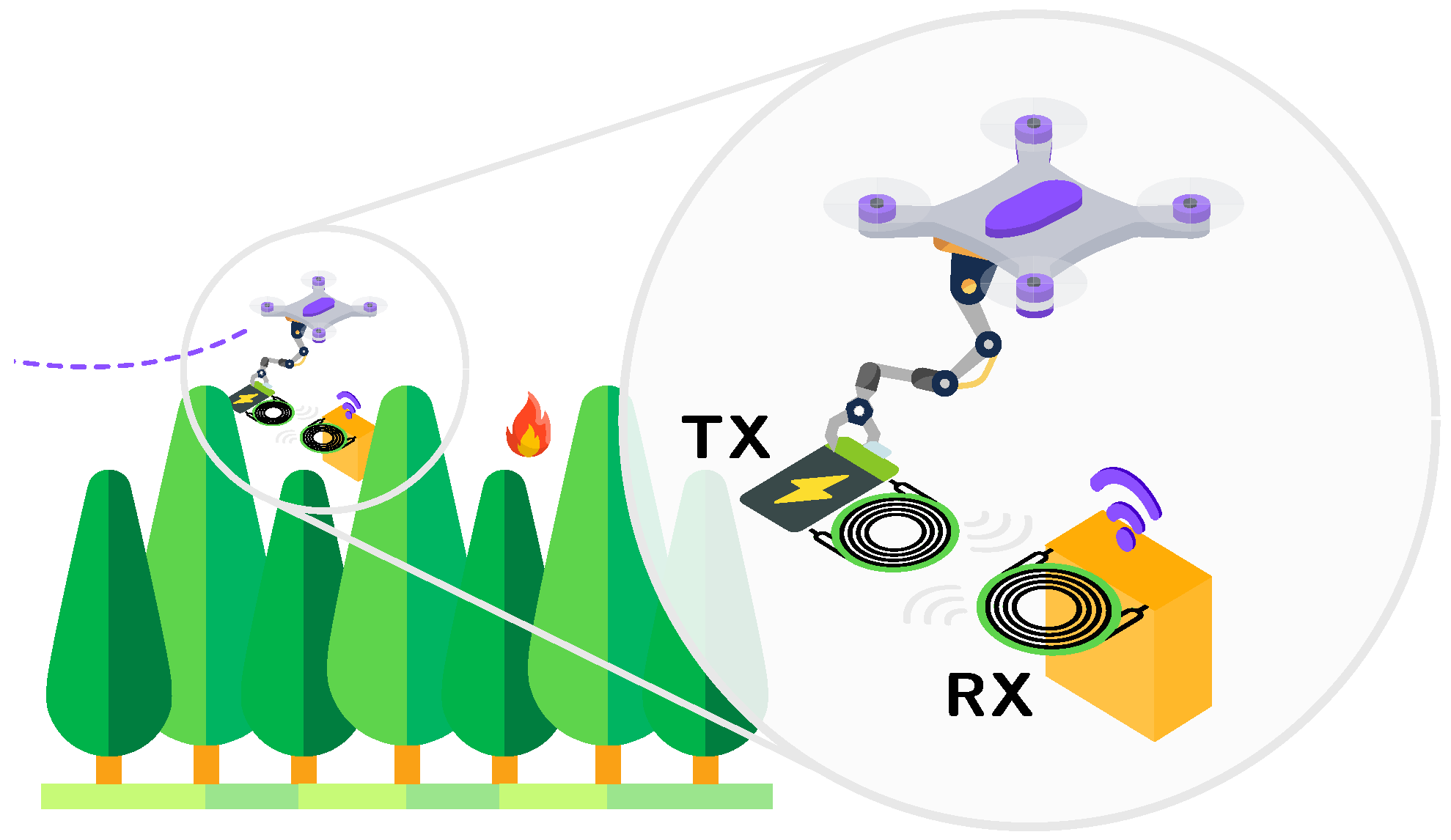
- It can supply energy to remote, energy-constrained IoT devices, even those with high energy demands.
- It enables battery recovery and recycling at EoL, preventing harmful components from being left in nature.
2. Battery Swapping Approach: High-Level Architecture
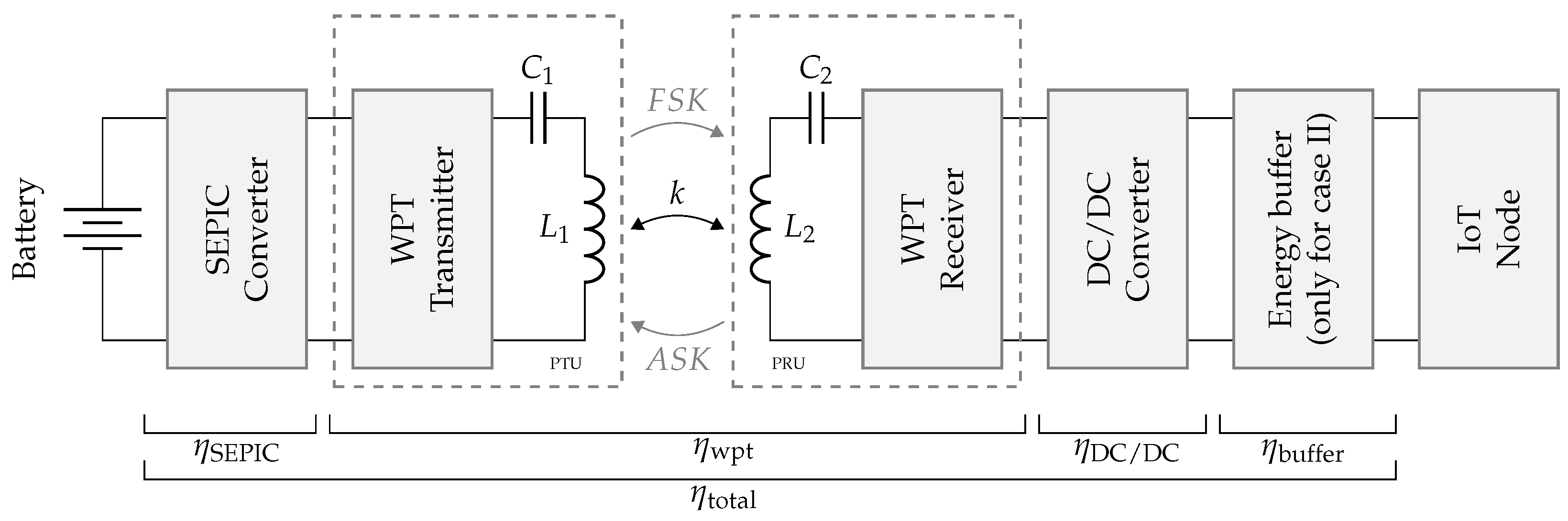
- In polling-based applications the sensors’ power can be interrupted, allowing the IoT node to work without a local energy buffer. A potential application of this configuration is in air-quality monitoring, where mostly periodic measurements are required [16].
- Interrupt-based applications require sensors to stay powered. To handle the continuous and unpredictable energy demands of the system, a smaller receiver-side energy buffer is needed. A typical application is sound monitoring, where interrupt-based threshold detection is commonly required to detect short-duration sound spikes [17].
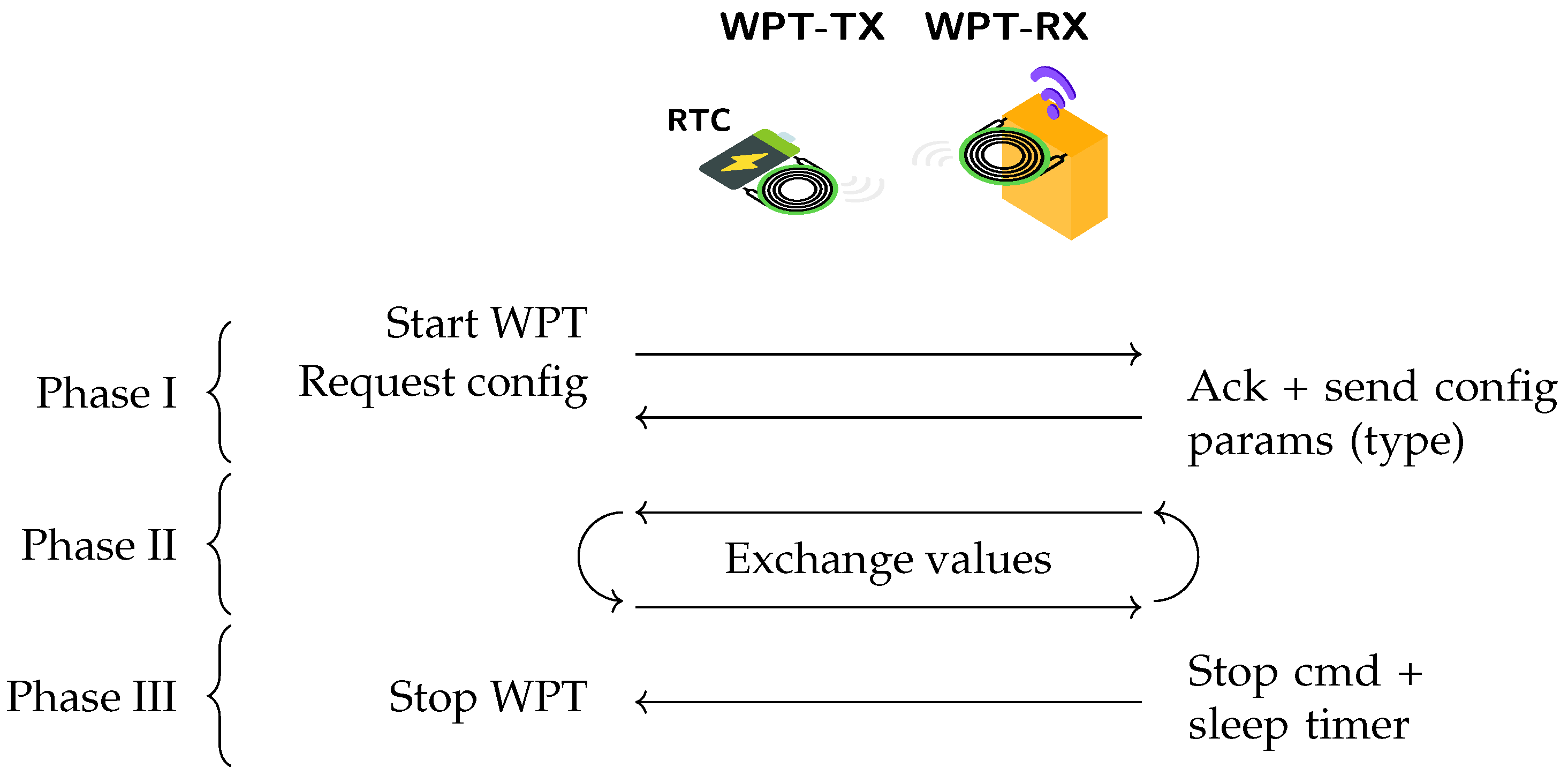
- Phase I (discovery): Communication is always initiated by the transmitter. If the receiver’s energy buffer is depleted, the transmitter first provides enough power to restore functionality and prevents the receiver from remaining discharged. Also, the ability to initiate communication from the receiver side would require additional components. A timer, by the use of a real-time clock (RTC), is kept at the transmitter, enabling and disabling the WPT circuit when energy is needed. A configuration request to the IoT node determines the application-specific WPT parameters. The IoT node stores the application parameters, i.e., type of application, time between measurements, and desired charge current, etc., in non-volatile memory.
- Phase II (energy transfer): After the discovery phase, the energy is transferred to the receiving IoT node. For polling-based operation, the receiving node directly uses the provided power to perform a functional operation, such as taking a measurement. For an interrupt-based system, the provided power is used to charge an energy buffer at the receiving side. The transmitter can be reused for both configurations, while the receiver will be different based on the type of configuration. At this stage, the energy transfer can be optimized by changing the transmitter’s amplitude to obtain an optimal load at the receiver.
- Phase III (termination): The IoT node signals when a measurement is completed, transfers the sleep time, and the system returns to a low-power mode until the next energy transfer. The battery transmitter includes an RTC for timekeeping and periodically enables the WPT link based on the sleep timer value it received. For polling-based operation, the timer value is fixed and periodic, and it is stored in non-volatile memory. A temporary polling interval change can be achieved, provided an update signal in downlink wireless communication can modify the sleep time variable at the IoT-node side. The required sleep time is transferred to the WPT transmitter after each measurement, which in turn changes the wake-up time for the next cycle. In the case of an interrupt-based system, the IoT node dynamically adjusts the sleep time of the transmitter with each charging cycle to keep the energy buffer sufficiently charged at the receiving side. This is done by carefully predicting when the charge of the energy buffer (in a worst-case scenario) will be empty, and therefore notifying the battery of this by changing the RTC timer compare value.
3. WPT Design
3.1. Overview of WPT
3.2. Swappable Battery as WPT Transmitter
3.3. IoT Node Add-On as WPT Receiver
4. System Validation and Performance Assessment
4.1. Efficiency of WPT Link with Transmitter and Receiver
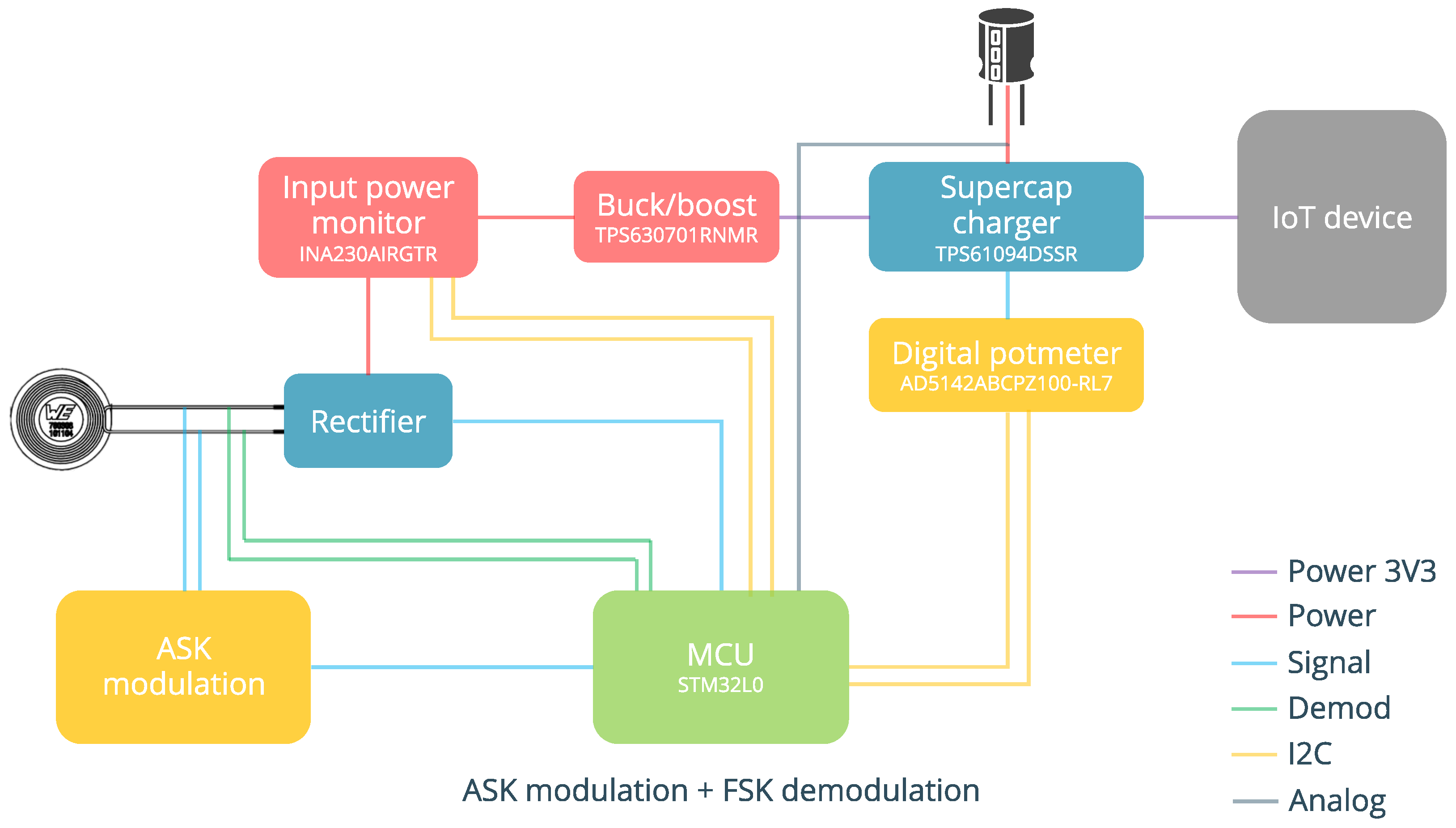
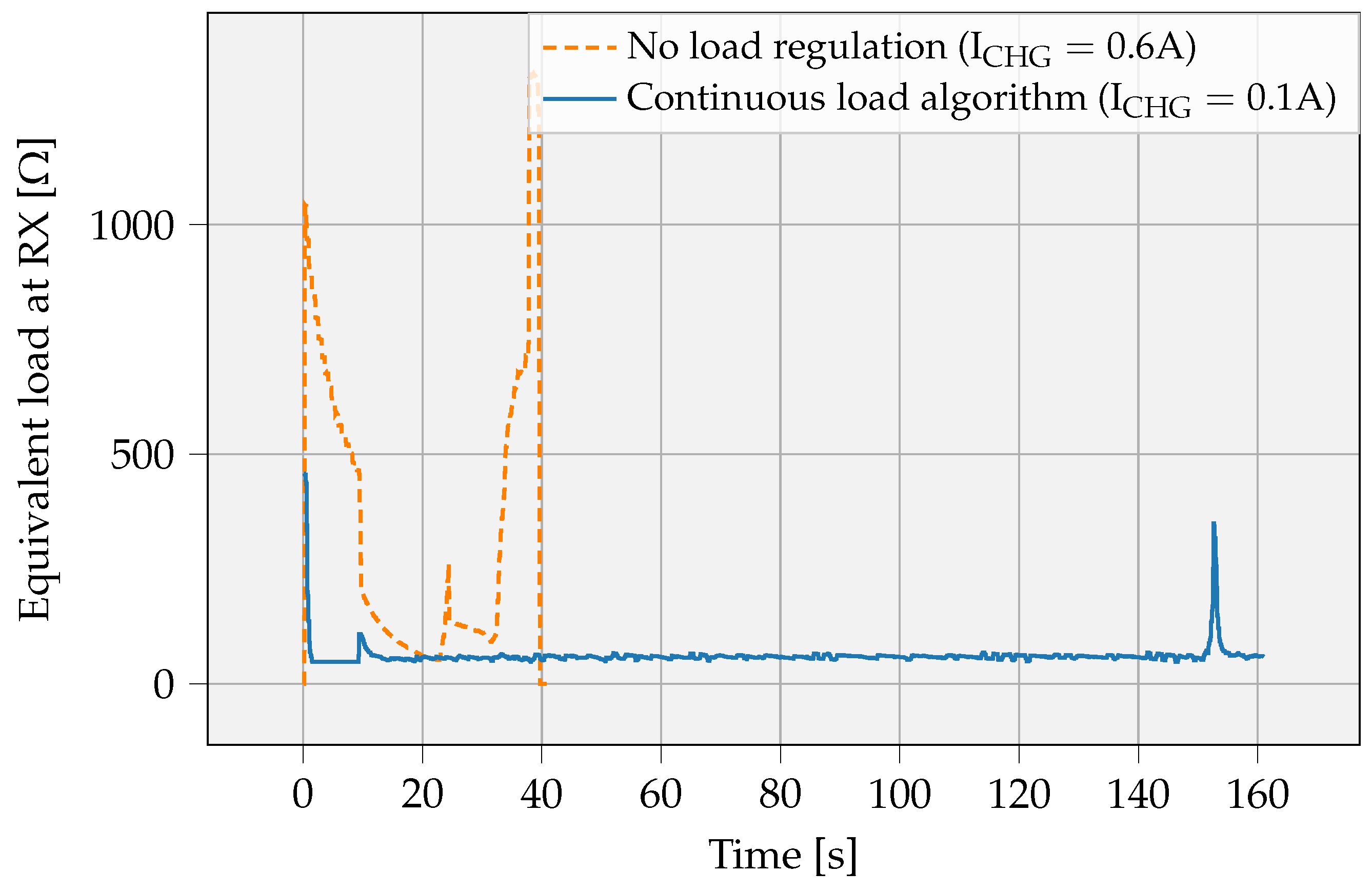
- Dynamically changing the amplitude of the transmitter, which changes the amplitude at the receiver. The supercapacitor can then be charged rapidly using a constant current. An example of this approach is given in Figure 8, where the equivalent load at the receiver is set to 60 . The transmitter dynamically adjusts its amplitude with a simple PID controller to match the desired load at the receiver. The equivalent output resistance at the receiver side is calculated based on the on-board INA230 power monitor from TI, with an 0.3% max gain error and 25 V offset [29].
- Charging with constant power, dynamically adjusting its charge current. This simplifies the WPT control mechanisms and keeps the WPT link parameters nearly constant. This is not further implemented in hardware.
4.2. Total System Efficiency
4.3. Comparison to Typical Systems
5. Sustainability Analysis and Discussion
5.1. Life Cycle Assessment of the Design
5.2. Selection of Energy Buffers
5.3. Comparison to Other Alternative Solutions
6. Conclusions and Future Work
Author Contributions
Funding
Data Availability Statement
Conflicts of Interest
References
- Hasan, K.; Tom, N.; Yuce, M.R. Navigating Battery Choices in IoT: An Extensive Survey of Technologies and Their Applications. Batteries 2023, 9, 580. [Google Scholar] [CrossRef] [Scilit]
- Callebaut, G.; Leenders, G.; Van Mulders, J.; Ottoy, G.; De Strycker, L.; Van der Perre, L. The Art of Designing Remote IoT Devices—Technologies and Strategies for a Long Battery Life. Sensors 2021, 21, 913. [Google Scholar] [CrossRef] [Scilit]
- Hossein Motlagh, N.; Taleb, T.; Arouk, O. Low-Altitude Unmanned Aerial Vehicles-Based Internet of Things Services: Comprehensive Survey and Future Perspectives. IEEE Internet Things J. 2016, 3, 899–922. [Google Scholar] [CrossRef] [Scilit]
- Williams, A.J.; Torquato, M.F.; Cameron, I.M.; Fahmy, A.A.; Sienz, J. Survey of Energy Harvesting Technologies for WSNs. IEEE Access 2021, 9, 77493–77510. [Google Scholar] [CrossRef] [Scilit]
- Czyża, S.; Szuniewicz, K.; Kowalczyk, K.; Dumalski, A.; Ogrodniczak, M.; Zieleniewicz, L. Assessment of Accuracy in Unmanned Aerial Vehicle (UAV) Pose Estimation with the REAL-Time Kinematic (RTK) Method on the Example of DJI Matrice 300 RTK. Sensors 2023, 23, 2092. [Google Scholar] [CrossRef] [Scilit]
- Grlj, C.G.; Krznar, N.; Pranjić, M. A Decade of UAV Docking Stations: A Brief Overview of Mobile and Fixed Landing Platforms. Drones 2022, 6, 17. [Google Scholar] [CrossRef] [Scilit]
- Cui, Y.; Wang, C.; Hu, Q.; Xu, B.; Song, X.; Yuan, Z.; Zhu, Y. A Novel Positioning Method for UAV in GNSS-Denied Environments Based on Mechanical Antenna. IEEE Trans. Ind. Electron. 2024, 71, 13461–13469. [Google Scholar] [CrossRef] [Scilit]
- Delabie, D.; Feys, T.; Buyle, C.; Cox, B.; Van der Perre, L.; De Strycker, L. Echoes of Accuracy: Enhancing Ultrasonic Indoor Positioning for Energy-Neutral Devices With Neural Network Approaches. IEEE J. Indoor Seamless Position. Navig. 2025, 3, 227–244. [Google Scholar] [CrossRef] [Scilit]
- Hu, Y.; Yuan, X.; Zhang, G.; Schmeink, A. Sustainable Wireless Sensor Networks With UAV-Enabled Wireless Power Transfer. IEEE Trans. Veh. Technol. 2021, 70, 8050–8064. [Google Scholar] [CrossRef] [Scilit]
- Cetinkaya, O.; Ozger, M.; De Roure, D. Coverage Performance of UAV-Powered Sensors for Energy-Neutral Networks with Recharging Stations. In Proceedings of the ICC 2023—IEEE International Conference on Communications, Rome, Italy, 28 May–1 June 2023; pp. 2902–2908. [Google Scholar] [CrossRef] [Scilit]
- Liu, Y.; Dai, H.N.; Wang, H.; Imran, M.; Wang, X.; Shoaib, M. UAV-enabled data acquisition scheme with directional wireless energy transfer for Internet of Things. Comput. Commun. 2020, 155, 184–196. [Google Scholar] [CrossRef] [Scilit]
- De Silva, S.C.; Phlernjai, M.; Rianmora, S.; Ratsamee, P. Inverted Docking Station: A Conceptual Design for a Battery-Swapping Platform for Quadrotor UAVs. Drones 2022, 6, 56. [Google Scholar] [CrossRef] [Scilit]
- Hoang, M.; Ov, A.; Chen, S.; Huynh, D.; Vega, J.; Kim, N.; Karwal, Y.; Dobbs, S.; Yu, Z. Design of Autonomous Battery Swapping for UAVs. In Proceedings of the AIM, 2024, San Francisco, CA, USA, 10–13 June 2024; pp. 353–358. [Google Scholar] [CrossRef] [Scilit]
- Van Mulders, J.; Cappelle, J.; Goossens, S.; De Strycker, L.; Van der Perre, L. UAV-Based Servicing of IoT Nodes: Assessment of Ecological Impact. Sensors 2023, 23, 2291. [Google Scholar] [CrossRef] [Scilit] [PubMed]
- Cappelle, J. DRAMCO Github. Available online: https://github.com/DRAMCO/Contactless-Battery-Solution-for-Sustainable-IoT-Devices (accessed on 20 January 2025).
- Saini, J.; Dutta, M.; Marques, G. A comprehensive review on indoor air quality monitoring systems for enhanced public health. Sustain. Environ. Res. 2020, 30, 6. [Google Scholar] [CrossRef] [Scilit]
- Buyle, C.; Thoen, B.; Cox, B.; Alleman, M.; Wielandt, S.; De Strycker, L. Ultra-Low-Power Smart Sensing Platform for Urban Sound Event Monitoring. In Proceedings of the 2019 Symposium on Information Theory and Signal Processing in the Benelux. WIC, Ghent, Belgium, 28–29 May 2019; pp. 35–40. Available online: https://w-i-c.org/proceedings/proceedings_SITB2019.pdf (accessed on 9 September 2025).
- ITS-PE-1010—Red Magnetics. Available online: https://www.red-magnetics.com/en/product-groups/electromagnets/permanent-electromagnets/its-pe-1010/ (accessed on 2 January 2025).
- Graniteriverlabs. Evolution of Qi Wireless Charging Standard & What’s New with Qi2. Available online: https://www.graniteriverlabs.com/en-us/technical-blog/qi2-wireless-charging-standards-evolution (accessed on 9 September 2025).
- van Schuylenbergh, K.; Puers, R. Inductive Powering: Basic Theory and Application to Biomedical Systems; Analog Circuits and Signal Processing; Springer: Dordrecht, The Netherlands, 2009. [Google Scholar]
- Shevchenko, V.; Husev, O.; Strzelecki, R.; Pakhaliuk, B.; Poliakov, N.; Strzelecka, N. Compensation Topologies in IPT Systems: Standards, Requirements, Classification, Analysis, Comparison and Application. IEEE Access 2019, 7, 120559–120580. [Google Scholar] [CrossRef] [Scilit]
- Karimi, M.J.; Jin, M.; Zhou, Y.; Dehollain, C.; Schmid, A. Wirelessly Powered and Bi-Directional Data Communication System With Adaptive Conversion Chain for Multisite Biomedical Implants Over Single Inductive Link. IEEE Trans. Biomed. Circuits Syst. 2024, 18, 636–647. [Google Scholar] [CrossRef] [Scilit] [PubMed]
- Wireless Power Consortium. Qi Specification v2.1. Available online: https://www.wirelesspowerconsortium.com/media/303pxv0x/qi-v21-public.zip (accessed on 10 September 2025).
- Peters, J.F.; Baumann, M.; Zimmermann, B.; Braun, J.; Weil, M. The environmental impact of Li-Ion batteries and the role of key parameters—A review. Renew. Sustain. Energy Rev. 2017, 67, 491–506. [Google Scholar] [CrossRef] [Scilit]
- Science, L. Europe’s ‘New’ Periodic Table Predicts Which Elements Will Disappear in the Next 100 Years. Available online: https://www.livescience.com/64596-new-periodic-table-shows-helium-scarcity.html (accessed on 7 November 2022).
- PulsesPlus™ Series—Tadiran Batteries. Available online: https://tadiranbat.com/products/pulsesplus-series/ (accessed on 3 January 2025).
- Peaktech. Peaktech 6225A User Manual. Available online: https://www.peaktech.de/media/60/9a/e5/1703674474/PeakTech_6225A_6226_12-2023_DE-EN.pdf (accessed on 2 October 2025).
- Korad. Korad KEL103 Electronic Load User Manual. Available online: https://static.eleshop.nl/mage/media/downloads/kel-103_user_manual.pdf (accessed on 2 October 2025).
- TI. INA230 36V, 16-Bit, I2C Output Current, Voltage and Power Monitor with Alert Datasheet. Available online: https://www.ti.com/lit/ds/symlink/ina230.pdf (accessed on 2 October 2025).
- Kao, S.K. A CMOS Active Rectifier with Time Domain Technique to Enhance PCE. Electronics 2021, 10, 1450. [Google Scholar] [CrossRef] [Scilit]
- Eaton. The Major Differences Between Supercapacitors and Batteries; Technical Report; Eaton: Norwich, UK, 2022. [Google Scholar]
- Sphera. Product Sustainability (GaBi) Data Search Sphera. Available online: https://sphera.com/product-sustainability-gabi-data-search/ (accessed on 24 November 2023).
- Earthster. EF3.1 Impact Categories|Earthster Knowledge Base. Available online: https://docs.earthster.org/en/articles/6840014-ef3-1-impact-categories (accessed on 6 March 2025).
- STMicroelectronics. STM32 wireless MCUs. Available online: https://www.st.com/en/microcontrollers-microprocessors/stm32-wireless-mcus.html?fbclid=IwY2xjawF– (accessed on 18 August 2025).
- TI. The Importance of Ensuring Supply for Foundational Semiconductor Chips. Available online: https://www.ti.com/about-ti/newsroom/company-blog/the-importance-of-ensuring-supply-for-foundational-semiconductor-chips.html (accessed on 13 August 2025).
- STMicroelectronics. BCD—Bipolar-CMOS-DMOS. Available online: https://www.st.com/content/st_com/en/about/innovation---technology/BCD.html (accessed on 13 August 2025).
- Daryanani, S. GaN Power ICs Lead the Way to Sustainability. Available online: https://www.powerelectronicsnews.com/gan-power-ics-lead-the-way-to-sustainability/ (accessed on 14 August 2025).
- Gómez, P.; Elduque, D.; Pina, C.; Javierre, C. Influence of the Composition on the Environmental Impact of Soft Ferrites. Materials 2018, 11, 1789. [Google Scholar] [CrossRef] [Scilit]
- Pirson, T.; Bol, D. Assessing the embodied carbon footprint of IoT edge devices with a bottom-up life-cycle approach. J. Clean. Prod. 2021, 322, 128966. [Google Scholar] [CrossRef] [Scilit]
- Moreau, N.; Pirson, T.; Le Brun, G.; Delhaye, T.; Sandu, G.; Paris, A.; Bol, D.; Raskin, J.P. Could Unsustainable Electronics Support Sustainability? Sustainability 2021, 13, 6541. [Google Scholar] [CrossRef] [Scilit]
- TI. bq5105xB High-Efficiency Qi v1.2-Compliant Wireless Power Receiver and Battery Charger Datasheet. Available online: https://www.ti.com/lit/ds/symlink/bq51051b.pdf (accessed on 11 September 2025).
- BU-205: Types of Lithium-Ion—Battery University. Available online: https://batteryuniversity.com/article/bu-205-types-of-lithium-ion (accessed on 14 August 2025).
- Cossutta, M.; Vretenar, V.; Centeno, T.A.; Kotrusz, P.; McKechnie, J.; Pickering, S.J. A comparative life cycle assessment of graphene and activated carbon in a supercapacitor application. J. Clean. Prod. 2020, 242, 118468. [Google Scholar] [CrossRef] [Scilit]
- Kamali, A.K.; Glogic, E.; Keppetipola, N.M.; Sonnemann, G.; Toupance, T.; Cojocaru, L. Prospective Life Cycle Assessment of Two Supercapacitor Architectures. Acs Sustain. Chem. Eng. 2023, 11, 15898–15909. [Google Scholar] [CrossRef] [Scilit]
- Raffeck, P.; Posner, S.; Wagemann, P. CO2CoDe: Towards Carbon-Aware Hardware/Software Co-Design for Intermittently-Powered Embedded Systems. Sigenergy Energy Inform. Rev. 2025, 4, 127–133. [Google Scholar] [CrossRef] [Scilit]
- Supercapacitors—LIGNA Energy. Available online: https://www.lignaenergy.com/ (accessed on 13 August 2025).
- Sun, J.; Luo, B.; Li, H. A Review on the Conventional Capacitors, Supercapacitors, and Emerging Hybrid Ion Capacitors: Past, Present, and Future. Adv. Energy Sustain. Res. 2022, 3, 2100191. [Google Scholar] [CrossRef] [Scilit]
- Ulrich, S.; Trench, A.; Hagemann, S. Gold mining greenhouse gas emissions, abatement measures, and the impact of a carbon price. J. Clean. Prod. 2022, 340, 130851. [Google Scholar] [CrossRef] [Scilit]
- Song, J.; Koch, C.; Wang, L. Correlation between Wear Resistance and Lifetime of Electrical Contacts. Adv. Tribol. 2012, 2012, 893145. [Google Scholar] [CrossRef] [Scilit]
- Bondhus, B. Gold Plating Thickness of Connectors and Contacts. Available online: https://advancedplatingtech.com/wp-content/uploads/2018/04/Gold-Plating-Thickness-Blog-Advanced-Plating-Technologies-1.pdf (accessed on 1 October 2025).
- Eurostat. Hourly Labour Costs. Available online: https://ec.europa.eu/eurostat/statistics-explained/index.php?title=Hourly_labour_costs (accessed on 3 October 2025).
- Rodrigues, T.A.; Patrikar, J.; Oliveira, N.L.; Matthews, H.S.; Scherer, S.; Samaras, C. Drone flight data reveal energy and greenhouse gas emissions savings for very small package delivery. Patterns 2022, 3, 100569. [Google Scholar] [CrossRef] [Scilit] [PubMed]
- Liu, X.; Clare, L.; Yuan, X.; Wang, C.; Liu, J. A Design Method for Making an LCC Compensation Two-Coil Wireless Power Transfer System More Energy Efficient Than an SS Counterpart. Energies 2017, 10, 1346. [Google Scholar] [CrossRef] [Scilit]



| Component | Specification |
|---|---|
| TX Coil | WE 760308101104, Q-factor: 42 |
| Diameter: 2.05 cm, Max current: 2.5 A | |
| RX Coil | WE 760308105214, Q-factor: 15 |
| Diameter; 1.9 cm, Max current: 1.5 A | |
| Operating frequency | 360 kHz |
| Switching transistor | EPC8010 (EPC) |
| Half bridge driver | LMG1210 (TI) |
| Rectifier diode | PD3S140-7 (Diodes Incorporated) |
| Buck–boost converter | TPS63070 (TI) |
| Supercap charger | TPS61094 (TI) |
| Distance | Coupling Factor (k) |
|---|---|
| 0 mm | 0.82 |
| 2 mm | 0.53 |
| 5 mm | 0.35 |
| Approach | Efficiency * | Sustainability | Maintenance | Applicability |
|---|---|---|---|---|
| Fire-and-forget IoT | 90% (DC/DC converter) | - Short device lifetime - Non-replaceable batteries lead to high e-waste levels - Discarded at EoL | - Requires manual replacement - Impractical in remote areas | Only low-power systems |
| Energy harvesting (solar, RF, motion, etc.) | 71% (energy buffer losses) | + Avoids replacement if sufficient energy - Discarded at EoL | + No manual replacement if harvesting is sufficient - Still a problem at EoL | When enough energy can be harvested, dependent on environmental conditions |
| Contact-based battery swapping | 90% (DC/DC converter) | + Enables battery recovery - Requires robust gold plating | - Mechanically complex - Exposed contacts corrode, may need manual cleaning | Only in non-harsh scenarios |
| Full device replacement by UAV | 90% (battery integrated, no WPT losses) | - Poor when replacing full device + Good when battery is changed off-site | - High cost when replacing full device - Manual labor when changing battery off-site | Robust to many applications if fully encapsulated |
| Contactless battery solution (this work) | 46–58% (interrupt vs. polling-based) | + Enables automated battery recovery + Reduces long-term e-waste - Extra hardware needed | + Simplifies UAV-based automated swapping + No manual intervention | Suitable for harsh/remote environments, fully sealed, corrosion-free |
Disclaimer/Publisher’s Note: The statements, opinions and data contained in all publications are solely those of the individual author(s) and contributor(s) and not of MDPI and/or the editor(s). MDPI and/or the editor(s) disclaim responsibility for any injury to people or property resulting from any ideas, methods, instructions or products referred to in the content. |
© 2025 by the authors. Licensee MDPI, Basel, Switzerland. This article is an open access article distributed under the terms and conditions of the Creative Commons Attribution (CC BY) license (https://creativecommons.org/licenses/by/4.0/).
Share and Cite
Cappelle, J.; De Strycker, L.; Van der Perre, L. Contactless Battery Solution for Sustainable IoT Devices: Assessment of Environmental Impact. Electronics 2025, 14, 4140. https://doi.org/10.3390/electronics14214140
Cappelle J, De Strycker L, Van der Perre L. Contactless Battery Solution for Sustainable IoT Devices: Assessment of Environmental Impact. Electronics. 2025; 14(21):4140. https://doi.org/10.3390/electronics14214140
Chicago/Turabian StyleCappelle, Jona, Lieven De Strycker, and Liesbet Van der Perre. 2025. "Contactless Battery Solution for Sustainable IoT Devices: Assessment of Environmental Impact" Electronics 14, no. 21: 4140. https://doi.org/10.3390/electronics14214140
APA StyleCappelle, J., De Strycker, L., & Van der Perre, L. (2025). Contactless Battery Solution for Sustainable IoT Devices: Assessment of Environmental Impact. Electronics, 14(21), 4140. https://doi.org/10.3390/electronics14214140