You are currently viewing a new version of our website. To view the old version click .
Electronics
  • Article
  • Open Access

9 May 2023

A Requirement Quality Assessment Method Based on User Stories
,
,
,
,
and
College of Systems Engineering, National University of Defense Technology, Changsha 410073, China
*
Author to whom correspondence should be addressed.
This article belongs to the Topic Advanced Systems Engineering: Theory and Applications

Abstract

Agile development processes based on user stories often face issues such as incomplete, inconsistent, and inaccurate user requirements, which increase the workload of agile development teams and reduce the efficiency of product function development, ultimately resulting in the inability to respond quickly to user requirements. This paper proposes a user requirement quality assessment method based on user stories to address these problems. This method relies on the agile development process, constructs a user requirement quality assessment framework, defines a user story model and a user requirement quality model, develops seven user requirement quality assessment criteria, and designs a user requirement quality assessment process. A data experiment exploring the development of smartphone requirements is used to validate the feasibility and effectiveness of the method. The experimental results demonstrate that the method improves user requirement quality to some extent, providing an automated solution for agile development teams to enhance user requirement quality.

1. Introduction

Agile development is a prominent research direction in requirements engineering. Recently, novel advancements in theory have emerged, while abundant practical experience has been obtained in various enterprise operations in the Internet and big data environments [1]. At its core, agile development is a development method that responds to quickly changing user requirements through iterative, small-scale, and rapid development and functionality delivery, ultimately allowing for a rapid response to user requirements and the continuous optimization of function design [2]. Compared to the traditional waterfall approach, agile development has a significant advantage in dealing with unclear or changing requirements, and can greatly minimize the risk of costly user requirement changes in the later stages of project development [3].
The successful implementation of agile development in a project relies on the efficient, rapid, and accurate flow of information between organizations or members [4]. Of all kinds of information, user requirements are of the utmost importance, serving as the core of agile development teams. Inaccurate requirements can impede progress, drastically impact the quality of the delivered product, and even damage the morale of the development team. Consequently, high-quality user requirements can be seen as a “catalyst” that provides a solid foundation in the early stages of a project, bolsters the positive feedback of iterative development, leads the entire project development process in a virtuous cycle, and ultimately results in a product that effectively meets user needs. Requirements play a crucial role in project development across various fields. For example, in research on optical wireless communication systems based on smartphone cameras, the technology requirements of smartphone cameras play a critical and leading role in generating solutions for optical camera communication [5]. In the field of the model-based design of cyber-physical systems, traceability from requirements to the model to the simulation results has become increasingly important [6]. In the development of mobile learning applications, inappropriate technology requirements will affect the quality and increase the development cost of mobile learning applications [7]. Additionally, in the Internet environment, users can add their comments as feedback in the mobile application store, and this feedback can be considered a requirement and analyzed through natural language processing to improve the software quality and functionality of mobile applications [8,9].
In agile development, user stories are commonly used as the source of user requirements instead of traditional requirement specifications. A user story is composed of three elements, namely role, activity, and value, and is usually expressed as “What ‘Activity’ a ‘role’ wants to accomplish to achieve what ‘Value’” [10,11]. By collecting a large number of user stories, agile development teams can quickly comprehend user requirements, allowing for rapid response and iteration. However, in many project practices, the agile development process with user stories as a tool is not always implemented smoothly [12,13]. This is mainly due to the wide source of user requirements, as well as different cultural backgrounds, abilities, and cooperation degrees of users, causing most of the collected user stories to be incomplete, inconsistent, and inaccurate, thereby reducing the usability of user requirement information and seriously affecting the efficiency of agile development.
The traditional approach to these problems involves setting guidelines prior to collecting user stories. The INVEST (independent, negotiable, valuable, estimable, small, testable) principles provide a framework for evaluating the quality of user stories [14]. Agile teams typically analyze user stories through manual review after collection and by filtering out qualified stories for development. While these strategies improve quality to some extent, they are impractical when the number of user stories is large. Investing too much time and effort in review can burden the agile team, impeding iteration speed and making it difficult to meet requirements on time. Thus, given the pragmatic requirements of agile development practices, it is critical to construct a scientific, automatic, and effective user requirement quality assessment method to assist agile teams in improving requirement quality and development efficiency.
The main contribution of this paper is the construction of a user requirement quality assessment method based on user stories in agile development. By constructing a user story model and combining it with the INVEST criteria, seven user requirement quality assessment criteria are established, and a user requirement quality model is generated. This achieves a transformation of the concept of “user requirement quality” from abstraction to concreteness and from qualitative to quantitative, providing an automated solution for user requirement quality assessment in agile development. Through a data experiment on smartphones, the feasibility and effectiveness of the method proposed in this paper are confirmed.
The remaining parts of the paper are organized as follows: related works are reviewed in Section 2; the framework of user requirement quality assessment is introduced in Section 3; the model design is detailed in Section 4; the experimental results are discussed in Section 5; the summary and prospects of this study are discussed in Section 6.

3. User Requirement Quality Assessment Framework

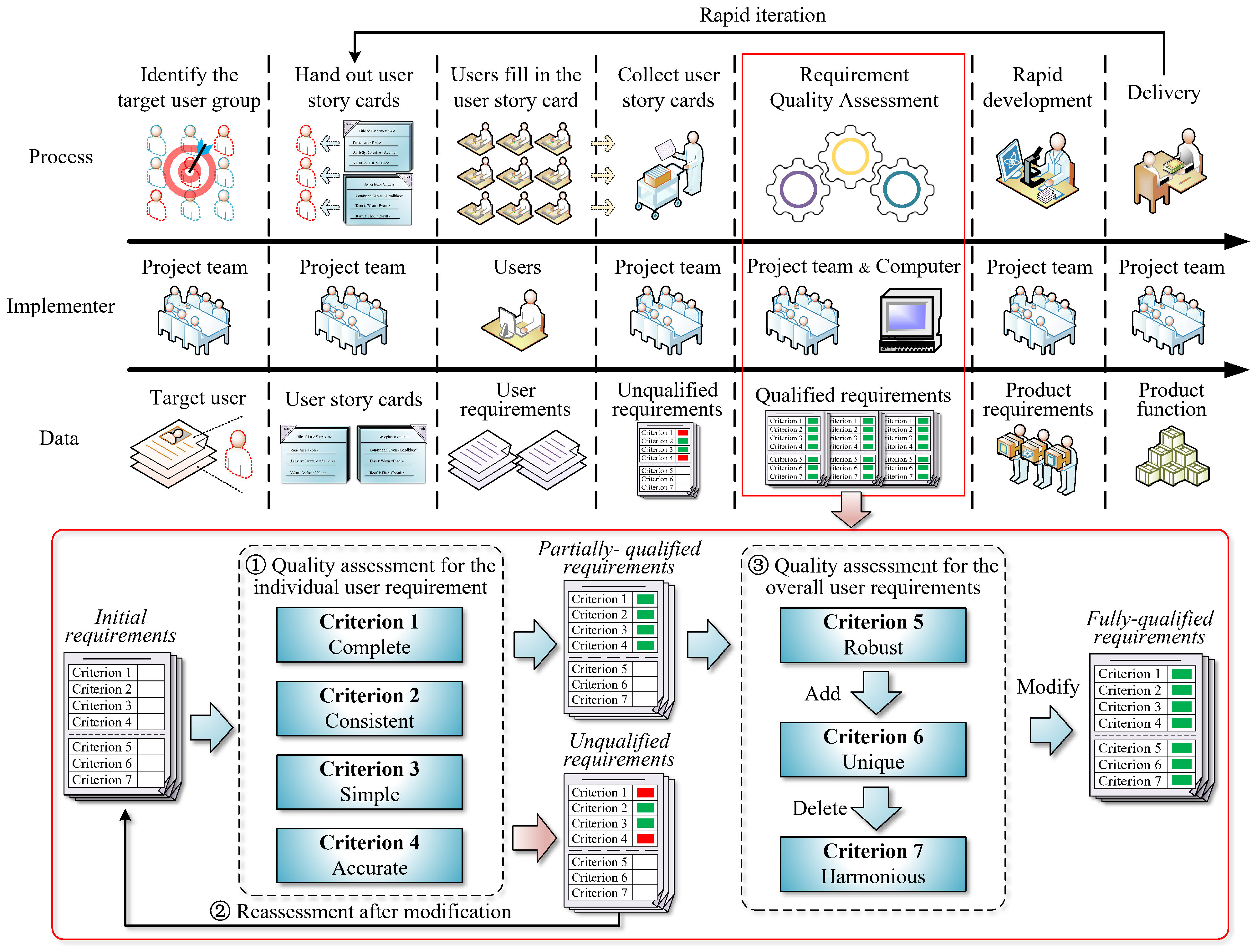
The agile development process is illustrated in Figure 1, which is extended with the overall framework of requirement quality assessment in this paper. When the requirements are not clearly specified, the project team should start by identifying target users and forming a target user group. Subsequently, user story cards are distributed to the target user group, and the purpose and standards of filling in the cards are explained to them. After the user story cards are filled out, they are collected back by the project team. Then, the quality of user requirements is automatically evaluated by computers, and only qualified user requirements are fed into fast development. Finally, the product or function is delivered to the user, and the rapid iteration of product development is achieved through user feedback.
Figure 1. Framework for user requirement quality assessment in agile development.
As illustrated in Figure 1, the quality assessment of user requirements is conducted from two perspectives: individual user requirements and overall user requirements. Based on seven quality assessment criteria, the process is divided into three steps. First, an individual user requirement is assessed from four aspects: complete, consistent, simple, and accurate. Second, unqualified requirements are fed back to the users and modified. Finally, the overall quality assessment of all requirements with partially qualified quality is conducted from three aspects: robust, unique, and harmonious. Fully qualified user requirements are generated by adding, deleting, and modifying requirements. The seven assessment criteria are further explicated in the following section.

4. Model Design

In agile development, a user story is the primary vehicle for conveying user requirements. Agile development teams organize target users to fill in user story cards and obtain more detailed user requirements after analyzing a large number of user story cards. Therefore, this paper constructs a user story model and user requirement quality model to realize the quantitative analysis of requirement quality assessment.

4.1. User Story Model

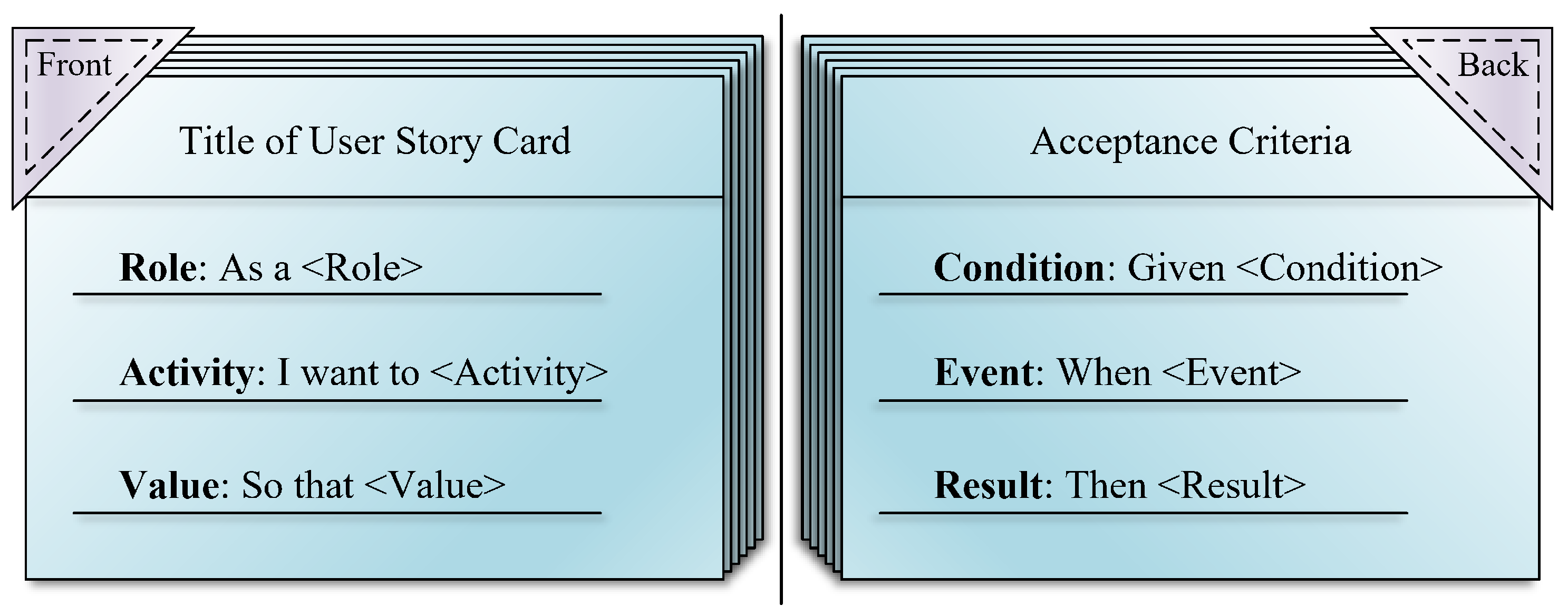
The user story is an essential tool utilized in agile development to enable developers to rapidly acquire user requirements. An illustration of a user story card is presented in Figure 2.
Figure 2. User story card.
As illustrated in Figure 2, the front of the card outlines the three essential elements of the user story: “role”, “activity”, and “value”. “Role” explains the individual (or user) of the user story. “Activity” specifies the activity the user wishes that needs to be complete or the demands of the feature. “Value” outlines the aim or the benefit to the user after completing this activity. The back of the card provides the regulations and acceptance criteria for the user story. If the system’s response adheres to the rules or acceptance criteria of the user story when the events given in the acceptance criteria occur, then the user story’s requirements have been met.
Combined with the definition of the user story, the user story model is constructed, as illustrated in Equation (1):
U S = R , A , V , C , E , R E
where R is the “role” of the story, A is the “activity” of the story, V is the “value” of the story, and V points to a requirement goal in the requirement goal set G, denoted as V G i . R , A , V forms the description on the front of the user story card. C represents the “condition” of the user story, E represents the “event” of the user story, and R E represents the “result” of the user story. C , E , R E forms the validation information on the back of the user story card.
New energy vehicles (NEVs) are vehicles that utilize alternative energy sources as their primary power source. These alternative energy sources include electricity, hydrogen fuel cells, and hybrid technologies. NEVs can reduce—or even eliminate—emissions and dependence on fossil fuels, and play an important role in the transition toward sustainable transportation. Table 1 is an exemplary user story model used to elucidate the functional requirements of NEVs.
Table 1. Example of a user story model.

4.2. User Requirement Quality Model

User requirements are expressed through user stories, and the quality of these requirements is determined by the accuracy and clarity of these stories. Therefore, INVEST guidelines for writing user stories can be used as a reference for assessing the quality of user requirements. Combined with several key attributes of quality requirements outlined by Lloyd [16], this paper proposes seven criteria for assessing the quality of user requirements from both individual user requirement and overall user requirement perspectives, as depicted in Table 2.
Table 2. Assessment criteria for the quality of user requirements.
According to the above criteria, the user requirement quality model is constructed, as shown in Equation (2):
U R Q = S 1 , S 2 , S 3 , S 4 , S 5 , S 6 , S 7
where S 1 S 7 represent the performance of user requirement quality under criterion 1 to criterion 7, respectively. S 1 , S 2 , S 3 , S 4 constitutes the quality performance set of the individual user requirements, while S 5 , S 6 , S 7 constitutes the quality performance set of the overall user requirements.
Since the processing of user requirement expression involves natural language processing technology, this paper further defines the calculation methods of S 1 S 7 in combination with the natural language toolkit in Python, as illustrated in Table 3.
Table 3. Calculation methods of S 1 S 7 .
It should be noted that the calculation method of S 6 utilizes a semantic similarity calculation method based on the vector space model [38]. This method is capable of rapidly calculating semantic similarity within a certain scope of text, and the principle will not be discussed in this paper. Through this model, the abstract nature of user requirements can be made concrete. Coupled with the customization algorithm, a large number of user stories can be processed by a computer automatically to quickly calculate the qualified quality of individual user requirements and the overall user requirements under the seven criteria. In conclusion, the automatic quality assessment of user requirements in agile development with user stories as the primary source of requirements can be achieved.

5. Experimental Results

To verify the effectiveness and feasibility of the proposed method in this paper, this study invited 20 smartphone users from different industries and age groups to fill out user cards, and used all the user cards filled out by the users as input data to validate the effectiveness and feasibility of the model. The specific process is as follows:
Step 1—Generating the user requirement framework of the smartphone: By analyzing the functional features and specification parameters of the smartphones, this paper summarizes the user requirements framework of a smartphone, as shown in Table A1 in Appendix A. This framework contains a total of 34 requirement items divided into 4 categories (appearance, usability, economy, and entertainment). These requirement items can help users fill out user story cards, and serve as the requirement goal of agile development teams to continuously guide the research and development of products and the design of functions.
Step 2—Organizing users to fill out user cards based on the smartphone requirement framework: The research group organized a special seminar, and invited 20 smartphone users from various industries and age groups to participate. The user requirement framework for smartphones was provided as a reference, and user story cards filled out by the participants were collected and analyzed. A total of 136 user stories about smartphones were obtained, and Table 4 presents an example of one of these user stories.
Table 4. A user story created by a smartphone user.
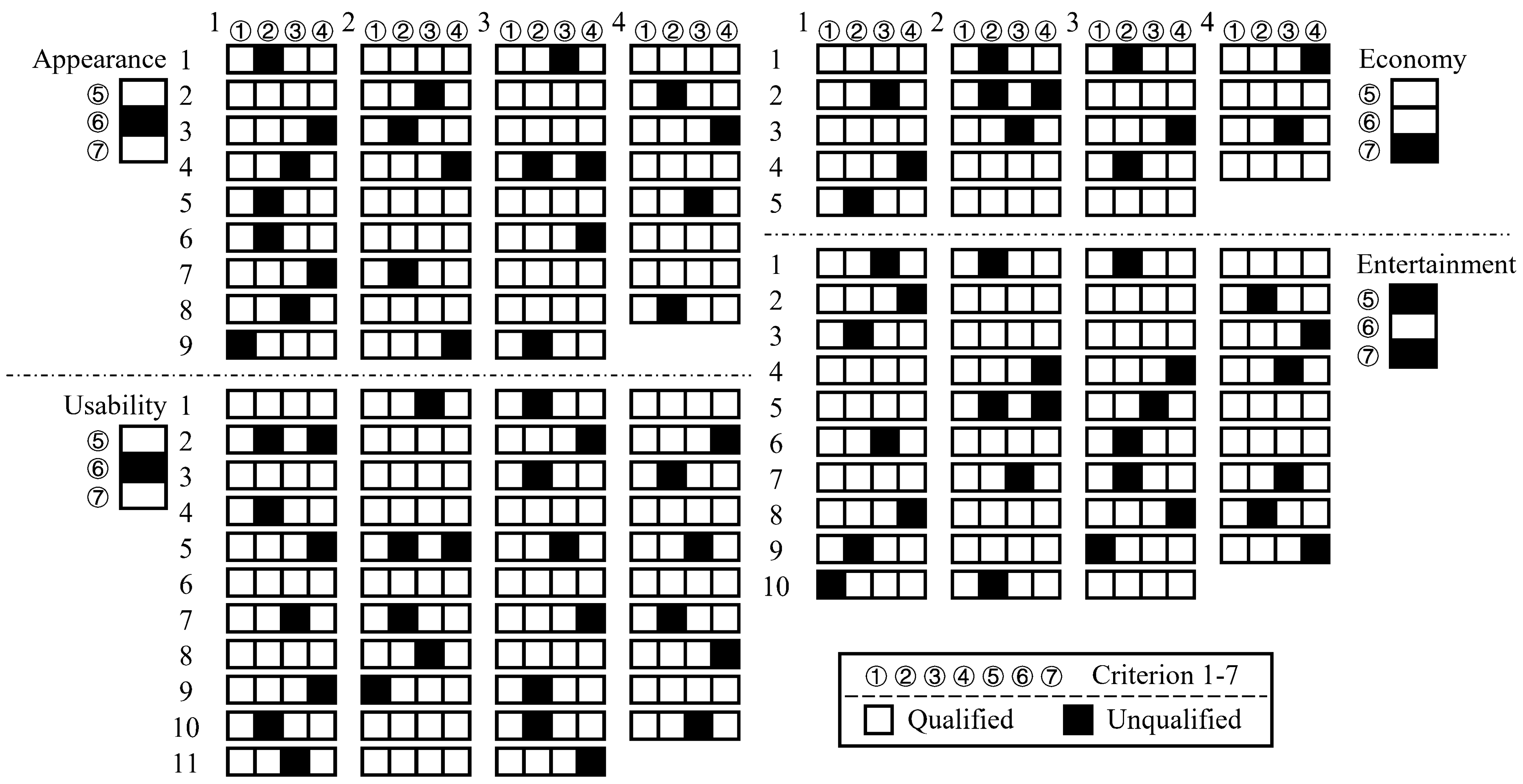
Step 3—Manually assessing and annotating the quality performance of user stories: The 136 user stories were manually assessed according to seven criteria, and their compliance with the quality assessment was marked. The results of the manual assessment were used as a benchmark dataset to support the validation of the effectiveness of the method, as shown in Figure 3, where the circled numbers indicate the criteria numbers for requirement quality assessment, the black squares represent “unqualified”, and the white squares represent “qualified”.
Figure 3. Manual assessment results of requirement quality for 136 user stories.
Step 4—Assessing the quality of user stories with the proposed model and determining the statistical experimental results: By evaluating the requirement quality of 136 user stories using the proposed method in this paper and comparing the results with the manually labeled data, experimental data were obtained to verify the effectiveness of the model, as shown in Table 5, where TP represents the number of cases that were manually annotated as “qualified” while the model assessment result was also “qualified”; FP represents the number of cases that were manually annotated as “unqualified” while the model assessment result was “qualified”; FN represents the number of cases that were manually annotated as “qualified” while the model assessment result was “unqualified”; and TN represents the number of cases that were manually annotated as “unqualified” while the model assessment result was also “unqualified”.
Table 5. The experimental results data after statistical analysis.
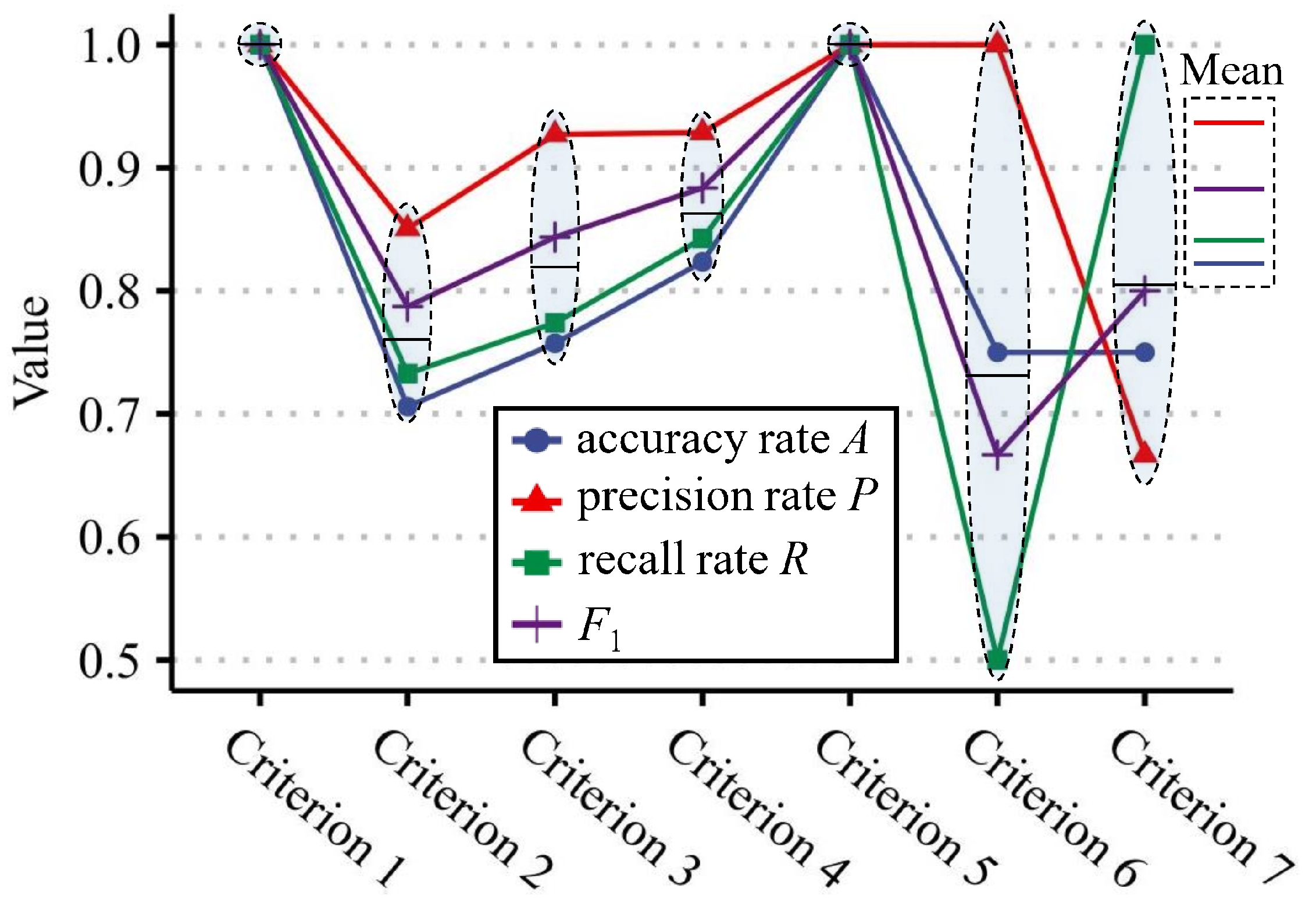
Step 5—Calculating the metrics used to validate the effectiveness of the model: In this paper, the accuracy rate A, precision rate P, recall rate R, and F1 score are used to analyze the effectiveness of the model. The F1 score harmonizes the precision rate P and recall rate R, providing a more comprehensive assessment of the effectiveness of the model. The calculation results of the metrics for model effectiveness are presented in Table 6 and Figure 4.
Table 6. The calculation results of the metrics for model effectiveness.
Figure 4. Line charts for A, P, R, and F1 scores.
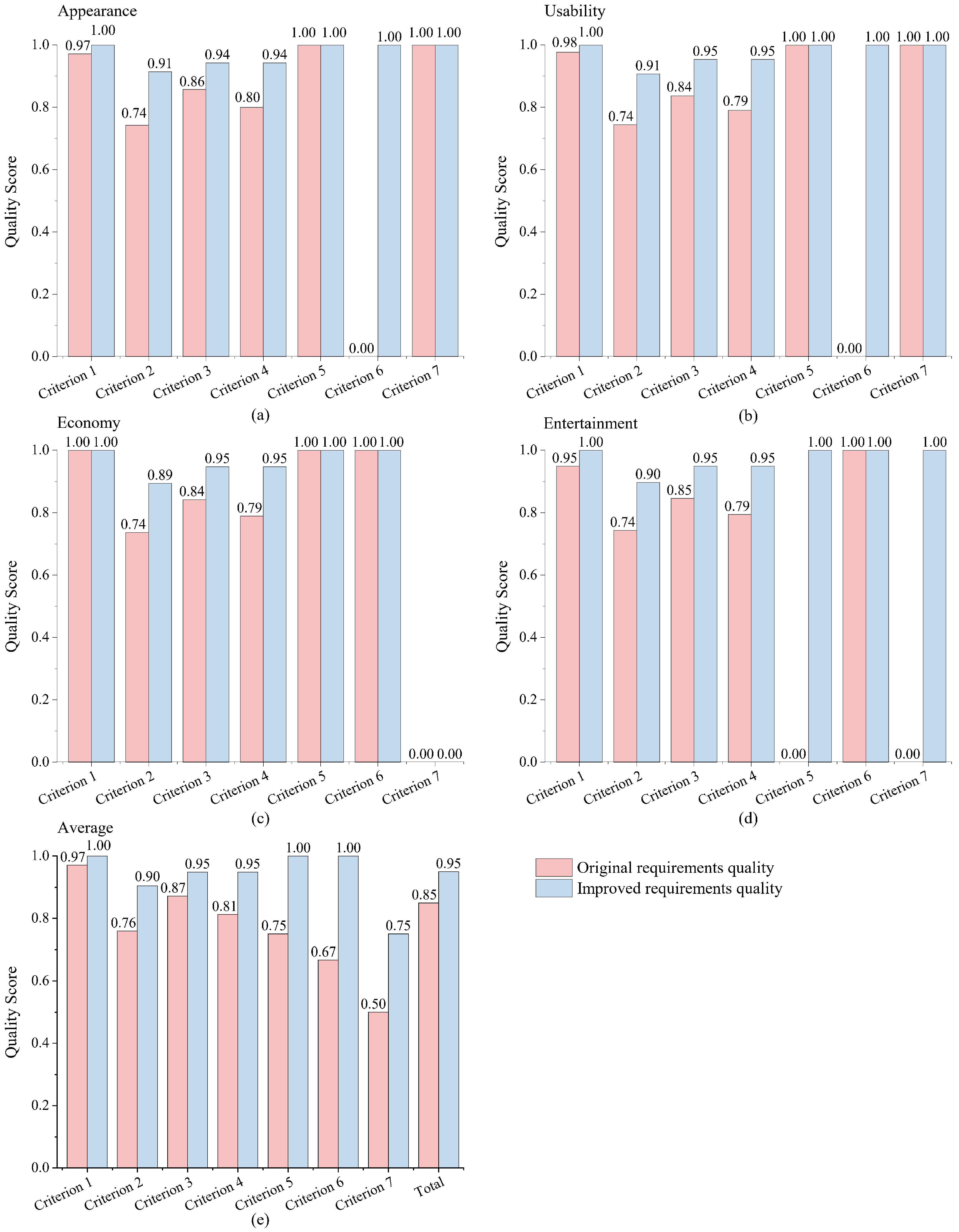
Step 6—Calculating the effect of the model on improving requirement quality: To verify the feasibility of the proposed model in this paper, the improvement in requirement quality after applying the model was calculated. The effect of the quality improvement is shown in Figure 5, where subfigures (a)–(e) represent the quality improvement in the aspects of appearance, usability, economy, entertainment, and average values found in the user stories, with red bars indicating the original requirement quality and blue bars indicating the improved requirement quality.
Figure 5. Bar chart of the requirement quality improvement effect.
Step 7—Analyzing the experimental data and drawing conclusions: By analyzing the above experimental results, the following three conclusions can be drawn:
(1) The model demonstrated good overall effectiveness. Based on Table 6 and Figure 4, the proposed user requirement quality assessment method in this paper achieved average A, P, and R of 82.19%, 93.33%, 84.67%, respectively, and an average F1 score of 0.8879, on 136 samples of user stories, demonstrating its effectiveness on this test dataset. The experimental data also showed the following characteristics: (a) The model achieved 100% accuracy and an F1 score of 1 in the testing of criteria 1 and 5. This is because the user story cards were used to collect user requirements, and the user story model can clearly divide the various elements in the user stories, which can then be processed by the computer. This method greatly reduces the burden of manual review and the possibility of errors. (b) The model performed relatively poorly in the testing of criterion 6, with an F1 score of only 0.6667. This is because the value of s i m p in Equation (8) was set too low, resulting in two user stories with slightly similar semantics being judged as unqualified. Therefore, by testing the F1 score under multiple s i m p values, the accuracy of the model on criterion 6 can be improved.
(2) The model has a significant improvement effect on the quality of user stories. Figure 5 illustrates that overall, user stories in the four aspects (appearance, usability, economy, and entertainment) showed a significant quality improvement in the seven assessment criteria, with improvements ranging from 2% to 100%, and the average requirement quality score was improved by 10.01%. This reflects the feasibility of the proposed model in improving the quality of user story requirements. However, in criterion 7 of economy, there was an outlier in the effect of quality improvement. After analysis, it was found that since criterion 7 evaluates the overall quality of the requirements, a single misjudgment by the model can lead to the entire requirement being deemed unqualified. This problem can be solved by improving the user requirement quality model, which will be the focus of future research.
(3) The model design that integrates multiple technologies demonstrates improvements. Compared to the existing research on requirement quality definitions [15,16,17,18,19], this study innovatively adopts a modeling approach to model the seven commonly recognized requirement quality attributes in the field of requirement engineering. Mathematical formulas are used to express the definition and calculate the requirement quality, prompting a shift from qualitative to quantitative approaches in requirement quality research. Compared to subjective methods for requirement quality assessment [20,21,22,23,24,25,26,27,28,29,30,31,32,33], this study integrates natural language processing to design an automated process for requirement quality assessment, which greatly improves the efficiency of the assessment process while demonstrating its effectiveness and feasibility. Compared to objective methods for requirement quality assessment [25,26,30,34,35,36,37], this paper collects user requirements as inputs for the requirement quality evaluation model through user stories used in agile development. This solves the problem of nonstandardized requirement descriptions due to broad sources, improves the consistency of data, and further enhances the model’s feasibility. The above three aspects collectively demonstrate the innovation and advancement of this study.

6. Summary and Prospects

This paper proposes a method for assessing user requirement quality in agile development. By constructing the user requirement quality assessment framework, designing the user requirement quality assessment process, constructing the user story model based on user story cards, building the user requirement quality model, and designing the requirement quality assessment method, the problem of low-quality user requirements encountered in agile development is addressed to some extent. The method demonstrated good performance in a data experiment on smartphone user requirements, with A, P, and R of 82.19%, 93.33%, 84.67%, respectively, and an F1 score of 0.8879. The average requirement quality score improved by 10.01%, demonstrating the effectiveness and feasibility of the method. This provides an automated solution for agile development teams to effectively improve user requirement quality.
However, there are still some shortcomings in our work. For example, the assessment of the overall requirement quality needs to be further quantified, further optimization needs to be conducted for the parameter settings in the model, the scalability of user requirement quality assessment criteria needs to be improved, and the applicability of the user requirement quality assessment method in large-scale complex high-end equipment agile development needs to be further explored. In future work, we aim to advance the user requirement quality assessment model to achieve higher levels of accuracy and applicability. Specifically, we plan to apply the model in the acquisition of high-end equipment requirements, such as those associated with new energy vehicles. Additionally, we aim to develop a user requirement quality improvement tool by integrating natural language processing. The tool will provide agile development teams with improved work efficiency, allowing them to more effectively address the challenges involved in improving user requirement quality.

Author Contributions

Conceptualization, X.X.; methodology, X.X.; validation, X.X.; investigation, Y.D.; resources, L.Q.; data curation, Z.Z.; writing—original draft, X.X.; writing—review & editing, Y.T.; visualization, Y.M.; funding acquisition, Y.D. All authors have read and agreed to the published version of the manuscript.

Funding

This research was funded by the National Natural Science Foundation of China grant number 72231011.

Institutional Review Board Statement

“Not applicable” for studies not involving humans or animals.

Data Availability Statement

Data sharing is not applicable to this article due to privacy re-strictions.

Acknowledgments

The authors would like to thank the anonymous reviewers for their careful work and thoughtful suggestions.

Conflicts of Interest

The authors declare no conflict of interest.

Appendix A

The user requirement framework of a smartphone is shown in Table A1.
Table A1. User requirement framework of a smartphone.
Requirement CategoryFunctions/AttributesUnit
1. Appearance1.1 Screen sizeinch
1.2 Screen curvaturedegree
1.3 Screen ratiopercentage
1.4 Foldable screenBoolean
1.5 Secondary screen sizeinch
1.6 Body colortype
1.7 Camera arrangementtype
1.8 Body materialtype
1.9 Weightgram
2. Usability2.1 Screen quality (refresh rate/resolution/color accuracy)hertz/ppi/ΔE
2.2 StorageGB
2.3 Battery endurancehour
2.4 Charging time (0–100%)minute
2.5 Wireless charging/reverse wireless chargingwatt
2.6 Dual SIM/5Gtype
2.7 WIFI/infrared/Bluetooth/NFCtype
2.8 Biometric identificationtype
2.9 Waterproof and dustproof gradeIPXX
2.10 3.5 mm headphone jackBoolean
2.11 Communication encryptionBoolean
3. Economy3.1 Selling priceEUR/USD
3.2 Failure ratepercentage
3.3 Warranty periodmonth
3.4 Maintenance priceEUR/USD
3.5 Recycling priceEUR/USD
3.6 Free charger/protective caseboolean
4. Entertainment4.1 Large game framerate/temperaturef/s/°C
4.2 Game modetype
4.3 Loudspeaker powerwatt
4.4 Photographic pixelpixel
4.5 Zoom magnificationnumber
4.6 Various photography modestype
4.7 Equipped with a stylusBoolean
4.8 Operating system ecologytype
Note: “type” indicates multiple optional types, and “Boolean” indicates equipped or not equipped.

References

  1. Monte, I.; Lins, L.; Marinho, M. Communities of Practice in Large-Scale Agile Development: A Systematic Literature Mapping. In Proceedings of the 2022 48th Latin American Computing Conference, CLEI 2022, Armenia, Colombia, 17–21 October 2022. [Google Scholar]
  2. Prenner, N.; Klunder, J.; Schneider, K. Defining Frames to Structure Agile Development in Hybrid Settings—A Multi-Case Interview Study. In Proceedings of the ACM International Conference Proceeding Series, Pittsburgh, PA, USA, 20–22 May 2022; pp. 34–44. [Google Scholar]
  3. Uluda, O.; Philipp, P.; Putta, A.; Paasivaara, M.; Lassenius, C.; Matthes, F. Revealing the state of the art of large-scale agile development research: A systematic mapping study. J. Syst. Softw. 2022, 194, 111473. [Google Scholar] [CrossRef]
  4. Kumar, D.; Dhir, S. Requirement Barriers to Implement the Software Projects in Agile Development; Springer Series in Reliability Engineering; Springer: Berlin/Heidelberg, Germany, 2022; pp. 341–353. [Google Scholar]
  5. Shahjalal, M.; Hasan, M.K.; Chowdhury, M.Z.; Jang, Y.M. Smartphone Camera-Based Optical Wireless Communication System: Requirements and Implementation Challenges. Electronics 2019, 8, 913. [Google Scholar] [CrossRef]
  6. Mengist, A.; Buffoni, L.; Pop, A. An Integrated Framework for Traceability and Impact Analysis in Requirements Verification of Cyber-Physical Systems. Electronics 2021, 10, 983. [Google Scholar] [CrossRef]
  7. Almaiah, M.A.; Hajjej, F.; Lutfi, A.; Al-Khasawneh, A.; Alkhdour, T.; Almomani, O.; Shehab, R. A Conceptual Framework for Determining Quality Requirements for Mobile Learning Applications Using Delphi Method. Electronics 2022, 11, 788. [Google Scholar] [CrossRef]
  8. Yahya, A.E.E.; Gharbi, A.; Yafooz, W.M.S.; Al-Dhaqm, A. A Novel Hybrid Deep Learning Model for Detecting and Classifying Non-Functional Requirements of Mobile Apps Issues. Electronics 2023, 12, 1258. [Google Scholar] [CrossRef]
  9. Muellner, N.H. Karnaugh-Veitch Maps as Minimal Formal Contract between Textual Requirements and Tests: A Use-Case Based Technical Analysis. Electronics 2022, 11, 2430. [Google Scholar] [CrossRef]
  10. Yang, B.; Ma, X.; Wang, C.; Guo, H.; Liu, H.; Jin, Z. User story clustering in agile development: A framework and an empirical study. Front. Comput. Sci. 2023, 17, 176213. [Google Scholar] [CrossRef]
  11. Ferreira, A.M.; da Silva, A.R.; Paiva, A.C. Towards the Art of Writing Agile Requirements with User Stories, Acceptance Criteria, and Related Constructs. In Proceedings of the International Conference on Evaluation of Novel Approaches to Software Engineering, ENASE–Proceedings, Online Streaming, 25–26 April 2022; pp. 477–484. [Google Scholar]
  12. Amna, A.R.; Poels, G. Ambiguity in user stories: A systematic literature review. Inf. Softw. Technol. 2022, 145, 106824. [Google Scholar] [CrossRef]
  13. Ananjeva, A.; Persson, J.S.; Bruun, A. Integrating UX work with agile development through user stories: An action research study in a small software company. J. Syst. Softw. 2020, 170, 110785. [Google Scholar] [CrossRef]
  14. Ussery, S.J. A Construct for Assessing and Improving the Quality of Agile User Stories. Ph.D. Thesis, The George Washington University, Washington, DC, USA, 2021. [Google Scholar]
  15. Femmer, H.; Vogelsang, A. Requirements quality is quality in use. IEEE Softw. 2019, 36, 83–91. [Google Scholar] [CrossRef]
  16. Montgomery, L.; Fucci, D.; Bouraffa, A.; Scholz, L.; Maalej, W. Empirical research on requirements quality: A systematic mapping study. Requir. Eng. 2022, 27, 183–209. [Google Scholar] [CrossRef] [PubMed]
  17. Unterkalmsteiner, M.; Gorschek, T. Requirements Quality Assurance in Industry: Why, What and How? Lecture Notes in Computer Science (including subseries Lecture Notes in Artificial Intelligence and Lecture Notes in Bioinformatics); Springer International Publishing: Berlin/Heidelberg, Germany, 2017; Volume 10153 LNCS, pp. 77–84. [Google Scholar]
  18. Seidel Calazans, A.T.; Paldes, R.A.; Canedo, E.D.; Seidel Masson, E.T.; De Albuquerque Guimaraes, F.; Fialho Rezende, K.M.; De Souza Goncalves, F.; Mariano, A.M. Quality requirements and the requirements quality: The indications from Requirements Smells in a Financial Institution Systems. In Proceedings of the XXXIII Brazilian Symposium on Software Engineering, Salvador, Brazil, 23–27 September 2019; pp. 472–480. [Google Scholar]
  19. Parra, E.; De La Vara, J.L.; Alonso, L. Poster: Analysis of requirements quality evolution. In Proceedings of the International Conference on Software Engineering, Gothenburg, Sweden, 27 May–3 June 2018; pp. 199–201. [Google Scholar]
  20. Hauser, S.; Muller-Schmeer, S.; Franczyk, B.; Radomski, S. An Improved Assessing Requirements Quality with ML Methods. In Proceedings of the 2022 14th IEEE International Conference on Computational Intelligence and Communication Networks, CICN 2022, Al-Khobar, Saudi Arabia, 4–6 December 2022; pp. 424–429. [Google Scholar]
  21. Kang, J.; Park, J. Data anonymization for requirements quality analysis: A reproducible automatic error detection task. In Proceedings of the LREC 2018—11th International Conference on Language Resources and Evaluation, Miyazaki, Japan, 7–12 May 2018; pp. 4432–4436. [Google Scholar]
  22. Anu, V.; Walia, G.; Hu, W.; Carver, J.C.; Bradshaw, G. Using a Cognitive Psychology Perspective on Errors to Improve Requirements Quality: An Empirical Investigation. In Proceedings of the International Symposium on Software Reliability Engineering, ISSRE, Ottawa, ON, Canada, 23–27 October 2016; pp. 65–76. [Google Scholar]
  23. Dehghani, R.; Wnuk, K.; Mendez, D.; Gorschek, T.; Ramsin, R. On Understanding the Relation of Knowledge and Confidence to Requirements Quality; Lecture Notes in Computer Science (including subseries Lecture Notes in Artificial Intelligence and Lecture Notes in Bioinformatics); Springer International Publishing: Cham, Switzerland, 2021; Volume 12685 LNCS, pp. 208–224. [Google Scholar]
  24. Gallego, E.; Chale-Gongora, H.G.; Llorens, J.; Fuentes, J.; Álvarez, J.; Genova, G.; Fraga, A. Requirements quality analysis: A successful case study in the industry. In Complex Systems Design & Management: Proceedings of the Seventh International Conference on Complex Systems Design & Management, CSD&M Paris 2016; Springer: Cham, Switzerland, 2016; pp. 187–201. [Google Scholar]
  25. Osama, E.; Abdelsalam, M.; Khedr, A. The effect of requirements quality and requirements volatility on the success of information systems projects. Int. J. Adv. Comput. Sci. Appl. 2020, 11, 420–425. [Google Scholar] [CrossRef]
  26. Dargan, J.L.; Wasek, J.S.; Campos-Nanez, E. Systems performance prediction using requirements quality attributes classification. Requir. Eng. 2016, 21, 553–572. [Google Scholar] [CrossRef]
  27. Timoshchuk, E.; Kuznetsov, S.; Usmonov, Z.; Utih, A.; Farah, A.; Saliu, H. Application of Natural Language Processing with GQM and AHP Approaches for Requirements Quality Assessment; CEUR Workshop Proceedings. 2019, Volume 2525. Available online: https://ceur-ws.org/Vol-2525/ITTCS-19_paper_30.pdf (accessed on 8 January 2023).
  28. Singh, M. Using Machine Learning and Graph Mining Approaches to Improve Software Requirements Quality: An Empirical Investigation. Ph.D. Thesis, North Dakota State University, Fargo, ND, USA, 2019. [Google Scholar]
  29. Reyterou, C. Requirements Quality in the Incremental Design Processes: Problems and Perspectives; CEUR Workshop Proceedings. 2016, Volume 1564. Available online: https://ceur-ws.org/Vol-1564/paper4.pdf (accessed on 8 January 2023).
  30. Post, A.; Fuhr, T. Case study: How Well Can IBM’s “requirements Quality Assistant” Review Automotive Requirements; CEUR Workshop Proceedings. 2021, Volume 2857. Available online: https://ceur-ws.org/Vol-2857/nlp4re8.pdf (accessed on 8 January 2023).
  31. Moreno, V.; Genova, G.; Parra, E.; Fraga, A. Application of machine learning techniques to the flexible assessment and improvement of requirements quality. Softw. Qual. J. 2020, 28, 1645–1674. [Google Scholar] [CrossRef]
  32. Airlangga, G.; Liu, A. Investigating Software Domain Impact in Requirements Quality Attributes Prediction. J. Inf. Sci. Eng. 2022, 38, 295–316. [Google Scholar]
  33. Wang, C.; Jin, Z.; Zhao, H.; Cui, M. An Approach for Improving the Requirements Quality of User Stories. Jisuanji Yanjiu yu Fazhan/Comput. Res. Dev. 2021, 58, 731–748. [Google Scholar]
  34. Griva, A.; Byrne, S.; Dennehy, D.; Conboy, K. Software Requirements Quality: Using Analytics to Challenge Assumptions at Intel. IEEE Softw. 2022, 39, 80–88. [Google Scholar] [CrossRef]
  35. Gopal, D.; Lyytinen, K. Effects of Social Structures in Requirements Quality of Open Source Software Project Development. In Proceedings of the ICIS 2017: Transforming Society with Digital Innovation, Seoul, Republic of Korea, 10–13 December 2017. [Google Scholar]
  36. Lind, E.; Gonzalez-Huerta, J.; Alegroth, E. Requirements Quality vs Process and Stakeholders’ Well-being: A Case of a Nordic Bank. arXiv 2022, arXiv:2211.06122. [Google Scholar]
  37. Aziz, R.A.; Wong, B. The Impacts of Requirements Relationships Knowledge on Requirements Quality and Software Development Project Success; CEUR Workshop Proceedings. 2021, Volume 3062, pp. 41–50. Available online: https://opus.lib.uts.edu.au/bitstream/10453/158585/2/Paper07_QuASoQ.pdf (accessed on 8 January 2023).
  38. Singh, R.; Singh, S. Text Similarity Measures in News Articles by Vector Space Model Using NLP. J. Inst. Eng. Ser. B 2021, 102, 329–338. [Google Scholar] [CrossRef]
Disclaimer/Publisher’s Note: The statements, opinions and data contained in all publications are solely those of the individual author(s) and contributor(s) and not of MDPI and/or the editor(s). MDPI and/or the editor(s) disclaim responsibility for any injury to people or property resulting from any ideas, methods, instructions or products referred to in the content.

Article Metrics

Citations

Article Access Statistics

Multiple requests from the same IP address are counted as one view.