Abstract
In this paper, we propose efficient computational solutions for estimating the statistical properties of wide-sense stationary un-correlative scattering (WSSUS) and non-WSSUS multiple-input multiple-output (MIMO) vehicle-to-vehicle (V2V) channel models. Specifically, in the WSSUS channel models, we first estimate the angle of departure (AoD) for the non-line of sight (NLoS) propagation components. In this manner, the complex channel impulse response (CIR), which are widely used in the existing literature to characterize the wireless channel physical properties, can be estimated on the basis of the estimated AoD and defined model parameters. Conversely, in the non-WSSUS channel models, by estimating the AoD in the initial stage, the real-time complex CIR of the V2V channel model can be estimated on the basis of the estimated AoD and the moving time/velocities/directions of the mobile transmitter (MT) and mobile receiver (MR). In the estimation process of the aforementioned cases, we introduce different solutions to convert the CIRs from the complex domain to the real-value domain, thereby optimizing the computational efficiency for investigating channel characteristics as compared to existing methods. Numerical results of the WSSUS and non-WSSUS MIMO V2V channel characteristics, such as the spatial-temporal (ST) cross-correlation functions (CCFs) and auto-correlation functions (ACFs), are estimated on the basis of the estimated complex CIRs. These results are in agreements with theoretical ones, indicating that the proposed algorithms are practical for estimating the WSSUS and non-WSSUS MIMO V2V channel characteristics.
1. Introduction
1.1. Backgrounds
Sixth-generation (6G) systems aim at enabling users to share information globally in a wide range of spectra, global coverage, and in full applications with extremely low latency and high data rates [1]. In recent years, the demand for mobile communications with higher-capability and wider-spectrum is continuously increasing in the fields of industry and academia [2]. Furthermore, multiple-input multiple-output (MIMO) assisted vehicle-to-vehicle (V2V) communications, which aim at minimizing the number of traffic fatalities, injuries, and accidents while fostering the improvement of new applications, ought to become hotspot scenarios in 6G networks [3,4,5]. For efficiently study the performance of realistic V2V wireless communication systems, and meanwhile compare different communication proposals for 6G, it is essential and necessary to develop effective channel models to gain insights into the underlying propagation characteristics in V2V wireless networks [6,7].
1.2. Previous Related Work
Channel models used for wireless communication analysis are typically fundamental to facilitate theoretical analysis and make simulations tractable. Currently, V2V channels are commonly modeled as the sum of propagation paths from the transmitter to the receiver via the reflection of interfering objects. Most preliminary research on V2V channel modeling depended on the wide-sense stationary un-correlative scattering (WSSUS) assumption. Specifically, the authors in [8,9] proposed WSSUS Rician channel models for studying the V2V channel propagation properties, wherein ellipse models were used to depict practical communication environments. In [10], R. He et al. proposed a geometry-based statistical channel model for V2V communications. In this study, the authors assumed that the propagation waves emerging from the transmitter in wireless channels experienced single interaction before arriving at the receiver. It is well known that the aforementioned WSSUS channel models for V2V communications relied on the assumption that the underlying characteristics are stable with respect to motion time of the transmitter and receiver. Measurements in [11,12] have demonstrated that WSSUS assumption holds on only for extremely short time intervals (in the order of millisecond [13]). Recently, the growth of V2V communications, especially in high dynamic scenarios, has gradually behaved temporal non-stationary properties, which means V2V channel characteristics keep varying with ongoing transceiver motion. Therefore, WSSUS assumption is no longer enable for accurately characterizing the high dynamic propagation properties in actual V2V wireless communication environments. In the existing literature, Q. M. Zhu et al. [14] considered the non-WSSUS nature in time and frequency domains while investigating high dynamic wireless channels. In [15], the authors proposed a cluster-based non-stationary channel model for V2V communication environments, which derived the channel impulse response (CIR) for characterizing the high dynamic physical properties of the channel model. Furthermore, A. Ghazal et al. [16] proposed a cluster-based non-stationary MIMO channel model to investigate the time variation of the wireless channels in different moving environments by considering the small-scale time-varying parameters. In [16], some underlying V2V propagation characteristics, such as local spatial cross-correlation functions (CCFs) and temporal auto-correlation functions (ACFs), were derived and investigated. In [17], the authors developed a non-wide-sense stationary (non-WSS) MIMO channel model for high dynamic intelligent transportation systems, which derived the real-time model parameters, i.e., angular parameters and distances from the transmitter/receiver to the cluster, to investigate the non-stationary properties of MIMO V2V channels. For the aforementioned channel models, the interfering objects, which mainly mimic moving vehicles, buildings, and other features, are generally randomly situated in complicated V2V communication scenarios. In principle, it is difficult, almost impossible, to determine the position of interfering objects when channel characteristics are investigated, which brings us difficult in accurately investigating the V2V propagation characteristics.
For conducting the research on the system-level performance for V2V communications, various parameter-related estimation algorithms have recently been provided. Specifically, in [18], the authors developed an improved Rayleigh fading channel model for evaluating the discrete-time MIMO communication system performances in space, time, and frequency domains. The authors in [19] estimated the angular parameters at the transmitter and receiver in a Clarke channel model, thereby improving the computational efficiency of temporal correlation investigations in V2V channel models. It deserves to mention that the research on angle of departure (AoD) and angle of arrival (AoA) estimations of multiple narrowband signals is a basic work in fields on the analysis of the propagation characteristics of wireless channel models, that even arise in a variety of engineering applications; consequently, various algorithms have been proposed for providing AoD/AoA estimators with low computational complexity for practical communication systems [20]. In principle, the computational complexities of the propagation characteristics will decrease as the channel matrix is transformed from the complex-value domain into the real-value domain [21]. Similarly, the authors in [22] decreased the computational and hardware implementation complexities, by the means of converting the channel model parameters from the complex-valued domain to the real-valued domain. Nevertheless, the impacts of the channel physical properties related to the environmental parameters on the performance of AoD estimations have not been considered.
1.3. Motivation and Contributions
It deserves to mention that the investigation of the propagation characteristics for V2V communications is required to obtain the specific channel information, i.e., AoD, AoA, and propagation paths. In the existing literature, such as [16,17], the authors assumed that the angular parameters and propagation paths in WSSUS and non-WSSUS wireless channels are known in advance. However, in reality, these model parameters are difficulty to obtain in practical WSSUS channels for V2V communications, which will in principle bring us difficult in investigating the V2V propagation characteristics. To solve this issue, when the V2V channel is WSSUS, we need to propose an approach to estimate the angular parameters at the mobile transmitters (MTs) for the non-line of sight (NLoS) propagation rays. Afterwards, the complex CIRs of the V2V channel model can be estimated on the basis of the estimated AoD and defined model parameters. However, when the V2V channel is non-WSS, owing to the real-time property of current algorithms, the expressions of the angular parameters and propagation paths are time-variant at different moving time of the MTs and mobile receivers (MRs). Therefore, conventional methods bring us large computational complexity for simulating the complex CIRs of the non-WSSUS V2V channels in the real-time stage. To solve this issue, it is of vital importance to propose effectively computational solutions for estimating the real-time model parameters at the transmitter, by utilizing the estimated initial AoD and the moving properties of the MT and MR in the real-time stage. Thereafter, the complex CIRs, which are widely used in the prior work to characterize the wireless channel physical properties, can be derived by using the estimated time-varying model parameters.
Overall, the main contributions of this paper are summarized as follows:
- The complex CIRs of WSSUS and non-WSSUS MIMO V2V models, which have the advantages of characterizing the physical properties of wireless channels, are estimated on the basis of the estimated angular parameters and propagation paths with the goal of reducing the computational complexity of the channel modeling.
- Based on the estimated complex CIRs in WSSUS and non-WSSUS MIMO V2V channels, we estimate the spatial-temporal (ST) CCFs and ACFs of the channel models for different MT and MR moving time/velocities/directions and different Rician factors. The numerically estimated results are in agreements with the theoretical ones, which, in principle, indicate that the proposed estimation algorithm is suitable for characterizing the channel characteristics of WSSUS and non-WSSUS V2V communications. Furthermore, the simulation time of analyzing the channel characteristics with the proposed solutions are relatively shorter than those of the prior ones, which effectively demonstrate the computational efficiency of the analysis of the V2V propagation characteristics.
- The proposed AoD estimation algorithms for WSSUS and non-WSSUS channel modeling can be adapted to a variety of V2V communication environments. For example, when we adjust the geometric configuration of the proposed MIMO antenna system, the proposed channel model is capable of introducing other MIMO antenna systems, such as uniform circular array (UCA), uniform rectangular array (URA), and L-shaped array.
The remainder of this paper is summarized as follows. The proposed AoD estimation algorithms for WSSUS and non-WSSUS channel modeling for V2V communications are presented in Section 1 and Section 2, respectively. In Section 3, the key characteristics of the WSSUS and non-WSSUS MIMO V2V channel models are estimated. Section 4 presents the numerical results and corresponding discussion. Finally, our conclusions are given in Section 5.
Notation: The represents the expectation operation and (·) is the complex conjugate operation. The is the transpose operation. The notation is a complex Gaussian variable x with mean and variance , and is the imaginary unit.
2. Estimation of the Complex CIRs in WSSUS MIMO V2V Channels
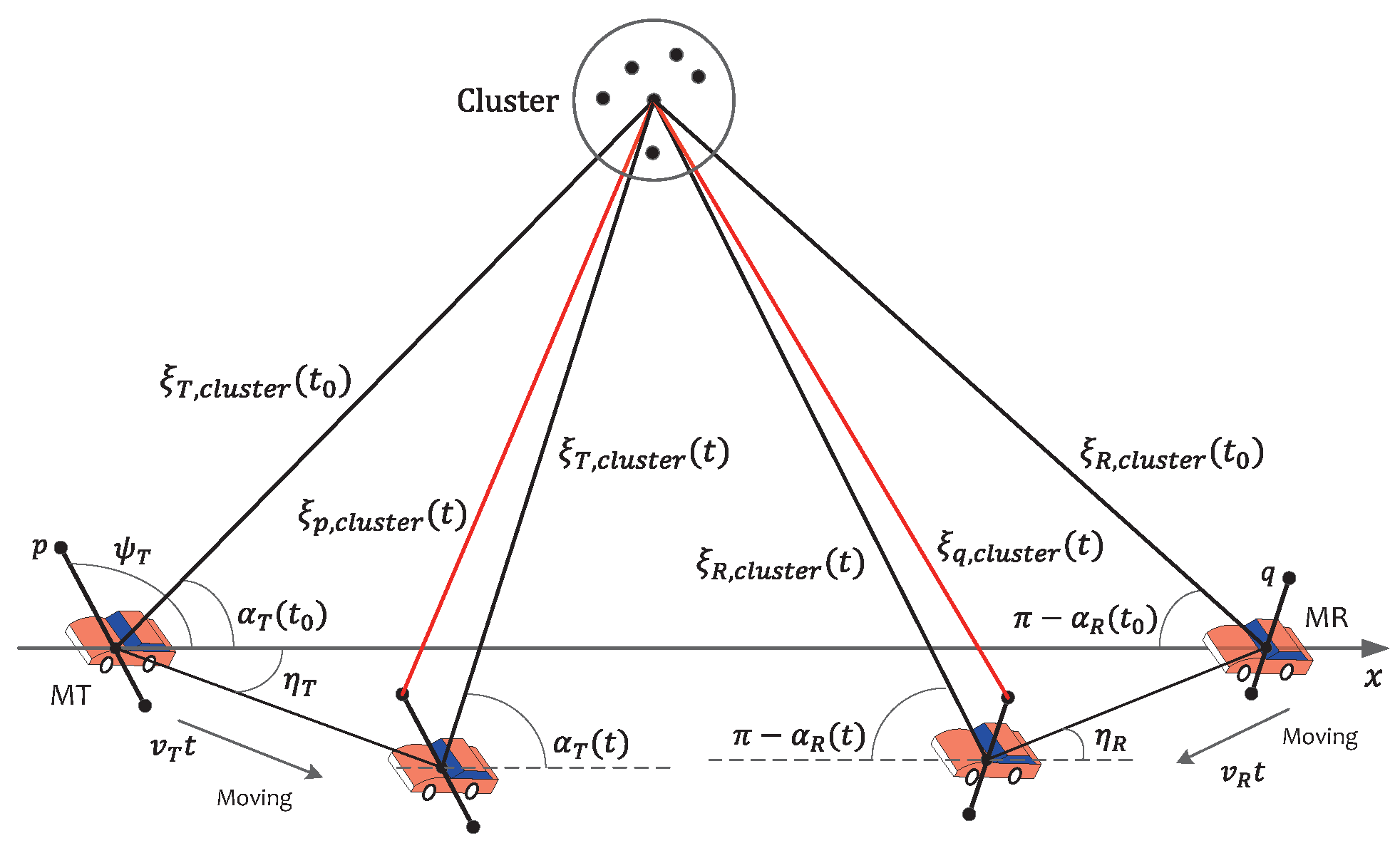
As shown in Figure 1, we consider a geometry-based stochastic WSSUS channel model for MIMO V2V point-to-point communications, where the uniform linear array (ULA) at the transmitter and receiver are respectively composed of and antenna elements. The proposed channel model can be extended to end-to-end channel models as we properly adjust the geometric parameters of the channel model. In the proposed channel model, the radio propagation environment is characterized by scattering with LoS and NLoS components between the MT and MR. For the NLoS components, the waves undergo multiple rays within the cluster, wherein every ray is approximated to experience the same propagation distance from the center of the corresponding array [23]. Notice that the MT and MR move with time-varying speeds and arbitrary trajectories in practical V2V communication scenarios [24]; however, if we consider the time-varying moving directions and speeds of the transmitter and receiver in the proposed estimation algorithm for V2V channel modeling, the derivations will be very complicated, and therefore will be our future work. Instead, we assume that the MT and MR move at constant speeds and , respectively; while their moving directions indicated by the x-axis are denoted by and , respectively. This assumption has been widely proposed in the existing literature [25,26]. In fact, we only depict the ℓ-th cluster in such channel model, while other clusters can be depicted in similar solutions, and therefore we omit them here for brevity.
Figure 1.
Angular parameters and path lengths of the WSSUS channel models for MIMO V2V communications.
In this part, we suppose that the propagation characteristics satisfy the WSSUS assumption, which indicates that the channel statistical properties in time domain remain invariant over a relatively short period of time, and that the clusters with different propagation delays are uncorrelated. For such channel model, the statistical proposed properties are characterized by a matrix of size , where represents the complex CIR between the p-th () antenna of the MT array and q-th () antenna of the MR array. Let us suppose that the LoS and NLoS propagation components are independent to each other, we have that [27]
where for the LoS rays is deterministic, which can be written by [28]
where denotes the Rician factor, is the carrier frequency, c is the speed of light, and is the carrier wavelength. The is the distance of the waves from the p-th transmit antenna directly propagate to the q-th receive antenna, i.e., LoS components. Based on the geometry-based relations in Figure 1, we have
where and
where . The accounts for the distance from the center of the MT antenna array to that of the MR array. The and are the adjacent antenna element spacings at the MT and MR, respectively; and are the orientations of the transmit and receive antenna arrays indicated by the x-axis, respectively. Furthermore, in (1), for NLoS rays is random, which statistical properties are introduced by the initial random phase . It is assumed that the phase satisfies the uniform distribution in the interval from to . Assume that there are N sub-paths within the ℓ-th cluster. Then, we can obtain
where and are, respectively, the AoD and AoA related to the n-th ray within the ℓ-th cluster. The and are, respectively, the distances from the p-th transmit antenna and q-th receive antenna to the ℓ-th cluster. In the following, we assume that every ray within the ℓ-th cluster is approximately at the same angle and same distance from the center of the corresponding array [23], e.g., , , , . Then, we can obtain
where and denote the distances from the centers of the MT and MR antenna arrays to the cluster, respectively, which are expressed as
Subsequently, we define the moving time period of the MT and MR is from 0 to T. It can be observed that the complex CIR in the WSSUS V2V channel model is related to the moving time t of the MT and MR, we define as the signal transmitted by the p-th antenna of the MT array. By taking the convolution operation between the complex CIR and signal in terms of the moving time t, the received signal of the q-th antenna element for different time t can be written by
where ∗ stands for the convolution operation and is the complex noise of the q-th receive antenna. By substituting (1) into (10), the received signal can be further written by
where . Next, we convert the continuous received signal in to K discrete sequence of samples [18], where the spacing between two different samples is denoted by . At the MR, the signal of the k-th () sample of the q-th receive antenna can be written by
where stands for the complex noise of the k-th sample of the q-th antenna of the MR array. Assume that the follow the white Gaussian distribution [29], i.e., , i.e., . Define as the received signal vector of the q-th antenna of the MR array, which is written by
Based on the aforementioned derivations, the received signal vector of the WSSUS MIMO V2V communication system, denoted by , is written by
It is obvious that the received signal vector in (14) is in complex domain, which brings us relatively high computational complexities on the estimates of the angular parameters at the MT in the WSSUS V2V channel model, especially for complicated communication systems. To solve this challenge, it is required to convert the signal from the complex domain to the real-value domain. Let us define a vector as [30]
where and , which are both composed of real elements, stand for the real and imaginary parts of the complex received signal vector , respectively. Define and as the k-th sample of the discrete sequences and , respectively, which are written by
where and are, respectively, the real and imaginary parts of the k-th sample of the q-th receive antenna of the complex white Gaussian noise, i.e., and . Based on these derivations, we suppose that and , with the vectors and accounting for the mean elements of the discrete sequences of the real received signal vector , respectively, is an identity matrix of the size . The mean values of the k-th sample of the vectors and are denoted by and , respectively. We have that
It is assumed that the elements in the received signal vector are independent to each other; hence, the probability density function (PDF) of the AoD for the normal distribution can be written by [31]
where denotes the dimensional covariance matrix of the normal distributed real vector , i.e., . The stands for the expectation of the , which means . By substituting the aforementioned expressions into (20), we can further obtain
By taking the natural Logarithm of (21), we have
It is worth mentioning that the AoA in WSSUS V2V channel models can be obtained by using the conventional solutions, such as compressive sensing-based [32] and deep learning-based methods [33]. In light of this, we will estimate the AoD in the following parts. Affiliate that, we are able to obtain the estimated expressions of the complex CIR to estimate the physical properties of the WSSUS channel models. To achieve this challenge, we should solve the maximum likelihood estimation (MLE) problem with respect to the optimization AoD , which can be expressed as
Accordingly, the AoD in WSSUS channel models for V2V communications can be derived by adopting the Newton-Raphson algorithm [34]. In light of this, the distances from the p-th transmit antenna and q-th receive antenna can be respectively estimated as
Subsequently, the propagation distances of the waves from the p-th transmit antenna and q-th receive antenna to the cluster are respectively estimated as
By substituting the estimated parameters in (26) and (27) into (5), the complex CIR of the WSSUS MIMO V2V channel model for the NLoS propagation components are estimated as
Thus far, the complex CIR of WSSUS MIMO V2V channel models has been derived and investigated. Their investigations of V2V channel propagation characteristics will be discussed later in Section 4.
3. Estimation of the Complex CIRs in Non-WSSUS MIMO V2V Channels
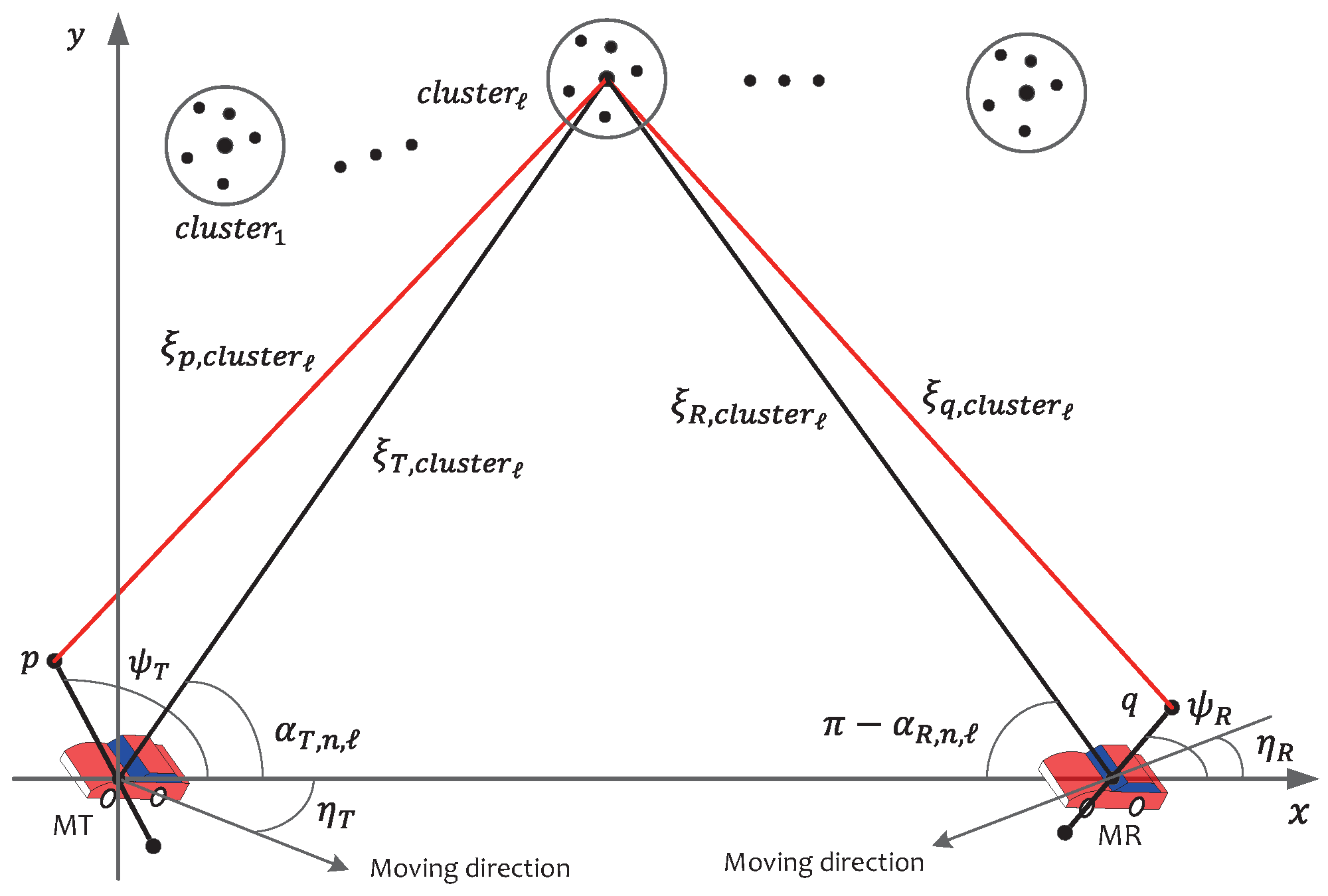
It is important to mention that when the MT and MR move from one position to another position, as shown in Figure 2, it is required to derive the real-time model parameters, such as the AoD/AoA and path lengths, to characterize the time and frequency non-WSSUS nature of the MIMO channel models for V2V communications. Furthermore, we should estimate the real-time complex CIRs to investigate the non-WSSUS V2V channel propagation properties [35]. It deserves however to mention that the estimation of the time-varying complex CIRs seems to be impossible, which is mainly on account of the high computational complexity of such process. To solve this issue, we define as a time interval during which the mobile terminals are stationary, which correspond to the time instant we begin to observe the channel. In such stage, we propose a computational method to estimate the angular parameters at the MT. Afterwards, for the state when the channel is not stationary, we estimate the real-time angular parameters at the MT and MR according to the estimated initial AoD and the model parameters of the motion of the transceivers. Finally, when we substitute the estimates of the time-varying expressions of the AoD and AoA into the complex CIR, the statistical propagation properties of the non-WSSUS channel models for V2V communications can be characterized.
Figure 2.
Angular parameters and path lengths of the non-WSSUS channel models for MIMO V2V communications.
It deserve to mention that the non-WSSUS channel models for V2V communications are represented by the matrix of size , where accounts for the complex CIR of the propagation links between the p-th transmit antenna and q-th receive antenna, which is written by [35,36]
where and denote the real-time propagation delays of the waves that emerge from the center position of the MT array to that of the MR array via the LoS and NLoS components, respectively. We define as the complex CIR between the p-th MT antenna and the q-th MR antenna at the time instant . It can be observed that the complex CIR in the non-WSSUS V2V channel model depends on the moving time t and propagation delay , we define as the signal transmitted by the p-th antenna of the MT array, which is obviously different from the previous definition of the transmitted in the WSSUS V2V channel model in Section 2. By taking the convolution operation between the complex CIR and signal in terms of the delay , the received signal of the q-th antenna element for different delay is written by
where accounts for the complex noise of the q-th receive antenna. We define as the complex noise vector, which elements are supposed to be independent to each other. The complex received signal vector, denoted by , can be expressed as
where stands for the matrix of the complex fading envelope for the LoS rays during the initialization, where the real and imaginary parts of the complex fading envelope are denoted as and , respectively, which can be expressed as
where represents the propagation distance of the waves from the p-th transmit antenna to the q-th receive antenna via the LoS component. In the following, let us convert the vector in (31) from the complex-value domain to the real domain for the sake of high-efficient investigation of the non-WSSUS MIMO V2V channel characteristics, which is similar to the previous discussions. To achieve this goal, we define as [30]
where and account for the real and imaginary parts of the complex matrix , respectively. Define as
Furthermore, in (31), is a matrix of the complex fading envelope for the NLoS rays, where the real and imaginary parts of the complex fading envelope are denoted by and , respectively, which can be expressed as
Similar as before, we define as the complex matrix for the NLoS components in real domain, which can be expressed as [30]
where and account for the real and imaginary parts of the complex matrix , respectively. Define as
In addition, we define as
Based on the aforementioned derivations, the received signal vector can be rewritten in real-value domain, i.e., . According to (31), we have that
At the MR, we define as the q-th signal vector in real domain, which can be written by
where
We convert the continuous received signal and to K discrete sequences of samples. In this case, the discrete received signal of the q-th receive antenna element in real-value domain, that is , can be further expressed as
Suppose that the received signal vectors and satisfy the white Gaussian distribution, i.e., and , where and stand for the K mean elements of the vectors and , respectively. Let us define and as the mean values of the k-th samples of the and , respectively, which can be expressed as
where and account for the real and imaginary parts of the complex signal transmitted by the p-th antenna of the MT array for the LoS components, respectively. The and are the real and imaginary parts of the complex signal transmitted by the p-th transmit antenna for NLoS rays, respectively. In light of this, the received signal vector of the non-WSSUS MIMO V2V communication system at the time instant , denoted by , can be estimated as
Therefore, the PDF of the AoD in the non-WSSUS channel models for V2V communications for the normal distribution is written by
Similar to the estimates of the AoD in the WSSUS channel models for V2V communications in Section 2, the in the non-WSSUS channel models can be estimated as
Accordingly, the initial propagation distances from the centers of the transmit and receive antenna arrays to the cluster, they are and , respectively, can be estimated as
Subsequently, the real-time propagation distances from the center positions of the transmit and receive antenna arrays to the cluster, they are and , respectively, can be estimated as
Next, the real-time propagation distances from the p-th transmit antenna and q-th receive antenna to the cluster, they are and , respectively, can be estimated as
where and stand for the estimated angular parameters at the MT and MR, respectively, which can be written by
According to (51)–(58), the complex CIR of the non-WSSUS MIMO V2V channel model for the NLoS components can be estimated as
Thus far, the complex CIR of non-WSSUS MIMO V2V channel models has been derived and investigated. Their investigations of V2V channel propagation characteristics will be discussed later in Section 4.
4. Estimated WSSUS and Non-WSSUS Channel Propagation Characteristics
Based on the aforementioned estimated complex CIRs of the WSSUS and non-WSSUS channel models, in the following, we estimate the underlying MIMO V2V channel propagation characteristics correspondingly, such as the ST CCFs and temporal ACFs.
4.1. ST CCFs
We adopt the ST CCFs to study the MIMO V2V channel statistical properties, which can be determined by the correlation properties between two different complex CIRs. It deserves to mention that in the WSSUS MIMO V2V channel models, the ST CCF between the propagation link from the p-th antenna of the transmit array to q-th antenna of the receive array and the link from the -th () antenna of the transmit array to -th () antenna of the receive array is measured by the calculating the correlation between the and , which is written by [37]
where accounts for the time difference. It is important to mention that the expectation applies only to the initial random phase . Next, we substitute (28) into (60), the ST CCF for the NLoS components in the WSSUS channel models for MIMO V2V communications can be estimated as by averaging over the random phases as follows:
On the other hand, when the MIMO V2V channel model is non-WSS, we suppose that no correlations exist between the processes in different propagation delays [27]. In this case, the ST CCF can be written by
By substituting (59) into (62), the ST CCF for the NLoS components in the non-WSSUS MIMO V2V channel model can be estimated as
It is important to mention that the ST CCF in the non-WSSUS channel model in (63) reduces to that in the WSSUS channel model as we neglect the time-varying properties of the AoD/AoA and model parameters, which are omitted here for brevity.
4.2. Temporal ACFs
In non-WSSUS MIMO V2V channel models, the complex CIRs show different statistical properties at different moving time t. Owing to this kind of characteristics, the current works adopt the temporal ACFs to characterize the wireless channels for different time difference . In principle, the temporal ACF of the link from the p-th antenna of the transmit array to the q-th antenna of the receive array at different time difference is calculated by
By substituting (59) into (64), the temporal ACF of the non-WSSUS channel models for MIMO V2V communications can be estimated as
By substituting the estimated time-varying AoD into (65), the temporal ACF for the NLoS components in non-WSSUS MIMO V2V channel model can be estimated. It is noteworthy to mention that the aforementioned derivations of the estimated WSSUS and non-WSSUS channel propagation characteristics, such as ST CCFs, temporal ACFs, and frequency CCFs, are not related to the number of antennas of ULA. In fact, they are related to the two adjacent antenna spacings at the transmitter and receiver. Therefore, we will investigate the channel propagation characteristics with respect to the different antenna spacings at the transmitter and receiver in the following parts.
5. Numerical Results and Discussions
In this section, we first describe the AoD estimations in the WSSUS and non-WSSUS MIMO V2V channel models. In the proposed estimation algorithms, when the V2V channel is WSSUS, we should record the second sample from the NLoS propagation rays while the first sample is in correspondence with the LoS propagation rays. In this way, we can estimate the AoD in the WSSUS channel model. However, when the channel is non-stationary, the signal received at the MR consist of the components with different propagation delays. In contrast, in the estimation process of the initial stage, we assume that the MR receives the signal propagated from the MT for a while. In such stage, we need to record the second sample corresponding to the NLoS propagation rays, as well as the first sample corresponds to the LoS propagation rays. In this way, we can estimate the initial AoD in the non-WSSUS channel model.
To validate the efficiency of the proposed algorithms for estimating the statistical properties of the WSSUS and non-WSSUS MIMO channel models for V2V communications, we summarize some basic parameters as follows: GHz, , , , and . In the following, we use the mean squared error (MSE) to measure the coarse AoD estimate. Define the MSE as [34]
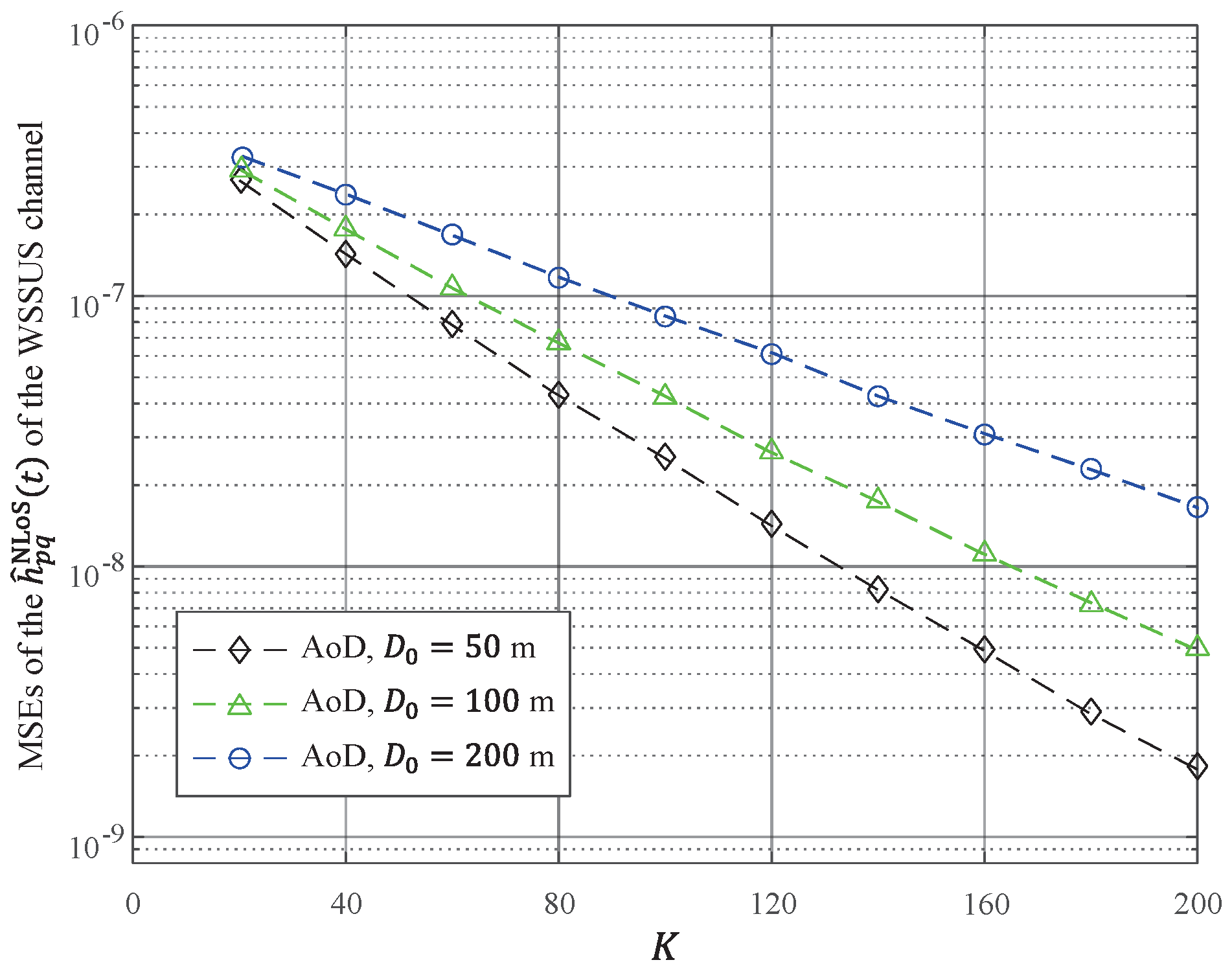
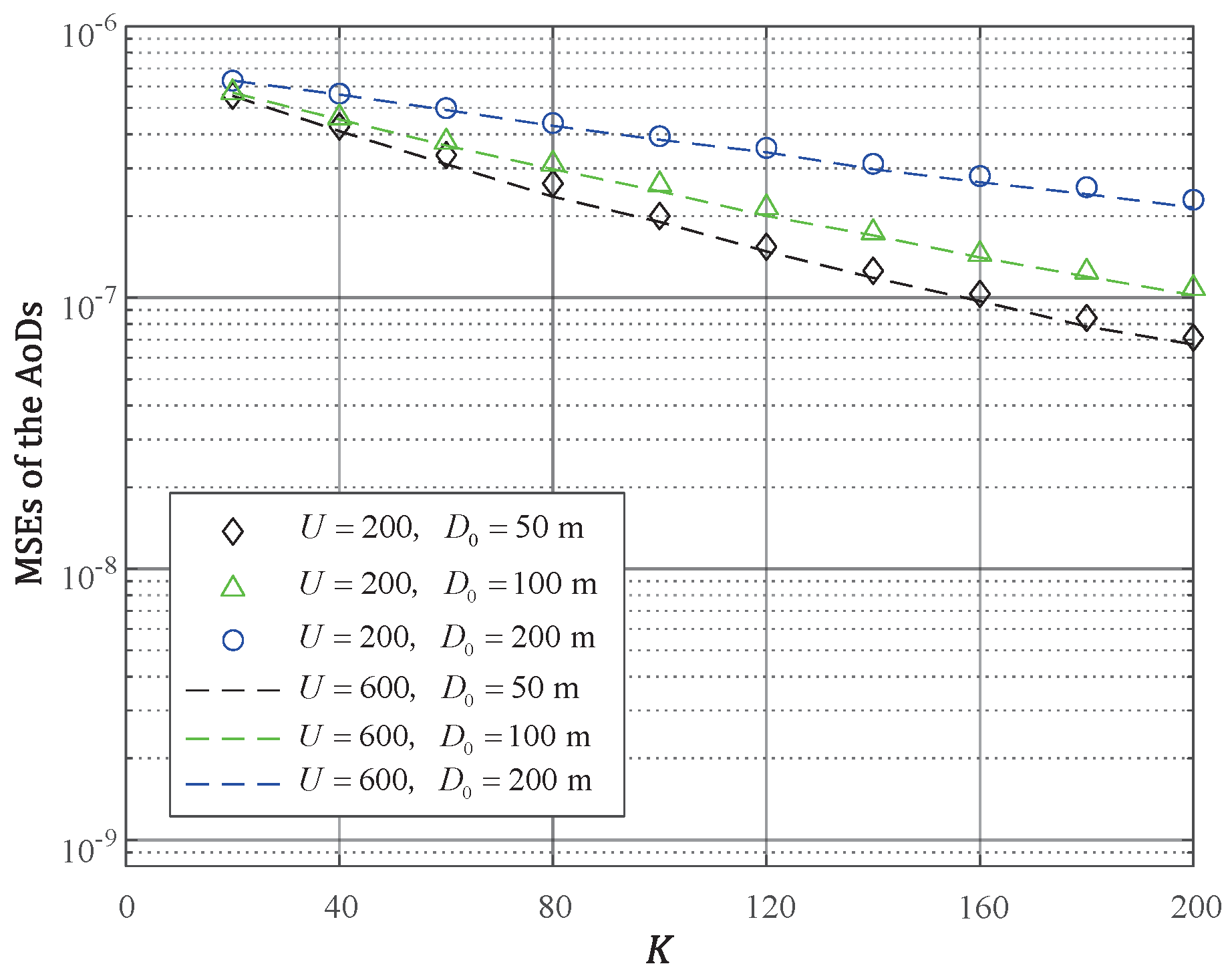
where accounts for the estimation of the AoD of the u-th Monte Carlo trial. Figure 3 plots the MSEs of the angular parameters at the MT for total number of trials and different sample numbers K in the WSSUS V2V channel model. It can be seen that the impacts of the total number of trials on the estimate performances of the angular parameters are insignificant. Furthermore, the MSEs drop as the number of the discrete sequence rises, which shows that the proposed computational solutions are excellent for estimating the V2V channel propagation characteristics, especially as the value of the K is large. The above results are consistent with the conclusions in [38], and therefore further validates the accuracy of the derivations and conclusions. In addition, we can observe that when the distance rises from 50 m to 200 m, the MSEs for estimating the AoD increase slowly [39]. In Figure 4, we illustrate the MSEs for estimating the complex CIR of the WSSUS V2V channel models. It is observed that the estimation errors for estimating the complex CIR for NLoS propagation components drop gradually as the number of samples K increases, which are in consistent with the simulation results in [40,41], thereby demonstrating that the estimation performance, such as the estimating precision, etc., can be nicely used for WSSUS V2V channel modeling. Furthermore, we notice that when the distance rises from 50 m to 200 m, the MSEs of the complex CIR of the WSSUS MIMO V2V channel model rise slowly, which are in agreements with the behaviors in Figure 3.
Figure 3.
MSEs of the AoD estimations in the WSSUS channel models for V2V communications with respect to the distance when m/s, m/s, , and .
Figure 4.
MSEs of the complex CIR of the WSSUS channel models for V2V communications with respect to the distance .
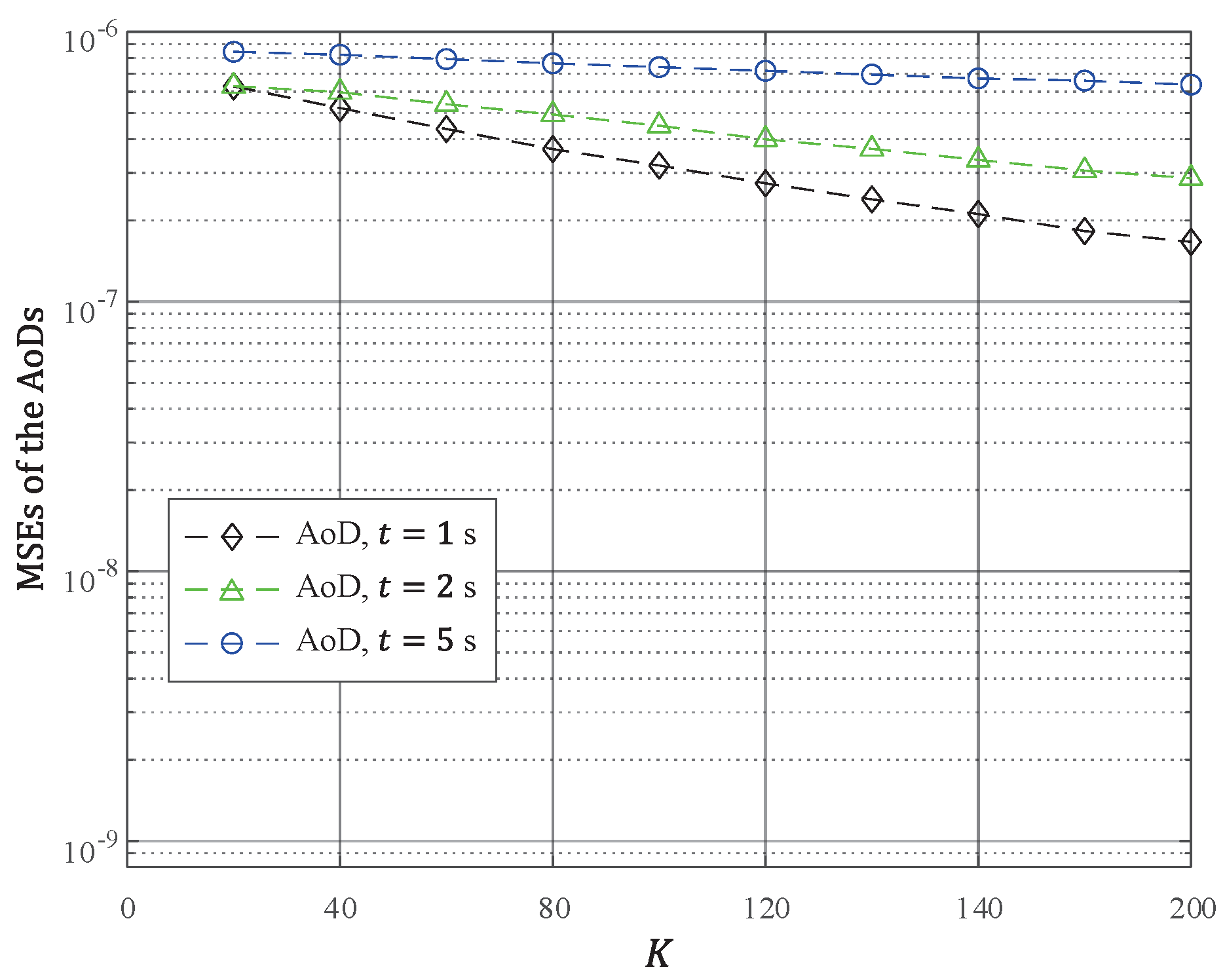
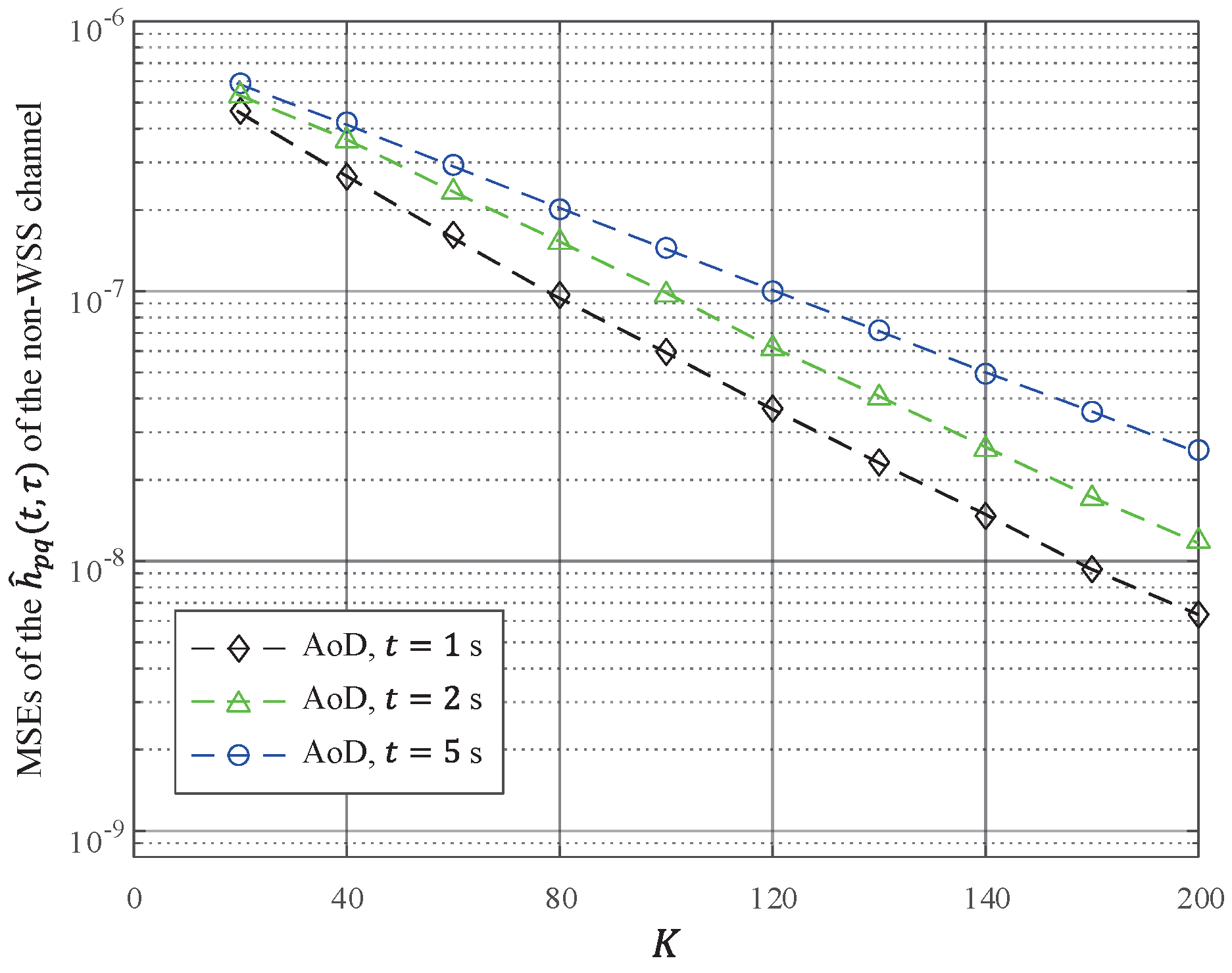
Figure 5 illustrates the MSEs for estimating the AoD in the non-WSSUS MIMO V2V channel models. It is obvious that when the moving directions of the transmitter and receiver are set as and , respectively, which means the transceivers move in opposite directions, the MSEs rise slowly as the moving time t increases from 1 s to 5 s. In Figure 6, we illustrate the MSEs for estimating the complex CIR of the non-WSSUS channel models for MIMO V2V communications. It is observed that when the moving time of the MT/MR rises from 1 s to 5 s, the MSEs of the complex CIR of the non-WSSUS MIMO V2V channel model increase slowly, which are in consist with the conclusions in Figure 5.
Figure 5.
MSEs of the AoD estimations in the non-WSSUS channel models for V2V communications with respect to the distance when m/s, m/s, , and .
Figure 6.
MSEs of the complex CIR of the non-WSSUS channel models for V2V communications with respect to the moving time of the MT and MR.
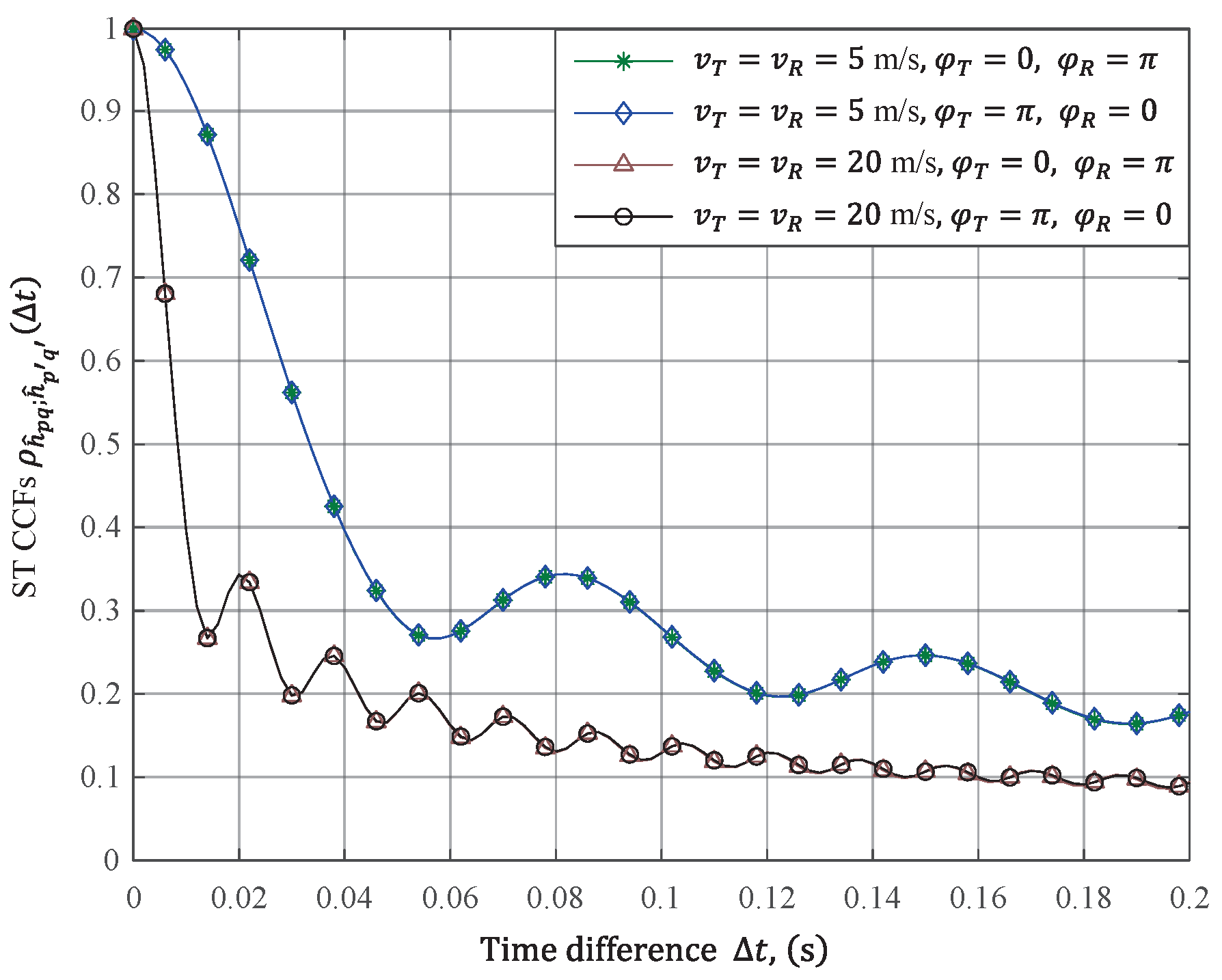
It deserves to mention that Equation (39) for Figure 7 is a Bessel function, which fluctuates as we increase the antenna spacing; however, we notice that the general trend is to decrease with the increasing of the antenna spacing. The aforementioned simulation results fit the measurements in [42] very well, which further shows the accuracy of the analysis and derivations of the spatial CCFs of the WSSUS MIMO V2V channel model. For V2V communications, the propagation characteristics are obviously influenced by the moving properties of the transmitter and receiver. In light of this, in Figure 7, we plot the estimated ST CCFs of the WSSUS channel models for MIMO V2V communications with respect to the moving directions/velocities of the MT and MR. It is obvious that the ST CCFs are independent of the moving directions and . Furthermore, when the moving velocities and increase from 5 m/s to 20 m/s, the ST CCFs decrease gradually.
Figure 7.
Estimated ST CCFs of WSSUS MIMO V2V channel models with respect to the moving directions/velocities of the MT and MR when and = 100 m.
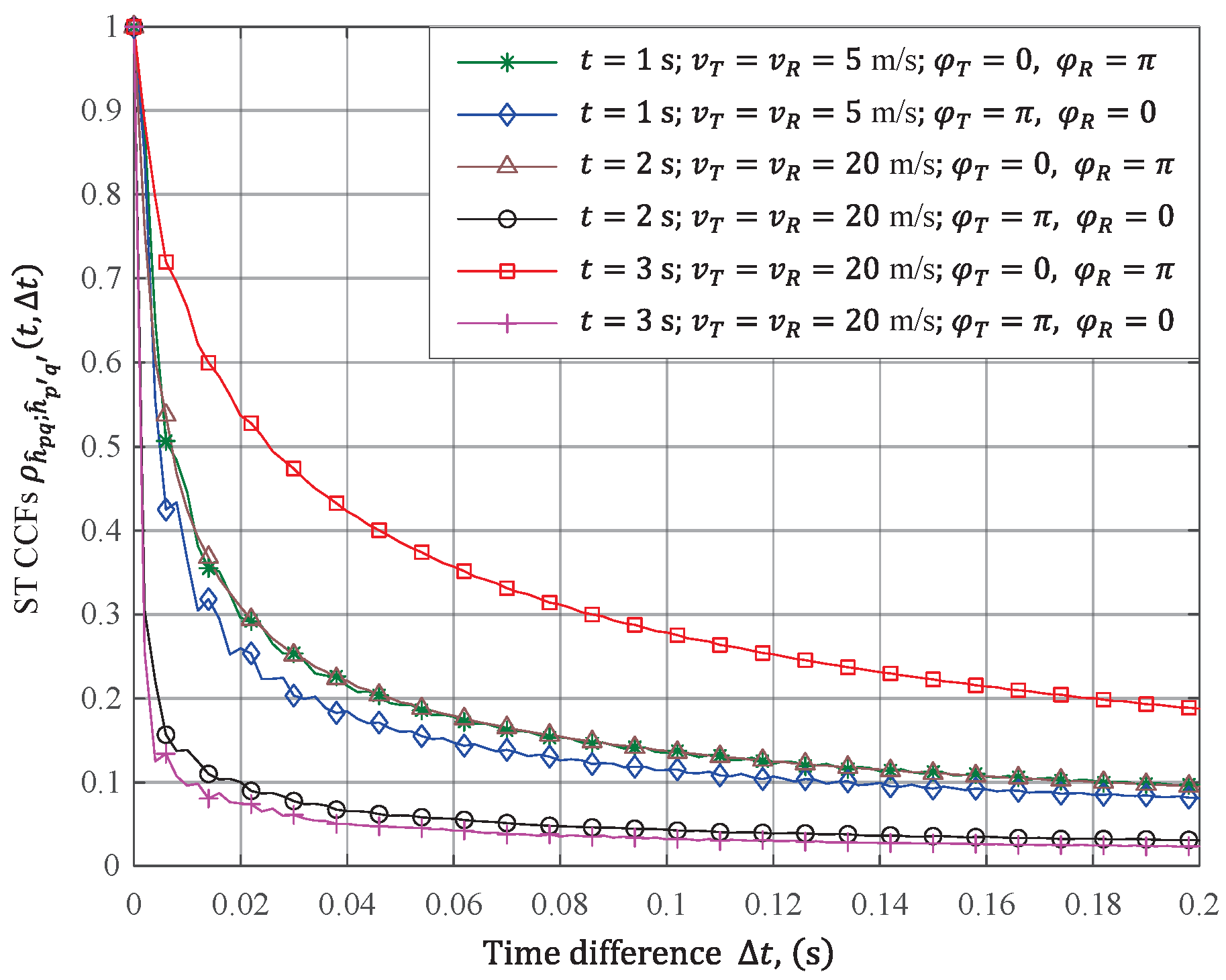
By using (63), Figure 8 shows the estimated ST CCFs of the non-WSSUS channel models for V2V communications in terms of the moving time/directions/velocities of the transmitter and receiver. It is observed that when the moving time t is fixed, the spatial correlation for the case of the transmitter and receiver moving towards each other (i.e., and ) is larger than that for the case of the transmitter and receiver moving away from each other (i.e., and ). The difference between the aforementioned two cases becomes more obvious as the t rises from 1 s to 5 s. Furthermore, we notice that when the moving directions of the transmitter and receiver are set as and , respectively, the ST CCFs rise as the t increases from 1 s to 3 s. However, when the moving directions of the transmitter and receiver are set as and , respectively, the ST CCFs decrease slowly as the t increases from 1 s to 3 s.
Figure 8.
Estimated ST CCFs of WSSUS MIMO V2V channel model with respect to the moving directions/velocities of the MT and MR when and = 100 m.
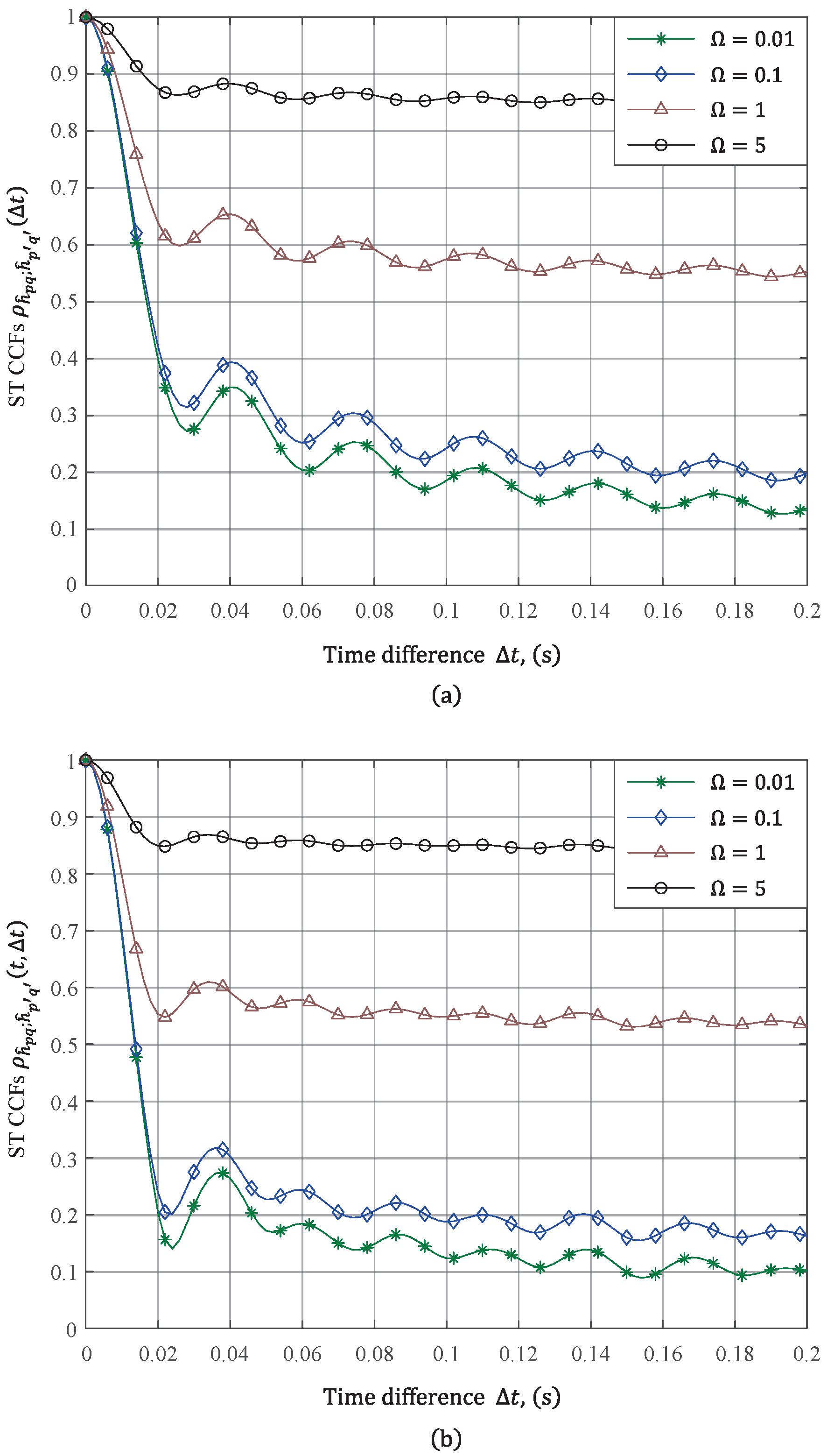
Figure 9 illustrates the estimated ST CCFs of the WSSUS and non-WSSUS MIMO V2V channel models for different Rician factors . It can be seen that when the Rician factor increases from 0.01 to 5, the proportion of the rays with NLoS interactions in the MIMO V2V channel models drops slowly, which results in the rising of the values of the spatial correlations.
Figure 9.
Estimated ST CCFs of MIMO V2V channel models for different Rician factors when s, m/s, , and . (a) WSSUS channel model; (b) non-WSSUS channel model.
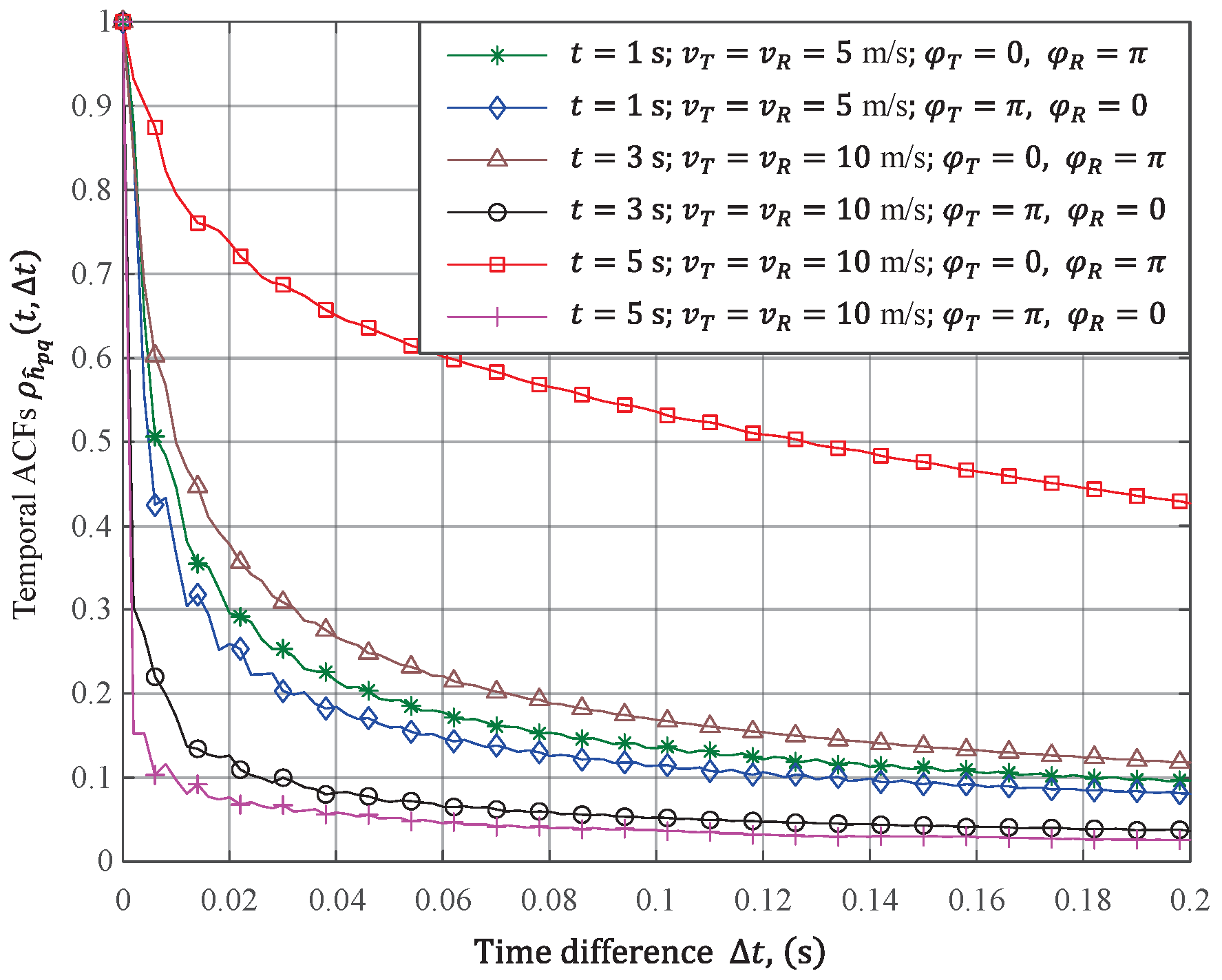
By using (65), Figure 10 depicts the estimated temporal ACFs of the non-WSSUS channel models for V2V communications. It can be seen that when the t is fixed, the temporal correlations for the case of and are relatively larger than those for the case of and . The difference between these two cases becomes more obvious as the t increases from 1 s to 5 s. Furthermore, notice that when the transmitter and receiver move mutually, the temporal correlations rise as the t increases. However, when the MT and MR move away from mutually, the temporal correlations drop as the t rises.
Figure 10.
Estimated temporal ACFs of non-WSSUS channel models for V2V communications with respect to the moving time/directions/velocities of the MT and MR when and m.
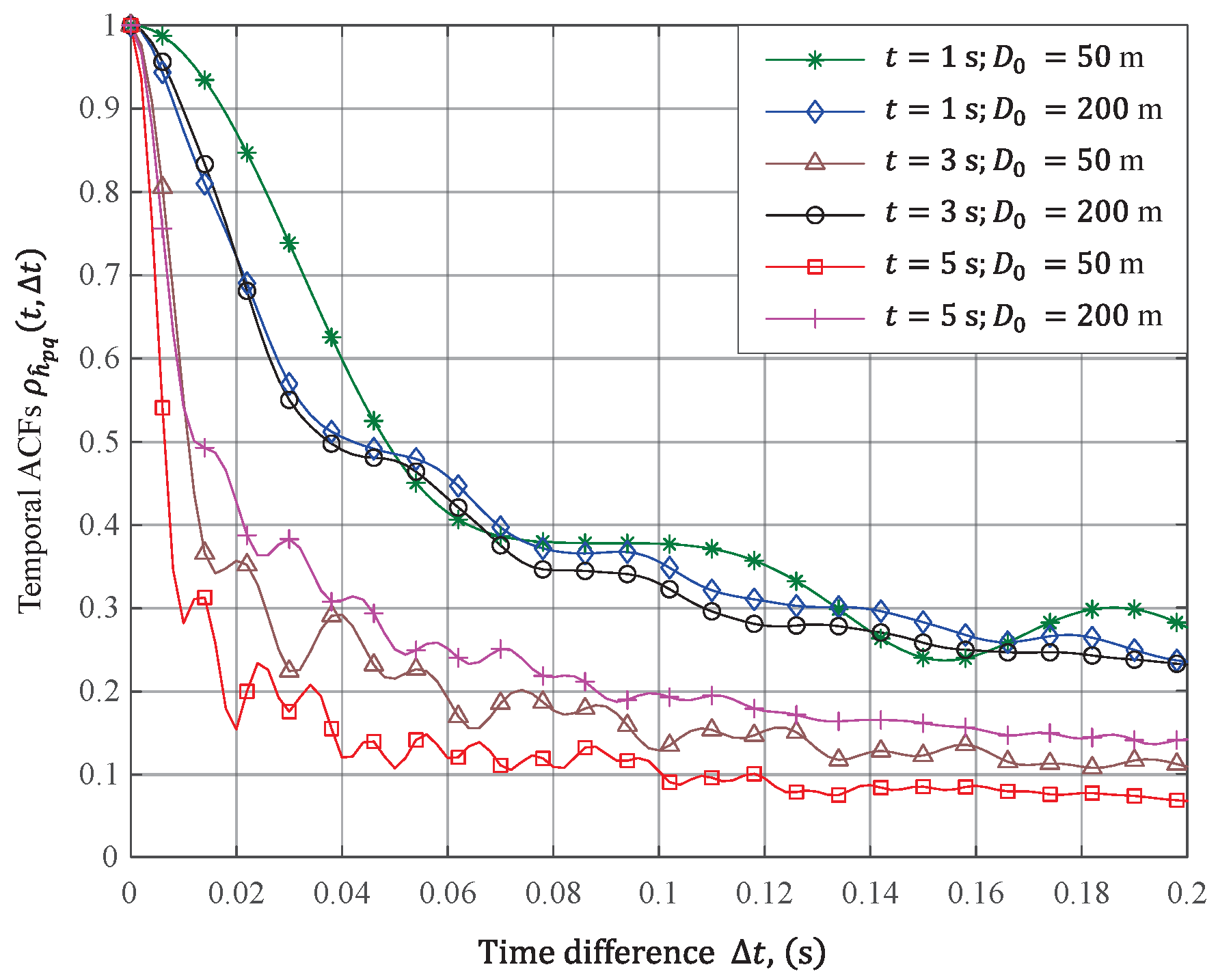
Figure 11 illustrates the estimated temporal ACFs of the non-WSSUS channel models for V2V communications for different distances . It is obviously observed that there are different properties in the temporal correlations at different t. Notice that similar conclusions are in Figure 8. It also can be seen that the temporal correlations drop slowly as the time difference rises. They are consistent with the results in [17], thereby validating the aforementioned simulations and analysis. Furthermore, we notice that by increasing the from 50 m to 200 m, the propagation delay of the waves emerging from the transmitter to the receiver rises gradually, which results in the increasing of the correlations in temporal domain.
Figure 11.
Estimated temporal ACFs of non-WSSUS channel models for V2V communications with respect to the moving time of the MT and MR when .
6. Conclusions
In this study, we have provided efficient computational solutions to estimate the angular parameters at the MT for determining the complex CIRs, which aim at estimating the propagation characteristics of the WSSUS and non-WSSUS MIMO V2V channels. It has been demonstrated that the estimate performances of the angular parameters at the MT behave very well as the discrete sequence is very large. It also has been shown that the estimated results of the propagation characteristics, such as the ST CCFs and temporal ACFs, sufficiently fit the theoretical results. These observations in principle validate that the proposed solutions are practical for estimating the propagation characteristics for MIMO V2V communications. As future works, we can point out two potential directions: (i) study the impact of channel sparsity on the proposed propagation delay estimation algorithms; (ii) conduct some channel measurements to further validate the efficiency of the proposed algorithms for estimating the WSSUS and non-WSSUS MIMO V2V channel models.
Author Contributions
All authors (B.Z., T.C., Y.Z. and G.X.) have read and agreed to the published version of the manuscript. All authors have read and agreed to the published version of the manuscript.
Funding
This research was funded by National Key Research and Development Program on Monitoring, Early Warning and Prevention of Major Natural Disaster (2019YFC1510004) and NSFC Grants (42005020).
Acknowledgments
The authors would like to thank the anonymous reviewers for their constructive comments, which greatly helped improve this paper.
Conflicts of Interest
The authors declare no conflict of interest.
References
- You, X.; Wang, C.X.; Huang, J.; Gao, X.; Zhang, Z.; Wang, M. Towards 6G wireless communication networks: Vision, enabling technologies, and new paradigm shifts. Sci. China Inf. Sci. 2021, 64, 110301. [Google Scholar] [CrossRef]
- Jiang, H.; Mukherjee, M.; Zhou, J.; Lloret, J. Channel modeling and characteristics for 6G wireless communications. IEEE Netw. 2021, 35, 296–303. [Google Scholar] [CrossRef]
- Ruan, C.; Zhang, Z.; Jiang, H.; Dang, J.; Wu, L.; Zhang, H. Approximate message passing for channel estimation in reconfigurable intelligent surface aided MIMO multi-user systems. IEEE Trans. Commun. 2022, 70, 5469–5481. [Google Scholar] [CrossRef]
- Zhou, J.; Wang, X.; Jiang, H.; Sasaki, S.; Shao, G. MIMO channel estimation with arbitrary angle of arrival incident power spectrum for wireless communications. IET Commun. 2020, 15, 232–244. [Google Scholar] [CrossRef]
- Wei, C.; Jiang, H.; Dang, J.; Wu, L.; Zhang, H. Accurate channel estimation for mmWave massive MIMO with partially coherent phase offsets. IEEE Commun. Lett. 2022. [Google Scholar] [CrossRef]
- Jiang, H.; Ying, W.; Zhou, J.; Shao, G. A 3D wideband two-cluster channel model for massive MIMO vehicle-to-vehicle communications in semi-ellipsoid environments. IEEE Access 2020, 8, 23594–23600. [Google Scholar] [CrossRef]
- Jiang, H.; Chen, Z.; Zhou, J.; Dang, J.; Wu, L. A general 3D non-stationary wideband twin-cluster channel model for 5G V2V tunnel communication environments. IEEE Access 2019, 7, 137744–137751. [Google Scholar] [CrossRef]
- Jiang, H.; Zhang, Z.; Dang, J.; Wu, L. Analysis of geometric multibounced virtual scattering channel model for dense urban street environments. IEEE Trans. Veh. Technol. 2017, 66, 1903–1912. [Google Scholar] [CrossRef]
- Jiang, H.; Zhang, Z.; Wu, L.; Dang, J. A non-stationary geometry-based scattering vehicle-to-vehicle MIMO channel model. IEEE Commun. Lett. 2018, 22, 1510–1513. [Google Scholar] [CrossRef]
- He, R.; Ai, B.; Stüber, G.L.; Wang, G.; Zhong, Z. Geometrical-based modeling for millimeter-wave MIMO mobile-to-mobile channels. IEEE Trans. Veh. Technol. 2018, 67, 848–2863. [Google Scholar] [CrossRef]
- Karedal, J.; Tufvesson, F.; Czink, N.; Paier, A.; Dumard, C.; Zemen, T. A geometry-based stochastic MIMO model for vehicleto-vehicle communications. IEEE Trans. Wirel. Commun. 2009, 8, 3646–3657. [Google Scholar] [CrossRef] [Green Version]
- Boban, M.; Vinhoza, T.T.; Ferreira, M.; Barros, J.; Tonguz, O.K. Impact of vehicles as obstacles in vehicular ad hoc networks. IEEE J. Sel. Areas Commun. 2011, 29, 15–28. [Google Scholar] [CrossRef]
- Paier, A.; Zemen, T.; Bernado, L.; Matz, G.; Karedal, J.; Czink, N. Non-WSSUS vehicular channel characterization in highway and urban scenarios at 5.2 GHz using the local scattering function. In Proceedings of the WSA 2008, Vienna, Austria, February 2008; pp. 9–15. [Google Scholar]
- Zhu, Q.; Li, W.; Wang, C.X.; Xu, D.; Bian, J.; Chen, X.; Zhong, W. Temporal correlations for a non-stationary vehicle-to-vehicle channel model allowing velocity variations. IEEE Commun. Lett. 2019, 23, 1280–1284. [Google Scholar] [CrossRef]
- Li, Y.; He, R.; Lin, S.; Guan, K.; He, D.; Wang, Q.; Zhong, Z. Cluster-based nonstationary channel modeling for vehicle-to-vehicle communications. IEEE Antennas Wirel. Prop. Lett. 2017, 16, 1419–1422. [Google Scholar] [CrossRef]
- Ghazal, A.; Yuan, Y.; Wang, C.X.; Zhang, Y.; Yao, Q.; Zhou, H.; Duan, W. A non-stationary IMT-Advanced MIMO channel model for high-mobility wireless communication systems. IEEE Trans. Wirel. Commun. 2017, 16, 2057–2068. [Google Scholar] [CrossRef] [Green Version]
- Ghazal, A.; Wang, C.X.; Ai, B.; Yuan, D.; Haas, H. A nonstationary wideband MIMO channel model for high-mobility intelligent transportation systems. IEEE Trans. Intell. Transp. Syst. 2015, 16, 885–897. [Google Scholar] [CrossRef] [Green Version]
- Xiao, C.; Wu, J.; Leong, S.Y.; Zheng, Y.R.; Letaief, K.B. A discrete-time model for triply selective MIMO Rayleigh fading channels. IEEE Trans. Wirel. Commun. 2004, 3, 1678–1688. [Google Scholar] [CrossRef]
- Xiao, C.S.; Zheng, Y.R.; Beaulieu, N.C. Novel sum-of-sinusoids simulation models for Rayleigh and Rician fading channels. IEEE Trans. Wirel. Commun. 2006, 5, 3667–3679. [Google Scholar] [CrossRef]
- Tan, Z.; Eldar, Y.C.; Nehorai, A. Nehorai, Direction of arrival estimation using co-prime arrays: A super resolution viewpoint. IEEE Trans. Signal Proc. 2014, 62, 5565–5576. [Google Scholar] [CrossRef] [Green Version]
- Johnny, M.; Aref, M.R.; Razzazi, F. Effect of unitary transformation on Bayesian information criterion for source numbering in array processing. IET Signal Proc. 2019, 13, 670–678. [Google Scholar] [CrossRef]
- Xu, D.; Liu, Z.; Xu, Y.; Cao, J. A unitary transformation method for DOA estimation with uniform circular array. In Proceedings of the IEEE WCNIS, Beijing, China, 25–27 June 2010; pp. 142–145. [Google Scholar]
- Lopez, C.F.; Wang, C.-X. Novel 3-D non-stationary wideband models for massive MIMO channels. IEEE Trans. Wirel. Commun. 2018, 17, 2893–2905. [Google Scholar] [CrossRef] [Green Version]
- Xiong, B.; Zhang, Z.; Zhang, J.; Jiang, H.; Dang, J.; Wu, L. Novel multi-mobility V2X channel model in the presence of randomly moving clusters. IEEE Trans. Wirel. Commun. 2021, 20, 3180–3195. [Google Scholar] [CrossRef]
- Jiang, H.; He, R.; Ruan, C.; Zhou, J.; Chang, D. Three-dimensional geometry-based stochastic channel modeling for intelligent reflecting surface-assisted UAV MIMO communications. IEEE Wirel. Commun. Lett. 2021, 10, 2727–2731. [Google Scholar] [CrossRef]
- Jiang, H.; Xue, Y.; Zhou, J.; Chen, Z.; Dang, J.; Wu, L. A 3D cylinder MIMO channel model for 5G macrocell mobile-to-mobile communication systems. IEEE Access 2019, 7, 119350–119356. [Google Scholar] [CrossRef]
- Jiang, H.; Zhang, Z.; Wu, L.; Dang, J.; Gui, G. A 3D non-stationary wideband geometry-based channel model for MIMO vehicle-to-vehicle communications in tunnel environments. IEEE Trans. Veh. Technol. 2019, 8, 6257–6271. [Google Scholar] [CrossRef]
- Jiang, H.; Zhang, Z.; Dang, J.; Wu, L. A novel 3D massive MIMO channel model for vehicle-to-vehicle communication environments. IEEE Trans. Commun. 2018, 66, 79–90. [Google Scholar] [CrossRef]
- Hellings, C.; Gerdes, L.; Weil, L.; Utschick, W. On optimal Gaussian signaling in MIMO relay channels with partial decode-and-forward. IEEE Trans. Signal Proc. 2014, 62, 3153–3164. [Google Scholar]
- Telatar, E. Capacity of Multi-Antenna Gaussian Channels; John Wiley and Sons, Ltd.: Hoboken, NJ, USA, 2008. [Google Scholar]
- Steven, M.K. Fundamentals of Statistical Signal Processing Vol. I: Estimation Theory; Prentice Hall PTR: Englewood Cliffs, NJ, USA, 1993. [Google Scholar]
- Wu, C.; Elangage, J. Multiemitter two-dimensional angle-of-arrival estimator via compressive sensing. IEEE Trans. Aerosp. Electron. Syst. 2020, 56, 884–2895. [Google Scholar] [CrossRef]
- Liu, Z.M.; Zhang, C.W.; Yu, P.S. Directional-of-arrival estimation based on deep neural networks with robustness to array imperfections. IEEE Trans. Antennas Propag. 2018, 66, 7315–7327. [Google Scholar] [CrossRef]
- Badics, Z.; Cendes, Z.J. A Newton-Raphson algorithm with adaptive accuracy control based on a block-preconditioned conjugate gradient technique. IEEE Trans. Magnetics 2005, 41, 1652–1655. [Google Scholar] [CrossRef]
- Xiong, B.; Zhang, Z.; Jiang, H.; Zhang, J.; Wu, L.; Dang, J. A 3D non-stationary MIMO channel model for reconfigurable intelligent surface auxiliary UAV-to-ground mmWave communications. IEEE Trans. Wirel. Commun. 2022. [Google Scholar] [CrossRef]
- Xiong, B.; Zhang, Z.; Jiang, H.; Zhang, H.; Zhang, J.; Wu, L.; Dang, J. A statistical MIMO channel model for reconfigurable intelligent surface assisted wireless communications. IEEE Trans. Commun. 2022, 70, 1360–1375. [Google Scholar] [CrossRef]
- Jiang, H.; Ruan, C.; Zhang, Z.; Dang, J.; Wu, L.; Mukherjee, M.; da Costa, D.B. A general wideband non-stationary stochastic channel model for intelligent reflecting surface-assisted MIMO communications. IEEE Trans. Wirel. Commun. 2021, 20, 5314–5328. [Google Scholar] [CrossRef]
- Chen, T.; Liu, L.; Pan, D. A ULA-based MWC discrete compressed sampling structure for carrier frequency and AOA estimation. IEEE Access 2017, 5, 14154–14164. [Google Scholar] [CrossRef]
- Zhu, D.; Choi, J.; Heath, R.W. Auxiliary beam pair enabled AoD and AoA estimation in closed-loop large-scale millimeter-wave MIMO systems. IEEE Trans. Wirel. Commun. 2017, 16, 4770–4785. [Google Scholar] [CrossRef]
- Jiang, H.; Zhang, Z.; Wang, C.X.; Zhang, J.; Dang, J.; Wu, L.; Zhang, H. A novel 3D UAV channel model for A2G communication environments using AoD and AoA estimation algorithms. IEEE Trans. Commun. 2020, 68, 7232–7246. [Google Scholar] [CrossRef]
- Jiang, H.; Xiong, B.; Zhang, Z.; Zhang, J.; Zhang, H.; Dang, J.; Wu, L. Novel statistical wideband MIMO V2V channel modeling using Unitary matrix transformation algorithm. IEEE Trans. Wirel. Commun. 2021, 20, 4947–4961. [Google Scholar] [CrossRef]
- Payami, S.; Tufvesson, F. Channel measurements and analysis for very large array systems at 2.6 GHz. In Proceedings of the EUCAP, Prague, Czech Republic, 26–30 March 2012; pp. 433–437. [Google Scholar]
Publisher’s Note: MDPI stays neutral with regard to jurisdictional claims in published maps and institutional affiliations. |
© 2022 by the authors. Licensee MDPI, Basel, Switzerland. This article is an open access article distributed under the terms and conditions of the Creative Commons Attribution (CC BY) license (https://creativecommons.org/licenses/by/4.0/).