


Abstract
To develop cosmetic film-forming agents that combine sustainability with functionality, this study synthesized a series of bio-based polyols using epoxidized soybean oil (ESO) as raw material through acid-catalyzed ring-opening reactions. These polyols partially replaced petroleum-based polyols and reacted with isophorone diisocyanate (IPDI). By incorporating β-cyclodextrin (β-CD), a water-based polyurethane (CPS-ESO) was successfully developed that combines degradability with active ingredient delivery capability. Experiments demonstrated that the resulting CPS-M film exhibits excellent water repellency (contact angle 66.7°), mechanical properties (tensile strength 14.21 MPa, elongation at break 229.42%), adhesion (Level 0), and breathability, while displaying controllable degradation behavior under both enzymatic and alkaline hydrolysis conditions. Due to the cavity structure of β-cyclodextrin, this material efficiently loaded resveratrol (RES) at a loading rate of 0.16%. Formulated into a setting spray (F1), the product demonstrated outstanding makeup longevity (lowest ΔE value after water/sweat immersion), anti-friction performance (ΔE value after friction only one-third of the control group), and antioxidant activity (DPPH scavenging rate of 86.25%), with RES remaining stable under high-temperature storage conditions. This study provides new insights for designing green multifunctional cosmetic film-forming agents.
1. Introduction
With the rapid development of the cosmetics industry and consumers’ increasing demands for makeup longevity and user experience, setting sprays—as convenient and efficient makeup setting products—have demonstrated significant market growth [1,2,3]. Today, consumer expectations extend beyond basic setting functions, with growing demand for multifunctional benefits including skincare, hydration, and anti-dullness effects [4,5,6]. For instance, sprays enriched with antioxidants like vitamin C and niacinamide help achieve brightening and anti-aging effects [7,8,9,10]. Formulations containing hyaluronic acid and plant extracts deliver instant hydration and soothing benefits, aligning with the increasingly popular “makeup–skincare integration” concept [11,12,13]. Driven by this trend, the global cosmetics market is accelerating its shift toward “green sustainability” and “integrated efficacy” [14,15,16].
Film-forming agents serve as the core functional ingredients in setting sprays, directly influencing makeup adhesion, sweat resistance, and the final skin feel [17]. However, widely used traditional petroleum-based film-forming agents (such as polyvinylpyrrolidone PVP and acrylic resins) generally suffer from poor environmental degradability and limited functionality, failing to meet market demands for products that combine skincare efficacy with eco-friendly attributes [18,19,20].
Water-based polyurethane (WPU) uses water as its dispersion medium, exhibiting excellent film-forming properties, flexibility, adhesion, and biocompatibility. Its performance can be flexibly tuned through molecular design, making it a highly promising candidate for eco-friendly film-forming agents [21,22,23]. It should be noted that waterborne polyurethanes (WPUs) can be synthesized via two distinct routes: the conventional diisocyanate-based polyaddition method, and the emerging non-isocyanate polyurethane (NIPU) route based on cyclic carbonate ring-opening polymerization. While the NIPU approach offers advantages in terms of isocyanate-free processing, the diisocyanate-based method remains the dominant industrial route for WPUs due to its well-established chemistry, broad monomer availability, and superior mechanical properties. In this study, the conventional diisocyanate-based polyaddition approach was adopted, and water dispersibility was achieved through the incorporation of dimethylolbutanoic acid (DMBA) as an internal emulsifier, followed by neutralization with triethylamine to form carboxylate salt groups that stabilize the polyurethane particles in aqueous medium [21,24].
However, it is noteworthy that mainstream commercial WPUs still primarily rely on petroleum-based polyols for synthesis, indicating shortcomings in the sustainability of their raw material sources. Furthermore, conventional WPU systems are typically not engineered for active ingredient encapsulation and controlled release, making it difficult to effectively carry and deliver lipophilic skincare actives. This limitation hinders the integration of cosmetic and skincare functions in a single formulation [24,25,26].
To overcome these limitations, researchers have primarily adopted two modification strategies. The first strategy focuses on achieving sustainability through renewable resources. Vegetable oils, such as epoxidized soybean oil (ESO), serve as abundant, inexpensive, and versatile platforms for synthesizing bio-based polyols [27]. By incorporating them into the WPU backbone, the aim is to create materials with improved environmental properties and tunable biodegradation rates [28,29,30]. The second strategy emphasizes functional enhancement through molecular embedding. Cyclodextrins (CDs), cyclic oligosaccharides featuring hydrophobic cavities and hydrophilic shells, are renowned for their ability to form host–guest complexes [31,32,33]. When grafted onto polymer chains, cyclodextrins serve as built-in nanocarriers, encapsulating poorly soluble active ingredients like antioxidants (e.g., resveratrol) and preventing their degradation [34,35,36,37]. This approach enables the direct incorporation of skincare benefits within film matrices. Diaconu et al. [38] prepared hydrolyzable cyclodextrin–polyurethane hydrogels by chemically modifying cyclodextrin with oligolactone derivatives, followed by crosslinking with isophorone diisocyanate (IPDI) and polyethylene glycol (PEG). They demonstrated the potential of this cyclodextrin–polyurethane hydrogel as a topical drug delivery system through in vitro release experiments using levofloxacin as a model drug.
Poly(ε-caprolactone) diol (PCL) was selected as the soft segment due to its biocompatibility, semi-crystalline nature, and biodegradability, which have been extensively documented in polyurethane synthesis for biomedical and cosmetic applications [24,25]. Resveratrol (RES), a naturally occurring polyphenolic antioxidant, was chosen as the model active ingredient owing to its well-documented free radical scavenging activity, anti-inflammatory properties, and growing application in anti-aging skincare formulations [9,10]. However, its poor water solubility and chemical instability under ambient conditions necessitate an effective encapsulation strategy, making it an ideal candidate for evaluating the active delivery capability of the developed cyclodextrin-functionalized polyurethane system.
This study designed and synthesized functional biodegradable WPU film formers. Through acid-catalyzed ESO ring-opening reactions, we synthesized a series of bio-based polyols with varying hydroxyl values. These polyols partially replaced petroleum-based polyols in WPU synthesis. By embedding β-cyclodextrin (β-CD) into the polymer backbone and further modifying it with amino silane (KH550) to enhance mechanical properties and hydrophobicity, we successfully constructed novel water-based polyurethanes (CPS-ESO). The CPS-ESO system was specifically engineered to load and controllably release the model antioxidant resveratrol (RES), forming stable inclusion complexes. We systematically investigated the chemical structures, mechanical properties, degradability, and active substance encapsulation efficiency of these materials. Finally, by formulating them into setting sprays and evaluating key metrics such as setting power, friction resistance, and antioxidant efficacy, we validated their practical application potential.
2. Materials and Methods
2.1. Materials
Isophorone diisocyanate (IPDI, 99%), poly(ε-caprolactone) diol (PCL, Mn = 2000 g/mol), dimethylolbutanoic acid (DMBA, 98%), β-cyclodextrin (β-CD, 98%), 3-aminopropyltriethoxysilane (KH550, 98%), and resveratrol (RES, >99%) were purchased from Shanghai Aladdin Biochemical Technology Co., Ltd. (Shanghai, China). Epoxidized soybean oil (ESO) and the binary acids (malic acid, tartaric acid, glutaric acid, succinic acid) were obtained from Shanghai Macklin Biochemical Co., Ltd. (Shanghai, China). All other chemicals were of analytical grade and used as received.
The following instruments and software were used in this study: Fourier transform infrared spectrometer (Nicolet iS50, Thermo Fisher Scientific, Waltham, MA, USA); universal testing machine (WDW-01, Jinan Chenda Testing Machine Manufacturing Co., Ltd., Jinan, China); contact angle meter (KJ.63-JJC-1, Beijing Zhuochuan Electronic Technology Co., Ltd., Beijing, China); field-emission scanning electron microscope (JSM-7610F Plus, JEOL Ltd., Tokyo, Japan); UV-visible spectrophotometer (UV-2600i, Shimadzu Corporation, Kyoto, Japan); nanoparticle size analyzer (Zetasizer Nano ZS, Malvern Panalytical Ltd., Malvern, UK); thermogravimetric analyzer (SDT 650/SD TA Instruments Waters Corporation, USA); and a centrifuge (H1850, Hunan Xiangyi Laboratory Instrument Development Co., Ltd., Changsha, China). Data analysis was performed using OriginPro 2021 software (OriginLab Corporation, Northampton, MA, USA). Spectral processing was completed using OMNIC 9.2 software (Thermo Fisher Scientific, Waltham, MA, USA).
2.2. Synthesis of Functionalized WPUs
2.2.1. Synthesis of Soybean Oil-Based Polyol
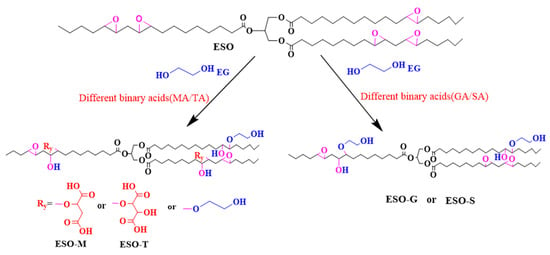
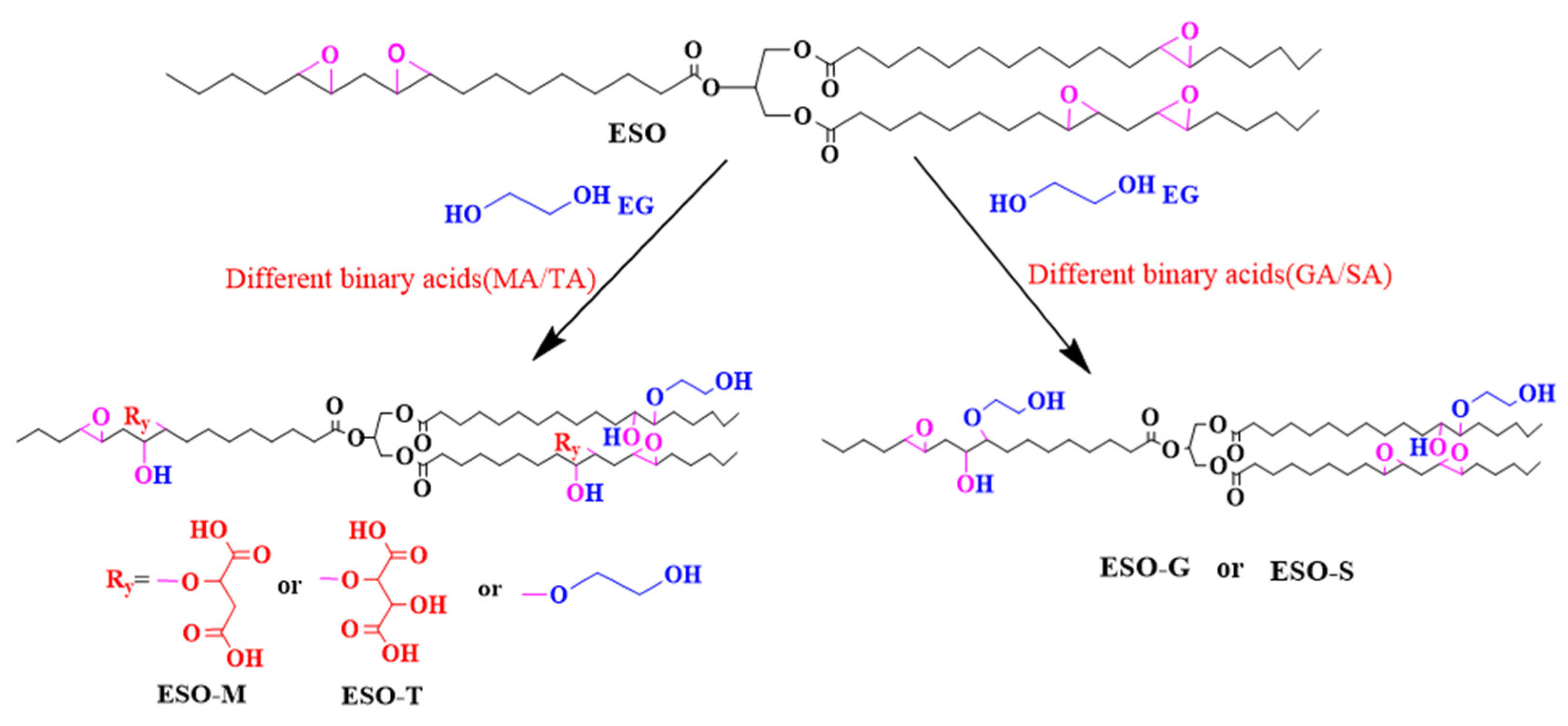
ESO was reacted with ethylene glycol (EG) using different binary acids (0.5 wt% of ESO) as catalysts at 140 °C under N2 for 4 h to obtain soybean oil-based polyols (named ESO-M, ESO-T, ESO-G, and ESO-S based on the acid used) [27,28]. The synthetic route for soybean oil polyols is shown in Figure 1.
Figure 1.
Synthesis route for soybean oil polyols.
2.2.2. Synthesis of CPS-ESO
Vacuum-dehydrated PCL, β-CD (1.5% by weight of the soft segment), and soybean oil-based polyol ESO-M (20% by molar weight of total hydroxyl groups in the PCL soft segment) were added to a three-neck flask equipped with a stirring rod and condenser. After heating to 80 °C, IPDI was added, and stirring was maintained at a constant speed for 1 h. Add hydrophilic chain extender DMBA and a small amount of catalyst DBTDL, stirring for 2 h. Once the -NCO value reaches the theoretical value, add BDO for chain extension and continue the reaction for 2 h. Add an appropriate amount of DMAC to adjust the system viscosity. Cool to 40 °C, and then add TEA and KH550 to achieve 100% neutralization and react for 1.5 h. Finally, deionized water was slowly added dropwise under high-speed stirring (1200 rpm) to emulsify via phase inversion.
The water dispersibility of the synthesized polyurethane was achieved via the conventional pre-polymer method. The introduction of DMBA provided pendant carboxyl groups along the polymer backbone. After neutralization with triethylamine, these carboxyl groups were converted into hydrophilic carboxylate anions, which acted as internal emulsifiers. Upon addition of deionized water under high-speed stirring, phase inversion occurred, forming stable polyurethane nanoparticles dispersed in water [21,24]. After dialysis to remove solvents, the soybean oil-based aqueous polyurethane film-forming agent (CPS-M) was obtained.
2.2.3. Preparation of Inclusion Compounds
Take 10 mL of CPS-M dispersion solution and slowly add it dropwise to the RES ethanol solution (mass concentration 1 g/L) at a molar ratio of β-CD to RES of 1:1 in CPS-M. Stir for 4–6 h to promote host–guest inclusion. After leaving the solution to stand for 12 h, centrifuge at 5000 r/min for 10 min to remove unencapsulated RES solids, yielding a milky-white inclusion complex solution [34,35].
2.3. Setting Spray Preparation
A series of setting spray samples was formulated according to the recipe. The base formulation contained: 2% film-forming agent (in-house film-forming agent CPS-M and a commercially available waterborne polyurethane film-forming agent, designated as agent A), 0.8% niacinamide, 1% 1,3-butanediol, 0.02% EDTA-2Na, and 0.8% preservative C1-04, with the remainder made up to 100% with water. By incorporating different film-forming agents, samples F1 and F2 were produced for subsequent performance evaluation. All samples underwent homogenization and filtration before filling, followed by testing after equilibration at room temperature [17].
2.4. Characterization and Performance Evaluation
2.4.1. Hydroxyl Value Determination
The hydroxyl value was determined in accordance with GB/T 12008.3-2009 [39] (“Plastics—Polyether Polyols—Part 3: Determination of Hydroxyl Value”). This standard specifies the acetylation method, where the hydroxyl groups are acetylated with acetic anhydride, followed by titration of the residual acid with potassium hydroxide solution. The hydroxyl value is expressed as milligrams of KOH equivalent per gram of sample (mg KOH/g).
2.4.2. Chemical Structure
FT-IR (Nicolet iS50) Fourier-transform infrared spectra of the samples were acquired using a Nicolet iS50 spectrometer in absorption mode. Measurements were performed in attenuated total reflection mode over the wavelength range of 4000–400 cm−1, with a resolution of 4 cm−1 and 16 scans.
2.4.3. Emulsion Performance Testing
Visual inspection: the emulsion was transferred into a transparent container to observe its color and transparency. Stability test: centrifugation was conducted at 3000 r/min for 15 min; if no sediment formed, the emulsion’s storage stability was determined to be >6 months. Particle size was measured using a nanoparticle size analyzer.
2.4.4. Mechanical Property Testing
Per GB/T 1040-2006 [40] “Plastics—Determination of Tensile Properties,” cut the sample film into standard dumbbell-shaped specimens using a cutting tool. Determine the mechanical properties of the film using a universal testing machine at a tensile rate of 50 mm/min. Conduct three parallel experiments and calculate the arithmetic mean of the results. Adhesion testing was conducted per GB/T 9286-2021 [41] “Paints and Varnishes—Cross-Hatch Adhesion Test.” Pencil hardness testing was performed according to GB/T 6739-2006 [42] “Paints and Varnishes—Determination of Film Hardness by the Pencil Method.”
2.4.5. Thermal Stability Testing
Dynamic mass monitoring of samples was conducted via DSC under nitrogen atmosphere, with test temperatures ranging from 30 to 400 °C and a heating rate of 10 °C/min.
2.4.6. Hydrophobicity Testing
The water contact angle of the film was measured using a contact angle measuring instrument. A 5 µL water droplet was used for testing. Five test points were selected for each sample, and the measured water contact angles were recorded. The results were averaged arithmetically.
2.4.7. Degradation Performance Testing
Biodegradation: Cut the membrane into 2 × 2 cm pieces and place them in PBS buffer solution containing 1.5 mg/mL porcine pancreatic lipase. Incubate in a constant-temperature shaking incubator with the following parameters: temperature 50 °C, and shaking speed 120 rpm. Remove samples weekly, rinse repeatedly with distilled water until constant weight is achieved, and store in a desiccator for subsequent testing [29,30].
Hydrolytic degradation: Cut polyurethane membrane into 2 × 2 cm squares and place into prepared sample vials. Add 5 mL of pre-prepared 1 wt% sodium hydroxide solution. Place vials in a 45 °C constant-temperature incubator and monitor degradation rate over time.
2.4.8. Surface Morphology Analysis of Polyurethane Membranes
The surface morphology of polyurethane membrane samples before and after degradation was systematically characterized using a JSM-7610F Plus field emission scanning electron microscope.
2.4.9. Determination of Inclusion Rate and Loading Rate
Establishment of the RES solution standard curve: Accurately weigh 10 mg (0.0438 mmol) of RES reference substance. Dissolve it in 40% ethanol by volume, and then dilute to 100 mL in a volumetric flask to prepare a 100 μg/mL RES stock solution. Dilute the RES stock solution with 40% ethanol by volume to prepare standard solutions with mass concentrations of 0.5, 1, 2, 3, 4, and 5 μg/mL. Using 40% ethanol by volume as the blank background, measure the absorbance (y) at 306 nm using a UV–visible spectrophotometer. Perform linear regression fitting for the RES mass concentration (x, μg/mL). The resulting calibration curve equation was as follows: y = 0.17928x − 0.00352 (R2 = 0.9998).
Using ultrafiltration centrifugation, an appropriate sample volume was placed in an ultrafiltration centrifuge tube with a molecular weight cutoff of 3000. After centrifugation at 10,000 r/min for 30 min, the filtrate collected at the bottom was diluted appropriately with 40% ethanol by volume. The absorbance of the solution at 306 nm was measured using a UV–visible spectrophotometer. The RES inclusion rate (%) and loading rate (%) were calculated using the standard curve equation and Equations (1) and (2). Each sample was analyzed in triplicate, and the arithmetic mean was taken as the final result.
In the equation, m1 is the mass of RES in the filtrate, g; m0 is the actual mass of RES added, g; and m is the total mass of the inclusion complex, g.
2.5. Breathability Test
To evaluate the vapor permeability of films formed by film-forming agents, a water vapor transmission rate test method based on the gravimetric approach was employed. Its fundamental principle involves measuring the mass increase caused by water vapor permeating the film and being absorbed by a desiccant under constant-temperature and -humidity conditions, thereby calculating the film’s vapor permeability (water vapor transmission rate). The specific procedure is as follows: Immerse pieces of parchment paper of identical size in the film-forming agent solution. After thorough saturation, remove the paper and lay it flat in a cool, shaded area at room temperature to dry evenly and form a film. Take a dry weighing bottle and precisely weigh 1 g of anhydrous calcium chloride as desiccant, placing it at the bottom of the bottle. Tightly cover the flask opening with the prepared film and rigorously seal the edges using sealing film to ensure that water vapor permeates only through the film area. Use an uncovered, open weighing bottle as a blank control. Place the assembled test apparatus in a constant-relative-humidity environment (room temperature, 75% RH) maintained by saturated sodium chloride solution. After 24 h, remove the apparatus and immediately perform precise weighing of the total mass for each device [43]. Calculate the relative gas permeability (Φ) of the film under these conditions by determining the mass increase (ΔMsample) of the test apparatus over 24 h and comparing it to the mass increase (ΔMblank) of the blank control, using Formula (3).
Here, ΔM reflects the absorption amount of water vapor freely diffusing under identical conditions, representing the theoretical maximum moisture permeability. Each sample undergoes five parallel measurements, with results averaged.
2.6. Setting Spray Test
2.6.1. Setting Spray Film Formation and Surface Drying Test
To evaluate the drying rate and immediate skin feel of setting spray during use, the surface drying time was measured using the finger touch method. Specifically, at room temperature, a standardized pump dispensed the sample evenly onto a specific area of the volunteer’s clean, dry hand back. Timing commenced immediately and continued until the film no longer adhered to the finger. The surface drying time was recorded, with the test independently repeated three times [17].
2.6.2. Testing the Makeup Setting Spray’s Long-Lasting Effect in an In Vitro Setting
To evaluate the makeup setting spray’s stability and longevity, a simulated water exposure (sweat) scenario was created to mimic real-world usage. Testing employed an artificial sweat immersion method combined with color quantification analysis. Specifically, a smooth, off-white leather surface (3 cm × 3 cm) served as the standard makeup application substrate. Precise balances were used to weigh eyeshadow (0.001 g ± 0.0002 g), which was then evenly applied to the substrate surface to form a uniform makeup layer. The test setting spray was then evenly sprayed onto the makeup surface. A sample sprayed with an equal volume of deionized water served as the blank control. After drying, the samples were immersed in water and artificial sweat for 1 h. A color difference meter measured the L*, a*, and b* values at the center of the test area before and after immersion [44,45,46,47]. The color difference ΔE was calculated using Formula (4). The ΔE value comprehensively reflects the overall color shift of the makeup [48,49,50,51,52]. A lower ΔE value indicates less makeup loss due to immersion, signifying better water or sweat resistance of the sample. Measurements were taken at 5–8 points per sample, with three parallel tests conducted.
In the formula, L*t0, a*t0, and b*t0 represent the values measured before immersion; L*t1, a*t1, and b*t1 represent the values measured after immersion.
2.6.3. Anti-Friction Performance Test for Setting Sprays
To quantitatively evaluate the anti-friction performance of setting sprays, a test simulating daily friction was designed. After evenly applying an equal amount of eyeshadow to a designated area on the back of a volunteer’s hand, the test setting spray sample was sprayed and allowed to fully form a film. A cotton cloth wrapped around a 200 g weight was used to apply constant vertical pressure, performing 10 reciprocating friction cycles on the test area. A sample without any setting spray applied served as the blank control. A colorimeter measured the L*, a*, and b* values of the test area before and after friction. The color difference ΔE was calculated using Formula (4). A higher ΔE value indicates more significant color change in the makeup due to friction, signifying poorer friction resistance.
2.6.4. Antioxidant Performance Testing of Setting Spray
Since the self-formulated film-forming agent contains the antioxidant resveratrol, the in vitro antioxidant performance of the setting spray was evaluated using the 1,1-diphenyl-2-picrylhydrazyl (DPPH) radical scavenging method. This method relies on antioxidants providing hydrogen atoms or electrons to DPPH radicals, causing their decolorization. The radical scavenging capacity of the sample is thus quantified by changes in absorbance [53,54,55,56]. The specific experimental steps are as follows: Accurately weigh 3.94 mg of DPPH standard, dilute to 100 mL with anhydrous ethanol to prepare a 0.1 mM stock solution, and store it protected from light. Prior to use, dilute the stock solution 1:1 with anhydrous ethanol to obtain a 0.05 mM working solution. Prepare the following groups: a sample group (A1: 1 mL sample + 1 mL DPPH), a sample background group (A2: 1 mL sample + 1 mL anhydrous ethanol), a blank group (A3: 1 mL DPPH + 1 mL anhydrous ethanol), a positive control group (1 mL free resveratrol or L-ascorbic acid Vc + 1 mL DPPH), and a negative control group (1 mL CPS sample without RES inclusion + 1 mL DPPH). The negative control group is used to correct for interference from the intrinsic color of CPS. Immediately after sample addition, vortex for 5–10 s to mix thoroughly. Wrap with aluminum foil or place in darkness, and then incubate at room temperature (25 ± 1 °C) in the dark for 30 min. After incubation, measure absorbance at 517 nm using a microplate reader and calculate the DPPH radical scavenging rate according to Formula (5) [54].
In the formula, A1 represents the absorbance of the sample group, A2 represents the absorbance of the sample background group, and A3 represents the absorbance of the blank group.
2.6.5. Antioxidant Stability of Setting Sprays
To evaluate the antioxidant stability of resveratrol in setting spray formulations, three samples were prepared: a setting spray containing free resveratrol (RES); a setting spray containing commercially available film-forming agent A and resveratrol (F2-RES); and a setting spray containing a resveratrol inclusion complex with film-forming agent CPS-M (F1).
The samples were stored for 48 h under ambient conditions (25 ± 2 °C) and accelerated stability conditions (60 ± 2 °C). Subsequently, antioxidant activity was measured using the DPPH radical scavenging assay under both storage conditions. Changes in scavenging rates were evaluated to assess resveratrol stability across different formulations.
3. Results
3.1. Structure and Hydroxyl Value of Soybean Oil-Based Polyols
As shown in Figure S1, the characteristic absorption peak of the raw material epoxidized soybean oil (ESO) near 835 cm−1 (attributed to epoxy group vibrations) is weakened or absent in the infrared spectra of all four acid-catalyzed products (ESO-M, ESO-T, ESO-G, ESO-S). This provides direct evidence for the ring-opening reaction of the epoxy ring, indicating that the epoxy group in ESO has participated in the reaction. All four products exhibit broad, intense absorption peaks around 3400 cm−1, characteristic of hydroxyl (-OH) stretching vibrations. This confirms that the ring-opening reaction successfully introduced hydroxyl groups, thereby generating polyols. Strong absorption peaks near ~1740 cm−1 are also visible, assigned to ester carbonyl (C=O) stretching vibrations. The presence of this peak confirms that the dicarboxylic acid underwent esterification with the hydroxyl group formed during ring-opening, forming a new ester bond that constitutes the backbone of the polyol molecule. The peak shape and intensity in this region may exhibit slight variations among different samples, reflecting minor differences in the local chemical environment of the ester bond introduced by the distinct structures of the dicarboxylic acids.
All spectra retain the strong absorption peaks around 2920 cm−1 and 2850 cm−1 (corresponding to the asymmetric and symmetric stretching vibrations of -CH2-, respectively). This indicates that the long fatty acid backbone of the soybean oil feedstock remains largely intact and undamaged during the modification process. FT-IR analysis confirmed that under the catalysis of all four dicarboxylic acids, the epoxy groups of ESO underwent ring-opening, successfully synthesizing soybean oil-based polyols featuring a long aliphatic backbone and terminal hydroxyl groups [27,28].
As shown in Table S1, the soybean oil polyol ESO-M synthesized using malic acid as the catalyst exhibited the highest hydroxyl value, followed by the tartaric acid-catalyzed product ESO-T. This is because both malic acid (MA) and tartaric acid (TA) are short-chain hydroxy dicarboxylic acids with relatively low molecular weights. During the ring-opening esterification process, the hydroxyl groups they carry either are retained or participate in the reaction, thereby contributing a higher density of hydroxyl functional groups in the final product, which manifests as a higher hydroxyl value. The hydroxyl value of tartaric acid is slightly lower than that of malic acid, possibly related to its molecular spatial structure or reactivity site accessibility. Glutaric acid (GA) and succinic acid (SA), being straight-chain saturated dicarboxylic acids without additional hydroxyl groups, primarily function as linear linking units. Their relatively large molecular weights (glutaric acid > succinic acid) result in fewer terminal hydroxyl groups per unit mass of polyol when linking fatty chains, thus exhibiting lower hydroxyl values.
3.2. Infrared Testing of Soybean Oil-Based Waterborne Polyurethane
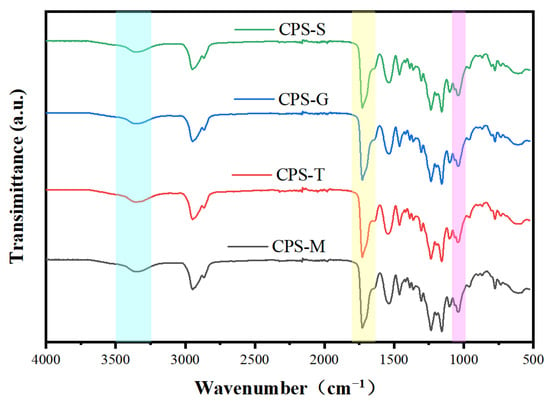
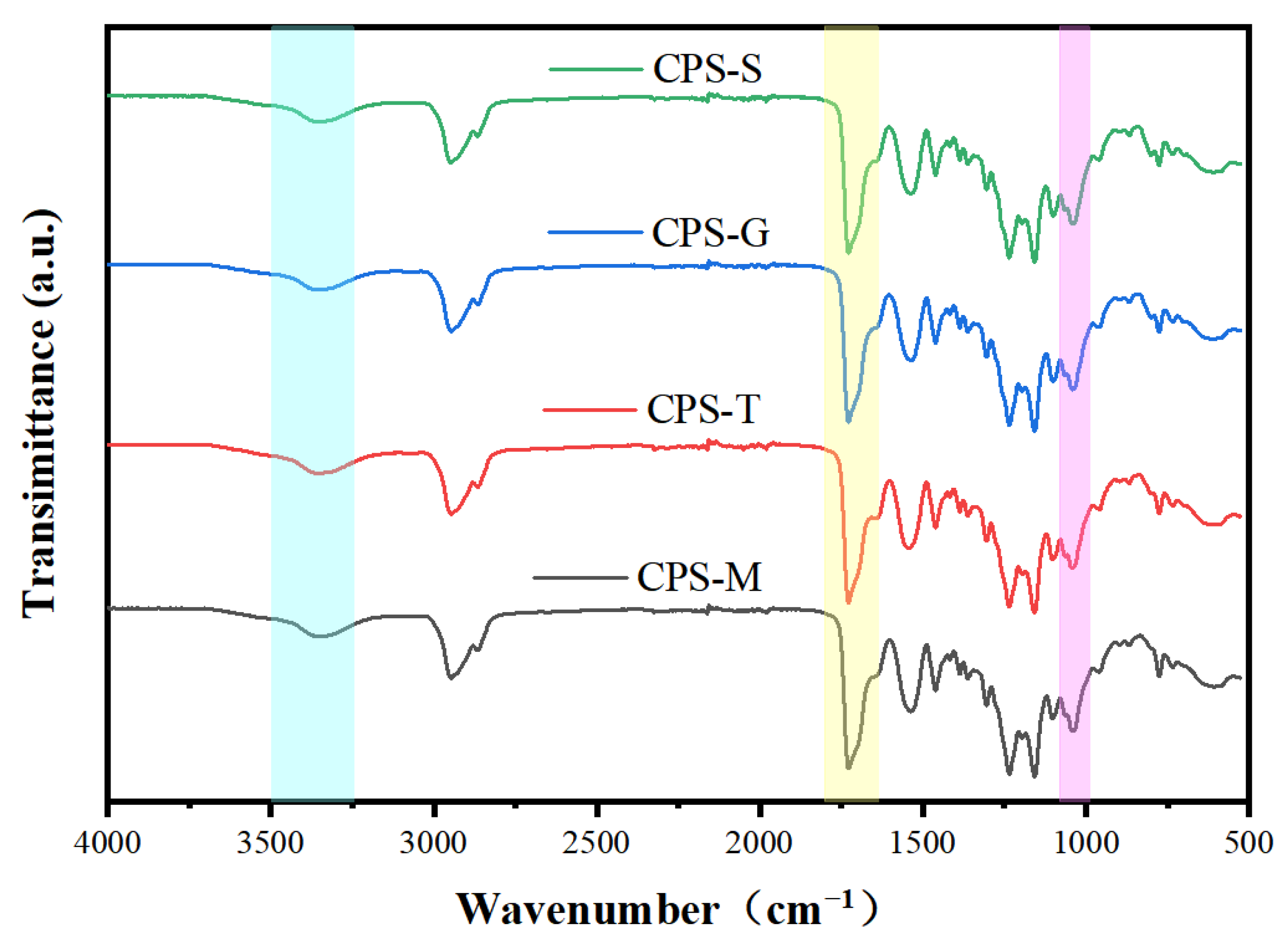
As shown in Figure 2, no distinct absorption peaks were observed in the 2250–2270 cm−1 range for any sample, indicating that the -NCO groups of isocyanate (IPDI) were completely reacted with no residual monomers [57,58,59,60]. The broad, intense absorption peak at 3330 cm−1 is attributed to the hydrogen-bonded N-H stretching vibration in the urethane bond, resulting from the reaction between hydroxyl and isocyanate groups to form urethane linkages. The strong absorption peak at 1730 cm−1 primarily originates from the hydrogen-bonded C=O stretching vibration within the urethane bond [61,62]. The absorption peak at 1034 cm−1 results from the overlapping stretching vibrations of Si-O-Si and C-O-C bonds [63]. Absorption peaks around 2920 cm−1 and 2850 cm−1 correspond to the asymmetric and symmetric stretching vibrations of methylene (-CH2-), respectively, confirming the retention of the long fatty acid chain backbone from soybean oil [64,65,66,67]. FT-IR analysis confirmed that soybean oil-based waterborne polyurethanes were successfully synthesized using four different soybean oil-based polyols, all of which reacted with IPDI.
Figure 2.
FT-IR spectrum of soybean oil-based waterborne polyurethane.
3.3. Mechanical Properties of Soybean Oil-Based Waterborne Polyurethane Films
The mechanical properties of the polyurethane films are shown in Figure S2 and Table 1. As the hydroxyl value of the soybean oil polyol decreased (from ESO-M to ESO-S), the tensile strength and elongation at break of the films exhibited opposite trends. Specifically, tensile strength decreased from 14.21 MPa (CPS-M) to 7.17 MPa (CPS-S). Conversely, elongation at break increased significantly from 229.42% (CPS-M) to 327.20% (CPS-S). All samples exhibited excellent adhesion (Grade 0) and consistent surface pencil hardness (6H), indicating that these properties are primarily governed by shared hard-segment composition and surface chemistry, and are insensitive to variations in polyol hydroxyl value in this study. Agent A (commercial waterborne polyurethane film-forming agent) showed lower tensile strength (4.73 MPa) compared to all CPS series samples, confirming the mechanical advantage of the bio-based polyurethane design.
Table 1.
Mechanical properties of soybean oil-based waterborne polyurethane.
The hydroxyl value of soybean oil polyols directly determines the crosslink density of the polyurethane network. ESO-M, possessing the highest hydroxyl value, formed the greatest number of crosslinking points with IPDI during polymerization, constructing the densest three-dimensional network structure. In this high-crosslink-density system, the dense physical and chemical crosslinking points between polymer segments enabled synergistic stress sharing during tensile loading, resulting in strong cohesive forces and the highest tensile strength (14.21 MPa). Conversely, the crosslinked network formed by low-hydroxyl ESO-S is relatively loose with larger spacing between crosslinks, resulting in weaker intermolecular interactions. During tensile loading, stress cannot be effectively transferred and dispersed, leading to premature local chain segment breakage and consequently lower tensile strength (7.17 MPa). This trend is consistent with previous reports on bio-based polyurethane mechanical properties, where higher crosslink density generally enhances tensile strength while reducing elongation [24,28].
Contrary to the trend observed in tensile strength, elongation at break significantly increases with decreasing hydroxyl value. In the highly crosslinked CPS-M system, molecular chains are extensively “locked” by crosslinking points, severely restricting segmental mobility and significantly reducing deformation capacity. When subjected to external tensile stress, the polymer network struggles to release stress through segmental slip and rearrangement, leading to brittle fracture at low strains and the lowest elongation at break (229.42%). In contrast, the CPS-S system with low crosslink density allows molecular segments greater freedom of movement. During stretching, it effectively absorbs and dissipates energy through segment orientation, slip, and rearrangement, endowing the material with superior deformation capacity. Consequently, CPS-S withstands greater tensile strain without fracture, achieving an elongation at break of 327.20% and demonstrating outstanding flexibility and ductility.
In summary, the soybean oil-based waterborne polyurethane developed in this study exhibits high strength and low toughness in the high-hydroxyl-value system (CPS-M), while the low-hydroxyl-value system (CPS-S) demonstrates low strength and high toughness. Both systems maintain stable adhesion and hardness, effectively meeting the requirements for film strength and durability in setting sprays. The results indicate that compared to commercially available film-forming agent A, material CPS-M exhibits superior mechanical properties.
Agent A is a commercial waterborne polyurethane film-forming agent commonly used in cosmetic setting sprays.
3.4. Thermal Stability of Soybean Oil-Based Waterborne Polyurethane
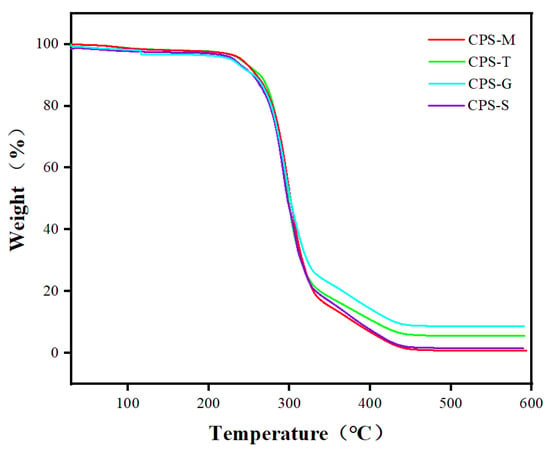
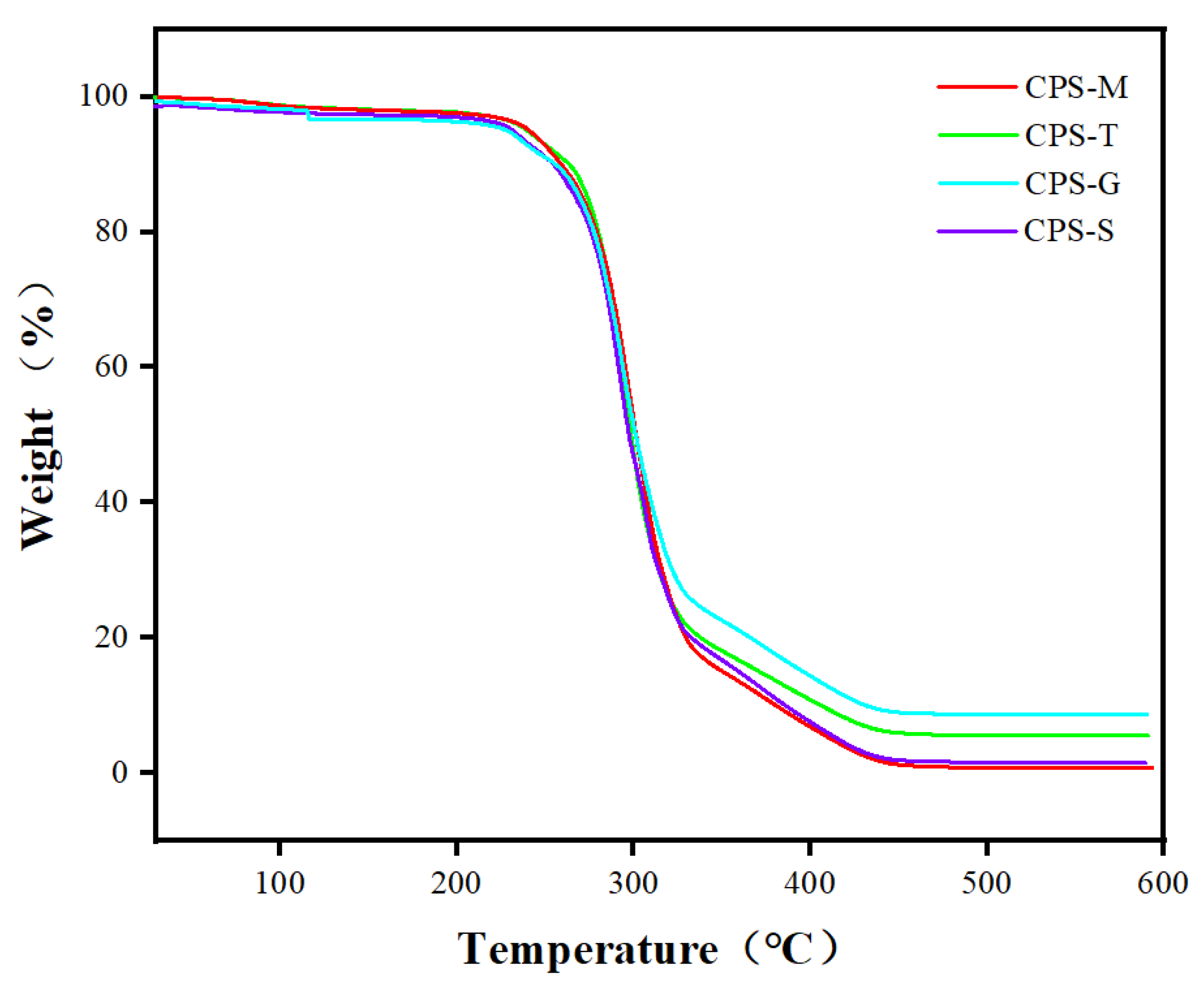
As shown in Figure 3, there are two distinct stages that occur in the thermal degradation of the polyurethane film. The first stage takes place from 230 °C to 330 °C, mainly corresponding to the thermal decomposition of the hard segments in polyurethane molecular chains. In this process, heat leads to bond breakage and a gradual reduction in molecular weight, resulting in rapid mass loss of the sample of about 80%. The second stage occurs from 330 °C to 430 °C; in this process, the soft segments of polyurethane predominate during the thermal decomposition. It is mainly that chemical bonds on the urethane groups break down, first decomposing into smaller molecules such as polyols and isocyanates, and ultimately forming volatile gases like CO2. There are certain differences in thermal weight loss behavior between CPS-G, CPS-T, CPS-M, and CPS-S. This is attributed to chain scission in the soybean oil-based polyol structure, demonstrating that the addition of epoxidized soybean oil (ESO) enhances the heat resistance of the rubber film. That is, the increase in the crosslinked structure within the polyurethane system strengthens the cohesive energy, thereby improving the heat resistance of the corresponding film. Similar two-stage degradation behavior has been reported for other bio-based waterborne polyurethanes, where initial decomposition temperature is strongly correlated with the type and the content of hard segments, as well as the crosslinking density of the molecular chains [58,61].
Figure 3.
TG curve of soybean oil-based waterborne polyurethane.
As shown in Table 2, at T5% (the temperature corresponding to 5% mass degradation of the polyurethane film), CPS-M with the highest hydroxyl value (T5% = 240.72 °C) was significantly higher than CPS-SA with the lowest hydroxyl value (T5% = 231.58 °C), indicating that an increased hydroxyl value enhances the initial decomposition temperature. The CPS-GA sample catalyzed by glutaric acid exhibited an unusually high residue at 600 °C. This may stem from residual carboxyl groups of the catalyst reacting with isocyanate to form amide groups. The bond energy of amide bonds is higher than that of ester and alkane bonds, making thermal decomposition difficult and promoting the formation of carbonized products. Conversely, tartaric acid, containing two hydroxyl groups, may reduce acid degradation by neutralizing some carboxyl groups, thereby lowering residual content.
Table 2.
Thermal performance data of soybean oil-based waterborne polyurethane films.
3.5. Hydrophobicity Testing of Soybean Oil-Based Waterborne Polyurethanes
As shown in Table 3, waterborne polyurethane films prepared from soybean oil-based polyols with different hydroxyl values exhibit varying degrees of hydrophobicity. As the polyol hydroxyl value decreases, the water contact angle of the film shows a decreasing trend—gradually decreasing from 66.7° for CPS-M to 56.5° for CPS-S—indicating a reduction in the material’s hydrophobicity. This phenomenon is consistent with expectations and can be further analyzed through the following mechanism.
Table 3.
Contact angle of soybean oil-based waterborne polyurethane.
The hydroxyl value of the polyol directly determines the crosslink density of the polyurethane network. Polyols with high hydroxyl values (e.g., ESO-M, hydroxyl value 252.9 mg KOH/g) contain more hydroxyl functional groups. During reaction with isophorone diisocyanate (IPDI), they form more crosslinking points, constructing a denser three-dimensional network structure. According to free volume theory, a dense crosslinked network significantly reduces the free volume fraction within the polymer, restricting the diffusion and permeation pathways for water molecules within the membrane. When water droplets contact the membrane surface, the internal dense network acts as a barrier, making it difficult for water molecules to permeate and diffuse into the membrane. This limits the spreading extent of water droplets on the surface, resulting in a higher contact angle. In contrast, polyols with low hydroxyl values (e.g., ESO-S with a hydroxyl value of 213.16 mg KOH/g) form looser crosslinked networks with larger free volumes. Water molecules can more readily penetrate into the membrane interior, promoting droplet spreading and wetting, resulting in relatively lower contact angles. These findings align with previous studies that established a correlation between crosslink density and surface hydrophobicity in polyurethane systems [21,24].
Comparative experiments demonstrate that the contact angle values of the self-made CPS-M film-forming agent are significantly higher than those of commercial sample agent A. This result strongly confirms its distinct technical advantage in water resistance.
3.6. Biodegradation Performance of Soybean Oil-Based Waterborne Polyurethane Films
Table 4 shows that the mass loss rate of all polyurethane films gradually increased with extended enzymatic hydrolysis time, with significant differences in degradation behavior among different samples. Among them, CPS-S and CPS-G exhibited faster degradation rates. This was attributed to the lower hydroxyl values of the soybean oil-based polyols (ESO-S and ESO-G) used in their formulation, resulting in lower crosslinking density, a looser network structure, and more defects. During enzymatic hydrolysis, such structures are more susceptible to penetration and erosion by lipase, exposing more ester bond sites and thereby accelerating the enzyme-catalyzed hydrolysis process. In contrast, CPS-M and CPS-T, utilizing polyols with higher hydroxyl values, form networks with higher crosslinking density and compact structures. This restricts the diffusion and contact of enzyme molecules within the material, causing degradation to occur primarily at the surface layer and resulting in a slower overall degradation rate.
Table 4.
Changes in mass loss of soybean oil-based waterborne polyurethane films under enzymatic degradation conditions.
This structure–degradation relationship aligns with previous studies on biodegradable polyurethanes. For instance, Liu et al. [30] reported that increasing crosslink density significantly retarded enzymatic hydrolysis by restricting enzyme penetration into the polymer matrix. In our system, the compact network of CPS-M likely limits lipase diffusion to the surface layer, resulting in gradual surface erosion, whereas the loose network of CPS-S permits deeper enzyme penetration and bulk degradation. This hypothesis is further supported by the SEM morphological analysis (Figure S3), where CPS-S exhibited pronounced surface pitting and cracking after 42 days, indicative of bulk erosion, while CPS-M only showed uniform surface roughening.
To investigate changes in material morphology during degradation, Figure S3 presents surface SEM images of polyurethane films before degradation (0 days) and after degradation (42 days). Prior to degradation, all samples exhibited smooth, flat surfaces. After 42 days of enzymatic hydrolysis, surface roughness significantly increased, with varying degrees of erosion observed. Specifically, the CPS-M surface showed uniform roughening, while the CPS-S surface developed distinct grooves and pits, indicating more pronounced surface peeling and bulk erosion. This morphological trend aligns with the mass loss results in Table 4, further confirming the dominant role of material structure in enzymatic degradation behavior: low-crosslink-density materials (CPS-S, CPS-G) undergo rapid and deep enzymatic erosion, whereas high-crosslink-density materials (CPS-M, CPS-T) primarily exhibit gradual surface degradation.
3.7. Chemical Degradation Performance of Soybean Oil-Based Waterborne Polyurethane Films
Table 5 presents the hydrolysis degradation results of polyurethane films synthesized using soybean oil-based polyols with different hydroxyl values. As shown in the table, the hydrolysis degradation rate of the polyurethane films exhibits a negative correlation with the hydroxyl value of the soybean oil polyol used—that is, the lower the hydroxyl value, the faster the degradation. Specifically, at the 8 h degradation point, CPS-S and CPS-G (using low-hydroxyl-value ESO-S and ESO-G, respectively) had completely fragmented, exhibiting the fastest degradation, while CPS-T and CPS-M (using high-hydroxyl ESO-T and ESO-M) remained intact with degradation rates of 29.6% and 28.1%, respectively, and only fully dissolved after 24 h. This phenomenon stems from hydroxyl value directly influencing polyol functionality and the final material’s crosslink density. Low-hydroxyl-value polyols form loose, defect-rich crosslink networks, facilitating rapid penetration and attack by OH− ions on ester groups within the polyurethane molecular chain soft segments. This disrupts the crosslink structure of the polyurethane membrane, generating small-molecule compounds that dissolve in solution, leading to degradation. Conversely, high-hydroxyl-value polyols form dense, intact crosslinked structures that effectively delay OH− erosion, resulting in relatively slow surface degradation. This alkaline hydrolysis behavior is consistent with reports on ester-bond-containing polyurethanes, where degradation rate is inversely proportional to crosslinking density [30,38].
Table 5.
Degradation data of polyurethane film in 1 wt% NaOH solution.
Figure S4 shows actual images of polyurethane membranes after 8 h of immersion in a 1 wt% NaOH solution. The images reveal progressively cloudy solutions post degradation, with the CPS-S solution exhibiting the highest turbidity, indicating near-complete degradation.
Figure S5 shows SEM images of the surface of polyurethane films after 0 h and 4 h of degradation in a 1 wt% NaOH solution. It can be observed that all film surfaces were smooth and flat prior to degradation. After 4 h of degradation, varying degrees of roughening, pitting, and cracking appeared on the sample surfaces. As the hydroxyl value of the soybean oil polyol decreased, the degradation rate of the films gradually increased. Among them, the low-hydroxyl-value samples (CPS-S, CPS-G) exhibited more significant morphological damage due to rapid bulk erosion. The sample surfaces were smooth and flat before degradation. After hydrolysis degradation, the surfaces became rough, and even holes and cracks appeared.
3.8. Breathability Test
Test calculations reveal that the film formed by the self-developed water-based polyurethane film-forming agent CPS-M exhibits a relative air permeability of 67.1 ± 1.64%, significantly outperforming commercially available film-forming agent A (44.6 ± 0.92%). The comprehensive results indicate that the self-made film-forming agent developed in this study can form a more breathable film structure while maintaining high mechanical properties and water resistance. This helps reduce the stuffy feeling during use of makeup products and enhances skin comfort. Compared with literature reports on polyurethane-based cosmetic films, the breathability achieved in this work is among the higher values, likely due to the microphase-separated structure introduced by the soybean oil polyol and β-cyclodextrin [21,24]. The presence of β-cyclodextrin may also contribute to increased free volume within the film matrix, facilitating water vapor transmission.
3.9. Surface Drying Time of Setting Sprays
As shown in Table 6, the surface drying time for all self-formulated setting spray formulations was less than 4 min. Compared to commercial reference products (F2 and F3), the drying rates of the developed formulations were comparable, with observed differences falling within experimental error margins. These results demonstrate that formulations based on self-made film-forming agents exhibit application performance equivalent to commercial products in achieving rapid skin-feel drying. The rapid drying behavior is attributed to the balanced hydrophilic–hydrophobic nature of the CPS-M polymer, which allows efficient water evaporation while maintaining film integrity [17,19].
Table 6.
Comparison of surface drying times for setting spray formulations.
3.10. Testing the Makeup Setting Spray’s Long-Lasting Effect In Vitro
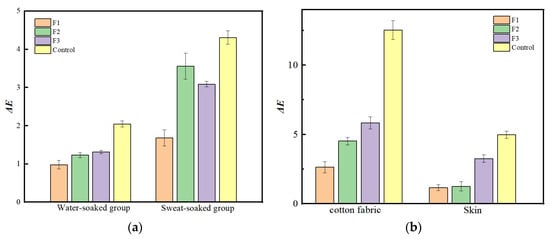
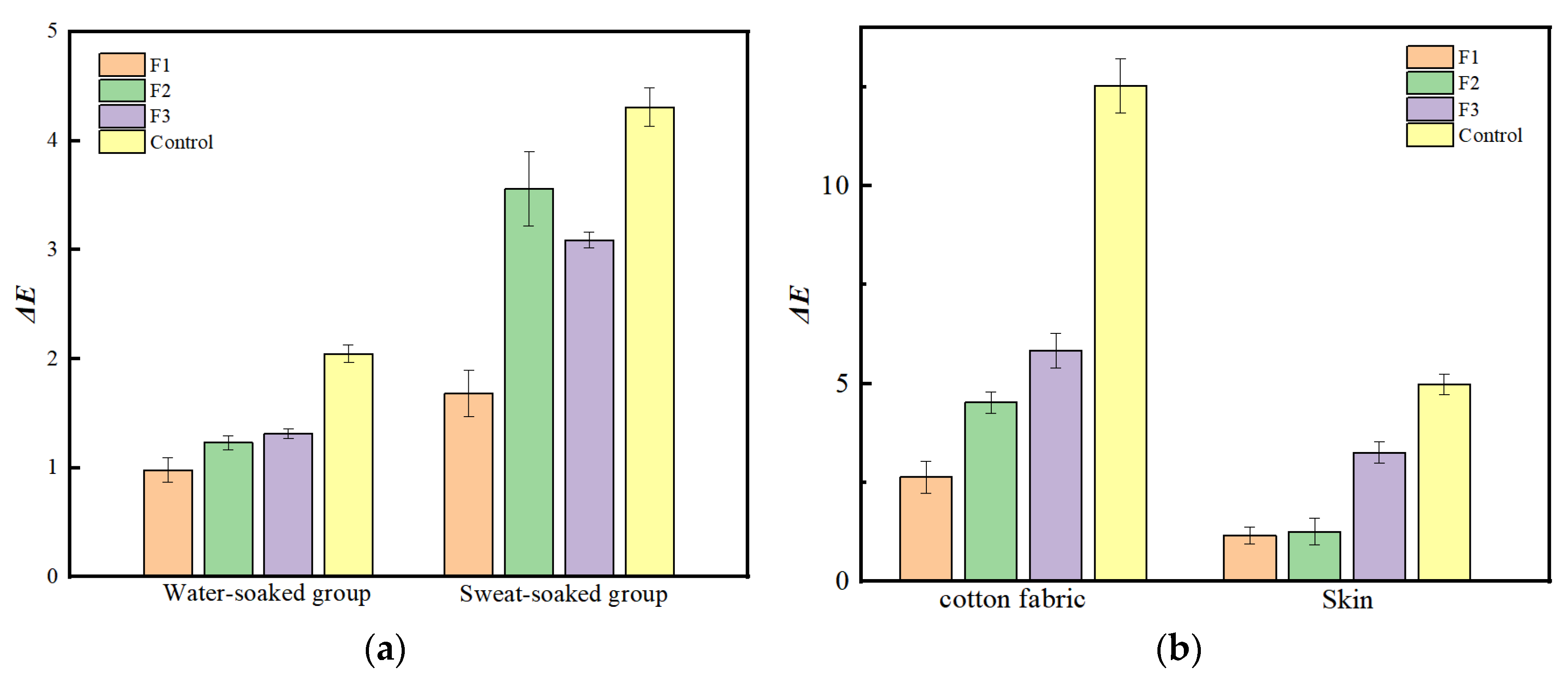
The results in Figure 4a indicate that both self-formulated setting spray samples (F1, F2) significantly enhance makeup’s water and sweat resistance, with ΔE values after immersion lower than the blank control group. Additionally, ΔE values in the sweat group were generally higher than in the pure water group for all samples, demonstrating that electrolytes and organic compounds in sweat exert stronger dissolution and penetration effects on the makeup layer, thereby causing greater impact on makeup appearance.
Figure 4.
(a) Changes in ΔE values after treatment for different samples. (b) Color difference comparison of different setting spray samples after abrasion testing.
Among the samples, sample F1 exhibited the lowest ΔE values in both pure water and artificial sweat, demonstrating optimal makeup stability. This result is attributed to the incorporation of soybean oil polyol in its film-forming agent, which effectively enhances the crosslinking density of the polymer network. This creates a dense and chemically stable film that significantly delays the penetration and degradation caused by water molecules and sweat electrolytes. Similar improvements in water and sweat resistance have been reported for crosslinked polyurethane-based cosmetic films [43,47]. The superior performance of F1 over F2 suggests that the higher crosslink density of CPS-M provides more effective barrier properties compared to commercial agent A.
3.11. Setting Spray Friction Resistance Test
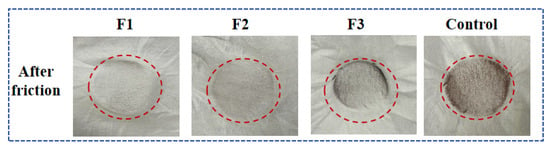
After friction testing, results were evaluated through two methods: (1) visual comparison of makeup residue adhering to the friction medium (cotton fabric); (2) quantitative measurement of ΔE values using a color difference meter.
As shown in Figure 5, the blank control group exhibited the most significant makeup deposition on the cotton fabric surface, indicating that makeup is highly prone to rub-off without film-forming protection. Among the experimental groups, the cotton fabric corresponding to F3 exhibited the second-highest residual makeup quantity compared to the blank control, indicating poor friction resistance. In contrast, the cotton fabric corresponding to F1 displayed the lightest color and least noticeable makeup residue, demonstrating the best friction resistance. Sample F2 showed intermediate residual levels between the two, with visually comparable degrees of residue.
Figure 5.
Makeup residue on cotton fabric after friction testing.
A higher ΔE value on cotton indicates greater makeup adhesion and poorer friction resistance. A higher ΔE value on skin indicates more severe makeup transfer and poorer friction resistance. As shown in Figure 4b, all sample test values were significantly lower than the blank control group, confirming the effectiveness of the film-forming agent. Overall, ΔE values exhibit distinct trends: Cotton ΔE primarily reflects makeup transfer intensity, decreasing in the order F3 > F2 > F1. Skin ΔE primarily reflects color change on the skin, decreasing in the order F3 > F2 > F1.
Sample F1 exhibited the lowest ΔE values in both tests, indicating that its film undergoes minimal color change after friction. This signifies the most intact film structure with the least damage, thereby providing the most effective prevention against makeup transfer to the friction medium. These results are consistent with the mechanical property data, where CPS-M showed the highest tensile strength, contributing to superior abrasion resistance [43].
3.12. Antioxidant Performance Testing of Setting Spray
Calculations show that CPS-M exhibits a 96.65% ± 0.47% encapsulation rate for RES, with a load rate of 0.16% ± 0.02%. This demonstrates the CPS-M system’s outstanding encapsulation performance for RES. The high encapsulation efficiency is attributed to the hydrophobic cavity of β-cyclodextrin grafted onto the polyurethane backbone, which forms stable inclusion complexes with resveratrol [34,35]. The branched structure of the soybean oil polyol may further enhance encapsulation by creating additional nano-cavities within the polymer network.
As shown in Table 7, sample F1 exhibited the highest clearance rate (86.25% ± 3.51%), approaching that of free resveratrol (90.5% ± 3.25%). This outstanding performance is attributed to the branched structure of the soybean oil polyol in the film-forming agent CPS-M. This structure disrupts the regular arrangement of polymer chains, forming a topological network with more nano-cavities. This enables higher loading and superior encapsulation of resveratrol. Consequently, sample F1 not only effectively sets makeup but also possesses outstanding antioxidant potential. In practical use, it delays dullness caused by oxidation, enhances the product’s overall wear performance, and embodies the concept of “makeup and skincare in one.” The antioxidant activity observed is comparable to or higher than that reported for other cyclodextrin-based delivery systems for resveratrol [36,37].
Table 7.
DPPH radical scavenging rates of different setting spray samples.
3.13. Antioxidant Stability of Setting Spray
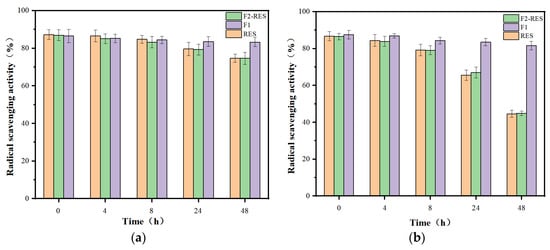
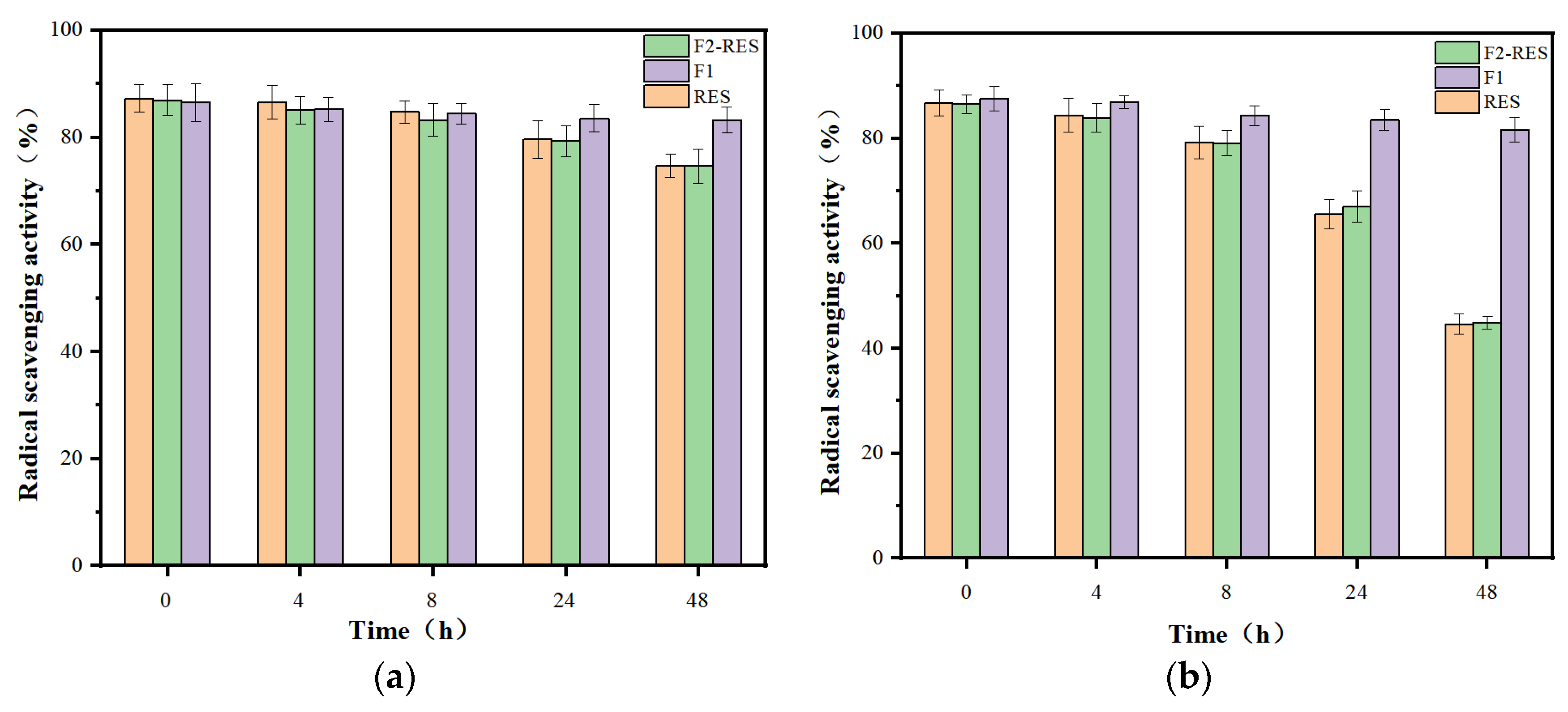
As shown in Figure 6, under ambient conditions (Figure 6a), the radical scavenging rate of the RES sample decreased significantly over time, indicating poor stability of free resveratrol in the spray system. The scavenging rate of the F1 sample remained relatively stable within 48 h, demonstrating that the film-forming agent CPS-M provides significant protective effects for resveratrol. Sample F2-RES, a physically blended resveratrol formulation without encapsulation, also exhibited reduced scavenging activity, confirming that the encapsulation effect is essential for stability enhancement.
Figure 6.
(a) Change in radical scavenging rate of setting spray samples after 48 h at room temperature; (b) change in radical scavenging rate of setting spray samples after 48 h at 60 °C. RES refers to a setting spray containing free resveratrol without a film-forming agent; F1 refers to a setting spray formulated with CPS-M containing a resveratrol inclusion complex; F2-RES refers to a setting spray formulated with commercial film-forming agent A and physically mixed free resveratrol.
Under accelerated aging at 60 °C (Figure 6b), the antioxidant activity of the RES sample declined more rapidly, dropping to approximately 40%. This indicates insufficient thermal stability of resveratrol, which degrades more readily at elevated temperatures. Sample F1 maintained high radical scavenging activity at elevated temperatures, with a much smaller decrease than RES, proving that the film-forming agent CPS-M significantly enhances resveratrol stability in high-temperature environments. The protective effect is attributed to the encapsulation of resveratrol within the β-cyclodextrin cavities, which shields the molecule from thermal degradation and oxidation [34,36].
4. Conclusions
In this study, a functionalized waterborne polyurethane film-forming agent (CPS-ESO) based on bio-based polyols and β-cyclodextrin was successfully developed, achieving tunable structure, controllable degradation, and efficient active ingredient delivery. Performance characterization demonstrated that the material exhibits excellent mechanical properties (tensile strength 14.21 MPa, elongation at break 229.42%), water resistance (contact angle 66.7°), adhesion (Level 0) and breathability. Among the samples, CPS-S showed the highest degradation weight loss rate of 26.5% under lipase treatment and could be completely degraded under alkaline hydrolysis conditions. The incorporation of β-cyclodextrin enabled the material to load resveratrol with a loading rate of 0.16%. The setting spray formulated with CPS-M exhibited excellent instant film-forming ability, makeup retention stability (lowest ΔE after water/sweat immersion), high friction resistance (ΔE after friction only one-third that of the control group), and significant antioxidant activity (DPPH scavenging rate 86.25%), while the active ingredient remained stable under accelerated conditions at 60 °C. This study provides a feasible material strategy and practical foundation for developing a new generation of cosmetic film-forming agents that are environmentally friendly, degradable, and functionally integrated with skincare benefits.
Supplementary Materials
The following supporting information can be downloaded at https://www.mdpi.com/article/10.3390/cosmetics13020092/s1. Figure S1: FT-IR spectrum of soybean oil-based polyol; Figure S2: Stress–strain curve of soybean oil-based waterborne polyurethane; Figure S3: Morphological comparison of polyurethane membranes before and after enzymatic degradation; Figure S4: Schematic diagram of polyurethane membrane left to stand in 1 wt% NaOH solution for 8 h; Figure S5: SEM comparison of polyurethane film before and after 4 h of standing in a 1 wt% NaOH solution; Table S1: Hydroxyl value of soybean oil polyols.
Author Contributions
Conceptualization and design, X.Z. and Y.L.; Methodology, X.Z. and Y.C.; Validation, X.Z. and Y.C.; Formal analysis, X.Z. and Y.C.; Research investigation, X.Z. and K.W.; Resource support, L.H., L.G. and Y.L.; Data collection, X.Z. and Y.C.; Data analysis, X.Z. and Y.C.; Data interpretation, X.Z. and Y.C.; Data reporting, X.Z. and Y.C.; Data management, X.Z. and Y.C.; Data visualization, X.Z. and K.W. Data organization, X.Z. and Y.C.; Drafting of the manuscript, X.Z. and Y.C.; Review and revision, Y.L.; Visualization, X.Z. and K.W.; Supervision, Y.L.; Funding acquisition, L.H. and Y.L. All authors have read and agreed to the published version of the manuscript.
Funding
The study was funded by Guangdong Pharmaceutical University 2025 Project for High-Quality Development in Continuing Education: “Reform and Practice of Fully Online Interactive Teaching Model for Organic Chemistry Under Digital Empowerment” (12-52112009027) and Guangdong Provincial College Student Innovation and Entrepreneurship Practice Project (S202410573004S).
Institutional Review Board Statement
Not applicable.
Informed Consent Statement
Not applicable.
Data Availability Statement
The raw data supporting the conclusions of this article will be made available by the authors on request.
Conflicts of Interest
Li Hu is affiliated with Guangdong B.C. Biotech Company Limited. All authors declare that the research was conducted in the absence of any commercial or financial relationships that could be construed as a potential conflict of interest. The funders had no role in the design of the study; in the collection, analyses, or interpretation of data; in the writing of the manuscript; or in the decision to publish the results.
References
- Watts, S.S.; Pal, K.; Asthana, N.; Bhattu, M.; Verma, M. Green synthesis by extraction of caffeine for cosmeceutical application: A review. J. Mol. Struct. 2024, 1305, 137733. [Google Scholar] [CrossRef] [Scilit]
- Martz, P.; Phan, T.V.; L’Haridon, J.; Beausoleil, M.-H.; Lafaye, K.; Gérand, Y.; Gallardo, C. Environmental profile of the production of fragrance ingredients used in cosmetic products: Comparative analysis of results obtained by life cycle assessment and the green chemistry-based eco-design tool GREEN MOTIONTM. Green Chem. 2023, 25, 6365–6382. [Google Scholar] [CrossRef] [Scilit]
- Luengo, G.S.; Leonforte, F.; Greaves, A.; Rubio, R.; Guzman, E. Physico-chemical challenges on the self-assembly of natural and bio-based ingredients on hair surfaces: Towards sustainable haircare formulations. Green Chem. 2023, 25, 7863–7882. [Google Scholar] [CrossRef] [Scilit]
- Wang, X.Y.; Zhong, C.Y.; Zhong, Y.G.; Fan, Z.X.; Liu, Z.R.; Xu, P.; Deng, X.X.; Guo, J.Q.; Sawant, T.R.; Zhou, M.B.; et al. Impressive merits of nanocellulose driving sustainable beauty. Carbohydr. Polym. 2025, 353, 123270. [Google Scholar] [CrossRef] [Scilit]
- Leong, H.J.; Teoh, M.L.; Beardall, J.; Convey, P. Green beauty unveiled: Exploring the potential of microalgae for skin whitening, photoprotection and anti-aging applications in cosmetics. J. Appl. Phycol. 2024, 36, 3315–3328. [Google Scholar] [CrossRef] [Scilit]
- Lima, N.F.; Maciel, G.M.; Lima, N.P.; Fernandes, I.A.A.; Haminiuk, C.W.I. Bacterial cellulose in cosmetic innovation: A review. Int. J. Biol. Macromol. 2024, 275, 133396. [Google Scholar] [CrossRef] [Scilit]
- Pacularu-Burada, B.; Ciric, A.; Begea, M. Anti-aging effects of flavonoids from plant extracts. Foods 2024, 13, 2441. [Google Scholar] [CrossRef] [Scilit]
- Nur, S.; Hanafi, M.; Setiawan, H.; Elya, B. Chemical characterization and biological activity of Molineria latifolia root extract as dermal antiaging: Isolation of natural compounds, in silico and in vitro study. Biocatal. Agric. Biotechnol. 2024, 56, 103039. [Google Scholar] [CrossRef] [Scilit]
- Sarikhani, M.; Deylam, M.; Alizadeh, E.; Hejazy, M.; Alizadeh-Salteh, S.; Moeini, H.; Firouzamandi, M. Anti-aging effects of peppermint (Mentha piperita L.) and Shirazi thyme (Zataria multiflora Boiss.) plant extracts. Food Biosci. 2021, 41, 100930. [Google Scholar] [CrossRef] [Scilit]
- Eccleston, A. Anti-IL-11 antibody shows anti-ageing properties. Nat. Rev. Drug Discov. 2024, 23, 658. [Google Scholar] [CrossRef] [Scilit]
- Xu, H.; Wu, Z.; Zhao, D.; Liang, H.; Yuan, H.; Wang, C. Preparation and characterization of electrospun nanofibers-based facial mask containing hyaluronic acid as a moisturizing component and huangshui polysaccharide as an antioxidant component. Int. J. Biol. Macromol. 2022, 214, 212–219. [Google Scholar] [CrossRef] [Scilit] [PubMed]
- Dini, I.; Laneri, S. The new challenge of green cosmetics: Natural food ingredients for cosmetic formulations. Molecules 2021, 26, 3921. [Google Scholar] [CrossRef] [Scilit]
- Mitura, S.; Sionkowska, A.; Jaiswal, A. Biopolymers for hydrogels in cosmetics: Review. J. Mater. Sci. Mater. Med. 2020, 31, 50. [Google Scholar] [CrossRef] [Scilit]
- You, X.; Zhou, Y.; Sun, R.; Pei, X.; Zhou, H.; Deng, D.; Wang, Z.; Hu, W.; Tan, Y. Biodegradable microbeads for personal care products and cosmetics. Green Chem. 2025, 27, 2823–2845. [Google Scholar] [CrossRef] [Scilit]
- Thompson, E.C.; Anastas, P.; Bialk, H.; D’Alessandro, D.; Hoven, V.P.; Kedwards, T.; Liu, Z.; Zuin Zeidler, V.; Daher, G. Advancing green chemistry performance assessment: The Estée Lauder Companies’ continuing journey towards meaningful transparency. Green Chem. 2025, 27, 5015–5026. [Google Scholar] [CrossRef] [Scilit]
- Berggren, E. Current trends in safety assessment of cosmetics ingredients. Regul. Toxicol. Pharmacol. 2022, 134, 105228. [Google Scholar] [CrossRef] [Scilit]
- Thewanjutiwong, S.; Phokasem, P.; Disayathanoowat, T.; Juntrapirom, S.; Kanjanakawinkul, W.; Chaiyana, W. Development of film-forming gel formulations containing royal jelly and honey aromatic water for cosmetic applications. Gels 2023, 9, 816. [Google Scholar] [CrossRef] [Scilit] [PubMed]
- Herman, A.; Herman, A.P. Essential oils and their constituents as skin penetration enhancer for transdermal drug delivery: A review. J. Pharm. Pharmacol. 2015, 67, 473–485. [Google Scholar] [CrossRef] [Scilit] [PubMed]
- Cai, M.; Qi, Z.; Guy, C.; An, C.; Chen, X.; Wang, Z.; Feng, Q. Insights into the abiotic fragmentation of biodegradable mulches under accelerated weathering conditions. J. Hazard. Mater. 2023, 454, 131477. [Google Scholar] [CrossRef] [Scilit]
- Lu, S.; Zhou, T.; Shabbir, I.; Choi, J.; Kim, Y.H.; Park, M.; Aweya, J.J.; Tan, K.; Zhong, S.; Cheong, K.-L. Marine algal polysaccharides: Multifunctional bioactive ingredients for cosmetic formulations. Carbohydr. Polym. 2025, 353, 123276. [Google Scholar] [CrossRef] [Scilit]
- Kim, B.K. Aqueous polyurethane dispersions. Colloid Polym. Sci. 1996, 274, 599–611. [Google Scholar] [CrossRef] [Scilit]
- Han, K.; Wang, J.; Li, C.; Zhou, C.; Yuan, J.; Pan, Z.; Pan, M. Click reaction benzimidazole into waterborne polyurethane toward anti-flashing rust, self-healing, robust coatings. Chem. Eng. J. 2023, 468, 143573. [Google Scholar] [CrossRef] [Scilit]
- Piotrowska, A.; Paciorek-Sadowska, J.; Łazarska, M.; Borowicz, M.; Isbrandt, M. Current progress in synthesis of polyurethane materials based on raw materials of non-petrochemical origin. Eur. Polym. J. 2025, 234, 114028. [Google Scholar] [CrossRef] [Scilit]
- Ahmadi, Y.; Ahmad, S. Recent Progress in the Synthesis and Property Enhancement of Waterborne Polyurethane Nanocomposites: Promising and Versatile Macromolecules for Advanced Applications. Polym. Rev. 2020, 60, 226–266. [Google Scholar] [CrossRef] [Scilit]
- Abbasoglu, T.; Lopez de Pariza, X.; Perli, G.; Merino, D.; Caillard-Humeau, P.; Duval, A.; Avérous, L.; Irusta, L.; González, A.; Sardon, H. Sustainable and biobased self-blown polycarbonate foams: From synthesis to application. Green Chem. 2025, 27, 4341–4351. [Google Scholar] [CrossRef] [Scilit]
- Zhang, B.; Zhang, G.; Ma, C.; Zhang, G. Rational designed polymeric rigid cages for trapping bulky vegetable oils toward versatile bio-based adhesives. Adv. Funct. Mater. 2025, 35, 2415944. [Google Scholar] [CrossRef] [Scilit]
- Kunduru, K.R.; Hogerat, R.; Ghosal, K.; Shaheen-Mualim, M.; Farah, S. Renewable polyol-based biodegradable polyesters as greener plastics for industrial applications. Chem. Eng. J. 2023, 459, 141211. [Google Scholar] [CrossRef] [Scilit]
- Yoshinaka, Y.; Miller, S.A. Bio-oil derived polyesteramides as water-degradable replacements for polyethylene. Green Chem. 2025, 27, 4152–4164. [Google Scholar] [CrossRef] [Scilit]
- Maitra, J.; Bhardwaj, N. Development of bio-based polymeric blends—A comprehensive review. J. Biomater. Sci. Polym. Ed. 2025, 36, 102–136. [Google Scholar] [CrossRef] [Scilit]
- Liu, J.; Ikura, R.; Yamaoka, K.; Sugawara, A.; Takahashi, Y.; Kure, B.; Takenaka, N.; Park, J.; Uyama, H.; Takashima, Y. Exploring enzymatic degradation, reinforcement, recycling, and upcycling of poly(ester)-poly(urethane) with movable crosslinks. Chem 2025, 11, 102327. [Google Scholar] [CrossRef] [Scilit]
- Kfoury, M.; Lichtfouse, E.; Fourmentin, S. The revival of cyclodextrins as active pharmaceutical ingredients. Environ. Chem. Lett. 2025, 23, 1–6. [Google Scholar] [CrossRef] [Scilit]
- Irani, V.; Magham, A.H.J. Molecular insights on the formation of inclusion complexes between natural and synthetic cyclodextrins and 7-O-methyl-aromadendrin. J. Mol. Struct. 2024, 1303, 137480. [Google Scholar] [CrossRef] [Scilit]
- Xu, P.-W.; Yuan, X.-F.; Li, H.; Zhu, Y.; Zhao, B. Preparation, characterization, and physicochemical property of the inclusion complexes of Cannabisin A with cyclodextrin. J. Mol. Struct. 2023, 1272, 134168. [Google Scholar] [CrossRef] [Scilit]
- Yildiz, Z.I.; Topuz, F.; Kilic, M.E.; Durgun, E.; Uyar, T. Encapsulation of antioxidant beta-carotene by cyclodextrin complex electrospun nanofibers: Solubilization and stabilization of beta-carotene by cyclodextrins. Food Chem. 2023, 423, 136284. [Google Scholar] [CrossRef] [Scilit]
- Yi, S.; Guo, T.; Wang, Y.; Yang, X.; Liao, Y.; Tang, X.; Zhang, X. A micrometer sized porous β-cyclodextrin polymer for improving bioavailability of poorly soluble drug. Carbohydr. Polym. 2025, 350, 123042. [Google Scholar] [CrossRef] [Scilit] [PubMed]
- Pant, K.; Bhattacharya, B. Efficacy of cyclodextrin nanosponges in protecting the bioactivity of cinnamon bark extract and trans-cinnamaldehyde. Food Biosci. 2024, 62, 105187. [Google Scholar] [CrossRef] [Scilit]
- Marwa, A.; Bahtiar, A.; Fuad, S.A.; Fidrianny, I. Mechanistic insights into drying methods: How they govern the structure and bioactivity of resveratrol-HP-β-CD inclusion complexes. Front. Chem. 2025, 13, 1692674. [Google Scholar] [CrossRef] [Scilit]
- Diaconu, A.D.; Logigan, C.L.; Peptu, C.A.; Ibanescu, C.; Harabagiu, V.; Peptu, C. Polyurethane degradable hydrogels based on cyclodextrin-oligocaprolactone derivatives. Gels 2023, 9, 755. [Google Scholar] [CrossRef] [Scilit]
- GB/T 12008.3-2009; Plastics—Polyether Polyols—Part 3: Determination of Hydroxyl Value. Standardization Administration of China: Beijing, China, 2009.
- GB/T 1040-2006; Plastics—Determination of Tensile Properties. Standardization Administration of China: Beijing, China, 2006.
- GB/T 9286-2021; Paints and Varnishes—Cross-Cut Test. Standardization Administration of China: Beijing, China, 2021.
- GB/T 6739-2006; Paints and Varnishes—Determination of Film Hardness by Pencil Method. Standardization Administration of China: Beijing, China, 2006.
- Keshavarzi, F.; Zajforoushan Moghaddam, S.; Barré Pedersen, M.; Østergaard Knudsen, N.; Jafarzadeh, S.; Thormann, E. Water vapor permeation through topical films on a moisture-releasing skin model. Ski. Res. Technol. 2021, 27, 153–162. [Google Scholar] [CrossRef] [Scilit]
- Jiang, Y.; Xu, Z.; Qiu, Y.; Chen, G.; Wang, S. Evaluation of the antiwear-ability/scratch-resistance efficacy of makeup products by in vitro test method application. Ski. Res. Technol. 2023, 29, e13420. [Google Scholar] [CrossRef] [Scilit] [PubMed]
- Ropelewska, E.; Popinska, W.; Sabanci, K.; Aslan, M.F. Cultivar Identification of Sweet Cherries Based on Texture Parameters Determined Using Image Analysis. J. Food Process Eng. 2021, 44, e13724. [Google Scholar] [CrossRef] [Scilit]
- Boswell, W.; Bible, B.; Singha, S. Relationship between cielab coordinates of peach color and visual ratings. HortScience 2019, 28, 254–260. [Google Scholar] [CrossRef] [Scilit]
- Rodrigues, R.; Oliveiea, M.B.P.P.; Alves, R.C. Chlorogenic Acids and Caffeine from Coffee By-Products: A Review on Skincare Applications. Cosmetics 2023, 10, 12. [Google Scholar] [CrossRef] [Scilit]
- Amano, K.; Xiao, K.; Wuerger, S.; Meyer, G. A colorimetric comparison of sunless with natural skin tan. PLoS ONE 2020, 15, e0233816. [Google Scholar] [CrossRef] [Scilit]
- Wang, Y.K.; Gao, Y.J.; Liu, J.; Zhu, Q.L.; Wang, J.C.; Qin, J.; Jin, H.Z. A Comparative Study of Melanocytic Nevi Classification with Dermoscopy and High-Frequency Ultrasound. Ski. Res. Technol. 2022, 28, 265–273. [Google Scholar] [CrossRef] [Scilit]
- Dzurenda, L. Natural Variability of the Color of Beech Wood in the Color Space CIE L*a*b*. Forests 2023, 14, 1103. [Google Scholar] [CrossRef] [Scilit]
- Wang, X.; Jiang, Y.; Du, J.; Xu, C. Establishment of a Color Tolerance for Yarn-Dyed Fabrics from Different Color-Depth Yarns. Color Res. Appl. 2021, 47, 225–235. [Google Scholar] [CrossRef] [Scilit]
- Khazi, M.I.; Kut, D.; Liaqat, F.; Demirkan, E. Synergistic Protease-Lipase Treatment for Enhanced Blood Stain Removal from Textiles: Process Optimization and Efficacy Evaluation. Process Biochem. 2025, 156, 20–32. [Google Scholar] [CrossRef] [Scilit]
- Sharma, N.; Sharma, A.; Lee, H.J. The antioxidant properties of green carbon dots: A review. Environ. Chem. Lett. 2025, 23, 1061–1109. [Google Scholar] [CrossRef] [Scilit]
- Isildak, O.; Yildiz, I.; Genc, N. A new potentiometric PVC membrane sensor for the determination of DPPH radical scavenging activity of plant extracts. Food Chem. 2022, 373, 131420. [Google Scholar] [CrossRef] [Scilit]
- Hendrickx, T.; Trullemans, L.; Heyer, A.J.; Boonen, I.; Turkalj, M.; Rammal, F.; Su, Y.; Matranxhi, B.; Pully, D.; Meerbeek, B.V.; et al. Novel arylindane diols as sustainable primary antioxidants from lignin. Green Chem. 2025, 27, 7803–7819. [Google Scholar] [CrossRef] [Scilit]
- Marullo, S.; Petta, F.; Infurna, G.; Dintcheva, N.T.; D‘Anna, F. Polysaccharide-based supramolecular bicomponent eutectogels as sustainable antioxidant materials. Green Chem. 2023, 25, 4513–4527. [Google Scholar] [CrossRef] [Scilit]
- Dai, S.; Yan, F.; Zhang, S.; Guo, J.; Zhang, L.; Liu, Y.; Liu, L.; Ao, Y. Synthesis of a fully bio-based self-catalyzed hyperbranched waterborne polyurethane as a sizing agent for enhancing the interfacial properties of CF/PA6 composites. Green Chem. 2024, 26, 4127–4134. [Google Scholar] [CrossRef] [Scilit]
- Han, J.; Zhu, X.; Tian, L.; Yan, N.; Zhang, H.; Wang, L. Bio-based waterborne polyurethanes from castor oil, sorbitan monooleate and sodium lignosulfonate with ultraviolet resistance, photothermal effect, corrosion protection and degradation properties. Int. J. Biol. Macromol. 2025, 287, 138471. [Google Scholar] [CrossRef] [Scilit]
- Aydogmus, E.; Kamisli, F. New commercial polyurethane synthesized with biopolyol obtained from canola oil: Optimization, characterization, and thermophysical properties. J. Mol. Struct. 2022, 1256, 132495. [Google Scholar] [CrossRef] [Scilit]
- Niesiobedzka, J.; Datta, J. Challenges and recent advances in bio-based isocyanate production. Green Chem. 2023, 25, 2482–2504. [Google Scholar] [CrossRef] [Scilit]
- Li, J.; Hong, C.; Zhang, H.; Zhang, J.; Zhai, R.; Fei, B.; Zhou, C. Sustainable, transparent, strong toughness, UV resistance, and anti-corrosion properties of cashew shell oil-based waterborne polyurethane network derived from phloretin and sorbitan monooleate-based siloxane. Chem. Eng. J. 2024, 490, 151506. [Google Scholar] [CrossRef] [Scilit]
- Hernandez-Ramos, F.; Alriols, M.G.; Antxustegi, M.M.; Labidi, J.; Erdocia, X. Valorisation of crude glycerol in the production of liquefied lignin bio-polyols for polyurethane formulations. Int. J. Biol. Macromol. 2023, 247, 125855. [Google Scholar] [CrossRef] [Scilit]
- Jensma, A.; Elders, N.; van den Berg, K.J.; Feringa, B.L. Waterborne polymers and coatings from bio-based butenolides. Green Chem. 2024, 26, 9676–9681. [Google Scholar] [CrossRef] [Scilit]
- Jeon, B.; Lee, K.; Shin, J.; Choi, S.Q. Tailored mechanical properties of soybean oil-based non-isocyanate polyurethanes by copolymer integration. Green Chem. 2025, 27, 3559–3572. [Google Scholar] [CrossRef] [Scilit]
- Ling, Z.; Zhou, Q. Synthesis and properties of linseed oil-based waterborne non-isocyanate polyurethane coating. Green Chem. 2023, 25, 10082–10090. [Google Scholar] [CrossRef] [Scilit]
- Kim, G.; Kim, W.; Yuk, J.S.; Jeong, H.; Jeon, H.G.; Yoo, Y.; Shin, J.; Park, S.H. Soybean oil derived-process oil prepared via recyclable organocatalysis for eco-friendly styrene-butadiene rubber composites. Green Chem. 2024, 26, 3732–3746. [Google Scholar] [CrossRef] [Scilit]
- Ettahiri, M.; Hamine, A.; Ouacha, E.H.; Mesbah, H.; Tafkirte, M. An ultrasound approach to characterize mixtures of vegetable oils with the same type of dominant chemical compositions. Appl. Food Res. 2024, 4, 100430. [Google Scholar] [CrossRef] [Scilit]


Disclaimer/Publisher’s Note: The statements, opinions and data contained in all publications are solely those of the individual author(s) and contributor(s) and not of MDPI and/or the editor(s). MDPI and/or the editor(s) disclaim responsibility for any injury to people or property resulting from any ideas, methods, instructions or products referred to in the content. |
© 2026 by the authors. Licensee MDPI, Basel, Switzerland. This article is an open access article distributed under the terms and conditions of the Creative Commons Attribution (CC BY) license.