1. Introduction
Androgenetic alopecia (AGA) is the most common type of hair loss, affecting up to 80% of men and 50% of women during their lifetime. Characterized by a continuous reduction in hair follicle size over time and a distinct pattern of hair thinning, AGA has considerable psychosocial and emotional consequences, particularly in younger individuals [
1,
2].
The pathogenesis of AGA is multifactorial, with genetic predisposition and androgenic activity playing central roles. Dihydrotestosterone (DHT), a potent metabolite of testosterone produced via the enzyme 5α-reductase, is a critical mediator of hair follicle miniaturization. It promotes the transition of hair follicles from the anagen (growth) phase to the telogen (resting) phase [
3]. In addition to androgenic pathways, recent studies have identified additional molecular mechanisms contributing to AGA, including Wnt/β-catenin signaling, prostaglandin regulation, oxidative stress, and inflammation. Suppression of Wnt signaling impairs follicular regeneration, while elevated levels of prostaglandin D
2 (PGD
2) inhibit hair growth [
4,
5]. Chronic low-grade inflammation and oxidative damage may further exacerbate this degenerative process [
6].
Current pharmacological therapies, such as topical minoxidil and oral finasteride, are effective in halting or reversing hair loss. However, they often have limitations, including hormonal imbalances, adverse effects, and the need for long-term use [
7,
8]. These limitations have spurred growing interest in alternative and complementary approaches, including cosmetic formulations enriched in bioactive compounds to stimulate hair regrowth.
Emerging clinical evidence supports the efficacy of cosmetic formulations that contain botanical extracts, peptides, amino acids, and stem cell-derived ingredients. For example, herbal extract combination has demonstrated improvements in hair density and hair mass index [
9]. Additionally, adipose-derived stem cell extracts have been linked to enhanced follicular proliferation without major side effects [
10]. Multi-therapeutic regimens have also been shown to achieve favorable outcomes in an interventional study [
11].
In the present study, three novel molecular targets for the treatment of hair loss were identified, and corresponding synthetic, small-molecule, multitarget agents were subsequently developed using an artificial intelligence-driven ingredient discovery platform. Hydroxy trimethyl pyridinyl methyl indole carboxamide (HM), a glycogen phosphorylase inhibitor, was developed based on its ability to modulate energy metabolism via antioxidative mechanisms, thereby prolonging the anagen phase of hair growth [
12]. A prostaglandin D
2 (PGD
2) receptor antagonist, biphenylmethyl carboxymethyl benzyldimethylpyrazole carbamate (BCBC), was developed to inhibit catagen onset by blocking the catagen-inducing activity of PGD
2 [
4]. Additionally, we developed dihydroisoquinolinone piperidinylcarboxy pyrazolopyridine (DPP), a potent inhibitor of 15-prostaglandin dehydrogenase, an enzyme responsible for degrading prostaglandin E
2 (PGE
2), thereby increasing tissue levels of PGE
2 for improving hair growth [
13]. Based on these effects, the role of functional cosmetics in the management of AGA warrants further investigation.
The aim of this study was to evaluate the efficacy and safety of Motifull hair tonic, a cosmetic formulation designed to improve hair growth and scalp health, in individuals with AGA. By combining clinical assessment of hair density and thickness with patient-reported outcomes, the study could contribute to the growing evidence supporting the use of non-pharmacological interventions in AGA management.
2. Materials and Methods
2.1. Study Design and Ethical Aspects
This study was a randomized, placebo-controlled, double-blind clinical trial with a 24-week duration. All participants signed an informed consent form. This study was conducted in accordance with the tenets of the Declaration of Helsinki, and the protocol was approved by the Institutional Review Board Ethics Committee at the P&K Skin Research Center (IRB No. P2307-4594). This study was registered with the Clinical Research Information Service (CRIS), Republic of Korea (Registration No. KCT0010804, approved on 24 July 2025). Randomization was performed using a computer-generated sequence. Allocation concealment was ensured using sealed envelopes. Participants and investigators were blinded.
2.2. Study Participants
Adults who met all inclusion criteria and none of the exclusion criteria were enrolled. Eligible individuals were aged between 18 and 54 years and met the predefined inclusion and exclusion criteria. The inclusion criteria comprised individuals diagnosed with AGA according to the basic and specific (BASP) classification. Participants with basic BASP types M1, C1, or U1 or higher, as well as specific types V1 or F1 or higher, were eligible. Additionally, male participants with a Norwood–Hamilton classification of stages 2, 2A, or higher and female participants with a Ludwig classification of stage 1 or higher were included.
The exclusion criteria were as follows: (1) presence of severe acute kidney or heart disease, or other chronic diseases (e.g., hypertension or diabetes); (2) use of hair growth products or medications (e.g., dutasteride or finasteride) within 6 months prior to the study; (3) pregnancy or breastfeeding; (4) systemic diseases affecting hair growth (e.g., thyroid disorders or autoimmune diseases); (5) psychiatric or mental illness; and (6) history of surgical treatment for hair loss, such as hair transplantation or scalp reduction.
A total of 56 participants were enrolled; 55 participants who received at least one application and had at least one post-baseline assessment were included in the full analysis set (FAS); 49 participants completed the study per protocol and were included in the PP analysis.
2.3. Study Schedule
The study was conducted over 24 weeks. The participants were randomized into two groups: the test group, in which the investigational product was applied by spraying an appropriate amount (approximately five pumps) onto the entire scalp twice daily (morning and evening); and the placebo group, in which a control formulation lacking the active ingredient was applied. Compliance was monitored at each study visit (weeks 8, 16, and 24) by weighing the product container to estimate product use and adherence to the prescribed application regimen.
Dermatological assessments were performed at baseline (before the first application) and at 8, 16, and 24 weeks after the initiation of product application. Tolerability and efficacy data were collected at each time point.
2.4. Randomization and Double-Blinding
Participants were randomly assigned to either the test group or the control group in a 1:1 ratio using a computer-generated randomization sequence created with SPSS statistical software (IBM SPSS Statistics, version 26; IBM Corp., Armonk, NY, USA). Random numbers were generated and allocated as follows: A = 0 for the control group and B = 1 for the test group.
Each participant was assigned a serial number in the order of enrollment, and the corresponding investigational product was allocated according to a pre-established randomization table.
Double-blinding was maintained throughout the study period. Both participants and investigators, including outcome assessors, remained blinded to group allocation until the completion of the study. The allocation code was unblinded only after all study procedures and data collection had been completed, through disclosure of the sponsor-provided group allocation information.
2.5. Outcome Measures
The primary endpoint of this study was the change in hair density from baseline to Week 24, as measured by phototrichogram analysis.
Secondary endpoints included changes in hair thickness, expert visual assessment scores, and participant-reported outcomes related to hair condition. Hair thickness was evaluated using the same phototrichogram system, while visual assessments were conducted by trained dermatological evaluators using a standardized scoring scale. Participant-reported outcomes were collected using structured questionnaires assessing perceived improvements in hair loss symptoms, hair richness, hair shedding, and front hairline condition at each visit.
2.6. Test Product
The test product (Motifull hair tonic; Innovo Therapeutics Inc., Seoul, Republic of Korea) is a cosmetic formulation containing HM, BCBC, and DPP. Participants in the intervention group applied it twice daily throughout the study period. The cosmetic product named “Motifull Hair Boosting Ampoule Tonic” has the same formulation as that used in this study. Since the active ingredients are in colorless, odorless powders, the test product and the control product could not be discriminated by sensory evaluation. Both products were transparent liquid formulations, making them indistinguishable in appearance.
The detailed composition of the test and placebo products is presented in
Table 1.
2.7. Test Area
During all assessments, the ambient temperature was maintained between 20 and 25 °C and the relative humidity between 40% and 60%. Participants rested for 30 min after washing the designated skin test site. The testing environment was stabilized under these controlled conditions before instrumental measurements were performed. Water intake was restricted during the resting period to minimize variability in scalp hydration that could affect measurement consistency. To ensure consistent and objective measurements, all assessments were conducted by the same researcher at each time point.
2.8. Phototrichogram
Scalp hair was assessed using a standardized phototrichogram procedure. A 1 cm2 target area in the frontal/parietal scalp was selected and permanently marked using a small tattoo to ensure identical field selection at each visit. Hair within the target area was clipped to approximately 1 mm using standardized electric clippers, and measurements were performed after a fixed interval of hair growth (e.g., 48 h) under uniform lighting and camera settings. The phototrichogram device Folliscope 5.0 (LeadM Corporation, Suwon, Republic of Korea) was calibrated before each session according to the manufacturer’s instructions using the built-in calibration grid and color reference chart. All images were acquired with a fixed magnification and working distance, and automatic focus and exposure were used to minimize operator-dependent variability.
To measure hair density and thickness, the hair in the area of hair loss was evenly cut to a length of ≤2 mm in a circle of diameter 1.4 cm. Folliscope 5.0 (LeadM, Seoul, Republic of Korea) was used to measure hair density (n/cm2) and hair thickness (mm).
2.9. Measurement of Hair Density
The scalp was measured (approximately 1 cm2), and the number of hairs (N) within this area was used as the evaluation data. In the placebo and intervention groups, hair density was measured before the intervention and after 8, 16, and 24 weeks of intervention. The degree of improvement compared with the pre-intervention level was evaluated.
2.10. Measurement of Hair Thickness
The scalp was measured (approximately 1 cm2), and the mean thickness (mm) of all visible hairs within this 1 cm2 area was used as the evaluation data. In the placebo and intervention groups, hair thickness was measured before the intervention and after 8, 16, and 24 weeks of intervention. The degree of improvement compared with the pre-intervention level was evaluated. The change in hair thickness was also expressed as a proportional change in cross-sectional area (radius2) to better illustrate the cosmetic visibility of the improvement.
2.11. Visual Evaluation of Hair Density by Experts
Visual assessment was independently conducted by two trained evaluators using a seven-point grading scale (
Table 2), and the lower score was adopted in cases of disagreement to ensure conservative scoring. Standardized clinical photographs of the vertex (90°) and frontal hairline (45°) regions were captured at each evaluation point using a Canon EOS Rebel T8i digital camera (Canon Inc., Tokyo, Japan) coupled with a Global Hair Device (Canfield Imaging Systems, Parsippany, NJ, USA), providing fixed illumination and positioning. All images were obtained under identical acquisition settings (shutter speed 1/160 s, ISO 100, white balance 5500 K, aperture f/22), with consistent camera distance, angle, and anatomical location across visits. Inter-rater reliability was assessed using the intraclass correlation coefficient (ICC) with 95% confidence intervals.
2.12. Safety Evaluation
The safety of the product was determined by classifying adverse events recorded at 8, 16, and 24 weeks into five levels: severe (4), moderately severe (3), moderate (2), slight (1), and none (0). All adverse events reported during the test period in all test participants who used the test product more than once were used as safety evaluation data for the product.
2.13. Statistical Analysis
All statistical analyses were performed using SPSS (version 26, IBM Corp., Armonk, NY, USA), and statistical significance was set at p < 0.05. All continuous variables are presented as mean ± standard deviation (SD), unless otherwise specified. Baseline comparability between the test and placebo groups was assessed using independent t-tests for continuous variables and chi-square tests for categorical variables. Data distribution normality was evaluated using the Shapiro–Wilk test. For normally distributed repeated measurements, repeated-measures analysis of variance (RM-ANOVA) was applied to assess within-group changes over time. Mauchly’s test of sphericity was conducted, and when the assumption of sphericity was violated, the Greenhouse–Geisser correction was applied. For non-normally distributed repeated measures, the Friedman test was used, followed by post hoc pairwise comparisons using the Wilcoxon signed-rank test with Bonferroni correction. Between-group comparisons at each time point were conducted using independent t-tests for normally distributed variables or Mann–Whitney U tests for non-normally distributed variables. For ordinal variables derived from expert visual grading, an ordinal logistic GEE model with a cumulative logit link function was used to account for repeated measures and intra-subject correlations. The primary and secondary efficacy endpoints were analyzed in the per-protocol (PP) population, which included participants who completed the study without major protocol deviations. Safety analyses were performed in the full analysis set (FAS), defined as all participants who used the study product at least once and had at least one post-baseline assessment. Missing data in the FAS population were handled using the last observation carried forward (LOCF) method, as appropriate.
Effect sizes (Cohen’s d) and 95% confidence intervals (CIs) were calculated for key outcomes to estimate the magnitude and precision of the product-related effects. A post hoc power analysis was performed based on the primary endpoint to confirm that the sample size was sufficient to detect the observed differences. All statistical analyses were performed independently by an independent biostatistics department.
3. Results
3.1. Consolidated Standards of Reporting Trials (CONSORT) Flow Diagram of the Controlled Interventional Trial
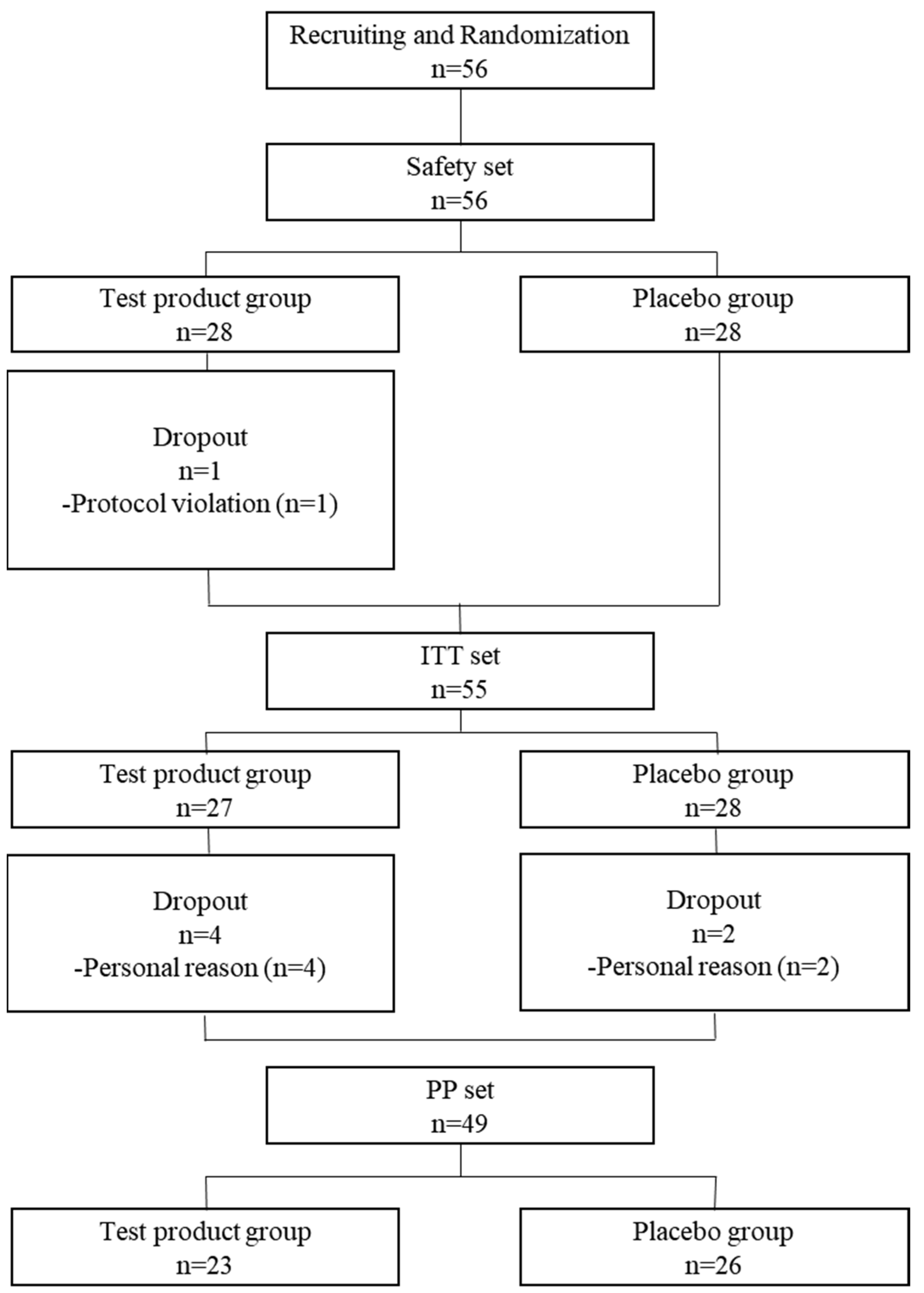
A total of 56 participants aged 18–54 years were enrolled and randomly assigned to either the test or placebo group. During the study period, six participants withdrew consent (test group,
n = 4; placebo group,
n = 2) for reasons unrelated to the trial, and one participant was excluded because of a protocol violation (steroid use within 1 month prior to enrollment). Consequently, 55 participants who applied the study product at least once and underwent at least one post-baseline assessment were included in the full analysis set. A total of 49 participants completed the study without major protocol deviations and were included in the per-protocol (PP) analysis, comprising 23 participants in the test group and 26 in the placebo group. The flow of participants throughout the trial is presented in the CONSORT diagram (
Figure 1).
3.2. Subject Characteristics
A total of 56 volunteers (28 in the test group and 28 in the placebo group) were initially enrolled. The mean age of participants in the test group (n = 27) was 41.91 ± 7.97 years, and that in the placebo group (n = 28) was 39.88 ± 7.91 years. Of these subjects, 10 were male, and 39 were female.
Prior to product application, a homogeneity test was conducted to evaluate the baseline comparability between the test and placebo groups in terms of hair density and thickness. One participant in the test group withdrew before baseline assessment and was therefore excluded from the baseline homogeneity analysis.
The statistical analysis revealed no significant differences between the groups in either parameter. Therefore, the test and placebo groups were homogeneous at baseline (
Table 3 and
Table 4).
Table 3.
Measurement of hair density before intervention, n/cm2.
Table 3.
Measurement of hair density before intervention, n/cm2.
| | (Mean ± SD) |
|---|
| Classification | Test product (n = 27) | Control product (n = 28) |
| Before use | 101.593 ± 19.516 | 95.964 ± 18.780 |
Homogeneity test
(test product–placebo) | 0.281 |
Data are presented as mean ± SD. No significant difference was observed between the groups at baseline (independent t-test, p > 0.05).
Table 4.
Measurement of hair thickness before intervention, mm.
Table 4.
Measurement of hair thickness before intervention, mm.
| | (Mean ± SD) |
|---|
| Classification | Test product (n = 27) | Control product (n = 28) |
| Before use | 0.127 ± 0.018 | 0.123 ± 0.022 |
Homogeneity test
(test product–placebo) | 0.497 |
Data are presented as mean ± SD. No significant difference was observed between the groups at baseline (independent t-test, p > 0.05).
3.3. Effect of the Test Product on Hair Density (Per-Protocol Analysis)
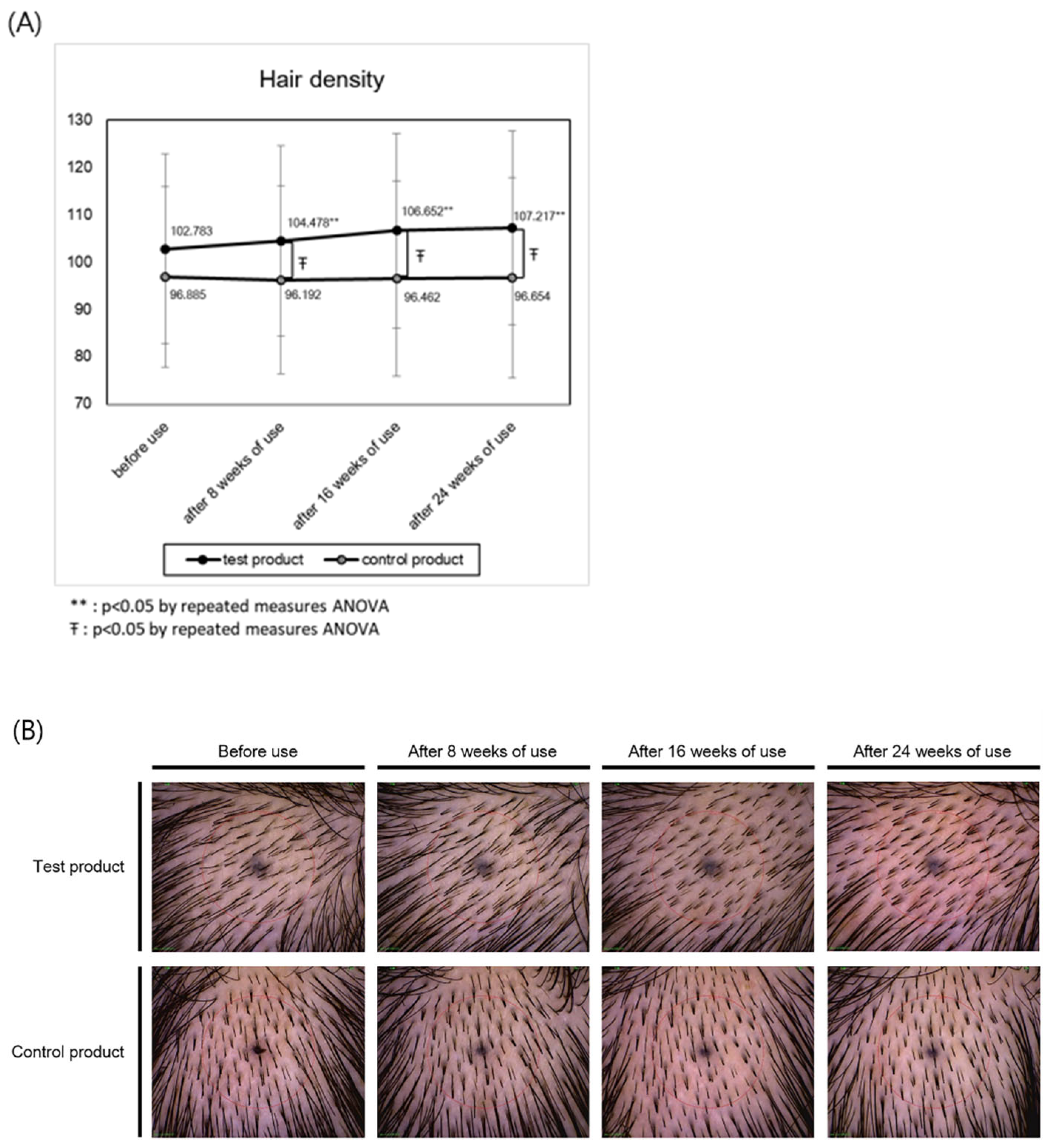
At baseline, hair density was comparable between the groups (test: 102.78 ± 19.97 n/cm2; placebo: 96.89 ± 19.03 n/cm2; p = 0.284). In the per-protocol population, over 24 weeks, the test group showed a statistically significant increase in hair density (Δ +4.43 n/cm2; 95% CI: 2.66–6.20; p < 0.001), whereas the placebo group showed no statistically significant change (Δ −0.23 n/cm2; 95% CI: −1.96–1.50; p = 0.784).
Between-group comparison at Week 24 demonstrated a statistically significant difference (mean difference: 4.67 n/cm
2; 95% CI: 2.21–7.13;
p < 0.001; Cohen’s d = 1.18), indicating a large effect size (
Figure 2).
3.4. Effect of the Test Product on Hair Thickness (Per-Protocol Analysis)
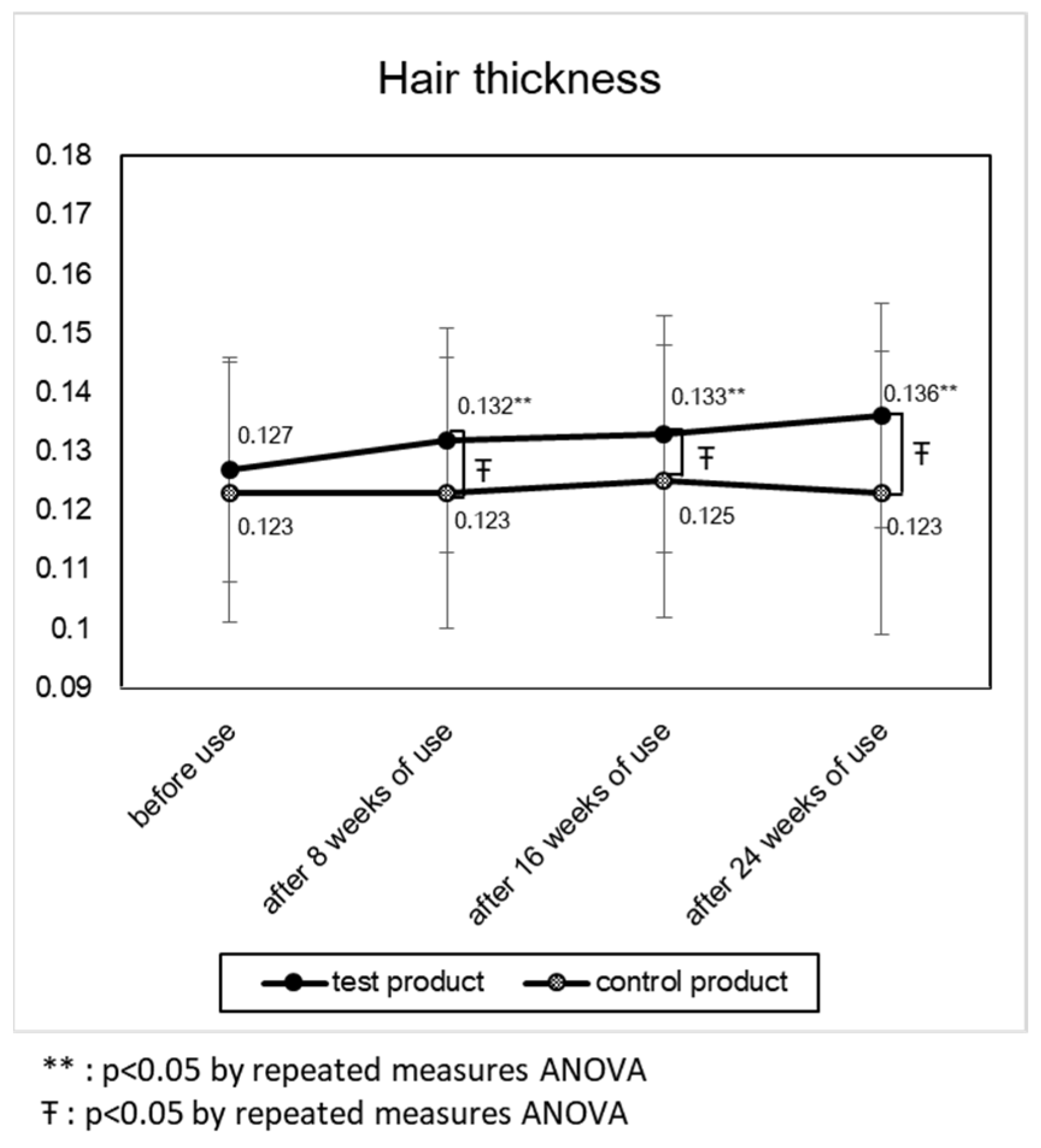
At baseline, hair thickness was comparable between the groups (test: 0.127 ± 0.020 mm; placebo: 0.123 ± 0.022 mm; p = 0.524). In the per-protocol population, over 24 weeks, the test group showed a statistically significant increase in hair thickness (Δ +0.010 mm; 95% CI: 0.007 to 0.013; p < 0.001), whereas the placebo group showed no statistically significant change (Δ −0.001 mm; 95% CI: −0.003 to 0.001; p = 0.521).
Between-group comparison at Week 24 demonstrated a statistically significant difference (mean difference: 0.011 mm; 95% CI: 0.007–0.015;
p < 0.001; Cohen’s d = 0.86), indicating a large effect size (
Figure 3).
3.5. Dermatological Visual Evaluation of Hair Growth
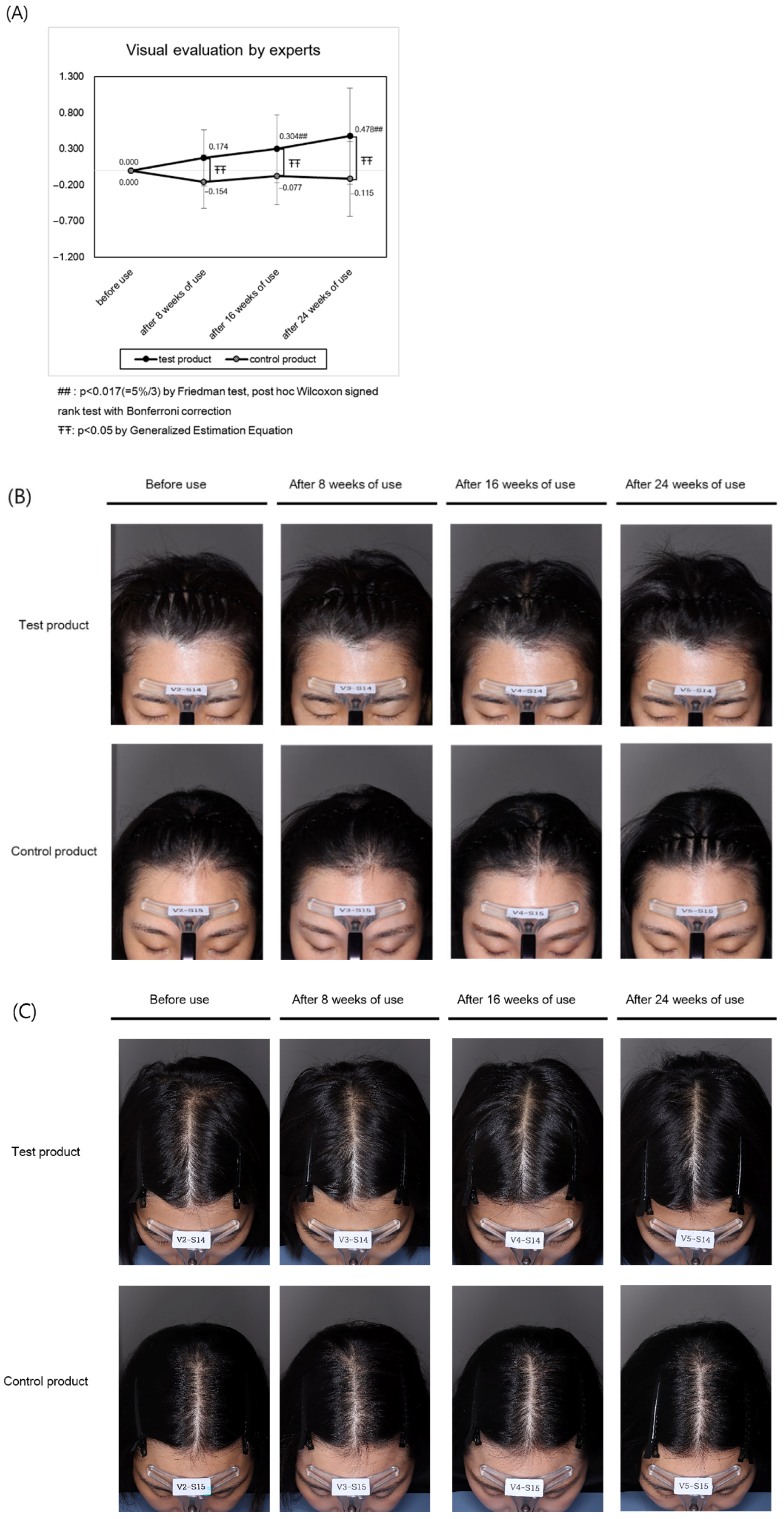
The test group showed progressive improvements in visual evaluation scores, increasing to 0.174 after 8 weeks, 0.304 after 16 weeks, and 0.478 after 24 weeks. The increase at 16 and 24 weeks was significant compared with baseline values (
p < 0.017). In contrast, the placebo group showed no meaningful improvement, with scores ranging from −0.154 to −0.115. Significant differences between the test and placebo groups were observed at all time points after baseline (
p < 0.05, GEE). The ICC was calculated to confirm the visual interrater reliability. The ICC values for the test and placebo groups were 0.645 and 0.609, respectively, indicating moderate inter-rater reliability based on standard statistical criteria (
Figure 4).
3.6. Participant-Reported Outcomes on Hair Condition
After using the test product, a questionnaire survey on hair-loss improvement, hair richness, number of hairs lost, and the front hairline was conducted after 8, 16, and 24 weeks of intervention. Results are presented as mean ± standard deviation and response distribution percentage. In the test group, all evaluation items showed a continuous improvement over time. The score for the improvement in hair loss symptoms increased from 1.304 at week 8 to 1.652 at week 16 and 1.826 at week 24. Similarly, hair richness in the area improved from 1.217 to 1.304 and further to 1.783 by week 24. The number of hairs lost and front hairlines also showed consistent improvement, reaching final scores of 1.696 and 1.696, respectively. In contrast, the placebo group showed limited or plateaued improvements across all parameters. For example, the improvement score for hair loss symptoms increased modestly from 1.000 at week 8 to 1.231 at week 16, but declined to 1.115 at week 24. Other parameters, including hair richness, number of hairs lost, and front hairline, followed similar patterns with lower final scores than those of the test group. Overall, the test group demonstrated greater improvements in all evaluated categories compared with the placebo group, with more pronounced and sustained effects over 24 weeks (
Table 5).
3.7. Safety Evaluation of the Test Product
Safety was evaluated at each scheduled study visit (Weeks 8, 16, and 24) based on participant-reported symptoms and dermatological assessments performed by trained clinical investigators. Throughout the 24-week application period, no product-related adverse events were reported by any participant at any visit. In addition, dermatological examinations conducted at Weeks 8, 16, and 24 revealed no abnormal clinical findings, including erythema, pruritus, burning sensation, or scaling, indicating that the test product was well tolerated throughout the study period.
4. Discussion
Over 24 weeks, the multi-targeted cosmetic formulation significantly improved hair density and thickness compared with placebo. Visual expert assessments and participant-reported outcomes supported these findings, and no adverse events were observed, indicating good tolerability.
Hair plays a critical role in shaping physical appearance and self-identity. Consequently, individuals suffering from hair loss, both men and women, may develop psychological distress and body image concerns, potentially leading to reduced self-esteem and overall quality of life [
14,
15,
16]. Among the various forms of hair loss, AGA, commonly referred to as pattern hair loss, is the most prevalent and affects a large portion of the global population. This condition typically involves progressive follicular miniaturization and a decrease in the duration of the anagen (growth) phase of the hair cycle, ultimately resulting in decreased hair density and conversion of terminal hair to vellus hair [
17].
The underlying pathophysiology of AGA is complex and involves an interplay of genetic, hormonal, and molecular factors. The role of androgens, particularly DHT, a potent metabolite of testosterone produced via 5α-reductase, is central to the development of AGA. DHT binds to androgen receptors in dermal papilla cells (DPCs), altering gene expression and disrupting the normal hair growth cycle. In addition to androgenic activity, emerging evidence has highlighted the involvement of other pathways. Understanding the multifaceted molecular mechanisms underlying AGA is critical for developing effective and targeted intervention strategies [
18].
In this study, we evaluated the efficacy of a multi-targeted anti-hair loss formulation comprising agents with three distinct molecular targets. This outcome was achieved through an AI-assisted discovery framework that identified candidate compounds. Three synthetic small-molecule inhibitors targeting PYGL, DP2, and 15-PGDH were developed for combination therapy in hair loss. The identified compounds were HM, BCBC, and DPP.
Prostaglandins play a pivotal role in regulating hair growth and differentiation. PGD
2 induces hair loss, whereas PGE
2 promotes hair growth following depilation [
19,
20]. In our previous study, we demonstrated that a DP
2 antagonist and a 15-PGDH inhibitor reduced reactive oxygen species production in DHT-damaged human follicle dermal papilla cells (HFDPCs). These agents also restore the mitochondrial membrane potential and increase the phosphorylation of proteins of the Akt and ERK signaling pathways. Furthermore, they promoted hair growth in an ex vivo human hair follicle organ culture model [
21,
22]. We confirmed that the PYGL inhibitor suppressed oxidative stress and prevented glycogen degradation in hydrogen peroxide-induced HFDPCs, thereby enhancing hair growth in ex vivo cultures [
23].
In the present study, the cosmetic formulation containing TrinogeniX™ (HM, BCBC, and DPP) demonstrated consistent improvements in hair-related parameters over the 24-week study period compared with placebo. Rather than reflecting isolated changes at specific time points, the overall pattern suggests a sustained cosmetic benefit in terms of improved hair appearance, including increased density and thickness. These findings support the potential of this multi-targeted formulation to enhance overall hair fullness and visual coverage under controlled use conditions.
Considering that both hair density and thickness affect the clinical appearance of hair loss, the observed increase in hair thickness supports the efficacy of the test formulation. These findings were further validated through visual assessments conducted by two independent dermatologists (
Figure 4). The results demonstrated significant improvements in hair density. This study demonstrated that a multi-targeted cosmetic formulation improved hair density and thickness over 24 weeks compared to the placebo. The observed effect sizes were large (Cohen’s d ≈ 0.86–1.18), supporting a measurable but modest magnitude of improvement.
The observed improvements were not only statistically significant but also clinically meaningful. Hair density increased by approximately 4.43 n/cm
2, and hair thickness increased by 0.010 mm. When interpreted in terms of cross-sectional area (proportional to radius
2), this corresponds to an approximate 14–16% increase in hair fiber area, which may contribute to perceived improvements in hair fullness. Although statistically significant, the magnitude of change should be interpreted cautiously in terms of clinical relevance. For context, previous randomized controlled trials of 5% topical minoxidil have reported an increase of approximately 24.5 hairs/cm
2 at 48 weeks [
24]. Considering the shorter treatment duration in the present study, the magnitude of improvement appears clinically relevant and may represent a perceptible benefit for patients. Throughout the 24-week application period, participants reported no adverse events, including skin irritation, pruritus, or inflammation, supporting the formulation’s safety profile. A subjective survey was conducted at Weeks 8, 16, and 24 of product application to evaluate the participant-perceived improvements in hair condition. Across all assessment points, participants in the test group consistently reported higher mean scores than those in the placebo group in four evaluation domains: improvement in hair loss symptoms, hair richness in partial areas, reduction in the number of hairs lost, and improvement in the front hairline. These findings suggest that continuous application of the test product for up to 24 weeks resulted in significantly greater perceived improvements in overall hair condition than the application of the control product (
Table 5).
Furthermore, analysis of individual response rates showed that 22 of the 23 participants (95.7%) in the test group exhibited a positive response, defined as an increase in hair count by at least one strand. One participant showed no change, while none experienced hair loss. In contrast, only 8 of the 26 participants (30.8%) in the placebo group showed a positive response, 4 participants showed no change, and 14 participants (53.8%) experienced a decrease in hair count after 24 weeks of application. These findings are consistent with previous studies on the role of PGD
2 inhibition and glycogen phosphorylase regulation in hair follicle biology [
4,
12], further supporting the mechanistic rationale for our multitarget approach. Despite the promising findings, this study has several limitations, including a relatively small sample size, a relatively short study duration, the absence of mechanistic biomarker assessments, and an imbalance in sex distribution. In particular, the predominance of female participants may limit the generalizability of the findings to male androgenetic alopecia (AGA), although the trends observed in male subjects were generally consistent with those of the overall study population (
Table S1). In addition, a post hoc power analysis indicated that the study achieved approximately 82% statistical power to detect the observed between-group difference in hair density. Therefore, future studies with larger and more balanced populations, longer follow-up periods, and mechanistic endpoints are warranted to further validate and extend these findings.




 ,
,