Article

Effective Skin Hydration Using an Ultra-Micro Liquid Crystal Emulsion Containing Pumpkin Seed Oil and Polysaccharides

by
Setinee Chanpirom
1,2,
Thapakorn Tree-Udom
1,2,
Pacharamon Inchai
1,
Pornchanok Krongthamsiri
1,
Christin Yodsing
1,
Supakorn Chantapa
1,
Varitsara Narupabenjapon
1,
Nisakorn Saewan
1,3,
Naphatsorn Ditthawutthikul
4,
Maria Pilar Vinardell
5,* and
Tawanun Sripisut
1,2,*
1
School of Cosmetic Science, Mae Fah Luang University, Chiang Rai 57100, Thailand
2
Cosmetics for Beauty and Wellness (CoBeW) Research Group, Mae Fah Luang University, Chiang Rai 57100, Thailand
3
Cosmetic and Beauty Innovations for Sustainable Development (CBIS) Research Group, Mae Fah Luang University, Chiang Rai 57100, Thailand
4
Faculty of Pharmacy, Institute of Entrepreneurial Science Ayothaya, Phra Nakhon Si Ayutthaya 13000, Thailand
5
Departament de Bioquímica i Fisiologia, Facultat de Farmàcia i Ciències de l’Alimentació, Universitat de Barcelona, 08028 Barcelona, Spain
*
Authors to whom correspondence should be addressed.
Cosmetics 2026, 13(2), 49; https://doi.org/10.3390/cosmetics13020049
Submission received: 20 January 2026 / Revised: 11 February 2026 / Accepted: 18 February 2026 / Published: 24 February 2026
(This article belongs to the Section Cosmetic Formulations)

Abstract

Polysaccharides extracted from Japanese pumpkin (Cucurbita maxima Duchesne) possess antioxidant activity and moisturizing effects. To meet the demand for natural skincare, this study aims to develop ultra-micro liquid crystal (ULC) emulsions containing pumpkin seed oil (PO) and Japanese pumpkin polysaccharide (PP). The novelty lies in the synergistic triple-action mechanism of the lipid lamellar structure, emollients and humectants, which together achieve superior moisturization. The formulation is varied by different emulsifiers (Emulgade® PL 68/50 and Olivem® 1000), thickening agents (0.3–0.5% w/w of hydroxyethyl cellulose, xanthan gum, or guar gum), and active concentrations of 2.0–4.0% w/w PO and 0.1% w/w PP. Physicochemical characterization was conducted via polarized light microscopy, particle size analysis, and wide-angle X-ray diffraction (WAXD). Stability was assessed through centrifugation and six heating–cooling cycles, while clinical safety and moisturizing efficacy were evaluated in human volunteers using the Corneometer® and Tewameter®. Polarized light microscopy revealed distinct Maltese cross structures, while WAXD confirmed the presence of α-gel and lamellar (Lα) phases. The ULC emulsion containing PO and PP (F9), comprising 4.5% Emulgade® PL 68/50, 0.3% xanthan gum, 2.0% PO, and 0.1% PP, demonstrated excellent physical stability and a particle size of 4.02 ± 0.02 µm. Clinical results demonstrated that F9 was non-irritating and significantly enhanced skin hydration, while reducing transepidermal water loss compared to the baseline (p < 0.05). Although F9 showed the greatest numerical improvement in barrier function, its efficacy was comparable to placebo cream and ULC emulsion containing PO (F6) (p > 0.05). In conclusion, the successful integration of pumpkin-derived actives into a stable ULC system provides a safe and effective approach for advanced moisturizing skincare applications.

1. Introduction

Cosmetic products made from natural ingredients are gaining popularity, as consumers increasingly prioritize their health, safety, and overall well-being. Consumers are willing to purchase personal care products containing natural ingredients. Not only are consumers interested in improving their physical appearance, but they also seek formulations that improve skin health and provide additional functional benefits [1]. Incorporating bioactive compounds from functional foods into cosmetics offers the opportunity to enhance product efficacy and deliver added health benefits [2].
Japanese pumpkin (Curcubita maxima Duchesne) is widely cultivated in Thailand and other tropical regions due to its adaptability to diverse climates. It is a creeping plant belonging to the Cucurbitaceae family [3]. Pumpkin seeds are a significant agricultural commodity for Thailand, which ranks among the top 25 global exporters. In 2023, Thailand contributed approximately 1.27% to the global export value, representing an economic impact exceeding 12.2 million USD [4]. Japanese pumpkin is rich in a variety of bioactive compounds such as gallic acid, ellagic acid, naringin, morin, kaempferol, carotenoids, amino acids, minerals, and polysaccharides. These compounds exhibit antioxidant, antimicrobial, antidiabetic, and hypoglycemic activities [5,6]. Polysaccharides derived from Japanese pumpkin (PP) demonstrate antioxidant properties, are non-irritating to the skin, and function as effective moisturizers, making them suitable for topical application [7]. Pumpkin seed oil (PO) is similarly rich in bioactive compounds, including fatty acids, β-carotene, α-tocopherol, vitamins, lutein, phytosterols, and minerals, and exhibits antioxidant, anti-inflammatory, and antibacterial activities [8,9]. These properties make PO a promising ingredient for cosmetic formulations aimed at improving skin health.
Liquid crystal (LC) emulsions are advanced delivery systems that combine the advantages of both oil and water phases. They exhibit fluidity like liquids while maintaining ordered molecular arrangements like solids. Typically, LC emulsions are formed and stabilized by the self-assembly of surfactants or lipids in aqueous media, producing oil-in-water (O/W) emulsions [10]. Their formation, primarily driven by the hydrophobic effect, is dependent on the concentration of amphiphilic components. Different LC phases can arise according to the geometry of the amphiphilic molecules and their critical packing parameter (CPP), forming lamellar, hexagonal, cubic, or reverse hexagonal morphologies [11,12,13]. Lamellar LC can encapsulate both lipophilic and hydrophilic molecules within its lipid bilayers and aqueous channels [14,15]. The distinctive microstructures and physicochemical properties of LC have attracted considerable interest in pharmaceutical and cosmetic research. Several studies have reported LC formulations loaded with natural bioactive compounds, such as green tea extract [16], germinated brown rice extract [17], resveratrol [18], and mangiferin [19]. The lamellar structure of LC emulsions mimics the organization of skin lipids, enhancing moisturizing capacity and reducing transepidermal water loss (TEWL) while improving skin hydration, permeability, and occlusion compared to conventional emulsions [10,19,20]. Recent advancements highlight the superiority of ultra-micro liquid crystal (ULC) emulsions with particle sizes around or below approximately 4 µm, over traditional large (LLC) or non-liquid crystal (NLC) systems. These ULC systems offer enhanced stability and refined viscoelasticity, while providing sustained hydration through a reinforced skin barrier. Consequently, reducing the dimensions of LC is a pivotal strategy for optimizing the delivery and efficacy of active ingredients [21].
Despite the promising individual benefits of PP and PO, limited research has focused on their incorporation into ULC emulsion formulations. Thus, this study aims to develop and evaluate a ULC emulsion containing PO and PP. PP exhibits a strong affinity for water molecules due to the presence of hydroxyl groups [7], allowing it to function as a humectant and thereby contributing to skin hydration. On the other hand, PO permeates the skin via an intercellular pathway involving solute diffusion through the intercellular lipid domains along a tortuous pathway [22]. Therefore, to maximize skin delivery and enhance efficacy, the formulation of PP and PO into ULC emulsions is proposed as a strategy for improving skin penetration.
This study investigates the effects of formulation parameters, including emulsifiers, thickeners, and the incorporation of PO and PP, on the formation of ULC structures and physicochemical properties of emulsions. Furthermore, the stability, in vivo safety, and moisturizing efficacy of ULC emulsion containing PO and PP are evaluated to determine their commercial potential. The study findings offer valuable insights into the development of innovative skincare products incorporating pumpkin-derived components.

2. Materials and Methods

2.1. Plant Materials and Chemicals

Fresh fruits of Japanese pumpkin (Cucurbita maxima Duchesne) were purchased from Phuwarin Farm (Nan, Thailand) in December 2024.
The analytical-grade (AR) reagents, including absolute ethanol and diethyl ether, were obtained from Fisher Scientific (Waltham, MA, USA). Sodium hydroxide (NaOH), calcium chloride, hydrochloric acid, phenol, and sulfuric acid were purchased from Sigma-Aldrich (St. Louis, MO, USA). Glucose was supplied by Chem-Supply Pty Ltd. (Gillman, SA, Australia). Deionized (DI) water was provided by the Scientific and Technological Instruments Center, Mae Fah Luang University (Chiang Rai, Thailand).
The cosmetic-grade ingredients, Olivem® 1000 (cetearyl olivate and sorbitan olivate), olive oil, sodium hyaluronate, xanthan gum, propanediol, and Euxyl® PE9010 (phenoxyethanol and ethylhexylglycerin) were purchased from Chanjao Longevity Co., Ltd. (Bangkok, Thailand). Emulgade® PL 68/50 (cetearyl glucoside and cetearyl alcohol), cetearyl alcohol, caprylic/capric triglyceride, glycerin, and pumpkin seed oil, were obtained from Chemecosmetic Co., Ltd. (Bangkok, Thailand).

2.2. Preparation of Japanese Pumpkins Polysaccharides and Deproteinization

Pumpkin polysaccharides were extracted and prepared as previously described [7]. Firstly, fresh Japanese pumpkins were sliced into small pieces and dried in a tray dryer (France Etuves XUE343, Chelles, France) at 45 °C for three days. The dried pumpkins were subsequently pulverized into a fine powder using a blender (PHILIPS HR2223/00, Suzhou, China). The pumpkin powder (200 g) was boiled in hot deionized (DI) water (95 °C) with a solid-to-liquid ratio of 1:10 (w/v) for 2 h. After cooling, the mixture was filtered, and the resulting filtrate was centrifuged at 4500 rpm for 20 min to collect the supernatant. The water-soluble PP was then precipitated by the addition of cold absolute ethanol (200 mL) and maintained at a controlled temperature for one week. The precipitate was filtered through a filter cloth and sequentially washed with absolute ethanol and diethyl ether to remove impurities. Finally, the obtained PP was dried in a hot air oven (Memmert UF110, Schwabach, Germany) at 45 °C for 48 h until it achieved a constant weight.
The deproteinization of the dried PP precipitate was conducted using the CaCl2 method [7]. Initially, the pH of the polysaccharide solution was adjusted to 9.0–10.0 using 2% w/v NaOH, followed by heating to 85 °C. A 5% w/v CaCl2 solution was then added to the mixture. After that, the sample was cooled to room temperature and filtered, and the pH was neutralized to 7.0 using 20% v/v HCl solution. The polysaccharides were precipitated by adding 200 mL of absolute ethanol. The ethanol was subsequently removed using a rotary evaporator (Hei-VAP Expert Control, Heidolph, Schwabach, Germany) under reduced pressure. The resulting precipitate was dried in a hot air oven at 45 °C for 48 h and finally washed sequentially with absolute ethanol and diethyl ether to yield the purified deproteinized PP.

2.3. Determination of Total Polysaccharide Content

The total polysaccharide content of the extracted samples was determined using the phenol–sulfuric acid method, as previously described by Chanpirom et al. [7], with glucose as the standard. Briefly, 100 μL of the extract solution was mixed with 150 μL of 96–98% v/v sulfuric acid. Subsequently, 30 μL of 5% w/v phenol was added to the mixture. The reaction mixture was then incubated at 95 °C for 10 min. After cooling to room temperature, the prepared mixture was transferred to a 96-well microplate, with its absorbance measured at 490 nm to determine the polysaccharide content. The total polysaccharide content was calculated from a glucose standard curve and expressed as milligrams of glucose equivalents per milligram of extract (mg GE/mg extract).

2.4. Development of the Ultra-Micro Liquid Crystal (ULC) Emulsion Cream

ULC emulsions were formulated and prepared through a systematic approach to evaluate the effects of various components on their physicochemical properties. The formulation was prepared using a heat-emulsification method. Briefly, the aqueous phase (Part A) and the oil phase (Part B) were heated separately to 70–75 °C. The oil phase was then slowly added to the aqueous phase under high-shear mixing using a homogenizer (T25 digital ULTRA-TURRAX®, IKA, Staufen, Germany) at 3200–3400 rpm for 3 min. Once the temperature had decreased to below 40 °C, Parts C and D were incorporated. The mixture was continuously stirred until it formed a homogeneous cream. The detailed compositions and concentrations of all ingredients for each formulation are listed in Table 1, Table 2, Table 3 and Table 4.

2.4.1. Effect of Emulsifier Type

To investigate the effect of emulsifiers on the ULC formation and emulsion properties, two emulsifier types were used in the formulation: Formula F1 (Olivem® 1000), and F2 (Emulgade® PL 68/50). The concentrations of the emulsifiers and all other components were maintained constantly to ensure comparability between formulations. The detailed compositions of these formulations are summarized in Table 1.

2.4.2. Effect of Thickening Agent Type and Concentration

The effects of thickening agents on emulsion formation and properties were evaluated using three different thickeners: hydroxyethyl cellulose (F3), xanthan gum (F4), and guar gum (F5), at concentrations of 0.3%, 0.5%, and 1.0%. The compositions of these formulations are detailed in Table 2.

2.4.3. Effect of Pumpkin Seed Oil (PO) Concentration

The concentration of PO in the formulation was varied to determine its impact on the LC formation and the product’s characteristics. The ingredients are listed in Table 3.

2.4.4. Effects of PP Addition

To evaluate the effects of PP addition on the properties of the ULC emulsion containing PO, a concentration of 0.1% w/w PP was selected. This dosage has previously been proven to be the effective concentration for enhancing skin hydration [7]. The specific formulations are detailed in Table 4.

2.5. Characterization of Liquid Crystal (LC) Emulsion

2.5.1. Polarized Optical Microscopy

The presence of LC structures was observed using a polarized optical microscope (CX22, Olympus, Tokyo, Japan) equipped with a U-ANT nosepiece analyzer, U-POT polarizer, and CX 3-KPA condenser. For sample preparation, a small amount of the emulsion was smeared onto a glass slide and covered with a coverslip. Observations were performed using 10X and 40X objective lenses. Images were captured under both bright-field and polarized light conditions with a cross-polarizer to detect birefringence, specifically looking for the Maltese cross patterns characteristic of lamellar LC systems.

2.5.2. Particle Size

The mean particle size of each formulation was determined using a laser diffraction particle size analyzer (LA-960, Horiba, Kyoto, Japan).

2.5.3. Wide Angle X-Ray Diffraction (WAXD)

The crystalline structure and LC phase within the emulsion were analyzed by X-ray diffraction (XRD) using an Empyrean diffractometer (PANalytical, Almelo, The Netherlands) in reflection mode [23]. XRD patterns were recorded over a 2θ range of 2° to 50° with a step size of 0.02°. From the diffraction angle (θ), the interlayer spacing (d) was calculated according to Bragg’s law:
n λ = 2 d   sin   θ
where n is an integer indicative of the reflection order, λ is the wavelength of CuKaα radiation (λ = 1.5418 Å), and θ is the diffraction peak.
To quantitatively assess the extent of crystallinity, the relative crystallinity percentage (Xc) was calculated according to the following equation:
X c = A c ( A c   +   A m ) ×   100
where Xc represents the percentage of crystallinity, Ac is the integrated area of the crystalline phase and Am is the area corresponding to the amorphous phase.

2.5.4. Organoleptic Properties

The organoleptic properties of the formulations were assessed as a preliminary, qualitative evaluation by the authors during the formulation development stage. Visual characteristics, including appearance, color, texture, and homogeneity, were assessed. Sensory attributes upon application, such as spreadability, thickness, absorption, and softness, were evaluated with the definitions and instructions described by Ali et al. [24]. This assessment was conducted to ensure basic formulation acceptability before in vivo testing and did not involve human subjects.

2.5.5. pH Measurement

The pH of the formulations was measured using a digital pH meter (S220 SevenCompact, Mettler Toledo, Columbus, OH, USA) at a controlled room temperature of 25 ± 2 °C.

2.5.6. Viscosity Measurement

The viscosity of the formulations was determined using a viscometer (RVDV2T Extra, Brookfield, Middleboro, MA, USA) equipped with spindle No. 5 at a specified shear rate.

2.6. Stability Test

All formulations (F1–F9) were initially subjected to preliminary stability testing via centrifugation to evaluate phase separation [10]. Approximately 10 g of each formulation was placed in a centrifuge (MPW-352R, MPW Med. Instruments, Warsaw, Poland) and centrifuged at 6000 rpm for 20 min at room temperature. Any signs of physical instability, including phase separation, creaming, or non-homogeneity, were visually inspected and recorded.
Based on the preliminary stability results and formulation optimization, formulations F6 and F9 were subjected to accelerated stability testing through heating–cooling cycles. Each cycle consisted of storage at 45 °C for 24 h, followed by storage at 4 °C for 24 h. Physicochemical stability, including organoleptic properties, pH, and viscosity, was evaluated at the baseline (Cycle 0) and after the third and sixth cycles.

2.7. Clinical Evaluation

2.7.1. Ethical Conduct

This clinical study was conducted in strict accordance with international ethical guidelines, including the Declaration of Helsinki, the Belmont Report, the Council for International Organizations of Medical Sciences (CIOMS) Guidelines, and the International Conference on Harmonization—Good Clinical Practice (ICH-GCP). The study protocol was reviewed and formally approved by the Mae Fah Luang University Ethics Committee on Human Research (Protocol No. EC25014-17).

2.7.2. Volunteer Recruitment and Informed Consent

Thirty-three healthy Thai volunteers (male and female), aged 30–50 years, were recruited for this study. Eligible participants had no history of skin diseases, visible skin injuries, or anatomical markers (e.g., scars or tattoos) on the test site (inner left forearm) that could interfere with objective measurements. Exclusion criteria included pregnancy or lactation, known hypersensitivity to any of the test ingredients, and current participation in other clinical trials. All experimental procedures were comprehensively explained to participants both verbally and in writing prior to the study. Written informed consent was obtained from all subjects before participation.

2.7.3. Skin Irritation Test

A closed patch test was conducted to assess the skin irritation potential of the optimized LC cream formulations. The test site on the inner left upper arm was cleansed with water, gently dried, and allowed to equilibrate for 30 min prior to application. Four test substances were used: (1) deionized water as a negative control, (2) a placebo cream (ULC emulsion base formulation without PO and PP), (3) a ULC emulsion containing 2.0% w/w PO (F6), and (4) a ULC emulsion containing 2.0% w/w PO and 0.1% w/w PP (F9). Each substance (20 µL) was applied using an 8 mm Finn chamber (SmartPractice, Phoenix, AZ, USA) under occlusion for 24 h. Cutaneous reactions were visually assessed and graded at 30 min, 24 h, 48 h, and 72 h after patch removal. The Mean Irritation Index (M.I.I.) was calculated using Equation (3), with values below 0.20 interpreted as non-irritating [25].
M . I . I . =   Skin   reaction   grade Number   of   subjects

2.7.4. Clinical Skin Efficacy Evaluation

Clinical evaluations were performed for a placebo cream, F6, and F9. The placebo cream consisted of a ULC emulsion base with a composition similar to that of F6 and F9, but without PO and PP, and was used as a control formulation. The moisturizing performance of the ULC emulsions was evaluated through short-term and long-term (14-day) clinical studies.
A total of thirty-three healthy volunteers who exhibited no signs of irritation in the skin irritation assessment were enrolled in the clinical efficacy study. Participants were instructed to avoid applying any cosmetic products to the designated test site (left inner forearm) throughout the study [26]. All subjects rested for at least 30 min in a controlled environment set at 23 ± 2 °C and 55 ± 5% relative humidity to stabilize skin conditions. Skin hydration was evaluated by the Corneometer® CM 825 (Courage+Khazaka, Köln, Germany), and TEWL by the Tewameter® TM 300 (Courage+Khazaka, Köln, Germany) with MPA CTplus software (Version 2.3.4.1).
For short-term efficacy, a pea-sized amount of each formulation (approximately 0.05-0.1 g), including the placebo cream, F6, and F9, was applied to the designated 4 cm2 areas (2 × 2 cm2) on the left inner forearm. Skin measurements were recorded at the baseline (T0) and 15-, 30-, and 60 min post-application.
For long-term assessment, the same amount of each formulation was used twice daily (morning and evening) for 14 days. All measurements were performed in triplicate, and the results were expressed as the percentage change from the baseline, calculated using the following equation:
% Change   =   A t   -   A 0 A 0 ×   100
where At is the value measured at a specific time, and A0 is the value measured at the baseline.

2.8. Statistical Analysis

All experiments were performed in triplicate and expressed as the mean ± standard deviation (SD). For clinical efficacy outcomes, data are presented as the mean ± standard error of the mean (SEM). Statistical analyses were performed using IBM SPSS Statistics software (version 27.0.1; IBM Corp., Armonk, NY, USA). For in vitro experiments, comparisons between two groups were analyzed using independent t-tests, with multiple group comparisons using one-way analysis of variance (ANOVA) followed by Dunnett’s post hoc test for multiple comparisons. Regarding clinical efficacy, the paired sample t-test, the Wilcoxon Test, and the Friedman Test were employed. In all analyses, a p-value of less than 0.05 (p < 0.05) was considered to indicate a statistically significant difference.


3. Results and Discussion

3.1. Extraction Yield and Total Polysaccharide Content of PP

Water-soluble polysaccharides were extracted from Japanese pumpkin via hot water extraction followed by deproteinization using the CaCl2 method to enhance the purity of the polysaccharide fractions. The resulting purified Japanese PP appeared as a fine yellow powder. The extraction yield was 8.93 ± 0.15%. The total polysaccharide content, determined by the phenol–sulfuric acid method, was 0.054 ± 0.00 mg glucose equivalent/mg of extract. These values were slightly lower than those reported in a previous study by Chanpirom et al. [7]. The observed discrepancies in both yield and polysaccharide content may be attributable to natural variations in the raw materials, specifically differences in cultivation locations and harvesting seasons compared to the previous study.

3.2. Ultra-Micro Liquid Crystal Emulsion Cream

3.2.1. Effect of Emulsifier Type

To investigate the formation and properties of ULC emulsions, two nonionic emulsifiers were compared: Olivem® 1000 (cetearyl olivate and sorbitan olivate) and Emulgade® PL 68/50 (cetearyl glucoside and cetearyl alcohol). Both surfactants are widely recognized for their ability to generate biomimetic liquid crystalline structures, which enhance formulation stability and minimize skin irritation by mimicking the lipid bilayer of the stratum corneum [10,27].
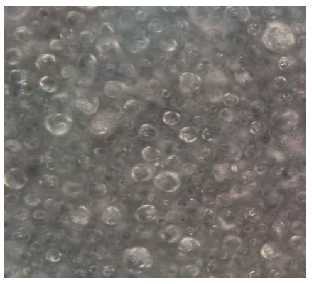
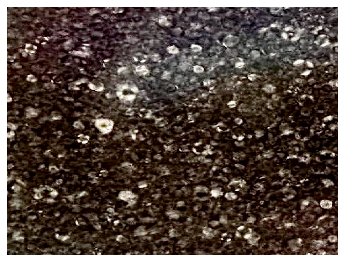
Polarized optical microscopy revealed distinct birefringence in both F1 (Olivem® 1000) and F2 (Emulgade® PL 68/50) (Table 5), confirming the successful assembly of liquid crystalline structures. Generally, amphiphilic compounds organize themselves into various mesophases (e.g., cubic, hexagonal, or lamellar) governed by their critical packing parameter (CPP) [11]. While cubic phases are optically isotropic and do not exhibit birefringence due to their symmetric configuration [28], the distinct Maltese cross patterns observed in this study confirm a lamellar arrangement. The formulation F2 displayed more prominent and dense Maltese cross patterns compared to F1. This suggests that the alkyl polyglucoside architecture of Emulgade® PL 68/50 more effectively promotes the development of extensive lamellar networks that encapsulate oil droplets and extend into the continuous aqueous phase [27,29].
The microstructural findings were further supported by droplet size analysis. Particle size analysis revealed a statistically significant difference (p < 0.05) between the mean droplet diameters of the two formulations. Formulation F1 exhibited a mean size of 4.58 ± 0.01 µm, while F2 showed a slightly smaller droplet size of 4.34 ± 0.03 µm. While Terescenco et al. [27] reported that LC emulsions prepared from polar oils (e.g., caprylic/capric triglycerides) and alkyl polyglucoside (APG) emulsifiers typically yield droplet sizes ranging from 5 to 10 µm, the average size of LC emulsions observed in the present study is more consistent with the ULC emulsions described by Hua et al. [21]. These ULC systems are characterized by a particle size typically centered around the 4 µm range. According to their findings, the smaller particle size of ULC emulsions contributes to superior viscoelasticity, enhanced long-term moisturizing properties, and improved skin barrier function. Furthermore, ULC emulsions offer more efficient selective delivery of active substances compared to large liquid crystal (LLC) and non-liquid crystal (NLC) emulsions. Although the numerical difference between F1 and F2 appears small, the smaller droplet size in F2 contributes to enhanced kinetic stability. According to the principles of emulsion science, a reduction in droplet size effectively decreases the rate of gravitational separation, such as creaming or sedimentation, thereby extending the shelf-life of the formulation [30]. Furthermore, the finer droplet size in F2 likely facilitates a more ordered structural organization.
Visually, both formulations appeared as off-white, high-gloss emulsions (Figure S1) with ease of absorption without residual tackiness. However, F2 was characterized by a smoother, richer texture and higher viscosity compared to F1. These sensory attributes, particularly the superior hydration perceived during application, are likely driven by the molecular architecture of the APG-based emulsifier, Emulgade® PL 68/50, in F2. The molecular architecture of APGs promotes the formation of biomimetic lamellar phases that encapsulate oil droplets and extend into the continuous aqueous phase [27]. This network not only acts as a mechanical barrier against droplet coalescence but also traps water within the crystalline layers, explaining the richer feel and higher perceived hydration of F2. Based on its optimal microstructural organization, stability potential, and favorable sensory attributes, Emulgade® PL 68/50 was selected as the optimal emulsifier for subsequent investigations.

3.2.2. Effect of Thickening Agent Type and Concentration

In this study, the effects of thickener type and concentration on the formation and properties of emulsions formulated with Emulgade® PL 68/50 as the primary emulsifier were investigated. Hydroxyethyl cellulose (HEC), xanthan gum (XG), and guar gum (GG) were incorporated at 0.3%, 0.5%, and 1.0% w/w to assess their influence on ULC formation, droplet size, and texture.
Polarized light microscopy confirmed that the lamellar liquid crystalline arrangement, evidenced by distinct Maltese cross patterns, remained intact across all formulations regardless of the thickener type or concentration (Table 6). This suggests that adding these hydrophilic polymers did not disrupt the lamellar structure.
As the concentration of these polymers increases, so does the mean droplet size. Possible mechanisms of the polymers within the LC network are likely [31,32]. Firstly, hydrophilic polymers may be predominantly distributed within the continuous aqueous phase and increase the bulk viscosity. This heightened viscosity can hinder the efficient breakup of oil droplets during mechanical shear in the homogenization process, leading to larger droplet diameters. Secondly, these polymers may insert into the inter-lamellar water layers situated between the emulsifier bilayers. Given their high water affinity, the intercalation of polymers into these aqueous domains can induce swelling of the lamellar shell, thereby expanding the overall particle size. Furthermore, hydrophilic polymers may be adsorbed at the interface. Recent studies have reported that increasing the concentration of thickeners, such as xanthan gum, in O/W emulsions enhances hydrogen bonding with the emulsifier (glycerol stearate and PEG-100 stearate), leading to an accumulation of polymer–emulsifier aggregates at the interface [32]. This thickening of the interfacial film, potentially enhancing steric stability, contributes to the observed size enlargement at higher concentrations. Similar interactions between Emulgade® PL 68/50 and the evaluated polymers (HEC, XG, and GG) in this study may explain the observed microstructural expansion.
While all formulations maintained a high-gloss, off-white appearance (Figure S2), their textural and sensorial profiles diverged significantly based on the polymer’s molecular structure and concentration. The HEC-based formulations (F3.1–F3.3) presented a soft texture with moderate absorption, while the XG formulations (F4.1–F4.3) showed a light, watery texture with moderate viscosity, an elastic feel, and rapid absorption. In contrast, the GG formulations (F5.1–F5.3) displayed a soft and thicker texture with slower absorption, consistent with the higher viscosity typically associated with the characteristic of GG. Based on the overall parameter, the 0.3% XG (F4.1) was selected as the optimal thickening agent for subsequent investigations.

3.2.3. Effect of PO Concentration

Based on the optimized parameters established in Section 3.2.1 and Section 3.2.2, a formulation containing 4.5% w/w Emulgade® PL 68/50 as the emulsifier and 0.3% w/w XG as the thickening agent was designed to evaluate the effect of PO content. The PO concentration varied at 2% (F6), 3% (F7), and 4% (w/w) (F8).
Polarized optical microscopy revealed distinct Maltese cross patterns in all formulations at both 10× and 40× magnification (Table 7). This observation confirms that the inclusion of PO within the 2–4% range does not disrupt the fundamental lamellar liquid crystalline structure. Similar findings have indicated that the structural integrity of lamellar phases can accommodate varying emollient structures without phase transition [27,33].
The particle size data for formulations with varying oil content are presented in Table 7. A significant reduction in mean droplet diameter was observed as the PO concentration increased from 2% (F6) to 4% (F8). In a system with a fixed concentration of Emulgade® PL 68/50 (4.5% w/w), increasing the oil phase volume likely optimized the oil-to-surfactant ratio. This optimization facilitates a more effective reduction in interfacial tension during emulsification, allowing the mechanical shear from the homogenizer to fragment the oil phase into finer droplets more efficiently. Furthermore, the decrease in particle size correlates with the polar nature of PO, which is rich in unsaturated fatty acids and bioactive compounds. In systems stabilized by APG emulsifiers, polar oils are known to interact more favorably with surfactant bilayers, enhancing the stability of newly formed interfaces and preventing immediate coalescence, thereby resulting in a smaller final droplet size [27].
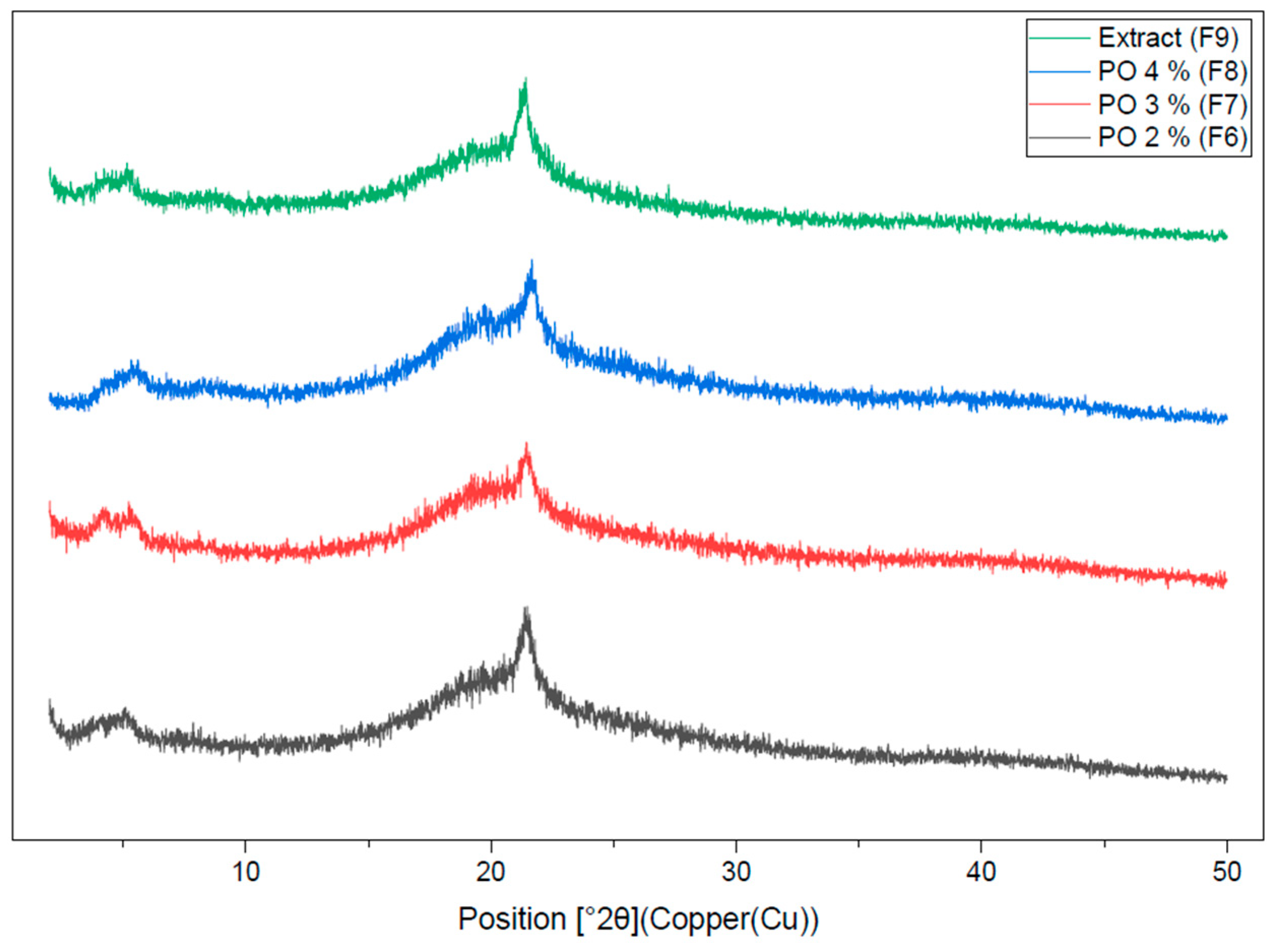
To achieve a more reliable structural interpretation and confirm the phase behavior of the system, WAXD analysis was performed. The WAXD patterns (Figure 1) exhibit distinct, sharp reflections at 2θ values of 21.40°, 21.42°, and 21.73° for 2%, 3%, and 4% PO formulations, respectively. According to Bragg’s Law [27,34], these peaks correspond to an interlayer d-spacing of approximately 0.41–0.42 nm, indicating α-gel (Lβ phase) structures. Additionally, these sharp reflections are observed alongside a broad diffuse scattering region centered around 2θ values of 19.7° (corresponding to a d-spacing of approximately 0.45 nm), indicating lamellar liquid-crystalline phases (Lα). The presence of both sharp and broad signals confirms the coexistence of ordered α-gel and semi-ordered liquid-crystalline structures (Lα) within the formulations [27,34]. Among the samples, the 2% PO formulation exhibited the highest peak intensity, suggesting a greater degree of crystallinity or larger crystalline domains [29]. Relative crystallinity calculations indicated that the 2% PO formulation had the highest value (Xc = 14.29%), which decreased to 13.35% and 12.33% for the 3% and 4% PO emulsions, respectively.
Interestingly, the observed reduction in droplet size appeared to be inversely related to the relative crystallinity determined by the WAXD data. As the oil content increased to 4%, the decrease in Xc suggests a shift toward a more fluid-like lamellar phase (Lα) rather than a rigid α-gel. A more flexible and fluid interfacial film is generally more resilient during high-shear processing, allowing the system to maintain a smaller droplet distribution. In contrast, at lower oil concentrations (2% PO), the higher crystallinity may result in a more rigid network that is less effective at stabilizing smaller droplets during the rapid fragmentation and re-coalescence cycles of homogenization [29].
Organoleptic evaluation provided textural and sensorial profiles of the formulations (Figure S3). All emulsions exhibited an off-white, high-gloss appearance with a hydrating skin feel. As expected, increasing the PO content resulted in a higher perception of oiliness on the skin. This sensory trend is consistent with the WAXD data; the lower crystallinity observed in F8 may result in a more mobile oil phase at the skin surface, enhancing the perception of oiliness despite the firmer bulk consistency.

3.2.4. Effect of the PP Addition

Based on the optimized physicochemical properties, including polarized light microscopy, particle size distribution, textural profile, and WAXD characterization, the formulation containing 2% PO, 0.3% XG, and 4.5% Emulgade® PL 68/50 was selected as the base for evaluating the effect of PP incorporation. Under polarized microscopy, the ULC emulsion containing PO and PP (F9) exhibited distinct Maltese cross patterns, indicating that the PP addition did not disrupt the fundamental lamellar liquid-crystalline structure.
The particle size data is summarized in Table 7. The addition of the PP led to a statistically significant reduction in droplet size, from 4.19 ± 0.01 µm in F6 to 4.02 ± 0.02 µm in F9. This reduction suggests that components within the PP may possess surface-active properties or act as co-surfactants, further reducing the interfacial tension and improving emulsification efficiency.
WAXD profiles were analyzed to identify phase transitions after PP incorporation (Figure 1). The formulation containing PO and PP (F9) maintained the characteristic reflections at 2θ values of 21.4° (d-spacing of 0.415 nm), corresponding to the α-gel phase. The diffuse signal at around 19.7° (d-spacing of 0.45 nm), is indicative of the lamellar liquid-crystalline (Lα) phase [27,34]. Interestingly, F9 exhibited a higher crystallinity percentage (18.14%) compared to F6–F8. This increase in Xc suggests that the PP components may facilitate tighter molecular packing or promote the formation of more ordered domains within the lamellar matrix. This reinforcement of the crystalline structure can be beneficial for the mechanical stability of the emulsion and may control the release rate of the encapsulated PP.
Organoleptic assessment revealed that F9 maintained desirable textural attributes, characterized by high viscosity, excellent spreadability, and a good hydrating sensation upon application. The systems provide a watery feel, which is typical of liquid-crystalline emulsions as they break down and release immobilized water onto the skin. The slightly more pronounced light-yellow hue exhibited by F9 (Figure S4), is consistent with the natural color of the incorporated botanical extract.

3.3. Stability of the Formulations

All formulations (F1–F9) were centrifuged, and none showed any signs of phase separation after centrifugation.
The selected ULC emulsion containing PO (F6) and the ULC emulsion containing PO and PP (F9) were subjected to six heating–cooling cycles to evaluate their physical stability. Initially, all formulations were presented as homogenous, white, and odorless creams. Throughout the six cycles of stability testing, no observable changes in color, odor, or phase separation were detected. The appearance, viscosity, and pH change during the stability study are summarized in Table 8. Statistical analysis indicated no significant changes in viscosity for any formulation across the cycles (p > 0.05), suggesting excellent long-term structural integrity. Good stability can be attributed to the formation of LC phases within the emulsion system. This interpretation is supported by previous findings reported by Jia et al. [35], who demonstrated that multiple emulsions containing LC structures exhibit superior stability compared to non-LC formulations. All formulations demonstrated remarkable pH stability with no significant fluctuations over time (p > 0.05), remaining within the optimal range for topical application. However, the reduction in pH may be attributable to the degradation of certain active ingredients or the oxidation of the PO and PP components, which can release acidic by-products (such as free fatty acids) over time. This finding implies that while F9 is physically stable (no phase separation), its chemical stability may require further optimization, such as the addition of antioxidants or a buffering system to maintain the desired pH level throughout its shelf-life.

3.4. Clinical Evaluation

3.4.1. Skin Irritation Test

The skin irritation potential of the placebo cream, F6, and F9 was evaluated using a single application closed patch test on 33 healthy volunteers. After patch removal, the placebo cream, F6, and F9 exhibited M.I.I. values of 0.03, 0.03, and 0.12, respectively. According to the irritation classification, all tested formulations fell within the non-irritant category (M.I.I. < 0.2). No adverse cutaneous reactions, such as erythema or edema, were observed in any participants during the study period.
These results are consistent with a previous study by Chanpirom et al. [7], who reported that PP in an aqueous solution is safe for skin application at concentrations up to 0.1% w/v. Although the irritancy of active ingredients can depend on the formulation matrix, the findings of this present study demonstrate that incorporating 0.1% w/w PP into a LC emulsion preserves the non-irritating nature of PP. Moreover, the combination of 2.0% w/w PO with 0.1% w/w PP did not induce any synergistic increase in irritation. The LC structure, which mimics the lamellar lipid organization of the stratum corneum, likely enhances barrier compatibility and minimizes adverse reactions. Therefore, transitioning from a simple aqueous solution of 0.1% PP to a ULC-based delivery system is dermatologically safe and suitable for topical cosmetic applications.

3.4.2. Short-Term Moisturizing Efficacy

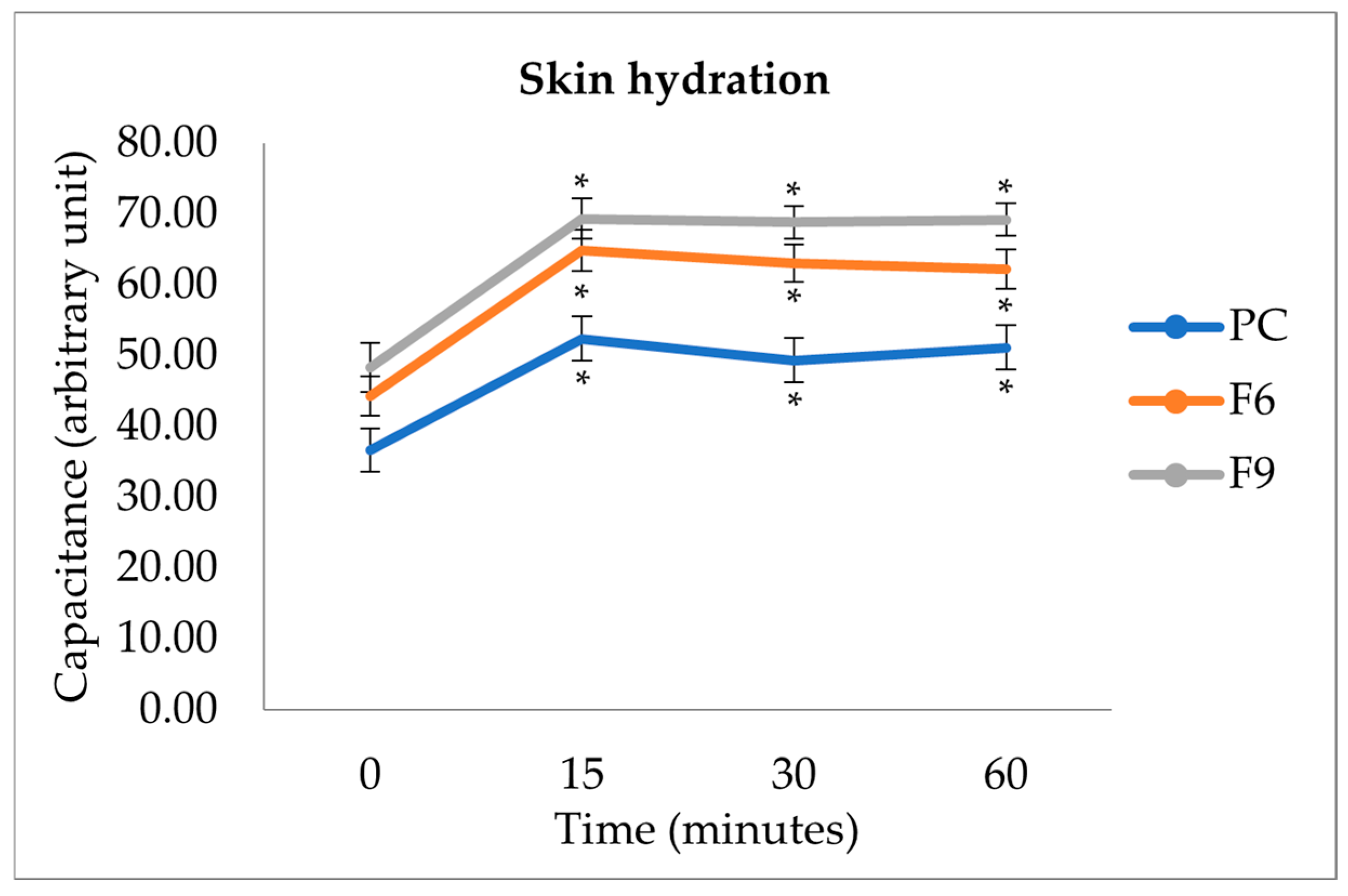
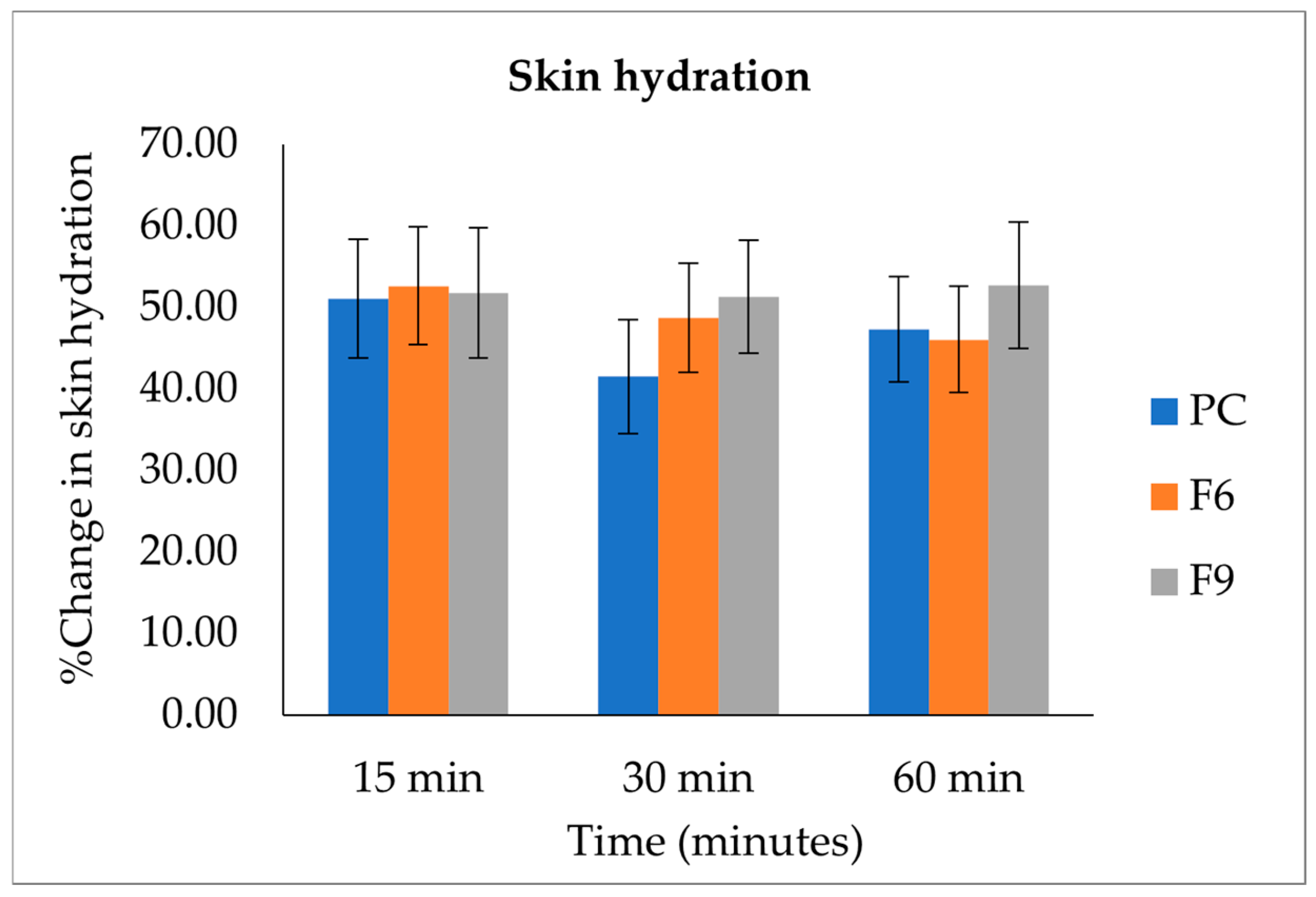
The short-term skin moisturizing effects of the ULC cream formulations were evaluated by measuring skin hydration and TEWL. As shown in Figure 2, all ULC formulations significantly (p < 0.05) increased skin hydration, measured as capacitance, immediately after a single application, and this effect persisted throughout the 60 min study period. Further observation of the percentage change in skin hydration (Figure 3) showed that all groups achieved a substantial increase in skin hydration exceeding 50% at the 15 min post-application stage. As the study progressed to 30 and 60 min, the PC and F6 showed a slight decline in the percentage change in hydration over time, particularly at the 30 min interval, while F9 could sustain a percentage increase in hydration of approximately 50%. Although there were no significant differences in percentage change among the formulations, this could suggest that all ULC emulsions similarly improve skin hydration relative to the baseline. These results indicate that, while F9 achieved the greatest absolute hydration, the LC matrix effectively facilitated moisture enhancement across all formulations.
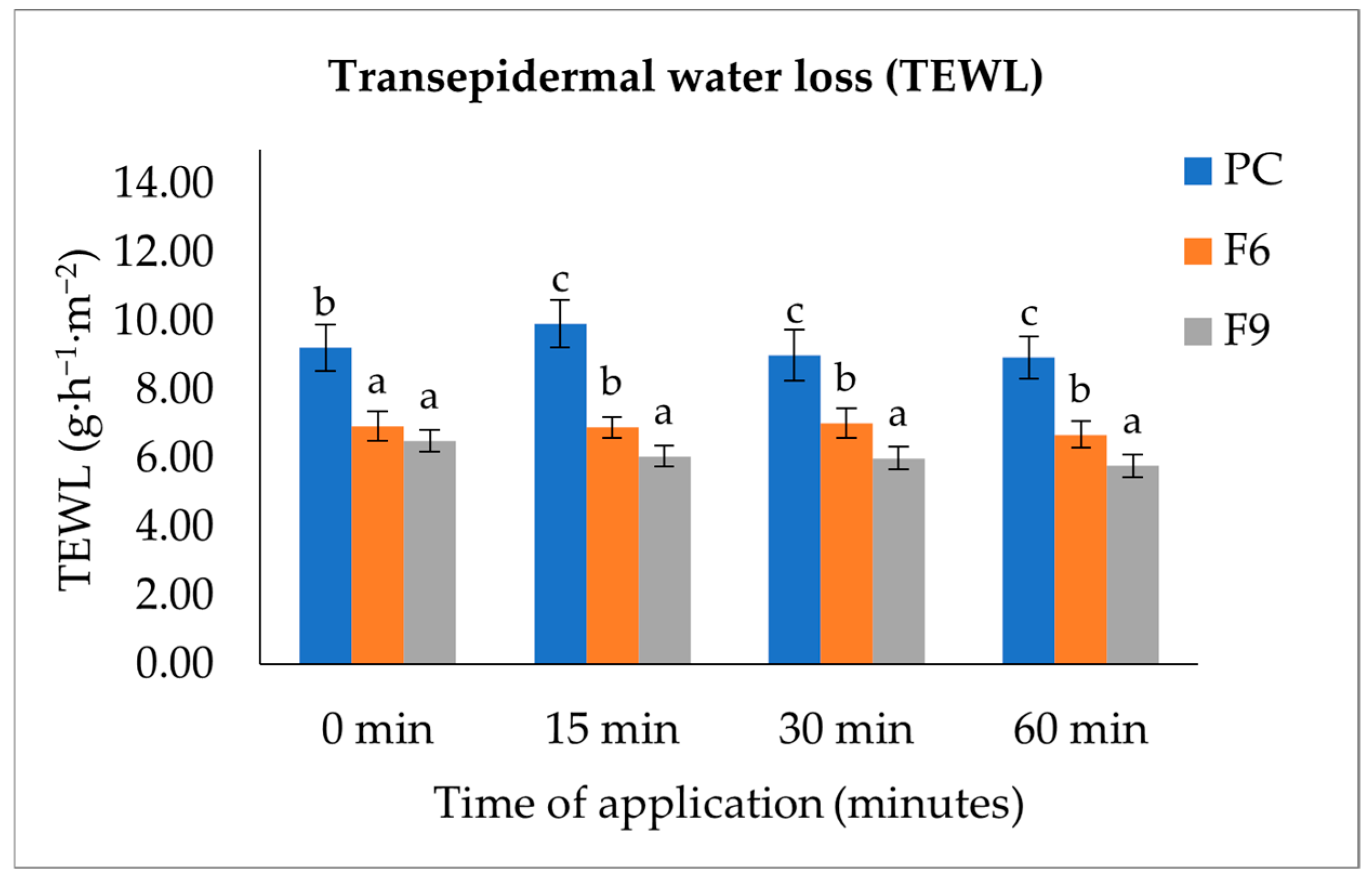
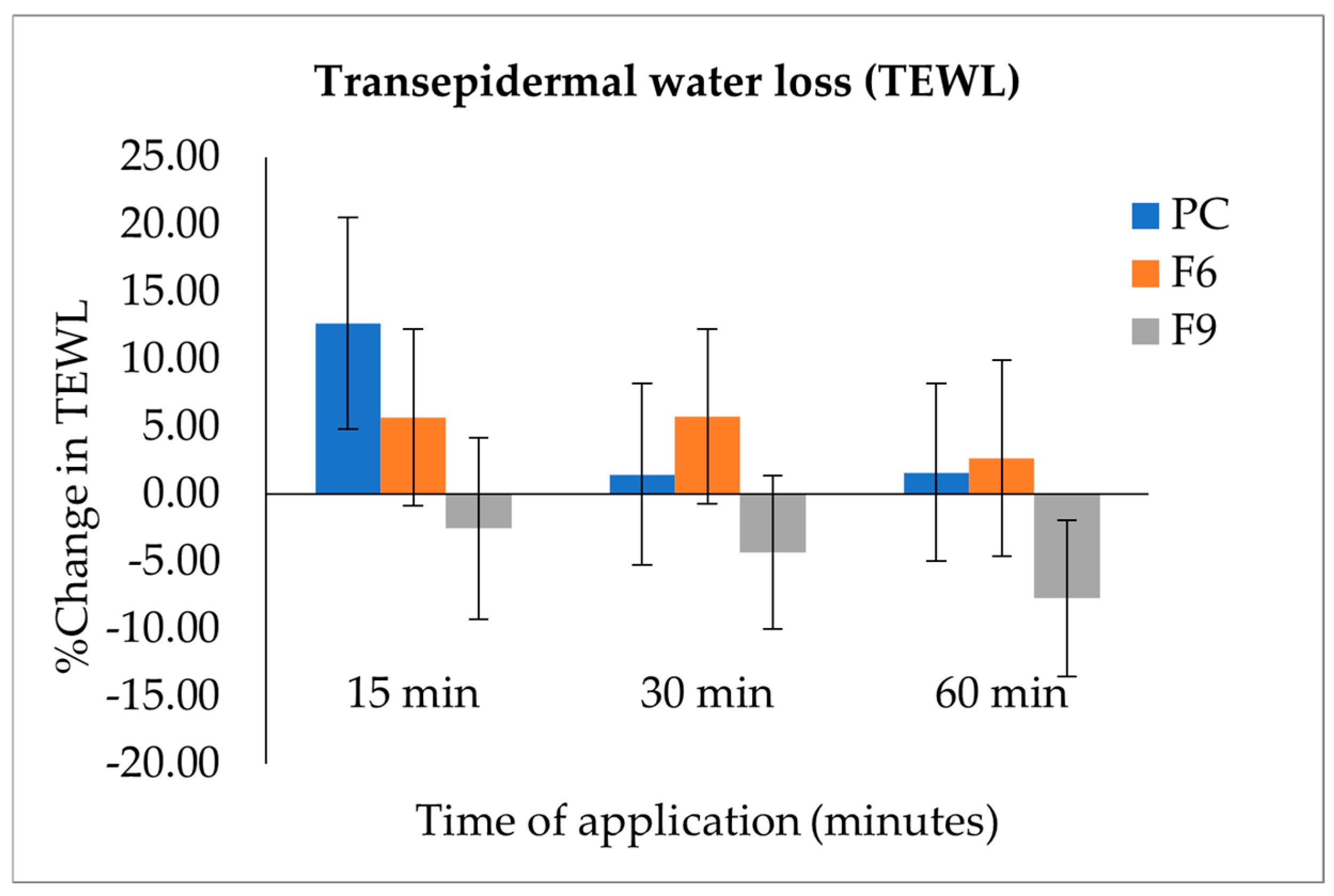
To evaluate the skin barrier function, the TEWL was monitored to assess the occlusive properties of the creams. Formulation F6 and F9 exhibited a significantly lower TEWL than the PC (Figure 4) at all time points, although they did not differ from the baseline (0 min). The lack of significant differences between formulations F6 and F9 and their baseline TEWL values suggests that cream application did not cause an immediate change in the skin barrier. In contrast, the consistently lower TEWL observed for F6 and F9 compared with the placebo throughout the study period indicates effectively maintained skin barrier integrity and reduced water loss for these formulations relative to the placebo. The percentage change in TEWL (Figure 5) showed that formulation F9 exhibited a decreasing trend, with TEWL reduction (negative percentage change) observed from 15 min post-application and becoming more pronounced at 60 min. In contrast, the PC and F6 showed initial fluctuations before stabilizing. The greater TEWL reduction observed with F9 suggests a stronger occlusive effect, efficiently inhibiting water loss from the skin surface. However, differences were not statistically significant (p > 0.05), indicating that all three ULC formulations provide a comparable capacity to maintain skin barrier integrity.
Overall, these findings demonstrate that while the incorporation of PO and PP in F9 contributes to an interesting trend toward enhanced efficacy, all formulations exhibit a comparable capacity to increase skin hydration and support the skin barrier function. This suggests that the LC matrix itself serves as a fundamental moisturizing vehicle, providing an effective baseline of dermal benefits.

3.4.3. Long-Term Moisturizing Efficacy

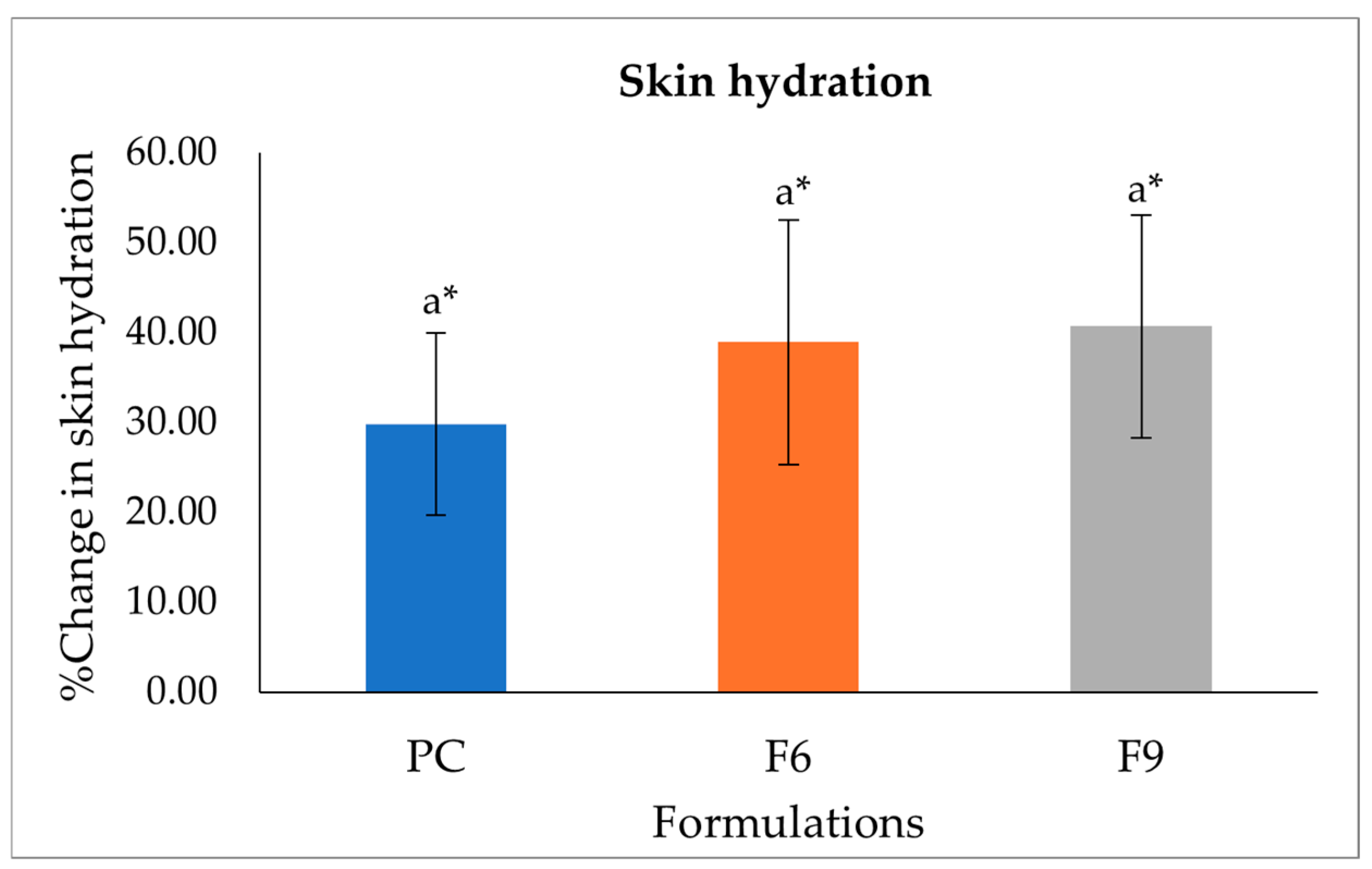
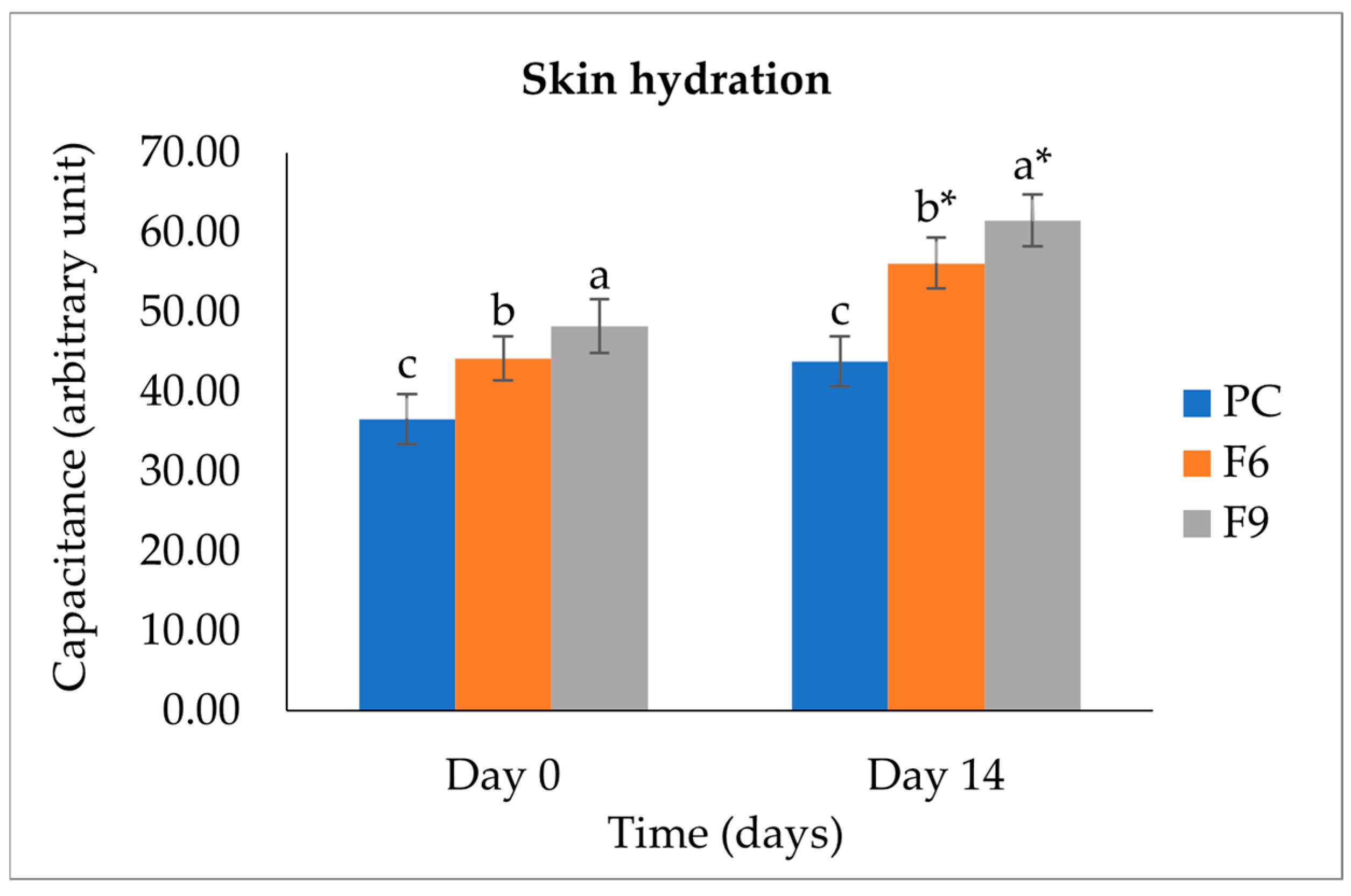
To assess the cumulative benefits of the formulations, skin hydration was monitored over 14 days. As shown in Figure 6, all formulations significantly improved skin capacitance compared to their respective baselines on Day 0 (p < 0.05). By Day 14, F9 reached the highest hydration level (approximately 60 arbitrary units), significantly higher than PC and F6. This long-term improvement is further emphasized in Figure 7, where the percentage change in skin hydration on Day 14 reached approximately 30–40% across all groups. Although the differences in percentage change between PC, F6, and F9 were not statistically significant, the data confirm that the moisturizing effect is not merely transient but sustained and enhanced with regular use.
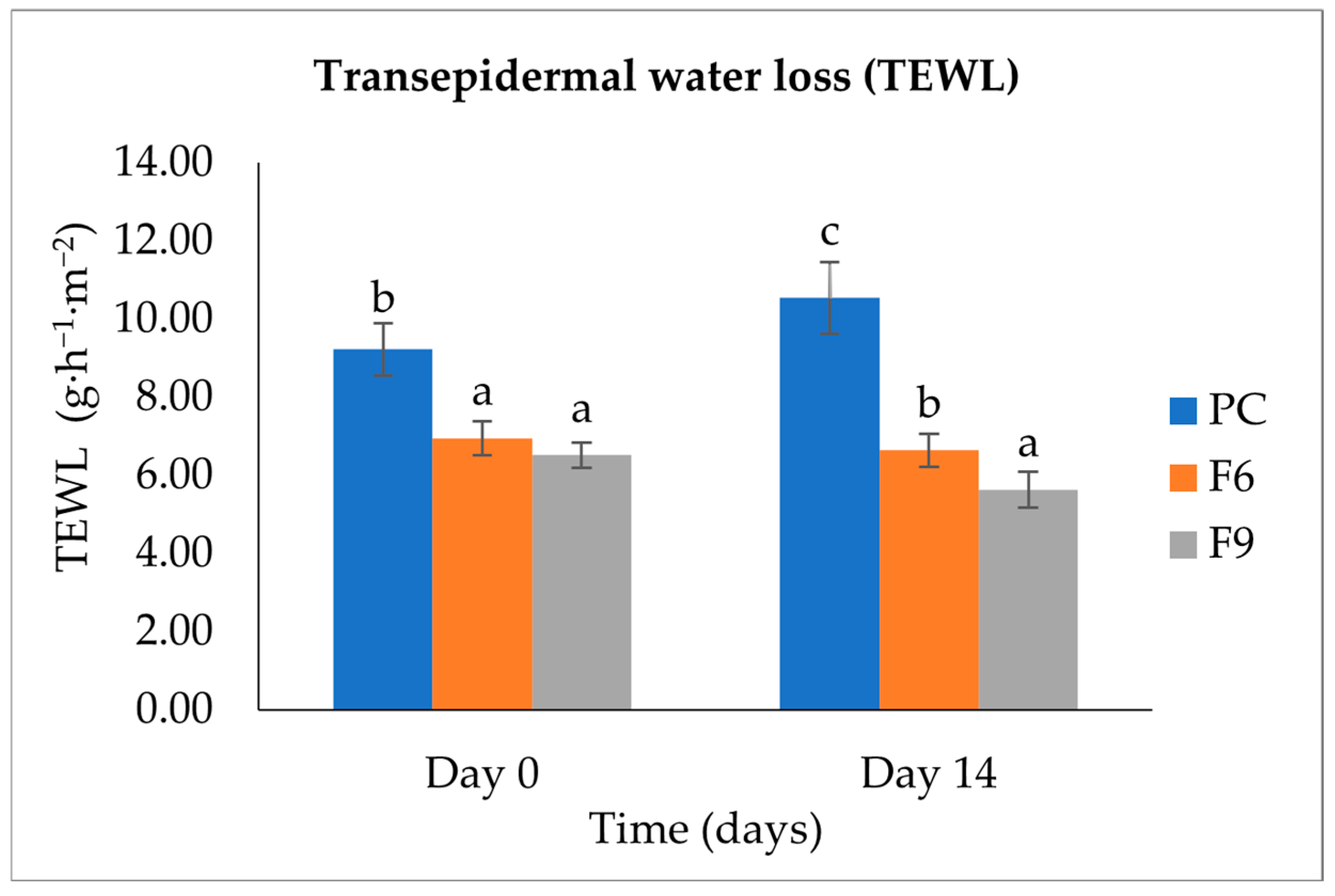
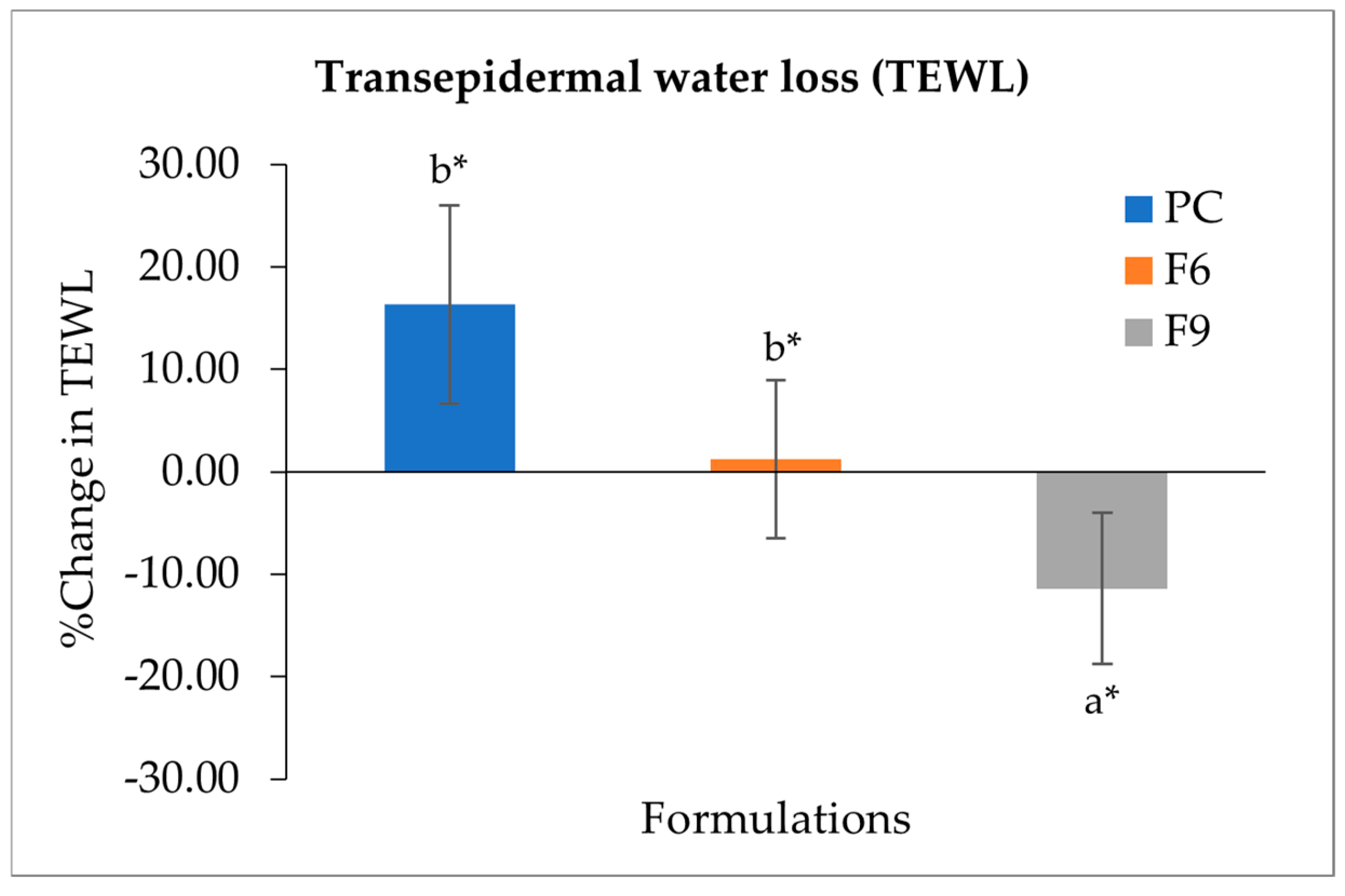
Figure 8 and Figure 9 revealed that F9 achieved a statistically significant reduction in TEWL by Day 14 (p < 0.05). While PC and F6 showed increased or stabilized TEWL, the negative percentage change in F9 signifies an enhanced ability to reinforce the skin barrier and prevent cumulative moisture loss over time.
The trend toward enhanced efficacy observed in F9 can be attributed to a synergistic triple-action mechanism. First, the ULC emulsion framework creates a biomimetic lamellar structure consisting of alternating oil and water layers. This organization mimics the natural intercellular lipids of the stratum corneum, acting as a water reservoir that ensures sustained hydration [36]. Second, the incorporated PP functions as an effective humectant, forming a hygroscopic film on the skin surface to bind and retain environmental moisture [7]. Finally, the PO and other oils act as an emollient, penetrating the stratum corneum to replenish essential fatty acids and support the repair of the lipid barrier [37,38]. Together, these components integrate within the ULC matrix to provide a comprehensive approach to skin barrier reinforcement and hydration.
The short-term and 14-day results substantiate that the inclusion of PO and PP in an ULC system effectively maintains a consistent baseline of dermal benefits. These findings, coupled with the previous non-irritation results, demonstrate that the developed ULC emulsions are not only dermatologically safe but also highly effective for chronic skin dryness management in topical cosmetic applications.

4. Conclusions

This study successfully integrated Japanese pumpkin polysaccharide and pumpkin seed oil into a stable liquid crystal emulsion. The formation of a lamellar (Lα) structure and α-gel phase was confirmed through polarized light microscopy and wide-angle X-ray diffraction, which contributed to the physical stability of the formulation. Clinical evaluations demonstrated that the optimized ULC emulsion (F9) is non-irritating and significantly enhances skin hydration while reducing transepidermal water loss. Although the percentage change was comparable to the control groups, the unique combination of pumpkin-derived bioactive compounds within a liquid crystal system offers a promising, safe, and natural alternative for advanced moisturizing skincare. These findings demonstrate the potential for utilizing agricultural by-products in the development of high-performance cosmeceutical delivery systems.

Supplementary Materials

The following supporting information can be downloaded at: https://www.mdpi.com/article/10.3390/cosmetics13020049/s1, Figure S1: Appearance of the LC emulsions formulated with different emulsifiers: Olivem® 1000 (F1) and Emulgade® PL 68/50 (F2); Figure S2: Appearance of the liquid crystal emulsions formulated with different thickening agents: (a) HEC (F3.1–F3.3), (b) Xan (F4.1–F4.3), and (c) GG (F5.1–F5.3); Figure S3: Appearance of the liquid crystal emulsions formulated with varying concentrations of PO: 2% w/w (F6), 3% w/w (F7), and 4% w/w (F8); Figure S4: Appearance of ULC emulsions after PP addition (F19).

Author Contributions

Conceptualization, S.C. (Setinee Chanpirom). and T.S.; methodology, S.C. (Setinee Chanpirom), T.T.-U. and T.S.; validation, S.C. (Setinee Chanpirom), and T.S.; formal analysis, S.C. (Setinee Chanpirom), T.T.-U., N.D. and T.S.; investigation, S.C. (Setinee Chanpirom), T.T.-U., P.I., P.K., C.Y., S.C. (Supakorn Chantapa), V.N. and T.S.; resources, S.C. (Setinee Chanpirom), T.T.-U., N.S. and T.S.; writing—original draft preparation, S.C. (Setinee Chanpirom), T.T.-U., P.I., P.K., N.D. and T.S.; writing—review and editing, S.C. (Setinee Chanpirom), T.T.-U., N.S., N.D., M.P.V. and T.S.; visualization, S.C. (Setinee Chanpirom), T.T.-U. and T.S.; supervision, S.C. (Setinee Chanpirom), T.T.-U. and T.S.; project administration, S.C. (Setinee Chanpirom), T.T.-U. and T.S.; funding acquisition, S.C. (Setinee Chanpirom), T.T.-U., P.I., P.K., and T.S. All authors have read and agreed to the published version of the manuscript.

Funding

This work was supported by the Technology and Innovation-Based Enterprise Development Fund (TED Fund) under the Regional Science Park North (RSP) and by Mae Fah Luang University.

Institutional Review Board Statement

The product tested is non-therapeutic, intended for topical use, and poses low risk to participants. Therefore, it does not meet the criteria for registration applied to drug or medical device trials investigating disease treatment or prevention. The study was conducted in accordance with the Declaration of Helsinki, the Belmont Report, and the CIOMS Guidelines and approved by the Ethics Committee on Human Research of Mae Fah Luang University (Protocol Code: EC25014-17, approved on 27 August 2025).

Informed Consent Statement

Written informed consent was obtained from all subjects involved in this study, in accordance with international ethical guidelines.

Data Availability Statement

The original contributions presented in this study are included in the article. Further inquiries can be directed to the corresponding author.

Acknowledgments

The authors acknowledge the Scientific & Technological Instruments Center (STIC), the Center of Excellence for Medicinal Plants and Thai Traditional Medicine (MPIC), and the Mae Fah Luang Intellectual Property Management and Innovation Division (MFii) for providing research facilities, infrastructure, and technical support. Gratitude is also extended to Phuwarin Farm, Nan Province, Thailand, for providing the pumpkin used in this study.

Conflicts of Interest

The authors declare that there are no conflicts of interest.

References

  1. Giménez Martínez, R.J.; Rivas García, F.; March Cerdá, J.C.; Hernández-Ruíz, Á.; González Castro, M.I.; Valverde-Merino, M.-I.; Huertas Camarasa, F.J.; Lloris Meseguer, F.; López-Viota Gallardo, M. Bioactive Substances and Skin Health: An Integrative Review from a Pharmacy and Nutrition Perspective. Pharmaceuticals 2025, 18, 373. [Google Scholar] [CrossRef]
  2. Choi, H.Y.; Lee, Y.J.; Kim, C.M.; Lee, Y.-M. Revolutionizing Cosmetic Ingredients: Harnessing the Power of Antioxidants, Probiotics, Plant Extracts, and Peptides in Personal and Skin Care Products. Cosmetics 2024, 11, 157. [Google Scholar] [CrossRef]
  3. W.F.O. Cucurbita maxima Duchesne. Available online: http://www.worldfloraonline.org/taxon/wfo-0000629095 (accessed on 2 January 2026).
  4. Tridge. Thailand Pumpkin Seeds: Suppliers & Market Trends. Available online: https://www.tridge.com/tridge-woods/pumpkin-seeds/TH (accessed on 9 November 2025).
  5. Ji, X.; Peng, B.; Ding, H.; Cui, B.; Nie, H.; Yan, Y. Purification, Structure and Biological Activity of Pumpkin Polysaccharides: A Review. Food Rev. Int. 2023, 39, 307–319. [Google Scholar] [CrossRef]
  6. Anastácio, T.O.; Madalozzo, E.S.; Oliveira, V.S.; Sandim, G.C.; Moroto, B.S.; Formagio, A.S.N.; Cardoso, C.A.L.; Sardi, J.C.O.; Oliveira, C.F.R.; Macedo, M.L.R. Nutraceutical potential of Cucurbita maxima Duchesne pulp extract. Food Sci. Technol. Int. 2025, 10820132251349940. [Google Scholar] [CrossRef]
  7. Chanpirom, S.; Saewan, N.; Sripisut, T. Alternative Utilization of Vegetable Crop: Pumpkin Polysaccharide Extract and Their Efficacy on Skin Hydration. Cosmetics 2022, 9, 113. [Google Scholar] [CrossRef]
  8. Singh, A.; Kumar, V. Pumpkin seeds as nutraceutical and functional food ingredient for future: A review. Grain Oil Sci. Technol. 2024, 7, 12–29. [Google Scholar] [CrossRef]
  9. Gedi, M.A. Chapter 14—Pumpkin seed oil components and biological activities. In Multiple Biological Activities of Unconventional Seed Oils; Mariod, A.A., Ed.; Academic Press: Cambridge, MA, USA, 2022; pp. 171–184. [Google Scholar]
  10. Teeranachaideekul, V.; Soontaranon, S.; Sukhasem, S.; Chantasart, D.; Wongrakpanich, A. Influence of the emulsifier on nanostructure and clinical application of liquid crystalline emulsions. Sci. Rep. 2023, 13, 4185. [Google Scholar] [CrossRef] [PubMed]
  11. Chountoulesi, M.; Pispas, S.; Tseti, I.K.; Demetzos, C. Lyotropic Liquid Crystalline Nanostructures as Drug Delivery Systems and Vaccine Platforms. Pharmaceuticals 2022, 15, 429. [Google Scholar] [CrossRef] [PubMed]
  12. Chavda, V.P.; Dyawanapelly, S.; Dawre, S.; Ferreira-Faria, I.; Bezbaruah, R.; Rani Gogoi, N.; Kolimi, P.; Dave, D.J.; Paiva-Santos, A.C.; Vora, L.K. Lyotropic liquid crystalline phases: Drug delivery and biomedical applications. Int. J. Pharm. 2023, 647, 123546. [Google Scholar] [CrossRef]
  13. Subash, P.; Khute, S. Recent advances in lyotropic liquid crystal nanoparticle formulations for drug delivery systems. Front. Soft Matter 2025, 5, 1658466. [Google Scholar] [CrossRef]
  14. Ding, L.; Li, H.; Ye, Z.; Shang, Y.; Wang, X.; Liu, H. Novel delivery system: A liquid crystal emulsion containing HSO crystals. New J. Chem. 2023, 47, 10576–10584. [Google Scholar] [CrossRef]
  15. Carlotti, M.E.; Sapino, S.; Gallarate, M.; Trotta, M.; Cavalli, R.; Ugazio, E.; Peira, E. Release of Mandelic Acid from O/W Emulsions with Lamellar Phases. J. Dispers. Sci. Technol. 2008, 29, 1460–1470. [Google Scholar] [CrossRef]
  16. Bento da Silva, P.; Fioramonti Calixto, G.M.; Oshiro Júnior, J.A.; Bombardelli, R.L.Á.; Fonseca-Santos, B.; Rodero, C.F.; Chorilli, M. Structural Features and the Anti-Inflammatory Effect of Green Tea Extract-Loaded Liquid Crystalline Systems Intended for Skin Delivery. Polymers 2017, 9, 30. [Google Scholar] [CrossRef]
  17. Jarupinthusophon, S.; Preechataninrat, P.; Anurukvorakun, O. Development of Liquid Crystal Cream Containing Germinated Brown Rice. Appl. Sci. 2022, 12, 11113. [Google Scholar] [CrossRef]
  18. Bonato Alves Oliveira, L.; de Oliveira, R.P.; Oliveira, C.; Raposo, N.R.B.; Brandão, M.A.F.; Ferreira, A.D.O.; Polonini, H. Cosmetic Potential of a Liotropic Liquid Crystal Emulsion Containing Resveratrol. Cosmetics 2017, 4, 54. [Google Scholar] [CrossRef]
  19. Sobharaksha, P.; Mahamongkol, H.; Channarong, S.; Tansathien, K.; Wongtrakul, P. Development of mangiferin-loaded anisotropic emulsion for cosmetic applications: A comprehensive study on formulation, antioxidant activity, stability, and skin compatibility. Sci. Eng. Health Stud. 2024, 18, 24050022. [Google Scholar] [CrossRef]
  20. Feng, B.; Shang, Y.; Li, C.L.; Ye, Z.; Liu, H. Study on the application and performance of liquid crystal emulsion system in sunscreen products. Liq. Cryst. 2024, 51, 1835–1846. [Google Scholar] [CrossRef]
  21. Hua, Z.; Zhang, C.; He, J.; Chen, Y.; Zhang, S.; Sun, J.; Wang, N.; Zhang, J.; Yang, X.; Chen, J.; et al. Ultra-micro Liquid Crystal in Cosmetic Emulsion with Excellent Moisture Retention and Delivery Selectivity. ACS Omega 2024, 9, 47194–47202. [Google Scholar] [CrossRef]
  22. Jain, S.; Patel, N.; Shah, M.K.; Khatri, P.; Vora, N. Recent Advances in Lipid-Based Vesicles and Particulate Carriers for Topical and Transdermal Application. J. Pharm. Sci. 2017, 106, 423–445. [Google Scholar] [CrossRef] [PubMed]
  23. Tarani, E.; Arvanitidis, I.; Christofilos, D.; Bikiaris, D.N.; Chrissafis, K.; Vourlias, G. Calculation of the degree of crystallinity of HDPE/GNPs nanocomposites by using various experimental techniques: A comparative study. J. Mater. Sci. 2023, 58, 1621–1639. [Google Scholar] [CrossRef]
  24. Ali, A.; Skedung, L.; Burleigh, S.; Lavant, E.; Ringstad, L.; Anderson, C.D.; Wahlgren, M.; Engblom, J. Relationship between sensorial and physical characteristics of topical creams: A comparative study on effects of excipients. Int. J. Pharm. 2022, 613, 121370. [Google Scholar] [CrossRef]
  25. Anatachodwanit, A.; Chanpirom, S.; Tree-Udom, T.; Kitthaweesinpoon, S.; Jiamphun, S.; Aryuwat, O.; Tantapakul, C.; Vinardell, M.P.; Sripisut, T. Upcycled Cocoa Pod Husk: A Sustainable Source of Phenol and Polyphenol Ingredients for Skin Hydration, Whitening, and Anti-Aging. Life 2025, 15, 1126. [Google Scholar] [CrossRef]
  26. Omar, S.S.S.; Hadi, H.; Mohd Hanif, N.; Ahmad, H.M.A.; Ng, S.-F. Lightening Effect of Skin Lightening Cream Containing Piper betle L. Extract in Human Volunteers. Cosmetics 2021, 8, 32. [Google Scholar] [CrossRef]
  27. Terescenco, D.; Picard, C.; Clemenceau, F.; Grisel, M.; Savary, G. Influence of the emollient structure on the properties of cosmetic emulsion containing lamellar liquid crystals. Colloids Surf. A Physicochem. Eng. Asp. 2018, 536, 10–19. [Google Scholar] [CrossRef]
  28. Eccleston, G.M.; Behan-Martin, M.K.; Jones, G.R.; Towns-Andrews, E. Synchrotron X-ray investigations into the lamellar gel phase formed in pharmaceutical creams prepared with cetrimide and fatty alcohols. Int. J. Pharm. 2000, 203, 127–139. [Google Scholar] [CrossRef]
  29. Lukic, M.; Pantelic, I.; Daniels, R.; Müller-Goymann, C.; Savic, M.; Savic, S. Moisturizing emulsion systems based on the novel long-chain alkyl polyglucoside emulsifier. J. Therm. Anal. Calorim. 2013, 111, 2045–2057. [Google Scholar] [CrossRef]
  30. Tan, C.; McClements, D.J. Application of Advanced Emulsion Technology in the Food Industry: A Review and Critical Evaluation. Foods 2021, 10, 812. [Google Scholar] [CrossRef]
  31. McClements, D.J. Food Emulsions: Principles, Practices, and Techniques, 3rd ed.; CRC Press: Boca Raton, FL, USA, 2015. [Google Scholar]
  32. Zhang, J.; Tai, X.; Liu, H.; Ma, X.; Gao, X.; Luo, Y. Effect of xanthan gum on stability and rheological behavior of O/W emulsion. J. Dispers. Sci. Technol. 2025, 46, 2189–2197. [Google Scholar] [CrossRef]
  33. Caritá, A.C.; Kichou, H.; Legrand, F.-X.; Verger, A.; Perse, X.; Rapetti, L.; Leonardi, G.R.; Gillet, G.; Munnier, E. Improvement of the rheological properties and performance of liquid crystal emulsions: Influence of oil addition and/or high-frequency ultrasound treatment. Int. J. Pharm. 2025, 682, 125934. [Google Scholar] [CrossRef]
  34. Alfutimie, A.; Curtis, R.; Tiddy, G. Lyotropic Surfactant Liquid Crystals: Micellar Systems. In Handbook of Liquid Crystals; Wiley: Hoboken, NJ, USA, 2014; pp. 1–44. [Google Scholar]
  35. Jia, B.; Zhang, Z.; Chen, M.-H.; Zhang, W.-P. Effect of liquid oils on the properties of multiple emulsions containing liquid crystals. J. Dispers. Sci. Technol. 2017, 38, 876–882. [Google Scholar] [CrossRef]
  36. Wu, N.; Ye, Z.; Zhou, K.; Wang, F.; Lian, C.; Shang, Y. Construction and Properties of O/W Liquid Crystal Nanoemulsion. Langmuir 2024, 40, 7723–7732. [Google Scholar] [CrossRef] [PubMed]
  37. Lin, T.-K.; Zhong, L.; Santiago, J.L. Anti-Inflammatory and Skin Barrier Repair Effects of Topical Application of Some Plant Oils. Int. J. Mol. Sci. 2018, 19, 70. [Google Scholar] [CrossRef] [PubMed]
  38. McMullen, R.L. The benefits and challenges of treating skin with natural oils. Int. J. Cosmet. Sci. 2024, 46, 553–565. [Google Scholar] [CrossRef] [PubMed]
Figure 1. WAXD patterns of formulations containing different concentrations of PO (F6–F8) and the formulation containing PO and PP (F9), showing the coexistence of α-gel and lamellar liquid-crystalline (Lα) phases.
Cosmetics 13 00049 g001
Figure 2. Skin capacitance measured at 15, 30, and 60 min post-application of ULC creams (Mean ± SEM, n = 33). * indicates significant differences (p < 0.05) compared to the baseline (T0).
Cosmetics 13 00049 g002
Figure 3. Percentage change in skin hydration after applying ULC cream formulations (Mean ± SEM, n = 33). The absence of letters and * indicates no significant differences (p < 0.05) between samples and the baseline (T0).
Cosmetics 13 00049 g003
Figure 4. Transepidermal water loss (TEWL) after applying ULC cream formulations (Mean ± SEM, n = 33). Different letters at the same time of application indicate significant differences (p < 0.05) between samples. The absence of * indicates no significant differences (p < 0.05) compared to the baseline (T0).
Cosmetics 13 00049 g004
Figure 5. Percentage change in transepidermal water loss (TEWL) after applying ULC cream formulations (Mean ± SEM, n = 33). The absence of letters and * indicates no significant differences (p < 0.05) between samples and the baseline (T0).
Cosmetics 13 00049 g005
Figure 6. Skin capacitance after the application of ULC creams for 14 days (Mean ± SEM, n = 33). Different letters in the same week of application indicate significant differences (p < 0.05) between samples. * indicates significant differences (p < 0.05) compared to the baseline (D0).
Cosmetics 13 00049 g006
Figure 7. Percentage changes in skin hydration after the application of ULC creams for 14 days (Mean ± SEM, n = 33). Different letters in the same week of application indicate significant differences (p < 0.05) between samples. * indicates significant differences (p < 0.05) compared to the baseline (D0).
Cosmetics 13 00049 g007
Figure 8. Transepidermal water loss (TEWL) after the application of ULC creams for 14 days (Mean ± SEM, n = 33). Different letters in the same week of application indicate significant differences (p < 0.05) between samples. The absence of * indicates no significant differences (p < 0.05) compared to the baseline (D0).
Cosmetics 13 00049 g008
Figure 9. Percentage changes in transepidermal water loss (TEWL) after the application of ULC creams for 14 days (Mean ± SEM, n = 33). Different letters in the same week of application indicate significant differences (p < 0.05) between samples. * indicates significant differences (p < 0.05) compared to the baseline (D0).
Cosmetics 13 00049 g009
Table 1. Emulsion formulations prepared using two different emulsifiers.
PartIngredientsINCI NameAmount (%w/w)Function
F1F2
ADI waterWater67.967.9Solvent
Xanthan gum Xanthan gum0.50.5Thickening Agent
PropanediolPropanediol2.52.5Humectant
GlycerinGlycerin2.52.5Humectant
Olivem® 1000Cetearyl olivate (and) sorbitan olivate4.5-Emulsifier
Emulgade® PL 68/50Cetearyl glucoside (and) cetearyl alcohol-4.5Emulsifier
BCetearyl alcoholCetearyl alcohol4.04.0Co-emulsifier
Caprylic/capric triglycerideCaprylic/capric triglyceride5.05.0Emollient
Pumpkin seed oilCucurbita pepo (pumpkin) seed oil3.03.0Active ingredient
Olive oilOlea europaea (olive) fruit oil4.04.0Emollient
CSodium hyaluronateSodium hyaluronate0.10.1Humectant
GlycerinGlycerin5.05.0Wetting agent
DEuxyl® PE9010Phenoxyethanol (and) ethylhexylglycerin1.01.0Preservative
- indicates that the ingredient was not included in the formulation.
Table 2. Formula composition of F3, F4, and F5 using three different thickening agents.
PartIngredientsINCI NameAmount (%w/w)Function
F3–F5
ADI waterWaterq.s. to 100Solvent
Thickening Agent*0.3–1.0 *Thickening Agent
PropanediolPropanediol2.5Humectant
GlycerinGlycerin2.5Humectant
Emulgade® PL 68/50Cetearyl glucoside (and) cetearyl alcohol4.5Emulsifier
BCetearyl alcoholCetearyl alcohol4.0Co-emulsifier
Caprylic/capric triglycerideCaprylic/capric triglyceride5.0Emollient
Pumpkin seed oilCucurbita pepo (pumpkin) seed oil3.0Active ingredient
Olive oilOlea europaea (olive) fruit oil4.0Emollient
CSodium hyaluronateSodium hyaluronate0.1Humectant
GlycerinGlycerin5.0Wetting agent
DEuxyl® PE9010Phenoxyethanol (and) ethylhexylglycerin1.0Preservative
* F3: Hydroxyethyl cellulose, 0.3% (F3.1), 0.5% (F3.2), 1.0% (F3.3); F4: Xanthan gum, 0.3% (F4.1), 0.5% (F4.2), 1.0% (F4.3); F5: Guar gum, 0.3% (F5.1), 0.5% (F5.2), 1.0% (F5.3).
Table 3. Emulsion formulations containing different concentrations of PO.
PartIngredientsINCI NameAmount (%w/w)Function
F6F7F8
ADI waterWater69.168.167.1Solvent
Xanthan gumXanthan gum0.30.30.3Thickening Agent
PropanediolPropanediol2.52.52.5Humectant
GlycerinGlycerin2.52.52.5Humectant
Emulgade® PL 68/50Cetearyl glucoside (and) cetearyl alcohol4.54.54.5Emulsifier
BCetearyl alcoholCetearyl alcohol4.04.04.0Co-emulsifier
Caprylic/capric triglycerideCaprylic/capric triglyceride5.05.05.0Emollient
Pumpkin seed oilCucurbita pepo (pumpkin) seed oil2.03.04.0Active ingredient
Olive oilOlea europaea (olive) fruit oil4.04.04.0Emollient
CSodium hyaluronateSodium hyaluronate0.10.10.1Humectant
GlycerinGlycerin5.05.05.0Wetting agent
DEuxyl® PE9010Phenoxyethanol (and) ethylhexylglycerin1.01.01.0Preservative
Table 4. Emulsion formulations with PP addition.
PartIngredientsINCI NameAmount (%w/w)Function
F9
ADI waterWater69.0Solvent
Xanthan gumXanthan gum0.3Thickening Agent
PropanediolPropanediol2.5Humectant
GlycerinGlycerin2.5Humectant
Emulgade® PL 68/50Cetearyl glucoside (and) cetearyl alcohol4.5Emulsifier
BCetearyl alcoholCetearyl alcohol4.0Co-emulsifier
Caprylic/capric triglycerideCaprylic/capric triglyceride5.0Emollient
Pumpkin seed oilCucurbita pepo (pumpkin) seed oil2.0Active ingredient
Olive oilOlea europaea (olive) fruit oil4.0Emollient
CSodium hyaluronateSodium hyaluronate0.1Humectant
GlycerinGlycerin5.0Wetting agent
Pumpkin PolysaccharideCucurbita maxima (pumpkin) fruit extract0.1Active ingredient
DEuxyl® PE9010Phenoxyethanol (and) ethylhexylglycerin1.0Preservative
Table 5. Polarized optical micrograph and particle size analysis of LC emulsions containing two emulsifiers: Olivem® 1000 (F1) and Emulgade® PL 68/50 (F2).
FormulaPolarized Optical Micrograph (40%#xD7;) Particle Size (µm)
F1Cosmetics 13 00049 i0014.58 ± 0.01 b
F2Cosmetics 13 00049 i0024.34 ± 0.03 a
Different letters in the same column indicate significant differences (p < 0.05).
Table 6. Polarized optical micrograph and particle size analysis of liquid crystal emulsions containing different thickening agents: hydroxyethyl cellulose (F3), xanthan gum (F4), and guar gum (F5) at 0.3%, 0.5%, and 1.0%.
FormulaPolarized Optical Micrograph (40%#xD7;) Particle Size (µm)FormulaPolarized Optical Micrograph (40%#xD7;) Particle Size (µm)FormulaPolarized Optical Micrograph (40%#xD7;) Particle Size (µm)
F3.1Cosmetics 13 00049 i0033.89 ± 0.03 aF4.1Cosmetics 13 00049 i0043.86 ± 0.01 a, d F5.1Cosmetics 13 00049 i0053.93 ± 0.02 a, g
F3.2Cosmetics 13 00049 i0064.36 ± 0.02 bF4.2Cosmetics 13 00049 i0074.17 ± 0.01 eF5.2Cosmetics 13 00049 i0083.92 ± 0.02 a, h
F3.3Cosmetics 13 00049 i0095.24 ± 0.01 cF4.3Cosmetics 13 00049 i0104.55 ± 0.01 fF5.3Cosmetics 13 00049 i0114.75 ± 0.15 h
Different letters in the particle size column indicate significant differences (p < 0.05).
Table 7. Polarized optical micrograph and particle size analysis of liquid crystal emulsions varying PO concentration (F6–F8) and after adding PP (F9).
FormulaPolarized Optical Micrograph (40%#xD7;) Particle Size (µm)
F6Cosmetics 13 00049 i0124.19 ± 0.01 a
F7Cosmetics 13 00049 i0133.92 ± 0.00 c
F8Cosmetics 13 00049 i0143.90 ± 0.00 d
F9Cosmetics 13 00049 i0154.02 ± 0.02 b
Different letters in the same column indicate significant differences (p < 0.05).
Table 8. Stability assessment results (pH and viscosity) of liquid crystal cream formulations at different cycles.
FormulaCycles
T0T3T6
pHViscosity (mPa.s)pHViscosity (mPa.s)pHViscosity (mPa.s)
F65.43 ± 0.03 a62,200 ± 3337.54 a5.42 ± 0.36 a56,560 ± 3394.11 a5.23 ± 0.56 a61,600 ± 5769.99 a
F95.45 ± 0.04 a180,600 ± 17,819.09 a5.36 ± 0.12 a158,500 ± 3252.69 a5.01 ± 0.45 a172,400 ± 7071.07 a
Spindle no.5, 3 rpm for F6 and 2 rpm for F9, 25 °C, %Torque > 80%. Different letters indicate significant differences (p < 0.05), compared with values at T0.
Disclaimer/Publisher’s Note: The statements, opinions and data contained in all publications are solely those of the individual author(s) and contributor(s) and not of MDPI and/or the editor(s). MDPI and/or the editor(s) disclaim responsibility for any injury to people or property resulting from any ideas, methods, instructions or products referred to in the content.