Physicochemical Properties of Two Poly-L-Lactic Acid Injectable Implants: Potential Impact on Their Biological Properties

 , ,
, ,
Abstract
1. Introduction
2. Materials & Methods
2.1. Sample Preparation
2.2. Differential Scanning Calorimetry
2.3. X-Ray Powder Diffraction
2.4. Particle Size and Morphology
2.5. In Vivo Local Inflammatory Tissue Response (Reactivity) and Persistence of Response
3. Results
3.1. Crystallinity and Thermal Properties
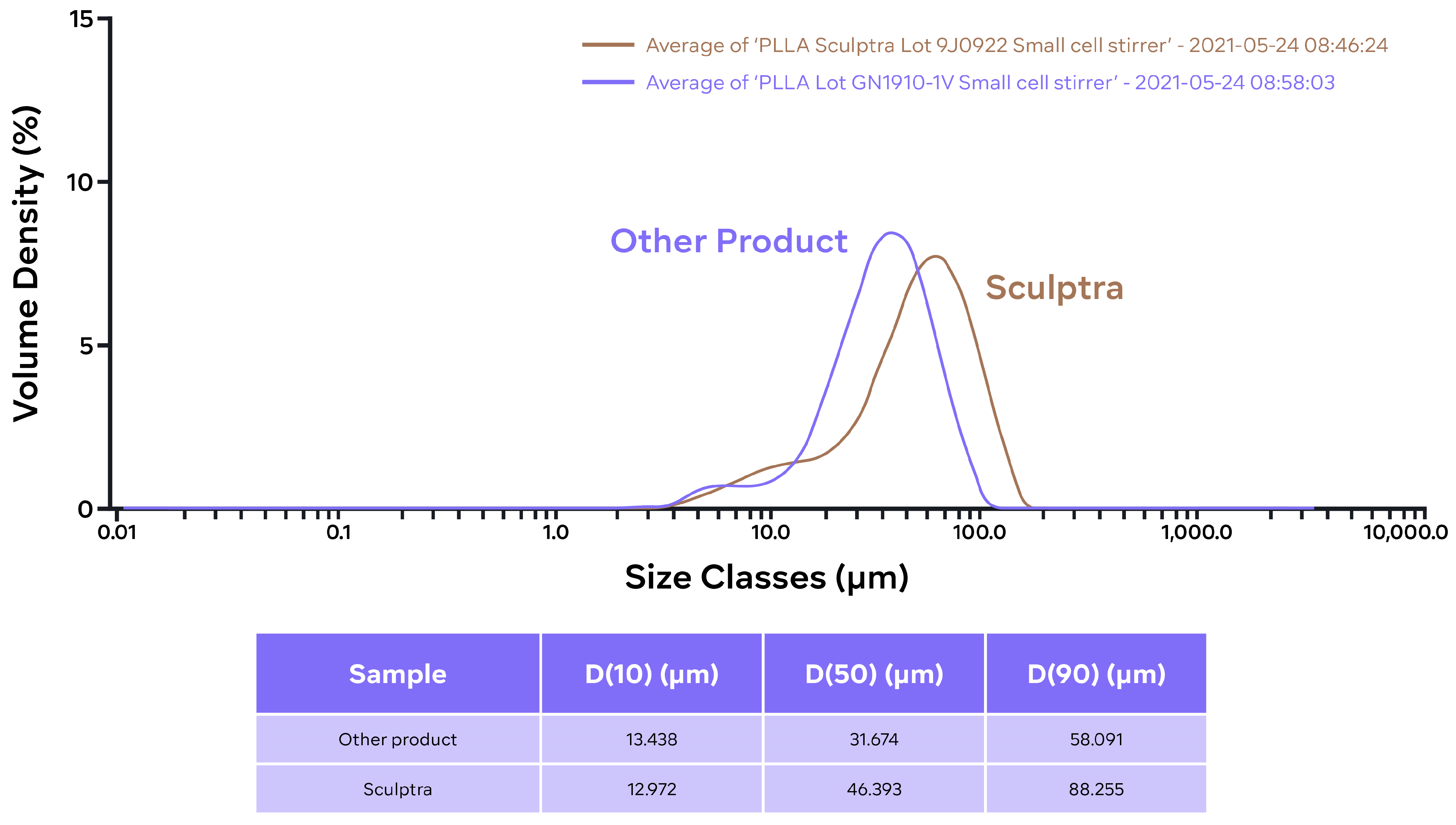
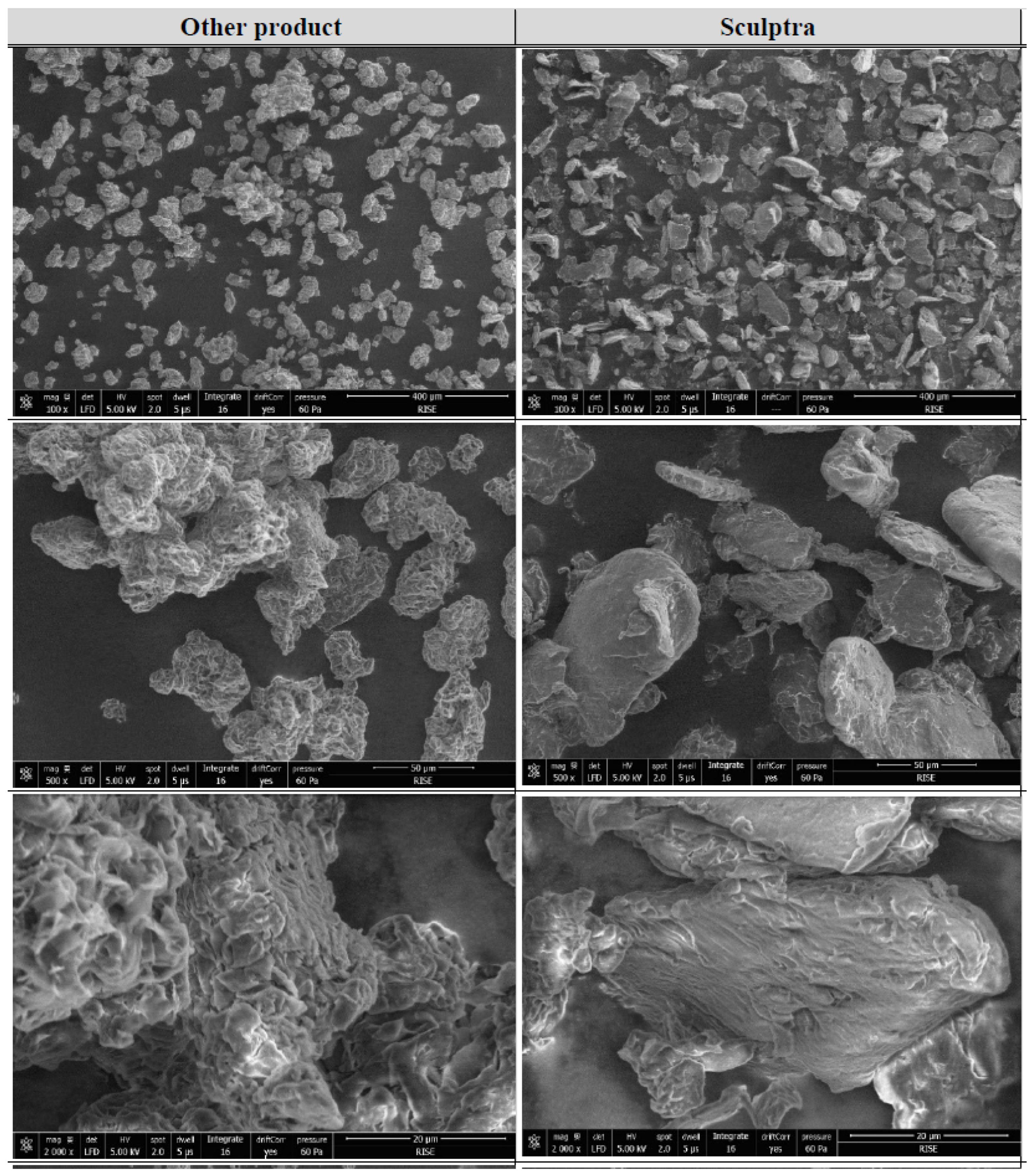
3.2. Particle Size and Morphology
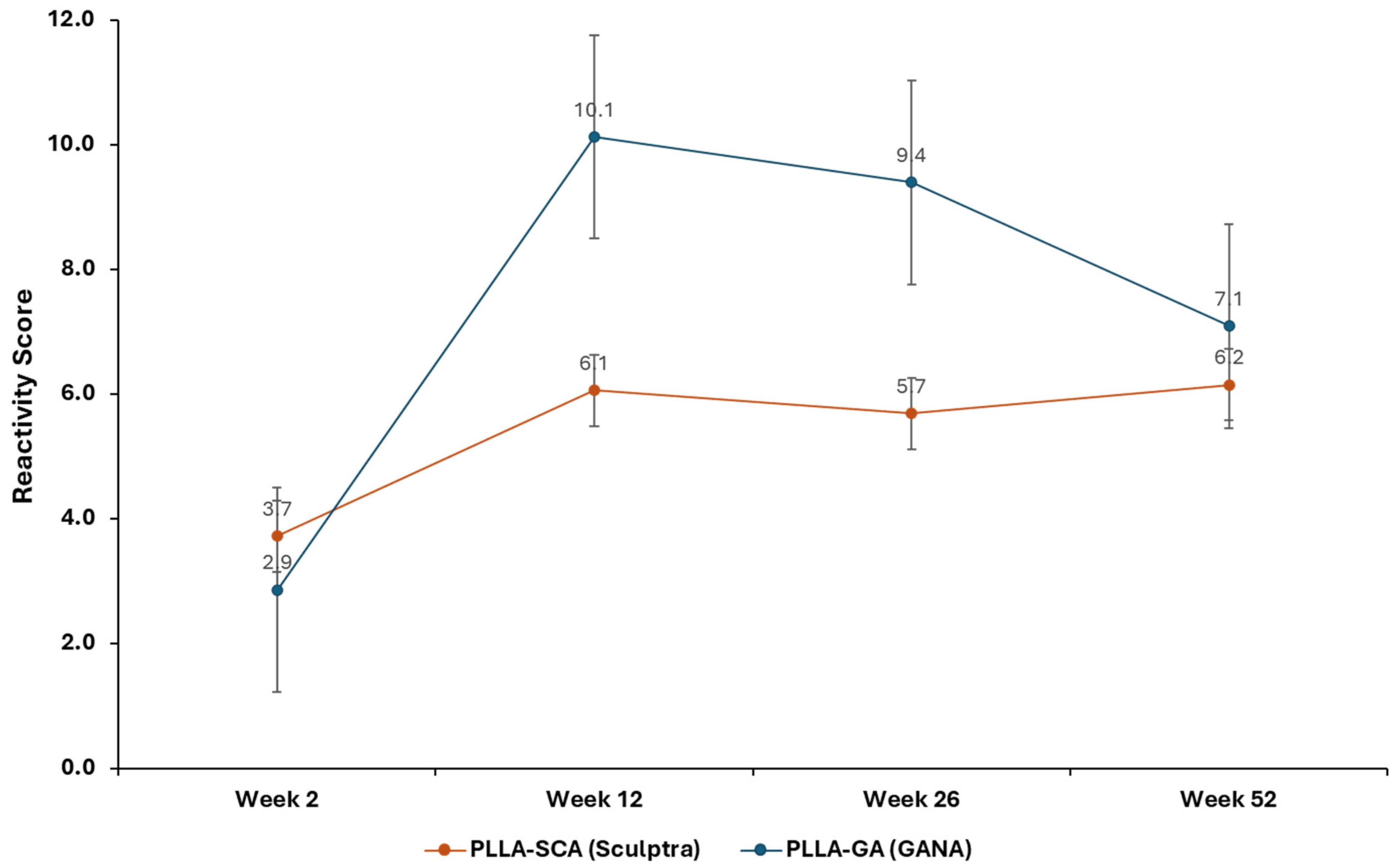
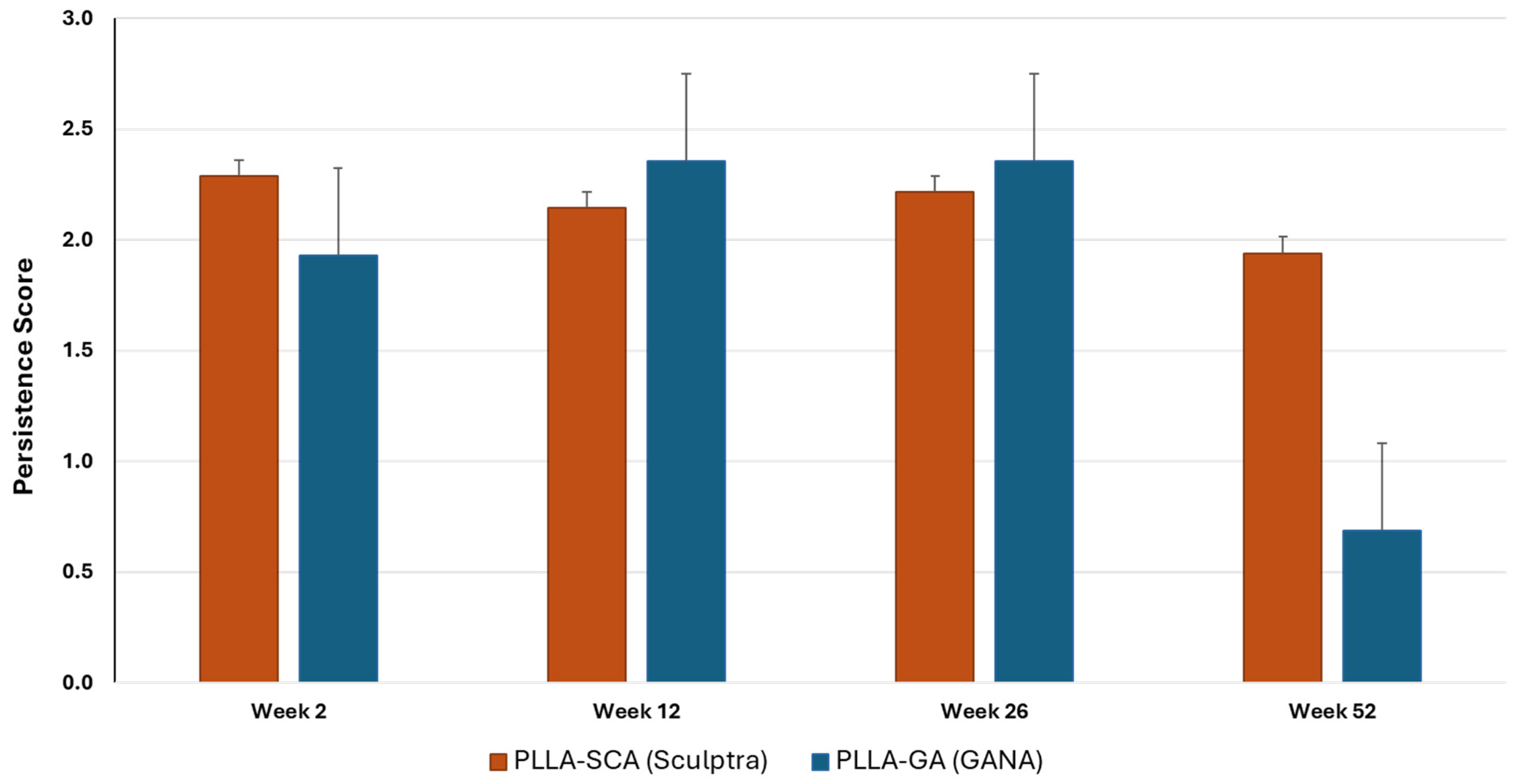
3.3. In Vivo Local Inflammatory Tissue Response (Reactivity) and Persistence Score
4. Discussion
Author Contributions
Funding
Institutional Review Board Statement
Data Availability Statement
Acknowledgments
Conflicts of Interest
Correction Statement
References
- Ramot, Y.; Haim-Zada, M.; Domb, A.J.; Nyska, A. Biocompatibility and safety of PLA and its copolymers. Adv. Drug Deliv. Rev. 2016, 107, 153–162. [Google Scholar] [CrossRef] [PubMed]
- Ginjupalli, K.; Shavi, G.V.; Averineni, R.K.; Bhat, M.; Udupa, N.; Upadhya, P.N. Poly(α-hydroxy acid) based polymers: A review on material and degradation aspects. Polym. Degrad. Stab. 2017, 144, 520–535. [Google Scholar] [CrossRef]
- Vleggaar, D.; Fitzgerald, R.; Lorenc, Z.P. Composition and Mechanism of Action of Poly-L-Lactic Acid in Soft Tissue Augmentation. J. Drugs Dermatol. 2014, 13, s29–s31. [Google Scholar]
- Anderson, J.M.; Rodriguez, A.; Chang, D.T. Foreign body reaction to biomaterials. Semin. Immunol. 2008, 20, 86–100. [Google Scholar] [CrossRef]
- Nonhoff, M.; Puetzler, J.; Hasselmann, J.; Fobker, M.; Gosheger, G.; Schulze, M. The Potential for Foreign Body Reaction of Implanted Poly-L-Lactic Acid: A Systematic Review. Polymers 2024, 16, 817. [Google Scholar] [CrossRef]
- Waibel, J.; Nguyen, T.Q.; Le, J.H.T.D.; Ziegler, M.; Widgerow, A.; Meckfessel, M.; Bråsäter, D. A randomized, comparative study describing the gene signatures of Poly-L-Lactic Acid (PLLA-SCA) and Calcium Hydroxylapaptite (CaHA) in the treatment of nasolabial folds. IMCAS World Congress. 2024, 91, AB110. [Google Scholar] [CrossRef]
- Zhu, W.; Dong, C. Poly-L-lactic acid increases collagen gene expression and synthesis in cultured dermal fibroblast (Hs68) through the TGF-β/Smad pathway. J. Cosmet. Dermatol. 2023, 22, 1213–1219. [Google Scholar] [CrossRef] [PubMed]
- Fitzgerald, R.; Bass, L.M.; Goldberg, D.J.; Graivier, M.H.; Lorenc, Z.P. Physiochemical Characteristics of Poly-L-Lactic Acid (PLLA). Aesthet. Surg. J. 2018, 38, 13–17. [Google Scholar] [CrossRef]
- Cabral, L.R.B.; Teixeira, L.N.; Gimenez, R.P.; Demasi, A.P.D.; de Brito Junior, R.B.; de Araújo, V.C.; Martinez, E.F. Effect of hyaluronic acid and poly-L-lactic acid dermal fillers on collagen synthesis: An in vitro and in vivo study. Clin. Cosmet. Investig. Dermatol. 2020, 13, 701–710. [Google Scholar] [CrossRef]
- Farah, S.; Anderson, D.G.; Langer, R. Physical and mechanical properties of PLA, and their functions in widespread applications —A comprehensive review. Adv. Drug Deliv. Rev. 2016, 107, 367–392. [Google Scholar] [CrossRef] [PubMed]
- Gao, Q.; Duan, L.; Feng, X.; Xu, W. Superiority of poly(L-lactic acid) microspheres as dermal fillers. Chin. Chem. Lett. 2021, 32, 577–582. [Google Scholar] [CrossRef]
- Zhang, Y.; Liang, H.; Luo, Q.; Chen, J.; Zhao, N.; Gao, W.; Pu, Y.; He, B.; Xie, J. In vivo inducing collagen regeneration of biodegradable polymer microspheres. Regen. Biomater. 2021, 8, rbab042. [Google Scholar] [CrossRef]
- Auras, R.A.; Lim, L.T.; Selke, S.E.M.; Tsuji, H. Poly(Lactic Acid): Synthesis, Structures, Properties, Processing, and Applications, 1st ed.; John Wiley & Sons Inc.: Hoboken, NJ, USA, 2010. [Google Scholar]
- Feng, P.; Jia, J.; Liu, M.; Peng, S.; Zhao, Z.; Shuai, C. Degradation mechanisms and acceleration strategies of poly (lactic acid) scaffold for bone regeneration. Mater. Des. 2021, 210, 110066. [Google Scholar] [CrossRef]
- Sedush, N.G.; Kalinin, K.T.; Azarkevich, P.N.; Gorskaya, A.A. Physicochemical Characteristics and Hydrolytic Degradation of Polylactic Acid Dermal Fillers: A Comparative Study. Cosmetics 2023, 10, 110. [Google Scholar] [CrossRef]
- Elsawy, M.A.; Kim, K.H.; Park, J.W.; Deep, A. Hydrolytic degradation of polylactic acid (PLA) and its composites. Renew. Sustain. Energy Rev. 2017, 79, 1346–1352. [Google Scholar] [CrossRef]
- Lin, C.Y.; Lin, J.Y.; Yang, D.Y.; Lee, S.H.; Kim, J.Y.; Kang, M. Efficacy and safety of poly-D,L-lactic acid microspheres as subdermal fillers in animals. Plast. Aesthetic Res. 2019, 6, 16. [Google Scholar] [CrossRef]
- Yang, D.Y.; Ko, K.; Lee, S.H.; Lee, W.K. A Comparison of the Efficacy and Safety Between Hyaluronic Acid and Polylactic Acid Filler Injection in Penile Augmentation: A Multicenter, Patient/Evaluator-Blinded, Randomized Trial. J. Sex. Med. 2019, 16, 577–585. [Google Scholar] [CrossRef]
- Christen, M.O. Collagen Stimulators in Body Applications: A Review Focused on Poly-L-Lactic Acid (PLLA). Clin. Cosmet. Investig. Dermatol. 2022, 15, 997–1019. [Google Scholar] [CrossRef] [PubMed]
- Oh, S.; Lee, J.H.; Kim, H.M.; Batsukh, S.; Sung, M.J.; Lim, T.H.; Lee, M.H.; Son, K.H.; Byun, K. Poly-L-Lactic Acid Fillers Improved Dermal Collagen Synthesis by Modulating M2 Macrophage Polarization in Aged Animal Skin. Cells 2023, 12, 1320. [Google Scholar] [CrossRef]
- Han, W.Y.; Kim, H.J.; Kwon, R.; Kang, S.M.; Yon, D.K. Safety and Efficacy of Poly-L-Lactic Acid Filler (Gana V vs. Sculptra) Injection for Correction of the Nasolabial Fold: A Double-Blind, Non-Inferiority, Randomized, Split-Face Controlled Trial. Aesthetic Plast. Surg. 2023, 47, 1796–1805. [Google Scholar] [CrossRef] [PubMed]
- Fabi, S.; Bråsäter, D. Letter to the Editor on: “Safety and Efficacy of Poly-L-Lactic Acid Filler (Gana V vs. Sculptra) Injection for Correction of the Nasolabial Fold: A Double-Blind, Non-Inferiority, Randomized, Split-Face Controlled Trial”. Aesthetic Plast. Surg. 2025, 49, 988–990. [Google Scholar] [CrossRef] [PubMed]
- Narins, R.S.; Baumann, L.; Brandt, F.S.; Fagienet, S.; Glazer, S.; Lowe, N.J.; Monheit, G.D.; Rendon, M.I.; Rohrich, R.J.; Werschler, W.P. A randomized study of the efficacy and safety of injectable poly-L-lactic acid versus human-based collagen implant in the treatment of nasolabial fold wrinkles. J. Am. Acad. Dermatol. 2010, 62, 448–462. [Google Scholar] [CrossRef]
- Brandt, F.S.; Cazzaniga, A.; Baumann, L.; Fagien, S.; Glazer, S.; Lowe, N.J.; Monheit, G.D.; Rendon, M.I.; Rohrich, R.J.; Werschler, W.P. Investigator global evaluations of efficacy of injectable poly-L-lactic acid versus human collagen in the correction of nasolabial fold wrinkles. Aesthet. Surg. J. 2011, 31, 521–528. [Google Scholar] [CrossRef] [PubMed]
- Haddad, A.; Avelar, L.; Fabi, S.G.; Sarubi, J.; Somenek, M.; Coimbra, D.D.; Palm, M.; Durairaj, K.K.; Somji, M.; Vasconcelos-Berg, R.; et al. Injectable Poly-L-Lactic Acid for Body Aesthetic Treatments: An International Consensus on Evidence Assessment and Practical Recommendations. Aesthet. Plast. Surg. 2025, 49, 1507–1517. [Google Scholar] [CrossRef] [PubMed]



| Score | |||||
|---|---|---|---|---|---|
| Cell Type/Response | 0 | 1 | 2 | 3 | 4 |
| Polymorphonuclear cells | 0 | Rare, 1–5/hpf | 5–10/hpf | Heavy infiltrate | Packed |
| Lymphocytes | 0 | Rare, 1–5/hpf | 5–10/hpf | Heavy infiltrate | Packed |
| Plasma cells | 0 | Rare, 1–5/hpf | 5–10/hpf | Heavy infiltrate | Packed |
| Macrophages | 0 | Rare, 1–5/hpf | 5–10/hpf | Heavy infiltrate | Packed |
| Giant cells | 0 | Rare, 1–2/hpf | 3–5/hpf | Heavy infiltrate | Sheets |
| Necrosis | 0 | Minimal | Mild | Moderate | Severe |
| Neovascularization | 0 | Minimal capillary proliferation, focal, 1–3 buds | Groups of 4–7 capillaries with supporting fibroblastic structures | Broad band of capillaries with supporting structures | Extensive band of capillaries with supporting fibroblastic structures |
| Fibrosis | 0 | Narrow band | Moderately thick band | Thick band | Extensive band |
| Fatty Infiltrate | 0 | Minimal amount of fat associated with fibrosis | Several layers of fat and fibrosis | Elongated and broad accumulation of fat cells about the implant site | Extensive fat completely surrounding the implant |
Disclaimer/Publisher’s Note: The statements, opinions and data contained in all publications are solely those of the individual author(s) and contributor(s) and not of MDPI and/or the editor(s). MDPI and/or the editor(s) disclaim responsibility for any injury to people or property resulting from any ideas, methods, instructions or products referred to in the content. |
© 2026 by the authors. Licensee MDPI, Basel, Switzerland. This article is an open access article distributed under the terms and conditions of the Creative Commons Attribution (CC BY) license.
Share and Cite
Avelar, L.; Haddad, A.; Fabi, S.G.; Somenek, M.; Beleznay, K.; Aguilera, S.B.; Taylor-Barnes, K.; Mao, C.; Öhrlund, Å.; Lundgren, B.; et al. Physicochemical Properties of Two Poly-L-Lactic Acid Injectable Implants: Potential Impact on Their Biological Properties. Cosmetics 2026, 13, 18. https://doi.org/10.3390/cosmetics13010018
Avelar L, Haddad A, Fabi SG, Somenek M, Beleznay K, Aguilera SB, Taylor-Barnes K, Mao C, Öhrlund Å, Lundgren B, et al. Physicochemical Properties of Two Poly-L-Lactic Acid Injectable Implants: Potential Impact on Their Biological Properties. Cosmetics. 2026; 13(1):18. https://doi.org/10.3390/cosmetics13010018
Chicago/Turabian StyleAvelar, Luiz, Alessandra Haddad, Sabrina G. Fabi, Michael Somenek, Katie Beleznay, Shino Bay Aguilera, Kathryn Taylor-Barnes, Cheri Mao, Åke Öhrlund, Björn Lundgren, and et al. 2026. "Physicochemical Properties of Two Poly-L-Lactic Acid Injectable Implants: Potential Impact on Their Biological Properties" Cosmetics 13, no. 1: 18. https://doi.org/10.3390/cosmetics13010018
APA StyleAvelar, L., Haddad, A., Fabi, S. G., Somenek, M., Beleznay, K., Aguilera, S. B., Taylor-Barnes, K., Mao, C., Öhrlund, Å., Lundgren, B., Leng, L., Nicodeme, E., Morgan, P., & Bråsäter, D. (2026). Physicochemical Properties of Two Poly-L-Lactic Acid Injectable Implants: Potential Impact on Their Biological Properties. Cosmetics, 13(1), 18. https://doi.org/10.3390/cosmetics13010018