1. Introduction
The global transition toward renewable energy is accelerating in response to intensify climate goals. Within this shift, renewable energy firms, particularly those operating in innovation-driven contexts, face a complex landscape of rapid technological innovation, regulatory complexity, and the urgent need for business model (BM) flexibility. Unlike traditional utilities, they must continuously adapt their value propositions, delivery channels, and revenue mechanisms in response to policy shifts and technological opportunities. These firms are increasingly adopting digital technologies to transform not only their operations but also their strategic positioning [
1,
2,
3]. Technologies such as artificial intelligence (AI), the Internet of Things (IoT), blockchain, digital twins, and cloud platforms are enabling predictive forecasting, remote control, platform-based services, and consumer-centric design, for example. These digital tools are not just enhancing technical performance but also creating new opportunities for firms to reconfigure how they create, deliver, and capture value [
4,
5,
6]. This makes the sector an ideal setting for understanding how digital technologies catalyze BM transformation.
Despite the growing attention to digitalization in the energy sector, much of the existing literature has focused on macro-level impacts such as grid flexibility, market decentralization, and technology integration [
7,
8,
9]. Few studies have systematically examined the firm-level consequences of digital technologies, specifically, how they influence the architecture and evolution of BMs and especially in renewable energy companies [
2,
10,
11,
12,
13,
14,
15,
16]. While some empirical research has demonstrated the potential of digital technology platforms to facilitate innovative business models and intensify stakeholder relationships in the energy sector [
17], broader analyses indicate that actual implementation remains fragmented. For instance, recent evidence shows that many renewable energy startups still struggle to fully integrate digital business models, often relying on traditional value delivery methods rather than realizing deep digital transformation [
18]. These gaps are especially evident in studies examining how digitalization acts as a catalyst for structural changes within BM components and value logic [
14,
15].
To address this gap, our study builds a three-layered conceptual framework. The first layer focuses on digital technologies as transformation triggers. There is little prior research on understanding the triggers of BMs in sustainability-oriented companies, which has been recognized as an important research gap to be addressed [
19,
20]. Existing research often treats digital transformation and BM and sustainability as separate domains, highlighting the need for integrative frameworks to holistically capture their interplay [
21,
22].
These include technologies that enable real-time data exchange, remote monitoring, decentralized market participation, and automation of system functions, ranging from AI and machine learning to blockchain and energy-specific digital platforms [
4,
10,
23,
24].
The second layer examines BM components, which are defined as value creation (how offerings are produced or co-produced), value delivery (how offerings reach users and through which infrastructure), and value capture (how value is monetized and sustained) [
25]. This gap relates to the understanding of the integrative mechanisms of value logic transition when modelling a business through the lens of sustainability [
26]. This structure draws on the established literature that conceptualizes BMs as the configuration of value creation, delivery, and capture mechanisms, forming a vital link between firm strategy and market implementation [
25,
27,
28,
29].
We also read these mechanisms through a sustainability lens [
30], linking digital roles to efficiency, resilience and inclusion outcomes relevant to energy transitions [
31]. This approach helps us to investigate how synergies between digitalization and sustainability unfold.
The third gap concerns the outcomes of BM change to beyond established links to firm performance through novel value configurations in the BM [
28,
32,
33,
34]. So, the degree of BM change can be related to business model adaptation (BMA), business model evolution’ (BME) and, to ‘business model innovation’ (BMI). BMA refers to incremental and reactive adjustments made in response to environmental changes or competitive pressure [
35,
36]. BME describes continuous but coherent shifts in model structure that maintain internal alignment and competitiveness over [
37,
38,
39]. Finally, BMI entails more radical reconfigurations that introduce new value logics, revenue mechanisms, or platform-based structures [
28,
35,
40]. So, the degree of change is increasing from ‘business model adaptation’ (BMA) to ‘business model evolution’ (BME) to ‘business model innovation’ (BMI). BM changes then leads to a sequence of BM changes in form of BMA, BME or BMI changes over time.
Using this conceptual framing, this study preset how digital technologies act as enablers of BM change in renewable energy firms. The focus is on high-tech and digitally embedded firms, those developing or applying smart, data-driven energy solutions, rather than traditional utilities. These firms often operate in complex, regulated, and data-rich environments where BM flexibility is key to competitiveness [
3,
41]. However, the strategic implications of their digitalization efforts remain fragmented across academic literature.
To synthesize these insights, we conduct a systematic review that combines descriptive and bibliometric analyses with Gioia-style thematic coding to surface first-order concepts, second-order themes, and aggregate dimensions, and to map how digital technologies related to BM elements changes and typology of changes [
42].
The study is guided by the following main research question: How do digital technologies drive changes in business models for renewable energy firms?
For clarity, this review focuses on renewable energy firms, those developing solar, wind, hydro, geothermal, and biomass technologies, which represent a subset of the broader sustainable energy sector.
This question shapes the design and analytical focus of the review, which seeks to uncover how digital technologies influence the architecture, components, and transformation pathways of BMs in this context.
This review contributes to academic theory by linking specific digital technology to sustainability-oriented reconfiguration in BM elements and type. From a practical standpoint, this study offers insights into how renewable energy firms can move from isolated tool adoption toward digitally coherent business strategies. At the same time, this study also recognizes that integrating digital technologies in this sector involves several limitations related to data quality, cybersecurity, interoperability, and institutional complexity, which are discussed later in this paper.
By organizing and interpreting fragmented insights into a unified analytical framework, this study enhances our understanding of how digital technologies serve as catalysts of BM transformation in the renewable energy sector. It also provides a foundation for future empirical research on digital strategy and innovation in sustainable energy systems.
The remainder of this paper is organized into four chapters:
Section 2 describes the research design and methodology, outlining the systematic literature review process, and the application of the Gioia methodology.
Section 3 presents the findings across three analytical layers: functional roles of digital technologies, their influence on BM components, and the types of BM change they enable.
Section 4 discusses these findings in greater depth, highlighting patterns across technology groups, BM elements, and transformation trajectories, while also addressing limitations and synthesizing insights. Finally,
Section 5 concludes the paper by summarizing the key contributions, offering theoretical and practical implications, and proposing directions for future research.
2. Research Design and Methodology
This study uses a systematic literature review (SLR) to investigate how digital technologies influence business model (BM) change in the renewable energy sector. The review is grounded in a structured conceptual model that connects three dimensions: key digital technologies, BM components (value creation, value delivery, value capture), and types of BM change (BMA, BME, and BMI).
Following established review protocols [
43], the process involves three core phases: planning the review and selecting sources, conducting the analysis through data extraction and coding, and presenting descriptive and thematic findings. The Gioia methodology [
42] is adapted to organize and interpret qualitative data from selected studies, allowing for inductive theorization grounded in the reviewed literature.
2.1. Research Question Formulation
The research questions guiding this study are informed by a clear gap in the literature at the intersection of digital transformation and BM change within renewable energy firms [
3]. While digitalization is widely discussed in technical and sectoral contexts, their influence on how firms create, deliver, and capture value is rarely touched upon [
44]. Existing studies often focus on operational efficiencies or infrastructure optimization but seldom examine how these technologies drive reconfigurations in BM logic or strategic positioning [
41].
To address this gap, this review is guided by the following main research question: how do digital technologies drive changes in business models for renewable energy firms?
To capture the different facets of this phenomenon, the primary question was supported by three sub-questions: (1) What are the key digital technologies influencing business models in renewable energy firms? (2) What are the mechanisms through which digital technologies shape the components of business models, including value creation, value delivery, and value capture? (3) What types of business model changes are triggered by digital technologies in renewable energy firms?
These questions structure the entire review process and inform the search strategy, inclusion criteria, and coding dimensions used in the following stages.
2.2. Planning the Review: Search and Filtering
The literature review process was designed using principles from systematic review methodology to ensure transparency, replicability, and analytical rigor [
43]. The Scopus database was selected as the primary source due to its broad interdisciplinary coverage and inclusion of high-quality peer-reviewed journals in energy, management, and information systems [
45,
46]. The search was conducted in April 2025 and targeted articles published between 2015 and 2025 to reflect developments over the last decade, a period during which digitalization has become increasingly central to renewable energy strategy and BMs.
The search string was constructed to capture the intersection of three key dimensions: digital technologies, business models, and the renewable energy sector. The Boolean query used was as follows:
(“Digital technologies” OR “Digitization”) AND (“Renewable Energy” OR “Sustainable Energy”) AND (“Business model innovation” OR “Business model evolution” OR “Business model adaptation” OR “Business model dynamic”).
This string was designed to retrieve articles discussing digital transformation tools in the context of business model structure or innovation within renewable energy settings. The search was limited to English-language, peer-reviewed journal articles and excluded conference proceedings, editorials, and gray literature to ensure methodological rigor and editorial transparency [
43]; however, this choice may underrepresent perspectives from non-Anglophone regions (such as China) with significant renewable energy innovation and limits access to emerging practices documented in industry reports or conference proceedings.
Initial screening was conducted based on titles and abstracts, followed by full-text reviews for inclusion. Articles were included if they (1) explicitly examined the use or application of digital technologies in the context of renewable or sustainable energy; (2) provided insights into changes related to BM components, BM transformation, or firm-level strategic reconfiguration; and (3) focused on renewable energy contexts or electricity systems with clear sustainability relevance. Articles were excluded if they were purely technical (e.g., focused solely on optimization algorithms and device control systems) without any substantive connection to BM considerations or digital transformation.
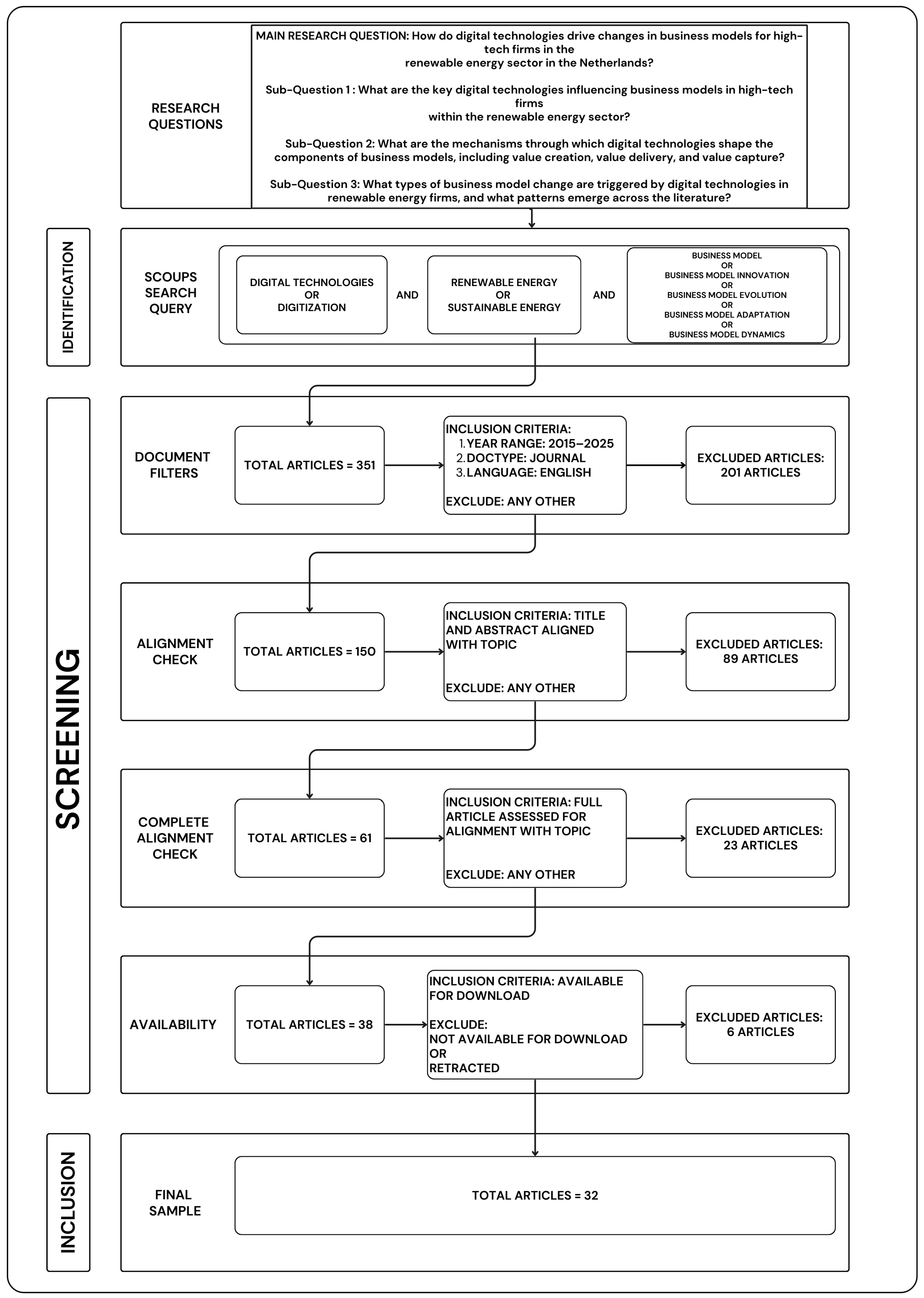
After applying these criteria and removing duplicates, the final sample consisted of 32 peer-reviewed journal articles. The review process followed PRISMA (Preferred Reporting Items for Systematic Reviews and Meta-Analyses) guidelines [
47] to ensure methodological transparency. The completed PRISMA checklist is provided as
Supplementary Materials (Table S1). The four-phase PRISMA flow diagram [
Figure 1] outlines the identification, screening, eligibility, and inclusion steps used in the review.
This planning phase laid the foundation for structured data extraction and thematic synthesis in the subsequent stages of the review.
2.3. Conducting the Review: Extraction, Analysis, and Synthesis
Once the final set of 32 articles was selected, the analysis phase began with systematic data extraction and inductive coding. To structure the analysis and generate theory from the literature, this study adopted the Gioia methodology, a qualitative research approach that supports inductive concept development through rigorous coding and abstraction [
42,
48,
49]. The methodology has been effectively applied in structured literature reviews where the aim is to uncover recurring concepts, build second-order themes, and connect them to overarching theoretical dimensions [
50].
Each article was read in full and manually coded. Relevant content was extracted into structured tables, focusing on passages that addressed digital technologies, BM components, or types of BM change. The extraction process retained contextual clarity by using the exact or closely paraphrased language from the articles. These excerpts formed the basis of the first-order concepts, capturing author-reported phenomena such as the role of AI in predictive maintenance or the use of digital platforms for energy-as-a-service delivery.
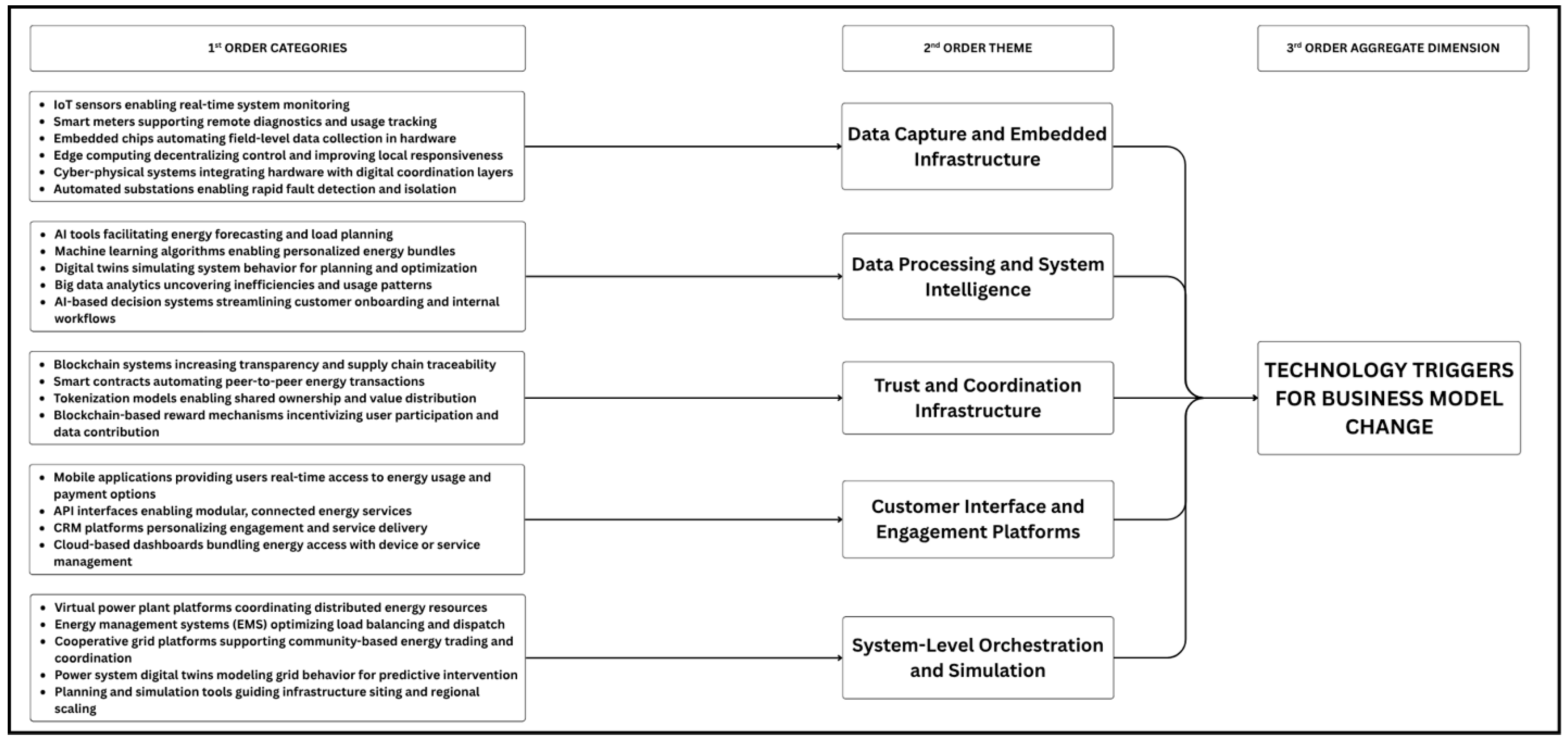
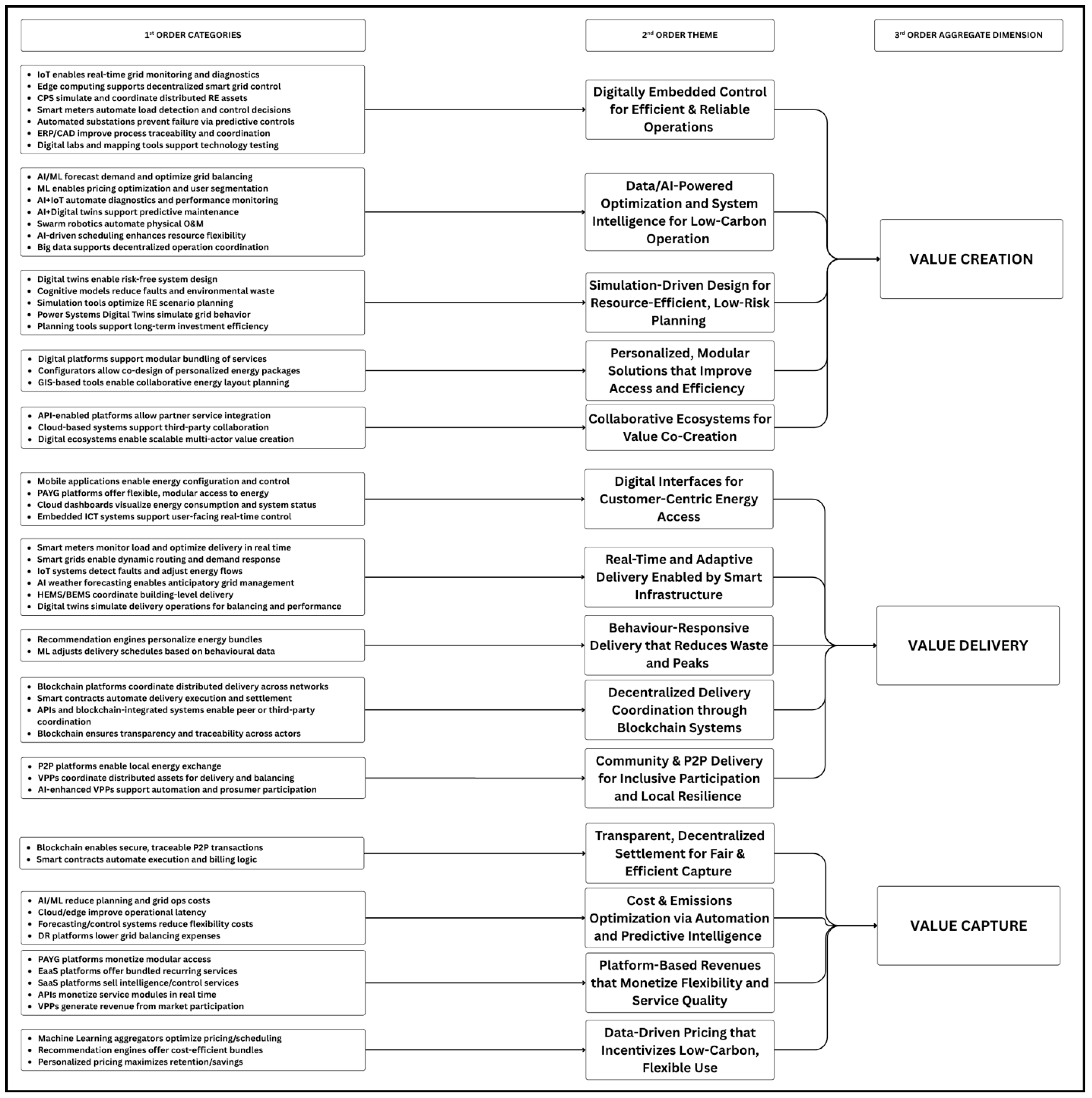
As the first analytical layer, digital technologies were coded to uncover the functional roles they played in enabling BM change. This process resulted in the Gioia Tree of Technological Triggers, which organized relevant first-order concepts into second-order themes that reflect recurring digital functions observed across the dataset. These themes capture how technologies such as artificial intelligence, the Internet of Things, blockchain, digital twins, and cloud-based platforms contribute to shifts in firm behaviour, decision-making, infrastructure coordination, and customer interaction. This analysis forms the basis of the study by highlighting the mechanisms through which digital technologies influence BM transformation in renewable energy firms. So, rather than directly connecting the adoption of digital technologies to BM changes, we decided to take the mechanism of change into account by clarifying the function of these digital technologies and then their effect (through their function) on BM components.
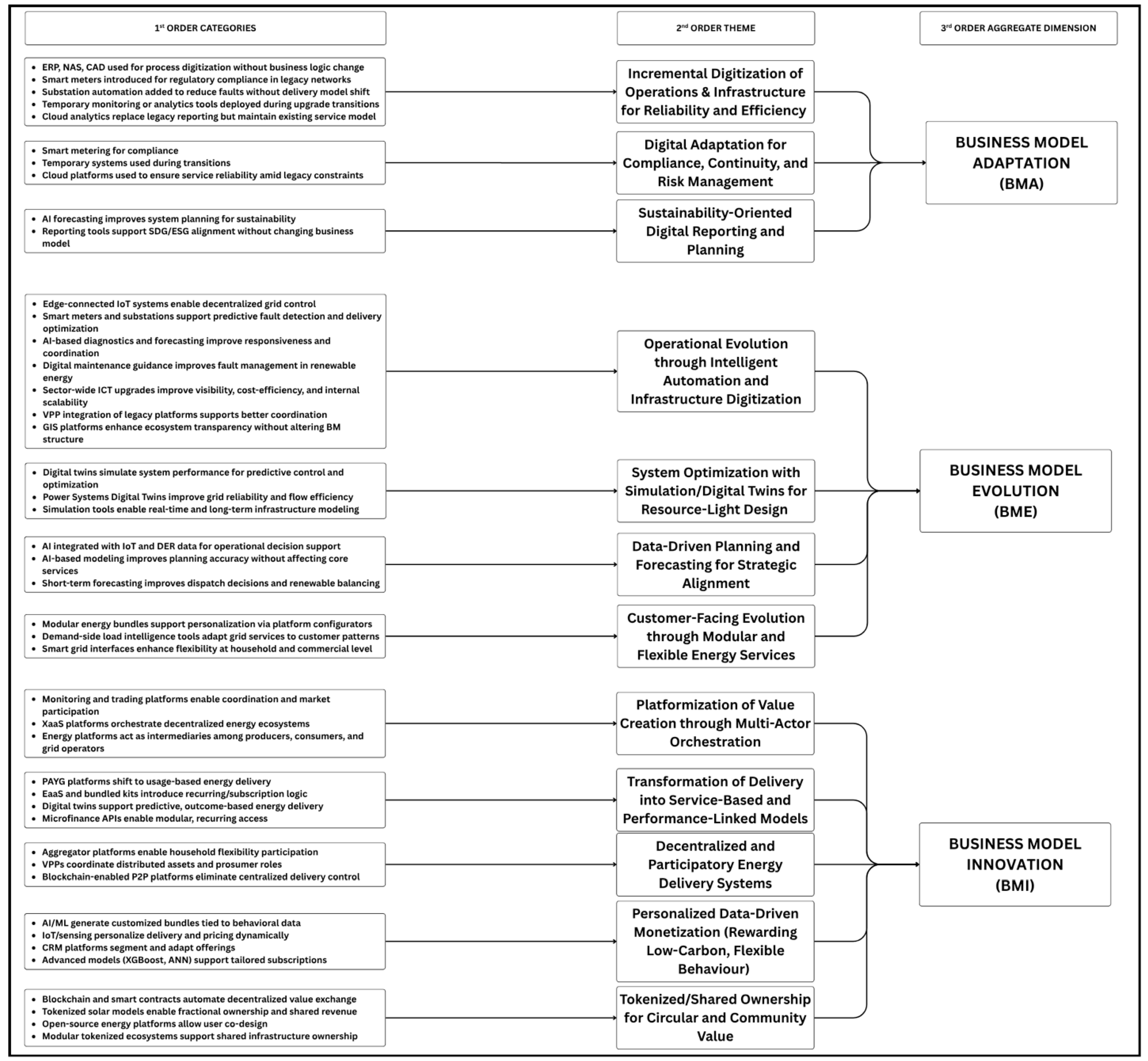
In addition to this first layer of analysis, separate coding structures were applied to analyze how these technologies influenced BM components and types of change. While some first-order concepts appeared across more than one coding lens, the extraction and grouping processes were independently carried out for each Gioia tree to reflect the specific analytical dimension. BM components were coded under value creation, value delivery, and value capture [
25,
28]. Types of BM change were classified as adaptation (BMA), evolution (BME), or innovation (BMI), drawing from established typologies of BM transformation [
35,
38].
To maintain analytical traceability, the Gioia structure was applied consistently across all articles. Each quote or insight was linked to a specific BM component and assigned a corresponding change type where applicable. This ensured that the synthesis did not rely solely on researcher interpretation but remained anchored in the language and logic of the source materials. The coding process was iterative, with themes refined as patterns emerged across the dataset. In cases where a paper addressed multiple technologies or intersecting BM elements, multiple coding was allowed. To ensure coding quality and validity, the initial coding was reviewed by the 2 co-authors who assessed the consistency of theme assignment, the appropriateness of aggregations, and the alignment of second-order themes with the source material. Throughout this review process, discrepancies in interpretation were resolved through iterative discussion and consensus, where conflicting coding decisions were revisited against the source text and the Gioia coding framework until agreement was reached. For instance, articles describing how smart meters and substations support predictive fault detection and delivery optimization were initially coded as operational efficiency improvements. Upon secondary review, the co-authors recognized these as BME rather than adaptation, as the technologies reshape multiple value creation and delivery mechanisms while maintaining core utility-centric value logic. Through consensus discussion referencing typology criteria, the team confirmed this represents the “Operational Evolution through Intelligent Automation and Infrastructure Digitization” pattern, where there is multiple-component reconfiguration without systemic institutional disruption. This validation process ensured that the final Gioia trees reflected shared understanding of patterns across the dataset and enhanced synthesis reliability. This iterative peer-review validation aligns with established criteria for trustworthiness in qualitative research [
51] and serves as a member checking mechanism [
52] that enhances the credibility of the Gioia coding outcomes.
The Gioia-based synthesis enabled a rich, layered understanding of how digital technologies shape BMs in renewable energy firms. It revealed both the diversity of digital applications and the varied strategic responses they enable. This structured analysis laid the groundwork for presenting the findings as three interconnected Gioia trees in the next chapter: one each for (1) digital technology triggers, (2) business model components, and (3) types of business model change.
2.4. Descriptive and Bibliometric Findings
To contextualize the selected literature and understand the evolution of scholarly attention to the topic, a bibliometric overview was conducted based on the final sample of 32 peer-reviewed articles. This descriptive analysis complements the thematic synthesis by offering a macro-level view of the research field’s development over time and across disciplinary domains.
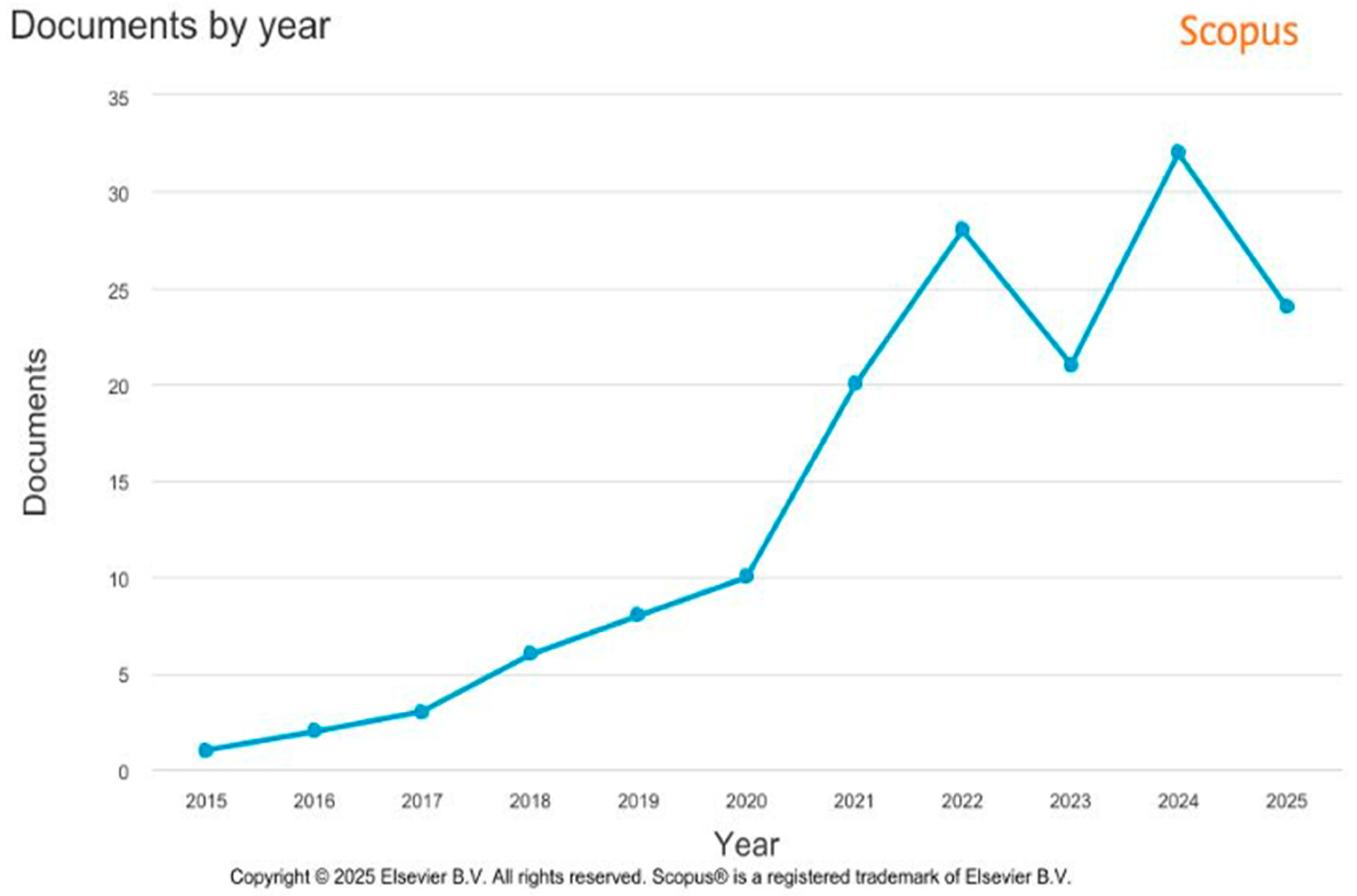
The year-wise distribution of publications [
Figure 2] reveals a clear upward trend in scholarly interest at the intersection of digital technologies, BMs, and renewable energy. Beginning with isolated papers in 2015–2017, the volume of publications steadily increases after 2018, with a notable surge in the period between 2020 and 2024. This trend aligns with broader developments in energy system digitalization and the growing pressure on firms to innovate BMs in response to policy, market, and climate imperatives [
4,
12].
Citation analysis of the sample identifies three highly influential contributions: reference [
7] on AI in the Water–Energy–Food nexus (86 citations), reference [
23] on blockchain as an energy revolution driver (48 citations), and reference [
10] on digital business models for rural renewable energy (46 citations). Keyword analysis reveals three core clusters: (i) digital technologies (“AI,” “blockchain,” “digital transformation,” and “Industry 4.0”), (ii) business model concepts (“business model innovation,” “digital business model,” and “business models”), and (iii) energy/sustainability themes (“renewable energy,” “energy transition,” “circular economy,” and “prosumer”).
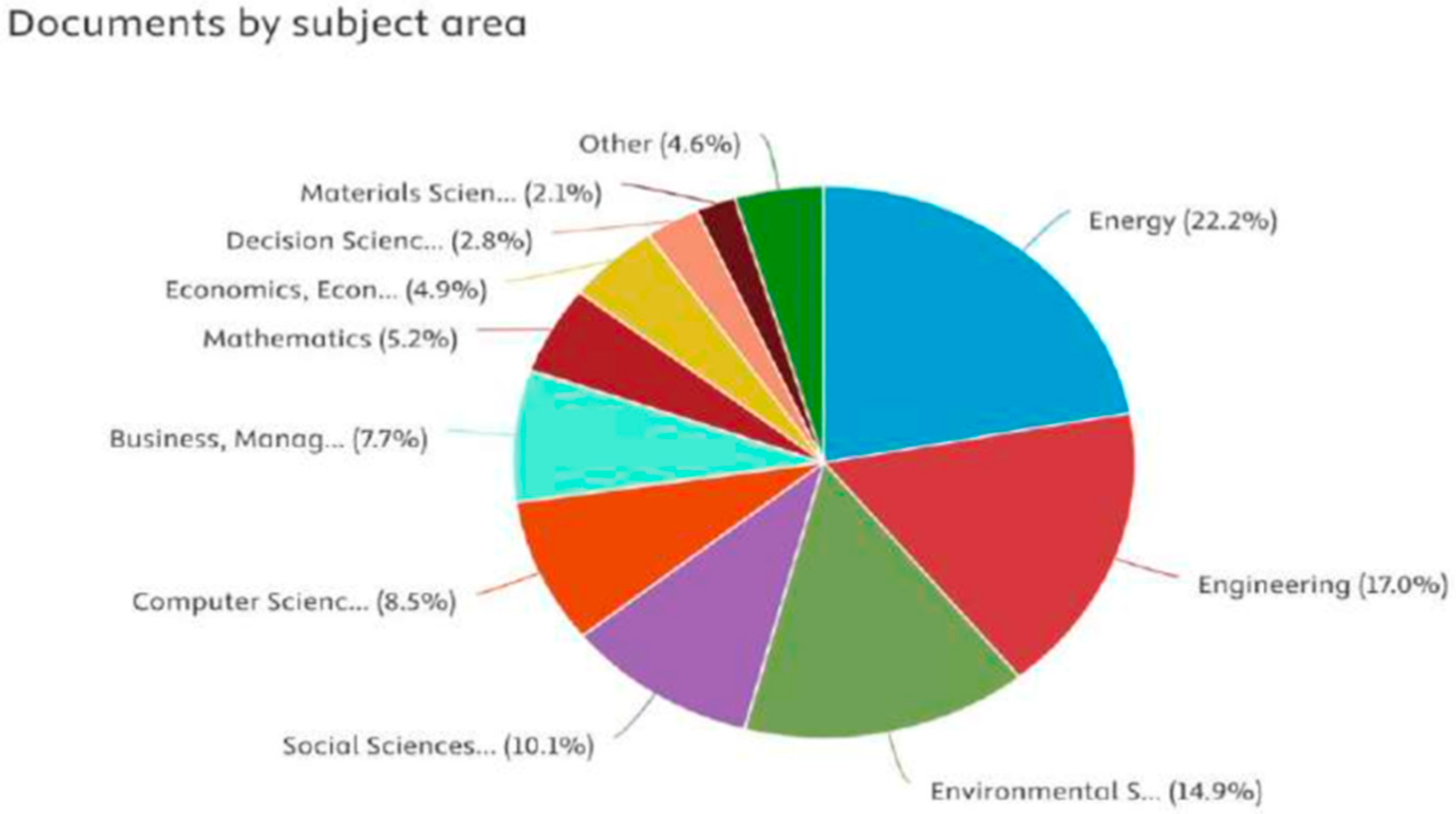
A disciplinary breakdown of the article sample [
Figure 3] confirms the multidisciplinary nature of this research stream. Articles are drawn from journals in energy systems, sustainability science, innovation management, and digital transformation. Categorization by subject area (as indexed in Scopus) shows a near-even distribution among energy and environmental sciences, engineering and technology, and business and management. This reflects the integrative challenge of the topic, which cuts across technological, business strategy, and market design.
These findings underscore the novelty and relevance of the chosen research focus. While interest in digital technologies in energy is well-established, the literature that links these technologies to strategic BM transformation is still emerging. The diversity of publication outlets and the recent growth in volume suggest that this domain is in a formative stage, marked by conceptual experimentation, dispersed case studies, and limited cross-study generalization. This further validates the need for a structured synthesis such as the one presented in this review.
4. Synthesis
Understanding the historical development of business model research provides the context for interpreting contemporary digital-driven transformations [
66]. Modern business models are increasingly characterized by digital embeddedness, ecosystem participation, and value co-creation with multiple actors—patterns that distinguish contemporary models from earlier conceptions. This chapter integrates the review’s findings into a single narrative that connects (i) the functional roles of digital technologies, (ii) their effects on business model (BM) components (value creation, delivery, and capture) through a sustainability lens, and (iii) the types of business-model change they precipitate (adaptation, evolution, and innovation). Rather than treating these strands separately, we read them together: foundational functions create operational visibility; higher-order capabilities build on that base; and, as interactions deepen across components and partners, change accumulates and can reconfigure the underlying logic.
Section 4.1,
Section 4.2 and
Section 4.3 therefore present one story through three lenses.
4.1. Key Digital Technologies and Functional Groups
The review reveals a wide array of digital technologies shaping renewable energy BMs. To analyse their impact systematically, these technologies are grouped into functional categories based on how they operate within energy systems. This functional lens allows us to move beyond individual technologies and observe the patterns through which they enable BM change. Another reason to form functional groups of technologies is that many different digital technologies exist and new ones will emerge over time, a limited number of functional groups will thus create overview. Finally, digital technologies can be used in different ways in companies and thus induce completely different BM changes. By grouping technologies in functional groups, the effect on BMs is clearer. Digital technologies can be part of multiple functional groups, depending on their specific application in companies. For example, digital twins function as Simulation and Planning when used in pre-deployment testing, but shift to Monitoring and Control when linked to live operational data, and to Forecasting and Optimization when generating dispatch recommendations. AI similarly spans groups: demand forecasting places it in Forecasting and Optimization, anomaly detection in Monitoring and Control, and customer personalization in User Interfaces. In this study, we assign each technology to its primary functional group based on its most direct BM impact, while acknowledging these secondary roles. Although the empirical sample for this review is bounded to studies published between 2015 and 2025, the functional taxonomy is designed to accommodate emerging digital tools. For instance, early applications of generative AI for automated scenario generation, report drafting, and conversational planning assistants would primarily fall under Data Processing and System Intelligence, where they support forecasting, option exploration, and decision support, while secondary uses in personalized advice or chatbot-based guidance would place them within Customer Interface and Engagement Platforms. Likewise, high-bandwidth, low-latency communication standards such as 5G primarily expand the reach of Data Capture and Embedded Infrastructure and System-Level Orchestration and Simulation by enabling denser sensor deployments and near real-time control of distributed assets. These examples illustrate that emerging technologies can be classified by their dominant functional roles rather than by adding new categories, preserving the framework’s adaptability as the digital energy landscape evolves.
The key functional groups are:
Data Capture and Embedded Infrastructure for Monitoring and Control: Technologies such as IoT sensors, edge computing, and cyber-physical systems that collect and process real-time data. These tools form the operational backbone for adaptive control, fault detection, and decentralized decision-making.
Data Processing and System Intelligence for Forecasting and Optimization Engines: AI, ML, and digital twins used for demand prediction, dispatch planning, and operational optimization. These tools introduce intelligence, enable predictive maintenance, and reduce costs.
Customer Interface and Engagement Platforms: Mobile apps, cloud dashboards, CRM systems, and configurators that facilitate interaction between users and the energy system. These interfaces improve accessibility, personalization, and user participation.
Trust and Coordination Infrastructure: Blockchain, smart contracts, and virtual power plant (VPP) platforms that manage distributed energy coordination. These tools decentralize control, automate transactions, and support peer-to-peer delivery.
System-Level Orchestration and Simulation/Planning Tools: Digital twin models, scenario simulators, and planning interfaces that guide infrastructure design and long-term decision-making. These tools enable experimentation, improve resilience, and align systems with sustainability goals.
Taken together, these roles are cumulative: instrumented, data-rich operations enable predictive and planning tools; shared standards and verifiable records make distributed coordination and user-facing interfaces viable; and, in more advanced settings, simulation and orchestration support system-level redesign. We use these roles not as rigid boxes but as triggers that firms can layer and recombine.
This functional taxonomy approach is theoretically grounded in the dynamic capabilities perspective [
67], which emphasizes that technology value emerges not from the tools themselves but from how firms orchestrate and integrate them into strategic processes. Further, it aligns with discovery-driven approaches to business model understanding [
68], which recognize that business model development is an iterative learning process where firms discover viable configurations through experimentation. Thus, rather than categorizing technologies by type, organizing them by function reveals the strategic logic through which digital tools enable business model transformation. By grouping technologies into five functional categories, we clarify how their contributions map to BM components and the types of change they enable. The next section analyses this in greater detail.
4.2. Business Model Components Value Reconfiguration
The reconfiguration of value creation, delivery, and capture mechanisms through digital technologies has direct implications for organizational sustainability [
69]. Digital technologies reconfigure value creation, value delivery, and value capture by activating distinct functional groups: monitoring and control, forecasting and optimization, simulation and planning, user interfaces, and coordination and exchange.
4.2.1. Value Creation
Monitoring and control systems (IoT, smart meters, CPS, ERP) elevate situational awareness and coordination across distributed assets, enabling proactive performance management and efficiency gains [
12,
63]. Forecasting and optimization engines (AI, ML, big data) support predictive control, dynamic load balancing, and intelligent scheduling, thereby reducing operational uncertainty and improving resource utilization [
4,
8,
55]. Simulation environments and digital twins enable ex-ante testing and design optimization, lowering cost and risk, while interface tools such as CRMs, AI configurators, and modular bundling platforms extend value creation through personalization and co-creation with users [
17,
57]. In short, value creation is dominated by monitoring/control and forecasting/optimization, with simulation amplifying design quality and interfaces opening demand-side co-production where propositions are configurable. Collectively, these shifts underpin resource efficiency and emissions avoidance at asset and portfolio levels.
4.2.2. Value Delivery
Interfaces coupled with smart infrastructure (PAYG platforms, cloud dashboards, and embedded EMS) bridge physical systems and end users, improving accessibility and transparency, particularly in off-grid contexts [
55,
61]. Forecasting and optimization tools (AI-based load and weather prediction; HEMS/BEMS) enable real-time, decentralized coordination that supersedes static scheduling [
8,
9]. Coordination and exchange infrastructures, notably blockchain and VPPs, facilitate peer-to-peer trading, prosumer aggregation, and community balancing, positioning users as active agents in delivery [
1,
5,
23,
59]. Thus, delivery shifts most when interfaces externalize control and feedback and when coordination infrastructures reassign roles; forecasting amplifies both by improving timeliness and reliability. Decentralised coordination and transparent interfaces enhance reliability and energy equity, particularly in underserved contexts.
4.2.3. Value Capture
Forecasting and optimization improve planning precision and operational efficiency, reducing downtime and overcapacity and strengthening profitability [
7,
8,
58]. Interfaces and analytics enable granular pricing, personalized tariffs, and refined segmentation [
8,
17,
57,
60]. Blockchain and smart contracts automate transparent, decentralized transactions [
5,
13,
59]. Platform logics such as PAYG, EaaS, and SaaS introduce recurring and modular revenue structures aligned with digitally mediated services [
5,
18,
44,
53,
61]. Empirically, capture effects are strongest when interfaces (for personalization) and coordination (for automated settlement) are combined with forecasting (for cost discipline), a triad that underpins many observed moves toward dynamic pricing and subscription models. Adaptive pricing and service models allow firms to monetise flexibility and low-carbon services, reinforcing financial and environmental performance.
Propagation across components is not automatic and remains context-dependent. A blockchain deployment limited to provenance can strengthen delivery assurance without shifting monetization, an operational upgrade rather than a new revenue logic. Pay-as-you-go models may be innovative in underserved markets yet merely evolutionary in tightly regulated retail regimes. Digital twins often begin as design-stage tools (creation) and, when linked to live telemetry and user interfaces, evolve into operational decision engines that shape scheduling and pricing (delivery and capture). These cases underscore that a technology’s role is application-specific and can sit in different parts of the architecture.
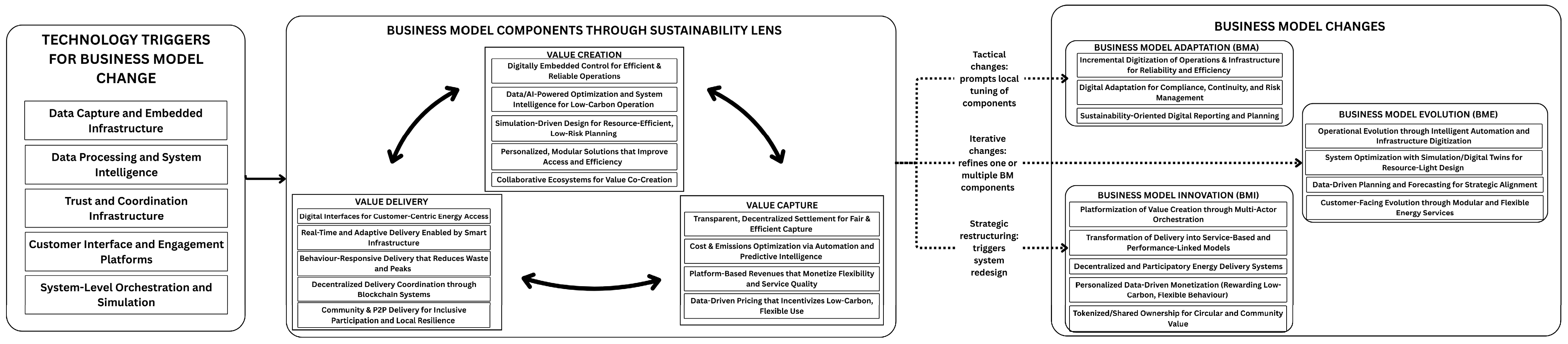
When propagation does occur, effects are mutually reinforcing: improvements in value creation (e.g., visibility and forecasting) spill into delivery (e.g., decentralized scheduling and new channels) and ultimately reshape capture (e.g., granular pricing and novel exchange mechanisms). Conversely, new pricing or exchange mechanisms can pull delivery redesign and alter upstream creation activities.
Figure 7 visualizes these interdependencies and feedback across components and motivates the change-type analysis in
Section 4.3.
4.3. Types of Business Model Change Through a Sustainability Lens
This study interprets BM change along three intertwined criteria; degree of change, structural impact (how many and which components are affected), and introduction of new logic, that locate cases on a continuum from adaptation (BMA) through evolution (BME) to innovation (BMI) [
25,
28,
33,
35,
37,
70,
71,
72]. The functional mechanisms identified in
Section 4.1 and their component-level effects in
Section 4.2 provide the pathway through which these change types materialize.
Table 1 summarizes the three BM change types applied in this study. Business model adaptation (BMA) refers to short-term, reactive adjustments to specific components. Business model evolution (BME) describes gradual and coordinated refinement over time. Business model innovation (BMI) represents transformational change in value creation, delivery, and capture. The table consolidates these operationalizations and distinguishes them by degree of change, structural scope, and logic preservation. This distinction guides the analysis in the following subsections.
As set out in
Section 4.1, we treat digital technologies as functional triggers grouped by the role or mechanism through which they operate, keeping the model simple and extensible so new tools can be placed by function rather than label. Together with
Section 4.2, this lens maps how triggers act on value creation, delivery, and capture.
Figure 7 presents a single model of these layers: as role-based triggers are layered and aligned across components and partners, they generate outcomes along the BMA–BME–BMI continuum. Read through a sustainability lens, BMA aligns reporting and efficiency; BME enhances system-level efficiency and resilience; BMI enables inclusive, circular and low-carbon value logics. For example, IoT-based monitoring and substation automation in distribution grids (Data Capture and Embedded Infrastructure) improve visibility, predictive maintenance, and reliability in value creation and delivery, illustrating an evolutionary pattern of change (BME) that primarily enhances efficiency and resilience. Likewise, blockchain-enabled peer-to-peer platforms and virtual power plants (Trust and Coordination Infrastructure) introduce new value-capture logics and prosumer participation, exemplifying how coordination architectures can underpin more radical, innovation-oriented changes (BMI) with implications for inclusion and shared value creation. Thus, integration depth links digital roles to sustainability outcomes.
4.3.1. Business Model Adaptation (BMA)
Adaptation captures localized operational or reporting improvements within an unchanged value logic. Illustrative cases include substation automation to enhance reliability in the Portuguese distribution network [
63], AI-based scenario planning aligned with SDGs [
8], and cognitive digital twins were used for strategic tracking, none of which alter revenue or delivery mechanisms [
11]. In the model, BMA corresponds to shallow deployments (typically monitoring/control or design-time simulation) with effects concentrated in a single component, most often value creation or delivery.
4.3.2. Business Model Evolution (BME)
Evolution denotes cross-functional integration and system-level restructuring while the underlying value logic persists. Diagnostics, digital twins, and predictive maintenance improve planning and grid efficiency [
7,
8,
55]. Smart meters and IoT/edge architectures decentralize control and automate delivery decisions without changing actor roles or revenue structures [
6,
63]. Simulation tools optimize upgrades and design choices without altering pricing or consumption mechanisms [
13,
58]. In the model, BME arises when monitoring/control, forecasting, and simulation co-operate to affect multiple components (creation and delivery), while interfaces and coordination remain domesticated within existing commercial rules.
4.3.3. Business Model Innovation (BMI)
Innovation involves a structural reconfiguration of how value is created, delivered, and captured through the introduction of new coordination and monetization logics. Blockchain and smart contracts enable peer-to-peer exchange and tokenized ownership that challenge centralized utility structures [
23,
59]. Mobile-enabled PAYG shifts from asset sales to service access in off-grid settings [
61]. EaaS and SaaS subscriptions redefine relationships and pricing [
5,
44]. AI-enabled personalization supports dynamic bundling and behavioural pricing beyond fixed tariffs [
17,
57]. In the model, BMI is most likely when interfaces and coordination are combined with forecasting to reassign roles and redesign payments, thereby altering all three components simultaneously.
Trajectories are rarely linear: progress occurs via iterative adjustments that compound across components and partners, layering BMA and BME before BMI emerges [
8,
23,
55]. Business model innovation in the renewable energy sector faces distinctive tensions between technological advancement, regulatory constraints, and sustainability imperatives [
73], creating multiple valid pathways for innovation rather than a single optimal model. Crossing from BME to BMI depends less on the presence of any particular tool than on integration depth across components and partners, on interoperability, and on institutional openness (e.g., tariff and settlement regimes) that allow new value logics to operate. For example, mobile-enabled pay-as-you-go (PAYG) systems function as BME in regulated utility contexts where they merely improve payment flexibility within existing delivery channels and utility control, but constitute BMI in off-grid contexts where they introduce prosumer participation, new actor roles, and fundamentally alter how value is captured through service-based micropayment models [
61]. Pathways also vary with organizational heritage: incumbents tend to layer upgrades under existing constraints, whereas entrants more readily adopt platform-based designs that enable larger leaps.
Although grounded in renewable energy, the conceptual model is portable to other digitally intensive, infrastructure-dependent sectors (e.g., mobility, logistics, water, and telecom). The generalizability of this framework is supported by cross-sectoral findings on digital transformation and business model change [
15], which document similar patterns of technology-enabled business model reconfiguration across the energy, mobility, logistics, and telecommunications sectors. Feasibility and application will differ by sector, but the role-based trigger → component → change-type logic offers a consistent template that can be applied and empirically tested beyond energy. Organisational heritage also matters: smaller entrants can often adopt platform logics faster, whereas incumbents tend to layer changes under legacy constraints. Chapter 5 distils these insights into key contributions and draws out the implications.
5. Conclusions
5.1. Theoretical Contributions
This study offers several contributions to the literature at the intersection of digitalization and business model (BM) change in the renewable energy sector. One of the primary contributions is the introduction of a functional grouping of digital technologies. Rather than analyzing tools like artificial intelligence, blockchain, or digital twins in isolation, this study classifies them according to the roles they perform within business contexts. These include functions such as data monitoring, system optimization, user interaction, decentralized coordination, and strategic simulations. This grouping enables a more abstract and generalizable understanding of digital transformation and helps bridge the gap between technological capabilities and BM outcomes.
Many firms adopt technologies in layers, beginning with real-time monitoring tools such as IoT sensors or smart meters. These foundational tools often enable higher-order technologies like AI, blockchain, or configurator platforms to operate effectively. This layered configuration reflects how digital integration evolves over time and supports increasingly complex value creation and capture mechanisms.
The functional perspective also supports clearer theorization of how digital tools affect different BM components. By focusing on what technologies enable rather than what they are, the study shows how digitalization shapes value creation, delivery, and capture through mechanisms like predictive control, behavioral personalization, and decentralized exchange. This function-based lens helps explain why the same technology may lead to different outcomes across firms and why certain combinations of technologies tend to appear together. The study identified key technologies like AI, IoT, and digital twins, but emphasized that their business relevance depends on functional deployment. The functional groups provide a clearer map of how different tools contribute to strategic change. The study found that digital functions can impact value creation, delivery, and capture in varied and overlapping ways. For example, AI-powered forecasting affects both operations and pricing [
4,
8,
53], while blockchain supports both coordination and monetization [
6,
11,
13,
23,
44]. These patterns are not fixed but highly context-dependent. The sustainability lens operates across three dimensions: efficiency (reducing technical and economic waste), resilience (enhancing the ability of energy systems and firms to absorb and adapt to shocks), and inclusion (broadening access and participation in energy services). The five digital functional groups contribute to these outcomes in distinct but interconnected ways. Data capture and embedded infrastructure (e.g., IoT sensors, smart meters, substation automation) primarily support efficiency and resilience by improving visibility into generation and consumption, enabling faster fault detection, and informing grid investment decisions; system-dynamics analyses of distribution networks, for instance, show how advanced monitoring and automation can both increase reliability and guide more cost-effective reinforcement strategies [
63]. Data processing and system intelligence (e.g., AI- and ML-based forecasting, optimization engines, and digital twins) further enhance efficiency and resilience by reducing forecast errors, optimizing dispatch, and supporting proactive maintenance and planning, thereby improving operational performance and alignment with sustainability-oriented targets in energy enterprises. Customer interface and engagement platforms (e.g., mobile dashboards, cloud portals, and GSM-enabled Pay-As-You-Go systems) enable users to monitor and adapt their consumption in real time while lowering entry barriers for low-income and off-grid households in regions such as Sub-Saharan Africa, directly linking digital engagement to both demand-side efficiency and inclusion [
61]; at the same time, these interfaces are implicated in broader debates on “energy democracy,” where digital tools shape how citizens participate in and influence energy transitions. Trust and coordination infrastructures (e.g., blockchain platforms, smart contracts, and virtual power plants) foster resilience and inclusion by enabling secure, transparent coordination among distributed prosumers, facilitating local trading and aggregation of distributed resources, and experimenting with new participatory business models such as peer-to-peer trading and community-based VPPs [
56,
59,
64]. Finally, system-level orchestration and simulation tools (e.g., digital twins, scenario-based planning environments, and system-dynamics models) contribute to efficiency and resilience by allowing firms and policymakers to explore alternative configurations of renewable assets, redesign regional “energy valleys,” and compare digital versus conventional grid investment pathways under uncertainty before committing to physical deployment [
58]. Together, these functional roles illustrate that digitalization can reinforce efficiency, resilience, and inclusion, but the extent to which these sustainability outcomes are realized depends on how technologies are embedded within business models and regulatory and market contexts.
A second theoretical contribution is the integration of this functional view with the typology of BM change. Beyond the functional grouping lens, this work contributes to business model innovation theory by addressing the distinction between wicked problems (ill-defined, context-dependent) and paradigmatic problems (well-defined, generalizable) in business model research [
74]. The functional taxonomy approach treats technology roles as paradigmatic while acknowledging that their strategic impact is contextual, offering more nuanced understanding than purely contingency-based approaches. The study interprets changes as adaptation, evolution, or innovation, and connects each to specific digital functions and configurations. Adaptation typically occurred due to internal improvement needs or external pressures, such as policy goals. Evolution involved broader restructuring with continuity in value logic, while innovation represented fundamental shifts in how value is created and delivered.
Finally, by synthesizing fragmented findings from across energy systems, digital innovation, and strategic management literature, the study contributes to a more unified theory of how renewable energy firms use digital tools to reconfigure their BMs. It provides conceptual clarity and analytical structure in a field often marked by disciplinary silos and case-specific insights.
5.2. Practical Contributions
The findings of this study offer several important insights for renewable energy firms managing digital transformation. A key implication is that adopting digital technologies in isolation is unlikely to deliver strategic impact. Instead, firms should focus on aligning technologies with specific BM priorities. For instance, firms aiming for personalized offerings should integrate analytics-enabled platforms, while those focused on grid efficiency may prioritize forecasting engines and simulation tools. The study also highlights the importance of sequencing. Digital transformation often unfolds in layers and our findings suggest a four-step logic grounded in the functional groupings: first, firms consolidate foundational visibility and control through data capture and embedded infrastructure (IoT sensors, smart meters, monitoring, automation); second, they build system intelligence and simulation capabilities (AI/ML forecasting, optimization, digital twins); third, they extend digitalization to customer-side and ecosystem interfaces (mobile apps, portals, configurators, PAYG systems); and fourth, they experiment with decentralized coordination and new market logics (blockchain, P2P trading, VPPs, platforms). Firms that progress broadly along this sequence can better align digital investments with coherent trajectories of business model adaptation, evolution, or innovation, while advancing efficiency, resilience, and inclusion outcomes. Firms should therefore approach digitalization as a cumulative process, building robust digital infrastructure before deploying advanced applications.
The functional grouping developed in this study offers a practical framework for assessing digital capabilities. By understanding technologies through their roles such as monitoring, coordination, or user interaction, firms can identify gaps, evaluate synergies, and prioritize technologies that best support their strategic goals. This function-based view also helps firms avoid tool-centric approaches and instead build coherent digital strategies rooted in business outcomes. Practically, the functional-mechanism lens also helps managers sequence digital investments that advance both BM change and sustainability outcomes (efficiency, resilience, and inclusion), offering a replicable pathway for asset-intensive sectors.
Firms should expect to combine adaptive improvements with more structural evolutions and occasional innovations over time. Recognizing digital transformation as an ongoing, layered process can help firms better manage risks, maintain coherence, and sustain long-term competitiveness.
Finally, enabling this transformation will require supportive regulatory frameworks [
3,
4,
5,
10,
23]. Policymakers should ensure legal clarity around smart contracts, promote interoperability standards, and create conditions for emerging BMs such as peer-to-peer trading and service-based energy delivery. Regulation that keeps pace with digital innovation will be essential for scaling firm-level experimentation into broader system change.
Despite their promise, digital integrations face recurring constraints. Data and security issues (sensor fidelity, incomplete datasets, and cybersecurity/privacy tensions) reduce AI reliability and complicate ledger immutability [
4,
17,
23]. Technical barriers include legacy interoperability and the computational demands of AI/IoT/blockchain stacks [
8,
54]. Economic hurdles, up-front infrastructure costs and uncertain ROI in capped-tariff contexts, deter smaller firms [
18]. Organizational gaps in skills and governance slow cross-actor coordination [
3,
12]. Regulatory ambiguity around smart contracts/peer-to-peer models and weak interoperability enforcement persist [
10,
23]. Ethical concerns (digital exclusion, automation-led job loss, data misuse, and environmental footprints) require deliberate mitigation [
7,
55]. These boundary conditions shape feasible integration depth and help explain the variation in the observed change types.
5.3. Research Limitations
While this study offers a structured synthesis of how digital technologies influence BM change in renewable energy firms, it has several limitations that open opportunities for further research. A fundamental methodological constraint is that, as a systematic literature review, the study draws exclusively from published academic sources and does not incorporate empirical data from within firms. Although the Gioia methodology enabled rigorous and transparent coding, findings rest on secondary interpretations rather than primary data. This constraint is compounded by the review’s reliance on Scopus and English-language peer-reviewed articles, which introduces selection bias toward established, Anglophone scholarship. This likely underrepresents work in non-English-speaking regions (such as China) with significant renewable energy sectors and distinct regulatory contexts. Together, these limitations mean the study captures what is published in English-language journals but misses emerging practices, regional variations, and practitioner insights from non-Anglophone markets. Future research could address these constraints by combining case studies, interviews, and longitudinal methods with non-English sources, industry reports, and ethnographic fieldwork to validate the patterns identified here and illuminate contextual dimensions absent from academic literature.
Another limitation is that while the study examines the functional roles of digital technologies, it does not assess the depth of their integration into firm operations and BM architecture. The same digital tool may lead to very different outcomes depending on how deeply it is embedded in a firm’s processes, infrastructure, and strategic systems. A shallow implementation might result in minor efficiency gains, while deep integration could enable more fundamental transformation. This difference likely influences not only the scale of change but also whether firms experience adaptation, evolution, or innovation in their BMs. This assessment is complicated by real-world implementation barriers. Data quality issues, cybersecurity vulnerabilities, and interoperability constraints identified throughout the literature directly affect whether assumed causal pathways materialize as theorized. Additionally, emerging technologies (5G, quantum computing, etc.) may fundamentally reshape which functional roles are viable or dominant post-2025, requiring the model to be revisited as the technology landscape evolves. Furthermore, the review does not systematically examine why identical digital technologies produce different BM outcomes across firms. While findings reveal heterogeneous transformation pathways, the moderating factors explaining these differences such as firm size, digital maturity, organizational heritage, and institutional context remain underexplored in the reviewed literature, limiting the model’s explanatory power for predicting outcomes across diverse firm contexts.
A key limitation is also that this review does not systematically examine how regulatory and policy frameworks shape digital adoption and BM change types. Tariff regulation, data governance requirements, interoperability standards, and smart contract legal clarity significantly influence whether firms pursue incremental adaptation versus radical innovation. Future research should investigate the moderating effects of regulatory environments on digital-driven BM transformation.
These limitations directly inform the future research agenda in
Section 5.4. Specifically, the reliance on secondary data and lack of longitudinal evidence motivates studies of sequential BM change pathways (RQ1–RQ4). The English-language and Scopus-centric scope calls for research in non-Anglophone contexts such as China (RQ6). And the emergent nature of moderating factors (firm size, digital maturity, regulatory regimes) suggests empirical work to test their boundary conditions (RQ5).
5.4. An Agenda for Future Research
Building on this observation, future research should explore the concept of digital integration depth as a key determinant of BM change. This would involve studying not just what technologies are adopted but how extensively and coherently they are embedded across value creation, delivery, and capture mechanisms. A particularly promising direction concerns the heterogeneity of transformation pathways across firm types. Evidence suggests start-ups and incumbents follow distinct business model change trajectories when adopting digital technologies [
75,
76]. Startups typically adopt platform-based, innovative business models more readily, while incumbents tend to layer digital improvements within existing constraints. Future research should investigate whether this difference reflects organizational capabilities, regulatory constraints, or strategic choice. Understanding these patterns at the firm level can provide a more detailed view of how digital transformation unfolds over time. While deeper integration can enable more fundamental transformation, digitalization does not guarantee sustainability; rebound effects and governance gaps may offset gains. This underscores the need for outcome measurement alongside mapping integration depth.
To guide such inquiry, we propose the following research question:
How does the depth of digital technology integration influence the type and trajectory of business model change in renewable energy firms?
Beyond this core question, several additional thematic gaps emerged from the literature analysis that point to promising directions for future research.
Table 2 below outlines underexplored areas and corresponding research questions organized by theme.
These directions extend the conceptual foundation developed in this study and open avenues for comparative, longitudinal, and firm-level research. Exploring these questions empirically can help build a more nuanced understanding of digital transformation processes and offer valuable insights for both academic theorization and strategic decision-making in renewable energy and related sectors.
5.5. Final Reflection
This study set out to understand how digital technologies shape BM change in the renewable energy sector. By synthesizing insights from across disciplines and organizing them through a functional lens, this study provides a clearer picture of how digital tools enable firms to reconfigure value creation, delivery, and capture. The findings show that digital transformation is not a uniform or one-directional process. Instead, it unfolds in layered, context-specific ways, with firms combining foundational tools and advanced applications to meet strategic goals.
Rather than focusing on individual technologies, this study emphasizes what these technologies do. This function-based perspective offers a more flexible and transferable framework for analysing BM change. It helps explain how the same tool can lead to different outcomes and why similar outcomes may be achieved using different configurations. By linking functional roles to types of change, this study contributes to a more nuanced understanding of digital BM transformation in the renewable energy sector.
Ultimately, the path forward for both research and practice lies in recognizing that digitalization is not just a technical upgrade but a strategic re-composition of how firms create, deliver, and capture value. As renewable energy firms continue to adapt to regulatory shifts, customer expectations, and technological advances, their ability to align digital capabilities with evolving BMs will be a key factor in their long-term competitiveness and impact.