Article

A Systems Approach to Modeling Loyalty Contagion and Adaptive Regulation in Emergency Document Systems: The Role of User Stickiness

1
College of Economics and Management, Harbin Engineering University, Harbin 150001, China
2
School of International Business and Administration, Shanghai International Studies University, Shanghai 201306, China
*
Author to whom correspondence should be addressed.
Systems 2026, 14(3), 268; https://doi.org/10.3390/systems14030268
Submission received: 12 January 2026 / Revised: 4 February 2026 / Accepted: 27 February 2026 / Published: 2 March 2026

Abstract

Aiming at the problems of low information coordination efficiency and insufficient sustained user participation in emergency document systems during incident response, this paper proposes a user stickiness-based loyalty contagion and adaptive regulation model for emergency document systems. The model consists of an environment module, an agent module, a metrics module, and a regulation module, which are used to simulate the formation and contagion mechanism of user stickiness on system loyalty in emergency scenarios, and to explore effective pathways for maintaining system health through adaptive regulation. The feasibility of the model is verified through simulation experiments. The results show that there exists an optimal platform regulation intensity that can significantly improve the standardization of emergency collaboration and the overall system effectiveness.

1. Introduction

Currently, the frequent occurrence and spread of natural disasters, public health events, social safety incidents, and other emergencies on a global scale are continuously challenging the resilience and efficiency of emergency response systems [1,2,3]. During emergency response processes, the rapid sharing of information and efficient coordination are crucial for ensuring the smooth progress of rescue operations [4,5]. In recent years, the public has become accustomed to releasing information and seeking assistance through social media. With the widespread adoption of digital collaboration tools, emergency online shared document systems have gradually evolved into core platforms for integrating fragmented information and breaking down spatiotemporal barriers, playing an increasingly important role in responding to emergencies [6,7,8]. However, existing systems still commonly face issues such as insufficient efficiency in information coordination and a lack of sustained user participation willingness in practical applications. This often leads to information gaps, response delays, and resource wastage during collaboration, making it difficult to support long-term, high-intensity, multi-phase emergency coordination tasks [9,10]. These challenges not only constrain the overall effectiveness of emergency response but also affect the sustainable development of emergency collaboration systems [11].
Emergency shared document systems are key information coordination platforms supporting emergency response. Their core function lies in rapidly aggregating, editing, and disseminating dynamic information through cloud-based real-time collaboration to enhance the efficiency of emergency decision-making and action [8,12]. In disaster relief, public health events (such as pandemic control), or major accident handling, authorized personnel can synchronously edit shared documents through various terminals, realizing critical collaborative behaviors such as updating task lists, registering resources, summarizing progress reports, and conveying instructions [13,14]. Emergency shared document systems break through the linear limitations of information transmission, constructing a multi-agent, real-time, interactive information ecology network [15]. Some scholars have conducted multi-perspective research on the application modes and effectiveness of online documents in emergency scenarios. Lyu et al. explored the case of using collaborative documents for cross-departmental resource scheduling during the Zhengzhou heavy rainstorm, verifying their effectiveness in reducing information delays [16,17]. Chen et al. analyzed the “information hub” role played by online documents in coordinating community supplies and volunteers during large-scale public health events [18,19]. Furthermore, mainstream collaborative office platforms have been utilized in multiple actual emergency events, with their rapid deployment and low-threshold characteristics being empirically validated.
Similar to emergency command systems, high-intensity, high-pressure collaborative behaviors within emergency online document systems also require clear process norms and operational constraints to ensure the accuracy, orderliness, and security of information flow. From the perspective of emergency managers, this paper focuses on users’ micro-level operational behaviors within such systems, exploring their behavioral patterns, potential risks, and corresponding guidance and governance strategies.
Social behavior modeling is an abstract and mathematical description of the behavioral characteristics of groups in whole societies. However, there are usually several difficulties in modeling social behavior. (1) Portraying a complete individual requires considering many attributes and factors. Limited by computational resources, it is challenging to select the key factors that match the model. (2) The individuals portrayed need to consider the group’s social behavior while maintaining the differences among individuals. At present, there are several classical approaches to modeling social behavior. Reynolds proposed the famous Boids model for simulating the social behavior of flocks of birds in aggregated flight [20]. Hoogendoorn et al. proposed a model of pedestrian movement based on gas dynamics theory, using a particle discretization approach to describe crowd motion [21]. Hughes et al. proposed a pedestrian motion model based on fluid dynamics, using continuous medium theory to describe crowd motion using density fields [22]. Helbing et al. proposed a social force model based on Newton’s second law of mechanics, using psychosocial and physical forces to describe the pedestrian motion mathematical model [23]. Lerner et al. introduced a new algorithmic framework for crowd simulation visual analysis, which has better practicality than actual data [24]. In recent years, several scholars have proposed agent-based modeling approaches. Chen et al. studied the introduction of regret–happiness levels in a simulation model based on pairs of multi-agents. They designed a learning rule that considers personal, neighborhood, and historical information to analyze urban residents’ waste-sorting behavior [25]. Ahmad et al. proposed a multi-agent simulation model to investigate the economic, ecological, climatic, and demographic factors driving this polarization [26]. Xue et al. studied the influence of social distance on the spread of COVID-19 based on the agent [27].
Unlike other methods, the agent-based modeling approach uses an agent as a carrier for the model module construction, which can improve the reusability of the model and present better visualization effects. In this paper, a multi-agent-based approach will be used to model and simulate the social behavior of groups in emergency online documents.
User stickiness describes the extent to which a person uses a specific product or service and is a measure of the loyalty metric used for that thing, which plays a vital role in the brand of the whole product or service. User stickiness is a social behavior of users in the real world, and it is not only crucial for actual companies [28], but it is equally important to improve user stickiness and keep more users in that community when dealing with many emergency online documents.
There have been many researchers who have studied user stickiness-related content. For instance, Khalifa et al. [29] proposed a model to explain the assessment of online consumer stickiness through repurchase. Zhang et al. [30] proposed a model for the effect of customer engagement on stickiness. Sun et al. [31] constructed a logistic regression scorecard model for assessing customer stickiness. Xu et al. constructed a model to detect the effects of various website attributes and users on user stickiness [32]. Rong et al. proposed a model based on platform and Hotelling theory to explain the differences in user stickiness between two-sided and merchant platforms [33]. Li et al. developed a theoretical model to examine how social and technological factors affect user stickiness [34]. User stickiness is an intuitive phenomenon formed by the aggregation of a variety of information perceived by individuals, and it involves the influence of numerous factors, such as personal preferences, environmental information, religion, and geography. Based on the results of previous scholarly research on user stickiness, it can be concluded that user stickiness affects the behavior of individuals.
As a key metric measuring users’ willingness to continuously use a system, user stickiness plays a pivotal role in the formation and dissemination of system loyalty [35]. In emergency collaboration scenarios, user stickiness is not only related to an individual’s dependence on the system but also influences the stability and standardization of group collaborative behaviors [36,37]. However, current research on emergency online shared document systems mostly focuses on technical architecture and functional design. There is less exploration from the micro-perspective of user behavior and social interaction regarding how user stickiness affects the formation and dissemination mechanisms of system loyalty, and how to enhance the overall collaborative effectiveness of the system through effective regulation strategies [38]. In this paper, we will consider user stickiness as a factor that influences the action decision of an agent.
Existing research on user stickiness has predominantly centered on the consumer sector, such as e-commerce and social media. Its theoretical frameworks and empirical findings are largely constructed around commercial objectives like purchase intention and repurchase behavior [35]. However, directly transferring these conclusions to emergency management contexts—characterized by public welfare orientation, stringent time sensitivity, and high-pressure decision-making—presents significant limitations in applicability [7]. As a core information coordination platform for emergency response, the user stickiness within emergency document systems (among emergency managers, frontline responders, and the public) directly impacts the efficiency of emergency information dissemination, the accuracy of rescue operations, and public compliance with response protocols. For instance, during sudden disasters, strong user stickiness to official emergency document systems can reduce information acquisition delays and prevent rescue errors caused by fragmented information. In contrast, key drivers of user stickiness in consumer contexts—such as price discounts and personalized recommendations—play a markedly limited role in emergency scenarios. Here, user stickiness relies more heavily on factors such as information authority, system usability, functional relevance, and situational urgency [8,12].
Therefore, based on the interaction mechanism between user stickiness and system loyalty in emergency collaborative scenarios, this paper introduces and extends the “Loyalty Contagion and Regulation Model” from the metaverse community to construct an adaptive collaborative governance framework for emergency shared document systems [39]. This model dynamically simulates the formation and diffusion effects of user behaviors on system loyalty through four modules: Environment, Agents, Metrics, and Regulation, thereby exploring feasible paths to maintain system health and enhance collaborative effectiveness through adaptive regulation strategies. This paper validates the effectiveness of the model through simulation experiments and identifies the optimal regulation intensity through sensitivity analysis. The aim is to provide theoretical foundations and management references for improving the collaborative standardization, sustainability of user participation, and overall resilience of emergency shared document systems.
To guide the model construction and experimental validation, this study addresses the following research questions (RQs) and proposes corresponding hypotheses (Hs).
  • RQ1: How does user stickiness influence the formation and contagion mechanisms of system loyalty within an emergency document system?
  • RQ2: Does there exist an optimal intensity of platform regulation that can maximize system loyalty while maintaining sustainable management costs?
H1. 
User stickiness is positively correlated with system loyalty.
H2. 
There is an inverted U-shaped relationship between platform regulation intensity and system comprehensive effectiveness.
H3. 
Adaptive platform regulation significantly moderates the behavioral transition pathways of users (e.g., from centrist to loyalist), primarily by mitigating the impact of malicious events and reinforcing positive social contagion.
The subsequent model and simulation experiments are designed to explicitly test these hypotheses.
The main contributions of this study include:
(1)
A novel theoretical perspective. Moving beyond the consumer-centric focus of existing user stickiness research, this study pioneers its application to emergency document systems. We establish a “systems perspective + cross-domain adaptation” framework by integrating user stickiness theory with loyalty contagion and adaptive regulation mechanisms. This provides a new paradigm for studying user behavior in the high-stakes context of emergency management.
(2)
An innovative modeling approach. In contrast to prior work on emergency management systems, which predominantly focuses on technical optimizations (e.g., data storage, retrieval efficiency), this research introduces a loyalty contagion and adaptive regulation model. This approach quantifies the mediating role of user stickiness, thereby addressing the traditional gap of prioritizing technology over the dynamics of user behavior and interaction within collaborative systems.
(3)
Actionable practical implications. Tailored to the high-pressure and time-sensitive nature of emergency response, this study refines the evaluation metrics system for user stickiness to better align with the information-seeking logic of emergency personnel. This provides an operable theoretical basis for optimizing the design of emergency document systems and formulating effective user retention strategies.
The remaining parts of the paper are as follows: Section 2 describes the model’s construction method and derivation process in detail. The experimental part and the conclusion are presented in Section 3 and Section 4, respectively.

2. Materials and Methods

2.1. AIR Model Overview

This paper constructs the AIR (agent metrics regulation) model, deconstructing the emergency online document platform into four core modules: Environment–Agent–metrics–Regulation, forming a closed-loop operational mechanism. Utilizing this model, this study simulates the mechanism by which user stickiness affects user loyalty within the emergency online document platform. By establishing a regulatory mechanism based on the platform loyalty metric, it aims to circumvent platform failure issues caused by user churn and information chaos [40].

2.2. Environment Module

In the Environment module, the primary purpose is to model the objects appearing in the model, including the agent, the active areas, and the events that influence the agent’s decisions.

2.2.1. Agent and Area Appearance Definition

In this paper, agents are the most dominant objects in the model, representing users in the emergency online document platform. We categorize agents into four types: Loyalists ( A g e n t l , users who use the platform frequently, actively share information, and trust the platform), centrists ( A g e n t c , users who use the platform occasionally with a neutral attitude), oppositionists ( A g e n t o , users who distrust the platform, refuse to use it, or spread negative evaluations; the behavioral characteristics of such users stem from dissatisfaction with the platform’s information quality, functionality, or governance mechanisms [36,38], and the expelled ( A g e n t e , users whose permissions are restricted due to violations such as posting false information or malicious editing). In the model, these four types of agents are represented by green, yellow, red, and silver dots, respectively.
Within the emergency online document platform, all users exist in a virtual information space. To more intuitively simulate the changes made by different types of agents influenced by the external environment, we constructed a 2D scene to display the simulation effects. In this scene, we partitioned the agent area into four sections: A r e a l   (loyalist gathering area, where users who frequently access and edit documents are concentrated), A r e a c   (centrist gathering area, where users who occasionally access documents are concentrated), A r e a o   (oppositionist gathering area, where users who refuse access or spread negative evaluations are concentrated) and A r e a e (expelled gathering area, where users with restricted permissions are concentrated).

2.2.2. Event Definition

Typically, new users joining the platform through official recommendations or driven by emergency needs maintain relatively high loyalty initially. However, as they encounter issues such as information errors, untimely updates, and permission confusion during use, their loyalty metric may change. Particularly, when vicious events like the spread of false information or malicious editing occur within the platform, this will significantly impact user loyalty indices and behavioral preferences. Such events affect not only new users but also alter the behavioral patterns of existing users.
Define such an event as a vicious event: E v e n t v i c i o u s . When this event occurs, different similar agents are affected. We use the following formula to indicate whether the event occurs or not:
E v e n t v i c i o u s = { 1 0
where −1 represents the event that happened, and 0 represents the event that did not happen.

2.3. Agent Module

The agent is essential for researching both artificial intelligence and computational science. On the theoretical aspect, mathematical forms can derive agent properties. On the practical aspect, agents can be programmed and experimented with using programming languages [41]. In this paper, we use mathematical forms to derive the properties and behaviors of an agent and use the programming language to visualize and simulate the agent.

2.3.1. Agent

Due to the many users in the emergency online document platform, we need to create many agents in the model. To facilitate the management of the agents and the calculation of the platform loyalty metric, we assume that the total number of agents is S u m t , as shown in Equation (2):
S u m t = A g e n t l t + Agent c t + Agent o t + Agent e t
where A g e n t l t represents the number of loyalists at time t, Agent c t represents the number of centrists at time t, Agent o t represents the number of oppositions at time t, and Agent e t represents the number of the expelled at time t.
Then, the transformation rates of different types of agents are as follows:
{ A g e n t l = A g e n t l t + 1 - A g e n t l t A g e n t c = A g e n t c t + 1 - A g e n t c t A g e n t o = A g e n t o t + 1 - A g e n t o t A g e n t e = A g e n t e t + 1 - A g e n t e t
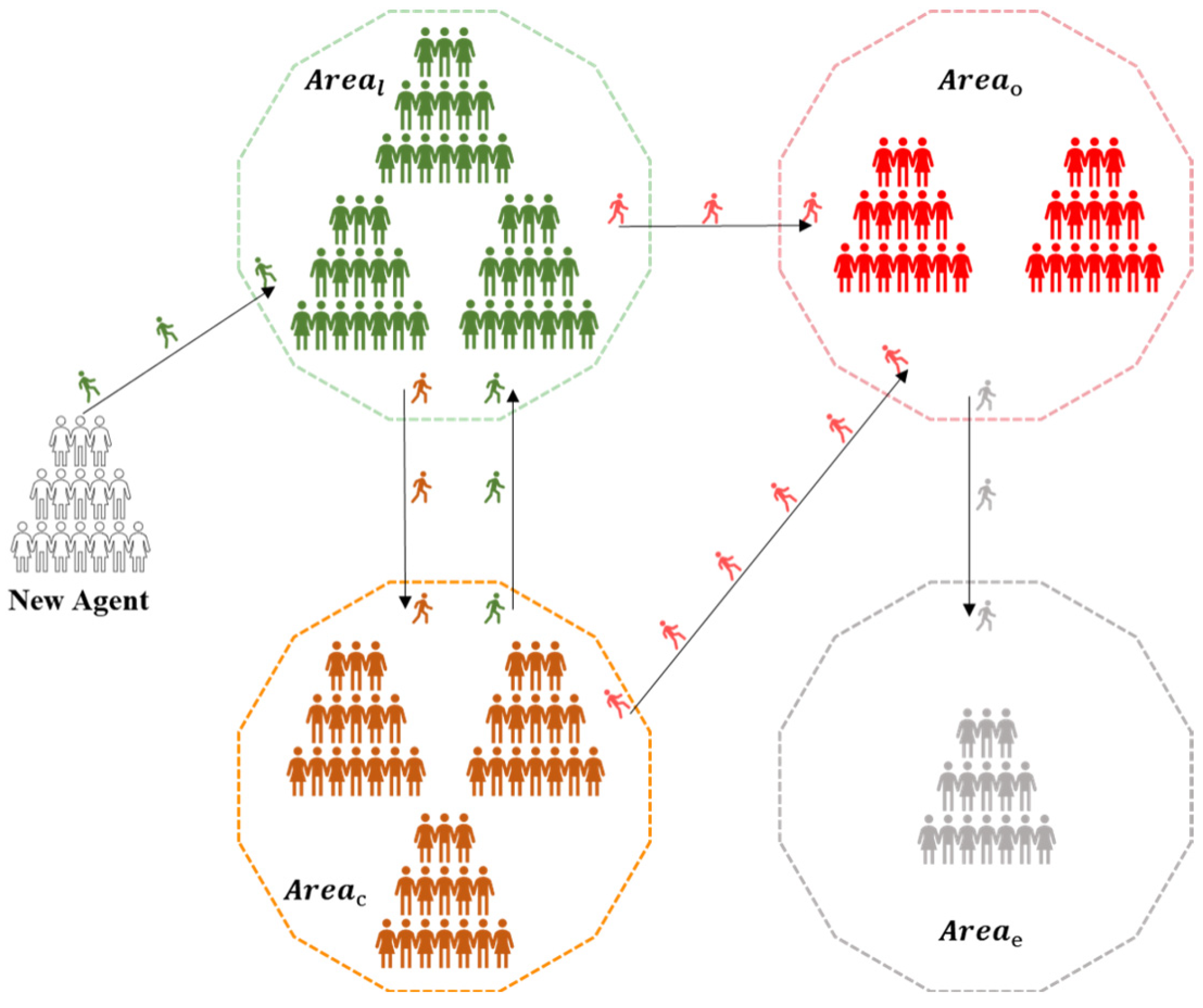
Based on the above definition, we present the transformation process of the agent, as shown in Figure 1. Different classes of agents in the platform can transform into each other at different rates. The green area gathered is the loyalist agents, the red area gathered is the opposition agents, the yellow area gathered is the centrist agents, and the gray area gathered is the expelled agents.
The loyalty contagion and regulation model for the emergency online document platform, based on user stickiness, incorporates the following assumptions:
  • Assume that the information demand in the model is stable. This assumption is set to simplify the modeling process and control the interference of irrelevant variables, with the core purpose of focusing on the core research content of the user loyalty contagion mechanism and the platform’s adaptive regulation logic.
  • Assume that the population in the model is dynamic, with a constant inflow of n per unit of time. In reality, the emergency online document platform can attract new users through various measures such as official promotion and integration into emergency response systems.
  • Assume that all newly joining agents are loyalists. During emergency response processes, if new users are malicious actors who engage in negative, disruptive behaviors such as disseminating false emergency information or disrupting emergency orders, they will be subject to clear legal constraints and severe sanctions under relevant laws and regulations. Given this, the probability of malicious new users appearing is extremely low and can be temporarily excluded from the initial assumptions of the model.
  • Assume that loyalists can be transformed into centrists or oppositions at rates of αc, αo, respectively. Influenced by the environment, the loyalists change their loyalty to the platform, but the process of decline is gradual, i.e., it is specified that αc > αo. Thus, the number of people who change from loyalists to centrists at unit time t is a c A g e n t l t , and the number of people who change from loyalists to opposition is a o A g e n t l t .
  • Assume that the centrists can be transformed into loyalists or opposition at the rate of β l or β o , respectively. By the influence of other agents, some of the centrists will be transformed into loyalists, and some of them will be transformed into opposition. Thus, at the time t per unit time, the number of people who are transformed from centrists to loyalists is β l · A g e n t c t , and the number of people who are transformed from centrists to opposition is β o · A g e n t c t .
  • Assume that the platform will regulate the opposition at a rate of γ e . Due to platform control, a part of the opposition will be expelled. Thus, at unit time t, the number of people transformed from opposition to expelled is γ e · A g e n t o t .
The core focus of this model is to characterize the kinetic process of how user loyalty decays through vicious events and negative social contagion in the absence of effective platform regulation, and to investigate the efficacy of regulatory mechanisms in curbing this decline. Therefore, the model explicitly formulates the primary pathways of loyalty degradation (as shown in Equations (4) and (5)). Within this framework, the positive enhancement of loyalty is understood as the process in which platform regulation (CR) effectively increases user stickiness (Equation (7)), thereby preventing users from migrating to lower-loyalty states and maintaining them as loyalists or centrists. This perspective of “maintenance as enhancement”, in contrast to uncontrolled decline, better aligns with the priority objective in emergency management of preventing system collapse and maintaining a baseline for collaboration.
We define the above assumptions formulaically, as shown in Equation (4):
{ A g e n t l t = A g e n t l t 1 + n + β l · A g e n t c t , A g e n t c t = A g e n t c t 1 + α c · A g e n t l t , A g e n t o t = A g e n t o t 1 + α o · A g e n t l t + β o · A g e n t c t , A g e n t e t = A g e n t e t 1 + γ e · A g e n t o t .
From the above assumptions, it follows that the rate of change in the number of loyalists in the emergency online document platform is ( n + β l · A g e n t c t ) ( α c A g e n t l t + A g e n t l t ) . The rate of change in the number of centrists is α c · A g e n t l t ( β l · A g e n t c t + β o · A g e n t c t ) . The rate of change in the number of opponents is ( α o · A g e n t l t + β o · A g e n t c t ) γ e · A g e n t c t . The rate of change in the number of expelled is γ e · A g e n t o t .
We use differential equations to represent the transformation from the initial state of the agents to the loyalists, centrists, oppositions, and expelled.
{ A g e n t l = d A g e n t l t d t = ( n + β l · A g e n t c t ) - ( α c · A g e n t l t + α o · A g e n t l t ) , A g e n t c = d A g e n t c t d t = α c · A g e n t l t - ( β l · A g e n t c t + β o · A g e n t c t ) , A g e n t o = d A g e n t o t d t = ( α o · A g e n t l t + β o · A g e n t c t ) - γ e · A g e n t o t , A g e n t e = d A g e n t e t d t = γ e · A g e n t o t .

2.3.2. Agent Stickiness

Agent stickiness: We divided agents into three levels of stickiness: (1) High, where agents spend more time in the emergency online document platform and are more likely to be loyalists; (2) middle, where agents are generally more neutral towards the platform and are more likely to be centrists; and (3) low, where agents have developed opposition to the platform and are more likely to become oppositionists. The three user stickiness value parameters (UShigh, USmiddle, and USlow) indicate the user stickiness of this agent, and they satisfy the following relationship:
{ 0.7 U S h i g h 1 , 0.3 < U S m i d d l e < 0.7 , 0 U S l o w 0.3 .
The division of user stickiness thresholds is based on a threefold scientific basis, ensuring the adaptability of the classification standards to emergency scenarios and academic rigor: (1) Drawing on mature research findings in the emergency field, Xue et al. (2023) [39] verified through multiple rounds of simulations in the loyalty contagion model in the metaverse community that the behavioral threshold range for core participants (high-stickiness users) in group collaboration scenarios is 0.7–1. This classification logic was proven applicable to the quantitative research of user participation behavior, providing a basic framework for this study. Meanwhile, the Protective Action Decision Model (PADM) proposed by Lindell and Perry points out that there is a clear intensity boundary for users’ willingness to continuously participate in emergency scenarios, and the behavioral characteristics of “high-responsiveness users” in their research are highly consistent with the high-stickiness threshold (0.7–1) set in this study [42]. (2) Supported by empirical data from emergency document systems, Lyu et al. (2023) [17] found through an empirical study of the Online Collaborative Document (OCD) in the emergency collaboration case during the Zhengzhou rainstorm disaster that core users who continuously participated in document maintenance and information verification had behavioral intensity highly consistent with high-stickiness characteristics; users who occasionally supplemented information showed a moderate level of participation, while users who did not participate in editing or only browsed corresponded to low-stickiness performance. This empirical result directly verifies the rationality of the threshold range. In addition, Smith et al. found in their research on user responses to flood warnings that users with disaster experience had significantly higher continuous attention and participation in emergency information than ordinary users, and the boundary of their behavioral intensity was consistent with the 0.3 and 0.7 thresholds set in this study [43]. (3) Calibrated and optimized using the expert consultation method, five researchers in the field of emergency management (all with more than 10 years of research experience in emergency information systems, covering research directions such as emergency collaboration behavior and user participation mechanisms) and three frontline emergency collaboration personnel (who have participated in practical work such as COVID-19 pandemic prevention and control and major natural disaster rescue, and are familiar with the actual application scenarios of emergency document systems) were invited to conduct two rounds of consultations through the Delphi method. The expert team unanimously recognized the classification standards of low stickiness (≤0.3), medium stickiness (0.3–0.7), and high stickiness (0.7–1), believing that this range can accurately reflect the degree of users’ dependence on the document system, willingness to participate, and behavioral contribution in emergency scenarios, and meets the practical needs of emergency collaboration.
Where the user stickiness value is closer to 0, the agent is more likely to become the opposition. The closer the user stickiness value is to 1, the more likely they are to become a loyalist. In addition, if the user stickiness value is between 0.3 and 0.7, the agent is a centrist.
Agent stickiness can be affected by the platform environment. For instance, malicious events such as the spread of false information and malicious editing will reduce an agent’s stickiness. The platform maintains its own stability through measures like information review and quality optimization, thereby enhancing the agent’s stickiness, as shown in Equation (7):
U S ( i , t ) = n · ( 1 + n ) · 1 t E v e n t v i c i o u s 2 + C R t
where U S ( i , t ) represents the user stickiness of agent i at   t time. n · ( 1 + n ) · 1 t E v e n t v i c i o u s 2 represents the level of vicious events generated as of t time. C R t represents the intensity of regulation made by the platform at t time.

2.3.3. Action Preference

Agent actions are the behaviors taken by the agent based on the perceived information about the external environment. The number of actions determines an agent’s completeness. However, too many actions will affect the speed and performance of the model.
As shown in Figure 1, we define an agent action as A cti on ( A ctio n l , A c t i o n c , A ctio n o , A ctio n e ). Where A ctio n l means that the agent moves towards A r e a i and transforms into a loyalist. A c t i o n c means that the agent moves toward A r e a c and transforms into a centrist. A ctio n o means that the agent moves towards A r e a o and transforms into an opposition. A ctio n e means that the agent moves towards Areae and transforms into an expelled.
Many factors influence the agent’s action, such as user stickiness, other agents, and environmental information. One of the most influential factors in agent actions is user stickiness, and we define the values of action preferences influenced by user stickiness in Equation (8):
A U S ( i , t ) = A U S ( i , t 1 ) + U S ( i , t )
where U S ( i , t ) represents an agent’s user stickiness at t time, and A U S ( i , t ) represents an agent’s action preference value influenced by user stickiness at t time.
In the emergency online document platform, an agent’s actions are influenced not only by its own attributes but also by other agents (such as other users’ usage evaluations and sharing behaviors). We define the action preferences of A g e n t j to A g e n t i   as Equation (9):
A j i = U S A g e n t i + U S A g e n t j
where U S A g e n t i represents the user stickiness of A g e n t i and U S A g e n t j represents the user stickiness of A g e n t j .
Because there is no physical distance between groups in the emergency online document platform, there will be an influence on each agent. The average value can be used here as the influence result. Thus, we define the average value of action preferences of A g e n t i influenced by other agents at t time as:
A A v g ( i , t ) = j = 1 S u m t A j i S u m t
According to the above deduction, the action preference values of the agent can be defined as Equation (11):
A P = A U V ( i , t ) + A A v g ( i , t )
According to this definition, the agent selects an action according to the action preference value. When the action preference value is between c 2 and c 3 , the agent selects A c t i o n o . When the action preference value is more significant than c 1 , the agent selects A c t i o n l . When the action preference value is between c 2 and c 1 , the agent selects A c t i o n c . When the action preference value is below c 3 , the agent selects A c t i o n e :
A c t i o n = { A c t i o n l , A p > c 1 A c t i o n c , c 1 A p c 2 A c t i o n o , c 2 > A p c 3 A c t i o n e , A p < c 3
where c 1 , c 2 , c 3 represent the constants.

2.4. Metrics Module

The metrics module is a comprehensive measure that summarizes various metrics or specific observations of the same phenomenon and is an essential statistical method for analyzing changes in the number of social phenomena [44]. It is an urgent problem for the emergency online document platform managers to have a clear and fast overview of the platform. In this paper, we use the metrics module to reflect the overall operation of users on the platform.

2.4.1. Loyalty Metric

In this paper, loyalty is defined as a comprehensive metric that quantifies user loyalty by integrating multiple relevant factors. In the context of our study, the key indicators of loyalty include A gen t state : agent state, A gen t stick : agent stickiness, and A gen t AP : agent action preference.
The agent state represents the type of that agent and is a direct representation of the loyalty. According to our above definition of an agent, an agent is classified into: A g e n t l , A g e n t c , A g e n t o , and A g e n t e . In these four states, the loyalty of the agents decreases in order. However, as expellees have been removed from the platform, this agent is no longer considered. We specify the loyalty value of the agent state as Equation (13):
A g e n t s t a t e = { 1 , s t a t e = A g e n t l 0 , s t a t e = A g e n t c 1 , s t a t e = A g e n t o
Agent stickiness is a degree of dependence of the agent on that platform and an essential metric to evaluate loyalty. In this paper, user stickiness is graded as UShigh, USmiddle, or USlow. The following values are also assigned to the different user stickinesses:
A g e n t s t i c k = { 1 , U S ( i , t ) > b 1 0 , U S ( i , t ) 1 , U S ( i , t ) < b 2
On the other hand, agent action preferences represent the potential action intentions of the agent and can indirectly reflect its loyalty. The same three action preferences of agents are defined in subsection III-C3: A c t i o n l , A c t i o n c , and A c t i o n o . Assign them here as:
A g e n t A p = { 1 , A c t i o n l 0 , A c t i o n c 1 , A c t i o n o
Nevertheless, different metrics can reflect the agents’ loyalty differently, and we need to define the weights for the three metrics, as shown in Equation (16):
L I A g e n t i = w 1 · A g e n t s t a t e + w 2 · A g e n t s t i c k + w 3 · A g e n t A p
where w 1 , w 2 , w 3 are the metrics’ weights and w 1 + w 2 + w 3 = 1 .

2.4.2. Platform Loyalty Metric

Section III-D1 could calculate agent loyalty by Equation (16), but platform loyalty needs to consider all agents. The methods that can be taken to include all participants in the statistics are the cumulative summation method and the average method.
Cumulative summation method: Namely, the loyalty metric is cumulated for all the agents, as shown in Equation (17):
C L I t = L I A g e n t 1 + L I A g e n t 2 + + L I A g e n t n = i = 1 n L I A g e n t i
where C L I t represents the sum of the platform loyalty metric at t time, and n represents the total number of members in the platform at that time.
Average method: Namely, the loyalty metric is accumulated for all the agents and averaged, as shown in Equation (18):
C L I t ¯ = L I A g e n t 1 + L I A g e n t 2 + + L I A g e n t n n = i = 1 n L I A g e n t i n
The cumulative summation method may have problems with variable platform sizes and different total numbers of people at different times. The C L I t so calculated does not accurately reflect the overall platform loyalty. In contrast, the average method to calculate the average C L I t ¯ of all the agents’ loyalty can reflect the overall situation of the platform.

2.5. Regulation Module

In the above three modules, the agent acts according to the rules. However, vicious events on the platform will reduce platform loyalty and affect other agents, forming a vicious circle. The most common method to prevent the occurrence of such phenomena is to manage regulation [45]. Regulation can effectively reduce the influence of vicious events, reduce the generation of oppositions, stabilize the centrists with potential opposition intentions, and strengthen the loyalists.
Platform regulation is equal to a benign event, which can improve the user stickiness and change the action preferences of an agent. Namely, the control can effectively reduce the “defections” of highly loyal agents. We define the value range of platform regulation as follows:
M a x C R M i n ,
where C R is the intensity of platform control, and M i n and M ax are the upper and lower regulation limits.
Instead of considering its comprehensive performance, the model does not use C L I t ¯ directly as the only measure of model effectiveness. We use three metrics to assess the model’s performance under different platform regulations:
  • C L I t ¯ : C L I t ¯ is the average value of user loyalty in the emergency online document platform, which is the metric of most importance to the platform. This metric directly reflects the regulatory effect of the model.
  • C R : C R represents the intensity of platform regulation. The platform plays a regulatory role by increasing the number of benign events, but it does not mean well. These events require a cost to the platform, such as economic costs. This metric reflects the potential cost of the model.
  • C P : C P represents comprehensive performance. It is necessary to take into account not only the platform loyalty metric in the model but also the cost of regulatory effort. We use the comprehensive performance to express the performance of the model. Based on the above definition, we list the equation for calculating C P :
C P = W 1 · C L I t ¯ W 2 · C R ,
where W1 and W2 represent the weights.
The metrics module provides feedback on the C L I t ¯ at a specific time to the regulation module, calculates the comprehensive performance under C L I t ¯ , and feeds back the regulation strength to the agent module.

3. Results

3.1. Simulation Experiment

This section verifies the model with experimental data and simulation experiments. Our hardware environment in the experiments is: i7-9700 and 48 GB RAM, and the software environment is AnyLogic 8.7.2 and MATLAB r2019a.

3.1.1. Parameter Setting

The setting of the experimental parameters can significantly affect the simulation results. In this experiment, we set the values of the various parameters as shown in Table 1.
In Table 1, S u m 0 represents the total population in the initial state. As the population size was not fixed in the simulation and comparison experiments, specific values are not given. Moreover, the initial values of each agent are set according to the percentage of the population. In the simulation experiment, we set the initial total population size to 300, 600, and 900. The default minimum value ( C R = 0.05 ) was used for the platform regulation effort. Namely, no platform intervention. The model assumes that the platform starts without dealing with the opposition, A g e n t e 0 = 0 .

3.1.2. Experiment Results

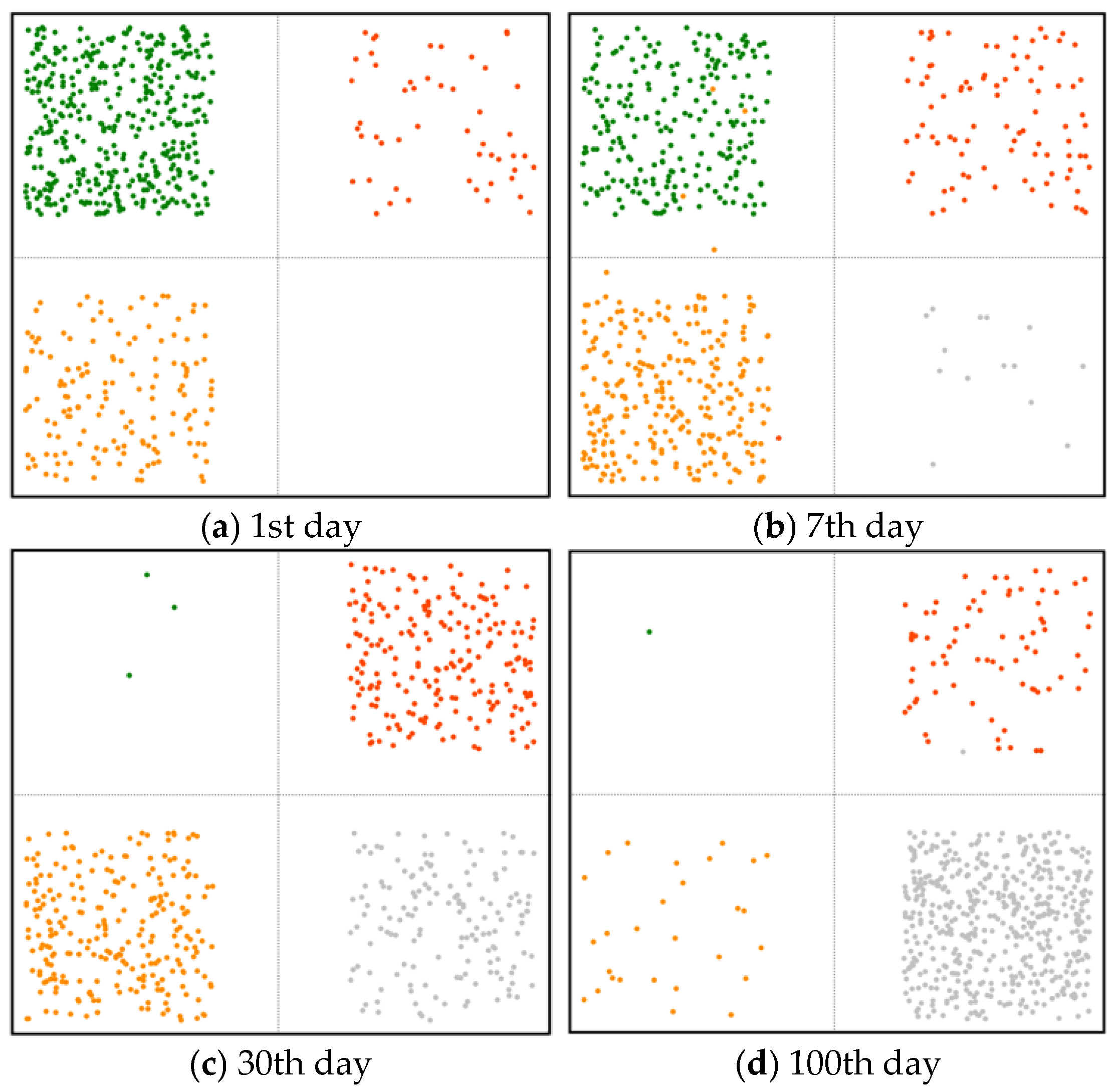
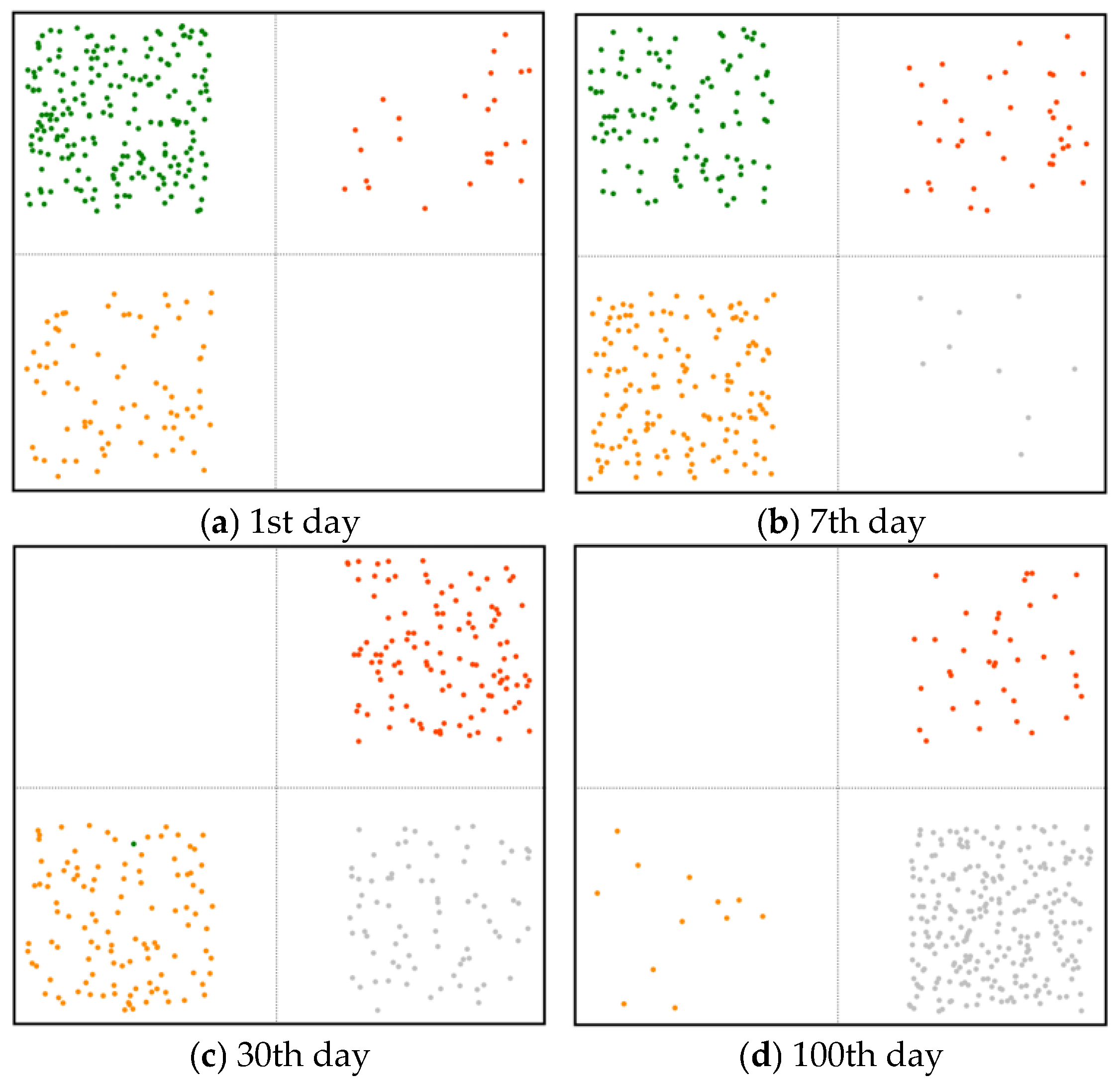
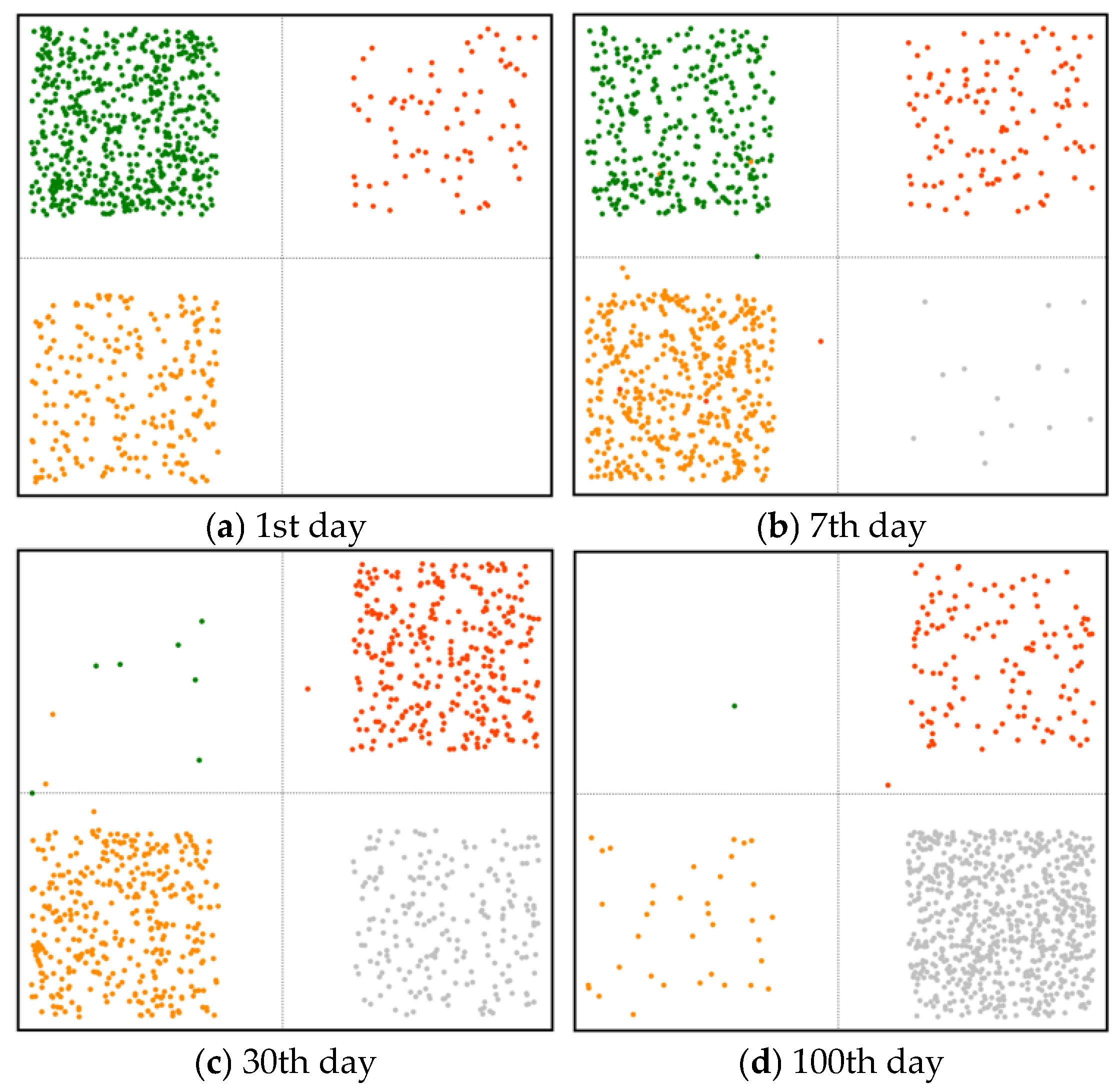
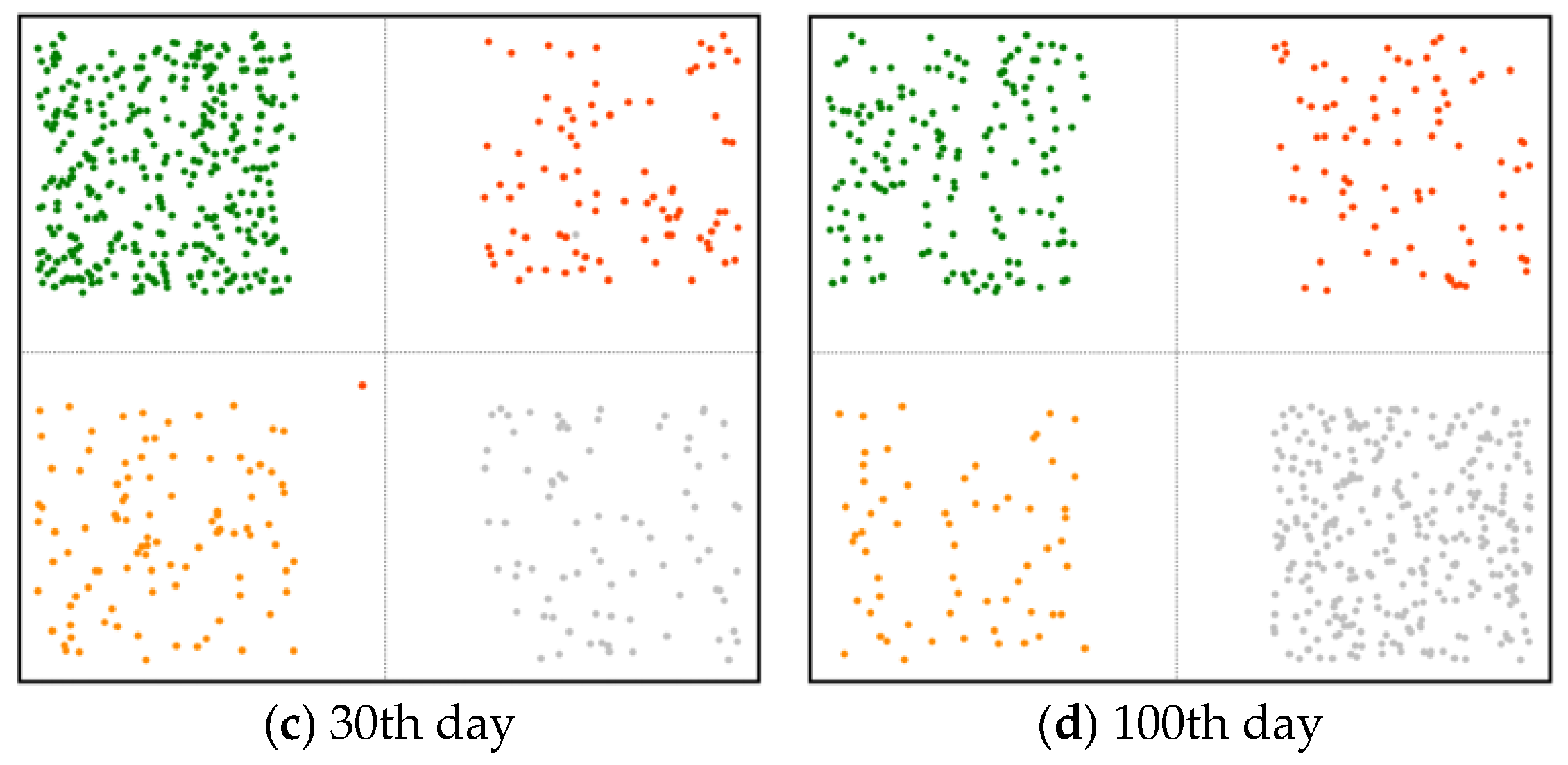
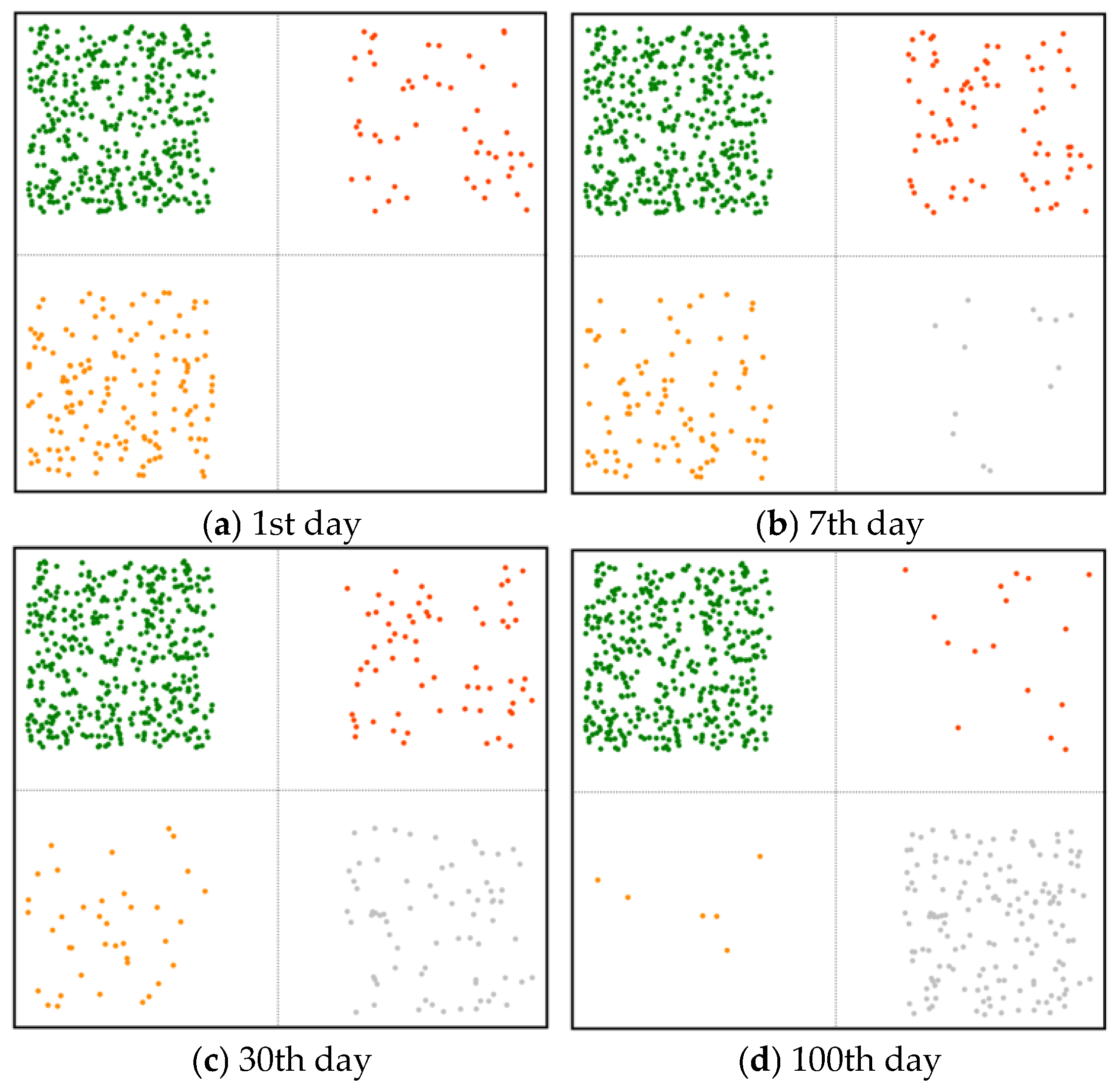
The quantity of agents can accurately capture the evolving trend of each agent type as the model runs. The simulation animation then allows for the visualization of the agent’s actions in the platform. Therefore, we give the simulation experiment results containing the change in actions (Figure 2, Figure 3 and Figure 4). In the simulation visualization, different agent types are represented by distinct colors: loyalists in green, centrists in yellow, oppositionists in red, and expelled users in gray. These color codes are consistently used throughout all figures.
Due to the long animation process of the model, it is impossible to give the whole animation process. We combine the above observations and give the model simulation effect with the time nodes of day 1, day 7, day 30, and day 100, as shown in Figure 2, Figure 3 and Figure 4.
The action processes of the agents within the platform are illustrated in Figure 2, Figure 3 and Figure 4. Agents of the same type tend to congregate together. The green agents cluster in the loyalist area, the yellow agents in the centrist area, and the red agents in the opposition area. The gray agents represent the expellee area. The experimental results indicate the variation trends in the quantity of the four agent types:
  • On day 1, the number relationship of all four types of agents was maintained 8:3:1:0.
  • On day 7, the centrist agents surpassed the loyalist agents, the centrist process had an upward trend, and the loyalist process had a decreasing trend.
  • On day 30, the number of opposition agents reached the maximum, and the centrist agents showed a decreasing trend.
  • From day 30 to the end, the number of loyalists, centrists, and opposition agents showed a decreasing trend. The number of expelled agents steadily increases to the maximum.

3.1.3. Experiments Result

Based on the aforementioned simulation experiments, the following conclusions can be drawn:
  • Across simulation scenarios with varying sample sizes, the experimental results of the model remain highly consistent, demonstrating its good stability and generalizability.
  • Communities lacking standardized governance will struggle to maintain healthy development, ultimately descending into a detrimental state due to user attrition and heightened group polarization.

3.2. Sensitivity Analysis Experiment

When a model is constructed, parameters that have a greater impact on the model results can be identified by sensitivity analysis. The easiest way is to constantly change the parameter values to experiment with the appropriate parameter value [46]. Sensitivity analysis has been widely used by researchers, such as in food safety [47], chemical models [48], biomedicine [49], and building performance analysis [50].
Many factors affect platform loyalty in this paper, such as agent status, user stickiness, action preferences, and platform regulation. However, most of the factors are necessary for the model to run. By comparison, platform regulation is an external intervention imposed on the agent group. It can not only independently influence the output results of the model but also serve as the only core parameter responsible for the regulatory function in the model.

3.2.1. Parameter Setting and Algorithm

The parameter chosen for the sensitivity analysis of this experiment was the emergency online document platform regulation strength (CR), while the values of the other parameters in the model remain constant in Table 1. In addition, the initial sample size of the model was 600 ( S u m 0 = 600 ), and the time was 100 days to keep the data stable and the model running speed. We created the platform loyalty metric set to collect the experimental results generated during each model run to obtain the expected experimental data. The specific algorithm is shown in Algorithm 1.
Algorithm 1 Sensitivity Analysis
Input   parameter :   C R , M i n , M a x , L , T
initialize   min = 0.05 , max = 1 , C R = min , L = 0.1 , T = mod e l t i m e
if   C R < max then
clear the previous experiments data and cure.
get   C L I t ¯   and   time ,   Plot   C L I t ¯ time curve.
C R C R + L
else break
Output Sensitivity analysis data and cure
The purpose of Algorithm 1 is to obtain the platform loyalty corresponding to CR at different parameter values. The CR is taken as the min value at the beginning of the experiment, and the critical experimental data time and C L I t ¯ are obtained as the model is run. The collected data for that time are saved in the set, and a line time plot is plotted. When the round of experiments ends, the CR value is increased by a step L from the original one and compared with the maximum value. If CR < max, the above process is repeated; if CR > max, the experiment is ended.

3.2.2. Experimental Results

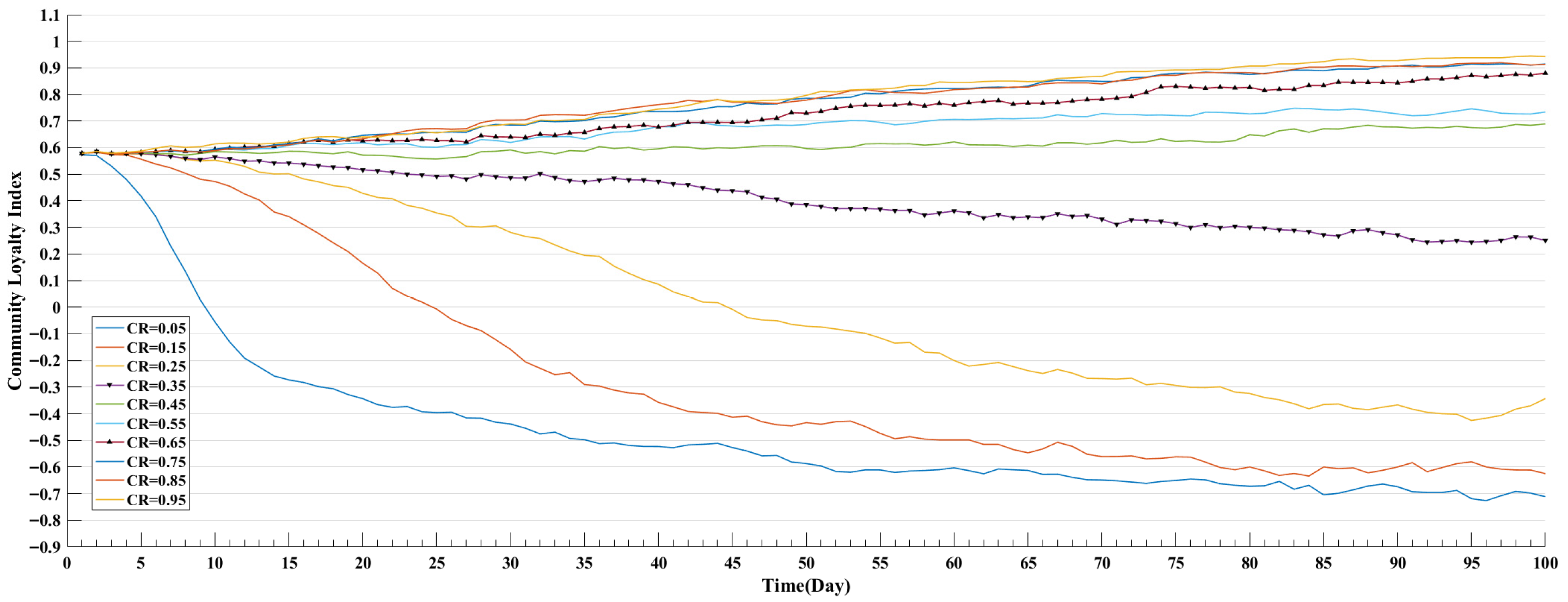
Sensitivity analysis experiments were conducted for ten simulations with different CR values, and each experimental curve and data were recorded. The experimental results are shown in Figure 5 and Table 2.
Detailed data from the sensitivity analysis experiments are presented in Table 2. Given the excessive volume of the experimental dataset, we extracted data points corresponding to specific time nodes (1, 7, 21, 30, 50, 75, and 100) for subsequent analysis. Through comparison, the selected time node values are consistent with the trend in Figure 5.
As seen in Figure 5, the platform loyalty metric gradually stabilizes at a determined value over time, regardless of the change in the value of CR. When the intensity of platform regulation gradually increases, the platform loyalty metric also gradually increases.
As shown in Table 2, when the CR is increased to above 0.35, the platform loyalty metric stabilizes within the non-negative range. When CR reaches 0.45, the growth of the metrics tends to level off, though it still maintains an upward trend. If regulation is further intensified to CR ≥ 0.75, the loyalty metric not only rises significantly but also consistently exceeds the baseline level for 50 days after the simulation ends.

3.2.3. Experiment Analysis

The evaluation of platform regulation intensity in section III-E relies on three combined factors: C L I t ¯ , CR, and CP. Accordingly, the global effect of the model can be analyzed by integrating these three factors using Equation (20).
The most important thing that communities value is the loyalty metric related to the platform’s health. However, too much regulation will bring cost problems. Therefore, we specify that W1 = 0.8 and W2 = 0.8. In addition, we observe the final regulation result, and so   C L I t ¯ takes the value at the end of the model, i.e., t = 100. CR takes the corresponding value.
We are surprised to find the following:
  • When 0.25 ≥ CR ≥ 0.05, CP increases as platform regulation increases, but the result is still negative. The majority of the population transforms into opponents at this time, which is related to the platform’s environment. The benefits of management efforts are not as great as the losses caused by vicious events, which reduce the effectiveness of platform management.
  • When 0.35 ≥ CR ≥ 0.75, CP increases rapidly as platform regulation increases, and the result is positive. The benefits of the platform to the group are causing more and more people to transform into loyalists, and the growing loyalty metric covers the cost of platform regulation.
  • When CR ≥ 0.85, CP falls again instead. The population state has been stable, even if a further increase in regulation does not produce better results, but instead reduces the overall performance because of the cost.
The sensitivity analysis reveals the following:
(1)
Within the range of experimental parameters and values set in this study, the platform’s management intensity shows a negative correlation with comprehensive performance. Specifically, when exceeding the optimal range, an increase in management intensity leads to a decline in comprehensive performance.
(2)
The experimental results indicate that when the platform’s regulatory intensity is set at 0.75, the model achieves its peak comprehensive performance, striking an optimal balance between enhancing loyalty and controlling regulatory costs.

3.3. Comparison Experiment

The comparison experiment will be designed by combining the experimental results and conclusions derived from the simulation experiment and the sensitivity analysis experiment. The experiment will fix the sample size of the platform and compare the experimental results by changing the intensity of platform regulation.
The comparison experiment aims to verify whether the conclusions obtained from the sensitivity analysis experiment are reliable in a simulation environment. The experimental format is still presented as the simulation experiment.
To ensure the rigor of the experimental results and eliminate the influence of other parameter variations, the basic parameters in the comparison experiments are kept consistent with those in Table 1, and the initial platform samples are all set to 600 ( S u m 0 ).
The setting of the platform regulation (CR) strength values was then based on the results of the sensitivity analysis experiments. We selected three comparison parameter values for the comparison experiments based on the following:
  • CR = 0.05. At this regulation intensity, the platform eventually becomes chaotic and collapses, which is a great control value.
  • CR = 0.35. At this regulation intensity, the comprehensive performance of the model becomes positive, and the platform develops in a healthy direction.
  • CR = 0.75. At this regulation intensity, the comprehensive performance of the model achieves its maximum value, and the platform is in an optimal state.

3.3.1. Experiment Results

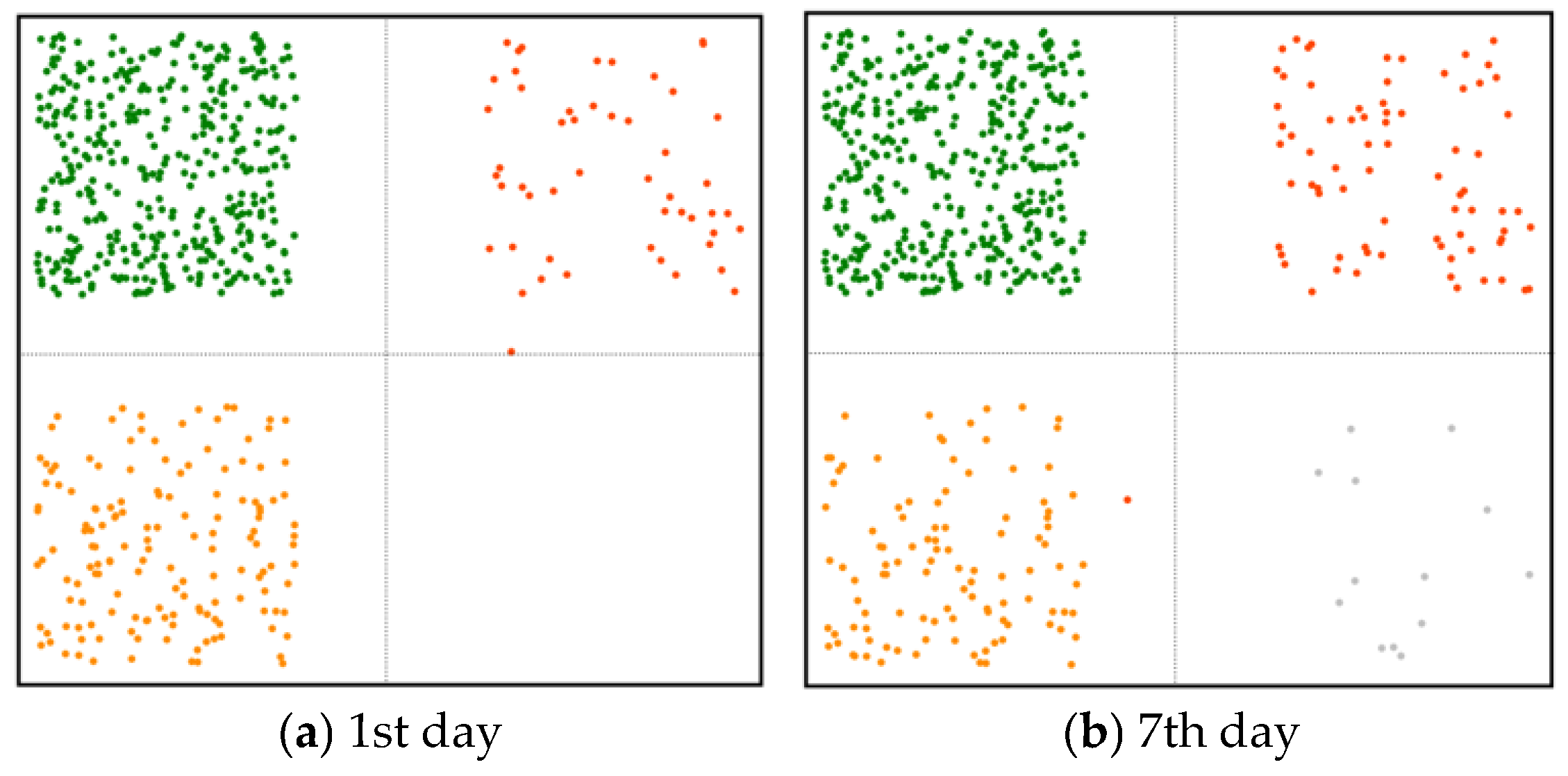
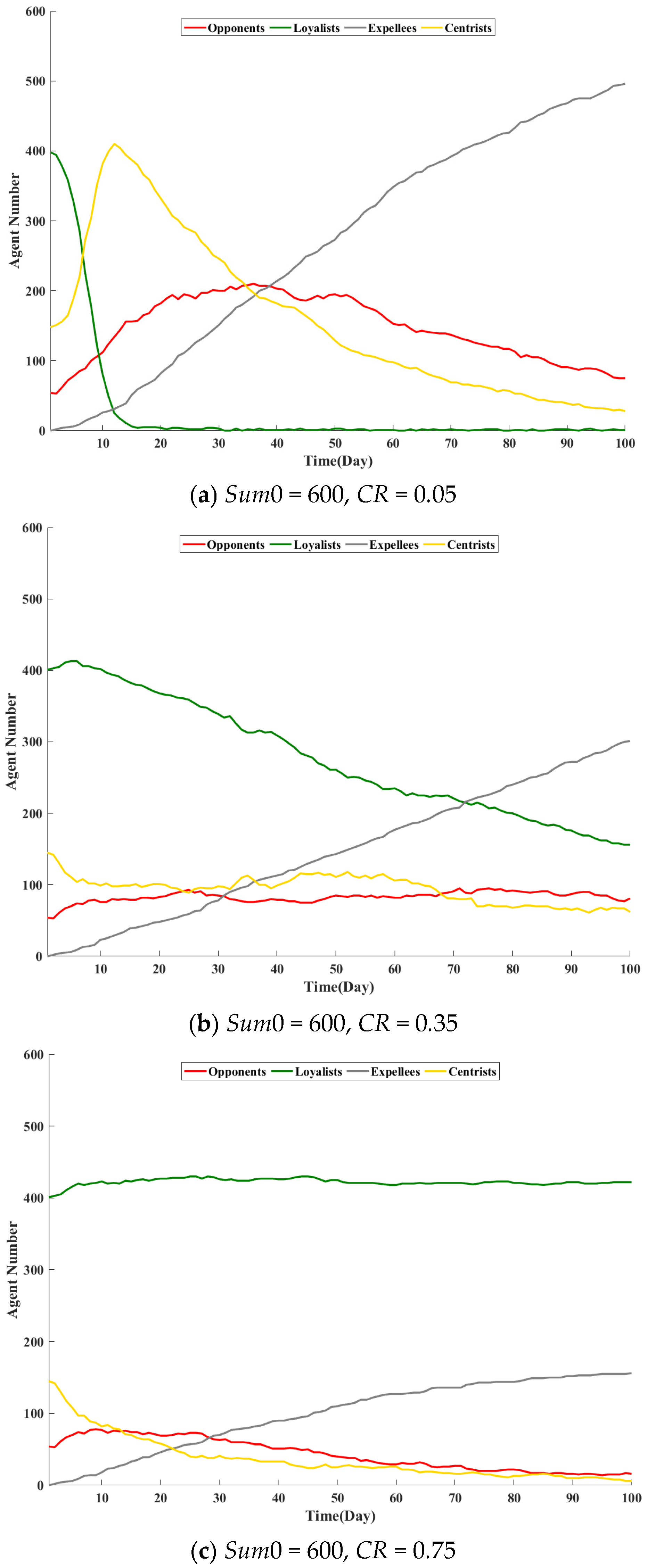
In the comparison experiments, we presented the same graphs of the change in the number of agents (Figure 6) and the change in the agents’ actions (Figure 7, Figure 8 and Figure 9). The agents represented by each curve in Figure 6 are consistent with Figure 3. The colors of the agents in Figure 7, Figure 8 and Figure 9 are also consistent with Figure 2, Figure 3 and Figure 4.
We could observe the following from the intelligent body timeline in Figure:
  • In Figure 6a, the platform regulation intensity is 0.05. The loyalist agents decline rapidly from the start of the model, reaching a minimum around day 15, after which there are only a few inflows of new agents and transfers from the centrist. The centrist agents first experienced a wave of rapid growth, peaking around day 15 and then steadily declining. The opposition agents first grew slowly, plateaued from day 20 to day 50, and declined slowly.
  • In Figure 6b, the platform regulation intensity is 0.35. The loyalist agents grew slowly from the beginning to the top on day five and then showed an overall decreasing trend. The centrist agents had a short period of decline after the beginning and then remained around 100. The opposition agents had a period of growth after the beginning and then maintained a similar trend to the centrist agents until the end.
  • In Figure 6c, the platform regulation intensity is 0.75. The loyalist agents grew from the beginning and remained within that fluctuation range. The centrist agents were in an overall decreasing trend from the beginning to the end. Oppositionist agents experienced an increase after the beginning and then slowly decreased.
  • The expelled agents in Figure 6a–c showed an increasing trend, but at different rates and with very different final numbers.
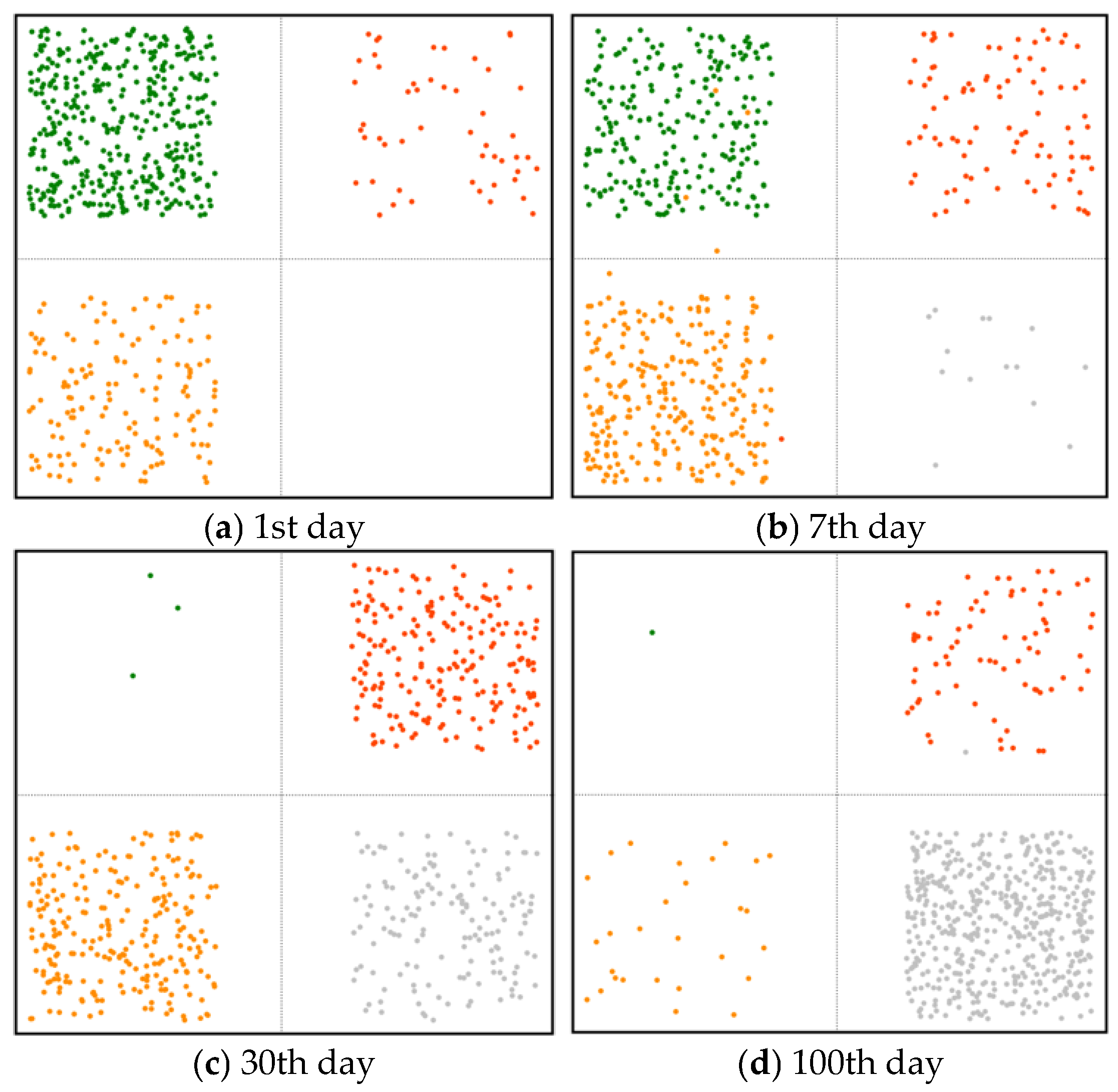
We still sample time nodes for the simulation animation process to highlight the dynamic change process of the agent under different platform control efforts. To highlight the contrast effect, we included the time nodes of day 1, day 7, day 30, and day 100, as shown in Figure 7, Figure 8 and Figure 9.
The experimental results in Figure 7, Figure 8 and Figure 9 show that the activity status of the agents is consistent with the curve changes in Figure 6. We can see more intuitively that the number of loyalist agents increases significantly at the same time point when the platform regulation is increasing. The number of centrists, opponents, and expellees is significantly lower.

3.3.2. Experiment Analysis

By comparing the experimental results of the experiments, we found the following:
  • When the platform sample is constant, different platform regulation intensities will significantly impact the agents’ actions.
  • When the platform sample is constant, and the platform regulation intensity gradually increases, the agents will develop in a better direction.
  • When the platform regulation intensity is 0.35, the CP value is positive at this time. Nevertheless, it can be seen in the experimental results that the platform is still developing in a dangerous direction at this time. We could conclude the following from the comparative experiments.
  • When the platform regulation intensity is at a low level (0.05), due to the lack of effective intervention in the spread of vicious events and negative loyalty contagion, the loyalist group exhibits a continuous attenuation trend, and the system gradually presents characteristics of disorderly evolution. When the platform regulation intensity is 0.35, the number of loyalists tends to stabilize after initial fluctuating adjustments, and the risk of system collapse is effectively curbed. When the regulation intensity is further increased to the optimal threshold (0.75), the loyalist group not only exhibits a growth trend at the initial stage of evolution but also maintains a dominant position in the long term.
(1)
The comparative experiment verifies that the data obtained from the sensitivity analysis experiment are accurate.
(2)
Taking only the regulation strength when CP is positive cannot make the platform healthy and long-lasting.
(3)
Proactive platform regulation can significantly enhance individual user stickiness to break the transmission chain of negative loyalty attenuation, thereby effectively curbing the trend of system disorder.

4. Discussion

This study is grounded in the perspective of micro-social behavior and constructs a group loyalty propagation and regulation model for emergency document systems based on user stickiness. Through multi-agent simulation and systematic sensitivity analysis, the following core conclusions are drawn:
(1)
The model demonstrates good validity and robustness: Simulation results indicate that the model can stably reproduce the dynamic evolution of user loyalty in emergency document systems. Under various initial parameter settings, the model consistently exhibits the same behavioral trend: without effective external regulation, user loyalty continuously declines, and the system tends toward disorder; however, once appropriate regulation mechanisms are introduced, the system state can be effectively guided and restored to a healthy range. This validates the rationality of the model’s structural design and the reliability of its simulation outputs.
(2)
User stickiness serves as the micro-foundation for system loyalty formation: The simulation process reveals that user stickiness characteristics at the individual level—such as usage habits, satisfaction, and task dependency—can significantly influence the overall loyalty level of the system through interaction and diffusion within the collaborative network. This finding confirms that in task-oriented information systems like emergency document platforms, enhancing individual user stickiness is fundamental to maintaining collaborative activity and collective loyalty.
(3)
There exists an optimal threshold for active system regulation intensity: Sensitivity analysis results show that the relationship between platform (system) regulation intensity and comprehensive system performance (balancing steady-state loyalty levels and regulation cost control) is not a simple linear positive correlation. Specifically, we have the following:
-
When regulation intensity is within a low range, the system evolves in a laissez-faire manner, with loyalty levels continuously declining.
-
When regulation intensity is within a moderate range, the system can achieve significant improvements in loyalty levels and long-term stability under reasonable regulatory cost constraints, reaching optimal comprehensive performance.
-
When regulation intensity is excessively high, although higher loyalty levels can be maintained, the marginal benefits of regulation diminish significantly, and it may lead to surging management costs or excessive suppression of user autonomy.
The governance of emergency document systems should focus on seeking the “optimal regulation intensity”, rather than maximizing intervention, to achieve sustainable system health and collaborative efficiency. This study still has certain limitations. The current model’s representation of user heterogeneity and complex social networks remains relatively simplified. Future work will consider incorporating richer agent types and more complex network structures to more accurately reflect interactive relationships in emergency scenarios. This paper assumes that information demand remains stable and that new users initially all belong to the loyalist category. While these assumptions help focus on the core mechanisms, they may not fully capture the drastic fluctuations in information demand during crisis response or the diversity of user motivations. Future research could introduce dynamic information demand modules and positive incentive feedback, and consider heterogeneous initial states for new users.

Author Contributions

Conceptualization, Y.F.; methodology, Y.F.; writing—review and editing, Y.F.; supervision, Y.S.; project administration and funding acquisition, Y.S.; investigation, Y.F. All authors have read and agreed to the published version of the manuscript.

Funding

Supported by the Humanities and Social Sciences Planning Project of the Ministry of Education, “A Study on the Enhancement Mechanism of Emergency Decision-Making Quality Empowered by AIGC in Human–Machine Collaboration (NO.24YJA630080)”. Supported by the Shanghai Municipal Government Decision-Making Consultation Project, “Research on the Governance of Generative Artificial Intelligence (AIGC) Pollution in Chinese Internet (NO.2023-JD-G08)”.

Data Availability Statement

Data are contained within the article.

Conflicts of Interest

The authors declare no conflicts of interest.

References

  1. Cutter, S.L. The origin and diffusion of the social vulnerability metrics (SoVI). Int. J. Disaster Risk Reduct. 2024, 109, 104576. [Google Scholar] [CrossRef]
  2. Dai, J.; Azhar, A. Collaborative governance in disaster management and sustainable development. Public Adm. Dev. 2024, 44, 358–380. [Google Scholar] [CrossRef]
  3. Fei, L.; Li, T.; Ding, W. Dempster–Shafer theory-based information fusion for natural disaster emergency management: A systematic literature review. Inf. Fusion 2024, 112, 102585. [Google Scholar] [CrossRef]
  4. Albahri, A.S.; Khaleel, Y.L.; Habeeb, M.A.; Ismael, R.D.; Hameed, Q.A.; Deveci, M.; Homod, R.Z.; Albahri, O.S.; Alamoodi, A.H.; Alzubaidi, L. A systematic review of trustworthy artificial intelligence applications in natural disasters. Comput. Electr. Eng. 2024, 118, 109409. [Google Scholar] [CrossRef]
  5. Daume, S. Online misinformation during extreme weather emergencies: Short-term information hazard or long-term influence on climate change perceptions? Environ. Res. Commun. 2024, 6, 022001. [Google Scholar] [CrossRef]
  6. Shah, S.S.; Shah, A.A.; Memon, F.; Kemal, A.A.; Soomro, A. Online learning during the COVID-19 pandemic: Applying the self-determination theory in the ‘new normal’. Rev. Psicodidáct. (Engl. Ed.) 2021, 26, 169–178. [Google Scholar] [CrossRef]
  7. Ogie, R.I.; James, S.; Moore, A.; Dilworth, T.; Amirghasemi, M.; Whittaker, J. Social media use in disaster recovery: A systematic literature review. Int. J. Disaster Risk Reduct. 2022, 70, 102783. [Google Scholar] [CrossRef]
  8. Wang, X.; Zhang, C. Constructing the digital ark: How China utilizes shared media to foster online information collaboration and crisis management in public emergency response. Int. J. Disaster Risk Reduct. 2024, 101, 104239. [Google Scholar] [CrossRef]
  9. Li, G.; Kou, G.; Peng, Y. Heterogeneous large-scale group decision making using fuzzy cluster analysis and its application to emergency response plan selection. IEEE Trans. Syst. Man Cybern. Syst. 2022, 52, 3391–3403. [Google Scholar] [CrossRef]
  10. Zhang, X.A.; Sung, Y.H. Communities going virtual: Examining the roles of online and offline social capital in pandemic perceived community resilience-building. Mass Commun. Soc. 2023, 26, 539–565. [Google Scholar] [CrossRef]
  11. Sharif, S.V.; Moshfegh, P.H.; Kashani, H. Simulation modeling of operation and coordination of agencies involved in post-disaster response and recovery. Reliab. Eng. Syst. Saf. 2023, 235, 109219. [Google Scholar] [CrossRef]
  12. Jiang, H.; Zhang, Y.; Guo, W.; Cheng, W.; Peng, J. Online collaborative documents as media logic: The mediatization of risk response in the post-pandemic era. Front. Psychol. 2022, 13, 892569. [Google Scholar] [CrossRef] [PubMed]
  13. Wei, L.; Huang, Q. Retrospecting digital media use, negative emotions, and trust gaps during the COVID-19 pandemic in China: Cross-sectional web-based survey. J. Med. Internet Res. 2024, 26, e49422. [Google Scholar] [CrossRef]
  14. Shan, S.; Su, J.; Li, J.; Li, Y.; Zhou, Z. Harnessing Multi-Modal Synergy: A Systematic Framework for Disaster Loss Consistency Analysis and Emergency Response. Systems 2025, 13, 498. [Google Scholar] [CrossRef]
  15. Al-Omoush, K.S.; Garrido, R.; Cañero, J. The impact of government use of social media and social media contradictions on trust in government and citizens’ attitudes in times of crisis. J. Bus. Res. 2023, 159, 113748. [Google Scholar] [CrossRef]
  16. Revez, A.; Dunphy, N.; Harris, C.; Rogan, F.; Byrne, E.; McGookin, C.; Bolger, P.; Gallachóir, B.Ó.; Barry, J.; Ellis, G.; et al. Mapping emergent public engagement in societal transitions: A scoping review. Energy Sustain. Soc. 2022, 12, 2. [Google Scholar] [CrossRef] [PubMed]
  17. Lyu, S.; Gao, G.; Lee, C.-H.; Sun, L.; Xu, N.; Qian, C. Collective rescue: Why the government can collaborate with the public during extreme precipitation. Water 2023, 15, 2848. [Google Scholar] [CrossRef]
  18. Baraldo, M.; Di Franco, P.D.G. Place-centred emerging technologies for disaster management: A scoping review. Int. J. Disaster Risk Reduct. 2024, 112, 104782. [Google Scholar] [CrossRef]
  19. Zhu, R.; Hu, X. The public needs more: The informational and emotional support of public communication amidst the COVID-19 in China. Int. J. Disaster Risk Reduct. 2023, 84, 103469. [Google Scholar] [CrossRef]
  20. Reynolds, C.W. Flocks, herds and schools: A distributed behavioral model. In Proceedings of the 14th Annual Conference on Computer Graphics and Interactive Techniques (SIGGRAPH ‘87), Anaheim, CA, USA, 27–31 July 1987; pp. 25–34. [Google Scholar]
  21. Hoogendoorn, S.; Bovy, P. Pedestrian route-choice and activity scheduling theory and models. Transp. Res. Part B Methodol. 2004, 38, 169–190. [Google Scholar] [CrossRef]
  22. Hughes, R.L. The flow of human crowds. Annu. Rev. Fluid Mech. 2003, 35, 169–182. [Google Scholar] [CrossRef]
  23. Helbing, D.; Molnár, P. Social force model for pedestrian dynamics. Phys. Rev. E 1995, 51, 4282–4286. [Google Scholar] [CrossRef]
  24. Lerner, A.; Chrysanthou, Y.; Shamir, A.; Cohen-Or, D. Data driven evaluation of crowds. In Motion in Games; Springer: Berlin/Heidelberg, Germany, 2009; pp. 75–83. [Google Scholar]
  25. Chen, L.; Gao, M. A new learning interaction rule for municipal household waste classification behavior based on multi-agent-based simulation. J. Clean. Prod. 2020, 271, 122654. [Google Scholar] [CrossRef]
  26. Ahmad, I.S.; Sun, S.; Boufama, B. Agent-based crowd simulation modeling in a gaming environment. In Proceedings of the 2018 6th International Conference on Multimedia Computing and Systems (ICMCS), Rabat, Morocco, 10–12 May 2018; pp. 1–6. [Google Scholar]
  27. Xue, J.; Zhang, M.; Xu, M. Modeling the impact of social distancing on the COVID-19 pandemic in a low transmission setting. IEEE Trans. Comput. Soc. Syst. 2021, 8, 830–839. [Google Scholar] [CrossRef]
  28. Goyal, T.; Dutta, K. Website stickiness: Role of customer value, satisfaction, trust and habit. Int. J. Technol. Mark. 2021, 15, 426–445. [Google Scholar] [CrossRef]
  29. Khalifa, M.; Limayem, M.; Liu, V. Online customer stickiness. J. Glob. Inf. Manag. 2002, 10, 14. [Google Scholar] [CrossRef]
  30. Zhang, M.; Guo, L.; Hu, M.; Liu, W. Influence of customer engagement with company social networks on stickiness: Mediating effect of customer value creation. Int. J. Inf. Manag. 2017, 37, 229–240. [Google Scholar] [CrossRef]
  31. Sun, Y. Customer stickiness evaluation model research based on machine learning. In Lecture Notes in Electrical Engineering; Springer: Singapore, 2022; pp. 522–527. [Google Scholar]
  32. Xu, F.; Qi, Y.; Li, X. What affects the user stickiness of the mainstream media websites in china? Electron. Commer. Res. Appl. 2018, 29, 124–132. [Google Scholar] [CrossRef]
  33. Rong, K.; Xiao, F.; Zhang, X.; Wang, J. Platform strategies and user stickiness in the online video industry. Technol. Forecast. Soc. Change 2019, 143, 249–259. [Google Scholar] [CrossRef]
  34. Li, Y.; Li, X.; Cai, J. How attachment affects user stickiness on live streaming platforms: A socio-technical approach perspective. J. Retail. Consum. Serv. 2021, 60, 102478. [Google Scholar] [CrossRef]
  35. Pang, H.; Zhang, K. How multidimensional benefits determine cumulative satisfaction and eWOM engagement on mobile social media: Reconciling motivation and expectation disconfirmation perspectives. Telemat. Inform. 2024, 93, 102174. [Google Scholar] [CrossRef]
  36. Chew, Y.C.; Mohamed Zainal, S.R. A sustainable collaborative talent management through collaborative intelligence mindset theory: A systematic review. SAGE Open 2024, 14, 21582440241261851. [Google Scholar] [CrossRef]
  37. McDonnell, S.; Ghorbani, P.; Wolf, C.; Cruz, M.J.; Burgy, D.M.; Desai, S.; Berkovits, D.; Silberblatt, R. A managed-participatory approach to community resilience: The case of the New York rising community reconstruction program. Am. Rev. Public Adm. 2019, 49, 309–324. [Google Scholar] [CrossRef]
  38. Li, Y.; Peng, L.; Sang, Y.; Gao, H. The characteristics and functionalities of citizen-led disaster response through social media: A case study of the #HenanFloodsRelief on Sina Weibo. Int. J. Disaster Risk Reduct. 2024, 106, 104419. [Google Scholar]
  39. Xue, J.; Zhang, M. Metaverse Community Group Loyalty Contagion and Regulation Model Based on User Stickiness. In Proceedings of the 2023 IEEE Conference on Virtual Reality and 3D User Interfaces Abstracts and Workshops (VRW), Shanghai, China, 25–29 March 2023; pp. 979–984. [Google Scholar]
  40. Zhou, H.; Song, Q.; Lian, J.C.; Liu, Y.M. Towards Standardizing Validation Practices in Agent-Based Modeling: A Hierarchical ABM Validation Framework. ACM Trans. Model. Comput. Simul. 2026, 36, 4. [Google Scholar] [PubMed]
  41. Qian, G.; Mahdi, A. Sensitivity analysis methods in the biomedical sciences. Math. Biosci. 2020, 323, 108306. [Google Scholar] [CrossRef] [PubMed]
  42. Pang, Z.; O’Neill, Z.; Li, Y.; Niu, F. The role of sensitivity analysis in the building performance analysis: A critical review. Energy Build. 2020, 209, 109659. [Google Scholar] [CrossRef]
  43. Wooldridge, M.; Jennings, N.R. Intelligent agents: Theory and practice. Knowl. Eng. Rev. 1995, 10, 115–152. [Google Scholar] [CrossRef]
  44. Cossío-Silva, F.-J.; Revilla-Camacho, M.-A.; Vega-Vázquez, M. The tourist loyalty metric: A new metrics for measuring tourist destination loyalty? J. Innov. Knowl. 2019, 4, 71–77. [Google Scholar] [CrossRef]
  45. Xue, J.; Yin, H.; Lv, P.; Xu, M.; Li, Y. Crowd queuing simulation with an improved emotional contagion model. Sci. China Inf. Sci. 2019, 62, 44201. [Google Scholar] [CrossRef]
  46. Hamby, D.M. A review of techniques for parameter sensitivity analysis of environmental models. Environ. Monit. Assess. 1994, 32, 135–154. [Google Scholar] [CrossRef] [PubMed]
  47. Frey, H.C.; Patil, S.R. Identification and review of sensitivity analysis methods. Risk Anal. 2002, 22, 553–578. [Google Scholar] [CrossRef] [PubMed]
  48. Saltelli, A.; Ratto, M.; Tarantola, S.; Campolongo, F. Sensitivity analysis for chemical models. Chem. Rev. 2005, 105, 2811–2828. [Google Scholar] [CrossRef] [PubMed]
  49. Lindell, M.K.; Perry, R.W. The protective action decision model: Theoretical modifications and additional evidence. Risk Anal. 2012, 32, 616–632. [Google Scholar] [CrossRef]
  50. Smith, K.R.; Grant, S.; Thomas, R.E. Testing the public’s response to receiving severe flood warnings using simulated cell broadcast. Nat. Hazards 2022, 112, 1611–1631. [Google Scholar] [CrossRef]
Figure 1. Agent transformation mechanism.
Systems 14 00268 g001
Figure 2. S u m 0 = 300 ,   C R = 0.05 .
Systems 14 00268 g002
Figure 3. S u m 0 = 600 ,   C R = 0.05 .
Systems 14 00268 g003
Figure 4. S u m 0 = 900 ,   C R = 0.05 .
Systems 14 00268 g004
Figure 5. Sensitivity analysis diagram. A line graph of the platform loyalty metric for different CR values is plotted in the Figure. Two curves with significant changes are marked, i.e., CR = 0.35 and CR = 0.65.
Systems 14 00268 g005
Figure 6. Agent number time graph.
Systems 14 00268 g006
Figure 7. S u m 0 = 600 ,   C R = 0.05 .
Systems 14 00268 g007
Figure 8. S u m 0 = 600 ,   C R = 0.35 .
Systems 14 00268 g008aSystems 14 00268 g008b
Figure 9. S u m 0 = 600 ,   C R = 0.75 .
Systems 14 00268 g009
Table 1. Experiment parameters.
Parameter Meaning ValueParameter Meaning ValueParameter Meaning Value
S um 0 Initial total populationV Sum0
A g e n t l 0 : A g e n t c 0 : A g e n t o 0 Agent initial ratio8:3:1
n Population inflow per unit time1
α c Loyalist to centrist rate0.10
α o Loyalist to opponent rate0.05
β l Centrist to loyalist rate0.05
β 0 Centrist to opponent rate0.1
γ e Opponent to expelled rate0.2
E v e n t v i c i o u s Initial vicious events1
w 1 : w 2 : w 3 Weighting ratio of Equation (16)4:3:3
Table 2. Sensitivity analysis experimental data.
Time (Days) C R 0.05 C R 0.15 C R 0.025 C R 0.35 C R 0.45 C R 0.55 C R 0.65 C R 0.75 C R 0.85 C R 0.95
C L I 1 ¯ 0.57330.57830.57830.57830.57830.57830.57830.57830.57830.5783
C L I 7 ¯ 0.23040.52390.56920.56730.57750.58770.58940.58940.59110.6065
C L I 14 ¯ −0.25850.35790.50090.54240.58100.59690.60530.60950.60600.6162
C L I 21 ¯ −0.36590.12820.41260.51270.57120.61040.62880.64970.64550.6396
C L I 30 ¯ −0.4388−0.15900.28080.48660.59130.61940.63990.68490.70360.6893
C L I 50 ¯ −0.5872−0.4336−0.07160.38510.59660.68700.72950.78570.77870.7967
C L I 75 ¯ −0.6508−0.5619−0.29390.31380.62300.72060.83040.87960.87200.8922
C L I 100 ¯ −0.7115−0.6250−0.34310.25080.68930.73400.88000.91440.91290.9424
Disclaimer/Publisher’s Note: The statements, opinions and data contained in all publications are solely those of the individual author(s) and contributor(s) and not of MDPI and/or the editor(s). MDPI and/or the editor(s) disclaim responsibility for any injury to people or property resulting from any ideas, methods, instructions or products referred to in the content.