How Dynamic Capabilities and Ambidextrous Learning Shape SME Innovation Performance: The Moderating Role of Exploratory and Exploitative Learning

Abstract
1. Introduction
2. Literature Review
2.1. Dynamic Capabilities Theory
2.2. A Dynamic Capabilities Perspective on Firm Innovation
2.3. Ambidextrous Learning Theory
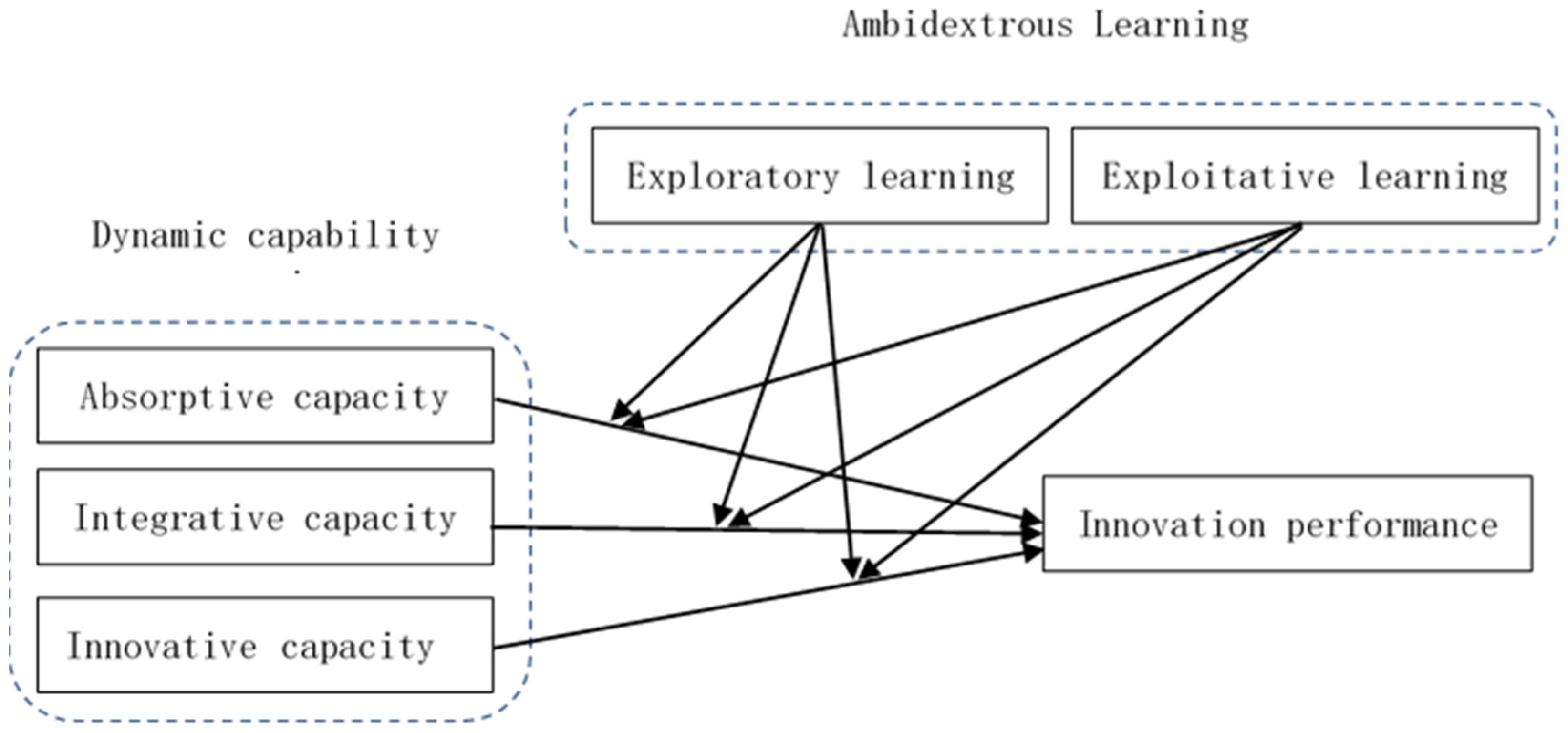
3. Theoretical Framework and Research Hypotheses
3.1. Dynamic Capabilities and Innovation Performance
3.2. The Moderating Role of Ambidextrous Learning
3.2.1. The Moderating Role of Exploratory Learning
3.2.2. The Moderating Role of Exploitative Learning
4. Research Design
4.1. Data Sources and Sample Description
4.2. Scale Design
4.3. Analytical Strategy
5. Data Analysis
5.1. Reliability and Validity Tests
5.2. Descriptive Statistics and Correlation Analysis
5.3. Hierarchical Regression Analysis
5.4. Robustness Test
6. Discussion
6.1. Differential Roles of Dynamic Capability Dimensions
6.2. Ambidextrous Learning as a Conditioning Factor
6.3. Theoretical and Managerial Implications
6.4. Limitations and Future Research
7. Conclusions
Author Contributions
Funding
Institutional Review Board Statement
Informed Consent Statement
Data Availability Statement
Conflicts of Interest
References
- Cinar, E.; Demircioglu, M.A.; Acik, A.C.; Simms, C. Public sector innovation in a city state: Exploring innovation types and national context in Singapore. Res. Policy 2024, 53, 104915. [Google Scholar] [CrossRef]
- Li, B.; Teece, D.J.; Baskaran, A.; Chandran, V.G.R. Dynamic Knowledge Management: A dynamic capabilities approach to knowledge management. Technovation 2025, 147, 103316. [Google Scholar] [CrossRef]
- Teece, D.J. A dynamic capabilities-based entrepreneurial theory of the multinational enterprise. J. Int. Bus. Stud. 2014, 45, 8–37. [Google Scholar] [CrossRef]
- Hewitt-Dundas, N. Resource and capability constraints to innovation in small and large plants. Small Bus. Econ. 2006, 26, 257–277. [Google Scholar] [CrossRef]
- Barreto, I. Dynamic capabilities: A review of past research and an agenda for the future. J. Manag. 2010, 36, 256–280. [Google Scholar] [CrossRef]
- Schilke, O. On the contingent value of dynamic capabilities for competitive advantage: The nonlinear moderating effect of environmental dynamism. Strateg. Manag. J. 2014, 35, 179–203. [Google Scholar] [CrossRef]
- March, J.G. Exploration and exploitation in organizational learning. Organ. Sci. 1991, 2, 71–87. [Google Scholar] [CrossRef]
- Luo, Y. Dynamic capabilities in international expansion. J. World Bus. 2000, 35, 355–378. [Google Scholar] [CrossRef]
- Barney, J. Firm resources and sustained competitive advantage. J. Manag. 1991, 17, 99–120. [Google Scholar] [CrossRef]
- Teece, D.J. Explicating dynamic capabilities: The nature and microfoundations of (sustainable) enterprise performance. Strateg. Manag. J. 2007, 28, 1319–1350. [Google Scholar] [CrossRef]
- Teece, D.J.; Pisano, G.; Shuen, A. Dynamic capabilities and strategic management. Strateg. Manag. J. 1997, 18, 509–533. [Google Scholar] [CrossRef]
- Eisenhardt, K.M.; Martin, J.A. Dynamic capabilities: What are they? In The SMS Blackwell Handbook of Organizational Capabilities; Blackwell Publishing Ltd.: Oxford, UK, 2017; pp. 341–363. [Google Scholar]
- Zahra, S.A.; George, G. Absorptive capacity: A review, reconceptualization, and extension. Acad. Manag. Rev. 2002, 27, 185–203. [Google Scholar] [CrossRef]
- Wang, C.L.; Ahmed, P.K. Dynamic capabilities: A review and research agenda. Int. J. Manag. Rev. 2007, 9, 31–51. [Google Scholar] [CrossRef]
- Cohen, W.M.; Levinthal, D.A. Absorptive capacity: A new perspective on learning and innovation. Adm. Sci. Q. 1990, 35, 128–152. [Google Scholar] [CrossRef]
- Grant, R.M. Toward a knowledge-based theory of the firm. Strateg. Manag. J. 1996, 17, 109–122. [Google Scholar] [CrossRef]
- Lawson, B.; Samson, D. Developing innovation capability in organisations: A dynamic capabilities approach. Int. J. Innov. Manag. 2001, 5, 377–400. [Google Scholar] [CrossRef]
- Vossen, R.W. Relative strengths and weaknesses of small firms in innovation. Int. Small Bus. J. 1998, 16, 88–94. [Google Scholar] [CrossRef]
- Teece, D.J. Routines versus Entrepreneurial Action. J. Manag. Stud. 2012, 49, 1395–1401. [Google Scholar] [CrossRef]
- Helfat, C.E.; Peteraf, M.A. Managerial cognitive capabilities and the microfoundations of dynamic capabilities. Strateg. Manag. J. 2015, 36, 831–850. [Google Scholar] [CrossRef]
- Volberda, H.W.; Foss, N.J.; Lyles, M.A. Perspective—Absorbing the concept of absorptive capacity: How to realize its potential in the organization field. Organ. Sci. 2010, 21, 931–951. [Google Scholar] [CrossRef]
- De Luca, L.M.; Atuahene-Gima, K. Market knowledge dimensions and cross-functional collaboration: Examining the different routes to product innovation performance. J. Mark. 2007, 71, 95–112. [Google Scholar] [CrossRef]
- Zhou, K.Z.; Wu, F. Technological capability, strategic flexibility, and product innovation. Strateg. Manag. J. 2010, 31, 547–561. [Google Scholar] [CrossRef]
- Drnevich, P.L.; Kriauciunas, A.P. Clarifying the conditions and limits of the contributions of ordinary and dynamic capabilities to relative firm performance. Strateg. Manag. J. 2011, 32, 254–279. [Google Scholar] [CrossRef]
- Levinthal, D.A.; March, J.G. The myopia of learning. Strateg. Manag. J. 1993, 14, 95–112. [Google Scholar] [CrossRef]
- Jansen, J.J.; Van Den Bosch, F.A.; Volberda, H.W. Exploratory innovation, exploitative innovation, and performance: Effects of organizational antecedents and environmental moderators. Manag. Sci. 2006, 52, 1661–1674. [Google Scholar] [CrossRef]
- Laursen, K.; Salter, A. Open for innovation: The role of openness in explaining innovation performance among UK manufacturing firms. Strateg. Manag. J. 2006, 27, 131–150. [Google Scholar] [CrossRef]
- He, Z.L.; Wong, P.K. Exploration vs. exploitation: An empirical test of the ambidexterity hypothesis. Organ. Sci. 2004, 15, 481–494. [Google Scholar] [CrossRef]
- Atuahene-Gima, K. Resolving the capability–rigidity paradox in new product innovation. J. Mark. 2005, 69, 61–83. [Google Scholar] [CrossRef]
- Schulz, M. The uncertain relevance of newness: Organizational learning and knowledge flows. Acad. Manag. J. 2001, 44, 661–681. [Google Scholar] [CrossRef]
- Leonard-Barton, D. Core capabilities and core rigidities: A paradox in managing new product development. Strateg. Manag. J. 1992, 13, 111–125. [Google Scholar] [CrossRef]
- Easterby-Smith, M.; Prieto, I.M. Dynamic capabilities and knowledge management: An integrative role for learning? Br. J. Manag. 2008, 19, 235–249. [Google Scholar] [CrossRef]
- Cepeda, G.; Vera, D. Dynamic capabilities and operational capabilities: A knowledge management perspective. J. Bus. Res. 2007, 60, 426–437. [Google Scholar] [CrossRef]
- Wang, C.L.; Senaratne, C.; Rafiq, M. Success traps, dynamic capabilities and firm performance. Br. J. Manag. 2015, 26, 26–44. [Google Scholar] [CrossRef]
- Kogut, B.; Zander, U. Knowledge of the firm, combinative capabilities, and the replication of technology. Organ. Sci. 1992, 3, 383–397. [Google Scholar] [CrossRef]
- Henderson, R.; Cockburn, I. Measuring competence? Exploring firm effects in pharmaceutical research. Strateg. Manag. J. 1994, 15, 63–84. [Google Scholar] [CrossRef]
- Subramaniam, M.; Youndt, M.A. The influence of intellectual capital on the types of innovative capabilities. Acad. Manag. J. 2005, 48, 450–463. [Google Scholar] [CrossRef]
- Lane, P.J.; Koka, B.R.; Pathak, S. The reification of absorptive capacity: A critical review and rejuvenation of the construct. Acad. Manag. Rev. 2006, 31, 833–863. [Google Scholar] [CrossRef]
- Verona, G. A resource-based view of product development. Acad. Manag. Rev. 1999, 24, 132–142. [Google Scholar] [CrossRef]
- Danneels, E. The dynamics of product innovation and firm competences. Strateg. Manag. J. 2002, 23, 1095–1121. [Google Scholar] [CrossRef]
- Calantone, R.J.; Cavusgil, S.T.; Zhao, Y. Learning orientation, firm innovation capability, and firm performance. Ind. Mark. Manag. 2002, 31, 515–524. [Google Scholar] [CrossRef]
- Sitkin, S.B.; Sutcliffe, K.M.; Schroeder, R.G. Distinguishing control from learning in total quality management: A contingency perspective. Acad. Manag. Rev. 1994, 19, 537–564. [Google Scholar] [CrossRef]
- Benner, M.J.; Tushman, M.L. Exploitation, exploration, and process management: The productivity dilemma revisited. Acad. Manag. Rev. 2003, 28, 238–256. [Google Scholar] [CrossRef]
- Nonaka, I.; Takeuchi, H. The Knowledge-Creating Company: How Japanese Companies Create the Dynamics of Innovation; Oxford University Press: New York, NY, USA, 1995. [Google Scholar]
- Uotila, J.; Maula, M.; Keil, T.; Zahra, S.A. Exploration, exploitation, and financial performance: Analysis of S&P 500 corporations. Strateg. Manag. J. 2009, 30, 221–231. [Google Scholar]
- Jian, Z.; Wang, C.; Chen, J. Strategic Orientation, Dynamic Capabilities and Technological Innovation: The Moderating Role of Environmental Uncertainty. RD Manag. 2015, 27, 65–76. [Google Scholar]
- Rong, J.; Liu, X.; Tong, Z. The Relationship among Knowledge Stock, Ambidextrous Learning, and Enterprise Performance. Ind. Technol. Econ. 2016, 35, 68–74. [Google Scholar]
- Ritter, T.; Gemünden, H.G. The Impact of a Company’s Business Strategy on Its Technological Competence, Network Competence and Innovation Success. J. Bus. Res. 2004, 57, 548–556. [Google Scholar] [CrossRef]
- Atuahene, M.B.; Gonzalez-Padron, T.; Calantone, R.J. An Integrated Marketing Capability Benchmarking Approach to Dealer Performance through Parametric and Nonparametric Analyses. Ind. Mark. Manag. 2010, 39, 150–160. [Google Scholar] [CrossRef]
- Chung, G.; Chapman, M. IBM’s Global CEO Report 2006: Business Model Innovation Matters. Strategy Leadersh. 2006, 34, 34–40. [Google Scholar]
- Pavlou, P.A.; El Sawy, O.A. Understanding the elusive black box of dynamic capabilities. Decis. Sci. 2011, 42, 239–273. [Google Scholar] [CrossRef]
- Aiken, L.S.; West, S.G.; Reno, R.R. Multiple Regression: Testing and Interpreting Interactions; Sage: Thousand Oaks, CA, USA, 1991. [Google Scholar]
- Cohen, J.; Cohen, P.; West, S.G.; Aiken, L.S. Applied Multiple Regression/Correlation Analysis for the Behavioral Sciences; Routledge: Abingdon-on-Thames, UK, 2013. [Google Scholar]
- Podsakoff, P.M.; MacKenzie, S.B.; Lee, J.Y.; Podsakoff, N.P. Common method biases in behavioral research: A critical review of the literature and recommended remedies. J. Appl. Psychol. 2003, 88, 879. [Google Scholar] [CrossRef] [PubMed]
- Hair, J.; Black, W.C.; Babin, B.J.; Anderson, R.J. Multivariate Data Analysis, 7th ed.; Pearson Educational International: Hoboken, NJ, USA, 2010. [Google Scholar]
- Fornell, C.; Larcker, D.F. Evaluating structural equation models with unobservable variables and measurement error. J. Mark. Res. 1981, 18, 39–50. [Google Scholar] [CrossRef]



| Sample Characteristic | Measurement Indicator | Frequency | Percentage (%) |
|---|---|---|---|
| Enterprise Years | 1 year or less | 9 | 3.01 |
| 1–5 years | 42 | 14.05 | |
| 5–10 years | 57 | 19.06 | |
| 10–20 years | 86 | 28.76 | |
| Over 20 years | 105 | 35.12 | |
| Enterprise asset scale | Below 1 million | 18 | 6.02 |
| 1–3 million | 39 | 13.04 | |
| 3–5 million | 12 | 4.01 | |
| 5–10 million | 27 | 9.03 | |
| 10–30 million | 30 | 10.03 | |
| over 30 million | 173 | 57.86 | |
| Enterprise Type | State-Owned Enterprises(SOEs) | 87 | 29.09 |
| Private Enterprises | 179 | 59.87 | |
| Sino-Foreign Joint Ventures | 9 | 3.01 | |
| Wholly Foreign-Owned Enterprises | 12 | 4.01 | |
| Others | 12 | 4.01 |
| Variables | Measurement Items | Reference Scholar | |
|---|---|---|---|
| Independent Variable | Absorptive capacity | (1) Our enterprise can rapidly identify external new knowledge conducive to our development based on market trends. | Cohen, Zahra & George [13,15] |
| (2) Our enterprise frequently interacts with other companies in the industry to acquire new knowledge and technologies. | |||
| (3) Our enterprise frequently shares experiences related to knowledge acquisition and creation internally to effectively apply knowledge. | |||
| (4) Our enterprise can assimilate external new knowledge and technologies into the organization to meet evolving market demands. | |||
| Integrative capacity | (1) Our enterprise can leverage and adapt relevant new technological information in response to shifts in the market environment. | Pavlou & El Sawy [51] | |
| (2) Our enterprise is capable of rapidly integrating new information and knowledge, disseminating it throughout the enterprise. | |||
| (3) Our enterprise can apply rapidly integrate new information and knowledge to the development of new products or new markets. | |||
| (4) Our enterprise is capable of rapidly reconfiguring internal resources and fostering cross-departmental collaboration to achieve strategic objectives. | |||
| Innovative capacity | (1) Our enterprise can rapidly incorporate market feedback into the development process of new products or services. | Lawson & Samson [17] | |
| (2) Our enterprise frequently experiments with novel ideas or approaches for the development of new products and services. | |||
| (3) Our enterprise is capable of swiftly applying knowledge from diverse sources to the development of new products and services. | |||
| (4) Our enterprise proactively seeks new profit growth opportunities through its products and services. | |||
| Dependent variable | Innovation performance | (1) Compared to our primary competitors, our enterprise introduces a greater number of innovative production and operational methods. | Ritter [48] |
| (2) Compared to our primary competitors, our enterprise is often the first in the industry to launch new products and services. | |||
| (3) Compared to our primary competitors, the innovation and improvement in our products achieve superior market acceptance. | |||
| (4) Compared to our primary competitors, our enterprise possesses industry-leading technological processes and operational procedures. | |||
| Moderating variable | Exploratory learning | (1) Our enterprise places high value on acquiring new technologies and skills from the market. | Chung, Atuahene-Gima [49,50] |
| (2) Our enterprise emphasizes learning development skills for new products/services and industry processes. | |||
| (3) Our enterprise tends to intensify the learning of new technologies in domains where we lack experience. | |||
| (4) Our enterprise prefers to acquire completely new technologies and skills through the collection and synthesis of new information to facilitate application. | |||
| (5) Our enterprise focuses on learning new technologies and skills through multiple channels and diverse fields. | |||
| Exploitative learning | (1) Our enterprise emphasizes consolidating existing knowledge and skills to support our current products and services. | Chung, Atuahene-Gima [49,50] | |
| (2) Our enterprise places a high priority on refining the skills associated with our established product development processes. | |||
| (3) Our enterprise tends to allocate available resources to mature technologies and skills in order to enhance productivity. | |||
| (4) Our enterprise focuses on upgrading existing technologies and skills to improve the efficiency of ongoing innovation activities. | |||
| (5) Our enterprise tends to apply information-gathering methods to renew the knowledge base of our existing products and services. | |||
| (6) Our enterprise prioritizes finding solutions to problems that arise during the development of products and services. | |||
| (7) Our enterprise focuses on seeking ideas and information that ensure the stability and optimization of our production capabilities. | |||
| Variables | Measurement Items | Cronbach’s α | Factor Loadings | Cumulative Explained Variance (%) | KMO | Bartlett’s Test (χ2) | CR | AVE | |
|---|---|---|---|---|---|---|---|---|---|
| Dependent Variable | Absorptive capacity | (1) | 0.918 | 0.789 | 21.794 | 0.789 | 778.29 *** | 0.9311 | 0.7717 |
| (2) | 0.866 | ||||||||
| (3) | 0.808 | ||||||||
| (4) | 0.804 | ||||||||
| Integrative capacity | (1) | 0.851 | 0.639 | 35.874 | 0.728 | 562.06 *** | 0.8988 | 0.6896 | |
| (2) | 0.735 | ||||||||
| (3) | 0.838 | ||||||||
| (4) | 0.873 | ||||||||
| Innovative capacity | (1) | 0.878 | 0.773 | 48.831 | 0.824 | 594.22 *** | 0.9143 | 0.7274 | |
| (2) | 0.773 | ||||||||
| (3) | 0.716 | ||||||||
| (4) | 0.643 | ||||||||
| Dependent Variable | Innovation performance | (1) | 0.904 | 0.892 | 60.652 | 0.466 | 1430.10 *** | 0.9384 | 0.7928 |
| (2) | 0.739 | ||||||||
| (3) | 0.827 | ||||||||
| (4) | 0.809 | ||||||||
| Moderating Variable | Exploratory learning | (1) | 0.926 | 0.855 | 70.702 | 0.872 | 1426.95 *** | 0.946 | 0.7801 |
| (2) | 0.836 | ||||||||
| (3) | 0.876 | ||||||||
| (4) | 0.842 | ||||||||
| (5) | 0.624 | ||||||||
| Exploitative learning | (1) | 0.969 | 0.892 | 80.448 | 0.885 | 1933.24 *** | 0.9534 | 0.7454 | |
| (2) | 0.895 | ||||||||
| (3) | 0.919 | ||||||||
| (4) | 0.866 | ||||||||
| (5) | 0.889 | ||||||||
| (6) | 0.821 | ||||||||
| (7) | 0.841 | ||||||||
| Variables | Mean | Standarddeviation | 1 | 2 | 3 | 4 | 5 | 6 | 7 | 8 | 9 |
|---|---|---|---|---|---|---|---|---|---|---|---|
| 1 Absorptive capacity | 5.263 | 1.312 | 1 | ||||||||
| 2 Integrative capacity | 4.311 | 1.348 | 0.440 ** | 1 | |||||||
| 3 Innovative capacity | 4.892 | 1.304 | 0.593 ** | 0.502 ** | 1 | ||||||
| 4 innovation performance | 4.213 | 1.406 | 0.472 ** | 0.415 ** | 0.556 ** | 1 | |||||
| 5 Exploratory learning | 5.178 | 1.307 | 0.391 ** | 0.240 ** | 0.466 ** | 0.405 ** | 1 | ||||
| 6 Exploitative learning | 5.134 | 1.478 | 0.328 ** | 0.271 ** | 0.428 ** | 0.306 ** | 0.560 ** | 1 * | |||
| 7 Enterprise Years | 3.789 | 1.155 | 0.105 | 0.042 | 0.070 | −0.067 | 0.185 ** | 0.119 | 1 | ||
| 8 Enterprise asset scale | 4.274 | 2.444 | 0.142 | 0.041 | 0.088 | 0.162 * | 0.280 ** | 0.115 | 0.448 ** | 1 | |
| 9 Enterprise Type | 1.940 | 0.918 | −0.004 | 0.145 | 0.122 | −0.086 | −0.110 | 0.077 | −0.240 ** | −0.325 ** | 1 |
| Variable | VIF | Tolerance |
|---|---|---|
| Absorptive Capacity | 4.4 | 0.22753 |
| Integrative Capacity | 4 | 0.250097 |
| Innovative Capacity | 3.98 | 0.251016 |
| Exploratory Learning | 3.98 | 0.251292 |
| Exploitative Learning | 3.67 | 0.272531 |
| Enterprise Age | 3.56 | 0.281179 |
| Enterprise Asset Scale | 3.52 | 0.284149 |
| Enterprise Type | 3.26 | 0.307041 |
| AC × Exploratory Learning | 2.15 | 0.465252 |
| IC × Exploratory Learning | 1.97 | 0.506934 |
| INC × Exploratory Learning | 1.51 | 0.661765 |
| AC × Exploitative Learning | 1.47 | 0.681826 |
| IC × Exploitative Learning | 1.45 | 0.689312 |
| INC × Exploitative Learning | 1.25 | 0.799654 |
| Variables | M 1 | M 2 | M 3 | M 4 | M 5 | M 6 | |
|---|---|---|---|---|---|---|---|
| Independent Variable | Absorptive capacity | 0.176 ** | 0.155 ** | 0.112 ** | 0.168 ** | 0.083 ** | |
| Integrative capacity | 0.179 ** | 0.180 ** | 0.139 ** | 0.175 ** | 0.122 * | ||
| Innovative capacity | 0.427 ** | 0.370 ** | 0.306 ** | 0.400 ** | 0.402 ** | ||
| Moderating Variable | Exploratory learning | 0.150 ** | 0.219 ** | ||||
| Exploitative learning | 0.071 ** | 0.219 ** | |||||
| Interaction term | Absorptive capacity × Exploratory learning | 0.193 ** | |||||
| Integrative capacity × Exploratory learning | 0.187 ** | ||||||
| Innovative capacity × Exploratory learning | 0.191 ** | ||||||
| Absorptive capacity × Exploitative learning | 0.209 ** | ||||||
| Integrative capacity × Exploitative learning | 0.186 ** | ||||||
| Innovative capacity × Exploitative learning | 0.187 ** | ||||||
| Control Variable | Enterprise Years | −0.220 ** | −0.271 ** | −0.278 ** | −0.291 ** | −0.278 ** | −0.260 ** |
| Enterprise asset scale | 0.129 ** | 0.082 * | 0.068 | 0.086 ** | 0.080 | 0.068 | |
| Enterprise Type | −0.087 | −0.254 ** | −0.235 ** | −0.208 ** | −0.261 ** | −0.217 ** | |
| R2 | 0.053 | 0.421 | 0.435 | 0.546 | 0.425 | 0.526 | |
| Adjusted R2 | 0.044 | 0.409 | 0.421 | 0.531 | 0.412 | 0.510 | |
| F | 5.547 *** | 35.386 *** | 31.970 *** | 34.674 *** | 30.785 *** | 31.974 *** | |
| Interaction | Condition | Simple Slope (β) | SE | t-Value | 95% CI |
|---|---|---|---|---|---|
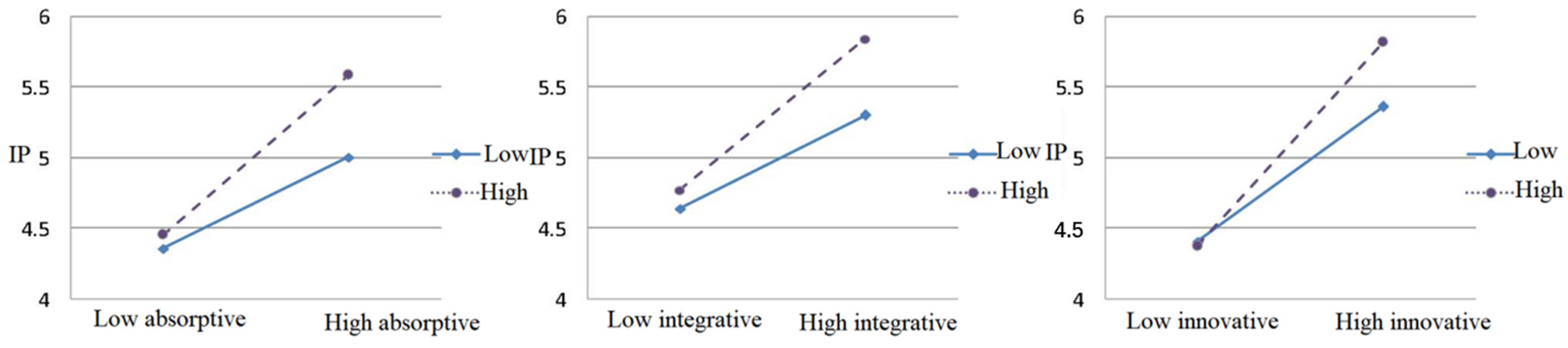
| AC × ERL | High ERL (+1 SD) | 0.298 | 0.062 | 4.81 *** | [0.176, 0.420] |
| Low ERL (−1 SD) | 0.089 | 0.058 | 1.53 | [−0.025, 0.203] | |
| IC × ERL | High ERL (+1 SD) | 0.312 | 0.065 | 4.80 *** | [0.184, 0.440] |
| Low ERL (−1 SD) | 0.102 | 0.061 | 1.67 | [−0.018, 0.222] | |
| INC × ERL | High ERL (+1 SD) | 0.456 | 0.058 | 7.86 *** | [0.342, 0.570] |
| Low ERL (−1 SD) | 0.187 | 0.054 | 3.46 ** | [0.081, 0.293] | |
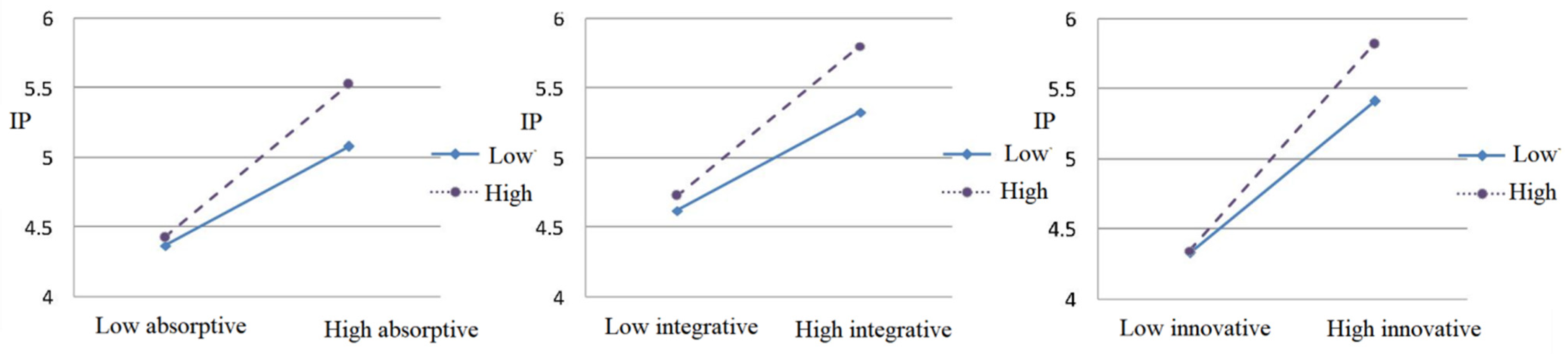
| AC × ETL | High ETL (+1 SD) | 0.321 | 0.059 | 5.44 *** | [0.205, 0.437] |
| Low ETL (−1 SD) | 0.076 | 0.055 | 1.38 | [−0.032, 0.184] | |
| IC × ETL | High ETL (+1 SD) | 0.298 | 0.063 | 4.73 *** | [0.174, 0.422] |
| Low ETL (−1 SD) | 0.095 | 0.059 | 1.61 | [−0.021, 0.211] | |
| INC × ETL | High ETL (+1 SD) | 0.487 | 0.056 | 8.70 *** | [0.377, 0.597] |
| Low ETL (−1 SD) | 0.201 | 0.052 | 3.87 *** | [0.099, 0.303] |
| Interaction Term | ΔR2 | F | p |
|---|---|---|---|
| Exploratory Learning (Total) | 0.018 | 4.11 | 0.007 |
| AC × Exploratory Learning | 0.008 | - | - |
| IC × Exploratory Learning | 0.008 | - | - |
| INC × Exploratory Learning | 0.016 | - | - |
| Exploitative Learning (Total) | 0.056 | 12.80 | <0.001 |
| AC × Exploitative Learning | 0.044 | - | - |
| IC × Exploitative Learning | 0.021 | - | - |
| INC × Exploitative Learning | 0.044 | - | - |
| Variables | M 1 | M 2 | M 3 | M 4 | M 5 | M 6 | |
|---|---|---|---|---|---|---|---|
| Independent Variable | Absorptive capacity | 0.150 ** | 0.156 ** | 0.167 ** | 0.171 ** | 0.178 ** | |
| Integrative capacity | 0.101 ** | 0.108 ** | 0.129 ** | 0.103 ** | 0.112 * | ||
| Innovative capacity | 0.588 ** | 0.599 ** | 0.616 ** | 0.625 ** | 0.612 ** | ||
| Moderating Variable | Exploratory learning | 0.122 ** | 0.219 ** | ||||
| Exploitative learning | 0.070 ** | 0.079 ** | |||||
| Interaction term | Absorptive capacity × Exploratory learning | 0.193 ** | |||||
| Integrative capacity × Exploratory learning | 0.187 ** | ||||||
| Innovative capacity × Exploratory learning | 0.191 ** | ||||||
| Absorptive capacity × Exploitative learning | 0.216 * | ||||||
| Integrative capacity × Exploitative learning | 0.186 ** | ||||||
| Innovative capacity × Exploitative learning | 0.182 ** | ||||||
| Control Variable | Enterprise Years | −0.156 ** | −0.209 ** | −0.208 ** | −0.199 ** | −0.250 ** | −0.249 ** |
| Enterprise asset scale | 0.173 ** | 0.111 ** | 0.113 ** | 0.089 ** | 0.072 | 0.022 | |
| R2 | 0.154 | 0. 429 | 0. 529 | 0.619 | 0.533 | 0.615 | |
| Adjusted R2 | 0.145 | 0.515 | 0.523 | 0.598 | 0.517 | 0.594 | |
| F | 5.526 *** | 39.378 *** | 31.450 *** | 35.384 *** | 34.143 *** | 32.550 *** | |
Disclaimer/Publisher’s Note: The statements, opinions and data contained in all publications are solely those of the individual author(s) and contributor(s) and not of MDPI and/or the editor(s). MDPI and/or the editor(s) disclaim responsibility for any injury to people or property resulting from any ideas, methods, instructions or products referred to in the content. |
© 2026 by the authors. Licensee MDPI, Basel, Switzerland. This article is an open access article distributed under the terms and conditions of the Creative Commons Attribution (CC BY) license.
Share and Cite
Ma, Y.; Wei, Z. How Dynamic Capabilities and Ambidextrous Learning Shape SME Innovation Performance: The Moderating Role of Exploratory and Exploitative Learning. Systems 2026, 14, 164. https://doi.org/10.3390/systems14020164
Ma Y, Wei Z. How Dynamic Capabilities and Ambidextrous Learning Shape SME Innovation Performance: The Moderating Role of Exploratory and Exploitative Learning. Systems. 2026; 14(2):164. https://doi.org/10.3390/systems14020164
Chicago/Turabian StyleMa, Yonghong, and Zihui Wei. 2026. "How Dynamic Capabilities and Ambidextrous Learning Shape SME Innovation Performance: The Moderating Role of Exploratory and Exploitative Learning" Systems 14, no. 2: 164. https://doi.org/10.3390/systems14020164
APA StyleMa, Y., & Wei, Z. (2026). How Dynamic Capabilities and Ambidextrous Learning Shape SME Innovation Performance: The Moderating Role of Exploratory and Exploitative Learning. Systems, 14(2), 164. https://doi.org/10.3390/systems14020164