Article

Rheological Properties and Anti-Icing Performance of Asphalt Modified with Hydrophobic and Salt-Storage Components

1
School of Aerospace Materials and New Energy, Xihang University, Xi’an 710077, China
2
School of Civil Engineering, Shandong University, Jinan 250100, China
3
Inner Mongolia Urban Planning & Municipal Engineering Design Research Institute Co., Ltd., Hohhot 010070, China
4
School of Transportation Engineering, Chang’an University, Xi’an 710064, China
5
School of Business, Fuyang Normal University, Fuyang 236037, China
*
Author to whom correspondence should be addressed.
Coatings 2026, 16(9), 1072; https://doi.org/10.3390/coatings16091072
Submission received: 20 August 2026 / Revised: 4 September 2026 / Accepted: 7 September 2026 / Published: 9 September 2026

Abstract

Hydrophobic and salt-storage functionalization can impart anti-icing capability to asphalt, but the associated changes in rheological behavior should be evaluated concurrently. In this study, silica aerogel and potassium acetate-loaded diatomite were incorporated as hydrophobic and salt-storage components, respectively. Contact angle and leachate conductivity were used to characterize surface wettability and ion-release response, while temperature sweep, frequency sweep, multiple-stress creep and recovery, bending-beam rheometer, and linear amplitude sweep tests were conducted to evaluate rheological performance. A compromise formulation was subsequently selected using multi-objective evaluation and the response surface methodology. The hydrophobic component increased the contact angle of asphalt, whereas the salt-storage component generated a time-dependent aqueous ion-release response. Composite modification improved high-temperature deformation resistance but increased low-temperature creep stiffness and reduced stress-relaxation capacity and fatigue life, indicating a clear rheological trade-off associated with functionalization. The selected formulation contained an 8% hydrophobic component and a 14.6% salt-storage component. At the mixture scale, this formulation reduced ice accumulation by 48.3%, lowered the freezing temperature of a 1 mm water film by approximately 2.8 °C, and decreased the apparent ice–pavement shear strength at −10 °C from 0.71 to 0.45 MPa relative to the control. These results indicate that hydrophobic and salt-storage components contribute differently to anti-icing behavior while jointly altering the rheological response of asphalt.

1. Introduction

Asphalt is a temperature- and stress-dependent viscoelastic material, and functional modification can alter its rheological response [1]. Anti-icing modification can reduce the adverse effects of pavement icing, but the incorporation of functional additives may also affect material performance [2]. Salt-based systems can lower the freezing temperature and facilitate ice removal, while salt release may influence asphalt durability [3,4]. Therefore, anti-icing functionality should be evaluated together with the rheological response when designing functionalized asphalt.
Hydrophobic anti-icing technologies mainly alter water-wetting behavior and ice adhesion at the pavement surface, thereby limiting water-film spreading and reducing interfacial interactions between the ice layer and the pavement [5]. Most existing studies have developed hydrophobic interfaces using surface coatings, emulsified asphalt, or fog seals. The silicone-rubber coating prepared by Peng et al. extended the freezing time of water droplets and reduced the ice-detachment force, while studies by Han et al. and Lu et al. also showed that hydrophobic emulsified asphalt and sand fog seals can improve pavement-surface hydrophobicity and anti-icing performance [6,7,8]. Hydrophobic components can also be incorporated directly into asphalt binders, thereby avoiding exclusive reliance on a surface functional layer. Previous results have shown that SiO2-based materials and other hydrophobic modifiers can increase the contact angle of asphalt surfaces and improve their anti-icing performance [9,10]. However, surface-applied materials may be affected by traffic abrasion and the quality of interfacial bonding, whereas internally incorporated hydrophobic components may alter the stiffness and rheological response of asphalt. Overall, hydrophobic modification mainly regulates surface wetting and ice adhesion but does not directly provide sustained freezing-point depression of the aqueous phase.
Unlike hydrophobic regulation, salt-storage anti-icing technologies generally load or encapsulate deicing salts in porous carriers, microcapsules, or functional fillers. When a water film forms on the pavement surface, the stored salts gradually enter the aqueous phase, lowering the local freezing temperature and thereby delaying ice formation or promoting ice melting [11]. To reduce rapid salt loss during service, porous-carrier loading, polymer coating, and microencapsulation have increasingly been used to regulate salt storage and release. Zhang and Shi coated CaCl2-loaded zeolite with microporous epoxy resin, while Zhao et al. prepared a microcapsule-type anti-icing agent using a porous solid-waste carrier and a polymer wall material [12,13]. The effectiveness of salt-storage systems depends on salt loading and release behavior as well as environmental temperature, moisture conditions, and material structure. Meanwhile, salt leaching and the incorporation of functional fillers may alter the moisture stability, rheological behavior, and long-term performance of asphalt materials [14,15,16]. Accordingly, salt-storage modification requires a balance between freezing-point depression and the resulting changes in asphalt performance. Unlike hydrophobic modification, its primary contribution is the regulation of aqueous-phase freezing through ion release rather than surface wetting.
To broaden the effective range of a single anti-icing approach, several studies have investigated the combined use of functional materials. Lu et al. applied hydrophobic emulsified asphalt and a sustained-release deicing material in a sand fog seal, enabling the pavement-surface functional layer to exhibit both hydrophobic and salt-release characteristics [8]. Wu et al. combined a phase-change material with a slow-release salt-storage material to coordinate thermal regulation and salt release, while Zou et al. incorporated rubber particles and a salt-storage filler into asphalt mixtures to combine deicing functionality with pavement performance [17,18]. NaCl microcapsules have also been used in functional anti-icing coatings [19], while superhydrophobic coatings with hierarchical micro/nanostructures have been developed to reduce ice adhesion and improve surface durability [20,21]. Recent studies have further extended the evaluation of salt-storage asphalt mixtures to long-term salt release, water-scouring resistance, and functional lifespan [22,23]. These studies indicate that multifunctional anti-icing systems are technically feasible, although their performance should be evaluated together with durability and changes in material properties.
Salt-storage anti-icing systems have been evaluated in terms of salt-release life, interfacial adhesion, ion migration, long-term pavement performance, and material-dosage optimization [24,25,26,27,28]. Current anti-icing research has largely followed three routes: hydrophobic regulation, salt-storage-based ice suppression, and surface multifunctionalization. Hydrophobic systems limit water-film spreading and ice adhesion by regulating surface wettability and ice–pavement interfacial interactions. Salt-storage systems instead lower the freezing temperature of water films through the sustained release of stored salts. Multifunctional surface systems further combine superhydrophobic structures with photothermal conversion to delay icing, promote ice melting, and reduce ice adhesion [29,30,31]. However, few studies have incorporated hydrophobic and salt-storage components into the same asphalt-based material. Systematic comparisons of their individual contributions, combined response, and effects on asphalt rheology remain scarce. The location of the functional components distinguishes the internally modified system from surface- and textile-based systems. Surface coatings rely on the retained integrity of an exposed functional layer, and photothermal coatings additionally require illumination [29,30]. Low-surface-energy finishes on flexible fabrics can increase static water contact angles [32], although textile wettability reflects a different loading and abrasion regime from pavement service. The present system incorporates both hydrophobic and salt-storage components into the asphalt binder. Because asphalt is a temperature-sensitive viscoelastic material, this design requires joint evaluation of anti-icing and rheological performance.
This study used silica aerogel and potassium acetate (KAc)-loaded diatomite as the hydrophobic component (HC) and salt-storage component (SC), respectively. Four asphalt-mixture systems were evaluated: the base asphalt control (Control), the hydrophobic-component mixture (HA), the salt-storage-component mixture (SSA), and the composite-modified mixture (CM). Binder tests characterized surface wettability, ion release, high-temperature rheology, low-temperature performance, and fatigue resistance. Mixture tests compared ice accumulation, the freezing temperature of surface-water films, and apparent ice–pavement shear strength. Entropy weighting and the response surface methodology were then combined to identify a compromise formulation that balanced anti-icing functionality and pavement performance.

2. Materials and Methods

2.1. Materials

2.1.1. Base Asphalt Binder

AH-70 paving asphalt was used as the base binder. The same batch of base asphalt was used for all modified binders and corresponding mixtures to minimize the influence of raw-material batch variation on the test results. The basic physical properties of the base asphalt are listed in Table 1, and the relevant indices were measured in accordance with JTG 3410-2025.

2.1.2. Hydrophobic Candidate Materials

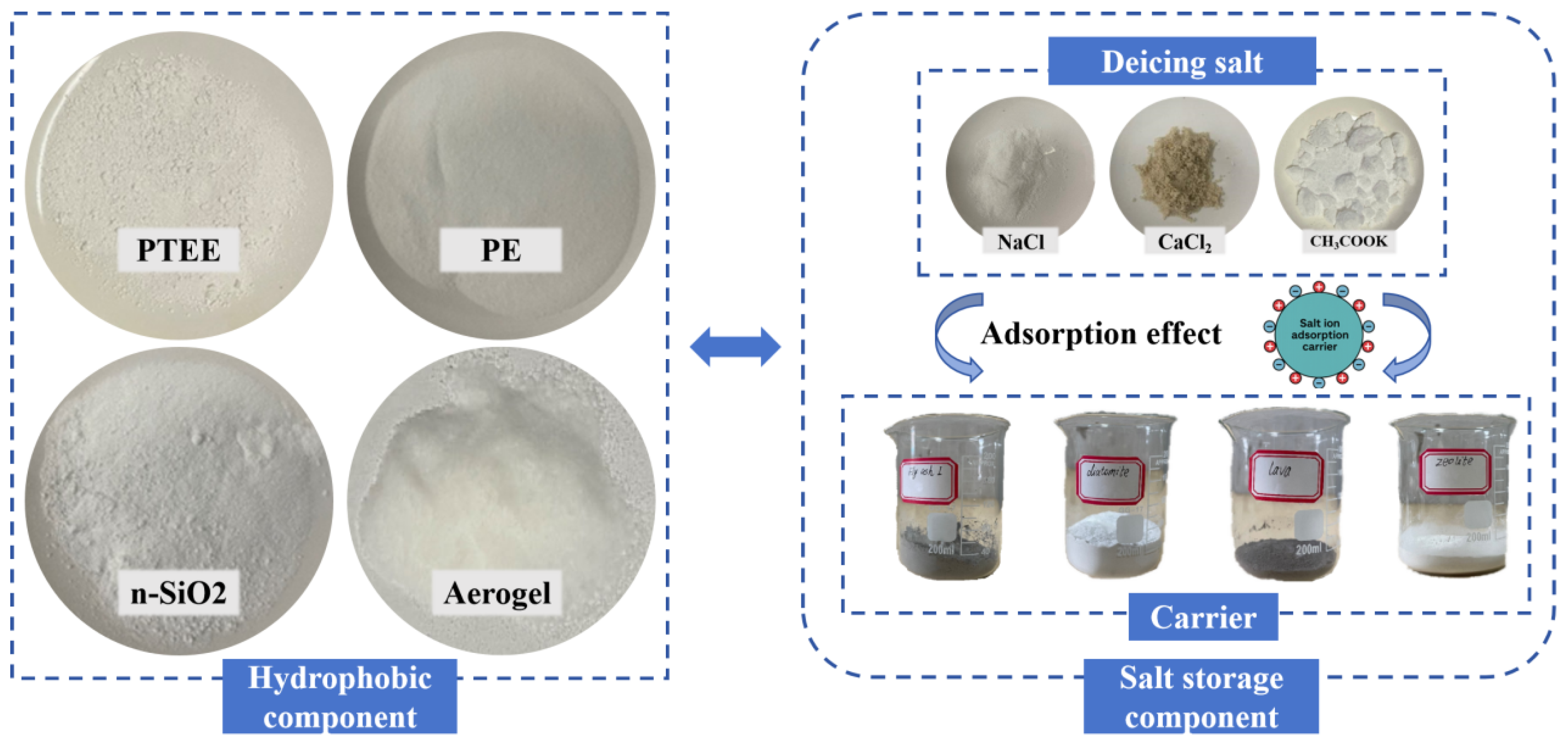
Polytetrafluoroethylene micropowder (PTFE), polyethylene-wax micropowder (PE wax), hydrophobic nanosilica (hydrophobic n-SiO2), and hydrophobic silica aerogel (silica aerogel) were selected as candidate hydrophobic materials. All four powders had a product specification of 200 mesh and were used to compare the wetting responses of different hydrophobic materials to deionized water and salt solutions. Before contact-angle testing, each candidate material was dried at 85 °C and sealed after cooling. The appearances of the four candidate materials are shown in Figure 1. The hydrophobic silica aerogel was purchased from Langfang Longxi New Material Technology Co., Ltd. (Langfang, China), and the PTFE, PE-wax, and hydrophobic n-SiO2 powders were purchased from Shanghai Macklin Biochemical Co., Ltd. (Shanghai, China).

2.1.3. Candidate Deicing Salts and Carrier Materials

NaCl, CaCl2, and KAc were selected as candidate deicing salts, while fly ash, diatomite, volcanic-rock powder, and zeolite powder were selected as candidate carrier materials [33]. None of the four carriers underwent acid–base activation, ion exchange, or surface modification. The appearances of the candidate materials are shown in Figure 1. NaCl, CaCl2, and KAc (analytical grade) were purchased from Sinopharm Chemical Reagent Co., Ltd. (Shanghai, China). The diatomite was supplied by Shengzhou Xinglong Diatomite Development Products Co., Ltd. (Shengzhou, China). The fly ash was obtained from a local coal-fired power plant (Xi’an, China), and the volcanic-rock powder and zeolite powder were purchased from Shijiazhuang Xunhua Mineral Products Co., Ltd. (Shijiazhuang, China).

2.1.4. Aggregates and Mineral Filler

Asphalt mixtures were prepared using limestone coarse aggregate, limestone fine aggregate, and limestone mineral filler from the same batches. All three were conventional commercial road materials and satisfied the technical requirements of JTG F40-2004.

2.2. Preparation of Functional Components, Binders, and Mixtures

2.2.1. Preparation of the Salt-Storage Functional Component

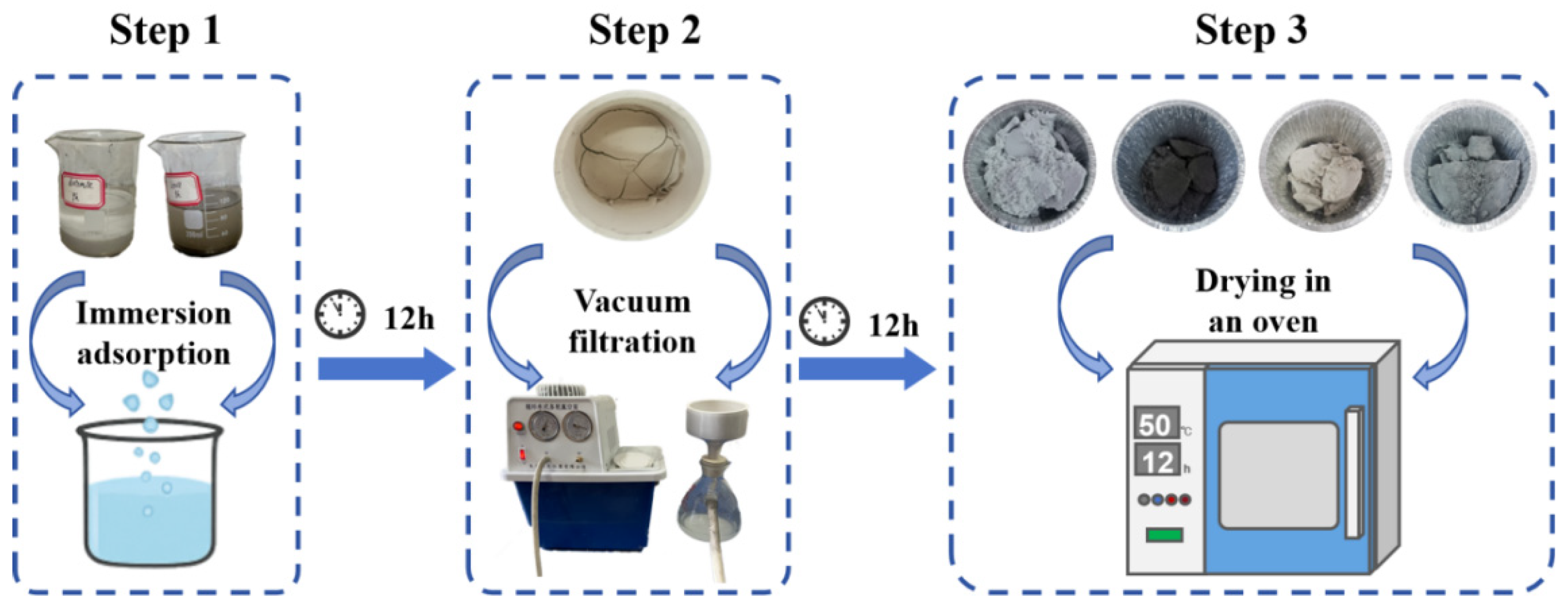
To prepare the salt-storage functional components, a solution impregnation–filtration–drying process was adapted from the porous-carrier salt-loading approach reported by Yan et al. [34]. NaCl, CaCl2, and KAc were separately dissolved in deionized water to prepare saturated solutions. Fly ash, diatomite, volcanic-rock powder, and zeolite powder were then immersed in the corresponding solutions for 12 h. Excess surface solution was removed by vacuum filtration, after which the samples were dried at 50 °C for 12 h and cooled to room temperature. These controlled preparation conditions were applied consistently to all candidate carriers. The resulting salt–carrier combinations were sealed for storage and screened in subsequent tests. The selected combination was prepared again using the same procedure for the modified-asphalt experiments. Figure 2 illustrates the preparation process.

2.2.2. Preparation of Modified Asphalt

The preparation parameters of modified asphalt binders were selected with reference to hot-mix asphalt requirements and reported powder-dispersion practices. JTG F40-2004 gives reference ranges of 155–165 °C for heating 70# paving asphalt and 145–165 °C for asphalt-mixture discharge [35]. Guo et al. summarized commonly used high-shear conditions for nanomaterial-modified asphalt, including temperatures of 130–165 °C, shear rates above 4000 r/min, and mixing times of 40–60 min [36]. Tan et al. used staged addition and introduced diatomite at 1000 r/min during preparation of a composite-modified asphalt [37]. These studies provided the basis for the staged procedure adopted here. Specifically, 500 g of base asphalt was heated to 145 ± 5 °C and maintained in a fully fluid state. The hydrophobic component was added, manually premixed for 10 min, and sheared at 4000 r/min for 40 min to facilitate mechanical dispersion. The salt-storage component was then introduced and mixed at 1000 r/min for 60 min. The lower shear rate was intended to limit disturbance of the salt-loaded porous structure. The asphalt temperature was maintained at 145 ± 10 °C throughout preparation. Both components were externally incorporated, with dosages calculated relative to the mass of base asphalt. The same procedure was applied to all formulations to maintain comparable thermal and mechanical histories. The binders were subsequently cooled to room temperature for performance testing.

2.2.3. Mixture Design and Compaction

Dense-graded AC-13 asphalt mixtures were used. All experimental groups had the same aggregate gradation and asphalt–aggregate ratio to maintain a consistent mineral composition. Before mixing, the coarse and fine aggregates were preheated to 175 °C, the asphalt binder was heated to 160 °C and maintained in a fully fluid state, and the limestone mineral filler was stored under dry conditions. The coarse and fine aggregates were mixed uniformly, after which the corresponding asphalt binder was added and mixed at 160 ± 5 °C. Once the aggregate surfaces were uniformly coated, the mineral filler was added, and mixing continued until the mixture was homogeneous. The mixtures were then placed in a wheel-tracking compaction mold and compacted at 150 ± 5 °C into 300 mm × 300 mm × 50 mm slabs. For each mixture, three slabs were independently mixed and compacted. For each anti-icing test, one 90 mm × 90 mm × 50 mm specimen was randomly cut from each of the three slabs. Thus, each group in each test contained three independently mixed and compacted replicates. The cut specimens were cooled to room temperature, sealed for storage, and used for the ice accumulation, surface-water freezing-temperature, and ice–pavement shear tests.

2.3. Experimental Design and Statistical Analysis

2.3.1. Screening and Microstructural Characterization of Candidate Additives

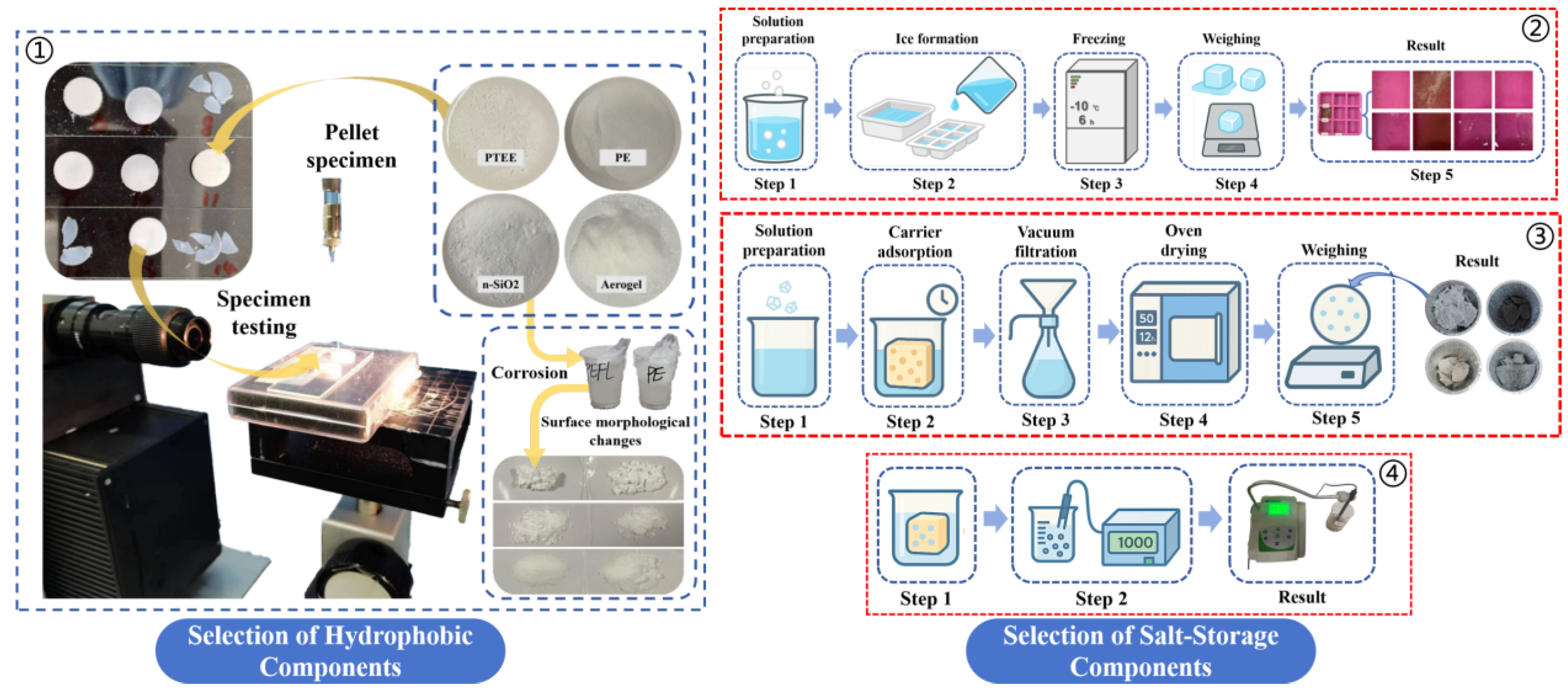
The screening procedure for candidate hydrophobic and salt-storage materials is shown in Figure 3. After drying at 85 °C, three independent pellets of each candidate hydrophobic material were prepared using the same powder mass, mold, and pressing procedure; the pellet surfaces were neither ground nor polished. The apparent contact angle of deionized water on the pellet surface was measured by the sessile-drop method using an automatic contact-angle instrument (OCA20; DataPhysics Instruments GmbH, Filderstadt, Germany) with a droplet volume of 6 μL. Three different positions were measured on each pellet, and the mean of these measurements was taken as the result for that pellet. Contact-angle images were acquired within 1 s after droplet deposition. For the salt-solution treatment, the candidate hydrophobic materials were immersed in saturated NaCl, CaCl2, or KAc solutions for 24 h; rinsed with deionized water; and oven-dried. The treated powders were pelletized and tested using the same procedure as the untreated materials, with deionized water used as the test liquid. Hydrophobicity retention was evaluated by comparing the contact angles before and after salt-solution treatment.
Candidate salt-storage materials were evaluated in terms of ice-melting performance, apparent loading characteristics, and short-term ion-release response. The ice-melting test was conducted in accordance with GB/T 23851-2017. For the apparent-loading test, 20 g of predried carrier material was immersed in the different saturated salt solutions for 9, 18, or 27 h. After impregnation, residual surface solution was removed by vacuum filtration, and the material was dried at 80 °C to constant mass. The mass increase after impregnation and drying was used to compare the apparent loading characteristics of the different salt–carrier combinations. For the short-term ion-release test, 5 g of candidate salt-storage material was immersed in 80 mL of deionized water, and a DDS-11A conductivity meter (Leici, Shanghai Yidian Scientific Instrument Co., Ltd., Shanghai, China) was used to monitor leachate conductivity over 2–6 h. The conductivity profiles were used to compare the short-term ion-release responses of different salt–carrier systems.
A scanning electron microscope (S-4800; Hitachi, Tokyo, Japan) was used to observe the surface morphology and pore-structure characteristics of the candidate hydrophobic materials, carrier materials, and materials after salt-solution impregnation and drying.

2.3.2. Multi-Objective Dosage Evaluation and Formulation Selection

(1)
Response surface experimental design
The response surface methodology was used to investigate the effects of hydrophobic-component (HC) and salt-storage-component (SC) dosages on the functional and rheological responses of modified asphalt [38]. The HC and SC dosages were set at 6%–8% and 12%–18%, respectively, relative to the mass of base asphalt. A two-factor, five-level central composite design was constructed in Design-Expert 8.0.6, yielding 13 formulations comprising four factorial points, four axial points, and five center points. The factor levels and experimental combinations are listed in Table 2. Based on the functional, high-temperature rheological, low-temperature rheological, and fatigue test results, the entropy-weight method was used to calculate the comprehensive score of each performance category, and the four category-level scores were used as response variables. Quadratic polynomial models were developed to describe the relationships between HC and SC dosages and the response values. The coefficient of determination (R2) was used to evaluate model adequacy within the experimental design space. Response surface analysis was conducted to compare dosage-dependent trends and determine a compromise formulation considering the four performance categories. Weight sensitivity analysis was further performed using equal weights of 0.25 for the four performance categories as the baseline condition. The weight of one category was increased to 0.40, while the remaining three categories were adjusted to 0.20. The optimization was repeated using the same response surface models and optimization constraints to evaluate the robustness of the optimal formulation.
(2)
Performance evaluation metric
The functional, high-temperature rheological, low-temperature rheological, and fatigue properties of the modified asphalt were each represented by multiple indices; no single index could fully describe the response within each performance category. The entropy-weight method was therefore used to standardize and weight the indices within each category and calculate composite scores for functional, high-temperature, low-temperature, and fatigue performance. Positive indices, for which a higher value represented improved performance, and negative indices, for which a higher value indicated poorer performance, were normalized using the corresponding procedures to account for differences in scale and direction [39]. The weight of each index was determined from its dispersion among the different formulations, with greater variation in the data resulting in a higher weight. The composite score for each performance category was obtained by summing the products of the standardized index values and their corresponding weights and was subsequently used as the response variable for response surface analysis.

2.3.3. Performance of Modified Asphalt

(1)
Functional performance
Contact-angle and leachate-conductivity tests were conducted to evaluate the functional properties of the composite-modified asphalt. Contact angle was used to characterize surface wettability, with larger values indicating less spreading of water droplets on the asphalt surface. The leachate-conductivity test characterized the short-term ion-release response of asphalt containing the salt-storage component in an aqueous environment. Conductivity was recorded at 0, 4, 8, 12, 48, and 72 h. The resulting time-dependent response was used to compare the effect of SC dosage and was included in the composite evaluation of functional performance. Contact-angle, conductivity, and rheological results were compared descriptively across formulations and test conditions to characterize dosage-dependent trends.
(2)
High-temperature rheological properties
All DSR, BBR, and LAS tests were conducted on unaged asphalt binders. To characterize the high-temperature rheological response relevant to rutting resistance, temperature sweep, frequency sweep, and multiple-stress creep and recovery (MSCR) tests were performed using a dynamic shear rheometer (DSR; TA Instruments, New Castle, DE, USA) [40,41,42]. Temperature sweep tests were conducted in strain-controlled mode (1.5%) from 40 to 76 °C at 1.5 °C/min. Frequency sweep tests were conducted at 1.5% strain from 40 to 76 °C over an angular-frequency range of 0.1–100 rad/s. MSCR tests were performed from 40 to 76 °C in stress-controlled mode, with 20 cycles at 0.1 kPa followed by 10 cycles at 3.2 kPa. The temperature and frequency sweep tests followed JTG 3410-2025, and the MSCR tests followed AASHTO T 350-19.
(3)
Low-temperature rheological properties
Low-temperature bending-beam creep tests were conducted using a bending-beam rheometer (TE-BBR; CANNON Instrument Company, State College, PA, USA) to evaluate the low-temperature stress-relaxation capacity and cracking resistance of the modified asphalt binders. Tests were performed at −12, −18, and −24 °C, with three parallel specimens at each temperature. The load and corresponding deflection measured at 60 s were recorded as the evaluation indices. All tests were conducted in accordance with ASTM D6648-08.
(4)
Fatigue performance
The linear amplitude sweep (LAS) test was used to evaluate the fatigue resistance of the modified asphalt binders. The LAS test was conducted using a dynamic shear rheometer and comprised two stages. First, a frequency sweep was performed under strain control at 0.2–30 Hz with a constant strain amplitude of 0.1%. Second, an amplitude sweep was performed under continuous oscillatory strain control, with strain increasing from 0.1% to 30% at a fixed loading frequency of 10 Hz. All LAS tests were conducted at 25 °C. We adopted the frequency and amplitude sweep sequence and the damage-characteristic-curve method for estimating fatigue life from AASHTO TP 101-12, while testing unaged binders.

2.3.4. Correlation Analysis

Spearman rank correlation coefficients were used to analyze the associations between the functional and rheological properties of the composite-modified asphalt. Contact angle and the area under the 0–72 h conductivity-response curve were selected to represent functional performance. The temperature sweep |G*|/sin δ at 64 °C and MSCR Jnr3.2 were selected to represent high-temperature rheological performance; creep stiffness, S, and creep rate, m, at −18 °C represented low-temperature rheological performance; and LAS fatigue life, Nf, at 5% strain represented fatigue performance. The correlation coefficients described the direction and strength of monotonic associations among the indices. Because Runs 9–13 of the response surface experiment had identical HC and SC dosages, the five center-point measurements were averaged to represent a single formulation condition. Together with the other eight distinct dosage conditions, nine independent formulation conditions were included in the analysis (n = 9).

2.3.5. Test Methods for the Anti-Icing Performance of Modified Asphalt Mixtures

(1)
Ice accumulation test
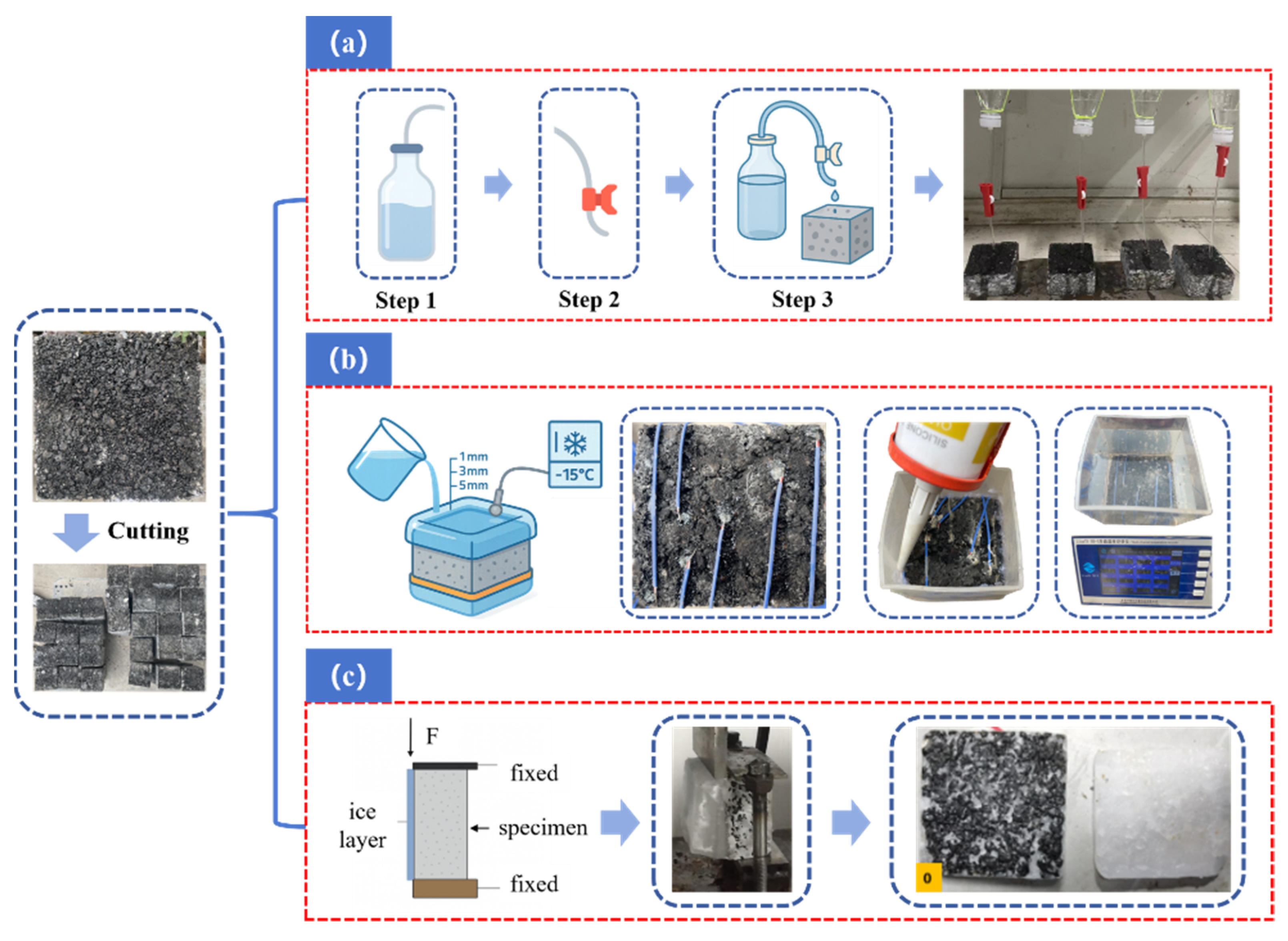
To evaluate the anti-icing performance of modified asphalt mixtures under inclined-drainage conditions, one 90 mm × 90 mm × 50 mm specimen was randomly cut from each of three independently mixed and compacted slabs for each mixture, providing three independent mixture replicates (n = 3). The specimens were precooled at −10 °C for 12 h and weighed to obtain the initial mass, m0. They were then placed at a 4% slope, and 50 g of water was uniformly applied to the surface over 30 min. After further conditioning at −10 °C for 6 h, the specimens were weighed to obtain m1. Ice accumulation was calculated as Δm = m1 − m0, and the surface icing ratio was calculated as Δm/50 × 100%. The testing procedure is illustrated in Figure 4a.
(2)
Freezing-temperature test
To determine the freezing temperature of water on the mixture surfaces, wheel-tracking slabs were cut into 90 mm × 90 mm × 50 mm specimens, and a silicone sleeve was used to form a closed water-storage area on each specimen. Water-layer thicknesses of 1, 3, and 5 mm were tested. A K-type thermocouple and an SH-X multichannel temperature recorder (Dongguan Lianyi Instrument Co., Ltd., Dongguan, China) were used to monitor the water-layer temperature with a resolution of 0.1 °C and a sampling frequency of 1 Hz. The specimens were continuously cooled in a −15 °C environment. The minimum supercooling temperature was not taken as the freezing temperature; after nucleation-induced heat release, the stable plateau formed during temperature recovery was used to identify the freezing temperature. When the temperature range over 60 consecutive seconds did not exceed 0.2 °C and ice and water were observed to coexist, the mean temperature over those 60 s was taken as the test result. The complete temperature–time history was recorded for each specimen. The testing procedure is illustrated in Figure 4b.
(3)
Ice–pavement shear test
A horizontal ice–pavement shear test was used to compare the deicing performance of the different modification systems. The mixture specimens measured 90 mm × 90 mm × 50 mm, and the ice–pavement contact area was 8100 mm2. A sealed mold was placed on the specimen surface and filled with deionized water, which was frozen at −5, −10, or −15 °C to form a 50 mm ice layer. After ice formation, the specimens were held at the test temperature until the temperatures of the specimen, ice layer, and fixture had stabilized. A universal testing machine and a custom horizontal shear fixture were then used to load the specimen to failure. The apparent ice–pavement shear strength was calculated as τ = Fmax/8100, where Fmax is the peak load. This index was used to compare deicing resistance among the mixture systems under the test-fixture and ice-layer geometry used in this study.

3. Results and Discussion

3.1. Selection of Hydrophobic and Salt-Storage Components

3.1.1. Performance of Hydrophobic Components

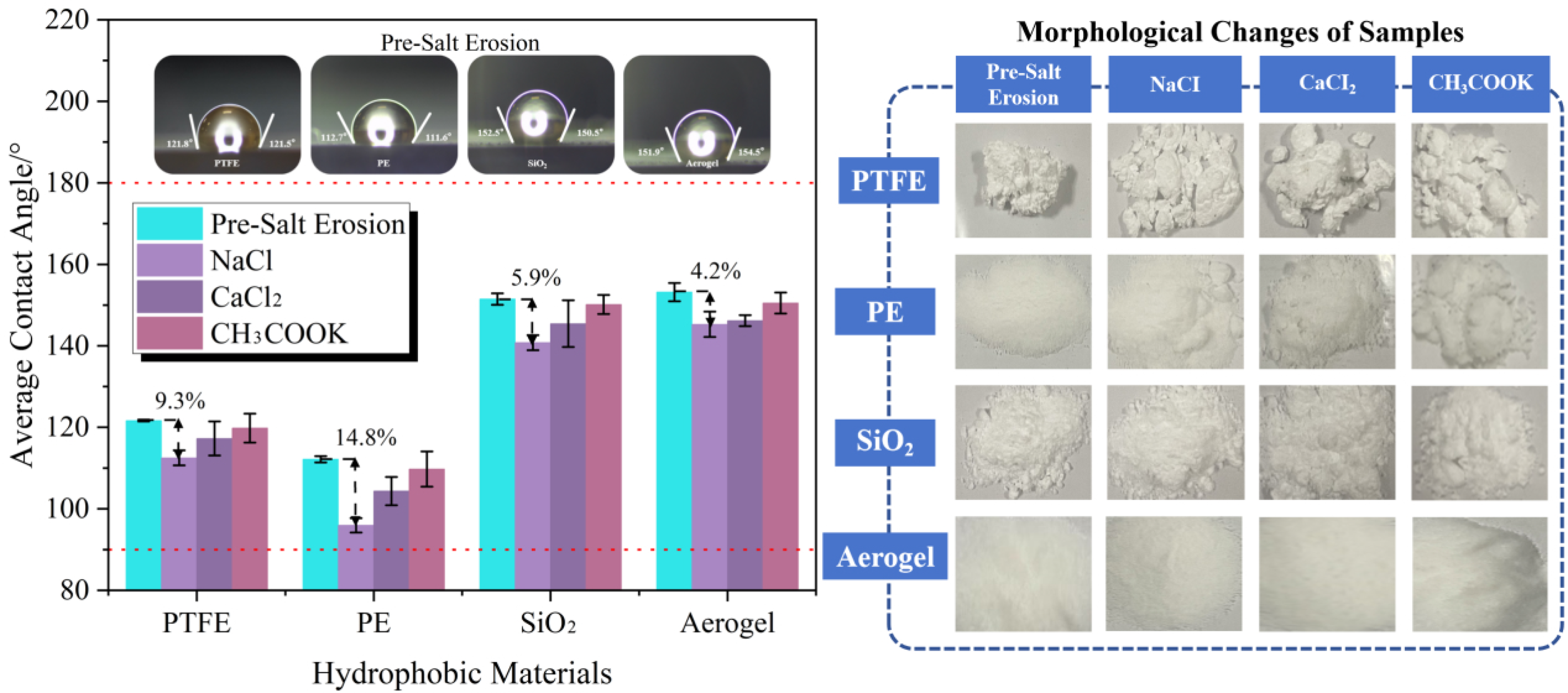
Figure 5 compares the contact angles of the four candidate hydrophobic materials before and after treatment with different saturated salt solutions. Deionized water was used as the test liquid in all contact-angle measurements. The contact angles of the untreated materials represented their initial hydrophobicity, while those measured after salt-solution immersion, rinsing, and drying were used to evaluate retention of hydrophobic performance.
As shown in Figure 5, the apparent contact angles of the four candidate hydrophobic materials differed markedly before and after salt-solution treatment. Before treatment, the contact angles of aerogel and hydrophobic n-SiO2 were 153.2° and 151.5°, respectively, indicating strong hydrophobicity; those of PTFE and PE were 121.65° and 112.15°, respectively, which were lower than the values for the two silica-based materials. After immersion in saturated NaCl, CaCl2, or KAc solution for 24 h followed by rinsing and drying, the contact angles decreased to different extents. The contact angles of treated aerogel and hydrophobic n-SiO2 remained above 145°, with reductions of less than 6%, indicating good retention of hydrophobic performance after treatment with all three salt solutions. The contact angle of treated PTFE was approximately 112–120°, showing relatively little overall variation. PE exhibited the largest decrease; after NaCl-solution treatment, its contact angle decreased to 95.95°, approximately 14.4% below the initial value, indicating greater sensitivity to salt-solution treatment. Considering both the initial contact angles and their retention after salt-solution treatment, aerogel and hydrophobic n-SiO2 performed better overall than PTFE and PE.

3.1.2. Performance of Salt-Storage Components

(1)
Selection of deicing salts
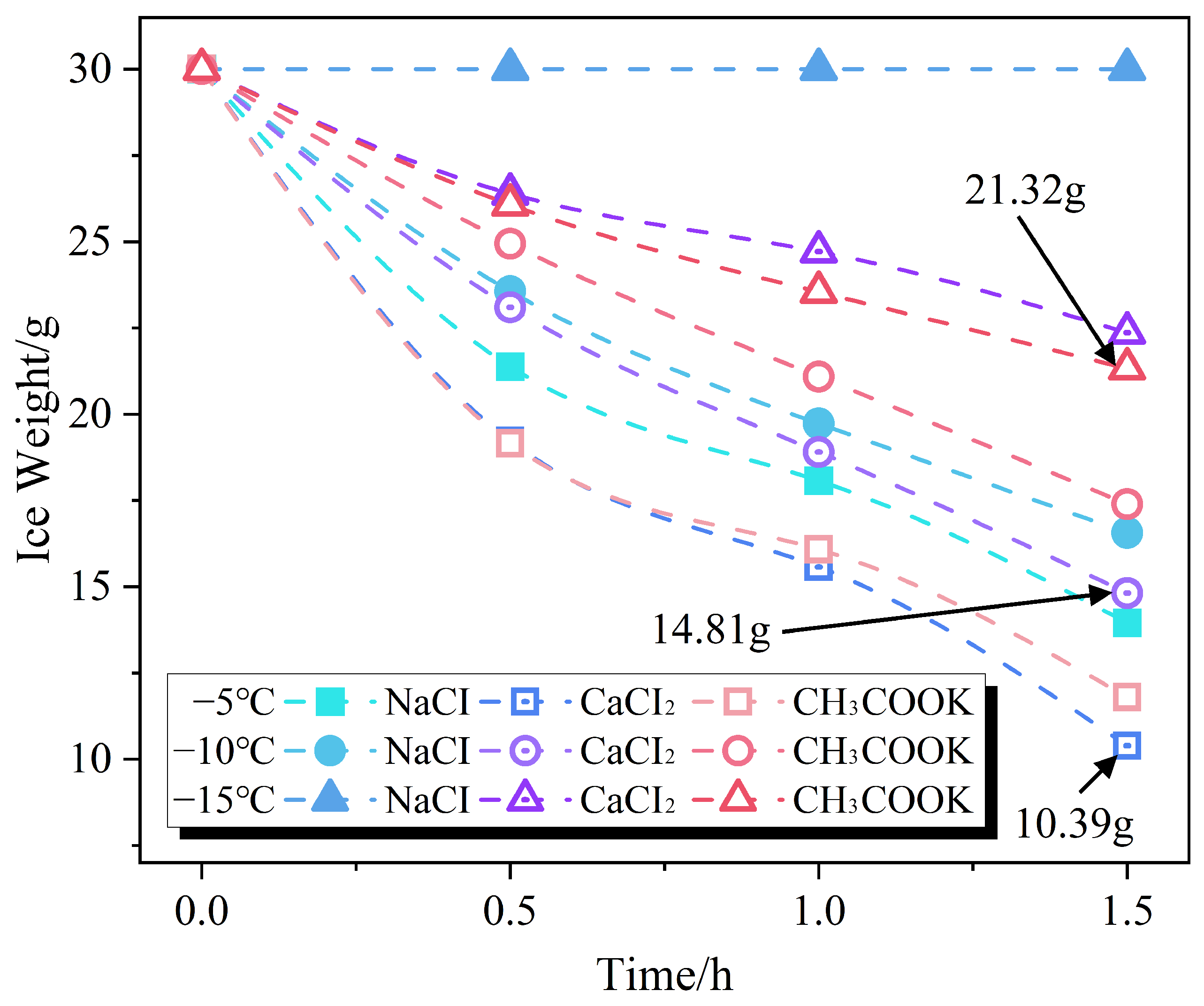
To compare the ice-melting capacities and low-temperature adaptability of the deicing salts, the residual ice mass of each specimen was measured under different temperature conditions to evaluate melting rate and persistence. The results are presented in Figure 6.
As shown in Figure 6, the deicing salts exhibited different short-term ice-melting capacities at the test temperatures. The residual ice mass generally decreased with increasing exposure time in all groups. NaCl performed well at −5 and −10 °C; after 1.5 h, the residual ice masses decreased to 13.95 and 16.56 g, respectively, corresponding to melting ratios above 45%. At −15 °C, the ice-melting performance of NaCl weakened markedly, and the reduction in ice mass was less pronounced than at the higher temperatures. CaCl2 exhibited strong ice-melting capacity at all three temperatures. After 1.5 h at −15 °C, its residual ice mass was 22.36 g, indicating better low-temperature performance than NaCl. KAc showed intermediate performance relative to NaCl and CaCl2, and it retained some ice-melting capacity at −15 °C. Considering the changes in residual ice mass and melting ratio at the different temperatures, CaCl2 and KAc performed better overall than NaCl at low temperatures, with both salts retaining ice-melting capacity at −15 °C.
(2)
Apparent loading characteristics of carrier materials
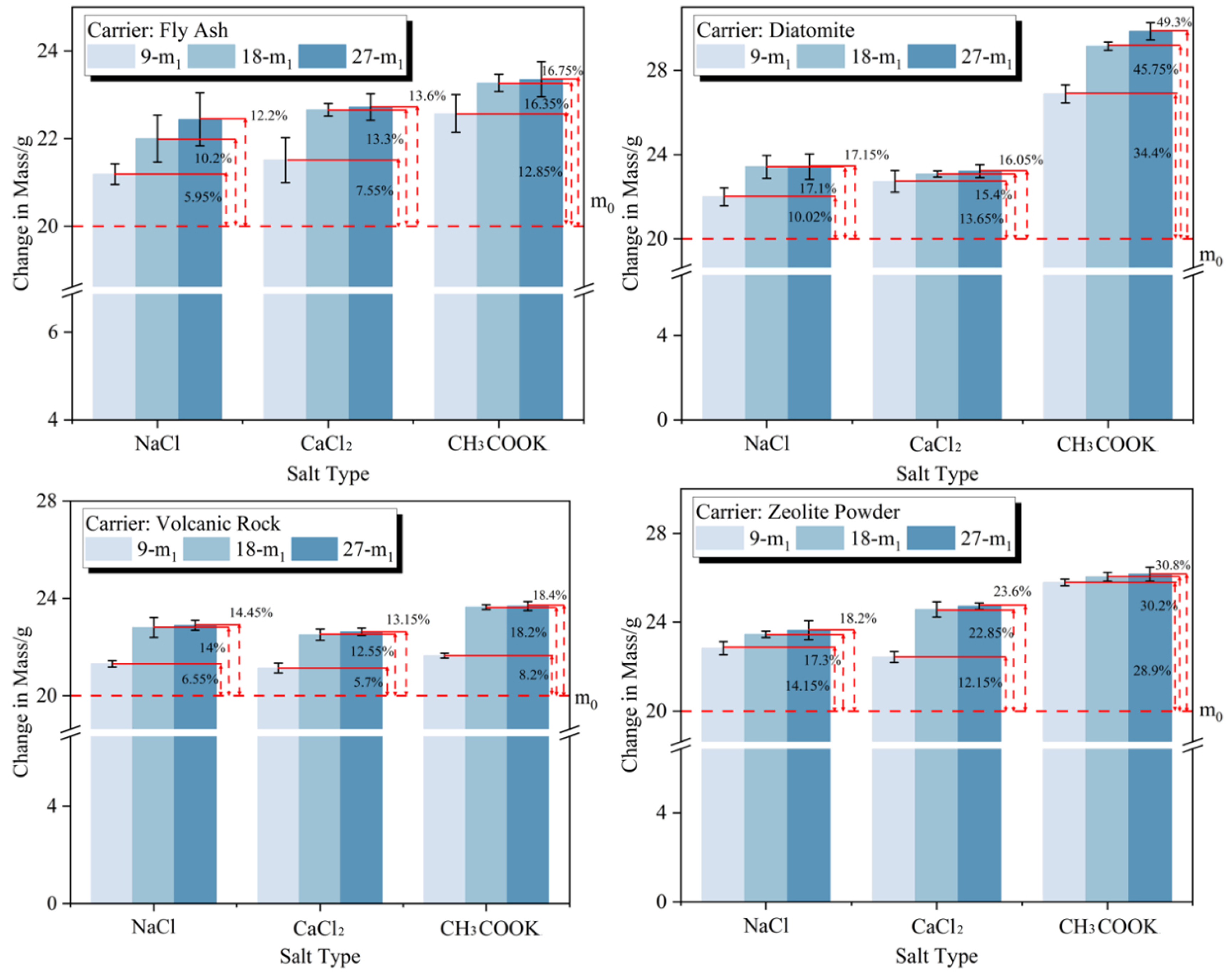
To compare the salt-holding capacities of the carrier materials, their mass changes after immersion in salt solutions and subsequent drying were measured. These results were used to evaluate the apparent salt-loading characteristics of each carrier (Figure 7).
As shown in Figure 7, the carriers exhibited marked differences in mass after salt-solution impregnation and drying. The dry mass of each carrier generally increased as the impregnation time increased from 9 to 27 h, indicating that longer impregnation facilitated the entry of salt solution into the carrier pores and subsequent salt deposition during drying. Among the three salt solutions, the carriers generally showed the largest mass increases in the KAc system, followed by CaCl2 and then NaCl. Diatomite and zeolite powder exhibited larger mass increases than the other carriers. After impregnation in KAc solution for 27 h, the total dry masses of diatomite and zeolite powder were 29.85 and 26.16 g, respectively, representing increases of 9.85 and 6.16 g relative to their initial masses. The larger mass increase of diatomite may be related to its well-developed pore structure and larger effective contact area, which favor solution penetration into the pores and salt deposition after drying. Across the different salt solutions and impregnation times, the apparent loading characteristics of the four carriers were generally ranked as diatomite, zeolite powder, volcanic-rock powder, and fly ash.
(3)
Short-term ion-release response of salt-storage materials
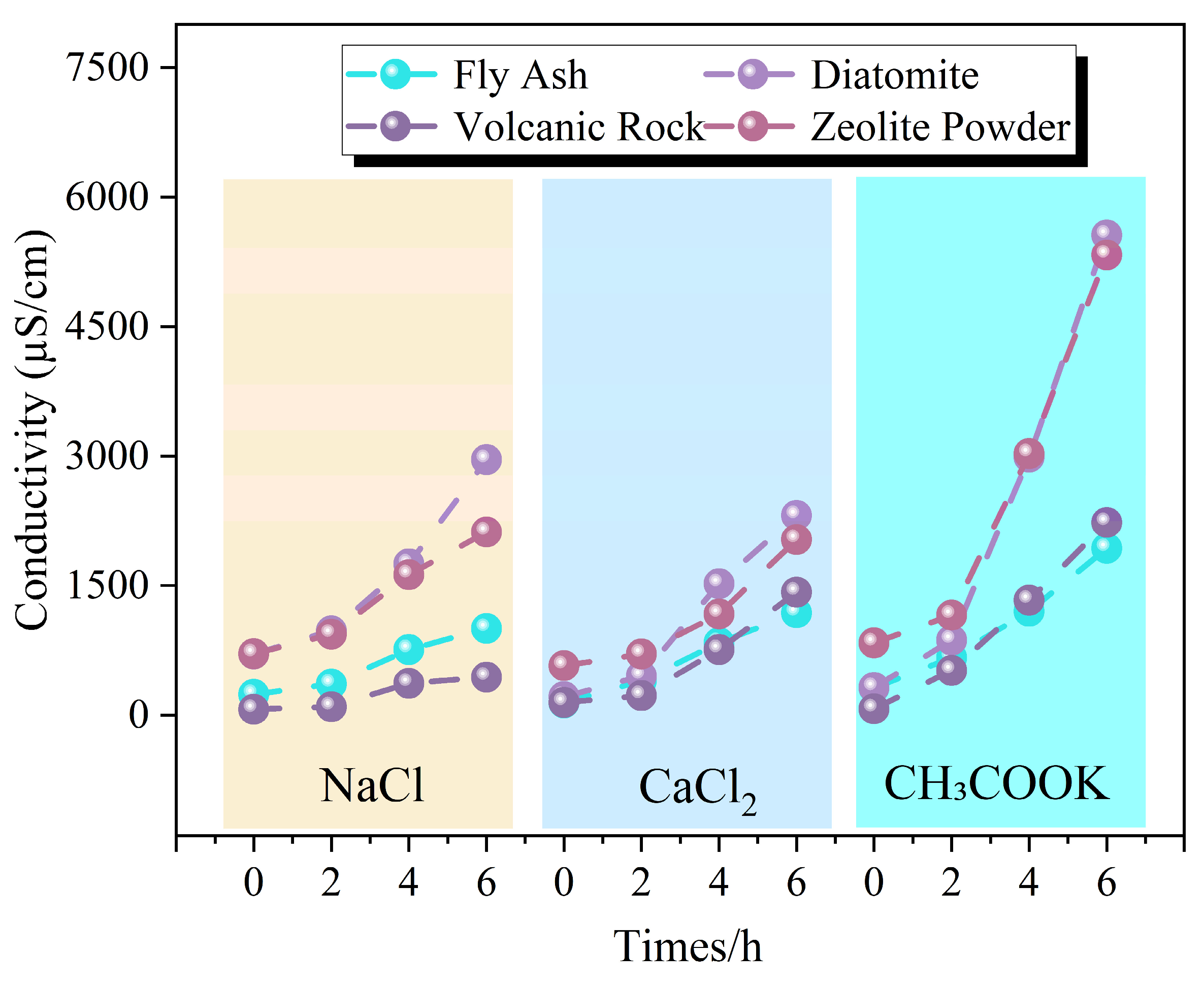
To investigate ion release from salt-storage systems with different carrier materials, conductivity was monitored to characterize dissolution and release in deionized water. The resulting conductivity profiles were used to compare the short-term ion-release responses of the salt-storage components (Figure 8).
The short-term ion-release responses of the candidate salt-storage systems with different carriers were compared by monitoring leachate conductivity after immersion in deionized water (Figure 8). For all salt-storage materials, leachate conductivity increased with immersion time, indicating that water-soluble ions gradually entered the aqueous phase. For a given deicing salt, the diatomite and zeolite-powder systems showed larger increases in conductivity. After 6 h, the conductivities of the NaCl-loaded diatomite and NaCl-loaded zeolite-powder systems reached 2960 and 2120 μS/cm, respectively, exceeding those of the fly-ash and volcanic-rock-powder systems and indicating stronger short-term ion-release responses under the same salt and test conditions. Similar patterns were observed for the CaCl2 and KAc systems; the conductivity of the KAc-loaded diatomite system reached 5560 μS/cm at 6 h. Because the salt solutions differed in ionic composition and molar conductivity, conductivity values for different salts were not used to compare the actual amounts of salt released. The test was therefore used mainly for relative comparisons of the ion-release responses of different carriers loaded with the same salt.
Considering ice-melting performance, mass changes after impregnation and drying, and the short-term conductivity response, aerogel showed favorable performance among the candidate hydrophobic materials, while diatomite showed a larger apparent loading response and a stronger short-term ion-release response than the other candidate carriers. Aerogel was therefore selected as the hydrophobic functional component. Among the candidate deicing salts, KAc was selected because it retained effective ice-melting capability at low temperatures and, as a non-chloride deicer, may offer advantages in terms of environmental compatibility and reduced chloride-induced corrosion risk. KAc-loaded diatomite was therefore selected as the salt-storage functional component for the subsequent preparation and evaluation of the composite-modified asphalt.
Candidate hydrophobic materials were screened based on their initial contact angles, retention of hydrophobicity after salt-solution treatment, and compatibility with hot-mixing conditions. All four candidates were insoluble solid particles; their performance therefore depended primarily on surface properties and on wetting and dispersion in asphalt. The initial contact angles of silica aerogel and hydrophobic nano-SiO2 were 153.2° and 151.5°, respectively, and both remained above 145° after salt-solution treatment. Polytetrafluoroethylene had an initial contact angle of approximately 122°. Polyethylene wax showed the lowest initial value, approximately 112°, and this value decreased by a further 14% after NaCl treatment. Because its melting point was below 145 °C, polyethylene wax melted near the processing temperature. These results excluded polytetrafluoroethylene and polyethylene wax from subsequent tests. Both silica aerogel and hydrophobic nano-SiO2 met the contact-angle criterion; silica aerogel was selected as the hydrophobic component for subsequent experiments.
Both silica aerogel and KAc-loaded diatomite were incorporated into asphalt as solid particles. The same staged mixing procedure was applied to all formulations, ensuring comparable preparation conditions for the subsequent rheological and anti-icing evaluations.

3.1.3. Microstructural Morphology of Selected Components

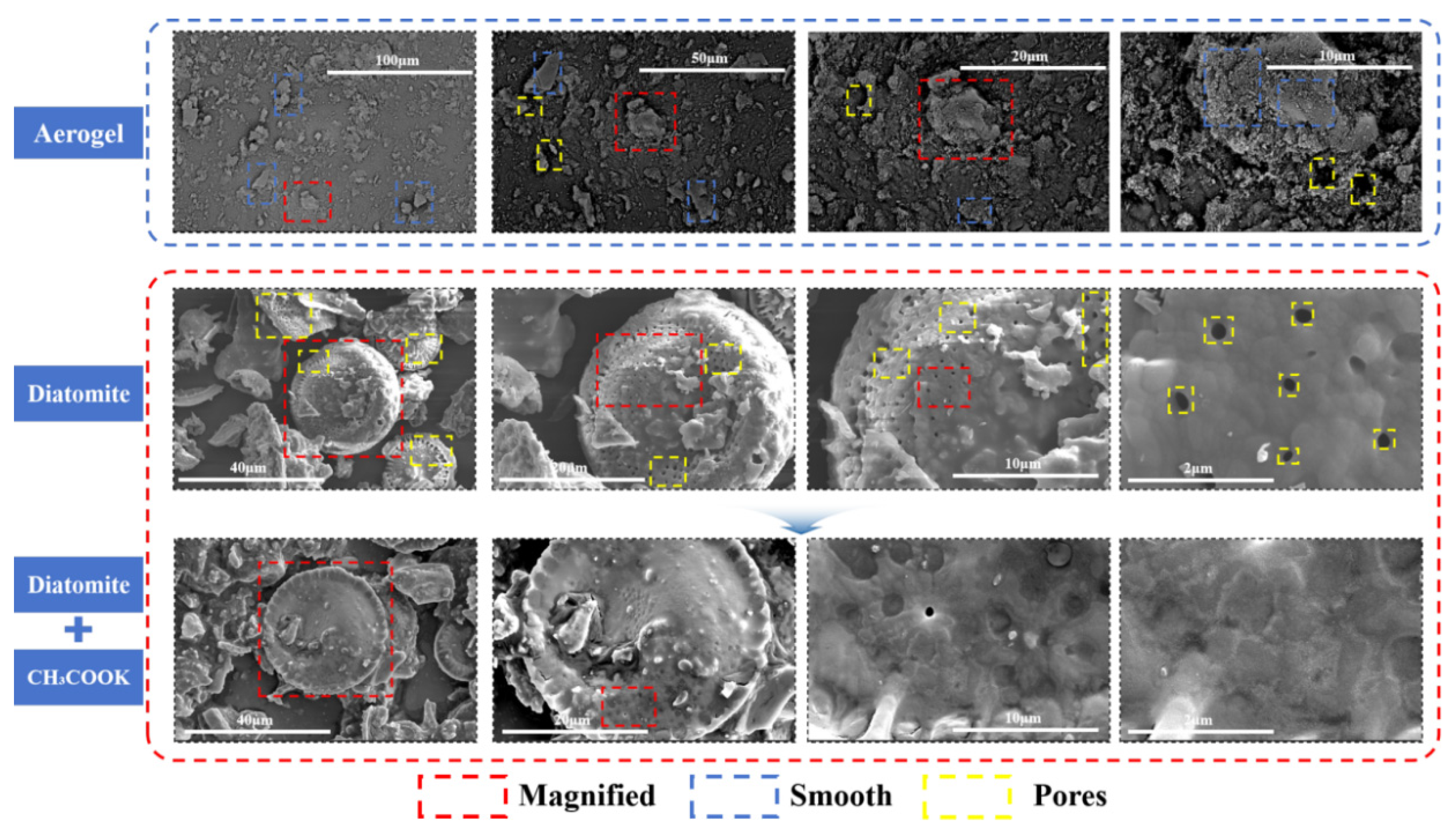
To compare the microstructures of the selected hydrophobic material, carrier, and salt-storage composite, scanning electron microscopy (SEM) was used to observe aerogel, diatomite, and KAc-loaded diatomite at progressively higher magnifications. Figure 9 presents their surface morphology and pore-structure characteristics.
As shown in Figure 9, aerogel, diatomite, and KAc-loaded diatomite exhibited distinctly different microstructures. At the observed scales, the aerogel appeared as a continuous, relatively dense agglomerated structure without obvious large open pores on the surface. This morphology was consistent with its high contact angle and retention of hydrophobicity after salt-solution treatment.
Diatomite without KAc loading exhibited a typical diatom-frustule structure. Relatively complete disc-shaped skeletons were visible at scale bars ranging from 40 to 10 μm. At higher magnification, numerous micrometer-scale pores were distributed over the frustule surface, with pore sizes mainly of approximately 0.5–2 μm; smaller pore openings were also present locally, forming a multiscale pore structure. These developed pores provided space for salt-solution infiltration and salt deposition during drying, consistent with the comparatively large mass increase of diatomite after impregnation and drying.
After impregnation in KAc solution and drying, visible deposits appeared on the diatomite surface and in some pore regions. The original pore openings became less exposed, and sheet-like or continuous covering structures formed locally. This morphological change was consistent with the mass increase after impregnation and drying and the conductivity response after water immersion.

3.2. Multi-Objective Dosage Evaluation and Formulation Selection of Composite-Modified Asphalt

3.2.1. Functional Performance

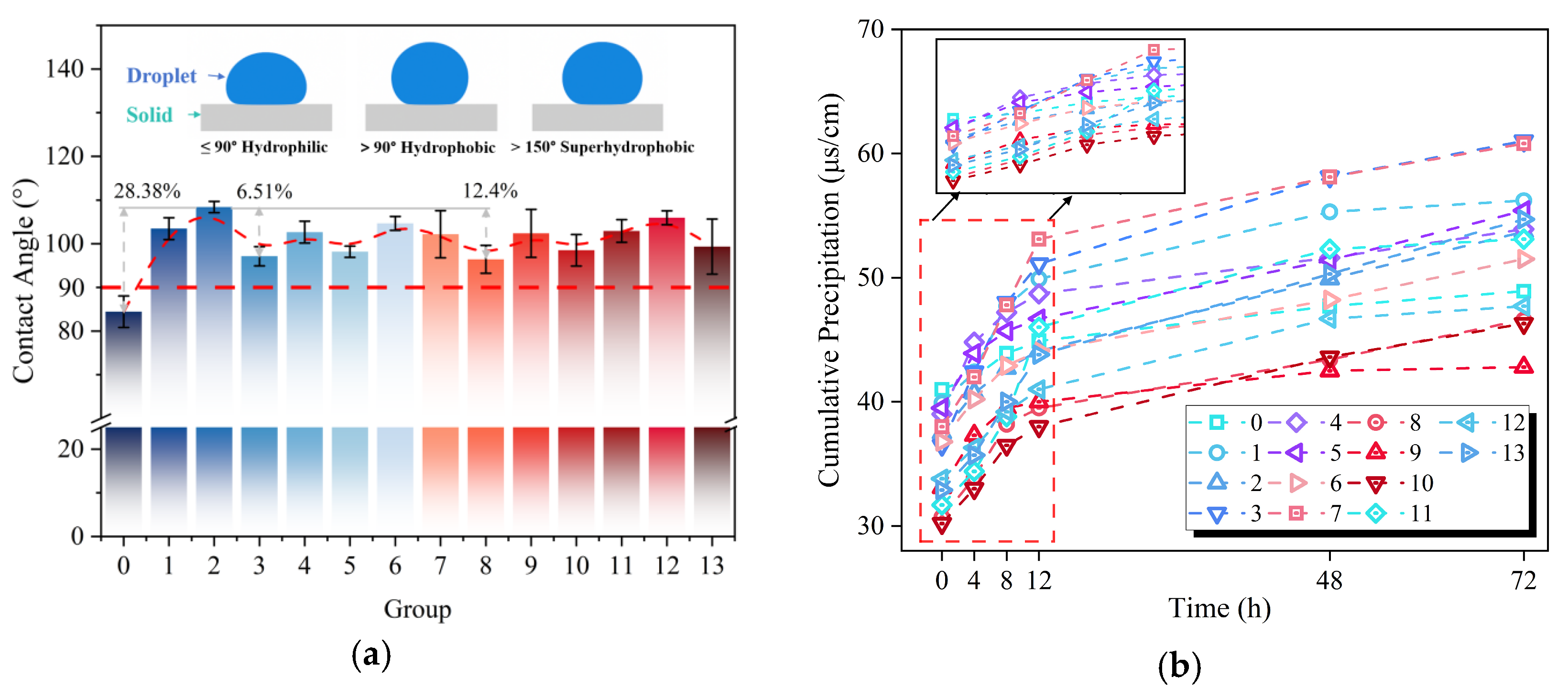
Contact angle and leachate conductivity were used to examine the effects of the HC and SC dosages on the functional properties of the composite-modified asphalt (Figure 10). Contact angle characterized asphalt-surface wettability, while the time-dependent leachate conductivity characterized the short-term aqueous-phase ion-release response of the salt-storage component under the specified immersion conditions.
As shown in Figure 10a, contact angle and leachate conductivity differed among the HC and SC dosage combinations. The contact angle of the base asphalt was 84.43°. After incorporation of the functional components, the contact angles of the modified binders generally increased to 95–108°, indicating reduced water-droplet spreading. Some formulations had contact angles above 105°, indicating relatively high hydrophobicity. The variation among formulations indicated that both HC and SC dosages affected surface wettability.
As shown in Figure 10b, after asphalt containing the salt-storage component was immersed in deionized water, leachate conductivity generally increased over 0–72 h, with a larger initial increase followed by a gradual slowdown. Conductivity increased markedly over 0–12 h, whereas the increase after 48 h was smaller, suggesting that the apparent ion-release rate changed with immersion time. At 72 h, conductivity differed substantially among the formulations, with the highest value exceeding 60 μS/cm, indicating that the SC dosage and its combination with HC affected the short-term aqueous-phase ion-release response of the modified asphalt.
Overall, HC mainly increased the surface hydrophobicity of the modified asphalt, whereas SC generated leachate-conductivity responses of different magnitudes. Contact angle and conductivity therefore described the functional characteristics of the composite-modified asphalt from the respective perspectives of interfacial wetting and aqueous-phase ion-release response.

3.2.2. High-Temperature Rheological Properties

(1)
Temperature sweep
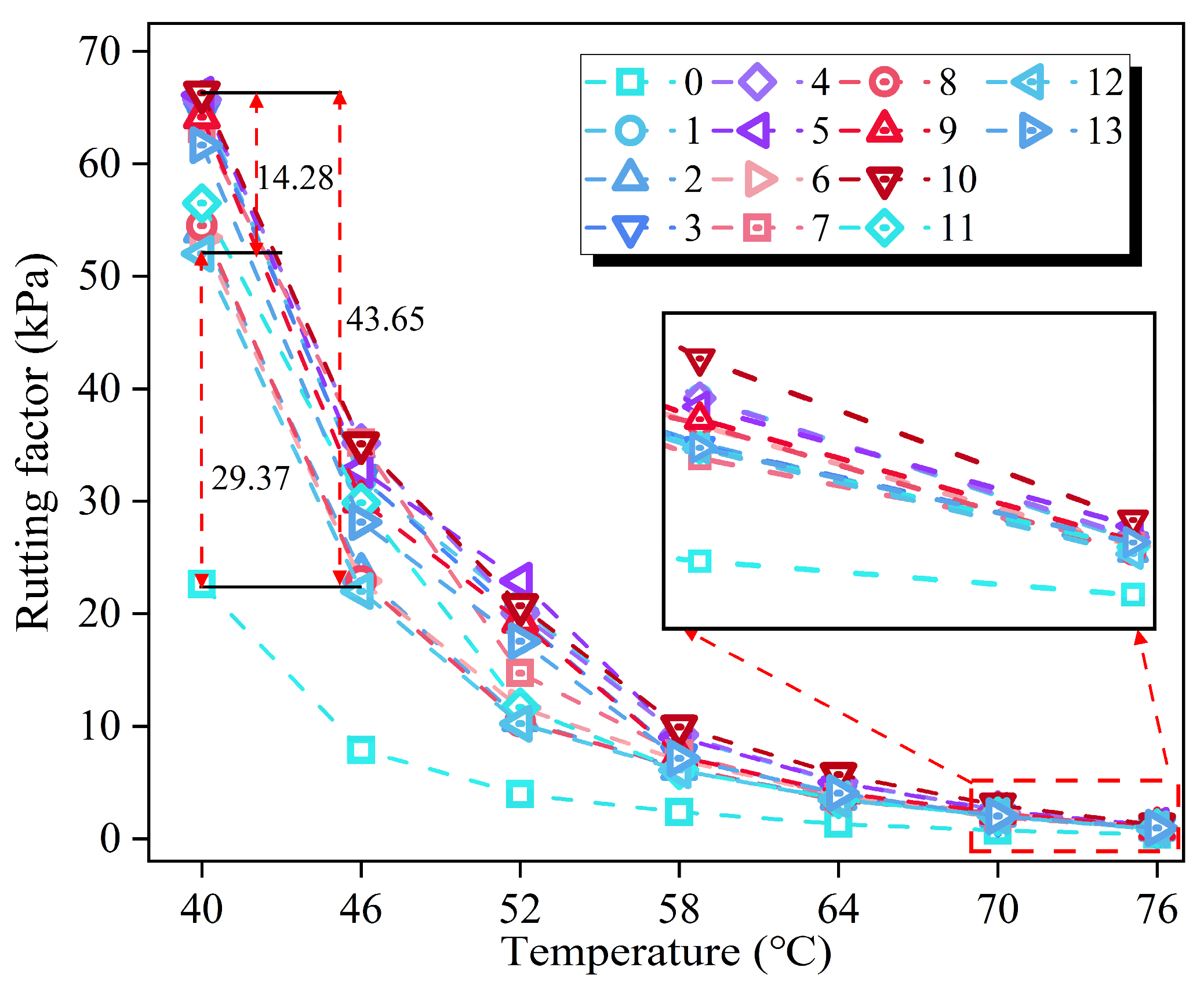
To evaluate the effect of combining the hydrophobic and salt-storage components on the high-temperature deformation resistance of modified asphalt, the complex shear modulus, |G*|, and phase angle, δ, were measured over a range of temperatures, and the rutting factor, |G*|/sin δ, was calculated. Its temperature dependence reflects resistance to rutting deformation at different temperatures; a higher |G*|/sin δ indicates greater rutting resistance and better high-temperature binder performance. The results are shown in Figure 11.
As shown in Figure 11, the |G*|/sinδ values of all asphalt samples decreased with increasing temperature, indicating lower stiffness and a greater viscous contribution at elevated temperatures, consistent with pronounced thermal sensitivity. Compared with the control group, all modified asphalt samples displayed higher |G*|/sinδ values, indicating that incorporating the hydrophobic and salt-storage components increased stiffness and resistance to permanent deformation under the test conditions. Across the different dosage combinations, the |G*|/sinδ values initially increased and then decreased with increasing HC and SC contents, showing a non-monotonic dosage dependence. Moderate component contents increased the rutting factor, whereas further increases in dosage did not provide additional improvement. This variation may be associated with changes in the effective solid content, particle dispersion, and local heterogeneity of the modified binder as the component dosages increased. Overall, the composite formulation improved the high-temperature rheological response within a certain dosage range.
(2)
Frequency sweep
Asphalt is a typical viscoelastic material whose mechanical response is governed by both temperature and loading time. Increasing temperature intensifies molecular chain mobility, leading to reduced elastic response and greater viscous flow, as reflected by relaxation and creep. Based on the time–temperature superposition (TTS) principle, mechanical data obtained at different temperatures can be shifted to a reference temperature using the logarithm of the shift factor, log αT, enabling a unified representation of time- and temperature-dependent effects.
Frequency sweep data measured for the asphalt binders at various temperatures were processed to determine the shift factor, αT. The resulting shift factors were then used to construct frequency sweep master curves for each binder. The shift factor, αT, was calculated using the semi-empirical Williams–Landel–Ferry (WLF) equation, as expressed in Equations (1) and (2).
ω r = ω · α T
l g α T = C 1 ( T T r ) C 2 + ( T T r )
where ωr is the reduced angular frequency at the reference temperature (rad/s); ω is the angular frequency (rad/s); αT is the temperature shift factor; C1 and C2 are fitting constants that vary with material type; T is the test temperature (°C); and Tr is the reference temperature, which was set to 58 °C in this study.
To construct the frequency master curves of |G*| and δ for each asphalt binder, the standard sigmoidal model was employed for curve fitting. The sigmoidal models used for master curve fitting are given in Equations (3) and (4).
The standard sigmoidal model for the complex shear modulus (|G*|) is expressed as
lg G * = a + b 1 + e c + d * l g f r
The standard sigmoidal model for the phase-angle (δ) master curve is expressed as
δ = π 2 × α ν ( e β + γ · l g f r ) [ 1 + e β + γ · l g f r ] 2
where a is the fitting parameter representing the lower bound of the modulus, b denotes the fitting parameter corresponding to the modulus range, c and d are fitting parameters that define the shape of the master curve, ωr is the reduced angular frequency at the reference temperature (rad/s), ω is the angular frequency (rad/s), δ is the phase angle (°), α is the fitting parameter for the lower bound of the phase angle, v represents the fitting parameter for the phase angle range, and β and γ are fitting parameters describing the shape of the phase angle master curve.
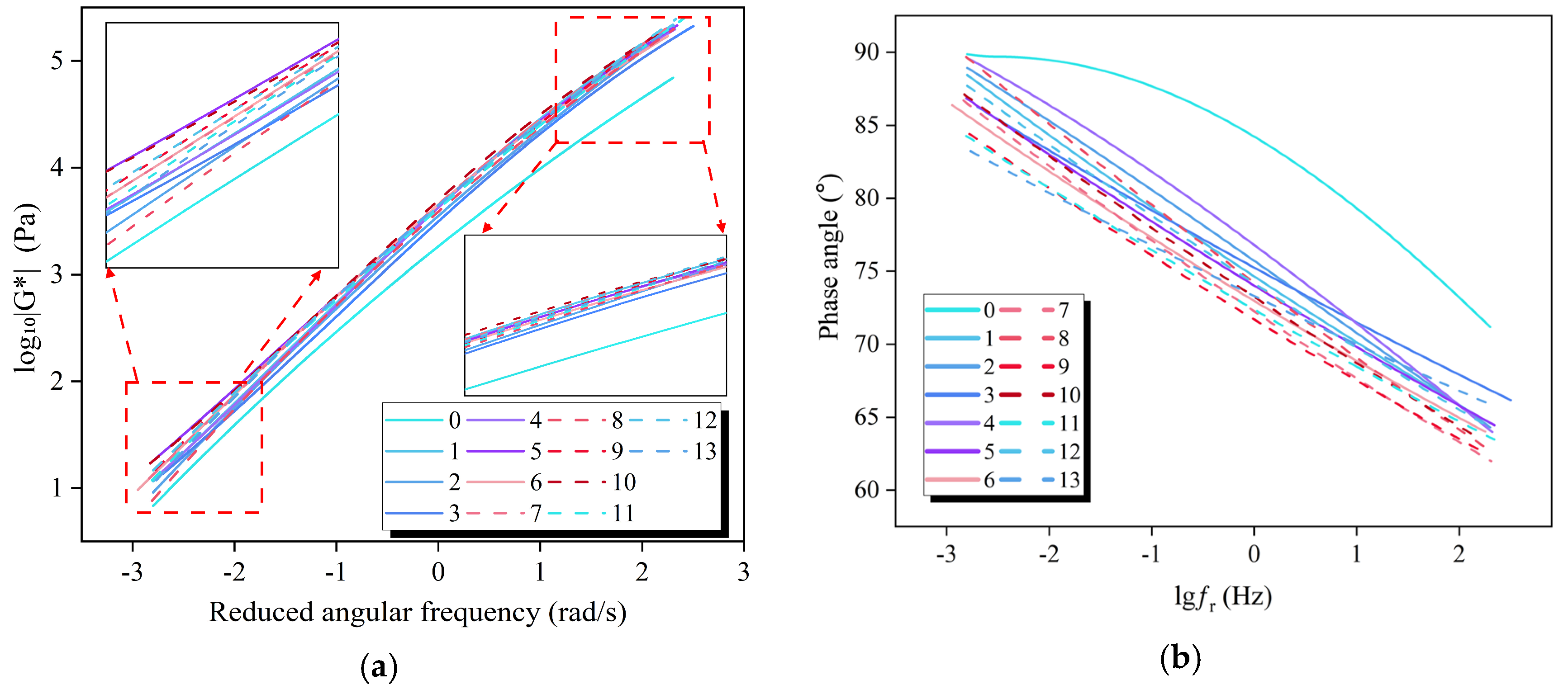
The master curves of the complex shear modulus, |G*|, and phase angle, δ, for the different asphalt binders are presented in Figure 12. The vertical axis represents the complex shear modulus or phase angle, while the horizontal axis corresponds to the reduced angular frequency, ωr. In general, a higher |G*| indicates greater resistance of the asphalt binder to deformation, whereas a larger phase angle, δ, reflects a greater delay between stress and strain responses, indicating a greater viscous contribution to the viscoelastic response of the asphalt binder.
As shown in Figure 12a, all composite-modified asphalt samples exhibited pronounced viscoelastic behavior in frequency sweep tests. With increasing loading frequency, the complex shear modulus, |G*|, increased markedly, whereas the phase angle (δ) results are presented in Figure 12b and gradually decreased, indicating increased stiffness and a greater elastic contribution at higher frequencies. This trend reflected the mechanical response of asphalt under high-frequency loading, where molecular chain mobility is restricted and structural stiffness is enhanced. Across the different dosage combinations, the modified binders generally exhibited higher |G*| and lower δ than the control binder, indicating greater stiffness and elastic contribution within the investigated frequency range. At a fixed HC content, changes in SC content further affected |G*|, whereas the variation in δ was less uniform. These trends may have resulted from the combined influence of effective solid content, particle dispersion, and local heterogeneity within the modified binder. Overall, the magnitude of the rheological response depended on the relative contents of the two functional components.
(3)
MSCR
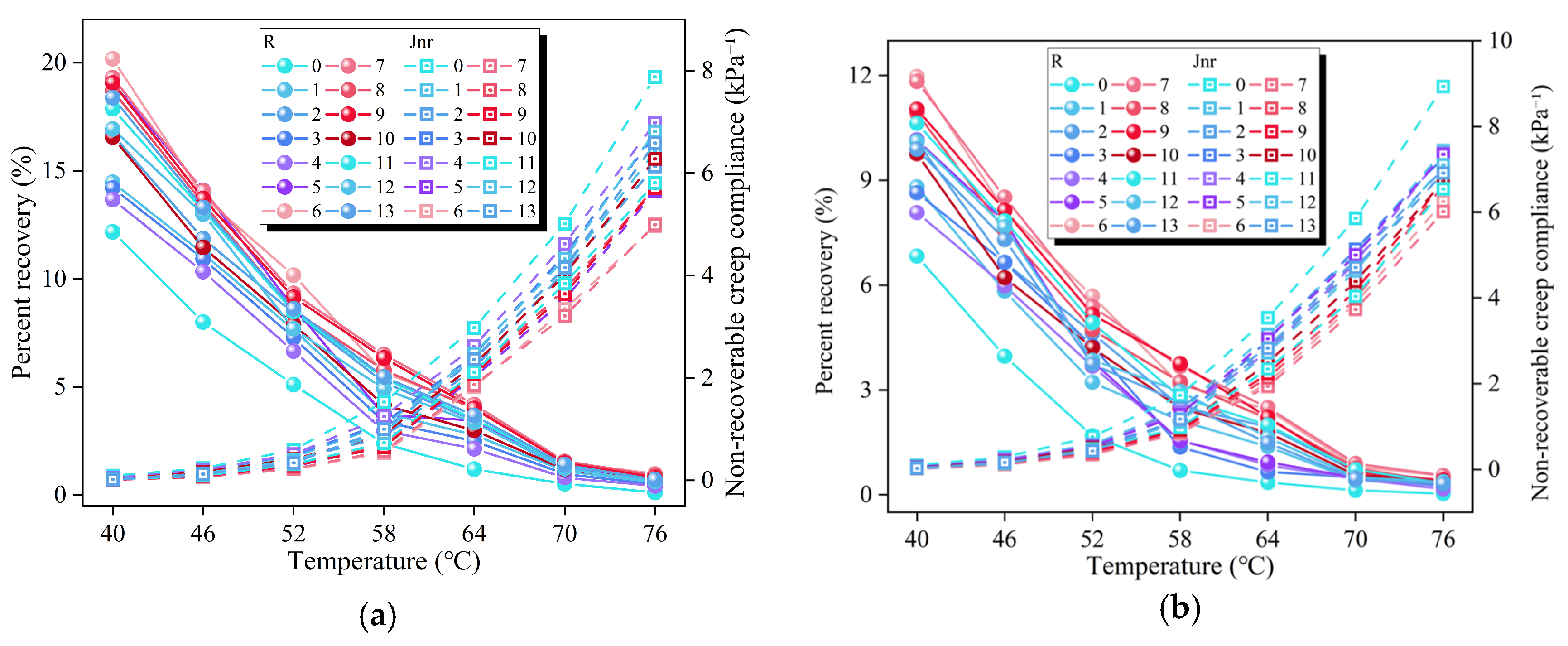
To evaluate the effects of composite modification on high-temperature deformation resistance and elastic recovery, non-recoverable creep compliance (Jnr) and recovery (R) were selected as the principal indices. These parameters characterize flow stability and structural recovery under high-temperature loading. The results are shown in Figure 13.
Figure 13a shows the creep and recovery performance at 0.1 kPa, whereas Figure 13b presents the corresponding results at 3.2 kPa. With increasing temperature, all asphalt samples showed decreasing recovery (R) and increasing non-recoverable creep compliance (Jnr) at stress levels of 0.1 and 3.2 kPa. This trend indicated progressive weakening of the viscoelastic structure at elevated temperatures, accompanied by increased susceptibility to permanent deformation and reduced rutting resistance. Compared with the control group, all modified asphalt samples showed lower Jnr and higher R values, indicating that incorporating the hydrophobic and salt-storage components improved elastic recovery and resistance to permanent deformation under the test conditions. At 0.1 kPa, R values of all samples were generally higher than those at 3.2 kPa, indicating that deformation under low stress was dominated by recoverable elastic behavior. As the stress level increased, the contribution of viscous flow became more pronounced, leading to reduced elastic response. In addition, the decrease in R from 0.1 to 3.2 kPa was less pronounced for several composite-modified binders than for the control binder, indicating better retention of recoverable response as the applied stress increased. The lower Jnr and higher R values indicated that the modified binders exhibited less non-recoverable deformation and greater recovery under the tested conditions. This response may be associated with the increased stiffness produced by the incorporated solid components, together with differences in their effective content and dispersion state within the binder.

3.2.3. Low-Temperature Rheological Properties

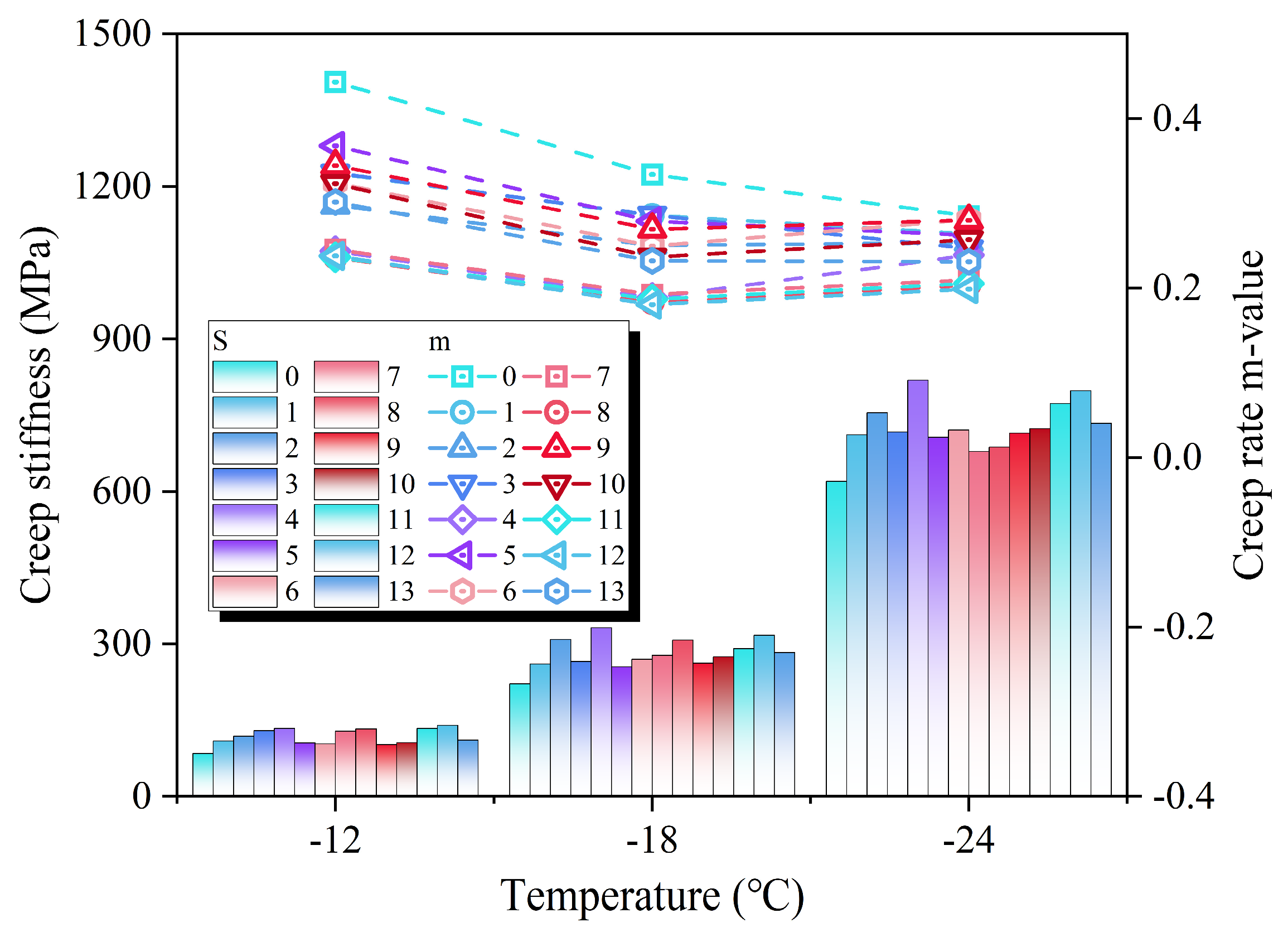
Bending-beam rheometer (BBR) tests were conducted to characterize the low-temperature creep behavior and cracking resistance of the composite-modified asphalt. Creep stiffness (S) and creep rate (m) at 60 s were selected as the evaluation indices. A higher S indicates greater brittleness because increased stiffness reduces stress-relaxation capacity and increases the risk of low-temperature cracking. Conversely, a lower m indicates a slower change in stiffness under loading, implying poorer stress-relaxation capacity and greater susceptibility to low-temperature cracking. The results are presented in Figure 14.
As shown in Figure 14, creep stiffness (S) increased and the m value decreased for all asphalt samples as the temperature decreased from −12 °C to −24 °C. This trend indicated that lower temperatures increased brittleness and reduced the stress-relaxation capacity and ductility of asphalt. Compared with the control group, the composite-modified asphalt generally exhibited higher S and lower m values at −18 °C and −24 °C, indicating increased stiffness and lower stress-relaxation capacity at low temperatures.
Among the dosage groups, Group 2 exhibited the highest S value at −24 °C, reaching 819 MPa, while its m value decreased to below 0.25. The simultaneous increase in S and decrease in m indicates that the relatively high HC content markedly increased low-temperature stiffness and weakened stress relaxation. In comparison, the changes associated with SC content were less pronounced, and several groups with higher SC contents showed lower S values or higher m values than the corresponding low-SC formulations. Therefore, the results suggest that HC content had a stronger influence on the deterioration of low-temperature relaxation than SC content, particularly at the lower test temperatures.

3.2.4. Fatigue Performance

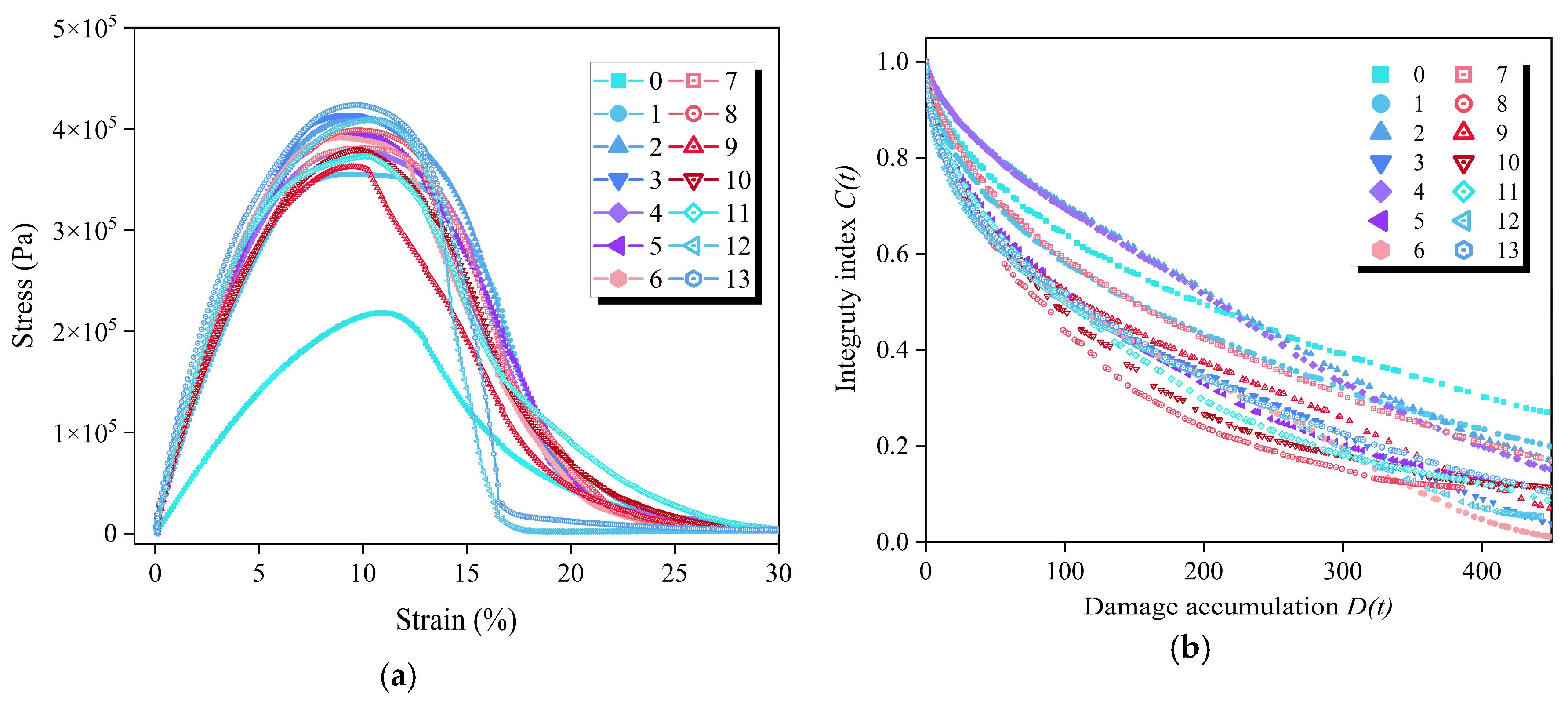
To evaluate the fatigue resistance of the composite-modified asphalt, linear amplitude sweep (LAS) tests were conducted to characterize damage evolution and fatigue life under cyclic loading. The stress–strain response, fatigue damage curves, and predicted fatigue life were analyzed to compare the fatigue responses of the different dosage groups. The test results are presented in Figure 15.
As shown in Figure 15a, all asphalt binders exhibited a typical increase–peak–decrease response during LAS tests. With increasing strain amplitude, shear stress gradually increased to a distinct peak and then decreased rapidly. Compared with the control group, all composite-modified asphalt samples showed higher peak stress levels, indicating that incorporation of hydrophobic and salt-storage components increased the pre-peak stress-carrying capacity under LAS loading. Several dosage groups, including Groups 2, 5, 9, and 13, reached their maximum stress at strain levels of approximately 9%–10% and exhibited higher peak stresses than the control binder. This result indicated that the modified binders could sustain a higher stress level before reaching the peak. However, some high-dosage groups displayed a steeper stress reduction after the peak, indicating a more rapid loss of stress-carrying capacity with further strain. Thus, the increase in peak stress was accompanied by a sharper post-peak softening response in these formulations.
As shown in Figure 15b, |G*|sinδ decreased continuously with increasing damage variable D for all binders. Compared with the control binder, Groups 1–13 generally exhibited steeper decreases in |G*|sinδ, indicating faster stiffness degradation during the LAS loading process. This result was consistent with the more pronounced post-peak stress reduction observed in Figure 15a and indicated that the modified binders lost their load-carrying capacity more rapidly as damage accumulated.
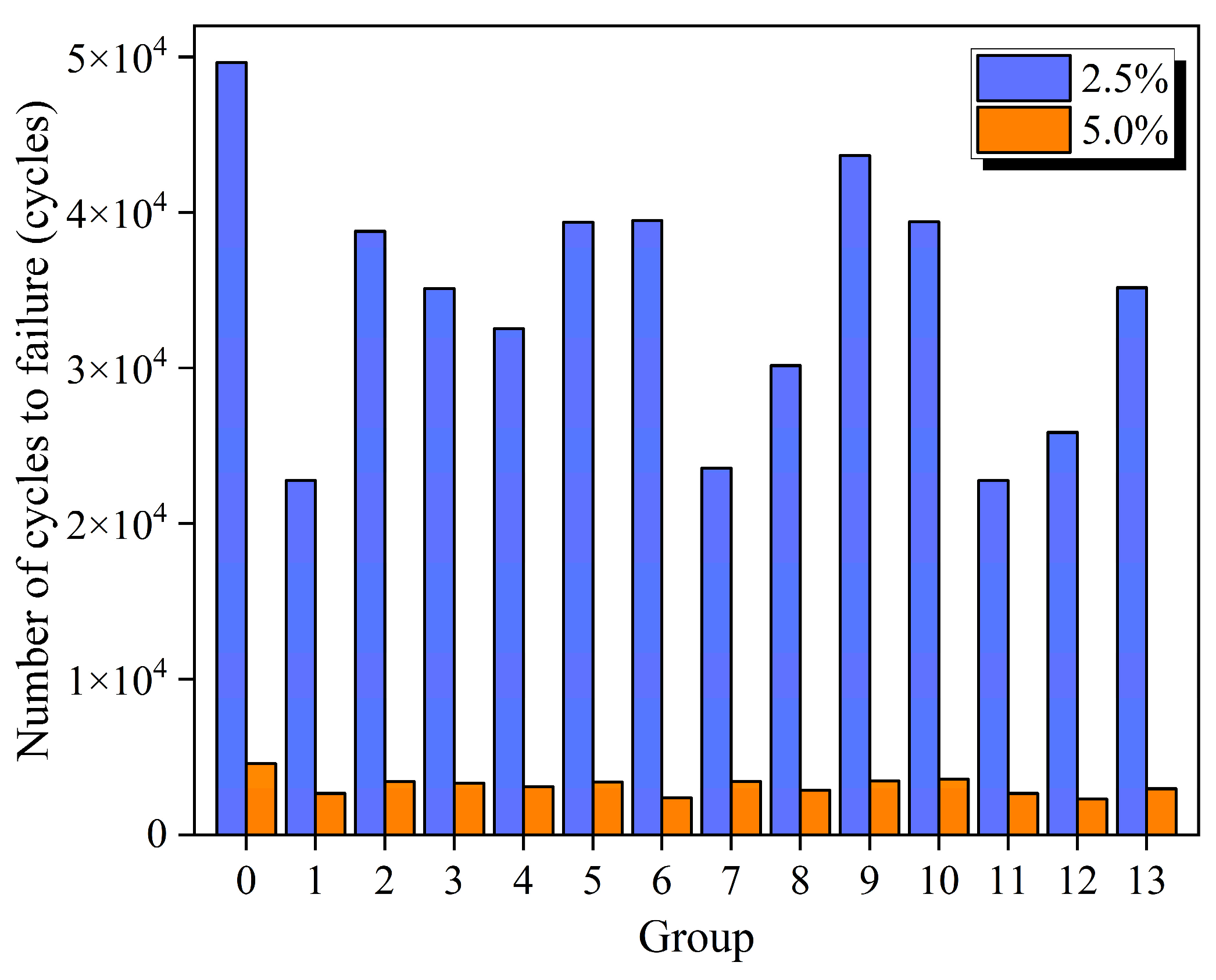
To further analyze the fatigue characteristics of composite-modified asphalt with different dosages, strain levels of 2.5% and 5.0% were selected to compare fatigue performance at lower and higher strain amplitudes, respectively. The fatigue life (Nf) of each dosage group was then calculated, where a larger Nf indicates greater fatigue resistance. The fatigue life results of the asphalt binders under different strain levels are presented in Figure 16.
As shown in Figure 16, the fatigue lives (Nf) of the modified binders at strain levels of 2.5% and 5.0% were generally lower than those of the control binder, indicating reduced fatigue resistance. At 2.5% strain, the fatigue lives of the modified binders ranged from 2.3 × 10⁴ to 4.3 × 10⁴ cycles, approximately 20%–40% lower than that of the control binder. At 5.0% strain, the values ranged from 2.3 × 10³ to 3.6 × 10³ cycles and were markedly lower than the corresponding control value. The greater difference at the higher strain level indicated that the modified binders were more sensitive to applied strain. Together with the higher peak stresses and faster stiffness degradation in Figure 15a,b, these fatigue-life results indicate that the improved stiffness and pre-peak stress response were accompanied by a reduced ability to sustain repeated deformation.

3.2.5. Correlation Between Functional and Rheological Properties

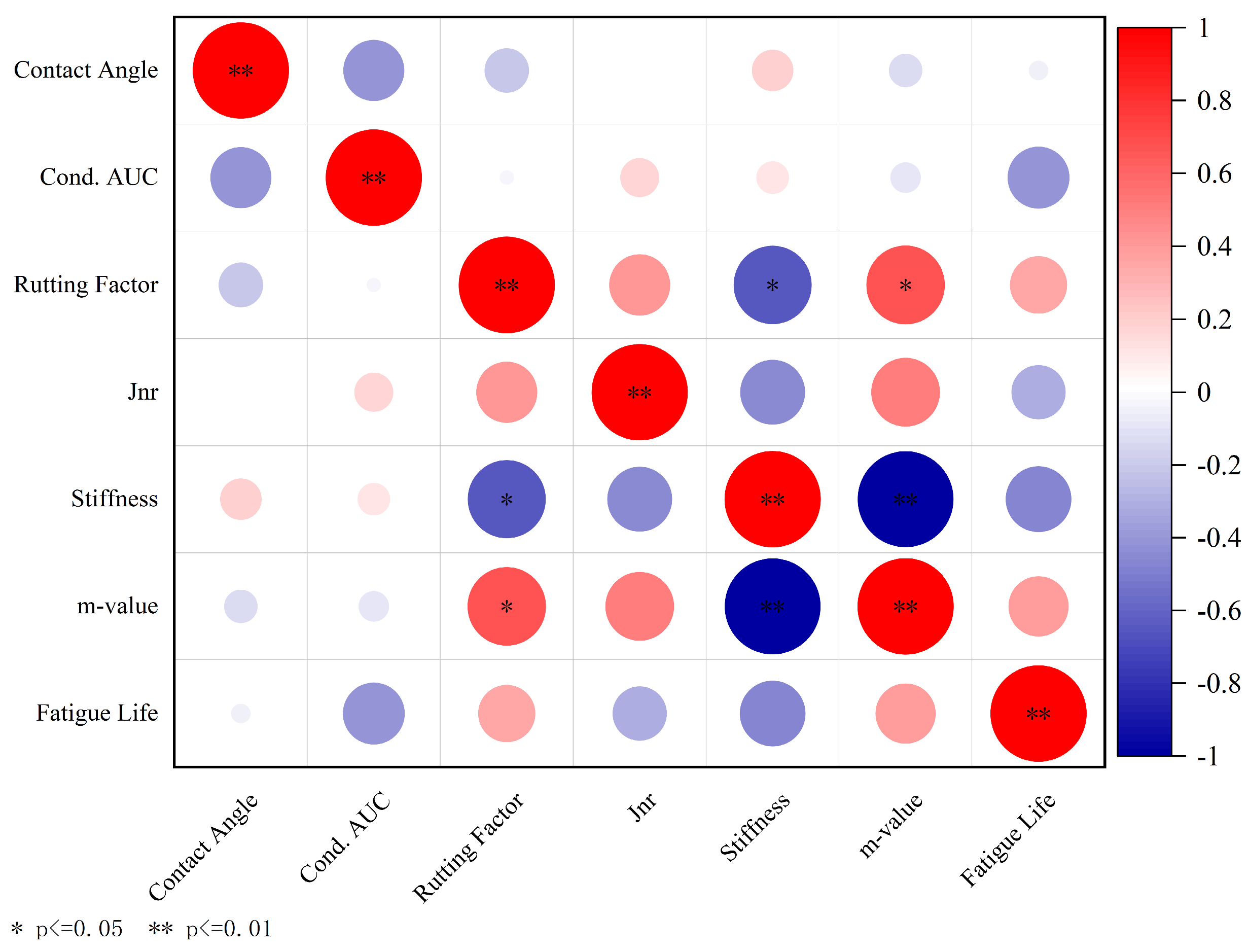
After the five center-point runs were combined into one formulation condition, an exploratory Spearman correlation analysis was conducted using representative indices for nine unique formulation conditions (Figure 17). Contact angle was only weakly correlated with the rheological indices overall, while the area under the conductivity-response curve was moderately negatively correlated with fatigue life (r = −0.41), indicating that functional and rheological performance did not change in a simple synchronous manner. Low-temperature creep stiffness and m values showed a strong negative correlation (r = −0.99), consistent with the reduction in stress-relaxation capacity as low-temperature stiffness increased. The correlation coefficients of rutting factor with low-temperature creep stiffness and m values were −0.65 and 0.66, respectively, indicating some association between the high- and low-temperature rheological responses of the formulations but no simple trade-off. Overall, no single index could comprehensively describe the performance of the composite-modified asphalt; functional, high-temperature, low-temperature, and fatigue properties should therefore be considered together in a multi-index evaluation.

3.2.6. Dosage Effects and Comprehensive Performance Evaluation

To facilitate the joint evaluation of multiple performance indices in a multicomponent asphalt system, a comprehensive performance evaluation framework was established for anti-icing-modified asphalt using 12 third-level indices. These indices were integrated into four first-level categories: functional, high-temperature rheological, low-temperature rheological, and fatigue performance [43,44]. This framework enables systematic analysis of the dosage-dependent effects of the hydrophobic and salt-storage components. The evaluation system is summarized in Table 3.
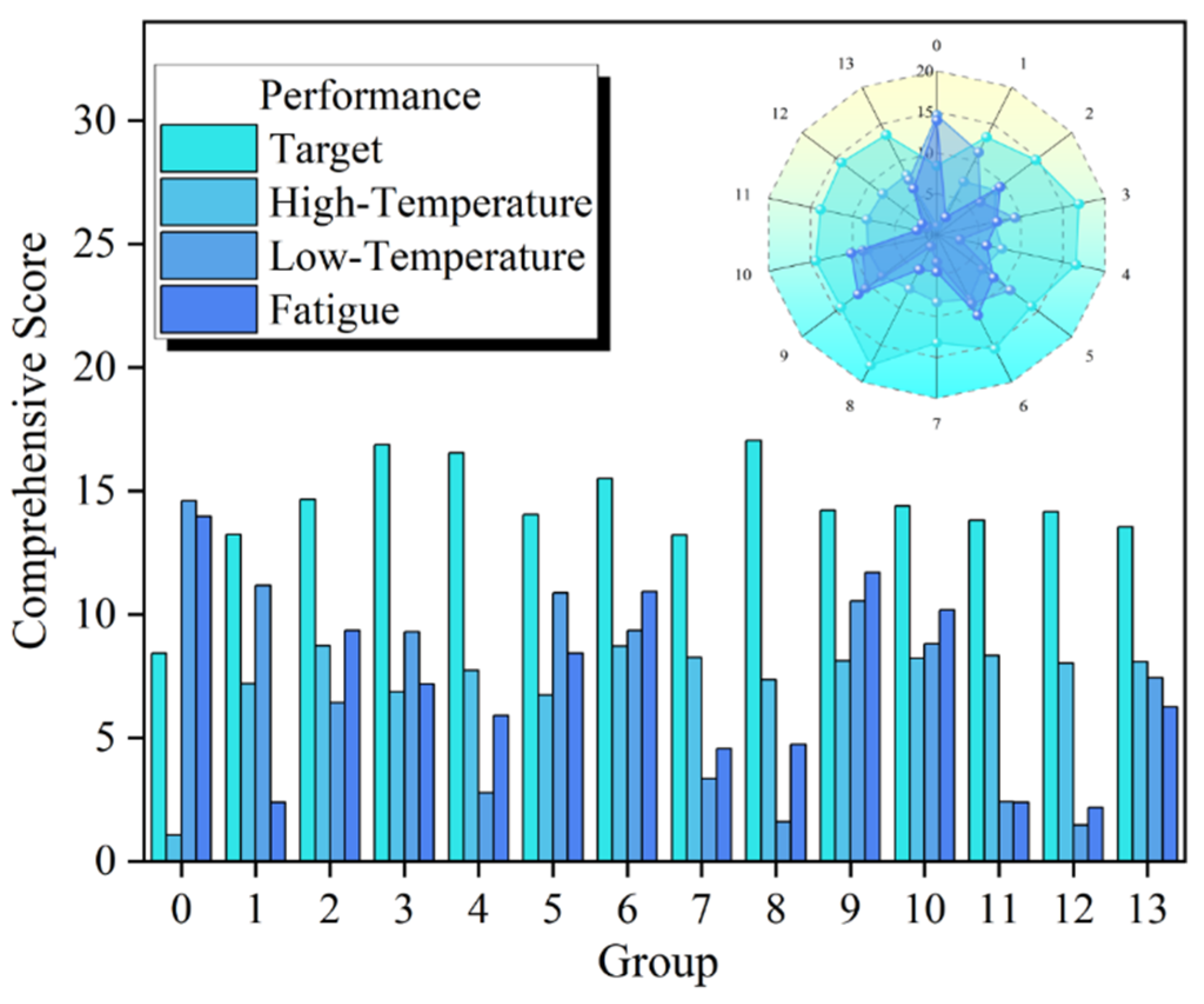
The entropy-weight method was applied to evaluate the different performance attributes of each asphalt binder, yielding comprehensive scores for the functional performance, high-temperature rheological performance, low-temperature rheological performance, and fatigue performance of the anti-icing modified asphalt based on multiple factors. To facilitate comparison, the obtained scores were multiplied by 100. The resulting normalized scores are presented in Figure 18.
As shown in Figure 18, the modified asphalt samples exhibited distinct performance characteristics across the four first-level indicators. Overall, functional performance and high-temperature rheological performance improved, whereas low-temperature rheological performance and fatigue resistance decreased. This trend indicated that combined incorporation of hydrophobic and salt-storage components improved the functional response and high-temperature stability, but that the increased stiffness was accompanied by reduced stress-relaxation capacity and damage tolerance.
Response surface analysis was performed using Design-Expert 8.0.6 (Stat-Ease, Inc., Minneapolis, MN, USA) to examine dosage-dependent trends in functional, high-temperature, low-temperature, and fatigue performance. The hydrophobic-component dosage (X1) and salt-storage-component dosage (X2) were the independent variables, and quadratic equations were fitted separately to the four entropy-weighted performance scores. The fitted equations and corresponding coefficients of determination are summarized in Table 4. All four quadratic models were statistically significant within the experimental design space and showed no significant lack of fit (Table 4). Model p values were ≤0.003, lack-of-fit p values ranged from 0.358 to 0.648, adjusted R2 values ranged from 0.81 to 0.96, and predicted R2 values ranged from 0.78 to 0.91. The fitted models were then used for multi-objective optimization with equal weights assigned to functional, high-temperature, low-temperature, and fatigue performance. Optimization using the desirability function within the bounds of 6%–8% HC and 12%–18% SC yielded a compromise formulation containing 8% HC and 14.6% SC.
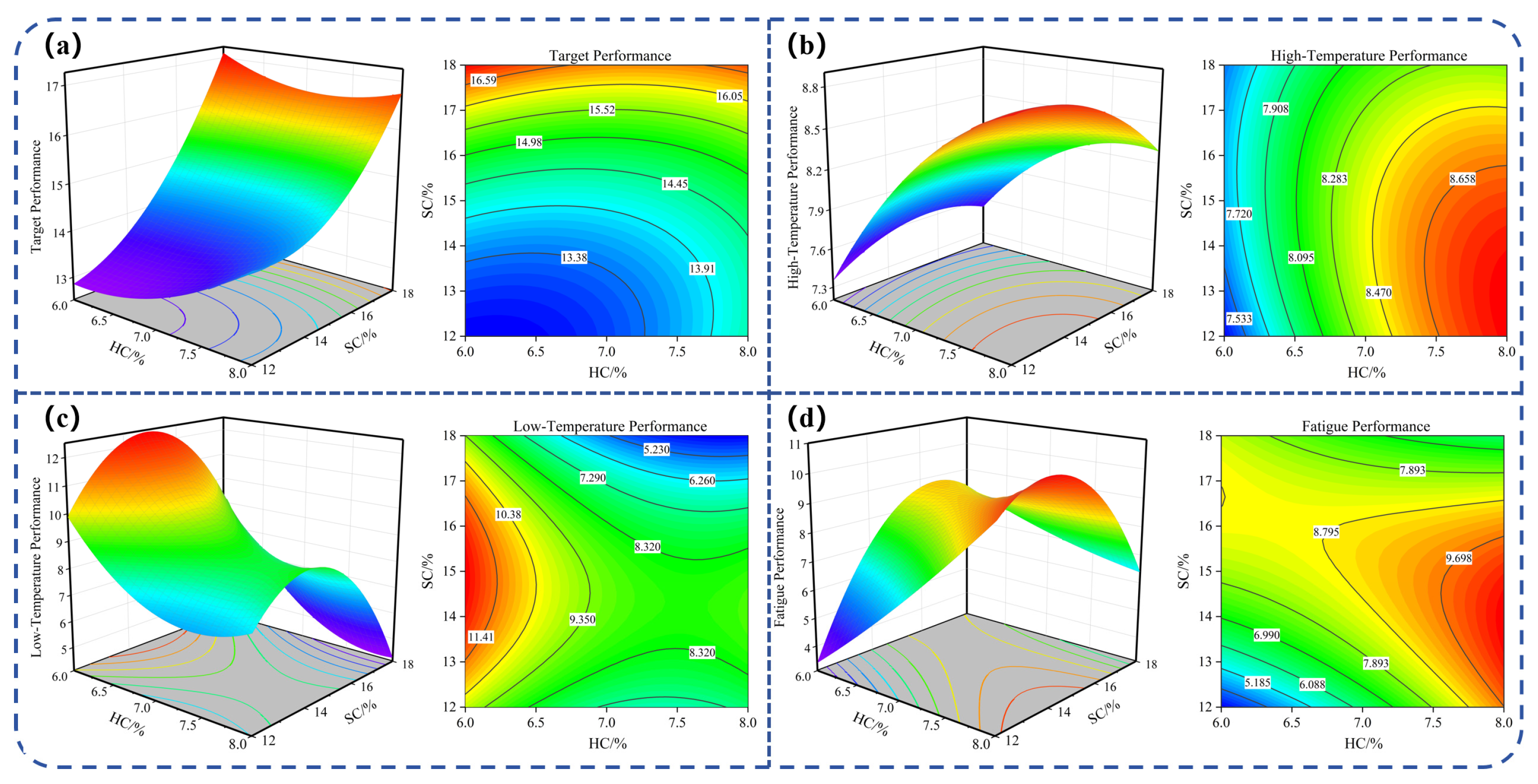
Based on the fitted equations, response surfaces and corresponding contour maps were generated to visualize the changes in the four performance scores with HC and SC dosages (Figure 19). The surfaces were used to compare the direction and magnitude of the dosage-dependent responses within the investigated range.
As shown in Figure 19, the dosages of the hydrophobic component (HC) and salt-storage component (SC) had clear dosage-dependent effects on the performance of the modified asphalt. The functional performance score generally increased with increasing HC and SC dosages and reached a relatively high level in the high-dosage region, indicating that higher combined dosages improved surface hydrophobicity and salt-release-related functionality under the test conditions. The response surface showed that the magnitude of functional improvement varied across the investigated dosage range. The high-temperature rheological performance score initially increased and then decreased with increasing HC and SC contents, forming a distinct convex surface. When HC was approximately 7.5% and SC was approximately 15%, the high-temperature performance score reached its maximum within the investigated range, indicating that this dosage combination provided the most favorable high-temperature response among the tested conditions. Beyond the peak region, further increases in HC or SC content resulted in a gradual decrease in the high-temperature performance score. This trend was consistent with the temperature sweep results, in which the rutting factor initially increased and then decreased with increasing component dosage. The two sets of results indicated that the high-temperature benefit was limited to an appropriate dosage range rather than increasing continuously with HC and SC contents. In contrast, the low-temperature performance score showed the opposite trend, forming a concave response surface. This pattern indicated that higher combined component dosages were generally associated with poorer low-temperature performance, particularly in the high-dosage region.
The four response surfaces showed different dosage-dependent trends. Functional performance generally increased toward the higher-dosage region, whereas the high-temperature score reached a relatively high level within an intermediate dosage range. The low-temperature and fatigue scores did not vary in the same direction as the functional score. Joint consideration of the four response surfaces identified 8% HC and 14.6% SC as a compromise formulation within the investigated design range. The measured response at this formulation was then compared with the fitted value, as summarized in Table 5.
Weight-sensitivity analysis quantified how the optimization result depended on the weights assigned to the four performance categories. When the weight of functional, high-temperature, low-temperature, or fatigue performance was increased from 0.25 to 0.40 and the weights of the other three categories were reduced to 0.20, the optimal HC dosage reached the upper bound of 8.00% in every scenario. The corresponding optimal SC dosages were 15.98%, 13.98%, 14.36%, and 14.30%, respectively. Within the current design space, the optimization consistently favored the higher HC dosage, whereas the optimal SC dosage varied from 13.98% to 15.98% around the equal-weight baseline of 14.64%. The equal-weight solution of 8% HC and 14.6% SC therefore provided a compromise across the four performance categories.
The relative errors between the fitted and measured values in Table 5 were 2.6%–5.0%, indicating close numerical agreement within the experimental range. This comparison describes the internal agreement of the fitted models at the selected formulation rather than their performance beyond the investigated design space.

3.3. Evaluation of Anti-Icing Performance of Modified Asphalt Mixtures

Four mixture systems were evaluated under identical material, preparation, and testing conditions: hydrophobic-only modified asphalt (HA), salt-storage-only modified asphalt (SSA), selected composite-modified asphalt (CM), and unmodified base asphalt (Control). This four-group design provided an internal laboratory benchmark for comparing the single-component and composite formulations. CM was therefore evaluated relative to Control, HA, and SSA using the same gradation, asphalt–aggregate ratio, specimen geometry, and conditioning conditions. The dosages for each group are listed in Table 6.

3.3.1. Ice Accumulation Test

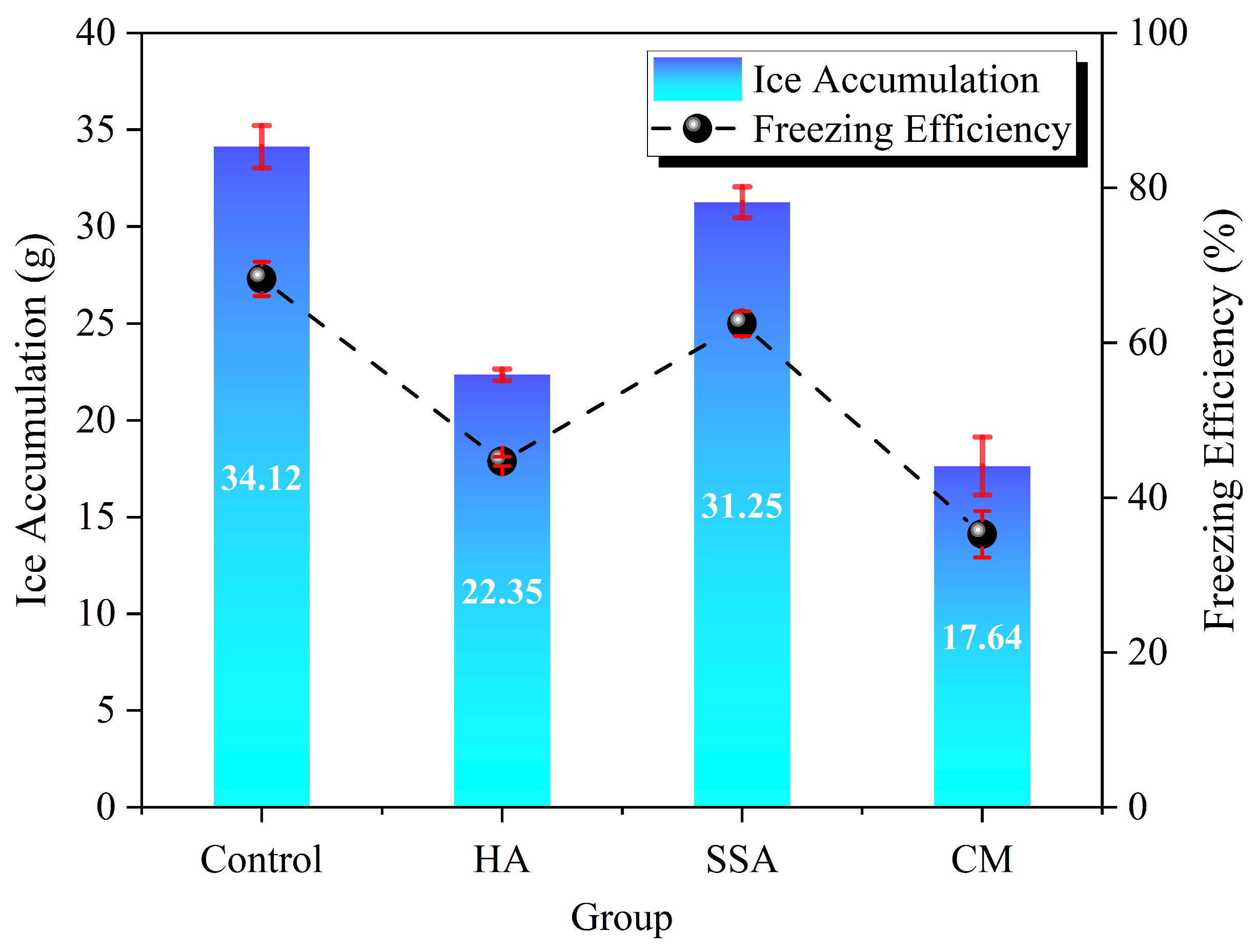
To compare the effects of the modification systems on mixture anti-icing performance, an ice accumulation test was conducted. Differences among the hydrophobic-only, salt-storage-only, and composite systems were evaluated by measuring ice accumulation and the surface icing ratio. The results are presented in Figure 20.
To compare the effects of the different modification systems on pavement-surface icing, ice accumulation was measured for the Control, HA, SSA, and CM mixtures under identical inclined-water-application and low-temperature conditioning conditions (Figure 20). At −10 °C, Control had the highest mean ice accumulation, at 34.12 ± 1.10 g, while the values for HA, SSA, and CM were 22.35 ± 0.30, 31.25 ± 0.80, and 17.64 ± 1.50 g, respectively. Compared with Control, ice accumulation decreased by 34.5%, 8.4%, and 48.3% for HA, SSA, and CM, respectively; the CM value was also 21.1% and 43.6% lower than those of HA and SSA, respectively. The 34.5% reduction for HA, compared with only 8.4% for SSA, indicates that hydrophobic modification had a greater effect on ice accumulation than the salt-storage component alone under the inclined-water-application and short-term low-temperature conditioning conditions used here. The further reduction observed for CM indicated that adding the salt-storage component to HA further improved the anti-accumulation performance of the composite system.

3.3.2. Freezing-Temperature Test

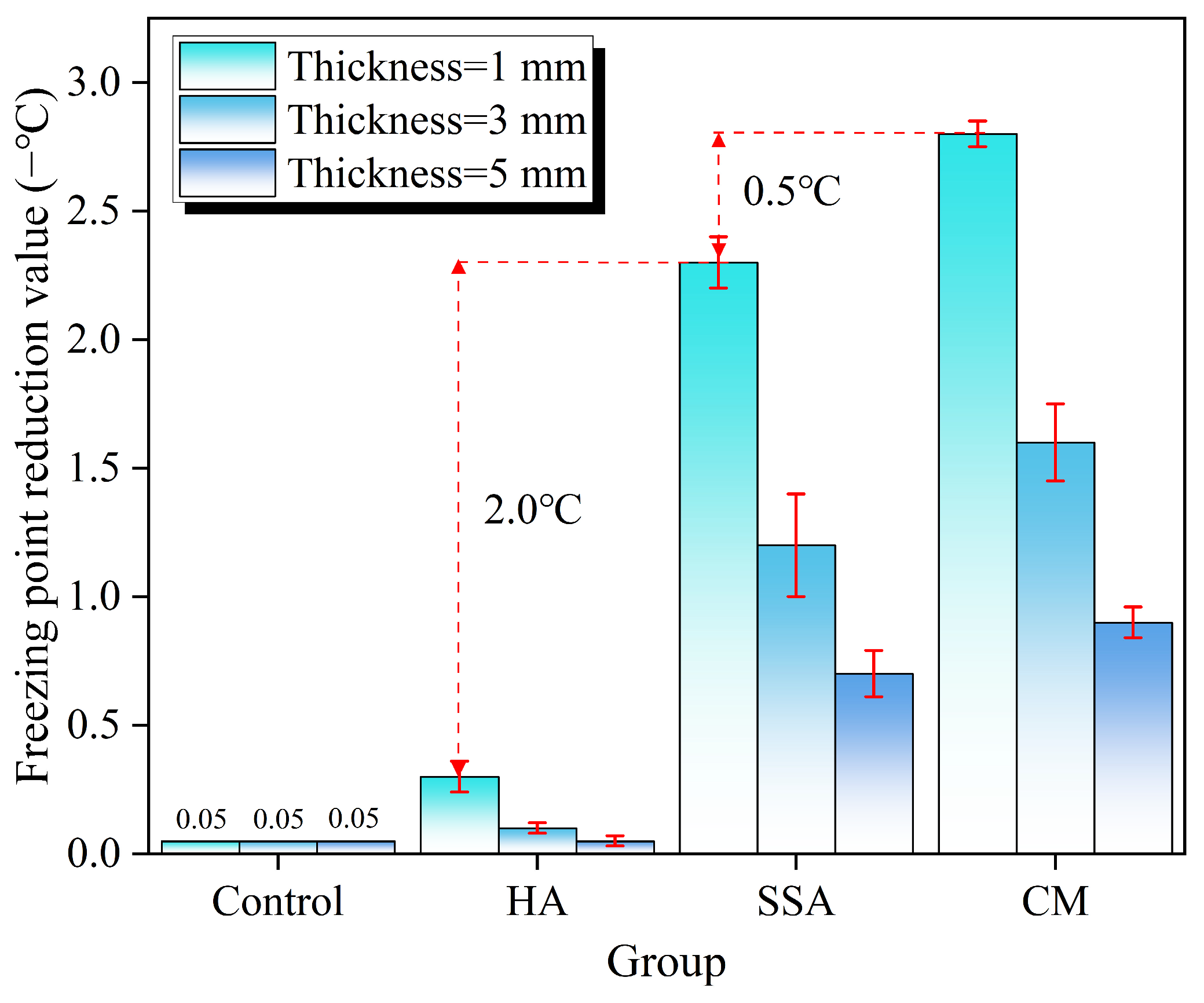
To examine differences in freezing temperature among the modification routes, freezing-temperature tests were conducted, and the results are presented in Figure 21.
As shown in Figure 21, pronounced reductions in freezing temperature occurred only in the salt-containing systems (SSA and CM), whereas HA remained close to Control. At a water-layer thickness of 1 mm, the freezing temperatures of Control, HA, SSA, and CM were −0.05, −0.30, −2.30, and −2.80 °C, respectively. Control and HA exhibited relatively close freezing temperatures, whereas substantially lower values were obtained for the salt-containing SSA and CM systems. These results indicate that the observed freezing-temperature reduction was mainly associated with the salt-storage component. The small difference between Control and HA should be interpreted cautiously in combination with the measurement resolution and variation among replicate specimens. At a water-layer thickness of 1 mm, CM exhibited a freezing temperature 0.5 °C lower than that of SSA. CM also maintained the lowest freezing temperature at water-layer thicknesses of 3 and 5 mm. As the water layer became thicker, the freezing temperatures of SSA and CM increased and their reductions relative to Control became smaller, indicating that the freezing-temperature benefit of the salt-containing systems weakened as the water volume increased. Nevertheless, CM maintained a lower freezing temperature than SSA across all three water-layer thicknesses.

3.3.3. Ice–Pavement Shear Test

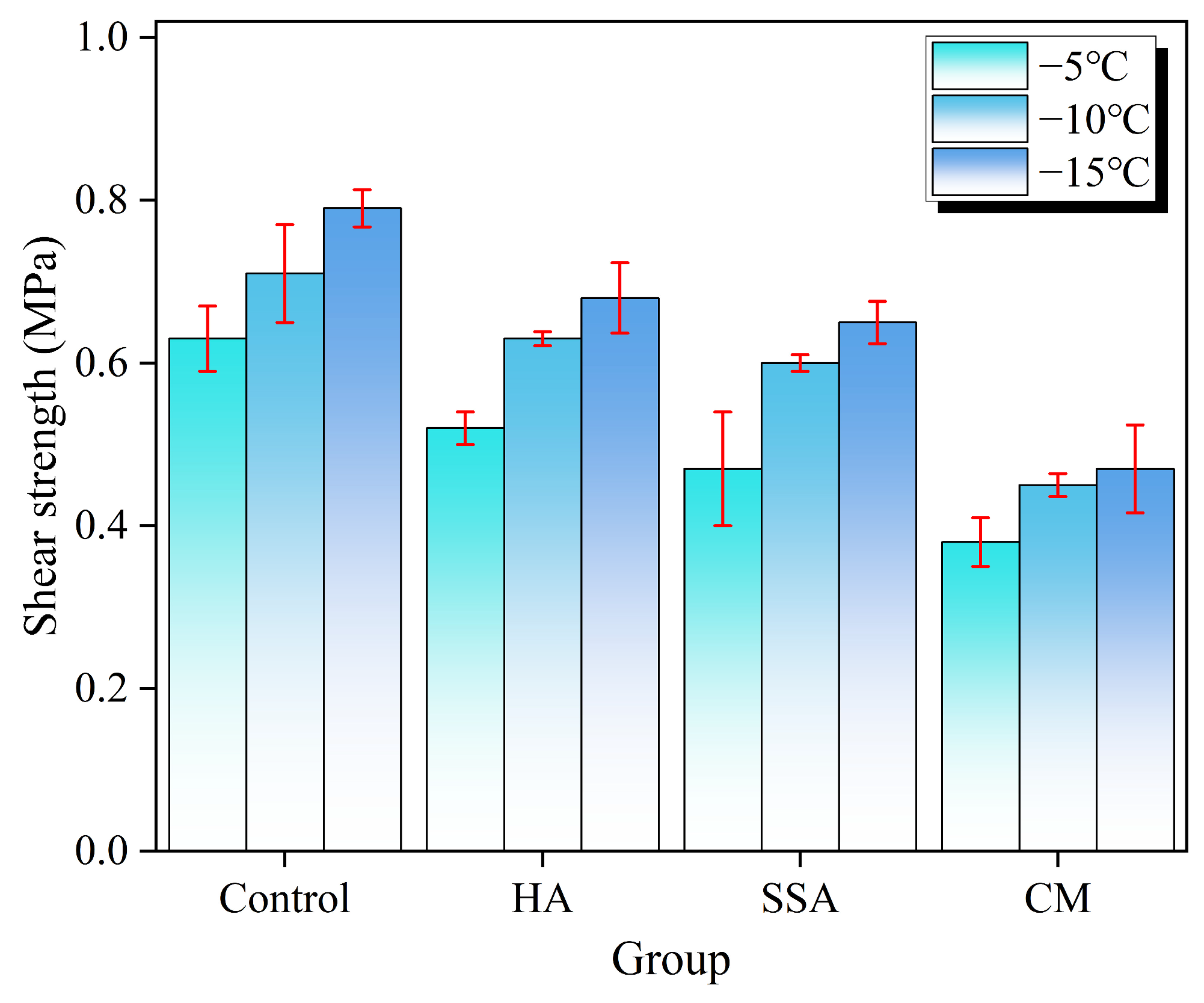
To compare the effects of different modification routes on ice–pavement interfacial shear resistance, apparent ice–pavement shear tests were conducted at −5, −10, and −15 °C under the same fixture and ice-layer geometry, and the results are shown in Figure 22.
As shown in Figure 22, the apparent ice–pavement shear strength increased as the temperature decreased for all four mixture systems. For Control, the values increased from 0.63 MPa at −5 °C to 0.71 MPa at −10 °C and 0.79 MPa at −15 °C. HA produced a moderate reduction over the three test temperatures, whereas SSA showed its largest reduction at −5 °C and a progressively smaller reduction as the temperature decreased. Therefore, the apparent shear-strength reduction of SSA was more sensitive to temperature than that of HA. CM exhibited the lowest apparent shear strength at all three temperatures. At −10 °C, the value of CM was 0.45 MPa, compared with 0.71 MPa for Control and 0.63 MPa for HA. The consistently lower values of CM indicated that the composite formulation maintained an additional reduction in apparent shear resistance over the investigated temperature range.

3.4. Statistical Analysis of Anti-Icing Performance

Each mixture group comprised three independently mixed and compacted specimens for each anti-icing test (n = 3), and results are reported as the mean ± standard deviation. Statistical comparisons were conducted separately at each water-film thickness or test temperature. Overall differences among Control, HA, SSA, and CM were evaluated using Welch’s one-way analysis of variance, followed by prespecified Welch’s t-tests. Each modified group was compared with Control; for ice accumulation, CM was also compared with HA and SSA. Benjamini–Hochberg (BH) correction was applied to the prespecified comparisons within each test condition. Table 7 summarizes the results.

4. Discussion

Table 8 summarizes the material forms, incorporation positions, and comparison designs of the anti-icing asphalt systems most closely related to this study. Previous studies have investigated surface fog seals combining hydrophobic and salt-release functions [8], hydrophobic modifiers incorporated into asphalt binders [9,10], salt-storage fog seals [14], multifunctional asphalt mixtures [18], and the long-term performance of salt-storage mixtures [22,23]. Compared with these studies, the present work uses matched Control, HA, SSA, and CM systems to compare individual-component and composite formulations within the same internally modified binder framework.
Yu et al. reported a 61.2% reduction in ice-bonding strength for a hydrophobic coating [45], Zou et al. reported a reduction of approximately 50% for a salt-storage system at −7 °C [46], and Jin et al. obtained a freezing-temperature reduction of approximately 3.1 °C using a salt-storage asphalt mortar [47]. In the present study, HA produced a greater reduction in ice accumulation than SSA, whereas the decrease in freezing temperature was mainly observed in the salt-containing SSA and CM systems. CM exhibited the lowest ice accumulation, freezing temperature, and apparent ice–pavement shear strength among the four systems. At the binder scale, the improvements in functional and high-temperature rheological performance were accompanied by increased low-temperature stiffness, reduced stress-relaxation capacity, and lower predicted fatigue life. These results indicate that the two components contributed differently to individual anti-icing indices, while the composite formulation provided additional reductions in several anti-icing indicators but introduced a clear trade-off in low-temperature and fatigue performance. Surface-engineered multifunctional anti-icing systems place active materials in a coating. He et al. [29] prepared a superhydrophobic anti-icing coating for pavements and evaluated its durability through multiple tests. Peng et al. [30] combined the photothermal response of carbon nanotubes with the superhydrophobicity of polytetrafluoroethylene in an emulsified asphalt coating, thereby coupling photothermal and hydrophobic anti-icing and deicing. Azeem et al. [32] used a low-surface-energy finish on flexible fabrics and reported static water contact angles of 125° to 135°; their study evaluated textile wettability. In coating-based pavement systems, the photothermal response depends on illumination, while service durability depends on maintaining the exposed functional layer. Traffic abrasion and freeze–thaw cycling can therefore challenge long-term coating performance. These differences motivated the present internal-modification strategy. We incorporated hydrophobic and salt-storage components directly into the asphalt binder and compared matched Control, HA, SSA, and CM systems within the same framework. This design distinguishes the responses of the individual-component and composite formulations while quantifying the associated changes in rheological performance.
Superhydrophobic surfaces can delay icing by altering water–solid contact and heterogeneous nucleation, while ice adhesion is also governed by surface structure and freezing conditions [5,48]. In this study, aerogel modification increased the contact angle, and HA exhibited lower ice accumulation and apparent ice–pavement shear strength than Control. These responses are consistent with reduced water-film spreading and interfacial contact. Immersion of KAc-loaded diatomite increased leachate conductivity, while SSA and CM lowered the freezing temperature of surface-water films. These results support an ion-release pathway in which the salt-storage component depresses the aqueous freezing point [4]. Thus, HA primarily regulated interfacial wetting and ice adhesion, SSA primarily depressed the freezing point of the aqueous phase, and CM combined both functional responses.
The asphalt–mastic layer at the mixture surface and its interface with the aggregate provide a pathway for transferring binder-scale functionality to the pavement surface [47]. HA primarily reduced ice accumulation and apparent ice–pavement shear strength, whereas SSA primarily lowered the freezing temperature of surface-water films, indicating that the two components acted at different stages of icing. CM produced lower values than Control for all three indicators and further reduced selected indicators relative to HA and SSA. Ice accumulation with CM was 48.3% lower than with Control, exceeding the reductions observed for HA (34.5%) and SSA (8.4%). The composite system therefore provided the strongest control of ice accumulation among the four systems.
The improvement in high-temperature performance, together with the decline in low-temperature and fatigue performance, reflects the viscoelastic trade-off introduced by the rigid particulate modifiers. The increase in |G*|/sinδ and reduction in non-recoverable creep compliance in the MSCR test indicated greater resistance to high-temperature deformation. In contrast, the higher low-temperature creep stiffness, reduced stress-relaxation capacity, and shorter fatigue life indicated greater binder rigidity. As solid particles, silica aerogel and KAc-loaded diatomite may increase the effective solid volume fraction of the binder and restrict viscous flow and stress relaxation, consistent with the overall experimental trends [41]. The formulation was therefore optimized using functional, high-temperature, low-temperature, and fatigue performance as simultaneous objectives. Increasing the dosage of both components improved the functional score but further reduced low-temperature and fatigue performance. The equal-weight optimization identified 8% HC and 14.6% SC as the compromise formulation within the experimental design space; this formulation reduced all three anti-icing indicators relative to Control while balancing anti-icing functionality against the rheological trade-offs.

5. Conclusions

Silica aerogel and KAc-loaded diatomite were used as the hydrophobic and salt-storage components, respectively, to prepare a composite-modified asphalt containing both components. Its functional and rheological properties and the anti-icing performance of the corresponding mixture were evaluated. The main conclusions are as follows:
(1)
Aerogel had a high initial contact angle and retained good hydrophobicity after treatment with saturated NaCl, CaCl2, and KAc solutions. In the KAc system, diatomite showed a large mass increase after impregnation and drying and a strong short-term conductivity response. Microstructural observations showed that diatomite had a well-developed multiscale pore structure and that visible deposits appeared on its surface and in some pore regions after KAc-solution impregnation and drying.
(2)
The hydrophobic component increased the contact angle of the modified asphalt and reduced water-droplet spreading on its surface, while the salt-storage component produced a time-dependent leachate-conductivity response during the short-term test. The composite system outperformed the two single-component systems for some anti-icing indices, indicating complementary contributions from the two functions under the test conditions.
(3)
In the unaged state, composite modification improved the high-temperature deformation resistance of asphalt but increased low-temperature creep stiffness, reduced stress-relaxation capacity, and adversely affected fatigue performance. Thus, the improvements in anti-icing functionality and high-temperature performance were accompanied by some loss of low-temperature and fatigue performance.
(4)
Spearman correlation analysis showed no stable monotonic associations between hydrophobicity or the ion-release response and most rheological indices, indicating that no single index could comprehensively characterize the overall performance of the composite-modified asphalt. The entropy-weighted evaluation and response surface analysis showed that the HC and SC dosages markedly affected both functional and rheological performance. Within the investigated range, the combination of 8% HC and 14.6% SC was selected as a compromise formulation considering the four performance categories. The relative errors between the experimental and fitted values were 2.6%–5.0%, showing small numerical deviations at the selected formulation rather than providing independent validation of predictive capability.
(5)
Under the specified laboratory conditions, the composite-modified mixture reduced ice accumulation by approximately 50% relative to the base asphalt mixture, lowered the freezing temperature by approximately 2–3 °C for a 1 mm water layer, and reduced the apparent ice–pavement shear strength by approximately 35%–40% at −10 °C. The composite system produced further reductions in some indices relative to the two single-component systems, indicating an additional benefit from the composite formulation.
This study supported the feasibility of combining hydrophobic and salt-storage components. Long-term functional durability and pavement performance require further evaluation under aging, freeze–thaw cycling, water scouring, and traffic loading.
Future work will focus on storage stability, long-term durability, and engineering economics. High-temperature storage tests will quantify separation, sedimentation, and agglomeration of the two functional components and evaluate binder performance after storage. Formulation refinement will aim to reduce aerogel consumption, increase salt-loading efficiency, and identify lower-cost hydrophobic materials. Full-scale pavement trials and long-term monitoring will evaluate salt-release life, retention of surface hydrophobicity, and the duration of anti-icing performance under traffic loading and field climate conditions [26,27]. These results will support life-cycle cost analyses that account for material consumption per unit pavement area, construction energy use, service life, and maintenance costs.


Author Contributions

Conceptualization, Y.G., J.L. and W.Z.; Methodology, Y.G., B.T. and W.Z.; Software, Y.G., B.T., Y.T. and Z.L.; Validation, B.T., Y.T. and Z.L.; Formal analysis, B.T. and Y.T.; Investigation, Y.T., Z.L. and X.L.; Resources, J.L. and X.L.; Data curation, J.L., W.Z. and X.L.; Writing—original draft, Y.G., B.T. and W.Z.; Writing—review & editing, W.Z.; Visualization, B.T., Z.L. and X.L.; Supervision, J.L.; Project administration, Y.G. and J.L.; Funding acquisition, Y.G. All authors have read and agreed to the published version of the manuscript.
Funding

This work was supported by the China Postdoctoral Science Foundation (2025M771625), the Youth Talent Support Program of Xi’an Association for Science and Technology (0959202513023), the Open Research Fund of the State Key Laboratory of Mountain Bridge and Tunnel Engineering (SKLBT-2321), the Natural Science Basic Research Program of Shaanxi Province (2025JC-YBMS-401 and 2026JC-YBQN-0732), the Natural Science Foundation of Inner Mongolia Autonomous Region of China (2026SHZR4785), the Shandong Provincial Natural Science Foundation (ZR2024LZN021), and the Natural Science Research of Anhui Provincial Department of Education (2025AHGXZK30369).

Data Availability Statement

Data will be made available on request.

Conflicts of Interest

Author Yuchen Guo was employed by Inner Mongolia Urban Planning & Municipal Engineering Design Research Institute Co., Ltd. The remaining authors declare that the research was conducted in the absence of any commercial or financial relationships that could be construed as a potential conflict of interest.

Declaration of Generative AI and AI-Assisted Technologies in the Writing Process

During the preparation of this manuscript, the authors used ChatGPT-5.6 (OpenAI) solely for language polishing and improving the readability of the text. All AI-assisted content was subsequently reviewed and revised by the authors, who take full responsibility for the content of the manuscript.

References

  1. Bi, Y.; Chen, H.; Chen, Z.; Pei, J.; Zhang, J.; Luo, Z.; Wang, W.; Gao, J. A comprehensive review of rheological behaviors of asphalt binders, mastics, and mixtures from a generalized rheology perspective. Fuel 2025, 393, 134984. [Google Scholar] [CrossRef] [Scilit]
  2. Du, W.; Wang, Q.; Li, Y.; Wang, X.; Liu, X.; Wang, Y.; Wang, Y.; Li, J. Performances of asphalt mastic incorporating with a home-made sustained-releasing salt storage additive. Case Stud. Constr. Mater. 2025, 22, e04114. [Google Scholar] [CrossRef] [Scilit]
  3. Guo, R.; Zhang, H.; Tan, Y. Influence of salt dissolution on durable performance of asphalt and self-ice-melting asphalt mixture. Constr. Build. Mater. 2022, 346, 128329. [Google Scholar] [CrossRef] [Scilit]
  4. Zhang, Y.; Liu, Z.; Shi, X. Development and use of salt-storage additives in asphalt pavement for anti-icing: Literature review. J. Transp. Eng. Part B Pavements 2021, 147, 03121002. [Google Scholar] [CrossRef] [Scilit]
  5. Kulinich, S.A.; Farzaneh, M. Ice adhesion on super-hydrophobic surfaces. Appl. Surf. Sci. 2009, 255, 8153–8157. [Google Scholar] [CrossRef] [Scilit]
  6. Peng, C.; Zhang, H.; You, Z.; Xu, F.; Jiang, G.; Lv, S.; Zhang, R.; Yang, H. Preparation and anti-icing properties of a superhydrophobic silicone coating on asphalt mixture. Constr. Build. Mater. 2018, 189, 227–235. [Google Scholar] [CrossRef] [Scilit]
  7. Han, S.; Yao, T.; Yang, X. Preparation and anti-icing properties of a hydrophobic emulsified asphalt coating. Constr. Build. Mater. 2019, 220, 214–227. [Google Scholar] [CrossRef] [Scilit]
  8. Lu, C.; Zhang, Z.; Qiang, Y.; Zhao, F.; Wang, D. A hydrophobic and sustainable anti-icing sand fog seal for asphalt pavement: Its preparation and characterization. Constr. Build. Mater. 2023, 401, 132918. [Google Scholar] [CrossRef] [Scilit]
  9. Qian, J.; Dong, F.; Chen, X.; Xu, X.; Zhang, D.; Li, F.; Gao, Y.; Sun, H.; Pang, L.; Tang, X.; et al. Facile preparation of polysiloxane-modified asphalt binder exhibiting enhanced performance. Polymers 2023, 15, 3795. [Google Scholar] [CrossRef] [Scilit] [PubMed]
  10. Guo, Y.; Tian, B.; Zhao, J.; Ji, G.; Wang, X. Study on automatic anti-icing effect and rheological properties of asphalt based on SiO2 nanowires. Case Stud. Constr. Mater. 2024, 21, e03714. [Google Scholar] [CrossRef] [Scilit]
  11. Yang, Y.; Chen, G.; Yang, Y.; Yue, L.; Xu, J. Advances in salt-storage materials, road and anti-freezing performances of salt-storage asphalt mixture: A review. Coatings 2022, 12, 1323. [Google Scholar] [CrossRef] [Scilit]
  12. Zhang, Y.; Shi, X. Laboratory evaluation of a sustainable additive for anti-icing asphalt. Cold Reg. Sci. Technol. 2021, 189, 103338. [Google Scholar] [CrossRef] [Scilit]
  13. Zhao, Y.; Peng, Y.; Zhao, Q.; Chen, Y.; Chu, X. Preparation of a green sustained-release microcapsule-type anti-icing agent for asphalt pavement and its application demonstration project. ACS Omega 2023, 8, 4906–4920. [Google Scholar] [CrossRef] [Scilit] [PubMed]
  14. Zhu, J.; Huang, J.; Zhao, Q.; Ling, L.; Qin, Y.; Xi, C.; Meng, Y. Study on slow-release mechanism of salt-storage anti-icing fog seal. Constr. Build. Mater. 2022, 349, 128724. [Google Scholar] [CrossRef] [Scilit]
  15. Liu, Z.; Xing, M.; Chen, S.; He, R.; Cong, P. Influence of the chloride-based anti-freeze filler on the properties of asphalt mixtures. Constr. Build. Mater. 2014, 51, 133–140. [Google Scholar] [CrossRef] [Scilit]
  16. Fay, L.; Shi, X. Environmental impacts of chemicals for snow and ice control: State of the knowledge. Water Air Soil Pollut. 2012, 223, 2751–2770. [Google Scholar] [CrossRef] [Scilit]
  17. Wu, C.; Gao, D.; Shangguan, H.; Chen, R.; Hou, C. Phase-change/salt-based slow-release composite material for anti-icing and snow-melting. Buildings 2024, 14, 2177. [Google Scholar] [CrossRef] [Scilit]
  18. Zou, G.; Chen, Q.; Jiao, Y.; Yuan, Y.; Zhang, Y.; Yu, J. Research on deicing performance of high-elastic/salt-storage asphalt mixture containing rubber particle and self-developed salt-storage filler. Constr. Build. Mater. 2024, 449, 138303. [Google Scholar] [CrossRef] [Scilit]
  19. Xiang, H.; Xia, H.; Chen, Y.; Wu, Y.; Chen, H.; Yan, M. Pavement anti-icing coating based on a functional composite of NaCl microcapsules. Constr. Build. Mater. 2021, 307, 125010. [Google Scholar] [CrossRef] [Scilit]
  20. Yang, E.; Ma, B.; Jia, W.; Du, Y.; Yuan, H.; Ding, H.; Di, H.; Yuan, F.; Qiu, Y. Anti-icing properties of superhydrophobic coatings with hierarchical structure surfaces on asphalt pavement. Constr. Build. Mater. 2024, 434, 136685. [Google Scholar] [CrossRef] [Scilit]
  21. Rocha Segundo, I.; Moreira, L.; Freitas, E.; Lima, O., Jr.; Kuzminov, D.; Carneiro, J.O. Anti-icing coatings for asphalt mixtures using sprayed hierarchical nano/micro-particle structures. Emergent Mater. 2025, 8, 4897–4916. [Google Scholar] [CrossRef] [Scilit]
  22. Liu, C.; Guo, D.; Sun, X.; Li, X.; Xu, M.; Losa, M.; Riccardi, C.; Wang, T.; Cannone Falchetto, A. Study on the long-term salt release characteristics of self-melting ice asphalt mixtures and their impact on pavement performance. Polymers 2024, 16, 1379. [Google Scholar] [CrossRef] [Scilit] [PubMed]
  23. Li, J.; Li, B.; Li, G.; Sun, M.; Du, Y.; Guo, F.; Li, L. Effect evolution and lifespan estimation on ice-melting performance of salt-storage asphalt mixtures under dynamic water scouring. Constr. Build. Mater. 2025, 489, 142327. [Google Scholar] [CrossRef] [Scilit]
  24. Xu, O.; Xiang, S.; Yang, X.; Liu, Y. Estimation of the surface free energy and moisture susceptibility of asphalt mastic and aggregate system containing salt storage additive. Constr. Build. Mater. 2022, 318, 125814. [Google Scholar] [CrossRef] [Scilit]
  25. Xu, O.; Yang, X.; Xiang, S.; Zhang, H. Migration characteristic and model of chloride ions for NaCl-based salt storage asphalt mixtures. Constr. Build. Mater. 2021, 280, 122482. [Google Scholar] [CrossRef] [Scilit]
  26. Cao, Y.; Li, X.; Liu, Z.; Li, J.; Zhang, F.; Shan, B. Laboratory study and field validation of the performance of salt-storage asphalt mixtures. Materials 2022, 15, 6720. [Google Scholar] [CrossRef] [Scilit] [PubMed]
  27. Zhang, H.; Guo, R. Investigation of long-term performance and deicing longevity prediction of self-ice-melting asphalt pavement. Materials 2022, 15, 6026. [Google Scholar] [CrossRef] [Scilit] [PubMed]
  28. Si, Y.; Li, B.; Zhao, Y. Performance evaluation and optimal dosage determination of slow release salt storage asphalt mixtures using fuzzy analysis. Sci. Rep. 2025, 15, 40467. [Google Scholar] [CrossRef] [Scilit] [PubMed]
  29. He, Z.; Xu, H.; Zhou, Y.; Tan, Y. Preparation and multi-evaluation of durability for superhydrophobic anti-icing coating on asphalt pavement. Constr. Build. Mater. 2024, 441, 137587. [Google Scholar] [CrossRef] [Scilit]
  30. Peng, C.; Yang, D.; You, Z.; Ruan, D.; Guan, P.; Ye, Z.; Ning, Y.; Zhao, N.; Yang, F. A photothermal and superhydrophobic emulsified asphalt coating modified by CNTs and PTFE for anti-icing and de-icing applications. Constr. Build. Mater. 2024, 416, 135148. [Google Scholar] [CrossRef] [Scilit]
  31. Peng, C.; Chen, P.; You, Z.; Lv, S.; Xu, F.; Zhang, W.; Yu, J.; Zhang, H. The anti-icing and mechanical properties of a superhydrophobic coating on asphalt pavement. Constr. Build. Mater. 2018, 190, 83–94. [Google Scholar] [CrossRef] [Scilit]
  32. Azeem, M.; Wiener, J.; Khan, M.Z. Hydrophobic analysis of nano-filament polyester fabric. Vlák. Text. 2018, 25, 8–12. [Google Scholar]
  33. Terry, L.G.; Conaway, K.; Rebar, J.; Graettinger, A.J. Alternative deicers for winter road maintenance-A review. Water Air Soil Pollut. 2020, 231, 394. [Google Scholar] [CrossRef] [Scilit]
  34. Yan, Y.; Han, R.; Cao, H.; Chen, T.; Xiang, H.; Zhai, Y. Effect of preparation methods for salt-storage additives on the properties of epoxy asphalt mixture. ACS Omega 2026, 11, 14787–14796. [Google Scholar] [CrossRef] [Scilit] [PubMed]
  35. Ministry of Transport of the People’s Republic of China. Technical Specifications for Construction of Highway Asphalt Pavements (JTG F40-2004); China Communications Press: Beijing, China, 2004.
  36. Guo, W.; Guo, X.; Chang, M.; Dai, W. Evaluating the effect of hydrophobic nanosilica on the viscoelasticity property of asphalt and asphalt mixture. Materials 2018, 11, 2328. [Google Scholar] [CrossRef] [Scilit] [PubMed]
  37. Tan, B.; Su, Y.; Fan, Y.; Zhang, W.; Li, Q. Preparation and road performance study of rubber-diatomite composite-modified asphalt mixture. Materials 2023, 16, 7359. [Google Scholar] [CrossRef] [Scilit] [PubMed]
  38. Al-Sabaeei, A.M.; Alhussian, H.; Abdulkadir, S.J.; Giustozzi, F.; Jakarni, F.M.; Md Yusoff, N.I. Predicting the rutting parameters of nanosilica/waste denim fiber composite asphalt binders using the response surface methodology and machine learning methods. Constr. Build. Mater. 2023, 363, 129871. [Google Scholar] [CrossRef] [Scilit]
  39. Guo, Y.; Zhang, W.; Su, H.; Li, J.; Xu, P.; Wang, J.; Tian, B. Optimal selection of chemical composition of pavement materials based on wave-absorbing heating characteristics and design of de-icing functional layer for pavements. Case Stud. Constr. Mater. 2025, 23, e05224. [Google Scholar] [CrossRef] [Scilit]
  40. Zhang, X.; Han, C.; Yang, J.; Xu, X.; Zhang, F. Evaluating the rheological properties of high-modulus asphalt binders modified with rubber polymer composite modifier. Materials 2021, 14, 7727. [Google Scholar] [CrossRef] [Scilit] [PubMed]
  41. Anderson, D.A.; Christensen, D.W.; Bahia, H.U.; Dongre, R.; Sharma, M.G.; Antle, C.E.; Button, J. Binder Characterization and Evaluation, Volume 3: Physical Characterization; Strategic Highway Research Program, National Research Council: Washington, DC, USA, 1994. [Google Scholar]
  42. D’Angelo, J.; Kluttz, R.; Dongré, R.N.; Stephens, K.; Zanzotto, L. Revision of the Superpave high temperature binder specification: The multiple stress creep recovery test. J. Assoc. Asph. Paving Technol. 2007, 76, 123–162. [Google Scholar]
  43. Huang, Q.; Chen, X.; Yao, J.; Yu, X.; Yao, D. Comprehensive performance evaluation of asphalt mortar based on multi-index weighted decision model. J. Test. Eval. 2022, 50, 2866–2882. [Google Scholar] [CrossRef] [Scilit]
  44. Slebi-Acevedo, C.J.; Pascual-Muñoz, P.; Lastra-González, P.; Castro-Fresno, D. A multi-criteria decision-making analysis for the selection of fibres aimed at reinforcing asphalt concrete mixtures. Int. J. Pavement Eng. 2021, 22, 763–779. [Google Scholar] [CrossRef] [Scilit]
  45. Yu, H.; He, Z.; Qian, G.; Gong, X.; Qu, X. Research on the anti-icing properties of silicone modified polyurea coatings (SMPC) for asphalt pavement. Constr. Build. Mater. 2020, 242, 117793. [Google Scholar] [CrossRef] [Scilit]
  46. Zou, G.; Chen, Q.; Zhang, Y.; Zhang, D.; Yu, J. Research on deicing performance and environmental impact of anti-freezing asphalt mixtures. Constr. Build. Mater. 2024, 428, 136355. [Google Scholar] [CrossRef] [Scilit]
  47. Jin, J.; Zhang, M.; Liu, S.; Chen, H.; Xu, H.; Zhang, Y.; Wen, Z.; Liu, M.; Liu, R. Study on rheological properties and de-icing function of core-shell salt storage asphalt mortar. Constr. Build. Mater. 2025, 505, 144804. [Google Scholar] [CrossRef] [Scilit]
  48. Esmeryan, K.D. From extremely water-repellent coatings to passive icing protection—Principles, limitations and innovative application aspects. Coatings 2020, 10, 66. [Google Scholar] [CrossRef] [Scilit]
Figure 1. Visual appearance of the candidate hydrophobic materials, deicing salts, and porous carriers.
Coatings 16 01072 g001
Figure 2. Preparation procedure of salt-storage materials.
Coatings 16 01072 g002
Figure 3. Testing methods for the performance evaluation of hydrophobic and salt-storage materials: ① contact angle measurement, ② ice-melting performance evaluation, ③ apparent salt-loading characteristics, and ④ short-term ion-release response.
Coatings 16 01072 g003
Figure 4. Methods for evaluating the anti-icing performance: (a) ice accumulation test; (b) freezing-temperature test; (c) ice–pavement shear test.
Coatings 16 01072 g004
Figure 5. Selection and performance comparison of hydrophobic materials.
Coatings 16 01072 g005
Figure 6. Ice-melting efficiency of deicing salts.
Coatings 16 01072 g006
Figure 7. Mass variation of candidate salt–carrier systems after impregnation and drying.
Coatings 16 01072 g007
Figure 8. Salt dissolution and release performance of salt-storage materials.
Coatings 16 01072 g008
Figure 9. Microstructural morphology of hydrophobic and salt-storage materials.
Coatings 16 01072 g009
Figure 10. Functional performance of composite-modified asphalt. (a) Contact angle. (b) Conductivity response.
Coatings 16 01072 g010
Figure 11. Rutting factor obtained from temperature sweep tests of composite-modified asphalt.
Coatings 16 01072 g011
Figure 12. Master curves of |G*| and δ for composite-modified asphalt. (a) ∣G*∣. (b) δ.
Coatings 16 01072 g012
Figure 13. Creep and recovery performance of composite-modified asphalt. (a) 0.1 kPa. (b) 3.2 kPa.
Coatings 16 01072 g013
Figure 14. Low-temperature performance of composite-modified asphalt.
Coatings 16 01072 g014
Figure 15. Fatigue performance of composite-modified asphalt. (a) Stress–strain curves. (b) Fatigue damage curves.
Coatings 16 01072 g015
Figure 16. Fatigue life of composite-modified asphalt.
Coatings 16 01072 g016
Figure 17. Spearman correlation heatmap of representative performance indicators.
Coatings 16 01072 g017
Figure 18. Comprehensive performance evaluation of composite-modified asphalt.
Coatings 16 01072 g018
Figure 19. Response surface plots and contour maps for the comprehensive performance of composite-modified asphalt.
Coatings 16 01072 g019
Figure 20. Results of ice accumulation tests for composite-modified asphalt.
Coatings 16 01072 g020
Figure 21. Freezing temperatures of water layers on different modified asphalt mixtures.
Coatings 16 01072 g021
Figure 22. Apparent ice–pavement shear strength of different mixture systems.
Coatings 16 01072 g022
Table 1. Basic properties of AH-70 base asphalt binder.
PropertyTest ConditionTest ResultRequirementTest Method
Penetration25 °C, 100 g, 5 s66.5 (0.1 mm)60–80JTG 3410-2025, T 0604-2011
Softening point-50.5 °C≥46 °CJTG 3410-2025, T 0606-2011
Ductility5 °C, 50 mm/min78-JTG 3410-2025, T 0605-2011
Flash point->300 °C≥260 °CJTG 3410-2025, T 0611-2011
Table 2. Experimental design scheme based on response surface methodology.
Experimental Group IDX1: Hydrophobic Component (%)X2: Salt-Storage Component (%)
Control0.000.00
16.0012.00
28.0012.00
36.0018.00
48.0018.00
55.5915.00
68.4115.00
77.0010.76
87.0019.24
97.0015.00
107.0015.00
117.0015.00
127.0015.00
137.0015.00
Table 3. Performance evaluation index system for composite-modified asphalt.
ObjectiveFirst-Level IndicatorSecond-Level IndicatorThird-Level Indicator
Comprehensive Evaluation of Asphalt PerformanceFunctional PerformanceHydrophobicityContact angle (°)
Salt release behavior72 h leachate conductivity (μS/cm)
High-Temperature Rheological PerformanceTemperature sweepG*/sinδ
Frequency sweepδ, G*
MSCRr0.1, r3.2, Jnr0.1, Jnr3.2
Low-Temperature Rheological PerformanceBBRS, m
Fatigue PerformanceLASFatigue life cycles
Table 4. Quadratic response surface models and fit statistics.
Performance CategoryFitted Quadratic EquationR2Adj. R2Pred. R2Model FModel pLOF p
FunctionalYTP = 28.81 − 3.36 × X1 − 1.09 × X2 − 0.15 × X1 × X2 + 0.42 × X12 + 0.09 × X220.970.950.8945.57<0.0010.532
High-Temperature YHTP = −18.09 + 4.96 × X1 + 0.99 × X2 − 0.06 × X1 × X2 − 0.25 × X12 − 0.02 × X220.980.960.9162.98<0.0010.387
Low-Temperature YLTP = 7.02 − 19.56 × X1 + 10.59 × X2 − 0.23 × X1 × X2 + 1.51 × X12 − 0.31 × X220.910.830.8012.500.0020.358
Fatigue YFP = −118.12 + 8.21 × X1 + 12.47 × X2 − 0.69 × X1 × X2 + 0.23 × X12 − 0.25 × X220.900.810.7811.320.0030.648
Table 5. Comparison between fitted and experimental values at the selected formulation.
ItemFitted ValueMeasured ValueRelative Error (%)
Functional14.7215.12.58
High-Temperature 8.618.372.79
Low-Temperature 8.308.542.89
Fatigue10.3110.835.04
Table 6. Experimental scheme for comparing the anti-icing performance of asphalt mixtures.
Dosage/%ControlHASSACM
HC/8.00/8.00
SC//14.614.6
Table 7. Statistical results of anti-icing tests (n = 3 per group).
Test (Condition)ComparisonStatistic/ΔRelative ChangeSig.
Ice accumulationWelch ANOVAF(3, 3.70) = 293.28/***
HA vs. Control−11.77 g−34.5%**
SSA vs. Control−2.87 g−8.4%*
CM vs. Control−16.48 g−48.3%***
CM vs. HA−4.71 g−21.1%*
CM vs. SSA−13.61 g−43.6%**
Freezing temperature (1 mm)Welch ANOVAF(3, 3.49) = 2437.66/***
HA vs. Control−0.25 °C/*
SSA vs. Control−2.25 °C/***
CM vs. Control−2.75 °C/***
Freezing temperature (3 mm)Welch ANOVAF(3, 3.80) = 771.94/***
HA vs. Control−0.05 °C/*
SSA vs. Control−1.15 °C/**
CM vs. Control−1.55 °C/***
Freezing temperature (5 mm)Welch ANOVAF(3, 4.06) = 331.75/***
HA vs. Control0.00 °C/ns
SSA vs. Control−0.65 °C/**
CM vs. Control−0.85 °C/**
Shear strength (−5 °C)Welch ANOVAF(3, 4.16) = 17.95/**
HA vs. Control−0.11 MPa−17.5%ns
SSA vs. Control−0.16 MPa−25.4%*
CM vs. Control−0.25 MPa−39.7%*
Shear strength (−10 °C)Welch ANOVAF(3, 4.30) = 148.77/***
HA vs. Control−0.08 MPa−11.3%ns
SSA vs. Control−0.11 MPa−15.5%ns
CM vs. Control−0.26 MPa−36.6%*
Shear strength (−15 °C)Welch ANOVAF(3, 4.28) = 33.57/**
HA vs. Control−0.11 MPa−13.9%*
SSA vs. Control−0.14 MPa−17.7%*
CM vs. Control−0.32 MPa−40.5%*
Notes: Δ is the difference between groups; negative values indicate reductions. Significance symbols show omnibus p values for Welch ANOVA and BH-adjusted p values for prespecified Welch t-tests. Each group included three independently prepared specimens. * p < 0.05, ** p < 0.01, *** p < 0.001; ns, not significant; /, not applicable.
Table 8. Comparison of representative anti-icing asphalt systems with the present study.
StudyMaterial Form and Incorporation PositionMain Comparison and EvaluationDifference from the Present Study
Lu et al. [8]Hydrophobic emulsified asphalt and sustained-release deicing material applied as a surface sand fog sealEvaluated the hydrophobicity, anti-icing performance, and pavement function of different fog-seal formulationsA surface maintenance layer rather than an internally modified asphalt binder
Guo et al. [9,10]Hydrophobic functional materials incorporated into asphalt bindersEvaluated binder hydrophobicity and rheology, together with mixture anti-icing or deicing performanceFocused on a single hydrophobic route without a matched salt-storage comparison
Zhu et al. [14]Salt-storage material applied in an anti-icing fog sealInvestigated salt-release behavior under different material and environmental conditionsFocused on the release behavior of a surface salt-storage layer
Zou et al. [18]Rubber particles and salt-storage filler incorporated into asphalt mixturesCompared deicing performance and pavement properties of multifunctional mixturesFunctional components were introduced mainly at the mixture scale
Liu et al. [22] and Li et al. [23]Salt-storage materials incorporated into asphalt mixturesEvaluated long-term salt release, performance attenuation, water-scouring effects, and functional lifespanFocused on the durability of the salt-storage route rather than matched single- and dual-function systems
Present studySilica aerogel and KAc-loaded diatomite incorporated into the asphalt binderCompared Control, HA, SSA, and CM at binder and mixture scales, including functional, rheological, and anti-icing indicatorsIdentifies the indicator-specific effects of the two components, the additional improvement in CM, and the associated rheological trade-off
Disclaimer/Publisher’s Note: The statements, opinions and data contained in all publications are solely those of the individual author(s) and contributor(s) and not of MDPI and/or the editor(s). MDPI and/or the editor(s) disclaim responsibility for any injury to people or property resulting from any ideas, methods, instructions or products referred to in the content.