Article

Influence of Asphalt Mixing Plant Recycled Powder as Cement Replacement on Concrete Performance

1
Jiangxi Provincial Highway and Bridge Engineering Co., Ltd., Nanchang 330008, China
2
Jiangxi Provincial Communications Investment Group Co., Ltd., Nanchang 330018, China
3
College of Civil and Transportation Engineering, Hohai University, Nanjing 210098, China
*
Author to whom correspondence should be addressed.
Coatings 2026, 16(9), 1073; https://doi.org/10.3390/coatings16091073
Submission received: 13 August 2026 / Revised: 6 September 2026 / Accepted: 7 September 2026 / Published: 9 September 2026

Highlights

What are the main findings?
  • RP incorporation reduced concrete workability; slump decreased linearly with replacement ratio (0%–28%), with a maximum reduction of 21.1%, due to RP’s high specific surface area and porous structure increasing water demand.
  • Compressive and splitting tensile strengths declined continuously with increasing RP replacement ratio. The mechanical behavior was dominated by the dilution effect: the higher relative early-age strength gain of the RP mixtures in compressive strength mainly reflects their lower absolute strength rather than accelerated hydration, as isothermal calorimetry showed that RP retards hydration.
  • RP exacerbated drying shrinkage. MIP analysis (0% vs. 14% mixtures) showed that moderate RP increased the proportion of gel pores but concurrently raised mesopores/macropores; the pore-structure evolution at higher dosages requires further investigation.
What are the implications of the main findings?
  • The results validate the feasibility of utilizing RP as a cement replacement material in C30 concrete, offering a promising pathway for high-value utilization of asphalt-related industrial solid waste.
  • Limiting the RP replacement ratio (≤14%) balances workability, mechanical properties, and volume stability, satisfying engineering requirements.
  • Findings provide guidance for efficient resource utilization of asphalt waste and support the low-carbon development of the concrete industry.

Abstract

Asphalt mixing plant recycled powder (RP) is a solid waste generated during asphalt mixture production, and its efficient resource utilization is urgently needed. This study investigates the feasibility of utilizing RP as a cement replacement material in C30 concrete. The effects of RP on the workability, mechanical properties, drying shrinkage, hydration kinetics, and microstructure of concrete were systematically evaluated at replacement ratios ranging from 0% to 28%. The results indicate that RP incorporation reduces the fluidity of fresh concrete, with a maximum slump reduction of 21.1%. Both compressive and splitting tensile strengths decrease continuously with increasing replacement ratio. The higher relative early-age strength gain of RP mixtures in compressive strength mainly stems from their much lower absolute strength rather than accelerated hydration; isothermal calorimetry further revealed that RP retards hydration and reduces both the peak and cumulative heat release, while the dilution effect suppresses the formation of hydration products (C-S-H gel), thereby inhibiting strength development. Consequently, the 28-day compressive strength fails to meet the C30 design standard at a 28% replacement ratio. In addition, RP exacerbates drying shrinkage owing to its high water absorption. Pore structure analysis showed that moderate RP increased the proportion of gel pores while concurrently increasing mesopores and macropores; the pore-structure evolution at replacement ratios beyond 14% requires further investigation. Considering workability, mechanical performance, and volume stability, 14% is recommended as the maximum replacement ratio that satisfies the engineering acceptance requirements. Within this limit, RP demonstrates viability as a cement replacement material, offering a promising pathway for the high-value utilization of asphalt-related industrial solid waste and contributing to the low-carbon development of the concrete industry.

1. Introduction

Asphalt Mixing Plant Recycled Powder (RP) is an inevitable solid waste generated during the heating and drying of aggregates and the subsequent dust collection process in asphalt mixture production [1,2,3]. Specifically, during the high-temperature mixing phase (typically 150–180 °C), fine aggregate and mineral powder particles become entrained in the hot gas stream and are subsequently captured by baghouse filters, forming RP [4]. This specific formation mechanism imparts unique physicochemical properties to RP, distinguishing it markedly from natural limestone powder or manufactured sand dust. Mineralogically, RP consists primarily of carbonate and silicate particles derived from aggregates, exhibiting a complex and variable composition. Crucially, due to the thermal history and direct exposure to asphalt fumes, RP surfaces inevitably adsorb light asphalt fractions, organic residues, and soluble salts [5]. This organic–inorganic composite microstructure alters the surface energy, hydrophilicity, and reactivity of the particles, rendering their behavior in cementitious systems highly uncertain. With the continuous expansion of global transportation infrastructure, the yield of RP is substantial; statistics indicate that the production of every 100 tons of asphalt mixture generates approximately 8 to 10 tons of RP. However, current management practices predominantly rely on open-air stockpiling or landfilling [6,7]. This not only consumes scarce land resources but also poses severe environmental hazards, including fugitive dust emissions and soil contamination via organic leachate, urgently necessitating the exploration of high-value resource utilization pathways.
Simultaneously, the cement and concrete industry stands at a critical juncture in the global transition toward a low-carbon economy [8,9,10]. As the binder of the most widely used construction material, ordinary Portland cement (OPC) accounts for approximately 7% to 8% of global anthropogenic CO2 emissions [11]. Under the stringent emission reduction mandates of the Paris Agreement, the construction sector faces immense pressure to decarbonize. A globally endorsed mitigation strategy entails the extensive utilization of supplementary cementitious materials (SCMs) to replace a portion of OPC, thereby reducing the clinker factor and the associated carbon footprint. Historically, industrial byproducts such as fly ash (FA) and ground granulated blast furnace slag (GGBS) have served as primary SCM sources [12,13,14,15]. However, the sustainability of this supply chain is increasingly imperiled. Driven by shifts in global energy policies and the accelerated decommissioning of coal-fired power plants, a global deficit of high-quality FA and GGBS is intensifying, characterized by market volatility and supply instabilities. Consequently, identifying alternative, stable, and low-cost SCMs is an urgent imperative for the green development of the concrete industry.
Against this backdrop, utilizing RP as a novel cement replacement material presents a viable approach to simultaneously alleviating the waste management burden in the asphalt industry and the material shortage in the cement sector. However, existing research on RP has been predominantly limited to the asphalt domain, with a primary focus on its influence on the rheological behavior of asphalt mastic [16,17]; its application in cement-based materials has received relatively little attention. Given the unique mineralogy and the presence of organic residues in RP, existing theoretical frameworks for limestone powder-modified concrete may not be entirely applicable to RP-modified systems, and the interaction mechanisms between RP and the cement hydration process remain not fully understood. Therefore, this study seeks to preliminarily evaluate the feasibility of utilizing RP as a cement replacement material in structural concrete. Focusing on C30 grade concrete—a typical benchmark for civil engineering applications—this research employs RP as a partial cement replacement via equal mass substitution. Through a combination of macroscopic performance testing and microscopic characterization, the study examines the influence of RP on workability, mechanical properties, and durability, while attempting to provide insights into the underlying mechanisms governing hydration kinetics and microstructural evolution. Unlike conventional pozzolanic SCMs (e.g., fly ash and ground granulated blast-furnace slag), RP is not expected to exhibit significant pozzolanic or hydraulic activity; it acts mainly through physical effects, including dilution, particle filling, and a possible nucleation effect, and is therefore more appropriately described as a cement replacement (filler) material. This terminology is adopted throughout the manuscript. It is anticipated that the findings will offer valuable references for the resource utilization of asphalt-related industrial solid waste.

2. Materials and Methods

2.1. Raw Materials

The recycled powder (RP) utilized in this study is a byproduct collected via baghouse filtration systems during the production of asphalt mixtures in asphalt mixing plants. The primary physicochemical properties of RP are as follows: organic matter content of 0.6%, methylene blue (MB) value of 0.83, plasticity index of 3.48%, apparent density of 2.62 g/cm3, fineness (residue on 45 μm sieve) of 24%, and specific surface area of 495.3 m2/kg.
The main elemental contents of RP, determined by X-ray fluorescence (XRF) analysis (Malvern Panalytical, Malvern, Worcestershire, UK), are as follows: C 5.2%–6.4%, N 0.6%–0.8%, O 48.1%–50.7%, Si 4.4%–5.4%, Ca 26.5%–29.1%, and other elements 10.3%–12.5%. To further characterize the material, the mineralogical composition of RP was determined by X-ray diffraction (XRD)(Malvern Panalytical-X’Pert3 Powder, Malvern, Worcestershire, UK), and the XRD pattern is presented in Figure 1. XRD analysis indicates that the recycled powder consists predominantly of calcite (CaCO3), together with minor quartz (SiO2) and portlandite (Ca(OH)2), consistent with limestone-derived dust from an asphalt mixing plant.
P·O 42.5 ordinary Portland cement, sourced from a local commercial supplier in Jiangxi, China, was used as the binder. It possesses a specific surface area of 358 m2/kg and conforms to the requirements of GB 175-2023 “Common Portland Cement”. A polycarboxylate-based water-reducing agent (WRA) was employed as a chemical admixture, sourced locally. The key performance indicators of the WRA include a water bleeding rate of 86%, a water reduction rate of 27.8%, and an air content of 2.6%.
Coarse aggregates consisted of basalt crushed stone with a continuous gradation of 5–20 mm. Its properties were determined as follows: flaky particle content of 5.6%, water absorption of 0.8%, apparent density of 2.648 g/cm3, bulk density of 1.648 g/cm3, and crushing value of 13.46%. Fine aggregates were machine-made sand with a fineness modulus of 2.82. The physical properties of the fine aggregate include an apparent density of 2.684 g/cm3, a natural bulk density of 1.642 g/cm3, a compacted bulk density of 1.628 g/cm3, and a moisture content of 3.6%.

2.2. Specimen Preparation

C30 concrete, characterized by moderate strength and cost-effectiveness, is widely applied in highway engineering for structures such as drainage ditches, minor auxiliary facilities, retaining walls, crash barriers, culvert bodies, and service-area pavements. In this study, the mix proportion of the C30 concrete was designed in accordance with JGJ 55-2011 [18].
Based on the reference mix proportion (mass ratio of coarse aggregate: fine aggregate: water: binder = 1.00: 0.68: 0.14: 0.35), recycled powder was incorporated as a cement replacement material to partially replace cement. The replacement ratios by mass were set at 0%, 7%, 14%, 21%, and 28%, respectively. The specific mix proportions are listed in Table 1. These dosage levels were selected at a constant 7% interval to systematically cover low (7%), moderate (14%), and high (21% and 28%) substitution ratios; in particular, 14% lies close to the upper limit (typically 10–15%) commonly adopted for nearly inert mineral fillers in cementitious systems, according to existing literature studies [19,20]. This arrangement aims to determine the feasible replacement boundary satisfying the engineering acceptance criteria. To isolate the influence induced by RP substitution, the dosage of the water-reducing agent remained constant across all mixture groups.
The mixing procedure was conducted using a forced mixer. First, coarse aggregate, fine aggregate, cement, and recycled powder were dry-mixed for 30 s to ensure homogeneity. Subsequently, water and the water-reducing agent were introduced, and the mixture was wet-mixed for an additional 120 s. After casting, all specimens were placed in a standard curing room until reaching the designated testing ages. All specimens were consolidated by mechanical vibration on a vibrating table; no evident compaction difficulties or surface defects were observed for any mixture, even at the highest RP replacement ratio.

2.3. Testing Procedures

2.3.1. Slump Test

The workability of fresh concrete was evaluated via the slump test in accordance with GB/T 50080-2016 [21]. Prior to testing, the slump cone and base plate were moistened to a saturated surface-dry condition. The fresh concrete was placed into the cone in three approximately equal layers, with each layer compacted uniformly by tamping. After leveling the top surface, the cone was lifted vertically within 3 to 7 s. For each mixture, three independent measurements were performed, and the arithmetic mean was calculated and reported as the final slump value.

2.3.2. Compressive Strength Test

The compressive strength test was conducted following GB/T 50081-2019 [22]. Cubic specimens (100 mm × 100 mm × 100 mm) were prepared and cured under standard conditions until testing at 3, 7, and 28 days. A continuous and uniform load was applied at a constant rate of 0.8 MPa/s until specimen failure. Considering the non-standard specimen size, a conversion factor of 0.95 was applied to determine the equivalent compressive strength. Three parallel specimens were tested for each group, and the arithmetic mean was reported as the compressive strength.

2.3.3. Splitting Tensile Strength Test

The splitting tensile strength test was performed in accordance with GB/T 50081-2019 [22]. Cubic specimens (100 mm × 100 mm × 100 mm) were cured under standard conditions until reaching the designated ages of 3, 7, and 28 days. During the test, the specimen was positioned at the geometric center of the testing machine’s bearing plates, with arc-shaped steel padding strips placed along the top and bottom loading surfaces. A uniform loading rate of 0.05 to 0.08 MPa/s was maintained until the specimen failed by splitting. The peak load at failure was recorded to calculate the splitting tensile strength, with three replicates tested for each mixture.

2.3.4. Drying Shrinkage Test

The drying shrinkage of concrete was tested according to GB/T 50082-2009 [23], the standard test method for long-term performance and durability of ordinary concrete; the adopted drying regime (temperature and relative humidity) was consistent with that specified in ASTM C596-23. Prism specimens with dimensions of 100 mm × 100 mm × 515 mm were prepared. After curing in molds for 1 day, the specimens were demolded and placed in a standard curing room (20 ± 2 °C, RH ≥ 95%) for an additional 2 days to establish the initial length. Subsequently, the specimens were moved to a drying shrinkage chamber with a controlled environment of 20 ± 2 °C and 60 ± 5% RH. A digital length comparator was employed to record length changes at designated ages, and the drying shrinkage strain was calculated to evaluate the volume stability of the concrete. Although ASTM C596-23 [24] is formally a test method for mortar containing hydraulic cement, its drying regime (20 ± 2 °C, 60 ± 5% RH) has been widely applied to concrete prisms in the literature [25]; the prism dimensions (100 mm × 100 mm × 515 mm) and the length-change measurement procedure adopted in this study follow GB/T 50082-2009 [23], which is the applicable standard for ordinary concrete.

2.3.5. Pore Structure Test

The pore structure and porosity of the concrete were characterized using Mercury Intrusion Porosimetry (MIP). Upon reaching the designated curing ages, small fragments with dimensions of 3–4 mm were extracted from the central region of the concrete specimens to avoid the interfacial transition zone (ITZ) effects. To terminate further hydration, the samples were immediately immersed in anhydrous ethanol for over 24 h. Prior to testing, the fragments were dried in a vacuum oven at 60 °C for 48 h until a constant mass was achieved. Mercury intrusion was performed under controlled pressures, and the pore size distribution was calculated based on the Washburn equation.

2.3.6. Heat of Hydration Test

The evolution of hydration heat serves as a critical indicator for characterizing the hydration kinetics of cementitious materials [26]. Therefore, the influence of the RP replacement ratio on the hydration of cement pastes was investigated using a TAM Air isothermal calorimeter (TA Instruments, New Castle, DE, USA). For each mixture, 10 g of paste, prepared with the same water-to-binder ratio and water-reducing-agent dosage as the corresponding concrete, was weighed into a plastic ampoule. Deionized water and the polycarboxylate-based superplasticizer (PCE) were added sequentially, and the mixture was stirred manually to homogeneity. Thermal monitoring was initiated approximately 15 min after water addition. The heat flow (mW/g) and cumulative heat release (J/g) were continuously recorded at 5 s intervals under isothermal conditions of 20.0 ± 0.1 °C for a duration of 72 h.
For each test, including the slump test, compressive strength test, splitting tensile strength test, and drying shrinkage test, three replicate specimens were measured, and the reported results are expressed as the arithmetic mean with the corresponding standard deviation.

3. Results

3.1. Slump Test Results

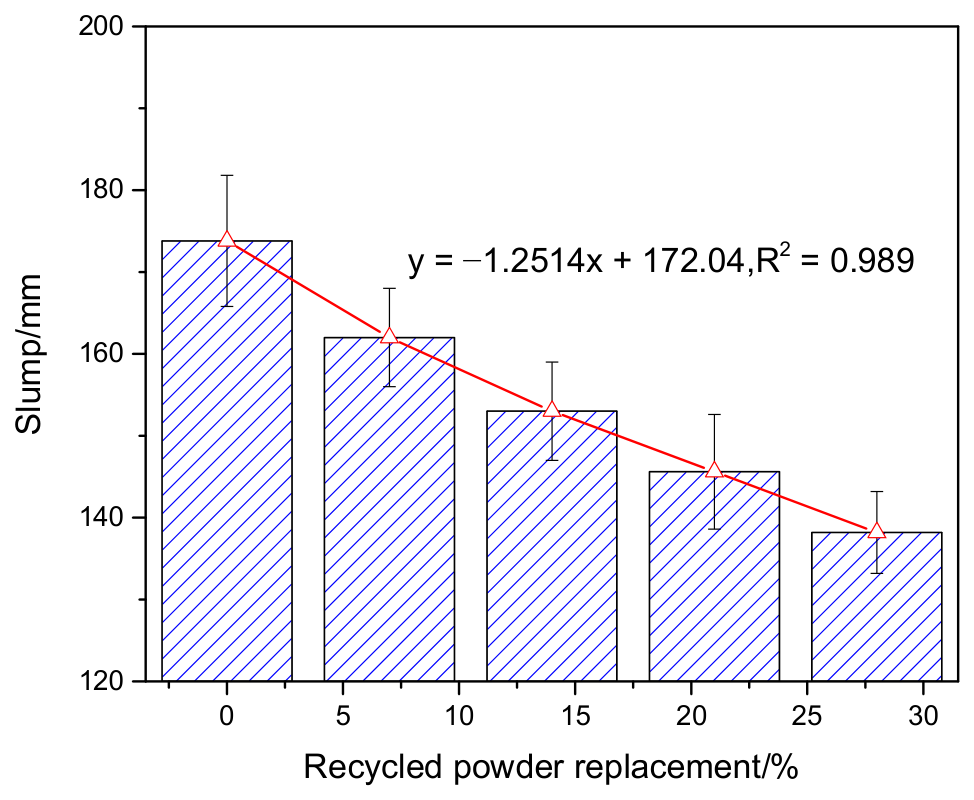
The slump test serves as a crucial indicator for evaluating the workability and fluidity of fresh concrete, providing essential data for optimizing concrete mix design and ensuring proper construction quality. As shown in Figure 2, the slump of the concrete mixture decreased linearly with increasing RP replacement ratio, with a correlation coefficient (R2) of 0.99, indicating a strong correlation between the slump and the replacement ratio.
The reference concrete (with 0% recycled powder replacement) had a slump of approximately 175 mm, and when the replacement ratio increased to 28%, the slump decreased to approximately 138 mm, representing a reduction of about 21.1% compared to the reference. This demonstrates that the incorporation of recycled powder reduces the fluidity of the concrete, and this adverse effect intensifies progressively with increasing replacement ratio. The core mechanism of this phenomenon originates from the essential differences in micro-morphology and water demand between recycled powder and cement. Recycled powder mainly consists of prismatic particles with a surface covered by lamellar structures, existing in the form of loose lamellar clusters, as reported in the previous literature [27], and its specific surface area (495.3 m2/kg) is higher than that of cement (358 m2/kg). This results in a standard consistency water demand of recycled powder that is 15%–25% higher than that of cement, thereby reducing the fluidity of the mixture.
To assess the degree of compaction, the 28 d hardened bulk density of all mixtures was measured; no evident differences were observed among the mixtures, indicating that the reduced workability at higher RP contents did not result in inadequate compaction of the specimens and that the strength reduction can mainly be attributed to the dilution effect of cement replacement.

3.2. Compressive Strength Test Results

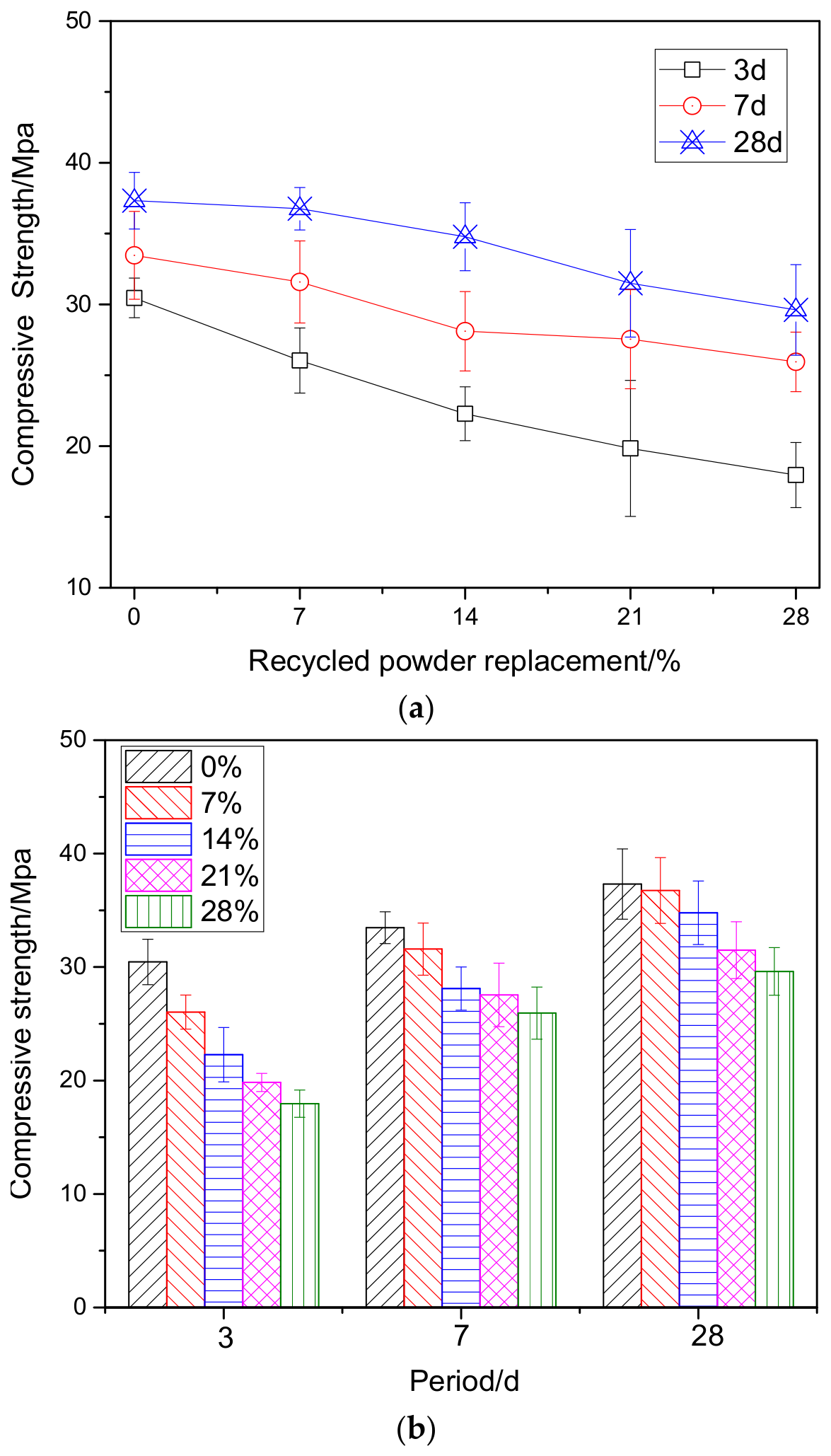
Compressive strength serves as a fundamental mechanical indicator for structural design, quality control, and durability assessment of concrete, directly reflecting the material’s capacity to resist external loads. Figure 3 illustrates the influence of recycled powder (RP) replacement ratio on the compressive strength at different curing ages. Evidently, as the RP replacement ratio increases from 0% to 28%, the compressive strengths at 3 d, 7 d, and 28 d all exhibit a monotonically decreasing trend. Specifically, the strengths of all RP-modified specimens are lower than those of the reference concrete (0% replacement), with the degree of reduction intensifying at higher replacement levels. Quantitatively, compared to the reference group, the 28 d compressive strength decreased from approximately 37.5 MPa to 29.5 MPa at 28% replacement—a reduction of 21.3%. Similarly, the 3 d strength dropped from 30.5 MPa to 18.0 MPa (a 41.0% reduction), and the 7 d strength declined from 33.5 MPa to 26.0 MPa (a 22.4% reduction).
The evolution of strength in RP concrete shows a higher percentage growth rate at early ages, while the relative growth advantage over the reference narrows at later ages. Taking the 3 d–7 d period as an example, the reference concrete showed a strength increase from 30.5 MPa to 33.5 MPa, whereas the 28% RP mixture increased from 18.0 MPa to 26.0 MPa. Although the relative growth of the high-RP mixture was larger, this is largely a consequence of its much lower 3 d strength (i.e., a lower starting base). Moreover, the calorimetry results (Section 3.6) showed that RP reduces the hydration heat release and retards the hydration process. Accordingly, the higher early-age relative strength growth of RP mixtures does not necessarily demonstrate accelerated hydration; it more plausibly reflects the lower degree of hydration already attained by the RP mixtures at 3 d and the resulting larger remaining hydration potential. Although fine mineral powders can act as nucleation substrates for C-S-H precipitation and thereby accelerate early hydration in some systems [19,28], in the present system any such nucleation effect appears to be outweighed by the dilution effect of RP.
Conversely, during the 7 d–28 d period, the strength growth dynamics shifted. The reference concrete exhibited a strength increase from 33.5 MPa to 37.5 MPa (an 11.9% relative growth), while the 28% RP group increased from 26.0 MPa to 29.5 MPa (a 13.5% relative growth). Although the relative growth rate of the RP concrete remained marginally higher than that of the reference, its absolute strength gain was lower. This phenomenon suggests that the dilution effect of RP reduces the cement content per unit volume. Furthermore, as reported in previous studies on limestone-blended cements [29,30], the possible interaction between calcium carbonate in RP and aluminate phases may lead to the formation of carboaluminate phases; however, this interpretation is based on the previous literature and could not be directly confirmed by phase characterization in the present study.
From an engineering application perspective, the 28 d compressive strength is a critical acceptance criterion. Figure 3 indicates that at a 28% replacement ratio, the 28 d strength approximates 29.5 MPa, which falls below the design requirement for C30 concrete (≥30 MPa).

3.3. Splitting Tensile Strength

Splitting tensile strength is a pivotal mechanical indicator of concrete’s crack resistance, intrinsically linked to the material’s durability and structural safety [31]. A higher splitting tensile strength effectively delays crack initiation and mitigates the intrusion of aggressive agents, thereby extending the service life of the structure.
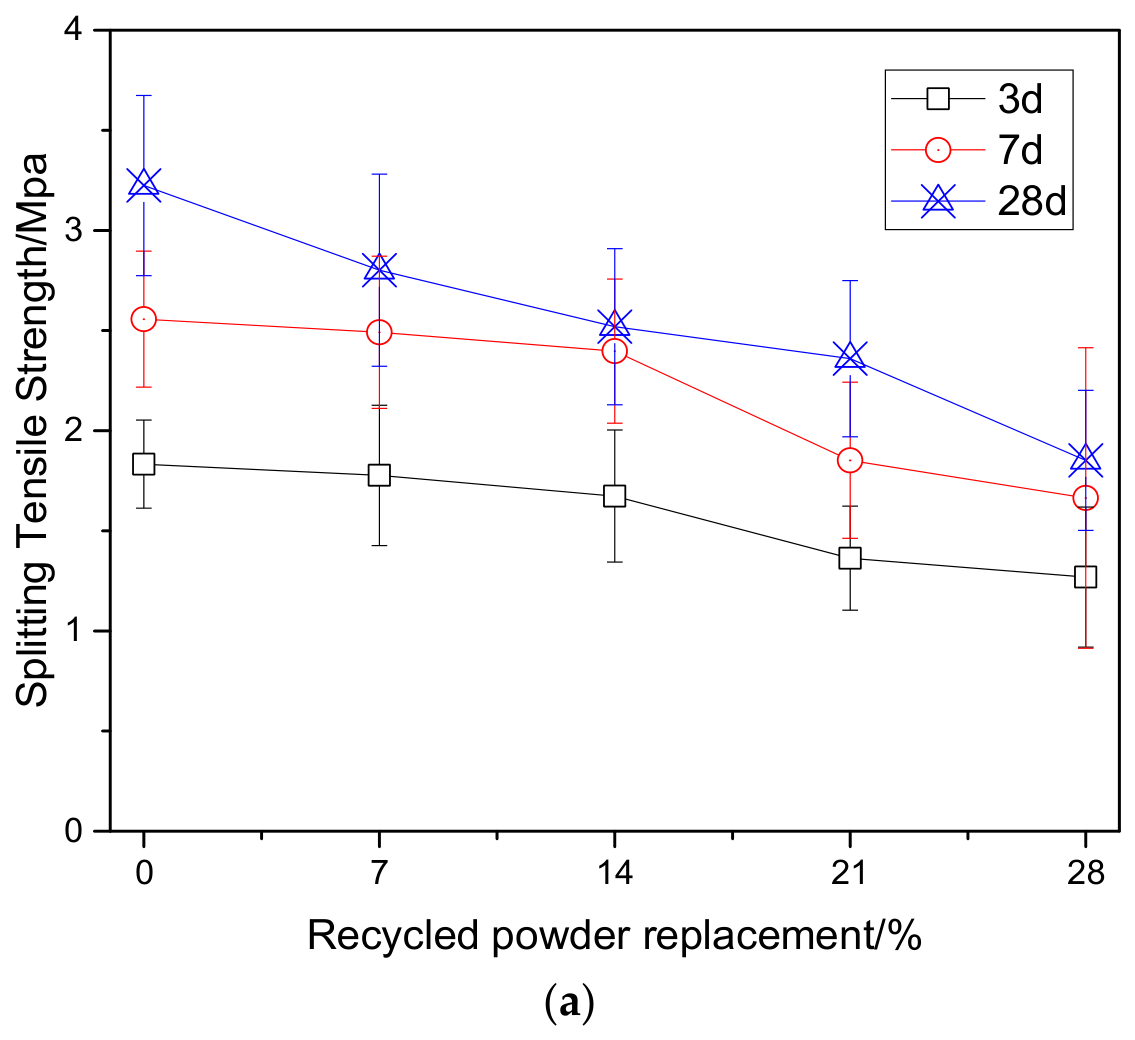
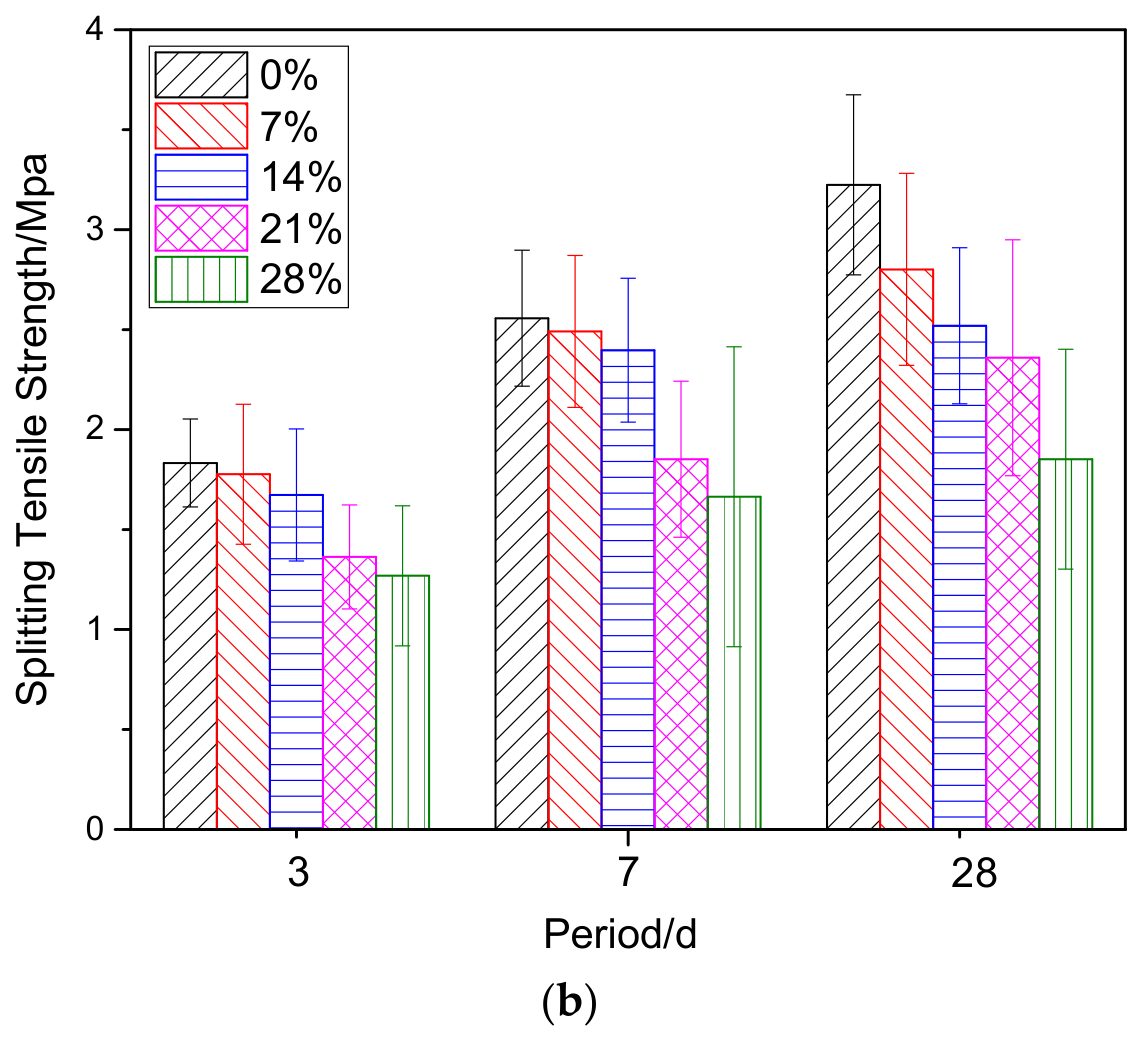
Figure 4 illustrates the variation in splitting tensile strength with recycled powder (RP) replacement ratio. As the RP content increases from 0% to 28%, the splitting tensile strengths at 3 d, 7 d, and 28 d all exhibit a monotonically decreasing trend. Specifically, the strength of each RP-modified group is inferior to that of the reference concrete (0% replacement), with the reduction magnitude intensifying at higher replacement levels. Quantitatively, compared to the reference group, the 28 d splitting tensile strength decreased from 3.22 MPa to 1.85 MPa at 28% replacement, representing a reduction of 42.5%. Similarly, the 3 d strength dropped from 1.83 MPa to 1.27 MPa (a 30.6% reduction), and the 7 d strength declined from 2.56 MPa to 1.66 MPa (a 35.2% reduction). Age-wise analysis reveals a clear strength hierarchy: 28 d > 7 d > 3 d, confirming that strength development continues over time. However, the incorporation of RP attenuates this growth potential; the strength increment between 3 d and 28 d for the reference group is 1.39 MPa, whereas for the 28% RP group, it diminishes to merely 0.58 MPa.
Further analysis of the strength evolution reveals that the growth rate of RP concrete is consistently lower than that of the reference concrete across different ages. Taking the 3 d–7 d period as an example, the strength of the reference group increased by 0.73 MPa (a relative growth of 39.9%), while the 28% RP group increased by only 0.39 MPa (a relative growth of 30.7%). Similarly, during the 7 d–28 d period, the reference group showed a relative growth of 25.8%, much higher than the 11.4% observed in the 28% RP group. These results indicate that the incorporation of RP did not promote faster early strength development, which can be mainly attributed to the dominant dilution effect caused by the reduction in effective cementitious material. Although RP particles can act as nucleation substrates for C-S-H gel, lowering the nucleation energy barrier, this nucleation effect is insufficient to offset the negative impact of cement dilution. Consequently, the overall hydration degree and the interlocking of hydration products are weakened, which reasonably explains the consistently lower strength growth rate of RP concrete at all ages.
From an engineering application perspective, the 28 d splitting tensile strength is a key index for evaluating concrete crack resistance, as the tensile capacity directly governs the initiation of cracks under restrained shrinkage and external loads. As shown in Figure 4, the 28 d splitting tensile strength decreases monotonically with increasing RP content within the tested range; nevertheless, even at a replacement ratio of 14%, it reaches approximately 2.52 MPa, which still satisfies the crack-resistance acceptance requirement (≥2.5 MPa) adopted in the design documents of the highway project in which this concrete is applied. Accordingly, 14% should be regarded not as a material-level physical optimum but as an engineering acceptance limit, i.e., the maximum replacement ratio at which this acceptance requirement can still be met. Exceeding this ratio would cause the splitting tensile strength to fall below the acceptance criterion; therefore, it is recommended that the RP replacement ratio be controlled within 14% in practical applications to ensure structural safety. In addition, the strength loss relative to the reference concrete becomes increasingly pronounced as the replacement ratio rises, which is consistent with the dilution-dominated mechanism discussed above and can be mainly attributed to the increased porosity and local stress concentration induced by the inert components of RP, which act as micro-defects and progressively weaken the tensile load-bearing capacity of the concrete.

3.4. Drying Shrinkage Performance

Drying shrinkage is a critical parameter for evaluating the volume stability of concrete, directly reflecting the material’s deformation capacity driven by moisture loss [25]. Its magnitude profoundly influences the cracking risk and long-term durability of structures; excessive drying shrinkage is prone to induce tensile cracking, facilitating the ingress of aggressive agents and thereby compromising structural service life.
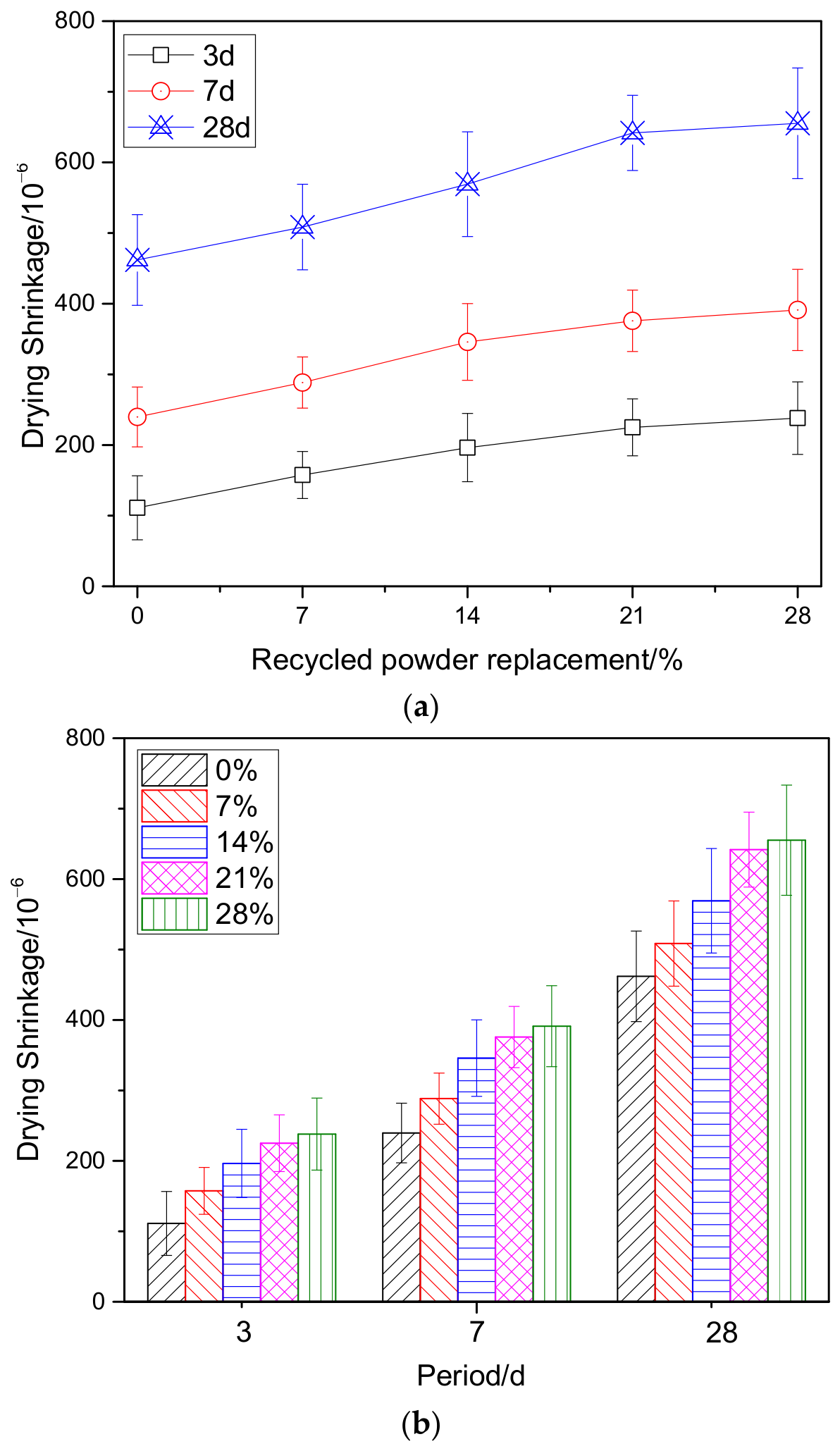
Figure 5 illustrates the evolution of drying shrinkage rates with varying recycled powder (RP) replacement ratios. As the RP content increases from 0% to 28%, the drying shrinkage strains at 3 d, 7 d, and 28 d all exhibit a monotonically increasing trend. Specifically, the shrinkage strains of all RP-modified groups exceed those of the reference concrete (0% replacement), with the increment magnitude intensifying at higher replacement levels. Quantitatively, compared to the reference group, the 28 d drying shrinkage rate of the 28% RP group increased by 41.7%. The increases are even more pronounced at early ages, with the 3 d and 7 d shrinkage rates rising by 114.2% and 63.2%, respectively. Age-wise analysis reveals a clear hierarchy: the shrinkage strain accumulates continuously over time, with the 28 d value being the highest, followed by 7 d and 3 d.
The kinetics of shrinkage development in RP concrete follows a characteristic pattern of “rapid growth in the early stage followed by gradual stabilization in the later stage.” Taking the 3 d–7 d period as an example, the reference group exhibited a relative growth of 115.5%, while the 28% RP group showed a relative growth of 64.2%. It is worth noting that while the relative growth rate of the reference group appears higher in this specific interval, the absolute shrinkage value of the RP group remains markedly larger throughout. This phenomenon is primarily attributed to the physical properties of RP: its high specific surface area and porous nature refine the pore structure of the matrix. During the early stage (3 d → 7 d), the evaporation of free water from capillary pores generates high capillary tension within the refined pores, accelerating shrinkage. In the later stage (7 d → 28 d), as free water is exhausted, the shrinkage mechanism transitions to the migration of gel water and adsorbed water. Since this process is diffusion-controlled and slower, the growth rate of shrinkage decelerates, leading to eventual stabilization.
From an engineering perspective, the 28 d drying shrinkage strain is a pivotal acceptance criterion. Figure 5 indicates that at RP replacement ratios of 7%, 14%, and 28%, the 28 d shrinkage increased by approximately 10.0%, 23.1%, and 41.7%, respectively, compared to the reference. While a 14% replacement results in a moderate increase, higher dosages lead to excessive deformation. Therefore, to mitigate the risk of shrinkage-induced cracking and ensure volume stability, it is recommended that the RP replacement ratio be strictly controlled and not exceed 14%.
From an engineering viewpoint, the increased drying shrinkage and the retarded hydration induced by RP could be mitigated by measures previously reported in the literature: (i) shrinkage-reducing admixtures (SRAs), which lower the surface tension of the pore solution and thereby reduce the capillary tension that drives drying shrinkage [25,32]; (ii) extended wet curing or internal curing (e.g., using pre-wetted lightweight aggregates or superabsorbent polymers), which replenishes the moisture lost during drying and alleviates the reduction in the degree of hydration [25,33]; and (iii) further optimization of the water-to-binder ratio and the aggregate content to reduce the paste volume and the associated shrinkage potential [25]. These mitigation strategies were beyond the scope of the present study and are recommended for future investigations.

3.5. Pore Structure Analysis

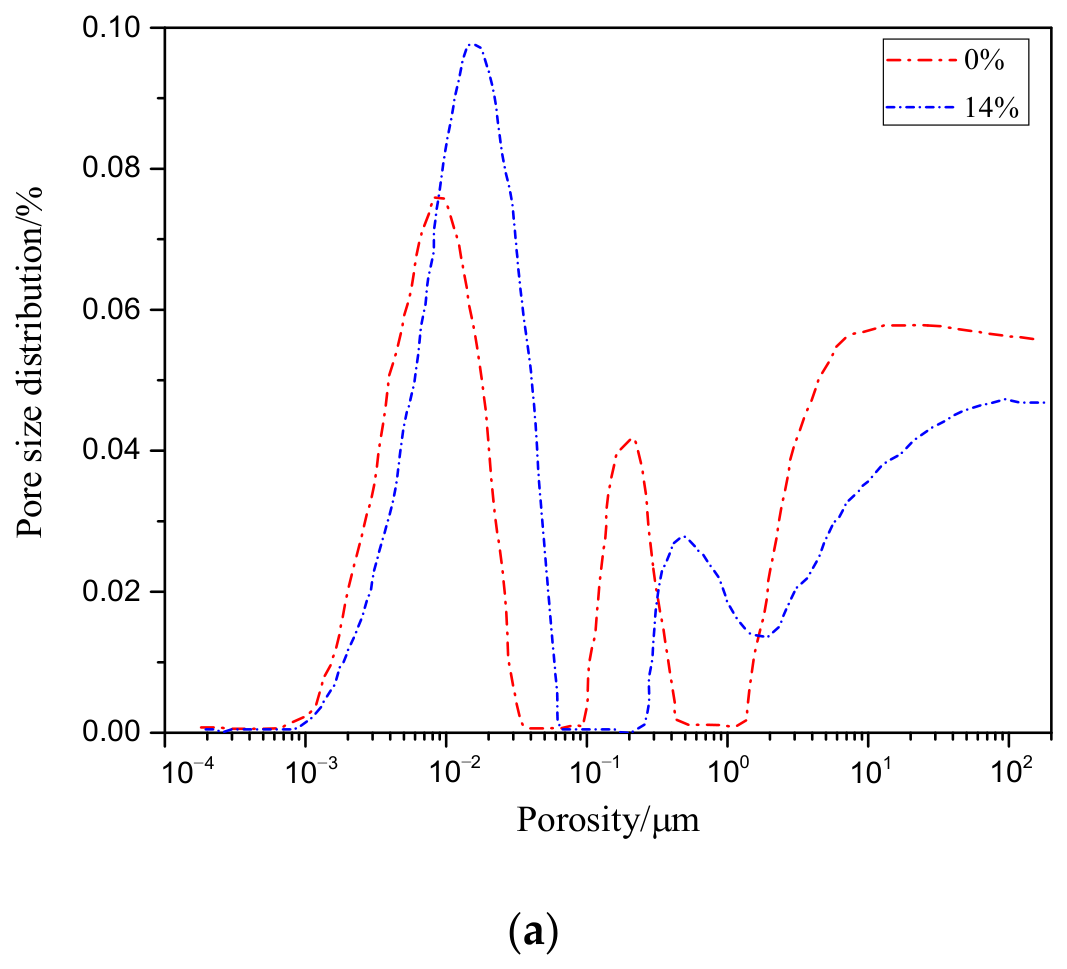
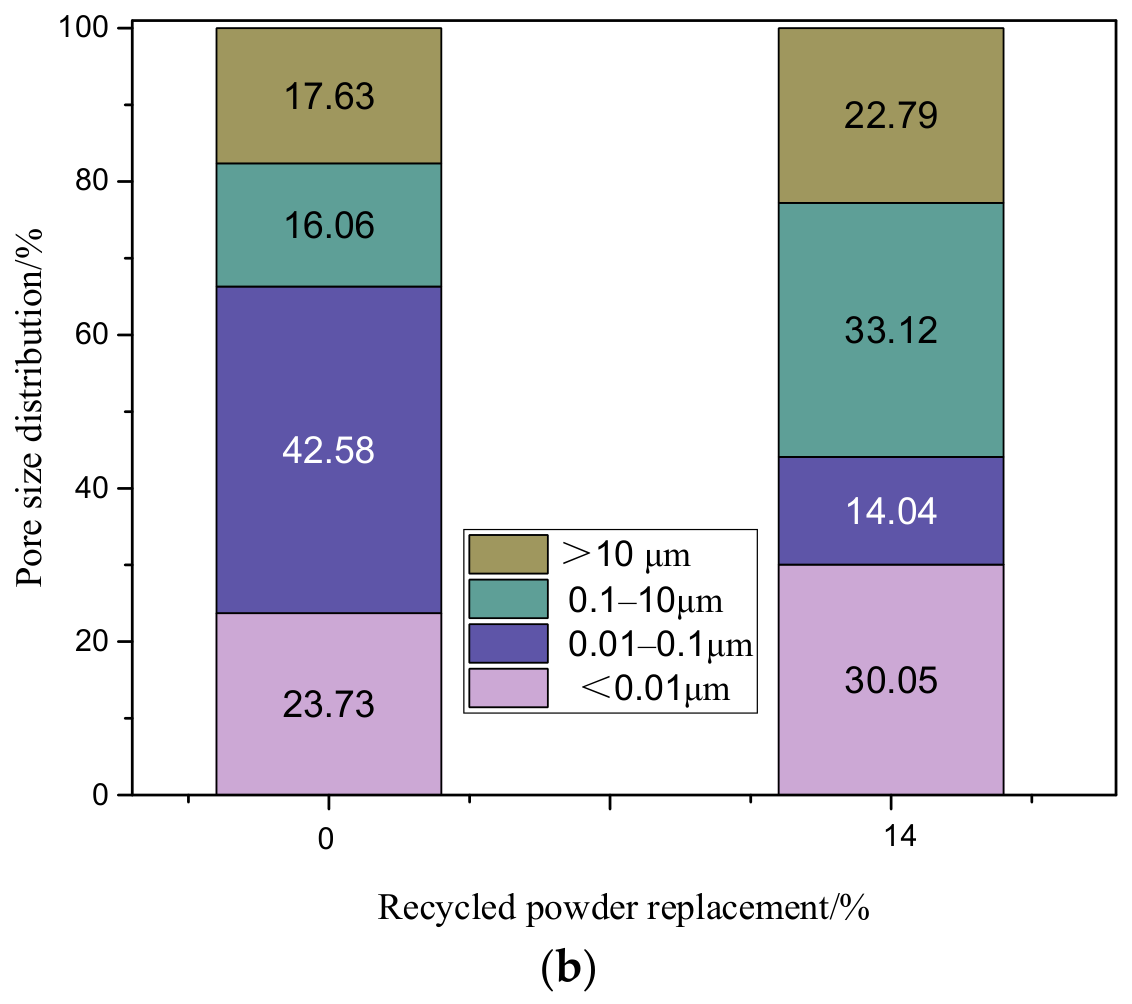
The characteristics of the pore structure are intrinsic determinants of concrete durability [34]. This study elucidates the regulatory mechanisms of recycled powder (RP) replacement on the pore structure by comparing the characteristics of concrete with 0% and 14% RP replacement ratios. As shown in Figure 6, RP substitution markedly altered the proportions of pores in different size intervals. It should be noted that the MIP analysis was performed only on the 0% and 14% mixtures.
From a mechanistic perspective, the influence of RP on the pore structure is essentially governed by the trade-off between the micro-aggregate filling effect and the dilution effect (reduction in hydration products). In the micropore region (<0.1 μm), the filling effect of RP is predominant. At a 14% replacement ratio, the proportion of gel pores (<0.01 μm) increased from 23.73% to 30.05%, an increment of 26.64%, demonstrating the positive role of RP in pore refinement. Concurrently, the proportion of small capillary pores (0.01–0.1 μm) decreased from 42.58% to 14.04%, a reduction of 67.03%. This shift indicates that the pore-refining efficiency of RP decreases with increasing replacement ratio; although RP effectively promotes the transformation of small capillaries into gel pores, this refinement benefit diminishes at higher replacement ratios.
Conversely, in the capillary pore interval (0.1–10 μm), the proportion witnessed a substantial increase, nearly doubling from 16.06% to 33.12% (a 106.2% increase), exhibiting the most pronounced variation among all intervals. Meanwhile, the proportion of 0.01–0.1 μm pores decreased sharply from 42.58% to 14.04% (a reduction of 67.0%), whereas the gel pores (<0.01 μm) and harmful macropores (>10 μm) increased from 23.73% to 30.05% (a 26.6% increase) and from 17.63% to 22.79% (a 29.3% increase), respectively. In this study, pores are classified as gel pores (<0.01 μm), fine capillary pores (0.01–0.1 μm), capillary pores (0.1–10 μm), and macropores (>10 μm), following the classification commonly adopted for cementitious materials. Overall, the pore structure exhibits a pronounced bimodal polarization at 14% replacement: a fraction of the pores is refined into the gel-pore range, while the remainder coarsens into larger capillary pores and macropores. This indicates that, although RP addition promotes partial pore refinement, the filling effect is insufficient to refine pores progressively downward; instead, the reduction in effective cementitious material and the resulting deficiency of C-S-H gel weaken inter-particle bonding, so that the refinement benefit is partially offset by the accumulation of capillary pores and the rebound of macropores. Notably, the total proportion of harmful pores (>0.1 μm) increased from 33.69% to 55.91% (an increase of 22.2 percentage points), which is consistent with the degradation in macroscopic mechanical performance and supports the adoption of 14% as the recommended upper limit of replacement.
Regarding durability and engineering application, the evolution of the pore structure directly dictates macroscopic performance. The increase in gel pores (<0.01 μm) can reduce pore connectivity and impede the transport of aggressive agents, which is beneficial to durability. However, the marked rise in capillary pores (0.1–10 μm) and macropores (>10 μm) creates preferential channels for fluid migration and weakens the interfacial transition zone (ITZ) bonding, which is detrimental to impermeability and durability. It should therefore be emphasized that the pore-structure change at 14% replacement is two-sided: the increase in gel pores is favorable, whereas the concurrent accumulation of capillary pores and the rebound of macropores are detrimental. Accordingly, the 14% dosage is regarded as the maximum replacement level recommended on the basis of both the macroscopic performance and the available pore-structure evidence. In addition, the pore-structure evolution at replacement ratios beyond 14% was not directly measured in this study; higher RP contents may plausibly lead to a rebound in the proportion of harmful macropores. Nevertheless, because the MIP analysis covers only the 0% and 14% mixtures, this rebound remains a hypothesis that should be verified by further MIP measurements at 21% and 28% replacement.

3.6. Heat of Hydration

Hydration heat serves as a critical thermodynamic indicator for characterizing the hydration kinetics of cement-based materials [35]. The magnitude and rate of heat release are intrinsically linked to early strength development, temperature stress distribution, and volume stability. For the recycled powder derived from asphalt mixing plants, its incorporation alters the hydration kinetic process through physical effects (such as dilution and filling) and potential chemical interactions, thereby influencing the early-age performance of concrete.
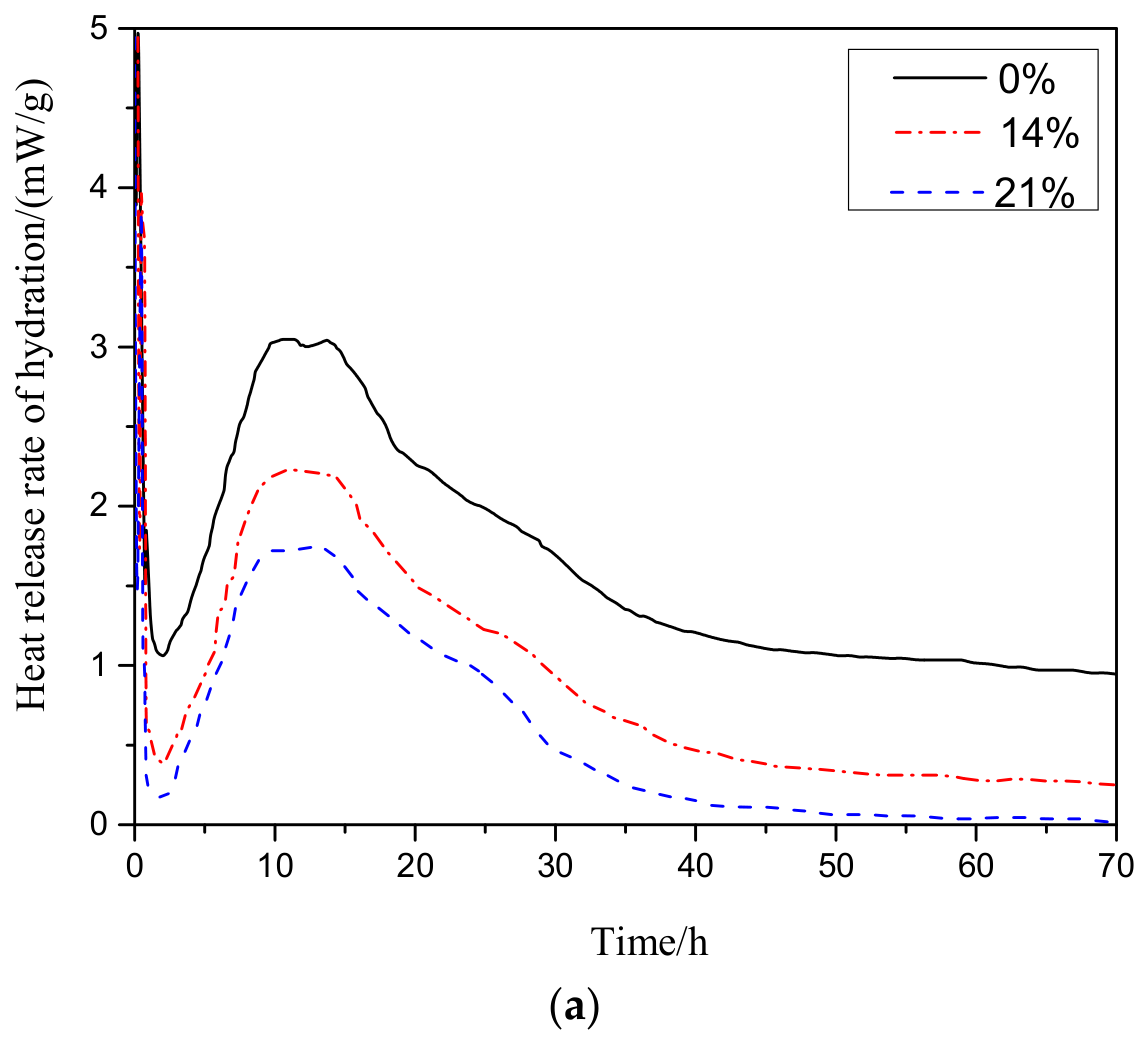
As illustrated in Figure 7a, the reference mixture (0% RP) exhibits the highest and earliest exothermic peak, indicating the most intense early hydration activity. As the RP replacement ratio increases to 14% and 21%, the peak exothermic rate gradually diminishes, and the induction period appears to extend slightly. This retardation phenomenon may be attributed to the complex interplay between the physical properties and chemical composition of RP. Specifically, the porous, lamellar structure of RP particles results in a high specific surface area. While this morphology could theoretically provide nucleation sites, the organic residues inherent in RP (originating from asphalt) tend to adsorb onto the surface of cement particles [36]. This adsorption layer acts as a barrier, hindering the contact between water and cement particles, thereby increasing the activation energy required for dissolution and delaying the acceleration phase of hydration. This interpretation is consistent with previous studies on cement–asphalt systems, in which organic components were shown to adsorb onto cement grains and retard cement hydration [36].
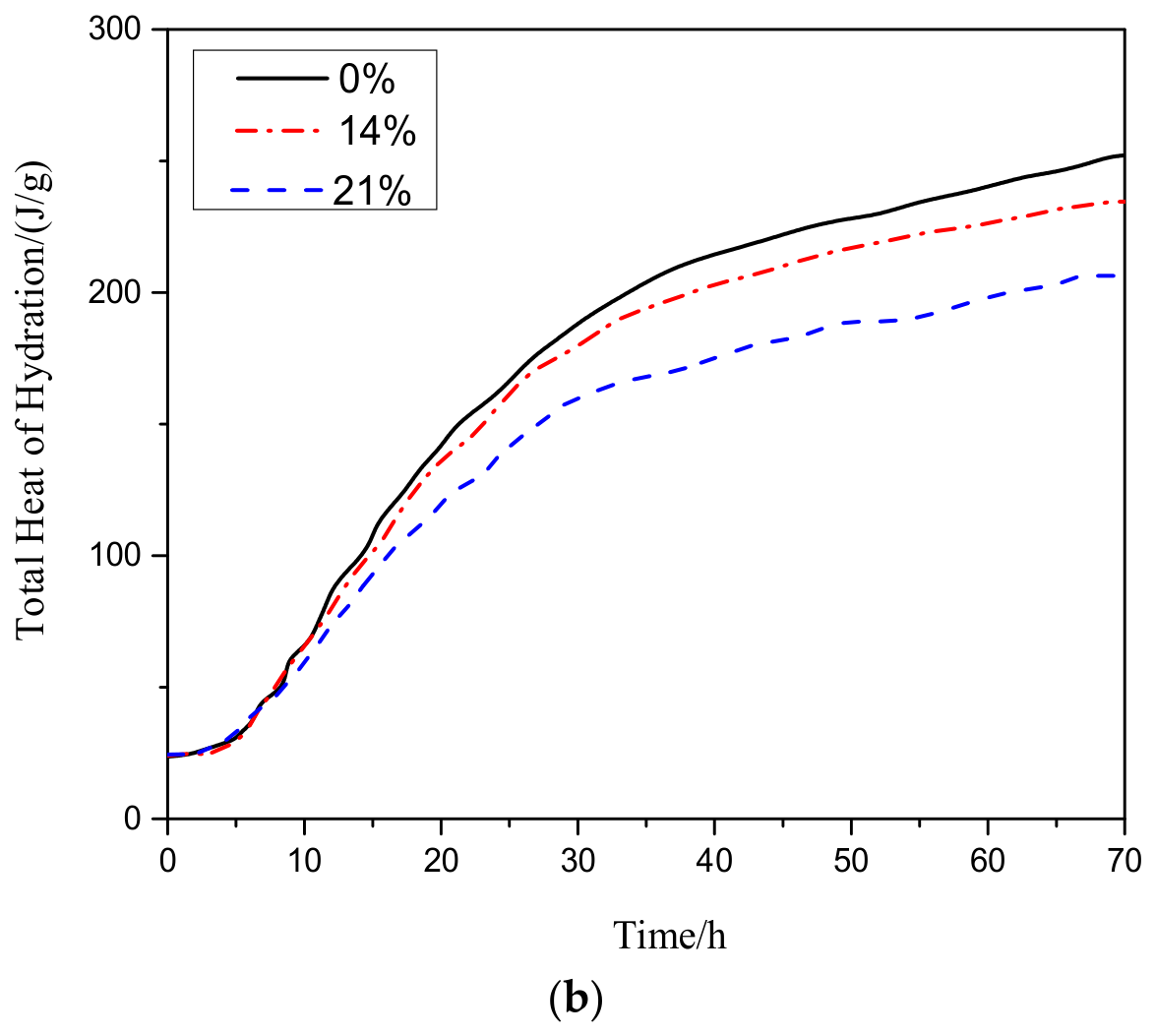
Figure 7b presents the total heat release evolution over time. The total heat release shows a monotonically decreasing trend with increasing RP dosage, with the 0% reference group releasing the most heat. This reduction is primarily driven by the dilution effect: replacing cement with RP reduces the amount of reactive cementitious material per unit volume, thereby directly lowering the total heat generation potential of the system. At a 21% replacement ratio, the total heat release decreases. Beyond the dilution effect, this trend is further exacerbated by the chemical inertness of specific RP components. While the calcium carbonate in RP may participate in reactions to form carboaluminate phases, as reported for limestone-blended cements [29,30], partially compensating for heat loss, its contribution is marginal compared with the reduction in C-S-H gel formation caused by cement replacement. These interpretations are consistent with the calorimetry trends, although direct phase characterization would be required to fully confirm the underlying mechanisms.

4. Conclusions

This study systematically investigated the feasibility of utilizing asphalt mixing plant recycled powder as a cement replacement material in C30 concrete, discussed the underlying mechanisms, and evaluated the maximum replacement ratio that satisfies the engineering acceptance requirements. The main conclusions are drawn as follows:
(1)
The incorporation of recycled powder markedly deteriorated the workability of fresh concrete. As the replacement ratio increased from 0% to 28%, the slump exhibited a monotonically decreasing trend with a maximum reduction of 21.1%. This is primarily attributed to the porous structure and high specific surface area of recycled powder, which markedly increased the water demand of the mixture.
(2)
Both compressive and splitting tensile strengths decreased continuously with increasing recycled powder replacement ratios. The higher relative early-age strength growth of RP mixtures mainly reflects their much lower absolute strength, and isothermal calorimetry indicated that RP retards hydration rather than accelerating it. The dilution effect reduced the formation of C-S-H gel, weakening the matrix strength. When the replacement ratio reached 28%, the 28-day compressive strength fell below the C30 design standard.
(3)
The incorporation of recycled powder exacerbated the drying shrinkage of concrete due to its porous nature and high water absorption. MIP analysis (performed on the 0% and 14% mixtures) showed that moderate RP increased the proportion of gel pores while also increasing mesopores and macropores; the pore-structure evolution at replacement ratios beyond 14% requires further investigation.
(4)
The addition of recycled powder reduced both the peak value and total release of hydration heat, retarding the hydration process. This is tentatively attributed to the dilution effect and the retardation caused by organic residues within the recycled powder.
(5)
Considering workability, mechanical properties, and volume stability, 14% is recommended as the maximum recycled powder replacement ratio that satisfies the engineering acceptance requirements; it should be clearly distinguished from a physically optimal dosage, which was not observed within the tested range. Within this limit, recycled powder can be effectively utilized as a cement replacement material, satisfying engineering requirements while promoting the resource utilization of solid waste and reducing the carbon footprint associated with cement production.
(6)
From an environmental perspective, the partial replacement of cement by RP reduces the cement (clinker) content and thus contributes to lowering the CO2 footprint of concrete, reinforcing the sustainability significance of reusing asphalt-related industrial solid waste.
The following aspects are recommended for future research: (i) long-term (e.g., 56 d and 90 d) strength development to fully evaluate the influence of RP on the hydration process; (ii) durability-related properties, including freeze–thaw resistance, the depth of water penetration under pressure, and carbonation depth; and (iii) mitigation measures for the increased drying shrinkage and hydration retardation, such as shrinkage-reducing admixtures, internal curing, and extended curing.

Author Contributions

Z.Z.: investigation, writing—original draft, and visualization. J.C.: methodology, validation, and writing—review and editing. Y.L.: investigation. W.C.: data curation. S.M.: methodology and writing—review and editing. S.L.: supervision and funding acquisition. All authors have read and agreed to the published version of the manuscript.

Funding

This research was funded by the Science and Technology Project of Jiangxi Provincial Department of Transportation (2025YB031).

Data Availability Statement

The original contributions presented in the study are included in the article; further inquiries can be directed to the corresponding author.

Conflicts of Interest

Author Zhihai Zhang and Jun Chen was employed by the company Jiangxi Provincial Highway and Bridge Engineering Co., Ltd. Yangqing Liu, Weiwei Chen and Shouju Miao were employed by the company Jiangxi Provincial Communications Investment Group Co., Ltd. The remaining authors declare that the research was conducted in the absence of any commercial or financial relationships that could be construed as potential conflicts of interest.

Abbreviations

The following abbreviations are used in this manuscript:
RPRecycled Powder
SCMSupplementary Cementitious Material
OPCOrdinary Portland Cement
WRAWater-Reducing Agent
PCEPolycarboxylate-based superplasticizer
MIPMercury Intrusion Porosimetry
C-S-HCalcium Silicate Hydrate
ITZInterfacial Transition Zone
CRMCement Replacement Material

References

  1. Esquinas, A.R.; Ramos, C.; Jiménez, J.; Fernández, J.; De Brito, J. Mechanical behaviour of self-compacting concrete made with recovery filler from hot-mix asphalt plants. Constr. Build. Mater. 2017, 131, 114–128. [Google Scholar] [CrossRef] [Scilit]
  2. Martín, J.; Montero, J.R.; Moreno, F.; Sala, J.P.; Rubio, M. Feasibility analysis of the reuse of waste filler of bituminous mixtures for the production of self-compacting concrete. Mater. Des. 2013, 46, 372–380. [Google Scholar] [CrossRef] [Scilit]
  3. Khedaywi, T.; Haddad, M.; Hwarie, S. Effect of waste iron powder on properties of asphalt concrete mixtures: State of the art. Int. J. Pavement Res. Technol. 2025, 18, 91–101. [Google Scholar] [CrossRef] [Scilit]
  4. Fanani, Z.; Wicaksono, A.; Kurniawan, A. Analysis of pollution level on asphalt mixing plant factory activities in Grogol District of Kediri Regency, Indonesia. Russ. J. Agric. Socio-Econ. Sci. 2020, 104, 33–38. [Google Scholar] [CrossRef] [Scilit]
  5. Tian, T.; Shi, J.; Yi, Y.; Jiang, Y. Optimizing the dosage of asphalt mixing plant recycled powder in cement-stabilized macadam: A multi-criteria pavement performance evaluation. Case Stud. Constr. Mater. 2026, 24, e06054. [Google Scholar] [CrossRef] [Scilit]
  6. Wu, H.; Yu, D.; Wang, W.; Yan, C.; Xiao, R.; Chen, R.; Zhang, P.; Zhang, H. A study on the characterization of asphalt plant reclaimed powder using fourier transform infrared spectroscopy. Materials 2025, 18, 3660. [Google Scholar] [CrossRef] [Scilit] [PubMed]
  7. Qian, Y.; Yue, H.; Li, J.; Hu, K.; Yang, T.; Sun, Z.; Zhuang, P. Sustainable recycling of asphalt mixing plant dust in ultra-high performance concrete: Effects on engineering performances and microstructure. Constr. Build. Mater. 2025, 491, 142822. [Google Scholar] [CrossRef] [Scilit]
  8. Tan, C.; Cai, S.; Ding, J.; Zhang, X.; Han, S.; Su, L.; Li, Y.; Cui, L. Candidate of low carbon economy concrete: Reinforcing recycled concrete via hybrid fibers. Environ. Res. 2025, 276, 121478. [Google Scholar] [CrossRef] [Scilit] [PubMed]
  9. Adhikary, S.K.; Ashish, D.K.; Rudžionis, Ž. A review on sustainable use of agricultural straw and husk biomass ashes: Transitioning towards low carbon economy. Sci. Total Environ. 2022, 838, 156407. [Google Scholar] [CrossRef] [Scilit] [PubMed]
  10. Pavlović, A. From research to practice–industry reflections on low-carbon concrete. Mag. Concr. Res. 2025, 77, 1205–1207. [Google Scholar] [CrossRef] [Scilit]
  11. Nejad, B.M.; Enferadi, S.; Andrew, R. A comprehensive analysis of process-related CO2 emissions from Iran’s cement industry. Clean. Environ. Syst. 2025, 16, 100251. [Google Scholar] [CrossRef] [Scilit]
  12. McCarthy, M.J.; Dhir, R.K. Development of high volume fly ash cements for use in concrete construction. Fuel 2005, 84, 1423–1432. [Google Scholar] [CrossRef] [Scilit]
  13. Li, G.; Zhou, C.; Ahmad, W.; Usanova, K.I.; Karelina, M.; Mohamed, A.M.; Khallaf, R. Fly ash application as supplementary cementitious material: A review. Materials 2022, 15, 2664. [Google Scholar] [CrossRef] [Scilit] [PubMed]
  14. Siddique, R.; Bennacer, R. Use of iron and steel industry by-product (GGBS) in cement paste and mortar. Resour. Conserv. Recycl. 2012, 69, 29–34. [Google Scholar] [CrossRef] [Scilit]
  15. Dom, A.A.M.; Jamaluddin, N.; Hamid, N.A.A.; Hoon, C.S. A review: GGBS as a cement replacement in concrete. IOP Conf. Ser. Earth Environ. Sci. 2022, 1022, 012044. [Google Scholar] [CrossRef] [Scilit]
  16. Sivilevičius, H.; Vislavičius, K. Simulation of composition of recycled hot-mix asphalt mixture produced in asphalt mixing plant. Constr. Build. Mater. 2019, 214, 17–27. [Google Scholar] [CrossRef] [Scilit]
  17. Zhang, K.; Zhang, W.; Xie, W.; Luo, Y.; Wei, G. Investigation of mechanical properties, chemical composition and microstructure for composite cementitious materials containing waste powder recycled from asphalt mixing plants. J. Build. Eng. 2024, 96, 110362. [Google Scholar] [CrossRef] [Scilit]
  18. JGJ 55-2011; Specification for Mix Proportion Design of Ordinary Concrete. China Architecture & Building Press: Beijing, China, 2011.
  19. Wang, D.; Shi, C.; Farzadnia, N.; Shi, Z.; Jia, H. A review on effects of limestone powder on the properties of concrete. Constr. Build. Mater. 2018, 192, 153–166. [Google Scholar] [CrossRef] [Scilit]
  20. Ramezanianpour, A.A.; Ghiasvand, E.; Nickseresht, I.; Mahdikhani, M.; Moodi, F. Influence of various amounts of limestone powder on performance of Portland limestone cement concretes. Cem. Concr. Compos. 2009, 31, 715–720. [Google Scholar] [CrossRef] [Scilit]
  21. GB/T 50080-2016; Standard for Test Method of Performance on Ordinary Fresh Concrete. China Architecture & Building Press: Beijing, China, 2017.
  22. GB/T 50081-2019; Standard for Test Methods of Concrete Physical and Mechanical Properties. China Architecture & Building Press: Beijing, China, 2019.
  23. GB/T 50082-2009; Standard for Test Methods of Long-Term Performance and Durability of Ordinary Concrete. China Architecture & Building Press: Beijing, China, 2009.
  24. ASTM C596-23; Standard Test Method for Drying Shrinkage of Mortar Containing Hydraulic Cement. ASTM International: West Conshohocken, PA, USA, 2023.
  25. Tran, N.P.; Gunasekara, C.; Law, D.W.; Houshyar, S.; Setunge, S.; Cwirzen, A. A critical review on drying shrinkage mitigation strategies in cement-based materials. J. Build. Eng. 2021, 38, 102210. [Google Scholar] [CrossRef] [Scilit]
  26. Liu, L.; Yang, P.; Qi, C.; Zhang, B.; Guo, L.; Song, K.-I. An experimental study on the early-age hydration kinetics of cemented paste backfill. Constr. Build. Mater. 2019, 212, 283–294. [Google Scholar] [CrossRef] [Scilit]
  27. Gebremariam, A.T.; Vahidi, A.; Di Maio, F.; Chang, C.; Rem, P. Enhancing the recovery of cement-rich powder from recycled fine aggregates through thermal shock. Case Stud. Constr. Mater. 2025, 23, e05272. [Google Scholar] [CrossRef] [Scilit]
  28. Berodier, E.; Scrivener, K. Understanding the filler effect on the nucleation and growth of C-S-H. J. Am. Ceram. Soc. 2014, 97, 3764–3773. [Google Scholar] [CrossRef] [Scilit]
  29. Ipavec, A.; Gabrovšek, R.; Vuk, T.; Kaučič, V.; Maček, J.; Meden, A. Carboaluminate phases formation during the hydration of calcite-containing Portland cement. J. Am. Ceram. Soc. 2011, 94, 1238–1242. [Google Scholar] [CrossRef] [Scilit]
  30. Bonavetti, V.L.; Rahhal, V.F.; Irassar, E.F. Studies on the carboaluminate formation in limestone filler-blended cements. Cem. Concr. Res. 2001, 31, 853–859. [Google Scholar] [CrossRef] [Scilit]
  31. Lan, X.; Li, Y.; Zou, S.; Liang, Y. Investigation of the splitting tensile behavior of rock-filled concrete based on mesoscopic modeling: Considering the effects of rock strength, bearing strip width, and rockfill ratio. Structures 2025, 82, 110432. [Google Scholar] [CrossRef] [Scilit]
  32. Deboodt, T.; Fu, T.; Ideker, J.H. Evaluation of FLWA and SRAs on autogenous deformation and long-term drying shrinkage of high performance concrete. Constr. Build. Mater. 2016, 119, 53–60. [Google Scholar] [CrossRef] [Scilit]
  33. Azarhomayun, F.; Haji, M.; Kioumarsi, M.; Shekarchi, M. Effect of calcium stearate and aluminum powder on free and restrained drying shrinkage, crack characteristic and mechanical properties of concrete. Cem. Concr. Compos. 2022, 125, 104276. [Google Scholar] [CrossRef] [Scilit]
  34. Ortiz-Marqués, A.; Caldevilla, P.; Goldmann, E.; Safuta, M.; Fernández-Raga, M.; Górski, M. Porosity and permeability in construction materials as key parameters for their durability and performance: A review. Buildings 2025, 15, 3422. [Google Scholar] [CrossRef] [Scilit]
  35. Liu, J.; Tan, Y.; Zeng, Z.; Song, W. Hydration mechanisms and mechanical property evolution of cemented backfill under diverse thermal environments: A review. Minerals 2026, 16, 276. [Google Scholar] [CrossRef] [Scilit]
  36. Zhang, P.; Hou, Y.; Niu, K.; Tian, B.; Wang, H. Effects of anionic emulsifiers and emulsified asphalt on hydration and microstructure of cement. Materials 2024, 17, 36. [Google Scholar] [CrossRef] [Scilit] [PubMed]
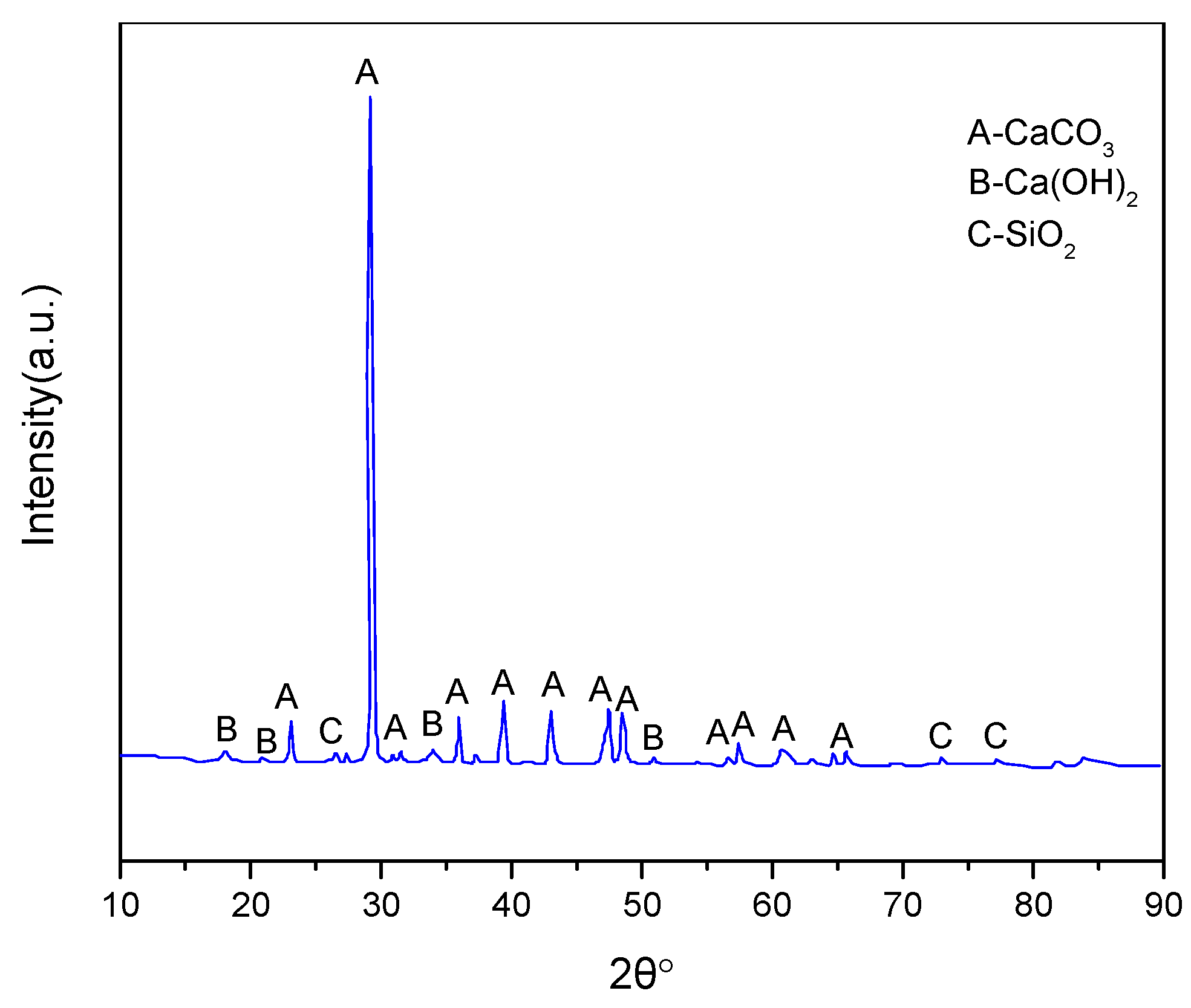
Figure 1. XRD pattern of RP.
Coatings 16 01073 g001
Figure 2. Slump properties of concrete containing recycled powder.
Coatings 16 01073 g002
Figure 3. Compressive strength results: (a) different replacement ratios; (b) different curing ages.
Coatings 16 01073 g003
Figure 4. Splitting tensile strength results: (a) different replacement ratios; (b) different curing ages.
Coatings 16 01073 g004aCoatings 16 01073 g004b
Figure 5. Drying shrinkage results: (a) different replacement ratios; (b) different curing ages.
Coatings 16 01073 g005
Figure 6. Pore structure results: (a) pore size distribution; (b) pore distribution.
Coatings 16 01073 g006aCoatings 16 01073 g006b
Figure 7. Hydration heat results: (a) heat release rate; (b) cumulative heat release.
Coatings 16 01073 g007aCoatings 16 01073 g007b
Table 1. Mix proportions of the concrete mixtures.
Rp ContentCementRpFine Agg.Coarse Agg.WaterWater Reducing Agent
%kg/m3kg/m3kg/m3kg/m3kg/m3%
0379.00.073710841521.1
7352.526.573710841521.1
14325.953.173710841521.1
21299.479.673710841521.1
28272.9106.173710841521.1
Note: The water-reducing agent (WRA) dosage was kept constant for all mixtures in order to isolate the influence of RP substitution.
Disclaimer/Publisher’s Note: The statements, opinions and data contained in all publications are solely those of the individual author(s) and contributor(s) and not of MDPI and/or the editor(s). MDPI and/or the editor(s) disclaim responsibility for any injury to people or property resulting from any ideas, methods, instructions or products referred to in the content.