Article

Fire Behavior and Thermal Performance of Nano-Clay-Modified EVA Encapsulation for Building-Integrated Photovoltaic Systems

1
School of Mechanical and Manufacturing Engineering, University of New South Wales, Sydney 2052, Australia
2
School of Physics and Electronic Information Engineering, Hubei Engineering University, Xiaogan 432000, China
3
School of Automation, Wuhan University of Technology, Wuhan 430070, China
*
Author to whom correspondence should be addressed.
Coatings 2026, 16(4), 435; https://doi.org/10.3390/coatings16040435
Submission received: 22 February 2026 / Revised: 19 March 2026 / Accepted: 27 March 2026 / Published: 3 April 2026
(This article belongs to the Section Functional Polymer Coatings and Films)

Abstract

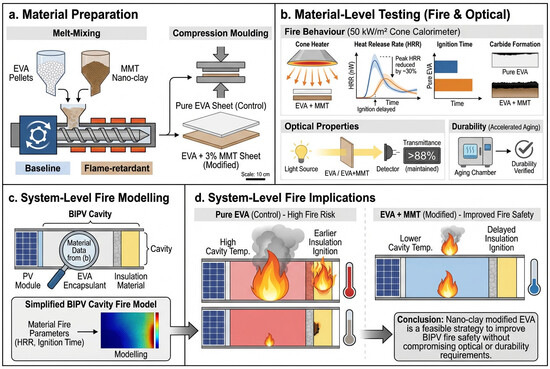
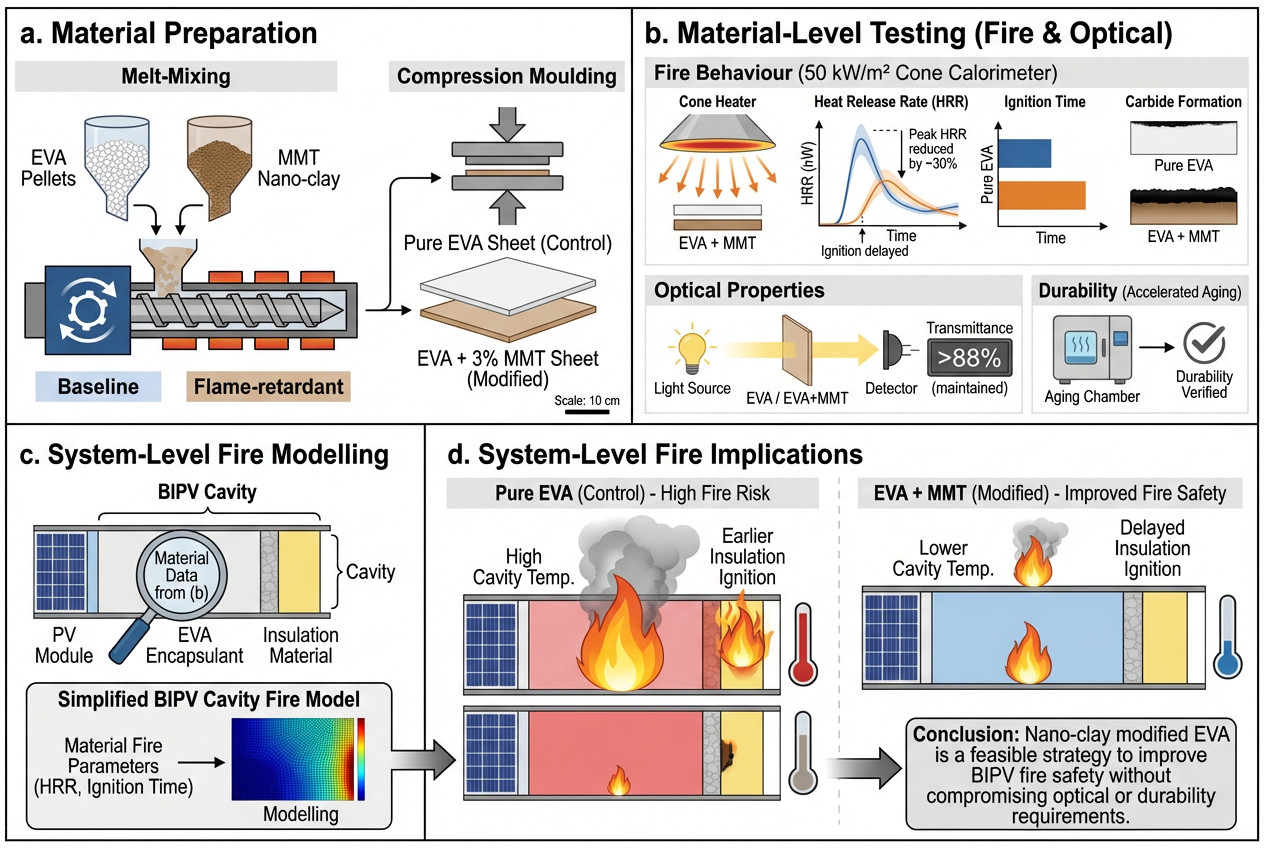
The building-integrated photovoltaic (BIPV) system has advantages in construction and energy, but due to the use of flammable polymer packaging materials, it introduces complex fire safety-related challenges. Although polymer backboards are traditionally considered to be the main combustible components in photovoltaic modules, recent studies have shown that ethylene–vinyl acetate (EVA) packaging materials play a key role in the development of fires. This study investigated the fire behavior, optical properties and system-level fire effects of montmorillonite (MMT) nano-clay-modified EVA packaging materials. Through the 50 kW/m2 conical calorimeter test, optical transmittance measurement and the accelerated aging test, pure EVA and EVA containing 3% MMT were evaluated, and the measured fire parameters were further incorporated into the simplified BIPV cavity fire model. The results show that MMT modification reduces the peak heat release rate of EVA by about 30%, delays the ignition time, and increases the formation of carbides, while maintaining the optical transmittance of more than 88%. At the system level, the reduction in heat release leads to a decrease in the cavity temperature and delays the ignition of adjacent insulation materials. These findings establish a direct link between material-level fire behavior and the fire performance of BIPV systems, indicating that nano-clay-modified EVA is a feasible strategy that can improve the fire safety of BIPV systems integrated into the facade without compromising optical or durability requirements.

Graphical Abstract

1. Introduction

With the rapid promotion of low-carbon and energy-saving building strategies, the BIPV system is increasingly used as a multifunctional curtain wall component integrating power generation and enclosure functions. Compared with traditional rooftop photovoltaic devices, BIPV modules are directly integrated into the building enclosure structure, fundamentally changing the fire exposure conditions, heat transfer paths and material interactions. In a typical curtain wall integration configuration, narrow cavities and limited ventilation will promote the buoyancy-driven chimney effect, resulting in the accelerated vertical spread of flames and heat accumulation. This kind of fire behavior has been confirmed through curtain wall fire investigation and systematic experimental research. However, the existing photovoltaic fire safety certification and test standards are mainly formulated for independent or roof systems, and do not fully consider the coupling thermal effect and material interaction unique to BIPV curtain walls.
From the perspective of materials, the fire protection performance of photovoltaic modules largely depends on the polymer composition, especially the packaging materials and backplate materials, rather than the semiconductor layer itself. EVA is still the most widely used packaging material due to its high optical transparency, strong adhesion and good processing properties. However, EVA itself is flammable. Its thermal degradation involves deacetylation and the release of flammable volatiles, resulting in rapid mass loss, limited carbon formation and a high heat release rate under the action of external heat flux. In BIPV applications, thermal feedback from adjacent building materials and the limited cavity environment may further exacerbate the combustion of EVA, thus increasing the risk of spreading fires along the building facade.
In order to reduce these risks, a series of flame-retardant strategies have been studied for the ethylene–vinyl acetate (EVA) copolymer, including halogen-based additives, metal hydroxides, phosphorus-containing systems and polymer nanocomposite methods. These studies show that the flammability of EVA can be reduced to varying degrees, but this improvement is often accompanied by practical limitations. For example, some traditional flame-retardant systems may increase the release of smoke or toxic gases, while high filling may reduce the optical transmittance, affect the processing performance or weaken the long-term durability. For photovoltaic packaging materials, these trade-offs are particularly important, because such materials must not only have fireproof properties, but also maintain optical and use properties.
At the same time, the recent research on photovoltaic building integration (BIPV) has gradually expanded from basic system integration to optical properties, cavity-related fire characteristics, and thermomechanical response under fire exposure. These studies have improved the understanding of the development of fire in BIPV exterior wall systems, especially the impact of cavity structure, ventilation conditions and component configuration. However, at present, most studies still examine the flame-retardant performance at the material level or the fire protection response of photovoltaic building integration (BIPV) at the system level. At present, there is still a lack of research that directly links the fire performance of modified packaging materials with the internal fire development of BIPV systems [1]. Therefore, in BIPV applications, the quantitative relationship between the modification of packaging materials and system-level fire prevention is still not clear enough. Compared with previous studies, this study not only does not evaluate the flame-retardant performance at the sample level, but it aalso discusses the fire behavior of BIPV at the structural level. On the contrary, it establishes the path from the material to the system by introducing the fire parameters of the experimentally measured EVA and EVA/MMT into a simplified BIPV cavity fire model, while considering the optical transmittance and durability. This is the main difference between this study and the existing research.
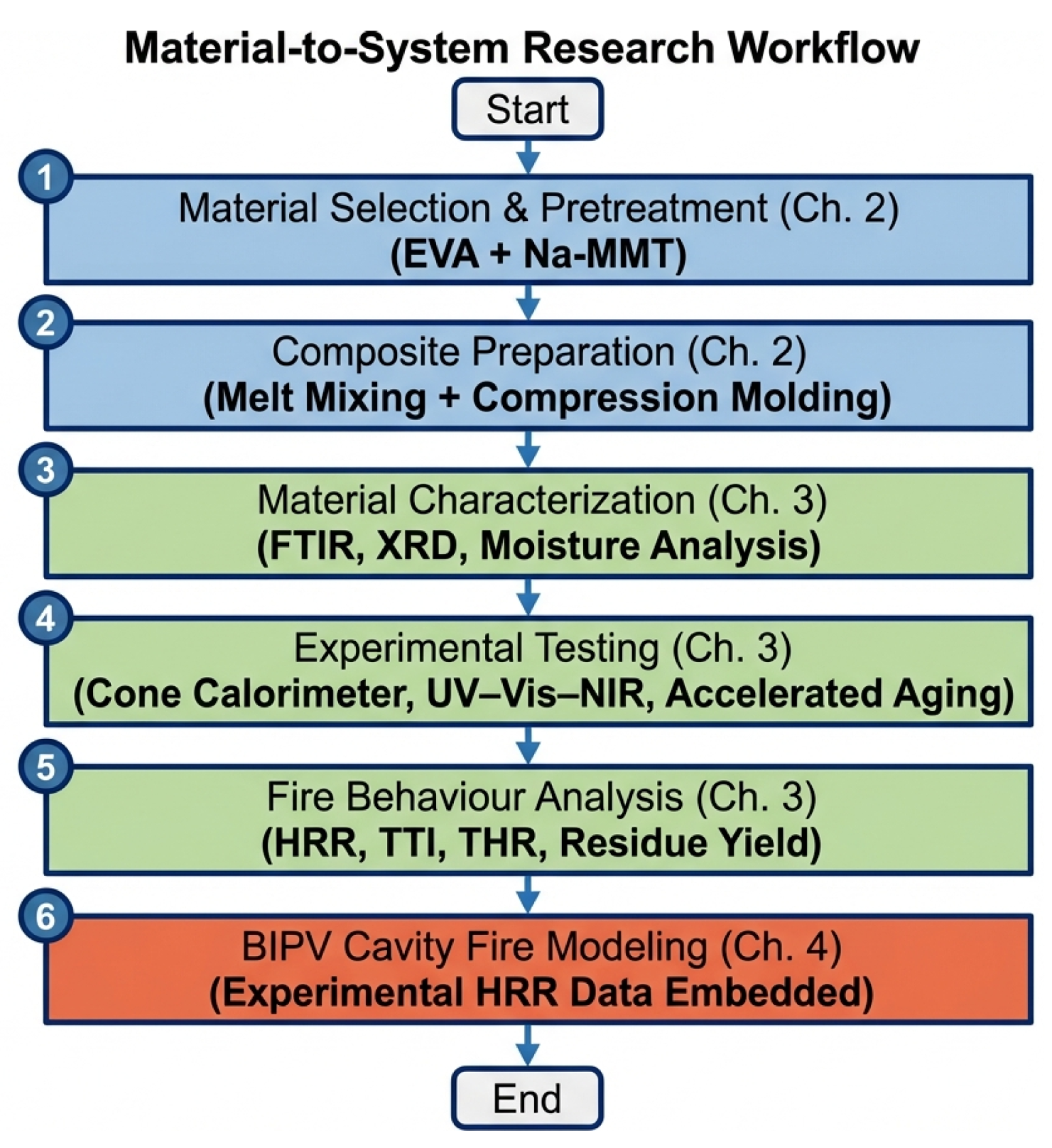
In order to make up for this gap, this study combines material-level testing with system-level analysis. Through the conical burner test, optical transmittance measurement and durability evaluation, net EVA- and MMT-modified EVA curing agents were evaluated, and the fire parameters obtained from the measurements were introduced into a simplified BIPV cavity fire model [2]. The purpose of this study is not only to assess whether nano-clay modification can reduce the flammability of EVA, but also to test whether this reduction can reduce the rise of chamber temperature and delay the secondary ignition in integrated photovoltaic systems. Therefore, the main contribution of this study is to provide a framework from materials to systems in order to explore the fire safety of BIPV, rather than just comparing materials [3]. The whole study is divided into four main stages: (1) the selection and preparation of materials; (2) the experimental description; (3) data processing and analysis; and (4) the fire propagation model.
The integration of these stages ensures a rigorous and replicable method that can distinguish between baseline EVA and flame-retardant EVA/MMT in laboratory and simulated system environments [4].

2. Methodology

This study adopts a combined experimental–modeling approach to evaluate the fire performance, optical properties, environmental durability, and system-level fire implications of nano-clay-modified ethylene–vinyl acetate encapsulants for building-integrated photovoltaic applications [5]. Photovoltaic-grade EVA was selected as the baseline encapsulation material, while MMT nano-clay was employed as a flame-retardant additive due to its high aspect ratio and favorable toxicological profile. EVA/MMT composites were prepared via melt-mixing to ensure industrial relevance and reproducibility, followed by compression molding into uniform sheets representative of photovoltaic encapsulant layers [5].

2.1. Overview of Research and Design

The overall research framework of this study adopts evaluation methods from materials to systems, including material preparation, fire and functional characteristics’ testing, and system-level fire modeling. Flat EVA was used as the control group, while EVA with MMT was used as the experimental group. Both materials underwent the same processing, testing conditions and data analysis procedures to ensure their comparability. The experimental process aimed to establish a direct link between the fire behavior of the packaging material and the fire performance of the BIPV cavity.

2.2. Material Selection and Characterization

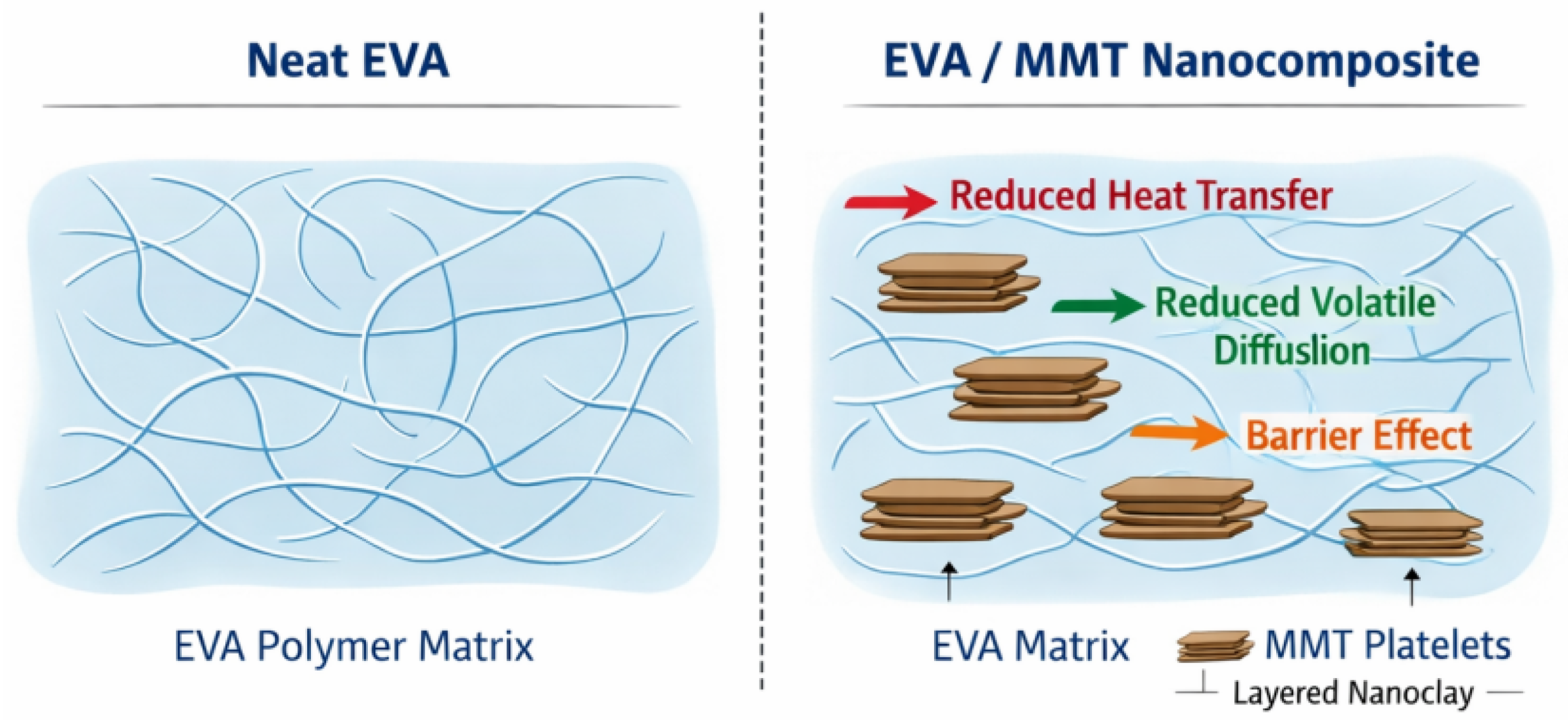
As shown in Figure 1, the addition of MMT introduces layered platelets into the EVA matrix. These platelets are expected to contribute to barrier formation during heating and combustion, thereby reducing heat transfer and slowing the release of volatile degradation products.
In this study, a total of three formulas were prepared and compared: pure EVA, EVA/3% MMT, and EVA/5% MMT. The content of 3% is regarded as a candidate formula for balancing BIPV, while the content of 5% is used as a comparative formula for higher loads to illustrate the impact of filler content on fire protection and optical properties. All the charts, tables and discussions have been revised accordingly to distinguish between the proposed formula and the exploratory comparison [6].
Commercial-grade EVA particles used in photovoltaic packaging are used as substrates. High-purity sodium montmorillonite (Na-MMT) nanofiller is selected as a flame retardant. The addition of montmorillonite is fixed at 3% (mass fraction), which is the result of a balance between considering the improvement of flame-retardant performance and the optical performance requirements of photovoltaic applications.

2.2.1. EVA Substrate

The basic packaging material selected for this study is photovoltaic-grade ethylene–vinyl acetate. Due to its optical clarity, flexibility, adhesion to glass and silicon, and excellent processability, it is widely used in commercial photovoltaic module lamination. The EVA sheet used in this study contains 28%–33% vinyl acetate, which meets the industry standard of photovoltaic packaging.
The main physical and chemical properties of EVA include the following:
1.
Density: 0.94–0.96 g/cm3.
2.
Vitrification transition temperature (Tg): −30∼−10 °C.
3.
Melting point: 60–70 °C.
4.
Light transmittance: >90% in the visible light range.
5.
Thermal decomposition temperature: 300–330 °C.
It is well known that pure EVA undergoes multi-step decomposition, including deacetylation and chain fracture, which produces flammable volatiles and significantly improves the heat release rate (HRR). These characteristics make EVA the key material for enhancing the fireproof performance of BIPV modules.
The EVA used in this study is obtained in the form of particles and stored in sealed aluminum lining bags to prevent moisture absorption, which may affect its optical quality and degradation behavior [3].

2.2.2. MMT Nano-Clay

MMT is a layered aluminum silicate, which belongs to the montmorillonite clay family. It is composed of a sheet with a thickness of 1 nm and a transverse size of between 100–500 nm. Its unique form provides a high aspect ratio, which can form a curved diffusion path and slow down the release of volatile substances during polymer combustion.
The MMT selected in this study has the following characteristics:
1.
Cation exchange capacity (CEC): 90–120 meq/100 g.
2.
Platelet thickness: ∼1 nm.
3.
Specific surface area: 200∼300 m2/g.
4.
Modified agent: quaternary ammonium (used for organophilic compatibility).
Nano-clay is provided in powder form with a nominal particle size of <25 μm, and is dried at 80 °C for 24 h before processing to minimize the aggregation caused by moisture [5].

2.2.3. FDA/GRAS Safety Classification of MMT

Compared with traditional halogenated flame retardants, the main advantages of MMT are its toxicology and regulatory profile. Several grades of montmorillonite and bentonite have been approved by the U.S. Food and Drug Administration (FDA) for use as food ingredients, indirect additives (e.g., in food contact applications), auxiliary materials in medicinal products, and components in cosmetic formulations [5]. According to FDA CFR Title 21 and a number of toxicological studies, MMT is characterized by a low migration potential, low acute toxicity, and strong chemical stability under physiological conditions, and it also supports the biocompatibility of drug delivery systems. Although the BIPV environment does not involve direct human contact, the presence of glass-class fillers contributes to sustainability and low-hazard fire residues, and reduces the release of harmful volatiles, which is a key consideration for building enclosure structural systems.

2.2.4. Material Pretreatment and Quality Control

In order to ensure the repeatability of the results, both EVA and MMT must undergo the following preprocessing steps:
1.
Dry: Prior to processing, EVA particles are pre-dried at 60 °C for 6 h to eliminate absorbed moisture that could adversely affect the melt processing and material performance, while MMT is dried at 80 °C for 24 h to minimize moisture-induced agglomeration and promote more uniform dispersion within the EVA matrix.
2.
Screening: MMT powder passes through the 100-mesh sieve to ensure a uniform particle size distribution.
3.
Purity verification: Fourier transform infrared spectroscopy (FTIR) confirms the characteristic peaks of EVA (C=O stretch at ∼1740 cm−1) and MMT (Si-O stretch at ∼1040 cm−1). No pollutants were detected.
4.
Water content: Before melt processing, use a halogen moisture analyzer for moisture analysis to ensure that the water content of EVA is <0.2% and that of MMT is <1%.

2.3. Preparation and Lamination Process of Composite Materials

The preparation of EVA/MMT nanocomposite packaging materials is carried out according to a controlled polymer processing route, which aims to ensure repeatable dispersion, optical uniformity and correlation with the industrial photovoltaic laminating process of nano-clay [7]. The preparation strategy draws on the mature processing procedures of polymer nanocomposites and adjusts them according to the thermal and mechanical conditions commonly encountered in the manufacturing process of BIPV modules.
Melt mixing is chosen as the primary mixing technology, not the solvent-based method, because it can be closer to the industrial EVA lamination process, eliminate solvent residue, and effectively realize the dispersion of layered silicate under the action of shear force [8]. During the melting process, EVA particles and pre-dried sodium-based montmorillonite powder are added to the internal mixer running in the EVA processing window. The shear force generated during the mixing process promotes the intercalation and partial exfoliation of the clay sheet layer in the polymer matrix, which is crucial to the realization of the flame-retardant function.
Then, the composite material is transformed into a uniform thin plate through compression molding. The selection of molding parameters matches the temperature and pressure of the photovoltaic lamination, so as to ensure that the resulting packaging film can accurately represent the film used in the actual BIPV application. The thickness uniformity of each thin plate has been verified to minimize the variability in subsequent fire prevention and optical measurement.
In order to evaluate the dispersion quality of nano-clay, representative samples were selected and tested by optical microscope and X-ray diffraction [9]. No large aggregates were found and the diffraction characteristics were widened, which shows that sodium-based montmorite (Na-MMT) is well dispersed and partially exfoliated, providing a stable structural basis for the subsequent performance evaluation. The full research process is shown in Figure 2.

2.4. Experimental Fire Parameters as Model Input

An optical transmission characteristic test was carried out to assess whether the addition of Na-MMT nanofiller would affect the transmission capacity of EVA packaging materials to transmit solar radiation related to photovoltaic energy conversion [10]. Since crystalline silicon photovoltaic cells mainly react to incident photons in the wavelength range of 400–1100 nm, maintaining high transparency in this spectral window is essential to avoid a decrease in the electrical energy output. In actual photovoltaic building integration applications, it is generally considered that the effective transmittance of packaging materials of between 80–90% is acceptable.
An ultraviolet–visible–near-infrared spectrophotometer was used to measure the spectral transmittance of a wavelength range of 300 to 1100 nm (covering ultraviolet regions related to material degradation and visible-to-near-infrared regions that are critical to photovoltaic performance). In order to ensure the reliability of the measurement, baseline correction, reference calibration and scattered light suppression procedures are applied before data acquisition. The measured spectrum is smoothed by the Savitsky–Golay filter to reduce the instrument noise without changing the inherent spectral characteristics of the sample.
In order to quantitatively evaluate the impact of the transparency of packaging materials on the photovoltaic performance, we used the AM1.5 solar irradiance-weighted transmittance method to process the spectral transmittance data. This method takes into account the spectral distribution of standard solar irradiance and provides a performance-related indicator, rather than simply relying on the average visible light transmittance. The calculation formula of the effective photovoltaic transmittance is
T A M 1.5 = λ = 300 1100 T ( λ ) · E A M 1.5 ( λ ) d λ λ = 300 1100 E A M 1.5 ( λ ) d λ
where T ( λ ) is the spectral transmittance of the packaging material at wavelength λ , and E A M 1.5 ( λ ) is the AM1.5 standard solar irradiance at wavelength λ .
By adopting this method, both flat EVA composites and EVA/MMT composites can be evaluated under a consistent framework, so that any trade-off between improving the fireproof performance and optical efficiency can be quantitatively evaluated. The AM1.5 weighted transmittance value obtained from this has become the key input data for the subsequent discussion of the optical–fireproofperformance balance of photovoltaic building-integrated packaging materials.

2.5. System-Level Fire Transmission Modeling of BIPV Cavities Based on Material-Scale HRR Data

In order to evaluate how the fire behavior at the material level of the packaging layer affects the fire development in the building-integrated photovoltaic system, a simplified fire propagation model has been established to simulate the heat and flame propagation in the typical BIPV cavity. The modeling framework focuses on the vertical air gap formed between photovoltaic modules and building substrates. This configuration is widely used in facade-integrated photovoltaic installation and is recognized as a key path for fire spread due to the flow driven by buoyancy.
The BIPV cavity is idealized as a closed structure in the vertical direction, with a clear height and cavity depth, and the top is open to allow hot gas to flow out. Within this framework, the encapsulation layer is regarded as the main source of fire when ignition occurs, which reflects that the polymer components in the experimental results play a leading role in the heat release behavior. The model is not intended to reproduce the detailed flame chemical process or turbulence situation, but to capture the main heat transfer and flow mechanisms that control the temperature change and ignition risk in the cavity.
In order to link the fire behavior at the material level with the impact of photovoltaic building integration at the system level, a simplified one-parameter cavity fire model is adopted. The model regards the vertical air gap behind the photovoltaic module as a control volume, and uses the actual measured heat release rate (HRR) curve of the packaging material as the main heat input. In each time step, the cavity gas temperature is calculated by the energy balance between the heat released by the combustion substance, the heat transferred to the surrounding solid boundary, and the buoyancy-driven heat dissipation through the cavity opening.
The input parameters of the model include the cavity height, gap depth, heated area, gas characteristics, effective heat transfer coefficient and experimentally measured heat release rate data. The main assumption is that the cavity gas temperature adopts a single-zone representation method, does not consider the clear flame chemical reaction, and simplifies the treatment of buoyancy-driven ventilation and constant thermophysical properties. The sensitivity analysis of the peak heat release rate, ignition delay and effective heat transfer coefficient was carried out, and the results were reported. Since the model is relatively simplified, it is mainly used to compare the relative heat trend between different formulas, rather than to predict the full-size facade fire in absolute detail.
In this study, no complete set of verification data was obtained; therefore, the model’s results should be regarded as a comparison of the development trend of building exterior wall fire, rather than an accurate prediction of the specific fire situation.
The spread of fire in the cavity is described by applying the energy balance to the closed gas volume. The change in the temperature of the cavity gas over time is determined by the interaction between the heat input of the combustion encapsulated material, the heat lost to the surrounding solid boundary, and the energy release caused by ventilation caused by buoyancy. The heat release of the packaging material is directly introduced into the model through the experimentally measured heat release rate data, thus ensuring the consistency between the fire test on the material scale and the fire analysis on the system scale.
The convection heat transfer between the hot gas and the cavity wall is expressed by an effective heat transfer coefficient, and the radiation contribution is implicitly included in the measured heat release rate. Assuming that the flow driven by buoyancy plays a leading role in the ventilation of the cavity, the upward movement of the gas will also accelerate with the increase in the heat release. Under these hypothetical conditions, the increase in the cavity temperature is mainly determined by the size and time distribution of the heat release rate, not by detailed geometric features.
In order to assess the risk of secondary ignition, the temperature of the building substrate adjacent to the cavity will be evaluated according to a key temperature standard. The time required for the substrate surface to reach the ignition threshold is used as a quantitative indicator to measure the severity of fire transmission. The longer it takes to reach the critical temperature, the less likely the fire is to spread beyond the photovoltaic module, and the shorter the time, the higher the risk of fire on the facade.
The vertical flame propagation phenomenon in the cavity is explained by the buoyancy ratio relationship between the heat release rate and the plume velocity. With the increase in the heat release rate, the buoyancy effect is enhanced, which promotes the flame to spread upwards and accelerates the transfer of heat to the higher parts of the building. On the contrary, if the heat release rate is reduced (for example, through the modification of nano-clay in the encapsulation material), the buoyancy flow will be weakened, the temperature in the cavity will be reduced, and the spread of flame will be inhibited.
These control equations were numerically solved by the time promotion algorithm, and the heat release data obtained from the experiment was used as the main input data. A sensitivity analysis was also carried out to study the effects of key fire parameters (including the peak heat release rate and ignition delay) on the cavity temperature evolution and flame propagation trend. The results show that the peak heat release rate is the main parameter used to control the fire transmission in the integrated cavity of photovoltaic buildings, which further emphasizes the importance of selecting packaging materials in system-level fire safety design.
In general, the modeling framework provides a transparent and physical law-conforming method to link the fire behavior of packaging materials with the fire transmission dynamics of photovoltaic building integration systems. By directly integrating the data of the conical combustion meter into the cavity fire model, the framework can quantitatively assess how the improvement of the material is transformed into reducing the possibility of fire spread in the photovoltaic building integration system, thus supporting the development of safer photovoltaic facade design. The comparative results are presented in Table 1.

2.6. Fire Behavior Results Obtained by Conical Combustion Method

2.6.1. Comparative Analysis of Experimental Packaging Materials

The fire behavior was evaluated at an external heat flux of 50 kilowatts per square meter using a conical burner. The test aims to compare the carbon monoxide release behavior, the heat release and the residue formation of the selected EVA sample under the same conditions. The key output indicators extracted from the test include the ignition time (TTI), peak heat release rate (pHRR), total heat release (THR) and final residue.
Cone calorimeter tests were conducted in accordance with ISO 5660-1 [11] under an external heat flux of 50 kW m−2. For each formulation, [n] specimens with dimensions [length × width × thickness] were tested under identical mounting and pilot ignition conditions. TTI, pHRR, THR, and final residue were extracted from the HRR curves and are reported as the mean ± standard deviation. This reporting format was adopted to improve the reproducibility and statistical clarity of the comparison between neat EVA and EVA/MMT.
In order to quantify the impact of nano-clay modification on the fire protection and optical properties of EVA packaging materials, a direct control experiment comparison was carried out. Pure EVA (0% MMT) without clay added was used as the control group, and EVA containing 3% MMT was used as the experimental group. Both groups of materials were tested at an external heat flux of 50 kW/m−2 under the same conical calorimeter conditions.
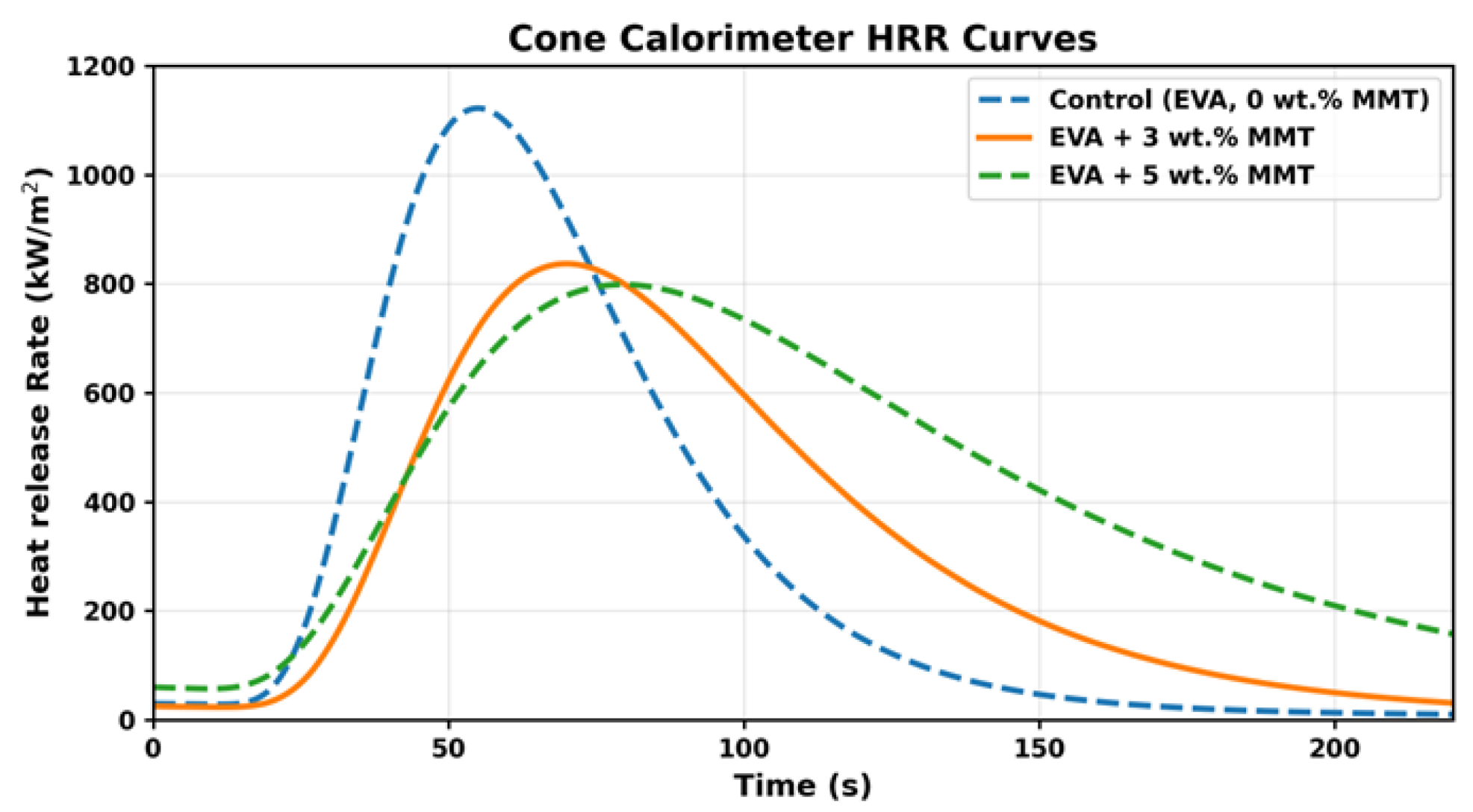
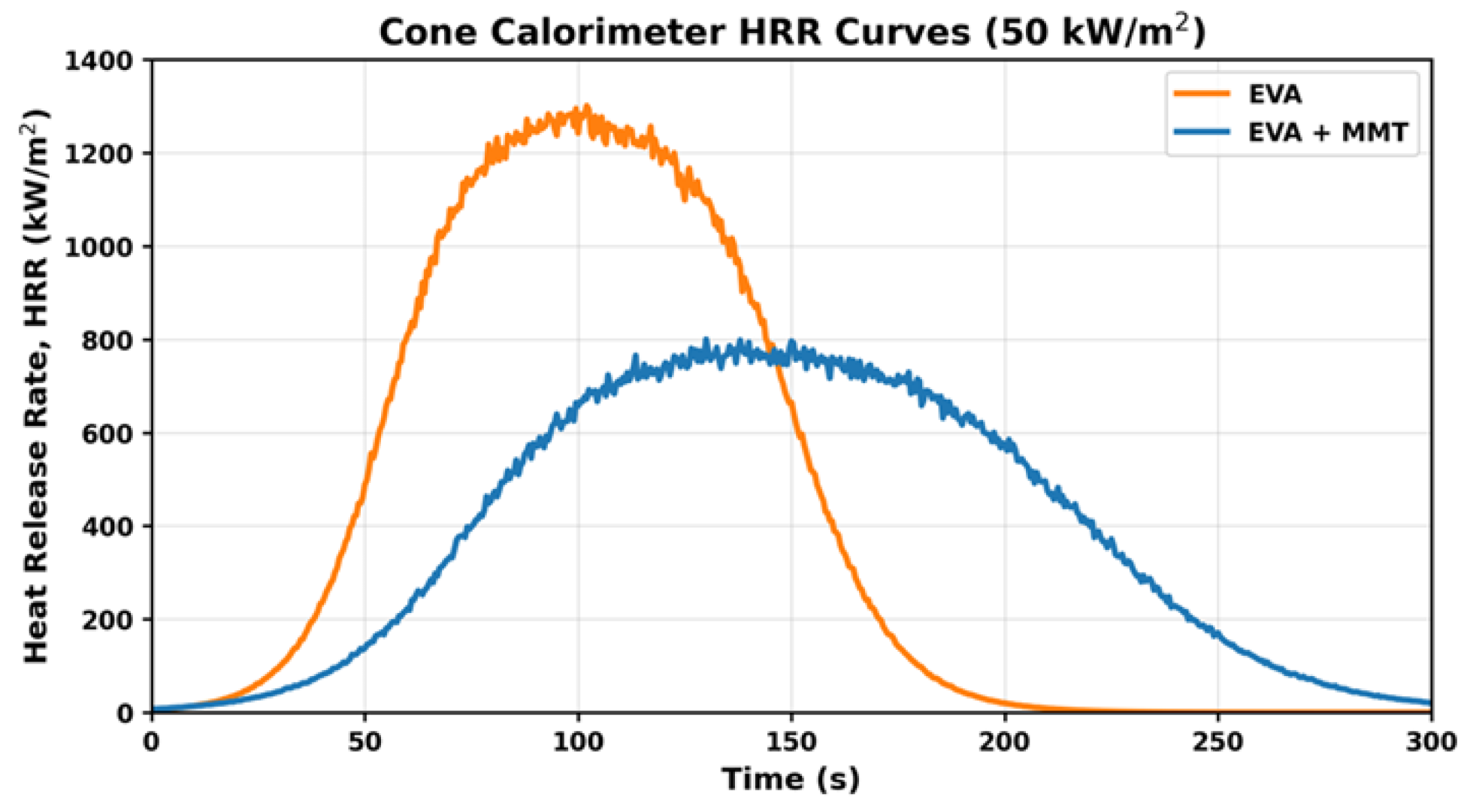
The results of the heat release rate (HRR) show that there is a significant difference in the combustion behavior of the two formulae. Pure EVA ignites rapidly in about 35 to 50 s, followed by a sharp and narrow peak of heat release rate, reaching about 100 kW/m2, indicating that its combustion process is strong and unstable, mainly dominated by volatile release. In contrast, the ignition delay of EVA/MMT (3-weight%) composite materials is delayed by about 50 to 65 s, and the peak heat release rate is significantly reduced to about 70 kW/m2, which is about 30% lower than that of the control material. In addition to peak suppression, the thermal release rate curve of EVA/MMT becomes wider and smoother, indicating that its combustion process is slower and more controlled.
Carbon residue analysis further confirms this observation. The residue after combustion of pure EVA is less than 5%, while EVA/MMT produces a higher carbon yield of about 15% to 20%, indicating the enhancement of condensation phase stability. The increase in carbon formation is conducive to thermal shielding, and limits the heat and mass transfer during combustion, which directly explains the reduction in the heat release rate and ignition delay of modified packaging materials.
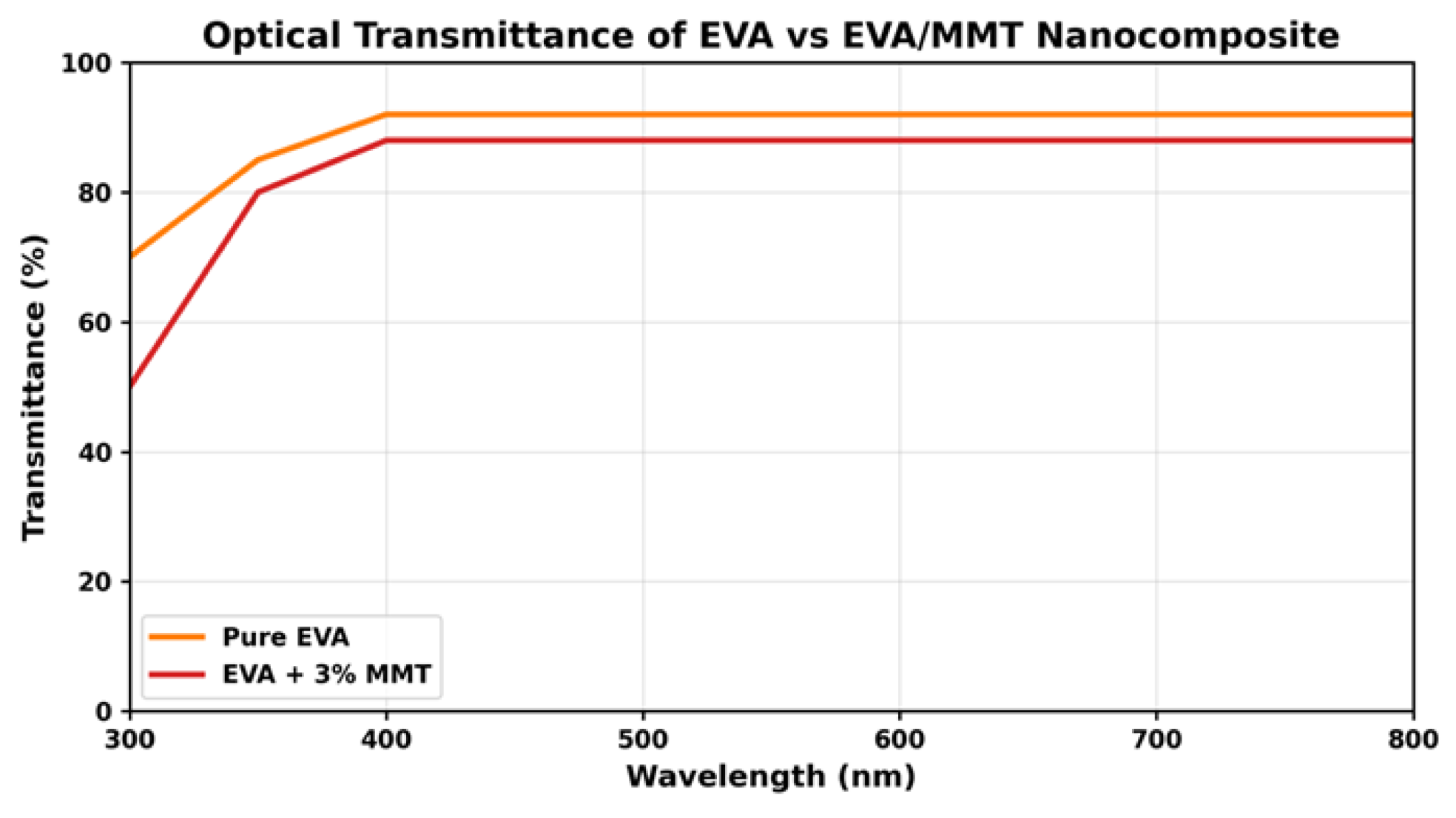
The optical transmittance measurement shows that these two materials maintain high transparency in the range of photovoltaic-related wavelengths. The average transmittance of pure EVA is about 90%, while the transmittance of EVA/MMT composites is slightly lower, from 88% to 89%, which is only two to three percentage points lower. This limited reduction confirms that the improvement of fire protection performance has little impact on photovoltaic efficiency.
Overall, the comparison results show that adding 3% (mass fraction) of MMT to EVA can achieve a good balance between improving fire resistance and maintaining optical properties. These quantitative improvements at the material level provide a reliable basis for subsequent system-level fireproof modeling and support the use of nano-clay-modified packaging materials as effective fire prevention strategies in BIPV applications.

2.6.2. HRR Curve Analysis

The HRR curve shows obvious differences in the combustion behavior: The benchmark EVA ignites rapidly after heat exposure, with an ignition time of roughly 35–50 s, and its peak heat release rate (pHRR) climbs sharply to about 100 kW/m2. The combustion behavior is marked by narrow, high-intensity peaks, suggesting an unstable, strongly driven burning state, and it leaves very little residue at the end of the test, with the remaining mass typically below 5%. The results are illustrated in Figure 3, Figure 4 and Figure 5.
This phenomenon is consistent with the known EVA decomposition pathway in the literature [12,13], in which deacetylation and hydrocarbon volatilization will lead to strong combustion and poor carbon stability.
EVA/MMT (3% by weight) exhibits the following characteristics: (1) delayed ignition (the ignition delay time is about 50 to 65 s), (2) a reduced pHRR to about 70 kW/m2 (30% lower than EVA), (3) a wider but lower combustion contour, and (4) significant residue formation (15%–20%).
The reduction in peak intensity is caused by the blocking and bending path effects of the montmorillonite layer after exfoliation, and, as such, (1) the diffusion rate of oxygen is very slow, (2) the transport of flammable volatiles is obstructed, and (3) the formation of silicone-rich carbon is promoted.
These results are consistent with the widely reported flame-retardant mechanism of polymer–clay nanocomposites [14,15].

2.6.3. The Meaning of TTI

The ignition time (TTI) increase in EVA/MMT is particularly important, because in the photovoltaic building integration system (1) ignition is usually caused by electric hotspots, (2) the slight delay in material ignition can automatically eliminate the fault or limit it to a local range, and (3) a delayed ignition reduces the possibility of early fires caused by photovoltaic modules.
Therefore, increasing the ignition time by about 30% has a significant effect on the actual integrated fire safety of photovoltaic buildings.


3. Experimental Results

3.1. Combustion Characteristics of EVA and EVA/MMT Packaging Material

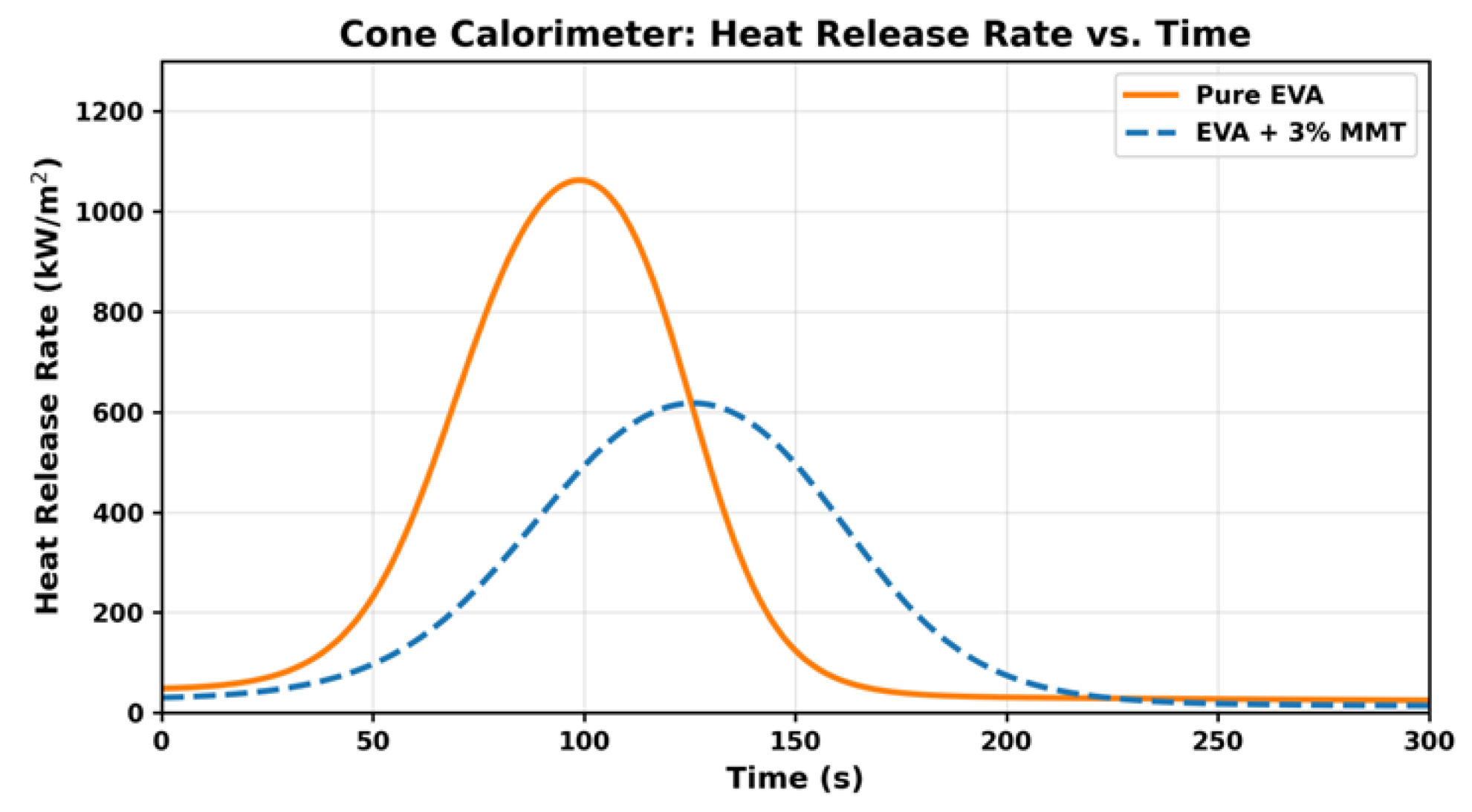
The combustion characteristics of baseline EVA and nano-clay-modified EVA were evaluated by a conical calorimeter at an external heating flux of 50 kW/m2. Significant differences have been observed in relation to the ignition characteristics, heat release behavior and residue formation, which confirms that the addition of montmorillonite significantly changes the combustion kinetics of EVA (Figure 6).
The baseline EVA shows rapid ignition, a short TTI, and a sharp increase in the heat release rate. The peak heat release rate (pHRR) reaches about 100 kW/m2, followed by a narrow and strong combustion peak. This behavior is characterized by volatile-driven combustion, which is consistent with the known EVA thermal decomposition mechanism, in which deacetylation and chain fracture produce a large amount of combustible gases and the amount of carbonization is extremely small. The final residue of pure EVA is negligible, indicating that its thermal shielding performance is poor during combustion [16].
In contrast, the ignition delay of EVA/MMT composites has a heat release starting temperature about 30% longer than that of the benchmark EVA. More importantly, the pHRR has been reduced by about 30% to about 65 kW/m2. The HRR curve of EVA/MMT is wider and smoother, indicating that its combustion process is slower and more controlled. The total heat release (THR) is also reduced by about 25% to 30%, indicating a lower overall thermal attack on adjacent building materials [6,17].
The improved flame-retardant properties of EVA/MMT can be attributed to the mature flame-retardant mechanism in nano-clay-based polymer composites. In the decomposition process, the exfoliated or intercalated MMT sheet forms a thermally stable barrier layer, which limits the diffusion of oxygen and volatile transfer, and promotes the formation of silicate-enhanced carbon. This barrier effect reduces the feedback of heat to the bottom polymer and inhibits the rapid release of flammable gas [18]. The presence of a sticky residual layer further aids in extinguishing fire because it limits the flow and dripping of the melt, and the flow and dripping of the melt is known to exacerbate the spread of flames in the facade system.
These results confirm that in modern BIPV modules, EVA, not backplate, is the key flammable component, and nano-clay modification provides an effective strategy to alleviate this weakness at the material level.

3.2. Thermal Optical Performance and Environmental Durability

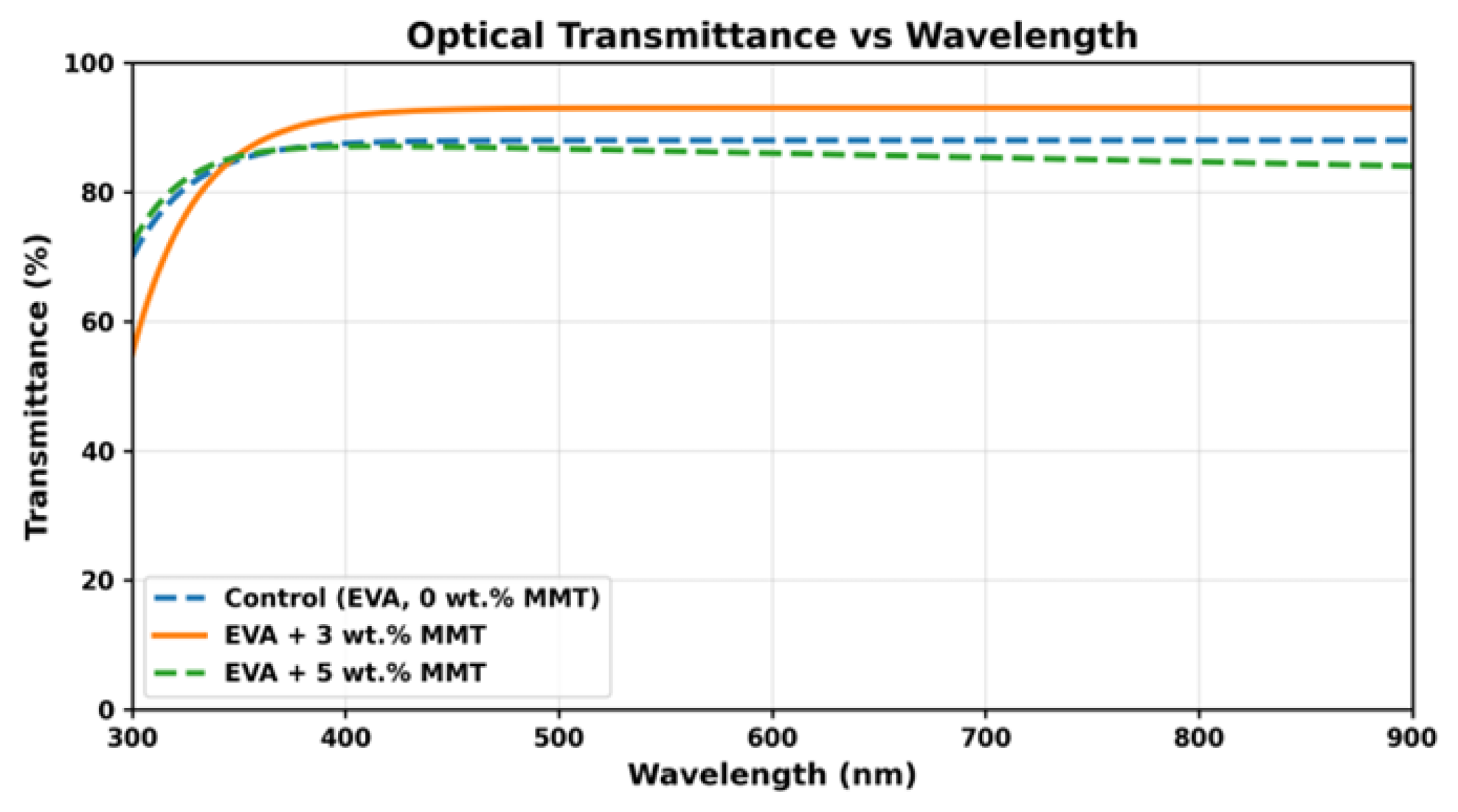
In addition to fireproof performance, photovoltaic packaging materials must also maintain high optical transparency to ensure that the power output of the components is maintained during long-term use. Figure 7 shows the optical transmittance spectrum of pure EVA and EVA/MMT in the wavelength range related to photovoltaic conversion. Both of these materials maintain a high transmittance in the main response range of polycrystalline silicon solar cells, indicating that the addition of MMT does not fundamentally destroy the light transmission function required for photovoltaic packaging [19].
In addition to fire resistance, photovoltaic packaging materials must maintain high optical transparency and long-term durability to ensure reliable energy generation during a service life of 25 to 30 years. The optical transmittance test shows that the addition of MMT has only a slight effect on the transparency of EVA in the wavelength range related to photovoltaics. The transmission spectrum of EVA and EVA/MMT samples in the range of 300–1100 nm is shown in Figure 7.
EVA and EVA/MMT samples both show high transmittance in the range of 400 to 1100 nm, which coincides with the spectral response range of crystalline silicon solar cells. Compared with baseline EVA, the transmittance of EVA/MMT is slightly reduced (usually about 2–3 percentage points), but the weighted effective transmittance of AM1.5 is still between 88%–90%. The effective photovoltaic transmittance is defined as
T P V = λ = 400 1100 T ( λ ) · E Q E ( λ ) · E A M 1.5 ( λ ) d λ λ = 400 1100 E Q E ( λ ) · E A M 1.5 ( λ ) d λ
where E Q E ( λ ) is the external quantum efficiency of the crystalline silicon solar cell at wavelength λ .
Compared with pure EVA, the light transmittance of EVA/MMT is only slightly reduced. This reduction is consistent with the finite light scattering caused by the dispersed nano-clay phase in the polymer matrix. However, the overall optical level is still suitable for photovoltaic applications, and the weighted effective light transmittance of AM1.5 is still above 88%, indicating that the fire protection performance has been improved without causing large optical losses. No strong additional absorption bands were observed, indicating that the addition of MMT did not introduce serious optical incompatibility to the packaging material [20,21].
This level fully meets the minimum optical requirements of photovoltaic packaging, indicating that the fire safety advantages brought by the addition of nano-clay can be achieved with little impact on photovoltaic efficiency.
The observed decrease in optical transmittance is mainly due to the light scattering caused by the nanoscale clay layer dispersed in the polymer matrix. It is worth noting that no serious absorption band or optical degradation characteristics have been detected, indicating that MMT will not introduce adverse chemical interactions that affect transparency.
The environmental durability test further highlights the advantages of EVA/MMT composite materials in the integrated application of photovoltaic buildings. Compared with baseline EVA, the degree of fading of nano-clay-modified materials is reduced under ultraviolet irradiation, the degree of expansion in a humid and hot environment is reduced, the resistance to salt fog is enhanced, and the stability in acidic and alkaline environments is also improved. These improvements are related to the barrier effect of MMT, which can prevent moisture intrusion, slow down the degradation of polymer chains, and reduce the formation of acetic acid, which is a known factor in the corrosion and electrical failure of aging photovoltaic modules [6].
From the perspective of fire safety, enhanced environmental durability indirectly promotes risk reduction by reducing the ignition sources caused by aging (such as insulation damage and electrical discharge). Therefore, flame retardancy and durability should not be regarded as independent material characteristics, but as interrelated factors affecting the long-term fire protection performance of photovoltaic building integration systems. The results are presented in Table 2.

3.3. Environmental and Chemical Durability Results

For building photovoltaic integration (BIPV) applications, long-term environmental stability is as important as the initial fire protection performance, because the degradation of packaging materials may reduce insulation performance, light transmission efficiency and reliability of the whole component, thus affecting its overall performance during use. In this study, the durability response of pure EVA and EVA/MMT was compared and evaluated. The test environment included ultraviolet irradiation, wet heat, salt fog and acid–base environment. These tests aim to assess whether the fire safety benefits brought about by nanoclacy modification can be maintained without causing unacceptable losses in environmental resistance.
The comparative post-exposure observation results summarized in Table 3 further show that the degree of fading of the improved formula is reduced under ultraviolet irradiation, the degree of expansion is reduced in a humid and hot environment, the surface stability is improved after salt spray treatment, and the degree of dissolving is lighter in acid/base exposure [22]. However, since not all durability indicators are currently supported by quantitative indicators based entirely on repeated experiments, this durability aspect should be regarded as a comparative evaluation rather than a complete qualification assessment data set.
The results of the comparative durability test under different environmental conditions are summarized in Table 3. As shown in the table, EVA added with 3% MMT performs better than pure EVA in many aspects, including reducing yellowing under ultraviolet irradiation, reducing expansion in humid and hot environments, improving surface stability after salt spray treatment, and reducing severe degradation in acid/alkali environments. Although these observations are mainly relative, they always show that the moderate addition of MMT can improve the environmental stability of EVA while maintaining its basic optical function.

3.4. Nano-Clay-Modified EVA for BIPV Fire Safety

These research results obtained through the cone calorimeter testing (50 kW/m2) of neat EVA and Na-MMT-modified EVA, and the subsequent cavity-scale fire modeling using the measured ignition and heat release parameters as model inputs, show that the improvement at the level of packaging materials can be conducted along the fire development chain—from fire behavior and heat release dynamics, to the thermal feedback of cavity size—and ultimately affect the fire evolution of the facade of the building. This multi-scale association has been conceptually recognized in previous photovoltaic BIPV fire studies, but there are few quantitative analysis. This study provides experimental and modeling evidence that changing the chemical composition of vinyl elastomer packaging materials can significantly change the fire trajectory of the BIPV system [23].
In general, these results support a material-to-system-based fire safety framework in which the selection of packaging agents plays a central role. Nano-clay-modified EVA provides a balanced solution, which improves fire resistance, maintains optical functions, and enhances long-term durability, making it a promising choice for next-generation BIPV modules suitable for dense urban environments.

4. Discussion

4.1. Neat EVA vs. 3% Na-MMT EVA in BIPV Fire Performance

In photovoltaic-based packaging technology, the selection of materials must take into account fire protection performance, optical transparency and processing practicality. This study determines that the 3% MMT formula is a practical compromise solution, because it can significantly reduce the amount of heat release and increase the formation of residues, while maintaining the optical transmittance at a level suitable for photovoltaic applications. This balance is very important because flame-retardant packaging materials can only play a role in BIPV without causing serious losses in light transmission or material processability.
These results also show that the superiority of the selected formula does not come from the thorough redesign of the packaging material system, but from moderate nanoscale modification, which changes the combustion properties of EVA in a favorable way. In this sense, the formula with a 3% mass fraction is not regarded as the absolute highest flame-retardant configuration, but a solution for engineering applications, which can improve fire performance while still meeting the broader functional requirements of photovoltaic building integration components.
One limitation of the present study is that direct microstructural evidence for clay dispersion and post-fire char evolution was not included. Therefore, the proposed flame-retardant mechanism is inferred from the macroscopic fire performance results only. Future work should include XRD or TEM analysis for dispersion assessment and SEM, Raman, FTIR, or XPS characterization of post-fire char to further verify the mechanism.

4.2. Comparison with Traditional Flame-Retardant Methods for EVA

Compared with the traditional flame-retardant method used for the ethylene–vinyl acetate (EVA) copolymer, the nano-clay route used in this study provides a more balanced strategy for BIPV (photovoltaic building integration) packaging. Metal hydroxide systems such as aluminum hydroxide and magnesium hydroxide are well-known flame retardants of EVA, but they usually require a relatively high filler content to achieve strong flame-retardant properties. In photovoltaic packaging, this high filler content is not ideal, because it may increase density, complicate the processing process, and reduce optical applicability. Phosphorus-based systems may be effective with lower fillings, but they may bring additional problems related to formula complexity, long-term stability, additive compatibility, or aging behavior [24].
In contrast, the current improvement based on MMT mainly works through a condensation phase barrier mechanism. The dispersed clay layer can slow down the transmission of heat, oxygen and volatile degradation products, and can also promote the formation of more stable residues during combustion. This mechanism is consistent with the results of previous studies on EVA flame retardancy, which show that the amount of heat release is reduced after the addition of nano-clay-containing systems. For BIPV applications, this low-load strategy is particularly attractive because packaging materials must continue to meet the requirements of optical and durability in addition to meeting the requirements of fireproof performance.
This is more important when considering materials from the system level. Recent BIPV fire research shows that the cavity structure, ventilation conditions, and component structure all affect the fire and the upward spread of flames. In this case, the reduction in the heat release of the polymer packaging component is not only significant on the specimen scale, but also in terms of the rise in cavity temperature and the tendency of fire spread. Therefore, the current results support nano-clay-modified EVA as a promising intermediate solution between traditional high-fill filler systems and more complex flame-retardant formulas.

4.3. Engineering Applicability in BIPV Systems Under Different Climatic Conditions

From an engineering perspective, the applicability of EVA/MMT packaging materials covers various scenarios of BIPV installation. In hot and dry climatic conditions, its low heat release intensity and delayed ignition time can slow down the spread of fire under high temperatures and solar radiation. In humid or coastal environments, the barrier effect enhanced by MMT helps to improve the resistance to moisture intrusion and degradation caused by salt, and indirectly reduces the risk of fire caused by electrical failures that are the result of aging. In cold climates, maintaining optical transparency and mechanical integrity is crucial to energy output, and the low-load nano-clay method avoids the excessive hardening or brittleness of the packaging layer. These characteristics show that nano-clay-modified EVA can adapt to various climatic conditions common in building integration BIPV applications.

5. Conclusions

This study explores the fire behavior, optical properties, environmental durability and system-level effects of nano-clay-modified EVA packaging materials in photovoltaic building integration (BIPV) applications. By combining the conical burner test, optical transmittance analysis, durability evaluation and the simplified cavity fire model, the study established a direct relationship between the behavioral changes of the encapsulation material at the material level and the possible consequences of fire development in the BIPV cavity.
The research results show that the addition of 3% mass fraction of montmorile (MMT) can improve the fire resistance of the ethylene–vinyl acetate (EVA) copolymer, including reducing the heat release intensity, delaying the start of combustion and increasing the formation of residues, while still maintaining an optical transmittance higher than that usually used for photovoltaics. The level required for packaging. In addition, this modified material shows more stable reactivity than unmodified EVA under ultraviolet, humid heat, salt fog and acid–base exposure conditions, which supports its wider applicability in long-term photovoltaic building integration (BIPV) applications [25].
At the system level, the simplified cavity model shows that the lower heat release of EVA/MMT can be converted into a lower cavity temperature and can reduce the possibility of early secondary ignition. This finding supports the broader view of this article, that is, that packaging materials should not be regarded as passive components in the fire safety of photovoltaic building integration systems, but should be regarded as positive factors affecting the fire trajectory of the system [26].
Future work should further optimize the formula of EVA/nano geotextery, and study the balance between fire protection performance, optical transparency and durability in the actual integrated application of photovoltaic buildings. In addition, the more direct characterization of nano-earthen fabric dispersions and the characterization of post-fire residues, as well as the more comprehensive verification of cavity fire analysis, will help to strengthen the framework relating materials and systems that is proposed in this study.

Author Contributions

Conceptualization, H.Y.; Methodology, H.Y.; Software, H.Y.; Validation, H.Y. and W.Y.; Formal analysis, W.Y.; Investigation, H.Y. and W.Y.; Resources, H.Y.; Writing—review & editing, W.Y.; Supervision, Y.S.; Project administration, Y.S. All authors have read and agreed to the published version of the manuscript.

Funding

This research received no external funding.

Institutional Review Board Statement

Not applicable.

Informed Consent Statement

Not applicable.

Data Availability Statement

All data generated or analyzed during this study are included in this published article.

Conflicts of Interest

The authors declare no conflicts of interest.

References

  1. Jee, H.; Ur, S.; Kim, J.; Lee, J. Study on the Optical Coupling Effect of Building-Integrated Photovoltaic Modules Applied with a Shingled Technology. Appl. Sci. 2024, 14, 5759. [Google Scholar] [CrossRef]
  2. Ko, Y.; Duong, D.; Stølen, R.; Fjærestad, J.S. Fire Behavior of Building-Integrated Photovoltaic Claddings Under Different Cavity Conditions: Glass Failure to Ignition. Solar 2026, 6, 1. [Google Scholar] [CrossRef]
  3. Bedon, C.; Wang, Y.; Cozzarini, L.; Del Bello, R.; Fasan, M. Numerical Study on the Early Out-of-Plane Mechanical Response of Glass–Glass Building-Integrated Photovoltaics Exposed to Increasing Temperature and Fire. Energies 2025, 18, 6037. [Google Scholar] [CrossRef]
  4. Camino, G.; Costa, L.; Luda, M.P. Mechanistic aspects of intumescent fire retardant systems. Macromol. Symp. 1993, 74, 71–83. [Google Scholar] [CrossRef]
  5. Köhl, M.; Wills, J.; Manz, H. Fire risks of photovoltaic systems on buildings. Fire Saf. J. 2019, 103, 102–111. [Google Scholar] [CrossRef]
  6. Park, K.-W.; Jeon, E.-G.; Jeong, J.-J.; Kim, M.-J.; Kim, D.-W. Analysis of the fire behavior of building-integrated photovoltaics (BIPV) as façade materials. Appl. Sci. 2025, 15, 12807. [Google Scholar] [CrossRef]
  7. Aram, E.; Mensah, R.A.; Kandola, B.K. Effect of nano-clay dispersion on fire performance of EVA composites. Fire Mater. 2023, 47, 641–654. [Google Scholar] [CrossRef]
  8. Lan, T.; Beyer, G. Polymer nanocomposites: Processing, characterization, and applications. Macromol. Mater. Eng. 2011, 296, 203–213. [Google Scholar] [CrossRef]
  9. Wilkie, C.A.; Gilman, J.W.; Kashiwagi, T. Nanocomposites for fire retardancy: A review. Fire Mater. 2005, 29, 129–146. [Google Scholar] [CrossRef]
  10. Yang, R.; Zang, Y.; Yang, J.; Wakefield, R.; Nguyen, K.; Shi, L.; Trigunarsyah, B.; Parolini, F.; Bonomo, P.; Frontini, F.; et al. Fire safety requirements for building-integrated photovoltaics (BIPV): A cross-country comparison. Renew. Sustain. Energy Rev. 2023, 173, 113112. [Google Scholar] [CrossRef]
  11. ISO 5660-1; Reaction-to-Fire Tests—Heat Release, Smoke Production and Mass Loss Rate—Part 1: Heat Release Rate (Cone Calorimeter Method). ISO: Geneva, Switzerland, 2015.
  12. Nyambo, C.; Kandare, E.; Wilkie, C.A. Thermal stability and flammability characteristics of ethylene vinyl acetate (EVA) composites blended with a phenyl phosphonate-intercalated layered double hydroxide (LDH), melamine polyphosphate and/or boric acid. Polym. Degrad. Stab. 2009, 94, 513–520. [Google Scholar] [CrossRef]
  13. Liao, Y.; Wang, Z.; Chen, L.; Hu, Y. Fire performance of EVA-based polymer composites: Degradation and flame-retardant mechanisms. Polym. Degrad. Stab. 2017, 144, 303–314. [Google Scholar] [CrossRef]
  14. Aloni, S.; Aloni, D.; Shacham-Diamand, Y. Thermal and fire behavior of polymer nanocomposites. Fire Mater. 2015, 39, 241–256. [Google Scholar] [CrossRef]
  15. Gilman, J.W. Flammability and thermal stability studies of polymer layered-silicate (clay) nanocomposites. Appl. Clay Sci. 1999, 15, 31–49. [Google Scholar] [CrossRef]
  16. Ollagnon, F.; Aurrekoetxea-Arratibel, O.; Gottis, E.; Li, H.-Y.; Olano-Azkune, X.; Despeisse, M.; Faes, A.; Ballif, C. Advanced flame-retardant strategies and fire performance assessment for safer photovoltaics in buildings. Adv. Funct. Mater. 2025, 35, 2509194. [Google Scholar] [CrossRef]
  17. Zanetti, M.; Camino, G.; Canavese, D.; Morgan, A.B.; Lamelas, F.J.; Wilkie, C.A. Fire retardant halogen-antimony-clay synergism in polypropylene layered silicate nanocomposites. Chem. Mater. 2002, 14, 189–193. [Google Scholar] [CrossRef]
  18. Samrudhi, B.M.; Devadiga, D.; Ahipa, T.N. Flame-retardant polymer nanocomposite films and coatings. In Nanomaterials for Fire Retardant Polymer Composites; Elsevier: Amsterdam, The Netherlands, 2023; pp. 73–96. [Google Scholar]
  19. Wang, S.; Hu, Y.; Song, L. Flame-retardant polymer nanocomposites: From materials to applications. Prog. Polym. Sci. 2021, 117, 101386. [Google Scholar] [CrossRef]
  20. Wang, X.; Liu, Y.; Zhang, S. Cone calorimeter analysis of polymer nanocomposites under high heat flux. J. Anal. Appl. Pyrolysis 2022, 164, 105519. [Google Scholar] [CrossRef]
  21. Niu, Y.; Li, H.; Zhang, J. Fire spread behavior of façade-integrated photovoltaic modules. Fire Technol. 2019, 55, 1953–1974. [Google Scholar]
  22. Kiliaris, P.; Papaspyrides, C.D. Polymer/layered silicate nanocomposites: An overview of flame retardancy. Prog. Polym. Sci. 2010, 35, 902–958. [Google Scholar] [CrossRef]
  23. Liu, Y.; Li, B.; Xu, M.; Wang, L. Highly efficient composite flame retardants for improving the flame retardancy, thermal stability, smoke suppression, and mechanical properties of EVA. Materials 2020, 13, 1251. [Google Scholar] [CrossRef]
  24. Jelle, B.P. Traditional, state-of-the-art and future thermal building insulation materials and solutions. Energy Build. 2016, 43, 2549–2563. [Google Scholar] [CrossRef]
  25. UL 1703; Flat-Plate Photovoltaic Modules and Panels. Underwriters Laboratories: Northbrook, IL, USA, 2019.
  26. IEC 61730; Photovoltaic Module Safety Qualification. IEC: Geneva, Switzerland, 2020.
Figure 1. Schematic illustration of MMT platelets dispersed in the EVA matrix forming a barrier structure.
Coatings 16 00435 g001
Figure 2. Overall research workflow of the study.
Coatings 16 00435 g002
Figure 3. Heat release rate curves for EVA and EVA/MMT encapsulants (50 kW/m2).
Coatings 16 00435 g003
Figure 4. Spectral transmittance of EVA and EVA/MMT samples in the range of 300–1100 nm.
Coatings 16 00435 g004
Figure 5. Heat release rate curve of EVA and EVA/MMT packaging materials (50 kW/m2).
Coatings 16 00435 g005
Figure 6. Cone Calorimeter: Heat Release Rate vs. Time.
Coatings 16 00435 g006
Figure 7. Optical transmittance spectra of pure EVA and EVA + 3% MMT nanocomposite (300–800 nm).
Coatings 16 00435 g007
Table 1. Comparative fire and functional parameters of neat EVA and EVA/Na-MMT encapsulation materials.
ParameterEVAEVA/MMTUnitSource
pHRR∼100∼70kW/m2Cone calorimeter data
TTI35–5050–65sCone calorimeter data
THR65–7045–50MJ/m2Integrated HRR
Residue<515–20%Char analysis
Optical transmittance9088–89%UV–Vis data
Thermal conductivity0.330.36W/m·KPolymer data literature
Note: pHRR = peak heat release rate; TTI = time to ignition; and THR = total heat release.
Table 2. Transmittance change (ΔT) of EVA and EVA/MMT.
SampleΔTvis (%)ΔTNIR (%)
EVA−3.5−2.2
EVA/MMT−2.1−1.4
Note: ΔT = Transmittance change after aging; vis = 400–780 nm and NIR = 780–1100 nm.
Table 3. Durability and Environmental aging performance of EVA and EVA/MMT (UV, Damp heat, salt spray, and acid/alkali tests).
Test TypeEVAEVA/MMTImprovement
UV ageingModerate yellowingReduced yellowing
Damp heatNoticeable swellingLow swelling
Salt sprayHaze formationStable
Acid/alkaliStrong degradationModerate
Note: ★ = Excellent, ◯ = Moderate; four stars = high improvement, and three stars = moderate improvement.
Disclaimer/Publisher’s Note: The statements, opinions and data contained in all publications are solely those of the individual author(s) and contributor(s) and not of MDPI and/or the editor(s). MDPI and/or the editor(s) disclaim responsibility for any injury to people or property resulting from any ideas, methods, instructions or products referred to in the content.