


Abstract
Engineering carbon nanostructures directly on carbon fiber fabrics offers an effective route to constructing hierarchical multifunctional coating systems. In this study, methane-based chemical vapor deposition (CVD) was employed to investigate nanocarbon coating formation on woven carbon fabrics supported by electrodeposited Ni catalysts. Catalyst morphology was systematically engineered through surface pretreatment, electric-field configuration, and pulse electrodeposition. At 700 °C, methane activation was insufficient to sustain continuous nanocarbon growth, indicating a temperature-dependent activation threshold. Raising the growth temperature to 900 °C enabled sustained methane decomposition and produced dense nanocarbon coatings; hydrogen assistance suppressed amorphous deposition and promoted more ordered nanofilament features. Pulse electrodeposition refined Ni catalyst dispersion and nucleation density, improving coating uniformity compared with direct-current deposition. Structural ordering was further supported by Raman spectroscopy (D and G bands with an average ID/IG of 0.678 ± 0.068 for methane-grown samples versus 0.798 ± 0.011 for electrodeposition-only controls) and by HRTEM revealing multi-layer graphitic walls (~0.34 nm interlayer spacing). Together, the results support a methane-derived dissolution–diffusion–precipitation growth pathway governed by catalyst morphology, temperature, and gas composition. This controllable, textile-compatible catalyst engineering approach provides a scalable route to hierarchical graphitic coatings for carbon-fabric-based composites, electromagnetic interference shielding, and thermal management applications.
1. Introduction
Carbon fiber fabrics are widely employed in advanced structural composites owing to their high specific strength, low density, corrosion resistance, and excellent thermal stability [1]. However, the inherently smooth and chemically inert surface of carbon fibers often results in weak interfacial bonding with polymer matrices, limiting load transfer efficiency and multifunctional integration. Surface engineering strategies have therefore been extensively explored to enhance interfacial adhesion, electrical conductivity, and thermal transport in hierarchical composite systems [2,3,4].
Among various approaches, the direct growth of carbon nanostructures such as carbon nanotubes (CNTs) and carbon nanofibers (CNFs) onto carbon textiles has emerged as a promising route for constructing multiscale architectures [2,5]. Compared with the physical mixing of nanofillers into matrices, in situ growth avoids dispersion-related agglomeration and enables intimate interfacial contact between nanoscale reinforcements and microscale fibers, thereby improving stress transfer and electrical percolation pathways [3,4]. Such hierarchical carbon architectures are of significant interest for applications in structural composites, electromagnetic shielding, thermal management coatings, and multifunctional laminates [4,6,7,8,9,10].
Chemical vapor deposition (CVD) is one of the most established techniques for synthesizing carbon nanostructures [5,6,11]. The choice of carbon precursor strongly influences growth temperature, catalytic kinetics, and structural evolution. Highly reactive hydrocarbons such as acetylene allow for CNT growth at relatively low temperatures but tend to produce amorphous carbon or rapid catalyst deactivation [6,12]. In contrast, methane is thermodynamically more stable and requires elevated temperatures to achieve sufficient catalytic dissociation [6,13]. Although methane-based CVD offers improved structural control and reduced amorphous carbon formation, the higher activation energy imposes stringent requirements on catalyst dispersion, thermal stability, and particle size control.
Nickel is widely used as a catalyst for carbon nanostructure synthesis due to its favorable carbon solubility, moderate carbide formation tendency, and catalytic activity toward hydrocarbon decomposition [5,14]. According to classical vapor–liquid–solid and surface diffusion models, carbon atoms dissociate on the catalyst surface, dissolve into the metal particle, and subsequently precipitate to form tubular or filamentous structures once supersaturation is reached [11,14]. The size, distribution, and anchoring stability of catalyst particles critically determine nucleation density, growth direction, and final morphology [14,15]. Excessive particle agglomeration or formation of continuous metallic films reduces effective catalytic surface area and inhibits controlled nanostructure growth.
Electrodeposition provides a scalable and cost-effective approach for depositing metallic catalysts onto conductive substrates such as carbon fabrics [16]. However, conventional direct-current (DC) electrodeposition often leads to uncontrolled growth, particle coalescence, and non-uniform current distribution across complex woven structures. Pulse electrodeposition, by introducing alternating on-time and off-time intervals, enables higher instantaneous current density while suppressing excessive grain growth and concentration polarization [17,18]. Previous studies have demonstrated that pulse parameters significantly influence nucleation rate, particle refinement, and surface coverage uniformity. Nevertheless, systematic investigations correlating pulse-deposited Ni catalyst morphology with methane-based CVD growth behavior on woven carbon fabrics remain limited.
In addition, hydrogen plays a critical role in methane CVD processes. Hydrogen can assist methane activation, suppress amorphous carbon formation, and stabilize catalyst surfaces by removing weakly bonded carbon species [6,13]. The synergistic effect between hydrogen atmosphere and engineered catalyst morphology is therefore expected to strongly influence nanocarbon coating evolution.
Despite extensive research on CNT synthesis, studies focusing on methane-derived carbon coatings grown directly on electrodeposited Ni catalysts supported by woven carbon fabrics are relatively scarce. In particular, the combined effects of surface pretreatment, electric-field configuration, pulse electrodeposition, temperature threshold, and hydrogen assistance have not been systematically integrated into a coherent growth mechanism.
Therefore, this study aims to systematically correlate Ni catalyst morphology engineering with methane-based CVD growth behavior on woven carbon fabrics. By integrating surface pretreatment, electric-field control, pulse electrodeposition, and hydrogen-assisted CVD, the growth threshold and structural evolution mechanisms are clarified. The findings provide further insight into methane-derived nanocarbon coating formation and offer a controllable strategy for hierarchical carbon surface engineering.
2. Experimental Section
2.1. Carbon Fabric Substrate Preparation
Commercial plain-weave carbon fiber fabrics were used as substrates in this study. The fabrics were first immersed in acetone for 1.5 h to remove the sizing layer, followed by rinsing with deionized water and drying at 80 °C for 1 h. After drying, the fabrics were cut into specimens consisting of 15 × 15 fiber bundles with an approximate area of 3 × 3 cm2.
To prepare the working electrode, silver paste was applied to the end surfaces of the carbon fiber bundles to enhance electrical conductivity during electrodeposition. The edges were then sealed using copper foil tape and insulating tape to define the exposed deposition area and ensure stable electrical contact.
A nickel plating electrolyte was prepared by dissolving NiCl2·6H2O in deionized water to form a 0.5 M solution, and the pH was adjusted to 3 using hydrochloric acid (HCl). Electrodeposition was carried out using a three-electrode configuration, with a 3 × 5 cm2 platinum plate as the counter electrode and a Ag/AgCl electrode as the reference electrode. Electrochemical control was performed using a BasyTec potentiostat (BasyTec GmbH, Asselfingen, Germany)
Although four electrodeposition modes were available, this study focuses on conditions relevant to methane-based CVD growth.
After electrodeposition, the samples were boiled in deionized water for 15 min, followed by ultrasonic cleaning for 5 min, rinsing with deionized water, and natural drying at room temperature to complete catalyst preparation.
2.2. Electrodeposition of Ni Catalysts
Nickel catalysts were deposited using an electrochemical workstation in a standard three-electrode configuration. The carbon fabric served as the working electrode, a platinum plate as the counter electrode, and a Ag/AgCl electrode as the reference electrode.
Two deposition modes were investigated: direct current (DC) electrodeposition and pulse electrodeposition. In both cases, deposition was performed under potentiostatic control versus Ag/AgCl.
For pulse electrodeposition, square-wave potential pulses were applied with an on-time of 5 ms and an off-time of 50 ms, corresponding to a total period of 55 ms (frequency ≈ 18 Hz) and a duty cycle of approximately 9%. The number of pulse cycles was fixed at 100 cycles for all pulse-deposition experiments.
For different pulse conditions, only the applied cathodic potential amplitude (−0.75 V, −0.85 V, or −0.90 V vs. Ag/AgCl) was varied, while all temporal parameters were kept identical to ensure consistent comparison of catalyst nucleation behavior. The intermittent off-time was introduced to suppress excessive grain growth and concentration polarization, thereby refining catalyst particle size distribution and improving dispersion uniformity.
Although the total effective deposition duration under pulse mode was shorter than that of DC deposition, the higher instantaneous current density during the pulse on-time promotes rapid nucleation events, enabling effective catalyst refinement despite the reduced net deposition time.
2.2.1. Direct Current (DC) Electrodeposition
DC deposition was performed at constant potentials of −0.75 V and −0.90 V for durations ranging from 1 to 5 min. These conditions were selected to evaluate the influence of cathodic overpotential on nucleation density and particle coarsening behavior.
2.2.2. Pulse Electrodeposition
Pulse electrodeposition was conducted under potentiostatic control using square-wave potential pulses versus a Ag/AgCl reference electrode. The pulse waveform consisted of an on-time of 5 ms followed by an off-time of 50 ms, corresponding to a total period of 55 ms (frequency ≈ 18 Hz) and a duty cycle of approximately 9%.
The number of pulse cycles was fixed at 100 cycles. For different pulse conditions, only the applied cathodic potential amplitude (−0.75 V, −0.85 V, or −0.90 V vs. Ag/AgCl) was varied, while all other parameters were maintained constant.
The intermittent off-time allows for partial relaxation of concentration gradients and suppresses continuous film growth, favoring repeated nucleation and improved catalyst dispersion.
2.2.3. Dual Auxiliary Electrode Configuration
To improve current distribution across the woven architecture, a dual auxiliary electrode setup was introduced in selected experiments. This configuration was designed to reduce edge effects and promote a more uniform electric-field distribution across the three-dimensional textile surface.
2.3. Methane Chemical Vapor Deposition (CVD)
Carbon growth was conducted in a horizontal tubular furnace equipped with calibrated mass flow controllers to ensure stable gas delivery. Prior to carbon deposition, the furnace was purged with hydrogen to remove residual oxygen and to thermally activate the Ni catalysts.
The growth process consisted of three sequential stages: (i) a heating stage under H2 atmosphere (300 sccm), (ii) a carbon deposition stage under CH4 (150 sccm) or a CH4/H2 mixed atmosphere (CH4:H2 = 15:135, total flow 150 sccm), and (iii) a cooling stage under N2 flow (50 sccm) to prevent unwanted oxidation during temperature reduction.
Two growth temperatures were investigated, namely 700 °C to evaluate the methane activation threshold and 900 °C to promote active nanocarbon formation. The total growth duration was maintained at 60 min to allow for sufficient carbon dissociation, diffusion into Ni catalyst particles, and subsequent precipitation to form graphitic nanocarbon structures.
2.4. Structural Characterization
Surface morphologies of the electrodeposited catalysts and carbon-grown samples were examined using scanning electron microscopy (SEM) operated at an accelerating voltage of 5 kV. Both low-magnification (5000×–10,000×) and high-magnification (30,000×) observations were performed to evaluate catalyst particle size, spatial distribution uniformity, carbon filament density, and coating continuity along the fiber axis.
Comparative morphological analyses were conducted among different deposition parameters to correlate catalyst morphology evolution with subsequent methane-derived nanocarbon growth behavior. The observations were used to establish the relationship between catalyst nucleation characteristics and coating structural development.
Raman spectroscopy and high-resolution transmission electron microscopy (HRTEM) were further employed to evaluate graphitic ordering (I_D/I_G ratio) and interlayer spacing.
3. Results and Discussion
3.1. Catalyst Morphology Engineering
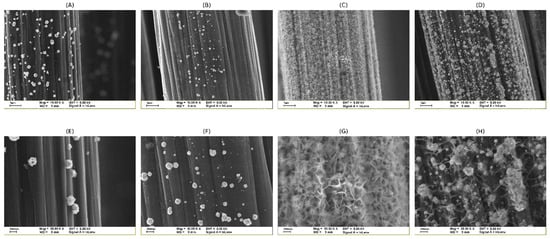
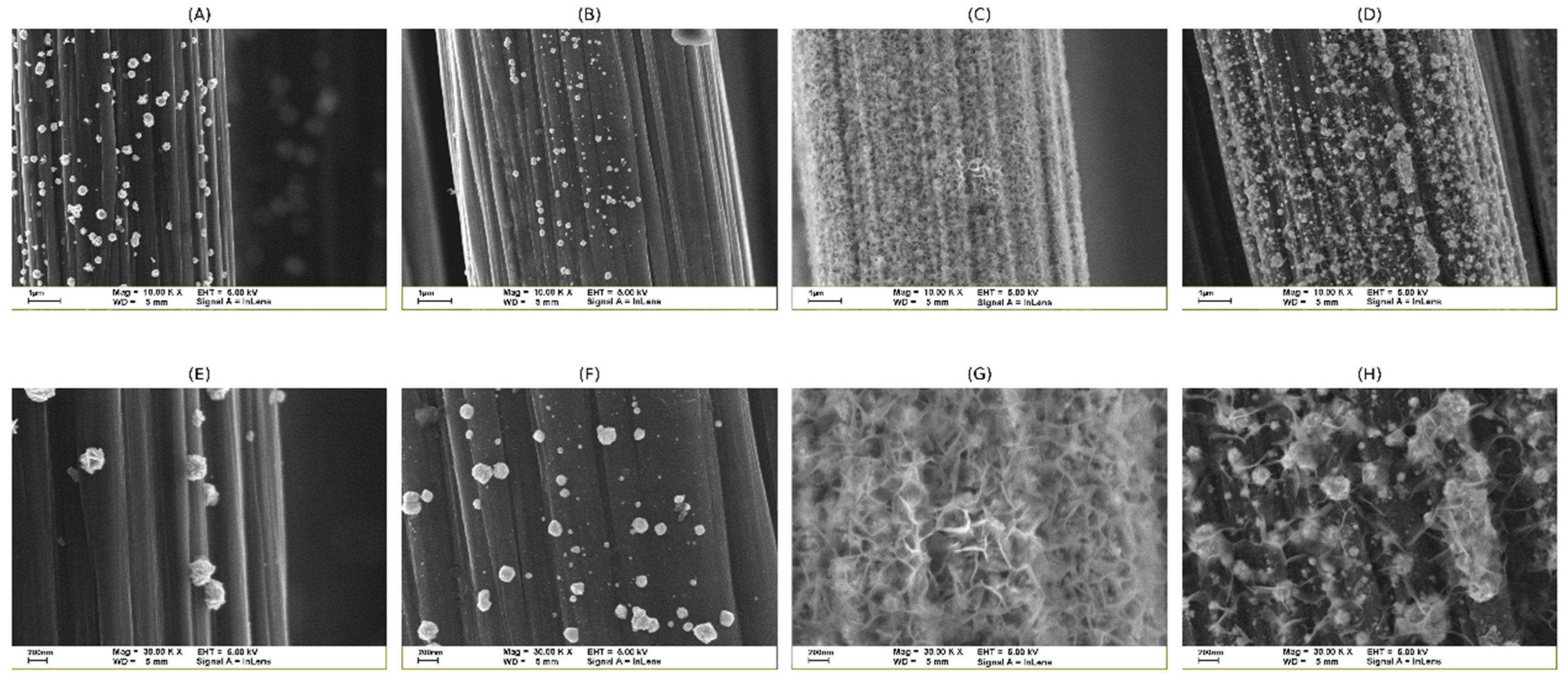
Surface pretreatment and electric-field configuration significantly influenced the morphology of electrodeposited Ni catalysts on woven carbon fabrics under identical deposition potential (−0.75 V, 5 min).
As shown in Figure 1A, samples without surface modification exhibited limited catalyst adhesion and sparse particle distribution, indicating insufficient nucleation sites on the untreated carbon surface.
Figure 1.
Effect of surface pretreatment and electric-field engineering on Ni catalyst morphology under −0.75 V (5 min) deposition conditions. (A–D) SEM images at 10k× showing overall catalyst distribution: (A) untreated carbon fabric, (B) sensitization/activation treatment, (C) surface pretreatment with auxiliary electrode configuration (no stirring), and (D) additional mechanical stirring during deposition. (E–H) Corresponding high-magnification SEM images at 30k× highlighting particle size and dispersion refinement. Combined surface pretreatment and electric-field control significantly improve nucleation density and reduce particle agglomeration.
After sensitization and activation treatment (Figure 1B), catalyst coverage increased, although partial particle aggregation was still observed.
When surface pretreatment was combined with electric-field engineering, further improvement in catalyst dispersion was achieved. As shown in Figure 1C, the introduction of an auxiliary electrode configuration promoted a more homogeneous distribution of Ni nuclei across the fiber surface.
Further refinement was obtained when mechanical stirring was incorporated during deposition (Figure 1D), which suppressed localized over-deposition and reduced particle agglomeration.
High-magnification observations (30k×) further confirm that samples prepared under optimized electric-field and stirring conditions exhibit smaller and more uniformly distributed catalyst particles relative to the untreated condition.
These results demonstrate that catalyst nucleation density and dispersion can be effectively engineered through combined surface pretreatment and electric-field control. Since catalyst morphology governs carbon dissolution and precipitation behavior during CVD, such refinement is critical for subsequent nanocarbon growth.
3.2. Effect of Deposition Potential on Catalyst Evolution
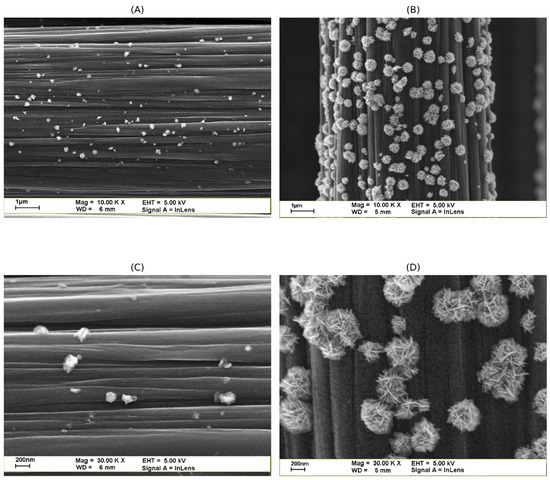
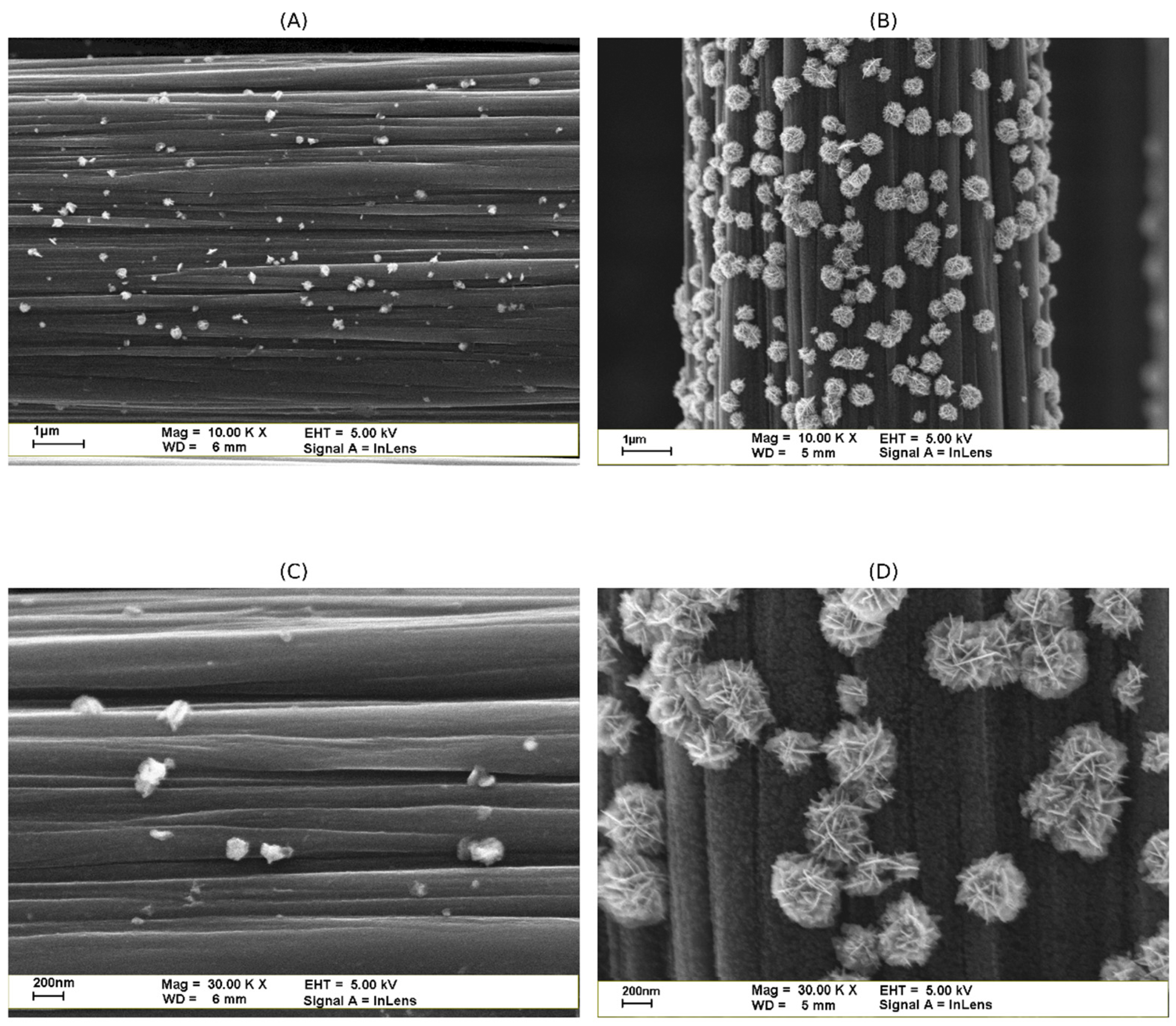
To isolate the effect of deposition potential, DC electrodeposition was performed at −0.75 V and −0.90 V (vs. Ag/AgCl) for 5 min under identical electrolyte composition and electrode configuration. The results are shown in Figure 2.
Figure 2.
Effect of deposition potential on Ni catalyst morphology on woven carbon fabrics under DC electrodeposition. SEM images comparing catalysts deposited at −0.75 V and −0.90 V (vs. Ag/AgCl) for 5 min under otherwise identical electrolyte composition and electrode configuration. (A,C) −0.75 V; (B,D) −0.90 V. Increasing the cathodic overpotential (−0.90 V) results in higher apparent nucleation density and a more refined particle distribution relative to the milder potential (−0.75 V).
At −0.75 V (Figure 2A,C), catalyst particles were relatively sparse and exhibited a tendency toward coalescence during continuous growth.
Increasing the cathodic overpotential to −0.90 V (Figure 2B,D) led to a noticeable increase in nucleation density and a refinement in particle size. The higher overpotential lowers the nucleation energy barrier, promoting rapid formation of new nuclei and suppressing excessive particle growth under the same deposition duration.
These observations indicate that cathodic overpotential provides an effective parameter for tuning catalyst nucleation density and particle refinement, which is expected to influence subsequent methane-derived nanocarbon growth behavior.
3.3. Methane Activation at 700 °C
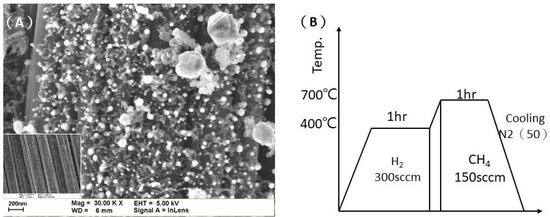
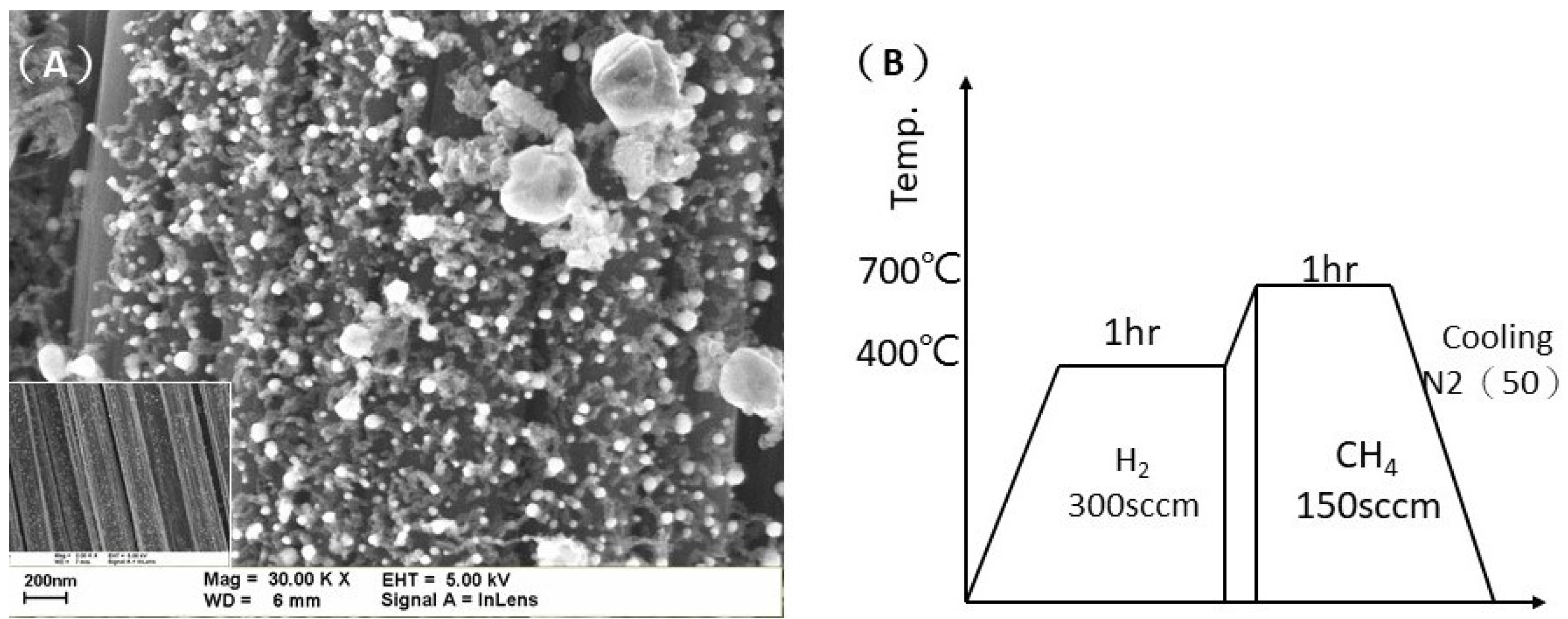
Figure 3 presents methane-based CVD results at 700 °C. Under this condition, only limited filament-like carbon structures were observed on the fiber surface (Figure 3A). Large catalyst particles remained largely inactive, suggesting insufficient methane decomposition at this temperature.
Figure 3.
Methane CVD at 700 °C showing limited nanocarbon formation on Ni-decorated carbon fabrics. (A) SEM image of the sample after methane exposure at 700 °C for 1 h; (B) corresponding temperature profile during the CVD process.
Methane possesses higher thermal stability compared with acetylene, as widely reported in hydrocarbon CVD studies [6,13], and therefore requires elevated temperatures to achieve effective catalytic dissociation. At 700 °C, carbon supply appears insufficient to sustain continuous dissolution–diffusion–precipitation processes within Ni particles. Consequently, only short and sparsely distributed carbon structures formed, indicating that 700 °C is close to the lower activation threshold for methane-derived growth in this catalyst system.
These observations indicate that higher growth temperatures are required to achieve continuous and dense nanocarbon coating formation.
3.4. Methane Growth at 900 °C
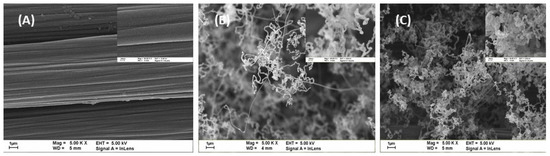
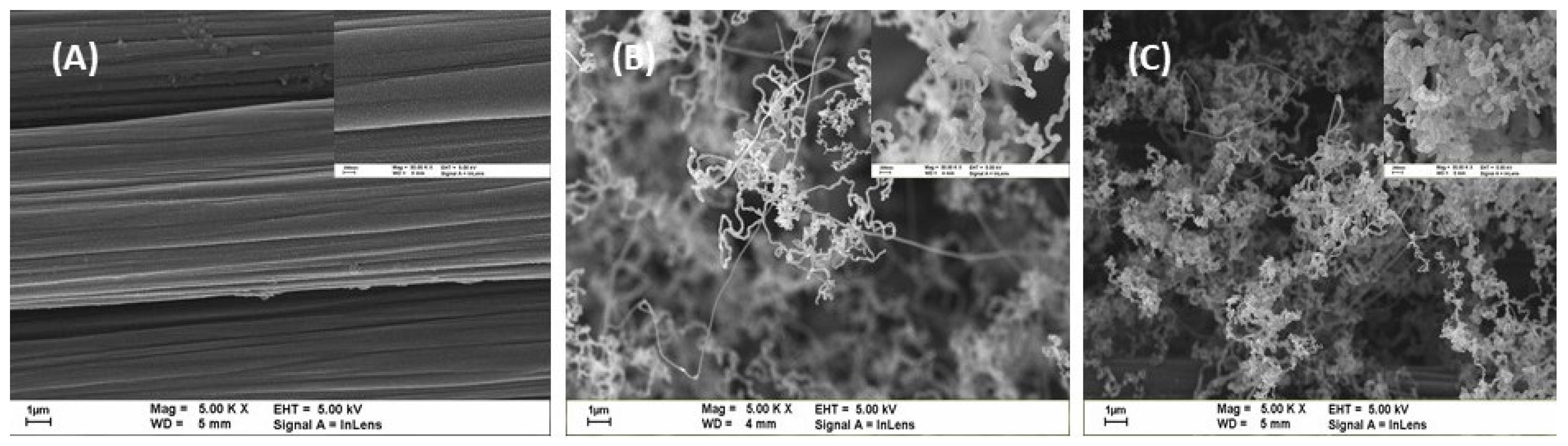
When the growth temperature was increased to 900 °C, substantial structural evolution was observed, as shown in Figure 4. Continuous carbon filaments emerged from the fiber surface, and the overall coating density increased significantly compared with the 700 °C condition.
Figure 4.
SEM images of methane-derived nanocarbon coatings grown at 900 °C on Ni-decorated carbon fabrics prepared under different catalyst pretreatment conditions. Continuous carbon filaments are observed emerging from the fiber surface. Variations in coating density and structural uniformity reflect differences in catalyst dispersion and nucleation behavior. (A) relatively smooth fiber surface with minimal nanocarbon coverage; (B) sparse filamentous nanocarbon growth on the fiber surface; (C) denser nanocarbon coating with aggregated filamentous structures.
Although carbon structures formed more readily at 900 °C, morphological variations were still evident among samples prepared under different catalyst pretreatment conditions. Samples with improved catalyst dispersion exhibited higher apparent nucleation density and more uniform coating distribution, whereas samples with aggregated catalyst particles showed uneven growth and localized clustering.
These results indicate that elevated temperature enhances methane decomposition kinetics and promotes sustained carbon dissolution–diffusion–precipitation processes within Ni catalysts. However, catalyst morphology remains a decisive factor governing structural uniformity. Therefore, temperature and catalyst engineering act synergistically in determining overall coating quality.
3.5. Hydrogen-Assisted Structural Evolution
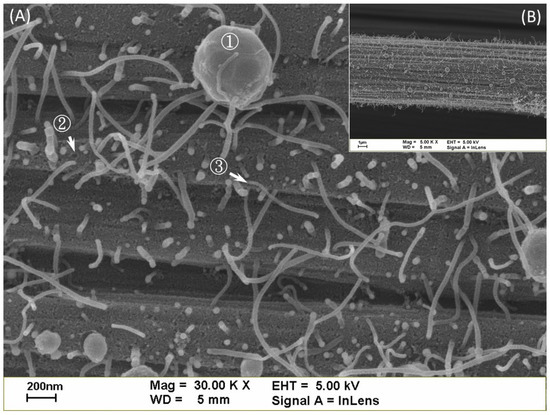
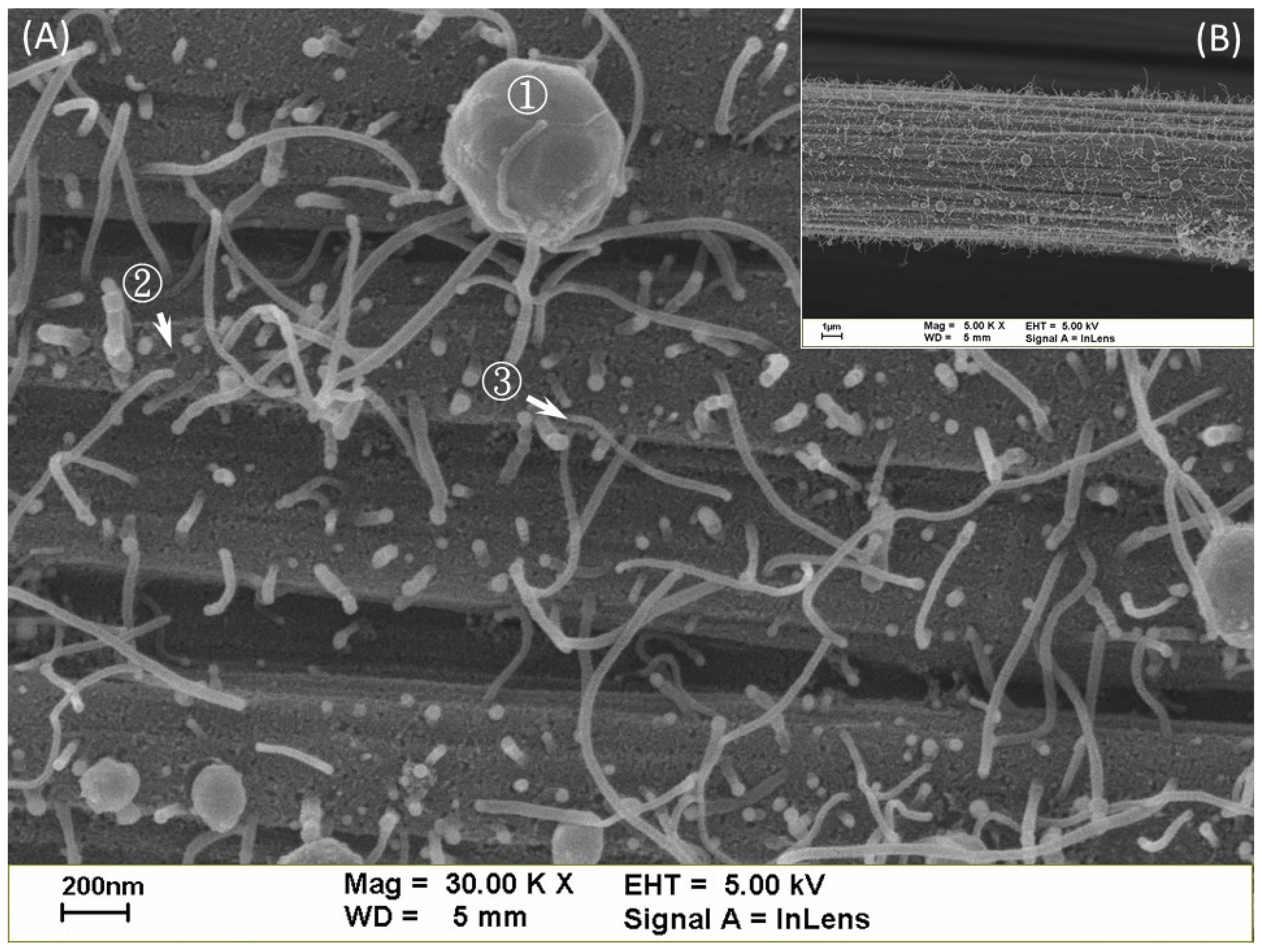
Figure 5 illustrates methane growth under a CH4/H2 mixed atmosphere at 900 °C. The overall morphology of a methane-grown carbon fiber is shown in Figure 5B. A higher-magnification image of a selected region is presented in Figure 5A, where localized catalyst agglomeration, surface cavities, and nanofilament/nanotube-like structures are indicated by markers ①–③.
Figure 5.
Hydrogen-assisted structural evolution under a CH4/H2 atmosphere at 900 °C. (B) Low-magnification SEM image showing the overall morphology of methane-grown carbon structures on a single carbon fiber. (A) Higher-magnification image of a selected region from (B). The circled markers ①–③ indicate localized catalyst agglomeration (①), surface cavities (②), and filamentous or nanotube-like carbon structures (③).
As shown in Figure 5A, clustered catalyst agglomeration (①) can be observed locally on the fiber surface. Surface cavities formed after growth are marked by ②, while nanofilament or nanotube-like carbon structures emerging from the substrate are indicated by ③.
The formation of surface cavities (②) is consistent with localized catalyst–substrate interactions under CH4/H2 exposure; however, contributions from thermal stress or fiber degradation cannot be completely excluded. The nanostructures indicated by ③ suggest enhanced structural ordering compared with the more purely filamentous morphology observed under methane-only conditions.
Hydrogen is known to suppress amorphous carbon deposition and stabilize active catalyst surfaces. Its presence likely facilitates selective carbon precipitation while limiting excessive carbon accumulation. However, excessive catalytic activity may also induce localized substrate etching, as evidenced by pore formation (②). Thus, hydrogen plays a dual role in promoting structural refinement while potentially affecting substrate integrity.
3.6. Pulse Electrodeposition Effects
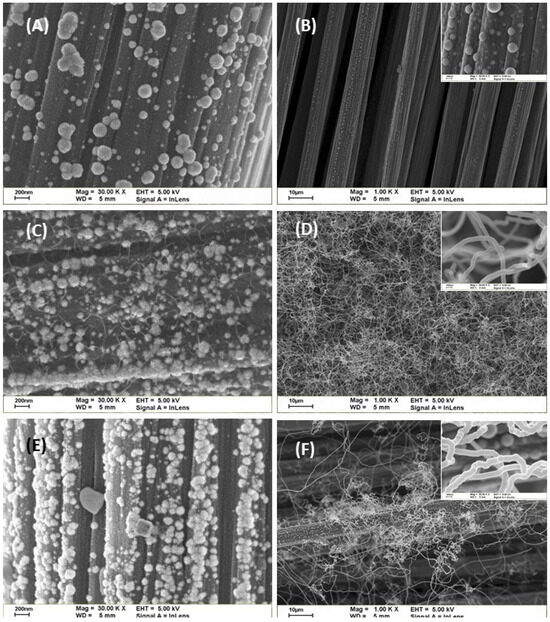
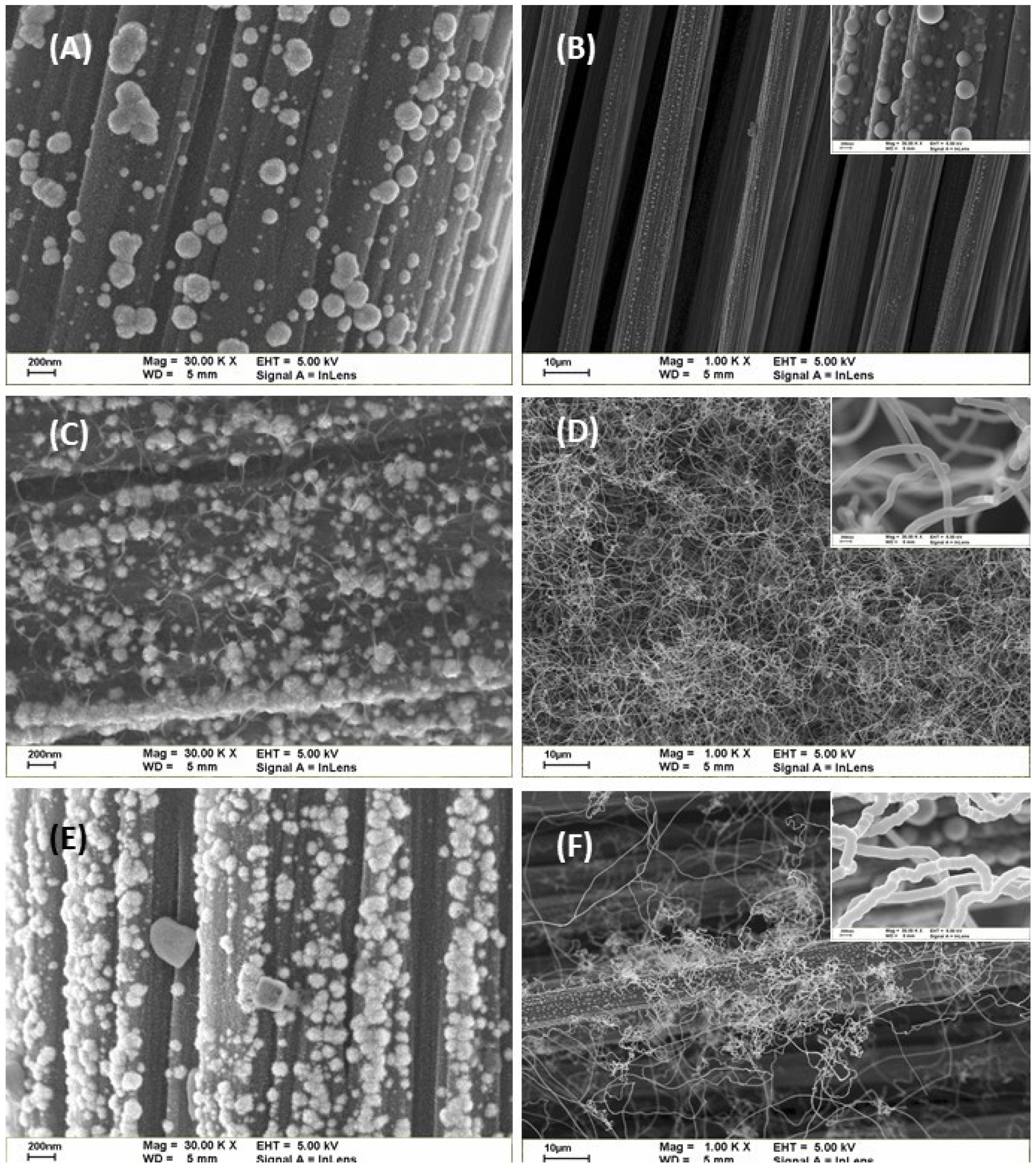
Figure 6 compares catalyst morphology and subsequent carbon growth under pulse electrodeposition conditions. Pulse deposition produced distinct catalyst evolution behavior depending on the applied voltage amplitude.
Figure 6.
Effect of pulse electrodeposition on methane-derived nanocarbon coating formation. (A,C,E) SEM images of Ni catalyst morphology prepared using pulse electrodeposition at different voltages; (B,D,F) corresponding nanocarbon growth after methane CVD at 900 °C. Pulse parameters influence catalyst nucleation density and subsequent coating uniformity.
At −0.75 V (Figure 6A,B), catalyst particles were deposited on a relatively thin underlying layer, suggesting the coexistence of nucleation and surface growth processes. Increasing the pulse voltage to −0.85 V and −0.90 V (Figure 6C–F) progressively altered particle morphology toward more discrete and densely nucleated structures.
After methane growth at 900 °C, samples prepared under optimized pulse parameters exhibited increased nanofilament/nanotube-like coating density and improved structural uniformity. The intermittent on-time and off-time cycles of pulse deposition likely promoted repeated nucleation events while suppressing continuous film formation, thereby enhancing catalyst dispersion and subsequent carbon growth homogeneity.
These results indicate that pulse electrodeposition provides an effective engineering strategy for tuning catalyst nucleation density and particle distribution, ultimately influencing methane-derived nanocarbon coating formation.
3.7. Proposed Growth Mechanism
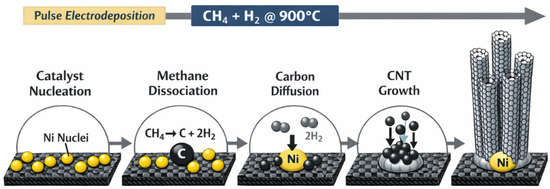
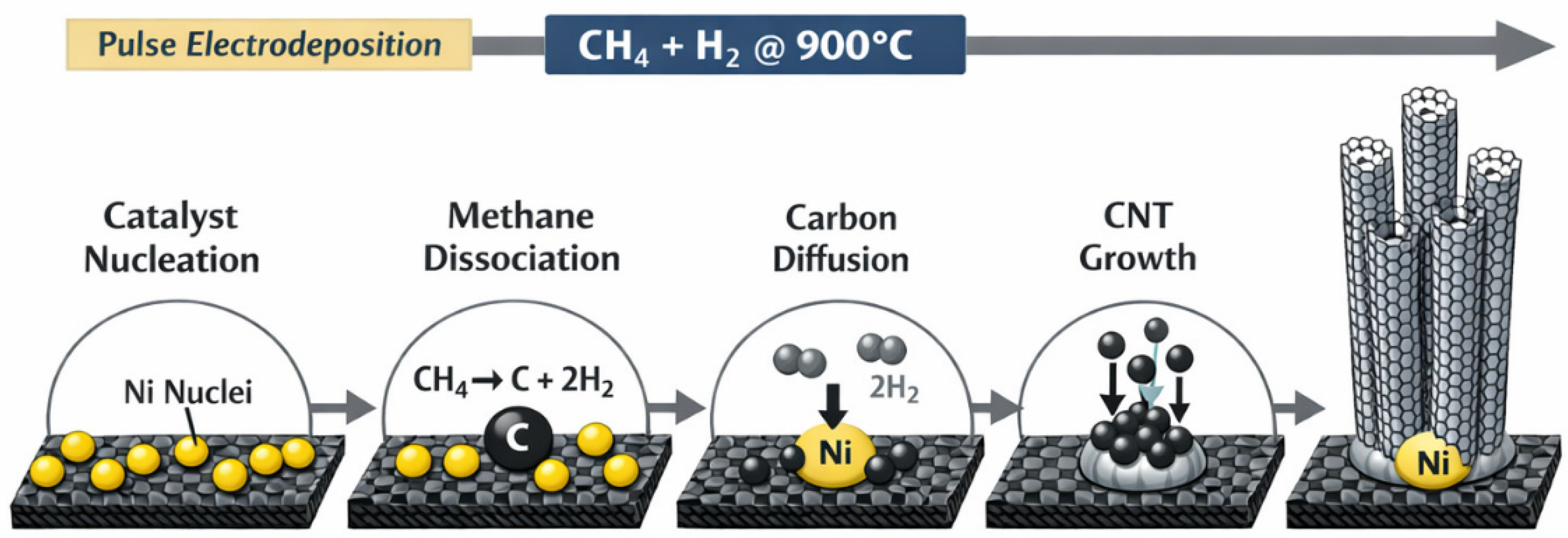
Based on the experimental observations, a methane-derived growth mechanism is proposed, as illustrated in Figure 7.
Figure 7.
Proposed growth mechanism of methane-derived carbon coatings on electrodeposited Ni catalysts supported on woven carbon fabrics. Methane dissociates on Ni catalyst particles at elevated temperature, followed by carbon dissolution, diffusion, and precipitation. Catalyst morphology, temperature, and hydrogen addition collectively influence coating density and structural evolution.
At elevated temperature, methane molecules dissociate on the surface of Ni catalyst particles, generating active carbon species. These carbon species dissolve into the catalyst particles and diffuse through the metal phase. Upon reaching a supersaturated state, carbon precipitates from the catalyst–substrate interface or catalyst surface, forming graphitic nanofilament or nanotube-like structures. This interpretation is consistent with the Raman D/G band characteristics and the lattice fringes observed in HRTEM analysis.
When catalyst particles are large or aggregated, carbon precipitation tends to occur unevenly, leading to disordered filament growth and reduced structural uniformity. In contrast, refined catalyst dispersion achieved through surface modification and pulse electrodeposition promotes more uniform carbon dissolution and controlled precipitation, resulting in denser and more continuous coatings.
In addition, hydrogen present in the CH4/H2 atmosphere is generally reported to suppress amorphous carbon formation and stabilize active catalyst surfaces during hydrocarbon CVD processes [6,13]. The observed structural refinement under CH4/H2 conditions is therefore consistent with a hydrogen-assisted growth mechanism.
Overall, methane-derived nanocarbon coating evolution is governed by the interplay among catalyst morphology, temperature-dependent methane activation, and gas-phase composition.
3.8. Raman and TEM Characterization of Graphitic Ordering
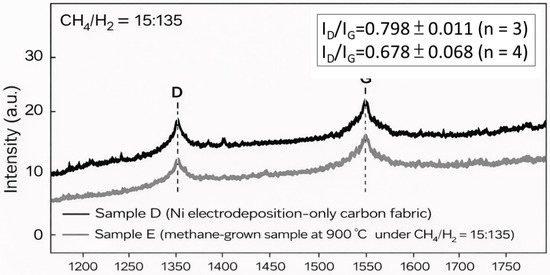
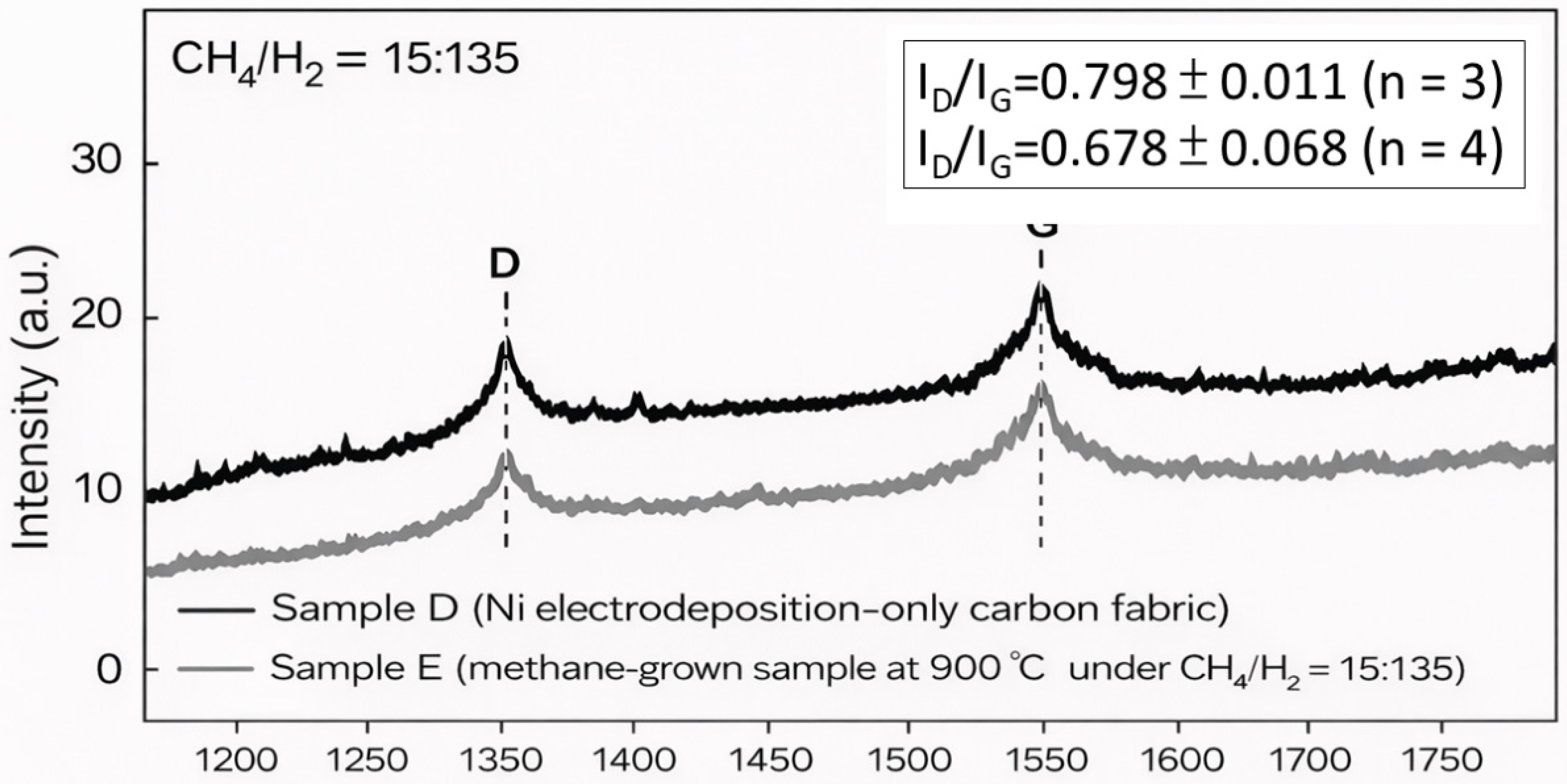
Raman spectroscopy was performed to evaluate structural ordering before and after methane CVD. The electrodeposition-only control (Sample D) exhibits relatively weak graphitic features dominated by the carbon-fabric background, whereas the methane-grown sample (Sample E, 900 °C, CH4/H2 = 15:135) shows pronounced D (~1350 cm−1) and G (~1580 cm−1) bands (Figure 8).
Figure 8.
Raman spectra of Sample D (Ni electrodeposition-only carbon fabric) and Sample E (methane-grown sample at 900 °C under CH4/H2 = 15:135). Pronounced D (~1350 cm−1) and G (~1580 cm−1) bands indicate sp2 graphitic features. The average I_D/I_G ratio decreases from 0.798 ± 0.011 (n = 3) for Sample D to 0.678 ± 0.068 (n = 4) for Sample E, indicating improved graphitic ordering after methane-derived growth.
Multi-region measurements were conducted to improve statistical reliability. The average ID/IG ratio decreases from 0.798 ± 0.011 (n = 3) for Sample D to 0.678 ± 0.068 (n = 4) for Sample E, indicating improved graphitic ordering after methane-derived growth. Although the standard deviation for the methane-grown sample is larger, the overall reduction in ID/IG suggests a trend toward increased structural ordering consistent with catalytic carbon formation.
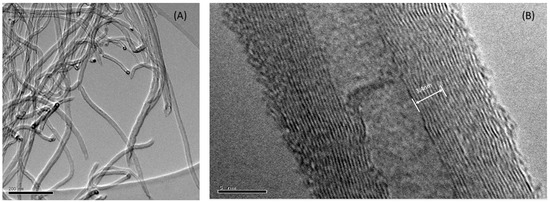
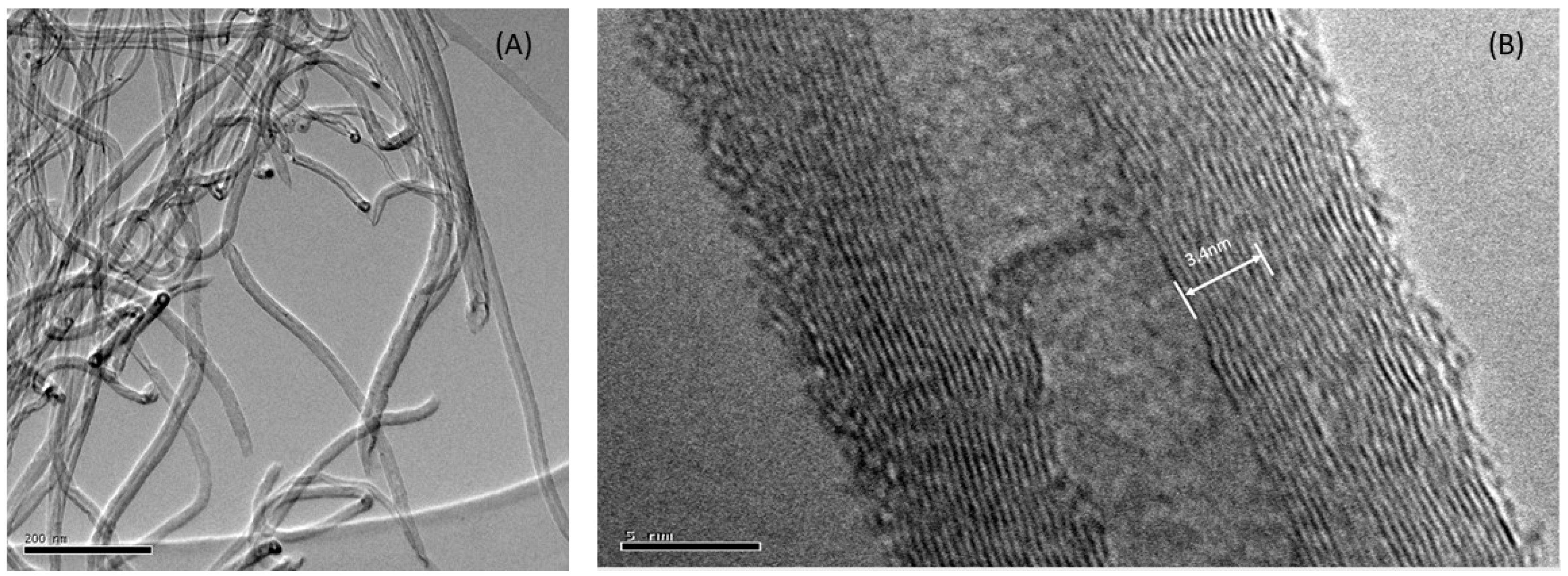
To further examine microstructural features, transmission electron microscopy (TEM) was performed on representative methane-grown samples. TEM images reveal filamentous nanocarbon structures decorated with graphitic layers (Figure 9A). High-resolution TEM (HRTEM) images show multi-layer graphitic walls with an interlayer spacing of approximately 0.34 nm (Figure 9B), consistent with graphitic lattice fringes.
Figure 9.
Representative TEM images of methane-grown nanocarbon coatings (900 °C, CH4/H2 = 15:135). (A) Low-magnification TEM image showing filamentous nanocarbon structures; (B) high-resolution TEM image showing graphitic lattice fringes with an interlayer spacing of approximately 0.34 nm.
These results collectively support the formation of graphitic nanofilament/nanotube-like structures under methane-assisted catalytic growth.
4. Conclusions
In summary, methane-derived nanocarbon coatings were successfully grown on woven carbon fabrics using electrodeposited Ni catalysts. Catalyst morphology was effectively tuned through surface pretreatment, electric-field engineering, and pulse electrodeposition, enabling controlled nucleation and dispersion on the textile substrate.
The results demonstrate that: (1) 700 °C represents the lower activation threshold for methane decomposition under the present catalytic conditions; (2) 900 °C enables sustained carbon dissolution–diffusion–precipitation processes, resulting in continuous and dense filamentous coatings; (3) hydrogen addition modifies carbon precipitation behavior, suppresses amorphous carbon deposition, and promotes nanofilament/nanotube-like structural features; and (4) pulse electrodeposition enhances catalyst dispersion and improves coating uniformity across the woven architecture.
Overall, nanocarbon coating evolution is governed by the coupled effects of catalyst morphology, temperature-dependent methane activation, and gas-phase composition. The integration of controlled catalyst engineering with methane-based CVD provides a scalable and textile-compatible approach for constructing hierarchical graphitic coatings, with potential applications in multifunctional composites and advanced thermal or electromagnetic management systems.
Author Contributions
Writing—original draft, M.-H.N.; Writing—review & editing, M.-H.N. and S.-S.T. All authors have read and agreed to the published version of the manuscript.
Funding
This work was supported by the National Science Council of Taiwan (Grant No. NSC 95-2221-E-036-035-MY3). The experimental study was conducted under this funded project, and the present manuscript provides an extended analysis of previously obtained experimental data.
Institutional Review Board Statement
Not applicable.
Informed Consent Statement
Not applicable.
Data Availability Statement
Data are contained within the article.
Acknowledgments
The authors used AI-assisted language editing tools for English language improvement. All scientific concepts, experimental design, data interpretation, and conclusions were developed solely by the authors.
Conflicts of Interest
The authors declare no conflicts of interest.
References
- Thostenson, E.T.; Li, C.; Chou, T.-W. Nanocomposites in context. Compos. Sci. Technol. 2005, 65, 491–516. [Google Scholar] [CrossRef] [Scilit]
- Qian, H.; Bismarck, A.; Greenhalgh, E.S.; Kalinka, G.; Shaffer, M.S.P. Carbon nanotube grafted carbon fibres: A study of interfacial properties. Compos. Part A Appl. Sci. Manuf. 2010, 41, 1107–1114. [Google Scholar] [CrossRef] [Scilit]
- Dai, H. Carbon nanotubes: Synthesis, integration, and properties. Acc. Chem. Res. 2002, 35, 1035–1044. [Google Scholar] [CrossRef] [Scilit] [PubMed]
- Iijima, S.; Ichihashi, T. Single-shell carbon nanotubes. Nature 1993, 363, 603–605. [Google Scholar] [CrossRef] [Scilit]
- Baker, R.T.K. Catalytic growth of carbon filaments. Carbon 1989, 27, 315–323. [Google Scholar] [CrossRef] [Scilit]
- Kong, J.; Cassell, A.M.; Dai, H. Chemical vapor deposition of methane for single-walled carbon nanotubes. Chem. Phys. Lett. 1998, 292, 137–142. [Google Scholar] [CrossRef] [Scilit]
- Ma, Z.; Wang, Y.; Qin, J.; Yao, Z.; Cui, X.; Cui, B.; Yue, Y.; Wang, Y.; Wang, C. Growth of carbon nanotubes on the surface of carbon fiber using Fe–Ni bimetallic catalyst at low temperature. Ceram. Int. 2021, 47, 1625–1631. [Google Scholar] [CrossRef] [Scilit]
- Qin, J.; Wang, C.; Wang, Y.; Su, S.; Yao, Z.; Ma, Z.; Gao, Q.; Yu, M.; Wang, Q.; Wei, H. Preparation carbon nanotube-decorated carbon fibers under low pressure for epoxy-based unidirectional hierarchical composites with enhanced interlaminar shear strength. Polym. Test. 2021, 93, 106892. [Google Scholar] [CrossRef] [Scilit]
- Li, S.; Li, M.; Yao, Z.; Ma, Z.; Wang, Y. Recent advances in surface modification of carbon fibers for high-performance composites: A review. Compos. Part B Eng. 2024, 271, 111166. [Google Scholar] [CrossRef] [Scilit]
- Zhang, X.; Fan, X.; Yan, C.; Li, H.; Zhu, Y.; Li, X.; Yu, L.; Zhang, Q. Interfacial microstructure and properties of carbon fiber composites modified with carbon nanotube grafting. Compos. Sci. Technol. 2021, 205, 108548. [Google Scholar] [CrossRef] [Scilit]
- Dresselhaus, M.S.; Dresselhaus, G.; Eklund, P.C. Science of Fullerenes and Carbon Nanotubes; Academic Press: San Diego, CA, USA, 1996. [Google Scholar]
- Cheung, C.L.; Kurtz, A.; Park, H.; Lieber, C.M. Diameter-controlled synthesis of carbon nanotubes from discrete catalytic nanoparticles. J. Phys. Chem. B 2002, 106, 2429–2433. [Google Scholar] [CrossRef] [Scilit]
- Li, Y.; Kim, W.; Zhang, Y.; Rolandi, M.; Wang, D.; Dai, H. Growth of single-walled carbon nanotubes from discrete catalytic nanoparticles of various sizes. Carbon 1999, 37, 493–497. [Google Scholar] [CrossRef] [Scilit]
- Baker, R.T.K.; Harris, P.S. Carbon filament growth mechanism. Carbon 1986, 24, 101–110. [Google Scholar]
- Paunovic, M.; Schlesinger, M. Fundamentals of Electrochemical Deposition, 2nd ed.; Wiley: Hoboken, NJ, USA, 2006. [Google Scholar]
- Low, C.T.J.; Wills, R.G.A.; Walsh, F.C. Electrodeposition of composite coatings and nanoparticle-modified metal surfaces. Surf. Coat. Technol. 2006, 201, 371–383. [Google Scholar] [CrossRef] [Scilit]
- Landolt, D. Pulse plating: Fundamentals and applications. Electrochim. Acta 2007, 52, 1845–1854. [Google Scholar] [CrossRef]
- Keshavarz, M.; Chowdhury, A.K.M.R.H.; Kassanos, P.; Tan, B.; Venkatrishnan, K. Self-Assembled N-Doped Q-Dot Carbon Nanostructures as a SERS-Active Biosensor with Selective Therapeutic Functionality. Sens. Actuators B Chem. 2020, 323, 128703. [Google Scholar] [CrossRef] [Scilit]
Disclaimer/Publisher’s Note: The statements, opinions and data contained in all publications are solely those of the individual author(s) and contributor(s) and not of MDPI and/or the editor(s). MDPI and/or the editor(s) disclaim responsibility for any injury to people or property resulting from any ideas, methods, instructions or products referred to in the content. |
© 2026 by the authors. Licensee MDPI, Basel, Switzerland. This article is an open access article distributed under the terms and conditions of the Creative Commons Attribution (CC BY) license.