


Highlights
- TaC coatings with a tunable amorphous-carbon content were fabricated.
- The incorporated a-C in the TaC coating can effectively reduce the thermal expansion coefficient and relax the internal stress.
- TaC/a-C coatings develop a porous network after thermal-shock cycling, effectively mitigating thermal stress and CTE mismatch with carbon substrates.
Abstract
TaC/amorphous-carbon (TaC/a-C) composite coatings with varied a-C contents were deposited on graphite by dual-target magnetron sputtering to mitigate the thermal-expansion mismatch that commonly triggers cracking and spallation in TaC coatings on carbon substrates during rapid thermal cycling. However, existing TaC–C (often termed “free carbon”) approaches rarely identify the carbon’s structural state and spatial distribution explicitly, and a clear correlation between carbon fraction, thermal-shock-driven microstructural evolution, and cyclic damage remains insufficiently established. Increasing the a-C fraction progressively refines the TaC grain structure and introduces an a-C phase along grain boundaries, thereby lowering the effective coefficient of thermal expansion (CTE) and improving compatibility with the graphite substrate. Under laser thermal cycling, coatings with higher a-C contents exhibit markedly enhanced resistance to cracking and spallation. After 15 cycles, the high-a-C (~28.99 at.%) coating remains free of through-thickness cracks, maintains its thickness, and retains a single-phase TaC structure without detectable Ta2C, whereas the low-a-C coating shows severe thinning, through-cracks, and partial TaC → Ta2C transformation. Microstructural observations indicate that the a-C phase forms a compliant, stress-relaxing boundary network and promotes a porous, mechanically interlocked TaC architecture, synergistically redistributing thermal stresses and deflecting crack propagation.
1. Introduction
Graphite and carbon–carbon (C/C) composites possess high specific strength, excellent high-temperature stability, and favorable thermal properties. As a result, they are widely used in critical components—such as hypersonic-vehicle leading edges, rocket nozzles, and throat liners—operating in extreme environments [1,2,3]. However, graphite oxidizes rapidly and undergoes mass loss at temperatures above approximately 420 °C, leading to a degradation of mechanical performance. Accordingly, extending the service life of graphite necessitates the implementation of ablation protection for which coating technologies are widely recognized as a particularly effective strategy in practice [4,5].
Among the available protective approaches, ultra-high-temperature ceramics (UHTCs) have emerged as premier coating materials for graphite and C/C components; their exceptional thermochemical stability, high melting points, and resistance to oxidation and ablation collectively enable reliable service in severe thermochemical and aero-heating environments [6]. Among UHTCs, tantalum carbide (TaC) is widely regarded as a leading candidate phase for ablation-protective coatings due to its exceptionally high melting point, excellent thermal stability, and outstanding ablation resistance [7,8]. Wang et al. [9] fabricated dense TaC coatings on graphite by isothermal chemical vapor deposition (CVD) and systematically examined the residual stresses and the ablation behavior under an oxy-acetylene flame; the coatings exhibited excellent ablation resistance. Xiong et al. [10] generated in situ TaC coatings on graphite via thermo-reaction deposition/diffusion (TRD), which demonstrated robust stability and resistance to chemical attack at elevated temperatures. Despite their high-temperature merits, TaC coatings on graphite frequently exhibit through-thickness cracking and interfacial delamination during service because the pronounced coefficient-of-thermal-expansion mismatch between TaC (α ≈ 6.3 × 10⁻⁶ K−1) and graphite induces large thermally generated stresses that are widely regarded as a primary factor governing coating failure [11,12]. Even with optimized composition and deposition processes aimed at improving the coating microstructure, the CTE mismatch remains the dominant factor governing crack initiation and propagation under thermal shock cycling. This mismatch significantly compromises the structural integrity and service life of TaC ablation-resistant coatings [2]. Enhancing the thermal shock resistance of TaC coatings is therefore crucial to fully harness their ablation-protective capabilities; accordingly, further investigation into the thermal shock performance of TaC coatings is clearly warranted.
To mitigate the thermal-expansion mismatch and improve interfacial bonding, a multilayer architecture is commonly adopted: a SiC transition layer is first applied on the carbon substrate, which is followed by a TaC-based UHTC topcoat. Li et al. [11] demonstrated that introducing an SiC bonding layer on C/C composites (via supersonic plasma spraying) prior to a TaC topcoat markedly improves adhesion and thermal-shock resistance. In addition, tailoring the SiC interlayer surface morphology/roughness or introducing a compositional gradient between the interlayer and the topcoat can reduce local thermal-stress concentration and enhance interfacial stability [13]. More broadly, the optimization of substrate surface topography has also been reported to influence deposition efficiency and interfacial bonding in coating systems [14]. Nevertheless, although a SiC interlayer can partially bridge the coefficient-of-thermal-expansion (CTE) mismatch between graphite and TaC, SiC becomes susceptible to thermal decomposition at temperatures above ~2200 °C [15]. Moreover, after high-temperature exposure, interdiffusion at Ta-containing coating/SiC interfaces can form brittle silicide phases (e.g., TaSi2 and Ta5Si3), which degrade interfacial integrity and adhesion [16]. These limitations restrict the use of SiC-interlayer coating systems in extreme environments. To overcome these issues, it is necessary to reconsider both interlayer material selection and coating architecture. A practical strategy is to employ a TaC interlayer that is compositionally identical to the outer TaC topcoat, thereby suppressing heterogeneous interfacial reactions and high-temperature instabilities at the source. Meanwhile, stress accommodation can be achieved by structurally tuning the TaC interlayer, leading to improved thermal-shock resistance. Kong et al. [17] used chemical vapor deposition to construct a columnar-grained TaC interlayer between a TaC topcoat and a C/C substrate; crack deflection and architectural stabilization alleviated thermal stresses and markedly improved thermal-shock resistance. In a related study [18], laser chemical vapor deposition (LCVD) was used to fabricate a porous TaC buffer layer on graphite, where a branched columnar architecture accommodated thermal mismatch via pore deformation and effectively suppressed crack propagation. Collectively, these studies demonstrate that enhanced thermal-shock resistance can be achieved through structural design within a single-material (Ta–C) system.
However, conventional TaC transition layers—typically dense columnar coatings or highly porous TaC layers deposited by high-temperature CVD/LCVD—retain the high stiffness and coefficient of thermal expansion (CTE) of bulk TaC. They therefore rely mainly on geometric compliance to relax thermal stresses, which limits durability under cyclic thermal loading. To overcome this limitation, TaC–C architectures (often described as TaC–“free carbon”) have been explored. Introducing a carbon phase can reduce the effective CTE and alleviate thermal-expansion mismatch with carbon substrates [13,19] while maintaining chemical compatibility within a single Ta–C system. Nevertheless, in many TaC–C studies, the carbon phase is referred to only as “free carbon”, and its role is primarily interpreted using rule-of-mixtures arguments. Direct evidence for the carbon’s structural state and spatial distribution is often lacking, which obscures the underlying stress-accommodation pathways. Moreover, systematic control of the carbon fraction and a quantitative correlation between carbon content and cyclic thermal-shock damage (e.g., cracking, spallation, and thickness loss) have not been well established. Here, we identify an amorphous-carbon (a-C) phase and establish a carbon-content-dependent correlation with cyclic thermal-shock damage.
The objective of this paper is to develop and systematically evaluate TaC/a-C composite transition layers to improve the cyclic thermal-shock resistance of TaC-based coatings on graphite substrates. By incorporating an intrinsically compliant amorphous-carbon (a-C) phase with low CTE and low elastic modulus into a chemically compatible Ta–C system, this architecture enables the simultaneous regulation of thermophysical properties and microstructural compliance. TaC/a-C transition layers with different a-C contents were deposited on graphite by magnetron sputtering. We then investigated how the a-C fraction affects thermal-shock-induced microstructural evolution (including the formation of an interconnected porous network and the emergence of platelet-like features) and how these changes correlate with cracking and spallation. These results clarify the mechanisms by which a-C incorporation improves thermal compatibility and enhances cyclic damage tolerance. Overall, this paper systematically clarifies how the a-C fraction governs thermal-shock-driven microstructural evolution and its linkage to cyclic damage tolerance.
2. Materials and Methods
2.1. Sample Preparation
Graphite substrates were polished with 2000-grit SiC paper, ultrasonically cleaned in anhydrous ethanol for 30 min, and dried at 353 K for 2 h. TaCx coatings were deposited onto the substrates by dual-target DC magnetron sputtering using 99.99% Ta and graphite targets (both targets: Φ50.8 mm × 5 mm; effective erosion area: 10.13 cm2) with a fixed target–substrate distance of 40 mm. Before deposition, the chamber was evacuated to a base pressure of ~1 × 10⁻⁴ Pa. The substrates were then Ar-plasma pre-etched for 20 min to remove surface contaminants, and both targets were pre-sputtered for 10 min to eliminate surface impurities. During deposition, the substrate temperature was maintained at 500 °C with no applied substrate bias; the Ar flow rate and working pressure were held at 1 × 10⁻⁶ m3·s−1 and 0.5 Pa, respectively. The power on the Ta target was fixed at 150 W (14.81 W·cm−2), while the graphite-target power was varied from 20 to 150 W (1.98–14.81 W·cm−2) to produce TaCx coatings with different stoichiometries (x) and amorphous-carbon (a-C) contents with a deposition time of 5 h. For each sputtering condition, up to eight graphite substrates could be coated in a single deposition run. Unless otherwise specified, three independently prepared coated specimens (n = 3) were used for statistical analysis and subsequent characterization/performance evaluation.
2.2. Characterization and Measurements
The phase composition of the coatings was analyzed by X-ray diffraction (XRD, Empyrean, PANalytical, Almelo, The Netherlands) using Cu Kα radiation (40 kV, 40 mA) with a scanning rate of 4°·min−1 and a step size of 0.02°. The bonding states and free-carbon content were evaluated by Raman spectroscopy (LabRAM HR Evolution, HORIBA, Kyoto, Japan) with a 514 nm excitation laser, using a 100× objective and a laser power of 2 mW. The chemical states and elemental compositions were characterized by X-ray photoelectron spectroscopy (XPS, K-Alpha, Thermo Scientific, Waltham, MA, USA) with all binding energies calibrated by referencing the C 1s peak to 284.8 eV. Surface and cross-sectional morphologies were examined by field-emission scanning electron microscopy (FESEM, Quanta 250, FEI, Hillsboro, OR, USA). The coefficients of thermal expansion (CTEs) were measured by push-rod dilatometry (DIL 402 SE, NETZSCH, Selb, Germany) under flowing Ar at a constant heating rate of 5 °C·min−1 using coated graphite specimens (bilayer: coating + substrate). Considering the micrometer-scale thickness of the sputtered coating, the measured values are reported as the effective/apparent CTE of the coated specimens for comparative analysis of the a-C-content-dependent trend rather than as the intrinsic CTE of the coating alone. Prior to the measurement, graphite substrates were polished under identical conditions (same abrasive sequence and polishing time/load/speed) to minimize thickness variation, achieving a comparable sub-millimeter thickness (hundreds-of-micrometers level). The thickness was checked at multiple positions using a digital caliper/micrometer (and the variation among specimens was within the measurement resolution). Nanoindentation measurements were performed to determine the hardness and elastic modulus of the TaC-based coatings using a Bruker Hysitron TI 980 nanoindenter (Bruker, Ettlingen, Germany). Indents were carried out in the static load-controlled mode. The maximum load was fixed such that the indentation depth did not exceed 10% of the coating thickness, thereby minimizing substrate effects. To reduce random error and ensure representativeness, measurements were conducted at five different locations on each coating, and the reported values were obtained from the averaged results.
2.3. Thermal Shock Test
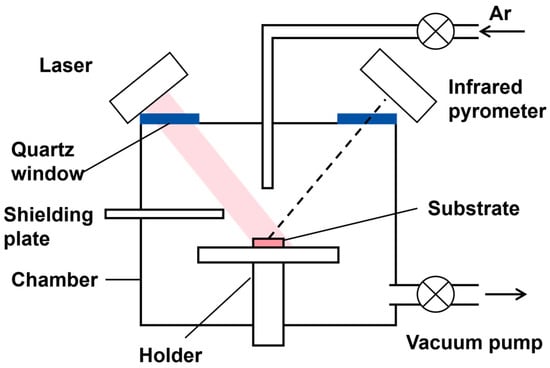
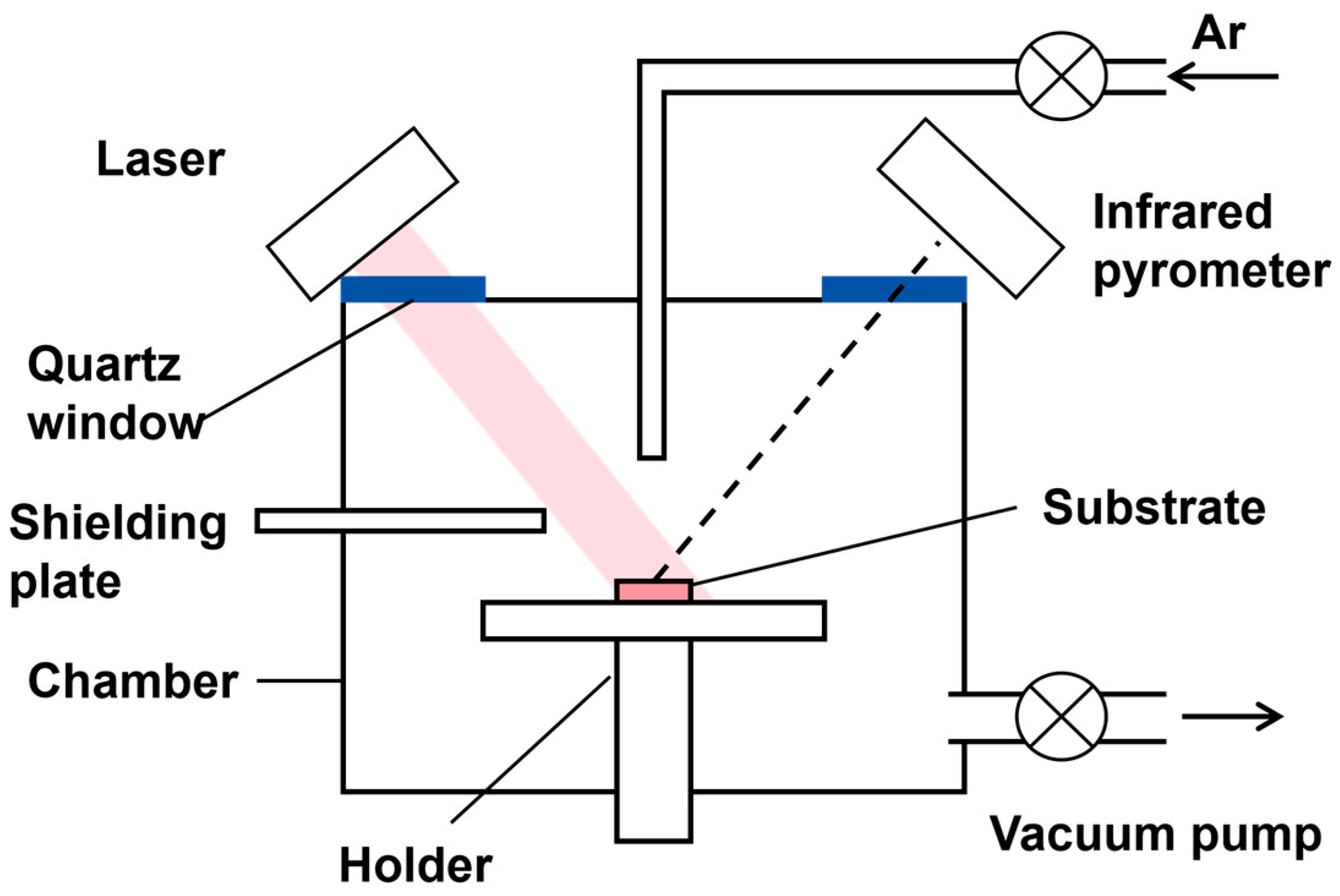
Thermal-shock resistance was evaluated using a custom-built laser-heating apparatus adapted from a laser chemical vapor deposition (LCVD) system (Figure 1). Under flowing Ar, specimens were rapidly heated by laser irradiation to a peak surface temperature of ~1300 °C by adjusting the laser driving current, held at the peak temperature for 5 s, and subsequently quenched to near-ambient temperature within ~30 s using a copper cooling plate. To ensure full laser coverage, square specimens (10 mm × 10 mm) were employed. The laser beam was configured into a ring-shaped spot with an outer diameter of ~10 mm, enabling quasi-uniform annular heating and minimizing localized overheating. Throughout each cycle, the surface temperature was monitored in real time using an infrared pyrometer, and the laser current was dynamically adjusted via temperature feedback to maintain consistent thermal loading across all specimens. The heating–holding–quenching sequence defined one thermal-shock cycle, simulating severe transient conditions encountered in extreme service environments. Cycling continued until the onset of coating failure, which was defined as the appearance of through-thickness cracks and/or coating discontinuity due to local delamination/spallation. For repeatability, three specimens from the same deposition batch were tested under identical conditions (n = 3).
Figure 1.
Schematic diagram of the thermal-shock test setup.
3. Results and Discussion
3.1. Phase and Microstructure of TaCx Coating
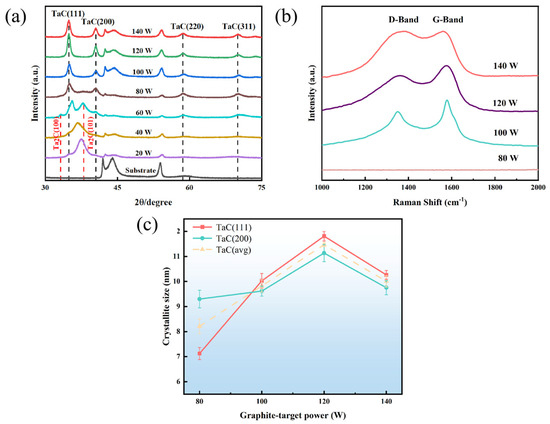
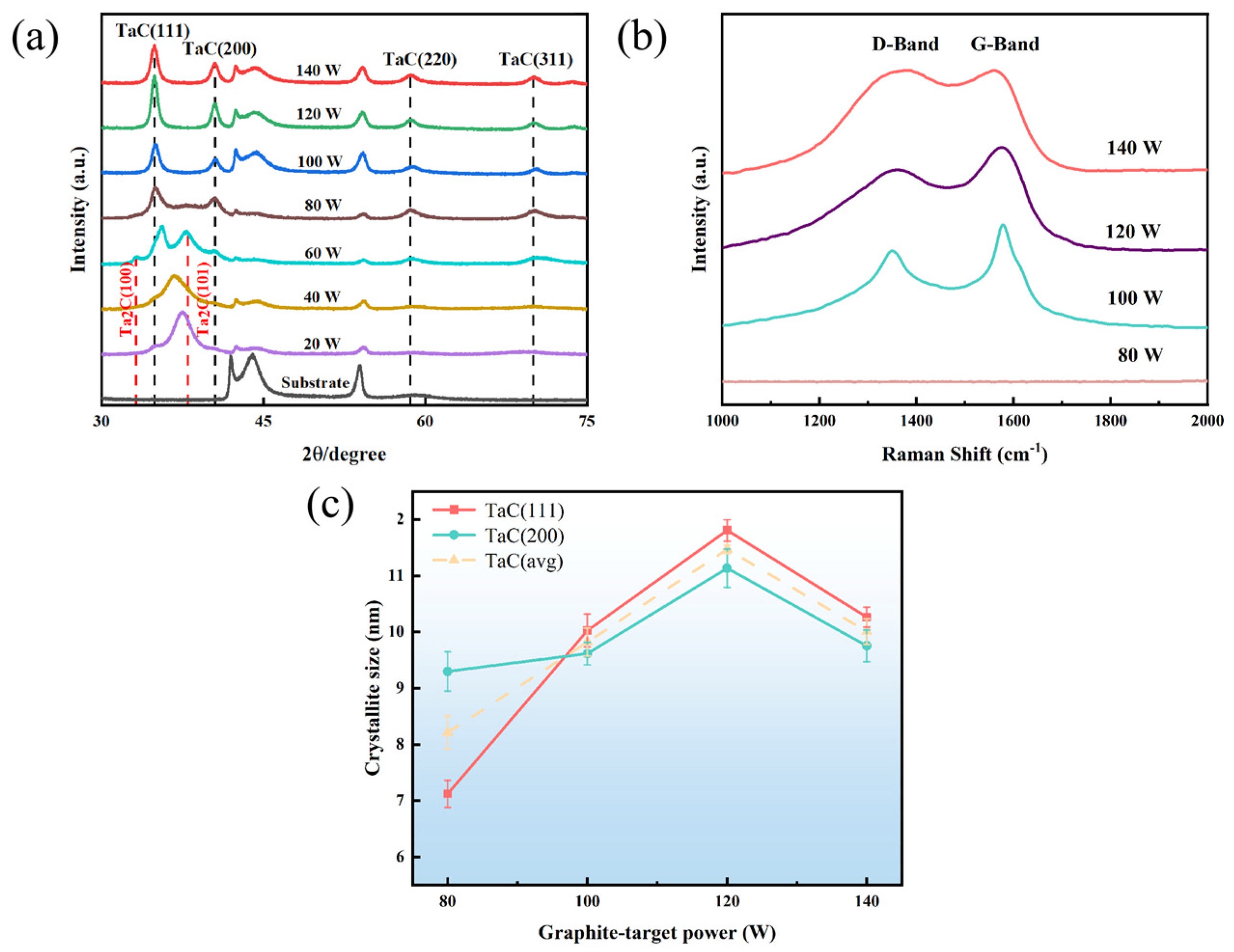
Figure 2a shows the XRD patterns of TaCx coatings deposited at different graphite-target powers; the peaks between 40° and 55° originate from the graphite substrate. At 20–40 W, an asymmetric broad feature appears at ~35–40°, which is attributed to the overlap of a Ta-related metallic phase and the Ta2C (101) reflection at 38.07°. When the graphite-target power is increased to 80 W, the coating evolves from a Ta/Ta2C mixture toward an assemblage dominated by fcc-TaC, and the lattice-distortion-induced asymmetry disappears [20]. Meanwhile, increasing carbon incorporation in TaCx expands the lattice and shifts the diffraction maxima toward lower 2θ; residual tensile stress in the coating can also contribute to a low-angle shift [21,22]. In this intermediate regime, reflections at 33.29°, 34.86°, 38.07°, and 40.46° can be indexed to Ta2C (100), TaC (111), Ta2C (101), and TaC (200), respectively. At 100 W, the Ta2C peaks vanish and a single-phase TaC pattern is obtained. At still higher powers, only TaC (111) and TaC (200) remain with no additional peaks observed.
Figure 2.
(a) X-ray diffraction (XRD) patterns of TaCx coatings deposited at graphite-target powers of 20–140 W; (b) Raman spectra of TaCx coatings deposited at graphite-target powers of 80–140 W; (c) TaC crystallite size as a function of graphite-target power (80–140 W) estimated from XRD using the Scherrer equation.
Notably, the substrate peak appears to shift toward higher 2θ after deposition, suggesting the introduction of residual stresses during processing. During cooling, thermal-expansion mismatch constrains the coating/substrate contraction, which may impose compressive strain in the near-surface region of the substrate and shift its peaks to higher 2θ. In addition, the crystallite size of fcc-TaC was estimated from the peak broadening of the TaC (111) and (200) reflections and is reported as the mean ± SD from three independent XRD measurements (error bars shown in Figure 2c). The crystallite size exhibits a non-monotonic dependence on graphite-target power: it increases initially, reaches a maximum at ~120 W, and then decreases at higher power. This trend suggests that in the intermediate-power regime, the higher plasma energy density enhances the surface mobility of arriving species, promoting Ta–C reactions and lattice ordering and thus facilitating crystallite growth. At higher power, intensified energetic-particle bombardment and enhanced re-sputtering can suppress the growth of coherent diffracting domains, broaden diffraction peaks, and lead to an apparent reduction in crystallite size. Consistently, Raman spectroscopy (Figure 2b) indicates an increasing contribution from highly disordered a-C with increasing graphite-target power. Excess a-C may segregate at grain boundaries, partially encapsulate TaCx crystallites, and hinder intergranular coalescence, thereby contributing to the reduced coherent domain size at high power [23].
To further elucidate the carbon state and phase evolution at higher graphite-target powers, Raman spectroscopy was performed on TaCx coatings deposited at 80, 100, 120, and 140 W. As shown in Figure 2b, pronounced D and G bands are observed; with increasing power, both bands intensify and slightly broaden. Meanwhile, the intensity minimum between the D and G bands progressively increases (i.e., an elevated D–G valley), suggesting an increasing contribution from highly disordered a-C components overlapping with the D/G envelope. According to the Ferrari–Robertson model [24,25,26], these features may indicate a higher fraction of amorphous carbon. The increasing ID/IG ratio may reflect the progressive enrichment of sp2 carbon clusters, whereas the persistently broadened D/G bands and the elevated D–G valley suggest that the carbon phase remains highly disordered and predominantly amorphous rather than graphitic. With a further power increase, the interstitial carbon in fcc-TaCx approaches saturation; excess carbon therefore may segregate as an a-C boundary phase. This Raman-inferred a-C enrichment is consistent with the high-power reduction in the coherent diffracting domain size inferred from XRD (Figure 2c).
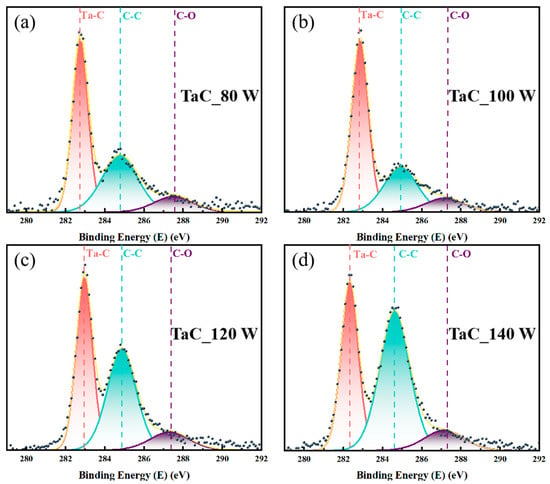
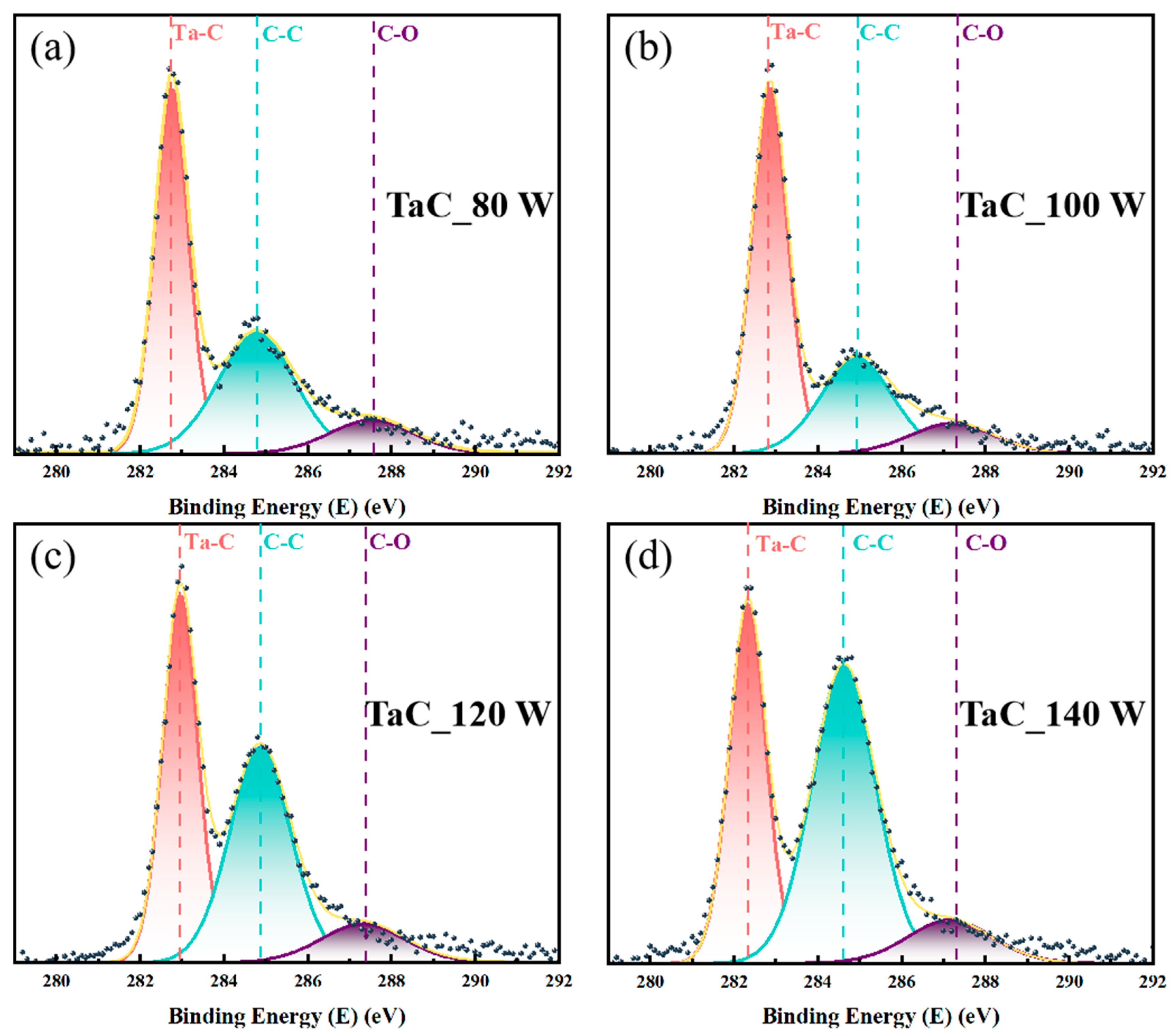
Figure 3 shows the high-resolution XPS C 1s spectra of TaCx coatings deposited at different graphite-target powers. The C 1s envelope is deconvoluted into a Ta–C component centered at ~282.8 eV and a C–C (graphitic or adventitious carbon) component at 284.8 eV. Table 1 lists the Ta and C atomic fractions and bonding ratios derived from the relative areas of these fitted components. From these data, the amorphous-carbon content (a-C) and the stoichiometric ratio x in TaCx are calculated as follows [20,27]:
where ATa and AC are the Ta and C atomic fractions, and P(Ta–C) and P(C–C) are the fractions of total carbon present in Ta–C and C–C bonds, respectively. Here, the reported ‘a-C content’ refers to the amorphous/free-carbon component in the TaC/a-C nanocomposite coating, which was semi-quantified from the XPS C 1s peak-area ratio (C–C vs. Ta–C) and corroborated by the Raman spectra (Figure 2b).
Figure 3.
High-resolution XPS C 1s spectra of TaCx coatings deposited at different graphite-target powers with a fixed Ta-target power of 150 W: (a) 80 W, (b) 100 W, (c) 120 W, and (d) 140 W.
Table 1.
Ta and C atomic fractions, fractions of Ta–C and C–C bonding, a-C content, and stoichiometric ratio x of the coatings as a function of target power. Values are reported as mean (SD), where the numbers in parentheses denote the standard deviation.
As evidenced by Figure 3 and Table 1, the fraction of carbon in Ta–C bonds and the overall a-C content evolve systematically with graphite-target power. At 40 W, the plasma density is low and carbon adatoms arriving at the growth interface have limited kinetic energy and surface mobility [28]. Consequently, carbon diffusion is restricted and does not fully react with Ta [29], yielding a comparatively high a-C fraction together with an elevated Ta/C atomic ratio. As the graphite-target power increases, the discharge plasma energy density and degree of ionization rise in tandem. Carbon species arriving at the growth interface thus attain higher surface mobility and react more completely with Ta, enabling greater carbon incorporation into the rock-salt TaC lattice; accordingly, x in TaCx increases. Notably, when the graphite-target power (PC) reaches ~100 W, x levers off at ≈0.72. Beyond this point, further increases in carbon flux mainly raise the a-C content. This plateau arises from (i) kinetic limitations and site-saturation constraints that impede additional carbon dissolution into the octahedral interstices of the TaC lattice at the deposition temperature and time scale [30,31] and (ii) an enhanced re-sputtering of surface carbon by energetic particle bombardment at high power [20,32]. Consequently, once incorporation sites are saturated, excess carbon no longer enters the lattice and instead accumulates as a-C. Since the TaCx stoichiometry is nearly saturated above PC = 100 W, subsequent analyses focused on coatings deposited at PC = 100, 120, and 140 W to isolate the effect of a-C content on coating performance.
3.2. Morphology and Thermophysical Properties
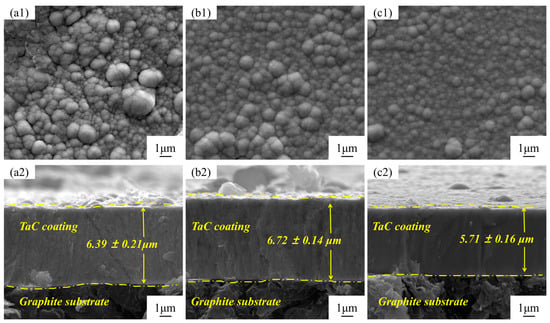
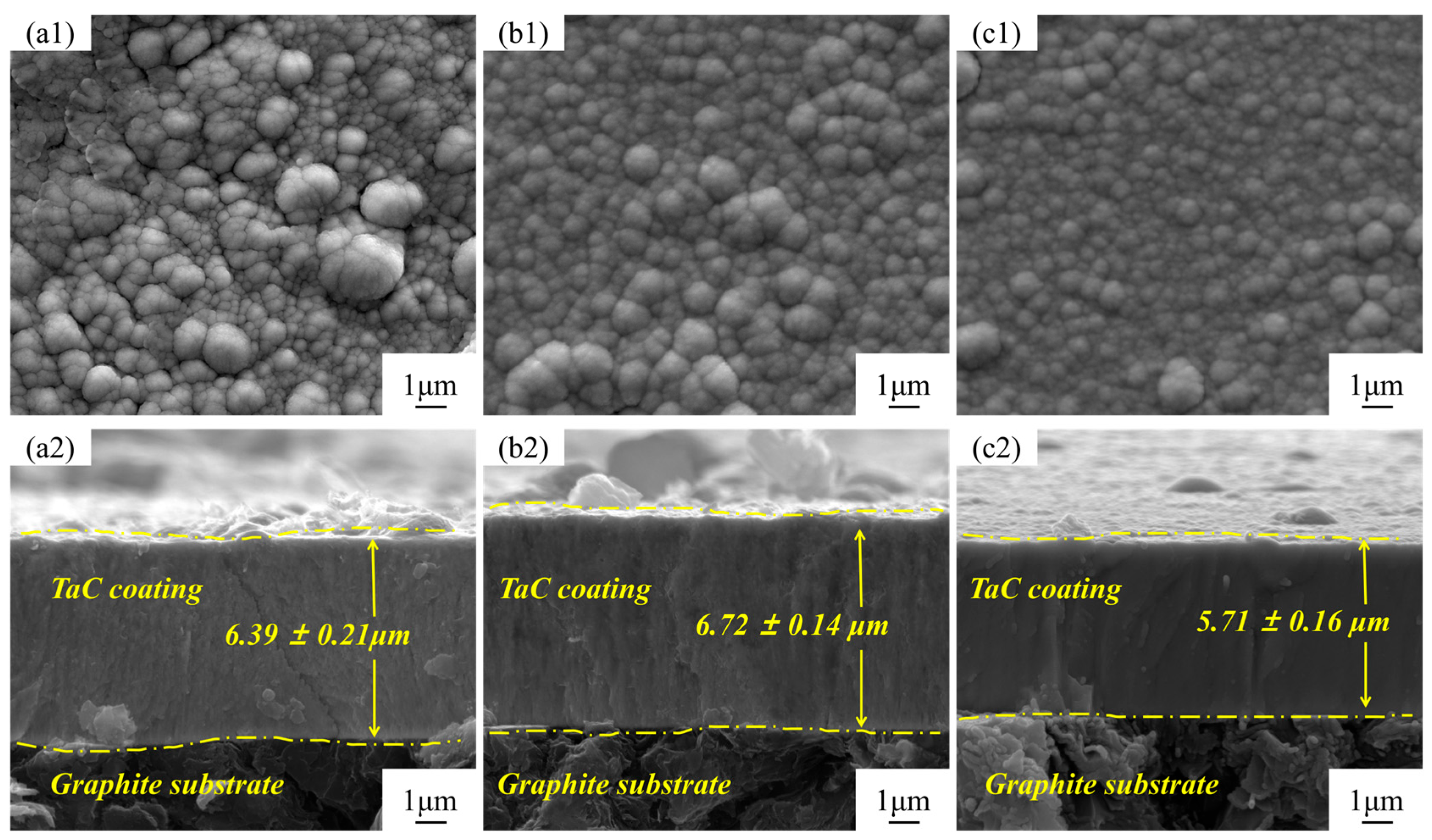
Figure 4 shows the surface morphologies of TaCx coatings deposited at various graphite-target powers (with a-C content increasing monotonically with power). All coatings are dense and free of surface cracks, but changes in the a-C fraction give rise to distinct morphological features. The deposition of TaC is consistent with the nucleation-barrier model for physical vapor deposition (PVD) [33,34]:
where Ω denotes the atomic volume, γ is the interfacial energy at the film growth front, S is the supersaturation (ratio), k is the Boltzmann constant, and Ts is the substrate temperature.
Figure 4.
Surface and cross-section morphologies of TaCx coatings prepared by different carbon target powers: (a1,a2) 100 W, (b1,b2) 120 W, and (c1,c2) 140 W.
As the sputtering power increases, the deposition flux—and thus the surface supersaturation S—rises. According to nucleation theory, a higher supersaturation lowers the nucleation free-energy barrier and reduces the critical nucleus radius r (i.e., r decreases as S increases). Consequently, the nucleation density is elevated at higher power. In accordance with this model, our coatings exhibit grain refinement and a denser surface morphology as the power (and hence supersaturation) is increased. Table 2 summarizes the coating thickness and deposition rate obtained under different deposition conditions. With increasing graphite-target power, the deposition rate first increases and then decreases, owing to enhanced re-sputtering and ion-bombardment-induced densification at high power.
Table 2.
Coating thickness and deposition rate under different processing conditions.
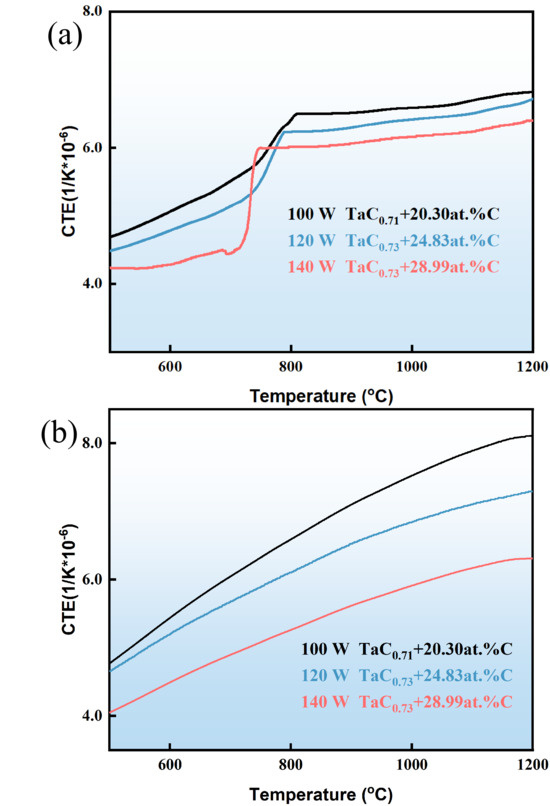
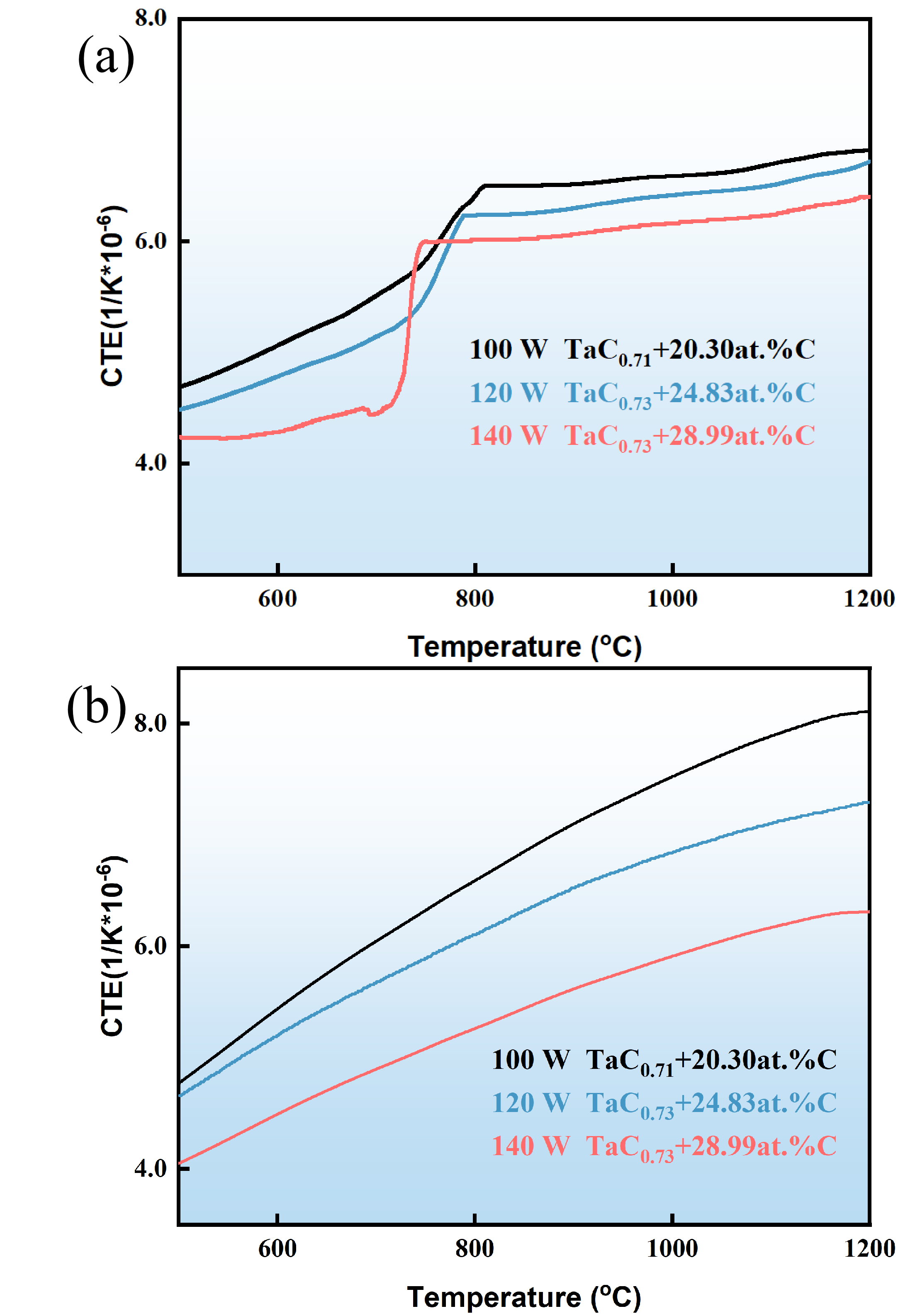
Figure 5a shows the temperature-dependent coefficient of thermal expansion (CTE) of TaCx coatings with different a-C contents. For all coatings, the CTE increases with temperature. The increase is modest at low temperatures, accelerates markedly between ~650 and 800 °C, and then transitions to a more gradual rise above ~800 °C where the curves approach a quasi-steady trend. Clear differences are observed among coatings with different a-C contents. In the 650–800 °C interval, higher a-C content leads to an earlier and steeper increase in CTE, which is followed by a faster tendency toward saturation. In contrast, the low-a-C coating shows a more gradual increase that extends to higher temperatures. In the quasi-steady regime above ~800 °C, the high-a-C coating consistently exhibits the lowest CTE, indicating that increasing a-C content reduces the effective thermal expansion in the relevant high-temperature range. The pronounced CTE change in the intermediate-temperature window is mainly associated with structural relaxation of the a-C phase. Alam et al. [35] reported significant relaxation in Ta–C coatings upon heating to ~600 °C, which was accompanied by the partial release of residual stresses and local volumetric contraction. With further heating, the activation of sp3 → sp2 rehybridization in the carbon phase becomes more pronounced [36,37], which can account for the rapid CTE increase between ~650 and 800 °C. Once this relaxation window is exceeded, the thermal-expansion response is largely governed by the TaC matrix, whereas the remaining a-C acts as a compliant, low-CTE constituent that buffers expansion and mitigates CTE mismatch with the carbon substrate.
Figure 5.
Coefficient of thermal expansion (CTE) of TaCx coatings with varying amorphous carbon (a-C) contents: (a) as-deposited coatings; (b) coatings after 15 thermal shock cycles.
Figure 5b presents the temperature-dependent CTE of the same coatings after 15 thermal-shock cycles. The CTE curves remain smooth and continuous over the tested range, suggesting that the coatings preserve stable thermophysical behavior after cycling. Notably, the relative differences among coatings are retained: samples with higher initial a-C content still exhibit lower CTE values at elevated temperatures. This behavior is consistent with the thermally induced structural stabilization of the carbon phase during cycling, as also reflected by post-shock Raman analysis (discussed later). Consequently, a higher fraction of the stabilized carbon phase can more effectively buffer the expansion of the TaC matrix, thereby alleviating thermal mismatch with the substrate and contributing to improved thermal-shock resistance and interfacial integrity.
3.3. Thermal Shock Resistance
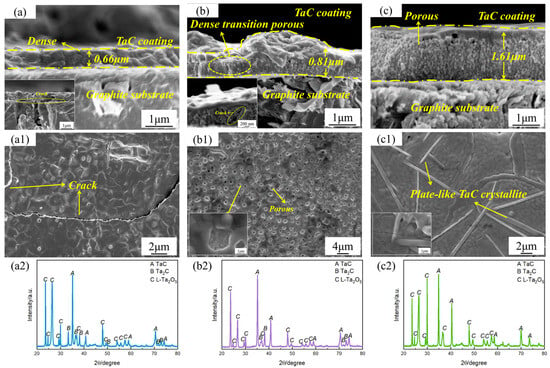
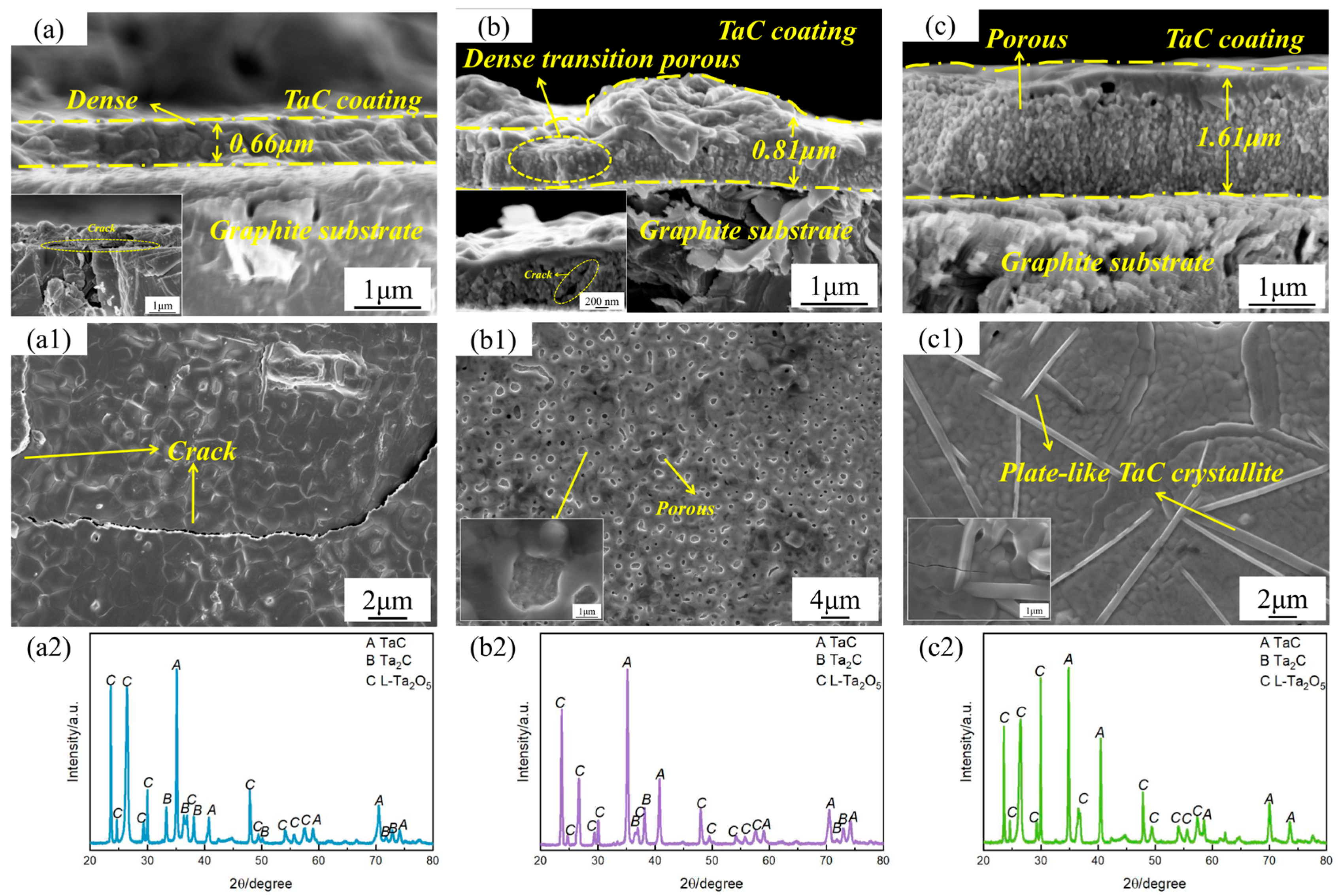
To investigate the influence of a-C content on the thermal-shock resistance of TaCx coatings, laser thermal-shock cycling tests were performed on three coated graphite specimens with low (20.03 at.%), medium (24.83 at.%), and high (28.99 at.%) a-C fractions. Figure 6 summarizes the post-cycling surface and cross-sectional morphologies together with the corresponding XRD patterns. Unless otherwise noted, comparisons are presented up to 15 cycles because the coatings remain sufficiently continuous at this stage to allow representative cross-sectional analysis. Compared with the as-deposited state, the post-cycling XRD patterns show sharper TaC reflections, indicating enhanced crystallinity. Notably, the Ta2C reflections weaken and eventually disappear, leaving only TaC peaks. This trend suggests that a higher a-C fraction increases the effective carbon availability/activity in the coating, thereby suppressing the reduction of TaC to the carbon-deficient Ta2C phase [21,38] and helping to preserve the TaC-dominated phase constitution after thermal shock. In addition, weak Ta2O5 reflections are observed in all three specimens after cycling and can be indexed to the orthorhombic low-temperature phase (L-Ta2O5), while no clear peaks of the tetragonal high-temperature phase (H-Ta2O5) are detected. It should be noted that XRD is sensitive to trace crystalline surface products, and peak intensity alone cannot be used to quantify oxide thickness or assess whether a continuous scale has formed. Consistently, cross-sectional SEM shows no distinct continuous oxide layer, implying that any oxide present is extremely thin and/or discontinuous under the present conditions. Given the rapid heating with a short dwell followed by fast quenching, transient high-temperature Ta2O5 may have insufficient time to develop any long-range order and would transform back to L-Ta2O5 upon cooling [39,40], which is consistent with the observed XRD signatures.
Figure 6.
Post-shock surface and cross-sectional morphologies and post-cycling phase composition (XRD patterns) of TaCx coatings with low (20.03 at.%), medium (24.83 at.%), and high (28.99 at.%) a-C fractions after 15 thermal-shock cycles: (a–a2) low-a-C, (b–b2) medium-a-C, (c–c2) high-a-C.
Cross-sectional SEM reveals that with increasing a-C content, the coating microstructure evolves from fully dense to a mixed dense-porous architecture and finally to a highly porous network. This porosity development is highly sensitive to the a-C fraction. Nakamura et al. [41] found that excess free carbon can weaken inter-particle contacts and hinder densification in ceramics. In the present system, the a-C phase encapsulates TaC grains, forming a composite microstructure with carbon-enriched grain boundaries. Under thermal shock, the grain-boundary a-C undergoes sp2 relaxation (stress relief due to graphitization) and contracts locally under the constraint of the surrounding TaC framework [24] while simultaneously reacting with residual oxygen in the environment. This carbon-removal-induced void formation is analogous to the Si-vapor-corrosion-driven pore formation reported by Wei et al. [12]. The combined effects of a-C structural shrinkage and carbon depletion at grain boundaries generate initial nanoscale voids, which, upon subsequent thermal cycles, coalesce and interconnect, resulting in a progressive transition from a dense to a porous morphology at the macroscale.
Moreover, the coating thickness loss after thermal shock is closely associated with thermomechanically driven interfacial debonding and subsequent spallation, as evidenced by cross-sectional SEM showing interfacial cracking/debonding and locally spalled regions. During rapid thermal cycling, the thermal-expansion mismatch between the substrate and the coating is expected to generate interfacial stresses, which can promote the initiation and propagation of interfacial cracks and, in severe cases, local delamination. Subsequent sheet-like or block-like spallation removes portions of the coating, manifesting as a reduced residual thickness in cross-section. The low-a-C coating, which shows a higher effective CTE (Figure 5), tends to exhibit a larger mismatch with graphite and correspondingly more pronounced interfacial cracking/spallation. By contrast, increasing the a-C fraction is expected to reduce the effective CTE mismatch and to introduce a more compliant/porous architecture; both factors can increase crack-path tortuosity and hinder through-thickness crack penetration, thereby mitigating catastrophic spallation. In addition, top-view SEM qualitatively suggests a smoother surface for the high-a-C coating, which may reduce the asperity-induced local stress concentration and boundary-condition heterogeneity during rapid heating/cooling, thereby further suppressing crack nucleation. As a result, the high-a-C architecture retains a larger residual thickness and shows improved thermal-shock tolerance.
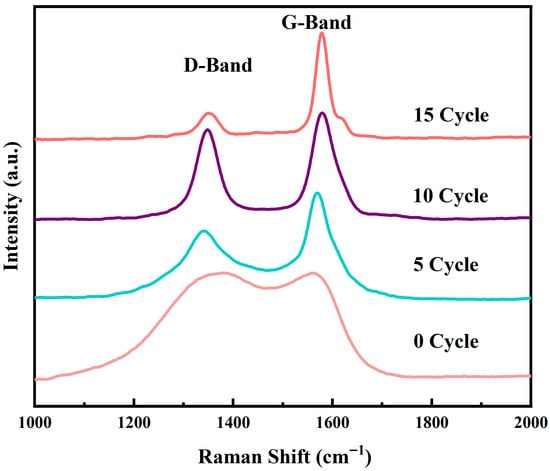
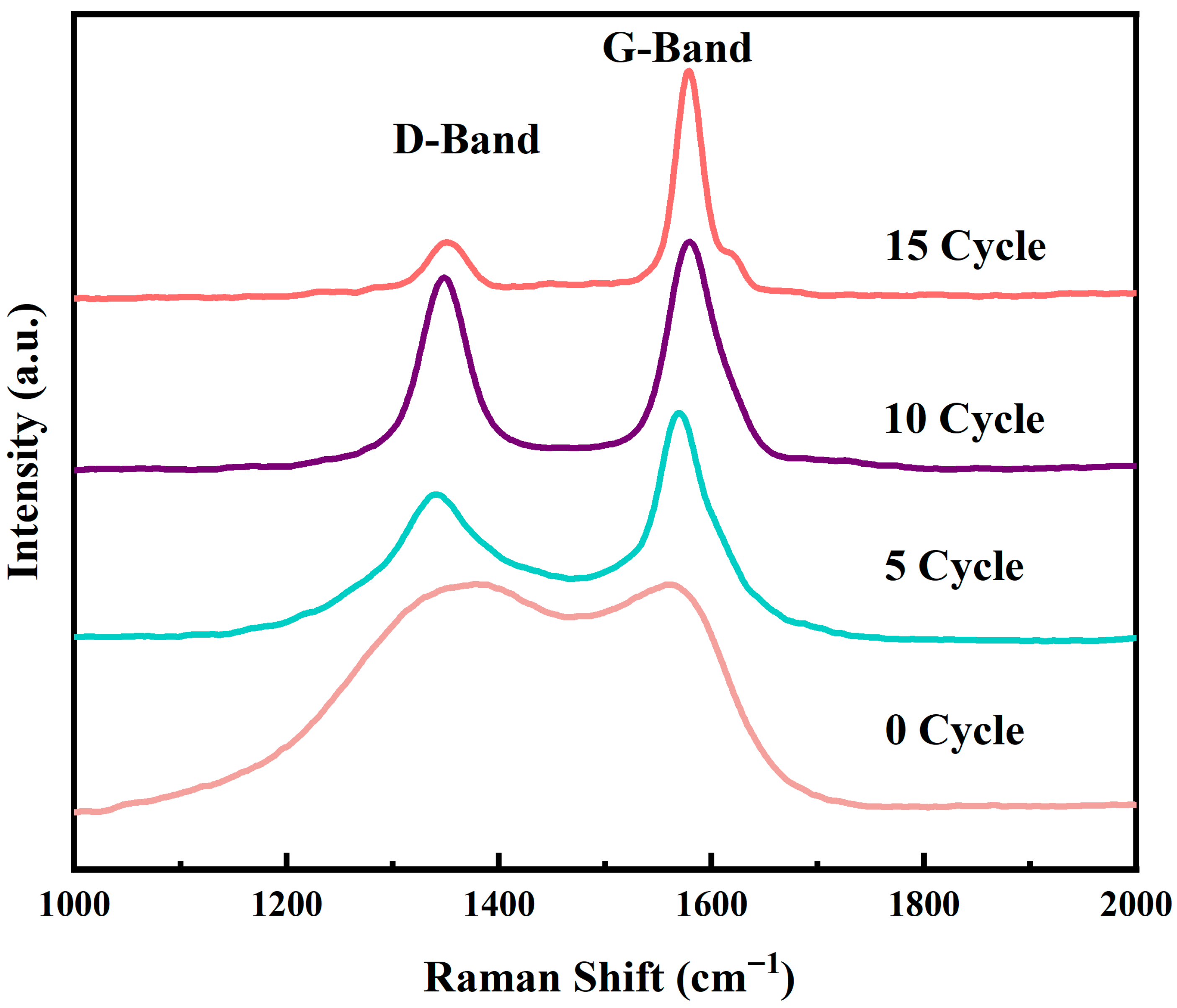
To further elucidate the structural evolution responsible for the superior thermal-shock resistance of the high-a-C coating, the specimen containing 28.99 at.% a-C was subjected to 5, 10, and 15 consecutive thermal-shock cycles. After each set of cycles, the morphological evolution was examined by SEM, and the corresponding changes in the a-C bonding structure were tracked by Raman spectroscopy. Prior to thermal shock, the coating consists of a close-packed assembly of nanoscale spherical particles. As shown in Figure 7, Raman spectroscopy was performed on samples subjected to different numbers of thermal-shock cycles. The as-received (0-cycle) sample exhibits the characteristic a-C double-band features in the 1200–1700 cm−1 range, which was dominated by the D band (~1350 cm−1) and G band (~1580–1600 cm−1). With increasing thermal-shock cycles (5 and 10), both the D and G bands become progressively sharper, and their full widths at half maximum (FWHM) decrease. Meanwhile, the intensity minimum between the D and G bands decreases markedly and approaches the baseline after 10 cycles, suggesting that the structural relaxation and short-time annealing may dominate at the early stage of thermal-shock exposure. Specifically, the bond-angle disorder at sp2 sites and local residual stresses within the a-C network could be partially relieved, while the sp2 configuration could undergo rearrangement and clustering, resulting in a more concentrated distribution of vibrational environments. In addition, the G band shifts toward higher wavenumbers (blue shift). Such a G-band blue shift has been widely reported during the annealing of amorphous carbon, further suggesting an increase in the ordering of the sp2 network. After 15 thermal-shock cycles, the FWHM of both bands decreases further, whereas the relative intensity of the D band drops significantly, leading to a pronounced reduction in ID/IG. Considering the oxide-related signals in the XRD patterns and the porous surface morphology observed after 15 cycles, this stage is consistent with the preferential oxidation of the a-C phase: defect-rich and chemically more reactive carbon (primarily associated with the D band) may be preferentially oxidized and consumed, whereas the more stable and ordered sp2 backbone is relatively retained. Consequently, the Raman spectra show sharper D and G bands accompanied by a lower ID/IG ratio.
Figure 7.
Raman spectra of TaCx coatings with high a-C content after different thermal shock cycles (0–15 cycles).
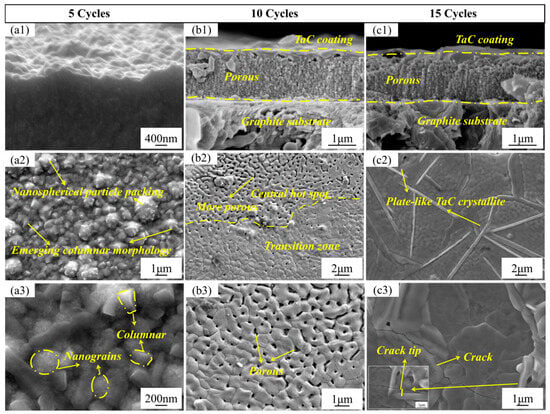
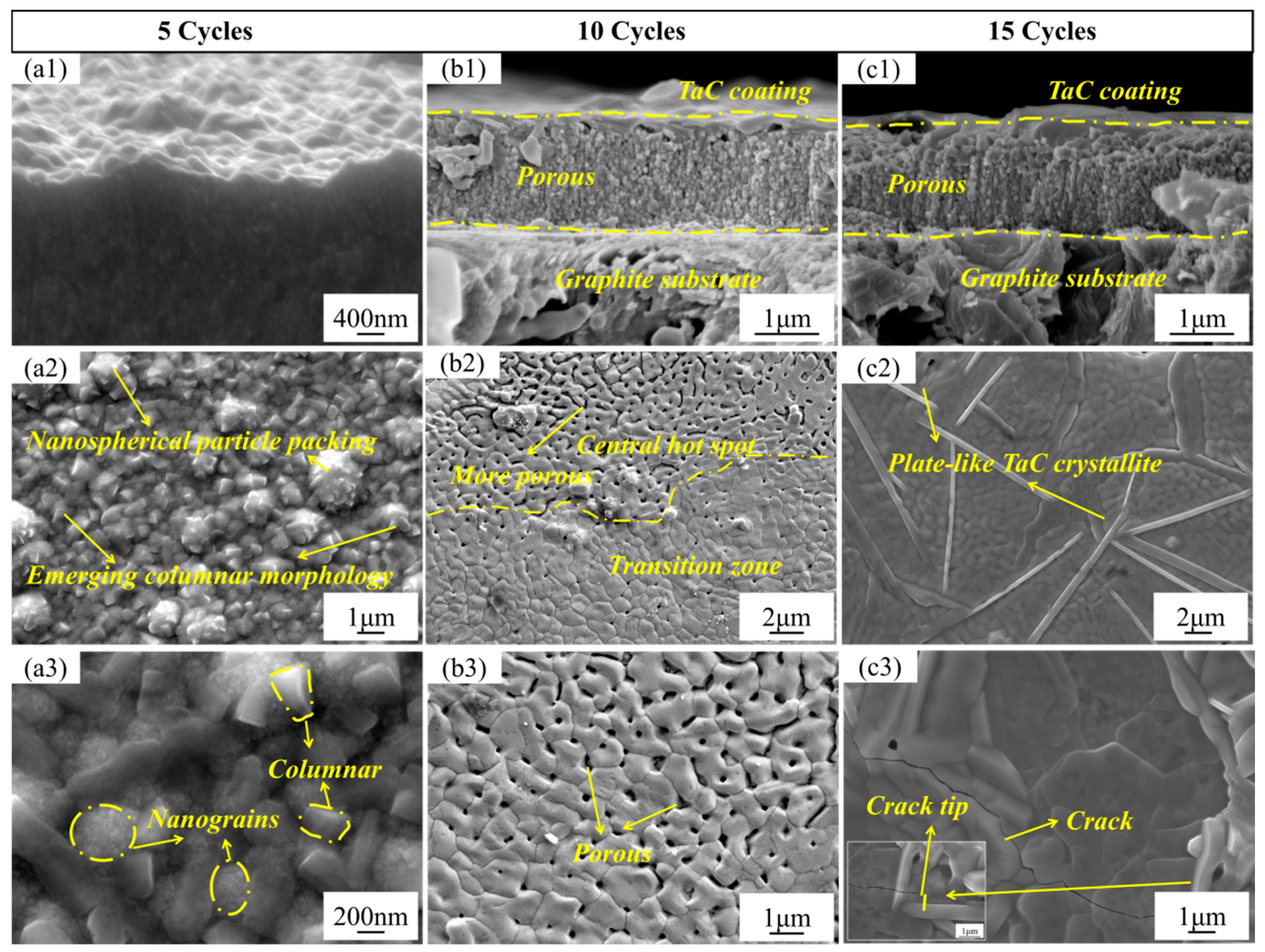
After five cycles, the higher curvature (and thus higher chemical potential) of the smaller particles [42] is expected to promote mass transport via the Gibbs–Thomson effect, resulting in coarsening that is manifested by the aggregation/coalescence and growth of these particles. Larger particles, benefiting from their size and favorable crystallographic orientation, may undergo preferential grain growth along certain crystallographic directions within the steep temperature gradient and cyclic stress field [42]. This growth is consistent with the development of a columnar morphology that develops in the surface. Because the thermal-shock exposure is extremely brief, mass transport is governed primarily by surface and interfacial diffusion with bulk diffusion remaining limited; consequently, columnar grains are mainly confined in the near-surface region, while the underlying layer retains a nanostructured particle-stacked morphology.
After ten thermal-shock cycles, the surface grains continue to coarsen. Meanwhile, the two effects noted above—volumetric contraction of the a-C phase and its local removal—advance further. As a result, extensive voided regions become apparent at the surface with a higher void density and larger cavities toward the center of the laser spot (consistent with the Gaussian laser energy profile). Cross-sectional observations reveal a more pronounced layered structure. The outermost layer has densified via grain-boundary-diffusion-controlled sintering, whereas the underlying layer, driven by thermal stresses and the action of a-C, has evolved into a highly interconnected porous network.
After fifteen thermal-shock cycles, the surface grains have coarsened significantly under repeated high-temperature impingement, progressively filling in the a-C–derived voids and producing a recrystallized dense surface layer. Concurrently, numerous plate-like crystallites precipitate at the surface and become embedded within the TaC matrix, forming a mechanically interlocked architecture. We attribute the formation of these platelets to a directional evolution of the TaC microstructure under thermal shock. During the early stages of cycling, the high-a-C grain-boundary phase relaxes and decarbonizes, generating micro-voids along boundaries that introduce free surfaces and markedly lower the barrier for heterogeneous TaC nucleation [43,44]. These sites provide favorable nuclei for the growth of plate-like TaC. With continued cycling at an elevated carbon potential, further TaC precipitation is promoted [20], while the steep thermal gradient amplifies anisotropy in interface mobility among different crystallographic orientations [45]. This drives the oriented growth of TaC platelets along specific low-energy crystallographic planes, causing them to emanate from the interior and become embedded within the coating.
The emergent network of TaC platelets in the high-a-C specimen functions as an energy-dissipating microstructure. The in-plane alignment of the platelets and their a-C—rich interface layers deflect propagating cracks and increase the tortuosity of crack paths, thereby enhancing the macroscopic thermal shock resistance. Moreover, such lamellar architectures are known to improve fracture toughness in ceramics through crack deflection and crack-bridging mechanisms [46]. Consistent with this toughening mechanism, post-cycling images (after fifteen shocks) show that cracks are blunted or arrested upon encountering the platelet-rich regions, and many cracks ultimately terminate within these regions (Figure 8).
Figure 8.
Morphology of the high-a-C sample after (a1–a3) 5, (b1–b3) 10, and (c1–c3) 15 laser thermal-shock cycles.
3.4. Thermal Shock Mechanism
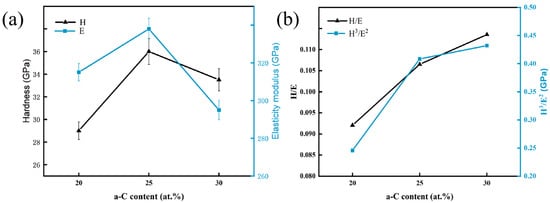
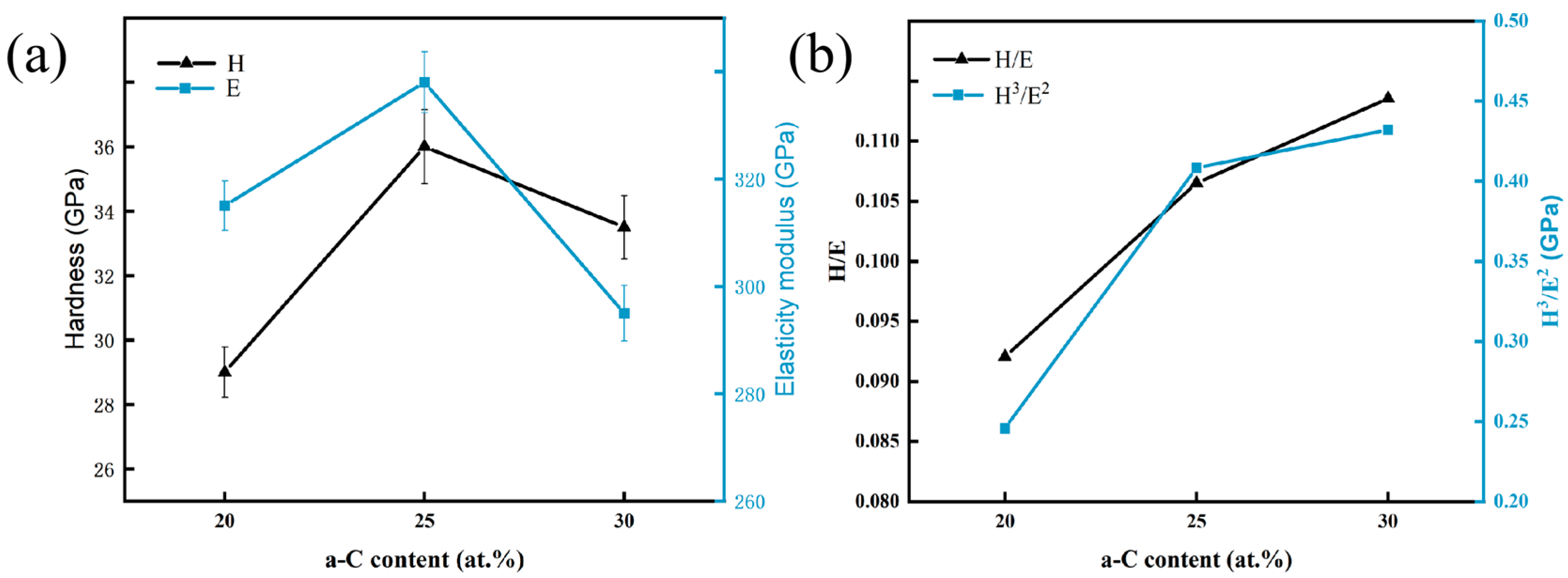
As shown in Figure 9, the nanoindentation-derived mechanical properties of the TaC/a-C coatings (prior to thermal shock) exhibit a clear non-monotonic dependence on the a-C content. As the a-C fraction increases, both the hardness (H) and elastic modulus (E) increase initially and reach a maximum at ~25 at.% a-C (H = 36.2 GPa and E = 338 GPa), which is followed by a gradual decrease at higher a-C contents. The initial enhancement in H and E can be rationalized by a nanocomposite strengthening mechanism: the introduction of an appropriate amount of amorphous carbon promotes the formation of a TaC/a-C nanocomposite architecture and suppresses TaC grain growth, leading to grain refinement and a strengthened grain-boundary constraint, which collectively increase the resistance to indentation. When the a-C content further increases, the growing contribution of the compliant amorphous phase (and the associated reduction in the load-bearing fraction of the TaC skeleton) becomes dominant, thereby lowering the effective hardness and modulus. Figure 9b summarizes the derived indices H/E and H3/E2 calculated from the measured H and E values. Notably, both H/E and H3/E2 increase monotonically with increasing a-C content despite the non-monotonic trends of H and E. These ratios are widely used to assess the elastic strain accommodation capability (H/E) and the resistance to localized plastic deformation under contact loading (H3/E2). Therefore, their simultaneous increase can indirectly indicate an improvement in the toughness-related damage tolerance of the coatings, i.e., a reduced tendency for crack initiation and propagation during indentation/contact deformation.
Figure 9.
(a) Hardness (H) and elastic modulus (E) of TaC/a-C coatings as a function of a-C content. (b) Variation in the H/E and H3/E2 index with a-C content for the TaC/a-C coatings. Error bars represent the standard deviation from multiple nanoindentation measurements.
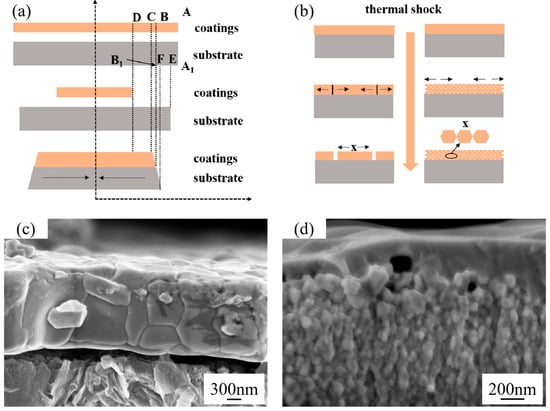
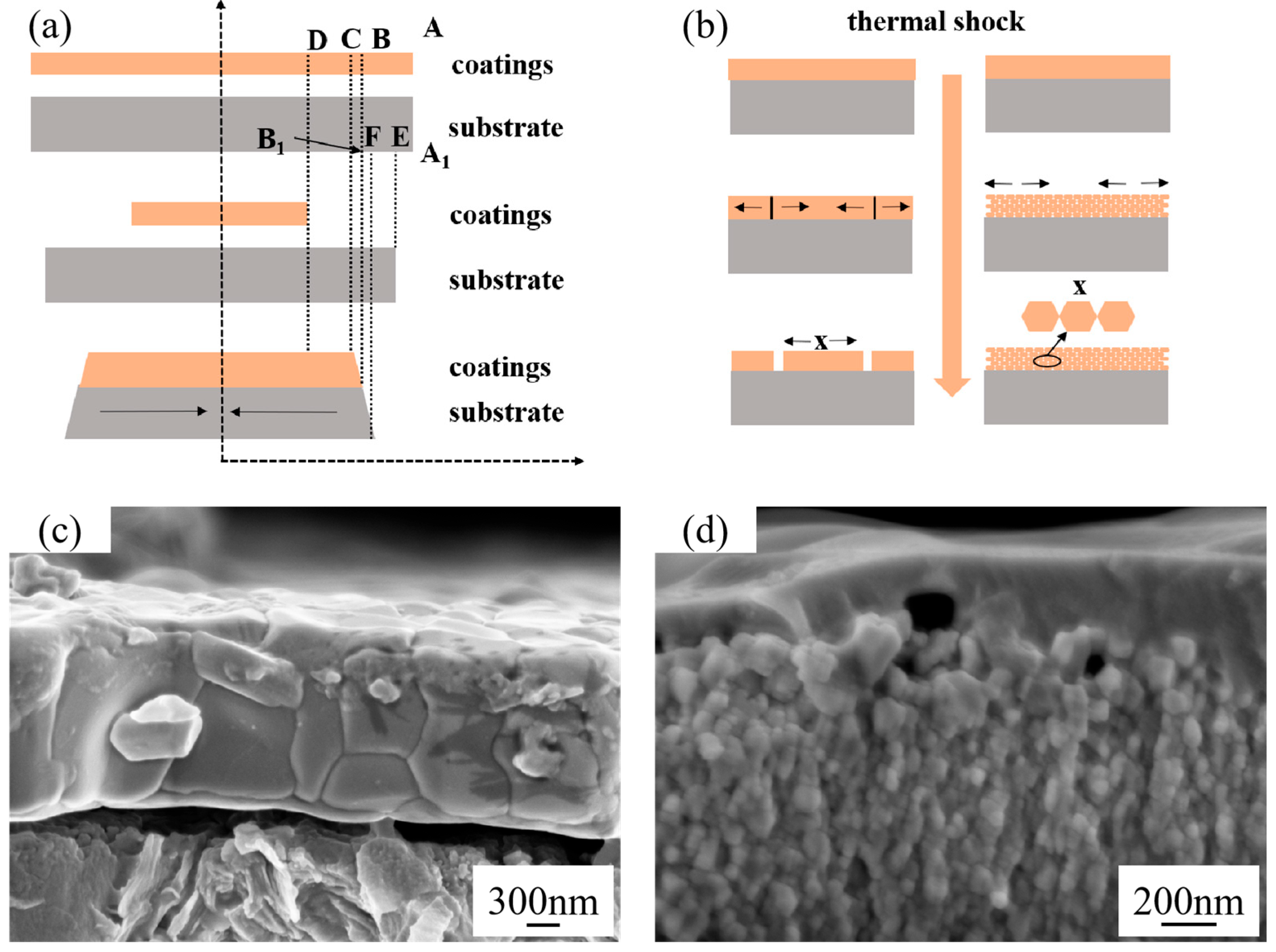
Thermally induced stresses are a primary factor governing the thermal-shock durability of coating/substrate systems. To interpret the improved resistance observed for the porous, high-a-C coatings, we adopt a simplified thermo-elastic shear-lag framework to describe the trend of stress transfer along the coating/graphite interface. As schematically illustrated in Figure 10a, interfacial bonding constrains the free thermal expansion of the coating and substrate; consequently, a thermal-mismatch strain is ∆α∆T generated during rapid heating/cooling and is accommodated through interfacial load transfer. Under a two-dimensional edge-affected formulation (variation only along the in-plane coordinate and linear elasticity assumed), the interfacial shear traction can be expressed as [47]:
where ∆α is the difference in the coefficients of thermal expansion (CTEs) between the substrate and the coating; ∆T is the temperature change; k is the effective interfacial shear compliance per unit area (a load-transfer parameter); K is the shear-lag parameter; l is the half-length of the specimen; and x is the distance measured from the free edge. According to the above expression, increases from the free edge ( = 0 at x = 0) toward the interior and reaches its maximum at x = l, i.e.,
Figure 10.
(a) conceptual model of residual thermal stress; (b) schematic illustration of the thermal-shock behavior of the TaC coating; (c) cross-sectional SEM image of the dense coating after thermal shock; and (d) cross-sectional SEM image of the porous coating after thermal shock.
It should be emphasized that this shear-lag treatment is intended as a semi-quantitative framework to rationalize the experimentally observed trends rather than a quantitative prediction of absolute interfacial stresses.
Figure 10b illustrates the thermal-shock response of a TaC-coated graphite substrate. During rapid heating and cooling cycles, the mismatch in CTE between the graphite substrate and the TaCx coating generates thermal stresses that can drive coating cracking or delamination. In the shear-lag description, as noted above, the interfacial shear stress increases with the distance from the free edge. However, the characteristic load-transfer length over which stress is transmitted in a dense, fully bonded interface is much larger than that in a porous, compliant interface (see Figure 10c,d). This means that in a dense architecture, stresses can build up over a larger distance, leading to higher peak stresses, whereas in a porous architecture, the effective stress transfer length is shorter, resulting in lower peak stresses. Additionally, the presence of voids in the porous coating subdivides the load-transfer length and increases the interfacial compliance [48,49,50]. This effectively reduces the magnitude of x involved in stress transfer and thus lowers the peak .
For a semi-quantitative comparison, Table 3 summarizes the estimated parameters for the low-a-C (dense) and high-a-C (porous) coatings. The effective CTE mismatch () and elastic modulus (E) were taken from the experimental results reported above. In the porous architecture, the effective stress build-up length l is typically on the sub-micrometer/nanometer scale, whereas in the dense architecture, stresses can accumulate over a longer distance and l is on the micrometer scale. Under these conditions, the dimensionless parameter Kl remains smaller than unity (Kl < 1), so that can be used as a first-order approximation. Accordingly, the interfacial shear compliance per unit area can be expressed as:
and the peak interfacial shear stress is simplified to
where E is the elastic modulus, is the Poisson’s ratio, and heff is the effective thickness of the interfacial/near-interfacial shear-deformation zone. For the dense coating, the interface is relatively continuous with few voids; therefore, shear deformation is mainly confined to a thin transition/microcrack band near the interface, giving heff 0.2–0.5 μm. In contrast, for the porous high-a-C coating, pores and microcracks produce a thicker segmented-contact/damaged zone near the interface, leading to a larger heff 0.5–1 μm. Substituting the estimated parameters into Equation (8) yields , indicating that the peak interfacial shear stress in the porous coating is reduced by approximately 75%. In summary, the porous microstructure redistributes and relaxes thermal stresses much more effectively than a dense one, which helps rationalize the thermal-shock resistance observed in the high-a-C (porous) TaCx coatings.
Table 3.
Estimated parameters used in the thermo-elastic shear-lag analysis for TaC/a-C coatings with different a-C contents.
4. Conclusions
By increasing the carbon-target power in dual-target DC magnetron sputtering, the coatings evolve toward a single-phase TaC matrix in which the stoichiometry plateaus near (x ≈ 0.72), while the a-C fraction rises from ~16.6 to 28.99 at.% and the surface morphology becomes finer-grained with a-C–rich boundaries that accommodate stress and participate in CTE relaxation. Under rapid laser thermal cycling to 1300 °C, the high-a-C coating (~28.99 at.%) retains greater residual thickness, exhibits no obvious through-thickness cracks after 15 cycles, and suppresses the TaC → Ta2C reduction. In contrast, the low a-C counterpart thins markedly, shows Ta2C signatures, and permits crack penetration; post-cycling oxides index solely to the low-temperature L-Ta2O5 polymorph. The thermal shock resistance enhancement arises from the synergistic effects of intrinsic thermophysical regulation by the a-C phase (lower effective CTE) and extrinsic microstructural toughening via a porous, platelet-reinforced TaC architecture. These results indicate that an a-C-enabled porous, compliant architecture that shortens the load-transfer length and lowers interfacial shear, together with an in situ platelet-reinforced TaC network that promotes crack deflection and bridging, renders TaC/a-C an effective chemically compatible, mechanically compliant transition layer that mitigates CTE mismatch and enhances the cyclic durability of TaC-based coatings on carbon substrates. This strategy provides a feasible pathway for designing chemically compatible, thermally compliant transition layers for UHTC coatings on carbon-based components operating under extreme thermal-shock environments.
Author Contributions
Y.H.: Investigation (equal); Formal analysis (equal); Writing—original draft (equal). J.P.: Conceptualization (equal); Supervision (equal); Writing—review and editing (equal). H.J.: Writing—review and editing (equal). Q.S.: Conceptualization (equal); Funding acquisition (equal); Writing—review and editing (equal). C.W.: Resources (equal); Investigation support (equal); Writing—review and editing (equal). All authors have read and agreed to the published version of the manuscript.
Funding
This work was financially supported by the National Natural Science Foundation of China (Grant No. 52572113).
Institutional Review Board Statement
Not applicable.
Informed Consent Statement
Not applicable.
Data Availability Statement
The original contributions presented in this study are included in the article. Further inquiries can be directed to the corresponding authors.
Conflicts of Interest
Author Huanjun Jiang was employed by the company Weihai Maxpower Advanced Tool Co., Ltd. The remaining authors declare that the research was conducted in the absence of any commercial or financial relationships that could be construed as a potential conflict of interest.
References
- Feng, G.; Li, H.; Yao, X.; Chen, L.; Yu, Y.; Wang, H.; Chen, M. Ablation behavior of ZrC and ZrO2 coatings on SiC coated C/C composites under oxyacetylene torch with different heat fluxes. Ceram. Int. 2021, 47, 21721–21729. [Google Scholar] [CrossRef] [Scilit]
- Kong, J.A.; Zhang, Y.; Chen, G.; Zhang, P.; Gai, W.; Wang, H.; Li, H. Ablation behavior of CVD-TaC coatings with different crystal structures for C/C composites under oxyacetylene flame. J. Eur. Ceram. Soc. 2022, 42, 6898–6907. [Google Scholar] [CrossRef] [Scilit]
- Zhang, X.; Guo, L.; Liu, H.; Zhang, Y.; Fu, Q.; Yin, X.; Li, H. Advanced anti-ablation C/C composites: Structural design strategies and future perspective. Mater. Today 2024, 80, 710–736. [Google Scholar] [CrossRef] [Scilit]
- Li, H.; Yao, D.; Fu, Q.; Liu, L.; Zhang, Y.; Yao, X.; Wang, Y.; Li, H. Anti-oxidation and ablation properties of carbon/carbon composites infiltrated by hafnium boride. Carbon 2013, 52, 418–426. [Google Scholar] [CrossRef] [Scilit]
- Yao, X.-Y.; Li, H.-J.; Zhang, Y.-L.; Ren, J.-J.; Yao, D.-J.; Tao, J. A SiC/ZrB2–SiC/SiC oxidation resistance multilayer coating for carbon/carbon composites. Corros. Sci. 2012, 57, 148–153. [Google Scholar] [CrossRef] [Scilit]
- Ni, D.; Cheng, Y.; Zhang, J.; Liu, J.-X.; Zou, J.; Chen, B.; Wu, H.; Li, H.; Dong, S.; Han, J.; et al. Advances in ultra-high temperature ceramics, composites, and coatings. J. Adv. Ceram. 2021, 11, 1–56. [Google Scholar] [CrossRef] [Scilit]
- Buinevich, V.S.; Nepapushev, A.A.; Moskovskikh, D.O.; Kuskov, K.V.; Yudin, S.N.; Mukasyan, A.S. Ultra-high-temperature tantalum-hafnium carbonitride ceramics fabricated by combustion synthesis and spark plasma sintering. Ceram. Int. 2021, 47, 30043–30050. [Google Scholar] [CrossRef] [Scilit]
- Lu, Z.; Liu, L.; Geng, G.; Laptev, A.M.; Hou, Z.; Wang, Y. Effect of boron addition on microstructure, mechanical properties and oxidation resistance of TaC ceramics. Ceram. Int. 2019, 45, 6712–6717. [Google Scholar] [CrossRef] [Scilit]
- Wang, Y.; Dou, Q.; Yang, J.; Li, Q. Residual stress and ablation behavior of CVD TaC coatings on graphite. Mater. Chem. Phys. 2022, 277, 125627. [Google Scholar] [CrossRef] [Scilit]
- Wang, Z.; Sun, W.; Xiong, X.; Zhang, H.; Liu, Z.; Tao, X. Growth and properties of tantalum carbide coatings on graphite by TRD technique. Surf. Coat. Technol. 2024, 484, 130798. [Google Scholar] [CrossRef] [Scilit]
- Wang, Y.-J.; Li, H.-J.; Fu, Q.-G.; Wu, H.; Liu, L.; Sun, C. Ablation behaviour of a TaC coating on SiC coated C/C composites at different temperatures. Ceram. Int. 2013, 39, 359–365. [Google Scholar] [CrossRef] [Scilit]
- Wei, T.; Guo, H.; Shao, Q.; Yang, D.; Pi, X.; Xu, L. Enhanced SiC crystal growth via thermo-reactive TaC coating synthesis on porous graphite. Ceram. Int. 2025, 51, 29457–29464. [Google Scholar] [CrossRef] [Scilit]
- Li, G.-D.; Xiong, X.; Huang, B.-Y.; Huang, K.-L. Structural characteristics and formation mechanisms of crack-free multilayer TaC/SiC coatings on carbon-carbon composites. Trans. Nonferrous Met. Soc. China 2008, 18, 255–261. [Google Scholar] [CrossRef] [Scilit]
- Viscusi, A.; Astarita, A.; Genna, S.; Leone, C. On the influence of different superficial laser texturing on the deposition of powders through cold spray process. Trans. IMF 2018, 96, 34–40. [Google Scholar] [CrossRef] [Scilit]
- Zhang, Z.; Pu, H.; Zhang, H.; Wang, M. Improved thermal shock resistance and bonding strength of TaC coatings by in situ-formed transitional layers on graphite substrates. Ceram. Int. 2025, 51, 48265–48273. [Google Scholar] [CrossRef] [Scilit]
- Qin, H.; Li, X.; Zheng, C.; Xu, S.; Cheng, L. Interfacial diffusion behaviour and mechanical properties of SiC/Ta hybrid accident tolerance fuel cladding structure. Compos. Part A Appl. Sci. Manuf. 2023, 165, 107332. [Google Scholar] [CrossRef] [Scilit]
- Kong, J.A.; Zhang, Y.; Wang, H.; Chen, G.; Gai, W.; Zhang, P.; Li, H. Sublayer design and ablation resistance of CVD-TaC alternate coatings with different crystallite morphologies for C/C composites. J. Mater. Sci. Technol. 2023, 141, 1–10. [Google Scholar] [CrossRef] [Scilit]
- Zhu, T.; Shen, Y.; Wang, B.; Huang, W.; Zhang, C.; Wang, C.; Guo, H.; Li, C.; Tu, R.; Zhang, S. High-speed deposition of porous TaC coatings by halide laser chemical vapor deposition for improving the thermal shock resistance. J. Alloys Compd. 2025, 1046, 184856. [Google Scholar] [CrossRef] [Scilit]
- Shi, B.; Meng, W.J.; Daulton, T.L. Thermal expansion of Ti-containing hydrogenated amorphous carbon nanocomposite thin films. Appl. Phys. Lett. 2004, 85, 4352–4354. [Google Scholar] [CrossRef] [Scilit]
- Hu, J.; Li, H.; Li, J.; Huang, J.; Kong, J.; Zhu, H.; Xiong, D. Structure, mechanical and tribological properties of TaCx composite films with different graphite powers. J. Alloys Compd. 2020, 832, 153769. [Google Scholar] [CrossRef] [Scilit]
- Hwang, S.; Lee, D. Carburization of Tantalum Metal Powder Using Activated Carbon. Materials 2025, 18, 2710. [Google Scholar] [CrossRef] [Scilit]
- Kim, J.G.; Yu, J. A study on the residual stress measurement methods on chemical vapor deposition diamond films. J. Mater. Res. 1998, 13, 3027–3033. [Google Scholar] [CrossRef] [Scilit]
- Evans, R.D.; Howe, J.Y.; Bentley, J.; Doll, G.L.; Glass, J.T. Influence of Deposition Parameters on the Composition and Structure of Reactively Sputtered Nanocomposite TaC/a-C:H Thin Films. J. Mater. Res. 2005, 20, 2583–2596. [Google Scholar] [CrossRef] [Scilit]
- Ferrari, A.C.; Robertson, J. Interpretation of Raman spectra of disordered and amorphous carbon. Phys. Rev. B 2000, 61, 14095–14107. [Google Scholar] [CrossRef] [Scilit]
- Cançado, L.G.; Jorio, A.; Ferreira, E.H.; Stavale, F.; Achete, C.A.; Capaz, R.B.; Moutinho, M.V.; Lombardo, A.; Kulmala, T.S.; Ferrari, A.C. Quantifying defects in graphene via Raman spectroscopy at different excitation energies. Nano Lett. 2011, 11, 3190–3196. [Google Scholar] [CrossRef] [Scilit] [PubMed]
- Ferrari, A.C. Raman spectroscopy of graphene and graphite: Disorder, electron–phonon coupling, doping and nonadiabatic effects. Solid State Commun. 2007, 143, 47–57. [Google Scholar] [CrossRef] [Scilit]
- Luo, H.; Pour Yazdi, M.A.; Chen, S.-C.; Sun, H.; Gao, F.; Heintz, O.; De Monteynard, A.; Sanchette, F.; Billard, A. Structure, mechanical and tribological properties, and oxidation resistance of TaC/a-C:H films deposited by high power impulse magnetron sputtering. Ceram. Int. 2020, 46, 24986–25000. [Google Scholar] [CrossRef] [Scilit]
- Helmersson, U.; Lattemann, M.; Bohlmark, J.; Ehiasarian, A.P.; Gudmundsson, J.T. Ionized physical vapor deposition (IPVD): A review of technology and applications. Thin Solid Film. 2006, 513, 1–24. [Google Scholar] [CrossRef] [Scilit]
- Sarakinos, K.; Alami, J.; Konstantinidis, S. High power pulsed magnetron sputtering: A review on scientific and engineering state of the art. Surf. Coat. Technol. 2010, 204, 1661–1684. [Google Scholar] [CrossRef] [Scilit]
- Gusev, A.I.; Kurlov, A.S.; Lipatnikov, V.N. Atomic and vacancy ordering in carbide ζ-Ta4C3−x (0.28⩽x⩽0.40) and phase equilibria in the Ta–C system. J. Solid State Chem. 2007, 180, 3234–3246. [Google Scholar] [CrossRef] [Scilit]
- Smirnova, E.; Nourazar, M.; Korzhavyi, P.A. Internal structure of metal vacancies in cubic carbides. Phys. Rev. B 2024, 109, L060103. [Google Scholar] [CrossRef] [Scilit]
- Greczynski, G.; Primetzhofer, D.; Hultman, L. Reference binding energies of transition metal carbides by core-level x-ray photoelectron spectroscopy free from Ar+ etching artefacts. Appl. Surf. Sci. 2018, 436, 102–110. [Google Scholar] [CrossRef] [Scilit]
- Chen, Z.-K.; Xiong, X.; Huang, B.-Y.; Li, G.-D.; Zheng, F.; Xiao, P.; Zhang, H.-B.; Yin, J. Phase composition and morphology of TaC coating on carbon fibers by chemical vapor infiltration. Thin Solid Film. 2008, 516, 8248–8254. [Google Scholar] [CrossRef] [Scilit]
- Wang, Y.-L.; Xiong, X.; Li, G.-D.; Zhao, X.-J.; Chen, Z.-K.; Sun, W.; Wang, Z.-S. Effect of gas composition on the microstructure and growth behavior of HfC coatings prepared by LPCVD. Solid State Sci. 2013, 20, 86–91. [Google Scholar] [CrossRef] [Scilit]
- Alam, T.M.; Friedmann, T.A.; Schultz, P.A.; Sebastiani, D. Low temperature annealing in tetrahedral amorphous carbon thin films observed by 13CNMR spectroscopy. Phys. Rev. B 2003, 67, 245309. [Google Scholar] [CrossRef] [Scilit]
- Champi, A.; Lacerda, R.G.; Viana, G.A.; Marques, F.C. Thermal expansion dependence on the sp2 concentration of amorphous carbon and carbon nitride. J. Non-Cryst. Solids 2004, 338–340, 499–502. [Google Scholar] [CrossRef] [Scilit]
- Grierson, D.S.; Sumant, A.V.; Konicek, A.R.; Friedmann, T.A.; Sullivan, J.P.; Carpick, R.W. Thermal stability and rehybridization of carbon bonding in tetrahedral amorphous carbon. J. Appl. Phys. 2010, 107, 033523. [Google Scholar] [CrossRef] [Scilit]
- Frisk, K.; Guillermet, A.F. Gibbs energy coupling of the phase diagram and thermochemistry in the tantalum–carbon system. J. Alloys Compd. 1996, 238, 167–179. [Google Scholar] [CrossRef] [Scilit]
- Mccormack, S.J.; Tseng, K.-P.; Weber, R.J.K.; Kapush, D.; Ushakov, S.V.; Navrotsky, A.; Kriven, W.M. In-situ determination of the HfO2–Ta2O5-temperature phase diagram up to 3000 °C. J. Am. Ceram. Soc. 2019, 102, 4848–4861. [Google Scholar] [CrossRef] [Scilit]
- Gonçalves, A.F.T.; Sinfrônio, F.S.M.; De Menezes, A.S.; Mendes, A.M.M. Thermo analytical characterization of tantalum oxide in the process for the development of tantalum nitride photoelectrodes. Mater. Today Commun. 2022, 32, 104122. [Google Scholar] [CrossRef] [Scilit]
- Nakamura, D.; Shigetoh, K.; Suzumura, A. Tantalum carbide coating via wet powder process: From slurry design to practical process tests. J. Eur. Ceram. Soc. 2017, 37, 1175–1185. [Google Scholar] [CrossRef] [Scilit]
- Voorhees, P.W. The theory of Ostwald ripening. J. Stat. Phys. 1985, 38, 231–252. [Google Scholar] [CrossRef] [Scilit]
- Raabe, D. Physical Metallurgy; Laughlin, D.E., Hono, K., Eds.; Elsevier: Amsterdam, The Netherlands, 2014; pp. 2291–2397. [Google Scholar]
- Sandström, R. Basic Modeling and Theory of Creep of Metallic Materials; Springer Nature: Cham, Switzerland, 2024; pp. 185–203. [Google Scholar]
- Peachey, D.D.R.; Carter, C.P.; Garcia-Jimenez, A.; Mukundan, A.; Leonard, D.N.; Charpagne, M.-A.; Cordero, Z.C. Directional recrystallization of an additively manufactured Ni-base superalloy. Addit. Manuf. 2022, 60, 103198. [Google Scholar] [CrossRef] [Scilit]
- Bouville, F.; Maire, E.; Meille, S.; Van De Moortele, B.; Stevenson, A.J.; Deville, S. Strong, tough and stiff bioinspired ceramics from brittle constituents. Nat. Mater. 2014, 13, 508–514, Correction in Nat. Mater. 2017, 16, 1271. https://doi.org/10.1038/nmat4982. [Google Scholar] [CrossRef] [Scilit] [PubMed]
- Wang, Y.; Chen, Z.; Pan, N.; Li, B.; Yu, S.; Cui, S. Residual thermal stresses prediction for CVD coating/substrate system based on a numerical model. Int. J. Appl. Ceram. Technol. 2018, 15, 1397–1406. [Google Scholar] [CrossRef] [Scilit]
- Bogdan, M.; Peter, I. A Comprehensive Understanding of Thermal Barrier Coatings (TBCs): Applications, Materials, Coating Design and Failure Mechanisms. Metals 2024, 14, 575. [Google Scholar] [CrossRef] [Scilit]
- Huang, J.B.; Wang, W.Z.; Li, Y.J.; Fang, H.J.; Ye, D.D.; Zhang, X.C.; Tu, S.T. A novel strategy to control the microstructure of plasma-sprayed YSZ thermal barrier coatings. Surf. Coat. Technol. 2020, 402, 126304. [Google Scholar] [CrossRef] [Scilit]
- Ji, X.; Zhao, J.; Ren, X.; Shang, Z.; Ji, C.; Wang, P.; Sun, Y.; Kiryukhantsev-Korneev, P.V.; Levashov, E.A.; Kang, X.; et al. Thermal expansion mismatch-induced in situ self-assembly design of gradient coatings: 1700 °C oxidation protection and oxygen barrier enhancement mechanism of borosilicate-modified ZrB2-MoSi2-BSG gradient composite coatings. Corros. Sci. 2026, 260, 113581. [Google Scholar] [CrossRef] [Scilit]

Disclaimer/Publisher’s Note: The statements, opinions and data contained in all publications are solely those of the individual author(s) and contributor(s) and not of MDPI and/or the editor(s). MDPI and/or the editor(s) disclaim responsibility for any injury to people or property resulting from any ideas, methods, instructions or products referred to in the content. |
© 2026 by the authors. Licensee MDPI, Basel, Switzerland. This article is an open access article distributed under the terms and conditions of the Creative Commons Attribution (CC BY) license.