Article

Stress Engineering in the Optimization of Next-Generation Hafnium-Based Ferroelectric Memory

1
School of Integrated Circuits, Anhui University, Hefei 230601, China
2
College of Integrated Circuits & Micro-Nano Electronics, Fudan University, Shanghai 200433, China
3
School of Integrated Circuits, State Key Laboratory of Crystal Materials, Shandong University, Jinan 250100, China
4
State Key Laboratory of Integrated Chips and Systems, Shanghai 201203, China
*
Authors to whom correspondence should be addressed.
These authors contributed equally to this work.
Nanomaterials 2026, 16(9), 516; https://doi.org/10.3390/nano16090516
Submission received: 13 March 2026 / Revised: 21 April 2026 / Accepted: 23 April 2026 / Published: 25 April 2026
(This article belongs to the Special Issue HfO2-Based Ferroelectric Thin Films and Devices)

Abstract

Hafnium oxide thin films have been extensively investigated for high-speed and low-power memory applications. Herein, we investigated the influence of oxygen vacancies and external stress on the ferroelectric characteristics of Al-doped HfO2 (HfAlO). Compared with HfAlO with 14% oxygen vacancies, films with 21% oxygen vacancies could lower the polarization switching barrier and increase the fraction of the ferroelectric phase. Furthermore, significant external stress promotes ferroelectric phase formation, thereby enhancing ferroelectric characteristics. The remanent polarization achieved with W electrodes (2Pr = 38 µC/cm2) is about 18 times that of Au electrodes, owing to the lower thermal expansion coefficient of W electrodes. Density functional theory calculations and finite element analysis provide theoretical insights corroborating the experimental results, helping to pave the way for developing hafnium-based materials for next-generation in-memory computing applications.

1. Introduction

With the rapid advancement of artificial intelligence, there is an unprecedented demand for highly efficient information processing in the field of integrated circuits [1,2,3]. Consequently, the development of high-performance memory devices has emerged as a foundational innovation frontier for next-generation information technologies [4,5,6]. Among the candidates for next-generation memory, ferroelectric memory has gained significant attention due to its high-speed operation and low power consumption [7,8,9]. Conventional ferroelectric materials exhibit severe limitations, including heavy metal toxicity, incompatibility with standard CMOS processes, and complex integration schemes [10,11,12]. The discovery of ferroelectricity in hafnium-based materials in 2011 fundamentally addressed these issues [13]. However, HfO2-based ferroelectric materials still face challenges, such as the elusive modulation mechanisms of their ferroelectric properties.
Recent studies have shown that oxygen defects have a significant impact on device performance [14,15]. For example, Islamov et al. observed that a wake-up phase is required to increase the remanent polarization at low oxygen vacancy densities, while excessive oxygen vacancies will suppress the ferroelectricity in hafnium-based films [16]. Huang et al. demonstrated that interfacial oxygen injection could reduce the coercive field of hafnium-based ferroelectric thin films by decreasing the oxygen vacancy concentration [17]. Additionally, out-of-plane stress also affects the ferroelectric characteristics of hafnium-based thin films [18,19]. Liu et al. reported that the hysteresis loop contracts with increasing compressive stress [20]. Song et al. suggested that stress plays a crucial role in optimizing the ferroelectric response [21]. Although the above studies have well illustrated empirical strategies for modulating hafnium-based ferroelectric thin films, the underlying modulation mechanisms remain elusive.
In this work, we systematically investigate the effects of oxygen content and mechanical stress on the ferroelectricity of Al-doped HfO2 (HfAlO) and its underlying physical mechanisms. The oxygen content of HfAlO is modulated by alternating the oxygen source during deposition. The oxygen vacancies play a crucial role in determining the polarization behavior and stability of HfO2. The stress induced in the films is tuned by employing different top electrodes. Stress can significantly alter the microstructure arrangement of HfO2-based thin films. Theoretical analyses are conducted to elucidate the mechanisms governing how oxygen content and stress enhance the ferroelectric characteristics.

2. Experimental

Initially, SiO2/Si substrates (with a 300 nm-thick SiO2 layer) were sequentially cleaned using acetone, absolute ethanol, and deionized water [22]. Subsequently, W bottom electrodes were deposited via physical vapor deposition (PVD). Then, 10 nm-thick aluminum-doped HfO2 (HfAlO) thin films were deposited on the W/SiO2/Si substrates using atomic layer deposition (ALD). Tetrakis(ethylmethylamino) hafnium (TEMAH) and trimethylaluminum (TMA) were employed as precursors, which were alternately pulsed into the ALD chamber at 250 °C using an N2 carrier gas (with a TEMAH:TMA cycle ratio of 34:1). H2O or O2 plasma was used as the oxidant. For the Al2O3, the ALD temperature was 280 °C. The ALD pulse and purge time were 2 and 5 s, respectively. The growth rate of the Al2O3 was 1.05 Å for each cycle. For the HfO2, the ALD temperature was 280 °C. The ALD pulse and purge time were 5 and 5 s, respectively. The growth rate of the HfO2 was 1 Å for each cycle. Finally, W top electrodes (80 × 80 µm2) were patterned via a standard lift-off process. A rapid thermal annealing (RTA) treatment was then performed in a nitrogen atmosphere at 500 °C for 30 s.
Based on density functional theory (DFT) calculations using the Materials Studio software 2019, we evaluate the effect of oxygen vacancy on the ferroelectricity of hafnium-based film. The Perdew–Burke–Ernzerhof (PBE) functional of generalized gradient approximation (GGA) is used to optimize the geometric stricture until the residual force on each atom is smaller than 0.02 eV/Å. The crystal structure is a 2 × 2 × 2 supercell with 96 atoms.

3. Results

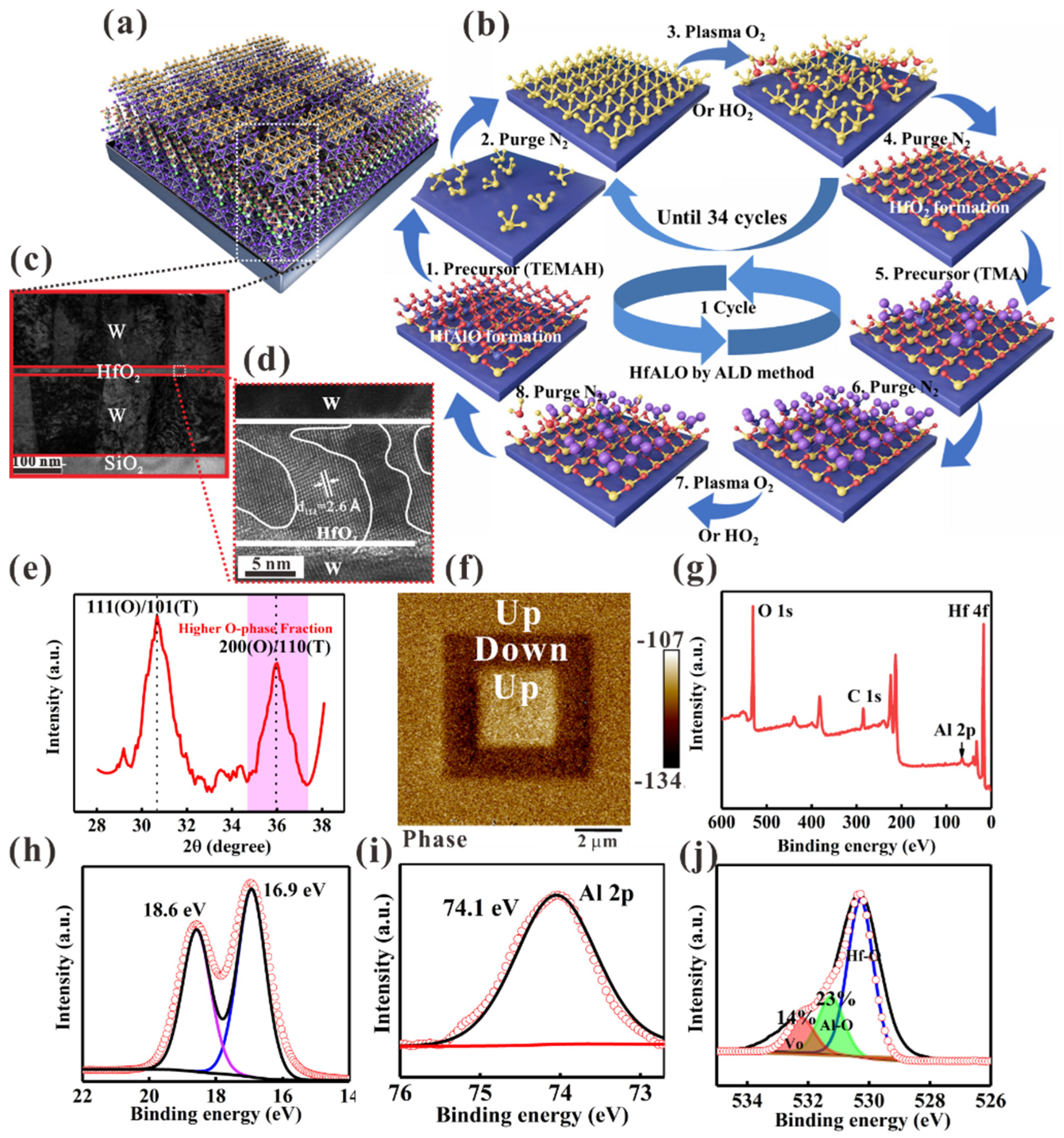
Figure 1a schematically illustrates the structure of the HfAlO ferroelectric devices. Figure 1b shows that the ALD cycle of the HfAlO thin films consists of 34 cycles of HfO2 followed by one cycle of Al2O3 at a chamber temperature of 250 °C. Cross-sectional scanning electron microscopy (SEM) images reveal distinct interfaces between the device layers, as demonstrated in Figure 1c,d. The thickness of the as-grown HfAlO thin film is approximately 10 nm. Through high-resolution transmission electron microscopy (HRTEM), the HfAlO thin films demonstrate high crystallinity after the RTP process. The measured d-spacing value is approximately 2.6 Å, which is consistent with the X-ray diffraction (XRD) results (Figure 1e). The XRD patterns of the HfAlO film display diffraction peaks at 30.5° and 36°, corresponding to the HfO2 orthorhombic (O) (111) and (200) phases, respectively [23,24]. Furthermore, Figure 1f shows that the Piezoelectric Force Microscopy (PFM) response is symmetrical for the +P and –P poled regions with an approximate 27° phase change, indicating robust ferroelectric switching [25,26]. As shown in Figure 1g, the X-ray photoelectron spectroscopy (XPS) survey spectra of the HfAlO films confirm the presence of Hf, Al, and O. Figure 1h shows that the Hf 4f core-level spectrum displays two peaks at 16.9 eV and 18.6 eV, corresponding to Hf 4f7/2 and Hf 4f5/2, respectively [17,27,28]. Figure 1i shows a characteristic peak located at approximately 74.1 eV, corresponding to the Al 2p core level, which indicates the Al3+ chemical state [29]. The O 1s spectrum was deconvoluted into three sub-peaks (Figure 1j). The main peak at approximately 530 eV is attributed to Hf–O bonding, and the 531 eV peak corresponds to Al–O bonding [30,31]. The remaining peak at a higher binding energy is ascribed to the presence of oxygen vacancies, as shown in Figure 1j. Furthermore, the oxygen content of the HfAlO thin films deposited using an O2 plasma is higher than that of the films deposited using an H2O oxidant, as shown in Figure S1.
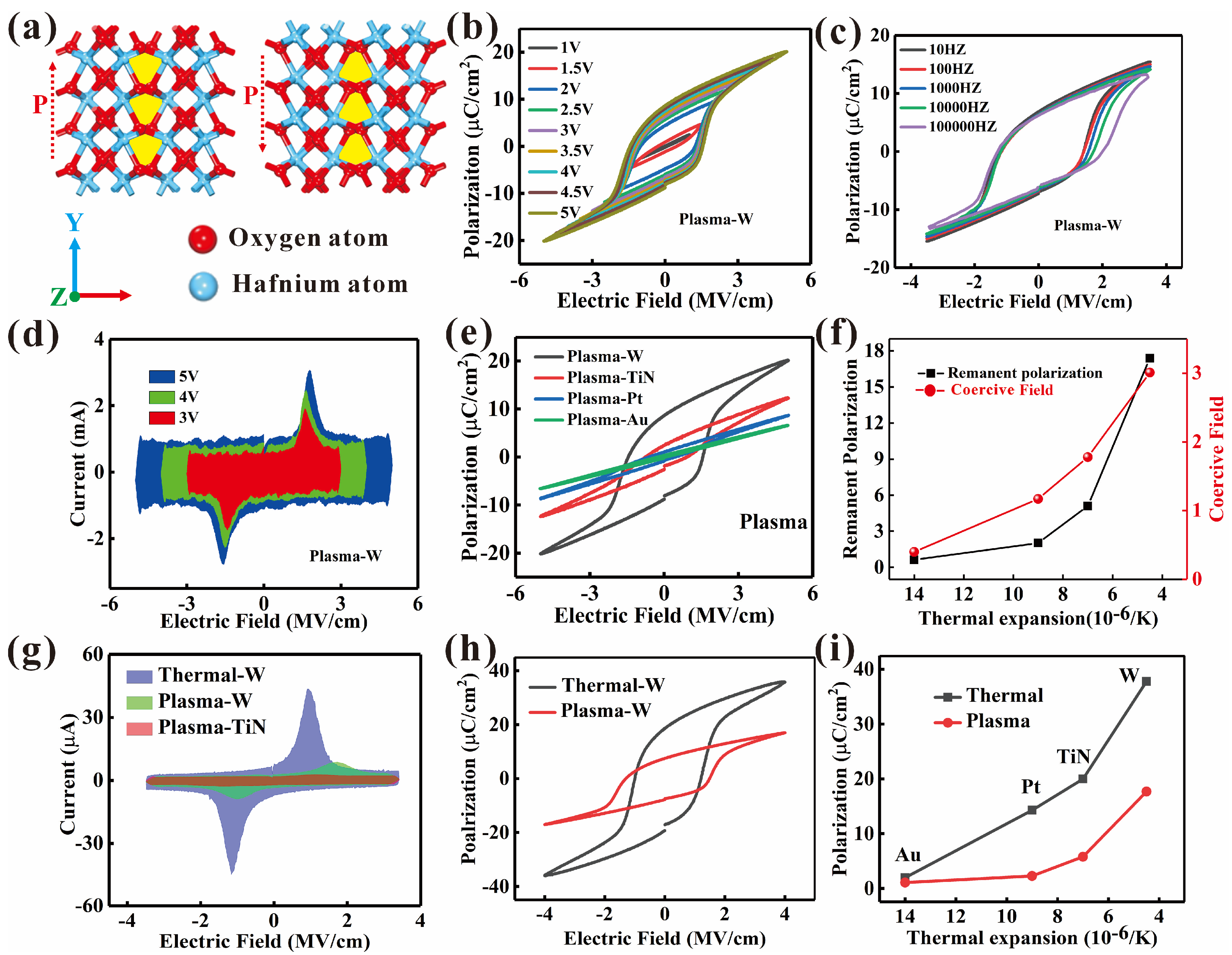
Figure 2a illustrates the atomistic model, where red and blue spheres represent oxygen and hafnium atoms, respectively. As depicted, oxygen atom displacement drives macroscopic polarization switching at room temperature. Figure 2b shows the P-E hysteresis curves of the HfAlO ferroelectric devices under different voltage sweep ranges. As the voltage sweep increases, a larger hysteresis window is obtained. Conversely, Figure 2c demonstrates the degradation of the P-E loops with increasing sweep frequency. As shown in Figure 2d, the current–voltage (I–V) curves exhibit a typical increase in leakage current with applied voltage. Figure S2 displays the capacitance–voltage (C–V) curves measured with bias voltages ranging from −4 V to +4 V at 1 KHz. These collective electrical characterizations indicate robust ferroelectric characteristics and high film quality. Furthermore, we systematically compared the ferroelectric characteristics of devices with different top electrodes and oxygen sources. As shown in Figure 2e, the devices with W top electrodes show well-saturated P-E hysteresis curves, yielding a remanent polarization of approximately 10 µC/cm2. In contrast, devices with Au top electrodes display poor P-E hysteresis curves. For the devices fabricated using an H2O oxygen source, the P-E hysteresis curves are shown in Figure S3. Figure 2f corresponds to the O2 plasma, and shows that both the remanent polarization and coercive field increase as the thermal expansion coefficient (CTE) of the top electrode decreases. For the HfAlO films with an oxygen vacancy concentration of 21.5% corresponding to water source, Figure S4 shows that the remanent polarization similarly increases with decreasing CTE. However, the coercive field exhibits an opposite trend, decreasing with reduced CTE. Figure 2g and Figure S5 show distinct switching current peaks for the devices with W top electrodes. For samples deposited with a H2O source, the devices show highly robust P-E curves, as shown in Figure 2h. The devices with HfO2 show a high remanent polarization of over 20 µC/cm2. From the results, it can be concluded that devices with W top electrodes display superior remanent polarization owing to mechanical confinement provided by their lower thermal expansion coefficient. Additionally, the remanent polarization is further enhanced for devices deposited with an H2O source, as summarized in Figure 2i.
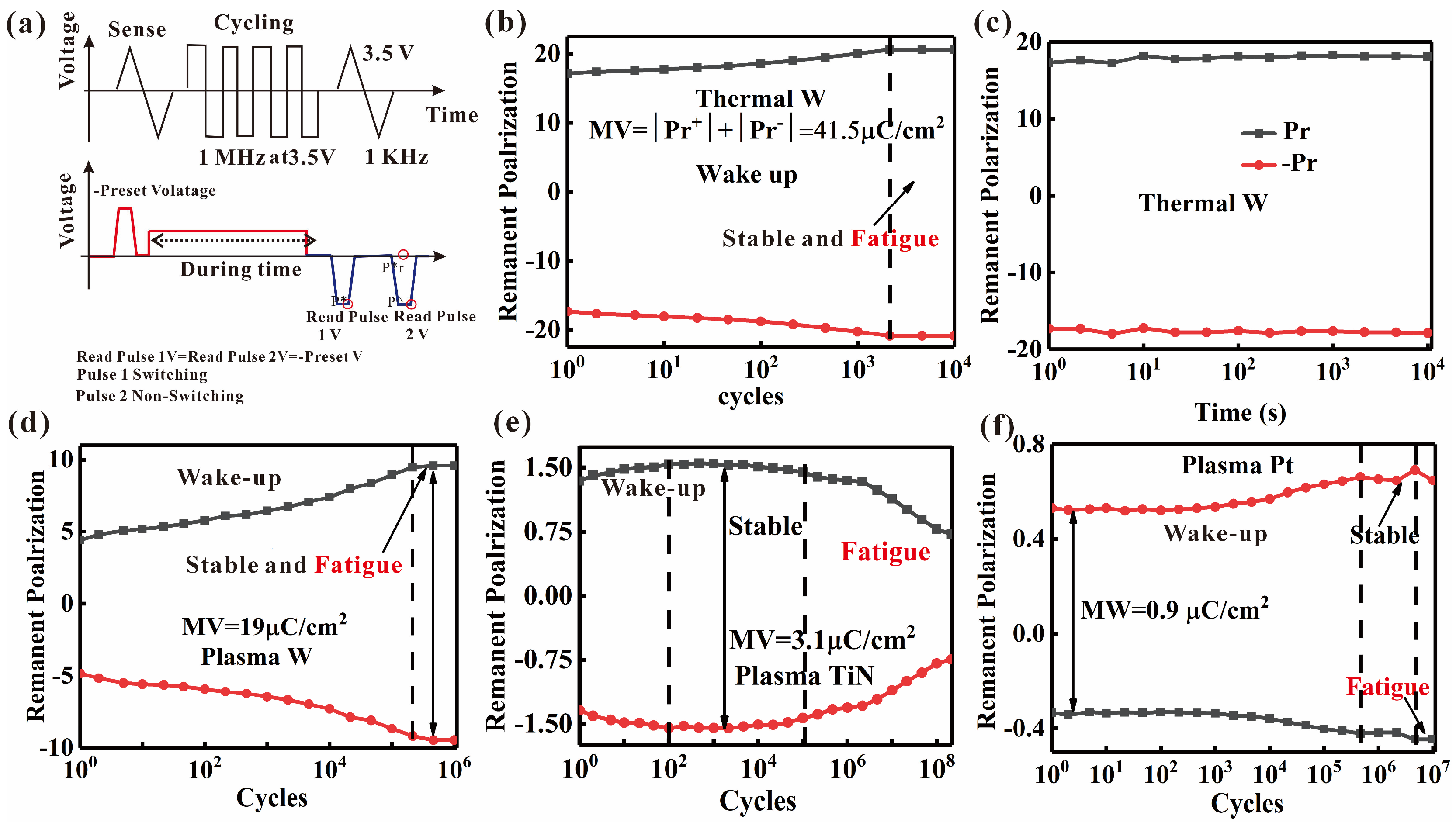
To systematically investigate the effects of top electrodes and oxygen sources on device characteristics, endurance and retention properties were evaluated as two essential reliability indicators for the HfAlO ferroelectric devices. The applied pulse waveforms for the endurance and retention tests are illustrated in Figure 3a. The endurance characteristics of the devices were tested with a 1000 ns-wide write pulse of 3.5 V and a 1000 ms-wide read pulse of 3.5 V. For the W electrode devices fabricated with an H2O oxygen source, Figure 3b shows that the devices exhibit an endurance of over 104 cycles, without significant fatigue degradation. Meanwhile, the retention time is maintained for over 104 s for the ferroelectric devices with W top electrodes, as shown in Figure 3c.
For W electrode devices with an O2 plasma source, Figure 3d shows that the devices demonstrate a substantially enhanced endurance of over 106 cycles. Their corresponding retention times are shown in Figure S6a. Notably, compared with the samples derived from H2O, the endurance characteristics are improved by two orders of magnitude. Other devices show distinct fatigue behaviors prior to failure. As shown in Figure 3e, the devices with TiN top electrodes achieve an endurance of over 108 cycles, with retention times shown in Figure S6b. The device’s operational lifespan is clearly divided into three distinct stages: wake-up, stabilization, and fatigue. Similarly, the three-stage degradation behavior is also observed for Pt top electrode devices, which yield an endurance of over 107 cycles, as shown in Figure 3f. The underlying physical mechanisms by which the top electrode and oxygen sources modulate the ferroelectric properties will be further analyzed below.
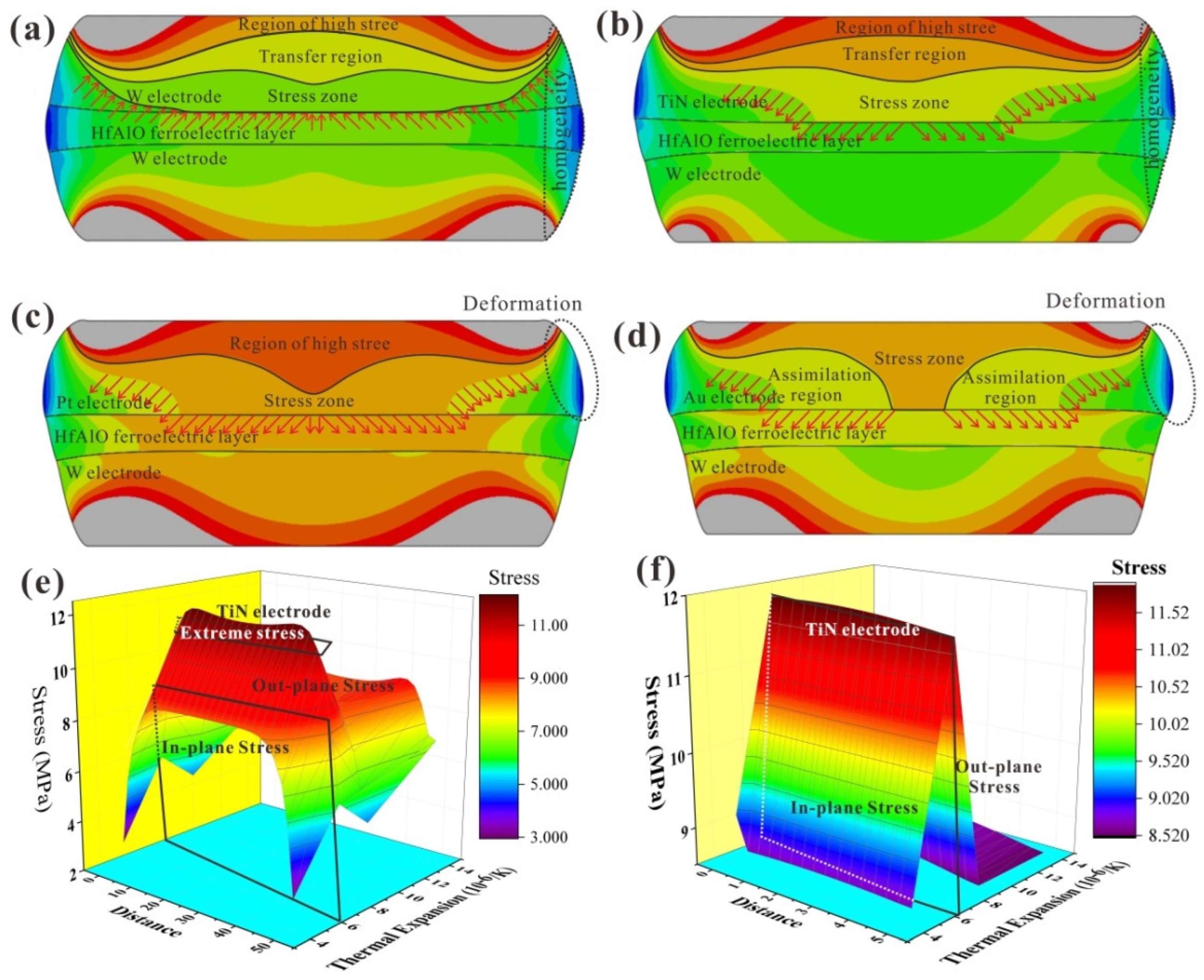
To elucidate the top electrode effects on the ferroelectric characteristics of the devices, finite element analysis (FEA) was performed using ABAQUS. A two-dimensional model was constructed based on the stacked film structure. Figure 4a shows that the W top electrode can induce large in-plane stress within the HfAlO ferroelectric films owing to the low thermal expansion coefficient (CTE) of metal W. However, other top electrodes predominantly induce out-of-plane stress in the HfO2 thin films. As shown in Figure 4b, the TiN electrode applies out-of-plane stress to the ferroelectric thin films, and the stress distribution exhibits three distinct spatial zones: a region of high stress, a transfer region, and a bulk stress zone. Because of the small CTE mismatch between the top electrodes (W as well as TiN) and HfO2, no large local deformation occurs during the thermal annealing process, thereby preventing severe stress relaxation. However, Pt and Au electrodes undergo significant deformation during the annealing process due to their high thermal expansion, resulting in pronounced stress dispersion. Figure 4c shows that film deformation may lead to the disappearance of transfer regions. With further increases in the thermal expansion coefficient, Figure 4d shows that the region of high stress disappears, and stress dissipation regions appear. This effectively reduces the stress exerted on the ferroelectric HfAlO films, ultimately leading to the degradation of their ferroelectric characteristics. Figure 4e illustrates that W top electrodes apply in-plane stress to the HfO2 thin films, whereas other electrodes exert out-of-plane stress on the functional thin films. Among them, the TiN top electrodes apply the maximum out-of-plane stress to the ferroelectric thin films. A similar stress distribution can also be observed along the vertical depth profile of the films (Figure 4f). Collectively, these simulations elucidate the influence of the electrode thermal expansion coefficient on the ferroelectric properties of the devices.
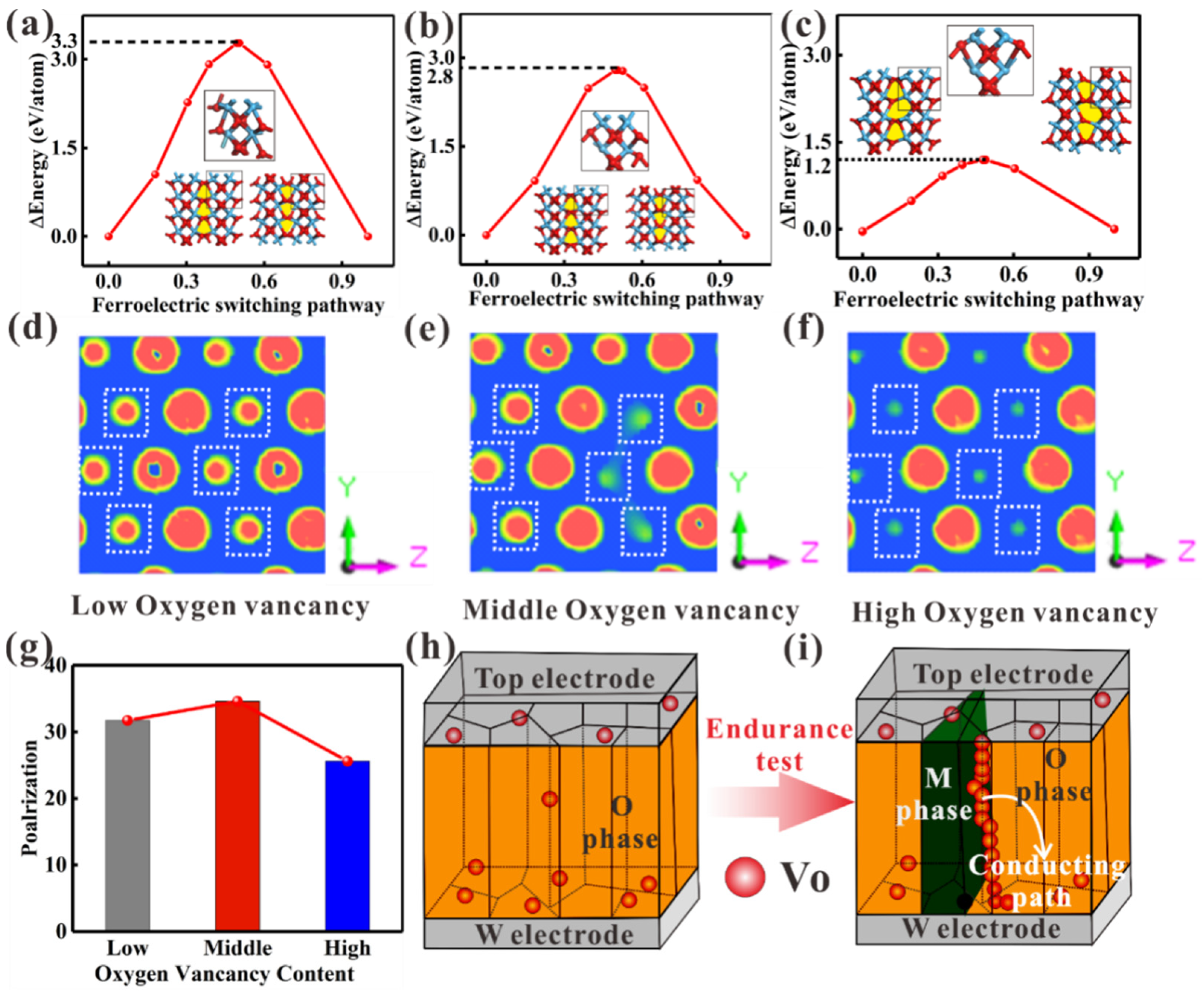
To better explore the effect of oxygen vacancies on the ferroelectric characteristics of the HfAlO devices, density functional theory (DFT) calculations were performed to determine the polarization switching barrier and the spontaneous polarization of the O-phase in HfO2. The DMol3 code within the Materials Studio suite was utilized to elucidate the oxygen vacancy−induced ferroelectric characteristics of HfAlO thin films. A 2 × 2 × 2 supercell with 96 atoms was built for Brillouin zone integration. To obtain an equilibrium structure, geometry optimization was conducted using the Local Density Approximation (LDA) and Projector Augmented Wave (PAW) methods. The structures were optimized until the residual force on each atom was smaller than 0.004 Ha/Å.
Figure 5a−c depict the minimum energy paths for switching between the two ferroelectric states, illustrating that the energy barrier is greatly reduced with increasing oxygen vacancy concentration. The switching barrier decreases by 0.5 eV relative to the pristine structure at an oxygen vacancy concentration of 7.6 × 1021 cm−3 (Figure 5b). At a higher oxygen vacancy concentration of 1.52 × 1022 cm−3, Figure 5c shows that the switching barrier is further reduced to less than 2.1 eV. The above analysis can explain the macroscopic coercive field reduction owing to the increase in oxygen vacancies.
Meanwhile, the electron density distributions and local geometric effects were investigated. Figure 5d shows slices of the charge density isosurfaces in the (100) plane for the pristine lattice. With oxygen vacancy increase, the electrode density decreases around the hafnium atoms, which may make it easier for oxygen atoms to move, i.e., the reduction in the coercive field (see Figure 5e). As the oxygen vacancies increase, the electron density decreases around the hafnium atoms, which facilitates oxygen atom displacement, i.e., the reduction in the coercive field (Figure 5e). With further increases in oxygen vacancies, the charge density continues to decrease around the hafnium atoms, as shown in Figure 5f, monotonically decreasing the coercive field. However, the HfO2 polarization also decreases when the oxygen vacancy concentration reaches 1.52 × 1022 cm−3 (Figure 5g). Conversely, for HfO2 cells with an oxygen vacancy concentration of 7.6 × 1021 cm−3, the remanent polarization reaches a maximum of 34.8 µC/cm2.
Figure 5h illustrates the pristine HfO2 cells. With an increase in polarization switching cycles, the O-phase structure may be damaged, leading to M-phase formation and the generation of massive oxygen vacancies. When these oxygen vacancies accumulate in the films, the devices lose efficacy (Figure 5i). For HfO2 thin films with excessive oxygen vacancies, the probability of conductive filament formation is higher, resulting in poor fatigue characteristics. Thus, precisely modulating a suitable content of oxygen vacancies is beneficial for optimizing the ferroelectric characteristics of HfO2 thin films.

4. Conclusions

In this study, we systematically investigated the influence of oxygen content and mechanical stress on the ferroelectricity of HfAlO thin films. The P-E curves demonstrate that an appropriate oxygen vacancy concentration can enhance the polarization properties and decrease the coercive field of HfAlO thin films. Specifically, the HfAlO films with a 21% oxygen vacancy concentration display a remanent polarization of approximately 20 µC/cm2. First-principle calculations reveal that an optimal level of oxygen vacancies can lower the polarization switching barrier of the HfO2 ferroelectric films and promote the formation of the ferroelectric phase. However, excessive oxygen vacancies degrade the endurance of the thin films (<105 cycles) due to the accelerated generation of defects during cycling. Furthermore, significant external stress can enhance macroscopic film polarization owing to the stabilization of the ferroelectric phase. Our work provides a solid experimental foundation and profound theoretical insights for the optimization of HfAlO ferroelectric thin films, paving the way for their application in next-generation non-volatile memory devices.

Supplementary Materials

The following supporting information can be downloaded at: https://www.mdpi.com/article/10.3390/nano16090516/s1. Figure S1 The core-level spectra assigned to O 1s, the oxygen of hafnium-based thin film form deionized water. Figure S2 C-V curves of the devices at 4 V. Figure S3 The P-E hysteresis curves of the hafnium-based thin films with 21.5% oxygen vacancies. Figure S4 the remanent polarization and coercive field change with the top electrode changing. Figure S5 The P-E hysteresis curves of the hafnium-based thin films with 14% oxygen vacancies. Fig. S6 the retention characteristics test of hafnium-based thin films with 14% oxygen vacancies.

Author Contributions

X.G., R.Y. and Y.H.; methodology, Z.L.; software. Y.L., J.Y., K.X. and Q.L.; validation. T.W., Q.S., D.W.Z. and L.C.; investigation. All authors have read and agreed to the published version of the manuscript.

Funding

This work was supported by the NSFC (92573202 and 62574061), Science and Technology Commission of Shanghai Municipality (25LN3201100), the “Shuguang Program” supported by the Shanghai Education Development Foundation, the Shanghai Municipal Education Commission, and the Fudan University Nano Information Science Innovation Support Center Project, Ministry of Education of China. The authors acknowledge the School of Microelectronics of Fudan University, the Nano Institute of Fudan University, the National Integrated Circuit Innovation Center, and Jiashan Fudan Institute.

Data Availability Statement

The data that support the findings of this study are available from the corresponding author upon reasonable request.

Conflicts of Interest

The authors declare no conflicts of interest.

References

  1. Zhou, C.; Ma, L.; Feng, Y.; Kuo, C.Y.; Ku, Y.C.; Liu, C.E.; Cheng, X.; Li, J.; Si, Y.; Huang, H.; et al. Enhanced polarization switching characteristics of HfO2 ultrathin films via acceptor-donor co-doping. Nat. Commun. 2024, 15, 2893. [Google Scholar] [CrossRef] [Scilit] [PubMed]
  2. Luo, Z.; Peng, B.; Zeng, J.; Yu, Z.; Zhao, Y.; Xie, J.; Lan, R.; Ma, Z.; Pan, L.; Cao, K.; et al. Sub-thermionic, ultra-high-gain organic transistors and circuits. Nat. Commun. 2021, 12, 1928. [Google Scholar] [CrossRef] [Scilit] [PubMed]
  3. Noheda, B.; Nukala, P.; Acuautla, M. Lessons from hafnium dioxide-based ferroelectrics. Nat. Mater. 2023, 22, 562–569. [Google Scholar] [CrossRef] [Scilit]
  4. Si, M.; Andler, J.; Lyu, X.; Niu, C.; Datta, S.; Agrawal, R.; Ye, P.D. Indium-Tin-Oxide Transistors with One Nanometer Thick Channel and Ferroelectric Gating. ACS Nano 2020, 14, 11542–11547. [Google Scholar] [CrossRef] [Scilit] [PubMed]
  5. Mikolajick, T.; Park, M.H.; Begon-Lours, L.; Slesazeck, S. From Ferroelectric Material Optimization to Neuromorphic Devices. Adv. Mater. 2023, 35, e2206042. [Google Scholar] [CrossRef] [Scilit]
  6. Zhou, S.; Zhang, J.; Rappe, A.M. Strain-induced antipolar phase in hafnia stabilizes robust thin-film ferroelectricity. Sci. Adv. 2022, 8, eadd5953. [Google Scholar] [CrossRef] [Scilit]
  7. Luo, Q.; Cheng, Y.; Yang, J.; Cao, R.; Ma, H.; Yang, Y.; Huang, R.; Wei, W.; Zheng, Y.; Gong, T.; et al. A highly CMOS compatible hafnia-based ferroelectric diode. Nat. Commun. 2020, 11, 1391. [Google Scholar] [CrossRef] [Scilit]
  8. Hsiang, K.Y.; Liao, C.Y.; Liu, J.H.; Lin, C.Y.; Lee, J.Y.; Lou, Z.F.; Chang, F.S.; Ray, W.C.; Li, Z.X.; Tseng, H.C.; et al. Dielectric Layer Design of Bilayer Ferroelectric and Antiferroelectric Tunneling Junctions Toward 3D NAND-Compatible Architecture. IEEE Electron Device Lett. 2022, 43, 1850–1853. [Google Scholar] [CrossRef] [Scilit]
  9. Pujar, P.; Cho, H.; Kim, Y.H.; Zagni, N.; Oh, J.; Lee, E.; Gandla, S.; Nukala, P.; Kim, Y.M.; Alam, M.A.; et al. An Aqueous Route to Oxygen-Deficient Wake-Up-Free La-Doped HfO2 Ferroelectrics for Negative Capacitance Field Effect Transistors. ACS Nano 2023, 17, 19076–19086. [Google Scholar] [CrossRef] [Scilit]
  10. Cheng, Y.; Gao, Z.; Ye, K.H.; Park, H.W.; Zheng, Y.; Zheng, Y.; Gao, J.; Park, M.H.; Choi, J.H.; Xue, K.H.; et al. Reversible transition between the polar and antipolar phases and its implications for wake-up and fatigue in HfO2-based ferroelectric thin film. Nat. Commun. 2022, 13, 645. [Google Scholar] [CrossRef] [Scilit]
  11. Khan, A.I.; Keshavarzi, A.; Datta, S. The future of ferroelectric field-effect transistor technology. Nat. Electron. 2020, 3, 588–597. [Google Scholar] [CrossRef] [Scilit]
  12. Li, Z.; Wang, T.; Yu, J.; Meng, J.; Liu, Y.; Zhu, H.; Sun, Q.; Zhang, D.W.; Chen, L. Ferroelectric Hafnium Oxide Films for In-Memory Computing Applications. Adv. Electron. Mater. 2022, 8, 2200951. [Google Scholar] [CrossRef] [Scilit]
  13. Zhong, H.; Li, M.; Zhang, Q.; Yang, L.; He, R.; Liu, F.; Liu, Z.; Li, G.; Sun, Q.; Xie, D.; et al. Large-Scale Hf0.5Zr0.5O2 Membranes with Robust Ferroelectricity. Adv. Mater. 2022, 34, e2109889. [Google Scholar] [CrossRef] [Scilit] [PubMed]
  14. Li, Z.; Wang, T.; Liu, Y.; Yu, J.; Meng, J.; Liu, P.; Xu, K.; Zhu, H.; Sun, Q.; Zhang, D.W.; et al. Understanding the Effect of Oxygen Content on Ferroelectric Properties of Al-Doped HfO2 Thin Films. IEEE Electron Device Lett. 2023, 44, 56–59. [Google Scholar] [CrossRef] [Scilit]
  15. Li, Z.; Meng, J.; Yu, J.; Liu, Y.; Wang, T.; Liu, P.; Chen, S.; Zhu, H.; Sun, Q.; Zhang, D.W.; et al. CMOS Compatible Low Power Consumption Ferroelectric Synapse for Neuromorphic Computing. IEEE Electron Device Lett. 2023, 44, 532–535. [Google Scholar] [CrossRef] [Scilit]
  16. Islamov, D.R.; Zalyalov, T.M.; Orlov, O.M.; Gritsenko, V.A.; Krasnikov, G.Y. Impact of oxygen vacancy on the ferroelectric properties of lanthanum-doped hafnium oxide. Appl. Phys. Lett. 2020, 117, 162901. [Google Scholar] [CrossRef] [Scilit]
  17. Wang, X.; Wu, M.; Cui, B.; Li, Y.; Wu, Y.; Wen, Y.; Liu, J.; Li, X.; Ye, S.; Ren, P.; et al. Oxygen Vacancy Modulation With TiO2 Stack Interface Engineering for Ferroelectric Hf0.5Zr0.5O2 Thin Films. IEEE Electron Device Lett. 2024, 45, 100–103. [Google Scholar] [CrossRef] [Scilit]
  18. Li, Z.; Meng, J.; Yu, J.; Liu, Y.; Wang, T.; Xu, K.; Zhu, H.; Sun, Q.; Zhang, D.W.; Chen, L. Stabilizing the Ferroelectric Phase in HfAlO Ferroelectric Tunnel Junction With Different Bottom Electrodes. IEEE Electron Device Lett. 2023, 44, 947–950. [Google Scholar] [CrossRef] [Scilit]
  19. Li, Z.; Wang, T.; Meng, J.; Zhu, H.; Sun, Q.; Zhang, D.W.; Chen, L. Flexible aluminum-doped hafnium oxide ferroelectric synapse devices for neuromorphic computing. Mater. Horiz. 2023, 10, 3643–3650. [Google Scholar] [CrossRef] [Scilit]
  20. Liu, Y.; Clima, S.; Hiblot, G.; Matagne, P.; Popovici, M.L.; Kaczer, B.; Velenis, D.; De Wolf, I. Investigation of the Impact of Externally Applied Out-of-Plane Stress on Ferroelectric FET. IEEE Electron Device Lett. 2021, 42, 264–267. [Google Scholar] [CrossRef] [Scilit]
  21. Song, T.; Lenzi, V.; Silva, J.P.B.; Marques, L.; Fina, I.; Sánchez, F. Disentangling stress and strain effects in ferroelectric HfO2. Appl. Phys. Rev. 2023, 10, 041415. [Google Scholar] [CrossRef] [Scilit]
  22. Li, Z.; Tang, S.; Wang, T.; Liu, Y.; Meng, J.; Yu, J.; Xu, K.; Yuan, R.; Zhu, H.; Sun, Q.; et al. Effect of Lanthanum-Aluminum Co-Doping on Structure of Hafnium Oxide Ferroelectric Crystals. Adv. Sci. 2025, 12, 2410765. [Google Scholar] [CrossRef] [Scilit] [PubMed]
  23. Böscke, T.S.; Müller, J.; Bräuhaus, D.; Schröder, U.; Böttger, U. Ferroelectricity in hafnium oxide thin films. Appl. Phys. Lett. 2011, 99, 102903. [Google Scholar] [CrossRef] [Scilit]
  24. Fields, S.S.; Smith, S.W.; Jaszewski, S.T.; Mimura, T.; Dickie, D.A.; Esteves, G.; David Henry, M.; Wolfley, S.L.; Davids, P.S.; Ihlefeld, J.F. Wake-up and fatigue mechanisms in ferroelectric Hf0.5Zr0.5O2 films with symmetric RuO2 electrodes. J. Appl. Phys. 2021, 130, 134101. [Google Scholar] [CrossRef] [Scilit]
  25. Kim, J.Y.; Choi, M.-J.; Jang, H.W. Ferroelectric field effect transistors: Progress and perspective. APL Mater. 2021, 9, 021102. [Google Scholar] [CrossRef] [Scilit]
  26. Xu, D.D.; Ma, R.R.; Fu, A.P.; Guan, Z.; Zhong, N.; Peng, H.; Xiang, P.H.; Duan, C.G. Ion adsorption-induced reversible polarization switching of a van der Waals layered ferroelectric. Nat. Commun. 2021, 12, 655. [Google Scholar] [CrossRef] [Scilit]
  27. Perevalov, T.V.; Gismatulin, A.A.; Gritsenko, V.A.; Prosvirin, I.P.; Mehmood, F.; Mikolajick, T.; Schroeder, U. Bipolar conductivity in ferroelectric La:HfZrO films. Appl. Phys. Lett. 2021, 118, 262903. [Google Scholar] [CrossRef] [Scilit]
  28. Liu, Y.; Wang, T.; Song, Y.; Xu, K.; Yuan, R.; Li, Z.; Yu, J.; Meng, J.; Zhu, H.; Sun, Q.; et al. Innovative Ultralow Thermal Budget ZrHfOx Ferroelectric Films with Low-Temperature Phase Transition for Next-Generation High-Speed Multifunctional Devices. Nano Lett. 2024, 25, 157–165. [Google Scholar] [CrossRef] [Scilit]
  29. Mallik, S.; Mahata, C.; Hota, M.K.; Dalapati, G.K.; Chi, D.Z.; Sarkar, C.K.; Maiti, C.K. HfAlO high-k gate dielectric on SiGe: Interfacial reaction, energy-band alignment, and charge trapping properties. Microelectron. Eng. 2010, 87, 2234–2240. [Google Scholar] [CrossRef] [Scilit]
  30. Kaiser, N.; Vogel, T.; Zintler, A.; Petzold, S.; Arzumanov, A.; Piros, E.; Eilhardt, R.; Molina-Luna, L.; Alff, L. Defect-Stabilized Substoichiometric Polymorphs of Hafnium Oxide with Semiconducting Properties. ACS Appl. Mater. Interfaces 2022, 14, 1290–1303. [Google Scholar] [CrossRef] [Scilit]
  31. Jeong, Y.; Gaddam, V.; Goh, Y.; Shin, H.; Lee, S.; Kim, G.; Jeon, S. Oxygen Vacancy Control as a Strategy to Enhance Imprinting Effect in Hafnia Ferroelectric Devices. IEEE Trans. Electron Devices 2023, 70, 354–359. [Google Scholar] [CrossRef] [Scilit]
Figure 1. (a) Schematic structure of the W/HfAlO/W/SiO2/Si devices. (b) Schematic of one cycle fabrication process of ALD for HfAlO thin films. (c,d) The cross-sectional image of the samples and the TEM images of the HfAlO thin films, respectively. (e) GIXRD pattern of the HfAlO thin films. (f) PFM phase for the HfAlO thin films. (g) XPS survey spectra of the initial form of the HfAlO thin films. The coreî−level spectra assigned to (h) Hf 4f, (i) Al 2p and (j) O 1s, respectively.
Nanomaterials 16 00516 g001
Figure 2. Electrical properties of the HfAlO samples. (a) The displacement of O2− ions causes the polarization switching and ferroelectric properties of the HfAlO samples with W top electrodes. (b,c) The P−E hysteresis curves of the samples at different voltages and frequencies, respectively. (d) I−V curves of the HfAlO ferroelectric devices under different voltages. (e) The P−E hysteresis curves of the devices with different top electrodes at different voltages. (f) The remanent polarization and coercive field change for HfAlO film with 14% oxygen vacancy and changing top electrode. (g) I−V curves of the devices with different top electrodes at different voltages. (h) The P−E hysteresis curves of the devices with different oxygen sources. (i) The effect of the thermal expansion of the top electrode effect on the remanent polarization.
Nanomaterials 16 00516 g002
Figure 3. (a) Waveform of the endurance of retention characteristics tests. (b,c) The endurance and retention characteristics of the W/HfAlO/W device with H2O as oxygen source, respectively. The endurance characteristics of (d) W/HfAlO/W devices, (e) TiN/HfAlO/W devices, and (f) Pt/HfAlO/W devices with O2 plasma as oxygen source.
Nanomaterials 16 00516 g003
Figure 4. Stress variation in the devices with (a) W top electrodes, (b) TiN top electrodes, (c) Pt top electrodes, and (d) Au top electrodes during the annealing process. (e) Stress variation in path 3 during the annealing process. (f) Stress variation in path 8 during the annealing process.
Nanomaterials 16 00516 g004
Figure 5. (a) The polarization switching barrier of the ideal HfO2 cell. The polarization switching barrier of an HfO2 cell with oxygen vacancy concentrations of (b) 7.6 × 1021 cm−3, and (c) 1.52 × 1022 cm−3, respectively. (d) The isosurface of charge density in the (100) plane for an ideal HfO2 cell. The isosurface of charge density in the (100) plane for an HfO2 cell with an oxygen vacancy concentration of (e) 7.6 × 1021 cm−3, and (f) 1.52 × 1022 cm−3, respectively. (g) The polarization of the O-phase as a function of d100. (h,i) The schematics of the failure mechanism of the HfAlO devices during endurance cycles.
Nanomaterials 16 00516 g005
Disclaimer/Publisher’s Note: The statements, opinions and data contained in all publications are solely those of the individual author(s) and contributor(s) and not of MDPI and/or the editor(s). MDPI and/or the editor(s) disclaim responsibility for any injury to people or property resulting from any ideas, methods, instructions or products referred to in the content.