


Abstract
Standard cancer chemotherapeutics often produce significant adverse effects and eventually lose their effectiveness due to the emergence of resistance mechanisms. As a result, patients with malignant tumors experience a poor quality of life and a short lifespan. Thus, combination medication regimens provide various advantages, including increased success rate, fewer side effects, and fewer occurrences of resistance. Curcumin (Cur), a potential phytochemical from turmeric, when coupled with traditional chemotherapeutics, has been established to improve the effectiveness of cancer treatment in clinical and preclinical investigations. Cur not only exerts multiple mechanisms resulting in apoptotic cancer cell death but also reduces the resistance to standard chemotherapy drugs, mainly through downregulating the multi-drug resistance (MDR) cargoes. Recent reports showed the beneficial outcomes of Cur combination with many chemotherapeutics in various malignancies. Nevertheless, owing to the limited bioavailability, devising co-delivery strategies for Cur and conventional pharmaceuticals appears to be required for clinical settings. This review summarized various Cur combinations with standard treatments as cancer therapeutics.
1. Introduction
Combination therapy is now a leading aspect of cancer therapy. In comparison to the monotherapy method, combining anti-cancer medications improves effectiveness due to targeting important pathways synergistically or additively. This strategy can potentially diminish drug resistance whilst also offering therapeutic anti-cancer advantages, e.g., halting mitotically active cells, lowering cancer stem cell populations, and causing apoptosis in cancerous cells [1]. The five-year survival rate of most metastatic malignancies is still relatively poor, and launching a unique anti-cancer treatment is both highly costly and exceedingly time-demanding [2,3,4]. A novel approach that focuses on survival routes and provides cost-effective and high-quality outcomes is thus urgently needed.
Chemotherapy medicines, e.g., docetaxel (DTX), irinotecan, 5-fluorouracil (5-FU), cisplatin, and paclitaxel (PTX), are utilized in treating diverse cancers; nevertheless, their efficacies are confined, owing to the emergence of drug resistance, inducing non-selective toxicity and producing significant adverse reactions [5]. It is expected that the efficiency of pharmacological therapy will improve when combined with treatments that use phytochemicals, and the unwanted effects will become less severe as a result [6,7,8]. For instance, the findings showed that curcumin (Cur, an active ingredient from Curcuma longa with multiple biological effects [9,10,11,12,13,14,15,16,17]), in combination with chemotherapeutics, had a wider range of anti-cancer action and a lower risk of severe side effects than standard chemotherapy medications [18,19]. In corroboration with the preclinical data, over the past decade, more than 20 clinical trials have assessed the efficacy and safety of Cur, alone or in combination with other chemotherapeutic agents, for treating various malignancies. The emerging clinical data validated the remarkable potential of Cur in cancer therapy [20,21]. More interestingly, with the progress of nanotechnology, targeted drug delivery systems have been designed to promote the bioavailability of relatively water-insoluble Cur and the co-delivery of Cur and conventional chemotherapeutics to the tumor site [22,23]. This review recapitulated the advancements in Cur and standard chemotherapy drugs combination therapy in various malignancies.
2. Curcumin-Based Combination Anti-Cancer Drug Delivery Systems against Colorectal Cancer
Colorectal cancer (CRC) is the third cause of cancer mortality worldwide. Although 5-FU and oxaliplatin are the main treatments, they are commonly used in chemotherapy regimens to suppress CRC progression. Unfortunately, CRC patients who are given 5-FU frequently experience multi-drug resistance (MDR). The issue is partially solved by raising the amount of 5-FU; however, excessive doses would cause significant toxicities; therefore, the therapy must be halted [24]. These patients may benefit from the combination of 5-FU and Cur, which has been shown to be helpful in overcoming drug resistance and decreasing 5-FU cytotoxicity. For example, Cur was demonstrated to increase 5-FU chemosensitivity and reverse mismatch repair (MMR)-deficient CRC cell chemoresistance [25]. Furthermore, Cur boosted 5-FU-mediated cleavage of pro-apoptotic proteins (e.g., caspases, peroxisome proliferator-activated receptor (PARP), and Bax) and downregulated Bcl-xL and cyclin D1 proteins in resistant CRC cells. Interestingly, Cur was found to reverse the 5-FU-activated nuclear factor kappa B (NF-κB)/phosphoinositide 3-kinase (PI3K)/Src signaling-mediated MDR development. As proof of concept, repressing IκB kinase (IKK) function and IκBα phosphorylation abolished the Cur chemosensitizing impact [26,27]. Similarly, Cur therapy was recently demonstrated to improve the CRC xenografts’ sensitivity to 5-FU cytotoxicity [28]. Moreover, Meiyanto et al., in their investigation on CRC cells, showed that 5-FU cytotoxicity increased when combined with PGV-1 (a Cur derivative with advanced cytotoxicity for cancer cells), and more profound growth inhibition was observed compared to each treatment. Apart from causing cell cycle arrest, PGV-1 reduced NF-κB activation and lowered cyclooxygenase-2 (COX-2) expression, an NF-κB downstream protein, indicating that PGV-1 might be a beneficial agent for cancer combination therapy [29]. Accordingly, it is possible to conclude from these findings that pretreatment with Cur or its derivatives is able to enhance sensitivity to 5-FU and invert MDR in resistant CRC cells by inhibiting NF-κB. Consistently, Cur was demonstrated to lower the chemoresistance of CRC cells by decreasing the expression of multidrug resistance protein 1 (MRP1) and P-glycoprotein (P-gp), two proteins involved in drug resistance [30].
As a result of chemosensitizing, the Cur and 5-FU co-administration has shown promising anti-cancer effects. For example, a combination of Cur (50 mg/kg) and 5-FU (20 mg/kg) suppressed epithelial-to-mesenchymal transition (EMT) and proliferation in resistant CRC cells. As expected, Cur also enhanced the 5-FU ability to prevent tumor development in a xenografted mice model [31]. In line with these findings, Cur was efficient in hindering cell multiplication, provoking apoptosis, and blocking G0/G1 phase in 5-FU-treated HCT-116 cells. Notably, Cur reduced the expression of ten-eleven translocation 1 (TET1) and naked cuticle homolog (NKD2), indicating that Cur might potentiate the impact of 5-FU on HCT-116 cells by restraining the TET1/NKD2/Wnt signaling and inhibiting the EMT [32]. Oxaliplatin resistance is also a real challenge in treating CRC that may be attributed to the transforming growth factor beta (TGF-β)/Smad signaling-induced EMT. In Yin et al.’s study, it was found that combining oxaliplatin with Cur reversed oxaliplatin resistance in HCT116 cells by affecting the TGF-β/Smad signaling and EMT in vitro and in vivo. The combination therapy also attenuated the expressions of p65 and Bcl-2 while enhancing the status of cleaved caspase-3 [33]. Accordingly, combining Cur with standard chemotherapeutics may be a suitable strategy to improve CRC patient prognosis. Intriguingly, recruiting nanotechnology for designing drug delivery systems significantly increases the beneficial outcomes of such combination therapies. For instance, incorporating Cur and 5-FU into thiolate chitosan nanoparticles was indicated to augment their anti-cancer impacts on CRC cells and increase the bioavailability of drugs compared to the non-formulated combination [34,35]. In another work by Sesarman et al., the anti-tumoral action of polyethylene glycol (PEG)ylated long-circulating nanoliposomes (LCL) co-delivering Cur and doxorubicin (DOX) on murine CRC cells (C26) was investigated. PEGylated LCL-Cur-DOX exhibited powerful antiproliferative impacts on C26 cells via inhibiting the generation of angiogenic/inflammatory proteins in an NF-κB-dependent way [36].
In recent years, FOLFOX chemotherapy (i.e., a combination drug regimen containing folinic acid, 5-FU, and oxaliplatin) remains the mainstay of CRC treatment, although they had minimal effectiveness. This may be attributed partly to the cancer stem cells (CSCs) being resistant to standard therapy. Specifically, Yu et al. investigated whether Cur or Cur plus FOLFOX chemotherapy might eradicate colon CSCs. It was shown that Cur, alone or in combination with FOLFOX, significantly reduced CSCs in the FOLFOX-surviving CRC cell population, as demonstrated by the lower expression of CD44 and CD166 and epidermal growth factor receptor (EGFR) and by the reduced capacity of cells to create anchorage-dependent colonies [37]. In another study, researchers found that Cur and FOLFOX performed together to boost cell growth inhibition in HCT-116 and HT-29 cells. The treatment inactivated EGFR, human epidermal growth factor receptor 2 (HER2), insulin-like growth factor type-1 receptor (IGF-1R), and AKT and reduced the expressions of COX-2 and cyclin-D1 in order to limit chemo-surviving cell formation [38]. Intriguingly, a phase I clinical trial in CRC patients with inoperable liver metastases revealed that Cur is a safe and well-tolerated adjuvant to FOLFOX treatment at dosages up to 2 g/day and may provide added benefits in subsets of patients [39]. Similarly, a randomized phase IIa trial found that Cur plus FOLFOX chemotherapy is safe and endurable in patients with metastatic CRC cancer [40].
3. Curcumin-Based Combination Anti-Cancer Drug Delivery Systems against Breast Cancer
For treating breast cancer, the primary health issue confronting women, 5-FU alone or combined with conventional chemotherapy medicines has extensively been employed. Intriguingly, the viability of breast cancer cells was considerably reduced through apoptosis induction when Cur (10 µM) and 5-FU (10 µM) were combined in vitro [41]. Furthermore, silk fibroin (SF) nanoparticles loaded with 5-FU and Cur were shown to be more efficient in killing breast cancer cells in vitro and in vivo than free Cur and 5-FU, mainly through provoking cellular ROS generation [42]. As another breast cancer treatment, PTX is a clinical drug that has anti-cancer action in diverse cancer cells. In this regard, Calaf et al. evaluated cell death induced by Cur and PTX alone and in combination in MCF-7 and MDA-MB-234 breast cancer cells. The findings suggested that both Cur and PTX were responsible for inducing apoptosis and necrosis. The apoptotic death was more profoundly induced by the Cur and PTX combination compared to either chemical alone. Consequently, using a multi-drug approach in chemotherapy may be helpful in treating breast cancer [43]. Another experiment engaged GANT61, a hexahydro pyrimidine product that selectively hindered GLI transcription factors in the Hedgehog signaling pathway when combined with Cur. The agents were co-delivered using polymeric nanoparticles in order to elicit a more significant anti-tumor impact against the heterogeneous MCF-7 breast cancer cells. The outcomes indicated that nanoparticles generated lethal effects at a mid-minimal dose, pursued by cell death through autophagy and apoptosis, a decrease in the target proteins expression, and a compromise of the self-renewal capacity of CSCs [44]. It is also worth mentioning that Cur- and methotrexate-co-encapsulated polylactic-co-glycolic acid (PLGA) nanoparticles, as a possible treatment for breast cancer, displayed much greater cytotoxicity than free methotrexate, Cur, or even their solo-loaded formulations. Co-delivery of methotrexate and Cur was shown to generate a synergistic effect on the advancement of breast cancer cells. Regarding the desired in vitro characteristics, it seems that the generated formulation is a suitable option for future in vivo investigations [45]. Furthermore, a targeted delivery system based on a Ni/Ta core–shell metal–organic framework coated with folic acid-activated chitosan nanoparticles exhibited a synergistic impact in suppressing breast cancer cells via the co-delivery of DOX and Cur and sensitizing breast cancer cells to DOX [46]. Hence, the dual-drug loaded nanoparticles provide a fresh viewpoint on assisting current anti-cancer nanomedicine treatments in efficiently targeting a heterogeneous tumor mass.
4. Curcumin-Based Combination Anti-Cancer Drug Delivery Systems against Prostate Cancer
Prostate cancer is the most prevalent diagnosis among men. It has been shown that using a combined chemotherapy plan for prostate cancer is a successful method. DTX has been extensively utilized in treating metastatic-castration-resistant prostate cancer for many years; nevertheless, extended treatment with this medication may induce significant toxicity in individuals [47]. In a study carried out by Banerjee et al., it was discovered that treating prostate cancer cells with Cur (20 µM) and DTX (10 nM) remarkably suppressed the multiplication of cells and provoked apoptosis in comparison to the treatment with each medication. Cur was demonstrated to improve the efficiency of DTX in PC-3 cells via modulating COX-2, p53, NF-κB, phospho-Akt, PI3K, and receptor tyrosine kinase (RTK) expression or function [48]. Of note, a pilot phase II clinical study indicated that the combination of Cur and DTX was well tolerated in prostate cancer patients [49]. Cur has also been shown to improve the sensitivity of prostate cancer cells to PTX through targeting mitogen and stress-activated kinase 1 (MSK1) and insulin receptor substrate-1 (IRS-1) signaling. The combination remarkably augmented apoptosis and reduced the expression of P-gp in CD44+ cells in comparison to Cur or PTX [50]. Furthermore, the combination of Cur and metformin displayed a synergistic impact in triggering apoptosis in LNCaP prostate cancer cells, as indicated by suppressing mTOR signaling, upregulating Bax and PUMA, and reducing the Bcl-2 expression [51]. Accordingly, combining Cur with chemotherapeutics for prostate cancer patients might be a viable treatment plan to reduce adverse effects, overcome drug resistance, and improve therapeutic outcomes. Moreover, nanoparticles such as lipid-polymer hybrid nanoparticles (LPNs) provide considerable benefits for combined prostate cancer treatment. In this regard, Chen et al. originated an aptamer-conjugated ligand and produced aptamer-functionalized Cur and cabazitaxel co-delivered LPNs (APT-CUR/CTX-LPNs). The nano-drug delivery system demonstrated noticeable cancer cell targeting, significant tumor penetration, and outstanding tumor suppression. These findings revealed that novel nanocarriers are promising tools for a synergistic combination treatment of prostate cancer [52].
5. Curcumin-Based Combination Anti-Cancer Drug Delivery Systems against Other Cancers
Cur-based combination therapy provides significant promise in diverse cancers (Table 1). The outcomes of the study by Fratantonio et al. confirmed that the antiproliferative function of PTX against murine glioma C6 cells was improved by Cur, as indicated by reducing clonogenic capacity, halting the cell cycle, provoking apoptosis, hindering NF-κB, and generating ROS. Additionally, the combination boosted the levels of p53 and p21, strengthening the antiproliferative impacts. These findings showed that Cur and PTX worked together to improve anti-glioma effectiveness in vitro, which might lead to lower doses of cytotoxic treatment and lessen adverse reactions [53]. Furthermore, the combination of Cur (10 µM) and FOLFOX chemotherapy caused the synergistic anti-tumor effect in BGC-823 gastric cancer cells, compared to each treatment, by reducing the Bcl-2 transcription and protein expression and increasing the Bax and caspases-3, 8, and 9 levels. Moreso, combining Cur and FOLFOX inhibited BGC-823 xenograft tumor development more effectively than 5-FU, oxaliplatin, or Cur alone [54]. Another experiment also found that the combination of 5-FU (50 µM) and Cur (25 µM) augmented cytotoxicity against AGS gastric cancer cells by interfering with the NF-κB signaling pathway and decreasing the COX-2 production. These findings recommend that Cur is probably modulating inflammatory cytokine production to promote the chemosensitivity of gastric cancer cells [55].

Table 1.
Curcumin in combination with chemotherapeutics in cancer therapy.
The FDA recently authorized the first-line therapy for advanced metastatic pancreatic, lung, and breast malignancies using PTX encapsulated in albumin (Abraxane®), currently being administered as a component of combination treatment regimens. In addition, difluorinated Cur, often known as CDF, is an innovative and powerful synthetic Cur analog being researched for various malignancies, such as pancreatic, liver, ovarian, and breast cancers. Gawde et al. encapsulated hydrophobic PTX and CDF separately in folic acid-decorated bovine serum albumin (BSA) nanoparticles, which they referred to as FA-BSA-PTX and FA-BSA-CDF, respectively. The goal was to increase the bioavailability and targeting capacities of the compounds. According to their findings, the combination of FA-BSA-CDF and FA-BSA-PTX generated a synergistic anti-cancer effect, probably owing to folate receptor-mediated targeted uptake of nanoparticles by cancerous cells as well as apoptosis activation. These outcomes indicated that the mentioned nanomedicine platform might be used to develop an effective combination treatment for the most common types of gynecological tumors, such as ovarian and cervical cancer [68] (Figure 1). Co-loaded nanoliposomes containing cisplatin and Cur were developed by Cheng et al. to overcome the dismal clinical outcomes of cisplatin monotherapy. During the treatment of hepatocellular carcinoma (HCC) cells, the liposomal cisplatin/Cur formulation displayed the highest anti-tumor efficacy and also enhanced the intracellular ROS levels, providing an attractive strategy to attain a synergistic effect for the treatment of HCC [69]. Hong et al. have developed uPAR-targeting, peptide-decorated, pH-sensitive, Cur- and DOX-loaded (U11-DOX/Cur) nanoparticles to attenuate the severe adverse effects and MDR of DOX treatment. The chemotherapeutic activity of nanoparticles was assessed in lung cancer in vitro and in vivo. U11-DOX/Cur nanoparticles demonstrated a powerful anti-cancer impact and a precise tumor tissue accumulation efficiency in vitro. Furthermore, the U11-DOX/Cur nanoparticles reduced tumor development to 85% in vivo, indicating that these nanoparticles had good potential for combined lung cancer therapy [70]. Moreover, Guo et al. discovered that loading DOX and Cur into polypeptide nanocarriers provided high anti-lymphoma effects with low toxicity [71]. Accordingly, designing nano-targeting platforms for the co-delivery of Cur and standard chemotherapeutics have the potential to revolutionize the therapeutic outcomes of cancer chemotherapy.
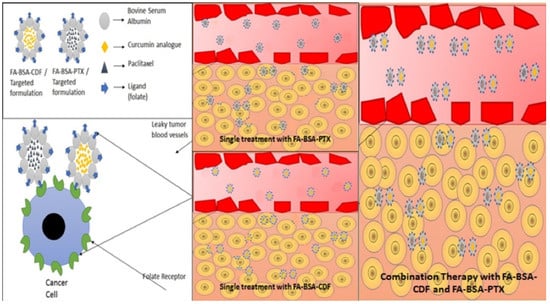
Figure 1.
Mechanism of receptor-mediated endocytosis for tumor cell-targeted delivery and internalization of combination drugs. The albumin base nanoparticles co-loaded with drugs can take advantage of leaky tumor vasculature or the EPR effect to accumulate in tumor tissues, followed by folate receptor-mediated endocytosis into tumor cells overexpressing the target. Reprinted with permission from Ref. [68]. Copyright 2018 Elsevier.
As mentioned, tumor MDR has mostly remained the cause of therapeutic cancer failures. It is a significant issue in treating tumors by chemical therapy or by techniques of surgical intervention. Unfortunately, more than 70% of patients with ovarian cancer are initially resistant to the standard medications, which leads to the recurrence of the disease [72]. Numerous reports revealed that overcoming MDR may minimize the risk of chemotherapy failure, which has a significant therapeutic benefit. Therefore, MDR reversal has emerged as a key area of interest in developing new chemotherapy medicines [73]. With this in mind, Liu et al. revealed that PTX and Cur incorporated into PLGA-phospholipid nanoparticles had increased solubility and stability and a delayed release pattern. As a result of improved drug delivery to the target site, Cur significantly enhanced the intracellular concentration of PTX in cancerous cells to increase its anti-cancer efficacy. This was because Cur dramatically lowers the P-gp level in drug-resistant ovarian cancer cells. Accordingly, the dual drug-loaded PLGA phospholipid nanohybrids were capable of defeating MDR and boosting the efficacy of chemotherapy medications [74]. Recently, a “core–shell” polymeric nanoparticle-mediated Cur and PTX co-delivery platform originated to reduce adverse effects, invert chemoresistance, and enhance the effectiveness of PTX in ovarian cancer. On chemosensitive human ovarian cancer cells (SKOV3) and their MDR variant (SKOV3-TR30), nanocarrier-mediated co-delivery of Cur and PTX caused synergistic anti-cancer impacts in vitro and in vivo. The action of nanosystems in impeding the P-gp-mediated efflux and inhibiting the migration of tumor cells, along with Cur function in reversing the P-gp-induced resistance to PTX, is suggested as the mechanism responsible for reversing drug resistance. It is important to point out that the therapy did not result in a considerable amount of toxicity being caused to the uterus or the ovaries, as shown by macroscopic and microscopic examinations. As a potential technique for treating ovarian cancer, co-delivery of Cur and PTX using targeted delivery nanosystems may boost the anti-tumor activity without raising adverse events [75].
It is noteworthy to mention that Cur has been utilized as a photosensitizer in the context of photodynamic therapy (PDT) for a wide range of malignancies [76,77,78]. PDT is an innovative method harnessing light-sensitive agents and a light source to eliminate abnormal cells by inducing oxidative stress. When combined with nanotechnology, PDT confers more effective and tailored therapeutic impacts [79]. The study by Zhang et al. investigated the combined chemotherapeutic and photosensitizing effects of Cur on melanoma cancer cells. The curcumin-loaded nanoparticles were demonstrated to effectively decrease the expression of hypoxia-inducible factor 1-alpha (HIF-1α) and deplete glutathione, thereby enhancing the vulnerability of cancer cells to PDT. During laser irradiation, Cur exhibited photosensitizing properties, leading to the generation of ROS and the subsequent eradication of B16F10 cells [80]. In a similar context, a recent study examined the potential of curcumin- and cisplatin-loaded mesoporous silica nanoparticles for synergistic chemo-PDT against drug-resistant human uterine sarcoma cells. The hybrid nanocomposites successfully transported Cur and cisplatin into the target cells, where the presence of Cur photosensitizer also increased cellular ROS levels under light irradiation. The integrated approach yielded a remarkable synergistic anti-cancer outcome in eradicating resistant cancer cells [81].
Intriguingly, Cur-loaded nanoparticles may be modified in a way that enables the invention of imaging-guided chemotherapeutics. A study by Liu et al. reported that applying a poly-dopamine coating on Cur-loaded 2D nanosheets resulted in the acquisition of multimodal imaging capabilities, facilitating the noninvasive visualization of distribution profiles specifically within the tumor region. In vivo experiments confirmed that the nanoparticles provided imaging-guided tumor chemo-PDT under laser irradiation, with minimal toxicity to surrounding normal tissues [82]. In a further endeavor, Cur-loaded, gadolinium-doped hollow silica nanospheres were engineered to enable magnetic resonance imaging (MRI)-guided synergistic cancer sonodynamic-chemotherapy. Given its substantially greater tissue penetration depth, sonodynamic therapy (SDT) exhibits substantial benefits over PDT. The delivery platforms leveraged the pH-responsive destruction and ultrasound-triggered drug release mechanisms. Moreover, the liberation of gadolinium ions or oligomers during degradation acts as a highly efficient contrast agent for MRI, facilitating the precise direction of cancer treatment. These nanoparticles exhibited an impressive tumor growth inhibition rate of approximately 85.6% when subjected to ultrasound irradiation, primarily attributed to the synergistic effect of sonodynamic-chemotherapy [83]. Sheng et al. employed an innovative strategy to achieve a multiplex imaging-guided programmed delivery of DOX and Cur using a self-fluorescent nanoparticles/hydrogel system composed of PEG and polycaprolactone (PCL) polymer. With the devised platform, DOX and CUR could be administered in a controlled fashion over time, which could be tracked in real-time, in vitro and in vivo [84].
Because of their synergistically enhanced apoptotic death of cancer cells through stimulating multiple signaling pathways, combinations of natural agents have garnered much interest in cancer therapy. However, the hydrophobic character of most biological substances, along with their poor bioavailability and limited cellular absorption, severely limited their therapeutic use [85,86]. As a solution, originating delivery systems increasing phytochemicals pharmacokinetics and delivery might improve their clinical anti-cancer impacts [87]. For instance, a nanoliposomal TriCurin (Cur, epicatechin gallate, and resveratrol) induced p53 function in cultured GL261 murine GBM cells to provoke apoptosis of GBM and GBM stem cells in vitro [88]. In Table 2, we demonstrated some potential combinational-regimen-based Cur with other natural products in various cancer cells.
Table 2.
Cur in combination with other phytochemicals in cancer therapy.
6. Conclusions
Combination therapy is one of the solutions for preventing the emergence of drug resistance and severe adverse effects, as well as improving the effectiveness of treatments for malignancies. With this in mind, numerous experiments examined the potential of phytochemicals as adjuvants to standard chemotherapy protocols and found encouraging results. Cur is one such compound that possesses apoptotic effects and suppresses multi-drug resistance mechanisms in cancerous cells, promoting the anti-cancer impacts of chemotherapy drugs and attenuating the likelihood of drug resistance. Furthermore, nano-drug carriers co-delivering Cur and chemotherapeutics to the site of action add value to the treatment. Overall, joining Cur to chemotherapy protocols seems a beneficial approach in cancer therapy; however, further research for developing drug delivery systems and determining treatment efficacy in clinical settings is demanded.
Author Contributions
A.R.A. and M.S. wrote the original draft; P.K. and A.S. critically revised the manuscript and supervised the project. All authors have read and agreed to the published version of the manuscript.
Funding
This research received no external funding.
Data Availability Statement
Not applicable.
Conflicts of Interest
The authors declare no conflict of interest.
References
- Mokhtari, R.B.; Homayouni, T.S.; Baluch, N.; Morgatskaya, E.; Kumar, S.; Das, B.; Yeger, H. Combination therapy in combating cancer. Oncotarget 2017, 8, 38022. [Google Scholar] [CrossRef] [PubMed]
- Shimamura, S.S.; Shukuya, T.; Asao, T.; Hayakawa, D.; Kurokawa, K.; Xu, S.; Miura, K.; Mitsuishi, Y.; Tajima, K.; Shibayama, R. Survival past five years with advanced, EGFR-mutated or ALK-rearranged non-small cell lung cancer—Is there a “tail plateau” in the survival curve of these patients? BMC Cancer 2022, 22, 323. [Google Scholar]
- McCutcheon, I.E.; Preul, M.C. Historical perspective on surgery and survival with glioblastoma: How far have we come? World Neurosurg. 2021, 149, 148–168. [Google Scholar] [PubMed]
- Caswell-Jin, J.L.; Plevritis, S.K.; Tian, L.; Cadham, C.J.; Xu, C.; Stout, N.K.; Sledge, G.W.; Mandelblatt, J.S.; Kurian, A.W. Change in survival in metastatic breast cancer with treatment advances: Meta-analysis and systematic review. JNCI Cancer Spectr. 2018, 2, pky062. [Google Scholar]
- Zugazagoitia, J.; Guedes, C.; Ponce, S.; Ferrer, I.; Molina-Pinelo, S.; Paz-Ares, L. Current challenges in cancer treatment. Clin. Ther. 2016, 38, 1551–1566. [Google Scholar]
- Khatoon, E.; Banik, K.; Harsha, C.; Sailo, B.L.; Thakur, K.K.; Khwairakpam, A.D.; Vikkurthi, R.; Devi, T.B.; Gupta, S.C.; Kunnumakkara, A.B. (Eds.) Phytochemicals in cancer cell chemosensitization: Current knowledge and future perspectives. In Seminars in Cancer Biology; Elsevier: Amsterdam, The Netherlands, 2020. [Google Scholar]
- Sanati, M.; Afshari, A.R.; Ahmadi, S.S.; Moallem, S.A.; Sahebkar, A. Modulation of the ubiquitin-proteasome system by phytochemicals: Therapeutic implications in malignancies with an emphasis on brain tumors. BioFactors, 2023; early view. [Google Scholar] [CrossRef]
- Sanati, M.; Afshari, A.R.; Amini, J.; Mollazadeh, H.; Jamialahmadi, T.; Sahebkar, A. Targeting angiogenesis in gliomas: Potential role of phytochemicals. J. Funct. Foods 2022, 96, 105192. [Google Scholar]
- Hassanzadeh, S.; Read, M.I.; Bland, A.R.; Majeed, M.; Jamialahmadi, T.; Sahebkar, A. Curcumin: An inflammasome silencer. Pharmacol. Res. 2020, 159, 104921. [Google Scholar] [CrossRef]
- Heidari, Z.; Daei, M.; Boozari, M.; Jamialahmadi, T.; Sahebkar, A. Curcumin supplementation in pediatric patients: A systematic review of current clinical evidence. Phytother. Res. 2022, 36, 1442–1458. [Google Scholar] [CrossRef]
- Keihanian, F.; Saeidinia, A.; Bagheri, R.K.; Johnston, T.P.; Sahebkar, A. Curcumin, hemostasis, thrombosis, and coagulation. J. Cell. Physiol. 2018, 233, 4497–4511. [Google Scholar] [CrossRef]
- Khayatan, D.; Razavi, S.M.; Arab, Z.N.; Niknejad, A.H.; Nouri, K.; Momtaz, S.; Gumpricht, E.; Jamialahmadi, T.; Abdolghaffari, A.H.; Barreto, G.E.; et al. Protective effects of curcumin against traumatic brain injury. Biomed. Pharmacother. 2022, 154, 113621. [Google Scholar] [CrossRef]
- Mokhtari-Zaer, A.; Marefati, N.; Atkin, S.L.; Butler, A.E.; Sahebkar, A. The protective role of curcumin in myocardial ischemia–reperfusion injury. J. Cell. Physiol. 2018, 234, 214–222. [Google Scholar] [CrossRef]
- Momtazi, A.A.; Sahebkar, A. Difluorinated curcumin: A promising curcumin analogue with improved anti-tumor activity and pharmacokinetic profile. Curr. Pharm. Des. 2016, 22, 4386–4397. [Google Scholar] [CrossRef]
- Momtazi-Borojeni, A.A.; Haftcheshmeh, S.M.; Esmaeili, S.A.; Johnston, T.P.; Abdollahi, E.; Sahebkar, A. Curcumin: A natural modulator of immune cells in systemic lupus erythematosus. Autoimmun. Rev. 2018, 17, 125–135. [Google Scholar] [CrossRef]
- Sahebkar, A. Molecular mechanisms for curcumin benefits against ischemic injury. Fertil. Steril. 2010, 94, e75–e76. [Google Scholar] [CrossRef]
- Marjaneh, R.M.; Rahmani, F.; Hassanian, S.M.; Rezaei, N.; Hashemzehi, M.; Bahrami, A.; Ariakia, F.; Fiuji, H.; Sahebkar, A.; Avan, A.; et al. Phytosomal curcumin inhibits tumor growth in colitis-associated colorectal cancer. J. Cell. Physiol. 2018, 233, 6785–6798. [Google Scholar] [CrossRef]
- Gall Troselj, K.; Novak Kujundzic, R. Curcumin in combined cancer therapy. Curr. Pharm. Des. 2014, 20, 6682–6696. [Google Scholar] [CrossRef]
- Mohajeri, M.; Sahebkar, A. Protective effects of curcumin against doxorubicin-induced toxicity and resistance: A review. Crit. Rev. Oncol./Hematol. 2018, 122, 30–51. [Google Scholar] [CrossRef]
- Hegde, M.; Girisa, S.; BharathwajChetty, B.; Vishwa, R.; Kunnumakkara, A.B. Curcumin Formulations for Better Bioavailability: What We Learned from Clinical Trials Thus Far? ACS Omega 2023, 8, 10713–10746. [Google Scholar] [CrossRef]
- Arslan, A.K.K.; Uzunhisarcıklı, E.; Yerer, M.B.; Bishayee, A. The golden spice curcumin in cancer: A perspective on finalized clinical trials during the last 10 years. J. Cancer Res. Ther. 2022, 18, 19–26. [Google Scholar]
- Batra, H.; Pawar, S.; Bahl, D. Curcumin in combination with anti-cancer drugs: A nanomedicine review. Pharmacol. Res. 2019, 139, 91–105. [Google Scholar] [CrossRef] [PubMed]
- Nezhadi, S.; Saadat, E.; Handali, S.; Dorkoosh, F. Nanomedicine and chemotherapeutics drug delivery: Challenges and opportunities. J. Drug Target. 2021, 29, 185–198. [Google Scholar] [CrossRef] [PubMed]
- Biller, L.H.; Schrag, D. Diagnosis and treatment of metastatic colorectal cancer: A review. JAMA 2021, 325, 669–685. [Google Scholar]
- Shakibaei, M.; Buhrmann, C.; Kraehe, P.; Shayan, P.; Lueders, C.; Goel, A. Curcumin chemosensitizes 5-fluorouracil resistant MMR-deficient human colon cancer cells in high density cultures. PLoS ONE 2014, 9, e85397. [Google Scholar]
- Shakibaei, M.; Mobasheri, A.; Lueders, C.; Busch, F.; Shayan, P.; Goel, A. Curcumin enhances the effect of chemotherapy against colorectal cancer cells by inhibition of NF-κB and Src protein kinase signaling pathways. PLoS ONE 2013, 8, e57218. [Google Scholar]
- Shakibaei, M.; Kraehe, P.; Popper, B.; Shayan, P.; Goel, A.; Buhrmann, C. Curcumin potentiates antitumor activity of 5-fluorouracil in a 3D alginate tumor microenvironment of colorectal cancer. BMC Cancer 2015, 15, 250. [Google Scholar] [CrossRef]
- Zhang, P.; Lai, Z.-L.; Chen, H.-F.; Zhang, M.; Wang, A.; Jia, T.; Sun, W.-Q.; Zhu, X.-M.; Chen, X.-F.; Zhao, Z. Curcumin synergizes with 5-fluorouracil by impairing AMPK/ULK1-dependent autophagy, AKT activity and enhancing apoptosis in colon cancer cells with tumor growth inhibition in xenograft mice. J. Exp. Clin. Cancer Res. 2017, 36, 190. [Google Scholar] [CrossRef]
- Meiyanto, E.; Septisetyani, E.P.; Larasati, Y.A.; Kawaichi, M. Curcumin analog pentagamavunon-1 (PGV-1) sensitizes Widr cells to 5-fluorouracil through inhibition of NF-κB activation. Asian Pac. J. Cancer Prev. APJCP 2018, 19, 49. [Google Scholar]
- Lu, W.-D.; Qin, Y.; Yang, C.; Li, L. Effect of curcumin on human colon cancer multidrug resistance in vitro and in vivo. Clinics 2013, 68, 694–701. [Google Scholar] [CrossRef]
- Toden, S.; Okugawa, Y.; Jascur, T.; Wodarz, D.; Komarova, N.L.; Buhrmann, C.; Shakibaei, M.; Boland, C.R.; Goel, A. Curcumin mediates chemosensitization to 5-fluorouracil through miRNA-induced suppression of epithelial-to-mesenchymal transition in chemoresistant colorectal cancer. Carcinogenesis 2015, 36, 355–367. [Google Scholar] [CrossRef]
- Lu, Y.; Zhang, R.; Zhang, X.; Zhang, B.; Yao, Q. Curcumin may reverse 5-fluorouracil resistance on colonic cancer cells by regulating TET1-NKD-Wnt signal pathway to inhibit the EMT progress. Biomed. Pharmacother. 2020, 129, 110381. [Google Scholar] [CrossRef]
- Yin, J.; Wang, L.; Wang, Y.; Shen, H.; Wang, X.; Wu, L. Curcumin reverses oxaliplatin resistance in human colorectal cancer via regulation of TGF-β/Smad2/3 signaling pathway. OncoTargets Ther. 2019, 12, 3893. [Google Scholar]
- Anitha, A.; Deepa, N.; Chennazhi, K.; Lakshmanan, V.-K.; Jayakumar, R. Combinatorial anticancer effects of curcumin and 5-fluorouracil loaded thiolated chitosan nanoparticles towards colon cancer treatment. Biochim. Biophys. Acta (BBA)-Gen. Subj. 2014, 1840, 2730–2743. [Google Scholar]
- Anitha, A.; Sreeranganathan, M.; Chennazhi, K.P.; Lakshmanan, V.-K.; Jayakumar, R. In vitro combinatorial anticancer effects of 5-fluorouracil and curcumin loaded N, O-carboxymethyl chitosan nanoparticles toward colon cancer and in vivo pharmacokinetic studies. Eur. J. Pharm. Biopharm. 2014, 88, 238–251. [Google Scholar] [CrossRef]
- Sesarman, A.; Tefas, L.; Sylvester, B.; Licarete, E.; Rauca, V.; Luput, L.; Patras, L.; Banciu, M.; Porfire, A. Anti-angiogenic and anti-inflammatory effects of long-circulating liposomes co-encapsulating curcumin and doxorubicin on C26 murine colon cancer cells. Pharmacol. Rep. 2018, 70, 331–339. [Google Scholar] [CrossRef]
- Yu, Y.; Kanwar, S.S.; Patel, B.B.; Nautiyal, J.; Sarkar, F.H.; Majumdar, A.P. Elimination of colon cancer stem-like cells by the combination of curcumin and FOLFOX. Transl. Oncol. 2009, 2, 321–328. [Google Scholar] [CrossRef]
- Patel, B.B.; Gupta, D.; Elliott, A.A.; Sengupta, V.; Yu, Y.; Majumdar, A.P. Curcumin targets FOLFOX-surviving colon cancer cells via inhibition of EGFRs and IGF-1R. Anticancer Res. 2010, 30, 319–325. [Google Scholar]
- James, M.I.; Iwuji, C.; Irving, G.; Karmokar, A.; Higgins, J.A.; Griffin-Teal, N.; Thomas, A.; Greaves, P.; Cai, H.; Patel, S.R. Curcumin inhibits cancer stem cell phenotypes in ex vivo models of colorectal liver metastases, and is clinically safe and tolerable in combination with FOLFOX chemotherapy. Cancer Lett. 2015, 364, 135–141. [Google Scholar] [CrossRef]
- Howells, L.M.; Iwuji, C.O.; Irving, G.R.; Barber, S.; Walter, H.; Sidat, Z.; Griffin-Teall, N.; Singh, R.; Foreman, N.; Patel, S.R. Curcumin combined with FOLFOX chemotherapy is safe and tolerable in patients with metastatic colorectal cancer in a randomized phase IIa trial. J. Nutr. 2019, 149, 1133–1139. [Google Scholar]
- Vinod, B.; Antony, J.; Nair, H.; Puliyappadamba, V.; Saikia, M.; Shyam Narayanan, S.; Bevin, A.; John Anto, R. Mechanistic evaluation of the signaling events regulating curcumin-mediated chemosensitization of breast cancer cells to 5-fluorouracil. Cell Death Dis. 2013, 4, e505. [Google Scholar] [CrossRef]
- Li, H.; Tian, J.; Wu, A.; Wang, J.; Ge, C.; Sun, Z. Self-assembled silk fibroin nanoparticles loaded with binary drugs in the treatment of breast carcinoma. Int. J. Nanomed. 2016, 11, 4373. [Google Scholar]
- Calaf, G.M.; Ponce-Cusi, R.; Carrión, F. Curcumin and paclitaxel induce cell death in breast cancer cell lines. Oncol. Rep. 2018, 40, 2381–2388. [Google Scholar] [PubMed]
- Borah, A.; Pillai, S.C.; Rochani, A.K.; Palaninathan, V.; Nakajima, Y.; Maekawa, T.; Kumar, D.S. GANT61 and curcumin-loaded PLGA nanoparticles for GLI1 and PI3K/Akt-mediated inhibition in breast adenocarcinoma. Nanotechnology 2020, 31, 185102. [Google Scholar] [CrossRef] [PubMed]
- Vakilinezhad, M.A.; Amini, A.; Dara, T.; Alipour, S. Methotrexate and Curcumin co-encapsulated PLGA nanoparticles as a potential breast cancer therapeutic system: In vitro and in vivo evaluation. Colloids Surf. B Biointerfaces 2019, 184, 110515. [Google Scholar] [PubMed]
- Jalaladdiny, S.-s.; Badoei-dalfard, A.; Karami, Z.; Sargazi, G. Co-delivery of doxorubicin and curcumin to breast cancer cells by a targeted delivery system based on Ni/Ta core-shell metal-organic framework coated with folic acid-activated chitosan nanoparticles. J. Iran. Chem. Soc. 2022, 19, 4287–4298. [Google Scholar]
- Nevedomskaya, E.; Baumgart, S.J.; Haendler, B. Recent advances in prostate cancer treatment and drug discovery. Int. J. Mol. Sci. 2018, 19, 1359. [Google Scholar]
- Banerjee, S.; Singh, S.K.; Chowdhury, I.; Lillard Jr, J.W.; Singh, R. Combinatorial effect of curcumin with docetaxel modulates apoptotic and cell survival molecules in prostate cancer. Front. Biosci. (Elite Ed.) 2017, 9, 235. [Google Scholar]
- Mahammedi, H.; Planchat, E.; Pouget, M.; Durando, X.; Curé, H.; Guy, L.; Van-Praagh, I.; Savareux, L.; Atger, M.; Bayet-Robert, M. The new combination docetaxel, prednisone and curcumin in patients with castration-resistant prostate cancer: A pilot phase II study. Oncology 2016, 90, 69–78. [Google Scholar]
- Vatankhah, M.A.; Panahizadeh, R.; Nejati-Koshki, K.; Arabzadeh, M.; Arabzadeh, A.A.; Najafzadeh, N. Curcumin Upregulates miR-148a to Increase the Chemosensitivity of CD44-Positive Prostate Cancer Stem Cells to Paclitaxel Through Targeting the MSK1/IRS1 axis. Drug Res. 2022, 72, 457–465. [Google Scholar]
- Eslami, S.S.; Jafari, D.; Montazeri, H.; Sadeghizadeh, M.; Tarighi, P. Combination of curcumin and metformin inhibits cell growth and induces apoptosis without affecting the cell cycle in LNCaP prostate cancer cell line. Nutr. Cancer 2021, 73, 1026–1039. [Google Scholar] [CrossRef]
- Chen, Y.; Deng, Y.; Zhu, C.; Xiang, C. Anti prostate cancer therapy: Aptamer-functionalized, curcumin and cabazitaxel co-delivered, tumor targeted lipid-polymer hybrid nanoparticles. Biomed. Pharmacother. 2020, 127, 110181. [Google Scholar]
- Fratantonio, D.; Molonia, M.S.; Bashllari, R.; Muscarà, C.; Ferlazzo, G.; Costa, G.; Saija, A.; Cimino, F.; Speciale, A. Curcumin potentiates the antitumor activity of Paclitaxel in rat glioma C6 cells. Phytomedicine 2019, 55, 23–30. [Google Scholar] [CrossRef]
- Zhou, X.; Wang, W.; Li, P.; Zheng, Z.; Tu, Y.; Zhang, Y.; You, T. Curcumin enhances the effects of 5-fluorouracil and oxaliplatin in inducing gastric cancer cell apoptosis both in vitro and in vivo. Oncol. Res. 2016, 23, 29. [Google Scholar]
- Yang, H.; Huang, S.; Wei, Y.; Cao, S.; Pi, C.; Feng, T.; Liang, J.; Zhao, L.; Ren, G. Curcumin enhances the anticancer effect of 5-fluorouracil against gastric cancer through down-regulation of COX-2 and NF-κB signaling pathways. J. Cancer 2017, 8, 3697. [Google Scholar]
- Wen, C.; Fu, L.; Huang, J.; Dai, Y.; Wang, B.; Xu, G.; Wu, L.; Zhou, H. Curcumin reverses doxorubicin resistance via inhibition the efflux function of ABCB4 in doxorubicin-resistant breast cancer cells. Mol. Med. Rep. 2019, 19, 5162–5168. [Google Scholar]
- Zou, J.; Zhu, L.; Jiang, X.; Wang, Y.; Wang, Y.; Wang, X.; Chen, B. Curcumin increases breast cancer cell sensitivity to cisplatin by decreasing FEN1 expression. Oncotarget 2018, 9, 11268. [Google Scholar]
- Su, P.; Yang, Y.; Wang, G.; Chen, X.; Ju, Y. Curcumin attenuates resistance to irinotecan via induction of apoptosis of cancer stem cells in chemoresistant colon cancer cells. Int. J. Oncol. 2018, 53, 1343–1353. [Google Scholar]
- Firouzi Amoodizaj, F.; Baghaeifar, S.; Taheri, E.; Farhoudi Sefidan Jadid, M.; Safi, M.; Seyyed Sani, N.; Hajazimian, S.; Isazadeh, A.; Shanehbandi, D. Enhanced anticancer potency of doxorubicin in combination with curcumin in gastric adenocarcinoma. J. Biochem. Mol. Toxicol. 2020, 34, e22486. [Google Scholar] [CrossRef]
- Namkaew, J.; Jaroonwitchawan, T.; Rujanapun, N.; Saelee, J.; Noisa, P. Combined effects of curcumin and doxorubicin on cell death and cell migration of SH-SY5Y human neuroblastoma cells. Vitr. Cell. Dev. Biol.-Anim. 2018, 54, 629–639. [Google Scholar]
- Chen, P.; Huang, H.-P.; Wang, Y.; Jin, J.; Long, W.-G.; Chen, K.; Zhao, X.-H.; Chen, C.-G.; Li, J. Curcumin overcome primary gefitinib resistance in non-small-cell lung cancer cells through inducing autophagy-related cell death. J. Exp. Clin. Cancer Res. 2019, 38, 254. [Google Scholar]
- Zhang, W.; Shi, H.; Chen, C.; Ren, K.; Xu, Y.; Liu, X.; He, L. Curcumin enhances cisplatin sensitivity of human NSCLC cell lines through influencing Cu-Sp1-CTR1 regulatory loop. Phytomedicine 2018, 48, 51–61. [Google Scholar] [PubMed]
- Gökçe Kütük, S.; Gökçe, G.; Kütük, M.; Gürses Cila, H.E.; Nazıroğlu, M. Curcumin enhances cisplatin-induced human laryngeal squamous cancer cell death through activation of TRPM2 channel and mitochondrial oxidative stress. Sci. Rep. 2019, 9, 17784. [Google Scholar] [PubMed]
- Cho, C.J.; Yang, C.W.; Wu, C.L.; Ho, J.Y.; Yu, C.P.; Wu, S.T.; Yu, D.S. The modulation study of multiple drug resistance in bladder cancer by curcumin and resveratrol. Oncol. Lett. 2019, 18, 6869–6876. [Google Scholar] [PubMed]
- Chen, C.F.; Lu, C.C.; Chiang, J.H.; Chiu, H.Y.; Yang, J.S.; Lee, C.Y.; Way, T.D.; Huang, H.J. Synergistic inhibitory effects of cetuximab and curcumin on human cisplatin-resistant oral cancer CAR cells through intrinsic apoptotic process. Oncol. Lett. 2018, 16, 6323–6330. [Google Scholar] [PubMed]
- Abdallah, F.M.; Helmy, M.W.; Katary, M.A.; Ghoneim, A.I. Synergistic antiproliferative effects of curcumin and celecoxib in hepatocellular carcinoma HepG2 cells. Naunyn-Schmiedebergs Arch. Pharmacol. 2018, 391, 1399–1410. [Google Scholar]
- Seo, S.U.; Woo, S.M.; Lee, H.-S.; Kim, S.H.; Min, K.-j.; Kwon, T.K. mTORC1/2 inhibitor and curcumin induce apoptosis through lysosomal membrane permeabilization-mediated autophagy. Oncogene 2018, 37, 5205–5220. [Google Scholar]
- Gawde, K.A.; Sau, S.; Tatiparti, K.; Kashaw, S.K.; Mehrmohammadi, M.; Azmi, A.S.; Iyer, A.K. Paclitaxel and di-fluorinated curcumin loaded in albumin nanoparticles for targeted synergistic combination therapy of ovarian and cervical cancers. Colloids Surf. B Biointerfaces 2018, 167, 8–19. [Google Scholar]
- Cheng, Y.; Zhao, P.; Wu, S.; Yang, T.; Chen, Y.; Zhang, X.; He, C.; Zheng, C.; Li, K.; Ma, X. Cisplatin and curcumin co-loaded nano-liposomes for the treatment of hepatocellular carcinoma. Int. J. Pharm. 2018, 545, 261–273. [Google Scholar]
- Hong, Y.; Che, S.; Hui, B.; Yang, Y.; Wang, X.; Zhang, X.; Qiang, Y.; Ma, H. Lung cancer therapy using doxorubicin and curcumin combination: Targeted prodrug based, pH sensitive nanomedicine. Biomed. Pharmacother. 2019, 112, 108614. [Google Scholar]
- Guo, W.; Song, Y.; Song, W.; Liu, Y.; Liu, Z.; Zhang, D.; Tang, Z.; Bai, O. Co-delivery of doxorubicin and curcumin with polypeptide nanocarrier for synergistic lymphoma therapy. Sci. Rep. 2020, 10, 7832. [Google Scholar]
- Gao, B.; Yang, F.; Chen, W.; Li, R.; Hu, X.; Liang, Y.; Li, D. Multidrug resistance affects the prognosis of primary epithelial ovarian cancer. Oncol. Lett. 2019, 18, 4262–4269. [Google Scholar]
- Engle, K.; Kumar, G. Cancer multidrug-resistance reversal by ABCB1 inhibition: A recent update. Eur. J. Med. Chem. 2022, 239, 114542. [Google Scholar]
- Liu, Z.; Zhu, Y.-Y.; Li, Z.-Y.; Ning, S.-Q. Evaluation of the efficacy of paclitaxel with curcumin combination in ovarian cancer cells. Oncol. Lett. 2016, 12, 3944–3948. [Google Scholar] [CrossRef][Green Version]
- Zhao, M.-D.; Li, J.-Q.; Chen, F.-Y.; Dong, W.; Wen, L.-J.; Fei, W.-D.; Zhang, X.; Yang, P.-L.; Zhang, X.-M.; Zheng, C.-H. Co-delivery of curcumin and paclitaxel by “core-shell” targeting amphiphilic copolymer to reverse resistance in the treatment of ovarian cancer. Int. J. Nanomed. 2019, 14, 9453. [Google Scholar]
- Duse, L.; Agel, M.R.; Pinnapireddy, S.R.; Schäfer, J.; Selo, M.A.; Ehrhardt, C.; Bakowsky, U. Photodynamic therapy of ovarian carcinoma cells with curcumin-loaded biodegradable polymeric nanoparticles. Pharmaceutics 2019, 11, 282. [Google Scholar] [CrossRef]
- Kuang, G.; Zhang, Q.; He, S.; Liu, Y. Curcumin-loaded PEGylated mesoporous silica nanoparticles for effective photodynamic therapy. RSC Adv. 2020, 10, 24624–24630. [Google Scholar] [CrossRef]
- Abdel Fadeel, D.A.; Kamel, R.; Fadel, M. PEGylated lipid nanocarrier for enhancing photodynamic therapy of skin carcinoma using curcumin: In-vitro/in-vivo studies and histopathological examination. Sci. Rep. 2020, 10, 10435. [Google Scholar]
- Li, S.; Yang, F.; Wang, Y.; Du, T.; Hou, X. Emerging nanotherapeutics for facilitating photodynamic therapy. Chem. Eng. J. 2023, 451, 138621. [Google Scholar] [CrossRef]
- Zhang, Z.; Wang, R.; Huang, X.; Luo, R.; Xue, J.; Gao, J.; Liu, W.; Liu, F.; Feng, F.; Qu, W. Self-delivered and self-monitored chemo-photodynamic nanoparticles with light-triggered synergistic antitumor therapies by downregulation of HIF-1α and depletion of GSH. ACS Appl. Mater. Interfaces 2020, 12, 5680–5694. [Google Scholar]
- Busa, P.; Kankala, R.K.; Deng, J.-P.; Liu, C.-L.; Lee, C.-H. Conquering cancer multi-drug resistance using curcumin and cisplatin prodrug-encapsulated mesoporous silica nanoparticles for synergistic chemo-and photodynamic therapies. Nanomaterials 2022, 12, 3693. [Google Scholar] [CrossRef]
- Liu, F.; Lin, L.; Zhang, Y.; Sheng, S.; Wang, Y.; Xu, C.; Tian, H.; Chen, X. Two-dimensional nanosheets with high curcumin loading content for multimodal imaging-guided combined chemo-photothermal therapy. Biomaterials 2019, 223, 119470. [Google Scholar] [PubMed]
- Tian, Y.; Liu, Y.; Wang, L.; Guo, X.; Liu, Y.; Mou, J.; Wu, H.; Yang, S. Gadolinium-doped hollow silica nanospheres loaded with curcumin for magnetic resonance imaging-guided synergistic cancer sonodynamic-chemotherapy. Mater. Sci. Eng. C 2021, 126, 112157. [Google Scholar]
- Sheng, S.; Wei, C.; Ma, T.; Zhang, Y.; Zhu, D.; Dong, X.; Lv, F. Multiplex fluorescence imaging-guided programmed delivery of doxorubicin and curcumin from a nanoparticles/hydrogel system for synergistic chemotherapy. J. Polym. Sci. 2022, 60, 1557–1570. [Google Scholar]
- Rizeq, B.; Gupta, I.; Ilesanmi, J.; AlSafran, M.; Rahman, M.M.; Ouhtit, A. The power of phytochemicals combination in cancer chemoprevention. J. Cancer 2020, 11, 4521. [Google Scholar] [CrossRef] [PubMed]
- WS Ho, J.; WM Cheung, M. Combination of phytochemicals as adjuvants for cancer therapy. Recent Pat. Anti-Cancer Drug Discov. 2014, 9, 297–302. [Google Scholar]
- Xie, J.; Yang, Z.; Zhou, C.; Zhu, J.; Lee, R.J.; Teng, L. Nanotechnology for the delivery of phytochemicals in cancer therapy. Biotechnol. Adv. 2016, 34, 343–353. [Google Scholar] [CrossRef]
- Mukherjee, S.; Baidoo, J.N.; Sampat, S.; Mancuso, A.; David, L.; Cohen, L.S.; Zhou, S.; Banerjee, P. Liposomal TriCurin, a synergistic combination of curcumin, epicatechin gallate and resveratrol, repolarizes tumor-associated microglia/macrophages, and eliminates glioblastoma (GBM) and GBM stem cells. Molecules 2018, 23, 201. [Google Scholar] [CrossRef]
- Swamy, M.V.; Citineni, B.; Patlolla, J.M.; Mohammed, A.; Zhang, Y.; Rao, C.V. Prevention and treatment of pancreatic cancer by curcumin in combination with omega-3 fatty acids. Nutr. Cancer 2008, 60 (Suppl. S1), 81–89. [Google Scholar] [CrossRef]
- Ravindranathan, P.; Pasham, D.; Balaji, U.; Cardenas, J.; Gu, J.; Toden, S.; Goel, A. A combination of curcumin and oligomeric proanthocyanidins offer superior anti-tumorigenic properties in colorectal cancer. Sci. Rep. 2018, 8, 13869. [Google Scholar]
- Bolat, Z.B.; Islek, Z.; Demir, B.N.; Yilmaz, E.N.; Sahin, F.; Ucisik, M.H. Curcumin-and piperine-loaded emulsomes as combinational treatment approach enhance the anticancer activity of curcumin on HCT116 colorectal cancer model. Front. Bioeng. Biotechnol. 2020, 8, 50. [Google Scholar]
- Gavrilas, L.I.; Cruceriu, D.; Ionescu, C.; Miere, D.; Balacescu, O. Pro-apoptotic genes as new targets for single and combinatorial treatments with resveratrol and curcumin in colorectal cancer. Food Funct. 2019, 10, 3717–3726. [Google Scholar] [CrossRef]
- Kundur, S.; Prayag, A.; Selvakumar, P.; Nguyen, H.; McKee, L.; Cruz, C.; Srinivasan, A.; Shoyele, S.; Lakshmikuttyamma, A. Synergistic anticancer action of quercetin and curcumin against triple-negative breast cancer cell lines. J. Cell. Physiol. 2019, 234, 11103–11118. [Google Scholar] [CrossRef]
- El-Far, A.H.; Saddiq, A.A.; Mohamed, S.A.; Almaghrabi, O.A.; Mousa, S.A. Curcumin and Thymoquinone Combination Attenuates Breast Cancer Cell Lines’ Progression. Integr. Cancer Ther. 2022, 21, 15347354221099537. [Google Scholar]
- Moghtaderi, H.; Sepehri, H.; Delphi, L.; Attari, F. Gallic acid and curcumin induce cytotoxicity and apoptosis in human breast cancer cell MDA-MB-231. BioImpacts BI 2018, 8, 185. [Google Scholar] [CrossRef]
- Mansourizadeh, F.; Alberti, D.; Bitonto, V.; Tripepi, M.; Sepehri, H.; Khoee, S.; Crich, S.G. Efficient synergistic combination effect of Quercetin with Curcumin on breast cancer cell apoptosis through their loading into Apo ferritin cavity. Colloids Surf. B: Biointerfaces 2020, 191, 110982. [Google Scholar]
- Javan, N.; Khadem Ansari, M.H.; Dadashpour, M.; Khojastehfard, M.; Bastami, M.; Rahmati-Yamchi, M.; Zarghami, N. Synergistic antiproliferative effects of co-nanoencapsulated curcumin and chrysin on mda-mb-231 breast cancer cells through upregulating mir-132 and mir-502c. Nutr. Cancer 2019, 71, 1201–1213. [Google Scholar] [CrossRef]
- Srivastava, N.S.; Srivastava, R.A.K. Curcumin and quercetin synergistically inhibit cancer cell proliferation in multiple cancer cells and modulate Wnt/β-catenin signaling and apoptotic pathways in A375 cells. Phytomedicine 2019, 52, 117–128. [Google Scholar]
- Mutlu Altundağ, E.; Yılmaz, A.M.; Koçtürk, S.; Taga, Y.; Yalçın, A.S. Synergistic induction of apoptosis by quercetin and curcumin in chronic myeloid leukemia (K562) cells. Nutr. Cancer 2018, 70, 97–108. [Google Scholar]
- Muhanmode, Y.; Wen, M.K.; Maitinuri, A.; Shen, G. Curcumin and resveratrol inhibit chemoresistance in cisplatin-resistant epithelial ovarian cancer cells via targeting P13K pathway. Hum. Exp. Toxicol. 2022, 41, 09603271221095929. [Google Scholar] [CrossRef]
- Man, S.; Zhang, L.; Cui, J.; Yang, L.; Ma, L.; Gao, W. Curcumin enhances the anti-cancer effects of Paris Saponin II in lung cancer cells. Cell Prolif. 2018, 51, e12458. [Google Scholar] [CrossRef]
Disclaimer/Publisher’s Note: The statements, opinions and data contained in all publications are solely those of the individual author(s) and contributor(s) and not of MDPI and/or the editor(s). MDPI and/or the editor(s) disclaim responsibility for any injury to people or property resulting from any ideas, methods, instructions or products referred to in the content. |
© 2023 by the authors. Licensee MDPI, Basel, Switzerland. This article is an open access article distributed under the terms and conditions of the Creative Commons Attribution (CC BY) license (https://creativecommons.org/licenses/by/4.0/).