


Abstract
The aim of this paper is to approximate fixed points of nonexpansive type mappings in Banach spaces when the set of fixed points is nonempty. We study the general Picard–Mann (GPM) algorithm, obtaining the weak and strong convergence theorems. We provide an example to illustrate the convergence behaviour of the GPM algorithm. We compare the GPM algorithm with other existing (well known) algorithms numerically (under different parameters and initial guesses).
1. Introduction and Preliminaries
Let be a Banach space. The mapping is nonexpansive if
A point is a fixed point of if Let denote the set of fixed points of . Finding a fixed point of nonlinear mappings is an important problem and various algorithms have been used by many researchers. The Picard algorithm [1] is mostly used (simplest and popular) to find the fixed points of contractive mappings. However, for nonexpansive mappings, the Picard algorithm need not converge to a fixed point. Krasnosel’skiĭ [2], Schaefer [3] and Mann [4] proposed more general algorithms to find fixed points of nonexpansive mappings.
Many mathematicians extended and generalized the class of nonexpansive mappings in different directions, see [5]. In 2011, García-Falset et al. [6] considered the following class of mappings:
Definition 1
([6]). Let be a subset of a Banach space such that A mapping is said to satisfy condition on if there exists such that
A mapping satisfies condition (E) on whenever satisfies for some
A number of papers have been appeared in literature dealing with condition (E), see [5,7,8,9] and references therein. In the last two decades, a number of algorithms (from one step to four steps) were studied by mathematicians to improve the fastness of the algorithm, see [4,10,11,12,13,14,15,16,17,18,19,20,21,22,23,24,25,26,27,28,29,30,31,32,33,34].
Motivated by the above results, we approximate fixed points of the class of mappings satisfying condition (E). We employ general Picard–Mann (in short GPM) and obtain a number of weak and strong convergence results. We supply a numerical example and compare the GPM algorithm with various algorithms presented in Section 2.
We denote → for strong convergence, ⇀ for weak convergence, and denotes a cluster points (-limit) set of a sequence that is,
Lemma 1
([35] p. 484). Let be a uniformly convex Banach space and for all Let and be two sequences such that and hold for some Then,
Lemma 2
((Demiclosedness principle). [6]). Let be a nonempty subset of a Banach space which has the Opial property. Let be a mapping satisfying condition (E). Suppose is a sequence in such that converges weakly to ϑ and Then, That is, is demiclosed at zero.
Lemma 3
([6]). Let be a nonempty subset of a Banach space and satisfies condition (E) with . Then, is quasi-nonexpansive.
2. Various Iterative Methods (or Algorithms)
In this section, we present a number of iterative methods considered in the literature: for a given and
- Mann [4]
- Ishikawa [10]
- Noor [11]
- Agarwal et al. [12]
- Phuengrattana and Suantai [13]
- Sahu [14]Remark1.In 2013, S. H. Khan [36] introduced the same iterative method like (7) and called it the Picard–Mann hybrid iterative method.
- Chugh et al. [15]
- Karaca and Yildirim [16]
- Abbas and Nazir [17]
- Thakur et al. [18]
- Sintunavarat and Pitea [19]
- Thakur et al. [20]
- Ullah and Arshad et al. [22]
- Ullah and Arshad [23]Remark2.In 2020, F. Ali and J. Ali [37] introduced the same iterative method like (15) and called it the iterative method.
- Hussain et al. [24]
- Ullah and Arshad [25]
- Piri et al. [26]
- Bhutia and Tiwary [27]
- Garodia and Uddin [28]
- Garodia and Uddin [29], and Hussain et al. [38] (D-iterative algorithm, see also [39])Remark3.If we look at the submission dates, it can be noticed that the paper by Hussain et al. [38] has been received on 3 May 2020, while Garodia and Uddin’s paper [29] has no submission information. Thus, we cannot say which iterative method appeared first.
- Ali et al. [30]
- Ali and Ali [31]
- Hassan et al. [32]
- Rani and Arti [33]
- Ahmad et al. [34]
3. A General Picard–Mann Iterative Method
In [40], Shukla et al. proposed the following algorithm (known as GPM):
where is a sequence in , and k is a fixed natural number.
4. Convergence Theorems
In this section, we present some convergence results for the sequence generated by iterative method (27).
Lemma 4.
Let be a nonempty closed convex subset of a Banach space and a mapping satisfying condition (E) with Let be a sequence defined by (27). Then, the following assertions hold:
- (1)
- If , then exists;
- (2)
- exists, where denotes the distance from ϑto
Proof.
Let . From (27), we have
Therefore, the sequence is nonincreasing and bounded. Hence, exists for each . Therefore, exists. □
Lemma 5.
Let be a uniformly convex Banach space, and be the same as in Lemma 4 with Let be a sequence defined by (27) with for all , where Then,
Proof.
By Lemma 4, the sequence is bounded and exists. Call it r. That is,
Thus,
□
Theorem 1.
Let be a uniformly convex Banach space, and be the same as in Lemma 4 with . Let be a sequence defined by (27) with for all , where If satisfies the Opial property, then weakly converges to a point in
Proof.
By Lemma 4, the sequence is bounded and by Lemma 5, Since is uniformly convex, there exists a subsequence of that weakly converges to a point From the demiclosedness principle of (Proposition (2)), Now, we claim that is a singleton, and there is a unique weak limit for each subsequence of . This implies that weakly converges to a fixed point of . In view of the Opial property, it can be seen that is a singleton. This completes the proof. □
Theorem 2.
Let , and be the same as in Theorem 1 with and a uniformly convex Banach space. If the range of under is contained in a compact subset of , then strongly converges to a fixed point of .
Proof.
Since the range of under is contained in a compact set, there exists a subsequence of that strongly converges to By the triangle inequality, we obtain
and, by Lemma 5, the subsequence strongly converges to By the condition on mapping ,
Taking implies
and we have In view of Lemma 4, it follows that exists. Therefore, strongly converges to . □
Theorem 3.
Let, andbe the same as in Theorem 1 withanda uniformly convex Banach space withThen, the sequencestrongly converges to a fixed point ofif.
Proof.
This can be completed following Theorem 4.12 [7]. □
Theorem 4.
Let , , and be the same as in Theorem 3 with If satisfies condition , then strongly converges to a point in
Proof.
This can be completed following Theorem 4.13 [7]. □
5. Numerical Results
In this section, we present an example and employ it to compare various iterative methods for different initial guess and parameters.
Example 1.
Let be a Banach space equipped with the norm
and a subset of . Let be a mapping defined by
Now, we show that satisfies the condition (E) for , and, for this, we consider the following cases:
- Case (i)
- Let If then,Let Now, we show thatNow, we can break the above inequality into two parts. First, we show the following inequality:From the triangle inequality, we haveFrom the considered range of and , we estimate that
- Case (ii)
- Let If , then is a contractive mapping and satisfies condition (E). Let We prove the following conditions:We shall break the above inequality into two parts. First, we shall prove the following inequality:By the triangle inequality, we have
Now, we compare convergence behavior of various algorithms in view of Example (32). We make different choices of initial guesses and parameters and set as our stopping criterion (p is a fixed point of ).
Observations: In view of Table 1 and Figure 1, Figure 2, Figure 3, Figure 4, Figure 5 and Figure 6, we note that, for different choices of initial guesses and parameters, the general Picard–Mann algorithm (GPM) (27) (with ) converges faster to a fixed point of mapping satisfying condition (E) than other algorithms considered in Section 2. We also conclude that (GPM) algorithm is consistent.

Table 1.
Influence of initial guesses and parameters: comparison of various iterative methods.
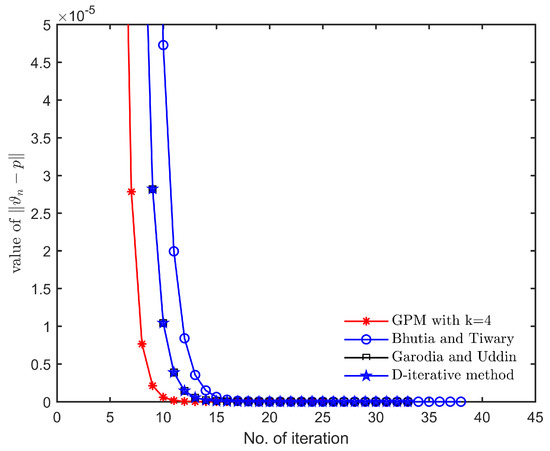
Figure 1.
Convergence behavior with parameters , and initial guess .
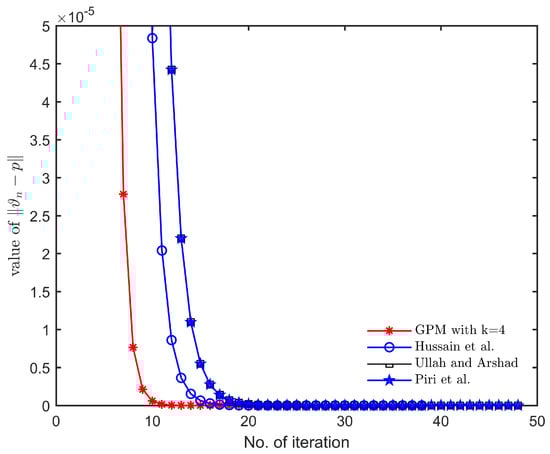
Figure 2.
Convergence behavior with parameters , and initial guess .
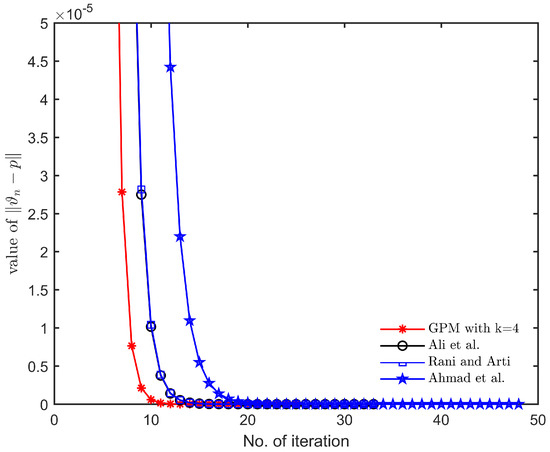
Figure 3.
Convergence behavior with parameters , and initial guess .
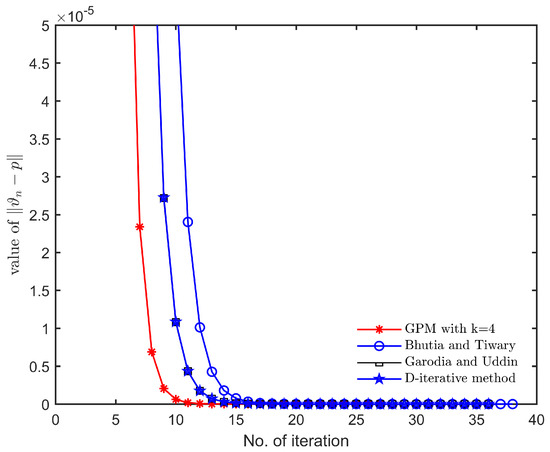
Figure 4.
Convergence behavior with parameters , and initial guess .
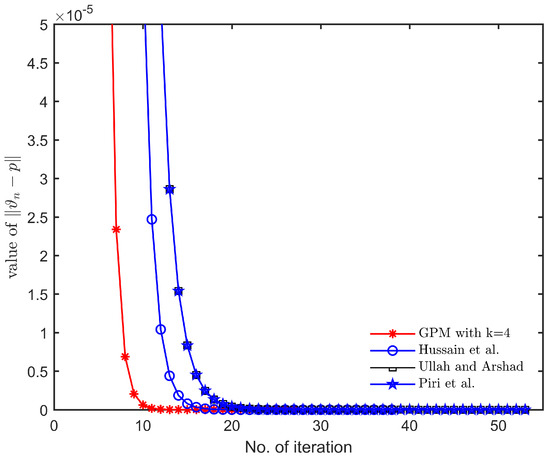
Figure 5.
Convergence behavior with parameters , and initial guess .
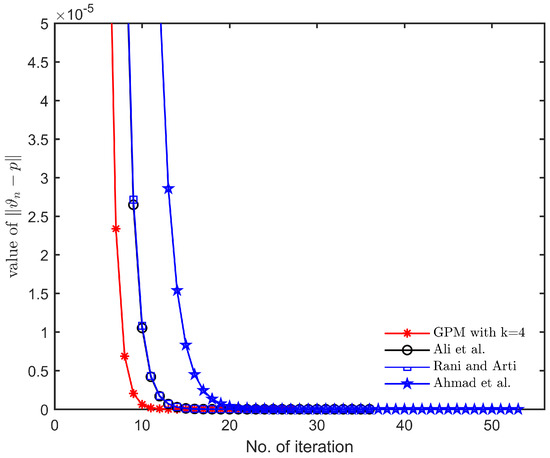
Figure 6.
Convergence behavior with parameters , and initial guess .
Author Contributions
Conceptualization, software, writing—original draft preparation, R.S., writing—review and editing, R.P. All authors have read and agreed to the published version of the manuscript.
Funding
This research received no external funding.
Institutional Review Board Statement
Not applicable.
Informed Consent Statement
Not applicable.
Data Availability Statement
Not applicable.
Acknowledgments
We are very thankful to the reviewers for their constructive comments and suggestions, which have been useful for the improvement of this paper.
Conflicts of Interest
The authors declare no conflict of interest.
References
- Picard, E. Mémoire sur la théorie des équations aux dérivées partielles et la méthodedes approximations successives. Mathématiques Pures Appliquées 1890, 6, 145–210. [Google Scholar]
- Krasnosel’skiĭ, M.A. Two remarks on the method of successive approximations. Uspehi Mat. Nauk 1955, 10, 123–127. [Google Scholar]
- Schaefer, H. Über die Methode sukzessiver Approximationen. Jber. Deutsch. Math.-Verein. 1957, 59, 131–140. [Google Scholar]
- Mann, W.R. Mean value methods in iteration. Proc. Amer. Math. Soc. 1953, 4, 506–510. [Google Scholar] [CrossRef]
- Pant, R.; Shukla, R.; Patel, P. Nonexpansive mappings, their extensions, and generalizations in Banach spaces. In Metric Fixed Point Theory—Applications in Science, Engineering and Behavioural Sciences; Forum for Interdisciplinary Mathematics; Springer: Singapore, 2021; pp. 309–343. [Google Scholar] [CrossRef]
- García-Falset, J.; Llorens-Fuster, E.; Suzuki, T. Fixed point theory for a class of generalized nonexpansive mappings. J. Math. Anal. Appl. 2011, 375, 185–195. [Google Scholar] [CrossRef]
- Pandey, R.; Pant, R.; Rakočević, V.; Shukla, R. Approximating fixed points of a general class of nonexpansive mappings in Banach spaces with applications. Results Math. 2019, 74, 7. [Google Scholar] [CrossRef]
- Pant, R.; Patel, P.; Shukla, R. Fixed point results for a class of nonexpansive type mappings in Banach spaces. Adv. Theory Nonlinear Anal. Appl. 2021, 5, 368–381. [Google Scholar] [CrossRef]
- Pant, R.; Patel, P.; Shukla, R.; De la Sen, M. Fixed point theorems for nonexpansive type mappings in Banach spaces. Symmetry 2021, 13, 585. [Google Scholar] [CrossRef]
- Ishikawa, S. Fixed points by a new iteration method. Proc. Amer. Math. Soc. 1974, 44, 147–150. [Google Scholar] [CrossRef]
- Noor, M.A. New approximation schemes for general variational inequalities. J. Math. Anal. Appl. 2000, 251, 217–229. [Google Scholar] [CrossRef]
- Agarwal, R.P.; O’Regan, D.; Sahu, D.R. Iterative construction of fixed points of nearly asymptotically nonexpansive mappings. J. Nonlinear Convex Anal. 2007, 8, 61–79. [Google Scholar]
- Phuengrattana, W.; Suantai, S. On the rate of convergence of Mann, Ishikawa, Noor and SP-iterations for continuous functions on an arbitrary interval. J. Comput. Appl. Math. 2011, 235, 3006–3014. [Google Scholar] [CrossRef]
- Sahu, D.R. Applications of the S-iteration process to constrained minimization problems and split feasibility problems. Fixed Point Theory 2011, 12, 187–204. [Google Scholar]
- Chugh, R.; Kumar, V.; Kumar, S. Strong convergence of a new three step iterative scheme in Banach spaces. Am. J. Comput. Math. 2012, 2, 345. [Google Scholar] [CrossRef] [Green Version]
- Karaca, N.; Yildirim, I. Approximating fixed points of nonexpansive mappings by a faster iteration process. J. Adv. Math. Stud. 2015, 8, 257–264. [Google Scholar]
- Abbas, M.; Nazir, T. A new faster iteration process applied to constrained minimization and feasibility problems. Mat. Vesnik 2014, 66, 223–234. [Google Scholar]
- Thakur, D.; Thakur, B.S.; Postolache, M. New iteration scheme for numerical reckoning fixed points of nonexpansive mappings. J. Inequal. Appl. 2014, 2014, 328. [Google Scholar] [CrossRef]
- Sintunavarat, W.; Pitea, A. On a new iteration scheme for numerical reckoning fixed points of Berinde mappings with convergence analysis. J. Nonlinear Sci. Appl. 2016, 9, 2553–2562. [Google Scholar] [CrossRef]
- Thakur, B.S.; Thakur, D.; Postolache, M. A new iterative scheme for numerical reckoning fixed points of Suzuki’s generalized nonexpansive mappings. Appl. Math. Comput. 2016, 275, 147–155. [Google Scholar] [CrossRef]
- Thakur, B.S.; Thakur, D.; Agarwal, R.P. Convergence theorems for total asymptotically nonexpansive mappings in CAT(0) spaces. J. Nonlinear Convex Anal. 2017, 18, 2059–2074. [Google Scholar]
- Ullah, K.; Arshad, M. New iteration process and numerical reckoning fixed points in Banach spaces. Politehn. Univ. Bucharest Sci. Bull. Ser. A Appl. Math. Phys. 2017, 79, 113–122. [Google Scholar]
- Ullah, K.; Arshad, M. Numerical reckoning fixed points for Suzukis generalized nonexpansive mappings via new iteration process. Filomat 2018, 32, 187–196. [Google Scholar] [CrossRef]
- Hussain, N.; Ullah, K.; Arshad, M. Fixed point approximation of Suzuki generalized nonexpansive mappings via new faster iteration process. J. Nonlinear Convex Anal. 2018, 19, 1383–1393. [Google Scholar]
- Ullah, K.; Arshad, M. New three-step iteration process and fixed point approximation in Banach spaces. J. Linear. Topological. Algebra. 2018, 7, 87–100. [Google Scholar]
- Piri, H.; Daraby, B.; Rahrovi, S.; Ghasemi, M. Approximating fixed points of generalized α-nonexpansive mappings in Banach spaces by new faster iteration process. Numer. Algorithms 2019, 81, 1129–1148. [Google Scholar] [CrossRef]
- Bhutia, J.; Tiwary, K. New iteration process for approximating fixed points in Banach spaces. J. Linear. Topological. Algebra. 2019, 8, 237–250. [Google Scholar]
- Garodia, C.; Uddin, I. A new fixed point algorithm for finding the solution of a delay differential equation. AIMS Math. 2020, 5, 3182–3200. [Google Scholar] [CrossRef]
- Garodia, C.; Uddin, I. A new iterative method for solving split feasibility problem. J. Appl. Anal. Comput. 2020, 10, 986–1004. [Google Scholar] [CrossRef]
- Ali, F.; Ali, J.; Nieto, J.J. Some observations on generalized non-expansive mappings with an application. Comput. Appl. Math. 2020, 39, 74. [Google Scholar] [CrossRef]
- Ali, J.; Ali, F. A new iterative scheme to approximating fixed points and the solution of a delay differential equation. J. Nonlinear Convex Anal. 2020, 21, 2151–2163. [Google Scholar]
- Hassan, S.; De la Sen, M.; Agarwal, P.; Ali, Q.; Hussain, A. A new faster iterative scheme for numerical fixed points estimation of Suzuki’s generalized nonexpansive mappings. Math. Probl. Eng. 2020, 2020, 3863819. [Google Scholar] [CrossRef]
- Rani, A.; Arti. A new iteration process for approximation of fixed points for Suzuki’s generalized non-expansive mappings in uniformly convex Banach spaces. J. Math. Comput. Sci. 2020, 10, 2110–2125. [Google Scholar]
- Ahmad, J.; Ullah, K.; Arshad, M.; Ma, Z. A New Iterative Method for Suzuki Mappings in Banach Spaces. J. Math. 2021, 2021. [Google Scholar] [CrossRef]
- Zeidler, E. Nonlinear Functional Analysis and Its Applications. I; Wadsack, P.E., Translator; Fixed-Point Theorems; Springer: New York, NY, USA, 1986; pp. xxi+897. [Google Scholar] [CrossRef]
- Khan, S.H. A Picard-Mann hybrid iterative process. Fixed Point Theory Appl. 2013, 2013, 69. [Google Scholar] [CrossRef]
- Ali, F.; Ali, J. Convergence, stability, and data dependence of a new iterative algorithm with an application. Comput. Appl. Math. 2020, 39, 267. [Google Scholar] [CrossRef]
- Hussain, A.; Ali, D.; Karapinar, E. Stability data dependency and errors estimation for a general iteration method. Alex. Eng. J. 2021, 60, 703–710. [Google Scholar] [CrossRef]
- Hussain, A.; Hussain, N.; Ali, D. Estimation of Newly Established Iterative Scheme for Generalized Nonexpansive Mappings. J. Funct. Spaces 2021, 2021, 6675979. [Google Scholar] [CrossRef]
- Shukla, R.; Pant, R.; Sinkala, W. A General Picard–Mann iterative method for approximating fixed points of nonexpansive mappings with applications. Symmetry 2022, 14, 1741. [Google Scholar] [CrossRef]
Publisher’s Note: MDPI stays neutral with regard to jurisdictional claims in published maps and institutional affiliations. |
© 2022 by the authors. Licensee MDPI, Basel, Switzerland. This article is an open access article distributed under the terms and conditions of the Creative Commons Attribution (CC BY) license (https://creativecommons.org/licenses/by/4.0/).