A Crossover Study on VR and Traditional Instruction in Engineering Education



Abstract
1. Introduction
1.1. Virtual Reality in Engineering Education
1.2. Limitations of the Existing Literature and Unresolved Issues
1.3. Rationale, Context, and Aim of the Present Study
Research Questions
- RQ1. How do perceived flow and engagement differ between the VR and Traditional conditions, both in between-condition comparisons and within-subject contrasts in this crossover setting?
- RQ2. How is the VR system’s perceived usability distributed, and to what extent is perceived usability associated with instructional sequence (VR-first vs. Trad-first)?
- RQ3. What descriptive performance patterns emerge on the short knowledge test across sequence groups and instructional conditions, and how can these patterns be used as contextual information?
- RQ4. How are pre-existing dispositions (attitudes toward emerging technologies, technology accommodation, VR interest, pre-test knowledge) associated with perceived experience measures in the VR and Traditional conditions?
- RQ5. What themes emerge from students’ open-ended feedback regarding perceived strengths, comparative advantages, difficulties, and preferred future use of VR in relation to traditional instruction?
2. Related Work
Conceptual Framing for Perceived Experience and User Acceptance
3. Experimental Design
3.1. Participants
3.2. Materials and Instructional Content
3.2.1. VR Lesson
3.2.2. Traditional Lesson
3.3. Instruments
3.4. Procedure
3.5. Data Analysis
- Data screening and reliability. Internal consistency for the FSS, UES, and SUS scales was assessed using Cronbach’s (), calculated for each relevant session frame (Sequence × Period × Condition) to examine measurement reliability across the design.
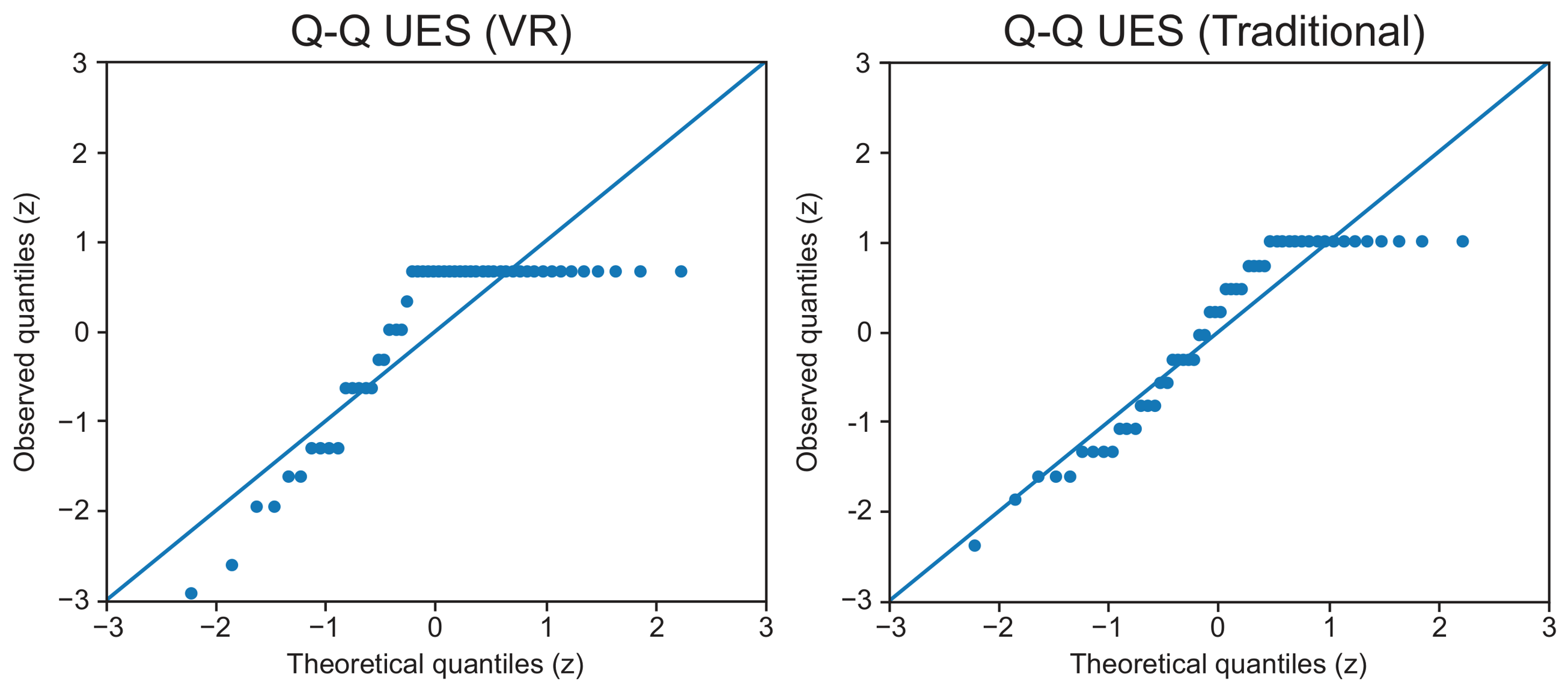
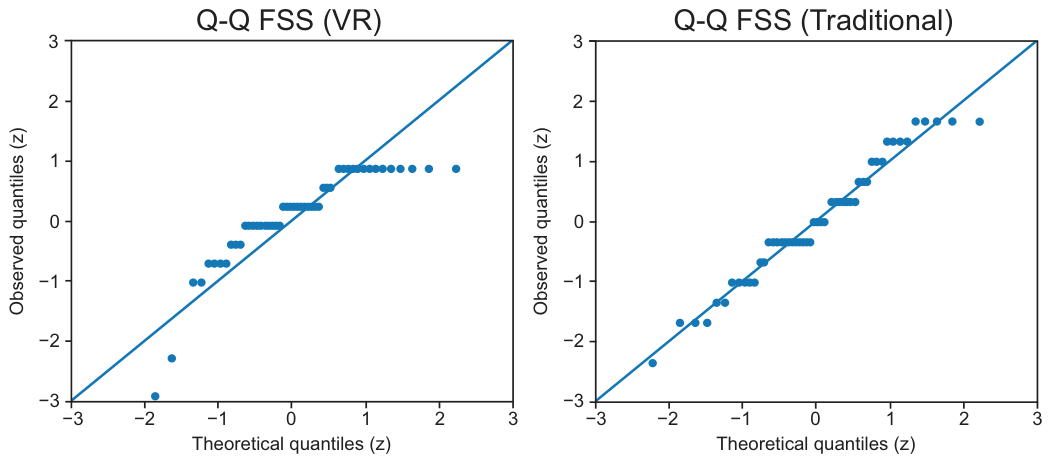
- Assumption checking. The Shapiro–Wilk test was used to assess the normality of the primary outcome variables (FSSTotal, UESTotal, SUSScore) within each condition. Homogeneity of variances between conditions was examined using Levene’s test, and distributional properties were further inspected visually via Q-Q plots.
- Between-condition comparisons (RQ1). To compare the VR and Traditional conditions across all periods, two-sided Mann–Whitney U tests were employed. Effect sizes were calculated and complemented with Cliff’s Delta () and its bootstrap 95% confidence interval as a non-parametric measure of dominance. Hodges–Lehmann median differences with 95% confidence intervals were also reported.
- Within-subject comparisons (RQ1). To leverage the within-subjects component of the design, two-sided Wilcoxon signed-rank tests were conducted on complete VR-Traditional pairs for each participant. Effect sizes (r) were calculated based on the effective sample size remaining after excluding zero-difference pairs.
- Analysis of sequence and usability (RQ2). The effect of instructional sequence on the perceived usability of the VR system (SUSScore) was analyzed using a Mann–Whitney U test comparing VR-first and Trad-first sequences, as SUS was only administered post-VR. This was supplemented with an ordinary least squares (OLS) regression with HC3 robust standard errors to examine the same association in a regression framework.
- Correlational analysis (RQ4). Relationships between pre-test measures (digital competencies, emerging technology attitudes, and VR interest) and post-test perceived experience outcomes were examined using Spearman’s rank-order correlation (), computed separately for the VR and Traditional conditions. The family-wise error rate for these multiple correlations was controlled using the Holm adjustment.
- Qualitative analysis (RQ5). Responses to the open-ended feedback questions were analyzed using inductive thematic analysis. Codes were grouped into themes describing perceived strengths, perceived comparative advantages of VR over traditional methods, reported difficulties, instructional preferences, and suggestions for improvement. Frequencies and illustrative quotes were used descriptively to characterize user perceptions and acceptance.
4. Results
4.1. Participant Characteristics, Data Completeness, and Scale Reliability
4.1.1. Participant Allocation and Data Completeness
4.1.2. Baseline Technology Profile and Pre-Existing Knowledge
4.2. Analysis Strategy and Statistical Assumptions
4.3. Comparative Perceived Experience: VR vs. Traditional Instruction
4.3.1. Non-Parametric and Paired Comparisons
4.3.2. Mixed-Effects and Robust Regression Models
4.4. Usability and Acceptability of the VR System
4.4.1. System Usability Scale Scores
4.4.2. SUS Acceptability Benchmarks
4.5. Correlates of Perceived Experience
4.5.1. Associations in the VR Condition
4.5.2. Associations in the Traditional Condition
4.6. Feedback
4.6.1. Perceived Strengths of the VR Lesson
4.6.2. Perceived Advantages over Traditional Instruction
4.6.3. Reported Difficulties with the VR Lesson
4.6.4. Preferred Mode of Future Instruction
4.6.5. Suggestions from Students for Future Iterations
5. Discussion
5.1. Sequence-Related Patterns
5.2. Role of Learner Dispositions in Perceived Experience
5.3. Implications for Feasibility and Classroom Use
5.4. Methodological and Interpretive Limitations
5.5. Implications for Future Research
6. Conclusions
Author Contributions
Funding
Institutional Review Board Statement
Informed Consent Statement
Data Availability Statement
Acknowledgments
Conflicts of Interest
Abbreviations
| 4MAT | 4MAT Learning Model |
| AI | Artificial Intelligence |
| CI | Confidence Interval |
| CNC | Computer Numerical Control |
| FC | Flipped Classroom |
| FSS | Flow State Scale |
| GT | Grounded Theory |
| HC3 | Heteroscedasticity-Consistent standard errors (type 3) |
| HCI | Human–Computer Interaction |
| HMD | Head-Mounted Display |
| HL | Hodges–Lehmann (estimate) |
| IEO | Inputs–Environment–Outcome (model) |
| IQR | Interquartile Range |
| LMM | Linear Mixed-Effects Model |
| OLS | Ordinary Least Squares |
| Q–Q | Quantile–Quantile (plot) |
| RQ | Research Question |
| SD | Standard Deviation |
| SE | Standard Error |
| STEAM | Science, Technology, Engineering, Arts and Mathematics |
| SUS | System Usability Scale |
| TAM | Technology Acceptance Model |
| UES | User Engagement Scale |
| UTAUT2 | Unified Theory of Acceptance and Use of Technology 2 |
| UV | Ultraviolet |
| UV-C | Ultraviolet C |
| VL | Virtual Laboratory |
| VR | Virtual Reality |
| VLE | Virtual Learning Environment |
| Wi-Fi 6 | Wireless Fidelity (IEEE 802.11ax) |
| UML | Unified Modeling Language |
References
- Soodtoetong, N.; Rattanasiriwongwut, M. A Virtual Reality Model for STEM Education in Thailand. In Proceedings of the International Workshop on Artificial Intelligence for Signal, Image Processing and Multimedia; AI-SIPM ’24; Association for Computing Machinery: New York, NY, USA, 2024; p. 3. [Google Scholar] [CrossRef]
- Singh, G.; Mantri, A.; Sharma, O.; Kaur, R. Virtual Reality Learning Environment for Enhancing Electronics Engineering Laboratory Experience. Comput. Appl. Eng. Educ. 2021, 29, 229–243. [Google Scholar] [CrossRef]
- Wang, Y. Application of Virtual Reality Technique in the Construction of Modular Teaching Resources. Int. J. Emerg. Technol. Learn. (IJET) 2020, 15, 126–139. [Google Scholar] [CrossRef]
- Trigos, F.; Tamayo-Enriquez, F. A Transdisciplinary Framework for Engineering Education, Developing Tactical Engineering Decision Making Skills. In Proceedings of the Transdisciplinarity and the Future of Engineering; Advances in Transdisciplinary Engineering; IOS Press: Amsterdam, The Netherlands, 2022; Volume 28, pp. 609–618. [Google Scholar] [CrossRef]
- Liang, L.M. Applied Research of VR Technology in Civil Engineering Teaching. In Proceedings of the 2021 International Conference on Internet, Education and Information Technology (IEIT), Suzhou, China, 16–18 April 2021. [Google Scholar] [CrossRef]
- Wang, C.; Tang, Y.; Kassem, M.A.; Li, H.; Hua, B. Application of VR Technology in Civil Engineering Education. Comput. Appl. Eng. Educ. 2022, 30, 335–348. [Google Scholar] [CrossRef]
- Coutinho, G.S.; Magana, A.J.; Dias, V.D.R. A Framework for the Development of Online Virtual Labs for Engineering Education. In Proceedings of the 2023 ASEE Annual Conference & Exposition, Baltimore, MD, USA, 25–28 June 2023. [Google Scholar] [CrossRef]
- Çoban, M.; Okur Akçay, N.; Çelik, İ. Using Virtual Reality Technologies in STEM Education: ICT Pre-Service Teachers’ Perceptions. Knowl. Manag. E-Learn. Int. J. 2022, 14, 270–285. [Google Scholar] [CrossRef]
- Ghazinejad, M.; Khoshnoud, F.; Porter, S. Enhancing Interactive Learning in Engineering Classes by Implementing Virtual Laboratories. In Proceedings of the 2021 IEEE Frontiers in Education Conference (FIE), Lincoln, NE, USA, 13–16 October 2021. [Google Scholar] [CrossRef]
- Li, F.; Jiang, J.; Qin, Q.; Wang, X.; Zeng, G.; Gu, Y.; Guo, W. Application of Sustainable Development of Teaching in Engineering Education: A Case Study of Undergraduate Course Design of Raman Spectroscopy Based on Virtual Reality (VR) Technology. Sustainability 2023, 15, 1782. [Google Scholar] [CrossRef]
- Grigore, P.I.; Turcu, C.O. Integrating Virtual Reality into Engineering Education: An Interactive Application for Learning Mechanisms. In Proceedings of the International Conference on Virtual Learning; National Institute for Research & Development in Informatics: Bucharest, Romania, 2025; Volume 20, pp. 155–166. [Google Scholar] [CrossRef]
- Vergara, D.; Rubio, M.P.; Lorenzo, M. A Virtual Resource for Enhancing the Spatial Comprehension of Crystal Lattices. Educ. Sci. 2018, 8, 153. [Google Scholar] [CrossRef]
- Solmaz, S.; Van Gerven, T. Integration of Interactive CFD Simulations with AR and VR for Educational Use in CRE. In Computer Aided Chemical Engineering; Pierucci, S., Manenti, F., Bozzano, G.L., Manca, D., Eds.; Elsevier: Amsterdam, The Netherlands, 2020; Volume 48, pp. 2011–2016. [Google Scholar] [CrossRef]
- Alkhedher, M.; Mohamad, O.; Alavi, M. An Interactive Virtual Laboratory for Dynamics and Control Systems in an Undergraduate Mechanical Engineering Curriculum—A Case Study. Glob. J. Eng. Educ. 2021, 23, 55–61. [Google Scholar]
- Guzsvinecz, T.; Orbán-Mihálykó, É.; Perge, E.; Sik-Lányi, C. The Effect of Engineering Education on Spatial Ability in Virtual Environments. Acta Polytech. Hung. 2023, 20, 11–30. [Google Scholar] [CrossRef]
- Grewe, M.H.; Gie, L. Can Virtual Reality Have a Positive Influence on Student Engagement? S. Afr. J. High. Educ. 2023, 37, 124–141. [Google Scholar] [CrossRef]
- Anjos, F.E.V.d.; Martins, A.d.O.; Rodrigues, G.S.; Sellitto, M.A.; Silva, D.O.d. Boosting Engineering Education with Virtual Reality: An Experiment to Enhance Student Knowledge Retention. Appl. Syst. Innov. 2024, 7, 50. [Google Scholar] [CrossRef]
- Grigore, P.I.; Turcu, C.O. Impact of Virtual Reality on Pre-University Students. Rom. J. Inf. Technol. Autom. Control 2024, 34, 99–113. [Google Scholar] [CrossRef]
- Chung, C.C.; Tung, C.C.; Cheng, Y.M.; Lou, S.J. Development of a VR STEAM Welding Project Course. In Innovative Technologies and Learning; Huang, T.C., Wu, T.T., Barroso, J., Sandnes, F.E., Martins, P., Huang, Y.M., Eds.; Lecture Notes in Computer Science; Springer: Cham, Switzerland, 2020; Volume 12555. [Google Scholar] [CrossRef]
- Jindal, R.; Mittal, S.K.; Bansal, A. Engineering Education and the Use of Virtual Reality: Idea and Possibility. In Proceedings of the 2023 2nd Edition of IEEE Delhi Section Flagship Conference (DELCON), Rajpura, India, 24–26 February 2023; pp. 1–7. [Google Scholar] [CrossRef]
- Extremera, J.; Vergara, D.; Rodríguez, S.; Dávila, L.P. Reality-Virtuality Technologies in the Field of Materials Science and Engineering. Appl. Sci. 2022, 12, 4968. [Google Scholar] [CrossRef]
- Parlier, J. Enhancing Advanced Manufacturing and Engineering Instruction with Augmented and Virtual Reality (AR/VR). In Proceedings of the 2022 CIEC, Tempe, AZ, USA, 17 April 2024. [Google Scholar] [CrossRef]
- Burgos-Lopez, M.Y.; del Carmen Bumas-Azcannio, M.; Turcios-Esquivel, A.M. Virtual Reality to Enhance User Satisfaction in an Engineering Innovation Project. In Proceedings of the 2024 IEEE Global Engineering Education Conference (EDUCON), Kos Island, Greece, 8–11 May 2024; pp. 1–7. [Google Scholar] [CrossRef]
- Ro’fatulhaq, H.; Wicaksono, S.A.; Falah, M.F.; Sukaridhoto, S.; Zainuddin, M.A.; Rante, H.; Al Rasyid, M.U.; Wicaksono, H. Development of Virtual Engineering Platform for Online Learning System. In Proceedings of the 2020 International Conference on Computer Engineering, Network, and Intelligent Multimedia (CENIM), Surabaya, Indonesia, 17–18 November 2020; pp. 185–192. [Google Scholar] [CrossRef]
- Cordero-Guridi, J.d.J.; Cuautle-Gutiérrez, L.; Alvarez-Tamayo, R.I.; Caballero-Morales, S.O. Design and Development of a I4.0 Engineering Education Laboratory with Virtual and Digital Technologies Based on ISO/IEC TR 23842-1 Standard Guidelines. Appl. Sci. 2022, 12, 5993. [Google Scholar] [CrossRef]
- Mahmood, K.; Otto, T.; Kuts, V.; Terkaj, W.; Modoni, G.; Urgo, M.; Colombo, G.; Haidegger, G.; Kovacs, P.; Stahre, J. Advancement in Production Engineering Education through Virtual Learning Factory Toolkit Concept. Proc. Est. Acad. Sci. 2021, 70, 374–382. [Google Scholar] [CrossRef]
- Saptadi, S.; Arliawan, M.A.; Nurkertamanda, D.; Widharto, Y.; Wicaksono, P.A. Development of Virtual Laboratory Applications Based on Virtual Reality Using the Requirements Engineering Method. In IOP Conference Series: Materials Science and Engineering; IOP Publishing: Bristol, UK, 2021; Volume 1072, p. 012075. [Google Scholar] [CrossRef]
- Cook-Chennault, K.; Farooq, A. A Validated Assessment Tool: Students’ Perceived Value of Engineering Laboratories in a Virtual Environment. Int. J. Eng. Educ. 2023, 39, 860–876. [Google Scholar]
- Dianova, Y.; Stolbova, I.; Tarasova, L. From Assembly Drawing to Virtual Model: Manufacturing Technologies in Engineering Education. In Proceedings of the 2024 7th International Conference on Information Technologies in Engineering Education (Inforino), Moscow, Russia, 16–19 April 2024; pp. 1–4. [Google Scholar] [CrossRef]
- Hamurcu, A.; Timur, Ş; Rızvanoğlu, K. A Study on the Adoption of Virtual Reality in Industrial Design Education. IEEE Trans. Learn. Technol. 2023, 16, 900–913. [Google Scholar] [CrossRef]
- Grigore, P.I.; Turcu, C.O. Evaluating the impact of virtual reality on student engagement and conceptual understanding in engineering education. Next Res. 2026, 3, 101172. [Google Scholar] [CrossRef]
- Vergara, D.; Antón-Sancho, Á.; Lampropoulos, G.; Fernández-Arias, P. Educational Use of Virtual Reality Technologies in Engineering Education: The Impact of the Digital Generation of Faculty. Educ. Inf. Technol. 2025, 30, 12807–12825. [Google Scholar] [CrossRef]
- Castro-Gutiérrez, N.; Flores-Cruz, J.; Acosta-Magallanes, F. Design and Implementation of a Virtual Laboratory for Electromagnetics Teaching in Engineering. In Proceedings of the CISETC 2021: International Congress on Educational and Technology in Sciences, Chiclayo, Peru, 16–18 November 2021; Volume 3037, pp. 105–113. [Google Scholar]
- Li, X.; Tian, Y.; Ye, P.; Duan, H.; Wang, F.Y. A Novel Scenarios Engineering Methodology for Foundation Models in Metaverse. IEEE Trans. Syst. Man Cybern. Syst. 2023, 53, 2148–2159. [Google Scholar] [CrossRef]
- Ntunka, M.G.; Maladzhi, R.W.; Mthombeni, N.H.; Nemavhola, F. Enhancing Project-Based Learning in Engineering Disciplines Through Emerging Technologies: A Systematic Literature Review. In Proceedings of the 2024 World Engineering Education Forum-Global Engineering Deans Council (WEEF-GEDC), Sydney, Australia, 2–5 December 2024; pp. 1–9. [Google Scholar] [CrossRef]
- Grigore, P.I.; Turcu, C.O.; Zaharia, A.; Nedeff, V. A VR Lesson Architecture for Environmental Engineering: Five Scenario Designs. In Proceedings of the International Conference on Virtual Learning; National Institute for Research & Development in Informatics: Bucharest, Romania, 2026; Volume 21, pp. 371–386. [Google Scholar] [CrossRef]
- Estriegana, R.; Medina-Merodio, J.A.; Barchino, R. Student Acceptance of Virtual Laboratory and Practical Work: An Extension of the Technology Acceptance Model. Comput. Educ. 2019, 135, 1–14. [Google Scholar] [CrossRef]
- Chen, H.M.; Nguyen, B.A.; Chang, Y.W.; Dow, C.R. A Gamified Method for Teaching Version Control Concepts in Programming Courses Using the Git Education Game. Electronics 2024, 13, 4956. [Google Scholar] [CrossRef]
- Vlahovic, S.; Suznjevic, M.; Skorin-Kapov, L. A Framework for the Classification and Evaluation of Game Mechanics for Virtual Reality Games. Electronics 2022, 11, 2946. [Google Scholar] [CrossRef]
- Jackson, S.A.; Marsh, H.W. Development and Validation of a Scale to Measure Optimal Experience: The Flow State Scale. J. Sport Exerc. Psychol. 1996, 18, 17–35. [Google Scholar] [CrossRef]
- Kyriazos, T.; Stalikas, A.; Prassa, K.; Galanakis, M.; Flora, K.; Chatzilia, V. The Flow Short Scale (FSS) Dimensionality and What MIMIC Shows on Heterogeneity and Invariance. Psychology 2018, 9, 1357–1382. [Google Scholar] [CrossRef]
- O’Brien, H.L.; Cairns, P.; Hall, M. A Practical Approach to Measuring User Engagement with the Refined User Engagement Scale (UES) and New UES Short Form. Int. J. Hum.-Comput. Stud. 2018, 112, 28–39. [Google Scholar] [CrossRef]
- Brooke, J. SUS: A Quick and Dirty Usability Scale. In Usability Evaluation in Industry; Jordan, P.W., Thomas, B., Weerdmeester, A., McClelland, I.L., Eds.; Taylor & Francis: London, UK, 1996; pp. 189–194. [Google Scholar]
- Bangor, A.; Kortum, P.T.; Miller, J.T. An Empirical Evaluation of the System Usability Scale. Int. J. Hum.–Comput. Interact. 2008, 24, 574–594. [Google Scholar] [CrossRef]
- Chen, C.; Chen, L.; Shen, N.; Luo, C.; Wang, R.; Fang, H.; Zhang, Q.; Hei, Z. The use of virtual reality to reduce stress among night-shift anesthesiologists: Study protocol for a crossover trial. Trials 2021, 22, 257. [Google Scholar] [CrossRef]




| Characteristic | VR-First Sequence | Trad-First Sequence | Total Sample |
|---|---|---|---|
| (n = 26) | (n = 26) | (n = 52) | |
| Age (years) | |||
| Mean (SD) | 22.6 (2.5) | 25.6 (7.3) | 24.1 (5.6) |
| Range | 20–33 | 20–45 | 20–45 |
| Typical undergraduate age (20–24) | 24 | 19 | 43 |
| Gender | |||
| Male | 21 (80.8%) | 22 (84.6%) | 43 (82.7%) |
| Female | 5 (19.2%) | 4 (15.4%) | 9 (17.3%) |
| Sequence 1 | Period | Condition | FSS_Total | UES_Total | SUS_Total |
|---|---|---|---|---|---|
| Trad-first | 1 | Trad | 26 | 26 | 0 |
| 2 | VR | 26 | 26 | 26 | |
| VR-first | 1 | VR | 26 | 26 | 26 |
| 2 | Trad | 26 | 26 | 0 | |
| Total | 104 | 104 | 52 |
| Measure | Trad-First (n = 26) | VR-First (n = 26) |
|---|---|---|
| Familiarity with VR (1–5) | 3.19 | 3.36 |
| Technology Accommodation (1–5) | 3.81 | 3.90 |
| VR Interest (1–5) | 4.24 | 4.84 |
| Emerging Technologies (1–5) | 4.58 | 4.77 |
| Pre-test Item 5.1 (proportion correct) | 0.96 | 0.96 |
| Pre-test Item 5.2 (proportion correct) | 0.81 | 0.92 |
| Pre-test Item 5.3 (proportion correct) | 0.65 | 0.81 |
| Pre-test mean (Items 5.1–5.3, proportion) | 0.81 | 0.90 |
| Comparison | Scale | Test Statistic | z | p-Value | Cliff’s | HL [95% CI] | Direction |
|---|---|---|---|---|---|---|---|
| Between-condition (Mann–Whitney) | FSS | U = 1974.5 | 4.08 | < | 0.46 | 3.00 [1.00, 4.00] | VR higher |
| Between-condition (Mann–Whitney) | UES | U = 1751.5 | 2.55 | 0.006 | 0.30 | 1.00 [0.00, 3.00] | VR higher |
| Within-subject (Wilcoxon) | FSS | W = 139.5 | −4.05 | < | – | 2.00 [1.00, 3.00] | VR higher |
| Within-subject (Wilcoxon) | UES | W = 88.0 | −3.31 | < | – | 0.50 [0.00, 2.00] | VR higher |
| FSS | UES | |||
|---|---|---|---|---|
| Predictor | LMM Coef. (SE) | OLS-HC3 Coef. (SE) | LMM Coef. (SE) | OLS-HC3 Coef. (SE) |
| Intercept | 19.96 (0.59) *** | 19.96 (0.65) *** | 29.85 (0.62) *** | 29.85 (0.77) *** |
| Condition (VR) | 2.15 (0.51) *** | 2.09 (0.49) *** | 1.79 (0.48) *** | 1.93 (0.54) *** |
| Period (2) | −0.77 (0.51) | −0.84 (0.51) | −0.10 (0.48) | 0.04 (0.58) |
| Sequence (VR-first) | 0.92 (0.65) | 0.99 (0.52) | 2.67 (0.74) *** | 2.53 (0.59) *** |
| Condition × Period | – | 0.13 (0.36) | – | −0.28 (0.32) |
| Item | SUS Item (English/Romanian) | Trad-First | VR-First | ||
|---|---|---|---|---|---|
| M | SD | M | SD | ||
| 1 | I think I would like to use this application frequently./Aș dori să folosesc frecvent o aplicație ca aceasta. | 3.35 | 0.98 | 3.77 | 0.51 |
| 2 * | I found the application unnecessarily complex./Aplicația a fost inutil de complexă. | 3.12 | 1.11 | 3.92 | 0.27 |
| 3 | I thought the application was easy to use./Aplicația a fost ușor de folosit. | 3.31 | 0.88 | 3.81 | 0.40 |
| 4 * | I think I would need technical support to use this application./Cred că aș avea nevoie de suport tehnic pentru a o folosi. | 2.42 | 1.42 | 3.42 | 0.76 |
| 5 | I found the various functions in this application were well integrated./Funcțiile aplicației par bine integrate. | 3.38 | 0.75 | 3.85 | 0.37 |
| 6 * | I thought there was too much inconsistency in this application./Am observat inconsistențe în aplicație. | 2.69 | 1.09 | 3.65 | 0.75 |
| 7 | I imagine that most people would learn to use this application very quickly./Mi-a fost ușor să învăț cum funcționează aplicația. | 3.38 | 0.75 | 3.73 | 0.53 |
| 8 * | I found the application very cumbersome to use./Aplicația a fost greoaie sau dificil de utilizat. | 3.35 | 1.26 | 3.88 | 0.43 |
| 9 | I felt very confident using the application./M-am simțit încrezător(ă) când am folosit aplicația. | 3.38 | 0.70 | 3.65 | 0.56 |
| 10 * | I needed to learn a lot of things before I could get going with this application./A trebuit să învăț multe lucruri înainte de a folosi aplicația. | 2.92 | 1.26 | 3.65 | 0.75 |
| Usability Category | SUS Range | Trad-First (n = 26) | VR-First (n = 26) |
|---|---|---|---|
| Acceptability level | |||
| Acceptable | 70–100 | 20 (77%) | 25 (96%) |
| Marginal | 50–69.9 | 5 (19%) | 1 (4%) |
| Not acceptable | 0–49.9 | 1 (4%) | 0 (0%) |
| Adjective rating | |||
| Excellent | 85–100 | 10 (38%) | 23 (88%) |
| Good | 70–84.9 | 10 (38%) | 2 (8%) |
| OK | 50–69.9 | 5 (19%) | 1 (4%) |
| Poor | 0–49.9 | 1 (4%) | 0 (0%) |
| Variable | 1 | 2 | 3 | 4 | 5 | 6 | 7 | 8 |
|---|---|---|---|---|---|---|---|---|
| 1. Familiarity | 1.00 | |||||||
| 2. Tech accommodation | 0.58 | 1.00 | ||||||
| 3. VR Interest | 0.11 | 0.25 | 1.00 | |||||
| 4. Emerging Tech | 0.19 | 0.25 | 0.72 | 1.00 | ||||
| 5. Pre Total | 0.73 | 0.75 | 0.63 | 0.64 | 1.00 | |||
| 6. FSS | −0.03 | 0.23 | 0.30 | 0.28 | 0.27 | 1.00 | ||
| 7. UES | 0.21 | 0.21 | 0.42 | 0.51 | 0.45 | 0.65 | 1.00 | |
| 8. SUS | 0.06 | 0.18 | 0.34 | 0.28 | 0.28 | 0.40 | 0.51 | 1.00 |
| Variable | 1 | 2 | 3 | 4 | 5 | 6 | 7 |
|---|---|---|---|---|---|---|---|
| 1. Familiarity | 1.00 | ||||||
| 2. Tech accommodation | 0.58 | 1.00 | |||||
| 3. VR Interest | 0.11 | 0.25 | 1.00 | ||||
| 4. Emerging Tech | 0.19 | 0.25 | 0.72 | 1.00 | |||
| 5. Pre Total | 0.73 | 0.75 | 0.63 | 0.64 | 1.00 | ||
| 6. FSS | −0.08 | 0.19 | 0.01 | 0.16 | 0.09 | 1.00 | |
| 7. UES | 0.15 | 0.24 | 0.23 | 0.45 | 0.38 | 0.59 | 1.00 |
| Question | Responses | Abstentions |
|---|---|---|
| 4.1 What did you like most about the VR lesson? | 33 (63.46%) | 19 (36.54%) |
| 4.2 What was clearer or easier to understand in VR compared to traditional methods? | 32 (61.54%) | 20 (38.46%) |
| 4.3 What difficulties did you encounter during the VR lesson (if any)? | 22 (42.31%) | 30 (57.69%) |
| 4.4 If you could choose, how would you prefer to learn in the future? | 50 (96.15%) | 2 (3.85%) |
| 4.5 Additional comments or suggestions regarding the VR lesson | 0 (0%) | 52 (100%) |
| Theme | Frequency | Percentage | Example Responses |
|---|---|---|---|
| – | 19 | 28.36% | – |
| Clarity | 11 | 16.42% | “The way the lesson was explained.”, “Theory by drone + simulation” |
| Interactivity | 8 | 11.94% | “Step-by-step presentation: theory, practice, simulation” |
| Practicality | 7 | 10.45% | “Easy and practical learning process” |
| Autonomy | 5 | 7.46% | “I liked that we assembled everything ourselves.” |
| Simulation | 5 | 7.46% | “I liked experimenting with the disinfection process.” |
| Accessibility | 4 | 5.97% | “It was more pleasant and interesting.” |
| Other positive impressions | 8 | 11.94% | “Everything., It was my first time and I liked it all., Realistic design” |
| Theme | Frequency | Percentage | Example Responses |
|---|---|---|---|
| Clarity | 15 | 21.74% | “Easier to learn the components and how the system works” |
| Practicality | 11 | 15.94% | “Assembly of the system components” |
| Specific Content | 8 | 11.59% | “Component layout and function” |
| Interactivity | 5 | 7.25% | “Being able to interact with the filtration system” |
| Novelty | 3 | 4.35% | “It’s more innovative.”, “It was new to me.” |
| Other positive aspects | 7 | 10.14% | “Everything.”, “All of it”, “It involves you more in the learning process.” |
| Theme | Frequency | Percentage | Example Responses |
|---|---|---|---|
| No Difficulties | 33 | 63.46% | “None encountered.” |
| Initial Adjustment | 12 | 23.08% | “It was a bit hard at first, but I got used to it quickly.” |
| Movement Control | 4 | 7.69% | “Controlling movements was tricky.” |
| Other minor difficulties | 2 | 3.85% | “Learning how to use the app”, “Manipulating the device was a bit difficult.” |
| - | 1 | 1.92% | - |
| Preferred Method | Frequency | Percentage |
|---|---|---|
| Combination of VR and traditional | 46 | 88.5% |
| Only VR | 4 | 7.7% |
| No valid response | 2 | 3.8% |
| Theme | Frequency | Percentage | Example Responses |
|---|---|---|---|
| - | 30 | 54.5% | – |
| No Suggestions | 11 | 20.0% | “No improvements needed.”, “First experience, can’t comment.” |
| More Content | 5 | 9.1% | “More practice sessions.”, “More interactive games” |
| Clarity/Structure | 2 | 3.6% | “The steps could be clearer.” |
| Content Expansion | 1 | 1.8% | “Better understanding of the process” |
| More VR Lessons | 1 | 1.8% | “Use VR in more classes.” |
| Gamification | 1 | 1.8% | “Include objectives or tasks like in games” |
| Graphics | 1 | 1.8% | “Improve graphic realism”, “Allow grabbing/moving objects from a distance” |
Disclaimer/Publisher’s Note: The statements, opinions and data contained in all publications are solely those of the individual author(s) and contributor(s) and not of MDPI and/or the editor(s). MDPI and/or the editor(s) disclaim responsibility for any injury to people or property resulting from any ideas, methods, instructions or products referred to in the content. |
© 2026 by the authors. Licensee MDPI, Basel, Switzerland. This article is an open access article distributed under the terms and conditions of the Creative Commons Attribution (CC BY) license.
Share and Cite
Grigore, P.-I.; Turcu, C.O.; Zaharia, A.; Nedeff, V. A Crossover Study on VR and Traditional Instruction in Engineering Education. Information 2026, 17, 382. https://doi.org/10.3390/info17040382
Grigore P-I, Turcu CO, Zaharia A, Nedeff V. A Crossover Study on VR and Traditional Instruction in Engineering Education. Information. 2026; 17(4):382. https://doi.org/10.3390/info17040382
Chicago/Turabian StyleGrigore, Petru-Iulian, Corneliu Octavian Turcu, Andrei Zaharia, and Valentin Nedeff. 2026. "A Crossover Study on VR and Traditional Instruction in Engineering Education" Information 17, no. 4: 382. https://doi.org/10.3390/info17040382
APA StyleGrigore, P.-I., Turcu, C. O., Zaharia, A., & Nedeff, V. (2026). A Crossover Study on VR and Traditional Instruction in Engineering Education. Information, 17(4), 382. https://doi.org/10.3390/info17040382