

AI-Enhanced Modular Information Architecture for Cultural Heritage: Designing Cognitive-Efficient and User-Centered Experiences




Abstract
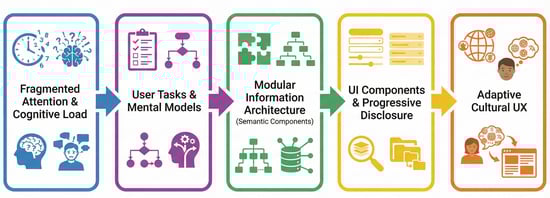
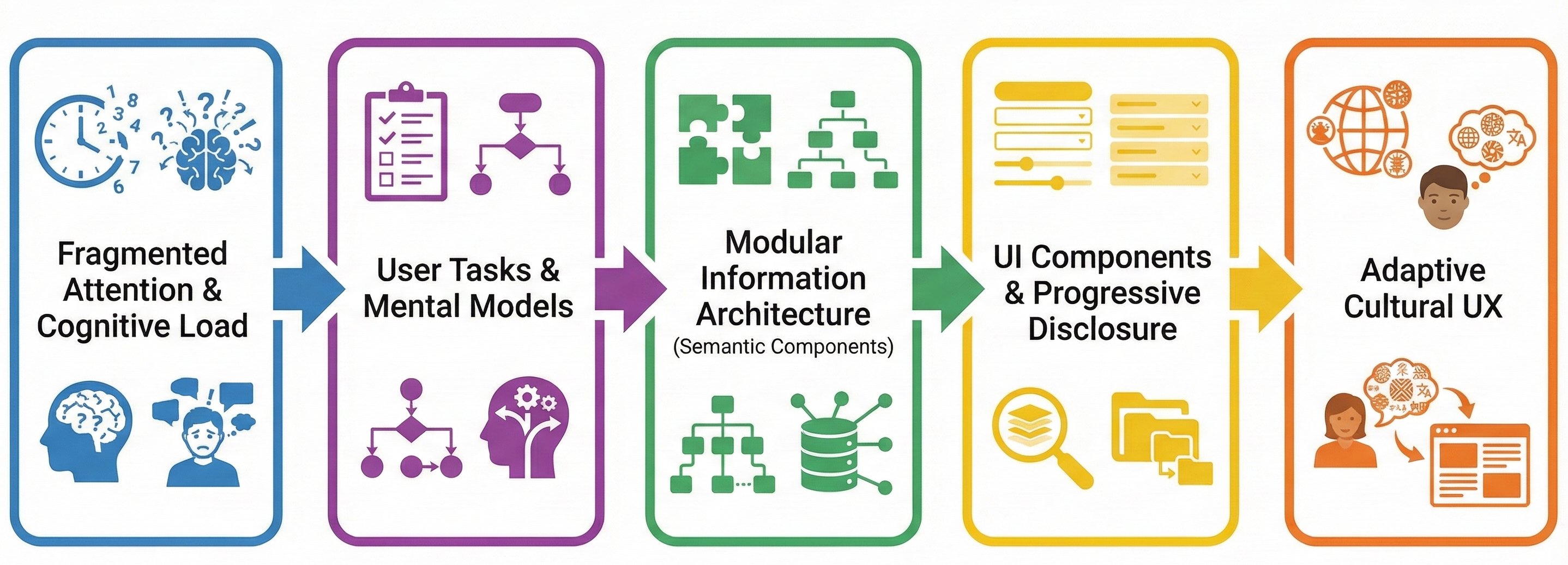
1. Introduction: Problem Definition and the Attention Crisis in User Experience
1.1. Attention Fragmentation and Its Implications for Cultural Heritage
1.2. From General UX to Cultural UX
1.3. Consequences for Information Architecture (IA)
- RQ1: How can Cognitive Load Theory and modular information architecture be synthesized to reduce cognitive barriers in digital cultural heritage experiences?
- RQ2: To what extent do current leading cultural heritage platforms support modularity and cognitive efficiency in their user experience?
- RQ3: How can a user-centered, component-based framework facilitate adaptive and personalized cultural heritage journeys?
2. Theoretical Foundations
2.1. Cognitive Load Theory in Cultural Interfaces
2.2. Mental Models and Findability
2.3. Modular Information Architecture Principles
- Componentization of content;
- Context-independence of modules;
- Explicit relationships via metadata;
- Progressive enhancement through layering;
- Adaptability across contexts and user needs.
3. Methodology: User-Centered Component Modeling and Evaluation Design
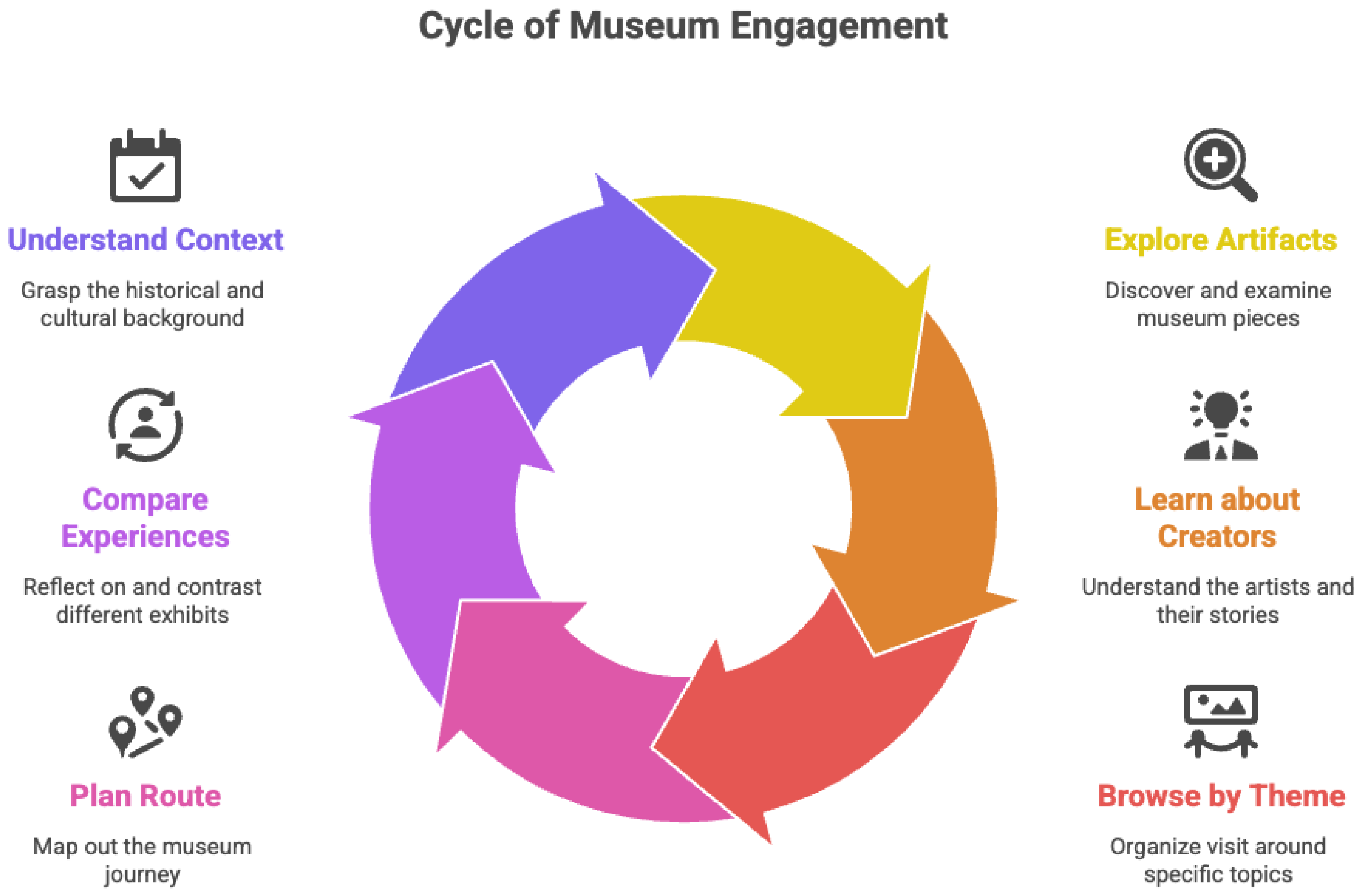
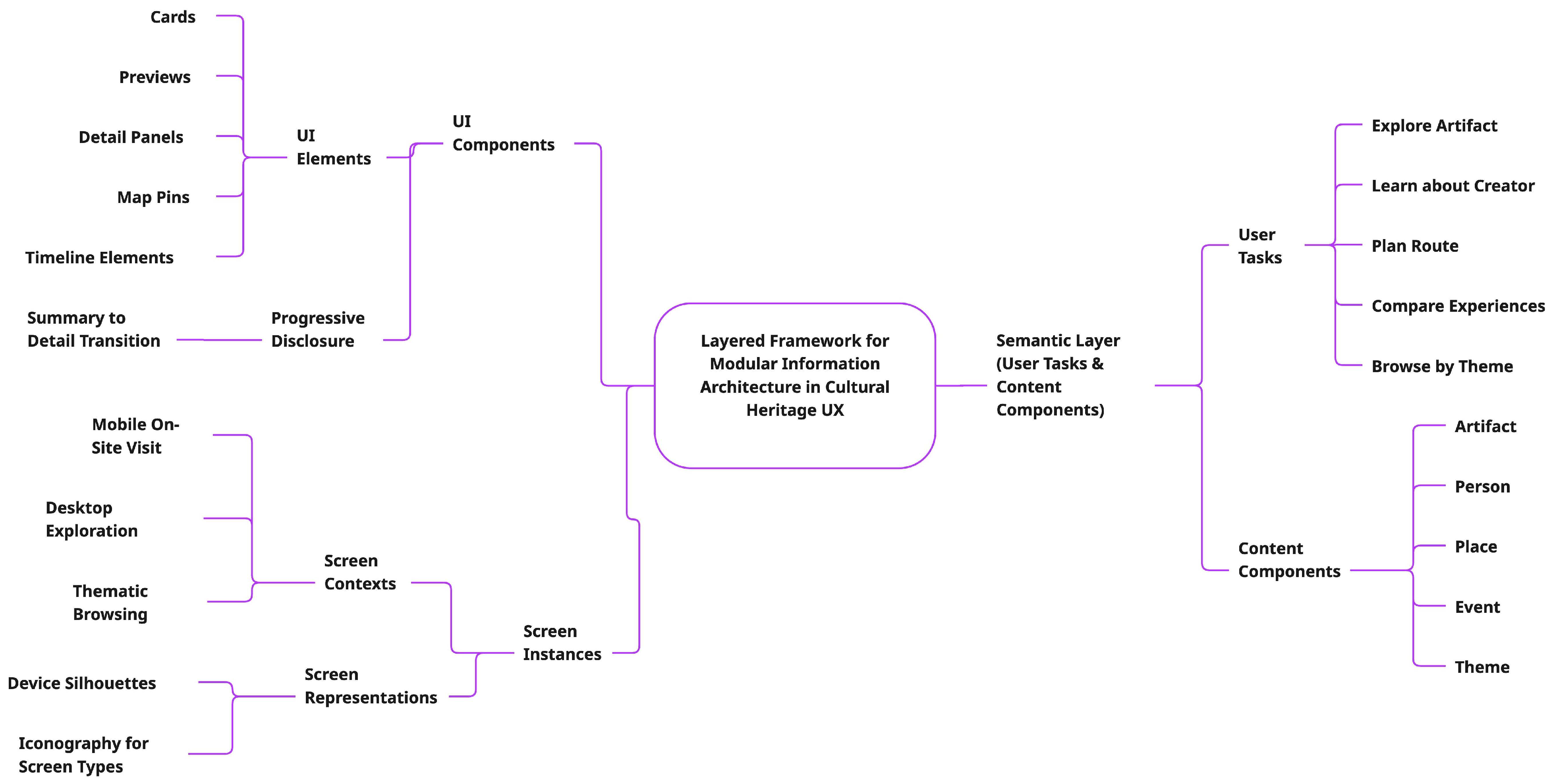
3.1. Mapping User Tasks to Semantic Components
3.2. UI Components and Progressive Disclosure
3.3. Screen Instances and Contextual Adaptation
3.4. Conceptual Diagram of the Framework
4. Results
4.1. Evaluation Criteria Based on the Proposed Framework
- Content Modularity and Semantic Structure: presence of reusable, semantically defined units (e.g., Artifact, Place) and explicit relationships.
- Progressive Disclosure and Cognitive Load Management: use of summaries, staged detail, and low extraneous load [3].
- User-centered Navigation and Findability: alignment with mental models, intuitive labels, and multiple entry points [10].
- Personalization and Context Adaptation: tailoring of content based on user profile, context, or behaviour [28].
- Cultural Depth and Narrative Support: extent to which cultural meaning, interpretation, and narrative coherence are enabled.
4.2. Platform Analysis and Comparative Summary
4.3. Insights and Gaps
- Divergent design philosophies: GA&C supports exploration and learning, TripAdvisor centers on planning, and Airbnb optimizes booking. This confirms that cultural UX requires balancing semantic depth with usability and decision efficiency.
- Need for semantic–social integration: User-generated content is rich but unstructured. Platforms lack mechanisms to integrate social insights into semantic models (e.g., thematic tags extracted via NLP), limiting hybrid discovery pathways.
- Opportunity for adaptive cultural UX: None of the platforms provide deep personalization grounded in cognitive load principles or user mental models. Modular IA could support adaptive pathways that adjust complexity, detail, or narrative style to user behavior and expertise.
5. Persona-Based Simulation of Cultural UX Journeys
5.1. AI Personas
- Maria (Harmonious Explorer)—emotion- and narrative-driven; benefits from staged storytelling and soft guidance.
- Leo (Urban Decoder)—analytical and detail-oriented; requires rapid access to structured, factual content.
- Chloe (Aesthetic Curator)—visual-spatial; engages through imagery and clean layouts with minimal initial text.
- Nikos (Community Advocate)—ethically motivated; prioritizes contextual and social-impact information.
- Alex (Adventure Seeker)—action-oriented; responds best to concise logistics, map-based views, and difficulty indicators.
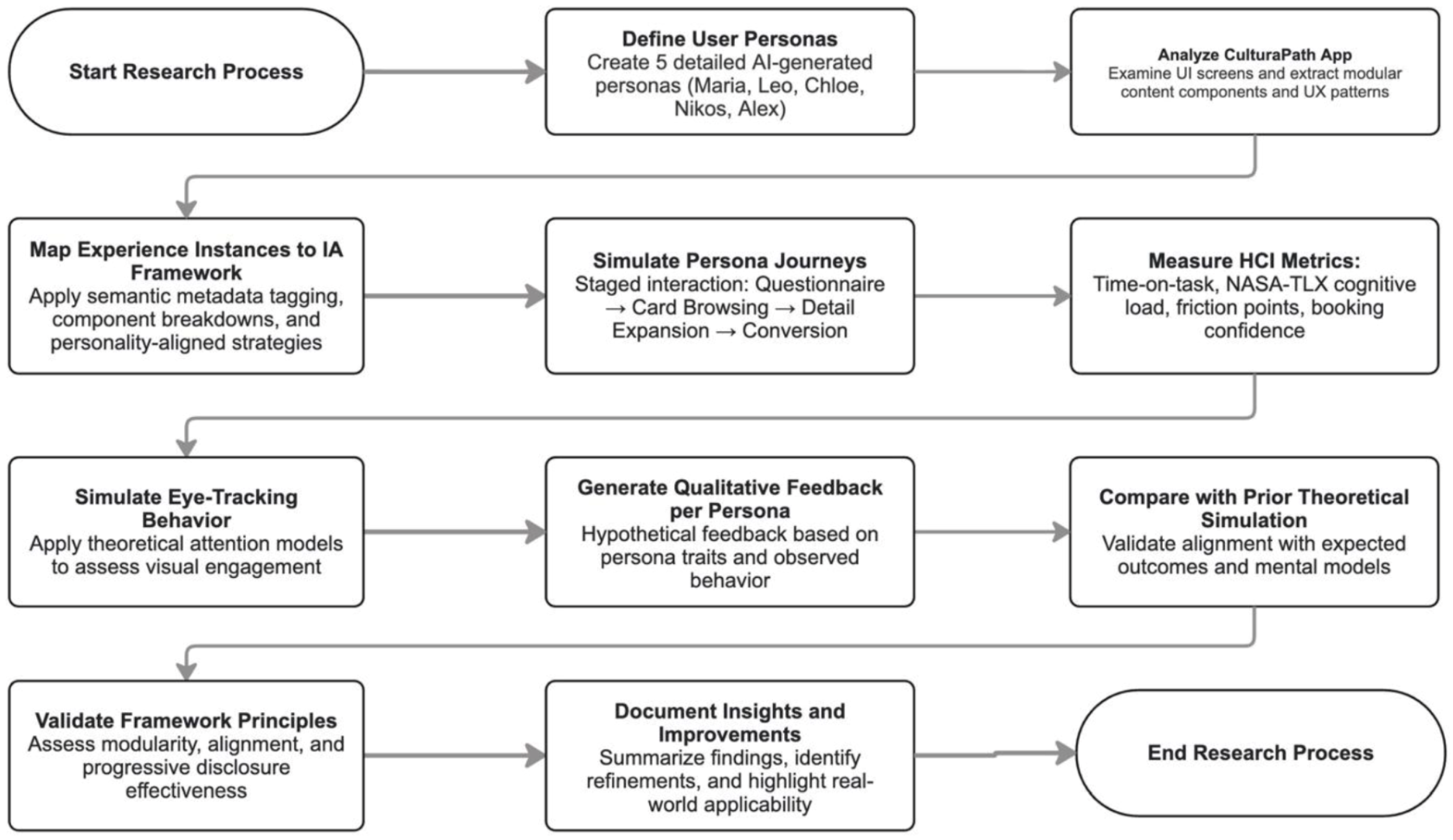
5.2. Simulation Setup
- time-on-task per stage,
- estimated cognitive workload (NASA–TLX),
- simulated eye-tracking patterns based on established UX attention models,
- qualitative feedback synthesized per persona.
5.3. Results: Cross-Persona Patterns
5.4. Framework Validation
- reduced extraneous cognitive load through progressive disclosure,
- aligned components with diverse mental models,
- enabled flexible interpretation without overwhelming the user,
- supported distinct decision-making pathways.
6. Conclusions and Summary of Contributions
- A theory-driven framework for cultural UX;
- A validated modular content and interface model;
- Comparative insights that highlight design trade-offs and future opportunities.
7. Discussion and Future Directions
Human-Centered AI Implications
Author Contributions
Funding
Institutional Review Board Statement
Informed Consent Statement
Data Availability Statement
Acknowledgments
Conflicts of Interest
Abbreviations
| AI | Artificial Intelligence |
| HCAI | Human-Centered Artificial Intelligence |
| UX | User Experience |
| IA | Information Architecture |
| CLT | Cognitive Load Theory |
| AR | Augmented Reality |
References
- Weinreich, H.; Obendorf, H.; Herder, E.; Mayer, M. An empirical study of Web use: Patterns, performance, and usability. ACM Trans. Web 2008, 2, 5. [Google Scholar] [CrossRef] [Scilit]
- Mark, G.; Gudith, D.; Klocke, U. The cost of interrupted work: More speed and stress. In Proceedings of the SIGCHI Conference on Human Factors in Computing Systems, Florence, Italy, 5–10 April 2008; pp. 107–110. [Google Scholar]
- Sweller, J. Cognitive Load Theory. In Psychology of Learning and Motivation; Academic Press: Cambridge, MA, USA, 2011; Volume 55, pp. 37–76. [Google Scholar]
- Hacioglu, N.; Leva, M.C.; Lee, H. Re-designing the interaction of day-to-day applications to support sustained attention level. In Proceedings of the International Conference on Human–Computer Interaction, Copenhagen, Denmark, 23–28 July 2023. [Google Scholar]
- Anufrieva, A.; Gorbunova, E. Cognitive Functions in the Digital Environment: Working Memory and Attention Under Real and Digital Conditions. Higher School of Economics Research Paper No. WP BRP 129 (2021). Available online: https://papers.ssrn.com/sol3/papers.cfm?abstract_id=3974610 (accessed on 2 January 2026).
- Lanir, J.; Wecker, A.; Yosfan, M.; Eilam, B. Using Mobile Devices as Activity Aids in a History Museum. In Proceedings of the AVI CH 2020, Ischia, Italy, 29 September 2020. [Google Scholar]
- Marty, P.F. Museum websites and museum visitors: Digital museum resources and their use. Mus. Manag. Curatorship 2008, 23, 81–99. [Google Scholar] [CrossRef] [Scilit]
- Black, G. The Engaging Museum: Developing Museums for Visitor Involvement; Routledge: London, UK, 2012. [Google Scholar]
- Norman, D.A. The Design of Everyday Things, Revised ed.; Basic Books: New York, NY, USA, 2013. [Google Scholar]
- Rosenfeld, L.; Morville, P. Information Architecture for the World Wide Web; O’Reilly Media: Sebastopol, CA, USA, 2002. [Google Scholar]
- Konstantakis, M.; Aliprantis, J.; Teneketzis, A.; Caridakis, G. Understanding User eXperience aspects in Cultural Heritage interaction. In Proceedings of the PCI’18, Athens, Greece, 29 November–1 December 2018; pp. 267–271. [Google Scholar]
- Bawden, D.; Robinson, L. The dark side of information: Overload, anxiety and other paradoxes and pathologies. J. Inf. Sci. 2009, 35, 180–191. [Google Scholar] [CrossRef] [Scilit]
- Pirolli, P.; Card, S. Information foraging in information access environments. In Proceedings of the CHI’95, Denver, CO, USA, 7–11 May 1995; pp. 51–58. [Google Scholar]
- Patel, M.; White, M.; Mourkoussis, N.; Walczak, K.; Wojciechowski, R.; Chmielewski, J. Metadata requirements for digital museum environments. Int. J. Digit. Libr. 2005, 5, 179–192. [Google Scholar] [CrossRef] [Scilit]
- Zhou, W.; Xue, Y.; Wang, S.; Cang, M.; Qi, K.; Qiao, Z. Cognitive load-based multi-level annotation model for knowledge acquisition in heritage games. Heritage Sci. 2025, 13, 559. [Google Scholar] [CrossRef] [Scilit]
- Maeyr, R.; Lee, H.; Peebles, A. Multimedia learning in a second language: A cognitive load perspective. Appl. Cogn. Psychol. 2014, 28, 653–660. [Google Scholar] [CrossRef] [Scilit]
- Chen, S.; Liu, X.; Bakhir, N.M.; Yu, Y. A study of the effects of different animations on germane cognitive load during intangible cultural heritage instruction. Educ. Inf. Technol. 2024, 29, 19163–19196. [Google Scholar] [CrossRef] [Scilit]
- Konstantakis, M.; Aliprantis, J.; Trichopoulos, G.; Ziku, M.; Michalakis, K.; Alexandridis, G.; Caridakis, G. CultKiosk: Revolutionizing Cultural Heritage Presentation with Cutting-Edge Interactive Technology. In Proceedings of the AVICH (2024), Genoa, Italy, 3–7 June 2024. [Google Scholar]
- Rosson, M.B.; Carroll, J.M. Scenario-Based Design. In The Human–Computer Interaction Handbook; CRC Press: Boca Raton, FL, USA, 2007; pp. 1032–1050. [Google Scholar]
- Zhang, Z.; Tan, T. Advancing Modular Design Generation: A Review of Modularization Workflows. J. Build. Eng. 2025, 116, 114646. [Google Scholar] [CrossRef] [Scilit]
- Abdellatif, M.; Moha, N.; Guéhéneuc, Y.G.; Mili, H.; El Boussaidi, G. Identifying reusable services in legacy object-oriented systems: A type-sensitive identification approach. IEEE Trans. Softw. Eng. 2025, 51, 2879–2899. [Google Scholar] [CrossRef] [Scilit]
- Pinto, A.; Cardinale, Y.; Dongo, I.; Ticona-Herrera, R. Ontology for modeling cultural heritage knowledge in urban tourism. IEEE Access 2022, 10, 61820–61842. [Google Scholar] [CrossRef] [Scilit]
- Sanchez, R.; Mahoney, J.T. Modularity, flexibility, and knowledge management. Strateg. Manag. J. 1996, 17, 63–76. [Google Scholar] [CrossRef] [Scilit]
- Baek, S.; Hwang, H.; Park, C.W.; Kim, H.K.; Lee, J.H. Development of an Artificial Intelligence-based Platform for the Analysis and Utilization of Cultural Heritage Data. ISPRS Ann. 2025, X-M-2-2025, 39–46. [Google Scholar] [CrossRef] [Scilit]
- Dobreva, M.; Chowdhury, S. User-centric evaluation of Europeana. In Proceedings of the ICADL 2010, Gold Coast, Australia, 21–25 June 2010; pp. 148–157. [Google Scholar]
- Gould, J.D.; Lewis, C. Designing for Usability: Key Principles. Commun. ACM 1985, 28, 300–311. [Google Scholar] [CrossRef] [Scilit]
- Shneiderman, B. The eyes have it: A task by data type taxonomy for information visualizations. In Proceedings of the IEEE Visual Languages 1996, Boulder, CO, USA, 3–6 September 1996; pp. 336–343. [Google Scholar]
- Brusilovsky, P. Adaptive hypermedia. User Model. User-Adapt. Interact. 2001, 11, 87–100. [Google Scholar] [CrossRef] [Scilit]
- Doerr, M.; Ore, C.E.; Stead, S. The CIDOC conceptual reference model. In Proceedings of the ER 2007, Auckland, New Zealand, 5–9 November 2007. [Google Scholar]
- Zhang, Y.; Zhang, B.; Jang, W.; Pan, Y. Enhancing Spatial Cognition in Online Virtual Museums. Appl. Sci. 2024, 14, 4163. [Google Scholar] [CrossRef] [Scilit]
- Ordoumpozanis, K.; Konstantakis, M.; Zoi, S.; Caridakis, G. Generative AI: A Systematic Review of Related Interfaces and Interactions. In Proceedings of the 3rd International Conference of the ACM Greek SIGCHI Chapter, Syros, Greece, 24–26 September 2025. [Google Scholar]
- Pisoni, G.; Díaz-Rodríguez, N.; Gijlers, H.; Tonolli, L. Human-centered artificial intelligence for accessible cultural heritage. Appl. Sci. 2021, 11, 870. [Google Scholar] [CrossRef] [Scilit]
- Luther, K.; Mohanty, V.; Lee, B.C.G.; Lykourentzou, I. Past Meets Future: Human-AI Interaction for Digital History. In Proceedings of the IUI ‘24 Companion: 29th International Conference on Intelligent User Interfaces, Greenville, SC, USA, 18–21 March 2024. [Google Scholar] [CrossRef] [Scilit]



| Dimension | TripAdvisor | Google Arts & Culture | Airbnb Experiences |
|---|---|---|---|
| Modularity | |||
| Cognitive Load Mgmt. | |||
| Navigation & Findability | |||
| Personalization | |||
| Cultural Depth |
Disclaimer/Publisher’s Note: The statements, opinions and data contained in all publications are solely those of the individual author(s) and contributor(s) and not of MDPI and/or the editor(s). MDPI and/or the editor(s) disclaim responsibility for any injury to people or property resulting from any ideas, methods, instructions or products referred to in the content. |
© 2026 by the authors. Licensee MDPI, Basel, Switzerland. This article is an open access article distributed under the terms and conditions of the Creative Commons Attribution (CC BY) license.
Share and Cite
Pastrakis, F.; Konstantakis, M.; Caridakis, G. AI-Enhanced Modular Information Architecture for Cultural Heritage: Designing Cognitive-Efficient and User-Centered Experiences. Information 2026, 17, 92. https://doi.org/10.3390/info17010092
Pastrakis F, Konstantakis M, Caridakis G. AI-Enhanced Modular Information Architecture for Cultural Heritage: Designing Cognitive-Efficient and User-Centered Experiences. Information. 2026; 17(1):92. https://doi.org/10.3390/info17010092
Chicago/Turabian StylePastrakis, Fotios, Markos Konstantakis, and George Caridakis. 2026. "AI-Enhanced Modular Information Architecture for Cultural Heritage: Designing Cognitive-Efficient and User-Centered Experiences" Information 17, no. 1: 92. https://doi.org/10.3390/info17010092
APA StylePastrakis, F., Konstantakis, M., & Caridakis, G. (2026). AI-Enhanced Modular Information Architecture for Cultural Heritage: Designing Cognitive-Efficient and User-Centered Experiences. Information, 17(1), 92. https://doi.org/10.3390/info17010092