Article

ARIA: An AI-Supported Adaptive Augmented Reality Framework for Cultural Heritage

by
Markos Konstantakis
1,* and
Eleftheria Iakovaki
2
1
Department of Cultural Technology and Communication, University of the Aegean, 81100 Mytilene, Greece
2
Department of Communication and Media Studies, University of Athens, 10680 Athens, Greece
*
Author to whom correspondence should be addressed.
Information 2026, 17(1), 90; https://doi.org/10.3390/info17010090
Submission received: 14 December 2025 / Revised: 9 January 2026 / Accepted: 12 January 2026 / Published: 15 January 2026
(This article belongs to the Special Issue Artificial Intelligence Technologies for Sustainable Development)

Abstract

Artificial Intelligence (AI) is increasingly reshaping how cultural heritage institutions design and deliver digital visitor experiences, particularly through adaptive Augmented Reality (AR) applications. However, most existing AR deployments in museums and galleries remain static, rule-based, and insufficiently responsive to visitors’ contextual, behavioral, and emotional diversity. This paper presents ARIA (Augmented Reality for Interpreting Artefacts), a conceptual and architectural framework for AI-supported, adaptive AR experiences in cultural heritage settings. ARIA is designed to address current limitations in personalization, affect-awareness, and ethical governance by integrating multimodal context sensing, lightweight affect recognition, and AI-driven content personalization within a unified system architecture. The framework combines Retrieval-Augmented Generation (RAG) for controlled, knowledge-grounded narrative adaptation, continuous user modeling, and interoperable Digital Asset Management (DAM), while embedding Human-Centered Design (HCD) and Fairness, Accountability, Transparency, and Ethics (FATE) principles at its core. Emphasis is placed on accountable personalization, privacy-preserving data handling, and curatorial oversight of narrative variation. ARIA is positioned as a design-oriented contribution rather than a fully implemented system. Its architecture, data flows, and adaptive logic are articulated through representative museum use-case scenarios and a structured formative validation process including expert walkthrough evaluation and feasibility analysis, providing a foundation for future prototyping and empirical evaluation. The framework aims to support the development of scalable, ethically grounded, and emotionally responsive AR experiences for next-generation digital museology.

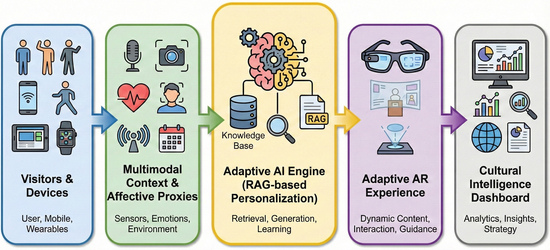
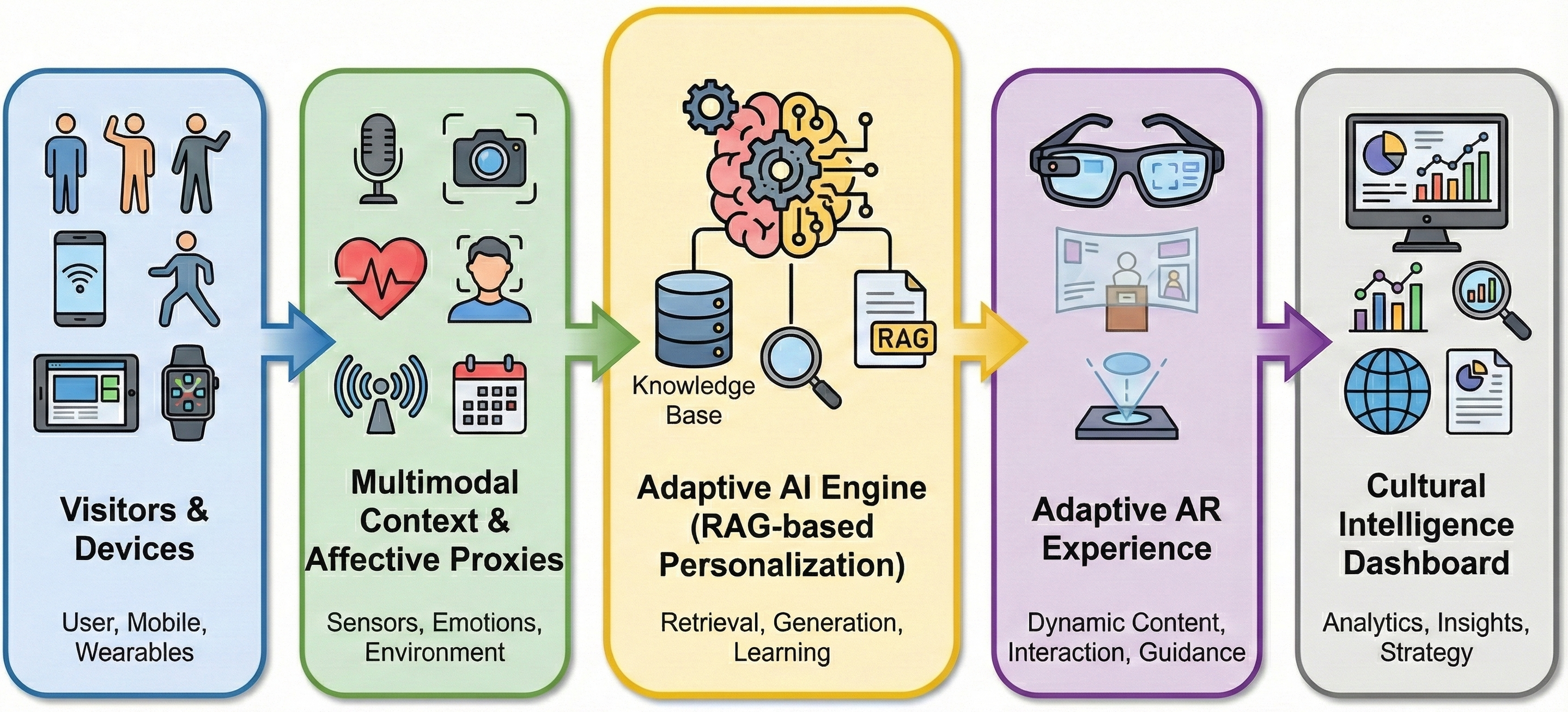
Graphical Abstract

1. Introduction

Extended Reality (XR) technologies (i.e., Augmented, Mixed, and Virtual Reality) are increasingly adopted in digital museology to enrich interpretation by situating digital information within physical exhibition spaces [1,2]. Within this umbrella, Augmented Reality (AR) is particularly relevant for in-situ, object- and place-based interpretation, because it can overlay contextual information onto authentic exhibits without fully disconnecting visitors from the physical environment [3,4].
Despite growing uptake, most AR deployments in GLAM institutions remain largely static and pre-scripted, with limited responsiveness to (i) visitor behavior and evolving interests, (ii) accessibility and diverse interaction needs, and (iii) moment-to-moment engagement states. Recent survey and review studies report recurring gaps in end-to-end adaptivity, interoperability with institutional infrastructures, and governance for responsible personalization in cultural settings (see Section 2). These gaps are amplified by the increasing availability of AI techniques (e.g., recommender systems and LLM-based assistants), which are often introduced in isolation—without a unifying architecture that connects sensing, user modeling, trustworthy content grounding, and AR delivery. These limitations have been repeatedly reported in recent survey and review studies on AR and XR in cultural heritage, which highlight the prevalence of static interaction models, limited personalization, and insufficient operationalization of ethical governance in deployed systems [5,6,7,8,9,10].
To clarify the motivation beyond the architectural “gap” itself, we frame the tackled problem as a set of persistent, practice-relevant challenges that repeatedly limit the impact and scalability of museum AR deployments. In particular, current GLAM implementations often suffer from:
(i) static and exhibit-centric interpretation, where personalization rarely goes beyond proximity or marker triggers and does not reflect evolving visitor needs;
(ii) fragmented pipelines, in which sensing, user modeling, content authoring, and AR delivery are developed as disconnected components, preventing an operational end-to-end adaptation loop;
(iii) limited mechanisms for trustworthy, curator-controlled personalization, which becomes critical when generative AI is introduced, due to risks of ungrounded content, loss of institutional voice, and reduced accountability;
(iv) weak integration with institutional asset and metadata infrastructures (e.g., DAM/collections systems), which hinders reuse, interoperability, and scalable content governance; and
(v) insufficient operationalization of privacy, consent, explainability, and cultural integrity as implementable system mechanisms rather than high-level principles.
As a design-oriented contribution, ARIA is intended to reduce integration ambiguity and support reproducible prototyping and evaluation, rather than to claim empirical performance gains in this study. Unlike purely conceptual frameworks, ARIA is supported by a formative validation process, including expert walkthrough evaluation, scenario-based consistency analysis, and technical feasibility reasoning, which are reported in Section 5.
Accordingly, the research gap addressed in this work is not only the absence of an AR-first “end-to-end” framework but specifically the lack of an implementable architectural blueprint that links these problem areas into a coherent, evaluable, and institutionally controllable adaptation cycle. ARIA is proposed to support this by integrating (a) multimodal context monitoring, (b) privacy-preserving affect proxies, (c) grounded personalization via Retrieval-Augmented Generation (RAG) over curator-approved knowledge sources, and (d) DAM-aligned content management, all under explicit Human-Centered Design and FATE-oriented governance.
To address this need, this paper presents ARIA (Augmented Reality for Interpreting Artefacts), a conceptual architectural and methodological framework for AR-first hyper-personalized museum engagement. ARIA combines (a) real-time multimodal context awareness, (b) lightweight affect-informed adaptation under strict privacy constraints, and (c) Retrieval-Augmented Generation (RAG) grounded in curator-approved knowledge sources, enabling dynamic narrative variation while preserving institutional authority and cultural integrity. The difficulty addressed by ARIA lies in delivering real-time, adaptive, and ethically governed AR interpretation in GLAM settings due to fragmented system pipelines, limited visitor modeling, and the lack of curator-grounded and accountable personalization mechanisms [11,12,13,14].
Importantly, ARIA is positioned as a design and integration blueprint rather than a fully implemented system: it specifies modules, data flows, decision points, and an evaluation protocol that can be instantiated across heterogeneous GLAM settings. The framework is grounded in Human-Centered Design (HCD) and operationalizes responsible AI principles (Fairness, Accountability, Transparency, and Ethics) through concrete methods (e.g., privacy-by-design, consent management, expert-in-the-loop validation, and explainability mechanisms).
More specifically, this work addresses limitations identified in prior cultural heritage AR frameworks by:
  • Articulating an AR-first, modular platform architecture that explicitly links immersive delivery, sensing/monitoring, DAM, and adaptive AI components, which are often treated separately in prior work;
  • Formalizing an affect–context fusion loop that specifies how affective proxies participate in real-time narrative and interface adaptation, rather than remaining at the level of post-hoc analytics;
  • Embedding RAG-based personalization within the AR adaptation pipeline and grounding generated narratives in curator-approved institutional knowledge, in contrast to standalone LLM-based museum assistants;
  • Operationalizing ethical and inclusivity principles through concrete governance mechanisms (privacy, consent, XAI, bias mitigation, authenticity checks), rather than addressing them as abstract guidelines;
  • Supporting feasibility and evaluability through a component-to-metric validation mapping, enabling structured walkthrough-based assessment instead of relying solely on illustrative scenarios.
These contributions should be interpreted as architectural and integrative advances rather than claims of first-use of individual technologies. While ARIA leverages semantic relationships similar to those found in knowledge graph-based approaches, its contribution does not lie in proposing a new semantic representation formalism. Instead, ARIA distinguishes itself by operationalizing semantic relationships as dynamic inputs to real-time AR adaptation. Semantic links are activated, weighted, and traversed based on evolving user models and affective context, rather than being queried statically for information retrieval alone.
The remainder of this article is organized as follows. Section 2 provides an in-depth analysis of the state of the art, synthesizing existing work on AR applications for cultural heritage, adaptive systems, affective computing, and Human–Computer Interaction (HCI) challenges. Section 3 introduces the conceptual architecture of the Augmented Reality for Interpreting Artefacts (ARIA), detailing its core modules, data flows, and technological underpinnings. In Section 4, we present the platform’s innovative technological pillars, including real-time sensor fusion, emotion-responsive AR, and AI-driven personalization enabled through Retrieval-Augmented Generation (RAG). Section 5 outlines the ethical governance framework, validation methodology, and implementation strategy, with emphasis on HCD and FATE-aligned development. Finally, Section 6 concludes the paper, discusses the implications for next-generation digital museology, and identifies key directions for future research.

2. State of the Art and Related Work

While digital technologies have reshaped cultural heritage (CH) interpretation, the current State of the Art (SotA) is still characterized by considerable fragmentation, technological constraints, and gaps in personalization, adaptivity, and ethical governance. Although the literature frequently discusses AR within broader XR ecosystems, this review deliberately foregrounds AR as the primary medium for in-situ cultural interpretation, treating VR and MR as complementary rather than central technologies [15,16,17].

2.1. Evidence from Surveys and Literature Mappings

Recent survey and review studies on AR in cultural heritage consistently report that a large proportion of deployments remain scripted and exhibit-centric rather than visitor-adaptive, and personalization is often limited to basic triggers (e.g., location/markers) instead of user modeling. Also, interoperability with museum back-end infrastructures and asset repositories remains uneven, while ethical governance (privacy, transparency, cultural integrity) is rarely operationalized as an end-to-end design requirement. These findings motivate the need for integrative frameworks that connect sensing, personalization intelligence, trustworthy content grounding, and AR delivery within GLAM constraints [5,6,7,18,19,20,21].

2.2. Existing Frameworks for AR in Cultural Heritage and Positioning of ARIA

Prior work has proposed conceptual and architectural frameworks for AR experiences in cultural heritage, focusing on aspects such as experience design, content pipelines, user engagement, or technology stacks. However, existing frameworks typically address only parts of the full loop (e.g., front-end experience design without back-end DAM integration or analytics without trustworthy generative personalization) and rarely specify decision logic for real-time adaptation or governance methods for responsible AI in GLAM contexts. To position ARIA, Table 1 compares representative frameworks against ARIA across adaptation, AI grounding, affect awareness, DAM/FAIR alignment, and governance mechanisms, with AR typically addressed as part of broader XR design ecosystems rather than as a standalone adaptive paradigm [8,9,22,23].

2.3. Architectural Frameworks for AR and XR in Cultural Heritage

Beyond individual AR and XR applications, a substantial body of prior work has proposed architectural, scene-based, and system-level frameworks intended to structure the design, development, and deployment of immersive experiences in cultural heritage contexts. These frameworks differ in scope and intent but typically aim to formalize how digital content, interaction logic, sensing, and presentation layers are orchestrated within museum and heritage environments.
Table 1 sketches the current status quo of architectural and conceptual frameworks for AR/XR in cultural heritage. Existing approaches share a common emphasis on either high-level experience conceptualization (e.g., experiential or interaction-focused frameworks) or system-oriented development concerns such as content pipelines, scene authoring, and XR deployment architectures. Across all compared works, AR is typically treated as part of a broader XR ecosystem rather than as a primary, autonomous medium for in-situ interpretation.
Several additional frameworks discussed in the literature were considered during the review process but are not included in Table 1. These approaches typically focus on narrower aspects of XR systems, such as scene authoring, interaction design, or experience evaluation, without specifying end-to-end adaptive logic, AI grounding, or governance mechanisms. Others address XR more broadly rather than AR-first or remain at a conceptual level without defining implementable architectural components. For these reasons, they were not selected for direct comparison, although their contributions informed the synthesis of limitations and design requirements motivating ARIA [24,25,26].
A key similarity among the reviewed frameworks is their reliance on predominantly static or predefined interpretive logic. While some systems support interaction-driven behavior or modular content structures, none explicitly specify a real-time adaptation loop that integrates contextual monitoring, user modeling, and decision-making within the AR experience. Likewise, AI-related components—particularly those enabling dynamic personalization or narrative variation—are either absent or remain outside the architectural scope of existing frameworks.
Notable differences emerge in terms of abstraction level and intended use: conceptual frameworks focus on experience design and value dimensions, whereas system-oriented approaches emphasize implementation pipelines and technical modularity. However, this division results in a recurring gap between conceptual intent and operational execution. Methodological aspects such as validation strategies, continuous adaptation logic, or explicit governance mechanisms are rarely articulated as part of the framework itself.
Crucially, ethical and institutional governance concerns—such as data protection, transparency of adaptive behavior, curatorial control over content variation, and accountability when AI-driven mechanisms are involved—are not operationalized within existing architectural proposals. When mentioned, they remain at the level of general discussion rather than implementable design elements.
In contrast, ARIA is proposed to address these weak points by explicitly linking sensing, adaptive reasoning, and AR delivery into a coherent, end-to-end architectural loop. By foregrounding AR as the primary medium for situated interpretation, integrating AI-driven personalization through curator-grounded Retrieval-Augmented Generation, and embedding ethical governance as a functional system layer, ARIA responds directly to the limitations identified in prior work. The framework therefore complements and extends existing approaches by providing an implementable blueprint for real-time, adaptive, and institutionally accountable AR experiences in GLAM contexts.
Representative examples include scene-based AR frameworks for museum exhibits, modular pipelines for authoring and deploying immersive cultural experiences, and system architectures integrating content management, interaction, and visualization components. Such approaches have been proposed for indoor museums, archaeological sites, and hybrid GLAM settings, often emphasizing content authoring workflows, exhibit-level orchestration, or device-level interaction abstractions. Recent framework-oriented contributions have also highlighted the importance of modularity, reuse, and scalability in AR/XR systems for cultural heritage, while acknowledging persistent limitations in real-time adaptivity, user modeling, and cross-layer integration. In parallel, more recent works have begun to discuss the role of AI-assisted personalization and intelligent content mediation, although typically as isolated components rather than as part of a unified end-to-end architectural loop.
In this study, we focus specifically on implementable frameworks that explicitly define architectural components, pipelines, or procedural models for AR/XR in cultural heritage, and distinguish them from survey or mapping studies that synthesize existing literature without proposing an operational framework.
It should be noted that survey and mapping studies, while essential for understanding trends and gaps in the literature, do not constitute implementable frameworks. Accordingly, literature reviews that do not introduce new architectural or procedural models are excluded from the comparative framework analysis, even if they are cited elsewhere in this section to support the state-of-the-art discussion.
Table 1 therefore compares the proposed ARIA framework against a representative set of prior architectural and scene-based frameworks for AR/XR in cultural heritage. The selection prioritizes works that explicitly define system architectures, content pipelines, or framework-level abstractions, including several well-established approaches introduced in recent years across journal and conference venues. The comparison is not intended to be exhaustive but to capture dominant design patterns and recurring limitations relevant to AR-first adaptive interpretation.

2.4. Usability, Interaction, and Fragmentation in Extended Reality

The adoption of XR—including Augmented Reality (AR), Virtual Reality (VR), and Mixed Reality (MR)—has accelerated within museums and heritage sites. AR, in particular, enables situated interpretation by overlaying contextual digital information directly onto physical exhibits. However, successful deployment of immersive systems remains hindered by Human–Computer Interaction (HCI) challenges. Studies consistently show that MR interfaces suffer from cognitive overload, interface complexity, ergonomics limitations, and device-induced discomfort [9,21]. Achieving seamless spatial alignment and maintaining immersion during transitions between real and virtual content is still technically demanding, especially when using Head-Mounted Displays (HMDs) with restricted field-of-view or unstable tracking [8].
Technical fragmentation also persists: heterogeneous hardware, divergent interaction paradigms, and inconsistent tracking systems impede standardization and cross-platform interoperability [9]. Similar fragmentation affects digital assets and metadata structures within AR and XR museum systems. Inconsistent documentation and disconnected Digital Asset Management (DAM) systems diminish discoverability and reduce the reusability of digitized assets [10]. Meanwhile, many existing XR applications remain fundamentally object-centered and static, offering minimal visitor autonomy. Critics note that such experiences risk reducing CH to a technological spectacle, offering entertainment rather than deep cultural understanding [27]. Consequently, research increasingly emphasizes participatory and co-creative design approaches as essential for meaningful engagement, which is particularly problematic for AR deployments that must run on visitor-owned smartphones or a small fleet of managed devices with limited calibration time [28].

2.5. Limitations in Adaptation, Personalization, and Affective Computing

Contemporary CH systems rarely deliver real-time adaptive experiences responsive to visitors’ cognitive, behavioral, or emotional states. Many existing platforms rely on simplistic personalization—typically proximity triggers, QR markers, or rule-based logic—resulting in generic content that fails to reflect the evolving needs and profiles of heterogeneous visitors [29].
A major gap concerns affective and emotional responsiveness. While affective computing has been shown to improve adaptive learning and human–AI interaction, its integration into CH environments remains at low Technology Readiness Levels (TRLs) [30].
Recent review studies suggest that affect-aware approaches are still not mainstream in deployed museum AR systems and are often limited to coarse proxies (e.g., dwell time, navigation logs) rather than robust multimodal inference. As a result, narrative depth, guidance, or difficulty cannot be dynamically adapted to reflect a visitor’s confusion, interest, fatigue, or curiosity. Research explicitly identifies the development of emotion-aware AR systems as a crucial direction for future innovation [6,7,30].
AI-driven storytelling and personalization also remain underdeveloped. Current museum chatbots and recommendation systems provide generic or static responses, lacking contextual sensitivity, situational awareness, or emotional alignment [31]. The potential of Large Language Models (LLMs) and multimodal generative AI to build rich, contextualized narratives is recognized but requires a unified architectural framework that integrates sensing, reasoning, content generation, and XR delivery.

2.6. Ethical and Human-Centered Design Challenges

The integration of pervasive sensing, AI-driven personalization, and XR interaction raises substantial ethical challenges. AR systems frequently process sensitive data—including geolocation, gaze patterns, camera input, and potentially emotional cues—necessitating strict compliance with GDPR, transparent consent mechanisms, and robust data governance [32]. Prediction-based personalization must incorporate Explainable AI (XAI) methods to avoid opacity, algorithmic bias, or erosion of visitor autonomy [33].
Inclusivity in XR remains a critical concern. Many systems rely on “one-size-fits-all” accessibility models that fail to accommodate diverse sensory, cognitive, or cultural needs. Adaptive UI principles and participatory design involving disabled communities are essential to address these gaps [34].
A further challenge concerns cultural authenticity. Generative AI models used for reconstruction or storytelling may unintentionally introduce hallucinated details, anachronisms, or cultural stereotypes, thereby compromising historical integrity [35]. Preservation ethics therefore require that XR-based visualizations be developed in collaboration with domain experts to ensure fidelity, transparency, and interpretative responsibility.

2.7. Synthesized Research Gap

In summary, the literature indicates strong progress in AR/XR experience design and in isolated components such as analytics or conversational agents. Nevertheless, a gap remains for an AR-first, end-to-end framework that: (i) specifies a real-time decision loop combining context signals and lightweight affect proxies, (ii) grounds adaptive narratives in curator-approved knowledge (to reduce hallucinations and preserve cultural integrity), (iii) connects front-end AR delivery to back-end DAM/FAIR-aligned asset infrastructures, and (iv) operationalizes ethical governance through implementable methods rather than high-level principles alone. ARIA is proposed to address this gap (Section 3).

3. The Augmented Reality for Interpreting Artefacts (ARIA) Framework

This section presents the conceptual and architectural foundations of the Augmented Reality for Interpreting Artefacts (ARIA). The framework is specified at the level of system roles, functional modules, and data flows, without assuming a single implementation or deployment configuration. The ARIA framework proposes a unified, modular ecosystem that can leverage cloud, edge, and on-device components, synthesizing advances in AI, AR, IoT, and HCI to enable truly hyper-personalized CH engagement.

3.1. Conceptual Overview and Modular Architecture

The overarching mission of ARIA is to transform how GLAM institutions curate, interpret, and disseminate cultural knowledge by providing an adaptive, ethically grounded, and interoperable technological infrastructure. The framework prioritizes inclusivity, sustainability, and accessibility, aligning closely with current developments in digital museology and human-centric Industry 5.0 principles [36,37,38].
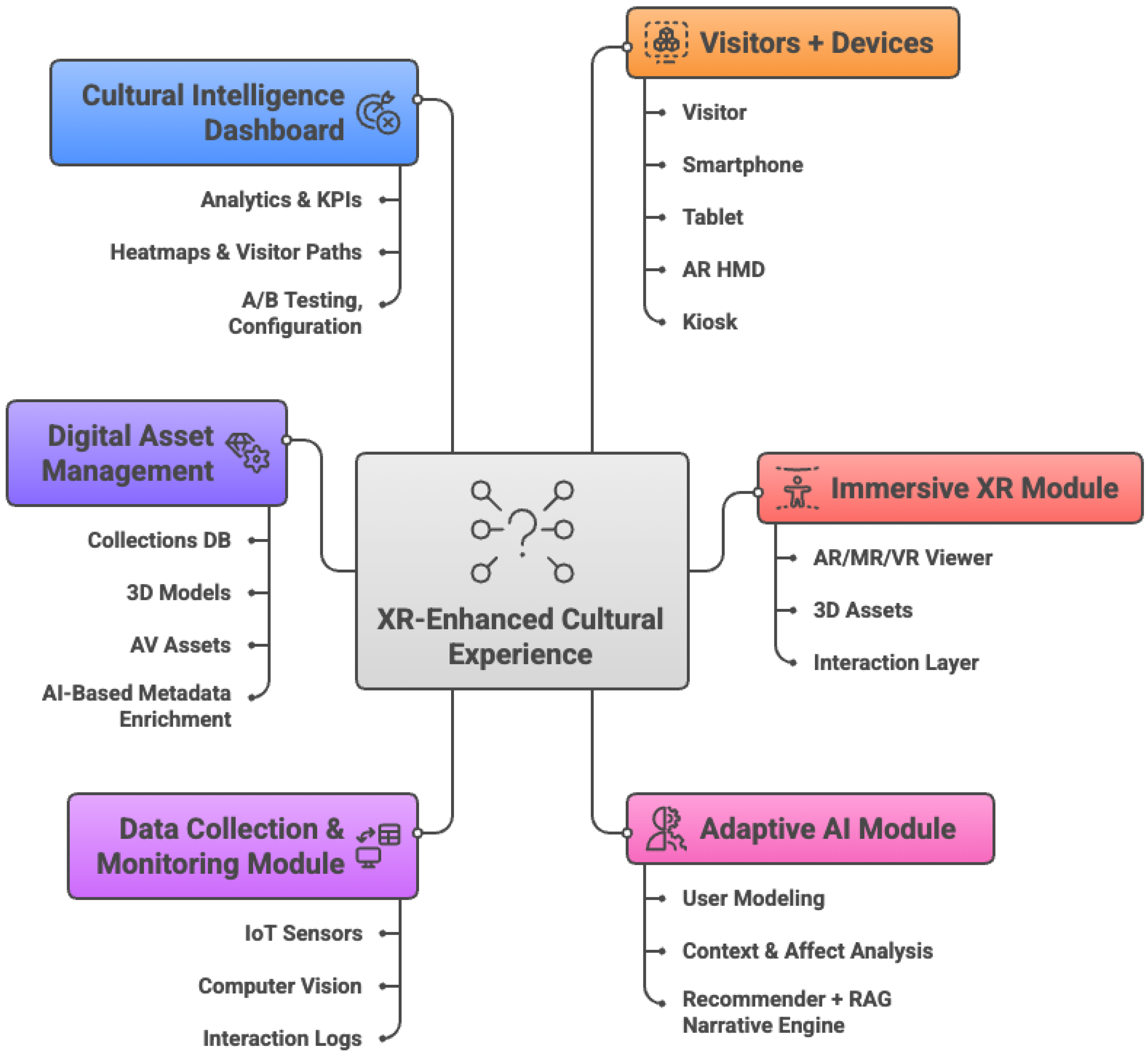
The ARIA architecture is designed as a modular, scalable, and standards-aligned platform with open APIs to ensure long-term sustainability and interoperability with evolving CH infrastructures. As illustrated in Figure 1, the framework connects heterogeneous visitor devices with an immersive XR module that is continuously driven by the adaptive AI engine and real-time monitoring, while the DAM and Cultural Intelligence Dashboard close the loop between digitization, analytics, and curatorial decision-making. The architecture is decomposed into five logical modules, each corresponding to a distinct functional responsibility within the ARIA framework:
  • Immersive XR Module: This module integrates primarily AR-based visualization, with optional MR/VR extensions depending on institutional needs. A core focus is the generation of high-fidelity 3D assets using polygonal mesh pipelines, photogrammetry, and high-resolution multimodal digitization [39]. Standardized formats enhance cross-museum interoperability and long-term digital preservation, addressing gaps highlighted in current XR deployments.
  • Adaptive AI Module: The AI module is the platform’s decision-making core, enabling context-aware, affect-responsive, and hyper-personalized content delivery. It integrates multimodal analytics (interaction patterns, sensor-based observations, and emotional cues) with advanced recommendation engines and Retrieval-Augmented Generation (RAG) models. Continuous model refinement can be supported through a shared learning pool, aligning with state-of-the-art adaptive systems in CH [40].
  • Data Collection and Monitoring Module: This module aggregates real-time data from IoT sensors, computer-vision tools, and interaction logs, enabling precise visitor flow analysis, engagement mapping, and affective state estimation. Real-time data pipelines are central to delivering low-latency adaptive content, reflecting recent developments in responsive museum analytics [41]. All sensing modalities are considered optional and configurable, subject to explicit consent and institutional policy constraints.
  • Digital Asset Management (DAM) Module: A centralized DAM repository supports FAIR-compliant management of digital artifacts, enabling advanced semantic enrichment using AI-based metadata extraction [42]. This module addresses the widespread fragmentation of digital assets across GLAM institutions.
  • Cultural Intelligence Dashboard: This dashboard consolidates multimodal analytics and KPI monitoring into an operational interface for curators and administrators. It supports evidence-informed curatorial reflection, exhibit planning, and adaptive interpretation strategies. Cultural decision-support environments have been identified as a critical missing element in digital museology workflows [43].
Figure 1 illustrates the modular, layered architecture of ARIA, highlighting the data flows between immersive front-end experiences, adaptive AI reasoning, sensor-driven monitoring, and FAIR-aligned digital asset management. The figure is intended as a reference architecture rather than a fixed system blueprint.

3.2. Foundational Methodology and Design Principles

The ARIA framework is grounded in interdisciplinary Design Science Research (DSR), combining methodologies from CH studies, AI ethics, HCI, and participatory design. Its development adheres to three guiding pillars: Human-Centered Design (HCD), accessibility-by-design, and ethical AI governance.
HCD underpins all ARIA development processes, ensuring alignment with user needs, cultural sensitivities, and institutional capabilities [44]. Participatory design methods—including co-creation workshops, scenario-based design (SBD), and iterative testing—ensure meaningful involvement of diverse stakeholders such as curators, educators, local communities, and marginalized user groups [45].
Accessibility is embedded through Universal Design principles and adaptive interface strategies, providing multimodal interaction pathways, alternative sensory channels, and cognitive load management. This approach aligns with emerging scholarship advocating for inclusive XR experiences and personalized accessibility profiles [46].
Given the integration of advanced AI, behavioral sensing, and emotion recognition, ARIA adopts a comprehensive ethical governance framework grounded in the FATE paradigm: Fairness, Accountability, Transparency, and Ethics [17,33,47]. Key components include:
  • Privacy-by-Design and GDPR Compliance: All data processing pipelines incorporate minimization, anonymization, and local processing strategies.
  • Explainable AI (XAI): Transparency layers inform visitors how recommendations, reconstructions, or adaptive narratives were produced [48].
  • Bias Mitigation: AI models are trained on diverse datasets, with human-expert review loops to prevent cultural distortion or stereotyping [49].
  • Cultural Authenticity: Reconstruction workflows include mandatory expert validation to ensure historical accuracy and mitigate risks associated with generative hallucinations in XR environments [50,51,52].
The ARIA framework thus integrates technological innovation with rigorous ethical standards, ensuring the delivery of adaptive, inclusive, and culturally responsible AR experiences. This methodology provides a robust foundation for future prototypes and real-world deployments.

3.3. Illustrative Use Case Scenario

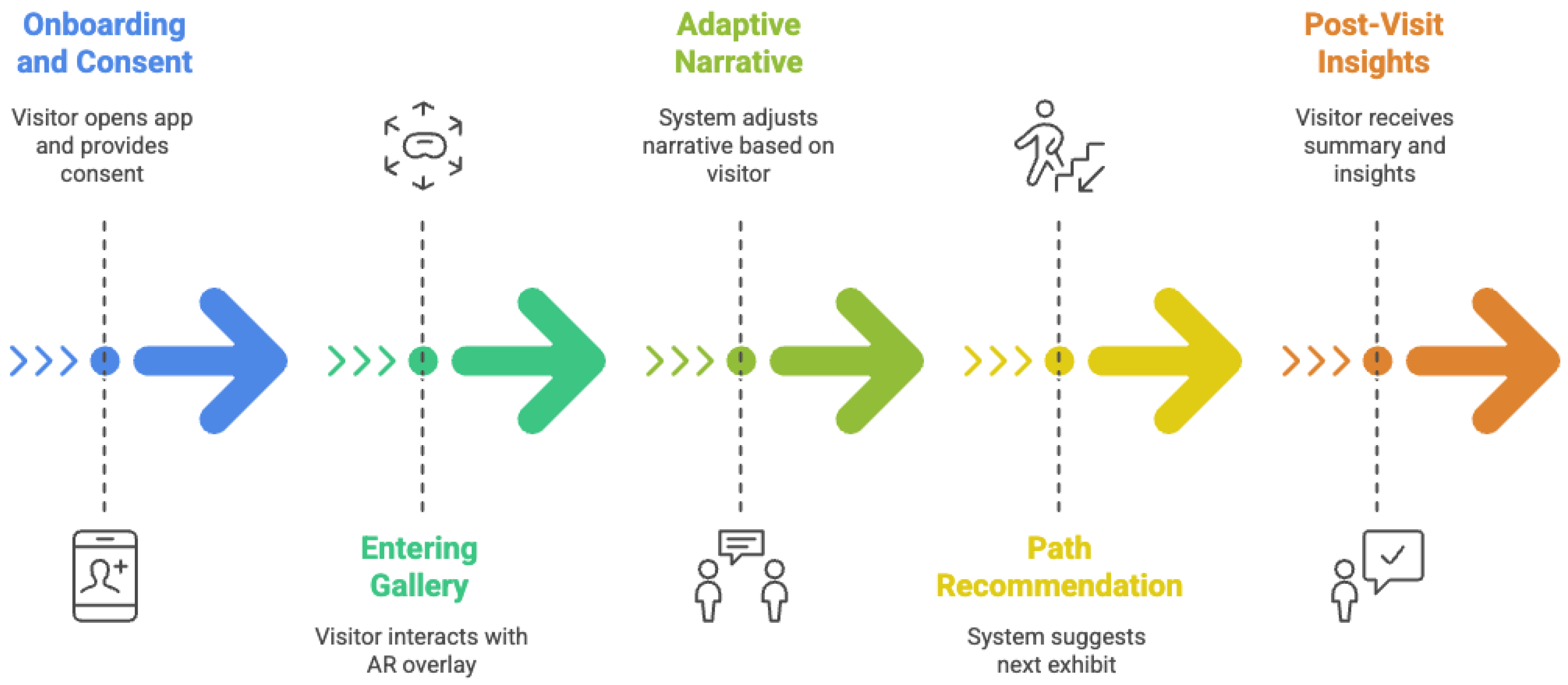
To clarify how the ARIA framework operates in practice, Figure 2 presents an illustrative use case scenario of a visitor journey in a museum gallery. The scenario is illustrative and aims to clarify system interactions rather than to report empirical evaluation results. These illustrative scenarios are subsequently used as inputs to the formative validation activities reported in Section 5, including expert walkthrough evaluation and scenario-based consistency analysis. The scenario highlights the interplay between frontstage visitor interactions and backstage ARIA modules: visitors first complete onboarding and consent, then experience context-aware AR overlays at selected exhibits, receive affect-aware narrative adaptations and personalized path recommendations, and finally contribute anonymized interaction data to the Cultural Intelligence Dashboard. This end-to-end flow concretely demonstrates how ARIA operationalizes its architectural components to deliver hyper-personalized and ethically governed cultural heritage experiences. Figure 2 below summarizes the experiential outcomes resulting from steps (4)–(6) of the adaptive loop described in Section 3.4.

3.4. End-to-End Adaptive Loop and Data-Flow Sequencing

To clarify how the architectural modules (Figure 1), the technological pillars (Figure 3), and the experiential outcomes (Figure 2) are operationally connected, this subsection describes the ARIA framework as a unified end-to-end adaptive loop. Rather than a set of isolated components, ARIA is designed as a continuously executing pipeline that links sensing, reasoning, and AR delivery into a traceable decision flow.
The adaptive loop unfolds as follows:
  • Onboarding, consent, and initialization. The visitor initiates the AR experience through a mobile or wearable AR interface. During onboarding, consent preferences are explicitly captured (e.g., location tracking, interaction logging, optional affect proxies), configuring which sensing and personalization modules are activated. This step corresponds to the Ethical Governance and Immersive XR modules in Figure 1 and sets the boundary conditions for the entire adaptive process.
  • Contextual sensing and proxy acquisition. As the visitor navigates the physical space, the Data Collection and Monitoring module continuously gathers multimodal contextual signals, including spatial position, dwell time, navigation patterns, and interaction events. Where permitted, lightweight affective proxies (e.g., hesitation, pacing, repeated interactions) are inferred without relying on intrusive biometric measurements. This stage operationalizes the Context-Aware and Affective Integration pillar (Figure 3).
  • Fusion and user model update. Incoming contextual and affective signals are fused and used to incrementally update the visitor’s dynamic user model. The model captures evolving interests, engagement levels, and accessibility needs, forming the decision state that drives personalization. This process bridges the sensing layer with the Adaptive AI module in Figure 1.
  • Grounded retrieval and adaptive reasoning. Based on the updated user model and situational context, the Adaptive AI module triggers a Retrieval-Augmented Generation (RAG) process. Curator-approved knowledge sources and DAM-managed assets are queried to retrieve relevant factual content, which constrains and grounds any generated narrative elements. This step directly maps to the AI-Driven Personalization and Adaptive Storytelling pillar.
  • Narrative and interface adaptation. Retrieved and generated content is translated into adaptive AR narratives and interface configurations. Narrative depth, modality (text, audio, visual overlay), pacing, and interaction complexity are adjusted in real time to match the visitor’s engagement state and contextual conditions. This stage connects the AI reasoning outputs to the Immersive XR Module, producing the experiential outcomes illustrated in Figure 2.
  • Experience logging and feedback aggregation. Interaction events, adaptation decisions, and high-level engagement indicators are logged in anonymized form. These data streams feed the Cultural Intelligence Dashboard, enabling curators and administrators to observe aggregate patterns, evaluate interpretive strategies, and identify content or interaction bottlenecks.
  • Curatorial reflection and system refinement. Insights derived from the dashboard inform curatorial decision-making, content updates, and system tuning. This closes the adaptive loop by linking visitor-facing experiences back to institutional governance and long-term experience design.
Through this sequencing, ARIA operationalizes the conceptual architecture as a continuous sense–model–decide–act–reflect cycle. Figure 1, Figure 2 and Figure 3 should therefore be read as complementary views of the same adaptive system: architectural structure, functional capabilities, and experiential outcomes, respectively.

4. ARIA’s Innovative Technological Pillars for Adaptive AR

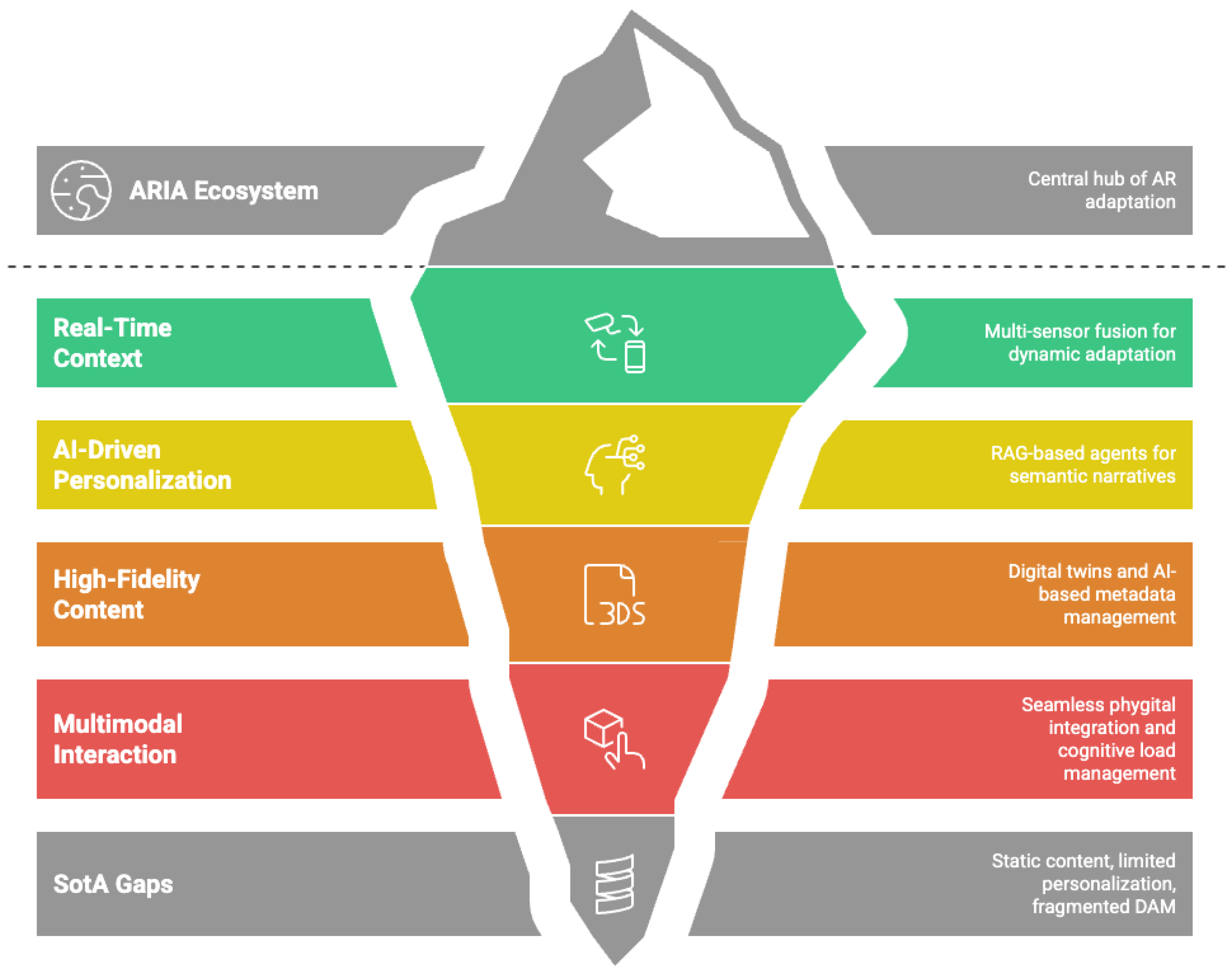
Building upon the conceptual architecture described in Section 3, this section details the four key technological pillars of the Augmented Reality for Interpreting Artefacts (ARIA), which are summarized in Figure 3. Each pillar is designed to directly address the limitations identified in the State of the Art (Section 2), namely the prevalence of static content, limited adaptivity, fragmented digital asset management, and persistent HCI/UX challenges in XR environments [10,19,20,30,34,46].
As summarized in Figure 3, the four technological pillars of ARIA are explicitly aligned with the main gaps identified in the State of the Art, moving from static, fragmented AR deployments toward a real-time, affect-aware, and hyper-personalized ecosystem.

4.1. Real-Time Context-Aware and Affective AR Integration

The first pillar focuses on transitioning from static, proximity-based AR systems to more deeply context-aware and affect-responsive mixed reality experiences. Whereas most current deployments rely on simple location triggers or QR codes [29], the ARIA aims to integrate multi-sensor data fusion and affective computing to drive real-time adaptation.
Existing frameworks typically address personalization, AI support, or ethical considerations in isolation, without specifying how these elements interact within a single operational loop. As summarized in Table 1, prior approaches either omit affect-aware adaptation, lack grounded generative mechanisms, or do not integrate governance constraints into system logic. ARIA’s contribution lies in explicitly binding these components into a traceable, end-to-end architectural loop, rather than introducing any single component in isolation. To the best of our knowledge, existing cultural heritage AR frameworks do not explicitly specify how affective proxies, contextual signals, and governance constraints are combined into a single, traceable adaptation loop that operates at runtime [29,30]. Therefore, the first pillar is structured into the following components:
  • Multi-Sensor Data Fusion: The ARIA framework incorporates a dense layer of IoT devices, environmental sensors, and tracking systems to continuously monitor visitor location, movement, crowd density, and ambient conditions. Similar IoT-based monitoring solutions have proven effective for visitor analytics and flow optimization in museum contexts [41]. By aggregating these heterogeneous data streams, the platform can construct a fine-grained model of the visitor’s situational context (e.g., congestion, dwell time, preferred paths), overcoming the limited, single-source triggers typical of current AR installations [10].
  • Emotion Recognition and Affective Computing: A second component of this pillar is the integration of emotion recognition and affective computing to assess engagement, confusion, or fatigue in real time. Prior work has demonstrated the potential of affect-aware systems in education and cultural heritage to improve adaptive support and user satisfaction [13,30]. In the ARIA, multimodal cues such as facial expressions, body posture, dwell patterns, and interaction rhythms can be used to infer affective and cognitive states, under strict ethical and privacy constraints (see Section 5). This directly responds to the identified gap whereby affective sensing in CH remains at low TRLs and largely confined to experimental prototypes [30].
  • Dynamic AR Content Adaptation: The fusion of contextual and affective signals enables dynamic modulation of AR content. For instance, if a visitor exhibits signs of confusion or reduced engagement, the system can simplify explanations, provide additional clarifications, or redirect them toward complementary exhibits. Conversely, highly engaged visitors may receive deeper, more expert-level narratives or alternative interpretive perspectives. This fine-grained adaptivity addresses the dominance of static, one-size-fits-all AR experiences noted in recent reviews [12,20] and aligns with emerging paradigms of responsive, data-driven museum interpretation [43].
From a technical perspective, ARIA adopts a late-fusion strategy, at the architectural level, for multimodal context and affect integration. Contextual signals (e.g., location, dwell time, navigation patterns) and affective proxies (e.g., interaction rhythm, hesitation, repetition) are processed independently and combined at the decision layer through weighted confidence aggregation rather than early sensor-level fusion. This design choice prioritizes robustness, interpretability, and privacy preservation.
ARIA is intentionally model-agnostic at the architectural level. The framework does not mandate specific machine learning models but instead defines standardized interfaces through which classifiers, recommender systems, or generative components may be integrated depending on institutional constraints and available expertise.
As a design-oriented framework, ARIA does not prescribe target accuracy levels for affect inference or personalization. Instead, evaluation is supported through component-specific indicators (e.g., responsiveness, consistency, traceability, curator approval rate), which are more appropriate for formative validation and expert walkthrough-based assessment.
Privacy constraints are enforced mechanically at the architectural level through consent-gated module activation, data minimization policies, and on-device or edge-level processing where applicable. Affective and sensing modules remain inactive by default and are enabled only following explicit user consent during onboarding, ensuring privacy-by-design rather than policy-level compliance.

4.2. AI-Driven Personalization and Adaptive Storytelling

The second technological pillar introduces an advanced AI layer for hyper personalized narrative construction and interaction. Existing personalization in CH systems tends to rely on coarse-grained segmentation or simple recommender logic [29,40]. The proposed RAG-driven storytelling engine represents a methodological advancement in cultural heritage AR, as it enables the real-time generation of context-specific narratives grounded strictly in curated institutional knowledge. While LLM-based assistants have begun to appear in museum contexts, ARIA is—based on our survey of the literature—one of the first architectural frameworks to explicitly combine RAG, multimodal user modeling, and affective feedback to produce non-linear, emergent narratives within an in-situ AR environment. More specifically, the AI personalization modules are:
  • RAG-Based Conversational Agents: RAG-based agents combine Large Language Models (LLMs) with curated cultural heritage knowledge bases and institution-specific datasets [37,40]. Instead of generic chatbots that offer static or loosely curated information [31], these agents can retrieve factual, institution-approved content and generate explanations, comparisons, and narratives aligned with the visitor’s current location, interaction history, and preferences. This setup reduces the risk of hallucinated information by grounding generative output in verified collections data and expert-curated metadata [42,50].
  • Sophisticated User Modeling: The ARIA maintains continuously evolving user models that integrate explicit preferences (e.g., chosen themes, languages), implicit behaviors (e.g., dwell time, navigation patterns), and inferred interests (e.g., repeated focus on specific cultural periods or media types). Such models build on recent work in adaptive personalization for CH [40], extending it with affective and contextual features harvested through the data collection and monitoring module [41]. This enables adaptive pacing, difficulty scaling, and content depth control, aiming to prevent both cognitive overload and under-stimulation [21,46].
  • Semantic Relationship Modeling and Emergent Narratives: To support rich, non-linear narrative paths, the ARIA employs semantic relationship modeling across digital objects, narratives, and contextual entities. Knowledge-graph-based approaches and AI-based metadata enrichment [42,43] are used to define conceptual, temporal, and spatial relationships between artifacts. As visitors navigate the physical and digital space, the system can dynamically surface connections (e.g., shared motifs, techniques, historical events) and generate emergent storylines tailored to their interests, addressing calls for more interpretatively sophisticated XR experiences in CH [27,28,39]. This semantic modeling architecture is novel in that it allows narrative pathways to emerge dynamically from visitor behavior and emotional responses, transforming AR storytelling from a static linear sequence into a more flexible, generative cultural knowledge experience.

4.3. High-Fidelity XR Content Creation and Digital Asset Management

The third pillar addresses the chronic fragmentation and underutilization of digital assets in GLAM institutions [10,36,38,42]. High-quality content is a prerequisite for compelling XR experiences, yet many institutions struggle with inconsistent digitization pipelines, limited 3D capture, and manual metadata practices [39,42]. ARIA introduces a unified workflow for generating high-fidelity digital twins optimized specifically for adaptive AR experiences. Unlike prior approaches that focus either on geometric accuracy or visual fidelity, ARIA integrates hybrid photogrammetry–laser scanning pipelines with semantic metadata generation, enabling assets to be both scientifically precise and computationally lightweight for real-time adaptation. More specifically:
  • High-Fidelity Digital Twins: The ARIA adopts state-of-the-art 3D recording and photogrammetric workflows to create high-fidelity digital twins of artifacts, architectural elements, and entire exhibition spaces [39]. Dense multi-view imaging, laser scanning, and mesh optimization pipelines support the production of detailed polygonal models suitable for AR/MR deployment while preserving conservation-grade accuracy. Such models underpin both in-situ AR overlays and immersive VR reconstructions, improving the realism and credibility of digital experiences [20,39].
  • AI-Based Digital Asset Management: To overcome fragmented DAM ecosystems, the ARIA integrates an AI-enhanced Digital Asset Management module that performs automated semantic enrichment, entity extraction, and relationship discovery across collections [10,42]. This reduces the manual burden on curators, improves cross-collection discoverability, and supports FAIR-compliant data practices [38,42]. The enriched metadata feed directly into the AI personalization and storytelling components, creating a virtuous cycle between content management and visitor-facing adaptivity. The DAM module extends existing systems by incorporating AI-based metadata enrichment that continuously aligns digital assets with evolving user models and emotional states. This tight coupling between semantic asset management and adaptive interaction has not been systematically documented within an AR-first cultural heritage framework [40,43].

4.4. Multimodal Interaction and Seamless Phygital Integration

The fourth pillar targets the complex HCI and UX/UI challenges of mixed reality environments, which have been repeatedly highlighted as barriers to adoption and sustained engagement [9,16,20,21,46]. In contrast to most MR systems that treat physical–digital transitions as static overlays, ARIA introduces a dynamic phygital synchronization mechanism that recalibrates spatial alignment, interaction modality, and content pacing based on visitor engagement and affective cues. This adaptive phygital orchestration constitutes a novel interaction paradigm for cultural heritage XR. More specifically:
  • Seamless Transitions and Spatial-Temporal Synchronization: A key objective is to maintain a unified sense of presence across physical and digital layers. Existing MR systems often suffer from misaligned overlays, tracking drift, or abrupt transitions, which disrupt immersion and increase cognitive load [9,21]. The ARIA architecture therefore emphasizes robust spatial registration, dynamic mapping, and temporal synchronization of content streams. Building on empirical insights from XR cultural heritage evaluation [2,20], the platform seeks to minimize visual discontinuities and to coordinate AR content with visitor movement and gaze.
  • Multimodal Interaction Channels: To support heterogeneous user needs and abilities, the ARIA enables multimodal interaction, including gaze-based selection, midair gestures, touch input, voice commands, and haptic feedback where available [16,46]. This design responds to recent work in inclusive interface design and adaptive accessibility [34,46], recognizing that no single interaction paradigm is universally suitable in museum contexts. Latency-sensitive operations (e.g., gesture recognition, spatial mapping) can be offloaded to edge-computing nodes to reduce lag and motion sickness [9,41].
  • Ergonomics and Cognitive Load Management: Finally, the ARIA explicitly integrates ergonomic and cognitive design considerations, drawing on established HCI and VR design guidelines [21,44,46]. Interface layouts, information density, and interaction complexity are tuned dynamically according to user profiles and real-time signals (e.g., signs of fatigue or overload), complementing the affective adaptivity described above. This pillar aims to counteract the usability issues and discomfort that often limit the adoption and long-term use of XR in CH settings [16,20,21,46].
Together, these four pillars operationalize the ARIA’s vision of a real-time, ethically governed, and hyper-personalized AR ecosystem for cultural heritage, grounded in robust digitization workflows, advanced AI, and inclusive HCI practice.

4.5. Implementation Challenges and Technical Feasibility

Despite the integrative potential of ARIA, the framework introduces several technical challenges that must be carefully addressed to ensure real-time performance and scalability. The simultaneous execution of affective computing pipelines, multi-sensor data fusion, RAG-driven adaptive storytelling, and high-fidelity XR rendering places significant computational demands on standard mobile hardware. Latency is a critical issue: adaptive feedback, spatial tracking, and semantic generation must occur within tight temporal constraints to preserve immersion and avoid cognitive overload. To mitigate these limitations, ARIA adopts a hybrid computation strategy that distributes processing across on-device inference, edge servers, and cloud-based reasoning components. Latency-sensitive tasks—such as gesture detection, spatial mapping, or lightweight affective cues—are executed locally or on edge nodes, whereas computationally intensive operations, including semantic retrieval and narrative generation, can be offloaded to cloud infrastructure when network conditions permit. This hybrid architecture improves feasibility while ensuring responsiveness, enabling ARIA to operate effectively within resource-constrained GLAM environments.

4.6. Minimum Viable Deployment, Resources, and Feasibility Constraints

ARIA does not assume the simultaneous deployment of all architectural modules. A minimum viable implementation (MVP) can be realized by selectively activating a subset of core components, depending on institutional capacity and goals. A baseline MVP configuration may include context-aware AR delivery, DAM-integrated content retrieval, and rule-constrained RAG-based narrative adaptation, without affective sensing or advanced emotion recognition.
From a human-resources perspective, an MVP deployment does not require large interdisciplinary teams. A minimal configuration may involve:
  • one curator or domain expert responsible for content validation and narrative constraints;
  • one XR developer for AR interface and interaction logic; and
  • one AI or software engineer responsible for integration of retrieval, recommendation, and analytics services. Advanced affective computing or multimodal sensing components may be introduced incrementally as institutional expertise and resources mature.
Infrastructure requirements are similarly scalable. At the MVP level, ARIA can operate on visitor-owned mobile devices, standard Wi-Fi connectivity, and cloud-based AI services accessed via APIs. No specialized sensing hardware is strictly required. More advanced deployments may introduce edge servers, IoT sensors, or dedicated XR devices, but these are optional and context-dependent. Accordingly, infrastructure costs should be understood in relative categories (low, medium, or high) rather than fixed estimates, reflecting differences in visitor volume, exhibition scale, and institutional strategy.
Several technical risks are acknowledged. These include latency constraints for real-time adaptation, dependency on network connectivity for cloud-based reasoning, and variability in mobile hardware capabilities. ARIA mitigates these risks through modular design, hybrid computation strategies, and graceful degradation mechanisms, whereby non-critical adaptive features can be temporarily disabled without compromising core AR functionality.
A realistic deployment timeline for an MVP instantiation of ARIA ranges from three to six months, encompassing requirements elicitation, content preparation, system integration, and pilot testing. Full-scale deployments incorporating affective sensing, advanced analytics, and cross-institution interoperability may extend beyond this timeframe and are envisioned as longer-term evolutions rather than immediate requirements.

5. Ethics, Human-Centered Design, and Formative Validation

ARIA is validated as a design-oriented framework following Design Science Research (DSR) principles. Accordingly, validation does not aim to demonstrate empirical performance gains but to establish architectural soundness, feasibility, and evaluability, following established design science research practices. The Augmented Reality for Interpreting Artefacts (ARIA) is grounded in an integrated approach combining ethical governance, Human-Centered Design (HCD), and a rigorous validation strategy. This ensures that advanced technologies such as real-time augmented reality (AR), affective computing, and AI-driven personalization are deployed in ways that are socially responsible, transparent, inclusive, and culturally sensitive (Table 2).

5.1. Ethical Governance and Privacy-Conscious Design

The ARIA addresses ethical risks inherent in pervasive sensing and AI-driven personalization, especially given the processing of potentially sensitive data such as movement traces, environmental context, and affective indicators. The ethical framework is guided by the FATE principles—Fairness, Accountability, Transparency, and Ethics [17,18]—ensuring responsible innovation throughout the system lifecycle.
  • Data Minimization and GDPR Compliance: Compliance with the General Data Protection Regulation (GDPR) is ensured through strict data minimization, purpose limitation, and secure processing. Sensitive signals such as emotional cues are anonymized, encrypted, and processed locally whenever possible to reduce systemic risk, aligning with current best practices in privacy-preserving AI [32,53].
  • Consent and User Autonomy: Visitors retain full control over the use of their data through explicit, granular opt-in mechanisms for camera access, emotion recognition, and sensor logging. Users may revoke consent at any time, supporting autonomy and informed participation [32]. These mechanisms are crucial for trust-building in GLAM environments, where technological interventions intersect with cultural sensitivities.
  • Transparency via Explainable AI (XAI): Explainable AI techniques enhance transparency by enabling curators and visitors to understand how recommendations, adaptive narratives, and XR reconstructions are produced. In line with recent XAI developments [48], ARIA integrates traceability layers and AR-based explanatory overlays that reveal data sources, model reasoning, and curatorial decision pathways. This is essential to maintaining institutional trust and preventing opaque or unintentionally biased interpretations.
  • Cultural Integrity and Bias Mitigation: AI-driven personalization risks introducing cultural biases or historically inaccurate “hallucinated” content. ARIA addresses these risks through: (i) mixed-initiative, template-based narrative generation to constrain AI outputs; (ii) expert-in-the-loop validation for digital reconstructions; and (iii) bias mitigation processes grounded in diverse training data and regular fairness audits [49,50]. Recent studies highlight the presence of cultural bias in museum datasets and knowledge graphs [54], underscoring the importance of these measures.

5.2. Human-Centered Design, Inclusivity, and Co-Creation

HCD underpins the ARIA methodology to ensure usability, accessibility, and cultural appropriateness. This approach aligns with contemporary movements in digital museology and XR design emphasizing co-creation, participatory processes, and inclusivity [44,45,46].
  • Participatory and Co-Creation Methodology: The framework promotes participatory design involving curators, educators, accessibility experts, and community stakeholders from early ideation to deployment. Co-creation facilitates shared authorship of interpretative narratives and strengthens cultural authenticity [45]. Such interdisciplinary collaboration is particularly effective in contextualizing AI-driven experiences within culturally sensitive domains.
  • Universal Design and Inclusive Interaction: ARIA operationalizes Universal Design principles to support visitors with diverse sensory, cognitive, linguistic, and motor needs. Strategies include adaptive multimodal interfaces, multilingual content, mobility-friendly navigation, and accessible XR interaction modalities. This approach is consistent with research on inclusive XR design [46,55].
  • Scenario-Based Design and Requirements Elicitation: Scenario-Based Design (SBD) is employed to capture experiential requirements and explore use cases for visitors with different accessibility profiles [44]. SBD supports the design of elastic interfaces, reduces cognitive load, and ensures that interaction models remain intuitive in mixed-reality contexts.

5.3. Validation Strategy and Preliminary Formative Results

This section reports formative validation activities that were carried out to assess the conceptual soundness, architectural coherence, and feasibility of the ARIA framework. Rather than reporting summative empirical results from a deployed system, the goal of validation at this stage is to establish conceptual soundness, architectural coherence, technical feasibility, and evaluability, in line with Design Science Research (DSR) practices.
Following a design science research methodology, ARIA undergoes iterative cycles of prototyping, testing, and refinement. Technical evaluations assess XR alignment accuracy, latency, stability, and AI model performance under real-use conditions [53,54,56,57,58]. User feedback from representative visitor groups informs subsequent design iterations.
Planned pilot deployments across diverse European GLAM environments (e.g., Italy, Greece, Spain, Turkey) are envisaged to enable ecological validation under realistic operating conditions. These settings capture cultural, architectural, and audience diversity, providing insight into cross-context robustness and scalability. Smart museum studies demonstrate the importance of multi-site pilots for stress-testing real-time visitor analytics and adaptive systems [41,59,60,61].
A mixed-method evaluation strategy combines quantitative and qualitative measures:
  • Quantitative KPIs: visitor engagement duration, interaction density, revisit probability, system latency, AR tracking accuracy, and emotional engagement metrics derived from affective signals [30,51].
  • Qualitative Measures: user satisfaction, cultural resonance, perceived transparency of AI, and inclusivity captured through interviews, focus groups, and UX studies [32,48].
  • Security and Privacy Compliance: architectural audits, penetration testing, and GDPR compliance checks ensure robust data protection and system resilience [53].
Through this comprehensive approach, ARIA aims to inform future progress toward TRL 6–7 through pilot deployments guided by the validation strategy described in this study. As part of the design validation process, ARIA was assessed through structured expert walkthroughs involving museum curators, digital heritage specialists, and HCI researchers. Experts review the framework against feasibility, interpretability, and institutional alignment criteria, evaluating whether each module addresses real operational needs and constraints in GLAM environments. Such expert-based validation is commonly used in early-stage framework assessment where full deployment is not yet feasible.

5.3.1. Implementation Constraints and Trade-Offs

ARIA does not assume full simultaneous deployment of all modules. Institutions may adopt the framework incrementally, prioritizing subsets (e.g., context-aware AR without affective sensing or RAG-based personalization without emotion proxies). This modular adoption strategy reduces staffing, cost, and technical barriers and aligns with heterogeneous institutional capacities across the GLAM sector.

5.3.2. Preliminary Formative Validation Results

To strengthen the credibility of the proposed framework, a set of preliminary formative validation activities was conducted. These activities do not aim to demonstrate empirical effectiveness but to assess feasibility, internal consistency, and institutional plausibility of the ARIA framework.
  • Expert walkthrough evaluation: A structured expert walkthrough was performed to evaluate the architectural completeness and controllability of the adaptive loop. The walkthrough involved domain experts from cultural heritage and human–computer interaction (e.g., curators, digital heritage researchers, and HCI practitioners; N = 5 ). Experts were guided through the end-to-end adaptation sequence (onboarding, sensing, user model update, adaptive reasoning, AR delivery, and curatorial feedback) and asked to assess feasibility, clarity of responsibilities, and alignment with GLAM institutional practices. Feedback confirmed that the modular decomposition and sequencing reflect realistic museum workflows and improve transparency compared to monolithic or ad hoc AR system designs. The walkthrough explicitly leveraged the illustrative use-case scenarios and end-to-end adaptation sequence to guide expert assessment of system behavior and decision traceability.
  • Scenario-based consistency validation: In addition, a scenario-based validation was conducted using representative visitor profiles (e.g., casual visitor, expert visitor, accessibility-focused visitor). For each scenario, the adaptation logic was traced step by step to verify that experiential outcomes illustrated in the use-case view can be derived from the proposed architectural modules and technological pillars without introducing undocumented assumptions. This analysis demonstrated internal consistency between the architecture (Figure 1), the technological pillars (Figure 3), and the visitor outcomes (Figure 2), while also confirming compliance with governance constraints such as consent configuration and curator oversight.
  • Technical feasibility reasoning: Finally, a feasibility check was performed at an analytical level to assess whether the adaptive loop can operate under realistic performance constraints. The pipeline was decomposed into latency-sensitive operations (e.g., interaction tracking, spatial alignment) and compute-intensive processes (e.g., retrieval and narrative generation). This reasoning supports the plausibility of hybrid deployment strategies combining on-device, edge, and cloud components, indicating that the framework does not rely on unrealistic computational assumptions.
Taken together, these preliminary results provide formative evidence that ARIA constitutes a coherent, technically plausible, and institutionally grounded architectural framework. Full empirical validation with end users is explicitly identified as future work, once partial or full implementations of the framework are realized. The walkthrough revealed no structural inconsistencies in the adaptive loop and confirmed that all adaptation decisions could be traced to explicit architectural components and governance constraints.
These formative results justify the publication of ARIA as a design and architectural contribution, while clearly delineating the boundary between early-stage validation and future summative evaluation.

6. Conclusions and Future Research Directions

This paper introduced ARIA (Augmented Reality for Interpreting Artefacts), an AR-first, AI-supported conceptual and architectural framework for adaptive cultural heritage experiences. The framework was motivated by persistent limitations in current AR deployments within GLAM institutions, including static content delivery, fragmented system architectures, limited personalization, and the lack of operationalized ethical governance for AI-driven adaptation.
Rather than proposing a single application or reporting empirical performance results, ARIA is positioned as a design-science contribution. Its primary objective is to specify a coherent, implementable blueprint that integrates adaptive AR delivery, context and affect awareness, AI-driven personalization, and FAIR-aligned digital asset management within the institutional, ethical, and technical constraints of cultural heritage environments.

6.1. Summary of Contributions and Implications

This work contributes to the literature on augmented reality and digital cultural heritage by advancing both theoretical understanding and practical design guidance for adaptive, AI-supported AR systems. Beyond listing system advantages, the contributions of ARIA are articulated in terms of their implications for theory and practice.
  • Theoretical implications: From a theoretical perspective, ARIA advances the state of the art in several ways. First, it introduces a unifying AR-first architectural abstraction for adaptive cultural interpretation, clarifying the role of Augmented Reality as a primary medium for in-situ meaning-making rather than as a secondary component within broader XR ecosystems. Second, the framework explicitly defines an end-to-end affect- and context-informed adaptation loop, operationalizing how sensing, user modeling, adaptive reasoning, and AR delivery interact in real time—an aspect that remains implicit or absent in most prior frameworks. Third, ARIA contributes to responsible AI discourse in cultural heritage by translating ethical and governance principles (e.g., privacy, transparency, accountability, curatorial authority) into concrete architectural mechanisms, rather than treating them as abstract guidelines. Finally, the framework establishes a structured bridge between AI-grounded narrative adaptation (via Retrieval-Augmented Generation) and museological authority, demonstrating how generative techniques can be constrained, explainable, and curator-controlled within interpretive systems.
  • Practical implications: From a practical standpoint, ARIA provides actionable guidance for GLAM institutions, system designers, and practitioners. The framework functions as a blueprint for incremental adoption, allowing institutions to deploy selected modules (e.g., context-aware AR or DAM integration) without committing to full-scale system transformation. It clarifies operational roles and control points for curators and heritage professionals, including approval workflows, narrative constraints, and oversight of adaptive behavior. ARIA also offers concrete guidance on integrating Digital Asset Management and metadata infrastructures with adaptive AR delivery, supporting interoperability and reuse across exhibitions and institutions. Finally, by explicitly mapping framework components to validation metrics, the framework supports evaluation-ready deployments, facilitating feasibility assessment, pilot studies, and evidence-informed procurement decisions.
Together, these contributions position ARIA not merely as a collection of system features, but as a theoretically grounded and practically applicable framework for next-generation adaptive AR experiences in cultural heritage.

6.2. Limitations of the Present Study

Several limitations should be acknowledged. First, ARIA has not yet been validated through full-scale deployments or longitudinal user studies. While the framework defines how evaluation can be conducted, empirical performance metrics (e.g., affect recognition accuracy or latency under real-world load) remain to be established through future implementations. Second, affective computing within cultural heritage contexts is treated conservatively, relying on proxies rather than claims of precise emotion recognition. Finally, the framework’s breadth implies non-trivial organizational and technical requirements, which may exceed the immediate capacities of smaller institutions without phased adoption.
These limitations are intrinsic to early-stage framework research and do not diminish the value of ARIA as a design artefact; instead, they define clear boundaries for interpretation and guide future work.

6.3. Future Research Directions

Building on the ARIA framework, several research directions emerge:
  • Prototype-based and pilot validation: Developing partial implementations (e.g., RAG-driven narrative adaptation without affect sensing) to empirically test feasibility, latency, and user acceptance in controlled museum settings.
  • Robust affect proxies for cultural environments: Investigating culturally sensitive, privacy-preserving affect indicators suitable for real-world GLAM contexts and systematically documenting their failure modes.
  • Longitudinal impact studies: Examining how adaptive AR influences learning outcomes, interpretive depth, and visitor memory over extended periods, beyond immediate engagement metrics.
  • Cross-institution interoperability: Exploring shared metadata standards, semantic alignment strategies, and collaborative DAM infrastructures to support adaptive AR across institutional boundaries.
  • Governance and organizational adoption: Studying how curatorial practices, staffing models, and institutional policies shape the adoption of adaptive AI systems in museums and heritage sites.
In conclusion, ARIA contributes a structured and defensible foundation for next-generation adaptive AR in cultural heritage. By framing adaptation, personalization, and ethics as architectural and methodological concerns rather than ad hoc features, the framework supports a shift toward more responsible, evaluable, and institutionally grounded digital museology. Future empirical work will be essential to instantiate and refine this vision, but the present contribution establishes the necessary conceptual and architectural groundwork.

Author Contributions

Conceptualization, M.K. and E.I.; methodology, M.K.; software, M.K.; validation, E.I.; formal analysis, M.K.; investigation, E.I.; resources, M.K. and E.I.; data curation, M.K. and E.I.; writing—original draft preparation, M.K.; writing—review and editing, M.K.; visualization, M.K.; supervision, M.K.; project administration, M.K.; funding acquisition, M.K. All authors have read and agreed to the published version of the manuscript.

Funding

This research received no external funding.

Institutional Review Board Statement

Not applicable.

Informed Consent Statement

Not applicable.

Data Availability Statement

Data is contained within the article.

Acknowledgments

During the preparation of this study, the authors used NotebookLM Pro to support parts of the analysis. All generated content was subsequently reviewed and edited by the authors, who take full responsibility for the final publication.

Conflicts of Interest

The authors declare no conflicts of interest.

Abbreviations

ARIAAugmented Reality for Interpreting Artefacts
AIArtificial Intelligence
ARAugmented Reality
CHCultural Heritage
DAMDigital Asset Management
FATEFairness, Accountability, Transparency, and Ethics
FAIRFindable, Accessible, Interoperable, Reusable
GDPRGeneral Data Protection Regulation
GLAMGalleries, Libraries, Archives, and Museums
HCDHuman-Centered Design
HCIHuman–Computer Interaction
HMDHead-Mounted Display
IoTInternet of Things
KPIKey Performance Indicator
LLMLarge Language Model
MRMixed Reality
RAGRetrieval-Augmented Generation
SBDScenario-Based Design
SotAState of the Art
TRLTechnology Readiness Level
UIUser Interface
UXUser Experience
VRVirtual Reality
XRExtended Reality

References

  1. Bekele, M.K.; Pierdicca, R.; Frontoni, E.; Malinverni, E.S.; Gain, J. A Survey of Augmented Reality Applications in Cultural Heritage. Comput. Graph. 2018, 77, 1–20. [Google Scholar]
  2. Tromp, J.; Schofield, D.; Raeisian Parvari, P.; Poyade, M.; Eaglesham, C.; Torres, J.C.; Johnson, T.; Jürivete, T.; Lauer, N.; Reyes-Lecuona, A.; et al. Designing and Evaluating XR Cultural Heritage Applications Through HCI Methods. Appl. Sci. 2025, 15, 7973. [Google Scholar] [CrossRef]
  3. Sylaiou, S.; Mania, K.; Karoulis, A.; White, M. Exploring the Relationship Between Presence and Enjoyment in a Virtual Museum. Int. J. Hum.–Comput. Stud. 2010, 68, 243–253. [Google Scholar] [CrossRef]
  4. Pujol, L.; Champion, E. Evaluating Presence in Cultural Heritage Projects. Int. J. Herit. Stud. 2012, 18, 83–102. [Google Scholar] [CrossRef]
  5. Konstantakis, M.; Aliprantis, J.; Teneketzis, A.; Caridakis, G. Understanding User Experience Aspects in Cultural Heritage Interaction. In Proceedings of the 22nd Pan-Hellenic Conference on Informatics, Athens, Greece, 29 November–1 December 2018; ACM: New York, NY, USA, 2018; pp. 267–271. [Google Scholar]
  6. Komianos, V. Immersive applications in museums: An analysis of the use of XR technologies and the provided functionality based on systematic literature review. JOIV Int. J. Inform. Vis. 2022, 6, 60–73. [Google Scholar] [CrossRef]
  7. Zhou, Y.; Chen, J.; Wang, M. A meta-analytic review on incorporating virtual and augmented reality in museum learning. Educ. Res. Rev. 2022, 36, 100454. [Google Scholar] [CrossRef]
  8. Innocente, C.; Ulrich, L.; Moos, S.; Vezzetti, E. A framework study on the use of immersive XR technologies in the cultural heritage domain. J. Cult. Herit. 2023, 62, 268–283. [Google Scholar] [CrossRef]
  9. Kobeisse, S. Hands on the Past: Towards a Conceptual Framework for Developing and Evaluating Tangible AR Interfaces for Historical Artefacts. In Proceedings of the 35th Australian Computer-Human Interaction Conference, Wellington, New Zealand, 2–6 December 2023. [Google Scholar]
  10. Boboc, R.G.; Băutu, E.; Gîrbacia, F.; Popovici, N.; Popovici, D.M. Augmented reality in cultural heritage: An overview of the last decade of applications. Appl. Sci. 2022, 12, 9859. [Google Scholar] [CrossRef]
  11. Breque, M.; de Nul, L.; Petridis, A. Industry 5.0: Towards a Sustainable, Human-Centric Industrial Model; European Commission Report; European Commission: Brussels, Belgium, 2021. [Google Scholar]
  12. Mortara, M.; Catalano, C.E.; Bellotti, F.; Fiucci, G.; Houry-Panchetti, M.; Petridis, P. Learning Cultural Heritage Through Serious Games: A Review. J. Cult. Herit. 2014, 15, 318–329. [Google Scholar] [CrossRef]
  13. Yun, H.J.; Cho, J. Affective domain studies of K-12 computing education: A systematic review from a perspective on affective objectives. J. Comput. Educ. 2022, 9, 477–514. [Google Scholar] [CrossRef]
  14. Konstantakis, M.; Aliprantis, J.; Michalakis, K.; Caridakis, G. Recommending user experiences based on extracted cultural personas for mobile applications-REPEAT methodology. In Proceedings of the 20th International Conference on Human-Computer Interaction with Mobile Devices and Services (MobileHCI’18), Barcelona, Spain, 3–6 September 2018. [Google Scholar]
  15. Konstantakis, M.; Kalatha, E.; Caridakis, G. Cultural heritage, serious games and user personas based on gardner’s theory of multiple intelligences:“The Stolen Painting” game. In International Conference on Games and Learning Alliance; Springer International Publishing: Cham, Switzerland, 2019; pp. 490–500. [Google Scholar]
  16. Aliprantis, J.; Kalatha, E.; Konstantakis, M.; Michalakis, K.; Caridakis, G. Linked Open Data as Universal Markers for Mobile Augmented Reality Applications in Cultural Heritage. In Digital Cultural Heritage: Final Conference of the Marie Skłodowska-Curie Initial Training Network for Digital Cultural Heritage, ITN-DCH 2017, Olimje, Slovenia, 23–25 May 2017; Revised Selected Papers; Springer International Publishing: Cham, Switzerland, 2018; pp. 79–90. [Google Scholar]
  17. Floridi, L.; Cowls, J. A Unified Framework of Five Principles for AI in Society. Harv. Data Sci. Rev. 2019, 1, 1–15. [Google Scholar] [CrossRef]
  18. Konstantakis, M.; Caridakis, G. Adding Culture to UX: UX Research Methodologies and Applications in Cultural Heritage. J. Comput. Cult. Herit. 2020, 13, 1–17. [Google Scholar] [CrossRef]
  19. Ordoumpozanis, K.; Konstantakis, M.; Zoi, S.; Caridakis, G. Generative AI: A Systematic Review of Related Interfaces and Interactions. In Proceedings of the 3rd International Conference of the ACM Greek SIGCHI Chapter, Syros, Greece, 24–26 September 2025; ACM: New York, NY, USA, 2025; pp. 39–47. [Google Scholar]
  20. Caarls, J.; Jonker, P.; Kolstee, Y.; Rotteveel, J.; van Eck, W. Augmented Reality for Art, Design and Cultural Heritage—System Design and Evaluation. EURASIP J. Image Video Process. 2009, 2009, 716160. [Google Scholar] [CrossRef]
  21. Jerald, J. The VR Book: Human-Centered Design for Virtual Reality; Morgan & Claypool: San Rafael, CA, USA, 2016. [Google Scholar]
  22. Zarantonello, L.; Schmitt, B.H. Experiential AR/VR: A consumer and service framework and research agenda. J. Serv. Manag. 2023, 34, 34–55. [Google Scholar] [CrossRef]
  23. Bozzelli, G.; Raia, A.; Ricciardi, S.; De Nino, M.; Barile, N.; Perrella, M.; Tramontano, M.; Pagano, A.; Palombini, A. An integrated VR/AR framework for user-centric interactive experience of cultural heritage: The ArkaeVision project. Digit. Appl. Archaeol. Cult. Herit. 2019, 15, e00124. [Google Scholar] [CrossRef]
  24. Hammady, R.; Ma, M.; Al-Kalha, Z.; Strathearn, C. A framework for constructing and evaluating the role of MR as a holographic virtual guide in museums. Virtual Real. 2021, 25, 895–918. [Google Scholar] [CrossRef]
  25. Spadoni, E.; Carulli, M.; Bordegoni, M. A Conceptual Framework to Support a New Collaborative Design Process for Immersive Technology Integration in Museum Exhibitions. In International Conference on Extended Reality; Springer Nature: Cham, Switzerland, 2023; pp. 160–178. [Google Scholar]
  26. Li, J.; Wider, W.; Ochiai, Y.; Fauzi, M.A. A bibliometric analysis of immersive technology in museum exhibitions: Exploring user experience. Front. Virtual Real. 2023, 4, 1240562. [Google Scholar] [CrossRef]
  27. Champion, E. Critical Gaming: Interactive History and Virtual Heritage; Routledge: London, UK, 2016. [Google Scholar]
  28. Balbi, B.; Marasco, A. Co-Designing Cultural Heritage Experiences for All with Virtual Reality. Um. Digit. 2021, 11, 71–94. [Google Scholar]
  29. Bellotti, F.; Berta, R.; De Gloria, A.; D’Ursi, A.; Fiore, V. A Serious Game Model for Cultural Heritage. J. Comput. Cult. Herit. (JOCCH) 2013, 5, 1–27. [Google Scholar] [CrossRef]
  30. Hu, H.; Wan, Y.; Tang, K.Y.; Li, Q.; Wang, X. Affective-Computing-Driven Personalized Display of Cultural Information for Commercial Heritage Architecture. Appl. Sci. 2025, 15, 3459. [Google Scholar] [CrossRef]
  31. De Mello, J.C.; Secci, G.P.N.; Ribeiro, P.H. Robotics and AI in museums—The future of the present. Robot. Syst. Appl. 2024, 4, 44–58. [Google Scholar] [CrossRef]
  32. Tavani, H. Ethics and Technology: Controversies, Questions, and Strategies for Ethical Computing; Wiley: New York, NY, USA, 2016. [Google Scholar]
  33. Floridi, L.; Cowls, J. A unified framework of five principles for AI in society. In Machine Learning and the City: Applications in Architecture and Urban Design; John Wiley & Sons Ltd.: Hoboken, NJ, USA, 2022; Volume 34, pp. 535–545. [Google Scholar]
  34. Atata, R.; Odedeyi, T. Designing Inclusive Interfaces: Enhancing User Experience for People with Disabilities Through Adaptive UI Accessibility Principles. Int. J. Sci. Res. Arch. 2025, 16, 1072–1096. [Google Scholar] [CrossRef]
  35. Tiribelli, S.; Pansoni, S.; Frontoni, E.; Giovanola, B. Ethics of artificial intelligence for cultural heritage: Opportunities and challenges. IEEE Trans. Technol. Soc. 2024, 5, 293–305. [Google Scholar] [CrossRef]
  36. Akman, A.Z.; Erdirençelebi, M. A human-centered digital transformation: A bibliometric analysis of society 5.0 and industry 5.0. Istanb. Manag. J. 2024, 2, 1361480. [Google Scholar] [CrossRef]
  37. Wu, H.-C.; Guo, W. AI Adoption in the Creative Sector: Practices, Perceptions, and Prospects Among Arts and Culture Organizations and Administrators. In The Art of Digital Governance: Navigating Platforms and AI Revolution; Springer Nature: Cham, Switzerland, 2025; pp. 407–431. [Google Scholar]
  38. European Commission. European Collaborative Cloud for Cultural Heritage (ECCCH): Strategic Orientation; Publications Office of the EU: Luxembourg, 2022. [Google Scholar]
  39. Konstantakis, M.; Trichopoulos, G.; Aliprantis, J.; Gavogiannis, N.; Karagianni, A.; Parthenios, P.; Caridakis, G. An Improved Approach for Generating Digital Twins of Cultural Spaces Through the Integration of Photogrammetry and Laser Scanning Technologies. Digital 2024, 4, 215–231. [Google Scholar] [CrossRef]
  40. Alexandridis, G.; Chrysanthi, A.; Tsekouras, G.E.; Caridakis, G. Personalized and content adaptive cultural heritage path recommendation: An application to the Gournia and Çatalhöyük archaeological site. User Model.-User-Adapt. Interact. 2019, 29, 201–238. [Google Scholar]
  41. Ivanov, R.; Velkova, V. Analyzing Visitor Behavior to Enhance Personalized Experiences in Smart Museums: A Systematic Literature Review. Computers 2025, 14, 191. [Google Scholar] [CrossRef]
  42. Baek, S.; Hwang, H.; Park, C.W.; Kim, H.K.; Lee, J.H. Development of an Artificial Intelligence-based Platform for the Analysis and Utilization of Cultural Heritage Data. ISPRS Ann. Photogramm. Remote Sens. Spat. Inf. Sci. 2025, X-M-2-2025, 39–46. [Google Scholar] [CrossRef]
  43. Münster, S.; Utescher, R.; Ulutaş Aydogan, S. Digital Topics on Cultural Heritage Investigated: How Can Data-Driven and Data-Guided Methods Support to Identify Current Topics and Trends in Digital Heritage? Built Herit. 2021, 5, 25. [Google Scholar] [CrossRef] [PubMed]
  44. Pisoni, G.; Díaz-Rodríguez, N.; Gijlers, H.; Tonolli, L. Human-Centered Artificial Intelligence for Designing Accessible Cultural Heritage. Appl. Sci. 2021, 11, 870. [Google Scholar] [CrossRef]
  45. Sanders, E.; Stappers, P. Co-Creation and the New Landscapes of Design. CoDesign 2008, 4, 5–18. [Google Scholar] [CrossRef]
  46. Fox, D.; Thornton, I.G. White Paper-The IEEE Global Initiative on Ethics of Extended Reality (XR) Report–Extended Reality (XR) Ethics and Diversity, Inclusion, and Accessibility. In The IEEE Global Initiative on Ethics of Extended Reality (XR) Report–Extended Reality (XR) Ethics and Diversity, Inclusion, and Accessibility; IEEE: Piscataway, NJ, USA, 2022; pp. 1–25. [Google Scholar]
  47. Allou, E. A Universal Ethical Framework for AI Systems Based on the Pure Time Theory; Springer: Berlin/Heidelberg, Germany, 2025. [Google Scholar]
  48. Belle, V.; Papantonis, I. Principles and Practice of Explainable Machine Learning. Front. Big Data 2021, 4, 688969. [Google Scholar] [CrossRef]
  49. Kumar, A.; Aelgani, V.; Vohra, R.; Gupta, S.K.; Bhagawati, M.; Paul, S.; Suri, J.S. Artificial Intelligence Bias in Medical System Designs: A Systematic Review. Multimed. Tools Appl. 2024, 83, 18005–18057. [Google Scholar]
  50. Abdelmonem, M.G. Architectural and Urban Heritage in the Digital Age: Dilemmas of Authenticity, Originality and Reproduction. Int. J. Archit. Res. ArchNet-IJAR 2017, 11, 5–15. [Google Scholar]
  51. Martella, C.; Miraglia, A.; Frost, J.; Cattani, M.; Van Steen, M. Visualizing, clustering, and predicting the behavior of museum visitors. Pervasive Mob. Comput. 2017, 38, 430–443. [Google Scholar] [CrossRef]
  52. Wang, Z.; Qiu, J. Research on the construction of revolutionary cultural heritage knowledge graph and the application of digital cultural innovation. Acad. J. Humanit. Soc. Sci. 2024, 7, 143–148. [Google Scholar] [CrossRef]
  53. Chang, J.M.; Zhuang, D.; Samaraweera, G.D. Privacy-Preserving Machine Learning; Simon and Schuster: New York, NY, USA, 2021. [Google Scholar]
  54. Bobasheva, A.; Gandon, F.; Precioso, F. Learning and Reasoning for Cultural Metadata Quality: Coupling Symbolic AI and Machine Learning over a Semantic Web Knowledge Graph to Support Museum Curators in Improving the Quality of Cultural Metadata and Information Retrieval. J. Comput. Cult. Herit. (JOCCH) 2022, 15, 1–23. [Google Scholar] [CrossRef]
  55. Saviano, M.; Malakuczi, V.; Imbesi, L. Toward Accessible Mixed Reality in the Museum: Usability Principles for Disadvantaged Visitors and a Feasibility Evaluation for a New MR System. Int. J. Des. Soc. 2024, 18, 65. [Google Scholar] [CrossRef]
  56. Qian, W.; Coutinho, R.W. On the design of edge-assisted mobile IoT augmented and mixed reality applications. In Proceedings of the 17th ACM Symposium on QoS and Security for Wireless and Mobile Networks, Alicante, Spain, 22 November 2021; pp. 131–136. [Google Scholar]
  57. Lewis, P.; Perez, E.; Piktus, A.; Petroni, F.; Karpukhin, V.; Goyal, N.; Küttler, H.; Lewis, M.; Yih, W.-T.; Rocktäschel, T.; et al. Retrieval-Augmented Generation for Knowledge-Intensive NLP. In Advances in Neural Information Processing Systems 33 (NeurIPS 2020); Curran Associates: Red Hook, NY, USA, 2020; pp. 9459–9474. [Google Scholar]
  58. Konstantakis, M.; Michalakis, K.; Aliprantis, J.; Kalatha, E.; Moraitou, E.; Caridakis, G. A methodology for optimised cultural user personas experience-CURE architecture. In Proceedings of the 32nd International BCS Human Computer Interaction Conference, Belfast, UK, 4–6 July 2018. [Google Scholar]
  59. Calvo, R.A.; D’Mello, S. Affect Detection: An Interdisciplinary Review of Models, Methods, and Their Applications. IEEE Trans. Affect. Comput. 2010, 1, 18–37. [Google Scholar] [CrossRef]
  60. Brusilovsky, P.; Millán, E. User Models for Adaptive Hypermedia and Adaptive Educational Systems. Int. J. Artif. Intell. Educ. 2007, 17, 89–120. [Google Scholar]
  61. Falk, J.H.; Dierking, L.D. The Museum Experience Revisited; Routledge: London, UK, 2016. [Google Scholar]
Figure 1. The conceptual architecture of ARIA.
Information 17 00090 g001
Figure 2. Illustrative use case scenario of ARIA deployed in a museum gallery.
Information 17 00090 g002
Figure 3. Overview of ARIA’s four technological pillars.
Information 17 00090 g003
Table 1. Comparison of representative architectural frameworks for AR/XR in cultural heritage. Properties are reported only when explicitly specified by the respective framework.
CriterionZarantonello [22]Arkae–Vision [23]Scene-Based XR [8]Modular XR (JCH) [9]ARIA
Framework typeExperience-oriented conceptual frameworkSystem-oriented technical frameworkScene-based architectural frameworkModular system architectureConceptual and architectural framework
Primary purposeExperience design and analysisDevelopment of interactive XR systemsAuthoring and deployment of XR scenesSystem structuring and modularizationEnd-to-end adaptive AR interpretation
Target CH contextGeneral XR servicesMuseums and CH sitesMuseum exhibitsMuseums and heritage environmentsGLAM institutions (in-situ AR)
Key componentsExperience dimensions and value constructsXR interaction modules and pipelinesScene authoring and rendering componentsModular system layersSensing, user modeling, AI reasoning, DAM, AR delivery
Adaptivity modelNot specifiedInteraction-driven (rule-based)Not specified (static scenes)Limited (predefined logic)Real-time context- and affect-informed adaptation
AI integrationNot specifiedNot specifiedNot specifiedNot specifiedYes (user modeling, RAG-based personalization)
Content groundingConceptual discussion onlyPre-authored contentScene-level authoringRepository-based contentCurator-approved knowledge sources (RAG)
Governance and ethicsDiscussed at a conceptual levelNot specified/out of scopeNot specified/out of scopeNot specified/out of scopeOperationalized (GDPR, FATE, XAI)
Table 2. Mapping of ARIA components to design goals and validation metrics.
Framework ComponentDesign GoalOperational MechanismIndicative Validation Metrics
Affective Sensing ModuleEngagement-aware adaptationMultimodal proxy fusion (behavioral + contextual)Latency, signal availability, adaptation trigger rate
Adaptive AI Engine (RAG)Trustworthy personalizationCurated retrieval + controlled generationRetrieval precision, narrative coherence, curator approval rate
Immersive AR ModuleUsability and immersionContext-driven content modulationAR stability, interaction errors, dwell time
DAM IntegrationContent integrityFAIR-aligned metadata + semantic linksMetadata completeness, reuse rate
Ethical Governance LayerTransparency and trustConsent management + XAI overlaysConsent opt-in rate, explainability comprehension
Disclaimer/Publisher’s Note: The statements, opinions and data contained in all publications are solely those of the individual author(s) and contributor(s) and not of MDPI and/or the editor(s). MDPI and/or the editor(s) disclaim responsibility for any injury to people or property resulting from any ideas, methods, instructions or products referred to in the content.