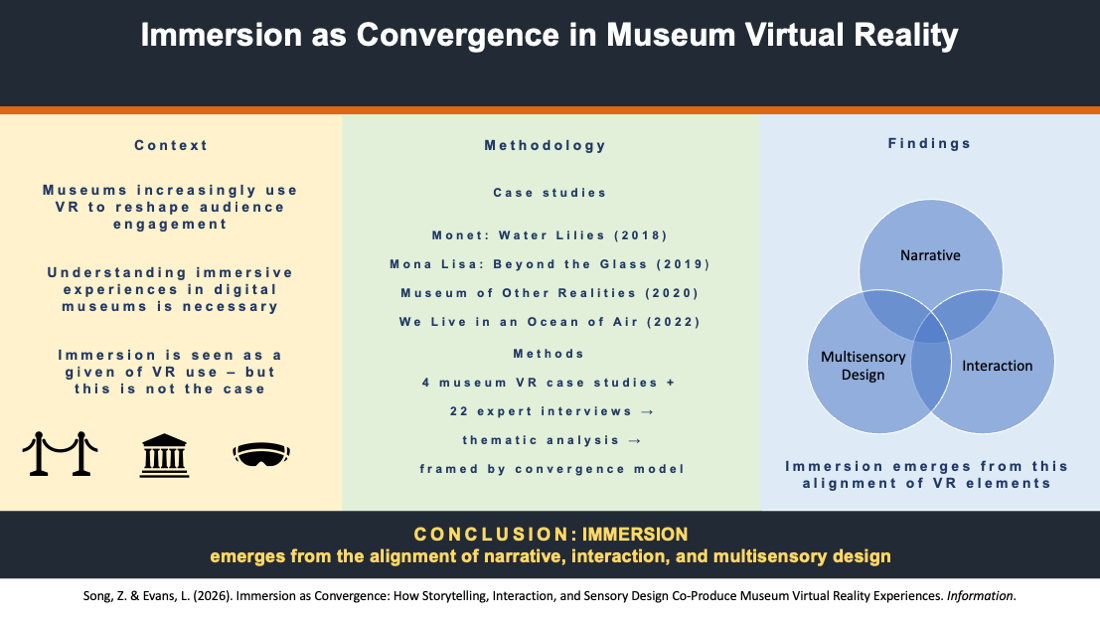
Immersion as Convergence: How Storytelling, Interaction, and Sensory Design Co-Produce Museum Virtual Reality Experiences


Abstract
1. Introduction
2. Literature Review
2.1. Theoretical Foundations of Virtual Reality and Immersion
2.2. Immersive Storytelling and Digital Museology
2.3. Applications of VR in Museum Practice
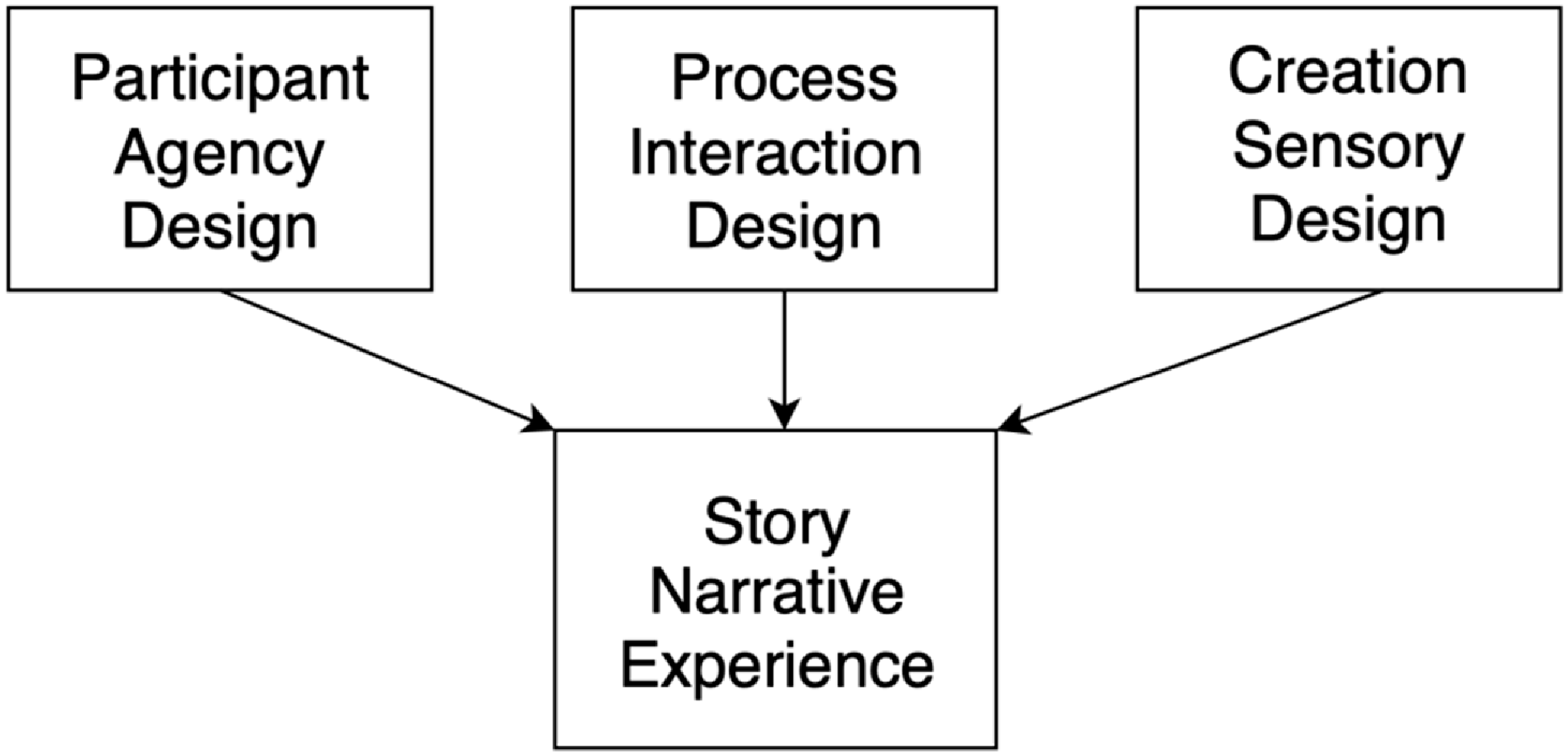
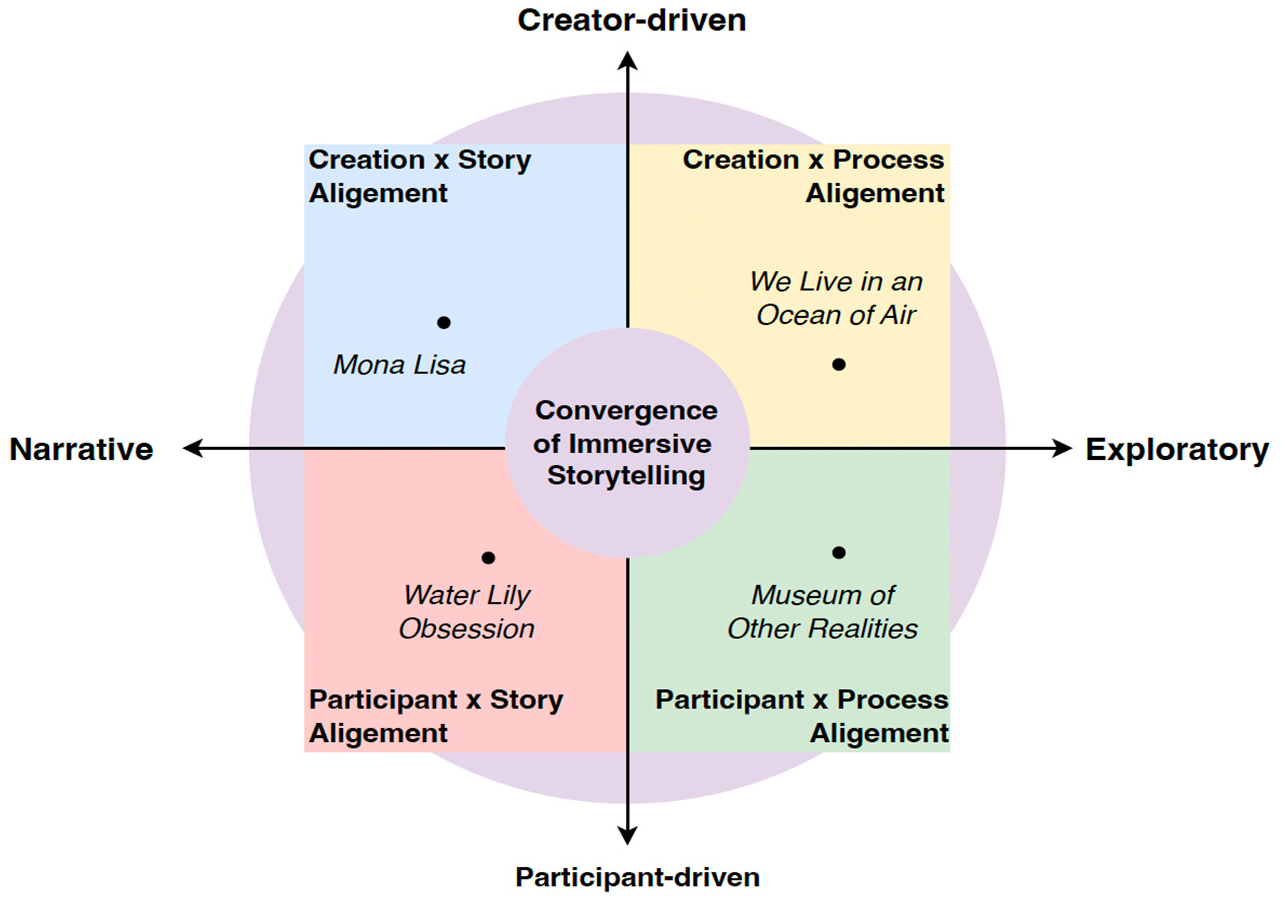
3. Immersive Storytelling Experience Research Framework
- Participant—where we are interested in the roles, identity, and agency of people participating, whether that be as audience, users, guests, etc.
- Process—where we are interested in the development of the story, and the experience and role of people who ‘tell’ and ‘make’ it, including both original ‘creator’ and others involved in its production.
- Creation—where we are interested in how the story is told amongst other things through space and the senses.
- Story—where we are interested in the properties of the story told and experienced.
4. Research Methods and Procedures
5. Results
5.1. Narrative Immersion and Empathetic Understanding
5.2. Sensory Interaction and Multisensory Coherence
5.3. Participant Agency, Collective Presence, and Audience Diversity
6. Discussion
7. Conclusions
Author Contributions
Funding
Institutional Review Board Statement
Informed Consent Statement
Data Availability Statement
Conflicts of Interest
References
- Bennet, R. Virtual & mixed reality: What you need to know and why it matters. MindCet Mag. 2016, 16–20. Available online: https://www.researchgate.net/publication/305985850_Virtual_Mixed_Reality_What_You_Need_to_Know_and_Why_It_Matters_MindCet_Magazine_pages_16-20 (accessed on 1 January 2026).
- Lanier, J. Dawn of the New Everything: A Journey Through Virtual Reality; Bodley Head: London, UK, 2017. [Google Scholar]
- Evans, L. The Re-Emergence of Virtual Reality, 1st ed.; Routledge: Oxfordshire, UK, 2019. [Google Scholar]
- International Council of Museums (ICOM). Creating a New Museum Definition—The Backbone of ICOM. Available online: https://icom.museum/en/resources/standards-guidelines/museum-definition/ (accessed on 20 October 2025).
- Aicardi, I.; Chiabrando, F.; Lingua, A.M.; Noardo, F. Recent trends in cultural heritage 3D survey: The photogrammetric computer vision approach. J. Cult. Herit. 2018, 32, 257–266. [Google Scholar] [CrossRef]
- Hermon, S.; Kalisperis, L. Between the real and the virtual: 3D visualization in the cultural heritage domain—Expectations and prospects. Virtual Archaeol. Rev. 2011, 2, 59. [Google Scholar] [CrossRef]
- Spadoni, E.; Carulli, M.; Ferrise, F.; Bordegoni, M. Impact of multisensory XR technologies on museum exhibition visits. In Universal Access in Human–Computer Interaction. HCII 2023; Antona, M., Stephanidis, C., Eds.; Lecture Notes in Computer Science; Springer: Berlin/Heidelberg, Germany, 2023; Volume 14021. [Google Scholar] [CrossRef]
- Hein, H.S. The Museum in Transition: A Philosophical Perspective; Smithsonian Institution Press: Washington, DC, USA, 2014; Available online: https://books.google.co.uk/books?id=tqRqBgAAQBAJ (accessed on 1 January 2026).
- Song, Z.; Evans, L. The museum of digital things: Extended reality and museum practices. Front. Virtual Real. 2024, 5, 1396280. [Google Scholar] [CrossRef]
- Md Nor, R.; Abdul Razak, M.H. Interactive design in enhancing user experience in museum. J. Comput. Res. Innov. 2021, 6, 86–91. [Google Scholar] [CrossRef]
- Roussou, M. Learning by doing and learning through play: An exploration of interactivity in virtual environments for children. In Museums in a Digital Age, 1st ed.; Parry, R., Ed.; Routledge: Oxfordshire, UK, 2010. [Google Scholar]
- Graham, B.; Cook, S. Rethinking Curating; MIT Press: Cambridge, UK, 2010. [Google Scholar]
- Deuze, M. Participation, remediation, bricolage: Considering principal components of a digital culture. Inf. Soc. 2006, 22, 63–75. [Google Scholar] [CrossRef]
- Gröppel-Wegener, A.; Kidd, J. Critical Encounters with Immersive Storytelling, 1st ed.; Routledge: Oxfordshire, UK, 2019. [Google Scholar]
- Creswell, J.W.; Creswell, J.D. Research Design: Qualitative, Quantitative, and Mixed Methods Approaches, 5th ed.; SAGE Publications: Thousand Oaks, CA, USA, 2018. [Google Scholar]
- Braun, V.; Clarke, V. Using thematic analysis in psychology. Qual. Res. Psychol. 2006, 3, 77–101. [Google Scholar] [CrossRef]
- Aukstakalnis, S.; Blatner, D. Silicon Mirage: The Art and Science of Virtual Reality; Peachpit Press: Berkeley, CA, USA, 1992. [Google Scholar]
- Woolley, B. Virtual World: A Journey in Hype and Hyperreality; Penguin Books: London, UK, 1992. [Google Scholar]
- Muhanna, M.A. Virtual reality and the CAVE: Taxonomy, interaction challenges and research directions. J. King Saud Univ.—Comput. Inf. Sci. 2015, 27, 344–361. [Google Scholar] [CrossRef]
- Jerald, J. The VR Book: Human-Centred Design for Virtual Reality; ACM Books: New York, NY, USA, 2015. [Google Scholar]
- Shin, D. Empathy and embodied experience in virtual environment: To what extent can virtual reality stimulate empathy and embodied experience? Comput. Hum. Behav. 2018, 78, 64–73. [Google Scholar] [CrossRef]
- Carrozzino, M.; Bergamasco, M. Beyond virtual museums: Experiencing immersive virtual reality in real museums. J. Cult. Herit. 2010, 11, 452–458. [Google Scholar] [CrossRef]
- Nakatsu, R.; Tosa, N. Active immersion: The goal of communications with interactive agents, KES’2000. In Fourth International Conference on Knowledge-Based Intelligent Engineering Systems and Allied Technologies Proceedings; IEEE: New York, NY, USA, 2000; Volume 1, pp. 85–89. [Google Scholar] [CrossRef]
- Ermi, L.; Mäyrä, F. Fundamental components of the gameplay experience: Analyzing immersion. In Proceedings of the Second Digital Games Research Association’s International Conference (DiGRA’05), Vancouver, BC, Canada, 16–20 June 2005; pp. 15–27. [Google Scholar]
- Sturabotti, D.; Surace, R. MuSA: The Museum of the Future: Insights and Reflections from 10 International Museums. 2016. Available online: https://www.scribd.com/document/382179722/MuSA-Museum-of-the-Future (accessed on 1 January 2026).
- Jenkins, H. Convergence Culture: Where Old and New Media Collide; New York University Press: New York, NY, USA, 2006. [Google Scholar]
- Song, Z.; Whyke, T.W.; Sun, X.; Evans, L. A phenomenology study of transmedia museum storytelling and gamification through XR technologies. Digit. Appl. Archaeol. Cult. Herit. 2025, 38, e00444. [Google Scholar] [CrossRef]
- Bevan, C.; Green, D. A mediography of virtual reality non-fiction: Insights and future directions. In Proceedings of the 2018 ACM International Conference on Interactive Experiences for TV and Online Video (TVX ’18), Seoul, Republic of Korea, 26–28 June 2018; pp. 161–166. [Google Scholar] [CrossRef]
- Bevan, C.; Green, D.P.; Farmer, H.; Rose, M.; Cater, K.; Fraser, D.S.; Brown, H. Behind the curtain of the “ultimate empathy machine”: On the composition of virtual reality nonfiction experiences. In Proceedings of the 2019 CHI Conference on Human Factors in Computing Systems (CHI’ 19), Glasgow, UK, 4–9 May 2019; p. 506. [Google Scholar] [CrossRef]
- Brown, B.; MacColl, I.; Chalmers, M.; Galani, A.; Randell, C.; Steed, A. Lessons from the lighthouse: Collaboration in a shared mixed-reality system. In Proceedings of the SIGCHI Conference on Human Factors in Computing Systems (CHI ’03), Fort Lauderdale, FL, USA, 5–10 April 2003; pp. 577–584. [Google Scholar] [CrossRef]
- Hürst, W.; de Coninck, F.; Tan, X.J. Complementing artworks to create immersive VR museum experiences. In Proceedings of the 13th International Conference on Advances in Computer Entertainment Technology (ACE ’16), Osaka, Japan, 9–12 November 2016; p. 34. [Google Scholar] [CrossRef]
- Huhtamo, E. On the origins of the virtual museum. In Museums in a Digital Age; Parry, R., Ed.; Routledge: Oxfordshire, UK, 2010; p. 122. [Google Scholar]
- Espacio Visual Europa. Short History of the Virtual Museum. Available online: https://evmuseography.wordpress.com/2016/10/26/short-history-of-the-virtual-museum/ (accessed on 1 January 2026).
- Tate. Modigliani VR: The Ochre Atelier—Behind the Scenes. Available online: https://www.tate.org.uk/whats-on/tate-modern/exhibition/modigliani/modigliani-vr-ochre-atelier (accessed on 20 October 2025).
- Murphy, A. The Lost Palace II—Return of Historic Royal Palaces’ VR sensation. Museums + Heritage Advisor. 2020. Available online: https://museumsandheritage.com/advisor/posts/lost-palace-ii-return-historic-royal-palaces-vr-sensation/ (accessed on 1 January 2026).
- VIVE Arts. Claude Monet: The Water Lily Obsession. VIVE Arts. 14 November 2018. Available online: https://www.vivearts.com/projects/monet-water-lilies (accessed on 22 October 2025).
- Ryan, M.-L. Narrative as Virtual Reality 2: Revisiting Immersion and Interactivity in Literature and Electronic Media; Johns Hopkins University Press: Baltimore, MD, USA, 2022. [Google Scholar]
- Langer, A. (Ed.) Storytelling in Museums; Rowman & Littlefield: Lanham, MD, USA, 2022. [Google Scholar]
- Kidd, J. Museums in the New Mediascape: Transmedia, Participation, Ethics; Ashgate Publishing: Farnham, UK, 2014. [Google Scholar]
- Pine, B.J.; Gilmore, J.H. The Experience Economy: Work Is Theatre and Every Business a Stage; Harvard Business Press: Brighton, MA, USA, 1999. [Google Scholar]
- Pine, B.J.; Gilmore, J.H. Welcome to the Experience Economy, updated ed.; Harvard Business Review Press: Brighton, MA, USA, 2011. [Google Scholar]
- Anderson, D.; Piscitelli, B.; Weier, K.; Everett, M.; Tayler, C. Children’s museum experiences: Identifying powerful mediators of learning. Curator Mus. J. 2002, 45, 213–231. [Google Scholar] [CrossRef]
- Ceccacci, S.; Generosi, A.; Leopardi, A.; Mengoni, M.; Mandorli, A.F. The role of haptic feedback and gamification in virtual museum systems. J. Comput. Cult. Herit. 2021, 14, 1–14. [Google Scholar] [CrossRef]
- Jung, T.; tom Dieck, M.C.; Lee, H.; Chung, N. Effects of virtual reality and augmented reality on visitor experiences in museums. In Information and Communication Technologies in Tourism 2016; Inversini, A., Schegg, R., Eds.; Springer: Berlin/Heidelberg, Germany, 2016; pp. 621–635. [Google Scholar] [CrossRef]
- Giaccardi, E. Heritage and Social Media: Understanding Heritage in a Participatory Culture; Routledge: Oxfordshire, UK, 2012. [Google Scholar]
- Mateos-Rusillo, S.M.; Gifreu-Castells, A. Transmedia storytelling and its natural application in museums: The case of the Bosch Project at the Museo Nacional del Prado. Curator Mus. J. 2018, 61, 301–313. [Google Scholar] [CrossRef]
- Chiara, I.; Luca, U.; Sandro, M.; Enrico, V. A framework study on the use of immersive XR technologies in the cultural-heritage domain. J. Cult. Herit. 2023, 62, 268–283. [Google Scholar] [CrossRef]



| Case Study | VR Project (Year) | Type of Experience | Main Narrative | Key Interaction and Sensory Features |
|---|---|---|---|---|
| Case 1 | Claude Monet: The Water Lily Obsession | 360° cinematic VR experience in-gallery | Monet’s life, perception, and creative process in Giverny | Spatial immersion; ambient sound; guided biographical narration. Still exhibited worldwide, considered a benchmark VR/art installation. |
| Case 2 | Mona Lisa: Beyond the Glass | 360° VR experience accompanying exhibition | Material, historical, and cultural context of the Mona Lisa | High-resolution 3D scans; close visual inspection; immersive audio. Continues to be cited as the Louvre’s flagship digital interpretation project. |
| Case 3 | The Museum of Other Realities | Multiplayer social VR museum | Exploration of VR-native artworks and abstract worlds | Free navigation; avatar interaction; exploration of 3D installations. Continues to operate with regular updates; widely used as a museum XR reference case. |
| Case 4 | We Live in an Ocean of Air | Location-based multi-user VR installation | Human–nature interdependence and environmental storytelling | Biometric sensors; free movement; real-time visualised body data. Continues to tour galleries and be analysed in museum studies research. |
Disclaimer/Publisher’s Note: The statements, opinions and data contained in all publications are solely those of the individual author(s) and contributor(s) and not of MDPI and/or the editor(s). MDPI and/or the editor(s) disclaim responsibility for any injury to people or property resulting from any ideas, methods, instructions or products referred to in the content. |
© 2026 by the authors. Licensee MDPI, Basel, Switzerland. This article is an open access article distributed under the terms and conditions of the Creative Commons Attribution (CC BY) license.
Share and Cite
Song, Z.; Evans, L. Immersion as Convergence: How Storytelling, Interaction, and Sensory Design Co-Produce Museum Virtual Reality Experiences. Information 2026, 17, 75. https://doi.org/10.3390/info17010075
Song Z, Evans L. Immersion as Convergence: How Storytelling, Interaction, and Sensory Design Co-Produce Museum Virtual Reality Experiences. Information. 2026; 17(1):75. https://doi.org/10.3390/info17010075
Chicago/Turabian StyleSong, Zhennuo, and Leighton Evans. 2026. "Immersion as Convergence: How Storytelling, Interaction, and Sensory Design Co-Produce Museum Virtual Reality Experiences" Information 17, no. 1: 75. https://doi.org/10.3390/info17010075
APA StyleSong, Z., & Evans, L. (2026). Immersion as Convergence: How Storytelling, Interaction, and Sensory Design Co-Produce Museum Virtual Reality Experiences. Information, 17(1), 75. https://doi.org/10.3390/info17010075