

Abstract
The scientific community has not stayed outside the Russia–Ukraine conflict. This study analyzes the attitudes and roles of international scientific organizations in the conflict, based on 923 official statements, through a combination of discourse analysis and Natural Language Processing (NLP) techniques, including sentiment analysis and topic modeling. The findings reveal that 527 organizations issued statements, with 47% explicitly “supporting Ukraine and condemning Russia”, and 13% maintaining a neutral stance. These statements reflect diverse concerns, including the conflict’s immediate humanitarian impact, disruption to scientific collaboration, and broader political and social implications. This research contributes to understanding how international scientific organizations navigate conflict contexts by systematically uncovering their attitudes, focus areas, and actions. Through a thematic analysis, the study demonstrates how these organizations articulate their positions, advocate for specific measures, and leverage their influence to address issues such as economic support, scientific collaboration, and healthcare assistance. By identifying these behaviors, the study clarifies the strategic roles scientific organizations play in shaping discourse and mediating international relations, offering key insights into their impact during geopolitical crises.
1. Introduction
Since Russia’s annexation of Crimea in 2014, tensions between Russia and Ukraine have steadily escalated. On 21 February 2022, the conflict intensified as Russia officially recognized the independence of Donetsk and Luhansk. Three days later, Russia initiated a “special military operation”, effectively marking the start of a full-scale invasion of Ukraine. In response, nations across the world imposed political and economic sanctions against Russia, while non-state actors, including multinational corporations, non-profit organizations, and global scientific institutions, also took action, either by publicly condemning Russia or severing ties in support of Ukraine.
The scientific community has suffered a devastating blow, as the conflict has destroyed Ukraine’s scientific infrastructure, leaving its scientists in despair [1]. At the same time, the global scientific communication and cooperation have been disrupted, with science increasingly caught in the crossfire of political conflict [2]. Many scientific organizations, academic publishers, and research institutions have also joined the “science boycott”, leading to a significant academic debate over the ethical implications of these actions [3,4,5].
International scientific organizations have played a central role in this “science boycott”. For example, the British Academy expressed support for Ukraine, while the Royal Netherlands Academy of Arts and Sciences suspended cooperation with Russia [6,7]. The National Academy of Sciences of Georgia condemned Russia’s actions [8], and CERN (the European Organization for Nuclear Research) suspended Russia’s participation as an observer and condemned its actions [9] However, some organizations have taken a neutral stance in their statements [10].
One possible catalyst for these statements is the appeal by the Council of Young Scientists of the National Academy of Sciences of Ukraine, which urged the global scientific community to take a stand [11,12,13]. In response, many scientific organizations have issued statements either aligning with Ukraine or advocating for science-based sanctions. While the conflict has harmed both Ukraine and Russia’s scientific communities [14,15,16], the global scientific community’s involvement has contributed to divisions and distrust within the scientific world. These statements may have also fueled public opinion online, reinforcing support for Ukraine and condemnation of Russia, potentially influencing scientific development and international discussions.
Existing research on Discourse Analysis (DA) has demonstrated its value in examining politically sensitive contexts, providing insights into how narratives shape public opinion and policy responses. However, few studies have applied discourse analysis to the statements of scientific organizations, despite their increasing role in global diplomacy and crisis response. To addresses this gap, this paper analyze the discourse in official statements made by international scientific organizations regarding the Russia–Ukraine conflict. Using Discourse Analysis (DA) methods based on Natural Language Processing (NLP), this study aims to uncover the attitudes, motivations, and potential consequences of these organizations’ actions. Specifically, we ask the following research questions:
- How do international scientific organizations position themselves in relation to the Russia–Ukraine conflict through their official statements?
- What are the primary themes, emotions, and sentiments expressed in these statements, and how do these reflect the organizations’ political or ethical stances?
- What are the broader implications of these positions for global scientific cooperation and political discourse?
The potential contributions of this study include the following:
- The first in-depth analysis of statement text data from international scientific organizations on the Russia–Ukraine conflict.
- A comprehensive analytical framework combining manual annotation, syntactic rules, and AI algorithms to extract valuable insights from the discourse, including topics, emotions, and sentiments.
- A deeper understanding of the organizational behavior, motivations, and potential impacts of global scientific organizations in the context of the Russia–Ukraine conflict, enriching the literature on organizational behavior and global science diplomacy.
2. Related Work
2.1. NLP-Based Discourse Analysis
Discourse Analysis (DA) is a linguistic methodology initially proposed by Harris [17] and subsequently refined through practical development. Synthesizing definitions from scholars such as Gee [18] and Blommaert [19], DA is construed as a method examining the linguistic structures and expressions within specific contexts, with the aim of elucidating the processes through which meaning is formed, conveyed, and interpreted in practical situations. It accentuates the significance of context, encompassing the societal, cultural, political, and historical background of discourse. As a qualitative analytical approach, traditional discourse analysis studies have traditionally relied on manual processing, involving researchers reading entire corpora to identify valuable information and formulate interpretative conclusions. However, the proliferation of the Internet and the ubiquity of digitization have given rise to what Wodak term “discursive swarming” [20], necessitating researchers to grapple with voluminous and unstructured data. In this context, traditional qualitative analysis encounters challenges: firstly, the holistic strategy of manually reading and encoding entire corpora to comprehend and interpret discourse becomes impractical when dealing with substantial datasets [21]; secondly, manual coding often entails subjective judgments, compromising the replicability and reproducibility of data processing and outcomes [22].
To address these challenges, some DA scholars have adopted quantitative methods like NLP to analyze large datasets. Topic modeling [23] is a key tool in NLP for uncovering hidden semantic structures and generating meaning in text, aligning with the goals of discourse analysis. Jacobs and Tschötschel [24] show how topic modeling and discourse analysis complement each other at both theoretical and cognitive levels. They argue that topic modeling helps overcome limitations in traditional methods, offering a more systematic approach to studying meaning. The efficacy of topic modeling in discourse analysis has been supported by multiple studies [25,26]. BERTopic [27], a recent advancement in this field, enhances topic modeling by incorporating both contextual and semantic information. It automatically determines the number of topics, minimizing manual intervention. These features are crucial for DA researchers. BERTopic not only helps explore and summarize topics in a corpus but also integrates context, which traditional models cannot do.
Sentiment analysis is another powerful NLP tool that automatically identifies the positivity, negativity, or neutrality of text—offering a quicker and more objective alternative to traditional DA method [28,29,30]. In contexts of war and conflict, emotions can serve as indicators of users’ positions and attitudes. For example, sentiment analysis of Turkish and English tweets discussing Syrian refugees reveals a predominance of positivity in Turkish tweets and a more negative tone in English tweets [31]. Similarly, recent discourse analysis on Afghanistan’s events shows that negative terms like terrorism, attacks, destruction, and violence dominate tweets. Across eight surveyed countries, the ratio of negative to positive tweets remains consistent, suggesting a shared perspective on Afghanistan’s recent events [32].
Going further to the context of the ongoing conflict carried out in Ukraine, it is important to acknowledge the discourse involved in conflict, acknowledging the role discourse plays. Grounded in the studies above discussed, NLP-based techniques show their potential when understanding organizational discourses in general, as well as in relation to the ongoing Russia–Ukraine conflict. Cutting-edge NLP tools, such as topic modeling and sentiment analysis, will be employed in this study to capture and understand important themes and emotions within discourse. However, public focus of the event intensified in the first few months after the conflict begins. Hence, this research tackled and indentified current knowledge gaps or science organization behavior on the first six months in 2022, from 22 Feburary 2022 to 31 August 2022.
2.2. Web Information Analysis of the Russia–Ukraine Conflict
Web information serves as a crucial and valuable source of information, conveying the attitudes and viewpoints of various entities. NLP technology plays a vital role in analyzing this unstructured textual information and has been widely applied to major international events such as the “China-US trade friction” [33,34], the “THAAD deployment in South Korea” [35], “Brexit” [36], and the “COVID-19” pandemic [37].
In the context of the ‘Russia–Ukraine conflict’, existing DA studies have primarily focused on public opinion within social media platforms, such as WEIBO, Twitter, and Facebook. These studies have covered topics such as user sentiment categorization [38,39] and opinion viewpoint extraction [40,41,42]. Some scholars [43,44,45,46] have integrated online public opinion with specific industries to analyze the impact of the conflict on sectors including green energy, aerospace, financial markets, and healthcare. There has also been a focus on the attitudes and tendencies of various entities. For instance, HANLEY [47] utilized text analytics to compare narrative differences in the ‘Russia–Ukraine conflict’ among Western, Russian, and Chinese media systems. They found that Western media emphasized military and humanitarian aspects, Russian media concentrated on explaining the reasons behind the so-called ‘special military operation’, and Chinese media highlighted diplomatic and economic consequences. Nejad [48] utilized a BERT-based sentiment analysis model to cross-reference geographic locations with opinion views and identified that users in the United States, Canada, the United Kingdom, and most Western European countries held similar views, while Eastern Europe, Asia, and South America exhibited greater consistency.
While existing research has explored public opinion among internet users and news media regarding the ‘Russian–Ukrainian conflict’, there has been a notable absence of analysis concerning key actors in science diplomacy, including the global science academies and scientific organizations. These scientific entities often express their positions through official statements. Previous studies [49,50,51,52] further support the notion that statement texts contain a wealth of valuable information and merit in-depth investigation. This research addresses that gap by using NLP-based discourse analysis to examine statements from international scientific organizations regarding the Russia-Ukraine conflict. The study seeks to explore the attitudes, concerns, and roles these organizations have expressed, contributing to the broader understanding of organizational behavior in times of political crisis.
3. Materials and Methods
In the context of science diplomacy and scientific collaboration, global scientific organizations play a crucial role in shaping international responses to geopolitical crises. To better understand the behavior of these organizations during the Russia–Ukraine conflict and address the research questions outlined above, this paper constructs an NLP-based framework for discourse analysis. The methodology integrates several NLP tools, including entity recognition, sentiment analysis, and topic modeling, to comprehensively analyze the discourse within official statements issued by international scientific organizations. A graphical representation of this research framework is provided in Figure 1.
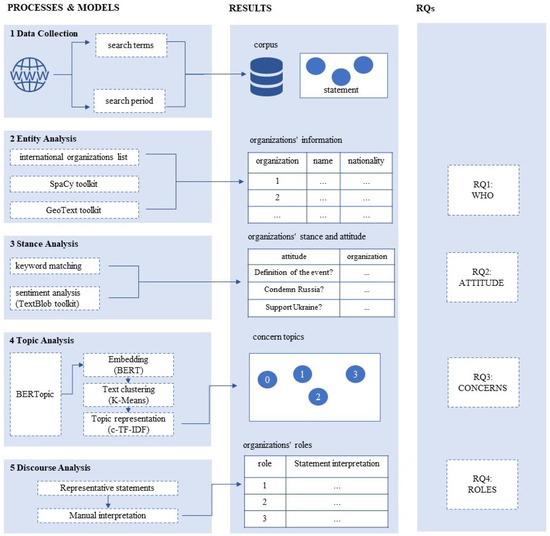
Figure 1.
Research framework.
The methodology followed these key steps:
- Corpus Collection: First, we compiled a dataset of official statements from international scientific organizations addressing the Russia–Ukraine conflict. These statements were gathered from online sources within a specified timeframe, forming the corpus for analysis.
- Entity Recognition: Using the SpaCy toolkit, along with a list of international organizations provided by the Union of International Associations, we performed entity recognition to identify organization names and associated nationalities. This step helped delineate the scope of organizational involvement in the conflict.
- Sentiment Analysis: We applied TextBlob to automatically assess the sentiment of each statement, classifying it as positive, negative, or neutral. This enabled us to capture the overall attitude or stance of each organization regarding the conflict.
- Topic Modeling: A BERTopic model was then employed to conduct topic modeling on the corpus, identifying the core themes present in the statements. BERTopic is particularly useful for uncovering hidden semantic structures and organizing the textual data into coherent topics.
- Manual Interpretation: Finally, we extracted the most representative topics from the model and conduct manual interpretation of the discourse. This step allowed for a deeper understanding of the roles and positions taken by the organizations in response to the Russia–Ukraine conflict.
By combining these NLP techniques, the methodology provides a comprehensive analysis of the discourse expressed by international scientific organizations, offering insights into their attitudes, concerns, and roles in the context of the conflict.
3.1. Data Collection
The corpus used for empirical analysis consists of statement texts published on the official websites of international scientific organizations. Empirical data were collected using systematic searches for statements related to the “Russia-Ukraine conflict” on these organizations’ websites, employing the Bing Search API provided by Microsoft Cognitive Services.
For instance, to gather statements from the Australian Academy of Science (www.science.org.au (accessed on 10 June 2023)), the search query was structured as follows: “Statement AND (Russian OR Ukraine) site: science.org.au”. To ensure comprehensive coverage, we checked each of the organizations listed in the catalog of the Union of International Associations (https://uia.org/ (accessed on 10 June 2023)); similar scanning rules were also applied to scientific academies listed under the Wikipedia category of Academies of sciences (https://en.wikipedia.org/wiki/Category:Academies_of_sciences (accessed on 10 June 2023)). For non-English websites, the query phase was translated in accordance with the website. The data collection period spanned from 1 February 2022 to 31 August 2022, which was a period during which significant discourse on the Russia–Ukraine conflict took place.
After conducting a manual review and cleaning the data, we collected a total of 13,123 valid statement texts. Of these, 923 statements were issued by international scientific organizations, including scientific academies and scientific societies. In order to facilitate analysis, this study converted the collected expectations into English.
3.2. Entity Analysis
The original dataset lacked explicit references to organizational names, necessitating the identification of which organizations issued statements regarding the Russia–Ukraine conflict. This study employed a dual methodology combining list matching and Named Entity Recognition (NER), utilizing both domain names and the content of the statements.
The list of international organizations was sourced from the Union of International Associations, providing comprehensive information including full organizational names, abbreviations, and associated domain names. To identify these organizations within the dataset, NER was conducted using the SpaCy toolkit.
To determine the geographical locations of the identified organizations, we applied a multimethod approach that included:
- Alignment with the international organization list;
- Domain name suffix matching;
- Integration with the GeoText toolkit.
Table 1 presents the outcomes of these identification processes, illustrating the accuracy achieved in recognizing both organizational names and corresponding nationalities within the dataset.

Table 1.
Example results of entity analysis.
3.3. Stance Analysis
Discourse analysis can enhance the aforementioned NLP-based quantitative approaches with a qualitative perspective [53]. In the context of the Russia–Ukraine conflict, specific keywords within statements can reflect the stance of the issuing organizations. For example, the Russian Federal Service for Supervision of Communications, Information Technology, and Mass Media (Roskomnadzor) issued warnings to the media, prohibiting terms like “invasion”, “attack”, or “declaration of war” to describe Russia’s military actions, with potential penalties including fines, publication bans, and website blocking.
Given this, keywords such as “invasion”, “attack”, and “declaration of war” were used as indicators for stance assessment. To enhance the analysis, this study employed the SpaCy toolkit for synonym expansion, enabling broader keyword matching within the statement texts. Partial results from this stance analysis are presented in Table 2.
Table 2.
Example results of stance analysis.
In addition to this quantitative approach, representative textual statements will be deliberately selected for manual interpretation. The goal is to qualitatively elucidate the domains in which international scientific organizations exert influence, identifying specific actions or measures they have undertaken in response to the conflict. Ultimately, this process aims to concretely delineate the behavioral patterns exhibited by these organizations in politically sensitive situations.
Emotional tendency reflects the attitude implied in the statement. In this study, sentiment analysis was performed using the TextBlob toolkit to obtain sentiment scores, which are represented as a tuple with two components: Polarity and Subjectivity.
- Polarity indicates whether the sentiment expressed in the text is positive, negative, or neutral, with values ranging from −1 to 1. A value of −1 denotes negative sentiment, 1 denotes positive sentiment, and 0 indicates a neutral sentiment;
- Subjectivity measures the degree of objectivity or subjectivity in the text, with values between 0 and 1. A score of 0 indicates a highly objective expression, while a score of 1 signifies a highly subjective one.
3.4. Topic Analysis
Topic modeling is an effective method for analyzing textual data, allowing for the quick identification of latent themes in large datasets compared to manual interpretation. However, common techniques like LDA [23] and TOP2VEC [54] have limitations, as they rely on density-based clustering and keyword selection based on distance from the centroid, leading to incomplete or inaccurate results. To address this, the study used the BERTopic model by Grootendorst [27].
Specifically, the methodology involved the initial transformation of declarative text into sentence embeddings using Sentence-BERT. Subsequently, considering that BERT embeddings convert text into high-dimensional vectors, the Uniform Manifold Approximation and Projection (UMAP) method, as proposed by McInnes et al., was employed for dimensionality reduction. This approach mitigates the “curse of dimensionality” while preserving the underlying structure of the data. Following this, the K-Means clustering method was applied, utilizing the similarity of sentence embeddings to partition the dataset into thematic clusters. Lastly, for thematic representation, a cluster-based Term Frequency–Inverse Document Frequency (c-TF-IDF) approach was employed to extract thematic keywords and representative statements from each cluster.
4. Results
4.1. Entity Analysis Results
In the initial phase of our analysis, we conducted organizational name recognition, successfully identifying 527 distinct international scientific organizations that responded to the 2022 Russia–Ukraine conflict. These organizations span diverse sectors, ranging from specialized technical bodies such as the International Atomic Energy Agency and Radio Amateur Satellite Corporation, to socio-cultural organizations like the Association for Slavic, East European, and Eurasian Studies and the Sasakawa Peace Foundation, as well as national and industry-focused entities like the Royal Irish Academy and the Academy of Medical Sciences.
The number of statements issued by these organizations reflects their level of concern regarding the conflict. Figure 2 illustrates the top 10 organizations based on the number of statements issued, including prominent entities such as the International Atomic Energy Agency, NATO Science and Technology Organization, and the International Science Council.
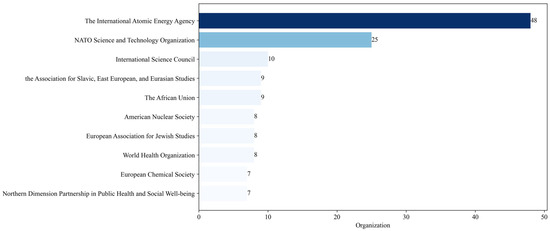
Figure 2.
Top 10 international scientific organizations and their number of statements.
Further analysis was conducted to determine the nationalities of the organizations. These organizations represent 40 countries and regions across the globe. The findings reveal that global organizations issued the highest number of statements, contributing 45% of the total dataset, followed by organizations from the European Union (EU), which accounted for 29%.
Figure 3 depicts the distribution of statements across various countries and regions, excluding global organizations. In the figure, the depth of the color represents the number of statements issued, with darker colors indicating a higher number of statements from the respective country or region. The analysis highlights a notable concentration of statements from European countries, with significant contributions from nations such as Poland, the United Kingdom, and Germany. The United States also exhibited a strong presence in terms of statement issuance. This pattern reflects the widespread attention the Russia–Ukraine conflict garnered, particularly in Europe, as the largest regional war in Europe since World War II.
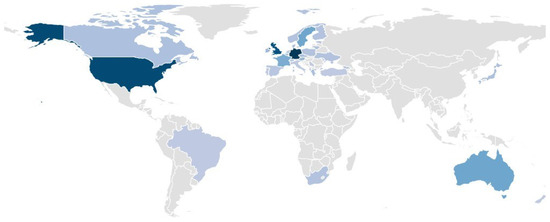
Figure 3.
The geographical distribution of statements.
Organizations from NATO, which identifies Russia as its most significant security threat, have been particularly active in addressing the conflict. Consequently, organizations from Europe and North America collectively generated the highest volume of statements related to the Russia–Ukraine conflict.
Interestingly, some regions, particularly in Africa, Asia, and the Middle East, have maintained a relative silence on the issue. This silence can be attributed to a variety of political factors. Many countries in these regions have chosen not to take sides in the conflict, reflecting complex geopolitical considerations. For example, India has condemned the conflict but abstained from endorsing United Nations resolutions against Russia, indicating a nuanced stance [55]. In Africa, factors such as reliance on Russian military support, dependence on Russian fertilizer imports, and skepticism toward NATO contribute to a more reserved approach from scientific organizations. These geopolitical dynamics shape the responses—or lack thereof—of scientific organizations in these regions [56]. This silence underscores the intricate relationship between scientific entities and the geopolitical landscape, where external political pressures and alliances influence the decision of whether to publicly comment on international conflicts.
4.2. Stances Analysis Results
International non-governmental organizations, unlike multinational corporations, do not act for profit, but rather with altruistic motives and with the promotion of the common good as the main purpose of their activities. Reputational pressure, self-exposure, boycott sanctions, and the repressive legislation of the Russian Federation collectively constitute the backdrop against which their actions unfold [57].
The traditional view is that “choosing sides” among the big powers is primarily a matter for the sovereigns. However, the influence of the Russia–Ukraine conflict permeates worldwide and across various sectors, leading international scientific organizations to also adopt a discernible “position”. For the collected texts, three core attitudes were defined: Definition of the Event, Attitude toward Russia, and Attitude toward Ukraine. The corresponding keywords for each of these attitudes were then identified, and the stance of the texts was analyzed by matching these keywords within the text:
- Definition of the Event: Keywords like “attack”, “invasion”, “declaration of war”, and their synonyms are indicative of considering the event as a “war”;
- Attitude towards Russia: Keywords such as “condemn”, “blame”, and their synonyms signify “condemning Russia”;
- Attitude towards Ukraine: Keywords like “support”, “standby”, and their synonyms represent “supporting Ukraine”.
The final stance statistics are presented in Figure 4. The formulation of statement texts inherently reflects the prevailing attitudes of the respective organizations. While some entities clearly articulated their positions, others produced statements that lacked explicit value judgments or identifiable stances.

Figure 4.
Statistical results on statement stances.
The data reveals that 87% of the statement texts used the term “war” to describe the conflict, with 88% of those statements expressing explicit support for Ukraine. Interestingly, 45% of the statements did not explicitly condemn Russia, suggesting that some organizations may be reluctant to take a confrontational stance or risk isolating the Russian scientific community. Among this subset of statements that did not directly condemn Russia, 7% refrained from using the term “war” altogether. Additionally, these statements did not express explicit support for Ukraine, indicating a more neutral stance by these organizations.
This nuanced approach highlights the diversity of perspectives within the scientific community and underscores the complexity of their responses to the Russia–Ukraine conflict.
The decision to either characterize the event as a “war” or condemn Russia may reflect sensitivities tied to political and diplomatic considerations, particularly in relation to Russia. Due to limited access to statements from certain organizations and the closure of some data sources, this study does not provide a fully quantitative analysis. However, as the global order continues to shift in the aftermath of the Russia–Ukraine conflict, the “choosing of sides” by scientific organizations is likely to become an increasingly significant factor influencing the strategic competition between major countries. This could have profound implications for the future evolution of the international order.
4.3. Topic Analysis Results
Employing the BERTopic model for the topic modeling of statement texts yielded a total of 31 topics. It is imperative to note that “TOPIC-1” represents a cluster of outlier topics automatically identified by the model, which is devoid of substantive significance. Furthermore, Figure 5 illustrates the representative vocabulary for the remaining 30 topics, providing a visual reference to facilitate a deeper understanding of these thematic elements within the statement texts.
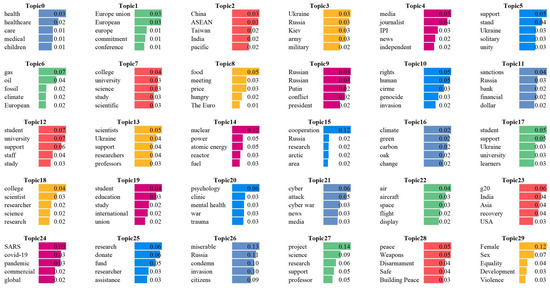
Figure 5.
Topics and their representative words.
Through a meticulous manual interpretation of representative vocabulary and exemplary statements under each theme, the 30 topics have been further categorized into four major classes: Russia–Ukraine Conflict, Statement Entities, Concern and Support, and Political and Societal Issues (see Figure 6):
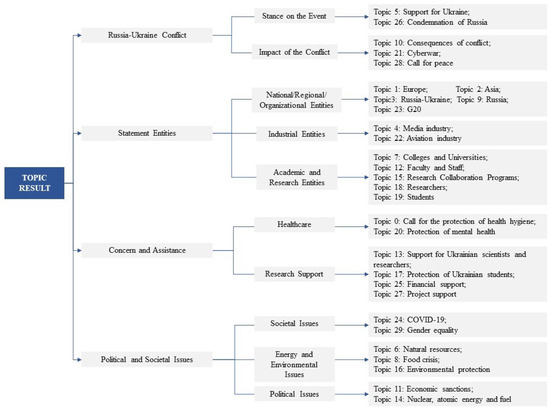
Figure 6.
Topic clustering result.
- Russia–Ukraine Conflict: On the one hand, there is the stance toward the events, with the mainstream opinions either supporting Ukraine or condemning Russia. On the other hand, there is the description of the consequences of the conflict, such as the cyber warfare triggered by the conflict and appeals for peace.
- Statement Entities: The statements encompass a diverse array of entities, ranging from the European Union, Asian nations, and G20 countries to media outlets, the aviation industry, and various academic subjects. Academic entities, including schools, staff, students, and researchers are also prominently featured.
- Concern and Support The primary concerns reflected in the statements are healthcare and academic support. In healthcare, the emphasis is on advocating for protective measures and addressing mental health issues. Regarding research support, there are expressions of solidarity, financial assistance, and project support, among other forms of assistance.
- Political and Societal Issues: Social topics encompass COVID-19 and gender equality, while environmental issues focus on natural resources, food crises, and environmental protection. Political discussions include economic sanctions, nuclear and atomic energy, and petroleum.
These four themes reflect the diverse roles played by scientific academies and scientific organizations. They not only express concerns and provide support for scientific research and individuals but also engage with broader societal, political, and environmental issues. This wide-ranging thematic spectrum highlights the multifaceted nature of these organizations’ participation in science diplomacy, where both scientific and international dimensions are at play. Beyond focusing on research entities, these organizations also engage with key stakeholders directly impacted by the Russia–Ukraine conflict.
4.4. Comparison of International Scientific Organizations and Others
To gain a deeper understanding of the actions of global science academies and scientific organizations, a comparison was made with non-scientific international organizations. Sentiment scores were calculated using the TextBlob package [58], as shown in Figure 7. The results indicate that sentiment scores and subjectivity were lower for scientific academy organizations compared to other international entities, suggesting that the statements from global scientific organizations tend to be more negative and objective in tone.
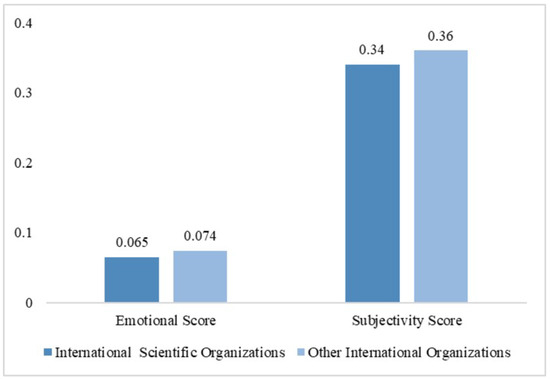
Figure 7.
Comparison of emotional attitudes across organizational types.
When analyzing the keywords from the top 25% and bottom 25% of sentiment-scored texts, we observed distinct patterns. Positive texts often centered on topics related to support and assistance, with a focus on women and children, as well as university education. In contrast, negative texts highlighted the disasters and destruction caused by the conflict, expressing concerns over essential resources like food, natural gas, and oil. These thematic differences contribute to the variation in sentiment observed between the two groups.
The lower sentiment scores in statements from global science academies and scientific organizations, compared to non-scientific international organizations, reflect a stronger concern for the negative consequences of the conflict.
Furthermore, a comparison was made of the entities and topics addressed in the statement texts of global science academies, scientific organizations, and non-scientific international organizations, as shown in Table 3.
Table 3.
Comparison of the subject matter and topics of statements.
The analysis shows that international scientific organizations focus more on entities directly related to scientific research, which is consistent with their academic orientation. In contrast, non-scientific international organizations have a broader scope, addressing entities from diverse sectors and regions beyond scientific research.
In terms of thematic content, scientific organizations primarily address issues tied to scientific research, funding, and education, alongside broader concerns related to societal, historical, and financial domains. Non-scientific organizations, on the other hand, cover a wider range of topics across various industries, including global challenges such as food security and energy sustainability.
In summary, international scientific organizations prioritize content closely aligned with scientific research, reflecting their academic focus, while non-scientific international organizations engage with a wider variety of entities and themes across different fields.
5. Discussion: The Role of International Scientific Organizations
International scientific organizations have issued statements and expressed their positions regarding the “Russia–Ukraine conflict”, constituting a segment of collective solidarity efforts within the global community. Additionally, certain organizations have strategically employed their expertise in political diplomacy, translating declarations into concrete actions. These actions extend beyond mere verbal declarations, encompassing engagement in specific domains with the provision of protection and assistance. To delve deeper into the quantitative findings presented in the preceding section, this paper undertakes a nuanced examination and discourse analysis of specific declaration texts. From this analysis, four distinct roles emerge, encompassing economic, scientific research, political diplomacy, and healthcare functions that international scientific organizations have assumed in response to the unfolding events.
5.1. Economic
Economic actions encompass both support for Ukraine and sanctions against Russia. In the realm of supporting Ukraine, distinguished institutions such as the Royal Society, the Bavarian Academy of Sciences and Humanities in Germany, and the Czech Academy of Sciences have established specialized scholarships to assist Ukrainian researchers [59,60,61]. The Finnish Academy of Sciences, on the other hand, earmarked 500,000 EUR to facilitate the visit of Ukrainian scholars to Finland [62].
In the context of sanctions targeting Russia, the Royal Netherlands Academy of Arts and Sciences temporarily halted financial transactions with Russian counterparts [7], while the Luxembourg Academy of Sciences announced the cessation of funding for projects associated with Russia and Belarus [63].
Under the influence of scientific organizations, universities have responded proactively. The British Academy of Medical Sciences and the University of Oxford have instituted and funded fellowships explicitly for Ukrainian researchers [64,65]. Similarly, Yale University, St. Andrews University, Olomouc Palacky University, and several U.S. universities have declared a temporary suspension of funding for research projects and scholarships linked to Russia [66,67,68,69].
5.2. Scientific Research
The statements have extensively addressed the protection and welfare of professionals, along with offering recommendations and appeals for research collaboration.
Regarding the welfare of professionals, there has been a dual approach. On the one hand, there is substantial support extended to Ukrainian scholars. A joint action plan, involving global science academies from countries including the United States, Ukraine, Poland, Denmark, Germany, and the United Kingdom, aims to establish a robust system for science, innovation, research, and training in Ukraine [70]. The U.S. National Academy of Sciences and the Finnish National Academy of Science have invited Ukrainian researchers to settle and work in their respective countries [71]. On the other hand, institutions like the Lithuanian Academy of Sciences and the Bulgarian Academy of Sciences have also supported Russian scholars known for upholding their values and showing resilience during the conflict [72,73]. Other research organizations, influenced by the academies, have issued statements and provided support to Ukraine. For instance, the Canadian Science Publishing Organization supports and protects nearly 500 Ukrainian journals, while Frontiers Publishing offers support to its employees, editors, and reviewers in Ukraine [74,75].
In research collaboration, the scientific community holds divergent views. While some advocate for suspending projects with Russian partners, emphasizing that collaboration does not always transcend purely geopolitical interests, others emphasize maintaining scientific freedom and endorsing continued cooperation [76,77,78,79,80]. This diversity reflects the complexities of science diplomacy, where scientific collaboration can serve as a diplomatic tool for conflict resolution, yet science itself may be subject to sanctions. The prudent use of scientific sanctions in major international events remains an unresolved challenge.
5.3. Political Diplomacy
Science diplomacy can serve as a bridge between countries with tense political relations. International scientific organizations, in reality, lack substantial political power and primarily exert their influence through issuing appeals and providing recommendations.
Most organizations, including the United States National Academy of Sciences, Engineering, and Medicine, perceive Russia’s actions in Ukraine as constituting “war crimes” and violations of human rights [81]. Organizations such as the Academy of Athens emphasize that Russia’s actions violate the United Nations Charter, constituting crimes against peace [82,83,84]. In terms of conflict resolution strategies, the majority advocate for peaceful means, including diplomacy and dialogue, to address the conflict [8,85].
Organizations also assess government actions, as seen in the disappointment expressed by The South African Academy of Academic Professionals regarding South Africa’s abstention from the United Nations resolution “demanding the withdrawal of Russian armed forces from Ukrainian territory”. They call for an end to Russia’s violent actions to ensure a peaceful resolution of the conflict [86].
The International Science Council (ISC) exemplifies science diplomacy in the Russia–Ukraine conflict. Post-conflict, ISC actively worked to uphold scientific collaboration, preserve scientific systems, and support scientists who became refugees or were displaced. ISC routinely engaged in teleconferences with international organizations involved in collaborations with refugee and displaced scientists, facilitating the exchange of information, strategic planning, and minimizing redundancy in efforts [87]. This collaborative effort culminated in the successful convening of the ’Conference on the Ukraine Crisis’ in June 2022, where a comprehensive seven-point action plan was formulated to support scientists entangled in the conflict [88]. The seamless maintenance of communication emerged as a primary outcome of this conference, itself constituting a valuable diplomatic effort.
5.4. Healthcare
On the one hand, certain statement texts emphasize the impact of the Russia–Ukraine conflict on healthcare and medical facilities. For instance, the National Academy of Medicine noted the devastating effects of disrupted medical facilities on civilians, patients, and healthcare workers during the conflict [89]. They advocated for the protection of medical facilities in conflict zones. Furthermore, they convened specialized seminars to discuss protective solutions for public health and healthcare during conflicts, translating their advocacy into practical actions. The Australian Academy of Science called for respecting the neutrality of healthcare personnel and the prohibition of targeting medical facilities in conflict [90].
On the other hand, certain statement texts appeal for the protection of patients during the conflict. For example, the European Association for the Study of the Liver urged major international and charitable organizations to safeguard liver disease patients, ensuring timely treatment and care [91]. The European Respiratory Society commits to supporting affected collaborators, healthcare personnel, and lung disease patients [92].
These actions highlight that global science academies and scientific organizations have extended their concerns and care beyond scientific research into other domains.
6. Conclusions
Alongside the human tragedy and the massive socio-economic consequences of this conflict, academics, and scientists—both Ukrainian and Russian—are being negatively impacted. On the occasion of the second anniversary of the outbreak of the Russia–Ukraine conflict, hostilities persist. According to statistics, Ukraine has already lost 18% of its scientists [93]. The scientific community in Ukraine and globally is currently grappling with adversity and gloom, marked by the loss of human capital, damage to material resources, and a reduction in international scientific cooperation. Fortunately, efforts from international scientific organizations and global stakeholders are contributing to the reconstruction of science in Ukraine. This study focused on the role of international scientific organizations, analyzing their statements regarding the 2022 Russia–Ukraine conflict through a combination of qualitative and quantitative methods, including NLP-based discourse analysis. Using tools such as entity analysis, topic modeling, and sentiment analysis, we gathered insights into the participating organizations, their stances, and the key themes of their statements. Representative statements were also manually reviewed to better understand the roles these organizations have assumed in response to the conflict. The key findings of the research are as follows:
- Inconsistent Attitudes: International scientific organizations showed varied attitudes toward the Russia–Ukraine conflict. While many expressed explicit support for Ukraine, 40% of the organizations refrained from condemning Russia directly.
- Themes of Statements: The statements covered a wide range of topics, including perspectives on the event and its consequences, involvement of various entities (national, industry, academic, etc.), concerns about healthcare and research support, and discussions on political and societal issues such as energy, politics, and the environment.
- Diverse Measures: These organizations have taken a variety of actions, including providing economic aid, supporting Ukrainian researchers, and imposing sanctions on Russia. Their efforts emphasize the strategic role of science diplomacy, leveraging scientific expertise to address urgent issues such as healthcare and advocating for science-based conflict resolution.
- Comparison with Non-Scientific Organizations: When compared to non-scientific international organizations, global science academies and organizations were more focused on protecting researchers and advancing scientific projects, demonstrating a clear commitment to the scientific community.
Globalization and the digital age have significantly empowered scientific organizations to shape international relations through interstate competition, global governance, and public opinion. The Russia–Ukraine conflict highlights their role as active participants and catalysts in global affairs, influencing cooperation and future international relations. To maximize their impact, integrating science diplomacy into crisis management is essential. Policymakers should leverage these organizations to foster cooperation, enhance multilingual communication, build resilience in scientific collaboration, and promote transparent dialogue to mediate geopolitical tensions effectively.
7. Limitations and Future Research
This study is limited to the initial phase of the conflict, from February 24 to 31 August 2022, capturing only the immediate reactions of international scientific organizations without addressing potential shifts in their stances over time. Future research should extend the timeframe to observe these dynamics more comprehensively. Additionally, this analysis primarily focuses on formal statements, and incorporating other sources such as interviews and internal communications could offer deeper insights into the broader scientific community’s response and motivations.
Author Contributions
Conceptualization, X.C. and X.W.; Methodology, J.L. and X.C.; Formal analysis, J.L.; Software, J.L.; Writing—original draft, J.L.; Writing—review and editing, X.C. and X.W.; Funding acquisition, X.W. All authors have read and agreed to the published version of the manuscript.
Funding
This research was funded by the major program of National Social Science Fund of China, titled “Research on the Application of Key Technologies for Intelligent Information in the Context of Digital-Intelligent Transformation” (Grant No. 23&ZD228).
Institutional Review Board Statement
Not applicable.
Informed Consent Statement
Not applicable.
Data Availability Statement
The data presented in this study are available upon request from the corresponding author.
Conflicts of Interest
The authors declare no conflicts of interest.
References
- Nature. Rebuilding Ukrainian science can’t wait-here’s how to start. Nature 2023, 614, 593–594. [Google Scholar] [CrossRef]
- How the War in Ukraine Reshaped the World of Science in 2022. Available online: https://sciencebusiness.net/news/International-news/how-war-ukraine-reshaped-world-science-2022 (accessed on 29 December 2023).
- McNutt, M.; Hildebrand, J. Scientists in the line of fire. Science 2022, 375, 1071. [Google Scholar] [CrossRef] [PubMed]
- Teixeira da Silva, J.A. Academia’s challenges in the face of the 2022 Russia-Ukraine war. Eur. Sci. Ed. 2022, 48, e83864. [Google Scholar]
- Blakemore, C.; Dawkins, R.; Noble, D.; Yudkin, M. Is a scientific boycott ever justified? Nature 2003, 421, 314. [Google Scholar] [CrossRef] [PubMed]
- The British Academy President’s Statement on the Russian Invasion of Ukraine. Available online: https://www.thebritishacademy.ac.uk/news/the-british-academy-presidents-statement-on-the-russian-invasion-of-ukraine/ (accessed on 10 June 2023).
- Dutch Knowledge Institutions Suspend Partnerships with Russia and Belarus. Available online: https://www.nwo.nl/en/news/dutch-knowledge-institutions-suspend-partnerships-russia-and-belarus (accessed on 10 June 2023).
- Statement of the National Academy of Sciences of Georgia on Ongoing Events in Ukraine. Available online: http://science.org.ge/?m=20220225&lang=en (accessed on 10 June 2023).
- CERN Council Responds to Russian Invasion of Ukraine. Available online: https://home.cern/news/news/cern/cern-council-responds-russian-invasion-ukraine (accessed on 10 June 2023).
- The President of the CNR Joins the Appeal for Peace in Ukraine. Available online: https://www.cnr.it/it/intervento-presidente/10950/la-presidente-del-cnr-si-unisce-all-appello-per-la-pace-in-ucraina (accessed on 10 June 2023).
- Address of the Council of Young Scientists of the National Academy of Sciences of Ukraine to the International Academic Community Regarding the War of the Russian Federation Against Ukraine. Available online: https://www.nas.gov.ua/UA/Messages/Pages/View.aspx?MessageID=8731 (accessed on 10 June 2023).
- Else, H. Ukrainian researchers pressure journals to boycott Russian authors. Nature 2022, 603, 559. [Google Scholar] [CrossRef]
- Chumachenko, D. Ukraine: Thousands sign plea for scientific sanctions against Russia. Nature 2022, 603, 393. [Google Scholar] [CrossRef] [PubMed]
- Stone, R. Ukrainian researchers flee war trauma and terror. Science 2022, 375, 1209–1210. [Google Scholar] [CrossRef] [PubMed]
- Stone, R. Western nations cut ties with Russian science, even as some projects try to remain neutral. Science 2022, 375, 1074–1076. Available online: https://www.science.org/content/article/western-nations-cut-ties-russian-science-even-some-projects-try-remain-neutral (accessed on 29 December 2023). [CrossRef] [PubMed]
- Wolfsberger, W.; Chhugani, K.; Shchubelka, K.; Frolova, A.; Salyha, Y.; Zlenko, O.; Arych, M.; Dziuba, D.; Parkhomenko, A.; Smolanka, V.; et al. Scientists without borders: Lessons from Ukraine. GigaScience 2022, 12, giad045. [Google Scholar] [CrossRef] [PubMed]
- Harris, Z.S. Discourse analysis. Language 1952, 28, 1–30. [Google Scholar] [CrossRef]
- Gee, J. An Introduction to Discourse Analysis: Theory and Method; Routledge: London, UK, 2014; pp. 1–15. [Google Scholar]
- Blommaert, J. Discourse: A Critical Introduction; Cambridge University Press: Cambridge, UK, 2005. [Google Scholar] [CrossRef]
- Wodak, R. What CDA Is About—A Summary of Its History, Important Concepts and Its Developments. Methods Crit. Discourse Anal. 2001, 1, 1–3. [Google Scholar]
- Turner, S.F.; Cardinal, L.B.; Burton, R.M. Research Design for Mixed Methods: A Triangulation-Based Framework and Roadmap. Organ. Res. Methods 2017, 20, 243–267. [Google Scholar] [CrossRef]
- Krippendorff, K. Content Analysis: An Introduction to Its Methodology; Sage Publications: Southend Oaks, CA, USA, 2018. [Google Scholar]
- Blei, D.M.; Ng, A.Y.; Jordan, M.I. Latent Dirichlet Allocation. J. Mach. Learn. Res. 2003, 3, 993–1022. [Google Scholar]
- Jacobs, T.; Tschötschel, R. Topic models meet discourse analysis: A quantitative tool for a qualitative approach. Int. J. Soc. Res. Methodol. 2019, 22, 469–485. [Google Scholar] [CrossRef]
- Aranda, A.M.; Sele, K.; Etchanchu, H.; Guyt, J.Y.; Vaara, E. From big data to rich theory: Integrating critical discourse analysis with structural topic modeling. Eur. Manag. Rev. 2021, 18, 197–214. [Google Scholar] [CrossRef]
- Lindelöf, G.; Aledavood, T.; Keller, B. Dynamics of the negative discourse toward COVID-19 vaccines: Topic modeling study and an annotated data set of Twitter posts. J. Med. Internet Res. 2023, 25, e41319. [Google Scholar] [CrossRef] [PubMed]
- Grootendorst, M. Neural topic modeling with a class-based TF-IDF procedure. arXiv 2022, arXiv:2203.05794. [Google Scholar]
- Xiang, X.; Lu, X.; Halavanau, A.; Xue, J.; Sun, Y.; Lai, P.H.; Wu, Z. Modern senicide in the face of a pandemic: An examination of public discourse and sentiment about older adults and COVID-19 using machine learning. J. Gerontol. Ser. B 2021, 76, e190–e200. [Google Scholar] [CrossRef] [PubMed]
- Matalon, Y.; Magdaci, O.; Almozlino, A.; Yamin, D. Using sentiment analysis to predict opinion inversion in Tweets of political communication. Sci. Rep. 2021, 11, 7250. [Google Scholar] [CrossRef]
- Anoop, V.S.; Sreelakshmi, S. Public discourse and sentiment during Mpox outbreak: An analysis using natural language processing. Public Health 2023, 218, 114–120. [Google Scholar] [CrossRef] [PubMed]
- Öztürk, N.; Ayvaz, S. Sentiment analysis on Twitter: A text mining approach to the Syrian refugee crisis. Telemat. Inform. 2018, 35, 136–147. [Google Scholar] [CrossRef]
- Aggarwal, S.; Khan, S.; Kakkar, M. Analyzing opinion of different countries for recent events in Afghanistan using text mining. In Proceedings of the 2022 12th International Conference on Cloud Computing, Noida, India, 27 January 2022. [Google Scholar]
- AlKhatib, M.; El Barachi, M.; AleAhmad, A.; Oroumchian, F.; Shaalan, K. A sentiment reporting framework for major city events: Case study on the China-United States trade war. J. Clean. Prod. 2020, 264, 121426. [Google Scholar] [CrossRef]
- Zeng, K.; Wells, R.; Gu, J.; Wilkins, A. Bilateral tensions, the trade war, and US–China trade relations. Bus. Politics 2022, 24, 399–429. [Google Scholar] [CrossRef]
- Liang, Y.; Fu, B.; Li, Z. Sentiment tendency analysis of THAAD event in Indonesian news. In Proceedings of the 2017 14th Web Information Systems and Applications Conference (WISA), Liuzhou, China, 19–21 May 2017. [Google Scholar]
- Georgiadou, E.; Angelopoulos, S.; Drake, H. Big data analytics and international negotiations: Sentiment analysis of Brexit negotiating outcomes. Int. J. Inf. Manag. 2020, 51, 102048. [Google Scholar] [CrossRef]
- Arbane, M.; Benlamri, R.; Brik, Y.; Alahmar, A.D. Social media-based COVID-19 sentiment classification model using Bi-LSTM. Expert Syst. Appl. 2023, 212, 118710. [Google Scholar] [CrossRef] [PubMed]
- Caprolu, M.; Sadighian, A.; Di Pietro, R. Characterizing the 2022 Russo-Ukrainian Conflict Through the Lenses of Aspect-Based Sentiment Analysis: Dataset, Methodology, and Preliminary Findings. arXiv 2023, arXiv:2208.04903. [Google Scholar]
- Vyas, P.; Vyas, G.; Dhiman, G. Ruemo—The classification framework for Russia-Ukraine war-related societal emotions on Twitter through machine learning. Algorithms 2023, 16, 69. [Google Scholar] [CrossRef]
- Chen, B.; Wang, X.; Zhang, W.; Chen, T.; Sun, C.; Wang, Z.; Wang, F.-Y. Public opinion dynamics in cyberspace on Russia–Ukraine War: A case analysis with Chinese Weibo. IEEE Trans. Comput. Soc. Syst. 2022, 9, 948–958. [Google Scholar] [CrossRef]
- Ngo, V.M.; Huynh, T.L.; Nguyen, P.V.; Nguyen, H.H. Public sentiment towards economic sanctions in the Russia–Ukraine war. Scott. J. Political Econ. 2022, 69, 564–573. [Google Scholar] [CrossRef]
- Chang, P.; Yu, Y.; Sanders, A.; Munasinghe, T. Perceiving the Ukraine-Russia conflict: Topic modeling and clustering on Twitter data. In Proceedings of the 2023 IEEE Ninth International Conference on Big Data Computing, Service, and Applications (BigDataService), Athens, Greece, 17–20 July 2023. [Google Scholar]
- Ibar-Alonso, R.; Quiroga-García, R.; Arenas-Parra, M. Opinion mining of green energy sentiment: A Russia-Ukraine conflict analysis. Mathematics 2022, 10, 2532. [Google Scholar] [CrossRef]
- Le, V.H.; von Mettenheim, H.J.; Goutte, S.; Liu, F. News-based sentiment: Can it explain market performance before and after the Russia–Ukraine conflict? J. Risk Financ. 2023, 24, 72–88. [Google Scholar] [CrossRef]
- Polyzos, E. Inflation and the war in Ukraine: Evidence using impulse response functions on economic indicators and Twitter sentiment. Res. Int. Bus. Financ. 2023, 66, 102044. [Google Scholar] [CrossRef]
- Jahanshahi, H.; Uzun, S.; Kaçar, S.; Yao, Q.; Alassafi, M.O. Artificial intelligence-based prediction of crude oil prices using multiple features under the effect of Russia–Ukraine war and COVID-19 pandemic. Mathematics 2022, 10, 4361. [Google Scholar] [CrossRef]
- Hanley, H.W.A.; Kumar, D.; Durumeric, Z. “A Special Operation”: A quantitative approach to dissecting and comparing different media ecosystems’ coverage of the Russo-Ukrainian war. In Proceedings of the International AAAI Conference on Web and Social Media, Limassol, Cyprus, 5–8 June 2023. [Google Scholar]
- Vahdat-Nejad, H.; Akbari, M.G.; Salmani, F.; Azizi, F.; Nili-Sani, H.R. Russia-Ukraine war: Modeling and Clustering the Sentiments Trends of Various Countries. arXiv 2023, arXiv:2301.00604. [Google Scholar]
- Kessler, M. A text analysis and gatekeepers’ perspectives of a promotional genre: Understanding the rhetoric of Fulbright grant statements. Engl. Specif. Purp. 2020, 60, 182–192. [Google Scholar] [CrossRef]
- Barnum, M.; Lo, J. Is the NPT unraveling? Evidence from text analysis of review conference statements. J. Peace Res. 2020, 57, 740–751. [Google Scholar] [CrossRef]
- Kumar, V.B.; Iyengar, R.; Nisal, N.; Feng, Y.; Habib, H.; Story, P.; Cherivirala, S.; Hagan, M.; Cranor, L.; Wilson, S.; et al. Finding a choice in a haystack: Automatic extraction of opt-out statements from privacy policy text. In Proceedings of the Web Conference 2020 (WWW’20), Taipei, China, 20–24 April 2020. [Google Scholar]
- Doh, T.; Kim, S.; Yang, S.K. How you say it matters: Text analysis of FOMC statements using natural language processing. Econ. Rev. Fed. Reserve Bank Kans. City 2021, 106, 25–40. [Google Scholar] [CrossRef]
- Wanniarachchi, V.U.; Scogings, C.; Susnjak, T.; Mathrani, A. Hate speech patterns in social media: A methodological framework and fat stigma investigation incorporating sentiment analysis, topic modelling and discourse analysis. Australas. J. Inf. Syst. 2023, 27, 1–29. [Google Scholar] [CrossRef]
- Angelov, D. Top2vec: Distributed representations of topics. arXiv 2020, arXiv:2008.09470. [Google Scholar]
- Mettela, T. What’s Behind India’s Strategic Neutrality on Russia’s Invasion of Ukraine; ABC NEWS: New York, NY, USA, 2023; Available online: https://abcnews.go.com/Politics/india-remaining-neutral-russias-invasion-ukraine/story?id=97891228 (accessed on 10 June 2023).
- Ajala, O. Russia’s War with Ukraine: Five Reasons Why Many African Countries Choose to Be ‘Neutral’. In The Conversation; Defence Web: Washington, DC, USA, 2022; Available online: https://theconversation.com/russias-war-with-ukraine-five-reasons-why-many-african-countries-choose-to-be-neutral-180135 (accessed on 10 June 2023).
- Koonin, E.V. Science in times of war: Oppose Russian aggression but support Russian scientists. EMBO Rep. 2022, 23, e54988. [Google Scholar] [CrossRef] [PubMed]
- Textblob: Simplified Text Processing. Available online: https://textblob.readthedocs.io/en/dev/ (accessed on 7 December 2024).
- CARA. Researchers at Risk Fellowships: Ukrainian Scholars Share Their Experiences; CARA: London, UK, 2022; Available online: https://www.cara.ngo/what-we-do/a-lifeline-to-academics-at-risk/ (accessed on 10 June 2023).
- Bavarian Academy of Sciences and Humanities. Scholarships for Ukrainian Researchers at Risk; Bavarian Academy of Sciences and Humanities: München, Germany, 2022; Available online: https://badw.de/die-akademie/presse/news/einzelartikel/detail/call-for-applications-scholarships-for-ukrainian-researchers-at-risk.html (accessed on 10 June 2023).
- The Czech Academy of Sciences. The Czech Academy of Sciences Supports Scientists in Ukraine; The Czech Academy of Sciences: Staré Město, Czech Republic, 2022; Available online: https://www.avcr.cz/en/news-archive/The-Czech-Academy-of-Sciences-supports-scientists-in-Ukraine/ (accessed on 10 June 2023).
- The Academy of Finland. Nine Researchers from Ukraine Invited to Finland with Funding from the Academy of Finland; The Academy of Finland: Helsinki, Finland, 2022; Available online: https://www.aka.fi/en/about-us/whats-new/press-releases/2022/9-researchers-from-ukraine-invited-to-finland-with-funding-from-the-academy-of-finland/ (accessed on 10 June 2023).
- The Luxembourg National Research Fund. FNR Statement on Ukraine; The Luxembourg National Research Fund: Esch-sur-Alzette, Luxembourg, 2022; Available online: https://www.fnr.lu/fnr-statement-ukraine/ (accessed on 10 June 2023).
- Academy of Medical Sciences. Ukraine Invasion: Academy of Medical Sciences Statement; Academy of Medical Sciences: London, UK, 2022; Available online: https://acmedsci.ac.uk/more/news/ukraine-invasion-academy-of-medical-sciences-statement (accessed on 10 June 2023).
- University of Oxford. University Response to the Invasion of Ukraine; University of Oxford: Oxford, UK, 2022; Available online: https://www.ox.ac.uk/news-and-events/university-response-invasion-ukraine (accessed on 10 June 2023).
- YALE News. Yale Money Pulled from Russia After Invasion; YALE News: New Haven, CT, USA, 2022; Available online: https://yaledailynews.com/blog/2022/03/09/yale-money-pulled-from-russia-after-invasion/ (accessed on 10 June 2023).
- University of St Andrews News. Principal’s Update on the War in Ukraine; University of St Andrews News: St Andrews, UK, 2022; Available online: https://news.st-andrews.ac.uk/archive/principals-update-on-the-war-in-ukraine/ (accessed on 10 June 2023).
- Syracuse University News. Syracuse University Getting Rid of Russian Investments; Syracuse University News: Syracuse, NY, USA, 2022; Available online: https://www.syracuse.com/syracuse-university/2022/03/syracuse-university-getting-rid-of-russian-investments.html (accessed on 10 June 2023).
- University of Pardubice. University of Pardubice to Support Ukrainian Students and End Cooperation with Russia; University of Pardubice: Pardubice, Czech Republic, 2022; Available online: https://www.upce.cz/en/university-of-pardubice-to-support-ukrainian-students-and-end-cooperation-with-russia (accessed on 10 June 2023).
- NASONLINE. NAS Statements on Ukraine; NASONLINE: Washington, DC, USA, 2022; Available online: http://www.nasonline.org/news-and-multimedia/ukraine.html (accessed on 10 June 2023).
- The Academy of Finland. Call for Inviting Researchers from Ukraine to Finland; The Academy of Finland: Helsinki, Finland, 2022; Available online: https://www.aka.fi/en/research-funding/apply-for-funding/calls-for-applications/apply-now2/call-for-inviting-researchers-from-ukraine-to-finland/ (accessed on 10 June 2023).
- Lithuanian Academy of Sciences. Appeal to Russian Scientists; Lithuanian Academy of Sciences: Vilnius, Lithuania, 2022; Available online: http://www.lma.lt/news/1486/38/Appeal-to-Russian-scientist (accessed on 10 June 2023).
- Bulgarian Academy of Sciences. Declaration of the Assembly of Academicians and Corresponding Members of the Bulgarian Academy of Sciences for Peace in Ukraine; Bulgarian Academy of Sciences: Sofia, Bulgaria, 2022; Available online: https://www.bas.bg/?p=37794&lang=en (accessed on 10 June 2023).
- The Public Knowledge Project. PKP Reacts to Russian Invasion of Ukraine; The Public Knowledge Project: Burnaby, BC, Canada, 2022; Available online: https://pkp.sfu.ca/2022/03/17/pkp-reacts-to-russian-invasion-of-ukraine/ (accessed on 10 June 2023).
- Frontiers. Statement: Frontiers Stands in Solidarity with the People of Ukraine; Frontiers: Lausanne, Switzerland, 2022; Available online: https://blog.frontiersin.org/2022/03/01/statement-frontiers-stands-in-solidarity-with-the-people-of-ukraine/ (accessed on 10 June 2023).
- Lund University. Regarding the War in Ukraine; Lund University: Lund, Sweden, 2022. [Google Scholar]
- International Committee for the History of Technology. Statement of the Historians of Science and Technology of Ukraine; International Committee for the History of Technology: Santiago, Chile, 2022; Available online: https://www.icohtec.org/2022/04/19/statement-of-the-historians-of-science-and-technology-of-ukraine/ (accessed on 10 June 2023).
- Austrian Science Fund. Standing in Solidarity with Ukraine; Austrian Science Fund: Vienna, Austria, 2022. [Google Scholar]
- The European Mathematical Society. Statement: European Mathematical Society Solidarity with Partners in Ukraine—Consequences for the Mathematical Community; The European Mathematical Society: Helsinki, Finland, 2022; Available online: https://euromathsoc.org/news/statement:-european-mathematical-society-solidarity-with-partners-in-ukraine—Consequences-for-the-mathematical-community-56 (accessed on 10 June 2023).
- The International Network for Governmental Science Advice. Statement on Ukraine; The International Network for Governmental Science Advice: Auckland, New Zealand, 2022. [Google Scholar]
- National Academy of Engineering. CHR Statement Regarding Attacks on Health Care in Ukraine; National Academy of Engineering: Washington, DC, USA, 2022; Available online: https://www.nae.edu/19579/31222/20054/266388/271676/CHR-Statement-regarding-Attacks-on-Health-Care-in-Ukraine (accessed on 10 June 2023).
- World Academy of Art and Science. A Time For Solidarity! Statement of the World Academy of Art & Science; World Academy of Art and Science: Geneva, Switzerland, 2022. [Google Scholar]
- Academy of Athens. Declaration of The Academy of Athens on the Invasion of Russia in Ukraine; Academy of Athens: Athina, Greece, 2022; Available online: http://www.academyofathens.gr/en/announcements/press-releases/20220303 (accessed on 10 June 2023).
- Turkish Academy of Sciences. Science Academy, Turkey—Statement Regarding the Military Attack of Russia on Ukraine; Turkish Academy of Sciences: Ankara, Turkey, 2022; Available online: https://en.bilimakademisi.org/statement-on-military-attack-of-russia-on-ukraine/ (accessed on 10 June 2023).
- Australian Academy of Science. Australian Academy of Science Statement on Current Conflict in Ukraine; Australian Academy of Science: Canberra, Australia, 2022; Available online: https://www.science.org.au/news-and-events/news-and-media-releases/australian-academy-science-statement-current-conflict (accessed on 10 June 2023).
- Eyewitness News. Open Letter: South Africa-Based Scientists Condemn Russia’s War in Ukraine; Eyewitness News: New York, NY, USA, 2022. [Google Scholar]
- International Science Council. Mitigating Crisis: The Power of Science Diplomacy; International Science Council: Paris, France, 2023; Available online: https://council.science/current/blog/mitigating-crisis-the-power-of-science-diplomacy/ (accessed on 10 June 2023).
- International Science Council. Conference on the Ukraine Crisis: Responses from the European Higher Education and Research Sectors; International Science Council: Paris, France, 2022; Available online: https://council.science/publications/ukraine-crisis-responses-from-european-higher-education-research/ (accessed on 10 June 2023).
- National Academy of Medicine. Statement by NAM President Victor Dzau on Responding to the Health Crisis In and Around Ukraine; National Academy of Medicine: Washington, DC, USA, 2022; Available online: https://nam.edu/statement-by-nam-president-victor-dzau-on-responding-to-the-health-crisis-in-and-around-ukraine/ (accessed on 10 June 2023).
- Medical Association for Prevention of War (Australia). Health Professionals’ Statement on Ukraine; Medical Association for Prevention of War (Australia): Carlton, Australia, 2022. [Google Scholar]
- EASL. Statement of Solidarity and Support to Those Affected by the Russian Invasion of Ukraine; EASL: Amsterdam, The Netherlands, 2022; Available online: https://easl.eu/news/solidarity-ukraine/ (accessed on 10 June 2023).
- ERS. ERS/ELF Statement of Solidarity and Support to Those Affected by the Russian Invasion of Ukraine; ERS: Lausanne, Switzerland, 2022. [Google Scholar]
- de Rassenfosse, G.; Murovana, T.; Uhlbach, W.H. The effects of war on Ukrainian research. Humanit. Soc. Sci. Commun. 2023, 10, 856. [Google Scholar] [CrossRef]
Disclaimer/Publisher’s Note: The statements, opinions and data contained in all publications are solely those of the individual author(s) and contributor(s) and not of MDPI and/or the editor(s). MDPI and/or the editor(s) disclaim responsibility for any injury to people or property resulting from any ideas, methods, instructions or products referred to in the content. |
© 2025 by the authors. Licensee MDPI, Basel, Switzerland. This article is an open access article distributed under the terms and conditions of the Creative Commons Attribution (CC BY) license (https://creativecommons.org/licenses/by/4.0/).