1. Theoretical Foundations: Spirituality and Health
At this time in history, a growing number of individuals describe themselves as “spiritual but not religious,” turning toward highly personal and often eclectic ways of seeking meaning, transcendence, and belonging (
Evans et al. 2025). The rise of secularism is not new, but the movement away from traditional settings and the increased influence of technology, along with church scandals and questions about patriarchy (among many other reasons), have contributed to a movement away from religious affiliation, with people maintaining faith outside religion or leaving religion entirely. These “nones” and “dones” may seek spiritual pathways outside formal religious settings, often individualistically. Whether people are deconstructing theological convictions or starting afresh, they are often self-initiated and creatively pieced together, often without the scaffolding of community, shared rituals, authority figures, or doctrinal frameworks (e.g.,
Russo-Netzer 2016). For some, departing from religion provides relief, authenticity, or freedom; for others, it leads to identity disruption, loneliness, and loss of meaning (
Van Tongeren et al. 2025). These dynamics underscore that spirituality does not automatically promote thriving but may support or hinder well-being depending on the relational, cultural, and interpretive contexts in which it is embedded.
Amid widespread mental health struggles, social fragmentation, and political polarization, interest in spirituality—broadly defined—remains strong. As humans, we are meaning-seeking creators who need to experience love to thrive (
Frankl [1959] 2006). People are looking to spiritual practices, commitments, and communities, whether traditional or novel, to find meaning and belonging, in order to cope with suffering, make sense of life, and pursue wholeness. In this moment, psychology has a distinctive role to play in clarifying what constitutes healthy spirituality and in offering resources to guide people and communities toward constructive spiritual pursuits. This article draws mainly on three subdisciplines within psychology—developmental psychology, positive psychology, and psychology of religion and spirituality—to present the Thrive Spiritual Health Framework (
King, forthcoming). The framework synthesizes empirical research into six interrelated facets: transcendence, habits and rhythms, relationships and community, identity and narrative, vocation and purpose, and ethics and virtues to form the acronym THRIVE. Together, the facets illuminate how spirituality can nurture thriving. At its core, the framework highlights love—transcendent, interpersonal, and intrapersonal—as the means and orienting telos of spiritual health. Two guiding questions frame the discussion: “What is spirituality?” and “What is health?” By addressing these questions, spiritual health is conceptualized in a way that is psychologically rigorous, contextually adaptable, and relevant across secular, religious, and pluralistic settings.
The central questions of this paper are, “What is spirituality?” and “What is health?” The answers to these questions become clear when answered from a relational developmental systems (RDS) metatheoretical approach that views human growth as dynamic, contextual, and relational (
Lerner 2018;
Lerner et al. 2022;
Overton 2015). From this perspective, development is not linear or understood to progress through discrete stages; rather, it is viewed from a dynamic systems perspective. Individuals are not isolated units but parts of living systems, simultaneously shaped by and shaping their environments, relationships, and cultures. Development and growth result from the
coaction, or bidirectional relationships, between parts of the system—whether at the cellular level, interpersonal level, or macrosystemic level—which may involve beliefs about transcendence (
Lerner et al. 2022;
King et al. 2021). Spirituality and health, therefore, cannot be reduced to private, internal states, nor are they static; they are embodied, contextualized, relational processes that unfold in constant interaction with the broader developmental ecology (see also
Fitchett 2002;
Hodge 2005).
2. What Is Spirituality?
From an RDS perspective, spirituality can be defined as people’s
experience of and response to transcendence (
King et al. 2014,
2021). In the psychology of religion and spirituality, transcendence is the psychological experience of connecting to something beyond the self, often the divine or other ultimate source of meaning. Transcendence engages cognition, emotion, and behavior and involves a shift in awareness from the self and mundane to the sacred or to realities, values, or meanings beyond the self that evoke awe, reverence, or connection to something ultimate and boundless (
Davis et al. 2023;
King et al. 2021;
Yaden et al. 2017). Spirituality involves the ways people encounter, interpret, and embody those experiences in beliefs, identity, relationships, and behaviors. Religion refers to organized systems of beliefs, rituals, and community. Spirituality overlaps with religion but also exists outside of religious traditions, encompassing diverse beliefs about transcendence, pursuits of meaning, and connection across religious and secular contexts that extend focus and commitments beyond oneself (
Davis et al. 2023;
Kim et al. 2024;
King et al. 2014,
2021;
Lerner et al. 2003;
Pargament 2007;
Yaden et al. 2017).
Transcendent experience has particular weight in a human life because it deals with the sacred and ultimate realities. Thus, spirituality exerts strong
ordering effects on human life (
Lerner et al. 2003;
King et al. 2024;
Pargament and Mahoney 2005). Encounters with transcendence shape beliefs and values, inform identity, orient goals, and direct actions. Spirituality is therefore not peripheral but central to human development, influencing how people understand themselves, relate to others, and interpret and act in the world (
Schnitker et al. 2019;
King et al. 2014,
2021,
2024).
Research suggests four main interrelated psychological processes involved in
spiritual development (
King et al. 2014,
2021). The first is
transcendence, which as described above involves encounters with realities beyond the self that elicit awe, elevation, or reverence. The second is that people
make meaning through their interpretation of those experiences informing their sense of self and how they make sense of the world. Transcendence heightens affect and prompts reflection on beliefs, which facilitates beliefs becoming salient, meaningful, and integrated into one’s identity (
Riveros and Immordino-Yang 2021). For example,
Immordino-Yang et al. (
2024) found that reflection on beliefs about the broader world, or a bigger story, promoted the internalization of beliefs as meaningful and increased the likelihood that those beliefs integrate into identity as prosocial values, predicting identity cohesion, self-liking, purpose, and relationship satisfaction (see also
Gotlieb et al. 2024). Youth spiritual exemplars report that transcendent encounters galvanize meaning, which informs identity (
King et al. 2014), prompting the third process,
fidelity, to transcendent values, people, and communities emerges, which in turn sustains the fourth,
contribution—action oriented toward serving others and the common good. These processes are iterative rather than linear, continually reshaping identity, behaviors, and purpose.
In RDS jargon, spiritual development occurs through the
co-action between individuals and their context, including their beliefs and experiences of the transcendent, culture, people, symbols, and nature, to name a few, and explains the dynamic integration of transcendent experiences into coherent systems of meaning, identity, purpose, and patterns of behavior. This process is facilitated by positive emotions (
Fredrickson 2013;
Immordino-Yang 2016), caring relationships (e.g., families, mentors, and ancestors; see
Fitchett 2002;
Hodge 2005), and sacred spaces (
Counted 2016). Attachment research and contemporary developmental neuroscience emphasize the essential role of caring relationships in identity and prosocial development (see
Mikulincer and Shaver 2016;
Immordino-Yang et al. 2024). Similarly, Counted’s work on place-spirituality draws on attachment theory, environmental psychology, and theology to show that places can function as “attachment figures”, which can serve as sources of comfort, identity, coherence, and transcendence. Spiritual development is always embodied, contextual, and situated.
3. What Is Health? Thriving as Developmental Growth and the Telos of the Reciprocating Self
If spirituality provides transcendent meaning, identity, and purpose, how do we define health in this context? History bears witness to many instances of transcendence, inspiration, belonging, meaning, and purpose being used toward destructive ends—whether to oneself (e.g., suicide bombings, cults) or to others (e.g., crusades, Third Reich). From a developmental perspective,
spiritual health is best captured by the concept of
thriving. Thriving refers to adaptive developmental strength-based growth marked by deepened capacity for connection and contribution (
King and Mangan 2023;
Lerner 2018;
Lerner et al. 2022). Through the ups and downs of life, thriving involves developing into one’s strengths with and for others (
King and Mangan 2023). Thriving requires mutually beneficial bidirectional relations or coaction between people and their contexts. In other words, individuals grow in developmentally nurturing environments, and in turn, they contribute to sustaining those environments for others (
Lerner 2018). From an RDS perspective, people are dependent on nurturing environments that consider the embodied, cultural, and gendered aspects of positive development. Consequently, additive reciprocity between individuals and their contexts is necessary and nuanced to sustain flourishing environments and to perpetuate thriving persons. Thus, thriving involves strength-based growth in connection wis others that contributes beyond the self.
Consequently, the goal of human development, or the
telos of thriving, is a
reciprocating self (
Balswick et al. 2016,
King and Mangan 2023;
Lerner et al. 2025). In contrast to more individualistic or independent conceptualizations of the self, a reciprocating self is simultaneously differentiated and relational—capable of both receiving and giving love and contributing to the world beyond the self. This vision of selfhood underscores that health and wellbeing involve maintaining a coherent sense of self while orienting beyond the self toward commitments that nurture mutual growth—whether between persons, with one’s understanding of the transcendent, or with the environment. From this vantage, thriving involves love and growing capacities for
unitive experiences with others and for
contributing to the wellbeing and thriving of others (
VanderWeele and Lee 2025). An RDS perspective also emphasizes the importance of the interplay of different systems of meaning. Love of the “other” must take seriously the embodied, cultural, and gendered aspects of encounter and community (
Ramírez-Johnson 2023). The reciprocating self is not a static, one-size-fits-all telos, but more of a guiding telos “north star”, allowing one to assess whether various forms of spirituality are guiding human development and formation in the right direction or if they are healthy or not. This perspective raises the questions, “Do the beliefs, practices, and community support the development of “selves” who give back and beyond themselves?” and “Do they promote identities, virtues, and purposes that promote the thriving of others and flourishing communities?”
4. Transcendent Narrative Identity
Transcendent narrative identity may be a lynchpin for understanding how spirituality sustains thriving. Narrative identity weaves together experiences of coherence and direction (
McAdams 2011, whereas
transcendent narrative identity is an evolving life story that integrates transcendent meaning, love, belonging, and values into enduring commitments and beyond-the-self purposes (
Schnitker et al. 2019;
King et al. 2020,
2024). Transcendent narrative identity helps individuals sustain fidelity to loving transcendent commitments across time, especially when anchored in communities of support. Ideally, such identities situate the self as beloved and called to live in ways that benefit others. They provide coherence across time, make sense of suffering, anchor resilience in suffering, and give meaning to and energize purpose and virtue.
The work of anthropologist and practical theologian
Ramírez-Johnson (
2023) emphasizes that transcendent narrative identity is always shaped at the intersection of culture, gender, ethnicity, and communal belonging. Any account of spiritual self-understanding must attend to the ways structural forces, cultural logics, and gendered expectations shape a person’s access to sacred stories, symbols, and practices. Ramírez-Johnson’s insight underscores that spiritual identities are both transcendent and contextual: people integrate ultimate meanings through narratives that are always mediated by the communities, histories, and identities they inhabit. He notes that religion and spirituality can empower or marginalize people depending on whether their intersecting identities are recognized, honored, and welcomed in the life of the church. For example, he shows that women, ethnic minorities, and immigrants frequently experience spiritual spaces differently due to cultural logics around authority, collectivism, masculinity/femininity, or family structures.
5. Spiritual Health as the Integration of Spirituality and Thriving
Spiritual health integrates spirituality and thriving through experiencing and responding to transcendence cognitively, affectively, behaviorally, and relationally, while weaving those responses into transcendent narrative identities that nurture and sustain experiencing and offering love through cultivating virtues and lived purpose. Spirituality is not reducible to belief, private experience, or even meaning-making alone. Instead, healthy spirituality is a holistic developmental process in which transcendent encounters are reflected on, felt, practiced, narrated, shared, and enacted in ways that nurture love and reciprocity (see
King, forthcoming).
6. Challenges and Opportunities in a Secular Age
Research suggests that many people now pursue spirituality outside traditional religious structures (
Evans et al. 2025). Whether for reasons of spiritual harm or abuse, lack of recognition of women’s marginalized experiences (i.e., #EmptyThePew movement), coercion and repression of races and minorities, shame (
Bryant-Davis and Wong 2013;
Exline 2013), and/or perceived irrelevance and boredom, religious affiliation and attendance are generally down, and many are forging their own spiritual pathways. For example,
Russo-Netzer (
2016) describes such individualized pathways as self-initiated and creatively assembled, often drawing on diverse traditions and practices. While empowering, these approaches may lack the institutional scaffolding of rituals, mentors, and communal norms that historically anchored spirituality.
Van Tongeren et al. (
2025) found that even when people leave religion for legitimate reasons like abuse and trauma, belief misalignment, community failings, and disillusionment, religious deidentification can free individuals from misaligned or harmful communities, yet it also often results in the loss of identity coherence, belonging, and sources of meaning.
As the first quarter of the 21st century comes to a close, a particular challenge is the rise of social isolation and mental health struggles. Loneliness is recognized as a public health epidemic and has resulted in profound consequences for physical and psychological well-being (
Murthy 2020).
VanderWeele (
2017) notes that religious involvement historically provided social capital and relational belonging—resources now less accessible to the religiously unaffiliated. Without relational support, individualized spiritual practices, like mindfulness, may fail to generate sustained meaning or resilience. Digital culture intensifies these challenges. Social media platforms provide spaces for spiritual expression and connection but also fragment attention and encourage superficial engagement (see
Twenge 2019). For many, spiritual exploration online becomes episodic and consumerist, shaped by algorithms rather than enduring commitments. Not only does this environment undermine the sustained attention and practices required for deep spiritual growth, but it often also directs people on isolated spiritual trajectories. In addition, digital culture runs the risk of lessening people’s experience of
place spirituality. Research by
Counted (
2016,
2021) demonstrates that human flourishing is shaped by how people experience belonging, safety, meaning, and sacredness in the physical environments they inhabit.
Furthermore, socio-political polarization further complicates the pursuit of spiritual health. Spirituality has the potential to bridge divides by affirming human dignity and shared purpose, but it can also be co-opted to reinforce ideological echo chambers. If transcendence informs beliefs and meaning-making, and points to how to live a good life, how do people who are pursuing their own spirituality come to know what they believe? Do the things that they come to believe point toward love, compassion, humility, patience—virtues that help people live in harmony and highlight our responsibility to one another? Studies show that polarization fosters distrust, hostility, and diminished empathy toward out-groups (
Bednar 2021;
Iyengar and Krupenkin 2018). In such climates, even spiritual communities can become insular, prioritizing identity protection over openness and reciprocity. The power of transcendence can be used to exacerbate polarities, amplifying what is already recognized as
affective polarization into
sanctified polarization, risking further justification of
othering and
excluding those with different spiritual convictions.
At the same time, these challenges create new opportunities for spirituality to serve as a resource for resilience and constructive engagement necessary for thriving individuals and flourishing societies. Research on awe, gratitude, and compassion demonstrates their capacity to counteract self-focus, broaden perspectives, and promote prosocial behavior (
Piff et al. 2015;
Fredrickson 2013). Emerging forms of community—online networks, interfaith collaborations, ecumenical efforts, secular mindfulness groups—suggest that new scaffolds for spirituality can be created. In sum, the secular age presents both vulnerabilities and possibilities. Spirituality is pursued with increasing autonomy, yet often in contexts of isolation, distraction, and polarization. These conditions highlight the urgency of clarifying what constitutes healthy spirituality and how it can be supported in pluralistic contexts.
7. The Spiritual Health Framework
The challenges of a secular age—generally declining institutional religion, rising individualism, increased isolation, digital distractions, and polarization—underscore the need for clear criteria to discern when spirituality is health-promoting and when it is not. While many people pursue spiritual meaning and practices with sincerity, research suggests that spirituality can either support or undermine well-being depending on the relational, emotional, and cultural contexts in which it unfolds (e.g.,
Russo-Netzer 2016;
Van Tongeren et al. 2025). In this landscape, psychology can provide much-needed clarity.
The Spiritual Health Framework, developed at the Thrive Center for Human Development (
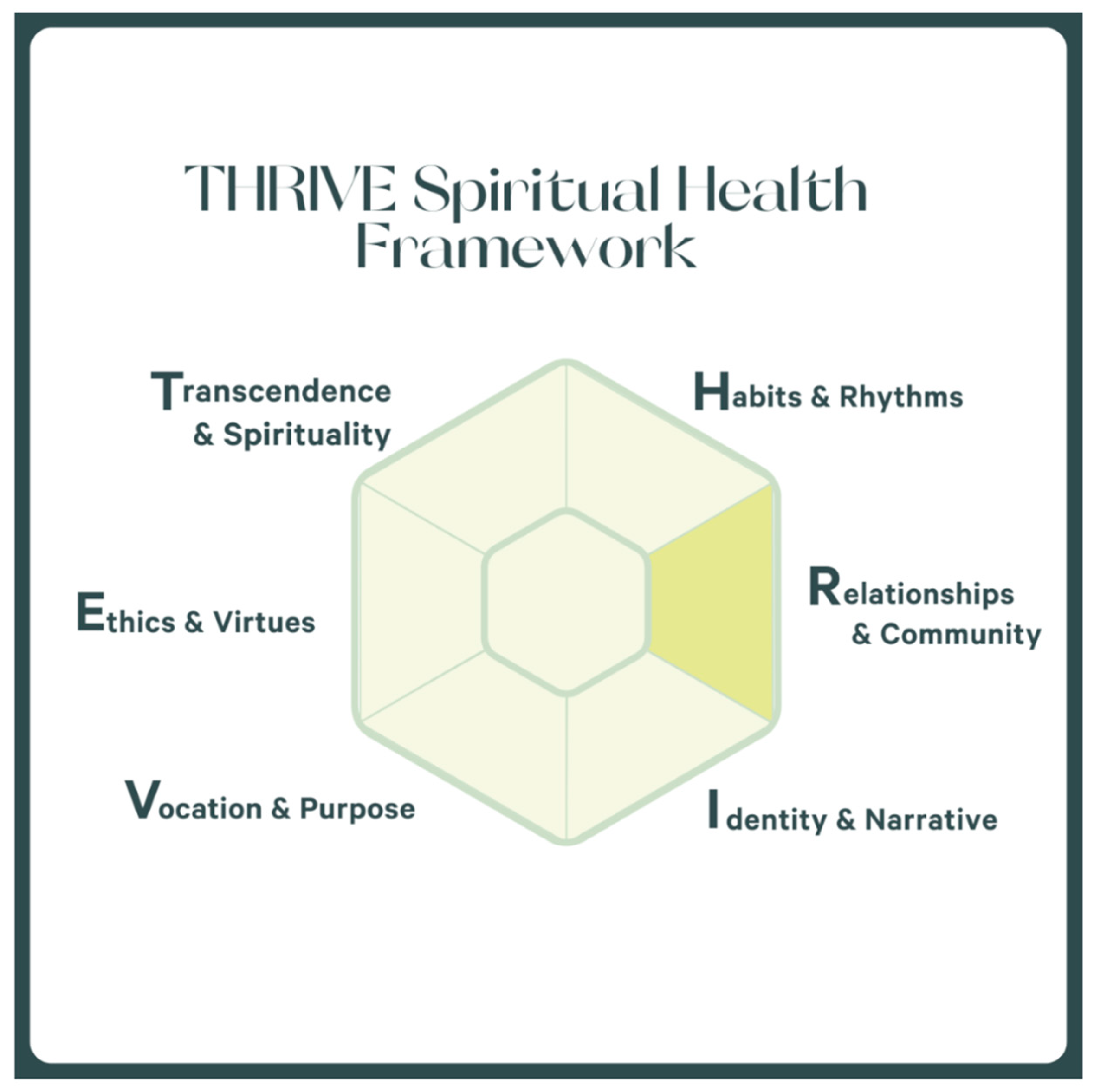
King, forthcoming), synthesizes insights from developmental and positive psychology to articulate six interrelated facets through which spirituality nurtures meaning, love, and thriving. These six facets spell the acronym THRIVE: Transcendence, Habits and Practices, Relationships and Community, Identity and Narrative, Vocation and Purpose, and Ethics and Virtues (see
Figure 1). Together, these categories highlight how spirituality becomes a resource for thriving when it enables individuals to encounter transcendence, sustain commitments through practices, experience belonging in community, integrate meaning into coherent identities, orient life toward purposes beyond the self, and embody virtues that express love in daily action.
Several features distinguish this framework. It emphasizes meaning-making as a unifying task of spiritual health. It identifies love as the foundation and orienting telos, or the ground and the goal of spirituality. It highlights the integration of inner processes and outer contribution, recognizing that transcendent experiences must be woven into identity, relationships, and purpose, and embodied in action to be sustained. It also underscores the mystery and uncontrollability of spiritual development because of engagement with realities that transcend ordinary human control. As numerous traditions affirm, spiritual growth often requires humility, surrender of ego, and openness to the sacred or the “more” in life (
James [1902] 1997). This numinous element does not preclude psychological study but does remind us that spiritual health cannot be engineered in mechanistic ways—it emerges in the interplay between human receptivity and perception of transcendence.
Finally, the framework highlights context, noting that while the six facets may appear across traditions and cultures, their particular expressions vary widely. In addition, given that this framework is based on the existing psychological research, which predominantly engages Western, Judeo-Christian samples, indigenous and other intercultural approaches may suggest other facets of spirituality in different cultures, traditions, and even in different periods of history. What matters for spiritual health is not these particular facets but whether approaches to spirituality nurture experiencing and responding to transcendence in ways that promote meaning and transcendent, inter-personal, and intra-personal love, and whether love must take seriously the embodied, culturally and gendered identities that shape every spiritual encounter and community practice (
Ramírez-Johnson 2023).
These six facets of the Thrive Spiritual Health Framework provide a way to evaluate both traditional and emerging spiritual expressions. It illuminates why forging new spiritual pathways can be deeply meaningful and innovative, but also why they are vulnerable when pursued in isolation without relational scaffolds or rhythms. It shows that while spirituality can provide relief, authenticity, and inspiration, it may also lead to fragmentation or harm if disconnected from love, practices, communities, or ethical commitments.
In the sections that follow, each facet of the framework will be described in turn. For each, I explain the facet in regard to spiritual health, provide examples across contexts, and note potential vulnerabilities. Together, these facets illustrate how spirituality nurtures thriving by helping individuals become more fully reciprocating selves—living out love in coherent, purposeful, and prosocial ways.
8. Transcendence
Spiritual health begins with experiences of transcendence. As described above,
transcendence is a deep psychological experience of connection to what is considered sacred or to an ultimate source of meaning—engaging cognition, emotion, and behavior (
Davis et al. 2023;
King et al. 2021;
Yaden et al. 2017)—and involves a shift in awareness from the self and the mundane to the meaningful and sacred.
Eliade’s (
1985) phenomenological approach has influenced many scholars in the psychology of religion and spirituality, through which he identified three modes of transcendence—
theophany,
hierophany, and
ontophany—as distinct ways the sacred reveals itself: through divine encounter (theophany), through the world and its symbols (hierophany), and through the very act of being itself (ontophany).
Beliefs shape one’s understanding of transcendence; emotions like awe and love, and practices like prayer and service reinforce it. Religion and spirituality emphasize a progression from self-focus to moving beyond the self to awareness of a greater reality (
Yaden and Newberg 2022). While
self-transcendence in psychology offers benefits like reduced anxiety and increased empathy, RS adds the importance of connecting with something sacred or ultimate—whether God, the natural order, or a sense of sacred unity experienced through one’s existence (
Lerner et al. 2003;
Pargament and Mahoney 2005). In this way transcendence involves an “extraordinary” awareness that offers sanctified values, identity, and purpose. These experiences, whether theistic or not, evoke meaning and connection and serve to sanctify elements of life.
Transcendent experiences, as
James (
[1902] 1997) observed, engage the “more” of life—realities that surpass ordinary understanding and resist human control. Unlike many developmental processes that can be pursued through clear, deliberate effort, transcendence requires humility, surrender, and openness. Many religious and spiritual traditions affirm this dynamic, emphasizing the need to relinquish control, minimize ego, and remain receptive to the sacred. This element of mystery does not render transcendence inaccessible to psychological study, but it reminds us that spirituality involves dimensions that are not fully reducible to mechanistic explanation.
From a psychological perspective, the content of transcendent beliefs also matters profoundly. Research shows that perceiving the divine or transcendent as loving and benevolent fosters trust, resilience, and pro-sociality, whereas viewing the transcendent as punitive or shaming predicts distress and maladaptive outcomes (see
Exline et al. 2021;
King, forthcoming). In addition, positive emotions play a critical role in shaping the impact of transcendent experiences on thriving. As discussed previously, transcendent emotions like awe, gratitude, and elevation broaden cognition and social repertoires, nurturing empathy and openness (
Fredrickson 2013), and are essential to the internalization of values and meaning-making (
Immordino-Yang 2016;
Riveros and Immordino-Yang 2021). In some ways, these emotions serve as developmental catalysts—they make transcendent experiences more likely to be integrated into identity and sustained as commitments, rather than dissipating as fleeting inspiration. Thus, spiritual health depends not only on the presence of transcendent experiences but also on whether they are interpreted as encounters with sources of love rather than fear.
Yet transcendent experiences are not self-interpreting. Without supportive frameworks, they may remain fleeting, confusing, or even distressing. For example, crucible experiences of suffering or loss can open a profound sense of transcendence but require meaning-making processes to integrate them constructively (
Park 2013).
Russo-Netzer (
2016) found that individuals pursuing spirituality outside traditional institutions often encountered powerful transcendent experiences but struggled to sustain or interpret them without communal support.
Van Tongeren et al. (
2025) likewise note that individuals who leave religion may lose access to the communities and rituals that once scaffolded their transcendent encounters.
The context of transcendence is crucial. What evokes transcendence varies across cultures and traditions: For one person, it may be prayer or chanting; for another, a sunrise over the ocean; and for another, participation in a justice movement. The framework offered here does not prescribe form but identifies transcendence as an essential category of spiritual health. Healthy spirituality requires not only the experience of transcendence but also relational, emotional, and interpretive supports that enable those experiences to be integrated into life-giving identities and commitments. Furthermore,
Counted’s (
2016) research demonstrates how a physical place can function as a portal to the sacred—a location where people perceive God, a higher power, ultimate meaning, or a sense of “more than.” This includes “numinous places,” restorative natural settings, or spaces infused with symbolic significance.
Example practices: Practices that cultivate transcendence include contemplative prayer, meditation, mindfulness (
https://thethrivecenter.org/a-4-step-mindful-breathing-exercise/, accessed on 25 November 2025) participation in worship, artistic creation, immersion in nature, or collective rituals of remembrance and justice (
https://thethrivecenter.org/elevating-for-social-change/, accessed on 25 November 2025) among others. The Thrive Center (
www.thethrivecenter.org, accessed on 25 November 2025) provides examples of how diverse traditions and individuals nurture transcendent experiences across contexts. In sum, transcendence provides the raw material of spiritual health—the encounters that open individuals to realities beyond the self and orient them toward love and reciprocity. When embedded in supportive contexts and accompanied by positive emotions, transcendent experiences become developmental catalysts for meaning-making, identity, and contribution. When interpreted through punitive or isolating lenses, however, they risk fragmentation or harm. Healthy spirituality begins with transcendence, but it cannot end there; it requires practices, communities, and commitments that sustain the mystery of the sacred and direct its power toward love and thriving.
9. Habits and Rhythms
While transcendent experiences often ignite spirituality, it is
habits and rhythms that sustain it. Habits and rhythms refer to the repeated practices, rituals, and embodied patterns through which individuals engage transcendence and weave it into daily life (
King, forthcoming). Unlike episodic experiences, regular spiritual practices provide continuity, stability, and accountability, enabling spirituality to become a lived reality over time. They are the “training ground” where transcendent inspiration is translated into enduring commitments, virtues, and ways of being.
Developmentally, habits and rhythms serve as scaffolds for meaning-making, providing regular opportunities to reflect, regulate, and relate. Research confirms that consistent spiritual practices predict greater resilience, prosocial behavior, and life satisfaction (
Schnitker et al. 2019). By embedding transcendent meaning in daily life, practices cultivate the psychological and relational resources needed for thriving.
Reflecting. Some practices function primarily as opportunities for reflection—creating space to remember and reorient around transcendent commitments. These include prayer, meditation, study of sacred texts, journaling, or mindful silence. Reflection allows individuals to revisit their beliefs about transcendence and to deepen their sense of being loved and worthy. As
Exline et al. (
2021) show, beliefs about God or ultimate reality as benevolent rather than punitive are linked to healthier outcomes, including greater trust, resilience, and pro-sociality. Reflective practices reinforce such beliefs and help internalize them as sources of meaning and identity.
Regulating. Other practices serve primarily to regulate thoughts, emotions, and behaviors, aligning them with transcendent commitments. Fasting, Sabbath rest, meditation, and contemplative prayer all function to regulate attention and emotion, reducing stress while cultivating openness and patience (see
Davis et al. 2023). Actively cultivating positive emotions such as gratitude, awe, and compassion, these practices fuel meaning-making and help individuals integrate transcendent experiences into narrative identity (
Riveros and Immordino-Yang 2021). Over time, they habituate individuals into more consistent states of empathy, humility, and openness, strengthening the capacity for reciprocity (see also
Ramírez-Johnson 2023).
Relating. Finally, some practices are explicitly oriented toward developing capacities for relating—extending love and compassion to others. Although many of these practices originate in religious traditions, they are often adapted for other spiritual contexts. For example, Buddhist
metta (loving-kindness) meditation systematically cultivates empathy and prosocial concern (
Hofmann et al. 2011). Christian practices of confession and forgiveness restore relationships, while communal rituals such as shared meals or liturgies foster belonging and solidarity. Research shows that such relational practices not only strengthen community ties but also promote altruism and civic engagement (see
VanderWeele 2017;
Van Cappellen et al. 2016,
2021). By directing attention outward, such practices cultivate the psychological capacities that enable individuals to embody love and help individuals grow as reciprocating selves.
Spiritual practices and rhythms are contextualized across cultures and traditions and must be culturally intelligent, gender-aware, and justice-oriented practices (
Ramírez-Johnson 2023). Practices may take the form of blessings, daily prayer, meditation, yoga, artistic creation, or collective service projects. What matters is not the uniformity of form but the presence of rhythms that sustain reflection, regulation, and relating in ways that, over time, nurture the capacity for loving reciprocity that encourages differentiation as well as connection and contribution beyond the self. At the same time, practices can be distorted—when they are motivated by fear, shame, or coercion, they risk reinforcing anxiety rather than fostering love (
Bryant-Davis and Wong 2013;
Exline 2013). Isolated, individualized practices may also lose continuity without communal scaffolding, becoming sporadic or disconnected from broader commitments (
Russo-Netzer 2016;
Van Tongeren et al. 2025).
Example practices: Examples of healthy habits and rhythms include daily prayer or mindfulness, gratitude journaling, fasting, Sabbath rest (
https://thethrivecenter.org/rhythms-and-rest-part-1/ accessed on 14 August 2024), forgiveness rituals (
https://thethrivecenter.org/on-the-road-to-forgivenes-spiritual-practices-for-healing/ accessed on 3 September 2025), and loving-kindness meditation. More practices are highlighted on the Thrive Center’s website (
www.thethrivecenter.org accessed on 3 September 2025), offering resources for individuals and communities seeking to integrate transcendent meaning into everyday life. In summary, habits and rhythms transform transcendent inspiration into enduring spiritual health. By sustaining reflection on benevolent sources of transcendence, regulating emotions in ways that cultivate love, and relating to others with empathy and reciprocity, these practices provide the daily scaffolding for meaning-making and thriving.
10. Relationships and Community
Spirituality, while often described as a search for transcendent or “otherworldly” meaning, is always lived out by embodied and relational beings. Spiritual health is most effectively pursued in networks of caring relationships and communities that nurture belonging, provide accountability, and offer models of living out transcendent commitments. Developmental science consistently demonstrates that caring relationships are among the most powerful predictors of positive outcomes across the lifespan (
Furrow et al. 2004;
Immordino-Yang et al. 2024;
Lerner et al. 2025). To thrive spiritually is to be situated within relational contexts that affirm one’s worth, guide one’s commitments, and offer opportunities for mutual care and reciprocity.
Religious and spiritual traditions at their best embody this truth by offering transcendent love, caring relationships, and supportive communities. One of the most well-documented resources of religious involvement is its social component, whether spiritual guidance, mentoring, exemplars, wisdom from others, or practical support (
Hardy et al. 2019;
VanderWeele 2017;
Garssen et al. 2020;
Koenig and Carey 2024). Involvement in religious communities is consistently linked to greater prosocial behavior, including volunteering and charitable giving, suggesting that the moral norms and relational expectations of these communities foster helping behaviors that extend beyond the self (
Lim and Putnam 2010;
VanderWeele 2017).
Communal rituals are central to these outcomes. Prayer groups, worship services, and religious festivals foster emotional resonance and shared meaning, contributing to both individual and collective well-being (
Van Cappellen et al. 2021,
2023;
VanderWeele 2017). Communal worship, ritual, and spiritual music deepen social bonds and foster unity with both others and the sacred (
Fredrickson et al. 2008;
Van Cappellen et al. 2023). Importantly, rituals that involve synchrony—such as chanting, coordinated singing, or movement—contribute to belonging, bonding, trust, and increased prosociality. Experimental research confirms that synchronized group activities reliably lead to greater cooperation, generosity, and compassionate behavior among participants (
Van Cappellen et al. 2016). Although most of this research has been conducted in explicitly religious settings, the mechanisms are not confined to religions. Similar effects are observed in secular or spiritual contexts where participants engage in synchronized practices—such as mindfulness retreats, artistic performances, or justice marches—demonstrating that collective resonance and synchrony can be powerful drivers of social bonding and prosociality wherever communities gather around transcendent commitments.
The centrality of relationships reflects the telos of human development: becoming a reciprocating self (
Balswick et al. 2016;
King and Mangan 2023;
Lerner et al. 2025). A reciprocating self matures by giving and receiving love in ways that strengthen both the individual and the community. Spiritual health, therefore, requires relational contexts that allow individuals to experience themselves as beloved and worthy, to receive the support and wisdom of others, and to reciprocate through acts of care and contribution. Without such grounding, spirituality risks remaining fragmented, overly individualistic, or vulnerable to distortion that can include coercion and shame. It is important to note that many religious and/or spiritual communities have provided detrimental shared language, extreme rules, and excess accountability. This is particularly true for socially and socio-economically marginalized communities who have been forced to conform to particular standards in detrimental ways (
Bryant-Davis and Wong 2013;
Exline 2013). Research on individualized spirituality highlights these vulnerabilities. For example,
Russo-Netzer (
2016) found that people pursuing self-initiated spiritual paths often lacked the relational scaffolding needed to sustain growth.
Van Tongeren et al. (
2025) similarly show that those who leave institutional religion often lose access to communities that once provided shared language, rituals, and accountability. These studies reinforce that while spirituality can be deeply personal, it thrives when embedded in communal networks that sustain meaning-making, fidelity, and contribution.
The context of relationships and community is also central to the framework. In some contexts, communities may take the form of congregations or temples; in others, recovery circles, interfaith networks, health and fitness groups, or secular justice movements. Even in schools or workplaces, communities can nurture spirituality through reflective practices, service, or shared rituals. What matters is not the particular form but whether communities embody belonging, accountability, and reciprocating love.
Example practices: Spiritual health is nurtured in community (
https://thethrivecenter.org/the-7-cs-of-a-healthy-community/ accessed on 3 April 2024) through small groups for prayer or reflection (
https://thethrivecenter.org/a-practice-reflecting-on-love-and-goodness-towards-others/ accessed on 17 January 2024), communal meals, synchronized rituals such as singing or meditation, and service projects that embody transcendent commitments. Secular analogs include support groups, artistic collaborations, and collective civic action. The Thrive Center offers examples of how diverse communities across traditions foster spiritual growth by embedding individuals in networks of love and accountability (
https://thethrivecenter.org/a-practice-how-to-build-bonds-with-others/ accessed on 31 January 2024). Relationships and community are indispensable to spiritual health. They provide the contexts in which individuals experience love, work out their beliefs, and embody their commitments. When experienced with emotional synchrony and reinforced by practices of reciprocity, relationships become the fertile ground where spirituality takes root and thrives.
11. Identity and Narrative
Spiritual health is not only about moments of transcendence or the practices and commitments that sustain them; it is also about how these experiences are integrated into a coherent sense of self. This integration takes place through identity and narrative, as people construct life stories that interpret their past, orient their present, and guide their future in light of transcendent meaning. Narrative identity weaves together experience into a sense of coherence and direction (
McAdams 2011), enabling individuals to answer the questions, “Who am I?” and “What is my life for?”
When spirituality informs identity, it often does so by anchoring self-understanding in transcendent commitments. This results in constructing a transcendent narrative identity—a life story that situates the self within larger frameworks of love, purpose, and responsibility. Such a narrative has transcendent beliefs and meaning integrated into identity and sustains fidelity to moral and spiritual commitments that orient a life (
Schnitker et al. 2019;
King et al. 2024). Such identities not only affirm personal uniqueness but also orient individuals toward beyond-the-self values and commitments that sustain fidelity and action across time.
A transcendent narrative identity is often shaped through sacred attributions—interpreting aspects of the self or one’s life story as imbued with divine or transcendent significance.
Pargament and Mahoney (
2005) show that sanctifying the self, or viewing one’s life as connected to the sacred, fosters resilience, humility, and moral commitment. More recently,
Mahoney et al. (
2022) demonstrate that such sacred attributions reinforce a sense of dignity and worth, while inviting openness to others. When individuals understand themselves as
beloved—as worthy of love, whether by God, ultimate reality, or community—this conviction becomes a powerful foundation for resilience and prosocial engagement. Healthy spirituality emphasizes the importance of beliefs and narratives that affirm the dignity, goodness, and uniqueness of all humanity. While many religious traditions affirm this principle, fundamental beliefs about human dignity are sometimes obscured or distorted in practice. By contrast, spiritual health highlights identities rooted in love and dignity, which open individuals to compassion and respect across differences.
Narratives of redemption are another key way spirituality informs identity.
McAdams et al. (
1997) found that highly generative American adults often constructed life stories of redemption, interpreting suffering as transformed into growth and moral purpose. Such redemptive narratives are frequently rooted in religious or spiritual frameworks that reframe adversity as meaningful within a larger transcendent story. Similarly,
Colby and Damon’s (
1992) study of moral exemplars revealed that individuals widely regarded as exceptionally moral grounded their identity in religious or spiritual commitments, which sustained lifelong engagement in service and leadership. These findings illustrate how transcendent narrative identities not only provide coherence but also direct people toward beyond-the-self commitments.
The role of narrative identity is evident across cultures and traditions. In one context, it may be shaped through a Christian story of being beloved children of God; in another, through indigenous narratives of belonging to the land and ancestors; in another, through secular commitments to justice or human rights. What unites these is that they embed the self in transcendent frameworks of meaning that orient identity toward love and contribution. Yet spiritual identities can also be distorted. When narratives emphasize shame, exclusion, or superiority, they may reinforce division or harm (
Bryant-Davis and Wong 2013;
Exline 2013). Narratives that fail to integrate suffering constructively may leave individuals vulnerable to despair or disillusionment. Thus, discerning the health of spiritual identities requires attention to whether they are grounded in love, coherence, and reciprocity.
Example practices: Practices that nurture transcendent narrative identity include life-story Thrive Center 2024 interviews, testimony in religious or spiritual communities, reflective journaling (
https://thethrivecenter.org/a-practice-questioning-beliefs-to-find-meaning/ accessed on 18 January 2024), and rituals of initiation or commitment. These practices invite individuals to articulate their experiences of transcendence, affirm their dignity as beloved, and weave their lives into larger narratives of love and purpose. Identity and narrative form the pivot point of spiritual health. They mark the place where transcendent meaning and positive emotions are integrated into coherent self-stories that sustain fidelity, give meaning to virtues, and guide purpose. Transcendent narrative identities not only affirm personal worth but also direct individuals to live out love in commitments that benefit others. In this way, identity and narrative serve as a critical bridge between transcendence and thriving, enabling people to grow into reciprocating selves who are both differentiated and oriented toward the flourishing of others.
12. Vocation and Purpose
If transcendent narrative identity provides the story in which spirituality is integrated, purpose and vocation represent the role an individual plays within that story.
Damon (
2008) defines purpose as “a stable and generalized intention to accomplish something that is meaningful to the self and consequential for the world beyond the self” (p. 121). This definition highlights three essential features: purpose is an enduring life goal that is personally meaningful, and it must extend beyond the self to benefit others. Purpose thus differs from mere goals or aspirations; it is enduring, identity-related, and directed toward contribution. Vocation and calling are often sanctified forms of purpose.
The centrality of purpose is evident across psychology, philosophy, and spirituality.
James (
[1902] 1997) argued that the deepest human motivation is to orient life around higher purposes that invest ordinary existence with significance.
Frankl (
[1959] 2006) echoed this insight in his logotherapy, contending that meaning and purpose are indispensable to survival and flourishing, even in the midst of suffering. Frankl’s oft-quoted claim that those with a “why” can endure almost any “how” underscores that purpose is not a luxury but a developmental necessity.
Spirituality has long provided such purposes by supplying narratives that situate individual lives within larger cosmic, moral, or communal dramas. Whether through stories of divine calling, ancestral lineage, or transcendent commitments to justice or stewardship, spirituality frames purposes that are not only self-chosen but experienced as received. This sense of calling from beyond connects purpose to the numinous and mysterious, infusing it with particular power and influence in a person’s life. Purpose, in this view, is not only about pursuing one’s own projects but about discerning and inhabiting a role within a transcendent story. Spirituality deepens these effects by connecting purposes to mystery and transcendence. Whereas secular goals may be pursued for personal satisfaction, spiritual purposes often carry a sense of calling, even destiny.
Dik and Duffy (
2009) describe calling as a “transcendent summons” to a particular role or life direction. This summons, whether understood as divine, ancestral, or cosmic, infuses purpose with a sense of sacred obligation. It also balances agency with humility: one discerns and responds to a call rather than inventing purpose entirely on one’s own.
Spirituality informs purpose in at least three ways. First, it supplies the narrative frameworks in which purposes are embedded. Through transcendent narrative identity (
Schnitker et al. 2019;
King et al. 2024), individuals integrate transcendent beliefs into life stories that orient identity and action. Purpose represents the enacted role within that story: the way one lives out love in concrete commitments. Second, spirituality sanctifies purpose, imbuing it with transcendent or sacred significance. Research shows that when individuals view their goals and roles as connected to the sacred, they experience greater motivation, resilience, and moral commitment (
Pargament and Mahoney 2005;
Mahoney et al. 2022). A teacher who views her vocation as a higher calling, or an activist who experiences justice work as sacred duty, may draw on deeper reservoirs of meaning and endurance. Third, spirituality motivates purpose through love. Purpose is not sustained by ambition alone but by love—whether love from a higher power or out of love of God, humanity, or the world. In this sense, purpose is how love is enacted in daily life.
Niemiec (
2018) shows that when character strengths are oriented toward purposes that serve others, they generate deeper meaning and flourishing. Purpose thus provides the structural link between transcendent commitments and lived contribution. Fourth, spirituality contributes to purpose through social support. In addition, spiritual communities often consist of people who share the same purpose or have similar purposes, providing companionship and practical support. In addition, spiritual communities often provide mentors, access to social capital, and various forms of support (
Bronk 2014;
Damon 2025).
From a developmental perspective, purpose is critical because it transforms transcendent beliefs into lived commitments. Adolescents and young adults who articulate a clear sense of purpose show greater academic engagement, civic participation, and resilience in adversity (
Bronk 2014;
Damon 2008). Adults with strong purpose report greater well-being, healthier behaviors, and reduced mortality risk (
Damon 2025;
Hill and Turiano 2014). These outcomes suggest that purpose is not only an individual good but a communal one, as people who pursue beyond-the-self purposes strengthen the social fabric.
As with other facets, the expressions of vocation and purpose are contextualizable. In one tradition, purpose and vocation may be framed as discerning a higher calling; in another, as fulfilling duties to family or ancestors; in another, as contributing to justice or ecological sustainability (
King 2021). What unites these is that purpose and/or vocation are experienced as personally meaningful, consequential for the world beyond the self, and as having a sense of higher calling beyond the mundane. Risks emerge, however, when purposes are disconnected from transcendent frameworks or love. Purposes that are self-serving, overly rigid, or distorted by fear may undermine both personal well-being and communal thriving. In contrast, purposes that are grounded in transcendent narrative identity, sanctified by transcendent significance, and motivated by love are more likely to promote health and resilience.
Example practices: Practices that nurture vocation and purpose include vocational discernment retreats, mentoring relationships, calling narratives, and service-learning experiences that connect personal strengths to communal needs. These practices (
https://thethrivecenter.org/seasons-of-purpose-finding-meaning-when-life-gets-messy/ accessed on 8 January 2025) help individuals discern their role within transcendent stories, interpret their commitments as sacred, and enact them in enduring ways. Vocation and purpose are how transcendent narrative identity becomes enacted. They represent the roles individuals inhabit within the stories they tell about the world and their place in it. Spiritual health supports purposes that are meaningful to the self, sanctified by transcendent significance, motivated by love, and consequential for others. In this way, purpose provides one of the clearest signs of thriving: a life lived as one’s best self,
with and for others, in response to the call of transcendence.
13. Ethics and Virtues
The final facet of spiritual health concerns ethics and virtues: the moral commitments and character strengths that guide daily life. If transcendent narrative identity provides the story and purpose defines the role, then ethics and virtues are the habits that make those commitments sustainable. Ethical codes reflect shared beliefs about how to live lovingly toward others and the planet. Virtues represent the cultivated dispositions—
habits of love—that enable individuals to embody those commitments consistently across contexts.
Aristotle (
1999) understood virtues as
habitus—stable moral dispositions formed through repeated practice in the pursuit of the good within one’s community. Building on this tradition,
MacIntyre (
2013) argued that virtues are cultivated through practices but gain their meaning from the local traditions, narratives, and visions of the good that shape communal life. He emphasized that virtues are always tethered to particular communities whose beliefs, ends, and practices give moral habits their purpose. Thus, virtues are not merely internal traits but socially embedded habits that are enacted and sustained within the contexts that form them. Across psychology, especially in spiritually informed research, virtues are increasingly understood as
trainable habits that enable human flourishing (see
King et al. 2024). Scholars such as
Worthington (
2013),
Emmons (
2005), and
Schnitker (
2012) show that virtues like forgiveness, gratitude, humility, and patience develop through repeated spiritual practices, relational engagement, and intentional character formation. This body of work demonstrates that virtues function as habituated moral capacities, cultivated over time through rituals, narratives, and practices that integrate belief, emotion regulation, and relational commitment (
King et al. 2024;
Schnitker et al. 2019). These findings align with the Spiritual Health Framework’s emphasis on virtues as embodied habits that transform ethical conviction into lived patterns of love and flourishing.
Spiritual or religious traditions tend to articulate ethical guidelines that ideally express their visions of love, justice, and reciprocity. Recognizing that these codes are often flawed and even used to marginalize individuals or people groups, at their best these codes specify what it means to live well in relation to others and the world: love your neighbor, honor your ancestors, care for the earth, pursue justice. From a developmental perspective, these ethical systems are not arbitrary rules but socially embedded commitments that anchor spiritual identity and direct prosocial behavior. They provide the norms and expectations that help individuals sustain fidelity to transcendent values in daily life. Yet ethical codes alone are insufficient. Without personal and cultural appropriation, they risk becoming external constraints rather than internalized commitments. Spiritual health requires that ethical belief be woven into the way people live out their spirituality through the cultivation of virtues.
Virtues are the psychological and behavioral habits that translate ethical ideals into lived reality. They are what enable people to embody love consistently—practicing compassion, humility, forgiveness, gratitude, justice, and courage in ordinary life. Positive psychology research highlights virtues as universal dimensions of character that promote both personal flourishing and communal well-being (
Matthews and Lerner 2024;
Peterson and Seligman 2004). In this framework, virtues are best understood as the
habits of love—patterns of thought, emotion, and behavior that sustain reciprocity over time. Developmental psychologists point out that virtues are constellations of habituated psychological capacities (e.g., emotion regulation, perspective taking) given meaning by one’s narrative identity that enable one to pursue their purpose across different settings and occasions (
Schnitker et al. 2019;
King et al. 2020,
2024).
Spirituality contributes to virtue development by situating them in transcendent narratives. When virtues are connected to transcendent commitments, they are experienced not merely as personal strengths but as sacred obligations. For example, forgiveness becomes more sustainable when interpreted as a spiritual practice framed by a loving ultimate reality; justice becomes more compelling when seen as participation in a transcendent order of dignity and equality.
Virtues do not emerge in a vacuum; they are cultivated through the interplay of identity and purpose. Transcendent narrative identity provides the story that makes virtues meaningful, while purpose provides the role that makes them necessary. A person who understands herself as beloved and called to serve others will be more motivated to cultivate compassion, patience, or courage. Purpose provides the context in which virtues are practiced and tested: the student develops perseverance, the activist cultivates courage, the teacher practices humility.
Psychological capacities are essential to this process. Virtues are more than beliefs. They require consistent-enough psychological strengths to manifest in coordinated ways to enable one to act virtuously across time and place (
King et al. 2024;
Lerner et al. 2022;
Schnitker et al. 2019). For example, emotion regulation allows individuals to resist anger when needing to extend forgiveness; self-awareness alerts people to anger and potential injustice; perspective-taking makes empathy possible; self-regulation enables fidelity to commitments even when inconvenient or costly. Not sufficient on their own, transcendent narrative identity patterns these capacities, imbuing them with meaning and direction (
King et al. 2024). The same self-regulatory strength that might otherwise be used to pursue selfish ambition is transformed into perseverance in service of love. Perspective-taking becomes not only a cognitive skill but an act of compassion rooted in a story that affirms the dignity of all people. In this way, transcendent narrative identity acts as a moral compass, integrating psychological capacities into a coherent whole oriented toward telos or purpose. Capacities are transformed into virtues when they are organized around transcendent meaning and enacted in service of love. It is noted that when such narratives are not based on love, justice, and care, “virtues” can become like “vices” and be used to the detriment of others. This integration is what enables spirituality to generate enduring habits of love that sustain spiritual health.
Virtues are essential for sustaining spiritual health over time. Transcendent experiences may ignite spirituality, practices may reinforce it, relationships may support it, and narrative identity may anchor it—but virtues ensure that spirituality is embodied in everyday life. They transform inspiration into action and sustain commitments through adversity. Without virtues, spirituality risks remaining episodic or performative. With virtues, spirituality becomes durable, coherent, and life-giving.
As with other facets, virtues are contextualizable. In one tradition, virtues may be codified as the fruit of the Spirit; in another, as Buddhist paramitas; and in another, as Indigenous values of harmony and respect. What unites them is their orientation toward love and reciprocity. Risks emerge when virtues are disconnected from love or distorted by fear—when humility becomes servility, or obedience becomes coercion. Spiritual health requires discernment to ensure that virtues are cultivated as habits of love rather than tools of control. Individualized paths of spirituality often lack ethical beliefs and narratives that give virtues meaning and may lack practices and communities that nurture them.
Example practices: Practices that nurture virtues (
https://thethrivecenter.org/a-practice-cultivating-patience-for-change/ accessed on 21 November 2024) include forgiveness rituals, gratitude exercises, justice-oriented service, mindfulness of compassion, and mentoring relationships that model virtuous living. The Thrive Center (
www.thethrivecenter.org accessed on 21 November 2024) offers resources for cultivating character strengths that align with transcendent commitments across diverse contexts.
Ethics and virtues are an essential element of spiritual health. Virtues embody love in a way that translates transcendent meaning, narrative identity, and purpose into daily life. By cultivating virtues as habits of love, individuals sustain reciprocity, embody their transcendent commitments, and contribute to the flourishing of others and the planet. In this way, ethics and virtues anchor spiritual health in enduring ways, ensuring that spirituality nurtures thriving across the lifespan.
14. Integrative Conclusion to the Framework
The six facets of the Spiritual Health Framework—Transcendence, Habits and Rhythms, Relationships and Community, Identity and Narrative, Vocation and Purpose, and Ethics and Virtues—together spell “THRIVE,” reflecting the framework’s grounding in developmental science. Each facet highlights a distinct but interrelated domain through which spirituality nurtures thriving by enabling individuals to experience and respond to transcendence. Rather than reducing spirituality to meaning-making, the framework emphasizes that spiritual health involves experiencing and responding to transcendence in cognitive, affective, behavioral, and relational ways. Cognitively, spirituality engages meaning-making, beliefs, and identity formation. Affectively, it evokes awe, love, gratitude, and compassion—positive emotions that broaden perspective and fuel empathy. Behaviorally, it is enacted in habits, virtues, and purposes that embody transcendent commitments in daily life and contribute beyond the self. Healthy spirituality is cultivated in the context of caring relationships and empowers people to be more loving. These dimensions come together in transcendent narrative identity, the developmental “fulcrum” where transcendent experiences are integrated into coherent life stories that orient identity, virtue, purpose, and action toward others.
Within this framework, the six facets can be understood as dimensions of this process. They are not stages. Following an RDS perspective, spiritual development or growth is not linear (see
King and Mangan 2023;
King et al. 2021) but rather cycles through these interrelated facets. Often, transcendent experiences ignite awareness of realities beyond the self. Habits and rhythms provide continuity, reinforcing transcendent meaning through consistent individual and communal practices. Relationships and community assist in making meaning and ground these commitments in belonging, accountability, and reciprocity—embodied experiences of love. Identity and narrative integrate them into affirming, coherent stories, which in turn shape vocation and purpose as enduring roles within transcendent narratives. Ethics and virtues provide ideals, and the habits of love that sustain fidelity to these commitments over time. Together, the facets articulate how spirituality becomes not merely inspiration but an enduring way of life that nurtures thriving—growing into one’s strengths with and for others. A crucial insight of the framework is that love is the orienting telos of spiritual health. Love grounds spirituality in dignity and belonging, fuels positive emotions that broaden perspective, and directs identities and purposes toward reciprocity. Virtues represent the habits of love that make these commitments sustainable. Without love, spirituality risks distortion—it becomes rigid, self-serving, and even harmful. With love, spirituality becomes a source of resilience, healing, and mutual flourishing.
The framework also highlights that spiritual development is both mysterious and contextualizable. Unlike other developmental processes that can be more directly nurtured, spirituality engages realities beyond ordinary human control. It requires humility, openness, and receptivity. Religious and spiritual traditions have long affirmed this truth, emphasizing surrender of ego and openness to the sacred. At the same time, the six facets are flexible enough to be expressed in diverse forms—prayer or meditation, worship or art, communal liturgies or civic rituals. What matters is not uniformity but whether these facets are present in ways that support coherent, loving, and reciprocal commitments.
The framework also provides perspective on the importance of physical space for spiritual health.
Counted (
2016,
2021) argues that individuals experience place not simply as a physical environment but as a socially gendered, culturally coded, and spiritually meaningful space. For example, in many cultural settings, women report a different relational experience of sacred or communal spaces, often shaped by caregiving roles and safety concerns, which alters how they encounter the sacred and community in those places. The Spiritual Health Framework provides a lens to view how transcendence is experienced through the felt sacredness, esthetic, and symbolic meaning of these environments; practices such as prayer, ritual, or pilgrimage are situated spatially and shaped by cultural scripts around gender; relationships and community are mediated by the social meanings of place; identity and narrative are formed through culturally gendered experiences of belonging to place; purpose emerges as individuals interpret spaces of struggle or rootedness as calling; and ethics and virtues are shaped by embodied responses to safety, hospitality, and inclusion within communal spaces. Counted’s intersectional account of place underscores that spiritual health is inseparable from the places people inhabit and the meanings those places hold.
Finally, the framework clarifies why spirituality is not automatically health-promoting. While transcendent experiences can inspire, without interpretive, relational, and communal support they may lead to confusion or harm. Individualized spiritual pathways may empower autonomy and creativity but are vulnerable when pursued without the scaffolding of loving community, practice, or narrative coherence (
Russo-Netzer 2016;
Van Tongeren et al. 2025). By contrast, when spirituality is supported across the six facets and centers on love, it nurtures enduring commitments, reciprocity, and thriving.
By synthesizing insights from psychology, the Thrive Spiritual Health Framework offers a grounded way to evaluate and support spiritual expressions in secular and pluralistic contexts. It shows how spirituality, at its best, enables people to encounter transcendence, integrate it into identities, purposes, and virtues, and live out love in ways that sustain both personal growth and communal flourishing. In this way, the framework highlights the deepest telos of human development: to thrive as reciprocating selves—becoming one’s best self with and for others.
15. Implications for Research
The Thrive Spiritual Health Framework highlights spirituality as a multidimensional developmental process: experiencing and responding to transcendence in cognitive, affective, behavioral, and relational ways, integrating those responses into transcendent narrative identities, and enacting them in purposes and virtues oriented toward love. This conceptualization not only advances theory but also carries important implications for both research and practice.
First, the framework underscores the need for measurement tools that capture the multidimensionality of spiritual health. Many existing measures focus narrowly on belief or private practice, but the framework points to the importance of facets such as identity, purpose, and virtues. Future research should develop and validate instruments that assess the six Thrive dimensions across cultural and religious contexts. This includes exploring both the presence and the integration of facets, since spiritual health depends not only on isolated experiences but on their coherence and enactment.
Second, this framework hinges on the concept of love as a relational dynamic that furthers the wellbeing of the people involved and entails both unitive and contributive dimensions (
VanderWeele and Lee 2025). Further scholarship is required to conceptualize and operationalize loving communities and networks. Given that religious communities have often been the source of shame for many, being able to identify loving communities is necessary. In addition, research that explores potential upsides and downsides of how spirituality affects identity formation are needed. Furthermore, research that can shed light on how virtues are engaged toward flourishing ends is essential to ensure that spiritual ideologies and communities do not use the cultivation of virtues such as civility and humility to subjugate minority groups.
Third, the framework calls for longitudinal studies to examine how spiritual health develops over time. While much research captures cross-sectional snapshots, developmental science emphasizes trajectories. Longitudinal designs can clarify how transcendent experiences become integrated into narrative identity, how purposes evolve across the lifespan, and how virtues are cultivated and sustained. Such studies can also illuminate protective and risk factors—identifying when spirituality fosters thriving and when it may fragment or harm.
Fourth, the framework invites greater attention to cultural and contextual diversity. The six facets are designed to be contextualizable, but their specific expressions vary widely. For example, transcendence may be experienced through prayer in one context, through nature in another, or through justice movements in another. Research is needed to examine how these expressions function across traditions and cultures, and whether certain combinations of facets are especially powerful in particular contexts. This work should include both global comparative studies and nuanced within-culture analyses. The framework opens avenues for exploring the psychological processes that underlie spiritual health. Positive emotions, attachment processes, emotion regulation, and perspective-taking all appear central to how transcendent experiences are integrated into identity and enacted as virtues. Empirical work that examines these mechanisms can bridge psychological science with lived spiritual practice.
Finally, inquiry about spirituality and thriving always invites questions about ultimate ends. Although the THRIVE Framework is based on RDS perspectives of thriving and the telos of the reciprocating self, which upholds the need for mutual reciprocity between a person and their contexts to ensure thriving trajectories, further scholarship and exploration of different philosophical and theological perspectives are warranted. Considering different cultural and philosophical worldviews is crucial for understanding how spiritual health and thriving are understood and pursued across different contexts.
16. Implications for Practice
Especially poignant in increasingly secular and pluralistic societies, for practitioners, the framework offers guidance for cultivating spiritual health in diverse settings. The psychologically forward language supports discussions around spiritual concepts like transcendence that are essential in settings that involve spiritual coping, making meaning out of trauma, identity and purpose development, and promoting mental health and wellbeing.
Education. Schools and universities can draw on the framework to support students in clarifying their beliefs about transcendence to foster purpose development and character education in the context of community, all of which are developmentally poignant at this stage of life. Service-learning, mentoring, and reflective exercises can help students connect transcendent meaning with personal identity and contributions to others.
Healthcare. Clinicians increasingly recognize the role of spirituality in coping and resilience. The framework provides a language for assessing patients’ spiritual resources beyond asking about belief or affiliation. Identifying whether patients have sources of transcendence, supportive communities, coherent narratives, and sustaining purposes can guide holistic care.
Chaplaincy and spiritual care. Chaplains are often offering spiritual care to individuals and families in crisis across diverse traditions. The framework offers a language for guiding people toward their own spiritual resources—whether beliefs, practices, or communities—necessary for spiritual coping. In addition, the six facets provide categories to create “spiritual tool kits” of practices that are accessible to people from a secular worldview.
Community and spiritual leadership. Leaders of religious, spiritual, or secular organizations can use the framework to evaluate the health of their communities. Are practices cultivating positive emotions? Do narratives affirm dignity and an identity as beloved? Are purposes oriented beyond the self? Are virtues being habituated as habits of love? These questions provide touchstones for guiding spiritual innovation in ways that foster thriving.
Counseling, coaching, wellness. Practitioners who support individuals in vocational discernment, life transitions, or meaning-making can use the framework to identify gaps and strengths across the six facets. For example, someone may have powerful transcendent experiences but lack practices to sustain them, or a strong sense of purpose but little communal support. The framework helps practitioners provide scaffolding for holistic spiritual health.
Furthermore, the framework offers opportunities for spiritual care providers to consider and pursue their own spiritual selfcare. The framework also carries a caution: spirituality cannot be reduced to a set of interventions or engineered outcomes. As noted earlier, spirituality involves engagement with realities beyond human control. Healthy practice, therefore, requires humility, openness, and respect for mystery. Practitioners can support conditions for spiritual health, but they cannot guarantee it. This humility is essential in pluralistic settings, where the role of psychology is not to prescribe spiritual paths but to clarify the resources that support love, reciprocity, and thriving. In addition, as evidenced in our increasingly polarized era, spiritual beliefs are often held with deep conviction, and worldviews often clash. Spiritual approaches that center on love that affirm the dignity of all persons, offer transcendent narratives that are inclusive of all persons are necessary to be able to seek the truth in love, and have authentic compassion and respect for those with differing beliefs.
While models such as FICA (
Puchalski and Romer 2000) and FACT (
LaRocca-Pitts 2012) have been instrumental in advancing the clinical assessment of spirituality within healthcare contexts, especially, they are primarily designed for acute or crisis-oriented settings in which practitioners must rapidly identify a patient’s spiritual beliefs, resources, and potential sources of distress to inform treatment planning or referral. By contrast, the Thrive Spiritual Health Framework offers a comprehensive and developmental perspective on spirituality that emphasizes the ongoing formation of spiritual health across multiple, interacting domains—identity and narrative, purpose, ethics and virtues, relationships and community, practices, and transcendence. Rather than serving as a time-limited screening tool, the Thrive Framework conceptualizes spirituality as an evolving dimension of human thriving, integrating cognitive, emotional, relational, and transcendent aspects of meaning-making. This broader orientation makes it particularly well suited for university, workplace, and community chaplaincy contexts, where the emphasis extends beyond crisis intervention toward holistic spiritual formation, integration, and flourishing across the lifespan.
The Thrive Spiritual Health Framework offers a bridge between different disciplines within psychology and the lived realities of spirituality in a secular age. For researchers, it provides a roadmap for advancing measurement, longitudinal, and cross-cultural studies. For practitioners, it offers a set of categories for discerning healthy spirituality and fostering it in diverse contexts. Across both domains, the framework highlights that spirituality is at its best when it enables people to become their best selves with and for others, growing as reciprocating selves who live out love in coherent, purposeful, and virtuous ways.
17. Conclusions
Spirituality is a natural part of what it means to be human—how we make meaning, define what a good life is, and connect to what we hold sacred. As people are seeking new forms of spirituality, deconstructing their religious beliefs, moving away from traditional religious communities, and simultaneously experiencing loneliness and fragmentation, we need psychologically informed perspectives of healthy spirituality that point to love, compassion, humility, self-understanding, and acknowledge the importance of relationships, community, and context. The Thrive framework offers guidance and emphasizes that spiritual health is not reducible to belief or private experience, nor even to meaning-making alone. Instead, it involves experiencing and responding to transcendence cognitively, affectively, behaviorally, and relationally, while integrating those responses into transcendent narrative identities that sustain purpose, virtues, and commitments of love. Love is experienced in transcendent, interpersonal, and intrapersonal forms, and emerges as the orienting telos of spiritual health that directs spirituality toward reciprocity, thriving, and flourishing.
In doing so, the framework sheds light on both the promise and the risks of spirituality in a secular age. While individualized spiritual pathways may empower autonomy and creativity, they are vulnerable without practices, communities, or narratives to sustain them. Conversely, spiritual communities risk being rigid, shameful, and oppressive. Spirituality becomes health-promoting not by default but when it is integrated across the six facets in ways that cultivate love, coherence, and contribution. For researchers, the framework offers a roadmap for advancing empirical study of spiritual development and health. For practitioners, it provides categories for evaluating and fostering spiritual health in pluralistic contexts. For individuals and communities, it affirms that spirituality at its best helps people grow into their best selves with and for others, becoming reciprocating selves who live out love in ways that sustain both personal thriving and communal flourishing. By clarifying how spirituality nurtures thriving, the framework offers both a scientific account and a practical guide for cultivating lives oriented toward transcendence, love, and the flourishing of all, demonstrating that spirituality is not a peripheral luxury but a vital dimension of human development.