1. Introduction
Marine renewable energy has increasingly emerged as a cornerstone in the pursuit of sustainable and resilient global energy systems. Among the various ocean-based resources, wave energy stands out for its exceptionally high energy density and inherent predictability, offering clear advantages over other renewables. As reported by Falnes [
1,
2], typical marine wave energy densities range from approximately 2 to 3 kW/m
2—several times greater than those of wind (0.4–0.6 kW/m
2) and solar radiation (0.1–0.2 kW/m
2). Globally, wave energy accounts for nearly 39% of total marine renewable potential, representing a theoretical annual resource of roughly 29,500 TWh/year [
3]. These characteristics make wave energy a compelling and strategically significant renewable resource for addressing long-term energy security and climate challenges.
Among various wave energy converter (WEC) technologies, the Oscillating Water Column (OWC) has gained particular prominence due to its structural simplicity and demonstrated reliability in harsh marine conditions. This is because OWC systems convert the oscillatory motion of enclosed water columns into pneumatic power, which subsequently drives the power take-off (PTO), i.e., the air turbine, which is inherently located away from erosive and biohazardous seawater. Furthermore, the onshore type of OWC has one additional key advantage: the economic viability of wave energy can be enhanced by sharing infrastructure costs and integrating additional coastal protection functions, such as breakwaters and harbor walls [
4,
5,
6]. These multifunctional structures can further improve system survivability while reducing overall construction and maintenance costs. Notable full-scale installations of onshore OWCs include the Sakata Harbor wave power plant in Japan [
7], the U-shaped OWC at the Mutriku wave power plant in Spain [
8], and the port of Civitavecchia in Italy [
9]. Collectively, these implementations underscore the onshore OWC’s Technology Readiness Level (TRL 8) [
10], economic feasibility, and suitability for deployment, thereby positioning it as one of the most extensively researched and practically demonstrated WEC technologies.
The historical development of OWC technology traces back to an early navigational aid patented by Courtney in the 1880s, the whistling buoy [
11], which harnesses wave-induced pressure fluctuations to produce acoustic signals. This OWC device also marks the first practical demonstration of ocean energy conversion. In the early 20th century, Bochaux-Praceique constructed a small-scale OWC near Bordeaux, France, capable of producing roughly 1 kW of power for household use [
12]. Masuda’s wave-powered navigation buoy exemplified subsequent progress in 1947 [
13], which incorporated an air turbine for charging batteries and for autonomous power generation. The modern era of OWC research emerged during the energy crises of the 1960s and 1970s, motivating intensive theoretical, numerical, and experimental studies of OWC hydrodynamics and performance. Major contributions include theoretical analyses (e.g., Evans [
14]; Malmo and Reitan [
15]), numerical investigations (e.g., Hong et al. [
16]; Simonetti et al. [
17]; Wang et al. [
18]), and experimental validations (e.g., Sarmento [
19]; López et al. [
20]). A comprehensive overview of OWCs’ evolution is provided by Falcão and Henriques [
21]. As a whole, these efforts have significantly advanced the scientific understanding and technological readiness of OWC-based wave energy conversion.
With the advent of advanced computational capabilities, Computational Fluid Dynamics (CFD) has become an indispensable tool for OWC research, enabling robust analyses of complex wave–structure interactions without the prohibitive costs of large-scale experiments. CFD-based investigations have yielded valuable insights into OWC optimization. For example, Bouali and Larbi [
22] employed ANSYS Fluent to explore geometric configurations that maximize energy extraction; López et al. [
23] used STAR-CCM+ with a RANS–VOF framework to model turbine–chamber coupling; Ciappi et al. [
24] validated aerodynamic performance of Wells turbines via hybrid analytical–CFD models. Even though some numerical models other than CFD have been particularly used, e.g., Kim et al. [
25]—potential-flow simulations for inclined OWC geometries, Ning et al. [
26]—fully non-linear time-domain boundary element model for wave–structure interaction, Rezanejad et al. [
27]—two-dimensional linear wave theory for analyzing OWCs with stepped bottoms, current research trends underscore CFD’s pivotal role in improving modeling accuracy, accelerating design optimization, and bridging gaps between theory and experiment in modern OWC developments.
Recent comparative numerical studies have increasingly focused on geometric configurations. Three primary geometric configurations were commonly employed in the design and study of OWCs: the traditional OWC, L-shaped OWC (L-OWC), and U-shaped OWC (U-OWC). López et al. [
28] conducted 2D numerical simulations with OpenFOAM to evaluate and compare these three configurations at a model scale, and to validate their numerical results against experimental data. Their study focused specifically on identifying optimal dimensions for U-OWC and L-OWC systems operating under the wave climates at Vigo, Spain. The L-OWC configuration outperformed both U-OWC and traditional models in energy efficiency; however, the U-OWC was distinguished by its broader operational bandwidth. Based upon this, Lin et al. [
29] undertook 2D numerical simulations of incompressible flow by FLOW-3D
® (Version 12) to establish an extensive performance database for a model-scale L-OWC. They subsequently used an optimization process integrated with a machine learning process to systematically yield optimal structural dimensions, achieving further improvements in energy capture efficiency compared to those reported by López et al. [
28]. These findings underscore the importance of geometric configuration in OWC performance, highlighting the ongoing need for detailed numerical analyses and comprehensive hydrodynamic studies of OWC geometries.
Despite considerable progress, several challenges persist in the numerical simulation and practical optimization of OWCs. Previous studies by López et al. [
28] and Lin et al. [
29] identified four primary challenges frequently encountered during numerical investigations of OWCs, namely scaling effects between model-scale and full-scale simulations, dimensional simplifications from 2D to 3D modeling, accurate modeling of air-compressibility, and realistic representation of power take-off (PTO) mechanisms. Among these factors, accurately capturing the air compressibility effects within the plenum chamber of OWCs is particularly critical, as they significantly influence the device’s performance at full-scale conditions. Sarmento and Falcão [
30], Portillo et al. [
31], and Falcão and Henriques [
32] characterized the dynamic effects of air compressibility in OWCs by an analogy to a spring-like mechanism. Numerical studies of a 3D, full-scale OWC by Elhanafi et al. [
33] revealed that failing to account for air compressibility can result in efficiency errors of nearly 12% compared to model-scale data, particularly under resonance and optimized PTO damping. Yuan et al. [
34], based on experimental results, found that ignoring the air-compressibility effect can lead to an overestimation of the device’s hydrodynamic efficiency, with the magnitude of the error depending on the incident wave frequency. Nevertheless, the inaccuracies in capture efficiency remained largely within a 10% margin. Carlo et al. [
35] focused on optimizing the hydrodynamic performance and geometric parameters of a traditional U-OWC. Combining 1:30-scale physical wave flume experiments with CFD simulations, this study explored the effects of the U-duct width and the orifice diameter on the device’s performance. Furthermore, it derived empirical relationships for calculating the resonance index and hydrodynamic efficiency for engineering design. Wang et al. [
36] proposed an innovative U-OWC concept featuring a front wall capable of a pitching motion within the U-duct. Based on linear wave theory analysis, the study demonstrated that by configuring an appropriate angular spring stiffness, this dynamic front wall design can significantly expand the frequency bandwidth for high-efficiency wave energy absorption. However, the enhanced efficiency results in significantly larger wave loads acting on the back lip-wall, necessitating a balance between wave power extraction efficiency and structural safety in practical applications. Zheng et al. [
37] similarly aimed to modify front wall rigidity by proposing a U-OWC design with a flexible bottom-standing front wall. By developing a theoretical model based on linear potential flow theory, it is found that the flexural rigidity of the flexible wall is a key parameter. Its deflection can induce both the natural mode resonance of the flexible wall and wave near-trapping effects, leading to three distinct peaks in the maximum wave power capture efficiency curve, thereby achieving high-efficiency absorption over a broader range of wave frequencies. Model experiments on an OWC chamber connected to an expanded reservoir performed by López et al. [
38] further corroborated these numerical insights, demonstrating that disregarding compressibility effects could lead to significant underestimations or overestimations of power output, depending heavily on specific wave conditions and turbine-induced damping. Additionally, a theoretical correction method proposed by Falcão et al. [
39], combining experimental and potential flow analyses, demonstrated that appropriately accounting for air compressibility can notably enhance predicted capture width ratios at specific wave periods. Altogether, these studies underscore the complexity and importance of accurately accounting for air compressibility in numerical simulations to ensure reliable optimization of OWC performance. Henriques et al. [
40] conducted wave flume experiments on a breakwater-integrated U-OWC, uniquely incorporating accurate modeling of air compressibility into the scaled model. The experimental results confirmed that the ratio of wave amplitude to lip clearance significantly affects device efficiency; increasing wave amplitude or decreasing lip clearance reduces the pneumatic capture width ratio. This non-linear effect implies that the U-OWC possesses the potential for “passive control of pneumatic power peaks,” allowing the system to self-protect during highly energetic wave conditions.
To address these challenges, Nguyen et al. [
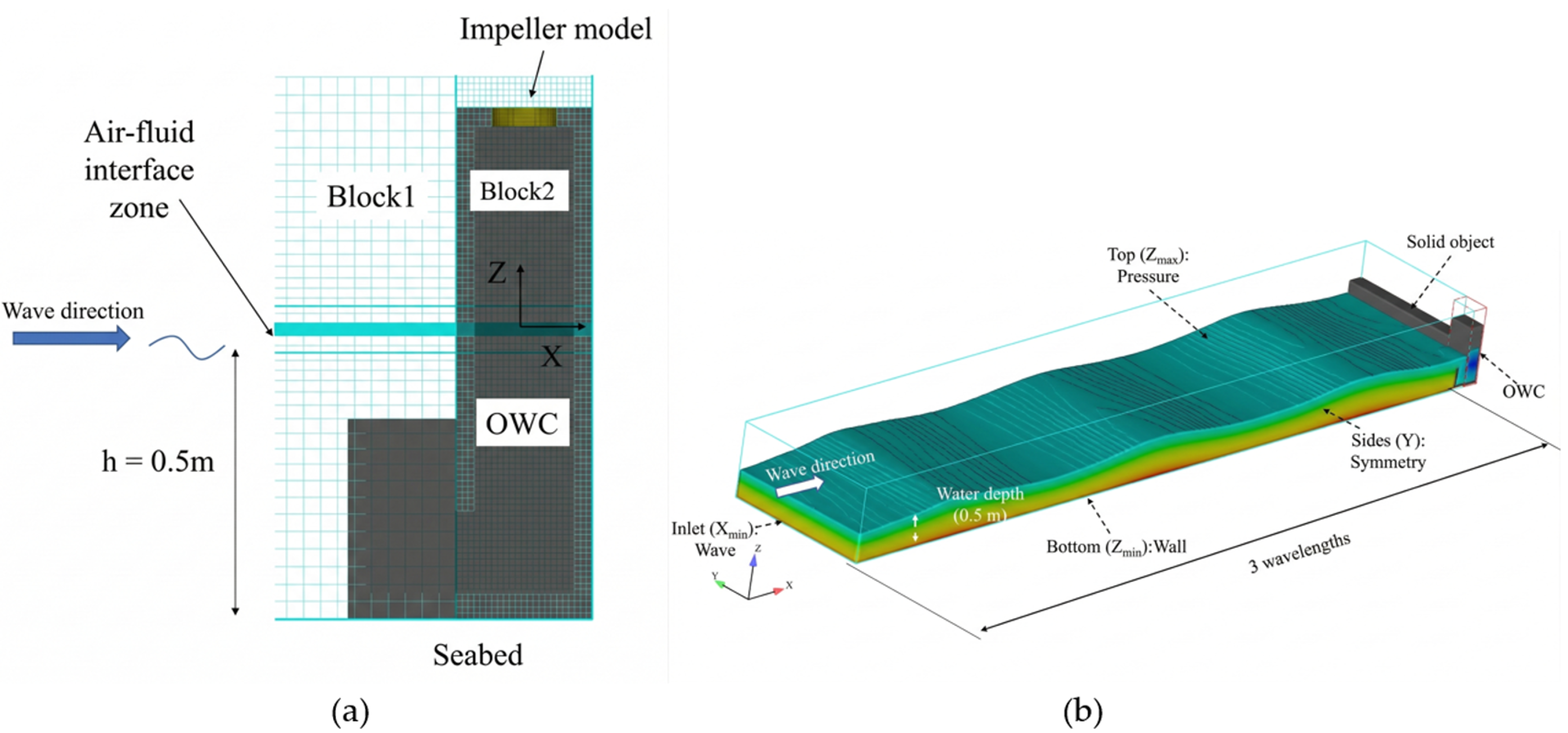
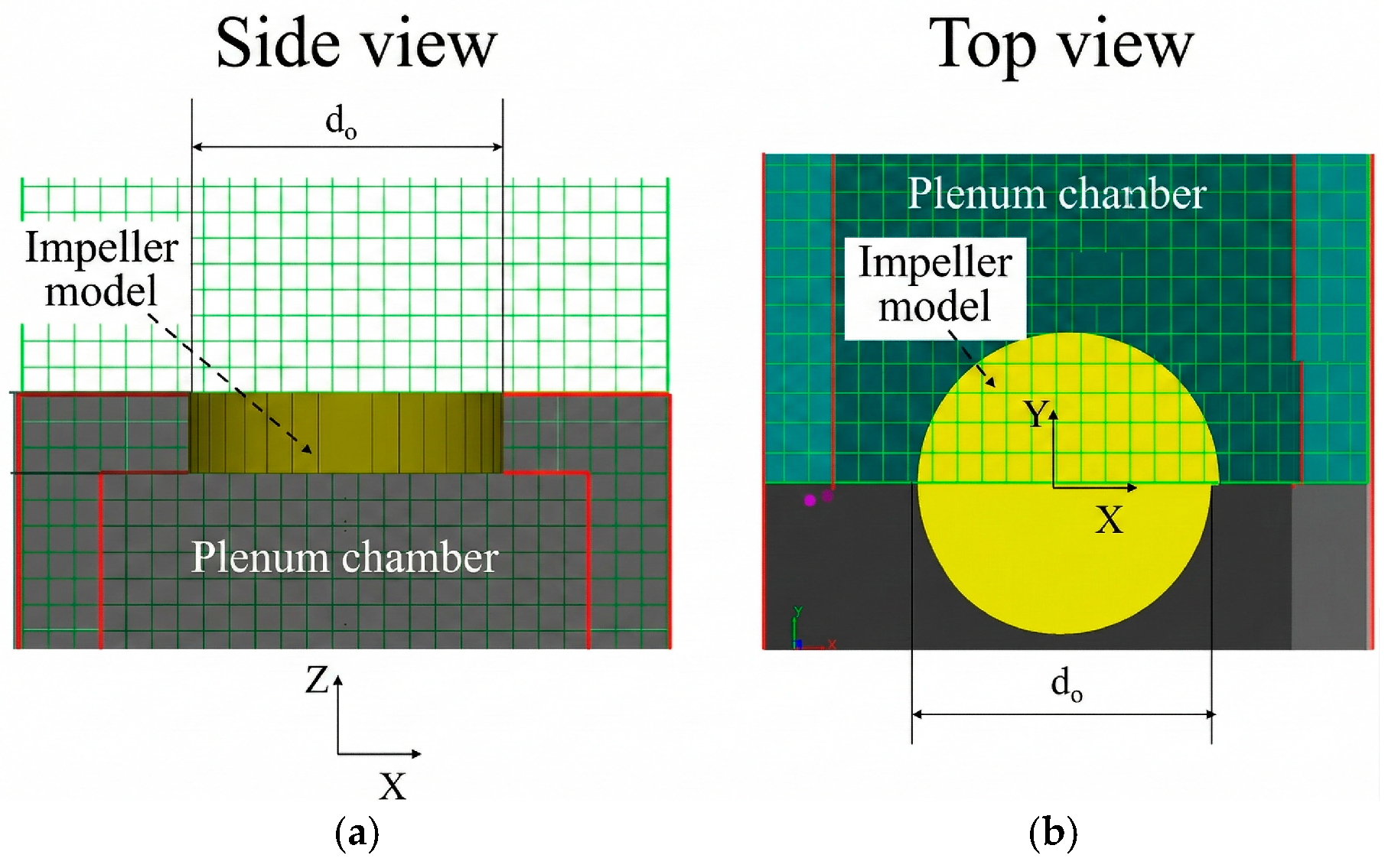
41] introduced a scaling-rematched methodology that provides a systematic framework for reconciling model-scale and full-scale hydrodynamics. This approach enables the accurate determination of essential coefficients, such as added mass, radiation damping, and excitation forces, while integrating theoretical corrections to account for spring-like air-compressibility effects. The method further employs FLOW-3D’s impeller model to simulate PTO damping effects from air turbines, enhancing the fidelity of numerical predictions. Applied initially to an L-OWC, the methodology proved effective in refining performance estimates and quantifying the influence of compressibility. The present paper further applies this methodology to a U-OWC and comprehensively evaluates its capture performance, hydrodynamic behavior, and compressibility effects. This paper is structured as follows.
Section 2 briefly describes the scaling-rematched approach and details the numerical simulations employed.
Section 3 presents the results and discussions of capture factors, hydrodynamic and gravitational coefficients, and effective coefficients of PTO damping and air compressibility. Lastly,
Section 4 concludes the main results.