Trends, Challenges, and Opportunities of Cañihua (Chenopodium pallidicaule) for Functional Food Development and Sustainable Agriculture: A Bibliometric and Systematic Approach
 , , , and
Abstract
1. Introduction
2. Materials and Methods
2.1. Search Strategy and Information Sources
2.2. Article Selection Process
2.3. Data Analysis
2.4. Data Extraction and Critical Appraisal of Included Studies
3. Results and Discussion
3.1. Bibliometric Analysis
3.1.1. Annual Publication Trends
3.1.2. Most Cited Documents and Authors
3.1.3. Countries with the Highest Scientific Output
3.1.4. Scientific Collaboration Networks
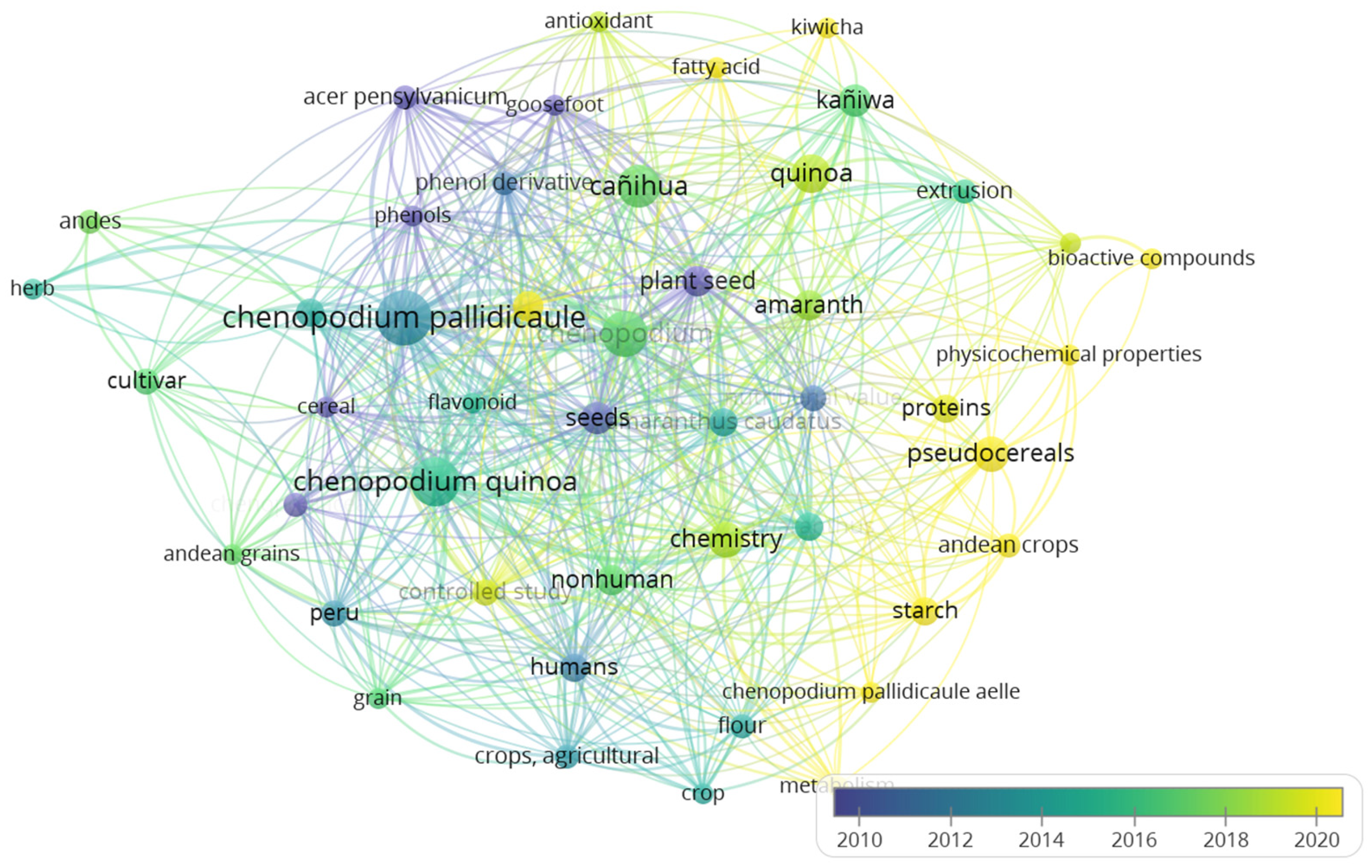
3.1.5. Keyword Co-Occurrence and Thematic Map
3.1.6. Methodological Limitations of the Bibliometric Analysis
3.1.7. Topic Areas and Main Findings
3.2. Trends in the Use of Cañihua
3.2.1. Nutritional Value and Bioactive Compounds

| Component | Main Constituents | Content * | Key Remarks | Reference |
|---|---|---|---|---|
| Carbohydrates | Starch and complex carbohydrates | 63.64–68.00% | Major fraction of the grain | [25,33] |
| Dietary fiber | Insoluble fiber | 22.27–23.16% | High fiber content compared to other pseudocereals | [25,33] |
| Protein | Albumins, globulins, glutelins, prolamins | 14.41–15.5% | High- quality protein; chemical score= 93.3; threonine limiting | [4,25,33] |
| Lipids | Unsaturated fatty acids (linoleic, oleic, α-linolenic) | 7.6–8.5% | 76.9% unsaturated; rich in essential fatty acids | [28,30,33,105] |
| Minerals | P, K, Ca, Mg, Na | - | Contributes to micronutrient intake | [84] |
| Phenolic compounds | Catechin, quercitin, kaempferol, resorcinols | 186.54 mg GAE/100 g | Strong antioxidant potential | [22,34,37] |
| Flavonoids | Flavonol triglycosides | 249.82 mg CAT/100 g | Linked to anti-inflammatory and anticancer activities | [30,34] |
| Tocols | Tocopherols and tocotrienols | 18.06 mg/100 g DW | Higher than quinoa and amaranth | [34] |
| Betalains | Betacyanins and betaxanthins | 2.3–42.0 mg/100 g | Varies with ecotype | [33] |
| Carotenoids | Lutein, β-carotene, β-cryptoxanthin, zeaxanthin | 385.7 µg/100 DW | Lutein predominant | [34] |
3.2.2. Pre-Treatments of Cañihua
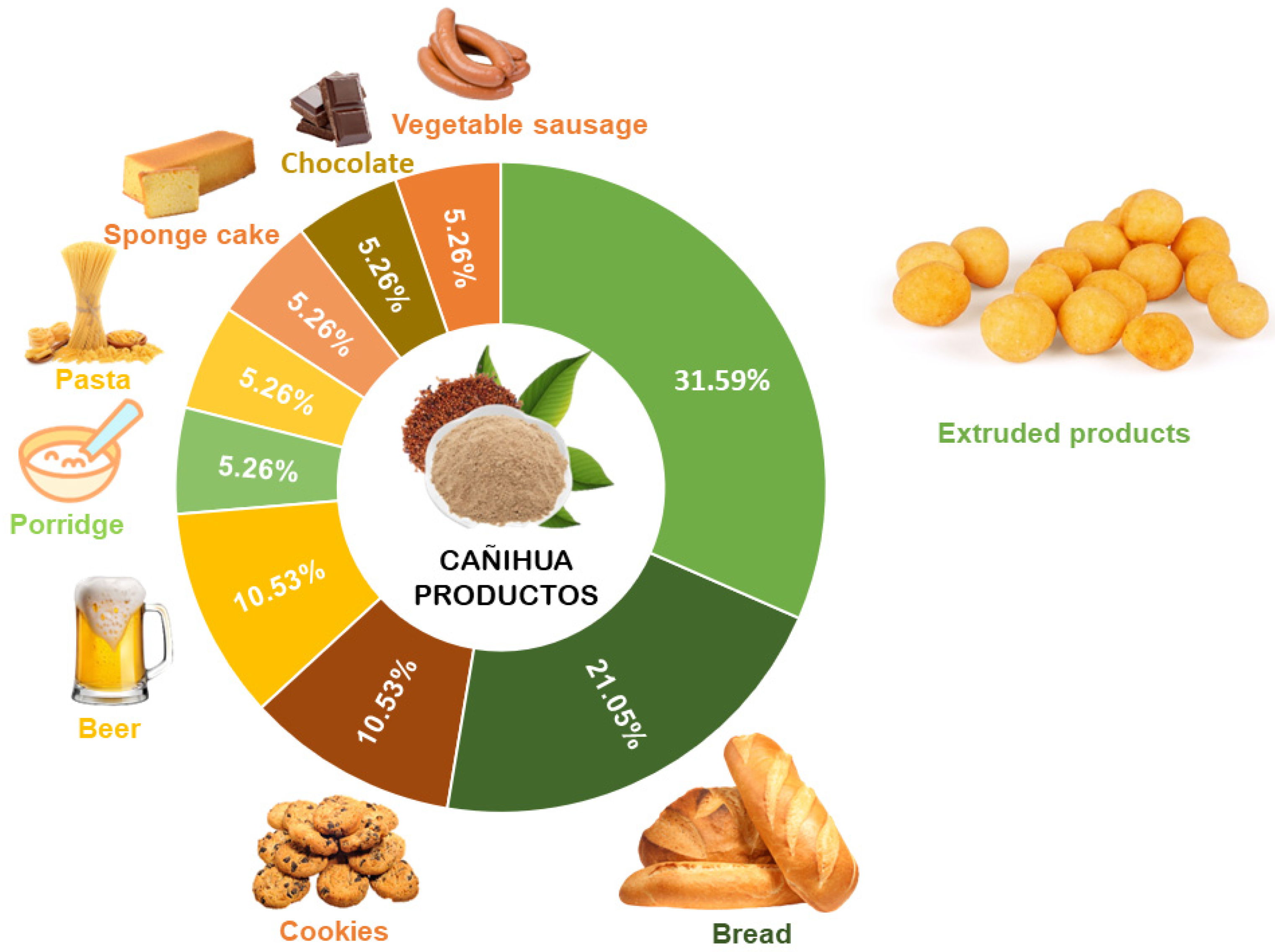
3.2.3. Applications in Functional Foods
3.2.4. Sensory Evaluation of Cañihua-Containing Products
3.2.5. Potential in the Cosmetic Industry
3.3. Challenges in Production and Consumption
3.3.1. Limitations in Agricultural Production
3.3.2. Grain Processing and Quality
3.3.3. Conservation of Genetic Diversity
3.4. Future Opportunities
3.4.1. Development of New Products
3.4.2. Agricultural Sustainability and Resilience
3.4.3. Innovation and Research in Genetic Improvement
4. Conclusions
Supplementary Materials
Author Contributions
Funding
Institutional Review Board Statement
Data Availability Statement
Acknowledgments
Conflicts of Interest
References
- Organización de las Naciones Unidas para la Alimentación y la Agricultura-FAO Los Sistemas Agroalimentarios y La Agenda 2030. Available online: https://www.fao.org/sustainable-development-goals-helpdesk/overview/agrifood-systems-and-the-2030-agenda/es?utm_source=chatgpt.com (accessed on 20 August 2025).
- Moscoso-Mujica, G.; Zavaleta, A.I.; Mujica, Á.; Arnao, I.; Moscoso-Neira, C.; Santos, M.; Sánchez, J. Antimicrobial Peptides Purified from Hydrolysates of Kanihua (Chenopodium pallidicaule Aellen) Seed Protein Fractions. Food Chem. 2021, 360, 129951. [Google Scholar] [CrossRef] [Scilit] [PubMed]
- Gomez Cahuata, J.F.; Rosas-Quina, Y.E.; Pachari Vera, E. Cañihua (Chenopodium pallidicaule Aellen) a Promising Superfood in Food Industry: A Review. Nutr. Food Sci. 2022, 52, 917–928. [Google Scholar] [CrossRef] [Scilit]
- Moscoso-Mujica, G.; Zavaleta, A.; Mujica, Á.; Santos, M.; Calixto, R. Fraccionamiento y Caracterización Electroforética de Las Proteínas de La Semilla de Kañihua (Chenopodium pallidicaule Aellen). Rev. Chil. Nutr. 2017, 44, 144–152. [Google Scholar] [CrossRef] [Scilit]
- Serena-Romero, G.; Ignot-Gutiérrez, A.; Conde-Rivas, O.; Lima-Silva, M.Y.; Martínez, A.J.; Guajardo-Flores, D.; Cruz-Huerta, E. Impact of In Vitro Digestion on the Digestibility, Amino Acid Release, and Antioxidant Activity of Amaranth (Amaranthus cruentus L.) and Cañihua (Chenopodium pallidicaule Aellen) Proteins in Caco-2 and HepG2 Cells. Antioxidants 2023, 12, 2075. [Google Scholar] [CrossRef] [Scilit]
- Moscoso-Mujica, G.; Mujica, Á.; Chura, E.; Begazo, N.; Jayo-Silva, K.; Oliva, M. Kañihua (Chenopodium pallidicaule Aellen), an Ancestral Inca Seed and Optimal Functional Food and Nutraceutical for the Industry: Review. Heliyon 2024, 10, e34589. [Google Scholar] [CrossRef] [Scilit]
- Sagu, S.T.; Schnepf, B.; Stenzel, P.; Nichani, K.; Erban, A.; Kopka, J.; Rawel, H.M.; Henze, A. Discovery of Species-Specific Peptide Markers for Superseed Authentication Using Targeted LC-MS/MS Proteomics. Molecules 2025, 30, 2993. [Google Scholar] [CrossRef] [Scilit]
- Villalobos-Fernandez, L.; Inga, M.; Betalleluz-Pallardel, I. Properties and Emulsifying Performance of Octenyl Succinic Anhydride-Modified Starch from an Andean Pseudocereal: Cañihua (Chenopodium pallidicaulle Aellen). Carbohydr. Polym. Technol. Appl. 2025, 9, 100605. [Google Scholar] [CrossRef] [Scilit]
- Paredes Ugarte, W.; Viza Salas, A.G.; Zaira Churata, A.; Aguirre Florez, L.A.; Moroco Choqueña, D.; Zapana Quispe, J.; Yanqui Apaza, I.; Gomez Campos, R.; Cossio Bolaños, M. Effect of Supplementation of an Instant Mixture Based on Cañihua, Cocoa and Bovine Blood on the Recovery of Anemia in Wistar Rats. Nutr. Clin. Diet. Hosp. 2025, 45, 312–318. [Google Scholar] [CrossRef] [Scilit]
- Choque Delgado, G.T.; Carlos Tapia, K.V.; Pacco Huamani, M.C.; Hamaker, B.R. Peruvian Andean Grains: Nutritional, Functional Properties and Industrial Uses. Crit. Rev. Food Sci. Nutr. 2023, 63, 9634–9647. [Google Scholar] [CrossRef] [Scilit]
- Carla, D.C.J.; Bertran, S.T. Screening the Dermatological Potential of Peruvian Cañihua Oil (Chenopodium pallidicaule): Antioxidant Activity and Inhibitory Capacities over Collagenase and Elastase. Res. J. Pharm. Technol. 2024, 17, 5869–5876. [Google Scholar] [CrossRef] [Scilit]
- De-La-Cruz-Yoshiura, S.; Vidaurre-Ruiz, J.; Alcázar-Alay, S.; Encina-Zelada, C.R.; Cabezas, D.M.; Correa, M.J.; Repo-Carrasco-Valencia, R. Sprouted Andean Grains: An Alternative for the Development of Nutritious and Functional Products. Food Rev. Int. 2023, 39, 5583–5611. [Google Scholar] [CrossRef] [Scilit]
- Page, M.J.; McKenzie, J.E.; Bossuyt, P.M.; Boutron, I.; Hoffmann, T.C.; Mulrow, C.D.; Shamseer, L.; Tetzlaff, J.M.; Akl, E.A.; Brennan, S.E.; et al. The PRISMA 2020 Statement: An Updated Guideline for Reporting Systematic Reviews. BMJ 2021, 372, n71. [Google Scholar] [CrossRef] [Scilit]
- Ouzzani, M.; Hammady, H.; Fedorowicz, Z.; Elmagarmid, A. Rayyan-a Web and Mobile App for Systematic Reviews. Syst. Rev. 2016, 5, 210. [Google Scholar] [CrossRef] [Scilit]
- Aria, M.; Cuccurullo, C. Bibliometrix: An R-Tool for Comprehensive Science Mapping Analysis. J. Informetr. 2017, 11, 959–975. [Google Scholar] [CrossRef] [Scilit]
- van Eck, N.J.; Waltman, L. Software Survey: VOSviewer, a Computer Program for Bibliometric Mapping. Scientometrics 2010, 84, 523–538. [Google Scholar] [CrossRef] [Scilit]
- Repo-Carrasco-Valencia, R.; Hellström, J.K.; Pihlava, J.M.; Mattila, P.H. Flavonoids and Other Phenolic Compounds in Andean Indigenous Grains: Quinoa (Chenopodium quinoa), Kañiwa (Chenopodium pallidicaule) and Kiwicha (Amaranthus caudatus). Food Chem. 2010, 120, 128–133. [Google Scholar] [CrossRef] [Scilit]
- Castro-Alba, V.; Lazarte, C.E.; Perez-Rea, D.; Carlsson, N.G.; Almgren, A.; Bergenståhl, B.; Granfeldt, Y. Fermentation of Pseudocereals Quinoa, Canihua, and Amaranth to Improve Mineral Accessibility through Degradation of Phytate. J. Sci. Food Agric. 2019, 99, 5239–5248. [Google Scholar] [CrossRef] [Scilit]
- Steffolani, M.E.; León, A.E.; Pérez, G.T. Study of the Physicochemical and Functional Characterization of Quinoa and Kañiwa Starches. Starch/Staerke 2013, 65, 976–983. [Google Scholar] [CrossRef] [Scilit]
- Ramos Diaz, J.M.; Kirjoranta, S.; Tenitz, S.; Penttilä, P.A.; Serimaa, R.; Lampi, A.M.; Jouppila, K. Use of Amaranth, Quinoa and Kañiwa in Extruded Corn-Based Snacks. J. Cereal Sci. 2013, 58, 59–67. [Google Scholar] [CrossRef] [Scilit]
- Ranilla, L.G.; Apostolidis, E.; Genovese, M.I.; Lajolo, F.M.; Shetty, K. Evaluation of Indigenous Grains from the Peruvian Andean Region for Antidiabetes and Antihypertension Potential Using in Vitro Methods. J. Med. Food 2009, 12, 704–713. [Google Scholar] [CrossRef] [Scilit] [PubMed]
- Peñarrieta, J.M.; Alvarado, J.A.; Åkesson, B.; Bergenståhl, B. Total Antioxidant Capacity and Content of Flavonoids and Other Phenolic Compounds in Canihua (Chenopodium pallidicaule): An Andean Pseudocereal. Mol. Nutr. Food Res. 2008, 52, 708–717. [Google Scholar] [CrossRef] [Scilit]
- Rosell, C.M.; Cortez, G.; Repo-Carrasco, R. Breadmaking Use of Andean Crops Quinoa, Kañiwa, Kiwicha, and Tarwi. Cereal Chem. 2009, 86, 386–392. [Google Scholar] [CrossRef] [Scilit]
- Repo-Carrasco-Valencia, R.A.M.; Encina, C.R.; Binaghi, M.J.; Greco, C.B.; de Ferrer, P.A.R. Effects of Roasting and Boiling of Quinoa, Kiwicha and Kañiwa on Composition and Availability of Minerals in Vitro. J. Sci. Food Agric. 2010, 90, 2068–2073. [Google Scholar] [CrossRef] [Scilit]
- Repo-Carrasco-Valencia, R.; de La Cruz, A.A.; Alvarez, J.C.I.; Kallio, H. Chemical and Functional Characterization of Kañiwa (Chenopodium pallidicaule) Grain, Extrudate and Bran. Plant Foods Hum. Nutr. 2009, 64, 94–101. [Google Scholar] [CrossRef] [Scilit]
- Ruas, P.M.; Bonifacio, A.; Ruas, C.F.; Fairbanks, D.J.; Andersen, W.R. Genetic Relationship among 19 Accessions of Six Species of Chenopodium L., by Random Amplified Polymorphic DNA Fragments (RAPD). Euphytica 1999, 105, 25–32. [Google Scholar] [CrossRef] [Scilit]
- Ibieta, G.; Ortiz-Sempértegui, J.; Peñarrieta, J.M.; Linares-Pastén, J.A. Enhancing the Functional Value of Andean Food Plants: Enzymatic Production of γ-Aminobutyric Acid from Tarwi, Cañihua and Quinoa Real Seeds’ Proteins. LWT 2025, 220, 117564. [Google Scholar] [CrossRef] [Scilit]
- Limachi, J.; Huanca, S.; Castañeta, G.; Miranda-Flores, D.; Palma, V.; Yañiquez, J.; Tejeda, L.; Mollinedo, P.; Dimov, K.; Popova, T.; et al. Antioxidant Potential and Fatty Acid Profile of Different Canihua (Chenopodium pallidicaule) Cultivars, Raised in Bolivian Altiplano. Food Sci. Appl. Biotechnol. 2023, 6, 383–394. [Google Scholar] [CrossRef] [Scilit]
- Applequist, W.L.; Avula, B.; Schaneberg, B.T.; Wang, Y.H.; Khan, I.A. Comparative Fatty Acid Content of Seeds of Four Cucurbita Species Grown in a Common (Shared) Garden. J. Food Compos. Anal. 2006, 19, 606–611. [Google Scholar] [CrossRef] [Scilit]
- Kim, D.S.; Iida, F. Kaniwa (Chenopodium pallidicaule)’s Nutritional Composition and Its Applicability as an Elder-Friendly Food with Gelling Agents. Gels 2023, 9, 61. [Google Scholar] [CrossRef] [Scilit]
- Paucar-Menacho, L.M.; Simpalo-López, W.D.; Castillo-Martínez, W.E.; Esquivel-Paredes, L.J.; Martínez-Villaluenga, C. Improving Nutritional and Health Benefits of Biscuits by Optimizing Formulations Based on Sprouted Pseudocereal Grains. Foods 2022, 11, 1533. [Google Scholar] [CrossRef] [Scilit]
- Coronado-Olano, J.; Repo-Carrasco-Valencia, R.; Reategui, O.; Toscano, E.; Valdez, E.; Zimic, M.; Best, I. Inhibitory Activity against α-Amylase and α-Glucosidase by Phenolic Compounds of Quinoa (Chenopodium quinoa Willd.) and Cañihua (Chenopodium pallidicaule Aellen) from the Andean Region of Peru. Pharmacogn. J. 2021, 13, 896–901. [Google Scholar] [CrossRef] [Scilit]
- Huamaní, F.; Tapia, M.; Portales, R.; Doroteo, V.; Ruiz, C.; Rojas, R. Proximate analysis, phenolics, betalains, and antioxidant activities of three ecotypes of kañiwa (Chenopodium pallidicaule aellen) from Peru. Pharmacologyonline 2020, 1, 229–236. [Google Scholar]
- Niro, S.; D’Agostino, A.; Fratianni, A.; Cinquanta, L.; Panfili, G. Gluten-Free Alternative Grains: Nutritional Evaluation and Bioactive Compounds. Foods 2019, 8, 208. [Google Scholar] [CrossRef] [Scilit]
- Chirinos, R.; Ochoa, K.; Aguilar-Galvez, A.; Carpentier, S.; Pedreschi, R.; Campos, D. Obtaining of Peptides with in Vitro Antioxidant and Angiotensin I Converting Enzyme Inhibitory Activities from Cañihua Protein (Chenopodium pallidicaule Aellen). J. Cereal Sci. 2018, 83, 139–146. [Google Scholar] [CrossRef] [Scilit]
- Rastrelli, L.; De Tommasi, N.; Ramos, I. Ecdysteroids in Chenopodium pallidicaule Seeds. Biochem. Syst. Ecol. 1996, 24, 353. [Google Scholar] [CrossRef] [Scilit]
- Rastrelli, L.; De Simone, F.; Schettino, O.; Dini, A. Constituents of Chenopodium pallidicaule (Cañihua) Seeds: Isolation and Characterization of New Triterpene Saponins. J. Agric. Food Chem. 1996, 44, 3528–3533. [Google Scholar] [CrossRef] [Scilit]
- Gomez-Herrera, G.P.; Gallo Ruelas, M.; Huamán-Gutierrez, O.G. Neuroprotective Effect of Chenopodium pallidicaule Flour (Cañihuaco) Suspension against Ethanol Toxicity in Mice. Nutr. Clin. Diet. Hosp. 2025, 45, 212–218. [Google Scholar] [CrossRef] [Scilit]
- Todorova, V.; Ivanova, S.; Yotov, V.; Zaytseva, E.; Ardasheva, R.; Turiyski, V.; Prissadova, N.; Ivanov, K. Phytoecdysteroids: Quantification in Selected Plant Species and Evaluation of Some Effects on Gastric Smooth Muscles. Molecules 2024, 29, 5145. [Google Scholar] [CrossRef] [Scilit] [PubMed]
- Castro-Alba, V.; Vargas, M.; Sandberg, A.S.; Perez-Rea, D.; Bergenståhl, B.; Granfeldt, Y.; Lazarte, C.E. Fermented Quinoa and Canihua in Plant-Based Diets Increase Iron and Zinc Bioavailability in Growing Rats. Food Sci. Nutr. 2024, 12, 9555–9565. [Google Scholar] [CrossRef] [Scilit]
- Barra, T.P.V.; de Quispe, T.F.; Quispe, J.R.P.; Ahumada, M.G.A. Effect of Consumption of Cookies Made with Andean Crops on Biochemical Indicators in Recently Weaned Wistar Rats. Edelweiss Appl. Sci. Technol. 2024, 8, 673–682. [Google Scholar] [CrossRef] [Scilit]
- Ormachea-Salcedo, P.; Navia-Coarite, A.; Tarquino-Flores, G.; Callejas-Calle, L.; Yupanqui-Machaca, C.; Latorre-Rada, C.; Mamani-Charca, M.; Salcedo-Ortiz, L. Glycemic Index of Cañahua, Quinua and Enzymatically Modified Products from Quinoa Jacha Grano [Índice Glucémico de Cañahua, Quinua y de Productos Enzimáticamente Modificados de Quinua Jacha Grano]. Rev. Esp. Nutr. Humana Diet. 2024, 28, 38–46. [Google Scholar] [CrossRef] [Scilit]
- Tello-Palma, E.; Choque-Quispe, M.; Pacheco-Tanaka, M.; Zamalloa-Cuba, W.; Valencia-Pacho, M.; Donaires-Flores, T.; Macedo-Enríquez, E.; Viza-Salas, A.; Quispe-Romero, A.; Paredes-Ugarte, W.; et al. Effects of Microencapsulated and Heme Iron Supplementation on the Recovery of Hemoglobin Levels in Iron-Depleted Rats. Nutr. Hosp. 2022, 39, 1357–1363. [Google Scholar] [CrossRef] [Scilit]
- Moscoso-Mujica, G.; Mujica, Á.; Chávez, J.; Peña, C.; Begazo, N.; Estrella, J.; Estrada, Z.; Tello, L.; Ramos, Y.; Rivera, D.; et al. Antianemic Activity of Quinoa (Chenopodium quinoa Willd) Collana Negra Variety and Kanihua (Chenopodium pallidicaule Aellen) Ramis Variety Seed Flour in Anemic Rats. SN Appl. Sci. 2022, 4, 318. [Google Scholar] [CrossRef] [Scilit]
- Ortiz-Chura, A.; Pari-Puma, R.M.; Rodríguez Huanca, F.H.; Cerón-Cucchi, M.E.; Araníbar Araníbar, M.J. Apparent Digestibility of Dry Matter, Organic Matter, Protein and Energy of Native Peruvian Feedstuffs in Juvenile Rainbow Trout (Oncorhynchus mykiss). Fish. Aquat. Sci. 2018, 21, 32. [Google Scholar] [CrossRef] [Scilit]
- White, P.L.; Alvistur, E.; Días, C.; ViñAs, E.; White, H.S.; Collazos, C. Nutritive Values of Crops, Nutrient Content and Protein Quality of Quinua and Cañihua, Edible Seed Products of the Andes Mountains. J. Agric. Food Chem. 2002, 3, 531–534. [Google Scholar] [CrossRef] [Scilit]
- Leon, J.D.A.; Leon Tacca, A.M.; Medina Espinoza, W.T. Physical Properties of Sausage Analogues Made with Quinoa and Cañihua Flours, by Extrusion [Propriedades Físicas de Análogos de Salsicha Elaborados Com Farinhas de Quinoa e Cañihua, Por Extrusão] [Propiedades Físicas de Análogos de Salchicha Elaborados Con…]. Rev. Fac. Agron. 2025, 42, e254245. [Google Scholar] [CrossRef] [Scilit]
- Paucar-Menacho, L.M.; Salvador-Reyes, R.; Castillo-Martinez, W.E.; Lavado-Cruz, A.; Verona-Ruiz, A.; Campos-Rodriguez, J.; Acosta-Coral, K.; Simpalo-Lopez, W.D.; López-Rodriguez, W.; Quezada-Berrú, S. Optimization of a Craft Ale-Type Beer Enriched with Cañihua Malt (Chenopodium pallidicaule) and Banana Passionfruit Juice (Passiflora tripartita Var. mollisima). Heliyon 2025, 11, e42610. [Google Scholar] [CrossRef] [Scilit]
- Leiva-Castro, B.; Mamani-Benavente, L.; Elías-Peñafiel, C.; Comettant-Rabanal, R.; Silva-Paz, R.; Olivera-Montenegro, L.; Paredes-Concepción, P. Andean Pseudocereal Flakes with Added Pea Protein Isolate and Banana Flour: Evaluation of Physical–Chemical, Microstructural, and Sensory Properties. Foods 2025, 14, 620. [Google Scholar] [CrossRef] [Scilit] [PubMed]
- Paucar-Menacho, L.M.; Salvador-Reyes, R.; Simpalo-Lopez, W.D.; Lavado-Cruz, A.; Verona-Ruiz, A.; Campos-Rodriguez, J.; Acosta-Coral, K.; Castillo-Martinez, W.E.; López-Rodriguez, W.; Quezada-Berrú, S. Optimization of Ale-Type Craft Beer Through the Addition of Cañihua Malt (Chenopodium pallidicaule) and Aguaymanto Juice (Physalis peruviana) Using a D-Optimal Experimental Design. Beverages 2024, 11, 4. [Google Scholar] [CrossRef] [Scilit]
- Editors, G.; Bezzo, F.; Manenti, F.; Pannocchia, G.; di Benedetto, A.; Poma, S.L.; Sanchez, P.A.; Suarez, R.S.; Isidro, R.M.; Vargas, E.M.; et al. Cookie Enriched with Quinoa (Chenopodium quinoa) and Enzymatic Hydrolysate of Anchovy (Engraulis ringens) to Overcome Anemia and Malnutrition. Chem. Eng. Trans. 2025, 117, 79–84. [Google Scholar] [CrossRef]
- Quispe, A.J.; Moreno, M.C.; Leon, A.M.; Bouchon, P.; Medina, W.T. Design of Cañihua-Rice: Development and Characterization of an Analogue of Rice by Warm-Extrusion of Cañihua (Chenopodium pallidicaule Aellen) and Rice (Oryza sativa) Flours. Food Humanit. 2024, 2, 100193. [Google Scholar] [CrossRef] [Scilit]
- Luque-Vilca, O.M.; Paredes-Erquinigo, J.Y.; Quille-Quille, L.; Choque-Rivera, T.J.; Cabel-Moscoso, D.J.; Rivera-Ashqui, T.A.; Silva-Paz, R.J. Utilization of Sustainable Ingredients (Cañihua Flour, Whey, and Potato Starch) in Gluten-Free Cookie Development: Analysis of Technological and Sensorial Attributes. Foods 2024, 13, 1491. [Google Scholar] [CrossRef] [Scilit] [PubMed]
- Paucar-Menacho, L.M.; Schmiele, M.; Lavado-Cruz, A.A.; Verona-Ruiz, A.L.; Mollá, C.; Peñas, E.; Frias, J.; Simpalo-Lopez, W.D.; Castillo-Martínez, W.E.; Martínez-Villaluenga, C. Andean Sprouted Pseudocereals to Produce Healthier Extrudates: Impact in Nutritional and Physicochemical Properties. Foods 2022, 11, 3259. [Google Scholar] [CrossRef] [Scilit]
- Quispe-Sanchez, L.; Mestanza, M.; Goñas, M.; Gill, E.R.A.; Oliva-Cruz, M.; Chavez, S.G. Physical, Functional and Sensory Properties of Bitter Chocolates with Incorporation of High Nutritional Value Flours. Front. Nutr. 2022, 9, 990887. [Google Scholar] [CrossRef] [Scilit] [PubMed]
- Paucar-Menacho, L.M.; Simpalo-López, W.D.; Castillo-Martínez, W.E.; Esquivel-Paredes, L.J.; Martínez-Villaluenga, C. Reformulating Bread Using Sprouted Pseudo-Cereal Grains to Enhance Its Nutritional Value and Sensorial Attributes. Foods 2022, 11, 1541. [Google Scholar] [CrossRef] [Scilit]
- Luna-Mercado, G.I.; Repo-Carrasco-Valencia, R. Gluten-Free Bread Applications: Thermo-Mechanical and Techno-Functional Characterization of Kañiwa Flour. Cereal Chem. 2021, 98, 474–481. [Google Scholar] [CrossRef] [Scilit]
- Kim, D.; Oh, H.; Kim, Y.S. Effect of Kañiwa (Chenopodium pallidicaule) Flour Addition on Textural, Physical, and Sensory Properties of Pound Cakes. Prog. Nutr. 2021, 23, e2021178. [Google Scholar] [CrossRef]
- Zegarra, S.; Muñoz, A.M.; Ramos-Escudero, F. Elaboration of a Gluten-Free Bread Based on Cañihua (Chenopodium pallidicaule Aellen) Flour and Sensory Acceptability Evaluation. Rev. Chil. Nutr. 2019, 46, 561–570. [Google Scholar] [CrossRef] [Scilit]
- Bustos, M.C.; Ramos, M.I.; Pérez, G.T.; León, A.E. Utilization of Kañawa (Chenopodium pallidicaule Aellen) Flour in Pasta Making. J. Chem. 2019, 2019, 4385045. [Google Scholar] [CrossRef] [Scilit]
- Ramos Diaz, J.M.; Sundarrajan, L.; Kariluoto, S.; Lampi, A.M.; Tenitz, S.; Jouppila, K. Partial Least Squares Regression Modeling of Physical and Chemical Properties of Corn-Based Snacks Containing Kañiwa and Lupine. J. Food Process Eng. 2017, 40, e12396. [Google Scholar] [CrossRef] [Scilit]
- Jiménez, M.D.; Salinas Alcón, C.E.; Lobo, M.O.; Sammán, N. Andean Crops Germination: Changes in the Nutritional Profile, Physical and Sensory Characteristics. A Review. Plant Foods Hum. Nutr. 2024, 79, 551–562. [Google Scholar] [CrossRef] [Scilit]
- del Carpio-Jiménez, C.; Molleda-Gutierrez, R.S.; Tapia-Delgado, P. Evaluation of Properties of Chenopodium pallidicaule (Cañihua) Oil for Possible Use in Cosmetic Formulations. J. Oleo Sci. 2023, 72, 501–509. [Google Scholar] [CrossRef] [Scilit] [PubMed]
- Bravo-Portocarrero, R.Y.; Leon-Tacca, B.; Llanos-Nina, J.M.; Leon-Tacca, A.; Medina, W.T. Morphologic and Agronomic Characterization of 3 Varieties and 27 Accessions of Cañihua (Chenopodium pallidicaule Aellen) from the Camacani Germplasm Bank, Puno, Peru [CARACTERIZACIÓN MORFOLÓGICA Y EVALUACIÓN AGRONÓMICA DE 3 VARIEDADES Y 27 ACCESIONES DE C…]. Bioagro 2022, 34, 111–124. [Google Scholar] [CrossRef] [Scilit]
- Anaya, R.B.; De La Cruz, E.; Muñoz-Centeno, L.M.; Cóndor, R.; León, R.; Carhuaz, R. Food and Medicinal Uses of Ancestral Andean Grains in the Districts of Quinua and Acos Vinchos (Ayacucho-Peru). Agronomy 2022, 12, 1014. [Google Scholar] [CrossRef] [Scilit]
- Ttacca, B.L.; Portocarrero, R.B.; Nina, J.M.L.; Tacca, A.L.; Medina Espinoza, W.T. Fluctuation of Main Insect Pests and Diseases in Cañihua (Chenopodium pallidicaule Aellen) of the Peruvian Andean Altiplano. Rev. Fac. Agron. 2022, 39, e246108. [Google Scholar] [CrossRef] [Scilit]
- Bonifacio, A. Improvement of Quinoa (Chenopodium quinoa Willd.) and Qañawa (Chenopodium pallidicaule Aellen) in the Context of Climate Change in the High Andes. Int. J. Agric. Nat. Resour. 2019, 46, 113–124. [Google Scholar] [CrossRef] [Scilit]
- Ramos-Diaz, J.M.; Sulyok, M.; Jacobsen, S.E.; Jouppila, K.; Nathanail, A.V. Comparative Study of Mycotoxin Occurrence in Andean and Cereal Grains Cultivated in South America and North Europe. Food Control 2021, 130, 108260. [Google Scholar] [CrossRef] [Scilit]
- Meldrum, G.; Mijatović, D.; Rojas, W.; Flores, J.; Pinto, M.; Mamani, G.; Condori, E.; Hilaquita, D.; Gruberg, H.; Padulosi, S. Climate Change and Crop Diversity: Farmers’ Perceptions and Adaptation on the Bolivian Altiplano. Environ. Dev. Sustain. 2018, 20, 703–730. [Google Scholar] [CrossRef] [Scilit]
- Abderrahim, F.; Huanatico, E.; Repo-Carrasco-Valencia, R.; Arribas, S.M.; Gonzalez, M.C.; Condezo-Hoyos, L. Effect of Germination on Total Phenolic Compounds, Total Antioxidant Capacity, Maillard Reaction Products and Oxidative Stress Markers in Canihua (Chenopodium pallidicaule). J. Cereal Sci. 2012, 56, 410–417. [Google Scholar] [CrossRef] [Scilit]
- Gade, D.W. Ethnobotany of Cañihua (Chenopodium pallidicaule), Rustic Seed Crop of the Altiplano. Econ. Bot. 1970, 24, 55–61. [Google Scholar] [CrossRef] [Scilit]
- Simmonds, N.W. The Grain Chenopods of the Tropical American Highlands. Econ. Bot. 1965, 19, 223–235. [Google Scholar] [CrossRef] [Scilit]
- Quispe, J.T. Food Production Agriculture and Climate Change: An Economic Analysis in the Department of Puno, Peru [Producción Agrícola Alimentaria y Cambio Climático: Un Análisis Económico En El Departamento de Puno, Perú]. Idesia 2015, 33, 119–136. [Google Scholar] [CrossRef] [Scilit]
- Padulosi, S.; Amaya, K.; Jäger, M.; Gotor, E.; Rojas, W.; Valdivia, R. A Holistic Approach to Enhance the Use of Neglected and Underutilized Species: The Case of Andean Grains in Bolivia and Peru. Sustainability 2014, 6, 1283–1312. [Google Scholar] [CrossRef] [Scilit]
- Pumacahua-Ramos, A.; Demiate, I.M.; Travalini, A.P.; Granza, A.G.; Farias, F.O.; Schnitzler, E.; Lopes-Filho, J.F. Morphological, Thermal, and Physicochemical Characteristics of Nano Starch from Cañihua (Chenopodium pallidicaule Aellen). Starch/Staerke 2024, 76, 2300095. [Google Scholar] [CrossRef] [Scilit]
- Mérida-López, J.; Rojas, C.C.; Bergenståhl, B.; Purhagen, J. Functional Properties of Starch Cultivars of Two Andean Grains Grown in Bolivia: Amaranth (Amaranthus caudatus) and Canihua (Chenopodium pallidicaule). Heliyon 2024, 10, e35140. [Google Scholar] [CrossRef] [Scilit]
- Ortiz-Sempértegui, J.; Ibieta, G.; Tullberg, C.; Peñarrieta, J.M.; Linares-Pastén, J.A. Chemical Characterisation of New Oils Extracted from Cañihua and Tarwi Seeds with Different Organic Solvents. Foods 2024, 13, 1982. [Google Scholar] [CrossRef] [Scilit] [PubMed]
- Dávalos, J.Z.; Tirado, A.; Romero, V.; Cisneros, G.; Gamarra, F. Structural, Thermal and Energetic Properties of Andean-Pseudocereal Flours with High Nutritional Values. J. Therm. Anal. Calorim. 2023, 148, 7207–7215. [Google Scholar] [CrossRef] [Scilit]
- Ramírez-López, S.; Ditchfield, C.; Moraes, I.C.F. Physicochemical Properties of Grain and Starch from Kanihua (Chenopodium pallidicaule) Compared with Quinoa (Chenopodium quinoa) Originated from Peru. Chem. Eng. Trans. 2023, 102, 49–54. [Google Scholar] [CrossRef]
- Vidaurre-Ruiz, J.; Vargas, R.J.Y.; Alcázar-Alay, S.; Encina-Zelada, C.R.; Cabezas, D.M.; Correa, M.J.; Repo-Carrasco-Valencia, R. Andean Crops: Kañiwa and Tarwi Flours Used for the Development of Vegan Gluten-Free Muffins. J. Sci. Food Agric. 2022, 102, 7282–7292. [Google Scholar] [CrossRef] [Scilit]
- Fuentes, C.; Perez-Rea, D.; Bergenståhl, B.; Carballo, S.; Sjöö, M.; Nilsson, L. Physicochemical and Structural Properties of Starch from Five Andean Crops Grown in Bolivia. Int. J. Biol. Macromol. 2019, 125, 829–838. [Google Scholar] [CrossRef] [Scilit]
- Ramos-Diaz, J.M.; Rinnan, Å.; Jouppila, K. Application of NIR Imaging to the Study of Expanded Snacks Containing Amaranth, Quinoa and Kañiwa. LWT 2019, 102, 8–14. [Google Scholar] [CrossRef] [Scilit]
- Shotts, M.L.; Plans Pujolras, M.; Rossell, C.; Rodriguez-Saona, L. Authentication of Indigenous Flours (Quinoa, Amaranth and Kañiwa) from the Andean Region Using a Portable ATR-Infrared Device in Combination with Pattern Recognition Analysis. J. Cereal Sci. 2018, 82, 65–72. [Google Scholar] [CrossRef] [Scilit]
- Mérida-López, J.; Pérez, S.J.; Morales, R.; Purhagen, J.; Bergenståhl, B.; Rojas, C.C. Comparison of the Chemical Composition of Six Canihua (Chenopodium pallidicaule) Cultivars Associated with Growth Habits and after Dehulling. Foods 2023, 12, 1734. [Google Scholar] [CrossRef] [Scilit]
- Aguirre, E.; Rodríguez, G.; León-López, A.; Urbina-Castillo, K.; Villanueva, E. Incorporation of Chia Seeds (Salvia hispanica L.) in Cereal Flour Mixtures: Rheology and Quality of Sliced Bread [Incorporación de Semillas de Chía (Salvia hispanica L.) En Mezclas de Harina de Cereales: Reología y Calidad Del Pan Rebanado]. DYNA 2021, 88, 109–116. [Google Scholar] [CrossRef] [Scilit]
- Suleiman, R.; Xie, K.; Rosentrater, K.A. Physical and Thermal Properties of Chia, Kañiwa, Triticale, and Farro Seeds as a Function of Moisture Content. Appl. Eng. Agric. 2019, 35, 417–429. [Google Scholar] [CrossRef] [Scilit]
- Yamile Gallego Villa, D.; Russo, L.; Kerbab, K.; Landi, M.; Rastrelli, L. Chemical and Nutritional Characterization of Chenopodium pallidicaule (Cañihua) and Chenopodium quinoa (Quinoa) Seeds. Emir. J. Food Agric. 2014, 26, 609–615. [Google Scholar] [CrossRef] [Scilit]
- Bruin, A. De Investigation of the Food Value of Quinua and Cañihua Seed. J. Food Sci. 1964, 29, 872–876. [Google Scholar] [CrossRef] [Scilit]
- Huaman, F.D.P.; Toscano, E.M.; Acosta, O.; Rojas, D.E.; Inocente, M.A.; Garrido, D.P.; Guevara-Fujita, M.L. Genotoxicity Study of an Experimental Beverage Made with Quinua, Kiwicha and Kañiwa. Rev. Peru. Biol. 2014, 21, 251–258. [Google Scholar] [CrossRef] [Scilit]
- Švec, I.; Kapačinskaité, R.; Hrušková, M. Wheat Dough Fermentation and Bread Trial Results under the Effect of Quinoa and Canahua Wholemeal Additions. Czech J. Food Sci. 2020, 38, 49–56. [Google Scholar] [CrossRef] [Scilit]
- Švec, I.; Hrušková, M.; Kapačinskaité, R.; Hofmanová, T. Influence of Canahua and Quinoa Wholemeals on Properties of Non-Fermented Wheat Dough. Sci. Agric. Bohem. 2019, 50, 228–235. [Google Scholar] [CrossRef] [Scilit]
- Salas-Valero, L.M.; Tapia-Blácido, D.R.; Menegalli, F.C. Biofilms Based on Canihua Flour (Chenopodium pallidicaule): Design and Characterization. Quim. Nova 2015, 38, 14–21. [Google Scholar] [CrossRef] [Scilit]
- Vargas, A.; Elzinga, D.B.; Rojas-Beltran, J.A.; Bonifacio, A.; Geary, B.; Stevens, M.R.; Jellen, E.N.; Maughan, P.J. Development and Use of Microsatellite Markers for Genetic Diversity Analysis of Cañahua (Chenopodium pallidicaule Aellen). Genet. Resour. Crop Evol. 2010, 58, 727–739. [Google Scholar] [CrossRef] [Scilit]
- Simmonds, N.W. Plant and Seed Colours in Cañáhua, Chenopodium pallidicaule. Heredity 1966, 21, 316–317. [Google Scholar] [CrossRef] [Scilit] [PubMed]
- Bruno, M.C.; Pinto, M.; Rojas, W. Identifying Domesticated and Wild Kañawa (Chenopodium pallidicaule) in the Archeobotanical Record of the Lake Titicaca Basin of the Andes. Econ. Bot. 2018, 72, 137–149. [Google Scholar] [CrossRef] [Scilit]
- Rodriguez, J.P.; Bonifacio, A.; Gómez-Pando, L.R.; Mujica, A.; Sørensen, M. Cañahua (Chenopodium pallidicaule Aellen). In Neglected and Underutilized Crops: Future Smart Food; Academic Press: Cambridge, MA, USA, 2023; Volume 30, pp. 45–93. [Google Scholar] [CrossRef] [Scilit]
- Vásquez-Ocmín, P.G.; Marti, G.; Gadea, A.; Cabanac, G.; Vásquez-Briones, J.A.; Casavilca-Zambrano, S.; Ponts, N.; Jargeat, P.; Haddad, M.; Bertani, S. Metabotyping of Andean Pseudocereals and Characterization of Emerging Mycotoxins. Food Chem. 2023, 407, 135134. [Google Scholar] [CrossRef] [Scilit]
- Alvarez-Flores, R.; Winkel, T.; Nguyen-Thi-Truc, A.; Joffre, R. Root Foraging Capacity Depends on Root System Architecture and Ontogeny in Seedlings of Three Andean Chenopodium Species. Plant Soil 2014, 380, 415–428. [Google Scholar] [CrossRef] [Scilit]
- Bruno, M.C. Archaeobotanical Insights into Kañawa (Chenopodium pallidicaule Aellen) Domestication: A Rustic Seed Crop of the Andean Altiplano. Agronomy 2023, 13, 2085. [Google Scholar] [CrossRef] [Scilit]
- Planella, M.T.; Scherson, R.; McRostie, V. New Evidence on the Use of Initial Cultigens by the Huntergatherer Groups of the Archaic IV Period at El Plomo, Alto Maipo, Central Chile [Sitio El Plomo y Nuevos Registros de Cultígenos Iniciales En Cazadores Del Arcaico IV En Alto Maipo, Chile Central]. Chungara 2011, 43, 189–202. [Google Scholar] [CrossRef] [Scilit]
- Carod-Artal, F.J.; Vázquez-Cabrera, C. An Anthropological Study about Headache and Migraine in Native Cultures from Central and South America. Headache 2007, 47, 834–841. [Google Scholar] [CrossRef] [Scilit]
- Paucar-Menacho, L.M.; Simpalo-Lopez, W.D.; Castillo-Martínez, W.E.; Esquivel-Paredes, L.J.; Martínez-Villaluenga, C.; Schmiele, M. Optimization of Rheological Properties of Bread Dough with Substitution of Wheat Flour for Whole Grain Flours from Germinated Andean Pseudocereals. Ciência Rural 2024, 54, e20220402. [Google Scholar] [CrossRef] [Scilit]
- Betalleluz-Pallardel, I.; Inga, M.; Mera, L.; Pedreschi, R.; Campos, D.; Chirinos, R. Optimisation of Extraction Conditions and Thermal Properties of Protein from the Andean Pseudocereal Cañihua (Chenopodium pallidicaule Aellen). Int. J. Food Sci. Technol. 2017, 52, 1026–1034. [Google Scholar] [CrossRef] [Scilit]
- El-Sohaimy, S.A.; Shehata, M.G.; Mehany, T.; Zeitoun, M.A. Nutritional, Physicochemical, and Sensorial Evaluation of Flat Bread Supplemented with Quinoa Flour. Int. J. Food Sci. 2019, 2019, 4686727. [Google Scholar] [CrossRef] [Scilit] [PubMed]
- Czerwonka, M.; Białek, A. Fatty Acid Composition of Pseudocereals and Seeds Used as Functional Food Ingredients. Life 2023, 13, 217. [Google Scholar] [CrossRef] [Scilit] [PubMed]
- Messias, E.; Guimarães, C.V.; da Luz, J.M.R.; de Paulo, E.H.; Oliveira, E.C.d.S.; Nascimento, M.H.C.; Ferrão, M.F.; Guarçoni, R.C.; Filgueiras, P.R.; Pereira, L.L. Study of the Sensory Profile of Coffea canephora through Malting/Fermentation Using HS-SPME-GC-MS and Synthetic Sampling Combined with Random Forest. Food Chem. 2025, 489, 144907. [Google Scholar] [CrossRef] [Scilit]
- Narwal, S.; Gupta, O.P.; Pandey, V.; Kumar, D.; Ram, S. Effect of Storage and Processing Conditions on Nutrient Composition of Wheat and Barley. In Wheat and Barley Grain Biofortification; Woodhead Publishing: Sawston, UK, 2020; pp. 229–256. [Google Scholar] [CrossRef] [Scilit]
- Singh, M.; Singh, R.; Sabharwal, P.K.; Sachchan, T.K.; Sharanagat, V.S. Barnyard Millet: A Review of Its Nutritional, Anti-Nutritional Characteristics, Processing and Value-Added Products. J. Food Compos. Anal. 2025, 148, 108262. [Google Scholar] [CrossRef] [Scilit]
- Pannu, S.; Sindhu, S.C.; Sindhu, M.; Kamboj, N.; Kumari, A. Effect of Malting on Iron Bioaccessibility, in Vitro Digestibility and Antioxidant Content in Biofortified and Non-Biofortified Pearl Millet. Nutr. Food Sci. 2025, 55, 1226–1240. [Google Scholar] [CrossRef] [Scilit]
- Bhinder, S.; Kumari, S.; Singh, B.; Kaur, A.; Singh, N. Impact of Germination on Phenolic Composition, Antioxidant Properties, Antinutritional Factors, Mineral Content and Maillard Reaction Products of Malted Quinoa Flour. Food Chem. 2021, 346, 128915. [Google Scholar] [CrossRef] [Scilit]
- Sahoo, M.; Balasubramaniam, S.P.L.; Titikshya, S.; Nayak, B.; Kumar, V.; Naik, S.N. Optimizing Antinutrient Removal and Structural, Morphological, and Techno-Functional Modifications in Five-Leaf Yam (Dioscorea pentaphylla): A Comparative Study of Processing Methods. ACS Food Sci. Technol. 2025, 5, 95–104. [Google Scholar] [CrossRef] [Scilit]
- Ramos Diaz, J.M.; Suuronen, J.P.; Deegan, K.C.; Serimaa, R.; Tuorila, H.; Jouppila, K. Physical and Sensory Characteristics of Corn-Based Extruded Snacks Containing Amaranth, Quinoa and Kañiwa Flour. LWT—Food Sci. Technol. 2015, 64, 1047–1056. [Google Scholar] [CrossRef] [Scilit]
- Ranini, A.A.; Ayu, A.M.; Anjani, G.; Syauqy, A.; Noer, E.R.; Ayustaningwarno, F. The Role of Malting in Grains and Legumes for the Development of High-Functionality Medical Foods. J. Agric. Food Res. 2025, 22, 102031. [Google Scholar] [CrossRef] [Scilit]
- Gu, Z.; Rao, J.; Chen, B. Application of Flavoromics Approach to Evaluate Aroma Characteristics in Malts: Current Trends and Future Outlooks. Trends Food Sci. Technol. 2025, 156, 104878. [Google Scholar] [CrossRef] [Scilit]
- Messias, E.; Guimarães, C.V.; da Luz, J.M.R.; de Paulo, E.H.; Oliveira, E.C.d.S.; Nascimento, M.H.C.; Lyrio, M.V.V.; Ferrão, M.F.; Cardoso, V.G.K.; Pereira, L.L.; et al. Volatile Composition of Coffea canephora Subjected to Malting Using SHS-GC–MS and ANOVA–Simultaneous Component Analysis (ASCA). Food Res. Int. 2026, 233, 118946. [Google Scholar] [CrossRef] [Scilit]
- Contreras-Castro, F.; Riveros-Becerra, K.; Jimenez-Vargas, I.; Toledo-Merma, P.; Silva-Paz, R.; Jarpa-Parra, M.; Contreras-Castro, F.; Riveros-Becerra, K.; Jimenez-Vargas, I.; Toledo-Merma, P.; et al. Effect of Germination on the Nutritional, Physical, Chemical and Sensory Characteristics of Multigrain Pita Bread Made from Legumes And Cereals. Curr. Res. Nutr. Food Sci. J. 2025, 13, 229–241. [Google Scholar] [CrossRef] [Scilit]
- Wang, Y.; Jian, C.; Salonen, A.; Dong, M.; Yang, Z. Designing Healthier Bread through the Lens of the Gut Microbiota. Trends Food Sci. Technol. 2023, 134, 13–28. [Google Scholar] [CrossRef] [Scilit]
- Patil, S.A.; Udachan, I.S. Malting Millets: Unlocking Enhanced Bioavailability of Nutrients. BIO Web Conf. 2025, 178, 03006. [Google Scholar] [CrossRef] [Scilit]
- Liu, W.; Li, S.; Han, N.; Bian, H.; Song, D. Effects of Germinated and Ungerminated Grains on the Production of Non-Dairy Probiotic-Fermented Beverages. Qual. Assur. Saf. Crops Foods 2022, 14, 32–39. [Google Scholar] [CrossRef] [Scilit]
- Manjari, K.S.; Chakraborty, D.; Kumar, A.; Singh, S. Biodiversity and Importance of Plant Bioprospecting in Cosmetics. In Bioprospecting of Plant Biodiversity for Industrial Molecules; Wiley: Hoboken, NJ, USA, 2021; pp. 189–210. ISBN 9781119718017. [Google Scholar]
- Vecino, X.; Cruz, J.M.; Moldes, A.B.; Rodrigues, L.R. Biosurfactants in Cosmetic Formulations: Trends and Challenges. Crit. Rev. Biotechnol. 2017, 37, 911–923. [Google Scholar] [CrossRef] [Scilit]
- Schönlechner, R.; Bender, D. Pseudocereals. In ICC Handbook of 21st Century Cereal Science and Technology; Academic Press: Cambridge, MA, USA, 2023; pp. 191–198. [Google Scholar] [CrossRef] [Scilit]
- Gite, S.S.; Sivaraj, D.; Karmakar, M.; Rasmi, P.K.; Boro, S.; Dalbhagat, C.G.; Nimbkar, S.M.; Kambhampati, V.; Perumal, T.; Singh, S. Extrusion-Induced Modulation in Functional and Structural Aspects of Pseudocereals-Based Extrudates. Food Humanit. 2025, 5, 100905. [Google Scholar] [CrossRef] [Scilit]
- Ruiz, F.F.; Villanueva, A.; Bazile, D. Chorematic Modeling to Represent Dynamics in the Quinoa Agroecosystems in Peru. PLoS ONE 2024, 19, e0300464. [Google Scholar] [CrossRef] [Scilit]
- Bvenura, C.; Kambizi, L. Future Grain Crops. In Future Foods: Global Trends, Opportunities, and Sustainability Challenges; Academic Press: Cambridge, MA, USA, 2022; Volume 25, pp. 81–105. [Google Scholar] [CrossRef] [Scilit]
- Perez-Rea, D.; Antezana-Gomez, R. The Functionality of Pseudocereal Starches. In Starch in Food: Structure, Function, and Applications; Woodhead Publishing: Sawston, UK, 2024; Volume 41, pp. 377–403. [Google Scholar] [CrossRef] [Scilit]
- Park, J.; Min, J.; Kim, Y.; Chung, Y. The Comparative Analyses of Six Complete Chloroplast Genomes of Morphologically Diverse Chenopodium album L. (Amaranthaceae) Collected in Korea. Int. J. Genom. 2021, 2021, 6643444. [Google Scholar] [CrossRef] [Scilit]
- Khan, M.R.; Rehman, N.; Inam, S.; Naeem, M.K.; Muhammad, A.; Uzair, M.; Riaz, A.; Rehman, O.U.; Muqaddas, F.; Murtaza, M.; et al. Implementation of Novel Genomic and Biotechnological Interventions for Accelerated Breeding of Crops. In Plant Speed Breeding and High-Throughput Technologies; CRC Press: Boca Raton, FL, USA, 2024; pp. 53–81. [Google Scholar] [CrossRef] [Scilit]
- Singh, R.K.; Sood, P.; Prasad, A.; Prasad, M. Advances in Omics Technology for Improving Crop Yield and Stress Resilience. Plant Breed. 2021, 140, 719–731. [Google Scholar] [CrossRef] [Scilit]
- Kayess, M.O.; Siddiqui, M.N.; Gupta, D.R.; Uddin, M.J.; Islam, T. Speed Breeding Enhances Crop Resilience and Productivity in a Changing Climate. Mol. Breed. 2025, 45, 80. [Google Scholar] [CrossRef] [Scilit] [PubMed]
- Ravuri, N.; Krishnamoorthy, I.; Subbarayan, S.; Narayanan, M.B.; Maharajan, E.; Padmanaban, G. Integrating Biotechnology and Multi-Omics Approaches for Enhancing Climate-Resilience in Pearl Millet (Pennisetum glaucum (L.) R. Br.): A Review. Euphytica 2026, 222, 43. [Google Scholar] [CrossRef] [Scilit]
- Kondić-Špika, A.; Trkulja, D.; Brbaklić, L.; Mikić, S.; Glogovac, S.; Johansson, E.; Alemu, A.; Chawade, A.; Rahmatov, M.; Ibba, M.I. Marker-Assisted Selection for the Improvement of Cereals and Pseudocereals. In Developing Sustainable and Health-Promoting Cereals and Pseudocereals: Conventional and Molecular Breeding; Academic Press: Cambridge, MA, USA, 2023; pp. 253–283. [Google Scholar] [CrossRef] [Scilit]
- Ain, Q.T.; Siddique, K.; Bawazeer, S.; Ali, I.; Mazhar, M.; Rasool, R.; Mubeen, B.; Ullah, F.; Unar, A.; Jafar, T.H. Adaptive Mechanisms in Quinoa for Coping in Stressful Environments: An Update. PeerJ 2023, 11, e14832. [Google Scholar] [CrossRef] [Scilit] [PubMed]
- Mousa, M.A.; Veres, S.; Basal, O. Abiotic Stress in Quinoa: A Comprehensive Review on the Impact of Salinity and Mitigation Strategies. Not. Bot. Horti Agrobot. Cluj. Napoca 2025, 53, 14860. [Google Scholar] [CrossRef] [Scilit]
- Campos, D.; Chirinos, R.; Gálvez Ranilla, L.; Pedreschi, R. Bioactive Potential of Andean Fruits, Seeds, and Tubers. Adv. Food Nutr. Res. 2018, 84, 287–343. [Google Scholar] [CrossRef] [Scilit]
- Quiroga Ledezma, C.C. Native Food Crops for Present and Future Generations: Their Role in Nutrition and Health. In Sustainability of the Food System: Sovereignty, Waste, and Nutrients Bioavailability; Academic Press: Cambridge, MA, USA, 2020; Volume 58, pp. 3–23. [Google Scholar] [CrossRef] [Scilit]
- Vinass Jamali, P.; Nambi, V.E.; Loganathan, M. Milling. In Unit Operations in Food Grain Processing; Academic Press: Cambridge, MA, USA, 2024; Volume 48, pp. 175–214. [Google Scholar] [CrossRef] [Scilit]
- Li, R.; Wang, Q.; Zhao, G.; Peng, H.; Zhang, D.; Li, Z. Effects of Germination Time on Phenolics, Antioxidant Capacity, in Vitro Phenolic Bioaccessibility and Starch Digestibility in Sorghum. Int. J. Food Sci. Technol. 2022, 57, 5175–5185. [Google Scholar] [CrossRef] [Scilit]
- Amavet, P.S.; Zucoloto, R.B.; Hrbek, T.; Farias, I.P. Genetic Diversity of New World Crocodilians. In Conservation Genetics of New World Crocodilians; Springer: Cham, Switzerland, 2020; pp. 123–151. ISBN 9783030563837. [Google Scholar]
- Jameson, I.G.; Grueber, C.E.; Waters, J.M.; Gleeson, D.M. Managing Genetic Diversity in Threatened Populations: A New Zealand Perspective. N. Z. J. Ecol. 2008, 32, 130–137. [Google Scholar]
- Milošević, M.; Miloradov, M.; Dragin, S.; Stegić, M. The Importance and Implication of Genetic Resources in Agriculture. Genetika 2010, 42, 585–598. [Google Scholar] [CrossRef] [Scilit]
- Kajba, D.; Gračan, J.; Ivanković, M.; Bogdan, S.; Gradečki-Poštenjak, M. Conservation of Forest Genetic Resources in Croatia [Očuvanje Genofonda Šumskih Vrsta Drveća u Hrvatskoj]. Glas. Sumske Pokuse 2006, 5, 235–249. [Google Scholar]
- Rabinowitch, H.D. Conservation of Genetic Resources. In Onions and Allied Crops: Volume I: Botany, Physiology, and Genetics; CRC Press: Boca Raton, FL, USA, 2018; pp. 113–134. ISBN 0849363004. [Google Scholar]
- Engelhardt, K.A.M.; Lloyd, M.W.; Neel, M.C. Effects of Genetic Diversity on Conservation and Restoration Potential at Individual, Population, and Regional Scales. Biol. Conserv. 2014, 179, 6–16. [Google Scholar] [CrossRef] [Scilit]
- Melo, A.T.d.O.; Coelho, A.S.G.; Pereira, M.F.; Blanco, A.J.V.; Franceschinelli, E.V. Conservation Genetics of Cabralea Canjerana (Vell.) Mart. (Meliaceae) in Atlantic Forest Fragments of Fernão Dias EPA [Genética Da Conservação de Cabralea Canjerana (Vell.) Mart. (Meliaceae) Em Fragmentos Florestais de Mata Atlântica Na APA Fernão Dias]. Rev. Arvore 2015, 39, 365–374. [Google Scholar] [CrossRef] [Scilit]
- Stetter, M.G.; Joshi, D.C.; Singh, A. Assessing and Mining Grain Amaranth Diversity for Sustainable Cropping Systems. Theor. Appl. Genet. 2025, 138, 171. [Google Scholar] [CrossRef] [Scilit]
- Vernooy, R.; Shrestha, P.; Sthapit, B. Governance and Management. In Community Seed Banks: Origins, Evolution and Prospects; Taylor and Francis: Abingdon-on-Thames, UK, 2015; pp. 26–33. ISBN 9781134608539. [Google Scholar]
- Quevedo-Olaya, J.L.; Schmiele, M.; Correa, M.J. Potential of Andean Grains as Substitutes for Animal Proteins in Vegetarian and Vegan Diets: A Nutritional and Functional Analysis. Foods 2025, 14, 2987. [Google Scholar] [CrossRef] [Scilit]
- Chen, Q.; Sun, J.; Dong, S.; Ye, P.; Xie, Y.; Pang, H.; Wang, Y.; Zhang, Z.; Wang, Y. Radio Frequency Treatment of Quinoa Flour Enhances the Physical Properties of Gluten-Free Bread. Food Hydrocoll. 2026, 172, 111934. [Google Scholar] [CrossRef] [Scilit]
- Rice, T.; Sahin, A.W.; Heitmann, M.; Lynch, K.M.; Jacob, F.; Arendt, E.K.; Coffey, A. Application of Mannitol Producing Leuconostoc Citreum TR116 to Reduce Sugar Content of Barley, Oat and Wheat Malt-Based Worts. Food Microbiol. 2020, 90, 103464. [Google Scholar] [CrossRef] [Scilit] [PubMed]
- Allouch, W.; Sfayhi, D.; Doggui, L.; Debbabi, H. An Overview on the Incorporation of Novel Ingredients on Nutritional, Textural, and Organoleptic Properties of Gluten-Free Cereal Products. N. Afr. J. Food Nutr. Res. 2022, 6, 66–74. [Google Scholar] [CrossRef] [Scilit]
- Alvarez-Jubete, L.; Auty, M.; Arendt, E.K.; Gallagher, E. Baking Properties and Microstructure of Pseudocereal Flours in Gluten-Free Bread Formulations. Eur. Food Res. Technol. 2010, 230, 437–445. [Google Scholar] [CrossRef] [Scilit]
- Poshadri, A.; Deshpande, H.W.; Machewad, G.M.; Kshirsagar, R.B.; Gadhe, K.S.; Kadam, S.D. Functional Properties of Selected Composite Gluten-Free Pseudocereals Flour. Food Humanit. 2023, 1, 1200–1205. [Google Scholar] [CrossRef] [Scilit]
- Sanchez-Siles, L.; Román, S.; Haro-Vicente, J.F.; Bernal, M.J.; Klerks, M.; Ros, G.; Gil, Á. Less Sugar and More Whole Grains in Infant Cereals: A Sensory Acceptability Experiment with Infants and Their Parents. Front. Nutr. 2022, 9, 855004. [Google Scholar] [CrossRef] [Scilit]
- Belén Mora-Garrido, A.; Jesús Cejudo-Bastante, M.; Heredia, F.J.; Luisa Escudero-Gilete, M. NC-ND License Revalorization of Residues from the Industrial Exhaustion of Grape by-Products. LWT 2022, 156, 113057. [Google Scholar] [CrossRef] [Scilit]
- Boros, A.; Szólik, E.; Desalegn, G.; Tőzsér, D. A Systematic Review of Opportunities and Limitations of Innovative Practices in Sustainable Agriculture. Agronomy 2025, 15, 76. [Google Scholar] [CrossRef] [Scilit]
- Luo, G.; Najafi, J.; Correia, P.M.P.; Trinh, M.D.L.; Chapman, E.A.; Østerberg, J.T.; Thomsen, H.C.; Pedas, P.R.; Larson, S.; Gao, C.; et al. Accelerated Domestication of New Crops: Yield Is Key. Plant Cell. Physiol. 2022, 63, 1624–1640. [Google Scholar] [CrossRef] [Scilit]
- Singh, S.; Khatana, K.; Singh, Y.; Mishra, A.K. Enhancing Resilience and Sustainability in Farming Practices. In Transition to Regenerative Agriculture: Principles and Indicators of Soil Health Management; Springer Nature: Singapore, 2025; pp. 187–203. ISBN 9789819614219. [Google Scholar]
- Visscher, A.M.; Vanek, S.; Huaraca, J.; Mendoza, J.; Ccanto, R.; Meza, K.; Olivera, E.; Fonte, S.J. Global Change Drivers Alter Weed Performance and Threaten Forage Production in an Andean Agroecosystem. Agric. Ecosyst. Environ. 2025, 390, 109692. [Google Scholar] [CrossRef] [Scilit]
- Lozano-Povis, A.; Alvarez-Montalván, C.E.; Moggiano, N. El Cambio Climático En Los Andes y Su Impacto En La Agricultura: Una Revisión Sistemática. Sci. Agropecu. 2021, 12, 101–108. [Google Scholar] [CrossRef] [Scilit]
- Lozano-Isla, F.; Apaza, J.D.; Mujica Sanchez, A.; Blas Sevillano, R.; Haussmann, B.I.G.; Schmid, K. Enhancing Quinoa Cultivation in the Andean Highlands of Peru: A Breeding Strategy for Improved Yield and Early Maturity Adaptation to Climate Change Using Traditional Cultivars. Euphytica 2023, 219, 26. [Google Scholar] [CrossRef] [Scilit]
- Arias Montevechio, E.; Crispin Cunya, M.; Fernández Jorquera, F.; Rendon, E.; Vásquez-Lavin, F.; Stehr, A.; Ponce Oliva, R.D. Traditional Crops and Climate Change Adaptation: Insights from the Andean Agricultural Sector. Clim. Dev. 2023, 15, 723–737. [Google Scholar] [CrossRef] [Scilit]
- Visscher, A.M.; Vanek, S.; Huaraca, J.; Mendoza, J.; Ccanto, R.; Meza, K.; Olivera, E.; Scurrah, M.; Wellstein, C.; Bonari, G.; et al. Traditional Soil Fertility Management Ameliorates Climate Change Impacts on Traditional Andean Crops within Smallholder Farming Systems. Sci. Total Environ. 2024, 912, 168725. [Google Scholar] [CrossRef] [Scilit]
- Zhang, H.; Feng, G.; Feng, Y. Quinoa as a Naturally Stress-Resistant Crop: Current Status and Future Promises. Stress Biol. 2026, 6, 12. [Google Scholar] [CrossRef] [Scilit]
- Matías, J.; Rodríguez, M.J.; Cruz, V.; Calvo, P.; Reguera, M. Heat Stress Lowers Yields, Alters Nutrient Uptake and Changes Seed Quality in Quinoa Grown under Mediterranean Field Conditions. J. Agron. Crop Sci. 2021, 207, 481–491. [Google Scholar] [CrossRef] [Scilit]
- Mahajan, R.; Kapoor, N. Molecular Breeding Strategies for Genetic Improvement in Rice (Oryza sativa L.). In Advances in Plant Breeding Strategies: Cereals: Volume 5; Springer International Publishing: Cham, Switzerland, 2019; pp. 317–341. ISBN 9783030231088. [Google Scholar]
- Bilichak, A.; Gaudet, D.; Laurie, J. Emerging Genome Engineering Tools in Crop Research and Breeding. In Methods in Molecular Biology; Humana Press Inc.: Totowa, NJ, USA, 2020; Volume 2072, pp. 165–181. [Google Scholar]
- Mastur; Lestari, P.; Sabran, M. Needs, Opportunities and Challenges for Crop Improvement in Indonesia. IOP Conf. Ser. Earth Environ. Sci. 2020, 482, 012001. [Google Scholar] [CrossRef] [Scilit]
- Lassoued, R.; Macall, D.M.; Hesseln, H.; Phillips, P.W.B.; Smyth, S.J. Benefits of Genome-Edited Crops: Expert Opinion. Transgenic Res. 2019, 28, 247–256. [Google Scholar] [CrossRef] [Scilit]


| Title | Journals | Country | Citations | References |
|---|---|---|---|---|
| Flavonoids and other phenolic compounds in Andean indigenous grains: Quinoa (Chenopodium quinoa), kañiwa (Chenopodium pallidicaule) and kiwicha (Amaranthus caudatus) | Food Chemistry | Peru | 374 | [17] |
| Fermentation of pseudocereals quinoa, canihua, and amaranth to improve mineral accessibility through degradation of phytate | Journal of the Science of Food and Agriculture | Sweden, Bolivia | 97 | [18] |
| Study of the physicochemical and functional characterization of quinoa and kañiwa starches | Bioscience, Nutrition and Biomedical | Argentina | 96 | [19] |
| Use of amaranth, quinoa and kañiwa in extruded corn-based snacks | Journal of Cereal Science | Finland | 95 | [20] |
| Evaluation of indigenous grains from the peruvian andean region for antidiabetes and antihypertension potential using in Vitro methods | Journal of Medicinal Food | Brazil | 87 | [21] |
| Total antioxidant capacity and content of flavonoids and other phenolic compounds in canihua (Chenopodium pallidicaule): An Andean pseudocereal | Molecular Nutrition & Food Research | Bolivia, Sweden | 78 | [22] |
| Breadmaking use of andean crops quinoa, Kañiwa, Kiwicha, and Tarwi | Cereal Chemistry | Spain, Peru | 72 | [23] |
| Effects of roasting and boiling of quinoa, kiwicha and kañiwa on composition and availability of minerals in vitro | Journal of the Science of Food and Agriculture | Peru, Argentina | 71 | [24] |
| Chemical and functional characterization of kañiwa (Chenopodium pallidicaule) grain, extrudate and bran | Plant Foods for Human Nutrition | Peru | 67 | [25] |
| Genetic relationship among 19 accessions of six species of Chenopodium L., by Random Amplified Polymorphic DNA fragments (RAPD) | Euphytica | United States, Brazil, Argentina | 67 | [26] |
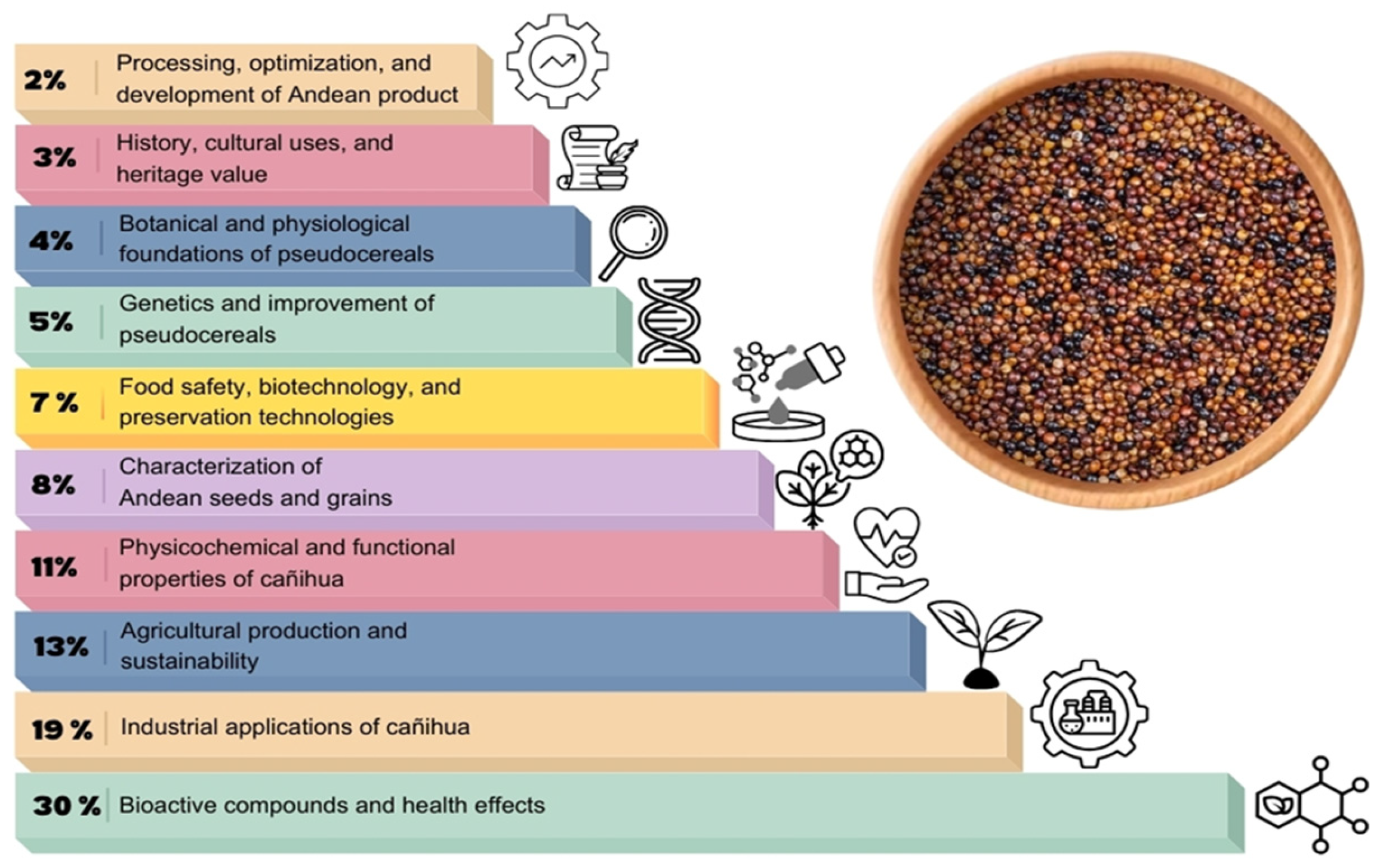
| Topic Area | Main Focus | Representative Findings | Research Gaps | Reference |
|---|---|---|---|---|
| Bioactive compounds and health effects | Identification and characterization of phenolic compounds, flavonoids, peptides, unsaturated fatty acids, GABA, phytoecdysteroids, saponins, and evaluation of biological activities. | Antioxidant, antihypertensive, antidiabetic, antimicrobial, neuroprotective and antianemic effects reported in in vitro and animal studies. | Lack of clinical studies, low evidence on bioavailability, mechanisms of action and dose–response relationships. | [2,5,9,11,17,21,22,24,25,27,28,29,30,31,32,33,34,35,36,37,38,39,40,41,42,43,44,45,46] |
| Agroindustrial applications of cañihua | Development and technological evaluation of value-added food and non-food products incorporating cañihua flour, malt, protein-rich fractions, or oil. Major applications include bakery products, gluten-free foods, pasta, snacks, extrudates, rice analogues, breakfast cereals, infant foods, craft beers, meat analogues, chocolates, and cosmetic formulations. | Cañihua has shown promising techno-functional properties, contributing to improved nutritional value, gluten-free formulations, protein enrichment, sensory acceptability, and diversification of Andean raw materials. Its incorporation has also supported innovation in extrusion-based products, fermented beverages, and specialty foods. Cañihua oil has additionally demonstrated potential for cosmetic applications. | Most studies remain at laboratory or pilot scale, with limited industrial validation. Further research is needed on process optimization, shelf life, consumer acceptance in broader markets, economic feasibility, regulatory aspects, and sustainable supply chain development for large-scale commercialization. | [10,20,23,47,48,49,50,51,52,53,54,55,56,57,58,59,60,61,62,63] |
| Agricultural production and sustainability | Studies in this area address germplasm conservation, morpho-agronomic characterization, seed physiology, pest and disease dynamics, climate resilience, farmer adaptation strategies, ethnobotanical knowledge, and the role of cañihua as a neglected crop in sustainable Andean farming systems. Research also includes genetic responses to abiotic stress and the socioeconomic relevance of diversified production systems. | Findings indicate that cañihua possesses strong tolerance to frost, drought, and high-altitude stress, making it a strategic crop under climate change scenarios. Existing germplasm resources reveal important genetic variability for breeding programs, while traditional knowledge highlights its cultural and food-security value in Andean communities. Studies also emphasize its contribution to agrobiodiversity and resilient local agriculture. | Despite its potential, cañihua remains underutilized and under-researched compared with other pseudocereals. More studies are needed on breeding, mechanized production, integrated pest management, seed systems, yield stability, environmental footprint, and policies that support scaling-up sustainable cultivation and market integration. | [64,65,66,67,68,69,70,71,72,73,74] |
| Physicochemical and functional properties of cañihua | Research in this area focuses on the characterization of cañihua starch, flour, and oil fractions, including structural, thermal, rheological, morphological, emulsifying, and techno-functional properties. Studies have also explored starch modification, nanostarch production, spectroscopy-based authentication, and ingredient performance in food systems. | Findings show that cañihua presents valuable functional attributes such as starch versatility, emulsifying potential, thermal stability, and suitability for gluten-free and plant-based formulations. Modified starches and nanostarch have demonstrated potential for advanced food applications, while spectroscopic tools have proven useful for quality control and authenticity assessment. These properties support the use of cañihua as an innovative ingredient for product development. | Current evidence is still fragmented and often based on small-scale laboratory studies. Further research is required on rheological behavior under industrial processing, interactions with other food components, storage stability, standardization among cultivars, and scale-up of modified starch and ingredient applications. | [8,19,75,76,77,78,79,80,81,82,83] |
| Characterization of Andean seeds and grains | This thematic area encompasses the physical, chemical, nutritional, proteomic, rheological, and structural characterization of cañihua and other Andean grains. Studies include cultivar differentiation, seed quality assessment, dehulling effects, protein fractionation, thermal behavior, mechanical properties, and analytical methods for authentication and comparative evaluation. | Findings highlight substantial variability among cultivars and processing conditions, influencing nutrient composition, protein profiles, and technological performance. Advanced tools such as LC-MS/MS proteomics, infrared spectroscopy, and mechanical analysis have improved species authentication and grain differentiation. These studies reinforce the nutritional value and technological potential of Andean grains while supporting quality control strategies. | Existing research is still limited by small sample sets and inconsistent methodologies. Further studies are needed on standardized quality parameters, broader germplasm screening, genotype–environment interactions, post-harvest effects, and the integration of rapid analytical tools into industrial and commercial quality assurance systems. | [4,7,84,85,86,87,88] |
| Food safety, biotechnology, and preservation technologies | Research in this area addresses contaminant monitoring, food safety assessment, fermentation processes, biodegradable packaging, and molecular tools for genetic identification and diversity analysis of cañihua. Studies include mycotoxin occurrence, genotoxicity evaluation, phytate degradation through fermentation, dough fermentation performance, biofilm development from cañihua flour, and marker-assisted characterization of germplas | Findings indicate that cañihua and related pseudocereals may be exposed to mycotoxins depending on cultivation and storage conditions, highlighting the need for safety surveillance. Fermentation has shown potential to improve mineral bioaccessibility and dough properties through phytate reduction. In addition, cañihua flour has demonstrated suitability for biodegradable biofilm production, while molecular markers have supported diversity assessment and germplasm management. | Available studies are still limited in scale and continuity. Further research is needed on long-term contaminant monitoring, industrial validation of fermentation processes, shelf-life and barrier properties of biofilms, genomic breeding tools, traceability systems, and regulatory frameworks to support safe commercialization of cañihua-based products. | [18,26,68,89,90,91,92,93,94] |
| Botanical and physiological foundations of pseudocereals | This thematic area examines the domestication history, archaeobotanical evidence, reproductive traits, early plant development, root architecture, stress adaptation, and metabolic profiling of cañihua and related pseudocereals. It provides the biological basis for understanding crop evolution, adaptation, and future improvement strategies. | Studies have identified domesticated and wild forms of kañawa in the Lake Titicaca Basin, supporting its long-standing role in Andean agriculture. Research on seed shattering has highlighted key domestication-related traits linked to harvestability, while root system architecture studies indicate adaptive strategies for nutrient foraging and establishment under marginal conditions. Metabolic profiling has further revealed biochemical diversity with relevance for stress responses and grain quality. | This area remains comparatively underexplored. Further studies are needed on reproductive biology, seed physiology, genome-assisted domestication traits, root–soil interactions, ecophysiological responses to climate stress, and the integration of archaeobotanical and molecular evidence to clarify the evolutionary trajectory of cañihua. | [95,96,97,98] |
| History, cultural uses, and heritage value | Studies in this area explore the domestication history, ancestral consumption, traditional uses, and cultural significance of cañihua within Andean societies. | Archaeobotanical evidence supports the early domestication and use of cañihua in the Andean Altiplano, while historical studies indicate its role in pre-Columbian food systems and traditional ethnomedical practices. These findings highlight cañihua as both a food resource and a component of regional biocultural heritage. | Further interdisciplinary research is needed to document traditional knowledge, historical diffusion, culinary practices, and the role of cañihua in contemporary cultural identity and heritage conservation. | [99,100,101] |
| Processing, optimization, and development of Andean products | Research in this area focuses on process optimization, ingredient extraction, and technological improvement of cañihua and other Andean raw materials for food applications. | Studies have optimized germination conditions for whole-grain pseudocereal flours and improved protein extraction processes, enhancing nutritional quality and functional properties. These approaches support the development of value-added Andean products with greater industrial potential. | Further research is needed on process scale-up, cost-efficiency, sustainability, sensory quality, and industrial implementation of optimized technologies for commercial production. | [102,103] |
| Sample | Parameters | References | ||
|---|---|---|---|---|
| GABA (g/100 g dw) | TSPC (mg GAE/100 g) | ORAC (µmol TE/g) | ||
| Germinated cañihua | 0.052 | 1545.09 | 114.92 | [54] |
| Cañihua | 27.05 | 97.50 | 1326.64 | [48] |
| Germinated cañihua | 1975.41 | 141.13 | 1975.41 | |
| Germinated cañihua | 0.100 | 386.12 | 114.92 | [56] |
| Process | Process Description | Experimental Conditions | Antinutrient Content | Main Results | References |
|---|---|---|---|---|---|
| Malting | Disinfection | Sodium hypochlorite solution (0.1%) for 30 min | The phytic acid (PA) content in cañihua was 1.30 g/100 g on a dry weight basis in the raw sample, whereas after the malting process, it decreased to 0.93 g/100 g (dry weight), representing an approximate 28.5% reduction associated with germination. | The nutritional profile of cañihua was significantly improved, with increased dietary fiber, phenolic compounds, and antioxidant capacity; however, protein and ash content decreased | [48] |
| Soaking | Grain–water ratio of 1:5 for 6 h at 25 °C in darkness | ||||
| Germination | 72 h at 20 °C | ||||
| Drying | 45 °C for 24 h until reaching 5–8% moisture content | ||||
| Particle size | 0.25 mm | ||||
| Disinfection | Sodium hypochlorite solution (0.1%) for 30 min | The phytic acid (PA) content in sprouted cañihua flour (SCF) was 0.56 g/100 g on a dry weight basis. | The nutritional profile of cañihua was significantly improved | [54] | |
| Washing | In sterile water at a ratio of 1:5 (w/v) for 6 h | ||||
| Germination | 20 °C for 72 h for cañihua | ||||
| Drying | 40 °C for 30 h | ||||
| Washing and disinfection | Sodium hypochlorite solution (0.1%) for 30 min | NA | The nutritional profile of cañihua was significantly improved | [50] | |
| Soaking | Grain–water ratio of 1:5 for 6 h at 25 °C in darkness | ||||
| Germination | 72 h at 20 °C, until radicles reach 7–10 mm | ||||
| Drying | 45 °C for 24 h until reaching a moisture content of 5–8% | ||||
| Particle size | 0.25 mm | ||||
| Disinfection | Sodium hypochlorite solution (0.1%) for 30 min | The phytic acid (PA) content in sprouted Cañihua flour (SCF) was 0.88 g/100 g on a dry weight basis. | The nutritional profile of cañihua was significantly improved | [56] | |
| Soaking | Grain–water ratio of 1:5 for 6 h at 25 °C in darkness | ||||
| Germination | Relative humidity ≥ 90% | ||||
| Drying | 40 °C for 30 h | ||||
| Particle size | Particle size |
| Product Type | Raw Material Used | % Cañihua | Nutritional/Technological Properties | Physical Properties | References |
|---|---|---|---|---|---|
| Sausage | Cañihua grains (Cupi variety), obtained from the Agrarian Experimental Station of the National Institute of Agrarian Innovation (INIA), Puno, Peru | 15% cañihua flour | Adding 15% cañihua flour produced sausages with intermediate texture, good stability, and high cooking yield, forming a compact protein network after frying. It also lowered color lightness, resembling artisanal meat, and reduced diameter shrinkage during cooking, improving product quality. | NA | [47] |
| Beer | Cañihua grains (Illpa-INIA variety), obtained from the Agrarian Experimental Station of the National Institute of Agrarian Innovation (INIA), Puno, Peru | 7%, 11%, 13%, 15%, 16%, 19%, 21%, and 25% malted cañihua flour | Adding malted cañihua to craft beer slightly lowered pH, increased acidity, and improved microbiological stability. It raised density through fermentable carbs, reduced soluble solids via fermentation, and enhanced turbidity and foam capacity. | Cañihua improved the beer’s nutritional and functional profile, increasing dietary fiber, phenolics, GABA, and antioxidant capacity. Malting lowered protein and ash but boosted nutrient bioavailability and antioxidants. Overall, it allowed for a more nutritious, functional beer with typical alcohol levels. | [48] |
| Beer | Cañihua grains (Illpa-INIA variety), provided by the Agrarian Experimental Station of the National Institute of Agrarian Innovation (INIA), Puno, Peru | 7%, 11%, 13%, 15%, 16%, 19%, 21%, and 25% malted cañihua flour | Adding cañihua to craft beer enhances density, viscosity, body, foam stability, darker color, turbidity, and slightly raises pH, aiding stability. Its fermentable sugars moderate alcohol and soften bitterness without affecting IBU. | NA | [50] |
| Extrudates | Pearled cañihua grains (Sahiua variety) | 59.52% cañihua flour | Snacks with cañihua flour (59.52%) showed high protein content (13.6 g/100 g), low lipid content (2.6 g/100 g), and a predominance of carbohydrates (74.5 g/100 g). The product also provided dietary fiber (2.2 g/100 g) and minerals (2.08 g/100 g), demonstrating the potential of cañihua as a functional ingredient for nutritious and healthy extruded snacks | The snacks had a porous, compact structure with an apparent density of 0.27 g/cm3 and moderate expansion (SEI 2.74). The brown color with yellowish tones is due to partial starch gelatinization and non-enzymatic browning during extrusion. Low water solubility indicates partially intact starch, contributing to a firm, stable texture suitable for direct consumption or use in liquids and semi-solids. | [49] |
| Extrudates | Cañihua (Chenopodium pallidicaule Aellen), obtained from the Agrarian Experimental Station, National Institute of Agrarian Innovation (ILLPA-INIA), Puno, Peru | 16.67%, 33.33%, 50%, 66.67%, and 100% germinated cañihua flour | Incorporating germinated cañihua flour boosted total soluble phenolic compounds (TSPC) and antioxidant capacity (ORAC), especially as the main ingredient. GABA content dropped (~35%) due to heat and shear during extrusion, while phytic acid stayed stable at high levels. | Incorporating germinated cañihua flour in extrudates reduces expansion, increases density, and produces denser snacks. It softens texture, boosts water absorption and solubility, and darkens color. While blending with corn semolina can lessen these effects, cañihua notably alters structure and functional properties. | [54] |
| Cookies | Cañihua (Chenopodium pallidicaule Aellen), INIA ILLPA variety, acquired from the National Institute of Agrarian Innovation (INIA), Puno, Peru | 29.67–59.35% cañihua flour | NA | Cookies with 38.51% cañihua flour showed a soft texture, while those with 35.15% were harder; additionally, increasing cañihua content reduced lightness and color intensity, resulting in a darker product | [53] |
| Extrudates | Cañihua grains (Illpa-INIA and Cupi varieties), obtained from the National Institute of Agrarian Innovation (INIA), Puno, Peru | 10% and 20% (Illpa variety), and 10% and 20% (Cupi variety) | Adding cañihua flour increased protein in extrudates, reaching 10.02% in Illpa at 20%, with modest fiber and ash levels, indicating higher mineral content. Illpa outperformed Cupi in protein at the same level. Extrudates had low lipid content (0.06–0.34%) and high carbohydrate content (77–80%), more than commercial brown rice but with less fiber. | Extruded rice products with 10–20% cañihua resembled cooked rice, reaching about 3 N hardness after 9–12 min, whereas brown rice stayed harder at 5 N, needing 24 min of cooking. Caçihua absorbs more water due to its fiber and porosity. Microstructure showed rough surfaces and voids in extrudates, but brown rice had smooth surfaces and a compact endosperm. | [52] |
| Chocolate | Cañihua grains supplied by the Native Cereals and Grains Program of the National Agrarian University La Molina, Peru | 1%, 2%, 3%, and 4% cañihua flour | The incorporation of cañihua flour increased the antioxidant activity of dark chocolate compared to the control, with the increase progressive as the addition level rose. This effect is attributed to the phenolic compounds present in cañihua, highlighting its potential as a functional ingredient | Adding cañihua flour changed the chocolate’s physical properties, increasing pH and particle size. Hardness dropped significantly due to microstructural and fat-crystallization changes caused by 3% inclusion. These structural shifts also affected rheological behavior, confirming that flour concentration is vital to product quality. | [55] |
| Bread | Cañihua grains supplied by the Native Cereals and Grains Program of the National Agrarian University La Molina, Peru | 8.33%, 5%, 10%, 15%, 15%, 10%, 11.67%, 5%, 5%, 5%, 6.67%, 10%, 6.67%, and 5% cañihua flour | Partial substitution of refined wheat flour with germinated cañihua flour improves bread’s nutritional properties. Higher cañihua levels boost phenolic compounds (up to 262.3 mg GAE/100 g) and antioxidant capacity (up to 66.3 µmol TE/g), surpassing control bread. GABA content nearly doubles, confirming enhanced bioactive compounds through germination. | NA | [56] |
| Bread | Cañihua (Cupi variety), supplied from the city of Puno, Peru | 12.5%, 25%, 50%, and 100% cañihua flour | NA | Replacing wheat with cañihua flour lowered dough stability, with lower torque in Mixolab. Pure cañihua had low stability. 12.5% substitution improved specific volume, but 25% or more created denser bread. Higher amounts darkened the crumb, increased hardness, and reduced elasticity and cohesiveness. | [23] |
| Bread | Cañihua flour acquired from Peruan Nature S.A. | 4.1%, 7.6%, 9.5%, and 8.3% cañihua flour | NA | Increasing the amount of cañihua flour raised bread hardness, while elasticity, gumminess, chewiness, and specific volume decreased compared to the wheat control. Color parameters L* and b* decreased, whereas a* increased, indicating a more reddish tone. | [59] |
| Sponge cake | Kañiwa supplied by Roland Foods, New York, USA | 25%, 50%, 75%, and 100% cañihua flour | Adding cañihua boosted polyphenols (0.84–1.39 mg GAE/g), flavonoids (7.65–11.42 mg QE/g), and reducing power (3.14–6.53), showing dose effects. These findings indicate higher phenolic content and antioxidant capacity than those of standard cereals such as sweet corn, oats, and amaranth. | As cañihua proportion increased, cake density and firmness increased, while specific volume and moisture decreased, although water retention capacity increased. Crust darkened and crumb slightly lightened. Texture became harder, less cohesive, more fracture-resistant, and more chewable, while elasticity remained unchanged | [58] |
| Pasta | Cañihua obtained from the communities of Quipaquipani and Jalsuri, Viacha municipality, Central Altiplano of Bolivia | 10%, 20%, and 30% cañihua flour from Quipaquipani (Viacha, Bolivia), and 10%, 20%, and 30% from Jalsuri (Viacha, Bolivia) | Partial substitution of wheat flour with cañihua flour (10%, 20%, and 30%) increased protein, dietary fiber, and amino acids. Although slight losses occur during cooking, cooked pasta maintains high fiber content, contributing 20–30% of the recommended daily intake per 100 g | Incorporation of cañihua flour into pasta modified the structure and technological behavior: cooking time decreased, water absorption and swelling index increased, and cooking loss rose due to disruption of the gluten network by fiber. Pasting viscosity and textural parameters, such as cohesiveness and elasticity, decreased | [60] |
| Extrudates | Commercial cañihua variety supplied from South America | 20%, 35%, and 50% cañihua flour | Increasing canihua flour in extruded snacks improves the nutritional profile, with higher protein, dietary fiber, bioactive compounds, folates, and lipid content. Products with 50% cañihua showed better retention than those with 20%. However, tocopherols decreased due to thermal processing, although retention improved at higher inclusion levels | Corn-based snacks with up to 50% cañihua did not show substantial changes in sectional expansion index or rigidity | [61] |
| Extrudates | Cañihua is supplied from South America in grain form (Aduki Ltd., Finland) | 20%, 35%, and 50% cañihua flour | NA | Cañihua incorporation significantly reduced the expansion index, especially at 50%, producing denser and less aerated extrudates, with smaller pores and thicker cell walls | [112] |
| Extrudates | Cañihua (Cupi variety), acquired from the Puno region in southern Peru | 20% cañihua flour | As cañihua content increased in extrudates, dietary fiber, protein, minerals, and bioactive compounds also increased. Higher fiber improved water retention and lipid oxidation in ground extrudates, while whole products showed better storage stability | With increasing cañihua, extrudates showed lower radial expansion, smaller and irregular pores, and reduced hardness (28 N mm−1). Fiber-limited structural compactness, while amylose–lipid complexes contributed to a denser and less fragile matrix | [20] |
| Porridge | Cañihua obtained from the National Institute of Agrarian Innovation (INIA), Puno, Peru | NA | It contains 16% protein with an in vitro digestibility of 96.3% and a chemical score of 0.92, classifying it as a high-quality protein source | The extruded porridge is an instant product with low moisture (7.1%), allowing easy dissolution in water and maintaining a homogeneous texture suitable for infant consumption | [10] |
| Product Type | % Cañihua | Type of Panelists | Type of Sensory Analysis | Results | Reference |
|---|---|---|---|---|---|
| Sausage | 15% cañihua flour | Semi-trained panel (25 panelists, men and women, aged 21–24 years) | Hedonic sensory analysis (5-point hedonic scale for acceptance evaluation) | The formulation with more isolated soy protein and less quinoa scored higher for odor, flavor, and overall acceptability. The one with more quinoa was also accepted (scores > 3), but slightly less so, similar to commercial sausages. The cañihua proportion stayed at 15%. | [47] |
| Beer | 7%, 11%, 13%, 15%, 16%, 19%, 21%, and 25% malted cañihua flour | 120 consumers aged between 18 and 60 years | Consumers rated aroma, color, flavor, and appearance on a 10 cm visual analog scale (0 = dislike very much, 10 = like very much). Purchase intention was scored on a 5-point scale (5 = would definitely buy, 1 = would definitely not buy). In a second stage, the Check-All-That-Apply (CATA) method was used, in which participants selected all applicable attributes from a list of 37 attributes grouped into appearance, color, aroma, flavor, and mouthfeel, as defined through focus group sessions. | The formulation with 16% cañihua malt, 10% banana–passion fruit juice, and 74% Pilsen malt achieved the highest scores in overall evaluation, flavor, and appearance. It was associated with desirable attributes, including intense caramel color, balanced sweetness, good foam, and a smooth mouthfeel. The 7% cañihua malt formulation showed the highest purchase intention | [48] |
| Beer | 7%, 11%, 13%, 15%, 16%, 19%, 21%, and 25% malted cañihua flour | 120 panelists aged between 20 and 55 years | Aroma, color, flavor, and appearance were evaluated using an unstructured 0–10 hedonic scale, and purchase intention with a 5-point scale. Additionally, the CATA method (Check-All-That-Apply) was applied to characterize the sensory profile, including 37 attributes grouped into appearance, color, aroma, flavor, and mouthfeel | Sensory analysis showed high acceptance of craft beers in aroma, color, flavor, and appearance. The formulation with 25% cañihua malt was the most preferred due to foam, sweetness, and effervescence. CATA identified 21 discriminant attributes, highlighting that golden color, brightness, effervescence, and toasted grain aroma increased acceptability | [50] |
| Snack | 59.52% cañihua flour | 72 participants aged between 18 and 50 years, regular breakfast cereal consumers | Sensory analysis included Flash Profile and Free Sorting Task, both descriptive methods using untrained consumers. Flash Profile involved the generation and ranking of sensory attributes by intensity, while Free Sorting grouped samples based on perceived similarities, providing a holistic perception of products | The extruded cañihua snack showed a distinctive sensory profile with natural appearance, chocolate-like flavor, sweetness, and crunchiness. Flash Profile and Free Sorting positioned it as a unique product, differentiated from wheat-based extrudates | [49] |
| Cookies | 29.67–59.35% cañihua flour | 102 consumers aged between 18 and 30 years | Sensory analysis included a discriminative sorting test and an acceptability test. In the acceptability test, consumers evaluated odor, color, flavor, and overall acceptance using a 9-point hedonic scale | Increasing cañihua flour significantly affected the sensory properties of cookies. Formulations with 29.67%, 38.51%, and 52.02% were rated higher, whereas higher levels (42.19%, 51.81%, 59.35%) reduced acceptance due to stronger flavor and aroma. The 38.51% formulation achieved the best balance | [53] |
| Extrudates | 10% and 20% (Illpa variety), and 10% and 20% (Cupi variety) | 15 panelists specialized in Peruvian gastronomy (7 women and 8 men, mean ages 25.3 ± 0.86 and 26.9 ± 1.9 years, respectively) | A 5-point hedonic scale was used (1 = dislike extremely, 5 = like extremely). Evaluated attributes included flavor, aroma, overall appearance, texture (adhesiveness), color, and overall acceptability | The whole extrudate showed the highest scores. Among rice–cañihua formulations, Cupi10 had the closest sensory profile to the control and the highest acceptability. All samples exceeded the neutral acceptance threshold | [52] |
| Chocolate | 1%, 2%, 3%, and 4% cañihua flour | 24 untrained judges from the Cocoa and Coffee Quality Control Laboratory | Chocolate acceptance was evaluated following the UNE-ISO 8587 sensory analysis — ranking test. | All chocolate formulations with cañihua had higher acceptability than the control. Levels of 1–2% showed better texture, while higher levels increased particle size without negatively affecting overall acceptance | [55] |
| Bread | 8.33%, 5%, 10%, 15%, 15%, 10%, 11.67%, 5%, 5%, 5%, 6.67%, 10%, 6.67%, and 5% cañihua flour | Thirty participants | Conducted in three sessions. Panelists evaluated bread acceptability (odor, color, flavor, texture) using a semi-structured 10 cm hedonic scale with monadic sample presentation | Bread with germinated cañihua showed good acceptability, particularly in color and texture, with no significant differences from the control. It maintained acceptable odor and flavor, supporting its use as a functional ingredient | [56] |
| Bread | 4.1%, 7.6%, 9.5%, and 8.3% cañihua flour | 76 panelists from the Food Engineering School of the National University Federico Villarreal | A discriminative test evaluated the importance of flavor, color, odor, volume, and softness. A 5-point hedonic test was then applied to determine overall acceptability, and an additional evaluation with celiac consumers validated preference | The most accepted bread contained 7.6% cañihua, while celiac consumers rated the formulation highly, with 8.3% | [56] |
| Sponge cake | 25%, 50%, 75%, and 100% cañihua flour | 30 untrained panelists (age range: 20–60 years) | Panelists evaluated pound cakes based on appearance, flavor, texture, sweetness, bitterness, and overall acceptability using a 9-point hedonic scale (1 = extremely bad, 9 = extremely good) | Increasing cañihua flour affected sensory scores (appearance, flavor, texture, sweetness, bitterness, acceptability). The most accepted sample contained 25% cañihua flour | [58] |
| Extrudates | 20%, 35%, and 50% cañihua flour | 10 panelists (7 women and 3 men, aged 20–30 years) recruited from the University of Helsinki (staff and students) | A descriptive sensory profile and Temporal Dominance of Sensations (TDS) were performed. Panelists rated flavor, texture, and aftertaste attributes using unstructured 10 cm scales, while TDS described the temporal evolution of dominant texture attributes during mastication | Extrudates with cañihua were less crispy than those with amaranth or quinoa. Crispness decreased and hardness increased with higher cañihua levels. Bitterness and aftertaste intensified at 50%, and TDS showed shorter crunch duration and greater stickiness before swallowing | [112] |
Disclaimer/Publisher’s Note: The statements, opinions and data contained in all publications are solely those of the individual author(s) and contributor(s) and not of MDPI and/or the editor(s). MDPI and/or the editor(s) disclaim responsibility for any injury to people or property resulting from any ideas, methods, instructions or products referred to in the content. |
© 2026 by the authors. Licensee MDPI, Basel, Switzerland. This article is an open access article distributed under the terms and conditions of the Creative Commons Attribution (CC BY) license.
Share and Cite
Estalla, A.; Alvarez, J.; Eduardo, K.; Coaguila-Gonza, M.; Barreto-Tarrillo, G.; Rios-Mera, J.D.; Saldaña, E. Trends, Challenges, and Opportunities of Cañihua (Chenopodium pallidicaule) for Functional Food Development and Sustainable Agriculture: A Bibliometric and Systematic Approach. Agriculture 2026, 16, 992. https://doi.org/10.3390/agriculture16090992
Estalla A, Alvarez J, Eduardo K, Coaguila-Gonza M, Barreto-Tarrillo G, Rios-Mera JD, Saldaña E. Trends, Challenges, and Opportunities of Cañihua (Chenopodium pallidicaule) for Functional Food Development and Sustainable Agriculture: A Bibliometric and Systematic Approach. Agriculture. 2026; 16(9):992. https://doi.org/10.3390/agriculture16090992
Chicago/Turabian StyleEstalla, Alberto, Jennifer Alvarez, Karina Eduardo, Milagros Coaguila-Gonza, Gabriela Barreto-Tarrillo, Juan D. Rios-Mera, and Erick Saldaña. 2026. "Trends, Challenges, and Opportunities of Cañihua (Chenopodium pallidicaule) for Functional Food Development and Sustainable Agriculture: A Bibliometric and Systematic Approach" Agriculture 16, no. 9: 992. https://doi.org/10.3390/agriculture16090992
APA StyleEstalla, A., Alvarez, J., Eduardo, K., Coaguila-Gonza, M., Barreto-Tarrillo, G., Rios-Mera, J. D., & Saldaña, E. (2026). Trends, Challenges, and Opportunities of Cañihua (Chenopodium pallidicaule) for Functional Food Development and Sustainable Agriculture: A Bibliometric and Systematic Approach. Agriculture, 16(9), 992. https://doi.org/10.3390/agriculture16090992