Article

Grain Quality and Stability of Advanced Barley Lines and Local Landraces in Mediterranean Conditions

by
Vasileios Greveniotis
1,2,*,
Elisavet Bouloumpasi
3,
Adriana Skendi
3,
Stylianos Zotis
2,†,
Dimitrios Kantas
4 and
Constantinos G. Ipsilandis
5
1
Institute of Industrial and Forage Crops, Hellenic Agricultural Organization Demeter (ELGO-Dimitra), GR-41335 Larissa, Greece
2
Department of Agricultural Technology, Technological Educational Institute of Western Macedonia, GR-53100 Florina, Greece
3
Department of Viticulture and Oenology, Democritus University of Thrace, GR-66100 Drama, Greece
4
Department of Animal Science, University of Thessaly, Campus Gaiopolis, GR-41500 Larissa, Greece
5
Regional Administration of West Macedonia, GR-50131 Kozani, Greece
*
Author to whom correspondence should be addressed.
Deceased.
Agriculture 2026, 16(3), 366; https://doi.org/10.3390/agriculture16030366
Submission received: 18 December 2025 / Revised: 31 January 2026 / Accepted: 2 February 2026 / Published: 4 February 2026

Abstract

Barley (Hordeum vulgare L.) seed quality traits were evaluated to investigate the relative genetic and environmental contributions to their variation, the stability of genotypes across environments, and the interrelationships among traits. Fifteen genotypes, including classical pedigree-derived lines (G1–G5), PYI-selected lines (G6–G10), YC-selected lines (G11–G12), cultivars (G13–G14), and a local population (G15), were assessed for crude protein content, fat content, ash content, starch content, crude fiber content, carbohydrate content, soluble fraction, and non-starch fraction. Field trials were conducted across six environments under a randomized complete block design with four replications per environment. Combined ANOVA revealed significant differences among genotypes for all evaluated traits, while environmental effects and genotype × environment interactions also contributed significantly to trait variation. Stability analysis using the Stability Index (SI) showed that classical pedigree lines (G1–G5) demonstrated the highest overall stability across most traits. Lines selected via the Plant Yield Index (PYI) and Yielding Coefficient (YC) criteria exhibited greater stability compared to the local population, while cultivars showed intermediate and trait-dependent stability. Broad-sense heritability (H2) was high for all traits (>92%), with crude protein, fat, ash, and crude fiber content showing particularly strong genetic control. Genetic advance (GA) and genetic advance as a percentage of the mean (GA%) indicated a favorable expected response to selection for protein- and fiber-related traits. Traits such as starch content, carbohydrate content, soluble fraction, and non-starch fraction were more strongly influenced by environmental variation, highlighting the need for multi-environment testing. Correlation analysis revealed significant associations among traits, highlighting both trade-offs and coordinated accumulation patterns. Crude protein content was negatively correlated with carbohydrate content, soluble fraction, and non-starch fraction, whereas fat content showed positive correlations with ash content and fiber-related components, indicating potential targets for breeding programs. Overall, advanced barley lines combine high performance and stability, providing material suitable for further breeding under Mediterranean conditions.

1. Introduction

Barley (Hordeum vulgare L.) is one of the most widely cultivated cereal crops worldwide, ranking after maize, rice, and wheat in terms of production area and yield [1]. It is grown across diverse regions, including Africa, Asia, Europe, the Americas, and Australia, and displays remarkable adaptability to challenging environments, such as high-altitude and cold regions [2,3]. Barley is utilized for human consumption, animal feed, and industrial purposes, making it a major target for genetic improvement programs.
Beyond yield, the nutritional and functional properties of barley grains are key determinants of their value. As the major components of the barley grain, carbohydrates significantly influence grain quality. Modern grains generally have high carbohydrate content, ranging from 78% to 83.9% of dry weight [4]. Starch content has been reported to be inversely correlated with dietary fiber. Barley is also rich in dietary fiber, proteins, β-glucans, and minerals, while containing low levels of lipids [5,6,7]. Total dietary fiber ranges from 11% to 34%, of which 3–20% is soluble [5,6]. Fatty acids are mainly palmitic, oleic, linoleic, with comparatively higher linolenic acid levels than wheat [8]. Additionally, barley grains contain bioactive compounds such as phenolic acids, flavonoids, lignans, vitamins (E and B complex), and sterols, which contribute to their health-promoting properties [9,10,11,12].
Variation in barley grain composition depends on varietal differences, year, locality, soil, and environmental factors [13]. Both year and locality influence carbohydrate composition as well as protein content. Starch accumulation is generally more sensitive to drought stress than protein accumulation during the growing season, while poor-quality sandy soils tend to decrease starch content and increase dietary fiber and protein levels. These responses indicate that grain quality traits are under both genetic control and strong environmental modulation, making multi-environment evaluation essential.
Similar genotype × environment effects on grain composition and quality traits have also been reported in other major cereals, such as maize, highlighting the broader relevance of stability and heritability analyses in cereal breeding programs [14,15,16]. Quantifying the relative contribution of genotype, environment, and their interaction is therefore critical for identifying traits with predictable expression across environments.
Breeding new barley varieties must consider the relationship between grain composition and intended use, as different applications (malting, animal feed, human consumption) require distinct quality traits. Recent research has highlighted that barley grain quality traits vary widely under different genetic and environmental conditions. Substantial genetic diversity exists among forage and elite barley germplasm, in terms of key grain quality attributes—such as protein, starch, lipid, ash, and β-glucan content—indicating the species’ broad biochemical diversity [7,17]. Moreover, abiotic stress resilience [18] and agronomic management practices, such as tillage, can influence grain composition and overall nutritional quality [19]. Traits such as protein, fat, fiber, and starch are not only important for nutritional quality but also represent practical targets for breeding programs, as their expression is influenced by genotype, environment, and their interaction [20,21,22]. Consequently, evaluation based only on mean performance may be limited, and the incorporation of stability parameters is necessary to identify genotypes with consistent quality expression across variable environments.
In this context, the Stability Index (SI), also referred to as the coefficient of homeostasis, integrates both performance stability and high heritability, providing a criterion for genotype selection [23,24]. SI enables the identification of genotypes that combine high mean performance with reduced sensitivity to environmental fluctuations, a key requirement under Mediterranean climatic variability.
Local barley populations (landraces) represent heterogeneous mixtures of sibling lines preserved over generations, often expressing unique adaptations to local environments [25,26,27]. Despite extensive studies on barley grain quality—including investigations into genetic and environmental variation in traits and correlations among quality parameters [28,29,30,31]—there is limited information on the combined evaluation of multiple quality traits, their heritability, stability across environments, and inter-trait correlations, particularly in Mediterranean conditions.
Stability across environments is of great importance for commercial cultivars, as stable genotypes exhibit minimal interactions with variable environments, responding positively under favorable conditions [32]. Breeders seek repeatable and reliable criteria for stability estimation to develop cultivars adaptable to diverse conditions [33]. In this context, the Stability Index (SI), based on variance and mean ratios [24], provides a quantitative measure to identify genotypes with consistent performance across years and locations.
However, comparative information on how different selection methodologies—such as classical ear-to-row pedigree selection and honeycomb-based PYI and YC selection—affect grain quality performance and stability is still limited. This study evaluates barley grain quality under Mediterranean conditions, integrating both historical and contemporary datasets to examine stability and heritability across environments. Systematic evaluation of advanced barley lines, including assessments of heritability and inter-trait correlations, is crucial for identifying superior genotypes suited to breeding programs targeting both yield stability and nutritional quality [34,35].
The objectives of this study were to:
(i)
evaluate the genetic variability, heritability, and stability of key grain quality traits in advanced barley lines, cultivars, and a local population under Mediterranean conditions;
(ii)
compare the performance and stability of lines derived through classical pedigree selection with those selected using honeycomb-based PYI and YC criteria; and
(iii)
investigate the relationships among grain quality traits to identify potential trade-offs and coordinated accumulation patterns relevant for barley breeding programs.

2. Materials and Methods

2.1. Plant Material and Experimental Design

A total of 12 advanced barley lines were evaluated for grain quality traits [36]. These lines originated from a single local barley population and represent three different selection approaches, providing a common genetic background for meaningful comparisons of grain quality, stability, and genetic parameters:
Classical ear-to-row pedigree selection: Five lines (1-progeny, 2-progeny, 3-progeny, 4-progeny, and 5-progeny) developed through the conventional pedigree method were included and used as reference material for comparison with lines developed under the honeycomb methodology.
Honeycomb selection—Plant Yield Index (PYI) [23,24,32]: Five lines (42-3, 30-21, 40-27, 50-6, and 23-26) were selected using the PYI criterion, the core selection index of the honeycomb methodology. These lines had previously demonstrated superior performance and stability based on s-PE% evaluation.
Honeycomb selection—Yielding Coefficient (YC) [36]: Two high-yielding lines (49-2 and 46-3) were selected using the Yielding Coefficient (YC = x × PYI), a complementary selection criterion designed to identify superior genotypes that may not be selected by PYI alone.
In addition to the 12 experimental lines, the original local barley population and two cultivars (Cannon and Plaisant) were included as checks, allowing direct comparison with historical material and previously published experiments. The inclusion of both the original population and cultivars enabled benchmarking of advanced lines against unselected and widely cultivated material.
All genotypes (experimental lines and checks) were grown under identical field management conditions within each environment.

2.1.1. Field Trials

The study comprised six environments (E1–E6), defined as unique combinations of location and cropping season. Trials were conducted at the TEI of Western Macedonia farm in Florina during the 2010–2011 (E1) and 2011–2012 (E2) growing seasons (40°46′ N, 21°22′ E, 705 m a.s.l.), at Trikala during 2023–2024 (E3) and 2024–2025 (E4) (39°55′ N, 21°46′ E, 120 m a.s.l.), and at Kalambaka during 2023–2024 (E5) and 2024–2025 (E6) (39°42′ N, 21°37′ E, 190 m a.s.l.).
Experiments were arranged in a Randomized Complete Block Design (RCBD) with four replications per environment. Each plot consisted of seven rows, spaced 25 cm apart and 5 m in length, providing a plot area of 8.75 m2. Genotypes were randomly allocated within each block. Sowing was performed in early November, while harvest took place in late June for Florina and in mid-June for Trikala and Kalambaka.
The six environments were selected to represent contrasting Mediterranean agroecological conditions, differing in altitude, temperature regime, and rainfall distribution.
Although the Florina datasets correspond to earlier growing seasons (2010–2012), the grain samples were analyzed following the same laboratory protocols, instruments, and calibration standards as the contemporary datasets (2023–2025). Long-term storage conditions (temperature, humidity, packaging, and duration) were carefully maintained to preserve sample integrity and minimize potential bias. Multi-year climatic data indicate that Florina represents a Mediterranean highland site, supporting its inclusion for temporal comparisons. Historical (Florina) and contemporary (Trikala and Kalambaka) trials together enabled evaluation of trait stability across spatially and temporally distinct environments, accounting for potential temporal heterogeneity.

2.1.2. Soil Characteristics

Soil texture and general soil conditions were recorded to characterize the experimental environments. Florina soils were classified as sandy loam, Trikala soils as loam, and Kalambaka soils as silty clay. Soil pH ranged from slightly acidic in Florina to alkaline in Trikala and Kalambaka, reflecting typical Mediterranean agroecosystems. Soil characterization was conducted to provide context for environmental variation among sites, rather than being treated as an experimental factor.

2.1.3. Crop Management

Fertilization followed standard agronomic practices: 500 kg ha−1 of 20–10–0 (N–P2O5–K2O) was incorporated into the soil before sowing, and 250 kg ha−1 of 34–0–0 was applied at the tillering stage. Uniform crop management across genotypes within each environment ensured that observed differences in grain quality traits were attributable to genetic and environmental effects rather than management variability.

2.1.4. Climatic Data

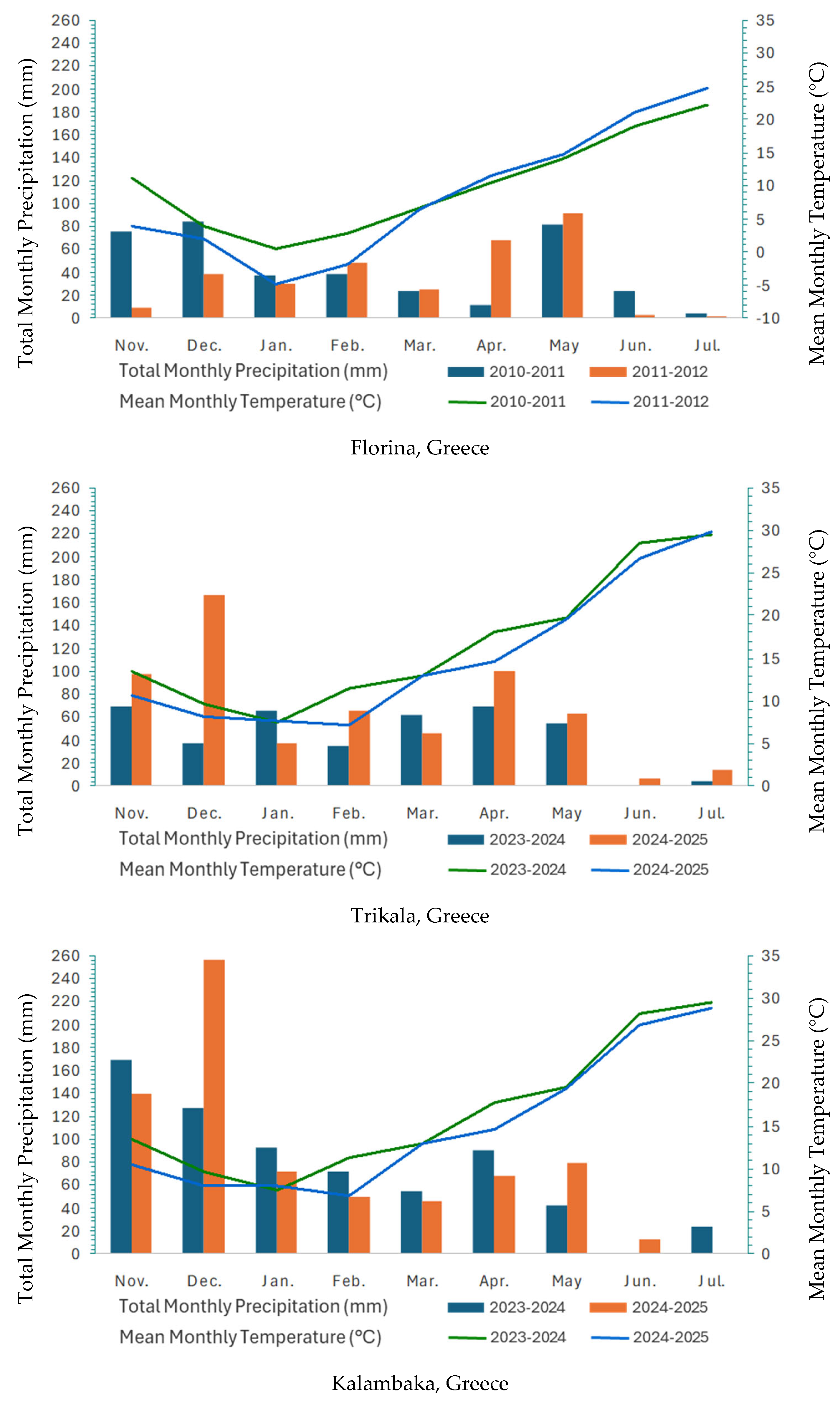
Monthly mean temperature (°C) and total precipitation (mm) were recorded for all six environments (Figure 1). Climatic variability among locations and years provided contrasting environmental conditions, allowing the assessment of genotype × environment interactions affecting grain quality traits. Climatic data were used descriptively to interpret environmental effects and were not included as covariates in statistical analyses. Figure 1 summarizes the environmental differences among the sites and years, illustrating the variability in temperature and precipitation experienced by the genotypes.

2.2. Sample Collection and Grain Quality Analysis

At harvest, grain samples from each plot were collected and cleaned. Grain samples obtained during the 2010–2012 and 2023–2025 experimental periods were analyzed shortly after harvest within each respective growing season. No long-term storage of grain samples across experimental periods was applied.
Prior to analysis, samples were air-dried to constant moisture content under laboratory conditions to ensure procedural consistency. All analyses were conducted using identical laboratory protocols and standardized methodologies across both experimental periods. By analyzing samples shortly after harvest, potential biases associated with long-term storage, sample aging, or degradation were avoided. Therefore, observed differences between experimental periods are interpreted as reflecting biological and environmental variation rather than analytical artifacts.
Proximate composition, including crude protein, crude fat, crude fiber, ash, and starch, was determined in triplicate using standard American Association of Cereal Chemists (AACC) methods [37]. Total nitrogen was measured according to AACC method 44-12.01, and crude protein (%) was calculated by multiplying nitrogen by 5.83. Crude fat (%) was extracted with petroleum ether using a Soxhlet apparatus (AACC method 30-25.01), ash (%) was determined by dry incineration at 550 °C (AACC method 08-01.01), starch (%) was quantified enzymatically (AACC method 76-13.01) using a Megazyme Amyloglucosidase/α-Amylase kit (Neogen, Wicklow, Ireland), and crude fiber (%) was measured following AACC method 32-10.01.
Carbohydrate content (%) was calculated by the difference method:
Carbohydrates (%) = 100 − (moisture + crude protein + crude fat + ash)
The soluble fraction (%) was obtained by subtracting starch and crude fiber from total carbohydrates, while the non-starch fraction (%) was calculated as the sum of crude fiber and soluble fraction. This difference-based approach allows consistent comparative evaluation across genotypes and environments, while acknowledging that derived fractions may incorporate cumulative analytical variability from individual components.

2.3. Statistical Analysis

A combined analysis of variance (ANOVA) was performed for each trait, considering genotype as a fixed factor and environment and genotype × environment (G × E) interactions as random factors [38], using IBM SPSS Statistics v29. Mean comparisons were conducted using Duncan’s multiple range test (p ≤ 0.05). Pearson’s correlation coefficients and Principal Component Analysis (PCA) were performed using JMP v18. The ANOVA model partitioned total variation into genotype (G), environment (E), and G × E components, allowing direct comparison of their relative contributions.
The Stability Index (SI) was used to quantify overall trait consistency across environments. For each trait, SI was calculated as:
S I = ( x ¯ / s ) 2
where x ¯ is the trait mean across environments and S is the corresponding standard deviation [24].
Higher SI values indicate greater stability. The index integrates mean performance and variability but does not capture specific crossover interactions, which should be interpreted alongside G × E results.
Variance components, including genotypic variance ( σ g 2 ), genotype × environment interaction variance ( σ g x e 2 ), and phenotypic variance ( σ p 2 ), were derived from the ANOVA mean squares following McIntosh [39]. These estimates were used to calculate broad-sense heritability (H2) on an entry-mean basis according to Johnson et al. [40] and Hanson et al. [41]. Genotypic (GCV) and phenotypic (PCV) coefficients of variation were computed from these variance components following Singh and Chaudhary [42], providing a comparative measure of genetic and environmental influences on each trait. Genetic advance (GA) and genetic advance as a percentage of the mean (GA%) were also calculated from the variance components, assuming a selection intensity of 5% [40].
Combining ANOVA, SI, heritability, and genetic advance allowed us to evaluate the contribution of genetic effects and their stability across environments.

3. Results

Barley seed quality traits were quantitatively evaluated across six environments to quantify genetic, environmental, and genotype × environment (G × E) contributions to phenotypic variation and to assess trait stability and interrelationships. The traits analyzed included crude protein content, fat content, ash content, starch content, crude fiber content, carbohydrate content, soluble fraction, and non-starch fraction. Trait stability was assessed using the Stability Index (SI), which integrates mean performance and variability to evaluate the consistency of genotypes across environments and years. The following sections summarize the statistical analyses conducted, including Combined ANOVA, Stability Index evaluation, genetic parameter estimates, and correlations among traits.

3.1. Combined ANOVA

The combined ANOVA revealed that genotypic effects (G) were highly significant (p ≤ 0.001) for all evaluated traits, including crude protein content, fat content, ash content, starch content, crude fiber content, carbohydrate content, soluble fraction, and non-starch fraction (Table 1). Genotypic mean squares were consistently higher than those of the environment (E) and genotype × environment interaction (G × E) across all traits (e.g., crude protein: G = 14.714 vs. E = 0.090 and G × E = 0.097; starch: G = 37.576 vs. E = 2.222 and G × E = 1.389), suggesting that genotypic differences were the primary contributors to phenotypic variation. Estimated variance components indicated that genotype accounted for the largest proportion of total variation, while environment and G × E contributed smaller, though significant, fractions.
Environmental effects were also highly significant (p ≤ 0.001) for all traits, confirming that differences among the six environments (E1–E6) influenced grain composition. However, environmental mean squares remained lower than genotypic mean squares, indicating that environmental conditions modulated trait expression but did not override genetic control. Traits related to carbohydrate partitioning (starch, carbohydrate, and soluble fraction) exhibited relatively higher environmental variance compared with protein- and fiber-related traits, reflecting increased sensitivity to climatic and soil variation.
The genotype × environment interaction was significant for all traits (p ≤ 0.001), although G × E mean squares were smaller than genotypic mean squares. This suggests that interaction effects modulated, rather than dominated, trait expression, supporting the relevance of stability analyses across multiple environments.
Replications within environments were not significant for any trait, confirming high experimental precision and effective control of random error.
Overall, the combined ANOVA indicates that barley grain quality traits are predominantly under genetic control, with genotype accounting for the largest proportion of variance across all evaluated traits.

3.2. Quality Stability Across Genotypes and Environments

Trait stability was evaluated using the Stability Index (SI), which integrates mean performance and variability across environments (Table 2 and Table 3).
Across genotypes (Table 2), pedigree-derived lines (G1–G5) displayed consistently high SI values for most traits, indicating stable performance across environments. For instance, crude protein SI ranged from 6991 (G1) to 8623 (G5), while starch SI varied from 11,359 to 14,463, reflecting relatively stable carbohydrate accumulation. Crude fiber and ash content also exhibited comparatively high SI in pedigree lines, highlighting their robustness.
YC-selected lines (G11–G12) showed similarly high stability, with protein SI ranging from 7965–8504 and starch SI from 12,431–12,608. In contrast, PYI-selected lines (G6–G10) displayed moderate stability (protein SI: 7091–7553; starch SI: 10,212–12,833), suggesting greater sensitivity to environmental variation. Cultivars (G13–G14) showed intermediate stability, whereas the local population (G15) exhibited lower SI for carbohydrate-related traits, indicating less consistent performance across sites.
Across environments (Table 3), SI values varied considerably. Crude protein SI ranged from 247 (E6) to 287 (E5), suggesting moderate environmental stability. Starch content exhibited wider variation (1737–2446), confirming greater sensitivity to environmental factors. Environments E3 and E5 generally displayed higher SI across several traits, whereas E2 and E6 were associated with lower stability.
Overall, these results indicate that genotypes with high genetic potential (G1–G5, G11–G12) tend to maintain stable quality traits across diverse environments, whereas genotypes with moderate genetic potential (G6–G10) or local adaptation (G15) exhibit higher environmental responsiveness. This underscores the relevance of combining genetic improvement with stability assessment for barley quality breeding programs.

3.3. Descriptive Statistics

Genetic parameter estimates indicated very high broad-sense heritability (H2) for all evaluated traits (Table 4), suggesting strong genetic control across environments.
Crude protein content exhibited H2 = 99.34%, GA = 1.57, and GA% = 12.4%, indicating a moderate but reliable response to selection.
Fat and ash contents showed similarly high heritability (H2 = 98.13% and 99.81%, respectively) with moderate GA%, confirming limited environmental influence.
Crude fiber content also had high H2 (98.76%) with GA% = 14.9%, supporting favorable selection prospects.
In contrast, starch (H2 = 96.3%, GA% = 4.1%) and total carbohydrate content (H2 = 97.08%, GA% = 3.1%) displayed low genetic advance relative to the mean, indicating that despite strong heritability, the potential for improvement through selection is limited.
The soluble fraction exhibited the highest genotypic variability (GCV = 26.42%) along with H2 = 94.27% and GA% = 52.9%, highlighting strong potential for selection. The non-starch fraction also showed high heritability (92.04%) and GA% = 20.2%.
Overall, the interpretation of H2, GA, and GA% indicates that protein, fat, ash, crude fiber, and soluble fraction are the most responsive traits for breeding, whereas starch and total carbohydrates may require alternative strategies, such as crossing or selection under specific environments. These findings also correlate with the stability analysis (3.2), as traits with higher H2 generally corresponded to higher stability indices across environments, supporting the reliability of selection for these traits.

3.4. Grain Quality Traits Across Genotypes

Significant differences among genotypes were observed for all evaluated traits, indicating substantial genetic variation for barley grain quality (Table 5).
Crude protein content ranged from 10.97% in G10 to 14.22% in G4, with lines derived from classical pedigree selection (G1–G5) generally exhibiting higher protein levels compared to PYI-selected lines and the local population.
Starch content varied from 58.78% in G2 to 63.53% in G3, with G3 combining the highest starch content with relatively low fat (2.04%) and ash (2.19%) values, suggesting a genotype with energy-rich but low-mineral composition.
Crude fiber ranged from 5.02% in G13 to 6.37% in G4, with pedigree lines consistently showing higher values.
The soluble fraction displayed the greatest variation among traits, ranging from 0.57% in G4 to 6.15% in G14, reflecting differential accumulation of soluble compounds across genotypes.
Total carbohydrate content ranged from 69.19% in G4 to 74.02% in G3, while the non-starch fraction spanned from 6.94% in G4 to 11.67% in G2.
Cultivars such as G13 and G14 exhibited intermediate values for most traits, whereas the local population (G15) did not display extreme values for any trait, highlighting its moderate nutritional profile. These results highlight the contrasting grain quality profiles of pedigree- and selection-derived lines, which can inform breeding programs aimed at enhancing protein, carbohydrate, or fiber content in barley.

3.5. Correlation Analysis

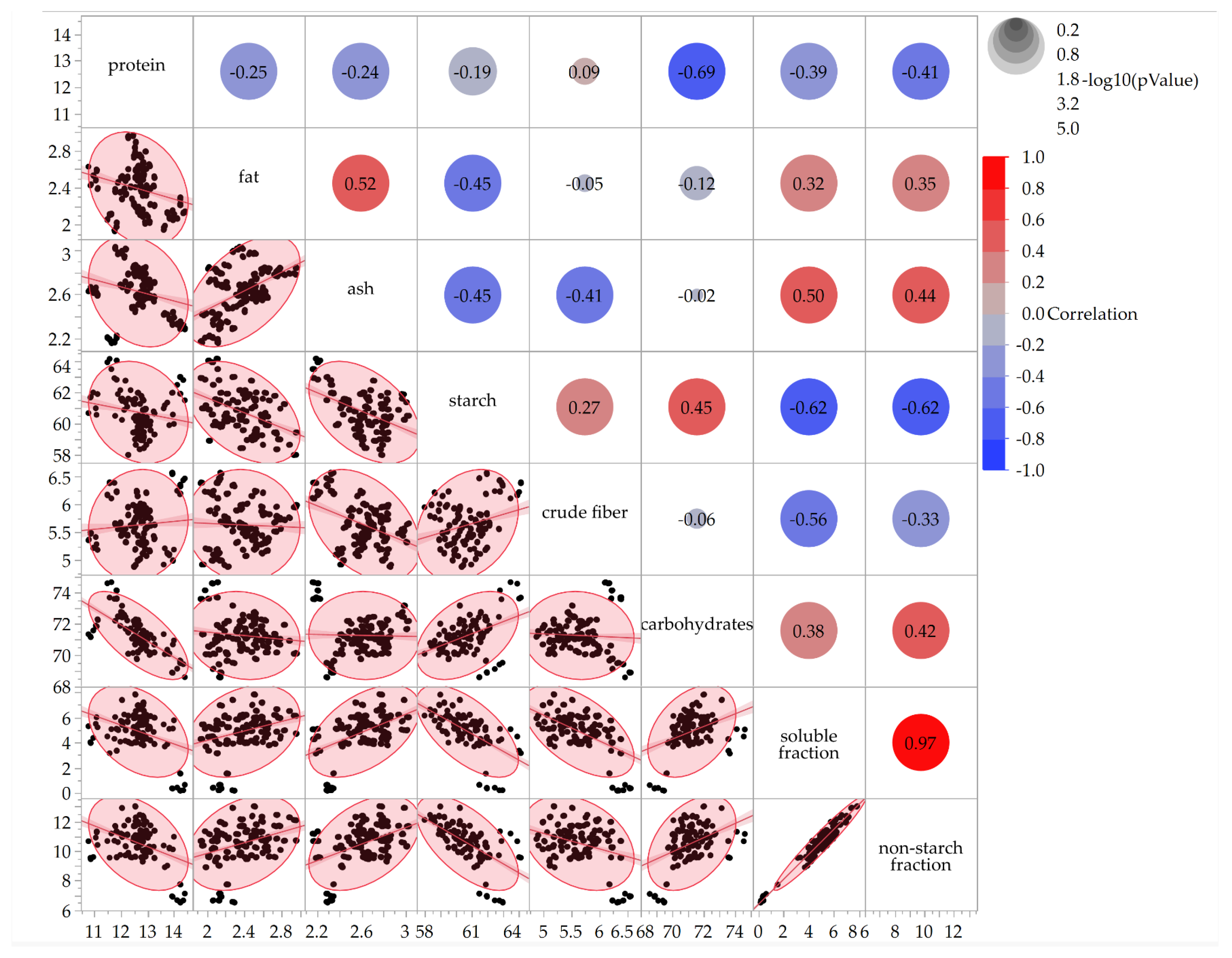
Pearson’s correlation analysis revealed clear relationships among barley grain quality traits (Figure 2). Crude protein content was negatively correlated with carbohydrate content (r = −0.69, p < 0.01), the soluble fraction (r = −0.39, p < 0.01), and the non-starch fraction (r = −0.41, p < 0.01), suggesting a trade-off between protein accumulation and carbohydrate- or soluble compound-related traits.
Fat content showed a positive correlation with ash (r = 0.52, p < 0.01) and moderate positive correlations with the soluble fraction (r = 0.32) and non-starch fraction (r = 0.35), indicating a co-variation between lipid content and mineral or soluble components.
Ash content was negatively correlated with starch (r = −0.45, p < 0.01), while starch content was strongly negatively correlated with fat, ash, soluble fraction, and non-starch fraction (r = −0.45 to −0.62, p < 0.01) and positively correlated with total carbohydrate content (r = 0.45, p < 0.01), reflecting its inverse relationship with protein- and fiber-related traits.
The soluble fraction and non-starch fraction were highly correlated (r = 0.97, p < 0.01), highlighting their close biochemical association and suggesting that selection for one trait is likely to influence the other.
These results provide a clear picture of how the traits are interdependent, offering valuable guidance for breeding strategies aimed at improving specific barley grain quality characteristics.

3.6. Exploratory Analysis

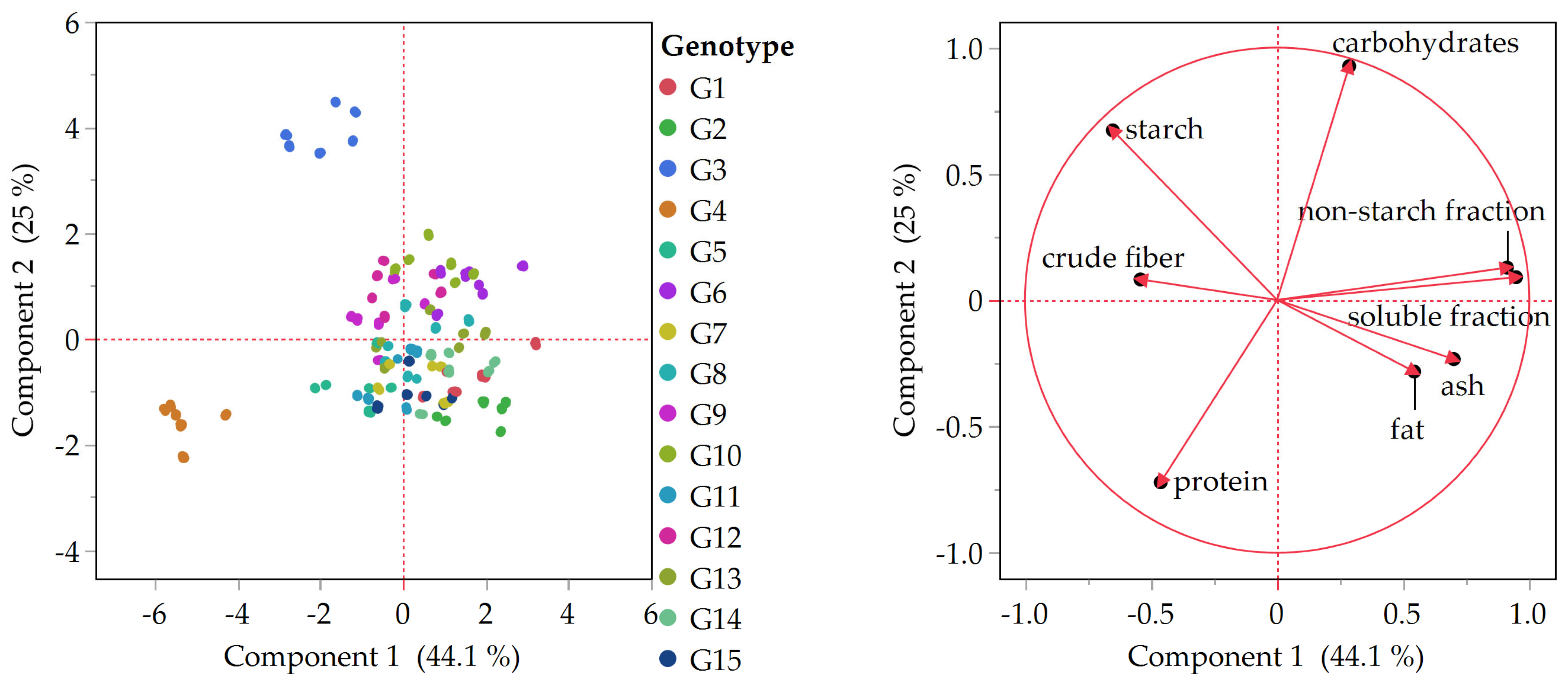
Principal Component Analysis (PCA) was performed to explore the multivariate structure of barley grain quality traits and to visualize differences among genotypes (Figure 3). The first two components explained 69.1% of the total variation. PC1 was mainly associated with ash, fat, crude fiber, soluble fraction, and non-starch fraction, whereas PC2 reflected the contrast between protein content and starch/carbohydrate accumulatio. Protein loaded negatively on PC2, confirming the inverse relationship between protein and energy-storage compounds.
PCA scores highlighted differences among genotypes. G4 and G5 had high protein and low carbohydrate content, whereas G3 exhibited elevated starch and carbohydrate levels. Genotypes G1, G2, and G14 were enriched in fat and ash, and G6 showed higher soluble and non-starch fractions.
Clustering patterns revealed that G1–G6 and G14 formed a tight group, whereas G8, G9, and G13 were more dispersed, indicating greater variability in trait expression.
Overall, PCA illustrated structured multivariate variation among barley genotypes and visually complemented the results of univariate analyses by distinguishing groups with more similar trait profiles from those showing greater dispersion.

4. Discussion

The evaluation of barley grain quality traits revealed substantial variation among genotypes, confirming the influence of both genetic and environmental factors, as well as their interaction. The combined ANOVA indicated that all evaluated traits—crude protein, fat, ash, starch, crude fiber, carbohydrate, soluble fraction, and non-starch fraction—were significantly affected by genotype (G), environment (E), and their interaction (G × E) at p ≤ 0.001. Genotypic mean squares were consistently higher than those of environment and G × E (e.g., crude protein: G = 14.714 vs. E = 0.090 and G × E = 0.097), highlighting the primary role of genetic variation. The significant G × E interactions indicate that the performance of specific genotypes varies depending on environmental conditions, emphasizing the importance of multi-environment evaluation to identify stable and high-performing lines. These findings directly address the first objective of the study, demonstrating differential genetic control and environmental sensitivity among protein-, fiber-, and carbohydrate-related traits under Mediterranean conditions. Overall, the data confirm the presence of considerable genetic diversity among advanced lines, local populations, and commercial cultivars [43,44,45], while emphasizing the impact of growing conditions on grain quality [12,46,47].
Observed performance patterns indicate that classical pedigree lines generally exhibit higher and more consistent values for key traits such as protein, fat, ash, and crude fiber, whereas lines selected using PYI or YC criteria also perform well but show trait-dependent variability. Cultivars typically show intermediate stability and trait values. These results suggest that gradual, pedigree-based selection and targeted selection criteria enhance both performance and stability of grain quality traits, supporting the effectiveness of classical pedigree selection in preserving trait uniformity and predictability [36]. These findings directly address the second objective of the study by highlighting performance and stability differences between pedigree-derived lines and PYI/YC-selected genotypes. Moreover, the role of genotype × environment interactions (G × E) in shaping trait expression emphasizes the importance of multi-environment evaluation, since genotypes performing consistently in one environment may fluctuate in others [48]. Considering practical applications, advanced lines clearly outperform local populations under Mediterranean conditions, combining high mean performance with greater stability, and are therefore more suitable for breeding programs aimed at producing nutritionally enriched and functionally consistent barley seeds.
Evaluation of barley genotypes for grain quality traits revealed significant differences in stability across environments. The classical ear-to-row pedigree lines consistently demonstrated the highest Stability Index (SI) values across all measured traits, indicating that gradual within-population selection effectively maintains uniformity and predictability of grain quality. Lines selected using PYI and YC criteria also generally exhibited improved stability compared to the original local population, although performance varied across specific traits. Cultivars displayed intermediate stability, suggesting that while they perform adequately across environments, their consistency may not match that of well-adapted pedigree or carefully selected lines. These findings are consistent with earlier research, showing that trait stability is largely governed by genetic control, with some traits exhibiting greater consistency than others under variable environmental conditions [49,50,51,52,53,54,55]. Additionally, genotype × environment interactions play a pivotal role in performance across locations, underscoring the importance of integrating both classical and modern selection strategies to develop stable genotypes [56,57,58]. This stability is particularly crucial under Mediterranean climates, where interannual variability in rainfall and temperature can significantly influence grain composition.
Crude protein content, fat content, ash content, starch content, crude fiber content, carbohydrate content, soluble fraction, and non-starch fraction exhibited high broad-sense heritability (H2 > 92%) in this study, indicating strong genetic control. However, high heritability alone does not guarantee effective selection. The inclusion of genetic advance (GA) and genetic advance as a percentage of the mean (GA%) revealed that traits such as crude protein, fat, ash, crude fiber, and soluble fraction combined high heritability with moderate to high GA%, suggesting predominance of additive gene action and a favorable response to selection. In contrast, starch and total carbohydrate content exhibited high heritability but comparatively lower GA%, implying stronger environmental influence and potential non-additive genetic effects. This observation is consistent with the principle proposed by Johnson et al. [40], highlighting that heritability estimates have practical relevance only when accompanied by substantial genetic advance. These findings are consistent with previous reports. Porumb et al. [59] observed high heritability for protein and moderate heritability for starch in barley. Fernando-Amabile [60] and Yadav et al. [61] similarly reported lower stability and selection response for starch compared to protein. Data from Gebru [62] and Iannucci et al. [63] further support the conclusion that protein- and fiber-related traits are largely genetically determined, whereas starch-related traits are more environmentally responsive. Together, these results underscore the superiority of advanced lines over landraces in terms of predictable genetic gain for nutritionally important traits.
Correlation analysis revealed the relationships among barley seed quality traits. Crude protein content was negatively correlated with carbohydrate content, soluble fraction, and non-starch fraction, indicating a trade-off whereby genotypes with higher protein concentration tend to have lower carbohydrate and fiber fractions. These relationships directly address the third objective of the study, highlighting clear trade-offs and coordinated accumulation patterns among grain quality traits that are critical for breeding strategies. Fat content showed a strong positive correlation with ash content and moderate positive correlations with soluble and non-starch fractions, suggesting coordinated accumulation of lipids with mineral and fiber components. These patterns are consistent with previous reports in barley [60,61,62,63,64,65] and emphasize physiological trade-offs that must be considered in multi-trait selection approaches.
The PCA of barley grain quality traits further supported the univariate and correlation results. The first principal component (PC1) primarily captured differences in carbohydrate fraction partitioning, contrasting soluble and non-starch components with starch and crude fiber, while PC2 distinguished genotypes based on protein versus starch accumulation. Although PC1 and PC2 together explained 69.1% of the total variance, slightly below the conventional 80% threshold, this level of explanation is reasonable given the complexity and number of quality traits assessed across multiple environments. The biological interpretation of PCA axes was clear and consistent with known cereal grain trade-offs, supporting the robustness of the analysis. Genotypes with high protein content (e.g., G4, G5) were clearly separated from starch-rich genotypes (e.g., G3), indicating distinct nutritional profiles and breeding potential. These multivariate relationships among grain quality traits have biological and practical relevance, as they highlight opportunities to improve both nutritional quality and functional properties in food applications [66]. This multivariate differentiation confirms that selection strategies have modified grain composition while maintaining genetic diversity and environmental responsiveness.
Overall, our results show that advanced barley lines, especially the ear-to-row pedigree derivatives and PYI/YC-selected genotypes, have both high genetic potential and good stability across different environments. By combining heritability, genetic advance, stability indices, correlations, and PCA, we were able to get a clear picture of how grain quality traits behave under Mediterranean conditions. These findings give practical guidance to breeders who want to improve nutritional quality while ensuring consistent performance, which is especially important under variable climate conditions.
It is worth noting that this study combines data from two separate periods (2010–2012 and 2023–2025), which brings some limitations. Differences over time, slight changes in analytical methods, and storage effects could all have influenced the results. Even though we treated each environment as a combination of location and year, some overlap between temporal effects and environmental variation might remain.
Some grain quality traits were calculated as differences between components, which could introduce small measurement errors. Finally, while stability indices and multivariate analyses provide valuable insight into consistency, they should be interpreted cautiously and not assumed to indicate broad environmental adaptability without further testing across additional locations and management systems. These points should be considered when interpreting the results and applying them to broader breeding programs.

5. Conclusions

The evaluation of barley genetic material, including advanced lines, cultivars, and a local population, under Mediterranean conditions revealed substantial genetic variability for key grain quality traits, such as crude protein, fat, ash, starch, crude fiber, carbohydrate, soluble fraction, and non-starch fraction. Significant differences among genotypes and noticeable genotype × environment interactions highlight the role of environmental conditions in shaping trait expression.
Traits such as crude protein, fat, ash, and crude fiber exhibited high broad-sense heritability (H2 > 92%) and relatively high genetic advance, indicating strong genetic control and effective potential for improvement through selection. Starch, total carbohydrates, soluble fraction, and non-starch fraction also showed high heritability, but were more sensitive to environmental variation, emphasizing the importance of multi-environment testing for accurate evaluation.
Stability analysis revealed that classical ear-to-row pedigree lines were the most consistent across traits, while PYI- and YC-selected lines also performed more stably than the original local population. Correlation analysis identified important trade-offs, such as protein versus carbohydrate fractions and fat versus ash content, which should be considered when improving multiple traits simultaneously.
Overall, combining selection for traits with high heritability and genetic advance with stability assessment allows the identification of superior barley lines well adapted to Mediterranean conditions, representing promising candidates for breeding programs aiming to improve nutritional quality while ensuring predictable performance under variable climates.

Author Contributions

Conceptualization, V.G. and S.Z.; methodology, V.G. and S.Z.; investigation, V.G., C.G.I., D.K. and E.B.; statistical analysis, A.S. and V.G.; writing—original draft preparation, V.G., E.B. and C.G.I.; writing—review and editing, V.G., E.B., D.K. and A.S.; visualization, A.S. and V.G.; supervision, V.G.; project administration, V.G. All authors have read and agreed to the published version of the manuscript.

Funding

This research received no external funding.

Institutional Review Board Statement

Not applicable.

Informed Consent Statement

Not applicable.

Data Availability Statement

The original contributions presented in this study are included in the article. Further inquiries can be directed to the corresponding author.

Conflicts of Interest

The authors declare no conflicts of interest.

References

  1. Su, Z.; Gao, S.; Hu, H.; Shabala, S.; Zhou, M.; Liu, C.; Zheng, Z. A major locus conferring both Fusarium crown rot resistance and drought tolerance in barley (Hordeum vulgare L.). Plant Breed. 2025, 144, 728–741. [Google Scholar] [CrossRef]
  2. Erkan, H.; Çelik, S.; Bilgi, B.; Köksel, H. A New Approach for the Utilization of Barley in Food Products: Barley Tarhana. Food Chem. 2006, 97, 12–18. [Google Scholar] [CrossRef]
  3. Zhu, F. Barley Starch: Composition, Structure, Properties, and Modifications. Compr. Rev. Food Sci. Food Saf. 2017, 16, 558–579. [Google Scholar] [CrossRef] [PubMed]
  4. Henry, R.J. The carbohydrates of barley grains—A review. J. Inst. Brew. 1988, 94, 71–78. [Google Scholar] [CrossRef]
  5. Das, R.; Biswas, S.; Banerjee, E.R. Nutraceutical-prophylactic and therapeutic role of functional food in health. J. Nutr. Food Sci. 2016, 6, 527. [Google Scholar] [CrossRef]
  6. Guo, T.; Horvath, C.; Chen, L.; Chen, J.; Zheng, B. Understanding the nutrient composition and nutritional functions of highland barley (Qingke): A review. Trend Food Sci. Technol. 2020, 103, 109–117. [Google Scholar] [CrossRef]
  7. Elouadi, F.; Amri, A.; El-Baouchi, A.; Kehel, Z.; Jilal, A.; Ibriz, M. Genotypic and environmental effects on quality and nutritional attributes of Moroccan barley cultivars and elite breeding lines. Front. Nutr. 2023, 10, 1204572. [Google Scholar] [CrossRef]
  8. Pitzer, S. Homegrown Whole Grains: Grow, Harvest & Cook Your Own Wheat, Barley, Oats, Rice, Corn & More; Storey Publishing: North Adams, MA, USA, 2009. [Google Scholar]
  9. Dykes, L. Phenolic Compounds in Cereal Grains and Their Health Benefits. Cereal Foods World 2007, 52, 105–111. [Google Scholar] [CrossRef]
  10. Lattanzio, V.; Lattanzino, V.M.T.; Cardinali, A. Role of phenolics in the resistance mechanisms of plants against fungal pathogens and insects. Phytochem. Advan. Res. 2006, 661, 23–67. [Google Scholar]
  11. Malik, A.H. Governing Grain Protein Concentration and Composition in Wheat and Barley: Use of Genetic and Environmental Factors. Ph.D. Thesis, Swedish University of Agricultural Sciences, Uppsala, Sweden, 2012. [Google Scholar]
  12. Hussain, A.; Ali, S.; Hussain, A.; Hussain, Z.; Manzoor, M.F.; Hussain, A.; Ali, A.; Mahmood, T.; Abbasi, K.S.; Karrar, E.; et al. Tajudin Compositional profile of barley landlines grown in different regions of Gilgit-Baltistan. Food Sci. Nutr. 2021, 9, 2605–2611. [Google Scholar] [CrossRef]
  13. Bach Knudsen, K.E.; Aaman, P.; Eggum, B.O. Nutritive value of Danish-grown barley varieties, I. Carbohydrates and other major constituents. J. Cereal Sci. 1987, 6, 173–186. [Google Scholar] [CrossRef]
  14. Katsenios, N.; Sparangis, P.; Chanioti, S.; Giannoglou, M.; Leonidakis, D.; Christopoulos, M.V.; Katsaros, G.; Efthimiadou, A. Genotype × Environment Interaction of Yield and Grain Quality Traits of Maize Hybrids in Greece. Agronomy 2021, 11, 357. [Google Scholar] [CrossRef]
  15. Greveniotis, V.; Bouloumpasi, E.; Zotis, S.; Korkovelos, A.; Kantas, D.; Ipsilandis, C.G. Stability Dynamics of Main Qualitative Traits in Maize Cultivations across Diverse Environments regarding Soil Characteristics and Climate. Agriculture 2023, 13, 1033. [Google Scholar] [CrossRef]
  16. Mebratu, A.; Wegary, D.; Teklewold, A.; Tarekegne, A. Testcross performance and combining ability of early-medium maturing quality protein maize inbred lines in Eastern and Southern Africa. Sci. Rep. 2024, 14, 9151. [Google Scholar] [CrossRef]
  17. Guo, C.; Fang, Y.; Yi, F.; Shi, Z.; Qiao, H.; Liu, F.; Zhao, H.; Zhu, L.; Ding, H. Analysis and Evaluation on Grain Quality Traits of Forage Barley. Anim. Husb. Feed Sci. 2024, 45, 79–84, (In Chinese, Abstract in English). [Google Scholar]
  18. Abdelghany, A.M.; Lamlom, S.F.; Naser, M. Dissecting the resilience of barley genotypes under multiple adverse environmental conditions. BMC Plant Biol. 2024, 24, 16. [Google Scholar] [CrossRef]
  19. Sinkevičienė, A.; Romaneckas, K.; Meškinytė, E.; Kimbirauskienė, R. The Effect of Different Tillage Methods on Spring Barley Productivity and Grain Quality Indicators. Agronomy 2025, 15, 1823. [Google Scholar] [CrossRef]
  20. Ehrenbergerová, J.; Belcredi, N.B.; Psota, V.; Hrstkova, P.; Cerkal, R.; Newman, C.W. Changes Caused by Genotype and Environmental Conditions in Beta-Glucan Content of Spring Barley for Dietetically Beneficial Human Nutrition. Plant Foods Hum. Nutr. 2008, 63, 111–117. [Google Scholar] [CrossRef]
  21. Åman, P.; Newman, C.W. Chemical Composition of Some Different Types of Barley Grown in Montana, U.S.A. J. Cereal Sci. 1986, 4, 133–141. [Google Scholar]
  22. Zhang, G.; Wang, J.; Chen, J. Analysis of β-glucan content in barley cultivars from different locations of China. Food Chem. 2002, 79, 251–254. [Google Scholar] [CrossRef]
  23. Fasoula, V.A. A novel equation paves the way for an everlasting revolution with cultivars characterized by high and stable crop yield and quality. In Proceedings of the 11th National Hellenic Conference in Genetics and Plant Breeding, Orestiada, Greece, 31 October–2 November 2006; pp. 7–14. [Google Scholar]
  24. Fasoula, V.A. Prognostic breeding: A new paradigm for crop improvement. Plant Breed. Rev. 2013, 37, 297–347. [Google Scholar]
  25. Bellucci, E.; Bitocchi, E.; Rau, D.; Nanni, L.; Ferradini, N.; Giardini, A.; Rodriguez, M.; Attene, G.; Papa, R. Population structure of barley landrace populations and gene-flow with modern varieties. PLoS ONE 2013, 8, e83891. [Google Scholar] [CrossRef] [PubMed]
  26. Zeven, A.C. Landraces: A review of definitions and classifications. Euphytica 1998, 104, 127–139. [Google Scholar] [CrossRef]
  27. Agorastos, A.G.; Goulas, C.K. Line Selection for Exploiting Durum Wheat (T. turgidum L. var. durum) Local Landraces in Modern Variety Development Program. Euphytica 2005, 146, 117–124. [Google Scholar] [CrossRef]
  28. Laidig, F.; Piepho, H.-P.; Rentel, D.; Drobek, T.; Meyer, U. Breeding progress, genotypic and environmental variation and correlation of quality traits in malting barley in German official variety trials between 1983 and 2015. Theor. Appl. Genet. 2017, 130, 2411–2429. [Google Scholar] [CrossRef]
  29. Cai, S.; Yu, G.; Chen, X.; Huang, Y.; Jiang, X.; Zhang, G.; Jin, X. Grain protein content variation and its association analysis in barley. BMC Plant Biol. 2013, 13, 35. [Google Scholar] [CrossRef]
  30. Güngör, H.; Türkoğlu, A.; Çakır, M.F.; Dumlupınar, Z.; Piekutowska, M.; Wojciechowski, T.; Niedbała, G. GT Biplot and Cluster Analysis of Barley (Hordeum vulgare L.) Germplasm from Various Geographical Regions Based on Agro-Morphological Traits. Agronomy 2024, 14, 2188. [Google Scholar] [CrossRef]
  31. De Santis, M.A.; Cammarano, D. Agronomic Management Factors Impacting Yield, Quality Stability, and Environmental Footprints of Barley in a Mediterranean Environment. Field Crops Res. 2024, 309, 109334. [Google Scholar] [CrossRef]
  32. Fasoulas, A.C. The Honeycomb Methodology of Plant Breeding; Aristoteles University of Thessaloniki: Thessaloniki, Greece, 1988. [Google Scholar]
  33. Jalaluddin, M.D.; Harrison, S. Repeatability of stability estimators for grain yield in wheat. Crop Sci. 1993, 33, 720–725. [Google Scholar] [CrossRef]
  34. Moghaddam, M.; Ehdaie, B.; Waines, J.G. Genetic variation and interrelationships of agronomic characters in landraces of bread wheat from southeastern Iran. Euphytica 1997, 95, 361–369. [Google Scholar] [CrossRef]
  35. Hamza, S.; Wafa, B.; Rebai, A.; Harrabi, M. SSR-Based Genetic Diversity Assessment among Tunisian Winter Barley and Relationship with Morphological Traits. Euphytica 2004, 135, 107–118. [Google Scholar] [CrossRef]
  36. Greveniotis, V.; Zotis, S.; Sioki, E.; Ipsilandis, C.G. Improving pedigree selection in applied breeding of barley populations. Cereal Res. Commun. 2019, 47, 123–133. [Google Scholar] [CrossRef]
  37. Association of Official Analytical Chemists (AOAC). Official Methods of Analysis, 18th ed.; AOAC International: Gaithersburg, MD, USA, 2005. [Google Scholar]
  38. Steel, R.G.D.; Torrie, H.; Dickey, D.A. Principles and Procedures of Statistics. A Biometrical Approach, 3rd ed.; McGraw-Hill: New York, NY, USA, 1997; p. 666. [Google Scholar]
  39. McIntosh, M.S. Analysis of Combined Experiments. Agron. J. 1983, 75, 153–155. [Google Scholar] [CrossRef]
  40. Johnson, H.W.; Robinson, H.E.; Comstock, R.E. Estimate of genetic and environmental variability in soybean. Agron. J. 1955, 47, 314–318. [Google Scholar] [CrossRef]
  41. Hanson, G.; Robinson, H.F.; Comstock, R.E. Biometrical studies on yield in segregating population of Korean Lespedeza. Agron. J. 1956, 48, 268–274. [Google Scholar] [CrossRef]
  42. Singh, R.K.; Chaudhary, B.D. Biometrical Methods in Quantitative Genetic Analysis; Kalyani Publishers: New Delhi, India, 1977; p. 304. [Google Scholar]
  43. Yiblet, Y.; Misganaw, W.; Adamu, E. Nutritional and functional composition of barley varieties from Legambo District, Ethiopia. Sci. World J. 2024, 2024, 1367540. [Google Scholar] [CrossRef]
  44. Šterna, V.; Zute, S.; Jansone, I.; Kantane, I. Chemical Composition of Covered and Naked Spring Barley Varieties and Their Potential for Food Production. Pol. J. Food Nutr. Sci. 2017, 67, 151–158. [Google Scholar] [CrossRef]
  45. Hu, Y.; Barmeier, G.; Schmidhalter, U. Genetic Variation in Grain Yield and Quality Traits of Spring Malting Barley. Agronomy 2021, 11, 1177. [Google Scholar] [CrossRef]
  46. Quddos, A.; Nadeem, M.; Ahsan, S.; Khaliq, A.; Chughtai, M.F.; Rebezov, M.; Terent’ev, S.; Tryabas, Y.; Ermolaev, V.; Iskakova, G.; et al. Genotype by environment interactions in barley (Hordeum vulgare L.) cultivars for nutritional quality assessment. AGRIVITA J. Agric. Sci. 2021, 43, 569–580. [Google Scholar] [CrossRef]
  47. Molina-Cano, J.L.; Francesch, M.; Perez-Vendrell, A.M.; Ramo, T.; Voltas, J.; Brufau, J.J. Genetic and environmental variation in malting and feed quality of barley. J. Cereal Sci. 1997, 25, 37–47. [Google Scholar] [CrossRef]
  48. Pour-Aboughadareh, A.; Ghazvini, H.; Jasemi, S.S.; Mohammadi, S.; Razavi, S.A.; Chaichi, M.; Ghasemi Kalkhoran, M.; Monirifar, H.; Tajali, H.; Fathihafshjani, A.; et al. Selection of High-Yielding and Stable Genotypes of Barley for the Cold Climate in Iran. Plants 2023, 12, 2410. [Google Scholar] [CrossRef] [PubMed]
  49. Greveniotis, V.; Sioki, E.; Ipsilandis, C.G. Estimations of fiber trait stability and type of inheritance in cotton. Czech J. Genet. Plant Breed. 2018, 54, 190–192. [Google Scholar] [CrossRef]
  50. Greveniotis, V.; Bouloumpasi, E.; Zotis, S.; Korkovelos, A.; Ipsilandis, C.G. Estimations on Trait Stability of Maize Genotypes. Agriculture 2021, 11, 952. [Google Scholar] [CrossRef]
  51. Greveniotis, V.; Bouloumpasi, E.; Zotis, S.; Korkovelos, A.; Ipsilandis, C.G. Stability, the Last Frontier: Forage Yield Dynamics of Peas under Two Cultivation Systems. Plants 2022, 11, 892. [Google Scholar] [CrossRef]
  52. Greveniotis, V.; Bouloumpasi, E.; Zotis, S.; Korkovelos, A.; Kantas, D.; Ipsilandis, C.G. A Comparative Study on Stability of Seed Characteristics in Vetch and Pea Cultivations. Agriculture 2023, 13, 1092. [Google Scholar] [CrossRef]
  53. Greveniotis, V.; Bouloumpasi, E.; Skendi, A.; Korkovelos, A.; Kantas, D.; Zotis, S.; Ipsilandis, C.G. Modeling Stability of Alfalfa Yield and Main Quality Traits. Agriculture 2024, 14, 542. [Google Scholar] [CrossRef]
  54. Greveniotis, V.; Bouloumpasi, E.; Skendi, A.; Korkovelos, A.; Kantas, D.; Ipsilandis, C.G. Evaluation and Stability of Red and White Trifolium Species for Nutritional Quality in a Mediterranean Environment. Agriculture 2025, 15, 391. [Google Scholar] [CrossRef]
  55. Greveniotis, V.; Bouloumpasi, E.; Skendi, A.; Ipsilandis, C.G. Fiber Quality and Stability of Partially Interspecific Cotton Lines Under Irrigation and Nitrogen Environments. Appl. Sci. 2025, 15, 9684. [Google Scholar] [CrossRef]
  56. Assefa, A.; Girmay, G.; Alemayehu, T.; Lakew, A. Performance Evaluation and Stability Analysis of Malt Barley (Hordeum vulgare L.) Varieties for Yield and Quality Traits in Eastern Amhara, Ethiopia. CABI Agric. Biosci. 2021, 2, 31. [Google Scholar] [CrossRef]
  57. Pour-Aboughadareh, A.; Barati, A.; Koohkan, S.A.; Jabari, M.; Marzoghian, A.; Gholipoor, A.; Shahbazi-Homonloo, K.; Zali, H.; Poodineh, O.; Kheirgo, M. Dissection of genotype-by-environment interaction and yield stability analysis in barley using AMMI model and stability statistics. Bull. Natl. Res. Cent. 2022, 46, 19. [Google Scholar] [CrossRef]
  58. Elakhdar, A.; El-Naggar, A.A.; El-Wakeell, S.; Ahmed, A.H. Integrating univariate and multivariate stability indices for breeding climate-resilient barley cultivars. BMC Plant Biol. 2025, 25, 76. [Google Scholar] [CrossRef]
  59. Porumb, I.; Russu, F.; Rotar, I. The heritability of some qualitative and quantitative traits in a set of spring barley genotypes. Bull. Univ. Agric. Sci. Vet. Med. Cluj-Napoca. Agric. 2018, 75, 2. [Google Scholar] [CrossRef]
  60. Fernando-Amabile, R.; Gelape-Faleiro, F.; Capettini, F.; Sayd, R. Estimation of genetic parameters, phenotypic, genotypic, and environmental correlations in barley (Hordeum vulgare L.) grown under irrigation conditions in the Brazilian Savannah. Interciencia 2015, 40, 255–262. [Google Scholar]
  61. Yadav, S.K.; Singh, A.K.; Pandey, P.; Singh, S. Genetic variability and direct selection criterion for seed yield in segregating generations of barley (Hordeum vulgare L.). Am. J. Plant Sci. 2015, 6, 1543–1549. [Google Scholar] [CrossRef]
  62. Gebru, A.; Meklib, F.; Lakew, B. Estimation of genetic variability of malt barley (Hordeum vulgare L.) varieties for yield and yield-related traits in North Eastern Ethiopia. Int. J. Plant Biol. Res. 2018, 6, 1105. [Google Scholar]
  63. Iannucci, A.; Suriano, S.; Codianni, P. Genetic Diversity for Agronomic Traits and Phytochemical Compounds in Coloured Naked Barley Lines. Plants 2021, 10, 1575. [Google Scholar] [CrossRef]
  64. Wirkijowska, A.; Rzedzicki, Z.; Zarzycki, P.; Sobota, A.; Sykut-Domańska, E. Chemical composition of naked barley for production of functional food. Acta Agrophys. 2016, 23, 287–301. [Google Scholar]
  65. Yang, X.; Ahmed, H.G.; Yang, J.; Pu, X.; Li, X.; Yang, L.; Yang, G.; Guan, X.; Tian, J.; Iqbal, R.; et al. Differences in nutrient functional composition among different types of grains in barley (Hordeum vulgare L.) recombinant inbred lines. Appl. Ecol. Environ. Res. 2025, 23, 7103–7121. [Google Scholar] [CrossRef]
  66. Skendi, A.; Biliaderis, C.G. Gelation of wheat arabinoxylans in the presence of Cu+2 and in aqueous mixtures with cereal β-glucans. Food Chem. 2016, 203, 267–275. [Google Scholar] [CrossRef]
Figure 1. Monthly mean temperature (°C) and total precipitation (mm) recorded during the growing seasons for all experimental environments: Florina, Greece (2010–2011 and 2011–2012), Trikala, Greece (2023–2024 and 2024–2025), and Kalambaka, Greece (2023–2024 and 2024–2025). Differences among sites and years illustrate environmental variability affecting barley grain quality traits and genotype × environment interactions.
Agriculture 16 00366 g001
Figure 2. Correlation matrix displaying pairwise scatterplots for the analyzed barley parameters. The upper section presents the correlation coefficients, while the lower section contains scatterplots (black dots) with fitted regression lines and 95% density (confidence) ellipses (pink), illustrating the clustering and relationships of the data points.
Agriculture 16 00366 g002
Figure 3. Principal Component Analysis (PCA) biplot of 15 evaluated barley genotypes (G1–G15) based on grain quality traits. G1–G5: classical ear-to-row progeny lines; G6–G10: PYI-selected lines; G11–G12: YC-selected lines; G13–G14: cultivars (Plaisant and Cannon); G15: local population. Arrows indicate the direction and relative magnitude of trait loadings. The first two principal components explain 69.1% of the total variance.
Agriculture 16 00366 g003
Table 1. Combined ANOVA for barley seed trait. Source of variation, df, mean squares (m.s.) for traits: crude protein, fat, starch, ash, crude fiber, carbohydrates, soluble fraction, and non-starch fraction.
Source of
Variation
dfCrude
Protein
FatAshStarchCrude
Fibre
Carbohydrates Soluble
Fraction
Non-Starch Fraction
m.sm.s.m.s.m.s.m.s.m.sm.s.m.s.
Environment (E)50.090 ***0.036 ***0.009 ***2.222 ***0.198 ***1.953 ***6.386 ***5.099 ***
REPS/environments180.00005 ns0.00005 ns0.00003 ns0.00007 ns0.0002 ns0.0004 ns0.0005 ns0.001 ns
Genotype (G)1414.714 ***1.444 ***1.069 ***37.576 ***3.962 ***28.781 ***42.743 ***30.192 ***
Environment × Genotype (E × G)700.097 ***0.027 ***0.002 ***1.389 ***0.049 ***0.840 ***2.445 ***2.404 ***
Error2520.0000640.000060.0000440.00010.00020.00030.001 0.0004
Probability levels: *** p ≤ 0.001; ns—not significant.
Table 2. Trait Stability Index (SI) across genotypes for key seed traits. Traits include crude protein, fat, starch, ash, crude fiber, carbohydrates, soluble fraction, and non-starch fraction. Higher SI values indicate greater stability of the genotype across environments.
GenotypesCrude
Protein
FatAshStarchCrude FiberCarbohydratesSoluble FractionNon-Starch Fraction
1-progeny (G1)69911057964014,463237721,50935140
2-progeny (G2)779096410,78112,481296241,01957282
3-progeny (G3)743794711,06413,841341426,54730215
4-progeny (G4)8018943955013,676234134,26121279
5-progeny (G5)8623107211,42911,359231922,84338175
(42-3) PYI criterion(G6)730189710,88710,515275023,49750169
(30-21) PYI criterion(G7)7553936916710,221248138,38765276
(40-27) PYI criterion (G8)713395310,12511,331259418,72935152
(50-6) PYI criterion (G9)709190110,96511,567201218,40642177
(23-26) PYI criterion (G10)741885610,96210,819243136,64753235
(49-2) YC criterion (BY) (G11)8504100311,08312,431281117,37659228
(46-3) YC criterion (BY) (G12)796591512,21312,608234636,84240253
Plaisant (G13)702093210,58010,299204920,94532139
Cannon (G14)839197811,60112,353232323,52662209
Local population (G15)764187811,00610,126217037,21854275
Table 3. Trait Stability Index (SI) across six environments (E1–E6). Traits include crude protein, fat, starch, ash, crude fiber, carbohydrates, soluble fraction, and non-starch fraction. Higher SI values indicate greater stability of each trait across environments.
EnvironmentCrude
Protein
FatAshStarchCrude FiberCarbohydratesSoluble FractionNon-Starch Fraction
E126475145196219435391068
E227697171173718036471161
E3250126156240021531771380
E42799317319191684869954
E528792157244620850071489
E624779169229218637621263
Table 4. Genetic parameter estimates for barley seed traits. Traits include crude protein, fat, starch, ash, crude fiber, carbohydrates, soluble fraction, and non-starch fraction. Values include genotypic variance ( σ g 2 ), genotype × environment interaction variance ( σ g x e 2 ), phenotypic variance ( σ p 2 ), broad-sense heritability (H2, %), genotypic coefficient of variation (GCV, %), phenotypic coefficient of variation (PCV, %), standard deviation (SD), minimum (min), maximum (max), genetic advance (GA), and genetic advance as % of mean (GA%).
TraitsMin.Max.MeanSD σ g 2 σ g x e 2 σ p 2 GCV (%)PCV (%)H2 (%)GAGA (%)
Crude protein10.7714.4212.660.770.6090.02420.61316.176.3199.341.5712.4
Fat1.932.972.390.250.0590.00670.060210.1710.2698.130.49620.8
Ash2.163.032.630.210.04450.00050.04458.038.0499.810.41115.6
Starch57.9864.1360.711.331.50780.34721.56572.022.0696.302.484.1
Crude fiber4.876.575.630.410.1630.01220.16517.177.2298.760.83814.9
Carbohydrates68.5774.6371.241.151.16420.20991.19921.511.5497.082.193.1
Soluble fraction0.197.854.901.491.67910.6111.78126.4227.2194.272.5952.9
Non-starch fraction6.5113.0310.531.311.15780.60091.25810.2110.6592.042.1320.2
Table 5. Duncan’s multiple range test (0.05) values for barley seed traits. Traits include crude protein, fat, starch, ash, crude fiber, carbohydrates, soluble fraction, and non-starch fraction.
GenotypesCrude
Protein
FatAshStarchCrude Fiber CarbohydratesSoluble FractionNon-Starch Fraction
1-progeny (G1)12.70 h2.613 c2.790 e59.73 l5.355 j71.10 h6.019 b11.38 bc
2-progeny (G2)12.53 k2.845 a2.805 d58.78 o5.863 d70.45 m5.805 d11.67 a
3-progeny (G3)11.69 n2.039 n2.193 o63.53 a6.252 b74.02 a4.239 n10.49 h
4-progeny (G4)14.22 a2.165 k2.319 n62.25 b6.372 a69.19 o0.568 o6.940 l
5-progeny (G5)13.81 b2.055 m2.411 m60.64 i5.086 m70.56 l4.835 j9.921 k
(42-3) PYI criterion(G6)12.01 m2.390 i2.985 a61.06 f5.497 h72.44 b5.888 c11.38 b
(30-21) PYI criterion(G7)13.07 c2.425 h2.587 j59.83 k5.469 i70.79 j5.489 f10.96 e
(40-27) PYI criterion (G8)12.72 g2.706 b2.809 c61.26 e5.778 e71.64 e4.597 l10.38 i
(50-6) PYI criterion (G9)12.62 j2.298 j2.487 l60.93 g5.749 f71.43 f4.751 k10.50 h
(23-26) PYI criterion (G10)10.97 o2.507 e2.627 h61.28 d5.323 k71.66 d5.056 h10.38 i
(49-2) YC criterion (BY) (G11)13.04 d2.137 l2.699 f59.93 j5.785 e70.59 k4.883 i10.67 f
(46-3) YC criterion (BY) (G12)12.18 l2.478 g2.676 g61.84 c5.608 g72.00 c4.549 m10.16 j
Plaisant (G13) 12.69 i2.133 l2.833 b60.71 h5.017 n71.29 g5.561 e10.58 g
Cannon (G14)12.86 e2.551 d2.572 k59.72 m5.218 l71.08 i6.147 a11.37 c
Local population (G15)12.73 f2.500 f2.602 i59.13 n6.079 c70.39 n5.176 g11.26 d
Means followed by the same letter within a column are not significantly different at p ≤ 0.05 according to Duncan’s multiple range test.
Disclaimer/Publisher’s Note: The statements, opinions and data contained in all publications are solely those of the individual author(s) and contributor(s) and not of MDPI and/or the editor(s). MDPI and/or the editor(s) disclaim responsibility for any injury to people or property resulting from any ideas, methods, instructions or products referred to in the content.