Systematic Review

Research on Soil Acidification and Heavy Metals: A Comparative Bibliometric Analysis Based on CNKI and Web of Science (2005–2025)


1
College of Land Resources and Environment, Jiangxi Agricultural University, Nanchang 330045, China
2
Research Base for Science and Technology and Management Innovation of Natural Resources Utilization, Jiangxi Agricultural University, Nanchang 330045, China
3
Research Center of Selenium-Rich Agricultural Industry Development, Jiangxi Agricultural University, Nanchang 330045, China
4
Key Laboratory of Crop Physiology, Ecology and Genetic Breeding, Jiangxi Agricultural University, Ministry of Education/Jiangxi Province, Nanchang 330045, China
*
Author to whom correspondence should be addressed.
Agriculture 2026, 16(8), 897; https://doi.org/10.3390/agriculture16080897
Submission received: 3 March 2026 / Revised: 29 March 2026 / Accepted: 15 April 2026 / Published: 17 April 2026
(This article belongs to the Section Agricultural Soils)

Abstract

The synergistic effects of soil acidification and heavy metal pollution present major challenges for global agroecosystems. To systematically trace the evolution of research and identify key topics in this field, this study employed CiteSpace to visualize and analyze 691 records from the China National Knowledge Infrastructure (CNKI) and 6747 highly relevant articles or reviews from the Web of Science (WOS) Core Collection database from 2005 to 2025. The results indicate a steady to rapid rise in global publications, with China contributing the largest share, at 2468 publications. This has produced a research cluster centered around the Chinese Academy of Sciences (CAS); however, the centrality of its international cooperation remains limited. Studies in the CNKI database are driven by agricultural needs, focusing on national food security, rice yield stability, improvement of arable land, and heavy metal passivation and remediation, with a concentration on basic agricultural science. By contrast, research in the WOS database emphasizes fundamental mechanisms and interdisciplinary integration, addressing aluminum toxicity, microbial communities, the nitrogen cycle, and global climate change, intersecting fields such as environmental science, soil science, ecology, and microbiology. The evolution of research hotspots shows a clear trajectory: from acidity regulation and chemical speciation analysis of heavy metals (2005–2013), to heavy metal passivation, remediation, and phytoremediation (2014–2018), and then to biochar materials, microbiome analysis, and the synergistic role of carbon sequestration (2019–2025). This study argues that future research should move beyond single remediation measures and adopt integrated strategic management to jointly improve bioremediation efficiency, promote soil carbon sequestration and soil health, and enhance microbial adaptation to global climate change.

1. Introduction

Rapid advancements in global industrialization, urbanization, and agricultural intensification have led to severe soil pollution and degradation, posing significant environmental challenges worldwide [1,2]. Heavy metal pollution is particularly concerning because of its high toxicity, persistence, bioaccumulation, and resistance to degradation [3,4]. Soil acidification is a critical component of soil degradation, affecting approximately 50% of arable land globally [5]. Acid deposition, along with irrational fertilization and crop uptake of saline ions, exacerbates soil acidification, particularly in regions such as southern China [6,7]. Under natural conditions, soil acidification progresses at a very slow pace. However, human activities, particularly the excessive use of nitrogen fertilizers, have significantly accelerated this process [8]. Nitrogen fertilizers introduce large amounts of ammonium nitrogen into the soil, which releases H+ through nitrification, causing acidification. The ongoing practice of high nitrogen input for increased crop yields is damaging the soil’s intrinsic quality. A study indicates that in just 30 years of intensive nitrogen use in China’s agricultural system, the average pH of surface soil in major farmlands has decreased by 0.5 units [6]. If not properly managed, by 2050, approximately 13.2% of China’s cultivated land could face the risk of aluminum toxicity, posing a serious threat to food security. Additionally, the deposition of acidic substances like nitrogen and sulfur from the atmosphere, through dry deposition or rainfall, is a primary cause of soil acidification [9,10]. Atmospheric deposition itself often acts as a direct nonpoint source of heavy metal pollution. For example, industrial emissions deposit cadmium (Cd), lead (Pb), copper (Cu) and Zinc (Zn), producing a complex environmental stress. Over the past 40 years, nitrogen deposition has led to a global average soil pH drop of 0.16 units [11]. In China, regions with severe acid deposition coincide with areas of acidic red and yellow soils in the south [1]. Besides the H+ balance, the balance of base cations is crucial for assessing soil acidification. There is a significant negative correlation between base cation content and soil acidification, with base cations providing a notable acid-buffering effect. In agricultural management, excessive nitrogen input not only directly reduces base cations in the soil but also results in crops absorbing alkaline cations, which are removed from the soil upon harvest [12]. Furthermore, when crops absorb more cations than anions, they release H+ to maintain charge balance, further exacerbating soil acidification [13].
Soil acidification and heavy metal pollution often occur together, exhibiting a synergistic relationship. It is essential to clarify the conceptual framework linking soil acidification and heavy metal accumulation. The primary indicator of acidification is a decline in pH driven by active acidity. Although active acidity represents only a small fraction of total acidity, it directly controls the initial chemical speciation and thermodynamic solubility of heavy metals [14]. Studies show that lower pH markedly increases the solubility and bioavailability of Cd, Pb, Cu and Zn [15,16,17]. This not only heightens the risk of heavy metals migrating to the surface and nearby water bodies but also increases the likelihood of these metals entering the food chain through crops, posing serious threats to ecosystems and human health [18,19]. At the soil micro-interface, exchangeable acidity exerts a key competitive control: as acidification intensifies, released Al3+ competes with divalent heavy metal cations for specific adsorption sites on clay minerals and organic matter, promoting desorption of metals from the solid phase into the active pool [20,21].
Addressing heavy metal pollution in acidified soils is a major concern in the environmental, soil, and agricultural sciences [22,23]. In particular, the combination of acidification and cadmium pollution in the red soils of southern China directly impacts the food security of paddy fields, emerging as a pressing environmental and livelihood issue within the national strategy of “hiding food in the land and food in the technology” [24,25,26]. Paddy fields, as a vital component of the global food production system, serve as a primary entry point for heavy metals like cadmium into the food chain and significantly contribute to agricultural methane emissions [27].
In recent years, research on the migration, transformation, toxicological effects, and pollution remediation technologies for heavy metals in acidified soil environments has expanded rapidly, resulting in a substantial body of literature on the subject [28,29]. Given this complex knowledge system, systematically organizing research paths, hotspots, and trends both domestically and internationally is crucial. Conventional literature reviews may summarize research advancements but frequently face challenges in thoroughly and impartially illustrating the complete knowledge framework and its development. In contrast, bibliometrics offers an objective and quantitative method to reveal the knowledge framework and developmental dynamics of this field [30,31].
In this study, we used CiteSpace and selected the CNKI and WOS databases to perform a visual bibliometric analysis of Chinese and English literature on soil acidification and heavy metals from 2005 to 2025. The co-evolution analyzed in this bibliometric study denotes the parallel development of research trends addressing the synergistic mechanism. Our goal was to offer researchers a knowledge map to assist in choosing upcoming research subjects and promoting scientific cooperation.

2. Data and Methods

2.1. Data

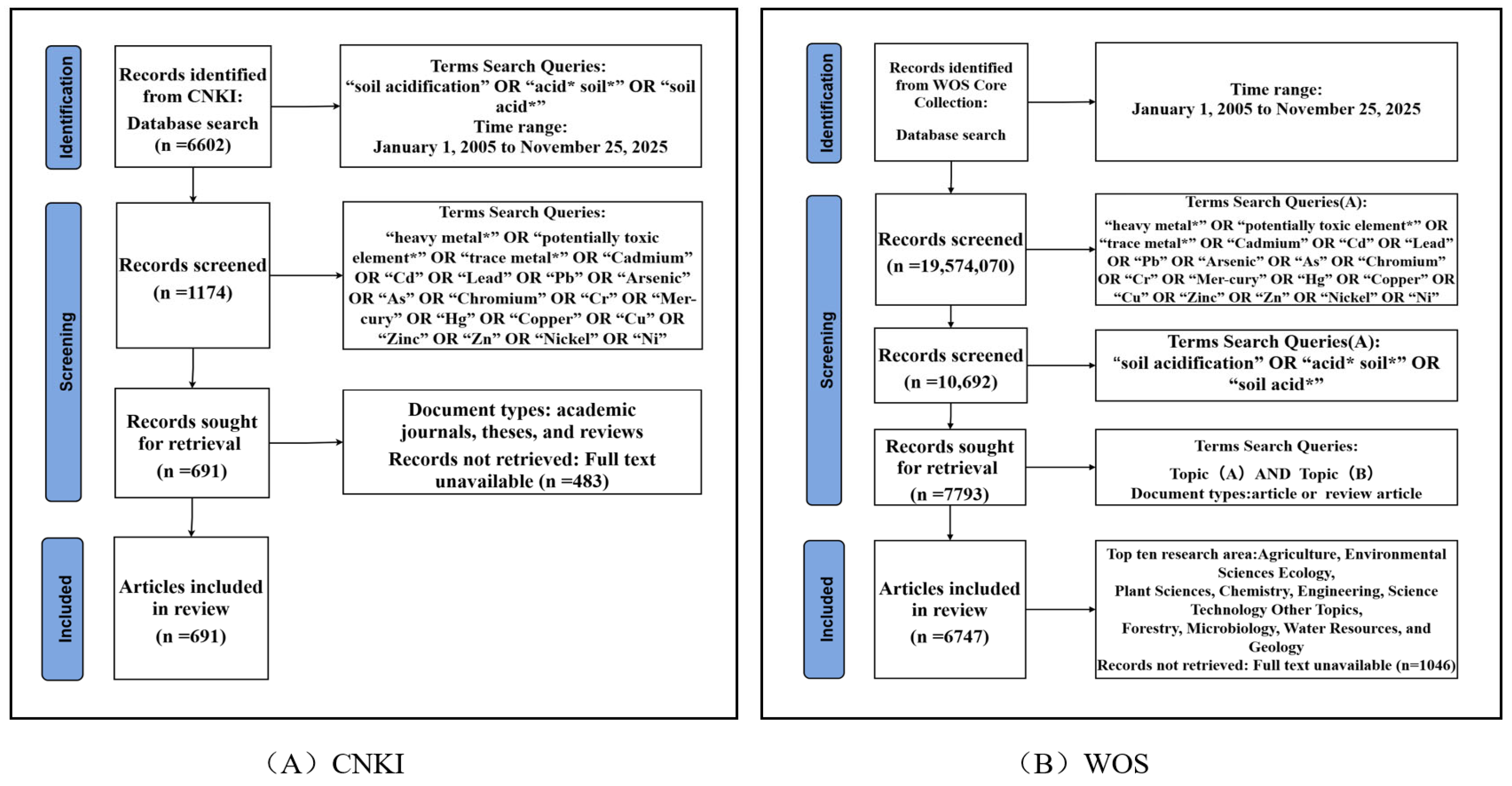
The literature search and screening process for this bibliometric analysis followed the PRISMA 2020 (Supplementary Materials) guidelines [32]. The research protocol for this review was retrospectively registered on the Open Science Framework (OSF) platform (Registration DOI: 10.17605/OSF.IO/SPD2A). The Chinese literature for this study was sourced from the CNKI database, and the English literature was obtained from the Web of Science (WOS) Core Collection database. Searches were conducted from January 1, 2005, to November 25, 2025. The search criteria were (“soil acidification” OR “acid* soil*” OR “soil acid*”) AND (“heavy metal*” OR “potentially toxic element*” OR “trace metal*” OR “Cadmium” OR “Cd” OR “Lead” OR “Pb” OR “Arsenic” OR “As” OR “Chromium” OR “Cr” OR “Mercury” OR “Hg” OR “Copper” OR “Cu” OR “Zinc” OR “Zn” OR “Nickel” OR “Ni”). The literature types included academic journals, theses, and reviews, excluding non-research materials such as notices, newspapers and conference abstracts. A total of 691 records from the CNKI database (exported in Refworks format) and 7793 articles or reviews from the WOS database (exported in plain text) were identified. From the large WOS literature pool, 6747 highly relevant papers that ranked among the top ten research areas were selected as the analysis sample. These areas are Agriculture, Environmental Sciences Ecology, Plant Sciences, Chemistry, Engineering, Science Technology Other Topics, Forestry, Microbiology, Water Resources, and Geology. Each selected research area contains more than 200 papers. Areas with fewer papers and lower relevance, such as zoology, entomology, mycology, and limnology were excluded from the retrieval scope. The detailed flowchart of the literature screening process is shown in Figure 1.

2.2. Methodology

CiteSpace is a visual analysis tool that transforms complex knowledge units, such as authors, institutions, countries, and keywords, into intuitive knowledge maps [33]. These maps reveal the development history, structural relationships, and cutting-edge dynamics of specific fields of research. In this study, we employed CiteSpace (version 6.3.R1) to visualize and analyze the Chinese and English literature data. Our analysis included publication trends, countries and institutions, author and co-citation analysis, keyword analysis, and literature and journal co-citation analyses. The goal of this study was to explore the current status and emerging trends in research on soil acidification and heavy metals. The analysis parameters were set as follows: a time span of 2005–2025 with one-year slices, and node selection by the g-index with scale factor k = 5. To improve clarity and interpretability, the merged networks were pruned using the pathfinder algorithm.

3. Results and Analysis

3.1. Trend Analysis of the Volume of Publications

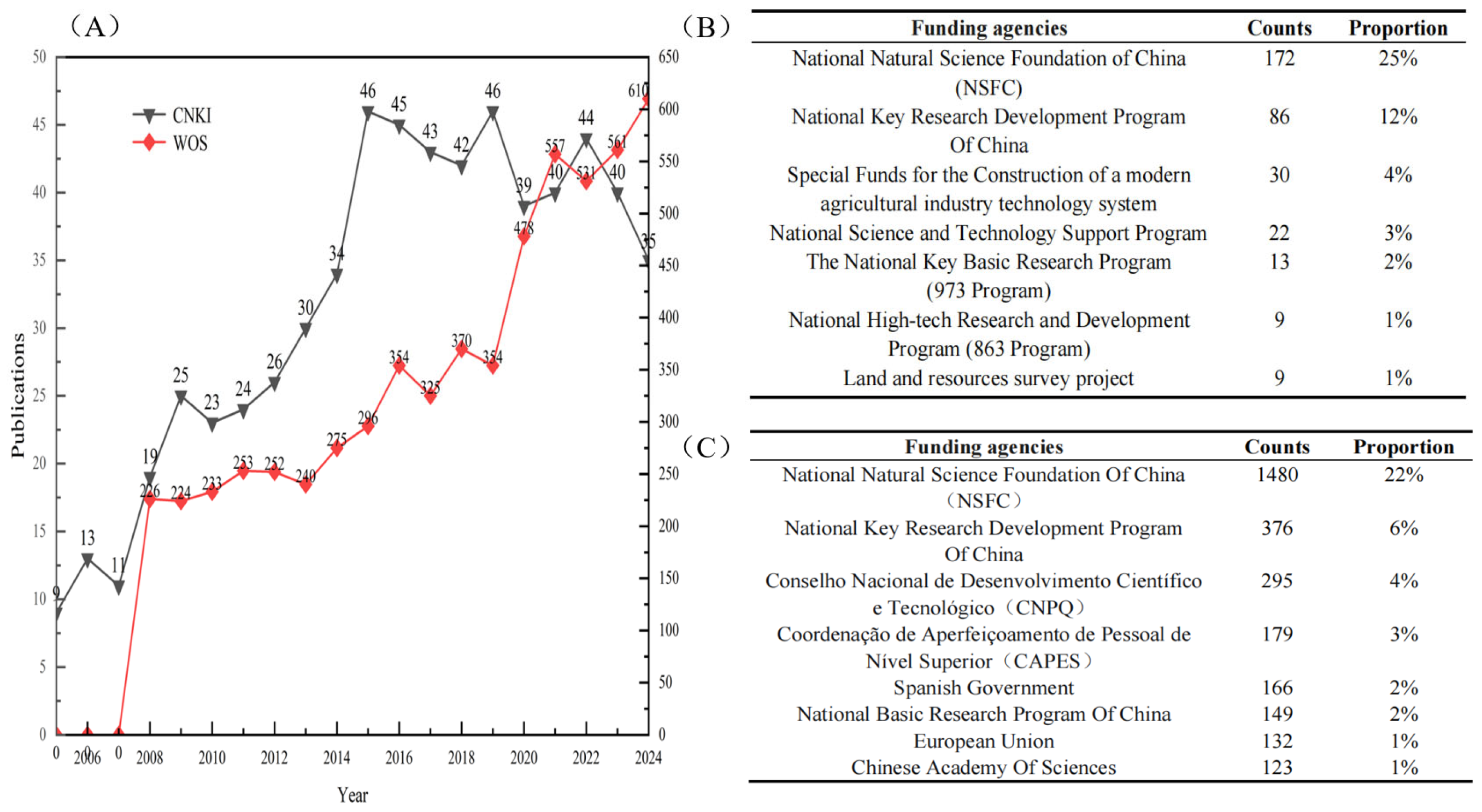
Figure 2A illustrates a transition in publication numbers in the WOS database from consistent growth to sudden acceleration. Between 2008 and 2014, publications increased steadily, ranging annually from approximately 220 to 275, laying a foundation for future research in the field. From 2015 to 2019, the number of publications rose sharply from 296 to 370, reflecting a growing global interest. The period from 2020 to 2024 marked explosive growth, with articles exceeding 400 in 2020 and peaking at 610 in 2024. This surge indicates that research on soil acidification and heavy metals has become a highly active area in environmental and agricultural science worldwide. In contrast, the CNKI database shows a much lower publication count than WOS, with a steady increase from 19 articles in 2008 to approximately 40 articles annually after 2015. Figure 2B,C present the distribution of scientific research funding institutions and underscore the influence of national strategic priorities in this field. The National Natural Science Foundation of China (NSFC) is the dominant funder in both databases, supporting 25% and 22% of projects in the CNKI and WOS databases, respectively. In the CNKI database, the National Key Research Development Program (12%), the National Science and Technology Support Program (3%), and the former 973 and 863 Programs also contribute substantial support. This pattern reflects China’s acute, dual challenge of red soil acidification in the south and heavy metal pollution of farmland. To safeguard national food security, the government channels targeted resources such as the National Key Research Development Program to accelerate the translation of basic research into field applications and to promote adoption of acid-farmland remediation technologies across China.
In the WOS database, funding came not only from Chinese institutions but also from Brazil (CNPQ and CAPES, 7% total), the Spanish government (2%), and the European Union (1%). This distribution mirrors the global geography of acidic soils. More than 60% of Brazil’s soils are affected by acidification and degradation, and Spain has long faced soil degradation and heavy metal accumulation under the Mediterranean climate. The pattern of funders suggests that soil acidification has evolved from a regional concern into a shared global scientific and environmental governance issue.

3.2. Analysis of Disciplinary Categories

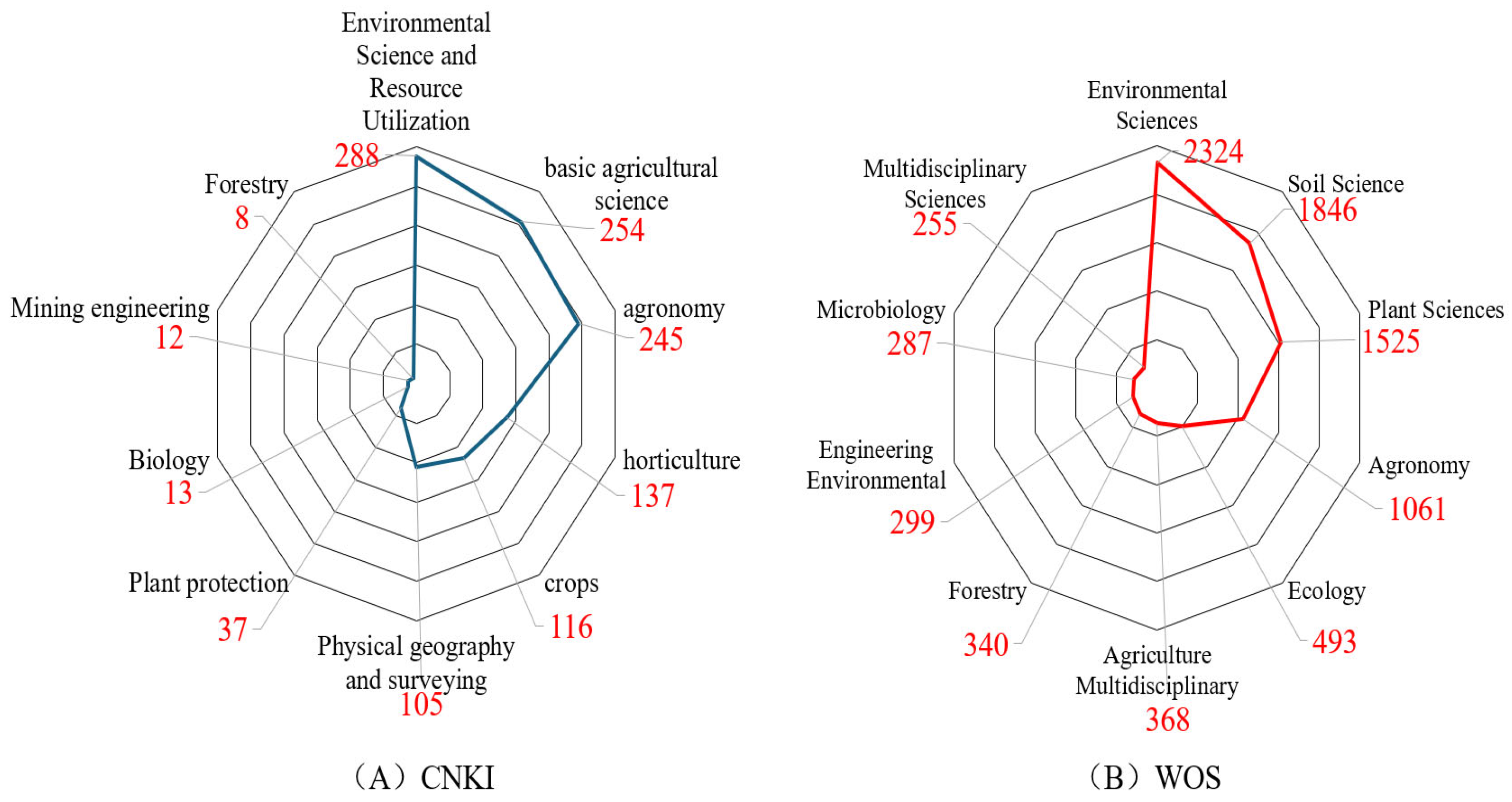
The discipline classification of the CNKI database in Figure 3A is primarily composed of applied disciplines. The leading three core disciplines were environmental science and resource utilization (288 articles), basic agricultural science (254 articles), and agronomy (245 articles). This was followed by horticulture (137 articles) and crops (116 articles). This disciplinary distribution aligns closely with the priority of China’s agricultural policies on food security. Faced with widespread acidification and heavy metal contamination in the acidic red soils of southern China, Chinese researchers have prioritized studies on the growth performance, yield stability, and grain quality compliance for crops such as rice. The principal driver is the urgent need for field-level management to control heavy metal sources while maintaining yields through measures such as liming and agronomic regulation. This emphasis underscores the research’s strong agricultural application. In contrast, Figure 3B shows that the top three disciplines in the WOS database are environmental science (2324 articles), soil science (1846 articles), and plant science (1525 articles). This database covers a wide range of fields, including agronomy (1061 articles), ecology (493 articles), forestry (340 articles), and microbiology (287 articles). This distribution indicates that the international academic community is shifting from single-factor governance toward integrated biogeochemical control. Research emphasis has moved from macroscopic remediation techniques to the analysis of microscopic mechanisms. This increase in interdisciplinarity aims to develop comprehensive solutions for global climate change and heavy metal management and to inform green, sustainable strategies for future carbon neutrality goals.

3.3. Country Analysis

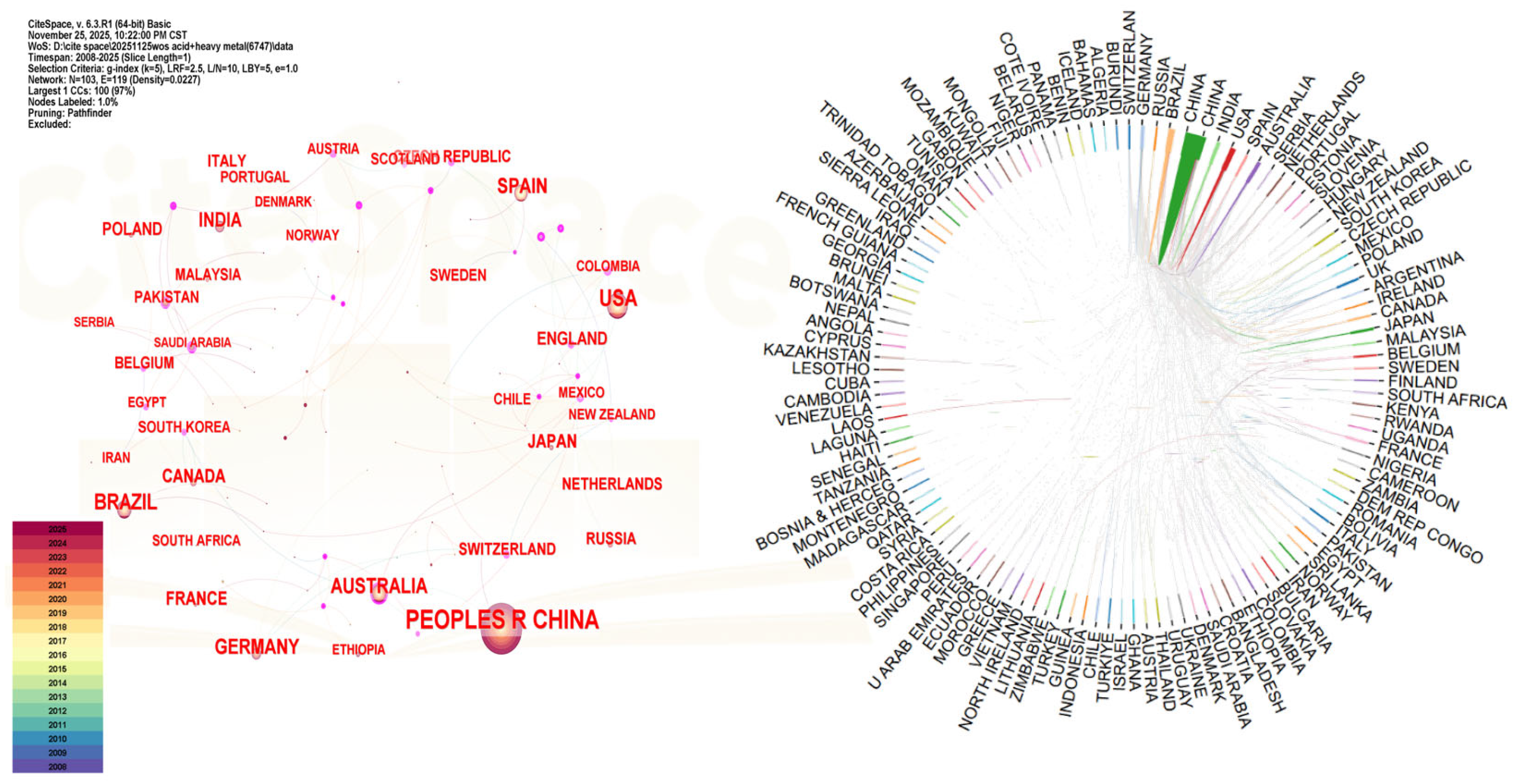
The data in Figure 4 and Table 1 show that China leads globally with 2468 publications, far surpassing the United States (US) with 863 and Brazil with 595. China’s high output in this field reflects both the worsening of soil acidification and heavy metal contamination driven by intensive agriculture and the country’s substantial investment in research on their remediation [34,35]. Brazil and Australia, with 595 and 493 articles, respectively, highlight the role of tropical and subtropical acidic soils in global agro-environmental research.
According to the centrality data in Table 1, China, the United States, and Brazil each had a mediated centrality of 0.04. This suggests that despite their high paper output, these countries may favor internal collaboration. In contrast, Argentina (0.92), Mexico (0.89), and Austria (0.77) exhibit higher mediated centrality, indicating that despite their smaller paper output, they play crucial roles in linking scientific research communities across different regions. A global research collaboration network now spans Asia, North America, South America and Europe. However, major high-output countries still need to enhance their efforts to foster international collaboration and increase academic impact.

3.4. Institution Analysis

3.4.1. Data from CNKI

The data in Table 2 indicates that research in the CNKI database primarily depends on scientific research institutes, colleges, universities, and technical extension institutions. The key institutions include China Agricultural University (10 articles), the National Center for Agricultural Technology Extension Services (8 articles), the Nanjing Soil Research Institute of the Chinese Academy of Sciences (7 articles), and the Technical Expert Group on Soil Testing and Fertilizer Application of the Ministry of Agriculture (7 articles). The Nanjing Soil Research Institute of the Chinese Academy of Sciences and the University of Chinese Academy of Sciences both have a centrality of 0.01, highlighting their crucial roles in the academic cooperation network. From the perspective of institutional distribution, the research framework of the CNKI database emphasizes the exploration of fundamental theories, alongside the innovation of technical methods and their practical applications. It primarily addresses the systematic management of indigenous soil environmental issues.

3.4.2. Data from WOS

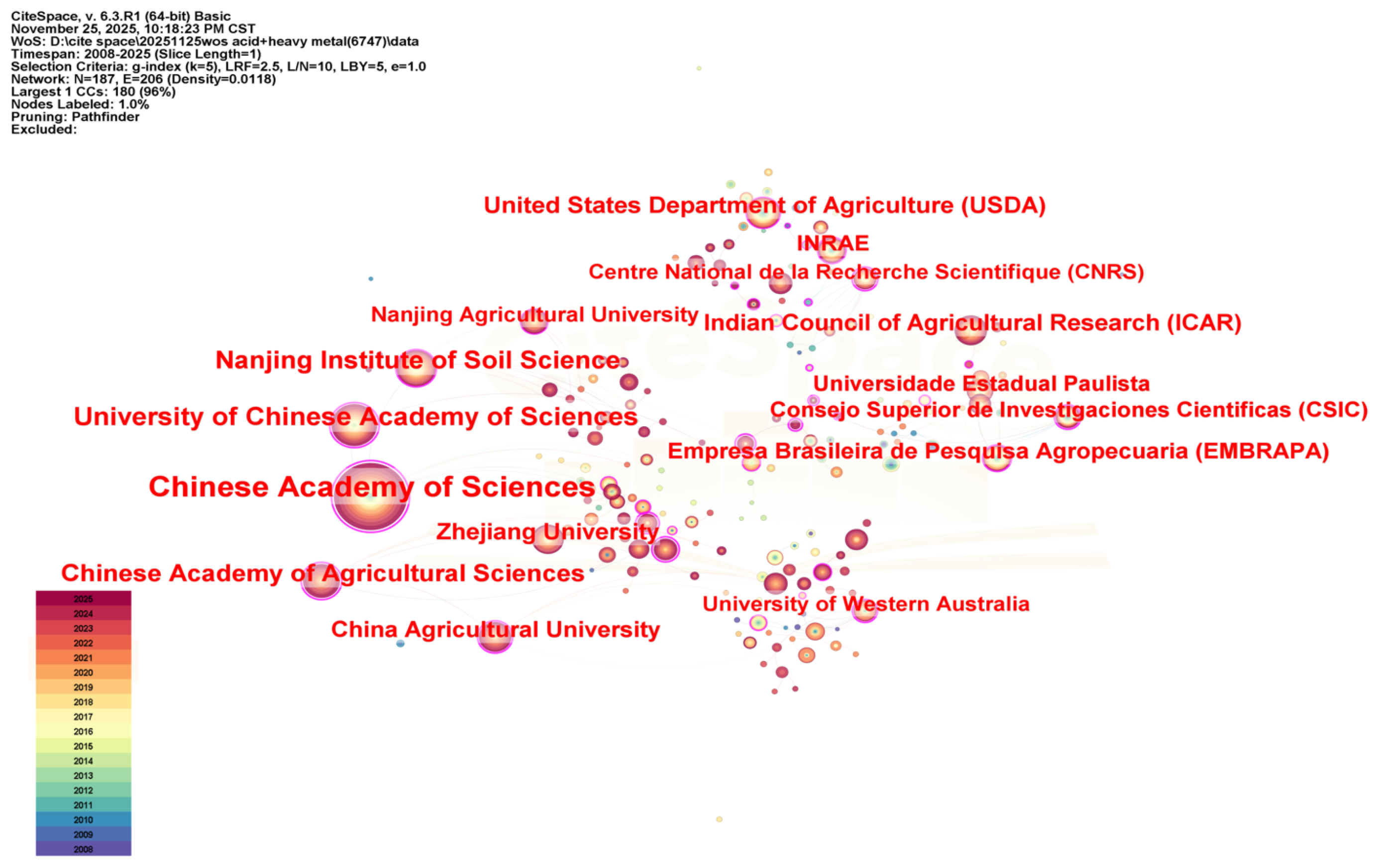
Primary international research institutions comprise national research institutes and higher education institutions, as shown in Figure 5. According to Table 3, the Chinese Academy of Sciences (CAS) has published 696 papers, with a centrality index of 1.21, positioning it at the forefront of this research field globally. The University of Chinese Academy of Sciences (UCAS), with 297 publications and a centrality of 0.93, and the Nanjing Institute of Soil Research (NISR) of CAS, with 259 publications and a centrality of 0.37, collectively form the main support system for knowledge output in this area. The involvement of international research organizations such as the United States Department of Agriculture (USDA, 165 articles), the Indian Council of Agricultural Research (ICAR, 156 articles), the Empresa Brasileira de Pesquisa Agropecuaria (EMBRAPA, 133 articles), and the French National Institute of Agri-Food and Environmental Research (INRAE, 125 articles) highlights the widespread attention that soil acidification and heavy metal contamination management have garnered globally, evolving into a significant strategic issue worldwide [36].

3.5. Author Analysis

3.5.1. Data from CNKI

In the CNKI database, authors with relatively large numbers of published papers are primarily affiliated with universities and research institutions, exhibiting clear institutional clustering and regional association. As shown in Table 4, Zhang Mingkui published 5 articles in 2005, while Dai Yunchao, Li Bin, and Lv Jialong each published 4 articles in 2015, indicating their substantial contributions. More recently, active scholars such as Zhang Mu, Wu Tengfei, and Ding Wuhan have each published 3 articles each in 2025. Their research has focused predominantly on soil improvement, heavy metal passivation, and remediation technologies, highlighting research trends toward practical technology applications. Ensuring food security, while balancing soil acidification control, heavy metal passivation, and greenhouse gas mitigation exemplifies China’s approach to resolving the tension between intensive agriculture and environmental carrying capacity, and it offers valuable technical guidance and case studies for the sustainable use of acidic croplands worldwide.

3.5.2. Data from WOS

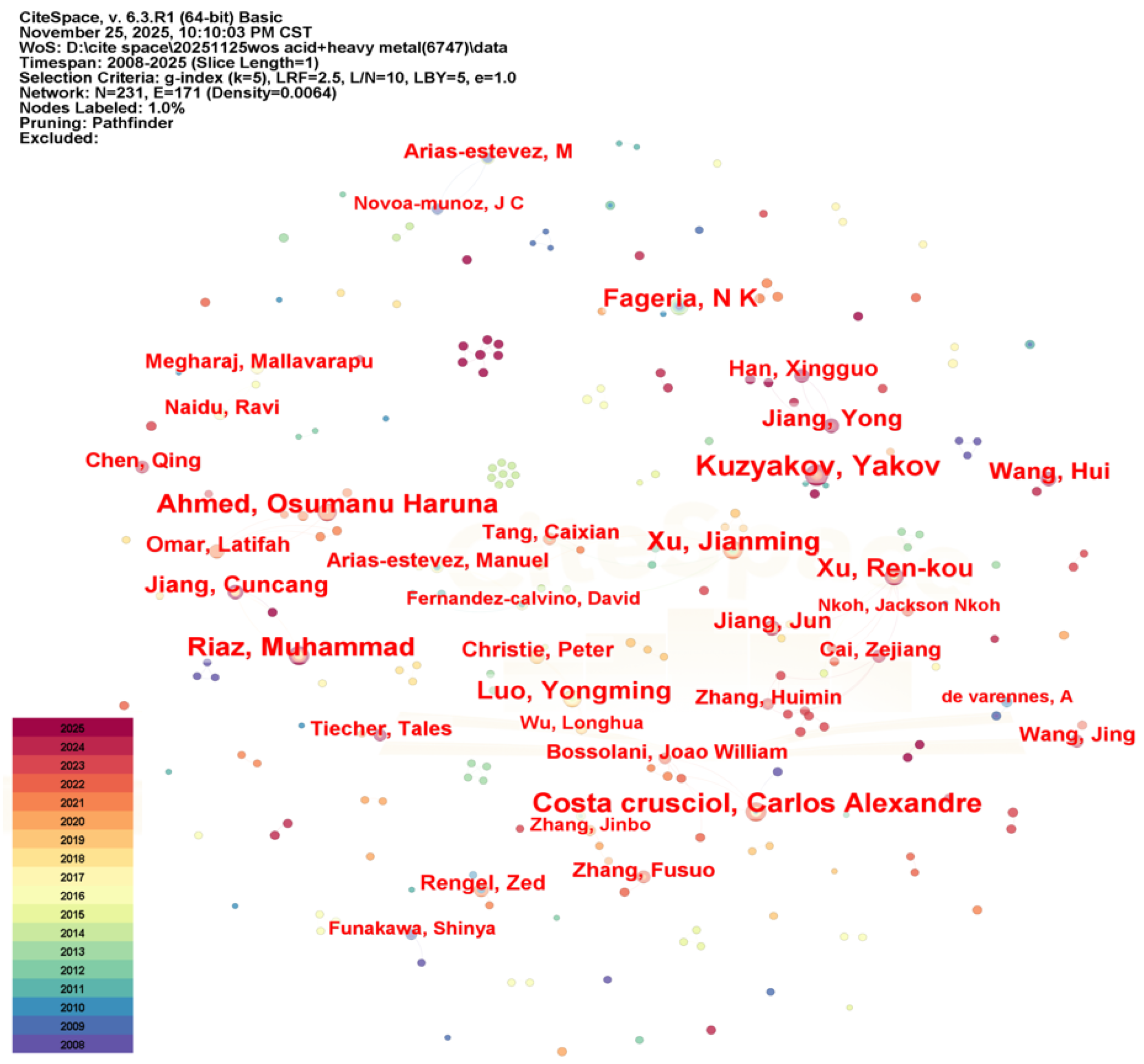
Figure 6 illustrates that authors with a high number of international publications hail from several countries. For instance, Kuzjakov and Yakov published 25 articles in 2020, Ahmed and Osumanu Haruna authored 19 articles in 2017, and Riaz and Muhammad contributed 19 articles in 2018. Although Fageria has only 26 articles, he ranks first in terms of average citations per article, with a rate of 12.31, highlighting the high quality of his work. Chinese researchers, such as Xu Jianming (19 articles, 2013), Xu Renkou (17 articles, 2012), and Luo Yongming (16 articles, 2014), are prominent, aligning with the dominance of the Chinese Academy of Sciences (CAS) system in institutional analyses (Table 5), reflecting China’s national strategic scientific and technological strengths in addressing resource and environmental challenges. Xu Renkou is particularly notable for his 66 total articles and 780 citations, which reflect his extensive focus on soil acidification and the remediation of heavy metal pollution. His considerable body of work and its significant impact highlight his prominence in this area of research. This study addresses the acute crisis in the red soil region of southern China, a traditional granary now suffering severe soil degradation and heavy metal contamination above regulatory limits. Substantial state investment in large-scale research to improve cultivated land quality and secure a safe production environment has enabled institutions such as the Chinese Academy of Sciences to produce systematic findings in this area.

3.6. Analysis of Keyword Co-Occurrence

3.6.1. Data from CNKI

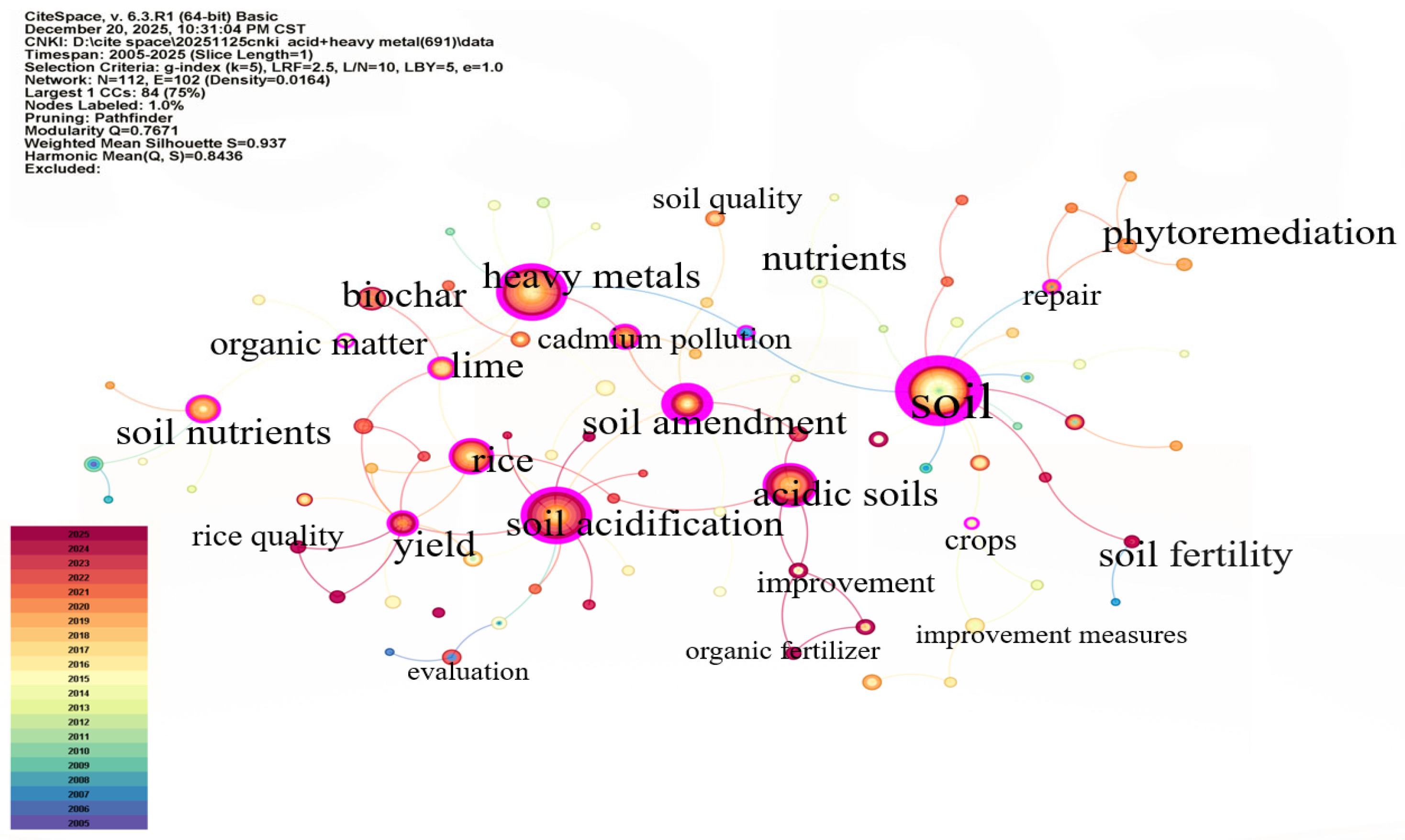
The keyword co-occurrence map in Figure 7 and the keywords in Table 6 reveal that “heavy metals” (frequency 92 times, centrality 0.33) is the core keyword. It is closely linked with terms such as soil pollution, acidic soil, effective state, and soil nutrients, highlighting the field’s focus on the presence of heavy metals in soil, their mobility patterns, and interactions with soil environmental factors. “Soil acidification” (73 times, centrality 0.37) is another significant keyword, associated with heavy metals, soil improvement, and yield, indicating its role as a crucial environmental factor in the migration and toxicity of heavy metals, as well as a research focus for treatment strategies. The keywords “soil” (72 times, centrality 0.64) and “acidic soil” (47 times, centrality 0.11) highlight the primary research subjects. “Soil improvement” (16 times, centrality 0.54) serves as a pivotal link between acidification issues and heavy metal management, suggesting a shift from problem identification to solution development and effective management techniques [37]. “Rice” (25 times, centrality 0.12) reflects the agricultural application focus, aiming to ensure food security. “Yield” (23 times, centrality 0.15) connects rice and cadmium pollution, emphasizing the research goal of mitigating the negative effects of heavy metal pollution on crop growth to achieve safe and high agricultural yields. The mention of “cadmium pollution” (eight times, centrality 0.1) indicates a growing interest in controlling specific hazardous heavy metals such as cadmium [38,39,40]. Additionally, the emergence of “biochar” as a keyword in 2021 suggests that new adsorption materials and remediation technologies, such as biochar, are current research frontiers and hotspots in the field [35,41,42,43].
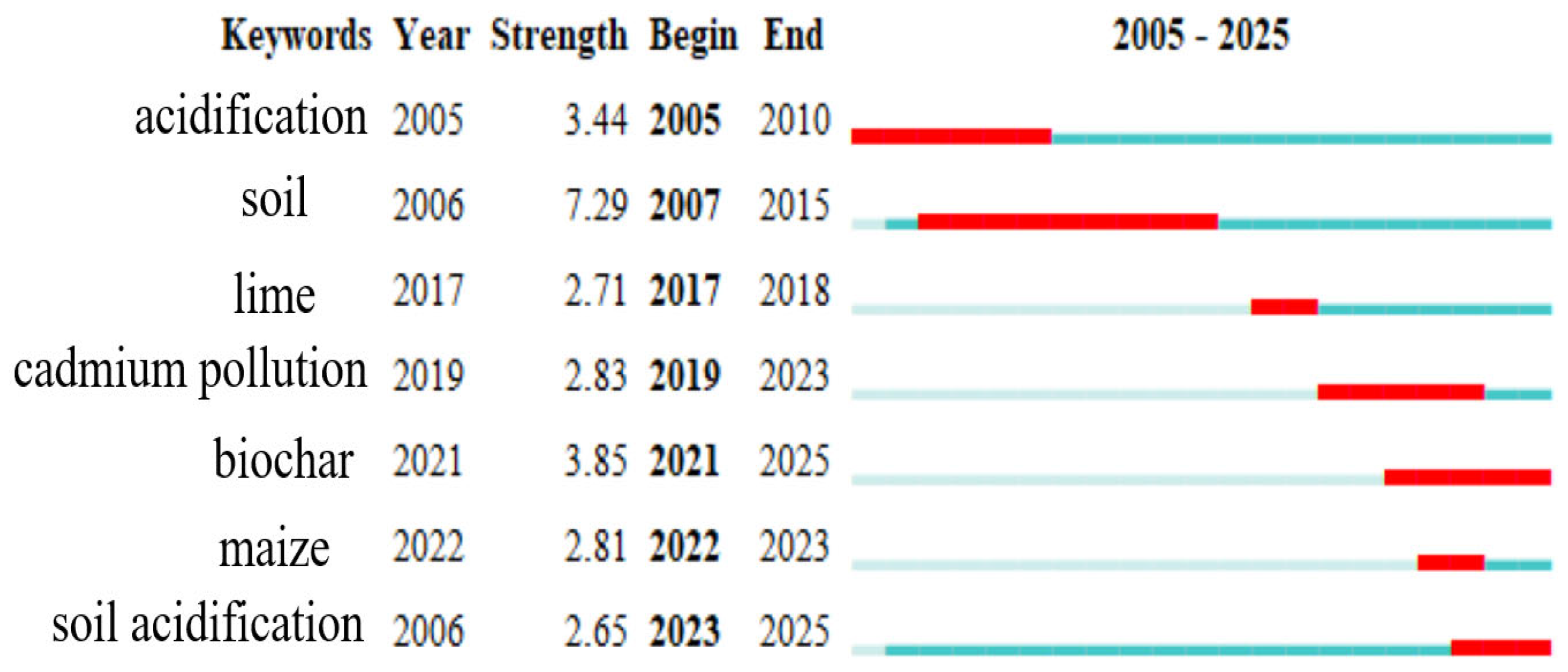
According to the keyword emergence map in Figure 8, “soil” emerged with the highest intensity and persisted for nearly ten years, highlighting its central role in research focused on soil properties, pollution formation processes, and amelioration effects. The emergence of “lime, “ a widely used soil amendment, suggests a shift in research toward remediation and improvement technologies [44]. In 2019, the emergence of “cadmium pollution” indicated a growing focus on specific heavy metal pollutants, likely due to increasing safety concerns over excessive cadmium levels in agricultural products. Moreover, the emergence of “maize” reflects a gradual shift toward studying specific crops, particularly in assessing and managing the impact of cadmium contamination on maize growth to ensure food safety. The strong and ongoing emergence of “biochar” until 2025 suggests that it has become a research hotspot as a novel material for soil improvement and pollution remediation, aligning with China’s dual-carbon goals [45,46].

3.6.2. Data from WOS

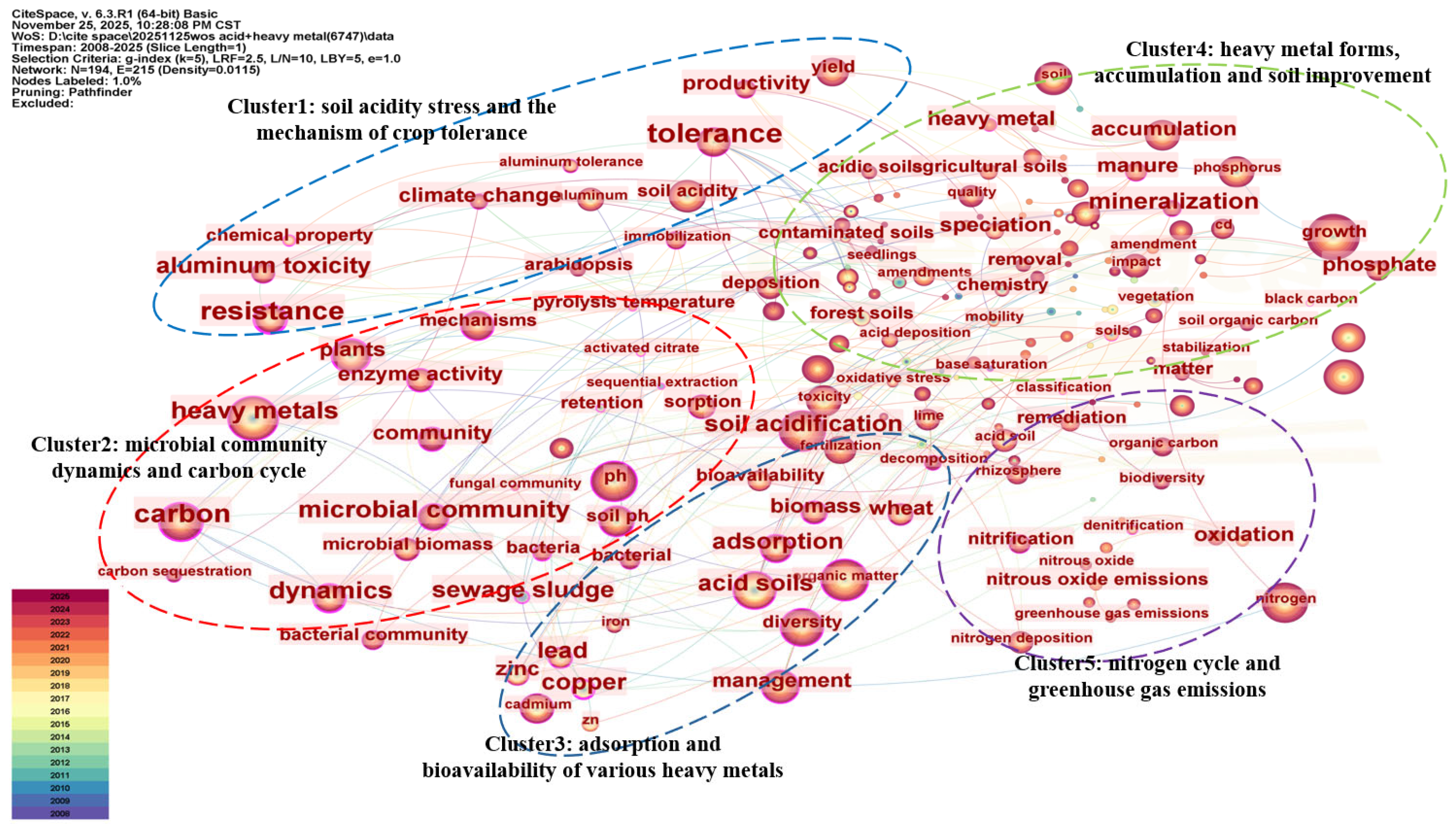
Figure 9 depicts a dense, highly interconnected keyword co-occurrence network, indicating the evolution of a well-established interdisciplinary knowledge system in the fields of soil acidification and heavy metals research. As shown in Table 7, research hotspots were primarily centered on soil acidification (559 occurrences), heavy metals (596 occurrences), nitrogen (588 occurrences), and organic matter (545 occurrences). Notably, the term “growth” appeared 720 times, highlighting the field’s emphasis on the inhibitory effects of acidification and heavy metal pollution on crop and vegetation growth, with a clear agroecological application focus [47].
Figure 9 shows the number of research clusters formed by the connecting lines and nodes. The core keywords of the cluster1 in the upper left include resistance, tolerance, chemical property, and aluminum toxicity. These clusters examine how organisms adapt to stressful environments, focusing on aluminum toxicity, which restricts plant growth in highly acidic soils [48]. Under such conditions, the bioavailability of heavy metals such as Cu, Pb, and Zn increases significantly. This cluster studies how plants and microorganisms resist the combined toxic effects of soil acidification and heavy metal ions through mechanisms such as root secretions and intracellular detoxification [49].
The core keywords of the cluster2 in the lower left of the map are carbon, heavy metals, microbial community, dynamics, and pH. These represent the most active clusters in interdisciplinary research. Soil pH and heavy metal contamination jointly regulate the structure and diversity of microbial communities. This regulation, in turn, affects soil carbon and nitrogen cycling processes, ultimately playing a crucial role in ecosystem services [50,51].
The primary keywords of cluster3 beneath the map are copper, zinc, lead, sewage sludge, adsorption, and management, emphasizing specific pollutants, their origins, and treatment methods. Copper, zinc, and lead are frequently found as heavy metal pollutants in agricultural fields. Copper, which exhibits high centrality in the keyword network, is often linked to mining, sewage discharge, and the use of livestock manure [52]. Adsorption techniques are widely employed in soil remediation to immobilize contaminants, whereas sewage sludge serves as both a source of heavy metals and a material for soil amendment [53,54,55].
The primary keywords of cluster4 located at the top right of the map—mineralization, growth, phosphate, accumulation, and productivity—are intimately linked to agricultural production and nutrient cycling. Soil acidification and heavy metal stress can disrupt the mineralization of phosphorus, nitrogen, and other nutrients, consequently affecting crop growth and yield formation. Additionally, the uptake and accumulation of heavy metals by crops are crucial indicators for assessing the safety of agricultural products [56].
The core keywords of cluster5 located at the bottom right of the map—nitrogen, oxidation, nitrification, and nitrous oxide emissions—primarily pertain to nitrogen biogeochemical processes. The misuse of nitrogen fertilizers is closely associated with soil acidification, emphasizing the need to study nitrogen transformation processes in environments affected by acidification and heavy metals. Nitrous oxide, a significant greenhouse gas, has garnered widespread attention [57,58]. The cluster emphasizes the growing interest in assessing the impact of acidification and heavy metal pollution on greenhouse gas emissions in agricultural settings.
According to Table 7, copper has the highest centrality (0.70). As a trace element and pollutant, the environmental behavior of copper under acidification has become a crucial node linking various research areas, including pollution effects, nutrient cycling, and biotoxicity. In addition to copper, resistance had a centrality of 0.60, connecting toxicity to plant or microbial communities. This underscores the current research emphasis on understanding the adaptive and resistance mechanisms of organisms under the dual stress of heavy metal exposure and acidification. Sewage sludge, with a centrality of 0.54, serves as a significant link between pollution sources and remediation technologies because of its heavy metal content and remediation potential from abundant organic matter. Organic matter can regulate the release of heavy metals through specific adsorption and complexation. Carbon also exhibited high centrality (0.51), highlighting the role of carbon-related substances, such as biochar, in regulating soil pH, immobilizing heavy metals, and affecting organic matter dynamics and microbial activity, thereby connecting multiple research clusters.
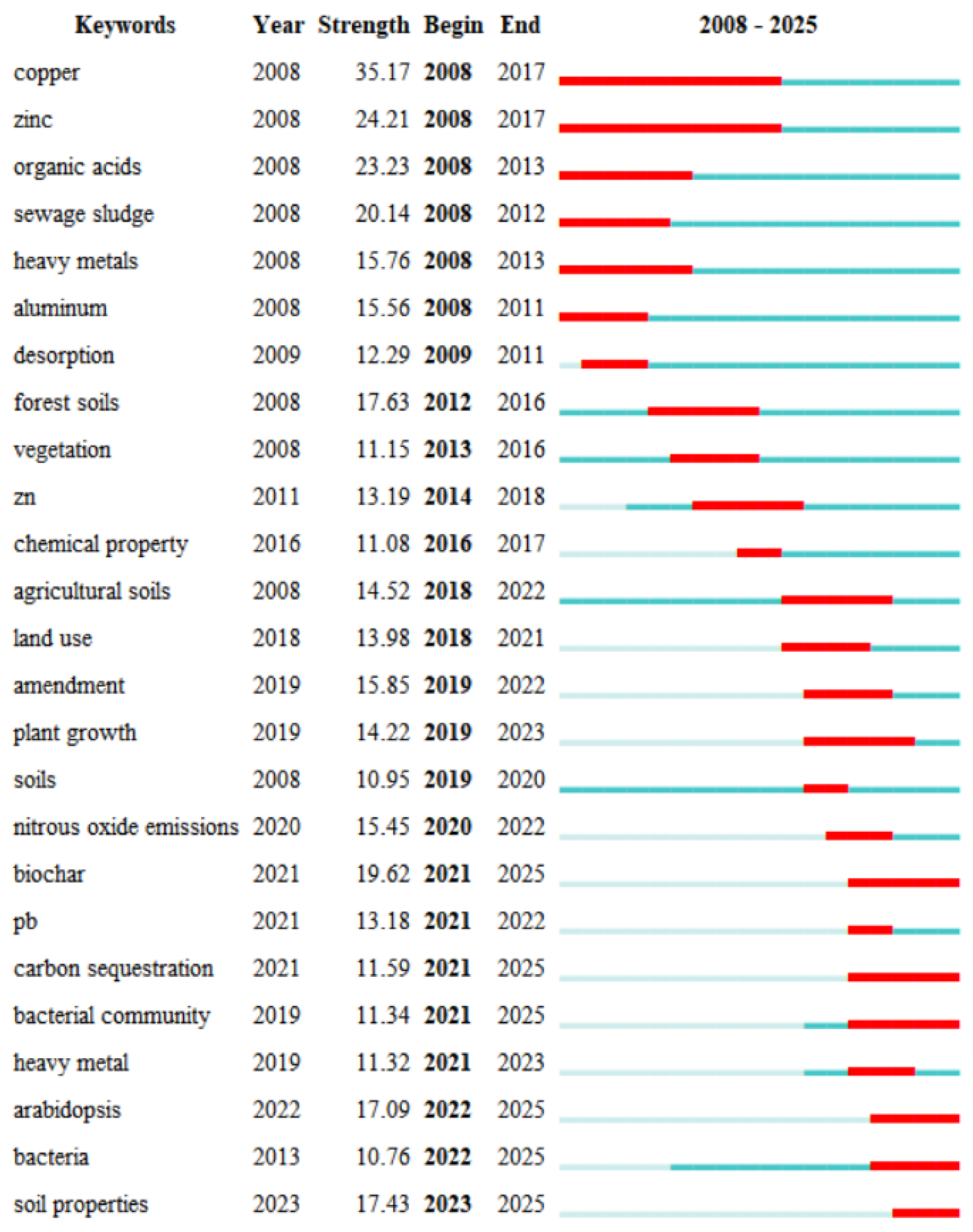
Figure 10 illustrates that from 2008 to 2013, there was a high intensity of keyword occurrences, indicating an increased focus on chemical processes and pollutant species identification during this period. Keywords such as copper, zinc, and organic acids showed the highest emergence intensities, reflecting the early research emphasis on the chemical behavior and mechanisms driving specific core pollutants. Studies have also focused on aluminum, an acidity-related toxicity factor, and common contamination sources such as sewage sludge. The prominence of keywords such as woodland soils, agricultural soils, and land use suggests a research shift towards addressing the actual contamination and remediation of agricultural soils [59]. From 2019 to 2025, the focus shifted to remediation technologies and biological responses, with biochar emerging as a significant soil amelioration tool, gaining high prominence and widespread interest. Keywords such as bacterial communities and Arabidopsis thaliana highlight research into the adaptation and resistance mechanisms of microorganisms in compound stress environments, utilizing them for remediation. Additionally, nitrous oxide emissions and carbon sequestration are emphasized, indicating an expansion of research into soil health and global climate change [60].

3.7. Keyword Cluster Analysis

3.7.1. Data from CNKI

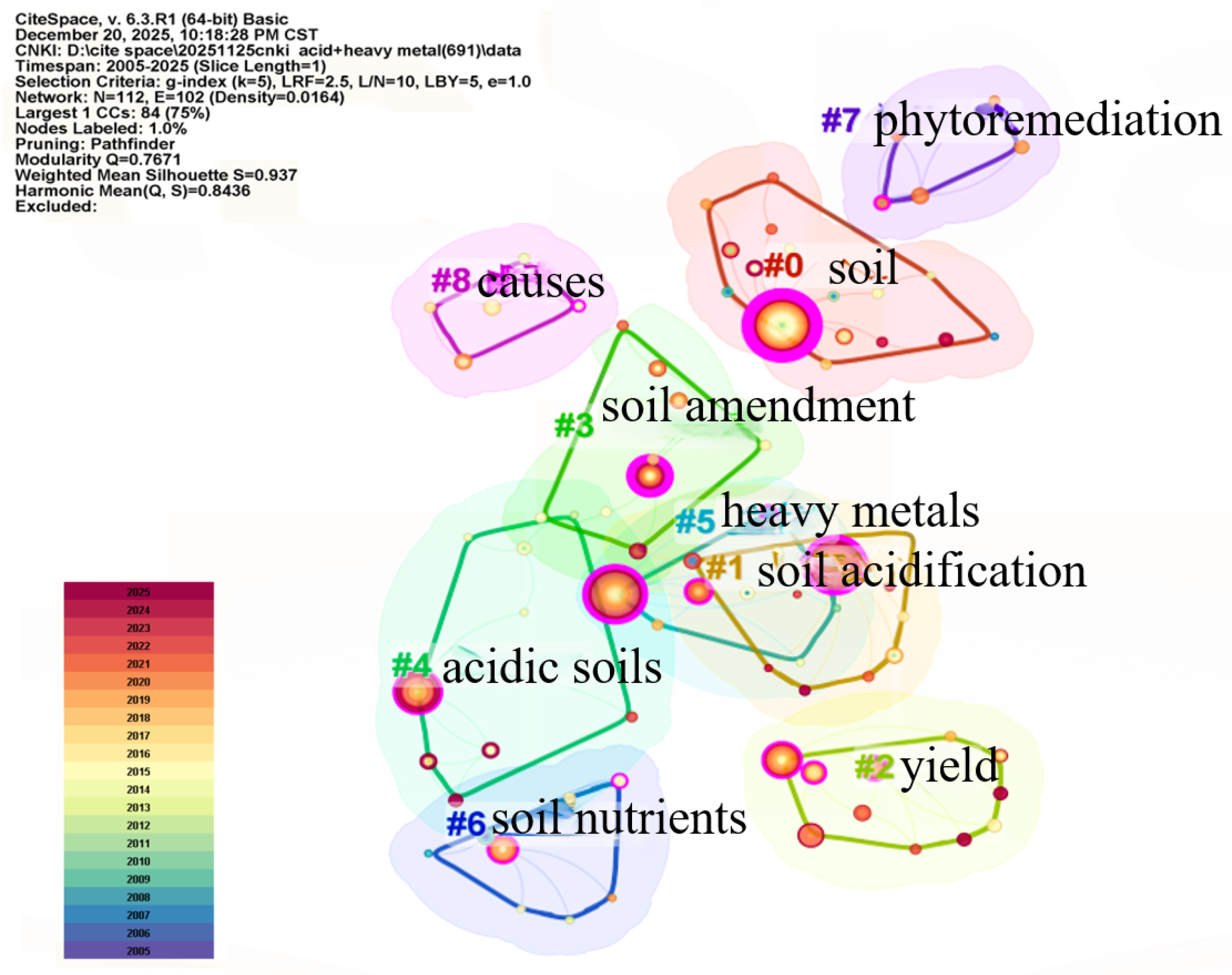
Figure 11 presents a keyword clustering map with a modularity Q value of 0.7671 and an average silhouette value S of 0.937, indicating reliable and structurally stable clustering results. The analysis identified nine distinct clusters, as detailed in Table 8. Cluster #0, labeled “soil,” is the largest and focuses on soil acidification research in Chinese tea plantations. Cluster #1, “soil acidification,” examines how acidification affects the morphology and chemical behavior of heavy metals like copper. Cluster #2, “yield,” addresses the yield and quality of food crops such as rice, along with the application and impact of soil conditioners. Cluster #3, “soil amendment,” emphasizes reducing cadmium content through amelioration techniques and includes environmental risk assessments. Cluster #4, “acidic soils,” investigates nutrient dynamics and losses in acidic environments. Cluster #5, “heavy metals,” explores passivation remediation technology and the dual role of municipal sludge as both a pollution source and an ameliorator. Cluster #6, “soil nutrients,” studies the evolution of soil nutrients and microbial communities under acidification and heavy metal stress. Cluster #7, “phytoremediation,” focuses on green remediation pathways via phytoremediation technology. For example, in rice, radial oxygen loss into the rhizosphere generates an oxidized zone. The consequent formation of an “iron plaque” on the root surface alters local pH and functions as both a physical and chemical barrier. This plaque immobilizes Cd and As by co-precipitation, thereby preventing their entry into the symplast [61,62]. Cluster #8, “causes,” systematically analyzed the causes of soil acidification and pollution, integrating them with amelioration measures and prevention strategies. The keyword clustering results highlighted that research in the CNKI database is heavily oriented toward agricultural applications, systematically aiming to control farmland pollution and ensure food security.
Table 8 shows that clusters #0 soil, #1 soil acidification, #4 acidic soil, and #5 heavy metals form the foundational structure of the network. These core clusters frequently connect with more application-oriented clusters, such as #2 yield, #3 soil amelioration, and #7 phytoremediation. This connectivity suggests that application technologies are deeply intertwined with an understanding of the basic mechanisms and environmental contexts. Cluster #3 soil amelioration and cluster #5 heavy metals are closely connected, emphasizing the importance of passivation remediation in addressing heavy metal pollution during soil improvement activities. Additionally, cluster #2 connects rice cultivation with soil conditioner use, underscoring the significant influence of agricultural production goals on technological advancements. In terms of temporal evolution, research from 2005 to 2013 primarily focused on basic chemical mechanisms and traditional improvement methods. From 2014 to 2018, attention shifted to agricultural product safety and specific cadmium pollution management. In the period from 2019 to 2025, green and efficient remediation technologies, such as biochar and phytoremediation, are being increasingly developed [23,53].

3.7.2. Data from WOS

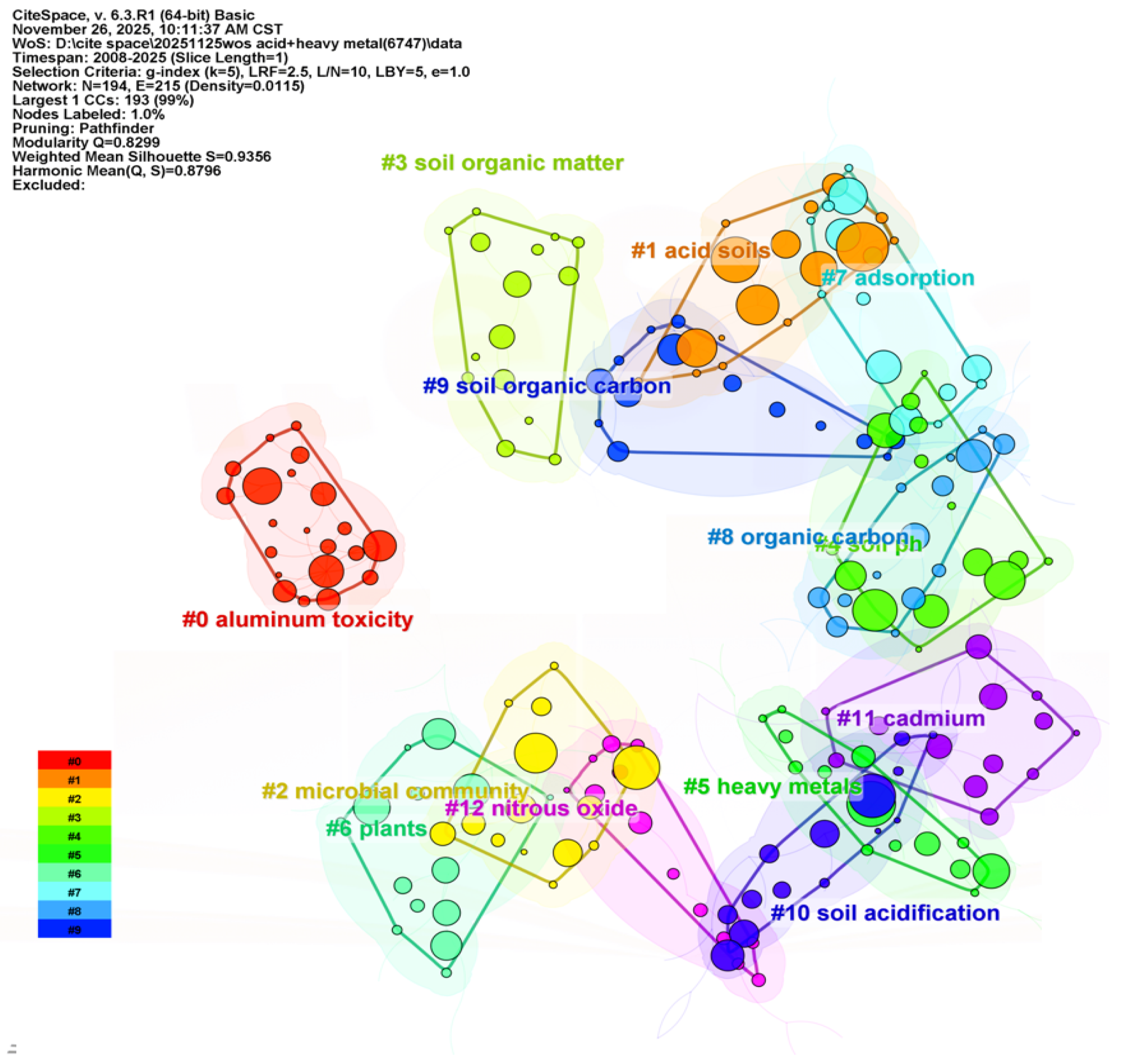
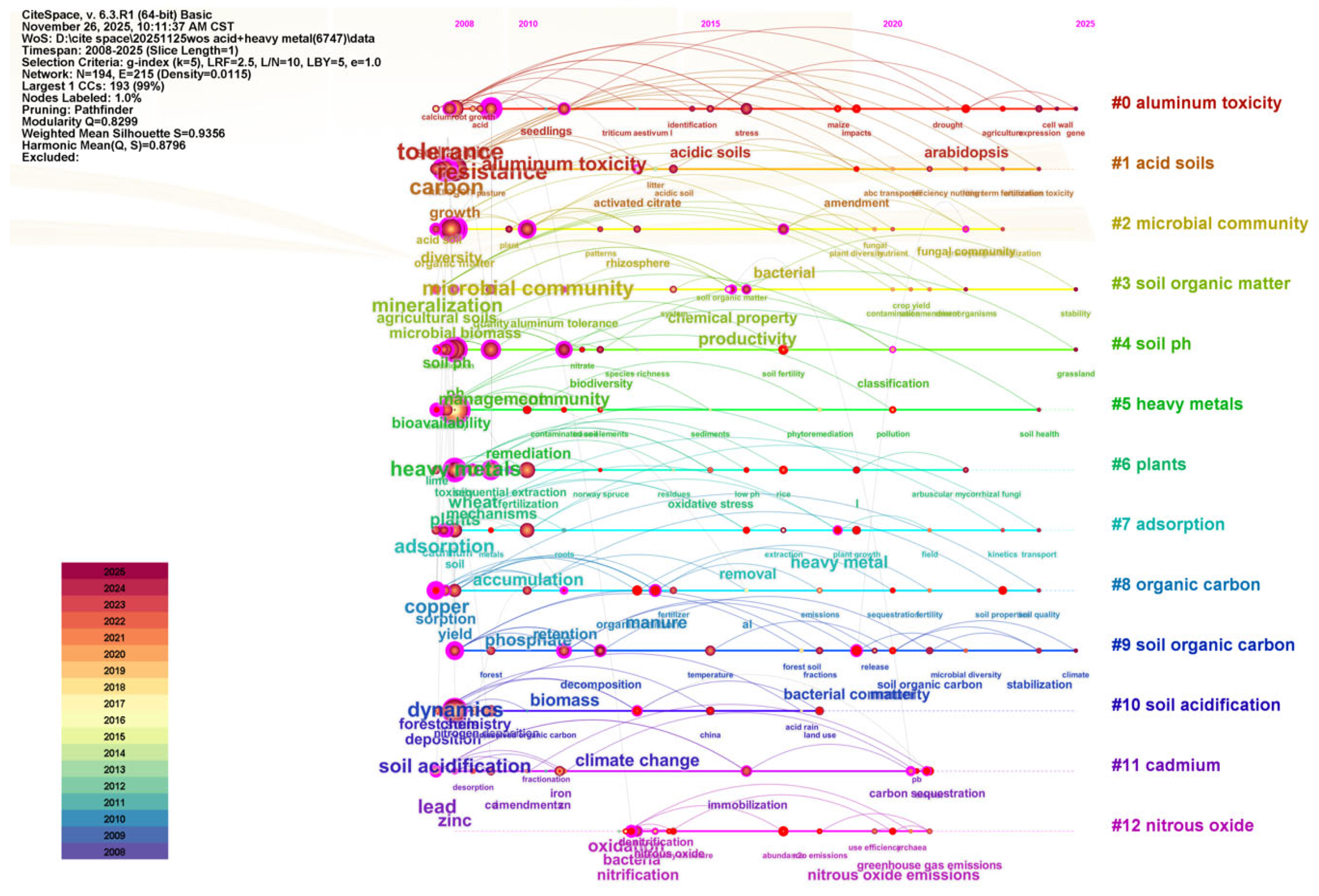
Figure 12 presents the keyword clustering results, showing a modularity Q of 0.8289 and an average contour value S of 0.9356. These metrics indicate a distinct and reliable clustering structure comprising 13 clusters (Table 9). The clustering analysis identified three core research modules in this field. The first module, the basic mechanism and stress response, underpins the field’s research by focusing on the acidification process and its inherent toxicity. This module centers on clusters #0 Aluminum Toxicity, #4 soil pH, and #1 acidic soil, emphasizing acidification drivers, management strategies, and aluminum toxicity as the main stressor mechanism. The second module, contaminants and applied remediation, targets specific contaminant types and sources, along with remediation strategies through immobilization. It is anchored by clusters #5 heavy metals, #11 cadmium, #7 adsorption, #8 organic, and #9 soil organic carbon. This module focuses on the morphological transformation and bioavailability of heavy metal pollutants, particularly cadmium, and highlights municipal sludge as both a pollution source and a soil amendment material. The third module, biological response and climate linkage, represents the field’s expansion into ecology and global environmental cycles. It includes clusters #2 microbial communities, #10 soil acidification, and #12 nitrous oxides. This section highlights the interdisciplinary aspect of the field by investigating the ecological roles and remediation capabilities of microbial communities under combined stress conditions. It also links soil acidification to emissions of greenhouse gases, particularly nitrous oxide emissions, in the context of global climate change. Overall, the keyword clustering mapping demonstrated that research in this field has evolved from focusing on basic acidification toxicity mechanisms to incorporating pollution remediation practices and further extending to the intersecting frontiers of microbial ecology and climate change [50,60,63].
Figure 13 presents a timeline diagram that highlights the research trends from 2008 to 2025. During the initial phase from 2008 to 2013, high-frequency nodes were concentrated in clusters #0 aluminum toxicity and #1 acidic soils. Keywords such as toxicity, tolerance, and adsorption are frequently mentioned, stressing the mechanisms of heavy metal activation and their harmful effects on organisms during soil acidification. In the middle phase from 2014 to 2019, the research emphasis shifted toward technological applications. Keywords such as biochar, immobilization, and amendment became prominent in clusters #9 soil organic carbon and #7 adsorption, indicating a transition from analyzing pollution mechanisms to developing remediation technologies centered on carbon-based materials. Looking ahead to 2020–2025, the research network is expanding into macroecology and climate change. Nodes such as climate change and carbon sequestration in cluster #10, along with the emerging cluster #12 nitrous oxide, suggest efforts to find synergistic approaches between soil acidification management, heavy metal remediation, and GHG emission reduction. Additionally, cluster #2 microbial community has remained active throughout the timeline, with strong links to keywords such as enzyme activity and resistance, underscoring the critical role of microorganisms in environmental monitoring and bioremediation [23].

3.8. Literature Co-Citation Analysis

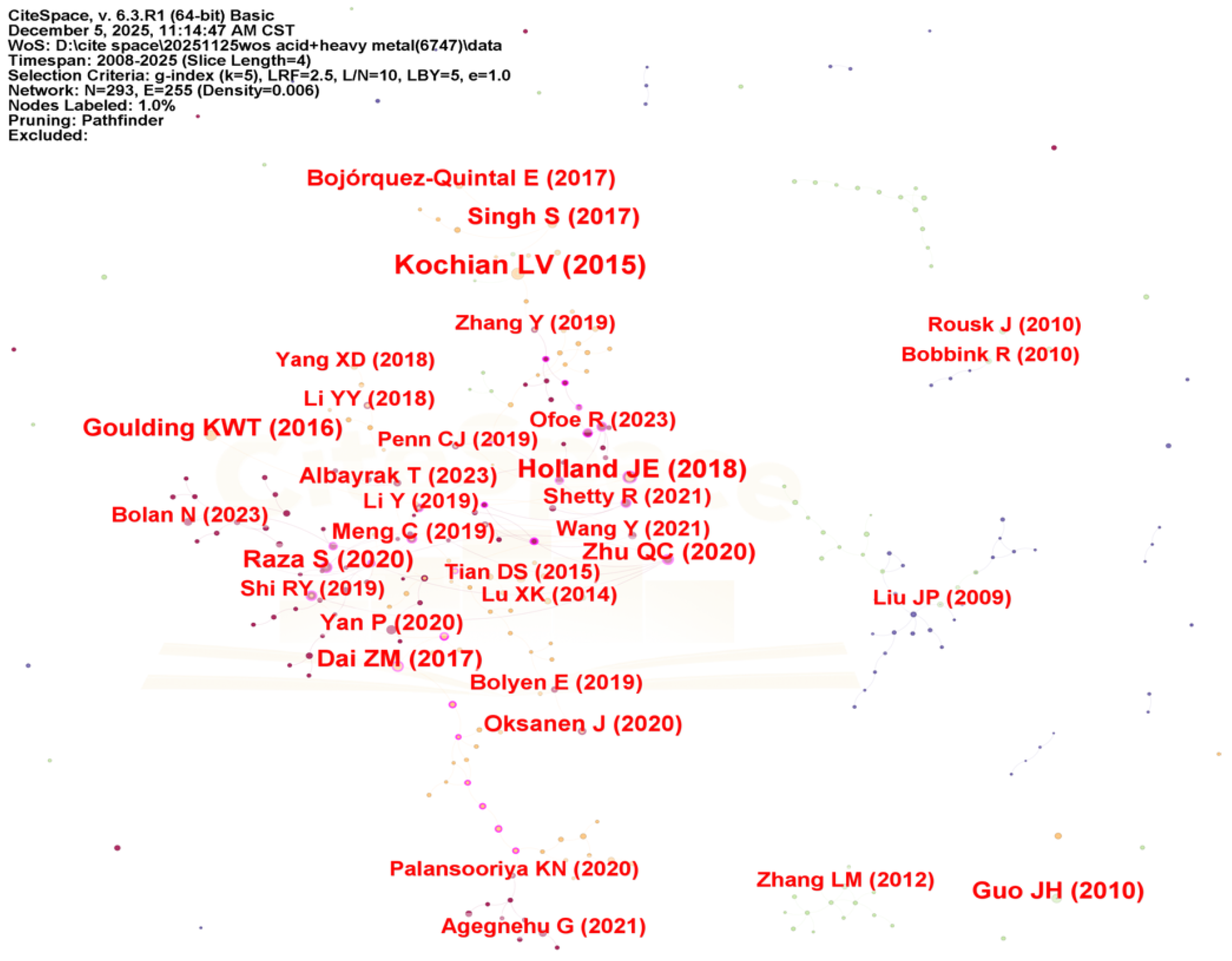
Bibliographic co-citation denotes how often two papers are cited together by the same later documents. Cluster analysis can uncover the principal knowledge bases, identify research frontiers, and reveal their evolutionary contexts within a field [64]. Figure 14 and Table 10 reveal that the most frequently co-cited literature is Kochian LV (2015) [65], with a frequency of 105 and a centrality of 0.08. This review summarizes the diversity of genes and mechanisms related to aluminum resistance, discusses the regulation and functions of gene expression, and explores how molecular and genetic analyses can increase crop growth in acidic soils, forming a theoretical foundation for research in this area. Following this approach, Holland JE (2018) [44], with a frequency of 89 and a centrality of 0.14, examined the impact of lime on neutralizing soil acidity, affecting soil biological communities and processes, and improving crop yield and quality. The research shifts the focus from understanding problematic mechanisms to developing management technologies and establishing a technological strategy to alleviate acidification by controlling soil physicochemical characteristics.
According to Table 10, Zhu QC (2020) [66] exhibited the highest centrality, with a frequency of 54 and a centrality of 0.55. This study evaluated the impact of arable land acidification on food security in China by analyzing the relationship between soil pH changes and crop yields across various soil acidification mitigation scenarios. It also linked “traditional chemical remediation” with “modern ecological risk assessment.” Several publications by Shi RY also show high centrality, primarily focusing on the role of biochar in soil acidification [67,68,69,70]. With respect to the timeline of the cited literature, early studies concentrated on fundamental scientific issues, such as the causes of acidification. Mid-term research has shifted its focus from understanding the mechanism to remediation and management. Recent studies indicate a transition from isolated governance to a systemic and integrated approach, emphasizing global climate change and environmental and ecological considerations.
Table 10. Top ten co-cited studies in terms of counts and centrality in the WOS database.
CountsYearAuthors of Co-Cited LiteratureCo-Cited LiteratureJournals of Co-Cited LiteratureCentralityYearAuthors of Co-Cited LiteratureCo-Cited LiteratureJournals of Co-Cited Literature
1052015Kochian LV[65]Annual Review of Plant Biology0.552020Zhu QC[66]Environmental Pollution
892018Holland JE[44]Science of the Total Environment0.222019Shi RY[67]Soil and Tillage Research
662020Raza S[8]Global Change Biology0.222017Shi RY[70]Journal of Agricultural and Food Chemistry
632016Goulding KWT[71]Soil Use and Management0.212022Hao TX[13]Soil and Tillage Research
592017Dai ZM[72]Science of the Total Environment0.212020Zhao WR[73]Agriculture, Ecosystems & Environment
572010Guo JH[6]Science0.22017Dai ZM[72]Science of the Total Environment
542020Zhu QC[66]Environmental Pollution0.22021Shetty R[74]Science of the Total Environment
522017Singh S[48]Environmental and Experimental Botany0.22019Shi RY[68]Chemosphere
452019Meng C[75]Environmental Research Letters0.22020Shi RY[69]Science of the Total Environment
452020Yan P[76]Science of the Total Environment0.22018Pandit NR[77]Science of the Total Environment

3.9. Analysis of High-Impact Journals

Table 11 shows that Science of The Total Environment leads with 273 articles and 985 citations. Plant and Soil follows with 184 articles and 588 citations, focusing on soil–plant interactions relevant to research areas such as phytoremediation, inter-root processes, and aluminum toxicity tolerance mechanisms. Geoderma, with 181 articles and 747 citations, specializes in soil genesis, classification, and physicochemical processes, which aligns with soil properties research. Although Soil Biology and Biochemistry has only 107 articles, it boasts 651 citations, with an average of 6.08 citations per article, making it particularly relevant for studies on microbial communities, which is a current research hotspot. The Journal of Soils and Sediments has an average of 5.3 citations per article, ranking second only to Soil Biology and Biochemistry, and focuses on soil and sediment systems, aligning with soil chemistry and environmental processes. Additionally, Chemosphere and Environmental Science and Pollution Research emphasize the environmental behavior of chemical substances, making them suitable for analyzing heavy metal morphology, adsorption and desorption mechanisms, and the effects of chemical ameliorators.

4. Discussion

4.1. Differences in Research Paradigms

The bibliometric map reveals a clear shift in the research paradigm. The WOS database focuses on basic mechanisms, emphasizing collaboration and global cooperation [28,42,67,70]. It analyzes soil physicochemical properties, the ecological characteristics of microbial communities, and global environmental evolution from multiple perspectives, revealing a strong, cross-disciplinary approach. The CNKI database follows problem identification, technology development, and field application. This approach probably comes from the need to protect arable land resources and food security, given the challenges of soil acidification and heavy metal pollution caused by intensive agricultural practices [78,79]. Therefore, research has primarily focused on developing soil improvement technologies, exploring crop growth response mechanisms, and testing effects of field applications, mainly focused on agricultural and environmental science. However, this practice-orientated approach also shows a central contradiction: high output with low international influence. Although many studies have generated large data sets on specific remediation materials or local field trials, they are not published in top international journals and their contribution to global environmental governance standards remains limited. This is mainly because a large number of studies have fallen into the empiricism of low-level repetition and lack of research on the common mechanisms of biogeochemical cycles, making it difficult to transform regional research results into globally applicable scientific theories. Future research needs to place local heavy metal pollution control practices within the macro-framework of global climate change and the scientific mechanisms of the earth system.

4.2. Differences in Research Hotspots

The evolution of research hotspots in the CNKI and WOS databases follows a three-stage progression, but the core concerns in each stage differ markedly. From 2005 to early 2013, scholars primarily concentrated on identifying basic characteristics. Research in the CNKI database has emphasized the physicochemical properties of soil and traditional remediation and improvement technologies, whereas the WOS database focused on the chemical behavior mechanisms of pollutants and their ecotoxicological effects. Between 2014 and mid-2018, research in the CNKI database shifted toward specific cadmium pollutants and their impacts on crop safety. In contrast, the WOS database prioritized the ecosystem’s response and feedback processes following the implementation of remediation technologies. From 2019 to 2025, biochar and microbial technologies are expected to become focal points globally. However, research in the CNKI database predominantly focuses on the practical applications in the field, whereas studies in the WOS database prioritize mechanistic analyses and comprehensive investigations of their synergistic effects with climate change. It describes a shift in soil environmental management strategies from single pollution control to multi-objective synergistic remediation strategies. Microbial technology has progressed from simple characterization of community structure to in-depth analysis of functional gene expression.

4.3. Evolution of Repair Technologies

Remediation technologies have progressed from early lime-based methods through a surge of interest in biochar to contemporary studies that integrate complex systems and climate change, reflecting a paradigm shift in soil management from physicochemical neutralization to bio-ecological synergy. Lime amendments can rapidly raise pH and reduce the bioavailability of cationic metals, but neutralization releases substantial CO2 and can alter denitrifying bacterial communities, indirectly affecting N2O emissions [80]. Consequently, lime-based approaches no longer satisfy current dual demands for low carbon and safety.
The limitations of a single governance approach are especially evident in paddy field water management. Continuous long-term flooding lowers redox potential and promotes CdS precipitation; although this decreases Cd availability, it creates favorable conditions for methanogens and thus large CH4 emissions [81]. By contrast, alternate wetting and drying suppresses methanogenesis but accelerates oxidative release of Cd-bound species [82]. Excessive or prolonged lime application can cause soil compaction, reduce porosity, and degrade microbial diversity [83,84].
To address this challenge, researchers have developed functionalized materials and multi-objective regulation strategies. Biochar contains abundant mineral ash; when added to soil, these alkaline components dissolve and neutralize H+ and monomeric Al3+, thereby raising soil pH [42]. Oxygen-containing surface functional groups such as carboxyl, phenolic, and hydroxyl groups form stable inner-sphere complexes with heavy metals. Its high-porosity structure and large specific surface area also promote physical adsorption and retention of metal ions within micropores. For example, iron-modified biochar can enhance Cd fixation via surface complexation, and the introduced ferric iron can act as an alternative electron acceptor to inhibit methanogens, thus coupling heavy metal immobilization with reduced greenhouse gas emissions [85]. Dissolved organic matter (DOM) released during biochar aging can form soluble complexes with heavy metals via abundant carboxyl groups, which may reactivate pollution and increase metal mobility. Conversely, aging can elevate oxygen-containing functional groups and cation exchange capacity on biochar surfaces, thereby enhancing long-term heavy metal immobilization [86]. These opposing processes require a shift in remediation strategies from static material application toward dynamic, biogeochemical collaborative management.

4.4. Evolution of Rhizosphere Microecology and Molecular Mechanisms

Interactions between soil acidity and heavy metal stress are most pronounced at the root–soil interface. At pH values below 4.0, Al3+ phytotoxicity becomes the primary stressor [87]. Al3+ damages root tips and disrupts pectin in cell walls, which can impair overall root uptake and thus reduce total heavy metal acquisition [88]. Acidification also induces deficiencies of essential nutrients such as Fe, Zn, and Mg, prompting plants to upregulate non-specific metal transporters and thereby increase Cd2+ and Pb2+ influx via the symplastic pathway. To mitigate toxicity, plants exude low-molecular-weight organic acids, such as citric acid and malic acid, that form stable, non-toxic complexes with Al3+ and Pb2+. Carbon-rich exudates, including sugars and amino acids, provide the primary energy source for rhizosphere microorganisms [89]. These exudates selectively stimulate the growth of certain bacteria and fungi, which in turn synthesize extracellular polymers. The polymers carry functional groups that immobilize heavy metals and limit their uptake by roots. Exudate-driven microbial activity also modifies rhizosphere redox conditions and thereby alters heavy metal speciation. Together, these observations indicate that future bioremediation strategies should target the underlying molecular mechanisms to enable precise control of the rhizosphere microecosystem [90].

4.5. Limitations

This study has several limitations. The search terms may have missed some relevant literature. For example, Cd, Pb, As, Cu, Zn, Cr, etc., were defined as target pollutants and thus included in the search scope. In contrast, Al, Fe, Mn, etc., were classified as acid-sensitive matrix elements and were not included in the search scope at this time. Future research could fully consider the influence of these elements. The WOS database only includes literature from disciplines ranked in the top ten, introducing a bias in sample representativeness. Due to the limitations of CiteSpace, authors, documents, and journals co-cited in the CNKI database could not be analyzed, resulting in incomplete data analysis. The publication trend may not fully reflect 2025, as data are only available up to November, potentially affecting the assessment of recent hotspot evolution. Furthermore, this study relied solely on the WOS Core Collection and CNKI databases. While these databases are highly representative in environmental and agricultural sciences, excluding other extensive databases such as Scopus and various non-English regional databases may introduce potential bias by omitting relevant regional studies. Future research could integrate multiple databases and use data fusion techniques to create a more comprehensive global knowledge map. In addition, the combined use of the CNKI and WOS databases may produce subtle differences in interpretation because each database varies in coverage and indexing practices. Therefore, the study’s comparison results should not be read as a strict parallel-controlled evaluation; instead, they should be understood as a complementary, comprehensive interpretation that links local remediation practices with global theoretical frontiers.

5. Conclusions

This study systematically analyzes the research status and trends in soil acidification and heavy metal pollution from 2005 to 2025 through bibliometric analysis of the CNKI and WOS databases. The findings indicate that research in this area has transitioned from a phase of stable development to a period of rapid global growth. China leads the world in both the number of publications and institutional influence. Research in the CNKI database primarily addresses local agricultural production challenges and application technologies. In contrast, the WOS database emphasizes basic research and interdisciplinary integration. Despite these differences, both databases reveal a shift from focusing solely on pollution control to embracing collaborative governance.
Overall, remediation in this field is shifting from single physico-chemical neutralization methods, such as traditional lime application, toward integrated biogeochemical control. Future research should expand international collaboration. Mechanistic studies must move beyond relying on bulk pH and instead probe how different acidity forms, such as active acid, exchangeable acid, and potential acid, competitively drive the adsorption–desorption kinetics of heavy metals. Emphasis should be placed on the rhizosphere micro-ecosystem to determine how plants modify heavy metal bioavailability at the soil–plant interface by actively regulating rhizosphere pH, secreting low-molecular-weight organic acids, and coupling acid–base and redox processes. In parallel, the molecular mechanisms by which functional microorganisms mediate valence transformations and speciation of heavy metals require investigation, with particular attention to regulation of plant tolerance-related gene expression under acidic conditions.
To enhance soil carbon sequestration and reduce greenhouse gas emissions when deploying novel soil amendments such as biochar, a full life-cycle risk assessment is required. The assessment should quantify the long-term effects of material aging and the release of DOM on heavy metal reactivation. A comprehensive governance model that integrates pollution prevention and control, carbon sequestration and emission reduction, and restoration assessment has been established to provide scientific support for the safe utilization of acidic soils and to promote the green and sustainable development of agriculture globally.

Supplementary Materials

The following supporting information can be downloaded at: https://www.mdpi.com/article/10.3390/agriculture16080897/s1.

Author Contributions

H.C. directed the writing of the manuscript. L.W. drafted the first draft of the manuscript. J.W., X.Z., and Z.L. also supervised the writing process. T.Z. revised the figures and tables. C.Y. and X.F. were responsible for data collection and article conceptualization, P.X. was responsible for data and figure verification, and K.L. was involved in data organization. All authors have read and agreed to the published version of the manuscript.

Funding

This research was supported and funded by the National Natural Science Foundation of China (Grant No. 42001232) and the Science and Technology Research Project of the Education Department of Jiangxi Province (Grant No. GJJ2200419).

Institutional Review Board Statement

Not applicable.

Data Availability Statement

The original contributions presented in this study are included in the article. Further inquiries can be directed to the corresponding author.

Conflicts of Interest

The authors declare no conflicts of interest.

References

  1. Zhao, F.-J.; Ma, Y.; Zhu, Y.-G.; Tang, Z.; McGrath, S.P. Soil Contamination in China: Current Status and Mitigation Strategies. Environ. Sci. Technol. 2015, 49, 750–759. [Google Scholar] [CrossRef]
  2. Ma, H.; Zhao, M.; Yang, N.; Feng, L.; Wang, L.; Jiang, C.; Jiang, M.; Guo, J.; Li, T. Regulated the Electrokinetic Application of Different Plant Growth Stages and Parameters Enhance the Economic Extraction of Soil Heavy Metals. Front. Plant Sci. 2025, 16, 1557261. [Google Scholar] [CrossRef]
  3. Zhang, R.; Zhao, X.; He, Y.; He, Y.; Ma, L. Extraction Methods Optimization of Available Heavy Metals and the Health Risk Assessment of the Suburb Soil in China. Environ. Monit. Assess. 2023, 195, 1221. [Google Scholar] [CrossRef] [PubMed]
  4. Wu, Y.; Xia, Y.; Mu, L.; Liu, W.; Wang, Q.; Su, T.; Yang, Q.; Milinga, A.; Zhang, Y. Health Risk Assessment of Heavy Metals in Agricultural Soils Based on Multi-Receptor Modeling Combined with Monte Carlo Simulation. Toxics 2024, 12, 643–666. [Google Scholar] [CrossRef] [PubMed]
  5. Zhu, H.; Chen, C.; Xu, C.; Zhu, Q.; Huang, D. Effects of Soil Acidification and Liming on the Phytoavailability of Cadmium in Paddy Soils of Central Subtropical China. Environ. Pollut. 2016, 219, 99–106. [Google Scholar] [CrossRef] [PubMed]
  6. Guo, J.H.; Liu, X.J.; Zhang, Y.; Shen, J.L.; Han, W.X.; Zhang, W.F.; Christie, P.; Goulding, K.W.T.; Vitousek, P.M.; Zhang, F.S. Significant Acidification in Major Chinese Croplands. Science 2010, 327, 1008–1010. [Google Scholar] [CrossRef]
  7. Sun, B.; Luo, Y.; Yang, D.; Yang, J.; Zhao, Y.; Zhang, J. Coordinative Management of Soil Resources and Agricultural Farmland Environment for Food Security and Sustainable Development in China. IJERPH 2023, 20, 3233. [Google Scholar] [CrossRef]
  8. Raza, S.; Miao, N.; Wang, P.; Ju, X.; Chen, Z.; Zhou, J.; Kuzyakov, Y. Dramatic Loss of Inorganic Carbon by Nitrogen-induced Soil Acidification in Chinese Croplands. Glob. Change Biol. 2020, 26, 3738–3751. [Google Scholar] [CrossRef]
  9. Huang, J.; Zhou, K.; Zhang, W.; Liu, J.; Ding, X.; Cai, X.; Mo, J. Sulfur Deposition Still Contributes to Forest Soil Acidification in the Pearl River Delta, South China, despite the Control of Sulfur Dioxide Emission since 2001. Environ. Sci. Pollut. Res. 2019, 26, 12928–12939. [Google Scholar] [CrossRef]
  10. Yu, Q.; Ge, X.; Zheng, H.; Xing, J.; Duan, L.; Lv, D.; Ding, D.; Dong, Z.; Sun, Y.; Maximilian, P.; et al. A Probe into the Acid Deposition Mitigation Path in China over the Last Four Decades and Beyond. Natl. Sci. Rev. 2024, 11, nwae007. [Google Scholar] [CrossRef]
  11. Chen, C.; Xiao, W.; Chen, H.Y.H. Mapping Global Soil Acidification under N Deposition. Glob. Change Biol. 2023, 29, 4652–4661. [Google Scholar] [CrossRef]
  12. Yu, Z.; Chen, H.Y.H.; Searle, E.B.; Sardans, J.; Ciais, P.; Peñuelas, J.; Huang, Z. Whole Soil Acidification and Base Cation Reduction across Subtropical China. Geoderma 2020, 361, 114107. [Google Scholar] [CrossRef]
  13. Hao, T.; Liu, X.; Zhu, Q.; Zeng, M.; Chen, X.; Yang, L.; Shen, J.; Shi, X.; Zhang, F.; De Vries, W. Quantifying Drivers of Soil Acidification in Three Chinese Cropping Systems. Soil Tillage Res. 2022, 215, 105230. [Google Scholar] [CrossRef]
  14. Murtaza, G.; Hassan, N.E.; Usman, M.; Zaman, Q.U.; Rizwan, M.; Deng, G.; Ahmed, Z.; Majeed, A.; Iqbal, J.; Elshikh, M.S.; et al. Combine Effects of Broussonetia Papyrifera-Derived Biochar and Selenium Nanoparticles for Lead-Polluted Saline Soils Remediation during Barley Cultivation. Sci. Rep. 2025, 15, 26837. [Google Scholar] [CrossRef]
  15. Yu, H.; Li, C.; Yan, J.; Ma, Y.; Zhou, X.; Yu, W.; Kan, H.; Meng, Q.; Xie, R.; Dong, P. A Review on Adsorption Characteristics and Influencing Mechanism of Heavy Metals in Farmland Soil. RSC Adv. 2023, 13, 3505–3519. [Google Scholar] [CrossRef] [PubMed]
  16. Apori, S.O.; Giltrap, M.; Dunne, J.; Tian, F. Human Health and Ecological Risk Assessment of Heavy Metals in Topsoil of Different Peatland Use Types. Heliyon 2024, 10, e33624. [Google Scholar] [CrossRef] [PubMed]
  17. Mlangeni, A.T.; Chinthenga, E.; Kapito, N.J.; Namaumbo, S.; Feldmann, J.; Raab, A. Safety of African Grown Rice: Comparative Review of as, Cd, and Pb Contamination in African Rice and Paddy Fields. Heliyon 2023, 9, e18314. [Google Scholar] [CrossRef]
  18. Xu, X.; Lin, W.; Keyhani, N.O.; Liu, S.; Li, L.; Zhang, Y.; Lu, X.; Wei, Q.; Wei, D.; Huang, S.; et al. Properties and Fungal Communities of Different Soils for Growth of the Medicinal Asian Water Plantain, Alisma Orientale, in Fujian, China. J. Fungi 2024, 10, 187–203. [Google Scholar] [CrossRef]
  19. Li, Z.; Xiao, X.; Xu, T.; Chu, S.; Wang, H.; Jiang, K. Removal of Pb(II) and Cd(II) from a Monometallic Contaminated Solution by Modified Biochar-Immobilized Bacterial Microspheres. Molecules 2024, 29, 4757. [Google Scholar] [CrossRef] [PubMed]
  20. Owusu, S.; Hartemink, A.E.; Zhang, Y.; Csorba, Á.; Michéli, E. Exchangeable Acidity and Pedotransfer Functions for the Soils of Ghana. Eur. J. Soil Sci. 2024, 75, e13460. [Google Scholar] [CrossRef]
  21. Zhao, W.; Hu, W.; Zhang, F.; Shi, Y.; Wang, Y.; Zhang, X.; Feng, T.; Hong, Z.; Jiang, J.; Xu, R. Exchangeable Acidity Characteristics of Farmland Black Soil in Northeast China. Geoderma Reg. 2024, 38, e00852. [Google Scholar] [CrossRef]
  22. Liu, Z.; Wang, L.; Yan, M.; Tian, Y.; Ma, B.; Xie, Q. Heavy Metal Synergistic Pollution Risk Assessment in the Soil-Crop System of the Nanyang Basin. Sci. Rep. 2025, 15, 19937. [Google Scholar] [CrossRef]
  23. Firincă, C.; Zamfir, L.-G.; Constantin, M.; Răut, I.; Jecu, M.-L.; Doni, M.; Gurban, A.-M.; Șesan, T.E. Innovative Approaches and Evolving Strategies in Heavy Metal Bioremediation: Current Limitations and Future Opportunities. J. Xenobiot. 2025, 15, 63–104. [Google Scholar] [CrossRef]
  24. Qi, G.; Liu, H.; Dong, H.; Zhang, Y.; Wang, Y.; Wang, H.; Li, X. Greenhouse Gas Emission and Cadmium Contamination in Rice Paddies: Research Progresses in Trade-off Relationships, Influencing Factors and Synergistic Mitigation Measures. Front. Sustain. Food Syst. 2025, 9, 1698002. [Google Scholar] [CrossRef]
  25. Zhang, Y.; Jiang, S.; Wang, H.; Yu, L.; Li, C.; Ding, L.; Shao, G. Interactions of Fe, Mn, Zn, and Cd in Soil–Rice Systems: Implications for Reducing Cd Accumulation in Rice. Toxics 2025, 13, 633–647. [Google Scholar] [CrossRef]
  26. Xie, J.; Liang, F.; Xie, J.; Jiang, G.; Zhang, X.; Zhang, Q. Yield Variation Characteristics of Red Paddy Soil under Long-Term Green Manure Cultivation and Its Influencing Factors. IJERPH 2022, 19, 2812. [Google Scholar] [CrossRef] [PubMed]
  27. Zhang, L.; Zhang, F.; Zhang, K.; Wei, H. Biochar Addition Effects on Rice Yield and Climate Change from Rice in the Rice–Wheat System: A Meta-Analysis. Agriculture 2025, 15, 2537. [Google Scholar] [CrossRef]
  28. Yu, J.; Chen, Z.; Gao, W.; He, S.; Xiao, D.; Fan, W.; Huo, M.; Nugroho, W.A. Global Trends and Prospects in Research on Heavy Metal Pollution at Contaminated Sites. J. Environ. Manag. 2025, 383, 125402. [Google Scholar] [CrossRef] [PubMed]
  29. Mai, X.; Tang, J.; Tang, J.; Zhu, X.; Yang, Z.; Liu, X.; Zhuang, X.; Feng, G.; Tang, L. Research Progress on the Environmental Risk Assessment and Remediation Technologies of Heavy Metal Pollution in Agricultural Soil. J. Environ. Sci. 2025, 149, 1–20. [Google Scholar] [CrossRef] [PubMed]
  30. Han, R.; Zhou, B.; Huang, Y.; Lu, X.; Li, S.; Li, N. Bibliometric Overview of Research Trends on Heavy Metal Health Risks and Impacts in 1989–2018. J. Clean. Prod. 2020, 276, 123249. [Google Scholar] [CrossRef]
  31. Shi, D.; Xie, C.; Wang, J.; Xiong, L. Changes in the Structures and Directions of Heavy Metal-Contaminated Soil Remediation Research from 1999 to 2020: A Bibliometric & Scientometric Study. Int. J. Environ. Res. Public Health 2021, 18, 7358. [Google Scholar] [CrossRef]
  32. Page, M.J.; McKenzie, J.E.; Bossuyt, P.M.; Boutron, I.; Hoffmann, T.C.; Mulrow, C.D.; Shamseer, L.; Tetzlaff, J.M.; Akl, E.A.; Brennan, S.E.; et al. The PRISMA 2020 Statement: An Updated Guideline for Reporting Systematic Reviews. BMJ 2021, 372, n71. [Google Scholar] [CrossRef] [PubMed]
  33. Chen, C. CiteSpace II: Detecting and Visualizing Emerging Trends and Transient Patterns in Scientific Literature. J. Am. Soc. Inf. Sci. Technol. 2006, 57, 359–377. [Google Scholar] [CrossRef]
  34. Ondrasek, G.; Shepherd, J.; Rathod, S.; Dharavath, R.; Rashid, M.I.; Brtnicky, M.; Shahid, M.S.; Horvatinec, J.; Rengel, Z. Metal Contamination—A Global Environmental Issue: Sources, Implications & Advances in Mitigation. RSC Adv. 2025, 15, 3904–3927. [Google Scholar] [CrossRef]
  35. Xu, L.; Zhao, F.; Peng, J.; Ji, M.; Li, B.L. A Comprehensive Review of the Application and Potential of Straw Biochar in the Remediation of Heavy Metal-Contaminated Soil. Toxics 2025, 13, 69. [Google Scholar] [CrossRef]
  36. Li, Y.; Wang, Z.; Liu, L.; Geng, Y.; Zhang, J. A Combined Model Method Was Used to Identify the Main Influencing Factors of Soil Heavy Metal Pollution Sources in Qian River, China. Sci. Rep. 2025, 15, 14040. [Google Scholar] [CrossRef]
  37. Nie, X.; Huang, X.; Li, M.; Lu, Z.; Ling, X. Advances in Soil Amendments for Remediation of Heavy Metal-Contaminated Soils: Mechanisms, Impact, and Future Prospects. Toxics 2024, 12, 872. [Google Scholar] [CrossRef]
  38. Al-Imran; Islam, M.A.; Biswas, S.; Shorna, M.N.A.; Islam, S.; Biswas, J.; Uddin, M.S.; Akhtar-E-Ekram, M.; Zaman, S.; Saleh, M.A. Enhancing Cadmium Stress Resilience in Rice Seedlings via Bacillus Pseudomycoides: Modulation of Heavy Metal Transporters and Physiological Responses for Sustainable Agriculture. Environ. Sci. Pollut. Res. 2025, 32, 15896–15914. [Google Scholar] [CrossRef] [PubMed]
  39. Zhang, J.; Li, P.; Li, S.; Lyu, Z. Assessment of Environmental Impacts of Heavy Metal Pollution in Rice in Nanning, China. Sci. Rep. 2025, 15, 3027. [Google Scholar] [CrossRef] [PubMed]
  40. Xu, C.; Chen, X.; Tao, H.; Gao, B.; Liang, T.; Wang, J.; Fan, Y.; Liao, X. Spatial Heterogeneity and Interacting Drivers of Cadmium Contamination in China’s Soils. J. Hazard. Mater. 2025, 499, 140213. [Google Scholar] [CrossRef] [PubMed]
  41. Yang, T.; Zhang, Z.; Zhu, W.; Meng, L.-Y. Quantitative Analysis of the Current Status and Research Trends of Biochar Research—A Scientific Bibliometric Analysis Based on Global Research Achievements from 2003 to 2023. Environ. Sci. Pollut. Res. 2023, 30, 83071–83092. [Google Scholar] [CrossRef]
  42. Ahmed, A.; Aidi, H. Biochar for Heavy Metal Remediation: Mechanisms, Modifications, and Environmental Applications. Environ. Sci. Pollut. Res. 2025, 32, 20288–20320. [Google Scholar] [CrossRef]
  43. Mu, L.; Zhou, H.; Lu, Z.; Wang, J.; Sun, S.; Li, A.; Zhang, N.; Bao, L. Passivation Effect of Modified Biochar on Cadmium in Mining Contaminated Soil. Sci. Rep. 2025, 15, 30402. [Google Scholar] [CrossRef] [PubMed]
  44. Holland, J.E.; Bennett, A.E.; Newton, A.C.; White, P.J.; McKenzie, B.M.; George, T.S.; Pakeman, R.J.; Bailey, J.S.; Fornara, D.A.; Hayes, R.C. Liming Impacts on Soils, Crops and Biodiversity in the UK: A Review. Sci. Total Environ. 2018, 610–611, 316–332. [Google Scholar] [CrossRef] [PubMed]
  45. Tao, J.; Chen, D.; Wu, S.; Zhang, Q.; Xiao, W.; Zhao, S.; Ye, X.; Chu, T. The Comprehensive Effects of Biochar Amendments on Soil Organic Carbon Accumulation, Soil Acidification Amelioration and Heavy Metal Availability in the Soil–Rice System. Agronomy 2024, 14, 2498. [Google Scholar] [CrossRef]
  46. Xiong, Z.; Wang, Y.; He, L.; Sheng, Q.; Sheng, X. Combined Biochar and Wheat-Derived Endophytic Bacteria Reduces Cadmium Uptake in Wheat Grains in a Metal-Polluted Soil. J. Environ. Sci. 2025, 147, 165–178. [Google Scholar] [CrossRef] [PubMed]
  47. Uniyal, N.; Dhami, B.; Petwal, H.; Sharma, A. Adverse Impacts of Heavy Metal Pollution on Soil and Plant Growth in Agriculture. Emergent LIFE Sci. Res. 2024, 10, 103–115. [Google Scholar] [CrossRef]
  48. Singh, S.; Tripathi, D.K.; Singh, S.; Sharma, S.; Dubey, N.K.; Chauhan, D.K.; Vaculík, M. Toxicity of Aluminium on Various Levels of Plant Cells and Organism: A Review. Environ. Exp. Bot. 2017, 137, 177–193. [Google Scholar] [CrossRef]
  49. Zhang, F.; Peng, R.; Xie, Y.; Xie, Y.; Liu, S.; Jiang, H.; Bai, L. Cultivar-Specific Response of a Root-Associated Microbiome Assembly of Rice to Cadmium Pollution. Plant Physiol. Biochem. 2025, 227, 110128. [Google Scholar] [CrossRef]
  50. Wang, Z.; Deng, G.; Hu, C.; Hou, X.; Zhang, X.; Fan, Z.; Zhao, Y.; Peng, M. Microbial Diversity and Community Assembly in Heavy Metal-Contaminated Soils: Insights from Selenium-Impacted Mining Areas. Front. Microbiol. 2025, 16, 1561678. [Google Scholar] [CrossRef]
  51. Ji, H.; Zhang, J.; Zhao, Y.; Huang, H.; Ma, Y.; Liang, D.; Chen, F.; Huo, H.; Wang, S.; Xie, T. Heavy Metal Pollution Migration and Its Ecological Impact on Microbial Communities in the Karst Region of Guangxi. Sci. Rep. 2025, 15, 14750. [Google Scholar] [CrossRef]
  52. Mohamed, H.I.; Ullah, I.; Toor, M.D.; Tanveer, N.A.; Din, M.M.U.; Basit, A.; Sultan, Y.; Muhammad, M.; Rehman, M.U. Heavy Metals Toxicity in Plants: Understanding Mechanisms and Developing Coping Strategies for Remediation: A Review. Bioresour. Bioprocess. 2025, 12, 95. [Google Scholar] [CrossRef] [PubMed]
  53. Nagy, A.; Magyar, T.; Kiss, N.É.; Tamás, J. Composted Sewage Sludge Utilization in Phytostabilization of Heavy Metals Contaminated Soils. Int. J. Phytorem. 2023, 25, 1510–1523. [Google Scholar] [CrossRef] [PubMed]
  54. Ma, P.; Du, Z.; Zhang, Q.; Sadowsky, M.; Rosen, C. Effects of Sewage Sludge Ash as a Recycled Phosphorus Source on the Soil Microbiome. Curr. Opin. Biotechnol. 2025, 92, 103254. [Google Scholar] [CrossRef] [PubMed]
  55. Ewald, A.; Roeder, G.; Spliethoff, H.; Fendt, S. Pulverized Sewage Sludge Combustion with Potassium Chloride Addition—Fate of Phosphorus, Potassium, Sulfur, and Heavy Metals. ACS Omega 2025, 10, 25733–25745. [Google Scholar] [CrossRef] [PubMed]
  56. Rojas-Solis, D.; Rodríguez, Y.M.G.; Larsen, J.; Santoyo, G.; Lindig-Cisneros, R. Growth Promotion of Maize Exposed to Arsenic and Mercury with a Consortia of Rhizosphere Bacteria Isolated from Mining Tailings. Curr. Microbiol. 2025, 82, 438. [Google Scholar] [CrossRef]
  57. Montzka, S.A.; Dlugokencky, E.J.; Butler, J.H. Non-CO2 Greenhouse Gases and Climate Change. Nature 2011, 476, 43–50. [Google Scholar] [CrossRef] [PubMed]
  58. Xu, P.; Gao, M.; Li, Y.; Ye, J.; Su, J.; Li, H. Combined Effects of Acidification and Warming on Soil Denitrification and Microbial Community. Front. Microbiol. 2025, 16, 1572497. [Google Scholar] [CrossRef]
  59. Liu, L.; Li, W.; Song, W.; Guo, M. Remediation Techniques for Heavy Metal-Contaminated Soils: Principles and Applicability. Sci. Total Environ. 2018, 633, 206–219. [Google Scholar] [CrossRef]
  60. Chen, W.; Modi, D.; Picot, A. Soil and Phytomicrobiome for Plant Disease Suppression and Management under Climate Change: A Review. Plants 2023, 12, 2736. [Google Scholar] [CrossRef]
  61. Linam, F.A.; Limmer, M.A.; Seyfferth, A.L. Contrasting Roles of Rice Root Iron Plaque in Retention and Plant Uptake of Silicon, Phosphorus, Arsenic, and Selenium in Diverse Paddy Soils. Plant Soil 2024, 502, 397–415. [Google Scholar] [CrossRef]
  62. Meng, F.-L.; Zhang, X.; Hu, Y.; Sheng, G.-P. New Barrier Role of Iron Plaque: Producing Interfacial Hydroxyl Radicals to Degrade Rhizosphere Pollutants. Environ. Sci. Technol. 2024, 58, 795–804. [Google Scholar] [CrossRef] [PubMed]
  63. Dhanapal, A.R.; Thiruvengadam, M.; Vairavanathan, J.; Venkidasamy, B.; Easwaran, M.; Ghorbanpour, M. Nanotechnology Approaches for the Remediation of Agricultural Polluted Soils. ACS Omega 2024, 9, 13522–13533. [Google Scholar] [CrossRef] [PubMed]
  64. Jia, Z.; Cai, A.; Li, R.; Wang, X.; Liu, Y. Knowledge Map and Hotspot Analysis in Source Appointment of Heavy Metals from 1994 to 2022: A Scientometric Review. Front. Environ. Sci. 2024, 12, 1443633. [Google Scholar] [CrossRef]
  65. Kochian, L.V.; Piñeros, M.A.; Liu, J.; Magalhaes, J.V. Plant Adaptation to Acid Soils: The Molecular Basis for Crop Aluminum Resistance. Annu. Rev. Plant Biol. 2015, 66, 571–598. [Google Scholar] [CrossRef]
  66. Zhu, Q.; Liu, X.; Hao, T.; Zeng, M.; Shen, J.; Zhang, F.; De Vries, W. Cropland Acidification Increases Risk of Yield Losses and Food Insecurity in China. Environ. Pollut. 2020, 256, 113145. [Google Scholar] [CrossRef] [PubMed]
  67. Shi, R.; Liu, Z.; Li, Y.; Jiang, T.; Xu, M.; Li, J.; Xu, R. Mechanisms for Increasing Soil Resistance to Acidification by Long-Term Manure Application. Soil Tillage Res. 2019, 185, 77–84. [Google Scholar] [CrossRef]
  68. Shi, R.; Ni, N.; Nkoh, J.N.; Li, J.; Xu, R.; Qian, W. Beneficial Dual Role of Biochars in Inhibiting Soil Acidification Resulting from Nitrification. Chemosphere 2019, 234, 43–51. [Google Scholar] [CrossRef]
  69. Shi, R.-Y.; Ni, N.; Nkoh, J.N.; Dong, Y.; Zhao, W.-R.; Pan, X.-Y.; Li, J.-Y.; Xu, R.-K.; Qian, W. Biochar Retards al Toxicity to Maize (Zea Mays L.) during Soil Acidification: The Effects and Mechanisms. Sci. Total Environ. 2020, 719, 137448. [Google Scholar] [CrossRef]
  70. Shi, R.; Hong, Z.; Li, J.; Jiang, J.; Baquy, M.A.-A.; Xu, R.; Qian, W. Mechanisms for Increasing the pH Buffering Capacity of an Acidic Ultisol by Crop Residue Derived Biochars. J. Agric. Food Chem. 2017, 65, 8111–8119. [Google Scholar] [CrossRef] [PubMed]
  71. Goulding, K.W.T. Soil Acidification and the Importance of Liming Agricultural Soils with Particular Reference to the United Kingdom. Soil Use Manag. 2016, 32, 390–399. [Google Scholar] [CrossRef]
  72. Dai, Z.; Zhang, X.; Tang, C.; Muhammad, N.; Wu, J.; Brookes, P.C.; Xu, J. Potential Role of Biochars in Decreasing Soil Acidification—A Critical Review. Sci. Total Environ. 2017, 581–582, 601–611. [Google Scholar] [CrossRef]
  73. Zhao, W.; Li, J.; Jiang, J.; Lu, H.; Hong, Z.; Qian, W.; Xu, R.; Deng, K.-Y.; Guan, P. The Mechanisms Underlying the Reduction in Aluminum Toxicity and Improvements in the Yield of Sweet Potato (Ipomoea Batatas L.) after Organic and Inorganic Amendment of an Acidic Ultisol. Agric. Ecosyst. Environ. 2020, 288, 106716. [Google Scholar] [CrossRef]
  74. Shetty, R.; Vidya, C.S.-N.; Prakash, N.B.; Lux, A.; Vaculík, M. Aluminum Toxicity in Plants and Its Possible Mitigation in Acid Soils by Biochar: A Review. Sci. Total Environ. 2021, 765, 142744. [Google Scholar] [CrossRef] [PubMed]
  75. Meng, C.; Tian, D.; Zeng, H.; Li, Z.; Yi, C.; Niu, S. Global Soil Acidification Impacts on Belowground Processes. Environ. Res. Lett. 2019, 14, 74003. [Google Scholar] [CrossRef]
  76. Yan, P.; Wu, L.; Wang, D.; Fu, J.; Shen, C.; Li, X.; Zhang, L.; Zhang, L.; Fan, L.; Wenyan, H. Soil Acidification in Chinese Tea Plantations. Sci. Total Environ. 2020, 715, 136963. [Google Scholar] [CrossRef] [PubMed]
  77. Pandit, N.R.; Mulder, J.; Hale, S.E.; Martinsen, V.; Schmidt, H.P.; Cornelissen, G. Biochar Improves Maize Growth by Alleviation of Nutrient Stress in a Moderately Acidic Low-Input Nepalese Soil. Sci. Total Environ. 2018, 625, 1380–1389. [Google Scholar] [CrossRef] [PubMed]
  78. Deng, P.; Hu, X.; Mu, L.; Yu, F.; Luo, L. Application of a Machine Learning-Based Food Risk Framework to Assess the Public Dietary Risk of Cadmium in China. Environ. Pollut. 2025, 384, 126911. [Google Scholar] [CrossRef]
  79. Li, X.; Pan, Y.; Zhu, C.; Tang, L.; Bai, Z.; Liu, Y.; Gu, X.; Gao, Y.; Zhou, Y.; Gao, B. Priority Areas Identification for Arable Soil Pollution Prevention Based on the Accumulative Risk of Heavy Metals. Sci. Total Environ. 2024, 954, 176440. [Google Scholar] [CrossRef]
  80. Xu, C.; Zheng, S.; Huang, D.; Zhang, Q.; Xiao, M.; Fan, J.; Zhu, Q.; Zhu, H. Phytoavailability of Cadmium in Rice Amended with Organic Materials and Lime: Effects of Rhizosphere Chemical Changes and Cadmium Sequestration in Iron Plaque. Ecotoxicol. Environ. Saf. 2023, 265, 115525. [Google Scholar] [CrossRef]
  81. Lu, W.; Huang, C.; Luo, W.; Zhang, Q.; Huang, X.; Jin, Y.; Yao, C.; Li, X.; Zeng, G.; Yang, F.; et al. Phosphogypsum and Cadmium Remediation Agents: A Synergy for Mitigating Cd Contamination and CH4 Emissions in Rice Paddies. Acta Geochim. 2025. [Google Scholar] [CrossRef]
  82. Cai, Y.; Wang, X.; Beesley, L.; Zhang, Z.; Zhi, S.; Ding, Y. Cadmium Uptake Reduction in Paddy Rice with a Combination of Water Management, Soil Application of Calcium Magnesium Phosphate and Foliar Spraying of Si/Se. Environ. Sci. Pollut. Res. 2021, 28, 50378–50387. [Google Scholar] [CrossRef]
  83. Li, Y.; Cui, S.; Chang, S.X.; Zhang, Q. Liming Effects on Soil pH and Crop Yield Depend on Lime Material Type, Application Method and Rate, and Crop Species: A Global Meta-Analysis. J. Soils Sediments 2019, 19, 1393–1406. [Google Scholar] [CrossRef]
  84. Zhang, S.; Zhu, Q.; De Vries, W.; Ros, G.H.; Chen, X.; Muneer, M.A.; Zhang, F.; Wu, L. Effects of Soil Amendments on Soil Acidity and Crop Yields in Acidic Soils: A World-Wide Meta-Analysis. J. Environ. Manag. 2023, 345, 118531. [Google Scholar] [CrossRef] [PubMed]
  85. Peng, X.; Wu, G.; Fu, Q.; Zhu, J.; Fang, L.; Islam, M.S.; Hu, H. Mechanisms of Iron-Modified Biochar in Inhibiting Arsenic and Cadmium Uptake by Rice. Agriculture 2026, 16, 407–422. [Google Scholar] [CrossRef]
  86. Liu, K.; Liang, J.; Zhang, N.; Li, G.; Xue, J.; Zhao, K.; Li, Y.; Yu, F. Global Perspectives for Biochar Application in the Remediation of Heavy Metal-Contaminated Soil: A Bibliometric Analysis over the Past Three Decades. Int. J. Phytoremediation 2023, 25, 1052–1066. [Google Scholar] [CrossRef]
  87. Silva, C.O.; Brito, D.S.; Da Silva, A.A.; Do Rosário Rosa, V.; Santos, M.F.S.; De Souza, G.A.; Azevedo, A.A.; Dal-Bianco, M.; Oliveira, J.A.; Ribeiro, C. Differential Accumulation of Aluminum in Root Tips of Soybean Seedlings. Braz. J. Bot. 2020, 43, 99–107. [Google Scholar] [CrossRef]
  88. Munyaneza, V.; Zhang, W.; Haider, S.; Xu, F.; Wang, C.; Ding, G. Strategies for Alleviating Aluminum Toxicity in Soils and Plants. Plant Soil 2024, 504, 167–190. [Google Scholar] [CrossRef]
  89. Chen, L.; Liu, Y. The Function of Root Exudates in the Root Colonization by Beneficial Soil Rhizobacteria. Biology 2024, 13, 95. [Google Scholar] [CrossRef] [PubMed]
  90. Wang, J.; Li, Y.; Zhou, Y.; Long, J.; Li, Z.; Qiu, C.; Liu, Q.; Lei, M. Environmental Dynamics and Risk: Bibliometric Insights into Soil Heavy Metal Accumulation under Environmental Stressors. BioRes 2025, 20, 6713–6735. [Google Scholar] [CrossRef]
Figure 1. Flowchart of literature screening in the CNKI and WOS databases.
Agriculture 16 00897 g001
Figure 2. (A) The changes in the number of Chinese and English papers published from 2005 to 2024. (B) Funding agencies in the CNKI database. (C) Funding agencies in the WOS database.
Agriculture 16 00897 g002
Figure 3. Diagram of subject categories in the CNKI and WOS databases, showing the top ten disciplines ranked by the volume of received documents.
Agriculture 16 00897 g003
Figure 4. Country map in the WOS database.
Agriculture 16 00897 g004
Figure 5. Institutional map in the WOS database.
Agriculture 16 00897 g005
Figure 6. Author map in the WOS database.
Agriculture 16 00897 g006
Figure 7. Keyword map in the CNKI database.
Agriculture 16 00897 g007
Figure 8. Top 7 keywords with the strongest citation bursts in the CNKI database.
Agriculture 16 00897 g008
Figure 9. Keyword map in the WOS database, showing five clusters.
Agriculture 16 00897 g009
Figure 10. Top 25 keywords with the strongest citation bursts in the WOS database.
Agriculture 16 00897 g010
Figure 11. Keyword clustering map in the CNKI database.
Agriculture 16 00897 g011
Figure 12. Keyword clustering map in the WOS database.
Agriculture 16 00897 g012
Figure 13. Timeline diagram in the WOS database.
Agriculture 16 00897 g013
Figure 14. Co-citation map in the WOS database.
Agriculture 16 00897 g014
Table 1. Top ten countries in terms of counts and centrality in the WOS database.
RankingCountsYearCountriesRankingCentralityYearCountries
124682008CHINA10.922008ARGENTINA
28632008USA20.892010MEXICO
35952008BRAZIL30.772009AUSTRIA
44932008AUSTRALIA40.542025AZERBAIJAN
54212008GERMANY50.532012URUGUAY
63922008SPAIN60.462008CROATIA
73632008INDIA70.442008BELGIUM
82272008FRANCE80.412010COLOMBIA
92192008CANADA90.42008CZECH REPUBLIC
102072008JAPAN100.382018SAUDI ARABIA
Table 2. The top ten institutions in terms of counts and centrality in the CNKI database.
RankingCountsYearInstitutionsCentralityYearInstitutions
1102009College of Resources and Environment, China agricultural university0.012006Nanjing Soil Research Institute, Chinese Academy of Sciences
282014National Center for Agricultural Technology Extension Services0.012015University of Chinese Academy of Sciences
372006Nanjing Soil Research Institute, Chinese Academy of Sciences0.012009College of Resources and Environment, Henan Agricultural University
472011Technical Expert Group on Soil Testing and Fertilizer Application, Ministry of Agriculture0.012009State Key Laboratory of Soil and Agricultural Sustainable Development (Nanjing Soil Research Institute, Chinese Academy of Sciences)
562014Department of Plantation Management, Ministry of Agriculture0.012019College of Environment, Shenyang University
662015University of Chinese Academy of Sciences02009College of Resources and Environment, China agricultural university
752017College of Resources and Environment, Southwest University02014National Center for Agricultural Technology Extension Services
842009College of Resources and Environment, Henan Agricultural University02011Technical Expert Group on Soil Testing and Fertilizer Application, Ministry of Agriculture
942010College of Resources and Environment, Northeast Agricultural University02014Department of Plantation Management, Ministry of Agriculture
1042009State Key Laboratory of Soil and Agricultural Sustainable Development (Nanjing Soil Research Institute, Chinese Academy of Sciences)02017College of Resources and Environment, Southwest University
Table 3. Top ten institutions in terms of counts and centrality in the WOS database.
RankingCountsYearInstitutionsRankingCentralityYearInstitutions
16962008Chinese Academy of Sciences11.212008Chinese Academy of Sciences
22972010University of Chinese Academy of Sciences20.972015Shenyang Institute of Applied Ecology
32592009Nanjing Institute of Soil Science30.932010University of Chinese Academy of Sciences
42212010Chinese Academy of Agricultural Sciences40.932024Hebei University
51652008United States Department of Agriculture (USDA)50.92016Northwest A&F University—China
61592009Zhejiang University60.822010Chinese Academy of Agricultural Sciences
71562010Indian Council of Agricultural Research (ICAR)70.812015Institute of Agricultural Resources & Regional Planning
81432012China Agricultural University80.652012China Agricultural University
91332008Empresa Brasileira de Pesquisa Agropecuaria (EMBRAPA)90.622009Centre National de la Recherche Scientifique (CNRS)
101252008INRAE100.612014Autonomous University of Barcelona
Table 4. Top ten authors in terms of counts in the CNKI database.
RankingCountsYearAuthorsInstitutions
152005Zhang MingkuiZhejiang University
242015Dai YunchaoNorthwest A&F University
342015Li BinSichuan Academy of Chinese Medicine Sciences
442015Lv JialongNorthwest A&F University
532025Zhang MuGuangdong Academy of Agricultural Sciences
632025Wu TengfeiGuangdong Academy of Agricultural Sciences
732025Ding WuhanGuangdong Academy of Agricultural Sciences
832025Yi QiongGuangdong Academy of Agricultural Sciences
932025Zeng KeGuangdong Academy of Agricultural Sciences
1022016Li QingmiaoSichuan Academy of Chinese Medicine Sciences
Table 5. The top ten authors in terms of publication frequency in the WOS database.
RankingCountsYearAuthorsTotal Number of ArticlesTotal Number of CitationsAverage Number of Citations
1252020Kuzyakov, Yakov312277.32
2192017Ahmed, Osumanu Haruna26572.19
3192018Riaz, Muhammad261656.35
4192013Xu, Jianming361955.42
5172012Xu, Ren-kou6678011.82
6162014Luo, Yongming24913.79
7162008Fageria, N K2632012.31
8132017Jiang, Yong24682.83
9132018Jiang, Cuncang221657.5
10112024Han, Xingguo19522.74
Table 6. The top ten keywords ranked by counts and centrality in the CNKI database.
RankingCountsYearKeywordsCentralityYearKeywords
1922007heavy metals0.642006soil
2732006soil acidification0.542015soil improvement
3722006soil0.372006soil acidification
4472011acidic soil0.332007heavy metals
5252009rice0.182016organic matter
6232012yield0.152012yield
7232010soil nutrients0.152007valid state
8162015soil improvement0.132010soil nutrients
992021biochar0.122009rice
1082019cadmium pollution0.112011acidic soil
Table 7. The top ten keywords ranked by counts and centrality in the WOS database.
RankingCcountsYearKeywordsCentralityYearKeywords
17202008growth0.72008copper
25962008heavy metals0.62009resistance
35882008nitrogen0.542008sewage sludge
45592008soil acidification0.512008carbon
55452008organic matter0.452008plants
65282008pH0.412008dynamics
74762008diversity0.372011retention
84672008carbon0.362008enzyme activity
94382008acid soils0.362010sequential extraction
104152008acidification0.352008organic matter
Table 8. Clustering table of 9 keywords in the CNKI database based on LLR algorithm.
ClusterIDSizeSilhouetteYearLabel (LLR)
0170.9922013soil; tea plantations; soil acidification; acidic soil; Yantai
1110.9132015soil acidification; soil; acidic soil; form; copper
2110.9662018yield; rice; Double-cropping rice; rice quality; soil conditioner
3100.8712017soil amendment; ligusticum chuan; cadmium content; buffer solution; environmental risk
490.8752015acidic soil; improvement; nutrients; soil acidification; organic fertilizer
580.9232012heavy metals; passivation repair; urban sludge valid state; cadmium pollution
680.9312012soil nutrients; land use; organic matter; soil microorganisms; trend of change
750.9742017phytoremediation; microorganisms; perennial ryegrass; dandelion; repair
850.9762014causes; improvement measures; prevention; crops; influence
Table 9. Clustering table of 13 keywords in the WOS database based on LLR algorithm.
ClusterIDSizeSilhouetteYearLabel (LLR)
02112015aluminum toxicity; tolerance; organic acids; aluminum; arabidopsis
1160.9432014acid soils; growth; acidic soil; nitrogen; carbon
2150.9412014microbial community; acid soil; diversity; enzyme activity; soil physicochemical properties
3150.8782015soil organic matter; microbial biomass; soil organic c; conventional tillage; agricultural soils
4150.8962011soil pH; soil fertility; soil acidity; soil acidification; vascular plants
5150.9752011heavy metals; sewage sludge; bioavailability; speciation; cadmium
6140.9362012plants; toxicity; al toxicity; aluminum; oxidative stress
71412014adsorption; heavy metal; cadmium; accumulation; modification
8140.8252014organic carbon; sorption; soil properties; spatial variability; phosphorus availability
91412017soil organic carbon; dynamics; bacterial community; impacts; cadmium
101412010soil acidification; nitrogen deposition; forest soils; climate change; critical loads
11130.7732013cadmium; lead; copper; soil acidity; zinc
12130.9562016nitrous oxide; nitrification; ammonia-oxidizing archaea; ammonia oxidizers; ammonia-oxidizing bacteria
Table 11. Top ten influential journals.
JournalsTotal Number of ArticlesTotal Citation CountsAverage Citation Counts
Science of The Total Environment2739853.61
Plant and Soil1845883.2
Geoderma1817474.13
Communications in Soil Science and Plant Analysis1742641.52
Agronomy-Basel1652141.3
Environmental Science and Pollution Research1463152.16
Journal of Soils and Sediments1316945.3
Chemosphere1082942.72
Soil Biology and Biochemistry1076516.08
Applied Soil Ecology1061581.49
Disclaimer/Publisher’s Note: The statements, opinions and data contained in all publications are solely those of the individual author(s) and contributor(s) and not of MDPI and/or the editor(s). MDPI and/or the editor(s) disclaim responsibility for any injury to people or property resulting from any ideas, methods, instructions or products referred to in the content.