Article

Divergent Microbial and Enzymatic Drivers Regulate Particulate and Mineral-Associated Organic Carbon During Alpine Meadow Restoration

1
Xi’an Botanical Garden of Shaanxi Province (Institute of Botany of Shaanxi Province), Xi’an 710061, China
2
College of Urban and Environmental Sciences, Northwest University, Xi’an 710127, China
3
Shaanxi Key Laboratory of Earth Surface System and Environmental Carrying Capacity, Northwest University, Xi’an 710127, China
4
Carbon Neutrality College (Yulin), Northwest University, Xi’an 710127, China
5
Shaanxi Xi’an Urban Ecosystem National Observation and Research Station, National Forestry and Grassland Administration, Xi’an 710127, China
6
State Key Laboratory of Soil Erosion and Dryland Farming on the Loess Plateau, Institute of Soil and Water Conservation, Chinese Academy of Sciences and Ministry of Water Resources, Yangling 712100, China
*
Author to whom correspondence should be addressed.
These authors contributed equally to this work.
Agriculture 2026, 16(8), 898; https://doi.org/10.3390/agriculture16080898
Submission received: 5 February 2026 / Revised: 13 April 2026 / Accepted: 16 April 2026 / Published: 18 April 2026
(This article belongs to the Section Agricultural Soils)

Abstract

Particulate organic carbon (POC) and mineral-associated organic carbon (MAOC) are two operationally defined fractions frequently used in studies related to soil organic carbon (SOC) dynamics. However, the changes and governing mechanisms of these fractions, particularly along a restoration chronosequence, remain poorly understood. Here, we investigated changes in SOC fractions, soil properties, and microbial communities across a restoration chronosequence (1, 5, 7, 13, and 20 years) of alpine meadows using a space-for-time substitution approach on the Qinghai–Tibet Plateau. We quantified the contributions of biotic and abiotic drivers using Spearman correlation analysis, linear regression and random forest analysis. The results revealed a unimodal pattern in SOC, POC, and MAOC contents, peaking at 7, 5, and 7 years, respectively, with no further increase thereafter. Restoration duration strongly shaped microbial community structure and observed species richness, but had no significant effect on Shannon index and Pielou index. Random forest analysis identified soil water content (SWC) and total nitrogen (TN) as the primary predictors of SOC. The microbial community composition dominated the variation in POC while enzyme activity was the key driver of MAOC. Our findings highlight that soil carbon accumulation during alpine meadow restoration is a nonlinear process with a temporal threshold, and POC and MAOC are regulated by distinct biotic and abiotic mechanisms. This study provides a theoretical basis for understanding carbon sequestration mechanisms during alpine meadow restoration and developing sustainable grassland management strategies.

1. Introduction

Grasslands cover approximately 41% of the global land area and store approximately 34% of terrestrial carbon stocks [1], playing a vital role in maintaining the global carbon balance. However, climate change and intensified human activities are increasingly threatening the carbon sink function of grasslands. Restoration strategies, such as grazing exclusion, have been widely implemented to mitigate grassland degradation and enhance carbon sequestration [2,3], especially in alpine meadows. Consequently, the impact of restoration duration on soil carbon stock has become a key research topic. As the dominant form of terrestrial soil carbon, soil organic carbon (SOC) dynamics have global implications, as even minor changes in its stock or turnover can substantially alter atmospheric CO2 concentrations [4]. Nevertheless, the patterns and controls of SOC fractions under grassland restoration remain inconsistent across regions and ecosystem types, highlighting the need for further investigation.
SOC is derived from the decomposition and successive transformation of plant tissue, resulting in fractions with substantial chemical and structural heterogeneity [5]. Particulate organic carbon (POC) and mineral-associated organic carbon (MAOC) have been increasingly distinguished as two contrasting and critical SOC pools, owing to their distinct differences in composition, formation pathways, functions, and carbon storage capacities [6,7]. POC primarily consists of lightweight particles varying in size and decomposition state. It is characterized by relatively short mean residence times (months to years) and high sensitivity to management practices [6,8]. Conversely, MAOC acts as a key long-term carbon reservoir, comprising low- to medium-molecular-weight compounds from plant and microbial sources stabilized on mineral surfaces or within microaggregates [9,10]. MAOC therefore typically exhibits long turnover times (decades to centuries) and dominates stable carbon storage [11]. The contents and ratios of these two fractions (POC/SOC, MAOC/SOC) reflect carbon accumulation, stabilization, and ecosystem functions. As demonstrated in diverse ecosystems [12], restoration commonly increases carbon inputs via enhanced plant biomass and diversity, promoting carbon storage across fractions. Vegetation recovery also modifies soil structure and microbial communities, altering the physical and biological protection of POC and MAOC [13,14]. However, the temporal dynamics of POC and MAOC during restoration remain unclear due to environmental heterogeneity.
Soil microorganisms are key drivers of the terrestrial carbon cycle, mediating both carbon mineralization and stabilization via extracellular decomposition and intracellular metabolism [15]. Microbial diversity, community composition, and metabolic activity regulate decomposition efficiency and carbon stabilization, thereby shaping SOC fractions [16,17]. Microbial communities mediate the accumulation patterns of POC and MAOC by regulating extracellular enzyme production, a process driven by the functional specialization of decomposers. These enzymes, particularly those targeting carbon (C), nitrogen (N), and phosphorus (P) acquisition, catalyze rate-limiting steps in SOC turnover and differentially regulate labile versus stable carbon pools [18]. Fungi, with their extensive hyphal networks and oxidative enzymes (e.g., cellulases, ligninases), efficiently decompose recalcitrant soil carbon, positioning them as primary biotic drivers of POC formation and the soil biogeochemical cycle [19,20]. Bacteria, by contrast, are key decomposers of labile carbon compounds (e.g., simple sugars, organic acids) and constitute a major source of microbial residues for MAOC [21,22]. Empirical studies have reported both positive and negative links between microbial diversity and MAOC [7,23]. Furthermore, microbial carbon use efficiency (CUE), a key predictor of SOC storage, is coupled with MAOC but decoupled with POC and SOC [22]. It is well established that microbial communities undergo progressive changes driven by vegetation and soil environment succession during restoration [24,25]. Yet, whether microbial dynamics synchronize with SOC fractions and exert differential controls remains inconclusive under specific environmental conditions.
In addition to biotic factors, soil properties (i.e., pH, moisture, and nutrient contents) significantly regulate POC and MAOC by modulating microbial activity [25,26,27]. For example, acidic conditions favor fungi, which decompose lignin and drive POC transformation [10]. Slightly alkaline environments promote bacterial proliferation, and bacterial necromass carbon and extracellular enzymes collectively facilitate MAOC accumulation and stabilization [28]. Drought conditions have been shown to decrease POC concentrations by 15.9% in temperate grasslands, while having negligible effects on MAOC [29]. Other research has reported that TN was the primary driver of POC, explaining approximately 28.10% of its variation, while silt is the primary driver of MAOC, explaining approximately 16.75% of its variation [30]. However, few studies have specifically addressed how the regulatory effects of soil properties on POC and MAOC across different restoration stages of alpine meadows.
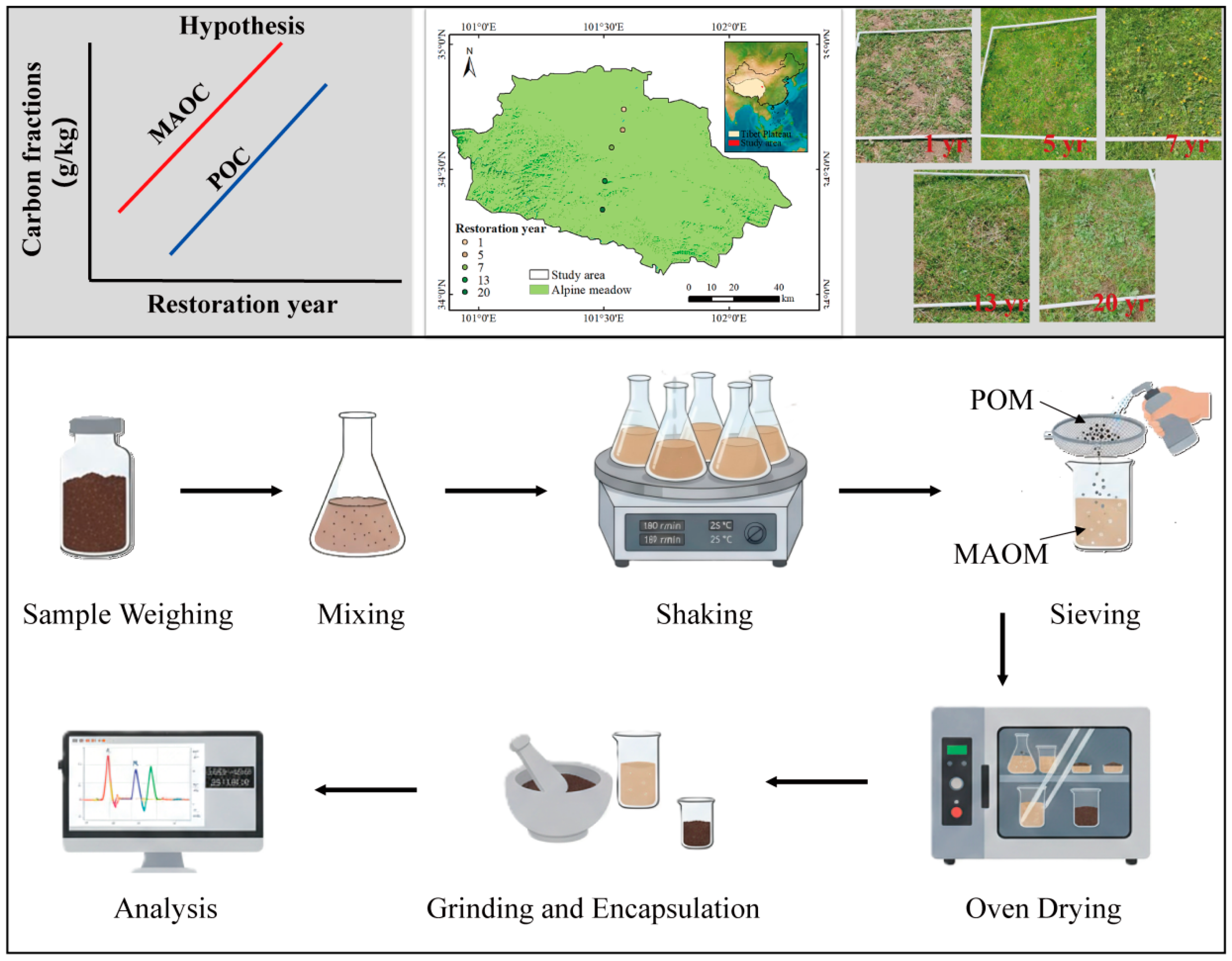
Alpine meadows on the Qinghai–Tibet Plateau support immense soil carbon stocks and play a critical role in regional carbon cycling [31]. Nevertheless, prolonged overgrazing and climate sensitivity have caused substantial SOC loss, especially in severely degraded areas. Therefore, grazing exclusion measures have been proposed as a primary intervention strategy to naturally restore the degraded grasslands [2,32,33]. However, the dynamics and driving mechanisms of different carbon fractions in these grassland ecosystems remain unclear, hindering the development of effective management and restoration strategies. To address this knowledge gap, we examined changes in SOC fractions across a restoration chronosequence of alpine meadows using the space-for-time substitution approach on the Qinghai–Tibet Plateau (Figure 1). Although the chronosequence approach is widely used in restoration research, it may be affected by subtle differences in initial site conditions. To minimize this bias, we selected sites with uniform elevation, slope, aspect, soil type, parent material, and pre-restoration degradation history. We aimed to: (1) reveal temporal patterns of POC and MAOC along the restoration gradient; (2) identify differential regulatory roles of microbial attributes, enzymes, and abiotic factors. We hypothesized that: (1) with increasing restoration duration, continuous increases in plant carbon input and improved soil environmental conditions would progressively promote the accumulation of POC and MAOC; (2) the microbial community composition, extracellular enzyme activity, and soil properties would differentially regulate POC and MAOC dynamics, owing to their distinct formation and stabilization mechanisms. This study is expected to provide insights for understanding the carbon sequestration mechanisms occurring during alpine meadow restoration and offers a theoretical basis for the ecological management of degraded grasslands.

2. Materials and Methods

2.1. Study Area and Field Sampling

This study was conducted at the Grassland Research Station of Henan Mongol Autonomous County, Qinghai Province (101°30′–101°35′ E, 34°20′–34°44′ N). The research site is located at an elevation of 3 477–3 599 m above sea level and features a plateau continental climate. The mean annual temperature ranges from −0.3 to 1.3 °C, and the mean annual precipitation is between 597.1 and 651.5 mm. The site is characterized by long, cold winters and a very short, cool growing season. Frost can occur in any month of the year. The vegetation is dominated by species from the families Poaceae and Cyperaceae, accompanied by various forbs. The soil was classified as Cambisols according to the FAO World Reference Base (WRB) soil classification system, with no obvious carbonate reaction.
In June 2025, soil samples were collected across a restoration chronosequence consisting of five stages: 1, 5, 7, 13, and 20 years after restoration through grazing exclusion. To minimize environmental variability, all sampling sites were selected for their similar topographic conditions, soil type, and parent material. Prior to restoration, all sites experienced the severity of long-term overgrazing degradation, ensuring comparable initial soil and ecosystem conditions. Grazing exclusion was implemented via complete fencing, with full exclusion of livestock and no human disturbance throughout the restoration period.
The 10 m × 10 m plot was defined as the experimental unit, with 6 independent replicate plots per restoration stage. To eliminate the risk of pseudo-replication, all 30 plots (5 stages × 6 plots) were spatially separated and distributed within a homogeneous area, with similar environmental conditions and pre-restoration degradation status, ensuring that the systematic variable among experimental units was restoration duration. In each plot, the five soil cores were combined into one composite sample to reduce within-plot spatial variability. Soil samples were collected from the 0–10 cm layer, which represented the biologically active horizon in alpine meadows, with the highest root biomass, microbial activity, and SOC turnover. This layer is sensitive to restoration-induced changes in carbon dynamics and has been widely used in relevant alpine grassland studies. Visible roots and litter were removed, and the five cores from the same plot were combined to form one composite sample, resulting in a total of 30 composite samples. Each composite sample was divided into three subsamples. One was air-dried for physicochemical analysis. Another was stored at 4 °C for measuring microbial biomass and enzyme activities. The third was preserved at −80 °C for subsequent DNA extraction and amplicon sequencing.

2.2. Analysis of Soil Properties

Soil pH was determined with a pH meter at a soil-to-water ratio of 1:2.5 (w/v) in deionized water. SOC content was analyzed by the potassium dichromate oxidation method with external heating at 180 °C for 5 min. Soil water content (SWC) was measured on undisturbed soil core samples collected with a steel cylinder. Total nitrogen (TN) was determined by the Kjeldahl method [34].
Particulate organic mass (POM) and mineral-associated organic mass (MAOM) were separated by wet sieving. Briefly, 20 g of air-dried soil (sieved to <2 mm) was placed in a conical flask, mixed with 60 mL of 5 g·L−1 sodium hexametaphosphate solution, and shaken on an orbital shaker for 18 h at 25 °C and 180 r·min−1. The suspension was then passed through a 53 μm nylon sieve and rinsed thoroughly with distilled water until the runoff was clear. The retained fraction (>53 μm) was defined as POM, and the fraction passing through the sieve (<53 μm) was collected as MAOM. Both fractions were oven-dried at 60 °C, finely ground, and their organic carbon contents were determined using the same potassium dichromate oxidation method as for SOC [9].
Soil microbial biomass was assessed by the chloroform fumigation–extraction method [35]. Microbial biomass carbon (MBC) and nitrogen (MBN) were extracted with 0.5 M K2SO4 after chloroform fumigation, whereas microbial biomass phosphorus (MBP) was extracted with 0.5 M NaHCO3 and measured by the molybdenum–antimony anti-colorimetric method.
CUE was estimated using an 18O-labeled water incubation approach [22]. After adding 18O-labeled water to soil samples, the incorporation of 18O into newly synthesized microbial DNA was quantified to determine the microbial growth carbon content. Concurrently, CO2 released during incubation was measured to assess respiratory carbon content. CUE was calculated as the ratio of microbial growth carbon to the total growth and respiration carbon.

2.3. Analysis of Soil Enzyme Activities

Following the method described by previous study [36], the activities of hydrolytic and oxidative enzymes related to C, N, and P acquisition were determined using a 96-well microplate reader-based assay. The enzymes measured included C-acquiring enzymes (β-glucosidase, BG; cellobiohydrolase, CBH; polyphenol oxidase, PPO), N-acquiring enzymes (β-N-acetylglucosaminidase, NAG; leucine aminopeptidase, LAP), and P-acquiring enzymes (acid phosphomonoesterase, ACP). The results of these soil physicochemical properties are summarized in Figure S1.
An enzyme-based ligninocellulose index (LCI) was calculated as an indicator of carbon quality [37]. A higher LCI value indicates greater carbon recalcitrance and lower microbial accessibility to degradable carbon. The index was calculated as follows:
L C I = l n P P O l n P P O + l n ( C B H + B G )  
Additionally, the vector length and vector angle were computed using an enzymatic stoichiometry vector model to quantify microbial C, N, and P limitations in soil [38]. The formulas were applied as follows:
V e c t o r   l e n g t h = l n ( B G ) l n ( N A G + L A P ) 2 + l n ( B G ) l n ( A C P ) 2
V e c t o r   a n g l e = D E G R E E S A T A N 2 ln B G ln A C P , l n ( B G ) l n ( N A G + L A P )
Here, a longer vector length indicates stronger microbial C limitation. A vector angle <45° denotes predominant N limitation, while an angle >45° indicates predominant P limitation. Microbial N limitation intensifies as the angle decreases, and P limitation intensifies as the angle increases.

2.4. Analysis of DNA Extraction, Sequencing, and Bioinformatics

For total soil microbial DNA extraction, 0.5 g of homogenized sample was taken from each of the 30 soil samples. DNA extraction was performed strictly following the instructions of the FastDNA® SPIN Kit for Soil (MP Biomedicals, Santa Ana, CA, USA). The concentration and purity of the extracted total DNA were measured using a micro-volume ultraviolet spectrophotometer (Thermo Fisher Scientific, NanoDrop, Wilmington, DE, USA), and DNA integrity was checked by agarose gel electrophoresis. The bacterial 16S rRNA gene was amplified using the primers 338F (5′-ACTCCTACGGGAGGCAGCAG-3′) and 806R (5′-GGACTACHVGGGTWTCTAAT-3′), and the fungal ITS region was amplified using the primers ITS1F (5′-CTTGGTCATTTAGAGGAAGTAA-3′) and ITS2R (5′-GCTGCGTTCTTCATCGATGC-3′). Sequencing libraries were prepared with the NEBNext® Ultra™ II DNA Library Prep Kit (Illumina, Ipswich, MA, USA) and subjected to PE250 paired-end sequencing on the Illumina NovaSeq 6000 platform (Illumina, Inc., San Diego, CA, USA). The raw sequences were processed using the EasyAmplicon v2.0 pipeline (an open-source tool developed by the Chinese Academy of Agricultural Sciences, Beijing, China) to generate an initial amplicon sequence variant (ASV) table. Taxonomic assignment of bacterial ASVs was performed against the SILVA database, and fungal ASVs were classified using the UNITE database [39]. All samples were rarefied to an even sequencing depth, and the resulting normalized ASV table was used for subsequent analyses. The abundances of OTUs were normalized using a standard sequence number corresponding to the sample with the least sequences (77,187 for bacteria and 60,310 for fungi).

2.5. Statistical Analyses

One-way analysis of variance (ANOVA) was used to compare significant differences in soil nutrient content, SOC fractions, and α-diversity across different restoration years. Permutational multivariate analysis of variance (PERMANOVA), analysis of similarity (ANOSIM), and multi-response permutation procedure (MRPP) were applied to examine significant differences in microbial community structure under different restoration durations [40]. Regression analysis was conducted to assess the relationships between various physicochemical properties and SOC fractions [41]. Random forest (RF) analysis was performed using the “randomForest” package to evaluate the contributions of soil physicochemical properties, enzyme activities, and microbial community characteristics to SOC and its fractions. The “A3” and “rfPermute” packages were employed to assess model significance and predictor importance [21]. A heatmap was generated to visualize Spearman correlations between different soil properties, microbial community features, and SOC fractions [28]. All statistical analyses were carried out using R version 4.3.1 (http://www.r-project.org/).

3. Results

3.1. Distribution Patterns of the SOC Fractions Along the Restoration Year

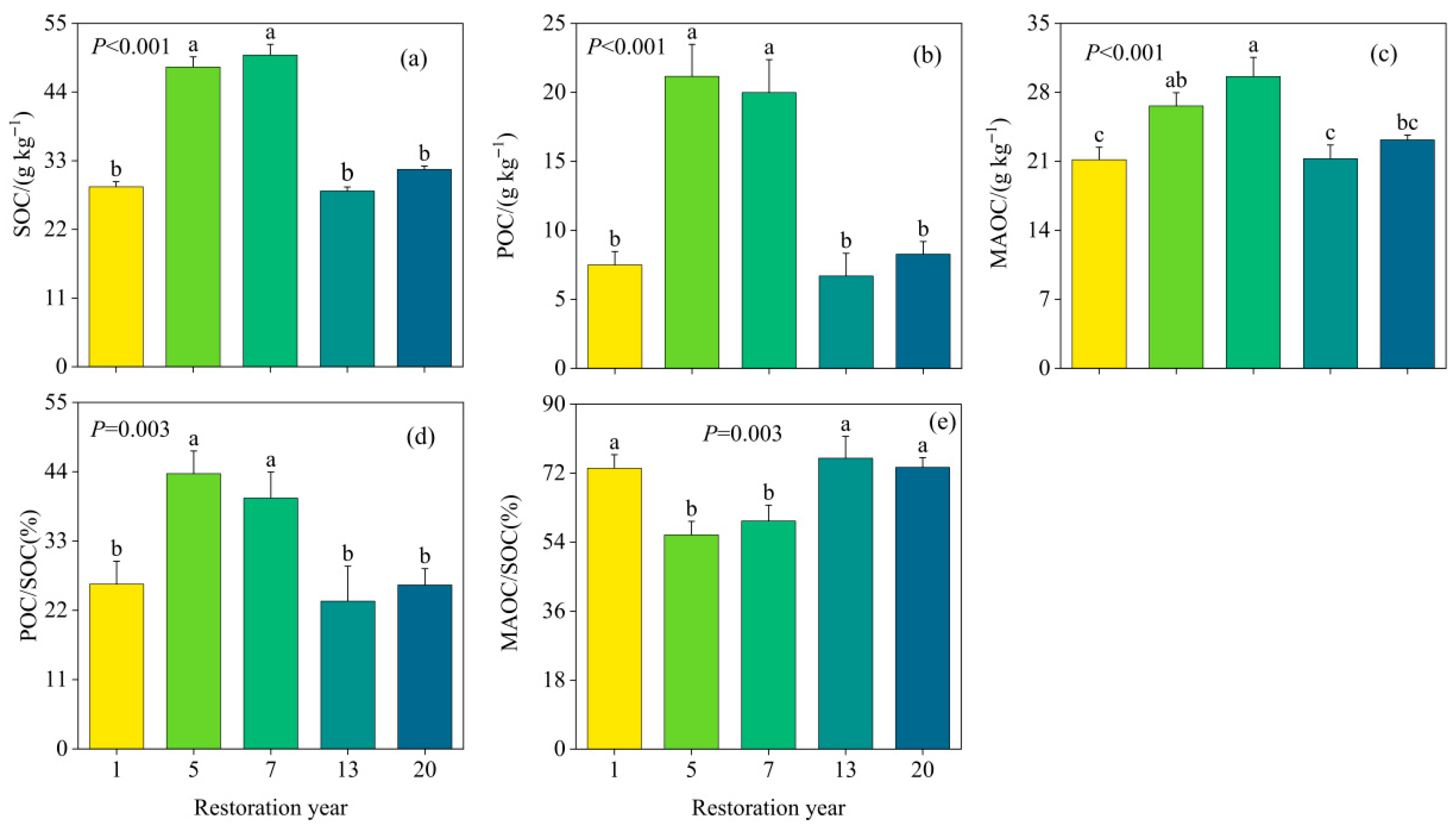
Significant differences were observed in SOC fractions and their contributions to SOC among restoration years (p < 0.05) (Figure 2). Using a space-for-time substitution approach, SOC, POC and MAOC contents followed a unimodal pattern across the restoration chronosequence, firstly increasing and then declining in the later stages. Specifically, the averages of SOC content ranged from 28.15 to 49.91 g kg−1. POC content reached the maximum at the 5-year restoration stage while SOC and MAOC content peaked at the 7-year restoration stage. Consistent with POC dynamics, the POC/SOC ratio increased initially and then declined, with a peak value of 43.68% at the 5-year restoration stage. Unlike MAOC, the MAOC/SOC ratio increased gradually with the restoration duration except for in the 1-year restoration stage. Furthermore, no significant differences in SOC fractions were observed between the 13-year and 20-year restoration stages.

3.2. Diversity and Composition of Soil Bacterial and Fungal Community Along the Restoration Chronosequence

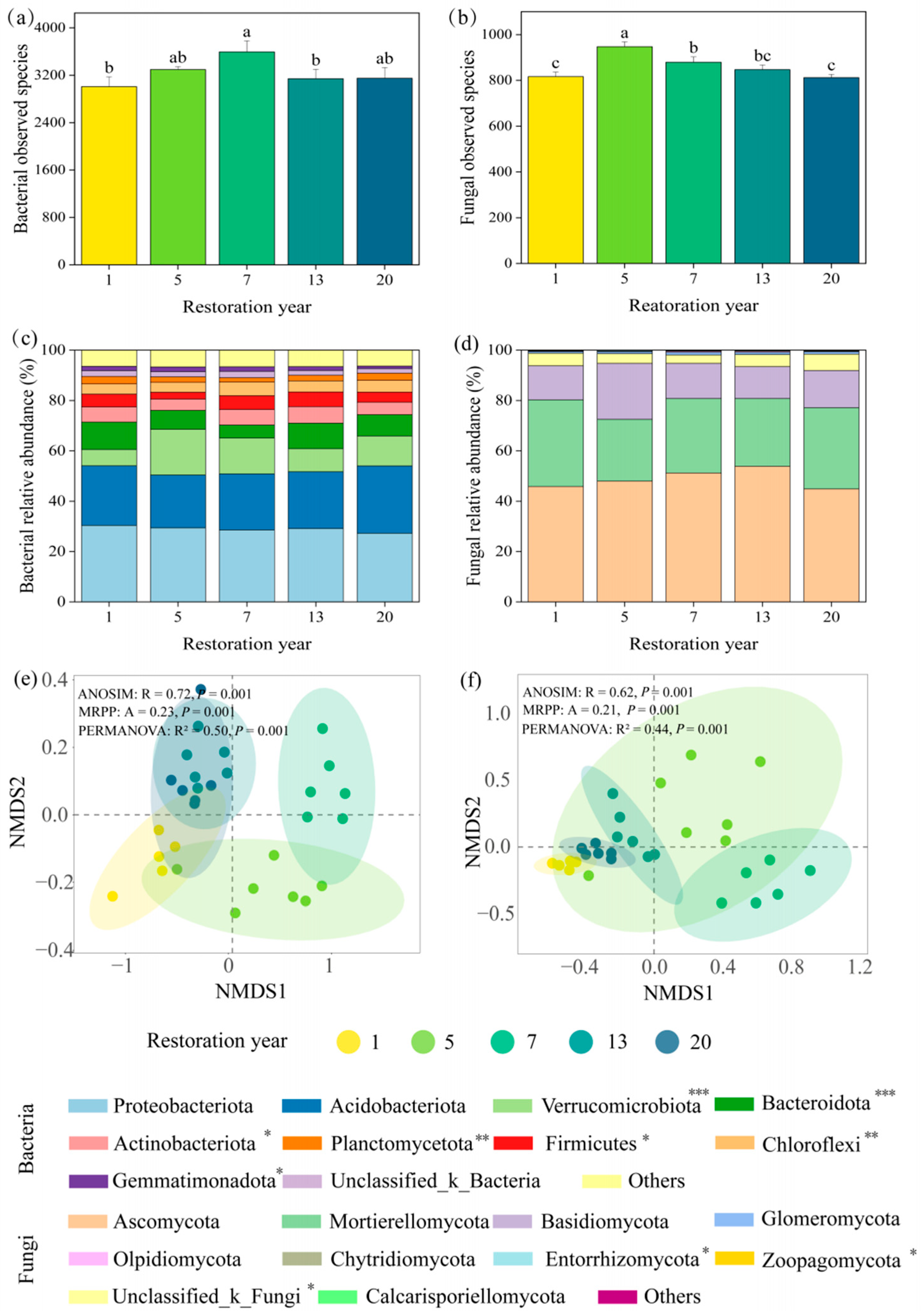
Although microbial community alpha diversity (except for fungal richness index) did not differ significantly among restoration years (Figure S2), the observed species numbers of bacteria and fungi both increased first and then decreased with restoration duration, peaking at the 7- year and 5-year restoration stages, respectively (Figure 3a,b). These peak values were significantly higher than those at the other restoration stages. Proteobacteria and Acidobacteriota were the dominant phyla in the bacterial community, together accounting for 50–54%, with no significant differences in their relative abundances among restoration stages (Figure 3c). Conversely, the relative abundance of Verrucomicrobiota varied markedly among restoration years and ranged from 6% to 18%, with the peak values occurring at the 5-year restoration stage. The relative abundances of Bacteroidota, Planctomycetota, Chloroflexi, Firmicutes, Gemmatimonadota, and Actinobacteriota also differed significantly among restoration years. Ascomycota, Mortierellomycota, and Basidiomycota were dominant fungal phyla, together accounting for more than 90% of the total fungal sequences (Figure 3d). Furthermore, both the bacterial and fungal community structures changed significantly with increasing restoration duration (Figure 3e,f). Statistical tests confirmed significant differences in both bacterial (p < 0.01) and fungal community (p < 0.01) compositions across different restoration stages. Restoration duration could explain 50% and 44% of the variance in the bacterial and fungal community structures, respectively.

3.3. Factors Affecting SOC Fractions Along the Restoration Year

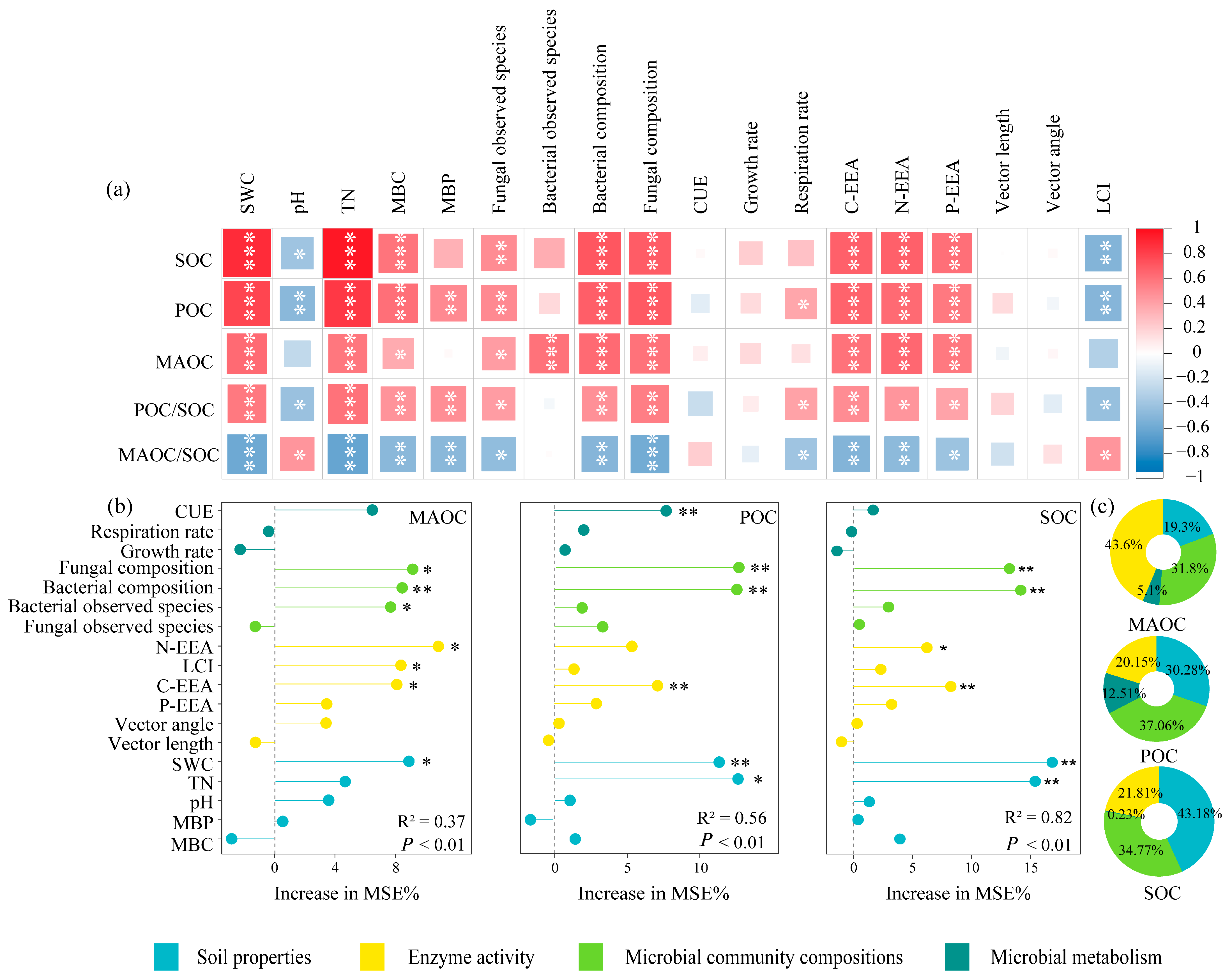
Spearman correlation analysis revealed that SOC, POC, and MAOC exhibited significant positive correlations with SWC, TN, MBC, bacterial composition, fungal composition, C-acquiring enzyme activity (C-EEA), N-acquiring enzyme activity (N-EEA), and P-acquiring enzyme activity (P-EEA) (p < 0.001, Figure 4a and Figure S3). Conversely, LCI was significantly negatively correlated with both SOC and POC (p < 0.01, Figure 4a). Furthermore, the POC/SOC ratio showed a similar correlation pattern to POC, whereas the MAOC/SOC ratio was negatively correlated with SWC, TN, and microbial community compositions, but positively correlated with LCI (Figure 4a and Figure S4).
Random forest models were constructed to evaluate variable importance for C fractions (Figure 4b). The models explained 82%, 56%, and 37% of the total variation in SOC, POC, and MAOC, respectively. For SOC, the highest importance values were observed for SWC and TN (p < 0.01). For POC, bacterial and fungal community composition showed the highest importance (p < 0.01), followed by TN and SWC. For MAOC, N-EEA, fungal community composition, and bacterial community composition were identified as the variables with the highest importance (p < 0.05). Among the four main factors, soil properties explained the largest proportion of variation in SOC (43.18%). However, microbial community compositions were the primary contributors to POC variation (37.06%), while enzyme activity accounted for the highest explained variance in MAOC (43.66%) (Figure 4c). Furthermore, MAOC/SOC and POC/SOC were mainly associated with SWC, TN, and bacterial composition (Figure S5).

4. Discussion

4.1. Response of SOC Fractions and Contributions to Restoration

The results showed significant differences in SOC fractions and their contributions to SOC among meadows with different restoration durations (p < 0.05). Contrary to the initial hypothesis of a linear increase and previous studies [24,42,43], SOC, POC, and MAOC content all exhibited a pattern of initial increase followed by a subsequent decline along the alpine meadow restoration gradient. This divergence likely arose from differences in initial degradation severity and restoration management, which strongly mediated ecosystem responses. The observed SOC contents (28.15–49.91 g·kg−1) were within the typical range reported for alpine meadows on the Qinghai–Tibet Plateau [44], but higher than those in many temperate grasslands [45] and most agricultural soils [46], reflecting the high soil C density of alpine ecosystems. This pattern strongly suggests that soil carbon accumulation is not a simple, continuous linear process but instead has a temporal threshold.
Specifically, the two functional carbon fractions exhibited asynchronous peaks along the restoration gradient, a pattern that reflects their distinct formation pathways and turnover rates. POC is primarily composed of partially decomposed plant residues and newly formed organic matter, with a relatively short turnover time and highly sensitivity to environmental changes and ecological disturbances [39,46]. During the initial restoration phase (1–5 years), the rapid vegetation re-establishment led to a substantial increase in aboveground litter and belowground root inputs, which likely directly drove the rapid accumulation of POC. This finding aligns with the plant-input-driven pattern observed in the early restoration stages of many forest and grassland ecosystems worldwide [12]. In contrast, MAOC represents a relatively stable organic carbon fraction with long turnover times. MAOC accumulates mainly through microbial processing of POC and dissolved organic carbon into microbial biomass and necromass, followed by sorption, complexation, and association with fine minerals [11]. Thus, the peak content of MAOC occurred later than that of POC.
Notably, following the initial increase, carbon fractions declined and stabilized in later restoration stages (Figure 1), suggesting that soil carbon inputs and outputs may approach a new equilibrium. This result may be attributed to two factors. First, with extended restoration duration, the vegetation community reaches a climax state, biomass growth plateaus, and organic carbon inputs no longer increase significantly [47]. Second, increased vegetation coverage and optimized soil microenvironments after restoration may maintain high microbial decomposition activity, leading to a scenario where carbon output exceeds input, causing decreases in SOC fraction content [42].
While some studies have reported that POC accounts for a large proportion of SOC [37], others have highlighted mineral association as a key long-term carbon sequestration mechanism in grassland soils [48]. In this study, the relative proportions of carbon fractions responded differently to restoration duration. The POC/SOC ratio exhibited a similar trend to POC content, peaking at the 5-year restoration stage (43.68%) before declining. This confirms that the increases in soil carbon pool during the early restoration phase are primarily attributable to the labile carbon pool, consistent with other restored systems [13]. Due to weak physical protection, POC was highly vulnerable to disturbance and mineralization [8], which induced a decline in the POC/SOC ratio during the later restoration stages.
In contrast, the MAOC/SOC ratio decreased initially and then increased, with a minimum at approximately 5 years of restoration. Firstly, grasslands restored for one year were characterized by sparse vegetation and low ground cover, a legacy of prior disturbance. Limited plant biomass led to reduced fresh carbon inputs from litterfall and root turnover [24]. Consequently, the MAOC/SOC ratio at this stage was comparatively high-level. During the 1–5 year restoration period, rapid vegetation recovery significantly increased POC content, which in turn decreased the ratio of MAOC/SOC. As restoration proceeded, changes in microbial community composition were associated with shifts in SOC partitioning, favoring the accumulation of mineral-associated organic carbon and thus contributing to the increasing trend in the MAOC/SOC ratio. Throughout the restoration process, MAOC accounted for more than 55% of SOC, clearly indicating that SOC in the restored meadows was primarily preserved in mineral-associated forms. This high MAOC dominance is characteristic of stable alpine meadow soils [49,50] and is much higher than in cultivated agricultural soils, where mineral protection is weak.

4.2. Response of Soil Microbial Community to Restoration

Vegetation restoration modulates soil microbial community structure and metabolism through aboveground–belowground linkages [51]. However, no consensus has been reached regarding the effects of restoration on soil microbial communities, due to heterogeneity in factors such as climate, initial soil conditions, restoration duration, and vegetation type [39,52]. Some studies have shown that restoration can significantly alter the alpha diversity [52,53], while others have exhibited no significant shifts in alpha diversity after vegetation restoration [52,54]. In our study, no significant differences in alpha diversity (the Simpson and Shannon indices) were observed with prolonged vegetation restoration years, possibly due to the relatively stable distribution of microbial taxa across restoration stages. However, the observed species numbers of bacteria and fungi exhibited unimodal patterns consistent with SOC fraction dynamics. Specifically, the number of observed fungal species was higher than in severely degraded meadows [55], indicating effective recovery of microbial habitats. In the early restoration stage, sparse plant cover, limited organic carbon inputs, and harsh microclimatic conditions restricted microbial colonization. As restoration proceeded, increased vegetation cover enhanced inputs of plant-derived organic matter (e.g., litter and root exudates) [12], thereby increasing soil nutrient availability and expanding the range of ecological niches available to soil microbes. This niche expansion facilitated the recruitment of diverse microbial taxa, driving an upward trend in observed species numbers. The subsequent decline after the peak reflected a transition toward more structured, competitive microbial communities as vegetation communities and soil physicochemical properties changed.
Bacterial communities are generally more responsive to environmental changes due to their faster growth rates and broader physiological plasticity, whereas fungal communities exhibit delayed responses and require a longer time to recover [48,56]. Contrary to this general expectation (e.g., some temperate grasslands or agricultural soils), our study revealed a distinct successional pattern: soil fungal richness peaked earlier (at 5 years) than bacterial richness (at 7 years) during vegetation restoration. The divergent successional dynamics may stem from the fundamental differences in resource requirements and life-history strategies between fungi and bacteria during ecosystem development. Firstly, soils in the initial restoration stages typically received a pulse of complex plant-derived polymers (cellulose, hemicellulose) from initial litterfall. Fungi, as primary decomposers of structural carbon [19], directly benefit from this resource input, leading to a rapid increase in their abundance. In contrast, bacterial communities were more tightly coupled to incremental changes in soil physicochemical properties (e.g., MAOC accummulation) and required additional time to reach peak abundance as edaphic conditions developed and stabilized. Secondly, soil in the initial restoration stage might experience abiotic stresses. Fungi, with their hyphal growth form and greater tolerance to environmental stress [20], might be better adapted to colonize harsh conditions.
Notably, although the overall taxonomic structure at the phylum level was consistent with previous reports [55,57], the temporal dynamics of these dominant phyla exhibited notable divergence across regions, revealing distinct, site-specific succession patterns. For bacteria, Proteobacteria and Acidobacteriota remained the dominant phyla across all restoration stages, collectively accounting for approximately half of the total bacterial abundance with no significant differences in their relative proportions among restoration stages. This might be because Proteobacteria and Acidobacteriota are ubiquitous in terrestrial soils and encompass a broad range of ecological strategies, from copiotrophy to oligotrophy, enabling them to persist under varying environmental conditions [39,52]. In contrast, Verrucomicrobiota were often associated with oligotrophic conditions and the utilization of complex carbon compounds, showing marked variation and peaking at 5 years of restoration, which indicated the high sensitivity to mid-restoration shifts in carbon quality and plant-derived substrate factors. Inconsistent with previous studies [58], Actinobacteriota displayed for a low relative abundance in our study, likely due to the high soil moisture and resource competition. Although they constitute a minor fraction of the total community, significant shifts in rare or sub-dominant phyla (e.g., Bacteroidota, Firmicutes, Chloroflexi) suggested their sensitivity to fine-scale environmental changes, potentially serving as early indicators of niche differentiation during restoration [59]. For fungi, Ascomycota, Mortierellomycota, and Basidiomycota jointly accounted for over 90% of sequences across all restoration stages, a pattern consistent with many restored and natural soil ecosystems. These phyla encompassed diverse lifestyles—including saprotrophy, symbiosis, and opportunism—allowing them to persist across successional stages. Together, these patterns indicated that restoration could preserve foundational microbial functions while restructuring community composition in response to evolving environmental filters [60].
Furthermore, significant shifts in both bacterial and fungal β-diversity along the restoration chronosequence (Figure 3e,f) demonstrated that temporal succession was a dominant force structuring the entire soil microbial community [57]. The high explanatory power of restoration duration (50% for bacteria, 44% for fungi) strongly suggests that microbial assembly was governed by a deterministic, time-dependent process, likely mediated by the progressive changes in vegetation structure, soil properties, and biogeochemical cycles, similar to other restored systems [39,52,55].

4.3. Differential Drivers of Soil Organic Carbon Fractions

Integrating Spearman correlation and random forest analyses allowed us to disentangle the divergent regulatory mechanisms governing the accumulation of SOC, POC, and MAOC along the alpine meadow restoration chronosequence. This integrated analytical approach provides a critical foundation for elucidating the distinct pathways that regulate labile and stable carbon pools in restored alpine grassland ecosystems (Figure 4).
Abiotic factors—specifically SWC and TN—primarily governed SOC content, which aligns with traditional perspectives on environmental constraints in different systems [34,61]. However, the turnover and stabilization of SOC fractions were driven by biotic factors. Specifically, variations in the labile POC pool were mainly driven by microbial community composition (p < 0.01), indicating that POC dynamics are closely linked to the immediate utilization and transformation of fresh organic substrates by microorganisms [26,62]. The correlation trend of POC/SOC was identical to that of POC, indicating that its variation was dominated by POC accumulation characteristics.
In contrast, variations in the more stable MAOC pool were explained by C-EEA, N-EEA, and microbial community composition. Herein, hydrolytic C-EEA depolymerized structural carbohydrates, providing soluble C that sustained microbial metabolism [63,64]. By depolymerizing proteins and chitin (key components of microbial necromass), N-EEA (LAP and NAG) directly generated nitrogen-rich, low-molecular-weight compounds such as peptides, amino acids, and amino sugars [13,32]. These compounds possessed abundant charged functional groups (e.g., amine and carboxyl groups), which granted them high affinity for mineral surfaces and established them as efficient, chemically compatible precursors for MAOC formation [65]. The key role of enzymes in MAOC formation observed here has also been reported in temperate grasslands and agricultural systems [27,49,61]. It is noteworthy that although CUE reflects the allocation of C between microbial growth and respiration [66], this study found no significant correlation between CUE and MAOC content. This suggests that MAOC formation in this system may be constrained less by the overall carbon metabolic efficiency, and more by the specific, enzyme-mediated supply of mineral-reactive precursors. Thus, the microbial community, through this coordinated enzymatic strategy, controls the rate at which organic matter is converted into mineral-reactive substrates [18]. Our study also shows that LCI is positively correlated with MAOC/SOC, consistent with the findings of Wan et al. [67], who reported that low-quality litter favors the retention of C in mineral-associated forms rather than particulate forms.
Additionally, we found that environmental factors exerted inconsistent effects on SOC fractions. Although increased nutrient availability promoted the accumulation of both MAOC and POC, the stimulatory effect on POC was more pronounced, thereby reducing the relative contribution of MAOC to the total SOC pool. This aligned with the findings of Liu et al. [68], indicating that while nutrient enrichment enhances total C sequestration, it may shift the soil C equilibrium towards the more labile and vulnerable POC fraction.
In summary, during the alpine meadow restoration process, the driving mechanisms of SOC and its fractions are significantly differentiated: abiotic factors dominate SOC accumulation, microbial community composition regulates POC turnover, and enzyme activity mediates MAOC stabilization. This divergent control differed from many agricultural ecosystems, where management and fertilization might overwhelm natural microbial and enzymatic controls. This conclusion provides important theoretical support for the precise regulation of grassland carbon pools and the improvement of carbon sequestration efficiency. Therefore, during grassland restoration, management strategies should focus not only on increasing total carbon stocks but also on facilitating the microbial processing required to transform labile POC into stable MAOC, thereby enhancing the long-term persistence of sequestered soil carbon.

4.4. Limitations of This Study

This study employed a space-for-time substitution chronosequence to infer temporal changes in SOC fractions and microbial communities during restoration, which carries inherent methodological limitations. Although we minimized heterogeneity by selecting sites with consistent topography, soil type, parent material, and pre-restoration degradation status, subtle differences in initial soil conditions or unrecorded historical disturbances cannot be fully excluded and may have affected the observed patterns. Future studies combining long-term in situ monitoring with chronosequence approaches would help verify the observed nonlinear carbon dynamics and regulatory mechanisms.
This study examined SOC, POC, and MAOC dynamics but did not characterize organic matter chemistry, humic substances, or dissolved carbon. Spectroscopic analyses in future work would help clarify chemical changes in organic carbon during the restoration process. In addition, this study did not determine soil texture (sand, silt, and clay contents) or clay mineralogy, which represent important controls on organo-mineral interactions and MAOC stabilization. Future studies incorporating soil granulometry and mineralogical analysis would provide a more comprehensive understanding of SOC fraction dynamics under restoration.

5. Conclusions

This study comprehensively investigated the dynamics and drivers of soil organic carbon fractions along a restoration chronosequence in an alpine meadow on the Qinghai–Tibet Plateau. Our findings indicate that soil carbon accumulation (SOC, POC, MAOC) during alpine meadow restoration is not a continuous process but reaches a temporal threshold. Notably, POC responded earlier than MAOC, while MAOC consistently constitutes the dominant carbon pool (>55% of SOC), highlighting its role as the primary reservoir for long-term carbon storage. Restoration duration is the primary deterministic force shaping microbial community structure, explaining 50% and 44% of the variance in bacterial and fungal communities, respectively. However, the drivers of different carbon fractions were distinct. The dynamic POC pool is predominantly regulated by microbial community composition, whereas the stable MAOC pool is primarily governed by extracellular enzyme activities that facilitate the generation of mineral-reactive precursors for carbon stabilization. In summary, our results underscore that effective grassland management aimed at enhancing long-term carbon sequestration should not only focus on maximizing total carbon inputs but also on fostering the specific microbial processes and enzymatic activities that promote the transformation of labile carbon into the persistent, mineral-associated pool. This study provides a mechanistic framework for understanding carbon stabilization in restored alpine ecosystems. Future studies should examine carbon dynamics in deeper soil horizons, where considerable carbon can be stabilized. Quantifying soluble carbon leaching and vertical translocation would improve understanding of whole-profile carbon sequestration during alpine meadow restoration. Additionally, further evaluation of the suitability and applicability of the analytical methods—particularly their effectiveness in characterizing different forms of soil carbon (e.g., labile vs. stable fractions)—is needed to improve carbon assessments in alpine meadow ecosystems.

Supplementary Materials

The following supporting information can be downloaded at https://www.mdpi.com/article/10.3390/agriculture16080898/s1.

Author Contributions

Conceptualization: G.J.; methodology, M.W.; software, G.J. and M.W.; formal analysis, G.J.; investigation, X.Z.; data curation, W.H.; writing—original draft preparation, G.J. and M.W.; writing—review and editing, G.J.; visualization, M.W.; supervision, J.W. and S.Z.; project administration, F.Z. and S.Z.; Funding acquisition, F.Z. and S.Z. All authors have read and agreed to the published version of the manuscript.

Funding

This work was supported by the Central Government to Guide Local Science & Technology Development in Qinghai Province (2025ZY007), the Natural Science Foundation of Qinghai Province (2025-ZJ-969T), and the Qinling Hundred Talents Project of Shaanxi Academy of Science (2024K-31).

Data Availability Statement

All data generated and/or analyzed during this study are included in the article and Supplementary Materials. The datasets are available from the corresponding author upon reasonable request.

Conflicts of Interest

The authors declare no conflicts of interest.

References

  1. White, R.; Murray, S.; Mark, R. Pilot Analysis of Global Ecosystems: Grassland Ecosystems; World Resources Institute (WRI): Washington, DC, USA, 2000. [Google Scholar]
  2. Sun, J.; Liu, M.; Fu, B.; Kemp, D.; Zhao, W.; Liu, G.; Han, G.; Wilkes, A.; Lu, X.; Chen, Y.; et al. Reconsidering the efficiency of grazing exclusion using fences on the Tibetan Plateau. Sci. Bull. 2020, 65, 1405–1414. [Google Scholar] [CrossRef]
  3. Zhou, J.; Liu, S.; Jan van Groenigen, K.; Mueller, C.W.; Ochoa-Hueso, R.; Fanin, N.; Ren, Z.; Zhang, Y.; Ma, Y.; Sun, S.; et al. Contrasting responses of particulate and mineral-associated organic carbon stocks to grazing exclusion in an alpine meadow. Agric. Ecosyst. Environ. 2026, 400, 110227. [Google Scholar] [CrossRef]
  4. Tao, F.; Huang, Y.; Hungate, B.A.; Manzoni, S.; Frey, S.D.; Schmidt, M.W.I.; Reichstein, M.; Carvalhais, N.; Ciais, P.; Jiang, L.; et al. Microbial carbon use efficiency promotes global soil carbon storage. Nature 2023, 618, 981–985. [Google Scholar] [CrossRef]
  5. Masevičienė, A.; Žičkienė, L. Soil Organic Carbon Dynamics in Contrasting Soil Types Under Short-Rotation Woody Crop Production. Agriculture 2026, 16, 281. [Google Scholar] [CrossRef]
  6. Lugato, E.; Lavallee, J.M.; Haddix, M.L.; Panagos, P.; Cotrufo, M.F. Different climate sensitivity of particulate and mineral-associated soil organic matter. Nat. Geosci. 2021, 14, 295–300. [Google Scholar] [CrossRef]
  7. Peng, Y.; Biswas, A.; Adamowski, J.F.; Zhang, X.; Li, Y.; Li, L.; Peng, Y.; Cao, J. Sources and stability of particulate organic matter (POM) and mineral-associated organic matter (MAOM) on the Loess Plateau: Implications for soil carbon management. Ecol. Indic. 2025, 179, 114162. [Google Scholar] [CrossRef]
  8. Leuthold, S.; Lavallee, J.M.; Haddix, M.L.; Cotrufo, M.F. Contrasting properties of soil organic matter fractions isolated by different physical separation methodologies. Geoderma 2024, 445, 116870. [Google Scholar] [CrossRef]
  9. Cotrufo, M.F.; Ranalli, M.G.; Haddix, M.L.; Six, J.; Lugato, E. Soil carbon storage informed by particulate and mineral-associated organic matter. Nat. Geosci. 2019, 12, 989–994. [Google Scholar] [CrossRef]
  10. Zhou, Z.; Ren, C.; Wang, C.; Delgado-Baquerizo, M.; Luo, Y.; Luo, Z.; Du, Z.; Zhu, B.; Yang, Y.; Jiao, S.; et al. Global turnover of soil mineral-associated and particulate organic carbon. Nat. Commun. 2024, 15, 5329. [Google Scholar] [CrossRef] [PubMed]
  11. Sokol, N.W.; Bradford, M.A. Microbial formation of stable soil carbon is more efficient from belowground than aboveground input. Nat. Geosci. 2019, 12, 46–53. [Google Scholar] [CrossRef]
  12. Ye, Y.; Zhang, R.; Tian, D.; Wang, J.; Yu, G.; Niu, S. Natural Regeneration Enhances Long-Term Soil Carbon Storage in Various Fractions More Effectively Than Active Restoration: Meta-Analysis. Glob. Change Biol. 2025, 31, e70255. [Google Scholar] [CrossRef]
  13. Li, Y.; Zhang, X.; Wang, B.; Wu, X.; Wang, Z.; Liu, L.; Yang, H. Revegetation promotes soil mineral-associated organic carbon sequestration and soil carbon stability in the Tengger Desert, northern China. Soil Biol. Biochem. 2023, 185, 109155. [Google Scholar] [CrossRef]
  14. Zhao, Z.; Qin, Y.; Wu, Y.; Chen, W.; Wang, H.; Chen, J.; Yang, J.; Liu, G.; Xue, S. Microbial necromass carbon drives soil organic carbon accumulation during long-term vegetation succession. J. Appl. Ecol. 2025, 62, 932–944. [Google Scholar] [CrossRef]
  15. Hu, J.; Cui, Y.; Manzoni, S.; Zhou, S.; Cornelissen, J.H.C.; Huang, C.; Schimel, J.; Kuzyakov, Y. Microbial Carbon Use Efficiency and Growth Rates in Soil: Global Patterns and Drivers. Glob. Change Biol. 2025, 31, e70036. [Google Scholar] [CrossRef]
  16. Whalen, E.D.; Grandy, A.S.; Geyer, K.M.; Morrison, E.W.; Frey, S.D. Microbial trait multifunctionality drives soil organic matter formation potential. Nat. Commun. 2024, 15, 10209. [Google Scholar] [CrossRef]
  17. Yuan, Y.; Zhang, J.; Feng, Z.; Zhang, Q.; Zhao, Z.; Li, Q.; Zhang, S.; Wei, G.; Han, X.; Xu, M.; et al. Microbial traits mediate the functional components of soil organic carbon under long-term fertilization. Appl. Soil Ecol. 2026, 219, 106798. [Google Scholar] [CrossRef]
  18. Hansen, P.M.; Zhang, Y.; Guseva, K.; Kaiser, C.; Francesca Cotrufo, M. Microbial community regulation of extracellular enzyme production can mediate patterns of particulate and mineral-associated organic matter accumulation in undersaturated soils. Soil Biol. Biochem. 2025, 214, 110056. [Google Scholar] [CrossRef]
  19. Leifheit, E.F.; Camenzind, T.; Lehmann, A.; Andrade-Linares, D.R.; Fussan, M.; Westhusen, S.; Wineberger, T.M.; Rillig, M.C. Fungal traits help to understand the decomposition of simple and complex plant litter. FEMS Microbiol. Ecol. 2024, 100, fiae033. [Google Scholar] [CrossRef]
  20. Ma, Z.; Jiao, S.; Zheng, K.; Ni, H.; Li, D.; Zhang, N.; Yang, Y.; Zhou, J.; Sun, B.; Liang, Y. Multiple spatial scales of bacterial and fungal structural and functional traits affect carbon mineralization. Mol. Ecol. 2023, 33, e17235. [Google Scholar] [CrossRef]
  21. Yang, Y.; Gunina, A.; Chen, J.; Wang, B.; Cheng, H.; Wang, Y.; Liang, C.; An, S.; Chang, S.X. Unfolding the Potential of Soil Microbial Community Diversity for Accumulation of Necromass Carbon at Large Scale. Glob. Change Biol. 2025, 31, e70292. [Google Scholar] [CrossRef] [PubMed]
  22. Yang, Y.; Gunina, A.; Cheng, H.; Liu, L.; Wang, B.; Dou, Y.; Wang, Y.; Liang, C.; An, S.; Chang, S.X. Unlocking Mechanisms for Soil Organic Matter Accumulation: Carbon Use Efficiency and Microbial Necromass as the Keys. Glob. Change Biol. 2025, 31, e70033. [Google Scholar] [CrossRef]
  23. Tardy, V.; Spor, A.; Mathieu, O.; Lévèque, J.; Terrat, S.; Plassart, P.; Regnier, T.; Bardgett, R.D.; van der Putten, W.H.; Roggero, P.P.; et al. Shifts in microbial diversity through land use intensity as drivers of carbon mineralization in soil. Soil Biol. Biochem. 2015, 90, 204–213. [Google Scholar] [CrossRef]
  24. Liao, J.; Yang, X.; Dou, Y.; Wang, B.; Xue, Z.; Sun, H.; Yang, Y.; An, S. Divergent contribution of particulate and mineral-associated organic matter to soil carbon in grassland. J. Environ. Manag. 2023, 344, 118536. [Google Scholar] [CrossRef]
  25. Zhang, J.; Zhang, Y.; Zhang, X.; Zhao, Y.; Liu, S.; Miao, J.; Han, X. Spatiotemporal effects of soil and water conservation measures on soil organic carbon enhancement in China: A meta-analysis. J. Hydrol. 2026, 664, 134373. [Google Scholar] [CrossRef]
  26. Liu, Y.; Chen, Z.; Li, L.; Sun, Y.; Hu, X.; Zhang, X.; Chen, S.; Du, S.; Chen, W.; Wei, G.; et al. Linking prokaryotic life-history strategies to soil organic carbon stability in semi-arid orchard with cover crops. Catena 2025, 252, 108833. [Google Scholar] [CrossRef]
  27. Wang, P.; Zhou, Z.; Yu, W.; Liu, F.; Cao, Y.; Liu, J.; Wang, N. Divergent changes in particulate and mineral-associated organic carbon under natural revegetation along a soil texture gradient in temperate grasslands of China. Soil Tillage Res. 2024, 243, 106171. [Google Scholar] [CrossRef]
  28. Yang, C.; Zhang, S.; Tan, G.; Zhu, S.; Wang, J. Effects of cover crops and nitrogen fertilization on soil physical properties, carbon and nitrogen fractions, and winter wheat yield in the Chinese loess plateau: A 4-year field experiment. Field Crops Res. 2024, 312, 109400. [Google Scholar] [CrossRef]
  29. Shi, B.; Delgado-Baquerizo, M.; Knapp, A.K.; Smith, M.D.; Reed, S.; Osborne, B.; Carrillo, Y.; Maestre, F.T.; Zhu, Y.; Chen, A.; et al. Aridity drives the response of soil total and particulate organic carbon to drought in temperate grasslands and shrublands. Sci. Adv. 2024, 10, eadq2654. [Google Scholar] [CrossRef]
  30. Zhang, H.; Liu, G.; Wu, J. The effect of land degradation and restoration on particulate and mineral-associated organic carbon. Appl. Soil Ecol. A Sect. Agric. Ecosyst. Environ. 2024, 196, 105322. [Google Scholar] [CrossRef]
  31. Yang, Y.; Fang, J.; Tang, Y.; Ji, C.; Zheng, C.; He, J.; Zhu, B. Storage, patterns and controls of soil organic carbon in the Tibetan grasslands. Glob. Chang. Biol. 2008, 14, 1592–1599. [Google Scholar] [CrossRef]
  32. Wang, B.; Huang, Y.; Li, N.; Yao, H.; Yang, E.; Soromotin, A.V.; Kuzyakov, Y.; Cheptsov, V.; Yang, Y.; An, S. Initial soil formation by biocrusts: Nitrogen demand and clay protection control microbial necromass accrual and recycling. Soil Biol. Biochem. 2022, 167, 108607. [Google Scholar] [CrossRef]
  33. Zhou, X.; Chen, X.; Yang, K.; Guo, X.; Liu, G.; Zhuang, G.; Zheng, G.; Fortin, D.; Ma, A. Vegetation restoration in an alpine meadow: Insights from soil microbial communities and resource limitation across soil depth. J. Environ. Manag. 2024, 360, 121129. [Google Scholar] [CrossRef]
  34. Zhou, J.; Shao, G.; Liu, E.; Liu, Q.; Yan, C.; Alharbi, S.A.; Filimonenko, E.; Mei, X.; Kuzyakov, Y. Climate warming and agronomic practice interactively alter soil carbon stock in dry farmland in China. Commun. Earth Environ. 2025, 6, 788. [Google Scholar] [CrossRef]
  35. Brookes, P.C.; Landman, A.; Pruden, G.; Jenkinson, D.S. Chloroform fumigationo and the release of soil nitrogen: A rapid direct extraction method to measure microbial biomass nitrogen in soil. Soil Biol. Biochem. 1985, 17, 837–842. [Google Scholar] [CrossRef]
  36. German, D.P.; Weintraub, M.N.; Grandy, A.S.; Lauber, C.L.; Rinkes, Z.L.; Allison, S.D. Optimization of hydrolytic and oxidative enzyme methods for ecosystem studies. Soil Biol. Biochem. 2011, 43, 1387–1397. [Google Scholar] [CrossRef]
  37. Wu, M.; Chen, L.; Chen, S.; Chen, Y.; Ma, J.; Zhang, Y.; Pang, D.; Li, X. Soil microbial carbon and nitrogen limitation constraints soil organic carbon stability in arid and semi-arid grasslands. J. Environ. Manag. 2025, 373, 123675. [Google Scholar] [CrossRef]
  38. Jiang, Y.; Lyu, M.; Lu, Y.; Deng, C.; Liu, J.; Wang, M.; Yang, Y.; Xie, J. Lignin–microbial necromass carbon coupling drives the vertical stratification mechanism of deep soil carbon sequestration in subtropical forests. J. Appl. Ecol. 2025, 62, 3550–3564. [Google Scholar] [CrossRef]
  39. Wang, S.; Chen, W.; Heal, K.V.; Liang, J.; Qiu, W.; Yu, Y.; Zhou, C. Vegetation restoration shapes soil organic matter chemistry and microbial processes. Soil Biol. Biochem. 2025, 211, 109970. [Google Scholar] [CrossRef]
  40. Liu, Y.; Yang, C.; Fu, X.; Zhao, F.; Wang, J. Mulching drive changes in soil microbial community assembly processes and networks across aggregate fractions. Eur. J. Soil Biol. 2024, 122, 103664. [Google Scholar] [CrossRef]
  41. Du, Y.; Yang, Y.; Wu, S.; Gao, X.; He, X.; Dong, S. Core microbes regulate plant-soil resilience by maintaining network resilience during long-term restoration of alpine grasslands. Nat. Commun. 2025, 16, 3116. [Google Scholar] [CrossRef]
  42. Deng, L.; Shangguan, Z. Divergent models of soil organic carbon sequestration related to vegetation restoration. Carbon Res. 2025, 4, 2. [Google Scholar] [CrossRef]
  43. Yang, Y.; Dou, Y.; Wang, B.; Wang, Y.; Liang, C.; An, S.; Soromotin, A.; Kuzyakov, Y. Increasing contribution of microbial residues to soil organic carbon in grassland restoration chronosequence. Soil Biol. Biochem. 2022, 170, 108688. [Google Scholar] [CrossRef]
  44. Sun, H.; Liu, J.; Wu, J.; Hu, H.; Chen, Q.; Fang, H.; Tao, K. Effects of alpine grassland degradation on soil microbial community structure and metabolic activity in the Qinghai-Tibet Plateau. Appl. Soil Ecol. 2024, 200, 105458. [Google Scholar] [CrossRef]
  45. Pan, J.; Wu, Y.; Zhang, W.; Wang, Y.; Zou, S.; Wu, Q.; Dong, Z.; Guo, X. Divergent pathways of soil organic carbon sequestration mediated by ecological restoration in arid coal mining areas: Plant- vs. microbial-derived contributions. J. Environ. Manag. 2025, 395, 127978. [Google Scholar] [CrossRef] [PubMed]
  46. Feng, Z.; Chen, D.; Su, T.; Xie, L.; Wang, Z.; Wang, C.; Zhang, J.; Bai, X.; Hu, B. Vegetation restoration promotes soil carbon stability by enhancing mineral-associated organic carbon and microbial necromass accumulation in karst ecosystems. J. Soils Sediments 2025, 25, 3397–3409. [Google Scholar] [CrossRef]
  47. Zhang, M.; Zhou, T.; Li, R.; Zhang, C.; Li, Y.; Liu, T.; Yu, H.; Liang, E.; Sun, J. Short-term grazing exclusion is more conducive to the rate of soil organic carbon stock in alpine grassland of the Tibetan Plateau. Agric. Ecosyst. Environ. 2026, 395, 109955. [Google Scholar] [CrossRef]
  48. Zhang, S.; Zhong, H.; Huang, L.; Kong, Z.; Wu, L. Recovery of soil organic carbon storage driven by microbial communities during long-term natural restoration in wetland ecosystems. Ecol. Eng. 2023, 199, 107170. [Google Scholar] [CrossRef]
  49. Wang, Y.; Ao, D.; Wang, B.; Chen, Y.; Hu, Y.; Zhang, B.; Zhang, H.; Guo, W.; An, S. Particulate organic carbon dominates soil organic carbon dynamics in alpine ecosystems for its climate sensitivity and continuous storage. Catena 2026, 262, 109607. [Google Scholar] [CrossRef]
  50. Wang, Y.; Ao, D.; Wang, B.; Hu, Y.; Zhang, B.; Zhang, H.; Guo, W.; Mekonnen, S.; Xu, C.; An, S. Asynchronous responses of particulate and mineral-associated organic carbon to environment driven by aridity reshaped soil organic carbon stability of Qinghai–Xizang Plateau. Catena 2026, 264, 109780. [Google Scholar] [CrossRef]
  51. Cheng, J.; Jing, G.; Wei, L.; Jing, Z. Long-term grazing exclusion effects on vegetation characteristics, soil properties and bacterial communities in the semi-arid grasslands of China. Ecol. Eng. 2016, 97, 170–178. [Google Scholar] [CrossRef]
  52. Sha, G.; Chen, Y.; Wei, T.; Guo, X.; Yu, H.; Jiang, S.; Xin, P.; Ren, K. Responses of soil microbial communities to vegetation restoration on the Loess Plateau of China: A meta-analysis. Appl. Soil Ecol. 2023, 189, 104910. [Google Scholar] [CrossRef]
  53. Wang, X.; Zhuo, Z.; Zhou, M.; Li, S.; Lin, G.; Zhang, Y.; Jiang, F.; Huang, Y.; Lin, J. Response of the Soil Bacterial Community to Soil Fertility During Vegetation Restoration in Soil and Water Loss Areas in South China. J. Soil Sci. Plant Nutr. 2024, 24, 3687–3698. [Google Scholar] [CrossRef]
  54. Yu, P.; Tang, H.; Sun, X.; Shi, W.; Pan, J.; Liu, S.; Jia, H.; Ding, Z.; Tang, X.; Chen, M. Afforestation alters soil microbial community composition and reduces microbial network complexity in a karst region of Southwest China. Land Degrad. Dev. 2024, 35, 2926–2939. [Google Scholar] [CrossRef]
  55. Sun, Y.; Zhang, X.; Yang, Y.; Zhang, Y.; Wang, J.; Zhang, M.; Wu, C.; Zou, J.; Zhou, H.; Li, J. Alpine meadow degradation regulates soil microbial diversity via decreasing plant production on the Qinghai-Tibetan Plateau. Ecol. Indic. 2024, 163, 112097. [Google Scholar] [CrossRef]
  56. Liao, Y.; Xiao, S.; Shen, F.; Liu, H.; Huang, J.; Chang, M.; Li, H.; Wang, F.; Chen, F. Combined effect of vegetation restoration duration and soil layers on soil microbial community in the red soil granite erosion area of southern China. Appl. Soil Ecol. 2025, 217, 106557. [Google Scholar] [CrossRef]
  57. Ma, H.; Yan, X.; Gao, E.; Qiu, Y.; Sun, X.; Wang, S.; Wang, Y.; Bruun, H.H.; He, Z.; Shi, X.; et al. Changes in composition and function of soil microbial communities during secondary succession in oldfields on the Tibetan Plateau. Plant Soil 2023, 495, 429–443. [Google Scholar] [CrossRef]
  58. Lan, J.; Jiang, Y.; Huang, M.; Wang, S. Alterations in Soil Properties Resulting from Vegetation Restoration Change Bacterial Communities and Networks in Karst Canyon, Southwestern China. J. Soil Sci. Plant Nutr. 2026, 26, 1780–1795. [Google Scholar] [CrossRef]
  59. Hou, Q.; Xia, R.; Yuan, B.; Aqeel, M.; Sun, Y.; Dong, L.; Manan, A.; Li, F.; Deng, Y.; Guo, X.; et al. Divergent community assembly processes and multifunctionality contributions of abundant and rare soil bacteria during a 53-year restoration in the Tengger Desert, China. Commun. Biol. 2025, 8, 1376. [Google Scholar] [CrossRef]
  60. Ma, L.; Zhang, C.; Feng, J.; Yao, C.; Xu, X. Distinct roles of plant and microbial communities in ecosystem multifunctionality during grassland degradation and restoration. Geoderma 2025, 459, 117381. [Google Scholar] [CrossRef]
  61. Xu, Z.; Wang, Y.; Li, H.; Dong, Y.; Wang, Z.; Liu, Z.; Liu, S.; Sun, D.; Zhao, H.; Wang, S. Soil moisture and bacterial carbon limitation regulate the soil organic carbon in mountain peatlands. Catena 2024, 234, 107610. [Google Scholar] [CrossRef]
  62. Hou, J.; Cao, R.; Wang, Z.; Li, X.; Shen, H.; Chen, J.; Liu, B.; Yang, W. Tropical cyclones impact soil particulate and mineral-associated organic carbon with variation among different forest restoration models. Plant Soil 2025, 516, 375–393. [Google Scholar] [CrossRef]
  63. Huang, Q.; Huang, Y.; Wang, B.; Dippold, M.A.; Li, H.; Li, N.; Jia, P.; Zhang, H.; An, S.; Kuzyakov, Y. Metabolic pathways of CO2 fixing microorganisms determined C-fixation rates in grassland soils along the precipitation gradient. Soil Biol. Biochem. 2022, 172, 108764. [Google Scholar] [CrossRef]
  64. Martins, M.d.R.; Angers, D.A.; Corá, J.E. Carbohydrate Composition and Water-Stable Aggregation of an Oxisol as Affected by Crop Sequence under No-Till. Soil Sci. Soc. Am. J. 2012, 76, 475–484. [Google Scholar] [CrossRef]
  65. Jilling, A.; Grandy, A.S.; Daly, A.B.; Hestrin, R.; Possinger, A.; Abramoff, R.; Annis, M.; Cates, A.M.; Dynarski, K.; Georgiou, K.; et al. Evidence for the existence and ecological relevance of fast-cycling mineral-associated organic matter. Commun. Earth Environ. 2025, 6, 690. [Google Scholar] [CrossRef]
  66. Wang, Q.; Wang, J.; Zhang, Z.; Li, M.; Wang, D.; Zhang, P.; Li, N.; Yin, H. Microbial metabolic traits drive the differential contribution of microbial necromass to soil organic carbon between the rhizosphere of absorptive roots and transport roots. Soil Biol. Biochem. 2024, 197, 109529. [Google Scholar] [CrossRef]
  67. Wan, B.; Kuzyakov, Y.; Chen, X.; Hu, F.; Whalen, J.K.; Liu, M. Rhizosphere—Detritusphere interactions stabilize soil carbon depending on plant litter traits. Soil Biol. Biochem. 2025, 209, 109875. [Google Scholar] [CrossRef]
  68. Liu, M.; Zheng, S.; Pendall, E.; Smith, P.; Liu, J.; Li, J.; Fang, C.; Li, B.; Nie, M. Unprotected carbon dominates decadal soil carbon increase. Nat. Commun. 2025, 16, 2008. [Google Scholar] [CrossRef] [PubMed]
Figure 1. Conceptual framework and methodological workflow. The upper illustrates the hypothesized changes in alpine meadow characteristics and POC and MAOC dynamics across a grassland restoration chronosequence. POM and MAOM indicate particulate organic mass and mineral-associated organic mass, respectively.
Agriculture 16 00898 g001
Figure 2. Changes in (a) SOC, (b) POC, (c) MAOC, (d) POC/SOC, and (e) MOC/SOC during grassland restoration. Bars labeled with different lowercase letters indicate significant differences among stages (one-way ANOVA followed by LSD, p < 0.05).
Agriculture 16 00898 g002
Figure 3. Changes in soil bacterial community and fungal community during grassland restoration (af). Observed species in bacteria (a) and fungi (b), the composition of soil microbial phyla in the bacteria (c) and fungi (d), and the non-metric multidimensional scaling (NMDS) ordination of bacterial (e) and fungal (f) community composition based on Bray–Curtis distances. Bars labeled with different lowercase letters indicate significant differences among stages (ANOVA followed by LSD, p < 0.05). Values are means ± SE (n = 6). *, **, and *** denote significance at p < 0.05, p < 0.01 and p < 0.001, respectively.
Agriculture 16 00898 g003
Figure 4. Relationships between soil biotic/abiotic factors and SOC, POC, MAOC, POC/SOC, MAOC/SOC. (a) Correlations of MNC and soil biotic and abiotic factors during grassland restoration. (b) Contributions of soil biotic and abiotic factors to MNC based on random forest models. Significance levels are as follows: * p < 0.05, ** p < 0.01, *** p < 0.001. SWC, soil water content; SOC, soil organic carbon; POC, particulate organic carbon; MAOC, mineral-associated organic carbon; TN, total nitrogen; MBC, microbial biomass carbon; MBP, microbial biomass phosphorus; C-EEA activities, C-acquiring extracellular enzyme activities (BG + CBH); N-EEA activities, N-acquiring extracellular enzyme activities (NAG + LAP); P-EEA activities, P-acquiring extracellular enzyme activities (AP); CUE, microbial carbon use efficiency; LCI, ligninocellulose index. (c) Relative contributions of microbial community composition, enzyme activities, microbial metabolism, and soil properties to POC, MAOC, and SOC.
Agriculture 16 00898 g004
Disclaimer/Publisher’s Note: The statements, opinions and data contained in all publications are solely those of the individual author(s) and contributor(s) and not of MDPI and/or the editor(s). MDPI and/or the editor(s) disclaim responsibility for any injury to people or property resulting from any ideas, methods, instructions or products referred to in the content.