Article

Optimized Nutrition as a Driver of Cultivar-Specific Metabolic Plasticity in Sweet Basil

1
AgroBioTech Research Centre, Slovak University of Agriculture in Nitra (SUA), Trieda A. Hlinku 2, 949 76 Nitra, Slovakia
2
Institute of Food Sciences, Slovak University of Agriculture in Nitra (SUA), Trieda A. Hlinku 2, 949 76 Nitra, Slovakia
3
Food Incubator in SUA Nitra s.r.o., Slovak University of Agriculture in Nitra (SUA), Trieda A. Hlinku 2, 949 76 Nitra, Slovakia
4
Institute of Horticulture, Faculty of Horticulture and Landscape Engineering, Slovak University of Agriculture in Nitra (SUA), Trieda A. Hlinku 2, 949 76 Nitra, Slovakia
*
Author to whom correspondence should be addressed.
Agriculture 2026, 16(13), 1387; https://doi.org/10.3390/agriculture16131387 (registering DOI)
Submission received: 13 May 2026 / Revised: 12 June 2026 / Accepted: 18 June 2026 / Published: 25 June 2026

Abstract

Sweet basil is a medicinal herb valued for its culinary and therapeutic applications, primarily due to its secondary metabolite content. Therefore, optimizing its cultivation is essential for growers seeking to improve both the quality and nutritional value of the plants. Two cultivars of Ocimum basilicum L., ‘Lettuce Leaf’ (LL) and ‘Purple Opal’ (PO), were evaluated under various nutritional regimes (mineral, organic, and organo-mineral). The assessment included measurements of total protein, fat, and ash content, as well as total polyphenol levels, phenolic acid content, and antioxidant activity. HPLC analysis was performed to evaluate the composition of selected phenolic and chlorogenic acids, flavonoids, and catechins. Additionally, mineral content was analyzed using OES-ICP. Gene expression of key genes involved in the phenylpropanoid pathway (PAL, C4H, 4Cl, CAD, and CVOMT) and the transcription factor OscWRKY1 was analyzed through RT-qPCR. The key findings indicated that the nutritional variants significantly impacted both primary and secondary metabolism in the assessed plants. Additionally, there was a significant (p < 0.05) cultivar-specific response to the different nutritional variants. The results suggest that the optimal nutritional strategy may vary depending on the target metabolite. Variant 4 was associated with the most favorable overall response in basil, including increased protein levels, higher total polyphenol content, and a balanced mineral composition. However, variant 5 showed the highest antioxidant activity for both cultivars. Rutin and protocatechuic acid were detected only in PO, and cryptochlorogenic acid was detected only in LL. A marked varietal difference was observed in gallocatechin content, with the LL variety containing more than fourfold higher levels than the PP variety. The results of RT-qPCR were fluctuating and strongly dependent on the cultivar.

1. Introduction

Sweet basil (Ocimum basilicum L.) is a traditional plant cultivated for over 3000 years and adapted to diverse climates and geographical regions [1]. It belongs to the family Lamiaceae, order Lamiales, and class Magnoliopsida [2]. The genus Ocimum is native to Asia, Central and South America, and Africa and is widely used in Iranian, Italian, Chinese, and Indian cuisines. Beyond culinary applications, basil is valued for its medicinal properties and used in the cosmetic industry [3] for its antimicrobial properties. It has been used to treat a wide range of issues, including mental illnesses (depression, anorexia) [4], gynecological conditions (childbirth-related bleeding, menstrual irregularities), or kidney disorders and arthritis.
Phytochemically, sweet basil is rich in secondary metabolites, particularly phenylpropanoids. Methanolic extracts contain polyphenols such as caffeic, ferulic, and rosmarinic acids [5,6,7]. Their content can be significantly affected by genetic factors, nutritional elements, and the conditions under which they are grown [8]. Biosynthesis of these phenylpropanoid compounds occurs via the shikimate pathway. Key enzymes involved in this process include phenylalanine ammonia-lyase (PAL), which catalyzes the deamination of phenylalanine to produce cinnamate, and cinnamate 4-hydroxylase (C4H), which hydroxylates trans-cinnamic acid to yield p-coumaric acid. Furthermore, 4-coumarate–CoA ligase (4CL) plays a regulatory role in the pathway by linking general phenylpropanoid metabolism to specific end-product pathways. Cinnamyl alcohol dehydrogenase (CAD) is a key enzyme in the lignin biosynthetic pathway. It catalyzes the final reduction step that converts cinnamaldehydes into their corresponding cinnamyl alcohols. The final step in the synthesis of estragole is mediated by chavicol O-methyltransferase (CVOMT) [9]. The expression of the genes that code for these enzymes can be influenced by environmental factors, which in turn can affect the final composition of secondary metabolites in plants [10,11,12].
Sweet basil is a fast-growing aromatic species with relatively high nutritional requirements, and its growth, productivity, and phytochemical composition are strongly influenced by nutrient availability. N is considered one of the most important elements for basil cultivation, as it directly affects vegetative growth, chlorophyll formation, photosynthetic activity, and biomass accumulation [13]. Previous studies have demonstrated that N nutrition significantly influences basil yield, nutrient accumulation, and the synthesis of secondary metabolites, including phenolic compounds and essential oils [14]. Furthermore, nutrient balance, particularly the availability of P and K, may affect nutrient uptake efficiency, metabolic processes, and the accumulation of quality-related compounds, highlighting the importance of optimizing nutritional management in basil cultivation [15].
In addition to growing conditions such as day/night length, growing or cutting season, basil cultivation is very sensitive to abiotic stresses such as drought stress [16], extreme temperatures, and water stress [17]. Sweet basil, according to several studies, is considered suitable for soilless cultivation methods, such as hydroponic systems [18,19] and MS medium [20,21]. These methods optimize space and enhance growth rates, facilitating the more efficient production of this aromatic herb, since they allow precise regulation of nutrition, which significantly influences the accumulation of secondary metabolites, such as polyphenolic compounds [10]. The management of fertilizers is essential for cultivating medicinal and aromatic plants, particularly basil, which has considerable nutritional and fertilizer requirements [22]. Both organic and inorganic fertilizers, especially N and K, significantly influence the morphology, yield, and quality of basil [23,24]. Considering that germination of basil may reach 95–98% under laboratory conditions, whereas under field conditions it can decrease to 10–15% [25], controlled cultivation systems may provide a more reliable environment for plant establishment and the production of high-quality plant material. Consequently, optimizing cultivation practices, including nutrient management, remains an important factor in improving basil quality and production efficiency. Consequently, the demand for high-quality basil is likely to increase, further fostering innovation in cultivation practices.
This study aimed to evaluate different nutritional strategies (mineral, organic, organo-mineral) in the cultivation and how they influence the concentration of total ash, fat, and protein content; total polyphenols, phenolic acids, and flavonoids; antioxidant activity; macro- and microelements content; and the changes in expression of the genes involved in the phenylpropanoid pathway in two sweet basil cultivars: ‘Lettuce Leaf’ and ‘Purple Opal’. This research may yield insights into future studies focused on enhancing the nutritional quality of basil and evaluating cultivar-specific differences in enhancing specific parameters through nutrition.

2. Materials and Methods

2.1. Plant Material and Growing Conditions

2.1.1. Biological Material

Two cultivars of sweet basil (Ocimum basilicum L.) were employed in the experiment: ‘Lettuce Leaf’ (LL) and ‘Purple Opal’ (PO). The LL cultivar is characterized by large, light green, slightly crinkled leaves and vigorous vegetative growth, whereas the PO cultivar is distinguished by its dark purple leaves resulting from anthocyanin pigmentation and its contrasting morphological appearance. Both cultivars belong to the species Ocimum basilicum L. and were selected to represent contrasting phenotypic characteristics. Certified seeds of both cultivars were obtained from SEMO a.s. (Smržice, Czech Republic) through conventional commercial distribution channels. To minimize variability among batches, a composite sample was created for each cultivar by combining multiple batches of seeds.

2.1.2. Substrate, Sowing, Harvest, Sampling

The sowing was conducted on 29 September 2025 using a mineral substrate: rockwool (GRODAN AO; plugs measuring 40 × 40 × 40 mm, composed of 98% mineral fiber) in accordance with the manufacturer’s technical specifications. Before sowing, the pH of the rockwool cubes was adjusted by soaking the substrate in a 10% nitric acid solution for 12 h. The final pH value before sowing was 5.5. Each treatment variant was established in six replicates, with each replicate containing six cultivation cubes, in which three seeds were planted. No thinning was carried out after germination to preserve the natural plant density. Following emergence, plant density was not adjusted, reflecting common cultivation practice. As germination was not completely uniform, the number of established plants could vary among cultivation cubes. However, samples were collected and processed at the level of biological replicates, with plant material from all cubes within a replicate combined prior to analysis. Plants were harvested on 7 November 2025 after reaching the developed vegetative phase of the first variant. All treatments were harvested on the same day to eliminate differences associated with plant age and developmental stage. The plants were lyophilized, crushed and mixed to homogenize any irregularities in the samples for further analyses except for expression analysis. The fresh biological material was used for expression analyses as a pool of multiple individual plants, thereby minimizing the impact of plant-to-plant variation and providing a representative biological sample.

2.1.3. Growing Conditions and Experimental Nutrition Variants

The plants were cultivated in a Climatic Chamber with Phytotron System KKS 750 FIT P equipped with a Smart PRO control system located at the AgroBioTech Research Centre (Slovak University of Agriculture in Nitra, Slovakia). During the experiment, a photoperiodic cycle was maintained, consisting of 16 h of light at 25 °C and 8 h of darkness at 18 °C. Relative humidity was maintained at 70% throughout the cultivation period. Illumination was provided by Philips MASTER TL5 HO 54W/840 fluorescent lamps (Signify, Eindhoven, The Netherlands). The T5 High-Output fluorescent lamps had a nominal power of 54 W and a correlated color temperature of 4000 K (color code 840; color rendering index Ra > 80). The light source produced neutral white light characteristic of triphosphor fluorescent lamps. Carbon dioxide concentration was not actively controlled and remained at ambient atmospheric levels. Irrigation was tailored to meet the specific needs of the plants and their developmental stages. Water and nutrient solutions were supplied every three days, with application rates adjusted according to plant developmental stage. During early establishment, each replicate received 100 mL of distilled water per irrigation event. During the true leaf development stage, 200 mL of initial nutrient solution was applied. After forming 3–4 true leaves, 400 mL of full nutrient solution was applied. The same irrigation regime and total solution volume were applied across all nutritional treatments. Nutrient solutions were prepared regularly on a weekly basis to ensure consistent nutrient availability throughout the cultivation period. In the experiment, six nutritional variants were assessed, with a detailed description provided in Table 1.

2.2. Total Ash, Fat and Protein Content

The AACC method 08-01 was used to determine the ash and crude protein content in the dry weight of the sample [25]. The semi-micro-Kjeldahl method was used to calculate the N content. The usual factor of 6.25 was used to convert N to protein.
According to manufacturer guidelines, the Ankom XT15 Fat Extractor (Ankom Technology, Macedon, NY, USA) was used to measure the amount of fat in the sample. The sample (1.5 g, W1) was weighed into a special filter bag (XT4, Ankom Technology, Macedon, NY, USA) and dried for three hours at 105 °C to remove moisture before the extraction. Samples were placed in a desiccant pouch for 15 min, reweighed (W2), and then extracted with petroleum ether for 60 min at 90 °C. Following the procedure, the samples were taken out, dried for 30 min at 105 °C in an oven, put in a desiccant bag, and reweighted (W3). The following formula was used to compute the fat content: [(W2 − W3)/W1] × 100 (%).
For the evaluation of fat, ash, protein content, antioxidant activity (DPPH), total polyphenols, flavonoids, and phenolic acids, all measurements were performed in technical triplicates, and the results are expressed as mean ± standard deviation.

2.3. Antioxidant Activity and Total Polyphenol, Flavonoid and Phenolic Acid Content

2.3.1. Sample Preparation for Antioxidant Analysis

Powdered dry sample (0.2 g) was extracted with 20 mL of 80% ethanol (v/v) under orbital shaking (2 h, 25 °C). The extraction ratio (1:100, w/v) was selected to ensure efficient recovery of phenolic compounds and antioxidant constituents while preventing saturation effects during spectrophotometric analyses. After centrifugation at 4000 rpm for 10 min (Rotofix 32 A, Hettich, Germany), supernatants were used for total polyphenols, flavonoids, phenolic acids, and antioxidant capacity assays. All results were calculated and expressed on a dry matter basis.

2.3.2. Chemicals for Antioxidant Analysis

Analytical-grade solvents and standards were purchased from CentralChem (Bratislava, Slovakia). Trolox, gallic acid, quercetin, caffeic acid, DPPH, and Folin–Ciocalteu reagent were of ≥98% purity.

2.3.3. DPPH—Free Radical Scavenging Activity

The free radical scavenging activity was measured according to the methodology of authors Yen & Chen [26] with slight modifications. A solution of 0.012 g DPPH in 100 mL ethanol was prepared, and 4 mL of this solution was added to 1 mL of the ethanolic seed extract. After incubation, absorbance was read at 515 nm (Jenway 6405 UV–Vis, Chelmsford, Essex, UK). Results are reported as mg of Trolox equivalent antioxidant capacity (TEAC) per gram of dry matter.

2.3.4. Total Polyphenols, Flavonoids, and Phenolic Acid Content

Total polyphenols were determined via the Folin–Ciocalteu method of Singleton & Rossi [27] modified for high-phenolic matrices. Samples (100 μL) were combined with Folin–Ciocalteu reagent, Na carbonate, and water; incubated in darkness (30 min); then read at 700 nm (Jenway 6405 UV–Vis, Chelmsford, Essex, UK). Results are reported as mg of gallic acid equivalents (GAE) per g of dry matter.
Total flavonoid content was determined using a modified aluminum chloride colorimetric assay [28]. A 0.5 mL sample mixed with AlCl3, potassium acetate, and water was incubated for 30 min at room temperature. Absorbance was recorded at 415 nm (Jenway 6405 UV–Vis, Chelmsford, Essex, UK); data are expressed as mg of quercetin equivalents (QEs) per g of dry matter.
The total phenolic acid content was analyzed according to the method described by Jain et al. (2017) [29] using a sequential colorimetric reaction and absorbance at 490 nm (Jenway 6405 UV–Vis, Chelmsford, Essex, UK). Results are presented as mg of caffeic acid equivalents (CAEs) per g of dry matter.

2.4. HPLC Analyses

2.4.1. Sample Preparation for HPLC Analyses

The samples (0.2 g) were extracted with 10 mL of methanol (HPLC purity) at laboratory temperature for 4 h by the shaker Unimax 2010 (Heidolph Instruments, GmbH, Schwabach, Germany). The extract was filtered through a PVDF filter (0.45 µm, 13 mm diameter) (Frisenette ApS, Knebel, Denmark) into the HPLC vial with a PTFE/RS septa cap. The extracts were prepared in duplicate twice and stored in a deep freezer at −20 °C until the time of HPLC analysis, which was performed within 48 h.

2.4.2. Chemicals for HPLC

Gallic acid, protocatechuic acid, 4-hydroxybenzoic acid, vanillic acid, trans-caffeic acid, trans-p-coumaric acid, trans-ferulic acid, trans-sinapic acid, trans-cinnamic acid, rosmarinic acid, rutin, myricetin, resveratrol, quercetin, and kaempferol; chlorogenic acid, cryptochlorogenic acid, and neochlorogenic acid; gallocatechin, catechin hydrate, epicatechin, epigallocatechin gallate, and gallocatechin gallate (Merck KGaA, Darmstadt, Germany) were used. Single-component standard stock solutions were prepared by dissolving ~2–5 mg of each compound in 10 mL of methanol (HPLC grade) and filtered through syringe PVDF filters (0.45 µm, 13 mm diameter) (Frisenette ApS, Denmark) into the HPLC vials.
Double-deionized water (ddH2O) was treated (18.2 MΩ cm−1) in a Simplicity 185 purification system (Millipore SAS, Molsheim, France). Acetonitrile (HPLC gradient grade), methanol (HPLC grade), formic acid, and phosphoric acid (ACS grade) were purchased from Sigma-Aldrich (Merck KGaA, Darmstadt, Germany).

2.4.3. Determination of Selected Phenolic Acids and Flavonoids by HPLC

All selected polyphenol compounds were determined by Agilent 1260 Infinity HPLC with DAD (Agilent Technologies GmbH, Wäldbronn, Germany) according to Scioli et al. [30] with modifications. HPLC separations were performed on an Accucore reversed-phase C18 column (100 mm × 4.6 mm × 2.6 μm) (Fisher Scientific, Waltham, MA, USA). The mobile phases consisted of 0.1% H3PO4 in ddH2O (v/v) (A) and 0.1% H3PO4 in acetonitrile (B). The gradient elution was as follows: 0–10 min isocratic elution (93% A and 7% B), 10–30 min linear gradient elution (72% A and 28% B), 30–38 min (75% A and 25% B), 38–45 min (2% A and 98% B) and hold until 2 min, and 47–48 min (93% A and 7% B) and hold until 10 min. The mobile phase flow was 0.6 mL.min−1, and the sample injection was 20 µL. The column thermostat was set to 30 °C and the samples were kept at 5 °C in the sampler manager. The detection wavelengths were set at 256 nm, 265 nm, 276 nm, 280 nm, 320 nm, and 324 nm, with scanning of the spectrum in the range of 210–600 nm. Each extract was analyzed in technical triplicate. Data were collected and processed using Agilent OpenLab software 2.08 (2025). The compounds were identified by comparing with standards of each identified compound using retention time and the absorbance spectrum profile. The calibration multi-standard solutions were prepared by dilution of stock solutions with methanol (HPLC grade) in the concentration range of 0.021–0.094 µg. Limits of detection (LOD), limits of quantification (LOQ), and linearity (R2) are summarized in the Supplementary Material (S1).

2.4.4. Determination of Chlorogenic Acids by HPLC

Chlorogenic acids were determined by Agilent 1260 Infinity HPLC with DAD (Agilent Technologies GmbH, Wäldbronn, Germany) according to Dillenburg Meinhart et al. (2017) [31]. HPLC separations were performed on an Accucore reverse-phase C18 column (100 mm × 4.6 mm × 2.6 μm) (Fisher Scientific, Waltham, MA, USA). The mobile phases consisted of methanol (A) and 0.1% HCOOH in ddH2O (B). The gradient elution was as follows: start ratio 20% A and 80% B, 0–3 min linear gradient elution (30% A and 70% B) and hold until 2 min, and 5–8 min linear gradient elution (40% A and 60% B) and hold until 2 min. The post-run was set for 2 min. The mobile phase flow was 0.6 mL.min−1, and the sample injection was 20 µL. The column thermostat was set to 30 °C and the samples were kept at 5 °C in the sampler manager. The detection wavelength was set at 320 nm with scanning of the spectrum in the range of 210–600 nm. Each extract was analyzed in triplicate. Data were collected and processed using Agilent OpenLab software 2.08 (2025). The compounds were identified by comparing with standards of each identified compound using retention time and the absorbance spectrum profile. The calibration multi-standard solutions were prepared by dilution of stock solutions with methanol (HPLC grade) in the concentration range 0.016–0.084 µg. Limits of detection (LOD), limits of quantification (LOQ), and linearity (R2) are summarized in the Supplementary Material (S1).

2.4.5. Determination of Catechins by HPLC

Gallic acid and catechins were determined by Agilent 1260 Infinity HPLC with DAD (Agilent Technologies GmbH, Wäldbronn, Germany) [32]. HPLC separations were performed on a HypersilGoldTM reverse phase C18 column (250 mm × 4.6 mm × 5 μm) (Fisher Scientific, Waltham, MA, USA). The mobile phases consisted of 0.1% H3PO4 in ddH2O (v/v) (A) and 0.1% H3PO4 in acetonitrile (B). The gradient elution was as follows: 0–5 min isocratic elution (90% A and 10% B), 5–10 min linear gradient elution (85% A and 15% B), 10–25 min (75% A and 25% B), and 25–28 min (90% A and 10% B). The total time was 30 min, and the post-run was set for 2 min. The mobile phase flow was 1.0 mL.min−1, and the sample injection was 20 µL. The column thermostat was set to 30 °C and the samples were kept at 5 °C in the sampler manager. The detection wavelengths were set at 210 nm and 280 nm, with scanning of the spectrum in the range of 200–650 nm. Each extract was analyzed in triplicate. Data were collected and processed using Agilent OpenLab software 2.08 (2025). The compounds were identified by comparing with standards of each identified compound using retention time and the absorbance spectrum profile. The calibration multi-standard solutions were prepared by dilution of stock solutions with methanol (HPLC grade) in the concentration range of 0.030–0.136 µg. Limits of detection (LOD), limits of quantification (LOQ), and linearity (R2) are summarized in the Supplementary Material (S1).

2.5. ICP-OES Analyses

2.5.1. Sample Preparation for Elemental Composition Analyses

The extracts for elemental content analysis were prepared as follows: samples (~0.2 g) were digested in closed polytetrafluoroethylene (PTFE) containers using a pressure microwave digestion system (Ethos One, Milestone, Italy) with 8 mL of concentrated nitric acid (69%, trace purity) and 2 mL of hydrogen peroxide (30%, trace purity). The digestion conditions were set to a temperature of 200 °C and a power of 1800 W for a total digestion time of 1 h. The containers were opened after the mineralization process had been completed, and the samples were cooled down to room temperature, filtered through filter paper No. 390 (Munktell & Filtrak GmbH, Bärenstein, Germany) and diluted with deionized water (0.054 mS.cm−1; Simplicity 185; Millipore SAS, Molsheim, France) to a final volume of 50 mL. Quality assurance and quality control procedures included multi-point calibration using standard solutions in the concentration range of 0.05–10 mg·L−1. Calibration curves exhibited correlation coefficients (R2) greater than 0.998. Reagent blanks were analyzed together with the samples to assess potential contamination. Method accuracy was evaluated through recovery assessment, yielding recoveries between 90% and 110% for the analyzed elements. All measurements were performed in technical triplicate.

2.5.2. Chemicals for ICP-OES

Nitric acid 69%, trace purity (VWR Chemicals, Darmstadt, Germany), hydrogen peroxide 30%, trace purity (Sigma-Aldrich, Germany), single-element stock standards (Agilent Technologies, USA), double-deionized water (ddH2O), which was treated (18.2 MΩ.cm−1) in a Simplicity 185 purification system (Millipore SAS, Molsheim, France).

2.5.3. Determination of Selected Elements by ICP-OES

Elemental analysis was carried out on the Agilent 720 ICP-OES spectrometer (Agilent Technologies Inc., Santa Clara, CA, USA) with axial plasma configuration and with SPS-3 autosampler (Agilent Technologies, Basel, Switzerland), according to the methodology by Árvay et al. [33]. The selected elements were analyzed under standard conditions: power (0.9 kW), plasma flow (15 L.min−1), auxiliary flow (1.5 L.min−1), nebulizer (1.0 L.min−1), replicate read time (3 s), instrument stabilization delay (20 s), sample uptake delay (25 s), pump rate (15 rpm), rinse time (20 s), and number of replicates (3). Limits of detection (LOD), limits of quantification (LOQ) are summerised in the Supplementary Materials (S2).

2.6. Gene Expression

Total RNA from fresh leaves was extracted using the Ribospin™ Plant (GeneAll, Seoul, Republic of Korea) kit, following the manufacturer’s instructions. The quantity and quality of the extracted RNA were assessed spectrophotometrically with NanoPhotometer™ P360 (Implen, Munich, Germany). cDNA synthesis was conducted using the Maxima First Strand cDNA Synthesis Kit for RT-qPCR (ThermoFisher Scientific, Waltham, MA, USA), utilizing 320 ng of RNA for each reaction. The gene expression levels were measured using the Real-Time PCR Thermal Cycler qTOWER3 (Analytikjena, Jena, Germany). Amplifications were conducted in a total volume of 10 µL using the EliZyme™ Green MIX (Elisabeth Pharmacon®, Brno, Czech Republic), along with 1 µL of 10× diluted cDNA. For the primers, concentrations were set at 400 nM for GAPDH, OscWRKY1, 4Cl, CAD, and CVOMT and 500 nM for PAL and C4H. The cycling conditions were set as follows: an initial step at 95 °C for 2 min; followed by 45 cycles consisting of 95 °C for 5 s and a subsequent temperature of Ta °C (Table 2) for 15 s for the genes PAL, C4H, CAD, and CVOMT; and 20 s for the genes GAPDH, OscWRKY1, and 4Cl. Following these cycles, a melt analysis was conducted to verify the specificity of the amplification product. Samples were analyzed in technical triplicate. The primers were designed using the Primer-BLAST program (version 2.5.0) available at https://www.ncbi.nlm.nih.gov/; detailed information is provided in Table 2.

2.7. Statistical Analyses

The relative gene expression levels were calculated using the 2−ΔΔCt method with regard to the reaction efficiency by Pfaffl [37]. Data were presented as fold change of variant 1 (control). For the evaluation of fat, ash, protein content, antioxidant activity (DPPH), total polyphenols, flavonoids, and phenolic acids. Statistical analysis was carried out using XLSTAT [38] (Addinsoft, Paris, France).
Except for gene expression analyses, the data were subjected to one-way analysis of variance (ANOVA) to assess the effect of different treatments. ANOVA was followed by post hoc Tukey’s test (α = 0.05) using the online freely available ANOVA Calculator (www.statskingdom.com).
Where appropriate, Pearson’s correlation analysis was performed using Microsoft Excel (Microsoft 365). The Pearson correlation coefficient (r) was used to evaluate the strength and direction of linear relationships between the analyzed variables. The strength of the correlation was interpreted according to commonly accepted criteria based on the absolute value of r: values < 0.20 indicate a very weak correlation, 0.20–0.39 a weak correlation, 0.40–0.59 a moderate correlation, 0.60–0.79 a strong correlation, and ≥0.80 a very strong correlation [39].

3. Results

Six different nutrient solutions were tested for the hydroponic cultivation of Ocimum basilicum L. cultivars ‘Lettuce Leaf’ (LL) and ‘Purple Opal’ (PO). Variant 1, which involved only water application without nutritional supplementation, served as the control for the genetic analyses and for total fat, protein, and ash content, and antioxidant activity. However, the growth of variant 1 was limited, resulting in insufficient biomass, which is why it was excluded from analyses that did not require a control sample (HPLC and ICP-OES analyses).

3.1. Total Ash, Fat and Crude Protein Content

The nutritional regime had a statistically significant effect (p < 0.05) on fat, crude protein, and ash content in both basil cultivars (Table 3). Fat content ranged from 3.00% in the control to 6.75% (LL variant 2). The highest values were determined in both variants 2 (LL 6.75%, PO 6.15%), while the lowest values were recorded in the control (3.00%) and PO variant 5 (3.80%). Crude protein content varied markedly among treatments, with the highest value in LL variant 2 (38.27%), followed by PO variant 4 (36.31%) and LL variant 6 (34.06%). The lowest protein contents were observed in PO variant 6 (25.39%) and the control (26.12%). Ash content ranged from 5.54% in the control to 14.74% in PO variant 6. The highest values were found in both variants 6 (PO 14.74%; LL 14.31%), whereas the control exhibited the lowest mineral content.

3.2. Antioxidant Activity and Total Polyphenol, Flavonoid and Phenolic Acid Content

The antioxidant activity determined by the DPPH assay (Table 4) showed statistically significant differences among all treatments (p < 0.05). The highest activity was observed in LL variant 5 (33.42 ± 0.16 mg TEAC·g−1), which differed significantly from all other samples. The control (27.23 ± 0.76 mg TEAC·g−1) also exhibited relatively high antioxidant capacity but remained significantly lower than LL variant 5. Intermediate values were recorded for LL variant 6 (22.76 ± 0.15 mg TEAC·g−1) and LL variant 4 (21.28 ± 0.31 mg TEAC·g−1), which did not differ significantly from each other. Lower antioxidant activity was found in PO variant 5 (19.15 ± 0.78 mg TEAC·g−1) and PO variant 4 (14.18 ± 0.32 mg TEAC·g−1), while the lowest values were recorded in PO variant 6 (6.43 ± 0.51 mg TEAC·g−1), LL variant 2 (4.63 ± 0.11 mg TEAC·g−1), and PO variant 2 (2.43 ± 0.07 mg TEAC·g−1). Although the control treatment exhibited high total polyphenol content, this finding should be interpreted with caution. Increased accumulation of phenolic compounds is frequently associated with plant stress responses and activation of antioxidant defense mechanisms. Therefore, the elevated polyphenol concentration observed in the control may reflect physiological stress rather than improved plant performance. This interpretation is supported by the comparatively poorer growth parameters recorded in the control treatment. In contrast, some treated variants achieved better growth performance despite having lower polyphenol concentrations, suggesting that enhanced growth and biomass production were not directly associated with maximal phenolic accumulation.
The contents of total polyphenols, flavonoids, and phenolic acids differed significantly among treatments (p < 0.05) (Table 4). Total polyphenol content (Table 4) ranged from 73.11 mg GAE·g−1 (PO variant 6) to 177.56 mg GAE·g−1 (control), with the highest values observed in the control and LL variant 4. Total flavonoid content (Table 4) showed a different pattern, with the highest values recorded in PO variant 6 (71.13 mg QE·g−1) and PO variant 2 (70.78 mg QE·g−1), while the control exhibited the lowest flavonoid concentration. Total phenolic acid content (Table 4) was highest in LL variant 6 (30.91 mg CAE·g−1), clearly distinguishing this treatment from all other samples, whereas the lowest values were observed in PO variant 4 (10.08 mg CAE·g−1).
Correlation analysis (Table 5) revealed generally weak relationships between most variables. A moderate positive correlation was observed between DPPH and TPC (r = 0.510) and TFAC (r = 0.638), while DPPH showed a moderate negative correlation with TFC (r = −0.509). Interestingly, no meaningful relationship was found between TPC and TFC (r = −0.006), suggesting that total phenolic content does not directly reflect flavonoid levels in the analyzed samples. Similarly, only weak correlations were observed between compositional parameters (protein and ash content) and antioxidant properties, indicating that antioxidant activity is not driven by bulk composition.

3.3. HPLC Analysis

Among the monitored polyphenolic compounds determined by HPLC–DAD, gallic acid, gallocatechin, and cryptochlorogenic acid were identified in samples of cultivar LL (Table 6). In contrast, in cultivar PO, gallic acid, gallocatechin, protocatechuic acid, and rutin were identified (Table 7). PO variant 3 produced insufficient biomass for analysis. Although 24 phenolic compounds were targeted, only a limited number were detected, which can be attributed to the specific phytochemical profile of basil and concentrations below the detection limits of the method.
LL contained gallic acid in the range of 56.76–104.21 µg·g−1, with the lowest concentration detected in variant 2 and the highest in variant 4. At the same time, the concentration detected in variant 3 (95.17 µg·g−1) did not differ statistically from that of variant 4. No statistically significant difference in gallic acid content was observed in variants 5 and 6 (71.09 µg·g−1 and 76.79 µg·g−1); however, both variants differed significantly from variant 2 and from variants 3 and 4. Gallocatechin was detected in the range of 54.68–136.78 µg·g−1, with the lowest concentration observed in variant 6 and the highest in variant 3 (p < 0.05). Statistically significant differences in gallocatechin concentration were observed among all variants except variant 2, which differed from 4 and 5. Cryptochlorogenic acid was detected at lower concentrations, ranging from 1.54 µg·g−1 (variant 6) to 9.96 µg·g−1 (variant 3). Only variant 3 was significantly different for cryptochlorogenic acid content in the sample collection.
In the PO cultivar, four polyphenolic compounds were identified; however, the sample corresponding to variant 3 did not produce sufficient biomass to allow analysis. Gallic acid was present in the range of 75.01–86.00 µg·g−1, with the lowest concentration detected in variant 6 and the highest in variant 5, representing a statistically significant difference. The gallic acid concentrations in samples of variants 2 and 4 (81.35 µg·g−1 and 79.60 µg·g−1) did not differ significantly from each other but were significantly different compared to variants 5 and 6. Gallocatechin was detected in the range of 11.79–31.06 µg·g−1, with the lowest content observed in variant 2 and the highest in variant 4, which was statistically significant. No significant difference in gallocatechin concentration was observed between variants 5 and 6 (18.84 µg·g−1 and 21.87 µg·g−1, respectively). The tested nutrient variants did not markedly influence the formation of protocatechuic acid, which was detected in the range of 2.27–2.34 µg·g−1, except for variant 5, in which the acid was not detected. Similarly, rutin was absent in variant 5. In contrast, in the remaining variants, rutin was present in the range of 4.66–10.19 µg·g−1 and showed statistically significant differences among variants.
Compared to the LL cultivar, the gallic acid content in the PO cultivar was distributed within a narrower concentration range; however, for each basil cultivar, a different nutrient variant was optimal for achieving the maximum gallic acid concentration (LL variant 4 = 104.21 µg·g−1 and PO variant 5 = 86.00 µg·g−1). In contrast, a pronounced difference was observed in gallocatechin content between the two cultivars, with an average of 4.2-fold higher gallocatechin concentration detected in LL compared to PO. Likewise, different nutrient variants were optimal for gallocatechin accumulation (LL variant 3 = 136.78 µg·g−1 and PO variant 4 = 31.06 µg·g−1). The remaining detected analytes from the group of polyphenolic compounds differed between the two cultivars.
In general, it can be stated that for hydroponic cultivation, PO variant 4 may be the most suitable from the studied variants for the specific targeted compounds measured. Under this treatment, three polyphenolic compounds (gallocatechin, protocatechuic acid, and rutin) were determined at their highest concentrations, and the third-highest concentration of gallic acid among a total of 24 monitored polyphenols was also observed. At the same time, for hydroponic cultivation of basil, cultivar LL variant 3 may be the most appropriate, as the highest concentrations of gallocatechin and cryptochlorogenic acid were determined, along with the second-highest concentration of gallic acid.

3.4. ICP-OES

Microelement concentrations in the LL cultivar are summarized in Table 8. Fe content ranged from 53.51 to 101.72 mg·kg−1 DW, with the highest value observed in variant 4. Mn showed considerable variability, ranging from 52.96 to 173.61 mg·kg−1 DW. Zn concentrations ranged from 43.95 to 92.45 mg·kg−1 DW, while Cu varied between 16.84 and 26.54 mg·kg−1 DW. Aluminum content ranged from 13.25 to 63.75 mg·kg−1 DW. Other elements such as Co, Cr, Ni, and Li were present at relatively low concentrations across all samples.
The content of macroelements (Ca, Na, K, Mg) in the LL cultivar is presented in Table 9. K was the most abundant element in all analyzed samples, ranging from 24,494 to 43,071 mg·kg−1 DW. The highest K content was observed in variant 4, while the lowest was found in variant 2. Ca concentrations varied between 3457 and 14,625 mg·kg−1 DW, with the highest levels recorded in variant 6. Mg ranged from 134.12 to 431.01 mg·kg−1 DW, whereas Na showed high variability, with values between 301.12 and 4850 mg·kg−1 DW.
The concentrations of toxic elements (Cd, Pb, As) in the LL cultivar are shown in Table 10. Cd levels ranged from 0.02 to 0.04 mg·kg−1 DW. Pb concentrations varied between 0.58 and 1.24 mg·kg−1 DW, with the highest value observed in variant 4. As content ranged from 0.22 to 0.82 mg·kg−1 DW, with the highest concentration detected in variant 5. Overall, the results provide clear cultivar differences in the macroelement and microelement, and trace element composition of the analyzed basil variants, highlighting significant differences among treatments.
The concentrations of micronutrients (Co, Cr, Cu, Fe, Li, Mn, Ni, Zn, Al, and Ba) in Table 11 showed notable variability among the studied variants of PO (Table 12). Variant 4 exhibited the highest accumulation of several elements, including Fe (82.98 ± 0.27 mg·kg−1 DW), Mn (215.62 ± 1.38 mg·kg−1 DW), Cu (48.64 ± 0.04 mg·kg−1 DW), and Zn (160.18 ± 1.04 mg·kg−1 DW), as well as Al (33.69 ± 0.56 mg·kg−1 DW). In contrast, Ba showed minimal variation across the variants. Other micronutrients (Co, Cr, Ni, and Li) were present at low concentrations and exhibited relatively small differences between treatments.
The concentrations of macroelements (Ca, Na, K, and Mg) varied among the PO variants (Table 12). The highest Ca content was observed in variant 2 (11,320 ± 62 mg·kg−1 DW), while the lowest was found in variant 5 (6477 ± 13 mg·kg−1 DW). Na reached its maximum concentration in variant 4 (543.3 ± 0.82 mg·kg−1 DW). K was the dominant macroelement in all variants, with the highest level recorded in variant 2 (30,949 ± 4 mg·kg−1 DW). Mg concentrations were relatively consistent, with slightly elevated levels in variant 5 (272.1 ± 0.36 mg·kg−1 DW).
The concentrations of risk elements (Cd, Pb, and As) differed among the variants (Table 13). Cd was detected at low levels in all variants (0.02–0.03 mg·kg−1 DW), with no substantial variation. Pb reached the highest concentration in variant 4 (1.25 ± 0.20 mg·kg−1 DW), whereas lower levels were observed in variant 2 and 6. As showed an increasing trend, from variant 2 (0.35 ± 0.01 mg·kg−1 DW) to the highest concentrations in variant 5 (0.87 ± 0.11 mg·kg−1 DW) and variant 6 (0.90 ± 0.08 mg·kg−1 DW). Overall, the elemental composition varied among the tested variants, reflecting differences in elemental concentrations among treatments.
Distinct differences in elemental accumulation patterns were observed between the two basil cultivars. LL was characterized by generally higher concentrations of macroelements, particularly Ca and K, whereas PO exhibited a more variable macroelement profile with comparatively lower Ca content but similar K dominance across variants. In terms of microelements, both cultivars showed elevated levels of Fe, Mn, Zn, and Cu; however, PO (especially variant 4) tended to accumulate higher concentrations of microelements, including Mn, Zn, and Al. Regarding toxic elements, both cultivars exhibited low Cd levels, while Pb and As showed cultivar- and variant-dependent variability, with slightly higher Pb accumulation observed in PO variant 4 and more pronounced As accumulation in later variants of the same cultivar.
Correlation analysis was performed on selected element pairs based on their known physiological roles (Table 14), potential interactions in plant uptake, and environmental relevance.
Correlation analysis of selected elements revealed distinct interaction patterns depending on their physiological roles and environmental origin. A strong positive correlation was observed between Cu and Zn (r = 0.84), which may suggest a similar behavior in uptake or accumulation patterns. This relationship could be associated with their essential roles in plant metabolism. Both elements are involved in various physiological processes, including enzymatic activity, photosynthesis, and oxidative stress protection, and are known to share common transport and regulatory pathways. However, the exact mechanisms underlying their co-variation cannot be confirmed based on correlation analysis alone. Previous studies have reported interactions between Cu and Zn, where an excess of one element may influence the availability of the other. Their interaction is complex, as excess Cu can reduce Zn availability [40], while Zn deficiency may disrupt the transport of other elements such as Fe [41].
In contrast, a moderate negative correlation between Na and K (r = −0.40) reflects their well-known antagonistic role in ionic balance. Among potentially toxic elements, a weak positive correlation between As and Pb (r = 0.36) may indicate a common environmental source or similar accumulation behavior, whereas the relationship between Ni and Pb was weak and negative (r = −0.28), suggesting different uptake mechanisms.

3.5. Genetic Analyses

The expression of five genes involved in the phenylpropanoid pathway (PAL, C4H, 4Cl, CAD, and CVOMT) and one transcriptional factor, OscWRKY1, was analyzed in two cultivars of O. basilicum under different nutritional conditions using RT-qPCR. All primers for the target genes were designed de novo based on mRNA sequences obtained from the NCBI database (National Center for Biotechnology Information), with accession numbers listed in Table 2. The reference gene was also measured for the -RT control with no Ct value, confirming the absence of genomic DNA. All assays were also performed with no-template controls, which showed no amplification, what validate the chemical purity. RT-qPCR efficiencies were within the optimal range for plant material between 90 and 110% [42]. The specificity of PCR products was further verified by melt curve analysis.
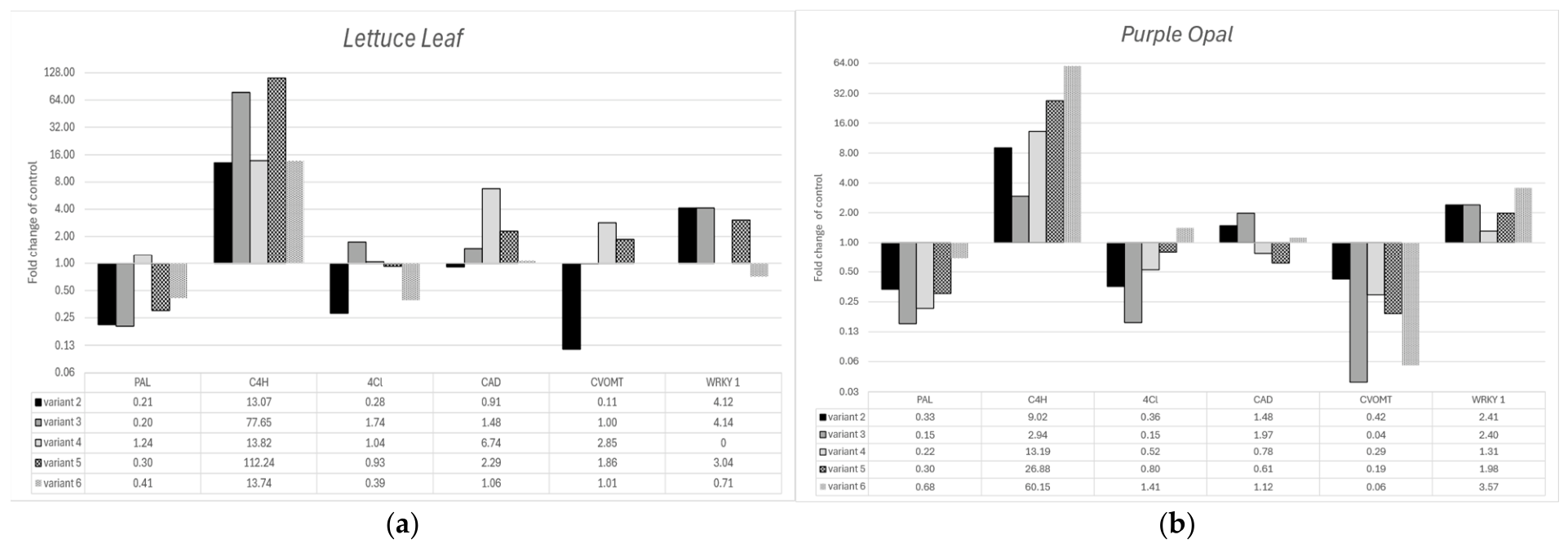
A similar trend (Figure 1) in fold change values was observed for the nutritional variants across the monitored genes in the phenylpropanoid pathway for both cultivars; however, significant differences were noted in the degree of expression changes compared to the control sample. The order of the genes is constructed in the same order as the enzymes involved in the pathway. In general, LL variant 4 exhibited the most stable expression pattern, with no extreme changes across all observed genes. Variants 2 and 6 displayed similar fold changes, except for CVOMT, where variant 2 was significantly downregulated compared to the other variants. In PO, nutritional variant 3 showed no significant upregulation in any of the measured genes; however, CVOMT expression was significantly downregulated. PO variant 6 exhibited the most changes in expression levels throughout the pathway.
Regarding PAL gene expression, it was reduced compared to the control in almost all nutritional variants for both cultivars, except for variant 4 in LL (1.24-fold). The trend in C4H relative expression indicated upregulation across all nutritional variants. LL exhibited similar values (13.07-, 13.82-, and 13.77-fold) in variants 2, 4, and 6. However, variants 3 (77.65-fold) and 5 (112.24-fold) showed significantly higher relative expressions. PO’s C4H expression was most upregulated in variant 6 (60.15-fold). The relative expressions of 4Cl exhibited a downregulation trend in almost all nutritional treatments for both cultivars, except LL variant 3, which was slightly upregulated (1.74-fold), and variant 4, which showed no change compared to the control (1.04-fold). PO’s variant 6 4Cl expression was upregulated (1.41-fold); under all other nutritional variants, the expression was downregulated, most significantly in variant 3 (0.15-fold). CAD expression levels were similar to control for LL in nutritional variants 2 (0.91-fold) and 6 (1.06-fold), with the highest expression noted in variant 6 (6.74-fold). In PO, CAD expression levels were downregulated in nutritional variants 4 (0.78-fold) and 5 (0.61-fold) but upregulated in variants 2 (1.48-fold) and 3 (1.97-fold). The relative CVOMT expression levels for the LL cultivar were similar to control in variants 3 (1.00-fold) and 6 (1.01-fold), while variant 2 was significantly downregulated at 0.11-fold. CVOMT expression levels in PO decreased across all nutritional variants, notably in variants 3 (0.04-fold) and 6 (0.06-fold).
The expression of the transcription factor OscWRKY1 (Figure 1) was upregulated in nearly all nutritional variants, with the exception of variant 6 of LL, which showed a 0.709-fold expression. Repeatedly, no signal was detected for LL variant 4. This result did not arise from RNA degradation or inhibition, as the cDNA sample for LL variant 4 was tested against a housekeeping gene and included in other gene expressions (PAL, C4H, 4Cl, CAD, CVOMT), which showed no issues with signaling. Furthermore, RNA concentration and purity were verified prior to cDNA synthesis. Additionally, in all analyses, -RT control and NTC (no template control) were included.

4. Discussion

The observed variability in fat, protein, and ash content reflects differences in nutrient composition, availability, and uptake efficiency associated with each fertilization strategy. The highest fat content in ‘Lettuce Leaf’ (LL) and ‘Purple Opal’ (PO) variant 2 suggests that readily available mineral nutrients, particularly N and K, may enhance lipid biosynthesis. This is supported by findings of [43], who reported increased lipid accumulation in leafy vegetables under optimized mineral nutrition. In contrast, the low-fat content in the control and PO variant 5 indicates that nutrient limitation or imbalance may restrict lipid formation. Intermediate values observed in organo-mineral treatments (e.g., LL variant 6) suggest a more gradual nutrient release and moderated metabolic response. These findings are consistent with those of the authors Sgherri et al. [44], who demonstrated that nutrient composition significantly affects lipid metabolism in basil. Crude protein content was strongly influenced by N availability—the highest: LL variant 2; the lowest: PO variant 6. The relatively high protein content in variant 4, for both cultivars, suggests that balanced nutrient composition and pH stabilization may improve N utilization efficiency [43]. Ash content, representing total mineral accumulation, was highest in treatments with organo-mineral fertilization (variant 6) for both cultivars. Humic acids enhance mineral uptake by improving nutrient solubility and root absorption capacity [45,46], as well as balanced nutrient supply resulting in intermediate values of ash content. Differences between LL and PO cultivars further indicate cultivar-specific responses to nutrient supply. Such interactions between cultivar and fertilization regime are well documented and are essential for optimizing crop production in controlled environments [47,48].
Nutrient regime also significantly influenced antioxidant capacity. The LL cultivar consistently exhibited higher antioxidant activity than PO, suggesting cultivar-specific differences in the accumulation of bioactive compounds, in agreement with observations reported by other authors [49]. Variant 5 showed the highest antioxidant activity, which may indicate that this nutrient formulation provided favorable conditions for the accumulation of antioxidant compounds. However, the underlying mechanisms were not investigated in the present study. The relatively high antioxidant activity observed in the control treatment may be associated with a physiological stress response induced by nutrient deficiency. Antioxidant compounds are often accumulated under stress conditions as part of plant defense mechanisms against oxidative damage caused by reactive oxygen species (ROS) [50]. Similarly, Lester et al. (2010) reported that mild stress conditions may enhance the nutritional quality of leafy vegetables through increased antioxidant levels [51]. In contrast, variant 2 was associated with the lowest antioxidant activity in both cultivars, suggesting that its nutrient composition may have been less favorable for the accumulation of antioxidant compounds. The intermediate values observed in variants 4 and 6 indicate that these nutrient regimes supported antioxidant activity to a moderate extent. Additionally, the antioxidant activity measured in basil samples may have been influenced not only by nutrient availability but also by other cultivation factors known to affect phytochemical composition [52]. The results suggest that nutrient management is associated with variations in antioxidant capacity, although further studies would be required to clarify the physiological mechanisms involved.
Polyphenols play a crucial role in plant response to abiotic stress, and phenolic compounds are enhanced to accumulate under limited nutrient input [50], which corresponds to the results of control samples in this study. Interestingly, PO variant 2 also showed relatively high polyphenol content despite previously observed lower antioxidant activity, indicating that antioxidant capacity depends not only on the total amount but also on the composition and structure of phenolic compounds [49]. In contrast, total flavonoid content followed a different trend, with the highest values found in PO. This suggests that flavonoid synthesis is influenced more by specific nutrient conditions than by nutrient limitation alone. The elevated flavonoid levels in PO can be attributed to the presence of anthocyanins, flavonoid compounds responsible for the characteristic purple coloration. Total phenolic acid content was highest in LL variant 6, indicating that the organo-mineral fertilization system may promote the synthesis of specific phenolic subclasses [52]. Cultivar-specific differences were also evident, with LL generally showing higher total polyphenol content, while PO accumulated more flavonoids, largely due to anthocyanin presence.
The results indicate that the concentration of gallic acid in both studied cultivars, LL and PO, was significantly influenced by the applied nutritional treatment, which is consistent with the available literature [43]. Gallic acid is commonly derived from the shikimate/phenylpropanoid pathway [53], and the biosynthesis is influenced by the light intensity and N fertilization [54]. In cultivar LL, the maximum concentration of gallic acid was achieved under variant 4, whereas in cultivar PO it was observed under variant 5. The differences between cultivars confirm that genetic background plays a key role in determining the metabolic response of plants to identical nutritional conditions, as has also been demonstrated in other basil cultivars grown in controlled hydroponic systems [55]. The most pronounced differences between cultivars were observed for gallocatechin, with cultivar LL exhibiting, on average, a 4.2-fold higher content compared to cultivar PO. The presence of protocatechuic acid and rutin exclusively in cultivar PO and, conversely, the presence of cryptochlorogenic acid only in cultivar LL highlights substantial differences in the secondary metabolism of the individual cultivars. These findings are consistent with the literature, which indicates that phenolic compounds are strongly genotype-dependent and closely linked to the regulation of oxidative stress in plants [43,56]. Variant 4 for cultivar PO promoted the highest accumulation of three polyphenolic compounds, which may be associated with a balanced supply of macro- and microelements throughout the entire cultivation cycle. Complex multicomponent mineral systems can stabilize plant metabolism and enhance antioxidant synthesis [13]. In contrast, organic constituents and bioactive compounds present in seaweed may act as elicitors of secondary metabolism and stimulate polyphenol synthesis, as has been documented in other studies [57], as showed results for cultivar LL variant 3.
The mineral composition of both basil cultivars was significantly influenced by the applied nutritional treatments, suggesting that fertilization plays an important role in modulating nutrient uptake and plant quality [14]. The variability in microelements (Fe, Mn, Zn, Cu) reflects differences in nutrient availability and potential ionic interactions in the growing medium [58]. In LL, variant 4 promoted the highest accumulation of Fe and Mn, indicating optimal nutrient balance and enhanced physiological activity, consistent with findings from controlled cultivation systems [59]. In contrast, lower values in variant 3 may be linked to slower nutrient release under organic fertilization [60]. K was dominant across all variants, reflecting its essential role in plant metabolism, while variability in Ca and Mg suggests nutrient interactions and genotype-dependent uptake [61]. In PO, variant 4 resulted in the highest accumulation of Mn, Zn, and Cu, indicating greater responsiveness to nutrient-rich conditions and supporting the importance of genotype in mineral accumulation [62]. Both cultivars showed low Cd concentrations and variable Pb and As levels, consistent with previous studies [63]. Slightly higher As levels may be associated with competition between arsenate and phosphate for uptake pathways [64].
There are still a few studies in the literature that focus on the gene regulation of phenylpropanoids in aromatic plants. The production of secondary metabolites and the expression of their corresponding genes in plants are strongly associated with growth conditions [35], nutrient availability and are dependent on cultivar or organ type [65]. The PAL enzyme plays a crucial regulatory role in the transition between primary and secondary metabolism and takes part in plant defense [36]. The composition of the nutrition given to plants can strongly influence the PAL pathway, most importantly the N form [66]. PAL plays a crucial role in mobilizing N in N-deficient tissues by liberating ammonium ions from phenylalanine. This process contributes to an increase in phenolic metabolites, such as flavonols, which are potent inhibitors of oxidative damage [67]. Enhanced PAL activity has been recorded under phosphate and N deficiency, leading to the accumulation of phenolics in leaves and roots [68]. Phenolics are believed to solubilize nutrients from unavailable sources, thereby facilitating their uptake. Tolerance to N deprivation can depend on PAL activity [67]. Elevated levels of Cd, Cu [69], and Se can also positively influence PAL activity and phenol content [70]. Since abiotic stress can enhance the production of secondary metabolites in plants, applying various stressors to increase secondary metabolite content has become a focus of research in plant improvement [71]. In a previous study, the application of ZnSO4 improved the expression of PAL and C4H genes as well as the content of phenolic compounds [72]. According to Xia et al. [73], the expression levels of C4H in Camellia sinensis were induced by various stress factors, including heat, salicylic acid (SA), and sucrose treatment. However, treatment with darkness decreased the expression of some C4H genes. Interestingly, the authors noted that among various tissues, CsC4Hc was relatively more highly expressed in old leaves compared to tender leaves. Our findings revealed an interesting relationship between PAL and C4H, as these enzymes are interrelated, with C4H utilizing the PAL product, cinnamate, as a substrate [35]. The C4H gene expression levels were significantly elevated across nearly all nutritional variations, particularly in LL variants 3 and 5, as well as PO variants 5 and 6, despite the detected under-expression of PAL. 4CL activity provides most of the precursors needed for the biosynthesis of essential oils, which is vital for other medicinal plants in the Lamiaceae family [74]. The expression of 4Cl, similar to the previous genes, is responsive to stressors such as drought, salinity [75,76], wounding, or UV-B light [77]. Various members of the 4Cl gene family may exhibit organ specificity [77] and functional diversity, responding to distinct stress stimuli [75]; similar findings are known for CAD gene expression [78,79]. CAD also plays a significant role in lignin biosynthesis [9,80], just as CVOMT [74], which catalyzes the final step in the biosynthesis of methylchavicol. CVOMT, similar to C4H and 4Cl expression, as well as their upregulation and downregulation by various environmental factors, can depend on the cultivar. Red and green cultivars of sweet basil responded differently to cold stress. In contrast, for drought, salt, heat, and light stress, the observed differences were related to the fold change of expression [11]. Our results indicated fluctuations in gene expression, with significant changes associated with nutritional variants; however, due to the limited sample size, no definitive statements can be made. Similar findings were observed under water stress [74].
Plants can reprogramme their metabolic processes through transcriptional regulation in response to biotic and abiotic signals [12,81]. WRKY transcriptional factors regulate various developmental and physiological functions in plants. The WRKY1 gene interacts with the W-box cis-element found in PAL and C4H. Silencing of OscWRKY1 resulted in reduced expression of PAL, C4H, and 4CL transcripts, while its overexpression is associated with increased PAL activity [36]. Our results did not reveal a linear relationship between the expression level of WRKY1 and the monitored genes across the different nutritional variants. However, for variant 4, where no signal was detected for the LL cultivar, the levels of gene activity exhibited the least variability.

5. Conclusions

The present study found that the nutrient regime significantly affected antioxidant activity, polyphenols, flavonoids, phenolic acids, fat, protein, ash, mineral composition, and gene expression in sweet basil. Polyphenol levels were higher in the ‘Lettuce Leaf’ cultivar, while the ‘Purple Opal’ exhibited increased flavonoid content. Mineral fertilization enhanced fat and protein levels, whereas organo-mineral treatment resulted in higher ash content. Based on the results, it can be stated that ‘Purple Opal’ is more resilient to nutritional changes than ‘Lettuce Leaf’.
Clearly, targeted fertilization influenced both primary and secondary metabolism. These results point to the fact that a varying nutritional approach to producing high-nutritional basil is necessary, and the growing strategy depends on the target compounds. These findings support the implementation of precision agriculture and controlled cultivation systems aimed at enhancing desired qualities in plants.

Supplementary Materials

The following supporting information can be downloaded at: https://www.mdpi.com/article/10.3390/agriculture16131387/s1, S1. Limit of detection (LOD), limit of quantificationand R square for selected polyphenols. S2. Limits of detection (LOD), limits of quantification (LOQ)for ICP-OES.

Author Contributions

Conceptualization, E.I., I.J., I.M., J.L., L.U., M.Š. and S.F.; methodology, E.I., I.J., I.M., J.L., L.U., M.Š. and S.F.; software, E.I., I.M. and L.U.; validation, E.I., I.J., J.L., L.U. and S.F.; formal analysis, E.I., I.J., I.M., J.L., L.U. and S.F.; investigation, E.I., I.J., J.L., L.U. and S.F.; resources, E.I., I.J., I.M., J.L., L.U., M.Š. and S.F.; data curation, E.I., I.J., I.M., J.L., L.U. and S.F.; writing—original draft preparation, E.I., I.J., I.M., J.L., L.U., M.Š. and S.F.; writing—review and editing, L.U. and S.F.; visualization, E.I., I.J., I.M., J.L., L.U. and S.F. All authors have read and agreed to the published version of the manuscript.

Funding

This research was funded by the EU NextGenerationEU through the Recovery and Resilience Plan for Slovakia under the project 09I05-03-V02-00085.

Data Availability Statement

The raw data supporting the conclusions of this article will be made available by the authors on request.

Conflicts of Interest

Author Eva Ivanišová is employed by the company Food Incubator in SUA Nitra s.r.o. The remaining authors declare that the research was conducted in the absence of any commercial or financial relationships that could be construed as a potential conflict of interest.

References

  1. Shahrajabian, M.H.; Sun, W.; Cheng, Q. Chemical Components and Pharmacological Benefits of Basil (Ocimum basilicum): A Review. Int. J. Food Prop. 2020, 23, 1961–1970. [Google Scholar] [CrossRef]
  2. Integrated Taxonomic Information System (ITIS). 2026. Available online: www.itis.gov (accessed on 12 June 2026).
  3. Purushothaman, B.; Srinivasan, R.P.; Suganthi, P.; Ranganathan, B.; Gimbun, J.; Shanmugam, K. A Comprehensive Review on Ocimum basilicum. J. Nat. Remedies 2018, 18, 71–85. [Google Scholar] [CrossRef]
  4. Ivanova, T.; Bosseva, Y.; Chervenkov, M.; Dimitrova, D. Sweet Basil between the Soul and the Table—Transformation of Traditional Knowledge on Ocimum basilicum L. in Bulgaria. Plants 2023, 12, 2771. [Google Scholar] [CrossRef] [PubMed]
  5. Elansary, H.O.; Szopa, A.; Kubica, P.; Ekiert, H.; El-Ansary, D.O.; Al-Mana, F.A.; Mahmoud, E.A. Saudi Rosmarinus Officinalis and Ocimum basilicum L. Polyphenols and Biological Activities. Processes 2020, 8, 446. [Google Scholar] [CrossRef]
  6. Ge, L.; Li, S.-P.; Lisak, G. Advanced Sensing Technologies of Phenolic Compounds for Pharmaceutical and Biomedical Analysis. J. Pharm. Biomed. Anal. 2020, 179, 112913. [Google Scholar] [CrossRef] [PubMed]
  7. Azizah, N.S.; Irawan, B.; Kusmoro, J.; Safriansyah, W.; Farabi, K.; Oktavia, D.; Doni, F.; Miranti, M. Sweet Basil (Ocimum basilicum L.)―A Review of Its Botany, Phytochemistry, Pharmacological Activities, and Biotechnological Development. Plants 2023, 12, 4148. [Google Scholar] [CrossRef] [PubMed]
  8. Romano, R.; De Luca, L.; Aiello, A.; Pagano, R.; Di Pierro, P.; Pizzolongo, F.; Masi, P. Basil (Ocimum basilicum L.) Leaves as a Source of Bioactive Compounds. Foods 2022, 11, 3212. [Google Scholar] [CrossRef] [PubMed]
  9. Sirisha, V.L.; Prashant, S.; Ranadheer Kumar, D.; Pramod, S.; Jalaja, N.; Hima Kumari, P.; Maheshwari Rao, P.; Nageswara Rao, S.; Mishra, P.; Rao Karumanchi, S.; et al. Cloning, Characterization and Impact of up- and down-Regulating Subabul Cinnamyl Alcohol Dehydrogenase (CAD) Gene on Plant Growth and Lignin Profiles in Transgenic Tobacco. Plant Growth Regul. 2012, 66, 239–253. [Google Scholar] [CrossRef]
  10. Kaur, A.; Sharma, K.; Pawar, S.V.; Sembi, J.K. Genome-Wide Characterization of PAL, C4H, and 4CL Genes Regulating the Phenylpropanoid Pathway in Vanilla planifolia. Sci. Rep. 2025, 15, 10714. [Google Scholar] [CrossRef] [PubMed]
  11. Shahivand, M.; Drikvand, R.M.; Gomarian, M.; Samiei, K. Key Genes in the Phenylpropanoids Biosynthesis Pathway Have Different Expression Patterns under Various Abiotic Stresses in the Iranian Red and Green Cultivars of Sweet Basil (Ocimum basilicum L.). Plant Biotechnol. Rep. 2021, 15, 585–594. [Google Scholar] [CrossRef]
  12. Khakdan, F.; Shirazi, Z.; Ranjbar, M. Identification and Functional Characterization of the CVOMTs and EOMTs Genes Promoters from Ocimum basilicum L. Plant Cell Tissue Organ Cult. 2022, 148, 387–402. [Google Scholar] [CrossRef]
  13. Kolega, S.; Miras-Moreno, B.; Buffagni, V.; Lucini, L.; Valentinuzzi, F.; Maver, M.; Mimmo, T.; Trevisan, M.; Pii, Y.; Cesco, S. Nutraceutical Profiles of Two Hydroponically Grown Sweet Basil Cultivars as Affected by the Composition of the Nutrient Solution and the Inoculation With Azospirillum brasilense. Front. Plant Sci. 2020, 11, 596000. [Google Scholar] [CrossRef] [PubMed]
  14. Dzida, K.; Pitura, K.; Król, A. Organic Fertilization vs. the Quality of Basil Raw Material. Agronomy 2025, 15, 2656. [Google Scholar] [CrossRef]
  15. Hazrati, S.; Pignata, G.; Casale, M.; Binello, A.; Cravotto, G.; Devecchi, M.; Nicola, S. Impact of Four Hydroponic Nutrient Solutions and Regrowth on Yield, Safety and Essential Oil Profile of Basil (Ocimum basilicum L.) Cultivated in Soilless Culture Systems. Folia Hortic. 2024, 36, 517–531. [Google Scholar] [CrossRef]
  16. Ekren, S.; Sönmez, Ç.; Özçakal, E.; Kurttaş, Y.S.K.; Bayram, E.; Gürgülü, H. The Effect of Different Irrigation Water Levels on Yield and Quality Characteristics of Purple Basil (Ocimum basilicum L.). Agric. Water Manag. 2012, 109, 155–161. [Google Scholar] [CrossRef]
  17. Al-Huqail, A.; El-Dakak, R.M.; Sanad, M.N.; Badr, R.H.; Ibrahim, M.M.; Soliman, D.; Khan, F. Effects of Climate Temperature and Water Stress on Plant Growth and Accumulation of Antioxidant Compounds in Sweet Basil (Ocimum basilicum L.) Leafy Vegetable. Scientifica 2020, 2020, 3808909. [Google Scholar] [CrossRef] [PubMed]
  18. Roosta, H.R. Comparison of the Vegetative Growth, Eco-Physiological Characteristics and Mineral Nutrient Content of Basil Plants in Different Irrigation Ratios of Hydroponic: Aquaponic Solutions. J. Plant Nutr. 2014, 37, 1782–1803. [Google Scholar] [CrossRef]
  19. Saha, S.; Monroe, A.; Day, M.R. Growth, Yield, Plant Quality and Nutrition of Basil (Ocimum basilicum L.) under Soilless Agricultural Systems. Ann. Agric. Sci. 2016, 61, 181–186. [Google Scholar] [CrossRef]
  20. Ekmekci, H.; Aasim, M. In vitro plant regeneration of Turkish sweet basil (Ocimum basilicum L.). J. Anim. Plant Sci. 2014, 24, 1758–1765. [Google Scholar]
  21. Kiferle, C.; Lucchesini, M.; Maggini, R.; Pardossi, A.; Mensuali-Sodi, A. In Vitro Culture of Sweet Basil: Gas Exchanges, Growth, and Rosmarinic Acid Production. Biol. Plant 2014, 58, 601–610. [Google Scholar] [CrossRef]
  22. Yaldiz, G.; Camlica, M.; Ozen, F. Biological Value and Chemical Components of Essential Oils of Sweet Basil (Ocimum basilicum L.) Grown with Organic Fertilization Sources. J. Sci. Food Agric. 2019, 99, 2005–2013. [Google Scholar] [CrossRef] [PubMed]
  23. Sifola, M.I.; Barbieri, G. Growth, Yield and Essential Oil Content of Three Cultivars of Basil Grown under Different Levels of Nitrogen in the Field. Sci. Hortic. 2006, 108, 408–413. [Google Scholar] [CrossRef]
  24. Camlica, M.; Yaldiz, G. Basil (Ocimum basilicum L.): Botany, Genetic Resource, Cultivation, Conservation, and Stress Factors. In Sustainable Agriculture in the Era of the OMICs Revolution; Prakash, C.S., Fiaz, S., Nadeem, M.A., Baloch, F.S., Qayyum, A., Eds.; Springer International Publishing: Cham, Switzerland, 2023; pp. 135–163. ISBN 978-3-031-15567-3. [Google Scholar]
  25. American Association of Cereal Chemists. Approved Methods of the American Association of Cereal Chemists, 8th ed.; American Association of Cereal Chemists: St. Paul, MN, USA, 1996. [Google Scholar]
  26. Yen, G.-C.; Chen, H.-Y. Antioxidant Activity of Various Tea Extracts in Relation to Their Antimutagenicity. J. Agric. Food Chem. 1995, 43, 27–32. [Google Scholar] [CrossRef]
  27. Singleton, V.L.; Rossi, J.A. Colorimetry of Total Phenolics with Phosphomolybdic-Phosphotungstic Acid Reagents. Am. J. Enol. Vitic. 1965, 16, 144–158. [Google Scholar] [CrossRef]
  28. Willett, W.C. Balancing Life-Style and Genomics Research for Disease Prevention. Science 2002, 296, 695–698. [Google Scholar] [CrossRef] [PubMed]
  29. Jain, R.; Rao, B.; Tare, A.B. Comparative Analysis of the Spectrophotometry Based Total Phenolic Acid Estimation Methods. J. Anal. Chem. 2017, 72, 972–976. [Google Scholar] [CrossRef]
  30. Scioli, G.; Della Valle, A.; Zengin, G.; Locatelli, M.; Tartaglia, A.; Cichelli, A.; Stefanucci, A.; Mollica, A. Artisanal Fortified Beers: Brewing, Enrichment, HPLC-DAD Analysis and Preliminary Screening of Antioxidant and Enzymatic Inhibitory Activities. Food Biosci. 2022, 48, 101721. [Google Scholar] [CrossRef]
  31. Meinhart, A.D.; Damin, F.M.; Caldeirão, L.; Da Silveira, T.F.F.; Filho, J.T.; Godoy, H.T. Chlorogenic Acid Isomer Contents in 100 Plants Commercialized in Brazil. Food Res. Int. 2017, 99, 522–530. [Google Scholar] [CrossRef] [PubMed]
  32. Jakabová, S.; Árvay, J.; Šnirc, M.; Lakatošová, J.; Ondejčíková, A.; Golian, J. HPLC-DAD Method for Simultaneous Determination of Gallic Acid, Catechins, and Methylxanthines and Its Application in Quantitative Analysis and Origin Identification of Green Tea. Heliyon 2024, 10, e35819. [Google Scholar] [CrossRef] [PubMed]
  33. Árvay, J.; Šnirc, M.; Hauptvogl, M.; Bilčíková, J.; Bobková, A.; Demková, L.; Hudáček, M.; Hrstková, M.; Lošák, T.; Král, M.; et al. Concentration of Micro- and Macro-Elements in Green and Roasted Coffee: Influence of Roasting Degree and Risk Assessment for the Consumers. Biol. Trace Elem. Res. 2019, 190, 226–233. [Google Scholar] [CrossRef] [PubMed]
  34. Kwon, D.Y.; Kim, Y.B.; Kim, J.K.; Park, S.U. Production of Rosmarinic Acid and Correlated Gene Expression in Hairy Root Cultures of Green and Purple Basil (Ocimum basilicum L.). Prep. Biochem. Biotechnol. 2021, 51, 35–43. [Google Scholar] [CrossRef] [PubMed]
  35. Abdollahi Mandoulakani, B.; Eyvazpour, E.; Ghadimzadeh, M. The Effect of Drought Stress on the Expression of Key Genes Involved in the Biosynthesis of Phenylpropanoids and Essential Oil Components in Basil (Ocimum basilicum L.). Phytochemistry 2017, 139, 1–7. [Google Scholar] [CrossRef] [PubMed]
  36. Joshi, A.; Jeena, G.S.; Shikha; Kumar, R.S.; Pandey, A.; Shukla, R.K. Ocimum Sanctum, OscWRKY1, Regulates Phenylpropanoid Pathway Genes and Promotes Resistance to Pathogen Infection in Arabidopsis. Plant Mol. Biol. 2022, 110, 235–251. [Google Scholar] [CrossRef] [PubMed]
  37. Pfaffl, M.W. A New Mathematical Model for Relative Quantification in Real-Time RT-PCR. Nucleic Acids Res. 2001, 29, 45e. [Google Scholar] [CrossRef] [PubMed]
  38. ADDINSOFT. XLSTAT Statistical. Data Analysis Solution; ADDINSOFT: New York, NY, USA, 2023. [Google Scholar]
  39. Papageorgiou, S.N. On Correlation Coefficients and Their Interpretation. J. Orthod. 2022, 49, 359–361. [Google Scholar] [CrossRef] [PubMed]
  40. Adamczyk-Szabela, D.; Wolf, W.M. The Influence of Copper and Zinc on Photosynthesis and Phenolic Levels in Basil (Ocimum basilicum L.), Borage (Borago officinalis L.), Common Nettle (Urtica dioica L.) and Peppermint (Mentha piperita L.). Int. J. Mol. Sci. 2024, 25, 3612. [Google Scholar] [CrossRef] [PubMed]
  41. Abou Seeda, M.A.; Abou El-Nour, E.A.A.; Abdallah, M.M.S.; El Bassiouny, H.M.S. Impacts of Metal, Metalloid and Their Effects in Plant Physiology: A Review. Middle East J. Agric. Res. 2022, 11, 838–931. [Google Scholar] [CrossRef]
  42. Zhao, F.; Maren, N.A.; Kosentka, P.Z.; Liao, Y.-Y.; Lu, H.; Duduit, J.R.; Huang, D.; Ashrafi, H.; Zhao, T.; Huerta, A.I.; et al. An Optimized Protocol for Stepwise Optimization of Real-Time RT-PCR Analysis. Hortic. Res. 2021, 8, 179. [Google Scholar] [CrossRef] [PubMed]
  43. Kiferle, C.; Maggini, R.; Pardossi, A. Influence of Nitrogen Nutrition on Growth and Accumulation of Rosmarinic Acid in Sweet Basil (Ocimum basilicum L.) grown in Hydroponic Culture. Aust. J. Crop Sci. 2013, 7, 321–327. [Google Scholar] [CrossRef]
  44. Sgherri, C.; Cecconami, S.; Pinzino, C.; Navari-Izzo, F.; Izzo, R. Levels of Antioxidants and Nutraceuticals in Basil Grown in Hydroponics and Soil. Food Chem. 2010, 123, 416–422. [Google Scholar] [CrossRef]
  45. Canellas, L.P.; Olivares, F.L.; Aguiar, N.O.; Jones, D.L.; Nebbioso, A.; Mazzei, P.; Piccolo, A. Humic and Fulvic Acids as Biostimulants in Horticulture. Sci. Hortic. 2015, 196, 15–27. [Google Scholar] [CrossRef]
  46. Rouphael, Y.; Cardarelli, M.; Bonini, P.; Colla, G. Synergistic Action of a Microbial-Based Biostimulant and a Plant Derived-Protein Hydrolysate Enhances Lettuce Tolerance to Alkalinity and Salinity. Front. Plant Sci. 2017, 8, 131. [Google Scholar] [CrossRef] [PubMed]
  47. Chrysargyris, A.; Aliniaeifard, S.; Nicola, S. Controlled Environment Agriculture (CEA) for Vegetables, Ornamental, and Aromatic Plants. Horticulturae 2026, 12, 421. [Google Scholar] [CrossRef]
  48. Veres, S.; Elhawat, N.; Rengel, Z.; Alshaal, T. Nitrogen Management in Crop–Soil–Environment Systems: Pathways Toward Sustainable and Climate-Resilient Agriculture. Int. J. Mol. Sci. 2026, 27, 2477. [Google Scholar] [CrossRef] [PubMed]
  49. Kim, D.-O.; Chun, O.K.; Kim, Y.J.; Moon, H.-Y.; Lee, C.Y. Quantification of Polyphenolics and Their Antioxidant Capacity in Fresh Plums. J. Agric. Food Chem. 2003, 51, 6509–6515. [Google Scholar] [CrossRef] [PubMed]
  50. Taiz, L.; Zeiger, E.; Møller, M.; Murph, A. Plant Physiology and Development, 6th ed.; Sinauer Associates: Sunderland, MA, USA, 2018. [Google Scholar]
  51. Lester, G.E.; Hallman, G.J.; Pérez, J.A. γ-Irradiation Dose: Effects on Baby-Leaf Spinach Ascorbic Acid, Carotenoids, Folate, α-Tocopherol, and Phylloquinone Concentrations. J. Agric. Food Chem. 2010, 58, 4901–4906. [Google Scholar] [CrossRef] [PubMed]
  52. Kwee, E.M.; Niemeyer, E.D. Variations in Phenolic Composition and Antioxidant Properties among 15 Basil (Ocimum basilicum L.) Cultivars. Food Chem. 2011, 128, 1044–1050. [Google Scholar] [CrossRef]
  53. Ćavar Zeljković, S.; Komzáková, K.; Šišková, J.; Karalija, E.; Smékalová, K.; Tarkowski, P. Phytochemical Variability of Selected Basil Genotypes. Ind. Crops Prod. 2020, 157, 112910. [Google Scholar] [CrossRef]
  54. Campos Espinosa, G.Y.; De Quadros, P.D.; Fulthorpe, R.R.; Tsopmo, A. Inclusion of Endophytes in Hydroponic Cultivation of Basils Enhances Hydroxycinnamic Acid Levels and Antioxidant Capacity. J. Food Sci. Technol. 2025, 62, 1425–1435. [Google Scholar] [CrossRef] [PubMed]
  55. Ciriello, M.; Formisano, L.; El-Nakhel, C.; Corrado, G.; Pannico, A.; De Pascale, S.; Rouphael, Y. Morpho-Physiological Responses and Secondary Metabolites Modulation by Preharvest Factors of Three Hydroponically Grown Genovese Basil Cultivars. Front. Plant Sci. 2021, 12, 671026. [Google Scholar] [CrossRef] [PubMed]
  56. Gill, S.S.; Tuteja, N. Reactive Oxygen Species and Antioxidant Machinery in Abiotic Stress Tolerance in Crop Plants. Plant Physiol. Biochem. 2010, 48, 909–930. [Google Scholar] [CrossRef] [PubMed]
  57. Lam, V.P.; Bok, G.; Loi, D.N.; Do, M.C.; Park, J. Seaweed Foliar Biostimulants Improve Growth and Phytochemicals of Thai Basil (Ocimum basilicum L.) in a Plant Factory. Plants 2025, 14, 3271. [Google Scholar] [CrossRef] [PubMed]
  58. Marschner, H.; Marschner, P. (Eds.) Marschner’s Mineral Nutrition of Higher Plants, 3rd ed.; Elsevier/Academic Press: London, UK; Waltham, MA, USA, 2012. [Google Scholar]
  59. Rouphael, Y.; Kyriacou, M.C.; Petropoulos, S.A.; De Pascale, S.; Colla, G. Improving Vegetable Quality in Controlled Environments. Sci. Hortic. 2018, 234, 275–289. [Google Scholar] [CrossRef]
  60. Colla, G.; Nardi, S.; Cardarelli, M.; Ertani, A.; Lucini, L.; Canaguier, R.; Rouphael, Y. Protein Hydrolysates as Biostimulants in Horticulture. Sci. Hortic. 2015, 196, 28–38. [Google Scholar] [CrossRef]
  61. White, P.J.; Broadley, M.R. Biofortification of Crops with Seven Mineral Elements Often Lacking in Human Diets—Iron, Zinc, Copper, Calcium, Magnesium, Selenium and Iodine. New Phytol. 2009, 182, 49–84. [Google Scholar] [CrossRef] [PubMed]
  62. Licina, V.; Jelacic, S.; Beatovic, D.; Antic-Mladenovic, S. Mineral Composition of Different Basil (Ocimum Spp.) Genotypes. Hem. Ind. 2014, 68, 501–510. [Google Scholar] [CrossRef]
  63. Peralta-Videa, J.R.; Lopez, M.L.; Narayan, M.; Saupe, G.; Gardea-Torresdey, J. The Biochemistry of Environmental Heavy Metal Uptake by Plants: Implications for the Food Chain. Int. J. Biochem. Cell Biol. 2009, 41, 1665–1677. [Google Scholar] [CrossRef] [PubMed]
  64. Zhao, F.-J.; McGrath, S.P.; Meharg, A.A. Arsenic as a Food Chain Contaminant: Mechanisms of Plant Uptake and Metabolism and Mitigation Strategies. Annu. Rev. Plant Biol. 2010, 61, 535–559. [Google Scholar] [CrossRef] [PubMed]
  65. Nadernejad, N.; Ahmadimoghadam, A.; Hossyinifard, J.; Poorseyedi, S. Effect of Different Rootstocks on PAL Activity and Phenolic Compounds in Flowers, Leaves, Hulls and Kernels of Three Pistachio (Pistacia vera L.) Cultivars. Trees 2013, 27, 1681–1689. [Google Scholar] [CrossRef]
  66. Jan, R.; Khan, M.A.; Asaf, S.; Lee, I.-J.; Kim, K.-M. Modulation of Sugar and Nitrogen in Callus Induction Media Alter PAL Pathway, SA and Biomass Accumulation in Rice Callus. Plant Cell Tissue Organ Cult. 2020, 143, 517–530. [Google Scholar] [CrossRef]
  67. Kováčik, J.; Bačkor, M. Changes of Phenolic Metabolism and Oxidative Status in Nitrogen-Deficient Matricaria chamomilla Plants. Plant Soil 2007, 297, 255–265. [Google Scholar] [CrossRef]
  68. Juszczuk, I.M.; Wiktorowska, A.; Malusá, E.; Rychter, A.M. Changes in the Concentration of Phenolic Compounds and Exudation Induced by Phosphate Deficiency in Bean Plants (Phaseolus vulgaris L.). Plant Soil 2004, 267, 41–49. [Google Scholar] [CrossRef]
  69. Kováčik, J.; Bačkor, M. Phenylalanine Ammonia-Lyase and Phenolic Compounds in Chamomile Tolerance to Cadmium and Copper Excess. Water Air Soil Pollut. 2007, 185, 185–193. [Google Scholar] [CrossRef]
  70. Astaneh, R.K.; Bolandnazar, S.; Nahandi, F.Z.; Oustan, S. Effect of Selenium Application on Phenylalanine Ammonia-Lyase (PAL) Activity, Phenol Leakage and Total Phenolic Content in Garlic (Allium sativum L.) under NaCl Stress. Inf. Process. Agric. 2018, 5, 339–344. [Google Scholar] [CrossRef]
  71. Gao, Y.; Zhang, J.; Wang, C.; Han, K.; Hu, L.; Niu, T.; Yang, Y.; Chang, Y.; Xie, J. Exogenous Proline Enhances Systemic Defense against Salt Stress in Celery by Regulating Photosystem, Phenolic Compounds, and Antioxidant System. Plants 2023, 12, 928. [Google Scholar] [CrossRef] [PubMed]
  72. Tian, X.; Zhang, R.; Yang, Z.; Fang, W. Methyl Jasmonate and Zinc Sulfate Induce Secondary Metabolism and Phenolic Acid Biosynthesis in Barley Seedlings. Plants 2024, 13, 1512. [Google Scholar] [CrossRef] [PubMed]
  73. Xia, J.; Liu, Y.; Yao, S.; Li, M.; Zhu, M.; Huang, K.; Gao, L.; Xia, T. Characterization and Expression Profiling of Camellia Sinensis Cinnamate 4-Hydroxylase Genes in Phenylpropanoid Pathways. Genes 2017, 8, 193. [Google Scholar] [CrossRef] [PubMed]
  74. Khakdan, F.; Nasiri, J.; Ranjbar, M.; Alizadeh, H. Water Deficit Stress Fluctuates Expression Profiles of 4Cl, C3H, COMT, CVOMT and EOMT Genes Involved in the Biosynthetic Pathway of Volatile Phenylpropanoids alongside Accumulation of Methylchavicol and Methyleugenol in Different Iranian Cultivars of Basil. J. Plant Physiol. 2017, 218, 74–83. [Google Scholar] [CrossRef] [PubMed]
  75. Lan, X.; Liu, N.; Zhou, Q.; Jin, M.; Liu, Y.; Tang, L. 4CL Gene Family in Red Beet: Genome-Wide Identification, Stress-Responsive Expression Patterns, and Their Role in Coordinating Secondary Metabolism and Growth Regulation. Sugar Tech 2026, 28, 45–58. [Google Scholar] [CrossRef]
  76. Zhang, Z.; Yang, X.; Ning, D.; Li, R. Characterization of 4-Coumarate-CoA Ligase (4CL) Genes in Wheat Uncovers Ta4CL91’s Role in Drought and Salt Stress Adaptation. Plants 2025, 14, 1301. [Google Scholar] [CrossRef] [PubMed]
  77. Li, M.; Guo, L.; Wang, Y.; Li, Y.; Jiang, X.; Liu, Y.; Xie, D.-Y.; Gao, L.; Xia, T. Molecular and Biochemical Characterization of Two 4-Coumarate: CoA Ligase Genes in Tea Plant (Camellia sinensis). Plant Mol. Biol. 2022, 109, 579–593. [Google Scholar] [CrossRef] [PubMed]
  78. Wu, M.; Li, Y.; Liu, Z.; Xia, L.; Xiang, Y.; Zhao, L.; Yang, X.; Li, Z.; Xie, X.; Wang, L.; et al. Genome-Wide Identification of the CAD Gene Family and Functional Analysis of Putative Bona Fide CAD Genes in Tobacco (Nicotiana tabacum L.). Front. Plant Sci. 2024, 15, 1400213. [Google Scholar] [CrossRef] [PubMed]
  79. Yusuf, C.Y.L.; Nabilah, N.S.; Taufik, N.A.A.M.; Seman, I.A.; Abdullah, M.P. Genome-Wide Analysis of the CAD Gene Family Reveals Two Bona Fide CAD Genes in Oil Palm. 3 Biotech. 2022, 12, 149. [Google Scholar] [CrossRef] [PubMed]
  80. Hu, L.; Zhang, X.; Ni, H.; Yuan, F.; Zhang, S. Identification and Functional Analysis of CAD Gene Family in Pomegranate (Punica granatum). Genes 2022, 14, 26. [Google Scholar] [CrossRef] [PubMed]
  81. Spitzer-Rimon, B.; Farhi, M.; Albo, B.; Cna’ani, A.; Ben Zvi, M.M.; Masci, T.; Edelbaum, O.; Yu, Y.; Shklarman, E.; Ovadis, M.; et al. The R2R3-MYB–Like Regulatory Factor EOBI, Acting Downstream of EOBII, Regulates Scent Production by Activating ODO1 and Structural Scent-Related Genes in Petunia. Plant Cell 2013, 24, 5089–5105. [Google Scholar] [CrossRef] [PubMed]
Figure 1. Relative expression levels of key genes involved in the phenylpropanoid pathway and OscWRKY1 transcription factor under different nutritional treatments: (a) Lettuce Leaf; (b) Purple Opal.
Agriculture 16 01387 g001
Table 1. Experimental nutrition variants.
Fertilizer
Variant No.Variant 1 (Control)Variant 2Variant 3Variant 4Variant 5Variant 6
Product nameDistilled
water
Plagron Hydro A + BPlagron Alga GrowAdvanced Nutrients pH PerfectCanna Aqua VegaJungle in da box Urban
A-B-Micro
Typeno
fertilizer
mineralorganicmineralmineralorgano-mineral
Composition
Components with elemental content in percentage-Component A
(NPK 3:0:1)
Component
(NPK 4:2:4)
Component Grow
(NPK 1:0:4)
Component A
(NPK 5:0:3)
Component A
(NPK 2:1:6)
N: 3.2%, K: 1.3%,
Ca: 5.9%, Mg: 0.4%
N: 4.2%, P: 2%,
K: 4.3%
amino acids
organic compounds
N: 1%, K: 4%,
Mg: 0.45%, S: 1.2%
N: 4.5%, K: 2.5%,
Ca: 2.1%, Mg: 1.3%,
Mn: 0.04%, Fe: 0.037%
N: 2%, P: 1%,
K: 6%, Mg: 0.5%,
S: 1%
Component B
(NPK 1:3:6)
Component Bloom
(NPK 1:3:4)
Component B
(NPK 0:3:4)
Component B
(NPK 0:5:4)
P: 3.2%, K: 5.7%,
Mg: 1.4%, S: 2.8%,
Cu: 0.004%,
Mn: 0.03%,
Zn: 0.01%,
Fe: 0.04%
N: 1%, P: 3%,
K: 4%, S: 0.5%
N: 0.2%, P: 2.6%,
K: 4.2%, Mg: 0.1%,
S: 1.1%, B: 0.009%,
Cu: 0.002%, Mn: 0.018%,
Mo: 0.003%
P: 5%, K: 4%,
Mg: 1.5%, S: 1%
Component Micro
(NPK 2:0:0)
Component Micro
(NPK 5:0:1)
N: 2%, Ca: 3.4%,
Mg: 0.25%, B: 0.02%,
Mn: 0.05%, Fe: 0.05%
N: 5%, K: 1%,
Ca: 5%, B: 0.015%,
Cu: 0.01%, Mn: 0.03%,
Zn: 0.02%, Fe: 0.1%,
Mo: 0.003%
Solution preparation (per 10 L of distilled water)
Initial A: 7 mL
B: 7 mL
Component:
10 mL
Grow: 20 mL
Micro: 20 mL
Bloom: 20 mL
A: 5 mL
B: 5 mL
A: 180 mL
B: 60 mL
Micro: 120 mL
Full
nutrient
A: 25 mL
B: 25 mL
Component:
40 mL
Grow: 40 mL
Micro: 40 mL
Bloom: 40 mL
A: 20 mL
B: 20 mL
A: 240 mL
B: 80 mL
Micro: 160 mL
Table 2. Primer information for RT-qPCR targeting genes involved in the phenylpropanoid pathway.
Gene NameNCBI
Accession
Primer Forward
(5′-3′)
Primer Reverse
(5′-3′)
Product Size (bp)Ta
(°C)
Reference
GAPDHHM196352.1AACATTATCCCCAGCAGCACTAGGAACTCGGAATGCCATC17263[34]
PALAB436791.1CAGGCGACCTGGTCCCACTATACGCCCGCTAGAGTGAGTGC12165
C4HHM990150AGATCTTGGTGAACGCCTGGTGCCGAGAATAGGCAAAGCA19265[35]
4CLKC576841GGCGACATAGGGTTTGTGGAACTTCACCAGCAGCCTCATC17963
CADAY879285GCTCTCGATCACTTAGGGGCAGAGAGGTAGGGCTCCAAGG13263
CVOMTAB530137CACATGTTGTGGCTGGGTTGCCTCCTCATCGTCCCAATCG12964
OscWRKY 1MN393294ACACTCGTGCAACCAGTCAATGACGTCTCCTTCCTGTCCA13665[36]
Table 3. Total fat, crude protein and ash content in analyzed samples.
CultivarVariantFat Content
± SD
(%)
Crude Protein Content
± SD
(%)
Ash Content
± SD
(%)
controlvariant 13.00 ± 0.14 g26.12 ± 0.69 e5.54 ± 1.11 f
Lettuce Leafvariant 26.75 ± 0.36 a38.27 ± 1.05 a10.63 ± 1.17 d,e
variant 45.45 ± 0.35 bc32.01 ± 0.3 c,d12.61 ± 0.15 c,d
variant 54.40 ± 0.14 d,e31.49 ± 0.92 d13.86 ± 1.23 b,c
variant 65.25 ± 0.07 b,c34.06 ± 1.58 b,c14.31 ± 0.26 a,b
Purple Opalvariant 26.15 ± 0.92 a,b32.34 ± 1.43 c,d10.39 ± 1.32 d,e
variant 44.93 ± 0.2 c,d36.31 ± 1.56 a,b12.49 ± 0.59 c,d
variant 53.80 ± 0.42 f31.84 ± 1.94 c,d12.75 ± 0.37 c,d
variant 63.95 ± 0.07 e,f25.39 ± 1.77 e14.74 ± 0.37 a
SD—standard deviation; different letters in columns indicate statistically significant differences according to Tukey’s test (p < 0.05).
Table 4. Antioxidant activity and total polyphenol, flavonoid and phenolic acid content of basil.
CultivarVariantAntioxidant Activity ± SDTotal Content of DW ± SD
DPPH
mg TEAC·g−1
Total Polyphenol
mg GAE·g−1
Total Flavonoid
mg QE·g−1
Total Phenolic Acid
mg CAE·g−1
Controlvariant 127.23 ± 0.76 b177.56 ± 6.59 a41.83 ± 3.91 g23.07 ± 0.17 b
Lettuce Leafvariant 24.63 ± 0.11 g95.33 ± 9.74 f63.45 ± 1.34 c19.66 ± 2.44 c
variant 421.28 ± 0.31 c170.89 ± 2.83 a67.73 ± 1.21 b18.83 ± 1.49 c
variant 533.42 ± 0.16 a130.89 ± 3.46 d56.97 ± 0.54 e21.54 ± 0.55 b
variant 622.76 ± 0.15 c104.22 ± 3.45 e52.88 ± 0.67 f30.91 ± 0.28 a
Purple Opalvariant 22.43 ± 0.07 h166.44 ± 9.17 b70.78 ± 0.13 a12.70 ± 0.06 d
variant 414.18 ± 0.32 e88.67 ± 5.97 f51.54 ± 0.4 f10.08 ± 0.33 e
variant 519.15 ± 0.78 d144.22 ± 2.83 c63.07 ± 0.54 c21.57 ± 0.84 b
variant 66.43 ± 0.51 f73.11 ± 2.28 g71.13 ± 1.48 a12.71 ± 0.39 d
SD—standard deviation; DW–dry weight; DPPH—2,2-diphenyl-1-picrylhydrazyl; TEAC—Trolox equivalent antioxidant capacity; GAE—gallic acid equivalent; QE—quercetin equivalent; CAE—caffeic acid equivalent; different letters in columns indicate statistically significant differences according to Tukey’s test (p < 0.05).
Table 5. Relationships between chemical composition and antioxidant characteristics (Pearson’s r).
Protein ContentAsh ContentDPPHTPCTFCTPAC
Protein content10.020−0.166−0.0850.114−0.047
Ash content 1−0.141−0.3060.298−0.165
DPPH 10.510−0.5090.638
TPC 1−0.0060.334
TFC 1−0.388
TPAC 1
DPPH—radical scavenging activity; TPC—total phenolic content; TFC—total flavonoid content; TPAC—total antioxidant capacity. Values represent Pearson correlation coefficients (r).
Table 6. Concentration of polyphenolic compounds in basil cultivar ‘Lettuce Leaf’.
CultivarVariantConcentration ± SD (µg·g−1 DW)
Gallic AcidGallocatechinCryptochlorogenic Acid
Lettuce Leafvariant 256.76 ± 3.63 a79.69 ± 2.72 a,c3.53 ± 1.2 a
variant 395.17 ± 3.14 b136.78 ± 6.68 b9.96 ± 1.23 b
variant 4104.21 ± 8.94 b76.41 ± 0.6 a2.39 ± 0.02 a
variant 571.09 ± 1.92 c82.53 ± 3.41 c2.27 ± 0.04 a
variant 676.79 ± 3.16 c54.68 ± 1.3 d1.54 ± 1.19 a
SD—standard deviation (n = 6), DW—dry weight. Letters in index indicate sample groupings based on significant differences by the Tukey HSD test.
Table 7. Concentration of polyphenolic compounds in basil cultivar ‘Purple Opal’.
CultivarVariantConcentration ± SD (µg·g−1 DW)
Gallic AcidGallocatechinProtocatechuic AcidRutin
Purple Opalvariant 281.35 ± 2.18 a11.79 ± 2.27 a2.34 ± 0.01 a7.01 ± 0.04 a
variant 479.6 ± 2.54 a31.06 ± 2.86 b2.27 ± 0.11 a10.19 ± 0.81 b
variant 586.00 ± 3.76 b18.84 ± 2.09 cNDND
variant 675.01 ± 0.7 c21.87 ± 4.45 c2.33 ± 0.02 a4.66 ± 0.04 c
SD—standard deviation (n = 6); ND—not detected; DW—dry weight. Letters in index indicate sample groupings based on significant differences by the Tukey HSD test.
Table 8. Concentration of microelements in basil cultivar ‘Lettuce Leaf’.
CultivarVariantConcentration ± SD (mg·kg−1 DW)
CoAlBaCrCuFeLiMnNiZn
Lettuce Leafvariant 20.17
± 0.04 a,b
13.25
± 0.35 a
1.19
± 0.00 a
0.89
± 0.01 a
21.94
± 0.07 a
62.34
± 0.21 a
0.23
± 0.00 a
74.40
± 0.20 a
0.72
± 0.07 a,c
46.88
± 0.55 a
variant 30.20
± 0.02 a,b
27.50
± 0.15 b
1.20
± 0.00 a
0.29
± 0.02 b
16.84
± 0.03 b
53.51
± 0.27 b
1.10
± 0.01 b
52.96
± 0.12 b
0.56
± 0.05 a,b
43.95
± 0.35 b
variant 40.19
± 0.06 a,b
20.63
± 0.57 c
1.96
± 0.01 b
0.75
± 0.07 c
26.23
± 0.07 c
101.72
± 0.24 c
0.86
± 0.00 c
173.61
± 0.36 c
0.40
± 0.10 b
79.61
± 1.00 c
variant 50.24
± 0.01 a
63.75
± 0.75 d
2.61
± 0.01 c
0.54
± 0.02 d
20.34
± 0.10 d
76.09
± 0.30 d
0.60
± 0.01 d
148.06
± 0.29 d
0.80
± 0.07 c
92.45
± 0.40 d
variant 60.10
± 0.05 b
22.84
± 0.39 e
0.98
± 0.00 d
0.43
± 0.04 e
26.54
± 0.05 e
74.19
± 0.10 e
0.25
± 0.00 e
106.82
± 0.27 e
0.45
± 0.05 b
56.27
± 0.60 e
SD—standard deviation (n = 3). Letters in index indicate sample groupings based on significant differences by the Tukey HSD test.
Table 9. Concentration of macroelements in basil cultivar ‘Lettuce Leaf’.
CultivarVariantConcentration ± SD (mg·kg−1 DW)
CaNaKMg
Lettuce Leafvariant 214,031 ± 24.74 a301.12 ± 0.51 a28,044 ± 282.74 a413.18 ± 0.78 a
variant 33457 ± 17.56 b4850 ± 17.87 b24,494 ± 52.34 b134.12 ± 0.21 b
variant 413,750 ± 33.27 c436.76 ± 1.10 c43,071 ± 130.37 c280.07 ± 0.72 c
variant 510,025 ± 30.51 d1671 ± 6.31 d29,929 ± 60.08 d431.01 ± 1.53 d
variant 614,625 ± 47.18 e496 ± 1.47 e30,337 ± 19.21 e386.91 ± 0.30 e
SD—standard deviation (n = 3). Letters in index indicate sample groupings based on significant differences by the Tukey HSD test.
Table 10. Concentration of toxic elements in basil cultivar ‘Lettuce Leaf’.
CultivarVariantConcentration ± SD (mg·kg−1 DW)
CdPbAs
Lettuce Leafvariant 20.03 ± 0.02 a0.86 ± 0.16 a0.79 ± 0.32 a
variant 30.02 ± 0.01 a0.59 ± 0.03 a0.48 ± 0.18 a,b
variant 40.04 ± 0.02 a1.24 ± 0.43 a0.22 ± 0.01 b
variant 50.02 ± 0.02 a0.58 ± 0.21 a0.82 ± 0.17 a
variant 60.02 ± 0.01 a0.87 ± 0.10 a0.60 ± 0.08 a,b
SD—standard deviation (n = 3). Letters in index indicate sample groupings based on significant differences by the Tukey HSD test.
Table 11. Concentration of microelements in basil cultivar ‘Purple Opal’.
CultivarVariantConcentration ± SD (mg·kg−1 DW)
CoAlBaCrCuFeLiMnNiZn
Purple Opalvariant 20.10
± 0.02 a
32.66
± 0.32 a,b
1.05
± 0.00 a
1.12
± 0.02 a
36.25
± 0.15 a
91.33
± 0.07 a
0.15
± 0.00 a
113.68
± 0.29 a
0.85
± 0.12 a
123.21
± 0.23 a
variant 40.11
± 0.03 a
33.69
± 0.56 a
0.69
± 0.01 b
0.41
± 0.01 b
48.64
± 0.04 b
82.98
± 0.27 b
0.73
± 0.00 b
215.62
± 1.38 b
0.55
± 0.16 b
160.18
± 1.04 b
variant 50.24
± 0.05 b
31.92
± 0.71 b
0.83
± 0.00 c
0.36
± 0.02 c
39.62
± 0.07 c
80.66
± 0.20 c
0.28
± 0.00 c
111.30
± 0.19 c
0.67
± 0.03 a,b
125.63
± 0.75 c
variant 60.08
± 0.02 a
28.41
± 0.68 c
0.78
± 0.00 d
0.31
± 0.01 d
35.78
± 0.02 d
77.35
± 0.20 d
0.13
± 0.00 d
100.18
± 0.31 d
0.50
± 0.06 b
106.62
± 0.26 d
SD—standard deviation (n = 3). Letters in index indicate sample groupings based on significant differences by the Tukey HSD test.
Table 12. Concentration of macroelements in basil cultivar ‘Purple Opal’.
CultivarVariantConcentration ± SD (mg·kg−1 DW)
CaNaKMg
Purple Opalvariant 211,316 ± 62.11 a384.5 ± 1.30 a30,949 ± 4.00 a238.0 ± 0.17 a
variant 48545 ± 51.01 b543.3 ± 0.82 b28,286 ± 37.14 b188.3 ± 0.33 b
variant 56477 ± 13.21 c213.4 ± 0.88 c28,763 ± 4.70 c272.1 ± 0.36 c
variant 68912 ± 18.15 d291.3 ± 2.10 d30,262 ± 20.00 d239.2 ± 0.69 d
SD—standard deviation (n = 3). Letters in index indicate sample groupings based on significant differences by the Tukey HSD test.
Table 13. Concentration of toxic elements in basil cultivar ‘Purple Opal’.
CultivarVariantConcentration ± SD (mg·kg−1 DW)
CdPbAs
Purple Opalvariant 20.03 ± 0.01 a0.92 ± 0.13 a0.35 ± 0.01 a
variant 40.03 ± 0.01 a1.25 ± 0.20 a0.46 ± 0.10 a
variant 50.02 ± 0.01 a1.01 ± 0.13 a0.87 ± 0.11 b
variant 60.02 ± 0.01 a0.92 ± 0.03 a0.90 ± 0.08 b
SD—standard deviation (n = 3). Letters in index indicate sample groupings based on significant differences by the Tukey HSD test.
Table 14. Key correlations highlighting interactions among selected elements.
ParameterCa–MgNa–KFe–MnCu–ZnAs–PbNi–PbCa–PbFe–CuFe–Zn
r0.65 *−0.400.080.84 *0.36−0.280.240.400.10
Correlation strength was interpreted according to the absolute value of r as follows: <0.20 very weak, 0.20–0.39 weak, 0.40–0.59 moderate, 0.60–0.79 strong, and ≥0.80 very strong (Papageorgiou, 2022 [39]). *—the strongest correlations.
Disclaimer/Publisher’s Note: The statements, opinions and data contained in all publications are solely those of the individual author(s) and contributor(s) and not of MDPI and/or the editor(s). MDPI and/or the editor(s) disclaim responsibility for any injury to people or property resulting from any ideas, methods, instructions or products referred to in the content.