Article

The Effects of Co-Application of Biochar and Phosphogypsum on Regulating the Microenvironment of Saline–Alkali Soils to Promote Safflower Growth and Quality Development
1
College of Pharmacy, Chengdu University, Chengdu 610106, China
2
Jilin Provincial Key Laboratory of Traditional Chinese Medicinal Materials Cultivation and Propagation, Institute of Special Animal and Plant Sciences, Chinese Academy of Agricultural Sciences, Changchun 130112, China
*
Author to whom correspondence should be addressed.
Agriculture 2026, 16(11), 1245; https://doi.org/10.3390/agriculture16111245 (registering DOI)
Submission received: 17 April 2026 / Revised: 22 May 2026 / Accepted: 25 May 2026 / Published: 5 June 2026
(This article belongs to the Special Issue Effects of Biochar on Soil Improvement and Crop Production)

Abstract

The utilization of saline–alkali lands and the competition between medicinal plants and grain crops are urgent issues. This study aimed to evaluate the effects of combined biochar and phosphogypsum application on soil physicochemical properties, microbial communities, and safflower growth, yield, and bioactive component accumulation in moderately saline–alkali soil of western Jilin, and to identify key soil factors driving these responses. To achieve this, outdoor pot experiments were conducted using safflower (Carthamus tinctorius L.), with the application of 1% biochar + 1% phosphogypsum to moderately saline–alkali soil. The results showed that the amendment significantly reduced bulk density (BD), pH, sodium adsorption ratio (SAR), total alkalinity (TA), and exchangeable sodium percentage (ESP), while increasing soil water content (SWC), soil organic matter (SOM), nitrogen, phosphorus, potassium, and beneficial ions. Soil sucrase, urease, alkaline phosphatase, and catalase activities were enhanced. Copiotrophic taxa (Pseudomonadota, Sphingomonas, Vicinamibacter) increased, whereas oligotrophic taxa (Gemmatimonadetes, Longimicrobium, Luteitalea) decreased, with stronger effects on bacteria than fungi. Safflower growth indices improved; leaf Na+/K+ ratio, superoxide radicals, and malondialdehyde decreased; and soluble protein, proline, and antioxidant enzyme activities increased. Bioactive components (hydroxysafflor yellow A, kaempferol) and yield reached 1.41%, 0.056%, and 343.23 mg/plant, representing 1.74–27.68-fold increases over moderate and mild saline–alkali soils. Correlation analysis identified SOM, total nitrogen (TN), available phosphorus (AP), BD, SWC, pH, SAR, TA, and ESP as key factors. In conclusion, co-application of 1% biochar and 1% phosphogypsum improves soil physicochemical and microbial properties, alleviates saline–alkali stress, and enhances safflower quality and yield.

1. Introduction

Soil salinization severely restricts crop growth and the sustainable utilization of land resources [1]. According to incomplete statistics from the United Nations, the global area of salinized soil reaches 955 million hectares, accounting for approximately 11% of the total land area, and this trend is worsening [2]. Saline–alkali soils are widely distributed in China, including North China, Northeast China, Northwest China, and some coastal plain areas, with diverse types. The saline–alkali land in western Jilin Province, located in the Songnen Plain, belongs to one of the three major soda saline–alkali distribution areas in the world. The degree of salinization in this region varies, but overall it is characterized by high sodium content (severe Na+ toxicity), low carbon content, poor soil structure, nutrient deficiency, weak soil functionality, and a sharp reduction in soil microorganisms. These characteristics directly lead to physiological drought in crops, manifested as osmotic imbalance, ion toxicity, and oxidative stress [3], severely affecting crop growth and development and restricting the utilization of land resources in the region.
China is rich in medicinal plant resources, some of which possess a certain tolerance to saline–alkali conditions, offering positive implications for the utilization of saline–alkali lands. Safflower (Carthamus tinctorius L.) is an annual herbaceous plant of the family Asteraceae. It has high medicinal value in traditional Chinese medicine, with its bioactive components being hydroxysafflor yellow A (HSYA) and kaempferol (KAE). Its main functions and effects include promoting blood circulation, removing blood stasis, and relieving menstrual pain. It is commonly used to treat gynecological disorders such as irregular menstruation and dysmenorrhea, and also helps alleviate various symptoms caused by poor blood circulation, including coronary heart disease and cerebral thrombosis [4]. Safflower extract is also used to produce safflower oil, which can be applied externally for injuries such as bruises and sprains, as well as rheumatic pain, indicating broad application prospects. Studies have shown that safflower has a certain capacity to tolerate saline–alkali stress [5]. Therefore, applying appropriate amelioration measures to saline–alkali lands while cultivating suitable traditional Chinese medicinal materials such as safflower can effectively alleviate the tension over land for medicinal plants under the background of preventing the conversion of farmland to non-grain uses. At the same time, this approach can contribute to both the efficient development and utilization of saline–alkali lands and the sustainable development of the traditional Chinese medicine industry.
Current methods for ameliorating saline–alkali soils mainly include physical, chemical, biological, and hydraulic engineering approaches. Among these, chemical amelioration has been proven to be one of the methods with great application potential and significant effects. Chemical amelioration primarily involves the application of chemical amendments such as gypsum, biochar, and humic acid. Gypsum consists of fine particles with low water content and contains mineral nutrients, such as Ca and S, which are beneficial for plant growth. When applied to saline–alkali soils, it not only reduces soil pH and sodium adsorption ratio under salt stress but also enhances soil structural stability and water retention capacity [6,7]. Phosphogypsum is rich in Ca2+; upon application, it undergoes reactions such as Ca2+–Na+ ion exchange and salt transformation, reducing saline–alkali indicators like exchangeable sodium percentage (ESP) and alleviating plant salt stress [8]. Furthermore, studies have shown that exogenous CaCl2 helps maintain reactive oxygen species (ROS) homeostasis in Nitraria sibirica under salt stress by enhancing leaf antioxidant enzyme activities and antioxidant content [9]. However, since gypsum itself is a salt with a single nutrient composition, its sole application has limitations. In recent years, biochar has received increasing attention as a potential method for improving soil quality and sustaining crop productivity. A study has shown that under saline–alkali stress, biochar improves the vegetative and reproductive growth as well as the biochemical characteristics of Catharanthus roseus, and enhances soil fertility [10]. The porous structure of biochar provides a “refuge” for soil microorganisms, protecting them from environmental threats, altering microbial abundance and activity, and promoting nutrient cycling [11]. A study by Lei et al. showed that biochar application improved soil pH, electrical conductivity (EC), and soil nutrients, and significantly increased microbial species richness, particularly bacteria such as Vicinamibacteraceae [12]. In summary, the ameliorative effect of biochar is mainly reflected in the improvement of soil properties and nutrient content. Thus, the combined application of phosphogypsum and biochar is an effective strategy for ameliorating saline–alkali soils. Therefore, this study adopted the combined application of 1% biochar and 1% phosphogypsum as the approach, starting from the amelioration of saline–alkali soils in western Jilin Province. It systematically investigated the synergistic effects of their combined application on soil physicochemical properties and microbial community structure, how the subsequent changes in the soil environment regulate safflower growth, yield, and bioactive component accumulation, and the pathways linking key soil factors to safflower quality indicators. The aim was to elucidate the comprehensive effects and underlying mechanisms of the combined biochar and phosphogypsum amelioration of saline–alkali soils on safflower growth, development, and quality formation, thereby providing a theoretical basis for the resource utilization of saline–alkali lands and the high-quality, high-yield cultivation of safflower. To the best of our knowledge, this is the first study to integrate safflower as a research subject with the development and utilization of saline–alkali land in western Jilin, China, through the combined application of biochar and phosphogypsum for saline–alkali soil amelioration.

2. Materials and Methods

2.1. Sample Collection and Experimental Design

Different degrees of saline–alkali soils (slightly, moderately, and strongly) were collected from Changling County, Songyuan City, Jilin Province (44°7′39.19″ N, 123°53′51.36″ E) at a depth of 0–20 cm. Seeds of safflower (Yuhonghua No. 1) were obtained from the Henan Academy of Agricultural Sciences and stored at 4 °C. A preliminary experiment was conducted to investigate the emergence and survival of safflower seeds. Plump and uniform seeds were sown in breathable pots (18 cm × 12.5 cm × 18 cm) containing different degrees of saline–alkali soil. Three seeds were sown per pot, with five pots as one replicate and three replicates per treatment. The emergence and survival of safflower seeds were observed. The results showed that safflower seeds died in strongly saline–alkali soil, grew well in slightly saline–alkali soil, and could survive but grew extremely poorly in moderately saline–alkali soil. Therefore, moderately saline–alkali soil was selected for the amelioration study. The amendment consisted of 1% biochar + 1% phosphogypsum. Biochar was purchased from Foshan Pels Carbon Materials Technology Co., Ltd., (Foshan, Guangdong Province, China) and was produced by pyrolysis of straw at a high temperature of 500 °C with a heating rate of 10 °C/min and a residence time of 30 min. Phosphogypsum was purchased from Zhucheng Jiuqi Building Materials Co., Ltd. (Zhucheng, Shandong Province, China) Non-saline farmland soil near the saline–alkali soil collection site, where plants grew normally, was used as the control (CK). The slightly and moderately saline–alkali soils were classified according to the national standard GB/T 42828.3-2023 [13]: slightly saline–alkali soil (M1, EC < 4, 15 < ESP < 20) and moderately saline–alkali soil (M2, 5 < EC < 8, 21 < ESP < 30). The amended treatment was designated as AM. On May 22, 2025, plump and uniform seeds were sown in breathable pots (18 cm × 12.5 cm × 18 cm) containing different degrees of saline-alkali soils. An outdoor pot experiment was conducted at the experimental farm of the Institute of Special Animal and Plant Sciences, Chinese Academy of Agricultural Sciences. Three safflower seeds were sown per pot, with five pots as one replicate and three replicates per treatment. After emergence, seedlings were thinned to one plant per pot for subsequent studies. During the vegetative growth period of safflower (42 days after sowing), three plants were randomly selected from each treatment, gently rinsed with distilled water (approximately 1–2 min) to avoid root damage, and then divided into roots, stems, and leaves for morphological measurements. The first fully expanded leaf from the base of each plant was collected, ground in liquid nitrogen, and stored at −80 °C for physiological analyses. During the flowering stage of safflower (64–79 days after sowing), the tubular florets of each plant were harvested in batches, the number of remaining involucres and their diameters were recorded, and the collected petals were air-dried at 30 °C for determination of bioactive components and yield. After the flowering stage (79 days after sowing), soil bulk density was measured for each treatment, and soil samples and safflower plants were collected for subsequent analyses. Soil samples were divided into two portions: one portion was air-dried, ground to remove debris, and passed through 20-mesh and 100-mesh sieves for chemical analyses; the other portion was stored at −80 °C for DNA extraction and soil enzyme activity assays.

2.2. Measurement Indicators and Experimental Methods

Determination of soil physical indicators: Soil bulk density (BD) was measured by the ring knife method, and soil water content (SWC) was determined by the oven-drying method [6].
Determination of soil chemical indicators: Soil pH was measured using a Mettler SK220 pH meter, and electrical conductivity (EC) was measured using a Mettler FE38 conductivity meter. Total nitrogen (TN) and soil organic matter (SOM) were determined using an elemental analyzer (Vario EL, Frankfurt, Germany). Total phosphorus (TP) was determined by the molybdenum blue method using a spectrophotometer at 700 nm [14]. Total potassium (TK) was measured using a flame photometer (6400 A, Shanghai, China). Nitrate nitrogen (NN) and ammonium nitrogen (AN) were extracted with 1 mol/L KCl and then determined using a continuous flow analyzer (Auto Analyzer 3-AA3, Hamburg, Germany). Available phosphorus (AP) and available potassium (AK) were determined using standard soil agrochemical analysis methods.
Determination of eight major ions in soil: A 50 g air-dried soil sample was mixed with deionized water at a soil-to-water ratio of 1:5, using 250 mL of CO2-free distilled water. After shaking for 5 min, the suspension was filtered under vacuum, and the filtrate was collected for ion determination. Sodium (Na+) and potassium (K+) were measured by flame photometry; calcium (Ca2+) and magnesium (Mg2+) were determined by EDTA titration; sulfate (SO42−) was determined by indirect EDTA complexometric titration; chloride (Cl) was determined by silver nitrate titration; and carbonate (CO32−) and bicarbonate (HCO3) were determined by double-indicator neutralization titration. Exchangeable sodium was determined by the ammonium acetate–ammonium hydroxide exchange-flame photometry method. Cation exchange capacity (CEC) was determined by the ammonium chloride–ammonium acetate exchange method [12].
The calculation formulas for total alkalinity (TA), sodium adsorption ratio (SAR), and exchangeable sodium percentage (ESP) are as follows:
TA = CO32− + HCO3 (mmolc/L)
SAR = Na + / [ C a 2 + + M g 2 + 2 ] × 100 %
E S P = E x c h a n g e a b l e   s o d i u m C E C × 100 %
The activities of soil sucrase (S-SC), urease (S-UE), alkaline phosphatase (S-AKP), and catalase (S-CAT) were measured using assay kits (Beijing Boxbio Science & Technology Co., Ltd., Beijing, China) and a SpectraMax iD3 multimode microplate reader (Molecular Devices, San Jose, CA, USA). The operating procedures were performed according to the kit instructions.
High-throughput sequencing of soil bacteria and fungi was performed using 16S rDNA and ITS sequences, respectively. Extraction of total soil DNA, amplification, library construction, and sequencing were completed by Beijing Biomarker Biotechnology Co., Ltd. (Beijing, China). The primers for the bacterial 16S rRNA (V3–V4) region were: F: 5′-ACTCCTACGGGAGGCAGCA-3′; R: 5′-GGACTACHVGGGTWTCTAAT-3′. The primers for the fungal ITS region were: F: 5′-CTTGGTCATTTAGAGGAAGTAA-3′; R: 5′-GCTGCGTTCTTCATCGATGC-3′. Qualified libraries obtained after PCR amplification and purification were subjected to high-throughput sequencing using the Illumina NovaSeq 6000 platform (Illumina, San Diego, CA, USA). The raw reads obtained from sequencing were filtered using Trimmomatic v0.33 software, and primer sequences were identified and removed using cutadapt 1.9.1 software. The resulting clean reads without primer sequences were then denoized using the DADA2 method implemented in QIIME2 2020.6 to obtain amplicon sequence variants (ASVs) and operational taxonomic units (OTUs).
Determination of safflower morphological indicators: Root length and plant height were measured using a ruler. Root diameter and stem diameter were measured using a vernier caliper. The first fully expanded leaf from the base of each plant was selected, and leaf area was measured using a leaf area meter (YMJ-D, Topu Yunnong, Hangzhou, China). After oven-drying, the dry weights of the belowground and aboveground parts were determined using an analytical balance.
Determination of safflower physiological indicators: The concentrations of Na+ and K+ ions in safflower leaves were quantitatively evaluated using a flame photometer. Soluble sugar was determined by the anthrone colorimetric method; soluble protein was determined by the BCA method; proline was determined by the acidic ninhydrin colorimetric method; hydrogen peroxide (H2O2) was determined by the titanium sulfate precipitation method; superoxide anion radical (O2●−) was determined by the hydroxylamine oxidation method; malondialdehyde (MDA) was determined by the thiobarbituric acid colorimetric method; peroxidase (POD) was determined by the guaiacol method; superoxide dismutase (SOD) was determined by the nitroblue tetrazolium photochemical reduction method; and catalase (CAT) was determined by the ammonium molybdate colorimetric method. All the above physiological indicators were measured using assay kits (purchased from Beijing Boxbio Science & Technology Co., Ltd., Beijing, China), and the operating procedures were performed according to the kit instructions.
Determination of safflower quality indicators: The diameter of the involucre was measured using a vernier caliper, and the number of involucres per plant was recorded. The yield per plant was determined using an analytical balance. According to the Pharmacopoeia of the People’s Republic of China: 2025 Edition, the bioactive components of safflower, HSYA and KAE, were determined by high-performance liquid chromatography (HPLC).

2.3. Data Analysis

Experimental data were organized using Excel 2021. OTU difference analysis, principal coordinate analysis (PCoA), and LEfSe analysis of soil microbial sequencing data were performed using the Biomarker Cloud Platform (https://international.biocloud.net/zh/dashboard, (accessed on 19 September 2025)). Data processing and significance analysis among different treatment groups were carried out using R 4.5.1 and GraphPad Prism 10.1.2. One-way analysis of variance (ANOVA) was used to test for significant differences among multiple groups, followed by Duncan’s multiple range test and the least significant difference (LSD) test for post hoc comparisons. The significance level was set at p < 0.05. Pearson correlation analysis was performed to evaluate the relationships between soil variables (nutrients, physicochemical properties, and enzyme activities) and microbial relative abundances at the phylum and genus levels. Charts and graphs were generated using GraphPad Prism 10.1.2, R 4.5.1, and Origin 2021. Image editing was performed using Adobe Illustrator 2023.

3. Results and Analysis

3.1. Effects of the Amendment on Physicochemical Properties, Nutrients, and Soil Enzymes of the Saline-Alkali Soil

3.1.1. Effects on Physical Properties and Nutrients of the Saline-Alkali Soil

The effects of different treatments on soil physical properties and nutrients are shown in Table 1. Significant differences in soil physical properties and nutrient contents were observed among CK, M1, and M2. Additionally, significant differences were found between the amended treatment (AM) and the moderately saline–alkali soil (M2) in terms of soil physical properties and nutrient contents. Specifically, comparing CK, M1, and M2, soil BD increased with increasing salinity–alkalinity degree, reaching the highest value of 1.41 g/cm3 in M2, with significant differences among all treatments. In contrast, the contents of SWC, SOM, TN, TP, TK, NN, AN, AP, and AK gradually decreased, with values of 24.47%, 10.27 g/kg, 0.04 g/kg, 0.35 g/kg, 2.37 g/kg, 131.54 mg/kg, 26.93 mg/kg, 69.42 mg/kg, and 59.80 mg/kg, respectively. Significant differences were also observed among all treatments. Compared with M2, the AM treatment significantly decreased soil BD by 19.15%, and significantly increased SWC, SOM, TN, TP, NN, AN, AP, and AK by 36.70%, 147.81%, 1600.00%, 60%, 88.27%, 183.03%, 96.79%, and 44.62%, respectively. However, TK was significantly decreased by 9.28% under AM treatment. These results indicate that the combined application of 1% biochar and 1% phosphogypsum significantly reduced BD, significantly increased SWC, improved soil physical properties, and significantly enhanced nutrient contents in the moderately saline–alkali soil, with the most pronounced effect on TN content. However, it significantly decreased TK content.

3.1.2. Effects of the Amendment on Soluble Cations and Anions in Saline–Alkali Soil

The effects of different treatments on soil soluble cations and anions are shown in Table 2. In the moderately saline–alkali soil (M2), CO32− and HCO3 accounted for 98.98% of the total soluble anions, while Na+ accounted for 65.96% of the total soluble cations, indicating that Na2CO3 and NaHCO3 played a dominant role in the salt composition of the soda saline–alkali soil. Comparing CK, M1, and M2, the contents of Na+, CO32−, and HCO3 gradually increased with increasing salinity–alkalinity degree, reaching the highest values in M2 at 0.6101 g/kg, 0.0520 g/kg, and 1.0390 g/kg, respectively, with significant differences among treatments. The contents of K+, Cl, and SO42− gradually decreased, reaching the lowest values in M2 at 0.0111 g/kg, 0.0099 g/kg, and 0.0013 g/kg, respectively, with significant differences for K+ and Cl among treatments. No significant difference in SO42− was observed between CK and M1, but M2 showed significant differences compared with both CK and M1. The order of Ca2+ and Mg2+ contents from low to high was M2 < CK < M1, with the highest values in M1 at 0.6227 g/kg and 0.1566 g/kg, respectively. Significant differences were observed for Ca2+ among all treatments. For Mg2+, no significant difference was found between CK and M1, but M2 showed significant differences compared with both CK and M1. Under the AM treatment, CO32− and HCO3 accounted for only 23.74% of the total soluble anions, replaced by SO42−, which accounted for 74.89% of the soluble anions. Furthermore, among the soluble cations, Na+ accounted for only 15.41% of the total soluble cations, representing reductions of 87.68% and 50.55%, respectively, replaced by Ca2+, which accounted for 77.36% of the soluble cations. Compared with M2, the AM treatment significantly decreased Na+, CO32−, HCO3, and Cl contents by 34.57%, 88.65%, 86.11%, and 12.12%, respectively, and significantly increased K+, Ca2+, Mg2+, and SO42− contents by 191.89%, 1005.35%, 26.55%, and 36,353.85%, respectively. These results indicate that the combined application of 1% biochar and 1% phosphogypsum significantly reduced the alkaline salts (Na+, CO32−, and HCO3−) in the moderately saline–alkali soil and significantly increased the contents of K+, Ca2+, Mg2+, and SO42−.

3.1.3. Effects of the Amendment on pH, EC, SAR, TA, and ESP of Saline–Alkali Soil

Soil pH, EC, SAR, TA, and ESP are important indicators for evaluating the amelioration effect of saline–alkali soils. As shown in Table 3, although the amendment treatment significantly increased the EC of the moderately saline–alkali soil, it significantly decreased pH, SAR, TA, and ESP, indicating a favorable amelioration effect on the moderately saline–alkali soil. Comparing CK, M1, and M2, soil pH increased with increasing salinity–alkalinity degree. CK was slightly acidic, M1 was slightly alkaline, and M2 was alkaline (9.32). Under the AM treatment, pH decreased to 7.39, representing a significant reduction of 20.71%, and fell between CK and M1. Furthermore, comparing CK, M1, and M2, EC, SAR, TA, and ESP all showed increasing trends, with the highest values observed in M2 at 5.33 dS/m, 1.09%, 3.75 mmolc/L, and 16.10%, respectively. Significant differences were also found among all treatment groups. Compared with M2, the AM treatment significantly increased EC by 27.77%, while significantly decreasing TA and ESP by 86.40% and 60.12%, respectively, with these values falling between CK and M1. SAR was significantly decreased by 73.39%, even falling below the CK level. In summary, although the combined application of 1% biochar and 1% phosphogypsum increased the EC of the moderately saline saline–alkali soil alkali soil, it significantly reduced pH, SAR, TA, and ESP, thereby improving the soil environment.

3.1.4. Effects of the Amendment on Soil Enzyme Activities in the Saline–Alkali Soil

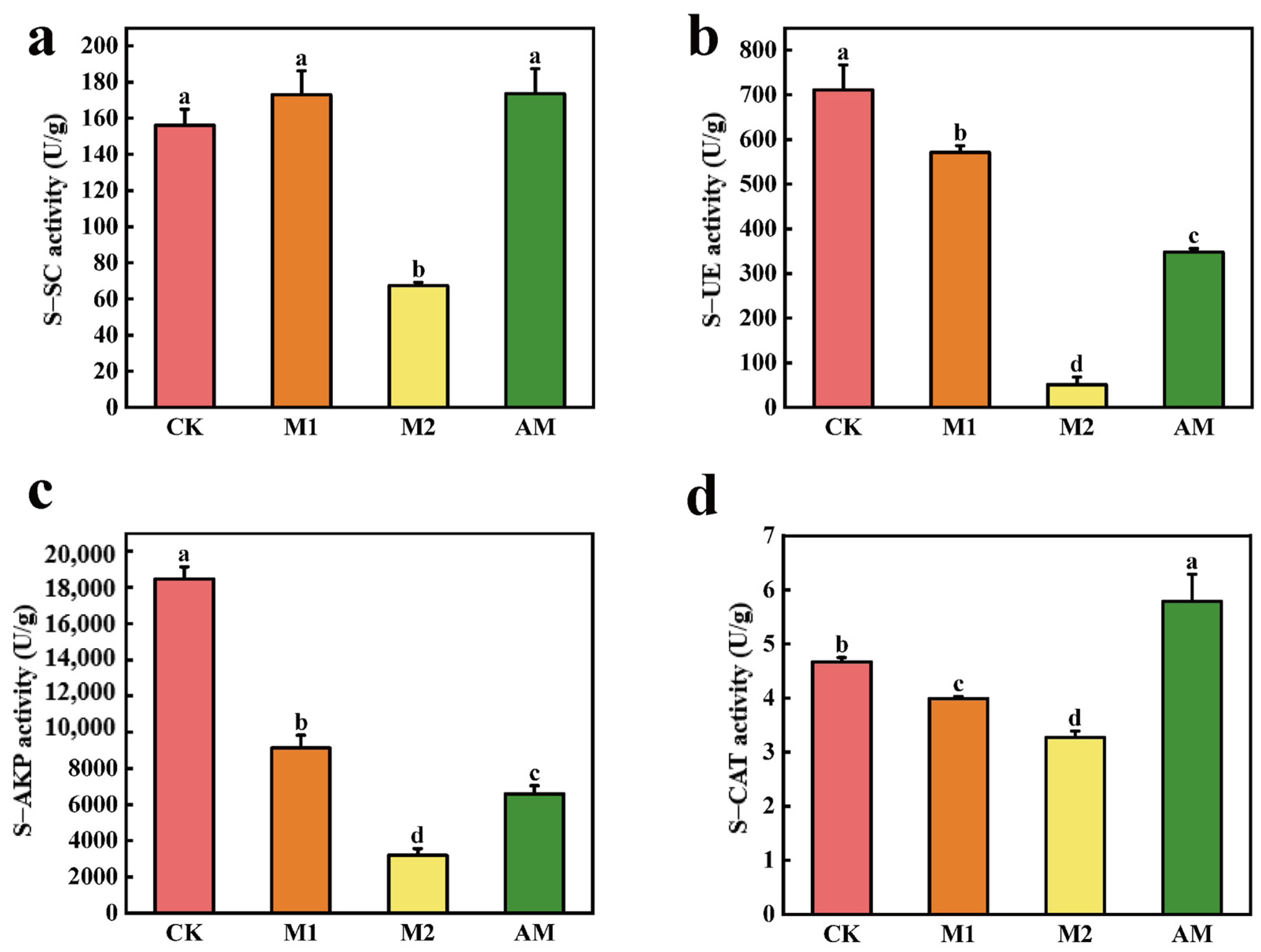
As proteins with catalytic activity, soil enzymes play a central role in material cycling and energy flow within soil ecosystems. Soil enzyme activity is an important indicator for assessing soil biological activity and fertility. As shown in Figure 1, we measured the activities of four soil enzymes: sucrase, urease, alkaline phosphatase, and catalase. The results showed that, comparing CK, M1, and M2, soil sucrase activity first increased and then significantly decreased with increasing salinity–alkalinity degree, while the activities of urease, alkaline phosphatase, and catalase all significantly decreased as the degree of salinity–alkalinity increased. All four enzymes exhibited the lowest activities under the M2 treatment, with S-SC, S-UE, S-AKP, and S-CAT activities reaching only 43.19%, 7.20%, 17.30%, and 70.02% of those in CK, respectively. Compared with M2, the AM treatment significantly increased S-SC, S-UE, S-AKP, and S-CAT activities by 157.43%, 579.70%, 106.18%, and 77.06%, respectively. These results indicate that the amendment treatment significantly enhanced the decomposition and transformation capacity of soil organic matter, the nitrogen supply capacity, the bioavailability of phosphorus, and the redox capacity of the moderately saline–alkali soil.

3.2. Effects of the Amendment on the Soil Microbial Community

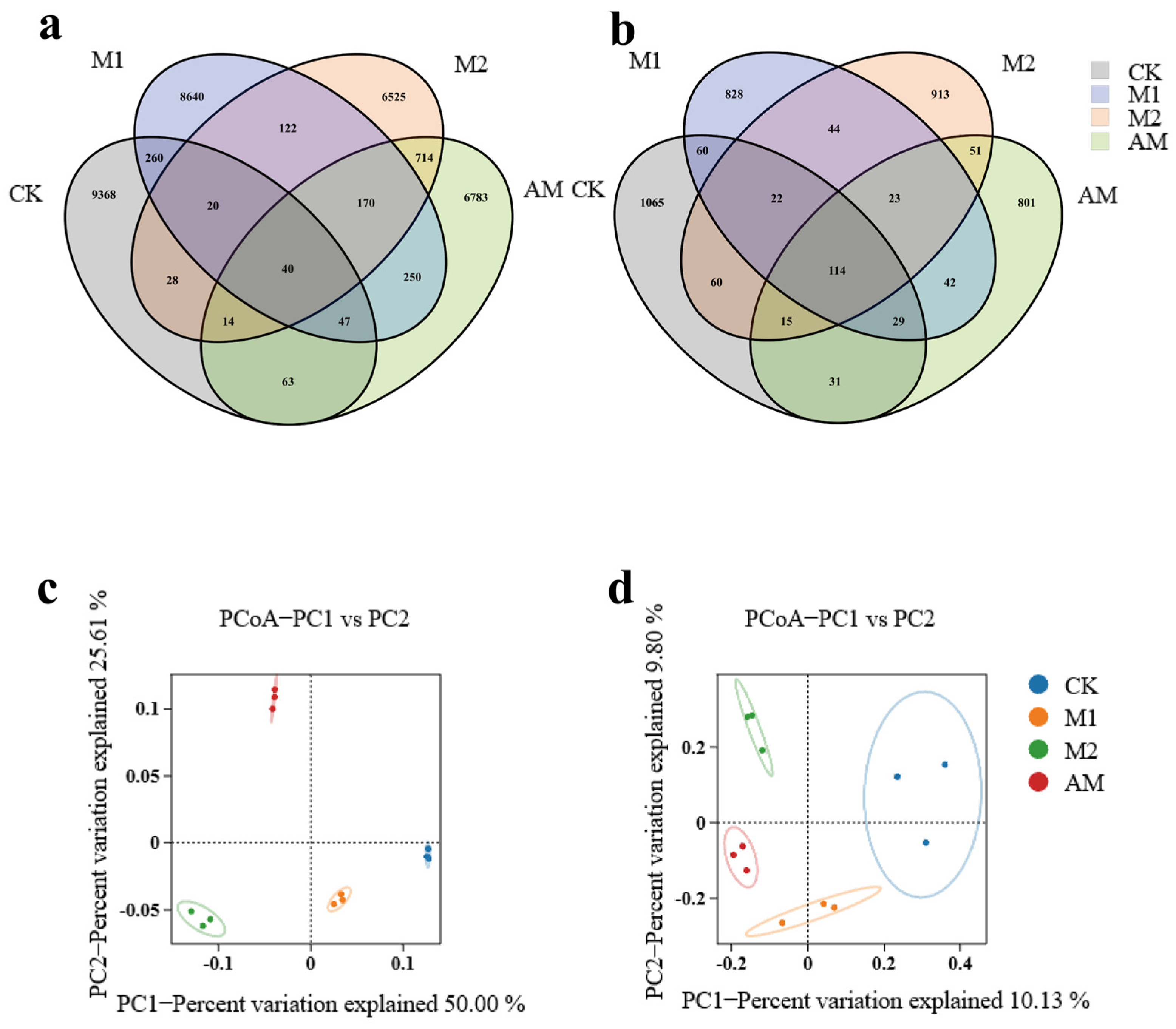
A total of 760,114 clean reads for bacteria and 823,008 clean reads for fungi were obtained from the bulk soil of different treatments. These reads were classified into 33,044 bacterial OTUs and 4098 fungal OTUs, indicating that bacterial species richness was much higher than that of fungi. The numbers of bacterial OTUs in CK, M1, M2, and AM were 9840, 9549, 7633 and 8081, respectively, and the numbers of unique OTUs were 9368, 8640, 6525 and 6783, respectively. The number of core shared bacterial OTUs across all treatments was 40 (Figure 2a). Furthermore, comparing CK, M1, and M2, the number of bacterial OTUs gradually decreased, indicating that bacterial richness declined with increasing salinity–alkalinity degree. Compared with M2, the number of bacterial OTUs in AM significantly increased, demonstrating that the combined application of 1% biochar and 1% phosphogypsum significantly enhanced bacterial richness. Regarding fungi, the numbers of fungal OTUs in CK, M1, M2, and AM were 1396, 1162, 1242 and 1106, respectively, and the numbers of unique OTUs were 1065, 828, 913 and 801, respectively. The number of core shared fungal OTUs across all treatments was 114 (Figure 2b). Principal coordinate analysis (PCoA) of bacterial communities showed clear spatial separation of samples from different treatments in the ordination plot, with a cumulative explanation rate of 75.61%, indicating that saline–alkali stress and the amendment differentially drove bacterial community structure, and samples within each group exhibited good consistency (Figure 2c). The PCoA plot for fungal communities showed a cumulative explanation rate of 19.93%, which was lower than that for bacterial communities, but differences among groups were still observed (Figure 2d).
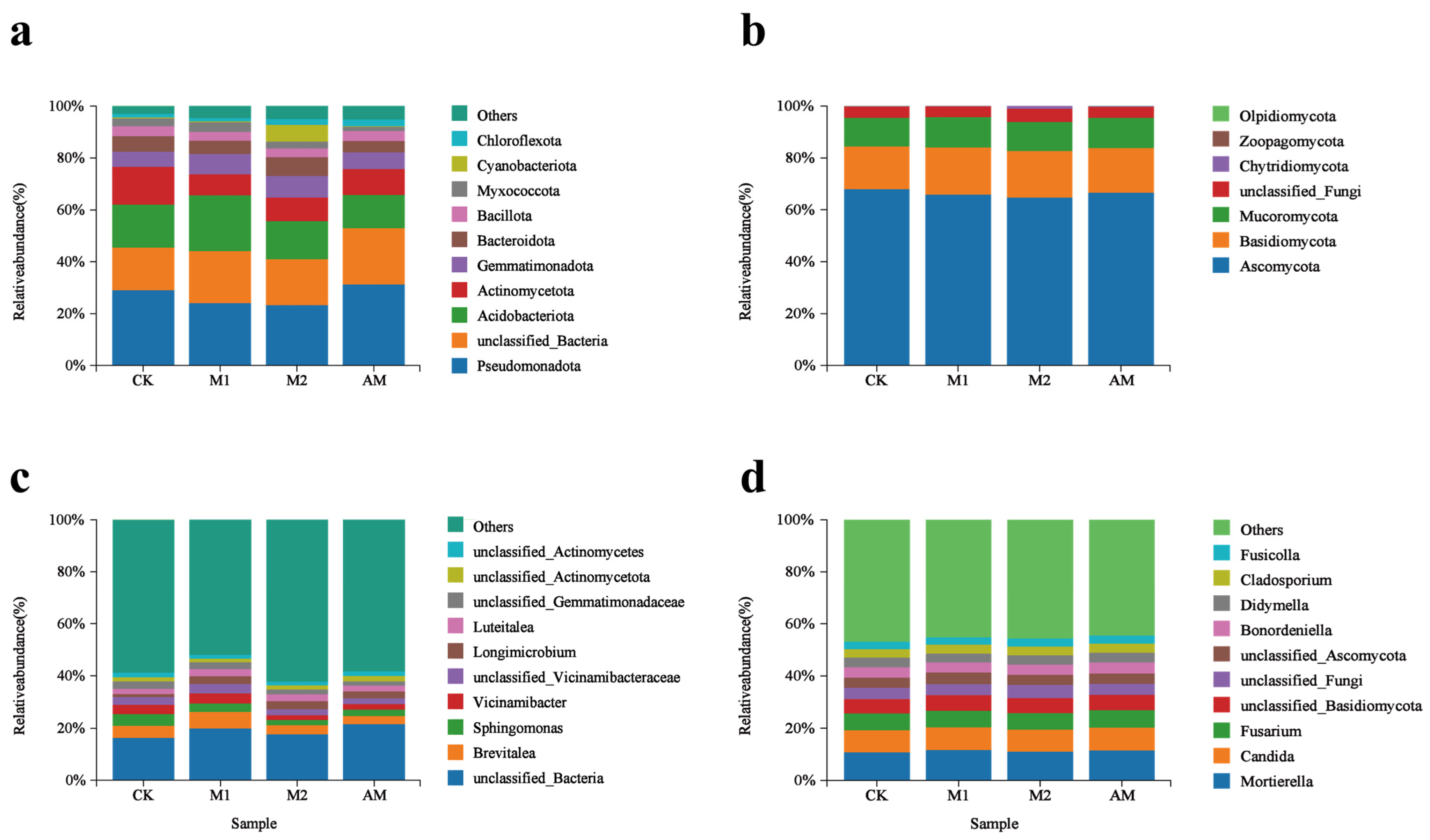
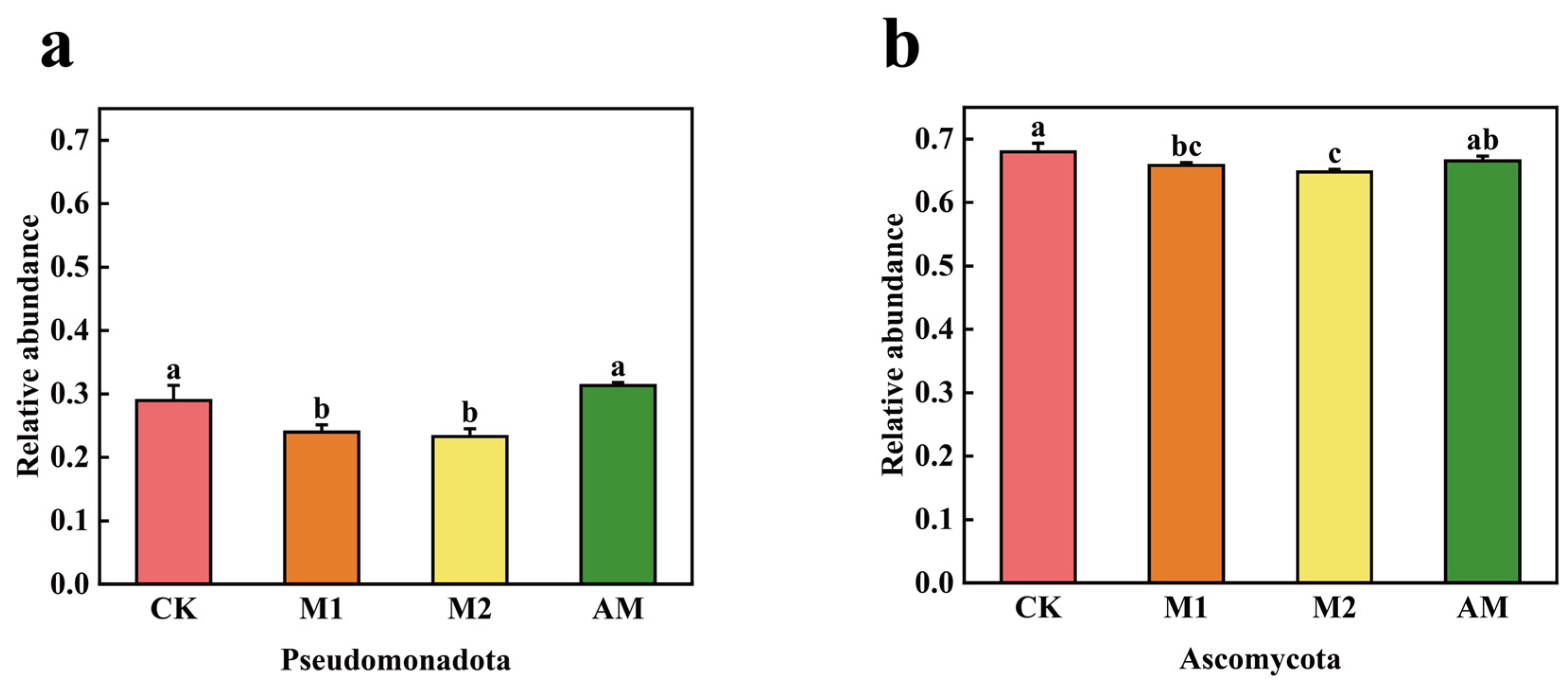
To further analyze the community composition under different treatments, we evaluated the relative abundance of soil microorganisms at the phylum and genus levels. The top ten bacterial phyla in terms of community abundance are shown in Figure 3a. The combined relative abundance of these ten phyla was ≥94.94% in each soil sample, with the highest in CK (97.02%) and the lowest in AM (94.94%), indicating that these ten phyla constituted the absolute majority of the soil bacterial community. The core dominant phyla were consistent across treatments. Pseudomonadota was the most dominant phylum in all treatments, with abundance ranging from 23.30% (M2) to 31.33% (AM). This was followed by unclassified_Bacteria, Acidobacteriota, and Actinomycetota. Together, these four groups accounted for more than 60% of the top ten phyla in each treatment, serving as the core support of the community structure. Compared with CK, M2 showed significant decreases in the abundance of Pseudomonadota (19.85%, Figure 4a) and Actinomycetota (37.75%), while the abundances of Gemmatimonadota, Bacteroidota, and Cyanobacteriota increased by 44.89%, 21.34%, and 1651.35%, respectively. Compared with M2, AM significantly increased the abundance of Pseudomonadota by 34.46% (Figure 4a) and increased Actinomycetota by 10.36%, while decreasing Gemmatimonadota, Bacteroidota, and Cyanobacteriota by 22.73%, 39.61%, and 96.60%, respectively. Thus, the amendment treatment increased the abundances of Pseudomonadota and Actinomycetota and decreased those of Gemmatimonadota, Bacteroidota, and Cyanobacteriota. At the genus level, compared with CK, M2 decreased the abundances of Sphingomonas and Vicinamibacter by 56.79% and 52.22%, respectively, and increased the abundances of Longimicrobium and Luteitalea by 178.57% and 33.33%, respectively. Compared with M2, AM increased the abundances of Sphingomonas, and Vicinamibacter by 19.90%, and 23.84%, respectively, and decreased the abundances of Longimicrobium and Luteitalea by 17.31% and 15.91%, respectively (Figure 3c). Regarding fungi, only seven phyla were detected. Among them, Ascomycota, Basidiomycota, Mucoromycota, and unclassified_Fungi were the dominant phyla, with their combined relative abundance reaching ≥98.99% in each sample. Compared with CK, M2 significantly decreased the relative abundance of Ascomycota by 4.66% (Figure 4b), while increasing Basidiomycota and Mucoromycota by 8.11% and 2.28%, respectively, and increased unclassified_Fungi by 16.40%. Chytridiomycota increased sharply by 733.33%, whereas Zoopagomycota and Olpidiomycota completely disappeared in M2. Compared with M2, AM significantly increased the abundance of Ascomycota by 2.76% (Figure 4b) and increased Mucoromycota by 4.46%, while decreasing Basidiomycota, unclassified_Fungi, and Chytridiomycota by 3.64%, 17.42%, and 76.00%, respectively. Zoopagomycota and Olpidiomycota were detected again after amendment, albeit at extremely low abundances (Figure 3b). At the genus level, compared with CK, M2 showed varying degrees of decrease in the abundances of Mortierella, Candida, Fusarium, Bonordeniella, and Didymella, while the abundances of unclassified_Fungi, unclassified_Basidiomycota, unclassified_Ascomycota, Cladosporium, and Fusicolla increased. Among these, unclassified_Fungi and Fusicolla showed relatively large increases (16.40% and 9.51%, respectively). Compared with M2, AM decreased the abundances of unclassified_Fungi and Fusicolla, while most other genera showed recovery trends (Figure 3d). These trends indicate that moderate saline–alkali stress significantly reshaped the community structure of both bacteria and fungi, and the amendment treatment reversed these changes to some extent, with a significantly greater impact on bacteria than on fungi.
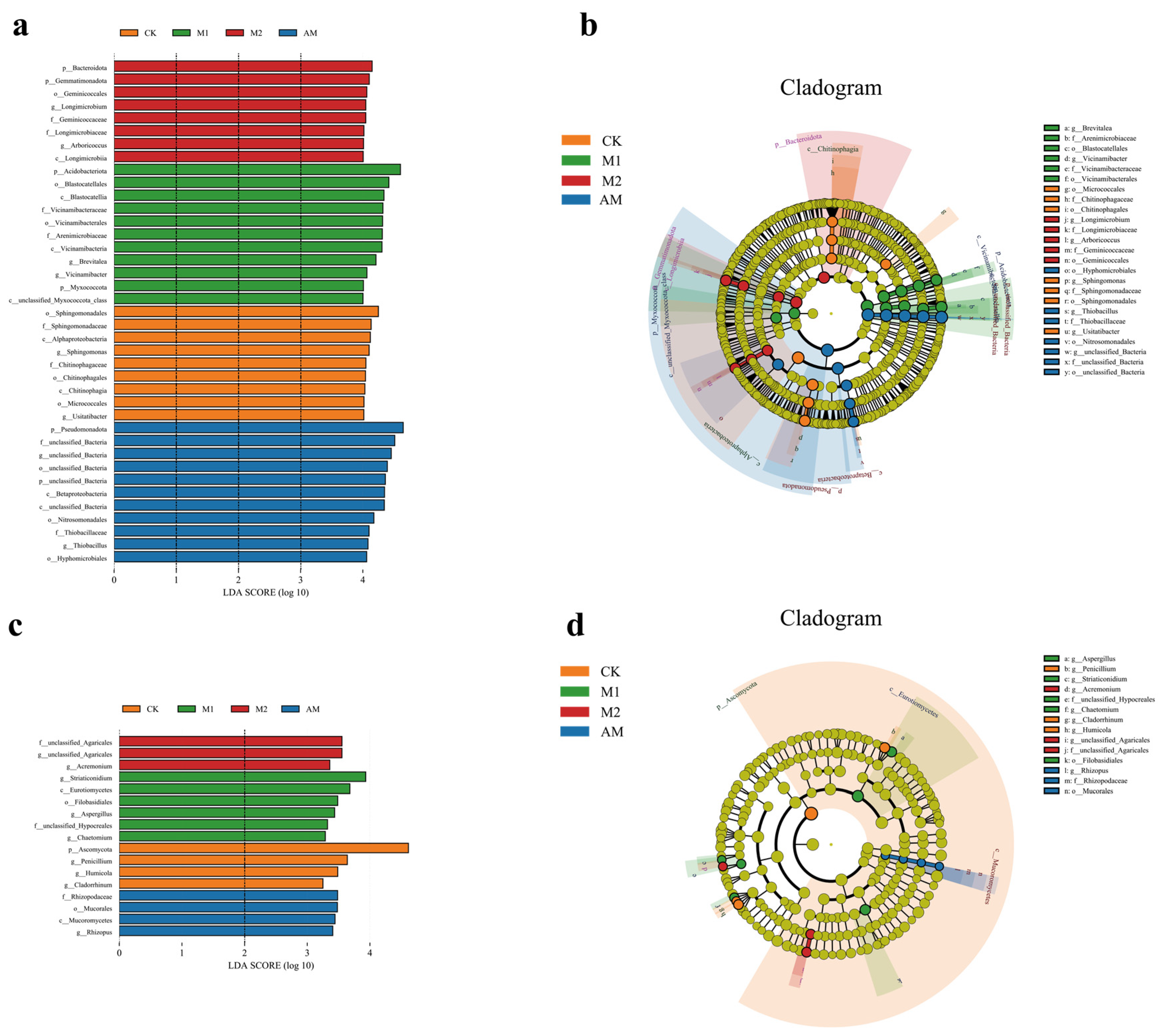
To further investigate the significantly different species and their phylogenetic relationships among microbial communities under different treatments, linear discriminant analysis effect size (LEfSe) was employed to screen biomarkers for each treatment group, and a cladogram was used to identify and visualize the differentially abundant species across treatments. The results showed that, for bacteria, the nine biomarkers in CK were mainly concentrated in common functional groups within Pseudomonadota and Bacteroidota, with functional groups such as c__Alphapseudomonadota and o__Sphingomonadales located at the core positions of Pseudomonadota. The 11 biomarkers in M1 were predominantly from Acidobacteriota. Among the eight biomarkers in M2, Bacteroidota and Gemmatimonadota directly corresponded to the groups that increased by 21.34% and 44.89%, respectively, in M2 compared with CK at the phylum level, and they formed independent branches in the phylogenetic tree. For AM, the 11 biomarkers from Pseudomonadota corresponded to the group that increased by 34.46% in AM compared with M2 at the phylum level. Notably, a large number of unclassified bacteria became biomarkers in the AM group and occupied multiple branches in the cladogram, indicating that the amendment treatment activated previously unidentified potential functional groups in the soil, which may exhibit specific responses to the amelioration measures (Figure 5a,b). Regarding fungi, the biomarkers in CK were Ascomycota and its core saprophytic genera (Penicillium, Humicola, Cladorrhinum), which occupied core positions in the cladogram. The biomarkers in M1 were mostly common saprophytic fungi within Ascomycota, which remained dominant under mild saline–alkali stress, consistent with the highest abundance of Basidiomycota (18.16%) in M1 at the phylum level, and were scattered across multiple branches of Ascomycota. The biomarkers in M2 were unclassified_Agaricales (family and genus) from Basidiomycota and Acremonium (genus) from Ascomycota. Phylum-level data showed that the abundance of Basidiomycota in M2 increased by 8.11% compared with CK, indicating that moderate saline–alkali stress selected for salt-tolerant groups within Basidiomycota and a few salt-tolerant genera within Ascomycota. The biomarkers in AM were all concentrated in Mucoromycota, suggesting that the amendment treatment promoted the enrichment of these fast-growing saprophytic fungi (Figure 5c,d). Overall, the amendment treatment promoted the enrichment of functional bacterial groups such as Pseudomonadota and activated potential unclassified taxa, while making fast-growing saprophytic fungi of Mucoromycota the dominant characteristic group among fungi, and functional groups of Ascomycota began to recover. However, overall, the impact of the amendment on bacteria was greater than that on fungi.

3.3. Effects of the Amendment on Safflower Phenotype, Physiology, Quality, and Yield

3.3.1. Effects on Morphological and Physiological Indicators of Safflower During the Growth Period

The morphological indicators of safflower during the growth period included root length, root diameter, plant height, stem diameter, leaf number, leaf area, belowground dry weight, and aboveground dry weight. As shown in Table 4, comparing CK, M1, and M2, with increasing salinity–alkalinity degree, root length, root diameter, plant height, stem diameter, leaf number, leaf area, belowground dry weight, and aboveground dry weight all showed a gradual decreasing trend. Specifically, M2 exhibited the lowest values for these parameters, accounting for 37.07%, 37.31%, 30.08%, 43.05%, 31.35%, 12.52%, 8.99%, and 9.54% of those in CK, respectively, with significant differences among all groups. Compared with M2, the AM treatment significantly increased these parameters by 119.14%, 106.00%, 194.77%, 92.31%, 162.66%, 367.28%, 637.50%, and 642.19%, respectively, and the values were significantly higher than those of M1, accounting for 81.22%, 76.87%, 88.67%, 82.78%, 82.35%, 58.48%, 66.29%, and 70.79% of those in CK, respectively. These results indicate that the combined application of 1% biochar and 1% phosphogypsum significantly improved the growth parameters of safflower.
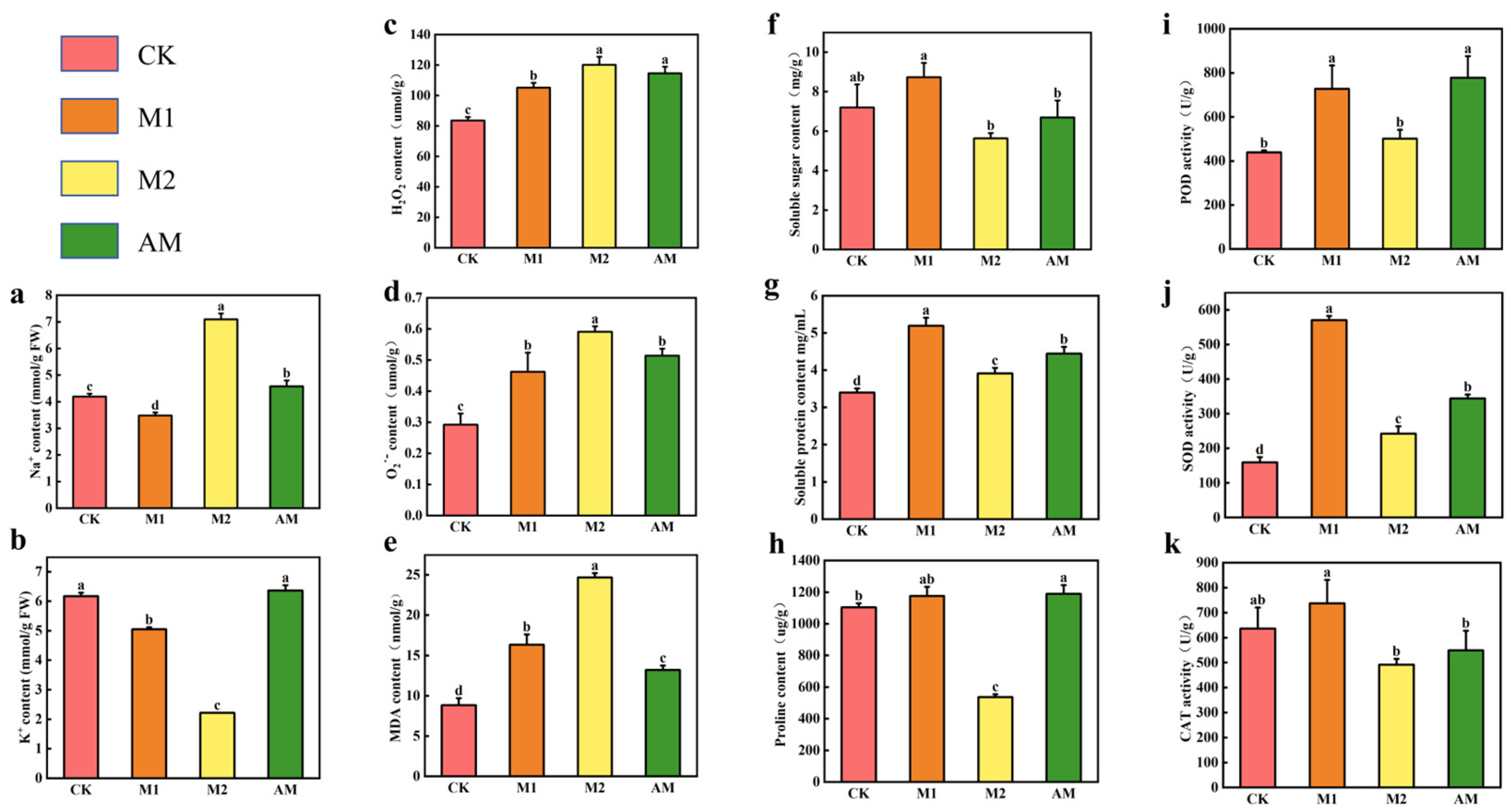
Different treatments induced profound physiological changes in safflower leaves. As shown in Figure 6, comparing CK, M1, and M2, the Na+ content in safflower leaves first decreased and then increased with increasing salinity–alkalinity degree, while the K+ content continuously decreased, with significant differences among groups. Consequently, compared with normal soil, the Na+/K+ ratio increased sharply, indicating that the critical ion balance required for plant life activities was disrupted. Compared with M2, the AM treatment significantly decreased Na+ content by 35.47% and significantly increased K+ content by 186.98%, and the amendment treatment significantly decreased the Na+/K+ ratio, alleviating the ion imbalance induced by saline–alkali stress. Furthermore, the contents of H2O2, O2●−, and MDA increased with increasing salinity–alkalinity degree. Compared with M2, the AM treatment decreased H2O2, O2●−, and MDA contents by 4.68%, 13.03%, and 46.49%, respectively, with significant differences among groups for O2●− and MDA. Interestingly, the contents of soluble sugar, soluble protein, proline, POD, SOD, and CAT first increased and then decreased with increasing salinity–alkalinity degree, reaching the highest values in M1. Compared with M2, these contents in AM increased by 18.97%, 13.53%, 122.04%, 55.37%, 41.87%, and 11.53%, respectively, with significant increases observed for soluble protein, proline, POD, and SOD. In brief, safflower leaves underwent significant metabolic adjustments under aggravated saline–alkali stress, and the combined application of 1% biochar and 1% phosphogypsum alleviated the saline-alkali stress.

3.3.2. Effects on Safflower Quality and Yield

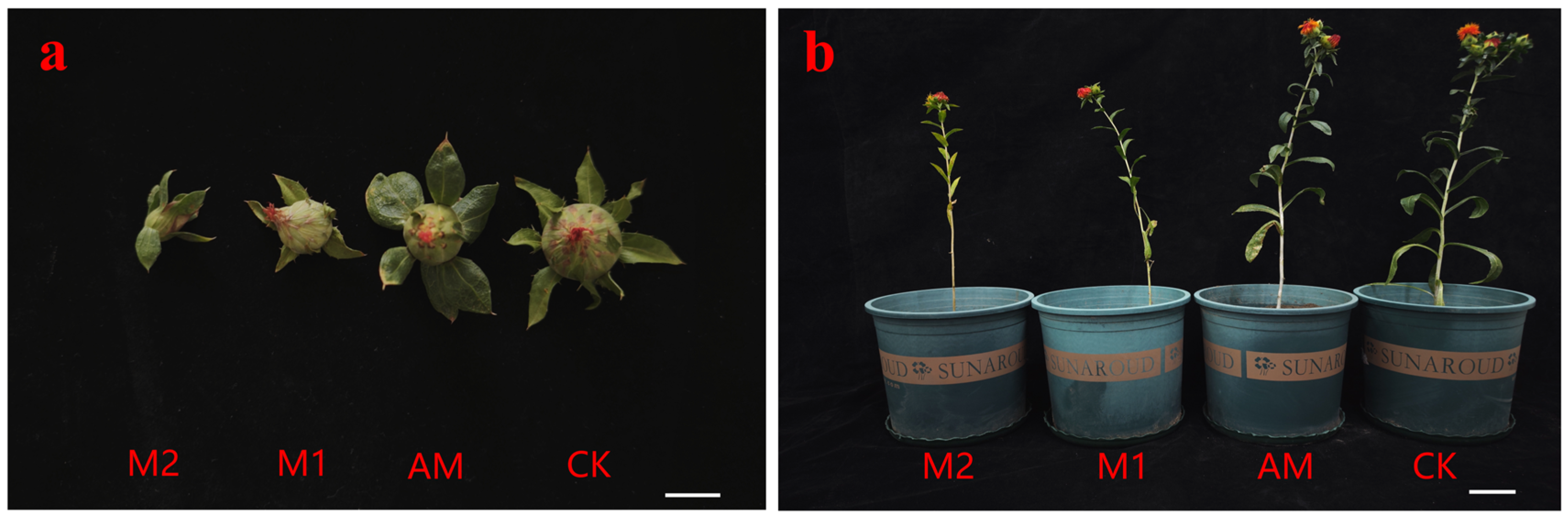
The flowering stage of safflower is shown in Figure 7. We measured involucre diameter, number of involucres per plant, yield per plant, and bioactive component contents. As shown in Table 5, comparing CK, M1, and M2, involucre diameter, number of involucres, yield per plant, HSYA content, and KAE content all showed decreasing trends with increasing salinity–alkalinity degree. The lowest values were observed in M2, accounting for only 21.82%, 26.60%, 2.75%, 33.33%, and 58.44% of those in CK, respectively. In M2, HSYA content was only 0.81% and KAE content was only 0.045%, which were below the national pharmacopoeia standards (HSYA ≥ 1.0%, KAE ≥ 0.05%). Under the AM treatment, involucre diameter, number of involucres, yield per plant, HSYA content, and KAE content accounted for 74.09%, 86.60%, 76.10%, 58.02%, and 72.73% of those in CK, respectively, and increased by 239.58%, 225.56%, 2667.98%, 74.07%, and 24.44%, respectively, compared with M2. The bioactive component contents in AM reached 1.41% for HSYA and 0.056% for KAE, exceeding the national pharmacopoeia standards. In summary, the combined application of 1% biochar and 1% phosphogypsum significantly promoted safflower yield per plant and quality by enhancing its growth and development and its ability to withstand salt stress.

3.4. Correlation Analysis Between Soil Microbial Community and Soil Nutrients, Physicochemical Indicators, and Soil Enzymes

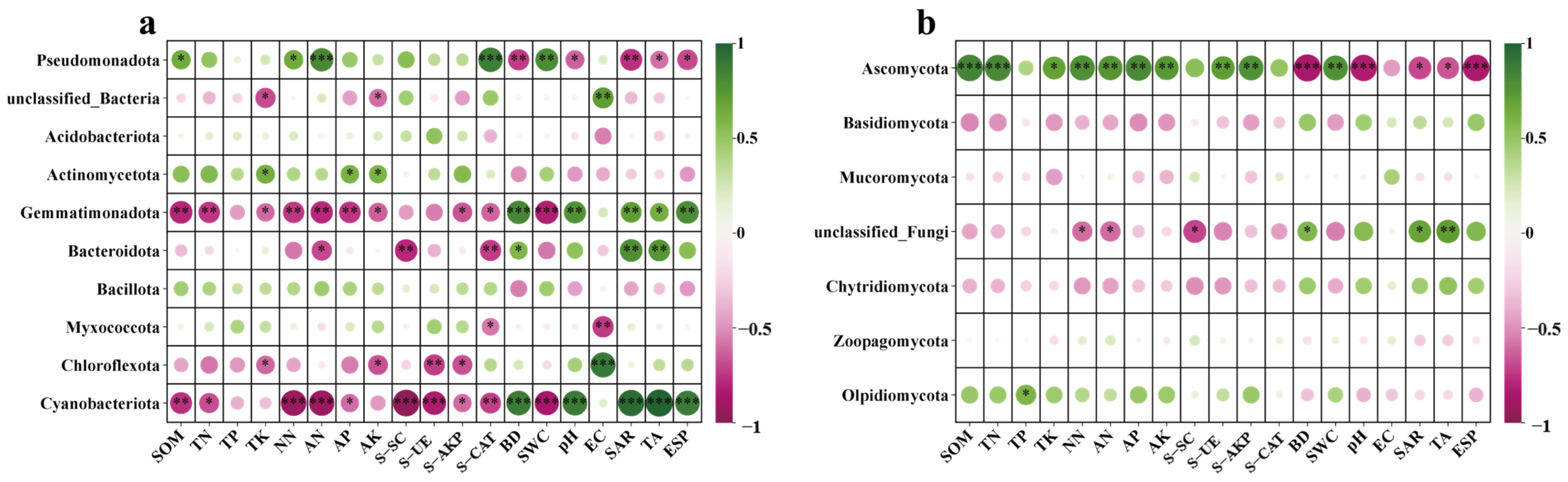
To investigate the key factors influencing the bulk soil microbial communities under different treatments, we performed correlation analyses between the top ten bacterial and fungal phyla and genera, respectively, and soil nutrients, physicochemical indicators, and soil enzymes. At the phylum level, the Pearson correlation heatmap showed that Pseudomonadota exhibited extremely significant positive correlations with AN, S-CAT, and SWC (p < 0.01), significant positive correlations with SOM and NN (p < 0.05), extremely significant negative correlations with soil BD and SAR, and significant negative correlations with soil pH, TA, and ESP. Actinomycetota showed significant positive correlations with TK, AP, and AK. Gemmatimonadota exhibited extremely significant negative correlations with SOM, NN, AN, S-SC, S-UE, S-CAT, and SWC, significant positive correlations with TN, AP, and S-AKP, and extremely significant positive correlations with soil BD, pH, SAR, TA, and ESP (Figure 8a). Regarding fungi, Ascomycota showed extremely significant positive correlations with SOM, TN, NN, AN, AP, AK, S-UE, S-AKP, and SWC, significant positive correlations with TK, and extremely significant negative correlations with soil BD, pH, and ESP, as well as significant negative correlations with SAR and TA (Figure 8b). These results indicate that bacterial phyla responded more strongly to soil factors than fungal phyla.
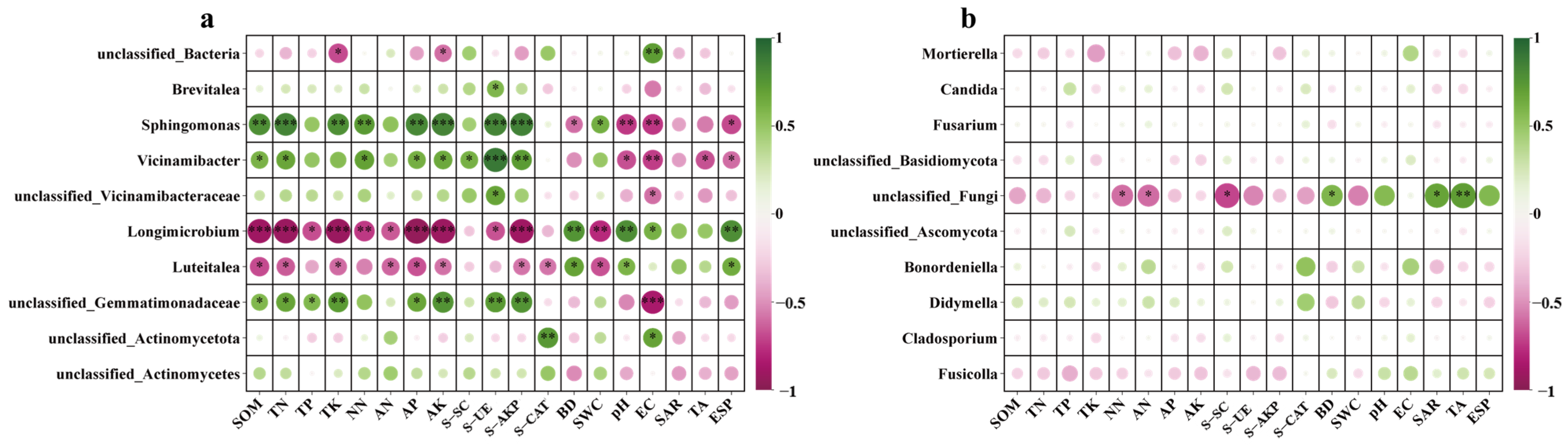
At the genus level, the Pearson correlation heatmap showed that Sphingomonas exhibited extremely significant positive correlations with SOM, TN, TK, NN, AP, AK, S-UE, and S-AKP (p < 0.01), a significant positive correlation with SWC (p < 0.05), extremely significant negative correlations with pH and EC, and a significant negative correlation with ESP. Vicinamibacter showed extremely significant positive correlations with S-UE and S-AKP, significant positive correlations with SOM, TN, NN, AP, AK, and S-SC, an extremely significant negative correlation with EC, and significant negative correlations with pH, TA, and ESP. Longimicrobium exhibited extremely significant negative correlations with SOM, TN, TK, NN, AP, AK, S-AKP, and SWC, significant negative correlations with TP, AN, and S-UE, and extremely significant positive correlations with soil BD, pH, and ESP, as well as a significant positive correlation with EC. Luteitalea showed significant negative correlations with SOM, TN, TK, AN, AP, AK, S-AKP, S-CAT, and SWC, and significant positive correlations with soil BD, pH, and ESP (Figure 9a). The correlations between the top ten fungal genera and soil nutrients and soil enzymes were relatively weak. Except for unclassified_Fungi, which showed significant negative correlations with NN, AN, and S-SC, significant positive correlations with soil BD and TA, and a significant positive correlation with ESP, no significant correlations were observed for the remaining fungal genera with soil nutrients or soil enzymes (Figure 9b). Overall, the top ten bacterial genera responded more strongly to soil factors than fungal genera.

3.5. Correlation Analysis Between Safflower Bioactive Components, Yield, and Soil Factors

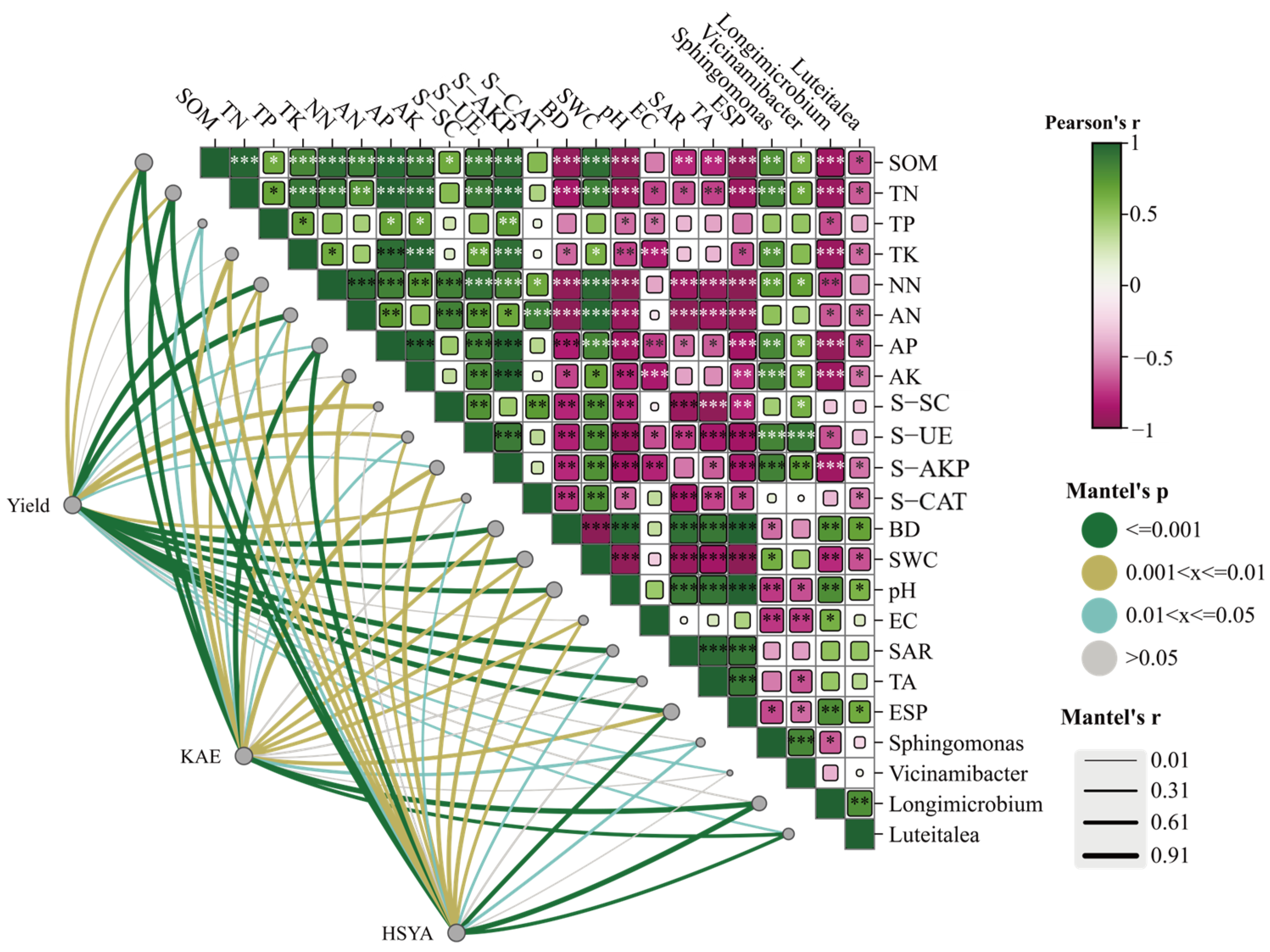
To dissect the associations among soil nutrients, physicochemical indicators, soil enzymes, and functional microbial genera, as well as the relationships between safflower bioactive components, yield, and these soil factors, a Mantel test was performed based on the Bray–Curtis distance matrix (Figure 10). The Pearson correlation heatmap showed that soil BD, pH, EC, SAR, TA, and ESP all exhibited strong negative correlations with soil nutrients. Specifically, soil BD showed extremely significant negative correlations with SOM, TN, NN, AN, and AP, and significant negative correlations with TK and AK. Soil pH showed extremely significant negative correlations with SOM, TN, TK, NN, AN, AP, and AK, and a significant negative correlation with TP. EC showed extremely significant negative correlations with TK, AP, and AK, and significant negative correlations with TN and TP. SAR showed extremely significant negative correlations with SOM, NN, and AN, and significant negative correlations with TN and AP. TA showed extremely significant negative correlations with SOM, TN, NN, and AN, and a significant negative correlation with AP. ESP showed extremely significant negative correlations with SOM, TN, NN, AN, AP, and AK, and significant negative correlations with TP and TK. In contrast, SWC, S-SC, S-UE, S-AKP, and S-CAT exhibited strong positive correlations with soil nutrients. Specifically, SWC showed extremely significant positive correlations with SOM, TN, NN, AN, and AP, and significant positive correlations with TK and AK. S-SC showed extremely significant positive correlations with NN and AN, and a significant positive correlation with SOM. S-UE showed extremely significant positive correlations with SOM, TN, TK, NN, AN, AP, and AK. S-AKP showed extremely significant positive correlations with SOM, TN, TP, TK, NN, AP, and AK, and a significant positive correlation with AN. S-CAT showed an extremely significant positive correlation with AN and a significant positive correlation with NN. The correlations of Sphingomonas, Vicinamibacter, Longimicrobium, and Luteitalea with other soil factors were as described in Section 4.1.
Mantel and Pearson correlation analyses showed that HSYA exhibited extremely significant correlations with SOM, TN, AP, ESP, Longimicrobium, and Luteitalea; highly significant correlations with TK, NN, AN, AK, BD, SWC, pH, EC, S-UE, and S-AKP; and significant correlations with TP, S-CAT, SAR, and Sphingomonas. KAE exhibited extremely significant correlations with SOM, TN, AP, Longimicrobium, and Luteitalea; highly significant correlations with TK, NN, AK, BD, SWC, pH, EC, ESP, and S-AKP; and significant correlations with TP, AN, S-UE, and Sphingomonas. Safflower yield exhibited extremely significant correlations with NN, AN, BD, SWC, pH, SAR, TA, and ESP; highly significant correlations with SOM, TN, S-SC, S-UE, and S-CAT; and significant correlations with AP, S-AKP, Vicinamibacter, and Luteitalea. In brief, significant correlations were observed between safflower bioactive components, yield, and multiple soil attributes (p < 0.05). Soil nutrients, soil structure, and soil salinity–alkalinity indicators, particularly SOM, TN, AP, Longimicrobium, and Luteitalea, were likely the key soil factors for the accumulation of the two bioactive components. Furthermore, ESP might also be a key soil factor for HSYA accumulation, while NN, AN, BD, SWC, pH, SAR, TA, and ESP might be key soil factors for yield accumulation.

4. Discussion

4.1. Biochar and Phosphogypsum Ameliorate the Saline–Alkali Soil Environment by Improving Soil Physicochemical Properties, Increasing Soil Nutrients, Enhancing Soil Enzyme Activities, and Reducing Saline–Alkali Indicators

Numerous studies have confirmed that biochar application can significantly reduce soil bulk density, increase soil water content, lower soil pH, enhance soil nutrients such as SOM, AP, and AK, and promote nutrient-related enzyme activities [15,16,17,18,19]. The addition of phosphogypsum can significantly reduce saline–alkali indicators, enhance soil fertility and enzyme activities in saline-alkali soils [20,21]. In recent years, researchers have begun to focus on the synergistic effects of combined biochar and phosphogypsum application. Field plot experiments have shown that the combined application of biochar and phosphogypsum is superior to either amendment alone in remediating secondary salinized soils in protected cultivation and promoting crop growth [22].
In soda saline–alkali soils, the salt supply during the salinization process mainly comes from carbonate alkaline salts such as Na2CO3 and NaHCO3, which together cause salt and alkali damage to crops and restrict soil productivity. Our study found that the combined application of 1% biochar and 1% phosphogypsum significantly reduced BD and pH, and significantly increased SWC as well as the contents of SOM, TN, TP, NN, AN, AP, and AK in the moderately saline–alkali soil of the Songnen Plain. This is because the straw-derived biochar used in this study is rich in nutrients such as N, P, and K required for plant growth. Combined with its porous structure and high specific surface area, its direct input significantly reduced soil BD, enhanced soil water retention capacity, and increased soil nutrients [23]. Meanwhile, the calcareous colloids in phosphogypsum promote the formation of soil aggregate structure, reduce BD, improve the water-holding capacity of saline–alkali soils, and the minerals contained in phosphogypsum effectively supplement soil Ca, P, S, and other elements, thereby increasing soil nutrients [6,20]. However, our study found that TK content decreased under the amendment treatment, which differs from some reports that biochar increases soil potassium [24,25]. This discrepancy may be explained by the fact that potassium in biochar exists in four forms: water-soluble, exchangeable, non-exchangeable, and insoluble [26]. Under the amendment treatment, the biomass of safflower increased dramatically (aboveground dry weight increased by 642.19%), leading to a substantial consumption of available potassium. This may have caused the readily soluble, water-soluble potassium introduced by biochar to be rapidly absorbed by safflower or leached away with water in the early stage of amelioration. Meanwhile, the potassium originally present in biochar as slow-release (non-exchangeable) forms gradually transformed into exchangeable and other available forms in response to subsequent changes in the soil environment (e.g., root exudation of organic acids, enhanced soil microbial activities), thereby maintaining the available potassium content in the soil solution. More importantly, Guo et al. indicated that biochar can accelerate the conversion of slowly available potassium to readily available potassium by altering clay mineral composition and promoting the growth of potassium-dissolving bacteria [27]. This implies that biochar modifies the transformation pathways of soil potassium, releasing the previously fixed “unavailable potassium” (originally bound in mineral interlayers or associated with soil clay particles, which plants cannot utilize) and converting it into available potassium.
The improvement in soil chemical properties under the amendment treatment is attributed to the combined effects of biochar and phosphogypsum. Biochar and phosphogypsum are rich in Ca2+, K+, and Mg2+, which can undergo exchange reactions with exchangeable Na+ on the surface of saline-alkali soil colloids, forming Na2SO4 that is not readily adsorbed and is leached out of the soil matrix with irrigation water, thereby reducing soil SAR and ESP [28]. Furthermore, Ca2+ also combines with CO32−, not only eliminating carbonate toxicity but also causing highly dispersed colloids to rapidly form microaggregates, greatly improving soil water permeability and creating prerequisites for desalination and dealkalization. Recent studies have revealed a deeper mechanism—Ca2+ activates the “mineral carbon pump,” providing more active sites, reducing the soil sodium adsorption ratio by 48%, and eliminating the restriction of salinization on carbon sequestration [29]. Phosphogypsum also contains a certain amount of residual acid, which can neutralize alkaline substances in the soil, lower pH, and reduce the contents of CO32− and HCO3, thereby decreasing TA [30]. The combined effects of both amendments led to significant reductions in the alkaline salt components Na+, CO32−, and HCO3 under the amendment treatment, while significantly increasing the contents of K+, Ca2+, Mg2+, and SO42−, which are beneficial for plant growth. Therefore, although EC increased, other saline-alkali indicators such as pH, SAR, TA, and ESP all significantly decreased. Thus, the comprehensive effect of phosphogypsum and biochar on saline–alkali soil amelioration is significant, and the benefits are substantial. Similar results have been obtained in studies on saline–alkali soils in western Jilin Province by Wu Hongsheng, Mao Shuo, and colleagues [30,31].
Soil enzyme activities are closely related to soil physicochemical properties, pH, soil organic matter, and soil nutrient cycling [32]. In our study, the inhibitory effect of saline–alkali stress on enzyme activities was consistent with previous reports, mainly due to the disruption of microbial cell osmotic pressure, changes in enzyme protein conformation, and interactions between salt ions and enzyme active centers under high-salt environments [33]. The amendment treatment significantly enhanced the activities of S-SC, S-UE, S-AKP, and S-CAT, indicating that soil carbon cycling, nitrogen cycling, phosphorus cycling, and soil redox capacity were significantly improved. These findings are consistent with the results of Yao, Xie, Wang, and colleagues [32,34,35]. Relevant studies have shown that the application of biochar and phosphogypsum directly provides carbon, nitrogen, and phosphorus sources. Their application improves soil physicochemical properties, and the large specific surface area of biochar adsorbs microorganisms, promoting their reproduction and metabolic activities, thereby alleviating previously inhibited microbial activities [36,37,38]. In addition, calcium ions in phosphogypsum can act as activators of enzymatic reactions, affecting the conformation and active centers of various enzymes [39].

4.2. Biochar and Phosphogypsum Promote Safflower Growth and Increase Yield by Reducing Oxidative Stress in Safflower

Studies have shown that saline–alkali stress not only stimulates the accumulation of Na+ and reduces K+ in plant leaves but also induces the synthesis of osmotic regulators such as soluble sugar, soluble protein, and proline. Excessive ions in tissues can also lead to the accumulation of ROS, ultimately resulting in decreased plant biomass [40,41,42]. Similar results were obtained in our study. Interestingly, the contents of H2O2, O2●−, and MDA continuously increased with increasing salinity–alkalinity degree, while Na+ in safflower leaves first decreased and then increased, and soluble sugar, soluble protein, proline, POD, SOD, and CAT showed a trend of first increasing and then decreasing with increasing salinity–alkalinity degree. This indicates that as the degree of saline–alkali stress increased, the oxidative damage to safflower also increased. However, under a certain level of saline–alkali stress, safflower could regulate leaf Na+ content, synthesize osmotic regulators, and enhance antioxidant enzyme activities, thereby exhibiting a certain capacity to withstand saline–alkali stress. These findings are consistent with the results of Sui Jingyi et al. [5]. Similar results have also been reported in studies on medicinal plants such as Salvia miltiorrhiza, Limonium sinense, Medicago sativa, and Nitraria sibirica Pall. [43,44,45,46].
Under the amendment treatment, Na+ content significantly decreased, K+ content significantly increased, and the Na+/K+ ratio significantly decreased, indicating that the application of biochar and phosphogypsum alleviated ion toxicity in safflower. The contents of soluble sugar, soluble protein, and proline, as well as the activities of POD, SOD, and CAT, increased to varying degrees. Meanwhile, H2O2 content decreased slightly, and O2●− and MDA contents decreased significantly, indicating that the application of biochar and phosphogypsum alleviated oxidative damage in safflower and promoted the synthesis of osmotic regulators and antioxidant enzymes. Correlation analysis showed significant associations between safflower bioactive components, yield, and multiple soil attributes (p < 0.05), which is consistent with the findings of Shen et al. [47]. Therefore, the significant improvements in safflower growth parameters, bioactive components, and yield under the amendment treatment may be attributed to the following: (1) the direct supply of nutrients such as N, P, and K required for safflower growth by biochar and phosphogypsum [48]; (2) the alleviation of saline–alkali stress on plants through the improvement of soil physicochemical properties by biochar and phosphogypsum [49]; (3) the increase in microbial abundance and activity following biochar and phosphogypsum application, which promotes interactions between safflower plants and microorganisms [50]. However, because few studies have been conducted on safflower in saline–alkali soils, current studies on active compounds are largely limited to correlational analyses; no direct causal relationship has been established between microbial functions and the biosynthesis of HSYA and KAE, and the specific mechanisms involved require further investigation.

4.3. Response of Soil Microbial Communities in the Bulk Soil Region to Biochar and Phosphogypsum

Our study found that the number of bacterial OTUs was significantly higher than that of fungal OTUs, a result consistent with the typical characteristics of microbial communities in saline–alkali soils, reflecting that bacteria, as the dominant microbial group in soil, have much higher species richness than fungi. LEfSe analysis showed that the amendment treatment promoted the enrichment of functional bacterial groups such as Pseudomonadota. Pseudomonadota is the most common copiotrophic bacterial group in soil and contains various functional bacteria involved in carbon, nitrogen, and sulfur cycling. Members of this phylum are widely recognized as Plant Growth-Promoting Rhizobacteria (PGPR), which enhance plant growth through multiple direct and indirect mechanisms, including biological nitrogen fixation, phosphate and potassium solubilization, phytohormone production (e.g., IAA), and suppression of soil-borne pathogens via siderophore and antibiotic production [51].Several studies have demonstrated that amendment treatments can significantly increase the relative abundance of Pseudomonadota. For example, in a study on the amelioration of salinized soils, the application of carbon-based fertilizer and urea phosphate significantly increased the relative abundance of Pseudomonadota [52], which is consistent with the 34.46% increase in Pseudomonadota abundance observed in the AM treatment in our study. The recovery of Pseudomonadota abundance is a direct reflection of improved soil nutrient status and alleviated saline–alkali stress after amendment, indicating the restoration of functional bacterial groups associated with nutrient cycling. Studies have confirmed that the relative abundance of Actinomycetota is significantly positively correlated with the soil carbon mineralization rate, suggesting that it plays an important role in organic matter decomposition [53]. The recovery of Actinomycetota in the AM treatment reflects, on the one hand, its adaptability to the improved environment and, on the other hand, indicates an enhancement of soil organic matter decomposition function. Gemmatimonadota is a typical oligotrophic bacterial group. Studies have shown that Gemmatimonadota is significantly enriched in highly saline–alkali soils and is one of the dominant groups in such soils [54], which is consistent with the significant increase in Gemmatimonadota abundance observed in M2 in our study. In nitrogen fertilization experiments, the relative abundance of Gemmatimonadota significantly decreased with nitrogen application, indicating a negative response to increased readily available nitrogen [55]. The decrease in Gemmatimonadota abundance in our study is an indirect reflection of improved soil nutrients and alleviated saline–alkali stress—when the environment is no longer “extreme,” the survival advantage of oligotrophic groups diminishes, vacating ecological niches for copiotrophic functional groups such as Pseudomonadota. Previous studies have confirmed that Ascomycota is one of the dominant fungal phyla in saline–alkali soils, but increased salinity significantly reduces its relative abundance [56]. This is consistent with our finding that Ascomycota abundance gradually decreased with increasing salinity–alkalinity degree and significantly recovered under the amendment treatment. The reason is that Ascomycota is a major decomposer of organic matter in soil. After the application of biochar and phosphogypsum, on the one hand, the porous structure and organic carbon provided by biochar provide a basis for fungal colonization and metabolism [57]; on the other hand, phosphogypsum reduces salinity–alkalinity, optimizes the ionic environment, improves soil aggregate structure, and enhances soil aeration and water retention, thereby allowing previously inhibited saprophytic fungi to recover [58].
Correlation analysis showed that soil nutrients and soil enzyme activities were significantly positively correlated with Sphingomonas and Vicinamibacter, and significantly negatively correlated with Longimicrobium and Luteitalea, suggesting that these genera may play important roles in soil remediation and the significant increase in safflower biomass. Studies have shown that many groups within Pseudomonadota (e.g., classes Alphapseudomonadota, Betapseudomonadota, and Gammapseudomonadota) are significantly positively correlated with soil available nutrients. Increasing nitrogen application significantly increased the relative abundances of Alphapseudomonadota and Gammapseudomonadota [32]. Among the top ten most abundant genera, Sphingomonas, whose abundance increased by 21.95%, belongs to Alphapseudomonadota. Studies have found that Sphingomonas, as a typical beneficial microbial group in soil, functions to promote plant growth, enhance stress tolerance, and participate in nutrient cycling [59]. Relevant studies have shown that a significant increase in the abundance of Vicinamibacter is positively correlated with soil organic matter, nitrogen and phosphorus nutrients, and rice yield, making it an indicator bacterium for soil fertility improvement and health restoration [60]. Chang et al. also found that biochar significantly increased the abundance of Vicinamibacter, with bacterial changes being more pronounced than those of fungi. Biochar also upregulated genes involved in phosphate uptake and phosphorus transport, indicating that bacteria may play a more important role than fungi in phosphorus cycling [12]. Therefore, Sphingomonas and Vicinamibacter may play important roles in promoting safflower growth, although the specific mechanisms require further investigation. Although studies on the function of Longimicrobium are limited, it is widely distributed in low-nutrient and stress environments, a finding also confirmed by our study [61]. Luteitalea, as an oligotrophic bacterium, has a competitive advantage in nutrient-poor soils. Its enrichment in moderately saline–alkali soil may be related to its adaptability to adverse environments. After amendment, soil fertility increased, salinity–alkalinity decreased, and nutrient availability improved, which is more favorable for the growth of copiotrophic microorganisms, leading to a decrease in Luteitalea abundance [62].

5. Conclusions

In summary, the combined application of biochar and phosphogypsum significantly improved the microenvironment of the saline–alkali soil and increased the yield and quality of safflower. The amendment treatment significantly reduced BD, significantly increased SWC and the contents of SOM, TN, TP, NN, AN, AP, and AK, significantly decreased other saline-alkali indicators including pH, SAR, TA, and ESP, significantly enhanced the activities of S-SC, S-UE, S-AKP, and S-CAT, and improved the soil microbial community. It increased the relative abundance of copiotrophic groups such as Pseudomonadota and Actinomycetota, particularly bacterial genera including Sphingomonas and Vicinamibacter, while decreasing the relative abundance of oligotrophic groups such as Gemmatimonadota, particularly bacterial genera including Longimicrobium and Luteitalea. Thus, the combined application of biochar and phosphogypsum significantly improved the physicochemical properties and nutrients of the moderately saline–alkali soil, regulated the soil microbial community, enhanced soil enzyme activities, promoted the synthesis of osmotic regulators and antioxidant enzymes in safflower, alleviated oxidative damage in safflower under saline–alkali stress, and significantly improved the growth indicators, yield indicators, and quality indicators of safflower. Compared with the slightly saline–alkali soil, a significant amelioration effect was achieved. Comprehensive analysis indicated that SOM, TN, AP, NN, AN, BD, SWC, pH, SAR, TA, ESP, Longimicrobium, and Luteitalea were likely the key soil factors determining safflower quality and yield formation.

Author Contributions

H.-J.L.: Writing—original draft, Visualization, Software, Resources, Investigation, Formal analysis, Data curation. H.S.: Supervision, Software, Resources, Formal analysis, methodology, validation. C.S.: Software, Resources, Formal analysis, methodology, validation. Y.-M.C.: Resources, Formal analysis, Methodology. W.-Y.C.: Formal analysis, Methodology. Y.W.: Formal analysis. J.-P.Z.: Formal analysis. X.-M.G.: Formal analysis. Y.-Y.Z.: Writing—review & editing, Validation, Supervision, Project administration, Funding acquisition, Formal analysis, Conceptualization. All authors have read and agreed to the published version of the manuscript.

Funding

This research was funded by the China Agriculture Research System of MOF and MARA, grant number CARS-21, and the National Key R&D Program of China, grant number 2021YFD1600902, and the CAAS Agricultural Science and Technology Innovation Program, grant number CAAS-ASTIP-2021-ISAPS.

Institutional Review Board Statement

This article does not contain any studies with human or animal subjects.

Data Availability Statement

The data presented in this study are available on request from the corresponding author.

Conflicts of Interest

The authors declare that they have no competing interests.

References

  1. Huang, K.W.; Kuai, J.; Jing, F.L.; Liu, X.; Wang, J.L.; Lin, J.; Zhang, Y.J.; You, Y.; Zhu, W.L. Effects of understory intercropping with salt-tolerant legumes on soil organic carbon pool in coastal saline-alkali land. J. Environ. Manag. 2024, 370, 122677. [Google Scholar] [CrossRef]
  2. Xu, X.; Guo, L.; Wang, S.B.; Wang, X.Y.; Ren, M.; Zhao, P.J.; Huang, Z.Y.; Jia, H.J.; Wang, J.H.; Lin, A.J. Effective strategies for reclamation of saline-alkali soil and response mechanisms of the soil-plant system. Sci. Total Environ. 2023, 905, 167179. [Google Scholar] [CrossRef] [PubMed]
  3. Yang, S.; Hao, X.H.; Xu, Y.M.; Yang, J.J.; Su, D.R. Meta-Analysis of the Effect of Saline-Alkali Land Improvement and Utilization on Soil Organic Carbon. Life 2022, 12, 1870. [Google Scholar] [CrossRef] [PubMed]
  4. Wu, X.Y.; Cai, X.B.; Ai, J.X.; Zhang, C.; Liu, N.; Gao, W. Extraction, Structures, Bioactivities and Structure-Function Analysis of the Polysaccharides From Safflower (Carthamus tinctorius L.). Front. Pharmacol. 2021, 12, 767947. [Google Scholar] [CrossRef] [PubMed]
  5. Sui, J.Y.; Song, Y.Q.; Cai, J.W.; Xu, L.P. Physiological Effects of Saline-Alkali Stress on Carthamus tinctorius Seedlings. Chin. Wild Plant Resour. 2023, 42, 28–32. [Google Scholar] [CrossRef]
  6. Zhang, Y.; Xu, Z.Q.; Yang, X.K. Effects of Different Soil Amendments on the Soil Improving and the Forage Grass Yield Increasing on the Severe Saline-alkali Soil in the Western Jilin Province. For. Eng. 2020, 36, 25–34. [Google Scholar] [CrossRef]
  7. Elmeknassi, M.; Elghali, A.; de Carvalho, H.W.P.; Laamrani, A.; Benzaazoua, M. A review of organic and inorganic amendments to treat saline-sodic soils: Emphasis on waste valorization for a circular economy approach. Sci. Total Environ. 2024, 921, 171087. [Google Scholar] [CrossRef]
  8. Li, M.Z.; Tian, R.R.; Li, R.; Zhang, J.; Wang, S.J.; Liu, J.; Xu, L.Z.; Li, Y.; Zhao, Y.G. Advances in invention patents related to flue gas desulfurization gypsum amendments for ameliorating saline-alkali soils. J. Tsinghua Univ. (Sci. Technol.) 2024, 64, 1759–1770. [Google Scholar] [CrossRef]
  9. Zhao, Y.; Liu, W.; Wang, H.; Wu, H.X.; Xiao, Y.N.; Yan, Y.Q. Effects of exogenous CaCl2 on reactive oxygen species metabolism in Nitraria sibirica under NaCl stress. Plant Physiol. J. 2021, 57, 1105–1112. [Google Scholar] [CrossRef]
  10. Kabari, S.F.M.; Asadi-Gharneh, H.A.; Tavallali, V.; Rowshan, V. Differential response of biochar in mitigating salinity stress in periwinkle (Catharanthus roseus L.) as an ornamental-medicinal plant species. Int. J. Phytoremediation 2024, 26, 1181–1192. [Google Scholar] [CrossRef]
  11. Xu, X.; Wang, J.H.; Tang, Y.M.; Cui, X.D.; Hou, D.B.; Jia, H.J.; Wang, S.B.; Guo, L.; Wang, J.H.; Lin, A.J. Mitigating soil salinity stress with titanium gypsum and biochar composite materials: Improvement effects and mechanism. Chemosphere 2023, 321, 138127. [Google Scholar] [CrossRef]
  12. Chang, L.; Ju, T.H.; Liang, K.Y.; Li, Y.F. Biochar-influenced solubilization and mineralization mechanisms of phosphorus in saline-sodic soils. Soil Biol. Biochem. 2025, 209, 109890. [Google Scholar] [CrossRef]
  13. GB/T 42828.3-2023; General Technology for Saline-Alkali Land Improvement—Part 3: Biological Improvement. China Standard Press: Beijing, China, 2023.
  14. Wang, L.X.; Guo, M.M.; Chen, Z.X.; Zhang, X.Y.; Wang, W.L.; Liu, X.; Han, X.; Liu, J.L. Changes in soil TN and TP induced by freeze-thaw effect and the driving mechanism of environmental factors in a small watershed. Int. Soil Water Conserv. Res. 2026, 14, 100609. [Google Scholar] [CrossRef]
  15. Wang, Y.H.; Shi, L.M.; Li, Z.J.; Zhou, B.W. Effects of grass species and biochar application rate on soda saline-alkali soil improvement and forage growth in northeast China. Acta Prataculturae Sin. 2026, 35, 139–150. [Google Scholar]
  16. Wang, J.; Shan, Y.; Ma, L.; Song, Y.J.; Wang, X.Y. Effects of Synergistic Application of Maize Straw and Biochar on Improvement of Saline-Alkali Farmland in the Yellow River Delta. Shandong Agric. Sci. 2026, 58, 104–111. [Google Scholar] [CrossRef]
  17. Gao, Y.L.; Fei, L.J.; Peng, Y.L.; Wang, A.X.; Liu, W.B.; Xu, Z.; Fan, Q.W. Influences of biochar addition on soil water and salt transport of infiltration with muddy water in saline-alkali soil. Trans. Chin. Soc. Agric. Eng. 2025, 41, 86–96. [Google Scholar]
  18. Xia, H.; Riaz, M.; Liu, B.; Li, Y.X.; El-Desouki, Z.; Jiang, C.C. Over two years study: Peanut biochar promoted potassium availability by mediating the relationship between bacterial community and soil properties. Appl. Soil Ecol. 2022, 176, 104485. [Google Scholar] [CrossRef]
  19. Yang, X.T.; Ran, Z.F.; Li, R.; Fang, L.; Zhou, J.; Guo, L.P. Effects of biochar on the growth, ginsenoside content, and soil microbial community composition of Panax quinquefolium L. J. Soil Sci. Plant Nutr. 2022, 22, 2670–2686. [Google Scholar] [CrossRef]
  20. Zhou, Y.H.; Liu, H.Y.; Wang, C.; Liu, X.T.; Jin, M.J. Effects of Phosphogypsum Addition on Soil Fertility and Enzyme Activity of the Cultivated Layer in Saline-sodic Paddy Fields. Soils 2025, 57, 325–332. [Google Scholar] [CrossRef]
  21. Lu, G.R.; Feng, Z.H.; Xu, Y.; Guan, F.C.; Jin, Y.Y.; Zhang, G.H.; Hu, J.F.; Yu, T.H.; Wang, M.M.; Liu, M.; et al. Phosphogypsum with Rice Cultivation Driven Saline-Alkali Soil Remediation Alters the Microbial Community Structure. Plants 2024, 13, 2818. [Google Scholar] [CrossRef]
  22. Wang, S.J.; Li, H.Y.; Shi, M.L.; Shen, H.; Liu, L.; Xiong, Q.Z.; Fang, L.; Wang, Y.; Jing, J.Y.; Ye, X.X. The Effect of Different Carbon Sources Combined with Phosphogypsum on Remediation of Facility Secondary Salinized Soil and the Growth of Pakchoi. Fertil. Health 2024, 51, 103–110. [Google Scholar]
  23. Jia, A.Y.; Song, X.J.; Li, S.P.; Liu, Z.P.; Liu, X.T.; Han, Z.X.; Gao, H.Z.; Gao, Q.Q.; Zha, Y.; Liu, Y.; et al. Biochar enhances soil hydrological function by improving the pore structure of saline soil. Agric. Water Manag. 2024, 306, 109170. [Google Scholar] [CrossRef]
  24. Wang, Y.T.; Tian, G.L.; Tian, Y.Y.; Zhao, Q.Q.; Zhen, B.; Li, H.Z.; Zhou, X.G. Optimizing Biochar Amendment to Improve Soil Property and Cotton Seedling Growth in Saline Soils. J. Irrig. Drain. 2023, 42, 72–79. [Google Scholar] [CrossRef]
  25. Kong, X.Q.; Wei, J.M.; Chang, G.W.; Song, J.; Lv, Y.D.; Wang, Z.H.; Yin, D.W.; Li, H.Y. Effect of Biochar on the Physical and Chemical Properties of Saline-alkali Soil and Soybean Yield. Soybean Sci. 2018, 37, 647–651. [Google Scholar]
  26. Bilias, F.; Kalderis, D.; Richardson, C.; Barbayiannis, N.; Gasparatos, D. Biochar application as a soil potassium management strategy: A review. Sci. Total Environ. 2023, 858, 159782. [Google Scholar] [CrossRef] [PubMed]
  27. Guo, H.M.; Wu, Z.C.; Li, J.X.; Lu, Z.L.; Luan, S.X.; Hu, S.X.; Liu, X.Y.; Li, N.; Han, X.R. A nine-year study: Continuous application of biochar achieves efficient potassium supply by modifying soil clay mineral composition and its potassium adsorption sites. J. Soils Sediments 2025, 25, 1829–1845. [Google Scholar] [CrossRef]
  28. Lu, W.H.; Wang, Y.F.; Liu, J.; Ren, L.J.; Zhang, N.M. Phosphogypsum (PG) Harmless Modification and Its Application in Farmland Soil Improvement: A Review. Soils 2023, 55, 699–707. [Google Scholar] [CrossRef]
  29. Liu, L.; Gunina, A.; Kumar, A.; Shang, W.H.; Wu, S.B.; Gong, H.Q.; Tian, J.; Cui, Z.L. Integrated soil–crop system management stabilizes soil organic carbon in saline soils via calcium-mediated synergy between microbial and mineral carbon pumps. CATENA 2026, 266, 109947. [Google Scholar] [CrossRef]
  30. Wu, H.S.; Chen, X.Q.; Ma, W.Z.; Wang, X.Y.; Cheng, C.; Ding, J.; Li, Y.H.; Liu, Z.; Duan, Y.J.; Di, M.C.; et al. Effects of Phosphogypsum on Coastal Saline-sodic Soil and the Growth of Winter Wheat. Acta Pedol. Sin. 2024, 61, 1077–1087. [Google Scholar]
  31. Mao, S.; Gao, J.H.; Zhang, X.H. An Experimental Study on the Improvement Effect of Combined Additive on Soda Saline-alkali Soil in Western Jilin Province. Water Sav. Irrig. 2022, 01, 85–90. [Google Scholar]
  32. Yao, T.X.; Zhang, W.T.; Gulaqa, A.; Cui, Y.F.; Zhou, Y.M.; Weng, W.N.; Wang, X.; Liu, Q.T.; Jin, F. Effects of peanut shell biochar on soil nutrients, soil enzyme activity, and rice yield in heavily saline-sodic paddy field. J. Soil Sci. Plant Nutr. 2021, 21, 655–664. [Google Scholar] [CrossRef]
  33. Han, D.W.; Zhang, D.; Han, D.Z.; Ren, H.L.; Wang, Z.; Zhu, Z.J.; Sun, H.Y.; Wang, L.X.; Qu, Z.C.; Lu, W.C.; et al. Effects of salt stress on soil enzyme activities and rhizosphere microbial structure in salt-tolerant and-sensitive soybean. Sci. Rep. 2023, 13, 17057. [Google Scholar] [CrossRef]
  34. Xie, X.R.; Liu, J.R.; Wang, Y.Q.; Geng, G.Q.; Wang, H.Z. Effect of Functional Solonchak Improvement Fertilizer on Saline Soil Improvement in Meadow of Hexi Corridor. Bull. Soil Water Conserv. 2017, 37, 67–74. [Google Scholar] [CrossRef]
  35. Wang, R.T.; Sun, J.K.; Lu, Z.H. Effect of Soil Ameliorants on the Biochemical Properties of Coastal Saline-alkali Soil in the Yellow River Delta. Acta Ecol. Sin. 2017, 37, 425–431. [Google Scholar] [CrossRef]
  36. Tang, J.W.; Zhang, S.D.; Zhang, X.T.; Chen, J.H.; He, X.Y.; Zhang, Q.Z. Effects of pyrolysis temperature on soil-plant-microbe responses to Solidago canadensis L.-derived biochar in coastal saline-alkali soil. Sci. Total Environ. 2020, 731, 138938. [Google Scholar] [CrossRef]
  37. Zheng, H.; Wang, X.; Chen, L.; Wang, Z.Y.; Xia, Y.; Zhang, Y.P.; Wang, H.F.; Luo, X.X.; Xing, B.S. Enhanced growth of halophyte plants in biochar-amended coastal soil: Roles of nutrient availability and rhizosphere microbial modulation. Plant Cell Environ. 2018, 41, 517–532. [Google Scholar] [CrossRef]
  38. Wu, H.P.; Zeng, G.M.; Liang, J.; Chen, J.; Xu, J.J.; Dai, J.; Li, X.D.; Chen, M.; Xu, P.A.; Zhou, Y.Y.; et al. Responses of bacterial community and functional marker genes of nitrogen cycling to biochar, compost and combined amendments in soil. Appl. Microbiol. Biotechnol. 2016, 100, 8583–8591. [Google Scholar] [CrossRef]
  39. Hou, J.J.; Yi, G.W.; Hao, Y.F.; Li, L.T.; Shen, L.C.; Zhang, Q.Z. The effect of combined application of biochar and phosphate fertilizers on phosphorus transformation in saline-alkali soil and its microbiological mechanism. Sci. Total Environ. 2024, 951, 175610. [Google Scholar] [CrossRef] [PubMed]
  40. Han, L.X.; Ouyang, D.J.; Zhang, G.X. Growth, Na+ and K+ Distribution and Osmotic Regulation of Chionanthus retusus Seedlings under NaCl Stress. Acta Bot. Boreali-Occident. Sin. 2020, 40, 502–509. [Google Scholar]
  41. Basu, S.; Kumari, S.; Kumar, A.; Shahid, R.; Kumar, S.; Kumar, G. Nitro-oxidative stress induces the formation of roots’ cortical aerenchyma in rice under osmotic stress. Physiol. Plant. 2021, 172, 963–975. [Google Scholar] [CrossRef]
  42. Wang, D.H.; Song, F.S.; Zhou, Y.T.; Zhong, T.T.; Zhang, Y.Y.; Deng, Q.; Wang, X.Q.; Wang, S.Q.; Wang, D.C.; Zhu, X.Q.; et al. Effects of alkaline salt stress on growth, physiological properties and medicinal components of clonal Glechoma longituba (Nakai) Kupr. BMC Plant Biol. 2024, 24, 965. [Google Scholar] [CrossRef] [PubMed]
  43. Niu, L.H. Preliminary Study on Biological Characteristics of Salvia miltiorrhiza. Master’s Thesis, Nanjing Agricultural University, Nanjing, China, 2019. [Google Scholar]
  44. Calone, R.; Mircea, D.M.; González-Orenga, S.; Boscaiu, M.; Zuzunaga-Rosas, J.; Barbanti, L.; Vicente, O. Effect of Recurrent Salt and Drought Stress Treatments on the Endangered Halophyte Limonium angustebracteatum Erben. Plants 2023, 12, 191. [Google Scholar] [CrossRef] [PubMed]
  45. Bian, W.J.; Bao, G.Z.; Qian, H.M.; Song, Z.W.; Qi, Z.M.; Zhang, M.Y.; Chen, W.W.; Dong, W.Y. Physiological Response Characteristics in Medicago sativa Under Freeze-Thaw and Deicing Salt Stress. Water Air Soil. Poll. 2018, 229, 196. [Google Scholar] [CrossRef]
  46. Cai, S.W.; Cao, X.; Yao, S.F.; Yan, F.F.; Tao, J. Advances in Salt Tolerance and Molecular Mechanism of Nitraria sibirica Pall. North Hortic. 2022, 3, 125–131. [Google Scholar]
  47. Shen, W.J.; Yang, W.T.; Qin, S.W.; Liu, Y.; Li, G.J.; Zhang, X.; Bao, M.Q.; Lu, Y.Q.; Sun, K.X.; Ma, W.; et al. Soil fertility and rhizosphere microbiome affecting hydroxysafflor yellow A accumulation in safflower. Front. Microbiol. 2025, 16, 1738669. [Google Scholar] [CrossRef]
  48. Huang, Z.; Mei, S.H.; Mao, D.M.; Wang, H.; Feng, Y.Z.; Zhong, Z.T.; Kuzyakov, Y. Biochar increases crop yield in salt-affected soils: A global meta-analysis. Pedosphere 2025, 12, 09. [Google Scholar] [CrossRef]
  49. Luo, Y.; Zhang, G.L.; Wang, F.; Xiang, Y.Z.; Ren, J. Effect of Chili Straw Biochar on Chemical Characteristics of Yellow Soil and Growth of Chinese Cabbage. J. Sichuan Agric. Univ. 2022, 40, 847–852. [Google Scholar] [CrossRef]
  50. Cheng, Y.; Liu, Z.D.; Shen, Q.B.; Yang, X.Y.; Xiao, X.Y.; Zhang, T.P. The Impact of Straw Biochar on Corn Rhizospheric and Non-rhizospheric Soil Microbial Community Structure. Ecol. Environ. Sci. 2018, 27, 1870–1877. [Google Scholar] [CrossRef]
  51. Pathania, P.; Rajta, A.; Singh, P.C.; Bhatia, R. Role of plant growth-promoting bacteria in sustainable agriculture. Biocatal. Agric. Biotechnol. 2020, 30, 101842. [Google Scholar] [CrossRef]
  52. Liang, P.F.; Guo, Q.E.; Cao, S.Y.; Nan, L.L. Effects of Salinized Soil Amendments on Diversity of Bacterial Community in Turfgrass Rhizosphere. Soils 2023, 55, 140–146. [Google Scholar] [CrossRef]
  53. Yao, R.J.; Yang, J.S.; Wang, X.P.; Xie, W.P.; Zheng, F.L.; Li, H.Q.; Tang, C.; Zhu, H. Response of soil characteristics and bacterial communities to nitrogen fertilization gradients in a coastal salt-affected agroecosystem. Land Degrad. Dev. 2021, 32, 338–353. [Google Scholar] [CrossRef]
  54. Liang, X.L.; Wang, X.Y.; Zhang, N.; Li, B.X. Biogeographical patterns and assembly of bacterial communities in saline soils of Northeast China. Microorganisms 2022, 10, 1787. [Google Scholar] [CrossRef]
  55. Cederlund, H.; Wessén, E.; Enwall, K.; Jones, C.M.; Juhanson, J.; Pell, M.; Philippot, L.; Hallin, S. Soil carbon quality and nitrogen fertilization structure bacterial communities with predictable responses of major bacterial phyla. Appl. Soil Ecol. 2014, 84, 62–68. [Google Scholar] [CrossRef]
  56. Zhang, W.W.; Wang, C.; Xue, R.; Wang, L.J. Effects of salinity on the soil microbial community and soil fertility. J. Integr. Agric. 2019, 18, 1360–1368. [Google Scholar] [CrossRef]
  57. Zhu, B.; Li, J.Q.; Li, J.Z.; Chen, X.; Chi, G.Y. Fungal community is more sensitive to the short-term application of biochar in saline farmland soil than bacterial community. Appl. Soil Ecol. 2025, 212, 106219. [Google Scholar] [CrossRef]
  58. Lu, G.R.; Feng, Z.H.; Xu, Y.; Jin, Y.Y.; Zhang, G.H.; Hu, J.F.; Yu, T.H.; Wang, M.M.; Liu, M.; Yang, H.Y.; et al. Impact of phosphogypsum application on fungal community structure and soil health in saline–alkali-affected paddy fields. Agronomy 2023, 13, 2726. [Google Scholar] [CrossRef]
  59. Asaf, S.; Numan, M.; Khan, A.L.; Al-Harrasi, A. Sphingomonas: From diversity and genomics to functional role in environmental remediation and plant growth. Crit. Rev. Biotechnol. 2020, 40, 138–152. [Google Scholar] [CrossRef]
  60. Xia, M.M.; Ma, X.L.; Liu, J.; Wu, M.; Li, Z.P.; Liu, M. Potential effect of key soil bacterial taxa on the increase of rice yield under milk vetch rotation. Front. Microbiol. 2023, 14, 1150505. [Google Scholar] [CrossRef] [PubMed]
  61. Mujakic, I.; Piwosz, K.; Koblízek, M. Phylum Gemmatimonadota and Its Role in the Environment. Microorganisms 2022, 10, 151. [Google Scholar] [CrossRef] [PubMed]
  62. Vieira, S.; Luckner, M.; Wanner, G.; Overmann, J. Luteitalea pratensis gen. nov., sp nov a new member of subdivision 6 Acidobacteria isolated from temperate grassland soil. Int. J. Syst. Evol. Microbiol. 2017, 67, 1408–1414. [Google Scholar] [CrossRef]
Figure 1. Soil enzyme activities under different treatments ((a) soil sucrase; (b) soil urease; (c) soil alkaline phosphatase; (d) soil catalase). Different letters indicate significant differences at p < 0.05.
Agriculture 16 01245 g001
Figure 2. OTU differences and principal coordinate analysis (PCoA) of soil bacteria (a,c) and fungi (b,d) under different treatments. The numbers in the overlapping areas between different-colored OTU figures represent the number of features shared among the processing units. The PCoA plots were generated with 95% confidence ellipses.
Agriculture 16 01245 g002
Figure 3. Relative abundance of soil bacteria (a,c) and fungi (b,d) at the phylum and genus levels under different treatments.
Agriculture 16 01245 g003
Figure 4. Relative abundance of Pseudomonadota (a) and Ascomycota (b) under different treatments. Different letters indicate significant differences at p < 0.05.
Agriculture 16 01245 g004
Figure 5. LEfSe analysis of soil bacterial and fungal communities under different treatments. (a) Bacterial LDA histogram (LDA threshold > 4). (b) Bacterial cladogram from LEfSe. (c) Fungal LDA histogram (LDA threshold > 2.5). (d) Fungal cladogram from LEfSe.
Agriculture 16 01245 g005
Figure 6. Contents of various physiological indicators in safflower leaves under different treatments. (a) Na+ content, (b) K+ content, (c) H2O2 content, (d) O2●− content, (e) MDA content, (f) soluble sugar content, (g) soluble protein content, (h) proline content, (i) POD activity, (j) SOD activity, (k) CAT activity. Different letters indicate significant differences at p < 0.05.
Agriculture 16 01245 g006
Figure 7. Flowering stage images of safflower under different treatments. Bar = 2 cm (a), Bar = 9 cm (b).
Agriculture 16 01245 g007
Figure 8. Heatmap of correlations between the top ten bacterial (a) and fungal (b) phyla and soil nutrients, physicochemical indicators, and soil enzymes. The numbers in the heatmap represent Pearson correlation coefficients; Symbols *, **, and *** indicate significance at p < 0.05, p < 0.01, and p < 0.001, respectively.
Agriculture 16 01245 g008
Figure 9. Heatmap of correlations between the top ten bacterial (a) and fungal (b) genera and soil nutrients, physicochemical indicators, and soil enzymes. The numbers in the heatmap represent Pearson correlation coefficients; Symbols *, **, and *** indicate significance at p < 0.05, p < 0.01, and p < 0.001, respectively.
Agriculture 16 01245 g009
Figure 10. Correlation network diagram of safflower bioactive components, yield, and soil factors. The width and thickness of the lines reflect the strength of the relationships between safflower bioactive components, yield, and soil factors. The colors of the squares represent the Pearson correlation coefficients among factors. Symbols *, **, and *** indicate significance at p < 0.05, p < 0.01, and p < 0.001, respectively.
Agriculture 16 01245 g010
Table 1. Soil physical properties and nutrients under different treatments.
TreatmentsBD (g/cm3)SWC (%)SOM (g/kg)Total Nutrients (g/kg)Available Nutrients (mg/kg)
TNTPTKNNANAPAK
CK1.07 ± 0.02 d35.37 ± 0.69 a39.45 ± 1.24 a1.83 ± 0.04 a2.27 ± 0.04 a6.90 ± 0.04 a295.32 ± 6.52 a75.97 ± 1.15 a297.99 ± 3.63 a381.29 ± 4.62 a
M11.23 ± 0.03 b29.79 ± 0.68 c21.61 ± 0.22 c0.71 ± 0.00 b0.86 ± 0.02 b2.77 ± 0.12 b238.91 ± 4.20 b56.24 ± 0.31 b135.56 ± 3.17 b141.17 ± 2.31 b
M21.41 ± 0.02 a24.47 ± 0.51 d10.27 ± 0.19 d0.04 ± 0.02 d0.35 ± 0.02 d2.37 ± 0.11 c131.54 ± 2.55 c26.93 ± 0.02 c69.42 ± 3.30 c59.80 ± 0.00 d
AM1.14 ± 0.01 c33.45 ± 0.42 b25.45 ± 0.35 b0.68 ± 0.01 c0.56 ± 0.01 c2.15 ± 0.12 d247.65 ± 5.66 b76.22 ± 0.29 a136.61 ± 3.30 b86.48 ± 2.31 c
Note: Different lowercase letters in the same column indicate significant differences among treatments at p < 0.05. BD: bulk density; SWC: soil water content; SOM: soil organic matter; TN: total nitrogen; TP: total phosphorus; TK: total potassium; NN: nitrate nitrogen; AN: ammonium nitrogen; AP: available phosphorus; AK: available potassium.
Table 2. Contents of soluble cations and anions in soil under different treatments.
TreatmentsSoluble Cations (g/kg)Soluble Anions (g/kg)
Na+K+Ca2+Mg2+ClCO32−HCO3SO42−
CK0.3177 ± 0.0092 d0.0782 ± 0.0057 a0.5267 ± 0.00012 c0.1537 ± 0.0021 a0.0549 ± 0.0009 a0.0031 ± 0.0000 c0.1272 ± 0.0005 d0.0110 ± 0.0005 b
M10.4593 ± 0.0053 b0.0340 ± 0.0028 b0.6227 ± 0.0012 b0.1566 ± 0.0014 a0.0467 ± 0.0003 b0.0063 ± 0.0000 b0.1589 ± 0.0006 b0.0102 ± 0.0003 b
M20.6101 ± 0.0053 a0.0111 ± 0.0028 c0.1813 ± 0.0012 d0.1224 ± 0.0007 b0.0099 ± 0.0003 c0.0520 ± 0.0002 a1.0390 ± 0.0009 a0.0013 ± 0.0003 c
AM0.3992 ± 0.0053 c0.0324 ± 0.0049 b2.0040 ± 0.0020 a0.1549 ± 0.0024 a0.0087 ± 0.0003 d0.0059 ± 0.0000 b0.1443 ± 0.0002 c0.4739 ± 0.0019 a
Note: Different lowercase letters in the same column indicate significant differences among treatments at p < 0.05.
Table 3. pH, EC, SAR, TA, and ESP of the saline–alkali soil under different treatments.
TreatmentspHEC (dS/m)SAR (%)TA (mmolc/L)ESP (%)
CK6.36 ± 0.02 d2.74 ± 0.14 d0.40 ± 0.01 c0.44 ± 0.02 d2.50 ± 0.03 d
M17.60 ± 0.04 c4.26 ± 0.30 c0.54 ± 0.01 b0.56 ± 0.02 b8.73 ± 0.23 b
M29.32 ± 0.07 a5.33 ± 0.08 b1.09 ± 0.01 a3.75 ± 0.03 a16.10 ± 0.16 a
AM7.39 ± 0.03 b6.81 ± 0.23 a0.29 ± 0.00 d0.51 ± 0.01 c6.42 ± 0.26 c
Note: Different lowercase letters in the same column indicate significant differences among treatments at p < 0.05. pH: soil pH; EC: electrical conductivity; SAR: sodium adsorption ratio; TA: total alkalinity; ESP: exchangeable sodium percentage.
Table 4. Morphological indicators of safflower under different treatments.
TreatmentsRoot Length/cmRoot Diameter/cmPlant Height/cmStem Diameter/cmLeaf NumberLeaf Area/cm2Belowground Dry Weight/gAboveground Dry Weight/g
CK14.38 ± 0.84 a1.34 ± 0.08 a36.90 ± 1.03 a1.51 ± 0.07 a17.00 ± 1.00 a39.07 ± 1.00 a0.89 ± 0.13 a6.71 ± 1.49 a
M18.41 ± 0.21 c0.63 ± 0.02 c20.99 ± 1.08 c0.80 ± 0.05 c8.67 ± 0.58 c10.66 ± 0.89 c0.19 ± 0.08 c2.36 ± 0.63 c
M25.33 ± 0.23 d0.50 ± 0.02 d11.10 ± 0.55 d0.65 ± 0.03 d5.33 ± 0.58 d4.89 ± 0.66 d0.08 ± 0.02 d0.64 ± 0.19 d
AM11.68 ± 0.56 b1.03 ± 0.08 b32.72 ± 1.48 b1.25 ± 0.06 b14.00 ± 1.00 b22.85 ± 1.14 b0.59 ± 0.12 b4.75 ± 0.79 b
Note: Different lowercase letters in the same column indicate significant differences among treatments at p < 0.05.
Table 5. Involucre diameter, number of involucres per plant, yield per plant, HSYA content, and KAE content of safflower under different treatments.
TreatmentsInvolucre Diameter/cmNumber of InvolucresYield per Plant/mgHSYA Content (%)KAE Content (%)
CK2.20 ± 0.05 a5.00 ± 0.00 a451.00 ± 82.05 a2.43 ± 0.11 a0.077 ± 0.002 a
M11.28 ± 0.05 c3.33 ± 0.58 b121.53 ± 23.65 c0.97 ± 0.09 c0.047 ± 0.002 c
M20.48 ± 0.03 d1.33 ± 0.58 c12.40 ± 4.54 d0.81 ± 0.02 d0.045 ± 0.001 c
AM1.63 ± 0.04 b4.33 ± 0.58 ab343.23 ± 64.31 b1.41 ± 0.05 b0.056 ± 0.001 b
Note: Different lowercase letters in the same column indicate significant differences among treatments at p < 0.05.
Disclaimer/Publisher’s Note: The statements, opinions and data contained in all publications are solely those of the individual author(s) and contributor(s) and not of MDPI and/or the editor(s). MDPI and/or the editor(s) disclaim responsibility for any injury to people or property resulting from any ideas, methods, instructions or products referred to in the content.