Article

Effect of In Ovo Injection Time of Various Plant Byproducts on Hatching Traits, Productive Performance, and Physiological Aspects of Hatched Chicks

by
Karrar Imad Abdulsahib Al-Shammari
1,
Meaad Rasool Mohammad
1 and
Justyna Batkowska
2,*
1
Department of Animal Production Techniques, Al-Musaib Technical College, Al-Furat Al-Awsat Technical University, Babylon 54003, Iraq
2
Institute of Biological Basis of Animal Production, University of Life Sciences in Lublin, 13 Akademicka St., 20-950 Lublin, Poland
*
Author to whom correspondence should be addressed.
Agriculture 2026, 16(11), 1246; https://doi.org/10.3390/agriculture16111246 (registering DOI)
Submission received: 6 May 2026 / Revised: 26 May 2026 / Accepted: 3 June 2026 / Published: 5 June 2026

Abstract

Using plant byproducts as bioactive sources for in ovo injection (IOI) can enhance embryo development. This study evaluated the effects of air cell IOI of sweet orange peel (SP), pomegranate peel (PP), and olive leaf (OL) aqueous extracts on embryonic days 10 and 18, assessing chicken hatching and post-hatch performance up to 42 days of age. Nine hundred eggs were assigned to 10 treatments. Each treatment had three replicates (n = 30 eggs/replicate) with a 5 × 2 factorial design (uninjected negative control, injection with distilled water as positive control, or injection with 1% SP, PP, or OL on day 10 or 18 of embryogenesis). Compared to the negative control, the results revealed that in ovo-injected substances (IOSs) did not alter hatchability but significantly decreased pipped-chick percentage, the heterophil-to-lymphocyte ratio, malondialdehyde, cholesterol, triglycerides, and glucose levels. However, IOSs were found to increase superoxide dismutase (SOD) levels, liveability, and final body weight. Specifically, SP maximised hatch weight, gut length, and thymus weight, whilst decreasing eggshell conductance and uric acid. SP and OL reduced liver enzyme activities, whereas PP lowered creatinine. Compared to day 10, IOI on day 18 improved hatchability, packed cell volume, SOD activity, liveability, and organ development. In conclusion, IOI with SP or OL, particularly on day 18 of incubation, is recommended to improve antioxidant status, biochemical indices, and cumulative body weight.

1. Introduction

In typical hatchery practice, newly hatched chicks are deprived of feed and water for approximately 24–48 h during transportation from the hatchery to the farm. This sensitive period negatively affects early feed ingestion and immune system development, and delays the stimulation of enzymatic and microbial activity in the digestive system of the chicks [1,2]. To overcome these obstacles, the in ovo injection (IOI) technique can be employed, as it supplies developing embryos with exogenous nutrients that promote successful embryonic development and post-hatch performance in avian species [3,4]. Factors such as the source and sex of the egg, timing and site of IOI, and needle depth, alongside the concentration and volume of the injected materials, are crucial for enhancing hatchability and the primary development of embryonic organs [3,5,6,7]. Although many histological, microbial, immunological, and molecular alterations are visible in the gut during the final phase of embryogenesis, the embryo’s gut is still immature at hatch [8]. Therefore, IOI as an early feeding strategy can stimulate the early development of a healthy gut by modulating the microbial ecosystem. This is crucial for accelerating nutrient utilisation, thereby maximising the overall productive and physiological parameters of hatchlings [1,4].
Natural materials delivered in ovo include various extracts of medicinal plants [9,10,11,12], plant-based byproducts [13,14,15,16], and plant-derived bioactive compounds such as polyphenols [7,17,18,19] and essential oils [20,21]. These serve as safe alternatives to conventional synthetic micronutrients and antibiotics. Many plant extracts promote general health and improve productivity due to their antioxidant, antimicrobial, and anti-inflammatory properties, which can be attributed to their high concentration of potent phytochemicals, primarily secondary metabolites [22].
Furthermore, inedible agro-industrial byproducts derived from fruits and vegetables remain under-researched despite their multiple benefits. Peels, leaves, pulps, and seeds can serve as sustainable resources for feeding avian embryos. Sweet orange peel (SP) is an industrial byproduct of Citrus sinensis L. processing, containing substantial bioactive compounds—such as flavonoids, ascorbic acid, coumarins, terpenes, and pectins—that act as powerful antioxidant sources in poultry nutrition and biological preparations [23]. SP incorporated into the diet or drinking water of poultry, under controlled or stressful rearing conditions, acts as an efficient growth promoter and physiological enhancer [24]. Vlaicu et al. [25] demonstrated that SP could improve meat antioxidant stability and serum parameters while inhibiting the proliferation of pathogenic bacteria and stimulating beneficial bacteria in the caeca of broilers. This is due to the presence of various antioxidant substances (polyphenols, lutein, zeaxanthin, vitamin E, and zinc) found in dietary SP supplementation.
Similarly, pomegranate peel (PP) and other residues, such as seed pulp originating from Punica granatum L., are recommended for poultry nutrition at dietary inclusion levels of up to 2% without any detrimental effects, resulting in a 12% increase in feed utilisation compared to control birds [24]. PP accounts for 60% of the total weight of pomegranate fruit and is a rich source of phenolics and tannins, alongside 13 distinct antioxidative flavonoid compounds, including chlorogenic acid. These compounds provide antioxidative, anti-inflammatory, and anti-cancer activities, and act as antibacterial and anti-diabetic agents in the host [26,27]. Consequently, dietary PP in powdered form has been shown to improve overall growth, intestinal morphology, and the antioxidant system while maintaining the gut microbiota in broilers challenged with oxidative stress [28] or Escherichia coli [29].
Olive leaf (OL) is another inedible part of Olea europaea L.; it is characterised by a fibrous texture and is rich in naturally active phytochemicals such as flavonoids and phenolic acids. The principal constituents of the oil extracted from dry OL include oleuropein, followed by (E)-anethole, (Z)-3-nonen-1-ol, and fenchone, alongside considerable amounts of fatty acids (palmitic, oleic, and alpha-linolenic acids) [30]. These functional compounds exhibit multiple biological modes of action via strong antioxidant defence combined with anti-inflammatory and anti-microbial characteristics. OL extract has proven effective in improving the physiological profile and productive performance in heat-stressed chickens when added to drinking water [31] or feed under non-stressed environments [32].
During the final phase of incubation, the metabolic rate of the embryo accelerates significantly to support the physical exertion of hatching and the critical transition from chorioallantoic to pulmonary respiration. This rapid metabolic shift is invariably accompanied by a marked overproduction of reactive oxygen species (which can induce systemic oxidative stress and compromise post-hatch viability) [33]. The provision of exogenous antioxidants, such as the flavonoids, phenolic acids, and oleuropein abundant in SP, PP, and OL, may act as a crucial physiological shield. By mitigating lipid peroxidation and scavenging free radicals, these bioactive phytochemicals protect developing embryonic tissues—particularly the delicate intestinal mucosa—thereby maintaining cellular integrity and supporting early robust growth.
The timing of in ovo administration is a critical determinant of its efficacy, as it dictates the route of embryonic assimilation and the subsequent physiological response. Embryonic day 10 represents a pivotal stage of mid-embryogenesis [34], characterised by rapid organogenesis, profound vascularisation of the extraembryonic membranes, and the initial differentiation of the gastrointestinal epithelium. Interventions at this stage aim to influence early metabolic programming and structural tissue development. Conversely, administration on embryonic day 18 targets the late-term embryo just prior to internal pipping. At this stage, the embryo ingests the remaining amniotic fluid [35]. Therefore, intra-amniotic injection on day 18 of embryonic growth ensures that the bioactive compounds are directly ingested and transported into the maturing gastrointestinal tract. This facilitates direct contact with the intestinal epithelium, enhancing mucosal morphology and pre-emptively modulating the gut microenvironment prior to the first post-hatch feed.
To the best of our knowledge, no data are currently available regarding the in ovo application of SP, PP, and OL extracts as natural, inexpensive, and eco-friendly candidates for embryonic programming. While previous phytogenic research has predominantly focused on purified synthetic molecules or dietary supplementation in adult birds, the utilisation of crude aqueous extracts from these specific agro-industrial byproducts via in ovo delivery remains completely unexplored. Accordingly, this is the first trial undertaken to investigate the possible impacts of the IOI of aqueous extracts from these candidate substances on days 10 and 18 of embryogenesis in broiler breeder eggs on hatching-related traits. Additionally, post-hatch productive and physiological parameters up to 6 weeks of age were evaluated.

2. Materials and Methods

2.1. Ethical Standards

The experiment was conducted from November 2024 to March 2025 at the poultry farm and laboratories of Al-Musaib Technical College, Al-Furat Al-Awsat Technical University, Babylon, Iraq. All procedures regarding animal care and use were strictly performed in accordance with the ethical guidelines approved by the Department of Animal Production Techniques (No. 22 of 1972).

2.2. Plant Sources and Phytochemical Screening

The plant materials used for IOI—pomegranate peel (PP), sweet orange peel (SP), and olive leaf (OL)—were procured from a local market. The samples were provided as homogeneously dried, finely ground powders, each possessing a characteristic pungent odour. The botanical identity of the powders was verified by the Department of Plant Production Techniques at Al-Musaib Technical College. High-performance liquid chromatography (HPLC, Shimadzu, Tokyo, Japan) was employed to identify, quantify, and separate specific bioactive compounds using certified standards and reagents (Sigma-Aldrich, St. Louis, MO, USA). The phytoconstituents determined included total anthocyanins, limonene, oleuropein, (+)-catechin, apigenin, kaempferol, luteolin, quercetin, and rutin [27,30,36]. Qualitative phytochemical screening for alkaloids, terpenoids, saponins, tannins, total flavonoids, and total phenols was performed following established protocols [37,38]. The phytobiotic properties of the plant materials used are shown in Table 1.

2.3. Preparation of Plant Extracts

Aqueous extraction was performed according to the method described by Sweidan et al. [39]. Briefly, 50 g of each powdered sample was soaked in 500 mL of distilled water. The mixture was agitated in a laboratory shaking incubator (Zetron Lyz-2102c, Beijing, China) for 4 h at 37 °C. The solutions were filtered three times using Whatman filter paper, and the solvent was removed under vacuum using a rotary evaporator (Henan Lanphan Industry Co., Ltd., Zhengzhou, China). The resulting extracts were kept at room temperature for up to 4 days until a constant weight was achieved. The dried concentrates were then preserved in dark vials at 4 °C. For IOI, a 1% aqueous solution was prepared by dissolving 1 g of extract in 100 mL of distilled water. These solutions were stored in amber-coloured bottles at 4 °C to maintain stability and purity until use.

2.4. IOI Procedure and Experimental Treatments

A total of 900 fertile eggs (average weight 56.12 ± 1.42 g) were obtained from a uniform Ross 308 broiler breeder flock (45 weeks of age). Eggs were randomly assigned to 10 treatments (n = 90 per treatment, with 3 replicates of 30 eggs each) in a 5 × 2 factorial arrangement based on the in ovo-injected substance (IOS) and in ovo-injection time (IOT).
  • Day 10 (Treatments 1–5): Non-injected negative control (NC × 10); positive control (PC × 10, injected with 0.1 mL distilled water); and experimental groups injected with 0.1 mL of 1% extracts of SP, PP, or OL.
  • Day 18 (Treatments 6–10): Non-injected negative control (NC × 18); positive control (PC × 18, injected with 0.1 mL distilled water); and experimental groups injected with 0.1 mL of 1% extracts of SP, PP, or OL.
Prior to the experiment, 3 eggs were candled and tested via air cell (AC) injection with phenyl blue stain to confirm the site of uptake. All injections were performed under sterile conditions [40].

2.5. Incubation and Chick Management

Prior to setting, the incubator was disinfected by fumigation using formaldehyde gas (generated from 21 mL of 40% formalin, 17 g of KMnO4, and 21 mL of water). The eggs were subsequently incubated in a Petersime incubator (Zulte, Belgium). From days 1 to 18, the setter was maintained at 37.7 °C and 60–65% relative humidity (RH) with automatic turning. In the hatcher (day 18 onwards), conditions were adjusted to 37.0 °C and 80–85% RH without turning. At post-hatch time, 600 high-quality chicks—defined as clinically healthy, viable, and alert individuals that were normally developed, free from physical malformations, and capable of standing firmly—were allocated to the 10 treatments (20 chicks per replicate). Birds were housed in floor pens and provided with standard diets [41] and water ad libitum under a standard lighting and temperature programme until 42 days of age.

2.6. Hatching-Related Traits

Hatchability and mortality rates were calculated as a percentage of fertile eggs. Pipped chicks (live-pipped, dead-pipped, and internally pipped) were also recorded. At hatch, the absolute body weight of chicks (BW) and their proportion in egg weight (relative body weight, RBW) were measured. Eggshell conductance (G) was determined according to the methodology detailed by Christensen et al. [42].

2.7. Blood Sampling and Analysis

At 5 days of age, three birds per replicate (one male and two females, selected randomly) were used for blood analyses without prior feed withdrawal. Blood was collected aseptically from the puncture of the brachial vein using a disposable syringe and directly from the jugular vein immediately after the humane euthanasia of the bird to ensure a substantial volume of sample. A portion of the freshly collected blood was transferred into anticoagulant tubes containing K3EDTA for the determination of packed cell volume (PCV) [43] and the heterophil-to-lymphocyte (H/L) ratio [44]. The remaining portion was collected in serum separator gel tubes and allowed to clot. These samples were then centrifuged at 3000 RPM for 15 min to harvest the serum, which was subsequently aliquoted and preserved at −20 °C until further analysis.
Serum redox markers, namely malondialdehyde (MDA) and superoxide dismutase (SOD), were determined according to the methods described by Salih et al. [45] and Misra and Fridovich [46], respectively, using analytical kits (Sigma-Aldrich, USA) and a spectrophotometer (Shenzhen, China). Biochemical parameters were measured via spectrophotometric assays using diagnostic kits with a range of quantified standards and reagents.
  • Enzymatic activity and renal indicators: Activities of aspartate aminotransferase (AST) and alanine aminotransferase (ALT) were estimated using Randox® kits (Randox Laboratories Ltd, Crumlin, UK) based on the procedure detailed by Reitman and Frankel [47]. Alkaline phosphatase (ALP) activity, as well as uric acid (UA) and creatinine levels (CREA), was determined following the protocols of Burtis and Ashwood [48] using Biolabo® commercial kits (Maizy, Frence).
  • Metabolic profile: Total cholesterol (TC), triglycerides (TGs), and total protein (TP) were measured using Biolabo® kits. Glucose level (GLU) was analysed following the analytical steps of the Cromatest® kit (Barcelona, Spain) [49].

2.8. Visceral Organs and Gut pH

To evaluate the physiological effects of the treatments, a comprehensive morphometric assessment of visceral organs was performed. Specifically, primary lymphoid organs were weighed as indicators of immunological development; the liver, pancreas, and gastrointestinal tract were measured to assess metabolic and digestive maturation; and the kidneys were evaluated to monitor for potential organ toxicity. Accordingly, on day 5 of the experiment, absolute weights were recorded for the primary lymphoid organs (thymus gland, bursa of Fabricius, and spleen), as well as the adrenal gland, pancreas, lungs, kidneys, liver, and yolk sac. Additionally, both absolute lengths and weights of the digestive organs, including the proventriculus, small intestine, large intestine, and total gut, were measured. All measurements were performed using a digital scale with an accuracy of 0.01 g (Aarson Digital Balance, Haryana, India) and a tape measure calibrated in millimetres. The same slaughtered chicks used for blood analyses were utilised to determine gut pH. The pH was measured in the digesta of three anatomical segments: the proventriculus, small intestine, and large intestine, following the method of Chaveerach et al. [50]. Briefly, 1 g of digesta from each section was placed in an Eppendorf tube and thoroughly mixed with 2 mL of distilled water using a vortex mixer (Labtron Equipment Ltd, Camberley, UK). Litmus pH test strips with a full-range colour scale were used to detect changes in the samples. Two readings were recorded for each sample, with each test lasting 15 s to allow for stable colour development before comparison with the fixed pH scale.

2.9. Productive Performance

Livability was calculated for each replicate by monitoring chicks from the time of hatching until day 5 post-hatch. Productive variables, including body weight (BW), body weight gain (BWG), feed intake (FI), feed conversion ratio (FCR), and relative growth rate (RGR) [51], were calculated weekly. All performance data are presented on an accumulative basis for day 42. The European efficiency factor (EEF) was calculated according to the formula detailed by Lemme et al. [52].
At the end of the trial (day 42), 3 birds per replicate (9 birds per treatment; 1 male and 2 females per replicate) with body weights close to the treatment mean were selected. Following a 10 h feed withdrawal, the birds were weighed, humanely euthanised, defeathered, and eviscerated. Dressing percentages were estimated both with and without giblets (gizzard, heart, and liver). Abdominal fat was weighed and expressed relative to final BW. Additionally, the weights of the main carcass cuts (breast, drumsticks, and thighs) were determined and expressed relative to the hot carcass weight.

2.10. Statistical Analysis

The data were analysed as a 5 × 2 factorial arrangement within a completely randomised design. The main effects of the in ovo-injected substance (IOS: NC, PC, SP, PP, and OL), the in ovo injection time (IOT: day 10 and day 18 of incubation), and their interactions (IOS × IOT) were evaluated using the General Linear Model (GLM) procedure of SAS (v9.4) [53]. The statistical model used was as follows:
Yijk = µ + IOSi + IOTj + (IOS × IOT)ij + εijk
where:
Yijk is the observed value of the dependent variable;
µ is the overall mean;
IOSi is the fixed effect of the in ovo-injected substance (i = 5);
IOTj is the fixed effect of the in ovo injection time (j = 2);
IOS × IOT represents the interaction between IOS and IOT (10 treatments);
εijk is the random residual error.
For performance parameters, the replicate pen served as the experimental unit, whereas for physiological and organ traits, the individual bird or egg was considered the experimental unit. All data were tested for normality and homogeneity of variance prior to analysis. When a significant interaction between IOS and IOT was observed, the main effects were considered subordinate to the interaction, and differences among the 10 treatment groups were evaluated. Furthermore, effect sizes for the main effects and their interactions were estimated using Partial Eta Squared ( η p 2 ) to determine the magnitude of the observed differences. Significant differences between treatment means were determined at a probability level of p ≤ 0.05 using Duncan’s multiple range test [54], a post hoc procedure selected for its higher sensitivity, which is appropriate for exploratory studies aiming to minimise Type II errors.

3. Results

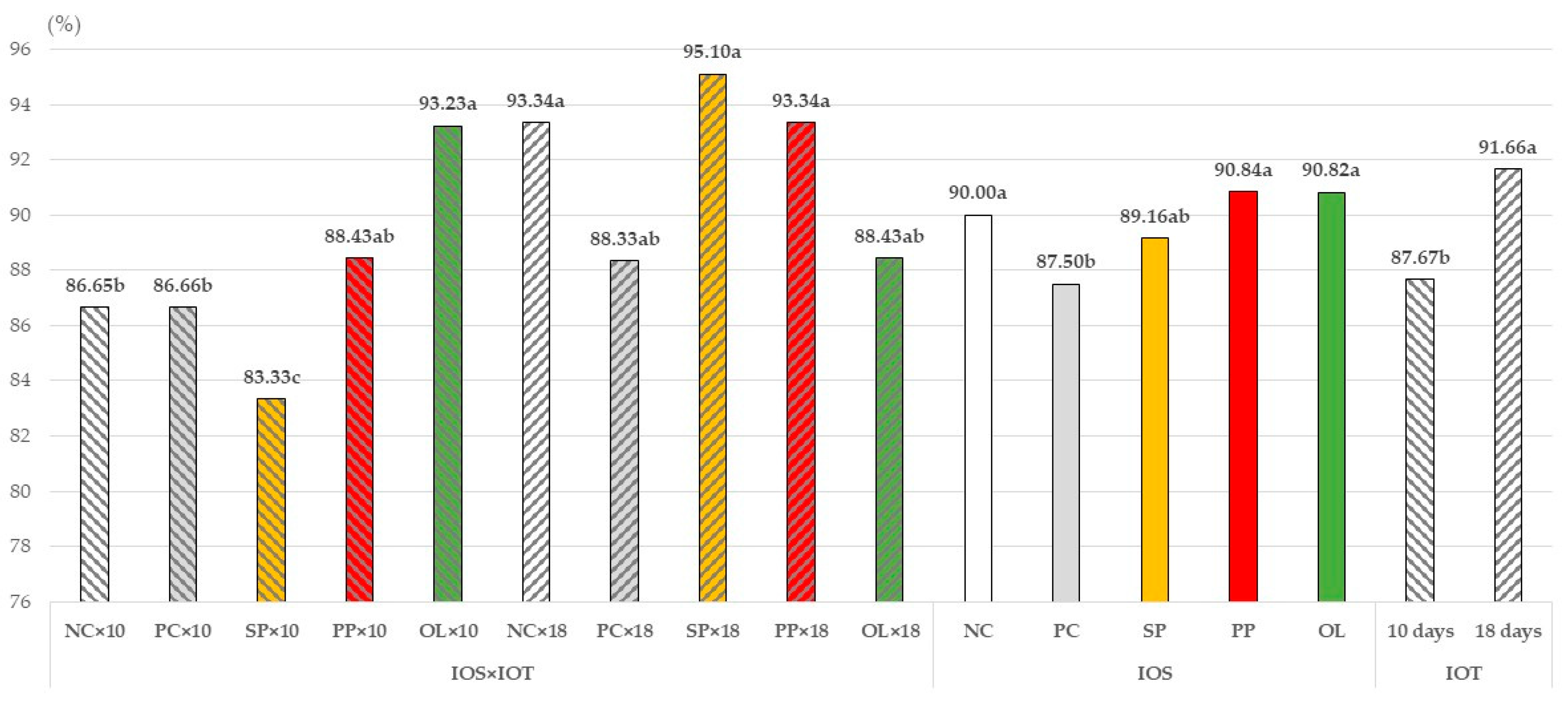
As shown in Figure 1, significantly higher hatchability and lower mortality (p = 0.049) rates were observed in the OL × 10, NC × 18, SP × 18, and PP × 18 groups compared to the NC × 10 group (Table 2). A reduced proportion of pipped chicks was recorded in the PC × 10, SP × 10, PP × 10, SP × 18, PP × 18, and OL × 18 groups compared to both negative control groups. The highest body weight (BW) and relative body weight (RBW) of chicks, alongside the lowest eggshell conductance (G), were recorded in the SP × 10 treatment. Regarding the main effect of IOS, hatchability and mortality rates were similar across the NC, SP, PP, and OL groups, yet both parameters were considerably better compared to the PC group (p = 0.040). Furthermore, a significantly lower percentage of pipped chicks was found in all in ovo-injected groups compared to the NC group (p = 0.030). Concerning the main effect of IOT, injection on day 18 significantly increased hatchability and reduced mortality (p = 0.038) compared to the procedure performed on day 10 of incubation. A significant interaction effect (p = 0.022) was found between the injection time and extract type regarding hatchability.
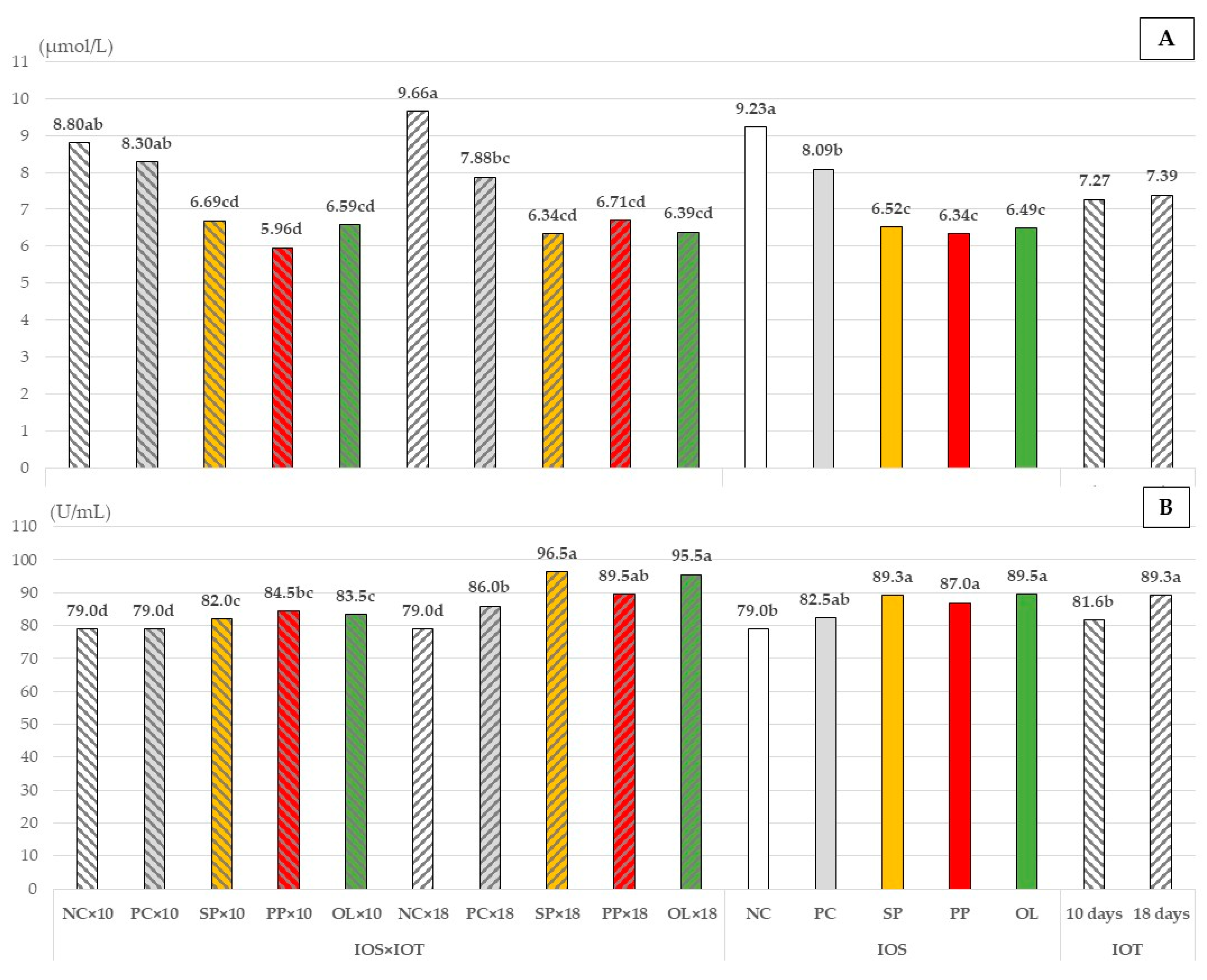
As illustrated in Figure 2, the systemic oxidative status was significantly influenced by the treatments. All in ovo-injected groups (SP, PP, and OL at both day 10 and 18) exhibited significantly higher SOD activity (Figure 2A) and lower MDA levels (Figure 2B) compared to the control groups (p = 0.035 and p = 0.031, respectively). Regarding the main effect of the IOS, the SP, PP, and OL treatments resulted in elevated SOD activity and reduced MDA levels compared to the NC group (p= 0.042 and p = 0.028, respectively). Concerning the main effect of IOT, in ovo injection on day 18 significantly increased SOD activity compared to injection on day 10 (p = 0.033).
Data regarding the haematological and metabolic profiles are presented in Table 3. PCV levels increased considerably in the NC × 18, SP × 18, and PP × 18 groups, while the H/L ratio decreased in the SP × 10, PP × 10, SP × 18, and PP × 18 treatments compared to NC × 10. Regarding the main effects of IOS, the SP, PP, and OL treatments resulted in lower H/L ratios compared to the NC group (p = 0.046) as well as injection on day 18 significantly increased PCV levels (p = 0.040). In terms of the metabolic profile in serum, GLU concentrations were reduced in the PP × 10, OL × 10, SP × 18, PP × 18, and OL × 18 groups; moreover, all interactive in ovo treatments were found to significantly lower TC levels (p = 0.043). Additionally, TG levels were decreased in all day 10 in ovo treatments and the NC × 10 group (p ≤ 0.05) compared to NC × 18.
All extract-injected groups exhibited significantly lower TC (p = 0.042), GLU (p = 0.027), and TG levels (p = 0.048). TC and TG levels were also significantly lower when the injection occurred on day 10 (p = 0.022 and p = 0.037, respectively).
As shown in Table 4, hepatic enzymes and renal markers were significantly modulated by the treatments. Significantly lower ALT activity (p = 0.023) was observed in the SP × 10 and PP × 10 groups compared to the controls. Decreased AST activity (p = 0.041) was recorded in the SP × 10, OL × 10, PC × 18, and OL × 18 treatments. Furthermore, the PC × 10, SP × 10, OL × 10, PC × 18, SP × 18, and OL × 18 treatments resulted in reduced ALP activity (p = 0.046). Concerning renal markers, both the OL × 10 and PP × 18 treatments decreased CREA levels (p = 0.026), and all treatments significantly minimised UA concentrations, with the exception of the OL × 18 group. Regarding the main effects of IOS, SP and PP significantly decreased ALT activity (p = 0.034), while the PC, SP, and OL treatments reduced both ALP and AST activities (p = 0.032 and p = 0.027, respectively). Furthermore, the main effect of PP significantly lowered CREA levels (p = 0.031), whereas SP significantly reduced UA concentrations (p = 0.042). Concerning the main effect of IOT, AST activity was significantly lower when the injection was performed on day 18 compared to day 10 (p = 0.030).
Data regarding the absolute weights and lengths of digestive and others visceral organs with pH of digestive organs are detailed in Supplementary Tables S1 and S2. Compared to NC × 10, the SP × 10 group showed a significantly higher small intestine length, while all in ovo treatments resulted in lower pH values (p = 0.025). Most treatments resulted in significantly larger large intestine length, and all interactive groups showed increased total gut length compared to the NC × 10 group (p = 0.036). Regarding the main effect of IOS, the OL treatment resulted in a significantly lower proventriculus length compared to the other groups (p = 0.025). An increase in total gut weight was observed in the PC and PP groups, while the main effect of SP was a significantly higher total gut length compared to the NC group (p = 0.040). In terms of the main effect of IOT, in ovo injection on day 18 significantly increased total gut length compared to injection on day 10 (p = 0.044).
As shown in Table S2, significantly higher weights for the pancreas (p = 0.044), kidneys (p = 0.30), liver (p = 0.026), thymus (p =0.030), and bursa of Fabricius (p = 0.023) were observed in the NC × 18, SP × 10, SP × 18, and PC × 18 groups compared to the NC × 10 group. Additionally, significantly higher lung weights (p = 0.043) were recorded in the SP × 10 and PP × 18 treatments compared to the controls; however, no significant interaction effects were found for the remaining visceral organs. Regarding the main effect of IOS, the SP, PP, and OL treatments significantly increased lung weight. Furthermore, SP and PC treatments resulted in significantly higher weights for the thymus and bursa of Fabricius, respectively, compared to the NC group (p = 0.041). Concerning the main effect of IOT, injection on day 18 resulted in significantly higher adrenal gland and liver weights compared to injection on day 10 (p = 0.044).
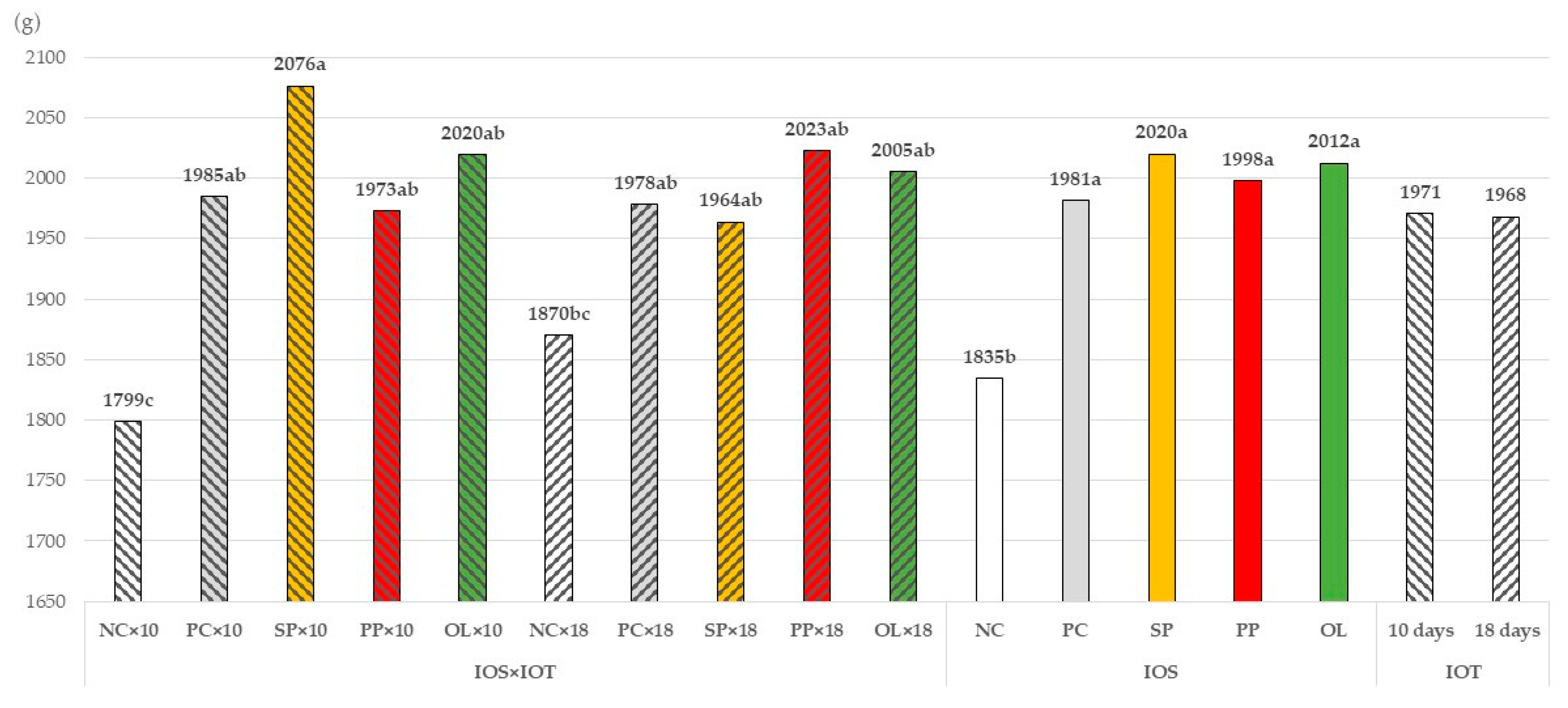
The productive performance of chicks affected by in ovo injection time of various plant byproducts is presented in Figure 3 and Table 5. Average final BW and EEF were significantly higher in all treatments compared to the control groups. Specifically, the SP × 10, OL × 10, and PP × 18 groups recorded the highest BWG (p = 0.022). Data in Table 5 indicate a significant increase in livability across all interactive treatments compared to the NC × 10 group (p = 0.030). Furthermore, all in ovo-injected groups showed considerably better livability, BW, BWG, and EEF compared to the NC group. Regarding the main effect of IOT, injection on day 18 resulted in significantly higher livability compared to injection on day 10 (p = 0.028).
According to Table 6, dressing percentage (without giblets) in the SP × 10, OL × 10, SP × 18, PP × 18, and OL × 18 groups did not differ significantly from both non-injected groups. A similar statistical trend was shown for the SP × 10, OL × 10, PC × 18, PP × 18, and OL × 18 groups compared to the control groups for other carcass traits. Furthermore, high abdominal fat was found only in carcasses from the PC × 10 group. Regarding the main effect of IOS, significant differences were found between the in ovo-injected groups and the PC group for dressing percentage with or without giblets (p = 0.037 or p = 0.029, respectively) and abdominal fat ratio (p = 0.040).

4. Discussion

4.1. Hatching Parameters and Embryo Development

The aqueous plant extracts (SP, PP, and OL) administered in ovo showed no detrimental effects on embryo development. On the contrary, a trend towards higher hatching rates and reduced embryonic mortality was observed in the interactive treatments (Table 2). This suggests that these natural solutions possess a high safety profile, likely due to their bioactive constituents (Table 1), which may support metabolic pathways and homeostasis in the developing embryo [10,11,22]. Furthermore, as fertile eggs can sometimes lack the specific exogenous compounds required to combat embryogenesis-related oxidative stress, the in ovo injection of plant-derived extracts appears to be a viable strategy to address these deficiencies without compromising the hatching process [2,4]. The decreased hatchability observed in the SP × 10 group may be attributed to the acidic nature of sweet orange peel extract, which could disrupt the physiological pH balance and microenvironment of embryos at the early organogenesis stage. In contrast, injection on day 18 is safer because embryos are more mature and tolerant to pH changes.
The observed reduction in the proportion of pipped chicks in the extract-treated groups suggests an enhanced hatching power. This response may be attributed to the ability of these phytochemicals to stimulate glucose availability and glycogen storage in the liver and muscles—critical energy reserves for the strenuous process of internal and external pipping [1]. Interestingly, our data indicate that in ovo delivery on day 18 is more effective in increasing hatchability and reducing mortality than on day 10. This is consistent with the observation that the 18th day of incubation is the optimal window for the embryo to orally consume nutraceuticals supplemented into the amnion or air cell, a timing that minimises interference with the physical and chemical characteristics of the egg environment [1,3].
The increased absolute and relative weights of chicks originating from SP-injected eggs may be correlated with the observed reduction in eggshell conductance (G). Eggshell conductance is a reliable indicator of moisture loss, which is governed by the incubation period and the pressure gradient across the shell [42]. The positive impact of SP is likely linked to its high limonene content (Table 1). Limonene, a major monoterpene in citrus oils, exhibits significant pharmacological activities [55].
Our findings align with several recent studies, albeit with some variations in methodology. For instance, Ngueda et al. [9] reported that in ovo administration of phytochemical-rich Manihot esculenta extracts on day 18 increased chick weight without affecting hatchability. Similarly, Al-Shammari [56] found that in ovo injection of limonene on day 18 increased BW at hatch and lowered G values, which mirrors our observations with SP. Conversely, while Kpossou et al. [16] found that Citrus aurantiifolia seed extracts increased BW without affecting hatchability, Khalifa et al. [14] noted that the effects of olive pulp extracts were dose-dependent, with lower concentrations even proving detrimental. These discrepancies may stem from differences in the major bioactive compounds; for example, Al-Shammari and Zamil [40] suggested that oleuropein (the primary compound in OL) or epigallocatechin-3 gallate can positively modulate hatchability and chick weight while decreasing eggshell conductance.
The chronological aspect of in ovo injection time (IOT) remains a relatively under-explored area. Ranjbar et al. [17] demonstrated that the timing and dosage of naringin—a potent citrus flavonoid—are critical, with later injections (day 17.5) yielding better hatchability than earlier ones (day 14). This supports our finding that day 18 is a superior time point for injection. Early attempts by Bhanja et al. [5] with amino acids suggested that day 14 was optimal, whereas Salahi et al. [57] observed that most injection timings reduced hatchability compared to controls. The success of our treatment on day 18 highlights the importance of aligning the injection with the physiological stage where the embryo is ready to actively ingest the amniotic fluid.

4.2. Blood Traits and Serum Biochemistry

The cellular components of the blood (PCV and H/L ratio) and redox indicators (MDA and SOD) were significantly influenced by both IOS and IOT, as well as their interactions (Table 3). The increase in PCV levels, particularly during the interactive treatments on day 18, suggests an enhanced erythropoietic response. This may be attributed to the stimulation of erythropoietin production, which prompts the bone marrow to increase erythrocyte synthesis, thereby supporting physiological homeostasis in the developing chick. Such a response likely explains the concurrent reduction in the H/L ratio. The H/L ratio is a well-established indicator of physiological stress in poultry, directly correlating with circulating corticosterone levels; thus, lower values signify a reduced stress response [58]. It is also important to critically consider the physiological stress induced by the injection procedure itself. Discrepancies between the negative (NC) and positive (PC) controls in certain variables highlight the fact that mechanical penetration and the introduction of a carrier fluid (distilled water) can elicit a transient stress response. The ability of the extracts to lower stress indicators below PC levels underscores their potential mitigating effects.
The protective potential of the administered extracts was further evidenced by the marked reduction in lipid peroxidation, as indicated by lowered MDA levels [45]. The fact that injection on day 18 proved most effective in enhancing SOD activity is noteworthy. As the first line of biological defence, SOD plays a vital role in neutralising superoxide anions, thereby protecting cells from oxidative damage during the critical stages of hatching [31,46].
Serum biochemical indices are essential for evaluating the general health and metabolic status of birds [58]. The observed reduction in circulating enzymatic activities (ALT, AST, and ALP) and metabolite concentrations (TC, GLU, TG, CREA, and UA) may suggest an attenuation of metabolic burden and the maintenance of hepatic cellular integrity. However, these physiological assumptions should be interpreted cautiously, as metabolic biomarkers are indirect indicators of organ function, and the specific mechanisms proposed for these phytochemicals are occasionally inferred from in vitro assays or general dietary poultry studies rather than direct histopathological confirmation in the current in ovo model.
The literature regarding the impact of phytogenic in ovo injection on the biochemical profile of newly hatched chicks shows varying trends. For instance, Ranjbar et al. [17] observed that different doses of naringin severely affected serum ALP, glucose, and SOD levels on the first day of hatch. In contrast, our results align more closely with those of Oke et al. [31], who reported that in ovo administration of black cumin extract modulated the redox status of heat-stressed chicks by reducing MDA, AST, ALT, and TG levels while increasing SOD activity. Similarly, Kpossou et al. [15,16] found that Citrus aurantiifolia seed extracts enhanced plasma SOD and lowered MDA without significantly altering other biochemical parameters.
However, Heidary et al. [18] found that in ovo nanocurcumin did not influence the H/L ratio or serum TC. Furthermore, Akosile et al. [10] observed that while clove and cinnamon extracts did not alter most biochemical traits, a specific dose of clove was effective in reducing the H/L ratio. The consistency of our results, particularly regarding the reduction in systemic stress markers, underscores the efficacy of the selected aqueous extracts (SP, PP, OL) when administered at the optimal embryonic stage.

4.3. Gut Health and Visceral Organ Morphometry

The notable reduction in small intestine pH and the increase in total gut length in the interactive treatments compared to the NC × 10 group (Table S1) are significant findings. This acidification of the intestinal environment is traditionally associated with enhanced nutrient absorption and digestive enzyme activity. Although direct microbiological or molecular evaluations were not performed in the present study, existing literature indicates that a lower pH creates a favourable environment for the modulation of beneficial microbial populations [6]. This is supported by Hajati et al. [59], who observed a significant inhibition of ileal colonisation by pathogenic bacteria following the IOI of grape seed extract. Similarly, Kpossou et al. [16] reported that in ovo administration of Citrus aurantiifolia lowered jejunal pH and increased villus height.
The increased weight and length of the total gut observed in the PP and SP groups may serve as gross morphological indicators of intestinal functionality. This effect could be attributed to the presence of alkaloids in these extracts (Table 1). In this context, Hundam et al. [60] demonstrated that in ovo delivery of isoquinoline alkaloids up-regulated the expression of tight junction proteins and increased the abundance of beneficial Lactobacillus species. While our morphometric data align with these general observations, further molecular studies are required to confirm whether these specific extracts directly modulate tight junction expression in our model.
The morphometric assessment of visceral organs is essential for evaluating metabolic status and immunological profiles. Our results (Table S2) suggest that each substance and injection timing had a specific influence on organ development. While some studies suggest that functional organs are relatively stable under the influence of IOI [2], others report dose-dependent variations. For instance, Oke et al. [31] found that while most visceral weights remained unchanged following black cumin IOI, a specific dose (6 mg) significantly enhanced heart and intestinal weights. In contrast, Ngueda et al. [9] reported increased weights for the liver and heart following in ovo Manihot esculenta treatment, whereas Kuka et al. [11] found no such effects with soursop leaf extract administrated in ovo.
In the present study, the main effects of IOS and SP were particularly influential in increasing the weights of the lungs and the bursa of Fabricius, respectively. While increased bursa weight is traditionally associated with immunological maturation, claims regarding enhanced immunocompetence should be interpreted with caution in the absence of direct immune marker assessments. These findings contrast with those of Kpossou et al. [16], who observed a reduction in bursa weight following IOI of citrus seed. Other contrasting results suggest that in ovo administration of various plant extracts often yields no significant changes in visceral organ weights [12,19]. These discrepancies likely stem from variations in extract concentrations and the specific site and effective time of IOI.
Regarding the timing of injection, IOI on day 18 was notably more effective than on day 10 for increasing total gut length and the absolute weights of the adrenal gland and liver. These findings are largely comparable to those of Salahi et al. [57], confirming that the late embryonic period represents a critical window for nutritional intervention via the amniotic fluid.

4.4. Productive Performance and Carcass Quality

The main effect of IOS proved pivotal in enhancing livability and increasing final values for BW, BWG, and EEF, without any detrimental impact on other productive variables (Figure 3, Table 5) or carcass quality (Table 6) throughout the six-week post-hatch period. Regarding the timing of injection, IOI on day 18 significantly increased livability compared to day 10. These positive growth performance metrics are likely the cumulative result of the modulated physiological and biochemical status discussed previously. It is crucial to acknowledge that some of the biochemical and morphometric alterations observed at day 5 post-hatch may reflect transient physiological responses to the exogenous stimuli rather than long-term biological adaptations. The EEF serves as a critical indicator of flock effectiveness [52]; the high EEF values recorded here suggest that the benefits of IOI extend well beyond embryogenesis into the late production stages.
The phytochemical composition of the extracts plays a fundamental role in these responses. For instance, the effects of OL extract injected in ovo may be attributed to oleuropein, which has been shown to support antioxidant capacity and modulate hormonal synthesis [40]. Similarly, the increased BW and livability in the SP group may be linked to limonene, known to enhance nutrient digestibility and inhibit corticosterone levels in hatchlings [56]. Furthermore, the increased weights of the primary lymphoid organs (thymus and bursa of Fabricius; Table S2) might indicate a better developmental trajectory of the immune system, potentially contributing to the observed livability, although functional immune responses were not directly quantified in this trial.
Our findings are consistent with several studies involving phytogenic IOI [13,15,16,31], which demonstrated increased BW, BWG, and superior growth performance in treated birds. However, the literature also contains divergent results where IOI of specific compounds [61] or extracts [14,18,19,59] reported no significant cumulative effects on productivity. These discrepancies underscore the importance of the specific bioactive profile, the dosage, and the precise timing of administration. In our study, the stability of carcass criteria and abdominal fat ratios indicates that the aqueous extracts promote growth without negatively altering physiological fat deposition.
From a practical perspective, the utilisation of aqueous extracts from agro-industrial byproducts (SP, PP, OL) for in ovo injection presents a highly scalable and economically feasible strategy for commercial hatcheries. Aqueous extraction is a low-cost, environmentally friendly process that bypasses the need for expensive synthetic additives or organic solvents. Furthermore, integrating this procedure into automated in ovo vaccination systems on day 18 of incubation would require minimal infrastructural adjustments, offering a sustainable approach to enhancing early chick robustness. However, to fully translate these findings into commercial practice, future studies should focus on establishing precise dose–response relationships to evaluate potential embryotoxic effects at higher extract concentrations, as well as investigating the long-term productive and economic consequences of these phytogenic in ovo supplementation strategies up to the end of the rearing cycle.

5. Conclusions

In conclusion, the in ovo injection (IOI) of 1% aqueous extracts of sweet orange peel (SP), pomegranate peel (PP), or olive leaf (OL) at a dose of 0.1 mL per egg is a safe and effective strategy for supporting poultry development. These phytogenic solutions effectively reduce the proportion of pipped chicks, reinforce the systemic antioxidant defence system, and positively modulate the biochemical status and livability of newly hatched chicks. Notably, the benefits of these treatments extend throughout the production cycle, leading to significantly higher final body weights at day 42.
Among the tested substances, SP and OL showed the most prominent results, with SP specifically increasing hatchling weight and gross morphological indicators such as thymus weight and total gut length. Furthermore, day 18 of incubation proved to be the optimal time for administration, yielding superior results in terms of hatchability, physiological response, and organ development compared to day 10.
While these phenotypic and physiological responses are highly encouraging, the underlying mechanisms related to enhanced immunocompetence and gut functionality were not directly evaluated in this study. Therefore, future research incorporating histological assessments, microbiota characterisation, and molecular analyses (such as gene expression) is warranted to fully elucidate the long-term biological adaptations associated with phytogenic in ovo supplementation.
From a practical and commercial perspective, it is recommended to apply IOI using SP or OL on the 18th day of incubation in broiler breeder eggs and different poultry species. This approach offers a natural and viable method for the poultry industry to optimise embryo development, improve post-hatch resilience, and maximise overall growth performance.


Supplementary Materials

The following supporting information can be downloaded at: https://www.mdpi.com/article/10.3390/agriculture16111246/s1, Table S1: Weights, lengths and pH of digestive organs sections of chicks affected by in ovo injection time of various plant byproduct; Table S2. Visceral organs weights of chicks affected by in ovo injection time of various plant-by products.

Author Contributions

Conceptualization, K.I.A.A.-S. and M.R.M.; methodology, K.I.A.A.-S. and J.B.; software, M.R.M.; validation, K.I.A.A.-S.; M.R.M. and J.B.; investigation, K.I.A.A.-S. and M.R.M.; data curation, K.I.A.A.-S.; writing—original draft preparation, K.I.A.A.-S.; M.R.M. and J.B.; writing—review and editing, K.I.A.A.-S. and J.B.; visualisation, J.B.; supervision, K.I.A.A.-S.; project administration, K.I.A.A.-S. All authors have read and agreed to the published version of the manuscript.

Funding

This research received no external funding.

Institutional Review Board Statement

The animal study protocol was approved by the Scientific Committee of the Department of Animal Production Techniques, Technical College of Al-Musaib, Al-Furat Al-Awsat Technical University, Iraq (compliance with the amended Law No. 22 of 1972, legislation number 2; date of approval 2 January 2024).

Data Availability Statement

The data presented in this study are available on request from the corresponding author.

Conflicts of Interest

The authors declare no conflicts of interest.

Abbreviations

The following abbreviations are used in this manuscript:
ACair cell
ALPalkaline phosphatase
ALTalanine aminotransferase
ASTaspartate aminotransferase
BWbody weight of chicks
BWGbody weight gain
CREAcreatinine
EEFEuropean efficiency factor
FCRfeed conversion ratio
FIfeed intake
Geggshell conductance
GLMGeneral Linear Model
GLUglucose
H/Lheterophil-to-lymphocyte
HPLCHigh-performance liquid chromatography
IOIin ovo injection
IOSin ovo injected substance
IOTin ovo injection time
Llength
MDAmalondialdehyde
NCnegative control
OLolive leaf
PCpositive control
PCVpacked cell volume
PPpomegranate peel
RBWrelative body weight
RGRrelative growth rate
RHrelative humidity
SEMstandard error of mean
SODsuperoxide dismutase
SPsweet orange peel
TCtotal cholesterol
TGtriglycerides
TPtotal protein
UAuric acid
Wweight

References

  1. Das, R.; Mishra, P.; Jha, R. In ovo feeding as a tool for improving performance and gut health of poultry: A review. Front. Vet. Sci. 2021, 8, 754246. [Google Scholar] [CrossRef]
  2. Arain, M.A.; Nabi, F.; Marghazani, I.B.; Hassan, F.; Soomro, H.; Kalhoro, H.; Soomro, F.; Buzdar, J.A. In ovo delivery of nutraceuticals improves health status and production performance of poultry birds: A review. World’s Poult. Sci. J. 2022, 78, 765–788. [Google Scholar] [CrossRef]
  3. Peebles, E.D. In ovo applications in poultry: A review. Poult. Sci. 2018, 97, 2322–2338. [Google Scholar] [CrossRef]
  4. Ebeid, T.A.; Ketta, M.; Al-Homidan, I.H.; Barakat, H.; Abdel-Moneim, A.-M.E. In ovo feeding of nutraceuticals and its role in adjusting the gastrointestinal tract, antioxidative properties, immunological response, and performance in poultry: An updated review. Czech J. Anim. Sci. 2023, 68, 1. [Google Scholar] [CrossRef]
  5. Bhanja, S.K.; Mandal, A.B.; Johri, T.S. Standardization of injection site, needle length, embryonic age and concentration of amino acids for in ovo injection in broiler breeder eggs. Indian J. Poult. Sci. 2004, 39, 105–111. [Google Scholar]
  6. Roto, S.M.; Kwon, Y.M.; Ricke, S.C. Applications of in ovo technique for the optimal development of the gastrointestinal tract and the potential influence on the establishment of its microbiome in poultry. Front. Vet. Sci. 2016, 3, 63. [Google Scholar] [CrossRef]
  7. Peşmen, G. Effects of in ovo injection of naringin into fertile broiler chicken eggs on hatchability and hatchling weight and length. S. Afr. J. Anim. Sci. 2025, 55, 340–347. [Google Scholar] [CrossRef]
  8. Jha, R.; Singh, A.K.; Yadav, S.; Berrocoso, J.F.D.; Mishra, B. Early nutrition programming (in ovo and post-hatch feeding) as a strategy to modulate gut health of poultry. Front. Vet. Sci. 2019, 6, 82. [Google Scholar] [CrossRef]
  9. Ngueda, D.O.R.; N’nanle, O.; Voemesse, K.; Onagbesan, O.; Decuypere, E.; Tona, K. Effects of in ovo injection of Manihot esculenta extract on hatchability and post-hatch performance of Sasso broiler chickens. Eur. Poult. Sci. 2021, 85, 1–11. [Google Scholar] [CrossRef]
  10. Akosile, O.A.; Sogunle, O.M.; Majekodunmi, B.; Oke, O.E. In ovo injection of cinnamon or clove alters the physiology and growth of broilers in a hot tropical environment. Transl. Anim. Sci. 2023, 7, txad036. [Google Scholar] [CrossRef] [PubMed]
  11. Kuka, T.T.; N’nanle, O.; Karou, S.; Tona, K.; Bakoma, B. Effects of in ovo injection of soursop (Annona muricata) leaf extract on blood profile, immune organs, and intestinal morphology of noiler chicks. J. World’s Poult. Res. 2024, 4, 343–350. [Google Scholar] [CrossRef]
  12. Sogunle, O.; Orhembetyoga, S.; Odutayo, O.; Opowoye, I.; Idowu, O.; Abiona, J.; Olutayo, A. Hatching traits and post-hatch performance of broiler chickens on in ovo feeding of aqueous extracts of garlic, mushroom and their combination. Folia Vet. 2024, 68, 8–18. [Google Scholar] [CrossRef]
  13. N’nanle, O.; Tété-Bénissan, A.; Tona, K.; Teteh, A.; Voemesse, K.; Decuypere, E.; Gbeassor, M. Effect of in ovo inoculation of Moringa oleifera leaves extract on hatchability and chicken growth performance. Eur. Poult. Sci. 2017, 81, 1–9. [Google Scholar] [CrossRef]
  14. Khalifa, W.H.; Sallam, M.G.; Kamel, N.N.; Samy, A.; Yassein, S.A.; El-Mallah, G.M.; Abusinaa, G.E. Using in-ovo injection of olive pulp extract and vitamin C to improve hatchability, post hatch growth performance, carcass traits and some biochemical blood analysis in broiler chickens. Int. J. Vet. Sci. 2022, 12, 353–359. [Google Scholar] [CrossRef]
  15. Kpossou, R.F.; Adjei-Mensah, B.; Everaert, N.; Tona, K. Evaluating the interaction response of broiler chickens to in ovo feeding of Citrus aurantiifolia seed extract and its powder supplementation. Ital. J. Anim. Sci. 2024, 23, 970–980. [Google Scholar] [CrossRef]
  16. Kpossou, R.F.; Adjei-Mensah, B.; N’nanle, O.; Everaert, N.; Tona, K. In ovo feeding of Citrus aurantiifolia seed extract on hatchability, chick quality, physiological response, intestinal morphology and posthatch growth performance of Cobb 500 broiler chickens. J. Appl. Poult. Res. 2024, 33, 100471. [Google Scholar] [CrossRef]
  17. Ranjbar, Z.; Torki, M.; Karimi Torshizi, A.A. In ovo injection of flavanone on bone quality characteristics, biochemical parameters and antioxidant enzyme status of blood in daily chicks. J. Anim. Physiol. Anim. Nutr. 2019, 103, 1418–1426. [Google Scholar] [CrossRef] [PubMed]
  18. Heidary, M.; Hassanabadi, A.; Mohebalian, H. Effects of in ovo injection of nanocurcumin and vitamin e on antioxidant status immune responses intestinal morphology and growth performance of broiler chickens exposed to heat stress. J. Livest. Sci. Technol. 2020, 8, 17–27. [Google Scholar] [CrossRef]
  19. Bondar, B.B.; Shukla, P.K.; Bhattacharyya, A.; Kherde, A.R.; Patel, M.; Gulhane, P.S.; Sharma, M. Effect of dietary supplementation and in ovo feeding of menthol on the growth performance, development of lymphoid and digestive organs and carcass quality traits of broilers. Indian J. Poult. Sci. 2024, 59, 281–290. [Google Scholar]
  20. Toosi, S.; Chamani, M.; Shivazad, M.; Sadeghi, A.A.; Mousavi, S.N. Effects of in ovo injection and inclusion a blend of essential oils and organic acids in high nsps diets of broiler breeders on performance of them and their offspring. J. Poult. Sci. 2016, 53, 192–200. [Google Scholar] [CrossRef][Green Version]
  21. Oladokun, S.; MacIsaac, J.; Rathgeber, B.; Adewole, D. Essential Oil Delivery Route: Effect on broiler chicken’s growth performance, blood biochemistry, intestinal morphology, immune, and antioxidant status. Animals 2021, 11, 3386. [Google Scholar] [CrossRef]
  22. Hu, R.; He, Y.; Arowolo, M.A.; Wu, S.; He, J. Polyphenols as potential attenuators of heat stress in poultry production. Antioxidants 2019, 8, 67. [Google Scholar] [CrossRef]
  23. Readh, C.E.A.; Miloud, L.; Abdelkarim, L.; Chaima, B.; Kaddour, B. The valorization and potential applications of orange byproducts and waste in poultry feeding: A review. Asian J. Dairy Food Res. 2024, 43, 189–195. [Google Scholar] [CrossRef]
  24. Azizi, M.; Seidavi, A.R.; Ragni, M.; Laudadio, V.; Tufarelli, V. Practical Applications of Agricultural Wastes in Poultry Feeding in Mediterranean and Middle East Regions. Part 1: Citrus, Grape, Pomegranate and Apple Wastes. World’s Poult. Sci. J. 2018, 74, 489–498. [Google Scholar] [CrossRef]
  25. Vlaicu, P.A.; Untea, A.E.; Panaite, T.D.; Turcu, R.P. Effect of dietary orange and grapefruit peel on growth performance, health status, meat quality and intestinal microflora of broiler chickens. Ital. J. Anim. Sci. 2020, 19, 1394–1405. [Google Scholar] [CrossRef]
  26. Akuru, E.A.; Chukwuma, C.I.; Oyeagu, C.E.; Mpendulo, T.C.; Lewu, F.B. Potential relevance of pomegranate (Punica granatum) peel in the nutrition, health, and quality products of poultry. Iran. J. Appl. Anim. Sci. 2023, 13, 627. [Google Scholar]
  27. Badshah, S.M.; Sultana, N.; Al-Rawi, M.B.A.; Tariq, Z.; Lin, K.-S.; Hussain, A.; Syed, W.; Ahmed, D.; Hussain, J.; Khan, B.; et al. Phytochemical profiling, biological potential and in silico identification of anticancerous compound from Pakistani pomegranate peel. Sci. Rep. 2025, 15, 26689. [Google Scholar] [CrossRef] [PubMed]
  28. Al-Shammari, K.I.A.; Batkowska, J.; Zamil, S.J. Role of pomegranate peels and black pepper powder and their mixture in alleviating the oxidative stress in broiler chickens. Int. J. Poult. Sci. 2019, 18, 122–128. [Google Scholar] [CrossRef][Green Version]
  29. Xu, P.; Wang, J.; Chen, P.; Ding, H.; Wang, X.; Li, S.; Fan, X.; Zhou, Z.; Shi, D.; Li, Z.; et al. Effects of pomegranate (Punica granatum L.) peel on the growth performance and intestinal microbiota of broilers challenged with Escherichia coli. Poult. Sci. 2024, 103, 103304. [Google Scholar] [CrossRef]
  30. Makowska-Wąs, J.; Galanty, A.; Gdula-Argasińska, J.; Tyszka-Czochara, M.; Szewczyk, A.; Nunes, R.; Carvalho, I.S.; Michalik, M.; Paśko, P. Identification of predominant phytochemical compounds and cytotoxic activity of wild olive leaves (Olea europaea L. ssp. Sylvestris) harvested in South Portugal. Chem. Biodivers. 2017, 14, e1600331. [Google Scholar] [CrossRef]
  31. Oke, O.E.; Emeshili, U.K.; Iyasere, O.S.; Abioja, M.O.; Daramola, J.O.; Ladokun, A.O.; Abiona, J.A.; Williams, T.J.; Rahman, S.A.; Rotimi, S.O.; et al. Physiological responses and performance of broiler chickens offered olive leaf extract under a hot humid tropical climate. J. Appl. Poult. Res. 2017, 26, 376–382. [Google Scholar] [CrossRef]
  32. Negm, M.H.; Aldhalmi, A.K.; Ashour, E.A.; Mohamed, L.A.; Youssef, I.M.; Kamal, M.; Elolimy, A.A.; Mahgoub, S.A.; Abd El-Hack, M.E.; Swelum, A.A. Consequences of dietary olive leaf powder supplementation on growth performance, carcass traits, blood biochemical parameters and gut microbiota in broilers. Poult. Sci. 2025, 104, 105087. [Google Scholar] [CrossRef]
  33. Surai, P.F. Antioxidant systems in poultry biology: Superoxide dismutase. J. Anim. Res. Nutr. 2016, 1, 8. [Google Scholar] [CrossRef]
  34. Tona, K.; Voemesse, K.; N’nanlé, O.; Oke, O.E.; Kouame, Y.A.E.; Bilalissi, A.; Meteyake, H.; Oso, O.M. Chicken incubation conditions: Role in embryo development, physiology and adaptation to the post-hatch environment. Front. Physiol. 2022, 13, 895854. [Google Scholar] [CrossRef]
  35. Park, J.Y.; Kim, J.H. Embryonic Development and Nutritional Modulation through in Ovo Feeding in Broiler Chickens. Korean J. Poult. Sci. 2025, 52, 271–289. [Google Scholar] [CrossRef]
  36. Omoba, O.S.; Obafaye, R.O.; Salawu, S.O.; Boligon, A.A.; Athayde, M.L. HPLC-DAD phenolic characterization and antioxidant activities of ripe and unripe sweet orange peels. Antioxidants 2015, 4, 498–512. [Google Scholar] [CrossRef] [PubMed]
  37. Ajanal, M.; Gundkalle, M.B.; Nayak, S.U. Estimation of total alkaloid in Chitrakadivati by UV-Spectrophotometer. Anc. Sci. Life 2012, 31, 198–201. [Google Scholar] [CrossRef]
  38. Ghorai, N.; Chakraborty, S.; Gucchait, S.; Saha, S.K.; Biswas, S. Estimation of total terpenoids concentration in plant tissues using a monoterpene, linalool as standard reagent. Res. Sq. 2012. [Google Scholar] [CrossRef]
  39. Sweidan, N.; Rayyan, W.A.; Mahmoud, I.; Ali, L. Phytochemical analysis, antioxidant, and antimicrobial activities of Jordanian pomegranate peels. PLoS ONE 2023, 18, e0295129. [Google Scholar] [CrossRef]
  40. Al-Shammari, K.I.A.; Zamil, S.J. Effect of in ovo injection of epigallocatechin-3 gallate and oleuropein on hatching, productive and physiological aspects of broiler chicks exposed to short heat stress. J. Indones. Trop. Anim. Agric. 2024, 49, 1–15. [Google Scholar] [CrossRef]
  41. NRC. Nutrient Requirements of Poultry, 9th Revised ed.; National Academies Press: Washington, DC, USA, 1994; p. 176. [Google Scholar]
  42. Christensen, V.L.; Grimes, J.L.; Wineland, M.J.; Bagley, L.G. Effects of turkey breeder hen age, strain, and length of the incubation period on survival of embryos and hatchlings 1. J. Appl. Poult. Res. 2001, 10, 5–15. [Google Scholar] [CrossRef]
  43. Archer, R.K. Haematological Techniques for Use on Animals; Blackwell Scientific Publications: Oxford, UK, 1965; p. 135. [Google Scholar]
  44. Burton, R.; Guion, C.W. The differential leucocyte blood count: Its precision and individuality in the chicken 1. Poult. Sci. 1968, 47, 1945–1949. [Google Scholar] [CrossRef] [PubMed]
  45. Salih, A.M.; Smith, D.M.; Price, J.F.; Dawson, L.E. Modified extraction 2-thiobarbituric acid method for measuring lipid oxidation in poultry. Poult. Sci. 1987, 66, 1483–1488. [Google Scholar] [CrossRef]
  46. Misra, H.P.; Fridovich, I. The role of superoxide anion in the autoxidation of epinephrine and a simple assay for superoxide dismutase. J. Biol. Chem. 1972, 247, 3170–3175. [Google Scholar] [CrossRef]
  47. Reitman, S.; Frankel, S. A colorimetric method for the determination of serum glutamic oxalacetic and glutamic pyruvic transaminases. Am. J. Clin. Pathol. 1957, 28, 56–63. [Google Scholar] [CrossRef]
  48. Burtis, C.A.; Ashwood, E.R. Tietz Textbook of Clinical Chemistry, 3rd ed.; W.B. Saunders: Philadelphia, PA, USA, 1999; p. 1847. [Google Scholar]
  49. Young, D.S. Effects of Drugs on Clinical Laboratory Tests, 5th ed.; AACC Press: Washington, DC, USA, 2000. [Google Scholar]
  50. Chaveerach, P.; Keuzenkamp, D.A.; Lipman, L.J.A.; Van Knapen, F. Effect of organic acids in drinking water for young broilers on Campylobacter infection, volatile fatty acid production, gut microflora and histological cell changes. Poult. Sci. 2004, 83, 330–334. [Google Scholar] [CrossRef]
  51. Brody, S. Bioenergetics and growth with special reference to the efficiency complex in domestic animals. (A Publication of the Herman Frasch Foundation). Q. Rev. Biol. 1946, 21, 97–99. [Google Scholar] [CrossRef]
  52. Lemme, A.; Frackenpohl, U.; Petri, A.; Meyer, H. Response of male BUT Big 6 turkeys to varying amino acid feeding programs. Poult. Sci. 2006, 85, 652–660. [Google Scholar] [CrossRef] [PubMed]
  53. SAS. SAS User’s Guide, Version 9.1.; SAS Institute Inc.: Cary, NC, USA, 2012. [Google Scholar]
  54. Duncan, D.B. Multiple range and multiple F tests. Biometrics 1955, 11, 1–42. [Google Scholar] [CrossRef]
  55. Erasto, P.; Viljoen, A.M. Limonene—A review: Biosynthetic, ecological and pharmacological relevance. Nat. Prod. Commun. 2008, 3, 1193–1202. [Google Scholar] [CrossRef]
  56. Al-Shammari, K.I.A. Influence of in ovo injection of phytochemicals and post-hatch feeding on hatching traits, physiological aspects, productive performance, duodenal morphology, and digestibility of broiler chickens. Poult. Sci. J. 2025, 13, 215. [Google Scholar] [CrossRef]
  57. Salahi, A.; Khabisi, M.M.; Mousavi, S.N. Optimum time of in ovo injection in eggs of young broiler breeder flock. In Proceedings of the 18th European Symposium on Poultry Nutrition, Izmir, Turkey, 31 November 2011; pp. 557–559. [Google Scholar]
  58. Al-Shammari, K.I.A.; Zamil, S.J.; Batkowska, J. The antioxidative influence of dietary creatine monohydrate and l-carnitine on laying performance, egg quality, ileal microbiota, blood biochemistry, and redox status of stressed laying quails. Poult. Sci. 2024, 103, 103166. [Google Scholar] [CrossRef]
  59. Hajati, H.; Hassanabadi, A.; Golian, A.; Nassiri-Moghaddam, H.; Nassiri, M.R. The effect of grape seed extract supplementation on performance, antioxidant enzyme activity, and immune responses in broiler chickens exposed to chronic heat stress. Iran. J. Appl. Anim. Sci. 2018, 8, 109–117. [Google Scholar]
  60. Hundam, S.; Al-Zghoul, M.B.; Mayyas, M.; Dahadha, R. In ovo isoquinoline alkaloid injection alters gut microbiota and improves tight junction gene expression in broiler chickens. Poult. Sci. 2025, 104, 105921. [Google Scholar] [CrossRef]
  61. Khaligh, F.; Hassanabadi, A.; Nassiri-Moghaddam, H.; Golian, A.; Kalidari, G.-A. Effects of in ovo injection of chrysin, quercetin and ascorbic acid on hatchability, somatic attributes, hepatic oxidative status and early post-hatch performance of broiler chicks. J. Anim. Physiol. Anim. Nutr. 2018, 102, e413–e420. [Google Scholar] [CrossRef]
Figure 1. The hatchability of birds (%) affected by in ovo injection time of various plant byproducts. IOS—in ovo-injected substance, IOT—in ovo injection time, NC, PC, SP, PP and OL—negative control, positive control, and in ovo injection of sweet orange peel, pomegranate peel, and olive leaf, respectively, on day 10 (×10) and day 18 (×18) of incubation; a, b, c—means within bars with different letters differ significantly (p ≤ 0.05).
Agriculture 16 01246 g001
Figure 2. Serum redox markers, malondialdehyde (MDA, part (A) and superoxide dismutase (SOD, part (B) affected by in ovo injection time of various plant byproducts. IOS—in ovo-injected substance, IOT—in ovo injection time, NC, PC, SP, PP and OL—negative control, positive control, and in ovo injection of sweet orange peel, pomegranate peel, and olive leaf, respectively, on day 10 (×10) and day 18 (×18) of incubation; a, b, c, d—means within bars with different letters differ significantly (p ≤ 0.05).
Agriculture 16 01246 g002
Figure 3. The final body weight of birds (g) affected by in ovo injection time of various plant byproducts. IOS—in ovo-injected substance, IOT—in ovo injection time, NC, PC, SP, PP and OL—negative control, positive control, and in ovo injection of sweet orange peel, pomegranate peel, and olive leaf, respectively, on day 10 (×10) and day 18 (×18) of incubation; a, b, c— means within bars with different letters differ significantly (p ≤ 0.05).
Agriculture 16 01246 g003
Table 1. Bioactive compounds in plant byproducts.
ComponentUnitSweet Orange Peel (SP)Pomegranate Peel (PP)Olive Leave (OL)
Total anthocyanin *ppm-78.25-
Limonene **%64.15--
Oleuropein **%--3.65
+(-)Catechin *ppm22.555.846.8
Apigenin *ppm18.993.578.5
Kaempferol *ppm26.948.736.9
Luteolin *ppm15.844.725.7
Quercetin *ppm16.952.120.6
Rutin *ppm42.978.965.8
Alkaloids *%6.2510.2514.58
Terpenoids *%22.3610.652.58
Saponins *%0.251.251.87
Tannins *%0.5852.5812.48
Total flavonoids *g/mg22.2595.8931.56
Total phenols *g/mg35.45138.98112.36
* Based on powdery extract; ** based on essential oil.
Table 2. Hatching results affected by in ovo injection time of various plant byproducts.
IOS × IOTMortality (%)Pipped Chicks (%)Chick BW (g)Chick RBW (%)G (mg/d/mm Hg)
NC × 1013.34 ab3.33 a43.46 bc43.46 bc14.50 ab
PC × 1013.33 ab0.00 b41.83 c41.83 c16.13 a
SP × 1016.66 a0.00 b46.15 a46.15 a11.81 c
PP × 1011.56 b0.00 b43.76 abc43.76 abc14.20 abc
OL × 106.76 c1.66 ab44.19 abc44.19 abc13.77 abc
NC × 186.65 c3.33 a43.73 abc43.73 abc14.23 abc
PC × 1811.66 b1.66 ab43.06 bc43.06 bc14.89 ab
SP × 185.01 c0.00 b44.47 ab44.47 ab13.49 bc
PP × 186.65 c0.00 b43.16 bc43.16 bc14.803 ab
OL × 1811.57 b0.00 b43.73 abc43.73 abc14.22 abc
In ovo-injected substance (IOS)
NC10.00 b3.33 a43.59 b75.16 b14.37 a
PC12.50 a0.83 b42.45 b73.19 b15.51 a
SP10.83 ab0.00 b45.31 a78.13 a12.65 b
PP9.15 b0.00 b43.46 b74.93 b14.50 a
OL9.18 b0.82 b43.96 ab75.80 ab14.00 ab
In ovo injection time (IOT)
10 days12.33 a1.0543.8875.6514.08
18 days8.33 b1.0143.6375.2314.33
Pooled SEM3.330.381.643.890.69
p-value
IOS0.0240.0300.0360.0470.038
IOT0.0380.2500.4220.1090.400
IOS × IOT0.0490.0430.0200.1020.040
NC, PC, SP, PP and OL—negative control, positive control, and in ovo injection of sweet orange peel, pomegranate peel, and olive leaf, respectively, on day 10 (×10) and day 18 (×18) of incubation; G—eggshell conductance; BW—body weight; RBW—relative body weight (expressed as a proportion of initial egg weight); SEM—standard error of the mean; a, b, c—means within a column with different letters differ significantly (p ≤ 0.05).
Table 3. Haematological and some biochemical traits of chicks affected by in ovo injection time of various plant byproducts.
IOS × IOTPCV (%)H/LGLU (mg/dL)TC (mg/dL)TG (mg/dL)TP (g/dL)
NC × 1025.30 b0.67 a130.00 a107.00 b42.00 cd2.40
PC × 1026.15 ab0.25 ab131.00 a100.50 c43.50 bcd2.40
SP × 1026.10 ab0.32 b127.00 ab102.00 c40.00 d2.75
PP × 1026.35 ab0.33 b118.50 d101.00 c40.00 d2.85
OL × 1027.15 ab0.42 ab123.50 c99.50 c41.50 cd2.85
NC × 1828.10 a0.57 ab 130.00 a114.00 a49.00 a2.40
PC × 1826.35 ab0.47 ab131.00 a108.50 b47.00 ab2.50
SP × 1827.60 a0.38 b125.50 b102.50 c46.00 abc2.90
PP × 1827.75 a0.37 b125.50 b101.50 c44.50 abcd2.80
OL × 1827.40 ab0.41 ab124.00 bc102.50 c43.00 cd2.75
In ovo-injected substance (IOS)
NC26.79 0.62 a130.00 a110.50 a 45.50 a2.40
PC26.250.50 ab131.00 a104.50 b45.25 a2.45
SP26.850.35 b126.25 b102.25 bc43.00 b2.82
PP27.050.35 b 122.00 c101.25 c42.25 c2.82
OL27.270.24 b 123.75 bc101.00 c42.25 c 2.80
In ovo injection time (IOT)
10 days26.21 b0.45126.00102.00 b41.40 b2.65
18 days27.44 a0.44127.20105.80 a45.90 a2.67
Pooled SEM0.650.052.291.301.340.19
p-value
IOS0.2230.0460.0270.0420.0480.069
IOT0.0400.0700.0650.0220.0370.099
IOS × IOT0.0340.0500.0360.0430.0310.132
NC, PC, SP, PP, and OL—negative control, positive control, and in ovo injection of sweet orange peel, pomegranate peel, and olive leaf, respectively, on day 10 (×10) and day 18 (×18) of incubation; PCV—packed cell volume, H/L—heterophil-to-lymphocyte ratio, GLU—glucose, TC—total cholesterol, TG—triglycerides, TP—total protein; SEM—standard error of the mean; a, b, c, d—means within a column with different letters differ significantly (p ≤ 0.05).
Table 4. Hepatic enzymes and renal markers of chicks affected by in ovo injection time of various plant byproducts.
IOS × IOTALT (U/L)AST (U/L)ALP (U/L)CREA (mg/dL)UA (mg/dL)
NC × 104.00 a120.00 a78.30 a0.50 a4.20 a
PC × 103.00 ab115.50 ab76.30 b0.40 ab3.75 b
SP × 102.50 b105.00 c75.90 b0.40 ab3.55 b
PP × 102.50 b115.00 ab78.25 a0.40 ab3.60 b
OL × 104.00 a110.50 bc73.90 b0.35 b3.75 b
NC × 184.00 a114.00 ab77.40 ab0.40 ab4.50 a
PC × 184.00 a104.50 c75.85 b0.45 a3.60 b
SP × 183.00 ab107.50 bc75.70 b0.40 ab3.40 b
PP × 183.50 ab112.00 abc77.95 a0.35 b3.80 b
OL × 183.50 ab105.00 c75.90 b0.45 a4.05 ab
In ovo-injected substance (IOS)
NC4.00 a117.00 a77.85 a0.45 a4.35 a
PC3.50 ab110.00 bc76.07 b0.42 ab3.67 ab
SP2.75 c106.25 c75.80 bc0.40 ab3.475 b
PP3.00 bc113.50 ab78.10 a0.37 b3.70 ab
OL3.75 a107.75 c74.90 c0.40 ab3.90 ab
In ovo injection time (IOT)
10 days3.20113.20 a76.530.413.77
18 days3.60108.60 b76.560.403.87
Pooled SEM0.321.990.420.030.28
p-value
IOS0.0340.0270.0320.0310.042
IOT0.0730.0300.2170.9000.100
IOS × IOT0.0230.0410.0460.0260.025
NC, PC, SP, PP, and OL—negative control, positive control, and in ovo injection of sweet orange peel, pomegranate peel, and olive leaf, respectively, on day 10 (×10) and day 18 (×18) of incubation; ALT—alanine aminotransferase, AST—aspartate aminotransferase, ALP—alkaline phosphatase, CREA—creatinine, UA—uric acid; SEM—standard error of mean; a, b, c,—means within a column with different letters differ significantly (p ≤ 0.05).
Table 5. Cumulative productive performance of chicks affected by in ovo injection time of various plant byproducts.
IOS × IOTLivability (%)BWG (g)RGR (%)FI (g)FCREEF
NC × 1090.00 b1755.69 c190.572620.911.49309.91 b
PC × 1097.50 a1938.24 ab190.832612.751.34409.83 a
SP × 10100.00 a2028.65 a 191.062852.051.40425.72 a
PP × 10100.00 a1924.86 abc190.392660.821.38407.90 a
OL × 10100.00 a1970.15 ab190.442583.001.31441.89 a
NC × 18100.00 a1816.68 bc188.882609.141.44372.04 ab
PC × 18100.00 a1921.54 abc188.872674.521.39406.13 a
SP × 18100.00 a1906.38 abc188.572654.361.39404.84 a
PP × 18100.00 a1906.36 abc188.752688.321.37422.47 a
OL × 18100.00 a1945.86 ab188.482685.171.38415.26 a
In ovo-injected substance (IOS)
NC95.00 b1786.19 b189.722615.031.46340.97 b
PC98.75 ab1929.89 a189.852643.631.36407.98 a
SP100.00 a1967.51 a 189.812748.701.39415.28 a
PP100.00 a1944.61 a189.572674.571.37415.18 a
OL100.00 a1958.01 a189.462634.091.34428.57 a
In ovo injection time (IOT)
10 days97.50 b1923.52190.662665.901.38399.05
18 days100.00 a1910.96188.712660.501.39404.15
Pooled SEM2.5336.880.65377.770.0318.14
p-value
IOS0.0430.0190.1230.2410.9210.045
IOT0.0280.9930.7420.9850.1720.068
IOS × IOT0.0300.0220.1030.6360.0910.029
NC, PC, SP, PP and OL—negative control, positive control, and in ovo injection of sweet orange peel, pomegranate peel, and olive leaf, respectively, on day 10 (×10) and day 18 (×18) of incubation; BWG—body weight gain, RGR—relative growth rate, FI—feed intake, FCR—feed conversion ratio, EEF—European efficiency factor; SEM—standard error of the mean; a, b, c—means within a column with different superscripts differ significantly (p ≤ 0.05).
Table 6. Carcass quality of chicks affected by in ovo injection time of various plant byproducts.
IOS × IOTDressing (%) *Dressing (%) **Breast (%)Thigh (%)Drumstick (%)Abdominal Fat (%)
NC × 1073.27 ab78.42 ab33.8917.9313.660.00 b
PC × 1071.88 c 76.91 c33.8417.8612.990.48 a
SP × 1074.29 a 79.62 a 34.6718.0112.910.00 b
PP × 1071.71 c76.72 c33.2818.1313.850.00 b
OL × 1074.81 a79.64 a 34.3917.7213.530.00 b
NC × 1873.27 ab78.42 ab 33.8917.9313.660.00 b
PC × 1871.64 c77.19 bc 34.4017.8813.320.00 b
SP × 1872.50 bc76.17 c34.5718.1212.560.00 b
PP × 1874.71 a79.77 a35.4717.4613.880.00 b
OL × 1874.40 a79.74 a34.5317.7013.980.00 b
In ovo-injected substance (IOS)
NC73.27 a78.42 ab33.8917.9313.660.00 b
PC71.76 b77.05 b34.1217.8713.160.24 a
SP73.32 a77.89 b34.3718.1612.480.00 b
PP73.21 a78.25 ab34.3717.8013.870.00 b
OL74.61 a79.69 a34.4617.7113.760.00 b
In ovo injection time (IOT)
10 days73.1978.2734.0117.9313.090.09
18 days73.3078.2634.2717.5812.980.00
Pooled SEM11.558.682.553.532.000.00
p-value
IOS0.0290.0370.6460.1010.1120.041
IOT0.1380.5420.1020.5210.1230.733
IOS × IOT0.0490.0280.8770.0820.4860.040
NC, PC, SP, PP, and OL—negative control, positive control, and in ovo injection of sweet orange peel, pomegranate peel, and olive leaf, respectively, on day 10 (×10) and day 18 (×18) of incubation; * without giblets, ** with giblets; SEM—standard error of the mean; a, b, c,—means within a column with different letters differ significantly (p ≤ 0.05).
Disclaimer/Publisher’s Note: The statements, opinions and data contained in all publications are solely those of the individual author(s) and contributor(s) and not of MDPI and/or the editor(s). MDPI and/or the editor(s) disclaim responsibility for any injury to people or property resulting from any ideas, methods, instructions or products referred to in the content.