Article

Potassium Fertigation Enhances Yield and Berry Development in Table Grapevines Under Semi-Arid Mediterranean Conditions

by
Hamzeh M. Rawashdeh
1,*,
Mazen A. Al-Kilani
1,
Mohammad Al Kadiri
2,
Asem Abu Alloush
1,
Ali Mahasneh
1,
Osama Migdadi
1,
Manal Alhiari
1,
Jaffar Y. M. AlKassasbeh
1,
Isra Al Kharabsheh
1,
Ahmad Abu-Dalo
1 and
Jafar AlWidyan
1
1
National Agricultural Research Center (NARC), Baq’a 19381, Jordan
2
Department of Statistics, Faculty of Science, Yarmouk University, Irbid 21163, Jordan
*
Author to whom correspondence should be addressed.
Agriculture 2026, 16(11), 1155; https://doi.org/10.3390/agriculture16111155
Submission received: 9 April 2026 / Revised: 20 May 2026 / Accepted: 21 May 2026 / Published: 25 May 2026
(This article belongs to the Special Issue Advances in Sustainable Viticulture)

Abstract

Efficient nutrient management through fertigation is essential for sustaining table grape production under water-limited Mediterranean environments. This study evaluated the effects of graded potassium (K) fertigation rates on yield and berry quality of grapevines under semi-arid conditions in northern Jordan. Field experiments were conducted over three consecutive seasons at three locations using four potassium application rates (0, 100, 200, and 300 kg K2O ha−1) applied through drip fertigation and synchronized with key vine phenological stages. Yield and fruit-quality parameters were analyzed using linear mixed-effects models accounting for treatment, year, location, and their interactions. Potassium fertigation significantly increased total yield, cluster weight, and berry physical attributes, including firmness, volume, weight, and diameter, whereas total soluble solids (TSS) and juice pH were largely unaffected. Relative to the control, potassium fertigation progressively increased total yield per vine by approximately 21%, 47%, and 72% under the 100, 200, and 300 kg K2O ha−1 treatments, respectively, although the magnitude of response differed among locations and growing seasons. Significant treatment × location interactions indicated that site-specific soil conditions influenced potassium response. These results demonstrate that synchronizing potassium supply with vine phenological demand through fertigation enhances productivity and berry physical quality without compromising fruit chemical composition. The observed improvements are consistent with the established physiological roles of potassium in osmotic regulation, assimilate transport, and berry development, supporting optimized potassium fertigation as a key component of precision nutrient management for sustainable viticulture in semi-arid Mediterranean regions.

1. Introduction

Grapevine (Vitis vinifera L.) is among the most economically important fruit crops cultivated across Mediterranean and semi-arid regions [1], where climatic variability strongly influences productivity and fruit composition. In these environments, water scarcity, soil salinity, and progressive nutrient depletion represent major constraints limiting vine vigor, yield potential, and fruit quality [2,3]. Sustaining grape production under such stress-prone conditions, therefore, requires integrated management strategies that enhance both water and nutrient-use efficiency while minimizing environmental impacts.
Among essential macronutrients, potassium (K) plays a central role in grapevine physiology by regulating osmotic balance, enzyme activation, and assimilate transport, thereby directly influencing berry growth, firmness, and sugar–acid balance [4,5]. Adequate potassium nutrition also improves photosynthetic efficiency, stomatal conductance, and carbon allocation to reproductive organs, ultimately supporting yield formation and fruit quality [6,7].
In contrast, potassium deficiency reduces leaf area, impairs turgor maintenance, limits assimilate translocation, and disrupts berry development [8]. These physiological functions highlight the importance of potassium in maintaining grapevine performance under the combined heat and water stress conditions typical of Mediterranean viticulture [2,6]. In addition, potassium plays important physiological roles in osmotic adjustment and stomatal function, which contribute to vine adaptation under semi-arid conditions [7,8,9].
The increasing use of water-soluble fertilizers has further enhanced fertigation efficiency and nutrient delivery in horticultural production systems [10], improving soil–plant interactions and increasing cropping-system resilience under climate stress [11]. In addition to potassium supply, potassium sulfate fertigation also provides sulfur, an essential macronutrient involved in amino acid synthesis, enzyme activation, and plant stress responses [7]. Under semi-arid conditions, sulfur availability may contribute to maintaining vine nutritional balance and supporting crop productivity. Field studies in Mediterranean viticulture have also shown that optimized irrigation and fertigation schedules can increase grape yield, improve fruit and must composition, and enhance water- and fertilizer-use efficiency while conserving water resources [12,13,14,15].
Despite the increasing adoption of fertigation practices, the specific contribution of potassium fertigation under multi-year, water-limited conditions remains insufficiently quantified. Spatial variability in soil texture, temperature regime, and irrigation-water quality can substantially affect potassium availability, uptake, and translocation, leading to site-specific responses in yield and fruit quality [2,15,16]. Moreover, both the rate and timing of potassium application across phenological stages are critical determinants of fertigation efficiency and berry quality development [5,13,17]. Therefore, multi-location and multi-season evaluations are necessary to develop adaptable, evidence-based potassium fertigation strategies for Mediterranean viticulture.
In this context, the present study evaluated the effects of graded potassium fertigation levels on yield and fruit quality of table grapevines under semi-arid Mediterranean conditions in northern Jordan. The study aimed to quantify treatment effects on yield components and berry quality attributes and to identify site-specific responses across contrasting soil and climatic environments. The findings contribute to improving potassium fertigation management strategies for sustainable grape production under water-limited conditions.

2. Materials and Methods

2.1. Study Sites and Plant Material

Field experiments were conducted in three commercial table grape vineyards over three consecutive growing seasons (2021–2023) across three agro-ecological zones in northern Jordan: Ajloun (32°22′45.82″ N, 35°50′0.15″ E; 780 m a.s.l.), Irbid (32°32′51.29″ N, 35°54′22.16″ E; 560 m a.s.l), and Ramtha (32°30′17.21″ N, 35°58′50.77″ E; 490 m a.s.l). These sites represent semi-arid Mediterranean environments and differ in altitude, mean temperature, and soil texture, thereby providing a representative environmental gradient to evaluate site-specific grapevine responses to potassium fertigation.
The ‘Red Globe’ table grape cultivar (Vitis vinifera L.) was selected due to its economic importance and widespread cultivation in Jordan and other Mediterranean regions. Vines were grafted onto 41B rootstock (Millardet et de Grasset 41B), which is commonly used in Mediterranean viticultural systems due to its adaptation to calcareous soils and suitability under semi-arid conditions.
Ten-year-old ‘Red Globe’ grapevines in Irbid were cultivated at a spacing of 4.0 × 3.0 m, whereas six-year-old vines in Ajloun and Ramtha were spaced at 2.0 × 3.0 m. All vines were trained on T-shaped trellis systems and managed according to standard commercial vineyard practices. Winter pruning was conducted in February following local production practices, while maintaining a consistent number of branches per vine across all treatments to ensure uniform crop load and comparable yield potential. Integrated pest management was implemented according to national guidelines.
Each experimental unit consisted of nine vines arranged in a 3 × 3 layout. To minimize edge effects, data were collected from the three central vines within each experimental unit.
Potassium was applied as potassium sulfate (K2SO4; 50% K2O) through drip fertigation. Applications were split into five equal doses corresponding to key phenological stages: shoot growth (BBCH 11–19), flowering (BBCH 60–69), fruit set (BBCH 71), berry development (BBCH 75–79), and ripening (BBCH 81–89).
All other agronomic practices, including irrigation management, were kept uniform across treatments to ensure that observed differences were attributable to potassium fertigation.

2.2. Soil Characteristics

Soil physical and chemical properties were determined prior to treatment application following standard methods [18] and are summarized in Table 1. Soils at Ajloun and Ramtha were classified as silty clay and clay loam, respectively, whereas the Irbid site was characterized by a clay texture. Soil pH ranged from slightly alkaline to alkaline across sites, with values of 8.1 in Ajloun, 7.4 in Irbid, and 8.0 in Ramtha.
Electrical conductivity (EC) values were low at all sites, indicating non-saline conditions, and ranged from 0.52 dS m−1 (Irbid) to 0.70 dS m−1 (Ramtha). Organic matter content varied among locations, with the highest value recorded in Ajloun (2.4%), followed by Irbid (1.1%) and Ramtha (0.8%). Baseline soil potassium availability also differed substantially among sites, being highest in Ajloun (435 mg kg−1), intermediate in Ramtha (360 mg kg−1), and lowest in Irbid (220 mg kg−1). These differences in soil texture, organic matter content, and native potassium availability were expected to influence potassium dynamics and grapevine responses across locations.

2.3. Experimental Design and Fertilization Treatments

The field experiments were arranged in a randomized complete block design (RCBD) at each experimental site, with three replicates (blocks) per treatment. Four potassium (K) fertigation levels were evaluated: 0 (T1, control), 100 (T2), 200 (T3), and 300 (T4) kg K2O ha−1. Potassium was supplied as potassium sulfate (K2SO4; sulfate of potash) and applied through a surface drip irrigation system. Each treatment was delivered using a dedicated fertilizer tank connected to an individual Venturi injector. To ensure complete separation among treatments, each treatment was assigned an independent irrigation line and fertilizer tank, thereby preventing cross-contamination.
Applications were divided into five fertigations aligned with major vine phenological stages: shoot growth (BBCH 11–19), flowering (BBCH 60–69), fruit set (BBCH 71), berry development (BBCH 75–79), and ripening (BBCH 81–89). The proportion of potassium applied increased progressively toward later growth stages to match the higher demand during berry development and maturation. The distribution of potassium application rates across stages is presented in Table 2.
To isolate the effects of potassium fertigation and minimize nutrient interactions, all treatments received uniform basal applications of nitrogen and phosphorus at rates of 100 kg N ha−1 and 50 kg P2O5 ha−1, supplied as urea and monoammonium phosphate, respectively. These nutrients were applied in five equal split doses synchronized with vine phenological stages to maintain balanced and non-limiting conditions across treatments. Nitrogen and phosphorus rates were maintained uniformly across treatments, whereas potassium application rates differed according to the experimental design. Magnesium was not applied as an additional fertilizer; however, its potential interaction with potassium was considered, given its role as a competing cation influencing nutrient uptake dynamics.

2.4. Irrigation Management

Irrigation was applied through a drip irrigation system equipped with two emitters per vine (24 L h−1 each), positioned approximately 40 cm from the trunk on both sides. Irrigation scheduling followed local commercial practices and was adjusted weekly based on prevailing climatic conditions and soil moisture measurements to maintain uniform water availability across treatments.
Soil moisture was monitored using tensiometers installed within the effective root zone (0–50 cm depth). Irrigation was scheduled according to tensiometer readings calibrated to field capacity at each site, and water was applied to maintain soil moisture at approximately 70–80% of field capacity from flowering (BBCH 61) to veraison (BBCH 81), thereby minimizing water stress and supporting optimal nutrient uptake.
Seasonal irrigation amounts, excluding effective rainfall, varied among locations and years. In 2021, total irrigation depths were 479, 480, and 576 mm at the Irbid, Ajloun, and Ramtha sites, respectively. Corresponding values for 2022 were 576, 576, and 710 mm, while in 2023, total irrigation depths reached 530, 423, and 595 mm across the same locations.

2.5. Measured Parameters

At each site, clusters were harvested between 15 and 25 September from the three central vines per plot to minimize border effects. From each experimental unit, four representative basal clusters were randomly selected for detailed laboratory evaluation.
Yield components included total yield per vine and mean cluster weight. Berry physical traits included berry diameter, fresh weight, and volume, with berry volume determined by the water displacement method. For physical and chemical analyses, representative berries were sampled from each selected cluster.
Fruit quality parameters included firmness, total soluble solids (TSS), and juice pH. Berry firmness was measured using a digital penetrometer (GY-4, Zhejiang Top Instrument Co., Ltd., Hangzhou, China) and expressed as g force [19]. Total soluble solids were determined using a digital refractometer (PAL-1, ATAGO Co., Ltd., Tokyo, Japan) according to standard refractometric procedures [20,21], and juice pH was measured using a calibrated pH meter (pH700, Eutech Instruments, Singapore) following established protocols [22,23]. All measurements were performed on freshly harvested berries under controlled laboratory conditions to ensure consistency and accuracy.

2.6. Statistical Analysis

All variables were analyzed using linear mixed-effects models (LMMs) to account for the multi-year and multi-location experimental design. Treatment, Year, and Location were included as fixed effects, together with their two-way and three-way interactions. Replicate was included as a random intercept nested within each Location × Year combination to account for block effects.
Models were fitted using the lme4 package in R (version 4.5.2) [24], and significance of fixed effects was assessed using Type III Wald tests implemented through the lmerTest package. When significant treatment effects were detected, means were separated using Fisher’s least significant difference (LSD) test at p ≤ 0.05.
Model assumptions, including normality and homogeneity of residuals, were evaluated through visual inspection of residual plots. Model performance was assessed using marginal (R2m) and conditional (R2c) coefficients of determination, representing the variance explained by fixed effects alone and by the full model including random effects, respectively.

3. Results

3.1. Effect of Potassium Fertigation on Vine Yield

Potassium fertigation significantly affected total grapevine yield across locations and growing seasons (Table 3). Linear mixed-effects model (LMM) analysis revealed a highly significant main effect of potassium treatment (p = 0.003), together with significant effects of Year and Location (p < 0.001), as well as significant Treatment × Location and Treatment × Year × Location interactions, indicating that the magnitude of yield responses varied among sites and seasons (Table 3).
Averaged across three locations and three growing seasons, mean yield per vine increased progressively with increasing potassium application rate, from 16.9 kg vine−1 in the control treatment (T1) to 29.1 kg vine−1 under the highest potassium rate (T4), representing a 72% increase relative to the control (Table 4). Although mean values are averaged across locations and seasons, the significant Treatment × Location interaction indicates site-specific differences in yield response. Mean separation using Fisher’s LSD test (p ≤ 0.05) showed that T4 and T3 produced significantly higher yields than T2 and T1, while all treatments differed significantly from each other (Table 4).
Despite the presence of significant interactions, treatment ranking remained consistent across environments, with T4 > T3 > T2 > T1 in all locations and years, indicating a robust and stable positive response of grapevine yield to increasing potassium fertigation under Mediterranean dryland systems (Table 3 and Table 4). The applied linear mixed-effects models showed excellent explanatory performance, with marginal and conditional R2 values of 0.949 and 0.977, respectively.

3.2. Cluster Weight Response to Potassium Fertigation

Cluster weight responded significantly to potassium fertigation across locations and growing seasons (Table 3). Linear mixed-effects model (LMM) analysis showed a highly significant main effect of potassium treatment on cluster weight (p < 0.001), together with significant effects of Year and Location (p < 0.001). In addition, significant Treatment × Location and Treatment × Year × Location interactions were detected (Table 3), indicating that the magnitude of cluster weight responses to potassium fertigation varied among sites and seasons.
Averaged across three locations and three growing seasons, mean cluster weight increased progressively with increasing potassium application rate, from 564.9 g in the control treatment (T1) to 1021.3 g in T4, corresponding to an 81% increase relative to the control (Table 4). Fisher’s LSD mean separation (p ≤ 0.05) revealed that T4 and T3 produced significantly heavier clusters than T2 and T1, while all potassium treatments differed significantly from each other (Table 4).
Despite the significant interaction effects, treatment ranking for cluster weight remained consistent across environments, following the order T4 > T3 > T2 > T1, confirming a robust positive response of cluster development to increasing potassium fertigation under semi-arid Mediterranean conditions (Table 3 and Table 4).

3.3. Berry Physical and Chemical Quality Traits

3.3.1. Berry Physical Traits

Berry physical attributes responded positively to increasing potassium fertigation across locations and growing seasons (Table 3). Linear mixed-effects model (LMM) analysis indicated highly significant main effects of potassium treatment on berry firmness, volume, weight, and diameter (p ≤ 0.002), along with significant effects of Year and Location and significant Treatment × Location and Treatment × Year × Location interactions (Table 3). These interactions indicate that the magnitude of berry responses to potassium fertigation varied among environments, although the overall treatment trend remained consistent.
Averaged across locations and seasons, berry firmness increased from 435.7 g force in the control treatment (T1) to 637.2 g force in T4, representing a 46% increase (Table 4). Similarly, berry volume and berry weight increased by approximately 60% and 56%, respectively, while berry diameter increased from 2.01 cm in T1 to 2.44 cm in T4 (Table 4). Fisher’s least significant difference (LSD) test (p ≤ 0.05) confirmed a clear separation among treatments, with T4 showing the highest values, followed by T3, T2, and T1 (Table 4).

3.3.2. Berry Chemical Traits

In contrast to physical traits, berry chemical attributes exhibited relatively limited responses to potassium fertigation. Juice pH showed a statistically significant overall treatment effect (p = 0.041; Table 3). However, the magnitude of variation among treatments was small, and Fisher’s least significant difference (LSD) test did not detect significant differences between treatment means (Table 4), as all treatments shared the same grouping letter. This indicates that potassium fertigation had only a limited effect on juice pH. However, total soluble solids (TSS) were not significantly affected by potassium treatment (p = 0.216; Table 3), and mean TSS values remained comparable across all treatments (Table 4).
The absence of a potassium effect on TSS indicates that increases in yield and berry size were not associated with dilution of soluble sugars, suggesting that potassium fertigation enhanced physical fruit quality without compromising sugar accumulation under semi-arid Mediterranean conditions. No significant potassium effect was observed for TSS, indicating that soluble sugar concentration remained relatively stable across fertigation treatments despite increases in yield and berry size.

3.4. Treatment × Location Interactions

Linear mixed-effects model (LMM) analysis revealed significant treatment × location and treatment × year × location interactions for total yield and most berry physical traits (Table 3), indicating that the magnitude of the potassium fertigation response varied among experimental sites and growing seasons. These interactions reflect the influence of site-specific soil and climatic conditions on potassium availability and vine response.
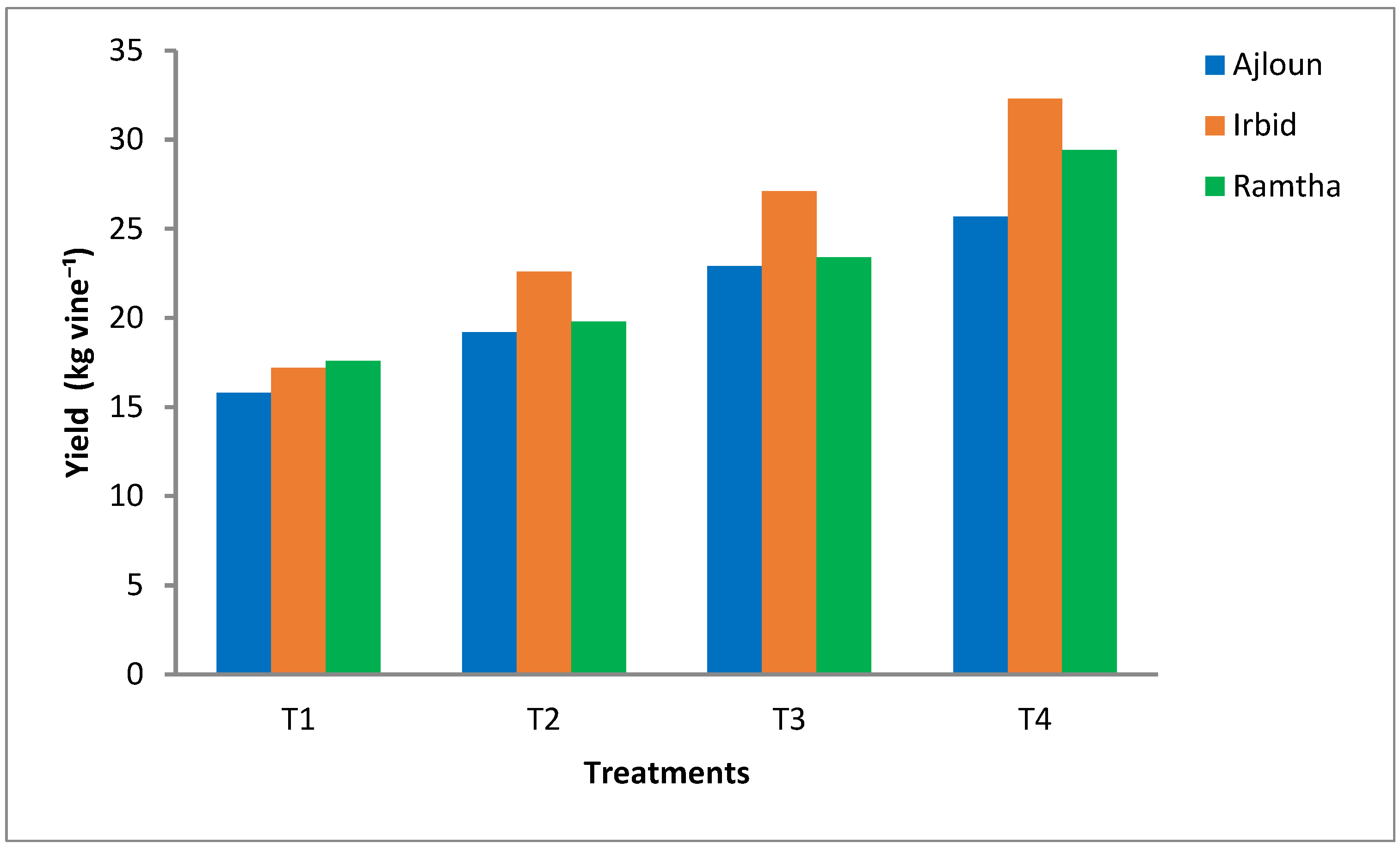
Yield responses to potassium fertigation differed among locations, with more pronounced increases observed at sites characterized by lower baseline soil potassium availability and coarser soil texture, whereas responses were comparatively moderate at sites with higher native potassium levels (Figure 1; Table 3). Despite differences in response magnitude, treatment ranking remained consistent across locations and seasons, with T4 consistently producing the highest yield, followed by T3, T2, and T1.
Similar interaction patterns were observed for berry firmness, volume, and weight, where higher potassium rates resulted in greater improvements at certain locations compared with others (Table 3; Figure 1). The presence of significant three-way interactions (Treatment × Year × Location) further indicates that environmental variability modulated potassium response strength across seasons; however, these interactions did not alter the overall positive effect of increasing potassium supply.
Collectively, these findings demonstrate that potassium fertigation effects on yield and berry size are not uniform across semi-arid Mediterranean environments and emphasize the need for site-specific optimization of potassium fertigation strategies rather than uniform application rates.

4. Discussion

4.1. Yield Response and Potassium Fertigation Efficiency

The present study demonstrates that potassium fertigation is a major determinant of grapevine productivity under semi-arid Mediterranean conditions. Across three growing seasons and contrasting agroecological zones, increasing potassium supply resulted in consistent and statistically robust improvements in total yield per vine. Linear mixed-effects model analysis confirmed a strong main effect of potassium treatment, together with significant effects of year and location, as well as significant treatment × location interactions (Table 3), indicating that yield response magnitude varied across sites while treatment ranking remained stable.
Although irrigation was managed to maintain optimal soil moisture during the experiment, the study was conducted under semi-arid Mediterranean conditions characterized by inherently limited water availability. This approach allowed the evaluation of potassium fertigation under realistic environmental conditions while minimizing the confounding effects of water stress.
These responses can be interpreted in light of well-established physiological roles of potassium in osmotic adjustment and stomatal function under semi-arid conditions [7,8]. The importance of potassium in grapevine growth, berry development, and vine physiological balance has long been recognized in viticultural literature [6,25]. Although direct physiological measurements were not conducted, the consistent improvements in yield and berry development across treatments are consistent with the known physiological roles of potassium in osmotic regulation and stomatal function under semi-arid conditions. Similar responses have been reported in Mediterranean viticultural systems, where potassium nutrition enhances plant hydraulic functioning under water-limited conditions [2,26], as well as in table grape cultivars where potassium fertilization significantly improves yield and nutrient status [27]. Comparable improvements in grape yield and quality following fertilizer application have also been reported under Jordanian growing conditions [28]. In addition to potassium supply, the use of potassium sulfate as the fertigation source also provided sulfur, with sulfur application increasing progressively from 0 kg ha−1 in T1 to approximately 67 kg ha−1 in T4. Sulfur is an essential macronutrient involved in amino acid synthesis, chlorophyll formation, and enzymatic activity, and its contribution may have partially supported vine nutritional balance and productivity under semi-arid conditions [7]. However, because sulfur availability was not independently evaluated in the present study, the observed responses were primarily interpreted in relation to potassium fertigation levels. Recent studies have further shown that potassium deficiency can reduce grapevine transpiration through decreased leaf area and stomatal conductance, emphasizing the role of potassium in maintaining vine physiological performance under water-limited conditions [8].
The consistent superiority of higher potassium rates (T4 and T3) across locations (Table 4) indicates that potassium availability was a limiting factor for yield formation in the studied environments. However, the presence of significant treatment × location interactions highlights that site-specific soil properties—particularly baseline potassium availability and soil texture—modulated the strength of the response. The observed response is consistent with the limited availability of potassium under semi-arid conditions. Potassium availability is not solely governed by soil K concentration, as reduced soil moisture can limit diffusion toward roots [29,30]. In addition, clay and clay loam soils may retain or fix part of the potassium, thereby reducing its immediate availability for plant uptake [29]. Similar patterns have been reported in Mediterranean viticultural systems, where potassium uptake and utilization efficiency vary with soil fertility and environmental conditions [15,26].
It is also important to consider the interaction between potassium and other cations, particularly magnesium, which can compete with potassium for uptake sites in plant roots. This antagonistic interaction between K+ and Mg2+ has been well documented in higher plants [31]. Although magnesium was not a treatment factor in this study, its presence in the soil may influence potassium uptake dynamics under field conditions.
Importantly, despite interannual yield variation driven by climatic variability, treatment ranking remained unchanged, confirming the agronomic robustness of potassium fertigation under variable semi-arid conditions.

4.2. Cluster Development as a Primary Yield-Forming Component

Cluster weight emerged as the primary yield-forming component influenced by potassium fertigation. In agreement with the LMM results (Table 3), cluster weight increased significantly with increasing potassium supply across all locations, closely mirroring the response observed for total yield (Table 4). The significant treatment × location interaction detected for cluster weight further indicates that assimilate allocation to reproductive organs responded differentially across environments.
Potassium is known to regulate phloem loading, osmotic balance, and carbohydrate translocation, thereby enhancing cluster growth and stability under water-limited conditions [6,7]. The strong correspondence between yield and cluster weight observed in this study confirms that yield gains were primarily driven by improved cluster development rather than changes in cluster number alone, a response consistent with previous reports on table grape production under Mediterranean climates [17,27].
These responses may also reflect the role of potassium in maintaining cell turgor and osmotic balance, which are critical for berry expansion and cluster development under semi-arid conditions [8,13,26].

4.3. Berry Physical Quality and Interaction Effects

Berry physical traits-including firmness, volume, weight, and diameter—responded positively and progressively to increasing potassium fertigation rates. Linear mixed-effects model (LMM) analysis revealed significant main effects of potassium treatment, as well as significant Treatment × Location and Treatment × Year × Location interactions for most traits (Table 3), indicating that the magnitude of response depended on environmental conditions.
Despite these interactions, the direction of response was consistent across locations, with higher potassium rates producing larger and firmer berries (Table 4). Improved berry firmness is particularly relevant for table grape production, as it enhances postharvest handling, transportability, and market quality. These findings are consistent with previous studies reporting improvements in berry size and texture under adequate potassium nutrition in grapevines grown under water-limited conditions [13,27,32]. Similar improvements in grape quality attributes under potassium fertilization have also been reported in ‘Early Sweet’ grapevines grown under salinity stress conditions [33].
The observed improvements in berry size and firmness can be attributed to the role of potassium in osmotic regulation and cell turgor maintenance, which are critical for cell expansion during berry growth [7,8,26]. Together with the stability of chemical traits, these results indicate that potassium fertigation enhanced physical fruit quality while maintaining overall physiological balance under semi-arid conditions.

4.4. Limited Response of Berry Chemical Traits

In contrast to physical attributes, berry chemical traits showed comparatively limited sensitivity to potassium fertigation. Juice pH exhibited small but statistically significant increases with increasing potassium supply (Table 3 and Table 4), whereas total soluble solids (TSS) were not significantly affected by treatment (p = 0.216). Mean TSS values ranged from 13.41 to 14.50 °Brix without a consistent trend across potassium levels, indicating that potassium fertigation did not significantly influence sugar accumulation. Small increases in juice pH following potassium application have also been reported in grapevine studies under contrasting climatic conditions [34].
Although some studies have reported increases in °Brix following potassium application, such responses are often associated with specific conditions, including water stress, berry dehydration, or concentration effects [32]. In the present study, potassium was applied through drip fertigation under relatively uniform irrigation conditions, which likely promoted berry growth and yield rather than sugar concentration.
The absence of a potassium effect on TSS indicates that increases in yield and berry size were not associated with dilution of soluble sugars, suggesting that potassium fertigation enhanced physical fruit quality without compromising sugar accumulation under semi-arid Mediterranean conditions [13,27].

4.5. Implications of Treatment × Location Interactions for Fertigation Management

The significant Treatment × Location and Treatment × Year × Location interactions detected in this study indicate that potassium fertigation responses are not uniform across semi-arid Mediterranean environments. Although higher potassium rates consistently improved yield and berry physical traits, the magnitude of these responses varied among sites, reflecting differences in soil properties and local environmental conditions. These interactions reflect the influence of site-specific soil and climatic conditions on potassium availability and vine response.
More pronounced responses were generally observed at sites characterized by lower baseline soil potassium availability and coarser soil texture, whereas responses were comparatively moderate at locations with higher native potassium levels. Variations in soil texture, baseline potassium availability, and soil moisture dynamics can substantially influence potassium mobility, uptake efficiency, and crop response under semi-arid conditions [15,29]. In addition, environmental variability among growing seasons likely modulated potassium response magnitude through its effects on vine physiology performance, soil moisture dynamics, and nutrient availability.
These findings emphasize that potassium fertigation strategies should be adapted to site-specific conditions rather than applying uniform fertilizer rates across different production areas. From a practical perspective, integrating site-specific potassium management into fertigation programs can improve nutrient-use efficiency, optimize yield performance, and enhance fruit quality [13,14]. Such approaches are particularly relevant under increasing climatic variability and water scarcity, where efficient resource management is critical for sustainable grape production.
Overall, the results highlight the importance of combining fertigation strategies with an understanding of local soil and environmental variability to achieve consistent and efficient production outcomes in semi-arid viticultural systems.

5. Conclusions

The present study demonstrates that potassium fertigation plays an important role in enhancing the Confirmedyield and fruit quality of ‘Red Globe’ table grapes under semi-arid Mediterranean conditions. Across three growing seasons and contrasting agro-ecological zones, increasing potassium supply resulted in consistent and statistically robust improvements in total yield per vine, cluster weight, and key berry physical attributes, including firmness, size, and volume, while maintaining stable total soluble solids (TSS) and only minor changes in juice pH.
The highest potassium application rate (300 kg K2O ha−1) consistently produced the greatest agronomic benefits, although the magnitude of response varied among locations due to differences in soil properties and environmental conditions. Yield improvements were primarily associated with enhanced cluster development and berry growth rather than changes in cluster number, highlighting potassium’s role in assimilate allocation and reproductive sink strength.
Significant treatment × location and treatment × year × location interactions identified through linear mixed-effects modeling highlight the importance of site-specific potassium management. Although higher potassium rates generally outperformed lower rates, the response magnitude depended on local soil fertility and climatic conditions, indicating that uniform fertigation programs may not be optimal across diverse semi-arid environments.
Overall, synchronizing potassium fertigation with key phenological stages represents an effective approach for improving productivity and berry physical quality under water-limited Mediterranean conditions. The observed improvements are consistent with the established physiological roles of potassium in osmotic regulation, assimilate transport, and berry development.
Integrating optimized, site-adapted potassium fertigation into precision irrigation frameworks may enhance yield stability, resource-use efficiency, and long-term sustainability of viticulture systems facing increasing climatic variability and water scarcity.

Author Contributions

Conceptualization, H.M.R.; methodology, H.M.R. and M.A.A.-K.; investigation, H.M.R., M.A.A.-K., A.A.A., O.M., M.A., A.M., I.A.K., A.A.-D. and J.A.; formal analysis, H.M.R., M.A.A.-K. and M.A.K.; data curation, M.A.A.-K., M.A. and I.A.K.; writing—original draft preparation, H.M.R.; writing—review and editing, M.A.A.-K., M.A.K., A.A.A., O.M., M.A., A.M., I.A.K., A.A.-D., J.Y.M.A. and J.A.; supervision, H.M.R.; project administration and field supervision, H.M.R. All authors have read and agreed to the published version of the manuscript.

Funding

This research was financially and logistically supported by the National Agricultural Research Center (NARC), Jordan, through an internally funded research project under the Center’s research program.

Data Availability Statement

The raw data supporting the conclusions of this article will be made available by the authors on request.

Acknowledgments

The authors gratefully acknowledge the technical staff of the National Agricultural Research Center (NARC) for assistance in vineyard management, field data collection, and laboratory analyses. The authors also appreciate the cooperation of grape growers in Ajloun, Irbid, and Ramtha for providing access to vineyard sites and supporting the implementation of the field experiments.

Conflicts of Interest

The authors declare no conflicts of interest.

References

  1. OIV—International Organisation of Vine and Wine. State of the World Vitivinicultural Sector in 2022; OIV: Paris, France, 2022; Available online: https://www.oiv.int/en/technical-standards-and-documents/statistics (accessed on 6 February 2026).
  2. Villette, J.; Cuéllar, T.; Verdeil, J.; Delrot, S.; Gaillard, I. Grapevine potassium nutrition and fruit quality in the context of climate change. Front. Plant Sci. 2020, 11, 123. [Google Scholar] [CrossRef]
  3. Pérez-Álvarez, E.P.; Intrigliolo Molina, D.S.; Vivaldi, G.A.; García-Esparza, M.J.; Lizama, V.; Álvarez, I. Effects of irrigation regimes on grapevine cv. Bobal in a Mediterranean climate: I. Water relations, vine performance and grape composition. Agric. Water Manag. 2021, 248, 106772. [Google Scholar] [CrossRef]
  4. Zörb, C.; Senbayram, M.; Peiter, E. Potassium in agriculture-status and perspectives. J. Plant Physiol. 2014, 171, 656–669. [Google Scholar] [CrossRef]
  5. Rogiers, S.Y.; Coetzee, Z.A.; Walker, R.R.; Deloire, A.; Tyerman, S.D. Potassium in the grape (Vitis vinifera L.) berry: Transport and function. Front. Plant Sci. 2017, 8, 1629. [Google Scholar] [CrossRef]
  6. Keller, M. The Science of Grapevines: Anatomy and Physiology, 2nd ed.; Academic Press: San Diego, CA, USA, 2015. [Google Scholar]
  7. Marschner, P. Marschner’s Mineral Nutrition of Higher Plants, 3rd ed.; Academic Press: London, UK, 2012. [Google Scholar]
  8. Sperling, O.; Perry, A.; Ben-Gal, A.; Yermiyahu, U.; Hochberg, U. Potassium deficiency reduces grapevine transpiration through decreased leaf area and stomatal conductance. Plant Physiol. Biochem. 2024, 208, 108534. [Google Scholar] [CrossRef] [PubMed]
  9. Hasanuzzaman, M.; Bhuyan, M.H.M.B.; Nahar, K.; Hossain, M.S.; Mahmud, J.A.; Hossen, M.S.; Masud, A.A.C.; Moumita; Fujita, M. Potassium: A vital regulator of plant responses and tolerance to abiotic stresses. Agronomy 2018, 8, 31. [Google Scholar] [CrossRef]
  10. Lekhavarshinee, J.; Sudhalakshmi, C.; Surendran, U.; Latha, P.; Kaleeswari, R.K.; Indurani, C. Nutrient efficiency unlocked: Water-soluble fertilizers in horticultural crop production. Plant Sci. Today 2024, 11, 1–9. [Google Scholar] [CrossRef]
  11. Sarma, H.H.; Paul, A.; Kakoti, M.; Talukdar, N. Fertigation: A modern approach for enhancing nutrient use efficiency. In Frontiers in Agricultural Sustainability; Integrated Publications TM: New Delhi, India, 2023; pp. 111–126. [Google Scholar]
  12. Darwish, T.; Shaban, A.; Faour, G.; Jomaa, I.; Moubarak, P.; Khadra, R. Sustainable and traditional irrigation and fertigation practices for potato and zucchini in dry Mediterranean regions. Sustainability 2025, 17, 1860. [Google Scholar] [CrossRef]
  13. Silva, A.O.; Costa, B.R.S.; Oldoni, H.; Silva, D.J.; Bassoi, L.H. Potassium fertigation and organic fertilisation in ‘Syrah’ grape in northeastern Brazil: Yield, must characteristics and phenolic compounds. OENO One 2024, 58, 55–68. [Google Scholar] [CrossRef]
  14. Han, W.; Sun, J.; Zhang, K.; Mao, L.; Gao, L.; Hou, X.; Cui, N.; Kang, W.; Gong, D. Optimizing drip fertigation management based on yield, quality, water, and fertilizer use efficiency of wine grape in North China. Agric. Water Manag. 2023, 280, 108188. [Google Scholar] [CrossRef]
  15. Ciotta, M.N.; Ceretta, C.A.; Krug, A.V.; Brunetto, G.; Nava, G. Grape (Vitis vinifera L.) production and soil potassium forms in vineyards subjected to potassium fertilization. Rev. Bras. Frutic. 2021, 43, e-682. [Google Scholar] [CrossRef]
  16. Hu, W.; Wang, J.; Deng, Q.; Liang, D.; Xia, H.; Lin, L.; Lv, X. Effects of different types of potassium fertilizers on nutrient uptake by grapevine. Horticulturae 2023, 9, 470. [Google Scholar] [CrossRef]
  17. Ben Yahmed, J.; Ben Mimoun, M. Effects of foliar application and fertigation of potassium on yield and fruit quality of ‘Superior Seedless’ grapevine. Acta Hortic. 2019, 1253, 367–372. [Google Scholar] [CrossRef]
  18. Page, A.L.; Miller, R.H.; Keeney, D.R. Methods of Soil Analysis. Part 2: Chemical and Microbiological Properties, 2nd ed.; American Society of Agronomy: Madison, WI, USA, 1982. [Google Scholar]
  19. Letaief, H.; Rolle, L.; Zeppa, G.; Gerbi, V. Assessment of grape skin hardness by a puncture test. J. Sci. Food Agric. 2008, 88, 1567–1575. [Google Scholar] [CrossRef]
  20. ISO 2173:2003; Fruit and Vegetable Products: Determination of Soluble Solids—Refractometric Method. International Organization for Standardization (ISO): Geneva, Switzerland, 2003.
  21. OIV-MA-AS2-02; Sugars-Refractometric Method for the Measurement of Soluble Dry Matter (°Brix). International Organisation of Vine and Wine (OIV): Paris, France, 2020.
  22. ISO 1842:1991; Fruit and Vegetable Products: Determination of pH. International Organization for Standardization (ISO): Geneva, Switzerland, 1991.
  23. OIV-MA-AS313-15; Acidity of Grapes, Musts and Wines-Determination of pH. International Organisation of Vine and Wine (OIV): Paris, France, 2020.
  24. R Core Team. R: A Language and Environment for Statistical Computing; R Foundation for Statistical Computing: Vienna, Austria, 2025; Available online: https://www.r-project.org (accessed on 31 October 2025).
  25. Winkler, A.J.; Cook, J.A.; Kliewer, W.M.; Lider, L.A. General Viticulture, 2nd ed.; University of California Press: Berkeley, CA, USA, 1974. [Google Scholar]
  26. Mpelasoka, B.S.; Schachtman, D.P.; Treeby, M.T.; Thomas, M.R. A review of potassium nutrition in grapevines with special emphasis on berry accumulation. Aust. J. Grape Wine Res. 2003, 9, 154–168. [Google Scholar] [CrossRef]
  27. Pushpavathi, Y.; Jogaiah, S.; Satisha, G.C.; Reddy, M.L. Influence of potassium fertilization on yield, petiole and soil nutrient status of table grape cv. Sharad seedless. J. Plant Nutr. 2021, 44, 2218–2227. [Google Scholar] [CrossRef]
  28. Abo-Ahmedeh, H.; Mhasneh, A.; Rawashdeh, H. Using soil and foliar applications of fertilizers to improve yield and quality parameters of table grapes (Vitis vinifera L.). Bull. UASVM Agric. 2020, 77, 1–6. [Google Scholar] [CrossRef]
  29. Havlin, J.L.; Tisdale, S.L.; Nelson, W.L.; Beaton, J.D. Soil Fertility and Fertilizers: An Introduction to Nutrient Management, 8th ed.; Pearson: Hoboken, NJ, USA, 2023. [Google Scholar]
  30. Wang, J.; Lu, Y.; Zhang, X.; Hu, W.; Lin, L.; Deng, Q.; Xia, H.; Liang, D.; Lv, X. Effects of potassium-containing fertilizers on sugar and organic acid metabolism in grape fruits. Int. J. Mol. Sci. 2024, 25, 2828. [Google Scholar] [CrossRef]
  31. Xie, K.; Cakmak, I.; Wang, S.; Zhang, F.; Guo, S. Synergistic and antagonistic interactions between potassium and magnesium in higher plants. Crop J. 2021, 9, 249–256. [Google Scholar] [CrossRef]
  32. Obenland, D.; Feliziani, E.; Zhu, S.; Zhao, X.; Margosan, D.A.; Gabler, F.M.; Van Zyl, S.; Romanazzi, G.; Smilanick, J.L.; Beno-Moualem, D.; et al. Potassium application to table grape clusters after veraison increases soluble solids by enhancing berry water loss. Sci. Hortic. 2015, 187, 58–64. [Google Scholar] [CrossRef]
  33. Fekry, W.M.E.; Aboel-Anin, M.A. Effect of potassium fertilizer sources on the production, quality, and chemical composition of ‘Early Sweet’ grapes under salinity stress. Asian J. Plant Sci. 2020, 19, 508–514. [Google Scholar] [CrossRef]
  34. Marcuzzo, P.; Gaiotti, F.; Lucchetta, M.; Lovat, L.; Tomasi, D. Tuning potassium fertilization to improve pH and acidity in Glera grapevine (Vitis vinifera L.) under a warming climate. Appl. Sci. 2021, 11, 11869. [Google Scholar] [CrossRef]
Figure 1. Interaction effect of potassium fertigation treatments and location on total yield per vine (kg vine−1) of ‘Red Globe’ table grapes in Ajloun, Irbid, and Ramtha. Values represent mean yield per treatment and location, averaged across three growing seasons.
Agriculture 16 01155 g001
Table 1. Selected physical and chemical soil properties at the experimental sites before treatment application.
ParameterAjlounIrbidRamtha
Soil TextureSilty ClayClayClay loam
pH (1:1 H2O)8.17.48.0
EC (dS m−1)0.650.520.70
Organic Matter (%)2.41.10.8
CaCO3 (%)13.010.07.0
Total N (%)0.1460.1260.104
Available P (mg kg−1)7.85.86.3
Available K (mg kg−1)435220360
Ca (meq L−1)8.02.53.3
Mg (meq L−1)6.43.11.2
Fe (mg kg−1)4.843.172.14
Zn (mg kg−1)0.580.400.34
Table 2. Potassium (K2O) application rates (kg ha−1 season−1) applied via fertigation at different vine phenological stages.
Growth StageT1T2T3T4
Shoot growth (BBCH 11–19)0153045
Flowering (BBCH 60–69)0153045
Fruit set (BBCH 71)0204060
Berry development (BBCH 75–79)0204060
Ripening (BBCH 81–89)0306090
Total K2O applied *0100200300
* Potassium was applied as potassium sulfate through drip fertigation. Values represent K2O rates (kg ha−1) per growth stage.
Table 3. Linear mixed-effects model (LMM) results showing the significance (p-values) of fixed effects on yield and berry quality traits of ‘Red Globe’ table grapes grown under potassium fertigation across three locations and three growing seasons.
EffectYieldCluster WeightpHTSSFirmnessBerry VolumeBerry WeightBerry Diameter
Treatment0.003<0.0010.0410.2160.002<0.001<0.001<0.001
Year<0.001<0.0010.0320.018<0.001<0.001<0.001<0.001
Location<0.001<0.0010.0470.021<0.001<0.001<0.001<0.001
Treatment × Year0.0280.0330.3140.2710.0410.0220.0310.039
Treatment × Location<0.001<0.0010.0450.2380.002<0.001<0.001<0.001
Year × Location<0.001<0.0010.0370.019<0.001<0.001<0.001<0.001
Treatment × Year × Location<0.001<0.0010.4110.3920.0290.0340.0410.038
Notes: p-values were obtained from Type III Wald tests of linear mixed-effects models. Treatment, Year, and Location were included as fixed effects, and Replicate was included as a random intercept nested within each Location × Year combination. Effects with p ≤ 0.05 were considered statistically significant.
Table 4. Descriptive statistics (mean ± SE) and Least Significant Difference (LSD, p ≤ 0.05) groupings for total yield and selected berry quality traits of table grapes as affected by potassium fertigation levels, averaged across three locations and three growing seasons.
TreatmentYield
(kg vine−1)
Cluster Weight
(g)
pHTSS (°Brix)Firmness
(g force)
Berry VolumeBerry WeightBerry Diameter (cm)
T116.9 ± 1.10 d564.9 ± 38.8 d3.84 ± 0.09 a13.91 ± 0.37 a435.7 ± 21.6 d65.7 ± 3.01 d66.5 ± 1.94 d2.01 ± 0.03 d
T220.5 ± 1.25 c660.4 ± 41.2 c3.77 ± 0.09 a14.50 ± 0.39 a504.1 ± 25.2 c79.3 ± 2.97 c77.8 ± 1.72 c2.20 ± 0.03 c
T324.5 ± 1.42 b818.6 ± 58.3 b3.81 ± 0.08 a13.79 ± 0.33 a559.7 ± 27.8 b91.4 ± 3.15 b86.4 ± 3.40 b2.29 ± 0.03 b
T429.1 ± 1.67 a1021.3 ± 68.7 a3.77 ± 0.09 a13.41 ± 0.43 a637.2 ± 32.2 a105.3 ± 2.66 a103.7 ± 2.25 a2.44 ± 0.02 a
Notes: Values are means ± standard error (SE). Different letters within a column indicate significant differences among potassium fertigation treatments according to Fisher’s least significant difference (LSD) test at p ≤ 0.05. Treatments sharing the same letter are not significantly different. Values are averaged across three locations and three growing seasons.
Disclaimer/Publisher’s Note: The statements, opinions and data contained in all publications are solely those of the individual author(s) and contributor(s) and not of MDPI and/or the editor(s). MDPI and/or the editor(s) disclaim responsibility for any injury to people or property resulting from any ideas, methods, instructions or products referred to in the content.