1. Introduction
Poultry production is currently facing a set of interconnected challenges related to feed sustainability, environmental impact, and system resilience, which increasingly depend on the interaction between feeding strategies and genetic resources. Feed production represents the main contributor to the environmental footprint of poultry meat, as well as the largest cost component of the production system, accounting for up to 60–70% of total costs [
1,
2,
3]. Within this context, soybean meal remains the primary protein source due to its high protein content, favorable amino acid profile, and high digestibility [
4]. However, the European Union remains highly dependent on imported protein-rich feedstuffs, particularly soybean meal, resulting in increased exposure of the poultry sector to market volatility and geopolitical constraints [
5,
6,
7]. This dependency also raises environmental concerns, including deforestation, biodiversity loss, and greenhouse gas emissions associated with soybean production and transport [
8].
In response, increasing attention has been directed towards alternative feeding strategies based on locally available raw materials, such as grain legumes, aimed at improving feed self-sufficiency and reducing environmental impacts. However, low-input diets formulated with locally available ingredients often differ from conventional diets not only in ingredient origin, but also in nutrient density. In this study, the low-input diet is interpreted as a combined feeding strategy based on local ingredients and characterized by lower protein and energy levels compared with the standard diet. These features may affect nutrient availability and muscle accretion and, through differences in lipid supply and oxidative susceptibility, may also influence meat composition, oxidative stability, fatty acid profile, and sensory traits. Such formulations may contain anti-nutritional factors and may impair nutrient digestibility and animal performance [
9], particularly in fast-growing commercial genotypes with high nutritional requirements. These limitations are expected to affect particularly fast-growing commercial genotypes, which have higher nutritional requirements. At the same time, the genetic architecture of poultry production systems is receiving increasing attention, as modern broiler production relies heavily on high-performance genotypes optimized for growth rate and feed efficiency, but often characterized by limited robustness under suboptimal environmental or nutritional conditions [
10]. In contrast, local chicken breeds represent an important reservoir of genetic diversity and adaptive traits, generally offering greater resilience in challenging environments and low-input systems [
11,
12,
13]. While their meat is highly valued for distinctive chemical and sensory characteristics, including a more intense flavor and firmer texture [
14,
15,
16], their low growth rate, poorer feed efficiency, longer production cycles, and potentially higher production costs pose significant challenges to commercial implementation and economic sustainability [
17,
18].
Within this framework, crossbreeding represents a promising strategy to combine the desirable traits of different genotypes. Crossing local breeds with more productive strains may improve growth performance while preserving, at least partially, adaptability and product quality [
19,
20]. Previous studies have shown that local breeds can successfully cope with challenging conditions, such as heat stress [
12,
21], non-optimal diets [
11], and alternative rearing systems [
18]. Nevertheless, information on the response of medium- and slow-growing chickens, including crossbreeds, to low-input feeding strategies remains limited, particularly in relation to meat quality and sensory traits.
This study evaluated the effect of genotype and diet on carcass traits, meat quality, and sensory profile in a fast-growing commercial genotype (Ross 308), two Italian local breeds (Bionda Piemontese, BP, and Robusta Maculata, RM), and their crosses with a medium-growing strain (Sasso T44, Sa; BP × Sa and RM × Sa), fed either a conventional diet based on maize and soybean meal or a low-input diet based on local ingredients, including faba bean (Vicia faba var. minor). The study was conceived under the following hypotheses: (i) genotype would play a major role in determining carcass traits, meat quality, and sensory characteristics, with local breeds potentially differing from the commercial genotype in oxidative stability, fatty acid composition, and sensory profile, and crossbreeds exhibiting intermediate profiles; (ii) the low-input diet would influence meat quality traits, particularly those related to composition, oxidative stability, and sensory properties; and (iii) the effect of diet would interact with genotype, with local breeds and crossbreeds potentially responding differently to the low-input diet compared to the fast-growing commercial genotype.
2. Materials and Methods
2.1. Animals and Experimental Design
This study was part of a broader experimental trial investigating the effects of genotype and feeding strategy on poultry production systems [
22]. The trial was conducted at the poultry research facility of the University of Padova (Legnaro, Padova, Italy), in a closed building equipped with a cooling system, forced ventilation, radiant heating, and controlled lighting.
A total of 441 one-day-old chicks of both sexes belonging to five genotypes were used: 102 chicks of a commercial fast-growing genotype, Ross 308 (51 females and 51 males); two Italian local breeds, 76 chicks of Bionda Piemontese (BP; 37 females and 39 males) and 72 chicks of Robusta Maculata (RM; 25 females and 47 males); and two crossbreeds obtained by mating roosters of the local breeds with females of a medium-growing strain (Sasso; Sa), resulting in 97 BP × Sa (49 females and 48 males) and 94 RM × Sa (47 females and 47 males).
Chicks were individually identified and randomly allocated to 40 pens (1.25 m × 2.60 m × 1.20 m-height; 3.25 m2) according to genotype, diet, and sex, following a factorial experimental design. Birds were reared under standardized environmental conditions, with ad libitum access to feed and water. A continuous lighting regime (24 h light) was applied during the first two days after housing. Thereafter, the photoperiod was gradually reduced until an 18L:6D light:dark cycle was achieved and maintained until the end of the trial.
All animals received a common starter diet from hatching to 20 days of age. Starting from day 21, chickens within each genotype and sex were distributed between two dietary treatments: standard (ST) or low-input (LI), which were maintained until slaughter. The ST diet was formulated to meet the nutritional requirements of fast-growing broilers, whereas the LI diet was characterized by reduced protein and energy levels (−10% crude protein and −8% of metabolizable energy compared to the ST diet) and was based on locally available ingredients, including faba bean (
Vicia faba var.
minor). The ST was considered nutritionally adequate for all genotypes and may have exceeded the requirements of local breeds and crossbred chickens, characterized by slower growth rates and lower nutrient demands. However, genotype-specific diets were not used in order to avoid introducing an additional source of variation and to allow a direct comparison of genotype responses to the same feeding strategies. Ingredient composition, chemical analysis, and fatty acid composition of the experimental diets are reported in
Supplementary Table S1.
Due to differences in growth rate among genotypes, birds were slaughtered at different ages, corresponding to comparable commercial endpoints: 47 days for Ross 308 and 105 days for the other genotypes. Therefore, the comparison among genotypes should be interpreted as a commercial-endpoint comparison, in which genotype effects may partly include differences related to physiological maturity at slaughter.
Further details on animal origin, management conditions, and experimental procedures are reported in Huerta et al. [
22].
2.2. Slaughtering, Carcass Traits, and Meat Quality Sampling
At the end of the rearing period, birds were slaughtered in a commercial slaughterhouse at different ages according to genotype. Before slaughter, birds were subjected to approximately 7 h of feed withdrawal, while water remained available until loading for transport. Transport from the farm to the slaughterhouse lasted approximately 30 min, and lairage before slaughtering was 3 h.
After slaughter, ready-to-cook carcasses were obtained following standard procedures and chilled for 2 h at 2 °C. Carcasses were then individually weighed to determine carcass yield and transported to the DAFNAE laboratories of the University of Padova, where they were stored at 2 °C for 24 h.
A total of 240 carcasses (six per pen) were selected to represent the average live weight and within-pen variability. From these, a subset of 120 samples (three per pen) was selected for proximate composition, fatty acid profile, and lipid oxidation analyses. The pen was considered the experimental unit, whereas individual carcasses selected within each pen were treated as subsamples for carcass and meat quality measurements. Carcasses were dissected into main commercial cuts (breast, wings, thighs, and drumsticks) according to Petracci and Baeza [
23]. The right and left
Pectoralis major muscles were then separated. The right breast muscle from all carcasses was used for the evaluation of meat quality traits, including pH, water-holding capacity, color, and shear force, while a subset of 120 samples (three per pen) was further analyzed for proximate composition, fatty acid profile, and lipid oxidation. The left breast muscles were vacuum-packed and stored at −18 °C until sensory evaluation.
In addition, all carcasses, irrespective of genotype, were visually inspected for the occurrence and severity of breast myopathies. White striping (WS) was scored as normal, moderate, or severe according to Kuttappan et al. [
24,
25], while the occurrence (presence/absence) of wooden breast (WB) and spaghetti meat (SM) was assessed according to Sihvo et al. [
26] and Baldi et al. [
27], respectively.
2.3. Meat Rheological Analyses
The pH and color (L*, a*, b*; lightness, redness, and yellowness, respectively) of the
P. major muscle were measured in triplicate on the ventral surface. The pH was measured 24 h
post-mortem using a portable pH meter (Basic 20, Crison Instruments SA, Carpi, Italy) equipped with a penetration electrode (cat. 5232, Crison Instruments SA), while color was assessed using a Minolta CM508 C spectrophotometer (Minolta Corp., Ramsey, NJ, USA) according to Petracci and Baeza [
23].
After these measurements, a meat sample (8 × 4 × 3 cm) was excised from the cranial portion of the muscle, parallel to the muscle fiber direction, vacuum-packed, and stored at −18 °C until further analyses.
Cooking losses (expressed as percentage weight loss before and after cooking) were determined on these samples following the procedures of Petracci and Baeza [
23]. After thawing, samples were cooked in a water bath at 80 °C (sealed in plastic bags) until an internal temperature of 80 °C was reached. After 40 min of cooling at room temperature, a subsample (4 × 2 × 1 cm) was obtained to measure shear force using a LS5 dynamometer (Lloyd Instruments Ltd., Bognor Regis, UK) equipped with an Allo-Kramer shear device (10 blades; load cell: 500 kg; blade spacing: 5 mm; blade thickness: 2 mm; crosshead speed: 250 mm/min) [
28].
2.4. Meat Proximate Composition, Fatty Acid Profile, and Lipid Peroxidation
After sampling for cooking losses, the residual right
P. major muscles (
n = 120) were individually minced using a Grindomix GM 200 (Retsch GmbH, Haan, Germany). Aliquots of fresh minced meat were used for fatty acid composition and lipid oxidation analyses, while the remaining samples were freeze-dried, ground, and analyzed for proximate composition, including dry matter (934.01), ash (967.05), crude protein (2001.11), and ether extract (991.36) according to AOAC [
29].
Total lipids were extracted from fresh samples by accelerated solvent extraction (ASE; Dionex, Sunnyvale, CA, USA) using petroleum ether as solvent. Extracted lipids were converted to fatty acid methyl esters (FAME) and analyzed by gas chromatography (Agilent 7820A, Agilent Technologies, Santa Clara, CA, USA) equipped with a Supelco OMEGAWAX™ 250 capillary column (30 m × 0.25 mm × 0.25 μm). Chromatographic conditions included hydrogen as carrier gas (1.4 mL/min), injector and detector temperatures set at 250 °C, and an oven temperature program from 50 °C (2 min) to 220 °C at 4 °C/min, held for 17 min. Individual FAME were identified by comparison with a standard mixture (Supelco 37-component FAME Mix) and expressed as percentage of total identified fatty acids. Saturated (SFA), monounsaturated (MUFA), and polyunsaturated fatty acids (PUFA) were calculated as sums of individual fatty acids.
Lipid oxidation was assessed as thiobarbituric acid reactive substances (TBARs) according to Botsoglou et al. [
30]. Absorbance was measured at 532 nm using a spectrophotometer (Jasco Mod. 7800 UV/VIS, 5301 Stevens Creek Blvd. Santa Clara, CA, USA), and results were expressed as mg malondialdehyde (MDA)/kg of meat.
2.5. Meat Sensory Evaluation
The left
P. major muscles were evaluated by quantitative descriptive analysis (QDA) using a trained panel composed of 12 assessors from DAFNAE (six males and six females, aged 23–60 years), selected and trained according to ISO standards [
31,
32,
33]. Prior to the evaluation, panelists underwent a one-month training period to familiarize themselves with the product and to develop and standardize the sensory descriptors. During this phase, a range of chicken breast samples prepared using different cooking methods was used to establish and calibrate 11 sensory attributes. Sensory evaluation was carried out over four sessions within a two-week period at the sensory analysis facility of DAFNAE. In each session, panelists evaluated two sets of five samples (each belonging to different experimental groups to ensure balanced representation), with a 15-min break between sets. Overall, each panelist evaluated 40 samples evenly distributed across genotypes, diets, and sexes. Samples were presented according to a Williams Latin square design to balance order and carryover effects. Assessors were instructed not to smoke, eat, or drink (except water) for at least 1 h before the sessions. During evaluation, panelists assessed one sample at a time, scoring odor, taste, and texture attributes, followed by overall liking (pleasantness), using a structured continuous scale ranging from 0 (not intense) to 10 (very intense). Between samples, the palate was cleansed with apple, unsalted crackers, and water, followed by a 2-min rest period. For sample preparation, breast muscles were thawed overnight at 4 °C, cut into pieces (7 × 8 × 1.5 cm) to obtain standardized sample dimensions, vacuum-packed, and cooked in a water bath at 85 °C for 25 min. After cooking, meat samples were portioned into standardized pieces (3 × 2 × 1 cm) and immediately served to the panelists. Data were collected using Fizz software (v2.47b; Biosystèmes, Couternon, France).
2.6. Statistical Analyses
Carcass traits and meat quality variables were analyzed using analysis of variance in SAS software, version 9.4 (SAS Institute Inc., Cary, NC, USA). For these variables, the pen was considered the experimental unit, and individual birds or meat samples selected within each pen were treated as subsamples. Data were analyzed using PROC MIXED, with genotype, diet, sex, and all two-way interactions included as fixed effects, and pen included as a random effect. The genotype × diet × sex interaction was not included in the final model because it was not part of the main experimental hypotheses and because the number of observations within each genotype × diet × sex combination limited robust biological interpretation of this higher-order interaction. Least square means were compared using the Bonferroni adjustment, and differences were considered significant at p ≤ 0.05. Sensory data were analyzed using PROC MIXED with restricted maximum likelihood estimation (REML). The model included genotype, diet, sex, and all two-way interactions as fixed effects. Panelist was included as a random effect, and the sample nested within genotype, diet, and sex was also fitted as a random term. Denominator degrees of freedom were estimated using the Kenward–Roger method. Least square means were compared using Bonferroni-adjusted pairwise tests, and significance was set at p ≤ 0.05.
Since breast myopathies were detected only in Ross 308 chickens, their occurrence was analyzed within this genotype using PROC GENMOD in SAS, with diet, sex, and their interaction included as fixed effects and assuming a binomial distribution.
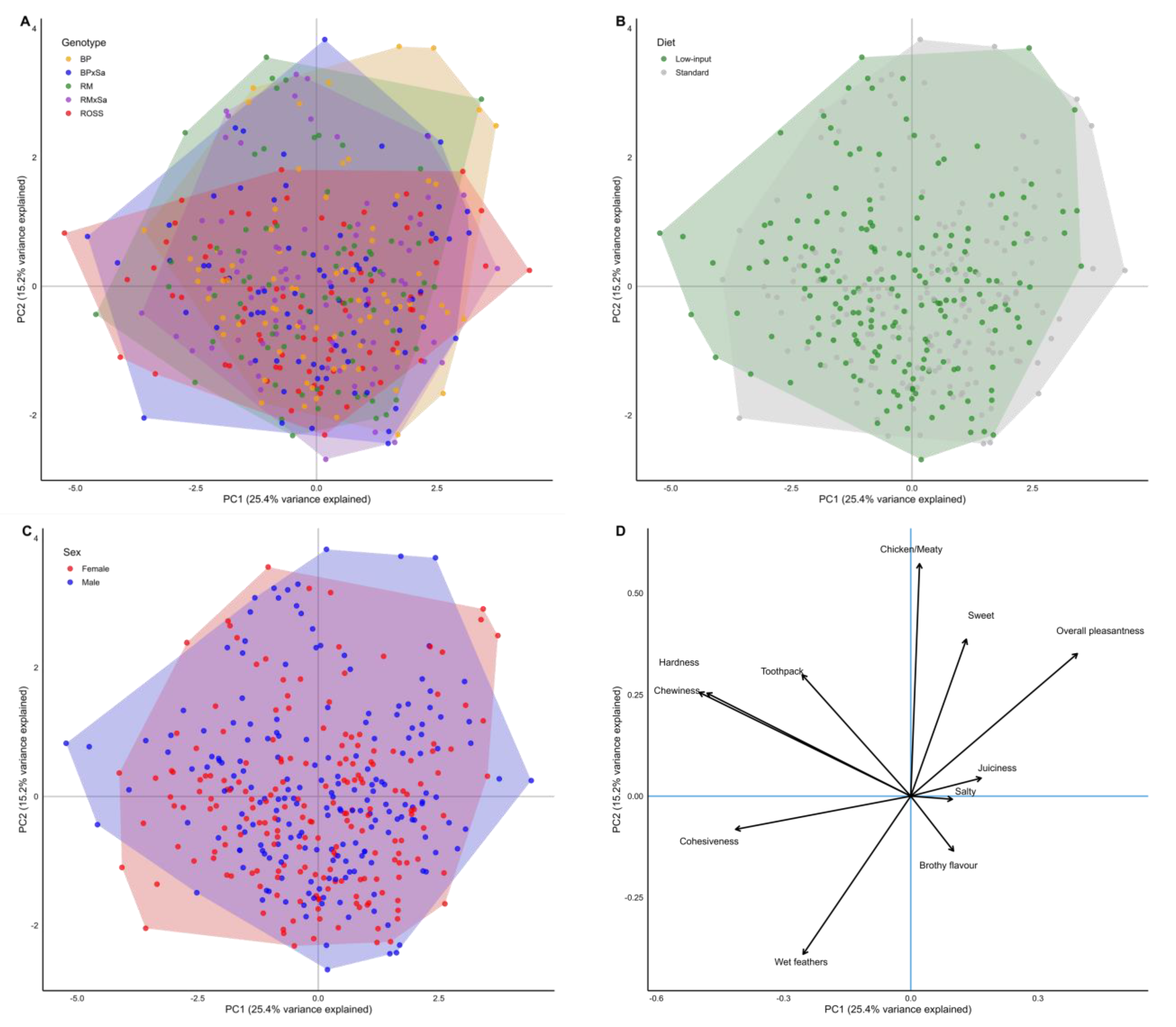
In addition, principal component analysis (PCA) was performed in RStudio (version 2025.09.2+418) to explore the multivariate relationships among sensory descriptors and to provide a graphical representation of sample distribution according to genotype, diet, and sex. The first two principal components were retained for visualization.
3. Results
3.1. Slaughter Results
Genotype significantly affected all carcass traits (
p < 0.001;
Table 1). As expected, Ross chickens showed the highest cold carcass weight, carcass yield, breast, and
P. major yields, followed by crossbred and local genotypes. Among local breeds and their crosses, Bionda Piemontese × Sasso (BP × Sa) and Robusta Maculata × Sasso (RM × Sa) exhibited higher carcass weights than their respective pure breeds (+24.4% and +17.3% in Bionda Piemontese—BP and Robusta Maculata—RM, respectively;
p < 0.001), while carcass yield was similar within each breed-cross pair. A similar pattern was observed for breast and
P. major yields in BP and BP × Sa, whereas RM and RM × Sa showed comparable values. Between local breeds, RM consistently showed higher carcass weight and yield traits compared to BP (
p < 0.001). Regarding carcass composition, Ross 308 chickens had lower proportions of wings, thighs, drumsticks, and hind legs compared to the other genotypes (
p < 0.01). Crossbreeding reduced the proportion of wings compared to the respective local breeds, while differences in hind legs were less consistent across genotypes.
Diet influenced carcass traits, with chickens fed the low-input (LI) diet showing lower cold carcass weight, carcass yield, breast, and P. major yields compared to those fed the standard (ST) diet (p < 0.05). Conversely, the LI diet increased the relative proportions of wings, drumsticks, and hind legs.
Sex effects were also observed, with males showing higher cold carcass weight and hind legs proportion, but lower breast and P. major yields compared to females (p < 0.001).
Significant genotype × diet interactions were observed for cold carcass weight, breast yield, and
P. major yield (
Table A1), indicating that the effect of the LI diet differed among genotypes. The reduction in cold carcass weight associated with the LI diet was most pronounced in Ross 308 chickens, whereas BP showed a more limited decrease, and BP × SA showed similar values between diets. RM and RM × SA displayed intermediate responses. A similar pattern was observed for breast and
P. major yields, with Ross 308 showing the largest reduction under the LI diet, while BP was largely unaffected, and the other genotypes showed smaller or intermediate changes. These results indicate a genotype-dependent response to the LI diet, particularly for traits related to carcass and breast development. Significant genotype × sex interactions were also detected for several carcass traits (
Table A2).
Although all genotypes were inspected using the same scoring procedure, breast myopathies were detected only in Ross chickens. In this genotype, the overall prevalence of white striping (WS), wooden breast (WB), and spaghetti meat (SM) was 50.6%, 34.5%, and 3.45%, respectively. The occurrence of WS was significantly higher in birds fed the ST diet compared to the LI diet (35.6% vs. 14.9%; p < 0.001), while no significant effects of diet were observed for WB and SM. Overall, the proportion of normal breasts was higher in chickens fed the LI diet compared to those fed the ST diet. Sex had no significant effect on myopathy occurrence.
3.2. Meat Quality Characteristics
Ross 308 chickens showed the highest lightness, cooking losses, shear force, lipid oxidation (thiobarbituric acid reactive substances; TBARs), and ether extract content (
Table 2;
p < 0.001), indicating a distinct meat quality profile compared to local and crossbred genotypes. In contrast, crossbred chickens generally exhibited lower pH values than both Ross 308 and local breeds (
p < 0.001). Differences between local breeds and their respective crosses were limited and not consistent across traits. In particular, BP and BP × Sa showed similar color and oxidative stability, whereas RM chickens displayed slightly lower lightness and higher redness compared to RM × Sa. Overall, crossbreeding had a limited effect on meat quality traits compared to the strong differences observed among genotypes.
Chickens fed the LI diet showed slightly lower ether extract content (−31.3%; p < 0.001) and lipid oxidation compared to those fed the ST diet (p < 0.05). Other traits, including cooking losses and shear force, were not significantly affected by diet.
Sex also influenced several traits, with males showing higher pH and lower lightness, yellowness, and cooking losses compared to females (p < 0.001), whereas no differences were observed for shear force or most chemical composition parameters.
Genotype × diet interactions were detected for selected meat quality traits, including cooking losses and shear force (
Table A1). In Ross 308, the LI diet reduced both cooking losses and shear force compared with the ST diet, whereas in RM, the LI diet increased these traits. BP, BP × SA, and RM × SA showed smaller or less consistent responses. Therefore, the interaction for meat quality traits appeared to be trait-specific and did not indicate a uniform effect of the LI diet across genotypes. Genotype × sex interactions were also observed for selected traits (
Table A2), mainly reflecting differences between males and females within genotypes.
3.3. Fatty Acid Profile and Lipid Peroxidation
Genotype had a marked effect on the fatty acid composition of breast meat (
Table 3). Ross chickens exhibited higher proportions of monounsaturated fatty acids (MUFA) and lower proportions of polyunsaturated fatty acids (PUFA) compared to local breeds and crossbred genotypes (
p < 0.001). Consequently, Ross 308 chickens showed lower total n-3 and n-6 fatty acids and a higher n-6/n-3 ratio, indicating a less favorable nutritional profile. In contrast, local breeds and their crosses were characterized by higher PUFA content, particularly n-3 fatty acids, and lower n-6/n-3 ratios. Differences between local breeds and their respective crosses were generally limited, although crossbred genotypes tended to show slightly higher MUFA proportions compared to pure local breeds. Regarding individual fatty acids, Ross chickens showed higher palmitic (C16:0) and oleic (C18:1 n-9) acids, whereas local breeds and crossbreds exhibited higher levels of linoleic (C18:2 n-6), α-linolenic (C18:3 n-3), and long-chain PUFA such as arachidonic (C20:4 n-6) and docosahexaenoic (C22:6 n-3) acids (
p < 0.001).
Chickens fed the LI diet showed higher proportions of total saturated fatty acids (SFA) and MUFA and lower proportions of PUFA compared to those fed the ST diet (
p < 0.001). This shift was associated with reduced levels of both n-3 and n-6 fatty acids and an increased n-6/n-3 ratio in LI-fed chickens, indicating a lower degree of unsaturation (
Table 3).
Regarding sex, males showed lower SFA, MUFA, and total unsaturated fatty acids (UFA), but higher PUFA proportions compared to females (p < 0.001). These differences were mainly associated with higher linoleic acid (C18:2 n-6) in males.
3.4. Sensory Analysis
Genotype significantly influenced selected sensory attributes of breast meat (
Table 4). In particular, Ross 308 breast meat was perceived as juicier than that of local breeds and crossbred genotypes (
p < 0.001), but also showed higher scores for the “wet feathers” attribute, an undesirable sensory note commonly used to describe poultry-related off-flavors, suggesting a less favorable sensory profile. Overall pleasantness was not significantly affected by genotype, although local breeds and crossbred chickens showed numerically higher scores than Ross 308.
Meat from chickens fed the LI diet was perceived as harder, chewier, and less juicy than that from chickens fed the ST diet (p < 0.001). In addition, LI samples received lower scores for saltiness and overall pleasantness (p < 0.05), indicating a negative impact of the low-input feeding strategy on sensory quality.
Sex influenced some sensory traits, with male chickens showing higher juiciness, sweetness, and overall pleasantness compared to females (p < 0.05).
To complement the univariate sensory analysis, the multivariate structure of the sensory dataset was explored by principal component analysis (PCA;
Figure 1). The first two principal components explained a moderate proportion of the total variance (PC1: 25.4%; PC2: 15.2%), capturing the main sensory gradients across samples.
Genotype-based PCA scores (Panel A) show substantial overlap among groups. Similarly, diet-based analysis (Panel B) reveals limited separation, though LI samples tend toward the positive PC1 axis, while sex (Panel C) exerts a negligible influence on the overall sensory profile.
The substantial overlap among groups indicates that the multivariate structure of sensory data was only partially explained by the experimental factors, and PCA should therefore be interpreted as an exploratory tool rather than as evidence of clear group separation. The loadings plot (Panel D) indicated that PC1 was mainly driven by a contrast between texture-related descriptors (hardness, chewiness, and cohesiveness) and positive eating-quality attributes such as juiciness and overall pleasantness. The descriptor “wet feathers” loaded in the same direction as the texture traits, further opposing pleasantness. PC2 was mainly driven by flavor-related attributes, particularly chicken flavor and brothy flavor, representing a secondary gradient related to flavor perception.
4. Discussion
Genotype emerged as the primary factor shaping carcass traits, meat quality, fatty acid profile, and sensory characteristics, with fast-growing Ross chickens showing superior carcass performance, including higher carcass weight, carcass yield, and breast development compared to local breeds and crossbred genotypes. These results are consistent with the well-established effects of genetic selection for growth and muscle accretion in commercial broilers [
17,
34]. In contrast, local breeds and their crosses showed lower breast yield and higher proportions of wings, thighs, and drumsticks, reflecting a different growth pattern and body composition. This can also be associated with their greater locomotor activity and behavioral expression compared to fast-growing genotypes. Several studies have demonstrated that slow-growing and local chickens are more active and make greater use of available space than commercial broilers [
17,
18]. Increased activity influences muscle development and metabolism, promoting a more oxidative muscle profile, higher myoglobin content, and improved oxidative stability, which in turn affects meat color, texture, and flavor [
35]. In contrast, fast-growing genotypes are characterized by reduced locomotor activity and a more glycolytic metabolism, which are associated with rapid muscle accretion but also with lower meat quality and higher susceptibility to muscle disorders [
24].
Consistently, local breeds and crossbred chickens differed from Ross 308 in specific meat quality traits, showing lower cooking losses, lower ether extract content, lower lipid oxidation, and a fatty acid profile characterized by higher polyunsaturated fatty acids (PUFA) and n-3 proportions and a lower n-6/n-3 ratio, while other traits followed less consistent patterns. These differences are likely associated with the larger muscle fiber size and glycolytic metabolism typical of fast-growing strains, which influence water-holding capacity and oxidative traits [
34,
36,
37]. In contrast, local breeds are generally characterized by a more oxidative muscle metabolism and higher activity levels, which may contribute to differences in lipid oxidation and meat quality [
38]. The sensory results further supported this interpretation. Although meat from Ross 308 was perceived as juicier, it also showed higher scores for the “wet feathers” descriptor, an undesirable poultry-related off-flavor note that may be associated with lipid oxidation and species-specific flavor perception [
12]. The higher sensory juiciness perceived in Ross 308 meat, despite its higher cooking losses and shear force, may be partly related to its higher ether extract content, which could contribute to oral lubrication during mastication. This apparent discrepancy also indicates that instrumental water losses and sensory juiciness do not necessarily describe the same quality dimension.
Conversely, local breeds and crossbred chickens showed numerically higher pleasantness scores than Ross 308, although the genotype effect on overall pleasantness was not significant. Therefore, sensory differences among genotypes appear mainly related to specific attributes, such as lower scores for the off-flavor descriptor “wet feathers”. These findings suggest that the advantages of fast-growing genotypes in terms of yield may be partially offset by less desirable sensory characteristics, whereas local and crossbred genotypes provide a better balance between technological and sensory quality. The link between meat lipid oxidation and off-flavor perception is well documented [
39] and is consistent with the higher thiobarbituric acid reactive substances (TBARs) values observed in Ross chickens.
Genotype also strongly influenced the fatty acid composition of the meat. In line with previous studies [
40], fast-growing chickens exhibited higher proportions of monounsaturated fatty acids (MUFA) and lower PUFA levels, resulting in a higher n-6/n-3 ratio compared to local breeds and crossbred genotypes. Conversely, local breeds and their crosses showed a more favorable fatty acid profile, characterized by higher PUFA and n-3 contents. These differences may be related to genotype-dependent variations in lipid metabolism and desaturase activity, but should also be interpreted considering differences in growth rate, physiological maturity at slaughter, and age-related changes in lipid metabolism and membrane composition [
14,
40].
It should be noted that birds were slaughtered at different ages according to genotype to reflect comparable commercial or physiological endpoints. Although this approach is commonly adopted in comparative studies involving genotypes with different growth rates, it may partially confound genotype effects with age-related differences, particularly for traits associated with muscle development, lipid metabolism, fatty acid composition, and sensory properties. Therefore, the results should be interpreted considering the combined effect of genotype and physiological maturity at slaughter.
The occurrence of breast myopathies further highlighted the impact of intensive genetic selection. In the present study, although all genotypes were inspected using the same scoring procedure, white striping, wooden breast, and spaghetti meat were detected exclusively in Ross 308 chickens, confirming previous evidence linking fast growth and high breast yield with the development of muscle abnormalities [
24,
41,
42]. The absence of myopathies in local breeds and crossbred genotypes supports their potential interest as alternative genetic resources, particularly in production systems aiming to improve animal welfare and product quality.
Diet also played a relevant role, although its effects were generally less pronounced than those of genotype. The low-input (LI) diet negatively affected carcass weight and breast yield, in agreement with the results observed on growth performances [
22], and in line with previous studies reporting performance limitations when soybean meal is partially replaced by locally sourced protein ingredients such as faba bean [
43]. These effects are likely related to lower nutrient density and the presence of antinutritional factors in alternative feedstuffs [
44].
In terms of meat quality, the LI diet had limited effects on most technological traits but influenced oxidative stability and color. In particular, meat from LI-fed chickens showed lower lipid oxidation and higher redness, suggesting potential benefits in terms of oxidative status. However, these effects were accompanied by changes in sensory properties, as LI samples were perceived as harder, chewier, and less pleasant than those from chickens fed the standard diet. This highlights a potential trade-off between feed sustainability and sensory quality that should be carefully considered when designing low-input feeding strategies. Diet also markedly influenced the fatty acid profile, with LI-fed chickens showing higher saturated fatty acids (SFA) and MUFA proportions and lower PUFA levels, resulting in a higher n-6/n-3 ratio. This pattern is consistent with the different lipid contribution of the dietary ingredients, particularly the lower ether extract content of the LI diet and the different balance between soybean-derived ingredients, faba bean meal, and soybean oil. Similar trends have been reported with legume-based diets [
45,
46]. These changes are directly related to the fatty acid composition of the diet and confirm the strong link between feed formulation and lipid composition of poultry meat.
Importantly, the genotype × diet interaction indicated that the response to the LI diet was not uniform across genetic groups. Ross 308 chickens showed the most pronounced reduction in carcass weight, breast yield, and
P. major yield, whereas local breeds and crossbred genotypes showed smaller or more variable changes. This pattern is consistent with the performance results reported in the companion paper [
22], where the LI diet reduced final body weight and feed efficiency, with the greatest reduction observed in Ross 308. These findings suggest genotype-dependent nutritional sensitivity, likely related to differences in growth potential and nutrient requirements. However, this should not be interpreted as definitive evidence that alternative genotypes are generally better suited to low-input systems, because their lower absolute carcass performance, the environmental trade-offs reported in the companion study [
22], and the need for economic assessment and appropriate market positioning must also be considered.
From a practical perspective, these findings highlight a trade-off between reducing dependence on imported soybean meal and maintaining productive efficiency. Although the use of local feed ingredients and local genetic resources may support more diversified and regionally based poultry systems, their adoption may involve longer production cycles, lower carcass yield, and potentially higher production costs. Therefore, successful implementation would require appropriate market positioning, where attributes such as local origin, differentiated meat quality, animal welfare, and sustainability can compensate for reduced productive efficiency.
Sex-related effects were generally consistent with previous literature, with males showing higher carcass weight and lower breast yield compared to females. These differences are mainly related to sexual dimorphism in growth patterns and body composition, with males allocating a greater proportion of growth to structural components such as legs, while females tend to show relatively higher breast development [
33,
47,
48]. In addition, sex-related differences in muscle metabolism and fat deposition may contribute to the observed variation in meat quality and sensory traits, particularly in alternative and local genotypes.
5. Conclusions
The present study evaluated the combined effects of genotype and low-input diet on carcass traits, meat quality, fatty acid profile, and meat sensory characteristics in broiler chickens. Overall, genotype emerged as the main driver of variability across carcass and meat quality traits, with fast-growing chickens maximizing carcass yield but showing higher cooking losses, lipid oxidation, less favorable fatty acid composition, and a higher incidence of breast myopathies. Conversely, local breeds and crossbred genotypes provided local breeds and crossbred genotypes showed lower carcass performance than the fast-growing genotype, but some favorable meat quality and fatty acid traits. Crossbred genotypes showed intermediate carcass performance between fast-growing and local breeds, confirming their potential to improve productivity compared to pure local lines. Besides, crossbreeding had limited effects on meat quality and sensory attributes, which remained similar to those of local breeds and generally more favorable than those of the fast-growing genotype. These conclusions should be interpreted within the framework of a commercial-endpoint comparison, where genotype-related differences may partly reflect differences in physiological maturity at slaughter.
The low-input diet reduced carcass traits, particularly in the fast-growing genotype, which was more sensitive to nutritional constraints. In contrast, local breeds and crossbred chickens showed smaller diet-related changes in some carcass and meat quality traits under the low-input diet, suggesting lower sensitivity to nutritional constraints within the conditions of the present study. While most technological traits were not affected, the low-input diet negatively affected the meat fatty acid profile and sensory attributes such as tenderness, juiciness, and overall pleasantness.
These findings highlight the importance of considering both genetic background and feeding strategy when designing more sustainable poultry production systems, particularly in contexts aiming to enhance feed self-sufficiency, animal welfare, and product quality. However, these strategies also involve practical trade-offs, since potential benefits in terms of product quality, feed self-sufficiency, and sustainability must be balanced against reduced carcass yield, longer growth duration, possible increases in production costs, and the need for appropriate market positioning.





 ,
,