Article

Agronomic Practices for Mitigating Clomazone Mobility: Medium-Term Effects in Rice Agroecosystems

by
Luis Vicente
1,*,
Manuel Pérez
1,
Damián Fernández-Rodríguez
2,
David Peña
3 and
Antonio López-Piñeiro
1
1
Área de Edafología y Química Agrícola, Facultad de Ciencias—Instituto del Agua Cambio Climático y Sostenibilidad (IACYS), Universidad de Extremadura, Avda de Elvas s/n, 06071 Badajoz, Spain
2
Área de Producción Vegetal, Escuela de Ingenierías Agrarias—Instituto del Agua Cambio Climático y Sostenibilidad (IACYS), Universidad de Extremadura, Ctra de Cáceres, 06071 Badajoz, Spain
3
Área de Edafología y Química Agrícola, Escuela de Ingenierías Agrarias—Instituto del Agua Cambio Climático y Sostenibilidad (IACYS), Universidad de Extremadura, Ctra de Cáceres, 06071 Badajoz, Spain
*
Author to whom correspondence should be addressed.
Agriculture 2026, 16(1), 58; https://doi.org/10.3390/agriculture16010058
Submission received: 25 November 2025 / Revised: 21 December 2025 / Accepted: 25 December 2025 / Published: 26 December 2025
(This article belongs to the Special Issue Impacts of Emerging Agricultural Pollutants on Environmental Health)

Abstract

Clomazone is a widely used herbicide in rice cultivation, known for its high toxicity to aquatic organisms and its potential to contaminate water bodies. This study investigates the medium-term effects (after four and five years) of rice management practices on the environmental fate of Clomazone under semi-arid Mediterranean conditions. The practices investigated are tillage systems, irrigation methods, and compost application. A field experiment was conducted to compare the following treatments: sprinkler irrigation combined with no tillage (S-NT), sprinkler irrigation combined with conventional tillage (S-T), flooding irrigation with conventional tillage (F-T), and each of the above with a single compost amendment (S-NTC, S-TC, and F-TC, respectively). Compost application consistently enhanced the soil’s capacity to adsorb Clomazone, regardless of the irrigation or tillage regime. However, the use of sprinkler irrigation was shown to increase Clomazone persistence, regardless of the tillage method (S-NT and S-T), which may in turn elevate the risk of groundwater contamination. Compost addition significantly reduced Clomazone leaching losses, particularly under sprinkler systems; leaching decreased from 47% to 27% in S-NT and from 48% to 36% in S-T after five years. These findings highlight that the application of compost, particularly when combined with sprinkler irrigation, could be a sustainable agricultural approach to significantly reducing the environmental risks associated with Clomazone in rice cultivation, at least in the medium term.

1. Introduction

Rice (Oryza sativa L.) is a fundamental food crop worldwide [1,2]. However, traditional rice production relies on unsustainable agronomic practices, such as intensive tillage and permanent flooding irrigation [3]. These practices are associated with excessive water consumption [4], the degradation of soil quality [5], and the contamination of soil and water resources due to intensive pesticide applications [6]. Herbicides are widely used in rice cultivation to control weeds, which can cause considerable yield losses [7]. Nevertheless, only a fraction of the applied herbicide reaches the target, while the remainder may persist in soil or be transported to surface and groundwater, raising environmental concerns [8]. Therefore, there is a growing need to mitigate herbicide contamination by implementing sustainable and innovative agricultural practices [9,10].
Changes in irrigation regimes not only affect water use efficiency but also induce changes in soil properties and redox conditions, which are key factors that can affect the persistence and mobility of herbicides in soil [11,12]. In this context, sprinkler irrigation has emerged as an alternative strategy capable of replacing flooded systems, substantially improving water use efficiency [13]. In addition, sprinkler irrigation also facilitates the adoption of soil conservation practices [14], leading to significant changes in the behavior of pesticides [9,15].
Soil management practices strongly influence soil properties. Conservation strategies such as the no-tillage strategy are particularly relevant in Mediterranean soils, which typically have low organic matter contents [16], and their long-term adoption has been shown to significantly increase soil organic matter [17]. Consequently, integrating conservation practices with sprinkler irrigation is recognized as a promising approach to improving both water and soil resource efficiency [9,18]. However, variable yields and even yield reductions have been reported under sprinkler irrigation systems, especially in soil with low-organic-matter contents [19,20,21], highlighting the need for complementary management strategies.
In Mediterranean agroecosystems, rice cultivation coexists with other characteristic agroforestry crops, such as olive groves. Olive oil production generates large amounts of by-products with potential agricultural use, including liquid residues such as olive mill wastewater, which contribute nutrients and organic matter to the soil [22], as well as solid residues called “alperujo” that can be composted, producing a material with clear benefits for agricultural application due to its lower content of phenolic compounds and more balanced C/N and C/P ratios [23,24]. The use of compost as an organic fertilizer offers several advantages, including increases in soil organic matter [23,25]. Thus, the implementation of sprinkler and no-tillage agronomic practices, in combination with the application of compost or alone, alters the physicochemical and biological properties of soils, which in turn affects the behavior and dynamics of herbicides applied in rice cultivation [26].
Among these herbicides, Clomazone [(2-chlorophenyl)methyl]-4,4-dimethyl-3-isoxazolidinone is one of the most widely used in global rice production due to its high efficacy against a broad spectrum of weeds, including both broadleaf and grass species, with possible applications pre- and post-emergence [12,27]. Clomazone’s physicochemical characteristics, such as its high water solubility (approximately 1100 mg dm−3); moderate soil mobility (KOC: 150–562 dm3 kg−1); slow degradation during environmental processes, including photolysis and hydrolysis; and considerable persistence in soil (DT50: 30–135 days) [28], together with its potential phytotoxic effects on subsequent rotational crops [29], make it an herbicide with significant environmental impact. Consequently, it has a high potential to contaminate surface and groundwater and is frequently detected in rice-growing areas in concentrations above 3.7 μg L−1 reported [30,31]. Zanella et al. [32] reported that Clomazone was detected in up to 90% of water samples collected from rivers near rice fields from Brazil. Additionally, studies have shown that Clomazone may negatively affect non-target organisms, such as nitrogen-fixing bacteria [33] and invertebrates [34], some of which are essential for sustainable rice production [35].
In this context, the implementation of soil conservation practices, such as sprinkler irrigation, has been shown to enhance soil organic matter content [17], which in turn can increase the adsorption of pesticides [36], stimulate microbial activity, and promote their degradation, potentially reducing herbicide leaching and runoff [37]. Furthermore, the presence of crop residues on the soil surface, a characteristic feature of no-tillage management systems, may increase the interception of applied pesticides and limit herbicide volatilization [38]. Although conservation practices can mitigate pesticide-related environmental contamination, their results are often inconsistent [39]. On the other hand, the use of organic amendments has frequently demonstrated beneficial effects. For example, Vicente et al. [12] reported that biochar increased Clomazone adsorption and decreased its leaching. Similarly, studies related to organic amendment from olive oil production have demonstrated an increase in the adsorption of herbicides, which reduces the risk of water contamination [40]. However, these effects depend on both the properties of the pesticide and the soil type [41]. In a previous study [15], we found that the application of compost reduced Clomazone leaching, with the strongest effects observed under flooded and tilled agricultural practices, although only short-term responses (≤3 years) were evaluated. Importantly, several reports have shown that herbicide behavior may differ between the short and medium term, e.g., [42,43], due to the temporal evolution and transformation of soil and organic amendment properties [44,45,46,47,48]. Therefore, medium-term evaluations are necessary to capture potential changes in Clomazone adsorption, leaching, and persistence that may not be evident in short-term studies.
Therefore, the main objective of the present study was to evaluate the medium-term effects (fourth and fifth year) of different irrigation and tillage practices, with or without compost, on the behavior of Clomazone in Mediterranean rice soils. To address this objective, the herbicide’s sorption–desorption, dissipation, and leaching processes were evaluated. The resulting information will support more efficient planning of Clomazone use, helping mitigate emerging agricultural pollutants and promoting sustainable crop management.

2. Materials and Methods

2.1. Experimental Design, Soil Sampling, and Analytical Procedures

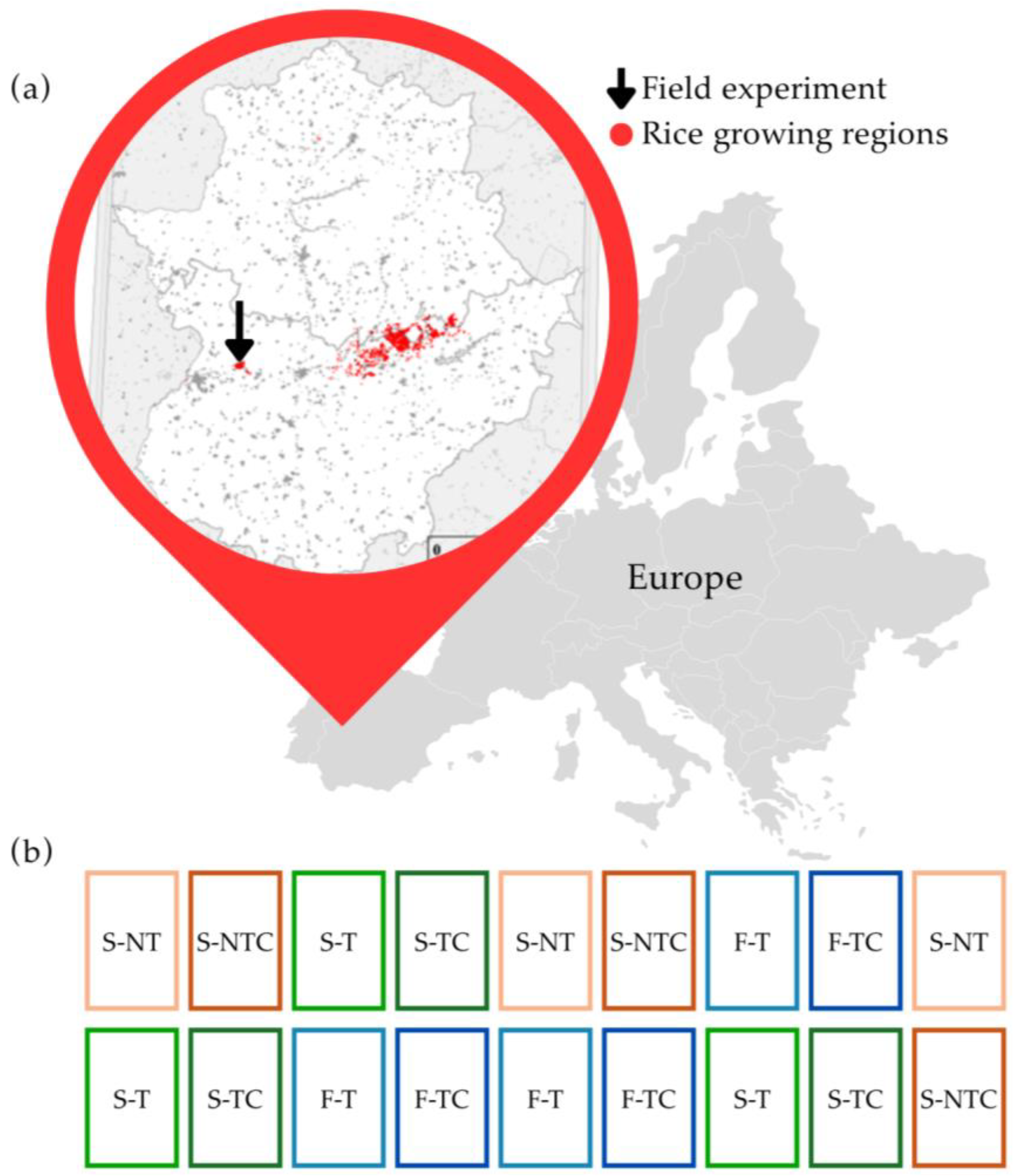
A two-year (2018 and 2019) field experiment was carried out in a rice (O. sativa L.) test field located in western Extremadura (Spain) (38°55′ N; 6°57′ W), characterized by a semi-arid Mediterranean climate, with an average annual temperature of 15.7 °C and an annual total precipitation of 439 mm. The experimental field had been under rice monoculture for 14 years, managed under a conventional system (flooding and tillage practices). During the last three years prior to the study, part of the field was converted to a sprinkler irrigation system, while the rest remained under conventional flooding irrigation. The soil at the experimental site is classified as having a loam texture, consisting of 20.8% clay, 28.9% silt, and 50.3% sand. The experimental area was divided into 18 plots of 180 m2 each, randomly distributed across the field. Six treatments were applied, each with three replications. The applied treatments were as follows: sprinkler irrigation with no tillage and without or with a single compost application (S-NT and S-NTC, respectively); conventional tillage without or with a single compost application (S-T and S-TC, respectively), and flooding irrigation with conventional tillage without or with a single compost application (F-T and F-TC, respectively). Figure 1a illustrates the location of the experimental site, and Figure 1b shows the spatial arrangement of the 18 experimental plots, which were randomly distributed across the field according to the different treatments. The compost, characterized by Gómez et al. [49], was applied once in 2015 at a rate of 80 Mg ha−1 and was derived from olive oil production residues. This application rate was chosen to achieve a soil organic matter content of 4% in the year of application. All treatment plots received the same fertilization regime during both years. In April, a basal application of 550 kg ha−1 of 9-18-27 compound fertilizer was conducted, followed by two nitrogen (urea) applications: 92 kg ha−1 at tillering and 69 kg ha−1 at the panicle initiation stage. For all treatments, the rice cultivar ‘Sirio’ was sown at a seeding rate of 160 kg ha−1. A Semeato TDNG 320 disc seeder (Semeato, Passo Fundo, Brazil) was used for the treatments under sprinkler irrigation, whereas an Amazone za-x-perfect broadcast seed drill (Amazone, Munich, Germany) was employed for the flooded irrigation treatments. To assess the medium-term response of the soil to the different management systems, sampling was conducted immediately after the rice harvests in 2018 and 2019, corresponding to four and five years, respectively, after the implementation of the agricultural practices. For each plot, four topsoil subsamples (0–20 cm) were randomly collected using a 70 mm manual auger and combined into a composite sample. Then, soils were air-dried, gently crushed, and sieved to <2 mm; the fine fraction was stored at 4 °C until analysis. Soil properties were characterized according to the procedures described by Peña et al. [50] and are summarized in Table S1. These soil samples were used to carry out the Clomazone sorption–desorption, dissipation, and leaching studies.

2.2. Herbicide

Clomazone was selected as a representative pre-emergence herbicide commonly used in rice cultivation. The technical-grade compound (purity 99.8%) was supplied by Dr. Ehrenstorfer GmbH (Augsburg, Germany); its physicochemical characteristics are summarized in Table 1. Clomazone concentrations were determined using high-performance liquid chromatography (HPLC) with a Waters 2695 E system equipped with a photodiode array detector (Waters 2996) (Waters, Milford, MA, USA) and an autosampler. Separation was performed on a Kinetex column (150 × 4.6 mm, 5 µm particle size) maintained at 30 °C. The mobile phase consisted of acetonitrile and distilled water (70:30, v/v) at a flow rate of 1 mL min−1, with an injection volume of 25 µL and UV detection at 214 nm. The Clomazone concentration was quantified against a linear calibration curve of chromatographic peak area versus Clomazone standards between 0.05 µM and 50 µM (external calibration). Repeatability was evaluated by ten repeated injections of Clomazone standards. This test was also carried out on a different day and in different media (distilled water, CaCl2 0.01 M, and on extracting agent) in order to verify the reproducibility. Adequate linearity and precision (R2 ≥ 0.9990 and relative standard deviation <2%) were obtained. Measurements with control samples (without Clomazone) showed no interfering peaks at the retention times of the herbicide at the band maxima of Clomazone in UV spectra. The limits of detection and quantification, calculated as the herbicide concentrations resulting in signal-to-noise ratios of 3:1 and 10:1, respectively, were 0.015 μM and 0.047 μM, respectively.

2.3. Sorption–Desorption Studies

Batch experiments were conducted to assess the effect of different agricultural practices on the sorption–desorption of Clomazone, following the methodology described by Vicente et al. [12]. Briefly, 5 g of soil was mixed with 10 mL of 0.01 M CaCl2 solution at initial Clomazone concentrations (Ci) of 5, 10, 20, 40, and 50 µM. The suspensions were shaken at 200 rpm and maintained at 20 °C for 24 h to reach equilibrium between the liquid and solid phases. The equilibrium concentration (Ce) was determined by HPLC. The amount of Clomazone adsorbed by the soil (Cs) was calculated from the difference between Ci and Ce. These sorption and desorption data were subsequently analyzed by fitting them to the Freundlich equation (Cs = Kf Cenf), which allowed for quantification of the relationship between the concentration in the solution and the amount adsorbed by the soil. Distribution coefficients (Kd) were obtained from the sorption isotherms according to Kd = Cs/Ce, using a selected Ce of 20 µM. Desorption was measured immediately after the sorption step by successive dilutions starting from the highest initial concentration (50 µM). The 5 mL of supernatant removed for sorption analysis was replaced with 5 mL of 0.01 M CaCl2 solution. The samples were resuspended, shaken for another 24 h, and centrifuged, and the equilibrium concentration in the supernatant was determined. This desorption procedure was repeated three times. The desorption percentage was calculated as %D = ((CsaCsd)/Csa) × 100, where Csa is the amount of Clomazone adsorbed during the adsorption phase and Csd is the amount remaining adsorbed after desorption.

2.4. Dissipation Studies

This experiment was carried out in triplicate using 5 g of soil per treatment (from soil samples at 0–20 cm depth) and under two distinct incubation conditions corresponding to the management systems. Samples from S-NT, S-NTC, S-T, and S-TC treatments were incubated at 80% of field capacity using distilled water, simulating sprinkler irrigation conditions, whereas samples from F-T and F-TC treatments were maintained under flooded conditions with a soil-to-water ratio of 1:1.25 (w/v). Soil moisture contents were maintained at a constant level throughout the experiment by periodically adding distilled water, as determined by weight measurements. Before herbicide application, soil samples were pre-incubated for 7 days at 20 °C in the dark to allow microbial communities to adapt to the experimental conditions. Then, Clomazone was applied at a rate equivalent to 1 kg ha−1. Samples were kept in darkness at 20 °C throughout the experiment, and Clomazone concentrations were determined by HPLC after 2 h, 2 days, 5 days, and weekly thereafter up to 49 days. Herbicides were extracted from soil by shaking 5 g of soil with 10 mL of methanol (ratio 2:1 v/w) for 24 h at 20 °C, followed by centrifugation for 7 min at 3500 rpm. The resulting supernatant was analyzed by HPLC to quantify the remaining herbicide. Preliminary studies showed that this extraction procedure recovered ≥95% of the Clomazone applied to the soils. Dissipation data were fitted to a first-order kinetic model described by the equation C = C0 e−kt, where C is the Clomazone concentration at time t (days), C0 the initial concentration, and k (day−1) the degradation rate constant. The validity of the model was tested based on two values: the correlation coefficient (R2) and the summed squared error (SSE). The corresponding half-lives (t1/2) were subsequently calculated from these parameters. In parallel, dehydrogenase activity (DHA), an indicator of overall microbial activity in soil, was evaluated under the same experimental conditions. For each treatment, 1 g of soil was used in triplicate, and soil moisture was adjusted to the same levels as those established in the dissipation experiment. Samples were incubated for 7 days at 20 °C in darkness before herbicide application, which was performed at the same rate and sampling intervals as in the dissipation test, with DHA measurements conducted periodically at 2 h, 2 days, 5 days, and weekly thereafter up to 49 days. Afterwards, the tubes were incubated for 20 h at 20 ± 1 °C in the dark with 1 mL of a 0.4% solution of 2-p-iodophenyl-3-p-nitrophenyl-5-tetrazolium chloride (INT) used as a substrate. At the end of the incubation, the produced iodonitrotetrazolium formazan (INTF) was extracted with methanol, and absorbance was measured spectrophotometrically at 490 nm.

2.5. Leaching Studies

To evaluate Clomazon leaching under different management systems, experiments were conducted using PVC soil columns (5 cm internal diameter × 30 cm length) filled with disturbed soil. Columns were prepared in triplicate for each treatment (S-NT, S-NTC, S-T, S-TC, F-T, and F-TC). The upper 5 cm of each column was packed with washed sea sand to ensure uniform water distribution, while the bottom 5 cm contained sea sand mixed with glass wool to prevent soil loss during drainage. The remaining 20 cm section was carefully filled. The soil was air-dried, gently disaggregated, and sieved to <2 mm prior to packing. The columns were packed to mean bulk densities of 0.983 kg L−1 for S-NT, 0.942 kg L−1 for S-NTC, 0.960 kg L−1 for S-T, 0.919 kg L−1 for S-TC, 0.910 kg L−1 for F-T, and 0.871 kg L−1 for F-TC. Before herbicide application, the columns were saturated with a 0.01 M CaCl2 solution and allowed to drain freely for 24 h. The mean pore volumes after saturation were 0.132 L for S-NT, 0.141 L for S-NTC, 0.125 L for S-T, 0.132 L for S-TC, 0.136 L for F-T, and 0.146 L for F-TC. Then, Clomazone was applied to the soil surface at a rate equivalent to 1 kg ha−1. Two hours after herbicide application, the columns were leached with 0.01 M CaCl2, applying 50 mL daily until the end of the experiment, that is, until the herbicide amounts detected in the leachate were negligible. Leachates were collected daily, filtered, and stored frozen until HPLC analysis. During the experimental period, each column received a daily application of 50 mL of 0.01 M CaCl2, applied at the top of the column, until no herbicide was detected in the leachates. Once the leaching experiments were completed, the columns were left to drain for 24 h. Residual Clomazone in the soil was quantified by extracting 5 g of soil with 10 mL of methanol, shaking for 24 h at 20 ± 1 °C, and analyzing the extracts by HPLC.

2.6. Statistical Analysis

Statistical analyses were performed using IBM SPSS Statistics software (version 25). A repeated measures ANOVA was applied to assess the influence of within-subject (year) and between-subject (treatment) factors on the dependent variables analyzed. This approach allowed for separate evaluation of the individual effects of both factors as well as their interaction. Additionally, one-way ANOVA tests were conducted for each dependent variable, considering the effects of year and treatment independently, in order to identify statistically significant differences among treatments within the same year and between years within each treatment. When significant effects were detected, Duncan’s post hoc test was applied to define homogeneous groups. Furthermore, bivariate correlation analyses were carried out using Pearson’s correlation coefficient and two-tailed significance tests to determine statistically significant relationships between variables. We determined the linear relationship between the dependent variable (leached Clomazone) and the independent variables (various physicochemical soil properties) using multiple linear regression, applying a stepwise backward regression method. Three levels of significance were considered: p ≤ 0.05, p ≤ 0.01, and p ≤ 0.001.

3. Results and Discussion

3.1. Sorption–Desorption Experiments

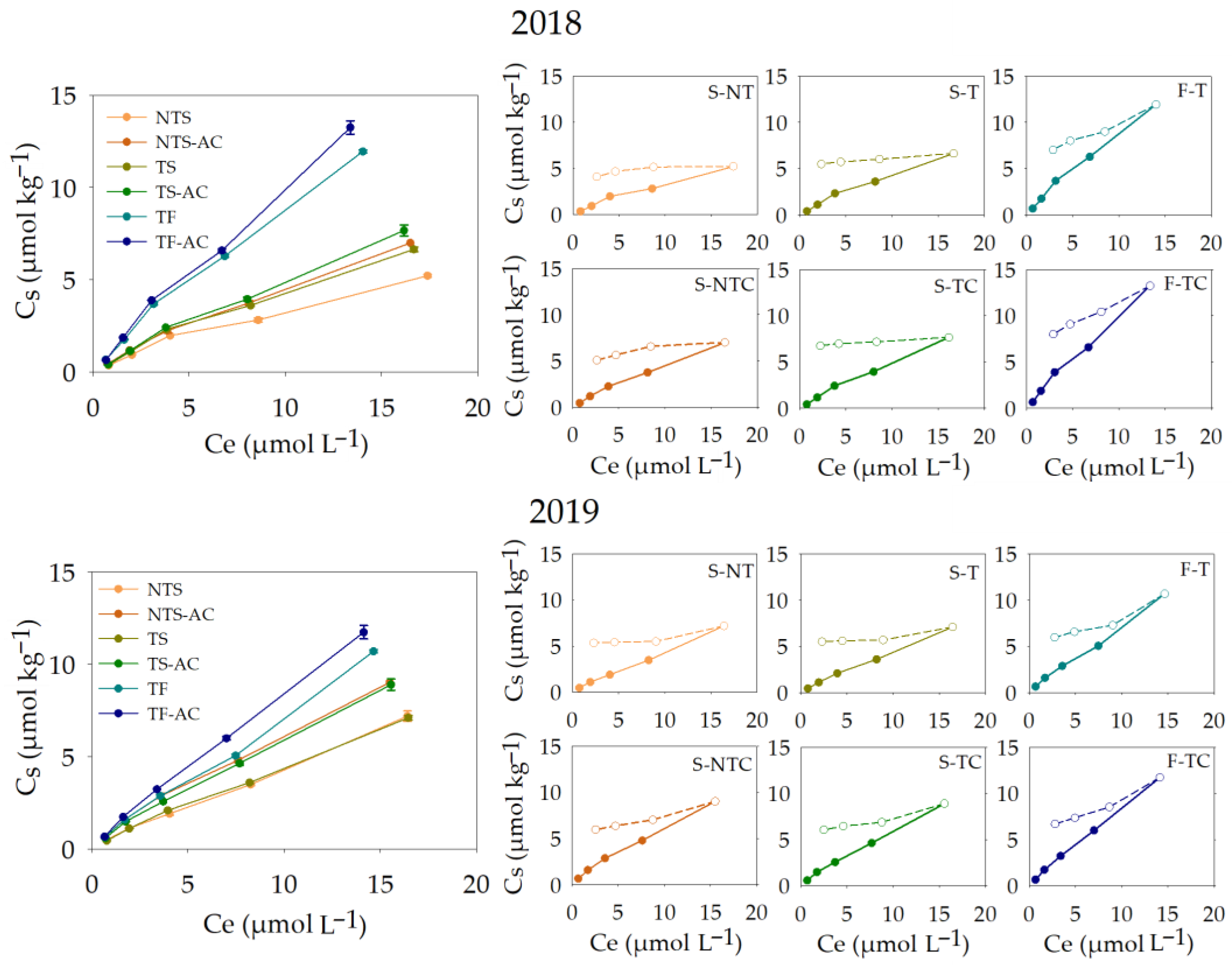
Figure 2 shows the sorption–desorption isotherms of Clomazone for different treatments. The experimental data fit well to the Freundlich model (R2 ≥ 0.987, Table 2). All n f values were found to be less than unity, regardless of the agronomic practices or the study year, indicating that Clomazone sorption was initially concentration dependent. Similar findings have been reported by other authors in different Mediterranean agricultural soils [12,26]. For the unamended agricultural managements, the Kd values (L kg−1) ranged from 1.16 (S-NT) to 1.60 (F-T) and from 1.26 (S-NT) to 1.66 (F-T) after four and five years, respectively (Table 2). Comparable sorption capacities of Clomazone (1.14–1.69) were also reported by Gámiz et al. [26] and Vicente et al. [12] in various Mediterranean agricultural soils. However, Cao et al. [51] showed a wide range of sorption capacity values (2.24–17.80) in agricultural soils from China, which also exhibited broad variations in total organic carbon (TOC) (3.70–74.8 g kg−1) and pH (4.90–8.20). Our results suggest that middle-term implementation of sprinkler irrigation, regardless of tillage practices, significantly reduced the sorption capacity of Clomazone. Thus, the Kd data were lower in S-NT and S-T than in F-T by average factors of 1.35 and 1.22, respectively (Table 2). These results are in agreement with those reported by Fernández et al. [15], who found that sorption values were higher in F-T than in S-NT and S-T under short-term effects (<3 years). This effect was attributed to an increase in soil pH induced by the implementation of sprinkler irrigation [15]. Consistently, in the present study, a rise in soil pH was also detected in both years, with treatment F-T exhibiting an average pH of 5.58, with values reaching up to 6.73 under S-NT conditions,. This indicates a reduction in the soil’s sorption capacity for Clomazone.
Regardless of tillage systems and irrigation practices, significant increases in Kd values were observed in the amended agricultural managements relative to the unamended managements. Hence, compared to unamended managements (S-NT, S-T, and F-T), the Clomazone Kd values were greater by a factor of 1.66, 1.54, and 1.85 and by a factor of 1.91, 1.77 and 1.95 in S-NTC, S-TC, and F-TC, respectively, after four and five years of implementation, respectively. These findings indicate that compost substantially enhanced the Kd values of Clomazone, probably associated with increases in TOC (Table S1). In fact, consistent with the short-term observations of Fernández et al. [15], significant and positive correlations were observed between Kd and TOC (r = 0.884, p < 0.01) and humic acids (HA) (r = 0.719, p < 0.01), highlighting the critical role of organic matter and especially humic fractions in the sorption behavior of this pesticide. These results are consistent with previous studies, which have also reported increased sorption of Clomazone at higher organic matter contents [52,53]. Therefore, based on our findings, the potential for Clomazone contamination in water bodies is likely reduced when this pesticide is applied in organic amended rice fields, irrespective of tillage and irrigation practices, at least in the medium term.
After five years, no significant differences were found between unamended agricultural managements, regarding the desorption process; an average value of 46.5% was observed for Clomazone desorption. Lower values of Clomazone desorption (29.1–35.6%) were found by Đurović-Pejčev et al. [53], although in agricultural soils with higher TOC and pH values than in our study. The effects of compost on Clomazone desorption were not always significant (Table 2). Five years after compost application, although there was an increase by a factor of 1.17 for tilled treatments (S-TC and F-TC), especially under flood irrigation (F-TC), compared to the unamended system, for the no-tilled treatment (S-NTC), a decrease of a factor of 1.12 was observed. These findings could be attributable to differences in soil properties between both agricultural management systems (S-NTC and F-TC). The higher water soluble organic carbon (WSOC) values observed in F-TC compared to S-NTC (357 and 562 mg kg−1, respectively) could explain the large amount of desorbed Clomazone under flooding conditions. Indeed, several reports have indicated that the ability of pesticides to form complexes with WSOC could enhance the reversibility of pesticide sorption [54,55]. Furthermore, according to previous studies [15,56], the greater reversibility of Clomazone sorption under flooding conditions could also be explained by the significant drop in HA in the flooding treatment (F-TC), the value of which was reduced by a factor of 1.36 in relation to S-NTC (Table S1). This is due to the important effect of humic substances on Clomazone sorption, as demonstrated in the present study and in previous studies [57].

3.2. Dissipation Experiments

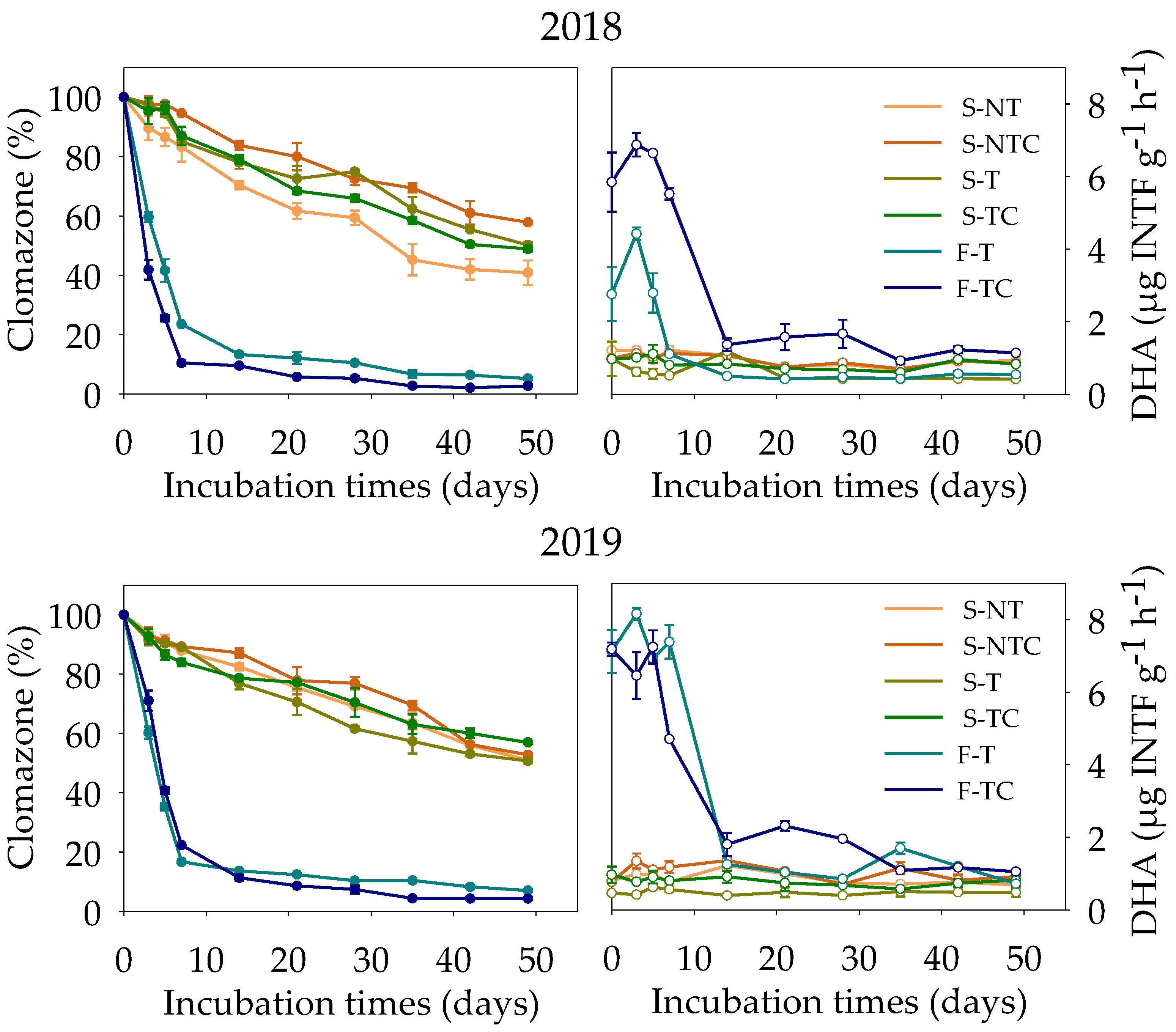
Figure 3 shows the Clomazone dissipation curves and DHA values obtained from the dissipation experiments. The experimental dissipation data were fitted to a first-order kinetic model, showing high correlation coefficients (R2 ≥ 0.820, Table 3) and low SSE values (SSE ≤ 4.16). The agricultural management practices significantly affected the Clomazone t1/2 values (Table 3). For the unamended agricultural managements systems, the t1/2 values ranged from 12.9 days (F-T) to 51.5 days (S-T) and from 15.9 days (F-T) to 52.9 days (S-NT) after four and five years, respectively, suggesting that Clomazone dissipation is faster under anaerobic conditions than aerobic conditions (Table 3). These results are consistent with the short-term findings reported by Fernández et al. [15], who also observed Clomazone half-life values of up to 18.2 times lower under flooding management compared to sprinkler conditions. A similar trend was also reported by Tomco et al. [58], who attributed the low persistence of Clomazone in rice fields of California to its rapid biotransformation through the opening of the aromatic ring [12,56,59].
During both years of the study, the effects of the amendment on t1/2 values of Clomazone differed under sprinkler agricultural management, regardless of the tillage technique (S-NTC and S-TC), compared to flooding management (F-TC). Significant increases in S-NTC and S-TC by factors of 1.62 and 1.11 were observed compared to S-NT and S-T, respectively, and by 1.09 and 1.33, respectively, after four and five years, respectively (Table 3). However, under flooding conditions, the t1/2 values were lower by factors of 1.24 and 1.43 for F-TC compared to F-T (Table 3). The greater persistence of Clomazone observed under amended agricultural management practices could be attributed to an enhanced Clomazone sorption capacity (Table 2), which likely limited pesticide dissipation, as demonstrated by several studies conducted with different soil types, agricultural management practices, pesticide applications, and environmental conditions [8,60]. However, this observation does not account for the reduced Clomazone persistence found in amended management under flooding conditions (F-TC). The high amount of desorbed Clomazone in F-TC likely facilitated microbial biodegradation of the pesticide. In fact, there was a significant and negative correlation between t1/2 and DHA values (r = −0.819, p < 0.01), suggesting that the increased dissipation of Clomazone was due to greater biological activity. This finding is consistent with previous reports indicating that microbial activity represents a major degradation pathway of Clomazone [61,62,63]. Thus, the faster dissipation observed under flooding agricultural managements (both unamended and amended) compared to sprinkler managements (both unamended and amended), regardless of tillage practice, could also be attributed to higher DHA activity [64]. This activity was up to 7.51 times greater under flooding than under sprinkler conditions in unamended managements and up to 4.41 times greater in amended managements.
Finally, it is important to note the variability in the effects of amendment on the persistence of Clomazone between the short and middle term. In the short term, the amendment led to significant decreases in Clomazone t1/2 values, especially under sprinkler irrigation treatments [15]. After four and five years, significant increases were observed under these same amended agricultural managements (Table 3). These differences could be explained by the nitrogen and/or carbon sources of the soil microorganisms, which also could explain the observed DHA results. Over the short term, the DHA values after two hours Clomazone application were 2.49, 1.63, and 6.85 times greater in S-NTC, S-TC, and F-TC, respectively, than those before Clomazone application, as reported by Fernández et al. [15]. However, in the medium term, the DHA values after two hours of Clomazone application were 0.770, 0.970, and 7.19 μg INTF g−1 h−1 for S-NTC, S-TC, and F-TC, respectively, similar to the values before Clomazone application (0.789, 0.842, and 7.28 μg INTF g−1 h−1, respectively) (Figure 3). Therefore, over a short period (<1 year), soil microorganisms appear to use Clomazone as a source of nutrients instead of the amendment, as indicated by the significant increase in DHA values following herbicide application. Conversely, in the medium term (4–5 years), soil microorganisms appeared to preferentially use the amendment as their nutrient source rather than Clomazone, as indicated by the similar DHA values before and after herbicide application. The aging of the amendment in the field was likely responsible for the higher persistence of Clomazone observed in the present study. These results clearly highlight the importance of considering the effects beyond the short term when evaluating the behavior and persistence of pesticides.

3.3. Leaching Experiments

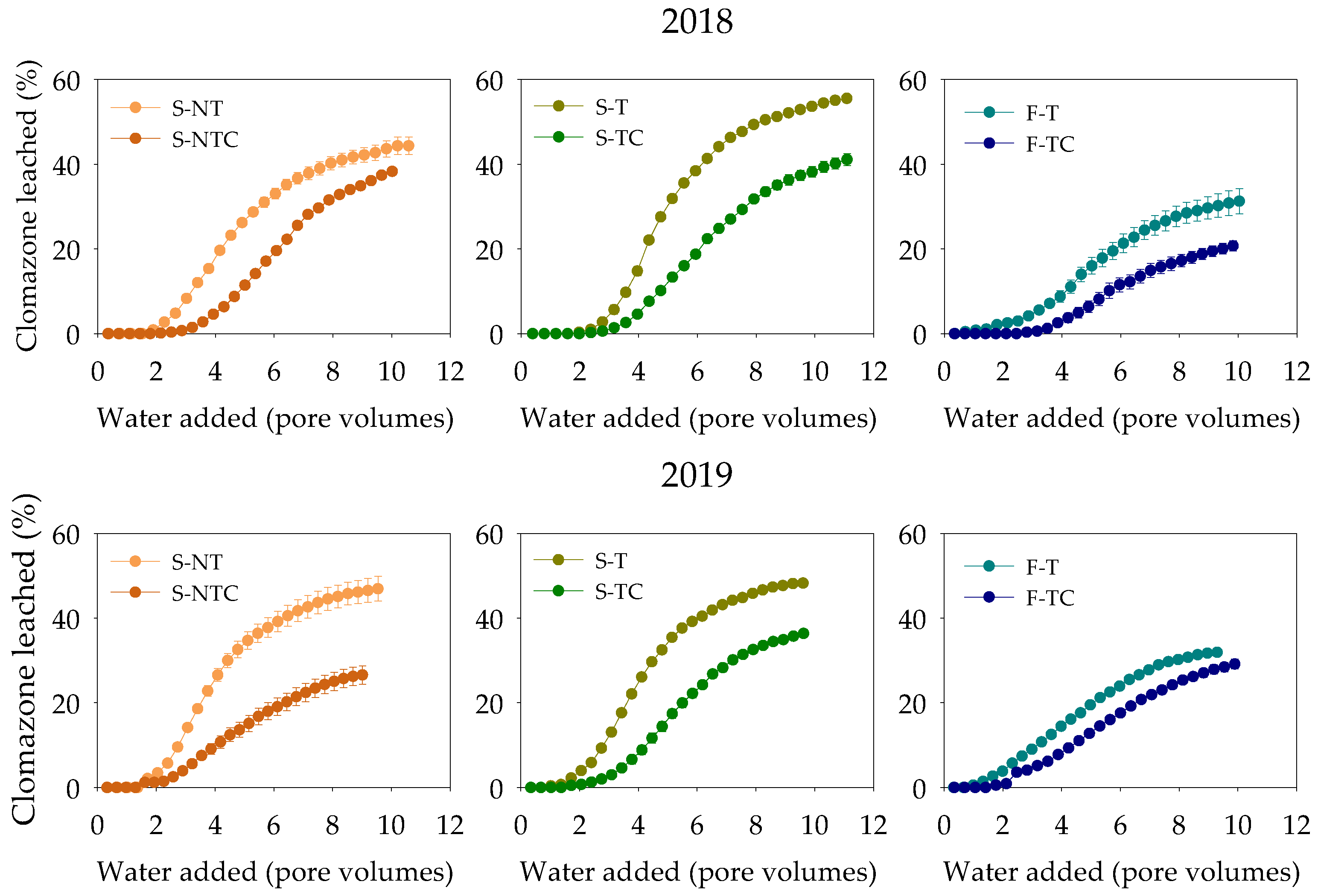
Figure 4 depicts the cumulative breakthrough curves for Clomazone for the different agricultural managements. For the F-T treatment, the Clomazone breakthroughs were below one pore volumes for both years of the study (Table 4), suggesting its high-water pollution potential under flooding managements. Nevertheless, the amendment caused significant increases in the initial pore volume, especially under tillage treatments, regardless of the irrigation management strategies (Table 4), probably associated with the improvement in important soil properties, such as TOC and HA. In fact, significant and negative correlations were observed between the initial pore volume and TOC (r = 0.516, p < 0.01) and HA (r = 0.498, p < 0.01).
Regarding the maximum leached concentration of Clomazone, for the unamended agricultural managements, it ranged from 0.969 to 2.44 μM (F-T and S-T, respectively) and from 0.633 to 1.49 μM (F-T and S-T, respectively) after four and five years of implementation, respectively (Table 4). Therefore, the implementation of sprinkler irrigation, especially under conventional tillage, could increase the maximum leached amount of Clomazone. However, in both years of the study, the amendment caused an important decrease in the maximum Clomazone concentration, especially under sprinkler irrigation (Table 4), due to high sorption capacity (Table 2). In fact, a significant and negative correlation was found between maximum concentration of Clomazone and kd (r = −0.644, p< 0.01).
For the different management systems, large amounts of total Clomazone leached were observed, with up to 55.6% of the pesticide applied. Comparable levels of Clomazone losses have been previously reported by other authors such as Gamiz et al. [26], who reported values of about 60% of Clomazone leached into a Mediterranean clay loam soil. This highlights the high leaching potential of Clomazone and its significant environmental and agronomic implications [65]. Specifically, the values of total Clomazone leached in the unamended managements ranged from 37.3 to 55.6% (F-T and S-T, respectively) and from 31.9 to 48.3% (F-T and S-T, respectively) after four and five years of their implementation, respectively (Table 4), highlighting a similar trend in the maximum amount of Clomazone leached. Indeed, the total Clomazone leached was significantly and positively correlated with the maximum concentration of Clomazone leached (r = 0.849, p < 0.01). Therefore, the implementation of sprinkler irrigation could increase Clomazone loss through leaching, at least in the medium term. These findings could be explained by the higher sorption of Clomazone under flooding compared to sprinkler agricultural systems, regardless of tillage management (Table 2). This is associated with changes in the physicochemical properties of the soil resulting from the implementation of these alternative agricultural management practices over the medium term (Table S1). In fact, it should be noted that during the first year of implementation, the capacity of Clomazone sorption was not significantly affected by the agricultural management strategies. The amount of Clomazone leached under F-T increased by factors of 1.36 and 1.33 compared to S-NT and S-T, respectively [15], highlighting the importance of timing. Furthermore, with regard to F-T treatment, the greater mobility of Clomazone observed in sprinkler irrigation systems (NT-S and T-S) can also be attributed to an increase in pesticide persistence (Table 3). In fact, a significant positive correlation was observed between the half-life and total Clomazone leached (r = 0.737, p < 0.01) when the correlation analysis was limited to unamended agricultural systems. Consequently, the adoption of sprinkler irrigation practices could increase the persistence of Clomazone, which may potentially enhance its weed control effectiveness; however, this could simultaneously increase the risk of groundwater contamination [12].
For both years of the study, the losses of Clomazone by leaching in amendment managements were significantly reduced compared to unamended agricultural managements, especially under sprinkler management, regardless of the tillage system (NT-C and ST-C). After four years of implementation, the total Clomazone leaching value decreased by a factor of 1.16 and 1.35 in NT-C and ST-C compared to NT and ST, respectively; after five years of implementation, they decreased by a factor of 1.76 and 1.33 in NT-C and ST-C compared to NT and ST, respectively (Table 4). These results indicate that the amendment ability to prevent Clomazone leaching is persistent, with significant effects remaining after five years. Other authors have reported similar results, also observing a reduction in Clomazone leaching capacity in soils amended with different types of amendments, such as biochar [26,27,56] and compost derived from olive mill waste [15]. However, medium- term effects were not evaluated. In these previous reports, the reduction in Clomazone mobility was attributed to an increase in sorption capacity following the application of amendments. In our study, we also found a significant and negative correlation between Kd and the total Clomazone leached (r = −0.759, p < 0.01), indicating that sorption is an important process in Clomazone leaching behavior [66]. Furthermore, performing a multiple regression analysis allows for the most accurate prediction of Clomazone leaching by combining DHA (X1) and HA (X2) using the following regression equation:
Total leached (%) = 63.1 − 0.525DHA (μg INTF g−1 h−1) − 14.2HA (g kg−1) (R2 = 0.838, p < 0.001)
These two variables accounted for 70.2% of the variation in Clomazone leaching. Consequently, the results of multiple regression suggested that DHA stimulation could reduce the risk of groundwater Clomazone contamination, probably associated with an increase in the degradation rate of the pesticide. Moreover, a significant and positive correlation between t1/2 and the total Clomazone leached (r = 0.384, p < 0.05) was found in our study, demonstrating the important relationship between the two processes (dissipation and leaching) influencing pesticide behavior. Furthermore, the regression equation showed that soil HA content is a very important property for reducing Clomazone mobility. Similar observations have been reported in several studies, which have shown that the transformation of organic matter into humic substances could play a crucial role in reducing pesticide loss through leaching [64]. For example, Gumasekara et al. [57] demonstrated the importance of HA in Clomazone sorption by soil, finding it can reduce herbicide mobility, as also shown in various studies with different types of non-ionic herbicides such as Clomazone [67,68].
Finally, the total amount of Clomazone extracted from the soil columns was significantly affected by the different treatments (p < 0.05), but their effects were not different between both years of the study (p > 0.05), as indicated by the treatment x year interaction (Table 4). The herbicide Clomazone exhibited a uniform distribution across the four soil-column sections under all treatments and in both years [15]. Thus, in the unamended agricultural managements strategies, the amount of Clomazone extracted ranged from 25.1 to 33.4 (Table 4). However, under sprinkler management, regardless of the tillage practices, the amendment increased the amount of Clomazone extracted from the soil column (S-NTC and S-TC), whereas under flooding management (F-TC), the amendment led to significant decreases, with 17.5 and 19.4% of Clomazone extracted from the soil columns. These trends in the amounts of extracted Clomazone were consistent with the persistence values (Table 3); there was a significant and positive correlation between extracted Clomazone and t1/2 in our study (r = 0.469, p < 0.01).

4. Conclusions

The medium-term implementation of sprinkler and/or no-tillage management practices, combined with organic amendment, can modify the soil’s properties and affect the environmental fate of Clomazone in rice crops. After five years of implementing sprinkler irrigation systems, Clomazone’s sorption capacity was reduced and its persistence increased compared to their values under traditional management (flooding and conventional tillage), resulting in higher leaching losses. These effects were largely mitigated by the addition of compost, which enhanced sorption and persistence while reducing leaching. The dehydrogenase activity and humic acid level were identified as key soil properties affecting the Clomazone leaching process. The combination of sprinkler irrigation and organic amendment may increase herbicide persistence while reducing water pollution risks, enhancing the sustainability of rice cropping systems. Although the present study provides valuable information on the medium-term effects of different agricultural management strategies on the environmental fate of Clomazone, further research under field conditions is needed to fully assess their effects and potential implications for ecotoxicity, weed management, and crop productivity.

Supplementary Materials

The following supporting information can be downloaded at https://www.mdpi.com/article/10.3390/agriculture16010058/s1, Table S1: Selected soil properties (0–20 cm depth).

Author Contributions

Conceptualization, L.V., D.F.-R., D.P. and A.L.-P.; methodology, L.V. and D.P.; software, L.V., M.P. and D.F.-R.; validation, D.F.-R., D.P. and A.L.-P.; formal analysis, L.V. and M.P.; investigation, L.V., M.P. and D.F.-R.; resources, A.L.-P.; data curation, L.V., M.P. and D.P.; writing—original draft preparation, L.V., D.F.-R. and D.P.; writing—review and editing, L.V., D.F.-R., D.P. and A.L.-P.; visualization, L.V., D.P. and A.L.-P.; supervision, D.P. and A.L.-P.; project administration, A.L.-P.; funding acquisition, A.L.-P. All authors have read and agreed to the published version of the manuscript.

Funding

This research study was funded by Grant TED2021–129790B-I00, funded by MCIN/AEI/10.13039/501100011033 and by European Union NextGeneration EU/PRTR; Grant RTI2018–095461-B-I00 and PID2021–123062OB-100, funded by FEDER, UE, and Grant GR21038; and by GR24018, funded by the Extremadura Regional Government. Manuel Perez is the recipient of a grant from the Ministry of Education, Science, and Vocational Training of the Regional Government of Extremadura and the European Social Fund Plus (ESF+) for financing predoctoral contract PD23023.

Institutional Review Board Statement

Not applicable.

Data Availability Statement

The original contributions presented in this study are included in the article/Supplementary Material. Further inquiries can be directed to the corresponding author.

Conflicts of Interest

The authors declare no conflicts of interest.

References

  1. He, X.; Batáry, P.; Zou, Y.; Zhou, W.; Wang, G.; Liu, Z.; Bai, Y.; Gong, S.; Zhu, Z.; Settele, J.; et al. Agricultural diversification promotes sustainable and resilient global rice production. Nat. Food 2023, 4, 788–796. [Google Scholar] [CrossRef]
  2. Ali, W.; Mao, K.; Zhang, H.; Junaid, M.; Xu, N.; Rasool, A.; Feng, X.; Yang, Z. Comprehensive review of the basic chemical behaviours, sources, processes, and endpoints of trace element contamination in paddy soil-rice systems in rice-growing countries. J. Hazard. Mater. 2020, 397, 122720. [Google Scholar] [CrossRef]
  3. Zhang, H.; Jing, W.; Zhao, B.; Wang, W.; Xu, Y.; Zhang, W.; Gu, J.; Liu, L.; Wang, Z.; Yang, J. Alternative fertilizer and irrigation practices improve rice yield and resource use efficiency by regulating source-sink relationships. Field Crops Res. 2021, 265, 108124. [Google Scholar] [CrossRef]
  4. Ishfaq, M.; Farooq, M.; Zulfiqar, U.; Hussain, S.; Akbar, N.; Nawaz, A.; Anjum, S.A. Alternate wetting and drying: A water-saving and ecofriendly rice production system. Agric. Water Manag. 2020, 241, 106363. [Google Scholar] [CrossRef]
  5. Mondal, S.; Khan, M.I.R.; Entila, F.; Dixit, S.; Pompe, P.C.; Panna Ali, M.; Pittendrigh, B.; Septiningsih, E.M.; Ismail, A.M. Responses of AG1 and AG2 QTL introgression lines and seed pre-treatment on growth and physiological processes during anaerobic germination of rice under flooding. Sci. Rep. 2020, 10, 10214. [Google Scholar] [CrossRef]
  6. Gusmaroli, L.; Buttiglieri, G.; Petrovic, M. The EU watch list compounds in the Ebro delta region: Assessment of sources, river transport, and seasonal variations. Environ. Pollut. 2019, 253, 606–615. [Google Scholar] [CrossRef] [PubMed]
  7. Calha, I.; Oliveira, M.D.F.; Reis, P. Weed management challenges in rice cultivation in the context of pesticide use reduction: A survey approach. Sustainability 2023, 15, 244. [Google Scholar] [CrossRef]
  8. Rodríguez-Seijo, A.; Pérez-Rodríguez, P.; Arias-Estévez, M.; Gómez-Armesto, A.; Conde-Cid, M.; Santás-Miguel, V.; Campillo-Cora, C.; Ollio, I.; Lloret, E.; Martínez-Martínez, S.; et al. Occurrence, persistence and risk assessment of pesticide residues in European wheat fields: A continental scale approach. J. Hazard. Mater. 2025, 494, 138291. [Google Scholar] [CrossRef] [PubMed]
  9. López-Piñeiro, A.; Martín-Franco, C.; Terrón-Sánchez, J.; Vicente, L.A.; Fernández-Rodríguez, D.; Albarrán, Á.; Nunes, J.M.R.; Peña, D. Environmental fate and efficiency of bispyribac-sodium in rice soils under conventional and alternative production systems affected by fresh and aged biochar amendment. Sci. Total Environ. 2022, 847, 157651. [Google Scholar] [CrossRef]
  10. Cervantes-Díaz, A.; Alonso-Prados, E.; Alonso-Prados, J.L.; Sandín-España, P. Assessing the effect of organic amendments on the degradation of profoxydim in paddy soils: Kinetic modeling and identification of degradation products. Sci. Total Environ. 2024, 912, 169072. [Google Scholar] [CrossRef]
  11. Bwire, D.; Saito, H.; Sidle, R.C.; Nishiwaki, J. Water Management and Hydrological Characteristics of Paddy-Rice Fields under Alternate Wetting and Drying Irrigation Practice as Climate Smart Practice: A Review. Agronomy 2024, 14, 1421. [Google Scholar] [CrossRef]
  12. Vicente, L.A.; Peña, D.; Fernández-Rodríguez, D.; Albarrán, Á.; Rato Nunes, J.M.; López-Piñeiro, A. Sorption, persistence and leaching of clomazone in rice environments under varying severity of alternate wetting and drying irrigation management with and without biochar amendment. J. Environ. Manag. 2025, 386, 125761. [Google Scholar] [CrossRef]
  13. Sánchez-Llerena, J.; López-Piñeiro, A.; Albarrán, A.; Peña, D.; Becerra, D.; Rato-Nunes, J.M. Short and long-term effects of different irrigation and tillage systems on soil properties and rice productivity under Mediterranean conditions. Eur. J. Agron. 2016, 77, 101–110. [Google Scholar] [CrossRef]
  14. Pinto, M.A.B.; Parfitt, J.M.B.; Timm, L.C.; Faria, L.C.; Concenço, G.; Stumpf, L.; Nörenberg, B.G. Sprinkler irrigation in lowland rice: Crop yield and its components as a function of water availability in different phenological phases. Field Crops Res. 2020, 248, 107714. [Google Scholar] [CrossRef]
  15. Fernández, D.; Gómez, S.; Albarrán, A.; Peña, D.; Rozas, M.A.; Rato-Nunes, J.M.; López-Piñeiro, A. How the environmental fate of clomazone in rice fields is influenced by amendment with olive-mill waste under different regimes of irrigation and tillage. Pest Manag. Sci. 2020, 76, 1795–1803. [Google Scholar] [CrossRef]
  16. Rato Nunes, J.; Cabral, F.; López-Piñeiro, A. Short-term effects on soil properties and wheat production from secondary paper sludge application on two Mediterranean agricultural soils. Bioresour. Technol. 2008, 99, 4935–4942. [Google Scholar] [CrossRef]
  17. Xue, C.; Yang, X.; Bouman, B.A.M.; Deng, W.; Zhang, Q.; Yan, W.; Zhang, T.; Rouzi, A.; Wang, H. Optimizing yield, water requirements, and water productivity of aerobic rice for the North China. Plain Irrig. Sci. 2008, 26, 459–474. [Google Scholar] [CrossRef]
  18. Rana, B.; Parihar, C.M.; Jat, M.L.; Patra, K.; Nayak, H.S.; Reddy, K.S.; Sarkar, A.; Anand, A.; Naguib, W.; Gupta, N.; et al. Combining sub-surface fertigation with conservation agriculture in intensively irrigated rice under rice-wheat system can be an option for sustainably improving water and nitrogen use-efficiency. Field Crops Res. 2023, 302, 109074. [Google Scholar] [CrossRef]
  19. Girsang, S.S.; Quilty, J.R.; Correa, T.Q.; Sanchez, P.B.; Buresh, R.J. Rice yield and relationships to soil properties for production using overhead sprinkler irrigation without soil submergence. Geoderma 2019, 352, 277–288. [Google Scholar] [CrossRef]
  20. Çolak, Y.B. Comparison of aerobic rice cultivation using drip systems with conventional flooding. J. Agric. Sci. 2021, 159, 544–556. [Google Scholar] [CrossRef]
  21. Muñoz, A.; López-Piñeiro, A.; Ramírez, M. Soil quality attributes of conservation management regimes in a semi-arid region of south western Spain. Soil Tillage Res. 2007, 95, 255–265. [Google Scholar] [CrossRef]
  22. Khalil, J.; Jaafar, A.A.; Habib, H.; Bouguerra, S.; Nogueira, V.; Rodríguez-Seijo, A. The impact of olive mill wastewater on soil properties, nutrient and heavy metal availability—A study case from Syrian vertisols. J. Environ. Manag. 2024, 351, 119861. [Google Scholar] [CrossRef]
  23. Muscolo, A.; Papalia, T.; Settineri, G.; Romeo, F.; Mallamaci, C. Three different methods for turning olive pomace in resource: Benefits of the end products for agricultural purpose. Sci. Total Environ. 2019, 662, 1–7. [Google Scholar] [CrossRef]
  24. Ameziane, H.; Nounah, A.; Khamar, M.; Zouahri, A. Composting olive pomace: Evolution of organic matter and compost quality. Agron. Res. 2020, 18, 5–17. [Google Scholar] [CrossRef]
  25. Zipori, I.; Erel, R.; Yermiyahu, U.; Ben-Gal, A.; Dag, A. Sustainable Management of Olive Orchard Nutrition: A Review. Agriculture 2020, 10, 11. [Google Scholar] [CrossRef]
  26. Gámiz, B.; Velarde, P.; Spokas, K.A.; Hermosin, M.C.; Cox, L. Biochar Soil Additions Affect Herbicide Fate: Importance of Application Timing and Feedstock Species. J. Agric. Food Chem. 2017, 65, 3109–3117. [Google Scholar] [CrossRef] [PubMed]
  27. Da Silva, M.R.F.; Queiroz, M.E.L.R.; Neves, A.A.; da Silva, A.A.; Oliveira, A.F.; de Oliveira, R.L.; Azevedo, M.M.; Pereira, G.A.M. Effect of the incorporation of sugarcane bagasse biochar in leaching and bioavailability of clomazone in soil. J. Braz. Chem. Soc. 2019, 30, 2386–2394. [Google Scholar] [CrossRef]
  28. Li, R.; Hu, W.; Liu, H.; Huang, B.; Jia, Z.; Liu, F.; Zhao, Y.; Khan, K.S. Occurrence, distribution and ecological risk assessment of herbicide residues in cropland soils from the Mollisols region of Northeast China. J. Hazard. Mater. 2024, 465, 133054. [Google Scholar] [CrossRef]
  29. Andrés, A.; Concenço, G.; Theisen, G.; Vidotto, F.; Ferrero, A. Selectivity and weed control efficacy of pre- and post-emergence applications of clomazone in Southern Brazil. Crop Prot. 2013, 53, 103. [Google Scholar] [CrossRef]
  30. Mattice, J.D.; Skulman, B.W.; Norman, R.J.; Gbur, E.E. Analysis of river water for rice pesticides in eastern Arkansas from 2002 to 2008. J. Soil Water Conserv. 2010, 65, 130–140. [Google Scholar] [CrossRef]
  31. Tomco, P.L.; Holstege, D.M.; Wei, Z.; Tjeerdema, R.S. Microbial degradation of clomazone under simulated California rice field conditions. J. Agric. Food Chem. 2010, 58, 3674–3680. [Google Scholar] [CrossRef]
  32. Zanella, R.; Primel, E.G.; Machado, S.L.; Gonçalves, F.F.; Marchezan, E. Monitoring of the herbicide clomazone in environmental water samples by solid-phase extraction and high-performance liquid chromatography with ultraviolet detection. Chromatographia 2002, 55, 573–577. [Google Scholar] [CrossRef]
  33. He, H.; Huang, J.; Zhao, Z.; Feng, W.; Zheng, X.; Du, P. Clomazone impact on fungal network complexity and stability. Front. Microbiol. 2023, 14, 1124127. [Google Scholar] [CrossRef]
  34. Stenert, C.; De Mello, I.C.M.F.; Pires, M.M.; Knauth, D.S.; Katayama, N.; Maltchik, L. Responses of macroinvertebrate communities to pesticide application in irrigated rice fields. Environ. Monit. Assess. 2018, 190, 74. [Google Scholar] [CrossRef]
  35. Schmidt, A.; Auge, H.; Brandl, R.; Heong, K.L.; Hotes, S.; Settele, J.; Villareal, S.; Schädler, M. Small-scale variability in the contribution of invertebrates to litter decomposition in tropical rice fields. Basic Appl. Ecol. 2015, 16, 674–680. [Google Scholar] [CrossRef]
  36. Cueff, S.; Alletto, L.; Dumény, V.; Benoit, P.; Pot, V. Adsorption and degradation of the herbicide nicosulfuron in a stagnic Luvisol and Vermic Umbrisol cultivated under conventional or conservation agriculture. Environ. Sci. Pollut. Res. Int. 2021, 28, 15934–15946. [Google Scholar] [CrossRef]
  37. Giuliano, S.; Alletto, L.; Deswarte, C.; Perdrieux, F.; Daydé, J.; Debaeke, P. Reducing herbicide use and leaching in agronomically performant maize-based cropping systems: An 8-year study. Sci. Total Environ. 2021, 788, 147695. [Google Scholar] [CrossRef]
  38. Bedos, C.; Alletto, L.; Durand, B.; Fanucci, O.; Brut, A.; Bourdat-Deschamps, M.; Giuliano, S.; Loubet, B.; Ceschia, E.; Benoit, P. Observed volatilization fluxes of S-metolachlor and benoxacor applied on soil with and without crop residues. Environ. Sci. Pollut. Res. Int. 2017, 24, 3985–3996. [Google Scholar] [CrossRef] [PubMed]
  39. Alletto, L.; Coquet, Y.; Benoit, P.; Heddadj, D.; Barriuso, E. Tillage management effects on pesticide fate in soils. A review. Agron. Sustain. Dev. 2010, 30, 367–400. [Google Scholar] [CrossRef]
  40. Cañero, A.I.; Becerra, D.; Cornejo, J.; Hermosín, M.C.; Albarrán, Á.; López-Piñeiro, A.; Cox, L. Transformation of organic wastes in soil: Effect on bentazone behavior. Sci. Total Environ. 2012, 433, 198–205. [Google Scholar] [CrossRef]
  41. Ahangar, A.G.; Smernik, R.J.; Kookana, R.S.; Chittleborough, D.J. Separating the effects of organic matter–mineral interactions and organic matter chemistry on the sorption of diuron and phenanthrene. Chemosphere 2008, 72, 886–890. [Google Scholar] [CrossRef]
  42. López-Piñeiro, A.; Vicente, L.; Fernández-Rodríguez, D.; Albarrán, Á.; Nunes, J.M.R.; Peña, D. Effects of Sustainable Rice Management on the Behavior and Bioefficacy of Bispyribac-Sodium: A Medium-Term Study. Sustainability 2024, 16, 4157. [Google Scholar] [CrossRef]
  43. Cheng, H.; Xing, D.; Twagirayezu, G.; Lin, S.; Gu, S.; Tu, C.; Hill, P.W.; Chadwick, D.R.; Jones, D.L.A. Effects of field-aging on the impact of biochar on herbicide fate and microbial community structure in the soil environment. Chemosphere 2024, 348, 140682. [Google Scholar] [CrossRef]
  44. Roldán, A.; Salinas-García, J.R.; Alguacil, M.M.; Caravaca, F. Changes in soil enzyme activity, fertility, aggregation and C sequestration mediated by conservation tillage practices and water regime in a maize field. Appl. Soil Ecol. 2005, 30, 11–20. [Google Scholar] [CrossRef]
  45. Araya, T.; Cornelis, W.M.; Nyssen, J.; Govaerts, B.; Getnet, F.; Bauer, H.; Amare, K.; Raes, D.; Haile, M.; Deckers, J. Medium-term effects of conservation agriculture based cropping systems for sustainable soil and water management and crop productivity in the Ethiopian highlands. Field Crops Res. 2012, 132, 53–62. [Google Scholar] [CrossRef]
  46. Li, C.F.; Yang, J.; Zhang, C.; Zhang, Z.S.; Zheng, M.; Ahmad, S.; Cao, C.G. Effects of short-term tillage and fertilization on grain yields and soil properties of rice production systems in central China. J. Food Agric. Environ. 2010, 8, 577–584. [Google Scholar]
  47. López-Fando, C.; Pardo, M.T. Changes in soil chemical characteristics with different tillage practices in a semi-arid environment. Soil Tillage Res. 2009, 104, 278–284. [Google Scholar] [CrossRef]
  48. Liben, F.M.; Tadesse, B.; Tola, Y.T.; Wortmann, C.S.; Kim, H.K.; Mupangwa, W. Conservation agriculture effects on crop productivity and soil properties in Ethiopia. Agron. J. 2018, 110, 758–767. [Google Scholar] [CrossRef]
  49. Gómez, S.; Fernández, D.; Peña, D.; Albarrán, Á.; López-Piñeiro, A. Be-haviour of bispyribac-sodium in aerobic and anaerobic rice-growing con-ditions with and without olive-mill waste amendment. Soil Tillage Res. 2019, 194, 104333. [Google Scholar] [CrossRef]
  50. Peña, D.; Albarrán, Á.; López-Piñeiro, A.; Rato-Nunes, J.M.; Sánchez-Llerena, J.; Becerra, D. Impact of oiled and de-oiled olive mill waste amendments on the sorption, leaching, and persistence of S-metolachlor in a calcareous clay soil. J. Environ. Sci. Health B 2013, 48, 767–775. [Google Scholar] [CrossRef]
  51. Cao, D.; Peng, W.; Xu, H.; Fu, X.; Gong, X.; Yu, S.; Wei, H.; Zhou, Q.; Huang, Y. Bioavailability and phytotoxicity of clomazone to corn depend on soil characteristics and can be estimated by in situ pore water. Pest Manag. Sci. 2025, 81, 1316–1323. [Google Scholar] [CrossRef] [PubMed]
  52. Pereira, G.A.M.; Rodrigues, D.A.; Fonseca, L.A.B.V.; de Jesus Passos, A.B.R.J.; da Silva, M.R.F.; Silva, D.V.; da Silva, A.A. Sorption and desorption behavior of herbicide clomazone in soils from Brazil. J. Biosci. 2018, 34, 1496–1504. [Google Scholar] [CrossRef]
  53. Đurović-Pejčev, R.D.; Radmanović, S.B.; Tomić, Z.P.; Kaluderović, L.M.; Bursić, V.P.; Šantrić, L.R. Adsorption–desorption behaviour of clomazone in Regosol and Chernozem agricultural soils. J. Serb. Chem. Soc. 2020, 85, 809–819. [Google Scholar] [CrossRef]
  54. Spark, K.M.; Swift, R.S. Effect of soil composition and dissolved organic matter on pesticide sorption. Sci. Total Environ. 2002, 298, 147–161. [Google Scholar] [CrossRef]
  55. Cabrera, A.; Trigo, C.; Cox, L.; Celis, R.; Cornejo, J. A comparative study of the use of organoclay-based formulations and organic amendment to reduce the leaching of the herbicide MCPA in soil. Clean-Soil Air Water 2008, 36, 990–995. [Google Scholar] [CrossRef][Green Version]
  56. López-Piñeiro, A.; Sánchez-Terrón, J.; Martín-Franco, C.; Peña Abades, D.; Vicente, L.A.; Gómez, S.; Fernández-Rodríguez, D.; Albarrán, Á. Impacts of fresh and aged holm-oak biochar on clomazone behaviour in rice cropping soils after transition to sprinkler irrigation. Geoderma 2022, 413, 115768. [Google Scholar] [CrossRef]
  57. Gunasekara, A.S.; Dela Cruz, I.D.P.; Curtis, M.J.; Claassen, V.P.; Tjeerdema, R.S. The behavior of clomazone in the soil environment. Pest Manag. Sci. 2009, 65, 711–716. [Google Scholar] [CrossRef]
  58. Tomco, P.L.; Holmes, W.E.; Tjeerdema, R.S. Biodegradation of clomazone in a california rice field soil: Carbon allocation and community effects. J. Agric. Food Chem. 2013, 61, 2618–2624. [Google Scholar] [CrossRef]
  59. Cao, J.; Diao, X.-P.; Hu, J.-Y. Hydrolysis and photolysis of herbicide clomazone in aqueous solutions and natural water under abiotic conditions. J. Integr. Agric. 2013, 12, 2074–2082. [Google Scholar] [CrossRef]
  60. Marín-Benito, J.M.; Andrades, M.S.; Sánchez-Martín, M.J.; Rodríguez-Cruz, M.S. Dissipation of Two Acidic Herbicides in Agricultural Soil: Impact of Green Compost Application, Herbicide Rate, and Soil Moisture. Agriculture 2025, 15, 552. [Google Scholar] [CrossRef]
  61. Rong, L.; Wu, X.; Xu, J.; Dong, F.; Liu, X.; Xu, H.; Cao, J.; Zheng, Y. Clomazone improves the interactions between soil microbes and affects C and N cycling functions. Sci. Total Environ. 2021, 770, 144730. [Google Scholar] [CrossRef] [PubMed]
  62. Szpyrka, E.; Słowik-Borowiec, M.; Książek-Trela, P.; Zwolak, A.; Podbielska, M. The difference in dissipation of clomazone and metazachlor in soil under field and laboratory conditions and their uptake by plants. Sci. Rep. 2020, 10, 3747. [Google Scholar] [CrossRef] [PubMed]
  63. Mervosh, T.L.; Sims, G.K.; Stoller, E.W. Clomazone Fate in Soil As Affected by Microbial Activity, Temperature, and Soil Moisture. J. Agric. Food Chem. 1995, 43, 537–543. [Google Scholar] [CrossRef]
  64. Ćwieląg-Piasecka, I. Soil Organic Matter Composition and pH as Factors Affecting Retention of Carbaryl, Carbofuran and Metolachlor in Soil. Molecules 2023, 28, 5552. [Google Scholar] [CrossRef]
  65. Włodarczyk, M.; Siwek, H. Influence of Formulation on Mobility of Clomazone in Soil. Bull. Environ. Contam. Toxicol. 2016, 97, 582–587. [Google Scholar] [CrossRef]
  66. Ðurović-Pejčev, R.; Radmanović, S.; Tomić, Z.P.; Kaluđerović, L.; Đorđević, T. Characterization of the clomazone sorption process in four agricultural soils using different kinetic models. Environ. Sci. Process. Impacts 2023, 25, 542–553. [Google Scholar] [CrossRef]
  67. Carpio, M.J.; Rodríguez-Cruz, M.S.; Sánchez-Martín, M.J.; Marín-Benito, J.M. Pesticide Fate in Soils Under Different Agricultural Management Practices. Handb. Environ. Chem. 2022, 113, 251–286. [Google Scholar] [CrossRef]
  68. Peña Abades, D.; Albarrán, Á.; Gómez, S.; Fernández-Rodríguez, D.; Nunes, J.M.; López-Piñeiro, A. Effects of olive mill wastes with different degrees of maturity on behaviour of S-metolachlor in three soils. Geoderma 2019, 348, 86–96. [Google Scholar] [CrossRef]
Figure 1. Distribution of rice cultivation areas: study site location (a) and arrangement of experimental plots (b).
Agriculture 16 00058 g001
Figure 2. The medium-term influence of the management systems on the cumulative breakthrough curves of Clomazone. Error bars denote one standard error of the mean.
Agriculture 16 00058 g002
Figure 3. Medium-term influence of different management systems on Clomazone dissipation (●) and dehydrogenase activity (○). Error bars denote one standard error of the mean.
Agriculture 16 00058 g003
Figure 4. The medium-term effects of the different management regimes on cumulative leaching curves of Clomazone. Error bars denote one standard error of the mean.
Agriculture 16 00058 g004
Table 1. Physicochemical properties of Clomazone.
PropertyValue
Chemical name2-(2-chlorobenzyl)-4,4-dimethyl-1,2-oxazolidin-3-one
Molecular formulaC12H14ClNO2
Molecular weight239.7 g mol−1
Physical state (25 °C)Solid crystalline
Water solubility1.21 g L−1
Vapor pressure27.0 mPa
Melting point33.9 °C
Technical-grade purity99.8%
HPLC detection limit0.015 µM
HPLC quantification limit0.047 µM
Table 2. Clomazone adsorption–desorption parameters.
nfR2sorptionKd
(L kg−1)
Kdoc%D R2desorption
2018
S-NT0.852 aA0.9991.16 aA1.25 bA32.7 aA0.973
S-NTC0.855 aA0.9951.93 dA1.16 aA37.7 cA0.975
S-T0.871 abA0.9971.35 bA1.35 cA34.4 abA0.999
S-TC0.894 abA0.9992.08 eA1.24 bA37.7 cA0.999
F-T0.854 aA0.9991.60 cA1.57 dB36.8 bcA0.997
F-TC0.919 bA0.9992.97 fA1.40 cA36.0 bcA0.998
2019
S-NT0.827 aA0.9911.26 aA1.30 aA45.4 abB0.997
S-NTC0.919 bA0.9872.41 cB1.74 bB40.7 aA0.996
S-T0.846 aA0.9831.33 aA1.25 aA48.6 bcB0.988
S-TC0.862 abA0.9952.35 cB1.44 aB51.2 bcB0.999
F-T0.877 abA0.9881.66 bA1.27 aA45.4 abB0.967
F-TC0.914 bA0.9943.23 dA1.75 bB53.2 cB0.911
T* ******
YNS *********
T × Y* ******
The data for nf, Kd, Kdoc, and desorption (D) are mean values. Treatments are as follows: sprinkler irrigation combined with no tillage or with a single compost amendment (S-NT and S-NTC, respectively); conventional tillage without or with a single compost amendment (S-T and S-TC, respectively); and flooding irrigation with conventional tillage without or with a single compost amendment (F-T and F-TC, respectively). ANOVA factors: T: Treatment; Y: Year; T × Y: Interaction Treatment × Year. F-values indicate significance at the * p < 0.05; ** p < 0.01; *** p < 0.001 levels; NS: not significant. Different letters indicate differences (p < 0.05) between treatments in the same year (lower-case letters) and between years within the same treatments (upper-case letters). R2 is the coefficient of determination. The percentage of D was calculated after three desorption cycles.
Table 3. Clomazone dissipation parameters and dehydrogenase activity.
t1/2
(Days)
R2DHA
(µg INTF g−1 h−1)
2018
S-NT37.0 bA0.9709.75 bB
S-NTC60.0 eB0.9699.43 abA
S-T40.8 cA0.9556.01 aB
S-TC45.4 dA0.9828.52 abA
F-T12.9 aA0.85014.0 cA
F-TC10.4 aA0.82034.8 dA
2019
S-NT52.9 dB0.9898.67 cA
S-NTC57.4 eA0.94610.4 dB
S-T48.9 cA0.9794.85 aA
S-TC65.0 fB0.9517.93 bB
F-T15.9 bB0.88236.4 fB
F-TC11.1 aB0.84035.0 eA
T*** ***
Y*** ***
T × Y*** ***
Half-lives: t1/2; DA: dehydrogenase activity considering all incubation times under soil condition. Treatments are as follows: sprinkler irrigation combined with no tillage or with a single compost amendment (S-NT and S-NTC, respectively); conventional tillage without or with a single compost amendment (S-T and S-TC, respectively); flooding irrigation with conventional tillage without or with a single compost amendment (F-T and F-TC, respectively). ANOVA factors: T: Treatment; Y: Year; T × Y: Interaction Treatment × Year. F-values indicate significance at the *** p < 0.001 levels; NS: not significant. Different letters indicate differences (p < 0.05) between treatment in the same year (lower-case letters) and between years within the same treatment (upper-case letters).
Table 4. Clomazone leaching parameters.
Initial Pore
Volume
Max. Concentration
Leached (µM)
Total
Leached (%)
Total
Extracted (%)
2018
S-NT1.89 bB1.40 bA44.4 dA25.9 bA
S-NTC2.15 cB1.08 abB38.3 bA40.9 cA
S-T1.98 bB2.44 cB55.6 eB25.3 bA
S-TC2.38 dB1.22 abB41.1 cA30.1 bA
F-T0.717 aA0.969 abA37.3 bB30.2 bA
F-TC2.81 eB0.679 aA20.7 aA17.5 aA
2019
S-NT1.70 cA1.39 bA46.9 bA25.1 bA
S-NTC1.61 cA0.635 aA26.6 aA38.6 cA
S-T1.03 bA1.49 bA48.3 bA26.3 bA
S-TC1.72 cA0.986 aA36.4 aA41.6 cA
F-T0.996 aB0.633 aA31.9 aA33.4 bA
F-TC1.77 cA0.567 aA29.1 aB19.4 aA
T**********
Y******NS
T × Y***NS**NS
The data are presented as means. Treatments are as follows: sprinkler irrigation combined with no tillage or with a single compost amendment (S-NT and S-NTC, respectively); conventional tillage without or with a single compost amendment (S-T and S-TC, respectively); flooding irrigation with conventional tillage without or with a single compost amendment (F-T and F-TC, respectively). ANOVA factors: T: Treatment; Y: Year; T × Y: Interaction Treatment × Year. F-values indicate significance at the * p < 0.05; ** p < 0.01; *** p < 0.001 levels; NS: not significant. Different letters indicate differences (p < 0.05) between treatment in the same year (lower-case letters) and between years within the same treatment (upper-case letters). Pore volume for initiation of the herbicide’s leaching.
Disclaimer/Publisher’s Note: The statements, opinions and data contained in all publications are solely those of the individual author(s) and contributor(s) and not of MDPI and/or the editor(s). MDPI and/or the editor(s) disclaim responsibility for any injury to people or property resulting from any ideas, methods, instructions or products referred to in the content.