Article

Rural Development Strategies in Border Areas: The Case of Sierra de San Pedro—Los Baldíos (Extremadura, Spain)


by
Francisco Javier Castellano-Álvarez
1,*,
Alejandro Jorge Márquez Mateo
2 and
María Durán-Pacheco
2
1
Economy Department, University of Extremadura, 10071 Cáceres, Spain
2
Faculty of Business, Finance and Tourism, University of Extremadura, 10071 Cáceres, Spain
*
Author to whom correspondence should be addressed.
Agriculture 2025, 15(24), 2604; https://doi.org/10.3390/agriculture15242604
Submission received: 24 November 2025 / Revised: 13 December 2025 / Accepted: 15 December 2025 / Published: 16 December 2025

Abstract

Taking as a reference a region located on the border between Spain and Portugal, this paper analyses how European rural development programs take into account this borderline nature in order to implement their development strategies. The case study methodology allows for an in-depth analysis of the investments implemented and the assessments of the entrepreneurs who carry them out. The results show the relevance of tourism projects within the investments made; however, the paradox is that it is precisely this type of project, and especially those aimed at creating rural accommodation, which have the highest percentage of failed investments. The results confirm the growing relevance of ‘non-productive’ actions led by local entities and aimed at the provision of public services. The interviews with the promoters show that, with the exception of some of the agricultural valorization actions, the vast majority of the projects carried out lack a cross-border vision. The development strategy of this county is not substantially different from that implemented by any other county. This is an interesting lesson since, if the same were happening in other border territories, the development strategies implemented would ignore the specific potentialities of this type of border region.

1. Introduction

Since the 1980s, the European Commission (EC), drawing on a series of key publications (including Guidelines for European Agriculture [1], the CAP Green Paper [2], the Communication ‘The Future of Rural Areas’ [3], and the Report ‘The Development and Future of the Common Agricultural Policy’ [4]) identified clear signs of the exhaustion within an agricultural policy framework marked by a dual productivist and protectionist orientation. Against this backdrop, the early 1990s witnessed the first major reform of the policy, undertaken in part to meet the binding commitments arising from the GATT Uruguay Round negotiations on international agricultural trade [5,6]. The Common Agricultural Policy (CAP) thus embarked on a prolonged process of transformation, transitioning from a productivist model (one that unequivocally equated rural development with agricultural development) to an income-support framework characterized by decoupled payments. This reorientation connected the development aspirations of the European rural milieu to an emerging paradigm aimed at promoting the economic diversification of rural territories. This was the context in which the EC approved the LEADER I Initiative [7], endorsing the aforementioned strategy of economic diversification with the objective of mitigating the adverse effects that the impending CAP reforms were expected to have on rural and agricultural incomes.
The LEADER I call for proposals emerged at a time when, according to the European Economic and Social Council [8], it had become evident that ‘the Structural Funds were unable to achieve the economic and social cohesion referred to in the Single Act’. Since then, the implementation of the Leader methodology has remained a constant feature of rural development in Europe. Following LEADER I, the LEADER II [9] and LEADER + [10] initiatives were adopted, consolidating an endogenous, participatory, multisectorial, and integrated development model known as the ‘Leader Approach’, whose characteristics have been extensively analyzed [11,12,13,14,15,16,17,18,19,20,21]. Moreover, the expectations generated by the initial LEADER calls prompted several countries, including Spain, to promote programs inspired by the Leader model that would allow regions excluded from the Initiative to apply the same development strategies, giving rise to PRODER I [22] and PRODER II [23].
However, despite the considerable interest shown by the European rural milieu in the implementation of these programs, their budgetary allocations remain negligible compared with other types of interventions characteristic of regional or agricultural policies [24,25,26,27,28,29]. Confronted with this paradox, González Regidor [30] argues that the true added value of these programs lies in the methodology applied rather than in the volume of investment involved. Elements such as the territorial scope of intervention [31], population participation [32,33,34,35,36,37,38,39,40], social capital [41,42,43,44,45,46,47,48,49,50,51], and the so-called intangibles of rural development [52,53] are particularly significant within this methodological framework.
To address the long-standing objective of economic diversification, these programs are structured around investments classified into “productive” and “non-productive” measures. Two measures fall into the ‘non-productive’ category. The first is intended to finance the operating costs of the Local Action Group (LAG) and the Rural Development Centre (CEDER), which constitute the organizational and technical bodies responsible for decision-making and for implementing the development strategy. The second measure encompasses a broad range of actions aimed at restoring cultural heritage and providing various public services; these initiatives are promoted by public authorities (either the LAG itself in the case of supra-local actions, or local councils for local-level projects). In turn, there are three ‘productive’ measures which adopt a cross-cutting approach to the development of different economic sectors: rural tourism; SMEs, crafts and services; and agricultural valorization and marketing of agricultural products [54].
Among the aforementioned productive measures, the one aimed at promoting rural tourism has arguably received the greatest attention from the scientific community. Bryden [55] explored the potential of this sector as an instrument of rural development; Patmore [56] and Butler et al. [57], highlighted the emerging recreational demands placed on rural areas and the opportunities these created for the tourism sector; Lane [58], Sharpley and Roberts [59], through their efforts to conceptualize and define this new phenomenon of rural tourism, may be considered some of the pioneers in the study of this topic. Other contributions could also be added, such as those of Perdue et al. [60], which have become essential references for scholars interested in local residents’ perception of the tourism phenomenon [61]. Indeed, the multiple interactions between the activation of social capital and the practice of rural tourism currently constitute a prominent line of research [62,63,64], alongside many others which, beyond the scope of endogenous rural development programs, underscore the academic interest that this subject continues to generate. Some of these lines of inquiry focus on the relationship between the rural environment and the various ways in which tourism makes use of its resources through the pursuit of health and well-being [65], culture [66], wine tourism [67,68], and agritourism [69,70,71], among others. Beyond the different modalities of tourism in rural areas, another notable area of research concerns the management of tourist establishments [72] and the role that ethical considerations may play in their management [73,74].
However, if we set aside the aforementioned diversity of research lines and analyze the literature that specifically links rural tourism to the implementation of endogenous development programs, it quickly becomes evident that numerous contributions (often descriptive in nature) seek to quantify the impact of these programs on the tourism development of the areas where they are implemented. There are countless examples of such studies, both at the international level [75,76,77,78] and focused on different regions within the same country in which the study area is located [79,80,81,82,83,84,85,86,87]. Although rural tourism has been the productive measure to which the greatest share of resources has been allocated in many iterations of these programs, this prominence does not necessarily translate into positive outcomes. In their analysis of the limitations of tourism as an instrument of regional development, Castellano-Álvarez et al. [88] emphasize the risks incurred by regions that, relying on their natural, cultural or heritage resources, adopt tourism as the cornerstone for their development strategy. Indeed, it is within this type of action (particularly in investments aimed at creating new rural accommodation) that these authors identify the highest number of failed projects and the lowest assessment made by project promoters regarding the viability of the investments undertaken [89].
The academic interest generated by the implementation of the other two productive measures is minimal compared with that sparked by the rural tourism and, in any case, should be situated within analyses of the overall implementation of this type of program [90,91,92,93,94] or within studies specifically focused on strengtheing the business fabric in rural areas [95,96] and on agricultural modernization and commercialization [97].
Having outlined this brief review of the literature, which constitutes the theoretical framework for the research, the objective of this study is to analyze the development strategy implemented by the Sierra de San Pedro—Los Baldíos region (Extremadura, Spain). This region forms part of a territory defined by its rural, peripheral and borderland character where, historically, there has been a close connection between the populations on both sides of the border, without this having led to a dynamic of development; this region constitutes a paradigmatic example of the territories that make up the extensive Portuguese-Spanish border. To achieve the aforementioned objective, the following research questions are posed: (a) In which sectors or activities have the investments derived from the aforementioned development strategy materialized?; (b) what is the long-term survival rate of these investments? (c) even in the case of projects that remain operational, how do the promoters assess the viability of their investments?; and (d) what is the cross-border orientation of the operational projects? This final question enables an assessment of the extent to which the border nature of this region, with its inherent limitations and opportunities, has been incorporated into the development strategy.
This research introduces two noteworthy contributions: (1) it examines the issue of economic development in border areas from the perspective of endogenous rural development programs implemented by the European Union (EU); consequently, its findings may offer valuable insights for those territories which, sharing the characteristics of the case study, have been applying these incentives; and (2) the methodology employed acknowledges the criticisms raised by Navarro et al. [98] regarding the quality of the official evaluations of these programs and, indeed, seeks to transcend them. In this regard, the study aligns with other authors who focus on the long-term survival of the projects implemented [99] or on the factors underlying their failure [100].
Following this introduction, which outlines the theoretical framework of the research, the next section describes the study’s approach and methodology, the third section presents the results obtained in response to the research questions, and the final section sets out the conclusions and discusses them in relation to the existing literature.

2. Research Approach and Methodology

2.1. The Sierra de San Pedro—Los Baldíos Region as a Case Study

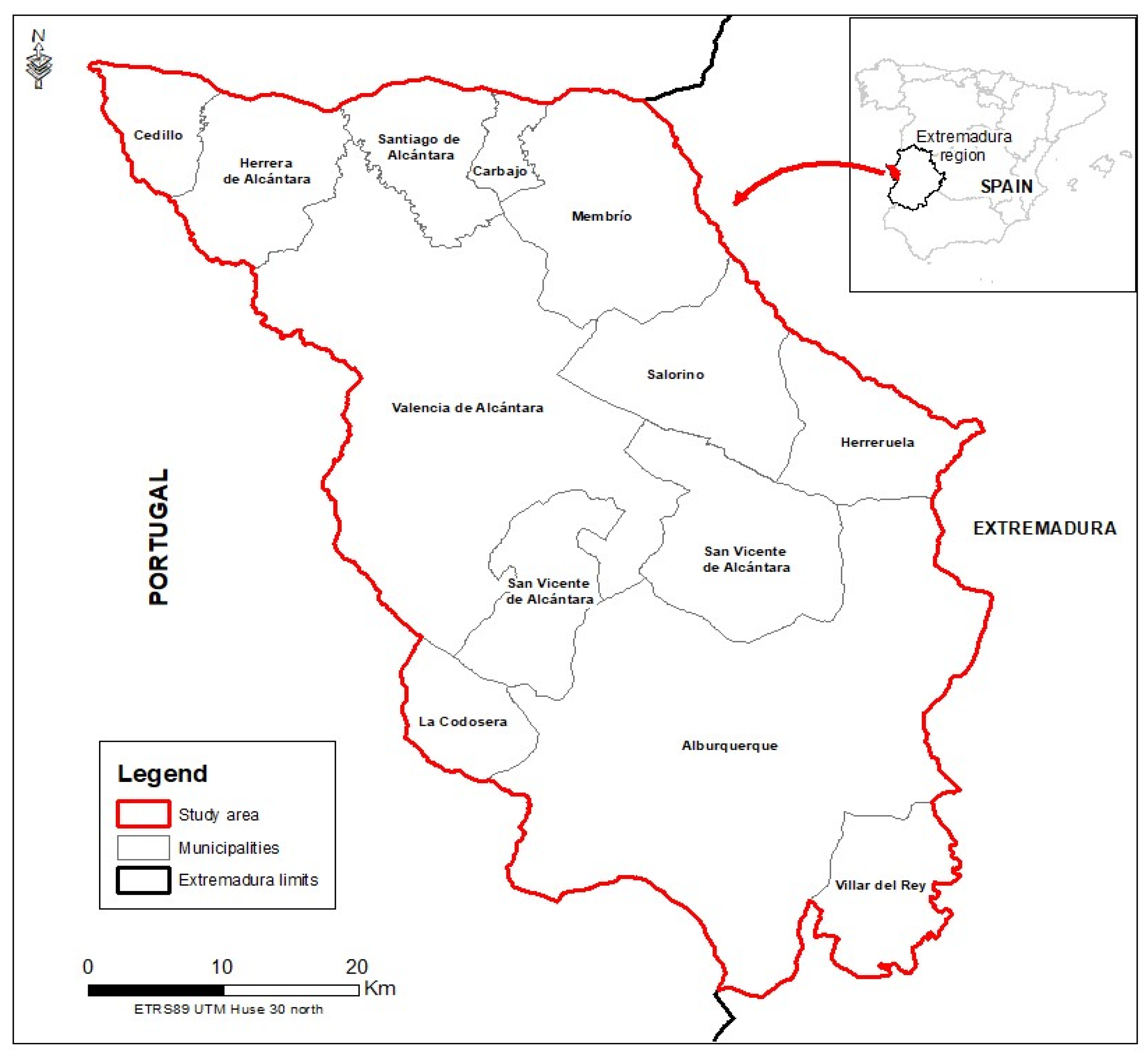
Located in the south–west of the province of Cáceres and north–west of Badajoz, the Sierra de San Pedro—Los Baldíos is a natural region whose western boundaries coincide with the frontier with Portugal. This Local Action Group (LAG) is the only one in Extremadura (Spain) comprising municipalities from both provinces; specifically, 12 municipalities that together cover an area of 2547.76 km2. As shown in Figure 1, Alburquerque (723.23 km2) and Valencia de Alcántara (594.83 km2) are the largest municipalities, collectively accounting for nearly half of the region’s surface area.
In demographic terms, the region has a total population of 22,492 inhabitants [101], nearly 60% of whom are concentrated in three towns: Alburquerque, San Vicente de Alcántara and Valencia de Alcántara, none of which plays a clearly predominant economic role. It is true that the presence of various public services in Valencia de Alcántara means that it acts as the regional capital, at least as far as the municipalities belonging to the province of Cáceres are concerned. Table 1 presents the area, population and population density of the municipalities in the region. As can be inferred from the aggregate figures, Sierra de San Pedro—Los Baldíos is characterized by a low population density (8.83 res./km2), markedly below the regional average (25.32 res./km2).
Taking the start of PRODER I as a reference and analyzing the evolution of the regional population in the period 1996–2023, a decrease of 18.27% can be observed [101]. In fact, the region as a whole is classified as a disadvantaged area due to depopulation, in accordance with European Council Directives 75/268/EEC and 86/466/EEC [102].
Regarding the selection of the Sierra de San Pedro—Los Baldíos region as the study area, Coller [103] argues that the use of case study methodology requires the research subject to have clearly defined boundaries and to be suitable for comparison with the phenomenon under investigation. The delimitation of the Sierra de San Pedro—Los Baldíos region is unequivocal and, with respect to the validity of the chosen case, it should be noted that this region meets all the conditions for the successful implementation of the endogenous rural development programs under analysis.
The Sierra de San Pedro—Los Baldíos region is characterized by pastureland landscapes where extensive livestock farming predominates. The agri-food industries linked to pork processing, meat products derived from the region’s abundant resources, and the auxiliary industries associated with livestock farming itself offer opportunities to promote investment aimed at agricultural development and marketing.
The hunting resources of the Sierra de San Pedro also provide significant support for rural tourism, an activity for which the region possesses outstanding assets: prehistoric dolmens forming the most important dolmen complex in Europe; magnificently preserved medieval castles that bear witness to the Christian Reconquest; cave paintings; Gothic quarters and Jewish synagogues that, due to their exceptional state of preservation, have been declared Historic-Artistic Sites; outstanding natural resources such as the Tajo International Natural Park, designated a Biosphere Reserve… all of this complemented by the inherent appeal of a border territory, clearly reflected in its heritage.

2.2. Time Frame of the Research

As stated above, the overarching objective of this research is to analyze the implementation of the rural development strategy in the Sierra de San Pedro—Los Baldíos region. Particular attention is given to assessing the long-term survival of the investments supported by these programs. To do so, it is essential to adopt a long-term time perspective that makes it possible to examine the continuity of the projects once the subsidy eligibility period has ended (during which promoters who failed to keep their projects operational would be required to repay the funds received). For this reason, the study covers the period from the second half of the 1990s (when the rural development programs became widely implemented across rural Europe) up to 2013, the year in which the so-called Leader Approach [104] came to an end. This timeframe thus encompasses the three six-year programming periods during which the Sierra de San Pedro—Los Baldíos region implemented the Proder I (1996–2001) and Proder II (2002–2007) programs, as well as the aforementioned Leader Approach (2007–2013).

2.3. Research Methodology and Phases

Methodologically, this study draws on the proposals of Castellano-Álvarez et al. [88,105] or Castellano-Álvarez and Robina-Ramírez [89] concerning the analysis of the long-term effects of rural development programs, an aspect these authors describe as the “footprint” of such programs on the territory. Their contributions are grounded in the application of the case study methodology, a research approach examined by various scholars, including Baxter and Jack [106], Durán [107] and Jiménez and Comet [108].
Yin [109] recommends this research methodology when the phenomenon under study is closely intertwined with its context. This is the case in the present research: the outcomes of the rural development strategies implemented in the study area cannot be understood without first considering the defining characteristics of the territory. Likewise, the implementation of such strategies entails the revalorization of the territory’s resources.
With regard to its phases, this research is grounded in extensive fieldwork in which three distinct stages (each involving different approaches) can be identified:
(1)
A preliminary phase involving the establishment of contact with the technical staff of the LAG responsible for managing the programs under analysis, as well as the examination of the development strategies employed. During this phase, the investments made were analyzed and quantified, together with their distribution across areas of intervention, their objectives, and other relevant aspects. In addition, in preparation for the second phase of fieldwork, the contact details of the promoters who had received funding from the program were located.
(2)
Analysis of projects and interviews with their promoters. In his studies on qualitative research, Yin [110] advocates the usefulness of interviews as a research tool and source of information, given that they enable interaction with the interviewees, allow their opinions to be contextualized, and thereby enhance the understanding of the information and evaluations they provide.
Given the large number of projects carried out during the three six-year programming periods under analysis, it was necessary to select a sample based on the following criteria: (1) the majority of the investment had to be private, meaning that the research focuses on the so-called ‘productive measures’ and, within these, on projects led by private promoters; (2) the subsidy received had to be at least 12,000 €; and (3) the subsidy had to be relevant to the overall investment, accounting for at least 20% of the project’s total cost. These three criteria aim to focus attention on projects which, given their size (and therefore greater impact on regional development), demonstrate the capacity of this type of program to mobilize endogenous resources in the region, given the amount of the grant received and the percentage it represents of the total investment made.
Applying these criteria resulted in a final sample of 70 projects. Table 2 presents the total number of private projects implemented in comparison with those selected for the sample, as well as the relative weight of the latter in terms of total investment.
As shown in Table 2, the criteria used to define a series of investments that represent around 45% of the projects implemented, account for almost 80% of productive investment during the three six-year programming periods that constitute the research time frame. This sample allows the second phase of the fieldwork to be undertaken without conditioning the generalization of the conclusions reached.
For the aforementioned second phase of fieldwork, semi-structured interviews were selected from among the various interview models available. This type of interview represents an intermediate option between closed surveys (which are unable to capture potentially valuable contributions that may arise spontaneously from interviewees within the interactive setting of an interview) and fully open interviews (which lack a script and therefore make it difficult to focus the interviewee’s attention on the aspects most relevant to the research, as well as to process the information obtained thereafter).
The questionnaire used is structured into five sections: The first defines the profile of the promoter and the project (age, gender, origin, place of residence, educational level, type of activity and type of project); the second section focuses on the characteristics of the investment (motivations, objectives, amount, and form of financing) as well as the relevance of the program and of grant managers in the execution of the project. The third section examines the importance of the project for the promoter’s income, while the fourth aims to capture the promoters’ assessment of the program’s contribution to their economic sector and to the region as a whole. Finally, in the last section of the interview, respondents are invited to provide any additional comments they consider relevant to the research.
(3)
Triangulation of results. Given the qualitative nature of the research and the long period of time that had elapsed between the implementation of the projects and the interviews, in order to avoid any bias on the part of the interviewees, the final stage of the fieldwork involved comparing the conclusions initially obtained in the previous phase with the assessment provided by the technical managers of the LAG responsible for implementing the three programs under analysis. These individuals constitute privileged witnesses to both the region’s evolution and the development strategy applied therein.

3. Analysis of the Implementation of the Rural Development Strategy

3.1. In Which Sectors or Activities Have the Investments Materialized?

Table 3 shows the investment made for each of the measures comprising the PRODER I, PRODER II and LEADER Approach programs, as well as their relative importance within the total investment committed by them.
Compared with its first edition, PRODER II almost doubled the investment allocated under by PRODER I. However, the implementation of the LEADER Approach shows a decline in the resources mobilized. This reduction may be attributable either to the limited funds assigned to the program or to the implementation capacity of the LAG itself. Comparison with other LAGs yield mixed and inconclusive results [88]. In the case or this LAG, however, an analysis of the allocation of resources by measure revels a marked contraction in investment in productive measures, which, under the LEADER Approach, were able to commit only slightly more than half of the resources invested in the previous six-year period.
Among the productive measures, the most pronounced decline in the capacity to commit resources is observed in the measure aimed at promoting rural tourism, where the resources invested amount to less than 30% of those allocated under PRODER II. This represents a substantial loss of relative importance for this measure and may underscore the limitations of tourism promotion as an instrument of economic diversification in this region [105]. It is noteworthy that nearly 40% of all resources invested in PRODER I and PRODER II were allocated to rural tourism; however, under the LEADER Approach, the resources devoted to this measure account for less than 15% of the total. This is an issue that the present study seeks to address.
Although the commitments for the other two productive measures also fall short of the amounts achieved in PRODER II, they nonetheless manage to maintain their relative importance within the program during the implementation of the LEADER Approach.
On the other hand, given a certain containment in the resources committed to unproductive measures between PRODER I and PRODER II, the most evident consequence of decline in productive investment under the LEADER Approach is the increase in resources allocated to the two unproductive measures and, in particular, to the measure concerning the restoration of rural heritage (under which various local projects are carried out, mainly promoted by the local councils themselves). Despite the reduction in resources committed by the LEADER Approach compared to the previous six-year period, the funds allocated for this type of action during the 2007–2013 are twice those committed by PRODER II for the same purpose. As a result, the aforementioned rural-heritage restoration actions account for one-third of the total investment.
Given the inability of the productive measures to stimulate private investment, it appears that this has been the strategy followed by the GAL to commit its resources. Without questioning its contribution to the social welfare of the rural population, it is worth considering whether the importance assigned to this type of unproductive project constitutes an anomaly in the implementation of this development program.
For its part, the measure for technical support for rural development shows a modest increase in the resources committed compared to previous editions. This measure covers the operating costs of the Rural Development Centre (CEDER), including office maintenance and staff salaries, as well as the implementation of training activities and/or the preparation of studies on the territory.
In addition to the resources allocated to these two unproductive measures, there are also public projects promoted by the various local councils as part of productive measures, as well as other actions of general interest managed directly by the LAG. Taken together, these actions account for 1,353,045.16 €, meaning that public or non-productive projects represent 43% of the total investment executed across the three programs.
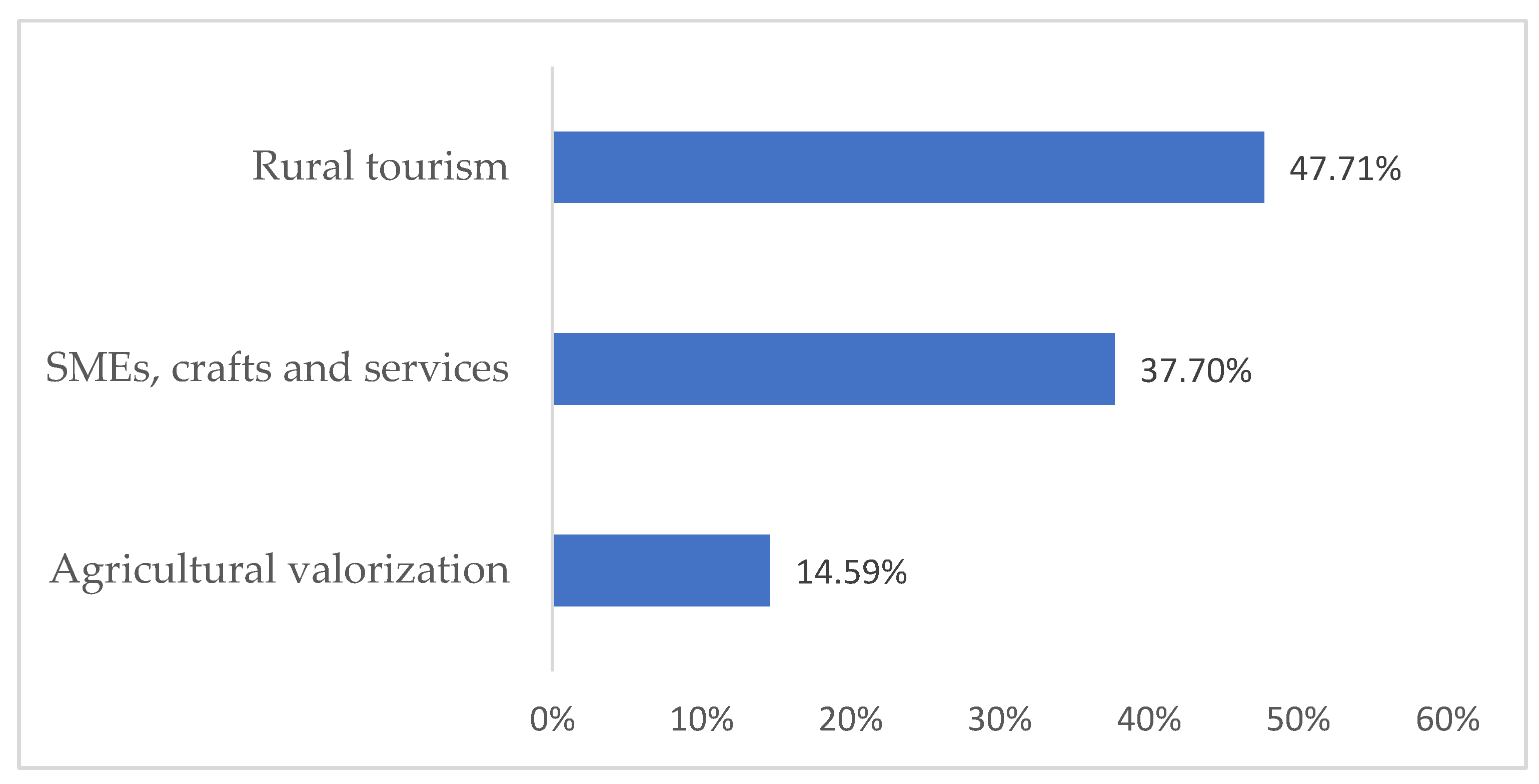
Figure 2 illustrates the distribution of productive investment by measure over the entire period under analysis. Despite the aforementioned decline in investment in the promotion of rural tourism under the LEADER Approach, the figure highlights the importance of this measure in the overall implementation of the development strategy during the period studied. Notably, as previously mentioned, this measure accounted for nearly 40% of all investments made under PRODER I and II.
The projects carried out under the SME, crafts and services measure are highly diverse. Despite differences in implementation between the two editions of PRODER and compared with the promotion of rural tourism under the LEADER Approach, this measure assumes a certain relative importance. It should be emphasized that this is due more to the shortcomings of tourism investments than to the commitments made under the SME, crafts and services measure, given that under the LEADER Approach, the final investment in this measure was 20% lower than that achieved in PRODER II.
The agricultural valuation measure, for its part, continues to play a modest role in productive investment across the three programs under analysis. It is highly likely that promoters of this type of investment would find a better fit for their projects within other lines of Community and/or regional support. However, it should be noted that this imbalance in the implementation of the various productive measures also occurs in other regions of Extremadura, where, at the same time, agricultural valuation projects account for the highest proportions of operational investments [89].
Having obtained an overview of the distribution of investment across the three programs analyzed, as well as the relative importance of each of their productive measures, we now turn to an analysis of the type of project implemented within each program in order to gain a deeper understanding of their sectoral orientation. It should be borne in mind that one of the main objectives of these programs is the economic diversification of rural areas.

3.1.1. Rural Tourism

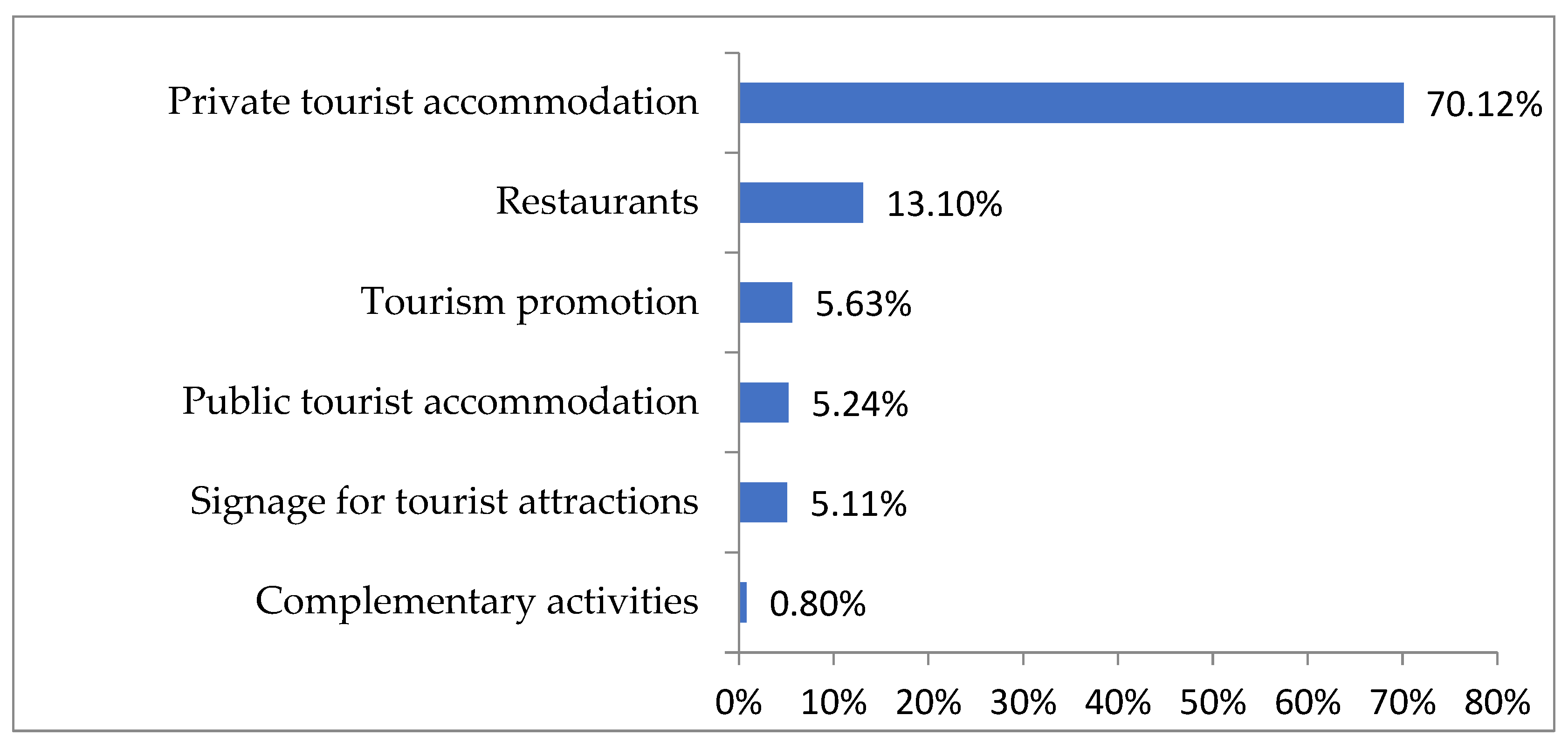
An analysis of the distribution of investment in rural tourism by activity further enriches the results obtained thus far. One idea clearly stands out in this analysis: 70% of resources were allocated to the creation and/or modernization of tourist accommodation by private promoters; if we add to this the resources invested in public initiatives with the same purpose, the conclusion is that three-quarters of all investment in rural tourism was concentrated on the creation of tourist accommodation. In the initial phase of the development strategy, it may even be reasonable to place special emphasis on this type of project, but the truth is that this concentration of investment not only continued during the implementation of PRODER II but was even accentuated. Given the importance of this measure for the region’s development strategy, analyzing the viability of this type of project will make it possible to assess its success more accurately.
Figure 3 shows the distribution of investment in rural tourism by activity, although it does not reflect the changes recorded across the three programs implemented. In this regard, it should be noted that under the LEADER Approach, despite the reduction in resources allocated to this measure, investments in the creation of accommodation remain similar in importance to those achieved in the two PRODER editions; the same cannot be said of restaurant-related projects, for which no investment was made, an aspect that may constitute a weakness in the tourism development strategy, as it limits the promotion of the region’s gastronomy and traditional products as a valuable cultural and tourist resource.
A direct consequence of concentrating resources on the creation or modernization of accommodation is the lack of investment in other types of actions that are equally important for promoting tourism development in the region: resources allocated to tourism promotion and those devoted to signage and the restoration of tourist assets each account for only 5% of total investment.
The virtual absence of projects aimed at promoting a broad range of complementary activities, as well as the resources committed to public accommodation, are additional factors that raise concerns after analyzing the distribution of tourism investment by project type. Regarding the former, it is essential for the region to offer activities and services that enhance its appeal and make it accessible to those interested in enjoying its tourism resources. The development strategy implemented by this LAG does not appear to have stimulated private developers’ interest in providing such services, thereby jeopardizing the region’s tourism development. Furthermore, the presence of the public sector is not limited to the aforementioned unusual prominence of non-productive measures; rather, in both editions of PRODER, several local councils in the region competed with private developers for funding under the productive measures. Under the heading of rural tourism promotion, more than 300,000 € was allocated during the two PRODER editions to the creation of tourist accommodation through six municipal projects. Only two of these projects, representing barely 20% of the investment, remain operational.

3.1.2. SMEs, Crafts and Services

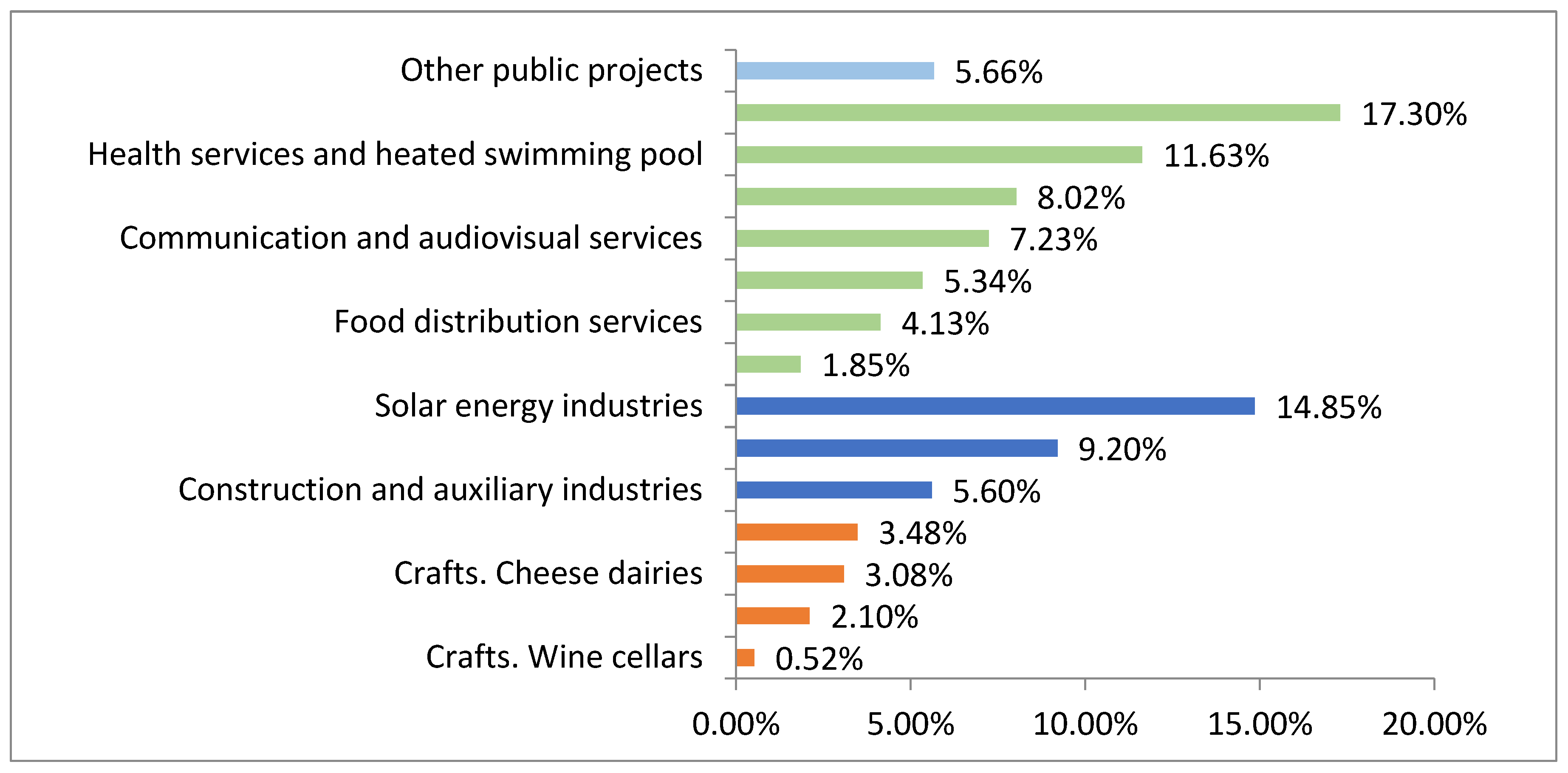
Depending on the type of economic activity, Figure 4 classifies the projects financed under this measure and shows the relative importance of each category.
Almost all of the companies benefiting from the program are SMEs. Figure 4 displays several lines of action in support of this, including:
(a)
Support for crafts based on the processing of local products. These actions, which are more characteristic of agricultural development measures, target a wide variety of products but are of limited significance as they account for only 9% of the resources committed to this measure.
(b)
Industrial promotion that adds value to local resources of particular importance to the regional economy, such as cork, while also supporting more innovative projects, such as the creation of a solar park. The commitment to solar energy production is concentrated in a single project. However, actions aimed at cork processing are widely distributed among the various industries in the region. The same is true of initiatives that foster the modernization of auxiliary industries in the construction sector. Industrial projects account for 30% of the investment made under this measure.
(c)
Projects aimed at creating or modernizing services account for just over half of the total investment and support a wide range of activities which, together with the other measures, reinforce the objective of economic diversification inherent in these programs. From support for retail trade to the provision of physiotherapy services, and from the modernization of consultancy firms to that of training centers, the sectoral diversity of these projects is undeniable. Two issues merit comment: (1) health-related services would account for barely 2% of the total investment under this measure if the funds allocated to the creation of a heated swimming pool (a failed project) were excluded; and (2) in assessing the demographic and economic dynamics of the region, it is both striking and revealing that funeral services are the activity that mobilizes the largest share of resources under this measure and, apart from investments in rural accommodation, arguably the program as a whole.
The analysis of the sectoral distribution of investments requires acknowledging these ‘other public projects’, which amount to just over 250,000 € and represent 5.66% of the total investment in this measure. As with the measure aimed at rural tourism, local councils compete with private developers for program funding. The nature of these public projects is heterogeneous: 70% of the resources are allocated to four initiatives intended to promote local industries, none of which are operational; a further three projects, accounting for an additional 25% of resources, involve the air conditioning of municipal facilities for welfare purposes; and finally, there is a small number of actions implemented directly by the LAG to support businesses. Both the long-term viability of this type of initiative and the welfare-oriented purpose of those that remain operational once again call into question the involvement of local councils in a productive measure.

3.1.3. Agricultural Valorization and Commercialization

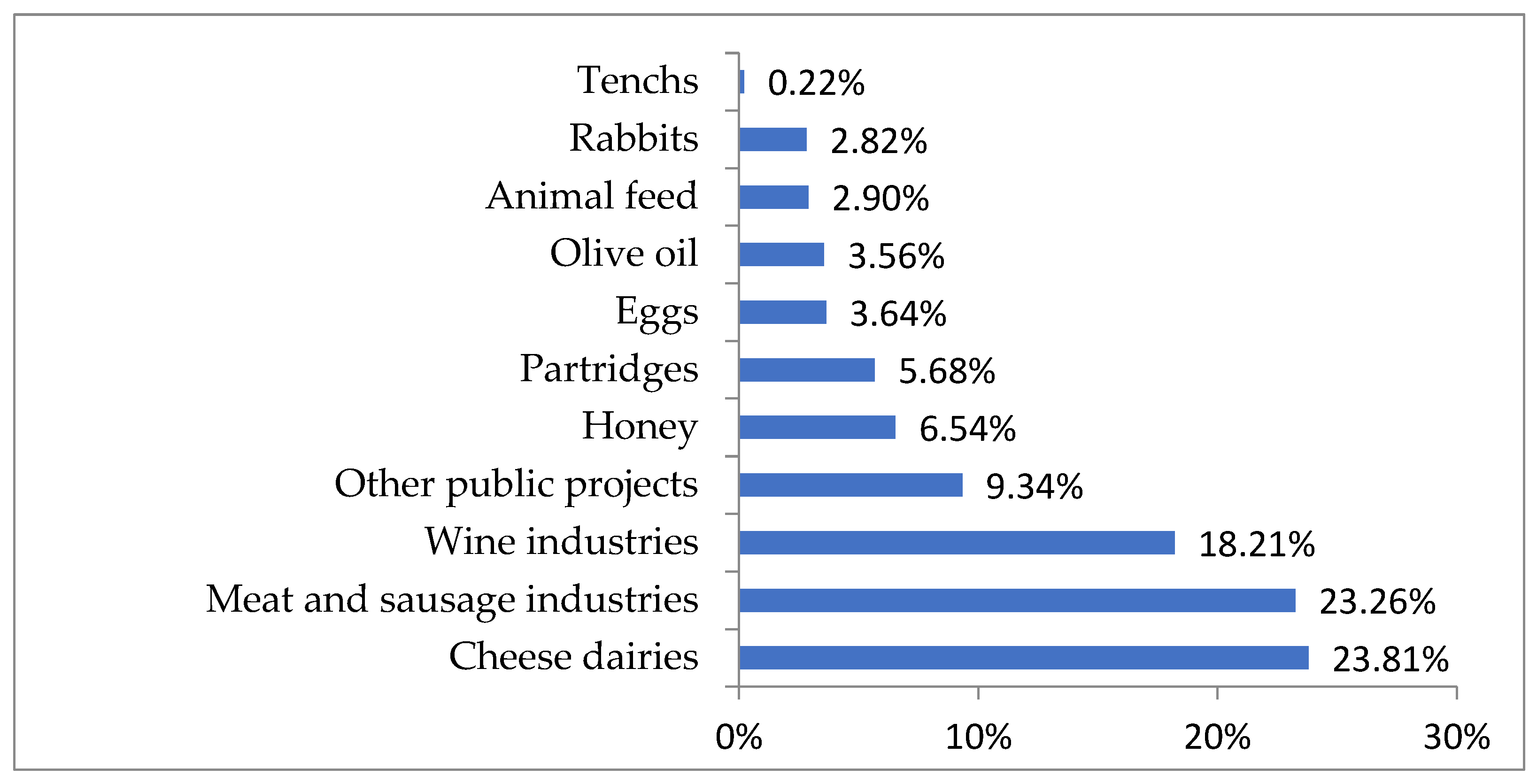
As anoted above, this measure has limited significance in terms of productive investment (Table 3); nevertheless, the investments made target all of the region’s characteristic products (cheese, pork, wine, olive oil, honey, game-derived meat products, etc.), while also supporting more innovative initiatives, such as the production and marketing of partridges, rabbits, eggs or the curing of hams. As shown in Figure 5, not all activities mobilize the same level of resources; the cheese, meat and wine industries are particularly dynamic, with some projects demonstrating notable economic relevance.
As shown in Figure 5, local councils in the region once again implemented projects funded through the resources allocated to this area of action. On this occasion, a total of seven projects accounted for just over 9% of the investment. Most of these initiatives involved the creation of cold storage facilities linked to municipal slaughterhouses; two other projects aimed to enhance the agricultural value of typical local products (such as cheese and tench); and one final project was implemented directly by the LAG. Fieldwork revealed that none of the municipal projects remain operational, representing 90% of the more than 160,000 € allocated to this type of initiative.

3.2. What Is the Long-Term Survival Rate of the Projects Implemented?

Focusing on the analysis of the long-term impact of rural development programs on the territory, and using as a reference the projects included in the samples obtained for the three programs under analysis (Table 2), Table 4 provides an overview of the status of each project, classifying them as operational, failed, or transferred.
As shown in the table above, regarding the implementation of the two editions of PRODER, the number of failed projects exceeds that of operational projects, and the proportion of investment allocated to both types remains similar. However, the application of the LEADER Approach improves this situation to some extent. Although the total number of failed projects remains considerable compared to operational ones, the investment involved in each shows a notable difference: almost 60% of the total investment in the projects selected for the sample remains operational, compared with 38% associated with failed projects; this difference is particularly significant for the projects implemented under the two editions of PRODER.
An analysis of operational, failed, and transferred projects, classified according to the measure under which they were implemented, reveals differences between tourism projects and those promoted under the other two productive measures. Table 5 illustrates the evolution of projects carried out under the rural tourism measure: while operational projects account for 52.52% of all productive investment executed in PRODER I and II, they represent 45.97% of investment within the rural tourism measure. In contrast, investment associated with failed projects accounts for 53.03% under the rural tourism measure, compared with 46.91% recorded across all productive measures.
The analysis of the long-term viability of projects carried out in rural tourism presents a less favorable picture than that of the program as a whole. Indeed, among the projects selected in the sample, the two editions of PRODER resulted in just over two million euros in failed tourism investments. This likely explains why the program was reoriented with the implementation of the LEADER Approach. Nevertheless, even during this latter period, the proportion of investment associated with failed projects exceeds that of operational projects. These findings call into question the development strategy implemented by this LAG: the measure receiving the largest share of resources is also the one with the highest number of failed projects by far.
The long-term viability of the projects implemented under the other two productive measures yields very different results. Table 6 and Table 7 classify the projects included in the samples for these two measures according to their operational status.
As shown in Table 6, for SMEs, crafts and services, operational projects account for 69.31% of investment executed; In terms of agricultural valorization (Table 7), this percentage rises to 83.09%, both figures being substantially higher than those recorded for rural tourism. The long-term viability of projects aimed at agricultural valorization aligns with the conclusions reached by Castellano-Álvarez and Robina-Ramírez [89] in their analysis of the implementation of rural development programs in La Vera region (Extremadura, Spain), and reinforces the idea that such projects should play a more prominent role within rural development strategies. It is paradoxical that the productive measure showing the highest percentage of operational investment and the lowest percentage of failed investment is the one with the least relative importance within the development strategy implemented by this LAG during the period analyzed (Table 3).

3.3. In Operational Projects, How Do Developers Assess the Viability of Their Investments?

Table 8 summarizes the promoters’ assessment of the viability of their projects, their level of commitment to them—whether as main (FT) or complementary (PT) activity—and the importance of receiving a grant for carrying out the investment. The responses reveal certain differences depending on the scope of the projects, as well as the interrelationship between some of these three aspects.
As Table 8 shows, the rural tourism measure includes all promoters who negatively assess the profitability of their projects. Furthermore, the capacity of tourism projects to generate employment appears more limited than that of the other two productive measures, whose promoters, in addition to being fully dedicated to their projects, report having employees. Likewise, depending on the productive measure in question, there are differences in the importance that receiving a subsidy has in the promoters’ decision-making process: in the measure aimed at promoting rural tourism, a clear majority acknowledge that the subsidy was a decisive factor in the implementation of their projects, whereas the opposite is true for the SMEs, crafts and services measure.
In turn, projects aimed at promoting rural tourism show certain differences depending on their nature. Of the ten interviewees who negatively assess the viability of their investments, the vast majority are involved in projects related to the creation of accommodation. For these promoters, the returns obtained from running their businesses are complementary to their main source of income, as is their level of dedication to them. Some of the responses gathered during the fieldwork interviews provide insight into their mindset. For example, promoter 1, who created his accommodation with support from PRODER I and later went on to carry out two other projects in the subsequent programming periods, replied as follows when asked about the possibility of making a living from a rural guest house: “no, perhaps with several guesthouses, but in our case it is a complementary activity; even more than complementary, it is auxiliary”.
Note that, in his response, this promoter points to the possibility that the size and number of accommodations may determine whether developers can make a living from them. Promoter 2 takes a similar stance when he responds, “from only one, perhaps not”. Promoter 3 provides an answer to this dilemma. This promoter is undertaking an ambitious investment to create four rural guesthouses as part of an agritourism project. When asked the same question, Can you make a living from a rural guesthouse?, the answer is the same: “in our case, no. For a rural guesthouse to be profitable, you cannot have staff. We had very high labor costs. It is very difficult to make a living solely from rural guesthouses; there are more and more guesthouses and increasing competition”. When asked about the relevance of the income derived from the operation of their accommodation within their total income, she states: “for us, the income from rural guesthouses is merely complementary to our main activity”.
The assessment offered by the aforementioned promoter reflects the general sentiment among this group of interviewees: promoter 4 denies the possibility of making a living from a rural guesthouse: “No. It is a supplementary source of income. Perhaps, with many sacrifices, it would be possible to subsist”; in similar terms, interviewee 5 responds: “No. That’s why I don’t want my children to take over the business. My intention is to sell it. I feel sorry, but the most sensible thing would be to close it”; promoter 6 also notes: “No, you can’t make a living solely from the rural guesthouse; you need other sources of income”. Along the same lines, promoters 7 and 8 state: “No. No. It’s hardly even a complement”. Contrary even to the conclusions reached by Castellano-Álvarez et al. [88,105] or Castellano-Álvarez and Robina-Ramírez [89], those promoters who modernized long-established businesses and whose project involves complementarity between restaurant and accommodation activities also give a negative response to this question: “the investment is not profitable even with the combination of both businesses”.
Only two interviewees, both involved in projects aimed at creating accommodation, offer a positive view of the potential for this type of investment to serve as a main source of income; however, it is worth noting that both belong to the second generation that inherited already-operational accommodation businesses and are not burdened by debt.
For their part, the profiles of the two restaurant businesses are very different. Their promoters are dedicated to them full-time, employ staff, and regard investments as their primary source of income.
With regard to the subsidy’s ability to encourage investment in tourism, those developers who acknowledge that they would not have undertaken their projects without receiving financial support offer similar reflections, although their responses differ somewhat: interviewees 6, 7 and 8 express clear refusal, while others are more hesitant. Promoter 3, for example, notes that “perhaps not. The investment was very large; in any case, the project would have been more modest” and promoter 5 states that “he would probably have undertaken his project, but with greater difficulty”.
Although the predominant profile of tourism promoters (based on the questions analyzed in Table 8) is that of individuals who view the viability of their investment negatively, work on their projects part-time, and would not have undertaken them without receiving a grant, the interviewees’ assessments are diverse. There are accommodation promoters who view the viability of their businesses positively but would not have carried out their projects without a subsidy, and the opposite case also exists: those who would have undertaken the modernization of their accommodation, with or without a subsidy, while acknowledging that the return on their investment is very limited.
For their part, projects implemented under the SME, crafts, and services measure, as well as those aimed at agricultural valorization and marketing, are characterized by both a positive assessment of their economic viability and the exclusive dedication of their promoters. With regard to the latter point, some differences appear in the agricultural valorization projects depending on their scale: smaller projects generally involve the full-time dedication of the promoter (often as self-employment), whereas in larger projects, the investment serves as an option for income diversification for a promoter who allocates only part of their time to the project, which in turns allows for the hiring of a significant number of workers. Indeed, this latter type of investment includes some of the most relevant projects implemented by this LAG (ham drying facility, olive oil mill, feed mill, wineries); and likely has had a greater impact on agricultural incomes, given the collective nature of some promoters or the boost they provide to the transformation and valorization of raw materials.
Other projects notable for the volume of investment mobilized are financed under the SME, crafts, and services measure: the construction of a solar park and the infrastructure for funeral services are two prominent examples. However, this measure also encompasses considerable heterogeneity in project size, with a significant number of smaller projects aimed at providing various services being promoted under its funding.
The scale of the projects may explain the differences in the promoters’ assessments of the other two productive measures regarding the importance of receiving a grant for carrying out their investment: paradoxically, the grant was more significant for the more modest projects. Some responses from promoters who acknowledge that they would not have undertaken their project without the grant include: “I don’t think so, they gave a little but it was very helpful”; “No, we wouldn’t have been able to, it was a very attractive incentive; then you realize that an incentive is not aid. In five years we have paid back that supposed aid in taxes”; “I wouldn’t have done it. I decided because of the financial boost the aid provided, but it arrived too late and was inadequate.” As can be seen, some of these responses contain mild criticism regarding the delay in the disbursement of the aid (a concern also shared by some promoters of larger projects, who did not make the execution of their investment conditional on receiving the subsidy), or even about having fallen into the “trap” of launching an investment to receive “aid” that they later do not regard as such.
However, some responses from promoters who acknowledge they wouldn’t have pursued their projects without receiving a grant also emphasize the benefits of such aid as a catalyst for investment. Examples include a baker who states, “No. My oven was holding up, but when they offered me a grant covering around 40% of the necessary investment, I decided to modernize it.”; or a promoter involved in creating infrastructure for funeral services who justifies his firm refusal as follows: “Not at that time. It was very important for us; we were in the midst of the 2008 crisis and the flow of bank credit was completely shut off. Without the boost from the grant, we wouldn’t have been able to make the investment”.

3.4. What Is the Border-Oriented Focus of the Operational Projects?

Regardless of the specific production measure in question, the main conclusion concerning this issue is the lack of a cross-border focus in the projects promoted under the development strategy of this region.
In terms of measures, it is striking that only one of the 14 promoters who still operate their tourism projects acknowledges having always considered the Portuguese market: “around 35–40% of our clients come from Portugal”. Others, while admitting to hosting guests from the neighboring country and recognizing that “Portugal and the border are an attraction for the region”, maintain that “we’ve never actively sought out Portuguese clients. We’ve always focused on Spanish clientele, especially those from Madrid”. At the very least, the reflection of one accommodation promoter could be considered paradoxical. After denying any cross-border focus for his project, he states: “Valencia de Alcántara relied heavily on Portugal for a long time; it used to, but when the border opened, business declined significantly”. Valencia de Alcántara is the main town in the region of this Local Action Group (LAG) located in the province of Cáceres. In this town, the existence of the border led to the creation of a whole range of commercial, administrative, and security services that, over time, have been lost with the disappearance of the border. This presents quite a paradox regarding the role of the border as a driver of development.
Promoters within the framework of SMEs, crafts, and services also demonstrate a limited cross-border perspective. Only one of the 15 interviewed acknowledges maintaining regular commercial relationships with clients across the border; others, despite having attempted to do so, claim that the results were not as expected: “I’ve been to markets in Portugal, but it didn’t quite convince me. Since it didn’t generate the expected business, it ended up being a huge waste of time, and in Spain, I had plenty of work”. Regulatory and legislative issues, as well as the presence of strong competition in Portugal, are among the reasons cited by the interviewees to justify their lack of interest in Portuguese markets.
However, three of the nine project promoters focused on agricultural valorization acknowledge that Portuguese clients are highly important to their business. These projects are diverse—feed mills, meat processing, and honey production—but all share a cross-border perspective. The representative of the Valencia de Alcántara cooperative, which is modernizing its feed mill with funding from the PRODER II program, admits that “we sell 40% of our feed to Portuguese buyers. Feed is much cheaper here, and besides, in Portugal, they don’t produce feed in meal form; it’s all pelleted. Portugal doesn’t have small feed mills for areas such as the Alentejo; their market is dominated by large brands”. Although less significant in terms of overall revenue, the promoter of a meat processing project states that Portugal’s potential was considered from the outset of their investment: “In fact, 10% of our clientele is Portuguese”. For her part, the promoter of a honey production project cannot specify a percentage of her clientele but assures that “we sell a lot of honey to Portugal and, currently, we have many clients from that country”.

4. Discussion and Conclusions

If we compare the implementation of programs managed by the Sierra de San Pedro—Los Baldíos region with that of other districts in Extremadura, the first thing that stands out is the modest level of implementation. This is particularly evident in the LEADER approach, where districts such as La Vera or Tajo Salor [88] commited around 40% more resources. Furthermore, it is worth noting that, in Sierra de San Pedro—Los Baldíos, the resources mobilized through the implementation of the LEADER approach were 20% lower than in the previous six-year period. The significant increase in resources allocated to non-productive measures further calls into question the implementation of this latter program. These two points suggest a certain “exhaustion” of this district’s capacity to mobilize investment. In line with the conclusions reached by Castellano-Álvarez and Robina-Ramírez [31], it may be advisable to reconfigure it as a unit of action from which to implement this type of development strategy.
The study of the development strategy in the Sierra de San Pedro—Los Baldíos also reveals a dual bias in the distribution of investment: on the one hand, resources devoted to the promotion of rural tourism account for almost 50% of productive investment; on the other hand, 70% of this investment is concentrated in a single type of action: the construction of new accommodations. The abrupt shift observed in the LEADER Approach regarding the resources allocated to this measure implicitly acknowledges that the bias of the program in the two PRODER editions may have been a mistake.
The analysis of the long-term viability of the projects reveals a major paradox in the concentration of investment in rural tourism promotion: 53% of the resources are allocated to failed projects. This proportion is significantly higher than the investment in similar projects under the other two productive measures. These findings are consistent with the conclusions reached by Castellano-Álvarez et al. [105] regarding the limitations of rural tourism as a development tool and corroborate the inherent risks of development strategies that depend on the opportunities offered by this sector. Likewise, in line with Castellano-Álvarez and Robina-Ramírez [89] in their analysis of the long-term survival of projects undertaken within the framework of these rural development programs, the investments mobilized under the agricultural valorization measure demonstrate the greatest viability, followed by those executed under the SMEs, crafts and services [111].
However, the most striking aspect of rural tourism investments is not merely the high proportion of resources committed to failed projects, but the negative assessment of the viability of operational projects expressed by their promoters. Indeed, all promoters who question the profitability of their investments are those involved in tourism projects focused on creating or modernizing accommodation. Consequently, the double bias that characterizes the distribution of investment in the development programs of the Sierra de San Pedro—Los Baldíos is unequivocally highlighted by the findings of this study.
However, in line with Castellano-Álvarez et al. [88,105] or Castellano-Álvarez and Robina-Ramírez [89], the viability of tourism projects clearly depends on their nature. In contrast to the negative assessment of those who undertook projects to create or modernize accommodation, promoters involved in the restaurant sector report satisfaction with their projects. The former acknowledge that the returns from managing their businesses are merely supplementary to their main source of income, as is their level of dedication. Conversely, the promoters of restaurant businesses state that managing their projects constitutes their primary activity and main source of income. In contrast to the limited capacity of tourism investments to constitute a primary source of income and employment, the projects implemented under the SMEs, crafts and services and Valorization of agriculture products measures, are characterized both by a positive assessment of their economic viability and by the exclusive dedication of their promoters [89].
Furthermore, depending on the specific measure, differences arise in the importance that receiving a subsidy has on the promoters’ decision-making process: among rural tourism promoters, a clear majority acknowledge that the subsidy was a decisive factor in the execution of their projects, whereas the opposite is true for SMEs, crafts, and services. This finding provides an lesson for managers of such programs, as promoters of projects with lower viability and a more limited capacity to generate employment report that the subsidy constituted a greater incentive for their investment decisions.
The final research question concerned the border-oriented nature of the projects. The interviews with project promoters reveal the absence of a cross-border vision in their investments. The introductory section characterized the region of Sierra de San Pedro—Los Baldíos as a rural, peripheral and border territory. However, in essence, the development strategy implemented is no different from that applied by any other region in Extremadura or Spain that meets only the first two characteristics. The development potential inherent in the border area has therefore been overlooked.
In theory, the numerous documents drawn up to shape the region’s development strategy should have ensured that all the territory’s potential was incorporated into it; however, the conclusions reached suggest otherwise. It is worth asking whether the management and implementation of these programs on both sides of the border, based on a national approach, may have hindered this cross-border vision. Throughout the research period, and even to this day, two LAGs have been operating in the same territory: on the Spanish side, Sierra de San Pedro—Los Baldíos; on the Portuguese side, the Association for Rural Development of Northern Alentejo (ADER-AL). What if truly cross-border LAGs were created in these types of areas? Not the sum of those on one side and those on the other, but a single LAG that implements, across the whole territory, the development opportunities offered on both sides of the border. The participation of local actors from both sides of the border in the decision-making bodies of these LAGs would allow for their full activation and interaction with a totally cross-border focus. The territory is the same, so why should bureaucratic or administrative issues divide it?
The limitations of this research arise from the methodology employed. Case studies do not allow for the universal extrapolation of their conclusions, although the results obtained may offer useful lessons for territories that share characteristics with the region under study. Moreover, the considerable time that has passed between the implementation of the projects and the interviews may affect the promoters’ ability to provide fully accurate accounts of events that occurred long ago; this subjective component should also be considered a potential limitation of the study. Despite these limitations, the research has enabled a deeper understanding of the outcomes achieved by rural development programs and an analysis of their long-term impact on the territory. In this regard, and in line with the criticisms made by Navarro et al. [98], some of the shortcomings of traditional evaluation systems have been overcome.
In the future, it would like to address two lines of research. With regard to the cross-border issue, this research would continue with an analysis of the development strategy implemented by ADER-AL. Maintaining the idea that it is the same territory, this would make it possible to learn about the projects carried out on both sides of the border, analyze possible differences and, in doing so, multiply the investment opportunities offered by this border area as a whole. With regard to the general analysis of rural development programs, following the work of Navarro et al. [99] or Cañete et al. [100], it could be highly interesting to focus on failed projects, analyzing their causes and the factors that influenced them. This would also make it possible to build upon and complete some of the contributions made by these authors [88,89,105].

Author Contributions

All authors contributed equally to this work. All authors wrote, reviewed, and commented on the manuscript. All authors have read and agreed to the published version of the manuscript.

Funding

This research received no external funding.

Data Availability Statement

The raw data supporting the conclusions of this article will be made available by the authors on request.

Conflicts of Interest

The authors declare no conflicts of interest.

References

  1. European Commission. Guidelines for European Agriculture. COM (81) 608 Final, Supplement 4/81; Bulletin of the European Communities; Office for Official Publications of the European Communities: Brussels, Belgium, 1981. [Google Scholar]
  2. European Commission. Perspectives for the Common Agricultural Policy. The Green Paper of the Commission. COM (85) 333; Bulletin of the European Communities; Office for Official Publications of the European Communities: Brussels, Belgium, 1985. [Google Scholar]
  3. European Commission. The Future of Rural Society. COM (88) 501, Supplement 4/88; Bulletin of the European Communities; Office for Official Publications of the European Communities: Brussels, Belgium, 1988. [Google Scholar]
  4. European Commission. The Development and Future of the Common Agricultural Policy. COM (91) 100, Supplement 5/91; Bulletin of the European Communities; Office for Official Publications of the European Communities: Luxembourg, 1991. [Google Scholar]
  5. Castellano-Álvarez, F.J.; Parejo-Moruno, F.M.; Rangel-Preciado, J.F.; Cruz-Hidalgo, E. Regulation of Agricultural Trade and Its Implications in the Reform of the CAP. The Continental Products Case Study. Agriculture 2021, 11, 633. [Google Scholar] [CrossRef]
  6. Castellano-Álvarez, F.J.; Robina Ramírez, R. Relevance of the Uruguay and Doha Rounds in the Evolution of International Agricultural Trade: The Case Study of Latin American Countries and Continental Products. Economies 2023, 11, 2. [Google Scholar] [CrossRef]
  7. European Commission. Notice to Member States laying down guidelines for integral global grants for which the Member States are invited to submit proposals in the framework of a Comunity Initiative for rural development (91/C 73/14). Off. J. Eur. Communities 1991. [Google Scholar]
  8. Consejo Económico y Social Europeo. Dictamen en Relación al Proyecto de Comunicación de la Comisión por la que se Invita a los Estados Miembros a Presentar Propuestas en el Marco de la Iniciativa Leader. Pleno 280º; Consejo Económico y Social Europeo: Brussels, Belgium, 1990. [Google Scholar]
  9. European Commission. Communication Setting out Guidelines for Global Grants to Integrated Operational Programs, for Which States Are Requested to Submit Applications for Assistance within a Community Initiative for Rural Development (94/C 180/12). Off. J. Eur. Communities 1994. [Google Scholar]
  10. European Commission. Communication to the Member States, Laying Down Guidelines for the Community Initiative for Rural Development (Leader +) (2000/C 139/05). Off. J. Eur. Communities 2000. [Google Scholar]
  11. Beltrán, C. Mecanismos e instrumentos de la Iniciativa Leader II. In Hacia un Nuevo Sistema Rural; Cruz Villalón, J., Ramos Real, E., Eds.; MAPA Serie Estudios: Madrid, Spain, 1995; pp. 483–495. [Google Scholar]
  12. Barke, M.; Newton, M. The EU Leader Initiative and endogenous rural development: The application of the program in two rural areas of Andalusia. J. Rural Stud. 1997, 13, 319–341. [Google Scholar] [CrossRef]
  13. Zapatero, J.; Sánchez, M.J. Instrumentos específicos para el desarrollo rural integrado: La Iniciativa Comunitaria Leader y el Programa PRODER. Polígonos. Rev. De Geogr. 1999, 8, 21–38. [Google Scholar] [CrossRef]
  14. Konečný, O. The Leader Approach across the European Union: One method of rural development, many forms of implementation. Eur. Countrys. 2019, 11, 1–16. [Google Scholar] [CrossRef]
  15. Cebrián, A. Génesis, método y territorio del desarrollo rural con enfoque local. Papeles Geogr. 2003, 38, 61–76. [Google Scholar]
  16. Bruckmeier, K. Leader in Germany and the discourse of autonomous regional development. Sociol. Rural. 2002, 40, 219–227. [Google Scholar] [CrossRef]
  17. Cazorla, A.; De los Ríos, I.; Díaz, J.M. La Iniciativa Leader como modelo de desarrollo rural: Aplicación a la región capital de España. Agrociencia 2005, 39, 697–708. [Google Scholar]
  18. Moseley, M.J. Policy and practice. The environmental component of the LEADER programme, 1992–1994. J. Environ. Plan. Manag. 1995, 38, 245–252. [Google Scholar] [CrossRef]
  19. Scott, M. Building institutional capacity in rural Northern Ireland: The role of partnership governance in the LEADER II programme. J. Rural Stud. 2004, 20, 49–59. [Google Scholar] [CrossRef]
  20. Aubert, F.; Frère, Q.; Lépicier, D.; Védrine, L. Decentralization and rural development policies effectiveness: A quasi experimental evaluation of the LEADER programme. Reg. Stud. 2002, 59, 2129606. [Google Scholar] [CrossRef]
  21. Pollermann, K.; Aubert, F.; Berriet-Solliec, M.; Laidin, C.; Lépicier, D.; Pham, H.V.; Raue, P.; Gitta Schnaut, G. Leader as a European policy for rural development in a multilevel gobernance framework: A comparison of the implementation in France, Germany and Italy. Eur. Countrys. 2020, 12, 156–178. [Google Scholar] [CrossRef]
  22. Ministerio Agricultura Pesca y Alimentación. Programa Nacional PRODER; Ministerio Agricultura Pesca y Alimentación: Madrid, Spain, 1996. [Google Scholar]
  23. Ministerio de Agricultura, Pesca y Alimentación. Real Decreto 2/2002, de 11 de Enero, por el que se Regula la Aplicación de la Iniciativa Comunitaria “Leader +” y los Programas de Desarrollo Endógeno Incluidos en los Programas Operativos Integrados y en los Programas de Desarrollo Rural (PRODER), 10–12 January; BOE: Madrid, Spain, 2002. [Google Scholar]
  24. European Commission. Financial Report of the European Union 2002; Office of Official Publications of the European Communities: Luxembourg, 2003. [Google Scholar]
  25. Colino, J.; Martínez, J.M. El desarrollo rural: Segundo pilar de la PAC. In Política Agraria Común: Balance y Perspectivas; García Delgado, J.L., García Grande, M.J., Eds.; Colección de Estudios Económicos de La Caixa: Barcelona, Spain, 2005; pp. 70–99. [Google Scholar]
  26. García Grande, M.J. El último decenio: Aplicación y consecuencias de las reformas de la PAC. In Política Agraria Común: Balance y Perspectivas; García Delgado, J.L., García Grande, M.J., Eds.; Colección de Estudios Económicos de La Caixa: Barcelona, Spain, 2005; pp. 44–69. [Google Scholar]
  27. García Álvarez-Coque, J.M. La reforma de la PAC y el futuro de las ayudas agrarias. Rev. Valencia. De Econ. Y Hacienda 2004, 11, 163–183. [Google Scholar]
  28. Viladomiu, L.; Rosell, J. Los Programas de Desarrollo Rural (2007–2013) de la Unión Europea y sus enfoques alternativos. In Cultura, Inovação e Território. O Agroalimentar e o Rural; SPER: Lisbon, Portugal, 2009; pp. 51–61. [Google Scholar]
  29. Compés, R. De la deconstrucción a la refundación: Elementos para un cambio de modelo de la PAC 2013. In Chequeo Médico de la PAC; García Álvarez-Coque, J.M., Gómez Limón, J.A., Eds.; MARM and Eumedia S.A.: Madrid, Spain, 2010; pp. 129–154. [Google Scholar]
  30. González Regidor, J. El método Leader: Un instrumento territorial para un desarrollo rural sostenible. El caso de Extremadura. In Desarrollo Rural de Base Territorial: Extremadura; González Regidor, J., Ed.; Ministerio de Agricultura, Pesca y Alimentación y Consejería Desarrollo Rural Junta Extremadura: Badajoz, Spain, 2006; pp. 15–90. [Google Scholar]
  31. Castellano-Álvarez, F.J.; Robina-Ramírez, R. Relevance of Territorial Identity in the Rural Development Programs: The Case Study of Tajo-Salor (Extremadura, Spain). Economies 2024, 12, 34. [Google Scholar] [CrossRef]
  32. Esparcia, J.; Noguera, J.; Pitarch, M.D. LEADER en España: Desarrollo rural, poder, legitimación aprendizaje y nuevas estructuras. Doc. D’Anàlisi Geogràfica 2000, 37, 95–113. [Google Scholar]
  33. Osti, G. LEADER and Partnerships: The Case of Italy. Soc. Rural. 2000, 40, 172–180. [Google Scholar] [CrossRef]
  34. Navarro, F.; Cejudo, E.; Maroto, J.C. Reflexiones en torno a la participación en el desarrollo rural. ¿Reparto social o reforzamiento del poder? LEADER y PRODER en el sur de España. EURE 2014, 40, 203–224. [Google Scholar] [CrossRef]
  35. Navarro, F.A.; Woods, M.; Cejudo, E. The LEADER Initiative has been a victim of its own success. The decline of the bottom-up approach in rural development programmes. The Cases Wales and Andalusia. Sociol. Rural. 2016, 56, 270–288. [Google Scholar] [CrossRef]
  36. Lukic, A.; Obad, O. New Actors in Rural Development. The LEADER Approach and projectification in rural Crotia. Sociol. I Prost. 2016, 1, 71–90. [Google Scholar] [CrossRef]
  37. Chmieliński, P. On community involvement in rural development. A case of Leader Programme in Poland. Econ. Sociol. 2011, 4, 120–128. [Google Scholar] [CrossRef]
  38. Salvia, R.; Quaranta, G. Place-based rural development and resilience: A lesson from a small communty. Sustainability 2017, 9, 889. [Google Scholar] [CrossRef]
  39. Chevalier, P.; Mačiulyté, J.; Razafimahefa, L.; Dedeire, M. The Leader Programme as a model of institutional transfer: Learning from its local implementation in France and Lithuania. Eur. Countrys. 2017, 2, 317–341. [Google Scholar] [CrossRef]
  40. Shucksmith, M. Endogenous development, social capital, and social inclusion: Perspectives from Leader in the UK. Sociol. Rural. 2002, 40, 208–218. [Google Scholar] [CrossRef]
  41. Putnam, R. Bowling alone: America’s Declining Social Capital. J. Democr. 1995, 6, 65–78. [Google Scholar] [CrossRef]
  42. Putman, R. Tuning In, Tuning Out: The Strange Disappearance of Social Capital in America. Political Sci. Politics 1995, 28, 664–683. [Google Scholar] [CrossRef]
  43. Putnam, R. The Prosperous Community: Social Capital and Public Life. Am. Prospect 1993, 4, 35–42. [Google Scholar]
  44. Bourdieu, P. The Forms of Capital. In Handbook of Theory and Research for the Sociology of Education; Richardson, J., Ed.; Greenwood: Westport, CT, USA, 1986; pp. 241–258. [Google Scholar]
  45. Coleman, J. Social Capital in the Creation of Human Capital. Am. J. Sociol. 1988, 94, 95–120. [Google Scholar] [CrossRef]
  46. Woolcock, M. Social capital and economic development: Toward a theoretical synthesis and policy framework. Theory Soc. 1998, 27, 151–208. [Google Scholar] [CrossRef]
  47. Esparcia, J.; Escribano, J.; Serrano, J. Una aproximación al enfoque del capital social y a su contribución al estudio de los procesos de desarrollo local. Investig. Reg. 2016, 34, 49–71. [Google Scholar]
  48. Saz-Gil, M.I.; Gómez-Quintero, J.D. Una aproximación a la cuantificación del capital social: Una variable relevante en el desarrollo de la provincia de Teruel, España. EURE 2015, 41, 29–51. [Google Scholar] [CrossRef]
  49. Garrido, F.; Moyano, E. Capital social y desarrollo en zonas rurales: Un análisis de los programas Leader II y Proder en Andalucía. Rev. Int. De Sociol. 2002, 60, 67–96. [Google Scholar] [CrossRef]
  50. Moyano, E. El concepto de capital social y su utilidad para el análisis de las dinámicas del desarrollo. Rev. De Fom. Soc. 2001, 56, 35–63. [Google Scholar] [CrossRef]
  51. Shortall, S. Social or Economic Goals, Civic Inclusion or Exclusion? An Analysis of Rural Development Theory and Practice. Sociol. Rural. 2004, 44, 109–123. [Google Scholar] [CrossRef]
  52. Castellano-Álvarez, F.J.; Nieto Masot, A.; Castro-Serrano, J. Intangibles of Rural Development. The Case Study of La Vera (Extremadura, Spain). Land 2020, 9, 203. [Google Scholar] [CrossRef]
  53. Pérez Rubio, J.A. (Coordinator) Los Intangibles en el Desarrollo Rural; Universidad de Extremadura: Cáceres, Spain, 2007. [Google Scholar]
  54. Castellano-Álvarez, F.J.; Durán-Sánchez, A.; del Río Rama, M.; Álvarez-García, J. Innovation and entrepreneurship as tools for rural development. Case study region of La Vera (Extremadura, Spain). In Entrepreneurship and the Community. A Multidisciplinary Perspective on Creativity, Social Challenges, and Business; Ratten, V., Ed.; Springer: Cham, Switzerland, 2020; pp. 125–140. [Google Scholar] [CrossRef]
  55. Bryden, J. Tourism and Development; Cambridge University Press: Cambridge, UK, 1973. [Google Scholar]
  56. Patmore, J. Recreation and Resources, Leisure Patterns and Leisure Places; Blackwell: Oxford, UK, 1983. [Google Scholar]
  57. Butler, R.; Hall, C.M.; Jenkins, J. (Eds.) Tourism and Recreation in Rural Areas; Wiley: Chichester, UK, 1998. [Google Scholar]
  58. Lane, B. What is rural tourism? J. Sustain. Tour. 1994, 2, 7–21. [Google Scholar] [CrossRef]
  59. Sharpley, R.; Roberts, L. Rural Tourism: 10 Years on. Int. J. Tour. Res. 2004, 6, 119–124. [Google Scholar] [CrossRef]
  60. Perdue, R.; Long, P.; Allen, L. Rural resident tourism perceptions and attitudes. Ann. Tour. Res. 1987, 14, 420–429. [Google Scholar] [CrossRef]
  61. Brankov, J.; Jojić, T.; Milanović, A.; Petrović, M.; Tretiakova, T. Resident’s Perceptions of Tourism Impact on Community in National Parks in Serbia. Eur. Countrys. 2019, 11, 124–142. [Google Scholar] [CrossRef]
  62. Muresan, I.; Oroian, C.; Harun, R.; Arion, F.; Porutiu, A.; Chiciudean, G.; Todea, A.; Lile, R. Local Residents Attitude toward Sustainable Rural Tourism Development. Sustainability 2016, 8, 100. [Google Scholar] [CrossRef]
  63. Quaranta, G.; Citro, E.; Salvia, R. Economic and Social Sustainable Synergies to Promote Innovations in Rural Tourism and Local Development. Sustainability 2016, 8, 668. [Google Scholar] [CrossRef]
  64. Muresan, I.; Harun, R.; Arion, F.; Oroian, C.; Dumitras, D.; Mihai, M.; Ilea, M.; Chiciudean, D.; Gigla, I.; Chiciudean, G. Residents Perception of Destination Quality: Key Factors for Sustainable Development. Sustainability 2019, 11, 2594. [Google Scholar] [CrossRef]
  65. Robina-Ramírez, R.; Martín-Lucas, M.; Dias, A.; Castellano-Álvarez, F.J. What role geoparks play improving the health and well-being of senior tourist? Heliyon 2023, 9, e22295. [Google Scholar] [CrossRef]
  66. Garau, C. Perspectives on Cultural and Sustainable Rural Tourism in a Smart Region: The Case Study of Marmilla in Sardinia (Italy). Sustainability 2015, 7, 6412–6434. [Google Scholar] [CrossRef]
  67. Gatti, S.; Incerti, F.; Ravagli, M. Wine and tourism: New perspectives for vineyard areas in Emilia-Romagna. Cah. D’Economie Sociol. Rural. 2002, 62, 97–117. [Google Scholar] [CrossRef]
  68. Marques, H. Searching for complementarities between agriculture and tourism: The demarcated Wine-producing regions of northern Portugal. Tour. Econ. 2006, 12, 147–155. [Google Scholar] [CrossRef]
  69. Ciolac, R.; Adamov, T.; Iancu, T.; Popescu, G.; Lile, R.; Rujescu, C.; Marin, D. Agritourism: A Sustainable Development Factor for Improving the “Health” of Rural Settlements. Case Study Apuseni Mountains Area. Sustainability 2019, 11, 1467. [Google Scholar] [CrossRef]
  70. Haghiri, M.; Okech, R. The Role of the Agritourism Management in Developing the Economy of Rural Regions; Book of Proceedings International Conference on Tourism & Management Studies: Algarve, Portugal, 2011; pp. 99–105. [Google Scholar]
  71. Giaccio, V.; Mastronardi, L.; Marino, D.; Giannelli, A.; Scardera, A. Do Rural Policies Impact on Tourism Development in Italy? A Case Study of Agritourism. Sustainability 2018, 10, 2938. [Google Scholar] [CrossRef]
  72. Martínez-Roget, F.; Moutela, J.A.; Rodríguez, X.A. Length of Stay and Sustainability: Evidence from the Schist Villages Network (SVN) in Portugal. Sustainability 2020, 12, 4025. [Google Scholar] [CrossRef]
  73. Robina-Ramírez, R.; Castellano-Álvarez, F.J.; Ferreira, P.; Loures, L. Tourism Development in Rural Border Territories: A “Phronetic” Approach to Threats and Opportunities. Agriculture 2025, 15, 524. [Google Scholar] [CrossRef]
  74. Leal-Solís, A.; Al-Jaberi, S.; Roets, A.; Castellano-Álvarez, F.J. Managerial strategies to reduce stress and brain drain in tourism through moral values. S. Afr. J. Bus. Manag. 2024, 55, a4842. [Google Scholar] [CrossRef]
  75. Giannakis, E. The role of rural tourism on the development of rural areas: The case of Cyprus. Rom. J. Reg. Sci. 2014, 81, 38–53. [Google Scholar]
  76. Iakovidou, O.; Koutsouris, A.; Partalidou, M. The development of rural tourism in Greece, through the initiative Leader II: The case of northern and central Chalkidiki. Mediterr. J. Econ. Agric. Environ. 2002, 4, 32–38. [Google Scholar]
  77. Shin, H.-J.; Kim, H.N.; Son, J.-Y. Measuring the Economic Impact of Rural Tourism Membership on Local Economy: A Korean Case Study. Sustainability 2017, 9, 639. [Google Scholar] [CrossRef]
  78. Apostolopoulos, N.; Liargovas, P.; Stavroyiannis, S.; Makris, I.; Apostolopoulos, S.; Petropoulos, D.; Anastasopoulou, E. Sustaining Rural Areas, Rural Tourism Enterprises and EU Development Policies: A Multi-Layer Conceptualisation of the Obstacles in Greece. Sustainability 2020, 12, 7687. [Google Scholar] [CrossRef]
  79. Toledano, N.; Gessa, A. El turismo rural en la provincia de Huelva. Un análisis de las nuevas iniciativas creadas al amparo de los programas Leader II y Proder. Rev. De Desarro. Rural Y Coop. Agrar. 2002, 6, 107–122. [Google Scholar]
  80. Candela, A.R.; García, M.M.; Such, M.P. La potenciación del turismo rural a través del programa Leader: La Montaña de Alicante. Investig. Geográficas 1995, 14, 77–98. [Google Scholar] [CrossRef]
  81. Mondéjar, J.A.; Mondéjar, J.; Vargas, M. Análisis del turismo cultural en Castilla-La Mancha (España). El impacto de los programas europeos de desarrollo rural LEADER y PRODER. Estud. Y Perspect. En Tur. 2008, 17, 359–370. [Google Scholar]
  82. García, M.; De la Calle, M. Turismo en el medio rural: Conformación y evaluación de un sector productivo en plena transformación. El caso del Valle del Tiétar (Ávila). Cuad. De Tur. 2006, 17, 75–101. [Google Scholar]
  83. Nieto, A.; Cárdenas, G. 25 años de políticas europeas en Extremadura: Turismo rural y método Leader. Cuad. De Tur. 2017, 39, 389–416. [Google Scholar] [CrossRef][Green Version]
  84. Pillet, F. Del turismo rural a la plurifuncionalidad en los territorios Leader y Proder de Castilla-La Mancha. In Turismo Rural y Desarrollo Local; Cebrián, F., Ed.; Universidad de Castilla La Mancha: Cuenca, Spain, 2008; pp. 187–198. [Google Scholar]
  85. Márquez, D.; Foronda, C.; Galindo, L.; García, A. Eficacia y eficiencia de Leader II en Andalucía. Aproximación a un índice-resultado en materia de turismo rural. Geographicalia 2005, 47, 137–142. [Google Scholar]
  86. Pérez, M.; López, E. La contribución del turismo a la diversificación de actividades en un espacio rural periférico. Análisis del impacto de la iniciativa LEADER en Galicia. Rev. De Estud. Agrosociales Y Pesq. 2005, 206, 111–135. [Google Scholar] [CrossRef]
  87. García, R. Turismo y desarrollo rural en la comarca del Noroeste de la región de Murcia: Los programas europeos Leader. Cuad. De Tur. 2011, 27, 419–435. [Google Scholar]
  88. Castellano-Álvarez, F.J.; Robina Ramírez, R.; Nieto Masot, A. Tourism Development in the Framework of Endogenous Rural Development Programs. Comparison of the Case Studies of the Regions of La Vera and Tajo-Salor (Extremadura, Spain). Agriculture 2023, 13, 726. [Google Scholar] [CrossRef]
  89. Castellano-Álvarez, F.J.; Robina-Ramírez, R. Long-Term Survival of Investments Implemented under Endogenous Rural Development Programs: The Case Study of La Vera Region (Extremadura, Spain). Agriculture 2023, 13, 2130. [Google Scholar] [CrossRef]
  90. Carvalho, P.; Fernandez, J.L. Iniciativas de desenvolvimiento local no espaço rural portugués. In Território, Inovaçao e Trajectorias de Desenvolvimiento; Caetano, L., Ed.; Centro de Estudios Geográficos da Fluc: Coimbra, Portugal, 2001; pp. 241–272. [Google Scholar]
  91. Nieto Masot, A.; Cárdenas Alonso, G.; Costa Moreno, L.M. Principal Component Analysis of the LEADER Approach (2007–2013) in South Western Europe (Extremadura and Alentejo). Sustainability 2019, 11, 4034. [Google Scholar] [CrossRef]
  92. Cejudo, E.; Navarro, F.A. La inversión en los programas de desarrollo rural. Su reparto territorial en la provincia de Granada. In Anales de Geografía de la Universidad Complutense; Universidad Complutense: Madrid, Spain, 2009; Volume 29, pp. 37–64. [Google Scholar]
  93. Alario, M.; Baraja, E. Políticas públicas de desarrollo rural en Castilla y León: ¿Sostenibilidad consciente o falta de opciones? Leader II. Boletín De La Asoc. Geógrafos Españoles 2006, 41, 267–293. [Google Scholar]
  94. Nieto, A.; Cárdenas, G. Towards Rural Sustainable Development? Contributions of the EAFRD 2007–2013 in Low Demographic Density Terriories: The Case of Extremadura. Sustainability 2017, 9, 1173. [Google Scholar] [CrossRef]
  95. Alberdi, J.C. El medio rural en la agenda empresarial: La difícil tarea de hacer partícipe a la empresa del desarrollo rural. Investig. Geográficas 2008, 45, 63–91. [Google Scholar] [CrossRef]
  96. Rangel-Preciado, J.F.; Parejo-Moruno, F.M.; Cruz-Hidalgo, E.; Castellano-Álvarez, F.J. Rural Districts and Business Agglomerations in Low-Density Business Environments. The Case of Extremadura (Spain). Land 2021, 10, 280. [Google Scholar] [CrossRef]
  97. Knickel, K. Trajectories of agricultural modernization and rural resilience: Some first insights derived from case studies in 14 countries. Appl. Stud. Agribus. Commer. 2016, 10, 31–44. [Google Scholar] [CrossRef]
  98. Navarro, F.; Cejudo, E.; Maroto, J.C. Aportaciones a la evaluación de los programas de desarrollo rural. Boletín De La Asoc. De Geógrafos Españoles 2012, 58, 349–379. [Google Scholar] [CrossRef][Green Version]
  99. Navarro, F.; Cejudo, E.; Cañete, J.A. Balance de la Iniciativa Comunitaria de desarrollo rural tras 25 años. Continuidad de las empresas creadas con apoyo de Leader I y II. El caso de las Alpujarras. In Treinta años de Política Agraria Común en España. Agricultura y Multifuncionalidad en el Contexto de la Nueva Ruralidad; Ruiz, A., Serrano, M., Plaza, J., Eds.; Asociación de Geógrafos Españoles: Ciudad Real, Spain, 2016; pp. 385–398. [Google Scholar]
  100. Cañete, J.A.; Cejudo, E.; Navarro, F. Proyectos fallidos de desarrollo rural en Andalucía. Boletín De La Asoc. De Geógrafos Españoles 2018, 78, 270–301. [Google Scholar] [CrossRef]
  101. Instituto Nacional de Estadística. Datos de 1996 y 2023. Available online: www.ine.es (accessed on 7 September 2024).
  102. CEDER Sierra de San Pedro—Los Baldíos y Equipo Técnico de EMPRENDEDOREX. Estudio Territorial de la Comarca Sierra de San Pedro—Los Baldíos; Asociación para el Desarrollo de la Sierra de San Pedro—Los Baldíos: Valencia de Alcantara, Spain, 2016. [Google Scholar]
  103. Coller, X. Estudio de Casos. Cuadernos Metodológicos, 30th ed.; Centro Investigaciones Sociológicas: Madrid, Spain, 2000. [Google Scholar]
  104. European Council. Council Decision of 20 February 2006 on Community strategic guidelines for rural development (programming period 2007 to 2013) (2006/144/CE). Off. J. Eur. Union L/55 2006, 49. [Google Scholar]
  105. Castellano-Álvarez, F.J.; del Río-Rama, M.d.l.C.; Álvarez-García, J.; Durán-Sánchez, A. Limitations of Rural Tourism as an Economic Diversification and Regional Development Instrument. The Case Study of La Vera. Sustainability 2019, 11, 3309. [Google Scholar] [CrossRef]
  106. Baxter, P.; Jack, S. Qualitative Case Study Methodology: Study Design and Implementation for Novice Researches. Qual. Rep. 2008, 13, 544–559. [Google Scholar] [CrossRef]
  107. Durán, M. El estudio de caso en investigación cualitativa. Rev. Adm. 2012, 3, 121–134. [Google Scholar] [CrossRef]
  108. Jiménez, V.; Comet, C. Los estudios de casos como enfoque metodológico. Acad. Rev. Investig. En Cienc. Soc. Y Humanidades 2016, 3, 1–11. [Google Scholar]
  109. Yin, R. Investigación y Aplicaciones de Estudios de Casos: Diseño y Métodos; SAGE: Los Angeles, CA, USA, 2018. [Google Scholar]
  110. Yin, R. Investigación Cualitativa de Principio a Fin; The Guilford Press: New York, NY, USA, 2016. [Google Scholar]
  111. Castellano-Álvarez, F.J.; Robina-Ramírez, R.; Silva, F. Rural Areas Facing the Challenge of Economic Diversification: Threats and Opportunities. Agriculture 2024, 14, 623. [Google Scholar] [CrossRef]
Figure 1. Sierra de San Pedro—Los Baldíos region. Source: Own elaboration.
Agriculture 15 02604 g001
Figure 2. Distribution by productive investment measures. Source: Own elaboration.
Agriculture 15 02604 g002
Figure 3. Distribution by activity of investment in rural tourism. Source: Own elaboration.
Agriculture 15 02604 g003
Figure 4. Sectoral distribution of investment in SMEs, crafts and services. Source: Own elaboration.
Agriculture 15 02604 g004
Figure 5. Sectoral distribution of investment in agricultural valuation measures. Source: Own elaboration.
Agriculture 15 02604 g005
Table 1. Population by municipality Sierra de San Pedro—Los Baldíos (2023).
MunicipalityResidentsArea (Km2)Density (Res./Km2)
Alburquerque5063723.237.00
Carbajo17927.946.40
Cedillo43361.567.03
Herrera de Alcántara228121.611.87
Herreruela321113.722.82
La Codosera200469.6328.78
Membrío572207.742.75
Salorino538157.653.41
Santiago de Alcántara47595.674.96
San Vicente de Alcántara5262275.3119.11
Valencia de Alcántara5236594.838.80
Villar del Rey218199.022.03
Total22,4922547.768.83
Source: Spanish Statistical Institute.
Table 2. Sample of private projects. Sierra de San Pedro—Los Baldíos region.
Program and MeasurePrivate
Projects
Sample
Projects
Total Investment Sample Projects% Investment Sample Projects Out of the Total Investment of the Measure
Proder I45241,902,193.6764.78
Rural tourism25171,415,782.2283.23
SMEs, crafts and services114309,509.3436.49
Agricultural valorization93176,902.1145.69
Proder II55295,103,331.8984.63
Rural tourism24142,589,868.6380.45
SMEs, crafts and services1571,871,288.3290.30
Agricultural valorization168642,174.9486.95
Enfoque Leader55172,454,217.3076.75
Rural tourism144583,124.5365.98
SMEs, crafts and services39111,222,089.5273.40
Agricultural valorization22649,003.25100.00
Total155709,549,742.8678.51
Source: Own elaboration.
Table 3. Investment by measures in PRODER I and II programs and LEADER Approach.
PRODER I%PRODER II%LEADER A.%
Technical support for development580,974.9713.241,074,412.8513.241,192,179.8518.36
Rural heritage restoration872,103.4219.871,008,252.6312.432,104,916.6332.41
Unproductive measures1,453,078.3933.112,082,665.4825.673,297,096.4850.77
Rural tourism1,701,042.5938.753,219,015.1639.68883,749.1213.61
SMEs, crafts and services848,077.0219.322,072,206.6625.541,664,875.6925.63
Agricultural valorization387,187.838.82738,544.519.11649,003.259.99
Productive measures2,936,307.4466.896,029,766.3374.333,197,628.0649.23
Total4,389,385.83 8,112,431.82 6,494,724.54
Source: Own elaboration based on the final implementation reports for the various programs.
Table 4. Operational, failed and transferred projects.
PRODER IPRODER IILEADER A.TOTAL
Operational projects8171338
Investment in operational projects797,850.03 2,881,592.54 2,015,649.585,695,092.15
% investment on the sample8.35%30.17%21.11%59.63%
Failed projects1512330
Investment in failed projects1,064,437.04 2,221,739.35 354,337.323,640,513.71
% investment on the sample11.15%23.26%3.71%38.12%
Transferred projects1012
Investment in transferred projects39,906.60 084,230.40124,137.00
% investment on the sample0.42%0.00%0.88%1.30%
Source: Own elaboration.
Table 5. Operational, failed and transferred projects in the rural tourism measure.
PRODER IPRODER IILEADER A.Total
Operational projects66214
Investment in operational projects672,149.10 1,169,187.22 275,182.682,116,519.00
% investment on the sample14.65%25.48%6.00%46.12%
Failed projects108220
Investment in failed projects703,726.52 1,420,681.41307,941.852,432,349.78
% investment on the sample15.33%30.96%6.71%53.00%
Transferred projects1001
Investment in transferred projects39,906.60 0039,906.60
% investment on the sample0.88%0.00%0.00%0.88%
Source: Own elaboration.
Table 6. Operational and failed projects in SMEs, crafts and services measure.
PRODER IPRODER IILEADER A.Total
Operational projects15915
Investment in operational projects57,234.171,210,030.76 1,091,463.652,358,728.58
% investment on the sample1.68%35.56%32.07%69.31%
Failed projects3216
Investment in failed projects252,275.17 661,257.56 46,395.47959,928.20
% investment on the sample7.41%19.43%1.36%28.21%
Transferred projects0011
Investment in transferred projects0084,230.4084,230.40
% investment on the sample0.00%0.00%2.48%2.48%
Source: Own elaboration.
Table 7. Operational and failed projects in the agricultural valorization measure.
PRODER IPRODER IILEADER A.Total
Operational projects1629
Investment in operational projects68,466.76 502,374.56 649,003.251,219,844.57
% investment on the sample4.66%34.22%44.21%83.09%
Failed projects22 4
Investment in failed projects108,435.36 139,800.38 248,235.74
% investment on the sample7.39%9.52% 16.91%
Source: Own elaboration.
Table 8. Can you make a living from your project? How much time do you devote to it? How relevant is the grant?
ViabilityDedicationExecution Without Subsidy?
YESNOFTPTYESNONR/DK
Rural tourism410410473
SMEs, crafts and services15-15-942
Agricultural valorization9-9-342
Source: Own elaboration.
Disclaimer/Publisher’s Note: The statements, opinions and data contained in all publications are solely those of the individual author(s) and contributor(s) and not of MDPI and/or the editor(s). MDPI and/or the editor(s) disclaim responsibility for any injury to people or property resulting from any ideas, methods, instructions or products referred to in the content.