Article

Temporal and Spatial Changes in Soil Drought and Identification of Remote Correlation Effects

1
State Key Laboratory of Spatial Datum, Faculty of Geographical Science and Engineering, College of Remote Sensing and Geoinformatics Engineering, Henan University, Zhengzhou 450046, China
2
Henan Industrial Technology Academy of Spatiotemporal Big Data, Henan University, Zhengzhou 450046, China
3
School of Water Conservancy, North China University of Water Resources and Electric Power, Zhengzhou 450046, China
*
Author to whom correspondence should be addressed.
Agriculture 2025, 15(24), 2603; https://doi.org/10.3390/agriculture15242603
Submission received: 6 November 2025 / Revised: 14 December 2025 / Accepted: 15 December 2025 / Published: 16 December 2025
(This article belongs to the Section Ecosystem, Environment and Climate Change in Agriculture)

Abstract

Under the extensive influence of the monsoon climate, droughts in the Yangtze River Basin (YRB) occur frequently and pose a serious threat to grain security. To better understand the evolution and drivers of soil drought, this study employed remote sensing-based soil moisture and atmospheric circulation data from 2000 to 2022. It assessed the spatiotemporal characteristics of soil drought across the YRB and its sub-basins, identified the main mutation points and types, and quantified the relative contributions of climatic and circulation factors. The results show that: (1) the most severe soil drought month occurred in August 2022 (Standardized Soil Moisture Index SSMI = –1.69), with two major mutation points in May 2011 (“decrease to increase”) and June 2019 (“increase to decrease”); (2) drought mutations were mainly categorized as “interrupted decrease” (9 sub-basins) and “increase to decrease” (1 sub-basin), most occurring after 2010; (3) the year 2022 experienced the most severe annual drought (SSMI = –0.94), with extreme drought covering 39.36% of the basin in August; (4) precipitation (PC) was the dominant climatic factor influencing drought (percentage area of significant coherence PASC = 15.48%), while the Interannual Pacific Oscillation (IPO), Pacific Decadal Oscillation (PDO), and Dipole Mode Index (DMI) all showed significant remote-correlation effects, with mean Shapley additive explanations (SHAP) values of 0.138, 0.111, and 0.090, respectively. This study clarifies the spatiotemporal patterns and drivers of soil drought in the YRB, providing a scientific basis for improved drought monitoring and agricultural risk management.

1. Introduction

Soil drought is caused by the abnormal deficit of soil water, which represents a serious state of soil water shortage, and this physical state directly affects the eco hydrological process [1,2,3]. Therefore, it has a profound impact on agricultural production, water resource security, ecosystem stability, and sustainable social and economic development. Soil drought is also one of the most severe environmental challenges in the context of global change [4,5]. As one of China’s most crucial economic and agricultural zones, the Yangtze River Basin (YRB) is particularly vulnerable to drought risks under the influence of the monsoon climate and increasing extreme events [6,7,8,9]. Especially the extremely severe basin-wide drought in 2022 had a huge impact on agriculture, shipping and people’s lives, warning us that it is urgent to deeply understand the occurrence and development laws of soil drought in this region [10,11]. Therefore, systematically studying the spatio-temporal dynamics, driving mechanisms and responses to meteorological drought of soil drought in the YRB is of crucial theoretical and practical significance for regional drought risk management, optimal allocation of water resources and formulation of agricultural adaptation strategies.
The essence of soil drought is the imbalance between water supply and demand in the soil–plant system. When the soil moisture content is continuously lower than a critical threshold required to sustain normal crop growth, the roots of crops have difficulty absorbing water, resulting in the closure of leaf stomata, inhibition of photosynthesis, and ultimately causing a decrease in yield [12,13]. From the perspective of the water cycle process, the soil moisture balance depends on the game between “income”, such as precipitation and irrigation and “expenditure”, such as evapotranspiration and runoff [4,14]. In the YRB, summer monsoon precipitation is the main source of soil moisture replenishment, while intense evapotranspiration is the main expenditure item [15]. Once precipitation remains persistently low or abnormal high temperatures intensify evapotranspiration, the soil’s water storage capacity will continue to be consumed, eventually triggering drought. It is worth noting that soil drought is not an isolated phenomenon, which is closely related to meteorological drought and hydrological drought, but there are essential differences [4,16,17]. From the perspective of the intrinsic connection between the formation and development of drought types, meteorological drought is a prerequisite for other types of droughts. Meteorological drought mainly refers to the abnormal shortage of precipitation, while soil drought emphasizes the actual negative impact of soil moisture deficiency on vegetation growth [18,19]. This means that even in cases where meteorological drought is not extreme, if high temperatures occur during the critical water requirement period of vegetation (such as the heading and filling period), severe soil drought may be triggered due to the sharp increase in evapotranspiration demand [20].
Many scholars have conducted research on the causes of soil drought and the spread of different types of droughts. Wang et al. combined the real-time monthly precipitation forecasts of three climate models from the North American Multimodel Ensemble (NMME) project, and used the copula method to establish the joint distribution of precipitation and soil moisture to predict the monthly evolution of soil drought from 2022 to 2023 [21]. The results showed that the NMME/copula prediction well reproduces the spatiotemporal evolution process of the extremely severe soil drought one month ago. Based on the characteristics of the extremely sudden drought in the Yangtze River in 2022, which was characterized by high intensity and rapid development in time and space, accompanied by abnormal anticyclone circulation, Yuan et al. used the soil moisture percentile as the drought index [22]. It was found that the drought expanded to the entire YRB within two months, and 80% of the basin was in a severe drought state by the end of August. Gu et al. first utilized multiple variables such as terrestrial water storage from the GRACE/GRACE-FO satellite and runoff and soil moisture from the ERA5-Land reanalysis dataset to extract land water storage drought, hydrological drought and agricultural drought [23]. Subsequently, through machine learning technology, key atmospheric and oceanic oscillation indicators that affect water resource shortages were identified. Deng et al. analyzed the spatiotemporal distribution characteristics of global soil moisture drought propagation from 1960 to 2020 based on trend analysis, Spearman’s correlation analysis and random forest model simulation, and evaluated the contributions of various meteorological factors to the propagation of soil moisture drought [24].
Against the background of global warming, the factors affecting soil drought in the YRB are becoming increasingly complex. The time of occurrence of extreme meteorological conditions has a more significant impact on the spread of drought than the average meteorological conditions during the drought period. The strengthened hydrological cycle under climate warming conditions may accelerate the development and recovery of drought [25,26,27,28]. In terms of climatic factors, warming not only directly increases the demand for atmospheric evaporation but also may affect the temporal and spatial distribution of monsoon precipitation by changing atmospheric circulation (such as the intensity and position of the Western Pacific subtropical high), thereby leading to the evolution of the drought pattern [29,30,31]. Furthermore, the “fertilization effect” resulting from the increase in CO2 concentration may promote vegetation growth, increase the leaf area index (LAI), and thereby enhance the overall transpiration water consumption of the ecosystem. This vegetation feedback mechanism may accelerate the “propagation” process from meteorological drought to soil drought [32,33]. The topography, geomorphology and soil types in the upper, middle and lower reaches of the YRB are significantly different. Although the middle and lower plain areas are rich in water resources, the highly intensive agricultural planting system has a huge demand for water, and the expansion of impermeable ground area caused by the urbanization process has affected the natural infiltration of water [34,35]. In addition, human activities, such as the dispatching of large-scale water conservancy projects like the Three Gorges and water extraction for agricultural irrigation, have profoundly altered the natural hydrological processes in river basins. The interaction of these natural and human factors makes the causal mechanism and spatio-temporal differentiation of soil drought in the YRB extremely complex [13,36,37,38].
At present, soil moisture products based on remote sensing technology provide unprecedented data support for large-scale and long-term soil drought monitoring, overcoming the problems of sparse and highly representative observations at traditional sites [39,40,41,42]. Scholars have conducted a large number of drought studies at global and regional scales using these data. Despite the progress made in the aforementioned studies, a systematic understanding of soil drought in the YRB still faces notable limitations [43]. First, existing research lacks fine identification of key mutation points and their transition patterns during drought evolution, with greater emphasis often placed on long-term trends while overlooking phased abrupt-change characteristics [44,45]. Second, analyses of multi-temporal-scale relationships between climatic factors and drought often remain at the level of linear correlation, lacking in-depth exploration of their dominant periodicities and phase relationships in the time–frequency domain [46,47,48]. Particularly critical is that, when dissecting the driving mechanisms of complex factors such as atmospheric circulation, current methods struggle to quantify the nonlinear independent contributions of individual factors and their interaction effects [15]. To address the above limitations, the core contribution of this study lies in constructing a progressive analytical framework. First, the Breaks for Additive Seasons and Trend Algorithm (BFAST) is employed to finely identify the key mutation points and transition characteristics in the evolution of soil drought in the YRB. Second, an innovative integration of Partial Wavelet Coherence (PWC) and the Shapley additive explanations (SHAP) interpretable model is proposed, aiming to reveal the dominant time–frequency domain influences of climatic factors on the one hand, and to quantify the nonlinear contributions and interaction effects of atmospheric circulation factors on the other. This combined approach of “time–frequency correlation analysis” and “nonlinear attribution analysis” enables a systematic investigation into the spatiotemporal evolution patterns of soil drought in the YRB.
In view of this, this study takes the YRB as the research area and utilizes multi-source remote sensing and reanalysis data, aiming to deeply reveal the evolution laws and driving mechanisms of soil drought in this region. The specific research objectives include: (1) uncover the spatiotemporal evolution trends of soil drought in the YRB from 2000 to 2022; (2) identify key mutation points and transition patterns during drought evolution; (3) analyze the independent contributions of climatic factors such as precipitation and temperature; (4) quantify the spatiotemporal dynamic responses of drought to key atmospheric circulation indices. This study aims to provide a scientific basis for precise drought monitoring and early warning, water resource management and climate change adaptation in the YRB.

2. Materials and Methods

2.1. Study Area Description

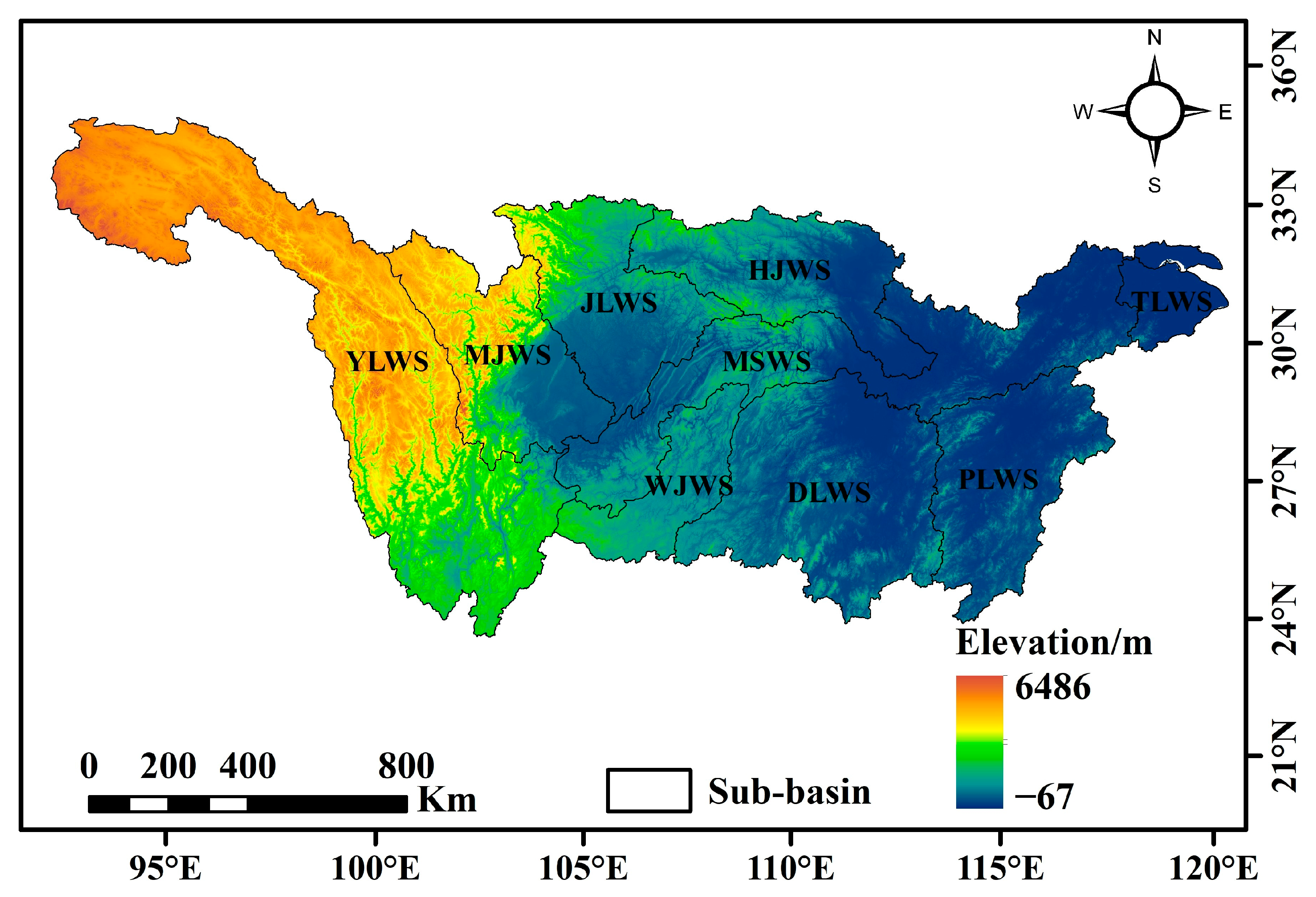
The Yangtze River is the largest river in China and the third-longest in the world. The Yangtze River is approximately 6300 km long, with a drainage area of 1.80 × 10⁶ km2, accounting for 18.8% of the total land area of China [6]. In terms of geological and geomorphic background, the YRB has a long geological history and well-developed strata, covering a continuous geological and stratigraphic sequence from the Archean to the Quaternary [49]. Meanwhile, the basin has a large east–west span, and the terrain is generally higher in the west and lower in the east. The landform types are rich and diverse, with mountains, plateaus, hills, basins, plains, etc., distributed. The landform structure is complex [50,51]. As shown in Figure 1, the YRB is divided into nine major water systems, namely the HanJiang Water System (HJWS), Main Stream of the Yangtze Water System (MSWS), Tai Lake Water System (TLWS), Poyang Lake Water System (PLWS), Dongting Lake Water System (DLWS), Wujiang Water System (WJWS), Jialing Water System (JLWS), Minjiang Water System (MJWS), and Yalong Water System (YLWS) [52].

2.2. Dataset

2.2.1. Soil Moisture Dataset

In this study, the soil moisture data used to calculate the standardized soil drought index were taken from the “Soil Moisture of China by in situ data (SMCI) of 1 km based on 1648 sites observations” released by the National Qinghai–Xizang Plateau Scientific Data Center. The time span of this dataset is from 2000 to 2022, with a relatively high spatiotemporal resolution. This dataset provides soil moisture estimates across 10 standardized depth layers (10, 20, …, 100 cm) [53]. It is important to clarify that these layers were not produced by vertical interpolation. Instead, a dedicated machine learning model was trained independently for each depth. Each model was calibrated using in situ soil moisture measurements from the corresponding depth as the target, along with a set of covariates. This data-driven methodology directly generates gridded soil moisture for each layer and inherently incorporates the effects of soil hydraulic properties on moisture distribution, without employing an explicit physical interpolation model. This soil moisture product has a wide range of application scenarios and can serve various analysis and modeling tasks in fields such as hydrology, meteorology, and ecology.

2.2.2. The Famine Early Warning Systems Network Land Data Assimilation System (FLDAS) Dataset

The meteorological data for studying the drivers of drought originated from the FLDAS dataset, which spatially covers the global scale and contains many climate-related variables [54]. The FLDAS management organization implements systematic quality control, processing and standardized storage of the collected raw data, builds an integrated meteorological data warehouse, and on this basis, has developed multiple user-friendly meteorological data sets for different scenarios. This dataset is based on a land surface model, assimilates multi-source observation data, and uses ensemble Kalman filtering technology to optimize the output of high-precision global land surface hydrological parameters, reducing the interference of non-climate signals caused by changes in observation conditions. Therefore, this study selected the monthly climate data (precipitation PC, soil moisture SM, soil temperature ST, air humidity AH, evapotranspiration ET, air temperature AT) provided by the FLDAS Center for the YRB from 2000 to 2022 to identify the meteorological drivers of drought.

2.2.3. Digital Elevation Model

The digital elevation model (DEM), quantitatively stores elevation information in raster or vector form and is the basic data source for research in fields such as hydrology, meteorology, ecology and geomorphology [55]. The commonly used DEM products at present have been verified and updated through multi-source data. While taking into account data accuracy and coverage, they provide reliable topographic support for multidisciplinary research at the basin scale. The DEM data adopted in this study is one of the land resource data products launched by the Geographic National Conditions Monitoring Cloud Platform. Based on linear and bilinear interpolation methods, its data accuracy can reach up to 30 m, which can meet the specific needs of users.

2.2.4. Atmospheric Circulation Factors

Atmospheric circulation factors are one of the important causes of drought formation. They may affect the local climate system through remote correlation and promote the occurrence, development and transmission of drought [23,55,56]. Due to its unique geographical location, the YRB is influenced by a combination of various atmospheric circulation patterns, including tropical cyclones, oscillations, subtropical high pressures and the East Asian monsoon, etc. This article selects twelve representative atmospheric circulation factors, which are, respectively, El Niño-Southern Oscillation (ENSO), Pacific Decadal Oscillation (PDO), Arctic Oscillation (AO), North Atlantic Oscillation (NAO), Dipole Mode Index (DMI), Atlantic Multidecadal Oscillation (AMO), North Pacific Index (NPI), Pacific/North American Index (PNA), Sunspot Index (SSI), Southern Oscillation Index (SOI), Interdecadal Pacific Oscillation (IPO), and Oceanic Niño Index (ONI).

2.2.5. Data Preprocessing

All analyses were based on monthly scale data. For SMCI soil moisture and FLDAS climate data, a minimal number of missing values were checked and filled using linear interpolation (ArcMap 10.7). To eliminate the influence of scale and magnitude differences on the models, all climatic factors and circulation indices were normalized to a [0, 1] range (R 4.3.2) prior to being input into the models. Before conducting BFAST decomposition and wavelet analysis (MATLAB R2022a), the time series were detrended and standardized to reduce interference from non-stationary trends and outliers on the analysis results, thereby ensuring the stability of the identified cycles and relationships.

2.3. Methodology

2.3.1. Construction of Standardized Drought Index (SSMI)

The calculation principle of the Standardized Soil Moisture Index (SSMI) is similar to that of the Standardized Precipitation Evapotranspiration Index (SPEI), using monthly soil moisture data for calculation. Based on the soil moisture time series, researchers have developed multiple indices to monitor soil moisture drought, among which SSMI is one of the widely verified indices that can effectively detect soil moisture drought. SSMI can be calculated by standardizing the long-term soil moisture time series of a certain location or area, converting soil moisture data into a sequence with a mean of 0 and a standard deviation of 1, eliminating regional and seasonal differences, and thus quantifying the degree of deviation of soil moisture. The classification criteria of SSMI are shown in Table 1.

2.3.2. The Breaks for Additive Seasons and Trend Algorithm (BFAST)

The BFAST algorithm is a method for detecting changes in time series proposed by Jan Verbesselt in one of his papers. This method is widely applied in the detection of vegetation changes and can detect the seasonal and trend changes in vegetation. BFAST decomposed the time series into trends, seasons and remaining components, detected the changes in the time series, obtained the time and frequency of mutations, and characterized the characteristics of mutation points with amplitude and direction [57,58]. The BFAST algorithm employed in this study estimates changepoint locations through an iterative piecewise regression model. Its core involves sequentially testing each potential point in the series, identifying the location that maximizes the improvement in the goodness-of-fit of the piecewise linear trend model as the candidate changepoint. The statistical significance of each candidate changepoint was verified using a hypothesis test based on the F-test principle; only changepoints with a p-value less than 0.05 were ultimately confirmed as significant trend mutations. In this study, the detected “mutation points” refer to specific moments in the time series when the long-term trend of soil drought undergoes a statistically significant and abrupt change in direction or rate. Furthermore, “mutation types” are defined based on the direction of the trend segments before and after these breakpoints. For example, a shift from a decreasing trend to an increasing trend with one clear mutation point is categorized as “decrease to increase”, whereas the reverse is termed “increase to decrease”. If the trend remains decreasing both before and after the mutation but exhibits a distinct positive interruption during the decline, it is classified as “interrupted decrease”.

2.3.3. Gridded Mann–Kendall Trend Test Method (GMK)

The Mann–Kendall Trend Test (MK) is a commonly used non-parametric statistical method in the field of time series trend detection [59,60]. This paper selects the grid-based Mann–Kendall trend test method (GMK). This method is an extension and optimization of the traditional MK test in the spatial dimension. The core logic involves applying the test process sequentially to each grid cell (pixel) within spatial grid data, such as remote sensing imagery or meteorological grids. By analyzing the time series data of every individual unit, the method accurately identifies whether a significant monotonic trend exists in the temporal dimension for that unit. This approach demonstrates overall superiority in spatial trend recognition compared to the traditional MK test. On the basis of completing the trend test of a single grid cell, it further reveals the spatial change patterns of soil drought at the regional scale.

2.3.4. Cross Wavelet Transform Technology

Wavelet analysis technology is based on the wavelet transform, including continuous wavelet transform and discrete wavelet transform. The discrete wavelet transform is mainly used for data compression and noise reduction, while the continuous wavelet transform is widely used for extracting specific scale and local features [61]. Based on wavelet decomposition and reconstruction, the cross-wavelet transform technique is mainly used to handle the correlation degree between two signals [62]. Partial Wavelet Coherence (PWC) is an improvement of wavelet coherence and is used to analyze the interrelationship between two time series at different time and frequency scales. It transforms the time series into the wavelet domain through the wavelet transform and then calculates the coherence of the two signals in the wavelet domain, thereby revealing the frequency-domain connection and time-domain correlation between them. The theoretical distribution of the cross-wavelet power and its background power spectrum of the two-time series is represented as follows:
D ( W n X ( s ) W n Y ( s ) σ X σ Y < p ) = Z v ( p ) v P k X P k Y
Among them, Zv(p) is the confidence level related to the probability p of the probability distribution function, which is defined by the square root of two χ 2 distributions.

2.3.5. Shapley Additive Explanations (SHAP)

SHAP is an interpretability method based on game theory, which quantifies the contribution of a single predictor variable to the model output through additive feature attribution, thereby achieving local and global interpretation of machine learning models [63,64,65]. Compared with traditional machine learning models, XGBoost, as an ensemble learning algorithm, can not only effectively capture the complex relationship between input features and target variables, but also has the advantages of high prediction accuracy and strong anti-overfitting ability. In order to quantify the nonlinear effect of circulation factors on soil drought, XGBoost was used to construct a regression model. Taking 12 circulation factors as the characteristics and the average SSMI of the basin as the goal, the data set was constructed monthly and randomly divided into training set and test set according to 8:2. In the training, the super parameters (including learning rate, tree depth, sub node weight and regularization term) were optimized by 50% cross validation, and the early stop strategy was used to prevent over fitting. The model performs well on the test set (R2 = 0.76, RMSE = 0.41), and can reliably capture the interpretation part of the circulation on drought changes, laying the foundation for the subsequent SHAP attribution analysis. When the SHAP value is positive (f(xij) > 0), it indicates that this predictor variable has a positive promoting effect on the model output; that is, an increase in the value of the factor will lead to an increase in the value of the dependent variable. Conversely, when the SHAP value is negative (f(xij) < 0), it indicates that the variable has a negative inhibitory effect; that is, an increase in the value of the factor will cause the value of the dependent variable to decrease. Let the j-th predictor variable of the i-th sample be xij, the model prediction value of this sample be yi, and the average value of all sample predictions be ybase. Then, the SHAP value satisfies the following additive relationship:
y i = y b a s e + f ( x i 1 ) + f ( x i 2 ) + f ( x i 3 ) + + f ( x i j )
In the formula, f(xij) represents the SHAP value of the j-th predictor variable of the i-th target variable, indicating the marginal contribution of this predictor variable to the predicted value of the target variable.

2.3.6. Methodological Justification

To ensure a close match between the research methods and objectives and to guarantee analytical rigor, this section explains the rationale behind key methodological choices. Selection of drought index: The core of this study is to monitor agricultural drought caused by soil water deficit. Although indices like SPEI are widely used, they essentially reflect climatic water surplus/deficit. To directly capture soil-layer moisture anomalies, this study employs the SSMI, calculated directly from standardized soil moisture series. Its data source integrates extensive nationwide in situ measurements, offering relatively high spatiotemporal resolution and accuracy, making it more directly applicable for soil drought assessment.
Selection of breakpoint detection method: This study employs the BFAST algorithm to detect structural change points in soil drought time series. Unlike traditional methods such as the Pettitt test, which only detect mean change points, the core advantage of BFAST lies in its ability to decompose the time series into three components: trend, seasonal, and residual, and specifically detect multiple change points in the trend component while accounting for seasonal fluctuations [57]. This characteristic makes it particularly suitable for analyzing hydrological variables like soil moisture that exhibit significant interannual periodicity, enabling more reliable identification of mutation points in long-term trends caused by climate change or human activities.
Selection of driving factor analysis methods: To investigate the associations between climate factors and soil drought across multiple time scales, this study adopts the PWC analysis. PWC is an important improvement over wavelet coherence analysis. When multiple interrelated influencing factors are present, ordinary wavelet coherence may fail to reveal the true pairwise relationships because it is interfered with by other factors. PWC, by controlling for the linear influences of other variables, can more clearly reveal the coherence between two variables in the time–frequency domain [61], thereby more accurately identifying the climate factors that play a dominant role in soil drought at specific time scales. To quantify the nonlinear effects of various circulation factors on drought, this study combines the XGBoost model with the SHAP interpretability method. Compared to methods like Permutation Importance, SHAP, based on solid game theory, provides consistent and stable quantification of feature contributions, and can reflect both global importance and offer explanations for individual samples [63]. This is crucial for understanding the individual and interactive effects of complex factors such as atmospheric circulation on soil drought, avoiding potential misconceptions that might arise from single metrics.

3. Results

3.1. Decomposition of the Temporal Variation Trend of Soil Drought

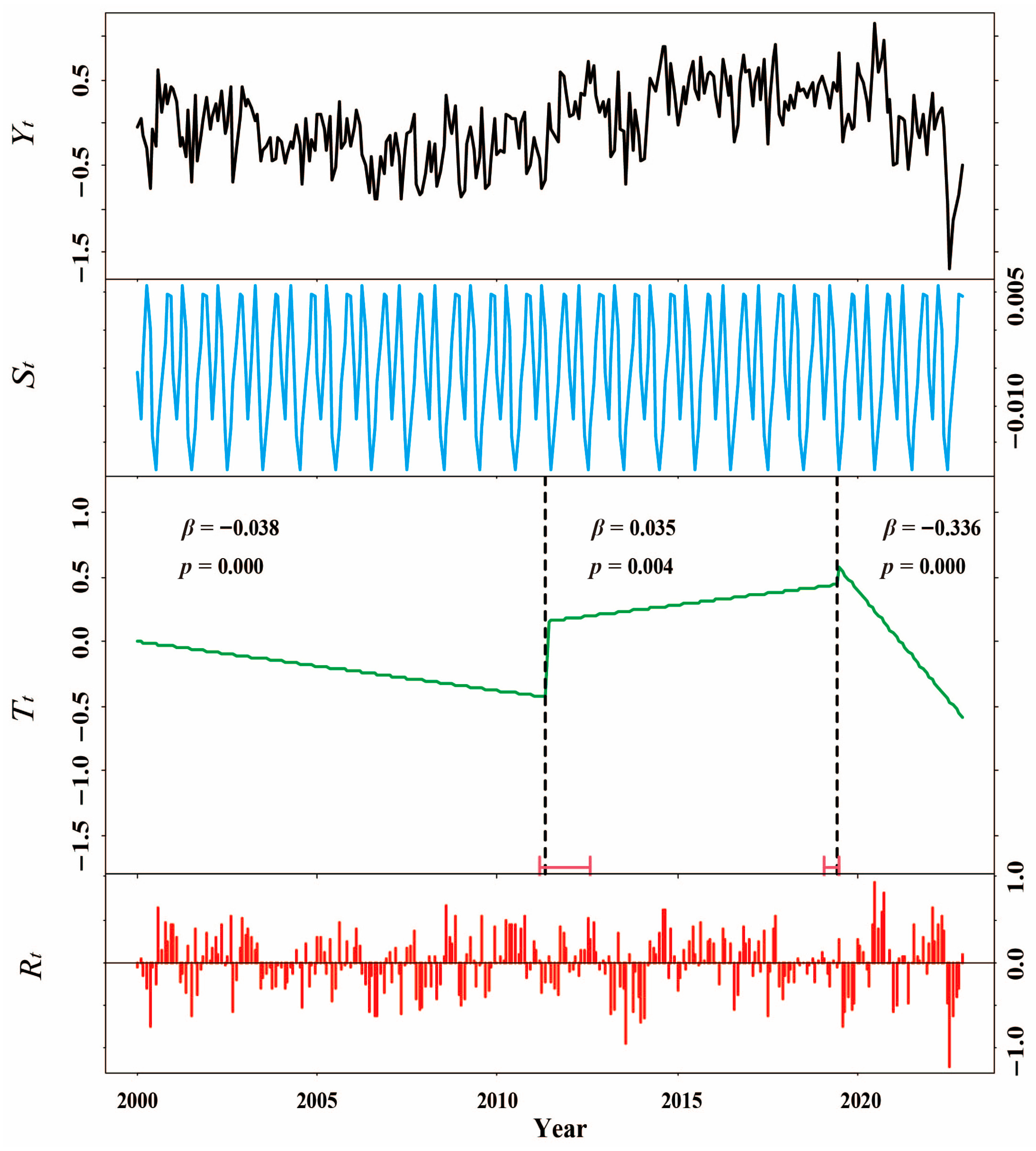
As shown in Figure 2, the seasonal component St represents the regular periodic fluctuation characteristics implied in soil drought. The changes in soil drought in the YRB are generally in a cycle of 12 months. The trend component Tt reflects the upward/downward trend of soil drought and the mutation points. From 2000 to 2022, soil drought in the YRB underwent two sudden changes, which occurred in May 2011 and June 2019, respectively. The slopes of SSMI before and after the first mutation point were –0.038 (downward trend) and 0.035 (upward trend), respectively, and the changing trends all passed the significance test of α = 0.01. In addition, this mutation point (May 2011) was a positive mutation (an upward-shift mutation), with the mutation type being “decrease to increase”, and the temporal range was from March 2011 to August 2012. This specifically indicates that the trend of soil aridity underwent a fundamental shift at this point, transitioning from a previously persistent state of intensification to a subsequent state of alleviation. The type of the second mutation point (June 2019) was “increase to decrease” (temporal range was from February 2019 to July 2019), and the changing trends before and after the mutation were significant (p < 0.01). Obviously, during the study period, the trend of soil drought changes in the YRB was aggravation–alleviation–aggravation, which was relatively consistent with the drought situation changes reflected by the original sequence Yt. In addition, the occurrence time of the extreme points of the residual term Rt roughly coincides with the original SSMI. The maximum value (1.16) of SSMI occurred in July 2020, and the minimum value (–1.69) occurred in August 2022, indicating that a relatively severe soil drought event occurred in the YRB in 2022.
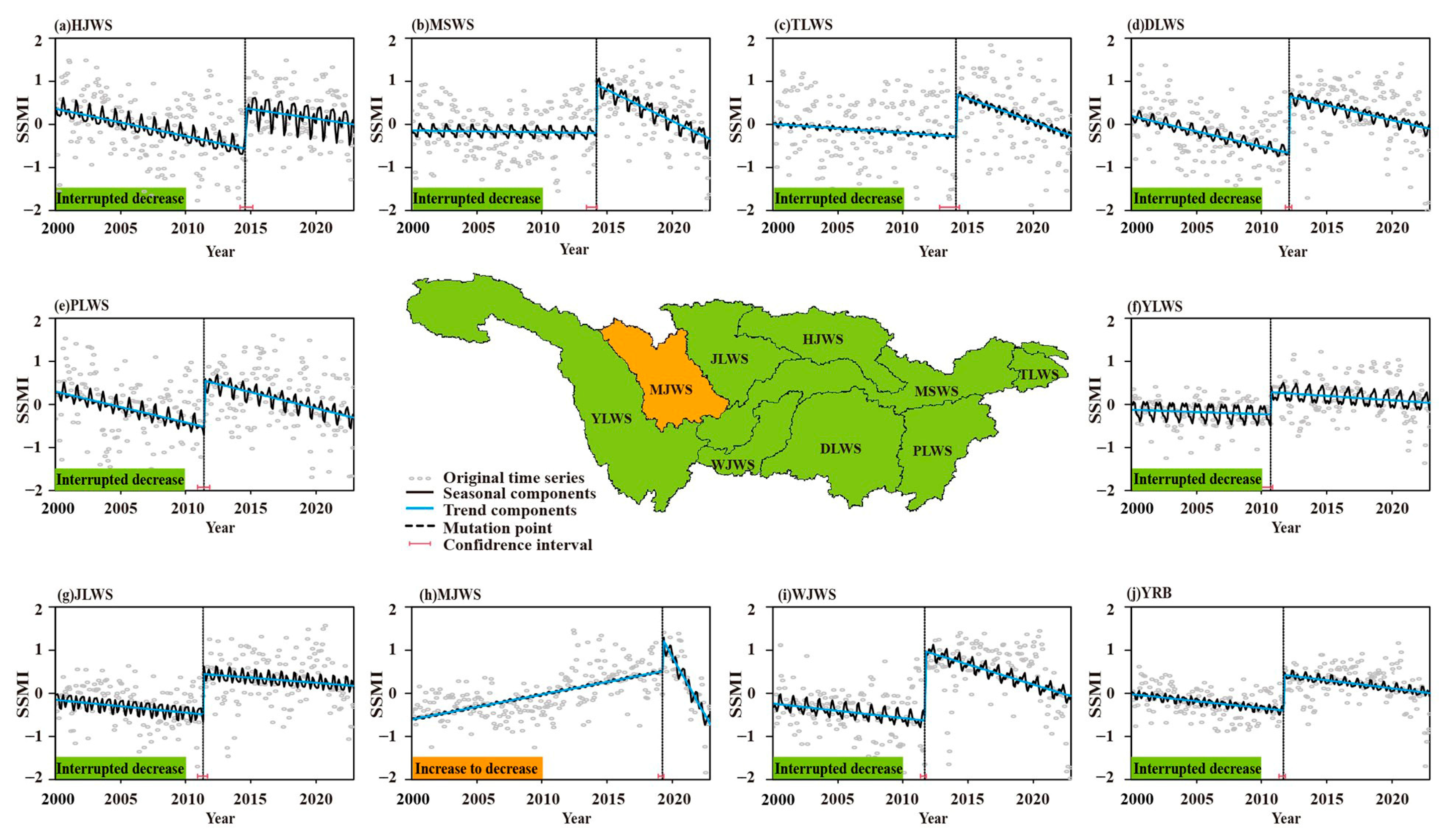
Figure 3 shows the changing trends of SSMI in various regions of the YRB, as well as the locations and types of mutation points. In HJWS, the SSMI before and after the positive mutation (an upward-shift mutation) point that occurred in August 2014 showed a downward trend, and the temporal range of this mutation point was within the period from March 2014 to March 2015. In MSWS, the mutation point occurred in March 2014 (with a temporal range from June 2013 to April 2014), and the mutation type was “interrupted decrease”. In MJWS, there was a mutation point that occurred in April 2019 between 2000 and 2022 (the mutation type was “increase to decrease”). Before the mutation point, it was a monotonically upward trend, but after the mutation, the trend changed to a significantly downward trend (p < 0.01), with a temporal range from December 2018 to May 2019. That is, there is a 95% chance that the mutation point will fall within this range, and the direction of the mutation is positive. Except for MJWS, the mutation types in the other partitions were consistent (“interrupted decrease”), and all mutation points showed a downward trend before and after. MJWS, as the only region showing the mutation type of “increase to decrease”, can be attributed to its complex natural conditions and high intensity of human activities. The middle and lower reaches of MJWS rely on Dujiangyan and other projects to maintain intensive irrigation, and the early water resources regulation may alleviate the drought. However, extreme weather has frequently occurred after 2019, which exceeds the capacity of system regulation, resulting in a sharp reversal of the trend from “man-made mitigation” to “climate man-made dual stress”. It was worth noting that all the sudden change points occurred after 2010, indicating that the meteorological conditions before 2010 were relatively stable. Overall, the mutation directions of SSMI in all regions of the YRB were positive, and the mutation type in nine regions was “interrupted decrease”, accounting for 90%.

3.2. Spatial Distribution of Soil Drought

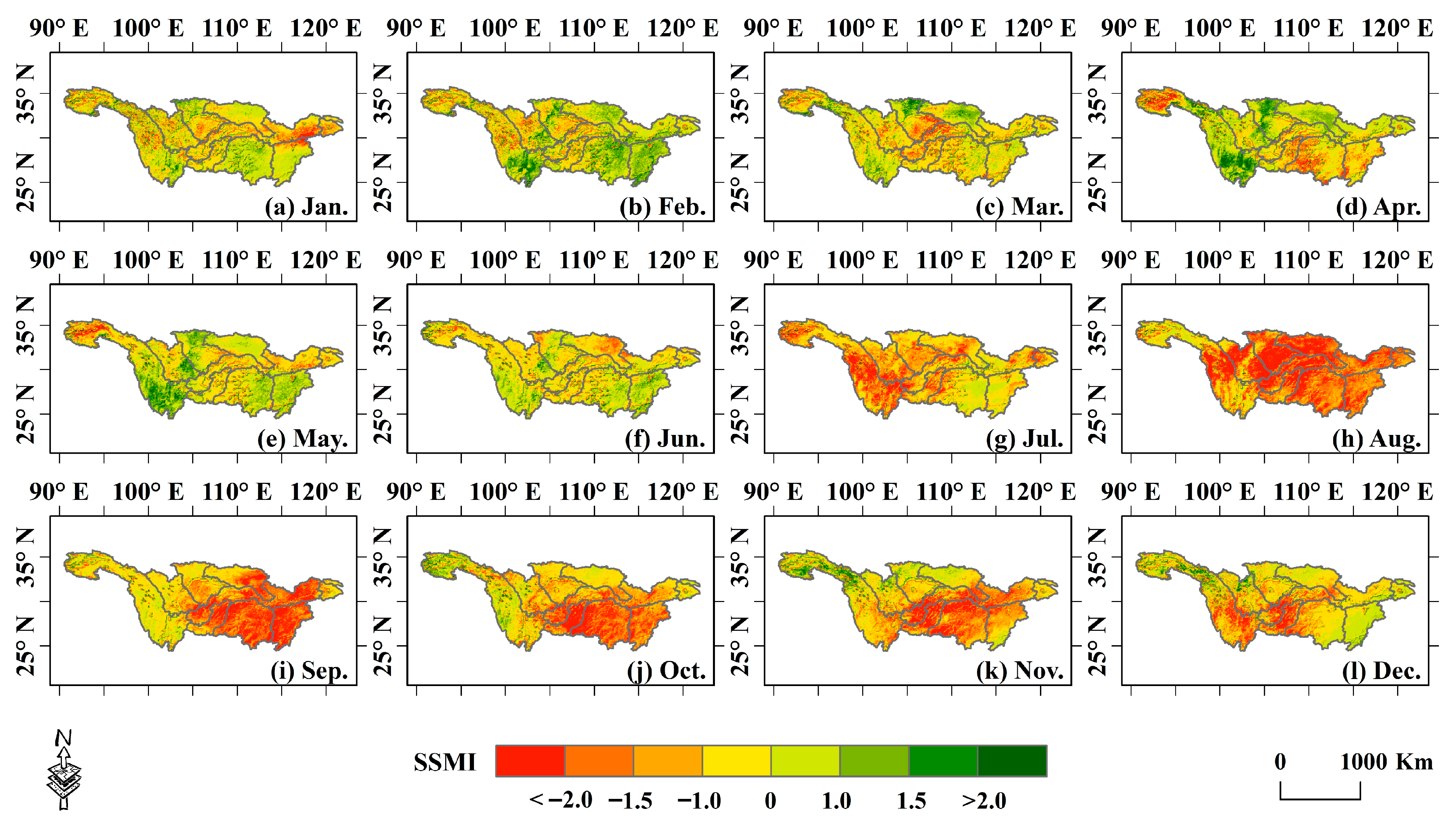
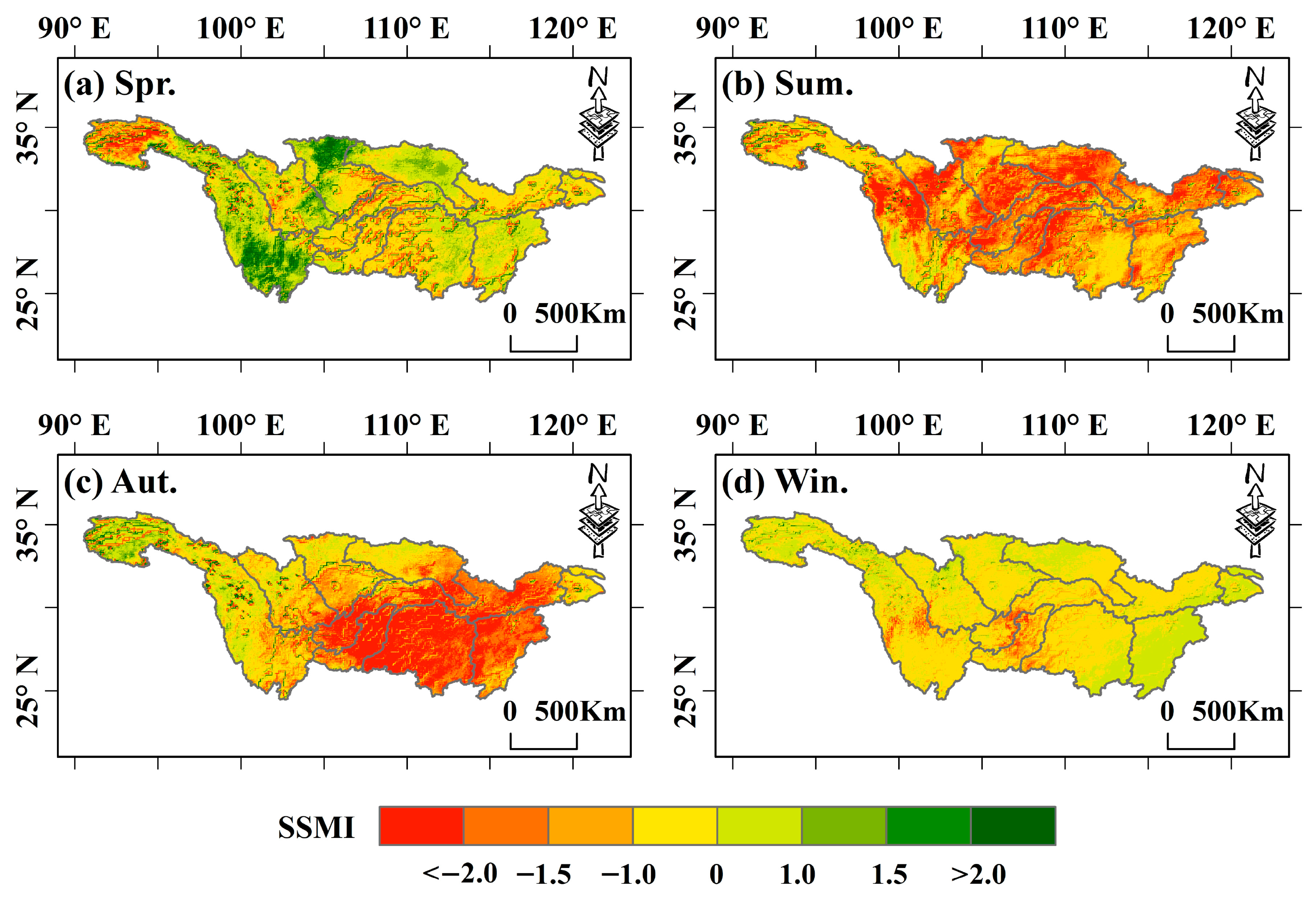
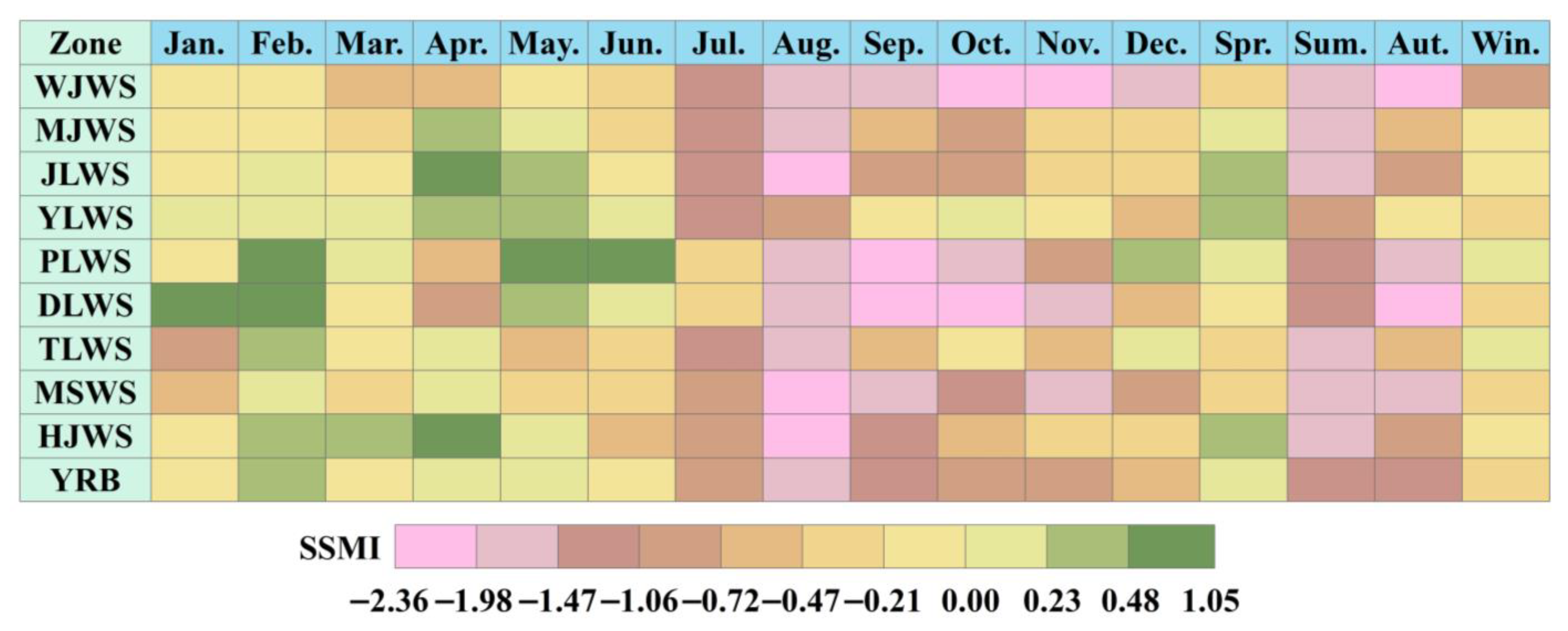
From 2000 to 2022, the smallest SSMI (–0.94) occurred in 2022. Therefore, we characterized the spatial distribution of soil drought at the monthly and quarterly scales for that year. As shown in Figure 4, from January to April, the average values of SSMI in the entire basin were –0.04, 0.34, –0.07, and 0.10, respectively, and the focus of drought gradually shifted from the eastern part of MSWS (January) to the southwestern part of DLWS (April). The percentage of areas with mild drought in February was 22.63%, and the percentage of areas with moderate drought was 5.85%. The drought in March was concentrated in the middle of the basin, with the average SSMI of MSWS being –0.42. As a major agricultural zone, the MSWS is dominated by paddy soils and alluvial soils. Although these soils have relatively strong water-holding capacity, the high evapotranspiration demand during spring crop growth makes the region prone to moderate drought when precipitation is below normal. From May to June, the drought was still not very obvious, and the smallest SSMI values occurred at TLWS (–0.53) and HJWS (–0.70), respectively. However, drought began to occur in July, and the YLWS of SSMI in the western part of the basin reached its minimum value of 1.37. In August, a severe drought occurred throughout the entire river basin (SSMI = –1.69), with the percentages of areas affected by severe drought and extreme drought being 22.98% and 39.36%, respectively. The pronounced spatial differentiation reflects distinct driving mechanisms between the upper and lower reaches. In upstream areas, steep terrain and shallow soil layers lead to a rapid drought response primarily governed by natural climatic processes. In contrast, the severely affected mid-lower reaches are in plains and hilly areas. Their deep soils support intensive agricultural evapotranspiration and high human water demand, making the drought there a compound product of climatic anomalies superimposed with anthropogenic pressures. Subsequently, the drought began to ease gradually, and the SSMI increased from –1.13 in September to –0.48 in December. In September, the percentage of arid areas was 83.82%, and this figure dropped to 63.99% in December. In each quarter, the average SSMI values of the entire basin were 0.13, –1.29, –1.15, and –0.23, respectively (Figure 5). It can be seen that the drought in the YRB was most severe in the summer of 2022. In summer, the districts with a mean SSMI less than –1.5 were HJWS (–1.67), MSWS (–1.57), JLWS (–1.58), MJWS (–1.51), and WJWS (–1.55) (Figure 6). These areas are typical examples where natural vulnerabilities (low elevation, high evapotranspiration demand, moderate water-holding soils) overlap most significantly with intense human water-use pressure.

3.3. Gridded Soil Drought Trend Characteristics

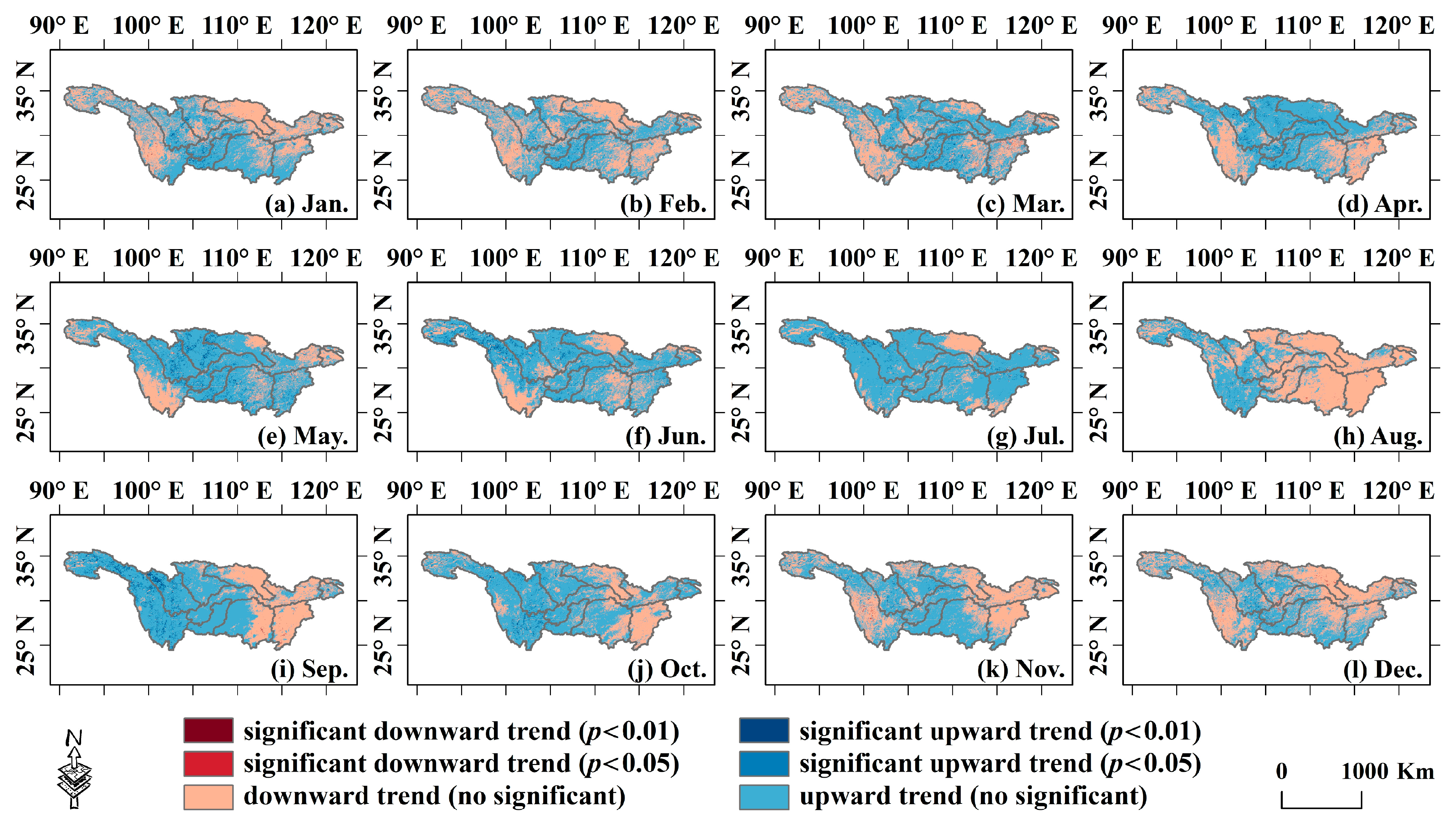
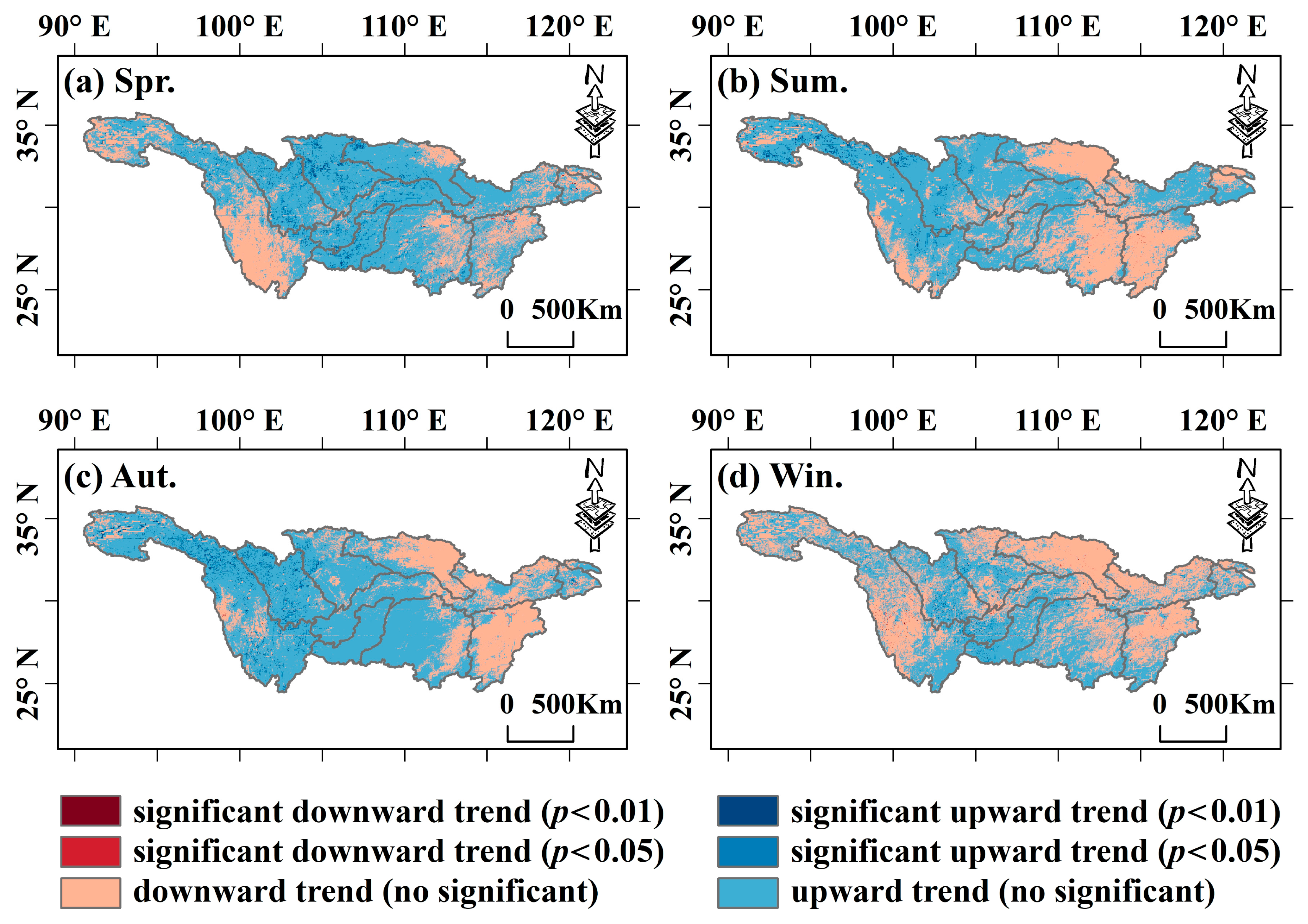
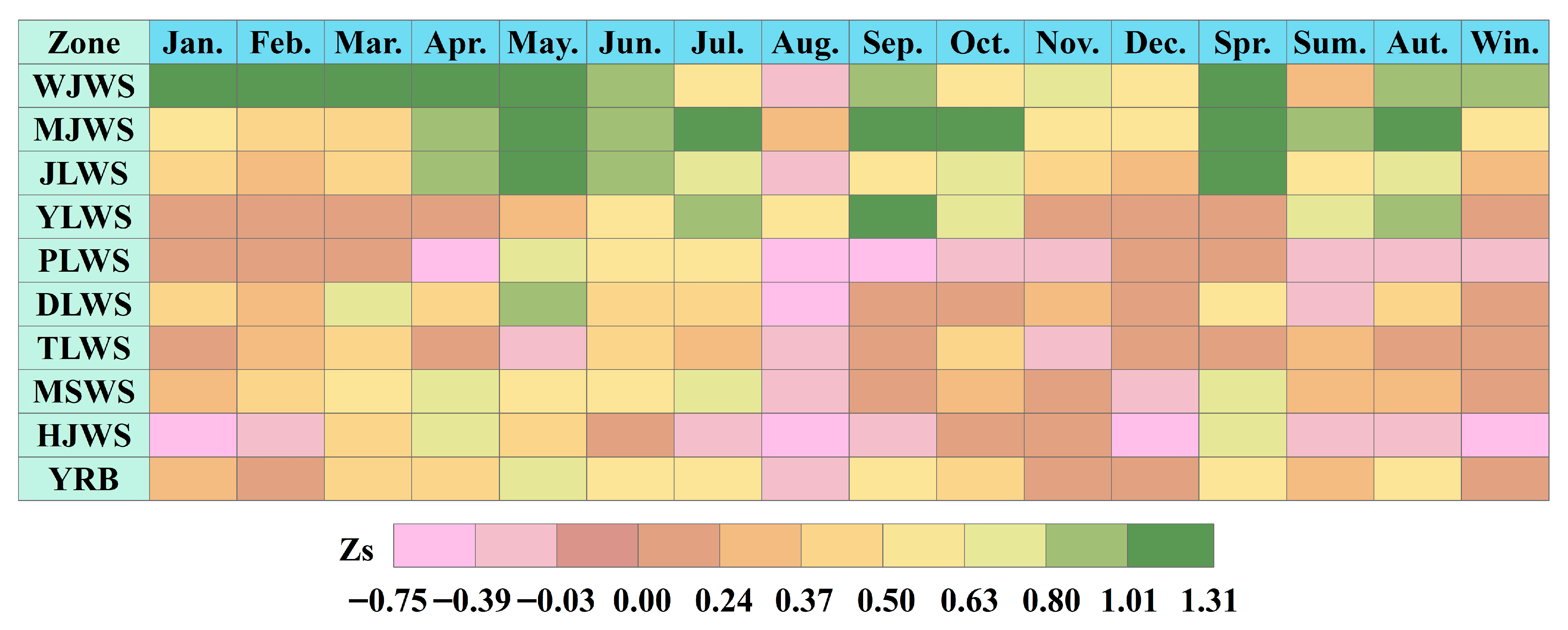
Figure 7 and Figure 8 show the grid-based soil drought trend characteristics on a spatial scale from 2000 to 2022. Figure 9 shows the characteristic values Zs of the trend statistical test for the YRB and its different sub-basins obtained based on the GMK method. In January, the Zs value of HJWS was –0.41, while that of WJWS was 1.24, with a difference of 1.65. In February, the percentage of areas with an increasing trend of drought was 40.52%, among which the proportion of significant trends reached 0.25% (p < 0.05). The increasing trend of drought in August was most obvious (with an area percentage of 60.32%), and the trend was more significant in most areas of the eastern part of the basin. The Zs values of PLWS, HJWS and DLWS were –0.75, –0.69 and –0.41, respectively. On a seasonal scale, the Zs values of the entire basin were 0.61, 0.34, 0.55, and 0.15, respectively. In spring, the percentage of areas where drought showed a significant increasing trend was 0.23% (p < 0.05). In summer, the percentage of areas where drought showed a significant easing trend was 1.85% (p < 0.05). In autumn, the Zs value of MJWS was 1.28, while that of PLWS was –0.16, with a difference of 1.44. In winter, the Zs of HJWS reached the minimum value of –0.39, indicating that the drought in this area generally showed an increasing trend. It is worth noting that in each sub-basin, the drought situation in YLWS and MJWS has shown a decreasing trend in all months and quarters.

3.4. Time–Frequency Decomposition of Climate Factors and Soil Drought

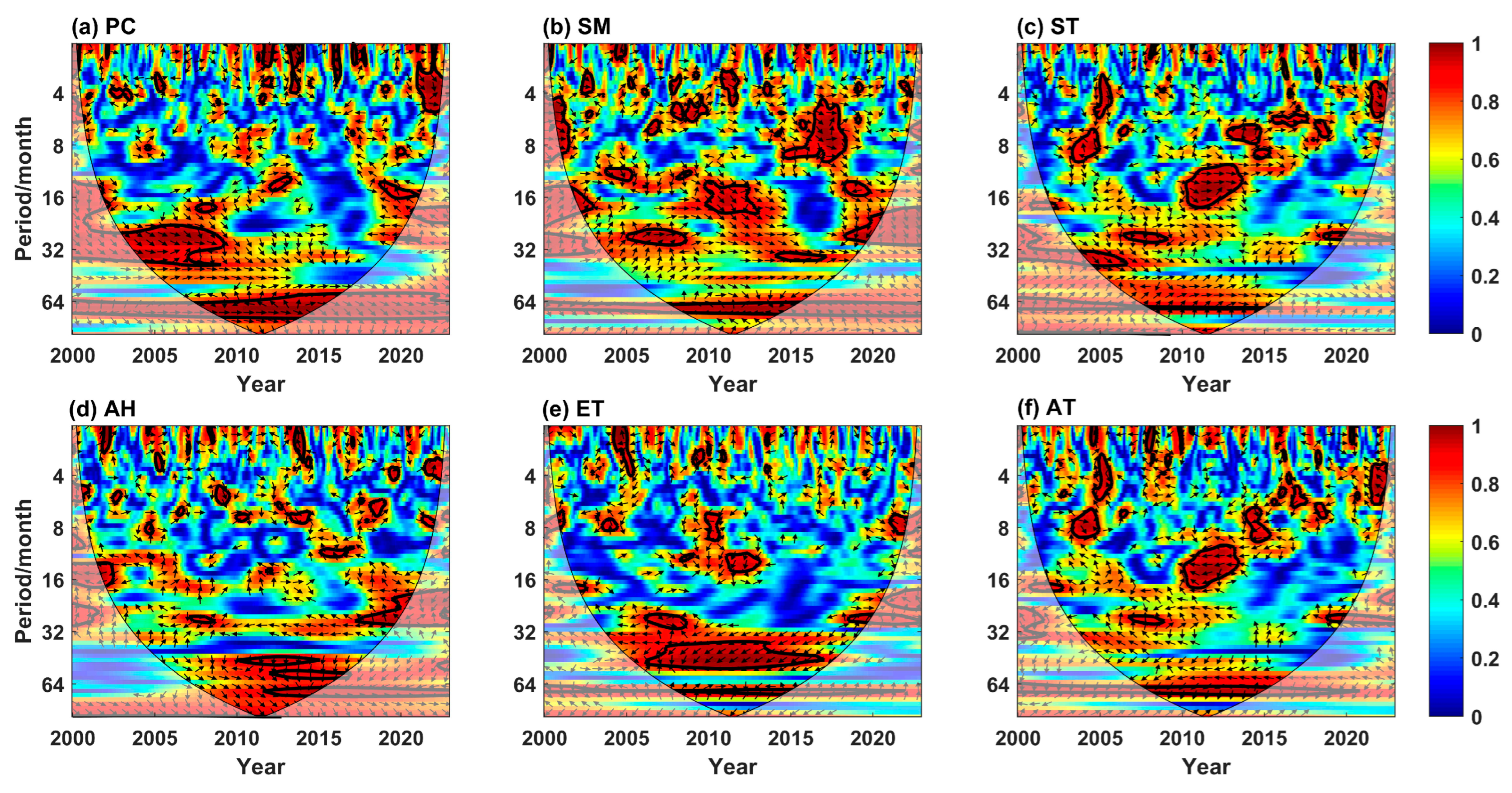
Figure 10 shows the time–frequency decomposition results of climate variables (PC, SM, ST, AH, ET, AT) and soil drought based on the partial wavelet analysis method. Rightward arrows indicate positive phase relationships, while leftward arrows denote negative phase relationships. Color bands represent wavelet coherence coefficients, with bold contours marking regions exceeding the 95% confidence level. The time–frequency domain was partitioned into three scales: small (<8 months), medium (8–32 months), and large (>32 months). During the research period, there were four significant resonance cycles between SSMI and PC in the YRB, namely three positive correlations: the 24–32 month cycle from 2003 to 2009, the 16–20 month cycle from 2008 to 2009, the 12–16 month cycle from 2012 to 2013, and 12–16 month cycle from 2018 to 2020 with a negative correlation. The average wavelet coherence (AWC)value of SSMI and PC was 0.94, and the percentage area of significant coherence (PASC) value was 15.48%. At small scales (1–8 months), medium scales (8–32 months), and large scales (>32 months), the PASC values were 8.08%, 13.73%, and 45.61%, respectively (Table 2). There were mainly five significant resonance periods with positive correlations between SSMI and SM. They were, respectively, the 14–24 month cycle from 2002 to 2003, the 12–14 month cycle from 2004 to 2005, the 24–32 month cycle from 2005 to 2008, the 12–24 month cycle from 2010 to 2013, and the 8–12 month cycle from 2014 to 2018. Meanwhile, the AWC and PASC values between the two were 0.93 and 14.94%, respectively. For ST, there were two negatively correlated periods with SSMI: the 8–10 month period from 2003 to 2004 and the 24–32 month period from 2006 to 2008. It has a positive correlation with three cycles: the 32–40 month cycle from 2004 to 2006, the 12–18 month cycle from 2010 to 2014, and the 24–32 month cycle from 2019 to 2020. Significant coherent signals at intraseasonal to annual scales (e.g., 4–12 months) were detected in the analysis, which corresponds directly to the intra-annual cycle of East Asian monsoon precipitation and evapotranspiration, representing a typical manifestation of seasonal soil moisture dynamics. Overall, among these six climate factors, the PASC value between PC and SSMI reached the maximum of 15.48%. Therefore, PC was the best climate variable for explaining soil drought in the YRB.

3.5. The Impact of Circulation Factors on Soil Drought

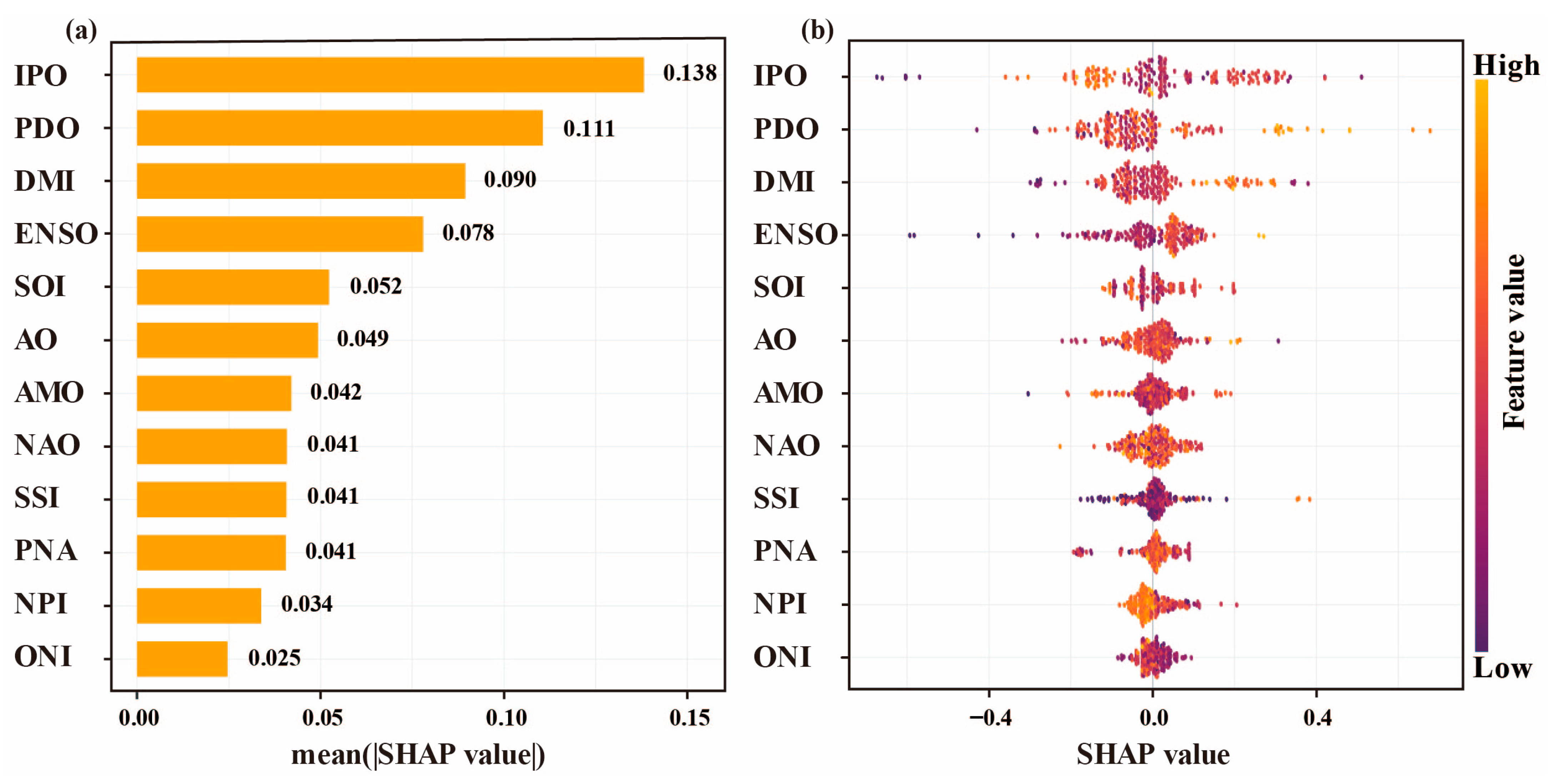
In this paper, based on the SHAP algorithm, we discuss the influence of different atmospheric circulation factors on soil drought in the YRB (Figure 11). The average values of SHAP for ranking and quantifying the influence of circulation factors on soil drought changes in the YRB are IPO (0.138), PDO (0.111), DMI (0.090), ENSO (0.078), SOI (0.052), AO (0.049), AMO (0.042), NAO (0.041), SSI (0.041), PNA (0.041), NPI (0.034), and ONI (0.025) (Figure 11a). Therefore, the most closely related remote correlation factor to soil drought is IPO. There is a negative correlation between IPO and SSMI, indicating that soil drought will worsen with the increase in IPO (Figure 11b). Conversely, the remote correlation factor that has the weakest impact on drought is ONI (with a mean SHAP of 0.025). Obviously, among these 12 remote correlation factors, the key circulation factor influencing soil drought based on the ranking of SHAP importance is IPO.
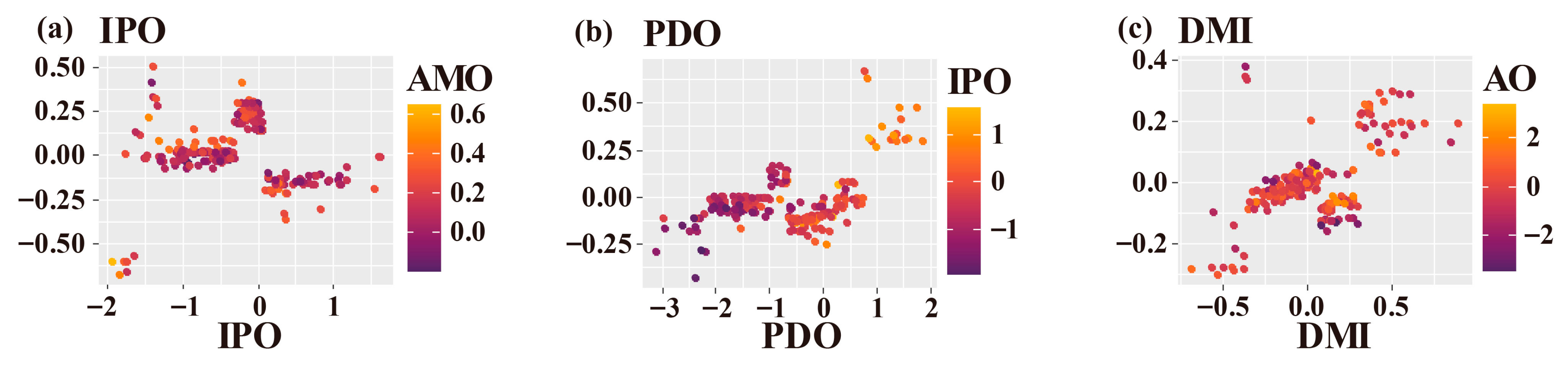
Based on the SHAP theory, we can also prove that there is an interaction relationship among different atmospheric circulation factors (Figure 12). The top three circulation factors influencing the dynamic changes in soil drought are IPO (SHAP = 0.138), PDO (SHAP = 0.111), and DMI (SHAP = 0.090). Therefore, these three circulation factors are the focus of discussion. As the number of IPO increases, the SHAP effect of IPO and AMO will gradually weaken. Furthermore, the relationship between IPO and AMO is divided by IPO = 0. When IPO < 0, the interaction SHAP value between the two is mostly positive (0 < SHAP value < 0.50). When IPO > 0, the interaction SHAP value between the two changes from positive to negative (–0.50 < SHAP value < 0). For PDO, as PDO increases, the relationship between PDO and IPO strengthens. When PDO < 0, the SHAP value gathers within the range of –0.25 to 0.25. When PDO > 0, the range interval of the SHAP value changes to [0.25, 0.5]. When DMI < 0, the SHAP interaction value between DMI and AO is mainly negative. With the increase in DMI value, the interaction relationship between DMI and AO gradually turns into a positive correlation.

4. Discussion

4.1. Advantages and Limitations

The timing of the two identified mutation points in soil drought trends (around 2011 and 2019) is strongly supported by quantitative shifts in key climatic elements. For the first mutation point (from intensification to alleviation), its temporal range (March 2011 to August 2012) exhibited a “wet-cool summer” pattern. The basin-average monthly precipitation (121.7 mm) was 7.2% higher than the preceding decade (113.5 mm), with particularly abundant summer rainfall in 2012. Concurrently, both the mean temperature (14.6 °C) and evapotranspiration (81.3 mm) were lower than in the earlier period. This moisture-balance configuration—characterized by “increased income and reduced expenditure”—effectively alleviated soil drought. For the second reversal (from alleviation to renewed intensification), the climatic background shifted to a “high-temperature and strong-evapotranspiration” stress regime. During 2018–2020, the mean temperature (15.1 °C) rose by 0.4 °C (p < 0.05) compared with the earlier period (14.7 °C). This magnitude of change exceeds the typical range of natural climate variability in recent years, indicating a trend-like signal. More importantly, this warming directly exacerbated drought through thermodynamic effects: according to the Clapeyron–Clausius equation, a 0.4 °C temperature increase raises the saturation vapor pressure by approximately 2.8%, thereby significantly increasing atmospheric evaporative demand. At the same time, intra-seasonal precipitation unevenness decreased significantly, reflected in a roughly 4% reduction in the monthly mean precipitation during 2018–2020 (99.64 mm) compared to the preceding period of 2011–2017 (103.48 mm). This “atmospheric drought” effect, combined with the concurrent precipitation shortages in the summers of 2019 and 2022, jointly drove the accelerated depletion of soil moisture, reasonably explaining the reversal of the soil drought trend during this period.
In 2022, due to record-breaking heatwaves and low precipitation, the YRB experienced the most severe drought since 1961 [11,22,56]. Meanwhile, the region also experienced the most severe heatwave worldwide. The average temperature in August of that year was 1.2 °C higher than the average for the same period in previous years. This intensified evaporation, reduced surface water volume, dried up soil and vegetation, and ultimately led to a more complex and persistent drought under relatively cold climate conditions [66]. Similarly, our results also confirm that 2022 was the year with the most severe drought in the YRB, and the drought indicator reached its minimum value in August. The reason for this is that climate change has increased the possibility of drought in the Northern Hemisphere by 20 times in 2022, and it is expected that the frequency, range and severity of such droughts will continue to rise in the 21st century [67]. Recent studies have further indicated that anthropogenic climate change and the coupling effect of land and atmosphere have synergistically exacerbated the risk of drought in the YRB in 2022. This suggests that the complex interaction between anthropogenic climate factors and natural processes can cause drought to exceed the expected range under natural climate variability [6,7,68].
In addition, our achievements have, to some extent, enriched the research on extreme events in the YRB. They have significant theoretical value and practical significance for further enhancing the disaster prevention and mitigation capacity of the YRB, ensuring the ecological security of agriculture and the coordinated development of the economy and society in the basin. It should be noted that soil drought is caused by multiple factors. These factors include both natural factors such as topography, climate and hydrology of the basin, as well as human factors. Moreover, there are uncertainties and interactions among these influencing factors [16,22,26,28]. Through PWC, this study quantified the independent contribution of climate factors to drought and excluded mutual interference among the variables (Figure 10). The occurrence of extreme weather is influenced by multiple factors and is closely related to altitude, topography, atmospheric circulation and human activities [25,29,31]. Among them, the influence of atmospheric circulation factors on extreme climate is significant [14,65]. Our research results indicate that soil drought is significantly influenced by IPO, PDO and DMI (Figure 11). IPO is a quasi-oscillation occurring in the Pacific basin region, which has a significant impact on the trend changes in global land precipitation [69]. The decadal northward propagation of the East Asian monsoon airflow and the corresponding rain belt is modulated by the PDO. When the PDO is in the negative phase, the main rain belt moves northward. As the PDO gradually transitions to the positive phase, the main rain belt begins to move southward again [70]. As an important indicator of sea surface temperature anomalies in the tropical Indian Ocean, the DMI directly influences the East Asian monsoon system. Its positive and negative phases regulate atmospheric circulation and water vapor transport, thereby significantly affecting precipitation and temperature variability in the YRB [71].
This paper systematically analyzes the spatio-temporal variation characteristics of soil drought in different periods in the YRB, and explores the influence mechanisms of different climatic factors and circulation factors on soil drought. However, there are still some deficiencies in revealing the impact of drought on vegetation [16,19,72]. With the in-depth research of remote sensing technology, multispectral remote sensing information provides surface temperature data and vegetation index data of various spatial resolutions and time scales for the study of land surface processes. These surface temperatures and vegetation indices are correlated with the growth of crops, providing strong support for soil drought monitoring [41]. Therefore, we need to fully consider the impact of vegetation coverage on soil moisture content, which can provide a new perspective and tool for drought assessment. Furthermore, although the drought influencing factors obtained in this study have improved our understanding of the mechanism of drought causes, the impact of specific drought events on the final agricultural yield has not been quantified, that is, how much agricultural yield loss will be caused when the characteristics such as the intensity and duration of soil drought reach [73,74,75]. The growth and development of crops is a relatively long process. The frequency and intensity of drought during the critical growth period of crops can have an impact on the loss of crop yield or productivity, which is also something that needs further consideration [42,58].

4.2. Future Prospects

The analysis of soil moisture in this paper is limited to surface soil moisture and fails to reflect the spatiotemporal variation characteristics of deep soil moisture and its impact on vegetation. If drought occurs in deeper soil layers, it may lead to a greater reduction in productivity. Therefore, in the future, it is necessary to evaluate the sustained effects of different types of droughts on vegetation under multiple scenarios [25,28,39]. The occurrence of soil drought is a cumbersome nonlinear process, and the agricultural production system is a huge nonlinear system [72]. The development process of drought disasters is characterized by complexity, dynamics, and uncertainty. The factors leading to the formation of agricultural soil drought have featured such as diverse types, nonlinearity, and large amounts of data. Therefore, the method of coupling deep learning and information fusion can combine multi-source data, such as soil, meteorology, and crop types over a long period of time with nonlinear data to form a spatio-temporal consistent data set. Then, a comprehensive method was adopted to establish a drought prediction model to improve the accuracy of soil drought monitoring, prediction and disaster assessment in the YRB [9,22,26,45]. Furthermore, in the future, remote sensing images with higher spatial resolution can be chosen to effectively reduce the interference of pixel factors and ensure more accurate monitoring and assessment of crop drought conditions [40,75]. With the in-depth research of machine learning and deep learning algorithms in soil moisture, more scholars have utilized experimental methods such as random forests, neural networks, and support vector machines to compare the monitoring effects of soil drought in different experimental areas and under different environmental conditions based on multi-source remote sensing data [74]. In the future, a new type of remote sensing drought monitoring algorithm based on soil drought index can be constructed by using machine learning and intelligent learning algorithms to improve the accuracy of soil drought monitoring and ensure food production security [41,76].

5. Conclusions

This study systematically reveals the spatiotemporal evolution patterns and driving mechanisms of soil drought in the YRB from 2000 to 2022. The main conclusions are as follows:
(1)
The soil drought in the YRB underwent a complex phased change in “worsening–slowing down–worsening”. The BFAST pinpointed two critical mutation points in May 2011 (“decrease to increase”) and June 2019 (“increase to decrease”), which accurately demarcate the timing of major hydrological regime shifts in the basin.
(2)
This study identifies 2022 as the most severe drought year within the study period (annual SSMI = –0.94), underscoring an escalating drought risk. The extreme drought event in August 2022, which affected 39.36% of the basin’s area, highlights the potential for unprecedented agricultural and water resource stress under current climate trends.
(3)
Based on GMK analysis, drought showed the most pronounced intensifying trend in August (with an area percentage of 60.32%). Seasonally, drought generally eased in spring, summer, and autumn, with 1.85% of areas experiencing significant relief in summer (p < 0.05).
(4)
Quantitative analysis confirmed PC as the dominant climatic driver. More importantly, the SHAP model attributed the highest relative contribution to soil drought variability to the IPO (mean SHAP value: 0.138), followed by the PDO (0.111) and DMI (0.090), quantitatively establishing their roles as key atmospheric circulation factors.
This study provides a scientific basis for monitoring soil drought and informing agricultural adaptation in the YRB. Identifying key mutation points improves drought prediction, supporting better agricultural water and fertilizer management to reduce yield loss. Remote circulation factors such as IPO and PDO offer useful references for forecasting seasonal drought trends and guiding water decisions.
In the future, intelligent models should combine with multi-source data to develop dynamic drought risk models covering entire crop growth cycles. These models can quantify yield losses under varying drought scenarios and ultimately enhance climate resilience in agriculture.

Author Contributions

Conceptualization, W.L., J.G. and S.H.; Methodology, Z.L. and N.L.; Original draft preparation, W.L., F.W. and R.M.; Validation, K.F. and Y.L.; Software, H.L., R.L. and M.D.; Funding acquisition, W.L. and Q.T. All authors have read and agreed to the published version of the manuscript.

Funding

This research was supported by National Key R&D Program of China (grant number 2023YFC3006603), Henan Provincial Youth Science Foundation (grant number 252300420828), National Natural Science Foundation of China (grant number 42401022 and 42301024), the State Key Laboratory of Spatial Datum Open Project (grant number SKLGIE2024-ZZ-8, SKLGIE2024-Z-4-1 and SKLGIE2023-ZZ-9), the Open Research Fund of Key Laboratory of River Basin Digital Twinning of Ministry of Water Resources (grant number Z0202042022), Key Research Projects of Higher Education Institutions in Henan Province (grant number 24A570005), Scientific and Technological Research Projects in Henan Province (grant number 242102321005), and Key Research and Development Special Project of Henan Province (grant number 251111210700).

Data Availability Statement

Data can be requested from the corresponding author upon reasonable request.

Acknowledgments

Thanks for the help with language editing provided by Yingying Wang.

Conflicts of Interest

The remaining authors declare that the research was conducted in the absence of any commercial or financial relationships that could be construed as a potential conflict of interest.

References

  1. Popat, E.; Döll, E. Soil moisture and streamflow deficit anomaly index: An approach to quantify drought hazards by combining deficit and anomaly. Nat. Hazards Earth Syst. Sci. 2021, 21, 1337–1354. [Google Scholar] [CrossRef]
  2. Wang, C.; Chen, J.; Gu, L.; Wu, G.; Tong, S.; Xiong, L.; Xu, C.Y. A pathway analysis method for quantifying the contributions of precipitation and potential evapotranspiration anomalies to soil moisture drought. J. Hydrol. 2023, 621, 129570. [Google Scholar] [CrossRef]
  3. Zhang, L.; Chang, J.X.; Guo, A.J.; Wang, Y.M.; Yang, G.B.; Zhou, K. Unraveling the dynamics of soil drought and its controlling factors across diverse ecosystems. Catena 2024, 238, 107849. [Google Scholar] [CrossRef]
  4. Kumar, V.; Sharma, K.V.; Pham, Q.B.; Srivastava, A.K.; Bogireddy, C.; Yadav, S.M. Advancements in drought using remote sensing: Assessing progress, overcoming challenges, and exploring future opportunities. Theor. Appl. Climatol. 2024, 155, 4251–4288. [Google Scholar] [CrossRef]
  5. Abebe, A.K.; Zhou, X.; Lv, T.; Tao, Z.; Bayissa, Y.; Zhang, H.; Elnashar, A. Advancing basin-scale drought monitoring: Development of a regional combined drought index using precipitation, soil moisture, and vegetation data. Agric. Water Manag. 2025, 318, 109734. [Google Scholar] [CrossRef]
  6. Liu, X.; Peng, J.; Liu, Y.; Yu, S.; Wang, Y. The Three Gorges Dam has weakened the drought propagation process in the Yangtze River Basin. J. Hydrol. 2024, 632, 130857. [Google Scholar] [CrossRef]
  7. Liu, X.; Yu, S.; Yang, Z.; Dong, J.; Peng, J. The first global multi-timescale daily SPEI dataset from 1982 to 2021. Sci. Data 2024, 11, 223. [Google Scholar] [CrossRef] [PubMed]
  8. Ma, W.; Zhou, H.; Dai, M.; Tang, L.; Xu, S.; Luo, Z. Characterizing the drought events in Yangtze River basin via the insight view of its sub-basins water storage variations. J. Hydrol. 2024, 633, 130995. [Google Scholar] [CrossRef]
  9. Chen, B.; Zhang, W.; Yang, S.; Xu, X. Roles of oceanic moisture exports in modulating summer rainfall over the middle-lower Yangtze River Basin: Inter-annual variability and decadal transition. Int. J. Climatol. 2019, 40, 3757–3770. [Google Scholar] [CrossRef]
  10. Hu, C.; Xia, J.; She, D.X.; Wang, G.; Zhang, L.; Jing, Z.; Hong, S.; Song, Z. Precipitation exacerbates spatial heterogeneity in the propagation time of meteorological drought to soil drought with increasing soil depth. Environ. Res. Lett. 2024, 19, 064021. [Google Scholar] [CrossRef]
  11. Ma, M.; Qu, Y.; Lyu, J.; Zhang, X.; Su, Z.; Gao, H.; Yang, X.; Chen, X.; Jiang, T.; Zhang, J.; et al. The 2022 extreme drought in the Yangtze River Basin: Characteristics, causes and response strategies. River 2022, 1, 162–171. [Google Scholar] [CrossRef]
  12. Alkhalidi, A.; Assaf, M.N.; Alkaylani, H.; Halaweh, G.; Salcedo, F.P. Integrated innovative technique to assess and priorities risks associated with drought: Impacts, measures/strategies, and actions, global study. Int. J. Disaster Risk Reduct. 2023, 94, 103800. [Google Scholar] [CrossRef]
  13. Guo, C.; Bao, X.; Sun, H.; Zhu, L.; Zhang, Y.; Zhang, K.; Bai, Z.; Zhu, J.; Liu, X.; Li, A.; et al. Optimizing root system architecture to improve cotton drought tolerance and minimize yield loss during mild drought stress. Field Crop Res. 2024, 308, 109305. [Google Scholar] [CrossRef]
  14. Wang, F.; Lai, H.; Li, Y.; Feng, K.; Tian, Q.; Zhang, Z.; Di, D.; Yang, H. Terrestrial ecological drought dynamics and its response to atmospheric circulation factors in the North China Plain. Atmos. Res. 2023, 294, 106944. [Google Scholar] [CrossRef]
  15. Wang, H.; Cheng, S.; Huang, L.; Guo, W. Investigating the meteorological causes of hydrological drought through the integration of spatiotemporal cubes and interpretable machine learning: A case study of the Yangtze River Basin. J. Hydrol. Reg. Stud. 2025, 62, 102796. [Google Scholar] [CrossRef]
  16. van Hateren, T.C.; Chini, M.; Matgen, P.; Teuling, A.J. Ambiguous Agricultural Drought: Characterising Soil Moisture and Vegetation Droughts in Europe from Earth Observation. Remote Sens. 2021, 13, 1990. [Google Scholar] [CrossRef]
  17. Jung, H.; Won, J.; Kang, S.; Kim, S. Characterization of the Propagation of Meteorological Drought Using the Copula Model. Water 2022, 14, 3293. [Google Scholar] [CrossRef]
  18. Goyal, M.; Poonia, V.; Jain, V. Three decadal urban drought variability risk assessment for Indian smart cities. J. Hydrol. 2023, 625, 130056. [Google Scholar] [CrossRef]
  19. Li, L.; Peng, Q.; Wang, M.; Cao, Y.; Gu, X.; Cai, H. Quantitative analysis of vegetation drought propagation process and uncertainty in the Yellow River Basin. Agric. Water Manag. 2024, 295, 108775. [Google Scholar] [CrossRef]
  20. Chen, S.; Zhang, Z.; Chen, Z.; Xu, H.; Li, J. Responses of canopy transpiration and conductance to different drought levels in Mongolian pine plantations in a semiarid urban environment of China. Agric. For. Meteorol. 2024, 347, 109897. [Google Scholar] [CrossRef]
  21. Wang, H.; Lan, J.; He, N.; Jiao, X.; Ye, H.; Sun, C.; Wang, G.; Guo, W. River Hydrological Regime Changes and Their Attribution: A Case Study in the Upper Reaches of the Yangtze River Using a Multi-Model Approach. River Res. Appl. 2024, 41, 349–366. [Google Scholar] [CrossRef]
  22. Yuan, X.; Wang, Y.; Zhou, S.; Li, H.; Li, C. Multiscale causes of the 2022 Yangtze mega-flash drought under climate change. Sci. China Earth Sci. 2024, 67, 2649–2660. [Google Scholar] [CrossRef]
  23. Gu, Z.; Gu, L.; Yin, J.; Fang, W.; Xiong, L.; Guo, J.; Zeng, Z.; Xia, J. Impact of atmospheric circulations on droughts and drought propagation over China. Sci. China Earth Sci. 2024, 67, 2633–2648. [Google Scholar] [CrossRef]
  24. Deng, S.; Tan, X.; Tan, X.; Wu, X.; Huang, Z.; Liu, Y.; Liu, B. On the development and recovery of soil moisture deficit drought events. J. Hydrol. 2024, 632, 130920. [Google Scholar] [CrossRef]
  25. Berg, A.; Sheffield, J. Climate Change and Drought: The Soil Moisture Perspective. Curr. Clim. Change Rep. 2018, 4, 180–191. [Google Scholar] [CrossRef]
  26. Jiao, D.; Wang, D.; Lv, H. Effects of human activities on hydrological drought patterns in the Yangtze River Basin, China. Nat. Hazards 2020, 104, 1111–1124. [Google Scholar] [CrossRef]
  27. Ye, X.; Zhang, Z.; Xu, C.Y.; Liu, J. Attribution Analysis on Regional Differentiation of Water Resources Variation in the Yangtze River Basin under the Context of Global Warming. Water 2020, 12, 1809. [Google Scholar] [CrossRef]
  28. Gong, J.; Yang, G.; Zhang, S.; Zhang, W.; Dong, X.; Zhang, S.; Wang, R.; Yan, C.; Wang, T. Human activities weaken the positive effects of soil abiotic factors and biodiversity on ecosystem multifunctionality more than drought: A case study in China’s West Liao River Basin. Sci. Total Environ. 2024, 957, 177564. [Google Scholar] [CrossRef]
  29. Grothe, P.; Cobb, K.; Liguori, G.; Lorenzo, E.D.; Capotondi, A.; Lu, Y.; Cheng, H.; Edwards, R.L.; Southon, J.R.; Santos, G.M.; et al. Enhanced El Niño-Southern Oscillation variability in recent decades. Geophys. Res. Lett. 2020, 47, e2019GL083906. [Google Scholar] [CrossRef]
  30. Fan, K.; Slater, L.; Zhang, Q.; Sheffield, J.; Gentine, P.; Sun, S.; Wu, W. Climate warming accelerates surface soil moisture drying in the Yellow River Basin, China. J. Hydrol. 2022, 615, 128735. [Google Scholar] [CrossRef]
  31. Zhang, X.; Hao, Z.; Singh, V.P.; Zhang, Y.; Feng, S.; Xu, Y.; Hao, F. Drought propagation under global warming: Characteristics, approaches, processes, and controlling factors. Sci. Total Environ. 2022, 838, 156021. [Google Scholar] [CrossRef]
  32. Yang, Q.; Du, T.; Li, N.; Liang, J.; Javed, T.; Wang, H.; Guo, J.; Liu, Y. Bibliometric Analysis on the Impact of Climate Change on Crop Pest and Disease. Agronomy 2023, 13, 920. [Google Scholar] [CrossRef]
  33. Zhao, H.; Fan, J.; Gu, B.; Chen, Y. Carbon sink response of terrestrial vegetation ecosystems in the Yangtze River Delta and its driving mechanism. J. Geogr. Sci. 2024, 34, 112–130. [Google Scholar] [CrossRef]
  34. Huang, F.; Xiong, H.; Jiang, S.H.; Yao, C.; Fan, X.; Catani, F.; Chang, Z.; Zhou, X.; Huang, J.; Liu, K. Modelling landslide susceptibility prediction: A review and construction of semi-supervised imbalanced theory. Earth Sci. Rev. 2024, 250, 104700. [Google Scholar] [CrossRef]
  35. Darko, R.O.; Odoi-Yorke, F.; Abbey, A.A.; Afutu, E.; Owusu-Sekyere, J.D.; Sam-Amoah, L.K.; Acheampong, L. A Review of Climate Change Impacts on Irrigation Water Demand and Supply-Detailed Analysis of Trends, Evolution, and Future Research Directions. Water Resour. Manag. 2025, 39, 17–45. [Google Scholar] [CrossRef]
  36. Ferreira, D.; Fernandes, C.V.S.; Kaviski, E.; Bleninger, T. Calibration of river hydrodynamic models: Analysis from the dynamic component in roughness coefficients. J. Hydrol. 2021, 598, 126136. [Google Scholar] [CrossRef]
  37. Hao, H.; Yang, M.; Wang, H.; Dong, N. Human activities reshape the drought regime in the Yangtze River Basin: A land surface-hydrological modelling analysis with representations of dam operation and human water use. Nat. Hazards 2023, 118, 2097–2121. [Google Scholar] [CrossRef]
  38. Wang, F.; Lai, H.X.; Men, R.Y.; Sun, K.; Li, Y.B.; Feng, K.; Tian, Q.Q.; Guo, W.X.; Du, X.F.; Qu, Y.P. Spatial and temporal evolutions of terrestrial vegetation drought and the influence of atmospheric circulation factors across the Mainland China. Ecol. Indic. 2024, 158, 111455. [Google Scholar] [CrossRef]
  39. Ochsner, T.E.; Cosh, M.H.; Cuenca, R.H.; Dorigo, W.A.; Draper, C.S.; Hagimoto, Y.; Kerr, Y.H.; Larson, K.M.; Njoku, E.G.; Small, E.E.; et al. State of the Art in Large-Scale Soil Moisture Monitoring. Soil Sci. Soc. Am. J. 2013, 77, 1888–1919. [Google Scholar] [CrossRef]
  40. Peng, J.; Loew, A. Recent Advances in Soil Moisture Estimation from Remote Sensing. Water 2017, 9, 530. [Google Scholar] [CrossRef]
  41. Abbes, A.B.; Jarray, N.; Farah, I.R. Advances in remote sensing based soil moisture retrieval: Applications, techniques, scales and challenges for combining machine learning and physical models. Artif. Intell. Rev. 2024, 57, 224. [Google Scholar] [CrossRef]
  42. Lubczynski, M.W.; Leblanc, M.; Batelaan, O. Remote sensing and hydrogeophysics give a new impetus to integrated hydrological models: A review. J. Hydrol. 2024, 633, 130901. [Google Scholar] [CrossRef]
  43. Zhou, Y.; Li, J.; Jia, W.; Zhang, F.; Zhang, H.; Wang, S. The Evolution of Drought and Propagation Patterns from Meteorological Drought to Agricultural Drought in the Pearl River Basin. Water 2025, 17, 1116. [Google Scholar] [CrossRef]
  44. Ma, F.; Yuan, X.; Liu, X. Intensification of drought propagation over the Yangtze River basin under climate warming. Int. J. Climatol. 2023, 43, 5640–5661. [Google Scholar] [CrossRef]
  45. Zhang, X.; She, D.; Xia, J.; Zhang, L.; Deng, C.; Liu, Z. The changing characteristics of propagation time from meteorological drought to hydrological drought in the Yangtze River basin, China. Atmos. Res. 2023, 290, 106774. [Google Scholar] [CrossRef]
  46. Wang, M.; Jiang, S.; Ren, L.; Xu, C.Y.; Menzel, L.; Yuan, F.; Xu, Q.; Liu, Y.; Yang, X. Separating the effects of climate change and human activities on drought propagation via a natural and human-impacted catchment comparison method. J. Hydrol. 2021, 603, 126913. [Google Scholar] [CrossRef]
  47. Fu, J.; Liu, B.; Lu, Y.; Chen, Y.; Yang, F.; He, Y.; Jia, W.; Zhang, Y. Separating the impact of climate change and human activities on the connection between meteorological and hydrological drought. Hydrol. Process. 2024, 38, e15258. [Google Scholar] [CrossRef]
  48. Qin, G.; Wang, N.; Wu, Y.; Zhou, S.; Meng, Z. Quantifying the contribution of climate change and human activities to surface drought in Qinghai, northeastern Qinghai-Tibetan Plateau. Theor. Appl. Climatol. 2024, 155, 6099–6117. [Google Scholar] [CrossRef]
  49. Hu, M.; Zhou, P.; Chen, C. Hydro-geochemical evolution of groundwater in the Central Yangtze Basin, China. Carbonates Evaporites 2023, 38, 28. [Google Scholar] [CrossRef]
  50. Li, R.; Tang, X.; Guo, W.; Lin, L.; Zhao, L.; Hu, Y.; Liu, M. Spatiotemporal distribution dynamics of heavy metals in water, sediment, and zoobenthos in mainstream sections of the middle and lower Changjiang River. Sci. Total Environ. 2020, 714, 136779. [Google Scholar] [CrossRef]
  51. Zong-Jie, L.; Jin-Zhu, M.; Hai-Chao, Y.; Huan, Y.; Ling-Ling, S.; Zong-Xing, L.; Juan, G. Geochemical evidence of ions’ sources and influences of meteorological factors on hydrochemistry of glacier snow meltwater in the source region of the Yangtze River Environ. Earth Sci. 2020, 79, 235. [Google Scholar] [CrossRef]
  52. Liu, Z.; Chao, N.; Chen, G.; Zhang, G.; Wang, Z.; Li, F.; Ouyang, G. Changes in monthly surface area, water level, and storage of 194 lakes and reservoirs in the Yangtze River Basin during 1990–2021 using multisource remote sensing data. Sci. Total Environ. 2024, 944, 173840. [Google Scholar] [CrossRef] [PubMed]
  53. Li, Q.; Shi, G.; Shangguan, W.; Nourani, V.; Li, J.; Li, L.; Huang, F.; Zhang, Y.; Wang, C.; Wang, D.; et al. A 1 km daily soil moisture dataset over China using in situ measurement and machine learning. Earth Syst. Sci. Data 2022, 14, 5267–5286. [Google Scholar] [CrossRef]
  54. Albarakat, R.; Le, M.H.; Lakshmi, V. Assessment of drought conditions over Iraqi transboundary rivers using FLDAS and satellite datasets. J. Hydrol. Res. Stud. 2022, 41, 101075. [Google Scholar] [CrossRef]
  55. Wang, F.; Lai, H.; Li, Y.; Feng, K.; Zhang, Z.; Tian, Q.; Zhu, X.; Yang, H. Dynamic variation of meteorological drought and its relationships with agricultural drought across China. Agric. Water Manag. 2022, 261, 107301. [Google Scholar] [CrossRef]
  56. Wang, Y.; Yuan, X.; Liu, Y.; Wang, W. Skillful seasonal prediction of the 2022–23 mega soil drought over the Yangtze River basin by combining dynamical climate prediction and copula analysis. Environ. Res. Lett. 2024, 19, 064019. [Google Scholar] [CrossRef]
  57. Verbesselt, J.; Hyndman, R.; Newnham, G.; Culvenor, D. Detecting trend and seasonal changes in satellite image time series. Remote Sens. Environ. 2010, 114, 106–115. [Google Scholar] [CrossRef]
  58. Kovács, G.M.; Horion, S.; Fensholt, R. Characterizing ecosystem change in wetlands using dense earth observation time series. Remote Sens. Environ. 2022, 281, 113267. [Google Scholar] [CrossRef]
  59. Malik, A.; Kumar, A. Spatio-temporal trend analysis of rainfall using parametric and non-parametric tests: Case study in Uttarakhand, India. Theor. Appl. Climatol. 2020, 140, 183–207. [Google Scholar] [CrossRef]
  60. Mallick, J.; Talukdar, S.; Alsubih, M.; Salam, R.; Ahmed, M.; Kahla, N.B.; Shamimuzzaman, M. Analysing the trend of rainfall in Asir region of Saudi Arabia using the family of Mann-Kendall tests, innovative trend analysis, and detrended fluctuation analysis. Theor. Appl. Climatol. 2021, 143, 823–841. [Google Scholar] [CrossRef]
  61. Hu, W.; Si, B. Technical Note: Multiple wavelet coherence for untangling scale-specific and localized multivariate relationships in geosciences. Hydrol. Earth Syst. Sci. 2017, 20, 3183–3191. [Google Scholar] [CrossRef]
  62. Ghaderpour, E.; Pagiatakis, S.D. LSWAVE: A MATLAB software for the least-squares wavelet and cross-wavelet analyses. GPS Solut. 2019, 23, 50. [Google Scholar] [CrossRef]
  63. Lundberg, S.M.; Lee, S.I. A unified approach to interpreting model predictions. Adv. Neural Inf. Process. Syst. 2017, 30, 4768–4777. [Google Scholar]
  64. Pradhan, B.; Lee, S.; Dikshit, A.; Kim, H. Spatial flood susceptibility mapping using an explainable artificial intelligence (XAI) model. Geosci. Front. 2023, 14, 101625. [Google Scholar] [CrossRef]
  65. Feng, Y.; Sun, F.; Liu, F. SHAP-powered insights into short-term drought dynamics disturbed by diurnal temperature range across China. Agric. Water Manag. 2025, 316, 109579. [Google Scholar] [CrossRef]
  66. Jia, N.; Cheng, J.; Li, Y.; Zheng, L.; Song, W.; Chen, R.; Zhu, A. China’s Yangtze River drought: A cascade of impacts from mountains to sea. Sci. China Earth Sci. 2025, 68, 957–962. [Google Scholar] [CrossRef]
  67. Yu, R.; Zhai, P. Changes in compound drought and hot extreme events in summer over populated eastern China. Weather Clim. Extrem. 2020, 30, 100295. [Google Scholar] [CrossRef]
  68. Liao, Z.; An, N.; Chen, Y.; Zhai, P. On the possibility of the 2022-like spatio-temporally compounding event across the Yangtze River Valley. Environ. Res. Lett. 2024, 19, 014063. [Google Scholar] [CrossRef]
  69. Dong, B.; Dai, A. The influence of the Interdecadal Pacific Oscillation on Temperature and Precipitation over the Globe. Clim. Dyn. 2015, 45, 2667–2681. [Google Scholar] [CrossRef]
  70. Ding, Y.; Li, Y.; Wang, Z.; Si, D.; Liu, Y. Interdecadal variation of Afro-Asian summer monsoon: Coordinated effects of AMO and PDO oceanic modes. Trans. Atmos. Sci. 2020, 43, 20–32. [Google Scholar]
  71. Shi, W.; Wang, M. Biological dipole mode indices: New parameters to characterize the physical and biological processes of the Indian Ocean Dipole event. Prog. Oceanogr. 2022, 206, 102847. [Google Scholar] [CrossRef]
  72. Du, L.; Song, N.; Liu, K.; Hou, J.; Hu, Y.; Zhu, Y.; Wang, X.; Wang, L.; Guo, Y. Comparison of Two Simulation Methods of the Temperature Vegetation Dryness Index (TVDI) for Drought Monitoring in Semi-Arid Regions of China. Remote Sens. 2017, 9, 177. [Google Scholar] [CrossRef]
  73. Kane, D.; Bradford, M.; Fuller, E.; Oldfield, E.; Wood, S. Soil organic matter protects US maize yields and lowers crop insurance payouts under drought. Remote Sens. Environ. 2021, 16, 044018. [Google Scholar] [CrossRef]
  74. Wang, K.; Chen, K.; Du, H.; Liu, S.; Xu, J.; Zhao, J.; Chen, H.; Liu, Y.; Liu, Y. New image dataset and new negative sample judgment method for crop pest recognition based on deep learning models. Ecol. Inform. 2022, 69, 101620. [Google Scholar] [CrossRef]
  75. Bellvert, J.; Pamies-Sans, M.; Casadesús, J.; Girona, J. Evaluating the impact of drought and water restrictions on agricultural production in irrigated areas through crop water productivity functions and a remote sensing-based evapotranspiration model. Agric. Water Manag. 2025, 309, 109319. [Google Scholar] [CrossRef]
  76. Jiang, H.; Hu, H.; Zhong, R.; Xu, J.; Xu, J.; Huang, J.; Wang, S.; Ying, Y.; Lin, T. A deep learning approach to conflating heterogeneous geospatial data for corn yield estimation: A case study of the US Corn Belt at the county level. Glob. Change Biol. 2020, 26, 1754–1766. [Google Scholar] [CrossRef]
Figure 1. The geographical location and agricultural sub-zones of the research area Yangtze River Basin (YRB).
Agriculture 15 02603 g001
Figure 2. Trend (green color), seasons (blue color), and remaining (red color) component decomposition of soil drought during 2000–2022 in the YRB. β represents the slope of the SSMI change trend before and after the mutation point, p represents the significance test level of the change trend before and after the mutation point.
Agriculture 15 02603 g002
Figure 3. Identification of sudden changes in soil drought in different zones of the YRB based on BFAST Algorithm (a) HJWS, (b) MSWS, (c) TLWS, (d) DLWS, (e) PLWS, (f) YLWS, (g) JLWS, (h) MJWS, (i) WJWS, and (j) YRB.
Agriculture 15 02603 g003
Figure 4. Spatial distribution of soil drought in the YRB in each month of 2022.
Agriculture 15 02603 g004
Figure 5. Spatial distribution of soil drought in the YRB in each quarter of 2022.
Agriculture 15 02603 g005
Figure 6. Average values of SSMI in different sub-zones of the YRB.
Agriculture 15 02603 g006
Figure 7. On the monthly scale, the spatial distribution of the characteristics of grid soil drought trend in the YRB.
Agriculture 15 02603 g007
Figure 8. On the quarterly scale, the spatial distribution of the characteristics of grid soil drought trend in the YRB.
Agriculture 15 02603 g008
Figure 9. Zs values of SSMI from 2000 to 2022 in different sub-zones of the YRB.
Agriculture 15 02603 g009
Figure 10. The partial wavelet coherence of soil drought and climate factors (a) PC, (b) SM, (c) ST, (d) AH, (e) ET, and (f) AT in the YRB.
Agriculture 15 02603 g010
Figure 11. (a) The importance ranking of circulation factors on soil drought and (b) global impacts of various atmospheric circulation factors. Orange indicates a higher contribution of circulation factors, and red denotes a lower contribution of circulation factors.
Agriculture 15 02603 g011
Figure 12. The interactive relationship among the top three circulation factors (a) IPO, (b) PDO and (c) DMI based on SHAP algorithm. Orange indicates a higher mutual relationship, and red denotes a lower mutual relationship.
Agriculture 15 02603 g012
Table 1. Websites and information regarding the remote sensing datasets used in this study.
SSMILevelSSMILevel
(−∞, −2.00)Extreme drought(2.00, +∞)Extremely wet
[−2.00, −1.50)Severe drought(1.50, 2.00]Damp
[−1.50, −1.00)Moderate drought(1.00, 1.50]Moist
[−1.00, 0)Mild drought[0, 1.00]Normal
Table 2. The AWC and PASC values between SSMI and climate factors (PC, SM, ST, AH, ET, and AT) at various time–frequency scales (small, medium, and large scale). AWC: The average wavelet coherence; PASC: the percentage area of significant coherence.
PWCScalePCSMSTAHETAT
AWCSmall0.930.920.910.910.920.91
Medium0.920.920.920.920.930.91
Large0.960.960.940.960.930.95
Total0.940.930.920.930.930.92
POSP
(%)
Small8.0812.237.196.884.767.61
Medium13.7313.708.958.7110.716.28
Large45.6128.6718.6619.848.9715.08
Total15.4814.949.479.378.407.78
Disclaimer/Publisher’s Note: The statements, opinions and data contained in all publications are solely those of the individual author(s) and contributor(s) and not of MDPI and/or the editor(s). MDPI and/or the editor(s) disclaim responsibility for any injury to people or property resulting from any ideas, methods, instructions or products referred to in the content.