1. Introduction
Lemons are one of the most widely used citric staples for human consumption and food production. Its harvested area has increased from 122.75 million hectares (Ha) in 2000 to 210.73 million (Ha). This represents almost a 95% increase in value production, from USD 1.66 billion in 2000 to USD 3.24 billion in 2023. There are two species of lemon to mention for the intended purposes herein: the Persian lime (
Citrus latifolia) and Mexican citrus or lemon (
Citrus aurantafolia). The former is consumed in countries such as the United States (U.S.), China, and most of Europe. The latter is the main species (staple) consumed in Mexico. Following FAO [
1] figures, global lemon and lime production increased from 788.47 million Ha (USD 10.82 billion) in 2000 to 1.38 billion Ha (USD 23.64 billion) in 2023.
According to production figures in Mexico [
1], 60% of Persian lime in Mexico is exported to the U.S. and to European Union (E.U.) members. The main staple of both species is the Mexican lemon, which is consumed in the country. This species is classified into five size categories. The first three are the largest. These are primarily consumed in restaurant and delicatessen recipes. Sizes #4 and #5 are more for general home use and are sold in markets and supermarkets. This paper focuses the research effort on the price of #4 Mexican lemons, due to their size and national consumption.
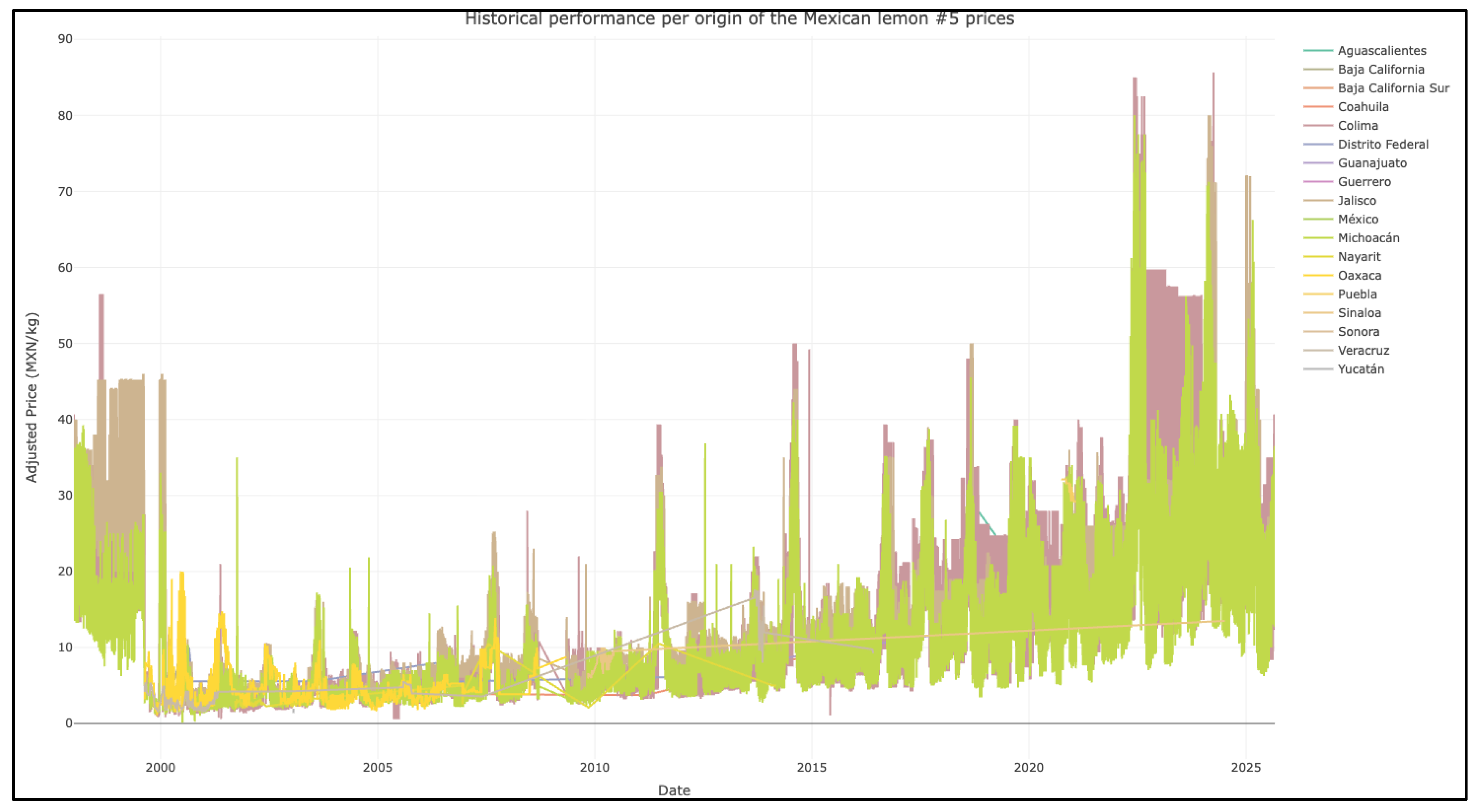
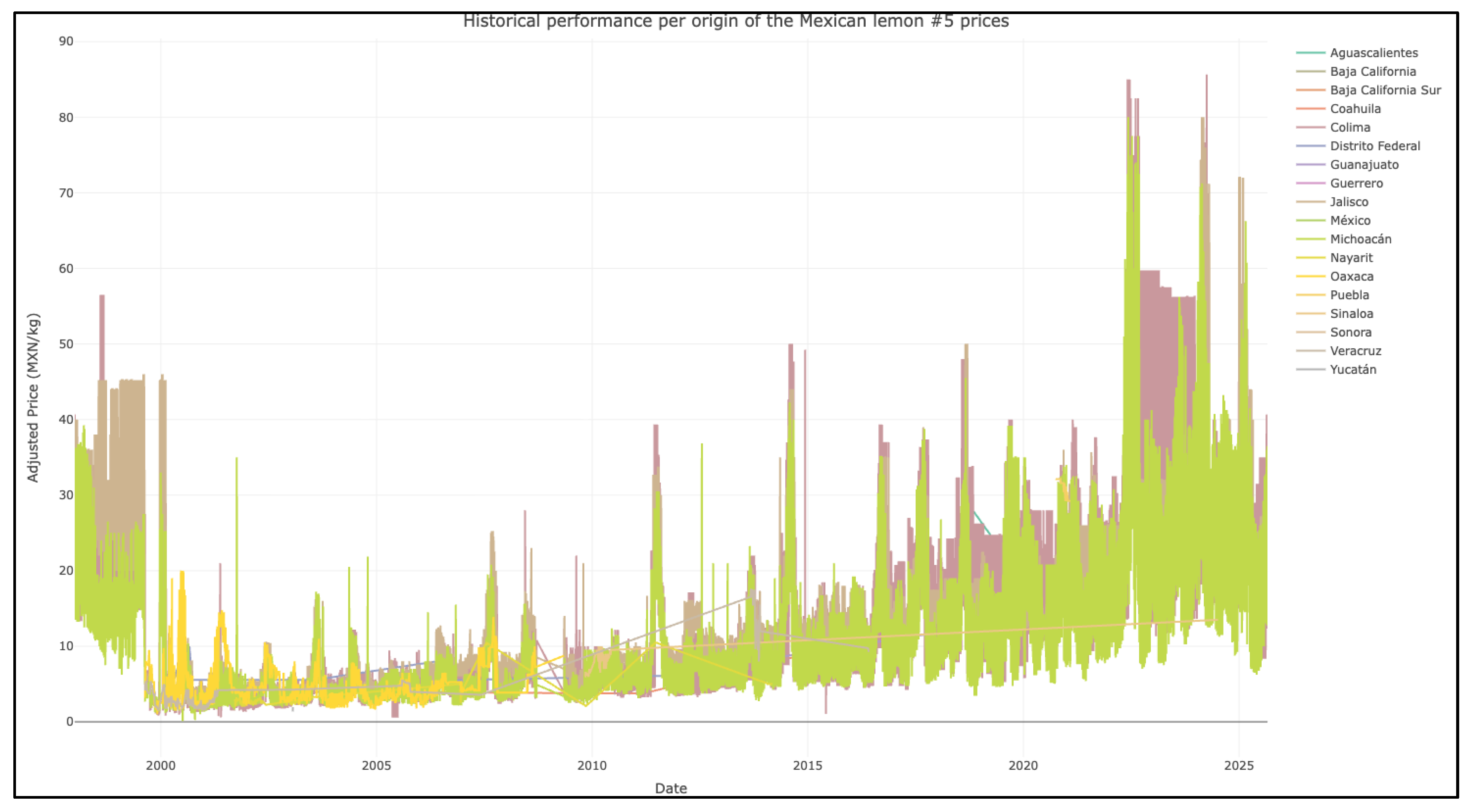
The Mexican lemon (henceforth, lemon) price has increased since its first record, on 28 December 1997, according to the SNIIM (National Information and Integration Market System) [
2], a public price record system of the Mexican Economy Secretary. Even though the Mexican lemon price shows an upward trend in its historical values, its market volatility remains high. This result indicates that Mexican lemon producers face significant income risk. If volatility is related to the low level of technological development in Mexican lemon production, income risk becomes a considerable concern for Mexican producers.
To measure the economic relevance of lemon production in Mexico, and based on 2023 data from the Agricultural, Food, and Fisheries Program (SIAP) [
1], the total value of Mexican lemon production was MXN 31,201,428,470.00. The figure for Mexican gross domestic product (GDP) in 2023 at current prices was approximately MXN 30,497,488,360,000.00 [
3]. By assuming an average marginal consumption propensity of 0.8, the estimated added value of Mexican lemon production was approximately MXN 156,007,142,350.00. This added value accounted for 0.51% of Mexican GDP in 2023.
Following previous works like those of Villar-Luna et al. [
4], Mellado-Vázquez et al. [
5], Espinosa-Zaragoza et al. [
6], Vargas-Canales et al. [
7], and Fernández et al. [
8], the lemon production generated income for 69,000 families in Mexico with about 28 million workdays a year. The five leading producing states are Michoacán, Colima, Veracruz, Oaxaca, and Tamaulipas. These Economic growth and development figures show the relevance of lemon production in Mexico. They also highlight the need to hedge the producer’s income risk with proper instruments to cover the selling price.
Mexican lemons and their delicatessen variety (Persian lime) are a type of agricultural product known as a “niche” product for trade and price hedging (cross-hedging). The Mexican lemon is a vital staple in Mexico, and its economic contribution is also significant. It is part of Mexican’s daily diet. Unfortunately, the Mexican lemon is not a commodity with a global demand, standardized qualities for worldwide trading, or other characteristics typically associated with commodities. Consequently, unlike globally traded commodities like corn, wheat, or sugar, it has no dedicated futures (and options) to hedge its price at periods ahead. As a potential solution, producers could hedge with similar futures (a practice known as cross-hedging). Unfortunately, there is no prior work or tests that suggest which futures to use for cross-hedging lemon (even Mexican lemon) prices. A gap that this paper tries to fill.
Historically, and as a policy to mitigate the inflationary impact of staple price increases in Mexico, the Mexican Government has implemented several price-hedging (minimum price) policies. The historical evolution of this program led, in 2016, to the creation of an organization known as SEGALMEX (an acronym for Mexican food security) that paid a minimum buy price to corn, rice, bean, and milk producers. A minimum buy price is estimated based on the monthly mean strike price of the related future on the Chicago Mercantile Exchange (CME). For example, the minimum buy price for corn was set at the monthly mean strike price of the 1-month yellow corn future on the CME. To translate this price to Mexican pesos (MXN), SEGALMEX used the monthly mean foreign exchange (FX) rate for Mexican pesos to US dollars (USDMXN). SEGALMEX paid this price to producers and absorbed the losses if the spot price fell, with taxpayers’ contributions covering the losses. This highlights the need for a hedging mechanism that transfers the risk of the offered hedge from taxpayers to financial markets.
Consequently, this paper aims to fulfill this gap by testing a cross-hedging algorithm in which a public financial institution, like SEGALMEX or a private one, could offer a buy or sell strike price to the Mexican lemon and transfer the risk to the futures markets through an opposite position of agricultural CME or NYMEX (New York Mercantile Exchange) futures portfolio. This potential solution could lead to offering a strike price . The difference between the strike and the spot price at could be paid with the opposite (short or long) position in the futures portfolio. Consequently, the impact on taxpayers or the shareholders of private financial institutions would be minimal.
This potential hedging mechanism has two drawbacks that this paper’s test wants to solve with the proposed hedging mechanism:
- 1.
The presence of basis risk due to the correlation of the Mexican lemon price time series with those of the futures or futures portfolio of interest. The lower the correlation, the higher the basis risk. Consequently, the use of such a hedge would lead to poor results in terms of income risk reduction.
- 2.
Trading fees and taxes hinder the practical feasibility of such a solution.
Previous works have tested cross-hedging of commodities and non-commodities and found high hedging effectiveness () above 0.7 (70%) or even 0.90 (90%) in most cases. Despite this, some of these works have not accounted for market impact and trading fees in their simulations. Additionally, most of these works are tested on specific Agricultural products, and the generalizability (positive validity) of the hedging rules is limited to these markets. Consequently, this paper aims to fill a gap in current research on Mexican lemon prices hedging by incorporating the effects of trading fees and taxes into the backtest. This paper also aims to contribute to the practical feasibility of the cross-hedging mechanism.
As the core quantitative hedging rule, the authors used the surplus efficient frontier method. A simplified version of the minimum tracking error portfolio selection method with the presence of the historical returns of the spot price as a benchmark to be replicated. The reason is that the rationale of tracking error reduction is consistent with reducing the basis risk. The minimum tracking error portfolio (the one that minimizes the tracking error, or surplus, between the lemon price and the futures portfolio) is characterized by a percentage variation close to that of the lemon price.
Consequently, the hypothesis to be tested in this paper is as follows:
H
0.
The use of the surplus efficient frontier to select the best hedging portfolio for the Mexican lemon price leads to a hedging effectiveness above 0.6 (60%) and is helpful for hedging purposes at t + 1 and t + 4 weeks, by reducing the agent’s income risk.
It is essential to note that the 0.6 (60%) hedging effectiveness may appear arbitrary. Still, this paper’s initial tests aim to demonstrate the benefits of replicating lemon prices using the futures portfolio of interest. A 0.6 or 60% hedging effectiveness is a target value shown as a reference, recognizing that, even if it is not high, this level must be the least acceptable cut-off criterion to determine that, among the 502 simulated portfolios, there is a subset of portfolios for practical hedging use.
To test such a hypothesis, the authors backtested the surplus efficient frontier hedging strategy across four scenarios in which a theoretical agent hedges the sale or purchase of one lemon kilogram at and hedging horizons.
As a summary of the research problem, this paper innovates by extending the previous works related to non-commodity cross-hedging by performing a first test of the benefit of using the surplus efficient frontier portfolio selection (one among the minimum tracking-error selection methods group) in the #4 Mexican lemon price replication and its practical use for income risk hedging. As a related goal, this paper tests the practicality and feasibility of these hedging strategies by incorporating trading fees and taxes. A gap that most previous works on cross-hedging have set aside.
Consequently, the potential use of this paper’s results could motivate the Mexican Government or its private financial institutions to implement this hedging mechanism. With this implementation, the current Mexican agricultural trade practices could evolve from the current market-protecting amber practices, according to the WTO [
9] classification, to green (more free-market-friendly) policies.
Given the theoretical, policy, and practical motivations, the paper is structured as follows:
Section 2 summarizes previous work and results that motivate this paper.
Section 3 describes the surplus efficient frontier portfolio selection method, the data gathering and processing of the input data, and the assumptions and parameters of the backtest.
Section 4 presents the main results and contributions.
Section 5 performs a corollary of the backtests’ results. Finally,
Section 6 presents the main conclusions and guidelines for further research.
2. Literature Review and Theoretical Motivations
The theoretical basis for cross-hedging with futures dates back to the works of Working [
10], Ederington [
11], and Anderson and Danthine [
12], who tested the mean variance efficiency of hedging a given underlying (primarily a financial one). The work of Working [
10] is the first to address the futures markets agents’ motivations, observing that hedging (according to his time) is the primary motivation in futures markets and that the use of cross-hedging is not a result of poor information and price generation quality, but a result of the appropriate market structure and liquidity. He discussed why Chicago’s futures markets were more successful in the 19th century than those of Europeans for commodities such as Californian wheat. This liquidity- and hedging-motivated behavior is known as Working’s hypothesis for futures markets.
The work of Ederington [
11] departs from Working’s hypothesis and the hedging hypothesis (hedging exists for risk avoidance). It uses the mean-variance portfolio selection framework to explain the profit-and-risk-reduction motivation of hedgers. For this purpose, this author is the first to mention the concept of basis. Basis is defined as the difference between the profit and loss (
) or the return (
) of the spot position and the opposite future. The variance of this difference
is a concept known as basis risk. Departing from this definition, this author proposed the idea of hedging effectiveness of a future (or futures portfolio):
If the future or futures portfolio pays a proper hedge, the value of the must be close to one (or 100% if expressed as percentage). If the hedge is poor, the value is close to zero, and, if , the futures position increases the risk to the hedger, making the hedge not feasible to the agent. It is essential to highlight that there is an inverse relationship between hedging effectiveness and the hedge ratio, a measure of how many future contracts’ nominal values must be used to make a proper hedge. The higher the hedging effectiveness, the closer the hedge ratio is to one. If the hedging effectiveness is less than 1, the hedge ratio is greater than one. This result leads to the need for a higher nominal value in futures and to an increase in basis risk. Consequently, finding a futures portfolio with a hedging effectiveness close to one with the lemon’s price could lead to a basis risk close to zero, due to the hedge ratio close to one.
Following this idea, the work of Anderson and Danthine [
12] focuses on several aspects of hedging, such as the correlation between the spot price
and the future price
. When such a correlation is neither perfect nor high, basis risk increases. Consequently, the authors suggest using a portfolio of direct futures to hedge the spot position, plus other futures that, given their correlation matrix, could reduce basis risk. This could motivate, as a primary goal, to find a futures weight vector
that solves the following optimal selection, assuming that the investment weights must be positive and add to 1 (100%):
Subject to
In the previous expression, is a futures return (percentage price variation ), being the number of futures and the length of the time series. is the vector of future weights in the hedging portfolio. The core idea is finding the optimal investment level such that tends to zero. That is, the basis risk is at its lowest.
The selection of the quantitative portfolio selection method to solve (2) is depicted in the following section. This section presents related work that motivates this paper.
Among the works that tested the benefits of cross-hedging on agricultural non-commodities, the authors found the work by De la Torre-Torres et al. [
13]. This work used optimal portfolio selection (minimum tracking error) for the Mexican avocado. The authors found that hedging effectiveness in avocado prices is around 0.94 when the avocado producer hedges with a short position in a portfolio that is 83.48% invested in sugar futures and 16.52% in coffee. This work did not account for trading fees because it did not run a proper active hedging backtest of the replicating futures portfolio. A result that this paper extends. Similarly, De la Torre-Torres et al. [
14] found that the hedging effectiveness in the Mexican white corn is 0.6180 for the corn producer. In this paper, the authors performed a backtest using a naïve strategy and three active hedging strategies based on the moving average convergence divergence (
), without trading fees. In their backtests, the authors found that the corn producer earned an extra income of MXN 5.7664 per kilo sold, had she hedged at t + 1 weeks during the weekly period from 1 January 2000 to 9 February 2025.
The present paper extends these two works by using the surplus efficient frontier and performing backtests that include a 0.1% trading fee and a 10% added-value tax (VAT).
The literature on hedging effectiveness and the hedge ratio of agricultural cross-hedging is less extensive than that on financial futures or even on energy prices.
A first study supporting the use of cross-hedging in agricultural products is that of Kumar and Pandey [
15]. These authors provided a historical review of several commodity markets in India, along with their relationships with the Indian futures markets. Consequently, the authors tested the hedging effectiveness of agricultural products such as soybean, corn, castor, and guar seeds. Also, the authors tested the use of Agricultural, energy, and metals futures traded on the NYMEX and other exchanges to assess their hedging effectiveness. In their results, the authors found that agricultural futures exhibit hedging effectiveness between 0.3 and 0.7 (30% to 70%), compared with the value observed in non-agricultural futures (around 20%). Also, they found that using a cross-hedge with NYMEX or other non-Indian futures significantly reduces the hedging effectiveness. A result that is contrary to this paper’s because, in this case, the foreign future markets do not provide a better cross-hedging (do not enhance the general correlation between the spot and futures position). From the perspective of underlying cross-hedging, Kumar and Pandey’s results support the use of cross-hedging with non-agricultural futures, an implication left for further research in this paper.
Ortiz-Arango and Montiel-Guzmán [
16] tested the dynamic short- and long-term (cointegration) relationship between Mexican white corn prices from all origins (the states where Mexico produces it) and the 1-month yellow-corn futures contract at the CME. In their results, the authors did not find a significant long-term relationship between the Mexican price of almost all origins (except Michoacan) and the corresponding CME futures. In the short term, they found that stochastic volatility models are appropriate for the relationship between the Mexican spot price and the CME futures. This is one of the primary motivations of this paper, as the authors found no strong correlation between CME futures and Mexican non-commodity markets, an issue addressed in a futures portfolio.
In a related review, Gupta et al. [
17] tested the effectiveness of Indian Agricultural and energy futures in hedging Indian agricultural products such as castor, guar seeds, copper, nickel, gold, silver, crude oil, and natural gas. The futures tested are the ones traded on the National Commodity and Derivatives Exchange (NCDEX). By using vector error correction (VEC) models and vector autoregressive (VAR) models with multivariate generalized autoregressive conditional heteroskedastic (MGARCH) variances (VAR-MGARCH), the authors found that the Indian precious metals’ futures show the best hedging effectiveness (
) and the best hedge ratio (
), to cross-hedge the commodities of interest. This result supports this paper and Anderson and Danthine [
12] position that cross-hedging improves hedging effectiveness even in the corresponding (direct) spot position. These conclusions motivate this paper to extend these tests to non-commodities.
To incorporate the effect of weather on agricultural prices, Barrera et al. [
18] tested the cross-hedge between Colombian electricity derivatives and several Colombian agricultural products (93 in total). Of these products, only nine showed a significant relationship between the product’s price and the futures. These reduced the price risk by only 32%. This result indicates that, in the Colombian case, using foreign agricultural futures could be a potential solution. A result that is aligned with this paper.
To test the benefits of hedging Colombian coffee prices, Barrios-Puente et al. [
19] developed a hedging model for coffee producers. In their models, the authors estimated the optimal number of NYMEX coffee futures contracts, given the spot price in USD and the futures contract. Also, the authors incorporated the covariance between the spot and futures prices and a mean-variance utility function. Complementary to the mathematical development of this model, the authors tested the income generated with a hedge determined by their models. The authors found that using their hedging model yields marginal positive income. This work motivates the present paper by using futures as an income-generation and income risk reduction tool for lemon producers.
The work of Penone et al. [
20] tested the hedging effectiveness of the Euronext futures exchange and the Chicago Board of Trade (CBOT) with the Italian soybean, corn, and milling wheat prices. Their primary motivation was to test the hedging effectiveness of European and US futures in the European income stabilization tool [
21,
22], a green practice under the WTO [
23,
24]. By testing a naïve and optimal hedge ratio
of the futures with the spot price, and by using ordinary least squares (OLS) and MGARCH models to estimate the
, the authors found three key results:
- 1.
Euronext futures are superior to CBOT futures in hedging.
- 2.
With more extended hedging periods, such as , the hedging effectiveness rises.
- 3.
The correlation between future and spot prices is relevant to hedging effectiveness.
This work aligns with this paper because it supports the idea of using futures hedging to reduce income risk and because it uses futures for non-commodities like soybeans. The result that does not align is the use of European futures (instead of CBOT futures) to hedge local production, rather than foreign futures.
Another contradictory work, for this paper, is that of Rout et al. [
24], who examined price formation between the futures and spot markets in India. Using OLS, exponential GARCH, or EGARCH, cointegration, and Engle-Granger [
25] causality tests, the authors concluded that the spot market influences the futures market but not vice versa. Contrary to expectations, the authors found low
due to market-specific liquidity and heterogeneous contract specifications.
The work of Erasmus and Geyser [
25] tested the benefits of hedging soy prices in South Africa using related local futures. By using OLS, vector error correction (VEC) models, and VEC-GARCH models, the authors found significant hedge ratios
but no significant difference in the
estimation among models. Similarly, the authors found that the South African futures hedging effectiveness is high only when the spot price is near or below the export parity. This work aligns with the present paper for the use of agricultural prices’ cross-hedging.
Regarding potential market impacts and costs that futures cross-hedging could entail, Goswami et al. [
26] tested for non-convergence. This phenomenon happens when the spot and future prices do not converge at the future’s redemption rate. This leads to different settlement and delivery prices that the hedger must consider in the hedging strategy. The authors also found that the optimal (minimum) hedge ratio method for hedging agricultural spot prices with their related futures is ineffective when non-convergence occurs. As a result, the authors used the surplus efficient frontier for optimal portfolio selection instead.
In some regions and agricultural products, the industry’s gross profit margins receive little attention, as Haarstad et al. [
27] have shown. In some sectors, such as salmon or shrimp production, this reality has changed, leading to the development of new futures exchanges that, due to limited demand or the design of future contracts, have provided limited hedging tools [
28,
29] or led to the closure of the newly created exchanges.
Despite these two issues, developing cross-hedging methods like those tested herein could reduce income risk, enhancing profitability and generating added value. Also, tools for cross-hedging with a futures portfolio could be helpful, as the hedger could use more liquid futures markets to hedge a non-commodity product. The core motivation of this paper is to test a portfolio of US agricultural (liquid) futures to hedge a niche product, such as Mexican lemon.
Given this literature review and the motivations and extensions this paper offers, the following section explains how the surplus efficient frontier method works for cross-hedging. Also, this section provides details on data gathering and processing for the related backtest, demonstrating its practical application to the Mexican lemon price.
3. Methodology
3.1. The Surplus Efficient Frontier Method and Its Use in the Tests
As mentioned in the previous literature, the work of Anderson and Danthine [
12] focuses on the futures’ correlations as a source for basis risk reduction in a direct or cross-hedging position. At this point, it is essential to explain why the surplus efficient frontier is the core of portfolio selection, rather than other related methods. The surplus efficient frontier is not the only quantitative method for securities (futures) portfolio selection and hedging (or cross-hedging). Working [
10], Ederington [
11], Overdahl and Starleaf [
30], Pennings and Meulenberg [
31], and Stein [
32] are among the authors to test and suggest the use of OLS methods in different functional forms to determine the optimal hedging ratio (
). With different functional forms, all these depart from a minimum tracking error (basis risk reduction) rationale and use the following OLS (or variants with price increments, prices at level, or the use of other regressors) functional form:
The optimal hedging ratio () in the previous expression () is the proportion of how many future contracts are necessary to buy in the hedge to achieve the lowest basis risk.
Despite its simplicity, this method builds on a core foundation of cross-hedging: the correlation between futures and the underlying to be hedged. It is essential to keep in mind that OLS methods assume no correlation among futures (the
ceteris paribus assumption). Consequently, the use of two or more futures could be approximated by estimating the following regression model with the restriction that all the hedge ratios must add to 1 (
) because, in a portfolio
:
This would require a quadratic programming method (or a similar method). A technique that is used in the minimum variance portfolio problem in (2). Contrary to (3) and (4), the surplus efficient frontier portfolio selection accounts for correlations (covariances) among the portfolio’s futures, treating them as advantages highlighted by Anderson and Danthine [
12].
Consequently, the futures portfolio could be optimally selected in a mean-variance framework. A primary quantitative approach to optimal selection using correlations via a covariance matrix is the minimum tracking error portfolio selection proposed by Leibowitz [
33], Grinold [
34], and Sharpe and Tint [
35]. These authors suggest using a benchmark or market portfolio to select a portfolio that either replicates the benchmark’s performance (passive portfolio management) or outperforms it (active portfolio management). In terms of portfolio management, the concept of tracking error aims to minimize the variance of the difference between the selected portfolio (
) and the benchmark (
). Optimal portfolio selection, since the seminal proposal of Markowitz [
36,
37], incorporates asset correlations as the key mathematical concept for portfolio diversification. Correlation is a closely related concordance parameter to covariance, which is the standardized measure of concordance in the portfolio selection process. The covariance matrix
is a central parameter to estimate a portfolio’s variance:
Consequently, the optimal portfolio selection, given the tracking error of the portfolio against a benchmark, is as follows:
Subject to
- (1)
- (2)
- (3)
In the previous problem is the target return that the portfolio manager must achieve (if feasible) in the portfolio selection if she wants to outperform the benchmark’s return. That is, if she wants to manage her portfolio actively. In the case of passive portfolio management, the first restriction is set aside. The second term of the target function is the covariance between the optimal portfolio and the benchmark. In (4), is the benchmark’s weights vector.
For the purposes of selecting a portfolio of futures that reduces basis risk as in (2), the optimal portfolio selection is not helpful because there must exist a benchmark or portfolio that replicates the agricultural price return, and the selection of such a portfolio to replicate the lemon’s price is the main goal in this paper. Consequently, the conventional minimum tracking error model in (6) is not feasible for the purposes intended in (2).
A related perspective on the optimal portfolio selection problem is to perform it in an asset-liability management context. When a portfolio is used as the asset or reserve to finance a liability or a stream of future payments, it is necessary to develop a benchmark, index, or theoretical portfolio that models the expected future value of the liability. This leads to optimal portfolio selection in the presence of liabilities, as suggested by Leibowitz [
33], Grinold [
34], Sharpe and Tint [
35], and Waring [
37,
38]. A first solution to such a problem is provided by the portfolio selection problem in (6), which requires a preexisting benchmark or a portfolio’s weight vector
. As a potential solution, Waring [
37,
38], following Sharpe and Tint [
37], changes the perspective by using not the weight vector
, but the benchmark’s returns (
). Waring [
36,
37,
38,
39,
40] proposes an economic approach (more straightforward than conventional actuarial estimates) to develop a benchmark that replicates the liability’s Macaulay [
41] duration and the future payment stream. Given this benchmark’s (liability) returns, the portfolio manager could estimate a concept known as surplus (
) in each of the portfolio’s securities (futures in this paper):
Given the surplus’ (not returns) time series, the analyst can estimate both the expected return vector
(not used in the context of non-commodity price replication herein) and the related surplus covariance matrix
. Consequently, the price replication problem, necessary for the cross hedging of the non-commodity (Mexican lemon) given in (2) can be expressed in the following optimal (minimum tracking error) portfolio selection problem:
Subject to
As noted, the optimal portfolio selection aligns with the minimum tracking error portfolio selection in (6) without the need for a known benchmark’s investment vector. Consequently, if the agricultural hedger wants to select an optimal agricultural futures portfolio, it needs to estimate each portfolio’s future surplus by substituting the benchmark returns
in (8) with the historical agricultural non-commodity’s price return (
) as follows:
Consequently, in a second step, the portfolio manager must perform the optimal portfolio selection problem in (8) to arrive at such a portfolio that reduces the basis risk the most, given the correlations (covariance) between the portfolio’s futures and the price of the non-commodity (lemon) of interest.
The optimal selection in (8) and (9) is the core quantitative method to test to select the optimal futures portfolio that reduces the basis risk (tracking error or surplus) with the lemon’s price. A portfolio that, as a result, increases its hedging effectiveness .
Among the specifics to test in the selection method in (8), there is an interest in knowing the futures set used in the portfolio. Consequently, the authors tested 502 combinations (portfolios) of the futures summarized in
Table 1. Also of interest is testing its practicality using either a naïve or an active hedging strategy, including the impact of trading fees and taxes on the lemon producer.
Another related perspective for a benchmark replication is the use of vector error correction models or VEC [
42,
43]. The general functional form of such models is as follows:
The first two terms are the long-term relationships between the future and spot prices, and the third is the error correction autoregressive term, given number of lags. The rationale for VEC models is that the regressors have a long-term relationship specified by . The third term models the correction of short-term price divergences because of shocks or new information in the markets of interest. Consequently, in (10) and following (9), .
Following (8) and (9),
is the hedge ratio. Given its long-term nature, this hedge ratio is more stable and results in fewer trades in the portfolio than (9). Alexander [
42] and Alexander and Dimitriu [
43] are the first to propose VEC models for index tracking as in (10) for an equity portfolio. Similarly to (9), these authors suggest estimating
using a quadratic programming problem, subject to the restriction that
.
This model was initially designed for tracking with a few stocks, minimizing trades, and using
for long-term investment weights. Despite the simplicity and flexibility of (10) for replicating the lemon price, this method is not used herein because it assumes that the spot and futures prices are cointegrated. That is, they have a long-term relationship tested by the Engle-Granger [
44] or Johansson [
45] cointegration tests. The use of this model is not of interest in this paper for the same reasons that led to the rejection of the OLS method in (9). That is, it is necessary to use a quadratic problem to solve for the investment levels
, and the model assumes no relationship or influence between the future’s prices.
Consequently, this paper intends to be among the first to test a model grounded in the conventional portfolio selection framework.
Finally, given the optimal portfolio selection used in this paper (8), it is essential to note that the paper employs a time-fixed covariance matrix. This paper, as mentioned, makes a first test of the use of (8) in Mexican lemon price replication and the benefits of the replication futures portfolio in reducing income risk.
As mentioned in the introduction section, this paper tests the following working hypothesis:
H
0.
The use of the surplus efficient frontier to select the best hedging portfolio for the Mexican lemon price leads to a hedging effectiveness above 0.6 and is helpful for hedging purposes at t + 1 and t + 4 weeks, by reducing the agent’s income risk.
This hypothesis was tested in two stages, with two particular hypotheses:
H
1.
The use of an agricultural futures portfolio reduces basis risk by replicating the Mexican lemon spot price with a hedging effectiveness higher than 0.6.
H
2.
The use of such a portfolio reduces income risk to a lemon producer (seller) by adding extra income due to the short (long) futures portfolio position profit or loss (P/L), including the impact of trading fees and taxes.
3.2. First Hypothesis Test: Does an Agricultural Futures Portfolio Replicate the Mexican Lemon Price by More than 0.6 of Hedging Effectiveness?
To test the first working hypothesis H
1, the authors simulated (backtested) the portfolio’s return (
) of the futures portfolios every week from 28 December 1997 to 16 February 2025. For this purpose, the authors obtained historical Mexican #4 lemon prices from the databases of the National Markets Information and Integration System (SNIIM) [
2], a market price database of the Mexican Economy Secretary. Because the SNIIM provides daily records of the minimum, maximum, and median lemon price of the main markets in each state, the authors estimated a national lemon price (
) with the average of the median price in each state on date
They transformed the daily time series to weekly by using the price on the last Labor Day of each week. It is essential to mention that the National average price was used instead of a regional production-based weighting scheme because five of the 32 states (Michoacan, Veracruz, Colima, Oaxaca, and Tamaulipas) concentrate almost 82% of the national production (please refer to
Appendix A.1 for the lemon production figures by state as of 2023). The arithmetic mean of the price by state could be appropriate, and there would be no weighting biases with this method. To reduce the impact of significant differences between the national average price and the origin-specific price, the origin price (the one quoted before storing and transportation costs) was used in the mean price calculation. We thank the anonymous peer reviewers for their kind comments in this regard.
Similarly, the authors obtained historical weekly futures prices from the databases of TradingView [
46], Refinitiv [
47], and the CME [
48], summarized in
Table 1. With these prices, they estimated the continuous-time returns as follows:
Using continuous-time returns, the authors estimated the surpluses for each future of interest using the lemon’s price returns (7). Given these surpluses (), the authors estimated, each week from 2 January 2000 to 16 February 2025, the surplus covariance matrix . For this purpose, the covariance matrix surplus at time t was calculated using an increasing time window (a rising information set) based on time series from 4 January 1998, to the simulated date t (2 January 2000 to 16 February 2025). The use of an increasing time window is to capture all the information in the correlation between futures and Mexican lemon returns. It is essential to highlight that we focus on the practical implementation of the hedging method of interest, leaving for further research the proper time window for parameter estimation or the use of a more dynamic covariance matrix, such as exponentially weighted covariances, M-GARCH, or Markov-Switching.
Given the covariance matrix, the optimal futures portfolio weights (
) were estimated using the selection problem in (8). With these optimal weights, the weekly portfolios’ returns were calculated as follows:
To select the best hedging portfolio, 502 different backtests were performed. Each backtest corresponds to each futures portfolio. Each simulated portfolio was a combination of two or all the futures of
Table 1. The core idea of backtesting each portfolio or combination is to determine which agricultural futures set best replicates the Mexican lemon price. To make such a selection, a cut-off criterion of the five portfolios with the highest mean historical hedging effectiveness (
) was used. The mean historical hedging effectiveness was estimated on each date with (1). For consistency and readability, the hedging effectiveness is presented as a percentage of the total explained variance. Consequently, (1) was estimated in percentage and not in decimals. A 1 or 100% value, means perfect hedging effectiveness.
To accept the first working hypothesis, it is necessary to have a mean historical value higher than 60%. It is essential to highlight that this cut-off criterion is not arbitrary at all, as it implies that the backtest portfolio replicates the variability and lemon price performance to more than 60%, reducing basis risk in the hedging strategy.
3.3. Second Hypothesis Test: Is the Best Hedging Portfolio Appropriate to Reduce Income Risk?
Once the five best hedging portfolios were selected, the authors backtested their use for lemon producers (sellers) and dealers (buyers). The core motivation of these two perspectives is to measure the impact (benefit) of using backtested futures portfolios on their income risk. The results should differ for people buying and selling lemons when a hedging rule is applied to the backtested portfolios.
To simulate the benefits of the four hedging rules for each agent, the authors estimated the agent’s
P/L at t in a naïve hedging context:
To assess the practical use of the hedge of the backtested portfolios, the authors applied four hedging rules using three different hedging strategies, based on a decision criterion provided by the
. The
is an indicator used in a form of security trading analysis known as technical analysis [
49]. Technical analysis is a trading method that uses charts, chart patterns, and quantitative methods such as moving averages. In technical analysis, the mean price over the last n periods is assumed to be the equilibrium price for that period (the price at which supply and demand for that security match). For most technical analysts in the industry, and as taught in most universities and trading schools, the 12- and 26-day moving averages (MA) are two key equilibrium or reference values. They are the proxy values of the fortnight and monthly equilibrium prices. Consequently, the rationale of the Moving Average Convergence Divergence, or
is that if the fortnight (twelve days) equilibrium price (
) is higher than the monthly one (26-day) or
, the security price is in an upward trend. If the opposite happens, it is expected that lower prices will occur in future periods. The estimation of the
is as follows:
Consequently, the second hedging rule was simulated with the following
P/L estimations for the lemon seller and buyer:
Following the MACD use in technical analysis, another trading rule uses the current
value, and its nine-day moving average. This is a parameter known as the
. The second trading rule (hedging for the purposes intended herein) is to buy when
. Consequently, the second hedging rule could be extended with the following one:
Finally, the third hedging rule tested in this paper was a combination of the two previous ones:
The authors used the MACD as a quantitative tool to simplify the hedging rule and adopt a widely used, simple trading (and hedging) method in the industry. Also, this method is easy to replicate. Despite this assumption, the authors left for further research the use of other Econometric, machine-learning, or even artificial-intelligence quantitative methods for the hedging rule. This paper aims to test the hedging effectiveness of an agricultural futures portfolio for Mexican lemon prices and its practical use with the four simple hedging rules (14) to (22).
In (14) to (22), on the seller’s (buyer’s) side, it was expected that (assuming a high ) a downward (upward) price move from to could be offset by the opposite upward (downward) variation in the backtested portfolio, leading to a near-zero difference.
If the values of the values are around zero (or higher) in a box plot, there will be evidence that the backtested portfolio really reduces income risk. The authors did not use a parametric or nonparametric test to assess the appropriateness of the assumptions for the backtested values.
Finally, to measure the impact of trading costs and the practical feasibility of the hedging rule, the authors assumed a 0.1% trading fee () on the traded amount, plus a 10% value-added tax (VAT). Consequently, the generated P/L in the hedging rules included the impact of these costs. When the futures position was bought (sold), the amount related to the trading fee and VAT was subtracted (added).
Among the main assumptions in the backtest, it is crucial to highlight that, except for trading fees and VAT, the authors assumed there are no other impacts. Market impact, slippage, non-convergence, and liquidity are not considered, given the nature of these errors and the specific quantitative simulations used to model them. Also, the nine futures of interest are among the most liquid, with liquidity risks and slippage mitigated by electronic trading facilities at the CME and NYMEX. Finally, the tests did not account for these effects because the periodicity used was weekly, and their impact tends to fade under such a schedule.
The 0.1% plus 10% VAT on trading fees is assumed because it aligns with the trading fees of most major brokers for individual investors. In the case of an institutional investor, such as SEGALMEX in Mexico, or a financial institution providing the lemon price hedge, the trading fees would be significantly lower, given the volume of traded futures required to balance the offered hedge.
Because the hedging is weekly, the risk of slippage is set aside in this first test of using the futures portfolio for cross-hedging. The authors assumed a weekly hedging period in the backtest because producers typically program payments or income on Thursdays or Fridays. Consequently, the assumption of weekly hedging periods could hold.
The simulations (backtests) were programmed and executed in R version 4.4.1, using the quantmod, tidyverse, and tidyquant libraries. To solve the optimal portfolio selection given in (6), the authors estimated the minimum variance (or minimum surplus or tracking-error) portfolio using a user-defined function in R that called the base quadprog function. The user-defined function is available upon request to the corresponding author.
Given the data gathering and processing of the input data, along with the backtests’ parameters and assumptions, the following section discusses the main results and findings of the backtests. This section also relates these to the two working hypotheses and the results of the related previous works.
4. Backtests’ Results Discussion
As mentioned previously, the two working hypotheses to test suggest that (1) the use of the hedging futures portfolios increases the hedging effectiveness at least to 0.6, and (2) the use of the best hedging portfolios reduces income risk by creating extra income due to the hedging position in the futures portfolio.
To present the results, the first subsection explains which of the 502 simulated portfolios are the best hedging. The cut-off criterion was the mean hedging effectiveness observed over the 1280 weeks of the simulated portfolios. If these five portfolios (or at least one) show a mean hedging effectiveness value higher than 0.6, the first working hypothesis is fulfilled. This implies that the use of that simulated portfolio is appropriate to replicate the Mexican lemon price.
The second subsection deals with the second hypothesis test. In this subsection, the authors presented a box plot of the for the five best-hedging portfolios across the four hedging strategies (the naïve and the three MACD ones). The first visual test compares the box plot of the unhedged lemon price with that of the simulated strategy. If the simulated portfolios’ box plot is narrower and closer to zero, there is initial visual evidence of the income risk reduction that such a strategy (and portfolio) offers.
To strengthen this result, a parametric Neyman–Pearson [
50] and a non-parametric Wilcoxon [
51] test were used to prove the null hypothesis that the real expected
value of the backtested portfolio is zero. If this hypothesis holds, there will be evidence to favor the use of each portfolio in each hedging strategy.
To check that the scale of the
in the simulated portfolios is significantly lower with the hedging rules, the authors used the parametric F-test of the variance ratio by dividing the portfolio’s
scale with the variance of the lemon’s price
:
To assess the robustness of the previous test, the authors performed the Levene test [
52] (nonparametric) to determine whether the hypothesis holds.
These four tests, along with the box plot, will support the second working hypothesis that using the backtested portfolios reduces income risk. A result that, as mentioned, has an expected value of zero and a lower variance than the unhedged position (lemon price).
It is essential that the tests for the second hypothesis were performed in a t + 1 and t + 4 weeks horizon. This was performed to follow Penone et al. [
20] who found that the hedging effectiveness in Agricultural cross-hedging improves with a longer hedging horizon.
4.1. The First Hypothesis Test: Is There an Improvement in the Hedging Effectiveness with the Backtested Portfolios?
To summarize the test of the 502 futures portfolios, the authors filtered the best five portfolios with the highest mean hedging effectiveness
.
Table 2 summarizes these five portfolios and ranks them according to their mean
value. As noted, the best hedging portfolios are combinations of only two futures. Portfolios with combinations of three or more futures, where either not feasible (due to matrix inversion issues in the optimization problem) or led to a lower
.
It is also important to note that, in these five portfolios and consistent with [
13] and [
14] the corn future is present in the best-hedging portfolio. This is an expected result because the yellow-corn 1-month future is the most traded among the agricultural in the CME [
53].
A significant result in
Table 2 is that, given the mean hedging effectiveness values, the mean hedge ratio is above 1. This means that the balancing futures position must be greater than the spot lemon position, a result that calls into question the practical feasibility of the hedging solution tested herein. As a potential response to this issue, this is the first test of the suggested hedging mechanism for Mexican lemon prices. The 60% to 70% mean hedging effectiveness values indicated that other types of futures (agricultural or non-agricultural) could be added to the backtested portfolios to improve correlation among futures and hedging effectiveness. This potential outcome could lead to the expected one-to-one hedging effectiveness and a hedge ratio near the expected value of one.
This table also summarizes the mean value of the optimal hedge ratio (
) as in (8), and mean squared root error (RMSE):
From these five portfolios, the corn and wheat futures portfolio is the one with the highest mean . As noted in the second column, if a given lemon producer (trader) wants to hedge the lemon’s price, she needs to buy a short (long) position 1.68 times greater in nominal value of the tons to be sold in that portfolio at . With such a position, the agent could have a 1 to 1 (almost zero basis risk) to hedge her income risk at .
Four of the best hedging portfolios in terms of hedging effectiveness HE show a mean HE value higher than 0.6. This first quantitative criterion suggests that the first hypothesis (the use of agricultural futures portfolios increases HE by more than 0.6) holds.
4.2. The Second Hypothesis Test: Do the Best Hedging Portfolios Reduce Income Risk in the Lemon Price?
As mentioned previously, four tests were performed to check whether the income risk reduction holds for the five best-hedging portfolios in
Table 2.
The first round of results is related to the backtests made for the
hedging horizon. Given the backtest described in the methodology sections,
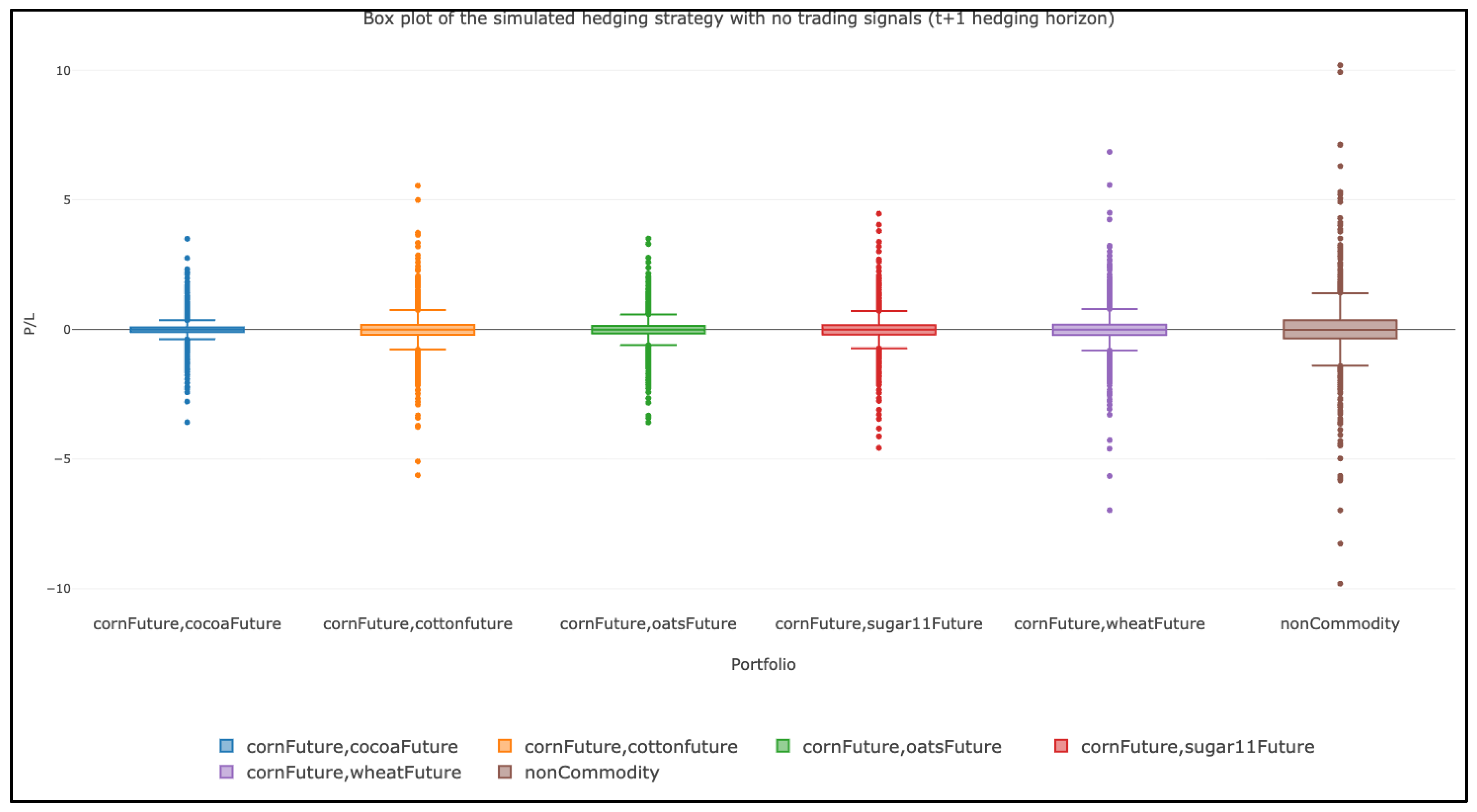
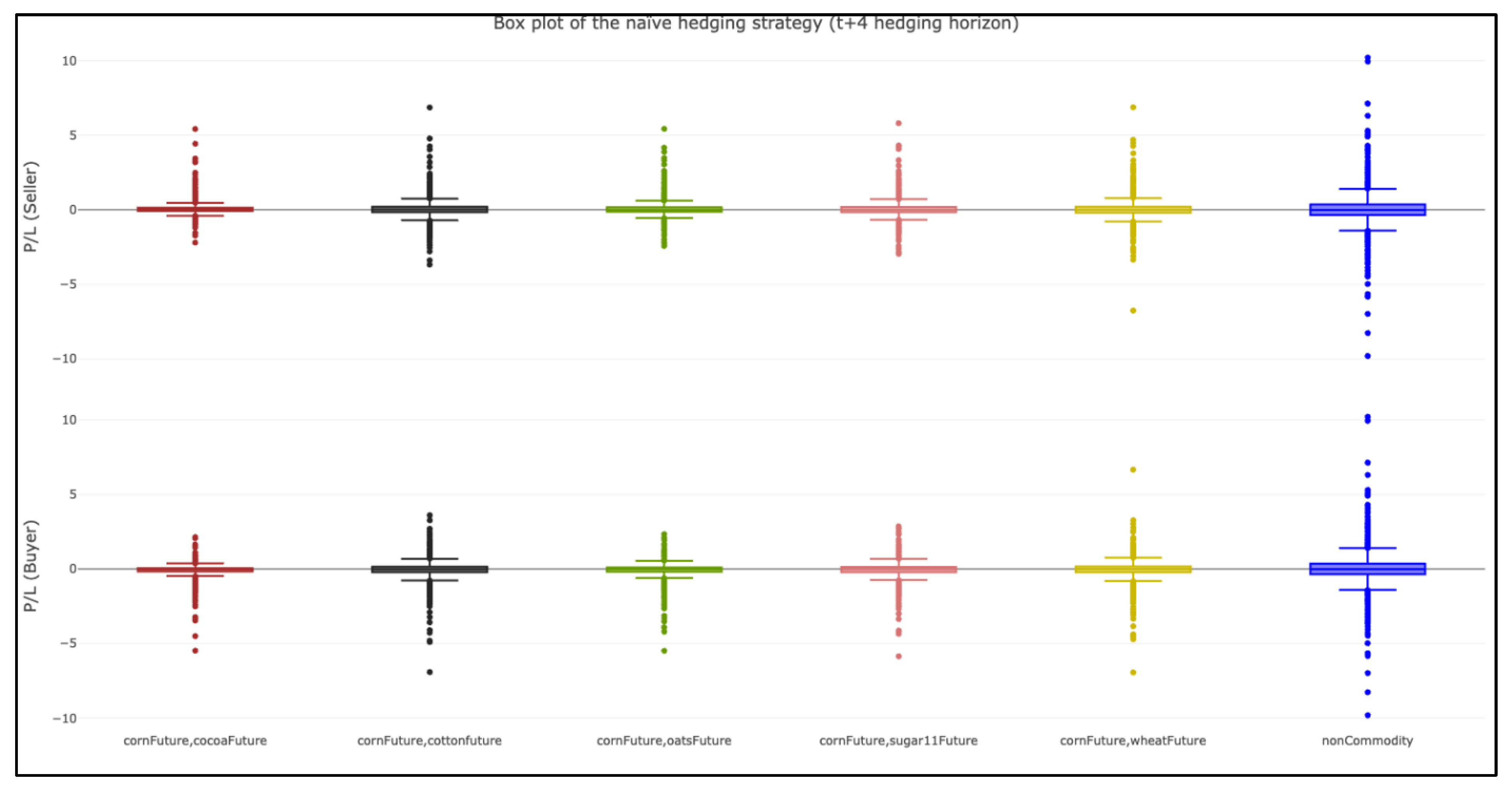
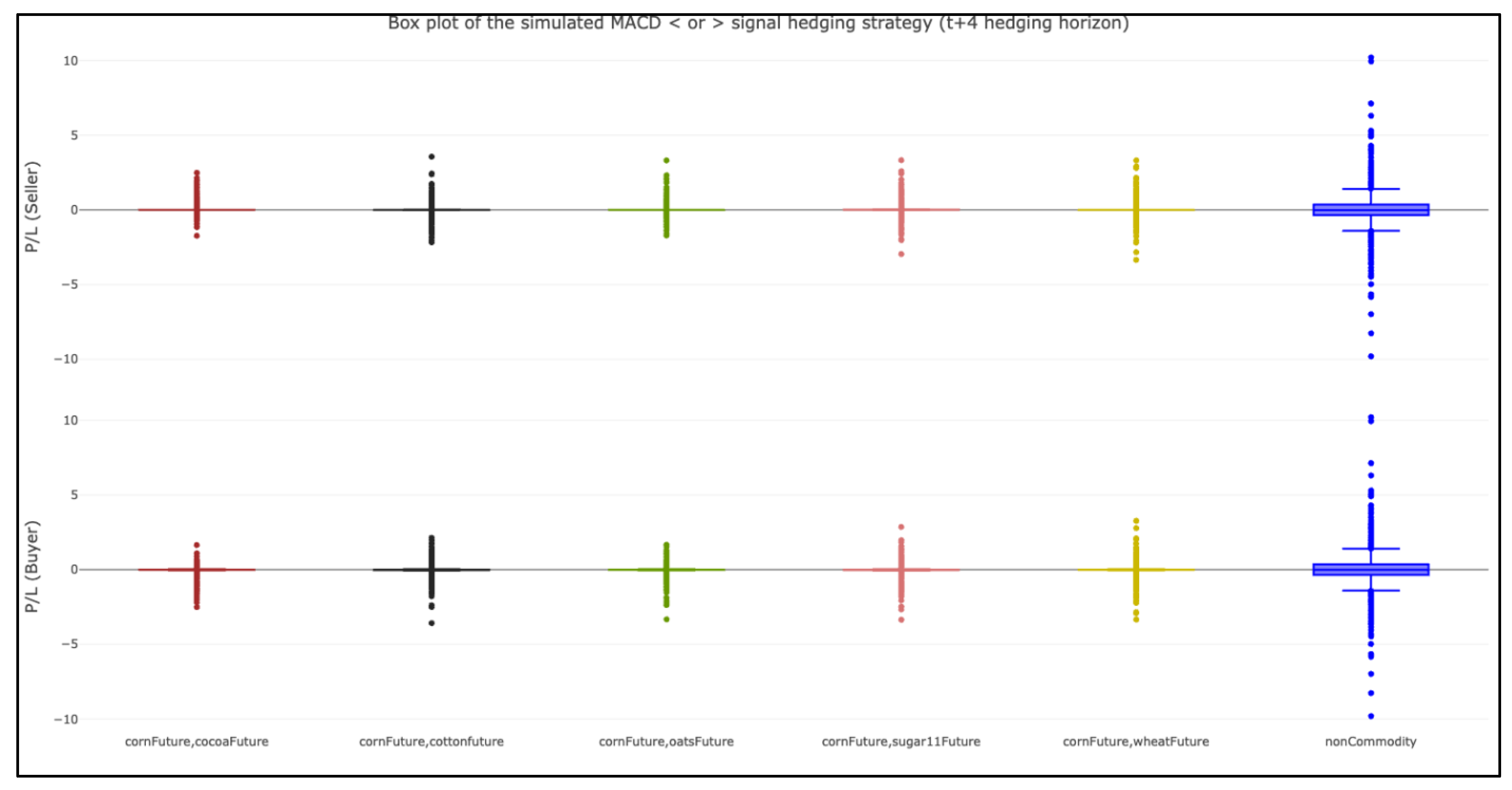
Figure 1 shows the comparative box plot of the unhedged position (non-Commodity)
P/L (upper panel) vs. the
P/L of a lemon seller (a producer in the middle panel) and a buyer (a dealer, intermediary, or final consumer in the lower panel). The agents used each of the five portfolios of
Table 2 with the naïve hedging (14) for a seller agent or (15) for a buyer.
As noted, the
P/L in the unhedged position is wider than the hedged positions of the seller and buyer. This result suggests that using the five portfolios in
Table 2 to hedge the Mexican lemon price reduces the agent’s income risk. This happens in the five simulated portfolios.
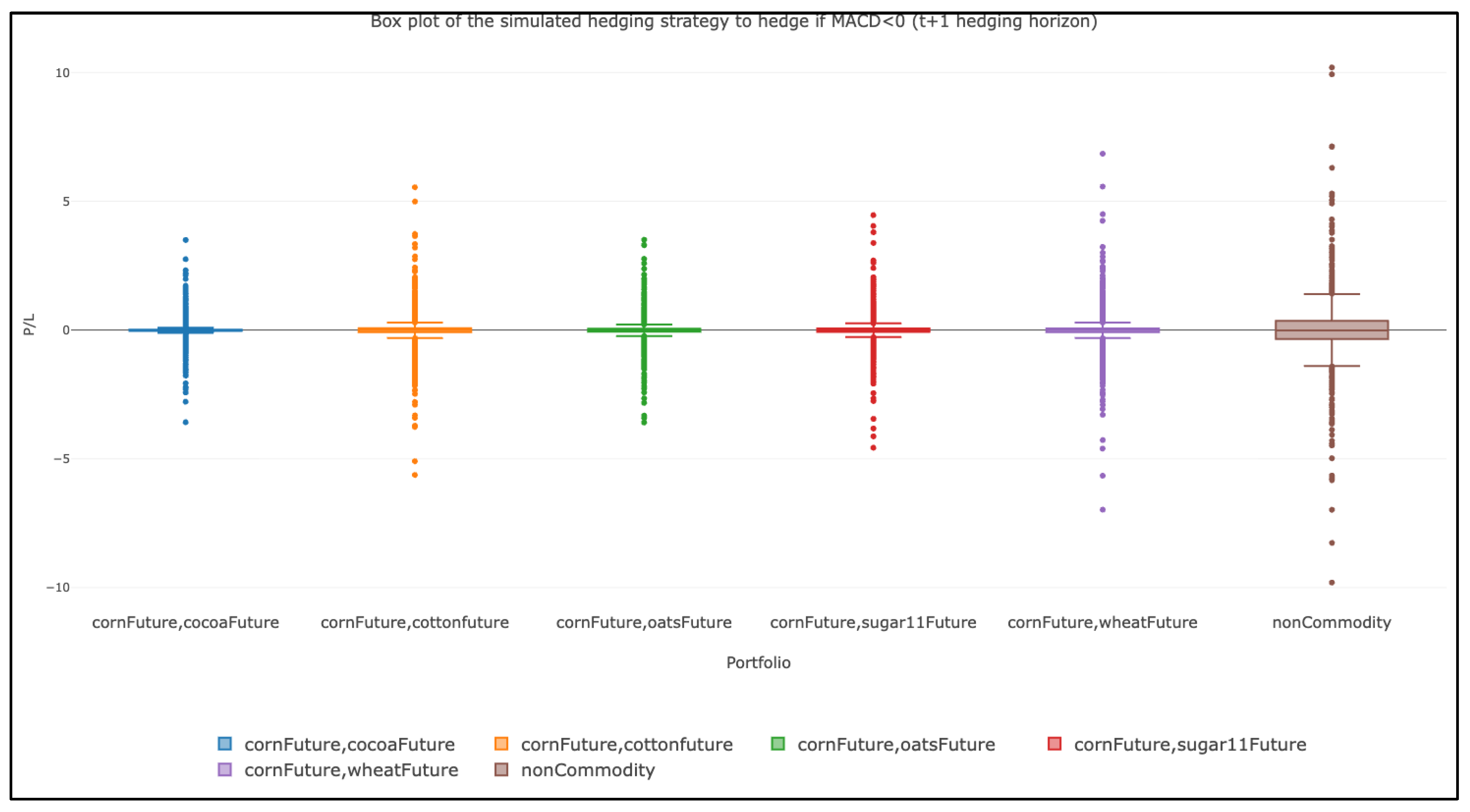
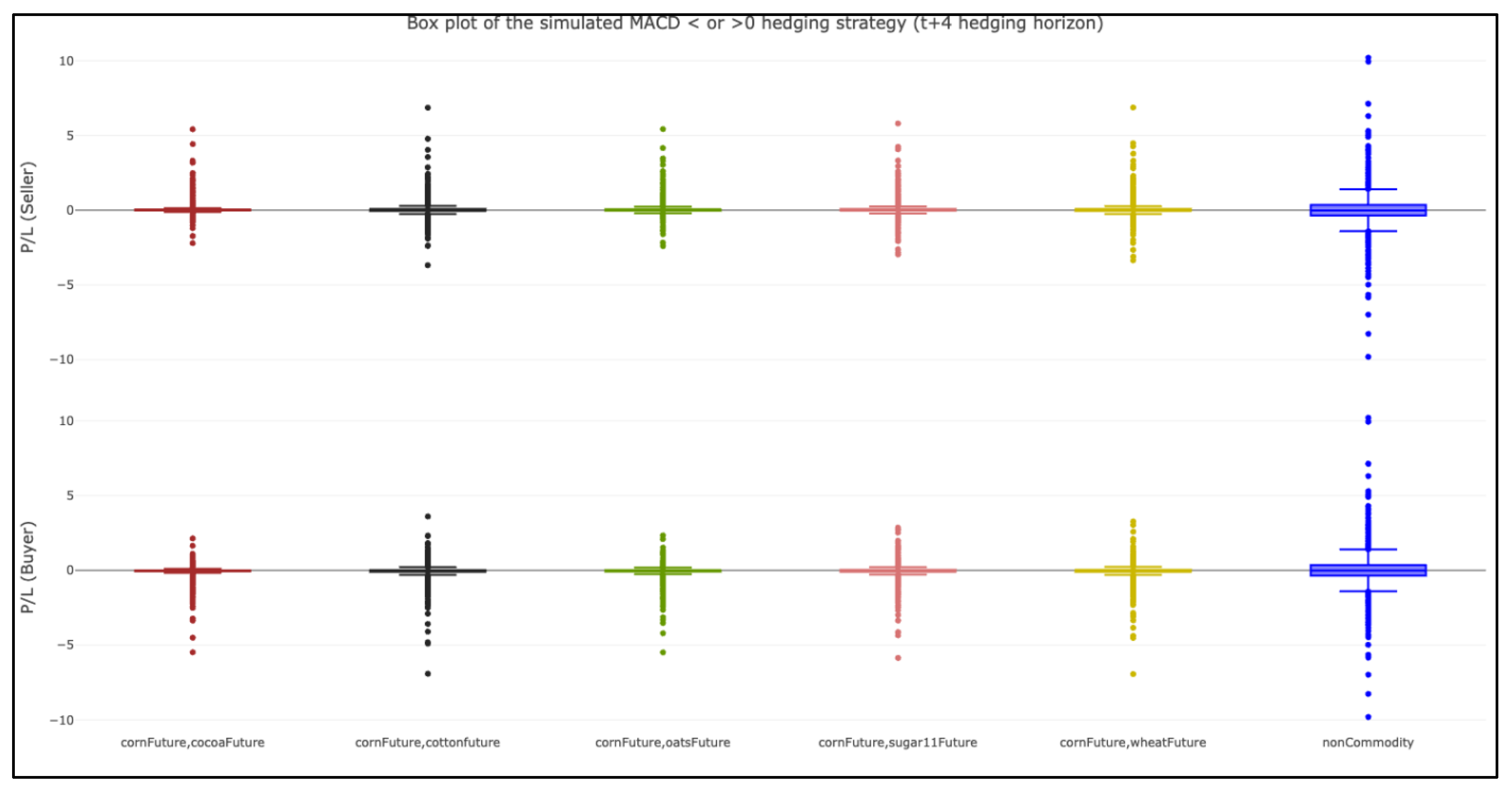
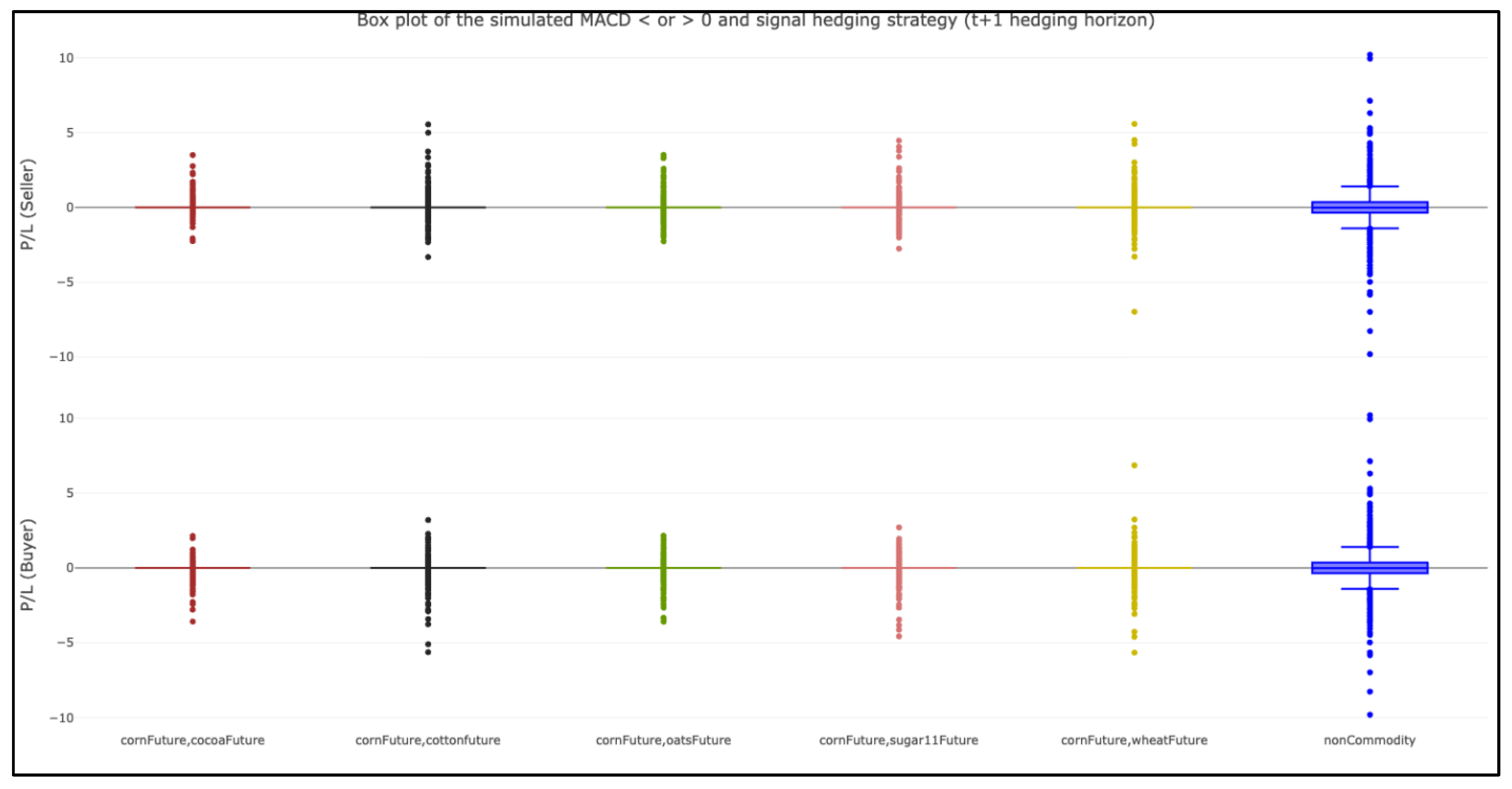
For the hedging strategy in which the lemon seller (buyer) hedges with a short (long) position of the backtested futures portfolio when
,
Figure 2 performs a similar test to
Figure 1. The displayed results show that the
dispersion is narrower when the hedging strategy (16) or (17) is used. The results suggest the same conclusion as the visual test for the naïve strategy in
Figure 1: the income risk (
dispersion) reduces with each of the five backtested portfolios of
Table 1 with this hedging rule.
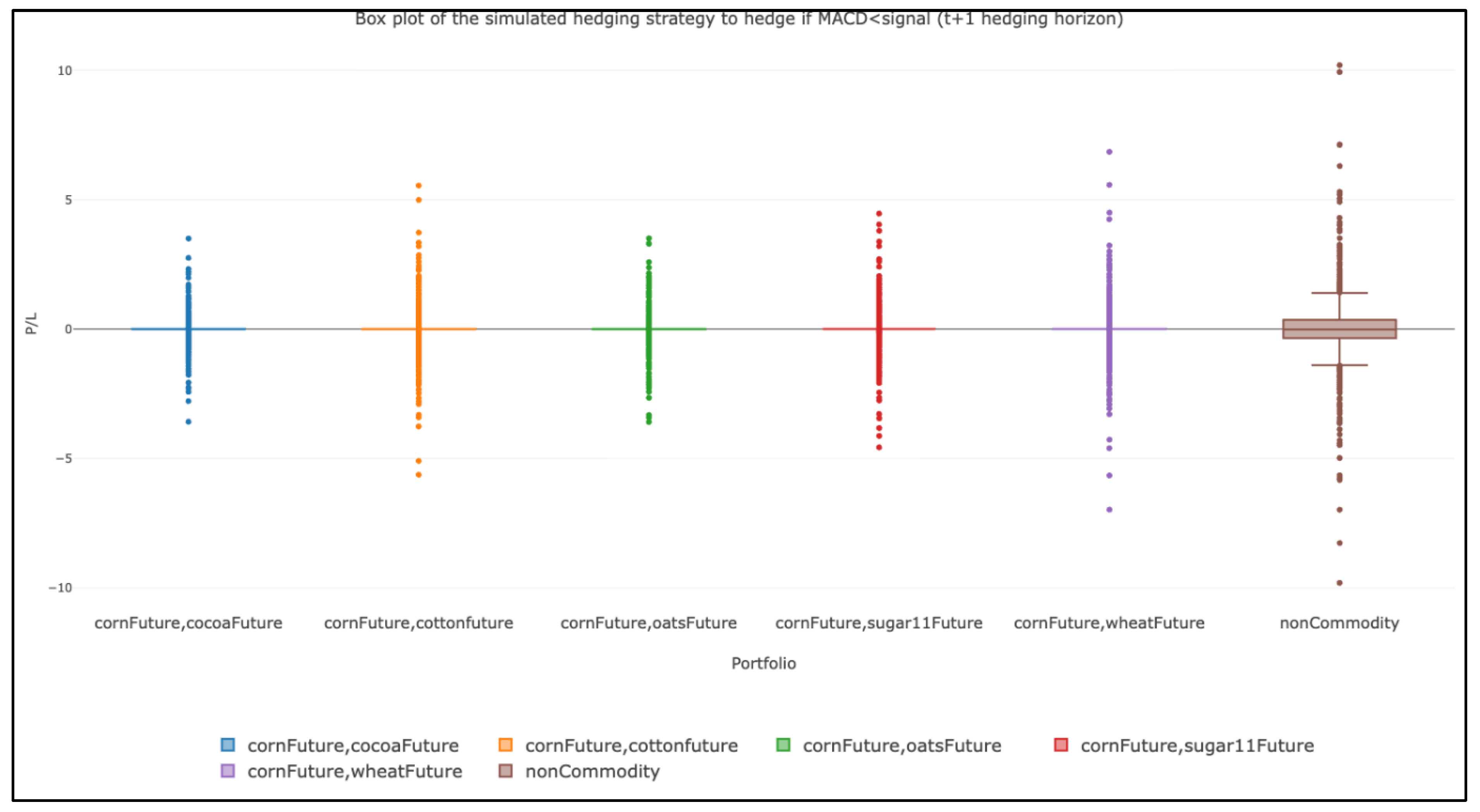
Similarly,
Figure 3 shows the
when the agent hedges her lemon price sell (buy) at
, by using the hedging strategy in (17) or (18). That is, when
(
). The results for this purpose are similar to the test in
Figure 1 and
Figure 2.
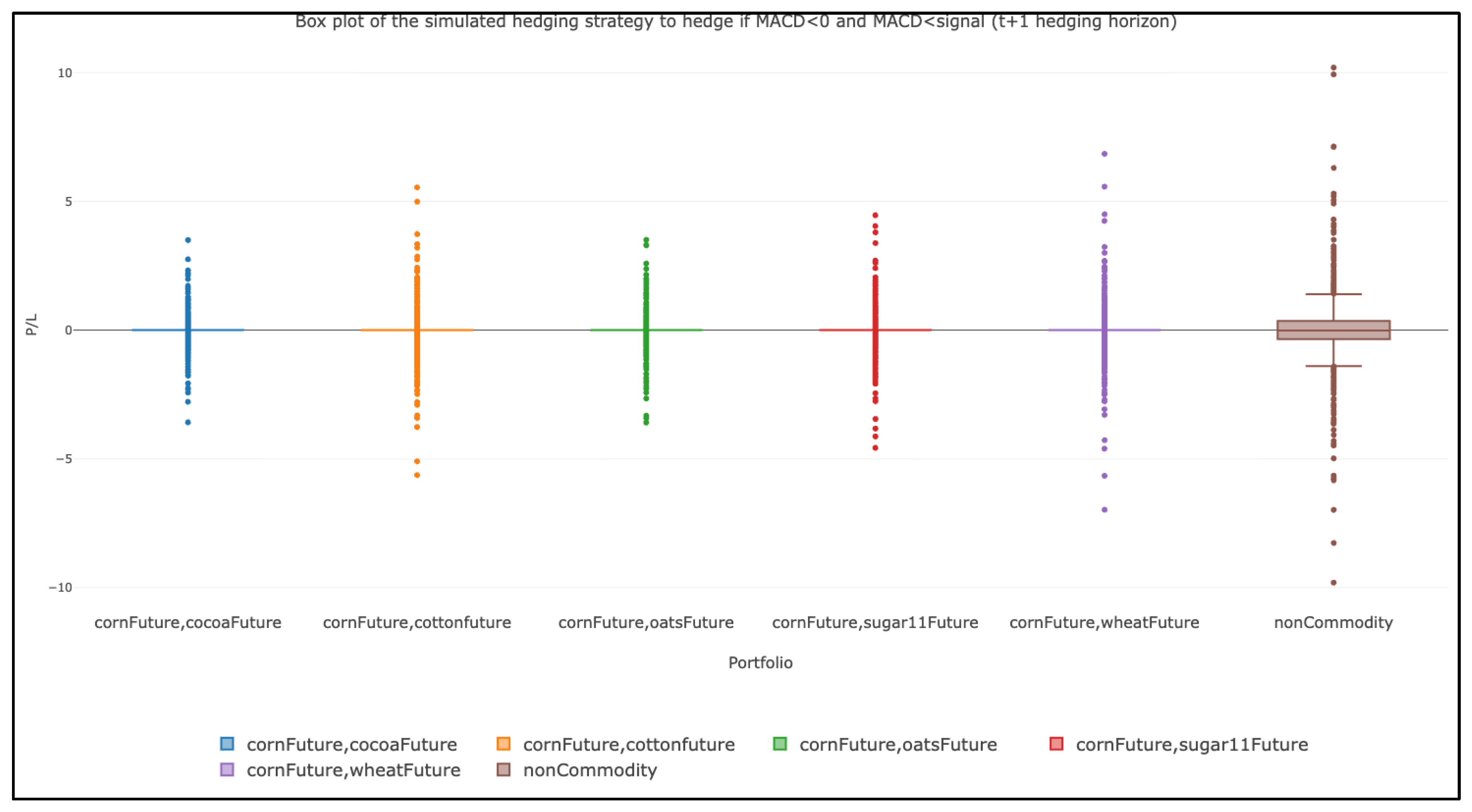
Figure 4 leads to the same conclusions as the three previous ones for the hedging rules (19) and (20).
Consequently, following the visual inspection of the backtested portfolios with the four hedging strategies (14) to (20), it is concluded that using each of the five backtested portfolios of
Table 1 reduces income risk in the
hedging scenario.
A similar set of results was observed in the Figures related to the
histogram for the t + 4 hedging horizon. That is, the agent (buyer or seller) reduced her income risk by using these five portfolios. These figures are shown in
Appendix A.2.
To test whether these results hold asymptotically for both t + 1 and t + 4 hedging horizons,
Table 3 and
Table 4 summarize the parametric and non-parametric hypothesis tests (two-tailed test’s
p-values), assuming that the value is zero due to proper hedging effectiveness.
Table 3 summarizes the Neyman–Pearson
p-values for each portfolio in each hedging strategy, and
Table 4 does the same with the Wilcoxon non-parametric test.
As noted in those two tables, the naïve hedging strategy had a asymptotic value of zero in the long term. This result holds for corn and wheat, corn and oats, and corn and sugar across almost all hedging strategies on both the buyer and seller sides. Despite this, only the corn and wheat portfolio is the most consistent in the equality to zero, either on the buyer or seller side, in the t + 1 hedging horizon. Regarding the t + 4 hedging horizon, all portfolios show values that are nonzero. Consequently, in a t + 4 hedging horizon, it is necessary to test other futures or more dynamic correlations (e.g., MGARCH) as potential solutions.
Among the possible explanations for the
horizon results, it is essential to highlight that time-fixed correlations play a significant role and can forecast over longer periods than
. These results differ from previous work, such as that of Penone et al. [
1], which found better hedging effectiveness in the
period. Contrary to Penone et al., this paper tested the hedging effectiveness of a niche non-commodity, lemon. In contrast, Penone et al. tested the hedging effectiveness of staples, European varieties of commodities like corn. Consequently, the correlation between the European staples and the Mexican lemon could differ, leading to poorer hedging results in
.
Also, it is expected that, due to the time-fixed nature of futures’ correlations, the optimal minimum tracking error portfolio could be stochastically dominated by another portfolio that uses a forecast of the covariance (correlation) matrix at
. This potential cause suggests using a dynamic covariance estimation method, such as MGARCH, in future tests. Another possible cause of such a difference is a structural break (change in regime) at t + 4 periods ahead. That is, at t, the futures and the lemon price could be related in a “calm” or low-volatility (and correlation) context. At t + 4, this context or regime could be of a “distress” or high-volatility one. This change in regime could impact the hedging effectiveness of the backtested portfolio and, consequently, lead to poorer hedging results. Following this rationale, it is suggested that this paper’s results be extended using either MGARCH or Markov switching covariances [
54,
55,
56].
For the
hedging horizon and following
Table 3, no portfolio, either on the seller or buyer side, leads to a statistically equal
equal to zero.
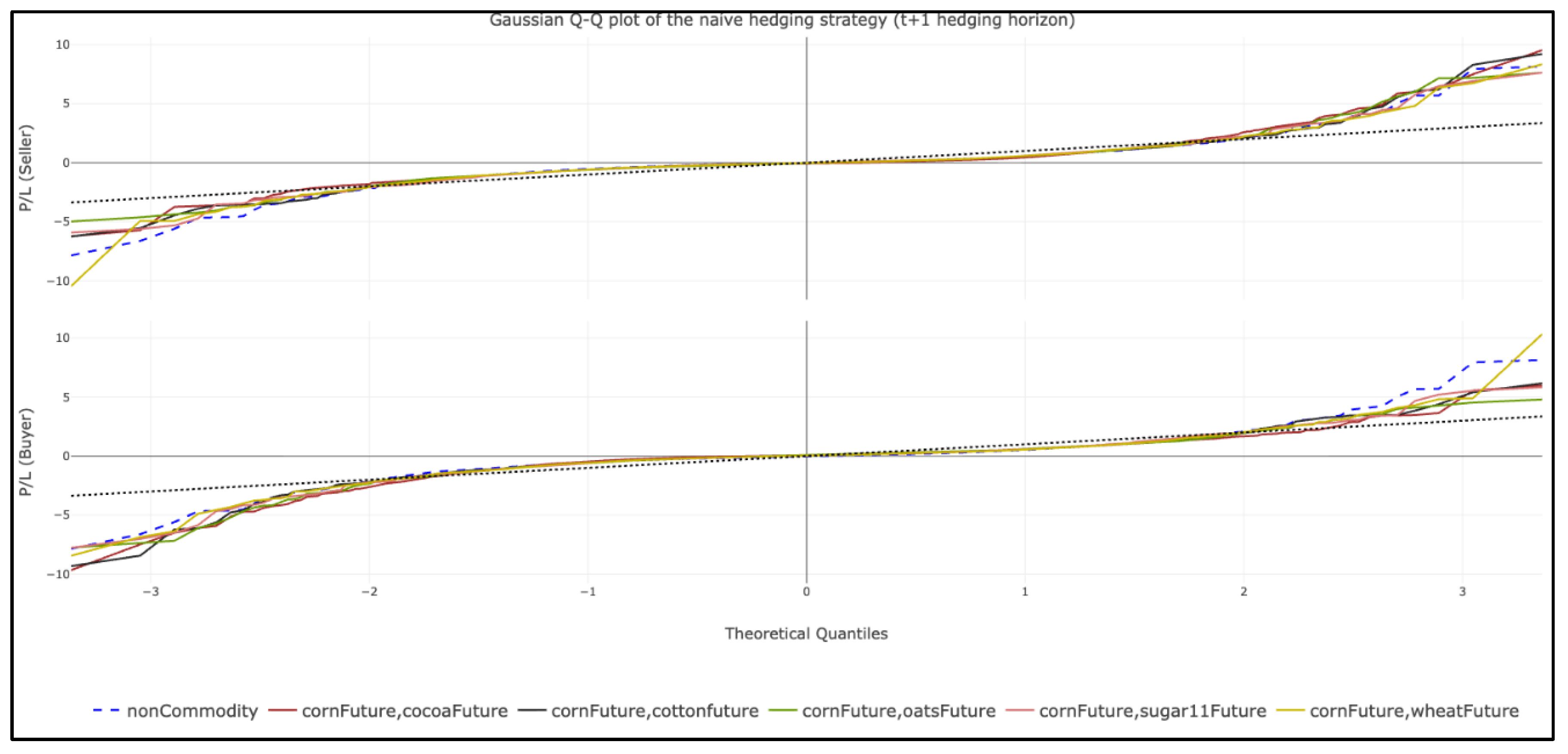
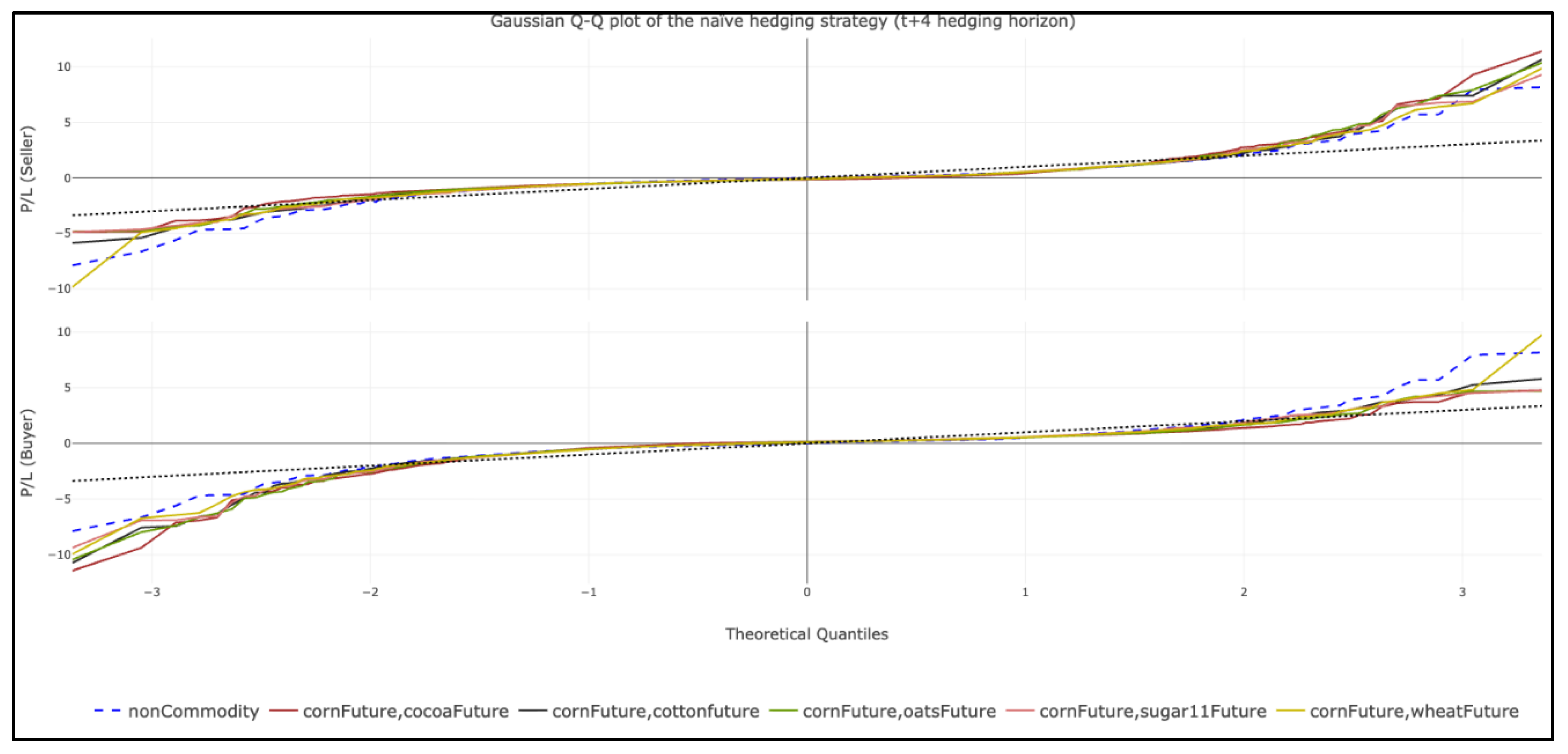
When the perspective changes to the non-parametric Wilcoxon test of
Table 4 (The visual test of normality is shown in
Appendix A.3), only the corn and wheat, corn and oats, and corn and sugar portfolios are the ones with a
value statistically equal to zero, either in t + 1 and t + 4 in almost all the hedging strategies.
A more detailed review of the results of these two tables leads to the observation that, mainly, a seller with a short position in the backtested portfolios is the agent with a significantly equal-to-zero mean . For the buyer side, the expected The value was more inconsistent, suggesting that using the corn and wheat, corn and oats, and corn and sugar portfolios is practically useful for short hedging positions for a seller.
Table 5 and
Table 6 show the parametric variance F-test and Levene’s non-parametric one. Contrary to the previous hypothesis, in these tests the null hypothesis is that the backtested portfolio’s
P/L variance (or scale) is lower than or equal to that of the unhedged position. The alternative hypothesis is that the variance is lower. Similarly to
Table 2 and
Table 3, the two-tailed
p-values for the
and
hedging horizons are displayed.
The results suggest that the variance reduction occurred across the five backtested portfolios, indicating that the income risk for a lemon seller or buyer is significantly reduced.
From these figures and tables, it is noted that hedging in and hedging horizons really helps to hedge (reduce) income risk, only for the seller. This result is stronger in .
From these results, it is essential to mention the linkage mechanism between the corn and wheat portfolio and the lemon price. A natural economic explanation for this linkage is the potential influence or spillover effect from Mexican to U.S. agricultural markets. The supply of other related spot products, such as corn or wheat, in Mexico is partially imported from U.S. markets. Consequently, the prices of these products in Mexico are correlated with their prices in the U.S., as in the case of the Mexican lemon. A potential answer is that the U.S. agricultural futures markets of interest could influence demand for other farm products, such as lemons. A staple that is mainly imported from Mexico in the U.S. Despite these potential explanations, it is necessary to suggest that the linkage of the Mexican lemon price and the futures of interest is a task left for further research. This paper aims to highlight that the correlation structure between the agricultural futures of interest and the Mexican lemon price is sufficient to perform cross-hedging with the corn and wheat futures portfolio. Also, its primary goal is to test the practical hedging benefits of such a portfolio.
Consequently, a public institution, such as SEGALMEX in Mexico, or a private financial institution could offer this minimum buy price or hedge. Had the producer performed so, she would have reduced her potential loss through the hedge. This result holds only if she used the hedging strategies (19) and (21).
It is important to remember that the backtests include the impact of trading fees and VAT. Consequently, these results are among the first in the literature to fill this gap. Previous works have not addressed this impact. An issue corrected herein.
Given these results, the following section summarizes the findings and presents a corollary to compare this paper’s results with those of previous work and the working hypotheses.
5. Results Discussion and Corollary
Following the discussion of the previous results, it is essential to note that the two working hypotheses hold for active hedging strategies on the sell side in and . That is, if a given lemon producer wants to hedge her income in these hedging horizons, she would have a hedging effectiveness higher than 0.6, and the futures portfolio would help to reduce her income risk significantly.
Given the results from the 502 backtested herein, with the highest mean values are portfolios with two futures. In all these portfolios, corn futures were combined with wheat, oats, sugar, cotton, and cocoa. From these five portfolios, the corn and wheat futures portfolio is the one with the highest mean of 0.7033. This result leads to the conclusion that this portfolio is appropriate to significantly reduce the basis risk when used to hedge the Mexican lemon price.
The previous results showed that they help reduce the lemon producer’s income risk because the corn and wheat variance is lower, and its expected value is statistically equal to zero.
The results of this paper show, in line with [
15,
16], that the cross-hedging of a non-commodity like the Mexican lemon is feasible with the use of a portfolio of the most liquid Agricultural futures in the CME and NYMEX. Also, align with these works because their use reduces income risk by generating extra income (accumulated
).
In this paper, it was expected that hedging effectiveness and income risk reduction would be enhanced with longer hedging horizons. Contrary to Penone et al. [
21], the results suggest that the best hedging effectiveness only holds in shorter hedging horizons. Despite this result, the feasibility of hedging with the backtest portfolios in longer hedging horizons holds.
A conclusion must be addressed given these results: From the best five hedging portfolios that show a higher than 0.6, which is the most suitable in terms of practical hedging? As noted in the previous section, the best hedging portfolio was corn and wheat, but the portfolios with the highest income from hedging were corn and cocoa and corn and oats. Despite this last result, the accumulated income of these two previous portfolios may be a short-term or sample result. Because the corn and cocoa showed a mean hedging effectiveness below 0.6, this portfolio could be excluded from the selection of the most suitable hedging portfolio for the lemon’s price.
The corn and wheat portfolio showed the lowest cumulative in the backtests, leaving corn and oats as the most suitable choice for the lemon’s price hedge. This portfolio showed a higher than 0.6 and close to that of the corn and wheat portfolio (0.6816).
6. Conclusions
Cross-hedging is a potential solution to reduce income risk in agricultural products worldwide. This paper tested the benefits of cross-hedging the Mexican #4 lemon, a local variety, and one of the most essential staples in Mexican’s diet. Among the problems that cross-hedging faces is the risk of basis. That is, the difference between the spot price change and the future price changes. A result that is more present when an agent hedges a non-commodity like a lemon with other agricultural (or non-agricultural) futures. As a solution, previous authors have suggested using not only a single future but a portfolio of futures to leverage the covariances (i.e., correlations) between them, thereby reducing basis risk and increasing hedging effectiveness ().
This paper tested the use of portfolios of agricultural futures, specifically the ten most traded on the Chicago Mercantile Exchange (CME) and the New York Mercantile Exchange (NYMEX). To select the best hedging portfolio, the authors of this paper used a minimum tracking error portfolio selection method known as the surplus efficient frontier, a technique used in asset-liability management within investment management. The core idea is to select the futures portfolio that minimizes tracking error (basis risk) relative to the lemon price.
After backtesting 502 portfolios or combinations of futures, the results suggest that a portfolio invested 51.89% in corn and 48.11% in wheat shows a 0.71 (71%) hedging effectiveness and, after accounting for futures trading fees and taxes, reduces income risk.
The results contribute to cross-hedging practice in non-commodities and agricultural products that lack direct futures markets for hedging. Also, they contribute to policy solutions, such as developing public price-hedging organizations like SEGALMEX (Mexico’s food security office). Government institutions like this, or even financial institutions, could offer a buy (strike) price for the lemon and, to transfer the hedged income risk, take a short position in an agricultural futures portfolio, such as corn and wheat. This potential solution could help Mexico’s government and similar entities to offer a hedge in agrarian production by transferring income risk to futures markets, rather than taxpayers.
Despite this result, there are some guidelines for further research, given the backtest assumptions. The most important is the practical (policy) implementation. There are other related issues, such as the hedging portfolio’s margin requirements, risk education among farmers, and a coordination mechanism for the lemon price hedging that must be developed and tested. The results of this paper suggest that the hedging benefits are for short-term periods, and the practical implementation, communication to hedgers, and the extension of more robust methods for long-term hedging are the leading research guidelines, given the results of this paper.
Among other necessary research tasks, the use of other future portfolio selection methods, such as regressions or vector error correction (VEC) models, is a natural extension of this paper. A comparative test between these models and the surplus efficient frontier tested herein could be of practical use and academic interest. Additionally, the use of dynamic or time-varying covariances, or even covariances with structural breaks, could be an essential extension to enhance hedging effectiveness and further reduce the income risk of a lemon producer. Related to market impacts such as slippage or non-convergence, correctly simulating these effects in the hedging results could be an extension of this paper. Because these are specific market issues that should be modeled with specific assumptions (such as jump-diffusion, exponentially distributed time features, or high-frequency related problems), their incorporation into the backtests could be an essential extension.
Finally, the use of artificial intelligence or machine learning methods to optimize the selection of futures portfolios is a natural extension.