1. Introduction
For over 20 years, the European agricultural landscape has undergone significant structural changes, with the volatility of both input and output prices a constant factor shaping the sector’s overall performance. Shifts in pricing, driven by global developments and changes in domestic agricultural markets, now affect producers’ income stability, farm competitiveness, and the economic resilience of agri-food systems. Many experts emphasize that understanding the relationship between production costs and farms’ economic outcomes is crucial for analyzing how the European agricultural sector functions [
1,
2]. The sharp rise in input prices following the 2008 financial crisis, along with pressures from more recent shocks, has constrained agricultural incomes, compressed profit margins, and exposed systemic vulnerabilities, particularly in emerging agricultural economies [
3,
4].
The specialized literature indicates that price transmission along the agri-food chain often occurs imperfectly, and that asymmetries between upward and downward adjustments create tensions in the accumulation of added value [
5,
6,
7]. This distorted transmission becomes even more pronounced amid energy price volatility, widely regarded as a key factor influencing agricultural costs, as it affects both mechanization and the logistics structures that support supply chains [
8,
9,
10]. Simultaneously, the integration of European markets has not yielded uniform effects; instead, it has revealed significant differences among member states in resilience, productivity, and adaptive capacity [
11,
12]. Recent research suggests that both farm structures and the governance of agri-food chains influence how agricultural economies respond to price fluctuations [
13,
14].
This article examines, through a multilevel analytical approach, how agricultural price fluctuations affect the performance of the farming sector in Europe, with particular attention to the relationship between input–output dynamics and key economic indicators, such as real factor income and gross value added. Although the existing literature offers valuable insights into price transmission, volatility-related risks, and structural differences among member states, it still leaves the simultaneous interactions among these dimensions and the formation of comparable patterns of evolution insufficiently explored. Most studies focus on a single product or a specific aspect of volatility, limiting a comprehensive understanding of how agricultural systems respond to price pressures. In this context, the article fills significant gaps by combining factor analysis, structural modeling, and clustering techniques, methods that help identify hidden relationships among variables and reveal consistent regional patterns.
The paper’s contribution lies in its integrated view of the relationships between price movements and sector performance, going beyond traditional methods that focus on individual markets or isolated shocks. Its contribution is to examine both input and output price changes simultaneously, evaluate their effects on economic outcomes, and identify groups of European countries that exhibit either similar or different responses to these changes. This approach provides a more detailed understanding of the resilience of European agriculture.
Against this background, the present study is guided by the following research question: To what extent do agricultural price dynamics, captured by changes in input and output prices, affect sectoral performance across European countries, and do these dynamics generate distinct national patterns of agricultural performance? This focus establishes a unified analytical framework linking theory, variable selection, empirical methods, and results.
This research question is addressed by developing theoretically grounded hypotheses in the literature review and by empirically testing them through multivariate techniques, including structural equation modeling and cluster analysis. The discussion section integrates theoretical expectations with empirical findings to assess how price movements translate into real factor income and gross value added, and how heterogeneous national responses shape differentiated resilience profiles across Europe.
3. Materials and Methods
3.1. Research Design
This study adopts a methodological approach grounded in the premise that analyzing the relationship between agricultural price dynamics and sectoral performance requires a long-term, integrative perspective. Structural, economic, and spatial factors shape agricultural systems across Europe and interact over time, influencing how changes in input and output prices are transmitted into real factor income and gross value added. The existing literature highlights significant variation in price movements and recovery patterns across member states [
7,
12,
14], which indicates that simplified or single-layer analytical approaches fail to capture the complexity of these interactions.
To address this challenge, the research design combines several complementary methodological tools within a unified analytical framework. The analysis focuses on average structural relationships and long-run variations in prices and performance, allowing the identification of stable asymmetries across European agricultural systems. The investigation relies on three interconnected methodological stages. First, factor analysis is used to identify the latent structures underlying the selected price and performance indicators, recognizing that observed variables often reflect economic dynamics not immediately evident in raw data. Second, this paper uses structural equation modeling (SEM) to estimate the structural relationships between agricultural price configurations and sectoral performance, enabling the simultaneous assessment of interdependencies and overcoming the limitations of traditional multiple regression.
Third, cluster analysis is applied to examine cross-country similarities and differences, based on the assumption that European agricultural systems may form distinct groups according to their structural characteristics and performance profiles, as suggested in the literature on competitiveness and production structures [
1,
11].
By integrating these analytical layers, the research design directly addresses the fragmentation observed in the literature, in which price volatility, agricultural performance, and regional differentiation are often analyzed in isolation. Instead, this study adopts a coherent framework in which agricultural price dynamics function both as key associated factors of sectoral performance and as criteria for distinguishing national agricultural systems.
Accordingly, the empirical strategy is designed to align with the study’s theoretical structure: factor analysis defines the latent price and performance constructs, structural equation modeling tests Hypothesis H1 regarding the association between price dynamics and performance, and cluster analysis addresses Hypothesis H2 by identifying differentiated national outcomes and “winner–loser” patterns within the EU agricultural market.
The study adopts a parsimonious modeling strategy focused on the direct relationship between agricultural price dynamics and sectoral performance. Although mediated or moderated frameworks are common in panel-data analyses, this paper aims to preserve interpretive clarity and isolate the core price–performance mechanism. More complex transmission channels are therefore acknowledged but deliberately deferred to future research.
3.2. Selected Data
The dataset used in this analysis is based on annual indicators from the Eurostat database, covering the period 2006–2024, and was chosen to accurately capture the dynamics of agricultural prices and their association with sector performance. Two variables are central to the analysis, each representing key aspects of European farm markets: the price index of agricultural products and the price index of means of agricultural production. The first variable, P_OUT, measures the year-to-year percentage change in agricultural output prices and shows how farmers experience market shifts when they sell their products. It serves as an indicator of the income environment, summarizing the pressures and opportunities arising from demand and market developments.
The second variable, P_IN, measures the percentage change in the prices of production inputs. It includes energy, fertilizers, seeds, and other key inputs, all of which affect farmers’ risk exposure because of their volatility and frequent asymmetric price adjustments. Together, these two variables demonstrate the dual pressure that markets place on agricultural activity, showing how the interaction between costs and revenues influences system performance.
The analysis also includes two indicators of economic performance chosen for their importance in assessing the health of the European agricultural sector. The first, real factor income per annual work unit (AWU), measured in chain-linked volumes (2015) and expressed in euros per AWU, provides an accurate view of the real earnings of production factors. This indicator responds not only to price changes but also to structural shifts that alter labor organization in agriculture. It thus enables a direct evaluation of how price fluctuations affect the economic well-being of agricultural producers.
The second indicator, gross value added at basic prices (GVA), also expressed in chain-linked volumes (2015), reflects the sector’s ability to generate economic value by transforming inputs into outputs. Because it is measured per unit of labor, it captures the sector’s financial efficiency and internal productivity, playing a key role in long-term performance analysis. Unlike real factor income, which measures remuneration, GVA reveals the structural potential of the agricultural system and shows how price dynamics translate into actual value creation.
By combining these four variables, two related to price dynamics and two reflecting economic performance, the dataset provides a solid foundation for analyzing the relationships underlying the study’s two hypotheses (see
Table 1).
These variables enable the analysis to identify tensions between costs and revenues and to clarify how price changes are either absorbed or amplified within the economic framework of European agriculture.
The analyzed period, 2006–2024, spans market phases with markedly different characteristics, from the post-enlargement years of the European Union and the global financial crisis to recent shocks from the pandemic and geopolitical crises. This time span captures considerable variation in both price structures and system responses, supporting firm conclusions. The two-decade interval also enables examination of how structural changes solidify over time—an aspect that shorter periods rarely reveal.
3.3. Methods
The methodology used in this study combines three complementary analytical methods chosen for their ability to capture the complexity of the relationship between agricultural price trends and sectoral performance across European countries. Each method provides a different interpretive perspective, and their combination within a multilevel framework allows exploration of hidden structures, association links, and spatial patterns that define agricultural development.
The initial phase uses factor analysis to uncover the underlying structures that organize variables related to input prices, output prices, and economic performance indicators. In its basic form, factor analysis follows model (1):
—observed variables (P_OUT, P_IN, AWU, and GVA).
—matrix of factor loadings.
—latent factors.
—errors.
This method reduces empirical variables to fewer factors that capture the key relationships linking input–output prices to sector performance [
69]. Factor analysis, therefore, serves as a tool for identifying the main dimensions of price dynamics, which then inform the estimation of structural association [
70].
The second methodological step employs structural equation modeling (SEM), selected for its ability to estimate both direct and indirect associations between price movements and agricultural performance. In its broadest form, an SEM model combines a measurement component with a structural component [
71,
72]. The structural model, intended to identify structural association among variables, follows relation (2):
η, ξ—endogenous and exogenous variable vectors;
B—effects of the latent endogenous variables on each other;
Γ—effects of the latent exogenous variables on the latent endogenous variables;
ζ—disturbances;
i—cases.
SEM enables testing the hypothesis that a favorable price setup positively influences real factor income and gross value added, thus providing a clearer understanding of how price changes relate to agricultural performance.
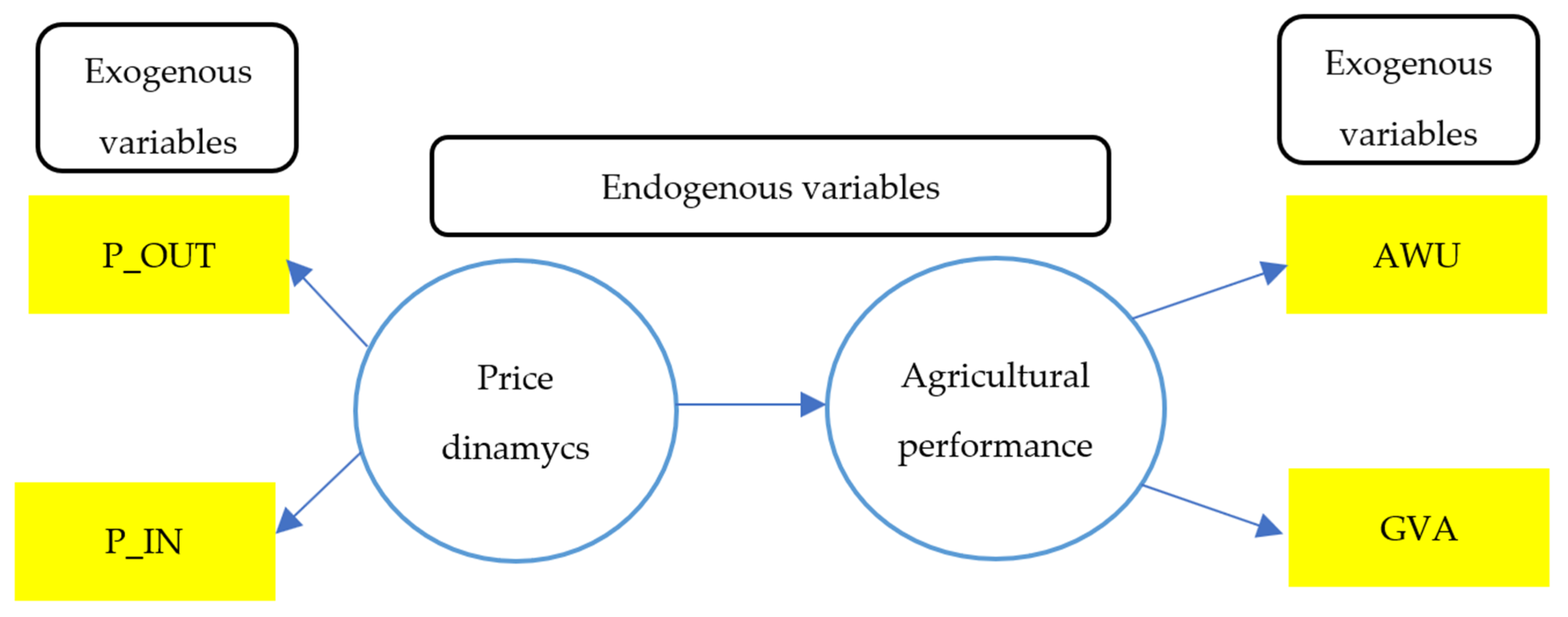
The conceptual model explicitly distinguishes between exogenous and endogenous constructs. The model treats agricultural price dynamics as an exogenous driver and sectoral performance indicators as endogenous outcomes. In line with the study’s objective of emphasizing direct associations and cross-country asymmetries, no mediating or moderating variables are included (
Figure 1).
Given the model’s latent-variable nature, statistical validation relies on reliability, validity, and goodness-of-fit criteria specific to structural equation modeling rather than on regression-based diagnostic tests. This approach aligns with established methodological standards in SEM applications.
The PLS-SEM framework used in this study examines structural associations among latent constructs rather than identifying causal effects. In the absence of instrumental variables, exogenous shocks, or dynamic identification strategies, the estimated path coefficients should be interpreted as parametric representations of systematic relationships in the observed data.
The final analytical stage employs cluster analysis to identify groups of countries with similar price and performance patterns. Given the structural diversity of European agriculture, this method reveals consistent regional patterns [
73] and highlights differences in resilience and adaptability to market volatility. Using the average method, a standard tool for cluster identification [
74], the optimization criterion is expressed in (3):
—observations from cluster 1.
—observations from cluster 2.
d(X, Y)—distance between a subject with observation vector x and a subject with observation vector.
k, l—cases (EU countries’ values for P_OUT, P_IN, AWU, and GVA).
This method groups countries based on their economic similarity, using price and performance indicators as reference points. In this process, cluster analysis directly tests the hypothesis that European countries form distinct patterns aligned with similar agricultural market structures.
By integrating these three tools, factor analysis, SEM, and cluster analysis, the study’s methodology provides a framework for a multilevel examination of European agriculture. This analytical setup not only uncovers hidden structures and estimates the transmission channel but also explains how countries differ in their responses to price changes, presenting clear profiles of resilience and vulnerability across the European agricultural sector.
4. Results
4.1. Factorial Analysis
To identify the latent structures shaping relationships among the variables in the study, the paper applied exploratory factor analysis to reduce data complexity and extract two core theoretical constructs: price dynamics, built from percentage changes in agricultural output prices (P_OUT) and input prices (P_IN), and agricultural performance, defined by the evolution of real factor income per annual work unit (AWU) and gross value added at basic prices (GVA). I used the Principal Axis Factoring method because it is well-suited for uncovering underlying structures that explain correlations among observed indicators.
The paper first examined price dynamics. The correlation matrix shows a relationship between P_OUT and P_IN, with a coefficient of 0.667, indicating a convergent movement between input and output prices, a pattern often observed in the literature on price transmission along the agri-food chain. The determinant of the matrix (0.555) indicates no perfect collinearity, and the Bartlett test is statistically significant (χ2 = 300.467; p < 0.001), confirming that the data meet the criteria for factorial analysis.
The extracted communalities, both 0.666 for the two variables, indicate that the latent factor explains about two-thirds of each indicator’s variation, supporting structural coherence. The single extracted factor has an initial eigenvalue of 1.667 and explains 83.35% of the variance, a proportion that remains high at 66.61% after extraction. The very similar factor loadings for P_OUT and P_IN (0.816 for both) support the interpretation that the dynamics of input and output prices represent two aspects of the same underlying economic concept, influenced by shared market pressures on farmers’ costs and revenues.
The paper then examined the agricultural performance construct. The factor analysis applied to AWU and GVA shows a relationship between them, with a correlation coefficient of 0.752. The determinant of the matrix (0.435) again rules out collinearity issues, and the Bartlett test (χ2 = 425.000; p < 0.001) confirms that the correlation structure supports the identification of a latent factor.
The extracted communalities, 0.751 for both variables, indicate the factor’s ability to explain variation and reinforce the legitimacy of this well-defined latent dimension. The single extracted factor has an eigenvalue of 1.752 and accounts for 87.58% of the total variance, retaining 75.09% of the variance after extraction.
The nearly identical factor loadings for AWU and GVA (0.867 in both cases) underscore the conceptual connection between the two indicators, each reflecting the agricultural sector’s economic performance in terms of factor remuneration and the ability to create added value.
Overall, the factorial analysis confirms the conceptual strength of the two latent constructs used in the subsequent modeling. Price dynamics and agricultural performance emerge as coherent structures that reliably summarize relevant economic information from the observed variables. This stage establishes a foundation for structural modeling, allowing tests of hypotheses about how price dynamics influence agricultural performance across Europe and the identification of patterns that distinguish countries’ responses to these developments.
4.2. Structural Equation Modeling
To explore the relationship between agricultural price trends and sectoral performance more thoroughly, structural equation modeling was chosen as the key methodological approach, using SmartPLS v3 [
75] for this analysis. The model estimates the simultaneous relationships among the latent constructs, price trends, defined by changes in agricultural output prices (P_OUT) and input costs (P_IN), and agricultural performance, composed of real factor income (AWU) and gross value added (GVA). This method enables the identification of the transmission channel linking market pressures to the system’s ability to produce economic value. The latent constructs represent parsimonious theoretical aggregations of closely related indicators, enabling a more straightforward structural comparison across countries.
The paper used consistent PLS, an improved version of Partial Least Squares that provides consistent estimators for reflective models by correcting attenuation bias and aligning results with covariance-based SEM [
76].
Figure 2 displays the SEM model.
Given the two-indicator structure of each latent construct, reliability and loading statistics primarily reflect internal consistency between paired indicators rather than multidimensional variation in the latent construct.
Construct validity was assessed using standard measures of internal consistency and reliability, all of which comfortably meet the methodological thresholds (
Table 2).
The reliability indicators show that the observed variables effectively reflect the underlying constructs, confirming their validity. Discriminant validity, assessed through the Fornell–Larcker criterion, clearly distinguishes the constructs: the values of 0.881 for agricultural performance and 0.839 for price dynamics surpass the squared correlation between them, ensuring a conceptual separation. The VIF values are all below 3, indicating minimal multicollinearity and suggesting that the variables operate relatively independently without excessive overlap among their predictive structures (see
Table 3).
Model fit indices clearly indicate the model’s adequacy. An SRMR of 0.005 indicates close agreement between the calculated and observed covariance matrices. Additional metrics, including d_ULS and d_G, are zero, and the NFI of 0.998 suggests an almost perfect fit of the covariance structure. The outer loadings and weights of the observable variables further support the model’s coherence, confirming that each indicator reliably captures the market pressures affecting costs and revenues. The primary result of the structural model shows a link between price dynamics and agricultural performance, with a path coefficient of 0.188, a standard deviation of 0.056, a t-statistic of 3.392, and a
p-value of 0.001 (see
Table 4).
The path coefficient (0.188) should not be interpreted as a short-term or year-to-year causal effect. Instead, it represents an average long-run relationship estimated across countries and over the entire observation period, capturing how differences in price dynamics are systematically associated with differences in agricultural performance across the European Union. In this sense, the SEM results identify a structural linkage between prices and performance that persists over time and across heterogeneous national contexts.
The analysis of these results indicates that hypothesis H1 is supported. The magnitude of the coefficient suggests that price dynamics are an important, though not exclusive, factor in agricultural performance. Structural characteristics, institutional settings, and market conditions likely mediate this relationship, explaining why similar price movements can produce uneven performance outcomes across countries.
4.3. Cluster Analysis
The hierarchical clustering analysis is intended as an exploratory tool to highlight broad cross-country patterns based on long-run price changes and performance indicators, rather than to establish statistically optimal or robust classifications.
Cluster analysis identified shared trends in the development of agricultural prices and sector performance across European countries. The research examined indicators such as ΔP_OUT (the change in real agricultural product prices from 2006 to 2024), ΔP_IN (the change in real agricultural input prices over the same period), CAWU (the real factor income from agriculture per annual work unit in 2024 compared to 2015), and CGVA (gross value added at basic prices in 2024 relative to 2015).
The clustering strategy deliberately summarizes the extended time dimension into long-run price changes and recent performance outcomes to identify structural country profiles rather than short-term fluctuations.
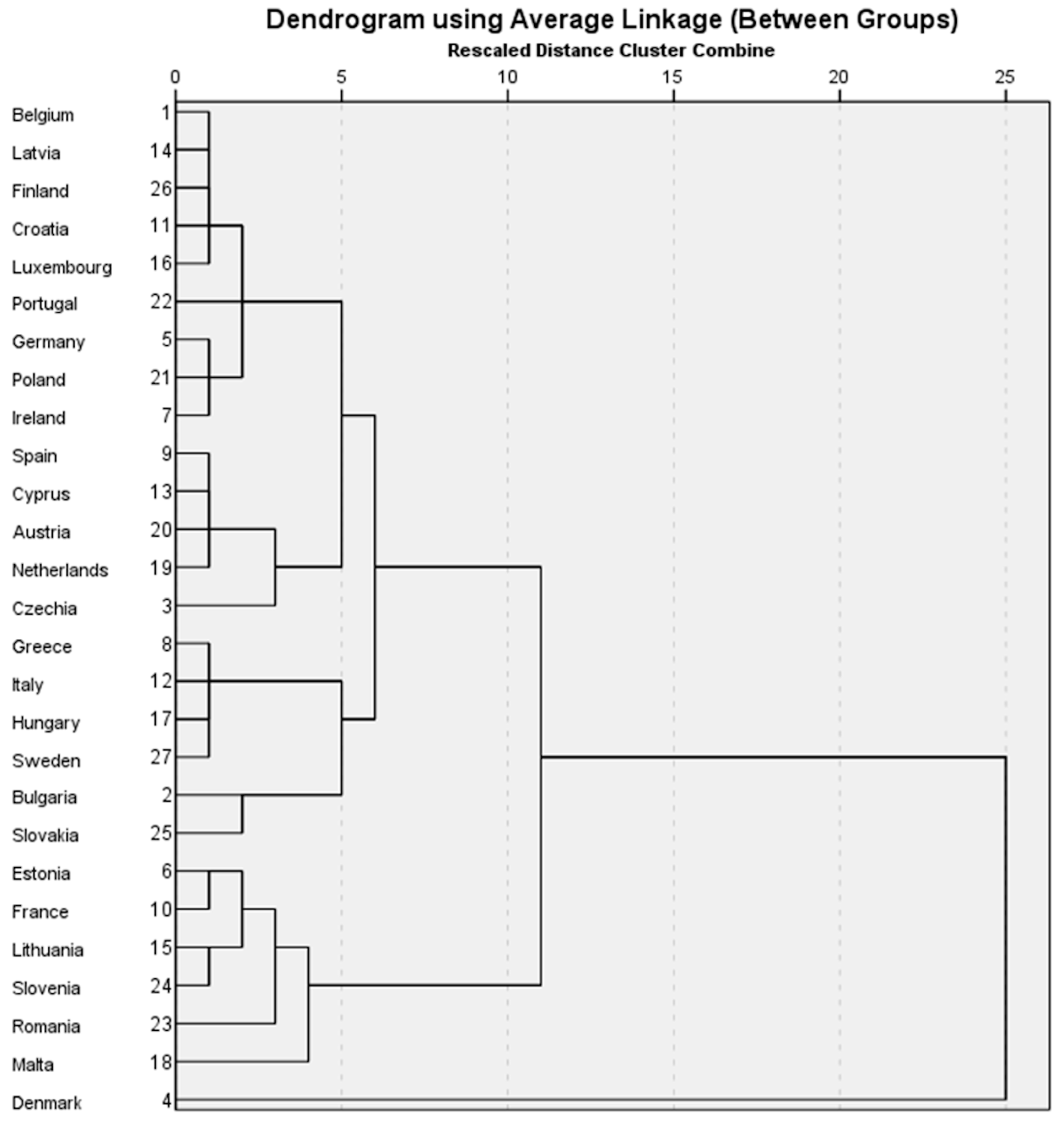
Combining selected variables, the analysis identified two clusters representing coherent agronomic profiles, in which tensions among costs, output prices, and economic performance manifest differently across countries (see
Figure 3 and
Table A1 in the
Appendix A). The dendrogram was generated using hierarchical clustering (average linkage) from standardized factor scores. The clustering structure reflects similarities in agricultural price dynamics and performance indicators across countries. The cutoff level used to define clusters is indicated by the horizontal distance on the dendrogram.
The cluster analysis reveals not only structural heterogeneity among European agricultural systems but also systematic differences in countries’ ability to translate agricultural price dynamics into economic performance. The identified clusters, therefore, reflect distinct positions within the EU agricultural market, separating countries that benefit from price movements from those that remain structurally disadvantaged.
Cluster A groups countries that can be considered relative “winners” in agricultural price dynamics. In these economies, changes in input and output prices are transmitted more effectively into higher real factor income and gross value added. This pattern indicates structural resilience supported by higher capitalization, more efficient farm structures, and stronger integration within agri-food value chains. Within this cluster, the first subgroup (subcluster A1) comprises highly competitive systems that coexist with moderate price changes and consistent performance, indicating the capacity to absorb cost pressures and exploit favorable market conditions.
The second subgroup (subcluster A2) includes countries where output prices rose more sharply, yet economic performance remained comparatively weaker. This pattern points to structural rigidities that limit the ability to fully capitalize on favorable price developments, such as fragmented farm structures or weaker price transmission mechanisms.
In contrast, Cluster B comprises countries that can be interpreted as relative “losers” in the EU agricultural market. Despite price dynamics broadly comparable to the European average, these systems exhibit significantly lower income and value added. This outcome indicates limited structural capacity to convert price signals into economic gains, reflecting ongoing challenges related to farm consolidation, investment intensity, and market integration.
Overall, the clustering results support Hypothesis H2 by showing that persistent asymmetries characterize European agriculture, with price dynamics reinforcing differentiated development paths rather than fostering convergence.
5. Discussion
The paper investigates the relationship between agricultural price trends and sectoral performance from 2006 to 2024 using SEM and examines how structural differences across European countries shape distinct clusters of economic development. Building on these two areas, the analysis offers a detailed interpretation of how national agricultural systems adapt to market pressures. It broadly supports strengthening income-stabilization policies, increasing investment in high-efficiency technologies, and enhancing coordination within the agri-food chain through agricultural strategies that balance competitiveness and the resilience of European agriculture.
Table 5 reports the validation of the research hypotheses, linking each hypothesis to the corresponding methodological approach and empirical outcome.
The empirical results provide clear support for Hypothesis H1, indicating a positive, statistically significant association between agricultural price dynamics and sectoral performance. The confirmation of Hypothesis H1 is consistent with previous empirical evidence highlighting the role of price dynamics in shaping agricultural income and value creation. The study’s observations align with the conclusions of Zsarnóczai and Zéman [
1], who highlight that cross-country differences in productivity and income partly stem from how production costs evolve and affect farms’ economic results. The convergence between the dynamics of input and output prices identified in the factorial analysis also aligns with the literature on asymmetric price transmission [
5,
36], which indicates that price adjustments seldom occur symmetrically and that cost pressures typically pass through only partially into selling prices. Despite these asymmetries, the structural model shows a significant positive association, suggesting that sectoral performance depends not only on absolute price levels but also on farms’ ability to adapt production structures in a changing environment.
Furthermore, the results align with those of Georgescu et al. [
18], who argue that the added value in agriculture depends heavily on the interaction between costs and agricultural product prices. Coca [
17] also shows that investments in modernization can mitigate the negative effects of rising costs and increase the share of positive output price trends, thereby enhancing economic performance. Taken together, these findings support H1, indicating that price dynamics serve as an economic mechanism through which agricultural systems can adjust their structure and efficiency, directly affecting performance.
The moderate effect size also suggests the presence of other key performance factors, such as farm structure, capitalization, the degree of agri-food chain integration, and the level of technology adoption—factors highlighted by both Nowak and Kaminska [
2] and Slijper et al. [
12]. In this context, price dynamics are a necessary but not sufficient condition for performance.
The cluster analysis results provide exploratory support for Hypothesis H2, revealing differences in countries’ ability to convert price dynamics into economic performance. Given the limited number of indicators and the relatively small cross-country sample, the clustering results should be interpreted with caution. Rather than providing definitive or statistically optimal groupings, the analysis highlights patterns in how persistent price–performance configurations vary across European agricultural systems. The identification of relative “winner” and “loser” groups does not imply rigid classifications but instead reflects systematic contrasts in long-run outcomes associated with similar price dynamics. These patterns suggest that structural and institutional characteristics shape how price signals are translated into real factor income and gross value added. Although these characteristics are not explicitly modeled in the present analysis, the clustering results indirectly capture their combined influence by revealing consistent cross-country differences.
By adopting this perspective, the findings move beyond the descriptive acknowledgment of heterogeneity in European agriculture and offer a more nuanced interpretation centered on countries’ unequal capacity to convert price movements into economic gains. In this sense, Hypothesis H2 is supported at an exploratory level, contributing to a policy-relevant understanding of why favorable price dynamics do not lead to uniform performance outcomes across the European Union.
This result aligns with the conclusions of Zsarnóczai and Zéman [
1], who show that disparities in agricultural income and productivity across Europe are closely associated with structural factors such as mechanization, intermediate consumption, and production concentration. Similarly, Georgescu et al. [
18] emphasize that gross value added in agriculture depends not only on price levels but also on how effectively production systems internalize cost–price interactions. The present cluster results reinforce these arguments by showing that favorable price dynamics alone do not guarantee superior performance unless supporting structural conditions are in place.
The distinction between winner and loser clusters also aligns with the resilience-oriented literature. Slijper et al. [
12] and Vigani et al. [
44] argue that resilience in European agriculture is unevenly distributed and depends heavily on structural characteristics, investment capacity, and the adoption of innovation. The countries identified here as winners correspond to systems described in the literature as more resilient, capable of absorbing price shocks while maintaining income stability. In contrast, the loser group reflects agricultural systems that, despite facing similar price environments, lack the structural flexibility to convert market signals into sustained economic performance.
Furthermore, the results align with studies on agri-food chain governance and price transmission. Carbone [
13] and Djekic et al. [
14] emphasize that differences in value chain coordination shape how price changes are distributed among actors. The weaker performance of loser countries identified in this study may therefore reflect incomplete or asymmetric price transmission, a phenomenon widely discussed by Peltzman [
5] and Meyer and von Cramon-Taubadel [
36].
From a policy perspective, these findings support recent arguments that price-based mechanisms and uniform policy instruments are insufficient to promote convergence within the European agricultural sector. As Biagini and Severini [
46] and Awokuse et al. [
45] note, income stabilization and resilience-enhancing measures must be tailored to the specific structural conditions of different agricultural systems. The present analysis provides empirical support for this view by showing that, without targeted investment and modernization policies, favorable price dynamics may reinforce existing asymmetries rather than reduce them.
Overall, by framing agricultural performance in terms of winners and losers within the EU market, this study contributes to a more nuanced understanding of how price dynamics, structural capacity, and resilience interact. It complements existing empirical and theoretical research by demonstrating that the key policy challenge is not simply managing price volatility but strengthening the ability of disadvantaged agricultural systems to translate market opportunities into long-term economic performance.
5.1. Theoretical Implications
The study’s empirical results reinforce a theoretical view that agricultural price dynamics are not merely contextual or temporary factors but fundamental determinants of economic performance. By confirming a positive link between favorable price structures and the growth of real income and added value, the findings support the idea that the European agricultural sector’s functioning relies on a complex price transmission mechanism. Within this system, changes in costs and output prices do not move in perfect lockstep, yet they still produce a significant overall economic impact. This finding aligns with economic theories of imperfect price transmission and shows that asymmetric cost effects do not completely undermine the system’s ability to respond to positive signals; instead, they alter how these signals affect performance.
Identifying clusters of countries with distinct price and performance trajectories provides empirical support for the literature on ongoing structural differences in European agriculture. This finding strengthens theories linking productivity and resilience to factors such as farm capitalization, integration into the value chain, production specialization, and institutional adaptability. The study shifts the theoretical debate away from a uniform interpretation of how agriculture responds to shocks toward a more contextualized view, in which performance results from the interaction between price trends and the structural characteristics of each agricultural economy. Overall, the paper’s theoretical implications provide a foundation for exploring, in an integrated way, the connections among prices, performance, and resilience. It also presents a clear conceptual framework for understanding European agricultural diversity amid current economic volatility.
5.2. Practical Implications
The study’s results highlight several practical implications for policymakers, farmers, and others in the European agri-food chain. First, confirming that price dynamics positively affect economic performance suggests that agricultural policies should do more than cushion negative shocks. They should also create conditions that enable farms to seize opportunities from rising output prices. This approach requires investments in technology, modernization, and logistics infrastructure to help farmers more effectively translate favorable market conditions into sustainable economic benefits.
Second, the significant differences among the identified clusters indicate that European policies need to adapt to each region’s structural characteristics. Countries in the high-performance cluster can benefit from measures that promote innovation and sustain competitiveness. In contrast, countries in the lower-performance cluster require programs focused on structural consolidation, reducing farm fragmentation, improving access to finance, and increasing integration into value chains. This differentiated approach can help close the persistent gaps in European agricultural performance.
Furthermore, the results suggest that price volatility requires income-stabilization tools and protection mechanisms tailored to the structural diversity of agricultural systems. Farmers can benefit from risk-management training, digital platforms for market monitoring, and financial instruments designed for periods of heightened volatility. From the perspective of the agri-food chain, the study emphasizes the need to improve transparency and coordination among stakeholders so that price adjustments are passed through more fairly and efficiently. Overall, the practical implications provide clear guidance for strengthening this sector’s resilience to the growing volatility of the agricultural market.
5.3. Limitations and Directions for Future Research
Like any empirical study, this research has limitations that also point to meaningful directions for future research. A first limitation stems from the use of nationally aggregated data. While such data are appropriate for identifying broad macrostructural trends and cross-country patterns in European agriculture, they may obscure substantial heterogeneity at lower levels of analysis. Differences among agricultural subsectors, such as crop versus livestock production, as well as between small-scale and industrial farms or between rural and peri-urban areas, remain insufficiently explored, despite their potential influence on exposure to price dynamics and adaptive capacity.
A second limitation concerns the deliberately parsimonious specification of the structural equation model. Although the SEM framework captures systematic associations between agricultural price dynamics and sectoral performance, it does not explicitly incorporate mediating or moderating factors, including capitalization intensity, digitalization levels, value-chain integration, or regional public policy interventions. Although the analysis focuses on a parsimonious set of price and performance indicators, it does not explicitly control for structural, institutional, or policy-related factors, including subsidy intensity, farm size, capitalization, technology adoption, climatic conditions, or institutional quality. These factors are widely recognized as key determinants of agricultural performance and may mediate or moderate the price–performance relationship. Their omission reflects a deliberate methodological choice to preserve interpretive clarity and ensure cross-country comparability. However, it also implies that the estimated associations may capture only a partial subset of broader macroeconomic trends and common shocks, rather than isolated price-related mechanisms.
Although the analysis relies on a concise set of price and performance indicators, other dimensions, such as ecological sustainability, technological adoption, innovation diffusion, and digital transformation, are widely recognized as critical drivers of long-term agricultural development. These dimensions often operate through indirect or efficiency-related channels and require detailed, harmonized datasets that are not yet consistently available across all EU member states over extended time horizons.
In addition, the clustering analysis relies on a limited set of indicators and does not formally assess cluster validity with alternative distance metrics or internal validation indices. Future research should test the robustness of country groupings using richer indicator sets, alternative clustering algorithms, and formal validation procedures.
In this context, future research could build on the present framework by adopting more innovation- and efficiency-oriented analytical approaches. For example, Aldieri et al. [
77] show that knowledge spillovers and technical efficiency contribute to cleaner, more competitive agricultural production systems, offering a valuable benchmark for extending price–performance analyses toward sustainability- and innovation-driven outcomes. Integrating these perspectives would deepen understanding of how price dynamics interact with efficiency gains, technological progress, and environmental objectives.
More broadly, further research should pursue multilevel, dynamic analytical strategies that integrate structural, institutional, and microeconomic factors to capture how agricultural systems adjust over time to changing market conditions. Comparative studies across agricultural subsectors or within different regional and national contexts could provide additional insights into resilience mechanisms and convergence processes. Finally, incorporating explicit sustainability and climate-related indicators would help clarify the complex links among price dynamics, economic performance, and the transition toward more sustainable agricultural systems across Europe.
6. Conclusions
This study examined the relationship between agricultural price dynamics and sectoral performance across European countries from 2006 to 2024, using an integrated analytical framework that combines factor analysis, structural equation modeling, and cluster analysis. Rather than estimating causal effects, the study focused on identifying systematic structural associations between price dynamics and performance outcomes, as measured by real factor income and gross value added.
The results indicate that changes in agricultural input and output prices are consistently associated with variations in sectoral performance across countries. However, this association is not uniform. European agriculture exhibits markedly different capacities to translate similar price dynamics into economic outcomes. While some countries can absorb cost pressures and align favorable price movements with sustained income growth and value creation, others remain structurally constrained and derive more limited benefits from comparable market conditions.
This differentiation leads to the emergence of distinct groups of relative “winners” and “losers” within the EU agricultural market. The existence of these groups suggests that price dynamics alone do not drive convergence in agricultural performance. Instead, structural characteristics, such as farm capitalization, productivity levels, technological intensity, and integration within agri-food value chains, shape how price signals translate into economic outcomes. As a result, favorable market developments may reinforce existing disparities.
From a policy perspective, these findings highlight the limitations of uniform, price-based policy instruments in promoting balanced agricultural development across the European Union. While income stabilization measures remain essential, they are insufficient on their own to address persistent performance gaps. More targeted interventions to strengthen structural resilience, particularly in countries identified as relative losers, are necessary to enhance their capacity to respond to evolving price dynamics. Such interventions may include support for farm modernization, digitalization, productivity-enhancing investments, and improved coordination along agri-food value chains.
Overall, this study contributes to the literature by shifting the focus from descriptive heterogeneity to a more policy-relevant understanding of agricultural performance in the EU. By framing agricultural systems in terms of relative winners and losers, this approach provides empirical evidence to support the design of differentiated agricultural and regional policies that reduce structural disparities and foster more inclusive and sustainable development across European agriculture.