Skin Barrier Function and Microtopography in Patients with Atopic Dermatitis


 ,
,  and
and 
Abstract
1. Introduction
2. Materials and Methods
- –
- Patients with AD diagnosed by a dermatologist following the Hanifin and Rajka criteria of at least 6 months of evolution and who have attended the Atopic Dermatitis consultation at the Dermatology Department of the Hospital Universitario Virgen de las Nieves
- –
- Aged between 12 and 65 years of age
- –
- Have signed the informed consent required to participate in the study
- –
- Subjects who do not wish to participate in the study and who do not sign the informed consent form
- –
- Patients with clinical infection in the area to be measured
- –
- History of cancer or immunosuppression
- –
- Any concomitant inflammatory skin pathology (psoriasis, hidradenitis suppurativa)
- °
- Scoring Atopic Dermatitis (SCORAD), an index that evaluates the extent with a percentage of the affected surface area, the intensity of AD through six items (erythema, oedema/papules, effect of scratching, oozing/crusting, lichenification and dryness) scored from 0 (absence) to 3 (intense) and two subjective symptoms, itching and insomnia, scored from 0 to 10. The total is calculated = extent/5 + 7 × intensity/2 + symptoms of itching and insomnia. The disease is considered mild if it has a score between 0 and 25; moderate between 25 and 50; and severe >50.
- °
- The Redness, Oedema, Scratches (ROS) scale which assesses erythema, oedema and excoriations. Each item is scored from 0 to 3 and the total score, adding up each item, will give a number between 0 and 9.
- °
- The Eczema Area and Severity Index (EASI) scale, that includes the extent of disease and the percentage of body surface area in four body regions (head and neck, trunk, upper limbs and lower limbs). The disease is mild if EASI ≤ 7, moderate 7.1–21, severe >21–50 and very severe >50.
- °
- The Investigator’s Global Assessment (IGA) which uses the clinical features of erythema, infiltration, papules, oozing and crusting to classify it from 0 (clear) to 5 (very severe disease).
3. Results
3.1. Descriptive Analysis and Sociodemographic Characteristics of the Study Population
3.2. Differences in Skin Barrier Function and Skin Microtopography between Healthy Skin and Flexural Eczematous Lesions
3.3. Differences between Men and Women
3.4. The Impact of Age in Skin Barrier Function and Skin Microtopography
3.5. Differences in Skin Barrier Function and Skin Microtopography Depending on Disease Severity
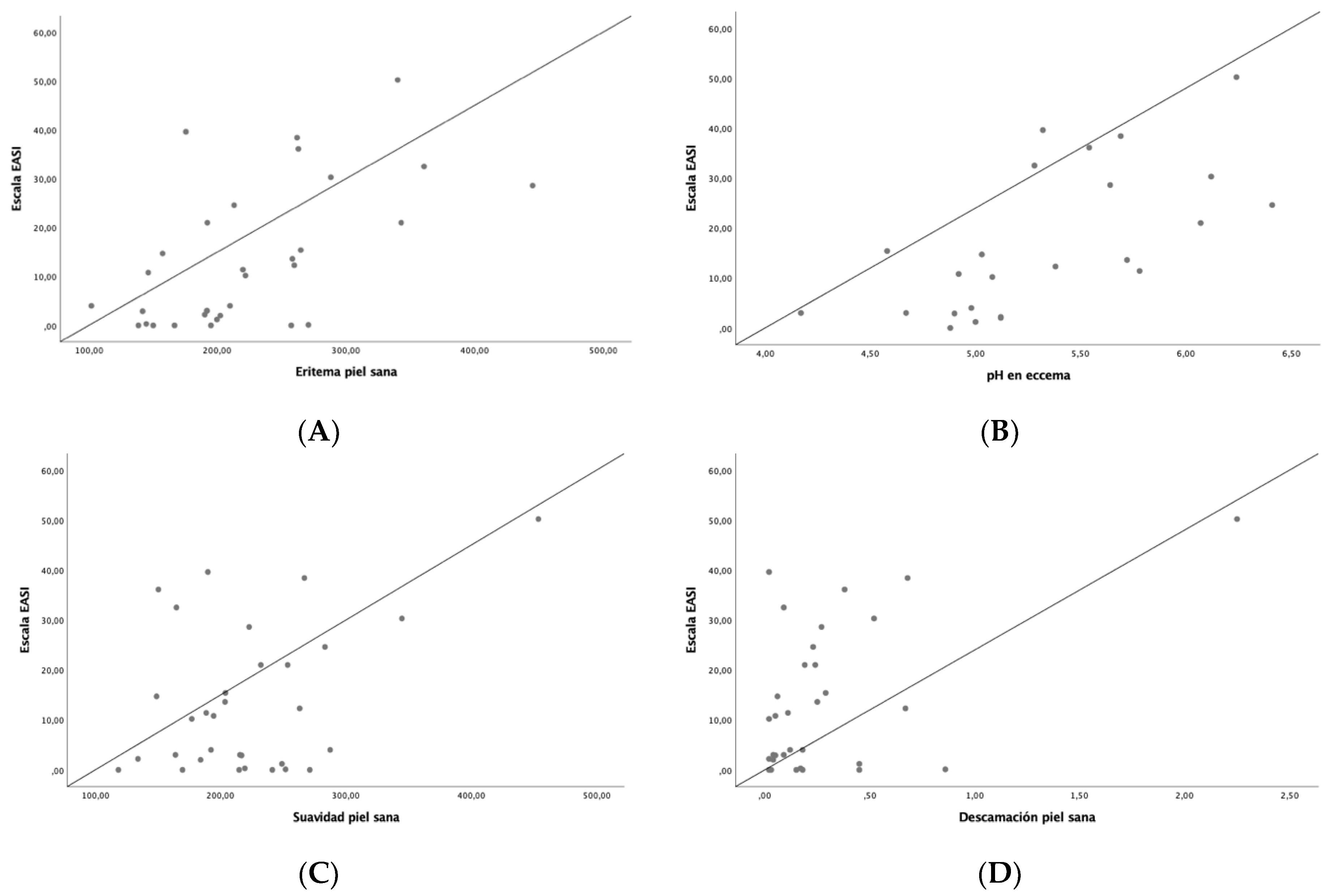
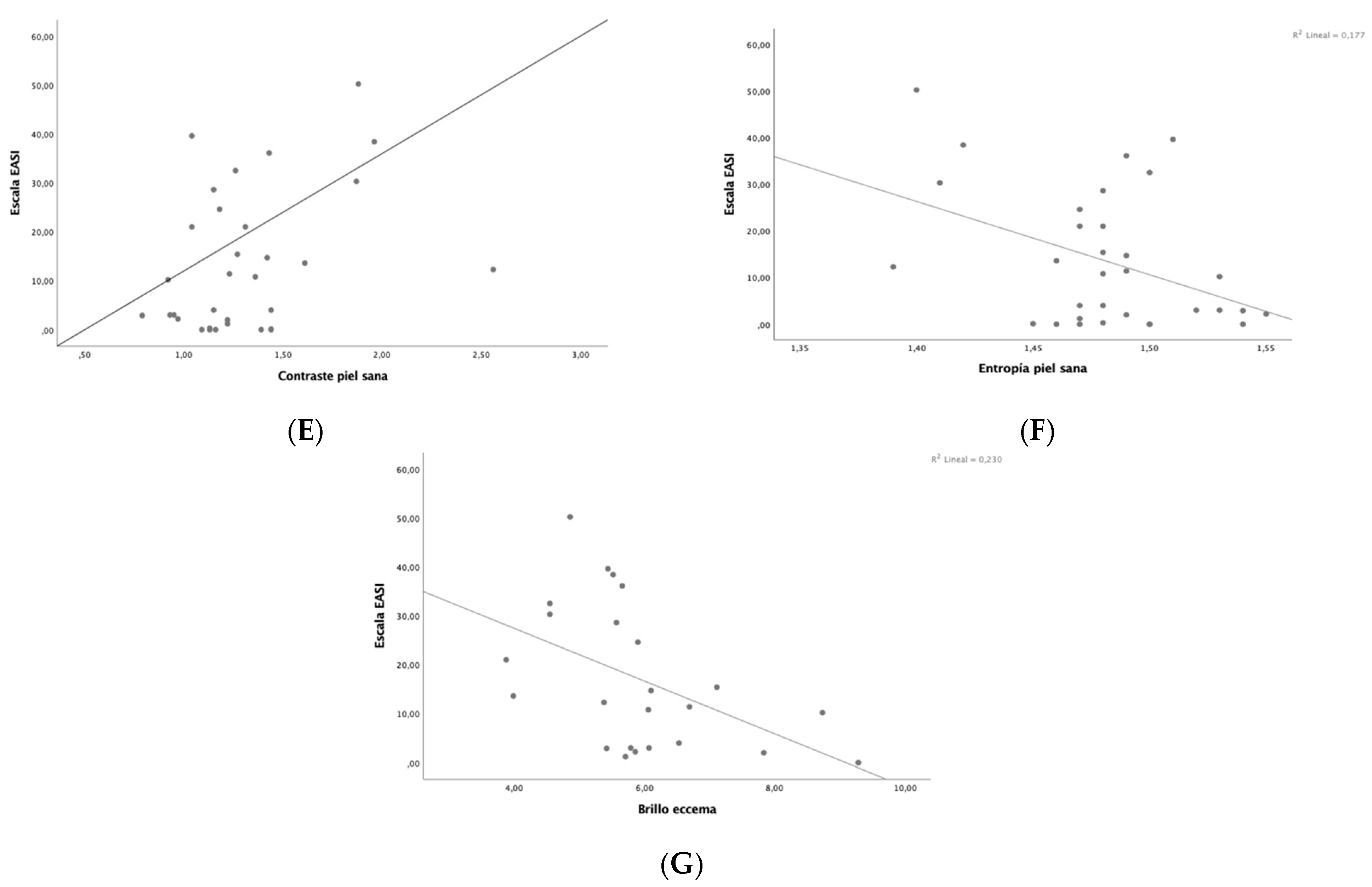
3.6. Correlations between Severity Scales and Barrier Function and Topographical Parameters
4. Discussion
5. Conclusions
Supplementary Materials
Author Contributions
Funding
Institutional Review Board Statement
Informed Consent Statement
Data Availability Statement
Conflicts of Interest
References
- Bylund, S.; von Kobyletzki, L.B.; Svalstedt, M.; Svensson, Å. Prevalence and Incidence of Atopic Dermatitis: A Systematic Review. Acta Derm. -Venereol. 2020, 100, 320–329. [Google Scholar] [CrossRef] [Scilit] [PubMed]
- Berardesca, E.; Mortillo, S.; Cameli, N.; Ardigo, M.; Mariano, M. Efficacy of a Shower Cream and a Lotion with Skin-Identical Lipids in Healthy Subjects with Atopic Dry Skin. J. Cosmet. Dermatol. 2018, 17, 477–483. [Google Scholar] [CrossRef] [Scilit] [PubMed]
- Yang, G.; Seok, J.K.; Kang, H.C.; Cho, Y.; Lee, H.S.; Lee, J.Y. Skin Barrier Abnormalities and Immune Dysfunction in Atopic Dermatitis. Int. J. Mol. Sci. 2020, 21, 2867. [Google Scholar] [CrossRef] [Scilit] [PubMed]
- Takada, M.; Ishikawa, Y.; Numano, K.; Hirano, S.; Imokawa, G. A Nano-Emulsion Containing Ceramide-like Lipo-Amino Acid Cholesteryl Derivatives Improves Skin Symptoms in Patients with Atopic Dermatitis by Ameliorating the Water-Holding Function. Int. J. Mol. Sci. 2022, 23, 13362. [Google Scholar] [CrossRef] [Scilit] [PubMed]
- Clark, R.A.F.; Ghosh, K.; Tonnesen, M.G. Tissue Engineering for Cutaneous Wounds. J. Investig. Dermatol. 2007, 127, 1018–1029. [Google Scholar] [CrossRef] [Scilit]
- Dąbrowska, A.K.; Spano, F.F.; Derler, S.S.; Adlhart, C.C.; Spencer, N.D.; Rossi, R.M. The Relationship Between Skin Function, Barrier Properties, and Body-Dependent Factors. Ski. Res. Technol. 2018, 24, 165. [Google Scholar] [CrossRef] [Scilit]
- Lee, H.; Kim, M. Skin Barrier Function and the Microbiome. Int. J. Mol. Sci. 2022, 23, 13071. [Google Scholar] [CrossRef] [Scilit]
- Montero-Vilchez, T.; Cuenca-Barrales, C.; Rodriguez-Pozo, J.-A.; Diaz-Calvillo, P.; Tercedor-Sanchez, J.; Martinez-Lopez, A.; Molina-Leyva, A.; Arias-Santiago, S. Epidermal Barrier Function and Skin Homeostasis in Atopic Dermatitis: The Impact of Age. Life 2022, 12, 132. [Google Scholar] [CrossRef] [Scilit]
- Kim, J.; Kim, B.E.; Leung, D.Y.M. Pathophysiology of Atopic Dermatitis: Clinical Implications. Allergy Asthma Proc. 2019, 40, 84–92. [Google Scholar] [CrossRef] [Scilit]
- Camilion, J.V.; Khanna, S.; Anasseri, S.; Laney, C.; Mayrovitz, H.N. Physiological, Pathological, and Circadian Factors Impacting Skin Hydration. Cureus 2022, 14, e27666. [Google Scholar] [CrossRef] [Scilit]
- Jungersted, J.M.; Scheer, H.; Mempel, M.; Baurecht, H.; Cifuentes, L.; Høgh, J.K.; Hellgren, L.I.; Jemec, G.B.E.; Agner, T.; Weidinger, S. Stratum Corneum Lipids, Skin Barrier Function, and Filaggrin Mutations in Patients with Atopic Eczema. Allergy 2010, 65, 911–918. [Google Scholar] [CrossRef] [Scilit] [PubMed]
- Montero-Vilchez, T.; Segura-Fernández-Nogueras, M.-V.; Pérez-Rodríguez, I.; Soler-Gongora, M.; Martinez-Lopez, A.; Fernández-González, A.; Molina-Leyva, A.; Arias-Santiago, S. Skin Barrier Function in Psoriasis and Atopic Dermatitis: Transepidermal Water Loss and Temperature as Useful Tools to Assess Disease Severity. J. Clin. Med. 2021, 10, 359. [Google Scholar] [CrossRef] [Scilit]
- Montero-Vilchez, T.; Sanabria-de-la-Torre, R.; Sanchez-Diaz, M.; Ureña-Paniego, C.; Molina-Leyva, A.; Arias-Santiago, S. The Impact of Dupilumab on Skin Barrier Function: A Systematic Review. J. Eur. Acad. Dermatol. Venereol. 2023, 37, 1284–1292. [Google Scholar] [CrossRef] [Scilit] [PubMed]
- Montero-Vilchez, T.; Rodriguez-Pozo, J.-A.; Diaz-Calvillo, P.; Salazar-Nievas, M.; Tercedor-Sanchez, J.; Molina-Leyva, A.; Arias-Santiago, S. Dupilumab Improves Skin Barrier Function in Adults with Atopic Dermatitis: A Prospective Observational Study. J. Clin. Med. 2022, 11, 3341. [Google Scholar] [CrossRef] [Scilit] [PubMed]
- Gupta, J.; Grube, E.; Ericksen, M.B.; Stevenson, M.D.; Lucky, A.W.; Sheth, A.P.; Assa’Ad, A.H.; Hershey, G.K.K. Intrinsically Defective Skin Barrier Function in Children with Atopic Dermatitis Correlates with Disease Severity. J. Allergy Clin. Immunol. 2008, 121, 725–730. [Google Scholar] [CrossRef] [Scilit] [PubMed]
- Rattanawiwatpong, P.; Wanitphakdeedecha, R.; Bumrungpert, A.; Maiprasert, M. Anti-Aging and Brightening Effects of a Topical Treatment Containing Vitamin C, Vitamin E, and Raspberry Leaf Cell Culture Extract: A Split-Face, Randomized Controlled Trial. J. Cosmet. Dermatol. 2020, 19, 671–676. [Google Scholar] [CrossRef] [Scilit]
- Sawatzky, S.; Schario, M.; Stroux, A.; Lünnemann, L.; Zuberbier, T.; Blume-Peytavi, U.; Bartels, N.G. Children with Dry Skin and Atopic Predisposition: Outcome Measurement with Validated Scores for Atopic Dermatitis. Ski. Pharmacol. Physiol. 2016, 29, 148–156. [Google Scholar] [CrossRef] [Scilit]
- Sanabria-de la Torre, R.; Ceres-Muñoz, M.; Pretel-Lara, C.; Montero-Vílchez, T.; Arias-Santiago, S. Microtopography and Barrier Function in Healthy Skin: Differences between Forearm, Cheek and Palm. Cosmetics 2024, 11, 5. [Google Scholar] [CrossRef] [Scilit]
- Dąbrowska, M.; Mielcarek, A.; Nowak, I. Evaluation of Sex-Related Changes in Skin Topography and Structure Using Innovative Skin Testing Equipment. Ski. Res. Technol. 2018, 24, 614–620. [Google Scholar] [CrossRef] [Scilit]
- Hon, K.; Lam, P.; Ng, W.; Kung, J.; Cheng, N.; Lin, Z.; Chow, C.; Leung, T. Age, Sex, and Disease Status as Determinants of Skin Hydration and Transepidermal Water Loss among Children with and without Eczema. Hong Kong Med. J. 2020, 26, 19–26. [Google Scholar]
- Hon, K.L.; Kung, J.S.C.; Ng, W.G.; Tsang, K.Y.C.; Cheng, N.; Leung, T.F. Are Skin Equipment for Assessing Childhood Eczema Any Good? J. Dermatol. Treat. 2021, 32, 45–48. [Google Scholar] [CrossRef] [Scilit] [PubMed]
- De Greef, A.; Ghislain, P.D.; de Montjoye, L.; Baeck, M. Real-Life Effectiveness and Tolerance of Upadacitinib for Severe Atopic Dermatitis in Adolescents and Adults. Adv Ther. 2023, 40, 2509–2514. [Google Scholar] [CrossRef] [Scilit] [PubMed]
- Mastorino, L.; Cantafio Duò, V.L.; Vecco, C.; Gelato, F.; Giordano, S.; Roccuzzo, G.; Cavaliere, G.; Avallone, G.; Ortoncelli, M.; Ribero, S.; et al. Impact of Comorbidities in the Response of Atopic Patients Treated with Dupilumab: A Real-Life Study up to 36 Weeks. J. Eur. Acad. Dermatol. Venereol. 2022, 36, e1021–e1023. [Google Scholar] [CrossRef] [Scilit] [PubMed]
- Montero-Vilchez, T.; Rodriguez-Pozo, J.A.; Cuenca-Barrales, C.; Sanabria-de-la-Torre, R.; Torres-de-Pinedo, J.M.; Arias-Santiago, S. Stratum Corneum Hydration as a Potential Marker of Response to Dupilumab in Atopic Dermatitis: A Prospective Observational Study. Dermatitis 2024, 35, 250–257. [Google Scholar] [CrossRef] [Scilit] [PubMed]


| Variables | Study Population (n = 32) |
|---|---|
| Sex | |
| Male | 37.5% (12) |
| Female | 62.5% (20) |
| Age (years) | 30.91 (14.29) |
| Education Level | |
| Basic | 28.1% (9) |
| Medium | 34.4% (11) |
| Higher | 37.5% (12) |
| Place of Residence | |
| Urban | 90.6% (29) |
| Rural | 9.4% (3) |
| Phototype | |
| I | 12.5% (4) |
| II | 43.8% (14) |
| III | 34.4% (11) |
| IV | 9.4% (3) |
| Smoking (yes) | 18.8% (6) |
| Number of cigarettes/day | 1.28 (3.43) |
| Drinking (yes) | 40.6% (13) |
| Number of SDU per week | 1.38 (2.08) |
| History of skin diseases (yes) | 34.4% (11) |
| Other diseases (yes) | 28.1% (9) |
| Daily medication (yes) | 28.1% (9) |
| Sun exposure (yes) | 50% (16) |
| Time exposed to sun (minutes) | 60.94 (85.7) |
| Use of sunscreen (yes) | 50% (16) |
| Use of moisturiser (yes) | 90.6% (29) |
| Number of times moisturiser is used per week | 5.53 (2.36) |
| Age of onset of AD (years) | 11.63 (19.56) |
| Family members with AD (yes) | 43.8% (14) |
| Associated comorbidities (yes) | 46.9% (15) |
| Asthma (yes) | 31.3% (10) |
| Rhinitis (yes) | 37.5% (12) |
| Conjunctivitis (yes) | 28.1% (9) |
| Variable | Healthy Skin (n = 32) | Flexural Eczematous Lesions (n = 24) | p (Healthy vs. Eczema) |
|---|---|---|---|
| Temperature (°C) | 31.81 (1.2) | 32.38 (1.11) | 0.02 |
| Erythema (AU) | 223.89 (74.73) | 369.12 (79.41) | <0.001 |
| TEWL (g/h/m2) | 13.51 (5.57) | 27.24 (11.85) | <0.001 |
| SCH (AU) | 31.88 (11.56) | 20.3 (10.41) | <0.001 |
| pH | 5.43 (0.6) | 5.32 (0.56) | 0.67 |
| Elasticity R0 (%) | 0.34 (0.08) | 0.34 (0.11) | 0.68 |
| Elasticity R2 (%) | 0.78 (0.13) | 0.78 (0.1) | 0.87 |
| Elasticity R7 (%) | 0.65 (0.12) | 0.56 (0.12) | 0.05 |
| Antioxidant capacity (AU) | 5.38 (2.65) | 4.73 (1.6) | 0.45 |
| Hardness (AU) | 9.63 (4.68) | 15.75 (9.7) | 0.02 |
| Friction (AU) | 177.84 (114.02) | 102.99 (51.46) | 0.02 |
| Shine (AU) | 6.46 (0.71) | 5.94 (1.31) | 0.13 |
| Indentometer (mm) | 2 (0.4) | 1.93 (0.45) | 0.77 |
| Smoothness (SEsm) | 220.95 (65.32) | 316.98 (111.99) | <0.001 |
| Roughness (Ser) | 2.21 (1.47) | 3.83 (6.06) | 0.24 |
| Scaling (SEsc) | 0.29 (0.42) | 5.57 (7.43) | 0.02 |
| Wrinkles (SEw) | 62.15 (14.94) | 73.33 (26.32) | 0.03 |
| Surface (%) | 696.31 (84.31) | 836.14 (144.54) | <0.001 |
| Volume (mm2) | 97.1 (14.57) | 105.28 (28.42) | 0.15 |
| Contrast (AU) | 1.31 (0.36) | 2.02 (0.88) | 0.01 |
| Entropy (AU) | 1.48 (0.04) | 1.43 (0.04) | <0.001 |
| Variance (AU) | 4.96 (0.72) | 6.22 (1.25) | <0.001 |
| Homogeneity (AU) | 5.28 (22.21) | 1.3 (0.08) | 0.32 |
| Anisotropy (AU) | 30.72 (13.48) | 34.33 (17) | 0.29 |
| Total number of cells | 132.5 (29.31) | 105.5 (35.65) | <0.001 |
| Corneofix all (%) | 50.35 (16.38) | 36.19 (16.54) | 0.02 |
| Corneofix all (mm2) | 14.19 (4.67) | 10.42 (4.76) | 0.03 |
| Scaling index | 26.1 (9.3) | 19.36 (10.74) | 0.04 |
| Variable | EASI | SCORAD | IGA | NRS Pruritus | NRS Sleep |
|---|---|---|---|---|---|
| Healthy Skin Temperature | |||||
| Correlation (r) | −0.15 | −0.25 | −0.16 | −0.34 | −0.14 |
| p | 0.43 | 0.17 | 0.38 | 0.06 | 0.47 |
| Flexural eczema Temperature | |||||
| Correlation (r) | −0.3 | −0.21 | −0.1 | −0.2 | −0.23 |
| p | 0.15 | 0.34 | 0.36 | 0.35 | 0.3 |
| Healthy Skin Erythema | |||||
| Correlation (r) | 0.56 | 0.57 | 0.65 | 0.33 | 0.31 |
| p | <0.001 | <0.001 | <0.001 | 0.07 | 0.09 |
| Flexural eczema Erythema | |||||
| Correlation (r) | 0.19 | 0.23 | 0.38 | 0.19 | 0.3 |
| p | 0.36 | 0.29 | 0.07 | 0.39 | 0.16 |
| Healthy Skin TEWL | |||||
| Correlation (r) | 0.28 | 0.23 | 0.19 | 0.01 | 0.2 |
| p | 0.12 | 0.2 | 0.3 | 0.95 | 0.27 |
| Flexural eczema TEWL | |||||
| Correlation (r) | −0.23 | −0.18 | −0.21 | −0.02 | −0.18 |
| p | 0.28 | 0.39 | 0.34 | 0.92 | 0.4 |
| Healthy Skin SCH | |||||
| Correlation (r) | −0.24 | −0.3 | −0.3 | −0.22 | 0.01 |
| p | 0.18 | 0.1 | 0.1 | 0.23 | 0.99 |
| Flexural eczema SCH | |||||
| Correlation (r) | −0.1 | −0.13 | −0.18 | 0.11 | 0.12 |
| p | 0.64 | 0.55 | 0.4 | 0.61 | 0.58 |
| Healthy Skin pH | |||||
| Correlation (r) | 0.19 | 0.23 | 0.13 | 0.14 | 0.12 |
| p | 0.3 | 0.21 | 0.49 | 0.46 | 0.53 |
| Flexural eczema pH | |||||
| Correlation (r) | 0.66 | 0.73 | 0.63 | 0.47 | 0.4 |
| p | <0.001 | <0.001 | 0.001 | 0.02 | 0.06 |
| Healthy Skin Elasticity R0 | |||||
| Correlation (r) | 0.29 | 0.32 | 0.36 | 0.23 | 0.21 |
| p | 0.11 | 0.07 | 0.04 | 0.22 | 0.25 |
| Flexural eczema Elasticity R0 | |||||
| Correlation (r) | 0.13 | 0.18 | 0.14 | 0.34 | 0.28 |
| p | 0.55 | 0.39 | 0.53 | 0.12 | 0.2 |
| Healthy Skin Elasticity R2 | |||||
| Correlation (r) | 0.11 | 0.19 | 0.15 | 0.25 | 0.23 |
| p | 0.54 | 0.3 | 0.42 | 0.18 | 0.22 |
| Flexural eczema Elasticity R2 | |||||
| Correlation (r) | −0.07 | −0.2 | −0.22 | −0.13 | −0.32 |
| p | 0.74 | 0.36 | 0.31 | 0.55 | 0.13 |
| Healthy Skin Elasticity R7 | |||||
| Correlation (r) | −0.03 | 0.06 | 0.07 | 0.12 | 0.16 |
| p | 0.89 | 0.74 | 0.69 | 0.52 | 0.39 |
| Flexural eczema Elasticity R7 | |||||
| Correlation (r) | −0.3 | −0.32 | −0.42 | −0.06 | −0.29 |
| p | 0.15 | 0.13 | 0.04 | 0.78 | 0.18 |
| Healthy Skin Brightness | |||||
| Correlation (r) | −0.27 | −0.3 | −0.38 | −0.19 | −0.15 |
| p | 0.14 | 0.1 | 0.03 | 0.3 | 0.43 |
| Flexural eczema Brightness | |||||
| Correlation (r) | −0.48 | −0.48 | −0.55 | −0.24 | −0.25 |
| p | 0.02 | 0.02 | 0.01 | 0.26 | 0.24 |
| Smoothness (SEsm) Healthy | |||||
| Correlation (r) | 0.05 | −0.12 | 0.09 | −0.31 | 0.01 |
| p | 0.82 | 0.59 | 0.7 | 0.15 | 0.96 |
| Flexural eczema Smoothness (SEsm) | |||||
| Correlation (r) | −0.05 | −0.09 | −0.09 | −0.07 | 0.04 |
| p | 0.78 | 0.62 | 0.62 | 0.73 | 0.85 |
| Roughness (Ser) Healthy | |||||
| Correlation (r) | 0.05 | −0.12 | 0.09 | −0.31 | 0.01 |
| p | 0.82 | 0.59 | 0.7 | 0.15 | 0.96 |
| Flexural eczema Roughness (Ser) | |||||
| Correlation (r) | 0.33 | 0.26 | 0.26 | 0.07 | 0.12 |
| p | 0.11 | 0.22 | 0.22 | 0.74 | 0.59 |
| Scaling (SEsc) Healthy | |||||
| Correlation (r) | 0.49 | 0.31 | 0.34 | 0.02 | −0.07 |
| p | 0.04 | 0.09 | 0.05 | 0.9 | 0.7 |
| Flexural eczema Scaling (SEsc) | |||||
| Correlation (r) | 0.29 | 0.22 | 0.2 | −0.1 | 0.11 |
| p | 0.16 | 0.31 | 0.35 | 0.62 | 0.62 |
| Wrinkles (SEw) Healthy | |||||
| Correlation (r) | 0.2 | 0.13 | 0.06 | 0.11 | 0.05 |
| p | 0.28 | 0.48 | 0.73 | 0.56 | 0.8 |
| Flexural eczema Wrinkles (SEw) | |||||
| Correlation (r) | 0.37 | 0.13 | 0.24 | −0.19 | −0.16 |
| p | 0.08 | 0.55 | 0.26 | 0.4 | 0.47 |
| Healthy Surface | |||||
| Correlation (r) | 0.32 | 0.31 | 0.38 | 0.12 | 0.01 |
| p | 0.07 | 0.09 | 0.03 | 0.52 | 0.96 |
| Flexural eczema Surface | |||||
| Correlation (r) | −0.11 | 0.02 | 0.11 | 0.07 | 0.43 |
| p | 0.6 | 0.92 | 0.63 | 0.77 | 0.04 |
| Healthy Contrast | |||||
| Correlation (r) | 0.37 | 0.34 | 0.41 | 0.14 | −0.01 |
| p | 0.04 | 0.06 | 0.02 | 0.45 | 0.98 |
| Flexural eczema Contrast | |||||
| Correlation (r) | −0.08 | 0.06 | 0.12 | −0.03 | 0.32 |
| p | 0.72 | 0.8 | 0.59 | 0.91 | 0.14 |
| Healthy Entropy | |||||
| Correlation (r) | −0.42 | −0.38 | −0.42 | −0.18 | −0.09 |
| p | 0.02 | 0.03 | 0.02 | 0.32 | 0.63 |
| Flexural eczema Entropy | |||||
| Correlation (r) | −0.003 | −0.06 | −0.19 | −0.01 | −0.32 |
| p | 0.99 | 0.79 | 0.37 | 0.99 | 0.13 |
| Healthy Variance | |||||
| Correlation (r) | 0.32 | 0.31 | 0.39 | 0.12 | 0.01 |
| p | 0.07 | 0.09 | 0.03 | 0.51 | 0.95 |
| Eczema Variance | |||||
| Correlation (r) | −0.1 | 0.03 | 0.11 | 0.05 | 0.43 |
| p | 0.64 | 0.89 | 0.61 | 0.83 | 0.04 |
| Healthy Homogeneity | |||||
| Correlation (r) | 0.46 | 0.27 | 0.26 | −0.01 | −0.07 |
| p | 0.01 | 0.13 | 0.16 | 0.99 | 0.7 |
| Flexural eczema Homogeneity | |||||
| Correlation (r) | 0.22 | 0.05 | −0.01 | −0.09 | −0.25 |
| p | 0.31 | 0.83 | 0.99 | 0.7 | 0.26 |
| Total Number of Cells Healthy | |||||
| Correlation (r) | −0.01 | −0.02 | 0.15 | −0.01 | 0.13 |
| p | 0.95 | 0.93 | 0.42 | 0.98 | 0.48 |
| Flexural eczema Total Number of Cells | |||||
| Correlation (r) | −0.42 | −0.32 | −0.32 | −0.05 | −0.1 |
| p | 0.04 | 0.12 | 0.13 | 0.83 | 0.66 |
| Corneofix all % Healthy | |||||
| Correlation (r) | 0.03 | −0.09 | −0.22 | −0.1 | −0.05 |
| p | 0.86 | 0.62 | 0.22 | 0.6 | 0.81 |
| Flexural eczema Corneofix all % | |||||
| Correlation (r) | 0.23 | 0.21 | 0.12 | 0.37 | 0.34 |
| p | 0.29 | 0.32 | 0.57 | 0.08 | 0.11 |
| Corneofix all mm2 Healthy | |||||
| Correlation (r) | −0.14 | −0.2 | −0.32 | −0.1 | −0.02 |
| p | 0.44 | 0.28 | 0.07 | 0.6 | 0.93 |
| Flexural eczema Corneofix all mm2 | |||||
| Correlation (r) | 0.23 | 0.21 | 0.12 | 0.37 | 0.34 |
| p | 0.29 | 0.32 | 0.57 | 0.08 | 0.11 |
| Scaling Index Healthy | |||||
| Correlation (r) | 0.05 | −0.07 | −0.2 | −0.08 | −0.05 |
| p | 0.77 | 0.7 | 0.29 | 0.68 | 0.8 |
| Flexural eczema Scaling Index | |||||
| Correlation (r) | 0.22 | 0.21 | 0.14 | 0.37 | 0.4 |
| p | 0.29 | 0.31 | 0.52 | 0.08 | 0.06 |
Disclaimer/Publisher’s Note: The statements, opinions and data contained in all publications are solely those of the individual author(s) and contributor(s) and not of MDPI and/or the editor(s). MDPI and/or the editor(s) disclaim responsibility for any injury to people or property resulting from any ideas, methods, instructions or products referred to in the content. |
© 2024 by the authors. Licensee MDPI, Basel, Switzerland. This article is an open access article distributed under the terms and conditions of the Creative Commons Attribution (CC BY) license (https://creativecommons.org/licenses/by/4.0/).
Share and Cite
Pretel-Lara, C.; Sanabria-de la Torre, R.; Arias-Santiago, S.; Montero-Vilchez, T. Skin Barrier Function and Microtopography in Patients with Atopic Dermatitis. J. Clin. Med. 2024, 13, 5861. https://doi.org/10.3390/jcm13195861
Pretel-Lara C, Sanabria-de la Torre R, Arias-Santiago S, Montero-Vilchez T. Skin Barrier Function and Microtopography in Patients with Atopic Dermatitis. Journal of Clinical Medicine. 2024; 13(19):5861. https://doi.org/10.3390/jcm13195861
Chicago/Turabian StylePretel-Lara, Carlota, Raquel Sanabria-de la Torre, Salvador Arias-Santiago, and Trinidad Montero-Vilchez. 2024. "Skin Barrier Function and Microtopography in Patients with Atopic Dermatitis" Journal of Clinical Medicine 13, no. 19: 5861. https://doi.org/10.3390/jcm13195861
APA StylePretel-Lara, C., Sanabria-de la Torre, R., Arias-Santiago, S., & Montero-Vilchez, T. (2024). Skin Barrier Function and Microtopography in Patients with Atopic Dermatitis. Journal of Clinical Medicine, 13(19), 5861. https://doi.org/10.3390/jcm13195861