


Polyphenolic and Anthocyanin Responses to Postharvest Fungal Pathogen Infection in Purple and Green near Isogenic Pepper (Capsicum annuum) Lines

 , , , , ,
  and
and
Abstract
1. Introduction
2. Materials and Methods
2.1. Plant Materials
2.2. Pathogen Assays
2.2.1. Pathogen Growth Tests In Vitro
2.2.2. Artificial Infection Studies In Vivo with B. cinerea, F. culmorum and A. alternata
2.3. Analytical Measurements
2.3.1. Sample Preparation for Analytical Measurements
2.3.2. Total Polyphenolic Content (TPC) and Antioxidant Capacity (FRAP) Measurements
2.3.3. HPLC Determination of Phenolics and Vitamin C
2.4. Statistical Analysis
3. Results and Discussion
3.1. Pathogen Growth Tests In Vitro
3.2. Artificial Infection Studies In Vivo with B. cinerea, F. culmorum and A. alternata
3.3. Total Polyphenolic Content, Antioxidant Capacity and Anthocyanin Content of the Infected Pepper Fruits
3.4. HPLC Determination of Phenolics and Vitamin C of the Botrytis-Infected Fruits
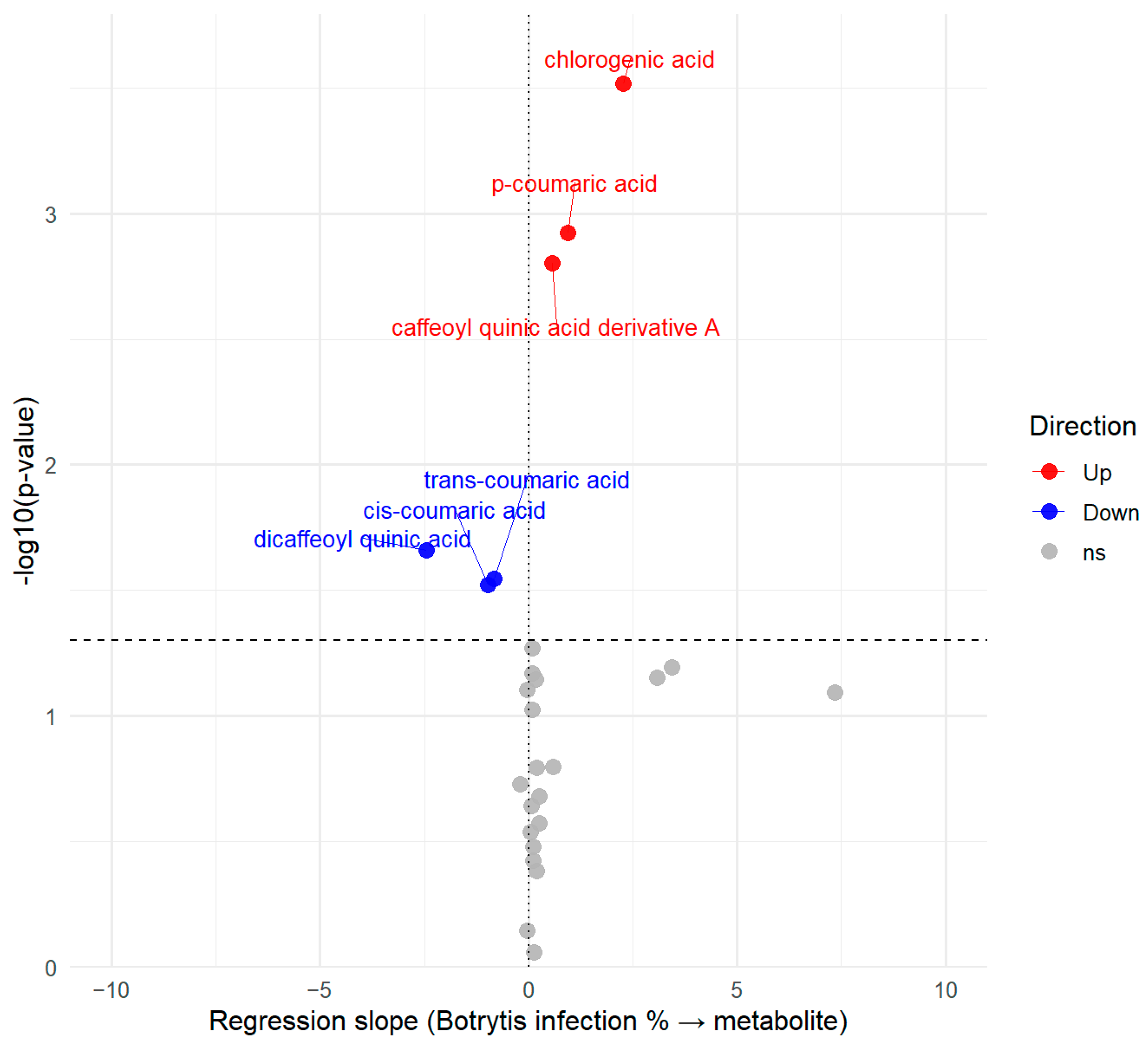
3.5. Relationship Between Botrytis Infection Severity and Metabolite Levels
4. Conclusions
Author Contributions
Funding
Institutional Review Board Statement
Informed Consent Statement
Data Availability Statement
Acknowledgments
Conflicts of Interest
Abbreviations
| A. alternata | Alternaria alternata |
| ANOVA | Analysis of Variance |
| B. cinerea | Botrytis cinerea |
| BR | Biological Ripeness |
| CGA | Chlorogenic acid |
| dpi | days post infection |
| ER | Economical Ripeness |
| F. avenaceum | Fusarium avenaceum |
| F. culmorum | Fusarium culmorum |
| F. solani | Fusarium solani |
| FRAP | Ferric Reducing Ability of Plasma |
| HPLC | High-Performance Liquid Chromatography |
| G | Green |
| Gt | Genotype |
| MANOVA | Multivariate Analysis of Variance |
| MG | Mature Green |
| NILs | Near Isogenic Lines |
| nd. | not detected |
| ns | not significant |
| P | Purple |
| P. capsici | Phytophthora capsici |
| PDA | Potato Dextrose Agar |
| Pp | Phenophase |
| qPCR | quantitative Polymerase Chain Reaction |
| RG | Red from Green |
| ROS | Reactive Oxygen Species |
| RP | Red from Purple |
| RR | Red Ripe |
| TFC | Total Flavonoid Content |
| TMA | Total Monomeric Anthocyanin Content |
| TPC | Total Polyphenolic Content |
References
- Karoney, E.M.; Molelekoa, T.; Bill, M.; Siyoum, N.; Korsten, L. Global research network analysis of fresh produce postharvest technology: Innovative trends for loss reduction. Postharvest Biol. Technol. 2024, 208, 112642. [Google Scholar] [CrossRef] [Scilit]
- Agrios, G.N. Plant Pathology; Elsevier: Amsterdam, The Netherlands, 2005. [Google Scholar]
- Gao, F.; Han, K.; Ma, W.; Zhang, J.; Xie, J. Exogenous Melatonin Application Enhances Pepper (Capsicum annuum L.) Fruit Quality via Activation of the Phenylpropanoid Metabolism. Foods 2025, 14, 1247. [Google Scholar] [CrossRef] [Scilit] [PubMed]
- Ahamad, S.; Asrey, R.; Vinod, B.; Meena, N.K.; Menaka, M.; Prajapati, U.; Saurabh, V. Maintaining postharvest quality and enhancing shelf-life of bell pepper (Capsicum annuum L.) using brassinosteroids: A novel approach. S. Afr. J. Bot. 2024, 169, 402–412. [Google Scholar] [CrossRef] [Scilit]
- Pal, S.; Das, A.; Sarkar, B.; Hasanuzzaman, M.; Adak, M.K. Modulation of secondary metabolism and redox regulation by exogenously applied glutathione improves the shelf life of Capsicum annuum L. fruit. Plant Physiol. Biochem. 2024, 212, 108789. [Google Scholar] [CrossRef] [Scilit]
- Pathare, A.M.; Pawase, P.A.; Bora, P.P.; Rout, S.; Bashir, O.; Sharma, E.; Roy, S. Advances in packaging technologies for capsicum: Enhancing shelf life and post-harvest quality through packaging film and coating technologies. Trends Food Sci. Technol. 2025, 163, 105140. [Google Scholar] [CrossRef] [Scilit]
- Mondal, K.; Bhattacharjee, S.K.; Mudenur, C.; Ghosh, T.; Goud, V.V.; Katiyar, V. Development of antioxidant-rich edible active films and coatings incorporated with de-oiled ethanolic green algae extract: A candidate for prolonging the shelf life of fresh produce. RSC Adv. 2022, 12, 13295–13313. [Google Scholar] [CrossRef] [Scilit] [PubMed]
- Limchoowong, N.; Sricharoen, P.; Konkayan, M.; Techawongstien, S.; Chanthai, S. A simple, efficient and economic method for obtaining iodate-rich chili pepper based chitosan edible thin film. J. Food Sci. Technol. 2018, 55, 3263–3272. [Google Scholar] [CrossRef] [Scilit]
- Pravallika, K.; Chakraborty, S. Comparative Effects of Steam, Microwave, and Pulsed Light Treatments on the Shelf Life of Fresh Red Chillies (Capsicum annum) at 28 °C and 4 °C. Food Humanit. 2025, 5, 100714. [Google Scholar] [CrossRef] [Scilit]
- Rao, T.R.; Gol, N.B.; Shah, K.K. Effect of postharvest treatments and storage temperatures on the quality and shelf life of sweet pepper (Capsicum annum L.). Sci. Hortic. 2011, 132, 18–26. [Google Scholar] [CrossRef] [Scilit]
- Park, J.; Oh, S.-M.; Park, M.K.; Park, J.-D.; Ahn, J.H.; Sung, J.M. Enhancing quality and shelf life of fresh-cut Paprika (Capsicum annuum L.) using insulated packaging with ice packs. Postharvest Biol. Technol. 2025, 222, 113360. [Google Scholar] [CrossRef] [Scilit]
- Zhang, W.; Jiang, H.; Cao, J.; Jiang, W. Advances in biochemical mechanisms and control technologies to treat chilling injury in postharvest fruits and vegetables. Trends Food Sci. Technol. 2021, 113, 355–365. [Google Scholar] [CrossRef] [Scilit]
- Bin, Y.; Wu, X.; Shi, J.; Zhao, Y.; Yue, X.; Xu, X.; Zuo, J.; Yuan, S.; Wang, Q. Rutin treatment delays postharvest chilling injury in green pepper fruit by modulating antioxidant defense capacity. Postharvest Biol. Technol. 2025, 230, 113753. [Google Scholar] [CrossRef] [Scilit]
- Romanazzi, G.; Smilanick, J.L.; Feliziani, E.; Droby, S. Integrated management of postharvest gray mold on fruit crops. Postharvest Biol. Technol. 2016, 113, 69–76. [Google Scholar] [CrossRef] [Scilit]
- Zhu, X.; Xiao, C.-L. Phylogenetic, morphological, and pathogenic characterization of Alternaria species associated with fruit rot of blueberry in California. Phytopathology 2015, 105, 1555–1567. [Google Scholar] [CrossRef] [Scilit]
- Dean, R.; Van Kan, J.A.; Pretorius, Z.A.; Hammond-Kosack, K.E.; Di Pietro, A.; Spanu, P.D.; Rudd, J.J.; Dickman, M.; Kahmann, R.; Ellis, J. The Top 10 fungal pathogens in molecular plant pathology. Mol. Plant Pathol. 2012, 13, 414–430. [Google Scholar] [CrossRef] [Scilit] [PubMed]
- Singh, D.; Sharma, R. Postharvest diseases of fruits and vegetables and their management. In Postharvest Disinfection of Fruits and Vegetables; Elsevier: Amsterdam, The Netherlands, 2018; pp. 1–52. [Google Scholar]
- Sekiguchi, H.; Masunaka, A.; Nomiyama, K.; Tomioka, K. Internal fruit rot of sweet pepper caused by Fusarium lactis in Japan and fungal pathogenicity on tomato and eggplant fruits. J. Gen. Plant Pathol. 2021, 87, 326–329. [Google Scholar] [CrossRef] [Scilit]
- Balamurugan, A.; Kumar, A. Postharvest fruit rot of Bell pepper (Capsicum annuum L.): Pathogenicity and Host range of Alternaria alternata. Sci. Hortic. 2023, 319, 112156. [Google Scholar] [CrossRef] [Scilit]
- Frimpong, G.K.; Adekunle, A.A.; Ogundipe, O.T.; Solanki, M.K.; Sadhasivam, S.; Sionov, E. Identification and toxigenic potential of fungi isolated from capsicum peppers. Microorganisms 2019, 7, 303. [Google Scholar] [CrossRef] [Scilit]
- Rampersad, S.; Teelucksingh, L. First report of Fusarium proliferatum infecting pimento chili peppers in Trinidad. Plant Dis. 2011, 95, 1313. [Google Scholar] [CrossRef] [Scilit]
- Ekwomadu, T.I.; Mwanza, M. Fusarium fungi pathogens, identification, adverse effects, disease management, and global food security: A review of the latest research. Agriculture 2023, 13, 1810. [Google Scholar] [CrossRef] [Scilit]
- Hua, L.; Yong, C.; Zhanquan, Z.; Boqiang, L.; Guozheng, Q.; Shiping, T. Pathogenic mechanisms and control strategies of Botrytis cinerea causing post-harvest decay in fruits and vegetables. Food Qual. Saf. 2018, 2, 111–119. [Google Scholar] [CrossRef] [Scilit]
- Wall, M.M.; Biles, C.L. Alternaria fruit rot of ripening chile peppers. Phytopathology 1993, 83, 324–328. [Google Scholar] [CrossRef] [Scilit]
- Rahman, M.; Halim, G.; Chowdhury, M.; Hossain, M.; Rahman, M. Changes in physicochemical attributes of sweet pepper (Capsicum annum L.) during fruit growth and development. Bangladesh J. Agric. Res. 2014, 39, 373–383. [Google Scholar] [CrossRef] [Scilit]
- Prusky, D.; Alkan, N.; Mengiste, T.; Fluhr, R. Quiescent and necrotrophic lifestyle choice during postharvest disease development. Annu. Rev. Phytopathol. 2013, 51, 155–176. [Google Scholar] [CrossRef] [Scilit]
- Deepa, N.; Kaur, C.; George, B.; Singh, B.; Kapoor, H. Antioxidant constituents in some sweet pepper (Capsicum annuum L.) genotypes during maturity. LWT-Food Sci. Technol. 2007, 40, 121–129. [Google Scholar] [CrossRef] [Scilit]
- Cantu, D.; Blanco-Ulate, B.; Yang, L.; Labavitch, J.M.; Bennett, A.B.; Powell, A.L. Ripening-regulated susceptibility of tomato fruit to Botrytis cinerea requires NOR but not RIN or ethylene. Plant Physiol. 2009, 150, 1434–1449. [Google Scholar] [CrossRef] [Scilit] [PubMed]
- Salzman, R.A.; Tikhonova, I.; Bordelon, B.P.; Hasegawa, P.M.; Bressan, R.A. Coordinate accumulation of antifungal proteins and hexoses constitutes a developmentally controlled defense response during fruit ripening in grape. Plant Physiol. 1998, 117, 465–472. [Google Scholar] [CrossRef] [Scilit]
- Wang, Y.; An, H.; Guo, Y.-N.; Wang, Q.; Shang, Y.-Y.; Chen, M.-K.; Liu, Y.-X.; Meng, J.-X.; Zhang, S.-Y.; Wei, J. Anthocyanins from Malus spp. inhibit the activity of Gymnosporangium yamadae by downregulating the expression of WSC, RLM1, and PMA1. Front. Microbiol. 2023, 14, 1152050. [Google Scholar] [CrossRef] [Scilit]
- Tao, S.; Zhang, S.; Tsao, R.; Charles, M.T.; Yang, R.; Khanizadeh, S. In vitro antifungal activity and mode of action of selected polyphenolic antioxidants on Botrytis cinerea. Arch. Phytopathol. Plant Prot. 2010, 43, 1564–1578. [Google Scholar] [CrossRef] [Scilit]
- Bassolino, L.; Zhang, Y.; Schoonbeek, H.j.; Kiferle, C.; Perata, P.; Martin, C. Accumulation of anthocyanins in tomato skin extends shelf life. New Phytol. 2013, 200, 650–655. [Google Scholar] [CrossRef] [Scilit] [PubMed]
- Zhang, Y.; Butelli, E.; De Stefano, R.; Schoonbeek, H.-j.; Magusin, A.; Pagliarani, C.; Wellner, N.; Hill, L.; Orzaez, D.; Granell, A. Anthocyanins double the shelf life of tomatoes by delaying overripening and reducing susceptibility to gray mold. Curr. Biol. 2013, 23, 1094–1100. [Google Scholar] [CrossRef] [Scilit]
- Zhang, Z.; Li, D.-W.; Jin, J.-H.; Yin, Y.-X.; Zhang, H.-X.; Chai, W.-G.; Gong, Z.-H. VIGS approach reveals the modulation of anthocyanin biosynthetic genes by CaMYB in chili pepper leaves. Front. Plant Sci. 2015, 6, 500. [Google Scholar] [CrossRef] [Scilit]
- Zhao, H.; Kim, Y.; Huang, L.; Xiao, C. Resistance to thiabendazole and baseline sensitivity to fludioxonil and pyrimethanil in Botrytis cinerea populations from apple and pear in Washington State. Postharvest Biol. Technol. 2010, 56, 12–18. [Google Scholar] [CrossRef] [Scilit]
- Konstantinou, S.; Veloukas, T.; Leroch, M.; Menexes, G.; Hahn, M.; Karaoglanidis, G. Population structure, fungicide resistance profile, and sdhB mutation frequency of Botrytis cinerea from strawberry and greenhouse-grown tomato in Greece. Plant Dis. 2015, 99, 240–248. [Google Scholar] [CrossRef] [Scilit] [PubMed]
- Lightbourn, G.J.; Griesbach, R.J.; Novotny, J.A.; Clevidence, B.A.; Rao, D.D.; Stommel, J.R. Effects of anthocyanin and carotenoid combinations on foliage and immature fruit color of Capsicum annuum L. J. Hered. 2008, 99, 105–111. [Google Scholar] [CrossRef] [Scilit]
- Liu, Y.; Tikunov, Y.; Schouten, R.E.; Marcelis, L.F.; Visser, R.G.; Bovy, A. Anthocyanin biosynthesis and degradation mechanisms in Solanaceous vegetables: A review. Front. Chem. 2018, 6, 52. [Google Scholar] [CrossRef] [Scilit]
- Wang, L.; Zhong, Y.; Liu, J.; Ma, R.; Miao, Y.; Chen, W.; Zheng, J.; Pang, X.; Wan, H. Pigment biosynthesis and molecular genetics of fruit color in pepper. Plants 2023, 12, 2156. [Google Scholar] [CrossRef] [Scilit]
- Oney-Montalvo, J.E.; Avilés-Betanzos, K.A.; Ramírez-Rivera, E.d.J.; Ramírez-Sucre, M.O.; Rodríguez-Buenfil, I.M. Polyphenols content in Capsicum chinense fruits at different harvest times and their correlation with the antioxidant activity. Plants 2020, 9, 1394. [Google Scholar] [CrossRef] [Scilit]
- Guilherme, R.; Aires, A.; Rodrigues, N.; Peres, A.M.; Pereira, J.A. Phenolics and antioxidant activity of green and red sweet peppers from organic and conventional agriculture: A comparative study. Agriculture 2020, 10, 652. [Google Scholar] [CrossRef] [Scilit]
- Schindelin, J.; Arganda-Carreras, I.; Frise, E.; Kaynig, V.; Longair, M.; Pietzsch, T.; Preibisch, S.; Rueden, C.; Saalfeld, S.; Schmid, B. Fiji: An open-source platform for biological-image analysis. Nat. Methods 2012, 9, 676–682. [Google Scholar] [CrossRef] [Scilit] [PubMed]
- Singleton, V.L.; Rossi, J.A. Colorimetry of total phenolics with phosphomolybdic-phosphotungstic acid reagents. Am. J. Enol. Vitic. 1965, 16, 144–158. [Google Scholar] [CrossRef] [Scilit]
- Benzie, I.F.; Strain, J.J. The ferric reducing ability of plasma (FRAP) as a measure of “antioxidant power”: The FRAP assay. Anal. Biochem. 1996, 239, 70–76. [Google Scholar] [CrossRef] [Scilit]
- Mendoza, L.; Cotoras, M.; Vivanco, M.; Matsuhiro, B.; Torres, S.; Aguirre, M. Evaluation of antifungal properties against the phytopathogenic fungus botrytis cinereaof anthocyanin rich-extracts obtained from grape pomaces. J. Chil. Chem. Soc. 2013, 58, 1725–1727. [Google Scholar] [CrossRef] [Scilit]
- Krasnow, C.S.; Cohen, F.; Sadhasivam, S.; Raphael, G.; Sionov, E.; Ziv, C. Sweet Pepper cv. Lai Lai Ripeness Stage Influences Susceptibility to Mycotoxinogenic Alternaria alternata Causing Black Mold. Plant Pathol. J. 2025, 41, 266–279. [Google Scholar] [CrossRef] [Scilit]
- Silva, C.J.; van den Abeele, C.; Ortega-Salazar, I.; Papin, V.; Adaskaveg, J.A.; Wang, D.; Casteel, C.L.; Seymour, G.B.; Blanco-Ulate, B. Host susceptibility factors render ripe tomato fruit vulnerable to fungal disease despite active immune responses. J. Exp. Bot. 2021, 72, 2696–2709. [Google Scholar] [CrossRef] [Scilit] [PubMed]
- Shah, P.; Powell, A.L.; Orlando, R.; Bergmann, C.; Gutierrez-Sanchez, G. Proteomic analysis of ripening tomato fruit infected by Botrytis cinerea. J. Proteome Res. 2012, 11, 2178–2192. [Google Scholar] [CrossRef] [Scilit]
- Silva, C.J.; Adaskaveg, J.A.; Mesquida-Pesci, S.D.; Ortega-Salazar, I.B.; Pattathil, S.; Zhang, L.; Hahn, M.G.; Van Kan, J.A.; Cantu, D.; Powell, A.L. Botrytis cinerea infection accelerates ripening and cell wall disassembly to promote disease in tomato fruit. Plant Physiol. 2023, 191, 575–590. [Google Scholar] [CrossRef] [Scilit] [PubMed]
- Petrasch, S.; Silva, C.J.; Mesquida-Pesci, S.D.; Gallegos, K.; Van Den Abeele, C.; Papin, V.; Fernandez-Acero, F.J.; Knapp, S.J.; Blanco-Ulate, B. Infection strategies deployed by Botrytis cinerea, Fusarium acuminatum, and Rhizopus stolonifer as a function of tomato fruit ripening stage. Front. Plant Sci. 2019, 10, 223. [Google Scholar] [CrossRef] [Scilit] [PubMed]
- Le, T.D.; McDonald, G.; Scott, E.S.; Able, A.J. Infection pathway of Botrytis cinerea in capsicum fruit (Capsicum annuum L.). Australas. Plant Pathol. 2013, 42, 449–459. [Google Scholar] [CrossRef] [Scilit]
- Kamara, A.; El-Argawy, E.; Korany, A.E.; Amer, G. Potential of certain cultivars and resistance inducers to control gray mould (Botrytis cinerea) of pepper (Capsicum annuum L.). Afr. J. Microbiol. Res. 2016, 10, 1926–1937. [Google Scholar] [CrossRef] [Scilit]
- Padilha, H.K.M.; Madruga, N.d.A.; Aranha, B.C.; Hoffmann, J.F.; Crizel, R.L.; Barbieri, R.L.; Chaves, F.C. Defense responses of Capsicum spp. genotypes to post-harvest Colletotrichum sp. inoculation. Phytoparasitica 2019, 47, 557–573. [Google Scholar] [CrossRef] [Scilit]
- Trávníčková, M.; Chrpová, J.; Palicová, J.; Kozová, J.; Martinek, P.; Hnilička, F. Association between Fusarium head blight resistance and grain colour in wheat (Triticum aestivum L.). Cereal Res. Commun. 2024, 52, 1599–1611. [Google Scholar] [CrossRef] [Scilit]
- Gozzi, M.; Blandino, M.; Dall’Asta, C.; Martinek, P.; Bruni, R.; Righetti, L. Anthocyanin content and Fusarium mycotoxins in pigmented wheat (Triticum aestivum L. spp. aestivum): An open field evaluation. Plants 2023, 12, 693. [Google Scholar] [CrossRef] [Scilit]
- Felici, L.; Atanasova, V.; Ponts, N.; Ducos, C.; Francesconi, S.; Sestili, F.; Richard-Forget, F.; Balestra, G.M. Cyanidin 3-O-glucoside and other anthocyanins affect enniatins production in Fusarium avenaceum. Fungal Biol. 2025, 129, 101640. [Google Scholar] [CrossRef] [Scilit]
- He, Q.; He, L.; Feng, Z.; Xiao, Y.; Qiu, Q.; Liu, J.; Han, H.; Huang, X. Metabolome and Transcriptome Analyses of the Molecular Mechanism Underlying Light-Induced Anthocyanin Accumulation in Pepper (Capsicum annuum L.) Peel. Curr. Issues Mol. Biol. 2025, 47, 774. [Google Scholar] [CrossRef] [Scilit]
- Cota, I.; Troncoso-Rojas, R.; Sotelo-Mundo, R.; Sánchez-Estrada, A.; Tiznado-Hernández, M. Chitinase and β-1, 3-glucanase enzymatic activities in response to infection by Alternaria alternata evaluated in two stages of development in different tomato fruit varieties. Sci. Hortic. 2007, 112, 42–50. [Google Scholar] [CrossRef] [Scilit]
- Marín, A.; Ferreres, F.; Tomás-Barberán, F.A.; Gil, M.I. Characterization and quantitation of antioxidant constituents of sweet pepper (Capsicum annuum L.). J. Agric. Food Chem. 2004, 52, 3861–3869. [Google Scholar] [CrossRef] [Scilit]
- Garra, A.; Alkalai-Tuvia, S.; Telerman, A.; Paran, I.; Fallik, E.; Elmann, A. Anti-proliferative activities, phytochemical levels and fruit quality of pepper (Capsicum spp.) following prolonged storage. Int. J. Food Sci. Technol. 2020, 55, 3574–3584. [Google Scholar] [CrossRef] [Scilit]
- Peić Tukuljac, M.; Danojević, D.; Medić-Pap, S.; Gvozdanović-Varga, J.; Prvulović, D. Antioxidant response of sweet pepper fruits infected with Alternaria alternata. J. Serbian Chem. Soc. 2023, 88, 237–250. [Google Scholar] [CrossRef] [Scilit]
- Meena, M.; Zehra, A.; Swapnil, P.; Dubey, M.K.; Patel, C.B.; Upadhyay, R. Effect on lycopene, β-carotene, ascorbic acid and phenolic content in tomato fruits infected by Alternaria alternata and its toxins (TeA, AOH and AME). Arch. Phytopathol. Plant Prot. 2017, 50, 317–329. [Google Scholar] [CrossRef] [Scilit]
- Tzortzakis, N. Physiological and proteomic approaches to address the active role of Botrytis cinerea inoculation in tomato postharvest ripening. Microorganisms 2019, 7, 681. [Google Scholar] [CrossRef] [Scilit]
- Bui, T.T.; Wright, S.A.; Falk, A.B.; Vanwalleghem, T.; Van Hemelrijck, W.; Hertog, M.L.; Keulemans, J.; Davey, M.W. Botrytis cinerea differentially induces postharvest antioxidant responses in ‘Braeburn’and ‘Golden Delicious’ apple fruit. J. Sci. Food Agric. 2019, 99, 5662–5670. [Google Scholar] [CrossRef] [Scilit] [PubMed]
- Akram, N.A.; Shafiq, F.; Ashraf, M. Ascorbic acid-a potential oxidant scavenger and its role in plant development and abiotic stress tolerance. Front. Plant Sci. 2017, 8, 613. [Google Scholar] [CrossRef] [Scilit] [PubMed]
- Echenique-Martínez, A.A.; Ramos-Parra, P.A.; Rodríguez-Sánchez, D.G.; Troncoso-Rojas, R.; Islas-Rubio, A.R.; Montoya-Ballesteros, L.d.C.; Hernández-Brenes, C. Botrytis cinerea induced phytonutrient degradation of strawberry puree: Effects of combined preservation approaches with high hydrostatic pressure and synthetic or natural antifungal additives. CyTA-J. Food 2023, 21, 451–463. [Google Scholar] [CrossRef] [Scilit]
- Muckenschnabel, I.; Goodman, B.; Williamson, B.; Lyon, G.; Deighton, N. Infection of leaves of Arabidopsis thaliana by Botrytis cinerea: Changes in ascorbic acid, free radicals and lipid peroxidation products. J. Exp. Bot. 2002, 53, 207–214. [Google Scholar] [CrossRef] [Scilit]
- Zimdars, S.; Hitschler, J.; Schieber, A.; Weber, F. Oxidation of wine polyphenols by secretomes of wild Botrytis cinerea strains from white and red grape varieties and determination of their specific laccase activity. J. Agric. Food Chem. 2017, 65, 10582–10590. [Google Scholar] [CrossRef] [Scilit]
- Blanco-Ulate, B.; Amrine, K.C.; Collins, T.S.; Rivero, R.M.; Vicente, A.R.; Morales-Cruz, A.; Doyle, C.L.; Ye, Z.; Allen, G.; Heymann, H. Developmental and metabolic plasticity of white-skinned grape berries in response to Botrytis cinerea during noble rot. Plant Physiol. 2015, 169, 2422–2443. [Google Scholar] [CrossRef] [Scilit]
- Ky, I.; Lorrain, B.; Jourdes, M.; Pasquier, G.; Fermaud, M.; Gény, L.; Rey, P.; Doneche, B.; TEISSEDRE, P.L. Assessment of grey mould (Botrytis cinerea) impact on phenolic and sensory quality of Bordeaux grapes, musts and wines for two consecutive vintages. Aust. J. Grape Wine Res. 2012, 18, 215–226. [Google Scholar] [CrossRef] [Scilit]
- Gimenez, P.; Just-Borras, A.; Gombau, J.; Canals, J.M.; Zamora, F. Effects of laccase from Botrytis cinerea on the oxidative degradation of anthocyanins. Oeno One 2023, 57, 243–253. [Google Scholar] [CrossRef] [Scilit]
- Muñoz Arias, S.; Guerrero Álvarez, G.E. Effect of Botrytis cinerea inoculation on the antioxidant capacity and total phenolic content in Rubus glaucus benth. Arch. Phytopathol. Plant Prot. 2021, 54, 152–163. [Google Scholar] [CrossRef] [Scilit]
- Wang, Q.; Tao, S.; Dubé, C.; Tury, E.; Hao, Y.J.; Zhang, S.; Zhao, M.; Wu, W.; Khanizadeh, S. Postharvest changes in the total phenolic content, antioxidant capacity and L-phenylalanine ammonia-lyase activity of strawberries inoculated with Botrytis cinerea. J. Plant Stud. 2012, 1, 11–18. [Google Scholar] [CrossRef] [Scilit]
- Liu, X.; Ji, D.; Cui, X.; Zhang, Z.; Li, B.; Xu, Y.; Chen, T.; Tian, S. p-Coumaric acid induces antioxidant capacity and defense responses of sweet cherry fruit to fungal pathogens. Postharvest Biol. Technol. 2020, 169, 111297. [Google Scholar] [CrossRef] [Scilit]
- Glazener, J. Accumulation of phenolic compounds in cells and formation of lignin-like polymers in cell walls of young tomato fruits after inoculation with Botrytis cinerea. Physiol. Plant Pathol. 1982, 20, 11–25. [Google Scholar] [CrossRef] [Scilit]
- Martínez, G.; Regente, M.; Jacobi, S.; Del Rio, M.; Pinedo, M.; de la Canal, L. Chlorogenic acid is a fungicide active against phytopathogenic fungi. Pestic. Biochem. Physiol. 2017, 140, 30–35. [Google Scholar] [CrossRef] [Scilit]
- Sung, W.S.; Lee, D.G. Antifungal action of chlorogenic acid against pathogenic fungi, mediated by membrane disruption. Pure Appl. Chem. 2010, 82, 219–226. [Google Scholar] [CrossRef] [Scilit]
- López-Gresa, M.P.; Torres, C.; Campos, L.; Lisón, P.; Rodrigo, I.; Bellés, J.M.; Conejero, V. Identification of defence metabolites in tomato plants infected by the bacterial pathogen Pseudomonas syringae. Environ. Exp. Bot. 2011, 74, 216–228. [Google Scholar] [CrossRef] [Scilit]
- Quijada-Morin, N.; Garcia, F.; Lambert, K.; Walker, A.S.; Tiers, L.; Viaud, M.; Sauvage, F.X.; Hirtz, C.; Saucier, C. Strain effect on extracellular laccase activities from Botrytis cinerea. Aust. J. Grape Wine Res. 2018, 24, 241–251. [Google Scholar] [CrossRef] [Scilit]
- Kalinova, J.; Radova, S. Effects of rutin on the growth of Botrytis cinerea, Alternaria alternata and Fusarium solani. Acta Phytopathol. Entomol. Hung. 2009, 44, 39–47. [Google Scholar] [CrossRef] [Scilit]
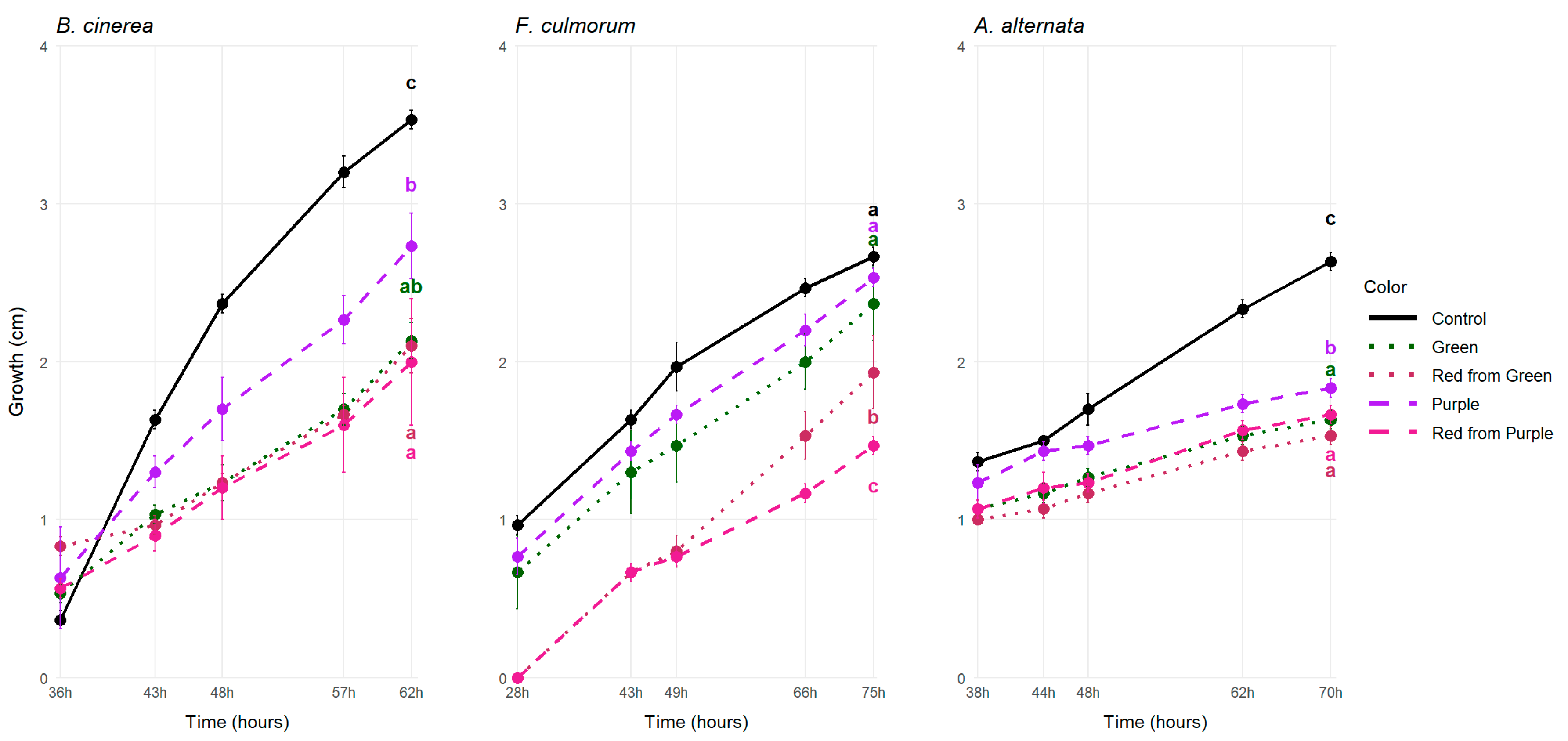
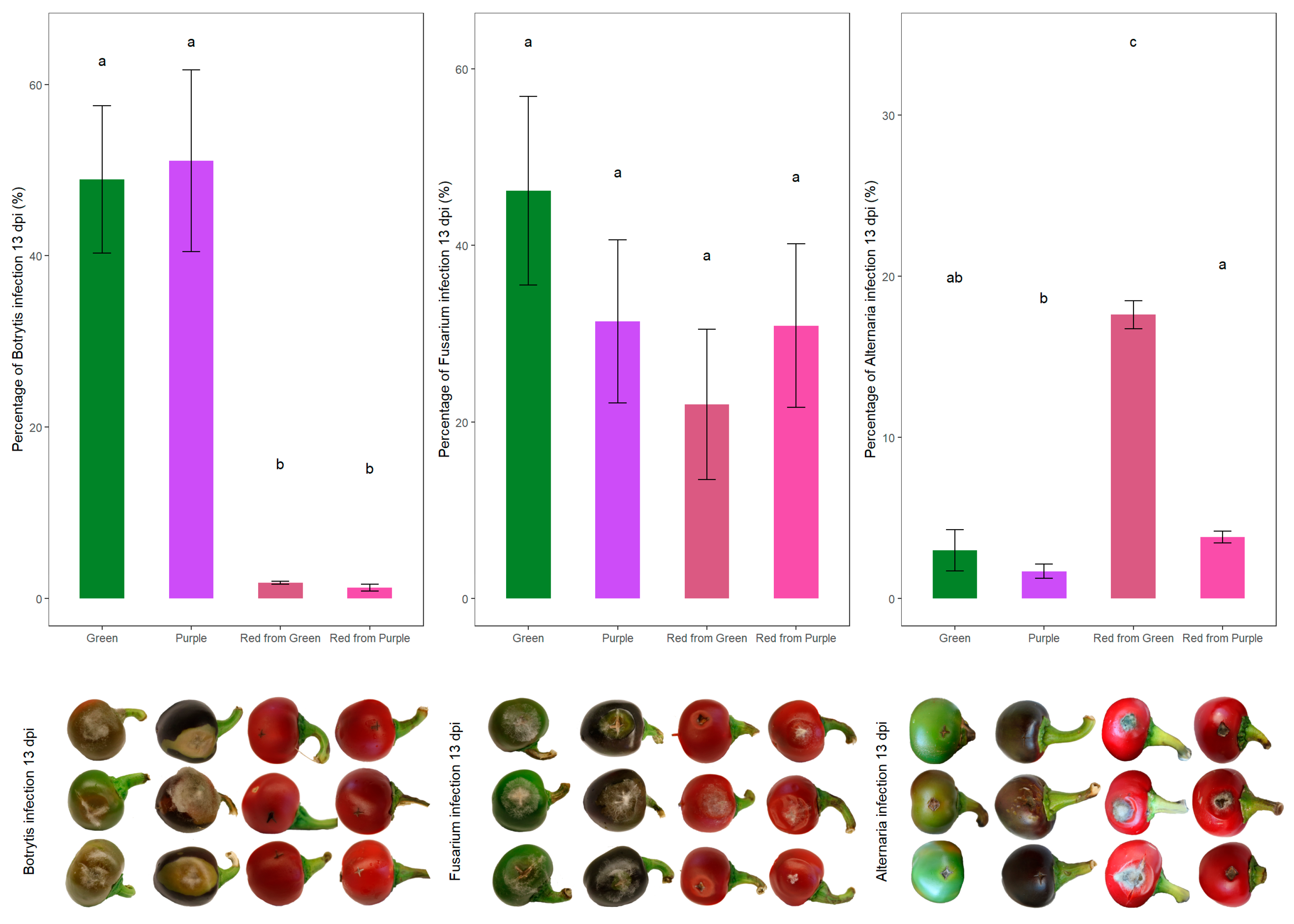
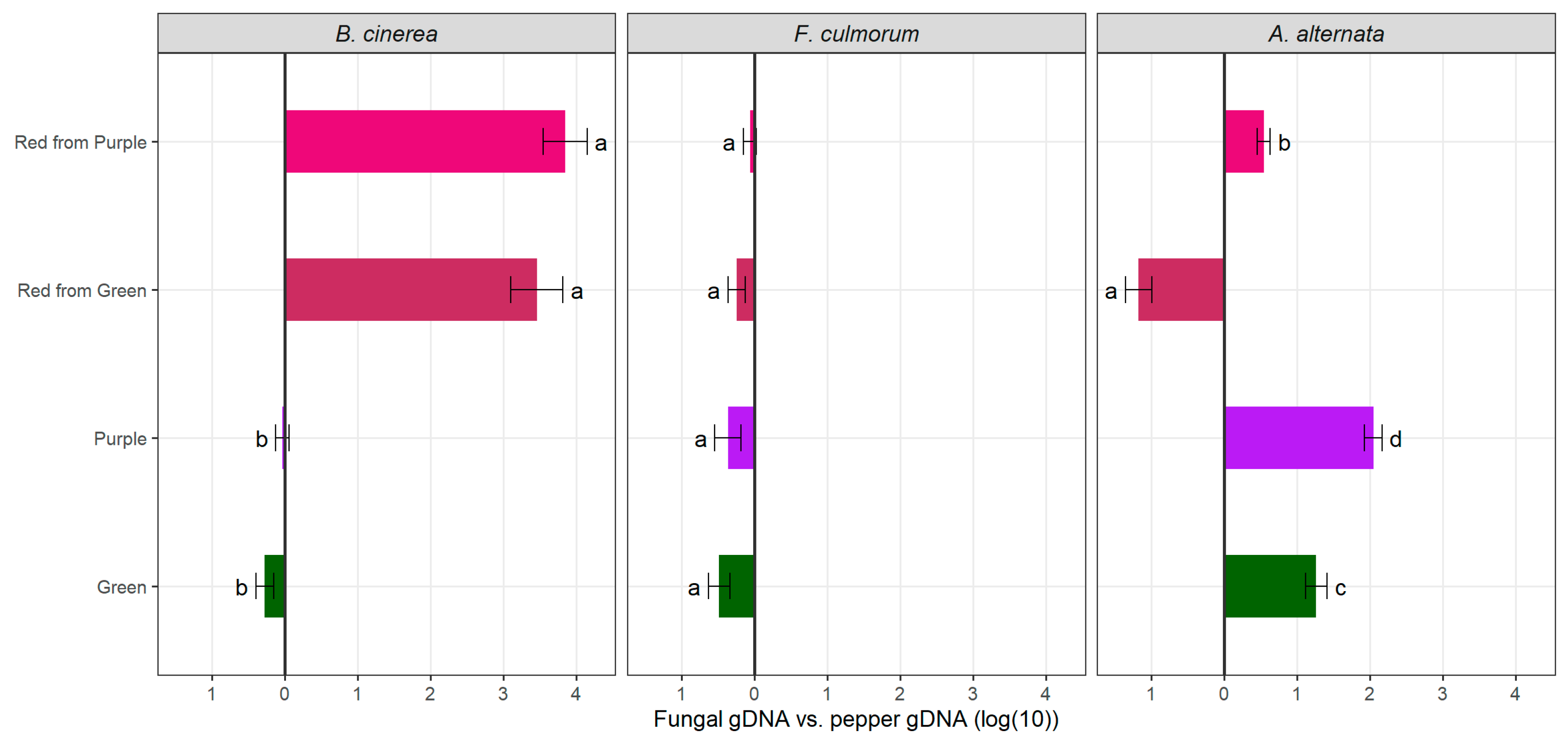
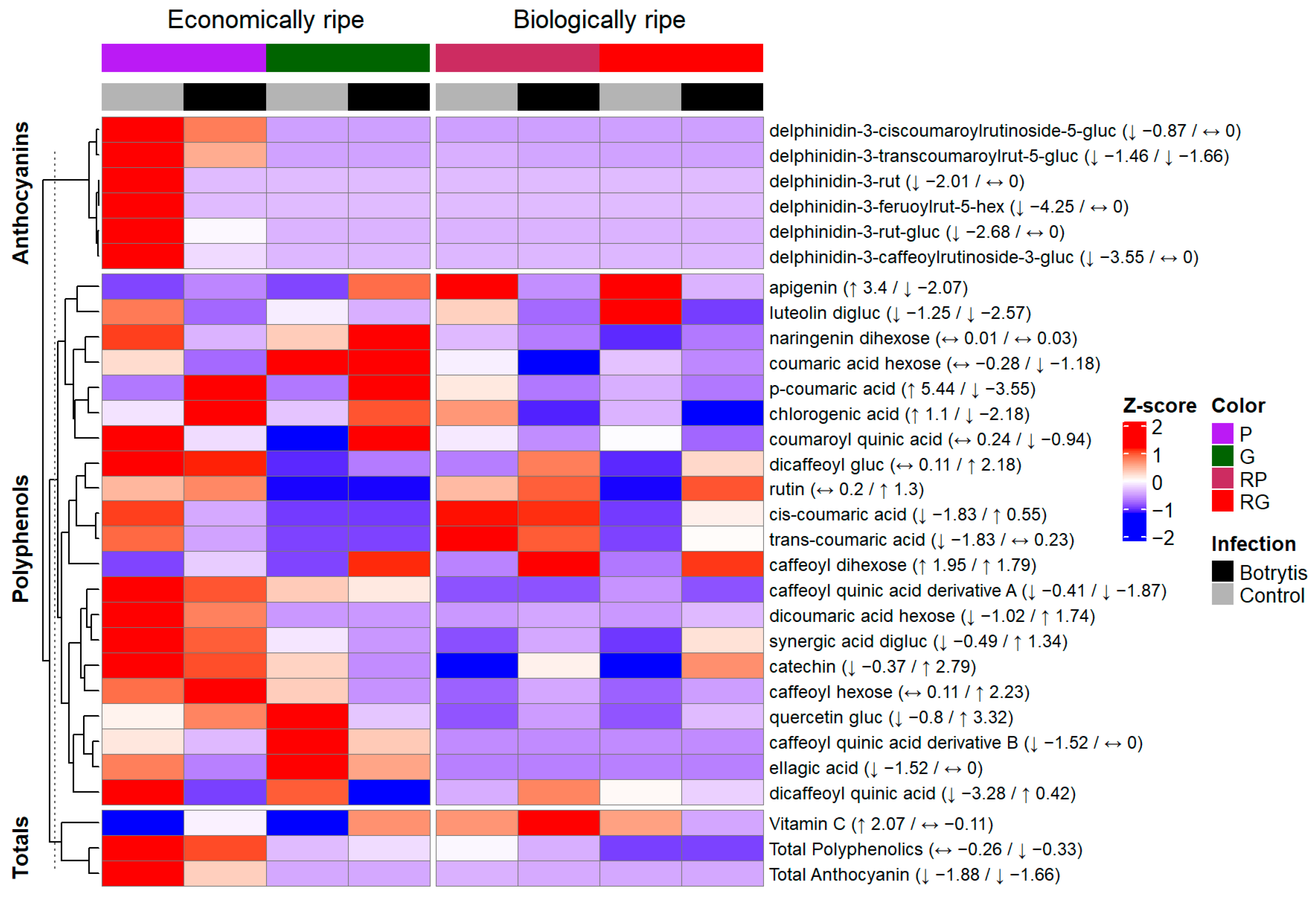

| Pathogen | Source of Variation | Wald Χ2 | p-Value |
|---|---|---|---|
| Botrytis | Genotype (Gt) | 2.457 | <0.117 |
| Phenophase (Pp) | 1185.514 | <0.001 | |
| Gt × Pp | 4.028 | <0.045 | |
| Fusarium | Genotype (Gt) | 0.031 | <0.860 |
| Phenophase (Pp) | 7.098 | <0.008 | |
| Gt × Pp | 6.496 | <0.011 | |
| Alternaria | Genotype (Gt) | 101.634 | <0.001 |
| Phenophase (Pp) | 154.047 | <0.001 | |
| Gt × Pp | 21.218 | <0.001 |
| FRAP [µmol As/g DW] | TMA–HPLC [µg/g DW] | TPC [mg GA/g DW] | TPC–HPLC [µg/g DW] | ||
|---|---|---|---|---|---|
| Purple | Week 0. | 293.76 ± 27.50 a | 1027.08 ± 52.23 a | 610.69 ± 54.16 a | 2654.90 ± 121.28 a |
| Control | 234.86 ± 21.48 b | 905.64 ± 115.93 a | 354.54 ± 48.89 b | 2518.99 ± 113.90 a | |
| Botrytis | 77.84 ± 3.05 c | 271.26 ± 71.39 b | 53.51 ± 1.97 c | 1814.64 ± 29.71 b | |
| Fusarium | 84.57 ± 4.03 c | 42.21 ± 4.80 c | |||
| Alternaria | 88.34 ± 3.47 c | 58.53 ± 2.36 c | |||
| Red from Purple | Week 0. | 211.65 ± 15.34 a | 105.82 ± 25.26 a | 467.66 ± 57.27 a | 1036.99 ± 21.69 a |
| Control | 214.83 ± 15.51 a | 17.81 ± 4.81 b | 266.30 ± 61.29 b | 1017.69 ± 53.12 a | |
| Botrytis | 73.17 ± 5.92 b | 2.85 ± 0.71 b | 47.04 ± 5.11 c | 732.03 ± 7.17 b | |
| Fusarium | 91.59 ± 3.59 b | 47.61 ± 3.49 c | |||
| Alternaria | 89.99 ± 4.01 b | 55.80 ± 3.32 c | |||
| Green | Week 0. | 219.77 ± 15.07 a | nd. | 328.20 ± 18.60 a | 1401.22 ± 36.56 a |
| Control | 199.10 ± 8.97 a | nd. | 273.14 ± 19.39 b | 784.42 ± 13.93 b | |
| Botrytis | 59.71 ± 10.65 c | nd. | 44.64 ± 5.44 c | 911.28 ± 8.62 c | |
| Fusarium | 88.76 ± 5.66 b | 51.20 ± 6.52 c | |||
| Alternaria | 90.39 ± 5.81 b | 67.87 ± 2.70 c | |||
| Red from Green | Week 0. | 166.50 ± 5.30 a | nd. | 292.76 ± 40.29 a | 1264.37 ± 87.42 a |
| Control | 173.90 ± 12.14 a | nd. | 310.65 ± 10.42 a | 468.98 ± 34.65 b | |
| Botrytis | 85.95 ± 3.03 b | nd. | 49.40 ± 2.05 b | 326.88 ± 11.25 b | |
| Fusarium | 88.31 ± 2.42 b | 45.81 ± 3.17 b | |||
| Alternaria | 84.47 ± 3.84 b | 54.65 ± 4.05 b |
| Pearson correlation coefficients in the case of Alternaria-infected plants | |||||||
| Phenophase | TPC | FRAP | Infection % | Genotype | |||
| Phenophase | 1 | −0.104 | −0.200 ** | 0.646 ** | 0 | ||
| TPC | 1 | 0.830 ** | −0.268 | 0.173 | |||
| FRAP | 1 | −0.175 | 0.140 | ||||
| Infection % | 1 | −0.389 * | |||||
| Genotype | 1 | ||||||
| Pearson correlation coefficients in the case of the Fusarium-infected plants | |||||||
| Phenophase | TPC | FRAP | Infection % | Genotype | |||
| Phenophase | 1 | −0.095 | −0.188 | −0.531 ** | 0 | ||
| TPC | 1 | 0.835 ** | 0.173 | 0.202 * | |||
| FRAP | 1 | 0.028 | 0.211 * | ||||
| Infection % | 1 | −0.129 | |||||
| Genotype | 1 | ||||||
| Pearson correlation coefficients in the case of the Botrytis-infected plants | |||||||
| Phenophase | TPC | FRAP | Infection % | Genotype | HPLC–TPC | HPLC–TMA | |
| Phenophase | 1 | −0.096 | −0.160 | −0.974 ** | 0 | −0.597 ** | −0.462 ** |
| TPC | 1 | 0.834 ** | 0.022 | 0.208 * | 0.453 ** | 0.462 ** | |
| FRAP | 1 | −0.246 | 0.202 * | 0.472 ** | 0.458 ** | ||
| Infection % | 1 | 0.017 | 0.762 ** | 0.486 ** | |||
| Genotype | 1 | 0.526 ** | 0.519 ** | ||||
| HPLC–TPC | 1 | 0.858 ** | |||||
| HPLC–TMA | 1 | ||||||
| Purple | Red from Purple | |||||
|---|---|---|---|---|---|---|
| µg/g DW | Week 0 | Control | Botrytis | Week 0 | Control | Botrytis |
| Vitamin C | 5526.84 ± 651.41 a | 1792.47 ± 368.54 b | 7023.42 ± 853.76 a | 11,335.50 ± 1552.46 a | 9819.50 ± 333.50 a | 12,446.18 ± 496.94 a |
| Total Polyphenolics | 2354.90 ± 247.23 a,b | 2485.66 ± 217.84 a | 1814.64 ± 59.41 b | 1036.990 ± 330.23 a | 732.03 ± 14.34 a | 1017.70 ± 396.40 a |
| Total Anthocyanins | 1027.08 ± 104.47 a | 1005.64 ± 80.47 a | 271.26 ± 46.96 b | 105.82 ± 50.51 a | 17.81 ± 4.33 a | nd. |
| delphinidin-3-rutinoside-glucoside | 46.57 ± 1,27 a | 60.47 ± 7.74 a | 7.75 ± 1.50 b | 8.85 ± 4.76 | nd. | nd. |
| delphinidin-3-rutinoside | 6.55 ± 1,27 a | 6.05 ± 0.29 a | nd. | nd. | nd. | nd. |
| delphinidin-3-caffeoylrutinoside-5-glucoside | 54.02 ± 8.18 a | 88.69 ± 8.18 b | 5.75 ± 2.77 c | 8.20 ± 4.18 | nd. | nd. |
| delphinidin-3-ciscoumaroylrutinoside-5-glucoside | 45.11 ± 1.19 a | 12.92 ± 0.85 b | 6.18 ± 1.04 c | 4.99 ± 2.54 | nd. | nd. |
| delphinidin-3-transcoumaroylrutinoside-5-glucoside | 840.00 ± 48.15 a | 687.89 ± 72.69 a | 248.63 ± 45.21 b | 78.89 ± 37.34 a | 17.81 ± 4.33 a | 4.26 ± 0.16 a |
| delphinidin-3-feruoylrutinoside-5-hexose | 29.06 ± 4.76 a | 36.18 ± 2.66 a | nd. | 2.47 ± 1.28 | nd. | nd. |
| synergic acid diglucoside | 30.78 ± 2.05 a | 78.12 ± 7.32 b | 55.64 ± 3.03 c | 29.47 ± 1.79 a | 12.70 ± 1.64 b | 23.16 ± 2.06 a |
| coumaric acid hexose | 16.21 ± 2.14 a | 12.82 ± 1.22 a | 5.04 ± 1.50 b | 10.05 ± 0.30 a | 10.39 ± 1.23 a | 1.04 ± 0.07 b |
| caffeoyl dihexose | nd. | nd. | 1.43 ± 0.37 | 1.95 ± 0.98 a,b | 0.64 ± 0.08 a | 4.68 ± 0.56 b |
| caffeoyl hexose | 711.42 ± 48.02 a | 431.06 ± 23.09 b | 704.81 ± 102.03 a | 75.05 ± 8.64 a | 21.17 ± 4.45 b | 108.60 ± 4.26 c |
| caffeoyl quinic acid derivative A | 1.26 ± 0.07 a | 42.72 ± 3.70 b | 29.92 ± 2.70 c | 23.44 ± 1.38 | nd. | nd. |
| coumaroyl quinic acid | 26.60 ± 1.98 a | 21.75 ± 2.66 b | 7.79 ± 1.34 c | 5.70 ± 0.18 a | 8.31 ± 0.36 b | 4.75 ± 0.23 c |
| caffeoyl quinic acid derivative B | 84.55 ± 6.00 a | 12.23 ± 0.58 b | 3.91 ± 1.28 c | 21.85 ± 10.93 a | nd. | nd. |
| catechin | 43.58 ± 2.42 a | 207.95 ± 1.41 b | 193.73 ± 25.44 b | 69.89 ± 9.92 a | 13.67 ± 0.85 b | 125.46 ± 5.39 c |
| naringenin dihexose | 121.54 ± 6.74 a | 72.07 ± 2.45 b | 35.21 ± 1.45 c | 50.62 ± 3.97 a | 36.14 ± 4.40 b | 28.12 ± 2.78 b |
| chlorogenic acid | 21.40 ± 3.00 a | 56.37 ± 1.34 b | 127.50 ± 5.96 c | 124.68 ± 20.84 a | 88.90 ± 13.50 a | 17.51 ± 4.38 b |
| p-coumaric acid | nd. | nd. | 39.93 ± 5.91 | 29.62 ± 3.14 a | 16.07 ± 1.43 b | nd. |
| ellagic acid | 6.70 ± 1.21 a | 10.21 ± 0.44 b | nd. | nd. | nd. | nd. |
| cis-coumaric acid | 34.13 ± 2.27 a | 86.26 ± 8.81 b | 21.92 ± 4.76 a | 31.01 ± 0.74 a | 87.22 ± 12.78 b | 84.85 ± 1.35 b |
| trans-coumaric acid | 26.38 ± 0.95 a | 70.40 ± 2.81 b | 18.34 ± 1.17 c | 96.69 ± 6.55 a | 93.46 ± 4.52 a,b | 72.74 ± 1.14 b |
| dicoumaric acid hexose | 73.23 ± 4.19 a | 54.16 ± 3.47 a | 25.73 ± 13.08 b | 5.06 ± 0.86 a | nd. | 1.31 ± 0.00 b |
| dicaffeoyl quninc acid | 101.40 ± 7.31 a | 240.44 ± 22.52 b | 43.68 ± 4.47 a | 97.08 ± 36.08 a | 88.43 ± 12.19 a | 185.17 ± 0.35 a |
| rutin | 22.58 ± 0.62 a | 15.91 ± 0.75 a | 18.56 ± 4.79 a | 11.90 ± 1.75 a | 15.70 ± 1.29 a,b | 20.61 ± 1.17 b |
| quercetin glucoside | 51.55 ± 4.06 a | 19.46 ± 1.83 b | 33.14 ± 13.18 a,b | nd. | nd. | 7.36 ± 0.37 |
| dicaffeoyl glucoside | 18.73 ± 0.51 a | 12.34 ± 0.53 a | 11.43 ± 7.20 | 7.82 ± 0.86 a | 2.07 ± 0.26 b | 9.59 ± 0.13 a |
| apigenin | nd. | nd. | 2.85 ± 0.75 | 23.89 ± 1.10 a | 20.42 ± 1.86 a | 3.27 ± 0.54 b |
| luteolin diglucoside | 13.42 ± 0.93 a | 24.76 ± 1.58 b | 5.22 ± 1.13 c | 8.59 ± 1.41 a | 18.51 ± 0.71 b | 5.30 ± 1.86 a |
| Green | Red from Green | |||||
|---|---|---|---|---|---|---|
| µg/g DW | Week 0 | Control | Botrytis | Week 0 | Control | Botrytis |
| Vitamin C | 3977.54 ± 547.09 a | 2255.95 ± 433,82 a | 9923.95 ± 939.88 b | 10,941.23 ± 462.80 a | 9587.57 ± 427.71 a | 5487.04 ± 542.50 b |
| Total Polyphenolics | 1601.22 ± 215.68 a | 784.42 ± 27.86 b | 911.28 ± 17.24 b | 1264.37 ± 198.14 a | 316.88 ± 9.68 b | 326.88 ± 22.5 b |
| synergic acid diglucoside | 25.00 ± 2.60 a | 30.60 ± 3.63 a | 21.19 ± 1.50 a | 30.52 ± 1.69 a | 10.28 ± 2.99 b | 38.05 ± 3.93 a |
| coumaric acid hexose | 76.02 ± 10.28 a | 21.47 ± 2.84 b | 22.94 ± 3.92 b | 20.74 ± 1.23 a | 8.61 ± 0.93 b | 6.24 ± 2.14 b |
| caffeoyl dihexose | nd. | nd. | 4.31 ± 0.32 | 4.31 ± 0.32 a | 0.52 ± 0.07 b | 4.23 ± 0.68 a |
| caffeoyl hexose | 783.81 ± 67.44 a | 297.54 ± 30.88 b | 82.92 ± 12.60 c | 154.77 ± 21.38 a | 21.14 ± 2.43 b | 97.68 ± 7.56 c |
| caffeoyl quinic derivative A | 23.82 ± 4.52 a | 19.54 ± 2.02 a | 16.56 ± 0.43 a | 10.64 ± 1.63 a | 5.29 ± 1.31 b | nd. |
| Coumaroylquinic acid | 30.02 ± 1.38 a | nd. | 10.30 ± 2.56 b | 11.39 ± 1.32 a | 9.04 ± 1.55 a | 3.30 ± 0.74 b |
| caffeoyl quinic acid derivative B | 48.62 ± 0.70 a | 46.40 ± 4.78 a | 15.16 ± 4.67 b | 22.48 ± 2.33 | nd. | nd. |
| catechin | 33.84 ± 2.79 a | 140.04 ± 10.19 b | 74.80 ± 7.81 b | 143.51 ± 9.97 a | 27.38 ± 3.8 a,b | 170.09 ± 10.33 a |
| naringenin dihexose | 64.26 ± 5.40 a | 53.50 ± 3.81 a | 91.21 ± 8.21 b | 88.91 ± 10.51 a | 18.42 ± 1.26 b | 27.70 ± 3.00 b |
| chlorogenic acid | 44.12 ± 1.79 a | 49.93 ± 6.58 a | 102.99 ± 18.5 b | 150.08 ± 18.81 a | 46.17 ± 1.71 b | 10.75 ± 2.12 b |
| p-coumaric acid | nd. | nd. | 45.17 ± 5.01 | 54.90 ± 2.83 a | 5.36 ± 0.65 b | nd. |
| ellagic acid | 12.25 ± 2.36 a | 18.55 ± 3.41 a | 8.70 ± 1.17 a | nd. | nd. | nd. |
| cis-coumaric acid | nd. | nd. | nd. | nd. | nd. | 43.74 ± 13.80 |
| trans-coumaric acid | nd. | nd. | nd. | nd. | nd. | 37.31 ± 13.19 |
| dicoumaric acid hexose | nd. | nd. | nd. | nd. | nd. | 3.37 ± 2.02 |
| dicaffeoyl quninc acid | 47.15 ± 3.39 a | 201.56 ± 7.66 b | nd. | nd. | 126.88 ± 26.27 a | 103.56 ± 22.40 a |
| rutin | nd. | nd. | nd. | nd. | nd. | 22.05 ± 3.89 |
| quercetin glucoside | 68.66 ± 3.41 a | 60.44 ± 2.93 a | 11.84 ± 3.78 b | 22.95 ± 2.56 a | nd. | 10.66 ± 1.08 b |
| dicaffeoyl glucoside | nd. | nd. | 1.98 ± 0.83 | nd. | nd. | 6.82 ± 1.70 |
| apigenin | nd. | nd. | 16.32 ± 3.67 | 15.83 ± 1.69 a | 20.42 ± 2.14 a | 4.91 ± 2.16 b |
| luteolin diglucoside | 6.94 ± 0.18 a | 13.68 ± 1.33 b | 9.78 ± 1.95 a,b | 8.87 ± 0.75 a | 38.96 ± 1.31 b | 2.72 ± 0.63 c |
Disclaimer/Publisher’s Note: The statements, opinions and data contained in all publications are solely those of the individual author(s) and contributor(s) and not of MDPI and/or the editor(s). MDPI and/or the editor(s) disclaim responsibility for any injury to people or property resulting from any ideas, methods, instructions or products referred to in the content. |
© 2025 by the authors. Licensee MDPI, Basel, Switzerland. This article is an open access article distributed under the terms and conditions of the Creative Commons Attribution (CC BY) license (https://creativecommons.org/licenses/by/4.0/).
Share and Cite
Kovács, Z.; Csilléry, G.; Daood, H.G.; Posta, K.; Bedő, J.; Tóth-Lencsés, K.A.; Veres, A.; Szőke, A.; Tarnawa, Á.; Juhász, Á. Polyphenolic and Anthocyanin Responses to Postharvest Fungal Pathogen Infection in Purple and Green near Isogenic Pepper (Capsicum annuum) Lines. Antioxidants 2025, 14, 1440. https://doi.org/10.3390/antiox14121440
Kovács Z, Csilléry G, Daood HG, Posta K, Bedő J, Tóth-Lencsés KA, Veres A, Szőke A, Tarnawa Á, Juhász Á. Polyphenolic and Anthocyanin Responses to Postharvest Fungal Pathogen Infection in Purple and Green near Isogenic Pepper (Capsicum annuum) Lines. Antioxidants. 2025; 14(12):1440. https://doi.org/10.3390/antiox14121440
Chicago/Turabian StyleKovács, Zsófia, Gábor Csilléry, Hussein Gehad Daood, Katalin Posta, Janka Bedő, Kitti Andrea Tóth-Lencsés, Anikó Veres, Antal Szőke, Ákos Tarnawa, and Ákos Juhász. 2025. "Polyphenolic and Anthocyanin Responses to Postharvest Fungal Pathogen Infection in Purple and Green near Isogenic Pepper (Capsicum annuum) Lines" Antioxidants 14, no. 12: 1440. https://doi.org/10.3390/antiox14121440
APA StyleKovács, Z., Csilléry, G., Daood, H. G., Posta, K., Bedő, J., Tóth-Lencsés, K. A., Veres, A., Szőke, A., Tarnawa, Á., & Juhász, Á. (2025). Polyphenolic and Anthocyanin Responses to Postharvest Fungal Pathogen Infection in Purple and Green near Isogenic Pepper (Capsicum annuum) Lines. Antioxidants, 14(12), 1440. https://doi.org/10.3390/antiox14121440

